EP4312398A1 - Km device, qkd system, key management start control method, and computer-readable medium - Google Patents
Km device, qkd system, key management start control method, and computer-readable medium Download PDFInfo
- Publication number
- EP4312398A1 EP4312398A1 EP23160034.7A EP23160034A EP4312398A1 EP 4312398 A1 EP4312398 A1 EP 4312398A1 EP 23160034 A EP23160034 A EP 23160034A EP 4312398 A1 EP4312398 A1 EP 4312398A1
- Authority
- EP
- European Patent Office
- Prior art keywords
- qkd
- authentication
- connection
- connection authentication
- inter
- Prior art date
- Legal status (The legal status is an assumption and is not a legal conclusion. Google has not performed a legal analysis and makes no representation as to the accuracy of the status listed.)
- Pending
Links
- 238000000034 method Methods 0.000 title claims description 9
- 238000012545 processing Methods 0.000 claims abstract description 93
- 238000004891 communication Methods 0.000 claims description 30
- 230000006870 function Effects 0.000 description 53
- 230000004044 response Effects 0.000 description 29
- 238000010586 diagram Methods 0.000 description 18
- 230000004913 activation Effects 0.000 description 5
- 238000010200 validation analysis Methods 0.000 description 5
- 230000005856 abnormality Effects 0.000 description 4
- 238000009434 installation Methods 0.000 description 3
- 238000004590 computer program Methods 0.000 description 2
- 238000005516 engineering process Methods 0.000 description 2
- 238000012795 verification Methods 0.000 description 2
- 230000005540 biological transmission Effects 0.000 description 1
- 238000012905 input function Methods 0.000 description 1
- 238000012544 monitoring process Methods 0.000 description 1
- 239000013307 optical fiber Substances 0.000 description 1
- 230000005610 quantum mechanics Effects 0.000 description 1
- 238000006467 substitution reaction Methods 0.000 description 1
Images




Classifications
-
- H—ELECTRICITY
- H04—ELECTRIC COMMUNICATION TECHNIQUE
- H04L—TRANSMISSION OF DIGITAL INFORMATION, e.g. TELEGRAPHIC COMMUNICATION
- H04L9/00—Cryptographic mechanisms or cryptographic arrangements for secret or secure communications; Network security protocols
- H04L9/08—Key distribution or management, e.g. generation, sharing or updating, of cryptographic keys or passwords
- H04L9/0816—Key establishment, i.e. cryptographic processes or cryptographic protocols whereby a shared secret becomes available to two or more parties, for subsequent use
- H04L9/0852—Quantum cryptography
-
- H—ELECTRICITY
- H04—ELECTRIC COMMUNICATION TECHNIQUE
- H04L—TRANSMISSION OF DIGITAL INFORMATION, e.g. TELEGRAPHIC COMMUNICATION
- H04L9/00—Cryptographic mechanisms or cryptographic arrangements for secret or secure communications; Network security protocols
- H04L9/08—Key distribution or management, e.g. generation, sharing or updating, of cryptographic keys or passwords
- H04L9/0816—Key establishment, i.e. cryptographic processes or cryptographic protocols whereby a shared secret becomes available to two or more parties, for subsequent use
- H04L9/0819—Key transport or distribution, i.e. key establishment techniques where one party creates or otherwise obtains a secret value, and securely transfers it to the other(s)
- H04L9/0827—Key transport or distribution, i.e. key establishment techniques where one party creates or otherwise obtains a secret value, and securely transfers it to the other(s) involving distinctive intermediate devices or communication paths
-
- H—ELECTRICITY
- H04—ELECTRIC COMMUNICATION TECHNIQUE
- H04L—TRANSMISSION OF DIGITAL INFORMATION, e.g. TELEGRAPHIC COMMUNICATION
- H04L9/00—Cryptographic mechanisms or cryptographic arrangements for secret or secure communications; Network security protocols
- H04L9/08—Key distribution or management, e.g. generation, sharing or updating, of cryptographic keys or passwords
- H04L9/0816—Key establishment, i.e. cryptographic processes or cryptographic protocols whereby a shared secret becomes available to two or more parties, for subsequent use
- H04L9/0852—Quantum cryptography
- H04L9/0855—Quantum cryptography involving additional nodes, e.g. quantum relays, repeaters, intermediate nodes or remote nodes
-
- H—ELECTRICITY
- H04—ELECTRIC COMMUNICATION TECHNIQUE
- H04L—TRANSMISSION OF DIGITAL INFORMATION, e.g. TELEGRAPHIC COMMUNICATION
- H04L9/00—Cryptographic mechanisms or cryptographic arrangements for secret or secure communications; Network security protocols
- H04L9/32—Cryptographic mechanisms or cryptographic arrangements for secret or secure communications; Network security protocols including means for verifying the identity or authority of a user of the system or for message authentication, e.g. authorization, entity authentication, data integrity or data verification, non-repudiation, key authentication or verification of credentials
- H04L9/3271—Cryptographic mechanisms or cryptographic arrangements for secret or secure communications; Network security protocols including means for verifying the identity or authority of a user of the system or for message authentication, e.g. authorization, entity authentication, data integrity or data verification, non-repudiation, key authentication or verification of credentials using challenge-response
- H04L9/3273—Cryptographic mechanisms or cryptographic arrangements for secret or secure communications; Network security protocols including means for verifying the identity or authority of a user of the system or for message authentication, e.g. authorization, entity authentication, data integrity or data verification, non-repudiation, key authentication or verification of credentials using challenge-response for mutual authentication
Definitions
- the present disclosure relates to a key manager (KM) device, a quantum key distribution (QKD) system, a key management start control method, and a computer-readable medium.
- KM key manager
- QKD quantum key distribution
- QKD quantum key distribution
- a key manager (KM) device includes an authentication processing unit, and a start unit.
- the authentication processing unit performs inter-KM-device connection authentication indicating authentication processing with an opposing KM device, and KM-quantum key distribution (QKD) connection authentication indicating authentication processing with an opposing QKD device.
- the start unit enables a KM function in a case where the inter-KM-device connection authentication is successful and the KM-QKD connection authentication is successful.
- KM key manager
- QKD quantum key distribution
- Key sharing by QKD has a limited communicable distance in principle, and only one-to-one key sharing can be used.
- a key manager (KM) device is introduced in addition to the QKD device, and the KM device holds and manages the key and is configured to relay the key, whereby a QKD network can be configured.
- KM key manager
- cryptographic key sharing between arbitrary two bases can be realized (see JP 2016-171530 A , and ITU-T Y.3800, (online), (searched on May 20, 2022), Internet ⁇ URL:https://www.itu.int/rec/T-REC-Y.3800/en >).
- the shared cryptographic key is provided from the KM device to an external application and used.
- the QKD device and the KM device may be integrally realized by, for example, one housing.
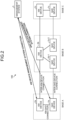
- Fig. 1 is a diagram illustrating a first example of a device configuration of a quantum key distribution (QKD) system 100 according to an arrangement.
- the QKD system 100 according to the arrangement includes QKD devices 1a to 1c, KM devices 2a to 2c, and a management system 3.
- the QKD devices 1a to 1c are simply referred to as QKD device 1.
- the KM devices 2a to 2c are simply referred to as KM device 2.
- the QKD device 1 executes a QKD protocol with the opposing QKD device 1 by QKD as described above to generate a cryptographic key.
- the cryptographic key is provided to the KM device 2.
- the KM device 2 receives the cryptographic key from at least one QKD device 1.
- the KM device 2 holds and manages the cryptographic key and relays the cryptographic key between the KM devices 2, thereby realizing cryptographic key sharing between arbitrary KM devices 2. Note that details of the relaying are described in JP 2016-171530 A , ITU-T Y.3800, (online), (searched on May 20, 2022), Internet ⁇ URL:https://www.itu.int/rec/T-REC-Y.3800/en >.
- the management system 3 manages a state and a configuration of the QKD network configured by the QKD device 1 and the KM device 2.
- Bases A to C are places where the QKD devices 1 and the KM devices 2 are installed. Nodes implemented by the QKD device 1 and the KM device 2 may be referred to as trusted nodes.
- the bases A to C are assumed to be sections in which physical safety is ensured, thereby ensuring security in storage and relaying of the cryptographic key.
- an application using the cryptographic key is connected to the KM device 2, receives the cryptographic key from the KM device 2, and performs cryptographic communication by using the cryptographic key.
- the application is installed in the bases A to C.
- the management system 3 is generally installed in an independent base (trusted node) or installed in any base (for example, the base C or the like in the example of Fig. 1 ).
- the inter-QKD-device connection is connection between the QKD devices 1, and the QKD protocol is executed by the inter-QKD-device connection to generate the cryptographic key.
- the QKD device 1 generally includes a transmitter that transmits photons and a receiver that receives photons, and operates by a specific pair. It is necessary to operate a correct QKD device with a correct pair configuration.
- the inter-KM-device connection is, for example, connection used by the KM device 2 to verify the cryptographic key acquired from the QKD device 1.
- connection between the KM devices 2 is connection used to perform key relaying using the cryptographic key. Since the KM device 2 handles cryptographic key data, the KM device 2 itself needs to be legitimate. It is also important that the connection is intended by the KM devices 2.
- the KM-QKD connection is connection used when the cryptographic key generated by the QKD device 1 is provided to the KM device 2.
- the KM-QKD connection may be used by the KM device 2 (or another management entity via the KM device 2) to grasp a situation of the QKD device 1.
- the KM device 2 holds, manages, relays, provides, and erases the cryptographic key generated by the QKD device 1. Therefore, the KM device 2 and the QKD device 1 need to be legitimate devices, and it is also important that the QKD device 1 paired with the KM device 2 is the intended QKD device 1.
- the QKD device 1a and the QKD device 1b-1 have the intra-QKD-device connection.
- the QKD device 1a and the KM device 2a are in the KM-QKD connection relationship.
- the QKD device 1b-1 and the KM device 2b are in the KM-QKD connection relationship.
- the KM device 2a and the KM device 2b have the intra-KM-device connection.
- a state in which the QKD devices 1a and 1b-1 and the KM devices 2a and 2b are connected in a "quadrangular relationship" by the inter-QKD-device connection, the KM-QKD connection (between the QKD device 1b-1 and the KM device 2b), the inter-KM-device connection, and the KM-QKD connection (between the KM device 2a and the QKD device 1a) is a state of a correct connection relationship.
- connection including the management system 3 will be described with reference to Fig. 2 .
- Fig. 2 is a diagram for explaining functions of the management system 3 according to the arrangement.
- the management system 3 according to the arrangement generally performs state monitoring, setting, and the like of the QKD device 1 and the KM device 2.
- the management system 3 confirms that the QKD device 1 is legitimate.
- the management system 3 confirms that the KM device 2 is legitimate.
- the management system 3 verifies the validity of the QKD device 1 and the KM device 2 and the correctness of the setting and determines an operation permission for the QKD device 1 and the KM device 2 according to the verification result. In other words, the management system 3 activates the QKD device 1 and the KM device 2.
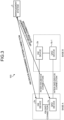
- Fig. 3 is a diagram illustrating a second example of the device configuration of the QKD system 100 according to the arrangement.
- the base C is not included, and the form of the system is further simplified.
- connection relationships included in the system configuration of the QKD system 100 according to the arrangement are as follows, and authentication for ensuring security is required for each connection relationship.
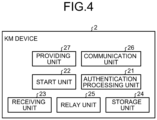
- Fig. 4 is a diagram illustrating an example of a functional configuration of the KM device 2 according to the arrangement.
- the KM device 2 according to the arrangement includes an authentication processing unit 21, a start unit 22, a receiving unit 23, a storage unit 24, a relay unit 25, a communication unit 26, and a providing unit 27.
- the authentication processing unit 21 performs processing for realizing an authentication function directly related to the KM device 2. Note that details of the processing for the authentication function will be described later.
- the start unit 22 performs control to enable a key management function (KM function) of the KM device 2 according to the authentication result of the authentication processing unit 21.
- the key management function includes at least one of a function of executing a KM protocol, a function of storing the cryptographic key received from an opposing QKD device, and a function of executing key relaying with an opposing KM device.
- a method of enabling the function of the KM device 2 includes, for example, the following variations (1) to (3), but any method may be used.
- the receiving unit 23 receives the cryptographic key from the QKD device 1 via the KM-QKD connection.
- the storage unit 24 stores the cryptographic key.
- the storage unit 24 stores the cryptographic key received from the opposing QKD device 1 verified to be valid by the KM-QKD connection authentication.
- the relay unit 25 relays (delivers) the cryptographic key via the inter-KM-device connection.
- the relay unit 25 performs relay processing with the opposing KM device 2 verified to be valid by the inter-KM-device connection authentication by using the cryptographic key shared by the QKD.
- the relayed cryptographic key is a global key (G key) used for communication between different bases.
- the G key is used, for example, as a common key (a cryptographic key and a decryption key) when an application performs cryptographic communication between different bases.
- the communication unit 26 has a communication function for realizing the KM function.
- the communication unit 26 receives the cryptographic key from the QKD device 1 by communicating with the QKD device 1 via the KM-QKD connection.
- the communication unit 26 relays the cryptographic key by communicating with the KM device 2 via the inter-KM-device connection.
- the communication unit 26 provides the cryptographic key to the application by communicating with the application.
- the providing unit 27 provides the cryptographic key to the application by using the communication function of the communication unit 26. For example, the providing unit 27 provides the common key to the application.
- the KM function is activated. That is, in Variation A, the authentication processing unit 21 performs the inter-KM-device connection authentication indicating authentication processing with the opposing KM device 2 and the KM-QKD connection authentication indicating authentication processing with the opposing QKD device 1. Then, in a case where the inter-KM-device connection authentication is successful and the KM-QKD connection authentication is successful, the start unit 22 enables the KM function.
- A-2 In a case where the KM-QKD connection authentication is performed and it is confirmed that the authentication is successful, the inter-KM-device connection authentication including the authentication success information is performed, and in a case where it is confirmed that the authentication is successful, the KM function is activated. Variation A-2 corresponds to activation in the opposing KM device 2, which is also validation of the KM-QKD connection.
- the KM function is activated.
- the KM device-management system connection authentication including the authentication success information is performed, and in a case where it is confirmed that the authentication is successful, the KM function is activated. That is, in variation B-2, the communication unit 26 transmits, to the management system 3, a request for the KM device-management system connection authentication indicating authentication processing with the management system 3 that manages the QKD system 100. Then, in a case where the KM device-management system connection authentication is successful, the authentication processing unit 21 performs the inter-KM-device connection authentication and the KM-QKD connection authentication.
- Variation B corresponds to activation in the management system 3, which is also validation of the inter-KM-device connection and the KM-QKD connection.
- the KM device-management system connection authentication and the KM-QKD connection authentication are performed according to permission of the management system 3, and in a case where it is confirmed that both of the authentications are successful, the KM function is activated. That is, in variation C, in a case where the inter-KM-device connection authentication is successful and the KM-QKD connection authentication is successful, the communication unit 26 transmits, to the management system 3, a request for the KM device-management system connection authentication indicating authentication processing with the management system 3 that manages the QKD system 100.
- Variation C corresponds to a case where the management system 3 first performs activation and validation of the introduced KM device 2.
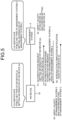
- Fig. 5 is a sequence diagram illustrating an example of the KM device-management system connection authentication according to the arrangement.
- the example of Fig. 5 illustrates a case of an authentication sequence executed between the KM device 2a and the management system 3.
- the KM device 2a holds a certificate authority (CA) certificate, a public key/private key pair of the KM device 2a, and setting information.
- the management system 3 holds a CA certificate, a public key/private key pair of the management system 3, and setting information.
- CA certificate authority
- the communication unit 26 of the KM device 2a transmits an authentication request to the management system 3 (step S1).
- the authentication request may include the setting information of the KM device 2a.
- the setting information of the KM device 2a includes a KM protocol of the KM device 2a, mounting information, manufacturer information, customer identifier (ID) information, IP address setting, installation position information, key storage capacity, KM setting, connection application information, information of the QKD device 1a (transmitter/receiver) that is in the KM-QKD connection relationship, previous authentication information, certificate information of the KM device 2a, and the like.
- the key storage capacity is, for example, a current value and a maximum storage value of the cryptographic key stored in the storage unit 24.
- the KM setting includes, for example, setting of how many global keys (G keys) to be shared with the KM device 2 in which base.
- the information of the QKD device 1 that is in the KM-QKD connection relationship is an ID, setting, a sign, and the like of the QKD device 1a that is already in the KM-QKD connection relationship or the QKD device 1a that is to be in the KM-QKD connection relationship.
- authentication result information indicating the authentication may be added to the authentication request.
- an authentication request message may be added with sign information indicating that the authentication response/authentication request is signed by the KM device 2a and is not falsified and that it is guaranteed that the authentication response/authentication request has been transmitted by the legitimate KM device 2a.
- the management system 3 performs authentication of the KM device 2a (step S2). For example, in the authentication in step S2, it is verified whether or not the KM device 2a is a legitimate device having a valid certificate. Furthermore, for example, in the authentication in step S2, it is verified whether or not the setting (for example, network setting or the like) of the KM device 2a is allowable (appropriate setting). Note that the management system 3 may hold the allowable setting information of the KM device 2a in advance.
- the management system 3 may cause the authentication to fail in a case where the KM protocol, the mounting information, the manufacturer information, and the customer ID information are not appropriate, or in a case where the information of the key storage capacity is insufficient or inappropriate.
- the KM device 2a has completed authentication (for example, the inter-KM-device connection authentication or the like) to be completed in advance.
- the KM device 2 that is a connection authentication destination of the KM device 2a is the KM device 2b (it may also be separately verified whether or not the above-described "quadrangular relationship" can be confirmed with reference to the information held by the management system 3).
- the management system 3 transmits an authentication response (the authentication processing result of step S2)/authentication request to the KM device 2a (step S3).
- the authentication response/authentication request may include the setting information of the management system 3.
- the setting information of the management system 3 includes a management protocol supported by the management system 3, mounting information, manufacturer information, customer ID information, IP address setting, installation position information, network information, configuration, and the like.
- Examples of the network information include a domain name system (DNS), a network time protocol (NTP), QKD network (QKDN) setting, and the like.
- the authentication response/authentication request may include the setting information (for example, IP address setting for specifying a device connected to the KM device 2a) indicated by the management system 3 for the KM device 2a.
- the setting information for example, IP address setting for specifying a device connected to the KM device 2a
- an authentication response/authentication request message may be added with sign information indicating that the authentication response/authentication request is signed by the management system 3 and is not falsified and that it is guaranteed that the authentication response/authentication request has been transmitted by the legitimate management system 3.
- the authentication processing unit 21 of the KM device 2a performs authentication of the management system 3 (step S4). For example, in the authentication in step S4, it is verified whether or not the management system 3 is a legitimate device having a valid certificate. Furthermore, for example, in the verification in step S4, it is verified whether or not the setting (for example, network setting or the like) of the management system 3 is allowable (appropriate setting). Note that the authentication in step S4 may be performed after verifying whether or not the setting information indicated by the management system 3 for the KM device 2a is allowable.
- the communication unit 26 of the KM device 2a transmits an introduction completion notification (an authentication response indicating the authentication processing result of step S4) to the management system 3 (step S5).
- An introduction completion notification message may be added with sign information indicating that the authentication response/authentication request is signed by the KM device 2a and is not falsified and that it is guaranteed that the authentication response/authentication request has been transmitted by the legitimate KM device 2a.
- the KM device 2a performs any one or more of the following processings (1) to (3).
- the KM device 2a (temporarily) stops the operation, and takes a measure such as making a notification of an abnormality by a log or an alarm.
- the management system 3 records the authentication result in a log or the like.
- Fig. 6 is a sequence diagram illustrating an example of KM-QKD connection authentication according to the arrangement.
- the example of Fig. 6 illustrates a case of an authentication sequence executed between the KM device 2a and the QKD device 1a.
- the KM device 2a holds a CA certificate, a public/private key pair of the KM device 2a, and setting information.
- the QKD device 1a holds a CA certificate, a public key/private key pair of the QKD device 1a, and setting information.
- the communication unit 26 of the KM device 2a transmits an authentication request to the QKD device 1a (step S11).
- the authentication request may include the setting information of the KM device 2a.
- the setting information of the KM device 2a is similar to that described above with reference to Fig. 5 .
- authentication result information indicating the authentication may be added to the authentication request.
- an authentication request message may be added with sign information indicating that the authentication response/authentication request is signed by the KM device 2a and is not falsified and that it is guaranteed that the authentication response/authentication request has been transmitted by the legitimate KM device 2a.
- the QKD device 1a performs authentication of the KM device 2a (step S12). For example, in the authentication in step S12, it is verified whether or not the KM device 2a is a legitimate device having a valid certificate. Furthermore, for example, in the authentication in step S12, it is verified whether or not the setting of the KM device 2a is allowed. Note that the QKD device 1a may hold the allowable setting information of the KM device 2a in advance. In addition, for example, in the authentication in step S12, it is verified whether or not the KM device 2a has completed authentication (for example, the inter-KM-device connection authentication or the like) to be completed in advance.
- the KM device 2a has completed authentication (for example, the inter-KM-device connection authentication or the like) to be completed in advance.
- a KM device 2 that is a connection authentication destination of the KM device 2a is the KM device 2b.
- the KM device 2b for which the KM device 2a performs the inter-KM-device connection authentication performs the KM-QKD connection authentication with the QKD device 1b-1 for which the QKD device 1a performs the inter-QKD-device connection authentication.
- the QKD device 1a may perform authentication by communicating with an external device (for example, the management system 3) as necessary.
- the QKD device 1a transmits an authentication response (the authentication processing result of step S12)/authentication request to the KM device 2a (step S13).
- the authentication response/authentication request may include the setting information of the QKD device 1a.
- the setting information of the QKD device 1a includes the QKD protocol of the QKD device 1a, the mounting information, the manufacturer information, the customer ID information, the IP address setting, the installation position information, the operation parameter, the performance index, information of the KM device 2a that is in the KM-QKD connection relationship, and the like.
- Examples of the information of the KM device 2a that is in the KM-QKD connection relationship include ID information, address information, setting information, and the like of the KM device 2a.
- the authentication response/authentication request may include the setting information (for example, the KM protocol, the mounting information, the manufacturer information, the customer ID information, or the like) instructing the KM device 2a to perform setting.
- the setting information for example, the KM protocol, the mounting information, the manufacturer information, the customer ID information, or the like
- an authentication response/authentication request message may be added with sign information indicating that the authentication request is signed by the QKD device 1a and is not falsified and that it is guaranteed that the authentication request has been transmitted by the legitimate QKD device 1a.
- the authentication processing unit 21 of the KM device 2a performs authentication of the QKD device 1a (step S14). For example, in the authentication in step S14, it is verified whether or not the QKD device 1a is a legitimate device having a valid certificate. Furthermore, for example, in the authentication in step S14, it is verified whether or not the setting (for example, network setting and the like) of the QKD device 1a is allowable (appropriate setting).
- the setting for example, network setting and the like
- the authentication processing unit 21 may perform the authentication in step S14 after verifying whether or not the setting information indicated by the QKD device 1a for the KM device 2a is allowable. For example, the authentication processing unit 21 may reject the connection in a case where the KM protocol, the mounting information, the manufacturer information, or the customer ID information indicated by the QKD device 1a for the KM device 2a is different.
- the authentication processing unit 21 may set again information regarding the amount and frequency of the cryptographic key provided from the QKD device 1a to the KM device 2a in light of the information of the key storage capacity, or may reject the connection in light of the information of the key storage capacity. Further, at the time of authentication in step S14, the authentication processing unit 21 may verify whether or not the QKD device 1a has completed authentication (for example, the inter-QKD-device connection authentication) to be completed in advance.
- the authentication in step S14 it is verified whether or not the QKD device 1 that is a connection authentication destination of the KM device 2a is the QKD device 1a.
- the QKD device 1a it may also be separately verified whether or not the above-described "quadrangular relationship" can be confirmed with reference to the information held by the KM device 2a.
- the authentication processing unit 21 verifies whether or not the QKD devices 1 are the same device based on whether or not the IDs of the QKD devices 1 match.
- the KM device 2a may perform authentication by communicating with an external device (for example, the management system 3) as necessary.
- the communication unit 26 of the KM device 2a transmits an authentication completion notification (authentication response/connection start) to the QKD device 1a (step S15).
- An authentication completion notification (authentication response/connection start) message may be added with sign information indicating that the authentication request is signed by the KM device 2a and is not falsified and that it is guaranteed that the authentication request has been transmitted by the legitimate KM device 2a.
- the QKD device 1a performs any one or more of the following processings (1) to (3).
- the QKD device 1a (temporarily) stops the operation, and takes a measure such as making a notification of an abnormality by a log or an alarm.
- the KM device 2a performs any one or more of the following processings (1) to (3).
- the KM device 2a (temporarily) stops the operation, and takes measures such as making a notification of an abnormality by a log or an alarm.
- a trigger for starting the connection authentication may be from the KM device 2 or from the QKD device 1.
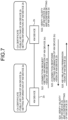
- Fig. 7 is a sequence diagram illustrating a first example of the inter-KM-device connection authentication according to the arrangement.
- the first example of Fig. 7 illustrates a case of an authentication sequence executed between the KM device 2a and the KM device 2b. It is assumed that the KM device 2a holds a CA certificate, a public/private key pair of the KM device 2a, and setting information. It is assumed that the KM device 2b holds a CA certificate, a public/private key pair of the KM device 2b, and setting information.
- the communication unit 26 of the KM device 2a transmits an authentication request (connection request) to the KM device 2b (step S21).
- the authentication request may include the setting information of the KM device 2b.
- the setting information of the KM device 2a is similar to that described above with reference to Fig. 5 .
- authentication result information indicating the authentication may be added to the authentication request.
- an authentication request message may be added with sign information indicating that the authentication response/authentication request is signed by the KM device 2a and is not falsified and that it is guaranteed that the authentication response/authentication request has been transmitted by the legitimate KM device 2a.
- the KM device 2b performs authentication of the KM device 2a (step S22). For example, in the authentication in step S22, it is verified whether or not the KM device 2a is a legitimate device having a valid certificate. Furthermore, for example, in the authentication in step S22, it is verified whether or not the setting of the KM device 2a is allowed. Note that the KM device 2b may hold the allowable setting information of the KM device 2a in advance. In addition, for example, in the authentication in step S22, it is verified whether or not the KM device 2a has completed authentication (for example, the KM-QKD connection authentication or the like) to be completed in advance.
- the KM device 2a has completed authentication (for example, the KM-QKD connection authentication or the like) to be completed in advance.
- the QKD device 1 that is a connection authentication destination of the KM device 2a is the QKD device 1a (it may also be separately verified whether or not the above-described "quadrangular relationship" can be confirmed with reference to the information held by the KM device 2b).
- the QKD device 1a for which the KM device 2a performs the KM-QKD connection authentication performs the inter-QKD-device connection authentication with the QKD device 1b-1 for which the KM device 2b performs the KM-QKD connection authentication.
- whether or not the authentication in step S22 can be performed may be determined based on the sufficiency of performance of the KM device 2a.
- the KM device 2b may perform authentication by communicating with an external device (for example, the management system 3) as necessary.
- an external device for example, the management system 3
- An example of the sequence in this case will be described later with reference to Fig. 8 .
- a method in which an external device (the management system 3 in Fig. 8 ) collectively manages a network configuration or authentication information between components has an advantage that the above-described "quadrangular relationship" or the like can be easily grasped.
- the KM device 2b transmits a connection response (the authentication processing result of step S22) to the KM device 2a (step S23).
- the connection response may include the setting information of the KM device 2b. Since the setting information of the KM device 2b is similar to the setting information of the KM device 2a, a description thereof will be omitted.
- the connection response may include the setting information of the KM device 2a indicated by the KM device 2b.
- a connection response message may be added with sign information indicating that the authentication response/authentication request is signed by the KM device 2b and is not falsified and that it is guaranteed that the authentication response/authentication request has been transmitted by the legitimate KM device 2b.
- step S24 the authentication processing unit 21 of the KM device 2a performs authentication of the KM device 2b (step S24).
- a description of step S24 is similar to the processing in which the KM device 2b performs authentication of the KM device 2a (step S22), and thus is omitted.
- the communication unit 26 of the KM device 2a transmits a key relaying permission notification (authentication completion notification) to the KM device 2b (step S25).
- a key relaying permission notification message may be added with sign information indicating that the authentication response/authentication request is signed by the KM device 2a and is not falsified and that it is guaranteed that the authentication response/authentication request has been transmitted by the legitimate KM device 2a.
- the KM device 2a executes any one or more of the following processings (1) to (3).
- the KM device 2a (temporarily) stops the operation, and takes a measure such as making a notification of an abnormality by a log or an alarm.
- the operation of the KM device 2b after the successful authentication and after the unsuccessful authentication is similar to that of the KM device 2a.
- the setting information of the KM device 2a includes, for example, the performance index of the KM function such as a storage capacity (maximum storage value) of the cryptographic key assumed in the KM device 2a
- whether or not the authentication can be performed may be determined based on the sufficiency of the performance of the KM device 2a.
- the communication unit 26 transmits a connection request including the performance index of the KM function to the opposing KM device 2b.
- the authentication processing unit 21 performs processing of verifying the validity of the KM device 2a and whether or not the performance index of the KM function is satisfied in the authentication in step S22.
- processing of verifying the validity of the opposing KM device 2b is performed.
- the authentication processing unit 21 determines that the inter-KM-device connection authentication is successful (step S25).
- the processing of verifying whether or not the performance index of the KM function is satisfied may be performed on the KM device 2a side in the authentication in step S24. In this case, the KM device 2a receives the performance index of the KM device 2b from the opposing KM device 2b.
- Fig. 8 is a sequence diagram illustrating a second example of the inter-KM-device connection authentication according to the arrangement.
- the second example of Fig. 8 illustrates a case where authentication of the KM devices 2a and 2b is performed by the management system 3 in step S33.
- a detailed description of the processing of each of steps S31 to S36 is similar to that of Fig. 7 , and thus will be omitted.
- the authentication processing unit 21 performs the inter-KM-device connection authentication indicating the authentication processing with the opposing KM device and the KM-QKD connection authentication indicating the authentication processing with the opposing QKD device.
- the start unit 22 enables the KM function.
- the security of the key management in the QKD system 100 can be further improved.
- Fig. 9 is a diagram illustrating an example of a hardware configuration of the KM device 2 according to the arrangement.
- the KM device 2 according to the arrangement includes a processor 301, a main storage device 302, an auxiliary storage device 303, a display device 304, an input device 305, and a communication IF 306.
- the processor 301, the main storage device 302, the auxiliary storage device 303, the display device 304, the input device 305, and the communication IF 306 are connected via a bus 310.
- the processor 301 executes a program read from the auxiliary storage device 303 to the main storage device 302.
- the main storage device 302 is a memory such as a ROM or a RAM.
- the auxiliary storage device 303 is an HDD, a memory card, or the like.
- the display device 304 displays the state and the like of the KM device 2.
- the input device 305 receives an input from the user. Note that the KM device 2 does not have to include the display device 304 and the input device 305.
- the communication IF 306 is an interface for communicating with the QKD device 1, the KM device 2, the management system 3, an application, and the like.
- the KM device 2 does not include the display device 304 and the input device 305, for example, a display function and an input function of an external terminal connected via the communication IF 306 may be used.
- the program executed by the KM device 2 is an installable or executable file, is stored in a computer-readable storage medium such as a CD-ROM, a memory card, a CD-R, or a digital versatile disc (DVD), and is provided as a computer program product.
- a computer-readable storage medium such as a CD-ROM, a memory card, a CD-R, or a digital versatile disc (DVD)
- the program executed by the KM device 2 may be stored in a computer connected to a network such as the Internet and may be provided by being downloaded via the network.
- the program executed by the KM device 2 may be provided via a network such as the Internet without being downloaded.
- the program executed by the KM device 2 may be provided by being incorporated in a ROM or the like in advance.
- the program executed by the KM device 2 has a module configuration having a function that can be realized by the program among the functional configurations of the KM device 2 described above.
- the processor 301 reads the program from the storage medium such as the auxiliary storage device 303 and executes the program, whereby the function realized by the program is loaded to the main storage device 302. That is, the function realized by the program is generated on the main storage device 302.
- the IC is, for example, a processor that performs dedicated processing.
- each processor may implement one of the functions, or may implement two or more of the functions.
- a key manager (KM) device includes an authentication processing unit, and a start unit.
- the authentication processing unit performs inter-KM-device connection authentication indicating authentication processing with an opposing KM device, and KM-quantum key distribution (QKD) connection authentication indicating authentication processing with an opposing QKD device.
- the start unit enables a KM function in a case where the inter-KM-device connection authentication is successful and the KM-QKD connection authentication is successful.
- the KM device according to Example 1 further includes a communication unit that transmits, to a management system that manages a QKD system, a request for KM device-management system connection authentication indicating authentication processing with the management system, in a case where the inter-KM-device connection authentication is successful and the KM-QKD connection authentication is successful.
- the start unit enables the KM function in a case where it is mutually verified that the KM device is valid and the management system is valid by the KM device-management system connection authentication.
- the KM device according to Example 1 further includes a communication unit that transmits, to a management system that manages a QKD system, a request for KM device-management system connection authentication indicating authentication processing with the management system.
- the authentication processing unit performs the inter-KM-device connection authentication and the KM-QKD connection authentication, in a case where the KM device-management system connection authentication is successful.
- the KM-QKD connection authentication includes processing of verifying whether or not a QKD device connected to the opposing KM device and a QKD device that has an inter-QKD-device connection to the opposing QKD device are a same device.
- the KM function includes at least one of a function of executing a KM protocol, a function of storing a cryptographic key received from the opposing QKD device, and a function of executing key relaying with the opposing KM device.
- Example 6 The KM device according to any one of Examples 1 to 3, further includes a communication unit that transmits, to the opposing KM device, a connection request indicating start of the inter-KM-device connection authentication.
- the connection request includes a performance index of the KM function.
- the inter-KM-device connection authentication includes processing of mutually verifying validity of the KM device and validity of the opposing KM device, and processing of verifying whether or not the performance index of the KM function is satisfied.
- the authentication processing unit determines that the inter-KM-device connection authentication is successful in a case where the validity of the KM device and the validity of the opposing KM device are mutually verified and the performance index of the KM function is satisfied.
- Example 7 The KM device according to any one of Examples 1 to 3, further includes a storage unit, a relay unit, and a providing unit.
- the storage unit stores a cryptographic key received from the opposing QKD device verified to be valid by the KM-QKD connection authentication.
- the relay unit performs relay processing for a common key shared between different bases, with the opposing KM device verified to be valid by the inter-KM-device connection authentication by using the cryptographic key shared by QKD.
- the providing unit provides the common key to an application.
- a quantum key distribution (QKD) system includes a plurality of QKD devices, and a plurality of key manager (KM) devices.
- Each of the plurality of KM devices includes an authentication processing unit, and a start unit.
- the authentication processing unit performs inter-KM-device connection authentication indicating authentication processing with an opposing KM device and KM-QKD connection authentication indicating authentication processing with an opposing QKD device.
- the start unit enables a KM function in a case where the inter-KM-device connection authentication is successful and the KM-QKD connection authentication is successful.
- a key management start control method includes: performing, by a key manager (KM) device, inter-KM-device connection authentication indicating authentication processing with an opposing KM device and KM-quantum key distribution (QKD) connection authentication indicating authentication processing with an opposing QKD device; and enabling, by the KM device, a KM function in a case where the inter-KM-device connection authentication is successful and the KM-QKD connection authentication is successful.
- KM key manager
- QKD KM-quantum key distribution
- Example 10 A computer-readable medium comprising instructions which, when executed by a computer of a key manager (KM) device, cause the computer to function as an authentication processing unit, and a start unit.
- the authentication processing unit performs inter-KM-device connection authentication indicating authentication processing with an opposing KM device and KM-quantum key distribution (QKD) connection authentication indicating authentication processing with an opposing QKD device.
- the start unit enables a KM function in a case where the inter-KM-device connection authentication is successful and the KM-QKD connection authentication is successful.
Landscapes
- Engineering & Computer Science (AREA)
- Computer Security & Cryptography (AREA)
- Computer Networks & Wireless Communication (AREA)
- Signal Processing (AREA)
- Physics & Mathematics (AREA)
- Electromagnetism (AREA)
- Theoretical Computer Science (AREA)
- Small-Scale Networks (AREA)
- Telephonic Communication Services (AREA)
Abstract
According to an arrangement, a key manager (KM) device (2) includes an authentication processing unit (21), and a start unit (22). The authentication processing unit (21) performs inter-KM-device connection authentication indicating authentication processing with an opposing KM device (2), and KM-quantum key distribution (QKD) connection authentication indicating authentication processing with an opposing QKD device (1). The start unit (22) enables a KM function in a case where the inter-KM-device connection authentication is successful and the KM-QKD connection authentication is successful.
Description
- The present disclosure relates to a key manager (KM) device, a quantum key distribution (QKD) system, a key management start control method, and a computer-readable medium.
- Hitherto, a quantum key distribution (QKD) technology for securely sharing a cryptographic key by using a single photon continuously transmitted between a transmission device and a reception device connected by an optical fiber has been known. It is ensured, based on the principle of quantum mechanics, that the cryptographic key generated and shared by the quantum key distribution (QKD) technology is not wiretapped.
-
-
Fig. 1 is a diagram illustrating a first example of a device configuration of a quantum key distribution (QKD) system according to an arrangement; -
Fig. 2 is a diagram for explaining functions of a management system according to the arrangement; -
Fig. 3 is a diagram illustrating a second example of the device configuration of the QKD system according to the arrangement; -
Fig. 4 is a diagram illustrating an example of a functional configuration of a key manager (KM) device according to the arrangement; -
Fig. 5 is a sequence diagram illustrating an example of KM device-management system connection authentication according to the arrangement; -
Fig. 6 is a sequence diagram illustrating an example of key manager (KM)-QKD connection authentication according to the arrangement; -
Fig. 7 is a sequence diagram illustrating a first example of inter-KM-device connection authentication according to the arrangement; -
Fig. 8 is a sequence diagram illustrating a second example of the inter-KM-device connection authentication according to the arrangement; and -
Fig. 9 is a diagram illustrating an example of a hardware configuration of the KM device according to the arrangement. - According to an arrangement, a key manager (KM) device includes an authentication processing unit, and a start unit. The authentication processing unit performs inter-KM-device connection authentication indicating authentication processing with an opposing KM device, and KM-quantum key distribution (QKD) connection authentication indicating authentication processing with an opposing QKD device. The start unit enables a KM function in a case where the inter-KM-device connection authentication is successful and the KM-QKD connection authentication is successful.
- Exemplary arrangements of a key manager (KM) device, a quantum key distribution (QKD) system, a key management start control method, and a computer program product will be explained below in detail with reference to the accompanying drawings.
- Key sharing by QKD has a limited communicable distance in principle, and only one-to-one key sharing can be used. A key manager (KM) device is introduced in addition to the QKD device, and the KM device holds and manages the key and is configured to relay the key, whereby a QKD network can be configured. As a result, in a network in which the QKD is used as a link and the KM device is used as a node, cryptographic key sharing between arbitrary two bases can be realized (see
JP 2016-171530 A - The shared cryptographic key is provided from the KM device to an external application and used. The QKD device and the KM device may be integrally realized by, for example, one housing.
-
Fig. 1 is a diagram illustrating a first example of a device configuration of a quantum key distribution (QKD)system 100 according to an arrangement. TheQKD system 100 according to the arrangement includesQKD devices 1a to 1c,KM devices 2a to 2c, and amanagement system 3. In a case where theQKD devices 1a to 1c are not distinguished from each other, theQKD devices 1a to 1c are simply referred to asQKD device 1. Similarly, in a case where theKM devices 2a to 2c are not distinguished from each other, theKM devices 2a to 2c are simply referred to asKM device 2. - The
QKD device 1 executes a QKD protocol with theopposing QKD device 1 by QKD as described above to generate a cryptographic key. The cryptographic key is provided to theKM device 2. - The
KM device 2 receives the cryptographic key from at least oneQKD device 1. TheKM device 2 holds and manages the cryptographic key and relays the cryptographic key between theKM devices 2, thereby realizing cryptographic key sharing betweenarbitrary KM devices 2. Note that details of the relaying are described inJP 2016-171530 A - The
management system 3 manages a state and a configuration of the QKD network configured by theQKD device 1 and theKM device 2. - Bases A to C are places where the
QKD devices 1 and theKM devices 2 are installed. Nodes implemented by theQKD device 1 and theKM device 2 may be referred to as trusted nodes. The bases A to C are assumed to be sections in which physical safety is ensured, thereby ensuring security in storage and relaying of the cryptographic key. - Note that an application using the cryptographic key is connected to the
KM device 2, receives the cryptographic key from theKM device 2, and performs cryptographic communication by using the cryptographic key. In many cases, the application is installed in the bases A to C. In addition, themanagement system 3 is generally installed in an independent base (trusted node) or installed in any base (for example, the base C or the like in the example ofFig. 1 ). - Inter-QKD-device connection, inter-KM-device connection, and KM-QKD connection necessary for proper connection and operation of the
QKD system 100 will be described. - The inter-QKD-device connection is connection between the
QKD devices 1, and the QKD protocol is executed by the inter-QKD-device connection to generate the cryptographic key. TheQKD device 1 generally includes a transmitter that transmits photons and a receiver that receives photons, and operates by a specific pair. It is necessary to operate a correct QKD device with a correct pair configuration. - The inter-KM-device connection is, for example, connection used by the
KM device 2 to verify the cryptographic key acquired from theQKD device 1. For example, connection between theKM devices 2 is connection used to perform key relaying using the cryptographic key. Since theKM device 2 handles cryptographic key data, theKM device 2 itself needs to be legitimate. It is also important that the connection is intended by theKM devices 2. - The KM-QKD connection is connection used when the cryptographic key generated by the
QKD device 1 is provided to theKM device 2. At the same time, the KM-QKD connection may be used by the KM device 2 (or another management entity via the KM device 2) to grasp a situation of theQKD device 1. TheKM device 2 holds, manages, relays, provides, and erases the cryptographic key generated by theQKD device 1. Therefore, theKM device 2 and theQKD device 1 need to be legitimate devices, and it is also important that theQKD device 1 paired with theKM device 2 is the intendedQKD device 1. - In addition to the fact that each of the inter-QKD-device connection, the inter-KM-device connection, and the KM-QKD connection needs to be legitimate, a relationship therebetween is also important. Usually, it is necessary that a pair of
QKD devices 1 that have the inter-QKD-device connection are connected to theKM devices 2 in the inter-KM-device connection relationship, and operate in such a way as to provide the same cryptographic key to theKM devices 2 in the inter-KM-device connection relationship. - For example, in the example of
Fig. 1 , theQKD device 1a and theQKD device 1b-1 have the intra-QKD-device connection. TheQKD device 1a and theKM device 2a are in the KM-QKD connection relationship. TheQKD device 1b-1 and theKM device 2b are in the KM-QKD connection relationship. TheKM device 2a and theKM device 2b have the intra-KM-device connection. As described above, a state in which theQKD devices KM devices QKD device 1b-1 and theKM device 2b), the inter-KM-device connection, and the KM-QKD connection (between theKM device 2a and theQKD device 1a) is a state of a correct connection relationship. - In the
QKD system 100 according to the arrangement illustrated inFig. 1 described above, it is important to ensure security. Therefore, even in the introduction (or replacement) of theKM device 2, it is required to confirm that theKM device 2 is a valid device and that valid setting has been made for theKM device 2 through a valid procedure, to ensure thatappropriate KM devices 2 are connected, and then to operate theKM device 2. - Next, connection including the
management system 3 will be described with reference toFig. 2 . -
Fig. 2 is a diagram for explaining functions of themanagement system 3 according to the arrangement. Themanagement system 3 according to the arrangement generally performs state monitoring, setting, and the like of theQKD device 1 and theKM device 2. When theQKD device 1 is connected to themanagement system 3, themanagement system 3 confirms that theQKD device 1 is legitimate. Similarly, when theKM device 2 is connected to themanagement system 3, themanagement system 3 confirms that theKM device 2 is legitimate. Themanagement system 3 verifies the validity of theQKD device 1 and theKM device 2 and the correctness of the setting and determines an operation permission for theQKD device 1 and theKM device 2 according to the verification result. In other words, themanagement system 3 activates theQKD device 1 and theKM device 2. - Note that the configuration of the
QKD system 100 according to the arrangement is not limited to the example ofFig. 1 .Fig. 3 is a diagram illustrating a second example of the device configuration of theQKD system 100 according to the arrangement. In the second example ofFig. 3 , the base C is not included, and the form of the system is further simplified. - In other words, connection relationships included in the system configuration of the
QKD system 100 according to the arrangement are as follows, and authentication for ensuring security is required for each connection relationship. - · Inter-QKD-device connection authentication
- · Inter-KM-device connection authentication
- · KM-QKD connection authentication
- · QKD device-management system connection authentication
- · KM device-management system connection authentication
- In the description of the arrangement, authentication directly related to the KM device 2 (inter-KM-device connection authentication, KM-QKD connection authentication, and KM device-management system connection authentication) will be described in detail.
-
Fig. 4 is a diagram illustrating an example of a functional configuration of theKM device 2 according to the arrangement. TheKM device 2 according to the arrangement includes anauthentication processing unit 21, astart unit 22, a receivingunit 23, astorage unit 24, arelay unit 25, acommunication unit 26, and a providingunit 27. - The
authentication processing unit 21 performs processing for realizing an authentication function directly related to theKM device 2. Note that details of the processing for the authentication function will be described later. - The
start unit 22 performs control to enable a key management function (KM function) of theKM device 2 according to the authentication result of theauthentication processing unit 21. The key management function includes at least one of a function of executing a KM protocol, a function of storing the cryptographic key received from an opposing QKD device, and a function of executing key relaying with an opposing KM device. - A method of enabling the function of the
KM device 2 includes, for example, the following variations (1) to (3), but any method may be used. - (1) The receiving
unit 23 starts receiving the cryptographic key from theQKD device 1. - (2) The
storage unit 24 starts operation of storing the cryptographic key received from theQKD device 1. - (3) The
relay unit 25 starts operation of relaying the cryptographic key via a link between the correctly connectedKM devices 2. - The receiving
unit 23 receives the cryptographic key from theQKD device 1 via the KM-QKD connection. - The
storage unit 24 stores the cryptographic key. For example, thestorage unit 24 stores the cryptographic key received from the opposingQKD device 1 verified to be valid by the KM-QKD connection authentication. - The
relay unit 25 relays (delivers) the cryptographic key via the inter-KM-device connection. For example, therelay unit 25 performs relay processing with the opposingKM device 2 verified to be valid by the inter-KM-device connection authentication by using the cryptographic key shared by the QKD. For example, the relayed cryptographic key is a global key (G key) used for communication between different bases. The G key is used, for example, as a common key (a cryptographic key and a decryption key) when an application performs cryptographic communication between different bases. - The
communication unit 26 has a communication function for realizing the KM function. For example, thecommunication unit 26 receives the cryptographic key from theQKD device 1 by communicating with theQKD device 1 via the KM-QKD connection. Furthermore, for example, thecommunication unit 26 relays the cryptographic key by communicating with theKM device 2 via the inter-KM-device connection. Furthermore, for example, thecommunication unit 26 provides the cryptographic key to the application by communicating with the application. - The providing
unit 27 provides the cryptographic key to the application by using the communication function of thecommunication unit 26. For example, the providingunit 27 provides the common key to the application. - Next, Variations A to C of a basic authentication operation step (authentication (or activation/validation) in a case where the
KM device 2 is introduced) in theQKD system 100 according to the arrangement will be described. - A. In a case where the inter-QKD-device connection authentication and the KM-QKD connection authentication are performed and it is confirmed that both of the authentications are successful, the KM function is activated. That is, in Variation A, the
authentication processing unit 21 performs the inter-KM-device connection authentication indicating authentication processing with the opposingKM device 2 and the KM-QKD connection authentication indicating authentication processing with the opposingQKD device 1. Then, in a case where the inter-KM-device connection authentication is successful and the KM-QKD connection authentication is successful, thestart unit 22 enables the KM function. - A-2: In a case where the KM-QKD connection authentication is performed and it is confirmed that the authentication is successful, the inter-KM-device connection authentication including the authentication success information is performed, and in a case where it is confirmed that the authentication is successful, the KM function is activated. Variation A-2 corresponds to activation in the opposing
KM device 2, which is also validation of the KM-QKD connection. - B. In a case where the inter-KM-device connection authentication, the KM-QKD connection authentication, and the KM device-management system connection authentication are performed and it is confirmed that all the authentications are successful, the KM function is activated.
- B-2. In a case where the inter-KM-device connection authentication and the KM-QKD connection authentication are performed and it is confirmed that both of the authentications are successful, the KM device-management system connection authentication including the authentication success information is performed, and in a case where it is confirmed that the authentication is successful, the KM function is activated. That is, in variation B-2, the
communication unit 26 transmits, to themanagement system 3, a request for the KM device-management system connection authentication indicating authentication processing with themanagement system 3 that manages theQKD system 100. Then, in a case where the KM device-management system connection authentication is successful, theauthentication processing unit 21 performs the inter-KM-device connection authentication and the KM-QKD connection authentication. Variation B corresponds to activation in themanagement system 3, which is also validation of the inter-KM-device connection and the KM-QKD connection. - C. In a case where the KM device-management system connection authentication is performed and it is confirmed that the authentication is successful, the KM device-management system connection authentication and the KM-QKD connection authentication are performed according to permission of the
management system 3, and in a case where it is confirmed that both of the authentications are successful, the KM function is activated. That is, in variation C, in a case where the inter-KM-device connection authentication is successful and the KM-QKD connection authentication is successful, thecommunication unit 26 transmits, to themanagement system 3, a request for the KM device-management system connection authentication indicating authentication processing with themanagement system 3 that manages theQKD system 100. Then, in a case where it is mutually verified that the KM device is valid and themanagement system 3 is valid by the KM device-management system connection authentication, thestart unit 22 enables the KM function. Variation C corresponds to a case where themanagement system 3 first performs activation and validation of the introducedKM device 2. - In addition to Variations A to C described above, there are various variations in the order of authentication to be performed, an entity performing the activation, a connection relationship to be a validation target, and the like, but any combination may be used.
- Hereinafter, an example of a processing step for each authentication will be described in detail.
-
Fig. 5 is a sequence diagram illustrating an example of the KM device-management system connection authentication according to the arrangement. The example ofFig. 5 illustrates a case of an authentication sequence executed between theKM device 2a and themanagement system 3. It is assumed that theKM device 2a holds a certificate authority (CA) certificate, a public key/private key pair of theKM device 2a, and setting information. It is assumed that themanagement system 3 holds a CA certificate, a public key/private key pair of themanagement system 3, and setting information. - First, the
communication unit 26 of theKM device 2a transmits an authentication request to the management system 3 (step S1). At this time, the authentication request may include the setting information of theKM device 2a. The setting information of theKM device 2a includes a KM protocol of theKM device 2a, mounting information, manufacturer information, customer identifier (ID) information, IP address setting, installation position information, key storage capacity, KM setting, connection application information, information of theQKD device 1a (transmitter/receiver) that is in the KM-QKD connection relationship, previous authentication information, certificate information of theKM device 2a, and the like. - Here, the key storage capacity is, for example, a current value and a maximum storage value of the cryptographic key stored in the
storage unit 24. Furthermore, the KM setting includes, for example, setting of how many global keys (G keys) to be shared with theKM device 2 in which base. The information of theQKD device 1 that is in the KM-QKD connection relationship is an ID, setting, a sign, and the like of theQKD device 1a that is already in the KM-QKD connection relationship or theQKD device 1a that is to be in the KM-QKD connection relationship. - As for the authentication result, if connection of the
KM device 2a to theQKD device 1a or theKM device 2b has already been authenticated, authentication result information indicating the authentication may be added to the authentication request. - In addition, an authentication request message may be added with sign information indicating that the authentication response/authentication request is signed by the
KM device 2a and is not falsified and that it is guaranteed that the authentication response/authentication request has been transmitted by thelegitimate KM device 2a. - Next, the
management system 3 performs authentication of theKM device 2a (step S2). For example, in the authentication in step S2, it is verified whether or not theKM device 2a is a legitimate device having a valid certificate. Furthermore, for example, in the authentication in step S2, it is verified whether or not the setting (for example, network setting or the like) of theKM device 2a is allowable (appropriate setting). Note that themanagement system 3 may hold the allowable setting information of theKM device 2a in advance. - For example, the
management system 3 may cause the authentication to fail in a case where the KM protocol, the mounting information, the manufacturer information, and the customer ID information are not appropriate, or in a case where the information of the key storage capacity is insufficient or inappropriate. - In addition, for example, in the authentication in step S2, it is verified whether or not the
KM device 2a has completed authentication (for example, the inter-KM-device connection authentication or the like) to be completed in advance. In addition, for example, in the authentication in step S2, it is verified whether or not theKM device 2 that is a connection authentication destination of theKM device 2a is theKM device 2b (it may also be separately verified whether or not the above-described "quadrangular relationship" can be confirmed with reference to the information held by the management system 3). - Next, the
management system 3 transmits an authentication response (the authentication processing result of step S2)/authentication request to theKM device 2a (step S3). At this time, the authentication response/authentication request may include the setting information of themanagement system 3. - The setting information of the
management system 3 includes a management protocol supported by themanagement system 3, mounting information, manufacturer information, customer ID information, IP address setting, installation position information, network information, configuration, and the like. Examples of the network information include a domain name system (DNS), a network time protocol (NTP), QKD network (QKDN) setting, and the like. - In addition, the authentication response/authentication request may include the setting information (for example, IP address setting for specifying a device connected to the
KM device 2a) indicated by themanagement system 3 for theKM device 2a. - In addition, an authentication response/authentication request message may be added with sign information indicating that the authentication response/authentication request is signed by the
management system 3 and is not falsified and that it is guaranteed that the authentication response/authentication request has been transmitted by thelegitimate management system 3. - Next, the
authentication processing unit 21 of theKM device 2a performs authentication of the management system 3 (step S4). For example, in the authentication in step S4, it is verified whether or not themanagement system 3 is a legitimate device having a valid certificate. Furthermore, for example, in the verification in step S4, it is verified whether or not the setting (for example, network setting or the like) of themanagement system 3 is allowable (appropriate setting). Note that the authentication in step S4 may be performed after verifying whether or not the setting information indicated by themanagement system 3 for theKM device 2a is allowable. - Next, the
communication unit 26 of theKM device 2a transmits an introduction completion notification (an authentication response indicating the authentication processing result of step S4) to the management system 3 (step S5). An introduction completion notification message may be added with sign information indicating that the authentication response/authentication request is signed by theKM device 2a and is not falsified and that it is guaranteed that the authentication response/authentication request has been transmitted by thelegitimate KM device 2a. - In a case where the KM device-management system connection authentication in steps S1 to S5 is successful, the
KM device 2a performs any one or more of the following processings (1) to (3). - (1) The
KM device 2a reflects the setting indicated by themanagement system 3. - (2) The
authentication processing unit 21 of theKM device 2a starts connection authentication (the KM-QKD connection authentication or the like) required to be executed next in both a case where the connection authentication is indicated by themanagement system 3 and a case where the connection authentication is not indicated by themanagement system 3. - (3) The
start unit 22 of theKM device 2a enables the function of theKM device 2a. - In a case where the KM device-management system connection authentication in steps S1 to S5 described above fails, the
KM device 2a (temporarily) stops the operation, and takes a measure such as making a notification of an abnormality by a log or an alarm. - Meanwhile, the
management system 3 records the authentication result in a log or the like. -
Fig. 6 is a sequence diagram illustrating an example of KM-QKD connection authentication according to the arrangement. The example ofFig. 6 illustrates a case of an authentication sequence executed between theKM device 2a and theQKD device 1a. It is assumed that theKM device 2a holds a CA certificate, a public/private key pair of theKM device 2a, and setting information. It is assumed that theQKD device 1a holds a CA certificate, a public key/private key pair of theQKD device 1a, and setting information. - First, the
communication unit 26 of theKM device 2a transmits an authentication request to theQKD device 1a (step S11). At this time, the authentication request may include the setting information of theKM device 2a. The setting information of theKM device 2a is similar to that described above with reference toFig. 5 . - As for the authentication result, if connection of the
KM device 2a to theKM device 2b or themanagement system 3 has already been authenticated, authentication result information indicating the authentication may be added to the authentication request. - In addition, an authentication request message may be added with sign information indicating that the authentication response/authentication request is signed by the
KM device 2a and is not falsified and that it is guaranteed that the authentication response/authentication request has been transmitted by thelegitimate KM device 2a. - Next, the
QKD device 1a performs authentication of theKM device 2a (step S12). For example, in the authentication in step S12, it is verified whether or not theKM device 2a is a legitimate device having a valid certificate. Furthermore, for example, in the authentication in step S12, it is verified whether or not the setting of theKM device 2a is allowed. Note that theQKD device 1a may hold the allowable setting information of theKM device 2a in advance. In addition, for example, in the authentication in step S12, it is verified whether or not theKM device 2a has completed authentication (for example, the inter-KM-device connection authentication or the like) to be completed in advance. - In addition, for example, in the authentication in step S12, it is verified whether or not a
KM device 2 that is a connection authentication destination of theKM device 2a is theKM device 2b. Note that it may also be separately verified whether or not the above-described "quadrangular relationship" can be confirmed with reference to the information held by theQKD device 1a. In a case where the normal "quadrangular relationship" is maintained, theKM device 2b for which theKM device 2a performs the inter-KM-device connection authentication performs the KM-QKD connection authentication with theQKD device 1b-1 for which theQKD device 1a performs the inter-QKD-device connection authentication. - Note that along with the authentication in step S12, the
QKD device 1a may perform authentication by communicating with an external device (for example, the management system 3) as necessary. - Next, the
QKD device 1a transmits an authentication response (the authentication processing result of step S12)/authentication request to theKM device 2a (step S13). At this time, the authentication response/authentication request may include the setting information of theQKD device 1a. - The setting information of the
QKD device 1a includes the QKD protocol of theQKD device 1a, the mounting information, the manufacturer information, the customer ID information, the IP address setting, the installation position information, the operation parameter, the performance index, information of theKM device 2a that is in the KM-QKD connection relationship, and the like. Examples of the information of theKM device 2a that is in the KM-QKD connection relationship include ID information, address information, setting information, and the like of theKM device 2a. - The authentication response/authentication request may include the setting information (for example, the KM protocol, the mounting information, the manufacturer information, the customer ID information, or the like) instructing the
KM device 2a to perform setting. - In addition, an authentication response/authentication request message may be added with sign information indicating that the authentication request is signed by the
QKD device 1a and is not falsified and that it is guaranteed that the authentication request has been transmitted by thelegitimate QKD device 1a. - Next, the
authentication processing unit 21 of theKM device 2a performs authentication of theQKD device 1a (step S14). For example, in the authentication in step S14, it is verified whether or not theQKD device 1a is a legitimate device having a valid certificate. Furthermore, for example, in the authentication in step S14, it is verified whether or not the setting (for example, network setting and the like) of theQKD device 1a is allowable (appropriate setting). - Note that the
authentication processing unit 21 may perform the authentication in step S14 after verifying whether or not the setting information indicated by theQKD device 1a for theKM device 2a is allowable. For example, theauthentication processing unit 21 may reject the connection in a case where the KM protocol, the mounting information, the manufacturer information, or the customer ID information indicated by theQKD device 1a for theKM device 2a is different. - Furthermore, for example, at the time of authentication in step S14, the
authentication processing unit 21 may set again information regarding the amount and frequency of the cryptographic key provided from theQKD device 1a to theKM device 2a in light of the information of the key storage capacity, or may reject the connection in light of the information of the key storage capacity. Further, at the time of authentication in step S14, theauthentication processing unit 21 may verify whether or not theQKD device 1a has completed authentication (for example, the inter-QKD-device connection authentication) to be completed in advance. - Furthermore, for example, in the authentication in step S14, it is verified whether or not the
QKD device 1 that is a connection authentication destination of theKM device 2a is theQKD device 1a. Note that it may also be separately verified whether or not the above-described "quadrangular relationship" can be confirmed with reference to the information held by theKM device 2a. For example, it may be verified whether or not theQKD device 1b-1 connected to the opposingKM device 2b and theQKD device 1b-1 that has the inter-QKD-device connection to the opposingQKD device 1a are the same device. For example, theauthentication processing unit 21 verifies whether or not theQKD devices 1 are the same device based on whether or not the IDs of theQKD devices 1 match. - Note that along with the authentication in step S14, the
KM device 2a may perform authentication by communicating with an external device (for example, the management system 3) as necessary. - Next, the
communication unit 26 of theKM device 2a transmits an authentication completion notification (authentication response/connection start) to theQKD device 1a (step S15). An authentication completion notification (authentication response/connection start) message may be added with sign information indicating that the authentication request is signed by theKM device 2a and is not falsified and that it is guaranteed that the authentication request has been transmitted by thelegitimate KM device 2a. - In a case where the KM-QKD connection authentication in steps S11 to S15 is successful, the
QKD device 1a performs any one or more of the following processings (1) to (3). - (1) The
QKD device 1a reflects the setting indicated by theKM device 2a. - (2) The
authentication processing unit 21 of theQKD device 1a starts connection authentication (the inter-QKD-device connection authentication or the like) required to be executed next in both a case where the connection authentication is indicated by theKM device 2a and a case where the connection authentication is not indicated by theKM device 2a. - (3) The
start unit 22 of theQKD device 1a enables the function of theQKD device 1a. - In a case where the KM-QKD connection authentication in steps S11 to S15 described above fails, the
QKD device 1a (temporarily) stops the operation, and takes a measure such as making a notification of an abnormality by a log or an alarm. - On the other hand, in a case where the KM-QKD connection authentication is successful as a result of the authentication, the
KM device 2a performs any one or more of the following processings (1) to (3). - (1) The
KM device 2a reflects the setting indicated by theQKD device 1a. - (2) The
KM device 2a starts connection authentication (the inter-KM-device connection authentication or the like) required to be executed next in both a case where the connection authentication is indicated by theQKD device 1a and a case where the connection authentication is not indicated by theQKD device 1a. - (3) The
KM device 2a enables the function of theKM device 2a. - In a case where the authentication fails, the
KM device 2a (temporarily) stops the operation, and takes measures such as making a notification of an abnormality by a log or an alarm. - Note that a trigger for starting the connection authentication may be from the
KM device 2 or from theQKD device 1. -
Fig. 7 is a sequence diagram illustrating a first example of the inter-KM-device connection authentication according to the arrangement. The first example ofFig. 7 illustrates a case of an authentication sequence executed between theKM device 2a and theKM device 2b. It is assumed that theKM device 2a holds a CA certificate, a public/private key pair of theKM device 2a, and setting information. It is assumed that theKM device 2b holds a CA certificate, a public/private key pair of theKM device 2b, and setting information. - First, the
communication unit 26 of theKM device 2a transmits an authentication request (connection request) to theKM device 2b (step S21). At this time, the authentication request may include the setting information of theKM device 2b. The setting information of theKM device 2a is similar to that described above with reference toFig. 5 . - As for the authentication result, if connection of the
KM device 2a to theQKD device 1a or themanagement system 3 has already been authenticated, authentication result information indicating the authentication may be added to the authentication request. - In addition, an authentication request message may be added with sign information indicating that the authentication response/authentication request is signed by the
KM device 2a and is not falsified and that it is guaranteed that the authentication response/authentication request has been transmitted by thelegitimate KM device 2a. - Next, the
KM device 2b performs authentication of theKM device 2a (step S22). For example, in the authentication in step S22, it is verified whether or not theKM device 2a is a legitimate device having a valid certificate. Furthermore, for example, in the authentication in step S22, it is verified whether or not the setting of theKM device 2a is allowed. Note that theKM device 2b may hold the allowable setting information of theKM device 2a in advance. In addition, for example, in the authentication in step S22, it is verified whether or not theKM device 2a has completed authentication (for example, the KM-QKD connection authentication or the like) to be completed in advance. - In addition, for example, in the authentication in step S22, it is verified whether or not the
QKD device 1 that is a connection authentication destination of theKM device 2a is theQKD device 1a (it may also be separately verified whether or not the above-described "quadrangular relationship" can be confirmed with reference to the information held by theKM device 2b). In a case where the normal "quadrangular relationship" is maintained, theQKD device 1a for which theKM device 2a performs the KM-QKD connection authentication performs the inter-QKD-device connection authentication with theQKD device 1b-1 for which theKM device 2b performs the KM-QKD connection authentication. - Furthermore, for example, in a case where the setting information of the
KM device 2a includes the performance index, whether or not the authentication in step S22 can be performed may be determined based on the sufficiency of performance of theKM device 2a. - Note that along with the authentication in step S22, the
KM device 2b may perform authentication by communicating with an external device (for example, the management system 3) as necessary. An example of the sequence in this case will be described later with reference toFig. 8 . A method in which an external device (themanagement system 3 inFig. 8 ) collectively manages a network configuration or authentication information between components has an advantage that the above-described "quadrangular relationship" or the like can be easily grasped. - Next, the
KM device 2b transmits a connection response (the authentication processing result of step S22) to theKM device 2a (step S23). At this time, the connection response may include the setting information of theKM device 2b. Since the setting information of theKM device 2b is similar to the setting information of theKM device 2a, a description thereof will be omitted. In addition, the connection response may include the setting information of theKM device 2a indicated by theKM device 2b. - In addition, a connection response message may be added with sign information indicating that the authentication response/authentication request is signed by the
KM device 2b and is not falsified and that it is guaranteed that the authentication response/authentication request has been transmitted by thelegitimate KM device 2b. - Next, the
authentication processing unit 21 of theKM device 2a performs authentication of theKM device 2b (step S24). A description of step S24 is similar to the processing in which theKM device 2b performs authentication of theKM device 2a (step S22), and thus is omitted. - Next, the
communication unit 26 of theKM device 2a transmits a key relaying permission notification (authentication completion notification) to theKM device 2b (step S25). A key relaying permission notification message may be added with sign information indicating that the authentication response/authentication request is signed by theKM device 2a and is not falsified and that it is guaranteed that the authentication response/authentication request has been transmitted by thelegitimate KM device 2a. - In a case where the inter-KM-device connection authentication in steps S21 to S25 is successful, the
KM device 2a executes any one or more of the following processings (1) to (3). - (1) The
KM device 2a reflects the setting indicated by theKM device 2b. - (2) The
authentication processing unit 21 of theKM device 2a starts connection authentication (the KM-QKD connection authentication or the like) required to be executed next in both a case where the connection authentication is indicated by theKM device 2a and a case where the connection authentication is not indicated by theKM device 2a. - (3) The
start unit 22 of theKM device 2a enables the function of theKM device 2a. - In a case where the inter-KM-device connection authentication in steps S21 to S25 described above fails, the
KM device 2a (temporarily) stops the operation, and takes a measure such as making a notification of an abnormality by a log or an alarm. - The operation of the
KM device 2b after the successful authentication and after the unsuccessful authentication is similar to that of theKM device 2a. - Note that, in the authentication in step S22 described above, since the setting information of the
KM device 2a includes, for example, the performance index of the KM function such as a storage capacity (maximum storage value) of the cryptographic key assumed in theKM device 2a, whether or not the authentication can be performed may be determined based on the sufficiency of the performance of theKM device 2a. In a case of determining whether or not the authentication can be performed based on the sufficiency of the performance, specifically, in step S21, thecommunication unit 26 transmits a connection request including the performance index of the KM function to the opposingKM device 2b. Theauthentication processing unit 21 performs processing of verifying the validity of theKM device 2a and whether or not the performance index of the KM function is satisfied in the authentication in step S22. Next, in the authentication in step S24, processing of verifying the validity of the opposingKM device 2b is performed. Then, in a case where it is mutually verified that theKM devices authentication processing unit 21 determines that the inter-KM-device connection authentication is successful (step S25). Note that the processing of verifying whether or not the performance index of the KM function is satisfied may be performed on theKM device 2a side in the authentication in step S24. In this case, theKM device 2a receives the performance index of theKM device 2b from the opposingKM device 2b. -
Fig. 8 is a sequence diagram illustrating a second example of the inter-KM-device connection authentication according to the arrangement. The second example ofFig. 8 illustrates a case where authentication of theKM devices management system 3 in step S33. A detailed description of the processing of each of steps S31 to S36 is similar to that ofFig. 7 , and thus will be omitted. - As described above, in the
KM device 2 according to the arrangement, theauthentication processing unit 21 performs the inter-KM-device connection authentication indicating the authentication processing with the opposing KM device and the KM-QKD connection authentication indicating the authentication processing with the opposing QKD device. In a case where the inter-KM-device connection authentication is successful and the KM-QKD connection authentication is successful, thestart unit 22 enables the KM function. - As a result, with the
QKD device 1 according to the arrangement, the security of the key management in theQKD system 100 can be further improved. - Finally, an example of a hardware configuration of the
KM device 2 according to the arrangement will be described. -
Fig. 9 is a diagram illustrating an example of a hardware configuration of theKM device 2 according to the arrangement. TheKM device 2 according to the arrangement includes aprocessor 301, amain storage device 302, anauxiliary storage device 303, adisplay device 304, aninput device 305, and a communication IF 306. Theprocessor 301, themain storage device 302, theauxiliary storage device 303, thedisplay device 304, theinput device 305, and the communication IF 306 are connected via abus 310. - The
processor 301 executes a program read from theauxiliary storage device 303 to themain storage device 302. Themain storage device 302 is a memory such as a ROM or a RAM. Theauxiliary storage device 303 is an HDD, a memory card, or the like. - The
display device 304 displays the state and the like of theKM device 2. Theinput device 305 receives an input from the user. Note that theKM device 2 does not have to include thedisplay device 304 and theinput device 305. - The communication IF 306 is an interface for communicating with the
QKD device 1, theKM device 2, themanagement system 3, an application, and the like. In a case where theKM device 2 does not include thedisplay device 304 and theinput device 305, for example, a display function and an input function of an external terminal connected via the communication IF 306 may be used. - The program executed by the
KM device 2 is an installable or executable file, is stored in a computer-readable storage medium such as a CD-ROM, a memory card, a CD-R, or a digital versatile disc (DVD), and is provided as a computer program product. - Further, the program executed by the
KM device 2 may be stored in a computer connected to a network such as the Internet and may be provided by being downloaded via the network. - Alternatively, the program executed by the
KM device 2 may be provided via a network such as the Internet without being downloaded. - Further, the program executed by the
KM device 2 may be provided by being incorporated in a ROM or the like in advance. - The program executed by the
KM device 2 has a module configuration having a function that can be realized by the program among the functional configurations of theKM device 2 described above. Theprocessor 301 reads the program from the storage medium such as theauxiliary storage device 303 and executes the program, whereby the function realized by the program is loaded to themain storage device 302. That is, the function realized by the program is generated on themain storage device 302. - Some or all of the functions of the
KM device 2 may be realized by hardware such as an integrated circuit (IC). The IC is, for example, a processor that performs dedicated processing. - Further, in a case of implementing the respective functions using a plurality of processors, each processor may implement one of the functions, or may implement two or more of the functions.
- While certain arrangements have been described, these arrangements have been presented by way of example only, and are not intended to limit the scope of the claims. Indeed, the apparatuses described herein may be embodied in a variety of other forms; furthermore various omissions, substitutions and changes in the form of the apparatuses described herein may be made.
- Example 1. A key manager (KM) device includes an authentication processing unit, and a start unit. The authentication processing unit performs inter-KM-device connection authentication indicating authentication processing with an opposing KM device, and KM-quantum key distribution (QKD) connection authentication indicating authentication processing with an opposing QKD device. The start unit enables a KM function in a case where the inter-KM-device connection authentication is successful and the KM-QKD connection authentication is successful.
- Example 2. The KM device according to Example 1, further includes a communication unit that transmits, to a management system that manages a QKD system, a request for KM device-management system connection authentication indicating authentication processing with the management system, in a case where the inter-KM-device connection authentication is successful and the KM-QKD connection authentication is successful. The start unit enables the KM function in a case where it is mutually verified that the KM device is valid and the management system is valid by the KM device-management system connection authentication.
- Example 3. The KM device according to Example 1, further includes a communication unit that transmits, to a management system that manages a QKD system, a request for KM device-management system connection authentication indicating authentication processing with the management system. The authentication processing unit performs the inter-KM-device connection authentication and the KM-QKD connection authentication, in a case where the KM device-management system connection authentication is successful.
- Example 4. In the KM device according to any one of Example 1 to 3, the KM-QKD connection authentication includes processing of verifying whether or not a QKD device connected to the opposing KM device and a QKD device that has an inter-QKD-device connection to the opposing QKD device are a same device.
- Example 5. In the KM device according to any one of Examples 1 to 3, the KM function includes at least one of a function of executing a KM protocol, a function of storing a cryptographic key received from the opposing QKD device, and a function of executing key relaying with the opposing KM device.
- Example 6. The KM device according to any one of Examples 1 to 3, further includes a communication unit that transmits, to the opposing KM device, a connection request indicating start of the inter-KM-device connection authentication. The connection request includes a performance index of the KM function. The inter-KM-device connection authentication includes processing of mutually verifying validity of the KM device and validity of the opposing KM device, and processing of verifying whether or not the performance index of the KM function is satisfied. The authentication processing unit determines that the inter-KM-device connection authentication is successful in a case where the validity of the KM device and the validity of the opposing KM device are mutually verified and the performance index of the KM function is satisfied.
- Example 7. The KM device according to any one of Examples 1 to 3, further includes a storage unit, a relay unit, and a providing unit. The storage unit stores a cryptographic key received from the opposing QKD device verified to be valid by the KM-QKD connection authentication. The relay unit performs relay processing for a common key shared between different bases, with the opposing KM device verified to be valid by the inter-KM-device connection authentication by using the cryptographic key shared by QKD. The providing unit provides the common key to an application.
- Example 8. A quantum key distribution (QKD) system includes a plurality of QKD devices, and a plurality of key manager (KM) devices. Each of the plurality of KM devices includes an authentication processing unit, and a start unit. The authentication processing unit performs inter-KM-device connection authentication indicating authentication processing with an opposing KM device and KM-QKD connection authentication indicating authentication processing with an opposing QKD device. The start unit enables a KM function in a case where the inter-KM-device connection authentication is successful and the KM-QKD connection authentication is successful.
- Example 9. A key management start control method includes: performing, by a key manager (KM) device, inter-KM-device connection authentication indicating authentication processing with an opposing KM device and KM-quantum key distribution (QKD) connection authentication indicating authentication processing with an opposing QKD device; and enabling, by the KM device, a KM function in a case where the inter-KM-device connection authentication is successful and the KM-QKD connection authentication is successful.
- Example 10. A computer-readable medium comprising instructions which, when executed by a computer of a key manager (KM) device, cause the computer to function as an authentication processing unit, and a start unit. The authentication processing unit performs inter-KM-device connection authentication indicating authentication processing with an opposing KM device and KM-quantum key distribution (QKD) connection authentication indicating authentication processing with an opposing QKD device. The start unit enables a KM function in a case where the inter-KM-device connection authentication is successful and the KM-QKD connection authentication is successful.
Claims (10)
- A key manager (KM) device (2) comprising:an authentication processing unit (21) that performs inter-KM-device connection authentication indicating authentication processing with an opposing KM device (2), and KM-quantum key distribution (QKD) connection authentication indicating authentication processing with an opposing QKD device (1); anda start unit (22) that enables a KM function in a case where the inter-KM-device connection authentication is successful and the KM-QKD connection authentication is successful.
- The KM device (2) according to claim 1, further comprisinga communication unit (26) that transmits, to a management system (3) that manages a QKD system, a request for KM device-management system connection authentication indicating authentication processing with the management system (3), in a case where the inter-KM-device connection authentication is successful and the KM-QKD connection authentication is successful,wherein the start unit (22) enables the KM function in a case where it is mutually verified that the KM device (2) is valid and the management system (3) is valid by the KM device-management system connection authentication.
- The KM device (2) according to claim 1, further comprisinga communication unit (26) that transmits, to a management system (3) that manages a QKD system, a request for KM device-management system connection authentication indicating authentication processing with the management system (3),wherein the authentication processing unit (21) performs the inter-KM-device connection authentication and the KM-QKD connection authentication, in a case where the KM device-management system connection authentication is successful.
- The KM device (2) according to any one of claims 1 to 3,
wherein the KM-QKD connection authentication includes processing of verifying whether or not a QKD device (1) connected to the opposing KM device (2) and a QKD device (1) that has an inter-QKD-device connection to the opposing QKD device (1) are identical. - The KM device (2) according to any one of claims 1 to 3,
wherein the KM function includes at least one of a function of executing a KM protocol, a function of storing a cryptographic key received from the opposing QKD device (1), and a function of executing key relaying with the opposing KM device (2). - The KM device (2) according to any one of claims 1 to 3, further comprisinga communication unit (26) that transmits, to the opposing KM device (2), a connection request indicating start of the inter-KM-device connection authentication, whereinthe connection request includes a performance index of the KM function,the inter-KM-device connection authentication includes processing of mutually verifying validity of the KM device (2) and validity of the opposing KM device (2), and processing of verifying whether or not the performance index of the KM function is satisfied, andthe authentication processing unit (21) determines that the inter-KM-device connection authentication is successful in a case where the validity of the KM device (2) and the validity of the opposing KM device (2) are mutually verified and the performance index of the KM function is satisfied.
- The KM device (2) according to any one of claims 1 to 3, further comprising:a storage unit (24) that stores a cryptographic key received from the opposing QKD device (1) verified to be valid by the KM-QKD connection authentication;a relay unit (25) that performs relay processing for a common key shared between different bases, with the opposing KM device (2) verified to be valid by the inter-KM-device connection authentication by using the cryptographic key shared by QKD; anda providing unit (27) that provides the common key to an application.
- A quantum key distribution (QKD) system (100) comprising:a plurality of QKD devices (1); anda plurality of key manager (KM) devices (2), whereineach of the plurality of KM devices (2) includes:an authentication processing unit (21) that performs inter-KM-device connection authentication indicating authentication processing with an opposing KM device (2) and KM-QKD connection authentication indicating authentication processing with an opposing QKD device (1); anda start unit (22) that enables a KM function in a case where the inter-KM-device connection authentication is successful and the KM-QKD connection authentication is successful.
- A key management start control method comprising:performing, by a key manager (KM) device (2), inter-KM-device connection authentication indicating authentication processing with an opposing KM device (2), and KM-quantum key distribution (QKD) connection authentication indicating authentication processing with an opposing QKD device (1); andenabling, by the KM device (2), a KM function in a case where the inter-KM-device connection authentication is successful and the KM-QKD connection authentication is successful.
- A computer-readable medium comprising instructions which, when executed by a computer of a key manager (KM) device (2), cause the computer to function as:an authentication processing unit (21) that performs inter-KM-device connection authentication indicating authentication processing with an opposing KM device (2) and KM-quantum key distribution (QKD) connection authentication indicating authentication processing with an opposing QKD device (1); anda start unit (22) that enables a KM function in a case where the inter-KM-device connection authentication is successful and the KM-QKD connection authentication is successful.
Applications Claiming Priority (1)
| Application Number | Priority Date | Filing Date | Title |
|---|---|---|---|
| JP2022119666A JP7714507B2 (en) | 2022-07-27 | 2022-07-27 | KM device, QKD system, key management initiation control method and program |
Publications (1)
| Publication Number | Publication Date |
|---|---|
| EP4312398A1 true EP4312398A1 (en) | 2024-01-31 |
Family
ID=85477860
Family Applications (1)
| Application Number | Title | Priority Date | Filing Date |
|---|---|---|---|
| EP23160034.7A Pending EP4312398A1 (en) | 2022-07-27 | 2023-03-03 | Km device, qkd system, key management start control method, and computer-readable medium |
Country Status (3)
| Country | Link |
|---|---|
| US (1) | US20240039710A1 (en) |
| EP (1) | EP4312398A1 (en) |
| JP (1) | JP7714507B2 (en) |
Citations (6)
| Publication number | Priority date | Publication date | Assignee | Title |
|---|---|---|---|---|
| US8639932B2 (en) * | 2008-10-27 | 2014-01-28 | Qinetiq Limited | Quantum key distribution |
| US9106406B2 (en) * | 2012-03-28 | 2015-08-11 | Kabushiki Kaisha Toshiba | Communication apparatus and key managing method |
| JP2016171530A (en) | 2015-03-13 | 2016-09-23 | 株式会社東芝 | Communication apparatus, communication method, program and communication system |
| US20170338952A1 (en) * | 2016-05-20 | 2017-11-23 | Electronics And Telecommunications Research Institute | Apparatus for quantum key distribution on a quantum network and method using the same |
| US20190149327A1 (en) * | 2017-11-14 | 2019-05-16 | Alibaba Group Holding Limited | Method and system for quantum key distribution and data processing |
| EP3934158A1 (en) * | 2019-12-27 | 2022-01-05 | Joint Stock Company "Infotecs" | System for the secure transfer of data within a digital network |
Family Cites Families (3)
| Publication number | Priority date | Publication date | Assignee | Title |
|---|---|---|---|---|
| JP5677380B2 (en) * | 2012-08-08 | 2015-02-25 | 株式会社東芝 | COMMUNICATION DEVICE, COMMUNICATION METHOD, PROGRAM, AND COMMUNICATION SYSTEM |
| JP7282717B2 (en) * | 2020-06-25 | 2023-05-29 | 株式会社東芝 | Application key management system, application key management device, application key management method and program |
| US11711210B2 (en) * | 2020-12-28 | 2023-07-25 | Mellanox Technologies, Ltd. | Quantum key distribution-based key exchange orchestration service |
-
2022
- 2022-07-27 JP JP2022119666A patent/JP7714507B2/en active Active
-
2023
- 2023-03-03 EP EP23160034.7A patent/EP4312398A1/en active Pending
- 2023-03-08 US US18/180,650 patent/US20240039710A1/en active Pending
Patent Citations (6)
| Publication number | Priority date | Publication date | Assignee | Title |
|---|---|---|---|---|
| US8639932B2 (en) * | 2008-10-27 | 2014-01-28 | Qinetiq Limited | Quantum key distribution |
| US9106406B2 (en) * | 2012-03-28 | 2015-08-11 | Kabushiki Kaisha Toshiba | Communication apparatus and key managing method |
| JP2016171530A (en) | 2015-03-13 | 2016-09-23 | 株式会社東芝 | Communication apparatus, communication method, program and communication system |
| US20170338952A1 (en) * | 2016-05-20 | 2017-11-23 | Electronics And Telecommunications Research Institute | Apparatus for quantum key distribution on a quantum network and method using the same |
| US20190149327A1 (en) * | 2017-11-14 | 2019-05-16 | Alibaba Group Holding Limited | Method and system for quantum key distribution and data processing |
| EP3934158A1 (en) * | 2019-12-27 | 2022-01-05 | Joint Stock Company "Infotecs" | System for the secure transfer of data within a digital network |
Also Published As
| Publication number | Publication date |
|---|---|
| US20240039710A1 (en) | 2024-02-01 |
| JP7714507B2 (en) | 2025-07-29 |
| JP2024017184A (en) | 2024-02-08 |
Similar Documents
| Publication | Publication Date | Title |
|---|---|---|
| US8392710B2 (en) | Entity bidirectional-identification method for supporting fast handoff | |
| US8307202B2 (en) | Methods and systems for using PKCS registration on mobile environment | |
| CN114444134B (en) | Data use authorization method, system and device | |
| US11764975B2 (en) | Method for validating a digital user certificate | |
| CN112313648A (en) | Authentication system, authentication method, application providing device, authentication device, and authentication program | |
| CN112632573B (en) | Intelligent contract execution method, device, system, storage medium and electronic equipment | |
| CN103716285A (en) | Single sign on method, proxy server and single sign on system | |
| US9049012B2 (en) | Secured cryptographic communication system | |
| WO2020103149A1 (en) | Method and apparatus for authenticating a device or user | |
| CN112219416A (en) | Technology for authenticating data transmitted over cellular networks | |
| KR20070112483A (en) | System and method for providing multi-hop access in a communication network | |
| CN107750470A (en) | Replace the method for at least one parameters for authentication for certification safety element and corresponding safety element | |
| CN110892695A (en) | Method, apparatus and computer program product for checking connection parameters of a password-protected communication connection during connection establishment | |
| CN104735064B (en) | The method that safety is cancelled and updated is identified in a kind of id password system | |
| CN113051539B (en) | Method and device for calling digital certificate | |
| JP6813030B2 (en) | Communications system | |
| US20080065776A1 (en) | Method of connecting a first device and a second device | |
| US20240039710A1 (en) | Km apparatus, qkd system, key management start control method, and computer program product | |
| KR20180052479A (en) | System for updating firm ware of wire and wireless access point using signature chain, wire and wireless access point and method thereof | |
| EP4312397A1 (en) | Qkd device, qkd system, qkd start control method, and computer-readable medium | |
| CN115567583B (en) | Device communication method, device and electronic equipment | |
| CN112671538B (en) | Key updating method, device, system, storage medium and computing equipment | |
| CN111147434A (en) | Cloud platform for device connection and device connection method | |
| US9882891B2 (en) | Identity verification | |
| CN113572717B (en) | Communication connection establishment method, washing and care equipment and server |
Legal Events
| Date | Code | Title | Description |
|---|---|---|---|
| PUAI | Public reference made under article 153(3) epc to a published international application that has entered the european phase |
Free format text: ORIGINAL CODE: 0009012 |
|
| STAA | Information on the status of an ep patent application or granted ep patent |
Free format text: STATUS: REQUEST FOR EXAMINATION WAS MADE |
|
| 17P | Request for examination filed |
Effective date: 20230303 |
|
| AK | Designated contracting states |
Kind code of ref document: A1 Designated state(s): AL AT BE BG CH CY CZ DE DK EE ES FI FR GB GR HR HU IE IS IT LI LT LU LV MC ME MK MT NL NO PL PT RO RS SE SI SK SM TR |