EP4312294A1 - Flame-retardant electrolyte, preparation method thereof, and lithium ion battery - Google Patents
Flame-retardant electrolyte, preparation method thereof, and lithium ion battery Download PDFInfo
- Publication number
- EP4312294A1 EP4312294A1 EP23180093.9A EP23180093A EP4312294A1 EP 4312294 A1 EP4312294 A1 EP 4312294A1 EP 23180093 A EP23180093 A EP 23180093A EP 4312294 A1 EP4312294 A1 EP 4312294A1
- Authority
- EP
- European Patent Office
- Prior art keywords
- solvent
- carbonate
- flame
- lithium
- retardant electrolyte
- Prior art date
- Legal status (The legal status is an assumption and is not a legal conclusion. Google has not performed a legal analysis and makes no representation as to the accuracy of the status listed.)
- Pending
Links
- 239000003792 electrolyte Substances 0.000 title claims abstract description 66
- RNFJDJUURJAICM-UHFFFAOYSA-N 2,2,4,4,6,6-hexaphenoxy-1,3,5-triaza-2$l^{5},4$l^{5},6$l^{5}-triphosphacyclohexa-1,3,5-triene Chemical compound N=1P(OC=2C=CC=CC=2)(OC=2C=CC=CC=2)=NP(OC=2C=CC=CC=2)(OC=2C=CC=CC=2)=NP=1(OC=1C=CC=CC=1)OC1=CC=CC=C1 RNFJDJUURJAICM-UHFFFAOYSA-N 0.000 title claims abstract description 63
- 239000003063 flame retardant Substances 0.000 title claims abstract description 63
- HBBGRARXTFLTSG-UHFFFAOYSA-N Lithium ion Chemical compound [Li+] HBBGRARXTFLTSG-UHFFFAOYSA-N 0.000 title claims description 39
- 229910001416 lithium ion Inorganic materials 0.000 title claims description 39
- 238000002360 preparation method Methods 0.000 title description 2
- 239000002904 solvent Substances 0.000 claims abstract description 93
- 229910003002 lithium salt Inorganic materials 0.000 claims abstract description 42
- RTZKZFJDLAIYFH-UHFFFAOYSA-N Diethyl ether Chemical compound CCOCC RTZKZFJDLAIYFH-UHFFFAOYSA-N 0.000 claims abstract description 36
- 159000000002 lithium salts Chemical class 0.000 claims abstract description 34
- BVKZGUZCCUSVTD-UHFFFAOYSA-L Carbonate Chemical compound [O-]C([O-])=O BVKZGUZCCUSVTD-UHFFFAOYSA-L 0.000 claims abstract description 22
- -1 1-Butyl-1-methylpyrrolidinium bis(trifluoromethylsulfonyl)imide, lithium salt Chemical class 0.000 claims abstract description 18
- ZUHZGEOKBKGPSW-UHFFFAOYSA-N tetraglyme Chemical compound COCCOCCOCCOCCOC ZUHZGEOKBKGPSW-UHFFFAOYSA-N 0.000 claims abstract description 10
- 239000002608 ionic liquid Substances 0.000 claims abstract description 6
- IAHFWCOBPZCAEA-UHFFFAOYSA-N succinonitrile Chemical compound N#CCCC#N IAHFWCOBPZCAEA-UHFFFAOYSA-N 0.000 claims abstract description 6
- HXJUTPCZVOIRIF-UHFFFAOYSA-N sulfolane Chemical compound O=S1(=O)CCCC1 HXJUTPCZVOIRIF-UHFFFAOYSA-N 0.000 claims abstract description 6
- 125000005587 carbonate group Chemical group 0.000 claims abstract 4
- LCGLNKUTAGEVQW-UHFFFAOYSA-N Dimethyl ether Chemical compound COC LCGLNKUTAGEVQW-UHFFFAOYSA-N 0.000 claims description 50
- KMTRUDSVKNLOMY-UHFFFAOYSA-N Ethylene carbonate Chemical group O=C1OCCO1 KMTRUDSVKNLOMY-UHFFFAOYSA-N 0.000 claims description 31
- 239000007784 solid electrolyte Substances 0.000 claims description 17
- SBLRHMKNNHXPHG-UHFFFAOYSA-N 4-fluoro-1,3-dioxolan-2-one Chemical group FC1COC(=O)O1 SBLRHMKNNHXPHG-UHFFFAOYSA-N 0.000 claims description 13
- 239000002131 composite material Substances 0.000 claims description 12
- 239000012528 membrane Substances 0.000 claims description 12
- XTHFKEDIFFGKHM-UHFFFAOYSA-N Dimethoxyethane Chemical group COCCOC XTHFKEDIFFGKHM-UHFFFAOYSA-N 0.000 claims description 6
- VDVLPSWVDYJFRW-UHFFFAOYSA-N lithium;bis(fluorosulfonyl)azanide Chemical compound [Li+].FS(=O)(=O)[N-]S(F)(=O)=O VDVLPSWVDYJFRW-UHFFFAOYSA-N 0.000 claims description 5
- 239000004014 plasticizer Substances 0.000 claims description 5
- 150000005676 cyclic carbonates Chemical group 0.000 claims description 4
- 229910001496 lithium tetrafluoroborate Inorganic materials 0.000 claims description 4
- QSZMZKBZAYQGRS-UHFFFAOYSA-N lithium;bis(trifluoromethylsulfonyl)azanide Chemical group [Li+].FC(F)(F)S(=O)(=O)[N-]S(=O)(=O)C(F)(F)F QSZMZKBZAYQGRS-UHFFFAOYSA-N 0.000 claims description 4
- 239000002861 polymer material Substances 0.000 claims description 4
- OIFBSDVPJOWBCH-UHFFFAOYSA-N Diethyl carbonate Chemical compound CCOC(=O)OCC OIFBSDVPJOWBCH-UHFFFAOYSA-N 0.000 claims description 3
- HSLXOARVFIWOQF-UHFFFAOYSA-N bis(trifluoromethylsulfonyl)azanide;1-butyl-1-methylpyrrolidin-1-ium Chemical compound CCCC[N+]1(C)CCCC1.FC(F)(F)S(=O)(=O)[N-]S(=O)(=O)C(F)(F)F HSLXOARVFIWOQF-UHFFFAOYSA-N 0.000 claims description 3
- 229910003473 lithium bis(trifluoromethanesulfonyl)imide Inorganic materials 0.000 claims description 3
- SBZXBUIDTXKZTM-UHFFFAOYSA-N diglyme Chemical compound COCCOCCOC SBZXBUIDTXKZTM-UHFFFAOYSA-N 0.000 claims description 2
- IEJIGPNLZYLLBP-UHFFFAOYSA-N dimethyl carbonate Chemical group COC(=O)OC IEJIGPNLZYLLBP-UHFFFAOYSA-N 0.000 claims description 2
- JBTWLSYIZRCDFO-UHFFFAOYSA-N ethyl methyl carbonate Chemical compound CCOC(=O)OC JBTWLSYIZRCDFO-UHFFFAOYSA-N 0.000 claims description 2
- 238000004519 manufacturing process Methods 0.000 claims description 2
- RUOJZAUFBMNUDX-UHFFFAOYSA-N propylene carbonate Chemical compound CC1COC(=O)O1 RUOJZAUFBMNUDX-UHFFFAOYSA-N 0.000 claims description 2
- YFNKIDBQEZZDLK-UHFFFAOYSA-N triglyme Chemical compound COCCOCCOCCOC YFNKIDBQEZZDLK-UHFFFAOYSA-N 0.000 claims description 2
- 229910052808 lithium carbonate Inorganic materials 0.000 abstract 1
- 230000015572 biosynthetic process Effects 0.000 description 4
- 229910052744 lithium Inorganic materials 0.000 description 4
- 239000000463 material Substances 0.000 description 4
- 238000000034 method Methods 0.000 description 4
- 239000000203 mixture Substances 0.000 description 4
- 239000000243 solution Substances 0.000 description 4
- 239000000654 additive Substances 0.000 description 3
- 238000001556 precipitation Methods 0.000 description 3
- 239000007787 solid Substances 0.000 description 3
- 238000003756 stirring Methods 0.000 description 3
- OKTJSMMVPCPJKN-UHFFFAOYSA-N Carbon Chemical compound [C] OKTJSMMVPCPJKN-UHFFFAOYSA-N 0.000 description 2
- 229910010941 LiFSI Inorganic materials 0.000 description 2
- WHXSMMKQMYFTQS-UHFFFAOYSA-N Lithium Chemical compound [Li] WHXSMMKQMYFTQS-UHFFFAOYSA-N 0.000 description 2
- 239000002033 PVDF binder Substances 0.000 description 2
- 150000004649 carbonic acid derivatives Chemical class 0.000 description 2
- 230000015556 catabolic process Effects 0.000 description 2
- 238000006731 degradation reaction Methods 0.000 description 2
- 230000000694 effects Effects 0.000 description 2
- 238000005516 engineering process Methods 0.000 description 2
- 239000010439 graphite Substances 0.000 description 2
- 229910002804 graphite Inorganic materials 0.000 description 2
- 238000010438 heat treatment Methods 0.000 description 2
- 239000011259 mixed solution Substances 0.000 description 2
- KTQDYGVEEFGIIL-UHFFFAOYSA-N n-fluorosulfonylsulfamoyl fluoride Chemical compound FS(=O)(=O)NS(F)(=O)=O KTQDYGVEEFGIIL-UHFFFAOYSA-N 0.000 description 2
- 239000003960 organic solvent Substances 0.000 description 2
- 229920003229 poly(methyl methacrylate) Polymers 0.000 description 2
- 239000004926 polymethyl methacrylate Substances 0.000 description 2
- 229920002981 polyvinylidene fluoride Polymers 0.000 description 2
- IQQRAVYLUAZUGX-UHFFFAOYSA-N 1-butyl-3-methylimidazolium Chemical compound CCCCN1C=C[N+](C)=C1 IQQRAVYLUAZUGX-UHFFFAOYSA-N 0.000 description 1
- AVFZOVWCLRSYKC-UHFFFAOYSA-N 1-methylpyrrolidine Chemical compound CN1CCCC1 AVFZOVWCLRSYKC-UHFFFAOYSA-N 0.000 description 1
- BTBUEUYNUDRHOZ-UHFFFAOYSA-N Borate Chemical compound [O-]B([O-])[O-] BTBUEUYNUDRHOZ-UHFFFAOYSA-N 0.000 description 1
- KKUKTXOBAWVSHC-UHFFFAOYSA-N Dimethylphosphate Chemical compound COP(O)(=O)OC KKUKTXOBAWVSHC-UHFFFAOYSA-N 0.000 description 1
- 229910013188 LiBOB Inorganic materials 0.000 description 1
- 229910001290 LiPF6 Inorganic materials 0.000 description 1
- 229910019142 PO4 Inorganic materials 0.000 description 1
- 229920002319 Poly(methyl acrylate) Polymers 0.000 description 1
- 229920002125 Sokalan® Polymers 0.000 description 1
- HMDDXIMCDZRSNE-UHFFFAOYSA-N [C].[Si] Chemical compound [C].[Si] HMDDXIMCDZRSNE-UHFFFAOYSA-N 0.000 description 1
- ANFWGAAJBJPAHX-UHFFFAOYSA-N bis(fluorosulfonyl)azanide;1-ethyl-3-methylimidazol-3-ium Chemical compound CC[N+]=1C=CN(C)C=1.FS(=O)(=O)[N-]S(F)(=O)=O ANFWGAAJBJPAHX-UHFFFAOYSA-N 0.000 description 1
- INDFXCHYORWHLQ-UHFFFAOYSA-N bis(trifluoromethylsulfonyl)azanide;1-butyl-3-methylimidazol-3-ium Chemical compound CCCCN1C=C[N+](C)=C1.FC(F)(F)S(=O)(=O)[N-]S(=O)(=O)C(F)(F)F INDFXCHYORWHLQ-UHFFFAOYSA-N 0.000 description 1
- LRESCJAINPKJTO-UHFFFAOYSA-N bis(trifluoromethylsulfonyl)azanide;1-ethyl-3-methylimidazol-3-ium Chemical compound CCN1C=C[N+](C)=C1.FC(F)(F)S(=O)(=O)[N-]S(=O)(=O)C(F)(F)F LRESCJAINPKJTO-UHFFFAOYSA-N 0.000 description 1
- 230000003197 catalytic effect Effects 0.000 description 1
- 238000002485 combustion reaction Methods 0.000 description 1
- 238000004146 energy storage Methods 0.000 description 1
- 150000003949 imides Chemical class 0.000 description 1
- 229910000664 lithium aluminum titanium phosphates (LATP) Inorganic materials 0.000 description 1
- DEUISMFZZMAAOJ-UHFFFAOYSA-N lithium dihydrogen borate oxalic acid Chemical compound B([O-])(O)O.C(C(=O)O)(=O)O.C(C(=O)O)(=O)O.[Li+] DEUISMFZZMAAOJ-UHFFFAOYSA-N 0.000 description 1
- PQXKHYXIUOZZFA-UHFFFAOYSA-M lithium fluoride Chemical compound [Li+].[F-] PQXKHYXIUOZZFA-UHFFFAOYSA-M 0.000 description 1
- FRMOHNDAXZZWQI-UHFFFAOYSA-N lithium manganese(2+) nickel(2+) oxygen(2-) Chemical compound [O-2].[Mn+2].[Ni+2].[Li+] FRMOHNDAXZZWQI-UHFFFAOYSA-N 0.000 description 1
- ACFSQHQYDZIPRL-UHFFFAOYSA-N lithium;bis(1,1,2,2,2-pentafluoroethylsulfonyl)azanide Chemical compound [Li+].FC(F)(F)C(F)(F)S(=O)(=O)[N-]S(=O)(=O)C(F)(F)C(F)(F)F ACFSQHQYDZIPRL-UHFFFAOYSA-N 0.000 description 1
- VGYDTVNNDKLMHX-UHFFFAOYSA-N lithium;manganese;nickel;oxocobalt Chemical compound [Li].[Mn].[Ni].[Co]=O VGYDTVNNDKLMHX-UHFFFAOYSA-N 0.000 description 1
- 239000010452 phosphate Substances 0.000 description 1
- 229920000747 poly(lactic acid) Polymers 0.000 description 1
- 229920005569 poly(vinylidene fluoride-co-hexafluoropropylene) Polymers 0.000 description 1
- 229920001223 polyethylene glycol Polymers 0.000 description 1
- 229920002451 polyvinyl alcohol Polymers 0.000 description 1
- 238000011002 quantification Methods 0.000 description 1
- 239000000758 substrate Substances 0.000 description 1
- DQWPFSLDHJDLRL-UHFFFAOYSA-N triethyl phosphate Chemical compound CCOP(=O)(OCC)OCC DQWPFSLDHJDLRL-UHFFFAOYSA-N 0.000 description 1
- WVLBCYQITXONBZ-UHFFFAOYSA-N trimethyl phosphate Chemical compound COP(=O)(OC)OC WVLBCYQITXONBZ-UHFFFAOYSA-N 0.000 description 1
- XLYOFNOQVPJJNP-UHFFFAOYSA-N water Chemical class O XLYOFNOQVPJJNP-UHFFFAOYSA-N 0.000 description 1
Images

Classifications
-
- H—ELECTRICITY
- H01—ELECTRIC ELEMENTS
- H01M—PROCESSES OR MEANS, e.g. BATTERIES, FOR THE DIRECT CONVERSION OF CHEMICAL ENERGY INTO ELECTRICAL ENERGY
- H01M10/00—Secondary cells; Manufacture thereof
- H01M10/05—Accumulators with non-aqueous electrolyte
- H01M10/056—Accumulators with non-aqueous electrolyte characterised by the materials used as electrolytes, e.g. mixed inorganic/organic electrolytes
- H01M10/0564—Accumulators with non-aqueous electrolyte characterised by the materials used as electrolytes, e.g. mixed inorganic/organic electrolytes the electrolyte being constituted of organic materials only
- H01M10/0566—Liquid materials
- H01M10/0569—Liquid materials characterised by the solvents
-
- H—ELECTRICITY
- H01—ELECTRIC ELEMENTS
- H01M—PROCESSES OR MEANS, e.g. BATTERIES, FOR THE DIRECT CONVERSION OF CHEMICAL ENERGY INTO ELECTRICAL ENERGY
- H01M10/00—Secondary cells; Manufacture thereof
- H01M10/05—Accumulators with non-aqueous electrolyte
- H01M10/052—Li-accumulators
- H01M10/0525—Rocking-chair batteries, i.e. batteries with lithium insertion or intercalation in both electrodes; Lithium-ion batteries
-
- H—ELECTRICITY
- H01—ELECTRIC ELEMENTS
- H01M—PROCESSES OR MEANS, e.g. BATTERIES, FOR THE DIRECT CONVERSION OF CHEMICAL ENERGY INTO ELECTRICAL ENERGY
- H01M10/00—Secondary cells; Manufacture thereof
- H01M10/05—Accumulators with non-aqueous electrolyte
- H01M10/056—Accumulators with non-aqueous electrolyte characterised by the materials used as electrolytes, e.g. mixed inorganic/organic electrolytes
-
- H—ELECTRICITY
- H01—ELECTRIC ELEMENTS
- H01M—PROCESSES OR MEANS, e.g. BATTERIES, FOR THE DIRECT CONVERSION OF CHEMICAL ENERGY INTO ELECTRICAL ENERGY
- H01M10/00—Secondary cells; Manufacture thereof
- H01M10/05—Accumulators with non-aqueous electrolyte
- H01M10/056—Accumulators with non-aqueous electrolyte characterised by the materials used as electrolytes, e.g. mixed inorganic/organic electrolytes
- H01M10/0564—Accumulators with non-aqueous electrolyte characterised by the materials used as electrolytes, e.g. mixed inorganic/organic electrolytes the electrolyte being constituted of organic materials only
- H01M10/0566—Liquid materials
-
- H—ELECTRICITY
- H01—ELECTRIC ELEMENTS
- H01M—PROCESSES OR MEANS, e.g. BATTERIES, FOR THE DIRECT CONVERSION OF CHEMICAL ENERGY INTO ELECTRICAL ENERGY
- H01M10/00—Secondary cells; Manufacture thereof
- H01M10/05—Accumulators with non-aqueous electrolyte
- H01M10/056—Accumulators with non-aqueous electrolyte characterised by the materials used as electrolytes, e.g. mixed inorganic/organic electrolytes
- H01M10/0564—Accumulators with non-aqueous electrolyte characterised by the materials used as electrolytes, e.g. mixed inorganic/organic electrolytes the electrolyte being constituted of organic materials only
- H01M10/0566—Liquid materials
- H01M10/0567—Liquid materials characterised by the additives
-
- H—ELECTRICITY
- H01—ELECTRIC ELEMENTS
- H01M—PROCESSES OR MEANS, e.g. BATTERIES, FOR THE DIRECT CONVERSION OF CHEMICAL ENERGY INTO ELECTRICAL ENERGY
- H01M10/00—Secondary cells; Manufacture thereof
- H01M10/05—Accumulators with non-aqueous electrolyte
- H01M10/056—Accumulators with non-aqueous electrolyte characterised by the materials used as electrolytes, e.g. mixed inorganic/organic electrolytes
- H01M10/0564—Accumulators with non-aqueous electrolyte characterised by the materials used as electrolytes, e.g. mixed inorganic/organic electrolytes the electrolyte being constituted of organic materials only
- H01M10/0566—Liquid materials
- H01M10/0568—Liquid materials characterised by the solutes
-
- H—ELECTRICITY
- H01—ELECTRIC ELEMENTS
- H01M—PROCESSES OR MEANS, e.g. BATTERIES, FOR THE DIRECT CONVERSION OF CHEMICAL ENERGY INTO ELECTRICAL ENERGY
- H01M2300/00—Electrolytes
- H01M2300/0017—Non-aqueous electrolytes
- H01M2300/0025—Organic electrolyte
- H01M2300/0028—Organic electrolyte characterised by the solvent
- H01M2300/0034—Fluorinated solvents
-
- H—ELECTRICITY
- H01—ELECTRIC ELEMENTS
- H01M—PROCESSES OR MEANS, e.g. BATTERIES, FOR THE DIRECT CONVERSION OF CHEMICAL ENERGY INTO ELECTRICAL ENERGY
- H01M2300/00—Electrolytes
- H01M2300/0017—Non-aqueous electrolytes
- H01M2300/0025—Organic electrolyte
- H01M2300/0028—Organic electrolyte characterised by the solvent
- H01M2300/0037—Mixture of solvents
-
- H—ELECTRICITY
- H01—ELECTRIC ELEMENTS
- H01M—PROCESSES OR MEANS, e.g. BATTERIES, FOR THE DIRECT CONVERSION OF CHEMICAL ENERGY INTO ELECTRICAL ENERGY
- H01M2300/00—Electrolytes
- H01M2300/0017—Non-aqueous electrolytes
- H01M2300/0025—Organic electrolyte
- H01M2300/0028—Organic electrolyte characterised by the solvent
- H01M2300/0037—Mixture of solvents
- H01M2300/004—Three solvents
-
- H—ELECTRICITY
- H01—ELECTRIC ELEMENTS
- H01M—PROCESSES OR MEANS, e.g. BATTERIES, FOR THE DIRECT CONVERSION OF CHEMICAL ENERGY INTO ELECTRICAL ENERGY
- H01M2300/00—Electrolytes
- H01M2300/0017—Non-aqueous electrolytes
- H01M2300/0025—Organic electrolyte
- H01M2300/0045—Room temperature molten salts comprising at least one organic ion
-
- H—ELECTRICITY
- H01—ELECTRIC ELEMENTS
- H01M—PROCESSES OR MEANS, e.g. BATTERIES, FOR THE DIRECT CONVERSION OF CHEMICAL ENERGY INTO ELECTRICAL ENERGY
- H01M2300/00—Electrolytes
- H01M2300/0017—Non-aqueous electrolytes
- H01M2300/0048—Molten electrolytes used at high temperature
- H01M2300/0051—Carbonates
-
- Y—GENERAL TAGGING OF NEW TECHNOLOGICAL DEVELOPMENTS; GENERAL TAGGING OF CROSS-SECTIONAL TECHNOLOGIES SPANNING OVER SEVERAL SECTIONS OF THE IPC; TECHNICAL SUBJECTS COVERED BY FORMER USPC CROSS-REFERENCE ART COLLECTIONS [XRACs] AND DIGESTS
- Y02—TECHNOLOGIES OR APPLICATIONS FOR MITIGATION OR ADAPTATION AGAINST CLIMATE CHANGE
- Y02E—REDUCTION OF GREENHOUSE GAS [GHG] EMISSIONS, RELATED TO ENERGY GENERATION, TRANSMISSION OR DISTRIBUTION
- Y02E60/00—Enabling technologies; Technologies with a potential or indirect contribution to GHG emissions mitigation
- Y02E60/10—Energy storage using batteries
Definitions
- the present application relates to a flame-retardant electrolyte, preparation method, and a lithium-ion battery.
- the electrolyte can be non-flammable phosphate compound, such as dimethyl phosphate, triethyl phosphate and trimethyl phosphate.
- non-flammable phosphate compound such as dimethyl phosphate, triethyl phosphate and trimethyl phosphate.
- poor battery stability is still a common problem due to a strong catalytic activity of graphite as the electrode of the battery.
- outside refers to a region that is beyond the outermost confines of a physical object.
- inside indicates that at least a portion of a region is partially contained within a boundary formed by the object.
- substantially is defined to essentially conforming to the particular dimension, shape or other word that substantially modifies, such that the component need not be exact.
- substantially cylindrical means that the object resembles a cylinder, but can have one or more deviations from a true cylinder.
- comprising means “including, but not necessarily limited to”; it specifically indicates open-ended inclusion or membership in a so-described combination, group, series and the like. It should be noted that references to “an” or “one” embodiment in this disclosure are not necessarily to the same embodiment, and such references mean at least one.
- a first embodiment of a flame-retardant electrolyte comprises a specific solvent, a lithium salt and a fluorinated solvent.
- the fluorinated solvent is a fluoroethylene carbonate.
- the concentration of the lithium salt in the flame-retardant electrolyte is in a range from 5 mol/kg to 7 mol/kg. In one embodiment, the concentration of the lithium salt in the flame-retardant electrolyte is in a range from 5 mol/kg to 6 mol/kg.
- the mass ratio of the fluorinated solvent ranges from 1%-20%. In one embodiment, the mass ratio of the fluorinated solvent is 10%.
- the fluorinated solvent can avoid the precipitation of the lithium salt and improve the stability of a negative electrode of the lithium ion battery.
- the flame-retardant electrolyte consists of the specific solvent, the lithium salt and the fluoroethylene carbonate, and the mass ratio of the fluoroethylene carbonate is 10%.
- the specific solvent can be carbonate solvent, ether solvent, succinonitrile, sulfolane, tetraglyme, ionic liquid or a combination thereof.
- the ionic liquid can be N-Butyl, methylpyrrolidinium bis(trifluoromethylsulfonyl)imide, 1-butyl-3-methylimidazolium bis[(trifluoromethyl)sulfonyl]imide, 1-ethyl-3-methylimidazolium bis[(trifluoromethyl)sulfonyl]imide, N-Butyl, methylpyrrolidinium bis(fluorosulfonyl)imide, 1-butyl-3-methylimidazolium bis[fluorosulfonyl]imide, 1-ethyl-3-methylimidazolium bis[fluorosulfonyl]imide.
- the specific solvent comprises carbonate solvent and ether solvent. In another embodiment, the specific solvent consists of carbonate solvent and ether solvent.
- the carbonate solvent can be cyclic carbonates and/ or linear carbonates.
- the cyclic carbonates can be ethylene carbonate, propylene carbonate or combinations thereof.
- the linear carbonates can be dimethyl carbonate, diethyl carbonate, ethyl methyl carbonate or combinations thereof.
- the ether solvent can be 1,2-dimethoxyethane, diethylene glycol dimethyl ether, triethylene glycol dimethyl ether, tetraethylene glycol dimethyl ether or a combination thereof.
- the lithium salt can be lithium bis(trifluoromethanesulfonyl)imide (LiN(CF3SO2)2, LiTFSI), lithium bis(fluorosulfonyl)imide (LiNO4S2F2, LiFSI), lithium hexafluorophosphate (LiPF6), lithium tetrafluoroborate (LiBF4) or combinations thereof.
- the specific solvent consists of ethylene carbonate (EC) and dimethyl ether (DME), and the molar ratio of ethylene carbonate and dimethyl ether is in a range of 10:1 to 1:10. In one embodiment, the molar ratio of ethylene carbonate and dimethyl ether is 1:2.
- the lithium salt is LiTFSI
- the flame-retardant electrolyte consists of a mixture of EC and DME, LiTFSI and fluoroethylene carbonate (FEC), and the concentration of lithium salt (LiTFSI) is in a range from 5 mol/kg to 6 mol/kg.
- the specific solvent is composed of the carbonate solvent such as EC and the ether solvent such as DME. Since the carbonate solvent such as EC is solid when the temperature is low, it is necessary to ensure that the carbonate solvent such as EC and ether solvent such as DME are completely mixed to obtain the specific solvent before proceeding to the subsequent steps.
- the order of step S2 and step S3 is not limited. That is, the order in which the specific solvents, the lithium salts, and the fluorinated solvent are mixed and dissolved with each other is not limited.
- the carbonate solvent and the ether solvent are organic solvents, and the carbonate solvent and the ether solvent are mixed in a certain volume ratio. Carbonate organic solvents are solid at normal temperature, and can be dissolved by heating to above 60 degrees Celsius for about two hours.
- the carbonate solvent is EC
- the ether solvent is DME
- the volume ratio of the EC to the DME is 1:2.
- step S2 the lithium salt is added into the specific solvent to increase a large amount of lithium ions.
- a force between the lithium ions and the specific solvent can prevent the specific solvent molecules from being vaporized, thereby improving the flame retardant characteristics of the flame-retardant electrolyte.
- the lithium salt is LiTFSI.
- the fluorinated solvent is FEC.
- the fluorinated solvent can avoid the precipitation of the lithium salt such as LiTFSI and improve the stability of negative electrodes. And the fluorinated solvent can enhance the force between the lithium ions and the specific solvent, and prevent the specific solvent molecules from being vaporized, so that the flame-retardant electrolyte is not flammable.
- the EC and DME are respectively provided.
- the EC and DME are mixed and stirred evenly, to obtain the specific solvent as an ion-conducting medium.
- the volume ratio of the EC to the DME is 1:2.
- the EC and the DME are put into a quantitative bottle for standard volume quantification and stir evenly.
- the EC is usually solid at room temperature, and is dissolved by heating to above 60 degrees Celsius for about two hours in advance.
- the lithium salt is weighed, then the lithium salt is added to the specific solvent, and continuously stirred until the lithium salt is evenly dissolved, obtaining a uniformly mixed solution.
- the concentration of the lithium salt is 5.14 moles per kilogram.
- Table 1 shows a comparison between the flame-retardant electrolyte and the control groups.
- Table 1 shows test results of the flame-retardant electrolyte and the control groups. The test results shows the combustion of the electrolyte I to electrolyte XII when an open flame contacts the electrolyte I to electrolyte XII in table 1 for five seconds.
- EC ethylene carbonate
- ILE-P 1-Butyl-1-methylpyrrolidinium bis(trifluoromethylsulfonyl)imide
- DME 1,2-dimethoxyethane
- DEC diethyl carbonate
- LiTFSI lithium bistrifluoromethanesulfonyl imide
- LiDFOB lithium difluoro(oxalato)borate.
- the electrolyte I when the specific solvent is a mixture of ILE-P and DEC with a mass ratio of 8:2, a molar ratio of ILE-P to LiTFSI is 8:2, and the molar concentration of LiTFSI is 0.59 mol/kg, the electrolyte I is flame retardant.
- the flame-retardant electrolyte can also comprise ILE-P, the lithium salt and the carbonate solvent.
- the flame-retardant electrolyte consists of ILE-P, the lithium salt (such as LiTFSI) and the carbonate solvent (such as DEC).
- the present application further provides a lithium ion battery 10.
- the lithium ion battery 10 includes a positive electrode 12, a negative electrode 14, a flame-retardant electrolyte 16, and a composite solid electrolyte membrane 18.
- the material of the positive electrode 12 is not limited, and the positive electrode 12 can be lithium nickel manganese cobalt oxide, lithium nickel manganese oxide, etc.
- the material of the negative electrode 14 is not limited, and the negative electrode 14 can be graphite, silicon carbon and lithium metal, etc.
- the flame-retardant electrolyte 16 has been described in detail above.
- the material of the composite solid electrolyte membrane 18 comprises lithium salt compound, polymer material, solid electrolyte and plasticizer.
- the composite solid electrolyte membrane 18 consists of lithium salt compound, polymer material, solid electrolyte and plasticizer.
- the lithium salt compound can be lithium fluoride (LiF), LiFSI, LiTFSI, lithium bis(perfluoroethylsulfonylimide) (Li(C2F5SO2)2N, LiBETI), lithium dioxalate borate (LiB(C2O4)2), LiBOB), or a combination thereof.
- the polymer material can be PVDF, PVDF-HFP, PVA, PLA, PEG, PMMA, PMA, PAA, or a combination thereof.
- the solid electrolyte can be LLZO, LLZTO, LATP, or a combination thereof.
- the plasticizer can be ethylene carbonate, succinonitrile, sulfolane, tetraglyme, or a combination thereof. It is easy to understand that the lithium salt compound can be a conventional lithium salt compound.
- PVDF, PMMA, lithium salt compound, solid electrolyte, and plasticizer are mixed and coated on a substrate, and then baked to form the composite solid electrolyte membrane 18.
- the negative electrode 14, the composite solid electrolyte membrane 18, the positive electrode 12, the composite solid electrolyte membrane 18, and the negative electrode 14 are sequentially formed into a multilayer battery cell. Then, in a vacuum environment, the flame-retardant electrolyte is injected into the multilayer battery cell for formation to obtain the lithium ion battery 10. The electrochemical properties of the lithium ion battery 10 are verified below.
- FIG.2 shows the charge-discharge curve of the lithium ion battery 10. It can be seen from FIG.2 that after using the flame-retardant electrolyte, the discharge capacity of the lithium ion battery 10 is 205 mAh/g, which is greater than 200 mAh/g, and the irreversibility of the first cycle is less than 12%. Thus, the performance of the lithium ion battery 10 is comparable to current materials. Thus, the lithium ion battery 10 adopting the flame-retardant electrolyte has good battery performance.
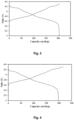
- FIG.3 shows the charge-discharge curve of the conventional lithium ion battery
- FIG.4 shows the charge-discharge curve of the lithium ion battery 10.
- the conventional lithium ion battery comprises a traditional separator and the flame-retardant electrolyte (the electrolyte VII in Table 1)
- the lithium ion battery 10 comprises the composite solid electrolyte membrane 18 and the flame-retardant electrolyte (the electrolyte VII in Table 1)
- the rest of the conventional lithium ion battery and the lithium ion battery 10 are the same.
- the performance of the composite solid electrolyte membrane 18 is equivalent to that of the traditional separator.
- Figure 2 , figure 3 and figure 4 are all the charge-discharge curve of batteries using the flame-retardant electrolytes.
- Figure 2 shows the charge-discharge curves of the first three cycles, and figures 3 and 4 show the charge-discharge curves after formation.
- the flame-retardant electrolyte and the composite solid electrolyte membrane are matched with each other, so that the charge-discharge performance of the lithium ion battery 10 is equivalent to that of a traditional lithium ion battery using a traditional separator, and the capacity of the lithium ion battery 10 can reach 200 mAh/g.
- the flame-retardant electrolyte, the method for making the flame-retardant electrolyte, and the lithium ion battery using the flame-retardant electrolyte have following advantages.
- the flame-retardant electrolyte of the present application comprises the specific solvent, and the concentration of the lithium salt is increased to above 5 mol/kg, appropriate amount of additives are added to the flame-retardant electrolyte, so that the flame-retardant electrolyte can avoid the lithium salt precipitation and the battery performance degradation, and the flame-retardant electrolyte has flame retardant properties.
- the flame-retardant electrolyte, the composite solid electrolyte membrane, the positive electrodes and the negative electrodes form the lithium ion battery with high energy and high safety.
Landscapes
- Chemical & Material Sciences (AREA)
- Engineering & Computer Science (AREA)
- Manufacturing & Machinery (AREA)
- Chemical Kinetics & Catalysis (AREA)
- Electrochemistry (AREA)
- General Chemical & Material Sciences (AREA)
- Inorganic Chemistry (AREA)
- Physics & Mathematics (AREA)
- Condensed Matter Physics & Semiconductors (AREA)
- General Physics & Mathematics (AREA)
- Materials Engineering (AREA)
- Secondary Cells (AREA)
Abstract
Description
- This application claims all benefits from the
Chinese Patent Application No. 202210906167.9, filed on July 29, 2022 - The present application relates to a flame-retardant electrolyte, preparation method, and a lithium-ion battery.
- In the fields of electric vehicles and energy storage systems, lithium-ion batteries are in great demand, but the carbonate-based electrolytes in the lithium-ion batteries have a safety problem of burning. Additives with flame retardant effect can improve the flame retardant characteristics of the electrolyte, but it is easy to cause the degradation of battery performance. Therefore, a flame-retardant electrolyte with excellent performance is expected, which can improve the safety of the battery without reducing the performance of the battery.
- At present, common additives with flame retardant effect can guarantee the safety of the electrolyte. The electrolyte can be non-flammable phosphate compound, such as dimethyl phosphate, triethyl phosphate and trimethyl phosphate. However, poor battery stability is still a common problem due to a strong catalytic activity of graphite as the electrode of the battery.
- Therefore, there is room for improvement in the art.
- In order to illustrate the technical solutions of the embodiments of the present application more clearly, the accompanying drawings in the embodiments will be briefly introduced below. It should be understood that the following drawings only show some embodiments of the present application, and therefore should not be seen as the limiting the scope. For one of ordinary skill in the art, other related drawings can also be obtained from these drawings without any creative work.
- Implementations of the present technology will now be described, by way of embodiments, with reference to the attached figures, wherein:
-
FIG. 1 shows a schematic view of a lithium ion battery in one embodiment. -
FIG. 2 shows a charge-discharge curves of the lithium ion battery of the first three cycles in an embodiment. -
FIG. 3 shows a charge-discharge curve of a conventional lithium ion battery after formation. -
FIG. 4 shows a charge-discharge curve of the lithium ion battery after formation in an embodiment. - It will be appreciated that for simplicity and clarity of illustration, where appropriate, reference numerals have been repeated among the different figures to indicate corresponding or analogous elements. In addition, numerous specific details are set forth in order to provide a thorough understanding of the embodiments described herein. However, it will be understood by those of ordinary skill in the art that the embodiments described herein can be practiced without these specific details. In other instances, methods, procedures, and components have not been described in detail so as not to obscure the related relevant feature being described. The drawings are not necessarily to scale, and the proportions of certain parts may be exaggerated better illustrate details and features. The description is not to be considered as limiting the scope of the embodiments described herein.
- The term "outside" refers to a region that is beyond the outermost confines of a physical object. The term "inside" indicates that at least a portion of a region is partially contained within a boundary formed by the object. The term "substantially" is defined to essentially conforming to the particular dimension, shape or other word that substantially modifies, such that the component need not be exact. For example, substantially cylindrical means that the object resembles a cylinder, but can have one or more deviations from a true cylinder. The term "comprising" means "including, but not necessarily limited to"; it specifically indicates open-ended inclusion or membership in a so-described combination, group, series and the like. It should be noted that references to "an" or "one" embodiment in this disclosure are not necessarily to the same embodiment, and such references mean at least one.
- A first embodiment of a flame-retardant electrolyte is provided. The flame-retardant electrolyte comprises a specific solvent, a lithium salt and a fluorinated solvent. In one embodiment, the fluorinated solvent is a fluoroethylene carbonate. The concentration of the lithium salt in the flame-retardant electrolyte is in a range from 5 mol/kg to 7 mol/kg. In one embodiment, the concentration of the lithium salt in the flame-retardant electrolyte is in a range from 5 mol/kg to 6 mol/kg. The mass ratio of the fluorinated solvent ranges from 1%-20%. In one embodiment, the mass ratio of the fluorinated solvent is 10%. The fluorinated solvent can avoid the precipitation of the lithium salt and improve the stability of a negative electrode of the lithium ion battery. In one embodiment, the flame-retardant electrolyte consists of the specific solvent, the lithium salt and the fluoroethylene carbonate, and the mass ratio of the fluoroethylene carbonate is 10%.
- The specific solvent can be carbonate solvent, ether solvent, succinonitrile, sulfolane, tetraglyme, ionic liquid or a combination thereof. The ionic liquid can be N-Butyl, methylpyrrolidinium bis(trifluoromethylsulfonyl)imide, 1-butyl-3-methylimidazolium bis[(trifluoromethyl)sulfonyl]imide, 1-ethyl-3-methylimidazolium bis[(trifluoromethyl)sulfonyl]imide, N-Butyl, methylpyrrolidinium bis(fluorosulfonyl)imide, 1-butyl-3-methylimidazolium bis[fluorosulfonyl]imide, 1-ethyl-3-methylimidazolium bis[fluorosulfonyl]imide.
- In one embodiment, the specific solvent comprises carbonate solvent and ether solvent. In another embodiment, the specific solvent consists of carbonate solvent and ether solvent.
- The carbonate solvent can be cyclic carbonates and/ or linear carbonates. The cyclic carbonates can be ethylene carbonate, propylene carbonate or combinations thereof. The linear carbonates can be dimethyl carbonate, diethyl carbonate, ethyl methyl carbonate or combinations thereof.
- The ether solvent can be 1,2-dimethoxyethane, diethylene glycol dimethyl ether, triethylene glycol dimethyl ether, tetraethylene glycol dimethyl ether or a combination thereof.
- The lithium salt can be lithium bis(trifluoromethanesulfonyl)imide (LiN(CF3SO2)2, LiTFSI), lithium bis(fluorosulfonyl)imide (LiNO4S2F2, LiFSI), lithium hexafluorophosphate (LiPF6), lithium tetrafluoroborate (LiBF4) or combinations thereof.
- In one embodiment, the specific solvent consists of ethylene carbonate (EC) and dimethyl ether (DME), and the molar ratio of ethylene carbonate and dimethyl ether is in a range of 10:1 to 1:10. In one embodiment, the molar ratio of ethylene carbonate and dimethyl ether is 1:2. In one embodiment, the lithium salt is LiTFSI, the flame-retardant electrolyte consists of a mixture of EC and DME, LiTFSI and fluoroethylene carbonate (FEC), and the concentration of lithium salt (LiTFSI) is in a range from 5 mol/kg to 6 mol/kg.
- A second embodiment of a method of making the flame-retardant electrolyte comprises:
- 51, providing the specific solvent;
- S2, adding the lithium salt into the specific solvent, and stirring; and
- S3, adding the fluorinated solvent after the lithium salt is dissolved, and stirring.
- In step S1, in one embodiment, the specific solvent is composed of the carbonate solvent such as EC and the ether solvent such as DME. Since the carbonate solvent such as EC is solid when the temperature is low, it is necessary to ensure that the carbonate solvent such as EC and ether solvent such as DME are completely mixed to obtain the specific solvent before proceeding to the subsequent steps. The order of step S2 and step S3 is not limited. That is, the order in which the specific solvents, the lithium salts, and the fluorinated solvent are mixed and dissolved with each other is not limited.
- In one embodiment, the carbonate solvent and the ether solvent are organic solvents, and the carbonate solvent and the ether solvent are mixed in a certain volume ratio. Carbonate organic solvents are solid at normal temperature, and can be dissolved by heating to above 60 degrees Celsius for about two hours. In one embodiment, the carbonate solvent is EC, the ether solvent is DME, and the volume ratio of the EC to the DME is 1:2.
- In step S2, the lithium salt is added into the specific solvent to increase a large amount of lithium ions. A force between the lithium ions and the specific solvent can prevent the specific solvent molecules from being vaporized, thereby improving the flame retardant characteristics of the flame-retardant electrolyte. In one embodiment, the lithium salt is LiTFSI.
- In step S3, in one embodiment, the fluorinated solvent is FEC. The fluorinated solvent can avoid the precipitation of the lithium salt such as LiTFSI and improve the stability of negative electrodes. And the fluorinated solvent can enhance the force between the lithium ions and the specific solvent, and prevent the specific solvent molecules from being vaporized, so that the flame-retardant electrolyte is not flammable.
- The following are specific examples of the method for making the flame-retardant electrolyte.
- First, in the environment where the saturated water vapor pressure is lower than 2 Pascals, the EC and DME are respectively provided. The EC and DME are mixed and stirred evenly, to obtain the specific solvent as an ion-conducting medium. The volume ratio of the EC to the DME is 1:2. The EC and the DME are put into a quantitative bottle for standard volume quantification and stir evenly. Wherein the EC is usually solid at room temperature, and is dissolved by heating to above 60 degrees Celsius for about two hours in advance.
- Second, the lithium salt is weighed, then the lithium salt is added to the specific solvent, and continuously stirred until the lithium salt is evenly dissolved, obtaining a uniformly mixed solution. The concentration of the lithium salt is 5.14 moles per kilogram.
- Third, an appropriate amount of FEC is added into the uniformly mixed solution and continuously stirred to obtain the flame-retardant electrolyte.
- Table 1 shows a comparison between the flame-retardant electrolyte and the control groups. Table 1 shows test results of the flame-retardant electrolyte and the control groups. The test results shows the combustion of the electrolyte I to electrolyte XII when an open flame contacts the electrolyte I to electrolyte XII in table 1 for five seconds.
Table 1: a comparison between the flame-retardant electrolyte and the control groups electro lyte lithium salt concentration of the lithium salt the composition and ratio of the specific solvent test results I LiTFSI ILE-P/LiTFSI=8/2 molar ratio ILE-P/DEC=8/2 (weight ratio) flame retardant II LiTFSI 2.3 mol/kg EC/DME=1/2 molar ratio flammable III LiTFSI 2.3 mol/kg II+10wt% FEC flammable IV LiTFSI 2.3 mol/kg II+5wt% FEC flammable V LiTFSI 2.3 mol/kg II+10wt% FEC +1wt% LiDFOB flammable VI LiTFSI 5.14 mol/kg EC/DME=1/2 molar ratio flame retardant VII LiTFSI 5.14 mol/kg VI+10wt% FEC+1wt% LiDFOB flame retardant VIII LiTFSI 3 mol/kg EC/DME=1/2 molar ratio flammable IX LiTFSI 4 mol/kg EC/DME=1/2 molar ratio flammable X LiTFSI 2.3 mol/kg EC/DME=1/1 molar ratio flammable XI LiTFSI 2.3 mol/kg EC/DME=2/1 molar ratio flammable XII LiTFSI 5.14 mol/kg VI+10wt% FEC flame retardant - In Table 1, EC represents ethylene carbonate, ILE-P represents 1-Butyl-1-methylpyrrolidinium bis(trifluoromethylsulfonyl)imide, DME represents 1,2-dimethoxyethane, DEC represents diethyl carbonate, LiTFSI represents lithium bistrifluoromethanesulfonyl imide, LiDFOB represents lithium difluoro(oxalato)borate.
- It can be seen from Table 1 that when the specific solvent is a mixture of EC and DME with a molar ratio of 1:2, and the concentration of the lithium salt is 5.14 mol/kg, the electrolyte is flame retardant.
- In can be seen from the electrolyte I that when the specific solvent is a mixture of ILE-P and DEC with a mass ratio of 8:2, a molar ratio of ILE-P to LiTFSI is 8:2, and the molar concentration of LiTFSI is 0.59 mol/kg, the electrolyte I is flame retardant. Thus, the flame-retardant electrolyte can also comprise ILE-P, the lithium salt and the carbonate solvent. In one embodiment, the flame-retardant electrolyte consists of ILE-P, the lithium salt (such as LiTFSI) and the carbonate solvent (such as DEC).
- Referring to
FIG.1 , the present application further provides alithium ion battery 10. Thelithium ion battery 10 includes apositive electrode 12, anegative electrode 14, a flame-retardant electrolyte 16, and a compositesolid electrolyte membrane 18. - The material of the
positive electrode 12 is not limited, and thepositive electrode 12 can be lithium nickel manganese cobalt oxide, lithium nickel manganese oxide, etc. The material of thenegative electrode 14 is not limited, and thenegative electrode 14 can be graphite, silicon carbon and lithium metal, etc. The flame-retardant electrolyte 16 has been described in detail above. - The material of the composite
solid electrolyte membrane 18 comprises lithium salt compound, polymer material, solid electrolyte and plasticizer. In one embodiment, the compositesolid electrolyte membrane 18 consists of lithium salt compound, polymer material, solid electrolyte and plasticizer. The lithium salt compound can be lithium fluoride (LiF), LiFSI, LiTFSI, lithium bis(perfluoroethylsulfonylimide) (Li(C2F5SO2)2N, LiBETI), lithium dioxalate borate (LiB(C2O4)2), LiBOB), or a combination thereof. The polymer material can be PVDF, PVDF-HFP, PVA, PLA, PEG, PMMA, PMA, PAA, or a combination thereof. The solid electrolyte can be LLZO, LLZTO, LATP, or a combination thereof. The plasticizer can be ethylene carbonate, succinonitrile, sulfolane, tetraglyme, or a combination thereof. It is easy to understand that the lithium salt compound can be a conventional lithium salt compound. - In one embodiment, PVDF, PMMA, lithium salt compound, solid electrolyte, and plasticizer are mixed and coated on a substrate, and then baked to form the composite
solid electrolyte membrane 18. - In a dry environment, the
negative electrode 14, the compositesolid electrolyte membrane 18, thepositive electrode 12, the compositesolid electrolyte membrane 18, and thenegative electrode 14 are sequentially formed into a multilayer battery cell. Then, in a vacuum environment, the flame-retardant electrolyte is injected into the multilayer battery cell for formation to obtain thelithium ion battery 10. The electrochemical properties of thelithium ion battery 10 are verified below. -
FIG.2 shows the charge-discharge curve of thelithium ion battery 10. It can be seen fromFIG.2 that after using the flame-retardant electrolyte, the discharge capacity of thelithium ion battery 10 is 205 mAh/g, which is greater than 200 mAh/g, and the irreversibility of the first cycle is less than 12%. Thus, the performance of thelithium ion battery 10 is comparable to current materials. Thus, thelithium ion battery 10 adopting the flame-retardant electrolyte has good battery performance. -
FIG.3 shows the charge-discharge curve of the conventional lithium ion battery, andFIG.4 shows the charge-discharge curve of thelithium ion battery 10. Compared with thelithium ion battery 10, the conventional lithium ion battery comprises a traditional separator and the flame-retardant electrolyte (the electrolyte VII in Table 1), while thelithium ion battery 10 comprises the compositesolid electrolyte membrane 18 and the flame-retardant electrolyte (the electrolyte VII in Table 1), the rest of the conventional lithium ion battery and thelithium ion battery 10 are the same. In can be seen fromFIG.3 and FIG.4 that the performance of the compositesolid electrolyte membrane 18 is equivalent to that of the traditional separator.Figure 2 ,figure 3 and figure 4 are all the charge-discharge curve of batteries using the flame-retardant electrolytes.Figure 2 shows the charge-discharge curves of the first three cycles, andfigures 3 and 4 show the charge-discharge curves after formation. It can be seen fromfigures 3 and 4 that in thelithium ion battery 10, the flame-retardant electrolyte and the composite solid electrolyte membrane are matched with each other, so that the charge-discharge performance of thelithium ion battery 10 is equivalent to that of a traditional lithium ion battery using a traditional separator, and the capacity of thelithium ion battery 10 can reach 200 mAh/g. - The flame-retardant electrolyte, the method for making the flame-retardant electrolyte, and the lithium ion battery using the flame-retardant electrolyte have following advantages.
- First, the flame-retardant electrolyte of the present application comprises the specific solvent, and the concentration of the lithium salt is increased to above 5 mol/kg, appropriate amount of additives are added to the flame-retardant electrolyte, so that the flame-retardant electrolyte can avoid the lithium salt precipitation and the battery performance degradation, and the flame-retardant electrolyte has flame retardant properties.
- Second, the flame-retardant electrolyte, the composite solid electrolyte membrane, the positive electrodes and the negative electrodes form the lithium ion battery with high energy and high safety.
- The embodiments shown and described above are only examples. Even though numerous characteristics and advantages of the present technology have been set forth in the foregoing description, together with details of the structure and function of the present disclosure, the disclosure is illustrative only, and changes may be made in the detail, including in matters of shape, size and arrangement of the parts within the principles of the present disclosure up to, and including, the full extent established by the broad general meaning of the terms used in the claims.
- The above embodiments are only used to illustrate the technical solutions of the present application rather than limitations. Although the present application has been described in detail with reference to the above preferred embodiments, one of ordinary skill in the art should understand that the technical solutions of the present application may be modified or equivalently replaced without departing from the spirit and scope of the technical solutions of the present application.
Claims (15)
- A flame-retardant electrolyte comprising:a specific solvent;a lithium salt; anda fluorinated solvent;wherein the specific solvent is carbonate solvent, ether solvent, succinonitrile, sulfolane, tetraglyme, ionic liquid or a combination thereof.
- The flame-retardant electrolyte of claim 1, wherein the specific solvent comprises carbonate solvent and ether solvent, or the specific solvent consists of carbonate solvent and ether solvent.
- The flame-retardant electrolyte of claim 1, wherein the carbonate solvent is a cyclic carbonate and/or a linear carbonate, the cyclic carbonate is ethylene carbonate, propylene carbonate, or combinations thereof, and the linear
carbonate is dimethyl carbonate, diethyl carbonate, ethyl methyl carbonate, or combinations thereof. - The flame-retardant electrolyte of claim 1, wherein the ether solvent is 1,2-dimethoxyethane, diethylene glycol dimethyl ether, triethylene glycol dimethyl ether, tetraethylene glycol dimethyl ether, or a combination thereof.
- The flame-retardant electrolyte of claim 1, wherein concentration of the lithium salt in the flame-retardant electrolyte is in a range from 5 moles per kilogram to 7 moles per kilogram.
- The flame-retardant electrolyte of claim 5, wherein the lithium salt is lithium bis(trifluoromethanesulfonyl)imide, lithium bis(fluorosulfonyl)imide, lithium hexafluorophosphate, lithium tetrafluoroborate, or a combination thereof.
- The flame-retardant electrolyte of claim 1, wherein the fluorinated solvent is fluoroethylene carbonate, 1-Butyl-1-methylpyrrolidinium bis(trifluoromethylsulfonyl)imide.
- The flame-retardant electrolyte of claim 1, wherein the specific solvent consists of ethylene carbonate and dimethyl ether, and a molar ratio of the ethylene carbonate and the dimethyl ether is in a range of 10:1 to 1:10.
- A lithium ion battery comprising:a positive electrode;a negative electrode;a flame-retardant electrolyte; anda composite solid electrolyte membrane;wherein the flame-retardant electrolyte comprises a specific solvent, a lithium salt, and a fluorinated solvent, wherein the specific solvent is carbonate solvent, ether solvent, succinonitrile, sulfolane, tetraglyme, ionic liquid or a combination thereof.
- The lithium ion battery of claim 9, wherein the specific solvent comprises carbonate solvent and ether solvent, or the specific solvent consists of carbonate solvent and ether solvent.
- The lithium ion battery of claim 9, wherein a concentration of the lithium salt in the flame-retardant electrolyte is in a range from 5 moles per kilogram to 7 moles per kilogram.
- The lithium ion battery of claim 11, wherein the lithium salt is lithium bis(trifluoromethanesulfonyl)imide, lithium bis (fluorosulfonyl) imide, lithium hexafluorophosphate, lithium tetrafluoroborate, or a combination thereof.
- The lithium ion battery of claim 9, wherein the specific solvent consists of ethylene carbonate and dimethyl ether, and a molar ratio of the ethylene carbonate and the dimethyl ether is in a range of 10:1 to 1:10.
- The lithium ion battery of claim 9, wherein the composite solid electrolyte membrane consists of lithium salt compound, polymer material, solid electrolyte and plasticizer.
- A method of making a flame-retardant electrolyte comprising:providing a specific solvent, wherein the specific solvent is carbonate solvent, ether solvent, succinonitrile, sulfolane, tetraglyme, ionic liquid, or a combination thereof;adding a lithium salt into the specific solvent; andadding a fluorinated solvent into the specific solvent after the lithium salt is dissolved.
Applications Claiming Priority (1)
| Application Number | Priority Date | Filing Date | Title |
|---|---|---|---|
| CN202210906167.9A CN117525598A (en) | 2022-07-29 | 2022-07-29 | Flame-retardant electrolyte and preparation method thereof and lithium-ion battery |
Publications (1)
| Publication Number | Publication Date |
|---|---|
| EP4312294A1 true EP4312294A1 (en) | 2024-01-31 |
Family
ID=89434229
Family Applications (1)
| Application Number | Title | Priority Date | Filing Date |
|---|---|---|---|
| EP23180093.9A Pending EP4312294A1 (en) | 2022-07-29 | 2023-06-19 | Flame-retardant electrolyte, preparation method thereof, and lithium ion battery |
Country Status (3)
| Country | Link |
|---|---|
| US (1) | US20240039049A1 (en) |
| EP (1) | EP4312294A1 (en) |
| CN (1) | CN117525598A (en) |
Cited By (1)
| Publication number | Priority date | Publication date | Assignee | Title |
|---|---|---|---|---|
| EP4435918A1 (en) * | 2023-02-24 | 2024-09-25 | Hon Hai Precision Industry Co., Ltd. | Composite electrolyte membrane and preparation method thereof and lithium-sulfur battery |
Families Citing this family (1)
| Publication number | Priority date | Publication date | Assignee | Title |
|---|---|---|---|---|
| CN118572194B (en) * | 2024-06-25 | 2025-10-31 | 清华大学深圳国际研究生院 | High-voltage lithium metal electrolyte, preparation method and lithium metal battery |
Citations (3)
| Publication number | Priority date | Publication date | Assignee | Title |
|---|---|---|---|---|
| US20200303765A1 (en) * | 2019-03-18 | 2020-09-24 | Kabushiki Kaisha Toshiba | Secondary battery, battery pack, and vehicle |
| CN113782810A (en) * | 2021-09-10 | 2021-12-10 | 贵州梅岭电源有限公司 | Lithium electrolyte of solvent self-sacrificial in-situ protection electrode and preparation and application thereof |
| CN113826255A (en) * | 2019-05-22 | 2021-12-21 | 阿科玛法国公司 | Electrolyte composition containing mixture of lithium salts |
Family Cites Families (4)
| Publication number | Priority date | Publication date | Assignee | Title |
|---|---|---|---|---|
| US9601805B2 (en) * | 2013-07-22 | 2017-03-21 | Nanotek Instruments, Inc. | Process for producing non-flammable quasi-solid electrolyte and electrolyte-separator for lithium battery applications |
| EP3104445B1 (en) * | 2014-02-06 | 2019-03-13 | Nissan Motor Co., Ltd. | Non-aqueous electrolyte secondary battery |
| US20170098858A1 (en) * | 2015-10-01 | 2017-04-06 | Samsung Electronics Co., Ltd. | Lithium metal battery |
| US20180277913A1 (en) * | 2017-03-23 | 2018-09-27 | Nanotek Instruments, Inc. | Non-flammable Quasi-Solid Electrolyte and Lithium Secondary Batteries Containing Same |
-
2022
- 2022-07-29 CN CN202210906167.9A patent/CN117525598A/en active Pending
-
2023
- 2023-06-19 EP EP23180093.9A patent/EP4312294A1/en active Pending
- 2023-06-25 US US18/213,855 patent/US20240039049A1/en active Pending
Patent Citations (3)
| Publication number | Priority date | Publication date | Assignee | Title |
|---|---|---|---|---|
| US20200303765A1 (en) * | 2019-03-18 | 2020-09-24 | Kabushiki Kaisha Toshiba | Secondary battery, battery pack, and vehicle |
| CN113826255A (en) * | 2019-05-22 | 2021-12-21 | 阿科玛法国公司 | Electrolyte composition containing mixture of lithium salts |
| CN113782810A (en) * | 2021-09-10 | 2021-12-10 | 贵州梅岭电源有限公司 | Lithium electrolyte of solvent self-sacrificial in-situ protection electrode and preparation and application thereof |
Cited By (1)
| Publication number | Priority date | Publication date | Assignee | Title |
|---|---|---|---|---|
| EP4435918A1 (en) * | 2023-02-24 | 2024-09-25 | Hon Hai Precision Industry Co., Ltd. | Composite electrolyte membrane and preparation method thereof and lithium-sulfur battery |
Also Published As
| Publication number | Publication date |
|---|---|
| CN117525598A (en) | 2024-02-06 |
| US20240039049A1 (en) | 2024-02-01 |
Similar Documents
| Publication | Publication Date | Title |
|---|---|---|
| CN111326799A (en) | Flame-retardant high-voltage electrolyte for lithium ion battery and preparation method thereof | |
| JP5557337B2 (en) | Secondary battery | |
| Wright et al. | Review on high temperature secondary Li-ion batteries | |
| US10056649B2 (en) | Non-aqueous electrolytic solutions and electrochemical cells comprising the same | |
| EP2469633B1 (en) | A mixed solvent for an electrolyte for a lithium secondary battery and lithium secondary battery comprising the same | |
| CN110911752A (en) | Low-internal-resistance lithium secondary battery electrolyte and lithium secondary battery | |
| CN102037600A (en) | Secondary battery | |
| CN111146502B (en) | Composite flame retardant electrolyte and lithium ion battery | |
| KR20220150370A (en) | Gel electrolyte precursors and their applications | |
| KR20140063762A (en) | Non-aqueous organic electrolyte, lithium ion secondary battery having same, lithium ion secondary battery preparation method and terminal communication device | |
| CN102195084A (en) | Non-aqueous electrolyte and lithium secondary battery using the same | |
| US20170294677A1 (en) | Fluorine-Substituted Propylene Carbonate-Based Electrolytic Solution and Lithium-Ion Battery | |
| CN114024036A (en) | A low-concentration lithium-ion battery electrolyte and its prepared lithium-ion battery | |
| EP4312294A1 (en) | Flame-retardant electrolyte, preparation method thereof, and lithium ion battery | |
| CN118610587B (en) | An electrolyte and lithium metal battery | |
| JP5819653B2 (en) | Non-flammable electrolyte | |
| CN120690921A (en) | Electrolyte, battery and energy storage device | |
| CN110838595B (en) | Lithium ion battery electrolyte and application thereof | |
| CN114520372A (en) | Oxidation-resistant electrolyte, lithium ion battery and preparation method | |
| KR20240046809A (en) | Low-temperature lithium-ion battery electrolyte and its manufacturing method and lithium-ion battery | |
| CN113764739A (en) | Wide-temperature-zone high-concentration double-salt flame-retardant electrolyte and application thereof in high-nickel lithium ion battery | |
| KR102851208B1 (en) | Liquid-solid composite electrolyte, manufacturing method thereof, and use thereof | |
| KR20240164143A (en) | Manufacturing method of lithium secondary battery | |
| JP2020202158A (en) | Insulation layer, battery cell sheet, and battery cell | |
| CN117374403A (en) | High temperature resistant lithium ion battery electrolyte and lithium ion battery |
Legal Events
| Date | Code | Title | Description |
|---|---|---|---|
| PUAI | Public reference made under article 153(3) epc to a published international application that has entered the european phase |
Free format text: ORIGINAL CODE: 0009012 |
|
| STAA | Information on the status of an ep patent application or granted ep patent |
Free format text: STATUS: THE APPLICATION HAS BEEN PUBLISHED |
|
| AK | Designated contracting states |
Kind code of ref document: A1 Designated state(s): AL AT BE BG CH CY CZ DE DK EE ES FI FR GB GR HR HU IE IS IT LI LT LU LV MC ME MK MT NL NO PL PT RO RS SE SI SK SM TR |
|
| STAA | Information on the status of an ep patent application or granted ep patent |
Free format text: STATUS: REQUEST FOR EXAMINATION WAS MADE |
|
| 17P | Request for examination filed |
Effective date: 20240320 |
|
| RBV | Designated contracting states (corrected) |
Designated state(s): AL AT BE BG CH CY CZ DE DK EE ES FI FR GB GR HR HU IE IS IT LI LT LU LV MC ME MK MT NL NO PL PT RO RS SE SI SK SM TR |
|
| STAA | Information on the status of an ep patent application or granted ep patent |
Free format text: STATUS: EXAMINATION IS IN PROGRESS |
|
| 17Q | First examination report despatched |
Effective date: 20241211 |