EP4312220A1 - Sample analyzing apparatus and method - Google Patents
Sample analyzing apparatus and method Download PDFInfo
- Publication number
- EP4312220A1 EP4312220A1 EP23186097.4A EP23186097A EP4312220A1 EP 4312220 A1 EP4312220 A1 EP 4312220A1 EP 23186097 A EP23186097 A EP 23186097A EP 4312220 A1 EP4312220 A1 EP 4312220A1
- Authority
- EP
- European Patent Office
- Prior art keywords
- sample
- mass spectrum
- search
- library
- molecular
- Prior art date
- Legal status (The legal status is an assumption and is not a legal conclusion. Google has not performed a legal analysis and makes no representation as to the accuracy of the status listed.)
- Pending
Links
Images





Classifications
-
- G—PHYSICS
- G16—INFORMATION AND COMMUNICATION TECHNOLOGY [ICT] SPECIALLY ADAPTED FOR SPECIFIC APPLICATION FIELDS
- G16C—COMPUTATIONAL CHEMISTRY; CHEMOINFORMATICS; COMPUTATIONAL MATERIALS SCIENCE
- G16C20/00—Chemoinformatics, i.e. ICT specially adapted for the handling of physicochemical or structural data of chemical particles, elements, compounds or mixtures
- G16C20/20—Identification of molecular entities, parts thereof or of chemical compositions
-
- H—ELECTRICITY
- H01—ELECTRIC ELEMENTS
- H01J—ELECTRIC DISCHARGE TUBES OR DISCHARGE LAMPS
- H01J49/00—Particle spectrometers or separator tubes
- H01J49/0027—Methods for using particle spectrometers
- H01J49/0036—Step by step routines describing the handling of the data generated during a measurement
-
- G—PHYSICS
- G16—INFORMATION AND COMMUNICATION TECHNOLOGY [ICT] SPECIALLY ADAPTED FOR SPECIFIC APPLICATION FIELDS
- G16C—COMPUTATIONAL CHEMISTRY; CHEMOINFORMATICS; COMPUTATIONAL MATERIALS SCIENCE
- G16C20/00—Chemoinformatics, i.e. ICT specially adapted for the handling of physicochemical or structural data of chemical particles, elements, compounds or mixtures
- G16C20/70—Machine learning, data mining or chemometrics
Definitions
- the present disclosure relates to a sample analyzing apparatus and method, and in particular to a technique for determining or estimating a molecular structure of a compound forming the sample.
- an EI mass spectrum library For identifying a compound (that is, determining a molecular structure of the compound), an EI mass spectrum library is used.
- an EI mass spectrum library provided by the National Institute of Standards and Technology (NIST) includes EI mass spectra acquired through mass spectrometry of 300 thousand or more compounds.
- the EI mass spectrum is a mass spectrum acquired by performing mass spectrometry of a compound under application of an electron ionization (EI) method.
- the EI mass spectrum normally includes a relatively large number of fragment ion peaks.
- An EI mass spectrum acquired through the mass spectrometry of a sample is compared with a plurality of EI mass spectra in the EI mass spectrum library. Based on the result of comparison, a molecular structure of the compound forming the sample may be determined.
- a general compound database is also used. For example, in PubChem, which is a representative compound database, more than 100 million compounds are registered. If the compound database is used, the molecular structure of the compound forming the sample can be narrowed down based on a molecular weight, an accurate mass, or a compositional formula of the compound forming the sample. However, the EI mass spectrum is not registered in general compound databases.
- the number of registered compounds in the EI mass spectrum library is much smaller than the number of registered compounds in the compound database.
- the compound identification using the EI mass spectrum library often, a situation arises where there is no EI mass spectrum in the EI mass spectrum library that matches the EI mass spectrum acquired from the sample.
- Document 1 JP 6994921 B discloses a technique to process a first mass spectrum acquired under a hard ionization method, and a second mass spectrum acquired under a soft ionization method. Document 1 is silent on a predicted mass spectrum.
- Document 2 discloses an EI mass spectrum library.
- the EI mass spectrum library is formed from a plurality of measured EI mass spectra and a plurality of predicted EI mass spectra.
- a molecular fingerprint defined from the molecular structure of each compound is input to a prediction model, and the prediction model produces the predicted EI mass spectrum.
- Document 2 does not describe stage-wise use of a measured EI mass spectrum library and a predicted EI mass spectrum library.
- An advantage of the present disclosure lies in enlargement of a range of compounds which may be estimated in the estimation of the molecular structure through mass spectrum matching. Alternatively, an advantage of the present disclosure lies in distinguishingly using a plurality of kinds of mass spectrum libraries having different properties or performances. Alternatively, an advantage of the present disclosure lies in improvement of estimation precision in the molecular structure estimation using a predicted mass spectrum library.
- a sample analyzing apparatus comprising: a first storage unit configured to store a primary library having a plurality of standard mass spectra acquired from a plurality of compounds forming a first compound group, and a plurality of molecular structures corresponding to the plurality of standard mass spectra; a second storage unit configured to store a secondary library having a plurality of predicted mass spectra corresponding to a plurality of compounds forming a second compound group, and a plurality of molecular structures corresponding to the plurality of predicted mass spectra; a primary searcher configured to execute a primary search with respect to the primary library based on a sample mass spectrum acquired from a sample; a judging unit configured to judge enlargement of a search range based on a result of the primary search; and a secondary searcher configured to execute a secondary search with respect to the secondary library based on the sample mass spectrum, when it is judged that the search range is to be enlarged, to thereby estimate a mole
- a method of analyzing a sample comprising: executing, based on a sample mass spectrum acquired from a sample, a primary search with respect to a primary library having a plurality of standard mass spectra acquired from a plurality of compounds forming a first compound group, and a plurality of molecular structures corresponding to the plurality of standard mass spectra; judging enlargement of a search range based on a result of the primary search; and executing, based on the sample mass spectrum, a secondary search with respect to a secondary library having a plurality of predicted mass spectra corresponding to a plurality of compounds forming a second compound group, and a plurality of molecular structures corresponding to the plurality of predicted mass spectra, when it is judged that the search range is to be enlarged, to thereby estimate a molecular structure of the sample.
- a sample analyzing apparatus comprises a first storage unit, a second storage unit, a primary searcher, a judging unit, and a secondary searcher.
- the first storage unit stores a primary library.
- the primary library has a plurality of standard mass spectra acquired from a plurality of compounds forming a first compound group, and a plurality of molecular structures corresponding to the plurality of standard mass spectra.
- the second storage unit stores a secondary library.
- the secondary library has a plurality of predicted mass spectra corresponding to a plurality of compounds forming a second compound group, and a plurality of molecular structures corresponding to the plurality of predicted mass spectra.
- the primary searcher executes a primary search with respect to the primary library based on a sample mass spectrum acquired from a sample.
- the judging unit judges enlargement of a search range based on a result of the primary search.
- the secondary searcher executes a secondary search with respect to the secondary library based on the sample mass spectrum when it is judged that the search range is to be enlarged, to thereby estimate a molecular structure of the sample.
- the first storage unit corresponds to a first memory.
- the second storage unit corresponds to a second memory.
- a processor to be described below functions as the primary searcher, the judging unit, and the secondary searcher.
- necessity of execution of the secondary search is determined based on the quality of the result of the primary search.
- the result of the primary search is superior, a possibility that the compound forming the sample is registered in the primary library is high, and thus, execution of the secondary search is skipped. In this case, the search time can be shortened.
- the secondary search is executed. That is, the search range is enlarged. With this configuration, it is possible to increase the possibility of identifying the compound forming the sample.
- the standard mass spectrum is a measured EI mass spectrum acquired through mass spectrometry of a compound.
- the predicted mass spectrum is an artificial EI mass spectrum predicted from a molecular structure of the compound.
- the standard mass spectrum is more reliable than the predicted mass spectrum. Therefore, the primary search using the primary library is first executed, and then the secondary search using the secondary library is executed.
- the above-described configuration distinguishingly use two libraries in consideration of the respective advantages and disadvantages thereof.
- a sample is a compound to be analyzed. When a plurality of components are extracted from an original sample in gas chromatograph or the like, and each component is analyzed through mass spectrometry, each component is the compound to be analyzed; that is, the sample.
- the secondary library may be produced in advance, or the secondary library may be produced at the point in time when sample molecular information is identified, as will be described below.
- Each of the primary library and the secondary library corresponds to a database.
- a primary library and a secondary library stored on a storage device on a network may be utilized.
- a single storage unit may be caused to function as the first storage unit and the second storage unit.
- the plurality of predicted mass spectra are a plurality of mass spectra predicted from the plurality of molecular structures corresponding to the plurality of the compounds forming the second compound group.
- the predicted mass spectrum may be produced from the molecular structure using a learned prediction model (machine learning model).
- the first compound group and the second compound group differ from each other.
- Each compound forming the first compound group is a compound for which a measured mass spectrum is already acquired.
- Each compound forming the second compound group is a compound for which the measured mass spectrum is not yet acquired.
- An existing EI mass spectrum library may be used as the primary library, or the primary library may be produced by information extracted from an existing EI mass spectrum library.
- the secondary library may be formed from a plurality of molecular structures extracted from an existing compound database and a plurality of predicted mass spectra produced based on the molecular structures.
- the judging unit judges the enlargement of the search range based on a plurality of degrees of similarity calculated between the sample mass spectrum and the plurality of standard mass spectra. For example, when there is no item in the plurality of calculated degrees of similarity which satisfies a predetermined condition, it is highly likely that the compound forming the sample is not registered in the primary library. The enlargement of the search range is judged in such cases.
- a predicted mass spectrum determined to be a hit in the secondary search is displayed along with the sample mass spectrum.
- the predicted mass spectrum to be displayed is, for example, a predicted mass spectrum which has resulted in the highest degree of similarity.
- the secondary searcher executes the secondary search in such a manner that a result of the secondary search is narrowed down by sample molecular information acquired through mass spectrometry of the sample. According to this configuration, estimation precision of the molecular structure can be improved by using both molecular information matching and mass spectrum matching. These matchings may be executed simultaneously or consecutively.
- the sample molecular information is at least one of a molecular weight, an accurate mass, or a compositional formula of the compound forming the sample.
- the secondary library has a plurality of pieces of compound molecular information corresponding to the plurality of compounds forming the second compound group.
- the secondary searcher executes the secondary search with respect to the secondary library based on the sample molecular information and the sample mass spectrum. By executing the molecular information matching in addition to the mass spectrum matching, it is possible to more effectively narrow down the result of the secondary search in comparison to the case in which only the mass spectrum matching is executed.
- the sample molecular information is identified based on a molecular ion peak included in another sample mass spectrum acquired from the same sample.
- the sample mass spectrum is a mass spectrum acquired through application of a hard ionization method.
- the other sample mass spectrum is a mass spectrum acquired through application of a soft ionization method.
- the hard ionization method is an ionization method in which, in comparison to the soft ionization method, fragment ions tend to be more easily produced.
- the soft ionization method is an ionization method in which, in comparison to the hard ionization method, molecular ions tend to be more easily produced.
- the sample analyzing apparatus further includes a predictor configured to produce a plurality of predicted mass spectra based on the sample molecular information.
- the plurality of predicted mass spectra in the secondary library are the plurality of predicted mass spectra produced by the predictor. According to this configuration, a scale of the secondary library can be reduced, and the search time can be shortened. When it takes a significantly long time to produce the plurality of predicted mass spectra, a secondary library which is produced in advance is utilized.
- a processor to be described below functions as the predictor.
- a method of analyzing a sample including a primary search step, a judging step, and a secondary search step.
- a primary search step a primary search with respect to a primary library is executed based on a sample mass spectrum acquired from a sample.
- the primary library has a plurality of standard mass spectra acquired from a plurality of compounds forming a first compound group, and a plurality of molecular structures corresponding to the plurality of standard mass spectra.
- the judging step enlargement of a search range is judged based on a result of the primary search.
- a secondary search with respect to a secondary library is executed based on the sample mass spectrum when it is judged that the search range is to be enlarged, to thereby estimate a molecular structure of the sample.
- the secondary library has a plurality of predicted mass spectra corresponding to a plurality of compounds forming a second compound group, and a plurality of molecular structures corresponding to the plurality of predicted mass spectra.
- the method of analyzing the sample described above is realized as a function of hardware or as a function of software.
- a program for executing the method of analyzing the sample described above is installed to an information processing apparatus via a network or a transportable recording medium.
- the concept of the "information processing apparatus” encompasses a computer, a sample analyzing apparatus, a mass spectrometry apparatus, and the like.
- the information processing apparatus has a recording medium which non-transitorily stores the program.
- the "mass spectrum” will simply be called a "spectrum” in some cases.
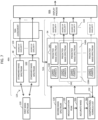
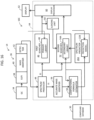
- FIG. 1 shows a sample analyzing system according to an embodiment of the present disclosure.
- the sample analyzing system is formed from an information processing apparatus 10, and a sample analyzing apparatus 12.
- the sample analyzing apparatus 12 is more specifically a mass spectrometry apparatus, and is formed from a measurer 14 and an information processing unit 16.
- the information processing apparatus 10 is formed from, for example, a computer having a processor and a memory.
- the processor is more specifically a CPU which executes a program.
- FIG. 1 a plurality of functions realized by the processor are represented by a plurality of blocks.
- the information processing apparatus 10 has a model producer 18, a primary library producer 24, a spectrum predictor 26, and a secondary library producer 32.
- the model producer 18 produces a prediction model 22A for predicting an EI mass spectrum from a molecular structure of a compound.
- the model producer 18 is more specifically formed from a machine learner. During a machine learning process, a training data set acquired from an EI mass spectrum library 20 is supplied to the model producer 18.
- the prediction model 22A thus produced is supplied to the spectrum predictor 26 (refer to reference numeral 28).
- the model producer 18 and the spectrum predictor 26 may be integrated.
- the primary library producer 24 produces a primary library based on information acquired from the EI mass spectrum library 20.
- the primary library is a database which is used in a primary search, which will be described later.
- the primary library includes a plurality of records corresponding to a plurality of first compounds forming a first compound group. Each record includes a standard mass spectrum (measured EI mass spectrum), a molecular structure, and the like.
- the spectrum predictor 26 produces a predicted mass spectrum from the molecular structure, and has a learned prediction model 22B (machine learning model).
- a plurality of molecular structures from a compound database 30 are sequential supplied to the spectrum predictor 26.
- a plurality of predicted mass spectra (predicted EI mass spectra) are sequentially produced.
- the plurality of predicted mass spectra that are produced and the plurality of molecular structures corresponding thereto are supplied to the secondary library producer 32.
- the secondary library producer 32 produces a secondary library based on information acquired from the compound database 30 and a plurality of predicted mass spectra which are produced.
- the secondary library is a database used in a secondary search to be described later.
- the secondary library includes a plurality of records corresponding to a plurality of second compounds. Each record includes the predicted mass spectrum (predicted EI mass spectrum), compound molecular information (molecular weight, accurate mass, compositional formula), the molecular structure, and the like.
- the primary library and the secondary library which are produced are transferred (copied) to the sample analyzing apparatus 12 (refer to reference numerals 49 and 55).
- the EI mass spectrum library 20 described above is, for example, an EI mass spectrum library provide by the NIST. Alternatively, other EI mass spectrum libraries may be utilized.
- the compound database 30 described above is, for example, PubChem described above. Alternatively, other compound databases may be utilized.
- the first compound group is formed from a plurality of compounds registered in the EI mass spectrum library.
- the second compound group is formed from a plurality of compounds which are registered in the compound database and which are not registered in the EI mass spectrum library.
- the first compound group and the second compound group do not overlap each other, and differ from each other.
- the two compound groups may partially overlap with each other as necessary.
- the sample analyzing apparatus 12 is formed from the measurer 14 and the information processing unit 16.
- An information processing unit 64 has a processor and a memory.
- the processor is more specifically a CPU which executes a program.
- FIG. 1 a plurality of functions realized by the processor are represented by a plurality of blocks.
- the measurer 14 is formed from a gas chromatograph (GC) 34 and a mass spectrometer 36.
- GC 34 gas chromatograph
- mass spectrometer 36 a plurality of components that are timewise separated are created from the original sample.
- the plurality of components are sequentially introduced to the mass spectrometer 36.
- each component is a compound to be analyzed; that is, a sample.
- the mass spectrometer 36 has an ion source 38, a mass analyzer 40, and a detector 42.
- the ion source 38 functions as an EI ion source following an electron ionization (EI) method, and as an FI ion source following an field ionization (FI) method.
- EI method is a typical hard ionization method.
- the FI method is a typical soft ionization method. Examples of other soft ionization methods include a chemical ionization (CI) method.
- the hard ionization method is an ionization method in which, in comparison to the soft ionization method, fragment ions tend to more easily produced.
- the soft ionization method is an ionization method in which, in comparison to the hard ionization method, molecular ions tend to be more easily detected.
- the mass analyzer 40 applies mass analysis of ions from the ion source.
- the mass analyzer 40 is formed from, for example, a time-of-flight type mass analyzer, or a quadrupole type mass analyzer. Alternatively, the mass analyzer 40 may be formed from other mass analyzers.
- the detector 42 detects ions passing through the mass analyzer 40. A detection signal from the detector 42 is sent through an electronic circuit (not shown) to the information processing unit 64.
- the EI method is selected, and mass spectrometry is sequentially executed under the EI method on a plurality of components sequentially introduced from the GC 34.
- a first mass spectrum array is acquired.
- the FI method is selected, and mass spectrometry is sequentially executed under the FI method on a plurality of components (which are basically identical to the plurality of components described previously) sequentially introduced from the GC.
- a second mass spectrum array is acquired.
- the secondary search to be described below is not to be executed, the acquisition of the second mass spectrum array may be omitted.
- the information processing unit 64 has a spectrum producer 44, a first searcher 46, a judging unit 50, a second searcher 52, an accurate mass identifier 56, a compositional formula estimator 58, a display processor 60, and the like.
- the first searcher 46 executes the primary search using a primary library 48.
- the first searcher 46 manages the primary library 48.
- the second searcher 52 executes the secondary search using a secondary library 54.
- the second searcher 52 manages the secondary library 54.
- the primary library 48 is stored in a first memory provided in the first searcher 46
- the secondary library 54 is stored in a second memory provided in the second searcher 52.
- a display 62 displays an image showing a result of the primary search or an image showing a result of the secondary search.
- the display 62 is formed from, for example, an LCD. While an inputting device is connected to the information processing unit 64, illustration thereof is omitted.
- the spectrum producer 44 produces a mass spectrum based on a detection signal from the measurer 14. More specifically, the spectrum producer 44 produces the first mass spectrum array based on the detection signal acquired under the EI method, and produces the second mass spectrum array based on the detection signal acquired under the FI method. Normally, the EI method is first executed, and the FI method is then executed. That is, the first mass spectrum array is first produced, and the second mass spectrum array is next produced. Alternatively, the spectrum producer 44 may be provided within the measurer 14.
- the spectrum producer 44 also functions as a spectrum processing unit. That is, the spectrum producer 44 also has a function to correlate the first mass spectrum array and the second mass spectrum array, and a function to produce an accumulated mass spectrum for each component based on the mass spectrum array. These functions will be described later.
- the first mass spectrum is an accumulated EI mass spectrum
- the second mass spectrum is an accumulated FI mass spectrum.
- the first searcher 46 functions.
- the first searcher 46 executes the primary search with respect to the primary library 48 based on the first mass spectrum. Specifically, the first mass spectrum is compared with a plurality of standard mass spectra in the primary library 48, to thereby calculate a plurality of degrees of similarity.
- a compositional formula matching may be executed. With such a configuration, precision of identifying the compound can be improved.
- the judging unit 50 judges enlargement of a search range based on the plurality of degrees of similarity which are calculated. Specifically, the judging unit 50 judges the enlargement of the search range; that is, execution of the secondary search, when the plurality of calculated degrees of similarity do not include an item that satisfies a predetermined condition; that is, when a possibility that the compound to be measured is included in the first compound group registered in the primary library 48 is low. On the other hand, the judging unit 50 judges skipping of the execution of the secondary search when the plurality of calculated degrees of similarity include an item that satisfies the predetermined condition; that is, when the possibility that the compound to be measured is included in the first compound group is high. When the compositional formula matching is executed in addition to the spectrum matching in the first searcher 46, the judging unit 50 may judge the enlargement of the search range based on the result of the spectrum matching and the result of the compositional formula matching.
- the result of the primary search is employed, and is sent to the display processor 60.
- the result of the primary search is formed from a plurality of pieces of information arranged in the order of magnitude of the degree of similarity.
- Each piece of information includes the degree of similarity, the molecular structure, the standard mass spectrum, and the like.
- arbitrary conditions may be determined. For example, when the degree of similarity varies from 1 to 1000 (with 1000 being the best degree of similarity), a condition that the plurality of the calculated degrees of similarity include a degree of similarly greater than or equal to 750 may be defined as the predetermined condition.
- the accurate mass identifier 56 identifies a molecular ion peak included in the second mass spectrum prior to the secondary search, and identifies the accurate mass corresponding to the molecular ion peak.
- the molecular ion peak may be designated by the user, or may be automatically determined.
- the compositional formula estimator 58 identifies one or a plurality of compositional formulae (one or a plurality of compositional formula candidates) from the identified accurate mass, prior to the secondary search.
- a compositional formula list is formed by the one or plurality of compositional formulae. For example, a range which takes an error into consideration is designated with respect to the accurate mass, and a large number of compositional formulae are identified based on the range.
- the compositional formula estimator 58 may identify one or a plurality of compositional formulae based on the accurate mass and a result of isotope pattern matching (degree of match).
- the secondary library 54 is referred to.
- the compound database may be referred to.
- Each individual compositional formula may be called sample molecular information. Examples of other pieces of sample molecular information include the molecular weight and the accurate mass. The sample molecular information will be described later.
- the second searcher 52 executes the secondary search with respect to the secondary library 54 based on the one or plurality of compositional formulae which are estimated, and the first mass spectrum.
- the compositional formula matching is employed in combination and in addition to the mass spectrum matching.
- the result of the secondary search is sent to the display processor 60.
- the result of the secondary search is formed from a plurality of pieces of information arranged in the order of magnitude of the degree of similarity. Each piece of information includes the degree of similarity, the molecular structure, the predicted mass spectrum, and the like.
- the display processor 60 has a function to produce an image representing the result of the primary search and an image representing the result of the secondary search.
- the display 62 displays the image representing the primary search result or the image representing the secondary search result. Alternatively, a judgment result of the judging unit 50 may be displayed on the display 62.
- FIG. 2 shows production of the prediction model.
- FIG. 2 shows an operation of the model producer 18.
- a training data set 66 is extracted from the EI mass spectrum library 20.
- the training data set 66 is formed from a plurality of pieces of training data 68 corresponding to a plurality of first compounds.
- Each piece of training data 68 is formed from a molecular structure 70 and an EI mass spectrum 72.
- a plurality of pieces of training data 68 are sequentially supplied to the prediction model 22A (learner).
- each molecular structure 70 is converted into data 74 having a graph structure, and the data 74 are supplied to the prediction model 22A.
- Various methods of expressing the molecular structure are known. For example, there are known a MOL SDF file format, linear expression methods such as SMILES and SMARTS, and the like.
- the prediction model 22A is formed from Graph Convolutional Networks. Alternatively, the prediction model 22A may be formed from other machine learning models.
- the produced prediction model 22A is supplied to the spectrum predictor. When the predicted mass spectrum is produced in the sample analyzing apparatus, the produced prediction model 22A is sent to the sample analyzing apparatus. This configuration will be described later with reference to FIG. 16 .
- the primary library producer 24 produces the primary library 48 based on the information extracted from the EI mass spectrum library.
- the produced primary library 48 is transferred to the sample analyzing apparatus.
- FIG. 3 shows an example of the primary library 48.
- the primary library 48 is formed from a plurality of records 78.
- Each record 78 includes a compound ID 80, a molecular weight 82, an accurate mass 84, a compositional formula 86, a molecular structure 88, a standard spectrum 90, and the like.
- information other than the molecular structure 88 and the standard spectrum 90 may be omitted.
- FIG. 4 shows prediction of a mass spectrum.
- FIG. 4 shows an operation of the spectrum predictor 26.
- a plurality of molecular structures 92 are extracted from the compound database 30, and are sequentially supplied to the trained prediction model 22B. With this process, a plurality of predicted mass spectra 100A are sequentially produced.
- each molecular structure 92 is converted to data 96 representing a graph structure, and the data 96 are input to the prediction model 22B.
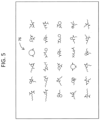
- FIG. 5 exemplifies a part 76 of the plurality of the molecular structures extracted from the compound database.
- a configuration may be employed in which a plurality of molecular structures are artificially created in a molecular structure creator 102, and are supplied to the prediction model 22B.
- each created molecular structure is converted to the data 96 representing the graph structure, and the data 96 are supplied to the prediction model 22B.
- the secondary library producer 32 produces the secondary library 54 based on the plurality of molecular structures 92A which are input to the prediction model 22B, and the plurality of predicted mass spectra 100A which are output from the prediction model 22B.
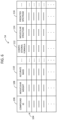
- FIG. 6 shows an example of the secondary library 54.
- the secondary library 54 is formed from a plurality of records 104.
- Each record 104 includes a compound ID 106, a molecular weight 108, an accurate mass 110, a compositional formula 112, a molecular structure 114, a predicted spectrum 116, and the like.
- the molecular weight 108 is not used in the secondary search, the molecular weight may be omitted. In either case, information necessary for execution of the secondary search is registered in the secondary library 54.
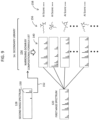
- FIG. 7 shows an operation of the sample analyzing apparatus according to an embodiment of the present disclosure; that is, a sample analyzing algorithm according to an embodiment of the present disclosure.
- Reference numeral 46A shows the primary search.
- Reference numeral 52A shows the secondary search.
- the primary library 48 is searched based on a first mass spectrum 120 (sample EI mass spectrum). Specifically, the first mass spectrum 120 is compared with a plurality of standard mass spectra 122, to thereby calculate a plurality of degrees of similarity 126. Judgment 50A is judgment of enlargement of the search range based on the plurality of degrees of similarity 126. When the enlargement of the search range is not judged, the result of the primary search is sent to a display process 60A.
- a molecular ion peak 130 included in a second mass spectrum 128 is identified.
- An accurate mass 56A is identified based on the molecular ion peak 130.
- a compositional formula list 58A is produced based on the accurate mass 56A.
- the secondary library 54 is referred to as necessary (refer to reference numeral 132).
- a compositional formula 138A is identified which matches a compositional formula in the compositional formula list 58A, from the plurality of compositional formulae 138 in the secondary library 54.
- a target of search based on the first mass spectrum 120 is narrowed down to a part 142 in the secondary library 54.
- This process is a narrowing-down process based on the sample molecular information.
- the secondary search is executed with respect to the part 142 in the secondary library 54 based on the first mass spectrum 120. Specifically, a plurality of degrees of similarity 144 are calculated between the first mass spectrum 120 and the plurality of predicted mass spectra 140A in the part 142.
- the result of the secondary search is sent to the display process 60A. For example, a plurality of records determined to be hits in the secondary search are sent to the display process 60A.
- S shows the degree of similarity
- mi shows an ith mass
- a i shows an ith intensity in the first mass spectrum
- P i shows an ith intensity in the predicted mass spectrum.
- the degree of similarity may be calculated using a calculation equation other than that described above.
- the above-described calculation equation or the like may be utilized when the degree of similarity is calculated in the primary search.
- the search based on the first mass spectrum may be executed first, and then, an intermediate search result identified by the search may be narrowed down based on the compositional formula list 58A.
- the matching based on the compositional formula list 58A and the matching based on the first mass spectrum may be executed simultaneously. In either case, as a result of the use of sample information other than the mass spectrum in the secondary search, the secondary search result can be appropriately narrowed down.
- FIG. 8 shows a specific example of the primary search.
- the primary library 48 includes the plurality of standard mass spectra 122 and a plurality of molecular structures 146 corresponding to a plurality of compounds.
- a plurality of degrees of similarity 148 are calculated between the first mass spectrum 120 and the plurality of standard mass spectra 122.
- the enlargement of the search range; that is, the execution of the secondary search, is judged when the plurality of degrees of similarity 148 do not satisfy a predetermined condition.
- FIG. 9 shows a specific example of the secondary search.
- the secondary library 54 includes a plurality of predicted mass spectra 140 and a plurality of molecular structures 156 corresponding to a plurality of compounds.
- An accurate mass 152 is identified based on a molecular ion peak included in the second mass spectrum 128, and a compositional formula list is produced based on the accurate mass.
- a plurality of degrees of similarity 158 are calculated between the first mass spectrum 120 and the plurality of predicted mass spectra.
- the target of the secondary search is narrowed down by the compositional formula list.
- a sequence of processes described above are executed for each component (compound) extracted from the original sample. An analysis result is displayed for each composition.
- the process described above may be applied also when the GC is not provided upstream of the mass spectrometer.
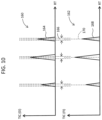
- FIG. 10 shows a process on the first mass spectrum array and the second mass spectrum array.
- An upper part of FIG. 10 shows a first total ion current chromatogram (TICC) 160 produced based on the first mass spectrum array, and a lower part of FIG. 10 shows a second TICC 162 produced based on the second mass spectrum array.
- the horizontal axis represents retention time (RT), and the vertical axis represents a total ion current (TIC).
- the first TICC 160 is produced by accumulating the mass spectra forming the first mass spectrum array.
- the second TICC 162 is produced by accumulating the mass spectra forming the second mass spectrum array.
- the first TICC 160 has a plurality of first peaks 164 corresponding to a plurality of components that are extracted.
- the second TICC 162 has a plurality of second peaks 168 corresponding to the plurality of extracted components.
- Each individual peak is identified using a peak detection technique. That is, each individual piece of component (compound) information is identified.
- correlation is executed between the plurality of first peaks 164 and the second peaks 168.
- a range 166 is set with the first peak 164 as a reference, and a second peak belonging to the range is identified as a pairing target.
- each second peak may be set as the reference.
- the plurality of first mass spectra arranged on the retention axis are accumulated, to thereby produce a first accumulated mass spectrum.
- the plurality of second mass spectra arranged on the retention axis are accumulated, to thereby produce a second accumulated mass spectrum.
- FIG. 11 shows a first accumulated mass spectrum 172 and a second accumulated mass spectrum 174 which are paired.
- a molecular ion peak 178 included in the second accumulated mass spectrum 174 is identified.
- the first accumulated mass spectrum 172 does not include a clear molecular ion peak (refer to reference numeral 176).
- An accurate mass 180 is identified based on (m/z) at which the molecular ion peak 178 is caused, and the compositional formula is estimated based on the accurate mass (refer to reference numeral 182).
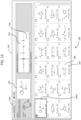
- FIG. 12 shows an image 184 showing the second search result.
- the image 184 includes a molecular structure list 186 formed from a plurality of molecular structures identified by the secondary search.
- the plurality of molecular structures are arranged in the order of magnitude of the degree of similarity.
- a score 189 indicating the degree of similarity is attached to each molecular structure 188.
- a state is shown in which a top molecular structure 188A is being selected.
- the image 184 includes an enlarged image 190 of the selected molecular structure.
- a field 198 shows the score attached to the selected molecular structure.
- a field 200 shows a rank of the selected molecular structure.
- a field 196 displays a compositional formula corresponding to the selected molecular structure.
- the image 184 includes a first mass spectrum 192 acquired from the sample, and a predicted mass spectrum 194 matched thereto.
- FIG. 13 shows a method of analyzing a sample according to an embodiment of the present disclosure.
- the first mass spectrum array is acquired.
- the second mass spectrum array is acquired.
- the peak pairing (correlation) is executed based on the first TICC produced from the first mass spectrum array and the second TICC produced from the second mass spectrum array. The correlation may alternatively be executed at another timing.
- the plurality of the first mass spectra are accumulated to produce the first accumulated mass spectrum.
- the plurality of second mass spectra are accumulated to produce the second accumulated mass spectrum.
- the first accumulated mass spectrum will be simply called a first mass spectrum
- the second accumulated mass spectrum will be simply called a second mass spectrum.
- the processes of S18 and S22 and on are executed for each component.
- the peak detection is executed with respect to the first mass spectrum, to produce a first peak list.
- the peak detection is executed with respect to the second mass spectrum, to produce a second peak list.
- a molecular ion peak is identified based on the second peak list. So long as the molecular ion peak can be identified in S26, S22 may be omitted.
- molecular information more specifically, a plurality of compositional formulae, is identified based on the molecular ion peak. Alternatively, as the molecular information, the molecular weight or the accurate mass may be identified.
- the primary search with respect to the primary library is executed based on the first mass spectrum (more specifically, the first peak list).
- the molecular information identified in S28 may be utilized. That is, the primary search with respect to the primary library may be executed based on the molecular information and the first mass spectrum.
- S32 the primary search result is evaluated. Specifically, necessity of the secondary search is judged. When it is judged that the secondary search is not necessary in S32, S38 is executed via S34, and the primary search result is displayed.
- S36 is executed via S34.
- S36 the secondary search with respect to the secondary library is executed based on the molecular information and the first mass spectrum. Then, in S38, the secondary search result is displayed.
- the plurality of degrees of similarity calculated by the secondary search do not satisfy a predetermined condition, non-registration may be judged, and the judgment may be notified to the user.
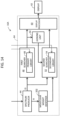
- FIG. 14 shows an information processing unit 16A according to a first alternative configuration.
- elements similar to those of FIG. 1 are assigned the same reference numerals. This is similarly true for FIGs. 15 and 16 to be described below.
- a molecular weight identifier 202 is provided for identifying a molecular weight (integer mass) based on the molecular ion peak included in the second mass spectrum.
- the secondary search with respect to the secondary library 54 is executed based on the molecular weight and the first mass spectrum.
- the molecular weight is used as the sample molecular information during the secondary search.
- the accurate mass may be used as the sample molecular information in place of the molecular weight.
- FIG. 15 shows a second alternative configuration.
- An ion source 38A included in the mass spectrometer 36 is an ion source following the EI method, and does not correspond to the soft ionization method.
- a spectrum producer 44A only the first mass spectrum serving as the EI mass spectrum is produced.
- the secondary search with respect to the secondary library 54 is executed based on the first mass spectrum.
- the structure of the sample analyzing apparatus can be simplified, and, in particular, the contents of the secondary library 54 can be simplified.
- narrowing-down by the molecular information is not possible in the secondary search.
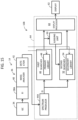
- FIG. 16 shows a third alternative configuration.
- An information processing unit 16C includes a spectrum predictor 26A.
- the spectrum predictor 26A realizes a function similar to that of the spectrum predictor 26 shown in FIG. 1 .
- the accurate mass identifier 56 identifies an accurate mass corresponding to the molecular ion peak based on the molecular ion peak in the second mass spectrum produced by the spectrum producer 44.
- a molecular structure estimator 59 estimates a plurality of molecular structures based on the accurate mass.
- the compound database 30 is referred to, or a secondary library 54A is referred to.
- a plurality of molecular structures are supplied to the prediction model 22B provided in the spectrum predictor 26A, to thereby produce a plurality of predicted mass spectra.
- the plurality of predicted mass spectra that are produced are registered in the secondary library 54A.
- a plurality of molecular structures corresponding to the plurality of predicted mass spectra are also registered in the secondary library 54A.
- the registration of the plurality of molecular structures may be omitted by referring to the compound database 30.
- the secondary library 54A has, for example, a structure shown in FIG. 6 .
- the second searcher 52 executes the secondary search with respect to the secondary library 54A based on the first mass spectrum.
- the secondary search result can be narrowed down based on the accurate mass prior to the secondary search. That is, only a plurality of predicted mass spectra which possibly correspond can be set as the target of search. With this configuration, reliability of the secondary search result can be improved.
- the molecular weight may be used in place of the accurate mass. However, when the molecular weight is used, in comparison to the case when the accurate mass is used, the number of predicted mass spectra that are produced is increased. When the time or burden for producing the plurality of predicted spectra are not ignorable, it is desirable to create the secondary library in advance. That is, the employment of the structure shown in FIG. 1 is desirable.
Landscapes
- Chemical & Material Sciences (AREA)
- Physics & Mathematics (AREA)
- Spectroscopy & Molecular Physics (AREA)
- Crystallography & Structural Chemistry (AREA)
- Life Sciences & Earth Sciences (AREA)
- Engineering & Computer Science (AREA)
- Bioinformatics & Cheminformatics (AREA)
- Bioinformatics & Computational Biology (AREA)
- Computing Systems (AREA)
- Theoretical Computer Science (AREA)
- Analytical Chemistry (AREA)
- Other Investigation Or Analysis Of Materials By Electrical Means (AREA)
Abstract
Description
- The present disclosure relates to a sample analyzing apparatus and method, and in particular to a technique for determining or estimating a molecular structure of a compound forming the sample.
- For identifying a compound (that is, determining a molecular structure of the compound), an EI mass spectrum library is used. For example, an EI mass spectrum library provided by the National Institute of Standards and Technology (NIST) includes EI mass spectra acquired through mass spectrometry of 300 thousand or more compounds.
- The EI mass spectrum is a mass spectrum acquired by performing mass spectrometry of a compound under application of an electron ionization (EI) method. The EI mass spectrum normally includes a relatively large number of fragment ion peaks. An EI mass spectrum acquired through the mass spectrometry of a sample is compared with a plurality of EI mass spectra in the EI mass spectrum library. Based on the result of comparison, a molecular structure of the compound forming the sample may be determined.
- For identifying the compound, a general compound database is also used. For example, in PubChem, which is a representative compound database, more than 100 million compounds are registered. If the compound database is used, the molecular structure of the compound forming the sample can be narrowed down based on a molecular weight, an accurate mass, or a compositional formula of the compound forming the sample. However, the EI mass spectrum is not registered in general compound databases.
- The number of registered compounds in the EI mass spectrum library is much smaller than the number of registered compounds in the compound database. In the compound identification using the EI mass spectrum library, often, a situation arises where there is no EI mass spectrum in the EI mass spectrum library that matches the EI mass spectrum acquired from the sample.
- Document 1 (
JP 6994921 B Document 1 is silent on a predicted mass spectrum. - Document 2 (Jennifer N. Wei et al., Rapid Prediction of Electron-Ionization Mass Spectrometry Using Neural Networks, ACS Publications, 2019, pp. 700-708) discloses an EI mass spectrum library. The EI mass spectrum library is formed from a plurality of measured EI mass spectra and a plurality of predicted EI mass spectra. A molecular fingerprint defined from the molecular structure of each compound is input to a prediction model, and the prediction model produces the predicted EI mass spectrum.
Document 2 does not describe stage-wise use of a measured EI mass spectrum library and a predicted EI mass spectrum library. - An advantage of the present disclosure lies in enlargement of a range of compounds which may be estimated in the estimation of the molecular structure through mass spectrum matching. Alternatively, an advantage of the present disclosure lies in distinguishingly using a plurality of kinds of mass spectrum libraries having different properties or performances. Alternatively, an advantage of the present disclosure lies in improvement of estimation precision in the molecular structure estimation using a predicted mass spectrum library.
- According to one aspect of the present disclosure, there is provided a sample analyzing apparatus comprising: a first storage unit configured to store a primary library having a plurality of standard mass spectra acquired from a plurality of compounds forming a first compound group, and a plurality of molecular structures corresponding to the plurality of standard mass spectra; a second storage unit configured to store a secondary library having a plurality of predicted mass spectra corresponding to a plurality of compounds forming a second compound group, and a plurality of molecular structures corresponding to the plurality of predicted mass spectra; a primary searcher configured to execute a primary search with respect to the primary library based on a sample mass spectrum acquired from a sample; a judging unit configured to judge enlargement of a search range based on a result of the primary search; and a secondary searcher configured to execute a secondary search with respect to the secondary library based on the sample mass spectrum, when it is judged that the search range is to be enlarged, to thereby estimate a molecular structure of the sample.
- According to another aspect of the present disclosure, there is provided a method of analyzing a sample, the method comprising: executing, based on a sample mass spectrum acquired from a sample, a primary search with respect to a primary library having a plurality of standard mass spectra acquired from a plurality of compounds forming a first compound group, and a plurality of molecular structures corresponding to the plurality of standard mass spectra; judging enlargement of a search range based on a result of the primary search; and executing, based on the sample mass spectrum, a secondary search with respect to a secondary library having a plurality of predicted mass spectra corresponding to a plurality of compounds forming a second compound group, and a plurality of molecular structures corresponding to the plurality of predicted mass spectra, when it is judged that the search range is to be enlarged, to thereby estimate a molecular structure of the sample.
- Embodiment(s) of the present disclosure will be described based on the following figures, wherein:
-
FIG. 1 is a block diagram showing a structure of a sample analyzing apparatus according to an embodiment of the present disclosure; -
FIG. 2 is a diagram showing a method of producing a model; -
FIG. 3 is a diagram showing an example of a primary library; -
FIG. 4 is a diagram showing a method of predicting a spectrum; -
FIG. 5 is a diagram showing an example of a plurality of molecular structures; -
FIG. 6 is a diagram showing an example of a secondary library; -
FIG. 7 is a diagram showing an operation of a sample analyzing apparatus according to an embodiment of the present disclosure; -
FIG. 8 is a diagram showing an example of a primary search; -
FIG. 9 is a diagram showing an example of a secondary search; -
FIG. 10 is a diagram for explaining correlation; -
FIG. 11 is a diagram showing an EI mass spectrum and an FI mass spectrum; -
FIG. 12 is a diagram showing an example of an image showing a result of secondary search; -
FIG. 13 is a flowchart showing a method of analyzing a sample according to an embodiment of the present disclosure; -
FIG. 14 is a block diagram showing a first alternative configuration; -
FIG. 15 is a block diagram showing a second alternative configuration; and -
FIG. 16 is a block diagram showing a third alternative configuration. - An embodiment of the present disclosure will now be described with reference to the drawings.
- A sample analyzing apparatus according to an embodiment of the present disclosure comprises a first storage unit, a second storage unit, a primary searcher, a judging unit, and a secondary searcher. The first storage unit stores a primary library. The primary library has a plurality of standard mass spectra acquired from a plurality of compounds forming a first compound group, and a plurality of molecular structures corresponding to the plurality of standard mass spectra. The second storage unit stores a secondary library. The secondary library has a plurality of predicted mass spectra corresponding to a plurality of compounds forming a second compound group, and a plurality of molecular structures corresponding to the plurality of predicted mass spectra. The primary searcher executes a primary search with respect to the primary library based on a sample mass spectrum acquired from a sample. The judging unit judges enlargement of a search range based on a result of the primary search. The secondary searcher executes a secondary search with respect to the secondary library based on the sample mass spectrum when it is judged that the search range is to be enlarged, to thereby estimate a molecular structure of the sample. The first storage unit corresponds to a first memory. The second storage unit corresponds to a second memory. A processor to be described below functions as the primary searcher, the judging unit, and the secondary searcher.
- In the structure described above, necessity of execution of the secondary search is determined based on the quality of the result of the primary search. When the result of the primary search is superior, a possibility that the compound forming the sample is registered in the primary library is high, and thus, execution of the secondary search is skipped. In this case, the search time can be shortened. On the other hand, when the result of the primary search is inferior, the secondary search is executed. That is, the search range is enlarged. With this configuration, it is possible to increase the possibility of identifying the compound forming the sample.
- In an embodiment of the present disclosure, the standard mass spectrum is a measured EI mass spectrum acquired through mass spectrometry of a compound. The predicted mass spectrum is an artificial EI mass spectrum predicted from a molecular structure of the compound. In general, the standard mass spectrum is more reliable than the predicted mass spectrum. Therefore, the primary search using the primary library is first executed, and then the secondary search using the secondary library is executed. The above-described configuration distinguishingly use two libraries in consideration of the respective advantages and disadvantages thereof. In the present disclosure, a sample is a compound to be analyzed. When a plurality of components are extracted from an original sample in gas chromatograph or the like, and each component is analyzed through mass spectrometry, each component is the compound to be analyzed; that is, the sample.
- The secondary library may be produced in advance, or the secondary library may be produced at the point in time when sample molecular information is identified, as will be described below. Each of the primary library and the secondary library corresponds to a database. Alternatively, a primary library and a secondary library stored on a storage device on a network may be utilized. Alternatively, a single storage unit may be caused to function as the first storage unit and the second storage unit.
- In an embodiment of the present disclosure, the plurality of predicted mass spectra are a plurality of mass spectra predicted from the plurality of molecular structures corresponding to the plurality of the compounds forming the second compound group. Alternatively, the predicted mass spectrum may be produced from the molecular structure using a learned prediction model (machine learning model).
- In an embodiment of the present disclosure, the first compound group and the second compound group differ from each other. Each compound forming the first compound group is a compound for which a measured mass spectrum is already acquired. Each compound forming the second compound group is a compound for which the measured mass spectrum is not yet acquired. An existing EI mass spectrum library may be used as the primary library, or the primary library may be produced by information extracted from an existing EI mass spectrum library. The secondary library may be formed from a plurality of molecular structures extracted from an existing compound database and a plurality of predicted mass spectra produced based on the molecular structures.
- In an embodiment of the present disclosure, the judging unit judges the enlargement of the search range based on a plurality of degrees of similarity calculated between the sample mass spectrum and the plurality of standard mass spectra. For example, when there is no item in the plurality of calculated degrees of similarity which satisfies a predetermined condition, it is highly likely that the compound forming the sample is not registered in the primary library. The enlargement of the search range is judged in such cases.
- In an embodiment of the present disclosure, when a result of the secondary search is displayed, a predicted mass spectrum determined to be a hit in the secondary search is displayed along with the sample mass spectrum. According to this structure, through a visual comparison of the sample mass spectrum and the predicted mass spectrum, it is possible to confirm that the secondary search is correctly executed, or to evaluate reliability of the result of the secondary search. The predicted mass spectrum to be displayed is, for example, a predicted mass spectrum which has resulted in the highest degree of similarity.
- In an embodiment of the present disclosure, the secondary searcher executes the secondary search in such a manner that a result of the secondary search is narrowed down by sample molecular information acquired through mass spectrometry of the sample. According to this configuration, estimation precision of the molecular structure can be improved by using both molecular information matching and mass spectrum matching. These matchings may be executed simultaneously or consecutively. In an embodiment of the present disclosure, the sample molecular information is at least one of a molecular weight, an accurate mass, or a compositional formula of the compound forming the sample.
- In an embodiment of the present disclosure, the secondary library has a plurality of pieces of compound molecular information corresponding to the plurality of compounds forming the second compound group. The secondary searcher executes the secondary search with respect to the secondary library based on the sample molecular information and the sample mass spectrum. By executing the molecular information matching in addition to the mass spectrum matching, it is possible to more effectively narrow down the result of the secondary search in comparison to the case in which only the mass spectrum matching is executed.
- In an embodiment of the present disclosure, the sample molecular information is identified based on a molecular ion peak included in another sample mass spectrum acquired from the same sample. For example, the sample mass spectrum is a mass spectrum acquired through application of a hard ionization method. The other sample mass spectrum is a mass spectrum acquired through application of a soft ionization method. The hard ionization method is an ionization method in which, in comparison to the soft ionization method, fragment ions tend to be more easily produced. The soft ionization method is an ionization method in which, in comparison to the hard ionization method, molecular ions tend to be more easily produced.
- In an embodiment of the present disclosure, the sample analyzing apparatus further includes a predictor configured to produce a plurality of predicted mass spectra based on the sample molecular information. The plurality of predicted mass spectra in the secondary library are the plurality of predicted mass spectra produced by the predictor. According to this configuration, a scale of the secondary library can be reduced, and the search time can be shortened. When it takes a significantly long time to produce the plurality of predicted mass spectra, a secondary library which is produced in advance is utilized. A processor to be described below functions as the predictor.
- According to another aspect of the present disclosure, there is provided a method of analyzing a sample, including a primary search step, a judging step, and a secondary search step. In the primary search step, a primary search with respect to a primary library is executed based on a sample mass spectrum acquired from a sample. The primary library has a plurality of standard mass spectra acquired from a plurality of compounds forming a first compound group, and a plurality of molecular structures corresponding to the plurality of standard mass spectra. In the judging step, enlargement of a search range is judged based on a result of the primary search. In the secondary search step, a secondary search with respect to a secondary library is executed based on the sample mass spectrum when it is judged that the search range is to be enlarged, to thereby estimate a molecular structure of the sample. The secondary library has a plurality of predicted mass spectra corresponding to a plurality of compounds forming a second compound group, and a plurality of molecular structures corresponding to the plurality of predicted mass spectra.
- The method of analyzing the sample described above is realized as a function of hardware or as a function of software. In the case of the latter, a program for executing the method of analyzing the sample described above is installed to an information processing apparatus via a network or a transportable recording medium. The concept of the "information processing apparatus" encompasses a computer, a sample analyzing apparatus, a mass spectrometry apparatus, and the like. The information processing apparatus has a recording medium which non-transitorily stores the program. In the following, the "mass spectrum" will simply be called a "spectrum" in some cases.
-
FIG. 1 shows a sample analyzing system according to an embodiment of the present disclosure. The sample analyzing system is formed from aninformation processing apparatus 10, and asample analyzing apparatus 12. Thesample analyzing apparatus 12 is more specifically a mass spectrometry apparatus, and is formed from ameasurer 14 and aninformation processing unit 16. - First, the
information processing apparatus 10 will be described. Theinformation processing apparatus 10 is formed from, for example, a computer having a processor and a memory. The processor is more specifically a CPU which executes a program. InFIG. 1 , a plurality of functions realized by the processor are represented by a plurality of blocks. Theinformation processing apparatus 10 has amodel producer 18, aprimary library producer 24, aspectrum predictor 26, and asecondary library producer 32. - The
model producer 18 produces aprediction model 22A for predicting an EI mass spectrum from a molecular structure of a compound. Themodel producer 18 is more specifically formed from a machine learner. During a machine learning process, a training data set acquired from an EImass spectrum library 20 is supplied to themodel producer 18. Theprediction model 22A thus produced is supplied to the spectrum predictor 26 (refer to reference numeral 28). Alternatively, themodel producer 18 and thespectrum predictor 26 may be integrated. - The
primary library producer 24 produces a primary library based on information acquired from the EImass spectrum library 20. The primary library is a database which is used in a primary search, which will be described later. The primary library includes a plurality of records corresponding to a plurality of first compounds forming a first compound group. Each record includes a standard mass spectrum (measured EI mass spectrum), a molecular structure, and the like. - The
spectrum predictor 26 produces a predicted mass spectrum from the molecular structure, and has a learnedprediction model 22B (machine learning model). A plurality of molecular structures from acompound database 30 are sequential supplied to thespectrum predictor 26. With this configuration, a plurality of predicted mass spectra (predicted EI mass spectra) are sequentially produced. The plurality of predicted mass spectra that are produced and the plurality of molecular structures corresponding thereto are supplied to thesecondary library producer 32. - The
secondary library producer 32 produces a secondary library based on information acquired from thecompound database 30 and a plurality of predicted mass spectra which are produced. The secondary library is a database used in a secondary search to be described later. The secondary library includes a plurality of records corresponding to a plurality of second compounds. Each record includes the predicted mass spectrum (predicted EI mass spectrum), compound molecular information (molecular weight, accurate mass, compositional formula), the molecular structure, and the like. - As shown in
FIG. 1 , the primary library and the secondary library which are produced are transferred (copied) to the sample analyzing apparatus 12 (refer toreference numerals 49 and 55). - The EI
mass spectrum library 20 described above is, for example, an EI mass spectrum library provide by the NIST. Alternatively, other EI mass spectrum libraries may be utilized. Thecompound database 30 described above is, for example, PubChem described above. Alternatively, other compound databases may be utilized. - In an embodiment of the present disclosure, the first compound group is formed from a plurality of compounds registered in the EI mass spectrum library. The second compound group is formed from a plurality of compounds which are registered in the compound database and which are not registered in the EI mass spectrum library. In other words, the first compound group and the second compound group do not overlap each other, and differ from each other. Alternatively, the two compound groups may partially overlap with each other as necessary.
- Next, the
sample analyzing apparatus 12 will be described. As described above, thesample analyzing apparatus 12 is formed from themeasurer 14 and theinformation processing unit 16. Aninformation processing unit 64 has a processor and a memory. The processor is more specifically a CPU which executes a program. InFIG. 1 , a plurality of functions realized by the processor are represented by a plurality of blocks. - The
measurer 14 is formed from a gas chromatograph (GC) 34 and amass spectrometer 36. In theGC 34, a plurality of components that are timewise separated are created from the original sample. The plurality of components are sequentially introduced to themass spectrometer 36. When viewed from themass spectrometer 36, each component is a compound to be analyzed; that is, a sample. - The
mass spectrometer 36 has anion source 38, amass analyzer 40, and adetector 42. In an embodiment of the present disclosure, theion source 38 functions as an EI ion source following an electron ionization (EI) method, and as an FI ion source following an field ionization (FI) method. The EI method is a typical hard ionization method. The FI method is a typical soft ionization method. Examples of other soft ionization methods include a chemical ionization (CI) method. The hard ionization method is an ionization method in which, in comparison to the soft ionization method, fragment ions tend to more easily produced. The soft ionization method is an ionization method in which, in comparison to the hard ionization method, molecular ions tend to be more easily detected. - The
mass analyzer 40 applies mass analysis of ions from the ion source. Themass analyzer 40 is formed from, for example, a time-of-flight type mass analyzer, or a quadrupole type mass analyzer. Alternatively, themass analyzer 40 may be formed from other mass analyzers. Thedetector 42 detects ions passing through themass analyzer 40. A detection signal from thedetector 42 is sent through an electronic circuit (not shown) to theinformation processing unit 64. - In an embodiment of the present disclosure, first, the EI method is selected, and mass spectrometry is sequentially executed under the EI method on a plurality of components sequentially introduced from the
GC 34. With this process, a first mass spectrum array is acquired. Then, the FI method is selected, and mass spectrometry is sequentially executed under the FI method on a plurality of components (which are basically identical to the plurality of components described previously) sequentially introduced from the GC. With this process, a second mass spectrum array is acquired. Alternatively, when the secondary search to be described below is not to be executed, the acquisition of the second mass spectrum array may be omitted. - In the illustrated example structure, the
information processing unit 64 has aspectrum producer 44, afirst searcher 46, a judgingunit 50, asecond searcher 52, anaccurate mass identifier 56, acompositional formula estimator 58, adisplay processor 60, and the like. Thefirst searcher 46 executes the primary search using aprimary library 48. Thefirst searcher 46 manages theprimary library 48. Thesecond searcher 52 executes the secondary search using asecondary library 54. Thesecond searcher 52 manages thesecondary library 54. In reality, theprimary library 48 is stored in a first memory provided in thefirst searcher 46, and thesecondary library 54 is stored in a second memory provided in thesecond searcher 52. - A
display 62 displays an image showing a result of the primary search or an image showing a result of the secondary search. Thedisplay 62 is formed from, for example, an LCD. While an inputting device is connected to theinformation processing unit 64, illustration thereof is omitted. - The
information processing unit 64 will now be described in further detail. Thespectrum producer 44 produces a mass spectrum based on a detection signal from themeasurer 14. More specifically, thespectrum producer 44 produces the first mass spectrum array based on the detection signal acquired under the EI method, and produces the second mass spectrum array based on the detection signal acquired under the FI method. Normally, the EI method is first executed, and the FI method is then executed. That is, the first mass spectrum array is first produced, and the second mass spectrum array is next produced. Alternatively, thespectrum producer 44 may be provided within themeasurer 14. - The
spectrum producer 44 also functions as a spectrum processing unit. That is, thespectrum producer 44 also has a function to correlate the first mass spectrum array and the second mass spectrum array, and a function to produce an accumulated mass spectrum for each component based on the mass spectrum array. These functions will be described later. - In the following, processing of the first mass spectrum and the second mass spectrum acquired from a certain unknown component (certain unknown compound) will be primarily described. The first mass spectrum is an accumulated EI mass spectrum, and the second mass spectrum is an accumulated FI mass spectrum. These mass spectra are both sample mass spectra.
- First, the
first searcher 46 functions. Thefirst searcher 46 executes the primary search with respect to theprimary library 48 based on the first mass spectrum. Specifically, the first mass spectrum is compared with a plurality of standard mass spectra in theprimary library 48, to thereby calculate a plurality of degrees of similarity. Alternatively, in thefirst searcher 46, in addition to the mass spectrum matching, a compositional formula matching may be executed. With such a configuration, precision of identifying the compound can be improved. - The judging
unit 50 judges enlargement of a search range based on the plurality of degrees of similarity which are calculated. Specifically, the judgingunit 50 judges the enlargement of the search range; that is, execution of the secondary search, when the plurality of calculated degrees of similarity do not include an item that satisfies a predetermined condition; that is, when a possibility that the compound to be measured is included in the first compound group registered in theprimary library 48 is low. On the other hand, the judgingunit 50 judges skipping of the execution of the secondary search when the plurality of calculated degrees of similarity include an item that satisfies the predetermined condition; that is, when the possibility that the compound to be measured is included in the first compound group is high. When the compositional formula matching is executed in addition to the spectrum matching in thefirst searcher 46, the judgingunit 50 may judge the enlargement of the search range based on the result of the spectrum matching and the result of the compositional formula matching. - When the secondary search is to be skipped, the result of the primary search is employed, and is sent to the
display processor 60. The result of the primary search is formed from a plurality of pieces of information arranged in the order of magnitude of the degree of similarity. Each piece of information includes the degree of similarity, the molecular structure, the standard mass spectrum, and the like. - As the predetermined condition described above, arbitrary conditions may be determined. For example, when the degree of similarity varies from 1 to 1000 (with 1000 being the best degree of similarity), a condition that the plurality of the calculated degrees of similarity include a degree of similarly greater than or equal to 750 may be defined as the predetermined condition.
- The
accurate mass identifier 56 identifies a molecular ion peak included in the second mass spectrum prior to the secondary search, and identifies the accurate mass corresponding to the molecular ion peak. In this case, the molecular ion peak may be designated by the user, or may be automatically determined. - The
compositional formula estimator 58 identifies one or a plurality of compositional formulae (one or a plurality of compositional formula candidates) from the identified accurate mass, prior to the secondary search. A compositional formula list is formed by the one or plurality of compositional formulae. For example, a range which takes an error into consideration is designated with respect to the accurate mass, and a large number of compositional formulae are identified based on the range. Alternatively, thecompositional formula estimator 58 may identify one or a plurality of compositional formulae based on the accurate mass and a result of isotope pattern matching (degree of match). In identifying the compositional formula, thesecondary library 54 is referred to. In this process, the compound database may be referred to. Each individual compositional formula may be called sample molecular information. Examples of other pieces of sample molecular information include the molecular weight and the accurate mass. The sample molecular information will be described later. - The
second searcher 52 executes the secondary search with respect to thesecondary library 54 based on the one or plurality of compositional formulae which are estimated, and the first mass spectrum. In this manner, in an embodiment of the present disclosure, the compositional formula matching is employed in combination and in addition to the mass spectrum matching. With this configuration, the result of the secondary search is narrowed down. Even when the prediction precision for the plurality of predicted mass spectra included in thesecondary library 54 is low, with the use of the sample molecular information in the secondary search, the precision of the secondary search can be improved. The result of the secondary search is sent to thedisplay processor 60. The result of the secondary search is formed from a plurality of pieces of information arranged in the order of magnitude of the degree of similarity. Each piece of information includes the degree of similarity, the molecular structure, the predicted mass spectrum, and the like. - The
display processor 60 has a function to produce an image representing the result of the primary search and an image representing the result of the secondary search. Thedisplay 62 displays the image representing the primary search result or the image representing the secondary search result. Alternatively, a judgment result of the judgingunit 50 may be displayed on thedisplay 62. - The structures described above will now be described in more detail.
FIG. 2 shows production of the prediction model.FIG. 2 shows an operation of themodel producer 18. - A
training data set 66 is extracted from the EImass spectrum library 20. Thetraining data set 66 is formed from a plurality of pieces oftraining data 68 corresponding to a plurality of first compounds. Each piece oftraining data 68 is formed from amolecular structure 70 and anEI mass spectrum 72. A plurality of pieces oftraining data 68 are sequentially supplied to theprediction model 22A (learner). In an embodiment of the present disclosure, eachmolecular structure 70 is converted intodata 74 having a graph structure, and thedata 74 are supplied to theprediction model 22A. Various methods of expressing the molecular structure are known. For example, there are known a MOL SDF file format, linear expression methods such as SMILES and SMARTS, and the like. - With progress of the machine learning, the prediction performance of the
prediction model 22A is gradually improved. In an embodiment of the present disclosure, theprediction model 22A is formed from Graph Convolutional Networks. Alternatively, theprediction model 22A may be formed from other machine learning models. The producedprediction model 22A is supplied to the spectrum predictor. When the predicted mass spectrum is produced in the sample analyzing apparatus, the producedprediction model 22A is sent to the sample analyzing apparatus. This configuration will be described later with reference toFIG. 16 . - The
primary library producer 24 produces theprimary library 48 based on the information extracted from the EI mass spectrum library. The producedprimary library 48 is transferred to the sample analyzing apparatus. -
FIG. 3 shows an example of theprimary library 48. In the illustrated example structure, theprimary library 48 is formed from a plurality ofrecords 78. Eachrecord 78 includes acompound ID 80, amolecular weight 82, anaccurate mass 84, acompositional formula 86, amolecular structure 88, astandard spectrum 90, and the like. Alternatively, information other than themolecular structure 88 and thestandard spectrum 90 may be omitted. -
FIG. 4 shows prediction of a mass spectrum.FIG. 4 shows an operation of thespectrum predictor 26. - A plurality of
molecular structures 92 are extracted from thecompound database 30, and are sequentially supplied to the trainedprediction model 22B. With this process, a plurality of predictedmass spectra 100A are sequentially produced. In an embodiment of the present disclosure, eachmolecular structure 92 is converted todata 96 representing a graph structure, and thedata 96 are input to theprediction model 22B.FIG. 5 exemplifies apart 76 of the plurality of the molecular structures extracted from the compound database. - In
FIG. 4 , a configuration may be employed in which a plurality of molecular structures are artificially created in amolecular structure creator 102, and are supplied to theprediction model 22B. In this case also, each created molecular structure is converted to thedata 96 representing the graph structure, and thedata 96 are supplied to theprediction model 22B. - The
secondary library producer 32 produces thesecondary library 54 based on the plurality ofmolecular structures 92A which are input to theprediction model 22B, and the plurality of predictedmass spectra 100A which are output from theprediction model 22B. -
FIG. 6 shows an example of thesecondary library 54. In the illustrated example structure, thesecondary library 54 is formed from a plurality ofrecords 104. Eachrecord 104 includes acompound ID 106, amolecular weight 108, anaccurate mass 110, acompositional formula 112, amolecular structure 114, a predictedspectrum 116, and the like. When themolecular weight 108 is not used in the secondary search, the molecular weight may be omitted. In either case, information necessary for execution of the secondary search is registered in thesecondary library 54. -
FIG. 7 shows an operation of the sample analyzing apparatus according to an embodiment of the present disclosure; that is, a sample analyzing algorithm according to an embodiment of the present disclosure.Reference numeral 46A shows the primary search.Reference numeral 52A shows the secondary search. - The
primary library 48 is searched based on a first mass spectrum 120 (sample EI mass spectrum). Specifically, thefirst mass spectrum 120 is compared with a plurality of standardmass spectra 122, to thereby calculate a plurality of degrees ofsimilarity 126.Judgment 50A is judgment of enlargement of the search range based on the plurality of degrees ofsimilarity 126. When the enlargement of the search range is not judged, the result of the primary search is sent to adisplay process 60A. - A
molecular ion peak 130 included in a second mass spectrum 128 (sample FI mass spectrum) is identified. Anaccurate mass 56A is identified based on themolecular ion peak 130. Acompositional formula list 58A is produced based on theaccurate mass 56A. In this process, thesecondary library 54 is referred to as necessary (refer to reference numeral 132). - In the
secondary search 52A, for example, acompositional formula 138A is identified which matches a compositional formula in thecompositional formula list 58A, from the plurality ofcompositional formulae 138 in thesecondary library 54. With this process, a target of search based on thefirst mass spectrum 120 is narrowed down to apart 142 in thesecondary library 54. This process is a narrowing-down process based on the sample molecular information. The secondary search is executed with respect to thepart 142 in thesecondary library 54 based on thefirst mass spectrum 120. Specifically, a plurality of degrees ofsimilarity 144 are calculated between thefirst mass spectrum 120 and the plurality of predictedmass spectra 140A in thepart 142. The result of the secondary search is sent to thedisplay process 60A. For example, a plurality of records determined to be hits in the secondary search are sent to thedisplay process 60A. - For the calculation of the degree of similarity, for example, the following calculation equation is used.

- In the calculation equation described above, S shows the degree of similarity, mi shows an ith mass, Ai shows an ith intensity in the first mass spectrum, and Pi shows an ith intensity in the predicted mass spectrum.
- Alternatively, the degree of similarity may be calculated using a calculation equation other than that described above. The above-described calculation equation or the like may be utilized when the degree of similarity is calculated in the primary search.
- Alternatively, the search based on the first mass spectrum may be executed first, and then, an intermediate search result identified by the search may be narrowed down based on the
compositional formula list 58A. Alternatively, the matching based on thecompositional formula list 58A and the matching based on the first mass spectrum may be executed simultaneously. In either case, as a result of the use of sample information other than the mass spectrum in the secondary search, the secondary search result can be appropriately narrowed down. -
FIG. 8 shows a specific example of the primary search. Theprimary library 48 includes the plurality of standardmass spectra 122 and a plurality ofmolecular structures 146 corresponding to a plurality of compounds. A plurality of degrees of similarity 148 (scores) are calculated between thefirst mass spectrum 120 and the plurality of standardmass spectra 122. The enlargement of the search range; that is, the execution of the secondary search, is judged when the plurality of degrees ofsimilarity 148 do not satisfy a predetermined condition. -
FIG. 9 shows a specific example of the secondary search. Thesecondary library 54 includes a plurality of predictedmass spectra 140 and a plurality ofmolecular structures 156 corresponding to a plurality of compounds. Anaccurate mass 152 is identified based on a molecular ion peak included in thesecond mass spectrum 128, and a compositional formula list is produced based on the accurate mass. - A plurality of degrees of
similarity 158 are calculated between thefirst mass spectrum 120 and the plurality of predicted mass spectra. In an embodiment of the present disclosure, in the secondary search, as shown byreference numeral 154, the target of the secondary search is narrowed down by the compositional formula list. - A sequence of processes described above are executed for each component (compound) extracted from the original sample. An analysis result is displayed for each composition. The process described above may be applied also when the GC is not provided upstream of the mass spectrometer.
-
FIG. 10 shows a process on the first mass spectrum array and the second mass spectrum array. An upper part ofFIG. 10 shows a first total ion current chromatogram (TICC) 160 produced based on the first mass spectrum array, and a lower part ofFIG. 10 shows asecond TICC 162 produced based on the second mass spectrum array. The horizontal axis represents retention time (RT), and the vertical axis represents a total ion current (TIC). - The
first TICC 160 is produced by accumulating the mass spectra forming the first mass spectrum array. Similarly, thesecond TICC 162 is produced by accumulating the mass spectra forming the second mass spectrum array. Thefirst TICC 160 has a plurality offirst peaks 164 corresponding to a plurality of components that are extracted. Similarly, thesecond TICC 162 has a plurality ofsecond peaks 168 corresponding to the plurality of extracted components. Each individual peak is identified using a peak detection technique. That is, each individual piece of component (compound) information is identified. - Next, correlation (pairing) is executed between the plurality of
first peaks 164 and the second peaks 168. In this process, for example, for eachfirst peak 164, arange 166 is set with thefirst peak 164 as a reference, and a second peak belonging to the range is identified as a pairing target. Alternatively, each second peak may be set as the reference. - For each component, the plurality of first mass spectra arranged on the retention axis are accumulated, to thereby produce a first accumulated mass spectrum. Similarly, for each component, the plurality of second mass spectra arranged on the retention axis are accumulated, to thereby produce a second accumulated mass spectrum. For each spectrum pair formed from the first accumulated mass spectrum and the second accumulated mass spectrum, the sequence of processes described above are applied.
-
FIG. 11 shows a first accumulatedmass spectrum 172 and a second accumulatedmass spectrum 174 which are paired. Through comparison of the first accumulatedmass spectrum 172 and the second accumulatedmass spectrum 174, amolecular ion peak 178 included in the second accumulatedmass spectrum 174 is identified. In the illustrated example configuration, the first accumulatedmass spectrum 172 does not include a clear molecular ion peak (refer to reference numeral 176). Anaccurate mass 180 is identified based on (m/z) at which themolecular ion peak 178 is caused, and the compositional formula is estimated based on the accurate mass (refer to reference numeral 182). -
FIG. 12 shows animage 184 showing the second search result. Theimage 184 includes amolecular structure list 186 formed from a plurality of molecular structures identified by the secondary search. The plurality of molecular structures are arranged in the order of magnitude of the degree of similarity. Ascore 189 indicating the degree of similarity is attached to eachmolecular structure 188. Currently, a state is shown in which a topmolecular structure 188A is being selected. - The
image 184 includes anenlarged image 190 of the selected molecular structure. Afield 198 shows the score attached to the selected molecular structure. Afield 200 shows a rank of the selected molecular structure. Afield 196 displays a compositional formula corresponding to the selected molecular structure. Theimage 184 includes afirst mass spectrum 192 acquired from the sample, and a predictedmass spectrum 194 matched thereto. -
FIG. 13 shows a method of analyzing a sample according to an embodiment of the present disclosure. In S10, the first mass spectrum array is acquired. Meanwhile, in S12, the second mass spectrum array is acquired. In S14, the peak pairing (correlation) is executed based on the first TICC produced from the first mass spectrum array and the second TICC produced from the second mass spectrum array. The correlation may alternatively be executed at another timing. - In
S 16, for each component, the plurality of the first mass spectra are accumulated to produce the first accumulated mass spectrum. In S20, for each component, the plurality of second mass spectra are accumulated to produce the second accumulated mass spectrum. In the following, the first accumulated mass spectrum will be simply called a first mass spectrum, and the second accumulated mass spectrum will be simply called a second mass spectrum. As shown byreference numeral 204, the processes of S18 and S22 and on are executed for each component. - In
S 18, the peak detection is executed with respect to the first mass spectrum, to produce a first peak list. In S22, the peak detection is executed with respect to the second mass spectrum, to produce a second peak list. - In S26, a molecular ion peak is identified based on the second peak list. So long as the molecular ion peak can be identified in S26, S22 may be omitted. In S28, molecular information, more specifically, a plurality of compositional formulae, is identified based on the molecular ion peak. Alternatively, as the molecular information, the molecular weight or the accurate mass may be identified.
- In S30, the primary search with respect to the primary library is executed based on the first mass spectrum (more specifically, the first peak list). In the primary search, the molecular information identified in S28 may be utilized. That is, the primary search with respect to the primary library may be executed based on the molecular information and the first mass spectrum. With the use of the molecular information in the primary search, the precision of the primary search can be improved and judgment precision by the judging unit can be improved.
- In S32, the primary search result is evaluated. Specifically, necessity of the secondary search is judged. When it is judged that the secondary search is not necessary in S32, S38 is executed via S34, and the primary search result is displayed.
- On the other hand, when it is judged that the secondary search is necessary in S32; that is, when the enlargement of the search range is judged, S36 is executed via S34. In S36, the secondary search with respect to the secondary library is executed based on the molecular information and the first mass spectrum. Then, in S38, the secondary search result is displayed. When the plurality of degrees of similarity calculated by the secondary search do not satisfy a predetermined condition, non-registration may be judged, and the judgment may be notified to the user.
-
FIG. 14 shows aninformation processing unit 16A according to a first alternative configuration. InFIG. 14 , elements similar to those ofFIG. 1 are assigned the same reference numerals. This is similarly true forFIGs. 15 and16 to be described below. - In the first alternative configuration shown in
FIG. 14 , amolecular weight identifier 202 is provided for identifying a molecular weight (integer mass) based on the molecular ion peak included in the second mass spectrum. In thesecond searcher 52, the secondary search with respect to thesecondary library 54 is executed based on the molecular weight and the first mass spectrum. In the first alternative configuration, the molecular weight is used as the sample molecular information during the secondary search. Alternatively, the accurate mass may be used as the sample molecular information in place of the molecular weight. -
FIG. 15 shows a second alternative configuration. Anion source 38A included in themass spectrometer 36 is an ion source following the EI method, and does not correspond to the soft ionization method. In aspectrum producer 44A, only the first mass spectrum serving as the EI mass spectrum is produced. In thesecond searcher 52, the secondary search with respect to thesecondary library 54 is executed based on the first mass spectrum. - In the manner described above, it is also possible to execute the secondary search without the use of the molecular information. According to the second alternative configuration, the structure of the sample analyzing apparatus can be simplified, and, in particular, the contents of the
secondary library 54 can be simplified. On the other hand, according to the second alternative configuration, narrowing-down by the molecular information is not possible in the secondary search. When a high estimation precision is desired, it is more desirable to employ the structure ofFIG. 1 . -
FIG. 16 shows a third alternative configuration. Aninformation processing unit 16C includes aspectrum predictor 26A. Thespectrum predictor 26A realizes a function similar to that of thespectrum predictor 26 shown inFIG. 1 . - Specifically, the
accurate mass identifier 56 identifies an accurate mass corresponding to the molecular ion peak based on the molecular ion peak in the second mass spectrum produced by thespectrum producer 44. Amolecular structure estimator 59 estimates a plurality of molecular structures based on the accurate mass. In this process, thecompound database 30 is referred to, or asecondary library 54A is referred to. - A plurality of molecular structures are supplied to the
prediction model 22B provided in thespectrum predictor 26A, to thereby produce a plurality of predicted mass spectra. The plurality of predicted mass spectra that are produced are registered in thesecondary library 54A. In this process, a plurality of molecular structures corresponding to the plurality of predicted mass spectra are also registered in thesecondary library 54A. The registration of the plurality of molecular structures may be omitted by referring to thecompound database 30. Thesecondary library 54A has, for example, a structure shown inFIG. 6 . Thesecond searcher 52 executes the secondary search with respect to thesecondary library 54A based on the first mass spectrum. - According to the third alternative configuration, the secondary search result can be narrowed down based on the accurate mass prior to the secondary search. That is, only a plurality of predicted mass spectra which possibly correspond can be set as the target of search. With this configuration, reliability of the secondary search result can be improved. Alternatively, the molecular weight may be used in place of the accurate mass. However, when the molecular weight is used, in comparison to the case when the accurate mass is used, the number of predicted mass spectra that are produced is increased. When the time or burden for producing the plurality of predicted spectra are not ignorable, it is desirable to create the secondary library in advance. That is, the employment of the structure shown in
FIG. 1 is desirable.
Claims (13)
- A sample analyzing apparatus (16, 16A, 16B, 16C) comprising:a first storage unit configured to store a primary library (48) having a plurality of standard mass spectra acquired from a plurality of compounds forming a first compound group, and a plurality of molecular structures corresponding to the plurality of standard mass spectra;a second storage unit configured to store a secondary library (54) having a plurality of predicted mass spectra corresponding to a plurality of compounds forming a second compound group, and a plurality of molecular structures corresponding to the plurality of predicted mass spectra;a primary searcher (46) configured to execute a primary search with respect to the primary library (48) based on a sample mass spectrum acquired from a sample;a judging unit (50) configured to judge enlargement of a search range based on a result of the primary search; anda secondary searcher (52) configured to execute a secondary search with respect to the secondary library (54) based on the sample mass spectrum, when it is judged that the search range is to be enlarged, to thereby estimate a molecular structure of the sample.
- The sample analyzing apparatus (16, 16A, 16B, 16C) according to claim 1, wherein
the plurality of predicted mass spectra are a plurality of mass spectra predicted from the plurality of molecular structures corresponding to the plurality of compounds forming the second compound group. - The sample analyzing apparatus (16, 16A, 16B, 16C) according to any preceding claim, wherein
the first compound group and the second compound group differ from each other. - The sample analyzing apparatus (16, 16A, 16B, 16C) according to any preceding claim, wherein
the judging unit (50) judges the enlargement of the search range based on a plurality of degrees of similarity calculated between the sample mass spectrum and the plurality of standard mass spectra. - The sample analyzing apparatus (16, 16A, 16B, 16C) according to any preceding claim, wherein
when a result of the secondary search is displayed, a predicted mass spectrum determined to be a hit in the secondary search is displayed along with the sample mass spectrum. - The sample analyzing apparatus (16, 16A, 16C) according to any preceding claim, wherein
the secondary searcher (52) executes the secondary search in such a manner that a result of the secondary search is narrowed down by sample molecular information acquired through mass spectrometry of the sample. - The sample analyzing apparatus (16, 16A, 16C) according to claim 6, wherein
the sample molecular information is at least one of a molecular weight, an accurate mass, or a compositional formula. - The sample analyzing apparatus (16, 16A, 16C) according to claim 6 or 7, whereinthe secondary library has a plurality of pieces of compound molecular information corresponding to the plurality of compounds forming the second compound group, andthe secondary searcher executes the secondary search with respect to the secondary library based on the sample molecular information and the sample mass spectrum.
- The sample analyzing apparatus (16, 16A, 16C) according to any one of claims 6 to 8, wherein
the sample molecular information is identified based on a molecular ion peak included in another sample mass spectrum acquired from the sample. - The sample analyzing apparatus (16, 16A, 16C) according to claim 9, whereinthe sample mass spectrum is a mass spectrum acquired through application of a hard ionization method, andthe other sample mass spectrum is a mass spectrum acquired through application of a soft ionization method.
- The sample analyzing apparatus (16C) according to any one of claims 6 to 9, further comprising:a predictor (26A) configured to produce a plurality of predicted mass spectra based on the sample molecular information, whereinthe plurality of predicted mass spectra in the secondary library are the plurality of predicted mass spectra produced by the predictor (26A).
- A method of analyzing a sample, the method comprising:executing (S30), based on a sample mass spectrum acquired from a sample, a primary search with respect to a primary library (48) having a plurality of standard mass spectra acquired from a plurality of compounds forming a first compound group, and a plurality of molecular structures corresponding to the plurality of standard mass spectra;judging (S32) enlargement of a search range based on a result of the primary search; andexecuting (S36), based on the sample mass spectrum, a secondary search with respect to a secondary library (54) having a plurality of predicted mass spectra corresponding to a plurality of compounds forming a second compound group, and a plurality of molecular structures corresponding to the plurality of predicted mass spectra, when it is judged that the search range is to be enlarged, to thereby estimate a molecular structure of the sample.
- A program for executing a method of analyzing a sample in an information processing apparatus (16), the program comprising the functions to:execute (46), based on a sample mass spectrum acquired from a sample, a primary search with respect to a primary library (48) having a plurality of standard mass spectra acquired from a plurality of compounds forming a first compound group, and a plurality of molecular structures corresponding to the plurality of standard mass spectra;judge (50) enlargement of a search range based on a result of the primary search; andexecute (52), based on the sample mass spectrum, a secondary search with respect to a secondary library (54) having a plurality of predicted mass spectra corresponding to a plurality of compounds forming a second compound group, and a plurality of molecular structures corresponding to the plurality of predicted mass spectra, when it is judged that the search range is to be enlarged, to thereby estimate a molecular structure of the sample.
Applications Claiming Priority (1)
| Application Number | Priority Date | Filing Date | Title |
|---|---|---|---|
| JP2022120745A JP7569821B2 (en) | 2022-07-28 | 2022-07-28 | Sample analysis device and method |
Publications (1)
| Publication Number | Publication Date |
|---|---|
| EP4312220A1 true EP4312220A1 (en) | 2024-01-31 |
Family
ID=87419326
Family Applications (1)
| Application Number | Title | Priority Date | Filing Date |
|---|---|---|---|
| EP23186097.4A Pending EP4312220A1 (en) | 2022-07-28 | 2023-07-18 | Sample analyzing apparatus and method |
Country Status (3)
| Country | Link |
|---|---|
| US (1) | US12476095B2 (en) |
| EP (1) | EP4312220A1 (en) |
| JP (1) | JP7569821B2 (en) |
Families Citing this family (2)
| Publication number | Priority date | Publication date | Assignee | Title |
|---|---|---|---|---|
| WO2026033961A1 (en) * | 2024-08-09 | 2026-02-12 | 株式会社島津製作所 | Apparatus and method for analyzing chromatogram data |
| CN119517179B (en) * | 2024-11-14 | 2025-10-03 | 上海交通大学 | Mass spectrum structure analysis method, device, storage medium and program product |
Citations (1)
| Publication number | Priority date | Publication date | Assignee | Title |
|---|---|---|---|---|
| JPH0694921B2 (en) | 1989-09-28 | 1994-11-24 | 出光興産株式会社 | Boiler control method and device |
Family Cites Families (9)
| Publication number | Priority date | Publication date | Assignee | Title |
|---|---|---|---|---|
| JPH10254352A (en) | 1997-03-07 | 1998-09-25 | Casio Comput Co Ltd | Structural formula display device, structural formula display method, and recording medium recording display control program |
| JP6110380B2 (en) | 2011-08-05 | 2017-04-05 | スミスズ ディテクション インコーポレイティド | Chemical identification using chromatographic retention indices |
| US9857377B2 (en) * | 2011-12-31 | 2018-01-02 | Bgi Tech Solutions Co., Ltd. | Method for quantification of proteome |
| EP2875518A1 (en) | 2012-07-18 | 2015-05-27 | Nederlandse Organisatie voor toegepast- natuurwetenschappelijk onderzoek TNO | New classification method for spectral data |
| EP3043175A4 (en) * | 2013-09-04 | 2016-08-31 | Shimadzu Corp | Data-processing apparatus for chromatography mass spectrometry |
| US11879879B2 (en) | 2017-01-30 | 2024-01-23 | Shimadzu Corporation | Spectrum data processing device |
| US10546736B2 (en) * | 2017-08-01 | 2020-01-28 | Protein Metrics Inc. | Interactive analysis of mass spectrometry data including peak selection and dynamic labeling |
| JP6994921B2 (en) | 2017-12-05 | 2022-01-14 | 日本電子株式会社 | Mass spectrometric data processing device and mass spectrometric data processing method |
| JP7562140B2 (en) | 2018-06-15 | 2024-10-07 | 学校法人沖縄科学技術大学院大学学園 | Method and system for identifying the structure of a compound |
-
2022
- 2022-07-28 JP JP2022120745A patent/JP7569821B2/en active Active
-
2023
- 2023-07-18 EP EP23186097.4A patent/EP4312220A1/en active Pending
- 2023-07-26 US US18/226,493 patent/US12476095B2/en active Active
Patent Citations (1)
| Publication number | Priority date | Publication date | Assignee | Title |
|---|---|---|---|---|
| JPH0694921B2 (en) | 1989-09-28 | 1994-11-24 | 出光興産株式会社 | Boiler control method and device |
Non-Patent Citations (4)
| Title |
|---|
| C.-Y. YEN ET AL: "Spectrum-to-Spectrum Searching Using a Proteome-wide Spectral Library", MOLECULAR & CELLULAR PROTEOMICS, vol. 10, no. 7, 1 July 2011 (2011-07-01), XP055059506, ISSN: 1535-9476, DOI: 10.1074/mcp.M111.007666 * |
| JENNIFER N WEI ET AL: "Rapid Prediction of Electron-Ionization Mass Spectrometry using Neural Networks", ARXIV.ORG, CORNELL UNIVERSITY LIBRARY, 201 OLIN LIBRARY CORNELL UNIVERSITY ITHACA, NY 14853, 21 November 2018 (2018-11-21), XP081123935, DOI: 10.1021/ACSCENTSCI.9B00085 * |
| JENNIFER N. WEI ET AL.: "Rapid Prediction of Electron-Ionization Mass Spectrometry Using Neural Networks", ACS PUBLICATIONS, 2019, pages 700 - 708 |
| ZHANG BAOJIE ET AL: "Prediction of electron ionization mass spectra based on graph convolutional networks", INTERNATIONAL JOURNAL OF MASS SPECTROMETRY, ELSEVIER SCIENCE PUBLISHERS , AMSTERDAM, NL, vol. 475, 20 February 2022 (2022-02-20), XP087005856, ISSN: 1387-3806, [retrieved on 20220220], DOI: 10.1016/J.IJMS.2022.116817 * |
Also Published As
| Publication number | Publication date |
|---|---|
| US12476095B2 (en) | 2025-11-18 |
| JP7569821B2 (en) | 2024-10-18 |
| JP2024017837A (en) | 2024-02-08 |
| US20240038513A1 (en) | 2024-02-01 |
Similar Documents
| Publication | Publication Date | Title |
|---|---|---|
| JP7026148B2 (en) | Data independent acquisition of generated ion spectrum and reference spectrum library matching | |
| US12476095B2 (en) | Sample analyzing apparatus and method | |
| US20240266001A1 (en) | Method and apparatus for identifying molecular species in a mass spectrum | |
| US20210247360A1 (en) | Method and system for identifying structure of compound | |
| US20240347141A1 (en) | Chemical peak finder model for unknown compound detection and identification | |
| US20230047202A1 (en) | Method and system for the identification of compounds in complex biological or environmental samples | |
| Adutwum et al. | Estimation of Start and Stop Numbers for Cluster Resolution Feature Selection Algorithm; An Empirical Approach using Null Distribution Analysis of Fisher Ratios | |
| US11735405B2 (en) | Mass spectrum processing apparatus and method | |
| JPWO2012095948A1 (en) | Mass spectrometry data analysis method, mass spectrometry data analysis apparatus, and mass spectrometry data analysis program | |
| US20240371474A1 (en) | Ion type tailored library search pre-processing, constraints and spectral database building | |
| CN114295766B (en) | Metabonomics data processing method and device based on stable isotope labeling | |
| JP2013057695A (en) | Mass spectrometric data analysis method | |
| US20240377369A1 (en) | Three-dimensional chemical peak finder for qualitative and quantitative analytical workflows | |
| Sotnezova et al. | Use of PLS discriminant analysis for revealing the absence of a compound in an electron ionization mass spectral database | |
| EP3971567A1 (en) | Apparatus and method for processing mass spectrum | |
| Wang et al. | MetaEval: Measuring the Discrimination of Benchmarks for Efficient LLM Evaluation | |
| US20240418685A1 (en) | Analysis Apparatus and Analysis Method | |
| EP4435793A2 (en) | Sample analyzing apparatus and method of creating pyrolysis product library | |
| US12578317B2 (en) | Learning data producing method, waveform analysis device, waveform analysis method, and recording medium | |
| Adeoye et al. | Application of the expert algorithm for substance identification (EASI) to the electron ionization (EI) mass spectra of fentanyl isomers and analogs | |
| EP4345826A1 (en) | Polymer analysis apparatus and method | |
| Gao et al. | Fuzzy-precise positioning: A pre-search algorithm based on feature peaks of mass spectra for acceleration of chemical compound recognition | |
| JP2022047013A (en) | Mass analysis system and method for correcting conversion formula | |
| CN115019889A (en) | Chemical probe identification and evaluation method and device | |
| Sun | Model-based biomarker detection and systematic analysis in translational science |
Legal Events
| Date | Code | Title | Description |
|---|---|---|---|
| PUAI | Public reference made under article 153(3) epc to a published international application that has entered the european phase |
Free format text: ORIGINAL CODE: 0009012 |
|
| STAA | Information on the status of an ep patent application or granted ep patent |
Free format text: STATUS: THE APPLICATION HAS BEEN PUBLISHED |
|
| AK | Designated contracting states |
Kind code of ref document: A1 Designated state(s): AL AT BE BG CH CY CZ DE DK EE ES FI FR GB GR HR HU IE IS IT LI LT LU LV MC ME MK MT NL NO PL PT RO RS SE SI SK SM TR |
|
| STAA | Information on the status of an ep patent application or granted ep patent |
Free format text: STATUS: REQUEST FOR EXAMINATION WAS MADE |
|
| 17P | Request for examination filed |
Effective date: 20240603 |
|
| RBV | Designated contracting states (corrected) |
Designated state(s): AL AT BE BG CH CY CZ DE DK EE ES FI FR GB GR HR HU IE IS IT LI LT LU LV MC ME MK MT NL NO PL PT RO RS SE SI SK SM TR |