EP4312155A1 - Method and system for calibrating machine learning models in fully homomorphic encryption applications - Google Patents
Method and system for calibrating machine learning models in fully homomorphic encryption applications Download PDFInfo
- Publication number
- EP4312155A1 EP4312155A1 EP23184975.3A EP23184975A EP4312155A1 EP 4312155 A1 EP4312155 A1 EP 4312155A1 EP 23184975 A EP23184975 A EP 23184975A EP 4312155 A1 EP4312155 A1 EP 4312155A1
- Authority
- EP
- European Patent Office
- Prior art keywords
- approximated
- function
- value
- model
- encrypted
- Prior art date
- Legal status (The legal status is an assumption and is not a legal conclusion. Google has not performed a legal analysis and makes no representation as to the accuracy of the status listed.)
- Pending
Links
Images


Classifications
-
- G—PHYSICS
- G06—COMPUTING OR CALCULATING; COUNTING
- G06N—COMPUTING ARRANGEMENTS BASED ON SPECIFIC COMPUTATIONAL MODELS
- G06N20/00—Machine learning
-
- G—PHYSICS
- G06—COMPUTING OR CALCULATING; COUNTING
- G06N—COMPUTING ARRANGEMENTS BASED ON SPECIFIC COMPUTATIONAL MODELS
- G06N3/00—Computing arrangements based on biological models
- G06N3/02—Neural networks
- G06N3/08—Learning methods
- G06N3/0985—Hyperparameter optimisation; Meta-learning; Learning-to-learn
-
- G—PHYSICS
- G06—COMPUTING OR CALCULATING; COUNTING
- G06N—COMPUTING ARRANGEMENTS BASED ON SPECIFIC COMPUTATIONAL MODELS
- G06N3/00—Computing arrangements based on biological models
- G06N3/02—Neural networks
- G06N3/04—Architecture, e.g. interconnection topology
- G06N3/045—Combinations of networks
-
- H—ELECTRICITY
- H04—ELECTRIC COMMUNICATION TECHNIQUE
- H04L—TRANSMISSION OF DIGITAL INFORMATION, e.g. TELEGRAPHIC COMMUNICATION
- H04L9/00—Cryptographic mechanisms or cryptographic arrangements for secret or secure communications; Network security protocols
- H04L9/008—Cryptographic mechanisms or cryptographic arrangements for secret or secure communications; Network security protocols involving homomorphic encryption
Definitions
- the disclosure herein generally relates to the field of cyber security and, more particularly, to a method and system for calibrating Machine Learning (ML) models in Fully Homomorphic Encryption (FHE) applications.
- ML Machine Learning
- FHE Fully Homomorphic Encryption
- Model calibration is a process of quantifying the quality of a system's predictions and evaluating Machine Learning (ML) models focuses on the overall performance of the model. Such calibrations include performance metrics and curves, and perhaps examples of incorrect predictions.
- Homomorphic encryption is one of the representative solutions to Privacy-Preserving Machine Learning (PPML) classification enabling the server to classify private data of clients while guaranteeing privacy.
- PPML Privacy-Preserving Machine Learning
- Calibrating a Fully Homomorphic Encryption (FHE) based ML model is challenging since either one of the ML model or the data used for training the ML model are in encrypted form. Generally, the evaluation of FHE based ML models are performed using approximated functions associated with the ML model.
- Embodiments of the present disclosure present technological improvements as solutions to one or more of the above-mentioned technical problems recognized by the inventors in conventional systems.
- a method for calibrating Machine Learning (ML) models in Fully Homomorphic Encryption (FHE) applications includes receiving by one or more hardware processors, a Machine Learning (ML) model to be calibrated, wherein the ML model to be calibrated belongs to one of a) unencrypted ML model trained with encrypted data b) encrypted ML model trained with encrypted data and c) encrypted ML model trained with unencrypted data.
- ML Machine Learning
- the method includes identifying, by the one or more hardware processors, a plurality of evaluation functions pertaining to the ML model, to be calibrated, using a pattern matching technique. Furthermore, the method includes generating, by the one or more hardware processors, an approximated function for each of the plurality of evaluation functions using a corresponding approximation technique. Furthermore, the method includes computing, by the one or more hardware processors, an Expected Calibration Error (ECE) value for the ML model based on a generated plurality of approximated functions using an approximated Broyden-Fletcher-Goldfarb-Shanno (BFGS) technique. Finally, the method includes evaluating, by the one or more hardware processors, the ML model based on the ECE value.
- ECE Expected Calibration Error
- a system for calibrating Machine Learning (ML) models in Fully Homomorphic Encryption (FHE) applications includes at least one memory storing programmed instructions, one or more Input /Output (I/O) interfaces, and one or more hardware processors operatively coupled to the at least one memory, wherein the one or more hardware processors are configured by the programmed instructions to receive a Machine Learning (ML) model to be calibrated, wherein the ML model to be calibrated belongs to one of a) unencrypted ML model trained with encrypted data b) encrypted ML model trained with encrypted data and c) encrypted ML model trained with unencrypted data.
- ML Machine Learning
- the one or more hardware processors are configured by the programmed instructions to identify a plurality of evaluation functions pertaining to the ML model, to be calibrated, using a pattern matching technique. Furthermore, the one or more hardware processors are configured by the programmed instructions to generate an approximated function for each of the plurality of evaluation functions using a corresponding approximation technique. Furthermore, the one or more hardware processors are configured by the programmed instructions to compute an Expected Calibration Error (ECE) value for the ML model based on a generated plurality of approximated functions using an approximated Broyden-Fletcher-Goldfarb-Shanno (BFGS) technique. Finally, the one or more hardware processors are configured by the programmed instructions to evaluate the ML model based on the ECE value.
- ECE Expected Calibration Error
- a computer program product including a non-transitory computer-readable medium having embodied therein a computer program for calibrating Machine Learning (ML) models in Fully Homomorphic Encryption (FHE) applications.
- the computer readable program when executed on a computing device, causes the computing device to receive a Machine Learning (ML) model to be calibrated, wherein the ML model to be calibrated belongs to one of a) unencrypted ML model trained with encrypted data b) encrypted ML model trained with encrypted data and c) encrypted ML model trained with unencrypted data.
- the computer readable program when executed on a computing device, causes the computing device to identify a plurality of evaluation functions pertaining to the ML model, to be calibrated, using a pattern matching technique. Furthermore, the computer readable program, when executed on a computing device, causes the computing device to generate an approximated function for each of the plurality of evaluation functions using a corresponding approximation technique. Furthermore, computer readable program, when executed on a computing device, causes the computing device to compute an Expected Calibration Error (ECE) value for the ML model based on a generated plurality of approximated functions using an approximated Broyden-Fletcher-Goldfarb-Shanno (BFGS) technique. Finally, the computer readable program, when executed on a computing device, causes the computing device to evaluate the ML model based on the ECE value.
- ECE Expected Calibration Error
- Embodiments herein provide a method and system for calibrating Machine Learning (ML) models in Fully Homomorphic Encryption (FHE) applications.
- the present disclosure provides a mechanism to evaluate ML models in FHE environment. Initially, the system receives a Machine Learning (ML) model to be calibrated.
- the ML model to be calibrated can be either encrypted or unencrypted.
- the inputs to the model can be either encrypted or unencrypted.
- the terms "calibration” and “evaluation” is used interchangeably throughout the document.
- a plurality of evaluation functions pertaining to the ML model to be calibrated are identified using a pattern matching technique. Further, an approximated function is generated for each of the plurality of evaluation functions using a corresponding approximation technique.
- an Expected Calibration Error (ECE) value is computed based on the plurality of approximated functions.
- ECE Expected Calibration Error
- the ML model is calibrated based on the computed ECE value. For example, a plurality of parameters associated with the ML model to be calibrated are adjusted based on the ECE value.
- the ECE value is computed after temperature scaling and hence the calibration error or ECE is less which further increases the confidence in calibration.
- FIGS. 1 through 3 where similar reference characters denote corresponding features consistently throughout the figures, there are shown preferred embodiments and these embodiments are described in the context of the following exemplary system and/or method.
- FIG. 1 is a functional block diagram for calibrating ML models in FHE applications, in accordance with some embodiments of the present disclosure.
- the system 100 includes or is otherwise in communication with hardware processors 102, at least one memory such as a memory 104, an I/O interface 112.
- the hardware processors 102, memory 104, and the Input /Output (I/O) interface 112 may be coupled by a system bus such as a system bus 108 or a similar mechanism.
- the hardware processors 102 can be one or more hardware processors.
- the I/O interface 112 may include a variety of software and hardware interfaces, for example, a web interface, a graphical user interface, and the like.
- the I/O interface 112 may include a variety of software and hardware interfaces, for example, interfaces for peripheral device(s), such as a keyboard, a mouse, an external memory, a printer and the like.
- the I/O interface 112 may enable the system 100 to communicate with other devices, such as web servers, and external databases.
- other devices comprises a plurality of sensors and a plurality of camera.
- the I/O interface 112 can facilitate multiple communications within a wide variety of networks and protocol types, including wired networks, for example, local area network (LAN), cable, etc., and wireless networks, such as Wireless LAN (WLAN), cellular, or satellite.
- the I/O interface 112 may include one or more ports for connecting several computing systems with one another or to another server computer.
- the I/O interface 112 may include one or more ports for connecting several devices to one another or to another server.
- the one or more hardware processors 102 may be implemented as one or more microprocessors, microcomputers, microcontrollers, digital signal processors, central processing units, node machines, logic circuitries, and/or any devices that manipulate signals based on operational instructions.
- the one or more hardware processors 102 is configured to fetch and execute computer-readable instructions stored in the memory 104.
- the memory 104 may include any computer-readable medium known in the art including, for example, volatile memory, such as static random access memory (SRAM) and dynamic random access memory (DRAM), and/or non-volatile memory, such as read only memory (ROM), erasable programmable ROM, flash memories, hard disks, optical disks, and magnetic tapes.
- volatile memory such as static random access memory (SRAM) and dynamic random access memory (DRAM)
- non-volatile memory such as read only memory (ROM), erasable programmable ROM, flash memories, hard disks, optical disks, and magnetic tapes.
- the memory 104 includes a plurality of modules 106.
- the memory 104 also includes a data repository (or repository) 110 for storing data processed, received, and generated by the plurality of modules 106.
- the plurality of modules 106 include programs or coded instructions that supplement applications or functions performed by the system 100 for calibrating ML models in FHE applications.
- the plurality of modules 106 can include routines, programs, objects, components, and data structures, which performs particular tasks or implement particular abstract data types.
- the plurality of modules 106 may also be used as, signal processor(s), node machine(s), logic circuitries, and/or any other device or component that manipulates signals based on operational instructions.
- the plurality of modules 106 can be used by hardware, by computer-readable instructions executed by the one or more hardware processors 102, or by a combination thereof.
- the plurality of modules 106 can include various sub-modules (not shown).
- the plurality of modules 106 may include computer-readable instructions that supplement applications or functions performed by the system 100 for the semantic navigation using spatial graph and trajectory history.
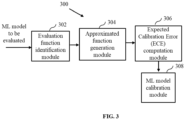
- the modules 106 includes an evaluation function identification module (shown in FIG. 3 ), an approximated function generation module (shown in FIG. 3 ), an ECE computation module (shown in FIG. 3 ) and an ML model evaluation module (shown in FIG. 3 ).
- FIG. 3 illustrates a functional architecture of the system of FIG. 1 , for calibrating ML models in FHE applications, in accordance with some embodiments of the present disclosure.
- the data repository (or repository) 110 may include a plurality of abstracted piece of code for refinement and data that is processed, received, or generated as a result of the execution of the plurality of modules in the module(s) 106.
- the data repository 110 is shown internal to the system 100, it will be noted that, in alternate embodiments, the data repository 110 can also be implemented external to the system 100, where the data repository 110 may be stored within a database (repository 110) communicatively coupled to the system 100.
- the data contained within such external database may be periodically updated. For example, new data may be added into the database (not shown in FIG. 1 ) and/or existing data may be modified and/or non-useful data may be deleted from the database.
- the data may be stored in an external system, such as a Lightweight Directory Access Protocol (LDAP) directory and a Relational Database Management System (RDBMS).
- LDAP Lightweight Directory Access Protocol
- RDBMS Relational Database Management System
- FIG. 2 is an exemplary flow diagram illustrating a method 200 for calibrating ML models in FHE applications implemented by the system of FIG. 1 according to some embodiments of the present disclosure.
- the system 100 includes one or more data storage devices or the memory 104 operatively coupled to the one or more hardware processor(s) 102 and is configured to store instructions for execution of steps of the method 200 by the one or more hardware processors 102.
- the steps of the method 200 of the present disclosure will now be explained with reference to the components or blocks of the system 100 as depicted in FIG. 1 and the steps of flow diagram as depicted in FIG. 2 .
- the method 200 may be described in the general context of computer executable instructions.
- computer executable instructions can include routines, programs, objects, components, data structures, procedures, modules, functions, etc., that perform particular functions or implement particular abstract data types.
- the method 200 may also be practiced in a distributed computing environment where functions are performed by remote processing devices that are linked through a communication network.
- the order in which the method 200 is described is not intended to be construed as a limitation, and any number of the described method blocks can be combined in any order to implement the method 200, or an alternative method.
- the method 200 can be implemented in any suitable hardware, software, firmware, or combination thereof.
- the one or more hardware processors 102 are configured by the programmed instructions to receive the ML model to be calibrated.
- the ML model to be calibrated belongs to one of a) unencrypted ML model trained with encrypted data b) encrypted ML model trained with encrypted data and c) encrypted ML model trained with unencrypted data.
- the dataset used for training the ML model includes textual data, tabular data, images and so on.
- the evaluation function identification module 302 executed by one or more hardware processors 102 is configured by the programmed instructions to identify the plurality of evaluation functions pertaining to the ML model to be calibrated using the pattern matching technique.
- the pattern matching technique compares a plurality of functions associated with the ML model to be calibrated with a plurality of predefined functions for which the approximation is to be generated.
- the plurality of functions associated with the ML model to be calibrated which matches with the plurality of predefined functions are identified.
- the plurality of predefined functions comprises a log loss function, an exponentiation function, a division by encrypted value function, a softmax function, a sign(x) function, an abs(x) function, a ReLU function, a minimum function, a maximum function, a line search function and a scalar function.
- the approximated function generation module 304 executed by the one or more hardware processors 102 is configured by the programmed instructions to generate the approximated function for each of the plurality of evaluation functions using the corresponding approximation technique.
- the approximated functions include an approximated log loss function, an approximated exponentiation function, an approximated division by encrypted value function, an approximated softmax function, an approximated sign(x) function, an approximated abs(x) function, an approximated ReLU function, a minimum approximation function, a maximum approximation function, an approximated line search function and an approximated scalar function.
- the approximated log loss function is a Taylor series expansion corresponding to the log loss function.
- Equation (1) indicates the log loss function and the corresponding approximated log function of the equation (1) is given in equation (2).
- x can be either p or (1 - p ).
- the approximated exponentiation function e x is a Maclaurin series expansion of the corresponding exponentiation function as given in equation (3).
- e x 1 + x + x 2 2 + x 3 6 + x 4 24 + x 5 120
- the approximated division by encrypted value function is obtained by generating an inverse of a denominator value and further multiplying by a numerator value, wherein the inverse is obtained using a Newton iterative method.
- the Newton iterative method is used for generating approximated values for real valued functions.
- the approximated abs ( x ) function given in equation (6) is obtained using a corresponding ReLU approximation of ' x '.
- the ReLU approximation is obtained using the pseudocode 1 given in Table I.
- 'a', 'b' and 'c' are coefficients of the corresponding polynomial used for approximation.
- the resultant value or the approximated ReLU value is obtained using the expression a + b ⁇ x + c ⁇ x 2 .
- abs x ReLU _ approx x + ReLU _ approx x * ⁇ 1 Table I
- res a + b*x + c*x 2 6. return res*7
- the approximated minimum function associated with a first value ' x ' and a second value ' y ' is obtained as follows. Initially, a corresponding ReLU approximation is computed based on a first difference ( x - y ) and a second difference ( y - x ). Further, a ReLU approximation sum value is computed based on the first difference ( x - y ) and the second difference ( y - x ). Further, an inverse of the ReLU approximation sum value is generated using the Newton iterate method. After that, a first coefficient and a second coefficient is computed based on the first difference and the second difference.
- the minimum approximation function corresponding to the first value and the second value is obtained by adding a first multiplicated value and a second multiplicative value.
- the first multiplicative value is obtained based on the first coefficient and the first value.
- the second multiplicative value is obtained based on the second coefficient and the second value.
- the pseudocode for generating the approximated minimum/maximum function is given in Table II and an example computation of minimum value using approximated maximum value is given in Table III.
- z1 ReLU_approx(y-x), 2.
- z2 ReLU_approx(x-y) 3.
- z z1+z2 4.
- z' newton_iterate_inverse(z) 5.
- a z1*z' ;
- b z2*z' 6.
- the maximum approximation function is obtained by swapping the coefficients 'a' and 'b' associated with the minimum approximation function.
- a max computation is given in Table IV. Now referring to Table IV, it is evident that the maximum value is obtained by swapping the coefficients at step 7 Table IV
- the approximated line search function computes a loss function corresponding to each of a plurality of step sizes and selects a step size with minimum loss.
- the pseudocode 3 for line search function and the corresponding the approximated line search function (pseudocode 4) is given in Table V.
- the main challenge is to compute the index_of_min_loss (Pseudocode 3).
- Losses are the list of loss values computed in the for loop of pseudocode 3.
- the corresponding approximated version is given in pseudocode 4 of Table V.
- the min_approx function is modified in such a way that it not only returns min(x,y) but also the coefficients a, b.
- the Scalar Function class includes two main functionalities to provide for BFGS algorithm including a "Generating scalar function for a given x0 - fun(X0)" and a "Returns approx. derivative for the updated scalar function - grad(X0)".
- the ECE computation module 306 executed by the one or more hardware processors 102 is configured by the programmed instructions to compute the ECE value for the ML model based on a generated plurality of approximated functions using an approximated Broyden-Fletcher-Goldfarb-Shanno (BFGS) technique.
- the BFGS is a common technique used for computing the ECE value.
- generating an approximated BFGS capable of evaluating an encrypted ML model is a challenging task which is achieved by the present disclosure.
- the approximated BFGS technique is obtained by replacing each of the plurality of evaluation functions associated with the BFGS with the corresponding approximated functions.
- the pseudocode 6 for the approximated BFGS is given in Table VII.
- BFGS algorithm is used for Minimization of scalar function of one or more variables. It is obtained from the family of newton's method for second order optimization. In BFGS, both first order and second order approximations are leveraged which gives the information on decent direction (pk) and step size (alpha_k) respectively. Further, Hessian matrix (Hk) containing the second order information is iteratively calculated. Here, x(k) value is replaced with x(k+1) given that the new point x(k+1) is an optimal solution.
- pk -Hk * gfk //pk gives us the direction to travel along the slope 10.
- alpha_k exact_line_search(f, xk, pk) 11.
- xkp1 xk + alpha_k * pk 12.
- gfkp1 fprime(xkp1) 13.
- sk xkp1 - xk 14.
- xk xkp1 15.
- IF gfkp1 None 16.
- THEN gfkp1 myfprime(xkp1) 17.
- yk, gfk gfkp1 - gfk, gfkp1 19.
- k k + 1 20.
- rhok_inv yk * sk 21.
- rhok newton_iterate(rhok_inv) 22.
- A1 l - sk[:] * yk[:] * rhok 23.
- A2 l - yk[:] * sk[:] * rhok 24.
- Hk A1 * (Hk * A2) + (rhok * sk[:] * sk[:]) 25.
- ENDWHILE 26. return xk 27.
- alpha_list [list of Alpha values] 30.
- f0 [wrapped_logloss(x0)] //evaluate the current function value 59.
- absolute_step (h) rel_step * sign_x0 * max(1, abs(x0)) //absolute value approximation 60.
- x x0 + h[0] 61.
- dx x[0] - x0[0] 62.
- df wrapped_logloss(x) - f0 63.
- J_transposed[0] df * newton_iterate(dx) //completes the first order derivative computation 64. return J_transposed 65. ENDFUNCTION
- the ML model evaluation module 308 executed by the one or more hardware processors 102 is configured by the programmed instructions to evaluate the ML model based on the ECE value.
- the plurality of parameters associated with the input ML model are adjusted based on the ECE value.
- the present disclosure has been calibrated in a plurality of ML datasets such as text (Internet Movie database (IMDB) from Kaggle, which classifies sentiment as positive or negative based on user reviews), tabular data (adult data from UC Irvine ML repository, which predicts whether the income exceeds 50K per year based on census income data), images (For Images, we used Dogs vs Cats dataset from Kaggle, which classifies whether the image contains a dog or a cat) and the like.
- IMDB Internet Movie database
- tabular data adult data from UC Irvine ML repository, which predicts whether the income exceeds 50K per year based on census income data
- images For Images, we used Dogs vs Cats dataset from Kaggle, which classifies whether the image contains a dog or a cat
- the ML model with IMDB dataset is trained and tested using 2500 samples in 5 epochs with a batch size of 256.
- the validation split is 0.25.
- the binary cross entropy loss function and Adam optimizer are used.
- the ML Model with adult data from UC Irvine ML repository is trained using 26048 samples and tested with 6512 samples.
- the logistic regression with maximum iteration 1000 is used for training and the accuracy was 79.28%.
- the ML model with Dog and Cat image dataset is trained using 18697 samples in 20 epochs and tested with 6303 samples. Optimization is done using Stochastic Gradient Descent (SGD) optimizer and categorical cross entropy loss function is used.
- SGD Stochastic Gradient Descent
- the embodiments of present disclosure herein address the unresolved problem of evaluating an encrypted ML model.
- the present disclosure generates approximated functions corresponding to the plurality of functions and the encrypted ML model is calibrated using the approximated plurality of functions. Further, the present disclosure helps in testing the performance resilience and robustness of the ML models in privacy preserving setting which is a vital thing in the present technology.
- the hardware device can be any kind of device which can be programmed including e.g. any kind of computer like a server or a personal computer, or the like, or any combination thereof.
- the device may also include means which could be e.g. hardware means like e.g. an application-specific integrated circuit (ASIC), a field-programmable gate array (FPGA), or a combination of hardware and software means, e.g.
- ASIC application-specific integrated circuit
- FPGA field-programmable gate array
- the means can include both hardware means and software means.
- the method embodiments described herein could be implemented in hardware and software.
- the device may also include software means.
- the embodiments may be implemented on different hardware devices, e.g. using a plurality of CPUs, GPUs and edge computing devices.
- the embodiments herein can comprise hardware and software elements.
- the embodiments that are implemented in software include but are not limited to, firmware, resident software, microcode, etc.
- the functions performed by various modules described herein may be implemented in other modules or combinations of other modules.
- a computer-usable or computer readable medium can be any apparatus that can comprise, store, communicate, propagate, or transport the program for use by or in connection with the instruction execution system, apparatus, or device.
- the illustrated steps are set out to explain the exemplary embodiments shown, and it should be anticipated that ongoing technological development will change the manner in which particular functions are performed. These examples are presented herein for purposes of illustration, and not limitation. Further, the boundaries of the functional building blocks have been arbitrarily defined herein for the convenience of the description.
- a computer-readable storage medium refers to any type of physical memory on which information or data readable by a processor may be stored.
- a computer-readable storage medium may store instructions for execution by one or more processors, including instructions for causing the processor(s) to perform steps or stages consistent with the embodiments described herein.
- the term "computer-readable medium” should be understood to include tangible items and exclude carrier waves and transient signals, i.e. non-transitory. Examples include random access memory (RAM), read-only memory (ROM), volatile memory, nonvolatile memory, hard drives, CD ROMs, DVDs, flash drives, disks, and any other known physical storage media.
Landscapes
- Engineering & Computer Science (AREA)
- Theoretical Computer Science (AREA)
- Physics & Mathematics (AREA)
- Software Systems (AREA)
- Mathematical Physics (AREA)
- Data Mining & Analysis (AREA)
- General Physics & Mathematics (AREA)
- Artificial Intelligence (AREA)
- General Engineering & Computer Science (AREA)
- Computing Systems (AREA)
- Evolutionary Computation (AREA)
- Biophysics (AREA)
- Computational Linguistics (AREA)
- General Health & Medical Sciences (AREA)
- Molecular Biology (AREA)
- Health & Medical Sciences (AREA)
- Biomedical Technology (AREA)
- Life Sciences & Earth Sciences (AREA)
- Signal Processing (AREA)
- Computer Networks & Wireless Communication (AREA)
- Computer Security & Cryptography (AREA)
- Computer Vision & Pattern Recognition (AREA)
- Medical Informatics (AREA)
- Complex Calculations (AREA)
Abstract
Description
- The present application claims priority from
Indian provisional patent application no. 202221042866, filed on July 26, 2022 - The disclosure herein generally relates to the field of cyber security and, more particularly, to a method and system for calibrating Machine Learning (ML) models in Fully Homomorphic Encryption (FHE) applications.
- Model calibration is a process of quantifying the quality of a system's predictions and evaluating Machine Learning (ML) models focuses on the overall performance of the model. Such calibrations include performance metrics and curves, and perhaps examples of incorrect predictions. Homomorphic encryption is one of the representative solutions to Privacy-Preserving Machine Learning (PPML) classification enabling the server to classify private data of clients while guaranteeing privacy. Calibrating a Fully Homomorphic Encryption (FHE) based ML model is challenging since either one of the ML model or the data used for training the ML model are in encrypted form. Generally, the evaluation of FHE based ML models are performed using approximated functions associated with the ML model.
- Conventional methods are using approximated Rectified Linear Activation Unit (ReLU), max-pooling and similar other simpler functions for FHE based ML model inference. However, the conventional ReLU and max-pooling approximations are using low-degree polynomials. The low-degree polynomial based approximations are unable to support deeper neural networks due to large approximation errors. Some other conventional methods are focusing on approximation of branching statements. However, no conventional method is providing a holistic approach to calibrate FHE based ML models.
- Embodiments of the present disclosure present technological improvements as solutions to one or more of the above-mentioned technical problems recognized by the inventors in conventional systems. For example, in one embodiment, a method for calibrating Machine Learning (ML) models in Fully Homomorphic Encryption (FHE) applications is provided. The method includes receiving by one or more hardware processors, a Machine Learning (ML) model to be calibrated, wherein the ML model to be calibrated belongs to one of a) unencrypted ML model trained with encrypted data b) encrypted ML model trained with encrypted data and c) encrypted ML model trained with unencrypted data. Further, the method includes identifying, by the one or more hardware processors, a plurality of evaluation functions pertaining to the ML model, to be calibrated, using a pattern matching technique. Furthermore, the method includes generating, by the one or more hardware processors, an approximated function for each of the plurality of evaluation functions using a corresponding approximation technique. Furthermore, the method includes computing, by the one or more hardware processors, an Expected Calibration Error (ECE) value for the ML model based on a generated plurality of approximated functions using an approximated Broyden-Fletcher-Goldfarb-Shanno (BFGS) technique. Finally, the method includes evaluating, by the one or more hardware processors, the ML model based on the ECE value.
- In another aspect, a system for calibrating Machine Learning (ML) models in Fully Homomorphic Encryption (FHE) applications is provided. The system includes at least one memory storing programmed instructions, one or more Input /Output (I/O) interfaces, and one or more hardware processors operatively coupled to the at least one memory, wherein the one or more hardware processors are configured by the programmed instructions to receive a Machine Learning (ML) model to be calibrated, wherein the ML model to be calibrated belongs to one of a) unencrypted ML model trained with encrypted data b) encrypted ML model trained with encrypted data and c) encrypted ML model trained with unencrypted data. Further, the one or more hardware processors are configured by the programmed instructions to identify a plurality of evaluation functions pertaining to the ML model, to be calibrated, using a pattern matching technique. Furthermore, the one or more hardware processors are configured by the programmed instructions to generate an approximated function for each of the plurality of evaluation functions using a corresponding approximation technique. Furthermore, the one or more hardware processors are configured by the programmed instructions to compute an Expected Calibration Error (ECE) value for the ML model based on a generated plurality of approximated functions using an approximated Broyden-Fletcher-Goldfarb-Shanno (BFGS) technique. Finally, the one or more hardware processors are configured by the programmed instructions to evaluate the ML model based on the ECE value.
- In yet another aspect, a computer program product including a non-transitory computer-readable medium having embodied therein a computer program for calibrating Machine Learning (ML) models in Fully Homomorphic Encryption (FHE) applications is provided. The computer readable program, when executed on a computing device, causes the computing device to receive a Machine Learning (ML) model to be calibrated, wherein the ML model to be calibrated belongs to one of a) unencrypted ML model trained with encrypted data b) encrypted ML model trained with encrypted data and c) encrypted ML model trained with unencrypted data. Further, the computer readable program, when executed on a computing device, causes the computing device to identify a plurality of evaluation functions pertaining to the ML model, to be calibrated, using a pattern matching technique. Furthermore, the computer readable program, when executed on a computing device, causes the computing device to generate an approximated function for each of the plurality of evaluation functions using a corresponding approximation technique. Furthermore, computer readable program, when executed on a computing device, causes the computing device to compute an Expected Calibration Error (ECE) value for the ML model based on a generated plurality of approximated functions using an approximated Broyden-Fletcher-Goldfarb-Shanno (BFGS) technique. Finally, the computer readable program, when executed on a computing device, causes the computing device to evaluate the ML model based on the ECE value.
- It is to be understood that both the foregoing general description and the following detailed description are exemplary and explanatory only and are not restrictive of the invention, as claimed.
- The accompanying drawings, which are incorporated in and constitute a part of this disclosure, illustrate exemplary embodiments and, together with the description, serve to explain the disclosed principles:
-
FIG. 1 is a functional block diagram of a system for calibrating Machine Learning (ML) models in Fully Homomorphic Encryption (FHE) applications, in accordance with some embodiments of the present disclosure. -
FIGS. 2 is an exemplary flow diagram illustrating a processor implemented method for calibrating ML models in FHE applications, implemented by the system ofFIG. 1 , in accordance with some embodiments of the present disclosure. -
FIG. 3 illustrates a functional architecture of the system ofFIG. 1 , for calibrating ML models in FHE applications, in accordance with some embodiments of the present disclosure. - Exemplary embodiments are described with reference to the accompanying drawings. In the figures, the left-most digit(s) of a reference number identifies the figure in which the reference number first appears. Wherever convenient, the same reference numbers are used throughout the drawings to refer to the same or like parts. While examples and features of disclosed principles are described herein, modifications, adaptations, and other implementations are possible without departing from the scope of the disclosed embodiments.
- Conventional methods are using approximated Rectified Linear Activation Unit (ReLU), max-pooling and similar simpler approximated functions for encrypted inference using Fully Homomorphic Encryption (FHE) based ML models. Further, the conventional ReLU and max-pooling approximations are using low-degree polynomials. The low-degree polynomial based approximation is unable to support deeper neural networks due to large approximation errors. Some other conventional methods are focusing on approximation of branching statements. However, no conventional method is providing a holistic approach to evaluate FHE based ML models.
- Embodiments herein provide a method and system for calibrating Machine Learning (ML) models in Fully Homomorphic Encryption (FHE) applications. The present disclosure provides a mechanism to evaluate ML models in FHE environment. Initially, the system receives a Machine Learning (ML) model to be calibrated. The ML model to be calibrated can be either encrypted or unencrypted. Similarly, the inputs to the model can be either encrypted or unencrypted. The terms "calibration" and "evaluation" is used interchangeably throughout the document. Further, a plurality of evaluation functions pertaining to the ML model to be calibrated are identified using a pattern matching technique. Further, an approximated function is generated for each of the plurality of evaluation functions using a corresponding approximation technique. After generating a plurality of approximated functions, an Expected Calibration Error (ECE) value is computed based on the plurality of approximated functions. Finally, the ML model is calibrated based on the computed ECE value. For example, a plurality of parameters associated with the ML model to be calibrated are adjusted based on the ECE value. In the present disclosure, the ECE value is computed after temperature scaling and hence the calibration error or ECE is less which further increases the confidence in calibration.
- Referring now to the drawings, and more particularly to
FIGS. 1 through 3 , where similar reference characters denote corresponding features consistently throughout the figures, there are shown preferred embodiments and these embodiments are described in the context of the following exemplary system and/or method. -
FIG. 1 is a functional block diagram for calibrating ML models in FHE applications, in accordance with some embodiments of the present disclosure. Thesystem 100 includes or is otherwise in communication withhardware processors 102, at least one memory such as amemory 104, an I/O interface 112. Thehardware processors 102,memory 104, and the Input /Output (I/O)interface 112 may be coupled by a system bus such as asystem bus 108 or a similar mechanism. In an embodiment, thehardware processors 102 can be one or more hardware processors. - The I/
O interface 112 may include a variety of software and hardware interfaces, for example, a web interface, a graphical user interface, and the like. The I/O interface 112 may include a variety of software and hardware interfaces, for example, interfaces for peripheral device(s), such as a keyboard, a mouse, an external memory, a printer and the like. Further, the I/O interface 112 may enable thesystem 100 to communicate with other devices, such as web servers, and external databases. For example, other devices comprises a plurality of sensors and a plurality of camera. - The I/
O interface 112 can facilitate multiple communications within a wide variety of networks and protocol types, including wired networks, for example, local area network (LAN), cable, etc., and wireless networks, such as Wireless LAN (WLAN), cellular, or satellite. For the purpose, the I/O interface 112 may include one or more ports for connecting several computing systems with one another or to another server computer. The I/O interface 112 may include one or more ports for connecting several devices to one another or to another server. - The one or
more hardware processors 102 may be implemented as one or more microprocessors, microcomputers, microcontrollers, digital signal processors, central processing units, node machines, logic circuitries, and/or any devices that manipulate signals based on operational instructions. Among other capabilities, the one ormore hardware processors 102 is configured to fetch and execute computer-readable instructions stored in thememory 104. - The
memory 104 may include any computer-readable medium known in the art including, for example, volatile memory, such as static random access memory (SRAM) and dynamic random access memory (DRAM), and/or non-volatile memory, such as read only memory (ROM), erasable programmable ROM, flash memories, hard disks, optical disks, and magnetic tapes. In an embodiment, thememory 104 includes a plurality ofmodules 106. Thememory 104 also includes a data repository (or repository) 110 for storing data processed, received, and generated by the plurality ofmodules 106. - The plurality of
modules 106 include programs or coded instructions that supplement applications or functions performed by thesystem 100 for calibrating ML models in FHE applications. The plurality ofmodules 106, amongst other things, can include routines, programs, objects, components, and data structures, which performs particular tasks or implement particular abstract data types. The plurality ofmodules 106 may also be used as, signal processor(s), node machine(s), logic circuitries, and/or any other device or component that manipulates signals based on operational instructions. Further, the plurality ofmodules 106 can be used by hardware, by computer-readable instructions executed by the one ormore hardware processors 102, or by a combination thereof. The plurality ofmodules 106 can include various sub-modules (not shown). The plurality ofmodules 106 may include computer-readable instructions that supplement applications or functions performed by thesystem 100 for the semantic navigation using spatial graph and trajectory history. In an embodiment, themodules 106 includes an evaluation function identification module (shown inFIG. 3 ), an approximated function generation module (shown inFIG. 3 ), an ECE computation module (shown inFIG. 3 ) and an ML model evaluation module (shown inFIG. 3 ). In an embodiment,FIG. 3 illustrates a functional architecture of the system ofFIG. 1 , for calibrating ML models in FHE applications, in accordance with some embodiments of the present disclosure. - The data repository (or repository) 110 may include a plurality of abstracted piece of code for refinement and data that is processed, received, or generated as a result of the execution of the plurality of modules in the module(s) 106.
- Although the
data repository 110 is shown internal to thesystem 100, it will be noted that, in alternate embodiments, thedata repository 110 can also be implemented external to thesystem 100, where thedata repository 110 may be stored within a database (repository 110) communicatively coupled to thesystem 100. The data contained within such external database may be periodically updated. For example, new data may be added into the database (not shown inFIG. 1 ) and/or existing data may be modified and/or non-useful data may be deleted from the database. In one example, the data may be stored in an external system, such as a Lightweight Directory Access Protocol (LDAP) directory and a Relational Database Management System (RDBMS). Working of the components of thesystem 100 are explained with reference to the method steps depicted inFIG. 2 and the components are depicted inFIG. 3 . -
FIG. 2 is an exemplary flow diagram illustrating amethod 200 for calibrating ML models in FHE applications implemented by the system ofFIG. 1 according to some embodiments of the present disclosure. In an embodiment, thesystem 100 includes one or more data storage devices or thememory 104 operatively coupled to the one or more hardware processor(s) 102 and is configured to store instructions for execution of steps of themethod 200 by the one ormore hardware processors 102. The steps of themethod 200 of the present disclosure will now be explained with reference to the components or blocks of thesystem 100 as depicted inFIG. 1 and the steps of flow diagram as depicted inFIG. 2 . Themethod 200 may be described in the general context of computer executable instructions. Generally, computer executable instructions can include routines, programs, objects, components, data structures, procedures, modules, functions, etc., that perform particular functions or implement particular abstract data types. Themethod 200 may also be practiced in a distributed computing environment where functions are performed by remote processing devices that are linked through a communication network. The order in which themethod 200 is described is not intended to be construed as a limitation, and any number of the described method blocks can be combined in any order to implement themethod 200, or an alternative method. Furthermore, themethod 200 can be implemented in any suitable hardware, software, firmware, or combination thereof. - At
step 202 of themethod 200, the one ormore hardware processors 102 are configured by the programmed instructions to receive the ML model to be calibrated. The ML model to be calibrated belongs to one of a) unencrypted ML model trained with encrypted data b) encrypted ML model trained with encrypted data and c) encrypted ML model trained with unencrypted data. The dataset used for training the ML model includes textual data, tabular data, images and so on. - At
step 204 of themethod 200, the evaluationfunction identification module 302 executed by one ormore hardware processors 102 is configured by the programmed instructions to identify the plurality of evaluation functions pertaining to the ML model to be calibrated using the pattern matching technique. For example, the pattern matching technique compares a plurality of functions associated with the ML model to be calibrated with a plurality of predefined functions for which the approximation is to be generated. The plurality of functions associated with the ML model to be calibrated which matches with the plurality of predefined functions are identified. In an embodiment, the plurality of predefined functions comprises a log loss function, an exponentiation function, a division by encrypted value function, a softmax function, a sign(x) function, an abs(x) function, a ReLU function, a minimum function, a maximum function, a line search function and a scalar function. - At
step 206 of themethod 200, the approximatedfunction generation module 304 executed by the one ormore hardware processors 102 is configured by the programmed instructions to generate the approximated function for each of the plurality of evaluation functions using the corresponding approximation technique. For example, the approximated functions include an approximated log loss function, an approximated exponentiation function, an approximated division by encrypted value function, an approximated softmax function, an approximated sign(x) function, an approximated abs(x) function, an approximated ReLU function, a minimum approximation function, a maximum approximation function, an approximated line search function and an approximated scalar function. - In an embodiment, the approximated log loss function is a Taylor series expansion corresponding to the log loss function. Equation (1) indicates the log loss function and the corresponding approximated log function of the equation (1) is given in equation (2). Now referring to equation (2), x can be either p or (1 - p).


- In an embodiment, the approximated exponentiation function ex is a Maclaurin series expansion of the corresponding exponentiation function as given in equation (3).

- In an embodiment, the approximated division by encrypted value function is obtained by generating an inverse of a denominator value and further multiplying by a numerator value, wherein the inverse is obtained using a Newton iterative method. The Newton iterative method is used for generating approximated values for real valued functions.
- In an embodiment, the approximated softmax function


- In an embodiment, the approximated sign(x) function is computed by as follows. Initially, a maximum value between 'x' and '0' is obtained using max(x, 0) function, wherein 'x' is a non-zero element. Further, an inverse of x is computed using the Newton iterate method. Finally, the approximated sign(x) function is computed by multiplying the obtained maximum value and the computed inverse of x. The approximated sign(x) function is given in equation (5). Now referring to equation (5), max(x, 0) is the ReLU function on input 'x'. Hence max(x, 0) can be computed using ReLU_approx polynomial approximation.

- In an embodiment, the approximated abs(x) function given in equation (6) is obtained using a corresponding ReLU approximation of 'x'. In an embodiment, the ReLU approximation is obtained using the pseudocode 1 given in Table I. Now referring to Pseudocode 1, 'a', 'b' and 'c' are coefficients of the corresponding polynomial used for approximation. The resultant value or the approximated ReLU value is obtained using the expression a + b ∗ x + c ∗ x 2 .

Table I Pseudocode 1: ReLU_approx(x): 1. x = x/7 2. a = 0.125 3. b = 0.5 4. c = 0.25 5. res = a + b*x + c*x2 6. return res*7 - In an embodiment, the approximated minimum function associated with a first value 'x' and a second value 'y' is obtained as follows. Initially, a corresponding ReLU approximation is computed based on a first difference (x - y) and a second difference (y - x). Further, a ReLU approximation sum value is computed based on the first difference (x - y) and the second difference (y - x). Further, an inverse of the ReLU approximation sum value is generated using the Newton iterate method. After that, a first coefficient and a second coefficient is computed based on the first difference and the second difference. Finally, the minimum approximation function corresponding to the first value and the second value is obtained by adding a first multiplicated value and a second multiplicative value. The first multiplicative value is obtained based on the first coefficient and the first value. The second multiplicative value is obtained based on the second coefficient and the second value. In an embodiment, the pseudocode for generating the approximated minimum/maximum function is given in Table II and an example computation of minimum value using approximated maximum value is given in Table III.
Table II Pseudocode 2: Approximated minimum/maximum function 1. z1 = ReLU_approx(y-x), 2. z2 = ReLU_approx(x-y) 3. z = z1+z2 4. z' = newton_iterate_inverse(z) 5. a = z1*z' ; b = z2*z' 6. min = a*x + b*y for min // max = b*x + a*y for max Table III Example: Approximated minimum function 1. min_approx(x,y): 2. min_approx(5,2): 3. z1 = relu_approx(y-x) = 0, z2 = relu_approx(x-y) = 3 4. z = z1+z2 = 3 5. z' = newton_iterate_inverse(z) = 1/3 6. a = z1*z' = 0; b = z2*z' = 1 7. min = a*x + b*y = 0*5 + 1*2 = 2 - In an embodiment, the maximum approximation function is obtained by swapping the coefficients 'a' and 'b' associated with the minimum approximation function. For example, a max computation is given in Table IV. Now referring to Table IV, it is evident that the maximum value is obtained by swapping the coefficients at step 7
Table IV Example: Approximated maximum function 1. max_approx(x,y): 2. max_approx(5,2): 3. z1 = relu_approx(y-x) = 0, z2 = relu_approx(x-y) = 3 4. z = z1+z2 = 3 5. z' = newton_iterate_inverse(z) = 1/3 6. a = z1*z' = 0; b = z2*z' = 1 7. max = b*x + a*y = 1*5 + 0*2 = 5 - In an embodiment, the approximated line search function computes a loss function corresponding to each of a plurality of step sizes and selects a step size with minimum loss. The pseudocode 3 for line search function and the corresponding the approximated line search function (pseudocode 4) is given in Table V.
Table V Pseudocode 3: Line search function Pseudocode 4: Approximated line search function FUNCTION exact_line search(fun, x, p): line_search_approx() FUNCTION fx(alpha): Initialize min = losses[0] return fun(x + alpha*p) min_alpha = alpha_list[0] For i = [1, ... length(losses)-1]: alpha_list = [list of Alpha values] i. min, a, b = min_approx(min, losses[i]) losses = [Empty list] i = 0 ii. min_alpha = a * min_alpha + b * alpha_list[i] FOR 0 TO length(alpha_list): losses = append this to_list(fx(alpha_list[i])) return min_alpha i = i + 1 index = index of min_loss(losses) return alpha_list[index] ENDFUNCTION Example: Approximated line search function let losses be : 1, -1, 3 alpha_list be: 2, 5, 6 min element in losses is -1, index 1 line search needs to return alpha_list[1] = 5. we initialize min=losses[0] = 1 min_aplha = alpha_list[0] = 2 for i = 1 : min, a, b = min_approx(min, losses[i]) = min_approx(1,-1) min, a, b = -1, 0, 1 min_alpha = a*min_alpha + b∗alpha_list[i] = 0*2 + 1*5 = 5 for i=2 : min, a, b = min_approx(min, losses[i]) = min_approx(-1, 3) min, a, b = -1, 1, 0 min_alpha = a*mn_alpha + b∗alpha_list[i] = 1*5 + 0*6 = 5 - Now referring to Table V, the main challenge is to compute the index_of_min_loss (Pseudocode 3). Losses are the list of loss values computed in the for loop of pseudocode 3. The corresponding approximated version is given in pseudocode 4 of Table V. As the values are encrypted and hence it is challenging to identify the minimum value. Now referring to pseudocode 4, it is required to find the index of minimum value in the losses list, and then return alpha_list[index]. Here, the min_approx function is modified in such a way that it not only returns min(x,y) but also the coefficients a, b. These coefficients are further used to compute the required (minimum) element from the alpha list.In an embodiment, the approximated scalar function is obtained based on the approximated sign(x) function and the approximated abs(x) function. In an embodiment, the approximated scalar function is generated using the pseudocode 5 given in Table V. Now referring to Table VI, the epsilon and bound values are initialized and passed into Scalar Function class. The Scalar Function class includes two main functionalities to provide for BFGS algorithm including a "Generating scalar function for a given x0 - fun(X0)" and a "Returns approx. derivative for the updated scalar function - grad(X0)". In approx_derivative function Jacobian matrix is generated by calculating an absolute step from a relative step. In line 20 sign approximation and max approximation are used.
Table VI Pseudocode 5: Approximated scalar function 1. FUNCTION _prepare_scalar_function_approx(fun, x0): 2. epsilon = eps 3. bounds = (-infinity, +infinity) //make sure input is in the bounds 4. sf = ScalarFunction(fun, x0, bounds) //evaluate the function 5. return sf 6. ENDFUNCTION 7. CLASS ScalarFunction: 8. FUNCTION fun(x0): 9. return updated_function //evaluate the function after every update 10. ENDFUNCTION 11. 12. FUNCTION grad(x0): 13. return approx_derivative(updated_function, x0) // get first order derivative to properly update in the next step 14. ENDFUNCTION 15. ENDCLASS 16. 17. FUNCTION approx_derivative(fun, x0): 18. rel_step = EPS**0.5 19. f0 = [fun(x0)] //evaluate the current function value 20. absolute_step (h) = rel_step * sign_x0 * max(1, abs(x0)) //absolute value approximation 21. x = x0 + h[0] 22. dx = x[0] - x0[0] 23. df = fun(x) - f0 24. J_transposed[0] = df * newton_iterate(dx) //completes the first order derivative computation 25. return J_transposed 26. ENDFUNCTION - At
step 208 of themethod 200, theECE computation module 306 executed by the one ormore hardware processors 102 is configured by the programmed instructions to compute the ECE value for the ML model based on a generated plurality of approximated functions using an approximated Broyden-Fletcher-Goldfarb-Shanno (BFGS) technique. The BFGS is a common technique used for computing the ECE value. However, generating an approximated BFGS capable of evaluating an encrypted ML model is a challenging task which is achieved by the present disclosure. In an embodiment, the approximated BFGS technique is obtained by replacing each of the plurality of evaluation functions associated with the BFGS with the corresponding approximated functions. - In an embodiment, the pseudocode 6 for the approximated BFGS is given in Table VII. Now referring to pseudocode 6, BFGS algorithm is used for Minimization of scalar function of one or more variables. It is obtained from the family of newton's method for second order optimization. In BFGS, both first order and second order approximations are leveraged which gives the information on decent direction (pk) and step size (alpha_k) respectively. Further, Hessian matrix (Hk) containing the second order information is iteratively calculated. Here, x(k) value is replaced with x(k+1) given that the new point x(k+1) is an optimal solution.
Table VII Pseudocode 6: Approximated BFGS function 1. FUNCTION minimize_bfgs( log_loss, x0) 2. sf = prepare_scalar_function (log_loss, x0) 3. f, fprime = sf.fun, sf.grad //returns wrapped logloss function (sf.fun) and first order derivative of logloss (sf.grad) respectively 4. old_fval, gfk = f(x0), fprime(x0) 5. k, N, I = 0, length(x0), Identity_matrix(N x N) 6. Hk = l 7. xk = x0 8. WHILE k < maxiter 9. pk = -Hk * gfk //pk gives us the direction to travel along the slope 10. alpha_k = exact_line_search(f, xk, pk) 11. xkp1 = xk + alpha_k * pk 12. gfkp1 = fprime(xkp1) 13. sk = xkp1 - xk 14. xk = xkp1 15. IF gfkp1 = None 16. THEN gfkp1 = myfprime(xkp1) 17. ENDIF 18. yk, gfk= gfkp1 - gfk, gfkp1 19. k = k + 1 20. rhok_inv = yk * sk 21. rhok = newton_iterate(rhok_inv) 22. A1 = l - sk[:] * yk[:] * rhok 23. A2 = l - yk[:] * sk[:] * rhok 24. Hk = A1 * (Hk * A2) + (rhok * sk[:] * sk[:]) 25. ENDWHILE 26. return xk 27. ENDFUNCTION 28. FUNCTION exact_line search(wrapped_logloss, x, p): 29. alpha_list = [list of Alpha values] 30. losses = [Empty list] 31. i = 0 32. FOR 0 TO length(alpha_list): 33. losses = append_this_to_list(wrapped_logloss(x+alpha_list[i]*p)) 34. i = i + 1 35. index = index of min_loss(losses) 36. return alpha_list[index] 37. ENDFUNCTION 38. 39. FUNCTION _prepare scalar function approx(log_loss, x0): 40. epsilon = eps 41. bounds = (-infinite, +infinite) //make sure input is in the bounds 42. sf = ScalarFunction(log_loss, x0, bounds) //evaluate the function 43. return sf 44. ENDFUNCTION 45. 46. CLASS ScalarFunction: 47. FUNCTION fun(x0): 48. return wrapped_logloss //wrappes our log_loss function 49. ENDFUNCTION 50. 51. FUNCTION grad(x0): 52. return approx derivative(wrapped_logloss, x0) // get first order derivative to properly update in the next step 53. ENDFUNCTION 54. ENDCLASS 55. 56. FUNCTION approx_derivative(wrapped_logloss, x0): 57. rel_step = EPS**0.5 58. f0 = [wrapped_logloss(x0)] //evaluate the current function value 59. absolute_step (h) = rel_step * sign_x0 * max(1, abs(x0)) //absolute value approximation 60. x = x0 + h[0] 61. dx = x[0] - x0[0] 62. df = wrapped_logloss(x) - f0 63. J_transposed[0] = df * newton_iterate(dx) //completes the first order derivative computation 64. return J_transposed 65. ENDFUNCTION - The ML
model evaluation module 308 executed by the one ormore hardware processors 102 is configured by the programmed instructions to evaluate the ML model based on the ECE value. The plurality of parameters associated with the input ML model are adjusted based on the ECE value. - In an embodiment, The present disclosure has been calibrated in a plurality of ML datasets such as text (Internet Movie database (IMDB) from Kaggle, which classifies sentiment as positive or negative based on user reviews), tabular data (adult data from UC Irvine ML repository, which predicts whether the income exceeds 50K per year based on census income data), images (For Images, we used Dogs vs Cats dataset from Kaggle, which classifies whether the image contains a dog or a cat) and the like.
- In an embodiment, the ML model with IMDB dataset is trained and tested using 2500 samples in 5 epochs with a batch size of 256. The validation split is 0.25. Here, the binary cross entropy loss function and Adam optimizer are used. Further, the ML Model with adult data from UC Irvine ML repository is trained using 26048 samples and tested with 6512 samples. The logistic regression with maximum iteration 1000 is used for training and the accuracy was 79.28%. Further, the ML model with Dog and Cat image dataset is trained using 18697 samples in 20 epochs and tested with 6303 samples. Optimization is done using Stochastic Gradient Descent (SGD) optimizer and categorical cross entropy loss function is used.
- The results obtained are inline or more accurate when compared the evaluation with ML models without encryption. For example, the ECE value obtained for FHE based ML models and the corresponding unencrypted ML models are shown in Table VIII. From Table VIII, it is evident that the present disclosure is scalable to a broader class of ML datasets.
Table VIII Use cases for ECE Dataset Original Encrypted Text 0.47 0.45 Tabular 0.411 0.42 Images 0.58 0.59 - The written description describes the subject matter herein to enable any person skilled in the art to make and use the embodiments. The scope of the subject matter embodiments is defined by the claims and may include other modifications that occur to those skilled in the art. Such other modifications are intended to be within the scope of the claims if they have similar elements that do not differ from the literal language of the claims or if they include equivalent elements with insubstantial differences from the literal language of the claims.
- The embodiments of present disclosure herein address the unresolved problem of evaluating an encrypted ML model. The present disclosure generates approximated functions corresponding to the plurality of functions and the encrypted ML model is calibrated using the approximated plurality of functions. Further, the present disclosure helps in testing the performance resilience and robustness of the ML models in privacy preserving setting which is a vital thing in the present technology.
- It is to be understood that the scope of the protection is extended to such a program and in addition to a computer-readable means having a message therein such computer-readable storage means contain program-code means for implementation of one or more steps of the method when the program runs on a server or mobile device or any suitable programmable device. The hardware device can be any kind of device which can be programmed including e.g. any kind of computer like a server or a personal computer, or the like, or any combination thereof. The device may also include means which could be e.g. hardware means like e.g. an application-specific integrated circuit (ASIC), a field-programmable gate array (FPGA), or a combination of hardware and software means, e.g. an ASIC and an FPGA, or at least one microprocessor and at least one memory with software modules located therein. Thus, the means can include both hardware means and software means. The method embodiments described herein could be implemented in hardware and software. The device may also include software means. Alternatively, the embodiments may be implemented on different hardware devices, e.g. using a plurality of CPUs, GPUs and edge computing devices.
- The embodiments herein can comprise hardware and software elements. The embodiments that are implemented in software include but are not limited to, firmware, resident software, microcode, etc. The functions performed by various modules described herein may be implemented in other modules or combinations of other modules. For the purposes of this description, a computer-usable or computer readable medium can be any apparatus that can comprise, store, communicate, propagate, or transport the program for use by or in connection with the instruction execution system, apparatus, or device. The illustrated steps are set out to explain the exemplary embodiments shown, and it should be anticipated that ongoing technological development will change the manner in which particular functions are performed. These examples are presented herein for purposes of illustration, and not limitation. Further, the boundaries of the functional building blocks have been arbitrarily defined herein for the convenience of the description. Alternative boundaries can be defined so long as the specified functions and relationships thereof are appropriately performed. Alternatives (including equivalents, extensions, variations, deviations, etc., of those described herein) will be apparent to persons skilled in the relevant art(s) based on the teachings contained herein. Such alternatives fall within the scope of the disclosed embodiments. Also, the words "comprising," "having," "containing," and "including," and other similar forms are intended to be equivalent in meaning and be open ended in that an item or items following any one of these words is not meant to be an exhaustive listing of such item or items, or meant to be limited to only the listed item or items. It must also be noted that as used herein and in the appended claims, the singular forms "a," "an," and "the" include plural references unless the context clearly dictates otherwise. Furthermore, one or more computer-readable storage media may be utilized in implementing embodiments consistent with the present disclosure. A computer-readable storage medium refers to any type of physical memory on which information or data readable by a processor may be stored. Thus, a computer-readable storage medium may store instructions for execution by one or more processors, including instructions for causing the processor(s) to perform steps or stages consistent with the embodiments described herein. The term "computer-readable medium" should be understood to include tangible items and exclude carrier waves and transient signals, i.e. non-transitory. Examples include random access memory (RAM), read-only memory (ROM), volatile memory, nonvolatile memory, hard drives, CD ROMs, DVDs, flash drives, disks, and any other known physical storage media.
- It is intended that the disclosure and examples be considered as exemplary only, with a true scope of disclosed embodiments being indicated by the following claims.
Claims (15)
- A processor implemented method (200), the method comprising:receiving (202), by one or more hardware processors, a Machine Learning (ML) model to be calibrated, wherein the ML model to be calibrated belongs to one of a) unencrypted ML model trained with encrypted data b) encrypted ML model trained with encrypted data and c) encrypted ML model trained with unencrypted data;identifying (204), by the one or more hardware processors, a plurality of evaluation functions pertaining to the ML model, to be calibrated, using a pattern matching technique;generating (206), by the one or more hardware processors, an approximated function for each of the plurality of evaluation functions using a corresponding approximation technique;computing (208), by the one or more hardware processors, an Expected Calibration Error (ECE) value for the ML model based on a generated plurality of approximated functions using an approximated Broyden-Fletcher-Goldfarb-Shanno (BFGS) technique; andcalibrating (210), by the one or more hardware processors, the ML model based on the ECE value.
- The processor implemented method of claim 1, wherein a plurality of approximated functions comprises an approximated log loss function, an approximated exponentiation function, an approximated division by encrypted value function, an approximated softmax function, an approximated sign(x) function, an approximated abs(x) function, an approximated ReLU function, an approximated minimum function, an approximated maximum function, an approximated line search function and an approximated scalar function, wherein the approximated line search function computes a loss function corresponding to each of a plurality of step sizes using the approximated minimum function and selects a step size with minimum loss, wherein the approximated scalar function is obtained based on the approximated sign(x) function and the approximated abs(x) function and, wherein the approximated BFGS technique is obtained by replacing each of the plurality of evaluation functions associated with the BFGS with the corresponding approximated functions.
- The processor implemented method of claim 2, wherein the approximated log loss function is a Taylor series expansion corresponding to the log loss function, wherein the approximated exponentiation function is a Maclaurin series expansion of the corresponding exponentiation function and, wherein the approximated division by encrypted value function is obtained by generating an inverse of a denominator value and further multiplying by a numerator value, wherein the inverse is obtained using a Newton iterate method.
- The processor implemented method of claim 2, wherein the approximated softmax function is obtained by:computing the approximated exponentiation for numerator using a corresponding Maclaurin series expansion;computing an exponential sum by adding of a plurality of exponentials within a range;computing an inverse of the exponential sum using the Newton iterate method; andobtaining the approximated softmax function by multiplying the approximated exponentiation and the computed inverse.
- The processor implemented method of claim 2, wherein the approximated abs(x) function is obtained using a corresponding ReLU approximation of 'x' and, wherein the ReLU approximation is obtained using a corresponding polynomial and wherein the approximated maximum function is obtained by reversing the first coefficient and the second coefficient associated with the minimum approximation function.
- The processor implemented method of claim 2, wherein the approximated minimum function based on a first value 'x' and a second value 'y' is obtained by:computing a corresponding ReLU approximation for a first difference (x - y) and a second difference (y - x);computing an approximated ReLU sum value based on the approximated first difference and the approximated second difference;generating an inverse of the approximated ReLU sum value using the Newton iterate method;computing a first coefficient and a second coefficient based on the first difference and the second difference; andobtaining the approximated minimum function based on the first coefficient, the first value, the second coefficient and the second value.
- The processor implemented method of claim 2, wherein the approximated sign(x) function is computed by:obtaining a maximum value between 'x' and zero using the approximated maximum function;computing an inverse of 'x' using the Newton iterate method; and obtaining the approximated sign(x) function by multiplying the obtained maximum value and the computed inverse of 'x'.
- A system (100) comprising:
at least one memory (104) storing programmed instructions; one or more Input /Output (I/O) interfaces (112); and one or more hardware processors (102) operatively coupled to the at least one memory (104), wherein the one or more hardware processors (102) are configured by the programmed instructions to:receive a Machine Learning (ML) model to be calibrated, wherein the ML model to be calibrated belongs to one of a) unencrypted ML model trained with encrypted data b) encrypted ML model trained with encrypted data and c) encrypted ML model trained with unencrypted data;identify a plurality of evaluation functions pertaining to the ML model, to be calibrated, using a pattern matching technique;generate an approximated function for each of the plurality of evaluation functions using a corresponding approximation technique;compute an Expected Calibration Error (ECE) value for the ML model based on a generated plurality of approximated functions using an approximated Broyden-Fletcher-Goldfarb-Shanno (BFGS) technique; andcalibrate the ML model based on the ECE value. - The system of claim 8, wherein a plurality of approximated functions comprises an approximated log loss function, an approximated exponentiation function, an approximated division by encrypted value function, an approximated softmax function, an approximated sign(x) function, an approximated abs(x) function, an approximated ReLU function, an approximated minimum function, an approximated maximum function, an approximated line search function and an approximated scalar function, wherein the approximated line search function computes a loss function corresponding to each of a plurality of step sizes using the approximated minimum function and selects a step size with minimum loss, wherein the approximated scalar function is obtained based on the approximated sign(x) function and the approximated abs(x) function and wherein the approximated BFGS technique is obtained by replacing each of the plurality of evaluation functions associated with the BFGS with the corresponding approximated functions.
- The system of claim 9, wherein the approximated log loss function is a Taylor series expansion corresponding to the log loss function, wherein the approximated exponentiation function is a Maclaurin series expansion of the corresponding exponentiation function and, wherein the approximated division by encrypted value function is obtained by generating an inverse of a denominator value and further multiplying by a numerator value, wherein the inverse is obtained using a Newton iterate method and, wherein the approximated maximum function is obtained by reversing the first coefficient and the second coefficient associated with the minimum approximation function.
- The system of claim 9, wherein the approximated softmax function is obtained by:computing the approximated exponentiation for numerator using a corresponding Maclaurin series expansion;computing an exponential sum by adding of a plurality of exponentials within a range;computing an inverse of the exponential sum using the Newton iterate method; andobtaining the approximated softmax function by multiplying the approximated exponentiation and the computed inverse.
- The system of claim 9, wherein the approximated abs(x) function is obtained using a corresponding ReLU approximation of 'x' and, wherein the ReLU approximation is obtained using a corresponding polynomial.
- The system of claim 9, wherein the approximated minimum function based on a first value 'x' and a second value 'y' is obtained by:computing a corresponding ReLU approximation for a first difference (x - y) and a second difference (y - x);computing an approximated ReLU sum value based on the approximated first difference and the approximated second difference;generating an inverse of the approximated ReLU sum value using the Newton iterate method;computing a first coefficient and a second coefficient based on the first difference and the second difference; andobtaining the approximated minimum function based on the first coefficient, the first value, the second coefficient and the second value.
- The system of claim 9, wherein the approximated sign(x) function is computed by:obtaining a maximum value between 'x' and zero using the approximated maximum function;computing an inverse of 'x' using the Newton iterate method; and obtaining the approximated sign(x) function by multiplying the obtained maximum value and the computed inverse of 'x'.
- One or more non-transitory machine readable information storage mediums comprising one or more instructions which when executed by one or more hardware processors causes:receiving a Machine Learning (ML) model to be calibrated, wherein the ML model to be calibrated belongs to one of a) unencrypted ML model trained with encrypted data b) encrypted ML model trained with encrypted data and c) encrypted ML model trained with unencrypted data;identifying a plurality of evaluation functions pertaining to the ML model, to be calibrated, using a pattern matching technique;generating an approximated function for each of the plurality of evaluation functions using a corresponding approximation technique;computing an Expected Calibration Error (ECE) value for the ML model based on a generated plurality of approximated functions using an approximated Broyden-Fletcher-Goldfarb-Shanno (BFGS) technique; andcalibrating the ML model based on the ECE value.
Applications Claiming Priority (1)
| Application Number | Priority Date | Filing Date | Title |
|---|---|---|---|
| IN202221042866 | 2022-07-26 |
Publications (1)
| Publication Number | Publication Date |
|---|---|
| EP4312155A1 true EP4312155A1 (en) | 2024-01-31 |
Family
ID=87280378
Family Applications (1)
| Application Number | Title | Priority Date | Filing Date |
|---|---|---|---|
| EP23184975.3A Pending EP4312155A1 (en) | 2022-07-26 | 2023-07-12 | Method and system for calibrating machine learning models in fully homomorphic encryption applications |
Country Status (2)
| Country | Link |
|---|---|
| US (1) | US12585999B2 (en) |
| EP (1) | EP4312155A1 (en) |
Family Cites Families (5)
| Publication number | Priority date | Publication date | Assignee | Title |
|---|---|---|---|---|
| US8359279B2 (en) * | 2010-05-26 | 2013-01-22 | Microsoft Corporation | Assisted clustering |
| CN112384860B (en) * | 2018-06-15 | 2023-12-08 | Asml荷兰有限公司 | Machine learning-based inverse optical proximity effect correction and process model calibration |
| KR102040120B1 (en) | 2018-07-27 | 2019-11-05 | 주식회사 크립토랩 | Apparatus for processing approximate encripted messages and methods thereof |
| US11275585B2 (en) | 2019-09-12 | 2022-03-15 | Intuit Inc. | System and method for approximating branching operations for use with data encrypted by fully homomorphic encryption (FHE) |
| KR102304992B1 (en) | 2021-04-07 | 2021-09-27 | 서울대학교산학협력단 | Apparatus for processing non-polynomial operation on homoprophic encrypted messages and methods thereof |
-
2023
- 2023-07-12 US US18/351,023 patent/US12585999B2/en active Active
- 2023-07-12 EP EP23184975.3A patent/EP4312155A1/en active Pending
Non-Patent Citations (2)
| Title |
|---|
| ONOUFRIOU GEORGE ET AL: "Fully Homomorphically Encrypted Deep Learning as a Service", MACHINE LEARNING AND KNOWLEDGE EXTRACTION, vol. 3, no. 4, 26 July 2021 (2021-07-26), pages 819 - 834, XP093109972, ISSN: 2504-4990, Retrieved from the Internet <URL:https://arxiv.org/pdf/2107.12997.pdf> [retrieved on 20231207], DOI: 10.3390/make3040041 * |
| SHAIK IMTIYAZUDDIN ET AL: "A Recommender System for Efficient Implementation of Privacy Preserving Machine Learning Primitives Based on FHE", CYBER SECURITY CRYPTOGRAPHY AND MACHINE LEARNING : FOURTH INTERNATIONAL SYMPOSIUM, CSCML 2020, BE'ER SHEVA, ISRAEL, JULY 2-3, 2020 : PROCEEDINGS; [LECTURE NOTES IN COMPUTER SCIENCE; LECT.NOTES COMPUTER; ISSN 0302-9743], SPRINGER INTERNATIONAL PUBLISH, vol. 12161, 25 June 2020 (2020-06-25), pages 193 - 218, XP047553272, ISBN: 978-3-030-49784-2, [retrieved on 20200625], DOI: 10.1007/978-3-030-49785-9_13 * |
Also Published As
| Publication number | Publication date |
|---|---|
| US12585999B2 (en) | 2026-03-24 |
| US20240054401A1 (en) | 2024-02-15 |
Similar Documents
| Publication | Publication Date | Title |
|---|---|---|
| US11972213B2 (en) | Event recognition method and apparatus, model training method and apparatus, and storage medium | |
| CN113626241B (en) | Abnormality processing method, device, equipment and storage medium for application program | |
| CN113343091A (en) | Industrial and enterprise oriented science and technology service recommendation calculation method, medium and program | |
| US20240242083A1 (en) | Anomaly detection for tabular data with internal contrastive learning | |
| US20200226325A1 (en) | Converting unstructured technical reports to structured technical reports using machine learning | |
| US20160034554A1 (en) | Large-scale data clustering with dynamic social context | |
| Li et al. | An expectation conditional maximization approach for Gaussian graphical models | |
| US20220101140A1 (en) | Understanding deep learning models | |
| Yoon et al. | Label-noise robust deep generative model for semi-supervised learning | |
| Dewaskar et al. | Robustifying likelihoods by optimistically re-weighting data | |
| US12494043B2 (en) | Method and system for deep learning based image feature extraction | |
| US20210248412A1 (en) | Image element matching via graph processing | |
| Angulo et al. | Mrmr+ and Cfs+ feature selection algorithms for high-dimensional data | |
| Boileau et al. | Cross-validated loss-based covariance matrix estimator selection in high dimensions | |
| Li et al. | Hyperbolic network latent space model with learnable curvature | |
| US12585999B2 (en) | Method and system for calibrating machine learning models in fully homomorphic encryption applications | |
| EP3961510B1 (en) | Method and system for matched and balanced causal inference for multiple treatments | |
| Beyaztas et al. | New block bootstrap methods: Sufficient and/or ordered | |
| Jreich et al. | Review of Bayesian selection methods for categorical predictors using JAGS | |
| US20240013081A1 (en) | Method and system for recommending optimum combination of quantum circuits | |
| CN116821346B (en) | Text classification method and device for protecting data privacy | |
| CN110955755A (en) | Method and system for determining target standard information | |
| CN117076234A (en) | Alarm information classification method, device, equipment and storage medium | |
| EP4564248B1 (en) | Estimation of dynamic adoption index and transition time for shifting to regenerative agriculture | |
| Wisnowski et al. | An improved compound estimator for robust regression |
Legal Events
| Date | Code | Title | Description |
|---|---|---|---|
| PUAI | Public reference made under article 153(3) epc to a published international application that has entered the european phase |
Free format text: ORIGINAL CODE: 0009012 |
|
| STAA | Information on the status of an ep patent application or granted ep patent |
Free format text: STATUS: THE APPLICATION HAS BEEN PUBLISHED |
|
| AK | Designated contracting states |
Kind code of ref document: A1 Designated state(s): AL AT BE BG CH CY CZ DE DK EE ES FI FR GB GR HR HU IE IS IT LI LT LU LV MC ME MK MT NL NO PL PT RO RS SE SI SK SM TR |
|
| STAA | Information on the status of an ep patent application or granted ep patent |
Free format text: STATUS: REQUEST FOR EXAMINATION WAS MADE |
|
| 17P | Request for examination filed |
Effective date: 20240516 |
|
| RBV | Designated contracting states (corrected) |
Designated state(s): AL AT BE BG CH CY CZ DE DK EE ES FI FR GB GR HR HU IE IS IT LI LT LU LV MC ME MK MT NL NO PL PT RO RS SE SI SK SM TR |