EP4311759A2 - Air supply apparatus for a ship, ship including the same, and method of supplying air to an air lubrication device - Google Patents
Air supply apparatus for a ship, ship including the same, and method of supplying air to an air lubrication device Download PDFInfo
- Publication number
- EP4311759A2 EP4311759A2 EP23203910.7A EP23203910A EP4311759A2 EP 4311759 A2 EP4311759 A2 EP 4311759A2 EP 23203910 A EP23203910 A EP 23203910A EP 4311759 A2 EP4311759 A2 EP 4311759A2
- Authority
- EP
- European Patent Office
- Prior art keywords
- fuel cell
- air
- supply apparatus
- exhaust gas
- air supply
- Prior art date
- Legal status (The legal status is an assumption and is not a legal conclusion. Google has not performed a legal analysis and makes no representation as to the accuracy of the status listed.)
- Pending
Links
Images



Classifications
-
- B—PERFORMING OPERATIONS; TRANSPORTING
- B63—SHIPS OR OTHER WATERBORNE VESSELS; RELATED EQUIPMENT
- B63B—SHIPS OR OTHER WATERBORNE VESSELS; EQUIPMENT FOR SHIPPING
- B63B1/00—Hydrodynamic or hydrostatic features of hulls or of hydrofoils
- B63B1/32—Other means for varying the inherent hydrodynamic characteristics of hulls
- B63B1/34—Other means for varying the inherent hydrodynamic characteristics of hulls by reducing surface friction
- B63B1/38—Other means for varying the inherent hydrodynamic characteristics of hulls by reducing surface friction using air bubbles or air layers gas filled volumes
-
- B—PERFORMING OPERATIONS; TRANSPORTING
- B63—SHIPS OR OTHER WATERBORNE VESSELS; RELATED EQUIPMENT
- B63H—MARINE PROPULSION OR STEERING
- B63H21/00—Use of propulsion power plant or units on vessels
- B63H21/38—Apparatus or methods specially adapted for use on marine vessels, for handling power plant or unit liquids, e.g. lubricants, coolants, fuels or the like
-
- H—ELECTRICITY
- H01—ELECTRIC ELEMENTS
- H01M—PROCESSES OR MEANS, e.g. BATTERIES, FOR THE DIRECT CONVERSION OF CHEMICAL ENERGY INTO ELECTRICAL ENERGY
- H01M8/00—Fuel cells; Manufacture thereof
- H01M8/04—Auxiliary arrangements, e.g. for control of pressure or for circulation of fluids
- H01M8/04082—Arrangements for control of reactant parameters, e.g. pressure or concentration
- H01M8/04089—Arrangements for control of reactant parameters, e.g. pressure or concentration of gaseous reactants
-
- H—ELECTRICITY
- H01—ELECTRIC ELEMENTS
- H01M—PROCESSES OR MEANS, e.g. BATTERIES, FOR THE DIRECT CONVERSION OF CHEMICAL ENERGY INTO ELECTRICAL ENERGY
- H01M8/00—Fuel cells; Manufacture thereof
- H01M8/04—Auxiliary arrangements, e.g. for control of pressure or for circulation of fluids
- H01M8/04082—Arrangements for control of reactant parameters, e.g. pressure or concentration
- H01M8/04201—Reactant storage and supply, e.g. means for feeding, pipes
-
- H—ELECTRICITY
- H01—ELECTRIC ELEMENTS
- H01M—PROCESSES OR MEANS, e.g. BATTERIES, FOR THE DIRECT CONVERSION OF CHEMICAL ENERGY INTO ELECTRICAL ENERGY
- H01M8/00—Fuel cells; Manufacture thereof
- H01M8/04—Auxiliary arrangements, e.g. for control of pressure or for circulation of fluids
- H01M8/04298—Processes for controlling fuel cells or fuel cell systems
- H01M8/04694—Processes for controlling fuel cells or fuel cell systems characterised by variables to be controlled
- H01M8/04746—Pressure; Flow
- H01M8/04761—Pressure; Flow of fuel cell exhausts
-
- H—ELECTRICITY
- H01—ELECTRIC ELEMENTS
- H01M—PROCESSES OR MEANS, e.g. BATTERIES, FOR THE DIRECT CONVERSION OF CHEMICAL ENERGY INTO ELECTRICAL ENERGY
- H01M8/00—Fuel cells; Manufacture thereof
- H01M8/06—Combination of fuel cells with means for production of reactants or for treatment of residues
- H01M8/0662—Treatment of gaseous reactants or gaseous residues, e.g. cleaning
-
- B—PERFORMING OPERATIONS; TRANSPORTING
- B63—SHIPS OR OTHER WATERBORNE VESSELS; RELATED EQUIPMENT
- B63B—SHIPS OR OTHER WATERBORNE VESSELS; EQUIPMENT FOR SHIPPING
- B63B1/00—Hydrodynamic or hydrostatic features of hulls or of hydrofoils
- B63B1/32—Other means for varying the inherent hydrodynamic characteristics of hulls
- B63B1/34—Other means for varying the inherent hydrodynamic characteristics of hulls by reducing surface friction
- B63B1/38—Other means for varying the inherent hydrodynamic characteristics of hulls by reducing surface friction using air bubbles or air layers gas filled volumes
- B63B2001/385—Other means for varying the inherent hydrodynamic characteristics of hulls by reducing surface friction using air bubbles or air layers gas filled volumes using exhaust gas
-
- B—PERFORMING OPERATIONS; TRANSPORTING
- B63—SHIPS OR OTHER WATERBORNE VESSELS; RELATED EQUIPMENT
- B63B—SHIPS OR OTHER WATERBORNE VESSELS; EQUIPMENT FOR SHIPPING
- B63B21/00—Tying-up; Shifting, towing, or pushing equipment; Anchoring
- B63B2021/003—Mooring or anchoring equipment, not otherwise provided for
-
- B—PERFORMING OPERATIONS; TRANSPORTING
- B63—SHIPS OR OTHER WATERBORNE VESSELS; RELATED EQUIPMENT
- B63H—MARINE PROPULSION OR STEERING
- B63H21/00—Use of propulsion power plant or units on vessels
- B63H2021/003—Use of propulsion power plant or units on vessels the power plant using fuel cells for energy supply or accumulation, e.g. for buffering photovoltaic energy
-
- H—ELECTRICITY
- H01—ELECTRIC ELEMENTS
- H01M—PROCESSES OR MEANS, e.g. BATTERIES, FOR THE DIRECT CONVERSION OF CHEMICAL ENERGY INTO ELECTRICAL ENERGY
- H01M8/00—Fuel cells; Manufacture thereof
- H01M8/10—Fuel cells with solid electrolytes
- H01M2008/1095—Fuel cells with polymeric electrolytes
-
- H—ELECTRICITY
- H01—ELECTRIC ELEMENTS
- H01M—PROCESSES OR MEANS, e.g. BATTERIES, FOR THE DIRECT CONVERSION OF CHEMICAL ENERGY INTO ELECTRICAL ENERGY
- H01M8/00—Fuel cells; Manufacture thereof
- H01M8/10—Fuel cells with solid electrolytes
- H01M8/12—Fuel cells with solid electrolytes operating at high temperature, e.g. with stabilised ZrO2 electrolyte
- H01M2008/1293—Fuel cells with solid oxide electrolytes
-
- H—ELECTRICITY
- H01—ELECTRIC ELEMENTS
- H01M—PROCESSES OR MEANS, e.g. BATTERIES, FOR THE DIRECT CONVERSION OF CHEMICAL ENERGY INTO ELECTRICAL ENERGY
- H01M2250/00—Fuel cells for particular applications; Specific features of fuel cell system
- H01M2250/20—Fuel cells in motive systems, e.g. vehicle, ship, plane
-
- H—ELECTRICITY
- H01—ELECTRIC ELEMENTS
- H01M—PROCESSES OR MEANS, e.g. BATTERIES, FOR THE DIRECT CONVERSION OF CHEMICAL ENERGY INTO ELECTRICAL ENERGY
- H01M8/00—Fuel cells; Manufacture thereof
- H01M8/04—Auxiliary arrangements, e.g. for control of pressure or for circulation of fluids
- H01M8/04082—Arrangements for control of reactant parameters, e.g. pressure or concentration
- H01M8/04089—Arrangements for control of reactant parameters, e.g. pressure or concentration of gaseous reactants
- H01M8/04111—Arrangements for control of reactant parameters, e.g. pressure or concentration of gaseous reactants using a compressor turbine assembly
Definitions
- Embodiments of the present disclosure relate to an air supply apparatus of an air lubrication type ship for reducing water friction resistance. Further, embodiments of the present disclosure relate to a method of supplying air to an air lubrication device of a ship. Further, embodiments of the present disclosure relate to a method of installing a fuel cell in an air supply apparatus.
- a ship receives friction resistance of water during marine navigation on its submerged surface of the ship's bottom.
- a large portion of the ship's hull resistance of results from friction resistance generated by relative flow of outside water at the ship's bottom.
- air lubrication can be used, particularly by discharging air into surroundings of the ship's hull.
- the reduction of friction resistance has a large fuel economy improving effect, and thus represents effective means to reduce the CO 2 emission of the ship.
- an air supply apparatus for a ship including the air supply apparatus, a method of supplying air to an air lubrication device of a ship, and a method of installing a fuel cell in an air supply apparatus according to the independent claims are provided. Further aspects, advantages, and features are apparent from the dependent claims, the description, and the accompanying drawings.
- an air supply apparatus for a ship includes a fuel cell and an air lubrication device for resistance reduction of the ship.
- An exhaust gas outlet of the fuel cell is connected with the air lubrication device via an exhaust gas line for supplying exhaust gas to the air lubrication device.
- the air supply apparatus of the present disclosure is improved with respect to energy consumption and eco friendliness.
- a ship including an air supply apparatus according to any embodiments described herein is provided.
- a method of supplying air to an air lubrication device of a ship includes supplying exhaust gas from a fuel cell to the air lubrication device.
- an air supply apparatus for a ship includes a fuel cell, an air lubrication device for resistance reduction of the ship, and a compressor connected to a pressurised line system for providing pressurised fluid to the pressurised line system.
- the pressurised line system is connected to the fuel cell for providing the fuel cell with pressurised fluid from the compressor.
- the pressurised line system is further connected to the air lubrication device for providing pressurised fluid to the air lubrication device.
- the air supply apparatus of the present disclosure is improved with respect to energy consumption and eco friendliness.
- a ship including an air supply apparatus according to any embodiments described herein is provided.
- a method of installing a fuel cell in an air supply apparatus for a ship includes an air lubrication device for resistance reduction of the ship, and a compressor for providing the air lubrication device with pressurised fluid.
- the method includes connecting the compressor outlet and an inlet of the fuel cell via an intake gas line or a bifurcated intake gas line.
- the method further includes connecting an inlet of the air lubrication device with an exhaust gas outlet of the fuel cell via an exhaust gas line or connecting an inlet of the air lubrication device with the compressor outlet via the bifurcated intake gas line.
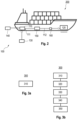
- the air supply apparatus 100 includes a fuel cell 110 and an air lubrication device 120 for resistance reduction of the ship 200.
- the air lubrication device 120 is configured for air bubble generation for hull lubrication. More specifically, typically the air lubrication device is configured for generating or forming an air layer on a bottom surface of the hull by discharging air to an outer surface below a waterline of the hull.
- air lubrication can be used, particularly by discharging air into surroundings of the ship's hull, especially under the hull. Accordingly, beneficially frictional resistance between the ship and water can be reduced.
- an exhaust gas outlet 111 of the fuel cell 110 is connected with the air lubrication device 120 via an exhaust gas line 112 for supplying exhaust gas to the air lubrication device 120.
- embodiments of the air supply apparatus as described herein beneficially provide for improved energy efficiency and eco friendliness compared to conventional apparatuses used for air lubrication type ships.
- the fuel cell 110 is connected to a compressor 130 for providing the fuel cell 110 with pressurized air.
- the fuel cell 110 can be a pressurized fuel cell which can be beneficial for supplying the air lubrication device with a pressurized flow. Accordingly, the energy efficiency of the ship may be improved. Further, the global carbon footprint of the ship can be reduced.
- the fuel cell 110 is connected to a fuel supply 140, as exemplarily shown in Fig. 2 .
- the fuel supply 140 is configured for providing the fuel cell 110 with fuel.
- the fuel can be at least one of hydrogen, methane, methanol, ammonia or any other suitable fuel. Accordingly, compared to conventional fuels used in marine transportation such as heavy oil, eco friendliness can be improved.
- the air supply apparatus 100 further includes at least one component 150 selected from an after burner, an oxidizer, a turbine, an expander, a heat exchanger, a throttle, particularly a flap, and a recirculation device.
- the at least one component 150 is connected to the exhaust gas line 112.
- Providing one or more of the further components 150 as described herein may be beneficial for improving the performance of the air supply apparatus, particularly the global system. It is to be understood that each of the at least one component 150 can be arranged in series or parallel.
- the air supply apparatus 100 further includes a flow control device 160 connected to the exhaust gas line 112.
- the flow control device can be a valve or a flap.
- the flow control device 160 may be provided in series to the at least one component 150, particularly downstream of the at least one component 150.
- the flow control device 160 can be provided in parallel to the at least one component 150. Accordingly, beneficially the air supply rate to the air lubrication device 120 can be adjusted.
- the fuel cell 110 is a proton exchange membrane fuel cell (PEMFC) or a solid oxide fuel cell (SOFC) or any other fuel cell type, particularly any other fuel cell for mobile applications.
- PEMFC proton exchange membrane fuel cell
- SOFC solid oxide fuel cell
- a ship 200 including an air supply apparatus according to any embodiments described herein is provided.
- a ship with a more efficient end more ecofriendly system for water-hull friction reduction can be provided, which can reduce the overall operation costs.
- the term "ship” may also include a boat or any other watercraft.
- the method includes supplying (represented by block 310 in Fig. 3a ) exhaust gas from a fuel cell 110 to the air lubrication device 120.
- the exhaust gas from the fuel cell is O 2 -poor air and/or steam.
- supplying the exhaust gas from the fuel cell to the air lubrication device typically includes directly routing the exhaust gas to the air lubrication device, particularly without using the exhaust gas rest energy to propel a turbocharger.
- the method 300 further includes providing (represented by block 320 in Fig. 3b ) the fuel cell 110 with pressurized air.
- the method 300 further includes guiding (represented by block 330 in Fig. 3b ) the exhaust gas through at least one component 150 selected from an after burner, an oxidizer, a turbine, an expander, a heat exchanger, a throttle, particularly a flap, and a recirculation device, prior to ejecting the exhaust gas from the air lubrication device 120.
- the method 300 further includes controlling (represented by block 340 in Fig. 3b ) the exhaust gas flow provided to the air lubrication device 120 by using a flow control device 160.
- the flow control device 160 is a valve or a flap.
- the method 300 of supplying air to an air lubrication device 120 of a ship 200 includes using (represented by block 350 in Fig. 3b ) the air supply apparatus 100 according to any embodiments described herein.
- the method 300 of supplying air to an air lubrication device 120 of a ship 200 can be carried out by employing the supply apparatus 100 according to any embodiments described herein.
- the specific combination of method blocks 310, 320, 330, 340 and 350 is only an example.
- the method blocks 320, 330, 340 and 350 represent optional additional method features which can be arbitrarily combined with the main block 310 of the method 300. More specifically, supplying (represented by block 310 in Figs. 3a and 3b ) exhaust gas from a fuel cell 110 to the air lubrication device 120 can be combined with one or more of the method blocks 320, 330, 340 and 350 as exemplarily described herein.
- the embodiments described herein beneficially provide for improved energy efficiency and eco friendliness, such that CO 2 emission and operation costs can be reduced.
- the air supply apparatus is configured to send energy and exhaust fluid from the fuel cell to the air lubrication device.
- embodiments of the present disclosure can be configured for directly providing the exhaust gas (e.g. O 2 -poor air and steam) from the fuel cell to the hull lubrication input.
- the exhaust gas outlet of the fuel cell is directly connected with the air lubrication device via the exhaust gas line, such that the exhaust gas from the fuel cell is directly routed to the air lubrication device.
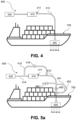
- the air supply apparatus 400 includes a fuel cell 410 and an air lubrication device 420 for resistance reduction of the ship 700.
- the air lubrication device 420 is configured for air bubble generation for hull lubrication.
- the air lubrication device is configured for generating or forming an air layer on a bottom surface of the hull by discharging air to an outer surface below a waterline of the hull.
- lubrication can be used to reduce the ship's hull friction resistance air, particularly by discharging air into surroundings of the ship's hull, especially under the hull.
- frictional resistance between the ship and water can be reduced.
- Hull drag commonly represents the main fraction of the ship fuel consumption.
- injecting air bubbles under the hull may improve the consumption of a ship by up to about 10%.
- the fuel consumption by means of injecting air bubbles can be improved for essentially all types of ships regardless of the mode of propulsion (Diesel, gas, electric with battery, fuel cell, hybrid).
- the “air” lubrication device 420 is not limited to applications with air.
- the exhaust gas originating from the fuel cell 410 may be introduced (optionally in a further pressurised manner) into the air lubrication device 420.
- the exhaust gas may simply correspond to air, it may, however, also correspond to (highly) humid air, or may contain further gases or particles (the particles are in such a case typically not environmentally harmful).
- the "air" lubrication device 420 may be fully operational with any type of pressurised fluid, and is not limited to being operated with air.
- the air supply apparatus 400 includes a compressor 430.
- the compressor 430 is connected to a pressurised line system for providing pressurised fluid to the pressurised line system.
- the pressurised line system may correspond to a manifold of several individual gas lines or line sections, such as, but not limited to one or more of an exhaust gas line 412, 512, an intake gas line 414, a bifurcated intake gas line 514, a first branch-off intake line 515, and a second branch-off intake line 516.
- the pressurised line system includes an exhaust gas line 412 and an intake gas line fluidly connecting the compressor and the fuel cell 410 (not labelled with a reference numeral).
- the pressurised line system 412, 414, 512, 514, 515, 516 is further connected to the fuel cell 410 for providing the fuel cell 410 with pressurised fluid from the compressor 430.
- the fuel cell 410 is a pressurised fuel cell which can (in some embodiments) be beneficial for supplying the air lubrication device with a pressurised flow. Accordingly, the energy efficiency of the ship may be improved. Further, the global carbon footprint of the ship can be reduced. Pressurization of the fuel cell is advantageous for fuel cell efficiency and power density improvements.
- the pressurised fluid provided to the fuel cell 410 is typically compressed air.
- a compressor outlet and an inlet of the fuel cell 410 may be directly connected by the intake gas line, as illustrated in Figure 4 .
- further components may be arranged in the gas line connecting compressor and fuel cell 410, as described further below.
- the pressurised line system 412, 414, 512, 514, 515, 516 is further connected to the air lubrication device 420 for providing pressurised fluid to the air lubrication device 420.
- the pressurised fluid conveyed to the air lubrication device 420 may, for example, be pressurised air, or exhaust gas, such as humid air, of the fuel cell.
- Embodiments of the present disclosure allow for providing both a fuel cell as well as an air lubrication device with a pressurised fluid while only requiring one compressor or compressor system for this purpose.
- the air supply apparatus of the present disclosure is less complex and simpler to implement compared to prior art systems.
- the present air supply apparatus reduces the air compression work and thus energy consumption required for pressurising both the fuel cell and the air lubrication device.
- the air supply apparatus can be retrofit to the already existing system, as also discussed further below. In such a case, energetically speaking, the fuel cell is thus pressurised "for free".
- the fuel cell may be provided on the ship for various purposes, e.g.
- the fuel cell may be used for ship propulsion, but also for other purposes, such as powering other electrical devices on the ship.
- the air supply apparatus of the present disclosure may be put into practice regardless of the purpose for installing the fuel cell on the ship.
- the air supply apparatus of the present disclosure can allow for shutting down the air lubrication system in certain circumstances (such as in case the ship is not moving) while keeping the fuel cell(s) in operation with pressurised fluid and while preferably recovering at least some of the energy of the pressurised fluid (as described further below).
- an exhaust gas outlet 411 of the fuel cell 410 is connected with the air lubrication device 420 via an exhaust gas line 412 of the pressurised line system for supplying exhaust gas to the air lubrication device 420.
- Figures 4, 5a , 5b and 6 illustrate examples of such embodiments.
- a compressor outlet of the compressor 430 is connected with the air lubrication device 420 via a bifurcated intake gas line 514 of the pressurised line system for supplying pressurised fluid from the compressor outlet to the air lubrication device 420.
- the pressurised fluid may typically be pressurised air.
- An exemplary embodiment thereof is illustrated, for example, in Figure 7 .
- a bifurcation corresponds to at least two branch-off lines which do not unite or merge further downstream of the bifurcation.
- the pressurised fluid or exhaust gas originating from the fuel cell 410 may preferably not be conveyed to the air lubrication device 420. Instead, the pressurised fluid or exhaust gas originating from the fuel cell 410 may be used for other purposes, such as recovering a fraction of the pressure enthalpy.
- the bifurcated intake gas line 514 may include a first branch-off intake line 515 connected to the fuel cell 410 and a second branch-off intake line 516 connected to the air lubrication device 420.
- Figures 8 to 10 show examples of the first and second branch-off intake lines 515, 516.
- the air supply apparatus 400 further includes a fuel cell bypass 415 connected to the pressurised line system, in particular the bifurcated intake gas line 514 or an intake gas line 414 and the exhaust gas line 412.
- Figure 5a illustrates an exemplary embodiment including a fuel cell bypass 415 connected to an intake gas line 414.
- the air supply apparatus may include a fuel cell bypass flow control device 416 configured for independently controlling a flow of the pressurised fluid to the fuel cell 410.
- the fuel cell bypass flow control device 416 may optionally be further configured for controlling a flow of the pressurised fluid to the air lubrication device 420.
- the fuel cell bypass flow control device 416 may preferably be a valve, or a flap.
- the fuel cell bypass flow control device 416 allows for setting the pressure as desired for a specific operation mode.
- the air supply apparatus may further include a blow-off valve 480 for releasing pressurised fluid.
- a blow-off valve 480 examples are illustrated in Figures 5a and 5b .
- the blow-off valve 480 allows for releasing substantial portions of the pressurised fluid or even the entire overpressure to the atmosphere in case it is not desired to pressurise one or more of the components of the air supply apparatus.
- the blow-off valve 480 may be connected to the exhaust gas line 412, 512.
- pressurising of the fuel cell is required for a certain application, but pressurising of the air lubrication device is undesired (e.g.
- the pressurised fluid may be released before being injecting into the air lubrication device 420.
- the blow-off valve 480 may be arranged downstream of the fuel cell 410 and/or upstream of the air lubrication device 420.
- the air supply apparatus may further include a blow-off outflow line connected the exhaust gas line 412, 512.
- the blow-off valve 480 may be arranged in the blow-off outflow line.
- the blow-off valve 480 and/or the blow-off outflow line may be arranged upstream of a turbine 450 (described in more detail further below) and/or upstream of a turbine bypass 451 (described in more detail further below).
- a blow-off valve 480 being arranged upstream of the turbine 450 is illustrated in Figure 5a .
- blow-off valve 480 and/or the blow-off outflow line may be arranged downstream of the turbine 450 (described in more detail further below) and/or upstream of the turbine bypass 451 (described in more detail further below) merging or uniting with the exhaust gas line 412, 512.
- An example of a blow-off valve 480 being arranged downstream of the turbine 450 is illustrated in Figure 5b . This allow for recovering back pressure energy/enthalpy in case the fuel cell is pressurised, and the air lubrication device is not in use (e.g. if the ship is not moving or to avoid any potential damage in case the ship is in a port or a shallow seabed).
- the air supply apparatus 400 further includes a flow control device 460, 560, 561.
- the flow control device 460, 560, 561 is preferably a valve or a flap.
- the flow control device 460, 560, 561 may be a throttle valve.
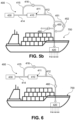
- Each of Figures 6 to 10 illustrate examples of the flow control device 460, 560, 561.
- the flow control device 460, 560, 561 is preferably arranged downstream of the fuel cell 410 and/or upstream of the air lubrication device 120.
- the flow control device 460, 560, 561 is preferably arranged downstream of the fuel cell bypass 415 merging or uniting with the exhaust gas line 412, 512.
- the flow control device 460, 560, 561 is connected to the exhaust gas line 412, 512 and/or the second branch-off intake line 516.
- the flow control device 460, 560, 561 may allow for adjusting the flow in the first and second branch-off intake lines 515, 516, and thus the flow of pressurised fluid injected respectively to the fuel cell 410 and the air lubrication device 420.
- the flow control device 460, 560, 561 being connected to the exhaust gas line 412, 512 (as illustrated for example in Figure 6 ) allows for the possibility of controlling the charging pressure of the fuel cell 410 independently from the air lubrication device pressure.
- the pressure required for the air lubrication device is typically determined by the draft depth of the ship.
- the air supply apparatus 400 further includes a turbine 450, 550 connected to the exhaust gas line 412, 512.
- the turbine is illustrated in Figures 5a and 8-10 .
- the turbine is arranged downstream of the fuel cell 410 and/or upstream of the air lubrication device 420.
- the turbine is preferably arranged upstream of the flow control device 460, 560, 561 (if present).
- the turbine 450, 550 is preferably arranged downstream of the fuel cell bypass 415 merging or uniting with the exhaust gas line 412, 512.
- the turbine 450, 550 allows for recovering a fraction of the energy of the exhaust gas originating from the fuel cell 410.
- the turbine 450, 550 allows for recovering a fraction of the energy.
- the air supply apparatus 400 may also include the turbine 450, 550.
- the air lubrication device typically has lower pressure requirements compared to the fuel cell 410. Therefore, a fraction of the energy may be recovered by the turbine 450, 550, while still ensuring a pressure high enough for operating the air lubrication device 420.
- the turbine allows for adjusting the charging pressures of fuel cell and air lubrication device independently, for example depending on the requirements due to the speed of the ship, the fuel cell load, or conditions of navigation.
- the turbine 450, 550 is preferably provided in series to the flow control device 460, 560, 561 and/or in parallel with the blow-off valve 480 and the blow-off outflow line.
- the air supply apparatus 400 may further comprise a turbine bypass 451 and a turbine bypass valve 452.
- the turbine bypass 451 is illustrated in Figure 5a .
- the turbine bypass may be connected to the exhaust gas line 412.
- the turbine bypass 451 and/or the turbine bypass valve 452 allow for limiting the pressure reduction resulting from recovering energy by the turbine.
- the turbine 450 may be a fixed geometry turbine and optionally include a turbine bypass 451 and a turbine bypass valve 452.
- the turbine 450 may be a variable geometry turbine 450 and optionally include a turbine bypass 451 and a turbine bypass valve 452.
- the air supply apparatus 400 further includes a high-pressure compressor 530 arranged downstream of the compressor 430 and upstream of the fuel cell 410 for providing the fuel cell 410 with pressurised fluid.
- a high-pressure compressor is illustrated in Figure 10 .
- the high-pressure compressor 530 is arranged in the first branch-off intake line 515.
- the fuel cell requires higher pressures compared to the air lubrication system, or even higher pressures than the maximal pressure offered by a one-stage compression process.
- the compressor 430 in connection with the high-pressure compressor 530 may be regarded as a two-stage compressor. In this embodiment, the compressor 430 may also be referred to as low-pressure compressor.
- the two-stage compressor ensures that the charging pressure is sufficiently high for the fuel cell 410.
- the air supply apparatus 400 may further include an intercooler arranged between the (low-pressure) compressor 430 and the high-pressure compressor 530.
- an intercooler may be arranged in the first branch-off intake line 515 upstream of the high-pressure compressor 530. Beneficially, the intercooler improves the compression efficiency.
- the air supply apparatus 400 may include the high-pressure compressor 530 according to any embodiment described herein, and the turbine 450, 550 according to any embodiment described herein.
- Figure 10 illustrates an exemplary embodiment including the high-pressure compressor 530 and the turbine 550.
- the high-pressure compressor 530 may provide pressurised fluid to the fuel cell with a pressure of 4 bar or more, whereas the exhaust gas originating from the fuel cell may be released to the atmosphere, or is provided to the air lubrication device, which may typically only require pressurised fluids having a pressure of 1.5 or 2 bar, for example.
- Combining the high-pressure compressor 530 with the turbine 450, 550 is particularly advantageous for recovering energy from the high-pressure fluid generated by the high-pressure compressor 530.
- the high-pressure compressor 530 is configured for supplying the pressurised fluid to the air lubrication device 420 via the fuel cell 410.
- the exhaust gas line 512 of the fuel cell 410 is connected with the bifurcated intake gas line 514, and in particular the second branch-off intake line 516.
- This connection line 518 is sketched by the dotted lines on the right-hand side of Figure 10 .
- the air supply apparatus 400 may further include at least one of a valve, a flap and a further turbine arranged within the connection line 518 (not shown in Figure 10 ).
- the second branch-off intake line 516 may further include the flow control device 460, 560, 561 and/or the turbine 450, 550 upstream of the air lubrication device 420 (not shown in Figure 10 ).
- the air supply apparatus 400 may include an inflow control device 570.
- an inflow control device is illustrated in Figure 9 .
- the inflow control device 570 may be arranged downstream of the compressor 430 and upstream of the fuel cell 410.
- the inflow control device 570 is preferably arranged in series with the fuel cell 410 and/or arranged in the first branch-off intake line 515 or in the intake gas line 414.
- the inflow control device 570 is preferably arranged upstream of the fuel cell bypass 415.
- the inflow control device 570 may be configured for controlling a charging pressure of the fuel cell 410.
- the inflow control device 570 is at least one of a valve, a flap and a second turbine.
- the air supply apparatus 400 may include a second turbine bypass and/or a second turbine bypass valve in embodiments, in which the inflow control device 570 is a second turbine.
- the second turbine bypass is configured for bypassing the second turbine.
- the air supply apparatus 400 may include the second turbine and/or the second turbine bypass and/or the second turbine bypass valve without including the (first) turbine and/or the (first) turbine bypass and/or the (first) turbine bypass valve.
- the turbines differ in that the (first) turbine is preferably connected to the exhaust gas line 412, 512, whereas the second turbine 570 is preferably arranged upstream of the fuel cell 410.
- the fuel cell 410 is connected to a fuel supply.
- the fuel supply is configured for providing the fuel cell 410 with fuel.
- the fuel can be at least one of hydrogen, methane, methanol, ammonia or any other suitable fuel. Accordingly, compared to conventional fuels used in marine transportation such as heavy oil, eco friendliness can be improved.
- the air supply apparatus 400 may further include at least one component selected from an after burner, an oxidizer, a heat exchanger, and a recirculation device.
- the at least one component is connected to the exhaust gas line 412.
- Providing one or more of the further components as described herein may be beneficial for improving the performance of the air supply apparatus, particularly the global system.
- each of the at least one component can be arranged in series or parallel.
- the flow control device 460, 560, 561 may be provided in series to the at least one component, particularly downstream of the at least one component 450.
- the flow control device 460, 560, 561 can be provided in parallel to the at least one component.
- the fuel cell 410 is a proton exchange membrane fuel cell (PEMFC) or a solid oxide fuel cell (SOFC) or, a fuel cell hybrid system or any other fuel cell type, particularly any other fuel cell for mobile applications.
- PEMFC proton exchange membrane fuel cell
- SOFC solid oxide fuel cell
- an air supply apparatus 400 may include a plurality of fuel cells and/or a plurality of air lubrication devices. Each of the plurality of fuel cells and/or the plurality of air lubrication devices may be connected to the pressurised line system and/or may be in fluid communication with the compressor.
- the compressor 430 may be configured for providing pressurised fluid to each of the plurality of fuel cells and/or the plurality of air lubrication devices.
- a ship 700 including an air supply apparatus 400 according to any embodiments described herein is provided.
- a ship with a more efficient end more ecofriendly system for water-hull friction reduction can be provided, which can reduce the overall operation costs.
- the term "ship” may also include a boat or any other watercraft.
- a method of installing a fuel cell in an air supply apparatus for a ship includes an air lubrication device for resistance reduction of the ship, and a compressor for providing the air lubrication device with pressurised fluid.
- the method may include providing the fuel cell and a pressurised line system having an intake gas line or a bifurcated intake gas line and an exhaust gas line.
- the method further includes connecting the compressor outlet and an inlet of the fuel cell via an intake gas line or a bifurcated intake gas line.
- the method includes connecting an inlet of the air lubrication device with an exhaust gas outlet of the fuel cell via an exhaust gas line or connecting an inlet of the air lubrication device with the compressor outlet via the bifurcated intake gas line.
- the method may include the air supply apparatus, the fuel cell, and the pressurised line system according to any embodiment described herein. Furthermore, the method may include installing any of the components according to any embodiment described herein in any of the locations (i.e. the position within the pressurised line system and upstream/downstream of other components) described herein. For example, the method may further include installing a turbine, and/or a flow control device.
- an air supply apparatus 100 for a ship 200 is provided.
- Embodiment 1 The air supply apparatus 100 comprising a fuel cell 110, and an air lubrication device 120 for resistance reduction of the ship 200, wherein an exhaust gas outlet 111 of the fuel cell 110 is connected with the air lubrication device 120 via an exhaust gas line 112 for supplying exhaust gas to the air lubrication device 120.
- Embodiment 2 The air supply apparatus 100 of embodiment 1, wherein the fuel cell 110 is connected to a compressor 130 for providing the fuel cell 110 with pressurized air.
- Embodiment 3 The air supply apparatus 100 of embodiment 1 or 2, wherein the fuel cell 110 is connected to a fuel supply 140 for providing the fuel cell 110 with fuel, particularly the fuel being at least one of hydrogen, methane, methanol, ammonia or any other suitable fuel.
- Embodiment 4 The air supply apparatus 100 of any of embodiments 1 to 3, further comprising at least one component 150 selected from an after burner, an oxidizer, a turbine, an expander, a heat exchanger, a throttle, particularly a flap, and a recirculation device, wherein the at least one component 150 is connected to the exhaust gas line 112.
- at least one component 150 selected from an after burner, an oxidizer, a turbine, an expander, a heat exchanger, a throttle, particularly a flap, and a recirculation device, wherein the at least one component 150 is connected to the exhaust gas line 112.
- Embodiment 5 The air supply apparatus 100 of any of embodiments 1 to 4, further comprising a flow control device 160 connected to the exhaust gas line 112, particularly the flow control device 160 being a valve or a flap.
- Embodiment 6 The air supply apparatus 100 of embodiments 4 and 5, wherein the flow control device 160 is provided in series to the at least one component 150, particularly downstream of the at least one component 150, or wherein the flow control device 160 is provided in parallel to the at least one component 150.
- Embodiment 7 The air supply apparatus 100 of any of embodiments 1 to 6, wherein the fuel cell 110 is a proton exchange membrane fuel cell PEMFC or a solid oxide fuel cell SOFC or any other fuel cell for mobile applications.
- the fuel cell 110 is a proton exchange membrane fuel cell PEMFC or a solid oxide fuel cell SOFC or any other fuel cell for mobile applications.
- Embodiment 8 The air supply apparatus 100 of any of embodiments 1 to 7, wherein the exhaust gas outlet 111 of the fuel cell 110 is directly connected with the air lubrication device 120 via the exhaust gas line 112, such that the exhaust gas from the fuel cell is directly routed to air lubrication device, particularly without using the exhaust gas rest energy to propel a turbocharger.
- a ship 200 comprising an air supply apparatus 100 according to any of embodiments 1 to 8 is provided.
- a method 300 of supplying air to an air lubrication device 120 of a ship 200 is provided.
- Embodiment 9 The method 300 comprising supplying 310 exhaust gas from a fuel cell 110 to the air lubrication device 120.
- Embodiment 10 The method 300 of embodiment 9, further comprising providing 320 the fuel cell 110 with pressurized air.
- Embodiment 11 The method 300 of embodiment 9 or 10, further comprising guiding 330 the exhaust gas through at least one component 150 selected from an after burner, an oxidizer, a turbine, an expander, a heat exchanger, a throttle, particularly a flap, and a recirculation device, prior to ejecting the exhaust gas from the air lubrication device 120.
- Embodiment 12 The method 300 of any of embodiments 9 to 11, further comprising controlling 340 the exhaust gas flow provided to the air lubrication device 120 by using a flow control device 160, particularly a valve or a flap.
- Embodiment 13 The method 300 of any of embodiments 9 to 12, wherein the exhaust gas is O 2 -poor air and/or steam.
- Embodiment 14 The method 300 of any of embodiments 9 to 13, wherein supplying 310 the exhaust gas from the fuel cell 110 to the air lubrication device 120 comprises directly routing the exhaust gas to the air lubrication device.
- Embodiment 15 The method 300 of any of embodiments 9 to 14, wherein supplying 310 the exhaust gas from the fuel cell 110 to the air lubrication device 120 comprises routing the exhaust gas to the air lubrication device without using the exhaust gas rest energy to propel a turbocharger.
- Embodiment 16 The method of any of embodiments 9 to 15, further comprising using 350 an air supply apparatus 100 according to any of embodiments 1 to 8.
- the embodiments described herein beneficially provide for improved energy efficiency and eco friendliness, such that CO 2 emission and operation costs can be reduced.
Landscapes
- Chemical & Material Sciences (AREA)
- Engineering & Computer Science (AREA)
- Chemical Kinetics & Catalysis (AREA)
- Sustainable Development (AREA)
- Sustainable Energy (AREA)
- Manufacturing & Machinery (AREA)
- Life Sciences & Earth Sciences (AREA)
- Electrochemistry (AREA)
- General Chemical & Material Sciences (AREA)
- Physics & Mathematics (AREA)
- Fluid Mechanics (AREA)
- Combustion & Propulsion (AREA)
- Mechanical Engineering (AREA)
- Ocean & Marine Engineering (AREA)
- Fuel Cell (AREA)
Abstract
Description
- Embodiments of the present disclosure relate to an air supply apparatus of an air lubrication type ship for reducing water friction resistance. Further, embodiments of the present disclosure relate to a method of supplying air to an air lubrication device of a ship. Further, embodiments of the present disclosure relate to a method of installing a fuel cell in an air supply apparatus.
- Generally, a ship receives friction resistance of water during marine navigation on its submerged surface of the ship's bottom. Especially for large ships, e.g. cargo ships, a large portion of the ship's hull resistance of results from friction resistance generated by relative flow of outside water at the ship's bottom.
- To reduce ship's hull friction resistance air lubrication can be used, particularly by discharging air into surroundings of the ship's hull. The reduction of friction resistance has a large fuel economy improving effect, and thus represents effective means to reduce the CO2 emission of the ship.
- In the state of the art, there are various systems and approaches for the production of air bubbles for the hull lubrication. For instance, for the generation of air bubbles for hull lubrication, the prior art teaches usage of separate or dedicated mechanical electrical compressors or blowers.
- However, there is a continuous demand for improved methods and systems for hull lubrication, particularly with respect to energy consumption and eco friendliness.
- In light of the above, an air supply apparatus for a ship, a ship including the air supply apparatus, a method of supplying air to an air lubrication device of a ship, and a method of installing a fuel cell in an air supply apparatus according to the independent claims are provided. Further aspects, advantages, and features are apparent from the dependent claims, the description, and the accompanying drawings.
- According to an aspect of the present disclosure, an air supply apparatus for a ship is provided. The air supply apparatus includes a fuel cell and an air lubrication device for resistance reduction of the ship. An exhaust gas outlet of the fuel cell is connected with the air lubrication device via an exhaust gas line for supplying exhaust gas to the air lubrication device.
- Accordingly, compared to conventional apparatuses used for air lubrication type ships, the air supply apparatus of the present disclosure is improved with respect to energy consumption and eco friendliness.
- According to a further aspect of the present disclosure, a ship including an air supply apparatus according to any embodiments described herein is provided.
- According to another aspect of the present disclosure, a method of supplying air to an air lubrication device of a ship is provided. The method includes supplying exhaust gas from a fuel cell to the air lubrication device.
- According to an aspect of the present disclosure, an air supply apparatus for a ship is provided. The air supply apparatus includes a fuel cell, an air lubrication device for resistance reduction of the ship, and a compressor connected to a pressurised line system for providing pressurised fluid to the pressurised line system. The pressurised line system is connected to the fuel cell for providing the fuel cell with pressurised fluid from the compressor. The pressurised line system is further connected to the air lubrication device for providing pressurised fluid to the air lubrication device.
- Accordingly, compared to conventional apparatuses used for air lubrication type ships, the air supply apparatus of the present disclosure is improved with respect to energy consumption and eco friendliness.
- According to a further aspect of the present disclosure, a ship including an air supply apparatus according to any embodiments described herein is provided.
- According to another aspect of the present disclosure, a method of installing a fuel cell in an air supply apparatus for a ship is provided. The air supply apparatus includes an air lubrication device for resistance reduction of the ship, and a compressor for providing the air lubrication device with pressurised fluid. The method includes connecting the compressor outlet and an inlet of the fuel cell via an intake gas line or a bifurcated intake gas line. The method further includes connecting an inlet of the air lubrication device with an exhaust gas outlet of the fuel cell via an exhaust gas line or connecting an inlet of the air lubrication device with the compressor outlet via the bifurcated intake gas line.
- Those skilled in the art will recognise additional features and advantages upon reading the following detailed description, and upon viewing the accompanying drawings.
- So that the manner in which the above recited features of the present disclosure can be understood in detail, a more particular description of the disclosure, briefly summarized above, may be had by reference to embodiments. The accompanying drawings relate to embodiments of the disclosure and are described in the following:
- Fig. 1
- shows a schematic view of a ship with an air supply apparatus according to embodiments described herein;
- Fig. 2
- shows a schematic view a ship with an air supply apparatus according to further embodiments described herein; and
- Fig. 3a and 3b
- show block diagrams for illustrating embodiments of a method of supplying air to an air lubrication device of a ship according to embodiments described herein.
- Fig. 4
- shows a schematic view of a ship with an air supply apparatus according to embodiments described herein;
- Fig. 5a
- shows a schematic view of a ship with an air supply apparatus according to further embodiments described herein;
- Fig. 5b
- shows a schematic view of a ship with an air supply apparatus according to further embodiments described herein;
- Fig. 6
- shows a schematic view of a ship with an air supply apparatus according to further embodiments described herein;
- Fig. 7
- shows a schematic view of a ship with an air supply apparatus according to further embodiments described herein;
- Fig. 8
- shows a schematic view of a ship with an air supply apparatus according to further embodiments described herein;
- Fig. 9
- shows a schematic view of a ship with an air supply apparatus according to further embodiments described herein; and
- Fig. 10
- shows a schematic view of a ship with an air supply apparatus according to further embodiments described herein.
- Reference will now be made in detail to the various embodiments, one or more examples of which are illustrated in each figure. Each example is provided by way of explanation and is not meant as a limitation. For example, features illustrated or described as part of one embodiment can be used on or in conjunction with any other embodiment to yield yet a further embodiment. It is intended that the present disclosure includes such modifications and variations.
- Within the following description of the drawings, the same reference numbers refer to the same or to similar components. Generally, only the differences with respect to the individual embodiments are described. Unless specified otherwise, the description of a part or aspect in one embodiment can apply to a corresponding part or aspect in another embodiment as well.
- With exemplary reference to
Fig. 1 , anair supply apparatus 100 for aship 200 according to the present disclosure is described. According to embodiments, which can be combined with other embodiments described herein, theair supply apparatus 100 includes afuel cell 110 and anair lubrication device 120 for resistance reduction of theship 200. In particular, theair lubrication device 120 is configured for air bubble generation for hull lubrication. More specifically, typically the air lubrication device is configured for generating or forming an air layer on a bottom surface of the hull by discharging air to an outer surface below a waterline of the hull. In other words, to reduce ship's hull friction resistance air lubrication can be used, particularly by discharging air into surroundings of the ship's hull, especially under the hull. Accordingly, beneficially frictional resistance between the ship and water can be reduced. As exemplarily indicated inFig. 1 , anexhaust gas outlet 111 of thefuel cell 110 is connected with theair lubrication device 120 via anexhaust gas line 112 for supplying exhaust gas to theair lubrication device 120. - Accordingly, embodiments of the air supply apparatus as described herein, beneficially provide for improved energy efficiency and eco friendliness compared to conventional apparatuses used for air lubrication type ships.
- With exemplary reference to
Fig. 2 , according to embodiments, which can be combined with other embodiments described herein, thefuel cell 110 is connected to acompressor 130 for providing thefuel cell 110 with pressurized air. In other words, thefuel cell 110 can be a pressurized fuel cell which can be beneficial for supplying the air lubrication device with a pressurized flow. Accordingly, the energy efficiency of the ship may be improved. Further, the global carbon footprint of the ship can be reduced. - According to embodiments, which can be combined with other embodiments described herein, the
fuel cell 110 is connected to afuel supply 140, as exemplarily shown inFig. 2 . Thefuel supply 140 is configured for providing thefuel cell 110 with fuel. In particular, the fuel can be at least one of hydrogen, methane, methanol, ammonia or any other suitable fuel. Accordingly, compared to conventional fuels used in marine transportation such as heavy oil, eco friendliness can be improved. - With exemplary reference to
Fig. 2 , according to embodiments, which can be combined with other embodiments described herein, theair supply apparatus 100 further includes at least onecomponent 150 selected from an after burner, an oxidizer, a turbine, an expander, a heat exchanger, a throttle, particularly a flap, and a recirculation device. As exemplarily shown inFig. 2 , typically the at least onecomponent 150 is connected to theexhaust gas line 112. Providing one or more of thefurther components 150 as described herein may be beneficial for improving the performance of the air supply apparatus, particularly the global system. It is to be understood that each of the at least onecomponent 150 can be arranged in series or parallel. - According to embodiments, which can be combined with other embodiments described herein, the
air supply apparatus 100 further includes aflow control device 160 connected to theexhaust gas line 112. In particular, the flow control device can be a valve or a flap. For instance, theflow control device 160 may be provided in series to the at least onecomponent 150, particularly downstream of the at least onecomponent 150. Alternatively, theflow control device 160 can be provided in parallel to the at least onecomponent 150. Accordingly, beneficially the air supply rate to theair lubrication device 120 can be adjusted. - According to embodiments, which can be combined with other embodiments described herein, the
fuel cell 110 is a proton exchange membrane fuel cell (PEMFC) or a solid oxide fuel cell (SOFC) or any other fuel cell type, particularly any other fuel cell for mobile applications. - Accordingly, from
Figs. 1 and2 it is to be understood, that according to another aspect of the present disclosure aship 200 including an air supply apparatus according to any embodiments described herein is provided. Thus, a ship with a more efficient end more ecofriendly system for water-hull friction reduction can be provided, which can reduce the overall operation costs. In the present disclosure, the term "ship" may also include a boat or any other watercraft. - With exemplary reference to the block diagrams shown in
Figs. 3a and 3b , embodiments of amethod 300 of supplying air to anair lubrication device 120 of aship 200 according to the present disclosure are described. According to embodiments, which can be combined with other embodiments described herein, the method includes supplying (represented byblock 310 inFig. 3a ) exhaust gas from afuel cell 110 to theair lubrication device 120. Typically, the exhaust gas from the fuel cell is O2-poor air and/or steam. In particular, supplying the exhaust gas from the fuel cell to the air lubrication device typically includes directly routing the exhaust gas to the air lubrication device, particularly without using the exhaust gas rest energy to propel a turbocharger. - With exemplary reference to
Fig. 3b , according to embodiments, which can be combined with other embodiments described herein, themethod 300 further includes providing (represented byblock 320 inFig. 3b ) thefuel cell 110 with pressurized air. - According to embodiments, which can be combined with other embodiments described herein, the
method 300 further includes guiding (represented byblock 330 inFig. 3b ) the exhaust gas through at least onecomponent 150 selected from an after burner, an oxidizer, a turbine, an expander, a heat exchanger, a throttle, particularly a flap, and a recirculation device, prior to ejecting the exhaust gas from theair lubrication device 120. - According to embodiments, which can be combined with other embodiments described herein, the
method 300 further includes controlling (represented byblock 340 inFig. 3b ) the exhaust gas flow provided to theair lubrication device 120 by using aflow control device 160. In particular, theflow control device 160 is a valve or a flap. - It is to be understood that typically the
method 300 of supplying air to anair lubrication device 120 of aship 200 includes using (represented byblock 350 inFig. 3b ) theair supply apparatus 100 according to any embodiments described herein. In other words, themethod 300 of supplying air to anair lubrication device 120 of aship 200 can be carried out by employing thesupply apparatus 100 according to any embodiments described herein. Further, it is to be understood that the specific combination of method blocks 310, 320, 330, 340 and 350 is only an example. In other words, the method blocks 320, 330, 340 and 350 represent optional additional method features which can be arbitrarily combined with themain block 310 of themethod 300. More specifically, supplying (represented byblock 310 inFigs. 3a and 3b ) exhaust gas from afuel cell 110 to theair lubrication device 120 can be combined with one or more of the method blocks 320, 330, 340 and 350 as exemplarily described herein. - Hence, in view of the above, it is to be understood that compared to the state of the art, the embodiments described herein beneficially provide for improved energy efficiency and eco friendliness, such that CO2 emission and operation costs can be reduced. Further, it is pointed that in contrast to the prior art, according to embodiments, which can be combined with other embodiments described herein, the air supply apparatus is configured to send energy and exhaust fluid from the fuel cell to the air lubrication device. In particular, embodiments of the present disclosure can be configured for directly providing the exhaust gas (e.g. O2-poor air and steam) from the fuel cell to the hull lubrication input. In other words, according to embodiments, which can be combined with other embodiments described herein, the exhaust gas outlet of the fuel cell is directly connected with the air lubrication device via the exhaust gas line, such that the exhaust gas from the fuel cell is directly routed to the air lubrication device.
- With exemplary reference to
Fig. 4 , anair supply apparatus 400 for aship 700 according to an aspect of the present disclosure is described. According to embodiments, which can be combined with other embodiments described herein, theair supply apparatus 400 includes afuel cell 410 and anair lubrication device 420 for resistance reduction of theship 700. - In particular, the
air lubrication device 420 is configured for air bubble generation for hull lubrication. Typically, the air lubrication device is configured for generating or forming an air layer on a bottom surface of the hull by discharging air to an outer surface below a waterline of the hull. In other words, lubrication can be used to reduce the ship's hull friction resistance air, particularly by discharging air into surroundings of the ship's hull, especially under the hull. Beneficially, frictional resistance between the ship and water can be reduced. Hull drag commonly represents the main fraction of the ship fuel consumption. Illustratively, injecting air bubbles under the hull may improve the consumption of a ship by up to about 10%. The fuel consumption by means of injecting air bubbles can be improved for essentially all types of ships regardless of the mode of propulsion (Diesel, gas, electric with battery, fuel cell, hybrid). - Although the term "air"
lubrication device 420 is used throughout this application, the "air"lubrication device 420 is not limited to applications with air. For example, and as discussed further below, the exhaust gas originating from thefuel cell 410 may be introduced (optionally in a further pressurised manner) into theair lubrication device 420. In this case, the exhaust gas may simply correspond to air, it may, however, also correspond to (highly) humid air, or may contain further gases or particles (the particles are in such a case typically not environmentally harmful). Thus, although air is preferably used, the "air"lubrication device 420 may be fully operational with any type of pressurised fluid, and is not limited to being operated with air. - For the purpose of generating gaseous bubbles, the
air supply apparatus 400 includes acompressor 430. Thecompressor 430 is connected to a pressurised line system for providing pressurised fluid to the pressurised line system. The pressurised line system may correspond to a manifold of several individual gas lines or line sections, such as, but not limited to one or more of anexhaust gas line intake gas line 414, a bifurcatedintake gas line 514, a first branch-offintake line 515, and a second branch-offintake line 516. - In the exemplary embodiment shown in
Fig. 4 , the pressurised line system includes anexhaust gas line 412 and an intake gas line fluidly connecting the compressor and the fuel cell 410 (not labelled with a reference numeral). - The pressurised
line system fuel cell 410 for providing thefuel cell 410 with pressurised fluid from thecompressor 430. In other words, thefuel cell 410 is a pressurised fuel cell which can (in some embodiments) be beneficial for supplying the air lubrication device with a pressurised flow. Accordingly, the energy efficiency of the ship may be improved. Further, the global carbon footprint of the ship can be reduced. Pressurization of the fuel cell is advantageous for fuel cell efficiency and power density improvements. - The pressurised fluid provided to the
fuel cell 410 is typically compressed air. In an embodiment, a compressor outlet and an inlet of thefuel cell 410 may be directly connected by the intake gas line, as illustrated inFigure 4 . In other embodiments, further components may be arranged in the gas line connecting compressor andfuel cell 410, as described further below. - The pressurised
line system air lubrication device 420 for providing pressurised fluid to theair lubrication device 420. The pressurised fluid conveyed to theair lubrication device 420 may, for example, be pressurised air, or exhaust gas, such as humid air, of the fuel cell. - Embodiments of the present disclosure allow for providing both a fuel cell as well as an air lubrication device with a pressurised fluid while only requiring one compressor or compressor system for this purpose. The air supply apparatus of the present disclosure is less complex and simpler to implement compared to prior art systems. Moreover, the present air supply apparatus reduces the air compression work and thus energy consumption required for pressurising both the fuel cell and the air lubrication device. In case of a compressor and an air lubrication device already being present on a ship, the air supply apparatus can be retrofit to the already existing system, as also discussed further below. In such a case, energetically speaking, the fuel cell is thus pressurised "for free". The fuel cell may be provided on the ship for various purposes, e.g. the fuel cell may be used for ship propulsion, but also for other purposes, such as powering other electrical devices on the ship. The air supply apparatus of the present disclosure may be put into practice regardless of the purpose for installing the fuel cell on the ship. The air supply apparatus of the present disclosure can allow for shutting down the air lubrication system in certain circumstances (such as in case the ship is not moving) while keeping the fuel cell(s) in operation with pressurised fluid and while preferably recovering at least some of the energy of the pressurised fluid (as described further below).
- According to an embodiment, an
exhaust gas outlet 411 of thefuel cell 410 is connected with theair lubrication device 420 via anexhaust gas line 412 of the pressurised line system for supplying exhaust gas to theair lubrication device 420.Figures 4, 5a ,5b and 6 illustrate examples of such embodiments. By supplying exhaust gas of the fuel cell to the air lubrication device, the addition of an expander or turbine downstream of the fuel cell for recovering a fraction of the pressure enthalpy is not necessarily required, as the pressurised fluid is further used for the air lubrication device. Further usage of the pressurised fluid for the air lubrication device results in less efficiency losses, as thermodynamic transformation (between different forms of energy) is reduced, and the mechanical complexity of the air supply apparatus is reduced. - According to another embodiment, a compressor outlet of the
compressor 430 is connected with theair lubrication device 420 via a bifurcatedintake gas line 514 of the pressurised line system for supplying pressurised fluid from the compressor outlet to theair lubrication device 420. In this embodiment, the pressurised fluid may typically be pressurised air. An exemplary embodiment thereof is illustrated, for example, inFigure 7 . According to a preferred embodiment, a bifurcation corresponds to at least two branch-off lines which do not unite or merge further downstream of the bifurcation. In this embodiment, the pressurised fluid or exhaust gas originating from thefuel cell 410 may preferably not be conveyed to theair lubrication device 420. Instead, the pressurised fluid or exhaust gas originating from thefuel cell 410 may be used for other purposes, such as recovering a fraction of the pressure enthalpy. - The bifurcated
intake gas line 514 may include a first branch-offintake line 515 connected to thefuel cell 410 and a second branch-offintake line 516 connected to theair lubrication device 420.Figures 8 to 10 show examples of the first and second branch-offintake lines - According to embodiments, which can be combined with other embodiments described herein, the
air supply apparatus 400 further includes afuel cell bypass 415 connected to the pressurised line system, in particular the bifurcatedintake gas line 514 or anintake gas line 414 and theexhaust gas line 412.Figure 5a illustrates an exemplary embodiment including afuel cell bypass 415 connected to anintake gas line 414. With further reference toFigures 5a and6 , the air supply apparatus may include a fuel cell bypassflow control device 416 configured for independently controlling a flow of the pressurised fluid to thefuel cell 410. The fuel cell bypassflow control device 416 may optionally be further configured for controlling a flow of the pressurised fluid to theair lubrication device 420. The fuel cell bypassflow control device 416 may preferably be a valve, or a flap. The fuel cell bypassflow control device 416 allows for setting the pressure as desired for a specific operation mode. - In one embodiment, the air supply apparatus may further include a blow-off
valve 480 for releasing pressurised fluid. Examples of a blow-offvalve 480 are illustrated inFigures 5a and5b . The blow-offvalve 480 allows for releasing substantial portions of the pressurised fluid or even the entire overpressure to the atmosphere in case it is not desired to pressurise one or more of the components of the air supply apparatus. Illustratively, the blow-offvalve 480 may be connected to theexhaust gas line air lubrication device 420. The blow-offvalve 480 may be arranged downstream of thefuel cell 410 and/or upstream of theair lubrication device 420. The air supply apparatus may further include a blow-off outflow line connected theexhaust gas line valve 480 may be arranged in the blow-off outflow line. - In one exemplary embodiment, the blow-off
valve 480 and/or the blow-off outflow line may be arranged upstream of a turbine 450 (described in more detail further below) and/or upstream of a turbine bypass 451 (described in more detail further below). An example of a blow-offvalve 480 being arranged upstream of theturbine 450 is illustrated inFigure 5a . - In another exemplary embodiment, the blow-off
valve 480 and/or the blow-off outflow line may be arranged downstream of the turbine 450 (described in more detail further below) and/or upstream of the turbine bypass 451 (described in more detail further below) merging or uniting with theexhaust gas line valve 480 being arranged downstream of theturbine 450 is illustrated inFigure 5b . This allow for recovering back pressure energy/enthalpy in case the fuel cell is pressurised, and the air lubrication device is not in use (e.g. if the ship is not moving or to avoid any potential damage in case the ship is in a port or a shallow seabed). - According to embodiments, which can be combined with other embodiments described herein, the
air supply apparatus 400 further includes aflow control device flow control device flow control device Figures 6 to 10 illustrate examples of theflow control device flow control device fuel cell 410 and/or upstream of theair lubrication device 120. Theflow control device fuel cell bypass 415 merging or uniting with theexhaust gas line flow control device exhaust gas line intake line 516. Theflow control device intake lines fuel cell 410 and theair lubrication device 420. Theflow control device exhaust gas line 412, 512 (as illustrated for example inFigure 6 ) allows for the possibility of controlling the charging pressure of thefuel cell 410 independently from the air lubrication device pressure. The pressure required for the air lubrication device is typically determined by the draft depth of the ship. - In one embodiment, the
air supply apparatus 400 further includes aturbine exhaust gas line Figures 5a and8-10 . The turbine is arranged downstream of thefuel cell 410 and/or upstream of theair lubrication device 420. The turbine is preferably arranged upstream of theflow control device turbine fuel cell bypass 415 merging or uniting with theexhaust gas line turbine fuel cell 410. For example, in case the exhaust gas is released to the atmosphere, theturbine air lubrication device 420, theair supply apparatus 400 may also include theturbine fuel cell 410. Therefore, a fraction of the energy may be recovered by theturbine air lubrication device 420. Moreover, the turbine allows for adjusting the charging pressures of fuel cell and air lubrication device independently, for example depending on the requirements due to the speed of the ship, the fuel cell load, or conditions of navigation. Theturbine flow control device valve 480 and the blow-off outflow line. - In case the
air supply apparatus 400 includes aturbine air supply apparatus 400 may further comprise aturbine bypass 451 and aturbine bypass valve 452. Theturbine bypass 451 is illustrated inFigure 5a . The turbine bypass may be connected to theexhaust gas line 412. Theturbine bypass 451 and/or theturbine bypass valve 452 allow for limiting the pressure reduction resulting from recovering energy by the turbine. - The
turbine 450 may be a fixed geometry turbine and optionally include aturbine bypass 451 and aturbine bypass valve 452. Alternatively, theturbine 450 may be avariable geometry turbine 450 and optionally include aturbine bypass 451 and aturbine bypass valve 452. - According to embodiments, which can be combined with other embodiments described herein, the
air supply apparatus 400 further includes a high-pressure compressor 530 arranged downstream of thecompressor 430 and upstream of thefuel cell 410 for providing thefuel cell 410 with pressurised fluid. An example of a high-pressure compressor is illustrated inFigure 10 . Typically, the high-pressure compressor 530 is arranged in the first branch-offintake line 515. In many applications, the fuel cell requires higher pressures compared to the air lubrication system, or even higher pressures than the maximal pressure offered by a one-stage compression process. Thecompressor 430 in connection with the high-pressure compressor 530 may be regarded as a two-stage compressor. In this embodiment, thecompressor 430 may also be referred to as low-pressure compressor. The two-stage compressor ensures that the charging pressure is sufficiently high for thefuel cell 410. - The
air supply apparatus 400 may further include an intercooler arranged between the (low-pressure)compressor 430 and the high-pressure compressor 530. Stated differently, an intercooler may be arranged in the first branch-offintake line 515 upstream of the high-pressure compressor 530. Beneficially, the intercooler improves the compression efficiency. - In one exemplary embodiment, the
air supply apparatus 400 may include the high-pressure compressor 530 according to any embodiment described herein, and theturbine Figure 10 illustrates an exemplary embodiment including the high-pressure compressor 530 and theturbine 550. For example, the high-pressure compressor 530 may provide pressurised fluid to the fuel cell with a pressure of 4 bar or more, whereas the exhaust gas originating from the fuel cell may be released to the atmosphere, or is provided to the air lubrication device, which may typically only require pressurised fluids having a pressure of 1.5 or 2 bar, for example. Combining the high-pressure compressor 530 with theturbine pressure compressor 530. - In one embodiment, the high-
pressure compressor 530 is configured for supplying the pressurised fluid to theair lubrication device 420 via thefuel cell 410. In one embodiment, theexhaust gas line 512 of thefuel cell 410 is connected with the bifurcatedintake gas line 514, and in particular the second branch-offintake line 516. Thisconnection line 518 is sketched by the dotted lines on the right-hand side ofFigure 10 . Theair supply apparatus 400 may further include at least one of a valve, a flap and a further turbine arranged within the connection line 518 (not shown inFigure 10 ). Additionally or alternatively, the second branch-offintake line 516 may further include theflow control device turbine Figure 10 ). - The
air supply apparatus 400 may include aninflow control device 570. For example, an inflow control device is illustrated inFigure 9 . Theinflow control device 570 may be arranged downstream of thecompressor 430 and upstream of thefuel cell 410. Theinflow control device 570 is preferably arranged in series with thefuel cell 410 and/or arranged in the first branch-offintake line 515 or in theintake gas line 414. Theinflow control device 570 is preferably arranged upstream of thefuel cell bypass 415. Theinflow control device 570 may be configured for controlling a charging pressure of thefuel cell 410. In a preferred embodiment, theinflow control device 570 is at least one of a valve, a flap and a second turbine. - The
air supply apparatus 400 may include a second turbine bypass and/or a second turbine bypass valve in embodiments, in which theinflow control device 570 is a second turbine. The second turbine bypass is configured for bypassing the second turbine. It is noted that theair supply apparatus 400 may include the second turbine and/or the second turbine bypass and/or the second turbine bypass valve without including the (first) turbine and/or the (first) turbine bypass and/or the (first) turbine bypass valve. The turbines differ in that the (first) turbine is preferably connected to theexhaust gas line second turbine 570 is preferably arranged upstream of thefuel cell 410. - In the following, some preferred embodiments of the invention will be summarised:
- 1) The
air supply apparatus 400 according to any embodiment disclosed herein, including thecompressor 430, thefuel cell 410, theair lubrication device 420, theturbine flow control device turbine flow control device exhaust gas line flow control device flow control device turbine exhaust gas line turbine flow control device air lubrication device 420 may be arranged in series in the first branch-off exhaust gas line. The second branch-off exhaust gas line may include a third turbine and a further flow control device. The second branch-off exhaust gas line, and in particular the further flow control device, may be configured for directly releasing the pressurised fluid to the atmosphere. The further flow control device is preferably arranged downstream of the third turbine. - 2) The
air supply apparatus 400 according to any embodiment disclosed herein, including thecompressor 430, thefuel cell 410, theair lubrication device 420, theturbine flow control device turbine flow control device exhaust gas line flow control device flow control device turbine exhaust gas line turbine flow control device air lubrication device 420 may be arranged in series in the first branch-off exhaust gas line. The second branch-off exhaust gas line may include a further flow control device. The second branch-off exhaust gas line, and in particular the further flow control device, may be configured for directly releasing the pressurised fluid to the atmosphere. - 3) The
air supply apparatus 400 according to any embodiment disclosed herein, including thecompressor 430, thefuel cell 410, theair lubrication device 420, theturbine flow control device turbine flow control device exhaust gas line flow control device exhaust gas line flow control device air lubrication device 420 may be arranged in series in the first branch-off exhaust gas line. The second branch-off exhaust gas line may include theturbine flow control device turbine - According to embodiments, which can be combined with other embodiments described herein, the
fuel cell 410 is connected to a fuel supply. The fuel supply is configured for providing thefuel cell 410 with fuel. In particular, the fuel can be at least one of hydrogen, methane, methanol, ammonia or any other suitable fuel. Accordingly, compared to conventional fuels used in marine transportation such as heavy oil, eco friendliness can be improved. - The
air supply apparatus 400 may further include at least one component selected from an after burner, an oxidizer, a heat exchanger, and a recirculation device. Typically, the at least one component is connected to theexhaust gas line 412. Providing one or more of the further components as described herein may be beneficial for improving the performance of the air supply apparatus, particularly the global system. It is to be understood that each of the at least one component can be arranged in series or parallel. For instance, theflow control device component 450. Alternatively, theflow control device - According to embodiments, which can be combined with other embodiments described herein, the
fuel cell 410 is a proton exchange membrane fuel cell (PEMFC) or a solid oxide fuel cell (SOFC) or, a fuel cell hybrid system or any other fuel cell type, particularly any other fuel cell for mobile applications. - According to embodiments, which can be combined with other embodiments described herein, an
air supply apparatus 400 may include a plurality of fuel cells and/or a plurality of air lubrication devices. Each of the plurality of fuel cells and/or the plurality of air lubrication devices may be connected to the pressurised line system and/or may be in fluid communication with the compressor. Thecompressor 430 may be configured for providing pressurised fluid to each of the plurality of fuel cells and/or the plurality of air lubrication devices. - According to another aspect of the present disclosure a
ship 700 including anair supply apparatus 400 according to any embodiments described herein is provided. Thus, a ship with a more efficient end more ecofriendly system for water-hull friction reduction can be provided, which can reduce the overall operation costs. In the present disclosure, the term "ship" may also include a boat or any other watercraft. - In another aspect of the present disclosure, a method of installing a fuel cell in an air supply apparatus for a ship is provided. The air supply apparatus includes an air lubrication device for resistance reduction of the ship, and a compressor for providing the air lubrication device with pressurised fluid. The method may include providing the fuel cell and a pressurised line system having an intake gas line or a bifurcated intake gas line and an exhaust gas line. The method further includes connecting the compressor outlet and an inlet of the fuel cell via an intake gas line or a bifurcated intake gas line. The method includes connecting an inlet of the air lubrication device with an exhaust gas outlet of the fuel cell via an exhaust gas line or connecting an inlet of the air lubrication device with the compressor outlet via the bifurcated intake gas line.
- The method may include the air supply apparatus, the fuel cell, and the pressurised line system according to any embodiment described herein. Furthermore, the method may include installing any of the components according to any embodiment described herein in any of the locations (i.e. the position within the pressurised line system and upstream/downstream of other components) described herein. For example, the method may further include installing a turbine, and/or a flow control device.
- According to an aspect of the present disclosure an
air supply apparatus 100 for aship 200 is provided. - Embodiment 1: The
air supply apparatus 100 comprising afuel cell 110, and anair lubrication device 120 for resistance reduction of theship 200, wherein anexhaust gas outlet 111 of thefuel cell 110 is connected with theair lubrication device 120 via anexhaust gas line 112 for supplying exhaust gas to theair lubrication device 120. - Embodiment 2: The
air supply apparatus 100 of embodiment 1, wherein thefuel cell 110 is connected to acompressor 130 for providing thefuel cell 110 with pressurized air. - Embodiment 3: The
air supply apparatus 100 of embodiment 1 or 2, wherein thefuel cell 110 is connected to afuel supply 140 for providing thefuel cell 110 with fuel, particularly the fuel being at least one of hydrogen, methane, methanol, ammonia or any other suitable fuel. - Embodiment 4: The
air supply apparatus 100 of any of embodiments 1 to 3, further comprising at least onecomponent 150 selected from an after burner, an oxidizer, a turbine, an expander, a heat exchanger, a throttle, particularly a flap, and a recirculation device, wherein the at least onecomponent 150 is connected to theexhaust gas line 112. - Embodiment 5: The
air supply apparatus 100 of any of embodiments 1 to 4, further comprising aflow control device 160 connected to theexhaust gas line 112, particularly theflow control device 160 being a valve or a flap. - Embodiment 6: The
air supply apparatus 100 of embodiments 4 and 5, wherein theflow control device 160 is provided in series to the at least onecomponent 150, particularly downstream of the at least onecomponent 150, or wherein theflow control device 160 is provided in parallel to the at least onecomponent 150. - Embodiment 7: The
air supply apparatus 100 of any of embodiments 1 to 6, wherein thefuel cell 110 is a proton exchange membrane fuel cell PEMFC or a solid oxide fuel cell SOFC or any other fuel cell for mobile applications. - Embodiment 8: The
air supply apparatus 100 of any of embodiments 1 to 7, wherein theexhaust gas outlet 111 of thefuel cell 110 is directly connected with theair lubrication device 120 via theexhaust gas line 112, such that the exhaust gas from the fuel cell is directly routed to air lubrication device, particularly without using the exhaust gas rest energy to propel a turbocharger. - According to a further aspect of the present disclosure, a
ship 200 comprising anair supply apparatus 100 according to any of embodiments 1 to 8 is provided. - According to another aspect of the present disclosure, a
method 300 of supplying air to anair lubrication device 120 of aship 200, is provided. - Embodiment 9: The
method 300 comprising supplying 310 exhaust gas from afuel cell 110 to theair lubrication device 120. - Embodiment 10: The
method 300 of embodiment 9, further comprising providing 320 thefuel cell 110 with pressurized air. - Embodiment 11: The
method 300 of embodiment 9 or 10, further comprising guiding 330 the exhaust gas through at least onecomponent 150 selected from an after burner, an oxidizer, a turbine, an expander, a heat exchanger, a throttle, particularly a flap, and a recirculation device, prior to ejecting the exhaust gas from theair lubrication device 120. - Embodiment 12: The
method 300 of any of embodiments 9 to 11, further comprising controlling 340 the exhaust gas flow provided to theair lubrication device 120 by using aflow control device 160, particularly a valve or a flap. - Embodiment 13: The
method 300 of any of embodiments 9 to 12, wherein the exhaust gas is O2-poor air and/or steam. - Embodiment 14: The
method 300 of any of embodiments 9 to 13, wherein supplying 310 the exhaust gas from thefuel cell 110 to theair lubrication device 120 comprises directly routing the exhaust gas to the air lubrication device. - Embodiment 15: The
method 300 of any of embodiments 9 to 14, wherein supplying 310 the exhaust gas from thefuel cell 110 to theair lubrication device 120 comprises routing the exhaust gas to the air lubrication device without using the exhaust gas rest energy to propel a turbocharger. - Embodiment 16. The method of any of embodiments 9 to 15, further comprising using 350 an
air supply apparatus 100 according to any of embodiments 1 to 8. - Hence, in view of the above, it is to be understood that compared to the state of the art, the embodiments described herein beneficially provide for improved energy efficiency and eco friendliness, such that CO2 emission and operation costs can be reduced.
- While the foregoing is directed to embodiments, other and further embodiments may be devised without departing from the basic scope, and the scope is determined by the claims that follow.
-
- 100
- air supply apparatus
- 110
- fuel cell
- 111
- exhaust gas outlet
- 112
- exhaust gas line
- 120
- air lubrication device
- 140
- fuel supply
- 150
- component
- 160
- flow control device
- 200
- ship
- 300
- method of supplying air to an air lubrication device
- 310, 320, 330, 340, 350
- blocks representing method steps of the method of supplying air to an air lubrication device
- 400
- air supply apparatus
- 410
- fuel cell
- 411, 511
- exhaust gas outlet
- 412, 512
- exhaust gas line
- 414
- intake gas line
- 415
- fuel cell bypass
- 416
- fuel cell bypass flow control device
- 420
- air lubrication device
- 430
- compressor
- 450, 550
- turbine
- 451
- turbine bypass
- 452
- turbine bypass valve
- 460, 560, 561
- flow control device
- 480
- blow-off valve
- 514
- bifurcated intake gas line
- 515
- first branch-off intake line
- 516
- second branch-off intake line
- 530
- high-pressure compressor
- 570
- inflow control device
- 700
- ship
Claims (15)
- An air supply apparatus (400) for a ship (700), comprising:- a fuel cell (410);- an air lubrication device (420) for resistance reduction of the ship (700);- a compressor (430) connected to a pressurised line system (412, 414, 512, 514, 515, 516) for providing pressurised fluid to the pressurised line system (412, 414, 512, 514, 515, 516), whereinthe pressurised line system (412, 414, 512, 514, 515, 516) is connected to the fuel cell (410) for providing the fuel cell (410) with pressurised fluid from the compressor (430), and whereinthe pressurised line system (412, 414, 512, 514, 515, 516) is further connected to the air lubrication device (420) for providing pressurised fluid to the air lubrication device (420).
- The air supply apparatus (400) of claim 1, wherein an exhaust gas outlet (411) of the fuel cell (410) is connected with the air lubrication device (420) via an exhaust gas line (412) of the pressurised line system (412, 414, 512, 514, 515, 516) for supplying exhaust gas to the air lubrication device (420).
- The air supply apparatus (400) of claim 1 or 2, wherein a compressor outlet of the compressor (430) is connected with the air lubrication device (420) via a bifurcated intake gas line (514) of the pressurised line system (412, 414, 512, 514, 515, 516) for supplying pressurised fluid from the compressor outlet to the air lubrication device (420).
- The air supply apparatus (400) of any one of claims 1 to 3, further comprising a fuel cell bypass (415) connected to the pressurised line system (412, 414, 512, 514, 515, 516), in particular the bifurcated intake gas line (514) or an intake gas line (414) and the exhaust gas line (412).
- The air supply apparatus (400) of any one of claims 1 to 4, wherein the bifurcated intake gas line (514) includes a first branch-off intake line (515) connected to the fuel cell (410) and a second branch-off intake line (516) connected to the air lubrication device (420).
- The air supply apparatus (400) of any one of claims 1 to 5, further comprising a flow control device (460, 560, 561), preferably connected to the exhaust gas line (412, 512) or the second branch-off intake line (516), particularly the flow control device (460, 560, 561) being a valve or a flap; and/or further comprising a blow-off valve (480) for releasing pressurised fluid, wherein preferably the blow-off valve (480) is connected to the exhaust gas line (412, 512).
- The air supply apparatus (400) of any one of claims 1 to 6, further comprising a turbine (450, 550) connected to the exhaust gas line (412, 512), and optionally wherein the turbine (450, 550) is provided in series to the flow control device (460, 560), particularly upstream of the flow control device (460, 560, 561).
- The air supply apparatus (400) of claim 7, further comprising a turbine bypass (451) and a turbine bypass valve (452), in particular connected to the exhaust gas line (412); and/or wherein the blow-off valve (480) is arranged downstream of the turbine (450) and/or upstream of the turbine bypass (451) merging or uniting with the exhaust gas line (412, 512).
- The air supply apparatus (400) of any one of claims 1 to 8, further comprising an inflow control device (570) arranged downstream of the compressor (430) and upstream of the fuel cell (410) for controlling a charging pressure of the fuel cell (410), particularly wherein the inflow control device (570) is at least one of a valve, a flap and a second turbine.
- The air supply apparatus (400) of any one of claims 1 to 9, further comprising a high-pressure compressor (530) arranged downstream of the compressor (430) and upstream of the fuel cell (410) for providing the fuel cell (410) with pressurised fluid; and optionally further comprising an intercooler arranged between the compressor (430) and the high-pressure compressor (530).
- The air supply apparatus (400) of claim 10, wherein the high-pressure compressor (530) is configured for supplying the pressurised fluid to the air lubrication device (420) via the fuel cell (410).
- The air supply apparatus (400) of any one of claims 1 to 11, wherein the fuel cell (410) is connected to a fuel supply for providing the fuel cell (410) with fuel, particularly the fuel being at least one of hydrogen, methane, methanol, ammonia or any other suitable fuel.
- The air supply apparatus (400) of any one of claims 1 to 12, wherein the fuel cell (410) is a proton exchange membrane fuel cell (PEMFC) or a solid oxide fuel cell (SOFC), a fuel cell hybrid system or any other fuel cell for mobile applications.
- A ship (400) comprising an air supply apparatus (400) according to any one of claims 1 to 13.
- A method of installing a fuel cell (410) in an air supply apparatus (400) for a ship (400), the air supply apparatus (400) comprising an air lubrication device (420) for resistance reduction of the ship (400), and a compressor (430) for providing the air lubrication device (420) with pressurised fluid, the method comprising:- connecting the compressor outlet and an inlet of the fuel cell (410) via an intake gas line (414) or a bifurcated intake gas line (514); and- connecting an inlet of the air lubrication device (420) with an exhaust gas outlet (411) of the fuel cell (410) via an exhaust gas line (412, 512); or connecting an inlet of the air lubrication device (420) with the compressor outlet via the bifurcated intake gas line (514).
Applications Claiming Priority (4)
| Application Number | Priority Date | Filing Date | Title |
|---|---|---|---|
| EP21163163.5A EP4059825A1 (en) | 2021-03-17 | 2021-03-17 | Air supply apparatus for a ship, ship including the same, and method of supplying air to an air lubrication device |
| EP21184556.5A EP4046901A1 (en) | 2021-03-17 | 2021-07-08 | Air supply apparatus for a ship, ship including the same, and method of installing a fuel cell in an air supply apparatus |
| PCT/EP2022/057044 WO2022195033A1 (en) | 2021-03-17 | 2022-03-17 | Air supply apparatus for a ship, ship including the same, and method of supplying air to an air lubrication device |
| EP22716054.6A EP4308446A1 (en) | 2021-03-17 | 2022-03-17 | Air supply apparatus for a ship, ship including the same, and method of supplying air to an air lubrication device |
Related Parent Applications (2)
| Application Number | Title | Priority Date | Filing Date |
|---|---|---|---|
| EP22716054.6A Division EP4308446A1 (en) | 2021-03-17 | 2022-03-17 | Air supply apparatus for a ship, ship including the same, and method of supplying air to an air lubrication device |
| EP22716054.6A Division-Into EP4308446A1 (en) | 2021-03-17 | 2022-03-17 | Air supply apparatus for a ship, ship including the same, and method of supplying air to an air lubrication device |
Publications (2)
| Publication Number | Publication Date |
|---|---|
| EP4311759A2 true EP4311759A2 (en) | 2024-01-31 |
| EP4311759A3 EP4311759A3 (en) | 2024-03-13 |
Family
ID=81306790
Family Applications (2)
| Application Number | Title | Priority Date | Filing Date |
|---|---|---|---|
| EP23203910.7A Pending EP4311759A3 (en) | 2021-03-17 | 2022-03-17 | Air supply apparatus for a ship, ship including the same, and method of supplying air to an air lubrication device |
| EP22716054.6A Pending EP4308446A1 (en) | 2021-03-17 | 2022-03-17 | Air supply apparatus for a ship, ship including the same, and method of supplying air to an air lubrication device |
Family Applications After (1)
| Application Number | Title | Priority Date | Filing Date |
|---|---|---|---|
| EP22716054.6A Pending EP4308446A1 (en) | 2021-03-17 | 2022-03-17 | Air supply apparatus for a ship, ship including the same, and method of supplying air to an air lubrication device |
Country Status (5)
| Country | Link |
|---|---|
| US (2) | US20240158048A1 (en) |
| EP (2) | EP4311759A3 (en) |
| JP (2) | JP7729906B2 (en) |
| KR (1) | KR20230155567A (en) |
| WO (1) | WO2022195033A1 (en) |
Citations (1)
| Publication number | Priority date | Publication date | Assignee | Title |
|---|---|---|---|---|
| FR3119832A1 (en) | 2021-02-17 | 2022-08-19 | NepTech | HYDRODYNAMIC DRAG REDUCTION DEVICE |
Family Cites Families (19)
| Publication number | Priority date | Publication date | Assignee | Title |
|---|---|---|---|---|
| US3342032A (en) * | 1966-06-29 | 1967-09-19 | Clifford B Cox | Jet propulsion means for a boat |
| JPH0631071B2 (en) * | 1984-06-29 | 1994-04-27 | 川崎重工業株式会社 | Water jet propulsion boat |
| JP2001233282A (en) * | 2000-02-25 | 2001-08-28 | Mitsubishi Heavy Ind Ltd | Exhaust gas blowout device for ship |
| CN1258829C (en) * | 2000-10-30 | 2006-06-07 | 探索空气技术公司 | Energy Efficient Gas Separation for Fuel Cells |
| CA2325072A1 (en) * | 2000-10-30 | 2002-04-30 | Questair Technologies Inc. | Gas separation for molten carbonate fuel cell |
| DE10224012A1 (en) * | 2002-05-29 | 2003-12-11 | Siemens Ag | Propulsion system for a fast seagoing ship, in particular a marine (Navy) ship |
| JP2004066917A (en) * | 2002-08-05 | 2004-03-04 | Mitsubishi Materials Corp | Ship power supply system |
| JP2010105578A (en) * | 2008-10-31 | 2010-05-13 | Panasonic Corp | Movement body provided with high temperature type fuel cell, and power generation system including the same |
| US8727821B2 (en) * | 2010-05-07 | 2014-05-20 | Daewoo Shipbuilding & Marine Engineering Co., Ltd. | Apparatus and method for generating electricity in liquefied natural gas carrier |
| JP5724935B2 (en) * | 2012-04-19 | 2015-05-27 | トヨタ自動車株式会社 | Engine system |
| KR101366937B1 (en) * | 2012-06-25 | 2014-02-25 | 두산엔진주식회사 | Power plant for ship with selective catalytic reuction system and auxiliary power generation system |
| JP2014163239A (en) * | 2013-02-21 | 2014-09-08 | Toyota Motor Corp | Internal combustion engine |
| JP5645148B2 (en) | 2013-06-28 | 2014-12-24 | 独立行政法人海上技術安全研究所 | Ship frictional resistance reduction device |
| JP2017186999A (en) | 2016-04-08 | 2017-10-12 | 三井造船株式会社 | Marine engine system and marine vessel |
| KR20180075296A (en) * | 2016-12-26 | 2018-07-04 | 현대중공업 주식회사 | Ship |
| JP6919854B2 (en) * | 2017-03-31 | 2021-08-18 | 国立研究開発法人 海上・港湾・航空技術研究所 | Engine exhaust control system and ships equipped with it |
| DE102019105843A1 (en) * | 2019-03-07 | 2019-04-18 | FEV Europe GmbH | Compressor unit for a fuel cell |
| WO2020192932A1 (en) * | 2019-03-28 | 2020-10-01 | Abb Schweiz Ag | Air supply apparatus for a ship, ship including the same, and method fof supplying air to an air lubrication device |
| US20220142208A1 (en) * | 2020-11-12 | 2022-05-12 | Bossa Nova Superfruit Company | Sparkling water micronutrient delivery system |
-
2022
- 2022-03-17 EP EP23203910.7A patent/EP4311759A3/en active Pending
- 2022-03-17 EP EP22716054.6A patent/EP4308446A1/en active Pending
- 2022-03-17 WO PCT/EP2022/057044 patent/WO2022195033A1/en not_active Ceased
- 2022-03-17 KR KR1020237034910A patent/KR20230155567A/en active Pending
- 2022-03-17 US US18/282,306 patent/US20240158048A1/en active Pending
- 2022-03-17 JP JP2023556566A patent/JP7729906B2/en active Active
-
2023
- 2023-09-15 US US18/369,072 patent/US12600453B2/en active Active
- 2023-09-21 JP JP2023154174A patent/JP7648703B2/en active Active
Patent Citations (3)
| Publication number | Priority date | Publication date | Assignee | Title |
|---|---|---|---|---|
| FR3119832A1 (en) | 2021-02-17 | 2022-08-19 | NepTech | HYDRODYNAMIC DRAG REDUCTION DEVICE |
| WO2022175360A1 (en) * | 2021-02-17 | 2022-08-25 | NepTech | Device for reducing hydrodynamic drag |
| EP4294713A1 (en) | 2021-02-17 | 2023-12-27 | Neptech | Device for reducing hydrodynamic drag |
Also Published As
| Publication number | Publication date |
|---|---|
| JP7648703B2 (en) | 2025-03-18 |
| EP4311759A3 (en) | 2024-03-13 |
| JP2024510618A (en) | 2024-03-08 |
| US20240002027A1 (en) | 2024-01-04 |
| JP7729906B2 (en) | 2025-08-26 |
| KR20230155567A (en) | 2023-11-10 |
| US20240158048A1 (en) | 2024-05-16 |
| US12600453B2 (en) | 2026-04-14 |
| EP4308446A1 (en) | 2024-01-24 |
| JP2024050468A (en) | 2024-04-10 |
| WO2022195033A1 (en) | 2022-09-22 |
Similar Documents
| Publication | Publication Date | Title |
|---|---|---|
| CN109185693A (en) | The natural gas high-low pressure integrated gas supply system of large-scale double fuel Power Vessel | |
| EP4136018B1 (en) | Air supply apparatus for a ship, ship including the same, and method for supplying air to an air lubrication device | |
| KR102660673B1 (en) | Air supply device for a ship, a ship comprising the same, and a method for supplying air to an air lubrication device | |
| CN103696883A (en) | Hydrogen-peroxide-based RBCC (Rocket Based Combined Cycle) engine pressure pumping and squeezing integrated fuel system | |
| CN116241793A (en) | A system for LNG-powered supertankers to capture CO2 instead of inert gas | |
| US10800503B2 (en) | Floating vessel and method of operating a floating vessel | |
| US12600453B2 (en) | Air supply apparatus for a ship, ship including the same, and method of supplying air to an air lubrication device | |
| JP5965019B1 (en) | Fuel supply device | |
| EP4046901A1 (en) | Air supply apparatus for a ship, ship including the same, and method of installing a fuel cell in an air supply apparatus | |
| JP2008111384A (en) | Surplus exhaust energy recovery system for marine engines | |
| KR20230150405A (en) | Air supply apparatus for a ship, ship including the same, and method of supplying air to an air lubrication device | |
| CN117446076A (en) | Air supply device, ship including same and method of supplying air to air lubrication equipment | |
| KR101307100B1 (en) | Multiplex power generating system improving efficiency of the marine engine | |
| CN115285277A (en) | Compressed air energy storage system and method for air lubrication system ship | |
| CN212719174U (en) | LNG (liquefied Natural gas) supply system for dual-fuel ship engine | |
| EP4571085A1 (en) | System and method for recovery of redundant gaseous fuel from a gaseous fuel supply system | |
| CN115832375B (en) | A zero-emission fuel power generation system | |
| WO2025093440A1 (en) | Air supply apparatus, ship including the same, and method of supplying air to an air-powered device | |
| CN120462616A (en) | Marine propulsion system and method for operating the same | |
| CN118204031A (en) | An inerting system for a methanol powered ship using a decarbonization device | |
| CN116838502A (en) | LNG ship integrated high-low pressure fuel gas supply system and fuel gas supply method | |
| CN118775753A (en) | A system for treating excess BOG on LNG ships | |
| JP2003049674A (en) | Supercharging system for internal combustion engine | |
| KR20130134605A (en) | High efficiency multiplex power generating system using reciprocating engine |
Legal Events
| Date | Code | Title | Description |
|---|---|---|---|
| PUAI | Public reference made under article 153(3) epc to a published international application that has entered the european phase |
Free format text: ORIGINAL CODE: 0009012 |
|
| STAA | Information on the status of an ep patent application or granted ep patent |
Free format text: STATUS: THE APPLICATION HAS BEEN PUBLISHED |
|
| AC | Divisional application: reference to earlier application |
Ref document number: 4308446 Country of ref document: EP Kind code of ref document: P |
|
| AK | Designated contracting states |
Kind code of ref document: A2 Designated state(s): AL AT BE BG CH CY CZ DE DK EE ES FI FR GB GR HR HU IE IS IT LI LT LU LV MC MK MT NL NO PL PT RO RS SE SI SK SM TR |
|
| REG | Reference to a national code |
Ref country code: DE Ref legal event code: R079 Free format text: PREVIOUS MAIN CLASS: B63H0021000000 Ipc: B63B0001380000 |
|
| PUAL | Search report despatched |
Free format text: ORIGINAL CODE: 0009013 |
|
| AK | Designated contracting states |
Kind code of ref document: A3 Designated state(s): AL AT BE BG CH CY CZ DE DK EE ES FI FR GB GR HR HU IE IS IT LI LT LU LV MC MK MT NL NO PL PT RO RS SE SI SK SM TR |
|
| RIC1 | Information provided on ipc code assigned before grant |
Ipc: B63B 1/38 20060101AFI20240202BHEP |
|
| STAA | Information on the status of an ep patent application or granted ep patent |
Free format text: STATUS: REQUEST FOR EXAMINATION WAS MADE |
|
| 17P | Request for examination filed |
Effective date: 20240912 |
|
| RBV | Designated contracting states (corrected) |
Designated state(s): AL AT BE BG CH CY CZ DE DK EE ES FI FR GB GR HR HU IE IS IT LI LT LU LV MC MK MT NL NO PL PT RO RS SE SI SK SM TR |
|
| RAP3 | Party data changed (applicant data changed or rights of an application transferred) |
Owner name: ACCELLERON SWITZERLAND LTD. |
|
| TPAC | Observations filed by third parties |
Free format text: ORIGINAL CODE: EPIDOSNTIPA |
|
| STAA | Information on the status of an ep patent application or granted ep patent |
Free format text: STATUS: EXAMINATION IS IN PROGRESS |
|
| 17Q | First examination report despatched |
Effective date: 20251127 |