EP4311364A1 - Method for transmitting brain electrical signal, and device - Google Patents
Method for transmitting brain electrical signal, and device Download PDFInfo
- Publication number
- EP4311364A1 EP4311364A1 EP22770566.2A EP22770566A EP4311364A1 EP 4311364 A1 EP4311364 A1 EP 4311364A1 EP 22770566 A EP22770566 A EP 22770566A EP 4311364 A1 EP4311364 A1 EP 4311364A1
- Authority
- EP
- European Patent Office
- Prior art keywords
- brain electrical
- charging
- electrical signal
- signal acquisition
- related data
- Prior art date
- Legal status (The legal status is an assumption and is not a legal conclusion. Google has not performed a legal analysis and makes no representation as to the accuracy of the status listed.)
- Pending
Links
Images

Classifications
-
- H—ELECTRICITY
- H04—ELECTRIC COMMUNICATION TECHNIQUE
- H04W—WIRELESS COMMUNICATION NETWORKS
- H04W76/00—Connection management
- H04W76/10—Connection setup
-
- H—ELECTRICITY
- H04—ELECTRIC COMMUNICATION TECHNIQUE
- H04L—TRANSMISSION OF DIGITAL INFORMATION, e.g. TELEGRAPHIC COMMUNICATION
- H04L67/00—Network arrangements or protocols for supporting network services or applications
- H04L67/14—Session management
- H04L67/141—Setup of application sessions
-
- A—HUMAN NECESSITIES
- A61—MEDICAL OR VETERINARY SCIENCE; HYGIENE
- A61B—DIAGNOSIS; SURGERY; IDENTIFICATION
- A61B5/00—Measuring for diagnostic purposes; Identification of persons
- A61B5/0002—Remote monitoring of patients using telemetry, e.g. transmission of vital signals via a communication network
- A61B5/0004—Remote monitoring of patients using telemetry, e.g. transmission of vital signals via a communication network characterised by the type of physiological signal transmitted
- A61B5/0006—ECG or EEG signals
-
- A—HUMAN NECESSITIES
- A61—MEDICAL OR VETERINARY SCIENCE; HYGIENE
- A61B—DIAGNOSIS; SURGERY; IDENTIFICATION
- A61B5/00—Measuring for diagnostic purposes; Identification of persons
- A61B5/24—Detecting, measuring or recording bioelectric or biomagnetic signals of the body or parts thereof
- A61B5/25—Bioelectric electrodes therefor
- A61B5/279—Bioelectric electrodes therefor specially adapted for particular uses
- A61B5/291—Bioelectric electrodes therefor specially adapted for particular uses for electroencephalography [EEG]
-
- A—HUMAN NECESSITIES
- A61—MEDICAL OR VETERINARY SCIENCE; HYGIENE
- A61B—DIAGNOSIS; SURGERY; IDENTIFICATION
- A61B5/00—Measuring for diagnostic purposes; Identification of persons
- A61B5/24—Detecting, measuring or recording bioelectric or biomagnetic signals of the body or parts thereof
- A61B5/316—Modalities, i.e. specific diagnostic methods
- A61B5/369—Electroencephalography [EEG]
-
- A—HUMAN NECESSITIES
- A61—MEDICAL OR VETERINARY SCIENCE; HYGIENE
- A61N—ELECTROTHERAPY; MAGNETOTHERAPY; RADIATION THERAPY; ULTRASOUND THERAPY
- A61N1/00—Electrotherapy; Circuits therefor
- A61N1/18—Applying electric currents by contact electrodes
- A61N1/32—Applying electric currents by contact electrodes alternating or intermittent currents
- A61N1/36—Applying electric currents by contact electrodes alternating or intermittent currents for stimulation
- A61N1/372—Arrangements in connection with the implantation of stimulators
- A61N1/37211—Means for communicating with stimulators
- A61N1/37252—Details of algorithms or data aspects of communication system, e.g. handshaking, transmitting specific data or segmenting data
-
- A—HUMAN NECESSITIES
- A61—MEDICAL OR VETERINARY SCIENCE; HYGIENE
- A61N—ELECTROTHERAPY; MAGNETOTHERAPY; RADIATION THERAPY; ULTRASOUND THERAPY
- A61N1/00—Electrotherapy; Circuits therefor
- A61N1/18—Applying electric currents by contact electrodes
- A61N1/32—Applying electric currents by contact electrodes alternating or intermittent currents
- A61N1/36—Applying electric currents by contact electrodes alternating or intermittent currents for stimulation
- A61N1/372—Arrangements in connection with the implantation of stimulators
- A61N1/378—Electrical supply
- A61N1/3787—Electrical supply from an external energy source
-
- G—PHYSICS
- G06—COMPUTING OR CALCULATING; COUNTING
- G06F—ELECTRIC DIGITAL DATA PROCESSING
- G06F3/00—Input arrangements for transferring data to be processed into a form capable of being handled by the computer; Output arrangements for transferring data from processing unit to output unit, e.g. interface arrangements
- G06F3/01—Input arrangements or combined input and output arrangements for interaction between user and computer
- G06F3/011—Arrangements for interaction with the human body, e.g. for user immersion in virtual reality
- G06F3/015—Input arrangements based on nervous system activity detection, e.g. brain waves [EEG] detection, electromyograms [EMG] detection, electrodermal response detection
-
- H—ELECTRICITY
- H02—GENERATION; CONVERSION OR DISTRIBUTION OF ELECTRIC POWER
- H02J—ELECTRIC POWER NETWORKS; CIRCUIT ARRANGEMENTS OR SYSTEMS FOR SUPPLYING OR DISTRIBUTING ELECTRIC POWER; SYSTEMS FOR STORING ELECTRIC ENERGY
- H02J50/00—Circuit arrangements or systems for wireless supply or distribution of electric power
- H02J50/80—Circuit arrangements or systems for wireless supply or distribution of electric power involving the exchange of data, concerning supply or distribution of electric power, between transmitting devices and receiving devices
-
- H—ELECTRICITY
- H02—GENERATION; CONVERSION OR DISTRIBUTION OF ELECTRIC POWER
- H02J—ELECTRIC POWER NETWORKS; CIRCUIT ARRANGEMENTS OR SYSTEMS FOR SUPPLYING OR DISTRIBUTING ELECTRIC POWER; SYSTEMS FOR STORING ELECTRIC ENERGY
- H02J7/00—Circuit arrangements for charging or discharging batteries or for supplying loads from batteries
- H02J7/40—Circuit arrangements for charging or discharging batteries or for supplying loads from batteries characterised by the exchange of charge or discharge related data
- H02J7/42—Circuit arrangements for charging or discharging batteries or for supplying loads from batteries characterised by the exchange of charge or discharge related data with electronic devices having internal batteries, e.g. mobile phones
-
- H—ELECTRICITY
- H02—GENERATION; CONVERSION OR DISTRIBUTION OF ELECTRIC POWER
- H02J—ELECTRIC POWER NETWORKS; CIRCUIT ARRANGEMENTS OR SYSTEMS FOR SUPPLYING OR DISTRIBUTING ELECTRIC POWER; SYSTEMS FOR STORING ELECTRIC ENERGY
- H02J7/00—Circuit arrangements for charging or discharging batteries or for supplying loads from batteries
- H02J7/90—Regulation of charging or discharging current or voltage
- H02J7/933—Regulation of charging or discharging current or voltage the cycle being controlled or terminated in response to electric parameters
-
- A—HUMAN NECESSITIES
- A61—MEDICAL OR VETERINARY SCIENCE; HYGIENE
- A61B—DIAGNOSIS; SURGERY; IDENTIFICATION
- A61B5/00—Measuring for diagnostic purposes; Identification of persons
- A61B5/24—Detecting, measuring or recording bioelectric or biomagnetic signals of the body or parts thereof
- A61B5/316—Modalities, i.e. specific diagnostic methods
- A61B5/369—Electroencephalography [EEG]
- A61B5/37—Intracranial electroencephalography [IC-EEG], e.g. electrocorticography [ECoG]
-
- A—HUMAN NECESSITIES
- A61—MEDICAL OR VETERINARY SCIENCE; HYGIENE
- A61B—DIAGNOSIS; SURGERY; IDENTIFICATION
- A61B5/00—Measuring for diagnostic purposes; Identification of persons
- A61B5/40—Detecting, measuring or recording for evaluating the nervous system
- A61B5/4058—Detecting, measuring or recording for evaluating the nervous system for evaluating the central nervous system
- A61B5/4064—Evaluating the brain
-
- A—HUMAN NECESSITIES
- A61—MEDICAL OR VETERINARY SCIENCE; HYGIENE
- A61N—ELECTROTHERAPY; MAGNETOTHERAPY; RADIATION THERAPY; ULTRASOUND THERAPY
- A61N1/00—Electrotherapy; Circuits therefor
- A61N1/02—Details
- A61N1/04—Electrodes
- A61N1/05—Electrodes for implantation or insertion into the body, e.g. heart electrode
- A61N1/0526—Head electrodes
- A61N1/0529—Electrodes for brain stimulation
- A61N1/0534—Electrodes for deep brain stimulation
-
- A—HUMAN NECESSITIES
- A61—MEDICAL OR VETERINARY SCIENCE; HYGIENE
- A61N—ELECTROTHERAPY; MAGNETOTHERAPY; RADIATION THERAPY; ULTRASOUND THERAPY
- A61N1/00—Electrotherapy; Circuits therefor
- A61N1/18—Applying electric currents by contact electrodes
- A61N1/32—Applying electric currents by contact electrodes alternating or intermittent currents
- A61N1/36—Applying electric currents by contact electrodes alternating or intermittent currents for stimulation
- A61N1/3605—Implantable neurostimulators for stimulating central or peripheral nerve system
- A61N1/36128—Control systems
-
- A—HUMAN NECESSITIES
- A61—MEDICAL OR VETERINARY SCIENCE; HYGIENE
- A61N—ELECTROTHERAPY; MAGNETOTHERAPY; RADIATION THERAPY; ULTRASOUND THERAPY
- A61N1/00—Electrotherapy; Circuits therefor
- A61N1/18—Applying electric currents by contact electrodes
- A61N1/32—Applying electric currents by contact electrodes alternating or intermittent currents
- A61N1/36—Applying electric currents by contact electrodes alternating or intermittent currents for stimulation
- A61N1/372—Arrangements in connection with the implantation of stimulators
- A61N1/37211—Means for communicating with stimulators
- A61N1/37252—Details of algorithms or data aspects of communication system, e.g. handshaking, transmitting specific data or segmenting data
- A61N1/37282—Details of algorithms or data aspects of communication system, e.g. handshaking, transmitting specific data or segmenting data characterised by communication with experts in remote locations using a network
-
- G—PHYSICS
- G16—INFORMATION AND COMMUNICATION TECHNOLOGY [ICT] SPECIALLY ADAPTED FOR SPECIFIC APPLICATION FIELDS
- G16H—HEALTHCARE INFORMATICS, i.e. INFORMATION AND COMMUNICATION TECHNOLOGY [ICT] SPECIALLY ADAPTED FOR THE HANDLING OR PROCESSING OF MEDICAL OR HEALTHCARE DATA
- G16H40/00—ICT specially adapted for the management or administration of healthcare resources or facilities; ICT specially adapted for the management or operation of medical equipment or devices
- G16H40/60—ICT specially adapted for the management or administration of healthcare resources or facilities; ICT specially adapted for the management or operation of medical equipment or devices for the operation of medical equipment or devices
- G16H40/63—ICT specially adapted for the management or administration of healthcare resources or facilities; ICT specially adapted for the management or operation of medical equipment or devices for the operation of medical equipment or devices for local operation
-
- G—PHYSICS
- G16—INFORMATION AND COMMUNICATION TECHNOLOGY [ICT] SPECIALLY ADAPTED FOR SPECIFIC APPLICATION FIELDS
- G16H—HEALTHCARE INFORMATICS, i.e. INFORMATION AND COMMUNICATION TECHNOLOGY [ICT] SPECIALLY ADAPTED FOR THE HANDLING OR PROCESSING OF MEDICAL OR HEALTHCARE DATA
- G16H40/00—ICT specially adapted for the management or administration of healthcare resources or facilities; ICT specially adapted for the management or operation of medical equipment or devices
- G16H40/60—ICT specially adapted for the management or administration of healthcare resources or facilities; ICT specially adapted for the management or operation of medical equipment or devices for the operation of medical equipment or devices
- G16H40/67—ICT specially adapted for the management or administration of healthcare resources or facilities; ICT specially adapted for the management or operation of medical equipment or devices for the operation of medical equipment or devices for remote operation
-
- H—ELECTRICITY
- H02—GENERATION; CONVERSION OR DISTRIBUTION OF ELECTRIC POWER
- H02J—ELECTRIC POWER NETWORKS; CIRCUIT ARRANGEMENTS OR SYSTEMS FOR SUPPLYING OR DISTRIBUTING ELECTRIC POWER; SYSTEMS FOR STORING ELECTRIC ENERGY
- H02J2105/00—Networks for supplying or distributing electric power characterised by their spatial reach or by the load
- H02J2105/40—Networks for supplying or distributing electric power characterised by their spatial reach or by the load characterised by the loads connecting to the networks or being supplied by the networks
- H02J2105/46—Medical devices, medical implants or life supporting devices
Definitions
- the present application relates to the technical field of medical devices, for example, a method for transmitting a brain electrical signal, and a device.
- An implantable nerve stimulation system including a nerve stimulator and a stimulation electrode implanted in the deep brain, is configured to treat nervous system disorders such as Parkinson's disease and epilepsy, and mental diseases such as addiction and obsessive-compulsive disorder.
- an implantable nerve stimulator of Medtronic's Percept model can continuously acquire and record brain electrical characteristic signals of a patient for a long time after operation and may be used for long-term monitoring of disease.
- a manner of acquiring electrical signals in the deep brain for a long time after operation is mainly as follows: in a non-program control state, that is, during daily stimulation of the patient, brain electrical signals are acquired continuously, and an abnormally fluctuating signal is recorded and stored in the memory of the nerve stimulator.
- the limitation of the nerve stimulator is that a large-capacity memory chip cannot be placed inside the nerve stimulator due to the volume of the nerve stimulator. Therefore, the storage space of the nerve stimulator is limited, and the nerve stimulator cannot continuously and periodically monitor brain electrical signals of a patient and cannot take a measure timely when an abnormality occurs.
- the present application provides a method for transmitting a brain electrical signal, and a device, so as to overcome a defect in the related art that a nerve stimulator cannot continuously and periodically acquire brain electrical signals of a patient.
- the present application provides a method for transmitting a brain electrical signal, which is applied to a brain electrical signal acquisition device associated with a patient.
- the method includes the steps described below.
- a two-way communication with a charging device is established.
- a charging instruction sent by the charging device is received, and the brain electrical signal acquisition device interacts with the charging device according to the charging instruction to perform charging.
- a brain electrical related data fetch instruction sent by the charging device is received, and brain electrical related data of the patient acquired by the brain electrical signal acquisition device is transmitted to the charging device according to the brain electrical related data fetch instruction.
- the step in which the brain electrical signal acquisition device interacts with the charging device according to the charging instruction to perform the charging includes the step described below.
- the brain electrical signal acquisition device interacts with the charging device according to the charging instruction to adjust a charging parameter, and the charging is performed according to the charging parameter, where the charging parameter is used for enabling a charging rate of the brain electrical signal acquisition device to meet a set requirement.
- the step in which the brain electrical related data of the patient acquired by the brain electrical signal acquisition device is transmitted to the charging device according to the brain electrical related data fetch instruction includes the steps described below.
- Brain electrical related data stored in the brain electrical signal acquisition device is transmitted to the charging device according to the brain electrical related data fetch instruction, where the brain electrical related data is obtained after the brain electrical signal acquisition device converts and stores an acquired brain electrical related signal of the patient before the brain electrical signal acquisition device is charged.
- the brain electrical signal acquisition device is charging
- a brain electrical related signal of the patient is acquired, the brain electrical related signal is converted into brain electrical related data, and the brain electrical related data is transmitted to the charging device.
- the step in which the brain electrical signal acquisition device converts and stores the acquired brain electrical related signal of the patent includes the step described below.
- the brain electrical related signal of the patient is acquired according to a set sampling parameter, the brain electrical related signal is converted into the brain electrical related data, and the brain electrical related data is compressed and stored in a memory of the brain electrical signal acquisition device, where the sampling parameter includes sampling duration, a sampling rate, a sampling channel, sampling data and a compression ratio.
- the present application provides a method for transmitting a brain electrical signal, which is applied to a charging device.
- the method includes the steps described below.
- a charging instruction is sent to a brain electrical signal acquisition device, and the charging device interacts with the brain electrical signal acquisition device to charge the brain electrical signal acquisition device.
- a brain electrical related data fetch instruction is generated and sent to the brain electrical signal acquisition device in a charging state, and brain electrical related data sent by the brain electrical signal acquisition device is received.
- the brain electrical related data is transmitted to a server.
- the step in which the brain electrical related data is transmitted to the server includes the steps described below.
- a communication connection with the server is established, and whether the communication connection is normal is determined.
- the received brain electrical related data is transmitted to the server.
- the received brain electrical related data is stored in the charging device, where the storage capacity of the charging device is at least 10 times the storage capacity of the brain electrical signal acquisition device.
- the present application provides a method for transmitting a brain electrical signal, which is applied to a wireless communication system including a brain electrical signal acquisition device and a charging device.
- the method includes the steps described below.
- a two-way communication between the brain electrical signal acquisition device associated with a patient and the charging device is established.
- the charging device sends a charging signal to the brain electrical signal acquisition device.
- the brain electrical signal acquisition device receives a charging instruction sent by the charging device and interacts with the charging device according to the charging instruction to perform charging.
- the charging device generates and sends a brain electrical related data fetch instruction to the brain electrical signal acquisition device in a charging state.
- the brain electrical related data fetch instruction sent by the charging device is received, and brain electrical related data of the patient acquired by the brain electrical signal acquisition device is transmitted to the charging device according to the brain electrical related data fetch instruction.
- the charging device transmits the brain electrical related data to a server.
- the present application provides a brain electrical signal acquisition device, which is associated with a patient.
- the device includes a communication module, a charging instruction receiving module and a transmission module.
- the communication module is configured to establish a two-way communication with a charging device.
- the charging instruction receiving module is configured to receive a charging instruction sent by the charging device and interact with the charging device according to the charging instruction to perform charging.
- the transmission module is configured to, in the case where the brain electrical signal acquisition device is charging, receive a brain electrical related data fetch instruction sent by the charging device and transmit brain electrical related data of the patient acquired by the brain electrical signal acquisition device to the charging device according to the brain electrical related data fetch instruction.
- the present application provides a charging device.
- the device includes a charging instruction sending module, a first transmission module and a second transmission module.
- the charging instruction sending module is configured to send a charging signal to a brain electrical signal acquisition device and interact with the brain electrical signal acquisition device to charge the brain electrical signal acquisition device.
- the first transmission module is configured to generate and send a brain electrical related data fetch instruction to the brain electrical signal acquisition device in a charging state and receive brain electrical related data sent by the brain electrical signal acquisition device.
- the second transmission module is configured to transmit the brain electrical related data to a server.
- the wireless communication system in the present application is widely arranged to provide multiple communication services such as charging.
- the wireless communication system includes a brain electrical signal acquisition device and a charging device.
- the brain electrical signal acquisition device in the present application is, for example, a rechargeable and implantable nerve stimulator.
- the rechargeable and implantable nerve stimulator needs to be charged regularly on time according to power consumption.
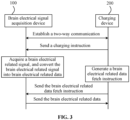
- FIG. 1 is a flowchart illustrating that a two-way communication between a brain electrical signal acquisition device 100 and a charging device 200 is established according to an embodiment of the present application.
- the brain electrical signal acquisition device 100 associated with a patient may establish the two-way communication with the charging device 200, and the brain electrical signal acquisition device 100 may perform bi-directional information transmission with the charging device 200.
- Transmission between the brain electrical signal acquisition device 100 associated with the patient and the charging device 200 is wireless, and at least two communication channels are provided between the brain electrical signal acquisition device 100 and the charging device 200.
- One of the two communication channels is used by the charging device 200 to charge the brain electrical signal acquisition device 100
- the other communication channel is used by the brain electrical signal acquisition device 100 to transmit brain electrical related data acquired and stored by the brain electrical signal acquisition device 100 to the charging device 200 so as to release the storage space of the brain electrical signal acquisition device 100.
- the method for transmitting a brain electrical signal provided in this embodiment and applied to the brain electrical signal acquisition device 100 is described below.
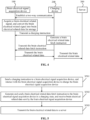
- FIG. 2 is a flowchart illustrating transmission of a brain electrical signal according to an embodiment of the present application.
- this embodiment provides a method for transmitting a brain electrical signal applied to the brain electrical signal acquisition device 100.
- the method includes the steps described below.
- S401 a two-way communication is established between the brain electrical signal acquisition device 100 associated with a patient and the charging device 200.
- a brain electrical related signal of the associated patient is acquired, and the brain electrical related signal is converted into brain electrical related data for storage.
- the brain electrical related signal of the associated patient is acquired according to a set sampling parameter, the brain electrical related signal is converted into the brain electrical related data, and the brain electrical related data is compressed and stored in the memory of the brain electrical signal acquisition device 100.
- the sampling parameter includes the sampling duration, the sampling rate, the sampling channel, sampling data and the compression ratio. For example, the sampling duration per day is 24 hours, the sampling rate is 200 Hz, the sampling channel is 1, and the sampling data is 2 bytes.
- the brain electrical related data is compressed and stored at a lossless compression ratio of 1:2.
- the volume of the brain electrical related data is about 132 Mbit, and the data may be stored in an external random-access memory (RAM) (1 Gbit) of a nerve stimulator. If the volume of the brain electrical related data exceeds the storage space of the RAM, a cyclic covering storage manner may be used.
- RAM random-access memory
- a charging instruction sent by the charging device 200 is received, and the brain electrical signal acquisition device 100 interacts with the charging device 200 according to the charging instruction to perform charging.
- the charging device 200 sends the charging instruction to the brain electrical signal acquisition device 100, the brain electrical signal acquisition device 100 interacts with the charging device 200 to adjust a charging parameter after receiving the charging instruction, and the charging is performed according to the charging parameter to enable the charging rate of the brain electrical signal acquisition device 100 to meet a set requirement.
- a brain electrical related data fetch instruction sent by the charging device 200 is received, and the brain electrical related data is transmitted to the charging device 200 according to the brain electrical related data fetch instruction.
- the charging device 200 generates and sends the brain electrical related data fetch instruction to the brain electrical signal acquisition device 100 when charging the brain electrical signal acquisition device 100, and the brain electrical signal acquisition device 100 performs the transmission of the brain electrical related data after receiving the brain electrical related data fetch instruction.
- the brain electrical related data is wirelessly transmitted to the charging device 200.
- a communication manner of simultaneous bi-directional transmission is used. While the brain electrical signal acquisition device 100 is charging, the brain electrical related data stored in the brain electrical signal acquisition device 100 is transmitted to the charging device 200 to release the storage space of the brain electrical signal acquisition device 100 so that the brain electrical signal acquisition device 100 can continuously and periodically acquire brain electrical signals of a patient without adding an additional operation of the patient, thereby effectively overcoming the defect that a brain electrical signal acquisition device 100 in the related art cannot continuously and periodically acquire brain electrical signals of a patient due to the limited storage space, which has strong operability and is easy to promote.
- FIG. 3 is a flowchart illustrating another two-way communication established between a brain electrical signal acquisition device 100 and a charging device 200 according to an embodiment of the present application.
- the brain electrical signal acquisition device 100 associated with a patient may establish the two-way communication with the charging device 200.
- the transmission between the brain electrical signal acquisition device 100 associated with the patient and the charging device 200 is wireless, and at least two communication channels are provided between the brain electrical signal acquisition device 100 and the charging device 200.
- One of the two communication channels is used by the charging device 200 to charge the brain electrical signal acquisition device 100
- the other communication channel is used by the brain electrical signal acquisition device 100 to transmit brain electrical related data, which is acquired by the brain electrical signal acquisition device 100 while the brain electrical signal acquisition device 100 is charging, to the charging device 200 in real time, so that the brain electrical related data acquired by the brain electrical signal acquisition device 100 does not occupy the storage space of the brain electrical signal acquisition device 100.
- Embodiment two is implemented based on the preceding embodiment one and expanded on the basis of embodiment one.
- the brain electrical signal acquisition device 100 while the brain electrical signal acquisition device 100 is charging, the brain electrical signal acquisition device 100 acquires a brain electrical related signal of the associated patient, converts the brain electrical related signal into brain electrical related data, and transmits the brain electrical related data to the charging device 200.
- the brain electrical signal acquisition device 100 acquires the brain electrical related data of the patient while charging and directly transmits the acquired brain electrical related data to the charging device 200 so that the brain electrical related data acquired by the brain electrical signal acquisition device 100 does not occupy the storage space of the brain electrical signal acquisition device 100.
- operations of acquiring the brain electricity signal and transmitting the data are synchronously completed in a charging process of the brain electrical signal acquisition device 100, thereby omitting a subsequent operation of transmitting the brain electrical related data in the brain electrical signal acquisition device 100 to the charging device 200.
- FIG. 4 is a flowchart illustrating another two-way communication established between a brain electrical signal acquisition device 100 and a charging device 200 according to an embodiment of the present application.
- the brain electrical signal acquisition device 100 associated with a patient may establish the two-way communication with the charging device 200, and the charging device 200 establishes a two-way communication with a server 300.
- the brain electrical signal acquisition device 100 may perform bi-directional information transmission with the charging device 200, and the charging device 200 may perform bi-directional information transmission with the server 300.
- Transmission between the brain electrical signal acquisition device 100 associated with the patient and the charging device 200 and transmission between the charging device 200 and the server 300 may be wireless, and at least two communication channels are between the brain electrical signal acquisition device 100 and the charging device 200.
- One of the two communication channels is used by the charging device 200 to charge the brain electrical signal acquisition device 100, and the other communication channel is used by the brain electrical signal acquisition device 100 to transmit brain electrical related data acquired and stored by the brain electrical signal acquisition device 100 to the charging device 200 so as to release the storage space of the brain electrical signal acquisition device 100.
- one communication channel may be between the charging device 200 and the server 300, and the communication channel is used by the charging device 200 to transmit the brain electrical related data received by the charging device 200 to the server 300.
- Embodiment three is implemented based on the preceding embodiment one and expanded on the basis of embodiment one.
- the charging device 200 transmits the brain electrical related data to the server 300 after receiving the brain electrical related data.
- a communication connection is established between the charging device 200 and the server 300, and whether the communication connection is normal is determined. If a determination result is that the communication connection is normal, the brain electrical related data received by the charging device 200 is transmitted to the server 300, and if the determination result is that the communication connection is abnormal, the brain electrical related data received by the charging device 200 is stored in the charging device 200.
- the storage capacity of the charging device 200 is at least 10 times the storage capacity of the brain electrical signal acquisition device 100, and the storage of the charging device 200 is used for storing brain electrical related data which cannot be transmitted to the server 300 in time when the brain electrical signal acquisition device 100 is charging.
- the charging device 200 transmits the brain electrical related data to the server 300 in real time.
- the server 300 may decode the data according to a set compression ratio to facilitate the subsequent statistical analysis.
- the charging device 200 transmits the brain electrical related data to the server 300 after receiving the brain electrical related data, so as to release the storage space of the charging device 200, thereby receiving brain electrical related data sent by the brain electrical signal acquisition device 100 continuously for a long time without affecting the storage of other data in the charging device 200. Moreover, transmission of the brain electrical related data from the brain electrical signal acquisition device 100 to the server 300 is completed while the brain electrical signal acquisition device 100 is charging so that only the brain electrical related data in the server 300 needs to be processed subsequently without adding an additional operation of the patient, which is convenient to use.
- FIG. 5 is a flowchart illustrating transmission of a brain electrical signal according to an embodiment of the present application.
- this embodiment provides a method for transmitting a brain electrical signal applied to a charging device 200.
- the method includes the steps described below.
- a charging instruction is sent to a brain electrical signal acquisition device 100, and the charging device 200 interacts with the brain electrical signal acquisition device 100 to charge the brain electrical signal acquisition device 100.
- the content that the charging device 200 charges the brain electrical signal acquisition device 100 has been described in detail in the preceding embodiments, which is not repeated here in this embodiment.
- a brain electrical related data fetch instruction is generated and sent to the brain electrical signal acquisition device 100 in a charging state, and brain electrical related data sent by the brain electrical signal acquisition device 100 is received.
- the content that the brain electrical signal acquisition device 100 transmits the brain electrical related data to the charging device 200 has been described in detail in the preceding embodiments, which is not repeated here in this embodiment.
- the brain electrical related data is transmitted to a server 300.
- the content that the brain electrical related data is transmitted to the server 300 has been described in detail in the preceding embodiments, which is not repeated here in this embodiment.
- This embodiment provides a method for transmitting a brain electrical signal applied to a wireless communication system.
- the wireless communication system includes a brain electrical signal acquisition device 100 and a charging device 200, where steps performed by the brain electrical signal acquisition device 100 are shown in FIG. 2 , which are not repeated here in this embodiment, and steps performed by the charging device 200 are shown in FIG. 5 , which are not repeated here in this embodiment.
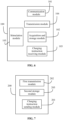
- FIG. 6 is a structural diagram of a brain electrical signal acquisition device 100 according to an embodiment of the present application.
- the brain electrical signal acquisition device 100 provided in this embodiment includes a communication module 101, an acquisition and storage module 102, a charging instruction receiving module 103 and a transmission module 104.
- the communication module 101 is configured to establish a two-way communication with a charging device 200
- the acquisition and storage module 102 is configured to acquire a brain electrical related signal of an associated patient and convert the brain electrical related signal into brain electrical related data for storage
- the charging instruction receiving module 103 is configured to receive a charging instruction sent by the charging device 200 and interact with the charging device 200 according to the charging instruction to perform charging
- the transmission module 104 is configured to, in a case where the brain electrical signal acquisition device 100 is charging, receive a brain electrical related data fetch instruction sent by the charging device 200 and transmit the brain electrical related data to the charging device 200 according to the brain electrical related data fetch instruction.
- the acquisition and storage module 102 includes an amplifier module, an analog-to-digital conversion (ADC) module and a first storage module.
- the amplifier module is configured to acquire a weak brain electrical related signal
- the ADC module is configured to convert the brain electrical related signal into brain electrical related data
- the first storage module is configured to store the brain electrical related data.
- the charging instruction receiving module 103 includes a charging receiving circuit and a digital signal modulation circuit.
- the digital signal modulation circuit may be configured to transmit a charging-related parameter.
- the charging device 200 sends the charging instruction to the brain electrical signal acquisition device 100, and the brain electrical signal acquisition device 100 receives the charging instruction through the charging instruction receiving module 103, adjusts a charging parameter and interacts the charging parameter with the charging device 200 to enable the charging rate of the brain electrical signal acquisition device 100 to meet a set requirement when the brain electrical signal acquisition device 100 is charging according to the charging parameter.
- the transmission module 104 may be a wireless module and is configured to transmit the brain electrical related data.
- the charging device 200 sends the brain electrical related data fetch instruction to the brain electrical signal acquisition device 100, and the brain electrical signal acquisition device 100 sends the brain electrical related data to the charging device 200 through the transmission module 104 after receiving the instruction.
- the transmission module 104 is further configured to bi-directionally transmit a program control instruction.
- the brain electrical signal acquisition device 100 further includes a stimulation module 105, and the stimulation module 105 may receive a stimulation parameter set by a doctor and enables the brain electrical signal acquisition device 100 to output a set value.
- FIG. 7 is a structural diagram of a charging device 200 according to an embodiment of the present application.
- the charging device 200 in this embodiment includes a charging instruction sending module 201 and a first transmission module 202.
- the charging instruction sending module 201 is configured to send a charging signal to a brain electrical signal acquisition device 100 and interact with the brain electrical signal acquisition device 100 to charge the brain electrical signal acquisition device 100
- the first transmission module 202 is configured to generate and send a brain electrical related data fetch instruction to the brain electrical signal acquisition device 100 in a charging state and receive brain electrical related data sent by the brain electrical signal acquisition device 100.
- the charging instruction sending module 201 includes a charging sending circuit and a digital signal modulation circuit, and the digital signal modulation circuit may be configured to set and acquire a charging-related parameter.
- the charging device 200 charges the brain electrical signal acquisition device 100 through the charging instruction sending module 201, and the brain electrical signal acquisition device 100 receives a charging instruction through the charging instruction receiving module 103, adjusts a charging parameter and interacts the charging parameter with the charging device 200 to enable the charging rate to meet a set requirement in the case where the brain electrical signal acquisition device 100 is charging according to the charging parameter.
- the first transmission module 202 may be a wireless module and is configured to transmit the brain electrical related data.
- the charging device 200 sends the brain electrical related data fetch instruction to the brain electrical signal acquisition device 100, and the brain electrical signal acquisition device 100 transmits the brain electrical related data to the first transmission module 202 of the charging device 200 through the transmission module 104 after receiving the instruction.
- the charging device 200 further includes a second storage module 203.
- the second storage module 203 is configured to store the brain electrical related data, where the storage capacity of the second storage module 203 included in the charging device 200 is at least 10 times the storage capacity of the first storage module included in the brain electrical signal acquisition device 100, thereby ensuring that the charging device 200 can continuously receive brain electrical related data from the brain electrical signal acquisition device 100.
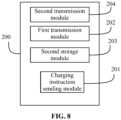
- FIG. 8 is a structural diagram of another charging device 200 according to an embodiment of the present application.
- Embodiment eight is implemented based on the preceding embodiment seven and expanded on the basis of embodiment seven.
- the charging device 200 in this embodiment includes a second transmission module 204 and is configured to transmit the brain electrical related data to a server 300. Therefore, at least unidirectional transmission exists between the first transmission module 202 and the second transmission module 204, that is, the first transmission module 202 transmits information to the second transmission module 204.
- the first transmission module 202 and the second transmission module 204 may be wireless modules, such as Bluetooth modules or Wireless Fidelity (WiFi) modules or the 4th Generation mobile communication technology (4G) modules, or may be, of course, other modules, which is not limited in this embodiment. Therefore, while the brain electrical signal acquisition device 100 is charging, real-time transmission of the brain electrical related data between the first transmission module 202 and the second transmission module 204 can be completed without adding an additional operation, which has strong operability and is easy to promote.
- An embodiment of the present application provides a storage medium, which is configured as a computer-readable storage.
- the storage medium stores one or more programs, where the one or more programs are executable by one or more processors to implement the method for transmitting a brain electrical signal provided in the preceding embodiments.
- the storage medium may include a computer storage medium (or a non-transitory medium) and a communication medium (or a transitory medium).
- the embodiments of the present application may be provided as methods, systems or computer program products. Therefore, the present application may take the form of an entire hardware embodiment, an entire software embodiment or an embodiment combining both software and hardware aspects. Moreover, the present application may take the form of a computer program product implemented on one or more computer-usable storage media (including, but not limited to, a disk memory, a compact disc read-only memory (CD-ROM), an optical memory, and the like) that include computer-usable program codes.
- a computer-usable storage media including, but not limited to, a disk memory, a compact disc read-only memory (CD-ROM), an optical memory, and the like
- These computer program instructions may also be stored in a computer-readable memory which may direct the computer or other programmable data processing device to operate in a particular manner so that the instructions stored in the computer-readable memory produce a manufactured product including an instruction means.
- the instruction means implements the functions specified in one or more flows in the flowcharts and/or one or more blocks in the block diagrams.
Landscapes
- Engineering & Computer Science (AREA)
- Health & Medical Sciences (AREA)
- Life Sciences & Earth Sciences (AREA)
- Computer Networks & Wireless Communication (AREA)
- Biomedical Technology (AREA)
- General Health & Medical Sciences (AREA)
- Power Engineering (AREA)
- Veterinary Medicine (AREA)
- Animal Behavior & Ethology (AREA)
- Public Health (AREA)
- Physics & Mathematics (AREA)
- Signal Processing (AREA)
- Heart & Thoracic Surgery (AREA)
- Biophysics (AREA)
- Pathology (AREA)
- Medical Informatics (AREA)
- Molecular Biology (AREA)
- Surgery (AREA)
- General Engineering & Computer Science (AREA)
- Nuclear Medicine, Radiotherapy & Molecular Imaging (AREA)
- Theoretical Computer Science (AREA)
- Radiology & Medical Imaging (AREA)
- Psychiatry (AREA)
- Dermatology (AREA)
- Neurology (AREA)
- Neurosurgery (AREA)
- Psychology (AREA)
- Human Computer Interaction (AREA)
- General Physics & Mathematics (AREA)
- Physiology (AREA)
- Measurement And Recording Of Electrical Phenomena And Electrical Characteristics Of The Living Body (AREA)
- Measuring And Recording Apparatus For Diagnosis (AREA)
Abstract
Description
- This application claims priority to
Chinese Patent Application No. 202110296316.X filed with the China National Intellectual Property Administration (CNIPA) on Mar. 19, 2021 - The present application relates to the technical field of medical devices, for example, a method for transmitting a brain electrical signal, and a device.
- An implantable nerve stimulation system, including a nerve stimulator and a stimulation electrode implanted in the deep brain, is configured to treat nervous system disorders such as Parkinson's disease and epilepsy, and mental diseases such as addiction and obsessive-compulsive disorder. Clinically, an implantable nerve stimulator of Medtronic's Percept model can continuously acquire and record brain electrical characteristic signals of a patient for a long time after operation and may be used for long-term monitoring of disease.
- A manner of acquiring electrical signals in the deep brain for a long time after operation is mainly as follows: in a non-program control state, that is, during daily stimulation of the patient, brain electrical signals are acquired continuously, and an abnormally fluctuating signal is recorded and stored in the memory of the nerve stimulator. The limitation of the nerve stimulator is that a large-capacity memory chip cannot be placed inside the nerve stimulator due to the volume of the nerve stimulator. Therefore, the storage space of the nerve stimulator is limited, and the nerve stimulator cannot continuously and periodically monitor brain electrical signals of a patient and cannot take a measure timely when an abnormality occurs.
- The present application provides a method for transmitting a brain electrical signal, and a device, so as to overcome a defect in the related art that a nerve stimulator cannot continuously and periodically acquire brain electrical signals of a patient.
- The present application provides a method for transmitting a brain electrical signal, which is applied to a brain electrical signal acquisition device associated with a patient. The method includes the steps described below.
- A two-way communication with a charging device is established.
- A charging instruction sent by the charging device is received, and the brain electrical signal acquisition device interacts with the charging device according to the charging instruction to perform charging.
- In the case where the brain electrical signal acquisition device is charging, a brain electrical related data fetch instruction sent by the charging device is received, and brain electrical related data of the patient acquired by the brain electrical signal acquisition device is transmitted to the charging device according to the brain electrical related data fetch instruction.
- In an embodiment of the present application, the step in which the brain electrical signal acquisition device interacts with the charging device according to the charging instruction to perform the charging includes the step described below.
- The brain electrical signal acquisition device interacts with the charging device according to the charging instruction to adjust a charging parameter, and the charging is performed according to the charging parameter, where the charging parameter is used for enabling a charging rate of the brain electrical signal acquisition device to meet a set requirement.
- In an embodiment of the present application, the step in which the brain electrical related data of the patient acquired by the brain electrical signal acquisition device is transmitted to the charging device according to the brain electrical related data fetch instruction includes the steps described below.
- Brain electrical related data stored in the brain electrical signal acquisition device is transmitted to the charging device according to the brain electrical related data fetch instruction, where the brain electrical related data is obtained after the brain electrical signal acquisition device converts and stores an acquired brain electrical related signal of the patient before the brain electrical signal acquisition device is charged.
- Alternatively, in the case where the brain electrical signal acquisition device is charging, a brain electrical related signal of the patient is acquired, the brain electrical related signal is converted into brain electrical related data, and the brain electrical related data is transmitted to the charging device.
- In an embodiment of the present application, the step in which the brain electrical signal acquisition device converts and stores the acquired brain electrical related signal of the patent includes the step described below.
- The brain electrical related signal of the patient is acquired according to a set sampling parameter, the brain electrical related signal is converted into the brain electrical related data, and the brain electrical related data is compressed and stored in a memory of the brain electrical signal acquisition device, where the sampling parameter includes sampling duration, a sampling rate, a sampling channel, sampling data and a compression ratio.
- The present application provides a method for transmitting a brain electrical signal, which is applied to a charging device. The method includes the steps described below.
- A charging instruction is sent to a brain electrical signal acquisition device, and the charging device interacts with the brain electrical signal acquisition device to charge the brain electrical signal acquisition device.
- A brain electrical related data fetch instruction is generated and sent to the brain electrical signal acquisition device in a charging state, and brain electrical related data sent by the brain electrical signal acquisition device is received.
- The brain electrical related data is transmitted to a server.
- In an embodiment of the present application, the step in which the brain electrical related data is transmitted to the server includes the steps described below.
- A communication connection with the server is established, and whether the communication connection is normal is determined.
- In response to the communication connection being normal, the received brain electrical related data is transmitted to the server.
- In response to the communication connection being abnormal, the received brain electrical related data is stored in the charging device, where the storage capacity of the charging device is at least 10 times the storage capacity of the brain electrical signal acquisition device.
- The present application provides a method for transmitting a brain electrical signal, which is applied to a wireless communication system including a brain electrical signal acquisition device and a charging device. The method includes the steps described below.
- A two-way communication between the brain electrical signal acquisition device associated with a patient and the charging device is established.
- The charging device sends a charging signal to the brain electrical signal acquisition device.
- The brain electrical signal acquisition device receives a charging instruction sent by the charging device and interacts with the charging device according to the charging instruction to perform charging.
- The charging device generates and sends a brain electrical related data fetch instruction to the brain electrical signal acquisition device in a charging state.
- In the case where the brain electrical signal acquisition device is charging, the brain electrical related data fetch instruction sent by the charging device is received, and brain electrical related data of the patient acquired by the brain electrical signal acquisition device is transmitted to the charging device according to the brain electrical related data fetch instruction.
- The charging device transmits the brain electrical related data to a server.
- The present application provides a brain electrical signal acquisition device, which is associated with a patient. The device includes a communication module, a charging instruction receiving module and a transmission module.
- The communication module is configured to establish a two-way communication with a charging device.
- The charging instruction receiving module is configured to receive a charging instruction sent by the charging device and interact with the charging device according to the charging instruction to perform charging.
- The transmission module is configured to, in the case where the brain electrical signal acquisition device is charging, receive a brain electrical related data fetch instruction sent by the charging device and transmit brain electrical related data of the patient acquired by the brain electrical signal acquisition device to the charging device according to the brain electrical related data fetch instruction.
- The present application provides a charging device. The device includes a charging instruction sending module, a first transmission module and a second transmission module.
- The charging instruction sending module is configured to send a charging signal to a brain electrical signal acquisition device and interact with the brain electrical signal acquisition device to charge the brain electrical signal acquisition device.
- The first transmission module is configured to generate and send a brain electrical related data fetch instruction to the brain electrical signal acquisition device in a charging state and receive brain electrical related data sent by the brain electrical signal acquisition device.
- The second transmission module is configured to transmit the brain electrical related data to a server.
-
-
FIG. 1 is a flowchart illustrating a two-way communication established between a brain electrical signal acquisition device and a charging device according to an embodiment of the present application. -
FIG. 2 is a flowchart illustrating transmission of a brain electrical signal according to an embodiment of the present application. -
FIG. 3 is a flowchart illustrating another two-way communication established between a brain electrical signal acquisition device and a charging device according to an embodiment of the present application. -
FIG. 4 is a flowchart illustrating another two-way communication established between a brain electrical signal acquisition device and a charging device according to an embodiment of the present application. -
FIG. 5 is a flowchart illustrating transmission of a brain electrical signal according to an embodiment of the present application. -
FIG. 6 is a structural diagram of a brain electrical signal acquisition device according to an embodiment of the present application. -
FIG. 7 is a structural diagram of a charging device according to an embodiment of the present application. -
FIG. 8 is a structural diagram of another charging device according to an embodiment of the present application. -
- 100
- brain electrical signal acquisition device
- 101
- communication module
- 102
- acquisition and storage module
- 103
- charging instruction receiving module
- 104
- transmission module
- 105
- stimulation module
- 200
- charging device
- 201
- charging instruction sending module
- 202
- first transmission module
- 203
- second storage module
- 204
- second transmission module
- 300
- server
- The present application is described hereinafter in detail in conjunction with drawings and embodiments so that those skilled in the art can understand and implement the present application.
- The wireless communication system in the present application is widely arranged to provide multiple communication services such as charging. The wireless communication system includes a brain electrical signal acquisition device and a charging device. The brain electrical signal acquisition device in the present application is, for example, a rechargeable and implantable nerve stimulator. The rechargeable and implantable nerve stimulator needs to be charged regularly on time according to power consumption.
-
FIG. 1 is a flowchart illustrating that a two-way communication between a brain electricalsignal acquisition device 100 and acharging device 200 is established according to an embodiment of the present application. - Referring to
FIG. 1 , the brain electricalsignal acquisition device 100 associated with a patient may establish the two-way communication with the chargingdevice 200, and the brain electricalsignal acquisition device 100 may perform bi-directional information transmission with the chargingdevice 200. - Transmission between the brain electrical
signal acquisition device 100 associated with the patient and thecharging device 200 is wireless, and at least two communication channels are provided between the brain electricalsignal acquisition device 100 and thecharging device 200. One of the two communication channels is used by the chargingdevice 200 to charge the brain electricalsignal acquisition device 100, and the other communication channel is used by the brain electricalsignal acquisition device 100 to transmit brain electrical related data acquired and stored by the brain electricalsignal acquisition device 100 to thecharging device 200 so as to release the storage space of the brain electricalsignal acquisition device 100. - The method for transmitting a brain electrical signal provided in this embodiment and applied to the brain electrical
signal acquisition device 100 is described below. -
FIG. 2 is a flowchart illustrating transmission of a brain electrical signal according to an embodiment of the present application. - Referring to
FIG. 2 , this embodiment provides a method for transmitting a brain electrical signal applied to the brain electricalsignal acquisition device 100. The method includes the steps described below. - In S401, a two-way communication is established between the brain electrical
signal acquisition device 100 associated with a patient and thecharging device 200. - In S402, a brain electrical related signal of the associated patient is acquired, and the brain electrical related signal is converted into brain electrical related data for storage.
- Exemplarily, the brain electrical related signal of the associated patient is acquired according to a set sampling parameter, the brain electrical related signal is converted into the brain electrical related data, and the brain electrical related data is compressed and stored in the memory of the brain electrical
signal acquisition device 100. The sampling parameter includes the sampling duration, the sampling rate, the sampling channel, sampling data and the compression ratio. For example, the sampling duration per day is 24 hours, the sampling rate is 200 Hz, the sampling channel is 1, and the sampling data is 2 bytes. The brain electrical related data is compressed and stored at a lossless compression ratio of 1:2. The volume of the brain electrical related data is about 132 Mbit, and the data may be stored in an external random-access memory (RAM) (1 Gbit) of a nerve stimulator. If the volume of the brain electrical related data exceeds the storage space of the RAM, a cyclic covering storage manner may be used. - In S403, a charging instruction sent by the charging
device 200 is received, and the brain electricalsignal acquisition device 100 interacts with the chargingdevice 200 according to the charging instruction to perform charging. - Exemplarily, the charging
device 200 sends the charging instruction to the brain electricalsignal acquisition device 100, the brain electricalsignal acquisition device 100 interacts with the chargingdevice 200 to adjust a charging parameter after receiving the charging instruction, and the charging is performed according to the charging parameter to enable the charging rate of the brain electricalsignal acquisition device 100 to meet a set requirement. - In S404, a brain electrical related data fetch instruction sent by the charging
device 200 is received, and the brain electrical related data is transmitted to thecharging device 200 according to the brain electrical related data fetch instruction. - Exemplarily, the charging
device 200 generates and sends the brain electrical related data fetch instruction to the brain electricalsignal acquisition device 100 when charging the brain electricalsignal acquisition device 100, and the brain electricalsignal acquisition device 100 performs the transmission of the brain electrical related data after receiving the brain electrical related data fetch instruction. The brain electrical related data is wirelessly transmitted to thecharging device 200. - In the present application, a communication manner of simultaneous bi-directional transmission is used. While the brain electrical
signal acquisition device 100 is charging, the brain electrical related data stored in the brain electricalsignal acquisition device 100 is transmitted to thecharging device 200 to release the storage space of the brain electricalsignal acquisition device 100 so that the brain electricalsignal acquisition device 100 can continuously and periodically acquire brain electrical signals of a patient without adding an additional operation of the patient, thereby effectively overcoming the defect that a brain electricalsignal acquisition device 100 in the related art cannot continuously and periodically acquire brain electrical signals of a patient due to the limited storage space, which has strong operability and is easy to promote. -
FIG. 3 is a flowchart illustrating another two-way communication established between a brain electricalsignal acquisition device 100 and acharging device 200 according to an embodiment of the present application. - Referring to
FIG. 3 , the brain electricalsignal acquisition device 100 associated with a patient may establish the two-way communication with the chargingdevice 200. - The transmission between the brain electrical
signal acquisition device 100 associated with the patient and thecharging device 200 is wireless, and at least two communication channels are provided between the brain electricalsignal acquisition device 100 and thecharging device 200. One of the two communication channels is used by the chargingdevice 200 to charge the brain electricalsignal acquisition device 100, and the other communication channel is used by the brain electricalsignal acquisition device 100 to transmit brain electrical related data, which is acquired by the brain electricalsignal acquisition device 100 while the brain electricalsignal acquisition device 100 is charging, to thecharging device 200 in real time, so that the brain electrical related data acquired by the brain electricalsignal acquisition device 100 does not occupy the storage space of the brain electricalsignal acquisition device 100. - The method for transmitting a brain electrical signal provided in this embodiment and applied to the brain electrical
signal acquisition device 100 is described below. Embodiment two is implemented based on the preceding embodiment one and expanded on the basis of embodiment one. - The difference between embodiment two and embodiment one is described below.
- In embodiment two, while the brain electrical
signal acquisition device 100 is charging, the brain electricalsignal acquisition device 100 acquires a brain electrical related signal of the associated patient, converts the brain electrical related signal into brain electrical related data, and transmits the brain electrical related data to thecharging device 200. - In this embodiment, the brain electrical
signal acquisition device 100 acquires the brain electrical related data of the patient while charging and directly transmits the acquired brain electrical related data to thecharging device 200 so that the brain electrical related data acquired by the brain electricalsignal acquisition device 100 does not occupy the storage space of the brain electricalsignal acquisition device 100. In this manner, operations of acquiring the brain electricity signal and transmitting the data are synchronously completed in a charging process of the brain electricalsignal acquisition device 100, thereby omitting a subsequent operation of transmitting the brain electrical related data in the brain electricalsignal acquisition device 100 to thecharging device 200. -
FIG. 4 is a flowchart illustrating another two-way communication established between a brain electricalsignal acquisition device 100 and acharging device 200 according to an embodiment of the present application. - Referring to
FIG. 4 , the brain electricalsignal acquisition device 100 associated with a patient may establish the two-way communication with the chargingdevice 200, and thecharging device 200 establishes a two-way communication with aserver 300. - The brain electrical
signal acquisition device 100 may perform bi-directional information transmission with the chargingdevice 200, and thecharging device 200 may perform bi-directional information transmission with theserver 300. Transmission between the brain electricalsignal acquisition device 100 associated with the patient and thecharging device 200 and transmission between the chargingdevice 200 and theserver 300 may be wireless, and at least two communication channels are between the brain electricalsignal acquisition device 100 and thecharging device 200. One of the two communication channels is used by the chargingdevice 200 to charge the brain electricalsignal acquisition device 100, and the other communication channel is used by the brain electricalsignal acquisition device 100 to transmit brain electrical related data acquired and stored by the brain electricalsignal acquisition device 100 to thecharging device 200 so as to release the storage space of the brain electricalsignal acquisition device 100. In addition, one communication channel may be between the chargingdevice 200 and theserver 300, and the communication channel is used by the chargingdevice 200 to transmit the brain electrical related data received by the chargingdevice 200 to theserver 300. - The method for transmitting a brain electrical signal provided in this embodiment and applied to the brain electrical
signal acquisition device 100 is described below. Embodiment three is implemented based on the preceding embodiment one and expanded on the basis of embodiment one. - The difference between embodiment three and embodiment one is described below.
- In embodiment three, the charging
device 200 transmits the brain electrical related data to theserver 300 after receiving the brain electrical related data. A communication connection is established between the chargingdevice 200 and theserver 300, and whether the communication connection is normal is determined. If a determination result is that the communication connection is normal, the brain electrical related data received by the chargingdevice 200 is transmitted to theserver 300, and if the determination result is that the communication connection is abnormal, the brain electrical related data received by the chargingdevice 200 is stored in thecharging device 200. The storage capacity of thecharging device 200 is at least 10 times the storage capacity of the brain electricalsignal acquisition device 100, and the storage of thecharging device 200 is used for storing brain electrical related data which cannot be transmitted to theserver 300 in time when the brain electricalsignal acquisition device 100 is charging. Of course, for the brain electrical related data stored in thecharging device 200, after the communication connection is normal, the chargingdevice 200 transmits the brain electrical related data to theserver 300 in real time. After receiving the brain electrical related data, theserver 300 may decode the data according to a set compression ratio to facilitate the subsequent statistical analysis. - In the present application, the charging
device 200 transmits the brain electrical related data to theserver 300 after receiving the brain electrical related data, so as to release the storage space of thecharging device 200, thereby receiving brain electrical related data sent by the brain electricalsignal acquisition device 100 continuously for a long time without affecting the storage of other data in thecharging device 200. Moreover, transmission of the brain electrical related data from the brain electricalsignal acquisition device 100 to theserver 300 is completed while the brain electricalsignal acquisition device 100 is charging so that only the brain electrical related data in theserver 300 needs to be processed subsequently without adding an additional operation of the patient, which is convenient to use. -
FIG. 5 is a flowchart illustrating transmission of a brain electrical signal according to an embodiment of the present application. - Referring to
FIG. 5 , this embodiment provides a method for transmitting a brain electrical signal applied to acharging device 200. The method includes the steps described below. - In S501, a charging instruction is sent to a brain electrical
signal acquisition device 100, and thecharging device 200 interacts with the brain electricalsignal acquisition device 100 to charge the brain electricalsignal acquisition device 100. - The content that the
charging device 200 charges the brain electricalsignal acquisition device 100 has been described in detail in the preceding embodiments, which is not repeated here in this embodiment. - In S502, a brain electrical related data fetch instruction is generated and sent to the brain electrical
signal acquisition device 100 in a charging state, and brain electrical related data sent by the brain electricalsignal acquisition device 100 is received. - The content that the brain electrical
signal acquisition device 100 transmits the brain electrical related data to thecharging device 200 has been described in detail in the preceding embodiments, which is not repeated here in this embodiment. - In S503, the brain electrical related data is transmitted to a
server 300. - The content that the brain electrical related data is transmitted to the
server 300 has been described in detail in the preceding embodiments, which is not repeated here in this embodiment. - Moreover, for details of an effect of this embodiment, reference is made to the preceding embodiments, which is not repeated here in this embodiment.
- This embodiment provides a method for transmitting a brain electrical signal applied to a wireless communication system. The wireless communication system includes a brain electrical
signal acquisition device 100 and acharging device 200, where steps performed by the brain electricalsignal acquisition device 100 are shown inFIG. 2 , which are not repeated here in this embodiment, and steps performed by the chargingdevice 200 are shown inFIG. 5 , which are not repeated here in this embodiment. -
FIG. 6 is a structural diagram of a brain electricalsignal acquisition device 100 according to an embodiment of the present application. - Referring to
FIG. 6 , the brain electricalsignal acquisition device 100 provided in this embodiment includes acommunication module 101, an acquisition andstorage module 102, a charginginstruction receiving module 103 and atransmission module 104. - The
communication module 101 is configured to establish a two-way communication with acharging device 200, the acquisition andstorage module 102 is configured to acquire a brain electrical related signal of an associated patient and convert the brain electrical related signal into brain electrical related data for storage, the charginginstruction receiving module 103 is configured to receive a charging instruction sent by the chargingdevice 200 and interact with the chargingdevice 200 according to the charging instruction to perform charging, and thetransmission module 104 is configured to, in a case where the brain electricalsignal acquisition device 100 is charging, receive a brain electrical related data fetch instruction sent by the chargingdevice 200 and transmit the brain electrical related data to thecharging device 200 according to the brain electrical related data fetch instruction. - The acquisition and
storage module 102 includes an amplifier module, an analog-to-digital conversion (ADC) module and a first storage module. The amplifier module is configured to acquire a weak brain electrical related signal, the ADC module is configured to convert the brain electrical related signal into brain electrical related data, and the first storage module is configured to store the brain electrical related data. - The charging
instruction receiving module 103 includes a charging receiving circuit and a digital signal modulation circuit. The digital signal modulation circuit may be configured to transmit a charging-related parameter. The chargingdevice 200 sends the charging instruction to the brain electricalsignal acquisition device 100, and the brain electricalsignal acquisition device 100 receives the charging instruction through the charginginstruction receiving module 103, adjusts a charging parameter and interacts the charging parameter with the chargingdevice 200 to enable the charging rate of the brain electricalsignal acquisition device 100 to meet a set requirement when the brain electricalsignal acquisition device 100 is charging according to the charging parameter. - The
transmission module 104 may be a wireless module and is configured to transmit the brain electrical related data. The chargingdevice 200 sends the brain electrical related data fetch instruction to the brain electricalsignal acquisition device 100, and the brain electricalsignal acquisition device 100 sends the brain electrical related data to thecharging device 200 through thetransmission module 104 after receiving the instruction. Of course, thetransmission module 104 is further configured to bi-directionally transmit a program control instruction. - The brain electrical
signal acquisition device 100 further includes astimulation module 105, and thestimulation module 105 may receive a stimulation parameter set by a doctor and enables the brain electricalsignal acquisition device 100 to output a set value. -
FIG. 7 is a structural diagram of acharging device 200 according to an embodiment of the present application. - Referring to
FIG. 7 , the chargingdevice 200 in this embodiment includes a charginginstruction sending module 201 and afirst transmission module 202. - The charging
instruction sending module 201 is configured to send a charging signal to a brain electricalsignal acquisition device 100 and interact with the brain electricalsignal acquisition device 100 to charge the brain electricalsignal acquisition device 100, and thefirst transmission module 202 is configured to generate and send a brain electrical related data fetch instruction to the brain electricalsignal acquisition device 100 in a charging state and receive brain electrical related data sent by the brain electricalsignal acquisition device 100. - The charging
instruction sending module 201 includes a charging sending circuit and a digital signal modulation circuit, and the digital signal modulation circuit may be configured to set and acquire a charging-related parameter. The chargingdevice 200 charges the brain electricalsignal acquisition device 100 through the charginginstruction sending module 201, and the brain electricalsignal acquisition device 100 receives a charging instruction through the charginginstruction receiving module 103, adjusts a charging parameter and interacts the charging parameter with the chargingdevice 200 to enable the charging rate to meet a set requirement in the case where the brain electricalsignal acquisition device 100 is charging according to the charging parameter. - The
first transmission module 202 may be a wireless module and is configured to transmit the brain electrical related data. The chargingdevice 200 sends the brain electrical related data fetch instruction to the brain electricalsignal acquisition device 100, and the brain electricalsignal acquisition device 100 transmits the brain electrical related data to thefirst transmission module 202 of thecharging device 200 through thetransmission module 104 after receiving the instruction. - The charging
device 200 further includes asecond storage module 203. After thefirst transmission module 202 receives the brain electrical related data, thesecond storage module 203 is configured to store the brain electrical related data, where the storage capacity of thesecond storage module 203 included in thecharging device 200 is at least 10 times the storage capacity of the first storage module included in the brain electricalsignal acquisition device 100, thereby ensuring that thecharging device 200 can continuously receive brain electrical related data from the brain electricalsignal acquisition device 100. -
FIG. 8 is a structural diagram of anothercharging device 200 according to an embodiment of the present application. - The charging
device 200 provided in this embodiment is described below. Embodiment eight is implemented based on the preceding embodiment seven and expanded on the basis of embodiment seven. - The difference between embodiment seven and embodiment eight is described below.
- The charging
device 200 in this embodiment includes asecond transmission module 204 and is configured to transmit the brain electrical related data to aserver 300. Therefore, at least unidirectional transmission exists between thefirst transmission module 202 and thesecond transmission module 204, that is, thefirst transmission module 202 transmits information to thesecond transmission module 204. Here, thefirst transmission module 202 and thesecond transmission module 204 may be wireless modules, such as Bluetooth modules or Wireless Fidelity (WiFi) modules or the 4th Generation mobile communication technology (4G) modules, or may be, of course, other modules, which is not limited in this embodiment. Therefore, while the brain electricalsignal acquisition device 100 is charging, real-time transmission of the brain electrical related data between thefirst transmission module 202 and thesecond transmission module 204 can be completed without adding an additional operation, which has strong operability and is easy to promote. - An embodiment of the present application provides a storage medium, which is configured as a computer-readable storage. The storage medium stores one or more programs, where the one or more programs are executable by one or more processors to implement the method for transmitting a brain electrical signal provided in the preceding embodiments.
- The storage medium may include a computer storage medium (or a non-transitory medium) and a communication medium (or a transitory medium).
- The embodiments of the present application may be provided as methods, systems or computer program products. Therefore, the present application may take the form of an entire hardware embodiment, an entire software embodiment or an embodiment combining both software and hardware aspects. Moreover, the present application may take the form of a computer program product implemented on one or more computer-usable storage media (including, but not limited to, a disk memory, a compact disc read-only memory (CD-ROM), an optical memory, and the like) that include computer-usable program codes.
- The present application is described with reference to flowcharts and/or block diagrams of methods, devices (systems) and computer program products according to the embodiments of the present application. It is to be understood that each flow and/or block in the flowcharts and/or block diagrams and a combination of flows and/or blocks in the flowcharts and/or block diagrams are implemented by computer program instructions. These computer program instructions can be provided to a general-purpose computer, a special-purpose computer, an embedded processor or a processor of another programmable data processing device to produce a machine, so that instructions executed by a computer or a processor of another programmable data processing device produce an apparatus for implementing the functions specified in one or more flows in the flowcharts and/or one or more blocks in the block diagrams.
- These computer program instructions may also be stored in a computer-readable memory which may direct the computer or other programmable data processing device to operate in a particular manner so that the instructions stored in the computer-readable memory produce a manufactured product including an instruction means. The instruction means implements the functions specified in one or more flows in the flowcharts and/or one or more blocks in the block diagrams.
- These computer program instructions may also be loaded onto the computer or other programmable data processing device so that a series of operation steps are performed on the computer or other programmable device to produce processing implemented by the computer. Therefore, instructions executed on the computer or other programmable device provide steps for implementing the functions specified in one or more flows in the flowcharts and/or one or more blocks in the block diagrams.
Claims (10)
- A method for transmitting a brain electrical signal, being applied to a brain electrical signal acquisition device associated with a patient and comprising:establishing a two-way communication with a charging device;receiving a charging instruction sent by the charging device, and interacting with the charging device according to the charging instruction to perform charging; andin a case where the brain electrical signal acquisition device is charging, receiving a brain electrical related data fetch instruction sent by the charging device, and transmitting, according to the brain electrical related data fetch instruction, brain electrical related data of the patient acquired by the brain electrical signal acquisition device to the charging device.
- The method according to claim 1, wherein interacting with the charging device according to the charging instruction to perform the charging comprises:
interacting with the charging device according to the charging instruction to adjust a charging parameter, and performing the charging according to the charging parameter, wherein the charging parameter is used for enabling a charging rate of the brain electrical signal acquisition device to meet a set requirement. - The method according to claim 1, wherein transmitting, according to the brain electrical related data fetch instruction, the brain electrical related data of the patient acquired by the brain electrical signal acquisition device to the charging device comprises:transmitting, according to the brain electrical related data fetch instruction, brain electrical related data stored in the brain electrical signal acquisition device to the charging device, wherein the brain electrical related data is data obtained after the brain electrical signal acquisition device converts and stores an acquired brain electrical related signal of the patient before the brain electrical signal acquisition device is charged; orin the case where the brain electrical signal acquisition device is charging, acquiring a brain electrical related signal of the patient, converting the brain electrical related signal into brain electrical related data, and transmitting the brain electrical related data to the charging device.
- The method according to claim 3, wherein converting and storing, by the brain electrical signal acquisition device, the acquired brain electrical related signal of the patient comprises:
acquiring the brain electrical related signal of the patient according to a set sampling parameter, converting the brain electrical related signal into the brain electrical related data, and compressing and storing the brain electrical related data in a memory of the brain electrical signal acquisition device, wherein the sampling parameter comprises sampling duration, a sampling rate, a sampling channel, sampling data and a compression ratio. - A method for transmitting a brain electrical signal, being applied to a charging device and comprising:sending a charging instruction to a brain electrical signal acquisition device, and interacting with the brain electrical signal acquisition device to charge the brain electrical signal acquisition device;generating a brain electrical related data fetch instruction, sending the brain electrical related data fetch instruction to the brain electrical signal acquisition device in a charging state, and receiving brain electrical related data sent by the brain electrical signal acquisition device; andtransmitting the brain electrical related data to a server.
- The method according to claim 5, wherein transmitting the brain electrical related data to the server comprises:establishing a communication connection with the server, and determining whether the communication connection is normal;in response to the communication connection being normal, transmitting the received brain electrical related data to the server; andin response to the communication connection being abnormal, storing the received brain electrical related data in the charging device, wherein a storage capacity of the charging device is at least 10 times a storage capacity of the brain electrical signal acquisition device.
- A method for transmitting a brain electrical signal, being applied to a wireless communication system, wherein the wireless communication system comprises a brain electrical signal acquisition device and a charging device; wherein the method comprises:establishing a two-way communication between the brain electrical signal acquisition device associated with a patient and the charging device;sending, by the charging device, a charging signal to the brain electrical signal acquisition device;receiving, by the brain electrical signal acquisition device, a charging instruction sent by the charging device, and interacting with the charging device according to the charging instruction to perform charging;generating, by the charging device, a brain electrical related data fetch instruction and sending the brain electrical related data fetch instruction to the brain electrical signal acquisition device in a charging state;in a case where the brain electrical signal acquisition device is charging, receiving the brain electrical related data fetch instruction sent by the charging device, and transmitting brain electrical related data of the patient acquired by the brain electrical signal acquisition device to the charging device according to the brain electrical related data fetch instruction; andtransmitting, by the charging device, the brain electrical related data to a server.
- A brain electrical signal acquisition device, being associated with a patient and comprising:a communication module configured to establish a two-way communication with a charging device;a charging instruction receiving module configured to receive a charging instruction sent by the charging device and interact with the charging device according to the charging instruction to perform charging; anda transmission module configured to, in a case where the brain electrical signal acquisition device is charging, receive a brain electrical related data fetch instruction sent by the charging device and transmit brain electrical related data of the patient acquired by the brain electrical signal acquisition device to the charging device according to the brain electrical related data fetch instruction.
- A charging device, comprising:a charging instruction sending module configured to send a charging signal to a brain electrical signal acquisition device and interact with the brain electrical signal acquisition device to charge the brain electrical signal acquisition device;a first transmission module configured to generate a brain electrical related data fetch instruction, send the brain electrical related data fetch instruction to the brain electrical signal acquisition device in a charging state, and receive brain electrical related data sent by the brain electrical signal acquisition device; anda second transmission module configured to transmit the brain electrical related data to a server.
- A storage medium, being configured as a computer-readable storage and storing at least one program, wherein the at least one program is executable by at least one processor to implement the method for transmitting a brain electrical signal according to any one of claims 1 to 7.
Applications Claiming Priority (2)
| Application Number | Priority Date | Filing Date | Title |
|---|---|---|---|
| CN202110296316.XA CN113115474B (en) | 2021-03-19 | 2021-03-19 | Method and equipment for transmitting electroencephalogram signals while charging |
| PCT/CN2022/081213 WO2022194213A1 (en) | 2021-03-19 | 2022-03-16 | Method for transmitting brain electrical signal, and device |
Publications (2)
| Publication Number | Publication Date |
|---|---|
| EP4311364A1 true EP4311364A1 (en) | 2024-01-24 |
| EP4311364A4 EP4311364A4 (en) | 2025-02-19 |
Family
ID=76712044
Family Applications (1)
| Application Number | Title | Priority Date | Filing Date |
|---|---|---|---|
| EP22770566.2A Pending EP4311364A4 (en) | 2021-03-19 | 2022-03-16 | METHOD FOR TRANSMITTING AN ELECTRICAL BRAIN SIGNAL AND DEVICE |
Country Status (4)
| Country | Link |
|---|---|
| US (1) | US20240171638A1 (en) |
| EP (1) | EP4311364A4 (en) |
| CN (1) | CN113115474B (en) |
| WO (1) | WO2022194213A1 (en) |
Families Citing this family (1)
| Publication number | Priority date | Publication date | Assignee | Title |
|---|---|---|---|---|
| CN113115474B (en) * | 2021-03-19 | 2022-07-19 | 苏州景昱医疗器械有限公司 | Method and equipment for transmitting electroencephalogram signals while charging |
Family Cites Families (11)
| Publication number | Priority date | Publication date | Assignee | Title |
|---|---|---|---|---|
| CN106160031B (en) * | 2015-03-25 | 2019-08-27 | 联想(北京)有限公司 | Electronic equipment and information processing method |
| US20170259072A1 (en) * | 2016-03-14 | 2017-09-14 | Qualcomm Incorporated | System architecture for medical implant |
| JP7071338B2 (en) * | 2016-08-26 | 2022-05-18 | セクアナ メディカル エヌブイ | Systems and methods for managing and analyzing data generated by embedded devices |
| EP3582069B1 (en) * | 2017-02-10 | 2025-10-22 | Nihon Kohden Corporation | Brain-machine interface system capable of changing amount of communication data from internal device, and control method therefor |
| CN106921194A (en) * | 2017-03-17 | 2017-07-04 | 中国农业大学 | Collector wireless charging method, collector, control terminal and system |
| CN110089040B (en) * | 2017-04-07 | 2022-04-15 | Oppo广东移动通信有限公司 | Data transmission method and sending end equipment |
| CN108784689A (en) * | 2018-06-19 | 2018-11-13 | 苏州修普诺斯医疗器械有限公司 | The mobile EEG signals Transmission system and method for power saving |
| CN109995117B (en) * | 2019-04-24 | 2021-07-20 | 北京极智嘉科技股份有限公司 | Robot-based charging system and method |
| CN111224453B (en) * | 2020-04-16 | 2020-08-25 | 锐迪科微电子(上海)有限公司 | Communication method based on charging wire, charging device, intelligent device and storage medium |
| CN111696333A (en) * | 2020-06-28 | 2020-09-22 | 上海明略人工智能(集团)有限公司 | Data transmission method, system and device |
| CN113115474B (en) * | 2021-03-19 | 2022-07-19 | 苏州景昱医疗器械有限公司 | Method and equipment for transmitting electroencephalogram signals while charging |
-
2021
- 2021-03-19 CN CN202110296316.XA patent/CN113115474B/en active Active
-
2022
- 2022-03-16 EP EP22770566.2A patent/EP4311364A4/en active Pending
- 2022-03-16 WO PCT/CN2022/081213 patent/WO2022194213A1/en not_active Ceased
- 2022-03-16 US US18/282,757 patent/US20240171638A1/en active Pending
Also Published As
| Publication number | Publication date |
|---|---|
| WO2022194213A1 (en) | 2022-09-22 |
| US20240171638A1 (en) | 2024-05-23 |
| CN113115474A (en) | 2021-07-13 |
| EP4311364A4 (en) | 2025-02-19 |
| CN113115474B (en) | 2022-07-19 |
Similar Documents
| Publication | Publication Date | Title |
|---|---|---|
| CN102462891B (en) | Remote implantable medical device monitoring system and remote implantable medical device monitoring method | |
| US10252054B2 (en) | Distributed processing of electrophysiological signals | |
| US11317850B2 (en) | Medical device, algorithm updating method, medical system and external monitoring device | |
| Brunelli et al. | Design considerations for wireless acquisition of multichannel sEMG signals in prosthetic hand control | |
| US12068075B2 (en) | Method for initiating a data transfer from an implantable medical device | |
| CN104225790A (en) | Closed loop nerve stimulation system | |
| US20230018684A1 (en) | Wireless communication in an implantable medical device system | |
| EP4311364A1 (en) | Method for transmitting brain electrical signal, and device | |
| US20230417053A1 (en) | Charging and processing case for wireless earbuds with in-the-ear electroencephalography implementation | |
| CN110352083B (en) | Method and apparatus for managing display of multiple data streams | |
| EP3965865A1 (en) | Methods and systems for storage, retrieval, and visualization of signals and signal features | |
| WO2018147407A1 (en) | Brain-machine interface system capable of changing amount of communication data from internal device, and control method therefor | |
| CN201897794U (en) | Remote monitoring system of implantable medical device | |
| DE202019100590U1 (en) | Implantable brain-machine interface | |
| US20210378583A1 (en) | Method and system for monitoring a subject | |
| CN210990286U (en) | Anesthesia depth monitor | |
| US20180279879A1 (en) | System and method for obtaining and wirelessly transmitting ecg data from a patient | |
| US20130274626A1 (en) | Measuring method for synchronizing bio-signals with stimulations | |
| EP4678100A1 (en) | Synchronized evoked response measurements in a bilateral hearing system | |
| US20260124456A1 (en) | Wireless communication in an implantable medical device system | |
| EP4587112A1 (en) | An active implantable medical device enabling an improved battery management | |
| WO2025252516A1 (en) | Non-cardiovascular implantable electronic device (cied) interface | |
| CN111481195A (en) | Wireless acquisition system for electroencephalogram signal acquisition | |
| CN103908746A (en) | Neural signal wireless transcription method and device | |
| TW201205329A (en) | Biofeedback electroencephalograph and biofeedback method |
Legal Events
| Date | Code | Title | Description |
|---|---|---|---|
| STAA | Information on the status of an ep patent application or granted ep patent |
Free format text: STATUS: THE INTERNATIONAL PUBLICATION HAS BEEN MADE |
|
| PUAI | Public reference made under article 153(3) epc to a published international application that has entered the european phase |
Free format text: ORIGINAL CODE: 0009012 |
|
| STAA | Information on the status of an ep patent application or granted ep patent |
Free format text: STATUS: REQUEST FOR EXAMINATION WAS MADE |
|
| 17P | Request for examination filed |
Effective date: 20230925 |
|
| AK | Designated contracting states |
Kind code of ref document: A1 Designated state(s): AL AT BE BG CH CY CZ DE DK EE ES FI FR GB GR HR HU IE IS IT LI LT LU LV MC MK MT NL NO PL PT RO RS SE SI SK SM TR |
|
| DAV | Request for validation of the european patent (deleted) | ||
| DAX | Request for extension of the european patent (deleted) | ||
| REG | Reference to a national code |
Ref country code: DE Ref legal event code: R079 Free format text: PREVIOUS MAIN CLASS: H04W0076100000 Ipc: A61N0001372000 |
|
| A4 | Supplementary search report drawn up and despatched |
Effective date: 20250121 |
|
| RIC1 | Information provided on ipc code assigned before grant |
Ipc: G16H 40/67 20180101ALN20250115BHEP Ipc: G16H 40/63 20180101ALN20250115BHEP Ipc: A61N 1/36 20060101ALN20250115BHEP Ipc: A61N 1/05 20060101ALN20250115BHEP Ipc: A61B 5/00 20060101ALN20250115BHEP Ipc: H02J 7/00 20060101ALN20250115BHEP Ipc: H02J 50/80 20160101ALI20250115BHEP Ipc: A61B 5/291 20210101ALI20250115BHEP Ipc: A61B 5/37 20210101ALI20250115BHEP Ipc: A61B 5/369 20210101ALI20250115BHEP Ipc: A61N 1/378 20060101ALI20250115BHEP Ipc: A61N 1/372 20060101AFI20250115BHEP |
|
| STAA | Information on the status of an ep patent application or granted ep patent |
Free format text: STATUS: EXAMINATION IS IN PROGRESS |