EP4310960A1 - Binder and preparation method therefor, secondary battery, battery module, battery pack, and electric apparatus - Google Patents
Binder and preparation method therefor, secondary battery, battery module, battery pack, and electric apparatus Download PDFInfo
- Publication number
- EP4310960A1 EP4310960A1 EP22926308.2A EP22926308A EP4310960A1 EP 4310960 A1 EP4310960 A1 EP 4310960A1 EP 22926308 A EP22926308 A EP 22926308A EP 4310960 A1 EP4310960 A1 EP 4310960A1
- Authority
- EP
- European Patent Office
- Prior art keywords
- monomer containing
- copolymer
- binder
- acrylate
- battery
- Prior art date
- Legal status (The legal status is an assumption and is not a legal conclusion. Google has not performed a legal analysis and makes no representation as to the accuracy of the status listed.)
- Pending
Links
Images


Classifications
-
- H—ELECTRICITY
- H01—ELECTRIC ELEMENTS
- H01M—PROCESSES OR MEANS, e.g. BATTERIES, FOR THE DIRECT CONVERSION OF CHEMICAL ENERGY INTO ELECTRICAL ENERGY
- H01M4/00—Electrodes
- H01M4/02—Electrodes composed of, or comprising, active material
- H01M4/62—Selection of inactive substances as ingredients for active masses, e.g. binders, fillers
- H01M4/621—Binders
- H01M4/622—Binders being polymers
-
- C—CHEMISTRY; METALLURGY
- C08—ORGANIC MACROMOLECULAR COMPOUNDS; THEIR PREPARATION OR CHEMICAL WORKING-UP; COMPOSITIONS BASED THEREON
- C08F—MACROMOLECULAR COMPOUNDS OBTAINED BY REACTIONS ONLY INVOLVING CARBON-TO-CARBON UNSATURATED BONDS
- C08F220/00—Copolymers of compounds having one or more unsaturated aliphatic radicals, each having only one carbon-to-carbon double bond, and only one being terminated by only one carboxyl radical or a salt, anhydride ester, amide, imide or nitrile thereof
- C08F220/02—Monocarboxylic acids having less than ten carbon atoms; Derivatives thereof
- C08F220/42—Nitriles
- C08F220/44—Acrylonitrile
-
- C—CHEMISTRY; METALLURGY
- C08—ORGANIC MACROMOLECULAR COMPOUNDS; THEIR PREPARATION OR CHEMICAL WORKING-UP; COMPOSITIONS BASED THEREON
- C08F—MACROMOLECULAR COMPOUNDS OBTAINED BY REACTIONS ONLY INVOLVING CARBON-TO-CARBON UNSATURATED BONDS
- C08F226/00—Copolymers of compounds having one or more unsaturated aliphatic radicals, each having only one carbon-to-carbon double bond, and at least one being terminated by a single or double bond to nitrogen or by a heterocyclic ring containing nitrogen
- C08F226/06—Copolymers of compounds having one or more unsaturated aliphatic radicals, each having only one carbon-to-carbon double bond, and at least one being terminated by a single or double bond to nitrogen or by a heterocyclic ring containing nitrogen by a heterocyclic ring containing nitrogen
- C08F226/10—N-Vinyl-pyrrolidone
-
- C—CHEMISTRY; METALLURGY
- C08—ORGANIC MACROMOLECULAR COMPOUNDS; THEIR PREPARATION OR CHEMICAL WORKING-UP; COMPOSITIONS BASED THEREON
- C08L—COMPOSITIONS OF MACROMOLECULAR COMPOUNDS
- C08L27/00—Compositions of homopolymers or copolymers of compounds having one or more unsaturated aliphatic radicals, each having only one carbon-to-carbon double bond, and at least one being terminated by a halogen; Compositions of derivatives of such polymers
- C08L27/02—Compositions of homopolymers or copolymers of compounds having one or more unsaturated aliphatic radicals, each having only one carbon-to-carbon double bond, and at least one being terminated by a halogen; Compositions of derivatives of such polymers not modified by chemical after-treatment
- C08L27/12—Compositions of homopolymers or copolymers of compounds having one or more unsaturated aliphatic radicals, each having only one carbon-to-carbon double bond, and at least one being terminated by a halogen; Compositions of derivatives of such polymers not modified by chemical after-treatment containing fluorine atoms
- C08L27/16—Homopolymers or copolymers or vinylidene fluoride
-
- C—CHEMISTRY; METALLURGY
- C08—ORGANIC MACROMOLECULAR COMPOUNDS; THEIR PREPARATION OR CHEMICAL WORKING-UP; COMPOSITIONS BASED THEREON
- C08L—COMPOSITIONS OF MACROMOLECULAR COMPOUNDS
- C08L39/00—Compositions of homopolymers or copolymers of compounds having one or more unsaturated aliphatic radicals, each having only one carbon-to-carbon double bond, and at least one being terminated by a single or double bond to nitrogen or by a heterocyclic ring containing nitrogen; Compositions of derivatives of such polymers
- C08L39/04—Homopolymers or copolymers of monomers containing heterocyclic rings having nitrogen as ring member
- C08L39/06—Homopolymers or copolymers of N-vinyl-pyrrolidones
-
- H—ELECTRICITY
- H01—ELECTRIC ELEMENTS
- H01M—PROCESSES OR MEANS, e.g. BATTERIES, FOR THE DIRECT CONVERSION OF CHEMICAL ENERGY INTO ELECTRICAL ENERGY
- H01M10/00—Secondary cells; Manufacture thereof
- H01M10/05—Accumulators with non-aqueous electrolyte
- H01M10/052—Li-accumulators
-
- H—ELECTRICITY
- H01—ELECTRIC ELEMENTS
- H01M—PROCESSES OR MEANS, e.g. BATTERIES, FOR THE DIRECT CONVERSION OF CHEMICAL ENERGY INTO ELECTRICAL ENERGY
- H01M10/00—Secondary cells; Manufacture thereof
- H01M10/05—Accumulators with non-aqueous electrolyte
- H01M10/052—Li-accumulators
- H01M10/0525—Rocking-chair batteries, i.e. batteries with lithium insertion or intercalation in both electrodes; Lithium-ion batteries
-
- H—ELECTRICITY
- H01—ELECTRIC ELEMENTS
- H01M—PROCESSES OR MEANS, e.g. BATTERIES, FOR THE DIRECT CONVERSION OF CHEMICAL ENERGY INTO ELECTRICAL ENERGY
- H01M4/00—Electrodes
- H01M4/02—Electrodes composed of, or comprising, active material
- H01M4/13—Electrodes for accumulators with non-aqueous electrolyte, e.g. for lithium-accumulators; Processes of manufacture thereof
- H01M4/131—Electrodes based on mixed oxides or hydroxides, or on mixtures of oxides or hydroxides, e.g. LiCoOx
-
- H—ELECTRICITY
- H01—ELECTRIC ELEMENTS
- H01M—PROCESSES OR MEANS, e.g. BATTERIES, FOR THE DIRECT CONVERSION OF CHEMICAL ENERGY INTO ELECTRICAL ENERGY
- H01M4/00—Electrodes
- H01M4/02—Electrodes composed of, or comprising, active material
- H01M4/13—Electrodes for accumulators with non-aqueous electrolyte, e.g. for lithium-accumulators; Processes of manufacture thereof
- H01M4/136—Electrodes based on inorganic compounds other than oxides or hydroxides, e.g. sulfides, selenides, tellurides, halogenides or LiCoFy
-
- H—ELECTRICITY
- H01—ELECTRIC ELEMENTS
- H01M—PROCESSES OR MEANS, e.g. BATTERIES, FOR THE DIRECT CONVERSION OF CHEMICAL ENERGY INTO ELECTRICAL ENERGY
- H01M4/00—Electrodes
- H01M4/02—Electrodes composed of, or comprising, active material
- H01M4/36—Selection of substances as active materials, active masses, active liquids
- H01M4/48—Selection of substances as active materials, active masses, active liquids of inorganic oxides or hydroxides
- H01M4/52—Selection of substances as active materials, active masses, active liquids of inorganic oxides or hydroxides of nickel, cobalt or iron
- H01M4/525—Selection of substances as active materials, active masses, active liquids of inorganic oxides or hydroxides of nickel, cobalt or iron of mixed oxides or hydroxides containing iron, cobalt or nickel for inserting or intercalating light metals, e.g. LiNiO2, LiCoO2 or LiCoOxFy
-
- H—ELECTRICITY
- H01—ELECTRIC ELEMENTS
- H01M—PROCESSES OR MEANS, e.g. BATTERIES, FOR THE DIRECT CONVERSION OF CHEMICAL ENERGY INTO ELECTRICAL ENERGY
- H01M4/00—Electrodes
- H01M4/02—Electrodes composed of, or comprising, active material
- H01M4/36—Selection of substances as active materials, active masses, active liquids
- H01M4/58—Selection of substances as active materials, active masses, active liquids of inorganic compounds other than oxides or hydroxides, e.g. sulfides, selenides, tellurides, halogenides or LiCoFy; of polyanionic structures, e.g. phosphates, silicates or borates
- H01M4/5825—Oxygenated metallic salts or polyanionic structures, e.g. borates, phosphates, silicates, olivines
-
- H—ELECTRICITY
- H01—ELECTRIC ELEMENTS
- H01M—PROCESSES OR MEANS, e.g. BATTERIES, FOR THE DIRECT CONVERSION OF CHEMICAL ENERGY INTO ELECTRICAL ENERGY
- H01M4/00—Electrodes
- H01M4/02—Electrodes composed of, or comprising, active material
- H01M4/62—Selection of inactive substances as ingredients for active masses, e.g. binders, fillers
- H01M4/621—Binders
- H01M4/622—Binders being polymers
- H01M4/623—Binders being polymers fluorinated polymers
-
- C—CHEMISTRY; METALLURGY
- C08—ORGANIC MACROMOLECULAR COMPOUNDS; THEIR PREPARATION OR CHEMICAL WORKING-UP; COMPOSITIONS BASED THEREON
- C08F—MACROMOLECULAR COMPOUNDS OBTAINED BY REACTIONS ONLY INVOLVING CARBON-TO-CARBON UNSATURATED BONDS
- C08F220/00—Copolymers of compounds having one or more unsaturated aliphatic radicals, each having only one carbon-to-carbon double bond, and only one being terminated by only one carboxyl radical or a salt, anhydride ester, amide, imide or nitrile thereof
- C08F220/02—Monocarboxylic acids having less than ten carbon atoms; Derivatives thereof
- C08F220/10—Esters
- C08F220/12—Esters of monohydric alcohols or phenols
- C08F220/16—Esters of monohydric alcohols or phenols of phenols or of alcohols containing two or more carbon atoms
- C08F220/18—Esters of monohydric alcohols or phenols of phenols or of alcohols containing two or more carbon atoms with acrylic or methacrylic acids
- C08F220/1808—C8-(meth)acrylate, e.g. isooctyl (meth)acrylate or 2-ethylhexyl (meth)acrylate
-
- H—ELECTRICITY
- H01—ELECTRIC ELEMENTS
- H01M—PROCESSES OR MEANS, e.g. BATTERIES, FOR THE DIRECT CONVERSION OF CHEMICAL ENERGY INTO ELECTRICAL ENERGY
- H01M4/00—Electrodes
- H01M4/02—Electrodes composed of, or comprising, active material
- H01M2004/026—Electrodes composed of, or comprising, active material characterised by the polarity
- H01M2004/028—Positive electrodes
-
- Y—GENERAL TAGGING OF NEW TECHNOLOGICAL DEVELOPMENTS; GENERAL TAGGING OF CROSS-SECTIONAL TECHNOLOGIES SPANNING OVER SEVERAL SECTIONS OF THE IPC; TECHNICAL SUBJECTS COVERED BY FORMER USPC CROSS-REFERENCE ART COLLECTIONS [XRACs] AND DIGESTS
- Y02—TECHNOLOGIES OR APPLICATIONS FOR MITIGATION OR ADAPTATION AGAINST CLIMATE CHANGE
- Y02E—REDUCTION OF GREENHOUSE GAS [GHG] EMISSIONS, RELATED TO ENERGY GENERATION, TRANSMISSION OR DISTRIBUTION
- Y02E60/00—Enabling technologies; Technologies with a potential or indirect contribution to GHG emissions mitigation
- Y02E60/10—Energy storage using batteries
Definitions
- the present application relates to the technical field of lithium batteries, and in particular to a binder and a preparation method therefor, a secondary battery, a battery module, a battery pack and a power consuming device.
- lithium ion batteries have been widely used in energy storage power systems such as hydroelectric, thermal, wind and solar power plants, as well as electric tools, electric bicycles, electric motorcycles, electric vehicles, military equipment, aerospace and other fields. With the popularity of lithium ion battery applications, there are higher requirements on their performance and cost.
- Binders are materials that are commonly used in lithium ion batteries, and are in great demand in electrode plates, separators, and packaging and the like of batteries.
- the existing binders have high cost and poor bonding performance, and it is urgent to develop polymers with excellent bonding performance that can replace or partially replace the existing binders, reduce the cost of binders and batteries, and improve the electrical properties of batteries.
- the present application has been made in view of the above problems, and an objective thereof is to provide a binder which can reduce the cost of the binder and has excellent bonding performance.
- a first aspect of the present application provides a binder, which comprises a copolymer C, wherein the copolymer C comprises a structural unit derived from a monomer containing a cyano group, a structural unit derived from a monomer containing an ester group, and a structural unit derived from a monomer containing a group shown in formula I, in which, n is selected from 0, 1, 2, or 3.
- a copolymer which comprises a structural unit derived from a monomer containing a cyano group, a structural unit derived from a monomer containing an ester group, and a structural unit derived from a monomer containing a group shown in formula I is used as a binder, such that the cost of the binder is reduced while the solid content of a slurry is not reduced, and the bonding performance of the binder and the cycling performance of a battery are improved.
- the monomer containing a cyano group is selected from one or more of acrylonitrile, methacrylonitrile, halogenated acrylonitrile, and methoxyacrylonitrile.
- the mass content of the structural unit derived from the monomer containing a cyano group is 80% - 95%, based on the total mass of the copolymer C.
- the copolymer C can further improve the bonding performance of the binder and the cycling performance of the battery.
- the monomer containing an ester group is selected from one or more of methyl acrylate, ethyl acrylate, propyl acrylate, butyl acrylate, isoamyl acrylate, isooctyl acrylate, methyl methacrylate, ethyl methacrylate, hydroxyethyl acrylate, and hydroxypropyl acrylate.
- the above monomer containing a cyano group and monomer containing an ester group have low cost, are not subjected to policy restrictions, can be mass-produced, and can greatly reduce the cost of the binder.
- the mass content of the structural unit derived from the monomer containing an ester group is 8% - 12%, based on the total mass of the copolymer C.
- the copolymer C can further improve the bonding performance of the binder and the cycling performance of the battery.
- the mass ratio of the structural unit derived from the monomer containing a cyano group to the structural unit derived from the monomer containing an ester group in the copolymer C is 8 : 1 - 12 : 1 or 8 : 1 - 10 : 1.
- the monomer containing a cyano group can improve the mechanical strength and bonding performance of the copolymer B, which can further improve the cycling performance of the battery.
- a small amount of the monomer containing an ester group can improve the flexibility of the copolymer B and avoid the brittle fracture of the electrode plate; in addition, the ester group has a certain ability to absorb and preserve the electrolyte solution, which can solve the problem of poor ionic conductivity of the fluoropolymer A.
- the copolymer C can further improve the bonding force of the electrode plate and the cycling performance of the battery.
- the monomer containing a group shown in formula I is selected from one or more of N-vinylpyrrolidone and N-allyl-2-pyrrolidone.
- the mass content of the structural unit derived from the monomer containing a group shown in formula I is 0.1% -2% or 0.5% -1.5%, based on the total mass of the copolymer C.
- the dispersion of the copolymer B can be improved by containing a proper amount of a group shown in formula I, such that the prepared slurry is not easy to precipitate, which is helpful to increase the solid content of the slurry and further improve the load of the electrode.
- the copolymer C has a weight average molecular weight of 400,000 - 700,000.
- the control of the weight average molecular weight of the copolymer C can balance the bonding performance and processability of the binder. If the weight average molecular weight of the copolymer C is too low, the brittleness will be too high, such that the bonding force of the binder is insufficient. If the weight average molecular weight of the copolymer C is too high, it will be difficult to disperse an electrode active material. Moreover, the reasonable combination of copolymers with different molecular weights can improve the dispersion of the electrode active material, thereby improving the performance of the battery.
- the copolymer C has a volume average particle size Dv50 of 5 - 20 ⁇ m. If the volume average particle size Dv50 of the copolymer C is too high, it will be difficult to be dissolved, and the poor dispersion of the slurry will lead to agglomerates formed between a conductive agent or the electrode active material and the binder, which will block the filter screen and affect the production. When the agglomerates are washed to the coating head, it will generate coating particle scratches and affect the coating quality.
- An appropriate volume average particle size Dv50 helps to increase the dissolution rate of the copolymer C in a solvent and improve the processing efficiency of the electrode plate.
- the copolymer C has an intrinsic viscosity of 0.8 - 1.1 dl/g.
- the control of the intrinsic viscosity of the copolymer C within an appropriate range can make the copolymer C have both excellent bonding performance and processability, which can avoid the failure of effective bonding due to too low viscosity, and avoid the difficulty of stirring, preparation and coating of the slurry due to too high viscosity.
- a second aspect of the present application provides a preparation method for a binder, which comprises the following steps:
- the method has low cost for preparing the monomer and mild reaction conditions, and can reduce the cost of the binder.
- the mass ratio of the monomer containing a cyano group to the monomer containing an ester group is 8 : 1 - 12 : 1 or 8 : 1 - 10 : 1, and the mass content of monomer containing a group shown in formula I is 0.1% - 2% or 0.5% - 1.5%, based on the total mass of the copolymer C.
- the monomer containing a cyano group is selected from one or more of acrylonitrile, methacrylonitrile, halogenated acrylonitrile, and methoxyacrylonitrile; and/or the monomer containing an ester group is selected from one or more of methyl acrylate, ethyl acrylate, propyl acrylate, butyl acrylate, isoamyl acrylate, isooctyl acrylate, methyl methacrylate, ethyl methacrylate, hydroxyethyl acrylate, and hydroxypropyl acrylate; and/or the monomer containing a group shown in formula I is selected from one or more of N-vinylpyrrolidone and N-allylpyrrolidone.
- a third aspect of the present application provides a secondary battery, including an electrode assembly and an electrolyte solution, wherein the electrode assembly includes a positive electrode plate, a separator, and a negative electrode plate, and the positive electrode plate includes a positive active material and the binder of the first or second aspect of the present application.
- the battery has better cycling performance.
- the positive electrode active material is a lithium-containing transition metal oxide, which is optionally lithium iron phosphate or doped and modified materials thereof, or at least one of conductive carbon-coated modified materials, conductive metal-coated modified materials, or conductive polymer-coated modified materials thereof.
- the present application provides a battery module, comprising a secondary battery of the third aspect of the present application.
- the present application provides a battery pack, comprising a battery module of the fourth aspect of the present application.
- the present application provides a power consuming device, comprising at least one of a secondary battery of the third aspect of the present application, a battery module of the fourth aspect of the present application, and a battery pack of the fifth aspect of the present application.
- the battery module of the fourth aspect and the battery pack of the fifth aspect of the present application include the secondary battery of the third aspect, so they have the same advantages as the secondary battery.
- 1 - battery pack 2 - upper box body; 3 - lower box body; 4 - battery module; 5 - secondary battery; 51 - housing; 52 - electrode assembly; 53 - top cover assembly.
- ranges are defined in the form of lower and upper limits.
- a given range is defined by selecting a lower limit and an upper limit, and the selected lower and upper limits defining the boundaries of the particular range. Ranges defined in this manner may be inclusive or exclusive, and may be arbitrarily combined, that is, any lower limit may be combined with any upper limit to form a range. For example, if the ranges 60-120 and 80-110 are listed for a particular parameter, it should be understood that the ranges 60-110 and 80-120 are also contemplated. Additionally, if minimum range values 1 and 2 are listed and maximum range values 3, 4, and 5 are listed, the following ranges are all contemplated: 1-3, 1-4, 1-5, 2-3, 2-4, and 2-5.
- the numerical range "a-b” denotes an abbreviated representation of any combination of real numbers between a and b, where both a and b are real numbers.
- the numerical range "0-5" means that all the real numbers between "0-5" have been listed herein, and "0-5" is just an abbreviated representation of combinations of these numerical values.
- a parameter is expressed as an integer ⁇ 2, it is equivalent to disclosing that the parameter is, for example, an integer of 2, 3, 4, 5, 6, 7, 8, 9, 10, 11, 12, etc.
- steps (a) and (b) indicate that the method may include steps (a) and (b) performed sequentially, and may also include steps (b) and (a) performed sequentially.
- the method may further include step (c)" indicates that step (c) may be added to the method in any order, e.g., the method may include steps (a), (b) and (c), or steps (a), (c) and (b), or steps (c), (a) and (b), etc.
- the term "or” is inclusive unless otherwise specified.
- the phrase “A or B” means “A, B, or both A and B". More specifically, the condition “A or B” is satisfied by any one of the following: A is true (or present) and B is false (or not present); A is false (or not present) and B is true (or present); or both A and B are true (or present).
- PVDF is a commonly used battery binder, but its cost is high and its bonding force is poor. During the cycle use of the battery, the cycling performance of the battery will be further reduced due to the weakening of the bonding force. Based on the above technical problems, the present application has developed a binder that has low cost and enables the electrode plate to have excellent bonding force, which significantly improves the cycling performance of the battery.
- the present application proposes a binder composition, which comprises a fluoropolymer A and a copolymer B, wherein the copolymer B comprises a structural unit derived from a monomer containing a cyano group and a structural unit derived from a monomer containing an ester group.
- binder composition refers to a mixture of a chemical compound or a polymer that forms a colloidal solution or a colloidal dispersion in a dispersion medium (such as water).
- the dispersion medium of the binder is an aqueous solvent, such as water.
- the dispersion medium of the binder is an oily solvent.
- the oily solvent include, but are not limited to, dimethylacetamide, N,N-dimethylformamide, N-methylpyrrolidone, acetone, dimethyl carbonate, ethyl cellulose, and polycarbonate.
- the binder is used to fix the electrode material and/or a conductive agent in a suitable place and bind them to a conductive metal part to form an electrode.
- the electrode does not contain any conductive agent.
- the binder is used as the positive electrode binder for binding the positive electrode active material and/or the conductive agent to form the positive electrode.
- the binder is used as the negative electrode binder for binding the negative electrode active material and/or the conductive agent to form the negative electrode.
- polymer includes, on the one hand, the aggregate of macromolecules prepared by polymerization (copolymerization or homopolymerization) that are chemically homogeneous but differ in degree of polymerization, molar mass and chain length.
- the term also includes derivatives of such aggregates of macromolecules formed by polymerization, that is, compounds or mixtures that can be obtained by the reaction of functional groups in the above macromolecules, such as addition or substitution, and can be chemically homogeneous or chemically heterogeneous.
- fluoropolymer refers to a polymer comprising a fluorine element.
- copolymer refers to a polymer prepared by polymerizing two or more different types of monomers.
- cyano refers to a -CN group.
- ester group refers to a group having a structural unit with a general formula of -COOR 9 , in which R 9 is selected from C 1-5 alkyl unsubstituted or substituted by a substituent.
- ester group include, but are not limited to: methyl ester, ethyl ester, propyl ester, butyl ester, pentyl ester, isooctyl ester, etc.
- substituted refers to being substituted by a substituent, wherein the substituent is each independently selected from: hydroxyl, mercapto, amino, cyano, nitro, aldehyde group, a halogen atom, C 1-6 alkyl, and C 1-6 alkoxy.
- the copolymer B is selected from one or more of acrylonitrile-methyl acrylate copolymers, acrylonitrile-2-methyl methacrylate copolymers, acrylonitrile-2-ethyl methacrylate copolymers, acrylonitrile-ethyl acrylate copolymers, acrylonitrile-butyl acrylate copolymers, acrylonitrile-isooctyl acrylate copolymers, acrylonitrile-butyl acrylate-hydroxyethyl acrylate copolymers, acrylonitrile-butyl acrylate-ethyl acrylate copolymers, acrylonitrile-isoamyl acrylate-hydroxypropyl acrylate copolymers, acrylonitrile-butyl acrylate-isooctyl acrylate-methyl methacrylate copolymers, and acrylonitrile-butyl acrylate-isoooooo
- the structural unit derived from a monomer containing a cyano group can not only effectively complex with the metal on the surface of the current collector, but also with the metal elements on the electrode active material, which ensures a strong bonding force between the electrode active material and the current collector.
- the structural unit derived from the monomer containing an ester group can improve the flexibility of the electrode plate and avoid the brittle fracture of the electrode plate.
- the cyano group and ester group on the copolymer B and the fluorine element in the fluoropolymer A generate a stronger bonding force between the electrode active material particles on the electrode plate via hydrogen bonds.
- the fluoropolymer A and the copolymer B comprising a structural unit derived from a monomer containing a cyano group and a structural unit derived from a monomer containing an ester group are used together as a binder, compared to the fluoropolymer A or the copolymer B alone used as a binder, the bonding performances of the binder between the electrode active material and the current collector, the electrode active material and the conductive agent, and the electrode active material and/or the conductive agent and the current collector are significantly improved, and the cycling performance of the battery is significantly improved.
- the weight average molecular weight of the fluoropolymer A is 6 ⁇ 10 5 - 9 ⁇ 10 5
- the weight average molecular weight of the copolymer B is 4 ⁇ 10 5 - 7 ⁇ 10 5
- the weight average molecular weight of the fluoropolymer A is selected from 6 ⁇ 10 5 - 8 ⁇ 10 5 , or 6 ⁇ 10 5 - 7 ⁇ 10 5 , or 7 ⁇ 10 5 - 9 ⁇ 10 5 , or 8 ⁇ 10 5 - 9 ⁇ 10 5 .
- the weight average molecular weight of the copolymer B is selected from 4 ⁇ 10 5 - 7 ⁇ 10 5 , or 4 ⁇ 10 5 - 6 ⁇ 10 5 , or 4 ⁇ 10 5 - 5 ⁇ 10 5 , or 5 ⁇ 10 5 - 7 ⁇ 10 5 , or 6 ⁇ 10 5 - 7 ⁇ 10 5 .
- weight average molecular weight refers to the sum of the weight fractions of molecules with different molecular weights in the polymer multiplied by their corresponding molecular weights.
- the control of the weight average molecular weight of the polymer can balance the bonding performance and processability of the binder. If the weight average molecular weight of the polymer is too low, the brittleness will be too high, such that the bonding force of the binder is insufficient. If the weight average molecular weight of the polymer is too high, it will be difficult to disperse an electrode active material. Moreover, the reasonable combination of polymers with different molecular weights can improve the dispersion of the electrode active material, thereby improving the performance of the battery.
- the mass ratio the fluoropolymer A to the copolymer B is 1 : 4 - 4 : 1. In some embodiments, the mass ratio of the fluoropolymer A to the copolymer B is 1 : 4 - 3 : 1,or 1 : 4 - 2 : 1,or 1 : 4 - 1 : 1,or 1 : 2 - 1 : 4,or 1 : 2 - 4 : 1,or 1 : 1 - 4 : 1,or 2 : 1 - 4 : 1,or 3 : 1 - 4 : 1.
- a reasonable combination of the fluoropolymer A and the copolymer B in a certain mass range can further improve the bonding force of the electrode plate and the cycling performance of the battery.
- the fluoropolymer A is selected from one or more of polyvinylidene fluoride, and the copolymers thereof with tetrafluoroethylene, hexafluoropropylene, and trichloroethylene.
- the fluoropolymer A is polyvinylidene fluoride, which is synthesized by an emulsion method, and has a particle volume average particle size Dv50 of 5-10 ⁇ m, a crystallinity of 35-40%, and a melting point of 160-170°C.
- the polyvinylidene fluoride synthesized by the emulsion method has a large single-synthesis capacity and lower cost.
- An appropriate molecular weight enables the slurry comprising the binder of the present application to have both excellent suspension and dispersibility, and prevents the binder from being unevenly dispersed in the slurry due to the sedimentation or agglomeration of the binder.
- An appropriate particle size can effectively reduce the dissolution time of polyvinylidene fluoride and thus reduce the time for slurry preparation.
- An appropriate polyvinylidene fluoride crystallinity can ensure a good bonding force without causing the brittleness of the electrode plate.
- a higher melting point prevents polyvinylidene fluoride from melting and deactivating as the coating dries.
- the monomer containing a cyano group is selected from one or more of acrylonitrile, methacrylonitrile, halogenated acrylonitrile, and methoxyacrylonitrile.
- the monomer containing an ester group is selected from one or more of methyl acrylate, ethyl acrylate, propyl acrylate, butyl acrylate, isoamyl acrylate, isooctyl acrylate, methyl methacrylate, ethyl methacrylate, hydroxyethyl acrylate, and hydroxypropyl acrylate.
- the monomer containing an ester group is selected from isooctyl acrylate.
- Isooctyl acrylate makes the copolymer B have a lower glass transition temperature and better flexibility, which is beneficial to the processing and manufacturing of electrode plates.
- the above monomer containing a cyano group and monomer containing an ester group have low cost, are not subjected to policy restrictions, can be mass-produced, and can greatly reduce the cost of the binder.
- the mass ratio of the structural unit derived from the monomer containing a cyano group to the structural unit derived from the monomer containing an ester group in the copolymer B is 8 : 1 - 12 : 1. In some embodiments, the mass ratio of the structural unit derived from the monomer containing a cyano group to the structural unit derived from the monomer containing an ester group in the copolymer B is 8 : 1-11 : 1, or 8 : 1 - 10 : 1, or 8 : 1 - 9 : 1, or 9 : 1 - 12 : 1, or 10 : 1 - 12 : 1, or 11 : 1 - 12 : 1.
- the monomer containing a cyano group can improve the mechanical strength and bonding performance of the copolymer C, which can further improve the cycling performance of the battery.
- a small amount of the monomer containing an ester group can improve the flexibility of the copolymer C and avoid the brittle fracture of the electrode plate; in addition, the ester group has a certain ability to absorb and preserve the electrolyte solution, which can solve the problem of poor ionic conductivity of a fluoropolymer A, and improve the ion-conducting ability of the binder.
- the copolymer B further comprises a structural unit derived from a monomer containing a group shown in formula I, in which, n is selected from 0, 1, 2, or 3.
- the electronegativity of the oxygen element in the group shown in formula I is greater than that of the nitrogen element in the cyano group; compared with the cyano group in the copolymer B, it is easier to form hydrogen bonds between the electrode active material and the conductive agent and the bond energy is higher, which can greatly improve the dispersibility of the slurry and increase the solid content of the slurry.
- the addition of the group shown in formula I can further improve the bonding force of the binder and the cycling performance of the battery.
- the monomer containing a group shown in formula I is selected from one or more of N-vinylpyrrolidone and N-allyl-2-pyrrolidone.
- the above monomers have low cost and good stability, and are easy to process and synthesize.
- the mass content of the structural unit derived from the monomer containing a group shown in formula I is 0.1% - 2%, based on the total mass of the copolymer B. In some embodiments, the mass content of the structural unit derived from the monomer containing a group shown in formula I is 0.5% -2% or 0.5% -1.5%, based on the total mass of the copolymer B.
- the dispersion of the copolymer B can be improved by containing a proper amount of a group shown in formula I, such that the prepared slurry is not easy to precipitate, which is helpful to increase the solid content of the slurry and further improve the load of the electrode.
- a second aspect of the present application provides a binder, which comprises a copolymer C, wherein the copolymer C comprises a structural unit derived from a monomer containing a cyano group, a structural unit derived from a monomer containing an ester group, and a structural unit derived from a monomer containing a group shown in formula I, in which, n is selected from 0, 1, 2, or 3.
- the electronegativity of the oxygen element in the group shown in formula I is greater than that of the nitrogen element in the cyano group; compared with the cyano group in the copolymer, it is easier to form hydrogen bonds between the electrode active material and the conductive agent and the bond energy is higher, which can greatly improve the dispersibility of the slurry and increase the solid content of the slurry.
- the monomer containing a cyano group can effectively complex with the metals on the current collector and the electrode active material, which ensures a strong bonding force between the electrode active material and the current collector.
- the monomer containing an ester group can reduce the brittleness of the electrode plate and avoid the brittle fracture of the electrode plate.
- a copolymer C which comprises a structural unit derived from a monomer containing a cyano group, a structural unit derived from a monomer containing an ester group, and a structural unit derived from a monomer containing a group shown in formula I is used as a binder, such that the cost of the binder is reduced while the solid content of a slurry is not reduced, and the bonding performance of the binder and the cycling performance of a battery are improved.
- the monomer containing a cyano group is selected from one or more of acrylonitrile, methacrylonitrile, halogenated acrylonitrile, and methoxyacrylonitrile.
- the mass content of the structural unit derived from the monomer containing a cyano group is 80% - 95%, based on the total mass of the copolymer C. In some embodiments, the mass content of the structural unit derived from the monomer containing a cyano group is 81% - 95%, or 82% - 95%, or 83% - 95%, or 84% - 95%, or 85% - 95%, or 86% - 95%, or 87% - 95%, or 88% - 95%, or 88% - 94%, or 88% - 93%, or 88% - 92%, or 88% - 91%, based on the total mass of the copolymer C. Within this range, the copolymer C can further improve the bonding performance of the binder and the cycling performance of the battery.
- the monomer containing an ester group is selected from one or more of methyl acrylate, ethyl acrylate, propyl acrylate, butyl acrylate, isoamyl acrylate, isooctyl acrylate, methyl methacrylate, ethyl methacrylate, hydroxyethyl acrylate, and hydroxypropyl acrylate.
- the monomer containing an ester group is selected from isooctyl acrylate.
- Isooctyl acrylate makes the copolymer C have a lower glass transition temperature and better flexibility, which is beneficial to the processing and manufacturing of electrode plates.
- the above monomer containing a cyano group and monomer containing an ester group have low cost, are not subjected to policy restrictions, can be mass-produced, and can greatly reduce the cost of the binder.
- the mass content of the structural unit derived from the monomer containing an ester group is 8% - 12%, based on the total mass of the copolymer C. In some embodiments, the mass content of the structural unit derived from the monomer containing an ester group is 8% - 11% or 9%-11%, based on the total mass of the copolymer C. Within this range, the copolymer C can further improve the bonding performance of the binder and the cycling performance of the battery.
- the mass ratio of the structural unit derived from the monomer containing a cyano group to the structural unit derived from the monomer containing an ester group in the copolymer C is 8 : 1 - 12 : 1.
- the monomer containing a cyano group can improve the mechanical strength and bonding performance of the copolymer B, which can further improve the cycling performance of the battery.
- a small amount of the monomer containing an ester group can improve the flexibility of the copolymer B and avoid the brittle fracture of the electrode plate; in addition, the ester group has a certain ability to absorb and preserve the electrolyte solution, which can solve the problem of poor ionic conductivity of the fluoropolymer A.
- the copolymer C can further improve the bonding force of the electrode plate and the cycling performance of the battery.
- the monomer containing a group shown in formula I is selected from one or more of N-vinylpyrrolidone and N-allyl-2-pyrrolidone.
- the mass content of the structural unit derived from the monomer containing a group shown in formula I is 0.1% - 2% or 0.5% - 1.5%, based on the total mass of the copolymer B.
- the dispersion of the copolymer B can be improved by containing a proper amount of the group shown in formula I, such that the prepared slurry contains more electrode active material, which is helpful to increase the solid content of the slurry.
- the copolymer C has a weight average molecular weight of 4 ⁇ 10 5 - 7 ⁇ 10 5 .
- the weight average molecular weight of the copolymer C is selected from 4 ⁇ 10 5 - 7 ⁇ 10 5 , or 4 ⁇ 10 5 - 6 ⁇ 10 5 , or 4 ⁇ 10 5 - 5 ⁇ 10 5 , or 5 ⁇ 10 5 - 7 ⁇ 10 5 , or 6 ⁇ 10 5 - 7 ⁇ 10 5 .
- the control of the weight average molecular weight of the copolymer C can balance the bonding performance and processability of the binder. If the weight average molecular weight of the copolymer C is too low, the brittleness will be too high, such that the bonding force of the binder is insufficient. If the weight average molecular weight of the copolymer C is too high, it will be difficult to disperse an electrode active material. Moreover, the reasonable combination of copolymers with different molecular weights can improve the dispersion of the electrode active material, thereby improving the performance of the battery.
- the copolymer C has a volume average particle size Dv50 of 5 - 20 ⁇ m.
- Dv50 refers to the corresponding particle size when the cumulative particle size distribution percentage of the particles reaches 50%. Its physical meaning is that 50% of particles have a particle size larger than it and 50% have a particle size smaller than it. Dv50 is also called median diameter or median particle size.
- the average particle size Dv50 of the copolymer C is too high, it will be difficult to be dissolved, and the poor dispersion of the slurry will lead to agglomerates formed between a conductive agent or the electrode active material and the binder, which will block the filter screen and affect the production. When the agglomerates are washed to the coating head, it will generate coating particle scratches and affect the coating quality.
- An appropriate average particle size Dv50 helps to increase the dissolution rate of the copolymer C in a solvent and improve the processing efficiency of the electrode plate.
- the copolymer C has an intrinsic viscosity of 0.8 - 1.1 dl/g.
- intrinsic viscosity refers to the most commonly used expression for the viscosity of a polymer solution. It is defined as the reduced viscosity when the concentration of the polymer solution tends to zero. That is to say, it represents the contribution of a single molecule to the viscosity of the solution, and is the viscosity reflecting the characteristics of the polymer, and its value does not change with the concentration.
- the intrinsic viscosity in the present invention refers to the intrinsic viscosity measured in N,N-dimethylacetamide at 30°C.
- the control of the intrinsic viscosity of the copolymer C within an appropriate range can make the copolymer C have both excellent bonding performance and processability, which can avoid the failure of effective bonding due to too low viscosity, and avoid the difficulty of stirring, preparation and coating of the slurry due to too high viscosity.
- a third aspect of the present application provides a preparation method for a binder, which comprises the following steps:
- the copolymer C is obtained by copolymerization using an anionic emulsifier by means of conventional emulsion polymerization.
- polymerizing the monomer containing a cyano group, the monomer containing an ester group, and the monomer containing a group shown in formula I under polymerizable conditions to prepare the copolymer C includes subjecting a first portion of the monomer containing a cyano group, the monomer containing an ester group, and the monomer containing a group shown in formula I with a first portion of a reaction solvent, a first portion of an emulsifier, a first portion of a pH buffering agent, and a first portion of an initiator to a first-stage reaction at a first polymerization temperature under a polymerization pressure; and after the first-stage reaction, adding a second portion of the monomer containing a cyano group, the monomer containing an ester group, and the monomer containing a group shown in formula I in the system, and subjecting them with a second portion of the reaction solvent, a second portion of the emulsifier, a second portion of the pH buffering
- the emulsifier is selected from one or more of alkali metal salts or alkyl acid salts of perfluorooctanoic acids.
- the alkali metal salts of perfluorooctanoic acids are selected from one or more of sodium perfluorooctanoate and potassium perfluorooctanoate.
- the alkyl acid salts are selected from one or more of alkyl sulfates and alkyl sulfonates.
- the initiator is selected from peroxides, and the peroxides are selected from one or more of persulfate inorganic peroxides and peroxide carbonates, wherein the inorganic peroxides are selected from one or more of ammonium persulfate and potassium persulfate, and the peroxide carbonates are selected from diisopropyl peroxydicarbonate.
- the reaction solvent is deionized water.
- the pH buffering agent is selected from one or more of ammonia water, potassium carbonate, and potassium bicarbonate.
- the first portion of the monomer containing a cyano group, the monomer containing an ester group, and the monomer containing a group shown in formula I is 75-90% of the formula amount of each monomer.
- the first portion of the reaction solvent is 70-80% of the total amount of monomers added in the first-stage reaction
- the first portion of the emulsifier is 0.2-0.3% of the total amount of monomers added in the first-stage reaction
- the first portion of the pH buffering agent is 0.05-0.2% of the total amount of monomers added in the first-stage reaction
- the first portion of the initiator is 0.15-1% of the total amount of monomers added in the first-stage reaction.
- the first polymerization temperature is 70-80°C
- the reaction time of the first-stage reaction is 2-3 hours.
- the second portion of the monomer containing a cyano group, the monomer containing an ester group, and the monomer containing a group shown in formula I is 10-25% of the formula amount of each monomer.
- the second portion of the reaction solvent is 20-30% of the total amount of monomers added in the second-stage reaction
- the second portion of the emulsifier is 0.05-0.1% of the total amount of monomers added in the second-stage reaction
- the second portion of the initiator is 0.05-0.3% of the total amount of monomers added in the second-stage reaction.
- the second polymerization temperature is 85-90°C
- the reaction time of the second-stage reaction is 3-4 hours.
- the mass ratio of the monomer containing a cyano group to the monomer containing an ester group is 8 : 1 - 12 : 1, and the mass content of monomer containing a group shown in formula I is 0.1% - 2%, based on the total mass of the copolymer C.
- the monomer containing a cyano group is selected from one or more of acrylonitrile, methacrylonitrile, halogenated acrylonitrile, and methoxyacrylonitrile; and/or the monomer containing an ester group is selected from one or more of methyl acrylate, ethyl acrylate, propyl acrylate, butyl acrylate, isoamyl acrylate, isooctyl acrylate, methyl methacrylate, ethyl methacrylate, hydroxyethyl acrylate, and hydroxypropyl acrylate; and/or the monomer containing a group shown in formula I is selected from one or more of N-vinylpyrrolidone and N-allylpyrrolidone.
- the method has low cost for preparing the monomer and mild reaction conditions, and can reduce the cost of the binder.
- the positive electrode plate includes a positive electrode current collector and a positive film layer provided on at least one surface of the positive electrode current collector, the positive film layer including a positive electrode active material.
- the positive electrode current collector has two surfaces opposite in its own thickness direction, and the positive electrode film layer is provided on either or both of opposite surfaces of the positive electrode current collector.
- the positive electrode current collector may be a metal foil or a composite current collector.
- a metal foil an aluminum foil can be used.
- the composite current collector may comprise a polymer material base layer and a metal layer formed on at least one surface of the polymer material base layer.
- the composite current collector can be formed by forming a metal material (aluminum, an aluminum alloy, nickel, a nickel alloy, titanium, a titanium alloy, silver and a silver alloy, etc.) on a polymer material substrate (such as polypropylene (PP), polyethylene terephthalate (PET), polybutylene terephthalate (PBT), polystyrene (PS), polyethylene (PE), etc.).
- PP polypropylene
- PET polyethylene terephthalate
- PBT polybutylene terephthalate
- PS polystyrene
- PE polyethylene
- the positive electrode active material can be a positive electrode active material known in the art for batteries.
- the positive electrode active material may comprise at least one of the following materials: lithium-containing phosphates of an olivine structure, lithium transition metal oxides, and their respective modified compounds.
- the present application is not limited to these materials, and other conventional materials that can be used as positive electrode active materials for batteries may also be used.
- These positive electrode active materials may be used alone or in combination of two or more.
- examples of lithium transition metal oxides may include, but are not limited to, at least one of lithium cobalt oxide (e.g. LiCoO 2 ), lithium nickel oxide (e.g. LiNiO 2 ), lithium manganese oxide (e.g.
- LiMnO 2 , LiMn 2 O 4 lithium nickel cobalt oxide, lithium manganese cobalt oxide, lithium nickel manganese oxide, lithium nickel cobalt manganese oxide (e.g. LiNi 1/3 Co 1/3 Mn 1/3 O 2 (also referred to as NCM 333 ), LiNi 0.5 Co 0.2 Mn 0.3 O 2 (also referred to as NCM 523 ), LiNi 0.5 Co 0.25 Mn 0.25 O 2 (also referred to as NCM 211 ), LiNi 0.6 Co 0.2 Mn 0.2 O 2 (also referred to as NCM 622 ), LiNi 0.8 Co 0.1 Mn 0.1 O 2 (also referred to as NCM 811 )), lithium nickel cobalt aluminum oxide (e.g.
- lithium-containing phosphates of olivine structure may include, but are not limited to, at least one of lithium iron phosphate (e.g. LiFePO 4 (also referred to as LFP)), lithium iron phosphate and carbon composites, lithium manganese phosphate (e.g. LiMnPO 4 ), lithium manganese phosphate and carbon composites, lithium iron manganese phosphate, and lithium iron manganese phosphate and carbon composites.
- LiFePO 4 also referred to as LFP
- LiMnPO 4 lithium manganese phosphate and carbon composites
- lithium iron manganese phosphate and carbon composites lithium iron manganese phosphate and carbon composites.
- the positive electrode film layer also optionally comprises a conductive agent.
- the conductive agent may include at least one of superconducting carbon, acetylene black, carbon black, Ketjen black, carbon dots, carbon nanotubes, graphene, and carbon nanofibers.
- the positive electrode plate can be prepared as follows: the above components for preparing the positive electrode plate, such as a positive electrode active material, a conductive agent, the binder of the present invention and any other components, are dispersed in a solvent (e.g. N-methylpyrrolidone) to form a positive electrode slurry; and the positive electrode current collector is coated with the positive electrode slurry, followed by the procedures such as drying and cold pressing, so as to obtain the positive electrode plate.
- a solvent e.g. N-methylpyrrolidone
- the negative electrode plate comprises a negative electrode current collector and a negative electrode film layer provided on at least one surface of the negative electrode current collector, the negative electrode film layer comprising a negative electrode active material.
- the negative electrode current collector has two surfaces opposite in its own thickness direction, and the negative electrode film layer is provided on either or both of the two opposite surfaces of the negative electrode current collector.
- the negative electrode current collector may be a metal foil or a composite current collector.
- a metal foil a copper foil can be used.
- the composite current collector may comprise a polymer material base layer and a metal layer formed on at least one surface of the polymer material substrate.
- the composite current collector can be formed by forming a metal material (copper, a copper alloy, nickel, a nickel alloy, titanium, a titanium alloy, silver and a silver alloy, etc.) on a polymer material substrate (e.g., polypropylene (PP), polyethylene terephthalate (PET), polybutylene terephthalate (PBT), polystyrene (PS), polyethylene (PE), etc.).
- PP polypropylene
- PET polyethylene terephthalate
- PBT polybutylene terephthalate
- PS polystyrene
- PE polyethylene
- the negative electrode active material can be a negative electrode active material known in the art for batteries.
- the negative electrode active material may comprise at least one of the following materials: artificial graphite, natural graphite, soft carbon, hard carbon, a silicon-based material, a tin-based material and lithium titanate, etc.
- the silicon-based material may be selected from at least one of elemental silicon, silicon oxides, silicon carbon composites, silicon nitrogen composites, and silicon alloys.
- the tin-based material may be selected from at least one of elemental tin, tin oxides, and tin alloys.
- the present application is not limited to these materials, and other conventional materials that can be used as negative electrode active materials for batteries can also be used. These negative electrode active materials may be used alone or as a combination of two or more.
- the negative electrode film layer also optionally comprises other binders.
- the binder may be selected from at least one of a butadiene styrene rubber (SBR), polyacrylic acid (PAA), sodium polyacrylate (PAAS), polyacrylamide (PAM), polyvinyl alcohol (PVA), sodium alginate (SA), polymethacrylic acid (PMAA) and carboxymethyl chitosan (CMCS).
- SBR butadiene styrene rubber
- PAA polyacrylic acid
- PAAS sodium polyacrylate
- PAM polyacrylamide
- PVA polyvinyl alcohol
- SA sodium alginate
- PMAA polymethacrylic acid
- CMCS carboxymethyl chitosan
- the negative electrode film layer also optionally comprises a conductive agent.
- the conductive agent may be selected from at least one of superconductive carbon, acetylene black, carbon black, ketjenblack, carbon dots, carbon nanotubes, graphene, and carbon nanofibers.
- the negative electrode film layer also optionally comprises other auxiliary agents, such as a thickener (e.g. sodium carboxymethyl cellulose (CMC-Na)), etc.
- a thickener e.g. sodium carboxymethyl cellulose (CMC-Na)
- CMC-Na sodium carboxymethyl cellulose
- the negative electrode plate can be prepared as follows: dispersing the above components for preparing the negative electrode plate, such as negative electrode active material, conductive agent, binder and any other components, in a solvent (e.g. deionized water) to form a negative electrode slurry; and coating a negative electrode current collector with the negative electrode slurry, followed by procedures such as drying and cold pressing, so as to obtain the negative electrode plate.
- a solvent e.g. deionized water
- the electrolyte functions to conduct ions between the positive electrode plate and the negative electrode plate.
- the type of the electrolyte is not specifically limited in the present application, and can be selected according to actual requirements.
- the electrolyte may be in a liquid state, a gel state or an all-solid state.
- an electrolyte solution is used as the electrolyte.
- the electrolyte solution includes an electrolyte salt and a solvent.
- the electrolyte salt may be selected from at least one of lithium hexafluorophosphate, lithium tetrafluoroborate, lithium perchlorate, lithium hexafluoroarsenate, lithium bisfluorosulfonimide, lithium bistrifluoromethanesulfonimide, lithium trifluoromethanesulfonate, lithium difluorophosphate, lithium difluorooxalate borate, lithium dioxalate borate, lithium difluorodioxalate phosphate and lithium tetrafluorooxalate phosphate.
- the solvent may be selected from at least one of ethylene carbonate, propylene carbonate, ethyl methyl carbonate, diethyl carbonate, dimethyl carbonate, dipropyl carbonate, methyl propyl carbonate, ethyl propyl carbonate, butylene carbonate, fluoroethylene carbonate, methyl formate, methyl acetate, ethyl acetate, propyl acetate, methyl propionate, ethyl propionate, propyl propionate, methyl butyrate, ethyl butyrate, 1,4-butyrolactone, sulfolane, dimethyl sulfone, ethyl methyl sulfone, and diethyl sulfone.
- the electrolyte solution also optionally comprises an additive.
- the additive may include a negative electrode film-forming additive and a positive electrode film-forming additive, and may further include an additive that can improve certain performances of the battery, such as an additive that improves the overcharge performance of the battery, or an additive that improves the high temperature or low-temperature performance of the battery.
- the secondary battery further comprises a separator.
- the type of the separator is not particularly limited in the present application, and any well-known porous-structure separator with good chemical stability and mechanical stability may be selected.
- the material of the separator may be selected from at least one of glass fibers, non-woven fabrics, polyethylene, polypropylene and polyvinylidene fluoride.
- the separator may be either a single-layer film or a multi-layer composite film, and is not limited particularly. When the separator is a multi-layer composite film, the materials in the respective layers may be same or different, which is not limited particularly.
- the present application provides a secondary battery, including an electrode assembly and an electrolyte solution, wherein the electrode assembly includes a positive electrode plate, a separator, a negative electrode plate, and the positive electrode plate includes a positive active material and the binder in any embodiment of the present application or the binder prepared by the preparation method in any embodiment of the present application.
- the second battery has better cycling performance.
- the positive electrode active material is a lithium-containing transition metal oxide, which is optionally lithium iron phosphate or doped and modified materials thereof, or at least one of conductive carbon-coated modified materials, conductive metal-coated modified materials, or conductive polymer-coated modified materials thereof.
- the lithium-containing transition metal oxide is optionally lithium cobaltate, lithium nickel manganese cobaltate, lithium nickel manganese aluminate, lithium iron phosphate, lithium vanadium phosphate, lithium cobalt phosphate, lithium manganese phosphate, lithium iron manganese phosphate, lithium iron silicate, lithium vanadium silicate, lithium cobalt silicate, lithium manganese silicate, spinel lithium manganate, spinel lithium nickel manganate, lithium titanate, or doped and modified materials thereof, or at least one of conductive carbon-coated modified materials, conductive metal-coated modified materials, or conductive polymer-coated modified materials thereof.
- an electrode assembly may be formed by a positive electrode plate, a negative electrode plate and a separator by a winding process or a stacking process.
- a secondary battery comprises a positive electrode plate, a negative electrode plate, an electrolyte and a separator.
- active ions are intercalated and de-intercalated back and forth between a positive electrode plate and a negative electrode plate.
- the electrolyte functions to conduct ions between the positive electrode plate and the negative electrode plate.
- the separator is provided between the positive electrode plate and the negative electrode plate, and mainly prevents the positive and negative electrodes from short-circuiting and enables ions to pass through.
- the secondary battery may comprise an outer package.
- the outer package may be used to encapsulate the above electrode assembly and electrolyte.
- the outer package of the secondary battery can be a hard shell, for example, a hard plastic shell, an aluminum shell, a steel shell, etc.
- the outer package of the secondary battery may also be a soft bag, such as a pouch-type soft bag.
- the material of the soft bag may be plastics, and the examples of plastics may comprise polypropylene, polybutylene terephthalate, polybutylene succinate, etc.
- the shape of the secondary battery is not particularly limited in the present application and may be cylindrical, square or of any other shape.
- Fig. 3 shows a secondary battery 5 with a square structure as an example.
- the outer package may comprise a housing 51 and a cover plate 53.
- the housing 51 may comprise a bottom plate and side plates connected to the bottom plate, and the bottom plate and the side plates enclose to form an accommodating cavity.
- the housing 51 has an opening in communication with the accommodating cavity, and the cover plate 53 may cover the opening to close the accommodating cavity.
- the positive electrode plate, the negative electrode plate, and the separator may be subjected to a winding process or a laminating process to form an electrode assembly 52.
- the electrode assembly 52 is encapsulated in the accommodating cavity.
- the electrolyte solution infiltrates the electrode assembly 52.
- the number of the electrode assemblies 52 contained in the secondary battery 5 may be one or more, and can be selected by those skilled in the art according to actual requirements.
- a fourth aspect of the present application provides an electrode, including an electrode active material and a binder composition or a binder in any embodiment, the electrode active material is optionally a positive electrode active material, and the positive electrode active material is a lithium-containing transition metal oxide.
- the lithium-containing transition metal oxide is optionally lithium cobaltate, lithium nickel manganese cobaltate, lithium nickel manganese aluminate, lithium iron phosphate, lithium vanadium phosphate, lithium cobalt phosphate, lithium manganese phosphate, lithium iron manganese phosphate, lithium iron silicate, lithium vanadium silicate, lithium cobalt silicate, lithium manganese silicate, spinel lithium manganate, spinel lithium nickel manganate, lithium titanate, or doped and modified materials thereof, or at least one of conductive carbon-coated modified materials, conductive metal-coated modified materials, or conductive polymer-coated modified materials thereof.
- the lithium-containing transition metal oxide is optionally lithium iron phosphate or doped and modified materials thereof
- the electrode has a higher bonding force, which makes the battery have better cycling performance.
- the secondary battery can be assembled into a battery module, and the number of the secondary batteries contained in the battery module may be one or more, and the specific number can be selected by those skilled in the art according to the application and capacity of the battery module.
- Fig. 5 shows a battery module 4 as an example.
- a plurality of secondary batteries 5 may be sequentially arranged in the length direction of the battery module 4.
- the secondary batteries may also be arranged in any other manner.
- the plurality of secondary batteries 5 may be fixed by fasteners.
- the battery module 4 may also comprise a housing with an accommodating space, and a plurality of secondary batteries 5 are accommodated in the accommodating space.
- the above battery module may also be assembled into a battery pack, the number of the battery modules contained in the battery pack may be one or more, and the specific number can be selected by those skilled in the art according to the application and capacity of the battery pack.
- the battery pack 1 can include a battery box and a plurality of battery modules 4 provided in the battery box.
- the battery box comprises an upper box body 2 and a lower box body 3, wherein the upper box body 2 may cover the lower box body 3 to form a closed space for accommodating the battery modules 4.
- a plurality of battery modules 4 may be arranged in the battery case in any manner.
- a sixth aspect of the present application provides a power consuming device, including a secondary battery in any embodiment, a battery module in any embodiment, or a battery pack in any embodiment.
- the power consuming device has a longer battery service life.
- the secondary battery, battery module or battery pack can be used as a power source of the power consuming device or as an energy storage unit of the power consuming device.
- the power consuming device may include a mobile device (e.g., a mobile phone, a laptop computer, etc.), an electric vehicle (e.g., a pure electric vehicle, a hybrid electric vehicle, a plug-in hybrid electric vehicle, an electric bicycle, an electric scooter, an electric golf cart, an electric truck, etc.), an electric train, ship, and satellite, an energy storage system, etc., but is not limited thereto.
- the secondary battery, battery module or battery pack can be selected according to the usage requirements thereof.
- Fig. 8 shows an example of the power consuming device.
- the power consuming device may be a pure electric vehicle, a hybrid electric vehicle, a plug-in hybrid electric vehicle, etc.
- a battery pack or a battery module may be used.
- the device may be a mobile phone, a tablet computer, a laptop computer, etc.
- the device is generally required to be thin and light, and may have a secondary battery used as a power source.
- the preparation method for the copolymer C is as follows: using a 10 L stainless steel autoclave with a rotation speed of 100 r/min as a polymerization kettle. Firstly, checking the tightness of a polymerization system, and then vacuumizing the autoclave and filling it with nitrogen to discharging oxygen, and repeating this process 3 times.
- the prepared copolymer has a weight average molecular weight of 700,000, a particle size Dv50 of 15 ⁇ m, and an intrinsic viscosity of 1.1 dl/g.
- the preparation method for the binder is as follows: adding 4 g of polyvinylidene fluoride (fluoropolymer polymer A) and 4 g of N-vinylpyrrolidone-acrylonitrile-isooctyl acrylate copolymer into 250 g of an N-methylpyrrolidone solution, and stirring same in a stirring and dispersing machine at a rotation speed of 500 r/ min for 90 min, and them removing the bubbles on an ultrasonic cleaner for 30 min after stirring.
- the polyvinylidene fluoride is a 601A product produced by HEC company, which is synthesized by an emulsion method, and has a weight average molecular weight of 900,000, a particle size Dv50 of 20 ⁇ m, a crystallinity of 40%, and a melting point of 170°C.
- a polypropylene film is used as a separator.
- the batteries of examples 2-25 and the button battery of comparative example 1 are prepared in a similar manner to the button battery of example 1, but the raw materials and proportions thereof for preparing the copolymer C or the proportions of the components in the binder are adjusted. See table 1 for the specific parameters.
- examples 8 - 11 the polymerization ratio of the acrylonitrile monomer to the isooctyl acrylate monomer in N-vinylpyrrolidone-acrylonitrile-isooctyl acrylate copolymer is adjusted, and other parameters are the same as in example 1. See table 1 for the specific parameters.
- examples 12 - 13 the polymerization ratio of the acrylonitrile monomer to the isooctyl acrylate monomer in N-vinylpyrrolidone-acrylonitrile-isooctyl acrylate copolymer is adjusted, and the mass ratio of polyvinylidene fluoride to N-vinylpyrrolidone-acrylonitrile-isooctyl acrylate copolymer is set at 2 : 1, and other parameters are the same as in example 1. See table 1 for the specific parameters.
- examples 14 - 15 the polymerization ratio of the acrylonitrile monomer to the isooctyl acrylate monomer in N-vinylpyrrolidone-acrylonitrile-isooctyl acrylate copolymer is adjusted, and the mass ratio of polyvinylidene fluoride to N-vinylpyrrolidone-acrylonitrile-isooctyl acrylate copolymer is set at 3 : 1, and other parameters are the same as in example 1. See table 1 for the specific parameters.
- examples 16 - 17 the polymerization ratio of the acrylonitrile monomer to the isooctyl acrylate monomer in N-vinylpyrrolidone-acrylonitrile-isooctyl acrylate copolymer is adjusted, and the mass ratio of polyvinylidene fluoride to N-vinylpyrrolidone-acrylonitrile-isooctyl acrylate copolymer is set at 4 : 1, and other parameters are the same as in example 1. See table 1 for the specific parameters.
- examples 18 - 20 the mass of N-vinylpyrrolidone added in the polymer B is adjusted, and the molar ratio of the acrylonitrile monomer to the isooctyl acrylate monomer in N-vinylpyrrolidone-acrylonitrile-isooctyl acrylate copolymer is set at 10 : 1, and other parameters are the same as in example 1. See table 1 for the specific parameters.
- the reaction time is adjusted from 4 h to 3 h and 2.5 h successively after a second fluid supplementation and the temperature is raised to 90°C, and the molar ratio of the acrylonitrile monomer to the isooctyl acrylate monomer in a N-vinylpyrrolidone modified acrylonitrile-isooctyl acrylate copolymer is set at 10 : 1, and other parameters and steps are the same as in example 1. See table 1 for the specific parameters.
- an acrylonitrile-isooctyl acrylate copolymer modified by N-allyl-2-pyrrolidone is used, and other parameters are the same as in example 1. See table 1 for the specific parameters.
- N-vinylpyrrolidone is not added in the process of copolymer preparation, and the molar ratio of the acrylonitrile monomer to the isooctyl acrylate monomer in the acrylonitrile-isooctyl acrylate copolymer is set at 10 : 1, and other parameters are the same as in example 1. See table 1 for the specific parameters.
- the polyvinylidene fluoride used in example 25 is a 401A product produced by HEC company, which has a weight average molecular weight of 600,000, and other steps are the same as in example 1. See table 1 for the specific parameters.
- the bonding force test process of the examples and comparative examples of the present application is as follows: using a blade to cut a sample with a width of 30 mm*a length of 100 - 160 mm, and pasting a special double-sided adhesive tape with a width of 20 mm*a length of 90 - 150 mm on a steel plate. Pasting the electrode plate sample cut earlier on the double-sided adhesive tape with the test side facing down, and then rolling same three times in the same direction with a pressure roller.
- the test process of the capacity retention rate of the battery is as follows: at 25°C, charging the battery corresponding to example 1 at a constant current of 1/3 C to 3.65 V, then charging same at a constant voltage of 3.65 V to a current of 0.05 C, leaving it to stand for 5 minutes, and then discharging it to 2.5 V at 1/3 C.
- the resulting capacity is recorded as the initial capacity C0.
- the capacity retention rate of the battery Pn Cn/C0* 100% after each cycle.
- the battery capacity retention rate data corresponding to example 1 in table 1 is the data measured after 500 cycles under the above test conditions, that is, the value of P500.
- the test processes of comparative example 1 and other examples are the same as above.
- examples 1 to 25 all provide a binder composition comprising polyvinylidene fluoride and an acrylonitrile-isooctyl acrylate copolymer, which comprises a structural unit derived from acrylonitrile and a structural unit derived from isooctyl acrylate.
- a binder composition comprising polyvinylidene fluoride and an acrylonitrile-isooctyl acrylate copolymer, which comprises a structural unit derived from acrylonitrile and a structural unit derived from isooctyl acrylate.
- the weight average molecular weight of the polyvinylidene fluoride in examples 1 - 25 is 600,000 - 900,000, and the weight average molecular weight of the acrylonitrile-isooctyl acrylate copolymer is 400,000 - 700,000. Compared with comparative examples 1-3, they all achieve good results, the bonding performance of the binder in the electrode plate and the capacity retention rate of the battery are improved.
- the mass ratio of polyvinylidene fluoride to the acrylonitrile-isooctyl acrylate copolymer in the binder composition is 1 : 4 - 4 : 1. Compared with comparative examples 1-3, they all achieve good results, the bonding performance of the binder in the electrode plate and the capacity retention rate of the battery are improved.
- the mass ratio of the structural unit derived from acrylonitrile to the structural unit derived from isooctyl acrylate in the acrylonitrile-isooctyl acrylate copolymer in examples 1 - 25 is 8 : 1 - 12 : 1, they all achieve good results, the bonding performance of the binder in the electrode plate and the capacity retention rate of the battery are improved.
- the mass ratio of the structural unit derived from acrylonitrile to the structural unit derived from isooctyl acrylate in the acrylonitrile-isooctyl acrylate copolymer is 8 : 1 - 10 : 1, the bonding performance of the binder in the electrode plate and the capacity retention rate of the battery are further improved.
- the acrylonitrile-isooctyl acrylate copolymer in examples 1-23 and 25 is modified by a monomer containing a pyrrolidone group, such that the copolymer comprises a structural units derived from a monomer containing a pyrrolidone group.
- the acrylonitrile-isooctyl acrylate copolymer C after modified by the monomer containing a pyrrolidone group has stronger electrode plate bonding force and battery capacity retention rate than before modification, and the solid content of the slurry is further improved.
- the mass content of the structural unit derived from the monomer containing a pyrrolidone group is 0.1% - 2%, based on the total mass of acrylonitrile-isooctyl acrylate copolymer. Within this range, the copolymer improves all of the bonding performance of the binder in the electrode plate, the capacity retention rate of the battery and the solid content of the slurry.
- the mass content of the structural unit derived from the monomer containing a pyrrolidone group in example 1-23 and 25 is either 0.5% - 1.5% or 0.5% - 1.0%. Within this range, the solid content of the slurry is further improved.
- the acrylonitrile-isooctyl acrylate copolymer in examples 1-23 and 25 is modified by the monomer containing a pyrrolidone group, and the mass content of the structural unit derived from acrylonitrile is 80% - 95%, based on the total mass of the copolymer. Within this range, the copolymer improves the bonding performance of the binder in the electrode plate, the capacity retention rate of the battery and the solid content of the slurry.
- the acrylonitrile-isooctyl acrylate copolymer in examples 1-23 and 25 is modified by the monomer containing a pyrrolidone group, and the mass content of the structural unit derived from isooctyl acrylate is 8% - 12%, based on the total mass of the copolymer. Within this range, the copolymer improves the bonding performance of the binder in the electrode plate, the capacity retention rate of the battery and the solid content of the slurry.
Landscapes
- Chemical & Material Sciences (AREA)
- Chemical Kinetics & Catalysis (AREA)
- Electrochemistry (AREA)
- General Chemical & Material Sciences (AREA)
- Health & Medical Sciences (AREA)
- Medicinal Chemistry (AREA)
- Polymers & Plastics (AREA)
- Organic Chemistry (AREA)
- Inorganic Chemistry (AREA)
- Engineering & Computer Science (AREA)
- Crystallography & Structural Chemistry (AREA)
- Materials Engineering (AREA)
- Manufacturing & Machinery (AREA)
- Battery Electrode And Active Subsutance (AREA)
- Addition Polymer Or Copolymer, Post-Treatments, Or Chemical Modifications (AREA)
- Adhesives Or Adhesive Processes (AREA)
- Secondary Cells (AREA)
Abstract

Description
- The present application relates to the technical field of lithium batteries, and in particular to a binder and a preparation method therefor, a secondary battery, a battery module, a battery pack and a power consuming device.
- In recent years, lithium ion batteries have been widely used in energy storage power systems such as hydroelectric, thermal, wind and solar power plants, as well as electric tools, electric bicycles, electric motorcycles, electric vehicles, military equipment, aerospace and other fields. With the popularity of lithium ion battery applications, there are higher requirements on their performance and cost.
- Binders are materials that are commonly used in lithium ion batteries, and are in great demand in electrode plates, separators, and packaging and the like of batteries. However, the existing binders have high cost and poor bonding performance, and it is urgent to develop polymers with excellent bonding performance that can replace or partially replace the existing binders, reduce the cost of binders and batteries, and improve the electrical properties of batteries.
- The present application has been made in view of the above problems, and an objective thereof is to provide a binder which can reduce the cost of the binder and has excellent bonding performance.
- A first aspect of the present application provides a binder, which comprises a copolymer C, wherein the copolymer C comprises a structural unit derived from a monomer containing a cyano group, a structural unit derived from a monomer containing an ester group, and a structural unit derived from a monomer containing a group shown in formula I,

- Thus, in the present application, a copolymer which comprises a structural unit derived from a monomer containing a cyano group, a structural unit derived from a monomer containing an ester group, and a structural unit derived from a monomer containing a group shown in formula I is used as a binder, such that the cost of the binder is reduced while the solid content of a slurry is not reduced, and the bonding performance of the binder and the cycling performance of a battery are improved.
- In any embodiment, the monomer containing a cyano group is selected from one or more of acrylonitrile, methacrylonitrile, halogenated acrylonitrile, and methoxyacrylonitrile.
- In any embodiment, the mass content of the structural unit derived from the monomer containing a cyano group is 80% - 95%, based on the total mass of the copolymer C. Within this range, the copolymer C can further improve the bonding performance of the binder and the cycling performance of the battery.
- In any embodiment, the monomer containing an ester group is selected from one or more of methyl acrylate, ethyl acrylate, propyl acrylate, butyl acrylate, isoamyl acrylate, isooctyl acrylate, methyl methacrylate, ethyl methacrylate, hydroxyethyl acrylate, and hydroxypropyl acrylate. Compared with fluorine-containing monomers, the above monomer containing a cyano group and monomer containing an ester group have low cost, are not subjected to policy restrictions, can be mass-produced, and can greatly reduce the cost of the binder.
- In any embodiment, the mass content of the structural unit derived from the monomer containing an ester group is 8% - 12%, based on the total mass of the copolymer C. Within this range, the copolymer C can further improve the bonding performance of the binder and the cycling performance of the battery.
- In any embodiment, the mass ratio of the structural unit derived from the monomer containing a cyano group to the structural unit derived from the monomer containing an ester group in the copolymer C is 8 : 1 - 12 : 1 or 8 : 1 - 10 : 1. The monomer containing a cyano group can improve the mechanical strength and bonding performance of the copolymer B, which can further improve the cycling performance of the battery. A small amount of the monomer containing an ester group can improve the flexibility of the copolymer B and avoid the brittle fracture of the electrode plate; in addition, the ester group has a certain ability to absorb and preserve the electrolyte solution, which can solve the problem of poor ionic conductivity of the fluoropolymer A. Within this range, the copolymer C can further improve the bonding force of the electrode plate and the cycling performance of the battery.
- In any embodiment, the monomer containing a group shown in formula I is selected from one or more of N-vinylpyrrolidone and N-allyl-2-pyrrolidone.
- In any embodiment, the mass content of the structural unit derived from the monomer containing a group shown in formula I is 0.1% -2% or 0.5% -1.5%, based on the total mass of the copolymer C. The dispersion of the copolymer B can be improved by containing a proper amount of a group shown in formula I, such that the prepared slurry is not easy to precipitate, which is helpful to increase the solid content of the slurry and further improve the load of the electrode.
- In any embodiment, the copolymer C has a weight average molecular weight of 400,000 - 700,000. The control of the weight average molecular weight of the copolymer C can balance the bonding performance and processability of the binder. If the weight average molecular weight of the copolymer C is too low, the brittleness will be too high, such that the bonding force of the binder is insufficient. If the weight average molecular weight of the copolymer C is too high, it will be difficult to disperse an electrode active material. Moreover, the reasonable combination of copolymers with different molecular weights can improve the dispersion of the electrode active material, thereby improving the performance of the battery.
- In any embodiment, the copolymer C has a volume average particle size Dv50 of 5 - 20 µm. If the volume average particle size Dv50 of the copolymer C is too high, it will be difficult to be dissolved, and the poor dispersion of the slurry will lead to agglomerates formed between a conductive agent or the electrode active material and the binder, which will block the filter screen and affect the production. When the agglomerates are washed to the coating head, it will generate coating particle scratches and affect the coating quality. An appropriate volume average particle size Dv50 helps to increase the dissolution rate of the copolymer C in a solvent and improve the processing efficiency of the electrode plate.
- In any embodiment, the copolymer C has an intrinsic viscosity of 0.8 - 1.1 dl/g. The control of the intrinsic viscosity of the copolymer C within an appropriate range can make the copolymer C have both excellent bonding performance and processability, which can avoid the failure of effective bonding due to too low viscosity, and avoid the difficulty of stirring, preparation and coating of the slurry due to too high viscosity.
- A second aspect of the present application provides a preparation method for a binder, which comprises the following steps:
- providing a monomer containing a cyano group, a monomer containing an ester group, and a monomer containing a group shown in formula I,

- polymerizing the monomer containing a cyano group, the monomer containing an ester group, and the monomer containing a group shown in formula I to prepare a copolymer C under polymerizable conditions.
- The method has low cost for preparing the monomer and mild reaction conditions, and can reduce the cost of the binder.
- In any embodiment, the mass ratio of the monomer containing a cyano group to the monomer containing an ester group is 8 : 1 - 12 : 1 or 8 : 1 - 10 : 1, and the mass content of monomer containing a group shown in formula I is 0.1% - 2% or 0.5% - 1.5%, based on the total mass of the copolymer C.
- In any embodiment, the monomer containing a cyano group is selected from one or more of acrylonitrile, methacrylonitrile, halogenated acrylonitrile, and methoxyacrylonitrile; and/or the monomer containing an ester group is selected from one or more of methyl acrylate, ethyl acrylate, propyl acrylate, butyl acrylate, isoamyl acrylate, isooctyl acrylate, methyl methacrylate, ethyl methacrylate, hydroxyethyl acrylate, and hydroxypropyl acrylate; and/or the monomer containing a group shown in formula I is selected from one or more of N-vinylpyrrolidone and N-allylpyrrolidone.
- A third aspect of the present application provides a secondary battery, including an electrode assembly and an electrolyte solution, wherein the electrode assembly includes a positive electrode plate, a separator, and a negative electrode plate, and the positive electrode plate includes a positive active material and the binder of the first or second aspect of the present application. The battery has better cycling performance.
- In any embodiment, the positive electrode active material is a lithium-containing transition metal oxide, which is optionally lithium iron phosphate or doped and modified materials thereof, or at least one of conductive carbon-coated modified materials, conductive metal-coated modified materials, or conductive polymer-coated modified materials thereof.
- In a fourth aspect, the present application provides a battery module, comprising a secondary battery of the third aspect of the present application.
- In a fifth aspect, the present application provides a battery pack, comprising a battery module of the fourth aspect of the present application.
- In a sixth aspect, the present application provides a power consuming device, comprising at least one of a secondary battery of the third aspect of the present application, a battery module of the fourth aspect of the present application, and a battery pack of the fifth aspect of the present application.
- The battery module of the fourth aspect and the battery pack of the fifth aspect of the present application include the secondary battery of the third aspect, so they have the same advantages as the secondary battery.
-
-
Fig. 1 is a graph of the bonding performance test of the binder prepared in example 1 and comparative example 1; -
Fig. 2 is a cycling test curve of the battery prepared in example 1 and comparative example 1; -
Fig. 3 is a schematic diagram of a secondary battery according to an embodiment of the present application. -
Fig. 4 is an exploded view of the secondary battery according to the embodiment of the present application as shown inFig. 3 . -
Fig. 5 is a schematic diagram of a battery module according to an embodiment of the present application. -
Fig. 6 is a schematic diagram of a battery pack according to an embodiment of the present application. -
Fig. 7 is an exploded view of the battery pack according to the embodiment of the present application as shown inFig. 6 . -
Fig. 8 is a schematic diagram of a power consuming device using a secondary battery according to an embodiment of the present application as a power source. - 1 - battery pack; 2 - upper box body; 3 - lower box body; 4 - battery module; 5 - secondary battery; 51 - housing; 52 - electrode assembly; 53 - top cover assembly.
- Hereinafter, the embodiments of the binder and a preparation method therefor, the electrode, the battery and the power consuming device of the present application are specifically disclosed in the detailed description with reference to the accompanying drawings as appropriate. However, unnecessary detailed illustrations may be omitted in some instances. For example, there are situations where detailed description of well known items and repeated description of actually identical structures are omitted. This is to prevent the following description from being unnecessarily verbose, and facilitates understanding by those skilled in the art. Moreover, the accompanying drawings and the descriptions below are provided for enabling those skilled in the art to fully understand the present application, rather than limiting the subject matter disclosed in the claims.
- The "ranges" disclosed in the present application are defined in the form of lower and upper limits. A given range is defined by selecting a lower limit and an upper limit, and the selected lower and upper limits defining the boundaries of the particular range. Ranges defined in this manner may be inclusive or exclusive, and may be arbitrarily combined, that is, any lower limit may be combined with any upper limit to form a range. For example, if the ranges 60-120 and 80-110 are listed for a particular parameter, it should be understood that the ranges 60-110 and 80-120 are also contemplated. Additionally, if
minimum range values maximum range values - All the embodiments and optional embodiments of the present application can be combined with one another to form new technical solutions, unless otherwise stated.
- All technical features and optional technical features of the present application can be combined with one another to form a new technical solution, unless otherwise stated.
- Unless otherwise stated, all the steps of the present application may be performed sequentially or randomly, preferably sequentially. For example, the method including steps (a) and (b) indicates that the method may include steps (a) and (b) performed sequentially, and may also include steps (b) and (a) performed sequentially. For example, reference to "the method may further include step (c)" indicates that step (c) may be added to the method in any order, e.g., the method may include steps (a), (b) and (c), or steps (a), (c) and (b), or steps (c), (a) and (b), etc.
- The terms "comprise" and "include" mentioned in the present application are open-ended or may also be closed-ended, unless otherwise stated. For example, "comprise" and "include" may mean that other components not listed may further be comprised or included, or only the listed components may be comprised or included.
- In the present application, the term "or" is inclusive unless otherwise specified. For example, the phrase "A or B" means "A, B, or both A and B". More specifically, the condition "A or B" is satisfied by any one of the following: A is true (or present) and B is false (or not present); A is false (or not present) and B is true (or present); or both A and B are true (or present).
- PVDF is a commonly used battery binder, but its cost is high and its bonding force is poor. During the cycle use of the battery, the cycling performance of the battery will be further reduced due to the weakening of the bonding force. Based on the above technical problems, the present application has developed a binder that has low cost and enables the electrode plate to have excellent bonding force, which significantly improves the cycling performance of the battery.
- On this basis, the present application proposes a binder composition, which comprises a fluoropolymer A and a copolymer B, wherein the copolymer B comprises a structural unit derived from a monomer containing a cyano group and a structural unit derived from a monomer containing an ester group.
- Herein, the term "binder composition" refers to a mixture of a chemical compound or a polymer that forms a colloidal solution or a colloidal dispersion in a dispersion medium (such as water).
- In some embodiments, the dispersion medium of the binder is an aqueous solvent, such as water.
- In some embodiments, the dispersion medium of the binder is an oily solvent. Examples of the oily solvent include, but are not limited to, dimethylacetamide, N,N-dimethylformamide, N-methylpyrrolidone, acetone, dimethyl carbonate, ethyl cellulose, and polycarbonate.
- In some embodiments, the binder is used to fix the electrode material and/or a conductive agent in a suitable place and bind them to a conductive metal part to form an electrode. In some embodiments, the electrode does not contain any conductive agent.
- In some embodiments, the binder is used as the positive electrode binder for binding the positive electrode active material and/or the conductive agent to form the positive electrode.
- In some embodiments, the binder is used as the negative electrode binder for binding the negative electrode active material and/or the conductive agent to form the negative electrode.
- Herein, the term "polymer" includes, on the one hand, the aggregate of macromolecules prepared by polymerization (copolymerization or homopolymerization) that are chemically homogeneous but differ in degree of polymerization, molar mass and chain length. On the other hand, the term also includes derivatives of such aggregates of macromolecules formed by polymerization, that is, compounds or mixtures that can be obtained by the reaction of functional groups in the above macromolecules, such as addition or substitution, and can be chemically homogeneous or chemically heterogeneous.
- Herein, the term "fluoropolymer" refers to a polymer comprising a fluorine element.
- Herein, the term "copolymer" refers to a polymer prepared by polymerizing two or more different types of monomers.
- Herein, the term "cyano" refers to a -CN group.
- Herein, the term "ester group" refers to a group having a structural unit with a general formula of -COOR9, in which R9 is selected from C1-5 alkyl unsubstituted or substituted by a substituent. Examples of the ester group include, but are not limited to: methyl ester, ethyl ester, propyl ester, butyl ester, pentyl ester, isooctyl ester, etc.
- Herein, the term "substituted" refers to being substituted by a substituent, wherein the substituent is each independently selected from: hydroxyl, mercapto, amino, cyano, nitro, aldehyde group, a halogen atom, C1-6 alkyl, and C1-6 alkoxy.
- In some embodiments, the copolymer B is selected from one or more of acrylonitrile-methyl acrylate copolymers, acrylonitrile-2-methyl methacrylate copolymers, acrylonitrile-2-ethyl methacrylate copolymers, acrylonitrile-ethyl acrylate copolymers, acrylonitrile-butyl acrylate copolymers, acrylonitrile-isooctyl acrylate copolymers, acrylonitrile-butyl acrylate-hydroxyethyl acrylate copolymers, acrylonitrile-butyl acrylate-ethyl acrylate copolymers, acrylonitrile-isoamyl acrylate-hydroxypropyl acrylate copolymers, acrylonitrile-butyl acrylate-isooctyl acrylate-methyl methacrylate copolymers, and acrylonitrile-butyl acrylate-isooctyl acrylate-ethyl methacrylate copolymers. In some embodiments, the copolymer B is an acrylonitrile-isooctyl acrylate copolymer.
- The structural unit derived from a monomer containing a cyano group can not only effectively complex with the metal on the surface of the current collector, but also with the metal elements on the electrode active material, which ensures a strong bonding force between the electrode active material and the current collector. At the same time, the structural unit derived from the monomer containing an ester group can improve the flexibility of the electrode plate and avoid the brittle fracture of the electrode plate. In addition, the cyano group and ester group on the copolymer B and the fluorine element in the fluoropolymer A generate a stronger bonding force between the electrode active material particles on the electrode plate via hydrogen bonds.
- In the present application, the fluoropolymer A and the copolymer B comprising a structural unit derived from a monomer containing a cyano group and a structural unit derived from a monomer containing an ester group are used together as a binder, compared to the fluoropolymer A or the copolymer B alone used as a binder, the bonding performances of the binder between the electrode active material and the current collector, the electrode active material and the conductive agent, and the electrode active material and/or the conductive agent and the current collector are significantly improved, and the cycling performance of the battery is significantly improved.
- In some embodiments, the weight average molecular weight of the fluoropolymer A is 6 × 10⁵ - 9 × 10⁵, and the weight average molecular weight of the copolymer B is 4 × 10⁵ - 7 × 10⁵. In some embodiments, the weight average molecular weight of the fluoropolymer A is selected from 6 × 10⁵ - 8 × 10⁵, or 6 × 10⁵ - 7 × 10⁵, or 7 × 10⁵ - 9 × 10⁵, or 8 × 10⁵ - 9 × 10⁵. In some embodiments, the weight average molecular weight of the copolymer B is selected from 4 × 10⁵ - 7 × 10⁵, or 4 × 10⁵ - 6 × 10⁵, or 4 × 10⁵ - 5 × 10⁵, or 5 × 10⁵ - 7 × 10⁵, or 6 × 10⁵ - 7 × 10⁵.
- Herein, the term "weight average molecular weight" refers to the sum of the weight fractions of molecules with different molecular weights in the polymer multiplied by their corresponding molecular weights.
- The control of the weight average molecular weight of the polymer can balance the bonding performance and processability of the binder. If the weight average molecular weight of the polymer is too low, the brittleness will be too high, such that the bonding force of the binder is insufficient. If the weight average molecular weight of the polymer is too high, it will be difficult to disperse an electrode active material. Moreover, the reasonable combination of polymers with different molecular weights can improve the dispersion of the electrode active material, thereby improving the performance of the battery.
- In some embodiments, the mass ratio the fluoropolymer A to the copolymer B is 1 : 4 - 4 : 1. In some embodiments, the mass ratio of the fluoropolymer A to the copolymer B is 1 : 4 - 3 : 1,or 1 : 4 - 2 : 1,or 1 : 4 - 1 : 1,or 1 : 2 - 1 : 4,or 1 : 2 - 4 : 1,or 1 : 1 - 4 : 1,or 2 : 1 - 4 : 1,or 3 : 1 - 4 : 1. A reasonable combination of the fluoropolymer A and the copolymer B in a certain mass range can further improve the bonding force of the electrode plate and the cycling performance of the battery.
- In some embodiments, the fluoropolymer A is selected from one or more of polyvinylidene fluoride, and the copolymers thereof with tetrafluoroethylene, hexafluoropropylene, and trichloroethylene.
- In some embodiments, the fluoropolymer A is polyvinylidene fluoride, which is synthesized by an emulsion method, and has a particle volume average particle size Dv50 of 5-10 µm, a crystallinity of 35-40%, and a melting point of 160-170°C.
- Compared with a suspension method for the synthesis of PVDF, the polyvinylidene fluoride synthesized by the emulsion method has a large single-synthesis capacity and lower cost. An appropriate molecular weight enables the slurry comprising the binder of the present application to have both excellent suspension and dispersibility, and prevents the binder from being unevenly dispersed in the slurry due to the sedimentation or agglomeration of the binder. An appropriate particle size can effectively reduce the dissolution time of polyvinylidene fluoride and thus reduce the time for slurry preparation. An appropriate polyvinylidene fluoride crystallinity can ensure a good bonding force without causing the brittleness of the electrode plate. A higher melting point prevents polyvinylidene fluoride from melting and deactivating as the coating dries.
- In some embodiments, the monomer containing a cyano group is selected from one or more of acrylonitrile, methacrylonitrile, halogenated acrylonitrile, and methoxyacrylonitrile.
- In some embodiments, the monomer containing an ester group is selected from one or more of methyl acrylate, ethyl acrylate, propyl acrylate, butyl acrylate, isoamyl acrylate, isooctyl acrylate, methyl methacrylate, ethyl methacrylate, hydroxyethyl acrylate, and hydroxypropyl acrylate.
- In some embodiments, the monomer containing an ester group is selected from isooctyl acrylate. Isooctyl acrylate makes the copolymer B have a lower glass transition temperature and better flexibility, which is beneficial to the processing and manufacturing of electrode plates.
- Compared with fluorine-containing monomers, the above monomer containing a cyano group and monomer containing an ester group have low cost, are not subjected to policy restrictions, can be mass-produced, and can greatly reduce the cost of the binder.
- In some embodiments, the mass ratio of the structural unit derived from the monomer containing a cyano group to the structural unit derived from the monomer containing an ester group in the copolymer B is 8 : 1 - 12 : 1. In some embodiments, the mass ratio of the structural unit derived from the monomer containing a cyano group to the structural unit derived from the monomer containing an ester group in the copolymer B is 8 : 1-11 : 1, or 8 : 1 - 10 : 1, or 8 : 1 - 9 : 1, or 9 : 1 - 12 : 1, or 10 : 1 - 12 : 1, or 11 : 1 - 12 : 1.
- The monomer containing a cyano group can improve the mechanical strength and bonding performance of the copolymer C, which can further improve the cycling performance of the battery. A small amount of the monomer containing an ester group can improve the flexibility of the copolymer C and avoid the brittle fracture of the electrode plate; in addition, the ester group has a certain ability to absorb and preserve the electrolyte solution, which can solve the problem of poor ionic conductivity of a fluoropolymer A, and improve the ion-conducting ability of the binder.
- In some embodiments, the copolymer B further comprises a structural unit derived from a monomer containing a group shown in formula I,
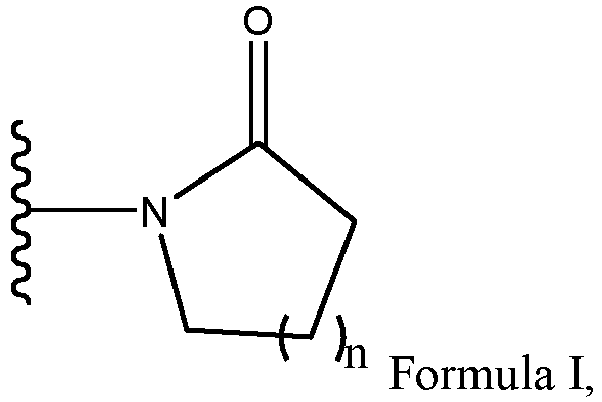
- When n is 0, the group shown in formula I is


- The electronegativity of the oxygen element in the group shown in formula I is greater than that of the nitrogen element in the cyano group; compared with the cyano group in the copolymer B, it is easier to form hydrogen bonds between the electrode active material and the conductive agent and the bond energy is higher, which can greatly improve the dispersibility of the slurry and increase the solid content of the slurry. At the same time, the addition of the group shown in formula I can further improve the bonding force of the binder and the cycling performance of the battery.
- In some embodiments, the monomer containing a group shown in formula I is selected from one or more of N-vinylpyrrolidone and N-allyl-2-pyrrolidone. The above monomers have low cost and good stability, and are easy to process and synthesize.
- In some embodiments, the mass content of the structural unit derived from the monomer containing a group shown in formula I is 0.1% - 2%, based on the total mass of the copolymer B. In some embodiments, the mass content of the structural unit derived from the monomer containing a group shown in formula I is 0.5% -2% or 0.5% -1.5%, based on the total mass of the copolymer B. The dispersion of the copolymer B can be improved by containing a proper amount of a group shown in formula I, such that the prepared slurry is not easy to precipitate, which is helpful to increase the solid content of the slurry and further improve the load of the electrode.
- A second aspect of the present application provides a binder, which comprises a copolymer C, wherein the copolymer C comprises a structural unit derived from a monomer containing a cyano group, a structural unit derived from a monomer containing an ester group, and a structural unit derived from a monomer containing a group shown in formula I,

- When n is 0, the group shown in formula I is


- The electronegativity of the oxygen element in the group shown in formula I is greater than that of the nitrogen element in the cyano group; compared with the cyano group in the copolymer, it is easier to form hydrogen bonds between the electrode active material and the conductive agent and the bond energy is higher, which can greatly improve the dispersibility of the slurry and increase the solid content of the slurry.
- The monomer containing a cyano group can effectively complex with the metals on the current collector and the electrode active material, which ensures a strong bonding force between the electrode active material and the current collector. The monomer containing an ester group can reduce the brittleness of the electrode plate and avoid the brittle fracture of the electrode plate.
- Thus, in the present application, a copolymer C which comprises a structural unit derived from a monomer containing a cyano group, a structural unit derived from a monomer containing an ester group, and a structural unit derived from a monomer containing a group shown in formula I is used as a binder, such that the cost of the binder is reduced while the solid content of a slurry is not reduced, and the bonding performance of the binder and the cycling performance of a battery are improved.
- In some embodiments, the monomer containing a cyano group is selected from one or more of acrylonitrile, methacrylonitrile, halogenated acrylonitrile, and methoxyacrylonitrile.
- In some embodiments, the mass content of the structural unit derived from the monomer containing a cyano group is 80% - 95%, based on the total mass of the copolymer C. In some embodiments, the mass content of the structural unit derived from the monomer containing a cyano group is 81% - 95%, or 82% - 95%, or 83% - 95%, or 84% - 95%, or 85% - 95%, or 86% - 95%, or 87% - 95%, or 88% - 95%, or 88% - 94%, or 88% - 93%, or 88% - 92%, or 88% - 91%, based on the total mass of the copolymer C. Within this range, the copolymer C can further improve the bonding performance of the binder and the cycling performance of the battery.
- In some embodiments, the monomer containing an ester group is selected from one or more of methyl acrylate, ethyl acrylate, propyl acrylate, butyl acrylate, isoamyl acrylate, isooctyl acrylate, methyl methacrylate, ethyl methacrylate, hydroxyethyl acrylate, and hydroxypropyl acrylate.
- In some embodiments, the monomer containing an ester group is selected from isooctyl acrylate. Isooctyl acrylate makes the copolymer C have a lower glass transition temperature and better flexibility, which is beneficial to the processing and manufacturing of electrode plates.
- Compared with fluorine-containing monomers, the above monomer containing a cyano group and monomer containing an ester group have low cost, are not subjected to policy restrictions, can be mass-produced, and can greatly reduce the cost of the binder.
- In some embodiments, the mass content of the structural unit derived from the monomer containing an ester group is 8% - 12%, based on the total mass of the copolymer C. In some embodiments, the mass content of the structural unit derived from the monomer containing an ester group is 8% - 11% or 9%-11%, based on the total mass of the copolymer C. Within this range, the copolymer C can further improve the bonding performance of the binder and the cycling performance of the battery.
- In some embodiments, the mass ratio of the structural unit derived from the monomer containing a cyano group to the structural unit derived from the monomer containing an ester group in the copolymer C is 8 : 1 - 12 : 1. The monomer containing a cyano group can improve the mechanical strength and bonding performance of the copolymer B, which can further improve the cycling performance of the battery. A small amount of the monomer containing an ester group can improve the flexibility of the copolymer B and avoid the brittle fracture of the electrode plate; in addition, the ester group has a certain ability to absorb and preserve the electrolyte solution, which can solve the problem of poor ionic conductivity of the fluoropolymer A. Within this range, the copolymer C can further improve the bonding force of the electrode plate and the cycling performance of the battery.
- In some embodiments, the monomer containing a group shown in formula I is selected from one or more of N-vinylpyrrolidone and N-allyl-2-pyrrolidone.
- In some embodiments, the mass content of the structural unit derived from the monomer containing a group shown in formula I is 0.1% - 2% or 0.5% - 1.5%, based on the total mass of the copolymer B. The dispersion of the copolymer B can be improved by containing a proper amount of the group shown in formula I, such that the prepared slurry contains more electrode active material, which is helpful to increase the solid content of the slurry.
- In some embodiments, the copolymer C has a weight average molecular weight of 4 × 10⁵ - 7 × 10⁵. In some embodiments, the weight average molecular weight of the copolymer C is selected from 4 × 10⁵ - 7 × 10⁵, or 4 × 10⁵ - 6 × 10⁵, or 4 × 10⁵ - 5 × 10⁵, or 5 × 10⁵ - 7 × 10⁵, or 6 × 10⁵ - 7 × 10⁵.
- The control of the weight average molecular weight of the copolymer C can balance the bonding performance and processability of the binder. If the weight average molecular weight of the copolymer C is too low, the brittleness will be too high, such that the bonding force of the binder is insufficient. If the weight average molecular weight of the copolymer C is too high, it will be difficult to disperse an electrode active material. Moreover, the reasonable combination of copolymers with different molecular weights can improve the dispersion of the electrode active material, thereby improving the performance of the battery.
- In some embodiments, the copolymer C has a volume average particle size Dv50 of 5 - 20 µm.
- Herein, the term "Dv50" refers to the corresponding particle size when the cumulative particle size distribution percentage of the particles reaches 50%. Its physical meaning is that 50% of particles have a particle size larger than it and 50% have a particle size smaller than it. Dv50 is also called median diameter or median particle size.
- If the average particle size Dv50 of the copolymer C is too high, it will be difficult to be dissolved, and the poor dispersion of the slurry will lead to agglomerates formed between a conductive agent or the electrode active material and the binder, which will block the filter screen and affect the production. When the agglomerates are washed to the coating head, it will generate coating particle scratches and affect the coating quality. An appropriate average particle size Dv50 helps to increase the dissolution rate of the copolymer C in a solvent and improve the processing efficiency of the electrode plate.
- In some embodiments, the copolymer C has an intrinsic viscosity of 0.8 - 1.1 dl/g.
- Herein, the term "intrinsic viscosity" refers to the most commonly used expression for the viscosity of a polymer solution. It is defined as the reduced viscosity when the concentration of the polymer solution tends to zero. That is to say, it represents the contribution of a single molecule to the viscosity of the solution, and is the viscosity reflecting the characteristics of the polymer, and its value does not change with the concentration. The intrinsic viscosity in the present invention refers to the intrinsic viscosity measured in N,N-dimethylacetamide at 30°C.
- The following method is used to test the intrinsic viscosity in the present invention: firstly, weighing a finished powder sample m1 (0.15 - 0.17 g) of the copolymer C and placing it in a 100 mL conical flask; adding V1 (50 - 60 ml) of N,N-dimethylacetamide with a pipette, sealing the mouth of the conical flask, and calculating the solution concentration C0 = m1/V1, then placing the conical flask into a constant temperature water bath at 60°C to dissolve same for 2.5 h; filtering the dissolved sample solution with a sand core filter to prevent particle impurities from clogging an Ubbelohde viscosity. Secondly, sucking the filtered N,N-dimethylacetamide with a disposable plastic straw, and rinsing the clean Ubbelohde viscometer with the solvent for at least 4-5 times; using the pipette to suck 10 mL of N,N-dimethylacetamide and injecting same into the Ubbelohde viscometer; placing the Ubbelohde viscometer in a constant temperature water bath at 30.0°C ± 0. 1°C and keeping it for 15 - 20 min, then measuring the outflow time and recording it as 10. Finally, sucking the filtered glue solution prepared in the first step with the disposable plastic straw, and rinsing the plastic straw with the glue solution for at least 4-5 times; sucking 10 mL of the glue solution with the pipette and injecting same into the Ubbelohde viscometer; placing the Ubbelohde viscometer in a constant temperature water bath at 30.0°C ± 0.1°C and keeping it for 15 - 20 min, then measuring the outflow time and recording it as t1, and the measured value of the intrinsic viscosity is (t1/t0)/C0.
- The control of the intrinsic viscosity of the copolymer C within an appropriate range can make the copolymer C have both excellent bonding performance and processability, which can avoid the failure of effective bonding due to too low viscosity, and avoid the difficulty of stirring, preparation and coating of the slurry due to too high viscosity.
- A third aspect of the present application provides a preparation method for a binder, which comprises the following steps:
- providing a monomer containing a cyano group, a monomer containing an ester group, and a monomer containing a group shown in formula I,

- polymerizing the monomer containing a cyano group, the monomer containing an ester group, and the monomer containing a group shown in formula I to prepare a copolymer C under polymerizable conditions.
- In some embodiments, the copolymer C is obtained by copolymerization using an anionic emulsifier by means of conventional emulsion polymerization.
- In some embodiments, polymerizing the monomer containing a cyano group, the monomer containing an ester group, and the monomer containing a group shown in formula I under polymerizable conditions to prepare the copolymer C includes subjecting a first portion of the monomer containing a cyano group, the monomer containing an ester group, and the monomer containing a group shown in formula I with a first portion of a reaction solvent, a first portion of an emulsifier, a first portion of a pH buffering agent, and a first portion of an initiator to a first-stage reaction at a first polymerization temperature under a polymerization pressure; and after the first-stage reaction, adding a second portion of the monomer containing a cyano group, the monomer containing an ester group, and the monomer containing a group shown in formula I in the system, and subjecting them with a second portion of the reaction solvent, a second portion of the emulsifier, a second portion of the pH buffering agent, and the second portion of the initiator to a second-stage reaction at a second polymerization temperature.
- In some embodiments, the emulsifier is selected from one or more of alkali metal salts or alkyl acid salts of perfluorooctanoic acids. The alkali metal salts of perfluorooctanoic acids are selected from one or more of sodium perfluorooctanoate and potassium perfluorooctanoate. The alkyl acid salts are selected from one or more of alkyl sulfates and alkyl sulfonates.
- In some embodiments, the initiator is selected from peroxides, and the peroxides are selected from one or more of persulfate inorganic peroxides and peroxide carbonates, wherein the inorganic peroxides are selected from one or more of ammonium persulfate and potassium persulfate, and the peroxide carbonates are selected from diisopropyl peroxydicarbonate.
- In some embodiments, the reaction solvent is deionized water.
- In some embodiments, the pH buffering agent is selected from one or more of ammonia water, potassium carbonate, and potassium bicarbonate.
- In some embodiments, the first portion of the monomer containing a cyano group, the monomer containing an ester group, and the monomer containing a group shown in formula I is 75-90% of the formula amount of each monomer. The first portion of the reaction solvent is 70-80% of the total amount of monomers added in the first-stage reaction, the first portion of the emulsifier is 0.2-0.3% of the total amount of monomers added in the first-stage reaction, the first portion of the pH buffering agent is 0.05-0.2% of the total amount of monomers added in the first-stage reaction, and the first portion of the initiator is 0.15-1% of the total amount of monomers added in the first-stage reaction. The first polymerization temperature is 70-80°C, and the reaction time of the first-stage reaction is 2-3 hours.
- In some embodiments, the second portion of the monomer containing a cyano group, the monomer containing an ester group, and the monomer containing a group shown in formula I is 10-25% of the formula amount of each monomer. The second portion of the reaction solvent is 20-30% of the total amount of monomers added in the second-stage reaction, the second portion of the emulsifier is 0.05-0.1% of the total amount of monomers added in the second-stage reaction, and the second portion of the initiator is 0.05-0.3% of the total amount of monomers added in the second-stage reaction. The second polymerization temperature is 85-90°C, and the reaction time of the second-stage reaction is 3-4 hours.
- In some embodiments, the mass ratio of the monomer containing a cyano group to the monomer containing an ester group is 8 : 1 - 12 : 1, and the mass content of monomer containing a group shown in formula I is 0.1% - 2%, based on the total mass of the copolymer C.
- In some embodiments, the monomer containing a cyano group is selected from one or more of acrylonitrile, methacrylonitrile, halogenated acrylonitrile, and methoxyacrylonitrile; and/or the monomer containing an ester group is selected from one or more of methyl acrylate, ethyl acrylate, propyl acrylate, butyl acrylate, isoamyl acrylate, isooctyl acrylate, methyl methacrylate, ethyl methacrylate, hydroxyethyl acrylate, and hydroxypropyl acrylate; and/or the monomer containing a group shown in formula I is selected from one or more of N-vinylpyrrolidone and N-allylpyrrolidone.
- The method has low cost for preparing the monomer and mild reaction conditions, and can reduce the cost of the binder.
- The positive electrode plate includes a positive electrode current collector and a positive film layer provided on at least one surface of the positive electrode current collector, the positive film layer including a positive electrode active material.
- As an example, the positive electrode current collector has two surfaces opposite in its own thickness direction, and the positive electrode film layer is provided on either or both of opposite surfaces of the positive electrode current collector.
- In some embodiments, the positive electrode current collector may be a metal foil or a composite current collector. For example, as a metal foil, an aluminum foil can be used. The composite current collector may comprise a polymer material base layer and a metal layer formed on at least one surface of the polymer material base layer. The composite current collector can be formed by forming a metal material (aluminum, an aluminum alloy, nickel, a nickel alloy, titanium, a titanium alloy, silver and a silver alloy, etc.) on a polymer material substrate (such as polypropylene (PP), polyethylene terephthalate (PET), polybutylene terephthalate (PBT), polystyrene (PS), polyethylene (PE), etc.).
- In some embodiments, the positive electrode active material can be a positive electrode active material known in the art for batteries. As an example, the positive electrode active material may comprise at least one of the following materials: lithium-containing phosphates of an olivine structure, lithium transition metal oxides, and their respective modified compounds. However, the present application is not limited to these materials, and other conventional materials that can be used as positive electrode active materials for batteries may also be used. These positive electrode active materials may be used alone or in combination of two or more. Among them, examples of lithium transition metal oxides may include, but are not limited to, at least one of lithium cobalt oxide (e.g. LiCoO2), lithium nickel oxide (e.g. LiNiO2), lithium manganese oxide (e.g. LiMnO2, LiMn2O4), lithium nickel cobalt oxide, lithium manganese cobalt oxide, lithium nickel manganese oxide, lithium nickel cobalt manganese oxide (e.g. LiNi1/3Co1/3Mn1/3O2 (also referred to as NCM333), LiNi0.5Co0.2Mn0.3O2 (also referred to as NCM523), LiNi0.5Co0.25Mn0.25O2 (also referred to as NCM211), LiNi0.6Co0.2Mn0.2O2 (also referred to as NCM622), LiNi0.8Co0.1Mn0.1O2 (also referred to as NCM811)), lithium nickel cobalt aluminum oxide (e.g. LiNi0.85Co0.15Al0.05O2), and modified compounds thereof, etc. Examples of lithium-containing phosphates of olivine structure may include, but are not limited to, at least one of lithium iron phosphate (e.g. LiFePO4 (also referred to as LFP)), lithium iron phosphate and carbon composites, lithium manganese phosphate (e.g. LiMnPO4), lithium manganese phosphate and carbon composites, lithium iron manganese phosphate, and lithium iron manganese phosphate and carbon composites.
- In some embodiments, the positive electrode film layer also optionally comprises a conductive agent. As an example, the conductive agent may include at least one of superconducting carbon, acetylene black, carbon black, Ketjen black, carbon dots, carbon nanotubes, graphene, and carbon nanofibers.
- In some embodiments, the positive electrode plate can be prepared as follows: the above components for preparing the positive electrode plate, such as a positive electrode active material, a conductive agent, the binder of the present invention and any other components, are dispersed in a solvent (e.g. N-methylpyrrolidone) to form a positive electrode slurry; and the positive electrode current collector is coated with the positive electrode slurry, followed by the procedures such as drying and cold pressing, so as to obtain the positive electrode plate.
- The negative electrode plate comprises a negative electrode current collector and a negative electrode film layer provided on at least one surface of the negative electrode current collector, the negative electrode film layer comprising a negative electrode active material.
- As an example, the negative electrode current collector has two surfaces opposite in its own thickness direction, and the negative electrode film layer is provided on either or both of the two opposite surfaces of the negative electrode current collector.
- In some embodiments, the negative electrode current collector may be a metal foil or a composite current collector. For example, as a metal foil, a copper foil can be used. The composite current collector may comprise a polymer material base layer and a metal layer formed on at least one surface of the polymer material substrate. The composite current collector can be formed by forming a metal material (copper, a copper alloy, nickel, a nickel alloy, titanium, a titanium alloy, silver and a silver alloy, etc.) on a polymer material substrate (e.g., polypropylene (PP), polyethylene terephthalate (PET), polybutylene terephthalate (PBT), polystyrene (PS), polyethylene (PE), etc.).
- In some embodiments, the negative electrode active material can be a negative electrode active material known in the art for batteries. As an example, the negative electrode active material may comprise at least one of the following materials: artificial graphite, natural graphite, soft carbon, hard carbon, a silicon-based material, a tin-based material and lithium titanate, etc. The silicon-based material may be selected from at least one of elemental silicon, silicon oxides, silicon carbon composites, silicon nitrogen composites, and silicon alloys. The tin-based material may be selected from at least one of elemental tin, tin oxides, and tin alloys. However, the present application is not limited to these materials, and other conventional materials that can be used as negative electrode active materials for batteries can also be used. These negative electrode active materials may be used alone or as a combination of two or more.
- In some embodiments, the negative electrode film layer also optionally comprises other binders. The binder may be selected from at least one of a butadiene styrene rubber (SBR), polyacrylic acid (PAA), sodium polyacrylate (PAAS), polyacrylamide (PAM), polyvinyl alcohol (PVA), sodium alginate (SA), polymethacrylic acid (PMAA) and carboxymethyl chitosan (CMCS).
- In some embodiments, the negative electrode film layer also optionally comprises a conductive agent. The conductive agent may be selected from at least one of superconductive carbon, acetylene black, carbon black, ketjenblack, carbon dots, carbon nanotubes, graphene, and carbon nanofibers.
- In some embodiments, the negative electrode film layer also optionally comprises other auxiliary agents, such as a thickener (e.g. sodium carboxymethyl cellulose (CMC-Na)), etc.
- In some embodiments, the negative electrode plate can be prepared as follows: dispersing the above components for preparing the negative electrode plate, such as negative electrode active material, conductive agent, binder and any other components, in a solvent (e.g. deionized water) to form a negative electrode slurry; and coating a negative electrode current collector with the negative electrode slurry, followed by procedures such as drying and cold pressing, so as to obtain the negative electrode plate.
- The electrolyte functions to conduct ions between the positive electrode plate and the negative electrode plate. The type of the electrolyte is not specifically limited in the present application, and can be selected according to actual requirements. For example, the electrolyte may be in a liquid state, a gel state or an all-solid state.
- In some embodiments, an electrolyte solution is used as the electrolyte. The electrolyte solution includes an electrolyte salt and a solvent.
- In some embodiments, the electrolyte salt may be selected from at least one of lithium hexafluorophosphate, lithium tetrafluoroborate, lithium perchlorate, lithium hexafluoroarsenate, lithium bisfluorosulfonimide, lithium bistrifluoromethanesulfonimide, lithium trifluoromethanesulfonate, lithium difluorophosphate, lithium difluorooxalate borate, lithium dioxalate borate, lithium difluorodioxalate phosphate and lithium tetrafluorooxalate phosphate.
- In some embodiments, the solvent may be selected from at least one of ethylene carbonate, propylene carbonate, ethyl methyl carbonate, diethyl carbonate, dimethyl carbonate, dipropyl carbonate, methyl propyl carbonate, ethyl propyl carbonate, butylene carbonate, fluoroethylene carbonate, methyl formate, methyl acetate, ethyl acetate, propyl acetate, methyl propionate, ethyl propionate, propyl propionate, methyl butyrate, ethyl butyrate, 1,4-butyrolactone, sulfolane, dimethyl sulfone, ethyl methyl sulfone, and diethyl sulfone.
- In some embodiments, the electrolyte solution also optionally comprises an additive. For example, the additive may include a negative electrode film-forming additive and a positive electrode film-forming additive, and may further include an additive that can improve certain performances of the battery, such as an additive that improves the overcharge performance of the battery, or an additive that improves the high temperature or low-temperature performance of the battery.
- In some embodiments, the secondary battery further comprises a separator. The type of the separator is not particularly limited in the present application, and any well-known porous-structure separator with good chemical stability and mechanical stability may be selected.
- In some embodiments, the material of the separator may be selected from at least one of glass fibers, non-woven fabrics, polyethylene, polypropylene and polyvinylidene fluoride. The separator may be either a single-layer film or a multi-layer composite film, and is not limited particularly. When the separator is a multi-layer composite film, the materials in the respective layers may be same or different, which is not limited particularly.
- The present application provides a secondary battery, including an electrode assembly and an electrolyte solution, wherein the electrode assembly includes a positive electrode plate, a separator, a negative electrode plate, and the positive electrode plate includes a positive active material and the binder in any embodiment of the present application or the binder prepared by the preparation method in any embodiment of the present application. The second battery has better cycling performance.
- In some embodiments, the positive electrode active material is a lithium-containing transition metal oxide, which is optionally lithium iron phosphate or doped and modified materials thereof, or at least one of conductive carbon-coated modified materials, conductive metal-coated modified materials, or conductive polymer-coated modified materials thereof.
- In some embodiments, the lithium-containing transition metal oxide is optionally lithium cobaltate, lithium nickel manganese cobaltate, lithium nickel manganese aluminate, lithium iron phosphate, lithium vanadium phosphate, lithium cobalt phosphate, lithium manganese phosphate, lithium iron manganese phosphate, lithium iron silicate, lithium vanadium silicate, lithium cobalt silicate, lithium manganese silicate, spinel lithium manganate, spinel lithium nickel manganate, lithium titanate, or doped and modified materials thereof, or at least one of conductive carbon-coated modified materials, conductive metal-coated modified materials, or conductive polymer-coated modified materials thereof.
- In some embodiments, an electrode assembly may be formed by a positive electrode plate, a negative electrode plate and a separator by a winding process or a stacking process.
- Typically, a secondary battery comprises a positive electrode plate, a negative electrode plate, an electrolyte and a separator. During the charge/discharge of the battery, active ions are intercalated and de-intercalated back and forth between a positive electrode plate and a negative electrode plate. The electrolyte functions to conduct ions between the positive electrode plate and the negative electrode plate. The separator is provided between the positive electrode plate and the negative electrode plate, and mainly prevents the positive and negative electrodes from short-circuiting and enables ions to pass through.
- In some embodiments, the secondary battery may comprise an outer package. The outer package may be used to encapsulate the above electrode assembly and electrolyte.
- In some embodiments, the outer package of the secondary battery can be a hard shell, for example, a hard plastic shell, an aluminum shell, a steel shell, etc. The outer package of the secondary battery may also be a soft bag, such as a pouch-type soft bag. The material of the soft bag may be plastics, and the examples of plastics may comprise polypropylene, polybutylene terephthalate, polybutylene succinate, etc.
- The shape of the secondary battery is not particularly limited in the present application and may be cylindrical, square or of any other shape. For example,
Fig. 3 shows asecondary battery 5 with a square structure as an example. - In some embodiments, referring to
Fig. 4 , the outer package may comprise ahousing 51 and acover plate 53. Herein, thehousing 51 may comprise a bottom plate and side plates connected to the bottom plate, and the bottom plate and the side plates enclose to form an accommodating cavity. Thehousing 51 has an opening in communication with the accommodating cavity, and thecover plate 53 may cover the opening to close the accommodating cavity. The positive electrode plate, the negative electrode plate, and the separator may be subjected to a winding process or a laminating process to form anelectrode assembly 52. Theelectrode assembly 52 is encapsulated in the accommodating cavity. The electrolyte solution infiltrates theelectrode assembly 52. The number of theelectrode assemblies 52 contained in thesecondary battery 5 may be one or more, and can be selected by those skilled in the art according to actual requirements. - A fourth aspect of the present application provides an electrode, including an electrode active material and a binder composition or a binder in any embodiment, the electrode active material is optionally a positive electrode active material, and the positive electrode active material is a lithium-containing transition metal oxide. In some embodiments, the lithium-containing transition metal oxide is optionally lithium cobaltate, lithium nickel manganese cobaltate, lithium nickel manganese aluminate, lithium iron phosphate, lithium vanadium phosphate, lithium cobalt phosphate, lithium manganese phosphate, lithium iron manganese phosphate, lithium iron silicate, lithium vanadium silicate, lithium cobalt silicate, lithium manganese silicate, spinel lithium manganate, spinel lithium nickel manganate, lithium titanate, or doped and modified materials thereof, or at least one of conductive carbon-coated modified materials, conductive metal-coated modified materials, or conductive polymer-coated modified materials thereof. In some embodiments, the lithium-containing transition metal oxide is optionally lithium iron phosphate or doped and modified materials thereof, or at least one of conductive carbon-coated modified materials, conductive metal-coated modified materials, or conductive polymer-coated modified materials thereof.
- The electrode has a higher bonding force, which makes the battery have better cycling performance.
- In some embodiments, the secondary battery can be assembled into a battery module, and the number of the secondary batteries contained in the battery module may be one or more, and the specific number can be selected by those skilled in the art according to the application and capacity of the battery module.
-
Fig. 5 shows abattery module 4 as an example. Referring toFig. 5 , in thebattery module 4, a plurality ofsecondary batteries 5 may be sequentially arranged in the length direction of thebattery module 4. Apparently, the secondary batteries may also be arranged in any other manner. Furthermore, the plurality ofsecondary batteries 5 may be fixed by fasteners. - Optionally, the
battery module 4 may also comprise a housing with an accommodating space, and a plurality ofsecondary batteries 5 are accommodated in the accommodating space. - In some embodiments, the above battery module may also be assembled into a battery pack, the number of the battery modules contained in the battery pack may be one or more, and the specific number can be selected by those skilled in the art according to the application and capacity of the battery pack.
-
Fig. 6 and Fig. 7 show abattery pack 1 as an example. ReferringFig. 6 and Fig. 7 , thebattery pack 1 can include a battery box and a plurality ofbattery modules 4 provided in the battery box. The battery box comprises anupper box body 2 and alower box body 3, wherein theupper box body 2 may cover thelower box body 3 to form a closed space for accommodating thebattery modules 4. A plurality ofbattery modules 4 may be arranged in the battery case in any manner. - A sixth aspect of the present application provides a power consuming device, including a secondary battery in any embodiment, a battery module in any embodiment, or a battery pack in any embodiment. The power consuming device has a longer battery service life.
- The secondary battery, battery module or battery pack can be used as a power source of the power consuming device or as an energy storage unit of the power consuming device. The power consuming device may include a mobile device (e.g., a mobile phone, a laptop computer, etc.), an electric vehicle (e.g., a pure electric vehicle, a hybrid electric vehicle, a plug-in hybrid electric vehicle, an electric bicycle, an electric scooter, an electric golf cart, an electric truck, etc.), an electric train, ship, and satellite, an energy storage system, etc., but is not limited thereto.
- As for the power consuming device, the secondary battery, battery module or battery pack can be selected according to the usage requirements thereof.
-
Fig. 8 shows an example of the power consuming device. The power consuming device may be a pure electric vehicle, a hybrid electric vehicle, a plug-in hybrid electric vehicle, etc. In order to meet the requirements of the power consuming device for a high power and a high energy density of a secondary battery, a battery pack or a battery module may be used. - As another example, the device may be a mobile phone, a tablet computer, a laptop computer, etc. The device is generally required to be thin and light, and may have a secondary battery used as a power source.
- Hereinafter, the examples of the present application will be explained. The examples described below are exemplary and are merely for explaining the present application, and should not be construed as limiting the present application. The examples in which techniques or conditions are not specified are based on the techniques or conditions described in documents in the art or according to the product introduction. The reagents or instruments used therein for which manufacturers are not specified are all conventional products that are commercially available.
- The preparation method for the copolymer C is as follows: using a 10 L stainless steel autoclave with a rotation speed of 100 r/min as a polymerization kettle. Firstly, checking the tightness of a polymerization system, and then vacuumizing the autoclave and filling it with nitrogen to discharging oxygen, and repeating this
process 3 times. Adding 2,000 g of deionized water, 1.6 g of ammonia water and 3.2 g of sodium alkyl sulfate, then adding 1,408 g of an acrylonitrile monomer, 176 g of an isooctyl acrylate monomer and 16 g of N-vinylpyrrolidone monomer, vacuumizing same until the polymerization pressure is 4.2 Mpa, raising the temperature to 55°C, standing same for 0.8 h, then adding 8 g of ammonium persulfate, raising the temperature to 75°C, and polymerizing same for 2 - 3 h with stirring. Continuously adding 352 g of an acrylonitrile monomer, 44 g of an isooctyl acrylate monomer, 4 g of a N-vinylpyrrolidone monomer, 400 g of deionized water, 1.6 g of alkyl sodium sulfate, 0.8 g of ammonium persulfate to the polymerization kettle, raising the temperature to 90°C, and maintaining the temperature for reaction for 4 h. Carrying out flash evaporation to obtain a polymerized article, then washing same with deionized water until the conductivity of the a washing liquid is less than 1*10-8 s/cm, and vacuum drying same to obtain a N-vinylpyrrolidone-acrylonitrile-isooctyl acrylate copolymer. The prepared copolymer has a weight average molecular weight of 700,000, a particle size Dv50 of 15 µm, and an intrinsic viscosity of 1.1 dl/g. - The preparation method for the binder is as follows: adding 4 g of polyvinylidene fluoride (fluoropolymer polymer A) and 4 g of N-vinylpyrrolidone-acrylonitrile-isooctyl acrylate copolymer into 250 g of an N-methylpyrrolidone solution, and stirring same in a stirring and dispersing machine at a rotation speed of 500 r/ min for 90 min, and them removing the bubbles on an ultrasonic cleaner for 30 min after stirring. The polyvinylidene fluoride is a 601A product produced by HEC company, which is synthesized by an emulsion method, and has a weight average molecular weight of 900,000, a particle size Dv50 of 20 µm, a crystallinity of 40%, and a melting point of 170°C.
- Adding 398 g of lithium iron phosphate and 2.8 g of conductive carbon black into an agate mortar and dry mixing same for 15 min. Adding the dry-mixed product to the binder, and stirring same on a stirring disperser at a rotation speed of 1200 r/min for 90 min, so as to prepare a positive electrode slurry for a lithium battery.
- Scrape-coating the above slurry on a carbon-coated aluminum foil and baking at 110°C for 15 min, cutting same into a disc with a diameter of 15 mm after cold pressing, and then making same into a button battery with a metal lithium plate, a separator, and an electrolyte solution. 3) Separator
- A polypropylene film is used as a separator.
- In an argon atmosphere glove box (H2O < 0.1 ppm, O2 < 0.1 ppm), mixing organic solvents of ethylene carbonate (EC)/ethyl methyl carbonate (EMC) at a volume ratio of 3/7 until uniform, adding LiPF6 lithium salt and dissolving it in the organic solvent, after stirring uniformly, preparing a 1 M LiPF6 EC/EMC solution to obtain an electrolyte solution.
- The batteries of examples 2-25 and the button battery of comparative example 1 are prepared in a similar manner to the button battery of example 1, but the raw materials and proportions thereof for preparing the copolymer C or the proportions of the components in the binder are adjusted. See table 1 for the specific parameters.
- In examples 2 - 7, the mass ratio of polyvinylidene fluoride to the copolymer C is adjusted, and other parameters are the same as in example 1. See table 1 for the specific parameters.
- In examples 8 - 11, the polymerization ratio of the acrylonitrile monomer to the isooctyl acrylate monomer in N-vinylpyrrolidone-acrylonitrile-isooctyl acrylate copolymer is adjusted, and other parameters are the same as in example 1. See table 1 for the specific parameters.
- In examples 12 - 13, the polymerization ratio of the acrylonitrile monomer to the isooctyl acrylate monomer in N-vinylpyrrolidone-acrylonitrile-isooctyl acrylate copolymer is adjusted, and the mass ratio of polyvinylidene fluoride to N-vinylpyrrolidone-acrylonitrile-isooctyl acrylate copolymer is set at 2 : 1, and other parameters are the same as in example 1. See table 1 for the specific parameters.
- In examples 14 - 15, the polymerization ratio of the acrylonitrile monomer to the isooctyl acrylate monomer in N-vinylpyrrolidone-acrylonitrile-isooctyl acrylate copolymer is adjusted, and the mass ratio of polyvinylidene fluoride to N-vinylpyrrolidone-acrylonitrile-isooctyl acrylate copolymer is set at 3 : 1, and other parameters are the same as in example 1. See table 1 for the specific parameters.
- In examples 16 - 17, the polymerization ratio of the acrylonitrile monomer to the isooctyl acrylate monomer in N-vinylpyrrolidone-acrylonitrile-isooctyl acrylate copolymer is adjusted, and the mass ratio of polyvinylidene fluoride to N-vinylpyrrolidone-acrylonitrile-isooctyl acrylate copolymer is set at 4 : 1, and other parameters are the same as in example 1. See table 1 for the specific parameters.
- In examples 18 - 20, the mass of N-vinylpyrrolidone added in the polymer B is adjusted, and the molar ratio of the acrylonitrile monomer to the isooctyl acrylate monomer in N-vinylpyrrolidone-acrylonitrile-isooctyl acrylate copolymer is set at 10 : 1, and other parameters are the same as in example 1. See table 1 for the specific parameters.
- In examples 21 - 22, in the process of copolymer preparation, the reaction time is adjusted from 4 h to 3 h and 2.5 h successively after a second fluid supplementation and the temperature is raised to 90°C, and the molar ratio of the acrylonitrile monomer to the isooctyl acrylate monomer in a N-vinylpyrrolidone modified acrylonitrile-isooctyl acrylate copolymer is set at 10 : 1, and other parameters and steps are the same as in example 1. See table 1 for the specific parameters.
- In example 23, an acrylonitrile-isooctyl acrylate copolymer modified by N-allyl-2-pyrrolidone is used, and other parameters are the same as in example 1. See table 1 for the specific parameters.
- In example 24, N-vinylpyrrolidone is not added in the process of copolymer preparation, and the molar ratio of the acrylonitrile monomer to the isooctyl acrylate monomer in the acrylonitrile-isooctyl acrylate copolymer is set at 10 : 1, and other parameters are the same as in example 1. See table 1 for the specific parameters.
- The polyvinylidene fluoride used in example 25 is a 401A product produced by HEC company, which has a weight average molecular weight of 600,000, and other steps are the same as in example 1. See table 1 for the specific parameters.
- In comparative example 1, polyvinylidene fluoride is used as the binder alone; in comparative example 2, the N-vinylpyrrolidone modified acrylonitrile-isooctyl acrylate copolymer prepared in example 9 is used as the binder alone, and in comparative example 3, the acrylonitrile-isooctyl acrylate copolymer prepared in example 24 is used as the binder alone, and other steps are the same as in example 1. See table 1 for the specific parameters.
- Relevant parameters of the binder of the above examples 1 - 25 and comparative examples 1 - 3 are shown in table 1 below.
- In addition, performance tests are performed on the electrode plates and batteries obtained in above examples 1-25 and comparative examples 1-3. The test method is as follows, and the test results are shown in table 1.
- Subjecting a sample to KBr tabletting using a tablet transmission method, and deducting the KBr background blank by the transmission method to obtain the sample test spectrum. Instrument model: Nicolet 5700 (Thermo Nicolet, USA), standard linearity: better than 0.07%, resolution: 0.09 cm-1, wavenumber range: 400 - 4000 cm-1, sensitivity < 9.65*10-5 Abls. It is used to detect the structure and chemical bonds of molecules.
- Using a Waters 2695 Isocratic HPLC gel chromatograph (differential refractive index detector 2141). Using a polystyrene solution sample with a mass fraction of 3.0% as a reference, and selecting a matched chromatographic column (oily: Styragel HT5 DMF7.8*300 mm + Styragel HT4). Using a purified N-methylpyrrolidone (NMP) solvent to prepare 3.0% of a binder glue solution, and allowing the prepared solution to stand for one day for later use. During the test, sucking tetrahydrofuran with a syringe first for rinse, and repeating this process several times. Then sucking 5 ml of the test solution, removing the air in the syringe, and wiping the needle tip to dry. Finally, slowly injecting the sample solution into the injection port. The data is obtained after the display is stable.
- With reference to the national standard GBT 2790-1995 "Adhesives-180° Peel Strength Test Method", the bonding force test process of the examples and comparative examples of the present application is as follows:
using a blade to cut a sample with a width of 30 mm*a length of 100 - 160 mm, and pasting a special double-sided adhesive tape with a width of 20 mm*a length of 90 - 150 mm on a steel plate. Pasting the electrode plate sample cut earlier on the double-sided adhesive tape with the test side facing down, and then rolling same three times in the same direction with a pressure roller. - Inserting a paper tape with a width equal to that of the electrode plate and a length 80-200 mm longer than the that of the sample under the electrode plate, and fixing it with a crepe glue.
- Turning on the power of a Sansi tensile machine (the sensitivity is 1 N) and the indicator light is on, then adjusting a limit block to a suitable position, and fixing the end of the steel plate that is not pasted with the electrode plate with a lower clamp. Folding the paper tape upwards, fixing it with an upper clamp, and using "Up" and "Down" buttons on a manual controller attached to the tensile machine to adjust the position of the upper clamp. Then carrying out the test and reading the value, so as to obtain the bonding force comparison data of example 1 and comparative example 1 as shown in accompanying
drawing 1 - Taking example 1 as an example, the test process of the capacity retention rate of the battery is as follows: at 25°C, charging the battery corresponding to example 1 at a constant current of 1/3 C to 3.65 V, then charging same at a constant voltage of 3.65 V to a current of 0.05 C, leaving it to stand for 5 minutes, and then discharging it to 2.5 V at 1/3 C. The resulting capacity is recorded as the initial capacity C0. Repeating the above steps for the same battery above, and recording the discharge capacity Cn of the battery after the n-th cycle at the same time, then the capacity retention rate of the battery Pn = Cn/C0* 100% after each cycle. With the values of the 100 points of P1, P2, ..., and P100 as the ordinate and the corresponding cycle times as the abscissa, the curves of capacity retention rate of the battery and cycle times of example 1 and comparative example 1 as shown in
Fig. 2 are obtained. - During this test, the first cycle corresponds to n = 1, the second cycle corresponds to n = 2, ... and the 100th cycle corresponds to n = 100. The battery capacity retention rate data corresponding to example 1 in table 1 is the data measured after 500 cycles under the above test conditions, that is, the value of P500. The test processes of comparative example 1 and other examples are the same as above.
- Test method of solid content: preparing a glass petri dish and recording its weight as m1, taking a part of the prepared positive electrode slurry and placing into the glass petri dish and recording the total weight as m2, placing the petri dish containing the positive electrode slurry into a drying oven for heating at a temperature of 120°C for 1 h. Weighing the dried petri dish and recording its weight as m3, the solid content = (m3 - m1)/(m2 - m1)*100%.
Table 1 Parameters and test results of examples 1 - 25 and comparative examples 1 - 3 No. Fluoropo lymer A Weight average molecul ar weight of fluoropo lymer A Copolyme rC Weig ht avera ge molec ular weigh t of copol ymer C Mass of polyviny lidene fluoride: mass of copolym er C in binder Mass ratio of structu ral unit derived from acrylon itrile to structu ral unit derived from isoocty 1 acrylat e in copoly mer C Mass content of structu ral unit derived from acrylon itrile mono mer in copoly mer C Mass conte nt of struct ural unit derive d from isooct yl acryla te mono mer in copol ymer C Monomer containin g group shown in formula I in copolyme rC Mass conte nt of struct ural unit contai ning group shown in formu la I in copol ymer C Bon ding force N/m Capa city reten tion rate after 500 cycle s Soli d cont ent of slur ry Exa mple 1 Polyviny lidene fluoride 90 N-vinylpyrro lidone-acrylonitri le-isooctyl acrylate copolymer 70 1 : 1 8 : 1 88% 11% N-vinylpyrr olidone 1% 32.3 89.5 0% 64 % Exa mple 2 Polyviny lidene fluoride 90 N-vinylpyrro lidone-acrylonitri le-isooctyl acrylate copolymer 70 2 : 1 8 : 1 88% 11% N-vinylpyrr olidone 1% 31.4 88.9 0% 64 % Exa mple 3 Polyviny lidene fluoride 90 N-vinylpyrro lidone-acrylonitri le-isooctyl acrylate copolymer 70 3 : 1 8 : 1 88% 11% N-vinylpyrr olidone 1% 30.6 88.4 0% 64 % Exa mple 4 Polyviny lidene fluoride 90 N-vinylpyrro lidone-acrylonitri le-isooctyl acrylate copolymer 70 4 : 1 8 : 1 88% 11% N-vinylpyrr olidone 1% 29.8 87.5 0% 64 % Exa mple 5 Polyviny lidene fluoride 90 N-vinylpyrro lidone-acrylonitri le-isooctyl acrylate copolymer 70 1 : 2 8 : 1 90% 9% N-vinylpyrr olidone 1% 32.1 88.7 0% 64 % Exa mple 6 Polyviny lidene fluoride 90 N-vinylpyrro lidone-acrylonitri le-isooctyl acrylate copolymer 70 1 : 3 8 : 1 90% 9% N-vinylpyrr olidone 1% 31.5 88.2 0% 64 % Exa mple 7 Polyviny lidene fluoride 90 N-vinylpyrro lidone-acrylonitri le-isooctyl acrylate copolymer 70 1 : 4 8 : 1 90% 9% N-vinylpyrr olidone 1% 30.2 87.5 0% 64 % Exa mple 8 Polyviny lidene fluoride 90 N-vinylpyrro lidone-acrylonitri le-isooctyl acrylate copolymer 70 1 : 1 9 : 1 89.1% 9.9% N-vinylpyrr olidone 1% 32.6 89.7 0% 64 % Exa mple 9 Polyviny lidene fluoride 90 N-vinylpyrro lidone-acrylonitri le-isooctyl acrylate copolymer 70 1 : 1 10 : 1 90% 9% N-vinylpyrr olidone 1% 33.5 89.9 0% 64 % Exa mple 10 Polyviny lidene fluoride 90 N-vinylpyrro lidone-acrylonitri le-isooctyl acrylate copolymer 70 1 : 1 11 : 1 90.75 % 8.25% N-vinylpyrr olidone 1% 31.6 88% 64 % Exa mple 11 Polyviny lidene fluoride 90 N-vinylpyrro lidone-acrylonitri le-isooctyl acrylate copolymer 70 1 : 1 12 : 1 92.31 % 7.69% N-vinylpyrr olidone 1% 30.2 87% 64 % Exa mple 12 Polyviny lidene fluoride 90 N-vinylpyrro lidone-acrylonitri le-isooctyl acrylate copolymer 70 2 : 1 9 : 1 89.1% 9.9% N-vinylpyrr olidone 1% 31.7 89.0 0% 64 % Exa mple 13 Polyviny lidene fluoride 90 N-vinylpyrro lidone-acrylonitri le-isooctyl acrylate copolymer 70 2 : 1 10 : 1 90% 9% N-vinylpyrr olidone 1% 32.1 89.4 0% 64 % Exa mple 14 Polyviny lidene fluoride 90 N-vinylpyrro lidone-acrylonitri le-isooctyl acrylate copolymer 70 3 : 1 9 : 1 89.1% 9.9% N-vinylpyrr olidone 1% 30.9 88.7 0% 64 % Exa mple 15 Polyviny lidene fluoride 90 N-vinylpyrro lidone-acrylonitri le-isooctyl acrylate copolymer 70 3 : 1 10 : 1 90% 9% N-vinylpyrr olidone 1% 31.3 88.5 0% 64 % Exa mple 16 Polyviny lidene fluoride 90 N-vinylpyrro lidone-acrylonitri le-isooctyl acrylate copolymer 70 4 : 1 9 : 1 89.1% 9.9% N-vinylpyrr olidone 1% 30.1 87.8 0% 64 % Exa mple 17 Polyviny lidene fluoride 90 N-vinylpyrro lidone-acrylonitri le-isooctyl acrylate copolymer 70 4 : 1 10 : 1 90% 9% N-vinylpyrr olidone 1% 30.5 88% 64 % Exa mple 18 Polyviny lidene fluoride 90 N-vinylpyrro lidone-acrylonitri le-isooctyl acrylate copolymer 70 1 : 1 10 : 1 90.45 % 9.05% N-vinylpyrr olidone 0.50% 29.6 88% 62 % Exa mple 19 Polyviny lidene fluoride 90 N-vinylpyrro lidone-acrylonitri le-isooctyl acrylate copolymer 70 1 : 1 10 : 1 89.55 % 8.95% N-vinylpyrr olidone 1.50% 29.8 88% 62 % Exa mple 20 Polyviny lidene fluoride 90 N-vinylpyrro lidone-acrylonitri le-isooctyl acrylate copolymer 70 1 : 1 10 : 1 89.09 % 8.91% N-vinylpyrr olidone 2% 28.5 0 87% 61 % Exampl e 21 Polyviny lidene fluoride 90 N-vinylpyrro lidone-acrylonitri le-isooctyl acrylate copolyme r 55 1 : 1 10 : 1 90% 9% N-vinylpyrr olidone 1% 28.2 86.8 % 61 % Exampl e 22 Polyviny lidene fluoride 90 N-vinylpyrro lidone-acrylonitri le-isooctyl acrylate copolyme r 40 1 : 1 10 : 1 90% 9% N-vinylpyrr olidone 1% 27.9 86.6 % 61 % Exampl e 23 Polyviny lidene fluoride 90 Acrylonitr ile-isooctyl acrylate copolyme r modified by N-allyl-2-pyrrolidon e 70 1 : 1 10 : 1 90% 9% N-allyl-2-pyrrolido ne 1% 28.4 86.9 % 61 % Exampl e 24 Polyviny lidene fluoride 90 Acrylonitr ile-isooctyl acrylate copolyme r 70 1 : 1 10 : 1 90.91 % 9.09 % - - 28.8 0 87% 61 % Exampl e 25 Polyviny lidene fluoride 60 N-vinylpyrro lidone-acrylonitri le-isooctyl acrylate copolyme r 70 1 : 1 10 : 1 90% 9% N-vinylpyrr olidone 1% 27 86.6 % 61 % Compa rative exampl e 1 Polyviny lidene fluoride 90 None - - - 26.5 86% 60 % Compa rative exampl e 2 N-vinylpyrro lidone-acrylonitri le-isooctyl acrylate copolyme r 70 1 : 1 10 : 1 90% 9% N-vinylpyrr olidone 1% 26.7 86.3 % 61 % Compa rative exampl e3 Acrylonitr ile-isooctyl acrylate copolyme r 70 1 : 1 10 : 1 90.91 % 9.09 % - - 26.9 86.5 % 59 % - As shown in
Fig. 1 and Fig. 2 , compared with comparative example 1, in example 1, due to the addition of an acrylonitrile-isooctyl acrylate copolymer modified by a monomer containing a pyrrolidone group, the bonding performance of the binder in the electrode plate and the capacity retention rate of the battery are both improved. - According to the results in table 1, it can be seen that examples 1 to 25 all provide a binder composition comprising polyvinylidene fluoride and an acrylonitrile-isooctyl acrylate copolymer, which comprises a structural unit derived from acrylonitrile and a structural unit derived from isooctyl acrylate. Compared with comparative examples 1-3, they all achieve good results, the bonding performance of the binder in the electrode plate and the capacity retention rate of the battery are improved.
- The weight average molecular weight of the polyvinylidene fluoride in examples 1 - 25 is 600,000 - 900,000, and the weight average molecular weight of the acrylonitrile-isooctyl acrylate copolymer is 400,000 - 700,000. Compared with comparative examples 1-3, they all achieve good results, the bonding performance of the binder in the electrode plate and the capacity retention rate of the battery are improved.
- In examples 1-25, the mass ratio of polyvinylidene fluoride to the acrylonitrile-isooctyl acrylate copolymer in the binder composition is 1 : 4 - 4 : 1. Compared with comparative examples 1-3, they all achieve good results, the bonding performance of the binder in the electrode plate and the capacity retention rate of the battery are improved.
- The mass ratio of the structural unit derived from acrylonitrile to the structural unit derived from isooctyl acrylate in the acrylonitrile-isooctyl acrylate copolymer in examples 1 - 25 is 8 : 1 - 12 : 1, they all achieve good results, the bonding performance of the binder in the electrode plate and the capacity retention rate of the battery are improved. When the mass ratio of the structural unit derived from acrylonitrile to the structural unit derived from isooctyl acrylate in the acrylonitrile-isooctyl acrylate copolymer is 8 : 1 - 10 : 1, the bonding performance of the binder in the electrode plate and the capacity retention rate of the battery are further improved.
- The acrylonitrile-isooctyl acrylate copolymer in examples 1-23 and 25 is modified by a monomer containing a pyrrolidone group, such that the copolymer comprises a structural units derived from a monomer containing a pyrrolidone group. The acrylonitrile-isooctyl acrylate copolymer C after modified by the monomer containing a pyrrolidone group has stronger electrode plate bonding force and battery capacity retention rate than before modification, and the solid content of the slurry is further improved.
- In examples 1-23 and 25, the mass content of the structural unit derived from the monomer containing a pyrrolidone group is 0.1% - 2%, based on the total mass of acrylonitrile-isooctyl acrylate copolymer. Within this range, the copolymer improves all of the bonding performance of the binder in the electrode plate, the capacity retention rate of the battery and the solid content of the slurry. The mass content of the structural unit derived from the monomer containing a pyrrolidone group in example 1-23 and 25 is either 0.5% - 1.5% or 0.5% - 1.0%. Within this range, the solid content of the slurry is further improved.
- The acrylonitrile-isooctyl acrylate copolymer in examples 1-23 and 25 is modified by the monomer containing a pyrrolidone group, and the mass content of the structural unit derived from acrylonitrile is 80% - 95%, based on the total mass of the copolymer. Within this range, the copolymer improves the bonding performance of the binder in the electrode plate, the capacity retention rate of the battery and the solid content of the slurry.
- The acrylonitrile-isooctyl acrylate copolymer in examples 1-23 and 25 is modified by the monomer containing a pyrrolidone group, and the mass content of the structural unit derived from isooctyl acrylate is 8% - 12%, based on the total mass of the copolymer. Within this range, the copolymer improves the bonding performance of the binder in the electrode plate, the capacity retention rate of the battery and the solid content of the slurry.
- Comparing comparative example 2 with comparative example 3, it can be seen that the solid content in the positive electrode slurry can be increased by modifying the binder with a monomer containing a group shown in formula I. Comparing example 9 with example 24, it can be seen that when the other conditions are the same, the binder modified by a monomer containing a group shown in formula I can increase the solid content in the positive electrode slurry, significantly improve the bonding force between the corresponding current collector and the negative electrode material layer, and significantly improve the capacity retention rate of the battery.
- It should be noted that the present application is not limited to the above embodiments. The above embodiments are exemplary only, and any embodiment that has substantially same constitutions as the technical ideas and has the same effects within the scope of the technical solution of the present application falls within the technical scope of the present application. In addition, without departing from the gist of the present application, various modifications that may be conceived by those skilled in the art to the embodiments, and other modes constructed by combining some of the constituent elements of the embodiments also fall within the scope of the present application.
Claims (19)
- A binder, comprising a copolymer C, wherein the copolymer C comprises a structural unit derived from a monomer containing a cyano group, a structural unit derived from a monomer containing an ester group, and a structural unit derived from a monomer containing a group shown in formula I,

- The binder according to claim 1, wherein the monomer containing a cyano group is selected from one or more of acrylonitrile, methacrylonitrile, halogenated acrylonitrile, and methoxyacrylonitrile.
- The binder according to claim 1 or 2, wherein the mass content of the structural unit derived from the monomer containing a cyano group is 80% - 95%, based on the total mass of the copolymer C.
- The binder according to any one of claims 1-3, wherein the monomer containing an ester group is selected from one or more of methyl acrylate, ethyl acrylate, propyl acrylate, butyl acrylate, isoamyl acrylate, isooctyl acrylate, methyl methacrylate, ethyl methacrylate, hydroxyethyl acrylate, and hydroxypropyl acrylate.
- The binder according to any one of claims 1-4, wherein the mass content of the structural unit derived from the monomer containing an ester group is 8% - 12%, based on the total mass of the copolymer C.
- The binder according to any one of claims 1-5, wherein the mass ratio of the structural unit derived from the monomer containing a cyano group to the structural unit derived from the monomer containing an ester group in the copolymer C is 8 : 1 - 12 : 1 or 8 : 1 - 10 : 1.
- The binder according to any one of claims 1 - 6, wherein the monomer containing a group shown in formula I is selected from one or more of N-vinylpyrrolidone and N-allyl-2-pyrrolidone.
- The binder according to any one of claims 1-7, wherein the mass content of the structural unit derived from the monomer containing a group shown in formula I is 0.1% - 2% or 0.5% - 1.5%, based on the total mass of the copolymer C.
- The binder according to any one of claims 1 - 8, wherein the copolymer C has a weight average molecular weight of 400,000 - 700,000.
- The binder according to any one of claims 1 - 9, wherein the copolymer C has an average particle size Dv50 of 5 - 20 µm.
- The binder according to claim 1, wherein the copolymer C has an intrinsic viscosity of 0.8 - 1.1 dl/g.
- A preparation method for a binder, comprising the following steps:providing a monomer containing a cyano group, a monomer containing an ester group, and a monomer containing a group shown in formula I,
 polymerizing the monomer containing a cyano group, the monomer containing an ester group, and the monomer containing a group shown in formula I to prepare a copolymer C under polymerizable conditions.
 - The preparation method for a binder according to claim 12, wherein
the mass ratio of the monomer containing a cyano group to the monomer containing an ester group is 8 : 1 - 12 : 1 or 8 : 1 - 10 : 1, and the mass content of the monomer containing a group shown in formula I is 0.1% - 2% or 0.5% - 1.5%, based on the total mass of the copolymer C. - The preparation method for a binder according to claim 12, whereinthe monomer containing a cyano group is selected from one or more of acrylonitrile, methacrylonitrile, halogenated acrylonitrile, and methoxyacrylonitrile; and/orthe monomer containing an ester group is selected from one or more of methyl acrylate, ethyl acrylate, propyl acrylate, butyl acrylate, isoamyl acrylate, isooctyl acrylate, methyl methacrylate, ethyl methacrylate, hydroxyethyl acrylate, and hydroxypropyl acrylate; and/orthe monomer containing a group shown in formula I is selected from one or more of N-vinylpyrrolidone and N-allylpyrrolidone.
- A secondary battery, comprising an electrode assembly and an electrolyte solution, wherein the electrode assembly includes a positive electrode plate, a separator and a negative electrode plate, and the positive electrode plate comprises a positive electrode active material, and a binder according to any one of claims 1 - 11 or a binder prepared by a preparation method according to any one of claims 12 - 14.
- The secondary battery according to claim 15, wherein the positive electrode active material is a lithium-containing transition metal oxide, which is optionally lithium iron phosphate or doped and modified materials thereof, or at least one of conductive carbon-coated modified materials, conductive metal-coated modified materials, or conductive polymer-coated modified materials thereof.
- A battery module, comprising a secondary battery according to claim 16.
- A battery pack, comprising a battery module according to claim 17.
- A power consuming device, comprising at least one selected from a secondary battery according to claim 17, a battery module according to claim 18, or a battery pack according to claim 19.
Applications Claiming Priority (1)
| Application Number | Priority Date | Filing Date | Title |
|---|---|---|---|
| PCT/CN2022/096488 WO2023230930A1 (en) | 2022-05-31 | 2022-05-31 | Binder and preparation method therefor, secondary battery, battery module, battery pack, and electric apparatus |
Publications (2)
| Publication Number | Publication Date |
|---|---|
| EP4310960A1 true EP4310960A1 (en) | 2024-01-24 |
| EP4310960A4 EP4310960A4 (en) | 2024-07-03 |
Family
ID=89026721
Family Applications (1)
| Application Number | Title | Priority Date | Filing Date |
|---|---|---|---|
| EP22926308.2A Pending EP4310960A4 (en) | 2022-05-31 | 2022-05-31 | BINDER AND ASSOCIATED PREPARATION METHOD, SECONDARY BATTERY, BATTERY MODULE, BATTERY PACK AND ELECTRICAL APPARATUS |
Country Status (6)
| Country | Link |
|---|---|
| US (1) | US20230420680A1 (en) |
| EP (1) | EP4310960A4 (en) |
| JP (1) | JP7724299B2 (en) |
| KR (1) | KR102938224B1 (en) |
| CN (1) | CN117501477A (en) |
| WO (1) | WO2023230930A1 (en) |
Families Citing this family (2)
| Publication number | Priority date | Publication date | Assignee | Title |
|---|---|---|---|---|
| JP7676568B2 (en) * | 2022-05-31 | 2025-05-14 | 香港時代新能源科技有限公司 | Adhesive composition, secondary battery, battery module, battery pack, and power consuming device |
| CN119161834B (en) * | 2024-10-17 | 2025-07-04 | 浙江锂威能源科技有限公司 | Polyacrylate adhesive and application thereof, electrode plate and lithium ion battery |
Family Cites Families (11)
| Publication number | Priority date | Publication date | Assignee | Title |
|---|---|---|---|---|
| CA2246673A1 (en) * | 1996-02-20 | 1997-08-21 | American Tape Company | Bilayer adhesive system for reinforced strapping tape |
| JP4361241B2 (en) | 2002-04-26 | 2009-11-11 | 株式会社クレハ | Non-aqueous secondary battery electrode binder composition, electrode mixture composition, electrode and secondary battery |
| JP5428126B2 (en) | 2005-10-07 | 2014-02-26 | 日立化成株式会社 | Binder resin composition for non-aqueous electrolyte energy device electrode, non-aqueous electrolyte energy device electrode and non-aqueous electrolyte energy device using the same |
| JP5729389B2 (en) * | 2010-09-01 | 2015-06-03 | 日本ゼオン株式会社 | Aqueous binder composition for secondary battery positive electrode, slurry composition for secondary battery positive electrode, secondary battery positive electrode and secondary battery |
| CN104904042B (en) | 2013-02-04 | 2017-03-15 | 日本瑞翁株式会社 | Slurry for positive electrode of lithium ion secondary battery |
| JP2015149177A (en) * | 2014-02-06 | 2015-08-20 | 第一工業製薬株式会社 | Binder for electrode, electrode manufactured using the binder, and nonaqueous electrolyte battery using the same |
| CN106220779B (en) * | 2016-08-17 | 2018-08-31 | 四川茵地乐科技有限公司 | Acrylonitrile copolymer binder and its application in lithium ion battery |
| JP6924841B2 (en) | 2017-10-12 | 2021-08-25 | 富士フイルム株式会社 | Method for manufacturing electrode sheet for all-solid-state secondary battery and all-solid-state secondary battery, and electrode sheet for all-solid-state secondary battery and all-solid-state secondary battery |
| CN111933864B (en) * | 2019-04-25 | 2022-12-20 | 聚电材料股份有限公司 | energy storage device |
| JP7364359B2 (en) | 2019-05-28 | 2023-10-18 | トヨタ自動車株式会社 | All-solid-state battery and its manufacturing method |
| CN112662348B (en) * | 2020-01-21 | 2023-08-29 | 四川茵地乐科技有限公司 | Adhesive for battery, lithium ion battery negative plate and lithium ion battery |
-
2022
- 2022-05-31 KR KR1020237032789A patent/KR102938224B1/en active Active
- 2022-05-31 EP EP22926308.2A patent/EP4310960A4/en active Pending
- 2022-05-31 JP JP2023550055A patent/JP7724299B2/en active Active
- 2022-05-31 CN CN202280041613.2A patent/CN117501477A/en active Pending
- 2022-05-31 WO PCT/CN2022/096488 patent/WO2023230930A1/en not_active Ceased
-
2023
- 2023-09-07 US US18/243,118 patent/US20230420680A1/en active Pending
Also Published As
| Publication number | Publication date |
|---|---|
| US20230420680A1 (en) | 2023-12-28 |
| KR102938224B1 (en) | 2026-03-11 |
| CN117501477A (en) | 2024-02-02 |
| EP4310960A4 (en) | 2024-07-03 |
| JP7724299B2 (en) | 2025-08-15 |
| KR20230168181A (en) | 2023-12-12 |
| JP2024526503A (en) | 2024-07-19 |
| WO2023230930A1 (en) | 2023-12-07 |
Similar Documents
| Publication | Publication Date | Title |
|---|---|---|
| CN115842130B (en) | Adhesive composition, positive electrode sheet, secondary battery, battery module, battery pack, and electric device | |
| EP4603518A1 (en) | Polymer, conductive slurry, positive electrode plate, secondary battery and electric device | |
| WO2024045554A1 (en) | Binder, preparation method, positive electrode sheet, secondary battery and electric device | |
| US20230420680A1 (en) | Binder and preparation method therefor, secondary battery, battery module, battery pack and power consuming device | |
| US20240063393A1 (en) | Positive electrode plate, secondary battery, battery module, battery pack and power consuming device | |
| CN115117358A (en) | Fluorine-containing polymer, method for producing same, use thereof, positive electrode slurry, secondary battery, battery module, battery pack, and electric device | |
| EP4318679A1 (en) | Binder and preparation method therefor, secondary battery, battery module, battery pack and electric device | |
| US12603283B2 (en) | Positive electrode slurry, secondary battery, battery module, battery pack and power consuming device | |
| EP4310944A1 (en) | Binder composition, secondary battery, battery module, battery pack, and electric apparatus | |
| EP4592325A1 (en) | Fluoropolymer, conductive paste, positive electrode piece, secondary battery and electrical apparatus | |
| CN117940525A (en) | Binder composition, positive electrode sheet, secondary battery and electrical device | |
| JP7760604B2 (en) | Adhesives, their manufacturing methods and applications | |
| EP4428208A1 (en) | Binder composition, positive electrode plate, secondary battery, and electric apparatus | |
| EP4509553A1 (en) | Bab-type block copolymer and preparation method therefor, positive electrode sheet, secondary battery, battery module, battery pack and electric device | |
| EP4588945A1 (en) | Fluoropolymer, primer slurry, secondary battery, and electrical apparatus | |
| EP4329015A1 (en) | Binder, preparation method, secondary battery, battery module, battery pack, and electric apparatus | |
| US20250066522A1 (en) | Core-shell polymer, water-based primer slurry, secondary battery and electrical apparatus | |
| EP4678666A1 (en) | Fluorine-containing polymer, preparation method therefor, positive electrode sheet, secondary battery and electric device | |
| WO2024216996A1 (en) | Fluoropolymer, conductive paste, positive electrode sheet, secondary battery, electrical device | |
| WO2024092789A1 (en) | Polymer having core-shell structure, conductive paste, secondary battery, and electrical device | |
| CN118435393A (en) | Adhesive composition, positive electrode sheet, secondary battery and electric device |
Legal Events
| Date | Code | Title | Description |
|---|---|---|---|
| STAA | Information on the status of an ep patent application or granted ep patent |
Free format text: STATUS: UNKNOWN |
|
| STAA | Information on the status of an ep patent application or granted ep patent |
Free format text: STATUS: THE INTERNATIONAL PUBLICATION HAS BEEN MADE |
|
| PUAI | Public reference made under article 153(3) epc to a published international application that has entered the european phase |
Free format text: ORIGINAL CODE: 0009012 |
|
| STAA | Information on the status of an ep patent application or granted ep patent |
Free format text: STATUS: REQUEST FOR EXAMINATION WAS MADE |
|
| 17P | Request for examination filed |
Effective date: 20230819 |
|
| AK | Designated contracting states |
Kind code of ref document: A1 Designated state(s): AL AT BE BG CH CY CZ DE DK EE ES FI FR GB GR HR HU IE IS IT LI LT LU LV MC MK MT NL NO PL PT RO RS SE SI SK SM TR |
|
| A4 | Supplementary search report drawn up and despatched |
Effective date: 20240603 |
|
| RIC1 | Information provided on ipc code assigned before grant |
Ipc: C08L 39/06 20060101ALI20240527BHEP Ipc: C08L 27/16 20060101ALI20240527BHEP Ipc: C08F 220/44 20060101ALI20240527BHEP Ipc: H01M 4/525 20100101ALI20240527BHEP Ipc: H01M 4/131 20100101ALI20240527BHEP Ipc: H01M 4/36 20060101ALI20240527BHEP Ipc: H01M 10/0525 20100101ALI20240527BHEP Ipc: H01M 4/136 20100101ALI20240527BHEP Ipc: H01M 4/02 20060101ALI20240527BHEP Ipc: H01M 4/58 20100101ALI20240527BHEP Ipc: C08F 226/10 20060101ALI20240527BHEP Ipc: C08F 220/18 20060101ALI20240527BHEP Ipc: H01M 4/485 20100101ALI20240527BHEP Ipc: H01M 4/62 20060101AFI20240527BHEP |
|
| RAP1 | Party data changed (applicant data changed or rights of an application transferred) |
Owner name: CONTEMPORARY AMPEREX TECHNOLOGY(HONG KONG) LIMITED |