EP4310809A1 - Electronic vaping device with an anti-assault functionality - Google Patents
Electronic vaping device with an anti-assault functionality Download PDFInfo
- Publication number
- EP4310809A1 EP4310809A1 EP22185559.6A EP22185559A EP4310809A1 EP 4310809 A1 EP4310809 A1 EP 4310809A1 EP 22185559 A EP22185559 A EP 22185559A EP 4310809 A1 EP4310809 A1 EP 4310809A1
- Authority
- EP
- European Patent Office
- Prior art keywords
- vaping device
- electronic vaping
- electronic
- alarm sound
- speaker
- Prior art date
- Legal status (The legal status is an assumption and is not a legal conclusion. Google has not performed a legal analysis and makes no representation as to the accuracy of the status listed.)
- Withdrawn
Links
Images


Classifications
-
- G—PHYSICS
- G08—SIGNALLING
- G08B—SIGNALLING SYSTEMS, e.g. PERSONAL CALLING SYSTEMS; ORDER TELEGRAPHS; ALARM SYSTEMS
- G08B15/00—Identifying, scaring or incapacitating burglars, thieves or intruders, e.g. by explosives
- G08B15/004—Identifying, scaring or incapacitating burglars, thieves or intruders, e.g. by explosives using portable personal devices
-
- G—PHYSICS
- G08—SIGNALLING
- G08B—SIGNALLING SYSTEMS, e.g. PERSONAL CALLING SYSTEMS; ORDER TELEGRAPHS; ALARM SYSTEMS
- G08B15/00—Identifying, scaring or incapacitating burglars, thieves or intruders, e.g. by explosives
- G08B15/001—Concealed systems, e.g. disguised alarm systems to make covert systems
-
- G—PHYSICS
- G08—SIGNALLING
- G08B—SIGNALLING SYSTEMS, e.g. PERSONAL CALLING SYSTEMS; ORDER TELEGRAPHS; ALARM SYSTEMS
- G08B25/00—Alarm systems in which the location of the alarm condition is signalled to a central station, e.g. fire or police telegraphic systems
- G08B25/01—Alarm systems in which the location of the alarm condition is signalled to a central station, e.g. fire or police telegraphic systems characterised by the transmission medium
- G08B25/016—Personal emergency signalling and security systems
-
- A—HUMAN NECESSITIES
- A24—TOBACCO; CIGARS; CIGARETTES; SIMULATED SMOKING DEVICES; SMOKERS' REQUISITES
- A24F—SMOKERS' REQUISITES; MATCH BOXES; SIMULATED SMOKING DEVICES
- A24F40/00—Electrically operated smoking devices; Component parts thereof; Manufacture thereof; Maintenance or testing thereof; Charging means specially adapted therefor
- A24F40/50—Control or monitoring
- A24F40/51—Arrangement of sensors
-
- A—HUMAN NECESSITIES
- A24—TOBACCO; CIGARS; CIGARETTES; SIMULATED SMOKING DEVICES; SMOKERS' REQUISITES
- A24F—SMOKERS' REQUISITES; MATCH BOXES; SIMULATED SMOKING DEVICES
- A24F40/00—Electrically operated smoking devices; Component parts thereof; Manufacture thereof; Maintenance or testing thereof; Charging means specially adapted therefor
- A24F40/60—Devices with integrated user interfaces
Definitions
- This disclosure pertains to the field of electronic vaping devices.
- Safe sound personal security alarm devices which include a buzzer adapted to emit a loud alarm sound when triggered. These devices are stand-alone devices, which usually comprise a button to trigger the alarm sound. Thus, one being assaulted can trigger the alarm sound by pushing the button.
- a disadvantage of such a device is the accessibility of the button to be pressed in case of assault. Indeed, the device is often kept in a handbag, when the user does think to take the device with him/her when going out.
- an assaulter may recognize these devices and take corresponding precautions to avoid that the user triggers the alarm.
- electronic vaping devices - or heated substrate aerosol generating devices - are known.
- a substrate containing tobacco or other suitable material is heated to a temperature that is sufficiently high to generate an aerosol from the material but not so high as to cause combustion of the material.
- This aerosol contains the components of the material sought by the user but not the undesired by-products of combustion that are generated when the material combusts.
- WO-A-2019/16468 describes an aerosol generating device comprising at least one accelerometer and a controller comprising a processor configured to determine a fall of the device based on at least one acceleration value measured by the at least one accelerometer.
- the controller is further configured to initiate at least one response procedure in case a fall is detected.
- the response procedure may include generating an audible beacon, such as the sound of a buzzer from the speaker. The sound of the buzzer may be louder the closer the user is to the aerosol generating device.
- WO-A-2020/099822 also discloses a diagnostic system for an electronic vapour provision system, comprising a detection processor adapted to detect any misuse events, such as dropping of system.
- a diagnostic processor is adapted to perform, in response to detection of a predetermined misuse event, a corresponding system diagnostic, such as signaling a user via a speaker.
- the level of the sound generated by the buzzer can be kept relatively low, since its function is essentially to warn the user that the aerosol generating device fell and to let the user know where the aerosol generating device lays, not to repulse the user.
- an electronic vaping device comprising a speaker adapted to emit an alarm sound of at least 80 dB, preferably at least 90 dB, more preferably at least 100 dB, when triggered through a user input.
- the electronic vaping device may comprise an anti-assault functionality consisting in emitting an alarm sound.
- the alarm sound may be triggered by the user, when needed, through a user input.
- the electronic vaping device is generally easy to access for a user, since the user may be holding the electronic vaping device, e.g. when using it, or keep it in an easy to access place, as a pocket for example.
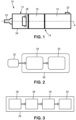
- Fig. 1 schematically shows an example of an electronic vaping device 10 - also known as electronic cigarette.
- Such an electronic vaping device 10 has become a popular alternative to traditional tobacco products such as cigarettes, cigars or pipes. By contrast to these traditional products, which rely on combustion of tobacco, an electronic vaping device 10 typically produces a vapor or aerosol for inhalation by a user.
- this kind of device a substrate containing tobacco or other suitable material is heated to a temperature that is sufficiently high to generate an aerosol from the material but not so high as to cause combustion of the material.
- This aerosol contains the components of the material sought by the user but not the undesired by-products of combustion that are generated when the material combusts. Accordingly, this kind of device may be regarded as a reduced-risk device.
- an electronic vaping device 10 usually comprises a vaporizer 12, a power unit 14 for powering the vaporizer 12, and a controller 16.
- the vaporizer 12, the power unit 14 and the controller 16 may be comprised in a casing 18.
- the casing 18 may be elongated along a longitudinal axis A.
- a mouthpiece 20 may be fixed on one end of the casing 18.
- the casing 18 may be provided with an ON/OFF button 22 for selectively switching on/off the power unit 14.
- the vaporizer 12 may comprise a cartridge 24 or reservoir or pod, which holds a liquid solution containing varying amounts of nicotine, flavorings, and other chemicals.
- the vaporizer 12 may further comprise a heating device 26, e.g. a resistor, for heating the product comprised in the cartridge 24.
- the heating device 26 is powered by the power unit 14.
- the power unit 14 may comprise a battery.
- the power unit 14 may further comprise a charging interface for the battery.
- the charging interface may take the form of a mini-USB port or any other format apparent to those skilled in the art.
- the controller 16 may comprise one printed circuit board (PCB) 28 or more than one printed circuit board (PCB) 28. In this latter case, the PCB may be connected together.
- PCB printed circuit board
- PCB printed circuit board
- Puffing may activate the battery-powered heating device 26, which vaporizes the liquid in the cartridge 24. The person then inhales the resulting aerosol or vapor through the mouthpiece 20.
- PCB 28 comprises a speaker 30 capable of generating an alarm sound.
- an alarm sound means at least one sound whose sound level is so unpleasant that people subject to this sound, especially in the neighborhood of the electronic vaping device 10, are incited to go away from the electronic vaping device 10.
- a sound level of at least 80 dB, preferably at least 90 dB, more preferably at least 100 dB is regarded as an unpleasant sound level.
- a sound level of 80 dB is usually considered as harmful, whereas a sound level of 90 to 100 dB is generally deemed dangerous.
- the sound level of the alarm sound is so high that a person subject to the alarm sound, especially in the neighborhood of the electronic vaping device 10, is incited to cover his/her hears.
- the alarm sound may consist in one single tone, played continuously. However, the alarm sound may comprise more than one tone.
- the alarm sound may for example comprise two or three tones played one after the other, e.g. in repeating cycles.
- the speaker 30 is triggered to generate the alarm sound in response to a user input.
- the user input may consist in activating or using a user input device 32.
- the user input device 32 may be connected to an electronic command unit (ECU) 34 - or microcontroller - on the PCB 28 which receives information from the user input device 32 and command the speaker 30 according to this information.
- ECU electronic command unit
- the user input device 32 is directly connected to the speaker 30 to trigger the emission of the alarm sound when activated/used.
- User input device 32 may be a specific button on the casing 18 of the electronic vaping device 10. In this case, a user pushing this specific button trigger the speaker 30 to emit the alarm sound.
- the user input device 32 may be the ON/OFF button 22 of the electronic vaping device 10.
- the ECU 34 may recognize a combination of press(es) on the ON/OFF button 22 like a long press on the ON/OFF button 22 longer than a predetermined time interval, or a combination of a plurality of presses on the ON/OFF button 22, e. g. more than five, preferably more than ten presses during a predetermined time interval.
- buttons 32 may be apparent to those skilled in the art, for example a button that is pressed by a deformation of the casing, a strain gauge on the casing or a capacitive sensor.
- Fig. 3 shows a second example of PCB 28 that can be used in the electronic vaping device 10 of Fig. 1 .
- the electronic vaping device 10 comprises means for measuring acceleration along three directions perpendicular to each other.
- the electronic vaping device 10 may for example comprise three accelerometers 36, each accelerometer 36 being able to measure acceleration along one single direction, the directions of the accelerometers being perpendicular to each other.
- the electronic vaping device 10 may comprise one single three-way accelerometer 36 (or three-axis accelerometer) capable of measuring accelerations along three directions, which are perpendicular to each other.
- an accelerometer may measure a proper acceleration.
- Proper acceleration is the acceleration of a body in its own instantaneous rest frame. This is different from coordinate acceleration, which is acceleration in a fixed coordinate system.
- coordinate acceleration which is acceleration in a fixed coordinate system.
- an accelerometer at rest on the surface of the Earth will measure a proper acceleration due to Earth's gravity, straight upwards of g ⁇ 9.81 m/s 2 .
- an accelerometer in free fall - i. e. falling toward the center of the Earth at a rate of about 9.81 m/s 2 - measures a proper acceleration equal to zero.
- the word “acceleration” refers to the "proper acceleration” as well as to the "coordinate acceleration”.
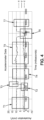
- Fig. 4 shows examples of signals measured by a three-axis accelerometer 36 in an electronic vaping device 10, representative of proper accelerations of the electronic vaping device 10 according to three different axes, which are perpendicular to each other.
- the electronic vaping device 10 is held by a user in movement. Accordingly, during this first timeslot T1, the vertical proper acceleration - along z axis - is substantially equal to 9,81 m/s 2 .
- the longitudinal acceleration - along x axis - is low but not equal to zero, since the x axis corresponds to the direction of the movement of the user. On the contrary, since there is no movement of the user along the y axis, the acceleration measured along this y axis is equal to zero.
- the user let the electronic vaping device 10 fall. Then, the electronic vaping device 10 is subject to a free fall - the only substantial force applied to the electronic vaping device 10 is Earth's gravity - during a first time interval.
- the accelerometer 36 measures proper accelerations substantially equal to zero, along its three axes, during this first time interval.
- the electronic vaping device 10 hit the ground. Accordingly, proper acceleration measured by the accelerometer 36 along the vertical z axis becomes higher than 10 - the electronic vaping device 10 rebounds on the floor - during a short time interval, especially shorter than the first time interval.
- the electronic vaping device 10 lies on the ground. Then the proper accelerations measured along the longitudinal x axis and the transversal y axis are substantially equal to zero. On the contrary, the acceleration measured along the vertical z axis is substantially equal to Earth's gravity.
- Fifth timeslot T5 is representative of a normal use of the electronic vaping device 10. Measured accelerations along the longitudinal x axis and the transversal y axis are kept relatively low during this fifth timeslot T5, whereas the proper acceleration measured along the vertical z axis is substantially equal to Earth's gravity. Low variations of the measured proper accelerations along the three axes may still be observed during this fifth timeslot T5.
- Sixth timeslot T6 is representative of a further movement of the electronic vaping device 10 thrown towards the ground.
- the proper accelerations measured during timeslot T6 are relatively closed to the accelerations measured during the second timeslot T2, i. e. during free fall of the electronic vaping device.
- the rebound of the electronic vaping device 10 hitting the ground also induce proper accelerations measured along the longitudinal x axis and the transversal y axis which are not equal to zero. This may be the result of a rebound on a ground which is not flat and/or to a particular position/orientation of the electronic vaping device 10 when hitting the ground.
- seventh timeslot T7 corresponds to a situation similar to the first timeslot T1, with similar measured proper accelerations.
- specific movements of the electronic vaping device 10 may be determined by analyzing acceleration/s of the electronic vaping device 10, especially proper acceleration/s measured by at least one accelerometer 34 provided in the electronic vaping device 10.
- a specific movement recognition based on analysis of acceleration is used as user input to trigger the speaker 30 to emit the alarm sound. Indeed, it is considered that it would be easier and faster for an assaulted user of the electronic vaping device 10, to move the electronic vaping device 10 according to a specific movement rather than using a user input device, especially a specific button and/or a specific combination of press(es) on a button.
- Fig. 5 shows a flowchart of the different steps carried out in the PCB 28 of Fig. 3 to trigger to speaker 30 to emit the alarm sound.
- Acceleration along only one single axis may be analyzed to determine a specific movement especially for movement according to one degree of freedom.
- a simple way to analyze three accelerations along directions which are perpendicular to each other is to consider a resultant acceleration. Indeed, then only one signal is handled, which is representative of the three accelerations.
- an activity detection is performed, e.g. by the ECU 34.
- the activity detection may consist in determining whether the acceleration variations are above a predetermined threshold, considered as representative of noise only. To do so, the signal energy of the measured acceleration(s) may be analyzed.
- the acceleration signal is conditioned, e.g. cleaned. Especially, high frequencies components - which may be considered as noise - of the acceleration signal may be subtracted from the measured acceleration signal.
- the acceleration signal may be processed through a low pass filter 38.
- the low pass filter 38 may be provided on the PCB 28.
- the low pass filter 38 may be distinct from the ECU 34. Alternatively, the low pass filter 38 is comprised in the ECU 34.
- the filtered acceleration signal is compared with a predetermined threshold value. Especially, during a drop of the electronic vaping device 10, it is expected that the proper acceleration of the electronic vaping device 10 becomes lower than a first threshold. It is also expected that the proper acceleration stays below the first threshold during a first time interval which is higher than a second threshold.
- curves C1 to C5 respectively illustrate the coordinate acceleration of the electronic vaping device 10 dropped respectively from the Vertex V, the forehead FH, the occiput O, the right parietal RP and the left parietal LP.
- the first threshold A T may be defined as a percentage of the maximum acceleration value reached by curves C1-C5 - e.g. half of the maximum acceleration value reached by curves C1-C5 - or a percentage of the maximum acceleration value reach by the lowest of curves C1-C5 - e.g. 80% of the maximum acceleration value reached by the lowest curve.
- the first threshold A T is preferably chosen high enough not to be confused with an acceleration underwent by the vaping device 10 in normal use, but not to high so as to be reachable by the lowest of curves C1-C5.
- the second threshold T T may then be defined as the minimum time interval each of the curves C1-C5 stay above the first threshold A T or a percentage thereof. It may be noticed here that, in case the vaping device 10 is provided with a three-axis accelerometer, then the ECU 32 may be capable of detecting in which position or orientation the vaping device 10 is falling. The ECU 32 may then adapt the thresholds A T , T T according to the orientation of the falling vaping device 10.
- the ECU 32 may be capable of using different curves C1-C5 and thus different threshold A T , T T , according to the orientation of the falling vaping device 10, which orientation may be detected by the ECU 32 based on accelerations measured by a three-axis accelerometer or three single-axis accelerometers.
- a longer time interval or a larger portion of the filtered signal including the free-fall time can be analyzed in step S3.
- the scheme of accelerations shown in Fig. 4 may be searched and recognized by the algorithm carried out.
- a second time interval may have to be detected, which may be immediate after the first time interval, during which at least one proper acceleration varies of an amount above a predetermined threshold, the second time interval being preferably shorter than a third threshold, to recognize a drop movement of the electronic vaping device.
- a second time interval which may be immediate after the first time interval, during which at least one coordinate acceleration varies of an amount above a predetermined threshold, the second time interval being preferably shorter than a third threshold, to recognize a drop movement of the electronic vaping device 10.
- step S4 the ECU 34 triggers the speaker 30 to emit the alarm sound.
- a specific movement that can be determined thank to acceleration/s may be e.g. one of:
- Fig. 7 shows a third example of the PCB 28 which can be used in the electronic vaping device 10 of Fig. 1 .
- the electronic vaping device 10 is provided with a microphone 40 adapted to sense sound from outside the electronic vaping device 10.
- the microphone 40 may be on the PCB 28.
- the microphone 40 may be on the casing 18 of the electronic vaping device 10.
- the ECU 34 may be configured to detect a specific sentence pronounced by the user of the electronic vaping device 10, by analyzing the signal provided by the microphone 40.
- the recognition of the specific sentence may be the user input based on which the alarm sound is triggered. Accordingly, when the ECU 34 determines that the specific sentence is pronounced by the user, the ECU 34 may trigger the speaker 30 to emit the alarm sound.
- the ECU 34 may be adapted to measure a sound level of the sound sensed by the microphone 40.
- the ECU 34 may be configured to trigger the speaker to emit the alarm sound in case the level of sound determined by the ECU 34 is above a predetermined threshold, preferably during a time interval longer than another threshold.
- the sound level may be above a predetermined threshold because of the user of the electronic vaping device 10 is shouting in response to the assault - e.g. calling for help.
- the sound level sensed by the microphone 40 is also a user input that can be used to trigger the speaker 30 to emit the alarm sound.
- the electronic vaping device 14 may further comprise means for recording the signal from the microphone 40, after the alarm sound was emitted.
- the electronic vaping device 14 may comprise a memory 42, e.g. RAM or, preferably ROM, for recording the signal from the microphone 40.
- the signal from the microphone 40 may be pre-treated before to be recorded on the memory 42.
- a noise reduction algorithm can be applied to the signal from the microphone 40 before it is recorded.
- the signal recorded on the memory 42 may then be accessible to the user of the electronic vaping device 10.
- the signal recorded on the memory 42 may then be accessible to a restricted number of people only, e.g. police officers or judges. To do so, the signal recorded on the memory 42 may for example be encoded.
- Fig. 8 shows a fourth example of PCB 28 which can be used in the electronic vaping device 10.
- the electronic vaping device 10 comprises a GPS module 44.
- the GPS module 44 is on the PCB 28.
- the GPS module 44 allows to determine the location of the electronic vaping device 10 when the ECU 34 triggers the speaker 30 to emit the alarm sound in response to a user input.
- the location of the electronic vaping device 10 can be stored in a memory 42.
- the electronic vaping device 10 may further include a communication module 46, especially a wireless communication module 46, e.g. a GSM module.
- the ECU 34 is configured to command the communication module 46 so that this communication module 46 send an alert message.
- the alert message can be sent immediately after the speaker 10 emitted the alarm sound.
- the alert message may comprise the location of the electronic vaping device 10 when the alarm sound was emitted, the location being provided by the GPS module 44.
- the alert message may be sent to the police or to contacts specified by the user of the electronic vaping device.
- the communication module 46 is a Wi-Fi or Bluetooth communication module.
- the electronic vaping device 10 may contact a smartphone of the user of the electronic vaping device 10 through the communication module 46, so that the smartphone is used to send the alert message, using one of the communication modules of the smartphone, e.g. the GSM communication module of the smartphone.
- the electronic vaping may further comprise a user input device, as a button, to stop the emission of the alarm sound after the speaker was triggered to emit the alarm sound.
Landscapes
- Physics & Mathematics (AREA)
- General Physics & Mathematics (AREA)
- Engineering & Computer Science (AREA)
- Computer Security & Cryptography (AREA)
- Business, Economics & Management (AREA)
- Emergency Management (AREA)
- Emergency Alarm Devices (AREA)
Abstract
An electronic vaping device (10) comprises a speaker (30) adapted to emit an alarm sound of at least 80 dB, when triggered through a user input.
Description
- This disclosure pertains to the field of electronic vaping devices.
- Safe sound personal security alarm devices are known, which include a buzzer adapted to emit a loud alarm sound when triggered. These devices are stand-alone devices, which usually comprise a button to trigger the alarm sound. Thus, one being assaulted can trigger the alarm sound by pushing the button.
- A disadvantage of such a device is the accessibility of the button to be pressed in case of assault. Indeed, the device is often kept in a handbag, when the user does think to take the device with him/her when going out.
- Moreover, an assaulter may recognize these devices and take corresponding precautions to avoid that the user triggers the alarm.
- On another hand, electronic vaping devices - or heated substrate aerosol generating devices - are known. In such an electronic vaping device, a substrate containing tobacco or other suitable material is heated to a temperature that is sufficiently high to generate an aerosol from the material but not so high as to cause combustion of the material. This aerosol contains the components of the material sought by the user but not the undesired by-products of combustion that are generated when the material combusts.
- Users generally have these devices on them most of the time and hold them in their hands, especially when they are outside, where vaping is authorized.
- Moreover,
WO-A-2019/16468 -
WO-A-2020/099822 also discloses a diagnostic system for an electronic vapour provision system, comprising a detection processor adapted to detect any misuse events, such as dropping of system. A diagnostic processor is adapted to perform, in response to detection of a predetermined misuse event, a corresponding system diagnostic, such as signaling a user via a speaker. - However, in these documents, the level of the sound generated by the buzzer can be kept relatively low, since its function is essentially to warn the user that the aerosol generating device fell and to let the user know where the aerosol generating device lays, not to repulse the user.
- It is proposed an electronic vaping device, comprising a speaker adapted to emit an alarm sound of at least 80 dB, preferably at least 90 dB, more preferably at least 100 dB, when triggered through a user input.
- Thus, the electronic vaping device may comprise an anti-assault functionality consisting in emitting an alarm sound. The alarm sound may be triggered by the user, when needed, through a user input. Usefully, the electronic vaping device is generally easy to access for a user, since the user may be holding the electronic vaping device, e.g. when using it, or keep it in an easy to access place, as a pocket for example.
- The following features can be optionally implemented, separately or in combination one with the others:
- the electronic vaping device comprises a button, the user input comprising pressing the button. Thus the user may easily know how to trigger the alarm sound;
- the electronic vaping device further comprises an electronic command unit to trigger the speaker to emit the alarm sound in response to the user input;
- the electronic vaping device further comprises at least one accelerometer, the electronic command unit being adapted to receive at least one signal from the accelerometer, to run an algorithm to determine whether the electronic vaping device is subject to a specific movement based on the signal from the accelerometer and to trigger the speaker to emit the alarm sound if the specific movement of the electronic vaping device is recognized by the algorithm. Thus a specific movement of the electronic vaping device may be used as user input to trigger the alarm sound. It is deemed that subjecting the electronic vaping device to a specific movement may be an easy user input to trigger the alarm sound, especially an easier user input than pressing a specific button;
- the electronic vaping device comprises one three-axis accelerometer, the electronic vaping device preferably comprising one single accelerometer, which is a three-axis accelerometer. Recognizing a movement underwent by the electronic vaping device is more accurate when accelerations according to three different axis which are perpendicular to each other, are analyzed;
- the algorithm comprises a first criterion consisting in detecting a first time interval during which at least one acceleration of the electronic vaping device is lower, respectively higher, than a first threshold. It is deemed that this simple criterion to check may be representative of a particular movement of the electronic vaping device, for example a fall of the electronic vaping device, which is consequently a user input which may be easily recognized by an algorithm analyzing at least one acceleration of the electronic vaping device;
- the algorithm comprises a second criterion consisting in detecting a second time interval, preferably immediate after the first time interval, during which at least one acceleration varies of an amount above a second threshold, the second time interval being preferably shorter than a third threshold. It is deemed that recognition of a specific movement of the electronic vaping device, e.g. a fall of the electronic vaping device, is more accurate when it is based on more criterions;
- the electronic vaping device comprises a three-axis accelerometer or three one-axis accelerometers adapted to measure an acceleration along three axes perpendicular to each other, wherein the algorithm comprises a first criterion consisting in detecting a first time interval during which a resultant acceleration of the electronic vaping device is lower, respectively higher, than a first threshold, the resultant acceleration being defined as the square root of the sum of the square of the three accelerations. It is deemed that analyzing a resultant acceleration may be a convenient way to take into consideration the three components of the acceleration of the electronic vaping device, handling only one signal;
- the algorithm comprises a second criterion consisting in detecting a second time interval, preferably immediate after the first time interval, during which the resultant acceleration varies of an amount above a second threshold, the second time interval being preferably shorter than a third threshold;
- the electronic vaping device further comprises a GPS module adapted to determine a position of the electronic vaping device when the speaker is triggered to emit the alarm sound, and a communication module, especially a GSM module, adapted to send an alert message comprising the position of the electronic vaping device when the speaker is triggered to emit the alarm sound;
- the electronic vaping device further comprises a microphone adapted to sense sound from outside the electronic vaping device;
- the microphone is connected to the electronic command unit and the electronic command unit is adapted to detect a specific sentence pronounced by a user of the electronic vaping device in the signal received from the microphone and to trigger the speaker to emit the alarm sound, when the specific sentence is detected. Accordingly, the alarm sound may be triggered without contact of the user with the electronic vaping device;
- the microphone is connected to the electronic command unit and the electronic command unit is adapted to detect a sound level of the sound sensed by the microphone, which is above a predetermined threshold, preferably during a predetermined threshold of time, and to trigger the speaker to emit the alarm sound consequently. Here again, the alarm sound may be triggered without contact of the user with the electronic vaping device;
- the electronic vaping device further comprises means for recording the signal from the microphone after the speaker was triggered to emit the alarm sound. This recording may be used later by a user to prove that he/she was assaulted;
- the electronic vaping device further comprises a user input device to stop the emission of the alarm sound after the speaker was triggered. Hence the user may stop the alarm sound, e.g. when the alarm was triggered by mistake.
- Other features, details and advantages will be shown in the following detailed description and on the figures, on which:
-
Fig. 1 is a schematic view of an electronic vaping device. -
Fig. 2 illustrates a schematic view of a first example of a PCB of the electronic vaping device ofFig. 1 . -
Fig. 3 shows a schematic view of a second example of a PCB of the electronic vaping device ofFig. 1 . -
Fig. 4 is a graphic showing examples of accelerations measured by the accelerometer of the PCB shown onFig. 3 , illustrating different use conditions of the corresponding electronic vaping device. -
Fig. 5 is a flowchart illustrating an algorithm to determine whether the electronic vaping device ofFig. 1 is subject to a fall movement. -
Fig. 6 is a graphic showing examples of accelerations of the electronic vaping device ofFig. 1 falling from different heights. -
Fig. 7 illustrates a schematic view of a third example of a PCB of the electronic vaping device ofFig. 1 . -
Fig. 8 shows a schematic view of a fourth example of a PCB of the electronic vaping device ofFig. 1 . -
Fig. 1 schematically shows an example of an electronic vaping device 10 - also known as electronic cigarette. - Such an
electronic vaping device 10 has become a popular alternative to traditional tobacco products such as cigarettes, cigars or pipes. By contrast to these traditional products, which rely on combustion of tobacco, anelectronic vaping device 10 typically produces a vapor or aerosol for inhalation by a user. - In this kind of device, a substrate containing tobacco or other suitable material is heated to a temperature that is sufficiently high to generate an aerosol from the material but not so high as to cause combustion of the material. This aerosol contains the components of the material sought by the user but not the undesired by-products of combustion that are generated when the material combusts. Accordingly, this kind of device may be regarded as a reduced-risk device.
- As illustrated on
Fig. 1 , anelectronic vaping device 10 usually comprises avaporizer 12, apower unit 14 for powering thevaporizer 12, and acontroller 16. Thevaporizer 12, thepower unit 14 and thecontroller 16 may be comprised in acasing 18. Thecasing 18 may be elongated along a longitudinal axis A. Amouthpiece 20 may be fixed on one end of thecasing 18. Thecasing 18 may be provided with an ON/OFF button 22 for selectively switching on/off thepower unit 14. - The
vaporizer 12 may comprise acartridge 24 or reservoir or pod, which holds a liquid solution containing varying amounts of nicotine, flavorings, and other chemicals. - The
vaporizer 12 may further comprise a heating device 26, e.g. a resistor, for heating the product comprised in thecartridge 24. The heating device 26 is powered by thepower unit 14. - The
power unit 14 may comprise a battery. Thepower unit 14 may further comprise a charging interface for the battery. The charging interface may take the form of a mini-USB port or any other format apparent to those skilled in the art. - The
controller 16 may comprise one printed circuit board (PCB) 28 or more than one printed circuit board (PCB) 28. In this latter case, the PCB may be connected together. - Puffing may activate the battery-powered heating device 26, which vaporizes the liquid in the
cartridge 24. The person then inhales the resulting aerosol or vapor through themouthpiece 20. - In the following, reference is made to one
single PCB 28 keeping in mind that the different elements on thissingle PCB 28 can actually be on different PCB connected together. - According to the example of
Fig. 2 ,PCB 28 comprises aspeaker 30 capable of generating an alarm sound. - As used herein, an alarm sound means at least one sound whose sound level is so unpleasant that people subject to this sound, especially in the neighborhood of the
electronic vaping device 10, are incited to go away from theelectronic vaping device 10. In the present application, a sound level of at least 80 dB, preferably at least 90 dB, more preferably at least 100 dB, is regarded as an unpleasant sound level. Indeed, a sound level of 80 dB is usually considered as harmful, whereas a sound level of 90 to 100 dB is generally deemed dangerous. Preferably, the sound level of the alarm sound is so high that a person subject to the alarm sound, especially in the neighborhood of theelectronic vaping device 10, is incited to cover his/her hears. - Moreover, the alarm sound may consist in one single tone, played continuously. However, the alarm sound may comprise more than one tone. The alarm sound may for example comprise two or three tones played one after the other, e.g. in repeating cycles.
- According to the first example of
PCB 28 as shown onFig. 2 , thespeaker 30 is triggered to generate the alarm sound in response to a user input. In the present case, the user input may consist in activating or using auser input device 32. Theuser input device 32 may be connected to an electronic command unit (ECU) 34 - or microcontroller - on thePCB 28 which receives information from theuser input device 32 and command thespeaker 30 according to this information. Alternatively, theuser input device 32 is directly connected to thespeaker 30 to trigger the emission of the alarm sound when activated/used. -
User input device 32 may be a specific button on thecasing 18 of theelectronic vaping device 10. In this case, a user pushing this specific button trigger thespeaker 30 to emit the alarm sound. - Alternatively, the
user input device 32 may be the ON/OFF button 22 of theelectronic vaping device 10. For example, theECU 34 may recognize a combination of press(es) on the ON/OFF button 22 like a long press on the ON/OFF button 22 longer than a predetermined time interval, or a combination of a plurality of presses on the ON/OFF button 22, e. g. more than five, preferably more than ten presses during a predetermined time interval. - Other
user input devices 32 may be apparent to those skilled in the art, for example a button that is pressed by a deformation of the casing, a strain gauge on the casing or a capacitive sensor. -
Fig. 3 shows a second example ofPCB 28 that can be used in theelectronic vaping device 10 ofFig. 1 . - According to this second example, at least one
accelerometer 36 is provided in theelectronic vaping device 10, e.g. on thePCB 28. Preferably, theelectronic vaping device 10 comprises means for measuring acceleration along three directions perpendicular to each other. Thus, theelectronic vaping device 10 may for example comprise threeaccelerometers 36, eachaccelerometer 36 being able to measure acceleration along one single direction, the directions of the accelerometers being perpendicular to each other. Alternatively, theelectronic vaping device 10 may comprise one single three-way accelerometer 36 (or three-axis accelerometer) capable of measuring accelerations along three directions, which are perpendicular to each other. - It must be noticed here that an accelerometer may measure a proper acceleration. Proper acceleration is the acceleration of a body in its own instantaneous rest frame. This is different from coordinate acceleration, which is acceleration in a fixed coordinate system. For example, an accelerometer at rest on the surface of the Earth will measure a proper acceleration due to Earth's gravity, straight upwards of g ≈ 9.81 m/s2. By contrast, an accelerometer in free fall - i. e. falling toward the center of the Earth at a rate of about 9.81 m/s2 - measures a proper acceleration equal to zero. In the following, the word "acceleration" refers to the "proper acceleration" as well as to the "coordinate acceleration".
-
Fig. 4 shows examples of signals measured by a three-axis accelerometer 36 in anelectronic vaping device 10, representative of proper accelerations of theelectronic vaping device 10 according to three different axes, which are perpendicular to each other. - During a first timeslot T1, the
electronic vaping device 10 is held by a user in movement. Accordingly, during this first timeslot T1, the vertical proper acceleration - along z axis - is substantially equal to 9,81 m/s2. The longitudinal acceleration - along x axis - is low but not equal to zero, since the x axis corresponds to the direction of the movement of the user. On the contrary, since there is no movement of the user along the y axis, the acceleration measured along this y axis is equal to zero. - During a second timeslot T2, the user let the
electronic vaping device 10 fall. Then, theelectronic vaping device 10 is subject to a free fall - the only substantial force applied to theelectronic vaping device 10 is Earth's gravity - during a first time interval. Theaccelerometer 36 measures proper accelerations substantially equal to zero, along its three axes, during this first time interval. - Then, during a third timeslot T3, the
electronic vaping device 10 hit the ground. Accordingly, proper acceleration measured by theaccelerometer 36 along the vertical z axis becomes higher than 10 - theelectronic vaping device 10 rebounds on the floor - during a short time interval, especially shorter than the first time interval. - During a fourth timeslot T4, the
electronic vaping device 10 lies on the ground. Then the proper accelerations measured along the longitudinal x axis and the transversal y axis are substantially equal to zero. On the contrary, the acceleration measured along the vertical z axis is substantially equal to Earth's gravity. - Fifth timeslot T5 is representative of a normal use of the
electronic vaping device 10. Measured accelerations along the longitudinal x axis and the transversal y axis are kept relatively low during this fifth timeslot T5, whereas the proper acceleration measured along the vertical z axis is substantially equal to Earth's gravity. Low variations of the measured proper accelerations along the three axes may still be observed during this fifth timeslot T5. - Sixth timeslot T6 is representative of a further movement of the
electronic vaping device 10 thrown towards the ground. As can be seen, the proper accelerations measured during timeslot T6 are relatively closed to the accelerations measured during the second timeslot T2, i. e. during free fall of the electronic vaping device. However, in this sixth timeslot T6 the rebound of theelectronic vaping device 10 hitting the ground also induce proper accelerations measured along the longitudinal x axis and the transversal y axis which are not equal to zero. This may be the result of a rebound on a ground which is not flat and/or to a particular position/orientation of theelectronic vaping device 10 when hitting the ground. - Finally, seventh timeslot T7 corresponds to a situation similar to the first timeslot T1, with similar measured proper accelerations.
- As it can be seen from
Fig. 4 , specific movements of theelectronic vaping device 10 may be determined by analyzing acceleration/s of theelectronic vaping device 10, especially proper acceleration/s measured by at least oneaccelerometer 34 provided in theelectronic vaping device 10. According to a specific embodiment of theelectronic vaping device 10 such a specific movement recognition based on analysis of acceleration is used as user input to trigger thespeaker 30 to emit the alarm sound. Indeed, it is considered that it would be easier and faster for an assaulted user of theelectronic vaping device 10, to move theelectronic vaping device 10 according to a specific movement rather than using a user input device, especially a specific button and/or a specific combination of press(es) on a button. - For example,
Fig. 5 shows a flowchart of the different steps carried out in thePCB 28 ofFig. 3 to trigger tospeaker 30 to emit the alarm sound. - In the following reference is made only to one acceleration of the electronic vaping device. It must be understood of course that each of the following steps can be carried out for each acceleration along a specific axis or for a resultant acceleration. The resultant acceleration may be equal to the square root of the sum of the square of each of the accelerations along three axes:

accelerometer 36. - Acceleration along only one single axis may be analyzed to determine a specific movement especially for movement according to one degree of freedom. However, it is preferred to analyze accelerations along three different axes which are perpendicular to each other. Indeed, the analysis of these accelerations may not be subject to biased due to a particular orientation of the
electronic vaping device 10 in this latter case. Moreover, a simple way to analyze three accelerations along directions which are perpendicular to each other, is to consider a resultant acceleration. Indeed, then only one signal is handled, which is representative of the three accelerations. - According to the flowchart shown of
Fig. 5 representative of the algorithm carried out in theelectronic vaping device 10, during a first step S1, an activity detection is performed, e.g. by theECU 34. The activity detection may consist in determining whether the acceleration variations are above a predetermined threshold, considered as representative of noise only. To do so, the signal energy of the measured acceleration(s) may be analyzed. - Then, during a second step S2, the acceleration signal is conditioned, e.g. cleaned. Especially, high frequencies components - which may be considered as noise - of the acceleration signal may be subtracted from the measured acceleration signal. To do so, the acceleration signal may be processed through a
low pass filter 38. Thelow pass filter 38 may be provided on thePCB 28. Thelow pass filter 38 may be distinct from theECU 34. Alternatively, thelow pass filter 38 is comprised in theECU 34. - It may be noticed here that such a cleaning of the acceleration signal may not be necessary, for example if the output of the accelerometer/s 34 is/are digital.
- Then, during a third step S3, the filtered acceleration signal is compared with a predetermined threshold value. Especially, during a drop of the
electronic vaping device 10, it is expected that the proper acceleration of theelectronic vaping device 10 becomes lower than a first threshold. It is also expected that the proper acceleration stays below the first threshold during a first time interval which is higher than a second threshold. - On the contrary, it is expected that the coordinate acceleration becomes higher than a corresponding first threshold during free fall and stay above the corresponding first threshold during a second time interval.
- This can be seen on
Fig. 6 showing coordinate accelerations of theelectronic vaping device 10 dropped from different heights. Thus, curves C1 to C5 respectively illustrate the coordinate acceleration of theelectronic vaping device 10 dropped respectively from the Vertex V, the forehead FH, the occiput O, the right parietal RP and the left parietal LP. Based on these curves C1-C5, the first threshold AT may be defined as a percentage of the maximum acceleration value reached by curves C1-C5 - e.g. half of the maximum acceleration value reached by curves C1-C5 - or a percentage of the maximum acceleration value reach by the lowest of curves C1-C5 - e.g. 80% of the maximum acceleration value reached by the lowest curve. The first threshold AT is preferably chosen high enough not to be confused with an acceleration underwent by the vapingdevice 10 in normal use, but not to high so as to be reachable by the lowest of curves C1-C5. The second threshold TT may then be defined as the minimum time interval each of the curves C1-C5 stay above the first threshold AT or a percentage thereof. It may be noticed here that, in case the vapingdevice 10 is provided with a three-axis accelerometer, then theECU 32 may be capable of detecting in which position or orientation thevaping device 10 is falling. TheECU 32 may then adapt the thresholds AT , TT according to the orientation of the fallingvaping device 10. According to another embodiment, theECU 32 may be capable of using different curves C1-C5 and thus different threshold AT , TT , according to the orientation of the fallingvaping device 10, which orientation may be detected by theECU 32 based on accelerations measured by a three-axis accelerometer or three single-axis accelerometers. - Other ways to define the first and second thresholds AT , TT are apparent to those skilled in the art.
- For a better detection of a drop of the
electronic caping device 10, a longer time interval or a larger portion of the filtered signal including the free-fall time can be analyzed in step S3. In this case, the scheme of accelerations shown inFig. 4 may be searched and recognized by the algorithm carried out. In other words, a second time interval may have to be detected, which may be immediate after the first time interval, during which at least one proper acceleration varies of an amount above a predetermined threshold, the second time interval being preferably shorter than a third threshold, to recognize a drop movement of the electronic vaping device. - On the contrary, it may be searched for a second time interval, which may be immediate after the first time interval, during which at least one coordinate acceleration varies of an amount above a predetermined threshold, the second time interval being preferably shorter than a third threshold, to recognize a drop movement of the
electronic vaping device 10. - In case the criterions described above are met, then a fall movement of the
electronic vaping device 10 is recognized. Accordingly, in step S4, theECU 34 triggers thespeaker 30 to emit the alarm sound. - Other ways to recognize specific movements of the
electronic vaping device 10 may be apparent to those skilled in the art. Especially, signal cross-correlations or neural networks may be considered to recognize specific movements of theelectronic vaping device 10. - Also, other specific movements than a fall can be determined thanks to acceleration measurement/s and analyze/s. A specific movement that can be determined thank to acceleration/s may be e.g. one of:
- a shaking of the
electronic vaping device 10 by the user; - a rotation of the
electronic vaping device 10, e.g. along a rotation axis which is perpendicular the longitudinal axis A of thecasing 18 of the electronic vaping devices. -
Fig. 7 shows a third example of thePCB 28 which can be used in theelectronic vaping device 10 ofFig. 1 . - According to this third example, the
electronic vaping device 10 is provided with amicrophone 40 adapted to sense sound from outside theelectronic vaping device 10. Themicrophone 40 may be on thePCB 28. Alternatively, themicrophone 40 may be on thecasing 18 of theelectronic vaping device 10. - Thanks to the
microphone 40 which is connected to theECU 34, theECU 34 may be configured to detect a specific sentence pronounced by the user of theelectronic vaping device 10, by analyzing the signal provided by themicrophone 40. The recognition of the specific sentence may be the user input based on which the alarm sound is triggered. Accordingly, when theECU 34 determines that the specific sentence is pronounced by the user, theECU 34 may trigger thespeaker 30 to emit the alarm sound. - It is deemed that recognition of a sentence pronounced by the user of the
electronic vaping device 10 is an easy and effective way to determined that the user is subject to an assault and that the alarm sound must be emitted. - Alternatively, the
ECU 34 may be adapted to measure a sound level of the sound sensed by themicrophone 40. In this case, theECU 34 may be configured to trigger the speaker to emit the alarm sound in case the level of sound determined by theECU 34 is above a predetermined threshold, preferably during a time interval longer than another threshold. Indeed, the sound level may be above a predetermined threshold because of the user of theelectronic vaping device 10 is shouting in response to the assault - e.g. calling for help. Thus, the sound level sensed by themicrophone 40 is also a user input that can be used to trigger thespeaker 30 to emit the alarm sound. - As illustrated in
Fig. 7 , theelectronic vaping device 14 may further comprise means for recording the signal from themicrophone 40, after the alarm sound was emitted. For example, theelectronic vaping device 14 may comprise amemory 42, e.g. RAM or, preferably ROM, for recording the signal from themicrophone 40. The signal from themicrophone 40 may be pre-treated before to be recorded on thememory 42. For example, a noise reduction algorithm can be applied to the signal from themicrophone 40 before it is recorded. - The signal recorded on the
memory 42 may then be accessible to the user of theelectronic vaping device 10. Alternatively, the signal recorded on thememory 42 may then be accessible to a restricted number of people only, e.g. police officers or judges. To do so, the signal recorded on thememory 42 may for example be encoded. - Finally,
Fig. 8 shows a fourth example ofPCB 28 which can be used in theelectronic vaping device 10. - According to this fourth example, the
electronic vaping device 10 comprises aGPS module 44. In the present case, theGPS module 44 is on thePCB 28. TheGPS module 44 allows to determine the location of theelectronic vaping device 10 when theECU 34 triggers thespeaker 30 to emit the alarm sound in response to a user input. The location of theelectronic vaping device 10 can be stored in amemory 42. However, as illustrated, theelectronic vaping device 10 may further include acommunication module 46, especially awireless communication module 46, e.g. a GSM module. Accordingly, it is deemed advantageous that theECU 34 is configured to command thecommunication module 46 so that thiscommunication module 46 send an alert message. The alert message can be sent immediately after thespeaker 10 emitted the alarm sound. The alert message may comprise the location of theelectronic vaping device 10 when the alarm sound was emitted, the location being provided by theGPS module 44. The alert message may be sent to the police or to contacts specified by the user of the electronic vaping device. - According to an alternative, the
communication module 46 is a Wi-Fi or Bluetooth communication module. In this case, theelectronic vaping device 10 may contact a smartphone of the user of theelectronic vaping device 10 through thecommunication module 46, so that the smartphone is used to send the alert message, using one of the communication modules of the smartphone, e.g. the GSM communication module of the smartphone. - It is to be understood that the invention is not limited to the details of construction set forth above. On the contrary, it is apparent to those skilled in the art having the benefit of the present disclosure that the invention is capable of other embodiments and of being practiced or carried out in various way.
- For example, the different embodiments described above may be combined when they are not inconsistent.
- Moreover, the electronic vaping may further comprise a user input device, as a button, to stop the emission of the alarm sound after the speaker was triggered to emit the alarm sound.
Claims (15)
- An electronic vaping device (10), comprising a speaker (30) adapted to emit an alarm sound of at least 80 dB, when triggered through a user input.
- The electronic vaping device of claim 1, wherein the electronic vaping device comprises a button (22), the user input comprising pressing the button (22).
- The electronic vaping device of claim 1 or 2, further comprising an electronic command unit (34) to trigger the speaker (30) to emit the alarm sound in response to the user input.
- The electronic vaping device of claim 3, further comprising at least one accelerometer (36), the electronic command unit (32) being adapted to receive at least one signal from the accelerometer (36), to run an algorithm to determine whether the electronic vaping device (10) is subject to a specific movement based on the signal from the accelerometer (36) and to trigger the speaker (30) to emit the alarm sound if the specific movement of the electronic vaping device (10) is recognized by the algorithm.
- The electronic vaping device of claim 4, comprising one three-axis accelerometer (36), the electronic vaping device (10) preferably comprising one single accelerometer (36), which is a three-axis accelerometer.
- The electronic vaping device of claim 4 or 5, wherein the algorithm comprises a first criterion consisting in detecting a first time interval during which at least one acceleration of the electronic vaping device is lower, respectively higher, than a first threshold.
- The electronic vaping device of claim 6, wherein the algorithm comprises a second criterion consisting in detecting a second time interval, preferably immediate after the first time interval, during which at least one acceleration varies of an amount above a second threshold, the second time interval being preferably shorter than a third threshold.
- The electronic vaping device of claim 4 of 5, comprising a three-axis accelerometer (36) or three one-axis accelerometers (36) adapted to measure an acceleration along three axes perpendicular to each other, wherein the algorithm comprises a first criterion consisting in detecting a first time interval during which a resultant acceleration of the electronic vaping device is lower, respectively higher, than a first threshold, the resultant acceleration being defined as the square root of the sum of the square of the three accelerations.
- The electronic vaping device of claim 8, wherein the algorithm comprises a second criterion consisting in detecting a second time interval, preferably immediate after the first time interval, during which the resultant acceleration varies of an amount above a second threshold, the second time interval being preferably shorter than a third threshold.
- The electronic vaping device of any one of the preceding claims, further comprising a GPS module (44) adapted to determine a position of the electronic vaping device (10) when the speaker (30) is triggered to emit the alarm sound, and a communication module (46), especially a GSM module, adapted to send an alert message comprising the position of the electronic vaping device (10) when the speaker (30) is triggered to emit the alarm sound.
- The electronic vaping device of any one of the preceding claims, further comprising a microphone (40) adapted to sense sound from outside the electronic vaping device (10).
- The electronic vaping device of claims 3 and 11, wherein the microphone (40) is connected to the electronic command unit (34) and wherein the electronic command unit (34) is adapted to detect a specific sentence pronounced by a user of the electronic vaping device (10) in the signal received from the microphone (40) and to trigger the speaker (30) to emit the alarm sound, when the specific sentence is detected.
- The electronic vaping device of claim 11 or 12, wherein the microphone (40) is connected to the electronic command unit (34) and wherein the electronic command unit (34) is adapted to detect a sound level of the sound sensed by the microphone (40), which is above a predetermined threshold, preferably during a predetermined threshold of time, and to trigger the speaker (30) to emit the alarm sound consequently.
- The electronic vaping device of one of claims 11 to 13, further comprising means (42) for recording the signal from the microphone (40) after the speaker (30) was triggered to emit the alarm sound.
- The electronic vaping device of any one of the preceding claims, further comprising a user input device to stop the emission of the alarm sound after the speaker (30) was triggered.
Priority Applications (1)
| Application Number | Priority Date | Filing Date | Title |
|---|---|---|---|
| EP22185559.6A EP4310809A1 (en) | 2022-07-18 | 2022-07-18 | Electronic vaping device with an anti-assault functionality |
Applications Claiming Priority (1)
| Application Number | Priority Date | Filing Date | Title |
|---|---|---|---|
| EP22185559.6A EP4310809A1 (en) | 2022-07-18 | 2022-07-18 | Electronic vaping device with an anti-assault functionality |
Publications (1)
| Publication Number | Publication Date |
|---|---|
| EP4310809A1 true EP4310809A1 (en) | 2024-01-24 |
Family
ID=82655373
Family Applications (1)
| Application Number | Title | Priority Date | Filing Date |
|---|---|---|---|
| EP22185559.6A Withdrawn EP4310809A1 (en) | 2022-07-18 | 2022-07-18 | Electronic vaping device with an anti-assault functionality |
Country Status (1)
| Country | Link |
|---|---|
| EP (1) | EP4310809A1 (en) |
Citations (9)
| Publication number | Priority date | Publication date | Assignee | Title |
|---|---|---|---|---|
| EP2237238A1 (en) * | 2009-03-29 | 2010-10-06 | Olivier Tibloux | Personal, portable, security device that acts as a deterrent, an alarm and for communication, providing security and identifying the location of people or its wearer, in the event of aggression or emergency. |
| US20150269835A1 (en) * | 2012-06-13 | 2015-09-24 | David B. Benoit | Systems and methods for managing an emergency situation |
| US20170156397A1 (en) * | 2015-12-07 | 2017-06-08 | R.J. Reynolds Tobacco Company | Motion sensing for an aerosol delivery device |
| DE102017202775A1 (en) * | 2017-02-21 | 2018-08-23 | Sven Meyer | Alarm messaging system and alarm reporting procedure |
| WO2019016468A1 (en) | 2017-07-17 | 2019-01-24 | La Fondation Mediterranee Infection | Novel mutated pte enzymes |
| US20200074838A1 (en) * | 2016-12-15 | 2020-03-05 | Holor, Llc | Wearable multi-functional personal security device |
| WO2020099822A1 (en) | 2018-11-16 | 2020-05-22 | Nicoventures Trading Limited | Diagnostic system and method |
| EP3721741A1 (en) * | 2019-04-05 | 2020-10-14 | ErnIdee UG (haftungsbeschränkt) | Alarm system for jogger |
| AU2021105886A4 (en) * | 2021-07-20 | 2021-10-21 | ShenZhen Vido Technology Co.,Ltd | A Smart Social E-cigarette |
-
2022
- 2022-07-18 EP EP22185559.6A patent/EP4310809A1/en not_active Withdrawn
Patent Citations (9)
| Publication number | Priority date | Publication date | Assignee | Title |
|---|---|---|---|---|
| EP2237238A1 (en) * | 2009-03-29 | 2010-10-06 | Olivier Tibloux | Personal, portable, security device that acts as a deterrent, an alarm and for communication, providing security and identifying the location of people or its wearer, in the event of aggression or emergency. |
| US20150269835A1 (en) * | 2012-06-13 | 2015-09-24 | David B. Benoit | Systems and methods for managing an emergency situation |
| US20170156397A1 (en) * | 2015-12-07 | 2017-06-08 | R.J. Reynolds Tobacco Company | Motion sensing for an aerosol delivery device |
| US20200074838A1 (en) * | 2016-12-15 | 2020-03-05 | Holor, Llc | Wearable multi-functional personal security device |
| DE102017202775A1 (en) * | 2017-02-21 | 2018-08-23 | Sven Meyer | Alarm messaging system and alarm reporting procedure |
| WO2019016468A1 (en) | 2017-07-17 | 2019-01-24 | La Fondation Mediterranee Infection | Novel mutated pte enzymes |
| WO2020099822A1 (en) | 2018-11-16 | 2020-05-22 | Nicoventures Trading Limited | Diagnostic system and method |
| EP3721741A1 (en) * | 2019-04-05 | 2020-10-14 | ErnIdee UG (haftungsbeschränkt) | Alarm system for jogger |
| AU2021105886A4 (en) * | 2021-07-20 | 2021-10-21 | ShenZhen Vido Technology Co.,Ltd | A Smart Social E-cigarette |
Similar Documents
| Publication | Publication Date | Title |
|---|---|---|
| CN103503041B (en) | For device and the method for operating thereof of fall detector or fall detection system | |
| EP1278457B1 (en) | Device and method for detecting abnormal situations | |
| US6454724B1 (en) | Sleep apnea detection system and method | |
| KR20100000317A (en) | Apparatus and method for fall-down detection | |
| JP5614827B2 (en) | Mobile phone terminal and health condition monitoring system | |
| KR20170004269A (en) | Apparatus and method for fall-down detection | |
| WO2001031604A1 (en) | Alertness monitoring system | |
| CN110620980A (en) | Method for operating a hearing device system and hearing device system | |
| EP1779772A1 (en) | System for analysing a person's activity and for automatic fall detection | |
| EP1974662A1 (en) | Fall detector | |
| CN212546918U (en) | Intelligent mood ring | |
| CN106225012B (en) | A kind of aiding smoking cessation lighter and its control method | |
| JP4867215B2 (en) | Physiological / psychological state determination device, physiological / psychological state determination method, reference data generation device, and reference data generation method. | |
| JP2000051157A (en) | Detector for abnormality of subject, information device for abnormality of subject, and emergency system for subject | |
| JP3694429B2 (en) | Radiation measurement system and personal dosimeter | |
| EP3756176A1 (en) | A wearable alarm device and a method of use thereof | |
| CN111161509A (en) | Brain wave-triggered non-contact alarm device and alarm detection method thereof | |
| JP2020113017A (en) | Mobile terminal for reporting, reporting system and reporting method | |
| CN211323054U (en) | Electronic cigarette | |
| GB2334127A (en) | Alertness monitor | |
| US20220211294A1 (en) | Communication device and communication system for monitoring breathing | |
| JP2002183859A (en) | Abnormality determination reporting device | |
| EP4235611A2 (en) | System for monitoring the physical condition of at least one user and method for monitoring the physical condition of a user | |
| KR101660122B1 (en) | A smoking control device, a smoking control system and a method for controlling thereof | |
| JP2021108048A (en) | Fall detection terminal and program |
Legal Events
| Date | Code | Title | Description |
|---|---|---|---|
| PUAI | Public reference made under article 153(3) epc to a published international application that has entered the european phase |
Free format text: ORIGINAL CODE: 0009012 |
|
| STAA | Information on the status of an ep patent application or granted ep patent |
Free format text: STATUS: THE APPLICATION HAS BEEN PUBLISHED |
|
| AK | Designated contracting states |
Kind code of ref document: A1 Designated state(s): AL AT BE BG CH CY CZ DE DK EE ES FI FR GB GR HR HU IE IS IT LI LT LU LV MC MK MT NL NO PL PT RO RS SE SI SK SM TR |
|
| STAA | Information on the status of an ep patent application or granted ep patent |
Free format text: STATUS: THE APPLICATION IS DEEMED TO BE WITHDRAWN |
|
| 18D | Application deemed to be withdrawn |
Effective date: 20240725 |