EP4310052A1 - Modified lignin in the manufacture of organic-inorganic hybrid materials - Google Patents
Modified lignin in the manufacture of organic-inorganic hybrid materials Download PDFInfo
- Publication number
- EP4310052A1 EP4310052A1 EP22185988.7A EP22185988A EP4310052A1 EP 4310052 A1 EP4310052 A1 EP 4310052A1 EP 22185988 A EP22185988 A EP 22185988A EP 4310052 A1 EP4310052 A1 EP 4310052A1
- Authority
- EP
- European Patent Office
- Prior art keywords
- lignin
- oxide precursor
- catalyst
- acid
- organic
- Prior art date
- Legal status (The legal status is an assumption and is not a legal conclusion. Google has not performed a legal analysis and makes no representation as to the accuracy of the status listed.)
- Withdrawn
Links
- 229920005610 lignin Polymers 0.000 title claims abstract description 80
- 239000000463 material Substances 0.000 title claims abstract description 23
- 238000004519 manufacturing process Methods 0.000 title description 5
- 239000012702 metal oxide precursor Substances 0.000 claims abstract description 24
- 238000000576 coating method Methods 0.000 claims abstract description 19
- 239000000203 mixture Substances 0.000 claims description 28
- XLYOFNOQVPJJNP-UHFFFAOYSA-N water Substances O XLYOFNOQVPJJNP-UHFFFAOYSA-N 0.000 claims description 24
- 238000000034 method Methods 0.000 claims description 23
- WYURNTSHIVDZCO-UHFFFAOYSA-N tetrahydrofuran Substances C1CCOC1 WYURNTSHIVDZCO-UHFFFAOYSA-N 0.000 claims description 21
- 239000003054 catalyst Substances 0.000 claims description 17
- 239000000758 substrate Substances 0.000 claims description 15
- 239000002904 solvent Substances 0.000 claims description 14
- ZMXDDKWLCZADIW-UHFFFAOYSA-N N,N-dimethylformamide Substances CN(C)C=O ZMXDDKWLCZADIW-UHFFFAOYSA-N 0.000 claims description 11
- 239000011248 coating agent Substances 0.000 claims description 11
- QTBSBXVTEAMEQO-UHFFFAOYSA-N Acetic acid Chemical compound CC(O)=O QTBSBXVTEAMEQO-UHFFFAOYSA-N 0.000 claims description 9
- 239000006185 dispersion Substances 0.000 claims description 9
- 239000002253 acid Substances 0.000 claims description 8
- 229910052751 metal Inorganic materials 0.000 claims description 7
- 239000002184 metal Substances 0.000 claims description 7
- IAZDPXIOMUYVGZ-UHFFFAOYSA-N Dimethylsulphoxide Chemical compound CS(C)=O IAZDPXIOMUYVGZ-UHFFFAOYSA-N 0.000 claims description 6
- 239000003960 organic solvent Substances 0.000 claims description 6
- 238000009833 condensation Methods 0.000 claims description 5
- 229910052782 aluminium Inorganic materials 0.000 claims description 4
- 229910052739 hydrogen Inorganic materials 0.000 claims description 4
- 230000007062 hydrolysis Effects 0.000 claims description 4
- 238000006460 hydrolysis reaction Methods 0.000 claims description 4
- 229910052710 silicon Inorganic materials 0.000 claims description 4
- 230000005494 condensation Effects 0.000 claims description 3
- 125000004191 (C1-C6) alkoxy group Chemical group 0.000 claims description 2
- 229910052796 boron Inorganic materials 0.000 claims description 2
- 239000007795 chemical reaction product Substances 0.000 claims description 2
- 239000001257 hydrogen Substances 0.000 claims description 2
- 125000004435 hydrogen atom Chemical class [H]* 0.000 claims description 2
- 229910052718 tin Inorganic materials 0.000 claims description 2
- 229910052719 titanium Inorganic materials 0.000 claims description 2
- 238000002834 transmittance Methods 0.000 claims description 2
- 229910052720 vanadium Inorganic materials 0.000 claims description 2
- 229910052726 zirconium Inorganic materials 0.000 claims description 2
- 238000011534 incubation Methods 0.000 claims 1
- 239000010409 thin film Substances 0.000 abstract description 33
- 230000015572 biosynthetic process Effects 0.000 abstract description 15
- 238000003786 synthesis reaction Methods 0.000 abstract description 9
- 238000003980 solgel method Methods 0.000 abstract description 6
- 239000012074 organic phase Substances 0.000 abstract description 4
- 239000010408 film Substances 0.000 description 20
- 239000010410 layer Substances 0.000 description 12
- VYPSYNLAJGMNEJ-UHFFFAOYSA-N Silicium dioxide Chemical compound O=[Si]=O VYPSYNLAJGMNEJ-UHFFFAOYSA-N 0.000 description 11
- VEXZGXHMUGYJMC-UHFFFAOYSA-N Hydrochloric acid Chemical compound Cl VEXZGXHMUGYJMC-UHFFFAOYSA-N 0.000 description 10
- 239000011521 glass Substances 0.000 description 10
- CSCPPACGZOOCGX-UHFFFAOYSA-N Acetone Chemical compound CC(C)=O CSCPPACGZOOCGX-UHFFFAOYSA-N 0.000 description 9
- YXFVVABEGXRONW-UHFFFAOYSA-N Toluene Chemical compound CC1=CC=CC=C1 YXFVVABEGXRONW-UHFFFAOYSA-N 0.000 description 9
- RTZKZFJDLAIYFH-UHFFFAOYSA-N Diethyl ether Chemical compound CCOCC RTZKZFJDLAIYFH-UHFFFAOYSA-N 0.000 description 8
- 239000000243 solution Substances 0.000 description 8
- 125000000956 methoxy group Chemical group [H]C([H])([H])O* 0.000 description 7
- 239000000377 silicon dioxide Substances 0.000 description 7
- XEKOWRVHYACXOJ-UHFFFAOYSA-N Ethyl acetate Chemical compound CCOC(C)=O XEKOWRVHYACXOJ-UHFFFAOYSA-N 0.000 description 6
- -1 aromatic alcohols Chemical class 0.000 description 6
- 238000009472 formulation Methods 0.000 description 6
- VLKZOEOYAKHREP-UHFFFAOYSA-N n-Hexane Chemical compound CCCCCC VLKZOEOYAKHREP-UHFFFAOYSA-N 0.000 description 6
- 229920001464 poly(sodium 4-styrenesulfonate) Polymers 0.000 description 6
- ODLMAHJVESYWTB-UHFFFAOYSA-N propylbenzene Chemical compound CCCC1=CC=CC=C1 ODLMAHJVESYWTB-UHFFFAOYSA-N 0.000 description 6
- 238000004528 spin coating Methods 0.000 description 6
- 150000004703 alkoxides Chemical class 0.000 description 5
- 125000003118 aryl group Chemical group 0.000 description 5
- 229930014251 monolignol Natural products 0.000 description 5
- 125000002293 monolignol group Chemical group 0.000 description 5
- YLQBMQCUIZJEEH-UHFFFAOYSA-N tetrahydrofuran Natural products C=1C=COC=1 YLQBMQCUIZJEEH-UHFFFAOYSA-N 0.000 description 5
- BOTDANWDWHJENH-UHFFFAOYSA-N Tetraethyl orthosilicate Chemical compound CCO[Si](OCC)(OCC)OCC BOTDANWDWHJENH-UHFFFAOYSA-N 0.000 description 4
- 125000001931 aliphatic group Chemical group 0.000 description 4
- 125000003545 alkoxy group Chemical group 0.000 description 4
- 229910010272 inorganic material Inorganic materials 0.000 description 4
- 239000011147 inorganic material Substances 0.000 description 4
- 239000000178 monomer Substances 0.000 description 4
- RYHBNJHYFVUHQT-UHFFFAOYSA-N 1,4-Dioxane Chemical compound C1COCCO1 RYHBNJHYFVUHQT-UHFFFAOYSA-N 0.000 description 3
- LFQSCWFLJHTTHZ-UHFFFAOYSA-N Ethanol Chemical compound CCO LFQSCWFLJHTTHZ-UHFFFAOYSA-N 0.000 description 3
- OKKJLVBELUTLKV-UHFFFAOYSA-N Methanol Chemical compound OC OKKJLVBELUTLKV-UHFFFAOYSA-N 0.000 description 3
- 239000012298 atmosphere Substances 0.000 description 3
- KRKNYBCHXYNGOX-UHFFFAOYSA-N citric acid Chemical compound OC(=O)CC(O)(C(O)=O)CC(O)=O KRKNYBCHXYNGOX-UHFFFAOYSA-N 0.000 description 3
- PKTOVQRKCNPVKY-UHFFFAOYSA-N dimethoxy(methyl)silicon Chemical compound CO[Si](C)OC PKTOVQRKCNPVKY-UHFFFAOYSA-N 0.000 description 3
- 125000002887 hydroxy group Chemical group [H]O* 0.000 description 3
- 229920005611 kraft lignin Polymers 0.000 description 3
- 208000016261 weight loss Diseases 0.000 description 3
- 230000004580 weight loss Effects 0.000 description 3
- JWUJQDFVADABEY-UHFFFAOYSA-N 2-methyltetrahydrofuran Chemical compound CC1CCCO1 JWUJQDFVADABEY-UHFFFAOYSA-N 0.000 description 2
- OKTJSMMVPCPJKN-UHFFFAOYSA-N Carbon Chemical compound [C] OKTJSMMVPCPJKN-UHFFFAOYSA-N 0.000 description 2
- HEDRZPFGACZZDS-UHFFFAOYSA-N Chloroform Chemical compound ClC(Cl)Cl HEDRZPFGACZZDS-UHFFFAOYSA-N 0.000 description 2
- 230000002378 acidificating effect Effects 0.000 description 2
- 239000000654 additive Substances 0.000 description 2
- 150000001298 alcohols Chemical class 0.000 description 2
- BHELZAPQIKSEDF-UHFFFAOYSA-N allyl bromide Chemical compound BrCC=C BHELZAPQIKSEDF-UHFFFAOYSA-N 0.000 description 2
- 238000005937 allylation reaction Methods 0.000 description 2
- XAGFODPZIPBFFR-UHFFFAOYSA-N aluminium Chemical compound [Al] XAGFODPZIPBFFR-UHFFFAOYSA-N 0.000 description 2
- PNEYBMLMFCGWSK-UHFFFAOYSA-N aluminium oxide Inorganic materials [O-2].[O-2].[O-2].[Al+3].[Al+3] PNEYBMLMFCGWSK-UHFFFAOYSA-N 0.000 description 2
- 229910052799 carbon Inorganic materials 0.000 description 2
- 238000006243 chemical reaction Methods 0.000 description 2
- 239000003153 chemical reaction reagent Substances 0.000 description 2
- 239000008367 deionised water Substances 0.000 description 2
- 229910021641 deionized water Inorganic materials 0.000 description 2
- 239000000539 dimer Substances 0.000 description 2
- 238000002149 energy-dispersive X-ray emission spectroscopy Methods 0.000 description 2
- 238000002329 infrared spectrum Methods 0.000 description 2
- 239000012528 membrane Substances 0.000 description 2
- 230000004048 modification Effects 0.000 description 2
- 238000012986 modification Methods 0.000 description 2
- 239000002245 particle Substances 0.000 description 2
- 229920000642 polymer Polymers 0.000 description 2
- BWHMMNNQKKPAPP-UHFFFAOYSA-L potassium carbonate Chemical compound [K+].[K+].[O-]C([O-])=O BWHMMNNQKKPAPP-UHFFFAOYSA-L 0.000 description 2
- 239000002243 precursor Substances 0.000 description 2
- 238000004626 scanning electron microscopy Methods 0.000 description 2
- 150000004756 silanes Chemical class 0.000 description 2
- 239000010703 silicon Substances 0.000 description 2
- 239000007787 solid Substances 0.000 description 2
- 238000013112 stability test Methods 0.000 description 2
- 238000012360 testing method Methods 0.000 description 2
- WYTZZXDRDKSJID-UHFFFAOYSA-N (3-aminopropyl)triethoxysilane Chemical compound CCO[Si](OCC)(OCC)CCCN WYTZZXDRDKSJID-UHFFFAOYSA-N 0.000 description 1
- 125000003903 2-propenyl group Chemical group [H]C([*])([H])C([H])=C([H])[H] 0.000 description 1
- HXLAEGYMDGUSBD-UHFFFAOYSA-N 3-[diethoxy(methyl)silyl]propan-1-amine Chemical compound CCO[Si](C)(OCC)CCCN HXLAEGYMDGUSBD-UHFFFAOYSA-N 0.000 description 1
- ZYAASQNKCWTPKI-UHFFFAOYSA-N 3-[dimethoxy(methyl)silyl]propan-1-amine Chemical compound CO[Si](C)(OC)CCCN ZYAASQNKCWTPKI-UHFFFAOYSA-N 0.000 description 1
- KSCAZPYHLGGNPZ-UHFFFAOYSA-N 3-chloropropyl(triethoxy)silane Chemical compound CCO[Si](OCC)(OCC)CCCCl KSCAZPYHLGGNPZ-UHFFFAOYSA-N 0.000 description 1
- OXYZDRAJMHGSMW-UHFFFAOYSA-N 3-chloropropyl(trimethoxy)silane Chemical compound CO[Si](OC)(OC)CCCCl OXYZDRAJMHGSMW-UHFFFAOYSA-N 0.000 description 1
- KEZMLECYELSZDC-UHFFFAOYSA-N 3-chloropropyl-diethoxy-methylsilane Chemical compound CCO[Si](C)(OCC)CCCCl KEZMLECYELSZDC-UHFFFAOYSA-N 0.000 description 1
- KNTKCYKJRSMRMZ-UHFFFAOYSA-N 3-chloropropyl-dimethoxy-methylsilane Chemical compound CO[Si](C)(OC)CCCCl KNTKCYKJRSMRMZ-UHFFFAOYSA-N 0.000 description 1
- FMGBDYLOANULLW-UHFFFAOYSA-N 3-isocyanatopropyl(trimethoxy)silane Chemical compound CO[Si](OC)(OC)CCCN=C=O FMGBDYLOANULLW-UHFFFAOYSA-N 0.000 description 1
- NNTRMVRTACZZIO-UHFFFAOYSA-N 3-isocyanatopropyl-dimethoxy-methylsilane Chemical compound CO[Si](C)(OC)CCCN=C=O NNTRMVRTACZZIO-UHFFFAOYSA-N 0.000 description 1
- SJECZPVISLOESU-UHFFFAOYSA-N 3-trimethoxysilylpropan-1-amine Chemical compound CO[Si](OC)(OC)CCCN SJECZPVISLOESU-UHFFFAOYSA-N 0.000 description 1
- MLTLWTJERLVODH-UHFFFAOYSA-N 4-triethoxysilylbutanoic acid Chemical compound CCO[Si](OCC)(OCC)CCCC(O)=O MLTLWTJERLVODH-UHFFFAOYSA-N 0.000 description 1
- VKVJAWNFDVEVBK-UHFFFAOYSA-N 4-trimethoxysilylbutanoic acid Chemical compound CO[Si](OC)(OC)CCCC(O)=O VKVJAWNFDVEVBK-UHFFFAOYSA-N 0.000 description 1
- 239000002028 Biomass Substances 0.000 description 1
- KXDHJXZQYSOELW-UHFFFAOYSA-M Carbamate Chemical compound NC([O-])=O KXDHJXZQYSOELW-UHFFFAOYSA-M 0.000 description 1
- 239000005046 Chlorosilane Substances 0.000 description 1
- 239000004593 Epoxy Substances 0.000 description 1
- 238000005033 Fourier transform infrared spectroscopy Methods 0.000 description 1
- CPELXLSAUQHCOX-UHFFFAOYSA-N Hydrogen bromide Chemical compound Br CPELXLSAUQHCOX-UHFFFAOYSA-N 0.000 description 1
- 229920001732 Lignosulfonate Polymers 0.000 description 1
- 238000006683 Mannich reaction Methods 0.000 description 1
- GRYLNZFGIOXLOG-UHFFFAOYSA-N Nitric acid Chemical compound O[N+]([O-])=O GRYLNZFGIOXLOG-UHFFFAOYSA-N 0.000 description 1
- XOJVVFBFDXDTEG-UHFFFAOYSA-N Norphytane Natural products CC(C)CCCC(C)CCCC(C)CCCC(C)C XOJVVFBFDXDTEG-UHFFFAOYSA-N 0.000 description 1
- 125000000217 alkyl group Chemical group 0.000 description 1
- 150000001414 amino alcohols Chemical class 0.000 description 1
- 238000004458 analytical method Methods 0.000 description 1
- 230000003666 anti-fingerprint Effects 0.000 description 1
- 230000000845 anti-microbial effect Effects 0.000 description 1
- 239000007864 aqueous solution Substances 0.000 description 1
- 150000001491 aromatic compounds Chemical class 0.000 description 1
- YHWCPXVTRSHPNY-UHFFFAOYSA-N butan-1-olate;titanium(4+) Chemical compound [Ti+4].CCCC[O-].CCCC[O-].CCCC[O-].CCCC[O-] YHWCPXVTRSHPNY-UHFFFAOYSA-N 0.000 description 1
- BSDOQSMQCZQLDV-UHFFFAOYSA-N butan-1-olate;zirconium(4+) Chemical compound [Zr+4].CCCC[O-].CCCC[O-].CCCC[O-].CCCC[O-] BSDOQSMQCZQLDV-UHFFFAOYSA-N 0.000 description 1
- 239000000919 ceramic Substances 0.000 description 1
- 239000002738 chelating agent Substances 0.000 description 1
- 239000003795 chemical substances by application Substances 0.000 description 1
- KOPOQZFJUQMUML-UHFFFAOYSA-N chlorosilane Chemical class Cl[SiH3] KOPOQZFJUQMUML-UHFFFAOYSA-N 0.000 description 1
- 239000002131 composite material Substances 0.000 description 1
- GAURFLBIDLSLQU-UHFFFAOYSA-N diethoxy(methyl)silicon Chemical compound CCO[Si](C)OCC GAURFLBIDLSLQU-UHFFFAOYSA-N 0.000 description 1
- PJIFJEUHCQYNHO-UHFFFAOYSA-N diethoxy-(3-isocyanatopropyl)-methylsilane Chemical compound CCO[Si](C)(OCC)CCCN=C=O PJIFJEUHCQYNHO-UHFFFAOYSA-N 0.000 description 1
- OTARVPUIYXHRRB-UHFFFAOYSA-N diethoxy-methyl-[3-(oxiran-2-ylmethoxy)propyl]silane Chemical compound CCO[Si](C)(OCC)CCCOCC1CO1 OTARVPUIYXHRRB-UHFFFAOYSA-N 0.000 description 1
- JJQZDUKDJDQPMQ-UHFFFAOYSA-N dimethoxy(dimethyl)silane Chemical compound CO[Si](C)(C)OC JJQZDUKDJDQPMQ-UHFFFAOYSA-N 0.000 description 1
- AHUXYBVKTIBBJW-UHFFFAOYSA-N dimethoxy(diphenyl)silane Chemical compound C=1C=CC=CC=1[Si](OC)(OC)C1=CC=CC=C1 AHUXYBVKTIBBJW-UHFFFAOYSA-N 0.000 description 1
- WHGNXNCOTZPEEK-UHFFFAOYSA-N dimethoxy-methyl-[3-(oxiran-2-ylmethoxy)propyl]silane Chemical compound CO[Si](C)(OC)CCCOCC1CO1 WHGNXNCOTZPEEK-UHFFFAOYSA-N 0.000 description 1
- YYLGKUPAFFKGRQ-UHFFFAOYSA-N dimethyldiethoxysilane Chemical compound CCO[Si](C)(C)OCC YYLGKUPAFFKGRQ-UHFFFAOYSA-N 0.000 description 1
- 238000004090 dissolution Methods 0.000 description 1
- 238000000724 energy-dispersive X-ray spectrum Methods 0.000 description 1
- 230000007515 enzymatic degradation Effects 0.000 description 1
- 230000032050 esterification Effects 0.000 description 1
- 238000005886 esterification reaction Methods 0.000 description 1
- 238000005194 fractionation Methods 0.000 description 1
- 238000007306 functionalization reaction Methods 0.000 description 1
- 238000007327 hydrogenolysis reaction Methods 0.000 description 1
- 230000002209 hydrophobic effect Effects 0.000 description 1
- 238000006459 hydrosilylation reaction Methods 0.000 description 1
- QRFPECUQGPJPMV-UHFFFAOYSA-N isocyanatomethyl(trimethoxy)silane Chemical compound CO[Si](OC)(OC)CN=C=O QRFPECUQGPJPMV-UHFFFAOYSA-N 0.000 description 1
- 238000002955 isolation Methods 0.000 description 1
- 150000002739 metals Chemical class 0.000 description 1
- 125000002496 methyl group Chemical group [H]C([H])([H])* 0.000 description 1
- 238000002156 mixing Methods 0.000 description 1
- 239000002103 nanocoating Substances 0.000 description 1
- 229920005615 natural polymer Polymers 0.000 description 1
- 229910017604 nitric acid Inorganic materials 0.000 description 1
- 239000012454 non-polar solvent Substances 0.000 description 1
- 238000010534 nucleophilic substitution reaction Methods 0.000 description 1
- 230000003287 optical effect Effects 0.000 description 1
- 230000003647 oxidation Effects 0.000 description 1
- 238000007254 oxidation reaction Methods 0.000 description 1
- 239000012071 phase Substances 0.000 description 1
- 239000000049 pigment Substances 0.000 description 1
- 239000003495 polar organic solvent Substances 0.000 description 1
- 239000002798 polar solvent Substances 0.000 description 1
- 229920001467 poly(styrenesulfonates) Polymers 0.000 description 1
- 238000011417 postcuring Methods 0.000 description 1
- 229910000027 potassium carbonate Inorganic materials 0.000 description 1
- 239000000047 product Substances 0.000 description 1
- 230000001681 protective effect Effects 0.000 description 1
- 239000011241 protective layer Substances 0.000 description 1
- 238000000746 purification Methods 0.000 description 1
- 238000000197 pyrolysis Methods 0.000 description 1
- 238000010526 radical polymerization reaction Methods 0.000 description 1
- 239000011541 reaction mixture Substances 0.000 description 1
- 230000035484 reaction time Effects 0.000 description 1
- 230000009257 reactivity Effects 0.000 description 1
- 238000010992 reflux Methods 0.000 description 1
- 230000001105 regulatory effect Effects 0.000 description 1
- 238000007142 ring opening reaction Methods 0.000 description 1
- 238000000926 separation method Methods 0.000 description 1
- 238000006884 silylation reaction Methods 0.000 description 1
- 238000000638 solvent extraction Methods 0.000 description 1
- 230000003068 static effect Effects 0.000 description 1
- 125000001424 substituent group Chemical group 0.000 description 1
- 238000010189 synthetic method Methods 0.000 description 1
- 239000010936 titanium Substances 0.000 description 1
- FRGPKMWIYVTFIQ-UHFFFAOYSA-N triethoxy(3-isocyanatopropyl)silane Chemical compound CCO[Si](OCC)(OCC)CCCN=C=O FRGPKMWIYVTFIQ-UHFFFAOYSA-N 0.000 description 1
- BOTMPGMIDPRZGP-UHFFFAOYSA-N triethoxy(isocyanatomethyl)silane Chemical compound CCO[Si](OCC)(OCC)CN=C=O BOTMPGMIDPRZGP-UHFFFAOYSA-N 0.000 description 1
- JXUKBNICSRJFAP-UHFFFAOYSA-N triethoxy-[3-(oxiran-2-ylmethoxy)propyl]silane Chemical compound CCO[Si](OCC)(OCC)CCCOCC1CO1 JXUKBNICSRJFAP-UHFFFAOYSA-N 0.000 description 1
- QQQSFSZALRVCSZ-UHFFFAOYSA-N triethoxysilane Chemical compound CCO[SiH](OCC)OCC QQQSFSZALRVCSZ-UHFFFAOYSA-N 0.000 description 1
- BPSIOYPQMFLKFR-UHFFFAOYSA-N trimethoxy-[3-(oxiran-2-ylmethoxy)propyl]silane Chemical compound CO[Si](OC)(OC)CCCOCC1CO1 BPSIOYPQMFLKFR-UHFFFAOYSA-N 0.000 description 1
- YUYCVXFAYWRXLS-UHFFFAOYSA-N trimethoxysilane Chemical compound CO[SiH](OC)OC YUYCVXFAYWRXLS-UHFFFAOYSA-N 0.000 description 1
- 239000002023 wood Substances 0.000 description 1
- 230000037303 wrinkles Effects 0.000 description 1
Images


Classifications
-
- C—CHEMISTRY; METALLURGY
- C08—ORGANIC MACROMOLECULAR COMPOUNDS; THEIR PREPARATION OR CHEMICAL WORKING-UP; COMPOSITIONS BASED THEREON
- C08H—DERIVATIVES OF NATURAL MACROMOLECULAR COMPOUNDS
- C08H6/00—Macromolecular compounds derived from lignin, e.g. tannins, humic acids
-
- B—PERFORMING OPERATIONS; TRANSPORTING
- B01—PHYSICAL OR CHEMICAL PROCESSES OR APPARATUS IN GENERAL
- B01D—SEPARATION
- B01D71/00—Semi-permeable membranes for separation processes or apparatus characterised by the material; Manufacturing processes specially adapted therefor
- B01D71/02—Inorganic material
- B01D71/0213—Silicon
-
- C—CHEMISTRY; METALLURGY
- C08—ORGANIC MACROMOLECULAR COMPOUNDS; THEIR PREPARATION OR CHEMICAL WORKING-UP; COMPOSITIONS BASED THEREON
- C08L—COMPOSITIONS OF MACROMOLECULAR COMPOUNDS
- C08L97/00—Compositions of lignin-containing materials
- C08L97/005—Lignin
-
- C—CHEMISTRY; METALLURGY
- C09—DYES; PAINTS; POLISHES; NATURAL RESINS; ADHESIVES; COMPOSITIONS NOT OTHERWISE PROVIDED FOR; APPLICATIONS OF MATERIALS NOT OTHERWISE PROVIDED FOR
- C09D—COATING COMPOSITIONS, e.g. PAINTS, VARNISHES OR LACQUERS; FILLING PASTES; CHEMICAL PAINT OR INK REMOVERS; INKS; CORRECTING FLUIDS; WOODSTAINS; PASTES OR SOLIDS FOR COLOURING OR PRINTING; USE OF MATERIALS THEREFOR
- C09D197/00—Coating compositions based on lignin-containing materials
- C09D197/005—Lignin
-
- B—PERFORMING OPERATIONS; TRANSPORTING
- B01—PHYSICAL OR CHEMICAL PROCESSES OR APPARATUS IN GENERAL
- B01D—SEPARATION
- B01D2323/00—Details relating to membrane preparation
- B01D2323/08—Specific temperatures applied
-
- B—PERFORMING OPERATIONS; TRANSPORTING
- B01—PHYSICAL OR CHEMICAL PROCESSES OR APPARATUS IN GENERAL
- B01D—SEPARATION
- B01D2323/00—Details relating to membrane preparation
- B01D2323/36—Introduction of specific chemical groups
-
- B—PERFORMING OPERATIONS; TRANSPORTING
- B01—PHYSICAL OR CHEMICAL PROCESSES OR APPARATUS IN GENERAL
- B01D—SEPARATION
- B01D2325/00—Details relating to properties of membranes
- B01D2325/04—Characteristic thickness
-
- B—PERFORMING OPERATIONS; TRANSPORTING
- B01—PHYSICAL OR CHEMICAL PROCESSES OR APPARATUS IN GENERAL
- B01D—SEPARATION
- B01D67/00—Processes specially adapted for manufacturing semi-permeable membranes for separation processes or apparatus
- B01D67/0002—Organic membrane manufacture
- B01D67/0006—Organic membrane manufacture by chemical reactions
-
- B—PERFORMING OPERATIONS; TRANSPORTING
- B01—PHYSICAL OR CHEMICAL PROCESSES OR APPARATUS IN GENERAL
- B01D—SEPARATION
- B01D67/00—Processes specially adapted for manufacturing semi-permeable membranes for separation processes or apparatus
- B01D67/0039—Inorganic membrane manufacture
- B01D67/0048—Inorganic membrane manufacture by sol-gel transition
-
- B—PERFORMING OPERATIONS; TRANSPORTING
- B01—PHYSICAL OR CHEMICAL PROCESSES OR APPARATUS IN GENERAL
- B01D—SEPARATION
- B01D67/00—Processes specially adapted for manufacturing semi-permeable membranes for separation processes or apparatus
- B01D67/0079—Manufacture of membranes comprising organic and inorganic components
-
- B—PERFORMING OPERATIONS; TRANSPORTING
- B01—PHYSICAL OR CHEMICAL PROCESSES OR APPARATUS IN GENERAL
- B01D—SEPARATION
- B01D69/00—Semi-permeable membranes for separation processes or apparatus characterised by their form, structure or properties; Manufacturing processes specially adapted therefor
- B01D69/12—Composite membranes; Ultra-thin membranes
-
- B—PERFORMING OPERATIONS; TRANSPORTING
- B01—PHYSICAL OR CHEMICAL PROCESSES OR APPARATUS IN GENERAL
- B01D—SEPARATION
- B01D69/00—Semi-permeable membranes for separation processes or apparatus characterised by their form, structure or properties; Manufacturing processes specially adapted therefor
- B01D69/14—Dynamic membranes
- B01D69/141—Heterogeneous membranes, e.g. containing dispersed material; Mixed matrix membranes
- B01D69/148—Organic/inorganic mixed matrix membranes
-
- B—PERFORMING OPERATIONS; TRANSPORTING
- B01—PHYSICAL OR CHEMICAL PROCESSES OR APPARATUS IN GENERAL
- B01D—SEPARATION
- B01D71/00—Semi-permeable membranes for separation processes or apparatus characterised by the material; Manufacturing processes specially adapted therefor
- B01D71/02—Inorganic material
- B01D71/024—Oxides
- B01D71/027—Silicium oxide
-
- B—PERFORMING OPERATIONS; TRANSPORTING
- B01—PHYSICAL OR CHEMICAL PROCESSES OR APPARATUS IN GENERAL
- B01D—SEPARATION
- B01D71/00—Semi-permeable membranes for separation processes or apparatus characterised by the material; Manufacturing processes specially adapted therefor
- B01D71/06—Organic material
- B01D71/74—Natural macromolecular material or derivatives thereof
-
- C—CHEMISTRY; METALLURGY
- C01—INORGANIC CHEMISTRY
- C01B—NON-METALLIC ELEMENTS; COMPOUNDS THEREOF; METALLOIDS OR COMPOUNDS THEREOF NOT COVERED BY SUBCLASS C01C
- C01B33/00—Silicon; Compounds thereof
- C01B33/113—Silicon oxides; Hydrates thereof
- C01B33/12—Silica; Hydrates thereof, e.g. lepidoic silicic acid
- C01B33/14—Colloidal silica, e.g. dispersions, gels, sols
Definitions
- Organic-inorganic hybrid materials using lignin as the organic phase for the synthesis of thin films are described. These hybrid materials are prepared through the known sol-gel method whereby a metal-oxide precursor and alkoxysilane functionalized lignin are used and subsequently processed to obtain coatings and thin films with a high content in lignin.
- Lignin is the second most abundant natural polymer on earth, accounting for 15-30% of the earth's biomass.
- Native lignins are complex heterogeneous aromatic polymers stemming from the radical polymerization of three aromatic alcohols called monolignol units: p-coumaryl, confineryl, and sinapyl alcohols.
- monolignol units p-coumaryl, confineryl, and sinapyl alcohols.
- the individual monolignols are bonded by different bonding motifs, with ⁇ -O-4 ether linkages being the predominant linker type. Lignin is the most sustainable source of aromatic compounds but only limited used in specialty products
- Lignin has not a defined structure, and its structure depends not only on its botanical source but also on the used isolation and post-treatment process. In addition, depolymerization or fractionation of the lignin yields mixtures with increased content in monomers, dimers, and low molecular weight oligomers. Hence, depending on all these factors, the molecular weight and amount of aromatic and aliphatic hydroxyl groups can vastly differ. However, it will always have a repeating unit or monomer derived from the monolignols it is synthesized from.
- the lignin can be any technical lignin such as Kraft Lignin, lignosulfonate, organosolv lignin, or a combination thereof.
- the employed lignin can be fractionated or depolymerized by one of the following methods: base-catalyzed depolymerization, hydrogenolysis, pyrolysis, oxidation, acidolysis, or enzymatic degradation.
- the lignin may be further fractionated using membrane separation or solvent extractions.
- lignin will have to be comprised out of oligomers and have a molecular weight between 100 and 100000 with a hydroxyl functionality between 0.1 and 25 mmol/g.
- the monolignols of lignin needs to be modified to enhance its reactivity towards the metal oxide precursor which co-react together in a sol-gel process forming the hybrid organic-inorganic material.
- reactive silanes are introduced on the lignin by fully or partly reacting the aromatic and aliphatic hydroxide groups.
- Possible synthetic methods include the use of functionalized alkoxysilanes that allow for modification of the lignin through but are not limited to, esterification, the nucleophilic substitution of chlorosilanes, allylation, and subsequent silylation, carbamate formation, the Mannich reaction, and ring-opening of epoxy silanes.
- the present invention provides a material, in particular an organic-Inorganic hybrid materials; more in particular a lignin based organic-Inorganic hybrid thin film material; comprising the reaction product of a composition comprising an alkoxysilane functionalized lignin according to Formula (I) with a hydrolyzable metal-oxide precursor.
- the hydrolysable metal-oxide precursor used has the formula MXn, where: n is 2 to 4; M is a metal selected from the group consisting of Si, Ti, Zr, Al, B, Sn, and V; and X is a hydrolysable moiety selected from the group C 1-6 alkoxy, Cl, Br, I, hydrogen, and C 1-6 alkoxyacryl.
- R 1 independently represents H, C 1-6 alkyl-phenyl or O-C 1-6 alkyl; wherein at least one of R 1 represents C 1-6 alkyl-phenyl or O-C 1-6 alkyl; in particular R 1 independently represents H, phenylpropane or OCH 3 ; wherein at least one of R 1 represents phenylpropane or OCH 3 : more in particular R1 independently represents H or O-C 1-6 alkyl; even more in particular H or OCH 3 ; wherein at least one of R 1 represents O-C 1-6 alkyl, more in particular OCH 3 .
- the present invention provides a method for obtaining the materials as herein defined, said method comprising the hydrolysis and condensation of a composition comprising at least one alkoxysilane functionalized lignin according to Formula (I), at least one hydrolysable metal oxide precursor, water, at least one solvent, and optionally a catalyst.
- the composition may further comprise amino-alcohols and large molecular weight alcohols, they are used as additives to influence the surface and optical properties of the films. But also coloured pigments, anti-fingerprint agents, ceramic hard particles and conductive particles, antimicrobial additives, chelating agents such as citric acid etc... can be added to provide further properties to the films / coatings obtainable using the alkoxysilane functionalized lignins according to the invention.
- a catalyst is optional. If present it can be an acid or a base, but is preferably an acid such as Acetic acid, HBr, or HCl.
- a catalyst for obtaining the materials as herein defined, comprises the hydrolysis and condensation of a composition comprising at least one alkoxysilane functionalized lignin according to Formula (I), at least one hydrolysable metal oxide precursor, water, at least one solvent, and an acidic catalyst.
- the solvent is preferably a water miscible organic solvent; in particular an inert water miscible organic solvent such as for example THF, DMF, chloroform, dioxane, ethanol, methanol and DMSO.
- an inert water miscible organic solvent such as for example THF, DMF, chloroform, dioxane, ethanol, methanol and DMSO.
- a first non-aqueous solution comprising the alkoxysilane functionalized lignin is typically mixed with the hydrolysable metal oxide precursor to form a dispersion.
- the hydrolysable metal oxide precursor can be added pure or as a second solution comprising the hydrolysable metal oxide precursor to form a dispersion.
- this second solution is a solution of said hydrolysable metal oxide precursor in a water miscible solvent, such as for example as tetrahydrofuran, 2-methyl tetrahydrofuran, 1,4-dioxane, toluene, ethyl acetate, acetone, diethyl ether, methyl ether ketone, and the like.
- said second solution further comprises a catalyst, accelerating the sol-gel formation.
- the catalyst can be an acid or a base, but is preferably an acid such as HCl.
- the concentration of the hydrolysable metal oxide precursor in said second solution is high, i.e. comprising at least 80 %wt of the hydrolysable metal oxide precursor.
- the thus obtained dispersion can subsequently be used to coat a substrate, for example using spin coating, and allowed to cure. Curing is simply performed at an elevated temperature, such as at temperatures of 50 to 300° C., and preferably from 60 to 180° C., and more preferably from 60 to 90° C.
- the present invention provides a method for coating a substrate with lignin based organic-Inorganic hybrid material, said method comprising the steps of:
- alkoxysilane functionalized lignin as the organic phase for the synthesis of Organic-inorganic hybrid materials.
- the functionalized alkoxysilanes are introduced on the lignin by fully or partly reacting the aromatic and aliphatic hydroxide groups present within the depolymerized lignin source materials, comprising mixtures of monomers, dimers, and low molecular weight oligomers.
- the alkoxysilanes used in the synthesis of the alkoxysilane functionalized lignin should contain at least two alkoxy groups; in particular two or three alkoxy groups and zero or one alkyl group.
- Non-limited examples of alkoxysilanes used for the modification of lignin are 4-(trimethoxysilyl)butanoic acid, 4-(triethoxysilyl)butanoic acid, 3-chloropropyltrimethoxysilane, 3-chloropropyltriethoxysilane, 3-chloropropylmethyldimethoxysilane, 3-chloropropylmethyldiethoxysilane, 3-chloromethyltrimethoxysilane, 3-chloromethyltriethoxysilane, 3-chloromethylmethyldimethoxysilane, 3-chloromethyldiethoxysilane, trimethoxysilane, triethoxysilane, methyldimethoxysilane, methyldiethoxysilane, isocyanatomethyltrimethoxysilane, isocyanatomethyltriethoxysilane, 3-isocyanatopropyltrimethoxysilane, 3-isocyanatoprop
- alkoxysilane functionalized lignin obtained can generally be presented as follows,
- R 4 is - O-C 1-41 alkyl
- its use in the synthesis of an hybrid inorganic-organic thin film or coating can generally be presented according to Scheme 1.
- the functionalized lignin is mixed with a metal-oxide precursor in a weight ratio of 1:99 to 99:1 together with water and optionally a catalyst, in an organic solvent to perform the art known sol-gel method.
- metal-oxide precursors are metal alkoxides such as tetraethyl orthosilicate, zirconium butoxide, and titanium butoxide but not limited to.
- metal-oxide precursors used in the sol-gel process contain at least two alkoxide groups that might be used such as diethoxydimethylsilane, dimethoxy-diphenyl silane, and dimethoxy-dimethyl silane. A combination of multiple metal-oxide precursors is also possible.
- a solvent is required to solubilize the lignin and for the processing of the material.
- Lignin is dissolved in a concentration of 0.1 to 5 wt%, with a preference for 0.25 to 2 wt% for coating of nanothick films by spin-coating.
- Solvents include, but are not limited to polar organic solvents such as tetrahydrofuran, 2-methyl tetrahydrofuran, 1,4-dioxane, toluene, ethyl acetate, acetone, diethyl ether, methyl ether ketone, or a combination thereof.
- Water and optionally a catalyst are required for the sol-gel process to proceed.
- water is used in the molar ratio range of alkoxide to water between 1:0.1 to 1:10 with a preference for equimolar conditions.
- a catalyst might be present and is preferably an acidic catalyst, such as but not limited to hydrochloric acid, acetic acid, or nitric acid and is typically used in a molar ratio of 0.001:1 to 0.1:1 with a preference for 0.025:1 to 0.075:1 of catalyst to an alkoxide.
- the mixture is stirred at a temperature range between 0 °C and 80 °C, preferably 30 °C to 50 °C for a minimum of 10 minutes, but preferably for 1 hour. Too low temperatures or too short a reaction time may lead to an incomplete formation of the sol.
- the thickness of the nanocoating it is possible to arbitrarily adjust the thickness of the nanocoating by altering the concentrations of the metal oxide precursor and lignin in the formulation to be used for spin-coating, the spin speed, and spin time. It is preferable that part of the sol-gel reaction is performed during the formation of the thin film layer and more preferable that the gel-gel reaction is advanced during and after the formation of the thin film later so that a thin film of high uniformity is obtained.
- a post-curing step is required which happens at a temperature range between 25 and 150 °C, preferably between 50 °C and 90 °C for a minimum of 1 hour, but preferable for 3 hours.
- the film can directly be formed on the substrate of interest such as but is not limited to glass, metals, or wood.
- the thin-film application can be performed on an undercoat layer and the thin film can afterward be separated from the undercoat layer by selective dissolution and transferred to another substrate. This step is not always required in the method of manufacturing the hybrid lignin organic-inorganic films but is nevertheless demonstrated in this invention.
- the hybrid lignin organic-inorganic films obtained by the described method of manufacturing the film thickness can be regulated at the nano level or less, with thickness in the range of 500 to 5 nm possible, but preferably between 150-20 nm.
- films with a surface area of 1 cm 2 , and further 10 cm 2 or more can be produced.
- R 1 and R 2 are defined as for the alkoxysilane functionalized lignin according to Formula (I) above;
- R 3 is independently selected from the structures above, wherein at least one R 3 represents
- dried Kraft lignin (molecular weight of 100-10000) was functionalized with alkoxysilanes in a two-step process.
- First the allylation of the lignin by treatment of the aliphatic and aromatic hydroxy groups with allyl bromide (X Br).
- X allyl bromide
- a hydrosilylation of the allylated lignin by treatment with methyl-dimethoxy silane (DSM) one R 3 is methyl and two R 3 substituents are methoxy
- DSM methyl-dimethoxy silane
- Moisture-free Kraft lignin (10g, 56.5 mmol OH, 1equiv.) and potassium carbonate (11.7g, 138.2 mmol, 1.5 equiv.) are mixed under an inert and moisture-free atmosphere in acetone (100 mL). After mixing for 1 hour at 40 °C, allyl bromide is added dropwise with the help of a dropping funnel over 1 hour while gently increasing the temperature to 70 °C under reflux and the reaction mixture is stirred for 24h. Next, the mixture was concentrated under vacuum and precipitated in 300 mL of acidified water (2 v/v % HCI) and filtered off. The obtained solids were copiously washed with water and dried in a vacuum for 24h to obtain 5.8 g of allylated lignin.
- allylated lignin (5g, 18.9 mmol allyl functionality) was dissolved in dry toluene under a moisture-free and inert atmosphere.
- the Karstedt's catalyst (5 mg, 100 ppm) was added together with the dropwise addition of methyl-dimethoxy silane (DSM) with the help of a dropping funnel under an inert atmosphere.
- DSM methyl-dimethoxy silane
- the mixture was stirred at 90 °C for 24 hours.
- the solvent was removed under vacuum and the remainder solid dried without purification to obtain the alkoxysilane functionalized lignin.
- Table 1 Formulation of lignin hybrid organic-inorganic materials
- Composition thin film Si(Oet) 4 A-lignin THF HCl (aq., 2.7M)
- the alkoxysilane functionalized lignin is dissolved in tetrahydrofuran (manufactured by Merck, >99%) together with tetraethyl orthosilicate (manufactured by Merck, 98% reagent grade), deionized water, and hydrochloric acid as shown in Table 1.
- the solution is filtered (0.4 ⁇ m) and spin-coated on a glass substrate, thereby configuring a thin film layer rich in lignin.
- the spin coating was carried out at 3000 rpm for 1.40 min.
- the final curing proceeded at 70 °C for 3 hours.
- the formulation described in Table 1 was spin-coated on glass substrates.
- the contact angle was determined through a static test whereby a water droplet is placed on the surface and the contact angle is measured through a goniometer. Five droplets are placed randomly on each surface and the average and standard deviation are reported in Table 2.
- the reference, which is an untreated glass surface is hydrophilic. This shows that the coating can arbitrarily influence the level of hydrophobicity of the treated glass by changing the silica oxide precursor in the formulation.
- the same coatings were also subjected to solvent stability test both in polar and apolar solvents such as hexane, tetrahydrofuran, and dimethylformamide.
- apolar solvents such as hexane, tetrahydrofuran, and dimethylformamide.
- pristine untreated lignin was used to highlight the importance of alkoxysilane functionalization for the stability of hybrid materials.
- the coatings were submerged in the solvent for 1 hour at room temperate, and the weight difference before and after was determined. All coatings (A-1, A-2, A-3) showed good solvent stability with a weight loss of less than 10%, while the reference showed a weight loss of up to 80% in tetrahydrofuran and dimethylformamide, equaling almost the mass of the organic lignin phase in the coating ( Figure 1 ).
- PSS Poly(sodium-4-styrene sulfonate)
- Mw average molecular weight
- Table 3 Formulation of lignin hybrid organic-inorganic materials Composition thin film Si(Oet) 4 A-lignin THF HCl (aq., 2.7M) A-4 50 wt% 40 mg 50 wt% 40 mg 99 wt% 7920 mg 19 mg A-5 50 wt% 40 mg 50 wt% 40 mg 98 wt% 3920 mg 19 mg A-6 50 wt% 40 mg 50 wt% 40 mg 96 wt% 1920 mg 19 mg
- a composition of lignin hybrid organic-inorganic material was prepared by dissolving alkoxy functionalized lignin prepared as described earlier in THF in three different concentrations together with tetraethyl orthosilicate (manufactured by Merck, >99%) together with tetraethyl orthosilicate (manufactured by Merck, 98% reagent grade), deionized water and hydrochloric acid as shown in Table 3.
- each solution is filtered (0.4 ⁇ m) and spin-coated on the PSS layer on the glass substrate, thereby configuring a thin film layer rich in lignin.
- the spin coating was carried out at 3000 rpm for 1.40 min.
- the final curing proceeded at 70 °C for 3 hours.
- the glass substrate layer-PSS and layer-lignin-silica films were dipped into the water.
- the PSS layer was dissolved, whereby the glass substrate and the lignin-silica thin film were separated from each other.
- the lignin-silica thin films were transferred to the surface of a porous alumina membrane (anodisc 25, manufactured by Whatman ) and subjected to analysis.
- the thin films were transferred to porous alumina support and observed by scanning electron microscopy. The obtained results were shown in Error! Reference source not found. and each image shows the film side surface and top surface. From these results, it was confirmed that the film was uniform and free from cracks.
- Layer thickness is controllable by formulation concentration as shown in Error! Reference source not found. . Layer thickness can vary from 120 to 30 nm with lower concentrations yielding smaller film thicknesses.
- the thin film A-5 was removed from the PSS underlayer and transferred to an aluminum plate with an 8 mm circular cutout.
- the film was transferred in such a manner that the cutout was completely covered by the lignin thin film.
- the obtained film of 60 nm thick proved to be self-supporting as the cutout was completely covered and no cracks or damages were observed (Error! Reference source not found.).
- the wrinkles are stemming from the transferring process of the film from the water surface to the aluminum plate.
Landscapes
- Chemical & Material Sciences (AREA)
- Organic Chemistry (AREA)
- Engineering & Computer Science (AREA)
- Materials Engineering (AREA)
- Chemical Kinetics & Catalysis (AREA)
- Health & Medical Sciences (AREA)
- Medicinal Chemistry (AREA)
- Polymers & Plastics (AREA)
- Life Sciences & Earth Sciences (AREA)
- Biochemistry (AREA)
- Wood Science & Technology (AREA)
- Inorganic Chemistry (AREA)
- Paints Or Removers (AREA)
Abstract
Organic-inorganic hybrid materials using lignin as the organic phase for the synthesis of thin films are described. These hybrid materials are prepared through the known sol-gel method whereby a metal-oxide precursor and alkoxysilane functionalized lignin are used and subsequently processed to obtain coatings and thin films with a high content in lignin.
Description
- Organic-inorganic hybrid materials using lignin as the organic phase for the synthesis of thin films are described. These hybrid materials are prepared through the known sol-gel method whereby a metal-oxide precursor and alkoxysilane functionalized lignin are used and subsequently processed to obtain coatings and thin films with a high content in lignin.
- Lignin is the second most abundant natural polymer on earth, accounting for 15-30% of the earth's biomass. Native lignins are complex heterogeneous aromatic polymers stemming from the radical polymerization of three aromatic alcohols called monolignol units: p-coumaryl, confineryl, and sinapyl alcohols. Depending on the type of lignocellulosic species the proportions of monolignols can vastly differ. The individual monolignols are bonded by different bonding motifs, with β-O-4 ether linkages being the predominant linker type. Lignin is the most sustainable source of aromatic compounds but only limited used in specialty products
- Lignin has not a defined structure, and its structure depends not only on its botanical source but also on the used isolation and post-treatment process. In addition, depolymerization or fractionation of the lignin yields mixtures with increased content in monomers, dimers, and low molecular weight oligomers. Hence, depending on all these factors, the molecular weight and amount of aromatic and aliphatic hydroxyl groups can vastly differ. However, it will always have a repeating unit or monomer derived from the monolignols it is synthesized from.

- The lignin can be any technical lignin such as Kraft Lignin, lignosulfonate, organosolv lignin, or a combination thereof. In addition, the employed lignin can be fractionated or depolymerized by one of the following methods: base-catalyzed depolymerization, hydrogenolysis, pyrolysis, oxidation, acidolysis, or enzymatic degradation. The lignin may be further fractionated using membrane separation or solvent extractions. Ideally, lignin will have to be comprised out of oligomers and have a molecular weight between 100 and 100000 with a hydroxyl functionality between 0.1 and 25 mmol/g.
- It is an object of the present invention to provide the use of lignin as the organic phase for the synthesis of Organic-Inorganic hybrid materials, more in particular as alkoxides in a sol-gel synthesis. Thereto the monolignols of lignin needs to be modified to enhance its reactivity towards the metal oxide precursor which co-react together in a sol-gel process forming the hybrid organic-inorganic material. To that end, and as further detailed hereinbelow, reactive silanes are introduced on the lignin by fully or partly reacting the aromatic and aliphatic hydroxide groups. Possible synthetic methods include the use of functionalized alkoxysilanes that allow for modification of the lignin through but are not limited to, esterification, the nucleophilic substitution of chlorosilanes, allylation, and subsequent silylation, carbamate formation, the Mannich reaction, and ring-opening of epoxy silanes.
- In a first aspect the present invention provides a material, in particular an organic-Inorganic hybrid materials; more in particular a lignin based organic-Inorganic hybrid thin film material; comprising the reaction product of a composition comprising an alkoxysilane functionalized lignin according to Formula (I) with a hydrolyzable metal-oxide precursor.
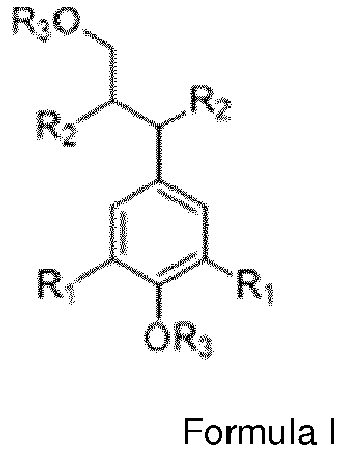
- Wherein;
- R1 independently represents H, C1-6alkyl-phenyl or O-C1-6alkyl; in particular H, phenylpropane or OCH3: more in particular H or O-C1-6alkyl; even more in particular H or OCH3;
- R2 independently represents H, OSO3M or SH

- M represent an alkaline metal; in particular Mg or Ca; and
- wherein at least one R4 is - O-C1-41alkyl.
- In one embodiment, the hydrolysable metal-oxide precursor used has the formula MXn, where: n is 2 to 4; M is a metal selected from the group consisting of Si, Ti, Zr, Al, B, Sn, and V; and X is a hydrolysable moiety selected from the group C1-6alkoxy, Cl, Br, I, hydrogen, and C1-6alkoxyacryl.
- In one embodiment R1 independently represents H, C1-6alkyl-phenyl or O-C1-6alkyl; wherein at least one of R1 represents C1-6alkyl-phenyl or O-C1-6alkyl; in particular R1 independently represents H, phenylpropane or OCH3; wherein at least one of R1 represents phenylpropane or OCH3: more in particular R1 independently represents H or O-C1-6alkyl; even more in particular H or OCH3; wherein at least one of R1 represents O-C1-6alkyl, more in particular OCH3.
- In a second aspect, the present invention provides a method for obtaining the materials as herein defined, said method comprising the hydrolysis and condensation of a composition comprising at least one alkoxysilane functionalized lignin according to Formula (I), at least one hydrolysable metal oxide precursor, water, at least one solvent, and optionally a catalyst. The composition may further comprise amino-alcohols and large molecular weight alcohols, they are used as additives to influence the surface and optical properties of the films. But also coloured pigments, anti-fingerprint agents, ceramic hard particles and conductive particles, antimicrobial additives, chelating agents such as citric acid etc... can be added to provide further properties to the films / coatings obtainable using the alkoxysilane functionalized lignins according to the invention.
- In the methods according to the invention the presence of a catalyst is optional. If present it can be an acid or a base, but is preferably an acid such as Acetic acid, HBr, or HCl. In one embodiment for obtaining the materials as herein defined, comprises the hydrolysis and condensation of a composition comprising at least one alkoxysilane functionalized lignin according to Formula (I), at least one hydrolysable metal oxide precursor, water, at least one solvent, and an acidic catalyst.
- In the methods according to the invention the solvent is preferably a water miscible organic solvent; in particular an inert water miscible organic solvent such as for example THF, DMF, chloroform, dioxane, ethanol, methanol and DMSO.
- In performing the methods according to the invention, a first non-aqueous solution comprising the alkoxysilane functionalized lignin, is typically mixed with the hydrolysable metal oxide precursor to form a dispersion. The hydrolysable metal oxide precursor can be added pure or as a second solution comprising the hydrolysable metal oxide precursor to form a dispersion.
- In an embodiment according to the invention this second solution is a solution of said hydrolysable metal oxide precursor in a water miscible solvent, such as for example as tetrahydrofuran, 2-methyl tetrahydrofuran, 1,4-dioxane, toluene, ethyl acetate, acetone, diethyl ether, methyl ether ketone, and the like. In another embodiment said second solution further comprises a catalyst, accelerating the sol-gel formation. The catalyst can be an acid or a base, but is preferably an acid such as HCl. In a particular embodiment the concentration of the hydrolysable metal oxide precursor in said second solution is high, i.e. comprising at least 80 %wt of the hydrolysable metal oxide precursor.
- The thus obtained dispersion can subsequently be used to coat a substrate, for example using spin coating, and allowed to cure. Curing is simply performed at an elevated temperature, such as at temperatures of 50 to 300° C., and preferably from 60 to 180° C., and more preferably from 60 to 90° C.
- Thus in a further aspect the present invention provides a method for coating a substrate with lignin based organic-Inorganic hybrid material, said method comprising the steps of:
- providing a sol derived from an organic solvent comprising an alkoxysilane functionalized lignin according to Formula (I) ;
- addition of the metal precursor (pure or in high concentration)
- adding a second solution comprising a water and optional a catalyst
- incubating the thus obtained mixture to from a dispersion;
- coating a substrate with said dispersion; and
- curing said dispersion upon said substrate, wherein said resulting coating is transparent to visible light with a transmittance of at least 85% at a thickness of up to 205 nm.
-
-
Figure 1 - Weightloss coatings after solvent treatment in DMF, THF and Hexane. -
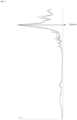
Figure 2 - Infrared spectra of the lignin hybrid thin films with compositions A-1, A-2, and A-3. -
Figure 3 - SEM top and side view of thin-film lignin hybrid materials according to the invention, showing thicknesses between 36 and 120 nm. -
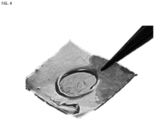
Figure 4 - Picture of a freestanding self-supporting lignin hybrid thin film covering an 8 mm diameter circular cutout. - As mentioned herein before it is an object of the present invention to provide the use of alkoxysilane functionalized lignin as the organic phase for the synthesis of Organic-inorganic hybrid materials. Thereto the functionalized alkoxysilanes are introduced on the lignin by fully or partly reacting the aromatic and aliphatic hydroxide groups present within the depolymerized lignin source materials, comprising mixtures of monomers, dimers, and low molecular weight oligomers.
- As the hydrolysis of an alkoxy group is needed for the co-condensation of an alkoxysilane functionalized lignin in the inorganic network, the alkoxysilanes used in the synthesis of the alkoxysilane functionalized lignin should contain at least two alkoxy groups; in particular two or three alkoxy groups and zero or one alkyl group.
- Non-limited examples of alkoxysilanes used for the modification of lignin are 4-(trimethoxysilyl)butanoic acid, 4-(triethoxysilyl)butanoic acid, 3-chloropropyltrimethoxysilane, 3-chloropropyltriethoxysilane, 3-chloropropylmethyldimethoxysilane, 3-chloropropylmethyldiethoxysilane, 3-chloromethyltrimethoxysilane, 3-chloromethyltriethoxysilane, 3-chloromethylmethyldimethoxysilane, 3-chloromethylmethyldiethoxysilane, trimethoxysilane, triethoxysilane, methyldimethoxysilane, methyldiethoxysilane, isocyanatomethyltrimethoxysilane, isocyanatomethyltriethoxysilane, 3-isocyanatopropyltrimethoxysilane, 3-isocyanatopropyltriethoxysilane, 3-isocyanatopropylmethyldimethoxysilane, 3-isocyanatopropylmethyldiethoxysilane, (3-glycidyloxypropyl)trimethoxysilane, (3-glycidyloxypropyl)triethoxysilane, (3-glycidyloxypropyl)methyldimethoxysilane, (3-glycidyloxypropyl)methyldiethoxysilane, (3-aminopropyl)trimethoxysilane, (3-aminopropyl)triethoxysilane, (3-aminopropyl)methyldimethoxysilane, (3-aminopropyl)methyldiethoxysilane or a mixture thereof containing a least two alkoxysilanes with the same functionality.
- The alkoxysilane functionalized lignin obtained, can generally be presented as follows,

- Wherein at least one R4 is - O-C1-41alkyl, and its use in the synthesis of an hybrid inorganic-organic thin film or coating, can generally be presented according to Scheme 1.

- The functionalized lignin is mixed with a metal-oxide precursor in a weight ratio of 1:99 to 99:1 together with water and optionally a catalyst, in an organic solvent to perform the art known sol-gel method.
- Specifically, preferred examples of metal-oxide precursors are metal alkoxides such as tetraethyl orthosilicate, zirconium butoxide, and titanium butoxide but not limited to. Other know metal-oxide precursors used in the sol-gel process contain at least two alkoxide groups that might be used such as diethoxydimethylsilane, dimethoxy-diphenyl silane, and dimethoxy-dimethyl silane. A combination of multiple metal-oxide precursors is also possible.
- A solvent is required to solubilize the lignin and for the processing of the material. Lignin is dissolved in a concentration of 0.1 to 5 wt%, with a preference for 0.25 to 2 wt% for coating of nanothick films by spin-coating. Solvents include, but are not limited to polar organic solvents such as tetrahydrofuran, 2-methyl tetrahydrofuran, 1,4-dioxane, toluene, ethyl acetate, acetone, diethyl ether, methyl ether ketone, or a combination thereof.
- Water and optionally a catalyst are required for the sol-gel process to proceed. Typically water is used in the molar ratio range of alkoxide to water between 1:0.1 to 1:10 with a preference for equimolar conditions. A catalyst might be present and is preferably an acidic catalyst, such as but not limited to hydrochloric acid, acetic acid, or nitric acid and is typically used in a molar ratio of 0.001:1 to 0.1:1 with a preference for 0.025:1 to 0.075:1 of catalyst to an alkoxide. The mixture is stirred at a temperature range between 0 °C and 80 °C, preferably 30 °C to 50 °C for a minimum of 10 minutes, but preferably for 1 hour. Too low temperatures or too short a reaction time may lead to an incomplete formation of the sol.
- With this method, it is possible to arbitrarily adjust the thickness of the nanocoating by altering the concentrations of the metal oxide precursor and lignin in the formulation to be used for spin-coating, the spin speed, and spin time. It is preferable that part of the sol-gel reaction is performed during the formation of the thin film layer and more preferable that the gel-gel reaction is advanced during and after the formation of the thin film later so that a thin film of high uniformity is obtained.
- After the formation of the thin film a post-curing step is required which happens at a temperature range between 25 and 150 °C, preferably between 50 °C and 90 °C for a minimum of 1 hour, but preferable for 3 hours. The film can directly be formed on the substrate of interest such as but is not limited to glass, metals, or wood.
- The thin-film application can be performed on an undercoat layer and the thin film can afterward be separated from the undercoat layer by selective dissolution and transferred to another substrate. This step is not always required in the method of manufacturing the hybrid lignin organic-inorganic films but is nevertheless demonstrated in this invention.
- The hybrid lignin organic-inorganic films obtained by the described method of manufacturing the film thickness can be regulated at the nano level or less, with thickness in the range of 500 to 5 nm possible, but preferably between 150-20 nm. The thinner the film thickness or the larger the surface area, the more likely the thin film is damaged from a crack or similar deformation. However, by employing the described method of manufacturing hybrid thin films containing lignin, films with a surface area of 1 cm2, and further 10 cm2 or more can be produced.
- It is also an object to provide the thin film layers of the alkoxysilane functionalized lignin monomers according to the invention as part of a composite material, such as comprising a further protective layer on top of the hybrid lignin organic-inorganic films obtained by the described method, or as part of a sandwich material wherein the hybrid lignin organic-inorganic films is sandwich between two layers of such protective films.
- In addition, self-supporting free-standing hybrid lignin inorganic-organic thin films with excellent durability and strength can be obtained by employing the method of manufacturing described in this invention.
-


- As a representative example, dried Kraft lignin (molecular weight of 100-10000) was functionalized with alkoxysilanes in a two-step process. First the allylation of the lignin by treatment of the aliphatic and aromatic hydroxy groups with allyl bromide (X = Br). In the second and final step, a hydrosilylation of the allylated lignin by treatment with methyl-dimethoxy silane (DSM) (one R3 is methyl and two R3 substituents are methoxy) in the presence of Pt(0) complex that acts as a catalyst.
- Moisture-free Kraft lignin (10g, 56.5 mmol OH, 1equiv.) and potassium carbonate (11.7g, 138.2 mmol, 1.5 equiv.) are mixed under an inert and moisture-free atmosphere in acetone (100 mL). After mixing for 1 hour at 40 °C, allyl bromide is added dropwise with the help of a dropping funnel over 1 hour while gently increasing the temperature to 70 °C under reflux and the reaction mixture is stirred for 24h. Next, the mixture was concentrated under vacuum and precipitated in 300 mL of acidified water (2 v/v % HCI) and filtered off. The obtained solids were copiously washed with water and dried in a vacuum for 24h to obtain 5.8 g of allylated lignin.
- In the second step, allylated lignin (5g, 18.9 mmol allyl functionality) was dissolved in dry toluene under a moisture-free and inert atmosphere. Next, the Karstedt's catalyst (5 mg, 100 ppm) was added together with the dropwise addition of methyl-dimethoxy silane (DSM) with the help of a dropping funnel under an inert atmosphere. The mixture was stirred at 90 °C for 24 hours. Finally, the solvent was removed under vacuum and the remainder solid dried without purification to obtain the alkoxysilane functionalized lignin.
Table 1 - Formulation of lignin hybrid organic-inorganic materials Composition thin film Si(Oet)4 A-lignin THF HCl (aq., 2.7M) A-1 50 wt% 40 mg 50 wt% 40 mg 98 wt% 3920 mg 19 mg A-2 67 wt% 54 mg 33 wt% 26 mg 98 wt% 3920 mg 22 mg A-3 75 wt% 60 mg 25 wt% 20 mg 98 wt% 3920 mg 24 mg - Next, the alkoxysilane functionalized lignin is dissolved in tetrahydrofuran (manufactured by Merck, >99%) together with tetraethyl orthosilicate (manufactured by Merck, 98% reagent grade), deionized water, and hydrochloric acid as shown in Table 1. After reacting for 1 hour at 40 °C, the solution is filtered (0.4 µm) and spin-coated on a glass substrate, thereby configuring a thin film layer rich in lignin. The spin coating was carried out at 3000 rpm for 1.40 min. The final curing proceeded at 70 °C for 3 hours.
- The formulation described in Table 1 was spin-coated on glass substrates. The contact angle was determined through a static test whereby a water droplet is placed on the surface and the contact angle is measured through a goniometer. Five droplets are placed randomly on each surface and the average and standard deviation are reported in Table 2. The higher the lignin content in the coatings, the more hydrophobic the surface is, while an increase in silica lowers this hydrophobicity. The reference, which is an untreated glass surface is hydrophilic. This shows that the coating can arbitrarily influence the level of hydrophobicity of the treated glass by changing the silica oxide precursor in the formulation.
Table 2 - Contact angle Composition thin film Silica content coating Average contact angle Standard deviation Untreated glass surface n/a 19.8 8.2 A-1 23 wt% 105.3 0.4 A-2 37 wt% 100.8 0.8 A-3 45 wt% 97.0 0.7 - The same coatings were also subjected to solvent stability test both in polar and apolar solvents such as hexane, tetrahydrofuran, and dimethylformamide. As a reference, pristine untreated lignin was used to highlight the importance of alkoxysilane functionalization for the stability of hybrid materials. The coatings were submerged in the solvent for 1 hour at room temperate, and the weight difference before and after was determined. All coatings (A-1, A-2, A-3) showed good solvent stability with a weight loss of less than 10%, while the reference showed a weight loss of up to 80% in tetrahydrofuran and dimethylformamide, equaling almost the mass of the organic lignin phase in the coating (
Figure 1 ). - Infrared spectra of the lignin hybrid thin films were obtained in the case of compositions A-1, A-2, and A-3. As a result of the good co-condensation between alkoxysilane functionalized lignin and metal oxide precursor virtually all the alkoxysilane is reacted into siloxane bonds, with the result of a strong peak at 1020 cm-1 (Error! Reference source not found.). This confirmed that the organic lignin polymer is well incorporated in the hybrid inorganic-organic silica material.
- A Poly(sodium-4-styrene sulfonate) (PSS) layer of thickness of 100 nm was formed on a glass substrate by a spin-coating method. The PSS (manufactured by Alfa Aesar) as user herein had an average molecular weight (Mw) of about 70 000 g/ mol and high solubility in water.
Table 3 - Formulation of lignin hybrid organic-inorganic materials Composition thin film Si(Oet)4 A-lignin THF HCl (aq., 2.7M) A-4 50 wt% 40 mg 50 wt% 40 mg 99 wt% 7920 mg 19 mg A-5 50 wt% 40 mg 50 wt% 40 mg 98 wt% 3920 mg 19 mg A-6 50 wt% 40 mg 50 wt% 40 mg 96 wt% 1920 mg 19 mg - Next, a composition of lignin hybrid organic-inorganic material was prepared by dissolving alkoxy functionalized lignin prepared as described earlier in THF in three different concentrations together with tetraethyl orthosilicate (manufactured by Merck, >99%) together with tetraethyl orthosilicate (manufactured by Merck, 98% reagent grade), deionized water and hydrochloric acid as shown in Table 3. After reacting for 1 hour at 40 °C, each solution is filtered (0.4 µm) and spin-coated on the PSS layer on the glass substrate, thereby configuring a thin film layer rich in lignin. The spin coating was carried out at 3000 rpm for 1.40 min. The final curing proceeded at 70 °C for 3 hours.
- Next, the glass substrate layer-PSS and layer-lignin-silica films were dipped into the water. The PSS layer was dissolved, whereby the glass substrate and the lignin-silica thin film were separated from each other. The lignin-silica thin films were transferred to the surface of a porous alumina membrane (anodisc 25, manufactured by Whatman ) and subjected to analysis.
- The thin films were transferred to porous alumina support and observed by scanning electron microscopy. The obtained results were shown in Error! Reference source not found. and each image shows the film side surface and top surface. From these results, it was confirmed that the film was uniform and free from cracks.
- Layer thickness is controllable by formulation concentration as shown in Error! Reference source not found.. Layer thickness can vary from 120 to 30 nm with lower concentrations yielding smaller film thicknesses.
- An EDX spectrum of sample A-5 was measured to determine the weight ratio of elemental silicon and carbon. Four different spots were analyzed, yielding an average Si/C weight ratio of 0.20 with a standard deviation of 0.02. This is close to the theoretical ratio of 0.25 if all metal oxide precursor reacts with all the lignin (Table 4). Thus it is confirmed that the structure of the lignin hybrid thin films is substantially complete.
Table 4 - Composition ratio silicon and carbon different location of thin film A-5 Composition thin film Si / C wt% ratio Theoretical 0.25 Spot - 1 0.22 Spot - 2 0.18 Spot - 3 0.18 Spot - 4 0.23 - The thin film A-5 was removed from the PSS underlayer and transferred to an aluminum plate with an 8 mm circular cutout. The film was transferred in such a manner that the cutout was completely covered by the lignin thin film. The obtained film of 60 nm thick proved to be self-supporting as the cutout was completely covered and no cracks or damages were observed (Error! Reference source not found.). The wrinkles are stemming from the transferring process of the film from the water surface to the aluminum plate.
Claims (10)
- A material comprising the reaction product of a composition comprising an alkoxysilane functionalized lignin according to Formula (I) with a hydrolysable metal-oxide precursor.
 R1 independently represents H, C1-6alkyl-phenyl or O-C1-6alkyl;R2 independently represents H, OSO3M or SH
 M represent an alkaline metal; in particular Mg or Ca.
 - The material of claim 1 wherein the hydrolysable metal-oxide precursor has the formula MXn, where: n is 2 to 4; M is a metal selected from the group consisting of Si, Ti, Zr, Al, B, Sn, and V; and X is a hydrolysable moiety selected from the group C1-6alkoxy, Cl, Br, I, hydrogen, and C1-6alkoxyacryl.
- A method for obtaining a material according to claim 1; said method comprising the hydrolysis and condensation of a composition comprising at least one an alkoxysilane functionalized lignin according to Formula (I), at least one hydrolysable metal oxide precursor, water, at least one solvent, and optionally a catalyst.
- The method according to claim 3, wherein the catalyst can be an acid or a base, but is preferably an acid such as Acetic acid, HBr, or HCl.
- The method according to claim 3, wherein the solvent is a water miscible organic solvent; in particular an inert water miscible organic solvent such as for example THF, DMF, and DMSO.
- A method for coating a substrate with a material according to claim 1 comprising the steps of:a. providing a sol derived from a water comprising an alkoxysilane functionalized lignin according to Formula (I) ;b. adding a second solution comprising a catalyst and at least one hydrolyzable metal oxide precursor to said sol;c. incubating the thus obtained mixture to from a dispersion;d. coating a substrate with said dispersion; ande. curing said dispersion upon said substrate, wherein said resulting coating is transparent to visible light with a transmittance of at least 85% at a thickness of at least 5 µm.
- The method according to claim 6, wherein the catalyst can be an acid or a base, but is preferably an acid such as HCl.
- The method according to claim 6, wherein the incubation step c is performed at a temperature between 0 °C and 80 °C, preferably 30 °C to 50 °C, for a minimum of 10 minutes, but preferably for 1 hour.
- The method according to claim 6, wherein the curing can be carried out at temperatures of 50 to 300° C., and preferably from 60 to 180°C, and more preferably from 60 to 90°C.
- A hybrid lignin organic-inorganic film obtained by the method according to any one of claims 3 to 9 with a thickness in the range of 5-500 nm possible, but preferably between 20-150 nm.
Priority Applications (2)
| Application Number | Priority Date | Filing Date | Title |
|---|---|---|---|
| EP22185988.7A EP4310052A1 (en) | 2022-07-20 | 2022-07-20 | Modified lignin in the manufacture of organic-inorganic hybrid materials |
| PCT/EP2023/070148 WO2024018000A1 (en) | 2022-07-20 | 2023-07-20 | Modified lignin in the manufacture of organic-inorganic hybrid materials |
Applications Claiming Priority (1)
| Application Number | Priority Date | Filing Date | Title |
|---|---|---|---|
| EP22185988.7A EP4310052A1 (en) | 2022-07-20 | 2022-07-20 | Modified lignin in the manufacture of organic-inorganic hybrid materials |
Publications (1)
| Publication Number | Publication Date |
|---|---|
| EP4310052A1 true EP4310052A1 (en) | 2024-01-24 |
Family
ID=83004700
Family Applications (1)
| Application Number | Title | Priority Date | Filing Date |
|---|---|---|---|
| EP22185988.7A Withdrawn EP4310052A1 (en) | 2022-07-20 | 2022-07-20 | Modified lignin in the manufacture of organic-inorganic hybrid materials |
Country Status (2)
| Country | Link |
|---|---|
| EP (1) | EP4310052A1 (en) |
| WO (1) | WO2024018000A1 (en) |
-
2022
- 2022-07-20 EP EP22185988.7A patent/EP4310052A1/en not_active Withdrawn
-
2023
- 2023-07-20 WO PCT/EP2023/070148 patent/WO2024018000A1/en not_active Ceased
Non-Patent Citations (5)
| Title |
|---|
| BERTELLA STEFANIA ET AL: "Lignin Functionalization for the Production of Novel Materials", TRENDS IN CHEMISTRY, vol. 2, no. 5, 1 May 2020 (2020-05-01), pages 440 - 453, XP093005835, ISSN: 2589-5974, DOI: 10.1016/j.trechm.2020.03.001 * |
| CARLOS DE HARO JUAN ET AL: "Lignin-Based Anticorrosion Coatings for the Protection of Aluminum Surfaces", ACS SUSTAINABLE CHEMISTRY & ENGINEERING, vol. 7, no. 6, 13 February 2019 (2019-02-13), US, pages 6213 - 6222, XP093005616, ISSN: 2168-0485, DOI: 10.1021/acssuschemeng.8b06568 * |
| ICHI JUN ' ET AL: "Preparation of Silica-Lignin Xerogel", LANGMUIR, 18 April 1997 (1997-04-18), pages 4185 - 4186, XP093005845, Retrieved from the Internet <URL:https://pubs.acs.org/doi/10.1021/la970072c> [retrieved on 20221207], DOI: https://doi.org/10.1021/la970072c * |
| SAAD RABIH ET AL: "Grafting of lignin onto nanostructured silica SBA-15: preparation and characterization", JOURNAL OF POROUS MATERIALS, vol. 20, no. 1, 28 April 2012 (2012-04-28), New York, pages 227 - 233, XP093005656, ISSN: 1380-2224, Retrieved from the Internet <URL:http://link.springer.com/article/10.1007/s10934-012-9592-z/fulltext.html> DOI: 10.1007/s10934-012-9592-z * |
| ZHUOHUA SUN ET AL: "Bright Side of Lignin Depolymerization: Toward New Platform Chemicals", CHEMICAL REVIEWS, vol. 118, no. 2, 16 January 2018 (2018-01-16), US, pages 614 - 678, XP055709777, ISSN: 0009-2665, DOI: 10.1021/acs.chemrev.7b00588 * |
Also Published As
| Publication number | Publication date |
|---|---|
| WO2024018000A1 (en) | 2024-01-25 |
Similar Documents
| Publication | Publication Date | Title |
|---|---|---|
| EP3448918B1 (en) | A method for preparing organopolysiloxane resins | |
| EP0660839B2 (en) | Single component inorganic/organic network materials and precursors thereof | |
| US10035812B2 (en) | Perfluoropolyether-modified polysilazane, making method, surface treating agent, and treated article | |
| US20090321894A1 (en) | Multi-functional linear siloxane compound, a siloxane polymer prepared from the compound, and a process for forming a dielectric film by using the polymer | |
| KR102138758B1 (en) | Organosiloxane containing acid anhydride group and method for preparing the same | |
| JP2010535915A (en) | Process for controlled hydrolysis and condensation of epoxy functional organosilanes and cocondensation of the epoxy functional organosilanes with other organofunctional alkoxysilanes | |
| CN101675063A (en) | Epoxysilanes, process for their preparation and curable compositions containing them | |
| JP5828292B2 (en) | Acid anhydride group-containing organosiloxane and method for producing the same | |
| TW201307372A (en) | Method of synthesizing siloxane monomers and use thereof | |
| US7470634B2 (en) | Method for forming interlayer dielectric film for semiconductor device by using polyhedral molecular silsesquioxane | |
| KR100807708B1 (en) | Organosilyl functionalized particles and the production thereof | |
| CN114746475B (en) | Fluoropolyether group-containing polymer, surface treatment agent, and article | |
| US12018123B2 (en) | Diterminally amine-modified perfluoropolyether compound and preparation thereof, and liquid-repelling composition, cured product and coated substrate containing the same | |
| US7985798B2 (en) | Mixed silanes | |
| WO2024018000A1 (en) | Modified lignin in the manufacture of organic-inorganic hybrid materials | |
| JP3681582B2 (en) | Epoxy group-containing silicone resin | |
| WO2004081130A1 (en) | Composition for photocatalyst coating and coating film | |
| JP7735972B2 (en) | Cyclic silazane compound having an alkoxysilyl group, method for producing the same, and composition, cured product, and coated substrate containing the same | |
| US20220185993A1 (en) | Mixed composition | |
| US11708460B2 (en) | Alkoxysilyl group-containing organic silazane compound, method for producing same, composition containing same and cured product | |
| JP7446840B2 (en) | mixed composition | |
| KR100506584B1 (en) | A preparation method of heat-resistant silicone resin | |
| WO2024033938A1 (en) | Biodegradable hydrophobic and moisture tolerant bio- resin paper coating and methods for preparing same | |
| CN120737349A (en) | Organosilicon anti-graffiti resin and preparation method thereof | |
| TW202300560A (en) | Fluorine-containing ether compound, fluorine-containing ether mixture, coating agent, article, and method of manufacturing article |
Legal Events
| Date | Code | Title | Description |
|---|---|---|---|
| PUAI | Public reference made under article 153(3) epc to a published international application that has entered the european phase |
Free format text: ORIGINAL CODE: 0009012 |
|
| STAA | Information on the status of an ep patent application or granted ep patent |
Free format text: STATUS: THE APPLICATION HAS BEEN PUBLISHED |
|
| AK | Designated contracting states |
Kind code of ref document: A1 Designated state(s): AL AT BE BG CH CY CZ DE DK EE ES FI FR GB GR HR HU IE IS IT LI LT LU LV MC MK MT NL NO PL PT RO RS SE SI SK SM TR |
|
| STAA | Information on the status of an ep patent application or granted ep patent |
Free format text: STATUS: THE APPLICATION IS DEEMED TO BE WITHDRAWN |
|
| 18D | Application deemed to be withdrawn |
Effective date: 20240725 |