EP4309720A2 - Vine robot tracheal intubation device - Google Patents
Vine robot tracheal intubation device Download PDFInfo
- Publication number
- EP4309720A2 EP4309720A2 EP23213233.2A EP23213233A EP4309720A2 EP 4309720 A2 EP4309720 A2 EP 4309720A2 EP 23213233 A EP23213233 A EP 23213233A EP 4309720 A2 EP4309720 A2 EP 4309720A2
- Authority
- EP
- European Patent Office
- Prior art keywords
- vine
- robot
- everting
- tracheal intubation
- intubation device
- Prior art date
- Legal status (The legal status is an assumption and is not a legal conclusion. Google has not performed a legal analysis and makes no representation as to the accuracy of the status listed.)
- Withdrawn
Links
Images




Classifications
-
- A—HUMAN NECESSITIES
- A61—MEDICAL OR VETERINARY SCIENCE; HYGIENE
- A61M—DEVICES FOR INTRODUCING MEDIA INTO, OR ONTO, THE BODY; DEVICES FOR TRANSDUCING BODY MEDIA OR FOR TAKING MEDIA FROM THE BODY; DEVICES FOR PRODUCING OR ENDING SLEEP OR STUPOR
- A61M16/00—Devices for influencing the respiratory system of patients by gas treatment, e.g. ventilators; Tracheal tubes
- A61M16/04—Tracheal tubes
- A61M16/0488—Mouthpieces; Means for guiding, securing or introducing the tubes
- A61M16/049—Mouthpieces
-
- A—HUMAN NECESSITIES
- A61—MEDICAL OR VETERINARY SCIENCE; HYGIENE
- A61M—DEVICES FOR INTRODUCING MEDIA INTO, OR ONTO, THE BODY; DEVICES FOR TRANSDUCING BODY MEDIA OR FOR TAKING MEDIA FROM THE BODY; DEVICES FOR PRODUCING OR ENDING SLEEP OR STUPOR
- A61M16/00—Devices for influencing the respiratory system of patients by gas treatment, e.g. ventilators; Tracheal tubes
- A61M16/04—Tracheal tubes
- A61M16/0402—Special features for tracheal tubes not otherwise provided for
- A61M16/0409—Special features for tracheal tubes not otherwise provided for with mean for closing the oesophagus
-
- A—HUMAN NECESSITIES
- A61—MEDICAL OR VETERINARY SCIENCE; HYGIENE
- A61M—DEVICES FOR INTRODUCING MEDIA INTO, OR ONTO, THE BODY; DEVICES FOR TRANSDUCING BODY MEDIA OR FOR TAKING MEDIA FROM THE BODY; DEVICES FOR PRODUCING OR ENDING SLEEP OR STUPOR
- A61M16/00—Devices for influencing the respiratory system of patients by gas treatment, e.g. ventilators; Tracheal tubes
- A61M16/04—Tracheal tubes
- A61M16/0488—Mouthpieces; Means for guiding, securing or introducing the tubes
-
- A—HUMAN NECESSITIES
- A61—MEDICAL OR VETERINARY SCIENCE; HYGIENE
- A61M—DEVICES FOR INTRODUCING MEDIA INTO, OR ONTO, THE BODY; DEVICES FOR TRANSDUCING BODY MEDIA OR FOR TAKING MEDIA FROM THE BODY; DEVICES FOR PRODUCING OR ENDING SLEEP OR STUPOR
- A61M16/00—Devices for influencing the respiratory system of patients by gas treatment, e.g. ventilators; Tracheal tubes
- A61M16/10—Preparation of respiratory gases or vapours
- A61M16/1005—Preparation of respiratory gases or vapours with O2 features or with parameter measurement
-
- A—HUMAN NECESSITIES
- A61—MEDICAL OR VETERINARY SCIENCE; HYGIENE
- A61M—DEVICES FOR INTRODUCING MEDIA INTO, OR ONTO, THE BODY; DEVICES FOR TRANSDUCING BODY MEDIA OR FOR TAKING MEDIA FROM THE BODY; DEVICES FOR PRODUCING OR ENDING SLEEP OR STUPOR
- A61M2205/00—General characteristics of the apparatus
- A61M2205/02—General characteristics of the apparatus characterised by a particular materials
- A61M2205/0216—Materials providing elastic properties, e.g. for facilitating deformation and avoid breaking
-
- A—HUMAN NECESSITIES
- A61—MEDICAL OR VETERINARY SCIENCE; HYGIENE
- A61M—DEVICES FOR INTRODUCING MEDIA INTO, OR ONTO, THE BODY; DEVICES FOR TRANSDUCING BODY MEDIA OR FOR TAKING MEDIA FROM THE BODY; DEVICES FOR PRODUCING OR ENDING SLEEP OR STUPOR
- A61M2205/00—General characteristics of the apparatus
- A61M2205/02—General characteristics of the apparatus characterised by a particular materials
- A61M2205/0266—Shape memory materials
-
- A—HUMAN NECESSITIES
- A61—MEDICAL OR VETERINARY SCIENCE; HYGIENE
- A61M—DEVICES FOR INTRODUCING MEDIA INTO, OR ONTO, THE BODY; DEVICES FOR TRANSDUCING BODY MEDIA OR FOR TAKING MEDIA FROM THE BODY; DEVICES FOR PRODUCING OR ENDING SLEEP OR STUPOR
- A61M2205/00—General characteristics of the apparatus
- A61M2205/07—General characteristics of the apparatus having air pumping means
-
- A—HUMAN NECESSITIES
- A61—MEDICAL OR VETERINARY SCIENCE; HYGIENE
- A61M—DEVICES FOR INTRODUCING MEDIA INTO, OR ONTO, THE BODY; DEVICES FOR TRANSDUCING BODY MEDIA OR FOR TAKING MEDIA FROM THE BODY; DEVICES FOR PRODUCING OR ENDING SLEEP OR STUPOR
- A61M2205/00—General characteristics of the apparatus
- A61M2205/33—Controlling, regulating or measuring
- A61M2205/3306—Optical measuring means
-
- A—HUMAN NECESSITIES
- A61—MEDICAL OR VETERINARY SCIENCE; HYGIENE
- A61M—DEVICES FOR INTRODUCING MEDIA INTO, OR ONTO, THE BODY; DEVICES FOR TRANSDUCING BODY MEDIA OR FOR TAKING MEDIA FROM THE BODY; DEVICES FOR PRODUCING OR ENDING SLEEP OR STUPOR
- A61M2205/00—General characteristics of the apparatus
- A61M2205/33—Controlling, regulating or measuring
- A61M2205/3375—Acoustical, e.g. ultrasonic, measuring means
-
- A—HUMAN NECESSITIES
- A61—MEDICAL OR VETERINARY SCIENCE; HYGIENE
- A61M—DEVICES FOR INTRODUCING MEDIA INTO, OR ONTO, THE BODY; DEVICES FOR TRANSDUCING BODY MEDIA OR FOR TAKING MEDIA FROM THE BODY; DEVICES FOR PRODUCING OR ENDING SLEEP OR STUPOR
- A61M2205/00—General characteristics of the apparatus
- A61M2205/50—General characteristics of the apparatus with microprocessors or computers
-
- A—HUMAN NECESSITIES
- A61—MEDICAL OR VETERINARY SCIENCE; HYGIENE
- A61M—DEVICES FOR INTRODUCING MEDIA INTO, OR ONTO, THE BODY; DEVICES FOR TRANSDUCING BODY MEDIA OR FOR TAKING MEDIA FROM THE BODY; DEVICES FOR PRODUCING OR ENDING SLEEP OR STUPOR
- A61M25/00—Catheters; Hollow probes
- A61M25/01—Introducing, guiding, advancing, emplacing or holding catheters
- A61M25/0105—Steering means as part of the catheter or advancing means; Markers for positioning
- A61M25/0119—Eversible catheters
Definitions
- Fields of the invention included medical devices, particularly intubation devices, and robotics.
- the growth robot has a thin-walled, hollow, pressurized, compliant body that elongates the body by everting from its tip new wall material that is stored inside the body and controls the shape of the body by actively controlling the relative lengths of the wall material along opposing sides of the body. Relative lengths of the wall material along opposing sides of the body can be controlled by shortening the length of the wall material on the side facing the inside of a turn by using contracting artificial muscles mounted along the length of the body.
- Relative lengths of the wall material along opposing sides of the body can also be controlled by lengthening the wall material on the side facing the outside of a turn, by releasing pinches in the wall material, or by actively softening the material so that the body lengthens due to the internal pressure.
- Relative lengths of the wall material along opposing sides of the body can also be controlled by actively restraining the length of the wall material on the side facing the inside of a turn while allowing the wall material on the outside of the turn to lengthen.
- An advancement of the growth robot technology by Hawkes et al. is provided in a soft robotic device that has an apical extension and includes fluid emission for burrowing and cleaning.
- Such soft robots are able to burrow through sand or dirt, in a manner analogous to a plant root.
- the robot extends apically through eversion, while emitting fluid from the tip that fluidizes sand and soil making it possible to grow underground. That advance is disclosed in PCT/US2019/50998, filed September 13, 2019 and in the published paper by Hawkes et al. , entitled "Soft Robotic Burrowing Device with Tip-Extension and Granular Fluidization.
- EMTs Emergency Medical Technicians
- the present invention can provide for hospital level success with less extensive medical training and is expected to improve success rates for EMTs and other personnel.
- a preferred embodiment provides an everting vine robot intubation device capable of automatically and autonomously intubating the trachea and producing a lumen through which artificial ventilation may be conducted.
- the device includes an everting primary vine robot attached to a mouthpiece and a smaller diameter everting intubation vine robot associated with the primary everting vine robot.
- the primary vine robot is shaped and sized to extend to the back of a patient's laryngopharynx when fully actuated and the intubation everting vine robot is shaped and sized to extend from the primary vine robot into the patient's trachea when fully actuated.
- a method for intubation of a patient is provided.
- a mouthpiece attached to an everting primary vine robot and an intubation vine robot with both of the primary vine robot and an intubation vine robot in an unactuated position is inserted into the patient's mouth.
- Fluid pressure is applied into the primary vine robot to gradually evert and extend it into the back of the laryngopharynx of the patient.
- Fluid pressure is applied to extend the intubation vine robot into the trachea of the patient and provide a lumen from the mouthpiece to the trachea.
- Air or oxygen is provided through the lumen into the trachea.
- the vine robot tracheal intubation device comprises an everting primary vine robot attached to a mouthpiece and a smaller diameter everting intubation vine robot associated with the primary everting vine robot, wherein the primary vine robot is shaped and sized to extend to the back of a patient's laryngopharynx when fully actuated and the intubation everting vine robot is shaped and sized to extend from the primary vine robot into the patient's trachea when fully actuated, whereby a lumen is provided by the device from the mouthpiece into the patient's trachea.
- the diameter of the primary vine robot is set such that while filling the oral cavity and oropharynx, it lifts the lower jaw and protrudes it forward and down.
- the intubation vine robot comprises a pre-bent section configured to place and orient the lumen in the trachea.
- the intubation vine robot is carried on an outer surface of the primary vine robot.
- the intubation vine robot defines a lumen sized to pass a breathing tube therethrough.
- the mouthpiece defines an access port to allow inflation of the primary vine robot.
- the intubation vine robot extends through the mouthpiece.
- the intubation vine robot is formed unitarily with the primary vine robot and is configured to form a branch from the primary vine robot when extended.
- the mouthpiece defines an access port to allow inflation of both of the primary vine robot and intubation vine robot from a single pressure source.
- the lumen is defined by both of the primary vine robot and intubation vine robot when extended.
- the primary vine robot comprises a predetermined non-linear shape when extended.
- the predetermined non-linear shape is configured to create pressure points to protrude the mandible, lift the epiglottis, and expose the trachea.
- a distal tip of the intubation vine robot comprises a flexible, self-expanding material, wherein further preferred the flexible, self-expanding material is nitinol.
- a method for intubation of a patient can comprise: inserting a mouthpiece attached to an everting primary vine robot and an intubation vine robot with both of the primary vine robot and an intubation vine robot in an unactuated position into the patient's mouth; applying fluid pressure into the primary vine robot to gradually evert and extend it into the back of the laryngopharynx of the patient; applying fluid pressure to extend the intubation vine robot into the trachea of the patient and provide a lumen from the mouthpiece to the trachea; and providing air or oxygen through the lumen into the trachea.
- the providing can comprise passing a breathing tube through the intubation vine robot and supplying the air or oxygen through the breathing tube.
- the method may comprise removing the mouthpiece, primary vine robot and the intubation vine robot while leaving the breathing tube in place prior to the providing.
- the providing may comprise passing the air or oxygen through the lumen, which is defined by both of the primary vine robot and the intubation vine robot.
- a preferred embodiment vine robot intubation device includes, and preferably consists of, a main eversion body, an intubation body, and a mouthpiece with a an access port to permit fluid/pressure transfer into the bodies from a regulated pressure reservoir.
- the main eversion body grows down the throat when inflated and carries the intubation body past the tongue and epiglottis. After primary inflation, the intubation body is inflated to grown into the trachea beyond the epiglottis.
- This body can act as a pathway through which a semi-rigid breathing tube can be passed to commence artificial breathing.
- the total length can be predetermined to match different physiology, e.g., by patient size, age, or measured physical characteristics.
- Preferred embodiments are inexpensive and disposable, avoiding problems regarding cleaning and reuse, which lead to hospital acquired infections and other problems.
- FIGs. 1A-1-E A preferred embodiment vine robot intubation device 10 is illustrated in FIGs. 1A-1-E , in progressive states during an intubation procedure.
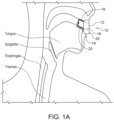
- FIG. 1A shows the initial state and unactuated state, in which a shaped mouthpiece 12 is inserted into the mouth 14 of a patient.
- the mouthpiece holds a primary vine robot 16 and includes an access port 18 to permit fluid/pressure transfer into the primary vine robot 16 to grow the primary vine robot 16 via eversion.
- An intubation vine robot 20 is carried on the outer surface of the primary vine robot 16 and extends through the mouthpiece 10 to permit access to fluid/pressure for its separate actuation and eversion. Much of the intubation vine robot 20 is folded within the primary vine robot 16 in FIG.
- the diameter and length of both of the primary vine robot and intubation vine robot can be predetermined according to physiology type or measured physical characteristics of a patient being intubated, e.g., age, gender, according to physical measurements of throat structure, etc.
- a practitioner can have a selection of vine robot intubation devices available and can use an appropriately sized choice based upon physiology.
- biocompatible plastics are preferred. Stiffness is lower than the radial stiffness, such that the body will lengthen with pressurization instead of ballooning outward. Couplings to the mouthpiece and for inflation will be compatible with current medical technology, e.g. a Luer lock.
- the device is preferably sterilized and packaged for single use, and packaging and device can include markings to ensure proper use by practitioners.
- the mouthpiece 12 is preferably formed biocompatible plastic or firm rubber compounds and is molded to match the general anatomy of the human face and mouth, with a protrusion for insertion into the mouth to depress the tongue and a recess into which the teeth can fall to hold the device inside the mouth and set a standard "zero" point reference from which extension of the intubation vine robot 20 can be determined.
- Preferred materials include medical grade silicone, polyurethane, or polyethylene.
- a mouthpiece is sized according to anatomical characteristics, as discussed above with respect to the vine robots.
- the mouthpiece 12 can house mechanical components that allow for actuation (e.g. buttons) and an indicator to show whether or not it has been used. Stiffness is achieved through inflation.
- the mouthpiece in a preferred embodiment can connect to and/or include a pressure reservoir, an actuation mechanism to commence intubation, and mechanical and electrical elements to actuate and control the two vine robots.
- the housing also includes a passage through which the semi-rigid breathing tube can be passed down to the trachea through the secondary body.
- the control can include light, ultrasound, magnetic, or other feedback.
- the primary vine robot 16 is a larger, primary vine robot that delivers the smaller intubation vine robot 20 to the back of the laryngopharynx while producing a jaw thrust that further exposes the trachea.
- the diameter of the primary vine robot 16 robot is set such that while filling the oral cavity and oropharynx, it lifts the lower jaw and protrudes it forward and down.
- Fluid e.g., air
- the port 18 is delivered through the port 18 with sufficient pressure to slowly inflate and invert the primary vine robot 16 until it reaches the back of the laryngopharynx.
- the smaller intubation vine robot 20 is actuated via fluid pressure from its proximal end that extends through the mouthpiece.
- the primary vine robot 16 can be shaped in a predetermined non-linear shape (when extended) and have material in specific positions to introduce specific pressure points to protrude the mandible, lift the epiglottis, and expose the trachea. Methods for shaping and producing firmness of the material in particular sections are disclosed in Hawkes et al. US Patent Publication US2019/0217908 .
- the intubation vine robot 20 is a lumen-producing vine robot that grows from the tip of the primary vine robot and accesses the trachea beyond the vestibular folds.
- the intubation vine robot provides an open lumen for passage and terminates distally with the opening or a temporarily sealed distal tip that can be breached or penetrated, such that after complete eversion, it provides an open lumen from its proximal opening to a distal opening.
- the distal tip can be open or include, e.g. a perforated seal.
- Another option is an elastic distal tip that the breathing tube can breach and pass through.
- the intubation vine robot 20 is preferably designed to work in a Seldinger type fashion to access the trachea in circumstances where the vocal cords are partially closed. Vine robots have been shown to be able to pass through orifices smaller than their body diameter. With appropriate softness size, the intubation vine robot 20 can pass through partially closed cords regardless of the orifice size, and due to the elimination of relative motion between the rigid ventilation tube and the cords, a larger tube may be passed through this lumen.
- the intubation vine robot 20 may also be designed in such a way as to produce the artificial breathing passage by hardening, or by pulling a semi-rigid tube through itself while growing, for example.
- the inflation acts as a pulling force as the intubation body everts. This allows for the automatic delivery of a rigid tube.
- Another option is a biologically compatible self-hardening material infused into the fabric of the vine robot bodies, which permits hardening the device inside the body to produce its own rigid lumen.
- the primary vine robot 20 can carry multiple intubation bodies (e.g., a controlled intubation robot and an uncontrolled/passive simple lumen) intended to increase device robustness, as well as the numerous potential configurations of each.
- intubation bodies e.g., a controlled intubation robot and an uncontrolled/passive simple lumen
- FIG. 1B shows the primary vine robot 16 in an actuated state. This phase commences as two sub-steps: first the primary vine robot 16 is inflated and grows toward the throat of the patient, away from the mouthpiece 12.
- FIG. 1C shows the primary vine robot 16 fully extended into the laryngopharynx. At this point, the intubation vine robot 20 is positioned to be inflated and grown. The intubation vine robot 20 can be pre-formed to approximate average anatomical structure.
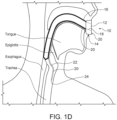
- FIG. 1D shows the growth of intubation vine robot 20 into the trachea.
- a predefined shape is preferably produced to orient the tip anteriorly towards the trachea.
- This intubation vine robot 20 can be pre-formed with one or two instances of curvature 22 (two are depicted in FIGs. 1D and 1E ).
- the instances of curvature provide the predefined shape.
- curvatures can be provided in different ways, including controlling relative lengths of the wall material of the intubation vine robot 20 on different sides.
- An open distal end 24 of the intubation body allows for the production of a lumen through which a semi-rigid breathing tube can be passed.
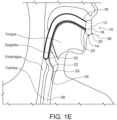
- FIG. 1E illustrates the passage of a breathing tube 26 through first through the mouthpiece 12 and second the lumen that was provided by extension of the intubation vine robot 20, allowing the breathing tube to easily pass through the lumen and into the patient's trachea.
- the device 10 can be removed from the patient and artificial breathing can commence.
- Another option instead of a tube is to include a valve to implement PEEP (positive-end expiatory pressure), which could be used instead of a breathing tube. If used, it is important to ensure that sufficient pressure is maintained so that the device will not collapse on itself during the exhalation.
- PEEP positive-end expiatory pressure
- a breathing tube adds an additional component and step. However, it ensures a simple and reliable intubation, and can reduce the costs of the intubation vine robot device because the device need only be designed for delivery instead of supporting the breathing cycle.
- FIGs. 2A-2C illustration another preferred embodiment vine robot intubation device 30.
- Common reference numbers are used for common features shown in FIGs. 1A-1E .
- Operation is similar to the device 10 of FIGs. 1A-1E .
- an intubation vine robot 32 is formed unitarily with a primary vine robot 34, as branch that extends from a side wall of the primary vine robot 34.
- the intubation vine robot 32 includes a preformed curve section 36 to help align a lumen defined by it for passage of an air tube as in FIG. 1E .
- a breathing tube can be used.
- the intubation vine robot and primary vine robot 34 incorporate flexible material, self-expanding material, e.g.
- the intubation robot 32 being a branch of the primary vine robot 34, it can be actuated via the same pressure source and lumen, such that a ventilator can simply pressurize the vine to deploy and continue ventilating thereafter with the fewest possible steps.
- the primary vine robot 34 has a length that permits it to extend into the esophagus slightly. This helps to both secure the device 30 and to produce a seal to prevent aspiration, much like a laryngeal mask airway (LMA).
- LMA laryngeal mask airway
Landscapes
- Health & Medical Sciences (AREA)
- Pulmonology (AREA)
- Emergency Medicine (AREA)
- Engineering & Computer Science (AREA)
- Anesthesiology (AREA)
- Biomedical Technology (AREA)
- Heart & Thoracic Surgery (AREA)
- Hematology (AREA)
- Life Sciences & Earth Sciences (AREA)
- Animal Behavior & Ethology (AREA)
- General Health & Medical Sciences (AREA)
- Public Health (AREA)
- Veterinary Medicine (AREA)
- Otolaryngology (AREA)
- Prostheses (AREA)
- Surgical Instruments (AREA)
Abstract
Description
- The application claims priority under 35 U.S.C. §119 and all applicable statutes and treaties from prior
United States provisional application serial number 62/882,239, which was filed August 2, 2019 - This invention was made with government support under grant no. 1637446 awarded by the National Science Foundation. The government has certain rights in the invention.
- Fields of the invention included medical devices, particularly intubation devices, and robotics.
-
Hawkes et al. US Patent Publication US2019/0217908, Published July 18, 2019 describes a growth robot. The growth robot has a thin-walled, hollow, pressurized, compliant body that elongates the body by everting from its tip new wall material that is stored inside the body and controls the shape of the body by actively controlling the relative lengths of the wall material along opposing sides of the body. Relative lengths of the wall material along opposing sides of the body can be controlled by shortening the length of the wall material on the side facing the inside of a turn by using contracting artificial muscles mounted along the length of the body. Relative lengths of the wall material along opposing sides of the body can also be controlled by lengthening the wall material on the side facing the outside of a turn, by releasing pinches in the wall material, or by actively softening the material so that the body lengthens due to the internal pressure. Relative lengths of the wall material along opposing sides of the body can also be controlled by actively restraining the length of the wall material on the side facing the inside of a turn while allowing the wall material on the outside of the turn to lengthen. - An advancement of the growth robot technology by Hawkes et al. is provided in a soft robotic device that has an apical extension and includes fluid emission for burrowing and cleaning. Such soft robots are able to burrow through sand or dirt, in a manner analogous to a plant root. The robot extends apically through eversion, while emitting fluid from the tip that fluidizes sand and soil making it possible to grow underground. That advance is disclosed in
PCT/US2019/50998, filed September 13, 2019 and in the published paper by Hawkes et al. , entitled "Soft Robotic Burrowing Device with Tip-Extension and Granular Fluidization. - Emergency Medical Technicians (EMTs) only achieve just over 50% success with tracheal intubation in emergency scenarios, for various reasons. To achieve the high level of success realized in hospital rooms, extensive training is required at prohibitive cost, and as such a serious medical dilemma is observed: how to ensure critical care is effectively provided without an anesthesiologist level training of nurses, paramedics, or EMTs. The present invention can provide for hospital level success with less extensive medical training and is expected to improve success rates for EMTs and other personnel.
- A preferred embodiment provides an everting vine robot intubation device capable of automatically and autonomously intubating the trachea and producing a lumen through which artificial ventilation may be conducted. The device includes an everting primary vine robot attached to a mouthpiece and a smaller diameter everting intubation vine robot associated with the primary everting vine robot. The primary vine robot is shaped and sized to extend to the back of a patient's laryngopharynx when fully actuated and the intubation everting vine robot is shaped and sized to extend from the primary vine robot into the patient's trachea when fully actuated.
- A method for intubation of a patient is provided. A mouthpiece attached to an everting primary vine robot and an intubation vine robot with both of the primary vine robot and an intubation vine robot in an unactuated position is inserted into the patient's mouth. Fluid pressure is applied into the primary vine robot to gradually evert and extend it into the back of the laryngopharynx of the patient. Fluid pressure is applied to extend the intubation vine robot into the trachea of the patient and provide a lumen from the mouthpiece to the trachea. Air or oxygen is provided through the lumen into the trachea.
- Generally, the vine robot tracheal intubation device comprises an everting primary vine robot attached to a mouthpiece and a smaller diameter everting intubation vine robot associated with the primary everting vine robot, wherein the primary vine robot is shaped and sized to extend to the back of a patient's laryngopharynx when fully actuated and the intubation everting vine robot is shaped and sized to extend from the primary vine robot into the patient's trachea when fully actuated, whereby a lumen is provided by the device from the mouthpiece into the patient's trachea. Preferably, in the vine robot tracheal intubation device the diameter of the primary vine robot is set such that while filling the oral cavity and oropharynx, it lifts the lower jaw and protrudes it forward and down. Preferably, in the vine robot tracheal intubation device the intubation vine robot comprises a pre-bent section configured to place and orient the lumen in the trachea. Preferably, in the vine robot tracheal intubation device the intubation vine robot is carried on an outer surface of the primary vine robot. Preferably, in the vine robot tracheal intubation device the intubation vine robot defines a lumen sized to pass a breathing tube therethrough. Preferably, in the vine robot tracheal intubation device the mouthpiece defines an access port to allow inflation of the primary vine robot. Preferably, in the vine robot tracheal intubation device the intubation vine robot extends through the mouthpiece. Preferably, in the vine robot tracheal intubation device the intubation vine robot is formed unitarily with the primary vine robot and is configured to form a branch from the primary vine robot when extended. Preferably, in the vine robot tracheal intubation device the mouthpiece defines an access port to allow inflation of both of the primary vine robot and intubation vine robot from a single pressure source.
- Preferably, in the vine robot tracheal intubation device the lumen is defined by both of the primary vine robot and intubation vine robot when extended. Preferably, in the vine robot tracheal intubation device the primary vine robot comprises a predetermined non-linear shape when extended. Therein, the predetermined non-linear shape is configured to create pressure points to protrude the mandible, lift the epiglottis, and expose the trachea. Preferably, in the vine robot tracheal intubation device a distal tip of the intubation vine robot comprises a flexible, self-expanding material, wherein further preferred the flexible, self-expanding material is nitinol. A method for intubation of a patient can comprise: inserting a mouthpiece attached to an everting primary vine robot and an intubation vine robot with both of the primary vine robot and an intubation vine robot in an unactuated position into the patient's mouth; applying fluid pressure into the primary vine robot to gradually evert and extend it into the back of the laryngopharynx of the patient; applying fluid pressure to extend the intubation vine robot into the trachea of the patient and provide a lumen from the mouthpiece to the trachea; and providing air or oxygen through the lumen into the trachea. In the method the providing can comprise passing a breathing tube through the intubation vine robot and supplying the air or oxygen through the breathing tube. Further, the method may comprise removing the mouthpiece, primary vine robot and the intubation vine robot while leaving the breathing tube in place prior to the providing. Further, in the method the providing may comprise passing the air or oxygen through the lumen, which is defined by both of the primary vine robot and the intubation vine robot.
- The invention will be explained in greater detail hereinafter on the basis of exemplary embodiments illustrated in the drawings, in which:
-
FIG. 1A is a schematic diagram of a preferred embodiment vine robot intubation device in an un-actuated state; -
FIGs. 1B and1C illustrate the vine robot intubation device ofFIG. 1A in a partially actuated state; -
FIG. 1D illustrates the actuation of the intubation vine robot ofFIG. 1A to provide a lumen through which a breathing tube is passed; and -
FIG. 1E illustrates the insertion of a breathing tube through the lumen generated by the extension of the intubation vine robot shown inFIG. 1D ; and -
FIGs. 2A-2C are schematic diagrams of a preferred embodiment vine robot intubation device in partially and fully actuated states. - A preferred embodiment vine robot intubation device includes, and preferably consists of, a main eversion body, an intubation body, and a mouthpiece with a an access port to permit fluid/pressure transfer into the bodies from a regulated pressure reservoir. The main eversion body grows down the throat when inflated and carries the intubation body past the tongue and epiglottis. After primary inflation, the intubation body is inflated to grown into the trachea beyond the epiglottis. This body can act as a pathway through which a semi-rigid breathing tube can be passed to commence artificial breathing. The total length can be predetermined to match different physiology, e.g., by patient size, age, or measured physical characteristics. Preferred embodiments are inexpensive and disposable, avoiding problems regarding cleaning and reuse, which lead to hospital acquired infections and other problems.
- Preferred embodiments of the invention will now be discussed with respect to the drawings. The drawings may include schematic representations, which will be understood by artisans in view of the general knowledge in the art and the description that follows. Features may be exaggerated in the drawings for emphasis, and features may not be to scale.
- A preferred embodiment vine
robot intubation device 10 is illustrated inFIGs. 1A-1-E , in progressive states during an intubation procedure.FIG. 1A shows the initial state and unactuated state, in which a shapedmouthpiece 12 is inserted into themouth 14 of a patient. The mouthpiece holds aprimary vine robot 16 and includes anaccess port 18 to permit fluid/pressure transfer into theprimary vine robot 16 to grow theprimary vine robot 16 via eversion. Anintubation vine robot 20 is carried on the outer surface of theprimary vine robot 16 and extends through themouthpiece 10 to permit access to fluid/pressure for its separate actuation and eversion. Much of theintubation vine robot 20 is folded within theprimary vine robot 16 inFIG. 1A , as theprimary vine robot 16 is in its fully retracted state when most of its material is inverted upon itself back inward toward its center. Generally, the diameter and length of both of the primary vine robot and intubation vine robot can be predetermined according to physiology type or measured physical characteristics of a patient being intubated, e.g., age, gender, according to physical measurements of throat structure, etc. In practice, a practitioner can have a selection of vine robot intubation devices available and can use an appropriately sized choice based upon physiology. For material of theprimary vine robot 16 and theintubation vine robot 20, biocompatible plastics are preferred. Stiffness is lower than the radial stiffness, such that the body will lengthen with pressurization instead of ballooning outward. Couplings to the mouthpiece and for inflation will be compatible with current medical technology, e.g. a Luer lock. The device is preferably sterilized and packaged for single use, and packaging and device can include markings to ensure proper use by practitioners. - The
mouthpiece 12 is preferably formed biocompatible plastic or firm rubber compounds and is molded to match the general anatomy of the human face and mouth, with a protrusion for insertion into the mouth to depress the tongue and a recess into which the teeth can fall to hold the device inside the mouth and set a standard "zero" point reference from which extension of theintubation vine robot 20 can be determined. Preferred materials include medical grade silicone, polyurethane, or polyethylene. A mouthpiece is sized according to anatomical characteristics, as discussed above with respect to the vine robots. Themouthpiece 12 can house mechanical components that allow for actuation (e.g. buttons) and an indicator to show whether or not it has been used. Stiffness is achieved through inflation. The mouthpiece in a preferred embodiment can connect to and/or include a pressure reservoir, an actuation mechanism to commence intubation, and mechanical and electrical elements to actuate and control the two vine robots. The housing also includes a passage through which the semi-rigid breathing tube can be passed down to the trachea through the secondary body. The control can include light, ultrasound, magnetic, or other feedback. - The
primary vine robot 16 is a larger, primary vine robot that delivers the smallerintubation vine robot 20 to the back of the laryngopharynx while producing a jaw thrust that further exposes the trachea. The diameter of theprimary vine robot 16 robot is set such that while filling the oral cavity and oropharynx, it lifts the lower jaw and protrudes it forward and down. Fluid, e.g., air, is delivered through theport 18 with sufficient pressure to slowly inflate and invert theprimary vine robot 16 until it reaches the back of the laryngopharynx. Once that point is reached, the smallerintubation vine robot 20 is actuated via fluid pressure from its proximal end that extends through the mouthpiece. Theprimary vine robot 16 can be shaped in a predetermined non-linear shape (when extended) and have material in specific positions to introduce specific pressure points to protrude the mandible, lift the epiglottis, and expose the trachea. Methods for shaping and producing firmness of the material in particular sections are disclosed inHawkes et al. US Patent Publication US2019/0217908 . - The
intubation vine robot 20 is a lumen-producing vine robot that grows from the tip of the primary vine robot and accesses the trachea beyond the vestibular folds. By lumen-producing, the intubation vine robot provides an open lumen for passage and terminates distally with the opening or a temporarily sealed distal tip that can be breached or penetrated, such that after complete eversion, it provides an open lumen from its proximal opening to a distal opening. The distal tip can be open or include, e.g. a perforated seal. Another option is an elastic distal tip that the breathing tube can breach and pass through. This type of distal tip provides feedback to a practitioner as to when a breathing tube passes out of the distal tip of the intubation vine roboe. Theintubation vine robot 20 is preferably designed to work in a Seldinger type fashion to access the trachea in circumstances where the vocal cords are partially closed. Vine robots have been shown to be able to pass through orifices smaller than their body diameter. With appropriate softness size, theintubation vine robot 20 can pass through partially closed cords regardless of the orifice size, and due to the elimination of relative motion between the rigid ventilation tube and the cords, a larger tube may be passed through this lumen. Theintubation vine robot 20 may also be designed in such a way as to produce the artificial breathing passage by hardening, or by pulling a semi-rigid tube through itself while growing, for example. By affixing a rigid tube to the open tip of the intubation body, the inflation acts as a pulling force as the intubation body everts. This allows for the automatic delivery of a rigid tube. Another option is a biologically compatible self-hardening material infused into the fabric of the vine robot bodies, which permits hardening the device inside the body to produce its own rigid lumen. While oneintubation vine robot 20 is illustrated, theprimary vine robot 20 can carry multiple intubation bodies (e.g., a controlled intubation robot and an uncontrolled/passive simple lumen) intended to increase device robustness, as well as the numerous potential configurations of each. -
FIG. 1B shows theprimary vine robot 16 in an actuated state. This phase commences as two sub-steps: first theprimary vine robot 16 is inflated and grows toward the throat of the patient, away from themouthpiece 12.FIG. 1C shows theprimary vine robot 16 fully extended into the laryngopharynx. At this point, theintubation vine robot 20 is positioned to be inflated and grown. Theintubation vine robot 20 can be pre-formed to approximate average anatomical structure. -
FIG. 1D shows the growth ofintubation vine robot 20 into the trachea. As theintubation vine robot 20 grows, a predefined shape is preferably produced to orient the tip anteriorly towards the trachea. Thisintubation vine robot 20 can be pre-formed with one or two instances of curvature 22 (two are depicted inFIGs. 1D and1E ). The instances of curvature provide the predefined shape. As discussed inHawkes et al. US Patent Publication US2019/0217908 and in the background of the application, curvatures can be provided in different ways, including controlling relative lengths of the wall material of theintubation vine robot 20 on different sides. An opendistal end 24 of the intubation body allows for the production of a lumen through which a semi-rigid breathing tube can be passed. -
FIG. 1E illustrates the passage of abreathing tube 26 through first through themouthpiece 12 and second the lumen that was provided by extension of theintubation vine robot 20, allowing the breathing tube to easily pass through the lumen and into the patient's trachea. At this point, thedevice 10 can be removed from the patient and artificial breathing can commence. Another option instead of a tube is to include a valve to implement PEEP (positive-end expiatory pressure), which could be used instead of a breathing tube. If used, it is important to ensure that sufficient pressure is maintained so that the device will not collapse on itself during the exhalation. A breathing tube adds an additional component and step. However, it ensures a simple and reliable intubation, and can reduce the costs of the intubation vine robot device because the device need only be designed for delivery instead of supporting the breathing cycle. -
FIGs. 2A-2C illustration another preferred embodiment vinerobot intubation device 30. Common reference numbers are used for common features shown inFIGs. 1A-1E . Operation is similar to thedevice 10 ofFIGs. 1A-1E . In thedevice 30, anintubation vine robot 32 is formed unitarily with aprimary vine robot 34, as branch that extends from a side wall of theprimary vine robot 34. Theintubation vine robot 32 includes a preformed curve section 36 to help align a lumen defined by it for passage of an air tube as inFIG. 1E . A breathing tube can be used. As another option, the intubation vine robot andprimary vine robot 34 incorporate flexible material, self-expanding material, e.g. nitinol at the distal opening and a few locations to maintain a breathing lumen during the entire breathing cycle. Inflation overcomes the force of the self-expanding material during insertion, and then the self-expanding material maintains the opening. With theintubation robot 32 being a branch of theprimary vine robot 34, it can be actuated via the same pressure source and lumen, such that a ventilator can simply pressurize the vine to deploy and continue ventilating thereafter with the fewest possible steps. Preferably, as shown inFIG. 2C , theprimary vine robot 34 has a length that permits it to extend into the esophagus slightly. This helps to both secure thedevice 30 and to produce a seal to prevent aspiration, much like a laryngeal mask airway (LMA). - While specific embodiments of the present invention have been shown and described, it should be understood that other modifications, substitutions and alternatives are apparent to one of ordinary skill in the art. Such modifications, substitutions and alternatives can be made without departing from the spirit and scope of the invention, which should be determined from the appended claims.
- Various features of the invention are set forth in the appended claims.
Claims (15)
- A tracheal intubation device, comprising:a housing configured to be inserted into a subject;a first everting vine robot coupled to the housing and configured to extend from the housing, when inserted into the subject, to the back of a laryngopharynx of the subject when actuated; anda second everting vine robot coupled to the first everting vine robot and configured to extend from the actuated primary vine robot into a trachea of the subject when actuated;wherein, when the first and second everting vine robot are actuated, an airflow lumen is provided by the housing, the first everting vine robot, and the second everting vine robot from outside a body of the subject to the trachea of the subject.
- The tracheal intubation device of claim 1, wherein the first everting vine robot has a pre-determined non-linear shape when actuated.
- The tracheal intubation device of claim 2, wherein the pre-determined non-linear shape is configured to create one or more pressure points to protrude a mandible of the subject, lift an epiglottis of the subject, and/or expose a trachea of the subject.
- The tracheal intubation device of claim 1, wherein the first everting vine robot has a length such that the first everting vine robot extends into the esophagus when the first everting vine robot is actuated.
- The tracheal intubation device of claim 1, wherein the second everting vine robot is unitary and continuous with the first everting vine robot.
- The tracheal intubation device of claim 1, wherein the second everting vine robot is a branch of the first everting vine robot.
- The tracheal intubation device of claim 1, wherein the second everting vine robot is carried at least partially on an outer surface of the first everting vine robot.
- The tracheal intubation device of claim 1, wherein the second everting vine robot comprises a pre-bent section configured to place and orient the provided airflow lumen into the trachea when the second everting vine robot is actuated.
- The tracheal intubation device of claim 1, wherein the housing comprises an access port allowing inflation of both the first and second everting vine robots from a single pressure source.
- The tracheal intubation device of claim 1, wherein the airway lumen is configured to allow a breathing tube to be passed therethrough.
- The tracheal intubation device of claim 1, wherein one or more of the first or second everting vine robots comprise a flexible, self-expanding material.
- The tracheal intubation device of claim 11, wherein the flexible, self- expanding material comprises Nitinol.
- The tracheal intubation device of claim 1, wherein one or more of the first or second everting vine robots are made of a biocompatible plastic.
- The tracheal intubation device of claim 13, wherein the biocompatible plastic is selected from the group comprising silicone, polyurethane, polyethylene, and combinations thereof.
- The tracheal intubation device of claim 1, wherein one or more of the first or second everting vine robots has a predetermined diameter or length based on a physiology type of the subject or a measured physical characteristic of the subject.
Applications Claiming Priority (3)
| Application Number | Priority Date | Filing Date | Title |
|---|---|---|---|
| US201962882239P | 2019-08-02 | 2019-08-02 | |
| PCT/US2020/043942 WO2021025911A1 (en) | 2019-08-02 | 2020-07-29 | Vine robot tracheal intubation device |
| EP20849766.9A EP3993860B1 (en) | 2019-08-02 | 2020-07-29 | Vine robot tracheal intubation device |
Related Parent Applications (2)
| Application Number | Title | Priority Date | Filing Date |
|---|---|---|---|
| EP20849766.9A Division EP3993860B1 (en) | 2019-08-02 | 2020-07-29 | Vine robot tracheal intubation device |
| EP20849766.9A Division-Into EP3993860B1 (en) | 2019-08-02 | 2020-07-29 | Vine robot tracheal intubation device |
Publications (2)
| Publication Number | Publication Date |
|---|---|
| EP4309720A2 true EP4309720A2 (en) | 2024-01-24 |
| EP4309720A3 EP4309720A3 (en) | 2024-03-13 |
Family
ID=74503985
Family Applications (2)
| Application Number | Title | Priority Date | Filing Date |
|---|---|---|---|
| EP23213233.2A Withdrawn EP4309720A3 (en) | 2019-08-02 | 2020-07-29 | Vine robot tracheal intubation device |
| EP20849766.9A Active EP3993860B1 (en) | 2019-08-02 | 2020-07-29 | Vine robot tracheal intubation device |
Family Applications After (1)
| Application Number | Title | Priority Date | Filing Date |
|---|---|---|---|
| EP20849766.9A Active EP3993860B1 (en) | 2019-08-02 | 2020-07-29 | Vine robot tracheal intubation device |
Country Status (7)
| Country | Link |
|---|---|
| US (2) | US12280208B2 (en) |
| EP (2) | EP4309720A3 (en) |
| JP (2) | JP7416388B2 (en) |
| CN (2) | CN117563095A (en) |
| CA (1) | CA3149399C (en) |
| PL (1) | PL3993860T3 (en) |
| WO (1) | WO2021025911A1 (en) |
Families Citing this family (5)
| Publication number | Priority date | Publication date | Assignee | Title |
|---|---|---|---|---|
| PL3993860T3 (en) * | 2019-08-02 | 2024-07-01 | The Regents Of The University Of California | Vine robot tracheal intubation device |
| EP4405016A4 (en) * | 2021-09-20 | 2025-09-24 | Vine Medical Inc | Device for intubating a soft robot |
| EP4598614A2 (en) * | 2022-10-06 | 2025-08-13 | Vine Medical, Inc. | Medical use soft robots |
| WO2025151566A1 (en) * | 2024-01-09 | 2025-07-17 | Vine Medical, Inc. | Medical use soft robots |
| WO2025250781A1 (en) * | 2024-05-30 | 2025-12-04 | University Of Washington | Emergency airway device |
Citations (1)
| Publication number | Priority date | Publication date | Assignee | Title |
|---|---|---|---|---|
| US20190217908A1 (en) | 2017-04-03 | 2019-07-18 | The Board Of Trustees Of The Leland Stanford Junior University | Robotic Mobility and Construction by Growth |
Family Cites Families (23)
| Publication number | Priority date | Publication date | Assignee | Title |
|---|---|---|---|---|
| US3506011A (en) * | 1966-07-15 | 1970-04-14 | Daniel Silverman | Medical instrument for everting a thinwalled flexible tubing |
| US4077610A (en) | 1976-01-06 | 1978-03-07 | Senichi Masuda | Method and apparatus for passing an article through an interior of a pipe |
| US4231365A (en) * | 1978-01-30 | 1980-11-04 | Scarberry Eugene N | Emergency resuscitation apparatus |
| US5174283A (en) * | 1989-11-08 | 1992-12-29 | Parker Jeffrey D | Blind orolaryngeal and oroesophageal guiding and aiming device |
| AU1405600A (en) * | 1998-12-01 | 2000-06-19 | Atropos Limited | A medical device comprising an evertable sleeve |
| JP4939717B2 (en) * | 2000-05-02 | 2012-05-30 | ウィルソン−クック メディカル インコーポレイテッド | Catheter with reversible sleeve O.D. T.A. Introducing device for L |
| GB2364644A (en) * | 2000-07-15 | 2002-02-06 | Donald Munro Miller | A streamlined liner of the pharygeal airway (SLIPA) |
| US6978784B2 (en) | 2003-12-11 | 2005-12-27 | The Research Foundation State University Of New York | Atraumatic endotracheal tube introducer and atraumatic intubation methods |
| US7174889B2 (en) * | 2004-06-02 | 2007-02-13 | Board of Regents of the University of Nebraska by and on behalf of the University of Nebraska Medical Center | Device for insertion of endotracheal tube |
| IL173251A0 (en) * | 2006-01-19 | 2006-06-11 | Namani Ronen | Multi purpose probe |
| US20110041854A1 (en) * | 2009-08-18 | 2011-02-24 | Julia Suzanne Rasor | Everting device and method for tracheostomy |
| GB201014773D0 (en) * | 2010-09-06 | 2010-10-20 | Laryngeal Mask Company The Ltd | Laryngeal mask airway device |
| WO2013188845A1 (en) * | 2012-06-15 | 2013-12-19 | The Regents Of The University Of California | System and methods for lung isolation and one lung ventilation |
| US10639443B2 (en) * | 2012-10-08 | 2020-05-05 | The Cleveland Clinic Foundation | Reversible airway device and related method for ventilating a subject |
| ES2667426T3 (en) * | 2013-05-16 | 2018-05-10 | Yissum Research Development Company Of The Hebrew University Of Jerusalem, Ltd. | Guided endotracheal intubation system |
| AU2014293390B2 (en) * | 2013-07-22 | 2018-12-13 | Wm & Dg, Inc. | Medical device, and the methods of using same |
| CN103520819B (en) * | 2013-11-04 | 2016-01-27 | 刘伯臣 | A kind of medical treatment anesthesia with climing enter formula tracheal intubation |
| EP2979722A3 (en) * | 2014-08-01 | 2016-04-27 | Cruzar Medsystems Inc | Catheter with vessel lining and methods for using same |
| US11147442B2 (en) * | 2014-08-08 | 2021-10-19 | Wm & Dg, Inc. | Medical devices and methods of placement |
| WO2016187108A1 (en) * | 2015-05-15 | 2016-11-24 | The Cleveland Clinic Foundation | Reversible airway device and related method for ventilating a subject |
| US11419998B2 (en) | 2017-06-30 | 2022-08-23 | Valam Corporation | Device for securing airway and ventilation during robotic surgery of the head and neck |
| WO2020060858A1 (en) | 2018-09-19 | 2020-03-26 | The Regents Of The University Of California | Soft robotic device with fluid emission for burrowing and cleaning |
| PL3993860T3 (en) * | 2019-08-02 | 2024-07-01 | The Regents Of The University Of California | Vine robot tracheal intubation device |
-
2020
- 2020-07-29 PL PL20849766.9T patent/PL3993860T3/en unknown
- 2020-07-29 CA CA3149399A patent/CA3149399C/en active Active
- 2020-07-29 CN CN202311568943.XA patent/CN117563095A/en active Pending
- 2020-07-29 JP JP2022506640A patent/JP7416388B2/en active Active
- 2020-07-29 WO PCT/US2020/043942 patent/WO2021025911A1/en not_active Ceased
- 2020-07-29 US US17/632,335 patent/US12280208B2/en active Active
- 2020-07-29 EP EP23213233.2A patent/EP4309720A3/en not_active Withdrawn
- 2020-07-29 EP EP20849766.9A patent/EP3993860B1/en active Active
- 2020-07-29 CN CN202080074693.2A patent/CN114630691B/en active Active
-
2023
- 2023-12-21 JP JP2023215381A patent/JP7666807B2/en active Active
-
2025
- 2025-03-13 US US19/078,616 patent/US20250235646A1/en active Pending
Patent Citations (1)
| Publication number | Priority date | Publication date | Assignee | Title |
|---|---|---|---|---|
| US20190217908A1 (en) | 2017-04-03 | 2019-07-18 | The Board Of Trustees Of The Leland Stanford Junior University | Robotic Mobility and Construction by Growth |
Also Published As
| Publication number | Publication date |
|---|---|
| JP7416388B2 (en) | 2024-01-17 |
| WO2021025911A1 (en) | 2021-02-11 |
| CN114630691A (en) | 2022-06-14 |
| EP3993860A4 (en) | 2023-01-11 |
| US20220288334A1 (en) | 2022-09-15 |
| EP4309720A3 (en) | 2024-03-13 |
| CA3149399A1 (en) | 2021-02-11 |
| CN117563095A (en) | 2024-02-20 |
| EP3993860C0 (en) | 2024-01-10 |
| JP2022542477A (en) | 2022-10-03 |
| JP2024029061A (en) | 2024-03-05 |
| CN114630691B (en) | 2023-12-12 |
| EP3993860A1 (en) | 2022-05-11 |
| JP7666807B2 (en) | 2025-04-22 |
| CA3149399C (en) | 2023-09-19 |
| EP3993860B1 (en) | 2024-01-10 |
| PL3993860T3 (en) | 2024-07-01 |
| US20250235646A1 (en) | 2025-07-24 |
| US12280208B2 (en) | 2025-04-22 |
Similar Documents
| Publication | Publication Date | Title |
|---|---|---|
| CA3149399C (en) | Vine robot tracheal intubation device | |
| AU2002248547B2 (en) | Intubation device and method | |
| US10864339B2 (en) | Airway tube | |
| US20100030057A1 (en) | Imaging catheter | |
| EP3082922B1 (en) | Intubating airway device | |
| JPH09505211A (en) | Oralopharyngeal ventilation tube with sleeve | |
| JP2022542477A5 (en) | ||
| AU2020335396B2 (en) | Airway management device | |
| WO2012014102A1 (en) | Tracheostomy tube loading catheter | |
| EP2915554B1 (en) | Intubation device | |
| US20240008939A1 (en) | Vine robot catheter device | |
| US20250041548A1 (en) | Soft robot intubation device | |
| KR20170027754A (en) | Endotracheal tube | |
| Parker et al. | Changing the indwelling Provox tracheoesophageal voice prosthesis as an Out‐patient procedure | |
| CN213526994U (en) | Anesthesia ventilation mask | |
| HK1105376A (en) | Imaging catheter |
Legal Events
| Date | Code | Title | Description |
|---|---|---|---|
| PUAI | Public reference made under article 153(3) epc to a published international application that has entered the european phase |
Free format text: ORIGINAL CODE: 0009012 |
|
| STAA | Information on the status of an ep patent application or granted ep patent |
Free format text: STATUS: THE APPLICATION HAS BEEN PUBLISHED |
|
| AC | Divisional application: reference to earlier application |
Ref document number: 3993860 Country of ref document: EP Kind code of ref document: P |
|
| AK | Designated contracting states |
Kind code of ref document: A2 Designated state(s): AL AT BE BG CH CY CZ DE DK EE ES FI FR GB GR HR HU IE IS IT LI LT LU LV MC MK MT NL NO PL PT RO RS SE SI SK SM TR |
|
| REG | Reference to a national code |
Ref country code: DE Ref legal event code: R079 Free format text: PREVIOUS MAIN CLASS: A61M0025060000 Ipc: A61M0016040000 |
|
| PUAL | Search report despatched |
Free format text: ORIGINAL CODE: 0009013 |
|
| AK | Designated contracting states |
Kind code of ref document: A3 Designated state(s): AL AT BE BG CH CY CZ DE DK EE ES FI FR GB GR HR HU IE IS IT LI LT LU LV MC MK MT NL NO PL PT RO RS SE SI SK SM TR |
|
| RIC1 | Information provided on ipc code assigned before grant |
Ipc: A61M 25/06 20060101ALI20240205BHEP Ipc: A61M 25/01 20060101ALI20240205BHEP Ipc: A61M 16/04 20060101AFI20240205BHEP |
|
| STAA | Information on the status of an ep patent application or granted ep patent |
Free format text: STATUS: REQUEST FOR EXAMINATION WAS MADE |
|
| 17P | Request for examination filed |
Effective date: 20240913 |
|
| RBV | Designated contracting states (corrected) |
Designated state(s): AL AT BE BG CH CY CZ DE DK EE ES FI FR GB GR HR HU IE IS IT LI LT LU LV MC MK MT NL NO PL PT RO RS SE SI SK SM TR |
|
| STAA | Information on the status of an ep patent application or granted ep patent |
Free format text: STATUS: EXAMINATION IS IN PROGRESS |
|
| 17Q | First examination report despatched |
Effective date: 20250204 |
|
| STAA | Information on the status of an ep patent application or granted ep patent |
Free format text: STATUS: THE APPLICATION IS DEEMED TO BE WITHDRAWN |
|
| 18D | Application deemed to be withdrawn |
Effective date: 20250805 |