EP4307071A1 - Control device and transport system - Google Patents
Control device and transport system Download PDFInfo
- Publication number
- EP4307071A1 EP4307071A1 EP21930350.0A EP21930350A EP4307071A1 EP 4307071 A1 EP4307071 A1 EP 4307071A1 EP 21930350 A EP21930350 A EP 21930350A EP 4307071 A1 EP4307071 A1 EP 4307071A1
- Authority
- EP
- European Patent Office
- Prior art keywords
- transport
- transported
- information
- control device
- robot
- Prior art date
- Legal status (The legal status is an assumption and is not a legal conclusion. Google has not performed a legal analysis and makes no representation as to the accuracy of the status listed.)
- Withdrawn
Links
Images


Classifications
-
- G—PHYSICS
- G05—CONTROLLING; REGULATING
- G05D—SYSTEMS FOR CONTROLLING OR REGULATING NON-ELECTRIC VARIABLES
- G05D1/00—Control of position, course, altitude or attitude of land, water, air or space vehicles, e.g. using automatic pilots
- G05D1/20—Control system inputs
- G05D1/24—Arrangements for determining position or orientation
- G05D1/246—Arrangements for determining position or orientation using environment maps, e.g. simultaneous localisation and mapping [SLAM]
- G05D1/2464—Arrangements for determining position or orientation using environment maps, e.g. simultaneous localisation and mapping [SLAM] using an occupancy grid
-
- G—PHYSICS
- G05—CONTROLLING; REGULATING
- G05D—SYSTEMS FOR CONTROLLING OR REGULATING NON-ELECTRIC VARIABLES
- G05D1/00—Control of position, course, altitude or attitude of land, water, air or space vehicles, e.g. using automatic pilots
- G05D1/20—Control system inputs
- G05D1/24—Arrangements for determining position or orientation
- G05D1/246—Arrangements for determining position or orientation using environment maps, e.g. simultaneous localisation and mapping [SLAM]
-
- G—PHYSICS
- G05—CONTROLLING; REGULATING
- G05D—SYSTEMS FOR CONTROLLING OR REGULATING NON-ELECTRIC VARIABLES
- G05D1/00—Control of position, course, altitude or attitude of land, water, air or space vehicles, e.g. using automatic pilots
- G05D1/20—Control system inputs
- G05D1/22—Command input arrangements
- G05D1/221—Remote-control arrangements
- G05D1/225—Remote-control arrangements operated by off-board computers
-
- G—PHYSICS
- G05—CONTROLLING; REGULATING
- G05D—SYSTEMS FOR CONTROLLING OR REGULATING NON-ELECTRIC VARIABLES
- G05D1/00—Control of position, course, altitude or attitude of land, water, air or space vehicles, e.g. using automatic pilots
- G05D1/20—Control system inputs
- G05D1/24—Arrangements for determining position or orientation
- G05D1/247—Arrangements for determining position or orientation using signals provided by artificial sources external to the vehicle, e.g. navigation beacons
-
- G—PHYSICS
- G05—CONTROLLING; REGULATING
- G05D—SYSTEMS FOR CONTROLLING OR REGULATING NON-ELECTRIC VARIABLES
- G05D1/00—Control of position, course, altitude or attitude of land, water, air or space vehicles, e.g. using automatic pilots
- G05D1/60—Intended control result
- G05D1/644—Optimisation of travel parameters, e.g. of energy consumption, journey time or distance
-
- G—PHYSICS
- G05—CONTROLLING; REGULATING
- G05D—SYSTEMS FOR CONTROLLING OR REGULATING NON-ELECTRIC VARIABLES
- G05D1/00—Control of position, course, altitude or attitude of land, water, air or space vehicles, e.g. using automatic pilots
- G05D1/60—Intended control result
- G05D1/644—Optimisation of travel parameters, e.g. of energy consumption, journey time or distance
- G05D1/6445—Optimisation of travel parameters, e.g. of energy consumption, journey time or distance for optimising payload operation, e.g. camera or spray coverage
-
- G—PHYSICS
- G05—CONTROLLING; REGULATING
- G05D—SYSTEMS FOR CONTROLLING OR REGULATING NON-ELECTRIC VARIABLES
- G05D1/00—Control of position, course, altitude or attitude of land, water, air or space vehicles, e.g. using automatic pilots
- G05D1/60—Intended control result
- G05D1/69—Coordinated control of the position or course of two or more vehicles
- G05D1/698—Control allocation
- G05D1/6987—Control allocation by centralised control off-board any of the vehicles
-
- G—PHYSICS
- G05—CONTROLLING; REGULATING
- G05D—SYSTEMS FOR CONTROLLING OR REGULATING NON-ELECTRIC VARIABLES
- G05D2101/00—Details of software or hardware architectures used for the control of position
- G05D2101/10—Details of software or hardware architectures used for the control of position using artificial intelligence [AI] techniques
-
- G—PHYSICS
- G05—CONTROLLING; REGULATING
- G05D—SYSTEMS FOR CONTROLLING OR REGULATING NON-ELECTRIC VARIABLES
- G05D2105/00—Specific applications of the controlled vehicles
- G05D2105/20—Specific applications of the controlled vehicles for transportation
- G05D2105/28—Specific applications of the controlled vehicles for transportation of freight
-
- G—PHYSICS
- G05—CONTROLLING; REGULATING
- G05D—SYSTEMS FOR CONTROLLING OR REGULATING NON-ELECTRIC VARIABLES
- G05D2107/00—Specific environments of the controlled vehicles
- G05D2107/70—Industrial sites, e.g. warehouses or factories
-
- G—PHYSICS
- G05—CONTROLLING; REGULATING
- G05D—SYSTEMS FOR CONTROLLING OR REGULATING NON-ELECTRIC VARIABLES
- G05D2109/00—Types of controlled vehicles
- G05D2109/10—Land vehicles
Definitions
- the present disclosure relates to a control device controlling a transport robot, and a transport system including the control device.
- a self-traveling transport robot such as an automated guided vehicle (AGV) or automated guided forklift (AGF) used in a factory, a warehouse or the like.
- a plurality of such transport robots are controlled by a control device through wireless communication, and a transport system that realizes automation of transportation in the factory or the like is constituted.
- Patent Document 1 Japanese Patent Laid-open No. 2013-225253
- the present disclosure has been made in view of the above problem, and an object thereof is to provide a control device and a transport system in which environmental influence on an object to be transported by a transport robot can be suppressed.
- the present disclosure adopts the following configurations in order to solve the above problems.
- a control device is a control device controlling a transport robot that travels within a predetermined area and transports an object to be transported.
- the control device includes: a master communication part, communicating with the transport robot; a storage part, storing map data containing obstacle information regarding an obstacle and environmental parameter information regarding an environmental parameter that may influence the object to be transported within the area; a transport instruction reception part, receiving a transport instruction regarding transportation of the object to be transported, the transport instruction containing transported object information indicating the object to be transported, transport source information indicating a transport source, and transport destination information indicating a transport destination; a transport path determination part, determining a transport path from the transport source to the transport destination of the object to be transported by the transport robot based on the transport instruction and the map data; and an instruction generator, giving the transport robot through the master communication part the transport instruction so that the transport robot transports the object to be transported in accordance with the transport path determined by the transport path determination part.
- the transport path determination part is configured to, according to the object to be transported that is indicated
- a transport system includes the above control device, and a transport robot provided with a traveling mechanism, a distance sensor that acquires distance information indicating a distance to an object existing within a monitoring area, an own position calculator that calculates own position information, a travel controller that controls the traveling mechanism using the distance information from the distance sensor and the own position information from the own position calculator, and a slave communication part that performs the communication.
- a control device and a transport system can be provided in which environmental influence on an object to be transported by a transport robot can be suppressed.
- FIG. 1 is a block diagram illustrating a configuration of a main part of a transport system according to Embodiment 1 of the present disclosure.
- a transport system 1 includes a control device 10 and a plurality of self-traveling transport robots 20.
- the control device 10 communicates with the transport robots 20 and gives an instruction to each of the transport robots 20.
- FIG. 1 an internal configuration of one transport robot 20 is illustrated in detail. However, the other transport robots 20 have a similar internal configuration.
- the transport robot 20 includes a distance sensor 24 that detects a distance to an object around and outputs the distance as distance information, and an own position calculator 23 that calculates own position information regarding its own position by using the distance information.
- the control device 10 controls the transport robot 20 that travels within a predetermined area and transports an object to be transported.
- the control device 10 also includes a master storage part 16 as a storage part that stores map data containing obstacle information and environmental parameter information within the area.
- the control device 10 also includes a transport instruction reception part 12 that receives a transport instruction from a host information processing system or the like, and a transport path determination part 14 that, based on the transport instruction and the map data, determines a transport path from a transport source to a transport destination of the object to be transported by the transport robot 20.
- the transport path determination part 14 determines the transport path in consideration of an environmental parameter that influences the object to be transported.
- the transport path of the transport robot 20 is determined in consideration of the environmental parameter that may influence the object to be transported by the transport robot 20, and environmental influence on the object to be transported by the transport robot 20 can be suppressed.
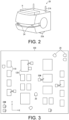
- FIG. 2 illustrates an outline example of a transport robot of the transport system according to Embodiment 1 of the present disclosure.
- FIG. 3 is an area map schematically illustrating an example of an area where the transport system according to Embodiment 1 of the present disclosure is applied.
- the self-traveling transport robot 20 is disposed that transports an object H to be transported, such as a product, a semi-finished product, a part, a raw material, a tool, a jig, a packing material, or a cassette storing the foregoing. Furthermore, on a transport robot as a cart, a self-traveling transport robot 20M provided with a robot arm (manipulator) gripping the object H to be transported may be disposed as a portion of the transport system 1.
- the transport robot 20M is an example of the transport robot 20, and is included in the transport robot 20 in the following description.
- the transport robot 20 may be in the form of an unmanned guided cart, an AGF, or a self-traveling transport device in other forms.
- a shelf 110 on which the object H to be transported may be placed is installed in the factory 100. Also installed in the factory 100 are production facilities for performing machining, assembly, processing or inspection of, or using, the object H to be transported.
- the transport robot 20 of the transport system 1 may transport the object H to be transported between these facilities. As illustrated in FIG. 3 , a position of each transport robot 20 is represented by XY coordinates defined on a floor of the factory 100 as the area.
- the object H to be transported is, for example, a storage container storing a plurality of semiconductor wafers, or a storage container storing an intermediate product of a display element such as an organic electroluminescent (EL) panel.
- a storage container storing a plurality of semiconductor wafers
- an intermediate product of a display element such as an organic electroluminescent (EL) panel.
- EL organic electroluminescent
- the transport system 1 includes the control device 10 and the self-traveling transport robots 20.
- the control device 10 is an information processing system responsible for managing transportation and may also be called a transport system server (automated material handling system (AMHS) server) or the like.
- AMHS automated material handling system
- control device 10 Based on a command from the host information processing system or the like, the control device 10 transmits a relatively specific transport instruction to the transport robot 20 in the transport system 1.
- the control device 10 may be any information processing system that may execute such processing, and does not have to be a device physically housed in one housing.
- the host information processing system that manages production of products in the production factory may be called a manufacturing execution system server (MES server).
- MES server manufacturing execution system server
- WMS server warehouse management system server
- the transport robot 20 includes a slave communication part 21, a travel controller 22, an own position calculator 23, a distance sensor 24, a traveling mechanism 25, an environment sensor 26, an environmental information acquisition part 27, and a slave storage part 28.
- the distance sensor 24 is arranged on a front side of the transport robot 20 and monitors the front of the transport robot 20 in a traveling direction.
- the distance sensor 24 for example, includes two light detection and ranging (LiDAR) devices and is able to acquire distance information indicating a distance to an object existing within a monitoring area thereof.
- the monitoring area of the distance sensor 24 may include a range of up to about 120 degrees to the left and right from the front of the transport robot 20 in the traveling direction.
- the LiDAR devices arranged in the transport robot 20 may be singular or plural in number. In the case of plural LiDAR devices, they may be arranged so as to monitor the rear as well.
- the type of the distance sensor 24 is not limited to LiDAR, and a sensor that acquires a distance image, such as a stereo camera or a time-of-flight (ToF) camera, or something based on another technique, may be used.
- the slave storage part 28 is a recording device provided in the transport robot 20.
- the slave storage part 28 appropriately holds identification information of the transport robot 20, map information within the floor of the factory 100, various information necessary for the transport robot 20 to travel, a travel history, a control program of the transport robot 20 or the like.
- the traveling mechanism 25 is a mechanism for the transport robot 20 to travel on a floor surface, which is operated under the control of the travel controller 22.
- a wheel 25A as a portion of the traveling mechanism 25 is illustrated.
- the slave communication part 21 is a communication interface for the transport robot 20 to communicate with the control device 10.
- the slave communication part 21 receives an instruction for the control robot 20 from the control device 10. Since the communication with the transport robot 20 through the slave communication part 21 includes real-time distance information, the communication preferably has high speed, low latency, and multiple connections. Hence, it is preferable that the slave communication part 21 perform 5th generation (5G) communication or Wi-Fi 6 communication (Wi-Fi is a registered trademark) with a master communication part 11 of the control device 10.
- 5G 5th generation
- Wi-Fi 6 communication Wi-Fi is a registered trademark
- the travel controller 22 is a functional block that controls the traveling mechanism 25 to cause the transport robot 20 to travel in accordance with the instruction from the control device 10.
- the travel controller 22 also calculates odometry data based on operation information of each mechanism from the traveling mechanism 25, specifically, output of a rotary encoder of a motor.
- the odometry data is information relatively indicating a position of the transport robot 20 during or after traveling relative to the position of the transport robot 20 at a certain point in time.
- the own position calculator 23 is a functional block that calculates an approximate position of the transport robot 20 according to the odometry data, and further calculates the own position information regarding an own position of the transport robot 20 from a comparison between the distance information and the map information of the vicinity of the approximate position.
- the calculated own position information is output to the control device 10 through the slave communication part 21.
- the environment sensor 26 measures a predetermined environmental parameter around the transport robot 20.
- the environmental parameter includes, for example, at least one of temperature, humidity, illuminance, vibration, UV intensity, gas concentration, or air cleanliness (density of particles suspended in the air).
- the environment sensor 26 includes a measuring instrument (sensor) that measures at least one of these environmental parameters.
- the environment sensor 26 may include a thermometer, a hygrometer, an illuminometer, a vibrometer, an UV detector, a gas concentration detector that detects the concentration of oxygen gas such as ozone gas, nitride gas such as nitrogen oxide, or oxide gas such as carbon monoxide gas, a meter for the particles described above, or the like.
- the environmental information acquisition part 27 acquires a measurement result of a measurement by the environment sensor 26. In accordance with the instruction from the control device 10, the environmental information acquisition part 27 transmits the acquired measurement result to the control device 10 through the slave communication part 21.
- the transport robot 20 notifies the control device 10 through the slave communication part 21 of information about a unique state related to the transport robot 20 itself, for example, unique information containing the distance information and own position information. Furthermore, the unique information may contain information regarding an operation of the transport robot 20 or other internal states, such as, for example, a state of the operation of the transport robot 20, a loading state of the object to be transported, and a remaining battery capacity.
- the transport robot 20 carries out required transportation in the following manner in accordance with the instruction from the control device 10.
- the travel controller 22 receives a transport instruction from the control device 10 through the slave communication part 21, by using the distance information, the own position information regarding the own position, and position information of the transport destination contained in the transport instruction, the travel controller 22 controls the traveling mechanism 25 to cause the transport robot 20 to travel to the transport destination.
- the own position calculator 23 keeps updating the own position information.
- the control device 10 includes the master communication part 11, the transport instruction reception part 12, a slave monitoring part 13, the transport path determination part 14, an instruction generator 15, and the master storage part 16.
- the master communication part 11 is a communication interface for the control device 10 to communicate with the transport robot 20.
- the communication between the master communication part 11 and the slave communication part 21 may take the form of, for example, wireless communication.
- the master storage part 16 is a recording device (storage part) provided in the control device 10.
- the master storage part 16 appropriately holds the map information within the floor of the factory 100, a control program of the control device 10, the unique information and operation log or the like of each transport robot 20.
- the master storage part 16 stores the map information that contains map data, the map data containing obstacle information regarding an obstacle and environmental parameter information regarding an environmental parameter that may influence the object H to be transported within the floor (within the area) of the factory 100.
- the map data is, for example, appropriately transmitted from the host information processing system through the transport instruction reception part 12 and stored in the master storage part 16.
- the obstacle information indicates an obstacle cost g corresponding to a degree of possibility of becoming an obstacle to a transportation operation by the transport robot 20 in association with a position within the floor.
- the obstacle cost g is a value associated with, for example, ease of traveling of the transport robot 20, and the value increases as approaching the shelf 110.
- the value of the obstacle cost g may increase, for example, as a width of a path through which the transport robot 20 passes decreases or as a slope of the path increases. In a place within the area where the shelf 110 or the production facilities are installed and in other positions not designated as a passage of the transport robot 20, a very large value is set for the obstacle cost g.
- the environmental parameter information contains information regarding the environmental parameter that may influence the object H to be transported that is associated with the position within the area.
- the environmental parameter may be, for example, at least one of temperature, humidity, illuminance, vibration, UV intensity, gas concentration, or air cleanliness.
- the environmental parameter information also contains a weighting coefficient value corresponding to the object H to be transported for each type of environmental parameter.
- An environmental influence cost fEnv for each position within the area is calculated according to the object H to be transported that is indicated by the transported object information and from the environmental parameter information, and details thereof will be described later.
- the transport instruction reception part 12 includes a communication interface for the control device 10 to communicate with the host information processing system.
- the transport instruction reception part 12 receives the transport instruction which is the transport instruction regarding transportation of the obj ect H to be transported and which contains the transported obj ect information indicating the object H to be transported, transport source information indicating the transport source, and transport destination information indicating the transport destination.
- the transported object information contains specific content of the object H to be transported, for example, information on the object H to be transported itself such as a storage container storing a semiconductor wafer in a specific state.
- the transport source information contains information regarding a current arrangement position of the object H to be transported that is associated with the position within the area.
- the transport destination information contains information regarding a delivery position to which the object H to be transported is delivered that is associated with the position within the area.
- the slave monitoring part 13 is a functional block that monitors the unique state of the transport robot 20 within the transport system 1.
- the slave monitoring part 13 monitors the unique state of the transport robot 20 at least based on the content of the unique information received by the master communication part 11 from the transport robot 20.
- the transport path determination part 14 is a functional block that, based on the transport instruction received by the transport instruction reception part 12 and the map data stored by the master storage part 16, determines the transport path from the transport source to the transport destination of the object H to be transported by the transport robot 20. A specific transport path determination method of the transport path determination part 14 will be described later.
- the instruction generator 15 assigns the transport robot 20 within the transport system 1 a job about transportation of the object H to be transported in consideration of the unique state of each transport robot 20 acquired by the slave monitoring part 13.
- the instruction generator 15 then further generates an instruction such as transportation for the transport robot 20 to which the job is assigned, and transmits the instruction through the master communication part 11.
- the following examples may be mentioned of the job assignment in consideration of the unique state of the transport robot 20.
- the job is assigned to the transport robot 20 whose operation state is not in job execution and located near a place where the object H to be transported is placed.
- the transport robot 20 with a sufficient remaining battery capacity is selected and assigned the job.
- the instruction generator 15 gives the transport robot 20 through the master communication part 11 the transport instruction so that the transport robot 20 performs transportation in accordance with the transport path determined by the transport path determination part 14
- the instruction generator 15 determines from a plurality of transport robots 20 one transport robot 20 to which a job is assigned, and causes the determined transport robot 20 to transport the object H to be transported in accordance with the transport path determined by the transport path determination part 14.
- the transport instruction received by the transport instruction reception part 12 may contain a command designating the transport robot 20 that transports the object to be transported, and the designated transport robot 20 may transport the object H to be transported.
- FIG. 4 illustrates a specific example of a movement direction of the transport robot of the transport system according to Embodiment 1 of the present disclosure.
- FIG. 5 illustrates a specific example of a transport path of the transport robot of the transport system according to Embodiment 1 of the present disclosure.
- the transport path determination part 14 determines a transport path of one transport robot 20 after the instruction generator 15 assigns a transportation job to the transport robot 20.
- the transport path determination part 14 acquires, from the transport instruction, the transported object information indicating the object H to be transported, the transport source information indicating the transport source, and the transport destination information indicating the transport destination.
- the transport path determination part 14 determines the transport path of the object H to be transported by the transport robot 20 by using the acquired transported object information, transport source information and transport destination information, while referring to the map data stored in the master storage part 16.
- the transport path determination part 14 divides the area into a plurality of grids separated in a grid pattern. By repeating, starting from the grid to which the transport source belongs, a selection step of selecting whether to extend the transport path to any adjacent grid, the transport path determination part 14 determines the transport path from the transport source to the transport destination.
- a transport path search algorithm conforms to a search algorithm called A* (A-star).
- the transport path determination part 14 calculates an evaluation cost f of the adjacent grid for each of the adjacent grid.
- the evaluation cost f includes the obstacle cost g of the adjacent grid based on the obstacle information contained in the map data, a movement cost h corresponding to a distance from the adjacent grid to the grid to which the transport destination belongs, and the environmental influence cost fEnv of the adjacent grid based on the environmental parameter of the environmental parameter information contained in the map data according to the object to be transported that is indicated by the transported object information.
- the transport path determination part 14 determines that the transport path is to be extended to the adjacent grid where the evaluation cost f is minimum among the calculated evaluation cost f for each adjacent grid.
- the transport path determination part 14 determines to which adjacent grid the transport robot 20 to advance next to minimize the evaluation cost.
- the adjacent grid is in, for example, eight directions, including C E (east direction), C SE (southeast direction), Cs (south direction), Csw (southwest direction), Cw (west direction), C NW (northwest direction), C N (north direction), and C NE (northeast direction).
- g the movement cost (that is, the obstacle cost of the adjacent grid) of the transport robot 20 from a current position to a point of interest (adjacent grid)
- h the movement cost of the transport robot 20 from the point of interest to a destination
- fEnv an environmental measured value (environmental influence cost) contained in the environmental parameter information.
- the movement cost h can be calculated using, for example, a known diagonal distance, Manhattan distance, or Euclidean distance.
- fE1, fE2, and fE3 represent mutually different environmental parameters that influence the designated object H to be transported and that are selected from, for example, temperature, humidity, illuminance, vibration, UV intensity, gas concentration, or air cleanliness.
- the number of environmental parameters included in the equation (2) is not limited to three, and it suffices if the equation (2) includes one or more environmental parameters.
- ⁇ , ⁇ , and ⁇ are weighting coefficients of 0 or more to 1 or less that are contained in the environmental parameter information.
- the environmental parameter information contains a weighting coefficient with respect to an environmental parameter that influences the object H to be transported.
- the environmental parameter and the weighting coefficient for calculating the environmental measured value fEnv are appropriately selected according to the designated object H to be transported, and are calculated as in, for example, the equation (2).
- k is a value of 0 or 1.
- the value of 0 is selected if environmental influence does not need to be considered, and the value of 1 is selected if environmental influence needs to be considered.
- the transport path determination part 14 finds, for example, path B as the transport path from the transport source to the transport destination of the transport robot 20 in a transportation area. That is, path B is a result of the determination made by the transport path determination part 14 that the transport path is to be extended to the adjacent grid where the evaluation cost f is minimum among the calculated evaluation cost f for each adjacent grid, as described above.
- path B indicates a transport path obtained by continuously connecting the grids with a low evaluation cost f among the adjacent grids.
- the transport path determination part 14 determines the found path B to be the transport path of the transport robot 20, notifies the instruction generator 15, and further instructs the transport robot 20 through the master communication part 11 to travel through the transport path.
- A* is exemplified as a predetermined search algorithm.
- the present embodiment is not limited thereto.
- jump point search (JPS) algorithm Dijkstra's algorithm, Theta*-Any-Angle, D* Lite, or RD-based path planning may be applied as a search algorithm.
- the transport path determination part 14 determines the transport path of the transport robot 20 in consideration of the environmental parameter that influences the object H to be transported. Hence, in the control device 10 and the transport system 1 of the present embodiment, environmental influence on the object H to be transported by the transport robot 20 can be suppressed.
- the object H to be transported is a semiconductor wafer in a specific state during a manufacturing process.
- the transport path of the object H to be transported avoid a region where the ozone concentration is high.
- a weighting coefficient regarding the object H to be transported with respect to an environmental parameter indicating the ozone concentration is increased.
- a place (grid) where the ozone concentration is high is calculated so that the environmental influence cost fEnv with respect to the semiconductor wafer (object H to be transported) is large, and a transport path passing through such a grid is prevented from being selected.
- the grid where the ozone concentration is high is avoided and the transport path is determined, and the semiconductor wafer sensitive to and easily influenced by the ozone concentration can be transported while suppressing the environmental influence.
- the transport path determination part 14 is able to determine the transport path of the transport robot 20 while knowing the position within the area of an environmental parameter that influences the obj ect H to be transported.
- the environmental influence on the object H to be transported by the transport robot 20 can be reliably suppressed.
- the environmental parameter includes at least one of temperature, humidity, illuminance, vibration, UV intensity, gas concentration, or air cleanliness.
- the transport path determination part 14 is able to determine the transport path in consideration of the influence of at least one of temperature, humidity, illuminance, vibration, UV intensity, gas concentration, or air cleanliness on the object H to be transported by the transport robot 20.
- the transport path determination part 14 since the transport path determination part 14 calculates the evaluation cost of the adjacent grid for each adjacent grid and determines the transport path, the transport path determination part 14 is able to easily determine the transport path in which the environmental influence on the object H to be transported by the transport robot 20 is suppressed.
- Embodiment 2 differs from Embodiment 1 mainly in that the transport path determination part 14 updates the map data based on a measurement result of the transport robot 20.
- the control device 10 of Embodiment 2 instructs, through the master communication part 11, the transport robot 20 to transmit the measurement result of the environment sensor 26 acquired by the environmental information acquisition part 27 to the control device 10 side.
- the transport path determination part 14 updates the environmental parameter information in the map data stored in the master storage part 16 based on the acquired measurement result. Accordingly, in the control device 10 and the transport system 1 of the present embodiment, it is possible for the transport path determination part 14 to determine a relatively suitable transport path of the transport robot 20 in real time.
- the obstacle information in the map data stored by the master storage part 16 may be appropriately updated with data from the transport robot 20.
- the travel controller 22 acquires a posture and a position of the transport robot 20 with odometry error by using the calculated odometry data and the own position information from the own position calculator 23.
- the travel controller 22 converts the scan data into a position, and, for each particle, generates local map data from the scan data after position conversion from a correspondence relationship of the map data accumulated in the past.
- the travel controller 22 compares the scan data from the posture and position of the transport robot 20 with the odometry error with the local map data for each particle, and calculates a likelihood value of each particle.
- the travel controller 22 finds a product of the calculated likelihood value and a weight, and performs weight calculation of each particle.
- a sampling interval (W/N) is determined using, for example, a distribution of systematic sampling U (0, W/N).
- W is the sum of the above weights
- N is the number of particles.
- the travel controller 22 updates the particle with the maximum likelihood as the current position and posture of the transport robot 20, and updates the local map data to the map data of the entire area. Then, the travel controller 22 transmits the updated map data containing the obstacle information to the control device 10 through the slave communication part 21. At that time, the travel controller 22 associates a value of the environmental parameter acquired from the environment sensor 26 by the environmental information acquisition part 27 with the current position, and transmits the result to the control device 10. As a result, in the control device 10, the map data in which the obstacle information and the environmental parameter information are updated is changed and stored in the master storage part 16.
- a functional block (particularly the transport path determination part 14) of the control device 10 may be implemented by a logic circuit (hardware) formed on an integrated circuit (IC chip) or the like or may be implemented by software.
- the transport path determination part 14 includes a computer executing commands of a program being software that realizes each function.
- This computer includes, for example, one or more processors, and includes a computer-readable recording medium storing the program.
- an object of the present disclosure is achieved by the processor reading the program from the recording medium and executing the program.
- a central processing unit for example, can be used.
- a "non-transitory tangible medium” for example, in addition to a read only memory (ROM), a tape, a disk, a card, a semiconductor memory, a programmable logic circuit or the like, can be used.
- a random access memory (RAM) or the like for developing the program may further be provided.
- the program may be supplied to the computer via an arbitrary transmission medium (such as a communication network or broadcast waves) capable of transmitting the program.
- a transmission medium such as a communication network or broadcast waves
- One aspect of the present invention may be realized in the form of a data signal embedded in a carrier wave, the data signal being embodied by the program by electronic transmission.
- a control device is a control device controlling a transport robot that travels within a predetermined area and transports an obj ect to be transported.
- the control device includes: a master communication part, communicating with the transport robot; a storage part, storing map data containing obstacle information regarding an obstacle and environmental parameter information regarding an environmental parameter that may influence the object to be transported within the area; a transport instruction reception part, receiving a transport instruction regarding transportation of the object to be transported, the transport instruction containing transported object information indicating the object to be transported, transport source information indicating a transport source, and transport destination information indicating a transport destination; a transport path determination part, determining a transport path from the transport source to the transport destination of the object to be transported by the transport robot based on the transport instruction and the map data; and an instruction generator, giving the transport robot through the master communication part the transport instruction so that the transport robot transports the object to be transported in accordance with the transport path determined by the transport path determination part.
- the transport path determination part is configured to, according to the
- the transport path determination part determines the transport path of the transport robot in consideration of the environmental parameter that influences the object to be transported. Hence, environmental influence on the object to be transported by the transport robot can be suppressed.
- the environmental parameter information may contain information regarding the environmental parameter that may influence the object to be transported that is associated with a position within the area.
- the transport path determination part is able to determine the transport path of the transport robot while knowing the position within the area of the environmental parameter that influences the obj ect to be transported, the environmental influence on the object to be transported by the transport robot can be reliably suppressed.
- the transport path determination part may update the map data stored by the storage part based on a measurement result by the transport robot about the environmental parameter acquired from the transport robot through the master communication part.
- the transport path determination part determines a relatively suitable transport path of the transport robot in real time.
- the environmental parameter may include at least one of temperature, humidity, illuminance, vibration, UV intensity, gas concentration, or air cleanliness.
- the transport path determination part is able to determine the transport path in consideration of the influence of at least one of temperature, humidity, illuminance, vibration, UV intensity, gas concentration, or air cleanliness on the object to be transported by the transport robot.
- the transport path determination part divides the area into a plurality of grids separated in a grid pattern. By repeating, starting from the grid to which the transport source belongs, a selection step of selecting whether to extend the transport path to any adjacent grid, the transport path determination part determines the transport path from the transport source to the transport destination.
- an evaluation cost of the adjacent grid may be calculated for each of the adjacent grid, the evaluation cost including an obstacle cost of the adjacent grid based on the obstacle information, a movement cost corresponding to a distance from the adjacent grid to the grid to which the transport destination belongs, and an environmental influence cost of the adjacent grid based on the environmental parameter according to the object to be transported that is indicated by the transported object information. It may be determined that the transport path is to be extended to the adjacent grid where the evaluation cost is minimum among the calculated evaluation cost.
- the transport path determination part is able to easily determine the transport path in which environmental influence on the object to be transported by the transport robot is suppressed.
- a transport system includes the above control device, and a transport robot provided with a traveling mechanism, a distance sensor that acquires distance information indicating a distance to an object existing within a monitoring area, an own position calculator that calculates own position information, a travel controller that controls the traveling mechanism using the distance information from the distance sensor and the own position information from the own position calculator, and a slave communication part that performs the communication.
- the transport system can be configured in which environmental influence on an object to be transported by the transport robot can be suppressed.
- the transport robot may further include an environment sensor that measures a predetermined environmental parameter around the transport robot.
- the transport path determination part determines a relatively suitable transport path of the transport robot in real time.
Landscapes
- Engineering & Computer Science (AREA)
- Aviation & Aerospace Engineering (AREA)
- Radar, Positioning & Navigation (AREA)
- Remote Sensing (AREA)
- Physics & Mathematics (AREA)
- General Physics & Mathematics (AREA)
- Automation & Control Theory (AREA)
- Control Of Position, Course, Altitude, Or Attitude Of Moving Bodies (AREA)
Abstract
Description
- The present disclosure relates to a control device controlling a transport robot, and a transport system including the control device.
- There has been proposed a self-traveling transport robot such as an automated guided vehicle (AGV) or automated guided forklift (AGF) used in a factory, a warehouse or the like. A plurality of such transport robots are controlled by a control device through wireless communication, and a transport system that realizes automation of transportation in the factory or the like is constituted.
- Patent Document 1:
Japanese Patent Laid-open No. 2013-225253 - However, in the conventional transport system as described above, the environment of an area such as the factory or warehouse, which may influence an object to be transported by the transport robot, has not been considered. Hence, in the related art, a problem may occur that environmental influence on the obj ect to be transported cannot be suppressed during transportation by the transport robot.
- The present disclosure has been made in view of the above problem, and an object thereof is to provide a control device and a transport system in which environmental influence on an object to be transported by a transport robot can be suppressed.
- The present disclosure adopts the following configurations in order to solve the above problems.
- A control device according to one aspect of the present disclosure is a control device controlling a transport robot that travels within a predetermined area and transports an object to be transported. The control device includes: a master communication part, communicating with the transport robot; a storage part, storing map data containing obstacle information regarding an obstacle and environmental parameter information regarding an environmental parameter that may influence the object to be transported within the area; a transport instruction reception part, receiving a transport instruction regarding transportation of the object to be transported, the transport instruction containing transported object information indicating the object to be transported, transport source information indicating a transport source, and transport destination information indicating a transport destination; a transport path determination part, determining a transport path from the transport source to the transport destination of the object to be transported by the transport robot based on the transport instruction and the map data; and an instruction generator, giving the transport robot through the master communication part the transport instruction so that the transport robot transports the object to be transported in accordance with the transport path determined by the transport path determination part. The transport path determination part is configured to, according to the object to be transported that is indicated by the transported object information contained in the transport instruction, determine the transport path in consideration of the environmental parameter that influences the object to be transported.
- A transport system according to one aspect of the present disclosure includes the above control device, and a transport robot provided with a traveling mechanism, a distance sensor that acquires distance information indicating a distance to an object existing within a monitoring area, an own position calculator that calculates own position information, a travel controller that controls the traveling mechanism using the distance information from the distance sensor and the own position information from the own position calculator, and a slave communication part that performs the communication.
- According to the present disclosure, a control device and a transport system can be provided in which environmental influence on an object to be transported by a transport robot can be suppressed.
-
-
FIG. 1 is a block diagram illustrating a configuration of a main part of a transport system according toEmbodiment 1 of the present disclosure. -
FIG. 2 illustrates an outline example of a transport robot of the transport system according toEmbodiment 1 of the present disclosure. -
FIG. 3 is an area map schematically illustrating an example of an area where the transport system according toEmbodiment 1 of the present disclosure is applied. -
FIG. 4 illustrates a specific example of a movement direction of the transport robot of the transport system according toEmbodiment 1 of the present disclosure. -
FIG. 5 illustrates a specific example of a transport path of the transport robot of the transport system according toEmbodiment 1 of the present disclosure. - An embodiment (hereinafter also written as "the present embodiment") according to one aspect of the present invention is described below based on the drawings.
- An example of a scene in which the present disclosure is applied is described with reference to
FIG. 1. FIG. 1 is a block diagram illustrating a configuration of a main part of a transport system according toEmbodiment 1 of the present disclosure. Atransport system 1 includes acontrol device 10 and a plurality of self-travelingtransport robots 20. Thecontrol device 10 communicates with thetransport robots 20 and gives an instruction to each of thetransport robots 20. - In
FIG. 1 , an internal configuration of onetransport robot 20 is illustrated in detail. However, theother transport robots 20 have a similar internal configuration. Thetransport robot 20 includes adistance sensor 24 that detects a distance to an object around and outputs the distance as distance information, and anown position calculator 23 that calculates own position information regarding its own position by using the distance information. - The
control device 10 controls thetransport robot 20 that travels within a predetermined area and transports an object to be transported. Thecontrol device 10 also includes amaster storage part 16 as a storage part that stores map data containing obstacle information and environmental parameter information within the area. Thecontrol device 10 also includes a transportinstruction reception part 12 that receives a transport instruction from a host information processing system or the like, and a transportpath determination part 14 that, based on the transport instruction and the map data, determines a transport path from a transport source to a transport destination of the object to be transported by thetransport robot 20. - Furthermore, in the
control device 10, according to the object to be transported that is indicated by transported object information contained in the transport instruction, the transportpath determination part 14 determines the transport path in consideration of an environmental parameter that influences the object to be transported. - Thus, according to the present embodiment, the transport path of the
transport robot 20 is determined in consideration of the environmental parameter that may influence the object to be transported by thetransport robot 20, and environmental influence on the object to be transported by thetransport robot 20 can be suppressed. -
FIG. 2 illustrates an outline example of a transport robot of the transport system according toEmbodiment 1 of the present disclosure.FIG. 3 is an area map schematically illustrating an example of an area where the transport system according toEmbodiment 1 of the present disclosure is applied. - In a
factory 100, the self-travelingtransport robot 20 is disposed that transports an object H to be transported, such as a product, a semi-finished product, a part, a raw material, a tool, a jig, a packing material, or a cassette storing the foregoing. Furthermore, on a transport robot as a cart, a self-travelingtransport robot 20M provided with a robot arm (manipulator) gripping the object H to be transported may be disposed as a portion of thetransport system 1. - The
transport robot 20M is an example of thetransport robot 20, and is included in thetransport robot 20 in the following description. Thetransport robot 20 may be in the form of an unmanned guided cart, an AGF, or a self-traveling transport device in other forms. - A
shelf 110 on which the object H to be transported may be placed is installed in thefactory 100. Also installed in thefactory 100 are production facilities for performing machining, assembly, processing or inspection of, or using, the object H to be transported. Thetransport robot 20 of thetransport system 1 may transport the object H to be transported between these facilities. As illustrated inFIG. 3 , a position of eachtransport robot 20 is represented by XY coordinates defined on a floor of thefactory 100 as the area. - The object H to be transported is, for example, a storage container storing a plurality of semiconductor wafers, or a storage container storing an intermediate product of a display element such as an organic electroluminescent (EL) panel. As indicated by dotted lines in
FIG. 2 , the obj ect H to be transported is transported from the transport source to the transport destination by thetransport robot 20 while being placed on an upper surface of thetransport robot 20. - A relatively specific configuration example and operation of the
transport system 1 will be described below. As illustrated inFIG. 1 , thetransport system 1 includes thecontrol device 10 and the self-travelingtransport robots 20. Thecontrol device 10 is an information processing system responsible for managing transportation and may also be called a transport system server (automated material handling system (AMHS) server) or the like. - Based on a command from the host information processing system or the like, the
control device 10 transmits a relatively specific transport instruction to thetransport robot 20 in thetransport system 1. Thecontrol device 10 may be any information processing system that may execute such processing, and does not have to be a device physically housed in one housing. - In the case where a scene in which the
transport system 1 is applied is a production factory, the host information processing system that manages production of products in the production factory may be called a manufacturing execution system server (MES server). If the scene in which thetransport system 1 is applied is a distribution warehouse, the host information processing system that manages storage and delivery of stored goods in the distribution warehouse may be called a warehouse management system server (WMS server). - As illustrated in
FIG. 1 , thetransport robot 20 includes aslave communication part 21, atravel controller 22, anown position calculator 23, adistance sensor 24, atraveling mechanism 25, anenvironment sensor 26, an environmentalinformation acquisition part 27, and aslave storage part 28. - The
distance sensor 24 is arranged on a front side of thetransport robot 20 and monitors the front of thetransport robot 20 in a traveling direction. As illustrated inFIG. 2 , in a specific example ofEmbodiment 1, thedistance sensor 24, for example, includes two light detection and ranging (LiDAR) devices and is able to acquire distance information indicating a distance to an object existing within a monitoring area thereof. As an example, the monitoring area of thedistance sensor 24 may include a range of up to about 120 degrees to the left and right from the front of thetransport robot 20 in the traveling direction. - The LiDAR devices arranged in the
transport robot 20 may be singular or plural in number. In the case of plural LiDAR devices, they may be arranged so as to monitor the rear as well. The type of thedistance sensor 24 is not limited to LiDAR, and a sensor that acquires a distance image, such as a stereo camera or a time-of-flight (ToF) camera, or something based on another technique, may be used. - The
slave storage part 28 is a recording device provided in thetransport robot 20. Theslave storage part 28 appropriately holds identification information of thetransport robot 20, map information within the floor of thefactory 100, various information necessary for thetransport robot 20 to travel, a travel history, a control program of thetransport robot 20 or the like. - The traveling
mechanism 25 is a mechanism for thetransport robot 20 to travel on a floor surface, which is operated under the control of thetravel controller 22. In the outline drawing of thetransport robot 20 inFIG. 2 , awheel 25A as a portion of the travelingmechanism 25 is illustrated. - The
slave communication part 21 is a communication interface for thetransport robot 20 to communicate with thecontrol device 10. Theslave communication part 21 receives an instruction for thecontrol robot 20 from thecontrol device 10. Since the communication with thetransport robot 20 through theslave communication part 21 includes real-time distance information, the communication preferably has high speed, low latency, and multiple connections. Hence, it is preferable that theslave communication part 21 perform 5th generation (5G) communication or Wi-Fi 6 communication (Wi-Fi is a registered trademark) with amaster communication part 11 of thecontrol device 10. In the outline drawing of thetransport robot 20 inFIG. 2 , anantenna 21A as a portion of theslave communication part 21 is illustrated. - The
travel controller 22 is a functional block that controls the travelingmechanism 25 to cause thetransport robot 20 to travel in accordance with the instruction from thecontrol device 10. Thetravel controller 22 also calculates odometry data based on operation information of each mechanism from the travelingmechanism 25, specifically, output of a rotary encoder of a motor. The odometry data is information relatively indicating a position of thetransport robot 20 during or after traveling relative to the position of thetransport robot 20 at a certain point in time. - The
own position calculator 23 is a functional block that calculates an approximate position of thetransport robot 20 according to the odometry data, and further calculates the own position information regarding an own position of thetransport robot 20 from a comparison between the distance information and the map information of the vicinity of the approximate position. The calculated own position information is output to thecontrol device 10 through theslave communication part 21. - The
environment sensor 26 measures a predetermined environmental parameter around thetransport robot 20. The environmental parameter includes, for example, at least one of temperature, humidity, illuminance, vibration, UV intensity, gas concentration, or air cleanliness (density of particles suspended in the air). Theenvironment sensor 26 includes a measuring instrument (sensor) that measures at least one of these environmental parameters. - That is, the
environment sensor 26 may include a thermometer, a hygrometer, an illuminometer, a vibrometer, an UV detector, a gas concentration detector that detects the concentration of oxygen gas such as ozone gas, nitride gas such as nitrogen oxide, or oxide gas such as carbon monoxide gas, a meter for the particles described above, or the like. - The environmental
information acquisition part 27 acquires a measurement result of a measurement by theenvironment sensor 26. In accordance with the instruction from thecontrol device 10, the environmentalinformation acquisition part 27 transmits the acquired measurement result to thecontrol device 10 through theslave communication part 21. - The
transport robot 20 notifies thecontrol device 10 through theslave communication part 21 of information about a unique state related to thetransport robot 20 itself, for example, unique information containing the distance information and own position information. Furthermore, the unique information may contain information regarding an operation of thetransport robot 20 or other internal states, such as, for example, a state of the operation of thetransport robot 20, a loading state of the object to be transported, and a remaining battery capacity. - As a basic operation, the
transport robot 20 carries out required transportation in the following manner in accordance with the instruction from thecontrol device 10. When thetravel controller 22 receives a transport instruction from thecontrol device 10 through theslave communication part 21, by using the distance information, the own position information regarding the own position, and position information of the transport destination contained in the transport instruction, thetravel controller 22 controls the travelingmechanism 25 to cause thetransport robot 20 to travel to the transport destination. At that time, based on the odometry data from thetravel controller 22 and the distance information from thedistance sensor 24, theown position calculator 23 keeps updating the own position information. - As illustrated in
FIG. 1 , thecontrol device 10 includes themaster communication part 11, the transportinstruction reception part 12, aslave monitoring part 13, the transportpath determination part 14, aninstruction generator 15, and themaster storage part 16. Themaster communication part 11 is a communication interface for thecontrol device 10 to communicate with thetransport robot 20. The communication between themaster communication part 11 and theslave communication part 21 may take the form of, for example, wireless communication. - The
master storage part 16 is a recording device (storage part) provided in thecontrol device 10. Themaster storage part 16 appropriately holds the map information within the floor of thefactory 100, a control program of thecontrol device 10, the unique information and operation log or the like of eachtransport robot 20. - The
master storage part 16 stores the map information that contains map data, the map data containing obstacle information regarding an obstacle and environmental parameter information regarding an environmental parameter that may influence the object H to be transported within the floor (within the area) of thefactory 100. The map data is, for example, appropriately transmitted from the host information processing system through the transportinstruction reception part 12 and stored in themaster storage part 16. - The obstacle information indicates an obstacle cost g corresponding to a degree of possibility of becoming an obstacle to a transportation operation by the
transport robot 20 in association with a position within the floor. Specifically, the obstacle cost g is a value associated with, for example, ease of traveling of thetransport robot 20, and the value increases as approaching theshelf 110. The value of the obstacle cost g may increase, for example, as a width of a path through which thetransport robot 20 passes decreases or as a slope of the path increases. In a place within the area where theshelf 110 or the production facilities are installed and in other positions not designated as a passage of thetransport robot 20, a very large value is set for the obstacle cost g. - The environmental parameter information contains information regarding the environmental parameter that may influence the object H to be transported that is associated with the position within the area. The environmental parameter may be, for example, at least one of temperature, humidity, illuminance, vibration, UV intensity, gas concentration, or air cleanliness. The environmental parameter information also contains a weighting coefficient value corresponding to the object H to be transported for each type of environmental parameter. An environmental influence cost fEnv for each position within the area is calculated according to the object H to be transported that is indicated by the transported object information and from the environmental parameter information, and details thereof will be described later.
- The transport
instruction reception part 12 includes a communication interface for thecontrol device 10 to communicate with the host information processing system. The transportinstruction reception part 12 receives the transport instruction which is the transport instruction regarding transportation of the obj ect H to be transported and which contains the transported obj ect information indicating the object H to be transported, transport source information indicating the transport source, and transport destination information indicating the transport destination. - The transported object information contains specific content of the object H to be transported, for example, information on the object H to be transported itself such as a storage container storing a semiconductor wafer in a specific state.
- The transport source information contains information regarding a current arrangement position of the object H to be transported that is associated with the position within the area. The transport destination information contains information regarding a delivery position to which the object H to be transported is delivered that is associated with the position within the area.
- The
slave monitoring part 13 is a functional block that monitors the unique state of thetransport robot 20 within thetransport system 1. Theslave monitoring part 13 monitors the unique state of thetransport robot 20 at least based on the content of the unique information received by themaster communication part 11 from thetransport robot 20. - The transport
path determination part 14 is a functional block that, based on the transport instruction received by the transportinstruction reception part 12 and the map data stored by themaster storage part 16, determines the transport path from the transport source to the transport destination of the object H to be transported by thetransport robot 20. A specific transport path determination method of the transportpath determination part 14 will be described later. - Based on the command from the host information processing system or the like, the
instruction generator 15 assigns thetransport robot 20 within the transport system 1 a job about transportation of the object H to be transported in consideration of the unique state of eachtransport robot 20 acquired by theslave monitoring part 13. Theinstruction generator 15 then further generates an instruction such as transportation for thetransport robot 20 to which the job is assigned, and transmits the instruction through themaster communication part 11. Here, the following examples may be mentioned of the job assignment in consideration of the unique state of thetransport robot 20. - For example, when a certain object H to be transported is to be moved, the job is assigned to the
transport robot 20 whose operation state is not in job execution and located near a place where the object H to be transported is placed. Alternatively, for transportation, thetransport robot 20 with a sufficient remaining battery capacity is selected and assigned the job. - Furthermore, the
instruction generator 15 gives thetransport robot 20 through themaster communication part 11 the transport instruction so that thetransport robot 20 performs transportation in accordance with the transport path determined by the transportpath determination part 14 - In the above description, a case has been described where, based on the command from the host information processing system, the
instruction generator 15 determines from a plurality oftransport robots 20 onetransport robot 20 to which a job is assigned, and causes thedetermined transport robot 20 to transport the object H to be transported in accordance with the transport path determined by the transportpath determination part 14. However, the present embodiment is not limited thereto. For example, the transport instruction received by the transportinstruction reception part 12 may contain a command designating thetransport robot 20 that transports the object to be transported, and the designatedtransport robot 20 may transport the object H to be transported. - A characteristic operation of the
control device 10 and thetransport system 1 according toEmbodiment 1 is described in detail with reference toFIG. 4 and FIG. 5. FIG. 4 illustrates a specific example of a movement direction of the transport robot of the transport system according toEmbodiment 1 of the present disclosure.FIG. 5 illustrates a specific example of a transport path of the transport robot of the transport system according toEmbodiment 1 of the present disclosure. In the following description, an operation is mainly described in which the transportpath determination part 14 determines a transport path of onetransport robot 20 after theinstruction generator 15 assigns a transportation job to thetransport robot 20. - When the transport
instruction reception part 12 receives the transport instruction from the host information processing system, the transportpath determination part 14 acquires, from the transport instruction, the transported object information indicating the object H to be transported, the transport source information indicating the transport source, and the transport destination information indicating the transport destination. The transportpath determination part 14 determines the transport path of the object H to be transported by thetransport robot 20 by using the acquired transported object information, transport source information and transport destination information, while referring to the map data stored in themaster storage part 16. - Specifically, the transport
path determination part 14 divides the area into a plurality of grids separated in a grid pattern. By repeating, starting from the grid to which the transport source belongs, a selection step of selecting whether to extend the transport path to any adjacent grid, the transportpath determination part 14 determines the transport path from the transport source to the transport destination. Such a transport path search algorithm conforms to a search algorithm called A* (A-star). - In the selection step, the transport
path determination part 14 calculates an evaluation cost f of the adjacent grid for each of the adjacent grid. The evaluation cost f includes the obstacle cost g of the adjacent grid based on the obstacle information contained in the map data, a movement cost h corresponding to a distance from the adjacent grid to the grid to which the transport destination belongs, and the environmental influence cost fEnv of the adjacent grid based on the environmental parameter of the environmental parameter information contained in the map data according to the object to be transported that is indicated by the transported object information. - The transport
path determination part 14 determines that the transport path is to be extended to the adjacent grid where the evaluation cost f is minimum among the calculated evaluation cost f for each adjacent grid. - More specifically, when the
transport robot 20 is located in a cell (grid) indicated by hatching inFIG. 4 , the transportpath determination part 14 determines to which adjacent grid thetransport robot 20 to advance next to minimize the evaluation cost. The adjacent grid is in, for example, eight directions, including CE (east direction), CSE (southeast direction), Cs (south direction), Csw (southwest direction), Cw (west direction), CNW (northwest direction), CN (north direction), and CNE (northeast direction). - The transport
path determination part 14 calculates the evaluation cost f using the following equation (1):
transport robot 20 from a current position to a point of interest (adjacent grid), h represents the movement cost of thetransport robot 20 from the point of interest to a destination, and fEnv represents an environmental measured value (environmental influence cost) contained in the environmental parameter information. - The movement cost h can be calculated using, for example, a known diagonal distance, Manhattan distance, or Euclidean distance.
- For example, with respect to a designated object H to be transported, if there are three environmental parameters that influence the object H to be transported, the environmental measured value fEnv is expressed by the following equation (2):

- α, β, and γ are weighting coefficients of 0 or more to 1 or less that are contained in the environmental parameter information. For each type of the object H to be transported, the environmental parameter information contains a weighting coefficient with respect to an environmental parameter that influences the object H to be transported. The environmental parameter and the weighting coefficient for calculating the environmental measured value fEnv are appropriately selected according to the designated object H to be transported, and are calculated as in, for example, the equation (2). k is a value of 0 or 1. With respect to the object H to be transported, the value of 0 is selected if environmental influence does not need to be considered, and the value of 1 is selected if environmental influence needs to be considered.
- As a result, as illustrated in
FIG. 5 , the transportpath determination part 14 finds, for example, path B as the transport path from the transport source to the transport destination of thetransport robot 20 in a transportation area. That is, path B is a result of the determination made by the transportpath determination part 14 that the transport path is to be extended to the adjacent grid where the evaluation cost f is minimum among the calculated evaluation cost f for each adjacent grid, as described above. - That is, for example, compared to path A illustrated in
FIG. 5 , path B indicates a transport path obtained by continuously connecting the grids with a low evaluation cost f among the adjacent grids. The transportpath determination part 14 determines the found path B to be the transport path of thetransport robot 20, notifies theinstruction generator 15, and further instructs thetransport robot 20 through themaster communication part 11 to travel through the transport path. - In the above description, A* is exemplified as a predetermined search algorithm. However, the present embodiment is not limited thereto. For example, jump point search (JPS) algorithm, Dijkstra's algorithm, Theta*-Any-Angle, D* Lite, or RD-based path planning may be applied as a search algorithm.
- As described above, in the
control device 10 and thetransport system 1 of the present embodiment, according to the object H to be transported that is indicated by the transported object information contained in the transport instruction, the transportpath determination part 14 determines the transport path of thetransport robot 20 in consideration of the environmental parameter that influences the object H to be transported. Hence, in thecontrol device 10 and thetransport system 1 of the present embodiment, environmental influence on the object H to be transported by thetransport robot 20 can be suppressed. - As a specific example, the object H to be transported is a semiconductor wafer in a specific state during a manufacturing process. In the case where ozone may adversely influence the semiconductor wafer, it is desirable that the transport path of the object H to be transported avoid a region where the ozone concentration is high. In such a case, a weighting coefficient regarding the object H to be transported with respect to an environmental parameter indicating the ozone concentration is increased. Then, a place (grid) where the ozone concentration is high is calculated so that the environmental influence cost fEnv with respect to the semiconductor wafer (object H to be transported) is large, and a transport path passing through such a grid is prevented from being selected.
- Accordingly, in the case of the transport path of the
transport robot 20, the grid where the ozone concentration is high is avoided and the transport path is determined, and the semiconductor wafer sensitive to and easily influenced by the ozone concentration can be transported while suppressing the environmental influence. - In the
control device 10 and thetransport system 1 of the present embodiment, since the environmental parameter information is associated with the position of the object to be transported by thetransport robot 20 within the area, the transportpath determination part 14 is able to determine the transport path of thetransport robot 20 while knowing the position within the area of an environmental parameter that influences the obj ect H to be transported. As a result, in thecontrol device 10 and thetransport system 1 of the present embodiment, the environmental influence on the object H to be transported by thetransport robot 20 can be reliably suppressed. - In the
control device 10 and thetransport system 1 of the present embodiment, the environmental parameter includes at least one of temperature, humidity, illuminance, vibration, UV intensity, gas concentration, or air cleanliness. Accordingly, in thecontrol device 10 and thetransport system 1 of the present embodiment, the transportpath determination part 14 is able to determine the transport path in consideration of the influence of at least one of temperature, humidity, illuminance, vibration, UV intensity, gas concentration, or air cleanliness on the object H to be transported by thetransport robot 20. - In the
control device 10 and thetransport system 1 of the present embodiment, since the transportpath determination part 14 calculates the evaluation cost of the adjacent grid for each adjacent grid and determines the transport path, the transportpath determination part 14 is able to easily determine the transport path in which the environmental influence on the object H to be transported by thetransport robot 20 is suppressed. - Another embodiment of the present disclosure is described below. For convenience of description, members having the same functions as those described in the above embodiment are denoted by the same reference numerals, and description thereof will not be repeated.
-
Embodiment 2 differs fromEmbodiment 1 mainly in that the transportpath determination part 14 updates the map data based on a measurement result of thetransport robot 20. - The
control device 10 ofEmbodiment 2 instructs, through themaster communication part 11, thetransport robot 20 to transmit the measurement result of theenvironment sensor 26 acquired by the environmentalinformation acquisition part 27 to thecontrol device 10 side. When thecontrol device 10 ofEmbodiment 2 acquires the above measurement result from thetransport robot 20, the transportpath determination part 14 updates the environmental parameter information in the map data stored in themaster storage part 16 based on the acquired measurement result. Accordingly, in thecontrol device 10 and thetransport system 1 of the present embodiment, it is possible for the transportpath determination part 14 to determine a relatively suitable transport path of thetransport robot 20 in real time. - In addition to the above description, the obstacle information in the map data stored by the
master storage part 16 may be appropriately updated with data from thetransport robot 20. - Specifically, in the
transport robot 20, after calculating the odometry data, thetravel controller 22 acquires a posture and a position of thetransport robot 20 with odometry error by using the calculated odometry data and the own position information from theown position calculator 23. - Next, the
travel controller 22 acquires scan data of thedistance sensor 24. Then, thetravel controller 22 finds a normal distribution (for example, n=100) of particles using a predetermined state transition model. - Subsequently, in the posture and position of each particle, the
travel controller 22 converts the scan data into a position, and, for each particle, generates local map data from the scan data after position conversion from a correspondence relationship of the map data accumulated in the past. - Next, the
travel controller 22 compares the scan data from the posture and position of thetransport robot 20 with the odometry error with the local map data for each particle, and calculates a likelihood value of each particle. - Subsequently, the
travel controller 22 finds a product of the calculated likelihood value and a weight, and performs weight calculation of each particle. - Next, the
travel controller 22 performs resampling on the particles. In this resampling, a sampling interval (W/N) is determined using, for example, a distribution of systematic sampling U (0, W/N). Here, W is the sum of the above weights, and N is the number of particles. - Subsequently, the
travel controller 22 updates the particle with the maximum likelihood as the current position and posture of thetransport robot 20, and updates the local map data to the map data of the entire area. Then, thetravel controller 22 transmits the updated map data containing the obstacle information to thecontrol device 10 through theslave communication part 21. At that time, thetravel controller 22 associates a value of the environmental parameter acquired from theenvironment sensor 26 by the environmentalinformation acquisition part 27 with the current position, and transmits the result to thecontrol device 10. As a result, in thecontrol device 10, the map data in which the obstacle information and the environmental parameter information are updated is changed and stored in themaster storage part 16. - A functional block (particularly the transport path determination part 14) of the
control device 10 may be implemented by a logic circuit (hardware) formed on an integrated circuit (IC chip) or the like or may be implemented by software. - In the latter case, the transport
path determination part 14 includes a computer executing commands of a program being software that realizes each function. This computer includes, for example, one or more processors, and includes a computer-readable recording medium storing the program. In the computer, an object of the present disclosure is achieved by the processor reading the program from the recording medium and executing the program. - As the processor, a central processing unit (CPU), for example, can be used. As the recording medium, a "non-transitory tangible medium," for example, in addition to a read only memory (ROM), a tape, a disk, a card, a semiconductor memory, a programmable logic circuit or the like, can be used. A random access memory (RAM) or the like for developing the program may further be provided.
- The program may be supplied to the computer via an arbitrary transmission medium (such as a communication network or broadcast waves) capable of transmitting the program. One aspect of the present invention may be realized in the form of a data signal embedded in a carrier wave, the data signal being embodied by the program by electronic transmission.
- A control device according to one aspect of the present disclosure is a control device controlling a transport robot that travels within a predetermined area and transports an obj ect to be transported. The control device includes: a master communication part, communicating with the transport robot; a storage part, storing map data containing obstacle information regarding an obstacle and environmental parameter information regarding an environmental parameter that may influence the object to be transported within the area; a transport instruction reception part, receiving a transport instruction regarding transportation of the object to be transported, the transport instruction containing transported object information indicating the object to be transported, transport source information indicating a transport source, and transport destination information indicating a transport destination; a transport path determination part, determining a transport path from the transport source to the transport destination of the object to be transported by the transport robot based on the transport instruction and the map data; and an instruction generator, giving the transport robot through the master communication part the transport instruction so that the transport robot transports the object to be transported in accordance with the transport path determined by the transport path determination part. The transport path determination part is configured to, according to the object to be transported that is indicated by the transported object information contained in the transport instruction, determine the transport path in consideration of the environmental parameter that influences the object to be transported.
- According to the above configuration, according to the object to be transported that is indicated by the transported object information contained in the transport instruction, the transport path determination part determines the transport path of the transport robot in consideration of the environmental parameter that influences the object to be transported. Hence, environmental influence on the object to be transported by the transport robot can be suppressed.
- In the control device according to the above aspect, the environmental parameter information may contain information regarding the environmental parameter that may influence the object to be transported that is associated with a position within the area.
- According to the above configuration, since the transport path determination part is able to determine the transport path of the transport robot while knowing the position within the area of the environmental parameter that influences the obj ect to be transported, the environmental influence on the object to be transported by the transport robot can be reliably suppressed.
- In the control device according to the above aspect, the transport path determination part may update the map data stored by the storage part based on a measurement result by the transport robot about the environmental parameter acquired from the transport robot through the master communication part.
- According to the above configuration, it is possible for the transport path determination part to determine a relatively suitable transport path of the transport robot in real time.
- In the control device according to the above aspect, the environmental parameter may include at least one of temperature, humidity, illuminance, vibration, UV intensity, gas concentration, or air cleanliness.
- According to the above configuration, the transport path determination part is able to determine the transport path in consideration of the influence of at least one of temperature, humidity, illuminance, vibration, UV intensity, gas concentration, or air cleanliness on the object to be transported by the transport robot.
- In the control device according to the above aspect, the transport path determination part divides the area into a plurality of grids separated in a grid pattern. By repeating, starting from the grid to which the transport source belongs, a selection step of selecting whether to extend the transport path to any adjacent grid, the transport path determination part determines the transport path from the transport source to the transport destination. In the selection step, an evaluation cost of the adjacent grid may be calculated for each of the adjacent grid, the evaluation cost including an obstacle cost of the adjacent grid based on the obstacle information, a movement cost corresponding to a distance from the adjacent grid to the grid to which the transport destination belongs, and an environmental influence cost of the adjacent grid based on the environmental parameter according to the object to be transported that is indicated by the transported object information. It may be determined that the transport path is to be extended to the adjacent grid where the evaluation cost is minimum among the calculated evaluation cost.
- According to the above configuration, the transport path determination part is able to easily determine the transport path in which environmental influence on the object to be transported by the transport robot is suppressed.
- A transport system according to one aspect of the present disclosure includes the above control device, and a transport robot provided with a traveling mechanism, a distance sensor that acquires distance information indicating a distance to an object existing within a monitoring area, an own position calculator that calculates own position information, a travel controller that controls the traveling mechanism using the distance information from the distance sensor and the own position information from the own position calculator, and a slave communication part that performs the communication.
- According to the above configuration, the transport system can be configured in which environmental influence on an object to be transported by the transport robot can be suppressed.
- In the transport system according to the above aspect, the transport robot may further include an environment sensor that measures a predetermined environmental parameter around the transport robot.
- According to the above configuration, it is possible for the transport path determination part to determine a relatively suitable transport path of the transport robot in real time.
- The present disclosure is not limited to the embodiments described above, and may be modified in various ways within the scope of the claims. An embodiment derived from a proper combination of technical means disclosed in respective different embodiments is also encompassed in the technical scope of the present disclosure.
-
- 1: transport system
- 10: control device
- 12: transport instruction reception part
- 14: transport path determination part
- 15: instruction generator
- 20: transport robot
- 22: travel controller
- 23: own position calculator
- 24: distance sensor
- 25: traveling mechanism
Claims (7)
- A control device, controlling a transport robot that travels within a predetermined area and transports an object to be transported, wherein the control device comprises:a master communication part, communicating with the transport robot;a storage part, storing map data containing obstacle information regarding an obstacle and environmental parameter information regarding an environmental parameter that may influence the object to be transported within the area;a transport instruction reception part, receiving a transport instruction regarding transportation of the object to be transported, the transport instruction containing transported object information indicating the object to be transported, transport source information indicating a transport source, and transport destination information indicating a transport destination;a transport path determination part, determining a transport path from the transport source to the transport destination of the object to be transported by the transport robot based on the transport instruction and the map data; andan instruction generator, giving the transport robot through the master communication part the transport instruction so that the transport robot transports the object to be transported in accordance with the transport path determined by the transport path determination part,wherein,according to the object to be transported that is indicated by the transported object information contained in the transport instruction, the transport path determination part determines the transport path in consideration of the environmental parameter that influences the object to be transported.
- The control device according to claim 1, wherein
the environmental parameter information contains information regarding an environmental parameter that may influence the object to be transported that is associated with a position within the area. - The control device according to claim 1 or 2, wherein
the transport path determination part updates the map data stored by the storage part based on a measurement result by the transport robot about the environmental parameter acquired from the transport robot through the master communication part. - The control device according to any one of claims 1 to 3, wherein
the environmental parameter comprises at least one of temperature, humidity, illuminance, vibration, UV intensity, gas concentration, or air cleanliness. - The control device according to any one of claims 1 to 4, whereinthe transport path determination part divides the area into a plurality of grids separated in a grid pattern;by repeating, starting from the grid to which the transport source belongs, a selection step of selecting whether to extend the transport path to any adjacent grid, the transport path determination part determines the transport path from the transport source to the transport destination; andin the selection step, the transport path determination part calculates an evaluation cost of the adjacent grid for each of the adjacent grid, and determines that the transport path is to be extended to the adjacent grid where the evaluation cost is minimum among the calculated evaluation cost, the evaluation cost comprising an obstacle cost of the adjacent grid based on the obstacle information, a movement cost corresponding to a distance from the adjacent grid to the grid to which the transport destination belongs, and an environmental influence cost of the adjacent grid based on the environmental parameter according to the object to be transported that is indicated by the transported object information.
- A transport system comprising:a transport robot, provided with a traveling mechanism, a distance sensor that acquires distance information indicating a distance to an object existing within a monitoring area, an own position calculator that calculates own position information, a travel controller that controls the traveling mechanism using the distance information from the distance sensor and the own position information from the own position calculator, and a slave communication part that performs the communication; andthe control device according to any one of claims 1 to 5.
- The transport system according to claim 6, wherein
the transport robot further comprises an environment sensor that measures a predetermined environmental parameter around the transport robot.
Applications Claiming Priority (2)
| Application Number | Priority Date | Filing Date | Title |
|---|---|---|---|
| JP2021040298A JP2022139772A (en) | 2021-03-12 | 2021-03-12 | Controller and transport system |
| PCT/JP2021/046661 WO2022190505A1 (en) | 2021-03-12 | 2021-12-17 | Control device and transport system |
Publications (2)
| Publication Number | Publication Date |
|---|---|
| EP4307071A1 true EP4307071A1 (en) | 2024-01-17 |
| EP4307071A4 EP4307071A4 (en) | 2025-01-08 |
Family
ID=83227890
Family Applications (1)
| Application Number | Title | Priority Date | Filing Date |
|---|---|---|---|
| EP21930350.0A Withdrawn EP4307071A4 (en) | 2021-03-12 | 2021-12-17 | Control device and transport system |
Country Status (5)
| Country | Link |
|---|---|
| US (1) | US20240111306A1 (en) |
| EP (1) | EP4307071A4 (en) |
| JP (1) | JP2022139772A (en) |
| CN (1) | CN116830050A (en) |
| WO (1) | WO2022190505A1 (en) |
Families Citing this family (3)
| Publication number | Priority date | Publication date | Assignee | Title |
|---|---|---|---|---|
| CN118131781B (en) * | 2024-05-10 | 2024-07-09 | 中国特种设备检测研究院 | Method and device for tracking invisible environment path of storage tank bottom plate in oil detection robot |
| EP4664225A1 (en) * | 2024-06-10 | 2025-12-17 | Vorwerk & Co. Interholding GmbH | Working machine |
| JP2026058875A (en) * | 2024-09-25 | 2026-04-06 | 横河電機株式会社 | Information processing device, information processing method, and information processing program |
Family Cites Families (11)
| Publication number | Priority date | Publication date | Assignee | Title |
|---|---|---|---|---|
| JPH11141135A (en) * | 1997-11-06 | 1999-05-25 | Mitsubishi Heavy Ind Ltd | Method and apparatus for generating path of transport system |
| DE102008030546A1 (en) * | 2008-06-27 | 2009-12-31 | Siemens Aktiengesellschaft | Control for an autonomous transport vehicle and method for operating an autonomous transport vehicle |
| JP2013225253A (en) | 2012-04-23 | 2013-10-31 | Panasonic Corp | Autonomous mobile device, autonomous mobile method, and program for autonomous mobile device |
| US9256852B1 (en) * | 2013-07-01 | 2016-02-09 | Google Inc. | Autonomous delivery platform |
| JP6539125B2 (en) * | 2015-06-22 | 2019-07-03 | 株式会社日立製作所 | Mobile robot system and control method of mobile robot |
| US10002471B2 (en) * | 2015-09-30 | 2018-06-19 | Ants Technology (Hk) Limited | Systems and methods for autonomous vehicle navigation |
| US20180164119A1 (en) * | 2016-07-29 | 2018-06-14 | Faraday&Future Inc. | System and method for generating an environmental condition database using automotive sensors |
| CN107782311A (en) * | 2017-09-08 | 2018-03-09 | 珠海格力电器股份有限公司 | Mobile path planning method and device for mobile terminal |
| US10894664B1 (en) * | 2018-06-29 | 2021-01-19 | Amazon Technologies, Inc. | Mobile sortation and delivery of multiple items |
| US11675324B2 (en) * | 2019-09-19 | 2023-06-13 | Bao Tran | Air transportation systems and methods |
| CN111483741B (en) * | 2020-04-10 | 2021-10-22 | 北京每日优鲜电子商务有限公司 | Handling system and handling method |
-
2021
- 2021-03-12 JP JP2021040298A patent/JP2022139772A/en active Pending
- 2021-12-17 CN CN202180092882.7A patent/CN116830050A/en active Pending
- 2021-12-17 WO PCT/JP2021/046661 patent/WO2022190505A1/en not_active Ceased
- 2021-12-17 US US18/276,641 patent/US20240111306A1/en not_active Abandoned
- 2021-12-17 EP EP21930350.0A patent/EP4307071A4/en not_active Withdrawn
Also Published As
| Publication number | Publication date |
|---|---|
| US20240111306A1 (en) | 2024-04-04 |
| WO2022190505A1 (en) | 2022-09-15 |
| EP4307071A4 (en) | 2025-01-08 |
| JP2022139772A (en) | 2022-09-26 |
| CN116830050A (en) | 2023-09-29 |
Similar Documents
| Publication | Publication Date | Title |
|---|---|---|
| EP4307071A1 (en) | Control device and transport system | |
| US9656749B1 (en) | Unmanned aerial vehicle physical metrics acquisition | |
| EP3892423B1 (en) | Transfer robot-based control method and device | |
| Rey et al. | A novel robot co-worker system for paint factories without the need of existing robotic infrastructure | |
| US10730620B1 (en) | Unmanned aerial vehicle scale alignment | |
| US9891631B1 (en) | Application program interface for weight and balance metrics | |
| US11137768B2 (en) | Position estimation system, position detection method, and program | |
| CN111273667A (en) | Navigation control method and system for unmanned carrying vehicle | |
| US12541205B2 (en) | Movement control support device and method | |
| Lebedev et al. | Method for inspecting high-voltage power lines using UAV based on the RRT algorithm | |
| US20250010472A1 (en) | Method and system for positioning sensors within a workspace | |
| WO2024202330A1 (en) | Conveyance system, self-propelled robot, control apparatus, and control method | |
| CN115840449B (en) | Cargo handling method, system, electronic device and storage medium | |
| CN118701567A (en) | An intelligent control system and method for intelligent warehousing | |
| Bošnak et al. | Obstacle avoidance for line-following AGV with local maps | |
| US20240233449A9 (en) | Dynamic Control of Operational Data Handling Settings in Mobile Robots | |
| CN117850425A (en) | A power transmission control method and device in an AGV mechanical structure | |
| US12378076B2 (en) | Transport system and transport robot | |
| CN118183186A (en) | Transfer robot system and transfer robot system driving method | |
| EP4249186A1 (en) | Self-traveling transport device, control method for self-traveling transport device, and inspection program | |
| Rohmann et al. | Highly accurate positioning method for car-like robots utilizing a monocular camera and QR code tracking | |
| KR102939339B1 (en) | Electronic device that detects anomalies in the operation environment of moving objects and its operation method | |
| CN120178940B (en) | A method, device, and medium for inspecting power distribution lines based on unmanned aerial vehicles (UAVs). | |
| JP2022139054A (en) | Carrier system | |
| Chung et al. | Material handling automation in production and warehouse systems |
Legal Events
| Date | Code | Title | Description |
|---|---|---|---|
| STAA | Information on the status of an ep patent application or granted ep patent |
Free format text: STATUS: THE INTERNATIONAL PUBLICATION HAS BEEN MADE |
|
| PUAI | Public reference made under article 153(3) epc to a published international application that has entered the european phase |
Free format text: ORIGINAL CODE: 0009012 |
|
| STAA | Information on the status of an ep patent application or granted ep patent |
Free format text: STATUS: REQUEST FOR EXAMINATION WAS MADE |
|
| 17P | Request for examination filed |
Effective date: 20230801 |
|
| AK | Designated contracting states |
Kind code of ref document: A1 Designated state(s): AL AT BE BG CH CY CZ DE DK EE ES FI FR GB GR HR HU IE IS IT LI LT LU LV MC MK MT NL NO PL PT RO RS SE SI SK SM TR |
|
| DAV | Request for validation of the european patent (deleted) | ||
| DAX | Request for extension of the european patent (deleted) | ||
| REG | Reference to a national code |
Ref country code: DE Ref legal event code: R079 Free format text: PREVIOUS MAIN CLASS: G05D0001020000 Ipc: G05D0001225000 |
|
| A4 | Supplementary search report drawn up and despatched |
Effective date: 20241206 |
|
| RIC1 | Information provided on ipc code assigned before grant |
Ipc: G05D 109/10 20240101ALI20241202BHEP Ipc: G05D 107/70 20240101ALI20241202BHEP Ipc: G05D 105/28 20240101ALI20241202BHEP Ipc: G05D 1/698 20240101ALI20241202BHEP Ipc: G05D 1/644 20240101ALI20241202BHEP Ipc: G05D 1/246 20240101ALI20241202BHEP Ipc: G05D 1/225 20240101AFI20241202BHEP |
|
| STAA | Information on the status of an ep patent application or granted ep patent |
Free format text: STATUS: THE APPLICATION IS DEEMED TO BE WITHDRAWN |
|
| 18D | Application deemed to be withdrawn |
Effective date: 20250703 |