EP4306872A1 - Refrigerant-containing composition, use thereof, refrigerator having said composition, and method for operating said refrigerator - Google Patents
Refrigerant-containing composition, use thereof, refrigerator having said composition, and method for operating said refrigerator Download PDFInfo
- Publication number
- EP4306872A1 EP4306872A1 EP22767165.8A EP22767165A EP4306872A1 EP 4306872 A1 EP4306872 A1 EP 4306872A1 EP 22767165 A EP22767165 A EP 22767165A EP 4306872 A1 EP4306872 A1 EP 4306872A1
- Authority
- EP
- European Patent Office
- Prior art keywords
- point
- refrigerant
- hfo
- points
- straight lines
- Prior art date
- Legal status (The legal status is an assumption and is not a legal conclusion. Google has not performed a legal analysis and makes no representation as to the accuracy of the status listed.)
- Withdrawn
Links
Images
Classifications
-
- C—CHEMISTRY; METALLURGY
- C09—DYES; PAINTS; POLISHES; NATURAL RESINS; ADHESIVES; COMPOSITIONS NOT OTHERWISE PROVIDED FOR; APPLICATIONS OF MATERIALS NOT OTHERWISE PROVIDED FOR
- C09K—MATERIALS FOR MISCELLANEOUS APPLICATIONS, NOT PROVIDED FOR ELSEWHERE
- C09K5/00—Heat-transfer, heat-exchange or heat-storage materials, e.g. refrigerants; Materials for the production of heat or cold by chemical reactions other than by combustion
- C09K5/02—Materials undergoing a change of physical state when used
- C09K5/04—Materials undergoing a change of physical state when used the change of state being from liquid to vapour or vice versa
- C09K5/041—Materials undergoing a change of physical state when used the change of state being from liquid to vapour or vice versa for compression-type refrigeration systems
- C09K5/044—Materials undergoing a change of physical state when used the change of state being from liquid to vapour or vice versa for compression-type refrigeration systems comprising halogenated compounds
- C09K5/045—Materials undergoing a change of physical state when used the change of state being from liquid to vapour or vice versa for compression-type refrigeration systems comprising halogenated compounds containing only fluorine as halogen
-
- C—CHEMISTRY; METALLURGY
- C09—DYES; PAINTS; POLISHES; NATURAL RESINS; ADHESIVES; COMPOSITIONS NOT OTHERWISE PROVIDED FOR; APPLICATIONS OF MATERIALS NOT OTHERWISE PROVIDED FOR
- C09K—MATERIALS FOR MISCELLANEOUS APPLICATIONS, NOT PROVIDED FOR ELSEWHERE
- C09K2205/00—Aspects relating to compounds used in compression type refrigeration systems
- C09K2205/10—Components
- C09K2205/12—Hydrocarbons
- C09K2205/122—Halogenated hydrocarbons
-
- C—CHEMISTRY; METALLURGY
- C09—DYES; PAINTS; POLISHES; NATURAL RESINS; ADHESIVES; COMPOSITIONS NOT OTHERWISE PROVIDED FOR; APPLICATIONS OF MATERIALS NOT OTHERWISE PROVIDED FOR
- C09K—MATERIALS FOR MISCELLANEOUS APPLICATIONS, NOT PROVIDED FOR ELSEWHERE
- C09K2205/00—Aspects relating to compounds used in compression type refrigeration systems
- C09K2205/10—Components
- C09K2205/12—Hydrocarbons
- C09K2205/126—Unsaturated fluorinated hydrocarbons
-
- C—CHEMISTRY; METALLURGY
- C09—DYES; PAINTS; POLISHES; NATURAL RESINS; ADHESIVES; COMPOSITIONS NOT OTHERWISE PROVIDED FOR; APPLICATIONS OF MATERIALS NOT OTHERWISE PROVIDED FOR
- C09K—MATERIALS FOR MISCELLANEOUS APPLICATIONS, NOT PROVIDED FOR ELSEWHERE
- C09K2205/00—Aspects relating to compounds used in compression type refrigeration systems
- C09K2205/22—All components of a mixture being fluoro compounds
-
- C—CHEMISTRY; METALLURGY
- C09—DYES; PAINTS; POLISHES; NATURAL RESINS; ADHESIVES; COMPOSITIONS NOT OTHERWISE PROVIDED FOR; APPLICATIONS OF MATERIALS NOT OTHERWISE PROVIDED FOR
- C09K—MATERIALS FOR MISCELLANEOUS APPLICATIONS, NOT PROVIDED FOR ELSEWHERE
- C09K2205/00—Aspects relating to compounds used in compression type refrigeration systems
- C09K2205/40—Replacement mixtures
-
- F—MECHANICAL ENGINEERING; LIGHTING; HEATING; WEAPONS; BLASTING
- F25—REFRIGERATION OR COOLING; COMBINED HEATING AND REFRIGERATION SYSTEMS; HEAT PUMP SYSTEMS; MANUFACTURE OR STORAGE OF ICE; LIQUEFACTION SOLIDIFICATION OF GASES
- F25B—REFRIGERATION MACHINES, PLANTS OR SYSTEMS; COMBINED HEATING AND REFRIGERATION SYSTEMS; HEAT PUMP SYSTEMS
- F25B2400/00—Component parts or details not otherwise provided for in this subclass
- F25B2400/12—Inflammable refrigerants
Definitions
- the present disclosure relates to a composition comprising a refrigerant, use of the composition, a refrigerating machine having the composition, and a method for operating the refrigerating machine.
- Patent Literature (PTL) 1 A working medium containing 1,2-difluoroethylene (HFO-1132) has been proposed (Patent Literature (PTL) 1).
- An object of the present disclosure is to suppress disproportionation in a refrigerant comprising HFO-1132(E).
- composition comprising a refrigerant for suppressing a disproportionation reaction of HFO-1132(E),
- a composition comprising HFO-1123 and/or R32, the composition being for use in suppressing a disproportionation reaction of HFO-1132(E),
- composition according to Item 16 wherein in the refrigerant, coordinates (x,y,z) are within the range of a figure surrounded by straight lines AB, BD, DC, and CA that connect the following four points:
- composition according to Item 16 wherein in the refrigerant, coordinates (x,y,z) are within the range of a figure surrounded by straight lines EB, BD', and D'E that connect the following three points:
- composition according to Item 16 wherein in the refrigerant, coordinates (x,y,z) are within the range of a figure surrounded by straight lines FG, GH, HD', D'I, and IF that connect the following five points:
- composition according to Item 16 wherein in the refrigerant, coordinates (x,y,z) are within the range of a figure surrounded by straight lines FG, GJ, JI, and IF that connect the following four points:
- a composition comprising a refrigerant
- composition according to Item 21 wherein in the refrigerant, coordinates (x,y,z) are within the range of a figure surrounded by straight lines FG, GJ, JI, and IF that connect the following four points:
- composition according to any one of Items 20 to 22 for use as a working fluid for a refrigerating machine, wherein the composition further comprises a refrigeration oil.
- composition according to any one of Items 20 to 23, for use as an alternative refrigerant for R410A for use as an alternative refrigerant for R410A.
- composition according to any one of Items 4 to 6 as an alternative refrigerant for R410A.
- a refrigerating machine comprising the composition according to any one of Items 20 to 23 as a working fluid.
- a method for operating a refrigerating machine comprising circulating the composition according to any one of Items 20 to 23 as a working fluid in a refrigerating machine.
- disproportionation in a refrigerant comprising HFO-1132(E) can be suppressed.
- HFO-1132(E) is chemically unstable due to its unsaturated bond and may be at risk of disproportionation.
- the present inventors found that disproportionation of HFO-1132 (E) is suppressed in a mixed refrigerant comprising HFO-1132(E), HFO-1123, and R32 at a specific mixing ratio.
- the present disclosure has been completed as a result of further research based on this finding.
- the present disclosure includes the following embodiments.
- refrigerant includes at least compounds that are specified in ISO 817 (International Organization for Standardization), and that are given a refrigerant number (ASHRAE number) representing the type of refrigerant with "R” at the beginning; and further includes refrigerants that have properties equivalent to those of such refrigerants, even though a refrigerant number is not yet given.
- refrigerants are broadly divided into fluorocarbon compounds and non-fluorocarbon compounds in terms of the structure of the compounds. Fluorocarbon compounds include chlorofluorocarbons (CFC), hydrochlorofluorocarbons (HCFC), and hydrofluorocarbons (HFC).
- composition comprising a refrigerant at least includes (1) a refrigerant itself (including a mixture of refrigerants), (2) a composition that further comprises other components and that can be mixed with at least a refrigeration oil to obtain a working fluid for a refrigerating machine, and (3) a working fluid for a refrigerating machine containing a refrigeration oil.
- the composition (2) is referred to as a "refrigerant composition” so as to distinguish it from a refrigerant itself (including a mixture of refrigerants).
- the working fluid for a refrigerating machine (3) is referred to as a "refrigeration oil-containing working fluid” so as to distinguish it from the "refrigerant composition.”
- the first type of “alternative” means that equipment designed for operation using the first refrigerant can be operated using the second refrigerant under optimum conditions, optionally with changes of only a few parts (at least one of the following: refrigeration oil, gasket, packing, expansion valve, dryer, and other parts) and equipment adjustment.
- this type of alternative means that the same equipment is operated with an alternative refrigerant.
- Embodiments of this type of "alternative” include “drop-in alternative,” “nearly drop-in alternative,” and “retrofit,” in the order in which the extent of changes and adjustment necessary for replacing the first refrigerant with the second refrigerant is smaller.
- alterative also includes a second type of "alternative,” which means that equipment designed for operation using the second refrigerant is operated for the same use as the existing use with the first refrigerant by using the second refrigerant. This type of alternative means that the same use is achieved with an alternative refrigerant.
- refrigerating machine refers to machines in general that draw heat from an object or space to make its temperature lower than the temperature of ambient air, and maintain a low temperature.
- refrigerating machines refer to conversion machines that gain energy from the outside to do work, and that perform energy conversion, in order to transfer heat from where the temperature is lower to where the temperature is higher.
- the unit for the pressure described in the present specification is absolute pressure (MPa), unless otherwise specified.
- a refrigerant having an "RCL of x% or more” means that the refrigerant has a refrigerant concentration limit (RCL), calculated in accordance with the US ANSI/ASHRAE Standard 34-2013, of x% or more.
- RCL refers to a concentration limit in the air in consideration of safety factors.
- RCL is an index for reducing the risk of acute toxicity, suffocation, and flammability in a closed space where humans are present.
- RCL is determined in accordance with the ASHRAE Standard.
- RCL is the lowest concentration among the acute toxicity exposure limit (ATEL), the oxygen deprivation limit (ODL), and the flammable concentration limit (FCL), which are respectively calculated in accordance with sections 7.1.1, 7.1.2, and 7.1.3 of the ASHRAE Standard.
- ATEL acute toxicity exposure limit
- ODL oxygen deprivation limit
- FCL flammable concentration limit
- the refrigerant according to the present disclosure is a mixed refrigerant comprising HFO-1132(E), HFO-1123, and R32.
- coordinates (x,y,z) are within the range of a figure surrounded by straight lines AB, BP, and PA that connect the following three points:
- the refrigerant according to the present disclosure satisfies the following requirements, it is not only that disproportionation of HFO-1132(E) is further suppressed at a refrigerant pressure of 3.0 MPa, but also that the GWP is 400 or less.
- coordinates (x,y,z) are within the range of a figure surrounded by straight lines AB, BD, DC, and CA that connect the following four points:
- the refrigerant according to the present disclosure satisfies the following requirements, it is not only that disproportionation of HFO-1132(E) is suppressed, but also that the GWP is 275 or less.
- coordinates (x,y,z) are within the range of a figure surrounded by straight lines EB, BD', and D'E that connect the following three points:
- the refrigerant according to the present disclosure satisfies the following requirements, disproportionation of HFO-1132(E) is suppressed at a refrigerant pressure of 3.0 MPa. Additionally, it is not only that the GWP is 275 or less, but also that the refrigerant concentration limit (RCL) is 60 g/m 3 or more, and the COP ratio is 96.5% or more relative to that of R410A.
- RCL refrigerant concentration limit
- the refrigerant comprises HFO-1132(E), R32, and R1234yf, and when the mass% of HFO-1132(E), R32, and R1234yf based on their sum is respectively represented by x, y, and z, coordinates (x,y,z) in a ternary composition diagram in which the sum of HFO-1132(E), R32, and R1234yf is 100 mass% are within the range of a figure surrounded by straight lines FG, GH, HD', D'I, and IF that connect the following five points:
- the refrigerant according to the present disclosure satisfies the following requirements, disproportionation of HFO-1132(E) is suppressed. Additionally, it is not only that the GWP is 275 or less, but also that the refrigerant concentration limit (RCL) is 60 g/m 3 or more, the COP ratio is 96.5% or more relative to that of R410A, and the condensation temperature glide is 2.0 or less relative to that of R410A.
- RCL refrigerant concentration limit
- coordinates (x,y,z) are within the range of a figure surrounded by straight lines FG, GJ, JI, and IF that connect the following four points:
- the refrigerant according to the present disclosure may further comprise other additional refrigerants, in addition to HFO-1132(E), HFO-1123, and R32, as long as the above properties and effects are not impaired.
- the refrigerant according to the refrigerant according to the present disclosure preferably comprises HFO-1132(E), HFO-1123, and R32 in a total amount of 99.5 mass% or more, more preferably 99.75 mass% or more, even more preferably 99.9 mass% or more, still more preferably 99.99 mass% or more, and most preferably 99.999 mass% or more, based on the entire refrigerant.
- the refrigerant according to the present disclosure may essentially consist of HFO-1132(E), HFO-1123, and R32, or may consist of HFO-1132(E), HFO-1123, and R32.
- the refrigerant according to the present disclosure essentially consists of HFO-1132(E), HFO-1123, and R32
- the refrigerant may contain, in addition to HFO-1132(E), HFO-1123, and R32, impurities that are inevitably mixed during the production process thereof.
- the mixed refrigerant may contain one additional refrigerant, or two or more additional refrigerants.
- additional refrigerants include acetylene, HFO-1132a, HFO-1141, HFO-1123, HFC-143a, HFC-134a, Z-HFO-1132, HFO-1243zf, HFC-245cb, HCFC-1122, HCFC-124, CFC-1113, HFC-152a, HFC-161, and 3,3,3-trifluoropropyne.
- the total amount of the additional refrigerants is preferably 0.5 mass% or less, more preferably 0.25 mass% or less, still more preferably 0.1 mass% or less, and most preferably 0.01 mass% or less, based on the entire refrigerant.
- the refrigerant according to the present disclosure can be preferably used as a working fluid in a refrigerating machine.
- composition according to the present disclosure is suitable for use as an alternative refrigerant for R410A.
- the refrigerant composition according to the present disclosure comprises at least the refrigerant according to the present disclosure, and can be used for the same use as the refrigerant according to the present disclosure. Moreover, the refrigerant composition according to the present disclosure can be further mixed with at least a refrigeration oil to thereby obtain a working fluid for a refrigerating machine.
- the refrigerant composition according to the present disclosure further comprises at least one other component in addition to the refrigerant according to the present disclosure.
- the refrigerant composition according to the present disclosure may comprise at least one of the following other components, if necessary.
- the refrigerant composition according to the present disclosure when used as a working fluid in a refrigerating machine, it is generally used as a mixture with at least a refrigeration oil. Therefore, it is preferable that the refrigerant composition according to the present disclosure does not substantially comprise a refrigeration oil.
- the content of the refrigeration oil based on the entire refrigerant composition is preferably 1 mass% or less, and more preferably 0.1 mass% or less.
- the refrigerant composition according to the present disclosure may contain a small amount of water.
- the water content of the refrigerant composition is preferably 0.1 mass% or less based on the entire refrigerant.
- a small amount of water contained in the refrigerant composition stabilizes double bonds in the molecules of unsaturated fluorocarbon compounds that can be present in the refrigerant, and makes it less likely that the unsaturated fluorocarbon compounds will be oxidized, thus increasing the stability of the refrigerant composition.
- a tracer is added to the refrigerant composition according to the present disclosure at a detectable concentration such that when the refrigerant composition has been diluted, contaminated, or undergone other changes, the tracer can trace the changes.
- the refrigerant composition according to the present disclosure may comprise a single tracer, or two or more tracers.
- the tracer is not limited, and can be suitably selected from commonly used tracers.
- tracers examples include hydrofluorocarbons, hydrochlorofluorocarbons, chlorofluorocarbons, hydrochlorocarbons, fluorocarbons, deuterated hydrocarbons, deuterated hydrofluorocarbons, perfluorocarbons, fluoroethers, brominated compounds, iodinated compounds, alcohols, aldehydes, ketones, and nitrous oxide (N 2 O).
- the tracer is particularly preferably a hydrofluorocarbon, a hydrochlorofluorocarbon, a chlorofluorocarbon, a hydrochlorocarbon, a fluorocarbon, or a fluoroether.
- the refrigerant composition according to the present disclosure may comprise one or more tracers at a total concentration of about 10 parts per million by weight (ppm) or more and about 1000 ppm or less, based on the entire refrigerant composition.
- the refrigerant composition according to the present disclosure preferably comprises one or more tracers at a total concentration of about 30 ppm or more, and more preferably about 50 ppm or more, based on the entire refrigerant composition.
- the refrigerant composition according to the present disclosure preferably comprises one or more tracers at a total concentration of about 500 ppm or less, and more preferably about 300 ppm or less, based on the entire refrigerant composition.
- the refrigerant composition according to the present disclosure may comprise a single ultraviolet fluorescent dye, or two or more ultraviolet fluorescent dyes.
- the ultraviolet fluorescent dye is not limited, and can be suitably selected from commonly used ultraviolet fluorescent dyes.
- ultraviolet fluorescent dyes examples include naphthalimide, coumarin, anthracene, phenanthrene, xanthene, thioxanthene, naphthoxanthene, fluorescein, and derivatives thereof.
- the ultraviolet fluorescent dye is particularly preferably either naphthalimide or coumarin, or both.
- the refrigerant composition according to the present disclosure may comprise a single stabilizer, or two or more stabilizers.
- the stabilizer is not limited, and can be suitably selected from commonly used stabilizers.
- stabilizers examples include nitro compounds, ethers, and amines.
- nitro compounds include aliphatic nitro compounds, such as nitromethane and nitroethane; and aromatic nitro compounds, such as nitro benzene and nitro styrene.
- ethers examples include 1,4-dioxane.
- amines examples include 2,2,3,3,3-pentafluoropropylamine and diphenylamine.
- stabilizers also include butylhydroxyxylene and benzotriazole.
- the content of the stabilizer is not limited. Generally, the content of the stabilizer is preferably 0.01 mass% or more, and more preferably 0.05 mass% or more, based on the entire refrigerant. Generally, the content of the stabilizer is preferably 5 mass% or less, and more preferably 2 mass% or less, based on the entire refrigerant.
- the refrigerant composition according to the present disclosure may comprise a single polymerization inhibitor, or two or more polymerization inhibitors.
- the polymerization inhibitor is not limited, and can be suitably selected from commonly used polymerization inhibitors.
- polymerization inhibitors examples include 4-methoxy-1-naphthol, hydroquinone, hydroquinone methyl ether, dimethyl-t-butylphenol, 2,6-di-tert-butyl-p-cresol, and benzotriazole.
- the content of the polymerization inhibitor is not limited. Generally, the content of the polymerization inhibitor is preferably 0.01 mass% or more, and more preferably 0.05 mass% or more, based on the entire refrigerant. Generally, the content of the polymerization inhibitor is preferably 5 mass% or less, based on the entire refrigerant.
- the refrigeration oil-containing working fluid according to the present disclosure comprises at least the refrigerant or refrigerant composition according to the present disclosure and a refrigeration oil, for use as a working fluid in a refrigerating machine.
- the refrigeration oil-containing working fluid according to the present disclosure is obtained by mixing a refrigeration oil used in a compressor of a refrigerating machine with the refrigerant or the refrigerant composition.
- the refrigeration oil-containing working fluid generally comprises 10 mass% or more and 50 mass% or less of refrigeration oil.
- composition according to the present disclosure may comprise a single refrigeration oil, or two or more refrigeration oils.
- the refrigeration oil is not limited, and can be suitably selected from commonly used refrigeration oils.
- refrigeration oils that are superior in the action of increasing the miscibility with the mixture and the stability of the mixture, for example, are suitably selected as necessary.
- the base oil of the refrigeration oil is preferably, for example, at least one member selected from the group consisting of polyalkylene glycols (PAG), polyol esters (POE), and polyvinyl ethers (PVE).
- PAG polyalkylene glycols
- POE polyol esters
- PVE polyvinyl ethers
- the refrigeration oil may further contain additives in addition to the base oil.
- the additive may be at least one member selected from the group consisting of antioxidants, extremepressure agents, acid scavengers, oxygen scavengers, copper deactivators, rust inhibitors, oil agents, and antifoaming agents.
- a refrigeration oil with a kinematic viscosity of 5 cSt or more at 40°C is preferable from the standpoint of lubrication.
- a refrigeration oil with a kinematic viscosity of 400 cSt or less at 40°C is preferable from the standpoint of lubrication.
- the refrigeration oil-containing working fluid according to the present disclosure may further optionally contain at least one additive.
- additives include the compatibilizing agents described below.
- the refrigeration oil-containing working fluid according to the present disclosure may comprise a single compatibilizing agent, or two or more compatibilizing agents.
- the compatibilizing agent is not limited, and can be suitably selected from commonly used compatibilizing agents.
- compatibilizing agents include polyoxyalkylene glycol ethers, amides, nitriles, ketones, chlorocarbons, esters, lactones, aryl ethers, fluoroethers, and 1,1,1-trifluoroalkanes.
- the compatibilizing agent is particularly preferably a polyoxyalkylene glycol ether.
- the method for operating a refrigerating machine according to the present disclosure is a method for operating a refrigerating machine using the refrigerant according to the present disclosure.
- the method for operating a refrigerating machine according to the present disclosure comprises the step of circulating the refrigerant according to the present disclosure in a refrigerating machine.
- the method for suppressing a disproportionation reaction according to the present disclosure is a method for suppressing a disproportionation reaction of HFO-1132(E), the method comprising operating a refrigeration cycle using the refrigerant according to the present disclosure.
- the method for suppressing a disproportionation reaction according to the present disclosure produces an effect of preventing a disproportionation reaction of HFO-1132(E) from occurring, in particular, at a refrigerant pressure of 3.0 MPa.
- a refrigeration cycle can be operated in a refrigerating machine that has no particular means for suppressing a disproportionation reaction.
- the use according to the present disclosure is use of HFO-1123 and/or R32 in suppressing a disproportionation reaction of HFO-1132(E); the suppression of the disproportionation reaction is performed by mixing HFO-1132(E), HFO-1123, and R32 such that the mixing ratio thereof is equal to that used in the refrigerant according to the present disclosure.
- the use in suppressing a disproportionation reaction according to the present disclosure produces an effect of preventing a disproportionation reaction of HFO-1132(E) from occurring, in particular, at a refrigerant pressure of 3.0 MPa.
- a refrigerant composition to be tested was transferred to a test container and heated to 150°C. Subsequently, a Pt wire in the container was melted and cut by applying a voltage, giving the refrigerant composition 30 J of energy. The presence or absence of disproportionation reaction was determined based on a rapid increase in the pressure and temperature in the apparatus.
- the COP ratio and the refrigerating capacity ratio relative to those of R410 were determined.
- the calculation conditions were as follows.
- Tables 2 to 4 show these values, together with the GWP of each mixed refrigerant. Table 4 also shows the results of examining the presence or absence of disproportionation reaction.
- Table 2 Item Unit Comp. Ex. 9 Comp. Ex. 2 Comp. Ex. 7 Comp. Ex. 10 Comp. Ex. 11 Comp. Ex. 12 Comp. Ex.
- coordinates (x,y,z) are within the range of a figure surrounded by straight lines AB, BP, and PA that connect the following three points:
- coordinates (x,y,z) are within the range of a figure surrounded by straight lines AB, BD, DC, and CA that connect the following four points:
- coordinates (x,y,z) are within the range of a figure surrounded by straight lines EB, BD', and D'E that connect the following three points:
- the refrigerant comprises HFO-1132(E), R32, and R1234yf, and when the mass% of HFO-1132(E), R32, and R1234yf based on their sum is respectively represented by x, y, and z, coordinates (x,y,z) in a ternary composition diagram in which the sum of HFO-1132(E), R32, and R1234yf is 100 mass% are within the range of a figure surrounded by straight lines FG, GH, HD', D'I, and IF that connect the following five points:
- coordinates (x,y,z) are within the range of a figure surrounded by straight lines FG, GJ, JI, and IF that connect the following four points:
Landscapes
- Chemical & Material Sciences (AREA)
- Engineering & Computer Science (AREA)
- Physics & Mathematics (AREA)
- Chemical Kinetics & Catalysis (AREA)
- Combustion & Propulsion (AREA)
- Thermal Sciences (AREA)
- Materials Engineering (AREA)
- Organic Chemistry (AREA)
- Lubricants (AREA)
- Organic Low-Molecular-Weight Compounds And Preparation Thereof (AREA)
Abstract
Description
- The present disclosure relates to a composition comprising a refrigerant, use of the composition, a refrigerating machine having the composition, and a method for operating the refrigerating machine.
- A working medium containing 1,2-difluoroethylene (HFO-1132) has been proposed (Patent Literature (PTL) 1).
- PTL 1:
WO2012/157765 - An object of the present disclosure is to suppress disproportionation in a refrigerant comprising HFO-1132(E).
- A method for suppressing a disproportionation reaction of HFO-1132(E), the method comprising operating a refrigeration cycle using a composition comprising a refrigerant,
- the refrigerant comprising trans-1,2-difluoroethylene (HFO-1132(E)), trifluoroethylene (HFO-1123), and difluoromethane (R32),
- wherein
- when the mass% of HFO-1132(E), HFO-1123, and R32 based on their sum is respectively represented by x, y, and z, coordinates (x,y,z) in a ternary composition diagram in which the sum of HFO-1132(E), HFO-1123, and R32 is 100 mass% are within the range of a figure surrounded by straight lines AB, BP, and PA that connect the following three points:
- point A (54.0, 0.0, 46.0),
- point B (0.0, 68.0, 32.0), and
- point P (0.0, 0.0, 100.0),
- or on the straight line AB (excluding the points A and B).
- The method according to
Item 1, wherein in the refrigerant, coordinates (x,y,z) are within the range of a figure surrounded by straight lines AB, BD, DC and CA that connect the following four points: - point A (54.0, 0.0, 46.0),
- point B (0.0, 68.0, 32.0),
- point D (0.0, 40.8, 59.2), and
- point C (40.8, 0.0, 59.2),
- or on the straight lines AB and DC (excluding the points A, B, D, and C).
- The method according to
Item 1, wherein in the refrigerant, coordinates (x,y,z) are within the range of a figure surrounded by straight lines EB, BD', and D'E that connect the following three points: - point E (33.6, 25.7, 40.7),
- point B (0.0, 68.0, 32.0), and
- point D' (0.0, 59.3, 40.7),
- or on the straight lines EB and D'E (excluding the points B and D') .
- The method according to
Item 1, wherein in the refrigerant, coordinates (x,y,z) are within the range of a figure surrounded by straight lines FG, GH, HD', D'I, and IF that connect the following five points: - point F (19.5, 43.4, 37.1),
- point G (10.0, 50.8, 39.2),
- point H (0.0, 59.8, 40.2),
- point D' (0.0, 59.3, 40.7), and
- point I (19.2, 40.1, 40.7),
- or on the straight lines (excluding the points H and D' and the straight line HD').
- The method according to
Item 1, wherein in the refrigerant, coordinates (x,y,z) are within the range of a figure surrounded by straight lines FG, GJ, JI, and IF that connect the following four points: - point F (19.5, 43.4, 37.1),
- point G (10.0, 50.8, 39.2),
- point J (13.9, 45.4, 40.7), and
- point I (19.2, 40.1, 40.7),
- or on the straight lines.
- Use of a composition comprising a refrigerant for suppressing a disproportionation reaction of HFO-1132(E),
- the refrigerant comprising HFO-1132(E), HFO-1123, and R32, wherein
- when the mass% of HFO-1132(E), HFO-1123, and R32 based on their sum is respectively represented by x, y, and z, coordinates (x,y,z) in a ternary composition diagram in which the sum of HFO-1132(E), HFO-1123, and R32 is 100 mass% are within the range of a figure surrounded by straight lines AB, BP, and PA that connect the following three points:
- point A (54.0, 0.0, 46.0),
- point B (0.0, 68.0, 32.0), and
- point P (0.0, 0.0, 100.0),
- or on the straight line AB (excluding the points A and B).
- The use according to Item 6, wherein in the refrigerant, coordinates (x,y,z) are within the range of a figure surrounded by straight lines AB, BD, DC, and CA that connect the following four points:
- point A (54.0, 0.0, 46.0),
- point B (0.0, 68.0, 32.0),
- point D (0.0, 40.8, 59.2), and
- point C (40.8, 0.0, 59.2),
- or on the straight lines AB and DC (excluding the points A, B, D, and C).
- The use according to Item 6, wherein in the refrigerant, coordinates (x,y,z) are within the range of a figure surrounded by straight lines EB, BD', and D'E that connect the following three points:
- point E (33.6, 25.7, 40.7),
- point B (0.0, 68.0, 32.0), and
- point D' (0.0, 59.3, 40.7),
- or on the straight lines EB and D'E (excluding the points B and D').
- The use according to Item 6, wherein in the refrigerant, coordinates (x,y,z) are within the range of a figure surrounded by straight lines FG, GH, HD', D'I, and IF that connect the following five points:
- point F (19.5, 43.4, 37.1),
- point G (10.0, 50.8, 39.2),
- point H (0.0, 59.8, 40.2),
- point D' (0.0, 59.3, 40.7), and
- point I (19.2, 40.1, 40.7),
- or on the straight lines.
- The use according to Item 6, wherein in the refrigerant, coordinates (x,y,z) are within the range of a figure surrounded by straight lines FG, GJ, JI, and IF that connect the following four points:
- point F (19.5, 43.4, 37.1),
- point G (10.0, 50.8, 39.2),
- point J (13.9, 45.4, 40.7), and
- point I (19.2, 40.1, 40.7),
- or on the straight lines.
- Use of HFO-1123 and/or R32 for suppressing a disproportionation reaction of HFO-1132(E),
- the disproportionation reaction being suppressed by mixing HFO-1132(E), HFO-1123, and R32 such that
- when the mass% of HFO-1132(E), HFO-1123, and R32 based on their sum is respectively represented by x, y, and z, coordinates (x,y,z) in a ternary composition diagram in which the sum of HFO-1132(E), HFO-1123, and R32 is 100 mass% are within the range of a figure surrounded by straight lines AB, BP, and PA that connect the following three points:
- point A (54.0, 0.0, 46.0),
- point B (0.0, 68.0, 32.0), and
- point P (0.0, 0.0, 100.0),
- or on the straight line AB (excluding the points A and B).
- The use according to Item 11, wherein in the refrigerant, coordinates (x,y,z) are within the range of a figure surrounded by straight lines AB, BD, DC, and CA that connect the following four points:
- point A (54.0, 0.0, 46.0),
- point B (0.0, 68.0, 32.0),
- point D (0.0, 40.8, 59.2), and
- point C (40.8, 0.0, 59.2),
- or on the straight lines AB and DC (excluding the points A, B, D, and C).
- The use according to Item 11, wherein in the refrigerant, coordinates (x,y,z) are within the range of a figure surrounded by straight lines EB, BD', and D'E that connect the following three points:
- point E (33.6, 25.7, 40.7),
- point B (0.0, 68.0, 32.0), and
- point D' (0.0, 59.3, 40.7),
- or on the straight lines EB and D'E (excluding the points B and D').
- The use according to Item 11, wherein in the refrigerant, coordinates (x,y,z) are within the range of a figure surrounded by straight lines FG, GH, HD', D'I, and IF that connect the following five points:
- point F (19.5, 43.4, 37.1),
- point G (10.0, 50.8, 39.2),
- point H (0.0, 59.8, 40.2),
- point D' (0.0, 59.3, 40.7), and
- point I (19.2, 40.1, 40.7),
- or on the straight lines (excluding points H and D', and the straight line HD').
- The use according to Item 11, wherein in the refrigerant, coordinates (x,y,z) are within the range of a figure surrounded by straight lines FG, GJ, JI, and IF that connect the following four points:
- point F (19.5, 43.4, 37.1),
- point G (10.0, 50.8, 39.2),
- point J (13.9, 45.4, 40.7), and
- point I (19.2, 40.1, 40.7),
- or on the straight lines.
- A composition comprising HFO-1123 and/or R32, the composition being for use in suppressing a disproportionation reaction of HFO-1132(E),
- the disproportionation reaction being suppressed by mixing HFO-1132(E), HFO-1123, and R32 such that
- when the mass% of HFO-1132(E), HFO-1123, and R32 based on their sum is respectively represented by x, y, and z, coordinates (x,y,z) in a ternary composition diagram in which the sum of HFO-1132(E), HFO-1123, and R32 is 100 mass% are within the range of a figure surrounded by straight lines AB, BP, and PA that connect the following three points:
- point A (54.0, 0.0, 46.0),
- point B (0.0, 68.0, 32.0), and
- point P (0.0, 0.0, 100.0),
- or on the straight line AB (excluding the points A and B).
- The composition according to Item 16, wherein in the refrigerant, coordinates (x,y,z) are within the range of a figure surrounded by straight lines AB, BD, DC, and CA that connect the following four points:
- point A (54.0, 0.0, 46.0),
- point B (0.0, 68.0, 32.0),
- point D (0.0, 40.8, 59.2), and
- point C (40.8, 0.0, 59.2),
- or on the straight lines AB and DC (excluding the points A, B, D, and C).
- The composition according to Item 16, wherein in the refrigerant, coordinates (x,y,z) are within the range of a figure surrounded by straight lines EB, BD', and D'E that connect the following three points:
- point E (33.6, 25.7, 40.7),
- point B (0.0, 68.0, 32.0), and
- point D' (0.0, 59.3, 40.7),
- or on the straight lines EB and D'E (excluding the points B and D').
- The composition according to Item 16, wherein in the refrigerant, coordinates (x,y,z) are within the range of a figure surrounded by straight lines FG, GH, HD', D'I, and IF that connect the following five points:
- point F (19.5, 43.4, 37.1),
- point G (10.0, 50.8, 39.2),
- point H (0.0, 59.8, 40.2),
- point D' (0.0, 59.3, 40.7), and
- point I (19.2, 40.1, 40.7),
- or on the straight lines (excluding the points H and D', and the straight line HD').
- The composition according to Item 16, wherein in the refrigerant, coordinates (x,y,z) are within the range of a figure surrounded by straight lines FG, GJ, JI, and IF that connect the following four points:
- point F (19.5, 43.4, 37.1),
- point G (10.0, 50.8, 39.2),
- point J (13.9, 45.4, 40.7), and
- point I (19.2, 40.1, 40.7),
- or on the straight lines.
- A composition comprising a refrigerant,
- the refrigerant comprising HFO-1132(E), R32, and R1234yf, wherein
- when the mass% of HFO-1132(E), R32, and R1234yf based on their sum is respectively represented by x, y, and z, coordinates (x,y,z) in a ternary composition diagram in which the sum of HFO-1132(E), R32, and R1234yf is 100 mass% are within the range of a figure surrounded by straight lines FG, GH, HD', D'I, and IF that connect the following five points:
- point F (19.5, 43.4, 37.1),
- point G (10.0, 50.8, 39.2),
- point H (0.0, 59.8, 40.2),
- point D' (0.0, 59.3, 40.7), and
- point I (19.2, 40.1, 40.7),
- or on the straight lines (excluding the points H and D', and the straight line HD').
- The composition according to Item 21, wherein in the refrigerant, coordinates (x,y,z) are within the range of a figure surrounded by straight lines FG, GJ, JI, and IF that connect the following four points:
- point F (19.5, 43.4, 37.1),
- point G (10.0, 50.8, 39.2),
- point J (13.9, 45.4, 40.7), and
- point I (19.2, 40.1, 40.7),
- or on the straight lines.
- The composition according to any one of
Items 20 to 22 for use as a working fluid for a refrigerating machine, wherein the composition further comprises a refrigeration oil. - The composition according to any one of
Items 20 to 23, for use as an alternative refrigerant for R410A. - Use of the composition according to any one of Items 4 to 6 as an alternative refrigerant for R410A.
- A refrigerating machine comprising the composition according to any one of
Items 20 to 23 as a working fluid. - A method for operating a refrigerating machine, comprising circulating the composition according to any one of
Items 20 to 23 as a working fluid in a refrigerating machine. - According to the present disclosure, disproportionation in a refrigerant comprising HFO-1132(E) can be suppressed.
-
-
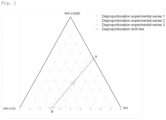
Fig. 1 is a ternary diagram that shows a compositional ratio of a mixed refrigerant subjected to a disproportionation suppression test in the Examples and a disproportionation limit line derived from the results. -
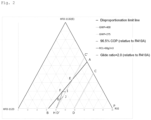
Fig. 2 is a ternary diagram that shows a compositional ratio of the composition of the present invention. - HFO-1132(E) is chemically unstable due to its unsaturated bond and may be at risk of disproportionation. As a result of intensive studies to achieve the above object, the present inventors found that disproportionation of HFO-1132 (E) is suppressed in a mixed refrigerant comprising HFO-1132(E), HFO-1123, and R32 at a specific mixing ratio.
- The present disclosure has been completed as a result of further research based on this finding. The present disclosure includes the following embodiments.
- In the present specification, the term "refrigerant" includes at least compounds that are specified in ISO 817 (International Organization for Standardization), and that are given a refrigerant number (ASHRAE number) representing the type of refrigerant with "R" at the beginning; and further includes refrigerants that have properties equivalent to those of such refrigerants, even though a refrigerant number is not yet given. Refrigerants are broadly divided into fluorocarbon compounds and non-fluorocarbon compounds in terms of the structure of the compounds. Fluorocarbon compounds include chlorofluorocarbons (CFC), hydrochlorofluorocarbons (HCFC), and hydrofluorocarbons (HFC).
- In the present specification, the phrase "composition comprising a refrigerant" at least includes (1) a refrigerant itself (including a mixture of refrigerants), (2) a composition that further comprises other components and that can be mixed with at least a refrigeration oil to obtain a working fluid for a refrigerating machine, and (3) a working fluid for a refrigerating machine containing a refrigeration oil. In the present specification, of these three embodiments, the composition (2) is referred to as a "refrigerant composition" so as to distinguish it from a refrigerant itself (including a mixture of refrigerants). Further, the working fluid for a refrigerating machine (3) is referred to as a "refrigeration oil-containing working fluid" so as to distinguish it from the "refrigerant composition."
- In the present specification, when the term "alternative" is used in a context in which the first refrigerant is replaced with the second refrigerant, the first type of "alternative" means that equipment designed for operation using the first refrigerant can be operated using the second refrigerant under optimum conditions, optionally with changes of only a few parts (at least one of the following: refrigeration oil, gasket, packing, expansion valve, dryer, and other parts) and equipment adjustment. In other words, this type of alternative means that the same equipment is operated with an alternative refrigerant. Embodiments of this type of "alternative" include "drop-in alternative," "nearly drop-in alternative," and "retrofit," in the order in which the extent of changes and adjustment necessary for replacing the first refrigerant with the second refrigerant is smaller.
- The term "alternative" also includes a second type of "alternative," which means that equipment designed for operation using the second refrigerant is operated for the same use as the existing use with the first refrigerant by using the second refrigerant. This type of alternative means that the same use is achieved with an alternative refrigerant.
- In the present specification, the term "refrigerating machine" refers to machines in general that draw heat from an object or space to make its temperature lower than the temperature of ambient air, and maintain a low temperature. In other words, refrigerating machines refer to conversion machines that gain energy from the outside to do work, and that perform energy conversion, in order to transfer heat from where the temperature is lower to where the temperature is higher.
- The unit for the pressure described in the present specification is absolute pressure (MPa), unless otherwise specified.
- In the present specification, a refrigerant having an "RCL of x% or more" means that the refrigerant has a refrigerant concentration limit (RCL), calculated in accordance with the US ANSI/ASHRAE Standard 34-2013, of x% or more. RCL refers to a concentration limit in the air in consideration of safety factors. RCL is an index for reducing the risk of acute toxicity, suffocation, and flammability in a closed space where humans are present. RCL is determined in accordance with the ASHRAE Standard. More specifically, RCL is the lowest concentration among the acute toxicity exposure limit (ATEL), the oxygen deprivation limit (ODL), and the flammable concentration limit (FCL), which are respectively calculated in accordance with sections 7.1.1, 7.1.2, and 7.1.3 of the ASHRAE Standard.
- The refrigerant according to the present disclosure is a mixed refrigerant comprising HFO-1132(E), HFO-1123, and R32.
- Since the refrigerant according to the present disclosure satisfies the following requirements, disproportionation of HFO-1132(E) is suppressed at a refrigerant pressure of 3.0 MPa.
- In the refrigerant, coordinates (x,y,z) are within the range of a figure surrounded by straight lines AB, BP, and PA that connect the following three points:
- point A (54.0, 0.0, 46.0),
- point B (0.0, 68.0, 32.0), and
- point P (0.0, 0.0, 100.0),
- or on the straight line AB (excluding the points A and B).
- Since the refrigerant according to the present disclosure satisfies the following requirements, it is not only that disproportionation of HFO-1132(E) is further suppressed at a refrigerant pressure of 3.0 MPa, but also that the GWP is 400 or less.
- In the refrigerant, coordinates (x,y,z) are within the range of a figure surrounded by straight lines AB, BD, DC, and CA that connect the following four points:
- point A (54.0, 0.0, 46.0),
- point B (0.0, 68.0, 32.0),
- point D (0.0, 40.8, 59.2), and
- point C (40.8, 0.0, 59.2),
- or on the straight lines AB and DC (excluding the points A, B, D, and C).
- Since the refrigerant according to the present disclosure satisfies the following requirements, it is not only that disproportionation of HFO-1132(E) is suppressed, but also that the GWP is 275 or less.
- In the refrigerant, coordinates (x,y,z) are within the range of a figure surrounded by straight lines EB, BD', and D'E that connect the following three points:
- point E (33.6, 25.7, 40.7),
- point B (0.0, 68.0, 32.0), and
- point D' (0.0, 59.3, 40.7),
- or on the straight lines EB and D'E (excluding the points B and D').
- Since the refrigerant according to the present disclosure satisfies the following requirements, disproportionation of HFO-1132(E) is suppressed at a refrigerant pressure of 3.0 MPa. Additionally, it is not only that the GWP is 275 or less, but also that the refrigerant concentration limit (RCL) is 60 g/m3 or more, and the COP ratio is 96.5% or more relative to that of R410A.
- The refrigerant comprises HFO-1132(E), R32, and R1234yf, and when the mass% of HFO-1132(E), R32, and R1234yf based on their sum is respectively represented by x, y, and z, coordinates (x,y,z) in a ternary composition diagram in which the sum of HFO-1132(E), R32, and R1234yf is 100 mass% are within the range of a figure surrounded by straight lines FG, GH, HD', D'I, and IF that connect the following five points:
- point F (19.5, 43.4, 37.1),
- point G (10.0, 50.8, 39.2),
- point H (0.0, 59.8, 40.2),
- point D' (0.0, 59.3, 40.7), and
- point I (19.2, 40.1, 40.7),
- or on the straight lines.
- Since the refrigerant according to the present disclosure satisfies the following requirements, disproportionation of HFO-1132(E) is suppressed. Additionally, it is not only that the GWP is 275 or less, but also that the refrigerant concentration limit (RCL) is 60 g/m3 or more, the COP ratio is 96.5% or more relative to that of R410A, and the condensation temperature glide is 2.0 or less relative to that of R410A.
- In the refrigerant, coordinates (x,y,z) are within the range of a figure surrounded by straight lines FG, GJ, JI, and IF that connect the following four points:
- point F (19.5, 43.4, 37.1),
- point G (10.0, 50.8, 39.2),
- point J (13.9, 45.4, 40.7), and
- point I (19.2, 40.1, 40.7),
- or on the straight lines.
- The refrigerant according to the present disclosure may further comprise other additional refrigerants, in addition to HFO-1132(E), HFO-1123, and R32, as long as the above properties and effects are not impaired. In this respect, the refrigerant according to the refrigerant according to the present disclosure preferably comprises HFO-1132(E), HFO-1123, and R32 in a total amount of 99.5 mass% or more, more preferably 99.75 mass% or more, even more preferably 99.9 mass% or more, still more preferably 99.99 mass% or more, and most preferably 99.999 mass% or more, based on the entire refrigerant. The refrigerant according to the present disclosure may essentially consist of HFO-1132(E), HFO-1123, and R32, or may consist of HFO-1132(E), HFO-1123, and R32. When the refrigerant according to the present disclosure essentially consists of HFO-1132(E), HFO-1123, and R32, the refrigerant may contain, in addition to HFO-1132(E), HFO-1123, and R32, impurities that are inevitably mixed during the production process thereof.
- Additional refrigerants are not limited and can be widely selected. The mixed refrigerant may contain one additional refrigerant, or two or more additional refrigerants. Examples of the additional refrigerants include acetylene, HFO-1132a, HFO-1141, HFO-1123, HFC-143a, HFC-134a, Z-HFO-1132, HFO-1243zf, HFC-245cb, HCFC-1122, HCFC-124, CFC-1113, HFC-152a, HFC-161, and 3,3,3-trifluoropropyne. The total amount of the additional refrigerants is preferably 0.5 mass% or less, more preferably 0.25 mass% or less, still more preferably 0.1 mass% or less, and most preferably 0.01 mass% or less, based on the entire refrigerant.
- The refrigerant according to the present disclosure can be preferably used as a working fluid in a refrigerating machine.
- The composition according to the present disclosure is suitable for use as an alternative refrigerant for R410A.
- The refrigerant composition according to the present disclosure comprises at least the refrigerant according to the present disclosure, and can be used for the same use as the refrigerant according to the present disclosure. Moreover, the refrigerant composition according to the present disclosure can be further mixed with at least a refrigeration oil to thereby obtain a working fluid for a refrigerating machine.
- The refrigerant composition according to the present disclosure further comprises at least one other component in addition to the refrigerant according to the present disclosure. The refrigerant composition according to the present disclosure may comprise at least one of the following other components, if necessary. As described above, when the refrigerant composition according to the present disclosure is used as a working fluid in a refrigerating machine, it is generally used as a mixture with at least a refrigeration oil. Therefore, it is preferable that the refrigerant composition according to the present disclosure does not substantially comprise a refrigeration oil. Specifically, in the refrigerant composition according to the present disclosure, the content of the refrigeration oil based on the entire refrigerant composition is preferably 1 mass% or less, and more preferably 0.1 mass% or less.
- The refrigerant composition according to the present disclosure may contain a small amount of water. The water content of the refrigerant composition is preferably 0.1 mass% or less based on the entire refrigerant. A small amount of water contained in the refrigerant composition stabilizes double bonds in the molecules of unsaturated fluorocarbon compounds that can be present in the refrigerant, and makes it less likely that the unsaturated fluorocarbon compounds will be oxidized, thus increasing the stability of the refrigerant composition.
- A tracer is added to the refrigerant composition according to the present disclosure at a detectable concentration such that when the refrigerant composition has been diluted, contaminated, or undergone other changes, the tracer can trace the changes.
- The refrigerant composition according to the present disclosure may comprise a single tracer, or two or more tracers.
- The tracer is not limited, and can be suitably selected from commonly used tracers.
- Examples of tracers include hydrofluorocarbons, hydrochlorofluorocarbons, chlorofluorocarbons, hydrochlorocarbons, fluorocarbons, deuterated hydrocarbons, deuterated hydrofluorocarbons, perfluorocarbons, fluoroethers, brominated compounds, iodinated compounds, alcohols, aldehydes, ketones, and nitrous oxide (N2O). The tracer is particularly preferably a hydrofluorocarbon, a hydrochlorofluorocarbon, a chlorofluorocarbon, a hydrochlorocarbon, a fluorocarbon, or a fluoroether.
- The following compounds are preferred as the tracer.
- FC-14 (tetrafluoromethane, CF4)
- HCC-40 (chloromethane, CH3Cl)
- HFC-23 (trifluoromethane, CHF3)
- HFC-41 (fluoromethane, CH3Cl)
- HFC-125 (pentafluoroethane, CF3CHF2)
- HFC-134a (1,1,1,2-tetrafluoroethane, CF3CH2F)
- HFC-134 (1,1,2,2-tetrafluoroethane, CHF2CHF2)
- HFC-143a (1,1,1-trifluoroethane, CF3CH3)
- HFC-143 (1,1,2-trifluoroethane, CHF2CH2F)
- HFC-152a (1,1-difluoroethane, CHF2CH3)
- HFC-152 (1,2-difluoroethane, CH2FCH2F)
- HFC-161 (fluoroethane, CH3CH2F)
- HFC-245fa (1,1,1, 3, 3-pentafluoropropane, CF3CH2CHF2)
- HFC-236fa (1,1,1, 3, 3, 3-hexafluoropropane, CF3CH2CF3)
- HFC-236ea (1,1,1,2,3,3-hexafluoropropane, CF3CHFCHF2)
- HFC-227ea (1,1,1,2,3,3,3-heptafluoropropane, CF3CHFCF3)
- HCFC-22 (chlorodifluoromethane, CHClF2)
- HCFC-31 (chlorofluoromethane, CH2ClF)
- CFC-1113 (chlorotrifluoroethylene, CF2=CClF)
- HFE-125 (trifluoromethyl-difluoromethyl ether, CF3OCHF2)
- HFE-134a (trifluoromethyl-fluoromethyl ether, CF3OCH2F)
- HFE-143a (trifluoromethyl-methyl ether, CF3OCH3)
- HFE-227ea (trifluoromethyl-tetrafluoroethyl ether, CF3OCHFCF3)
- HFE-236fa (trifluoromethyl-trifluoroethyl ether, CF3OCH2CF3)
- The refrigerant composition according to the present disclosure may comprise one or more tracers at a total concentration of about 10 parts per million by weight (ppm) or more and about 1000 ppm or less, based on the entire refrigerant composition. The refrigerant composition according to the present disclosure preferably comprises one or more tracers at a total concentration of about 30 ppm or more, and more preferably about 50 ppm or more, based on the entire refrigerant composition. The refrigerant composition according to the present disclosure preferably comprises one or more tracers at a total concentration of about 500 ppm or less, and more preferably about 300 ppm or less, based on the entire refrigerant composition.
- The refrigerant composition according to the present disclosure may comprise a single ultraviolet fluorescent dye, or two or more ultraviolet fluorescent dyes.
- The ultraviolet fluorescent dye is not limited, and can be suitably selected from commonly used ultraviolet fluorescent dyes.
- Examples of ultraviolet fluorescent dyes include naphthalimide, coumarin, anthracene, phenanthrene, xanthene, thioxanthene, naphthoxanthene, fluorescein, and derivatives thereof. The ultraviolet fluorescent dye is particularly preferably either naphthalimide or coumarin, or both.
- The refrigerant composition according to the present disclosure may comprise a single stabilizer, or two or more stabilizers.
- The stabilizer is not limited, and can be suitably selected from commonly used stabilizers.
- Examples of stabilizers include nitro compounds, ethers, and amines.
- Examples of nitro compounds include aliphatic nitro compounds, such as nitromethane and nitroethane; and aromatic nitro compounds, such as nitro benzene and nitro styrene.
- Examples of ethers include 1,4-dioxane.
- Examples of amines include 2,2,3,3,3-pentafluoropropylamine and diphenylamine.
- Examples of stabilizers also include butylhydroxyxylene and benzotriazole.
- The content of the stabilizer is not limited. Generally, the content of the stabilizer is preferably 0.01 mass% or more, and more preferably 0.05 mass% or more, based on the entire refrigerant. Generally, the content of the stabilizer is preferably 5 mass% or less, and more preferably 2 mass% or less, based on the entire refrigerant.
- The refrigerant composition according to the present disclosure may comprise a single polymerization inhibitor, or two or more polymerization inhibitors.
- The polymerization inhibitor is not limited, and can be suitably selected from commonly used polymerization inhibitors.
- Examples of polymerization inhibitors include 4-methoxy-1-naphthol, hydroquinone, hydroquinone methyl ether, dimethyl-t-butylphenol, 2,6-di-tert-butyl-p-cresol, and benzotriazole.
- The content of the polymerization inhibitor is not limited. Generally, the content of the polymerization inhibitor is preferably 0.01 mass% or more, and more preferably 0.05 mass% or more, based on the entire refrigerant. Generally, the content of the polymerization inhibitor is preferably 5 mass% or less, based on the entire refrigerant.
- The refrigeration oil-containing working fluid according to the present disclosure comprises at least the refrigerant or refrigerant composition according to the present disclosure and a refrigeration oil, for use as a working fluid in a refrigerating machine. Specifically, the refrigeration oil-containing working fluid according to the present disclosure is obtained by mixing a refrigeration oil used in a compressor of a refrigerating machine with the refrigerant or the refrigerant composition. The refrigeration oil-containing working fluid generally comprises 10 mass% or more and 50 mass% or less of refrigeration oil.
- The composition according to the present disclosure may comprise a single refrigeration oil, or two or more refrigeration oils.
- The refrigeration oil is not limited, and can be suitably selected from commonly used refrigeration oils. In this case, refrigeration oils that are superior in the action of increasing the miscibility with the mixture and the stability of the mixture, for example, are suitably selected as necessary.
- The base oil of the refrigeration oil is preferably, for example, at least one member selected from the group consisting of polyalkylene glycols (PAG), polyol esters (POE), and polyvinyl ethers (PVE).
- The refrigeration oil may further contain additives in addition to the base oil. The additive may be at least one member selected from the group consisting of antioxidants, extremepressure agents, acid scavengers, oxygen scavengers, copper deactivators, rust inhibitors, oil agents, and antifoaming agents.
- A refrigeration oil with a kinematic viscosity of 5 cSt or more at 40°C is preferable from the standpoint of lubrication. A refrigeration oil with a kinematic viscosity of 400 cSt or less at 40°C is preferable from the standpoint of lubrication.
- The refrigeration oil-containing working fluid according to the present disclosure may further optionally contain at least one additive. Examples of additives include the compatibilizing agents described below.
- The refrigeration oil-containing working fluid according to the present disclosure may comprise a single compatibilizing agent, or two or more compatibilizing agents.
- The compatibilizing agent is not limited, and can be suitably selected from commonly used compatibilizing agents.
- Examples of compatibilizing agents include polyoxyalkylene glycol ethers, amides, nitriles, ketones, chlorocarbons, esters, lactones, aryl ethers, fluoroethers, and 1,1,1-trifluoroalkanes. The compatibilizing agent is particularly preferably a polyoxyalkylene glycol ether.
- The method for operating a refrigerating machine according to the present disclosure is a method for operating a refrigerating machine using the refrigerant according to the present disclosure.
- Specifically, the method for operating a refrigerating machine according to the present disclosure comprises the step of circulating the refrigerant according to the present disclosure in a refrigerating machine.
- The method for suppressing a disproportionation reaction according to the present disclosure is a method for suppressing a disproportionation reaction of HFO-1132(E), the method comprising operating a refrigeration cycle using the refrigerant according to the present disclosure.
- The method for suppressing a disproportionation reaction according to the present disclosure produces an effect of preventing a disproportionation reaction of HFO-1132(E) from occurring, in particular, at a refrigerant pressure of 3.0 MPa.
- By the method for suppressing a disproportionation reaction according to the present disclosure, a refrigeration cycle can be operated in a refrigerating machine that has no particular means for suppressing a disproportionation reaction.
- The use according to the present disclosure is use of HFO-1123 and/or R32 in suppressing a disproportionation reaction of HFO-1132(E); the suppression of the disproportionation reaction is performed by mixing HFO-1132(E), HFO-1123, and R32 such that the mixing ratio thereof is equal to that used in the refrigerant according to the present disclosure.
- The use in suppressing a disproportionation reaction according to the present disclosure produces an effect of preventing a disproportionation reaction of HFO-1132(E) from occurring, in particular, at a refrigerant pressure of 3.0 MPa.
- The embodiments are described above; however, it will be understood that various changes in forms and details can be made without departing from the spirit and scope of the claims.
- The present disclosure is described in more detail below with reference to Examples. However, the present disclosure is not limited to the Examples.
- Mixed refrigerants were prepared by mixing HFO-1132(E), HFO-1123, and R32 at mass% shown in Tables 1 to 3 based on their sum.
- Each of these mixed refrigerants was examined for the presence or absence of disproportionation reaction by using the following test methods under the following test conditions. Table 1 and
Fig. 1 show the results. - A refrigerant composition to be tested was transferred to a test container and heated to 150°C. Subsequently, a Pt wire in the container was melted and cut by applying a voltage, giving the refrigerant composition 30 J of energy. The presence or absence of disproportionation reaction was determined based on a rapid increase in the pressure and temperature in the apparatus.
-
- Test container: 38-cc SUS container
- Test temperature: 150°C
- Pressure: 3 MPa
-
- Non-explosion: The temperature or pressure increased to less than twice after the melting and cutting of the Pt wire, and no rapid disproportionation reaction occurred.
- Explosion: The temperature or pressure increased to twice or more after the melting and cutting of the Pt wire, and a rapid disproportionation reaction occurred.
- For each of these mixed refrigerants, the COP ratio and the refrigerating capacity ratio relative to those of R410 were determined. The calculation conditions were as follows.
- Evaporating temperature: 5°C
- Condensation temperature: 45°C
- Superheating temperature: 5 K
- Supercooling temperature: 5 K
- Compressor efficiency: 70%
- Tables 2 to 4 show these values, together with the GWP of each mixed refrigerant. Table 4 also shows the results of examining the presence or absence of disproportionation reaction.
Table 2 Item Unit Comp. Ex. 9 Comp. Ex. 2 Comp. Ex. 7 Comp. Ex. 10 Comp. Ex. 11 Comp. Ex. 12 Comp. Ex. 13 A B C D C D' HFO-1132 (E) mass% R410A 540 0.0 40.8 0.0 59.3 0.0 HFO-1123 mass% 0.0 68.0 0.0 40.8 0.0 59.3 R32 mass% 460 32.0 59.2 59.2 40.7 40.7 GWP - 2088 311 217 400 400 275 275 COP ratio %(relative to R410A) 100.0 98.9 95.4 99.6 98.8 98.8 96.6 Refrigerating capacity ratio %(relative to R410A) 100.0 111.4 115.3 112.6 114.5 110.6 115.5 Condensation temperature glide ratio (relative to R410A) 1.00 0.04 1.41 0.26 3.89 0.24 2.43 RCL g/m3 - 41.8 79.7 46.6 76.6 40.1 78.7 Table 3 Item Unit Ex. 4 Ex. 5 Ex. 6 Comp. Ex. 14 Ex. 7 Ex. 8 E F G H I J HFO-1132 (E) mass% 33.6 19.5 10.0 0.0 19.2 13.9 HFO-1123 mass% 25.7 43.4 50.8 59.8 40.1 45.4 R32 mass% 40.7 37.1 39.2 40.2 40.7 40.7 GWP - 275 251 265 272 275 275 COP ratio % (relative to R410A) 97.5 96.5 96.5 96.5 96.9 96.8 Refrigerating capacity ratio % (relative to R410A) 113.4 114.6 115.1 115.5 114.6 114.9 Condensation temperature glide ratio (relative to R410A) 1.28 1.59 2.00 2.37 1.81 2.00 RCL g/m3 51.0 60.0 67.9 78.8 60.0 64.2 Table 4 Item Unit Comp. Ex. 15 Ex. 9 Ex. 10 Comp. Ex. 16 Ex. 11 Ex. 12 HFO-1132 (E) mass% 33.6 19.5 10.0 0.0 19.2 13.9 HFO-1123 mass% 25.7 43.4 508 59.8 40.1 45.4 R32 mass% 40.7 37.1 39.2 40.2 40.7 40.7 GWP - 275 251 265 272 275 275 COP ratio %(relative to R410A) 97.5 96.5 96.5 96.5 96.9 96.8 Refrigerating capacity ratio %(relative to R410A) 113.4 114.6 115.1 115.5 114.6 114.9 Condensation temperature glide ratio (relative to R410A) 1.28 1.59 200 2.37 1.81 200 RCL g/m3 51.0 600 67.9 78.8 600 64.2 Disproportionation reaction (3 Mpa) - Explosion Non-explosion Non-explosion Explosion Non-explosion Non-explosion - These results indicate that in a mixed refrigerant of HFO-1132(E), HFO-1123, and R32 that satisfies the following requirements, disproportionation of HFO-1132(E) is suppressed at a refrigerant pressure of 3.0 MPa.
- In the refrigerant, coordinates (x,y,z) are within the range of a figure surrounded by straight lines AB, BP, and PA that connect the following three points:
- point A (54.0, 0.0, 46.0),
- point B (0.0, 68.0, 32.0), and
- point P (0.0, 0.0, 100.0),
- or on the straight line AB (excluding the points A and B).
- These results indicate that in a mixed refrigerant of HFO-1132(E), HFO-1123, and R32 that satisfies the following requirements, it is not only that disproportionation of HFO-1132(E) is suppressed at a refrigerant pressure of 3.0 MPa, but also that the GWP is 400 or less.
- In the refrigerant, coordinates (x,y,z) are within the range of a figure surrounded by straight lines AB, BD, DC, and CA that connect the following four points:
- point A (54.0, 0.0, 46.0),
- point B (0.0, 68.0, 32.0),
- point D (0.0, 40.8, 59.2), and
- point C (40.8, 0.0, 59.2),
- or on the straight lines AB and DC (excluding the points A, B, D, and C).
- These results indicate that in a mixed refrigerant of HFO-1132(E), HFO-1123, and R32 that satisfies the following requirements, it is not only that disproportionation of HFO-1132(E) is suppressed, but also that the GWP is 275 or less.
- In the refrigerant, coordinates (x,y,z) are within the range of a figure surrounded by straight lines EB, BD', and D'E that connect the following three points:
- point E (33.6, 25.7, 40.7),
- point B (0.0, 68.0, 32.0), and
- point D' (0.0, 59.3, 40.7),
- or on the straight lines EB and D'E (excluding the points B and D').
- These results indicate that in a mixed refrigerant of HFO-1132(E), HFO-1123, and R32 that satisfies the following requirements, disproportionation of HFO-1132(E) is suppressed. Additionally, it is not only that the GWP is 275 or less, but also that the refrigerant concentration limit (RCL) is 60 g/m3 or more, and the COP ratio is 96.5% or more relative to that of R410A.
- The refrigerant comprises HFO-1132(E), R32, and R1234yf, and when the mass% of HFO-1132(E), R32, and R1234yf based on their sum is respectively represented by x, y, and z, coordinates (x,y,z) in a ternary composition diagram in which the sum of HFO-1132(E), R32, and R1234yf is 100 mass% are within the range of a figure surrounded by straight lines FG, GH, HD', D'I, and IF that connect the following five points:
- point F (19.5, 43.4, 37.1),
- point G (10.0, 50.8, 39.2),
- point H (0.0, 59.8, 40.2),
- point D' (0.0, 59.3, 40.7), and
- point I (19.2, 40.1, 40.7),
- or on the straight lines.
- These results indicate that in a mixed refrigerant of HFO-1132(E), HFO-1123, and R32 that satisfies the following requirements, disproportionation of HFO-1132(E) is suppressed. Additionally, it is not only that the GWP is 275 or less, but also that the refrigerant concentration limit (RCL) is 60 g/m3 or more, the COP ratio is 96.5% or more relative to that of R410A, and the condensation temperature glide is 2.0 or less relative to that of R410A.
- In the refrigerant, coordinates (x,y,z) are within the range of a figure surrounded by straight lines FG, GJ, JI, and IF that connect the following four points:
- point F (19.5, 43.4, 37.1),
- point G (10.0, 50.8, 39.2),
- point J (13.9, 45.4, 40.7), and
- point I (19.2, 40.1, 40.7),
- or on the straight lines.
| Item | | Experimental Series | 1 | |
|
||||||||||
| Comp. Ex. 1 | Comp. Ex. 2 | Comp. Ex. 3 | Comp. Ex. 4 | Comp. Ex.5 | Ex. 1 | Ex.2 | Ex.3 | Comp. Ex. 6 | Comp. Ex. 7 | Comp. Ex. B | |||||
| HFO-1132(E〉 | mass% | 56.0 | 54.0 | 52.0 | 29.0 | 27.0 | 27.0 | 27.0 | 25.0 | 0.0 | 0.0 | 0.0 | |||
| HFO-1123 | mass% | 0.0 | 0.0 | 0.0 | 34.0 | 36.0 | 34.0 | 32.0 | 34.0 | 66.0 | 68.0 | 700 | |||
| R32 | mass% | 44.0 | 46.0 | 48.0 | 37.0 | 37.0 | 39.0 | 41.0 | 41.0 | 34.0 | 32.0 | 30.0 | |||
| Disproportionation reaction (3 Mpa) | - | Explosion | Non-explosion | Non-explosion | Explosion | Explosion | Non-explosion | Non-explosion | Non-explosion | Explosion | Non-explosion | Non-explosion | |||
Claims (27)
- A method for suppressing a disproportionation reaction of HFO-1132(E), the method comprising operating a refrigeration cycle using a composition comprising a refrigerant,the refrigerant comprising trans-1,2-difluoroethylene (HFO-1132(E)), trifluoroethylene (HFO-1123), and difluoromethane (R32),whereinwhen the mass% of HFO-1132(E), HFO-1123, and R32 based on their sum is respectively represented by x, y, and z, coordinates (x,y,z) in a ternary composition diagram in which the sum of HFO-1132(E), HFO-1123, and R32 is 100 mass% are within the range of a figure surrounded by straight lines AB, BP, and PA that connect the following three points:point A (54.0, 0.0, 46.0),point B (0.0, 68.0, 32.0), andpoint P (0.0, 0.0, 100.0),or on the straight line AB (excluding the points A and B).
- The method according to claim 1, wherein in the refrigerant, coordinates (x,y,z) are within the range of a figure surrounded by straight lines AB, BD, DC and CA that connect the following four points:point A (54.0, 0.0, 46.0),point B (0.0, 68.0, 32.0),point D (0.0, 40.8, 59.2), andpoint C (40.8, 0.0, 59.2),or on the straight lines AB and DC (excluding the points A, B, D, and C).
- The method according to claim 1, wherein in the refrigerant, coordinates (x,y,z) are within the range of a figure surrounded by straight lines EB, BD', and D'E that connect the following three points:point E (33.6, 25.7, 40.7),point B (0.0, 68.0, 32.0), andpoint D' (0.0, 59.3, 40.7),or on the straight lines EB and D'E (excluding the points B and D') .
- The method according to claim 1, wherein in the refrigerant, coordinates (x,y,z) are within the range of a figure surrounded by straight lines FG, GH, HD', D'I, and IF that connect the following five points:point F (19.5, 43.4, 37.1),point G (10.0, 50.8, 39.2),point H (0.0, 59.8, 40.2),point D' (0.0, 59.3, 40.7), andpoint I (19.2, 40.1, 40.7),or on the straight lines (excluding the points H and D' and the straight line HD').
- The method according to claim 1, wherein in the refrigerant, coordinates (x,y,z) are within the range of a figure surrounded by straight lines FG, GJ, JI, and IF that connect the following four points:point F (19.5, 43.4, 37.1),point G (10.0, 50.8, 39.2),point J (13.9, 45.4, 40.7), andpoint I (19.2, 40.1, 40.7),or on the straight lines.
- Use of a composition comprising a refrigerant for suppressing a disproportionation reaction of HFO-1132(E),the refrigerant comprising HFO-1132(E), HFO-1123, and R32,whereinwhen the mass% of HFO-1132(E), HFO-1123, and R32 based on their sum is respectively represented by x, y, and z, coordinates (x,y,z) in a ternary composition diagram in which the sum of HFO-1132(E), HFO-1123, and R32 is 100 mass% are within the range of a figure surrounded by straight lines AB, BP, and PA that connect the following three points:point A (54.0, 0.0, 46.0),point B (0.0, 68.0, 32.0), andpoint P (0.0, 0.0, 100.0),or on the straight line AB (excluding the points A and B).
- The use according to claim 6, wherein in the refrigerant, coordinates (x,y,z) are within the range of a figure surrounded by straight lines AB, BD, DC, and CA that connect the following four points:point A (54.0, 0.0, 46.0),point B (0.0, 68.0, 32.0),point D (0.0, 40.8, 59.2), andpoint C (40.8, 0.0, 59.2),or on the straight lines AB and DC (excluding the points A, B, D, and C).
- The use according to claim 6, wherein in the refrigerant, coordinates (x,y,z) are within the range of a figure surrounded by straight lines EB, BD', and D'E that connect the following three points:point E (33.6, 25.7, 40.7),point B (0.0, 68.0, 32.0), andpoint D' (0.0, 59.3, 40.7),or on the straight lines EB and D'E (excluding the points B and D').
- The use according to claim 6, wherein in the refrigerant, coordinates (x,y,z) are within the range of a figure surrounded by straight lines FG, GH, HD', D'I, and IF that connect the following five points:point F (19.5, 43.4, 37.1),point G (10.0, 50.8, 39.2),point H (0.0, 59.8, 40.2),point D' (0.0, 59.3, 40.7), andpoint I (19.2, 40.1, 40.7),or on the straight lines.
- The use according to claim 6, wherein in the refrigerant, coordinates (x,y,z) are within the range of a figure surrounded by straight lines FG, GJ, JI, and IF that connect the following four points:point F (19.5, 43.4, 37.1),point G (10.0, 50.8, 39.2),point J (13.9, 45.4, 40.7), andpoint I (19.2, 40.1, 40.7),or on the straight lines.
- Use of HFO-1123 and/or R32 for suppressing a disproportionation reaction of HFO-1132(E),the disproportionation reaction being suppressed by mixing HFO-1132(E), HFO-1123, and R32 such thatwhen the mass% of HFO-1132(E), HFO-1123, and R32 based on their sum is respectively represented by x, y, and z, coordinates (x,y,z) in a ternary composition diagram in which the sum of HFO-1132(E), HFO-1123, and R32 is 100 mass% are within the range of a figure surrounded by straight lines AB, BP, and PA that connect the following three points:point A (54.0, 0.0, 46.0),point B (0.0, 68.0, 32.0), andpoint P (0.0, 0.0, 100.0),or on the straight line AB (excluding the points A and B).
- The use according to claim 11, wherein in the refrigerant, coordinates (x,y,z) are within the range of a figure surrounded by straight lines AB, BD, DC, and CA that connect the following four points:point A (54.0, 0.0, 46.0),point B (0.0, 68.0, 32.0),point D (0.0, 40.8, 59.2), andpoint C (40.8, 0.0, 59.2),or on the straight lines AB and DC (excluding the points A, B, D, and C).
- The use according to claim 11, wherein in the refrigerant, coordinates (x,y,z) are within the range of a figure surrounded by straight lines EB, BD', and D'E that connect the following three points:point E (33.6, 25.7, 40.7),point B (0.0, 68.0, 32.0), andpoint D' (0.0, 59.3, 40.7),or on the straight lines EB and D'E (excluding the points B and D').
- The use according to claim 11, wherein in the refrigerant, coordinates (x,y,z) are within the range of a figure surrounded by straight lines FG, GH, HD', D'I, and IF that connect the following five points:point F (19.5, 43.4, 37.1),point G (10.0, 50.8, 39.2),point H (0.0, 59.8, 40.2),point D' (0.0, 59.3, 40.7), andpoint I (19.2, 40.1, 40.7),or on the straight lines (excluding points H and D', and the straight line HD').
- The use according to claim 11, wherein in the refrigerant, coordinates (x,y,z) are within the range of a figure surrounded by straight lines FG, GJ, JI, and IF that connect the following four points:point F (19.5, 43.4, 37.1),point G (10.0, 50.8, 39.2),point J (13.9, 45.4, 40.7), andpoint I (19.2, 40.1, 40.7),or on the straight lines.
- A composition comprising HFO-1123 and/or R32, the composition being for use in suppressing a disproportionation reaction of HFO-1132(E),the disproportionation reaction being suppressed by mixing HFO-1132(E), HFO-1123, and R32 such thatwhen the mass% of HFO-1132(E), HFO-1123, and R32 based on their sum is respectively represented by x, y, and z, coordinates (x,y,z) in a ternary composition diagram in which the sum of HFO-1132(E), HFO-1123, and R32 is 100 mass% are within the range of a figure surrounded by straight lines AB, BP, and PA that connect the following three points:point A (54.0, 0.0, 46.0),point B (0.0, 68.0, 32.0), andpoint P (0.0, 0.0, 100.0),or on the straight line AB (excluding the points A and B).
- The composition according to claim 16, wherein in the refrigerant, coordinates (x,y,z) are within the range of a figure surrounded by straight lines AB, BD, DC, and CA that connect the following four points:point A (54.0, 0.0, 46.0),point B (0.0, 68.0, 32.0),point D (0.0, 40.8, 59.2), andpoint C (40.8, 0.0, 59.2),or on the straight lines AB and DC (excluding the points A, B, D, and C).
- The composition according to claim 16, wherein in the refrigerant, coordinates (x,y,z) are within the range of a figure surrounded by straight lines EB, BD', and D'E that connect the following three points:point E (33.6, 25.7, 40.7),point B (0.0, 68.0, 32.0), andpoint D' (0.0, 59.3, 40.7),or on the straight lines EB and D'E (excluding the points B and D').
- The composition according to claim 16, wherein in the refrigerant, coordinates (x,y,z) are within the range of a figure surrounded by straight lines FG, GH, HD', D'I, and IF that connect the following five points:point F (19.5, 43.4, 37.1),point G (10.0, 50.8, 39.2),point H (0.0, 59.8, 40.2),point D' (0.0, 59.3, 40.7), andpoint I (19.2, 40.1, 40.7),or on the straight lines (excluding the points H and D', and the straight line HD').
- The composition according to claim 16, wherein in the refrigerant, coordinates (x,y,z) are within the range of a figure surrounded by straight lines FG, GJ, JI, and IF that connect the following four points:point F (19.5, 43.4, 37.1),point G (10.0, 50.8, 39.2),point J (13.9, 45.4, 40.7), andpoint I (19.2, 40.1, 40.7),or on the straight lines.
- A composition comprising a refrigerant,the refrigerant comprising HFO-1132(E), R32, and R1234yf,whereinwhen the mass% of HFO-1132(E), R32, and R1234yf based on their sum is respectively represented by x, y, and z, coordinates (x,y,z) in a ternary composition diagram in which the sum of HFO-1132(E), R32, and R1234yf is 100 mass% are within the range of a figure surrounded by straight lines FG, GH, HD', D'I, and IF that connect the following five points:point F (19.5, 43.4, 37.1),point G (10.0, 50.8, 39.2),point H (0.0, 59.8, 40.2),point D' (0.0, 59.3, 40.7), andpoint I (19.2, 40.1, 40.7),or on the straight lines (excluding the points H and D', and the straight line HD').
- The composition according to claim 21, wherein in the refrigerant, coordinates (x,y,z) are within the range of a figure surrounded by straight lines FG, GJ, JI, and IF that connect the following four points:point F (19.5, 43.4, 37.1),point G (10.0, 50.8, 39.2),point J (13.9, 45.4, 40.7), andpoint I (19.2, 40.1, 40.7),or on the straight lines.
- The composition according to any one of claims 20 to 22 for use as a working fluid for a refrigerating machine, wherein the composition further comprises a refrigeration oil.
- The composition according to any one of claims 20 to 23, for use as an alternative refrigerant for R410A.
- Use of the composition according to any one of claims 4 to 6 as an alternative refrigerant for R410A.
- A refrigerating machine comprising the composition according to any one of claims 20 to 23 as a working fluid.
- A method for operating a refrigerating machine, comprising circulating the composition according to any one of claims 20 to 23 as a working fluid in a refrigerating machine.
Applications Claiming Priority (2)
| Application Number | Priority Date | Filing Date | Title |
|---|---|---|---|
| JP2021037767 | 2021-03-09 | ||
| PCT/JP2022/010104 WO2022191211A1 (en) | 2021-03-09 | 2022-03-08 | Refrigerant-containing composition, use thereof, refrigerator having said composition, and method for operating said refrigerator |
Publications (2)
| Publication Number | Publication Date |
|---|---|
| EP4306872A1 true EP4306872A1 (en) | 2024-01-17 |
| EP4306872A4 EP4306872A4 (en) | 2024-08-14 |
Family
ID=83226815
Family Applications (1)
| Application Number | Title | Priority Date | Filing Date |
|---|---|---|---|
| EP22767165.8A Withdrawn EP4306872A4 (en) | 2021-03-09 | 2022-03-08 | COOLANT-CONTAINING COMPOSITION, USE THEREOF, REFRIGERATOR COMPRISING SAID COMPOSITION AND METHOD FOR OPERATING SAID REFRIGERATOR |
Country Status (5)
| Country | Link |
|---|---|
| US (1) | US12410352B2 (en) |
| EP (1) | EP4306872A4 (en) |
| JP (2) | JP7769567B2 (en) |
| CN (1) | CN116964174A (en) |
| WO (1) | WO2022191211A1 (en) |
Families Citing this family (1)
| Publication number | Priority date | Publication date | Assignee | Title |
|---|---|---|---|---|
| EP4582430A1 (en) | 2022-08-31 | 2025-07-09 | Kyoto University | Compound, endoplasmic reticulum stress inhibitor, pharmaceutical product, ophthalmic agent, eye drops, composition, and method for producing compound |
Family Cites Families (16)
| Publication number | Priority date | Publication date | Assignee | Title |
|---|---|---|---|---|
| WO2012157763A1 (en) * | 2011-05-19 | 2012-11-22 | 旭硝子株式会社 | Working medium and heat-cycle system |
| BR112013029408A2 (en) | 2011-05-19 | 2017-01-31 | Asahi Glass Co Ltd | working medium and heat cycle system |
| CN110373159B (en) * | 2013-07-12 | 2021-08-10 | Agc株式会社 | Working medium for heat cycle, composition for heat cycle system, and heat cycle system |
| CN106133110B (en) * | 2014-03-18 | 2020-06-02 | Agc株式会社 | Working medium for thermal cycle, composition for thermal cycle system, and thermal cycle system |
| CN107532074A (en) | 2015-05-14 | 2018-01-02 | 旭硝子株式会社 | Fluid composition, refrigerant composition earl august eugene lund ian robert and air conditioner |
| JP6582236B2 (en) * | 2015-06-11 | 2019-10-02 | パナソニックIpマネジメント株式会社 | Refrigeration cycle equipment |
| JP2017133827A (en) * | 2017-03-02 | 2017-08-03 | 三菱電機株式会社 | Heat pump equipment |
| JP7269499B2 (en) | 2017-12-18 | 2023-05-09 | ダイキン工業株式会社 | refrigeration cycle equipment |
| AU2018392046B2 (en) * | 2017-12-18 | 2022-05-19 | Daikin Industries, Ltd. | Composition comprising refrigerant, use thereof, refrigerating machine having same, and method for operating said refrigerating machine |
| WO2019123897A1 (en) | 2017-12-18 | 2019-06-27 | ダイキン工業株式会社 | Refrigeration cycle device |
| US20200392388A1 (en) * | 2017-12-18 | 2020-12-17 | Daikin Industries, Ltd. | Refrigerant-containing composition, use thereof and refrigerator comprising same, and method for operating said refrigerator |
| JP6617849B1 (en) * | 2018-06-22 | 2019-12-11 | ダイキン工業株式会社 | Composition comprising refrigerant, use thereof, refrigerator having the same, and method of operating the refrigerator |
| WO2020256133A1 (en) | 2019-06-19 | 2020-12-24 | ダイキン工業株式会社 | Composition containing refrigerant, use of same, freezer having same, and method for operating said freezer |
| JP6897850B2 (en) | 2019-06-19 | 2021-07-07 | ダイキン工業株式会社 | A composition containing a refrigerant, its use, a refrigerator having it, and a method of operating the refrigerator. |
| WO2020256134A1 (en) * | 2019-06-19 | 2020-12-24 | ダイキン工業株式会社 | Working medium for refrigeration cycle, and refrigeration cycle system |
| JP6978706B2 (en) | 2019-06-19 | 2021-12-08 | ダイキン工業株式会社 | A composition containing a refrigerant, its use, a refrigerator having it, a method of operating the refrigerator, and a refrigerating cycle device having it. |
-
2022
- 2022-03-08 CN CN202280019731.3A patent/CN116964174A/en active Pending
- 2022-03-08 WO PCT/JP2022/010104 patent/WO2022191211A1/en not_active Ceased
- 2022-03-08 JP JP2022035505A patent/JP7769567B2/en active Active
- 2022-03-08 EP EP22767165.8A patent/EP4306872A4/en not_active Withdrawn
- 2022-12-06 JP JP2022194935A patent/JP2023016941A/en not_active Withdrawn
-
2023
- 2023-09-08 US US18/244,062 patent/US12410352B2/en active Active
Also Published As
| Publication number | Publication date |
|---|---|
| CN116964174A (en) | 2023-10-27 |
| US12410352B2 (en) | 2025-09-09 |
| JP7769567B2 (en) | 2025-11-13 |
| JP2023016941A (en) | 2023-02-02 |
| US20240010896A1 (en) | 2024-01-11 |
| WO2022191211A1 (en) | 2022-09-15 |
| JP2022138149A (en) | 2022-09-22 |
| EP4306872A4 (en) | 2024-08-14 |
Similar Documents
| Publication | Publication Date | Title |
|---|---|---|
| EP3730578B1 (en) | Composition containing refrigerant, use of said composition, refrigerator having said composition, and method for operating said refrigerator | |
| EP3730586A1 (en) | Coolant-containing composition, use for same, refrigerator having same, and method for operating refrigerator | |
| EP3730582B1 (en) | Refrigerant-containing composition, use thereof, refrigerating machine having same, and method for operating said refrigerating machine | |
| EP3730574A1 (en) | Composition comprising refrigerant, use thereof, refrigerating machine having same, and method for operating said refrigerating machine | |
| EP4592615A2 (en) | Composition containing refrigerant, use thereof, refrigerator having same, and operation method for said refrigerator | |
| EP4227602A1 (en) | Refrigerant-containing composition, use thereof, refrigerator having same, and method for operating said refrigerator | |
| EP4397920A1 (en) | Composition containing refrigerant, use of same, refrigerator having same, and method for operating said refrigerator | |
| US20240043728A1 (en) | Refrigerant-containing composition, use thereof, refrigerator having said composition, and method for operating said refrigerator | |
| EP3957700A1 (en) | Composition including refrigerant, use thereof, refrigerator having same, and method for operating said refrigerator | |
| EP4191162A1 (en) | Refrigerant-containing composition, use thereof, refrigerator having same, and method for operating said refrigerator | |
| US20210363396A1 (en) | Composition containing trans-1,2-difluoroethylene (hfo-1132(e)) and 1,1,1-trifluoroethane (hfc-143a) and method for separating hfo-1132(e) and hfc-143a from composition containing hfo-1132(e) and hfc-143a | |
| EP4592614A2 (en) | Composition containing refrigerant, use of same, refrigerator comprising same, and method for operating refrigerator | |
| US12410352B2 (en) | Refrigerant-containing composition, use thereof, refrigerator having said composition, and method for operating said refrigerator | |
| EP4245820A1 (en) | Refrigerant-containing composition, use thereof, refrigerator having said composition, and operating method for refrigerator | |
| EP4663717A1 (en) | Refrigerant-containing composition, use of same, freezer having same, and method for operating freezer | |
| EP4410925A1 (en) | Refrigerant-containing composition, use of same, refrigerator comprising same, and method for operating refrigerator | |
| EP4306871A1 (en) | Composition containing refrigerant, use of same, refrigerator comprising same, and method for operating said refrigerator | |
| EP4261476B1 (en) | Refrigerant-containing composition, use thereof, refrigerator having same, and method for operating said refrigerator | |
| EP4596651A1 (en) | Refrigerant-containing composition, use of same, refrigerator comprising same, and method for operating refrigerator | |
| JP7824537B2 (en) | Refrigerant-containing composition, its use, refrigeration method, and refrigeration device | |
| EP4190878A1 (en) | Refrigerant-containing composition, use thereof, refrigerator having same, and method for operating said refrigerator | |
| EP4481013A1 (en) | Refrigerant-containing composition, use of same, refrigerator comprising same, and method for operating refrigerator | |
| JP2026067850A (en) | A composition containing a refrigerant, its use, and a refrigerator having the same, and a method of operating the refrigerator. | |
| JP2026067849A (en) | A composition containing a refrigerant, its use, and a refrigerator having the same, and a method of operating the refrigerator. | |
| JP2024095636A (en) | COMPOSITIONS CONTAINING REFRIGERANTS, USES THEREOF, AND REFRIGERATORS HAVING SAME AND METHOD FOR OPERATION OF SAME - Patent application |
Legal Events
| Date | Code | Title | Description |
|---|---|---|---|
| STAA | Information on the status of an ep patent application or granted ep patent |
Free format text: STATUS: THE INTERNATIONAL PUBLICATION HAS BEEN MADE |
|
| PUAI | Public reference made under article 153(3) epc to a published international application that has entered the european phase |
Free format text: ORIGINAL CODE: 0009012 |
|
| STAA | Information on the status of an ep patent application or granted ep patent |
Free format text: STATUS: REQUEST FOR EXAMINATION WAS MADE |
|
| 17P | Request for examination filed |
Effective date: 20231009 |
|
| AK | Designated contracting states |
Kind code of ref document: A1 Designated state(s): AL AT BE BG CH CY CZ DE DK EE ES FI FR GB GR HR HU IE IS IT LI LT LU LV MC MK MT NL NO PL PT RO RS SE SI SK SM TR |
|
| DAV | Request for validation of the european patent (deleted) | ||
| DAX | Request for extension of the european patent (deleted) | ||
| P01 | Opt-out of the competence of the unified patent court (upc) registered |
Free format text: CASE NUMBER: APP_38389/2024 Effective date: 20240627 |
|
| A4 | Supplementary search report drawn up and despatched |
Effective date: 20240711 |
|
| RIC1 | Information provided on ipc code assigned before grant |
Ipc: C09K 5/04 20060101ALI20240705BHEP Ipc: F25B 1/00 20060101AFI20240705BHEP |
|
| STAA | Information on the status of an ep patent application or granted ep patent |
Free format text: STATUS: EXAMINATION IS IN PROGRESS |
|
| 17Q | First examination report despatched |
Effective date: 20250314 |
|
| STAA | Information on the status of an ep patent application or granted ep patent |
Free format text: STATUS: THE APPLICATION HAS BEEN WITHDRAWN |
|
| 18W | Application withdrawn |
Effective date: 20250806 |