EP4306842A1 - Method for filling a vessel with a cryogenic liquid - Google Patents
Method for filling a vessel with a cryogenic liquid Download PDFInfo
- Publication number
- EP4306842A1 EP4306842A1 EP22020327.7A EP22020327A EP4306842A1 EP 4306842 A1 EP4306842 A1 EP 4306842A1 EP 22020327 A EP22020327 A EP 22020327A EP 4306842 A1 EP4306842 A1 EP 4306842A1
- Authority
- EP
- European Patent Office
- Prior art keywords
- vessel
- pump
- cryogenic liquid
- pressure
- liquid
- Prior art date
- Legal status (The legal status is an assumption and is not a legal conclusion. Google has not performed a legal analysis and makes no representation as to the accuracy of the status listed.)
- Withdrawn
Links
Images
Classifications
-
- F—MECHANICAL ENGINEERING; LIGHTING; HEATING; WEAPONS; BLASTING
- F17—STORING OR DISTRIBUTING GASES OR LIQUIDS
- F17C—VESSELS FOR CONTAINING OR STORING COMPRESSED, LIQUEFIED OR SOLIDIFIED GASES; FIXED-CAPACITY GAS-HOLDERS; FILLING VESSELS WITH, OR DISCHARGING FROM VESSELS, COMPRESSED, LIQUEFIED, OR SOLIDIFIED GASES
- F17C5/00—Methods or apparatus for filling containers with liquefied, solidified, or compressed gases under pressures
- F17C5/02—Methods or apparatus for filling containers with liquefied, solidified, or compressed gases under pressures for filling with liquefied gases
-
- F—MECHANICAL ENGINEERING; LIGHTING; HEATING; WEAPONS; BLASTING
- F17—STORING OR DISTRIBUTING GASES OR LIQUIDS
- F17C—VESSELS FOR CONTAINING OR STORING COMPRESSED, LIQUEFIED OR SOLIDIFIED GASES; FIXED-CAPACITY GAS-HOLDERS; FILLING VESSELS WITH, OR DISCHARGING FROM VESSELS, COMPRESSED, LIQUEFIED, OR SOLIDIFIED GASES
- F17C13/00—Details of vessels or of the filling or discharging of vessels
- F17C13/02—Special adaptations of indicating, measuring, or monitoring equipment
- F17C13/026—Special adaptations of indicating, measuring, or monitoring equipment having the temperature as the parameter
-
- F—MECHANICAL ENGINEERING; LIGHTING; HEATING; WEAPONS; BLASTING
- F17—STORING OR DISTRIBUTING GASES OR LIQUIDS
- F17C—VESSELS FOR CONTAINING OR STORING COMPRESSED, LIQUEFIED OR SOLIDIFIED GASES; FIXED-CAPACITY GAS-HOLDERS; FILLING VESSELS WITH, OR DISCHARGING FROM VESSELS, COMPRESSED, LIQUEFIED, OR SOLIDIFIED GASES
- F17C2205/00—Vessel construction, in particular mounting arrangements, attachments or identifications means
- F17C2205/05—Vessel or content identifications, e.g. labels
- F17C2205/054—Vessel or content identifications, e.g. labels by bar codes
-
- F—MECHANICAL ENGINEERING; LIGHTING; HEATING; WEAPONS; BLASTING
- F17—STORING OR DISTRIBUTING GASES OR LIQUIDS
- F17C—VESSELS FOR CONTAINING OR STORING COMPRESSED, LIQUEFIED OR SOLIDIFIED GASES; FIXED-CAPACITY GAS-HOLDERS; FILLING VESSELS WITH, OR DISCHARGING FROM VESSELS, COMPRESSED, LIQUEFIED, OR SOLIDIFIED GASES
- F17C2205/00—Vessel construction, in particular mounting arrangements, attachments or identifications means
- F17C2205/05—Vessel or content identifications, e.g. labels
- F17C2205/058—Vessel or content identifications, e.g. labels by Radio Frequency Identification
-
- F—MECHANICAL ENGINEERING; LIGHTING; HEATING; WEAPONS; BLASTING
- F17—STORING OR DISTRIBUTING GASES OR LIQUIDS
- F17C—VESSELS FOR CONTAINING OR STORING COMPRESSED, LIQUEFIED OR SOLIDIFIED GASES; FIXED-CAPACITY GAS-HOLDERS; FILLING VESSELS WITH, OR DISCHARGING FROM VESSELS, COMPRESSED, LIQUEFIED, OR SOLIDIFIED GASES
- F17C2221/00—Handled fluid, in particular type of fluid
- F17C2221/01—Pure fluids
- F17C2221/011—Oxygen
-
- F—MECHANICAL ENGINEERING; LIGHTING; HEATING; WEAPONS; BLASTING
- F17—STORING OR DISTRIBUTING GASES OR LIQUIDS
- F17C—VESSELS FOR CONTAINING OR STORING COMPRESSED, LIQUEFIED OR SOLIDIFIED GASES; FIXED-CAPACITY GAS-HOLDERS; FILLING VESSELS WITH, OR DISCHARGING FROM VESSELS, COMPRESSED, LIQUEFIED, OR SOLIDIFIED GASES
- F17C2221/00—Handled fluid, in particular type of fluid
- F17C2221/01—Pure fluids
- F17C2221/013—Carbon dioxide
-
- F—MECHANICAL ENGINEERING; LIGHTING; HEATING; WEAPONS; BLASTING
- F17—STORING OR DISTRIBUTING GASES OR LIQUIDS
- F17C—VESSELS FOR CONTAINING OR STORING COMPRESSED, LIQUEFIED OR SOLIDIFIED GASES; FIXED-CAPACITY GAS-HOLDERS; FILLING VESSELS WITH, OR DISCHARGING FROM VESSELS, COMPRESSED, LIQUEFIED, OR SOLIDIFIED GASES
- F17C2221/00—Handled fluid, in particular type of fluid
- F17C2221/01—Pure fluids
- F17C2221/014—Nitrogen
-
- F—MECHANICAL ENGINEERING; LIGHTING; HEATING; WEAPONS; BLASTING
- F17—STORING OR DISTRIBUTING GASES OR LIQUIDS
- F17C—VESSELS FOR CONTAINING OR STORING COMPRESSED, LIQUEFIED OR SOLIDIFIED GASES; FIXED-CAPACITY GAS-HOLDERS; FILLING VESSELS WITH, OR DISCHARGING FROM VESSELS, COMPRESSED, LIQUEFIED, OR SOLIDIFIED GASES
- F17C2221/00—Handled fluid, in particular type of fluid
- F17C2221/01—Pure fluids
- F17C2221/016—Noble gases (Ar, Kr, Xe)
-
- F—MECHANICAL ENGINEERING; LIGHTING; HEATING; WEAPONS; BLASTING
- F17—STORING OR DISTRIBUTING GASES OR LIQUIDS
- F17C—VESSELS FOR CONTAINING OR STORING COMPRESSED, LIQUEFIED OR SOLIDIFIED GASES; FIXED-CAPACITY GAS-HOLDERS; FILLING VESSELS WITH, OR DISCHARGING FROM VESSELS, COMPRESSED, LIQUEFIED, OR SOLIDIFIED GASES
- F17C2223/00—Handled fluid before transfer, i.e. state of fluid when stored in the vessel or before transfer from the vessel
- F17C2223/01—Handled fluid before transfer, i.e. state of fluid when stored in the vessel or before transfer from the vessel characterised by the phase
- F17C2223/0146—Two-phase
- F17C2223/0153—Liquefied gas, e.g. LPG, GPL
- F17C2223/0161—Liquefied gas, e.g. LPG, GPL cryogenic, e.g. LNG, GNL, PLNG
-
- F—MECHANICAL ENGINEERING; LIGHTING; HEATING; WEAPONS; BLASTING
- F17—STORING OR DISTRIBUTING GASES OR LIQUIDS
- F17C—VESSELS FOR CONTAINING OR STORING COMPRESSED, LIQUEFIED OR SOLIDIFIED GASES; FIXED-CAPACITY GAS-HOLDERS; FILLING VESSELS WITH, OR DISCHARGING FROM VESSELS, COMPRESSED, LIQUEFIED, OR SOLIDIFIED GASES
- F17C2223/00—Handled fluid before transfer, i.e. state of fluid when stored in the vessel or before transfer from the vessel
- F17C2223/03—Handled fluid before transfer, i.e. state of fluid when stored in the vessel or before transfer from the vessel characterised by the pressure level
- F17C2223/033—Small pressure, e.g. for liquefied gas
-
- F—MECHANICAL ENGINEERING; LIGHTING; HEATING; WEAPONS; BLASTING
- F17—STORING OR DISTRIBUTING GASES OR LIQUIDS
- F17C—VESSELS FOR CONTAINING OR STORING COMPRESSED, LIQUEFIED OR SOLIDIFIED GASES; FIXED-CAPACITY GAS-HOLDERS; FILLING VESSELS WITH, OR DISCHARGING FROM VESSELS, COMPRESSED, LIQUEFIED, OR SOLIDIFIED GASES
- F17C2223/00—Handled fluid before transfer, i.e. state of fluid when stored in the vessel or before transfer from the vessel
- F17C2223/04—Handled fluid before transfer, i.e. state of fluid when stored in the vessel or before transfer from the vessel characterised by other properties of handled fluid before transfer
- F17C2223/042—Localisation of the removal point
- F17C2223/046—Localisation of the removal point in the liquid
-
- F—MECHANICAL ENGINEERING; LIGHTING; HEATING; WEAPONS; BLASTING
- F17—STORING OR DISTRIBUTING GASES OR LIQUIDS
- F17C—VESSELS FOR CONTAINING OR STORING COMPRESSED, LIQUEFIED OR SOLIDIFIED GASES; FIXED-CAPACITY GAS-HOLDERS; FILLING VESSELS WITH, OR DISCHARGING FROM VESSELS, COMPRESSED, LIQUEFIED, OR SOLIDIFIED GASES
- F17C2225/00—Handled fluid after transfer, i.e. state of fluid after transfer from the vessel
- F17C2225/01—Handled fluid after transfer, i.e. state of fluid after transfer from the vessel characterised by the phase
- F17C2225/0146—Two-phase
- F17C2225/0153—Liquefied gas, e.g. LPG, GPL
- F17C2225/0161—Liquefied gas, e.g. LPG, GPL cryogenic, e.g. LNG, GNL, PLNG
-
- F—MECHANICAL ENGINEERING; LIGHTING; HEATING; WEAPONS; BLASTING
- F17—STORING OR DISTRIBUTING GASES OR LIQUIDS
- F17C—VESSELS FOR CONTAINING OR STORING COMPRESSED, LIQUEFIED OR SOLIDIFIED GASES; FIXED-CAPACITY GAS-HOLDERS; FILLING VESSELS WITH, OR DISCHARGING FROM VESSELS, COMPRESSED, LIQUEFIED, OR SOLIDIFIED GASES
- F17C2225/00—Handled fluid after transfer, i.e. state of fluid after transfer from the vessel
- F17C2225/03—Handled fluid after transfer, i.e. state of fluid after transfer from the vessel characterised by the pressure level
- F17C2225/033—Small pressure, e.g. for liquefied gas
-
- F—MECHANICAL ENGINEERING; LIGHTING; HEATING; WEAPONS; BLASTING
- F17—STORING OR DISTRIBUTING GASES OR LIQUIDS
- F17C—VESSELS FOR CONTAINING OR STORING COMPRESSED, LIQUEFIED OR SOLIDIFIED GASES; FIXED-CAPACITY GAS-HOLDERS; FILLING VESSELS WITH, OR DISCHARGING FROM VESSELS, COMPRESSED, LIQUEFIED, OR SOLIDIFIED GASES
- F17C2227/00—Transfer of fluids, i.e. method or means for transferring the fluid; Heat exchange with the fluid
- F17C2227/01—Propulsion of the fluid
- F17C2227/0128—Propulsion of the fluid with pumps or compressors
- F17C2227/0135—Pumps
-
- F—MECHANICAL ENGINEERING; LIGHTING; HEATING; WEAPONS; BLASTING
- F17—STORING OR DISTRIBUTING GASES OR LIQUIDS
- F17C—VESSELS FOR CONTAINING OR STORING COMPRESSED, LIQUEFIED OR SOLIDIFIED GASES; FIXED-CAPACITY GAS-HOLDERS; FILLING VESSELS WITH, OR DISCHARGING FROM VESSELS, COMPRESSED, LIQUEFIED, OR SOLIDIFIED GASES
- F17C2227/00—Transfer of fluids, i.e. method or means for transferring the fluid; Heat exchange with the fluid
- F17C2227/04—Methods for emptying or filling
-
- F—MECHANICAL ENGINEERING; LIGHTING; HEATING; WEAPONS; BLASTING
- F17—STORING OR DISTRIBUTING GASES OR LIQUIDS
- F17C—VESSELS FOR CONTAINING OR STORING COMPRESSED, LIQUEFIED OR SOLIDIFIED GASES; FIXED-CAPACITY GAS-HOLDERS; FILLING VESSELS WITH, OR DISCHARGING FROM VESSELS, COMPRESSED, LIQUEFIED, OR SOLIDIFIED GASES
- F17C2250/00—Accessories; Control means; Indicating, measuring or monitoring of parameters
- F17C2250/03—Control means
- F17C2250/032—Control means using computers
-
- F—MECHANICAL ENGINEERING; LIGHTING; HEATING; WEAPONS; BLASTING
- F17—STORING OR DISTRIBUTING GASES OR LIQUIDS
- F17C—VESSELS FOR CONTAINING OR STORING COMPRESSED, LIQUEFIED OR SOLIDIFIED GASES; FIXED-CAPACITY GAS-HOLDERS; FILLING VESSELS WITH, OR DISCHARGING FROM VESSELS, COMPRESSED, LIQUEFIED, OR SOLIDIFIED GASES
- F17C2250/00—Accessories; Control means; Indicating, measuring or monitoring of parameters
- F17C2250/03—Control means
- F17C2250/034—Control means using wireless transmissions
-
- F—MECHANICAL ENGINEERING; LIGHTING; HEATING; WEAPONS; BLASTING
- F17—STORING OR DISTRIBUTING GASES OR LIQUIDS
- F17C—VESSELS FOR CONTAINING OR STORING COMPRESSED, LIQUEFIED OR SOLIDIFIED GASES; FIXED-CAPACITY GAS-HOLDERS; FILLING VESSELS WITH, OR DISCHARGING FROM VESSELS, COMPRESSED, LIQUEFIED, OR SOLIDIFIED GASES
- F17C2250/00—Accessories; Control means; Indicating, measuring or monitoring of parameters
- F17C2250/04—Indicating or measuring of parameters as input values
- F17C2250/0404—Parameters indicated or measured
- F17C2250/043—Pressure
-
- F—MECHANICAL ENGINEERING; LIGHTING; HEATING; WEAPONS; BLASTING
- F17—STORING OR DISTRIBUTING GASES OR LIQUIDS
- F17C—VESSELS FOR CONTAINING OR STORING COMPRESSED, LIQUEFIED OR SOLIDIFIED GASES; FIXED-CAPACITY GAS-HOLDERS; FILLING VESSELS WITH, OR DISCHARGING FROM VESSELS, COMPRESSED, LIQUEFIED, OR SOLIDIFIED GASES
- F17C2250/00—Accessories; Control means; Indicating, measuring or monitoring of parameters
- F17C2250/06—Controlling or regulating of parameters as output values
- F17C2250/0605—Parameters
- F17C2250/0626—Pressure
-
- F—MECHANICAL ENGINEERING; LIGHTING; HEATING; WEAPONS; BLASTING
- F17—STORING OR DISTRIBUTING GASES OR LIQUIDS
- F17C—VESSELS FOR CONTAINING OR STORING COMPRESSED, LIQUEFIED OR SOLIDIFIED GASES; FIXED-CAPACITY GAS-HOLDERS; FILLING VESSELS WITH, OR DISCHARGING FROM VESSELS, COMPRESSED, LIQUEFIED, OR SOLIDIFIED GASES
- F17C2250/00—Accessories; Control means; Indicating, measuring or monitoring of parameters
- F17C2250/07—Actions triggered by measured parameters
- F17C2250/072—Action when predefined value is reached
- F17C2250/075—Action when predefined value is reached when full
-
- F—MECHANICAL ENGINEERING; LIGHTING; HEATING; WEAPONS; BLASTING
- F17—STORING OR DISTRIBUTING GASES OR LIQUIDS
- F17C—VESSELS FOR CONTAINING OR STORING COMPRESSED, LIQUEFIED OR SOLIDIFIED GASES; FIXED-CAPACITY GAS-HOLDERS; FILLING VESSELS WITH, OR DISCHARGING FROM VESSELS, COMPRESSED, LIQUEFIED, OR SOLIDIFIED GASES
- F17C2265/00—Effects achieved by gas storage or gas handling
- F17C2265/06—Fluid distribution
Definitions
- the invention relates to a method for filling a vessel with a cryogenic liquid wherein the cryogenic liquid is transferred from a source of cryogenic liquid into the vessel by means of a pump wherein the pump transfers the cryogenic liquid at an operating pressure.
- Cryogenic storage vessels are used in the distribution and site storage of cryogenic liquids on customer sites. Such vessels are filled with cryogenic liquid from delivery trailers and trucks. During the filling process cryogenic liquid is pumped by means of a cryogenic pump to the vessel. Typically, the cryogenic pump is mounted on the delivery trailer.
- the filling process is normally finished when the operator (driver) observes that liquid issues from the try-cock valve and/ or the level indicator indicates full.
- the first layer of protective measures consists of the main safety pressure relief valves and bursting discs, if installed, on the storage vessel.
- the cryogenic pump power becomes stronger and stronger in order to accelerate the filling process. That means, even high-pressure vessels, for example vessels with a design limit of 36 bar, need to be protected against overpressure.
- the operator At each vessel installation prior filling, the operator has to pre-check individually the vessel conditions and the vessel limits. If the Operator disregards the filling instructions, it may lead to a hazardous situation.
- the most common over-pressure protection device is a vessel flow stop or limiting device.
- This device comprises a pressure sensor connected to the vessel or to the transfer line. The device will stop the cryogenic pump if the upper pressure limit of the vessel is exceeded.
- the invention shall reduce the necessity to manually adjust set parameters and thereby reduce the risk of manipulation.
- the cryogenic liquid is transferred from a source of cryogenic liquid into the vessel by means of a pump.
- the pump transfers the cryogenic liquid at an operating pressure.
- the invention provides a protection system against overpressure while transfilling a cryogenic liquid from a source of cryogenic liquid to a vessel.
- the inventive system recognizes and identifies the vessel to be filled and sets the maximum fill pressure accordingly. As long as the operator operates the filling process at a pressure below the maximum fill pressure, the over pressure protection system will not trip the pump.
- Each cryogenic tank is equipped with two redundant safety pressure relief valves and redundant bursting discs, if applicable These valves are activated or the discs rupture when the set tank pressure is reached and relief the stored gases to atmosphere where the surrounding area gets enriched with combustible gases (for example in the case of liquid oxygen) or inert gases (e.g. in the case of liquid nitrogen or liquid argon).
- combustible gases for example in the case of liquid oxygen
- inert gases e.g. in the case of liquid nitrogen or liquid argon.
- the inventive solution may impact all tank installations worldwide and can significantly lower the investment costs for increased safety.
- the solution is suitable for any type of cryogenic vessel or tank. It can be used for filling stationary tanks, for example at a customer site, or for filling transport tanks, for example on trucks or trailers.
- the vessel receiving the cryogenic liquid could be a stationary or static vacuum-insulated vessel.
- the source of cryogenic liquid could also be a stationary tank or vessel or a mobile tank or vessel.
- the source of cryogenic liquid especially includes fixed tanks of tank vehicles or tank wagons, demountable tanks, tank containers and swap bodies for cryogenic fluids.
- the invention is preferably used to improve the safety of existing tanks and vessels. With the new solution it is not required to install an over-pressure protection system to every individual vessel.
- the solution is able to cover all vessel or tank installations for different products, in particular for liquid nitrogen, liquid oxygen, liquid argon or liquid carbon dioxide. Further, the solution is not limited to certain pressure ranges but applicable to many design pressures. It can be implemented very easily with very low investment cost.
- the maximum fill pressure is determined depending on one or more parameters. These parameters are preferably selected from the group of the type of vessel, a vessel identifier, the cryogenic liquid in the source, the cryogenic liquid in the vessel, the maximum operating pressure of the pump and the maximum flow of the pump. One or more of these parameters are used to determine the maximum fill pressure. Of course, other parameters might be used in addition.
- the one or more parameters are preferably transmitted to an input device.
- the input device could for example be a scanner, a keyboard or a RFID reader device.
- the transmission of the parameter or the parameters to the input device is preferably done by means of wireless communication.
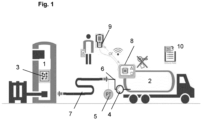
- Figure 1 schematically shows a system for filling a vessel with a cryogenic liquid according to the invention.
- Figure 1 illustrates the application of the invention for filling a cryogenic liquid from a vehicle with a cryogenic tank 2 into a stationary vessel 1.
- the stationary vessel 1 is preferably a vacuum insulated storage vessel.
- the vessel 1 is equipped with a label or sticker 3.
- the label 3 is preferably suitable to be used for wireless connection. It might comprise a barcode, a QR-code, a data matrix code, a tag, a RFID system (radiofrequency identification system) or a similar identification code in machine-readable form.
- the vehicle usually a truck or trailer, is provided with a cryogenic tank 2 which contains a cryogenic gas, for example nitrogen, in liquid form.
- the cryogenic tank 2 is the source of cryogenic liquid.
- the tank 2 is provided with a connector 6 where a filling hose 7 can be connected.
- a cryogenic pump 4 is provided for pumping cryogenic liquid from the tank 2 through a filling hose 7 to the stationary tank 1.
- a pressure transducer/ transmitter 5 is connected to the connector 6 and suitable to measure the pressure downstream of pump 4 and to transmit a pressure signal to a control unit 8.
- the operator who is responsible for the filling process is provided with an input device 9.
- the input device 9 could be a scanner, a keyboard, a RFID reader device or any other device capable to read information from the label 3 on the vessel 1.
- the vehicle driver is the operator.
- the operator has further got a delivery note, for example in paper form or on a mobile device.
- the operator Prior to filling the vessel 1 with a cryogenic liquid the operator has first to log on to the system. The operator enters the personnel ID into the input device 9, for example by scanning an identification card or typing an identification code into the input device 9.
- the operator scans or otherwise reads the label 3 of the vessel 1 to receive information about the product which is in the vessel 1 or is to be filled in the vessel 1.
- the label 3 further comprises information about the maximum vessel pressure and other vessel information, such as for example the volume of the vessel and the vessel serial number, which is also read by the input device 9.
- the information entered into or read by the input device 9 is transferred to the control unit 8, preferably by wireless communication means.
- the operator reads the information from the delivery note 10 and transfers it to the control unit 8, too. Reading the information and/or transmitting the information to the control unit 8 is preferably done by wireless communication means.
- the control unit 8 compares and verifies the information from the delivery note 10 and the information from the vessel label 3.
- the product in the vessel 1 has to the same as the product in the tank 2.
- the tank serial number or other tank identifying parameters are compared to the information on the delivery note 10 and if all parameters have been verified, a maximum fill pressure is set.
- the maximum fill pressure is determined depending on one or more parameters of the vessel 1 and in particular depending on the maximum vessel pressure which is stored on the label 3.
- the control unit 8 will not allow starting the filling process unless all parameters have been verified. For example, when the product in the tank 2 does not fit to the product in the vessel 1 or when the label 3 and/or the delivery note 10 has not been scanned, the filling process is not possible.
- a filling hose 7 is connected to the vessel 1 and to the connector 6 on the tank 2.
- the pump 4 is started and the operator can start the filling process.
- the pump 4 transfers liquid nitrogen from the tank 2 to the stationary vessel 1.
- the operating pressure of the pump 4 i. e. the pressure at which cryogenic liquid is pumped through the connector 6 and through the filling hose 7 to the vessel 1 is monitored by means of the pressure transmitter 5.
- Pressure transmitter 5 determines the pressure and sends a corresponding signal to the control unit 8.
- the control unit 8 compares the operating pressure with the set maximum fill pressure. As long as the operating pressure is below the maximum fill pressure the pump 4 continues to pump liquid nitrogen from tank 2 to vessel 1. If the operating pressure of the pump 4 exceeds the maximum fill pressure, control unit 8 disconnects the power supply to pump 4 and pump 4 stops to operate. Thereby, the pump 4 cannot cause over-pressurization of vessel 1.
- the whole filling process is recorded by the control unit 8.
- the control unit 8 records
Landscapes
- Engineering & Computer Science (AREA)
- Mechanical Engineering (AREA)
- General Engineering & Computer Science (AREA)
- Filling Or Discharging Of Gas Storage Vessels (AREA)
Abstract
The invention relates to a method for filling a vessel (1) with a cryogenic liquid wherein the cryogenic liquid is transferred from a source of cryogenic liquid (2) into the vessel by means of a pump (4) wherein the pump transfers the cryogenic liquid at an operating pressure. A pump transfers cryogenic liquid from the source into the vessel. The pump is stopped when its operating pressure exceeds the maximum fill pressure.
Description
- The invention relates to a method for filling a vessel with a cryogenic liquid wherein the cryogenic liquid is transferred from a source of cryogenic liquid into the vessel by means of a pump wherein the pump transfers the cryogenic liquid at an operating pressure.
- Cryogenic storage vessels are used in the distribution and site storage of cryogenic liquids on customer sites. Such vessels are filled with cryogenic liquid from delivery trailers and trucks. During the filling process cryogenic liquid is pumped by means of a cryogenic pump to the vessel. Typically, the cryogenic pump is mounted on the delivery trailer.
- Protective measures have to be implemented in order to prevent the vessel to be over-pressurized during the filling procedure. The driver of the delivery truck or trailer is trained and operates the filling process manually in accordance with a certain filling procedure. The operator (driver) must continuously monitor the tank pressure and adjusts the flow to the vessel manually by controlling the top and bottom fill valves to maintain the tank working pressure.
- The filling process is normally finished when the operator (driver) observes that liquid issues from the try-cock valve and/ or the level indicator indicates full.
- The first layer of protective measures consists of the main safety pressure relief valves and bursting discs, if installed, on the storage vessel. As a consequence of technical development the delivery pressures and flow rates of cryogenic pumps are increasing. The cryogenic pump power becomes stronger and stronger in order to accelerate the filling process. That means, even high-pressure vessels, for example vessels with a design limit of 36 bar, need to be protected against overpressure.
- But even the capacity of the safety pressure relief valve is not big enough to relief the full liquid capacity of the delivery pump. As a result, the pressure can further increase and exceed the design limits of the vessel, especially when the pump delivery pressure is higher than the vessel's design limits. Therefore, an overpressure protection system is installed to prevent rupture of the vessel. Rupture can lead to a fatality.
- At each vessel installation prior filling, the operator has to pre-check individually the vessel conditions and the vessel limits. If the Operator disregards the filling instructions, it may lead to a hazardous situation.
- There are several other protection systems worldwide in place. At least in central Europe, the most common over-pressure protection device is a vessel flow stop or limiting device. This device comprises a pressure sensor connected to the vessel or to the transfer line. The device will stop the cryogenic pump if the upper pressure limit of the vessel is exceeded.
- There are many different vessel types from different manufacturers with different design limits (product, pressure, etc.) available and installed. Further, there are also customized tanks where alternative over-pressure protection solutions are installed. The known solutions must be manually adjusted. In some cases they can be easily manipulated by the operator, for example by bypassing the safety function.
- It is an object of the present invention to provide an improved method for preventing excessive pressure during filling of a cryogenic vessel. In particular, the invention shall reduce the necessity to manually adjust set parameters and thereby reduce the risk of manipulation.
- This object is achieved by a method according to
claim 1. - For filling a vessel with a cryogenic liquid, the cryogenic liquid is transferred from a source of cryogenic liquid into the vessel by means of a pump. The pump transfers the cryogenic liquid at an operating pressure. The inventive method comprises the following steps:
- one or more parameters of the vessel, of the pump and/or of the cryogenic liquid are identified,
- a maximum fill pressure is determined depending on the one or more parameters,
- the pump is started and operated at an operating pressure below the maximum fill pressure whereby cryogenic liquid is transferred from the source into the vessel,
- the operating pressure of the pump is monitored and the pump is stopped or its operating pressure is reduced when the monitored operating pressure exceeds the maximum fill pressure.
- The invention provides a protection system against overpressure while transfilling a cryogenic liquid from a source of cryogenic liquid to a vessel. Prior transfilling, the inventive system recognizes and identifies the vessel to be filled and sets the maximum fill pressure accordingly. As long as the operator operates the filling process at a pressure below the maximum fill pressure, the over pressure protection system will not trip the pump.
- Each cryogenic tank is equipped with two redundant safety pressure relief valves and redundant bursting discs, if applicable These valves are activated or the discs rupture when the set tank pressure is reached and relief the stored gases to atmosphere where the surrounding area gets enriched with combustible gases (for example in the case of liquid oxygen) or inert gases (e.g. in the case of liquid nitrogen or liquid argon). Normally the Operator works alone during transfilling. If the Operator loses consciousness during the process, he may stay too long in this enriched atmosphere. The inventive solution will stop the pump before the safety pressure relief valves get activated by too high pressure.
- The inventive solution may impact all tank installations worldwide and can significantly lower the investment costs for increased safety. The solution is suitable for any type of cryogenic vessel or tank. It can be used for filling stationary tanks, for example at a customer site, or for filling transport tanks, for example on trucks or trailers. For example, the vessel receiving the cryogenic liquid could be a stationary or static vacuum-insulated vessel.
- The source of cryogenic liquid could also be a stationary tank or vessel or a mobile tank or vessel. The source of cryogenic liquid especially includes fixed tanks of tank vehicles or tank wagons, demountable tanks, tank containers and swap bodies for cryogenic fluids.
- The invention is preferably used to improve the safety of existing tanks and vessels. With the new solution it is not required to install an over-pressure protection system to every individual vessel.
- The solution is able to cover all vessel or tank installations for different products, in particular for liquid nitrogen, liquid oxygen, liquid argon or liquid carbon dioxide. Further, the solution is not limited to certain pressure ranges but applicable to many design pressures. It can be implemented very easily with very low investment cost.
- According to the invention the maximum fill pressure is determined depending on one or more parameters. These parameters are preferably selected from the group of the type of vessel, a vessel identifier, the cryogenic liquid in the source, the cryogenic liquid in the vessel, the maximum operating pressure of the pump and the maximum flow of the pump. One or more of these parameters are used to determine the maximum fill pressure. Of course, other parameters might be used in addition.
- The one or more parameters are preferably transmitted to an input device. The input device could for example be a scanner, a keyboard or a RFID reader device. The transmission of the parameter or the parameters to the input device is preferably done by means of wireless communication.
- According to a preferred embodiment the filling process includes some or all of the following steps:
- The identity of the operator who is responsible for the filling process is determined.
- The vessel is equipped with a label which comprises certain vessel parameters. One or more of the parameters are transmitted to an input device, preferably by wireless communication. The parameters may include information about the vessel itself, information about the product which is in the vessel or which is to be filled in the vessel, information about the maximum vessel pressure, the volume of the vessel and/or the vessel serial number and/or another vessel identifier.
- A delivery note includes information on the source of cryogenic liquid and on the product to be filled into the vessel. This information is transferred to a control unit. The control unit and the input device could be combined in one device or could be separate devices.
- The control unit compares and verifies the information from the delivery note and the information from the vessel label. The
control unit 8 will not allow starting the filling process unless all parameters have been verified. - The maximum fill pressure is determined depending on one or more parameters of the vessel and in particular depending on the maximum vessel pressure which is stored on the label.
- The source of cryogenic liquid and the vessel are connected, for example by means of a filling hose and a pump transfers cryogenic liquid from the source to the vessel.
- The operating pressure of the pump is monitored and compared to the maximum fill pressure. If the operating pressure of the pump exceeds the maximum fill pressure, the pump is stopped.
- The whole filling process is recorded
- The invention as well as further preferred embodiments will be described with reference to the figure.
-
Figure 1 schematically shows a system for filling a vessel with a cryogenic liquid according to the invention. -
Figure 1 illustrates the application of the invention for filling a cryogenic liquid from a vehicle with acryogenic tank 2 into astationary vessel 1. Thestationary vessel 1 is preferably a vacuum insulated storage vessel. Thevessel 1 is equipped with a label orsticker 3. Thelabel 3 is preferably suitable to be used for wireless connection. It might comprise a barcode, a QR-code, a data matrix code, a tag, a RFID system (radiofrequency identification system) or a similar identification code in machine-readable form. - The vehicle, usually a truck or trailer, is provided with a
cryogenic tank 2 which contains a cryogenic gas, for example nitrogen, in liquid form. Thecryogenic tank 2 is the source of cryogenic liquid. Thetank 2 is provided with aconnector 6 where a fillinghose 7 can be connected. Acryogenic pump 4 is provided for pumping cryogenic liquid from thetank 2 through a fillinghose 7 to thestationary tank 1. A pressure transducer/transmitter 5 is connected to theconnector 6 and suitable to measure the pressure downstream ofpump 4 and to transmit a pressure signal to acontrol unit 8. - The operator who is responsible for the filling process is provided with an
input device 9. Theinput device 9 could be a scanner, a keyboard, a RFID reader device or any other device capable to read information from thelabel 3 on thevessel 1. Typically, the vehicle driver is the operator. The operator (vehicle driver) has further got a delivery note, for example in paper form or on a mobile device. - Prior to filling the
vessel 1 with a cryogenic liquid the operator has first to log on to the system. The operator enters the personnel ID into theinput device 9, for example by scanning an identification card or typing an identification code into theinput device 9. - By means of the
input device 9 the operator scans or otherwise reads thelabel 3 of thevessel 1 to receive information about the product which is in thevessel 1 or is to be filled in thevessel 1. Thelabel 3 further comprises information about the maximum vessel pressure and other vessel information, such as for example the volume of the vessel and the vessel serial number, which is also read by theinput device 9. The information entered into or read by theinput device 9 is transferred to thecontrol unit 8, preferably by wireless communication means. - The operator reads the information from the
delivery note 10 and transfers it to thecontrol unit 8, too. Reading the information and/or transmitting the information to thecontrol unit 8 is preferably done by wireless communication means. - The
control unit 8 compares and verifies the information from thedelivery note 10 and the information from thevessel label 3. The product in thevessel 1 has to the same as the product in thetank 2. The tank serial number or other tank identifying parameters are compared to the information on thedelivery note 10 and if all parameters have been verified, a maximum fill pressure is set. The maximum fill pressure is determined depending on one or more parameters of thevessel 1 and in particular depending on the maximum vessel pressure which is stored on thelabel 3. - The
control unit 8 will not allow starting the filling process unless all parameters have been verified. For example, when the product in thetank 2 does not fit to the product in thevessel 1 or when thelabel 3 and/or thedelivery note 10 has not been scanned, the filling process is not possible. - Only when all parameters have been verified by the
control unit 8, a fillinghose 7 is connected to thevessel 1 and to theconnector 6 on thetank 2. Thepump 4 is started and the operator can start the filling process. Thepump 4 transfers liquid nitrogen from thetank 2 to thestationary vessel 1. The operating pressure of thepump 4, i. e. the pressure at which cryogenic liquid is pumped through theconnector 6 and through the fillinghose 7 to thevessel 1 is monitored by means of thepressure transmitter 5.Pressure transmitter 5 determines the pressure and sends a corresponding signal to thecontrol unit 8. Thecontrol unit 8 compares the operating pressure with the set maximum fill pressure. As long as the operating pressure is below the maximum fill pressure thepump 4 continues to pump liquid nitrogen fromtank 2 tovessel 1. If the operating pressure of thepump 4 exceeds the maximum fill pressure,control unit 8 disconnects the power supply to pump 4 and pump 4 stops to operate. Thereby, thepump 4 cannot cause over-pressurization ofvessel 1. - The whole filling process is recorded by the
control unit 8. Thecontrol unit 8 records - the operator's personnel ID (name, identification number or identification code),
- the product in the
tank 2 which is transferred into thevessel 1, - the product in the
vessel 1 prior to filling, - vessel parameters, such as the vessel serial number and the maximum vessel pressure,
- the operating pressure during filling, preferably together with a time stamp,
- and any interruptions of the filling process or any other issues or events.
Claims (8)
- Method for filling a vessel with a cryogenic liquid wherein the cryogenic liquid is transferred from a source of cryogenic liquid into the vessel by means of a pump wherein the pump transfers the cryogenic liquid at an operating pressure,
characterized in that- one or more parameters of the vessel, of the pump and/or of the cryogenic liquid are identified,- a maximum fill pressure is determined depending on the one or more parameters,- the pump is started and operated at an operating pressure below the maximum fill pressure whereby cryogenic liquid is transferred from the source into the vessel,- the operating pressure of the pump is monitored and- the pump is stopped or its operating pressure is reduced when the monitored operating pressure exceeds the maximum fill pressure. - Method according to claim 1, characterized in that the one or more parameters are selected from the group of a vessel identifier, the cryogenic liquid in the source, the cryogenic liquid in the vessel, the maximum operating pressure of the pump and the maximum flow of the pump.
- Method according to any of the preceding claims, characterized in that the cryogenic liquid is selected from the group of liquid nitrogen, liquid oxygen, liquid argon or liquid carbon dioxide.
- Method according to any of the preceding claims, characterized in that the vessel is a stationary tank.
- Method according to any of the preceding claims, characterized in that the source of cryogenic liquid is a transport tank, in particular a tank on a vehicle.
- Method according to any of the preceding claims, characterized in that the one or more parameters are transmitted to an input device.
- Method according to claim 6, characterized in that the input device is a scanner, a keyboard or a RFID reader device.
- Method according to any of claims 6 or 7, characterized in that the one or more parameters are transmitted to the input device by means of wireless communication.
Priority Applications (1)
| Application Number | Priority Date | Filing Date | Title |
|---|---|---|---|
| EP22020327.7A EP4306842A1 (en) | 2022-07-11 | 2022-07-11 | Method for filling a vessel with a cryogenic liquid |
Applications Claiming Priority (1)
| Application Number | Priority Date | Filing Date | Title |
|---|---|---|---|
| EP22020327.7A EP4306842A1 (en) | 2022-07-11 | 2022-07-11 | Method for filling a vessel with a cryogenic liquid |
Publications (1)
| Publication Number | Publication Date |
|---|---|
| EP4306842A1 true EP4306842A1 (en) | 2024-01-17 |
Family
ID=82748651
Family Applications (1)
| Application Number | Title | Priority Date | Filing Date |
|---|---|---|---|
| EP22020327.7A Withdrawn EP4306842A1 (en) | 2022-07-11 | 2022-07-11 | Method for filling a vessel with a cryogenic liquid |
Country Status (1)
| Country | Link |
|---|---|
| EP (1) | EP4306842A1 (en) |
Citations (3)
| Publication number | Priority date | Publication date | Assignee | Title |
|---|---|---|---|---|
| WO2007072073A1 (en) * | 2005-12-22 | 2007-06-28 | The Boc Group Plc | Apparatus for controlling delivery of fluid from a vessel |
| US20210039937A1 (en) * | 2019-05-06 | 2021-02-11 | Fountain Master, Llc | Fluid filling systems and methods |
| EP3825597A1 (en) * | 2019-11-20 | 2021-05-26 | Agim Smoqi | A method and a system for refilling gas cylinders in a building |
-
2022
- 2022-07-11 EP EP22020327.7A patent/EP4306842A1/en not_active Withdrawn
Patent Citations (3)
| Publication number | Priority date | Publication date | Assignee | Title |
|---|---|---|---|---|
| WO2007072073A1 (en) * | 2005-12-22 | 2007-06-28 | The Boc Group Plc | Apparatus for controlling delivery of fluid from a vessel |
| US20210039937A1 (en) * | 2019-05-06 | 2021-02-11 | Fountain Master, Llc | Fluid filling systems and methods |
| EP3825597A1 (en) * | 2019-11-20 | 2021-05-26 | Agim Smoqi | A method and a system for refilling gas cylinders in a building |
Similar Documents
| Publication | Publication Date | Title |
|---|---|---|
| US10534374B2 (en) | Cross contamination control systems with fluid product ID sensors | |
| US9310024B2 (en) | Method and system for filling a gas cylinder | |
| EP1236950B1 (en) | Interlock for cryogenic liquid off-loading systems | |
| EP0911572B1 (en) | High pressure cryogenic fluid delivery system | |
| HK1254297A1 (en) | Method for preventing cross contamination of fluids | |
| US20130340888A1 (en) | Gas filling ystem | |
| US9523978B2 (en) | Securing product storage tanks against unauthorized delivery | |
| US20110172816A1 (en) | Fuel delivery pathway control | |
| JP7463096B2 (en) | Powder container and system using same | |
| US9574712B2 (en) | System and method of automatically ending the filling of a gas transport module or other gas transport | |
| US20160167620A1 (en) | Vehicle control system and method | |
| WO2011123938A1 (en) | Tank identification delivery interlock system and method | |
| US6698463B2 (en) | System and method for controlling a hazardous fluid distribution facility | |
| JPH07251900A (en) | Instrumentation system of tank lorry | |
| JP2001354300A (en) | Method in transportation service, means for delivering, transporting and storing transport object and transportation system | |
| FI126967B (en) | Pneumatic emergency stop system | |
| JP2003231594A (en) | Liquid oil loading system and method | |
| NO312756B1 (en) | Tank system safety system |
Legal Events
| Date | Code | Title | Description |
|---|---|---|---|
| PUAI | Public reference made under article 153(3) epc to a published international application that has entered the european phase |
Free format text: ORIGINAL CODE: 0009012 |
|
| STAA | Information on the status of an ep patent application or granted ep patent |
Free format text: STATUS: THE APPLICATION HAS BEEN PUBLISHED |
|
| AK | Designated contracting states |
Kind code of ref document: A1 Designated state(s): AL AT BE BG CH CY CZ DE DK EE ES FI FR GB GR HR HU IE IS IT LI LT LU LV MC MK MT NL NO PL PT RO RS SE SI SK SM TR |
|
| STAA | Information on the status of an ep patent application or granted ep patent |
Free format text: STATUS: THE APPLICATION IS DEEMED TO BE WITHDRAWN |
|
| 18D | Application deemed to be withdrawn |
Effective date: 20240718 |