EP4306175B1 - Fire seals with self-healing properties - Google Patents
Fire seals with self-healing properties Download PDFInfo
- Publication number
- EP4306175B1 EP4306175B1 EP23164109.3A EP23164109A EP4306175B1 EP 4306175 B1 EP4306175 B1 EP 4306175B1 EP 23164109 A EP23164109 A EP 23164109A EP 4306175 B1 EP4306175 B1 EP 4306175B1
- Authority
- EP
- European Patent Office
- Prior art keywords
- glass transition
- transition temperature
- fire
- fire seal
- fiber
- Prior art date
- Legal status (The legal status is an assumption and is not a legal conclusion. Google has not performed a legal analysis and makes no representation as to the accuracy of the status listed.)
- Active
Links
Images




Classifications
-
- F—MECHANICAL ENGINEERING; LIGHTING; HEATING; WEAPONS; BLASTING
- F02—COMBUSTION ENGINES; HOT-GAS OR COMBUSTION-PRODUCT ENGINE PLANTS
- F02C—GAS-TURBINE PLANTS; AIR INTAKES FOR JET-PROPULSION PLANTS; CONTROLLING FUEL SUPPLY IN AIR-BREATHING JET-PROPULSION PLANTS
- F02C7/00—Features, components parts, details or accessories, not provided for in, or of interest apart form groups F02C1/00 - F02C6/00; Air intakes for jet-propulsion plants
- F02C7/24—Heat or noise insulation
- F02C7/25—Fire protection or prevention
-
- D—TEXTILES; PAPER
- D04—BRAIDING; LACE-MAKING; KNITTING; TRIMMINGS; NON-WOVEN FABRICS
- D04H—MAKING TEXTILE FABRICS, e.g. FROM FIBRES OR FILAMENTARY MATERIAL; FABRICS MADE BY SUCH PROCESSES OR APPARATUS, e.g. FELTS, NON-WOVEN FABRICS; COTTON-WOOL; WADDING ; NON-WOVEN FABRICS FROM STAPLE FIBRES, FILAMENTS OR YARNS, BONDED WITH AT LEAST ONE WEB-LIKE MATERIAL DURING THEIR CONSOLIDATION
- D04H13/00—Other non-woven fabrics
- D04H13/008—Glass fibre products; Complete installations for making them
-
- C—CHEMISTRY; METALLURGY
- C03—GLASS; MINERAL OR SLAG WOOL
- C03C—CHEMICAL COMPOSITION OF GLASSES, GLAZES OR VITREOUS ENAMELS; SURFACE TREATMENT OF GLASS; SURFACE TREATMENT OF FIBRES OR FILAMENTS MADE FROM GLASS, MINERALS OR SLAGS; JOINING GLASS TO GLASS OR OTHER MATERIALS
- C03C25/00—Surface treatment of fibres or filaments made from glass, minerals or slags
- C03C25/10—Coating
- C03C25/1095—Coating to obtain coated fabrics
-
- F—MECHANICAL ENGINEERING; LIGHTING; HEATING; WEAPONS; BLASTING
- F16—ENGINEERING ELEMENTS AND UNITS; GENERAL MEASURES FOR PRODUCING AND MAINTAINING EFFECTIVE FUNCTIONING OF MACHINES OR INSTALLATIONS; THERMAL INSULATION IN GENERAL
- F16J—PISTONS; CYLINDERS; SEALINGS
- F16J15/00—Sealings
- F16J15/02—Sealings between relatively-stationary surfaces
- F16J15/06—Sealings between relatively-stationary surfaces with solid packing compressed between sealing surfaces
- F16J15/064—Sealings between relatively-stationary surfaces with solid packing compressed between sealing surfaces the packing combining the sealing function with other functions
- F16J15/065—Sealings between relatively-stationary surfaces with solid packing compressed between sealing surfaces the packing combining the sealing function with other functions fire resistant
-
- C—CHEMISTRY; METALLURGY
- C03—GLASS; MINERAL OR SLAG WOOL
- C03C—CHEMICAL COMPOSITION OF GLASSES, GLAZES OR VITREOUS ENAMELS; SURFACE TREATMENT OF GLASS; SURFACE TREATMENT OF FIBRES OR FILAMENTS MADE FROM GLASS, MINERALS OR SLAGS; JOINING GLASS TO GLASS OR OTHER MATERIALS
- C03C2217/00—Coatings on glass
- C03C2217/70—Properties of coatings
- C03C2217/78—Coatings specially designed to be durable, e.g. scratch-resistant
-
- C—CHEMISTRY; METALLURGY
- C09—DYES; PAINTS; POLISHES; NATURAL RESINS; ADHESIVES; COMPOSITIONS NOT OTHERWISE PROVIDED FOR; APPLICATIONS OF MATERIALS NOT OTHERWISE PROVIDED FOR
- C09K—MATERIALS FOR MISCELLANEOUS APPLICATIONS, NOT PROVIDED FOR ELSEWHERE
- C09K21/00—Fireproofing materials
-
- D—TEXTILES; PAPER
- D10—INDEXING SCHEME ASSOCIATED WITH SUBLASSES OF SECTION D, RELATING TO TEXTILES
- D10B—INDEXING SCHEME ASSOCIATED WITH SUBLASSES OF SECTION D, RELATING TO TEXTILES
- D10B2101/00—Inorganic fibres
- D10B2101/02—Inorganic fibres based on oxides or oxide ceramics, e.g. silicates
- D10B2101/06—Glass
-
- D—TEXTILES; PAPER
- D10—INDEXING SCHEME ASSOCIATED WITH SUBLASSES OF SECTION D, RELATING TO TEXTILES
- D10B—INDEXING SCHEME ASSOCIATED WITH SUBLASSES OF SECTION D, RELATING TO TEXTILES
- D10B2401/00—Physical properties
- D10B2401/04—Heat-responsive characteristics
Definitions
- Fire-seals and high temperature seals are subject to harsh operating conditions and thus require material properties relating to high temperature exposure, ignition, burn-through, hold-pressure, stability against variety of fluids, etc. With advancement in engines that operate at higher temperatures, greater functional performance is expected of sealing materials. Many current materials used for fire seals are expensive and are not capable of long-term exposure to harsh operating environments.
- a fire-retardant composite can include two fire-retardant laminates, and a porous thermoplastic core material disposed between the two fire-retardant laminates.
- Each laminate can have one or more ply, each of the plies can include a plurality of fibers in a thermoplastic polymer matrix that includes a fire-retardant composition.
- the present disclosure relates to a fire seal according to claim 1 and a fire sealing method according to claim 15.
- the disclosed fire seal includes an amorphous material and a bulk material supporting the amorphous material.
- the bulk material is fire resistant.
- the disclosed multi-member assembly includes a first structural member and a second structural member opposed from the first structural member.
- the multi-member assembly further includes a fire seal positioned between the first structural member (202) and the second structural member.
- the fire seal includes a bulk material and an amorphous material supported by the bulk material. The bulk material is fire resistant.
- the disclosed fire-sealing method includes positioning a fire seal between a first structural member and a second structural member.
- the fire seal includes a bulk material and an amorphous material supported by the bulk material.
- the bulk material is fire resistant.
- example means that one or more feature, structure, element, component, characteristic, and/or operational step described in connection with the example is included in at least one aspect, embodiment, and/or implementation of the subject matter according to the present disclosure.
- the phrases “an example,” “another example,” “one or more examples,” and similar language throughout the present disclosure may, but do not necessarily, refer to the same example.
- the subject matter characterizing any one example may, but does not necessarily, include the subject matter characterizing any other example.
- subject matter characterizing any one example may be, but is not necessarily, combined with the subject matter characterizing any other example.
- a system, apparatus, device, structure, article, element, component, or hardware "configured to” perform a specified function is indeed capable of performing the specified function without any alteration, rather than merely having potential to perform the specified function after further modification.
- the system, apparatus, device, structure, article, element, component, or hardware "configured to” perform a specified function is specifically selected, created, implemented, utilized, programmed, and/or designed for the purpose of performing the specified function.
- "configured to” denotes existing characteristics of a system, apparatus, structure, article, element, component, or hardware that enable the system, apparatus, structure, article, element, component, or hardware to perform the specified function without further modification.
- a system, apparatus, device, structure, article, element, component, or hardware described as being “configured to” perform a particular function may additionally or alternatively be described as being “adapted to” and/or as being “operative to” perform that function.
- Coupled refers to two or more elements that are joined, linked, fastened, attached, connected, put in communication, or otherwise associated (e.g., mechanically, electrically, fluidly, optically, electromagnetically) with one another.
- the elements may be associated directly or indirectly.
- element A may be directly associated with element B.
- element A may be indirectly associated with element B, for example, via another element C. It will be understood that not all associations among the various disclosed elements are necessarily represented. Accordingly, couplings other than those depicted in the figures may also exist.
- the fire seal 100 includes an amorphous material 120 ( FIG. 3 ) and a bulk material 110 ( FIGs. 2 and 3 ) supporting the amorphous material 120.
- the amorphous material 120 is layered with the bulk material 110, see FIG. 2 .
- the amorphous material 120 is dispersed in the bulk material 110, see FIG. 3 and FIG. 4 .
- the amorphous material 120 is embedded in the bulk material 110.
- the fire seal 100 may further include a nano-clay material 115 supported by the bulk material 110, see FIG. 3 and FIG. 4 .
- the nano-clay material 115 may have an average particle size within a range from about 10 nm to about 1000 nm, such as an average particle size within a range from about 25 nm to about 500 nm, or an average particle size within a range from about 50 nm to about 100 nm.
- the nano-clay material 115 may be incorporated as a single layer or multiple layers to increase the diffusion barrier. For example, a high tortuosity diffusion path in the fire seal 100 material due to the addition of nano-clay material 115 may reduce the oxygen diffusion rate.
- a multi-layer assembly including nano-clay material 115 may help achieve ultra-low diffusion coefficients in the fire seal 100.
- the fire seal 100 may include one or more additives to promote, among other things, CO 2 evolution beyond specific temperature thresholds.
- additives include carbonates (e.g., calcium carbonate and/or sodium carbonate), bicarbonates (e.g., sodium bicarbonate), glucose, citrates, and the like, and mixtures thereof.
- the fire seal 100 may also include other additives.
- other additives include, but are not limited to, silica, alumina, zirconia, graphene, graphene oxide, graphite oxide, and the like, and mixtures thereof, which may be supported by the bulk material 110.
- the fire seal 100 may include an infrared-reflective coating 150 on an outside surface 105 of the fire seal 100.
- the infrared-reflective coating 150 may include inclusions that limit heat absorption in the material.
- the infrared-reflective coating 150 may include, for example, infrared-reflective pigments (e.g., leafing aluminum flakes) in a binder (e.g., thermoset resin).
- the amorphous material 120 may include any material having requisite material properties for the fire seal 100, specifically related to self-healing of one or more crack or defect 160 that may manifest after exposure to high temperatures.
- the amorphous material 120 includes a glass material.
- the amorphous material 120 includes a glass powder material.
- the amorphous material 120 includes a vanadate glass material.
- the amorphous material 120 includes a sponge material.
- the amorphous material 120 includes a fiber material.
- the amorphous material 120 includes a combination or mixture of materials.
- the amorphous material 120 has a glass transition temperature T g .
- the glass transition temperature T g is between approximately 200 °C and approximately 600 °C.
- the glass transition temperature T g is between approximately 300 °C and approximately 500 °C.
- the amorphous material 120 may become a flowy amorphous material 120', see FIG. 4 , and can thus flow into one or more crack or defect 160 of the fire seal 100.
- the bulk material 110 is fire resistant.
- the bulk material 110 decomposes at a decomposition temperature T D .
- the decomposition temperature T D is at least 400 °C.
- the decomposition temperature T D is at least 500 °C.
- the decomposition temperature T D is at least 600 °C.
- the decomposition temperature T D may be different than the glass transition temperature T g .
- a difference between the glass transition temperature T g and the decomposition temperature T D is at least 20 °C.
- a difference between the glass transition temperature Tg and the decomposition temperature T D is at least 30 °C.
- the bulk material 110 may include any material having requisite material properties for the fire seal 100.
- the bulk material 110 includes a ceramic material.
- the bulk material 110 includes ceramic oxide fibers.
- the bulk material 110 includes a polymeric material.
- the bulk material 110 may include aramid fibers, such as, for example, para-aramid material (e.g., KEVLAR brand fibers commercially available from DuPont) and/or a meta-aramid material (e.g., NOMEX brand fibers/sheets commercially available from DuPont).
- the bulk material 110 may include ceramic oxide fibers.
- the bulk material 110 may include one or more of a fabric material, a foam material, and a felt material.
- a fabric material include Nextel TM (AF-10, AF-10-900) (trademarks of 3M TM ), Nomex ® (HT-2002, HT001) (trademarks of Dupont TM ), Dacron TM (trademark of Dupont TM ), Kevlar TM (trademark of Dupont TM ), S2, and E-glass.
- the fire seal 100 includes a coating on an outside surface of the fiber material.
- the coating includes a polymer material.
- the coating includes a second amorphous material 124 having a second glass transition temperature T g2 .
- the glass transition temperature T g and the second glass transition temperature T g2 may be different.
- a difference between the glass transition temperature T g and the second glass transition temperature T g2 is at least 10 °C.
- a difference between the glass transition temperature T g and the second glass transition temperature T g2 is at least 20 °C.
- the amorphous material 120 includes a plurality of glass fibers 122.
- the plurality of glass fibers 122 is braided together.
- the plurality of glass fibers 122 is woven together.
- the plurality of glass fibers may include a first fiber 130 having a first glass transition temperature T fg1 and a second fiber 140 having a second glass transition temperature T fg2 .
- the first fiber 130 and the second fiber 140 are glass.
- a difference between the first glass transition temperature T fg1 of the first fiber 130 and the second glass transition temperature T fg2 of the second fiber 140 is at least 20 °C. In another example, a difference between of the first fiber and the second glass transition temperature T fg2 of the second fiber is at least 30 °C.
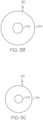
- the amorphous material 120 includes a first fiber 130 having a core material 132 and a glass coating 134 on an outside surface of the core material 132, see FIG. 5B .
- the glass coating 134 has a coating glass transition temperature T cg .
- the amorphous material 120 may further include a second fiber 140 entwined with the first fiber 130.
- the second fiber 140 has a second core material 142 and a second coating 144 on an outside surface of the second core material 142, see FIG. 5C .
- the second coating 144 has a second coating 144 glass transition temperature T cg2 .
- the core material 132 of the first fiber 130 and the second core material 142 of the second fiber 140 are compositionally different and may further have different glass transition temperatures.
- the core material 132 of the first fiber 130 comprises an amorphous material 120 having a core glass transition temperature T gc and a difference between the core glass transition temperature T gc and the coating glass transition temperature T cg is at least 20 °C.
- a difference between the coating glass transition temperature T cg and the second coating 144 glass transition temperature T cg2 may be at least 20 °C. In another example, a difference between the coating glass transition temperature T cg and the second coating 144 glass transition temperature T cg2 is at least 30 °C.
- the core material 132 of the first fiber 130 includes an amorphous material 120 having a core glass transition temperature T gc and a difference between the core glass transition temperature T gc and the coating glass transition temperature T cg is at least 30 °C.
- the core material 132 may include and material having requisite material properties for the fire seal 100.
- the core material 132 of the first fiber 130 includes a polymeric material.
- the core material 132 of the first fiber 130 includes an aramid polymer.
- the core material 132 of the first fiber 130 includes Kevlar TM .
- the second core material 142 of the second fiber 140 includes an amorphous material 120.
- the second core material 142 of the second fiber 140 has a second core glass transition temperature T gc2 .
- a difference between the second core glass transition temperature T gcs and the second coating 144 glass transition temperature T cg2 is at least 20 °C.
- a difference between the second core glass transition temperature T gc2 and the second coating 144 glass transition temperature T cg2 is at least 30 °C.
- the second core material 142 may include and material having requisite material properties for the fire seal 100.
- the second core material 142 of the second fiber 140 includes a polymeric material.
- the second core material 142 of the second fiber 140 includes an aramid polymer.
- the second core material 142 of the second fiber 140 includes Kevlar TM .
- the multi-member assembly 200 includes a first structural member 202 and a second structural member 204 opposed from the first structural member 202.
- the multi-member assembly 200 further includes a fire seal 100 positioned between the first structural member 202 and the second structural member 204.
- the first structural member 202 is an engine and the second structural member 204 is a pylon.
- the fire seal 100 of the multi-member assembly 200 includes a bulk material 110.
- the bulk material 110 is fire resistant.
- the fire seal 100 of the multi-member assembly 200 further includes an amorphous material 120 supported by the bulk material 110.
- the fire seal 100 of the multi-member assembly 200 may include an infrared-reflective coating 150 on an outside surface 105 of the fire seal 100.
- the fire sealing method includes the step of positioning a fire seal 100 between a first structural member 202 and a second structural member 204.
- the fire seal 100 includes a bulk material 110.
- the bulk material 110 is fire resistant.
- the fire seal 100 further includes an amorphous material 120 supported by the bulk material 110.
- the fire seal 100 of the fire sealing method may include an infrared-reflective coating 150 on an outside surface of the fire seal 100.
- Glass sealants or fire seals 100 incorporating glass fabric or chopped fiber can be used to hermetically seal interfaces between the different structural members 202, 204 of a multi-member assembly 200.
- Glass has excellent high temperature stability and its ability to soften at high temperature and set again when it cools down provides self-healing capability for the seals subjected to high temperature. If a fire seal 100 develops one or more crack and/or defect 160 due to exposure to very high temperature, the glass can flow and fill such defect 160, see FIG. 4 .
- the amorphous material 120 may be incorporated into a fire seal 100 as a glass fiber layer within the seal architecture, see FIG. 2 , or as chopped fiber glass dispersed in the matrix material or bulk material 110, see FIG. 3 .
- glass encompasses adequate flexibility to be incorporated into complex seal geometries without damage or brittle failure.
- Various glass compositions may be utilized to meet requirements for various service temperatures. Glass is a highly inert material and thus can be easily incorporated with a vast range of fire seal 100 materials, particularly in the aerospace industry.
- the fire seal 100 as shown and described herein may utilize an amorphous material 120 having multilayer glass-fiber expanded weave structure impregnated within a matrix resin bulk material 110.
- the amorphous material 120 provides the fire seal 100 with a range of protection at different temperature levels for progressive softening, melting etc.
- the amorphous material 120 further helps retain mechanical properties when temperature is continuously increasing in the fire seal 100.
- the fire seal 100 may include two or more families of coated glass fibers having different glass transition and melting temperatures such that one begins to transition at a lower temperature than the other. As one glass fiber melts, it spreads and helps heal defect 160 regions in the fire seal 100. The other glass fiber having a higher melting and glass transition temperature concurrently continues to provide overall strength.
- Kevlar TM fibers coated with various glass chemistries weaved together may progressively contribute to softening, melting, sealing, healing steps.
- service method 1100 may include specification and design (block 1104) of aircraft 1102 and material procurement (block 1106).
- component and subassembly manufacturing (block 1108) and system integration (block 1110) of aircraft 1102 may take place. Thereafter, aircraft 1102 may go through certification and delivery (block 1112) to be placed in service (block 1114). While in service, aircraft 1102 may be scheduled for routine maintenance and service (block 1116). Routine maintenance and service may include modification, reconfiguration, refurbishment, etc. of one or more systems of aircraft 1102.
- Each of the processes of service method 1100 may be performed or carried out by a system integrator, a third party, and/or an operator (e.g., a customer).
- a system integrator may include, without limitation, any number of aircraft manufacturers and major-system subcontractors
- a third party may include, without limitation, any number of vendors, subcontractors, and suppliers
- an operator may be an airline, leasing company, military entity, service organization, and so on.
- aircraft 1102 produced by service method 1100 may include airframe 1118 with a plurality of high-level systems 1120 and interior 1122.
- high-level systems 1120 include one or more of propulsion system 1124, electrical system 1126, hydraulic system 1128, and environmental system 1130. Any number of other systems may be included.
- propulsion system 1124 one or more of propulsion system 1124, electrical system 1126, hydraulic system 1128, and environmental system 1130. Any number of other systems may be included.
- propulsion system 1124 include one or more of propulsion system 1124, electrical system 1126, hydraulic system 1128, and environmental system 1130. Any number of other systems may be included.
- an aerospace example is shown, the principles disclosed herein may be applied to other industries, such as the automotive industry. Accordingly, in addition to aircraft 1102, the principles disclosed herein may apply to other vehicles, e.g., land vehicles, marine vehicles, space vehicles, etc.
- fire seals and fire-sealing methods are described in the context of an aircraft. However, one of ordinary skill in the art will readily recognize that the disclosed fire seals and fire-sealing methods may be utilized for a variety of applications. For example, the disclosed fire seals and fire-sealing methods may be implemented in various types of vehicles including, e.g., helicopters, watercraft, passenger ships, automobiles, various materials processing equipment design, and the like.
- a fire seal (100) comprises: an amorphous material (120); and a bulk material (110) supporting the amorphous material, wherein the bulk material (110) is fire resistant.
- the amorphous material (120) has a glass transition temperature (T g ), and wherein the glass transition temperature (T g ) is between approximately 200 °C and approximately 600 °C.
- the amorphous material (120) has a glass transition temperature (T g ), and wherein the glass transition temperature (T g ) is between approximately 300 °C and approximately 500 °C.
- the amorphous material (120) has a glass transition temperature (T g ) and the bulk material (110) has a decomposition temperature (T D ), and wherein a difference between the glass transition temperature (T g ) and the decomposition temperature (T D ) is at least 20 °C, preferably wherein: a difference between the glass transition temperature (T g ) and the decomposition temperature (T D ) is at least 30 °C.
- the amorphous material (120) comprises a glass material.
- the amorphous material (120) comprises a glass powder material.
- the amorphous material (120) comprises a vanadate glass material.
- the amorphous material (120) comprises a sponge material.
- the amorphous material (120) comprises a fiber material, preferably wherein the fire seal further comprises:. a coating (150) on an outside surface (105) of the fiber material, preferably wherein:
- the amorphous material comprises a plurality of glass fibers (122), preferably wherein:
- the amorphous material (120) comprises: a first fiber (130) having a core material (132) and a glass coating (134) on an outside surface of the core material, the glass coating (134) having a coating glass transition temperature (T cg ); and a second fiber (140) entwined with the first fiber (130) having a second core material (142) and a second coating (144) on an outside surface of the second core material (142), the second coating (144) having a second coating glass transition temperature (T cg2 ), preferably wherein:
- the amorphous material (120) is layered with the bulk material (110).
- the amorphous material (120) is dispersed in the bulk material (110).
- the amorphous material (120) is embedded in the bulk material (110).
- the bulk material (110) decomposes at a decomposition temperature (T D ), and wherein the decomposition temperature (T D ) is at least 400 °C.
- the bulk material (110) decomposes at a decomposition temperature (T D ), and wherein the decomposition temperature (T D ) is at least 500 °C.
- the bulk material (110) decomposes at a decomposition temperature (T D ), and wherein the decomposition temperature (T D ) is at least 600 °C.
- the bulk material (110) comprises a polymeric material.
- the bulk material (110) comprises an aramid polymer, preferably wherein: the aramid polymer comprises a meta-aramid polymer.
- the bulk material (110) comprises an amorphous material.
- the bulk material (110) comprises a fabric material.
- the bulk material (110) comprises a foam material.
- the bulk material (110) comprises a felt material.
- the fire seal of the first illustrative example further comprises a nano-clay material (115) supported by the bulk material (110).
- the fire seal of the first illustrative example further comprises one or more of silica, alumina, zirconia, graphene, graphene oxide, and graphite oxide supported by the bulk material (110).
- the fire seal of the first illustrative example further comprises an infrared-reflective coating (150) on an outside surface (105) of the fire seal (100).
- a multi-member assembly comprises: a first structural member (202); a second structural member (204) opposed from the first structural member (202); and a fire seal (100) positioned between the first structural member (202) and the second structural member (204), the fire seal (100) comprising: a bulk material (110); and an amorphous material (120) supported by the bulk material (110), wherein the bulk material (110) is fire resistant.
- the first structural member (202) is an engine and wherein the second structural (204) member is a pylon.
- a fire sealing method comprises: positioning a fire seal (100) between a first structural member (202) and a second structural member (204), the fire seal (100) comprising: a bulk material (110); and an amorphous material (120) supported by the bulk material (110), wherein the bulk material (110) is fire resistant.
- the first structural member (202) is an engine of an aircraft.
- the first structural member (202) is an engine of an aircraft and wherein the second structural member (204) is a pylon of the aircraft.
Landscapes
- Engineering & Computer Science (AREA)
- Chemical & Material Sciences (AREA)
- General Engineering & Computer Science (AREA)
- Combustion & Propulsion (AREA)
- Life Sciences & Earth Sciences (AREA)
- Mechanical Engineering (AREA)
- General Chemical & Material Sciences (AREA)
- Geochemistry & Mineralogy (AREA)
- Materials Engineering (AREA)
- Organic Chemistry (AREA)
- Chemical Kinetics & Catalysis (AREA)
- General Life Sciences & Earth Sciences (AREA)
- Textile Engineering (AREA)
- Sealing Material Composition (AREA)
- Laminated Bodies (AREA)
Description
- Fire-seals and high temperature seals are subject to harsh operating conditions and thus require material properties relating to high temperature exposure, ignition, burn-through, hold-pressure, stability against variety of fluids, etc. With advancement in engines that operate at higher temperatures, greater functional performance is expected of sealing materials. Many current materials used for fire seals are expensive and are not capable of long-term exposure to harsh operating environments.
-
EP 3 659 796 A1 states in its abstract that fire-retardant composites, methods of making fire-retardant composites, and use thereof are described therein. A fire-retardant composite can include two fire-retardant laminates, and a porous thermoplastic core material disposed between the two fire-retardant laminates. Each laminate can have one or more ply, each of the plies can include a plurality of fibers in a thermoplastic polymer matrix that includes a fire-retardant composition. -
US 2007/066738 A1 states in its abstract that blends of polysulfones, polyethersulfones and polyphenylene ether sulfones with resorcinol based polyesters, or resorcinol based polyester carbonate polymers, and silicone copolymers have improved flame resistance. Peak heat release energy is reduced and the time to reach peak heat release is increased. - Accordingly, those skilled in the art continue with research and development efforts in the field of fire seals.
- The present disclosure relates to a fire seal according to claim 1 and a fire sealing method according to claim 15.
- Disclosed are fire seals.
- In one example, the disclosed fire seal includes an amorphous material and a bulk material supporting the amorphous material. The bulk material is fire resistant.
- Also disclosed are multi-member assemblies.
- In one example, the disclosed multi-member assembly includes a first structural member and a second structural member opposed from the first structural member. The multi-member assembly further includes a fire seal positioned between the first structural member (202) and the second structural member. The fire seal includes a bulk material and an amorphous material supported by the bulk material. The bulk material is fire resistant.
- Also disclosed are fire-sealing methods.
- In one example, the disclosed fire-sealing method includes positioning a fire seal between a first structural member and a second structural member. The fire seal includes a bulk material and an amorphous material supported by the bulk material. The bulk material is fire resistant.
- Other examples of the disclosed fire seals and associated multi-member assemblies and fire-sealing methods will become apparent from the following detailed description, the accompanying drawings, and the appended claims.
-
-
FIG. 1 is a cross-sectional schematic of a multi-member assembly; -
FIG. 2 is a cross-sectional schematic of a fire seal of the multi-member assembly ofFIG. 1 ; -
FIG. 3 is a cross-sectional schematic of a portion of the fire seal ofFIG. 2 ; -
FIG. 4 is a cross-sectional schematic of a portion of the fire seal ofFIG. 2 ; -
FIG. 5A is a cross-sectional schematic of an amorphous material of the fire seal ofFIG. 2 ; -
FIG. 5B is a cross-sectional schematic of a portion of the amorphous material ofFIG. 5A ; -
FIG. 5C is cross-sectional schematic of a portion of the amorphous material ofFIG. 5A ; -
FIG. 6 is a flow diagram of an aircraft manufacturing and service methodology; and -
FIG. 7 is a schematic illustration of an aircraft. - The following detailed description refers to the accompanying drawings, which illustrate specific examples described by the present disclosure. Other examples having different structures and operations do not depart from the scope of the present disclosure. Like reference numerals may refer to the same feature, element, or component in the different drawings.
- Illustrative, non-exhaustive examples, which may be, but are not necessarily, claimed, of the subject matter according to the present disclosure are provided below. Reference herein to "example" means that one or more feature, structure, element, component, characteristic, and/or operational step described in connection with the example is included in at least one aspect, embodiment, and/or implementation of the subject matter according to the present disclosure. Thus, the phrases "an example," "another example," "one or more examples," and similar language throughout the present disclosure may, but do not necessarily, refer to the same example. Further, the subject matter characterizing any one example may, but does not necessarily, include the subject matter characterizing any other example. Moreover, the subject matter characterizing any one example may be, but is not necessarily, combined with the subject matter characterizing any other example.
- As used herein, a system, apparatus, device, structure, article, element, component, or hardware "configured to" perform a specified function is indeed capable of performing the specified function without any alteration, rather than merely having potential to perform the specified function after further modification. In other words, the system, apparatus, device, structure, article, element, component, or hardware "configured to" perform a specified function is specifically selected, created, implemented, utilized, programmed, and/or designed for the purpose of performing the specified function. As used herein, "configured to" denotes existing characteristics of a system, apparatus, structure, article, element, component, or hardware that enable the system, apparatus, structure, article, element, component, or hardware to perform the specified function without further modification. For purposes of this disclosure, a system, apparatus, device, structure, article, element, component, or hardware described as being "configured to" perform a particular function may additionally or alternatively be described as being "adapted to" and/or as being "operative to" perform that function.
- For the purpose of this disclosure, the terms "coupled," "coupling," and similar terms refer to two or more elements that are joined, linked, fastened, attached, connected, put in communication, or otherwise associated (e.g., mechanically, electrically, fluidly, optically, electromagnetically) with one another. In various examples, the elements may be associated directly or indirectly. As an example, element A may be directly associated with element B. As another example, element A may be indirectly associated with element B, for example, via another element C. It will be understood that not all associations among the various disclosed elements are necessarily represented. Accordingly, couplings other than those depicted in the figures may also exist.
- References throughout the present specification to features, advantages, or similar language used herein do not imply that all of the features and advantages that may be realized with the examples disclosed herein should be, or are in, any single example. Rather, language referring to the features and advantages is understood to mean that a specific feature, advantage, or characteristic described in connection with an example is included in at least one example. Thus, discussion of features, advantages, and similar language used throughout the present disclosure may, but do not necessarily, refer to the same example.
- Referring to
FIGs. 1-3 , disclosed is afire seal 100. Thefire seal 100 includes an amorphous material 120 (FIG. 3 ) and a bulk material 110 (FIGs. 2 and 3 ) supporting theamorphous material 120. In one example, theamorphous material 120 is layered with thebulk material 110, seeFIG. 2 . In another example, theamorphous material 120 is dispersed in thebulk material 110, seeFIG. 3 andFIG. 4 . In yet another example, theamorphous material 120 is embedded in thebulk material 110. - The
fire seal 100 may further include a nano-clay material 115 supported by thebulk material 110, seeFIG. 3 andFIG. 4 . The nano-clay material 115 may have an average particle size within a range from about 10 nm to about 1000 nm, such as an average particle size within a range from about 25 nm to about 500 nm, or an average particle size within a range from about 50 nm to about 100 nm. The nano-clay material 115 may be incorporated as a single layer or multiple layers to increase the diffusion barrier. For example, a high tortuosity diffusion path in thefire seal 100 material due to the addition of nano-clay material 115 may reduce the oxygen diffusion rate. A multi-layer assembly including nano-clay material 115 may help achieve ultra-low diffusion coefficients in thefire seal 100. - In addition to nano-
clay material 115, in one or more examples, thefire seal 100 may include one or more additives to promote, among other things, CO2 evolution beyond specific temperature thresholds. Examples include carbonates (e.g., calcium carbonate and/or sodium carbonate), bicarbonates (e.g., sodium bicarbonate), glucose, citrates, and the like, and mixtures thereof. - The
fire seal 100 may also include other additives. Examples of other additives include, but are not limited to, silica, alumina, zirconia, graphene, graphene oxide, graphite oxide, and the like, and mixtures thereof, which may be supported by thebulk material 110. - Referring to
FIG. 2 , in one or more examples, thefire seal 100 may include an infrared-reflective coating 150 on anoutside surface 105 of thefire seal 100. The infrared-reflective coating 150 may include inclusions that limit heat absorption in the material. The infrared-reflective coating 150 may include, for example, infrared-reflective pigments (e.g., leafing aluminum flakes) in a binder (e.g., thermoset resin). - The
amorphous material 120 may include any material having requisite material properties for thefire seal 100, specifically related to self-healing of one or more crack or defect 160 that may manifest after exposure to high temperatures. In one example, theamorphous material 120 includes a glass material. In another example, theamorphous material 120 includes a glass powder material. In a non-limiting example, theamorphous material 120 includes a vanadate glass material. In another example, theamorphous material 120 includes a sponge material. In another example, theamorphous material 120 includes a fiber material. In yet another example, theamorphous material 120 includes a combination or mixture of materials. - The
amorphous material 120 has a glass transition temperature Tg. In one example, the glass transition temperature Tg is between approximately 200 °C and approximately 600 °C. In another example, the glass transition temperature Tg is between approximately 300 °C and approximately 500 °C. Upon reaching the glass transition temperature Tg, theamorphous material 120 may become a flowy amorphous material 120', seeFIG. 4 , and can thus flow into one or more crack or defect 160 of thefire seal 100. - The
bulk material 110 is fire resistant. Thebulk material 110 decomposes at a decomposition temperature TD. In one example, the decomposition temperature TD is at least 400 °C. In another example, the decomposition temperature TD is at least 500 °C. In yet another example, the decomposition temperature TD is at least 600 °C. The decomposition temperature TD may be different than the glass transition temperature Tg. In one or more examples, a difference between the glass transition temperature Tg and the decomposition temperature TD is at least 20 °C. In another example, a difference between the glass transition temperature Tg and the decomposition temperature TD is at least 30 °C. - The
bulk material 110 may include any material having requisite material properties for thefire seal 100. In one example, thebulk material 110 includes a ceramic material. In one specific example, thebulk material 110 includes ceramic oxide fibers. In another example, thebulk material 110 includes a polymeric material. For example, thebulk material 110 may include aramid fibers, such as, for example, para-aramid material (e.g., KEVLAR brand fibers commercially available from DuPont) and/or a meta-aramid material (e.g., NOMEX brand fibers/sheets commercially available from DuPont). In another example, thebulk material 110 may include ceramic oxide fibers. - Further, the
bulk material 110 may include one or more of a fabric material, a foam material, and a felt material. Examples of a fabric material include Nextel™ (AF-10, AF-10-900) (trademarks of 3M™), Nomex® (HT-2002, HT001) (trademarks of Dupont™), Dacron™ (trademark of Dupont™), Kevlar™ (trademark of Dupont™), S2, and E-glass. - Referring to
FIG. 1 , in one or more examples, thefire seal 100 includes a coating on an outside surface of the fiber material. In one example, the coating includes a polymer material. In another example, the coating includes a secondamorphous material 124 having a second glass transition temperature Tg2. The glass transition temperature Tg and the second glass transition temperature Tg2 may be different. In one example, a difference between the glass transition temperature Tg and the second glass transition temperature Tg2 is at least 10 °C. In another example, a difference between the glass transition temperature Tg and the second glass transition temperature Tg2 is at least 20 °C. - Referring to
FIG. 5A , in one or more examples, theamorphous material 120 includes a plurality ofglass fibers 122. In one example, the plurality ofglass fibers 122 is braided together. In another example, the plurality ofglass fibers 122 is woven together. The plurality of glass fibers may include afirst fiber 130 having a first glass transition temperature Tfg1 and asecond fiber 140 having a second glass transition temperature Tfg2. In one example, thefirst fiber 130 and thesecond fiber 140 are glass. - In one example, a difference between the first glass transition temperature Tfg1 of the
first fiber 130 and the second glass transition temperature Tfg2 of thesecond fiber 140 is at least 20 °C. In another example, a difference between of the first fiber and the second glass transition temperature Tfg2 of the second fiber is at least 30 °C. - Still referring to
FIG. 5A , in one or more examples, theamorphous material 120 includes afirst fiber 130 having acore material 132 and aglass coating 134 on an outside surface of thecore material 132, seeFIG. 5B . Theglass coating 134 has a coating glass transition temperature Tcg. Theamorphous material 120 may further include asecond fiber 140 entwined with thefirst fiber 130. Thesecond fiber 140 has asecond core material 142 and asecond coating 144 on an outside surface of thesecond core material 142, seeFIG. 5C . Thesecond coating 144 has asecond coating 144 glass transition temperature Tcg2. - In one example, the
core material 132 of thefirst fiber 130 and thesecond core material 142 of thesecond fiber 140 are compositionally different and may further have different glass transition temperatures. In one example, thecore material 132 of thefirst fiber 130 comprises anamorphous material 120 having a core glass transition temperature Tgc and a difference between the core glass transition temperature Tgc and the coating glass transition temperature Tcg is at least 20 °C. - Further, a difference between the coating glass transition temperature Tcg and the
second coating 144 glass transition temperature Tcg2 may be at least 20 °C. In another example, a difference between the coating glass transition temperature Tcg and thesecond coating 144 glass transition temperature Tcg2 is at least 30 °C. - In one example, the
core material 132 of thefirst fiber 130 includes anamorphous material 120 having a core glass transition temperature Tgc and a difference between the core glass transition temperature Tgc and the coating glass transition temperature Tcg is at least 30 °C. - The
core material 132 may include and material having requisite material properties for thefire seal 100. In another example, thecore material 132 of thefirst fiber 130 includes a polymeric material. In yet another example, thecore material 132 of thefirst fiber 130 includes an aramid polymer. In one specific example, thecore material 132 of thefirst fiber 130 includes Kevlar™. - In one or more examples, the
second core material 142 of thesecond fiber 140, seeFIG. 5A andFIG. 5C , includes anamorphous material 120. Thesecond core material 142 of thesecond fiber 140 has a second core glass transition temperature Tgc2. In one example, a difference between the second core glass transition temperature Tgcs and thesecond coating 144 glass transition temperature Tcg2 is at least 20 °C. In another example, a difference between the second core glass transition temperature Tgc2 and thesecond coating 144 glass transition temperature Tcg2 is at least 30 °C. - The
second core material 142 may include and material having requisite material properties for thefire seal 100. In one example, thesecond core material 142 of thesecond fiber 140 includes a polymeric material. In another example, thesecond core material 142 of thesecond fiber 140 includes an aramid polymer. In one specific example, thesecond core material 142 of thesecond fiber 140 includes Kevlar™. - Referring to
FIG. 1 , disclosed is amulti-member assembly 200. Themulti-member assembly 200 includes a firststructural member 202 and a secondstructural member 204 opposed from the firststructural member 202. Themulti-member assembly 200 further includes afire seal 100 positioned between the firststructural member 202 and the secondstructural member 204. In one example, the firststructural member 202 is an engine and the secondstructural member 204 is a pylon. - The
fire seal 100 of themulti-member assembly 200 includes abulk material 110. In one example, thebulk material 110 is fire resistant. Thefire seal 100 of themulti-member assembly 200 further includes anamorphous material 120 supported by thebulk material 110. Further, in one or more examples, thefire seal 100 of themulti-member assembly 200 may include an infrared-reflective coating 150 on anoutside surface 105 of thefire seal 100. - Also disclosed is a fire sealing method. The fire sealing method includes the step of positioning a
fire seal 100 between a firststructural member 202 and a secondstructural member 204. Thefire seal 100 includes abulk material 110. In one example, thebulk material 110 is fire resistant. Thefire seal 100 further includes anamorphous material 120 supported by thebulk material 110. Further, in one or more examples, thefire seal 100 of the fire sealing method may include an infrared-reflective coating 150 on an outside surface of thefire seal 100. - The fire sealing method may be performed on aircraft components. In one example, the first
structural member 202 of the fire-sealing method is an engine of an aircraft and the secondstructural member 204 of the fire-sealing method is a pylon of the aircraft. - Glass sealants or
fire seals 100 incorporating glass fabric or chopped fiber can be used to hermetically seal interfaces between the differentstructural members multi-member assembly 200. Glass has excellent high temperature stability and its ability to soften at high temperature and set again when it cools down provides self-healing capability for the seals subjected to high temperature. If afire seal 100 develops one or more crack and/ordefect 160 due to exposure to very high temperature, the glass can flow and fillsuch defect 160, seeFIG. 4 . - The
amorphous material 120 may be incorporated into afire seal 100 as a glass fiber layer within the seal architecture, seeFIG. 2 , or as chopped fiber glass dispersed in the matrix material orbulk material 110, seeFIG. 3 . As either a fabric or chopped fiber, tubular, ribbons, fiber bundles, dispersed strands, etc., glass encompasses adequate flexibility to be incorporated into complex seal geometries without damage or brittle failure. Various glass compositions may be utilized to meet requirements for various service temperatures. Glass is a highly inert material and thus can be easily incorporated with a vast range offire seal 100 materials, particularly in the aerospace industry. - The
fire seal 100 as shown and described herein may utilize anamorphous material 120 having multilayer glass-fiber expanded weave structure impregnated within a matrixresin bulk material 110. Theamorphous material 120 provides thefire seal 100 with a range of protection at different temperature levels for progressive softening, melting etc. Theamorphous material 120 further helps retain mechanical properties when temperature is continuously increasing in thefire seal 100. Thefire seal 100 may include two or more families of coated glass fibers having different glass transition and melting temperatures such that one begins to transition at a lower temperature than the other. As one glass fiber melts, it spreads and helps healdefect 160 regions in thefire seal 100. The other glass fiber having a higher melting and glass transition temperature concurrently continues to provide overall strength. Alternative materials may be implemented in the structures shown and described herein including glass coated silica, Kevlar™ etc., to provide the beneficial material properties of glass along with the structural properties of silica or Kevlar™. For example, multiple Kevlar™ fibers coated with various glass chemistries weaved together may progressively contribute to softening, melting, sealing, healing steps. - Examples of the subject matter disclosed herein may be described in the context of aircraft manufacturing and
service method 1100 as shown inFIG. 6 andaircraft 1102 as shown inFIG. 7 . During pre-production,service method 1100 may include specification and design (block 1104) ofaircraft 1102 and material procurement (block 1106). During production, component and subassembly manufacturing (block 1108) and system integration (block 1110) ofaircraft 1102 may take place. Thereafter,aircraft 1102 may go through certification and delivery (block 1112) to be placed in service (block 1114). While in service,aircraft 1102 may be scheduled for routine maintenance and service (block 1116). Routine maintenance and service may include modification, reconfiguration, refurbishment, etc. of one or more systems ofaircraft 1102. - Each of the processes of
service method 1100 may be performed or carried out by a system integrator, a third party, and/or an operator (e.g., a customer). For the purposes of this description, a system integrator may include, without limitation, any number of aircraft manufacturers and major-system subcontractors; a third party may include, without limitation, any number of vendors, subcontractors, and suppliers; and an operator may be an airline, leasing company, military entity, service organization, and so on. - As shown in
FIG. 7 ,aircraft 1102 produced byservice method 1100 may includeairframe 1118 with a plurality of high-level systems 1120 and interior 1122. Examples of high-level systems 1120 include one or more ofpropulsion system 1124,electrical system 1126,hydraulic system 1128, andenvironmental system 1130. Any number of other systems may be included. Although an aerospace example is shown, the principles disclosed herein may be applied to other industries, such as the automotive industry. Accordingly, in addition toaircraft 1102, the principles disclosed herein may apply to other vehicles, e.g., land vehicles, marine vehicles, space vehicles, etc. - The disclosed fire seals and fire-sealing methods shown or described herein may be employed during any one or more of the stages of the manufacturing and
service method 1100. For example, components or subassemblies corresponding to component and subassembly manufacturing (block 1108) may be fabricated or manufactured in a manner similar to components or subassemblies produced whileaircraft 1102 is in service (block 1114). Also, one or more examples of the systems, methods, or combination thereof may be utilized during production stages component and subassembly manufacturing (block 1108) and system integration (block 1110), for example, by substantially expediting assembly of or reducing the cost ofaircraft 1102. Similarly, one or more examples of the systems or method realizations, or a combination thereof, may be utilized, for example and without limitation, whileaircraft 1102 is in service (block 1114) and/or during maintenance and service (block 1116). - The fire seals and fire-sealing methods are described in the context of an aircraft. However, one of ordinary skill in the art will readily recognize that the disclosed fire seals and fire-sealing methods may be utilized for a variety of applications. For example, the disclosed fire seals and fire-sealing methods may be implemented in various types of vehicles including, e.g., helicopters, watercraft, passenger ships, automobiles, various materials processing equipment design, and the like.
- Further, the disclosure comprises the following illustrative examples:
According to a first illustrative example, a fire seal (100) comprises: an amorphous material (120); and a bulk material (110) supporting the amorphous material, wherein the bulk material (110) is fire resistant. - Optionally, in the fire seal of the first illustrative example, the amorphous material (120) has a glass transition temperature (Tg), and wherein the glass transition temperature (Tg) is between approximately 200 °C and approximately 600 °C.
- Optionally, in the fire seal of the first illustrative example, the amorphous material (120) has a glass transition temperature (Tg), and wherein the glass transition temperature (Tg) is between approximately 300 °C and approximately 500 °C.
- Optionally, in the fire seal of the first illustrative example, the amorphous material (120) has a glass transition temperature (Tg) and the bulk material (110) has a decomposition temperature (TD), and wherein a difference between the glass transition temperature (Tg) and the decomposition temperature (TD) is at least 20 °C, preferably wherein:
a difference between the glass transition temperature (Tg) and the decomposition temperature (TD) is at least 30 °C. - Optionally, in the fire seal of the first illustrative example, the amorphous material (120) comprises a glass material.
- Optionally, in the fire seal of the first illustrative example, the amorphous material (120) comprises a glass powder material.
- Optionally, in the fire seal of the first illustrative example, the amorphous material (120) comprises a vanadate glass material.
- Optionally, in the fire seal of the first illustrative example, the amorphous material (120) comprises a sponge material.
- Optionally, in the fire seal of the first illustrative example, the amorphous material (120) comprises a fiber material, preferably wherein the fire seal further comprises:.
a coating (150) on an outside surface (105) of the fiber material, preferably wherein: - the coating (150) comprises a polymer material; and/or.
- the coating (150) comprises a second amorphous material (124) having a second glass transition temperature (Tg2), wherein optionally:.
- a difference between the glass transition temperature (Tg) and the second glass transition temperature (Tg2) is at least 10 °C, and/or
- a difference between the glass transition temperature (Tg) and the second glass transition temperature (Tg2) is at least 20 °C.
- Optionally, in the fire seal of the first illustrative example, the amorphous material comprises a plurality of glass fibers (122), preferably wherein:
- the plurality of glass fibers (122) is braided together; and/or
- the plurality of glass fibers (122) is woven together; and/or
- the plurality of glass fibers (122) comprises: a first fiber (130) having a first glass transition temperature (Tfg1); and a second fiber (140) having a second glass transition temperature (Tfg2), optionally wherein:
- a difference between the first glass transition temperature (Tfg1) and the second glass transition temperature (Tfg2) is at least 20 °C, and/or
- a difference between the first glass transition temperature (Tfg1) and the second glass transition temperature (Tfg2) is at least 30 °C.
- Optionally, in the fire seal of the first illustrative example, the amorphous material (120) comprises: a first fiber (130) having a core material (132) and a glass coating (134) on an outside surface of the core material, the glass coating (134) having a coating glass transition temperature (Tcg); and a second fiber (140) entwined with the first fiber (130) having a second core material (142) and a second coating (144) on an outside surface of the second core material (142), the second coating (144) having a second coating glass transition temperature (Tcg2), preferably wherein:
- the core material (132) of the first fiber (130) and the second core material (142) of the second fiber (140) are compositionally different; and/or.
- a difference between the coating glass transition temperature (Tcg) and the second coating glass transition temperature (Tcg2) is at least 20 °C; and/or.
- a difference between the coating glass transition temperature (Tcg) and the second coating glass transition temperature (Tcg2) is at least 30 °C; and/or.
- the core material of the first fiber comprises an amorphous material having a core glass transition temperature (Tgc) and wherein a difference between the core glass transition temperature (Tgc) and the coating glass transition temperature (Tcg) is at least 20 °C; and/or
- the core material of the first fiber comprises an amorphous material having a core glass transition temperature (Tgc) and wherein a difference between the core glass transition temperature (Tgc) and the coating glass transition temperature (Tcg) is at least 30 °C; and/or.
- the core material (132) of the first fiber (130) comprises a polymeric material; and/or.
- the core material (132) of the first fiber (130) comprises an aramid polymer; and/or.
- the second core material (142) of the second fiber (140) comprises an amorphous material having a second core glass transition temperature (Tgc2) and wherein a difference between the second core glass transition temperature (Tgcs) and the second coating glass transition temperature (Tcg2) is at least 20 °C; and/or
- the second core material (142) of the second fiber (140) comprises an amorphous material having a second core glass transition temperature (Tgc2) and wherein a difference between the second core glass transition temperature (Tgc2) and the second coating glass transition temperature (Tcg2) is at least 30 °C; and/or.
- the second core material (142) of the second fiber (140) comprises a polymeric material; and/or.
- the second core material (142) of the second fiber (140) comprises an aramid polymer.
- Optionally, in the fire seal of the first illustrative example, the amorphous material (120) is layered with the bulk material (110).
- Optionally, in the fire seal of the first illustrative example, the amorphous material (120) is dispersed in the bulk material (110).
- Optionally, in the fire seal of the first illustrative example, the amorphous material (120) is embedded in the bulk material (110).
- Optionally, in the fire seal of the first illustrative example, the bulk material (110) decomposes at a decomposition temperature (TD), and wherein the decomposition temperature (TD) is at least 400 °C.
- Optionally, in the fire seal of the first illustrative example, the bulk material (110) decomposes at a decomposition temperature (TD), and wherein the decomposition temperature (TD) is at least 500 °C.
- Optionally, in the fire seal of the first illustrative example, the bulk material (110) decomposes at a decomposition temperature (TD), and wherein the decomposition temperature (TD) is at least 600 °C.
- Optionally, in the fire seal of the first illustrative example, the bulk material (110) comprises a ceramic material.
- Optionally, in the fire seal of the first illustrative example, the bulk material (110) comprises a polymeric material.
- Optionally, in the fire seal of the first illustrative example, the bulk material (110) comprises an aramid polymer, preferably wherein:
the aramid polymer comprises a meta-aramid polymer. - Optionally, in the fire seal of the first illustrative example, the bulk material (110) comprises ceramic oxide fibers.
- Optionally, in the fire seal of the first illustrative example, the bulk material (110) comprises an amorphous material.
- Optionally, in the fire seal of the first illustrative example, the bulk material (110) comprises a fabric material.
- Optionally, in the fire seal of the first illustrative example, the bulk material (110) comprises a foam material.
- Optionally, in the fire seal of the first illustrative example, the bulk material (110) comprises a felt material.
- Optionally, the fire seal of the first illustrative example further comprises a nano-clay material (115) supported by the bulk material (110).
- Optionally, the fire seal of the first illustrative example further comprises one or more of silica, alumina, zirconia, graphene, graphene oxide, and graphite oxide supported by the bulk material (110).
- Optionally, the fire seal of the first illustrative example further comprises an infrared-reflective coating (150) on an outside surface (105) of the fire seal (100).
- According to a second illustrative example, a multi-member assembly (200) comprises: a first structural member (202); a second structural member (204) opposed from the first structural member (202); and a fire seal (100) positioned between the first structural member (202) and the second structural member (204), the fire seal (100) comprising: a bulk material (110); and an amorphous material (120) supported by the bulk material (110), wherein the bulk material (110) is fire resistant.
- Optionally, in the multi-member assembly of the second illustrative example, the first structural member (202) is an engine and wherein the second structural (204) member is a pylon.
- According to a third illustrative example, a fire sealing method comprises: positioning a fire seal (100) between a first structural member (202) and a second structural member (204), the fire seal (100) comprising: a bulk material (110); and an amorphous material (120) supported by the bulk material (110), wherein the bulk material (110) is fire resistant.
- Optionally, in the method of the third illustrative example, the first structural member (202) is an engine of an aircraft.
- Optionally, in the method of the third illustrative example, the first structural member (202) is an engine of an aircraft and wherein the second structural member (204) is a pylon of the aircraft.
- Although various examples of the disclosed fire seals and associated multi-member assemblies and fire-sealing methods have been shown and described, modifications may occur to those skilled in the art upon reading the specification. The present application includes such modifications and is limited only by the scope of the claims.
Claims (15)
- A fire seal (100) comprising:an amorphous material (120); anda bulk material (110) supporting the amorphous material, wherein the bulk material (110) is fire resistant, wherein:the amorphous material (120) comprises a fiber material, and a coating (150) on an outside surface (105) of the fiber material, wherein the coating (150) comprises a second amorphous material (124) having a second glass transition temperature (Tg2); and/orthe amorphous material comprises a plurality of glass fibers (122), comprising a first fiber (130) having a first glass transition temperature (Tfg1), and a second fiber (140) having a second glass transition temperature (Tfg2).
- The fire seal (100) of Claim 1, wherein the amorphous material (120) has a glass transition temperature (Tg), and wherein the glass transition temperature (Tg) is between approximately 200 °C and approximately 600 °C.
- The fire seal (100) of Claim 1 or 2, wherein the amorphous material (120) has a glass transition temperature (Tg), and wherein the glass transition temperature (Tg) is between approximately 300 °C and approximately 500 °C
- The fire seal (100) of any one of Claims 1 - 3, wherein the amorphous material (120) has a glass transition temperature (Tg) and the bulk material (110) has a decomposition temperature (TD), and wherein a difference between the glass transition temperature (Tg) and the decomposition temperature (TD) is at least 20 °C.
- The fire seal (100) of Claim 4, wherein a difference between the glass transition temperature (Tg) and the decomposition temperature (TD) is at least 30 °C.
- The fire seal (100) of any one of Claims 1 - 5, wherein a difference between the glass transition temperature (Tg) and the second glass transition temperature (Tg2) is at least 10 °C.
- The fire seal (100) of any one of Claims 1 - 6, wherein a difference between the first glass transition temperature (Tfg1) and the second glass transition temperature (Tfg2) is at least 20 °C.
- The fire seal (100) of any of Claims 1 to 7, wherein the amorphous material (120) comprises:a first fiber (130) having a core material (132) and a glass coating (134) on an outside surface of the core material, the glass coating (134) having a coating glass transition temperature (Tcg); anda second fiber (140) entwined with the first fiber (130) having a second core material (142) and a second coating (144) on an outside surface of the second core material (142), the second coating (144) having a second coating glass transition temperature (Tcg2).
- The fire seal of Claim 8, wherein a difference between the coating glass transition temperature and the second coating glass transition temperature is at least 20 °C.
- The fire seal (100) of any of Claims 1 to 9, wherein the amorphous material (120) is embedded in the bulk material (110).
- The fire seal (100) of any of Claims 1 to 9, wherein the amorphous material (120) is layered with the bulk material (110).
- The fire seal (100) of any of Claims 1 to 9, wherein the amorphous material (120) is dispersed in the bulk material (110).
- The fire seal (100) of any of Claims 1 to 12, wherein the bulk material (110) decomposes at a decomposition temperature (TD), and wherein the decomposition temperature (TD) is at least 400 °C.
- A multi-member assembly (200) comprising:a first structural member (202);a second structural member (204) opposed from the first structural member (202); anda fire seal (100) according to any one of Claims 1 - 13 positioned between the first structural member (202) and the second structural member (204).
- A fire sealing method comprising:
positioning a fire seal (100) according to any one of Claims 1 - 13 between a first structural member (202) and a second structural member (204).
Applications Claiming Priority (1)
| Application Number | Priority Date | Filing Date | Title |
|---|---|---|---|
| US17/812,223 US20240018708A1 (en) | 2022-07-13 | 2022-07-13 | Fire seals with self-healing properties |
Publications (2)
| Publication Number | Publication Date |
|---|---|
| EP4306175A1 EP4306175A1 (en) | 2024-01-17 |
| EP4306175B1 true EP4306175B1 (en) | 2025-05-07 |
Family
ID=85727108
Family Applications (1)
| Application Number | Title | Priority Date | Filing Date |
|---|---|---|---|
| EP23164109.3A Active EP4306175B1 (en) | 2022-07-13 | 2023-03-24 | Fire seals with self-healing properties |
Country Status (2)
| Country | Link |
|---|---|
| US (1) | US20240018708A1 (en) |
| EP (1) | EP4306175B1 (en) |
Family Cites Families (7)
| Publication number | Priority date | Publication date | Assignee | Title |
|---|---|---|---|---|
| CN1812943A (en) * | 2003-06-06 | 2006-08-02 | 豪富公司 | Multi-layer fire barrier systems |
| US7932310B2 (en) * | 2005-09-16 | 2011-04-26 | Sabic Innovative Plastics Ip B.V. | Flame retardant polysulfone blends |
| CN101802131A (en) * | 2007-05-18 | 2010-08-11 | 攀高维度材料公司 | Flame resistant and heat protective flexible material with intumescing guard plates and method of making the same |
| CN107254057B (en) * | 2012-07-30 | 2021-01-05 | 可乐丽股份有限公司 | Heat-resistant resin composite |
| US10780973B2 (en) * | 2018-01-19 | 2020-09-22 | Goodrich Corporation | Carbon nanotube heaters for aircraft heated floor panels |
| EP3659796A1 (en) * | 2018-11-27 | 2020-06-03 | SABIC Global Technologies B.V. | Rail interior compliant thermoplastic composite |
| CN110642534A (en) * | 2019-11-06 | 2020-01-03 | 武汉理工大学 | A kind of vacuum glass with composite layer sealing structure and anodic bonding packaging method thereof |
-
2022
- 2022-07-13 US US17/812,223 patent/US20240018708A1/en active Pending
-
2023
- 2023-03-24 EP EP23164109.3A patent/EP4306175B1/en active Active
Also Published As
| Publication number | Publication date |
|---|---|
| EP4306175A1 (en) | 2024-01-17 |
| US20240018708A1 (en) | 2024-01-18 |
Similar Documents
| Publication | Publication Date | Title |
|---|---|---|
| EP2682262A1 (en) | Nanoreinforced Films and Laminates for Aerospace Structures | |
| CN102658687B (en) | For the mixed goods system of the ambient stable of aircraft exterior protection | |
| CA2326314C (en) | Burn through resistant systems for transportation, especially aircraft | |
| CN100418850C (en) | Fuselage body | |
| EP2421750B2 (en) | Composite laminate for a thermal and acoustic insulation blanket | |
| US8286919B2 (en) | Impact resistant composite structures | |
| US9845142B2 (en) | Conductive thermoplastic ground plane for use in an aircraft | |
| JP7726635B2 (en) | bulletproof panel | |
| EP3822072B1 (en) | Fireproof and thermal insulator product | |
| US9969036B2 (en) | Fireproof flexible hoses with polyimide inner structures | |
| EP3508343A1 (en) | Thermoplastic composite laminate with ultraviolet protection and method of forming the same | |
| EP4306175B1 (en) | Fire seals with self-healing properties | |
| US8215585B2 (en) | Impact resistant core | |
| US8262840B2 (en) | Composite material structure with interlayer electrical conductance | |
| US8419876B1 (en) | Flame retardent composite structures and method of making the same | |
| EP4306179B1 (en) | Fire seals for high temperature and extreme environments | |
| US5418050A (en) | Fire/heat barrier laminates | |
| EP0736373B1 (en) | Fire/heat barrier laminates | |
| CA3033021A1 (en) | Aircraft thermal acoustic insulation blanket | |
| CA2919440A1 (en) | Composite material incorporating water ingress barrier | |
| CN117988127A (en) | Thermal safety protection material for new energy battery system | |
| KR20230103478A (en) | Low weight composite and car headliner using the same | |
| US8916082B2 (en) | Heat resistance using titanium dioxide nanofibers | |
| US20240300226A1 (en) | Fire retardant thermoplastic composite and method for forming same | |
| EP4513129B1 (en) | Mineral additive modified basalt fibre based pmma composites for ballistic applications |
Legal Events
| Date | Code | Title | Description |
|---|---|---|---|
| PUAI | Public reference made under article 153(3) epc to a published international application that has entered the european phase |
Free format text: ORIGINAL CODE: 0009012 |
|
| STAA | Information on the status of an ep patent application or granted ep patent |
Free format text: STATUS: THE APPLICATION HAS BEEN PUBLISHED |
|
| AK | Designated contracting states |
Kind code of ref document: A1 Designated state(s): AL AT BE BG CH CY CZ DE DK EE ES FI FR GB GR HR HU IE IS IT LI LT LU LV MC ME MK MT NL NO PL PT RO RS SE SI SK SM TR |
|
| STAA | Information on the status of an ep patent application or granted ep patent |
Free format text: STATUS: REQUEST FOR EXAMINATION WAS MADE |
|
| 17P | Request for examination filed |
Effective date: 20240621 |
|
| RBV | Designated contracting states (corrected) |
Designated state(s): AL AT BE BG CH CY CZ DE DK EE ES FI FR GB GR HR HU IE IS IT LI LT LU LV MC ME MK MT NL NO PL PT RO RS SE SI SK SM TR |
|
| GRAP | Despatch of communication of intention to grant a patent |
Free format text: ORIGINAL CODE: EPIDOSNIGR1 |
|
| STAA | Information on the status of an ep patent application or granted ep patent |
Free format text: STATUS: GRANT OF PATENT IS INTENDED |
|
| RIC1 | Information provided on ipc code assigned before grant |
Ipc: C09K 21/00 20060101ALI20241010BHEP Ipc: E04B 1/94 20060101ALI20241010BHEP Ipc: F16J 15/06 20060101ALI20241010BHEP Ipc: F02C 7/25 20060101ALI20241010BHEP Ipc: C09K 21/14 20060101ALI20241010BHEP Ipc: A62C 2/06 20060101AFI20241010BHEP |
|
| INTG | Intention to grant announced |
Effective date: 20241028 |
|
| GRAS | Grant fee paid |
Free format text: ORIGINAL CODE: EPIDOSNIGR3 |
|
| GRAA | (expected) grant |
Free format text: ORIGINAL CODE: 0009210 |
|
| STAA | Information on the status of an ep patent application or granted ep patent |
Free format text: STATUS: THE PATENT HAS BEEN GRANTED |
|
| AK | Designated contracting states |
Kind code of ref document: B1 Designated state(s): AL AT BE BG CH CY CZ DE DK EE ES FI FR GB GR HR HU IE IS IT LI LT LU LV MC ME MK MT NL NO PL PT RO RS SE SI SK SM TR |
|
| REG | Reference to a national code |
Ref country code: GB Ref legal event code: FG4D |
|
| REG | Reference to a national code |
Ref country code: CH Ref legal event code: EP |
|
| P01 | Opt-out of the competence of the unified patent court (upc) registered |
Free format text: CASE NUMBER: APP_19549/2025 Effective date: 20250423 |
|
| REG | Reference to a national code |
Ref country code: IE Ref legal event code: FG4D |
|
| REG | Reference to a national code |
Ref country code: DE Ref legal event code: R096 Ref document number: 602023003284 Country of ref document: DE |
|
| REG | Reference to a national code |
Ref country code: NL Ref legal event code: MP Effective date: 20250507 |
|
| PG25 | Lapsed in a contracting state [announced via postgrant information from national office to epo] |
Ref country code: FI Free format text: LAPSE BECAUSE OF FAILURE TO SUBMIT A TRANSLATION OF THE DESCRIPTION OR TO PAY THE FEE WITHIN THE PRESCRIBED TIME-LIMIT Effective date: 20250507 Ref country code: ES Free format text: LAPSE BECAUSE OF FAILURE TO SUBMIT A TRANSLATION OF THE DESCRIPTION OR TO PAY THE FEE WITHIN THE PRESCRIBED TIME-LIMIT Effective date: 20250507 Ref country code: PT Free format text: LAPSE BECAUSE OF FAILURE TO SUBMIT A TRANSLATION OF THE DESCRIPTION OR TO PAY THE FEE WITHIN THE PRESCRIBED TIME-LIMIT Effective date: 20250908 |
|
| REG | Reference to a national code |
Ref country code: LT Ref legal event code: MG9D |
|
| PG25 | Lapsed in a contracting state [announced via postgrant information from national office to epo] |
Ref country code: NO Free format text: LAPSE BECAUSE OF FAILURE TO SUBMIT A TRANSLATION OF THE DESCRIPTION OR TO PAY THE FEE WITHIN THE PRESCRIBED TIME-LIMIT Effective date: 20250807 Ref country code: GR Free format text: LAPSE BECAUSE OF FAILURE TO SUBMIT A TRANSLATION OF THE DESCRIPTION OR TO PAY THE FEE WITHIN THE PRESCRIBED TIME-LIMIT Effective date: 20250808 |
|
| PG25 | Lapsed in a contracting state [announced via postgrant information from national office to epo] |
Ref country code: NL Free format text: LAPSE BECAUSE OF FAILURE TO SUBMIT A TRANSLATION OF THE DESCRIPTION OR TO PAY THE FEE WITHIN THE PRESCRIBED TIME-LIMIT Effective date: 20250507 Ref country code: PL Free format text: LAPSE BECAUSE OF FAILURE TO SUBMIT A TRANSLATION OF THE DESCRIPTION OR TO PAY THE FEE WITHIN THE PRESCRIBED TIME-LIMIT Effective date: 20250507 |
|
| REG | Reference to a national code |
Ref country code: AT Ref legal event code: MK05 Ref document number: 1791850 Country of ref document: AT Kind code of ref document: T Effective date: 20250507 |
|
| PG25 | Lapsed in a contracting state [announced via postgrant information from national office to epo] |
Ref country code: BG Free format text: LAPSE BECAUSE OF FAILURE TO SUBMIT A TRANSLATION OF THE DESCRIPTION OR TO PAY THE FEE WITHIN THE PRESCRIBED TIME-LIMIT Effective date: 20250507 |
|
| PG25 | Lapsed in a contracting state [announced via postgrant information from national office to epo] |
Ref country code: HR Free format text: LAPSE BECAUSE OF FAILURE TO SUBMIT A TRANSLATION OF THE DESCRIPTION OR TO PAY THE FEE WITHIN THE PRESCRIBED TIME-LIMIT Effective date: 20250507 |
|
| PG25 | Lapsed in a contracting state [announced via postgrant information from national office to epo] |
Ref country code: AT Free format text: LAPSE BECAUSE OF FAILURE TO SUBMIT A TRANSLATION OF THE DESCRIPTION OR TO PAY THE FEE WITHIN THE PRESCRIBED TIME-LIMIT Effective date: 20250507 |
|
| PG25 | Lapsed in a contracting state [announced via postgrant information from national office to epo] |
Ref country code: RS Free format text: LAPSE BECAUSE OF FAILURE TO SUBMIT A TRANSLATION OF THE DESCRIPTION OR TO PAY THE FEE WITHIN THE PRESCRIBED TIME-LIMIT Effective date: 20250807 |
|
| PG25 | Lapsed in a contracting state [announced via postgrant information from national office to epo] |
Ref country code: IS Free format text: LAPSE BECAUSE OF FAILURE TO SUBMIT A TRANSLATION OF THE DESCRIPTION OR TO PAY THE FEE WITHIN THE PRESCRIBED TIME-LIMIT Effective date: 20250907 |
|
| PG25 | Lapsed in a contracting state [announced via postgrant information from national office to epo] |
Ref country code: LV Free format text: LAPSE BECAUSE OF FAILURE TO SUBMIT A TRANSLATION OF THE DESCRIPTION OR TO PAY THE FEE WITHIN THE PRESCRIBED TIME-LIMIT Effective date: 20250507 |
|
| PG25 | Lapsed in a contracting state [announced via postgrant information from national office to epo] |
Ref country code: DK Free format text: LAPSE BECAUSE OF FAILURE TO SUBMIT A TRANSLATION OF THE DESCRIPTION OR TO PAY THE FEE WITHIN THE PRESCRIBED TIME-LIMIT Effective date: 20250507 Ref country code: SM Free format text: LAPSE BECAUSE OF FAILURE TO SUBMIT A TRANSLATION OF THE DESCRIPTION OR TO PAY THE FEE WITHIN THE PRESCRIBED TIME-LIMIT Effective date: 20250507 |
|
| PG25 | Lapsed in a contracting state [announced via postgrant information from national office to epo] |
Ref country code: CZ Free format text: LAPSE BECAUSE OF FAILURE TO SUBMIT A TRANSLATION OF THE DESCRIPTION OR TO PAY THE FEE WITHIN THE PRESCRIBED TIME-LIMIT Effective date: 20250507 |
|
| PG25 | Lapsed in a contracting state [announced via postgrant information from national office to epo] |
Ref country code: EE Free format text: LAPSE BECAUSE OF FAILURE TO SUBMIT A TRANSLATION OF THE DESCRIPTION OR TO PAY THE FEE WITHIN THE PRESCRIBED TIME-LIMIT Effective date: 20250507 |
|
| PG25 | Lapsed in a contracting state [announced via postgrant information from national office to epo] |
Ref country code: SK Free format text: LAPSE BECAUSE OF FAILURE TO SUBMIT A TRANSLATION OF THE DESCRIPTION OR TO PAY THE FEE WITHIN THE PRESCRIBED TIME-LIMIT Effective date: 20250507 |
|
| PG25 | Lapsed in a contracting state [announced via postgrant information from national office to epo] |
Ref country code: IT Free format text: LAPSE BECAUSE OF FAILURE TO SUBMIT A TRANSLATION OF THE DESCRIPTION OR TO PAY THE FEE WITHIN THE PRESCRIBED TIME-LIMIT Effective date: 20250507 |
|
| REG | Reference to a national code |
Ref country code: DE Ref legal event code: R097 Ref document number: 602023003284 Country of ref document: DE |
|
| PLBE | No opposition filed within time limit |
Free format text: ORIGINAL CODE: 0009261 |
|
| STAA | Information on the status of an ep patent application or granted ep patent |
Free format text: STATUS: NO OPPOSITION FILED WITHIN TIME LIMIT |
|
| REG | Reference to a national code |
Ref country code: CH Ref legal event code: L10 Free format text: ST27 STATUS EVENT CODE: U-0-0-L10-L00 (AS PROVIDED BY THE NATIONAL OFFICE) Effective date: 20260318 |
|
| PGFP | Annual fee paid to national office [announced via postgrant information from national office to epo] |
Ref country code: DE Payment date: 20260327 Year of fee payment: 4 |
|
| 26N | No opposition filed |
Effective date: 20260210 |
|
| PGFP | Annual fee paid to national office [announced via postgrant information from national office to epo] |
Ref country code: FR Payment date: 20260325 Year of fee payment: 4 |