EP4304886B1 - Method and system for presenting a shared virtual environment to users residing in different vehicles, and server unit, user device, and vehicle - Google Patents
Method and system for presenting a shared virtual environment to users residing in different vehicles, and server unit, user device, and vehicle Download PDFInfo
- Publication number
- EP4304886B1 EP4304886B1 EP21712443.7A EP21712443A EP4304886B1 EP 4304886 B1 EP4304886 B1 EP 4304886B1 EP 21712443 A EP21712443 A EP 21712443A EP 4304886 B1 EP4304886 B1 EP 4304886B1
- Authority
- EP
- European Patent Office
- Prior art keywords
- data
- virtual
- vehicle
- event
- user
- Prior art date
- Legal status (The legal status is an assumption and is not a legal conclusion. Google has not performed a legal analysis and makes no representation as to the accuracy of the status listed.)
- Active
Links
Images

Classifications
-
- B—PERFORMING OPERATIONS; TRANSPORTING
- B60—VEHICLES IN GENERAL
- B60K—ARRANGEMENT OR MOUNTING OF PROPULSION UNITS OR OF TRANSMISSIONS IN VEHICLES; ARRANGEMENT OR MOUNTING OF PLURAL DIVERSE PRIME-MOVERS IN VEHICLES; AUXILIARY DRIVES FOR VEHICLES; INSTRUMENTATION OR DASHBOARDS FOR VEHICLES; ARRANGEMENTS IN CONNECTION WITH COOLING, AIR INTAKE, GAS EXHAUST OR FUEL SUPPLY OF PROPULSION UNITS IN VEHICLES
- B60K35/00—Instruments specially adapted for vehicles; Arrangement of instruments in or on vehicles
- B60K35/10—Input arrangements, i.e. from user to vehicle, associated with vehicle functions or specially adapted therefor
-
- B—PERFORMING OPERATIONS; TRANSPORTING
- B60—VEHICLES IN GENERAL
- B60K—ARRANGEMENT OR MOUNTING OF PROPULSION UNITS OR OF TRANSMISSIONS IN VEHICLES; ARRANGEMENT OR MOUNTING OF PLURAL DIVERSE PRIME-MOVERS IN VEHICLES; AUXILIARY DRIVES FOR VEHICLES; INSTRUMENTATION OR DASHBOARDS FOR VEHICLES; ARRANGEMENTS IN CONNECTION WITH COOLING, AIR INTAKE, GAS EXHAUST OR FUEL SUPPLY OF PROPULSION UNITS IN VEHICLES
- B60K35/00—Instruments specially adapted for vehicles; Arrangement of instruments in or on vehicles
- B60K35/20—Output arrangements, i.e. from vehicle to user, associated with vehicle functions or specially adapted therefor
- B60K35/28—Output arrangements, i.e. from vehicle to user, associated with vehicle functions or specially adapted therefor characterised by the type of the output information, e.g. video entertainment or vehicle dynamics information; characterised by the purpose of the output information, e.g. for attracting the attention of the driver
-
- B—PERFORMING OPERATIONS; TRANSPORTING
- B60—VEHICLES IN GENERAL
- B60K—ARRANGEMENT OR MOUNTING OF PROPULSION UNITS OR OF TRANSMISSIONS IN VEHICLES; ARRANGEMENT OR MOUNTING OF PLURAL DIVERSE PRIME-MOVERS IN VEHICLES; AUXILIARY DRIVES FOR VEHICLES; INSTRUMENTATION OR DASHBOARDS FOR VEHICLES; ARRANGEMENTS IN CONNECTION WITH COOLING, AIR INTAKE, GAS EXHAUST OR FUEL SUPPLY OF PROPULSION UNITS IN VEHICLES
- B60K35/00—Instruments specially adapted for vehicles; Arrangement of instruments in or on vehicles
- B60K35/85—Arrangements for transferring vehicle- or driver-related data
-
- G—PHYSICS
- G01—MEASURING; TESTING
- G01C—MEASURING DISTANCES, LEVELS OR BEARINGS; SURVEYING; NAVIGATION; GYROSCOPIC INSTRUMENTS; PHOTOGRAMMETRY OR VIDEOGRAMMETRY
- G01C21/00—Navigation; Navigational instruments not provided for in groups G01C1/00 - G01C19/00
- G01C21/26—Navigation; Navigational instruments not provided for in groups G01C1/00 - G01C19/00 specially adapted for navigation in a road network
- G01C21/34—Route searching; Route guidance
- G01C21/36—Input/output arrangements for on-board computers
- G01C21/3697—Output of additional, non-guidance related information, e.g. low fuel level
-
- G—PHYSICS
- G01—MEASURING; TESTING
- G01C—MEASURING DISTANCES, LEVELS OR BEARINGS; SURVEYING; NAVIGATION; GYROSCOPIC INSTRUMENTS; PHOTOGRAMMETRY OR VIDEOGRAMMETRY
- G01C21/00—Navigation; Navigational instruments not provided for in groups G01C1/00 - G01C19/00
- G01C21/38—Electronic maps specially adapted for navigation; Updating thereof
- G01C21/3804—Creation or updating of map data
- G01C21/3833—Creation or updating of map data characterised by the source of data
- G01C21/3841—Data obtained from two or more sources, e.g. probe vehicles
-
- G—PHYSICS
- G01—MEASURING; TESTING
- G01C—MEASURING DISTANCES, LEVELS OR BEARINGS; SURVEYING; NAVIGATION; GYROSCOPIC INSTRUMENTS; PHOTOGRAMMETRY OR VIDEOGRAMMETRY
- G01C21/00—Navigation; Navigational instruments not provided for in groups G01C1/00 - G01C19/00
- G01C21/38—Electronic maps specially adapted for navigation; Updating thereof
- G01C21/3885—Transmission of map data to client devices; Reception of map data by client devices
- G01C21/3896—Transmission of map data from central databases
-
- G—PHYSICS
- G01—MEASURING; TESTING
- G01S—RADIO DIRECTION-FINDING; RADIO NAVIGATION; DETERMINING DISTANCE OR VELOCITY BY USE OF RADIO WAVES; LOCATING OR PRESENCE-DETECTING BY USE OF THE REFLECTION OR RERADIATION OF RADIO WAVES; ANALOGOUS ARRANGEMENTS USING OTHER WAVES
- G01S19/00—Satellite radio beacon positioning systems; Determining position, velocity or attitude using signals transmitted by such systems
- G01S19/01—Satellite radio beacon positioning systems transmitting time-stamped messages, e.g. GPS [Global Positioning System], GLONASS [Global Orbiting Navigation Satellite System] or GALILEO
-
- G—PHYSICS
- G02—OPTICS
- G02B—OPTICAL ELEMENTS, SYSTEMS OR APPARATUS
- G02B27/00—Optical systems or apparatus not provided for by any of the groups G02B1/00 - G02B26/00, G02B30/00
- G02B27/01—Head-up displays
- G02B27/017—Head mounted
-
- G—PHYSICS
- G02—OPTICS
- G02B—OPTICAL ELEMENTS, SYSTEMS OR APPARATUS
- G02B27/00—Optical systems or apparatus not provided for by any of the groups G02B1/00 - G02B26/00, G02B30/00
- G02B27/01—Head-up displays
- G02B27/017—Head mounted
- G02B27/0172—Head mounted characterised by optical features
-
- G—PHYSICS
- G06—COMPUTING OR CALCULATING; COUNTING
- G06F—ELECTRIC DIGITAL DATA PROCESSING
- G06F3/00—Input arrangements for transferring data to be processed into a form capable of being handled by the computer; Output arrangements for transferring data from processing unit to output unit, e.g. interface arrangements
- G06F3/01—Input arrangements or combined input and output arrangements for interaction between user and computer
- G06F3/011—Arrangements for interaction with the human body, e.g. for user immersion in virtual reality
-
- G—PHYSICS
- G06—COMPUTING OR CALCULATING; COUNTING
- G06F—ELECTRIC DIGITAL DATA PROCESSING
- G06F3/00—Input arrangements for transferring data to be processed into a form capable of being handled by the computer; Output arrangements for transferring data from processing unit to output unit, e.g. interface arrangements
- G06F3/01—Input arrangements or combined input and output arrangements for interaction between user and computer
- G06F3/017—Gesture based interaction, e.g. based on a set of recognized hand gestures
-
- G—PHYSICS
- G06—COMPUTING OR CALCULATING; COUNTING
- G06Q—INFORMATION AND COMMUNICATION TECHNOLOGY [ICT] SPECIALLY ADAPTED FOR ADMINISTRATIVE, COMMERCIAL, FINANCIAL, MANAGERIAL OR SUPERVISORY PURPOSES; SYSTEMS OR METHODS SPECIALLY ADAPTED FOR ADMINISTRATIVE, COMMERCIAL, FINANCIAL, MANAGERIAL OR SUPERVISORY PURPOSES, NOT OTHERWISE PROVIDED FOR
- G06Q10/00—Administration; Management
- G06Q10/10—Office automation; Time management
-
- G—PHYSICS
- G06—COMPUTING OR CALCULATING; COUNTING
- G06Q—INFORMATION AND COMMUNICATION TECHNOLOGY [ICT] SPECIALLY ADAPTED FOR ADMINISTRATIVE, COMMERCIAL, FINANCIAL, MANAGERIAL OR SUPERVISORY PURPOSES; SYSTEMS OR METHODS SPECIALLY ADAPTED FOR ADMINISTRATIVE, COMMERCIAL, FINANCIAL, MANAGERIAL OR SUPERVISORY PURPOSES, NOT OTHERWISE PROVIDED FOR
- G06Q10/00—Administration; Management
- G06Q10/40—Business processes related to social networking or social networking services
-
- G—PHYSICS
- G06—COMPUTING OR CALCULATING; COUNTING
- G06Q—INFORMATION AND COMMUNICATION TECHNOLOGY [ICT] SPECIALLY ADAPTED FOR ADMINISTRATIVE, COMMERCIAL, FINANCIAL, MANAGERIAL OR SUPERVISORY PURPOSES; SYSTEMS OR METHODS SPECIALLY ADAPTED FOR ADMINISTRATIVE, COMMERCIAL, FINANCIAL, MANAGERIAL OR SUPERVISORY PURPOSES, NOT OTHERWISE PROVIDED FOR
- G06Q30/00—Commerce
- G06Q30/02—Marketing; Price estimation or determination; Fundraising
- G06Q30/0241—Advertisements
- G06Q30/0251—Targeted advertisements
- G06Q30/0265—Vehicular advertisement
-
- G—PHYSICS
- G06—COMPUTING OR CALCULATING; COUNTING
- G06Q—INFORMATION AND COMMUNICATION TECHNOLOGY [ICT] SPECIALLY ADAPTED FOR ADMINISTRATIVE, COMMERCIAL, FINANCIAL, MANAGERIAL OR SUPERVISORY PURPOSES; SYSTEMS OR METHODS SPECIALLY ADAPTED FOR ADMINISTRATIVE, COMMERCIAL, FINANCIAL, MANAGERIAL OR SUPERVISORY PURPOSES, NOT OTHERWISE PROVIDED FOR
- G06Q50/00—Information and communication technology [ICT] specially adapted for implementation of business processes of specific business sectors, e.g. utilities or tourism
- G06Q50/40—Business processes related to the transportation industry
-
- G—PHYSICS
- G06—COMPUTING OR CALCULATING; COUNTING
- G06T—IMAGE DATA PROCESSING OR GENERATION, IN GENERAL
- G06T19/00—Manipulating three-dimensional [3D] models or images for computer graphics
- G06T19/006—Mixed reality
-
- G—PHYSICS
- G06—COMPUTING OR CALCULATING; COUNTING
- G06V—IMAGE OR VIDEO RECOGNITION OR UNDERSTANDING
- G06V20/00—Scenes; Scene-specific elements
- G06V20/20—Scenes; Scene-specific elements in augmented reality scenes
-
- G—PHYSICS
- G06—COMPUTING OR CALCULATING; COUNTING
- G06V—IMAGE OR VIDEO RECOGNITION OR UNDERSTANDING
- G06V40/00—Recognition of biometric, human-related or animal-related patterns in image or video data
- G06V40/20—Movements or behaviour, e.g. gesture recognition
- G06V40/28—Recognition of hand or arm movements, e.g. recognition of deaf sign language
-
- H—ELECTRICITY
- H04—ELECTRIC COMMUNICATION TECHNIQUE
- H04L—TRANSMISSION OF DIGITAL INFORMATION, e.g. TELEGRAPHIC COMMUNICATION
- H04L67/00—Network arrangements or protocols for supporting network services or applications
- H04L67/01—Protocols
- H04L67/12—Protocols specially adapted for proprietary or special-purpose networking environments, e.g. medical networks, sensor networks, networks in vehicles or remote metering networks
-
- H—ELECTRICITY
- H04—ELECTRIC COMMUNICATION TECHNIQUE
- H04L—TRANSMISSION OF DIGITAL INFORMATION, e.g. TELEGRAPHIC COMMUNICATION
- H04L67/00—Network arrangements or protocols for supporting network services or applications
- H04L67/50—Network services
- H04L67/52—Network services specially adapted for the location of the user terminal
-
- H—ELECTRICITY
- H04—ELECTRIC COMMUNICATION TECHNIQUE
- H04N—PICTORIAL COMMUNICATION, e.g. TELEVISION
- H04N21/00—Selective content distribution, e.g. interactive television or video on demand [VOD]
- H04N21/20—Servers specifically adapted for the distribution of content, e.g. VOD servers; Operations thereof
- H04N21/21—Server components or server architectures
- H04N21/214—Specialised server platform, e.g. server located in an airplane, hotel, hospital
- H04N21/2146—Specialised server platform, e.g. server located in an airplane, hotel, hospital located in mass transportation means, e.g. aircraft, train or bus
-
- H—ELECTRICITY
- H04—ELECTRIC COMMUNICATION TECHNIQUE
- H04N—PICTORIAL COMMUNICATION, e.g. TELEVISION
- H04N21/00—Selective content distribution, e.g. interactive television or video on demand [VOD]
- H04N21/80—Generation or processing of content or additional data by content creator independently of the distribution process; Content per se
- H04N21/81—Monomedia components thereof
- H04N21/816—Monomedia components thereof involving special video data, e.g 3D video
-
- H—ELECTRICITY
- H04—ELECTRIC COMMUNICATION TECHNIQUE
- H04N—PICTORIAL COMMUNICATION, e.g. TELEVISION
- H04N21/00—Selective content distribution, e.g. interactive television or video on demand [VOD]
- H04N21/80—Generation or processing of content or additional data by content creator independently of the distribution process; Content per se
- H04N21/85—Assembly of content; Generation of multimedia applications
- H04N21/854—Content authoring
- H04N21/85406—Content authoring involving a specific file format, e.g. MP4 format
-
- H—ELECTRICITY
- H04—ELECTRIC COMMUNICATION TECHNIQUE
- H04N—PICTORIAL COMMUNICATION, e.g. TELEVISION
- H04N7/00—Television systems
- H04N7/14—Systems for two-way working
- H04N7/15—Conference systems
-
- H—ELECTRICITY
- H04—ELECTRIC COMMUNICATION TECHNIQUE
- H04W—WIRELESS COMMUNICATION NETWORKS
- H04W4/00—Services specially adapted for wireless communication networks; Facilities therefor
- H04W4/02—Services making use of location information
- H04W4/021—Services related to particular areas, e.g. point of interest [POI] services, venue services or geofences
-
- B—PERFORMING OPERATIONS; TRANSPORTING
- B60—VEHICLES IN GENERAL
- B60K—ARRANGEMENT OR MOUNTING OF PROPULSION UNITS OR OF TRANSMISSIONS IN VEHICLES; ARRANGEMENT OR MOUNTING OF PLURAL DIVERSE PRIME-MOVERS IN VEHICLES; AUXILIARY DRIVES FOR VEHICLES; INSTRUMENTATION OR DASHBOARDS FOR VEHICLES; ARRANGEMENTS IN CONNECTION WITH COOLING, AIR INTAKE, GAS EXHAUST OR FUEL SUPPLY OF PROPULSION UNITS IN VEHICLES
- B60K2360/00—Indexing scheme associated with groups B60K35/00 or B60K37/00 relating to details of instruments or dashboards
- B60K2360/16—Type of output information
- B60K2360/177—Augmented reality
-
- B—PERFORMING OPERATIONS; TRANSPORTING
- B60—VEHICLES IN GENERAL
- B60K—ARRANGEMENT OR MOUNTING OF PROPULSION UNITS OR OF TRANSMISSIONS IN VEHICLES; ARRANGEMENT OR MOUNTING OF PLURAL DIVERSE PRIME-MOVERS IN VEHICLES; AUXILIARY DRIVES FOR VEHICLES; INSTRUMENTATION OR DASHBOARDS FOR VEHICLES; ARRANGEMENTS IN CONNECTION WITH COOLING, AIR INTAKE, GAS EXHAUST OR FUEL SUPPLY OF PROPULSION UNITS IN VEHICLES
- B60K2360/00—Indexing scheme associated with groups B60K35/00 or B60K37/00 relating to details of instruments or dashboards
- B60K2360/589—Wireless data transfers
- B60K2360/5915—Inter vehicle communication
-
- B—PERFORMING OPERATIONS; TRANSPORTING
- B60—VEHICLES IN GENERAL
- B60K—ARRANGEMENT OR MOUNTING OF PROPULSION UNITS OR OF TRANSMISSIONS IN VEHICLES; ARRANGEMENT OR MOUNTING OF PLURAL DIVERSE PRIME-MOVERS IN VEHICLES; AUXILIARY DRIVES FOR VEHICLES; INSTRUMENTATION OR DASHBOARDS FOR VEHICLES; ARRANGEMENTS IN CONNECTION WITH COOLING, AIR INTAKE, GAS EXHAUST OR FUEL SUPPLY OF PROPULSION UNITS IN VEHICLES
- B60K2360/00—Indexing scheme associated with groups B60K35/00 or B60K37/00 relating to details of instruments or dashboards
- B60K2360/592—Data transfer involving external databases
-
- G—PHYSICS
- G02—OPTICS
- G02B—OPTICAL ELEMENTS, SYSTEMS OR APPARATUS
- G02B27/00—Optical systems or apparatus not provided for by any of the groups G02B1/00 - G02B26/00, G02B30/00
- G02B27/01—Head-up displays
- G02B27/0101—Head-up displays characterised by optical features
- G02B2027/0138—Head-up displays characterised by optical features comprising image capture systems, e.g. camera
-
- G—PHYSICS
- G02—OPTICS
- G02B—OPTICAL ELEMENTS, SYSTEMS OR APPARATUS
- G02B27/00—Optical systems or apparatus not provided for by any of the groups G02B1/00 - G02B26/00, G02B30/00
- G02B27/01—Head-up displays
- G02B27/0101—Head-up displays characterised by optical features
- G02B2027/014—Head-up displays characterised by optical features comprising information/image processing systems
-
- G—PHYSICS
- G02—OPTICS
- G02B—OPTICAL ELEMENTS, SYSTEMS OR APPARATUS
- G02B27/00—Optical systems or apparatus not provided for by any of the groups G02B1/00 - G02B26/00, G02B30/00
- G02B27/01—Head-up displays
- G02B27/0101—Head-up displays characterised by optical features
- G02B2027/0141—Head-up displays characterised by optical features characterised by the informative content of the display
-
- G—PHYSICS
- G02—OPTICS
- G02B—OPTICAL ELEMENTS, SYSTEMS OR APPARATUS
- G02B27/00—Optical systems or apparatus not provided for by any of the groups G02B1/00 - G02B26/00, G02B30/00
- G02B27/01—Head-up displays
- G02B27/0179—Display position adjusting means not related to the information to be displayed
- G02B2027/0183—Adaptation to parameters characterising the motion of the vehicle
-
- G—PHYSICS
- G02—OPTICS
- G02B—OPTICAL ELEMENTS, SYSTEMS OR APPARATUS
- G02B27/00—Optical systems or apparatus not provided for by any of the groups G02B1/00 - G02B26/00, G02B30/00
- G02B27/01—Head-up displays
- G02B27/0179—Display position adjusting means not related to the information to be displayed
- G02B2027/0187—Display position adjusting means not related to the information to be displayed slaved to motion of at least a part of the body of the user, e.g. head, eye
-
- G—PHYSICS
- G06—COMPUTING OR CALCULATING; COUNTING
- G06T—IMAGE DATA PROCESSING OR GENERATION, IN GENERAL
- G06T2219/00—Indexing scheme for manipulating 3D models or images for computer graphics
- G06T2219/024—Multi-user, collaborative environment
-
- H—ELECTRICITY
- H04—ELECTRIC COMMUNICATION TECHNIQUE
- H04W—WIRELESS COMMUNICATION NETWORKS
- H04W4/00—Services specially adapted for wireless communication networks; Facilities therefor
- H04W4/30—Services specially adapted for particular environments, situations or purposes
- H04W4/40—Services specially adapted for particular environments, situations or purposes for vehicles, e.g. vehicle-to-pedestrians [V2P]
Definitions
- the invention is concerned with a method for presenting a shared virtual environment to users residing in different vehicles while the respective vehicle is driving in a real-world environment.
- the invention also provides a corresponding system and the components of that system, which are a server unit, an interactive user device for presenting a virtual environment, and a vehicle comprising such an interactive user device.
- VR Virtual Reality
- AR Augmented Reality
- VR virtual Reality
- AR Augmented Reality
- the user wears a so-called head-mounted display (HMD).
- HMD head-mounted display
- the more general term "interactive user device” is used for referring to a HMD or a HMD with at least one portable controller or a HMD and an additional control circuitry linked to the HMD (and with or without the controller).
- VR and AR are limited to the static domain, i.e. a user wears the HMD while on stationary ground (e.g. in a room of a building).
- HMDs in the dynamic domain e.g., during a dynamic car ride, is also of interest.
- the implementation of these approaches in production vehicles would be of great advantage.
- fixed VR content can be visualized for a fixed driving route and, on the other hand, VR content can be generated dynamically based on the map information of a planned driving route.
- This implementation does not exploit the full potential of the VR user's positioning information in the vehicle and ignores the creation and generation of events / interactions by the VR user.
- Document US 10,785,621 B1 describes a virtual gaming system for vehicles.
- the system displays gaming characters in a virtual environment when the vehicle drives through a predefined region in the real-world environment and a user in the vehicle may interact with the gaming characters for example by shooting one of the characters and thus changing the state of the virtual gaming environment.
- the current state of the gaming environment may be transmitted to the other vehicle such that a user in that other vehicle may see this changed state of the gaming environment when the other vehicle passes through the region and the user in the other vehicle interacts with the virtual gaming environment.
- the virtual gaming system requires that vehicles meet each other in order to transfer the current state of the gaming environment. Also, the changes that are possible in the gaming environment need to be pre-programmed by the provider of the game.
- Document US 2019 / 0 101 976 A1 describes a system for displaying a virtual environment to a user in a vehicle.
- the displayed virtual content depends on the current driving state of the vehicle in that, for example, if the vehicle approaches a curve to fast, a warning may be displayed in the virtual environment.
- the user is thus confined to consuming pre-defined virtual content in the virtual environment.
- Document US 2018 / 0 040 163 A1 describes a system for displaying a virtual environment that depends both on the current driving route of a vehicle (as has been described above) and an anticipated stimulus event, for example a centrifugal force caused by the vehicle driving through a curve of a road.
- an anticipated stimulus event for example a centrifugal force caused by the vehicle driving through a curve of a road.
- the user only experiences virtual content that needs to be prepared by the provider of the virtual environment.
- the invention provides a method for presenting a shared virtual environment to users residing in different vehicles while the respective vehicle is driving in a real-world environment.
- the users may reside in the vehicles at the same time or at a different, overlapping and/or non-overlapping time intervals.
- a respective user While a respective user is in one of the vehicles and uses an interactive user device, the user may create new virtual content by defining or editing definition data describing the respective new virtual event.
- a respective interactive user device of that vehicle receives the definition data from the respective user residing in that vehicle and/or the user device generates the definition data (automatically) in dependence on a current driving situation of the vehicle.
- the definition data therefore describe a user-defined and/or situation-based new virtual event for the virtual environment.
- This virtual event is linked to a specific trigger region in the real-world environment where the vehicle is driving.
- a position sensor of the vehicle generates position data of the vehicle while the user generates the definition data.
- the position data describe a current position of the vehicle in the real-world environment.
- Such a user who creates definition data is named here as "creating user”. Additionally or alternatively, the user device may automatically generate such definition data of e new virtual event depending on sensor data describing the current driving situation.
- the position sensor e.g. a receiver for a position signal of a GNSS (global navigation satellite system), for example the GPS (global positioning system), indicates where the new virtual event was generated in the real-world environment.
- the real-world environment may comprise a road network where the vehicles are driving.
- a virtual event can be, for example, a message or a drawing that the creating user may leave for other users in the virtual environment.
- Such a user who consumes or regards a virtual event is also called "consuming user” in the following.
- a stationary server unit receives the definition data and the corresponding position data from out of the vehicle and generates corresponding event data of the new virtual event, wherein in dependence on the position data of the vehicle the trigger region is defined that defines wherein in the real-world environment the virtual event shall be triggered or located.
- the stationary server thus collects all the new virtual events that are generated by a respective creating user.
- the virtual environment is then populated or enriched with virtual events generated by creating users.
- Each virtual event is associated with a trigger position or trigger region in the real-world environment where the respective virtual event becomes accessible or visible to consuming users, when they access the virtual environment while residing in the real-world trigger region.
- a consuming user needs to pass by or enter the corresponding trigger region with a vehicle for detecting or seeing or accessing the corresponding virtual event in the virtual environment.
- the server unit receives respective request data from the respective user device of at least one of the vehicles.
- the request data indicate that the respective vehicle approaches or enters or is positioned in the respective trigger region of one of the virtual events.
- the server unit then sends the corresponding event data of that virtual event to the interactive user device of that vehicle and the corresponding virtual event is displayed to the user in that vehicle as a part of the virtual environment.
- a respective virtual event is thus triggered or started automatically.
- a virtual event left in the respective trigger region by a creating user is thus presented to a respective consuming user in the respective trigger region.
- the virtual environment therefore becomes a common virtual environment as a creating user may generate a virtual event that may also be experienced or consumed by other, consuming users.
- the invention provides the advantage that the virtual environment may be populated or enriched with virtual events that are created or added by the users themselves, such that a communication mechanism is implemented in the virtual environment. If the respective virtual event is created automatically by the user device itself (e.g. caused by a specific driving situation), this allows to signal to at least one consuming user how the creating user felt or experienced the driving situation.
- the invention also comprises embodiments that provide features which afford additional technical advantages.
- An embodiment may comprise that while the respective user device of at least one of the vehicles receives respective definition data of one of the virtual events, the user device also receives condition data, wherein the condition data describe a current environmental condition and/or a current state of the vehicle, e.g. describing the driving situation.
- the condition data may be user-defined, i.e. the creating user may set or describe the condition data (e.g. by providing corresponding user input on a keyboard or with a portable controller or via voice). Additionally or alternatively at least a part of the condition data may be measured by the user device using at least one sensor of the vehicle such that the condition data describes the current driving situation and/or environmental situation of the real-world environment.
- the server unit receives these condition data and generates a corresponding trigger condition for the new virtual event.
- a trigger condition for the new virtual event.
- the virtual event is only displayed to a user if the user resides in a vehicle that also fulfills the trigger condition.
- the consuming user experiences or is presented with the virtual event only if the consuming user is in the same situation as the creating user. This prevents the presentation of a virtual event that may not suit or correspond to the current situation of the consuming user.
- the speed interval may define that the vehicle is standing still or driving at a slow speed, i.e. a speed smaller than a pre-defined threshold value (for example the threshold value may be greater than 0 and in an interval ranging from 5 kilometers per hour to 50 kilometers per hour).
- the speed interval may also define a fast speed wherein the lower limit of the speed interval may be in the range of 150 kilometers per hour to 180 kilometers per hour and the upper limit of the speed interval may be in the region of 185 kilometers per hour to 300 kilometers per hour.
- a creating user who is in a vehicle that is driving fast may leave in a virtual event a message saying, for example, "I have been here! and this message will only be visible to or experienced by a consuming user if the consuming user is in a vehicle that drives at a speed that is in the described high-speed interval.
- a virtual event may be generated for the state of the traffic light in which the traffic light is red or green.
- a user may leave a massage, for example "This traffic light is always red when I arrive" and this virtual event is only visible to a consuming user if the vehicle of that user arrives at the traffic light while the traffic light is red.
- the driving speed and/or the state of the traffic light may be signaled by an electronic control unit of the respective vehicle that monitors the driving speed or the real-world environment.
- the state of the traffic may be described by traffic data that may be received from a traffic monitoring system that the vehicle is connected to.
- the state of the traffic can be for example a traffic jam such that a creating user may leave a message, for example "There is always a traffic jam in the morning" and a consuming user will only be presented with this virtual event if the consuming user also experiences a traffic jam in the trigger region.
- the weather may derive from weather data that may be received from a weather station.
- a user may leave a message, for example "This place looks beautiful when the sun shines" and the user may define that this virtual event may be displayed whenever a consuming user is in the trigger region while no sunshine is present (e.g. at night and/or on a cloudy day). This may inform a consuming user that the real-world environment in the trigger region looks beautiful if the sun is shining.
- An embodiment may comprise that the server unit generates map data from the event data of the stored virtual events and provides the map data to the vehicles, wherein the map data describe the respective trigger region of the virtual events.
- the data volume or data amount of the map data (e.g. measured in Megabytes) is less or smaller than the data volume of the event data as the details or the content of the virtual events does not need to be contained in the map data.
- the respective user device monitors the current vehicle position of the vehicle and generates the request data if the current vehicle position indicates that the vehicle approaches or enters or is positioned in the trigger region according to the map data.
- the corresponding interactive user device may administer or observe by itself where the limits or borders of the respective trigger region are.
- a trigger region may be, for example, a single spot or an area defined by a polygon or a geometrical shape or a certain section of a driving route.
- the creating user may thus use a virtual event to present a graphical and/or auditory and/or haptic message or experience to at least one consuming user while the consuming user passes through the trigger region.
- An embodiment may comprise that the definition data describe an interactive virtual event where at least two users interact in real-time via their respective user device, i.e. the access the virtual environment at the same time.
- a creating user and a consuming user may therefore have a real-time conversation.
- the virtual event for such a conversation can be, for example, a video meeting and/or an interaction or other task of the users.
- the creating user may create the virtual event, but once the virtual event is accessed or activated by the consuming user, both users may participate or provide signals, for e.g. a video stream and/or text messages and/or audio messages that may be interchanged between the user devices for enabling the conversation.
- An embodiment may comprise that the definition data also comprise a geometric position that is set by the user, wherein the geometric position describes a geometric offset of the virtual event with regard to the position of the vehicle or an absolute position of the virtual event in the real-world environment.
- the creating user may therefore shift the position of the virtual event, for example a message board displaying a message.
- the respective user device that is displaying the virtual event projects the virtual event to the geometric position.
- the creating user may input the geometric position by defining coordinates and/or by moving the new event in the virtual environment manually using, for example, a portable controller of the user device. If a relative position is defined using the geometric offset, the virtual event will follow the vehicle while the vehicle is moving in the real-world environment.
- the virtual event may be connected to and/or attached to an object in the real-world environment (in the case of augmented reality) or an object in the virtual event (in the case of virtual reality). This allows to associate a virtual event with an object that may be visible to the consuming user while experiencing or accessing the virtual event. For example a creating user may generate a virtual event comprising a comment regarding the respective object (e.g. "What a nice building!).
- An embodiment may comprise that the users are registered in at least one user group and at least one virtual event is associated with a respective user group and the server unit provides the event data of that virtual event only to the respective user device of such a user who is also registered in the user group that the virtual event is associated with.
- This allows to delimit or restrict the access to the respective virtual environment to a limited group of spectators or users.
- a creating user may invite a group of friends (each of which is a consuming user) to experience or access the new event. Unknown consuming users who the creating user wants to exclude from the new virtual event will not be presented with the virtual event created by the creating user.
- An embodiment may comprise that while a virtual event is displayed to one of the users in the respective vehicle an interaction of the user with the virtual event is monitored and the interaction is describes by interaction data that are provided to the server unit and the server unit adapts the event data of the virtual event wherein the adapted event data describe the result of the interaction.
- a consuming user may become a creating user by leaving an answer or a comment to the consumed virtual event of another creating user. This allows the users to interact in a non-real time manner.
- a consuming user may leave (as an interaction) a symbol indication that the consuming user likes the virtual event. This may be signaled to the creating user who created or generated the virtual event.
- An embodiment may comprise that by the respective user device the respective virtual event is displayed in a common virtual environment background that is super-imposed over the real-world environment.
- a virtual environment background can be a virtual stage where the users may leave or position their virtual events as object or content.
- the user device By providing a virtual environment background, the user device generates a virtual reality where the real-world environment is not visible to the user.
- the virtual environment background may represent objects from the real-world environment, for example a road that the vehicle is currently driving on.
- An embodiment may comprise that by the respective user device the respective virtual event is projected into the respective user's view on the real-world environment.
- This is an augmented reality where a user is presented at least one virtual event, for example an object, while regarding or viewing the real-world environment.
- the invention provides a system comprising a server unit for receiving and storing and sending out event data and at least one interactive user device for a respective vehicle, wherein the interactive user device is designed to display virtual events to a user in the vehicle and to receive definition data of new virtual events from the user, wherein processing units of the server unit and the at least one interactive user device are designed to interact according to one of the embodiment of the described method.
- the system provides the hardware or components for performing the inventive method.
- the invention provides a server unit for said system.
- the server unit may be operated as has already been described in connection with the inventive method.
- the server unit comprises a processing unit that is designed to store event data describing the at least one virtual event of a virtual environment, wherein the virtual event is associated with the respective real-world trigger region in a real-world environment. If from an interactive user device of a vehicle respective request data are received that indicate that the vehicle approaches or enters or is position in the respective trigger region of one of the virtual events, the event data of the corresponding virtual event are sent to the user device of the vehicle for displaying the virtual event to the user in that vehicle as a part of the virtual environment.
- the processing unit For generating the event data of the respective virtual event the processing unit is designed to receive both event data from the interactive user device of at least one of the vehicles, wherein the event data describe a user-defined new virtual event, and position data of that vehicle that describe a position of the vehicle in the real-world environment while the user generated the definition data.
- the server unit combines the event data and the position data to create the event data of the respective virtual event together with a trigger region where the virtual event resides in the real-world environment.
- the server unit may comprise of a computer or a network of computers, for example cloud computers.
- the server unit may be connected to the internet and a communication link between the server unit and the respective vehicle may be based on an internet connection and/or a wireless connection.
- a WiFi-technology and/or mobile phone technology e.g. 5G
- the invention provides an interactive user device for a vehicle, wherein the user device comprises a processing unit that is designed
- the user device may be designed as or comprise a HMD for displaying a VR and/or an AR environment as has been described above.
- the user device may comprise at least one portable menu controller and/or a keyboard and/or a virtual keyboard and/or a gesture recognition system that may, e.g. based on camera data of a camera, detect a hand of the user and may recognize the gesture performed by the user, e.g. based on an artificial neural network and/or a hidden Markov model.
- the user device may monitor the current vehicle position based on position data generated by a receiver of a position signal of a GNSS.
- the user device may compare the current position with map data describing the trigger regions of virtual events.
- the request data for requesting the event data may be sent to the server unit.
- the user device comprises the processing unit that may comprise at least one microprocessor and/or at least one ASIC (application specific integrated circuit).
- ASIC application specific integrated circuit
- a software or program code may be stored in a data storage of the processing unit.
- the invention provides a vehicle comprising at least one user device that is an embodiment of said the above-described interactive user device.
- the inventive vehicle is preferably designed as a motor vehicle, in particular as a passenger vehicle or a truck, or as a passenger bus.
- the invention also comprises the combinations of the features of the different embodiments.
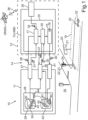
- Fig. 1 shows a system 10 that may comprise a back-end server unit or (in short) server unit 11 and several vehicles 12.
- each vehicle 12 at least one interactive user device 13 may be provided that may be designed as a head-mounted device HMD or that at least may comprise an HMD.
- Communication links 14 between the respective user device 13 and the server unit 11 may be operated on the basis of, e.g. an internet connection, that may be IP-based (IP - internet protocol) and/or based on a wireless connection, e.g. Wi-Fi and/or mobile communication.
- IP-based IP - internet protocol
- the respective user device 13 may present a virtual environment, especially a VRA or VR, to a user (not shown in Fig. 1 ), on the basis of e.g. a VR engine 15 that may render virtual content of a virtual environment 16 that the user may regard using the HMD.
- the user may also interact with the virtual environment 16.
- the respective user device 13 may operate an event map 17 that may indicate where in a real-world environment 18 that respective vehicle 12 is driving in, a respective trigger region 19 may be located or positioned that may be associated with a respective virtual event 20, for example a message 21 that a user of the user device 13 may see if the vehicle 12 where the user is reciting, is in the trigger region 19 as a possible additional trigger condition 22 for example a traffic light 23 may show a red light 24.
- the user may then be presented the virtual event 20 in the virtual environment 16, i.e. in this example the message 21 related to for example the red traffic light 23.
- a processing unit 25 of the user device 13 may send map request data 26 to the server unit 11.
- the server unit 11 may operate an event provider 27, i.e. a software module or an interface that may provide an API (application program interface) for receiving a processing a map request data 26.
- the server unit 11 may comprise a data storage 28 where for example in an event data base 29 event data 30 for different virtual events 20 may be stored. From the event data 30, the server unit 11, e.g. by means of the event provider, map data 31 may be generated or provided for populating or generating the event map.
- the user device 13 may monitor a current vehicle position 32 and optionally a current heading 33 of the vehicle 12.
- position data 34 may be received from a receiver 35 for a position signal 36 of a GNSS. Based on the position data 34, the user device 13 may locate the vehicle 12 or the current position 32 of the vehicle 12 in regard to the event map 17. If the approach and/or the entrance or the location inside the trigger region 19 as indicated by event map 17 is detected based on the position data 34, request data 37 may be sent to the server unit 11 for requesting the corresponding event data 30, that may be sent by for example an event producer 38 of the server unit 11.
- the event producer 38 can be, for example, a software program code or interface, for example an API.
- An event re-constructor module 39 or in general a software module of the processing unit 25 may generate the corresponding event 20 based on the received event data 30, i.e.
- the server unit 11 may operate a corresponding interface or API as a status event producer 41.
- the interaction data 40 may be stored in a user database 42 of the data storage 28 individually for each user wherein the different users and their user interaction data 40 may be grouped for example in user groups 43. From the interaction data 40, adapted user events 44 may be generated that may be valid for only the members of the user groups 43.
- the event data 30 for different virtual events 20 may also be grouped in user groups 43 such that only a user who is member or registered to the user group 43 may experience or access the corresponding virtual event 20.
- the user's experience of a vehicle drive is thus enhanced with geo-based, dynamic and interactive events influenced by other users.
- This enables gamification approaches (e.g. high score of an arcade game at a red light) as well as other interactions with other users (e.g. sharing news, videos, etc. at geo-location).
- Fig. 2 illustrates how the respective event data 30 for a specific user event 20 may be generated by a respective user 45 as a creating user.
- the user may user the user device 13 while the user 45 is in a vehicle 12 and operates the user device 13.
- the user device 13 may comprise a controller 46 for providing input data or definition data 47.
- the user 45 may access or regard the virtual environment 16 which in Fig. 2 is an augmented reality AR such that a building or in general an object 48 of the real-world environment 18 may be associated with or augmented with a virtual event 20, for example a message left by user 45 for at least one other user who is using a respective user device 13.
- the user 45 may set a relative or absolute geometric position 49 relative with regard to object 48 or as an absolute position in the real-world environment 18. For example, geographic coordinates and optionally a height-value may be defined.
- the definition data 47 are defined that may be sent to the sever unit 11 together with the current position data 34 of the current vehicle position 32.
- the definition data 47 and the position data 34 may be used to generate event data 30 for the virtual event 20 and the map data 31 for defining of delimiting a corresponding trigger region 19.
- the event data 30 and the map data 31 may then be made available to other user devices 13 as it has been explained on the basis of Fig. 1 .
- the system 10 may generate and display user-triggered and/or automatically generated geo-based, interactive virtual events that are to be stored in the server unit as a backend. These virtual events can then be signaled to the different VR-users / vehicles to create an event geo map. When users enter the corresponding geo area (trigger region) of one or more stored events / interactions, they can be dynamically integrated into the VR experience. The events can be interactive between the VR users.
- navigation and vehicle data will be exchanged between the vehicle and HMD (i.e. the interactive user device) to create the VR environment and visualize the vehicle movement in VR.
- HMD i.e. the interactive user device
- information for dynamic, interactive and geo-based creation of events / interactions may now be exchanged.
- an interface can be extended (e.g., via Bluetooth Low Energy, WiFi), but it is also possible for the HMD to communicate directly with the infrastructure of the server unit via a mobile communication standard, e.g. 5G.
- an event can also include metadata that includes magnitudes from environmental factors, temporal factors, and/or random parameters.
- the process of creating an event can be triggered on the system side by (partially) automated or manual means as well as by user input or interaction.
- a triggered event implies a download of user event data that can be executed, displayed or otherwise utilized on the user's side, i.e. in the vehicle where the user is residing with the user device.
- User event data can include both user-specific (e.g. user group information or personal data) and cross-user data.
- the aim of the system is to trigger virtual event as when the geo-position of the user (i.e. the user device used by the user) and the area of the trigger region marked in the event data is within or on the stored geometry of the virtual event, preferably also depending on the heading and/or other predefined factors.
- available virtual events in the vicinity and specific conditions for triggering them are retrieved from an event database as map data located in the backend, e.g. via an event provider, and stored in an event map in the user device.
- the VR environment generated by the user device is continuously checked for all stored events to see if they are to be triggered.
- request data signaling a request for the corresponding event data is sent to e.g. a event producer located in the backend server unit, which subsequently initiates the download of the user event data, which is processed, e.g.
- an event reconstructor within the user device, for the VR environment on the part of the user domain, i.e. the user device.
- the event data it is also possible to store certain status information of the user as interaction data within the backend server unit and to take this into account when triggering the same virtual event again or when triggering other, related virtual events.
- the example shows how real-world location-based events may be provided in a dynamic virtual environment.
Landscapes
- Engineering & Computer Science (AREA)
- Physics & Mathematics (AREA)
- General Physics & Mathematics (AREA)
- Theoretical Computer Science (AREA)
- Radar, Positioning & Navigation (AREA)
- Remote Sensing (AREA)
- Business, Economics & Management (AREA)
- General Engineering & Computer Science (AREA)
- Signal Processing (AREA)
- Strategic Management (AREA)
- Multimedia (AREA)
- Computer Networks & Wireless Communication (AREA)
- Human Computer Interaction (AREA)
- Entrepreneurship & Innovation (AREA)
- Human Resources & Organizations (AREA)
- Economics (AREA)
- Marketing (AREA)
- General Business, Economics & Management (AREA)
- Automation & Control Theory (AREA)
- Health & Medical Sciences (AREA)
- Tourism & Hospitality (AREA)
- Transportation (AREA)
- Mechanical Engineering (AREA)
- Chemical & Material Sciences (AREA)
- Combustion & Propulsion (AREA)
- General Health & Medical Sciences (AREA)
- Computer Graphics (AREA)
- Computer Hardware Design (AREA)
- Software Systems (AREA)
- Optics & Photonics (AREA)
- Operations Research (AREA)
- Quality & Reliability (AREA)
- Finance (AREA)
- Development Economics (AREA)
- Accounting & Taxation (AREA)
- Databases & Information Systems (AREA)
- Social Psychology (AREA)
- Computer Security & Cryptography (AREA)
- Computing Systems (AREA)
- Medical Informatics (AREA)
Description
- The invention is concerned with a method for presenting a shared virtual environment to users residing in different vehicles while the respective vehicle is driving in a real-world environment. The invention also provides a corresponding system and the components of that system, which are a server unit, an interactive user device for presenting a virtual environment, and a vehicle comprising such an interactive user device.
- Virtual Reality (VR) and Augmented Reality (AR) are technologies that are increasingly being used in the gaming and production sectors for displaying virtual environments. In both VR and AR, the user wears a so-called head-mounted display (HMD). In the following, the more general term "interactive user device" is used for referring to a HMD or a HMD with at least one portable controller or a HMD and an additional control circuitry linked to the HMD (and with or without the controller).
- Most use cases of VR and AR are limited to the static domain, i.e. a user wears the HMD while on stationary ground (e.g. in a room of a building). However, the use of HMDs in the dynamic domain, e.g., during a dynamic car ride, is also of interest. The implementation of these approaches in production vehicles would be of great advantage. In the implementation, on the one hand, fixed VR content can be visualized for a fixed driving route and, on the other hand, VR content can be generated dynamically based on the map information of a planned driving route.
- This implementation does not exploit the full potential of the VR user's positioning information in the vehicle and ignores the creation and generation of events / interactions by the VR user.
- Document
US 10,785,621 B1 - Document
US 2019 / 0 101 976 A1 describes a system for displaying a virtual environment to a user in a vehicle. The displayed virtual content depends on the current driving state of the vehicle in that, for example, if the vehicle approaches a curve to fast, a warning may be displayed in the virtual environment. The user is thus confined to consuming pre-defined virtual content in the virtual environment. - Document
US 2018 / 0 040 163 A1 describes a system for displaying a virtual environment that depends both on the current driving route of a vehicle (as has been described above) and an anticipated stimulus event, for example a centrifugal force caused by the vehicle driving through a curve of a road. The user only experiences virtual content that needs to be prepared by the provider of the virtual environment. - Document
US 2015/ 0 100 179 A1 is the document describing a method closest to the one presented here. The main idea there is to determine a spatial environment around a vehicle while creating one or more maneuver paths there. This environment is then projected to an output device and frequently updated. Finally the idea also includes to control one or more systems of the car based on the maneuver request, which depends on the maneuver path. - It is an object of the present invention to provide a system for displaying a virtual environment to users in different vehicles, wherein the virtual environment shall also reflect the individual situation of the users.
- The object is accomplished by the subject matter of the independent claims. Advantageous developments with convenient and non-trivial further embodiments of the invention are specified in the following description, the dependent claims and the figures.
- As a solution for achieving the object the invention provides a method for presenting a shared virtual environment to users residing in different vehicles while the respective vehicle is driving in a real-world environment. The users may reside in the vehicles at the same time or at a different, overlapping and/or non-overlapping time intervals. While a respective user is in one of the vehicles and uses an interactive user device, the user may create new virtual content by defining or editing definition data describing the respective new virtual event. To this end, in at least one of the vehicles a respective interactive user device of that vehicle receives the definition data from the respective user residing in that vehicle and/or the user device generates the definition data (automatically) in dependence on a current driving situation of the vehicle. The definition data therefore describe a user-defined and/or situation-based new virtual event for the virtual environment. This virtual event is linked to a specific trigger region in the real-world environment where the vehicle is driving. To this end, a position sensor of the vehicle generates position data of the vehicle while the user generates the definition data. The position data describe a current position of the vehicle in the real-world environment.
- Such a user who creates definition data is named here as "creating user". Additionally or alternatively, the user device may automatically generate such definition data of e new virtual event depending on sensor data describing the current driving situation. The position sensor, e.g. a receiver for a position signal of a GNSS (global navigation satellite system), for example the GPS (global positioning system), indicates where the new virtual event was generated in the real-world environment. The real-world environment may comprise a road network where the vehicles are driving. A virtual event can be, for example, a message or a drawing that the creating user may leave for other users in the virtual environment. Such a user who consumes or regards a virtual event is also called "consuming user" in the following.
- For updating the virtual environment, a stationary server unit receives the definition data and the corresponding position data from out of the vehicle and generates corresponding event data of the new virtual event, wherein in dependence on the position data of the vehicle the trigger region is defined that defines wherein in the real-world environment the virtual event shall be triggered or located. The stationary server thus collects all the new virtual events that are generated by a respective creating user. The virtual environment is then populated or enriched with virtual events generated by creating users. Each virtual event is associated with a trigger position or trigger region in the real-world environment where the respective virtual event becomes accessible or visible to consuming users, when they access the virtual environment while residing in the real-world trigger region. Thus, a consuming user needs to pass by or enter the corresponding trigger region with a vehicle for detecting or seeing or accessing the corresponding virtual event in the virtual environment.
- In order to access a virtual event, the following logic is provided. The server unit receives respective request data from the respective user device of at least one of the vehicles. The request data indicate that the respective vehicle approaches or enters or is positioned in the respective trigger region of one of the virtual events. The server unit then sends the corresponding event data of that virtual event to the interactive user device of that vehicle and the corresponding virtual event is displayed to the user in that vehicle as a part of the virtual environment. A respective virtual event is thus triggered or started automatically. A virtual event left in the respective trigger region by a creating user is thus presented to a respective consuming user in the respective trigger region. The virtual environment therefore becomes a common virtual environment as a creating user may generate a virtual event that may also be experienced or consumed by other, consuming users. This allows a creating user to communicate with at least one consuming user in real-time (i.e. both the creating user and the at least one consuming user use their respective interactive user device at the same time or simultaneously) or a creating user may leave a virtual event for later consumption by a consuming user, when the creating user might even have already left the trigger region.
- The invention provides the advantage that the virtual environment may be populated or enriched with virtual events that are created or added by the users themselves, such that a communication mechanism is implemented in the virtual environment. If the respective virtual event is created automatically by the user device itself (e.g. caused by a specific driving situation), this allows to signal to at least one consuming user how the creating user felt or experienced the driving situation.
- The invention also comprises embodiments that provide features which afford additional technical advantages.
- An embodiment may comprise that while the respective user device of at least one of the vehicles receives respective definition data of one of the virtual events, the user device also receives condition data, wherein the condition data describe a current environmental condition and/or a current state of the vehicle, e.g. describing the driving situation. The condition data may be user-defined, i.e. the creating user may set or describe the condition data (e.g. by providing corresponding user input on a keyboard or with a portable controller or via voice). Additionally or alternatively at least a part of the condition data may be measured by the user device using at least one sensor of the vehicle such that the condition data describes the current driving situation and/or environmental situation of the real-world environment. Correspondingly, the server unit receives these condition data and generates a corresponding trigger condition for the new virtual event. In addition to the trigger region there is then also a trigger condition. The virtual event is only displayed to a user if the user resides in a vehicle that also fulfills the trigger condition. In other words, the consuming user experiences or is presented with the virtual event only if the consuming user is in the same situation as the creating user. This prevents the presentation of a virtual event that may not suit or correspond to the current situation of the consuming user.
- An embodiment may comprise that the at least one trigger condition comprises:
- a driving speed of the vehicle has a value that lies within a predefined speed interval,
- a traffic light in the real-world environment has a predefined state,
- the traffic is in a predefined state (e.g. traffic jam),
- a weather in the real-world environment,
- a specific heading or driving direction (e.g. north east) of the vehicle,
- a driving destination as signaled by a navigation system.
- The speed interval may define that the vehicle is standing still or driving at a slow speed, i.e. a speed smaller than a pre-defined threshold value (for example the threshold value may be greater than 0 and in an interval ranging from 5 kilometers per hour to 50 kilometers per hour). The speed interval may also define a fast speed wherein the lower limit of the speed interval may be in the range of 150 kilometers per hour to 180 kilometers per hour and the upper limit of the speed interval may be in the region of 185 kilometers per hour to 300 kilometers per hour. For example, a creating user who is in a vehicle that is driving fast may leave in a virtual event a message saying, for example, "I have been here!" and this message will only be visible to or experienced by a consuming user if the consuming user is in a vehicle that drives at a speed that is in the described high-speed interval. For a traffic light, a virtual event may be generated for the state of the traffic light in which the traffic light is red or green. For example, a user may leave a massage, for example "This traffic light is always red when I arrive" and this virtual event is only visible to a consuming user if the vehicle of that user arrives at the traffic light while the traffic light is red. The driving speed and/or the state of the traffic light may be signaled by an electronic control unit of the respective vehicle that monitors the driving speed or the real-world environment. The state of the traffic may be described by traffic data that may be received from a traffic monitoring system that the vehicle is connected to. The state of the traffic can be for example a traffic jam such that a creating user may leave a message, for example "There is always a traffic jam in the morning" and a consuming user will only be presented with this virtual event if the consuming user also experiences a traffic jam in the trigger region. The weather may derive from weather data that may be received from a weather station. A user may leave a message, for example "This place looks beautiful when the sun shines" and the user may define that this virtual event may be displayed whenever a consuming user is in the trigger region while no sunshine is present (e.g. at night and/or on a cloudy day). This may inform a consuming user that the real-world environment in the trigger region looks beautiful if the sun is shining.
- As a data volume of the event data can be very large, a user device is generally not able to store all available event data. An embodiment may comprise that the server unit generates map data from the event data of the stored virtual events and provides the map data to the vehicles, wherein the map data describe the respective trigger region of the virtual events. The data volume or data amount of the map data (e.g. measured in Megabytes) is less or smaller than the data volume of the event data as the details or the content of the virtual events does not need to be contained in the map data. In the respective vehicle the respective user device monitors the current vehicle position of the vehicle and generates the request data if the current vehicle position indicates that the vehicle approaches or enters or is positioned in the trigger region according to the map data. Thus, in each vehicle the corresponding interactive user device may administer or observe by itself where the limits or borders of the respective trigger region are. Such a trigger region may be, for example, a single spot or an area defined by a polygon or a geometrical shape or a certain section of a driving route. This enables the user device to monitor by itself whether event data for a specific virtual event shall be requested from the server. This reduces the amount of data that need to be transferred from the server to the respective vehicle and only the map data are necessary for deciding whether a virtual event needs to be rendered in the respective user device.
- An embodiment may comprise that the definition data describe at least one of the following virtual events:
- a message that is displayed in the virtual environment,
- a camera image of the real-world environment,
- a screenshot of the virtual environment,
- an image of the user who defines the definition data,
- a video stream,
- a drawing
- an audio message,
- a haptic signal,
- a link to a media file of a song.
- The creating user may thus use a virtual event to present a graphical and/or auditory and/or haptic message or experience to at least one consuming user while the consuming user passes through the trigger region.
- An embodiment may comprise that the definition data describe an interactive virtual event where at least two users interact in real-time via their respective user device, i.e. the access the virtual environment at the same time. A creating user and a consuming user may therefore have a real-time conversation. The virtual event for such a conversation can be, for example, a video meeting and/or an interaction or other task of the users. The creating user may create the virtual event, but once the virtual event is accessed or activated by the consuming user, both users may participate or provide signals, for e.g. a video stream and/or text messages and/or audio messages that may be interchanged between the user devices for enabling the conversation.
- An embodiment may comprise that the definition data also comprise a geometric position that is set by the user, wherein the geometric position describes a geometric offset of the virtual event with regard to the position of the vehicle or an absolute position of the virtual event in the real-world environment. The creating user may therefore shift the position of the virtual event, for example a message board displaying a message. The respective user device that is displaying the virtual event projects the virtual event to the geometric position. The creating user may input the geometric position by defining coordinates and/or by moving the new event in the virtual environment manually using, for example, a portable controller of the user device. If a relative position is defined using the geometric offset, the virtual event will follow the vehicle while the vehicle is moving in the real-world environment. If an absolute position is defined, the virtual event may be connected to and/or attached to an object in the real-world environment (in the case of augmented reality) or an object in the virtual event (in the case of virtual reality). This allows to associate a virtual event with an object that may be visible to the consuming user while experiencing or accessing the virtual event. For example a creating user may generate a virtual event comprising a comment regarding the respective object (e.g. "What a nice building!").
- An embodiment may comprise that the users are registered in at least one user group and at least one virtual event is associated with a respective user group and the server unit provides the event data of that virtual event only to the respective user device of such a user who is also registered in the user group that the virtual event is associated with. This allows to delimit or restrict the access to the respective virtual environment to a limited group of spectators or users. For example, a creating user may invite a group of friends (each of which is a consuming user) to experience or access the new event. Unknown consuming users who the creating user wants to exclude from the new virtual event will not be presented with the virtual event created by the creating user.
- An embodiment may comprise that while a virtual event is displayed to one of the users in the respective vehicle an interaction of the user with the virtual event is monitored and the interaction is describes by interaction data that are provided to the server unit and the server unit adapts the event data of the virtual event wherein the adapted event data describe the result of the interaction. For example a consuming user may become a creating user by leaving an answer or a comment to the consumed virtual event of another creating user. This allows the users to interact in a non-real time manner. For example a consuming user may leave (as an interaction) a symbol indication that the consuming user likes the virtual event. This may be signaled to the creating user who created or generated the virtual event.
- An embodiment may comprise that by the respective user device the respective virtual event is displayed in a common virtual environment background that is super-imposed over the real-world environment. Such a virtual environment background can be a virtual stage where the users may leave or position their virtual events as object or content. By providing a virtual environment background, the user device generates a virtual reality where the real-world environment is not visible to the user. As it is known from the prior art, the virtual environment background may represent objects from the real-world environment, for example a road that the vehicle is currently driving on.
- An embodiment may comprise that by the respective user device the respective virtual event is projected into the respective user's view on the real-world environment. This is an augmented reality where a user is presented at least one virtual event, for example an object, while regarding or viewing the real-world environment.
- As a solution for achieving the above-stated object the invention provides a system comprising a server unit for receiving and storing and sending out event data and at least one interactive user device for a respective vehicle, wherein the interactive user device is designed to display virtual events to a user in the vehicle and to receive definition data of new virtual events from the user, wherein processing units of the server unit and the at least one interactive user device are designed to interact according to one of the embodiment of the described method. In other words, the system provides the hardware or components for performing the inventive method.
- As part of a solution for achieving the above-stated object the invention provides a server unit for said system. The server unit may be operated as has already been described in connection with the inventive method. In other words, the server unit comprises a processing unit that is designed to store event data describing the at least one virtual event of a virtual environment, wherein the virtual event is associated with the respective real-world trigger region in a real-world environment. If from an interactive user device of a vehicle respective request data are received that indicate that the vehicle approaches or enters or is position in the respective trigger region of one of the virtual events, the event data of the corresponding virtual event are sent to the user device of the vehicle for displaying the virtual event to the user in that vehicle as a part of the virtual environment. For generating the event data of the respective virtual event the processing unit is designed to receive both event data from the interactive user device of at least one of the vehicles, wherein the event data describe a user-defined new virtual event, and position data of that vehicle that describe a position of the vehicle in the real-world environment while the user generated the definition data. The server unit combines the event data and the position data to create the event data of the respective virtual event together with a trigger region where the virtual event resides in the real-world environment. The server unit may comprise of a computer or a network of computers, for example cloud computers. The server unit may be connected to the internet and a communication link between the server unit and the respective vehicle may be based on an internet connection and/or a wireless connection. For generating the communication link between the vehicle and a stationary network, a WiFi-technology and/or mobile phone technology (e.g. 5G) may be used.
- As part of a solution for achieving the above-stated object the invention provides an interactive user device for a vehicle, wherein the user device comprises a processing unit that is designed
- to receive definition data from a user residing in that vehicle, wherein the definition data describe a user-defined or automatically generated new virtual event for a virtual environment, and
- to receive position data of the vehicle from a position sensor of the vehicle while the definition data where generated, wherein the position data describe a current position of the vehicle in the real-world environment, and
- to provide the definition data and the position data to an embodiment of the described server unit, and
- to send request data to the server unit for receiving event data and
- to display to the user the received event data as a part of the virtual environment.
- The user device may be designed as or comprise a HMD for displaying a VR and/or an AR environment as has been described above. For receiving user input, the user device may comprise at least one portable menu controller and/or a keyboard and/or a virtual keyboard and/or a gesture recognition system that may, e.g. based on camera data of a camera, detect a hand of the user and may recognize the gesture performed by the user, e.g. based on an artificial neural network and/or a hidden Markov model. The user device may monitor the current vehicle position based on position data generated by a receiver of a position signal of a GNSS. The user device may compare the current position with map data describing the trigger regions of virtual events. If a trigger region is approached or entered or if the vehicle is already positioned in a trigger region, the request data for requesting the event data may be sent to the server unit. For performing the method steps, the user device comprises the processing unit that may comprise at least one microprocessor and/or at least one ASIC (application specific integrated circuit). For performing the method steps, a software or program code may be stored in a data storage of the processing unit.
- As part of a solution for achieving the above-stated object the invention provides a vehicle comprising at least one user device that is an embodiment of said the above-described interactive user device. The inventive vehicle is preferably designed as a motor vehicle, in particular as a passenger vehicle or a truck, or as a passenger bus.
- The invention also comprises the combinations of the features of the different embodiments.
- In the following an exemplary implementation of the invention is described. The figures show:
- Fig. 1
- a schematic illustration of an embodiment of the inventive system; and
- Fig. 2
- a schematic illustration of a driving situation.
- The embodiment explained in the following is a preferred embodiment of the invention. However, in the embodiment, the described components of the embodiment each represent individual features of the invention which are to be considered independently of each other and which each develop the invention also independently of each other and thereby are also to be regarded as a component of the invention in individual manner or in another than the shown combination. Furthermore, the described embodiment can also be supplemented by further features of the invention already described.
- In the figures identical reference signs indicate elements that provide the same function.
-
Fig. 1 shows asystem 10 that may comprise a back-end server unit or (in short)server unit 11 andseveral vehicles 12. In eachvehicle 12 at least oneinteractive user device 13 may be provided that may be designed as a head-mounted device HMD or that at least may comprise an HMD. Communication links 14 between therespective user device 13 and theserver unit 11 may be operated on the basis of, e.g. an internet connection, that may be IP-based (IP - internet protocol) and/or based on a wireless connection, e.g. Wi-Fi and/or mobile communication. - The
respective user device 13 may present a virtual environment, especially a VRA or VR, to a user (not shown inFig. 1 ), on the basis of e.g. aVR engine 15 that may render virtual content of avirtual environment 16 that the user may regard using the HMD. The user may also interact with thevirtual environment 16. For dynamically generating thevirtual environment 16 with content from other, creating users, therespective user device 13 may operate anevent map 17 that may indicate where in a real-world environment 18 thatrespective vehicle 12 is driving in, arespective trigger region 19 may be located or positioned that may be associated with a respectivevirtual event 20, for example amessage 21 that a user of theuser device 13 may see if thevehicle 12 where the user is reciting, is in thetrigger region 19 as a possible additional trigger condition 22 for example a traffic light 23 may show ared light 24. The user may then be presented thevirtual event 20 in thevirtual environment 16, i.e. in this example themessage 21 related to for example the red traffic light 23. - For monitoring
different trigger regions 19, aprocessing unit 25 of theuser device 13 may sendmap request data 26 to theserver unit 11. Theserver unit 11 may operate anevent provider 27, i.e. a software module or an interface that may provide an API (application program interface) for receiving a processing amap request data 26. Theserver unit 11 may comprise adata storage 28 where for example in anevent data base 29event data 30 for differentvirtual events 20 may be stored. From theevent data 30, theserver unit 11, e.g. by means of the event provider,map data 31 may be generated or provided for populating or generating the event map. Theuser device 13 may monitor acurrent vehicle position 32 and optionally a current heading 33 of thevehicle 12. For example,position data 34 may be received from areceiver 35 for aposition signal 36 of a GNSS. Based on theposition data 34, theuser device 13 may locate thevehicle 12 or thecurrent position 32 of thevehicle 12 in regard to theevent map 17. If the approach and/or the entrance or the location inside thetrigger region 19 as indicated byevent map 17 is detected based on theposition data 34,request data 37 may be sent to theserver unit 11 for requesting thecorresponding event data 30, that may be sent by for example anevent producer 38 of theserver unit 11. Theevent producer 38 can be, for example, a software program code or interface, for example an API. Anevent re-constructor module 39 or in general a software module of theprocessing unit 25 may generate thecorresponding event 20 based on the receivedevent data 30, i.e. the graphical and/or audio and/or apical content that shall be dynamically integrated in thevirtual environment 16. Once thevirtual event 20 is integrated in thevirtual environment 16, it becomes accessible or it can be experienced by the user of theuser device 13. The user may interact with thevirtual event 20 by means of theuser device 13. This interaction may result ininteraction data 40 that may be sent to theserver unit 11. For example, theserver unit 11 may operate a corresponding interface or API as astatus event producer 41. Theinteraction data 40 may be stored in auser database 42 of thedata storage 28 individually for each user wherein the different users and theiruser interaction data 40 may be grouped for example inuser groups 43. From theinteraction data 40, adapteduser events 44 may be generated that may be valid for only the members of theuser groups 43. Likewise, theevent data 30 for differentvirtual events 20 may also be grouped inuser groups 43 such that only a user who is member or registered to theuser group 43 may experience or access the correspondingvirtual event 20. - The user's experience of a vehicle drive is thus enhanced with geo-based, dynamic and interactive events influenced by other users. This enables gamification approaches (e.g. high score of an arcade game at a red light) as well as other interactions with other users (e.g. sharing news, videos, etc. at geo-location).
-
Fig. 2 illustrates how therespective event data 30 for aspecific user event 20 may be generated by arespective user 45 as a creating user. The user may user theuser device 13 while theuser 45 is in avehicle 12 and operates theuser device 13. Theuser device 13 may comprise acontroller 46 for providing input data ordefinition data 47. For example, theuser 45 may access or regard thevirtual environment 16 which inFig. 2 is an augmented reality AR such that a building or in general anobject 48 of the real-world environment 18 may be associated with or augmented with avirtual event 20, for example a message left byuser 45 for at least one other user who is using arespective user device 13. Using for example thecontroller 46, theuser 45 may set a relative or absolute geometric position 49 relative with regard to object 48 or as an absolute position in the real-world environment 18. For example, geographic coordinates and optionally a height-value may be defined. By choosing the type of thevirtual event 20 and the geometric position 49, thedefinition data 47 are defined that may be sent to the severunit 11 together with thecurrent position data 34 of thecurrent vehicle position 32. In theserver unit 11, thedefinition data 47 and theposition data 34 may be used to generateevent data 30 for thevirtual event 20 and themap data 31 for defining of delimiting acorresponding trigger region 19. Theevent data 30 and themap data 31 may then be made available toother user devices 13 as it has been explained on the basis ofFig. 1 . - The
system 10 may generate and display user-triggered and/or automatically generated geo-based, interactive virtual events that are to be stored in the server unit as a backend. These virtual events can then be signaled to the different VR-users / vehicles to create an event geo map. When users enter the corresponding geo area (trigger region) of one or more stored events / interactions, they can be dynamically integrated into the VR experience. The events can be interactive between the VR users. - Overall, in the
virtual environment system 10, navigation and vehicle data will be exchanged between the vehicle and HMD (i.e. the interactive user device) to create the VR environment and visualize the vehicle movement in VR. In addition to these data, information for dynamic, interactive and geo-based creation of events / interactions may now be exchanged. For the exchange of information between vehicle and HMD, for example, an interface can be extended (e.g., via Bluetooth Low Energy, WiFi), but it is also possible for the HMD to communicate directly with the infrastructure of the server unit via a mobile communication standard, e.g. 5G. - In the course of the virtual environment application, information is encoded onto the "real-world" environment in the form of geometries of trigger regions on road networks in dependency involving GPS coordinates and preferably also heading of a vehicle. In addition, an event can also include metadata that includes magnitudes from environmental factors, temporal factors, and/or random parameters. The process of creating an event can be triggered on the system side by (partially) automated or manual means as well as by user input or interaction. A triggered event implies a download of user event data that can be executed, displayed or otherwise utilized on the user's side, i.e. in the vehicle where the user is residing with the user device. User event data can include both user-specific (e.g. user group information or personal data) and cross-user data.
- The aim of the system is to trigger virtual event as when the geo-position of the user (i.e. the user device used by the user) and the area of the trigger region marked in the event data is within or on the stored geometry of the virtual event, preferably also depending on the heading and/or other predefined factors.
- This first requires a cyclic check of the geo-position of the user domain (i.e. the user device in the respective vehicle). Depending on this, available virtual events in the vicinity and specific conditions for triggering them are retrieved from an event database as map data located in the backend, e.g. via an event provider, and stored in an event map in the user device. The VR environment generated by the user device is continuously checked for all stored events to see if they are to be triggered. As soon as the user device detects the triggering of an event for the currently displayed VR environment, request data signaling a request for the corresponding event data is sent to e.g. a event producer located in the backend server unit, which subsequently initiates the download of the user event data, which is processed, e.g. in an event reconstructor within the user device, for the VR environment on the part of the user domain, i.e. the user device. When executing, displaying or otherwise utilizing the event data, it is also possible to store certain status information of the user as interaction data within the backend server unit and to take this into account when triggering the same virtual event again or when triggering other, related virtual events.
- Overall, the example shows how real-world location-based events may be provided in a dynamic virtual environment.
Claims (14)
- Method for presenting a shared virtual environment (16) to users (45) residing in different vehicles (12) while the vehicles (12) are driving in a real-world environment (18), wherein in at least one of the vehicles (12)- an interactive user device (13) of that vehicle (12) receives definition data (47) from the respective user (45) residing in that vehicle (12) and/or generates the definition data (47) in dependence on a current driving situation of the vehicle (12), wherein the definition data (47) describe a new virtual event (20) for the virtual environment (16), and- a position sensor of the vehicle (12) generates position data (34) of the vehicle (12) while the definition data (47) is generated, wherein the position data (34) describe a current position of the vehicle (12) in the real-world environment (18), anda stationary server unit (11) receives the definition data (47) and the corresponding position data (34) from out of the vehicle (12) and generates corresponding event data (30) of the new virtual event (20), wherein in dependence on the position data (34) a trigger region (19) is defined that defines where in the real-world environment (18) the virtual event (20) shall be triggered,characterized in thatthe server unit (11) receives respective request data (37) from a user device (13) of at least one of the other vehicles (12), wherein the request data (37) indicate that the vehicle (12) approaches or enters or is positioned in the respective trigger region (19) of one of the virtual events (20), and the server unit (11) sends the corresponding event data (30) of that virtual event (20) to the interactive user device (13) of that vehicle (12) and the corresponding virtual event (20) is displayed to the user (45) in that vehicle (12) as a part of the virtual environment (16).
- Method according to claim 1, wherein while the respective user device (13) of at least one of the vehicles (12) receives definition data (47) of a new virtual event (20), the user device (13) also receives condition (22) data, wherein the condition (22) data each describe a current environmental condition (22) and/or a current state of the vehicle (12), and
the server unit (11) receives the condition (22) data and generates at least one corresponding trigger condition (22) for the new virtual event (20), wherein the virtual event (20) is only displayed to such a user (45) who resides in a vehicle (12) that also fulfills the at least one trigger condition (22). - Method according to claim 2, wherein the at least one trigger condition (22) comprises:- a driving speed of the vehicle (12) has a value that lies within a predefined interval,- a traffic light (23) in the real-world environment (18) has a predefined state,- the traffic is in a predefined state,- a weather in the real-world environment (18)- a specific heading (33) of the vehicle (12),- a driving destination as signaled by a navigation system (10).
- Method according to any of the preceding claims, wherein the server unit (11) generates map data (31) from the event data (30) of the stored virtual events (20) and provides the map data (31) to the vehicles (12), wherein the map data (31) describe the trigger region (19) of the virtual events (20), and
in the respective vehicle (12) the respective user device (13) monitors the current vehicle (12) position of the vehicle (12) and generates the request data (37) if the current vehicle (12) position indicates that the vehicle (12) approaches or enters or is positioned in the trigger region (19) according to the map data (31). - Method according to any of the preceding claims, wherein the definition data (47) describe at least one of the following virtual events (20):- a message (21) that is displayed in the virtual environment (16),- a camera image of the real-world environment (18),- a screenshot of the virtual environment (16),- an image of the user (45) who defines the definition data (47),- a video stream,- a drawing,- an audio message (21),- a haptic signal,- a link to a media file of a song.
- Method according to any of the preceding claims, wherein the definition data (47) describe an interactive virtual event (20) where at least two users (45) interact in real-time via their respective user device (13).
- Method according to any of the preceding claims, wherein the definition data (47) also comprise a geometric position (49) that is set by the user (45), wherein the geometric position (49) describes a geometric offset of the virtual event (20) with regard to the position of the vehicle (12) or an absolute position of the virtual event (20) in the real-world environment (18) and
the respective user device (13) that is displaying the virtual event (20) projects the virtual event (20) to a corresponding geometric position (49) in the virtual environment (16). - Method according to any of the preceding claims, wherein the users (45) are registered in at least one user group (43) and at least one virtual event (20) is associated with a respective user group (43) and the server unit (11) provides the event data (30) of that virtual event (20) only to the respective user device (13) of such a user (45) who is also registered in the same user group (43) that the virtual event (20) is associated with.
- Method according to any of the preceding claims, wherein while a virtual event (20) is displayed to one of the users (45) in the respective vehicle (12) an interaction of the user (45) with the virtual event (20) is monitored and the interaction is describes by interaction data (40) that are provided to the server unit (11) and the server unit (11) adapts the event data (30) of the virtual event (20) wherein the adapted event data (30) describe the result of the interaction.
- Method according to any of the preceding claims, wherein by the respective user device (13) the respective virtual event (20)- is displayed in a common virtual environment (16) background that is super-imposed over the real-world environment (18) as a virtual reality, VR, or- is projected into the respective user's (45) view on the real-world environment (18) as augmented reality, AR.
- System (10) comprising a server unit (11) for receiving and storing and sending out event data (30) and at least one interactive user device (13) for a respective vehicle (12), wherein the interactive user device (13) is designed to display virtual events (20) to a user (45) in the respective vehicle (12) and to receive definition data (47) of new virtual events (20) from the user (45), wherein a respective processing unit (25) of the server unit (11) and of the at least one interactive user device (13) are designed to interact according to a method according to any one of the preceding claims.
- Server unit (11) for a system (10) according to claim 11, wherein the server unit (11) comprises a processing unit (25) that is designed store event data (30) describing the at least one virtual event (20) of a virtual environment (16), wherein the virtual event (20) is associated with a respective real-world trigger region (19) in a real-world environment (18), andif from an interactive user device (13) of a vehicle (12) respective request data (37) are received that indicate that the vehicle (12) approaches or enters or is positioned in the respective trigger region (19) of one of the virtual events (20), the event data (30) of the corresponding virtual event (20) are sent to the user device (13) of the vehicle (12) for displaying the virtual event (20) to the user (45) in that vehicle (12) as a part of the virtual environment (16), whereinfor generating the event data (30) of the respective virtual event (20) the processing unit (25) is designed to receive- event data (30) from the interactive user device (13) of at least one of the vehicles (12), wherein the event data (30) describe a new virtual event (20), and- position data (34) of that vehicle (12) that describe a position of the vehicle (12) in the real-world environment (18) while the definition data (47) where generated in that vehicle (12) andthe server unit (11) combines the event data (30) and the position data (34) to create the event data (30) of the respective virtual event (20) together with a definition of a trigger region (19) where the virtual event (20) resides in the real-world environment (18).
- Interactive user device (13) for a vehicle (12), wherein the user device (13) comprises a processing unit (25) that is designed- to receive definition data (47) from a user (45) residing in that vehicle (12), wherein the definition data (47) describe a user-defined new virtual event (20) for a virtual environment (16), and- to receive position data (34) of the vehicle (12) from a position sensor of the vehicle (12) while the user (45) generates the definition data (47), wherein the position data (34) describe a current position of the vehicle (12) in the real-world environment (18), and- to provide the definition data (47) and the position data (34) to a server unit (11) according to claim 12, and- to send request data (37) to the server unit (11) for receiving event data (30) and- to display to the user (45) the received event data (30) as a part of the virtual environment (16).
- Vehicle (12) comprising at least one interactive user device (13) according to claim 13.
Applications Claiming Priority (1)
| Application Number | Priority Date | Filing Date | Title |
|---|---|---|---|
| PCT/EP2021/056126 WO2022188974A1 (en) | 2021-03-11 | 2021-03-11 | Method and system for presenting a shared virtual environment to users residing in different vehicles, and server unit, user device, and vehicle |
Publications (2)
| Publication Number | Publication Date |
|---|---|
| EP4304886A1 EP4304886A1 (en) | 2024-01-17 |
| EP4304886B1 true EP4304886B1 (en) | 2025-06-04 |
Family
ID=74884931
Family Applications (1)
| Application Number | Title | Priority Date | Filing Date |
|---|---|---|---|
| EP21712443.7A Active EP4304886B1 (en) | 2021-03-11 | 2021-03-11 | Method and system for presenting a shared virtual environment to users residing in different vehicles, and server unit, user device, and vehicle |
Country Status (4)
| Country | Link |
|---|---|
| US (1) | US12450845B2 (en) |
| EP (1) | EP4304886B1 (en) |
| CN (1) | CN116963928A (en) |
| WO (1) | WO2022188974A1 (en) |
Families Citing this family (1)
| Publication number | Priority date | Publication date | Assignee | Title |
|---|---|---|---|---|
| CN118732850A (en) * | 2024-06-24 | 2024-10-01 | 广东胜华智慧科技有限公司 | A virtual-reality event response method and a virtual-reality interaction system, device, and storage medium |
Citations (1)
| Publication number | Priority date | Publication date | Assignee | Title |
|---|---|---|---|---|
| WO2015160859A1 (en) * | 2014-04-14 | 2015-10-22 | Sirius Xm Radio Inc. | Systems, methods and applications for using and enhancing vehicle to vehicle communications including synergies and interoperation with satellite radio |
Family Cites Families (26)
| Publication number | Priority date | Publication date | Assignee | Title |
|---|---|---|---|---|
| US20100214111A1 (en) * | 2007-12-21 | 2010-08-26 | Motorola, Inc. | Mobile virtual and augmented reality system |
| US20090237328A1 (en) * | 2008-03-20 | 2009-09-24 | Motorola, Inc. | Mobile virtual and augmented reality system |
| US7966024B2 (en) * | 2008-09-30 | 2011-06-21 | Microsoft Corporation | Virtual skywriting |
| US8350871B2 (en) * | 2009-02-04 | 2013-01-08 | Motorola Mobility Llc | Method and apparatus for creating virtual graffiti in a mobile virtual and augmented reality system |
| US20140063055A1 (en) * | 2010-02-28 | 2014-03-06 | Osterhout Group, Inc. | Ar glasses specific user interface and control interface based on a connected external device type |
| US20130278631A1 (en) * | 2010-02-28 | 2013-10-24 | Osterhout Group, Inc. | 3d positioning of augmented reality information |
| US20120194420A1 (en) * | 2010-02-28 | 2012-08-02 | Osterhout Group, Inc. | Ar glasses with event triggered user action control of ar eyepiece facility |
| US20120194418A1 (en) * | 2010-02-28 | 2012-08-02 | Osterhout Group, Inc. | Ar glasses with user action control and event input based control of eyepiece application |
| US9417691B2 (en) * | 2010-03-26 | 2016-08-16 | Nokia Technologies Oy | Method and apparatus for ad-hoc peer-to-peer augmented reality environment |
| EP2372512A1 (en) * | 2010-03-30 | 2011-10-05 | Harman Becker Automotive Systems GmbH | Vehicle user interface unit for a vehicle electronic device |
| US9085303B2 (en) * | 2012-11-15 | 2015-07-21 | Sri International | Vehicle personal assistant |
| DE102013016244A1 (en) * | 2013-10-01 | 2015-04-02 | Daimler Ag | Method and device for augmented presentation |
| US9630631B2 (en) * | 2013-10-03 | 2017-04-25 | Honda Motor Co., Ltd. | System and method for dynamic in-vehicle virtual reality |
| TWI578021B (en) * | 2015-08-19 | 2017-04-11 | 國立臺北科技大學 | Augmented reality interactive system and dynamic information interactive display method thereof |
| EP3481671A4 (en) * | 2016-07-06 | 2020-08-12 | Ford Global Technologies, LLC | EXCHANGE INFORMATION AND IMPROVE THE USER EXPERIENCE THROUGH CONTEXT-Aware VEHICLES |
| US9922466B2 (en) | 2016-08-05 | 2018-03-20 | Uber Technologies, Inc. | Virtual reality experience for a vehicle |
| SG11201909468QA (en) * | 2017-04-10 | 2019-11-28 | Boardactive Corp | A platform for location and time based advertising |
| US10134279B1 (en) * | 2017-05-05 | 2018-11-20 | Toyota Motor Engineering & Manufacturing North America, Inc. | Systems and methods for visualizing potential risks |
| US10585471B2 (en) | 2017-10-03 | 2020-03-10 | Disney Enterprises, Inc. | Systems and methods to provide an interactive space based on predicted events |
| WO2019191313A1 (en) * | 2018-03-27 | 2019-10-03 | Nvidia Corporation | Remote operation of vehicles using immersive virtual reality environments |
| US10841632B2 (en) * | 2018-08-08 | 2020-11-17 | Disney Enterprises, Inc. | Sequential multiplayer storytelling in connected vehicles |
| US11303621B2 (en) * | 2018-09-10 | 2022-04-12 | Here Global B.V. | Method and apparatus for pairing autonomous vehicles to share navigation-based content |
| US20220103789A1 (en) * | 2019-01-31 | 2022-03-31 | Lg Electronics Inc. | Method for sharing images between vehicles |
| US10785621B1 (en) | 2019-07-30 | 2020-09-22 | Disney Enterprises, Inc. | Systems and methods to provide an interactive space based on vehicle-to-vehicle communications |
| US11305195B2 (en) * | 2020-05-08 | 2022-04-19 | T-Mobile Usa, Inc. | Extended environmental using real-world environment data |
| US11610342B2 (en) * | 2020-09-17 | 2023-03-21 | Ford Global Technologies, Llc | Integrated augmented reality system for sharing of augmented reality content between vehicle occupants |
-
2021
- 2021-03-11 CN CN202180095393.7A patent/CN116963928A/en active Pending
- 2021-03-11 EP EP21712443.7A patent/EP4304886B1/en active Active
- 2021-03-11 WO PCT/EP2021/056126 patent/WO2022188974A1/en not_active Ceased
- 2021-03-11 US US18/549,863 patent/US12450845B2/en active Active
Patent Citations (1)
| Publication number | Priority date | Publication date | Assignee | Title |
|---|---|---|---|---|
| WO2015160859A1 (en) * | 2014-04-14 | 2015-10-22 | Sirius Xm Radio Inc. | Systems, methods and applications for using and enhancing vehicle to vehicle communications including synergies and interoperation with satellite radio |
Also Published As
| Publication number | Publication date |
|---|---|
| EP4304886A1 (en) | 2024-01-17 |
| US20240161428A1 (en) | 2024-05-16 |
| WO2022188974A1 (en) | 2022-09-15 |
| CN116963928A (en) | 2023-10-27 |
| US12450845B2 (en) | 2025-10-21 |
Similar Documents
| Publication | Publication Date | Title |
|---|---|---|
| US12216471B2 (en) | Pickup and drop off zones for autonomous vehicles | |
| US20210409513A1 (en) | Navigation using proximity information | |
| US20190098098A1 (en) | Method and system for location sharing | |
| US10237529B2 (en) | System and method for dynamic in-vehicle virtual reality | |
| EP3244591B1 (en) | System and method for providing augmented virtual reality content in autonomous vehicles | |
| US12348907B1 (en) | Augmented reality display to preserve user privacy | |
| CN111147810A (en) | Augmented Reality (AR) remote vehicle assistance | |
| US11451595B1 (en) | Virtual carpooling | |
| CN114201038A (en) | Integrated augmented reality system for sharing augmented reality content between vehicle occupants | |
| US8767016B2 (en) | Virtual reality interaction system and method | |
| US20200312282A1 (en) | Information processing apparatus, information processing method, program, display system, and mobile object | |
| KR102210140B1 (en) | Use of map information to smooth objects generated from sensor data | |
| US20230386138A1 (en) | Virtual environments for autonomous vehicle passengers | |
| CN109387217A (en) | Air navigation aid, computer readable storage medium and navigation server | |
| EP4304886B1 (en) | Method and system for presenting a shared virtual environment to users residing in different vehicles, and server unit, user device, and vehicle | |
| KR20200108272A (en) | Method and system for providing chat rooms in three-dimensional form and non-transitory computer-readable recording media | |
| CN112653755B (en) | Information pushing method and device for vehicle, client, server and medium | |
| US10132639B2 (en) | Systems and methods to provide updates at first device of location of second device as the devices travel to a destination | |
| US20240256709A1 (en) | Determining Responses to User Requests with Vehicle Information to Enable Learning | |
| US20210287320A1 (en) | Carpool utility | |
| CN118478897A (en) | Interactive system, method and device based on intelligent driving behavior and vehicle | |
| CN116389565A (en) | Message transmission method, device and readable storage medium applied to Metaverse | |
| CN119370126A (en) | Vehicle state control method, device, equipment and storage medium | |
| CN117556122A (en) | An information push method, system, terminal and storage medium | |
| KR20190018963A (en) | Method and system for synchronizing a user's real-time location using gps |
Legal Events
| Date | Code | Title | Description |
|---|---|---|---|
| STAA | Information on the status of an ep patent application or granted ep patent |
Free format text: STATUS: UNKNOWN |
|
| STAA | Information on the status of an ep patent application or granted ep patent |
Free format text: STATUS: THE INTERNATIONAL PUBLICATION HAS BEEN MADE |
|
| PUAI | Public reference made under article 153(3) epc to a published international application that has entered the european phase |
Free format text: ORIGINAL CODE: 0009012 |
|
| STAA | Information on the status of an ep patent application or granted ep patent |
Free format text: STATUS: REQUEST FOR EXAMINATION WAS MADE |
|
| 17P | Request for examination filed |
Effective date: 20230810 |
|
| AK | Designated contracting states |
Kind code of ref document: A1 Designated state(s): AL AT BE BG CH CY CZ DE DK EE ES FI FR GB GR HR HU IE IS IT LI LT LU LV MC MK MT NL NO PL PT RO RS SE SI SK SM TR |
|
| DAV | Request for validation of the european patent (deleted) | ||
| DAX | Request for extension of the european patent (deleted) | ||
| REG | Reference to a national code |
Ref country code: DE Ref legal event code: R079 Free format text: PREVIOUS MAIN CLASS: B60K0037060000 Ipc: B60K0035100000 Ref country code: DE Ref legal event code: R079 Ref document number: 602021031738 Country of ref document: DE Free format text: PREVIOUS MAIN CLASS: B60K0037060000 Ipc: B60K0035100000 |
|
| GRAP | Despatch of communication of intention to grant a patent |
Free format text: ORIGINAL CODE: EPIDOSNIGR1 |
|
| STAA | Information on the status of an ep patent application or granted ep patent |
Free format text: STATUS: GRANT OF PATENT IS INTENDED |
|
| RIC1 | Information provided on ipc code assigned before grant |
Ipc: B60K 35/85 20240101ALI20241217BHEP Ipc: B60K 35/28 20240101ALI20241217BHEP Ipc: H04L 67/12 20220101ALI20241217BHEP Ipc: B60K 35/10 20240101AFI20241217BHEP |
|
| INTG | Intention to grant announced |
Effective date: 20250116 |
|
| GRAS | Grant fee paid |
Free format text: ORIGINAL CODE: EPIDOSNIGR3 |
|
| GRAA | (expected) grant |
Free format text: ORIGINAL CODE: 0009210 |
|
| STAA | Information on the status of an ep patent application or granted ep patent |
Free format text: STATUS: THE PATENT HAS BEEN GRANTED |
|
| AK | Designated contracting states |
Kind code of ref document: B1 Designated state(s): AL AT BE BG CH CY CZ DE DK EE ES FI FR GB GR HR HU IE IS IT LI LT LU LV MC MK MT NL NO PL PT RO RS SE SI SK SM TR |
|
| REG | Reference to a national code |
Ref country code: GB Ref legal event code: FG4D |
|
| P01 | Opt-out of the competence of the unified patent court (upc) registered |
Free format text: CASE NUMBER: APP_21491/2025 Effective date: 20250506 |
|
| REG | Reference to a national code |
Ref country code: CH Ref legal event code: EP |
|
| REG | Reference to a national code |
Ref country code: DE Ref legal event code: R096 Ref document number: 602021031738 Country of ref document: DE |
|
| REG | Reference to a national code |
Ref country code: IE Ref legal event code: FG4D |
|
| REG | Reference to a national code |
Ref country code: NL Ref legal event code: MP Effective date: 20250604 |
|
| PG25 | Lapsed in a contracting state [announced via postgrant information from national office to epo] |
Ref country code: FI Free format text: LAPSE BECAUSE OF FAILURE TO SUBMIT A TRANSLATION OF THE DESCRIPTION OR TO PAY THE FEE WITHIN THE PRESCRIBED TIME-LIMIT Effective date: 20250604 Ref country code: ES Free format text: LAPSE BECAUSE OF FAILURE TO SUBMIT A TRANSLATION OF THE DESCRIPTION OR TO PAY THE FEE WITHIN THE PRESCRIBED TIME-LIMIT Effective date: 20250604 |
|
| REG | Reference to a national code |
Ref country code: LT Ref legal event code: MG9D |
|
| PG25 | Lapsed in a contracting state [announced via postgrant information from national office to epo] |
Ref country code: NO Free format text: LAPSE BECAUSE OF FAILURE TO SUBMIT A TRANSLATION OF THE DESCRIPTION OR TO PAY THE FEE WITHIN THE PRESCRIBED TIME-LIMIT Effective date: 20250904 Ref country code: GR Free format text: LAPSE BECAUSE OF FAILURE TO SUBMIT A TRANSLATION OF THE DESCRIPTION OR TO PAY THE FEE WITHIN THE PRESCRIBED TIME-LIMIT Effective date: 20250905 |
|
| PG25 | Lapsed in a contracting state [announced via postgrant information from national office to epo] |
Ref country code: PL Free format text: LAPSE BECAUSE OF FAILURE TO SUBMIT A TRANSLATION OF THE DESCRIPTION OR TO PAY THE FEE WITHIN THE PRESCRIBED TIME-LIMIT Effective date: 20250604 |
|
| PG25 | Lapsed in a contracting state [announced via postgrant information from national office to epo] |
Ref country code: BG Free format text: LAPSE BECAUSE OF FAILURE TO SUBMIT A TRANSLATION OF THE DESCRIPTION OR TO PAY THE FEE WITHIN THE PRESCRIBED TIME-LIMIT Effective date: 20250604 |
|
| PG25 | Lapsed in a contracting state [announced via postgrant information from national office to epo] |
Ref country code: HR Free format text: LAPSE BECAUSE OF FAILURE TO SUBMIT A TRANSLATION OF THE DESCRIPTION OR TO PAY THE FEE WITHIN THE PRESCRIBED TIME-LIMIT Effective date: 20250604 |
|
| PG25 | Lapsed in a contracting state [announced via postgrant information from national office to epo] |
Ref country code: RS Free format text: LAPSE BECAUSE OF FAILURE TO SUBMIT A TRANSLATION OF THE DESCRIPTION OR TO PAY THE FEE WITHIN THE PRESCRIBED TIME-LIMIT Effective date: 20250904 |
|
| PG25 | Lapsed in a contracting state [announced via postgrant information from national office to epo] |
Ref country code: LV Free format text: LAPSE BECAUSE OF FAILURE TO SUBMIT A TRANSLATION OF THE DESCRIPTION OR TO PAY THE FEE WITHIN THE PRESCRIBED TIME-LIMIT Effective date: 20250604 |
|
| PG25 | Lapsed in a contracting state [announced via postgrant information from national office to epo] |
Ref country code: NL Free format text: LAPSE BECAUSE OF FAILURE TO SUBMIT A TRANSLATION OF THE DESCRIPTION OR TO PAY THE FEE WITHIN THE PRESCRIBED TIME-LIMIT Effective date: 20250604 |
|
| PG25 | Lapsed in a contracting state [announced via postgrant information from national office to epo] |
Ref country code: PT Free format text: LAPSE BECAUSE OF FAILURE TO SUBMIT A TRANSLATION OF THE DESCRIPTION OR TO PAY THE FEE WITHIN THE PRESCRIBED TIME-LIMIT Effective date: 20251006 |
|
| REG | Reference to a national code |
Ref country code: AT Ref legal event code: MK05 Ref document number: 1800036 Country of ref document: AT Kind code of ref document: T Effective date: 20250604 |
|
| PG25 | Lapsed in a contracting state [announced via postgrant information from national office to epo] |
Ref country code: IS Free format text: LAPSE BECAUSE OF FAILURE TO SUBMIT A TRANSLATION OF THE DESCRIPTION OR TO PAY THE FEE WITHIN THE PRESCRIBED TIME-LIMIT Effective date: 20251004 |
|
| PG25 | Lapsed in a contracting state [announced via postgrant information from national office to epo] |
Ref country code: AT Free format text: LAPSE BECAUSE OF FAILURE TO SUBMIT A TRANSLATION OF THE DESCRIPTION OR TO PAY THE FEE WITHIN THE PRESCRIBED TIME-LIMIT Effective date: 20250604 Ref country code: SM Free format text: LAPSE BECAUSE OF FAILURE TO SUBMIT A TRANSLATION OF THE DESCRIPTION OR TO PAY THE FEE WITHIN THE PRESCRIBED TIME-LIMIT Effective date: 20250604 |
|
| PG25 | Lapsed in a contracting state [announced via postgrant information from national office to epo] |
Ref country code: CZ Free format text: LAPSE BECAUSE OF FAILURE TO SUBMIT A TRANSLATION OF THE DESCRIPTION OR TO PAY THE FEE WITHIN THE PRESCRIBED TIME-LIMIT Effective date: 20250604 |
|
| PG25 | Lapsed in a contracting state [announced via postgrant information from national office to epo] |
Ref country code: EE Free format text: LAPSE BECAUSE OF FAILURE TO SUBMIT A TRANSLATION OF THE DESCRIPTION OR TO PAY THE FEE WITHIN THE PRESCRIBED TIME-LIMIT Effective date: 20250604 |
|
| PG25 | Lapsed in a contracting state [announced via postgrant information from national office to epo] |
Ref country code: SK Free format text: LAPSE BECAUSE OF FAILURE TO SUBMIT A TRANSLATION OF THE DESCRIPTION OR TO PAY THE FEE WITHIN THE PRESCRIBED TIME-LIMIT Effective date: 20250604 |
|
| PG25 | Lapsed in a contracting state [announced via postgrant information from national office to epo] |
Ref country code: IT Free format text: LAPSE BECAUSE OF FAILURE TO SUBMIT A TRANSLATION OF THE DESCRIPTION OR TO PAY THE FEE WITHIN THE PRESCRIBED TIME-LIMIT Effective date: 20250604 |
|
| REG | Reference to a national code |
Ref country code: DE Ref legal event code: R097 Ref document number: 602021031738 Country of ref document: DE |
|
| PLBE | No opposition filed within time limit |
Free format text: ORIGINAL CODE: 0009261 |
|
| STAA | Information on the status of an ep patent application or granted ep patent |
Free format text: STATUS: NO OPPOSITION FILED WITHIN TIME LIMIT |
|
| PG25 | Lapsed in a contracting state [announced via postgrant information from national office to epo] |
Ref country code: DK Free format text: LAPSE BECAUSE OF FAILURE TO SUBMIT A TRANSLATION OF THE DESCRIPTION OR TO PAY THE FEE WITHIN THE PRESCRIBED TIME-LIMIT Effective date: 20250604 |
|
| REG | Reference to a national code |
Ref country code: CH Ref legal event code: L10 Free format text: ST27 STATUS EVENT CODE: U-0-0-L10-L00 (AS PROVIDED BY THE NATIONAL OFFICE) Effective date: 20260416 |