EP4303980A1 - Electrolyte solution for secondary battery, and secondary battery comprising same - Google Patents
Electrolyte solution for secondary battery, and secondary battery comprising same Download PDFInfo
- Publication number
- EP4303980A1 EP4303980A1 EP22763475.5A EP22763475A EP4303980A1 EP 4303980 A1 EP4303980 A1 EP 4303980A1 EP 22763475 A EP22763475 A EP 22763475A EP 4303980 A1 EP4303980 A1 EP 4303980A1
- Authority
- EP
- European Patent Office
- Prior art keywords
- chemical formula
- carbonate
- electrolyte solution
- secondary battery
- lithium
- Prior art date
- Legal status (The legal status is an assumption and is not a legal conclusion. Google has not performed a legal analysis and makes no representation as to the accuracy of the status listed.)
- Pending
Links
- 239000008151 electrolyte solution Substances 0.000 title claims description 35
- 239000000126 substance Substances 0.000 claims abstract description 190
- 239000011255 nonaqueous electrolyte Substances 0.000 claims abstract description 39
- 150000001875 compounds Chemical class 0.000 claims abstract description 25
- 239000000654 additive Substances 0.000 claims description 52
- 230000000996 additive effect Effects 0.000 claims description 50
- KMTRUDSVKNLOMY-UHFFFAOYSA-N Ethylene carbonate Chemical compound O=C1OCCO1 KMTRUDSVKNLOMY-UHFFFAOYSA-N 0.000 claims description 38
- 229910001290 LiPF6 Inorganic materials 0.000 claims description 36
- 229910052744 lithium Inorganic materials 0.000 claims description 32
- WHXSMMKQMYFTQS-UHFFFAOYSA-N Lithium Chemical compound [Li] WHXSMMKQMYFTQS-UHFFFAOYSA-N 0.000 claims description 25
- JBTWLSYIZRCDFO-UHFFFAOYSA-N ethyl methyl carbonate Chemical compound CCOC(=O)OC JBTWLSYIZRCDFO-UHFFFAOYSA-N 0.000 claims description 21
- 230000002708 enhancing effect Effects 0.000 claims description 18
- -1 cyclic ester Chemical class 0.000 claims description 13
- BVKZGUZCCUSVTD-UHFFFAOYSA-L Carbonate Chemical compound [O-]C([O-])=O BVKZGUZCCUSVTD-UHFFFAOYSA-L 0.000 claims description 11
- 229910003002 lithium salt Inorganic materials 0.000 claims description 11
- 159000000002 lithium salts Chemical class 0.000 claims description 11
- 239000011356 non-aqueous organic solvent Substances 0.000 claims description 9
- 150000002148 esters Chemical class 0.000 claims description 8
- 239000006182 cathode active material Substances 0.000 claims description 7
- 150000005676 cyclic carbonates Chemical class 0.000 claims description 7
- 238000009831 deintercalation Methods 0.000 claims description 7
- 238000009830 intercalation Methods 0.000 claims description 7
- VAYTZRYEBVHVLE-UHFFFAOYSA-N 1,3-dioxol-2-one Chemical compound O=C1OC=CO1 VAYTZRYEBVHVLE-UHFFFAOYSA-N 0.000 claims description 6
- BTBUEUYNUDRHOZ-UHFFFAOYSA-N Borate Chemical compound [O-]B([O-])[O-] BTBUEUYNUDRHOZ-UHFFFAOYSA-N 0.000 claims description 6
- XEKOWRVHYACXOJ-UHFFFAOYSA-N Ethyl acetate Chemical compound CCOC(C)=O XEKOWRVHYACXOJ-UHFFFAOYSA-N 0.000 claims description 6
- 229910019142 PO4 Inorganic materials 0.000 claims description 6
- VDVLPSWVDYJFRW-UHFFFAOYSA-N lithium;bis(fluorosulfonyl)azanide Chemical compound [Li+].FS(=O)(=O)[N-]S(F)(=O)=O VDVLPSWVDYJFRW-UHFFFAOYSA-N 0.000 claims description 6
- NBIIXXVUZAFLBC-UHFFFAOYSA-K phosphate Chemical compound [O-]P([O-])([O-])=O NBIIXXVUZAFLBC-UHFFFAOYSA-K 0.000 claims description 6
- 239000010452 phosphate Substances 0.000 claims description 6
- RUOJZAUFBMNUDX-UHFFFAOYSA-N propylene carbonate Chemical compound CC1COC(=O)O1 RUOJZAUFBMNUDX-UHFFFAOYSA-N 0.000 claims description 6
- BJWMSGRKJIOCNR-UHFFFAOYSA-N 4-ethenyl-1,3-dioxolan-2-one Chemical compound C=CC1COC(=O)O1 BJWMSGRKJIOCNR-UHFFFAOYSA-N 0.000 claims description 5
- SBLRHMKNNHXPHG-UHFFFAOYSA-N 4-fluoro-1,3-dioxolan-2-one Chemical compound FC1COC(=O)O1 SBLRHMKNNHXPHG-UHFFFAOYSA-N 0.000 claims description 5
- 239000006183 anode active material Substances 0.000 claims description 5
- IEJIGPNLZYLLBP-UHFFFAOYSA-N dimethyl carbonate Chemical compound COC(=O)OC IEJIGPNLZYLLBP-UHFFFAOYSA-N 0.000 claims description 5
- 125000006273 (C1-C3) alkyl group Chemical group 0.000 claims description 4
- YEJRWHAVMIAJKC-UHFFFAOYSA-N 4-Butyrolactone Chemical compound O=C1CCCO1 YEJRWHAVMIAJKC-UHFFFAOYSA-N 0.000 claims description 4
- FKRCODPIKNYEAC-UHFFFAOYSA-N ethyl propionate Chemical compound CCOC(=O)CC FKRCODPIKNYEAC-UHFFFAOYSA-N 0.000 claims description 4
- 125000004435 hydrogen atom Chemical group [H]* 0.000 claims description 4
- QSZMZKBZAYQGRS-UHFFFAOYSA-N lithium;bis(trifluoromethylsulfonyl)azanide Chemical compound [Li+].FC(F)(F)S(=O)(=O)[N-]S(=O)(=O)C(F)(F)F QSZMZKBZAYQGRS-UHFFFAOYSA-N 0.000 claims description 4
- OQYOVYWFXHQYOP-UHFFFAOYSA-N 1,3,2-dioxathiane 2,2-dioxide Chemical compound O=S1(=O)OCCCO1 OQYOVYWFXHQYOP-UHFFFAOYSA-N 0.000 claims description 3
- ZPFAVCIQZKRBGF-UHFFFAOYSA-N 1,3,2-dioxathiolane 2,2-dioxide Chemical compound O=S1(=O)OCCO1 ZPFAVCIQZKRBGF-UHFFFAOYSA-N 0.000 claims description 3
- FSSPGSAQUIYDCN-UHFFFAOYSA-N 1,3-Propane sultone Chemical compound O=S1(=O)CCCO1 FSSPGSAQUIYDCN-UHFFFAOYSA-N 0.000 claims description 3
- MVOLACBKRSSGRG-UHFFFAOYSA-N 2,4,8,10-tetraoxa-3,9-dithiaspiro[5.5]undecane Chemical compound C1OSOCC11COSOC1 MVOLACBKRSSGRG-UHFFFAOYSA-N 0.000 claims description 3
- YLPYBXGWNMUHNE-UHFFFAOYSA-N 3,3a,6,6a-tetrahydrofuro[3,2-b]furan-2,5-dione Chemical compound O1C(=O)CC2OC(=O)CC21 YLPYBXGWNMUHNE-UHFFFAOYSA-N 0.000 claims description 3
- CICIPYWTONFUIR-UHFFFAOYSA-N 4-(2,2-dioxo-1,3,2-dioxathiolan-4-yl)-1,3,2-dioxathiolane 2,2-dioxide Chemical compound O1S(=O)(=O)OCC1C1OS(=O)(=O)OC1 CICIPYWTONFUIR-UHFFFAOYSA-N 0.000 claims description 3
- BQPNUOYXSVUVMY-UHFFFAOYSA-N [4-[2-(4-diphenoxyphosphoryloxyphenyl)propan-2-yl]phenyl] diphenyl phosphate Chemical compound C=1C=C(OP(=O)(OC=2C=CC=CC=2)OC=2C=CC=CC=2)C=CC=1C(C)(C)C(C=C1)=CC=C1OP(=O)(OC=1C=CC=CC=1)OC1=CC=CC=C1 BQPNUOYXSVUVMY-UHFFFAOYSA-N 0.000 claims description 3
- ULTOUJQISQHAJP-UHFFFAOYSA-N bis(triethylsilyl) sulfate Chemical compound CC[Si](CC)(CC)OS(=O)(=O)O[Si](CC)(CC)CC ULTOUJQISQHAJP-UHFFFAOYSA-N 0.000 claims description 3
- KRUQDZRWZXUUAD-UHFFFAOYSA-N bis(trimethylsilyl) sulfate Chemical compound C[Si](C)(C)OS(=O)(=O)O[Si](C)(C)C KRUQDZRWZXUUAD-UHFFFAOYSA-N 0.000 claims description 3
- IGILRSKEFZLPKG-UHFFFAOYSA-M lithium;difluorophosphinate Chemical compound [Li+].[O-]P(F)(F)=O IGILRSKEFZLPKG-UHFFFAOYSA-M 0.000 claims description 3
- MHYFEEDKONKGEB-UHFFFAOYSA-N oxathiane 2,2-dioxide Chemical compound O=S1(=O)CCCCO1 MHYFEEDKONKGEB-UHFFFAOYSA-N 0.000 claims description 3
- ZFCHNQQIWRQCAW-UHFFFAOYSA-N triethylsilyl ethenesulfonate Chemical compound C(=C)S(=O)(=O)O[Si](CC)(CC)CC ZFCHNQQIWRQCAW-UHFFFAOYSA-N 0.000 claims description 3
- AHZTVPAPHWIJCL-UHFFFAOYSA-N trimethylsilyl ethenesulfonate Chemical compound C[Si](C)(C)OS(=O)(=O)C=C AHZTVPAPHWIJCL-UHFFFAOYSA-N 0.000 claims description 3
- GAEKPEKOJKCEMS-UHFFFAOYSA-N - Dihydro-5-methyl-2(3H)-furanone Natural products CC1CCC(=O)O1 GAEKPEKOJKCEMS-UHFFFAOYSA-N 0.000 claims description 2
- JBFHTYHTHYHCDJ-UHFFFAOYSA-N -5-Ethyldihydro-2(3H)-furanone Natural products CCC1CCC(=O)O1 JBFHTYHTHYHCDJ-UHFFFAOYSA-N 0.000 claims description 2
- ZZXUZKXVROWEIF-UHFFFAOYSA-N 1,2-butylene carbonate Chemical compound CCC1COC(=O)O1 ZZXUZKXVROWEIF-UHFFFAOYSA-N 0.000 claims description 2
- LWLOKSXSAUHTJO-UHFFFAOYSA-N 4,5-dimethyl-1,3-dioxolan-2-one Chemical compound CC1OC(=O)OC1C LWLOKSXSAUHTJO-UHFFFAOYSA-N 0.000 claims description 2
- LSUWCXHZPFTZSF-UHFFFAOYSA-N 4-ethyl-5-methyl-1,3-dioxolan-2-one Chemical compound CCC1OC(=O)OC1C LSUWCXHZPFTZSF-UHFFFAOYSA-N 0.000 claims description 2
- AUXJVUDWWLIGRU-UHFFFAOYSA-N 4-propyl-1,3-dioxolan-2-one Chemical compound CCCC1COC(=O)O1 AUXJVUDWWLIGRU-UHFFFAOYSA-N 0.000 claims description 2
- OZJPLYNZGCXSJM-UHFFFAOYSA-N 5-valerolactone Chemical compound O=C1CCCCO1 OZJPLYNZGCXSJM-UHFFFAOYSA-N 0.000 claims description 2
- DKPFZGUDAPQIHT-UHFFFAOYSA-N Butyl acetate Natural products CCCCOC(C)=O DKPFZGUDAPQIHT-UHFFFAOYSA-N 0.000 claims description 2
- 229910001558 CF3SO3Li Inorganic materials 0.000 claims description 2
- OIFBSDVPJOWBCH-UHFFFAOYSA-N Diethyl carbonate Chemical compound CCOC(=O)OCC OIFBSDVPJOWBCH-UHFFFAOYSA-N 0.000 claims description 2
- RJUFJBKOKNCXHH-UHFFFAOYSA-N Methyl propionate Chemical compound CCC(=O)OC RJUFJBKOKNCXHH-UHFFFAOYSA-N 0.000 claims description 2
- 229910052792 caesium Inorganic materials 0.000 claims description 2
- TVFDJXOCXUVLDH-UHFFFAOYSA-N caesium atom Chemical compound [Cs] TVFDJXOCXUVLDH-UHFFFAOYSA-N 0.000 claims description 2
- NDUUPYVMAUBBMO-UHFFFAOYSA-N cesium bis(trifluoromethylsulfonyl)azanide Chemical compound [Cs+].FC(F)(F)S(=O)(=O)[N-]S(=O)(=O)C(F)(F)F NDUUPYVMAUBBMO-UHFFFAOYSA-N 0.000 claims description 2
- VUPKGFBOKBGHFZ-UHFFFAOYSA-N dipropyl carbonate Chemical compound CCCOC(=O)OCCC VUPKGFBOKBGHFZ-UHFFFAOYSA-N 0.000 claims description 2
- BITPLIXHRASDQB-UHFFFAOYSA-N ethenyl-[ethenyl(dimethyl)silyl]oxy-dimethylsilane Chemical compound C=C[Si](C)(C)O[Si](C)(C)C=C BITPLIXHRASDQB-UHFFFAOYSA-N 0.000 claims description 2
- CYEDOLFRAIXARV-UHFFFAOYSA-N ethyl propyl carbonate Chemical compound CCCOC(=O)OCC CYEDOLFRAIXARV-UHFFFAOYSA-N 0.000 claims description 2
- FUZZWVXGSFPDMH-UHFFFAOYSA-N hexanoic acid Chemical compound CCCCCC(O)=O FUZZWVXGSFPDMH-UHFFFAOYSA-N 0.000 claims description 2
- 229910003473 lithium bis(trifluoromethanesulfonyl)imide Inorganic materials 0.000 claims description 2
- 229910001547 lithium hexafluoroantimonate(V) Inorganic materials 0.000 claims description 2
- 229910001540 lithium hexafluoroarsenate(V) Inorganic materials 0.000 claims description 2
- MHCFAGZWMAWTNR-UHFFFAOYSA-M lithium perchlorate Chemical compound [Li+].[O-]Cl(=O)(=O)=O MHCFAGZWMAWTNR-UHFFFAOYSA-M 0.000 claims description 2
- 229910001486 lithium perchlorate Inorganic materials 0.000 claims description 2
- 229910001496 lithium tetrafluoroborate Inorganic materials 0.000 claims description 2
- ACFSQHQYDZIPRL-UHFFFAOYSA-N lithium;bis(1,1,2,2,2-pentafluoroethylsulfonyl)azanide Chemical compound [Li+].FC(F)(F)C(F)(F)S(=O)(=O)[N-]S(=O)(=O)C(F)(F)C(F)(F)F ACFSQHQYDZIPRL-UHFFFAOYSA-N 0.000 claims description 2
- 229940017219 methyl propionate Drugs 0.000 claims description 2
- KKQAVHGECIBFRQ-UHFFFAOYSA-N methyl propyl carbonate Chemical compound CCCOC(=O)OC KKQAVHGECIBFRQ-UHFFFAOYSA-N 0.000 claims description 2
- 239000000203 mixture Substances 0.000 claims description 2
- YKYONYBAUNKHLG-UHFFFAOYSA-N n-Propyl acetate Natural products CCCOC(C)=O YKYONYBAUNKHLG-UHFFFAOYSA-N 0.000 claims description 2
- KTQDYGVEEFGIIL-UHFFFAOYSA-N n-fluorosulfonylsulfamoyl fluoride Chemical compound FS(=O)(=O)NS(F)(=O)=O KTQDYGVEEFGIIL-UHFFFAOYSA-N 0.000 claims description 2
- 229940090181 propyl acetate Drugs 0.000 claims description 2
- NQPDZGIKBAWPEJ-UHFFFAOYSA-N valeric acid Chemical compound CCCCC(O)=O NQPDZGIKBAWPEJ-UHFFFAOYSA-N 0.000 claims description 2
- PAPBSGBWRJIAAV-UHFFFAOYSA-N ε-Caprolactone Chemical compound O=C1CCCCCO1 PAPBSGBWRJIAAV-UHFFFAOYSA-N 0.000 claims description 2
- 238000011156 evaluation Methods 0.000 description 59
- UMGDCJDMYOKAJW-UHFFFAOYSA-N thiourea Chemical compound NC(N)=S UMGDCJDMYOKAJW-UHFFFAOYSA-N 0.000 description 54
- 229940021013 electrolyte solution Drugs 0.000 description 53
- 241001550224 Apha Species 0.000 description 38
- 230000014759 maintenance of location Effects 0.000 description 32
- 238000011084 recovery Methods 0.000 description 32
- XSQUKJJJFZCRTK-UHFFFAOYSA-N Urea Natural products NC(N)=O XSQUKJJJFZCRTK-UHFFFAOYSA-N 0.000 description 27
- PDQAZBWRQCGBEV-UHFFFAOYSA-N Ethylenethiourea Chemical compound S=C1NCCN1 PDQAZBWRQCGBEV-UHFFFAOYSA-N 0.000 description 22
- 230000000052 comparative effect Effects 0.000 description 11
- HBBGRARXTFLTSG-UHFFFAOYSA-N Lithium ion Chemical compound [Li+] HBBGRARXTFLTSG-UHFFFAOYSA-N 0.000 description 9
- 230000001965 increasing effect Effects 0.000 description 9
- 229910001416 lithium ion Inorganic materials 0.000 description 9
- 238000000354 decomposition reaction Methods 0.000 description 6
- 239000006227 byproduct Substances 0.000 description 5
- 238000002845 discoloration Methods 0.000 description 5
- 239000002904 solvent Substances 0.000 description 5
- SECXISVLQFMRJM-UHFFFAOYSA-N N-Methylpyrrolidone Chemical compound CN1CCCC1=O SECXISVLQFMRJM-UHFFFAOYSA-N 0.000 description 4
- 239000002033 PVDF binder Substances 0.000 description 4
- 238000004519 manufacturing process Methods 0.000 description 4
- 229920002981 polyvinylidene fluoride Polymers 0.000 description 4
- 229910010941 LiFSI Inorganic materials 0.000 description 3
- 239000004698 Polyethylene Substances 0.000 description 3
- QVGXLLKOCUKJST-UHFFFAOYSA-N atomic oxygen Chemical compound [O] QVGXLLKOCUKJST-UHFFFAOYSA-N 0.000 description 3
- 238000007599 discharging Methods 0.000 description 3
- 239000001301 oxygen Substances 0.000 description 3
- 229910052760 oxygen Inorganic materials 0.000 description 3
- 229920000573 polyethylene Polymers 0.000 description 3
- 239000002002 slurry Substances 0.000 description 3
- WMFOQBRAJBCJND-UHFFFAOYSA-M Lithium hydroxide Chemical compound [Li+].[OH-] WMFOQBRAJBCJND-UHFFFAOYSA-M 0.000 description 2
- 229910052782 aluminium Inorganic materials 0.000 description 2
- 239000010405 anode material Substances 0.000 description 2
- 239000011230 binding agent Substances 0.000 description 2
- 239000010406 cathode material Substances 0.000 description 2
- 239000004020 conductor Substances 0.000 description 2
- 150000002596 lactones Chemical class 0.000 description 2
- 239000012046 mixed solvent Substances 0.000 description 2
- 238000007086 side reaction Methods 0.000 description 2
- 230000006641 stabilisation Effects 0.000 description 2
- 238000011105 stabilization Methods 0.000 description 2
- OKTJSMMVPCPJKN-UHFFFAOYSA-N Carbon Chemical compound [C] OKTJSMMVPCPJKN-UHFFFAOYSA-N 0.000 description 1
- RYGMFSIKBFXOCR-UHFFFAOYSA-N Copper Chemical compound [Cu] RYGMFSIKBFXOCR-UHFFFAOYSA-N 0.000 description 1
- 229910000733 Li alloy Inorganic materials 0.000 description 1
- 229910032387 LiCoO2 Inorganic materials 0.000 description 1
- 229910002993 LiMnO2 Inorganic materials 0.000 description 1
- 229910015872 LiNi0.8Co0.1Mn0.1O2 Inorganic materials 0.000 description 1
- 229910014333 LiNi1-x-yCoxMyO2 Inorganic materials 0.000 description 1
- 229910014832 LiNi1−x−yCoxMyO2 Inorganic materials 0.000 description 1
- 229910003005 LiNiO2 Inorganic materials 0.000 description 1
- 229910002097 Lithium manganese(III,IV) oxide Inorganic materials 0.000 description 1
- 239000004743 Polypropylene Substances 0.000 description 1
- HUHKPYLEVGCJTG-UHFFFAOYSA-N [ditert-butyl(trifluoromethylsulfonyloxy)silyl] trifluoromethanesulfonate Chemical compound FC(F)(F)S(=O)(=O)O[Si](C(C)(C)C)(OS(=O)(=O)C(F)(F)F)C(C)(C)C HUHKPYLEVGCJTG-UHFFFAOYSA-N 0.000 description 1
- 239000006230 acetylene black Substances 0.000 description 1
- 239000002253 acid Substances 0.000 description 1
- 239000011149 active material Substances 0.000 description 1
- XAGFODPZIPBFFR-UHFFFAOYSA-N aluminium Chemical compound [Al] XAGFODPZIPBFFR-UHFFFAOYSA-N 0.000 description 1
- 229910003481 amorphous carbon Inorganic materials 0.000 description 1
- 150000001721 carbon Chemical class 0.000 description 1
- 239000006229 carbon black Substances 0.000 description 1
- 239000003054 catalyst Substances 0.000 description 1
- 239000006257 cathode slurry Substances 0.000 description 1
- 238000006243 chemical reaction Methods 0.000 description 1
- 239000003795 chemical substances by application Substances 0.000 description 1
- 238000002485 combustion reaction Methods 0.000 description 1
- 239000011889 copper foil Substances 0.000 description 1
- 239000007772 electrode material Substances 0.000 description 1
- 239000003792 electrolyte Substances 0.000 description 1
- 239000011888 foil Substances 0.000 description 1
- 239000007789 gas Substances 0.000 description 1
- 230000020169 heat generation Effects 0.000 description 1
- 239000001257 hydrogen Substances 0.000 description 1
- 229910052739 hydrogen Inorganic materials 0.000 description 1
- 238000002347 injection Methods 0.000 description 1
- 239000007924 injection Substances 0.000 description 1
- 239000012212 insulator Substances 0.000 description 1
- 230000002452 interceptive effect Effects 0.000 description 1
- IQPQWNKOIGAROB-UHFFFAOYSA-N isocyanate group Chemical group [N-]=C=O IQPQWNKOIGAROB-UHFFFAOYSA-N 0.000 description 1
- 239000001989 lithium alloy Substances 0.000 description 1
- XGZVUEUWXADBQD-UHFFFAOYSA-L lithium carbonate Chemical compound [Li+].[Li+].[O-]C([O-])=O XGZVUEUWXADBQD-UHFFFAOYSA-L 0.000 description 1
- 229910052808 lithium carbonate Inorganic materials 0.000 description 1
- 229910021450 lithium metal oxide Inorganic materials 0.000 description 1
- 229910052751 metal Inorganic materials 0.000 description 1
- 239000002184 metal Substances 0.000 description 1
- 229910044991 metal oxide Inorganic materials 0.000 description 1
- 150000004706 metal oxides Chemical class 0.000 description 1
- 229910021382 natural graphite Inorganic materials 0.000 description 1
- 230000003647 oxidation Effects 0.000 description 1
- 238000007254 oxidation reaction Methods 0.000 description 1
- OJMIONKXNSYLSR-UHFFFAOYSA-N phosphorous acid Chemical compound OP(O)O OJMIONKXNSYLSR-UHFFFAOYSA-N 0.000 description 1
- 229920000642 polymer Polymers 0.000 description 1
- 229920001155 polypropylene Polymers 0.000 description 1
- 239000011347 resin Substances 0.000 description 1
- 229920005989 resin Polymers 0.000 description 1
- 239000003381 stabilizer Substances 0.000 description 1
- 230000000087 stabilizing effect Effects 0.000 description 1
- 229910052723 transition metal Inorganic materials 0.000 description 1
- 150000003624 transition metals Chemical class 0.000 description 1
- STMPXDBGVJZCEX-UHFFFAOYSA-N triethylsilyl trifluoromethanesulfonate Chemical compound CC[Si](CC)(CC)OS(=O)(=O)C(F)(F)F STMPXDBGVJZCEX-UHFFFAOYSA-N 0.000 description 1
- JCUPGHJJFSUZRF-UHFFFAOYSA-N trimethylsilyl benzenesulfonate Chemical compound C[Si](C)(C)OS(=O)(=O)C1=CC=CC=C1 JCUPGHJJFSUZRF-UHFFFAOYSA-N 0.000 description 1
- FTVLMFQEYACZNP-UHFFFAOYSA-N trimethylsilyl trifluoromethanesulfonate Chemical compound C[Si](C)(C)OS(=O)(=O)C(F)(F)F FTVLMFQEYACZNP-UHFFFAOYSA-N 0.000 description 1
- NTJPIRDYMVYFNP-UHFFFAOYSA-M trimethylsilylmethanesulfonate Chemical compound C[Si](C)(C)CS([O-])(=O)=O NTJPIRDYMVYFNP-UHFFFAOYSA-M 0.000 description 1
- XLYOFNOQVPJJNP-UHFFFAOYSA-N water Substances O XLYOFNOQVPJJNP-UHFFFAOYSA-N 0.000 description 1
- 230000003442 weekly effect Effects 0.000 description 1
Classifications
-
- H—ELECTRICITY
- H01—ELECTRIC ELEMENTS
- H01M—PROCESSES OR MEANS, e.g. BATTERIES, FOR THE DIRECT CONVERSION OF CHEMICAL ENERGY INTO ELECTRICAL ENERGY
- H01M10/00—Secondary cells; Manufacture thereof
- H01M10/05—Accumulators with non-aqueous electrolyte
- H01M10/056—Accumulators with non-aqueous electrolyte characterised by the materials used as electrolytes, e.g. mixed inorganic/organic electrolytes
- H01M10/0564—Accumulators with non-aqueous electrolyte characterised by the materials used as electrolytes, e.g. mixed inorganic/organic electrolytes the electrolyte being constituted of organic materials only
- H01M10/0566—Liquid materials
- H01M10/0567—Liquid materials characterised by the additives
-
- H—ELECTRICITY
- H01—ELECTRIC ELEMENTS
- H01M—PROCESSES OR MEANS, e.g. BATTERIES, FOR THE DIRECT CONVERSION OF CHEMICAL ENERGY INTO ELECTRICAL ENERGY
- H01M10/00—Secondary cells; Manufacture thereof
- H01M10/05—Accumulators with non-aqueous electrolyte
- H01M10/052—Li-accumulators
-
- H—ELECTRICITY
- H01—ELECTRIC ELEMENTS
- H01M—PROCESSES OR MEANS, e.g. BATTERIES, FOR THE DIRECT CONVERSION OF CHEMICAL ENERGY INTO ELECTRICAL ENERGY
- H01M10/00—Secondary cells; Manufacture thereof
- H01M10/05—Accumulators with non-aqueous electrolyte
- H01M10/052—Li-accumulators
- H01M10/0525—Rocking-chair batteries, i.e. batteries with lithium insertion or intercalation in both electrodes; Lithium-ion batteries
-
- H—ELECTRICITY
- H01—ELECTRIC ELEMENTS
- H01M—PROCESSES OR MEANS, e.g. BATTERIES, FOR THE DIRECT CONVERSION OF CHEMICAL ENERGY INTO ELECTRICAL ENERGY
- H01M10/00—Secondary cells; Manufacture thereof
- H01M10/05—Accumulators with non-aqueous electrolyte
- H01M10/056—Accumulators with non-aqueous electrolyte characterised by the materials used as electrolytes, e.g. mixed inorganic/organic electrolytes
- H01M10/0564—Accumulators with non-aqueous electrolyte characterised by the materials used as electrolytes, e.g. mixed inorganic/organic electrolytes the electrolyte being constituted of organic materials only
- H01M10/0566—Liquid materials
- H01M10/0568—Liquid materials characterised by the solutes
-
- H—ELECTRICITY
- H01—ELECTRIC ELEMENTS
- H01M—PROCESSES OR MEANS, e.g. BATTERIES, FOR THE DIRECT CONVERSION OF CHEMICAL ENERGY INTO ELECTRICAL ENERGY
- H01M10/00—Secondary cells; Manufacture thereof
- H01M10/05—Accumulators with non-aqueous electrolyte
- H01M10/056—Accumulators with non-aqueous electrolyte characterised by the materials used as electrolytes, e.g. mixed inorganic/organic electrolytes
- H01M10/0564—Accumulators with non-aqueous electrolyte characterised by the materials used as electrolytes, e.g. mixed inorganic/organic electrolytes the electrolyte being constituted of organic materials only
- H01M10/0566—Liquid materials
- H01M10/0569—Liquid materials characterised by the solvents
-
- H—ELECTRICITY
- H01—ELECTRIC ELEMENTS
- H01M—PROCESSES OR MEANS, e.g. BATTERIES, FOR THE DIRECT CONVERSION OF CHEMICAL ENERGY INTO ELECTRICAL ENERGY
- H01M2300/00—Electrolytes
- H01M2300/0017—Non-aqueous electrolytes
- H01M2300/002—Inorganic electrolyte
- H01M2300/0022—Room temperature molten salts
-
- H—ELECTRICITY
- H01—ELECTRIC ELEMENTS
- H01M—PROCESSES OR MEANS, e.g. BATTERIES, FOR THE DIRECT CONVERSION OF CHEMICAL ENERGY INTO ELECTRICAL ENERGY
- H01M2300/00—Electrolytes
- H01M2300/0017—Non-aqueous electrolytes
- H01M2300/0025—Organic electrolyte
- H01M2300/0028—Organic electrolyte characterised by the solvent
- H01M2300/0037—Mixture of solvents
-
- Y—GENERAL TAGGING OF NEW TECHNOLOGICAL DEVELOPMENTS; GENERAL TAGGING OF CROSS-SECTIONAL TECHNOLOGIES SPANNING OVER SEVERAL SECTIONS OF THE IPC; TECHNICAL SUBJECTS COVERED BY FORMER USPC CROSS-REFERENCE ART COLLECTIONS [XRACs] AND DIGESTS
- Y02—TECHNOLOGIES OR APPLICATIONS FOR MITIGATION OR ADAPTATION AGAINST CLIMATE CHANGE
- Y02E—REDUCTION OF GREENHOUSE GAS [GHG] EMISSIONS, RELATED TO ENERGY GENERATION, TRANSMISSION OR DISTRIBUTION
- Y02E60/00—Enabling technologies; Technologies with a potential or indirect contribution to GHG emissions mitigation
- Y02E60/10—Energy storage using batteries
Definitions
- the present invention relates to an electrolyte solution for a secondary battery and a secondary battery including the same, and more particularly to a non-aqueous electrolyte solution for a secondary battery and a secondary battery including the same, in which a compound of Chemical Formula 1 or Chemical Formula 2 is added to a non-aqueous electrolyte solution for a lithium ion secondary battery, thereby effectively increasing the stability of the non-aqueous electrolyte solution.
- Secondary batteries are classified into lead-acid batteries, nickelcadmium (Ni-Cd) batteries, nickel-hydrogen (Ni-MH) batteries, lithium batteries, and the like, depending on the type of anode material or cathode material, and the potential and energy density thereof are determined by unique characteristics of the electrode materials.
- lithium secondary batteries have high energy density due to low oxidation/reduction potential and molecular weight of lithium and are thus mainly used as power sources for driving portable electronic devices such as laptop computers, camcorders, and mobile phones.
- lithium secondary batteries have a major problem in that safety thereof is deteriorated during continuous charging.
- the cathode active material of the non-aqueous electrolyte secondary battery includes lithium-containing metal oxide capable of intercalating and deintercalating lithium and/or lithium ions.
- Such a cathode active material is modified into a thermally unstable structure because a large amount of lithium is deintercalated during overcharging.
- the cathode transition metal precipitated on the anode acts as a catalyst that accelerates decomposition of the non-aqueous electrolyte, generating gas inside the battery, or interfering with movement of lithium ions due to the SEI layer of the anode during charging/discharging, ultimately greatly lowering battery performance and efficiency.
- lithium (LiOH, Li 2 CO 3 ) and residual water may promote side reactions of lithium salts in the non-aqueous electrolyte solution.
- Byproducts are generated through side reactions of lithium salts in the non-aqueous electrolyte solution, which causes discoloration of the electrolyte solution and impairs battery characteristics.
- Japanese Patent Application Publication No. 2013-157305 discloses an electrolyte solution including a compound having two isocyanate groups
- Korean Patent No. 10-0412522 discloses an electrolyte solution including di-t-butylsilyl bis(trifluoromethanesulfonate), trimethylsilyl methanesulfonate, trimethylsilyl benzenesulfonate, trimethylsilyl trifluoromethanesulfonate, triethylsilyl trifluoromethanesulfonate, etc., but there is still a need for research into electrolyte solutions with excellent room-temperature and high-temperature thermal stability and high-temperature storability.
- the present inventors have made great efforts to solve such problems, and thus ascertained that, when a compound of Chemical Formula 1 or Chemical Formula 2 is added to a non-aqueous electrolyte solution, generation of byproducts in the electrolyte solution may be suppressed by virtue of stabilization of the non-aqueous electrolyte solution, such that discoloration due to decomposition of the electrolyte solution may be prevented, and battery internal resistance characteristics may be improved and high-temperature storage efficiency (capacity retention/recovery) may be increased, thus culminating in the present invention.
- the present invention has a structure different and distinguished from conventional additives that stabilize electrolyte solutions, and has superior performance.
- the present invention provides a non-aqueous electrolyte solution for a secondary battery including (A) a lithium salt, (B) a non-aqueous organic solvent, and (C) at least one additive selected from the group consisting of a compound represented by Chemical Formula 1 and a compound represented by Chemical Formula 2 below.
- R 1 is independently a C1-C3 alkyl.
- R 1 and R 2 are each independently a hydrogen atom or a C1-C9 alkyl.
- the present invention provides a secondary battery including (a) a cathode including a cathode active material capable of intercalating and deintercalating lithium, (b) an anode including an anode active material capable of intercalating and deintercalating lithium, (c) the electrolyte solution described above, and (d) a separator.
- a non-aqueous electrolyte solution for a secondary battery is stabilized by adding an additive, which is a compound of Chemical Formula 1 or Chemical Formula 2, to the non-aqueous electrolyte solution, thus suppressing generation of byproducts in the electrolyte solution, thereby preventing discoloration due to decomposition of the electrolyte solution, and improving battery internal resistance characteristics and increasing high-temperature storage efficiency (capacity retention/recovery).
- an additive which is a compound of Chemical Formula 1 or Chemical Formula 2
- an aspect of the present invention pertains to a non-aqueous electrolyte solution for a secondary battery including (A) a lithium salt, (B) a non-aqueous organic solvent, (C) at least one additive selected from the group consisting of a compound represented by Chemical Formula 1 and a compound represented by Chemical Formula 2 below.
- R 1 is independently a C1-C3 alkyl.
- R 1 and R 2 are each independently a hydrogen atom or a C1-C9 alkyl.
- a secondary battery including (a) a cathode including a cathode active material capable of intercalating and deintercalating lithium, (b) an anode including an anode active material capable of intercalating and deintercalating lithium, (c) the electrolyte solution described above, and (d) a separator.
- the non-aqueous electrolyte solution for a secondary battery according to the present invention includes (A) a lithium salt, (B) a non-aqueous organic solvent, and (C) at least one additive selected from the group consisting of a compound represented by Chemical Formula 1 and a compound represented by Chemical Formula 2 below.
- R 1 is independently a C1-C3 alkyl.
- R 1 and R 2 are each independently a hydrogen atom or a C1-C9 alkyl.
- the compound represented by Chemical Formula 1 is preferably 2-imidazolidinethione, which is a compound represented by Chemical Formula 1-1 below.
- the compound represented by Chemical Formula 2 is preferably thiourea, which is a compound represented by Chemical Formula 2-1 below.
- At least one lifespan prolonging additive or anode film forming additive selected from the group consisting of vinyl carbonate, vinyl ethylene carbonate, fluoroethylene carbonate, and tetrahydrofuro[3,2-b]furan-2,5-dione (also referred to as muconic lactone) may be further included.
- At least one high-temperature performance enhancing additive selected from the group consisting of 1,3-propane sultone, 1,3-propene-1,3-sultone, ethylene sulfate, 1,4-butane sultone, 1,3-propanediol cyclic sulfate, 4,4'-bi-1,3,2-dioxathiolane-2,2,2',2'-tetraoxide, 1,3-divinyltetramethyldisiloxane, and 2,4,8,10-tetraoxa-3,9-dithiaspiro[5.5]undecane) (or referred to as 3,3,9,9-tetraoxide) may be further included.
- 1,3-propane sultone 1,3-propene-1,3-sultone, ethylene sulfate, 1,4-butane sultone, 1,3-propanediol cyclic sulfate, 4,4'-
- At least one power enhancing additive selected from the group consisting of aromatic phosphate compounds such as bis(triethylsilyl) sulfate, bis(trimethylsilyl) sulfate, trimethylsilyl ethenesulfonate, triethylsilyl ethenesulfonate, and tetraphenyl (propane-2,2-diylbis(4,1-phenylene)) bis(phosphate) may be further included.
- aromatic phosphate compounds such as bis(triethylsilyl) sulfate, bis(trimethylsilyl) sulfate, trimethylsilyl ethenesulfonate, triethylsilyl ethenesulfonate, and tetraphenyl (propane-2,2-diylbis(4,1-phenylene)) bis(phosphate) may be further included.
- At least one high-temperature performance and power enhancing additive selected from the group consisting of lithium difluorophosphate, lithium bis(oxalato)borate, lithium bis(fluorosulfonyl)imide, lithium bis(trifluoromethanesulfonyl)imide, cesium hexafluorophosphate, cesium bis(fluorosulfonyl)imide, cesium bis(trifluoromethanesulfonyl)imide, lithium difluoro(oxalato)borate, lithium tetrafluoro oxalato phosphate, lithium difluoro bis(oxalato) phosphate, and lithium bis(phosphorodifluoridate) triethylammonium ethenesulfonate may be further included.
- the lithium salt used as the solute of the electrolyte may be at least one selected from the group consisting of LiPF 6 , LiBF 4 , LiSbF 6 , LiAsF 6 , LiClO 4 , LiN(C 2 F 5 SO 2 ) 2 , LiN(CF 3 SO 2 ) 2 , CF 3 SO 3 Li, and LiC(CF 3 SO 2 ) 3 .
- the concentration of the lithium salt is preferably set in the range of 0.1 M to 2.0 M, more preferably 0.7 M to 1.6 M.
- the concentration thereof is less than 0.1 M, the conductivity of the electrolyte solution may decrease and the performance of the electrolyte solution may deteriorate, whereas if it exceeds 2.0 M, mobility of lithium ions may decrease due to an increase in the viscosity of the electrolyte solution.
- These lithium salts act as a source of lithium ions in the battery, enabling basic operation of the lithium secondary battery.
- the non-aqueous organic solvent may be at least one selected from the group consisting of linear carbonate, cyclic carbonate, linear ester, and cyclic ester.
- the linear carbonate may be at least one carbonate selected from the group consisting of dimethyl carbonate, diethyl carbonate, dipropyl carbonate, methyl propyl carbonate, ethyl propyl carbonate, ethyl methyl carbonate, and mixtures thereof
- the cyclic carbonate may be at least one carbonate selected from the group consisting of ethylene carbonate (EC), propylene carbonate (PC), 1,2-butylene carbonate, 2,3-butylene carbonate, 1,2-pentylene carbonate, 2,3-pentylene carbonate, vinylene carbonate (VC), vinyl ethylene carbonate, and fluoroethylene carbonate
- the linear ester may be at least one ester selected from the group consisting of methyl propionate, ethyl propionate, propyl acetate, butyl
- the non-aqueous organic solvent is a mixed solvent of a linear carbonate solvent and a cyclic carbonate solvent
- the linear carbonate solvent and the cyclic carbonate solvent may be mixed in a volume ratio of 1:9 to 9:1, preferably 1.5:1 to 4:1.
- the amount of at least one additive selected from the group consisting of a compound represented by Chemical Formula 1 and a compound represented by Chemical Formula 2 may be 10 to 100,000 ppm, preferably 20 to 80,000 ppm, more preferably 50 to 50,000 ppm, based on the total amount of the electrolyte solution for a secondary battery. If the amount thereof is less than 10 ppm, high-temperature battery characteristics may be deteriorated, whereas if it exceeds 100,000 ppm, ionic conductivity may be lowered.
- the electrolyte solution for a lithium ion secondary battery according to the present invention usually maintains stability in a temperature range of -20 to 50°C.
- the electrolyte solution of the present invention may be applied to lithium ion secondary batteries, lithium ion polymer batteries, and the like.
- the cathode material may include lithium metal oxide such as LiCoO 2 , LiNiO 2 , LiMnO 2 , LiMn 2 O 4 , or LiNi 1-x-y Co x M y O 2 (0 ⁇ x ⁇ 1, 0 ⁇ y ⁇ 1, 0 ⁇ x+y ⁇ 1, M is a metal such as Al, Sr, Mg, La, etc.), and the anode material may include crystalline or amorphous carbon, carbon composites, lithium metal, or lithium alloys.
- lithium metal oxide such as LiCoO 2 , LiNiO 2 , LiMnO 2 , LiMn 2 O 4 , or LiNi 1-x-y Co x M y O 2 (0 ⁇ x ⁇ 1, 0 ⁇ y ⁇ 1, 0 ⁇ x+y ⁇ 1, M is a metal such as Al, Sr, Mg, La, etc.
- the anode material may include crystalline or amorphous carbon, carbon composites, lithium metal, or lithium alloys.
- a lithium ion secondary battery is manufactured in a manner in which each active material is applied at an appropriate thickness and length onto a thin current collector, or is applied alone in a film form and wound or stacked along with a separator, which is an insulator, to form an electrode group, which is then placed in a can or similar container, followed by injection of a non-aqueous electrolyte solution containing trialkylsilyl sulfate and phosphite-based stabilizers.
- the separator used may be resin such as polyethylene, polypropylene, etc.
- a cathode slurry was prepared in a manner in which LiNi 0.8 Co 0.1 Mn 0.1 O 2 as a cathode active material, polyvinylidene fluoride (PVdF) as a binder, and carbon black as a conductive material were mixed in a weight ratio of 95.6:2.2:2.2 and then dispersed in N-methyl-2-pyrrolidone.
- This slurry was applied onto an aluminum foil having a thickness of 20 ⁇ m, dried, and rolled, thereby manufacturing a cathode.
- An anode active material slurry was prepared in a manner in which natural graphite as an anode active material, acetylene black as a conductive material, and polyvinylidene fluoride (PVdF) as a binder were mixed in a weight ratio of 85:8:7 and then dispersed in N-methyl-2-pyrrolidone. This slurry was applied onto a copper foil having a thickness of 15 ⁇ m, dried, and rolled, thereby manufacturing an anode.
- PVdF polyvinylidene fluoride
- a film separator made of polyethylene (PE) with a thickness of 20 ⁇ m was stacked between the electrodes manufactured above, wound, and pressed to form a cell using a pouch having a size of 6 mm in thickness x 35 mm in width x 60 mm in length, and the following non-aqueous electrolyte solution was injected thereto, ultimately manufacturing a lithium secondary battery (NCM811/AG (890 mAh)).
- PE polyethylene
- the electrolyte solution was prepared by dissolving LiPF 6 at 1.0 M in a mixed solvent of ethylene carbonate (EC) and ethylmethyl carbonate (EMC) (1:1 (v/v)) and then adding 0.02 wt% of 2-imidazolidinethione thereto.
- EC ethylene carbonate
- EMC ethylmethyl carbonate
- Example 2 Example 3
- Example 4 Example 5
- 2-imidazolidinethione 1.0 M LiPF 6 in EC/DMC 1/1 (v/v) 0.02 0.1 0.3
- 8 5 9
- Additive (wt%) Example 7
- Example 8 Example 9
- Example 10 Example 11
- Respective lithium secondary batteries were manufactured in the same manner as above, with the exception that 2-imidazolidinethione was not added to electrolyte solutions as shown in Table 6 below. [Table 6] Additive (wt%) Com.
- Example 1 Com.
- Example 2 Com.
- Example 3 Com.
- Example 4 Com.
- Example 5 Com.
- Example 6 Com.
- Example 2 These examples were performed in the same manner as in Example 2, with the exception that a lifespan prolonging additive, a high-temperature performance enhancing additive, a power enhancing additive, or a high-temperature performance and power enhancing additive was further added in the amounts shown in Tables 7 to 14 below.
- Example 13 Com.
- Example 14 Com.
- Example 15 Com.
- Example 16 Com.
- Example 17 Com.
- Example 19 Com.
- Example 20 Com.
- Example 21 Com.
- Example 22 Com.
- Example 23 Com.
- 140 160 97 78 High-temperature storage evaluation (70°C, 1 week)
- AC-IR Change %) 66.0% 70.3% 60.1% 63.2% 70.4% 40.8% Retention capacity Capacity retention (%) 74.1% 72.4% 78.8%
- Example 25 Com.
- Example 26 Com.
- Example 27 Com.
- Example 28 Com.
- 80 80
- AC-IR Change (%) 50.9% 48.6% 46.7% 45.6% 42.3%
- Retention capacity Capacity retention %) 73.9% 75.2%
- Thermal stability of the manufactured battery was measured at 25°C for 1 month at weekly intervals using a colorimeter (GNB Tech). APHA levels were represented at the beginning and after 1 month.
- Thermal stability was measured at 60°C for 1 week at daily intervals using a colorimeter (GNB Tech). APHA levels were represented at the beginning and after 1 week.
- the additive of the present invention is effective at stabilizing the non-aqueous electrolyte solution, thus suppressing generation of byproducts in the electrolyte solution by virtue of stabilization of the non-aqueous electrolyte solution, thereby (1) preventing discoloration due to decomposition of the electrolyte solution and (2) improving battery internal resistance characteristics and increasing high-temperature storage efficiency (capacity retention/recovery).
- the non-aqueous electrolyte solutions in which 2-imidazolidinethione was added according to Examples 1 to 21 of the present invention exhibited very low or almost no color change at room temperature and high temperature compared to Comparative Examples 1 to 7 of Table 6 in which 2-imidazolidinethione was not added. Moreover, the color change was confirmed to significantly decrease with an increase in the amount of 2-imidazolidinethione.
- Example 7 the electrolyte solution of Example 2 of the present invention in which 0.1 wt% of 2-imidazolidinethione was added exhibited a very low color change at room temperature and high temperature compared to Comparative Example 1 of Table 15, and manifested superior performance in battery internal resistance and high-temperature storage efficiency evaluation.
- Examples 29 to 50 when the lifespan prolonging additive, the high-temperature performance enhancing additive, the power enhancing additive, or the high-temperature performance and power enhancing additive was further added, battery performance was further enhanced.
- Examples 29 to 50 exhibited a very low color change at room temperature and high temperature compared to Comparative Examples 8 to 29 in which 2-imidazolidinethione was not added, and also, battery internal resistance was improved by about 5 to 45%, and capacity retention and recovery after storage at a high temperature were increased by about 3 to 15%.
- Example 51 of the present invention in which 0.1 wt% of thiourea was added exhibited a very low color change at room temperature and high temperature compared to Comparative Example 1 of Table 15, and also showed superior performance in battery internal resistance and high-temperature storage efficiency evaluation.
- Examples 52 to 73 when the lifespan prolonging additive, the high-temperature performance enhancing additive, the power enhancing additive, or the high-temperature performance and power enhancing additive was further added, battery performance was further enhanced.
- Examples 52 to 73 exhibited a very low color change at room temperature and high temperature compared to Comparative Examples 8 to 29 in which thiourea was not added, and battery internal resistance was improved by about 2 to 45%, and capacity retention and recovery after storage at a high temperature were increased by about 3 to 15%.
- a non-aqueous electrolyte solution is stabilized by adding a compound of Chemical Formula 1 or Chemical Formula 2 thereto, thus suppressing generation of byproducts in the electrolyte solution, thereby preventing discoloration due to decomposition of the electrolyte solution, and improving battery internal resistance characteristics and increasing high-temperature storage efficiency (capacity retention/recovery).
Landscapes
- Chemical & Material Sciences (AREA)
- Engineering & Computer Science (AREA)
- Manufacturing & Machinery (AREA)
- Chemical Kinetics & Catalysis (AREA)
- Electrochemistry (AREA)
- General Chemical & Material Sciences (AREA)
- Physics & Mathematics (AREA)
- Condensed Matter Physics & Semiconductors (AREA)
- General Physics & Mathematics (AREA)
- Inorganic Chemistry (AREA)
- Materials Engineering (AREA)
- Secondary Cells (AREA)
Abstract
Description
- The present invention relates to an electrolyte solution for a secondary battery and a secondary battery including the same, and more particularly to a non-aqueous electrolyte solution for a secondary battery and a secondary battery including the same, in which a compound of Chemical Formula 1 or Chemical Formula 2 is added to a non-aqueous electrolyte solution for a lithium ion secondary battery, thereby effectively increasing the stability of the non-aqueous electrolyte solution.
- Recently, portable electronic devices have been widely spread, and accordingly, these portable electronic devices are becoming thinner, smaller, and lighter. Thus, thorough research into manufacturing secondary batteries serving as power sources thereof, which are small and lightweight, are capable of charging and discharging for a long time, and have increased high-rate characteristics, is ongoing.
- Secondary batteries are classified into lead-acid batteries, nickelcadmium (Ni-Cd) batteries, nickel-hydrogen (Ni-MH) batteries, lithium batteries, and the like, depending on the type of anode material or cathode material, and the potential and energy density thereof are determined by unique characteristics of the electrode materials. Thereamong, lithium secondary batteries have high energy density due to low oxidation/reduction potential and molecular weight of lithium and are thus mainly used as power sources for driving portable electronic devices such as laptop computers, camcorders, and mobile phones. However, lithium secondary batteries have a major problem in that safety thereof is deteriorated during continuous charging. One of causes that may affect battery stability is heat generation due to structural collapse of the cathode, and the battery stability based on the principle of operation of a secondary battery, especially a non-aqueous electrolyte secondary battery, is described below. Specifically, the cathode active material of the non-aqueous electrolyte secondary battery includes lithium-containing metal oxide capable of intercalating and deintercalating lithium and/or lithium ions. Such a cathode active material is modified into a thermally unstable structure because a large amount of lithium is deintercalated during overcharging. In this overcharged state, when the battery temperature reaches a critical temperature due to external physical impact, such as exposure to high temperatures, etc., oxygen is released from the cathode active material having an unstable structure, and the released oxygen causes exothermic decomposition reaction with the solvent of the electrolyte solution. In particular, since combustion of the electrolyte solution is further accelerated by oxygen released from the cathode, ignition and rupture of the battery due to thermal runaway are caused by this chain of exothermic reactions. In addition, the cathode transition metal precipitated on the anode acts as a catalyst that accelerates decomposition of the non-aqueous electrolyte, generating gas inside the battery, or interfering with movement of lithium ions due to the SEI layer of the anode during charging/discharging, ultimately greatly lowering battery performance and efficiency.
- Meanwhile, in a battery with a high-capacity Ni-rich cathode, residual lithium (LiOH, Li2CO3) and residual water may promote side reactions of lithium salts in the non-aqueous electrolyte solution. Byproducts are generated through side reactions of lithium salts in the non-aqueous electrolyte solution, which causes discoloration of the electrolyte solution and impairs battery characteristics.
- With the goal of solving the above problems, therefore,
Japanese Patent Application Publication No. 2013-157305 Korean Patent No. 10-0412522 - Currently, development of additives capable of improving thermal stability and high-temperature storability of secondary batteries is required.
- Accordingly, the present inventors have made great efforts to solve such problems, and thus ascertained that, when a compound of Chemical Formula 1 or Chemical Formula 2 is added to a non-aqueous electrolyte solution, generation of byproducts in the electrolyte solution may be suppressed by virtue of stabilization of the non-aqueous electrolyte solution, such that discoloration due to decomposition of the electrolyte solution may be prevented, and battery internal resistance characteristics may be improved and high-temperature storage efficiency (capacity retention/recovery) may be increased, thus culminating in the present invention. In addition, the present invention has a structure different and distinguished from conventional additives that stabilize electrolyte solutions, and has superior performance.
- It is an object of the present invention to provide a non-aqueous electrolyte solution for a secondary battery with increased room-temperature and high-temperature thermal stability and high-temperature storability.
- It is another object of the present invention to provide a secondary battery having excellent room-temperature and high-temperature thermal stability and high-temperature storability.
- In order to accomplish the above objects, the present invention provides a non-aqueous electrolyte solution for a secondary battery including (A) a lithium salt, (B) a non-aqueous organic solvent, and (C) at least one additive selected from the group consisting of a compound represented by Chemical Formula 1 and a compound represented by Chemical Formula 2 below.

- In Chemical Formula 1, R1 is independently a C1-C3 alkyl.

- In Chemical Formula 2, R1 and R2 are each independently a hydrogen atom or a C1-C9 alkyl.
- In addition, the present invention provides a secondary battery including (a) a cathode including a cathode active material capable of intercalating and deintercalating lithium, (b) an anode including an anode active material capable of intercalating and deintercalating lithium, (c) the electrolyte solution described above, and (d) a separator.
- Unless otherwise defined, all technical and scientific terms used herein have the same meanings as typically understood by those skilled in the art to which the present invention belongs. In general, the nomenclature used herein is well known in the art and is typical.
- In the present invention, a non-aqueous electrolyte solution for a secondary battery is stabilized by adding an additive, which is a compound of Chemical Formula 1 or Chemical Formula 2, to the non-aqueous electrolyte solution, thus suppressing generation of byproducts in the electrolyte solution, thereby preventing discoloration due to decomposition of the electrolyte solution, and improving battery internal resistance characteristics and increasing high-temperature storage efficiency (capacity retention/recovery).
- Accordingly, an aspect of the present invention pertains to a non-aqueous electrolyte solution for a secondary battery including (A) a lithium salt, (B) a non-aqueous organic solvent, (C) at least one additive selected from the group consisting of a compound represented by Chemical Formula 1 and a compound represented by Chemical Formula 2 below.

- In Chemical Formula 1, R1 is independently a C1-C3 alkyl.

- In Chemical Formula 2, R1 and R2 are each independently a hydrogen atom or a C1-C9 alkyl.
- Another aspect of the present invention pertains to a secondary battery including (a) a cathode including a cathode active material capable of intercalating and deintercalating lithium, (b) an anode including an anode active material capable of intercalating and deintercalating lithium, (c) the electrolyte solution described above, and (d) a separator.
- Hereinafter, a detailed description will be given of the present invention.
- The non-aqueous electrolyte solution for a secondary battery according to the present invention includes (A) a lithium salt, (B) a non-aqueous organic solvent, and (C) at least one additive selected from the group consisting of a compound represented by Chemical Formula 1 and a compound represented by Chemical Formula 2 below.

- In Chemical Formula 1,
R1 is independently a C1-C3 alkyl.
- In Chemical Formula 2,
R1 and R2 are each independently a hydrogen atom or a C1-C9 alkyl. - In the present invention, the compound represented by Chemical Formula 1 is preferably 2-imidazolidinethione, which is a compound represented by Chemical Formula 1-1 below.

- In the present invention, the compound represented by Chemical Formula 2 is preferably thiourea, which is a compound represented by Chemical Formula 2-1 below.


- In the present invention, at least one lifespan prolonging additive or anode film forming additive selected from the group consisting of vinyl carbonate, vinyl ethylene carbonate, fluoroethylene carbonate, and tetrahydrofuro[3,2-b]furan-2,5-dione (also referred to as muconic lactone) may be further included.
- In the present invention, at least one high-temperature performance enhancing additive selected from the group consisting of 1,3-propane sultone, 1,3-propene-1,3-sultone, ethylene sulfate, 1,4-butane sultone, 1,3-propanediol cyclic sulfate, 4,4'-bi-1,3,2-dioxathiolane-2,2,2',2'-tetraoxide, 1,3-divinyltetramethyldisiloxane, and 2,4,8,10-tetraoxa-3,9-dithiaspiro[5.5]undecane) (or referred to as 3,3,9,9-tetraoxide) may be further included.
- In the present invention, at least one power enhancing additive selected from the group consisting of aromatic phosphate compounds, such as bis(triethylsilyl) sulfate, bis(trimethylsilyl) sulfate, trimethylsilyl ethenesulfonate, triethylsilyl ethenesulfonate, and tetraphenyl (propane-2,2-diylbis(4,1-phenylene)) bis(phosphate) may be further included.
- In the present invention, at least one high-temperature performance and power enhancing additive selected from the group consisting of lithium difluorophosphate, lithium bis(oxalato)borate, lithium bis(fluorosulfonyl)imide, lithium bis(trifluoromethanesulfonyl)imide, cesium hexafluorophosphate, cesium bis(fluorosulfonyl)imide, cesium bis(trifluoromethanesulfonyl)imide, lithium difluoro(oxalato)borate, lithium tetrafluoro oxalato phosphate, lithium difluoro bis(oxalato) phosphate, and lithium bis(phosphorodifluoridate) triethylammonium ethenesulfonate may be further included.
- In the present invention, the lithium salt used as the solute of the electrolyte may be at least one selected from the group consisting of LiPF6, LiBF4, LiSbF6, LiAsF6, LiClO4, LiN(C2F5SO2)2, LiN(CF3SO2)2, CF3SO3Li, and LiC(CF3SO2)3. The concentration of the lithium salt is preferably set in the range of 0.1 M to 2.0 M, more preferably 0.7 M to 1.6 M. If the concentration thereof is less than 0.1 M, the conductivity of the electrolyte solution may decrease and the performance of the electrolyte solution may deteriorate, whereas if it exceeds 2.0 M, mobility of lithium ions may decrease due to an increase in the viscosity of the electrolyte solution. These lithium salts act as a source of lithium ions in the battery, enabling basic operation of the lithium secondary battery.
- In the present invention, the non-aqueous organic solvent may be at least one selected from the group consisting of linear carbonate, cyclic carbonate, linear ester, and cyclic ester. Here, the linear carbonate may be at least one carbonate selected from the group consisting of dimethyl carbonate, diethyl carbonate, dipropyl carbonate, methyl propyl carbonate, ethyl propyl carbonate, ethyl methyl carbonate, and mixtures thereof, the cyclic carbonate may be at least one carbonate selected from the group consisting of ethylene carbonate (EC), propylene carbonate (PC), 1,2-butylene carbonate, 2,3-butylene carbonate, 1,2-pentylene carbonate, 2,3-pentylene carbonate, vinylene carbonate (VC), vinyl ethylene carbonate, and fluoroethylene carbonate, the linear ester may be at least one ester selected from the group consisting of methyl propionate, ethyl propionate, propyl acetate, butyl acetate, and ethyl acetate, and the cyclic ester may be at least one ester selected from the group consisting of gamma-butyrolactone, caprolactone, and valerolactone. In the electrolyte solution according to an embodiment of the present invention, when the non-aqueous organic solvent is a mixed solvent of a linear carbonate solvent and a cyclic carbonate solvent, the linear carbonate solvent and the cyclic carbonate solvent may be mixed in a volume ratio of 1:9 to 9:1, preferably 1.5:1 to 4:1.
- In the present invention, the amount of at least one additive selected from the group consisting of a compound represented by Chemical Formula 1 and a compound represented by Chemical Formula 2 may be 10 to 100,000 ppm, preferably 20 to 80,000 ppm, more preferably 50 to 50,000 ppm, based on the total amount of the electrolyte solution for a secondary battery. If the amount thereof is less than 10 ppm, high-temperature battery characteristics may be deteriorated, whereas if it exceeds 100,000 ppm, ionic conductivity may be lowered.
- The electrolyte solution for a lithium ion secondary battery according to the present invention usually maintains stability in a temperature range of -20 to 50°C. The electrolyte solution of the present invention may be applied to lithium ion secondary batteries, lithium ion polymer batteries, and the like.
- In the lithium secondary battery of the present invention, the cathode material may include lithium metal oxide such as LiCoO2, LiNiO2, LiMnO2, LiMn2O4, or LiNi1-x-yCoxMyO2 (0≤x≤1, 0≤y≤1, 0≤x+y≤1, M is a metal such as Al, Sr, Mg, La, etc.), and the anode material may include crystalline or amorphous carbon, carbon composites, lithium metal, or lithium alloys. A lithium ion secondary battery is manufactured in a manner in which each active material is applied at an appropriate thickness and length onto a thin current collector, or is applied alone in a film form and wound or stacked along with a separator, which is an insulator, to form an electrode group, which is then placed in a can or similar container, followed by injection of a non-aqueous electrolyte solution containing trialkylsilyl sulfate and phosphite-based stabilizers. Here, the separator used may be resin such as polyethylene, polypropylene, etc.
- A better understanding of the present invention may be obtained through the following examples. These examples are merely set forth to illustrate the present invention, and are not to be construed as limiting the scope of the present invention, as will be obvious to those skilled in the art.
- A cathode slurry was prepared in a manner in which LiNi0.8Co0.1Mn0.1O2 as a cathode active material, polyvinylidene fluoride (PVdF) as a binder, and carbon black as a conductive material were mixed in a weight ratio of 95.6:2.2:2.2 and then dispersed in N-methyl-2-pyrrolidone. This slurry was applied onto an aluminum foil having a thickness of 20 µm, dried, and rolled, thereby manufacturing a cathode.
- An anode active material slurry was prepared in a manner in which natural graphite as an anode active material, acetylene black as a conductive material, and polyvinylidene fluoride (PVdF) as a binder were mixed in a weight ratio of 85:8:7 and then dispersed in N-methyl-2-pyrrolidone. This slurry was applied onto a copper foil having a thickness of 15 µm, dried, and rolled, thereby manufacturing an anode.
- A film separator made of polyethylene (PE) with a thickness of 20 µm was stacked between the electrodes manufactured above, wound, and pressed to form a cell using a pouch having a size of 6 mm in thickness x 35 mm in width x 60 mm in length, and the following non-aqueous electrolyte solution was injected thereto, ultimately manufacturing a lithium secondary battery (NCM811/AG (890 mAh)).
- The electrolyte solution was prepared by dissolving LiPF6 at 1.0 M in a mixed solvent of ethylene carbonate (EC) and ethylmethyl carbonate (EMC) (1:1 (v/v)) and then adding 0.02 wt% of 2-imidazolidinethione thereto.
- These examples were performed in the same manner as in Example 1, with the exception that electrolyte solutions and 2-imidazolidinethione or thiourea were added in the amounts shown in Tables 1 to 5 below.
[Table 1] Additive (wt%) Example 1 Example 2 Example 3 Example 4 Example 5 Example 6 2-imidazolidinethione 1.0 M LiPF6 in EC/EMC=1/1 (v/v) 0.02 0.1 0.3 2-imidazolidinethione 1.0 M LiPF6 in EC/DMC=1/1 (v/v) 0.02 0.1 0.3 Room-temperature (25°C) thermal stability evaluation APHA(-) Beginning 3 2 2 3 3 2 After 1 month 6 6 4 6 6 4 High-temperature (60°C) thermal stability evaluation APHA(-) Beginning 3 2 2 3 3 2 After 1 month 8 8 5 9 8 5 [Table 2] Additive (wt%) Example 7 Example 8 Example 9 Example 10 Example 11 Example 12 2-imidazolidinethione 1.0 M LiPF6 in EC/DEC=1/1 (v/v) 0.02 0.1 0.3 2-imidazolidinethione 1.0 M LiPF6 in EC/PC=1/1 (v/v) 0.02 0.1 0.3 Room-temperature (25°C) thermal stability evaluation APHA(-) Beginning 3 3 3 7 7 4 After 1 month 5 5 4 9 9 7 High-temperature (60°C) thermal stability evaluation APHA(-) Beginning 3 3 3 7 7 4 After 1 month 7 7 5 9 9 5 [Table 3] Additive (wt%) Example 13 Example 14 Example 15 Example 16 Example 17 Example 18 2-imidazolidinethione 1.0 M LiPF6 in EC/EP=1/1 (v/v) 0.02 0.1 0.3 2-imidazolidinethione 1.0 M LiPF6 in EC/EA=1/1 (v/v) 0.02 0.1 0.3 Room-temperature (25°C) thermal stability evaluation APHA(-) Beginning 3 3 2 3 3 2 After 1 month 5 5 4 6 6 5 High-temperature (60°C) thermal stability evaluation APHA(-) Beginning 3 3 2 3 3 2 After 1 month 8 7 6 9 7 5 [Table 4] Additive (wt%) Example 19 Example 20 Example 21 2-imidazolidinethione 0.5 M LiPF6, 0.5 M LiFSI in EC/EMC=1/1 (v/v) 0.02 0.1 0.3 Room-temperature (25°C) thermal stability evaluation APHA(-) Beginning 4 4 2 After 1 month 7 7 6 High-temperature (60°C) thermal stability evaluation APHA(-) Beginning 4 4 2 After 1 month 11 9 6 [Table 5] Additive (wt%) Example 22 Example 23 Example 24 Example 25 Example 26 Example 27 Example 28 Thiourea 1.0 M LiPF6 in EC/EP=1/1 (v/v) 0.1 Thiourea 1.0 M LiPF6 in EC/DMC=1/1 (v/v) 0.1 Thiourea 1.0 M LiPF6 in EC/DEC=1/1 (v/v) 0.1 Thiourea 0.1 1.0 M LiPF6 in EC/PC=1/1 (v/v) Thiourea 1.0 M LiPF6 in EC/EP=1/1 (v/v) 0.1 Thiourea 1.0 M LiPF6 in EC/EA=1/1 (v/v) 0.1 Thiourea 0.5 M LiPF6, 0.5 M LiFSI in EC/EMC=1/1 (v/v) 0.1 Room-temperature (25°C) thermal stability evaluation APHA(-) Beginning 3 4 4 8 4 4 5 After 1 month 7 7 6 10 6 7 8 High-temperature (60°C) thermal stability evaluation APHA(-) Beginning 3 4 4 8 4 4 5 After 1 month 9 9 8 10 8 8 10 - Respective lithium secondary batteries were manufactured in the same manner as above, with the exception that 2-imidazolidinethione was not added to electrolyte solutions as shown in Table 6 below.
[Table 6] Additive (wt%) Com. Example 1 Com. Example 2 Com. Example 3 Com. Example 4 Com. Example 5 Com. Example 6 Com. Example 7 2 -imidazo lidinethio ne/thiourea 1.0 M LiPF6 in EC/EMC=1/1 (v/v) 0 2 -imidazo lidinethio ne/thiourea 1.0 M LiPF6 in EC/DMC=1/1 (v/v) 0 2 -imidazo lidinethio ne/thiourea 1.0 M LiPF6 in EC/DEC=1/1 (v/v) 0 2 -imidazo lidinethio ne/thiourea 1.0 M LiPF6 in EC/PC=1/1 (v/v) 0 2 -imidazo lidinethio ne/thiourea 1.0 M LiPF6 in EC/EP=1/1 (v/v) 0 2 -imidazo lidinethio ne/thiourea 1.0 M LiPF6 in EC/EA=1/1 (v/v) 0 2 -imidazo lidinethio ne/thiourea 0 0.5 M LiPF6, 0.5 M LiFSI in EC/EMC=1/1 (v/v) Room-temperature (25°C) thermal stability evaluation APHA(-) Beginning 10 12 10 15 11 12 15 After 1 month 35 41 31 42 36 37 46 High-temperature (60°C) thermal stability evaluation APHA(-) Beginning 10 12 10 15 11 12 15 After 1 month 82 90 79 101 78 80 107 - These examples were performed in the same manner as in Example 2, with the exception that a lifespan prolonging additive, a high-temperature performance enhancing additive, a power enhancing additive, or a high-temperature performance and power enhancing additive was further added in the amounts shown in Tables 7 to 14 below.
[Table 7] Additive (wt%) Example 2 Example 29 Example 30 Example 31 Example 32 Example 33 2-imidazolidinethione 1.0 M LiPF6 in EC/EMC=1/1 (v/v) 0.1 0.1 0.1 0.1 0.1 0.1 Chemical Formula A-1 1 Chemical Formula A-2 1 Chemical Formula A-3 1 Chemical Formula A-4 1 Chemical Formula B-1 2 Chemical Formula B-2 Chemical Formula B-3 Chemical Formula B-4 Chemical Formula B-5 Chemical Formula B-6 Chemical Formula B-7 Room-temperature (25°C) thermal stability evaluation APHA(-) Beginning 6 6 8 9 6 6 After 1 month 2 3 4 5 2 2 High-temperature APHA(-) Beginning 6 6 8 9 6 6 (60°C) thermal stability evaluation After 1 month 3 3 6 7 6 6 High-temperature storage evaluation (70°C, 1 week) AC-IR Change (%) 80.5% 68.6% 69.7% 73.9% 74.6% 75.2% Retention capacity Capacity retention (%) 70.6% 78.8% 81.4% 75.5% 74.6% 82.7% Recovery capacity Capacity recovery (%) 75.7% 83.6% 85.5% 81.2% 80.6% 88.8% [Table 8] Additive (wt%) Example 34 Example 35 Example 36 Example 37 Example 38 Example 39 2-imidazolidinethione 1.0 M LiPF6 in EC/EMC=1/1 (v/v) 0.1 0.1 0.1 0.1 0.1 0.1 Chemical Formula A-1 Chemical Formula A-2 Chemical Formula A-3 Chemical Formula A-4 Chemical Formula B-1 Chemical Formula B-2 2 Chemical Formula B-3 2 Chemical Formula B-4 2 Chemical Formula B-5 2 Chemical Formula B-6 2 Chemical Formula B-7 2 Room-temperature (25°C) thermal stability evaluation APHA(-) Beginning 7 9 6 6 6 6 After 1 month 3 5 2 2 3 3 High-temperature (60°C) thermal stability evaluation APHA(-) Beginning 7 9 6 6 6 6 After 1 month 6 7 6 6 6 6 High-temperature storage evaluation (70°C, 1 week) AC-IR Change (%) 80.2% 76.1% 78.7% 74.4% 75.5% 74.8% Retention capacity Capacity retention (%) 73.4% 82.6% 74.4% 80.5% 79.8% 81.1% Recovery capacity Capacity recovery (%) 76.8% 87.4% 79.6% 86.6% 83.3% 89.2% [Table 9] Additive (wt%) Example 40 Example 41 Example 42 Example 43 Example 44 Example 45 2-imidazolidinethione 1.0 M LiPF6 in EC/EMC=1/1 (v/v) 0.1 0.1 0.1 0.1 0.1 0.1 Chemical Formula C-1 1 Chemical Formula C-2 1 Chemical Formula C-3 1 Chemical Formula C-4 1 Chemical Formula C-5 1 Chemical Formula D-1 1 Chemical Formula D-2 Chemical Formula D-3 Chemical Formula D-4 Chemical Formula D-5 Chemical Formula D-6 Room-temperature (25°C) thermal stability evaluation APHA(-) Beginning 7 9 9 6 6 6 After 1 month 3 5 6 2 3 2 High-temperature (60°C) thermal stability evaluation APHA(-) Beginning 7 9 9 6 6 6 After 1 month 6 7 7 6 4 3 High-temperature storage evaluation (70°C, 1 week) AC-IR Change (%) 61.5% 68.7% 57.8% 60.5% 69.3% 35.6% Retention capacity Capacity retention (%) 77.7% 74.7% 81.4% 78.4% 74.2% 85.6% Recovery capacity Capacity recovery (%) 85.9% 83.1% 86.6% 86.2% 88.6% 94.5% [Table 10] Additive (wt%) Example 46 Example 47 Example 48 Example 49 Example 50 2-imidazolidinethione 1.0 M LiPF6 in EC/EMC=1/1 (v/v) 0.1 0.1 0.1 0.1 0.1 Chemical Formula C-1 Chemical Formula C-2 Chemical Formula C-3 Chemical Formula C-4 Chemical Formula D-1 Chemical Formula D-2 1 Chemical Formula D-3 1 Chemical Formula D-4 1 Chemical Formula D-5 1 Chemical Formula D-6 1 Room-temperature (25°C) thermal stability evaluation APHA(-) Beginning 6 6 6 6 6 After 1 month 2 2 2 2 2 High-temperature (60°C) thermal stability evaluation APHA(-) Beginning 6 6 6 6 6 After 1 month 3 4 4 3 3 High-temperature storage evaluation (70°C, 1 week) AC-IR Change (%) 48.7% 43.5% 41.4% 40.9% 38.2% Retention capacity Capacity retention (%) 77.7% 79.2% 83.6% 84.7% 85.5% Recovery capacity Capacity recovery (%) 85.6% 87.6% 91.1% 92.1% 93.4% [Table 11] Additive (wt%) Example 51 Example 52 Example 53 Example 54 Example 55 Example 56 Thiourea 1.0 M LiPF6 in EC/EMC=1/1 (v/v) 0.1 0.1 0.1 0.1 0.1 0.1 Chemical Formula A-1 1 Chemical Formula A-2 1 Chemical Formula A-3 1 Chemical Formula A-4 1 Chemical Formula B-1 2 Chemical Formula B-2 Chemical Formula B-3 Chemical Formula B-4 Chemical Formula B-5 Chemical Formula B-6 Chemical Formula B-7 Room-temperature (25°C) thermal stability evaluation APHA(-) Beginning 7 7 9 10 7 7 After 1 month 3 4 5 6 3 3 High-temperature (60°C) thermal stability evaluation APHA(-) Beginning 7 7 9 10 7 7 After 1 month 4 4 7 8 7 7 High-temperature storage evaluation (70°C, 1 week) AC-IR Change (%) 82.5% 70.6% 71.7% 75.9% 76.6% 77.2% Retention capacity Capacity retention (%) 69.1% 77.3% 79.9% 74.0% 73.1% 81.2% Recovery capacity Capacity recovery (%) 74.2% 82.1% 84.0% 79.7% 79.1% 87.3% Table 12] Additive (wt%) Example 57 Example 58 Example 59 Example 60 Example 61 Example 62 Tthiourea 0.1 0.1 0.1 0.1 0.1 0.1 1.0 M LiPF6 in EC/EMC=1/1 (v/v) Chemical Formula A-1 Chemical Formula A-2 Chemical Formula A-3 Chemical Formula A-4 Chemical Formula B-1 Chemical Formula B-2 2 Chemical Formula B-3 2 Chemical Formula B-4 2 Chemical Formula B-5 2 Chemical Formula B-6 2 Chemical Formula B-7 2 Room-temperature (25°C) thermal stability evaluation APHA(-) Beginning 8 10 7 7 7 7 After 1 month 4 6 3 3 4 4 High-temperature (60°C) thermal stability evaluation APHA(-) Beginning 8 10 7 7 7 7 After 1 month 7 8 7 7 7 7 High-temperature storage evaluation (70°C, 1 week) AC-IR Change (%) 82.2% 78.1% 80.7% 76.4% 77.5% 76.8% Retention capacity Capacity retention (%) 71.9% 81.1% 72.9% 79.0% 78.3% 79.6% Recovery capacity Capacity recovery (%) 75.3% 85.9% 78.1% 85.1% 81.8% 87.7% [Table 13] Additive (wt%) Example 63 Example 64 Example 65 Example 66 Example 67 Example 68 Thiourea 1.0 M LiPF6 in EC/EMC=1/1 (v/v) 0.1 0.1 0.1 0.1 0.1 Chemical Formula C-1 1 Chemical Formula C-2 1 Chemical Formula C-3 1 Chemical Formula C-4 1 Chemical Formula C-5 1 Chemical Formula D-1 1 Chemical Formula D-2 Chemical Formula D-3 Chemical Formula D-4 Chemical Formula D-5 Chemical Formula D-6 Room-temperature (25°C) thermal stability APHA(-) Beginning 8 10 10 7 7 7 After 1 month 4 6 7 3 4 3 evaluation High-temperature (60°C) thermal stability evaluation APHA(-) Beginning 8 10 10 7 7 7 After 1 month 7 8 8 7 5 4 High-temperature storage evaluation (70°C, 1 week) AC-IR Change (%) 63.5% 70.7% 59.8% 62.5% 71.3% 37.6% Retention capacity Capacity retention (%) 76.2% 73.2% 79.9% 76.9% 72.2% 84.1% Recovery capacity Capacity recovery (%) 84.4% 81.6% 85.1% 84.7% 86.6% 93.0% [Table 14] Additive (wt%) Example 69 Example 70 Example 71 Example 72 Example 73 Thiourea 1.0 M LiPF6 in EC/EMC=1/1 (v/v) 0.1 0.1 0.1 0.1 0.1 Chemical Formula C-1 Chemical Formula C-2 Chemical Formula C-3 Chemical Formula C-4 Chemical Formula D-1 Chemical Formula D-2 1 Chemical Formula D-3 1 Chemical Formula D-4 1 Chemical Formula D-5 1 Chemical Formula D-6 1 Room-temperature (25°C) thermal stability evaluation APHA(-) Beginning 7 7 7 7 7 After 1 month 3 3 3 3 3 High-temperature (60°C) thermal stability evaluation APHA(-) Beginning 7 7 7 7 7 After 1 month 4 5 5 4 4 High-temperature storage evaluation (70°C, 1 week) AC-IR Change (%) 50.7% 45.5% 43.4% 42.9% 40.2% Retention capacity Capacity retention (%) 76.2% 77.7% 82.1% 83.2% 84.0% Recovery capacity Capacity recovery (%) 84.1% 86.1% 89.6% 90.6% 91.9% - These comparative examples were performed in the same manner as in Comparative Example 1, with the exception that a lifespan prolonging additive, a high-temperature performance enhancing additive, a power enhancing additive, or a high-temperature performance and power enhancing additive was further added in the amounts shown in Tables 15 to 18 below.
[Table 15] Additive (wt%) Com. Example 1 Com. Example 8 Com. Example 9 Com. Example 10 Com. Example 11 Com. Example 12 2-imidazolidinethione/thiourea 1.0 M LiPF6 in EC/EMC=1/1 (v/v) Chemical Formula A-1 1 Chemical Formula A-2 1 Chemical Formula A-3 1 Chemical Formula A-4 1 Chemical Formula B-1 2 Chemical Formula B-2 Chemical Formula B-3 Chemical Formula B-4 Chemical Formula B-5 Chemical Formula B-6 Chemical Formula B-7 Room-temperature (25°C) thermal stability evaluation APHA(-) Beginning 10 10 13 15 10 11 After 1 month 35 38 43 50 38 39 High-temperature (60°C) thermal stability evaluation APHA(-) Beginning 10 10 13 15 10 11 After 1 month 82 88 90 101 90 100 High-temperature storage evaluation (70°C, 1 week) AC-IR Change (%) 85.2% 70.1% 71.2% 76.5% 77.5% 80.7% Retention capacity Capacity retention (%) 64.2% 75.9% 78.3% 72.2% 72.4% 80.7% Recovery capacity Capacity recovery (%) 68.7% 80.6% 82.2% 78.8% 77.6% 85.5% [Table 16] Additive (wt%) Com. Example 13 Com. Example 14 Com. Example 15 Com. Example 16 Com. Example 17 Com. Example 18 2-imidazolidinethione/thiourea 1.0 M LiPF6 in EC/EMC=1/1 (v/v) Chemical Formula A-1 Chemical Formula A-2 Chemical Formula A-3 Chemical Formula A-4 Chemical Formula B-1 Chemical Formula B-2 2 Chemical Formula B-3 2 Chemical Formula B-4 2 Chemical Formula B-5 2 Chemical Formula B-6 2 Chemical Formula B-7 2 Room-temperature (25°C) thermal stability evaluation APHA(-) Beginning 12 15 10 10 11 11 After 1 month 44 50 46 40 39 39 High-temperature (60°C) thermal stability evaluation APHA(-) Beginning 12 15 10 10 11 11 After 1 month 110 130 105 100 105 95 High-temperature storage evaluation (70°C, 1 week) AC-IR Change (%) 85.2% 80.9% 83.1% 78.9% 80.2% 79.9% Retention capacity Capacity retention (%) 70.8% 79.7% 71.1% 78.6% 77.7% 79.9% Recovery capacity Capacity recovery (%) 72.1% 84.3% 74.3% 83.9% 80.2% 86.4% [Table 17] Additive (wt%) Com. Example 19 Com. Example 20 Com. Example 21 Com. Example 22 Com. Example 23 Com. Example 24 2 -imidazo lidinethio ne/thiourea 1.0 M LiPF6 in EC/EMC=1/1 (v/v) Chemical Formula C-1 1 Chemical Formula C-2 1 Chemical Formula C-3 1 Chemical Formula C-4 1 Chemical Formula C-5 1 Chemical Formula D-1 1 Chemical Formula D-2 Chemical Formula D-3 Chemical Formula D-4 Chemical Formula D-5 Chemical Formula D-6 Room-temperature (25°C) thermal stability evaluation APHA(-) Beginning 12 10 15 15 13 10 After 1 month 50 52 56 60 40 36 High-temperature (60°C) thermal stability evaluation APHA(-) Beginning 12 10 15 15 13 10 After 1 month 130 150 140 160 97 78 High-temperature storage evaluation (70°C, 1 week) AC-IR Change (%) 66.0% 70.3% 60.1% 63.2% 70.4% 40.8% Retention capacity Capacity retention (%) 74.1% 72.4% 78.8% 74.6% 72.1% 83.1% Recovery capacity Capacity recovery (%) 82.6% 81.6% 83.4% 82.8% 81.7% 90.2% [Table 18] Additive (wt%) Com. Example 25 Com. Example 26 Com. Example 27 Com. Example 28 Com. Example 29 2 -imidazo lidinethio ne/thiourea 1.0 M LiPF6 in EC/EMC=1/1 (v/v) Chemical Formula C-1 Chemical Formula C-2 Chemical Formula C-3 Chemical Formula C-4 Chemical Formula C-5 Chemical Formula D-1 Chemical Formula D-2 1 Chemical Formula D-3 1 Chemical Formula D-4 1 Chemical Formula D-5 1 Chemical Formula D-6 1 Room-temperature (25°C) thermal stability evaluation APHA(-) Beginning 10 10 10 10 10 After 1 month 40 39 38 38 38 High-temperature (60°C) thermal stability evaluation APHA(-) Beginning 10 10 10 10 10 After 1 month 88 90 80 82 80 High-temperature storage evaluation (70°C, 1 week) AC-IR Change (%) 50.9% 48.6% 46.7% 45.6% 42.3% Retention capacity Capacity retention (%) 73.9% 75.2% 80.1% 81.1% 83.4% Recovery capacity Capacity recovery (%) 82.4% 84.6% 89.6% 89.9% 91.8% -
- Note) Chemical Formula A-1: vinyl carbonate
- Chemical Formula A-2: vinyl ethylene carbonate
- Chemical Formula A-3: fluoroethylene carbonate
- Chemical Formula A-4: muconic lactone or tetrahydrofuro[3,2-b]furan-2,5-dione
- Chemical Formula B-1: 1,3-propane sultone
- Chemical Formula B-2: 1,3-propene-1,3-sultone
- Chemical Formula B-3: ethylene sulfate
- Chemical Formula B-4: 1,4-butane sultone
- Chemical Formula B-5: 1,3-propanediol cyclic sulfate
- Chemical Formula B-6: 4,4'-bi-1,3,2-dioxathiolane- 2,2,2',2'-tetraoxide
- Chemical Formula B-7: 2,4,8,10-tetraoxa-3,9-dithiaspiro[5,5]undecane or 3,3,9,9-tetraoxide
- Chemical Formula C-1: bis(triethylsilyl) sulfate
- Chemical Formula C-2: bis(trimethylsilyl) sulfate
- Chemical Formula C-3: trimethylsilyl ethenesulfonate
- Chemical Formula C-4: triethylsilyl ethenesulfonate
- Chemical Formula C-5: tetraphenyl (propane-2,2-diylbis(4,1-phenylene)) bis(phosphate)
- Chemical Formula D-1: lithium difluorophosphate
- Chemical Formula D-2: lithium bis(oxalato)borate
- Chemical Formula D-3: lithium bis(fluorosulfonyl)imide
- Chemical Formula D-4: lithium difluoro(oxalato)borate
- Chemical Formula D-5: lithium tetrafluoro oxalato phosphate
- Chemical Formula D-6: lithium difluoro bis(oxalato) phosphate
- Thermal stability of the manufactured battery was measured at 25°C for 1 month at weekly intervals using a colorimeter (GNB Tech). APHA levels were represented at the beginning and after 1 month.
- Thermal stability was measured at 60°C for 1 week at daily intervals using a colorimeter (GNB Tech). APHA levels were represented at the beginning and after 1 week.
-
- 1) Internal resistance (AC-IR): After charging the manufactured battery to 4.2 V at 1C, internal resistance (AC-IR) was measured using a resistance meter (HIOKI, Japan), and the battery was charged to 4.2 V at 1C and then stored at a high temperature (70°C) for 7 days, followed by charging to 4.2 V at 1C and discharging at 1C twice, and internal resistance (AC-IR) was then measured using a resistance meter (HIOKI, Japan) after storage at a high temperature (70°C).
- 2) Retention, Recovery capacity: The battery was charged to 4.2 V at 1C, stored at a high temperature (70°C) for 7 days, and then discharged to 2.75 V at 1C, and retention capacity (discharge capacity) was measured, and also, the battery was charged again to 4.2 V at 1C and then discharged to 2.75 V at 1C, after which recovery capacity (discharge capacity) was measured and represented as a percentage relative to the initial discharge capacity.
- As shown in Tables 1 to 18, the electrolyte solutions of Examples 1 to 73 of the present invention exhibited enhanced lifespan and high-temperature storage evaluation results compared to Comparative Examples 1 to 29 in room-temperature and high-temperature thermal stability evaluation and high-temperature storage evaluation.
- As is apparent from Examples of the present invention, the additive of the present invention is effective at stabilizing the non-aqueous electrolyte solution, thus suppressing generation of byproducts in the electrolyte solution by virtue of stabilization of the non-aqueous electrolyte solution, thereby (1) preventing discoloration due to decomposition of the electrolyte solution and (2) improving battery internal resistance characteristics and increasing high-temperature storage efficiency (capacity retention/recovery).
- As shown in Tables 1 to 4, the non-aqueous electrolyte solutions in which 2-imidazolidinethione was added according to Examples 1 to 21 of the present invention exhibited very low or almost no color change at room temperature and high temperature compared to Comparative Examples 1 to 7 of Table 6 in which 2-imidazolidinethione was not added. Moreover, the color change was confirmed to significantly decrease with an increase in the amount of 2-imidazolidinethione.
- In addition, as shown in Table 5, the non-aqueous electrolyte solutions in which thiourea was added according to Examples 22 to 28 of the present invention exhibited very low or almost no color change at room temperature and high temperature compared to Comparative Examples 1 to 7 of Table 6 in which thiourea was not added.
- As shown in Table 7, the electrolyte solution of Example 2 of the present invention in which 0.1 wt% of 2-imidazolidinethione was added exhibited a very low color change at room temperature and high temperature compared to Comparative Example 1 of Table 15, and manifested superior performance in battery internal resistance and high-temperature storage efficiency evaluation. As in Examples 29 to 50, when the lifespan prolonging additive, the high-temperature performance enhancing additive, the power enhancing additive, or the high-temperature performance and power enhancing additive was further added, battery performance was further enhanced. Moreover, the electrolyte solutions of Examples 29 to 50 exhibited a very low color change at room temperature and high temperature compared to Comparative Examples 8 to 29 in which 2-imidazolidinethione was not added, and also, battery internal resistance was improved by about 5 to 45%, and capacity retention and recovery after storage at a high temperature were increased by about 3 to 15%.
- Similarly, as shown in Table 11, the electrolyte solution of Example 51 of the present invention in which 0.1 wt% of thiourea was added exhibited a very low color change at room temperature and high temperature compared to Comparative Example 1 of Table 15, and also showed superior performance in battery internal resistance and high-temperature storage efficiency evaluation. As in Examples 52 to 73, when the lifespan prolonging additive, the high-temperature performance enhancing additive, the power enhancing additive, or the high-temperature performance and power enhancing additive was further added, battery performance was further enhanced. Also, the electrolyte solutions of Examples 52 to 73 exhibited a very low color change at room temperature and high temperature compared to Comparative Examples 8 to 29 in which thiourea was not added, and battery internal resistance was improved by about 2 to 45%, and capacity retention and recovery after storage at a high temperature were increased by about 3 to 15%.
- According to the present invention, a non-aqueous electrolyte solution is stabilized by adding a compound of Chemical Formula 1 or Chemical Formula 2 thereto, thus suppressing generation of byproducts in the electrolyte solution, thereby preventing discoloration due to decomposition of the electrolyte solution, and improving battery internal resistance characteristics and increasing high-temperature storage efficiency (capacity retention/recovery).
- Having described specific parts of the present invention in detail above, it will be obvious to those skilled in the art that these specific descriptions are only preferred embodiments, and the scope of the present invention is not limited thereby. Accordingly, the substantial scope of the present invention will be defined by the appended claims and equivalents thereto.
Claims (14)
- A non-aqueous electrolyte solution for a secondary battery, comprising:(A) a lithium salt;(B) a non-aqueous organic solvent; and(C) at least one additive selected from the group consisting of a compound represented by Chemical Formula 1 and a compound represented by Chemical Formula 2:
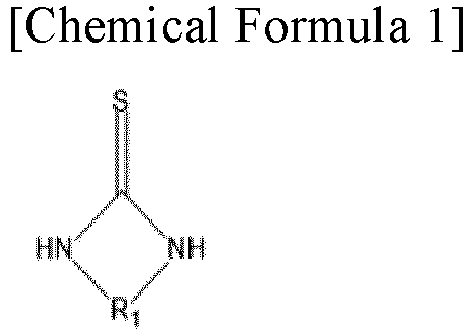

- The non-aqueous electrolyte solution for a secondary battery of claim 1, wherein the compound represented by Chemical Formula 1 is a compound represented by Chemical Formula 1-1:


- The non-aqueous electrolyte solution for a secondary battery of claim 1, wherein the compound represented by Chemical Formula 2 is a compound represented by Chemical Formula 2-1:

- The non-aqueous electrolyte solution for a secondary battery of claim 1, wherein the lithium salt is at least one selected from the group consisting of LiPF6, LiBF4, LiSbF6, LiAsF6, LiClO4, LiN(C2F5SO2)2, LiN(CF3SO2)2, CF3SO3Li, and LiC(CF3SO2)3.
- The non-aqueous electrolyte solution for a secondary battery of claim 4, wherein the lithium salt is contained at a concentration of 0.1 to 2.0 M in the non-aqueous organic solvent.
- The non-aqueous electrolyte solution for a secondary battery of claim 1, wherein the non-aqueous organic solvent is at least one selected from the group consisting of linear carbonate, cyclic carbonate, linear ester, and cyclic ester.
- The non-aqueous electrolyte solution for a secondary battery of claim 6, wherein:the linear carbonate is at least one carbonate selected from the group consisting of dimethyl carbonate, diethyl carbonate, dipropyl carbonate, methyl propyl carbonate, ethyl propyl carbonate, ethyl methyl carbonate, and mixtures thereof,the cyclic carbonate is at least one carbonate selected from the group consisting of ethylene carbonate, propylene carbonate, 1,2-butylene carbonate, 2,3-butylene carbonate, 1,2-pentylene carbonate, 2,3-pentylene carbonate, vinylene carbonate, vinyl ethylene carbonate, and fluoroethylene carbonate,the linear ester is at least one ester selected from the group consisting of methyl propionate, ethyl propionate, propyl acetate, butyl acetate, and ethyl acetate, andthe cyclic ester is at least one ester selected from the group consisting of gamma-butyrolactone, caprolactone, and valerolactone.
- The non-aqueous electrolyte solution for a secondary battery of claim 6, wherein the non-aqueous organic solvent comprises the linear carbonate and the cyclic carbonate that are mixed in a volume ratio of 1:9 to 9:1.
- The non-aqueous electrolyte solution for a secondary battery of claim 1, wherein an amount of the compound represented by Chemical Formula 1 or Chemical Formula 2 is 10 to 100,000 ppm based on a total amount of the electrolyte solution.
- The non-aqueous electrolyte solution for a secondary battery of claim 1, further comprising at least one lifespan prolonging additive selected from the group consisting of vinyl carbonate, vinyl ethylene carbonate, fluoroethylene carbonate, and tetrahydrofuro[3,2-b]furan-2,5-dione.
- The non-aqueous electrolyte solution for a secondary battery of claim 1, further comprising at least one high-temperature performance enhancing additive selected from the group consisting of 1,3-propane sultone, 1,3-propene-1,3-sultone, ethylene sulfate, 1,4-butane sultone, 1,3-propanediol cyclic sulfate, 4,4'-bi-1,3,2-dioxathiolane-2,2,2',2'-tetraoxide, 1,3-divinyltetramethyldisiloxane, and 2,4,8,10-tetraoxa-3,9-dithiaspiro[5.5]undecane.
- The non-aqueous electrolyte solution for a secondary battery of claim 1, further comprising at least one power enhancing additive selected from the group consisting of bis(triethylsilyl) sulfate, bis(trimethylsilyl) sulfate, trimethylsilyl ethenesulfonate, triethylsilyl ethenesulfonate, and tetraphenyl (propane-2,2-diylbis(4,1-phenylene)) bis(phosphate).
- The non-aqueous electrolyte solution for a secondary battery of claim 1, further comprising at least one high-temperature performance and power enhancing additive selected from the group consisting of lithium difluorophosphate, lithium bis(oxalato)borate, lithium bis(fluorosulfonyl)imide, lithium bis(trifluoromethanesulfonyl)imide, cesium hexafluorophosphate, cesium bis(fluorosulfonyl)imide, cesium bis(trifluoromethanesulfonyl)imide, lithium difluoro(oxalato)borate, lithium tetrafluoro oxalato phosphate, lithium difluoro bis(oxalato) phosphate, and lithium bis(phosphorodifluoridate) triethylammonium ethenesulfonate.
- A lithium secondary battery, comprising:(a) a cathode comprising a cathode active material capable of intercalating and deintercalating lithium;(b) an anode including an anode active material capable of intercalating and deintercalating lithium;(c) the non-aqueous electrolyte solution for a secondary battery of any one of claims 1 to 13; and(d) a separator.
Applications Claiming Priority (2)
| Application Number | Priority Date | Filing Date | Title |
|---|---|---|---|
| KR1020210028511A KR102767649B1 (en) | 2021-03-04 | 2021-03-04 | Electrolyte Solution for Secondary Battery and Secondary Battery Comprising the Same |
| PCT/KR2022/001751 WO2022186490A1 (en) | 2021-03-04 | 2022-02-04 | Electrolyte solution for secondary battery, and secondary battery comprising same |
Publications (2)
| Publication Number | Publication Date |
|---|---|
| EP4303980A1 true EP4303980A1 (en) | 2024-01-10 |
| EP4303980A4 EP4303980A4 (en) | 2024-09-25 |
Family
ID=83154176
Family Applications (1)
| Application Number | Title | Priority Date | Filing Date |
|---|---|---|---|
| EP22763475.5A Pending EP4303980A4 (en) | 2021-03-04 | 2022-02-04 | ELECTROLYTIC SOLUTION FOR SECONDARY BATTERY AND SECONDARY BATTERY COMPRISING SAME |
Country Status (6)
| Country | Link |
|---|---|
| US (1) | US20240154169A1 (en) |
| EP (1) | EP4303980A4 (en) |
| JP (1) | JP7810715B2 (en) |
| KR (1) | KR102767649B1 (en) |
| CN (1) | CN116918125A (en) |
| WO (1) | WO2022186490A1 (en) |
Families Citing this family (5)
| Publication number | Priority date | Publication date | Assignee | Title |
|---|---|---|---|---|
| WO2023003128A1 (en) * | 2021-07-22 | 2023-01-26 | 삼성에스디아이 주식회사 | Electrolyte for rechargeable lithium battery and rechargeable lithium battery including the same |
| KR20250078932A (en) * | 2022-10-04 | 2025-06-04 | 더 플로리다 인터내셔날 유니버서티 보드 오브 트러스티즈 | Electrolyte containing thioamide for use in electrochemical batteries |
| US12424664B2 (en) | 2022-10-04 | 2025-09-23 | The Florida International University Board Of Trustees | Electrolytes comprising thioamides for use in electrochemical batteries |
| CN116344936A (en) * | 2023-04-12 | 2023-06-27 | 武汉理工大学 | A kind of electrolyte additive, electrolyte and sodium ion battery |
| KR102711964B1 (en) * | 2023-09-08 | 2024-10-04 | 주식회사 천보비엘에스 | Lithium Bis(fluorosulfonyl)imide solution and battery including the same |
Family Cites Families (19)
| Publication number | Priority date | Publication date | Assignee | Title |
|---|---|---|---|---|
| JP2975627B2 (en) * | 1990-03-23 | 1999-11-10 | 三洋電機株式会社 | Battery |
| JPH06223875A (en) * | 1993-01-21 | 1994-08-12 | Mitsubishi Cable Ind Ltd | Electrolyte for lithium secondary battery |
| KR100263849B1 (en) * | 1997-08-30 | 2000-08-16 | 김순택 | Lithium ion battery |
| KR100412522B1 (en) | 2001-05-11 | 2003-12-31 | 삼성에스디아이 주식회사 | A non-aqueous electrolyte and a lithium secondary battery comprising the same |
| CN1563502A (en) * | 2004-03-25 | 2005-01-12 | 上海晶宝铜箔有限公司 | Electrolytic copper foil in use for high accuracy lithium cell smaller than 12 micros and preparation method |
| JP4797403B2 (en) | 2005-03-01 | 2011-10-19 | 三菱化学株式会社 | Non-aqueous electrolyte secondary battery and electrolyte for non-aqueous electrolyte secondary battery |
| CN101512823B (en) | 2006-09-05 | 2012-10-24 | 株式会社杰士汤浅国际 | Nonaqueous electrolyte battery and its manufacturing method |
| JP5277550B2 (en) | 2007-03-12 | 2013-08-28 | セントラル硝子株式会社 | Method for producing lithium difluorophosphate and non-aqueous electrolyte battery using the same |
| CN103155247B (en) | 2010-10-14 | 2015-06-10 | 株式会社吴羽 | Negative electrode mixture for nonaqueous electrolyte secondary battery, negative electrode for nonaqueous electrolyte secondary battery, and nonaqueous electrolyte secondary battery |
| JP6065367B2 (en) | 2011-06-07 | 2017-01-25 | ソニー株式会社 | Nonaqueous electrolyte battery, battery pack, electronic device, electric vehicle, power storage device, and power system |
| JP5928057B2 (en) | 2012-01-26 | 2016-06-01 | 三菱化学株式会社 | Non-aqueous electrolyte and non-aqueous electrolyte battery using the same |
| KR102525620B1 (en) * | 2017-12-27 | 2023-05-03 | 동화일렉트로라이트 주식회사 | Electrolyte for Secondary Battery and Secondary Battery Comprising the Same |
| KR102023678B1 (en) * | 2018-01-31 | 2019-09-23 | 파낙스 이텍(주) | Electrolyte for Secondary Battery and Secondary Battery Comprising the Same |
| JP7137755B2 (en) | 2018-09-19 | 2022-09-15 | トヨタ自動車株式会社 | Non-aqueous electrolyte for lithium-ion secondary batteries |
| CN111009683B (en) * | 2019-11-12 | 2021-11-23 | 北京泰丰先行新能源科技有限公司 | Asymmetric semi-solid electrolyte, preparation method and metal lithium secondary battery |
| CN111224171A (en) * | 2019-12-12 | 2020-06-02 | 中国科学院大连化学物理研究所 | Aqueous high-pressure electrolyte, preparation method and application thereof |
| KR20230028259A (en) * | 2020-06-30 | 2023-02-28 | 니폰 제온 가부시키가이샤 | Sealing agent for nonaqueous electrolyte battery, sealant composition for nonaqueous electrolyte battery, and nonaqueous electrolyte battery |
| KR102803274B1 (en) * | 2020-09-28 | 2025-05-07 | 주식회사 엘지에너지솔루션 | Additives for non-aqueous electrolyte, non-aqueous electrolyte and lithium secondary battery comprsing the same |
| KR20220079294A (en) * | 2020-12-04 | 2022-06-13 | 삼성에스디아이 주식회사 | Rechargeable lithium battery |
-
2021
- 2021-03-04 KR KR1020210028511A patent/KR102767649B1/en active Active
-
2022
- 2022-02-04 WO PCT/KR2022/001751 patent/WO2022186490A1/en not_active Ceased
- 2022-02-04 EP EP22763475.5A patent/EP4303980A4/en active Pending
- 2022-02-04 CN CN202280019136.XA patent/CN116918125A/en active Pending
- 2022-02-04 JP JP2023553984A patent/JP7810715B2/en active Active
- 2022-02-04 US US18/548,539 patent/US20240154169A1/en active Pending
Also Published As
| Publication number | Publication date |
|---|---|
| EP4303980A4 (en) | 2024-09-25 |
| JP2024508935A (en) | 2024-02-28 |
| US20240154169A1 (en) | 2024-05-09 |
| WO2022186490A1 (en) | 2022-09-09 |
| JP7810715B2 (en) | 2026-02-03 |
| KR102767649B1 (en) | 2025-02-19 |
| KR20220124870A (en) | 2022-09-14 |
| CN116918125A (en) | 2023-10-20 |
Similar Documents
| Publication | Publication Date | Title |
|---|---|---|
| KR101033697B1 (en) | Electrolyte Additive for Lithium Secondary Battery, Non-Aqueous Electrolyte and Lithium Secondary Battery Containing the Electrolyte Additive | |
| KR100536196B1 (en) | A non-aqueous electrolyte and a lithium secondary battery comprising the same | |
| US7691538B2 (en) | Nonaqueous electrolyte secondary battery | |
| CN101297433B (en) | Inhibitor of redox interaction additive life cycle reduction and nonaqueous electrolyte and secondary battery containing the same | |
| KR102277754B1 (en) | Electrolyte Solution for Secondary Battery and Secondary Battery Comprising the Same | |
| KR101211127B1 (en) | Electrolyte for lithium secondary battery and lithium secondary battery comprising the same | |
| EP4303980A1 (en) | Electrolyte solution for secondary battery, and secondary battery comprising same | |
| EP2908375B1 (en) | Lithium secondary battery | |
| KR100984134B1 (en) | Electrolyte for lithium secondary battery and lithium secondary battery comprising same | |
| KR20190078770A (en) | Electrolyte for Secondary Battery and Secondary Battery Comprising the Same | |
| KR20040095852A (en) | Electrolyte for lithium secondary battery and lithium secondary battery comprising same | |
| EP3046176B1 (en) | Non-aqueous electrolyte solution and lithium secondary battery including the same | |
| US12500269B2 (en) | Non-aqueous electrolyte solution for lithium secondary battery, and lithium secondary battery including the same | |
| KR102600045B1 (en) | Electrolyte Solution for Secondary Battery and Secondary Battery Comprising the Same | |
| KR101656549B1 (en) | Electrolyte solution for lithium secondary battery and lithium secondary battery comprising the same | |
| KR102177033B1 (en) | Non-Aqueous Electrolyte Solution for Lithium Ion Secondary Battery and Lithium Ion Secondary Battery Comprising the Same | |
| EP4391137A1 (en) | Non-aqueous electrolyte for lithium secondary battery, and lithium secondary battery comprising same | |
| KR100370384B1 (en) | Non-aqueous electrolyte solution for lithium battery | |
| KR101294763B1 (en) | Electrolyte for lithium secondary battery and lithium secondary battery comprising the same | |
| KR100534011B1 (en) | Nonaqueous Electrolyte for Battery and Secondary Battery comprising the Electrolyte | |
| KR100860441B1 (en) | Non-aqueous electrolyte for battery | |
| KR20190098432A (en) | Electrolyte Solution for Secondary Battery and Secondary Battery Comprising the Same | |
| KR100572283B1 (en) | Non-aqueous electrolyte for lithium battery | |
| KR101121052B1 (en) | Electrolytes and secondary batteries comprising the same | |
| KR20220167622A (en) | Non-Aqueous Electrolyte Solution for Secondary Battery and Secondary Battery Including Same |
Legal Events
| Date | Code | Title | Description |
|---|---|---|---|
| STAA | Information on the status of an ep patent application or granted ep patent |
Free format text: STATUS: THE INTERNATIONAL PUBLICATION HAS BEEN MADE |
|
| PUAI | Public reference made under article 153(3) epc to a published international application that has entered the european phase |
Free format text: ORIGINAL CODE: 0009012 |
|
| STAA | Information on the status of an ep patent application or granted ep patent |
Free format text: STATUS: REQUEST FOR EXAMINATION WAS MADE |
|
| 17P | Request for examination filed |
Effective date: 20230908 |
|
| AK | Designated contracting states |
Kind code of ref document: A1 Designated state(s): AL AT BE BG CH CY CZ DE DK EE ES FI FR GB GR HR HU IE IS IT LI LT LU LV MC MK MT NL NO PL PT RO RS SE SI SK SM TR |
|
| DAV | Request for validation of the european patent (deleted) | ||
| DAX | Request for extension of the european patent (deleted) | ||
| A4 | Supplementary search report drawn up and despatched |
Effective date: 20240823 |
|
| RIC1 | Information provided on ipc code assigned before grant |
Ipc: H01M 10/0569 20100101ALI20240819BHEP Ipc: H01M 10/0568 20100101ALI20240819BHEP Ipc: H01M 10/0525 20100101ALI20240819BHEP Ipc: H01M 10/0567 20100101AFI20240819BHEP |