EP4303211A1 - Industrial process for the preparation of hexanoic acid, 6(nitrooxy)-,(1s,2e)-3-[(1r,2r,3s,5r)-2-[(2z)-7-(ethylamino)-7-oxo-2-hepten-1-yl]3,5-dihydroxycyclopentyl]-1-(2-phenyl ethyl)-2-propen-1-yl ester and high pure product - Google Patents
Industrial process for the preparation of hexanoic acid, 6(nitrooxy)-,(1s,2e)-3-[(1r,2r,3s,5r)-2-[(2z)-7-(ethylamino)-7-oxo-2-hepten-1-yl]3,5-dihydroxycyclopentyl]-1-(2-phenyl ethyl)-2-propen-1-yl ester and high pure product Download PDFInfo
- Publication number
- EP4303211A1 EP4303211A1 EP22290046.6A EP22290046A EP4303211A1 EP 4303211 A1 EP4303211 A1 EP 4303211A1 EP 22290046 A EP22290046 A EP 22290046A EP 4303211 A1 EP4303211 A1 EP 4303211A1
- Authority
- EP
- European Patent Office
- Prior art keywords
- formula
- nitrooxy
- compound
- ester
- bimatoprost
- Prior art date
- Legal status (The legal status is an assumption and is not a legal conclusion. Google has not performed a legal analysis and makes no representation as to the accuracy of the status listed.)
- Granted
Links
Classifications
-
- C—CHEMISTRY; METALLURGY
- C07—ORGANIC CHEMISTRY
- C07C—ACYCLIC OR CARBOCYCLIC COMPOUNDS
- C07C235/00—Carboxylic acid amides, the carbon skeleton of the acid part being further substituted by oxygen atoms
- C07C235/02—Carboxylic acid amides, the carbon skeleton of the acid part being further substituted by oxygen atoms having carbon atoms of carboxamide groups bound to acyclic carbon atoms and singly-bound oxygen atoms bound to the same carbon skeleton
- C07C235/32—Carboxylic acid amides, the carbon skeleton of the acid part being further substituted by oxygen atoms having carbon atoms of carboxamide groups bound to acyclic carbon atoms and singly-bound oxygen atoms bound to the same carbon skeleton the carbon skeleton containing six-membered aromatic rings
- C07C235/34—Carboxylic acid amides, the carbon skeleton of the acid part being further substituted by oxygen atoms having carbon atoms of carboxamide groups bound to acyclic carbon atoms and singly-bound oxygen atoms bound to the same carbon skeleton the carbon skeleton containing six-membered aromatic rings having the nitrogen atoms of the carboxamide groups bound to hydrogen atoms or to acyclic carbon atoms
-
- A—HUMAN NECESSITIES
- A61—MEDICAL OR VETERINARY SCIENCE; HYGIENE
- A61K—PREPARATIONS FOR MEDICAL, DENTAL OR TOILETRY PURPOSES
- A61K31/00—Medicinal preparations containing organic active ingredients
- A61K31/557—Eicosanoids, e.g. leukotrienes or prostaglandins
- A61K31/5575—Eicosanoids, e.g. leukotrienes or prostaglandins having a cyclopentane, e.g. prostaglandin E2, prostaglandin F2-alpha
-
- A—HUMAN NECESSITIES
- A61—MEDICAL OR VETERINARY SCIENCE; HYGIENE
- A61P—SPECIFIC THERAPEUTIC ACTIVITY OF CHEMICAL COMPOUNDS OR MEDICINAL PREPARATIONS
- A61P27/00—Drugs for disorders of the senses
- A61P27/02—Ophthalmic agents
-
- A—HUMAN NECESSITIES
- A61—MEDICAL OR VETERINARY SCIENCE; HYGIENE
- A61P—SPECIFIC THERAPEUTIC ACTIVITY OF CHEMICAL COMPOUNDS OR MEDICINAL PREPARATIONS
- A61P27/00—Drugs for disorders of the senses
- A61P27/02—Ophthalmic agents
- A61P27/06—Antiglaucoma agents or miotics
-
- C—CHEMISTRY; METALLURGY
- C07—ORGANIC CHEMISTRY
- C07C—ACYCLIC OR CARBOCYCLIC COMPOUNDS
- C07C231/00—Preparation of carboxylic acid amides
- C07C231/12—Preparation of carboxylic acid amides by reactions not involving the formation of carboxamide groups
-
- C—CHEMISTRY; METALLURGY
- C07—ORGANIC CHEMISTRY
- C07C—ACYCLIC OR CARBOCYCLIC COMPOUNDS
- C07C231/00—Preparation of carboxylic acid amides
- C07C231/22—Separation; Purification; Stabilisation; Use of additives
- C07C231/24—Separation; Purification
-
- C—CHEMISTRY; METALLURGY
- C07—ORGANIC CHEMISTRY
- C07C—ACYCLIC OR CARBOCYCLIC COMPOUNDS
- C07C405/00—Compounds containing a five-membered ring having two side-chains in ortho position to each other, and having oxygen atoms directly attached to the ring in ortho position to one of the side-chains, one side-chain containing, not directly attached to the ring, a carbon atom having three bonds to hetero atoms with at the most one bond to halogen, and the other side-chain having oxygen atoms attached in gamma-position to the ring, e.g. prostaglandins ; Analogues or derivatives thereof
- C07C405/0008—Analogues having the carboxyl group in the side-chains replaced by other functional groups
- C07C405/0041—Analogues having the carboxyl group in the side-chains replaced by other functional groups containing nitrogen
-
- C—CHEMISTRY; METALLURGY
- C07—ORGANIC CHEMISTRY
- C07B—GENERAL METHODS OF ORGANIC CHEMISTRY; APPARATUS THEREFOR
- C07B2200/00—Indexing scheme relating to specific properties of organic compounds
- C07B2200/07—Optical isomers
-
- C—CHEMISTRY; METALLURGY
- C07—ORGANIC CHEMISTRY
- C07B—GENERAL METHODS OF ORGANIC CHEMISTRY; APPARATUS THEREFOR
- C07B2200/00—Indexing scheme relating to specific properties of organic compounds
- C07B2200/09—Geometrical isomers
-
- C—CHEMISTRY; METALLURGY
- C07—ORGANIC CHEMISTRY
- C07C—ACYCLIC OR CARBOCYCLIC COMPOUNDS
- C07C2531/00—Catalysts comprising hydrides, coordination complexes or organic compounds
- C07C2531/02—Catalysts comprising hydrides, coordination complexes or organic compounds containing organic compounds or metal hydrides
-
- C—CHEMISTRY; METALLURGY
- C07—ORGANIC CHEMISTRY
- C07C—ACYCLIC OR CARBOCYCLIC COMPOUNDS
- C07C2601/00—Systems containing only non-condensed rings
- C07C2601/06—Systems containing only non-condensed rings with a five-membered ring
- C07C2601/08—Systems containing only non-condensed rings with a five-membered ring the ring being saturated
-
- Y—GENERAL TAGGING OF NEW TECHNOLOGICAL DEVELOPMENTS; GENERAL TAGGING OF CROSS-SECTIONAL TECHNOLOGIES SPANNING OVER SEVERAL SECTIONS OF THE IPC; TECHNICAL SUBJECTS COVERED BY FORMER USPC CROSS-REFERENCE ART COLLECTIONS [XRACs] AND DIGESTS
- Y02—TECHNOLOGIES OR APPLICATIONS FOR MITIGATION OR ADAPTATION AGAINST CLIMATE CHANGE
- Y02P—CLIMATE CHANGE MITIGATION TECHNOLOGIES IN THE PRODUCTION OR PROCESSING OF GOODS
- Y02P20/00—Technologies relating to chemical industry
- Y02P20/50—Improvements relating to the production of bulk chemicals
- Y02P20/55—Design of synthesis routes, e.g. reducing the use of auxiliary or protecting groups
Definitions
- the present invention relates to a process, suitable for industrial-scale production.
- API(s) Active Pharmaceutical Ingredient(s)
- the limits of each impurity in the produced APIs are the subject of specific guidelines published by international agencies. In the last several years, growing importance has been given to the quantification of potential genotoxic impurities, i.e. those which could cause DNA damage involving genetic mutations. In particular, the limits of impurities bearing one or more alert functions are established according to specific guidelines.
- Compound (I) isomeric impurities such as (1E,3S)-1-((lR,2R,3S,5R)-2-((2E)-7-(ethylamino)-7-oxohept-2-en-1-yl)-3,5-dihydroxycyclopentyl)-5-phenylpent-1-en-3-yl 6-(nitrooxy) hexanoate that is the 5,6-trans-Compound (I) of formula (VII) and (1E,3R)-1-((1R,2R,3S,5R)-2-((2Z)-7-(ethylamino)-7-oxohept-2-en-1-yl)-3,5-dihydroxycyclopentyl)-5-phenylpent-1-en-3-yl 6-(nitrooxy) hexanoate that is the 15-epi-Compound (I) of formula (VIII)
- the 6-(nitrooxy)hexanoyl chloride is synthetized from the 6-(nitrooxy)hexanoic acid that is prepared by a ring-opening reaction of ⁇ -caprolactone and subsequent nitration of the 6-hydroxyhexanoic acid alkali salt with a mixture of HNO 3 and H 2 SO 4 in dichloromethane.
- the intermediates 6-(nitrooxy)hexanoic acid and 6-(nitrooxy)hexanoyl chloride are used without purification.
- the 15-(6-chlorohexanoyl) ester of bimatoprost of formula (II) is a side-product that is formed during the esterification step by exchange reaction of the nitrooxy group of (1E,3S)-1- ⁇ (1S,5R,6R,7R)-3-butyl-7-[(2Z)-7-(ethylamino)-7-oxohept-2-en-1-yl]-2,4-dioxa-3-borabicyclo[3.2.1]octan-6-yl ⁇ -5-phenylpent-1-en-3-yl 6-(nitrooxy)hexanoate and free chlorine anions; at the end of the process the removal of the boronate ester protecting group leads to 15-(6-chlorohexanoyl) bimatoprost ester.
- the 6- ⁇ [6-(nitrooxy)hexanoyl]oxy ⁇ hexanoic acid bimatoprost ester of formula (III) derives from the reaction of bimatoprost butyl-boronate of formula (IV) with 6-[6-nitrooxyhexanoyl]oxy ⁇ hexanoyl chloride that is an impurity of the intermediate 6-(nitrooxy)hexanoyl chloride; after esterification the removal of the butyl-boronate protection leads to 6- ⁇ [6-(nitrooxy)hexanoyl]oxy ⁇ hexanoic acid bimatoprost ester of formula (III).
- the crude Compound (I) prepared according to the WO 2021/023693 process has a HPLC purity of 73% (HPLC area %) and contains about 0.1% (HPLC area %) of 15-(6-chlorohexanoyl) bimatoprost ester of formula (II) and less than 0.05% (HPLC area %) (HPLC threshold) of 6- ⁇ [6-(nitrooxy)hexanoyl]oxy ⁇ hexanoic acid bimatoprost ester (III) before the last chromatographic purification.
- Example B-1 The synthesis of Compound (I) disclosed in WO 2009/136281 (Example B-1) includes: protection of C9-OH and C11-OH groups of bimatoprost with butyl-boronic acid to form bimatoprost butyl-boronate of formula (IV), esterification of C15-OH with 6-bromohexanoyl chloride to give the 15-(6-bromohexanoyl) ester of bimatoprost butyl-boronate protected form that is converted into the nitrate derivative by silver nitrate in acetonitrile, removal of the butyl-boronate group and purification of the product by reverse phase chromatography.
- 15-(6-chlorohexanoyl) ester of bimatoprost butyl-boronate is a side-product of the esterification reaction that forms by halogen exchange reaction between the bromine atom of 15-(6-bromohexanoyl) ester of bimatoprost butyl-boronate and free chlorine anions, which form during the esterification step, promoted by the presence of base in the reaction medium.
- WO 2009/136281 does not mention the impurities profile of the final product, experiments carried out by the inventors showed that Compound (I) prepared according to the process disclosed by WO 2009/136281 contains about 8.34% (HPLC area %) of 15-(6-chlorohexanoyl) ester of bimatoprost of formula (II).
- WO 2009/136281 also discloses an alternative process for the preparation of 15-acylalkynitrate bimatoprost derivatives (Examples N-1 and O-1).
- the synthesis comprises reacting bimatoprost in a boronate protected form with a nitrate-alkyl carboxylic acid chloride in the presence of 4-dimethylaminopyridine (DMAP) supported on resin (PS-DMAP), removal of the boronate protecting group and purification by silica gel column chromatography.
- DMAP 4-dimethylaminopyridine
- PS-DMAP 4-dimethylaminopyridine
- the main disadvantage of this synthesis is the removal of the unreacted nitrate-alkyl-(p-nitrophenyl)-carboxylate and of the by-product p-nitrophenol by chromatographic methods.
- the present invention solve the above the above-mentioned problem providing an industrially viable process for the preparation of high purity hexanoic acid, 6-(nitrooxy)-, (1S,2E)-3-[(1R,2R,3S,5R)-2-[(2Z)-7-(ethylamino)-7-oxo-2-hepten-1-yl]-3,5-dihydroxy cyclopentyl]-1-(2-phenylethyl)-2-propen-1-yl ester of formula (I).
- the present invention provides a process for the synthesis of hexanoic acid, 6-(nitrooxy)-, (1S,2E)-3-[(1R,2R,3S,5R)-2-[(2Z)-7-(ethylamino)-7-oxo-2-hepten-1-yl]-3,5-dihydroxycyclopentyl]-1-(2-phenylethyl)-2-propen-1-yl ester of formula (I) (Compound (I)) suitable for industrial scale production and that allows preparing high purity Compound (I) in high yield.
- the process of the invention includes an efficient one-pot reactions preparation step of the crude Compound (I) from Bimatoprost and 6-(nitrooxy)hexanoic acid followed by a highly efficient purification step of the crude Compound (I) that includes, first, a normal phase gravity silica gel column chromatography to remove almost all the impurities deriving from the preparation step followed by a silica gel filtration chromatography that has the scope to remove the higher boiling solvents.
- the process is applicable to a large scale preparation of Compound (I), for example up to 650 grams.
- An important advantage of the process of the invention is that this process is suitable for the preparation of highly pure hexanoic acid, 6-(nitrooxy)-, (1S,2E)-3-[(1R,2R,3S,5R)-2-[(2Z)-7-(ethylamino)-7-oxo-2-hepten-1-yl]-3,5-dihydroxycyclopentyl]-1-(2-phenylethyl)-2-propen-1-yl ester of formula (I), indeed the compound obtained by the process of the invention does not contain the 15-(6-chlorohexanoyl) ester of bimatoprost (II) and the amount of total impurities is not more than ( ⁇ ) 0.20% (HPLC area %).
- Another object of the invention is hexanoic acid, 6-(nitrooxy)-, (1S,2E)-3-[(1R,2R,3S,5R)-2-[(2Z)-7-(ethylamino)-7-oxo-2-hepten-1-yl]-3,5-dihydroxycyclopentyl]-1-(2-phenylethyl)-2-propen-1-yl ester of formula (I) substantially free of the impurity 15-(6-chlorohexanoyl) ester of bimatoprost of formula (II) and which contains an amount of total impurities not more than ( ⁇ ) 0.20% (HPLC area %), preferably the amount of total impurities is not more than ( ⁇ ) 0.15% (HPLC area %), most preferably the amount of total impurities is not more than ( ⁇ ) 0.10% (HPLC area %).
- the present invention relates to a process for the preparation of hexanoic acid, 6-(nitrooxy)-, (1S,2E)-3-[(1R,2R,3S,SR)-2-[(2Z)-7-(ethylamino)-7-oxo-2-hepten-1-yl]-3,5-dihydroxycyclopentyl]-1-(2-phenylethyl)-2-propen-1-yl ester of formula (I) said process comprising the following steps:
- the bimatoprost : phenyl boronic acid molar ratio is 1:1.1
- reaction step 2) preferably N,N'-diisopropyl carbodiimide 2.0 equiv., dimethylaminopyridine 0.2 equiv. and 6-(nitrooxy)hexanoic acid 1.8 to 2.2 equiv. are added.
- the phenylboronate protecting group is preferably removed using a NaOH solution.
- the phenylboronate protecting group is removed by quenching the reaction mixture obtained in step 2) with methanol, then adding a mixture of methylene chloride and 6.3 equiv. of NaOH as solution of NaOH 0.5M.
- reaction step 4 the organic phase is washed first with an aqueous solution of sodium hydrogen sulfate and twice with an aqueous solution of NaCl 15% w/w.
- the process of the invention gives the compound of formula (I) containing not more than ( ⁇ ) 0.10% (HPLC area %) of total impurities.
- Another embodiment of the invention relates to a process for the synthesis of the hexanoic acid, 6-(nitrooxy)-, (1S,2E)-3-[(1R,2R,3S,5R)-2-[(2Z)-7-(ethylamino)-7-oxo-2-hepten-1-yl]-3,5-dihydroxycyclopentyl]-1-(2-phenylethyl)-2-propen-1-yl ester of formula (I) comprising the following steps:
- the process of the invention has several advantages, it allows eliminating the formation of 15-(6-chlorohexanoyl) ester of bimatoprost of formula (II) and reducing the amount of 6- ⁇ [6-(nitrooxy)hexanoyl]oxy ⁇ hexanoic acid bimatoprost ester of formula (III) to below the limit of quantification that is 0.05% w/w.
- the purity assessment of Compound (I) performed by HPLC showed that also the amount of each of impurities 5,6-trans-Compound (I) of formula (VII) and 15-epi-Compound (I) of formula (VIII) is not more than ( ⁇ ) 0.05% w/w.
- Another advantage of the invention process is that the synthesis of the crude compound of formula (I) can be performed in a one-pot reactions preparation in which the above reported steps 1) to 3) are conducted without isolating or purifying the resulting intermediates.
- the present invention provides hexanoic acid, 6-(nitrooxy)-, (1S,2E)-3-[(1R,2R,3S,5R)-2-[(2Z)-7-(ethylamino)-7-oxo-2-hepten-1-yl]-3,5-dihydroxycyclopentyl]-1-(2-phenylethyl)-2-propen-1-yl ester of formula (I) does not contain of the impurity 15-(6-chlorohexanoyl) ester of bimatoprost of formula (II) and which contains an amount of total impurities not more than ( ⁇ ) 0.20% (HPLC area %), preferably the amount of total impurities is not more than ( ⁇ ) 0.15% (HPLC area %), most preferably the amount of total impurities is not more than ( ⁇ ) 0.10% (HPLC area %).
- An embodiment of the invention provides hexanoic acid, 6-(nitrooxy)-, (1S,2E)-3-[(1R,2R,3S,5R)-2-[(2Z)-7-(ethylamino)-7-oxo-2-hepten-1-yl]-3,5-dihydroxycyclopentyl]-1-(2-phenylethyl)-2-propen-1-yl ester of formula (I) that does not contain 15-(6-chlorohexanoyl) ester of bimatoprost of formula (II), wherein said compound of formula (I) contains:
- Another embodiment of the invention provides ophthalmic pharmaceutical compositions comprising hexanoic acid, 6-(nitrooxy)-, (1S,2E)-3-[(1R,2R,3S,5R)-2-[(2Z)-7-(ethylamino)-7-oxo-2-hepten-1-yl]-3,5-dihydroxycyclopentyl]-1-(2-phenylethyl)-2-propen-1-yl ester of formula (I) that does not contain (15-(6-chlorohexanoyl) ester of bimatoprost of formula (II), wherein said compound of formula (I) contains: not more than ( ⁇ ) 0.05% w/w 6- ⁇ [6-(nitrooxy)hexanoyl]oxy ⁇ hexanoic acid bimatoprost ester of formula (III), not more than ( ⁇ ) 0.05% w/w (1E,3S)-1-((1R,2R,3S,5R)-2
- Another embodiment of the invention provides an ophthalmic pharmaceutical composition
- the starting material bimatoprost is commercially available.
- the purified 6-(nitrooxy)hexanoic acid (952 g, 5.37 mole) was isolated as an oil in a 82% yield having a 98.7% purity by UPLC and containing a not detectable amount of 6-[6-nitrooxyhexanoyl]oxy ⁇ hexanoic acid.
- the mixture is stirred for 5 to 10 min, left to settle for 15 min and the lower organic phase was collected in a mobile tank.
- the aqueous layer was removed.
- the organic phase was charged again in the extractor and a 15% NaCl solution (20 L) was added and the mixture was stirred for 5 to 10 min and left to settle for 15 min.
- the organic layer was collected and the aqueous phase was removed.
- the organic layer was charged again in the extractor and a 15% NaCl w/w solution (20 L) was added.
- the mixture was stirred for 5 to 10 min and left to settle for 15 min.
- the organic layer was collected evaporated under vacuum at a temperature of 45°C ⁇ 5°
- the crude product was dissolved in dichloromethane (7 L, 10.5 vol) and the mixture was transferred into a reactor.
- the mixture was cooled to 5 - 10°C and kept for 30-60 min at this temperature to allow N,N'-diisopropyl urea precipitation.
- the mixture is filtered through the filter in a mobile tank.
- the reactor is washed with dichloromethane (2 L, 3 vol), solution is filtered and collected in the mobile tank.
- the Compound (I) was stored at 5°C ⁇ 3°C.
- Eluent mixture 2 was prepared by mixing distilled dichloromethane and distilled methanol in 30:1 volume ratio.
- the pure Compound (I) was dissolved in ethanol (6 L, 9 vol) and activated charcoal (60 g, around 9% w/w) was added. The mixture was stirred for 30 min at 20°C ⁇ 5°C and the activated charcoal is removed by filtration. The solvent was evaporated under vacuum at 45°C ⁇ 5°C until constant weight; 649.6 g (1.13 mole) pure Compound (I) was isolated as an oil. The overall yield of the process was 70.8%.
- the impurities profile of the isolated Compound (I) is reported in Table 2.
- Table 3 reports the contents of the impurity 15-(6-chlorohexanoyl) ester of bimatoprost (II) in the Compound (I) prepared according to the processes disclosed in the prior art.
- Method 1 the HPLC analysis was performed using the following measurement conditions:
- Method 2 the HPLC analysis was performed to quantify the 15-epi-Compound (I) of formula (VIII) using the following measurement conditions:
Landscapes
- Chemical & Material Sciences (AREA)
- Organic Chemistry (AREA)
- Health & Medical Sciences (AREA)
- Medicinal Chemistry (AREA)
- Pharmacology & Pharmacy (AREA)
- Life Sciences & Earth Sciences (AREA)
- Animal Behavior & Ethology (AREA)
- General Health & Medical Sciences (AREA)
- Public Health (AREA)
- Veterinary Medicine (AREA)
- Ophthalmology & Optometry (AREA)
- Chemical Kinetics & Catalysis (AREA)
- General Chemical & Material Sciences (AREA)
- Engineering & Computer Science (AREA)
- Bioinformatics & Cheminformatics (AREA)
- Nuclear Medicine, Radiotherapy & Molecular Imaging (AREA)
- Epidemiology (AREA)
- Organic Low-Molecular-Weight Compounds And Preparation Thereof (AREA)
- Pharmaceuticals Containing Other Organic And Inorganic Compounds (AREA)
- Low-Molecular Organic Synthesis Reactions Using Catalysts (AREA)
Abstract

Description
- The present invention relates to a process, suitable for industrial-scale production. for preparing high purity hexanoic acid, 6-(nitrooxy)-, (1S,2E)-3-[(1R,2R,3S,5R)-2-[(2Z)-7-(ethylamino)-7-oxo-2-hepten-1-yl]-3,5-dihydroxycyclopentyl]-1-(2-phenylethyl)-2-propen-1-yl ester, to high purity hexanoic acid, 6-(nitrooxy)-, (1S,2E)-3-[(1R,2R,3S,5R)-2-[(2Z)-7-(ethylamino)-7-oxo-2-hepten-1-yl]-3,5-dihydroxycyclopentyl]-1-(2-phenylethyl)-2-propen-1-yl ester substantially free of the impurity 15-(6-chlorohexanoyl) ester of bimatoprost and to ophthalmic pharmaceutical formulations containing the high purity compound.
- Hexanoic acid, 6-(nitrooxy)-, (1S,2E)-3-[(1R,2R,3S,5R)-2-[(2Z)-7-(ethylamino)-7-oxo-2-hepten-1-yl]-3,5-dihydroxycyclopentyl]-1-(2-phenylethyl)-2-propen-1-yl ester, also hereinafter referred to as Compound (I), has the following formula (I)

- The chemical name of the Compound (I) is also: (1S,2E)-3-{(1R,2R,3S,5R)-2-[(2Z)-7-(ethylamino)-7-oxohept-2-en-1-yl]-3,5-dihydroxycyclopentyl}-1-(2-phenylethyl)prop-2-en-1-yl 6-(nitrooxy)hexanoate.
- Hexanoic acid, 6-(nitrooxy)-, (1S,2E)-3-[(1R,2R,3S,SR)-2-[(2Z)-7-(ethylamino)-7-oxo-2-hepten-1-yl]-3,5-dihydroxycyclopentyl]-1-(2-phenylethyl)-2-propen-1-yl ester is a prostaglandin analogue that has proved effective as IOP-lowering agent (Impagnatiello F, Toris CB, Batugo M, Prasanna G, Borghi V, Bastia E, Ongini E, Krauss AHP; Invest Ophthalmol Vis Sci. 2015; 56:6558-64) and its efficacy as intraocular pressure (IOP) lowering drug in patients with open-angle glaucoma or ocular hypertension has being evaluated.
- Studying and monitoring the presence of impurities in Active Pharmaceutical Ingredient(s) (API(s)) is a central topic in drug production in order to ensure proper quality levels in the manufactured products. The limits of each impurity in the produced APIs are the subject of specific guidelines published by international agencies. In the last several years, growing importance has been given to the quantification of potential genotoxic impurities, i.e. those which could cause DNA damage involving genetic mutations. In particular, the limits of impurities bearing one or more alert functions are established according to specific guidelines.
- The preparation methods of hexanoic acid, 6-(nitrooxy)-, (1S,2E)-3-[(1R,2R,3S,5R)-2-[(2Z)-7-(ethylamino)-7-oxo-2-hepten-1-yl]-3,5-dihydroxycyclopentyl]-1-(2-phenylethyl)-2-propen-1-yl ester have already been reported; the synthesis methods are disclosed by the original compound patent
WO2009/136281 and by the preparation patent applicationsWO2019/162149 andWO2021/023693 . The Compound (I) prepared according to the processes disclosed inWO2019/162149 andWO2021/023693 contains two major impurities that are 15-(6-chlorohexanoyl) ester of bimatoprost of formula (II), which is a potentially genotoxic compound, and 6-{[6-(nitrooxy)hexanoyl]oxy}hexanoic acid bimatoprost ester of formula (III)

- Other known chemical impurities contained in Compound (I) are the isomeric impurities such as (1E,3S)-1-((lR,2R,3S,5R)-2-((2E)-7-(ethylamino)-7-oxohept-2-en-1-yl)-3,5-dihydroxycyclopentyl)-5-phenylpent-1-en-3-yl 6-(nitrooxy) hexanoate that is the 5,6-trans-Compound (I) of formula (VII)


- The presence of these impurities is a critical issue for a large-scale production of pharmaceutical grade Compound (I) because it is an oil and it cannot be purified by crystallization, moreover Compound (I) and the impurities 15-(6-chlorohexanoyl) ester of bimatoprost of formula (II) and 6-{[6-(nitrooxy)hexanoyl]oxy}hexanoic acid bimatoprost ester of formula (III) have similar polarities. Therefore, the removal of these impurities requires several purifications that reduce the yield of the process and increase the cost of the preparation of Compound (I) on a commercial scale.
-
WO 2019/162149 discloses an industrial process for the preparation of Compound (I). The process includes: the protection of C9-OH and C11-OH of bimatoprost with butyl-boronic acid to form bimatoprost butyl-boronate of formula (IV),
- The 15-(6-chlorohexanoyl) ester of bimatoprost of formula (II) is a side-product that is formed during the esterification step by exchange reaction of the nitrooxy group of (1E,3S)-1-{(1S,5R,6R,7R)-3-butyl-7-[(2Z)-7-(ethylamino)-7-oxohept-2-en-1-yl]-2,4-dioxa-3-borabicyclo[3.2.1]octan-6-yl}-5-phenylpent-1-en-3-yl 6-(nitrooxy)hexanoate and free chlorine anions; at the end of the process the removal of the boronate ester protecting group leads to 15-(6-chlorohexanoyl) bimatoprost ester.
- The 6-{[6-(nitrooxy)hexanoyl]oxy}hexanoic acid bimatoprost ester of formula (III) derives from the reaction of bimatoprost butyl-boronate of formula (IV) with 6-[6-nitrooxyhexanoyl]oxy}hexanoyl chloride that is an impurity of the intermediate 6-(nitrooxy)hexanoyl chloride; after esterification the removal of the butyl-boronate protection leads to 6-{[6-(nitrooxy)hexanoyl]oxy}hexanoic acid bimatoprost ester of formula (III).
-
WO 2021/023693 disclosed an improvement of the process disclosed inWO 2019/162149 that allows reducing the formation of the 6-{[6-(nitrooxy)hexanoyl]oxy}hexanoic acid bimatoprost ester of formula (III). In this method the 6-(nitrooxy)hexanoic acid is purified by reverse phase chromatography at the end of the nitration step of the 6-hydroxyhexanoic acid alkali salt. - The crude Compound (I) prepared according to the
WO 2021/023693 process has a HPLC purity of 73% (HPLC area %) and contains about 0.1% (HPLC area %) of 15-(6-chlorohexanoyl) bimatoprost ester of formula (II) and less than 0.05% (HPLC area %) (HPLC threshold) of 6-{[6-(nitrooxy)hexanoyl]oxy}hexanoic acid bimatoprost ester (III) before the last chromatographic purification. - The synthesis of Compound (I) disclosed in
WO 2009/136281 (Example B-1) includes: protection of C9-OH and C11-OH groups of bimatoprost with butyl-boronic acid to form bimatoprost butyl-boronate of formula (IV), esterification of C15-OH with 6-bromohexanoyl chloride to give the 15-(6-bromohexanoyl) ester of bimatoprost butyl-boronate protected form that is converted into the nitrate derivative by silver nitrate in acetonitrile, removal of the butyl-boronate group and purification of the product by reverse phase chromatography. The main drawbacks of the above synthesis are: the use of more than an equimolar amount of 6-bromohexanoyl chloride that has a structural alert for potentially mutagenicity; the use of silver nitrate that generates a large amount of silver salts in waste water, the potential formation of 15-(6-bromohexanoyl) ester of bimatoprost impurity that derives from the incomplete nitration of the intermediate 15-(6-bromohexanoyl) ester of bimatoprost butyl-boronate and the formation of the side-product 15-(6-chlorohexanoyl) ester of bimatoprost of formula (II) that derives from the incomplete nitration of 15-(6-chlorohexanoyl) ester of bimatoprost butyl-boronate. 15-(6-chlorohexanoyl) ester of bimatoprost butyl-boronate is a side-product of the esterification reaction that forms by halogen exchange reaction between the bromine atom of 15-(6-bromohexanoyl) ester of bimatoprost butyl-boronate and free chlorine anions, which form during the esterification step, promoted by the presence of base in the reaction medium. -
WO 2009/136281 does not mention the impurities profile of the final product, experiments carried out by the inventors showed that Compound (I) prepared according to the process disclosed byWO 2009/136281 contains about 8.34% (HPLC area %) of 15-(6-chlorohexanoyl) ester of bimatoprost of formula (II). -
WO 2009/136281 also discloses an alternative process for the preparation of 15-acylalkynitrate bimatoprost derivatives (Examples N-1 and O-1). The synthesis comprises reacting bimatoprost in a boronate protected form with a nitrate-alkyl carboxylic acid chloride in the presence of 4-dimethylaminopyridine (DMAP) supported on resin (PS-DMAP), removal of the boronate protecting group and purification by silica gel column chromatography. Although this alternative method avoids the use of 6-bromohexanoyl chloride and the removal of the silver salts, the main disadvantages of the process is the use of 4-dimethylaminopyridine supported on resin that makes the process unsuitable for commercial scale-up and expensive, furthermore, nitrate-alkyl carboxylic acid chloride is added in large excess. -
WO2009/136281 also discloses another process (Examples Q1) for the preparation of 15-acylalkynitrate bimatoprost derivatives. In this process the compounds were obtained by esterification of bimatoprost butyl-boronate with an excess of nitrate-alkyl-(p-nitrophenyl)-carboxylate in the presence of 4-dimethylaminopyridine. - The main disadvantage of this synthesis is the removal of the unreacted nitrate-alkyl-(p-nitrophenyl)-carboxylate and of the by-product p-nitrophenol by chromatographic methods.
- Thus, there is a need to have high purity hexanoic acid, 6-(nitrooxy)-, (1S,2E)-3-[(1R,2R,3S,5R)-2-[(2Z)-7-(ethylamino)-7-oxo-2-hepten-1-yl]-3,5-dihydroxycyclopentyl]-1-(2-phenylethyl)-2-propen-1-yl ester which is suitable for the manufacturing of ophthalmic pharmaceutical formulations.
- The present invention solve the above the above-mentioned problem providing an industrially viable process for the preparation of high purity hexanoic acid, 6-(nitrooxy)-, (1S,2E)-3-[(1R,2R,3S,5R)-2-[(2Z)-7-(ethylamino)-7-oxo-2-hepten-1-yl]-3,5-dihydroxy cyclopentyl]-1-(2-phenylethyl)-2-propen-1-yl ester of formula (I).
- The present invention provides a process for the synthesis of hexanoic acid, 6-(nitrooxy)-, (1S,2E)-3-[(1R,2R,3S,5R)-2-[(2Z)-7-(ethylamino)-7-oxo-2-hepten-1-yl]-3,5-dihydroxycyclopentyl]-1-(2-phenylethyl)-2-propen-1-yl ester of formula (I) (Compound (I)) suitable for industrial scale production and that allows preparing high purity Compound (I) in high yield.
- The process of the invention includes an efficient one-pot reactions preparation step of the crude Compound (I) from Bimatoprost and 6-(nitrooxy)hexanoic acid followed by a highly efficient purification step of the crude Compound (I) that includes, first, a normal phase gravity silica gel column chromatography to remove almost all the impurities deriving from the preparation step followed by a silica gel filtration chromatography that has the scope to remove the higher boiling solvents. The process is applicable to a large scale preparation of Compound (I), for example up to 650 grams. An important advantage of the process of the invention is that this process is suitable for the preparation of highly pure hexanoic acid, 6-(nitrooxy)-, (1S,2E)-3-[(1R,2R,3S,5R)-2-[(2Z)-7-(ethylamino)-7-oxo-2-hepten-1-yl]-3,5-dihydroxycyclopentyl]-1-(2-phenylethyl)-2-propen-1-yl ester of formula (I), indeed the compound obtained by the process of the invention does not contain the 15-(6-chlorohexanoyl) ester of bimatoprost (II) and the amount of total impurities is not more than (≤) 0.20% (HPLC area %). The high overall chemical yield of the process of about 70% and the high effective purification step make this process a cost-saving method easily applicable to an industrial scale preparation of pharmaceutical grade hexanoic acid, 6-(nitrooxy)-, (1S,2E)-3-[(1R,2R,3S,5R)-2-[(2Z)-7-(ethylamino)-7-oxo-2-hepten-1-yl]-3,5-dihydroxycyclopentyl]-1-(2-phenylethyl)-2-propen-1-yl ester of formula (I).
- Another object of the invention is hexanoic acid, 6-(nitrooxy)-, (1S,2E)-3-[(1R,2R,3S,5R)-2-[(2Z)-7-(ethylamino)-7-oxo-2-hepten-1-yl]-3,5-dihydroxycyclopentyl]-1-(2-phenylethyl)-2-propen-1-yl ester of formula (I) substantially free of the impurity 15-(6-chlorohexanoyl) ester of bimatoprost of formula (II) and which contains an amount of total impurities not more than (≤) 0.20% (HPLC area %), preferably the amount of total impurities is not more than (≤) 0.15% (HPLC area %), most preferably the amount of total impurities is not more than (≤) 0.10% (HPLC area %).
- The above definitions "does not contain 15-(6-chlorohexanoyl) ester of bimatoprost (II)" and "substantially free of the impurity 15-(6-chlorohexanoyl) ester of bimatoprost of formula (II)" means that the amount of said compound is below the Limit of Detection (LoD) of the HPLC method that is disclosed hereunder.
- The present invention relates to a process for the preparation of hexanoic acid, 6-(nitrooxy)-, (1S,2E)-3-[(1R,2R,3S,SR)-2-[(2Z)-7-(ethylamino)-7-oxo-2-hepten-1-yl]-3,5-dihydroxycyclopentyl]-1-(2-phenylethyl)-2-propen-1-yl ester of formula (I)

- 1) reacting bimatoprost with phenylboronic acid in toluene at the refluxing temperature and removing water by azeotropic distillation to obtain bimatoprost phenyl-boronate of formula (V)

- 2) cooling down the solution to 25°C and adding N,N'-diisopropyl carbodiimide, a catalytic amount of dimethylaminopyridine and 6-(nitrooxy)hexanoic acid to obtain (1E,3S)-1-{(1S,5R,6R,7R)-7-[(2Z)-7-(ethylamino)-7-oxohept-2-en-1-yl]-3-phenyl-2,4-dioxa-3-borabicyclo[3.2.1]octan-6-yl}-5-phenylpent-1-en-3-yl 6-(nitrooxy)hexanoate of formula (VI)

- 3) removing the phenylboronate protecting group under basic conditions;
- 4) separating the organic phase, washing the organic phase and evaporating the solvent;
- 5) stirring the raw product in dichloromethane, filtering the mixture and evaporating the solvent to obtain the crude compound of formula (I);
- 6) purifying the crude compound of formula (I) by applying a normal phase gravity silica gel column chromatography using an eluent mixture containing diisopropyl ether, acetone and water in 40:15:0.5 volume ratio;
- 7) collecting the fractions of appropriate purity and evaporating the solvent to obtain pure compound of formula (I);
- 8) dissolving the pure compound of formula (I) of step 7) in distilled methylene chloride and methanol, purifying the solution by gravity chromatography using an eluent mixture containing distilled methylene chloride and methanol in 30:1 volume ratio; collecting the fractions of appropriate purity and evaporating the solvent;
- 9) dissolving the pure compound of formula (I) of step 8) in a suitable solvent, treating the obtained solution with activated charcoal and thereafter separating the activated charcoal from the solution by filtration and removing the solvent by evaporation under vacuum to yield pure hexanoic acid, 6-(nitrooxy)-, (1S,2E)-3-[(1R,2R,3S,5R)-2-[(2Z)-7-(ethylamino)-7-oxo-2-hepten-1-yl]-3,5-dihydroxycyclopentyl]-1-(2-phenylethyl)-2-propen-1-yl ester;
- In the reaction step 1), preferably the bimatoprost : phenyl boronic acid molar ratio is 1:1.1,
- In the reaction step 2) preferably N,N'-diisopropyl carbodiimide 2.0 equiv., dimethylaminopyridine 0.2 equiv. and 6-(nitrooxy)hexanoic acid 1.8 to 2.2 equiv. are added.
- In the reaction step 3) the phenylboronate protecting group is preferably removed using a NaOH solution. In particular, the phenylboronate protecting group is removed by quenching the reaction mixture obtained in step 2) with methanol, then adding a mixture of methylene chloride and 6.3 equiv. of NaOH as solution of NaOH 0.5M.
- Preferably in reaction step 4) the organic phase is washed first with an aqueous solution of sodium hydrogen sulfate and twice with an aqueous solution of NaCl 15% w/w.
- Preferably the process of the invention gives the compound of formula (I) containing not more than (≤) 0.10% (HPLC area %) of total impurities.
- Another embodiment of the invention relates to a process for the synthesis of the hexanoic acid, 6-(nitrooxy)-, (1S,2E)-3-[(1R,2R,3S,5R)-2-[(2Z)-7-(ethylamino)-7-oxo-2-hepten-1-yl]-3,5-dihydroxycyclopentyl]-1-(2-phenylethyl)-2-propen-1-yl ester of formula (I) comprising the following steps:
- 1) reacting bimatoprost (1 equiv.) with phenyl boronic acid (1.1 equiv.) in toluene to protect the 9,11-hydroxy groups of bimatoprost; warming the reaction mixture to the reflux temperature of toluene to remove by water azeotropic distillation and stirring the reaction mixture at reflux temperature until formation of bimatoprost phenyl-boronate of formula (V);
- 2) cooling down the reaction mixture to 25°C and adding N,N'-diisopropyl carbodiimide (2.0 equiv.), a catalytic amount of dimethylaminopyridine (0.2 equiv.) and 6-(nitrooxy)hexanoic acid (1.8 to 2.2 equiv.) to obtain (1E,3S)-1-{(1S,5R,6R,7R)-7-[(2Z)-7-(ethylamino)-7-oxohept-2-en-1-yl]-3-phenyl-2,4-dioxa-3-borabicyclo[3.2.1]octan-6-yl}-5-phenylpent-1-en-3-yl 6-(nitrooxy)hexanoate of formula (VI);
- 3) at the end of the esterification, quenching the reaction mixture with methanol, then adding methylene chloride and a solution of NaOH 0.5 M, thereafter, stirring the resulting mixture to complete the removal of the phenylboronate protecting group, wherein preferably 6.3 equiv. of NaOH are used;
- 4) separating the organic phase and washing the organic phase first with an aqueous solution of sodium hydrogen sulfate and twice with an aqueous solution of NaCl 15% w/w thereafter evaporating the solvent at a temperature below 45°C.
- 5) adding dichloromethane to the raw mixture and stirring the mixture at 10°C for 30 minutes, removing N,N'-diisopropyl urea by filtration and evaporating the solvent of the filtered solution to obtain the crude compound of formula (I);
- 6) purifying the crude compound of formula (I) by applying normal phase gravity silica gel column chromatography using an eluent mixture containing diisopropylether/acetone/water in 40:15:0.5 volume ratio;
- 7) collecting the fractions of appropriate purity and evaporating the solvent to obtain pure compound of formula (I);
- 8) dissolving the pure compound of formula (I) obtained in step 7) and purifying the solution by gravity chromatography on a column packed with silica using an eluent mixture containing distilled methylene chloride/distilled methanol in 30:1 volume ratio; collecting the fractions of appropriate purity and evaporating the solvent to obtain pure compound of formula (I) as an oil;
- 9) dissolving the pure compound of formula (I) obtained in step 8) in ethanol, treating the obtained solution with activated charcoal, thereafter removing the activated charcoal by filtration and removing ethanol by evaporation under vacuum leading to the final pure compound of formula (I), wherein the process is characterized in that the obtained compound of formula(I) does not contain the 15-(6-chlorohexanoyl) ester of bimatoprost of formula (II), and has an amount of total impurities not more than (≤) 0.20% (HPLC area %); preferably the amount of the total impurities is not more than (≤) 0.10% (HPLC area %).
- The above "equiv." (equivalent) means the molar equivalent of each reagent and it is calculated with respect to the moles of bimatoprost.
- The above reported process is illustrated in the following Scheme.
-
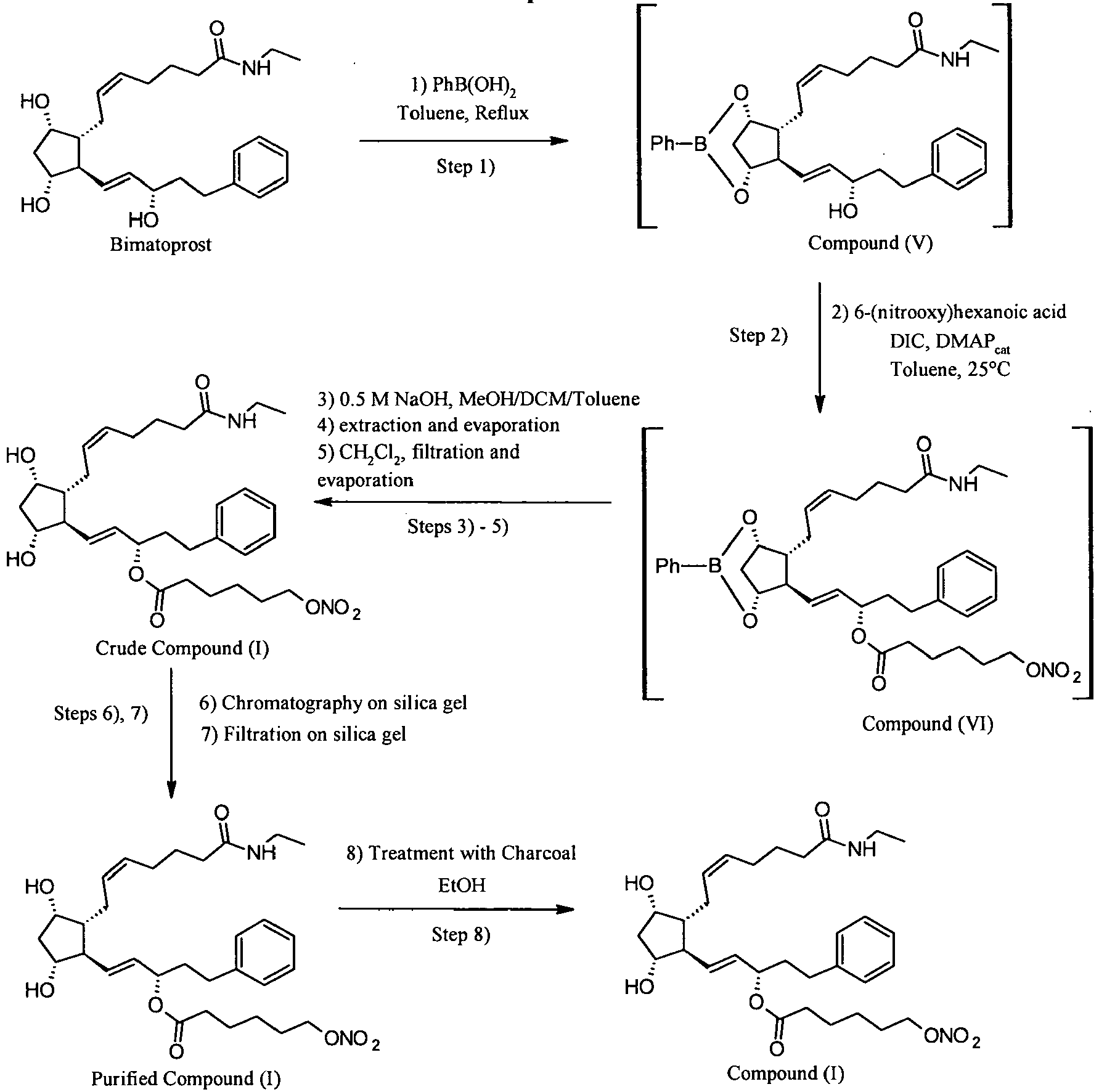
- The process of the invention has several advantages, it allows eliminating the formation of 15-(6-chlorohexanoyl) ester of bimatoprost of formula (II) and reducing the amount of 6-{[6-(nitrooxy)hexanoyl]oxy}hexanoic acid bimatoprost ester of formula (III) to below the limit of quantification that is 0.05% w/w. Moreover, the purity assessment of Compound (I) performed by HPLC showed that also the amount of each of impurities 5,6-trans-Compound (I) of formula (VII) and 15-epi-Compound (I) of formula (VIII) is not more than (≤) 0.05% w/w.
- Another advantage of the invention process is that the synthesis of the crude compound of formula (I) can be performed in a one-pot reactions preparation in which the above reported steps 1) to 3) are conducted without isolating or purifying the resulting intermediates.
- The present invention provides hexanoic acid, 6-(nitrooxy)-, (1S,2E)-3-[(1R,2R,3S,5R)-2-[(2Z)-7-(ethylamino)-7-oxo-2-hepten-1-yl]-3,5-dihydroxycyclopentyl]-1-(2-phenylethyl)-2-propen-1-yl ester of formula (I) does not contain of the impurity 15-(6-chlorohexanoyl) ester of bimatoprost of formula (II) and which contains an amount of total impurities not more than (≤) 0.20% (HPLC area %), preferably the amount of total impurities is not more than (≤) 0.15% (HPLC area %), most preferably the amount of total impurities is not more than (≤) 0.10% (HPLC area %).
- An embodiment of the invention provides hexanoic acid, 6-(nitrooxy)-, (1S,2E)-3-[(1R,2R,3S,5R)-2-[(2Z)-7-(ethylamino)-7-oxo-2-hepten-1-yl]-3,5-dihydroxycyclopentyl]-1-(2-phenylethyl)-2-propen-1-yl ester of formula (I) that does not contain 15-(6-chlorohexanoyl) ester of bimatoprost of formula (II), wherein said compound of formula (I) contains:
- not more than (≤) 0.05% w/w 6-{[6-(nitrooxy)hexanoyl]oxy}hexanoic acid bimatoprost ester of formula (III);
- not more than (≤) 0.05% w/w (1E,3S)-1-((1R,2R,3S,5R)-2-((2E)-7-(ethylamino)-7-oxohept-2-en-1-yl)-3,5-dihydroxycyclopentyl)-5-phenylpent-1-en-3-yl 6-(nitrooxy) hexanoate of formula (VII) (5,6-trans-Compound (I)); and
- not more than (≤) 0.05% w/w (1E,3R)-1-((1R,2R,3S,5R)-2-((2Z)-7-(ethylamino)-7-oxohept-2-en-1-yl)-3,5-dihydroxycyclopentyl)-5-phenylpent-1-en-3-yl 6-(nitrooxy) hexanoate of formula (VIII) (15-epi-Compound (I)); and
- Another embodiment of the invention provides hexanoic acid, 6-(nitrooxy)-, (1S,2E)-3-[(1R,2R,3S,5R)-2-[(2Z)-7-(ethylamino)-7-oxo-2-hepten-1-yl]-3,5-dihydroxy cyclopentyl]-1-(2-phenylethyl)-2-propen-1-yl ester of formula (I) that does not contain 15-(6-chlorohexanoyl) ester of bimatoprost of formula (II), wherein said compound of formula (I) contains:
- less than (<) 0.05% w/w 6-{[6-(nitrooxy)hexanoyl]oxy}hexanoic acid bimatoprost ester) of formula (III);
- not more than (≤) 0.05% w/w (1E,3S)-1-((1R,2R,3S,5R)-2-((2E)-7-(ethylamino)-7-oxohept-2-en-1-yl)-3,5-dihydroxycyclopentyl)-5-phenylpent-1-en-3-yl 6-(nitrooxy) hexanoate of formula (VII) (5,6-trans-Compound (I)); and
- less than (<) 0.05% w/w (1E,3R)-1-((1R,2R,3S,5R)-2-((2Z)-7-(ethylamino)-7-oxohept-2-en-1-yl)-3,5-dihydroxycyclopentyl)-5-phenylpent-1-en-3-yl 6-(nitrooxy) hexanoate of formula (VIII) (15-epi-Compound (I)); and
- Another embodiment of the invention provides hexanoic acid, 6-(nitrooxy)-, (1S,2E)-3-[(1R,2R,3S,5R)-2-[(2Z)-7-(ethylamino)-7-oxo-2-hepten-1-yl]-3,5-dihydroxy cyclopentyl]-1-(2-phenylethyl)-2-propen-1-yl ester of formula (I) that does not contain 15-(6-chlorohexanoyl) ester of bimatoprost of formula (II), wherein said compound of formula (I) contains:
- less than (<) 0.05% w/w 6-{[6-(nitrooxy)hexanoyl]oxy}hexanoic acid bimatoprost ester) of formula (III);
- not more than (≤) 0.05% w/w (1E,3S)-1-((1R,2R,3S,5R)-2-((2E)-7-(ethylamino)-7-oxohept-2-en-1-yl)-3,5-dihydroxycyclopentyl)-5-phenylpent-1-en-3-yl 6-(nitrooxy) hexanoate of formula (VII) (5,6-trans-Compound (I)); and
- less than (<) 0.05% w/w (1E,3R)-1-((1R,2R,3S,5R)-2-((2Z)-7-(ethylamino)-7-oxohept-2-en-1-yl)-3,5-dihydroxycyclopentyl)-5-phenylpent-1-en-3-yl 6-(nitrooxy) hexanoate of formula (VIII) (15-epi-Compound (I)); and
- Another embodiment of the invention provides hexanoic acid, 6-(nitrooxy)-, (1S,2E)-3-[(1R,2R,3S,5R)-2-[(2Z)-7-(ethylamino)-7-oxo-2-hepten-1-yl]-3,5-dihydroxy cyclopentyl]-1-(2-phenylethyl)-2-propen-1-yl ester of formula (I) that does not contain 15-(6-chlorohexanoyl) ester of bimatoprost of formula (II), wherein said compound of formula (I) contains:
- less than (<) 0.05% w/w 6-{[6-(nitrooxy)hexanoyl]oxy}hexanoic acid bimatoprost ester) of formula (III);
- not more than (≤) 0.05% w/w (1E,3S)-1-((1R,2R,3S,5R)-2-((2E)-7-(ethylamino)-7-oxohept-2-en-1-yl)-3,5-dihydroxycyclopentyl)-5-phenylpent-1-en-3-yl 6-(nitrooxy) hexanoate of formula (VII) (5,6-trans-Compound (I)); and
- less than (<) 0.05% w/w (1E,3R)-1-((1R,2R,3S,5R)-2-((2Z)-7-(ethylamino)-7-oxohept-2-en-1-yl)-3,5-dihydroxycyclopentyl)-5-phenylpent-1-en-3-yl 6-(nitrooxy) hexanoate of formula (VIII) (15-epi-Compound (I)); and
- Another embodiment of the invention provides an ophthalmic pharmaceutical composition comprising hexanoic acid, 6-(nitrooxy)-, (1S,2E)-3-[(1R,2R,3S,5R)-2-[(2Z)-7-(ethylamino)-7-oxo-2-hepten-1-yl]-3,5-dihydroxycyclopentyl]-1-(2-phenylethyl)-2-propen-1-yl ester of formula (I) that does not contain (15-(6-chlorohexanoyl) ester of bimatoprost of formula (II), and which contains an amount of total impurities not more than (≤) 0.20% (HPLC area %) and at least a pharmaceutically acceptable excipient, preferably the amount of total impurities is not more than (≤) 0.15% (HPLC area %), most preferably the amount of total impurities is not more than (≤) 0.10% (HPLC area %).
- Another embodiment of the invention provides ophthalmic pharmaceutical compositions comprising hexanoic acid, 6-(nitrooxy)-, (1S,2E)-3-[(1R,2R,3S,5R)-2-[(2Z)-7-(ethylamino)-7-oxo-2-hepten-1-yl]-3,5-dihydroxycyclopentyl]-1-(2-phenylethyl)-2-propen-1-yl ester of formula (I) that does not contain (15-(6-chlorohexanoyl) ester of bimatoprost of formula (II), wherein said compound of formula (I) contains: not more than (≤) 0.05% w/w 6-{[6-(nitrooxy)hexanoyl]oxy}hexanoic acid bimatoprost ester of formula (III), not more than (≤) 0.05% w/w (1E,3S)-1-((1R,2R,3S,5R)-2-((2E)-7-(ethylamino)-7-oxohept-2-en-1-yl)-3,5-dihydroxycyclopentyl)-5-phenylpent-1-en-3-yl 6-(nitrooxy) hexanoate of formula (VII) (5,6-trans-Compound (I)), not more than (≤) 0.05% w/w and (1E,3R)-1-((1R,2R,3S,5R)-2-((2Z)-7-(ethylamino)-7-oxohept-2-en-1-yl)-3,5-dihydroxycyclopentyl)-5-phenylpent-1-en-3-yl 6-(nitrooxy) hexanoate of formula (VIII) (15-epi-Compound (I)), wherein the amount of total impurities is not more than (≤) 0.20% (HPLC area %), and at least a pharmaceutical acceptable excipient.
- Another embodiment of the invention provides an ophthalmic pharmaceutical composition comprising hexanoic acid, 6-(nitrooxy)-, (1S,2E)-3-[(1R,2R,3S,5R)-2-[(2Z)-7-(ethylamino)-7-oxo-2-hepten-1-yl]-3,5-dihydroxycyclopentyl]-1-(2-phenylethyl)-2-propen-1-yl ester of formula (I) that does not contain (15-(6-chlorohexanoyl) ester of bimatoprost of formula (II), wherein said compound of formula (I) contains: less than (<) 0.05% w/w 6-{[6-(nitrooxy)hexanoyl]oxy}hexanoic acid bimatoprost ester of formula (III), not more than (≤) 0.05% w/w (1E,3S)-1-((1R,2R,3S,5R)-2-((2E)-7-(ethylamino)-7-oxohept-2-en-1-yl)-3,5-dihydroxycyclopentyl)-5-phenylpent-1-en-3-yl 6-(nitrooxy) hexanoate of formula (VII) (5,6-trans-Compound (I)), less than (<) 0.05% w/w (1E,3R)-1-((1R,2R,3S,5R)-2-((2Z)-7-(ethylamino)-7-oxohept-2-en-1-yl)-3,5-dihydroxycyclopentyl)-5-phenylpent-1-en-3-yl 6-(nitrooxy) hexanoate of formula (VIII) (15-epi-Compound (I)), and wherein the amount of total impurities is not more than (≤) 0.20% (HPLC area %) and at least a pharmaceutical acceptable excipient.
- Another embodiment of the invention provides ophthalmic pharmaceutical compositions comprising hexanoic acid, 6-(nitrooxy)-, (1S,2E)-3-[(1R,2R,3S,5R)-2-[(2Z)-7-(ethylamino)-7-oxo-2-hepten-1-yl]-3,5-dihydroxycyclopentyl]-1-(2-phenylethyl)-2-propen-1-yl ester of formula (I) that does not contain 15-(6-chlorohexanoyl) ester of bimatoprost of formula (II), wherein said compound of formula (I) contains: less than (<) 0.05% w/w 6-{[6-(nitrooxy)hexanoyl]oxy}hexanoic acid bimatoprost ester of formula (III), not more than (≤) 0.05% w/w (1E,3S)-1-((1R,2R,3S,5R)-2-((2E)-7-(ethylamino)-7-oxohept-2-en-1-yl)-3,5-dihydroxycyclopentyl)-5-phenylpent-1-en-3-yl 6-(nitrooxy) hexanoate of formula (VII) (5,6-trans-Compound (I)), less than (<) 0.05% w/w (1E,3R)-1-((1R,2R,3S,5R)-2-((2Z)-7-(ethylamino)-7-oxohept-2-en-1-yl)-3,5-dihydroxycyclopentyl)-5-phenylpent-1-en-3-yl 6-(nitrooxy) hexanoate of formula (VIII) (15-epi-Compound (I)), and wherein the amount of total impurities is not more than (≤) 0.15% (HPLC area %) and at least a pharmaceutical acceptable excipient.
- Another embodiment of the invention provides ophthalmic pharmaceutical compositions comprising hexanoic acid, 6-(nitrooxy)-, (1S,2E)-3-[(1R,2R,3S,5R)-2-[(2Z)-7-(ethylamino)-7-oxo-2-hepten-1-yl]-3,5-dihydroxycyclopentyl]-1-(2-phenylethyl)-2-propen-1-yl ester of formula (I) that does not contain 15-(6-chlorohexanoyl) ester of bimatoprost of formula (II), wherein said compound of formula (I) contains: less than (<) 0.05% w/w 6-{[6-(nitrooxy)hexanoyl]oxy}hexanoic acid bimatoprost ester of formula (III), not more than (≤) 0.05% w/w (1E,3S)-1-((1R,2R,3S,5R)-2-((2E)-7-(ethylamino)-7-oxohept-2-en-1-yl)-3,5-dihydroxycyclopentyl)-5-phenylpent-1-en-3-yl 6-(nitrooxy) hexanoate of formula (VII) (5,6-trans-Compound (I)), less than (<) 0.05% w/w (1E,3R)-1-((1R,2R,3S,5R)-2-((2Z)-7-(ethylamino)-7-oxohept-2-en-1-yl)-3,5-dihydroxycyclopentyl)-5-phenylpent-1-en-3-yl 6-(nitrooxy) hexanoate of formula (VIII) (15-epi-Compound (I)), and wherein the amount of total impurities is not more than (≤) 0.10% (HPLC area %) and at least a pharmaceutical acceptable excipient.
- The purity and the impurity profile of Compound (I) were assessed by HPLC methods disclosed hereunder (Method 1 and Method 2).
- The above reported definitions "does not contain 15-(6-chlorohexanoyl) ester of bimatoprost" or "substantially free of 15-(6-chlorohexanoyl) ester of bimatoprost" mean that the amount of 15-(6-chlorohexanoyl) ester of bimatoprost is below the Limit of Detection (LoD) of the HPLC method disclosed hereunder.
- The above reported definition "the amount of 6-{[6-(nitrooxy)hexanoyl]oxy}hexanoic acid bimatoprost ester is less than 0.05% w/w" means that the amount of 6-{[6-(nitrooxy)hexanoyl]oxy}hexanoic acid bimatoprost ester is below the Limit of Quantification (LoQ) of the HPLC method disclosed hereunder.
- The above reported definition "the amounts of 5,6-trans-Compound (I) is less than 0.05% w/w" means that the amount of 5,6-trans-Compound (I) is below the Limit of Quantification of the HPLC method disclosed hereunder.
- The above reported definition "the amounts of 15-epi-Compound (I) a less than 0.05% w/w" means that the amount of 15-epi-Compound (I) is blow the Limit of Quantification of the HPLC method disclosed hereunder.
- The starting material bimatoprost is commercially available.
- Dry methanol (300 mL) was charged in a 1 L three-necked flask equipped with thermometer, dropping funnel, reflux condenser and magnetic stirrer followed by conc. sulfuric acid (2.8 mL, 0.052 mole 0.06 eq). The mixture was heated to reflux temperature (T=63 °C). To the mixture was added dropwise a solution of ε-caprolactone (100 g, 0.876 mole, 1 eq) in dry methanol (200 mL). The reaction was stirred for 2 hours at reflux temperature. TLC was performed to monitor residual ε-caprolactone. Reaction mixture was then cooled down to 0-5°C. Conc. NaHCO3 solution (100 mL) was slowly added keeping the temperature below 10°C. The volatile solvent was removed on rotary evaporator under vacuum at temperature of 40°C.To the residue were added water and methyl tert-butyl ether (MTBE) (300 mL). The phases were stirred for 5 minutes, then separated. The aqueous phase was extracted with MTBE (2x200 mL). The combined organic phase was washed with brine (2x100 mL). The organic phase was dried over Na2SO4, then concentrated on rotary evaporator under vacuum at temperature of 40°C to obtain methyl 6-hydroxyhexanoate as a colorless oil (103.58 g, Y: 80.9%). GC purity: 96.2%.
- Conc. sulfuric acid (45.6 mL 0.85 mol, 3.1 eq) which was cooled to 0-5°C was added to a 500 mL three-necked flask equipped with thermometer, dropping funnel and magnetic stirrer. Then fuming nitric acid (47.2 mL, 1.12 mol, 4.1 eq) was added dropwise to it while the temperature was kept between 0-5 °C. To the cooled mixture was added slowly dry dichloromethane (100 mL, 2.5 V) then stirred between 0-5 °C for 30 min. At this temperature methyl 6-hydroxyhexanoate (40 g, 0.27 mol, 1 eq.) in dry (dichloromethane) DCM (100 mL) was added for 1 hour. After 30 min stirring at 0-5 °C the reaction mixture was monitored by TLC which showed the completed reaction. The reaction mixture was quenched by dropping it to cooled water (200 mL) (T<10°C, ~2 hours). Then the phases were separated. The organic phase was dried over Na2SO4, then concentrated on rotary evaporator under vacuum at temperature of 40°C to obtain methyl 6-nitrooxyhexanoate (49.46 g). as a yellow oil in a 94.5% yield.
- 1.5 M NaOH aqueous solution (208 mL) was charged into a 1 L three-necked flask equipped with thermometer, dropping funnel and magnetic stirrer. Methyl 6-nitrooxyhexanoate (49.64 g, 0.26 mol, 1 eq) dissolved in methanol (248 mL, 5V) was added dropwise at room temperature (Tmax=35 °C). After the addition, the mixture was stirred for 2 hours at room temperature. Controlled by TLC the reaction mixture showed the reaction was completed. The pH of the reaction mixture was set to 2.5 using 183 mL 2M HCl aqueous solution. The resulted mixture was extracted with MTBE (100 mL) then the water phase was extracted MTBE (5×50 mL). The combined organic phase was washed with brine (2x30 mL), then concentrated on rotary evaporator under vacuum at temperature of 40°C to obtain crude 6-(nitrooxy)hexanoic acid as a yellow oil (44.2 g). Assay is assessed by UPLC method.
- The crude 6-(nitrooxy)hexanoic acid was purified by column chromatography according to the following procedures:
Eluent was prepared by mixing toluene and methanol in a volumetric ratio of 40:1. Silica was stirred with eluent in a slurry dispenser and the column was loaded and prepared. The crude material (1161 g, assay of 91.8% by UPLC) was dissolved in toluene and the solution was loaded on the top of the column. The elution was performed at a flow rate of 15±5 L/h and fractions of 10 L were collected and analyzed by TLC. Purest fractions were combined and concentrated under vacuum at temperature below 55°C ± 5°C. The purified 6-(nitrooxy)hexanoic acid (952 g, 5.37 mole) was isolated as an oil in a 82% yield having a 98.7% purity by UPLC and containing a not detectable amount of 6-[6-nitrooxyhexanoyl]oxy}hexanoic acid. - Toluene (28 Kg, 49 vol) was charged in a reactor followed by Bimatoprost (663 g, 1.595 mol, 1 equiv) and phenylboronic acid (214 g, 1.755 mole, 1.1 equiv). The reaction is heated at 110°C±5°C and vapor temperature was maintained at 90°C for 4 hours to ensure azeotropic distillation of water for a total volume of solvent of around 12L. Reaction mixture was then cooled down to 25°C±5°C.
- Dimethylaminopyridine (DMAP) (39 g, 0.319 mole, 0.2 equiv) and N,N'-diisopropyl carbodiimide (DIC) (403 g, 3,190 mole, 2.0 equiv) were added to the cooled reaction mixture, followed by a solution of 6-(nitrooxy)hexanoic acid (565 g, 3.190 mole, 2.0 equiv) in toluene (0.5 L, 0.75 vol). The reaction was stirred for 1 to 3 hours at 25°C ± 5°C. TLC was performed to monitor residual bimatoprost phenyl-boronate (Compound (V))
- The reaction mixture was quenched with methanol (1.3L, 2 vol) and was stirred 5 to 10 min The reaction mixture was then transferred via vacuum into an extractor containing 0.5M sodium hydroxide solution (20 L) and dichloromethane (10 L, 15 vol). Reactor was washed with several portions of methylene chloride that were added to the reaction mixture. The reaction mixture was stirred for 2 to 3 hours, then left to settle for 60 min and the organic phase was collected in a mobile tank. Dichloromethane (10 L, 15 vol) was charged into the extractor, the mixture was stirred for 5 to 10 min and left to settle for 15 min. The organic layer was collected. The organic layers were charged again in the extractor and a 1M NaHSO4 solution (20 L) was transferred via vacuum into the extractor. The mixture is stirred for 5 to 10 min, left to settle for 15 min and the lower organic phase was collected in a mobile tank. The aqueous layer was removed. The organic phase was charged again in the extractor and a 15% NaCl solution (20 L) was added and the mixture was stirred for 5 to 10 min and left to settle for 15 min. The organic layer was collected and the aqueous phase was removed. The organic layer was charged again in the extractor and a 15% NaCl w/w solution (20 L) was added. The mixture was stirred for 5 to 10 min and left to settle for 15 min. The organic layer was collected evaporated under vacuum at a temperature of 45°C±5°
- The crude product was dissolved in dichloromethane (7 L, 10.5 vol) and the mixture was transferred into a reactor. The mixture was cooled to 5 - 10°C and kept for 30-60 min at this temperature to allow N,N'-diisopropyl urea precipitation. The mixture is filtered through the filter in a mobile tank. The reactor is washed with dichloromethane (2 L, 3 vol), solution is filtered and collected in the mobile tank. Then the solution in the mobile tank is transferred to a flask and the solvent is evaporated under vacuum at temperature of 45°C±5°C to obtain the crude hexanoic acid, 6-(nitrooxy)-, (1S,2E)-3-[(1R,2R,3S,5R)-2-[(2Z)-7-(ethylamino)-7-oxo-2-hepten-1-yl]-3,5-dihydroxycyclopentyl]-1-(2-phenylethyl)-2-propen-1-yl ester (crude Compound I).
- The eluent mixture 1 was prepared by mixing diisopropylether/acetone/water in 40:15:0.5 volume ratio.
- Silica gel (30 Kg, 45 vol) was suspended in the eluent mixture 1 (66.3 Kg, 100 vol), the suspension was stirred for 3 min and loaded in the column.
- The crude product was dissolved in the eluent mixture (1 L, 1.5 vol) and charged on the top of the column. The elution was performed and fractions of 15 L were collected and analyzed by TLC. Fractions were combined according to purity and analyzed by HPLC and UPLC.
- Selected fractions with desired purity were collected and the solvent was evaporated using a rotary evaporator at temperature of 45°C±5°C until dryness. The residue was dissolved in dichloromethane (5 L, 7.5 vol) and the solvent was evaporated again until dryness.
- The Compound (I) was stored at 5°C ±3°C.
- Eluent mixture 2 was prepared by mixing distilled dichloromethane and distilled methanol in 30:1 volume ratio.
- Silica 75 S (6.6 Kg, 10 vol) was added to eluent mixture 2 (13 Kg, 19.6 vol) and the suspension was stirred and poured to fill the column. Compound (I) was dissolved in dichloromethane (1 L, 1.5 vol) and the solution was loaded on the top of the column.
- The elution was performed and fractions were controlled by TLC and the selected fractions with desired purity were collected; the combined fractions were analyzed by HPLC and UPLC.
- Fractions were evaporated in a rotary evaporator under vacuum at temperature of 45°C±5°C. The pure Compound (I) isolated as an oil was stored at 5°C±3°C.
- The pure Compound (I) was dissolved in ethanol (6 L, 9 vol) and activated charcoal (60 g, around 9% w/w) was added. The mixture was stirred for 30 min at 20°C±5°C and the activated charcoal is removed by filtration. The solvent was evaporated under vacuum at 45°C±5°C until constant weight; 649.6 g (1.13 mole) pure Compound (I) was isolated as an oil. The overall yield of the process was 70.8%.
- The purity assessment of the isolated Compound (I) was performed by HPLC analysis using the two methods described below, the HPLC assay of Compound (I) was 99.91% (HPLC area %) assessed by HPLC / Method 1.
- The Limit of Detection (LoD) and the Limit of Quantification (LoQ) for 15-(6-chlorohexanoyl) ester of bimatoprost of formula (II), 6-{[6-(nitrooxy)hexanoyl]oxy}hexanoic acid bimatoprost ester of formula (III), 5,6-trans-Compound (I) of formula (VII) and 15-epi-Compound (I) of formula (VIII) are reported in Table 1.
- The impurities profile of the isolated Compound (I) is reported in Table 2.
- Table 3 reports the contents of the impurity 15-(6-chlorohexanoyl) ester of bimatoprost (II) in the Compound (I) prepared according to the processes disclosed in the prior art.
- Method 1: the HPLC analysis was performed using the following measurement conditions:
- Instrument: Waters HPLC System with PDA detector
- Stationary phase: Zorbax RX SIL, 250 × 4.6 mm, 5 µm
- Column temperature: 35°C
- Mobile phase: hexane : Ethanol: acetonitrile: acetic acid = 935:60:5:0.5
- Run Time: 60 min
- Flow rate: 1.5 ml/min
- Injected Volume: 20 µl
- Detection: UV, 210 nm
- Sample solvent: ethanol: hexane 2:8
- Method 2: the HPLC analysis was performed to quantify the 15-epi-Compound (I) of formula (VIII) using the following measurement conditions:
- Instrument: Waters HPLC System with PDA detector
- Stationary phase: Chiralpak AD-H, 250 × 4.6 mm, 5 µm
- Column temperature: 25°C
- Mobile phase: Hexane : Ethanol: TFA - 850 : 150 : 1
- Run Time: 30 min
- Flow rate: 1.0 mL/min
- Injected Volume: 10 µL
- Detection: 210 nm
- Sample solvent: Hexane : Ethanol - 8 : 2
Table 1 Limit of Detection (LoD) and Limit of Quantification (LoQ) of the impurities IMPURITY LoD % w/w LoQ % w/w 15-(6-chlorohexanoyl) ester of bimatoprost of formula (II) 0.01 0.03 6-{[6-(nitrooxy)hexanoyl]oxy}hexanoic acid bimatoprost ester of formula (III) 0.02 0.05 (1E,3 S)-1-((1R,2R,3 S,5R)-2-((2E)-7-(ethylamino)-7-oxohept-2-en-1-yl)-3,5-dihydroxycyclopentyl)-5-phenylpent-1-en-3-yl 6-(nitrooxy) hexanoate (5,6-trans-Compound (I) of formula (VII)) 0.01 0.05 (1E,3R)-1-((1R,2R,3 S,5R)-2-((2Z)-7-(ethylamino)-7-oxohept-2-en-1-yl)-3,5-dihydroxycyclopentyl)-5-phenylpent-1-en-3-yl 6-(nitrooxy) hexanoate (15-epi-Compound (I) of formula (VIII)) 0.02 0.05 Table 2 HPLC analysis of the isolated Compound (I) of Example 1 Main and total impurities IMPURITY % (w/w) Method 1 Method 2 RT (min) RT (min) 15-(6-chlorohexanoyl) ester of bimatoprost of formula (II) < LoD 15.4 - 6-{[6-(nitrooxy)hexanoyl]oxy } hexanoic acid bimatoprost ester of formula (III) < LoD 22.1 - (1E,3S)-1-((1R,2R,3S,5R)-2-((2E)-7-(ethylamino)-7-oxohept-2-en-1-yl)-3,5-dihydroxycyclopentyl)-5-phenylpent-1-en-3-yl 6-(nitrooxy) hexanoate (5,6-trans-Compound (I) of formula (VII)) <LoQ§ 23.6 - (1E,3R)-1-((1R,2R,3S,5R)-2-((2Z)-7-(ethylamino)-7-oxohept-2-en-1-yl)-3,5-dihydroxycyclopentyl)-5-phenylpent-1-en-3-yl 6-(nitrooxy) hexanoate (15-epi-Compound (I) of formula (VIII)) < LoD - 13.9 Total impurities 0.07∗ NA NA RT = Retention time §: the measured amount of 5,6-trans-Compound (I) of formula (VII) was 0.04% w/w calculated as medium value of two determinations by HPLC analysis ∗: HPLC area % Table 3 Summary of the contents of the impurity 15-(6-chlorohexanoyl) ester of bimatoprost (II) in the Compound (I) prepared according to the processes disclosed in the prior art WO 2009/136281 WO 2019/162149 WO 2021/023693 15-(6-chlorohexanoyl) ester of bimatoprost of formula (II) 8.34 (HPLC area%) 0.15 - 0.24 (% w/w) 0.11 (HPLC area%)
Claims (13)
- A process for the preparation of hexanoic acid, 6-(nitrooxy)-, (1S,2E)-3-[(1R,2R,3S,5R)-2-[(2Z)-7-(ethylamino)-7-oxo-2-hepten-1-yl]-3,5-dihydroxycyclopentyl]-1-(2-phenylethyl)-2-propen-1-yl ester of formula (I)
 1) reacting bimatoprost with phenylboronic acid in toluene at the refluxing temperature and removing water by azeotropic distillation to obtain bimatoprost phenyl-boronate of formula (V)
 2) cooling down the solution to 25°C and adding N,N'-diisopropyl carbodiimide, a catalytic amount of dimethylaminopyridine and 6-(nitrooxy)hexanoic acid to obtain (1E,3S)-1-{(1S,5R,6R,7R)-7-[(2Z)-7-(ethylamino)-7-oxohept-2-en-1-yl]-3-phenyl-2,4-dioxa-3-borabicyclo[3.2.1]octan-6-yl}-5-phenylpent-1-en-3-yl 6-(nitrooxy)hexanoate of formula (VI)
 3) removing the phenylboronate protecting group under basic conditions;4) separating the organic phase and evaporating the solvent;5) stirring the raw product in dichloromethane, filtering the mixture and evaporating the solvent to obtain the crude compound of formula (I);6) purifying the crude compound of formula (I) by applying a normal phase gravity silica gel column chromatography using an eluent mixture containing diisopropyl ether, acetone and water in 40:15:0.5 volume ratio;7) collecting the fractions of appropriate purity and evaporating the solvent to provide pure compound of formula (I);8) dissolving the pure compound of formula (I) of step 7) in distilled methylene chloride and methanol, purifying the solution by gravity chromatography using an eluent mixture containing distilled methylene chloride and methanol in 30:1 volume ratio and collecting the fractions of appropriate purity and evaporating the solvent to obtain pure compound of formula (I);9) dissolving the pure compound of formula (I) of step 8) in a ethanol, treating the solution with activated charcoal, thereafter removing the activated charcoal by filtration and removing the solvent by evaporation under vacuum to yield pure hexanoic acid, 6-(nitrooxy)-, (1S,2E)-3-[(1R,2R,3S,5R)-2-[(2Z)-7-(ethylamino)-7-oxo-2-hepten-1-yl]-3,5-dihydroxycyclopentyl]-1 -(2-phenylethyl)-2-propen-1-yl ester;said process being characterized in that the obtained hexanoic acid, 6-(nitrooxy)-, (1S,2E)-3-[(1R,2R,3S,5R)-2-[(2Z)-7-(ethylamino)-7-oxo-2-hepten-1-yl]-3,5-dihydroxycyclopentyl]-1-(2-phenylethyl)-2-propen-1-yl ester does not contain the 15-(6-chlorohexanoyl) ester of bimatoprost of formula (II), and contains not more than (≤) 0.20% (HPLC area %) of total impurities.
 - The process according to claim 1 wherein, in the reaction step 1), the bimatoprost: phenyl boronic acid molar ratio is 1:1.1.
- The process according to claim 1 or 2 wherein, in the reaction step 2), N,N'-diisopropyl carbodiimide 2.0 equiv., dimethylaminopyridine 0.2 equiv. and 6-(nitrooxy)hexanoic acid 1.8 to 2.2 equiv. are added.
- The process according to any one of the preceding claims, wherein in the reaction step 3) the phenylboronate protecting group is removed using a NaOH solution.
- The process according to claim 4 wherein the phenylboronate protecting group is removed by quenching the reaction mixture obtained in step 2) with methanol, then adding a mixture of methylene chloride and 6.3 equiv. of NaOH as solution of NaOH 0.5M.
- The process according to any one of the preceding claims, wherein, in reaction step 4) the organic phase is washed first with an aqueous solution of sodium hydrogen sulfate and twice with an aqueous solution of NaCl 15% w/w.
- The process according to any one of the preceding claims, wherein the obtained compound of formula (I) contains not more than (≤) 0.10% (HPLC area %) of total impurities.
- The compound of formula (I) which does not contain 15-(6-chlorohexanoyl) ester of bimatoprost of formula (II)

- The compound of formula (I) according to claim 8 wherein the amount of total impurities is not more than (≤) 0.15% (HPLC area %).
- The compound of formula (I) according to claim 8 wherein the amount of total impurities is not more than (≤) 0.10% (HPLC area %).
- The compound of formula (I) according to any one of claims claim 8-10 wherein said compound of formula (I) contains not more than (≤) 0.05% w/w 6-{[6-(nitrooxy)hexanoyl]oxy}hexanoic acid bimatoprost ester of formula (III)


- The compound of formula (I) according to any one of claims 8 to 11 wherein said compound of formula (I) contains less than (<) 0.05% w/w 6-{[6-(nitrooxy)hexanoyl]oxy}hexanoic acid bimatoprost ester of formula (III)


- An ophthalmic pharmaceutical composition comprising the compound of formula (I) according to any of claims 8 to 12 and at least a pharmaceutical acceptable excipient.
Priority Applications (29)
| Application Number | Priority Date | Filing Date | Title |
|---|---|---|---|
| MA71652A MA71652A (en) | 2022-07-07 | 2022-07-07 | INDUSTRIAL PROCESS FOR THE PREPARATION OF HEXANOIC ACID, 6-(NITROOXY)-, (1S,2E)-3-(1R,2R,3S,5R)-2- (2Z)-7-(ETHYLAMINO)-7-OXO-2-HEPTEN-1-YL) |
| EP24183626.1A EP4410294A3 (en) | 2022-07-07 | 2022-07-07 | Industrial process for the preparation of hexanoic acid, 6(nitrooxy)-,(1s,2e)-3-[(1r,2r,3s,5r)-2-[(2z)-7-(ethylamino)-7-oxo-2-hepten-1-yl]3,5-dihydroxycyclopentyl]-1-(2-phenyl ethyl)-2-propen-1-yl ester and high pure product |
| HRP20241504TT HRP20241504T1 (en) | 2022-07-07 | 2022-07-07 | Industrial process for the preparation of hexanoic acid, 6(nitrooxy)-,(1s,2e)-3-[(1r,2r,3s,5r)-2-[(2z)-7-(ethylamino)-7-oxo-2-hepten-1-yl]3,5-dihydroxycyclopentyl]-1-(2-phenyl ethyl)-2-propen-1-yl ester and high pure product |
| RS20241231A RS66198B1 (en) | 2022-07-07 | 2022-07-07 | Industrial process for the preparation of hexanoic acid, 6(nitrooxy)-,(1s,2e)-3-[(1r,2r,3s,5r)-2-[(2z)-7-(ethylamino)-7-oxo-2-hepten-1-yl]3,5-dihydroxycyclopentyl]-1-(2-phenyl ethyl)-2-propen-1-yl ester and high pure product |
| EP22290046.6A EP4303211B1 (en) | 2022-07-07 | 2022-07-07 | Industrial process for the preparation of hexanoic acid, 6(nitrooxy)-,(1s,2e)-3-[(1r,2r,3s,5r)-2-[(2z)-7-(ethylamino)-7-oxo-2-hepten-1-yl]3,5-dihydroxycyclopentyl]-1-(2-phenyl ethyl)-2-propen-1-yl ester and high pure product |
| HUE22290046A HUE069026T2 (en) | 2022-07-07 | 2022-07-07 | Industrial process for the preparation of hexanoic acid, 6(nitrooxy)-,(1s,2e)-3-[(1r,2r,3s,5r)-2-[(2z)-7-(ethylamino)-7-oxo-2-hepten-1-yl]3,5-dihydroxycyclopentyl]-1-(2-phenyl ethyl)-2-propen-1-yl ester and high pure product |
| LTEP22290046.6T LT4303211T (en) | 2022-07-07 | 2022-07-07 | Industrial process for the preparation of hexanoic acid, 6(nitrooxy)-,(1s,2e)-3-[(1r,2r,3s,5r)-2-[(2z)-7-(ethylamino)-7-oxo-2-hepten-1-yl]3,5-dihydroxycyclopentyl]-1-(2-phenyl ethyl)-2-propen-1-yl ester and high pure product |
| SM20240481T SMT202400481T1 (en) | 2022-07-07 | 2022-07-07 | Industrial process for the preparation of hexanoic acid, 6(nitrooxy)-,(1s,2e)-3-[(1r,2r,3s,5r)-2-[(2z)-7-(ethylamino)-7-oxo-2-hepten-1-yl]3,5-dihydroxycyclopentyl]-1-(2-phenyl ethyl)-2-propen-1-yl ester and high pure product |
| DK22290046.6T DK4303211T3 (en) | 2022-07-07 | 2022-07-07 | Industrial process for the production of hexanoic acid, 6-(nitrooxy)-, (1S,2E)-3-[(1R,2R,3S,5R)-2-[(2Z)-7-(ethylamino)-7-oxo- 2-hepten-1-yl]-3,5-dihydroxycyclopentyl]-1-(2-phenylethyl)-2-propen-1-yl ester and high purity product |
| PT222900466T PT4303211T (en) | 2022-07-07 | 2022-07-07 | Industrial process for the preparation of hexanoic acid, 6(nitrooxy)-,(1s,2e)-3-[(1r,2r,3s,5r)-2-[(2z)-7-(ethylamino)-7-oxo-2-hepten-1-yl]3,5-dihydroxycyclopentyl]-1-(2-phenyl ethyl)-2-propen-1-yl ester and high pure product |
| MA65191A MA65191B1 (en) | 2022-07-07 | 2022-07-07 | INDUSTRIAL PROCESS FOR THE PREPARATION OF HEXANOIC ACID ESTER 6(NITROOXY)-,(1S,2E)-3-[(1R,2R,3S,5R)-2-[(2Z)-7-(ETHYLAMINO)-7-OXO-2-HEPTENE-1-YL]3,5-DIHYDROXYCYCLOPENTYL]-1-(2-PHENYLETHYL)-2-PROPENE-1-YL AND HIGH PURITY PRODUCT |
| ES22290046T ES2992696T3 (en) | 2022-07-07 | 2022-07-07 | Industrial process for the preparation of hexanoic acid, 6(nitrooxy)-,(1s,2e)-3-[(1r,2r,3s,5r)-2-[(2z)-7-(ethylamino)-7-oxo-2-hepten-1-yl]3,5-dihydroxycyclopentyl]-1-(2-phenyl ethyl)-2-propen-1-yl ester and high pure product |
| PL22290046.6T PL4303211T3 (en) | 2022-07-07 | 2022-07-07 | Industrial method for the preparation of 6-(nitrooxy)hexanoic acid (1S,2E)-3-[(1R,2R,3S,5R)-2-[(2Z)-7-(ethylamino)-7-oxo-2-hepten-1-yl]-3,5-dihydroxycyclopentyl]-1-(2-phenylethyl)-2-propen-1-yl ester and a high-purity product |
| FIEP22290046.6T FI4303211T3 (en) | 2022-07-07 | 2022-07-07 | Industrial process for the preparation of hexanoic acid, 6(nitrooxy)-,(1s,2e)-3-[(1r,2r,3s,5r)-2-[(2z)-7-(ethylamino)-7-oxo-2-hepten-1-yl]3,5-dihydroxycyclopentyl]-1-(2-phenyl ethyl)-2-propen-1-yl ester and high pure product |
| SI202230062T SI4303211T1 (en) | 2022-07-07 | 2022-07-07 | Industrial process for the preparation of hexanoic acid, 6(nitrooxy)-,(1s,2e)-3-[(1r,2r,3s,5r)-2-[(2z)-7-(ethylamino)-7-oxo-2-hepten-1-yl]3,5-dihydroxycyclopentyl]-1-(2-phenyl ethyl)-2-propen-1-yl ester and high pure product |
| KR1020257003941A KR20250034143A (en) | 2022-07-07 | 2023-07-06 | Industrial method for the preparation of hexanoic acid, 6-(nitrooxy)-, (1S,2E)-3-[(1R,2R,3S,5R)-2-[(2Z)-7-(ethylamino)-7-oxo-2-hepten-1-yl]-3,5-dihydroxycyclopentyl]-1-(2-phenylethyl)-2-propen-1-yl ester and high purity product |
| AU2023303861A AU2023303861A1 (en) | 2022-07-07 | 2023-07-06 | Industrial process for the preparation of hexanoic acid, 6-(nitrooxy)-, (1s,2e)-3-[(1r,2r,3s,5r)-2-[(2z)-7-(ethylamino)-7-oxo-2-hepten-1-yl]-3,5-dihydroxycyclopentyl]-1-(2-phenylethyl)-2-propen-1-yl ester and high pure product |
| CN202310823778.1A CN117362210A (en) | 2022-07-07 | 2023-07-06 | Industrial process for preparing compounds and high purity products |
| CN202380052119.0A CN119522211A (en) | 2022-07-07 | 2023-07-06 | Industrial process for preparing 6-(nitrooxy)-hexanoic acid (1S,2E)-3-[(1R,2R,3S,5R)-2-[(2Z)-7-(ethylamino)-7-oxo-2-hepten-1-yl]-3,5-dihydroxycyclopentyl]-1-(2-phenylethyl)-2-propen-1-yl ester and high-purity product |
| PCT/EP2023/068661 WO2024008844A1 (en) | 2022-07-07 | 2023-07-06 | Industrial process for the preparation of hexanoic acid, 6-(nitrooxy)-, (1s,2e)-3-[(1r,2r,3s,5r)-2-[(2z)-7-(ethylamino)-7-oxo-2-hepten-1-yl]-3,5-dihydroxycyclopentyl]-1-(2-phenylethyl)-2-propen-1-yl ester and high pure product |
| JP2025500141A JP2025523301A (en) | 2022-07-07 | 2023-07-06 | Industrial process and high purity product for the preparation of hexanoic acid, 6-(nitrooxy)-, (1S,2E)-3-[(1R,2R,3S,5R)-2-[(2Z)-7-(ethylamino)-7-oxo-2-hepten-1-yl]-3,5-dihydroxycyclopentyl]-1-(2-phenylethyl)-2-propen-1-yl ester |
| CA3261164A CA3261164A1 (en) | 2022-07-07 | 2023-07-06 | Industrial process for the preparation of hexanoic acid, 6-(nitrooxy)-, (1s,2e)-3-[(1r,2r,3s,5r)-2-[(2z)-7-(ethylamino)-7-oxo-2-hepten-1-yl]-3,5-dihydroxycyclopentyl]-1-(2-phenylethyl)-2-propen-1-yl ester and high pure product |
| US18/881,613 US20250320182A1 (en) | 2022-07-07 | 2023-07-06 | Industrial process for the preparation of hexanoic acid, 6-(nitrooxy)-, (1s,2e)-3-[(1r,2r,3s,5r)-2-[(2z)-7-(ethylamino)-7-oxo-2-hepten-1-yl]-3,5-dihydroxycyclopentyl]-1-(2-phenylethyl)-2-propen-1-yl ester and high pure product |
| JP2023111243A JP2024012261A (en) | 2022-07-07 | 2023-07-06 | Hexanoic acid, 6-(nitrooxy)-, (1S,2E)-3-[(1R,2R,3S,5R)-2-[(2Z)-7-(ethylamino)-7-oxo-2-heptene -1-yl]-3,5-dihydroxycyclopentyl]-1-(2-phenylethyl)-2-propen-1-yl ester and high purity product |
| US18/348,185 US20240018096A1 (en) | 2022-07-07 | 2023-07-06 | Industrial process for the preparation of hexanoic acid, 6-(nitrooxy)-, (1s,2e)-3-[(1r,2r,3s,5r)-2-[(2z)-7-(ethylamino)-7-oxo-2-hepten-1-yl]-3,5-dihydroxycyclopentyl]-1-(2-phenylethyl)-2-propen-1-yl ester and high pure product |
| ARP230101763A AR129847A1 (en) | 2022-07-07 | 2023-07-06 | INDUSTRIAL PROCESS FOR THE PREPARATION OF 6-(NITROOXI)-, (1S,2E)-3-[(1R,2R,3S,5R)-2-[(2Z)-7-(ETHYLAMINO)-7-OXO-2-HEPTEN-1-IL]-3,5-DIHYDROXYCYCLOPENTYL]-1-(2-PHENYLETHYL)-2-PROPEN-1-YLIC ESTER OF HEXANOIC ACID AND HIGH PURITY PRODUCT |
| TW112125205A TW202408995A (en) | 2022-07-07 | 2023-07-06 | Industrial process for the preparation of hexanoic acid, 6-(nitrooxy)-, (1s,2e)-3-[(1r,2r,3s,5r)-2-[(2z)-7-(ethylamino)-7-oxo-2-hepten-1-yl]-3,5-dihydroxycyclopentyl]-1-(2-phenylethyl)-2-propen-1-yl ester and high pure product |
| EP23739508.2A EP4551553A1 (en) | 2022-07-07 | 2023-07-06 | Industrial process for the preparation of hexanoic acid, 6-(nitrooxy)-, (1s,2e)-3-[(1r,2r,3s,5r)-2-[(2z)-7-(ethylamino)-7-oxo-2-hepten-1-yl]-3,5-dihydroxycyclopentyl]-1-(2-phenylethyl)-2-propen-1-yl ester and high pure product |
| MX2025000209A MX2025000209A (en) | 2022-07-07 | 2025-01-06 | Industrial process for the preparation of hexanoic acid, 6-(nitrooxy)-, (1s,2e)-3-[(1r,2r,3s,5r)-2-[(2z)-7-(ethylamino)-7-oxo-2-hepten-1-yl]-3,5-dihydroxycyclopentyl]-1-(2-phenylethyl)-2-propen-1-yl ester and high pure product |
Applications Claiming Priority (1)
| Application Number | Priority Date | Filing Date | Title |
|---|---|---|---|
| EP22290046.6A EP4303211B1 (en) | 2022-07-07 | 2022-07-07 | Industrial process for the preparation of hexanoic acid, 6(nitrooxy)-,(1s,2e)-3-[(1r,2r,3s,5r)-2-[(2z)-7-(ethylamino)-7-oxo-2-hepten-1-yl]3,5-dihydroxycyclopentyl]-1-(2-phenyl ethyl)-2-propen-1-yl ester and high pure product |
Related Child Applications (2)
| Application Number | Title | Priority Date | Filing Date |
|---|---|---|---|
| EP24183626.1A Division-Into EP4410294A3 (en) | 2022-07-07 | 2022-07-07 | Industrial process for the preparation of hexanoic acid, 6(nitrooxy)-,(1s,2e)-3-[(1r,2r,3s,5r)-2-[(2z)-7-(ethylamino)-7-oxo-2-hepten-1-yl]3,5-dihydroxycyclopentyl]-1-(2-phenyl ethyl)-2-propen-1-yl ester and high pure product |
| EP24183626.1A Division EP4410294A3 (en) | 2022-07-07 | 2022-07-07 | Industrial process for the preparation of hexanoic acid, 6(nitrooxy)-,(1s,2e)-3-[(1r,2r,3s,5r)-2-[(2z)-7-(ethylamino)-7-oxo-2-hepten-1-yl]3,5-dihydroxycyclopentyl]-1-(2-phenyl ethyl)-2-propen-1-yl ester and high pure product |
Publications (2)
| Publication Number | Publication Date |
|---|---|
| EP4303211A1 true EP4303211A1 (en) | 2024-01-10 |
| EP4303211B1 EP4303211B1 (en) | 2024-08-21 |
Family
ID=82850340
Family Applications (3)
| Application Number | Title | Priority Date | Filing Date |
|---|---|---|---|
| EP22290046.6A Active EP4303211B1 (en) | 2022-07-07 | 2022-07-07 | Industrial process for the preparation of hexanoic acid, 6(nitrooxy)-,(1s,2e)-3-[(1r,2r,3s,5r)-2-[(2z)-7-(ethylamino)-7-oxo-2-hepten-1-yl]3,5-dihydroxycyclopentyl]-1-(2-phenyl ethyl)-2-propen-1-yl ester and high pure product |
| EP24183626.1A Pending EP4410294A3 (en) | 2022-07-07 | 2022-07-07 | Industrial process for the preparation of hexanoic acid, 6(nitrooxy)-,(1s,2e)-3-[(1r,2r,3s,5r)-2-[(2z)-7-(ethylamino)-7-oxo-2-hepten-1-yl]3,5-dihydroxycyclopentyl]-1-(2-phenyl ethyl)-2-propen-1-yl ester and high pure product |
| EP23739508.2A Pending EP4551553A1 (en) | 2022-07-07 | 2023-07-06 | Industrial process for the preparation of hexanoic acid, 6-(nitrooxy)-, (1s,2e)-3-[(1r,2r,3s,5r)-2-[(2z)-7-(ethylamino)-7-oxo-2-hepten-1-yl]-3,5-dihydroxycyclopentyl]-1-(2-phenylethyl)-2-propen-1-yl ester and high pure product |
Family Applications After (2)
| Application Number | Title | Priority Date | Filing Date |
|---|---|---|---|
| EP24183626.1A Pending EP4410294A3 (en) | 2022-07-07 | 2022-07-07 | Industrial process for the preparation of hexanoic acid, 6(nitrooxy)-,(1s,2e)-3-[(1r,2r,3s,5r)-2-[(2z)-7-(ethylamino)-7-oxo-2-hepten-1-yl]3,5-dihydroxycyclopentyl]-1-(2-phenyl ethyl)-2-propen-1-yl ester and high pure product |
| EP23739508.2A Pending EP4551553A1 (en) | 2022-07-07 | 2023-07-06 | Industrial process for the preparation of hexanoic acid, 6-(nitrooxy)-, (1s,2e)-3-[(1r,2r,3s,5r)-2-[(2z)-7-(ethylamino)-7-oxo-2-hepten-1-yl]-3,5-dihydroxycyclopentyl]-1-(2-phenylethyl)-2-propen-1-yl ester and high pure product |
Country Status (23)
| Country | Link |
|---|---|
| US (2) | US20240018096A1 (en) |
| EP (3) | EP4303211B1 (en) |
| JP (2) | JP2024012261A (en) |
| KR (1) | KR20250034143A (en) |
| CN (2) | CN119522211A (en) |
| AR (1) | AR129847A1 (en) |
| AU (1) | AU2023303861A1 (en) |
| CA (1) | CA3261164A1 (en) |
| DK (1) | DK4303211T3 (en) |
| ES (1) | ES2992696T3 (en) |
| FI (1) | FI4303211T3 (en) |
| HR (1) | HRP20241504T1 (en) |
| HU (1) | HUE069026T2 (en) |
| LT (1) | LT4303211T (en) |
| MA (2) | MA65191B1 (en) |
| MX (1) | MX2025000209A (en) |
| PL (1) | PL4303211T3 (en) |
| PT (1) | PT4303211T (en) |
| RS (1) | RS66198B1 (en) |
| SI (1) | SI4303211T1 (en) |
| SM (1) | SMT202400481T1 (en) |
| TW (1) | TW202408995A (en) |
| WO (1) | WO2024008844A1 (en) |
Families Citing this family (1)
| Publication number | Priority date | Publication date | Assignee | Title |
|---|---|---|---|---|
| ES2964005T3 (en) * | 2019-08-05 | 2024-04-03 | Nicox Sa | Procedure for preparing a nitric oxide donor prostaglandin analogue |
Citations (4)
| Publication number | Priority date | Publication date | Assignee | Title |
|---|---|---|---|---|
| WO2009136281A1 (en) | 2008-05-09 | 2009-11-12 | Nicox S.A. | Nitric oxide donating prostamides |
| WO2019162149A1 (en) | 2018-02-21 | 2019-08-29 | Nicox S.A. | Process for the preparation of a nitric oxide donating prostaglandin analogue |
| WO2021023693A1 (en) | 2019-08-05 | 2021-02-11 | Nicox S.A. | Process for the preparation of a nitric oxide donating prostaglandin analogue |
| WO2022167070A1 (en) * | 2021-02-03 | 2022-08-11 | Nicox S.A. | Process for the preparation of a nitric oxide donating prostaglandin analogue |
-
2022
- 2022-07-07 HR HRP20241504TT patent/HRP20241504T1/en unknown
- 2022-07-07 LT LTEP22290046.6T patent/LT4303211T/en unknown
- 2022-07-07 ES ES22290046T patent/ES2992696T3/en active Active
- 2022-07-07 DK DK22290046.6T patent/DK4303211T3/en active
- 2022-07-07 PT PT222900466T patent/PT4303211T/en unknown
- 2022-07-07 FI FIEP22290046.6T patent/FI4303211T3/en active
- 2022-07-07 HU HUE22290046A patent/HUE069026T2/en unknown
- 2022-07-07 EP EP22290046.6A patent/EP4303211B1/en active Active
- 2022-07-07 MA MA65191A patent/MA65191B1/en unknown
- 2022-07-07 RS RS20241231A patent/RS66198B1/en unknown
- 2022-07-07 SM SM20240481T patent/SMT202400481T1/en unknown
- 2022-07-07 MA MA71652A patent/MA71652A/en unknown
- 2022-07-07 SI SI202230062T patent/SI4303211T1/en unknown
- 2022-07-07 PL PL22290046.6T patent/PL4303211T3/en unknown
- 2022-07-07 EP EP24183626.1A patent/EP4410294A3/en active Pending
-
2023
- 2023-07-06 JP JP2023111243A patent/JP2024012261A/en active Pending
- 2023-07-06 TW TW112125205A patent/TW202408995A/en unknown
- 2023-07-06 KR KR1020257003941A patent/KR20250034143A/en active Pending
- 2023-07-06 CA CA3261164A patent/CA3261164A1/en active Pending
- 2023-07-06 JP JP2025500141A patent/JP2025523301A/en active Pending
- 2023-07-06 WO PCT/EP2023/068661 patent/WO2024008844A1/en not_active Ceased
- 2023-07-06 AU AU2023303861A patent/AU2023303861A1/en active Pending
- 2023-07-06 EP EP23739508.2A patent/EP4551553A1/en active Pending
- 2023-07-06 CN CN202380052119.0A patent/CN119522211A/en active Pending
- 2023-07-06 CN CN202310823778.1A patent/CN117362210A/en active Pending
- 2023-07-06 US US18/348,185 patent/US20240018096A1/en active Pending
- 2023-07-06 US US18/881,613 patent/US20250320182A1/en active Pending
- 2023-07-06 AR ARP230101763A patent/AR129847A1/en unknown
-
2025
- 2025-01-06 MX MX2025000209A patent/MX2025000209A/en unknown
Patent Citations (4)
| Publication number | Priority date | Publication date | Assignee | Title |
|---|---|---|---|---|
| WO2009136281A1 (en) | 2008-05-09 | 2009-11-12 | Nicox S.A. | Nitric oxide donating prostamides |
| WO2019162149A1 (en) | 2018-02-21 | 2019-08-29 | Nicox S.A. | Process for the preparation of a nitric oxide donating prostaglandin analogue |
| WO2021023693A1 (en) | 2019-08-05 | 2021-02-11 | Nicox S.A. | Process for the preparation of a nitric oxide donating prostaglandin analogue |
| WO2022167070A1 (en) * | 2021-02-03 | 2022-08-11 | Nicox S.A. | Process for the preparation of a nitric oxide donating prostaglandin analogue |
Non-Patent Citations (1)
| Title |
|---|
| TONS CBBATUGO MPRASANNA GBORGHI VBASTIA EONGINI EKRAUSS AHP, INVEST OPHTHALMOL VIS SCI, vol. 56, 2015, pages 6558 - 64 |
Also Published As
| Publication number | Publication date |
|---|---|
| PL4303211T3 (en) | 2024-12-16 |
| AR129847A1 (en) | 2024-10-02 |
| RS66198B1 (en) | 2024-12-31 |
| EP4303211B1 (en) | 2024-08-21 |
| MA71652A (en) | 2025-05-30 |
| HRP20241504T1 (en) | 2025-01-03 |
| US20250320182A1 (en) | 2025-10-16 |
| EP4551553A1 (en) | 2025-05-14 |
| MX2025000209A (en) | 2025-02-10 |
| JP2024012261A (en) | 2024-01-30 |
| US20240018096A1 (en) | 2024-01-18 |
| HUE069026T2 (en) | 2025-02-28 |
| CN117362210A (en) | 2024-01-09 |
| CA3261164A1 (en) | 2024-01-11 |
| TW202408995A (en) | 2024-03-01 |
| AU2023303861A1 (en) | 2025-02-20 |
| KR20250034143A (en) | 2025-03-10 |
| ES2992696T3 (en) | 2024-12-17 |
| MA65191B1 (en) | 2024-10-31 |
| EP4410294A3 (en) | 2024-11-06 |
| FI4303211T3 (en) | 2024-11-21 |
| LT4303211T (en) | 2024-11-25 |
| EP4410294A2 (en) | 2024-08-07 |
| WO2024008844A1 (en) | 2024-01-11 |
| DK4303211T3 (en) | 2024-10-07 |
| SMT202400481T1 (en) | 2025-01-14 |
| SI4303211T1 (en) | 2025-01-31 |
| CN119522211A (en) | 2025-02-25 |
| JP2025523301A (en) | 2025-07-18 |
| PT4303211T (en) | 2024-11-18 |
Similar Documents
| Publication | Publication Date | Title |
|---|---|---|
| JP5774732B2 (en) | Method for the synthesis of moxifloxacin hydrochloride | |
| JP7661437B2 (en) | Method for preparing nitric oxide-donating prostaglandin analogues | |
| EP4303211B1 (en) | Industrial process for the preparation of hexanoic acid, 6(nitrooxy)-,(1s,2e)-3-[(1r,2r,3s,5r)-2-[(2z)-7-(ethylamino)-7-oxo-2-hepten-1-yl]3,5-dihydroxycyclopentyl]-1-(2-phenyl ethyl)-2-propen-1-yl ester and high pure product | |
| JP7730912B2 (en) | Methods for the preparation of nitric oxide-donating prostaglandin analogs | |
| CN114174261B (en) | Method for preparing nitric oxide donor prostaglandin analogs | |
| MD4303211T2 (en) | Industrial process for the preparation of hexanoic acid, 6(nitrooxy)-, (1S,2E)-3-[(1R,2R,3S,5R)-2-[(2Z)-7-(ethylamino)-7-oxo-2-hepten-1-yl]3,5-dihydroxycyclopentyl]-1-(2-phenyl ethyl)-2-propen-1-yl ester and high pure product | |
| HK40117050A (en) | Industrial process for the preparation of hexanoic acid, 6-(nitrooxy)-, (1s,2e)-3-[(1r,2r,3s,5r)-2-[(2z)-7-(ethylamino)-7-oxo-2-hepten-1-yl]-3,5-dihydroxycyclopentyl]-1-(2-phenylethyl)-2-propen-1-yl ester and high pure product | |
| HK40105463A (en) | Industrial process for the preparation of compound and high pure product | |
| HK40102118A (en) | Process for the preparation of a nitric oxide donating prostaglandin analogue | |
| HK40071158A (en) | Process for the preparation of a nitric oxide donating prostaglandin analogue | |
| JP2025116432A (en) | Method for producing benzazepine compounds | |
| HK40071158B (en) | Process for the preparation of a nitric oxide donating prostaglandin analogue | |
| HK40037543A (en) | Process for the preparation of a nitric oxide donating prostaglandin analogue | |
| HK40037543B (en) | Process for the preparation of a nitric oxide donating prostaglandin analogue |
Legal Events
| Date | Code | Title | Description |
|---|---|---|---|
| REG | Reference to a national code |
Ref country code: HR Ref legal event code: TUEP Ref document number: P20241504T Country of ref document: HR |
|
| STAA | Information on the status of an ep patent application or granted ep patent |
Free format text: STATUS: EXAMINATION IS IN PROGRESS |
|
| PUAI | Public reference made under article 153(3) epc to a published international application that has entered the european phase |
Free format text: ORIGINAL CODE: 0009012 |
|
| 17P | Request for examination filed |
Effective date: 20230207 |
|
| AK | Designated contracting states |
Kind code of ref document: A1 Designated state(s): AL AT BE BG CH CY CZ DE DK EE ES FI FR GB GR HR HU IE IS IT LI LT LU LV MC MK MT NL NO PL PT RO RS SE SI SK SM TR |
|
| P01 | Opt-out of the competence of the unified patent court (upc) registered |
Effective date: 20240111 |
|
| GRAP | Despatch of communication of intention to grant a patent |
Free format text: ORIGINAL CODE: EPIDOSNIGR1 |
|
| STAA | Information on the status of an ep patent application or granted ep patent |
Free format text: STATUS: GRANT OF PATENT IS INTENDED |
|
| INTG | Intention to grant announced |
Effective date: 20240301 |
|
| RAP3 | Party data changed (applicant data changed or rights of an application transferred) |
Owner name: NICOX S.A. |
|
| RBV | Designated contracting states (corrected) |
Designated state(s): AL AT BE BG CH CY CZ DE DK EE ES FI FR GB GR HR HU IE IS IT LI LT LU LV MC MK MT NL NO PL PT RO RS SE SI SK SM TR |
|
| RAV | Requested validation state of the european patent: fee paid |
Extension state: TN Effective date: 20240306 Extension state: MD Effective date: 20240306 Extension state: MA Effective date: 20240306 Extension state: KH Effective date: 20240306 |
|
| RAX | Requested extension states of the european patent have changed |
Extension state: ME Payment date: 20240306 Extension state: BA Payment date: 20240306 |
|
| GRAS | Grant fee paid |
Free format text: ORIGINAL CODE: EPIDOSNIGR3 |
|
| GRAA | (expected) grant |
Free format text: ORIGINAL CODE: 0009210 |
|
| STAA | Information on the status of an ep patent application or granted ep patent |
Free format text: STATUS: THE PATENT HAS BEEN GRANTED |
|
| AK | Designated contracting states |
Kind code of ref document: B1 Designated state(s): AL AT BE BG CH CY CZ DE DK EE ES FI FR GB GR HR HU IE IS IT LI LT LU LV MC MK MT NL NO PL PT RO RS SE SI SK SM TR |
|
| REG | Reference to a national code |
Ref country code: GB Ref legal event code: FG4D Ref country code: TN Ref legal event code: VAGR Ref document number: TN/P/2024/000317 Country of ref document: TN |
|
| REG | Reference to a national code |
Ref country code: CH Ref legal event code: EP |
|
| REG | Reference to a national code |
Ref country code: IE Ref legal event code: FG4D |
|
| REG | Reference to a national code |
Ref country code: DE Ref legal event code: R096 Ref document number: 602022005499 Country of ref document: DE |
|
| REG | Reference to a national code |
Ref country code: DK Ref legal event code: T3 Effective date: 20241004 |
|
| REG | Reference to a national code |
Ref country code: NL Ref legal event code: FP |
|
| REG | Reference to a national code |
Ref country code: MA Ref legal event code: VAGR Ref document number: 65191 Country of ref document: MA Kind code of ref document: B1 |
|
| REG | Reference to a national code |
Ref country code: SE Ref legal event code: TRGR |
|
| REG | Reference to a national code |
Ref country code: PT Ref legal event code: SC4A Ref document number: 4303211 Country of ref document: PT Date of ref document: 20241118 Kind code of ref document: T Free format text: AVAILABILITY OF NATIONAL TRANSLATION Effective date: 20241112 |
|
| REG | Reference to a national code |
Ref country code: FI Ref legal event code: FGE |
|
| REG | Reference to a national code |
Ref country code: EE Ref legal event code: FG4A Ref document number: E024683 Country of ref document: EE Effective date: 20241101 |
|
| REG | Reference to a national code |
Ref country code: ES Ref legal event code: FG2A Ref document number: 2992696 Country of ref document: ES Kind code of ref document: T3 Effective date: 20241217 |
|
| REG | Reference to a national code |
Ref country code: SK Ref legal event code: T3 Ref document number: E 45321 Country of ref document: SK |
|
| REG | Reference to a national code |
Ref country code: GR Ref legal event code: EP Ref document number: 20240402742 Country of ref document: GR Effective date: 20241209 |
|
| REG | Reference to a national code |
Ref country code: MD Ref legal event code: VAGR Ref document number: 4303211 Country of ref document: MD Date of ref document: 20241231 Kind code of ref document: T2 |
|
| REG | Reference to a national code |
Ref country code: HR Ref legal event code: T1PR Ref document number: P20241504 Country of ref document: HR |
|
| REG | Reference to a national code |
Ref country code: HU Ref legal event code: AG4A Ref document number: E069026 Country of ref document: HU |
|
| REG | Reference to a national code |
Ref country code: DE Ref legal event code: R097 Ref document number: 602022005499 Country of ref document: DE |
|
| PLBE | No opposition filed within time limit |
Free format text: ORIGINAL CODE: 0009261 |
|
| STAA | Information on the status of an ep patent application or granted ep patent |
Free format text: STATUS: NO OPPOSITION FILED WITHIN TIME LIMIT |
|
| PGFP | Annual fee paid to national office [announced via postgrant information from national office to epo] |
Ref country code: SM Payment date: 20250627 Year of fee payment: 4 |
|
| PGFP | Annual fee paid to national office [announced via postgrant information from national office to epo] |
Ref country code: MC Payment date: 20250625 Year of fee payment: 4 |
|
| PGFP | Annual fee paid to national office [announced via postgrant information from national office to epo] |
Ref country code: PL Payment date: 20250624 Year of fee payment: 4 |
|
| PGFP | Annual fee paid to national office [announced via postgrant information from national office to epo] |
Ref country code: DK Payment date: 20250623 Year of fee payment: 4 |
|
| PGFP | Annual fee paid to national office [announced via postgrant information from national office to epo] |
Ref country code: LT Payment date: 20250619 Year of fee payment: 4 |
|
| PGFP | Annual fee paid to national office [announced via postgrant information from national office to epo] |
Ref country code: IS Payment date: 20250630 Year of fee payment: 4 Ref country code: NO Payment date: 20250623 Year of fee payment: 4 |
|
| PGFP | Annual fee paid to national office [announced via postgrant information from national office to epo] |
Ref country code: AL Payment date: 20250627 Year of fee payment: 4 |
|
| PGFP | Annual fee paid to national office [announced via postgrant information from national office to epo] |
Ref country code: HR Payment date: 20250624 Year of fee payment: 4 |
|
| PGFP | Annual fee paid to national office [announced via postgrant information from national office to epo] |
Ref country code: PT Payment date: 20250624 Year of fee payment: 4 Ref country code: LV Payment date: 20250627 Year of fee payment: 4 |
|
| REG | Reference to a national code |
Ref country code: HR Ref legal event code: ODRP Ref document number: P20241504 Country of ref document: HR Payment date: 20250624 Year of fee payment: 4 |
|
| PGFP | Annual fee paid to national office [announced via postgrant information from national office to epo] |
Ref country code: BG Payment date: 20250627 Year of fee payment: 4 |
|
| PGFP | Annual fee paid to national office [announced via postgrant information from national office to epo] |
Ref country code: TR Payment date: 20250623 Year of fee payment: 4 Ref country code: SK Payment date: 20250619 Year of fee payment: 4 |
|
| PGFP | Annual fee paid to national office [announced via postgrant information from national office to epo] |
Ref country code: CZ Payment date: 20250620 Year of fee payment: 4 |
|
| PGFP | Annual fee paid to national office [announced via postgrant information from national office to epo] |
Ref country code: IE Payment date: 20250620 Year of fee payment: 4 |
|
| 26N | No opposition filed |
Effective date: 20250522 |
|
| PGFP | Annual fee paid to national office [announced via postgrant information from national office to epo] |
Ref country code: SI Payment date: 20250623 Year of fee payment: 4 |
|
| PGFP | Annual fee paid to national office [announced via postgrant information from national office to epo] |
Ref country code: HU Payment date: 20250627 Year of fee payment: 4 |
|
| PGFP | Annual fee paid to national office [announced via postgrant information from national office to epo] |
Ref country code: NL Payment date: 20250710 Year of fee payment: 4 Ref country code: LU Payment date: 20250714 Year of fee payment: 4 |
|
| PGFP | Annual fee paid to national office [announced via postgrant information from national office to epo] |
Ref country code: ES Payment date: 20250801 Year of fee payment: 4 Ref country code: FI Payment date: 20250717 Year of fee payment: 4 |
|
| PGFP | Annual fee paid to national office [announced via postgrant information from national office to epo] |
Ref country code: DE Payment date: 20250701 Year of fee payment: 4 |
|
| PGFP | Annual fee paid to national office [announced via postgrant information from national office to epo] |
Ref country code: GR Payment date: 20250724 Year of fee payment: 4 |
|
| PGFP | Annual fee paid to national office [announced via postgrant information from national office to epo] |
Ref country code: IT Payment date: 20250731 Year of fee payment: 4 |
|
| VSFP | Annual fee paid to validation state [announced via postgrant information from national office to epo] |
Ref country code: MD Payment date: 20250701 Year of fee payment: 4 |
|
| PGFP | Annual fee paid to national office [announced via postgrant information from national office to epo] |
Ref country code: BE Payment date: 20250714 Year of fee payment: 4 |
|
| PGFP | Annual fee paid to national office [announced via postgrant information from national office to epo] |
Ref country code: FR Payment date: 20250714 Year of fee payment: 4 Ref country code: AT Payment date: 20251020 Year of fee payment: 4 |
|
| PGFP | Annual fee paid to national office [announced via postgrant information from national office to epo] |
Ref country code: CH Payment date: 20250801 Year of fee payment: 4 Ref country code: MT Payment date: 20250702 Year of fee payment: 4 Ref country code: SE Payment date: 20250723 Year of fee payment: 4 |
|
| PGFP | Annual fee paid to national office [announced via postgrant information from national office to epo] |
Ref country code: RS Payment date: 20250703 Year of fee payment: 4 Ref country code: EE Payment date: 20250702 Year of fee payment: 4 |
|
| PGFP | Annual fee paid to national office [announced via postgrant information from national office to epo] |
Ref country code: RO Payment date: 20250707 Year of fee payment: 4 |
|
| PGFP | Annual fee paid to national office [announced via postgrant information from national office to epo] |
Ref country code: MK Payment date: 20250630 Year of fee payment: 4 |
|
| VSFP | Annual fee paid to validation state [announced via postgrant information from national office to epo] |
Ref country code: MA Payment date: 20250623 Year of fee payment: 4 |
|
| PGFP | Annual fee paid to national office [announced via postgrant information from national office to epo] |
Ref country code: CY Payment date: 20250620 Year of fee payment: 4 |