EP4303056A1 - Method and system for controlling a display device in a vehicle - Google Patents
Method and system for controlling a display device in a vehicle Download PDFInfo
- Publication number
- EP4303056A1 EP4303056A1 EP22183493.0A EP22183493A EP4303056A1 EP 4303056 A1 EP4303056 A1 EP 4303056A1 EP 22183493 A EP22183493 A EP 22183493A EP 4303056 A1 EP4303056 A1 EP 4303056A1
- Authority
- EP
- European Patent Office
- Prior art keywords
- content
- view
- driver
- vehicle
- display device
- Prior art date
- Legal status (The legal status is an assumption and is not a legal conclusion. Google has not performed a legal analysis and makes no representation as to the accuracy of the status listed.)
- Granted
Links
Images


Classifications
-
- G—PHYSICS
- G06—COMPUTING OR CALCULATING; COUNTING
- G06F—ELECTRIC DIGITAL DATA PROCESSING
- G06F3/00—Input arrangements for transferring data to be processed into a form capable of being handled by the computer; Output arrangements for transferring data from processing unit to output unit, e.g. interface arrangements
- G06F3/01—Input arrangements or combined input and output arrangements for interaction between user and computer
- G06F3/011—Arrangements for interaction with the human body, e.g. for user immersion in virtual reality
- G06F3/013—Eye tracking input arrangements
-
- B—PERFORMING OPERATIONS; TRANSPORTING
- B60—VEHICLES IN GENERAL
- B60K—ARRANGEMENT OR MOUNTING OF PROPULSION UNITS OR OF TRANSMISSIONS IN VEHICLES; ARRANGEMENT OR MOUNTING OF PLURAL DIVERSE PRIME-MOVERS IN VEHICLES; AUXILIARY DRIVES FOR VEHICLES; INSTRUMENTATION OR DASHBOARDS FOR VEHICLES; ARRANGEMENTS IN CONNECTION WITH COOLING, AIR INTAKE, GAS EXHAUST OR FUEL SUPPLY OF PROPULSION UNITS IN VEHICLES
- B60K35/00—Instruments specially adapted for vehicles; Arrangement of instruments in or on vehicles
- B60K35/20—Output arrangements, i.e. from vehicle to user, associated with vehicle functions or specially adapted therefor
- B60K35/21—Output arrangements, i.e. from vehicle to user, associated with vehicle functions or specially adapted therefor using visual output, e.g. blinking lights or matrix displays
- B60K35/23—Head-up displays [HUD]
-
- B—PERFORMING OPERATIONS; TRANSPORTING
- B60—VEHICLES IN GENERAL
- B60K—ARRANGEMENT OR MOUNTING OF PROPULSION UNITS OR OF TRANSMISSIONS IN VEHICLES; ARRANGEMENT OR MOUNTING OF PLURAL DIVERSE PRIME-MOVERS IN VEHICLES; AUXILIARY DRIVES FOR VEHICLES; INSTRUMENTATION OR DASHBOARDS FOR VEHICLES; ARRANGEMENTS IN CONNECTION WITH COOLING, AIR INTAKE, GAS EXHAUST OR FUEL SUPPLY OF PROPULSION UNITS IN VEHICLES
- B60K35/00—Instruments specially adapted for vehicles; Arrangement of instruments in or on vehicles
- B60K35/20—Output arrangements, i.e. from vehicle to user, associated with vehicle functions or specially adapted therefor
- B60K35/21—Output arrangements, i.e. from vehicle to user, associated with vehicle functions or specially adapted therefor using visual output, e.g. blinking lights or matrix displays
- B60K35/23—Head-up displays [HUD]
- B60K35/235—Head-up displays [HUD] with means for detecting the driver's gaze direction or eye points
-
- B—PERFORMING OPERATIONS; TRANSPORTING
- B60—VEHICLES IN GENERAL
- B60K—ARRANGEMENT OR MOUNTING OF PROPULSION UNITS OR OF TRANSMISSIONS IN VEHICLES; ARRANGEMENT OR MOUNTING OF PLURAL DIVERSE PRIME-MOVERS IN VEHICLES; AUXILIARY DRIVES FOR VEHICLES; INSTRUMENTATION OR DASHBOARDS FOR VEHICLES; ARRANGEMENTS IN CONNECTION WITH COOLING, AIR INTAKE, GAS EXHAUST OR FUEL SUPPLY OF PROPULSION UNITS IN VEHICLES
- B60K35/00—Instruments specially adapted for vehicles; Arrangement of instruments in or on vehicles
- B60K35/20—Output arrangements, i.e. from vehicle to user, associated with vehicle functions or specially adapted therefor
- B60K35/28—Output arrangements, i.e. from vehicle to user, associated with vehicle functions or specially adapted therefor characterised by the type of the output information, e.g. video entertainment or vehicle dynamics information; characterised by the purpose of the output information, e.g. for attracting the attention of the driver
-
- B—PERFORMING OPERATIONS; TRANSPORTING
- B60—VEHICLES IN GENERAL
- B60K—ARRANGEMENT OR MOUNTING OF PROPULSION UNITS OR OF TRANSMISSIONS IN VEHICLES; ARRANGEMENT OR MOUNTING OF PLURAL DIVERSE PRIME-MOVERS IN VEHICLES; AUXILIARY DRIVES FOR VEHICLES; INSTRUMENTATION OR DASHBOARDS FOR VEHICLES; ARRANGEMENTS IN CONNECTION WITH COOLING, AIR INTAKE, GAS EXHAUST OR FUEL SUPPLY OF PROPULSION UNITS IN VEHICLES
- B60K35/00—Instruments specially adapted for vehicles; Arrangement of instruments in or on vehicles
- B60K35/60—Instruments characterised by their location or relative disposition in or on vehicles
-
- B—PERFORMING OPERATIONS; TRANSPORTING
- B60—VEHICLES IN GENERAL
- B60K—ARRANGEMENT OR MOUNTING OF PROPULSION UNITS OR OF TRANSMISSIONS IN VEHICLES; ARRANGEMENT OR MOUNTING OF PLURAL DIVERSE PRIME-MOVERS IN VEHICLES; AUXILIARY DRIVES FOR VEHICLES; INSTRUMENTATION OR DASHBOARDS FOR VEHICLES; ARRANGEMENTS IN CONNECTION WITH COOLING, AIR INTAKE, GAS EXHAUST OR FUEL SUPPLY OF PROPULSION UNITS IN VEHICLES
- B60K35/00—Instruments specially adapted for vehicles; Arrangement of instruments in or on vehicles
- B60K35/65—Instruments specially adapted for specific vehicle types or users, e.g. for left- or right-hand drive
-
- B—PERFORMING OPERATIONS; TRANSPORTING
- B60—VEHICLES IN GENERAL
- B60K—ARRANGEMENT OR MOUNTING OF PROPULSION UNITS OR OF TRANSMISSIONS IN VEHICLES; ARRANGEMENT OR MOUNTING OF PLURAL DIVERSE PRIME-MOVERS IN VEHICLES; AUXILIARY DRIVES FOR VEHICLES; INSTRUMENTATION OR DASHBOARDS FOR VEHICLES; ARRANGEMENTS IN CONNECTION WITH COOLING, AIR INTAKE, GAS EXHAUST OR FUEL SUPPLY OF PROPULSION UNITS IN VEHICLES
- B60K35/00—Instruments specially adapted for vehicles; Arrangement of instruments in or on vehicles
- B60K35/65—Instruments specially adapted for specific vehicle types or users, e.g. for left- or right-hand drive
- B60K35/654—Instruments specially adapted for specific vehicle types or users, e.g. for left- or right-hand drive the user being the driver
-
- B—PERFORMING OPERATIONS; TRANSPORTING
- B60—VEHICLES IN GENERAL
- B60K—ARRANGEMENT OR MOUNTING OF PROPULSION UNITS OR OF TRANSMISSIONS IN VEHICLES; ARRANGEMENT OR MOUNTING OF PLURAL DIVERSE PRIME-MOVERS IN VEHICLES; AUXILIARY DRIVES FOR VEHICLES; INSTRUMENTATION OR DASHBOARDS FOR VEHICLES; ARRANGEMENTS IN CONNECTION WITH COOLING, AIR INTAKE, GAS EXHAUST OR FUEL SUPPLY OF PROPULSION UNITS IN VEHICLES
- B60K35/00—Instruments specially adapted for vehicles; Arrangement of instruments in or on vehicles
- B60K35/80—Arrangements for controlling instruments
- B60K35/81—Arrangements for controlling instruments for controlling displays
-
- G—PHYSICS
- G06—COMPUTING OR CALCULATING; COUNTING
- G06F—ELECTRIC DIGITAL DATA PROCESSING
- G06F3/00—Input arrangements for transferring data to be processed into a form capable of being handled by the computer; Output arrangements for transferring data from processing unit to output unit, e.g. interface arrangements
- G06F3/01—Input arrangements or combined input and output arrangements for interaction between user and computer
- G06F3/011—Arrangements for interaction with the human body, e.g. for user immersion in virtual reality
- G06F3/012—Head tracking input arrangements
-
- B—PERFORMING OPERATIONS; TRANSPORTING
- B60—VEHICLES IN GENERAL
- B60K—ARRANGEMENT OR MOUNTING OF PROPULSION UNITS OR OF TRANSMISSIONS IN VEHICLES; ARRANGEMENT OR MOUNTING OF PLURAL DIVERSE PRIME-MOVERS IN VEHICLES; AUXILIARY DRIVES FOR VEHICLES; INSTRUMENTATION OR DASHBOARDS FOR VEHICLES; ARRANGEMENTS IN CONNECTION WITH COOLING, AIR INTAKE, GAS EXHAUST OR FUEL SUPPLY OF PROPULSION UNITS IN VEHICLES
- B60K2360/00—Indexing scheme associated with groups B60K35/00 or B60K37/00 relating to details of instruments or dashboards
- B60K2360/16—Type of output information
- B60K2360/167—Vehicle dynamics information
-
- B—PERFORMING OPERATIONS; TRANSPORTING
- B60—VEHICLES IN GENERAL
- B60K—ARRANGEMENT OR MOUNTING OF PROPULSION UNITS OR OF TRANSMISSIONS IN VEHICLES; ARRANGEMENT OR MOUNTING OF PLURAL DIVERSE PRIME-MOVERS IN VEHICLES; AUXILIARY DRIVES FOR VEHICLES; INSTRUMENTATION OR DASHBOARDS FOR VEHICLES; ARRANGEMENTS IN CONNECTION WITH COOLING, AIR INTAKE, GAS EXHAUST OR FUEL SUPPLY OF PROPULSION UNITS IN VEHICLES
- B60K2360/00—Indexing scheme associated with groups B60K35/00 or B60K37/00 relating to details of instruments or dashboards
- B60K2360/20—Optical features of instruments
- B60K2360/21—Optical features of instruments using cameras
-
- B—PERFORMING OPERATIONS; TRANSPORTING
- B60—VEHICLES IN GENERAL
- B60K—ARRANGEMENT OR MOUNTING OF PROPULSION UNITS OR OF TRANSMISSIONS IN VEHICLES; ARRANGEMENT OR MOUNTING OF PLURAL DIVERSE PRIME-MOVERS IN VEHICLES; AUXILIARY DRIVES FOR VEHICLES; INSTRUMENTATION OR DASHBOARDS FOR VEHICLES; ARRANGEMENTS IN CONNECTION WITH COOLING, AIR INTAKE, GAS EXHAUST OR FUEL SUPPLY OF PROPULSION UNITS IN VEHICLES
- B60K2360/00—Indexing scheme associated with groups B60K35/00 or B60K37/00 relating to details of instruments or dashboards
- B60K2360/741—Instruments adapted for user detection
-
- B—PERFORMING OPERATIONS; TRANSPORTING
- B60—VEHICLES IN GENERAL
- B60K—ARRANGEMENT OR MOUNTING OF PROPULSION UNITS OR OF TRANSMISSIONS IN VEHICLES; ARRANGEMENT OR MOUNTING OF PLURAL DIVERSE PRIME-MOVERS IN VEHICLES; AUXILIARY DRIVES FOR VEHICLES; INSTRUMENTATION OR DASHBOARDS FOR VEHICLES; ARRANGEMENTS IN CONNECTION WITH COOLING, AIR INTAKE, GAS EXHAUST OR FUEL SUPPLY OF PROPULSION UNITS IN VEHICLES
- B60K2360/00—Indexing scheme associated with groups B60K35/00 or B60K37/00 relating to details of instruments or dashboards
- B60K2360/77—Instrument locations other than the dashboard
- B60K2360/785—Instrument locations other than the dashboard on or in relation to the windshield or windows
-
- G—PHYSICS
- G02—OPTICS
- G02B—OPTICAL ELEMENTS, SYSTEMS OR APPARATUS
- G02B27/00—Optical systems or apparatus not provided for by any of the groups G02B1/00 - G02B26/00, G02B30/00
- G02B27/01—Head-up displays
- G02B27/0179—Display position adjusting means not related to the information to be displayed
- G02B2027/0183—Adaptation to parameters characterising the motion of the vehicle
Definitions
- the present invention relates to the field of controlling a display device in a vehicle, and more particularly to the field of displaying content on a display device of a vehicle. Specifically, the invention relates to a method and system for controlling a display device in a vehicle.
- Modern vehicles such as cars, are often provided with display devices for displaying content such as information about the current trip, like current speed, speed limitation, etc., navigation system information, driving assistant information or any other content from the infotainment system or content concerning the vehicle.
- Those display devices may provide a driver with useful information.
- many display devices are positioned in a central console, dashboard or even steering wheel of the vehicle such that the driver must take gaze away from the road and, thus, cannot pay full attention to the traffic at the same time.
- HUD head-up display
- a HUD projects the content to be displayed to a surface that is within the field of view of the driver, such as the windshield of the vehicle or a transparent board positioned in front of the steering wheel.
- the displayed content may then appear above the hood of the vehicle or even on the road ahead of the vehicle. This facilitates readability of the content since the driver is not required to look away from the road or to change focus.
- a driver may look into various directions. For instance, when turning left or right, the driver may look into the respective direction. If content displayed by a head-up display is at a fixed position, the driver will then again have to take gaze away from the road.
- a first aspect of the invention is directed to a, particularly computer-implemented, method of controlling a display device in a vehicle.
- a content to be displayed by the display device is provided.
- a drive situation dependent condition is determined and based on the determined drive dependent condition a view adjustment function is determined, the view adjustment function including a positional adjustment and a perspective adjustment of a view of the content.
- An adjusted view of the content is determined in accordance with the view adjustment function, and the content is displayed in the adjusted view by the display device.
- the method may be considered an improved method for controlling a display device in a vehicle.
- a positional adjustment but also a perspective adjustment to a view of a content to be displayed readability of the content can be improved for a driver of the vehicle.
- a view of the content may become distorted if no perspective adjustment is applied.
- the method can contribute to driving safety as it may ensure that the driver can read the displayed content at a convenient position, where distortion possibly caused by the positional adjustment can be corrected by means of the perspective adjustment.
- An additional benefit of the method can be achieved in that the adjustment of the view provides an enhanced user experience.
- the content may be positioned and may look like the driver would most likely expect.
- a seamless user experience can be created while driving.
- the displayed content may merge into the view of the driver without distracting them from safe driving.
- vehicle refers particularly to a car, including any type of motor vehicles, hybrid electric vehicles and battery electric vehicles as well as other vehicles like trucks, vans, or busses.
- the term "content”, as used herein, refers particularly to data that is processed to be displayed by a display device of the vehicle to be readable by a user, particularly a driver of the vehicle.
- the content may represent any type of information concerning the vehicle, e.g., obtained by a processing unit (e.g., ECU) of the vehicle, by a navigation system or infotainment system.
- the content may specifically represent data about a trip of the vehicle, such as current speed, time, remaining fuel or power, or other data typically shown by a dashboard of the vehicle.
- the content may also relate to navigation data, like directing arrows, directing notes, street names, or any other navigation system information.
- driving assisting data may be represented by the content, such as speed limits, distance to another vehicle or the like.
- the content may also relate to other infotainment system information.
- a "view" of the content is the appearance of the content a user sees on a display device. This may be a single image or an animated view.
- adjustment function refers particularly to a function that can be applied to a view of the content in order to adjust the view with regards to its position and perspective as will be explained below.
- the adjustment function may be applied to every pixel of the displayed view, which may result in at least one of a shift in any direction, a rotation in any direction or any distortion of the view.
- the adjustment function may be considered as a mapping function between a first view and a second view of the content, wherein the second view may be referred to as "adjusted view”.
- the term "perspective adjustment”, as used herein, refers particularly to an adjustment of a view of the content that relates to its perspective view. This may specifically include any adjustment of the view that affects its shape and/or size.
- a perspective adjustment may be achieved by any distortion of the view, e.g., trapezoidal or spherical distortions.
- the driver's direction of gaze is determined by means of at least one in-vehicle camera, wherein the camera is directed to the driver to capture a motion of the driver's head and/or the driver's eyes.
- a camera specifically provides an easy an efficient way to determine a driver's direction of gaze.
- the vehicle is equipped with one or more cameras for other purposes that rely on motion of the driver's head or eyes.
- Some applications may use eye-tracking, which may be utilized for adjusting a view of a content to be displayed by a display device in the vehicle. However, in order to avoid too many adjustments of the displayed content, which could be perceived as confusing or disturbing, it may be preferable to relay on head-tracking rather than eye-tracking.
- the positional adjustment includes a horizontal movement of the content in accordance with a gaze-horizon-view angle of the driver. Rather than looking up and down, the driver tends to look at a horizon line and may turn his gaze along the horizon line. Thus, an efficient way of adjusting the view of the displayed content may be moving it in a horizontal direction. Based on a distance to a center, which would refer to a straightforward direction of gaze of the driver, the adjusted view of the content may include a respective perspective correction.
- the perspective adjustment is determined based on the positional adjustment.
- the perspective adjustment may be dependent on the positional adjustment. More specifically, the perspective adjustment can be determined so as to compensate for perspective distortions that might be caused by the positional adjustment. In this way, readability of the displayed content in the adjusted view may be improved regardless of the position where the content is displayed.
- the drive situation dependent condition comprises at least one of an acceleration and a deceleration of the vehicle, wherein in case of an acceleration of the vehicle the adjustment function is determined such that the content appears farther away from the driver in the adjusted view, and in case of an acceleration of the vehicle the adjustment function is determined such that the content appears closer to the driver in the adjusted view.
- Such adjustment of the view may consider a natural distant view or near view of the driver when accelerating and decelerating, respectively.
- the display device is a head-up display of the vehicle.
- the head-up display me be configured to display content such that it appears in the windshield of the vehicle. Specifically, the content may appear in a region above the hood of the vehicle. While a projecting surface of a head-up display may cover only a limited region in front of the driver, modern head-up display may cover a wider region extending across the windshield. For instance, when a driver (of a left-hand drive vehicle) looks far to the right, the view of the content displayed by the head-up display may be shifted to the right accordingly. By applying the perspective adjustment, the content may always be clearly readable for the driver without being distorted.
- the display device is a display in at least one of a central console, a dashboard, a rear-view mirror, and a side-view mirror of the vehicle.
- the method may be applied also for such fixed display devices to improve readability of the content.
- the display device is a display in a region adjacent to the windshield.
- Such display device may be located, e.g., in the A-pillar, door or side window of the vehicle. Considering its location next to the windshield, particularly the sides of the windshield, it may be envisioned to extend a view of a head-up display. Since such view would extend from far left to far right across the vehicle, the method may be particularly advantageous to adjust a view of a displayed content.
- a second aspect of the present invention is directed to a data processing system being configured to perform the method of the first aspect, i.e. a data processing system for controlling a display device in a vehicle.
- the data processing system might specifically be configured by means of one or more computer programs to perform the method of the first aspect.
- the configuration may be implemented, in whole or in parts by respective hardware.
- the system comprises an evaluation unit and a control unit.
- the evaluation unit is configured to determine a drive situation dependent condition and to determine a view adjustment function based on the determined drive dependent condition, the view adjustment function including a positional adjustment and a perspective adjustment of a view of the content, and to determine an adjusted view of a content to be displayed in accordance with the view adjustment function.
- the control unit is configured to control the display device to cause the display device to display the content in the adjusted view.
- the computer program may in particular be implemented in the form of a data carrier on which one or more programs for performing the method are stored.
- this is a data carrier, such as a CD, a DVD or other optical medium, or a flash memory module.
- a data carrier such as a CD, a DVD or other optical medium, or a flash memory module.
- the computer program product is provided as a file on a data processing unit, in particular on a server, and can be downloaded via a data connection, e.g., the internet or a dedicated data connection, such as a proprietary or local area network.
- the system of the second aspect may accordingly have a program memory in which the computer program is stored.
- the system may also be set up to access a computer program available externally, for example on one or more servers or other data processing units, via a communication link, in particular to exchange with it data used during the course of the execution of the computer program or representing outputs of the computer program.
- an exemplary embodiment 100 of a method of the first aspect of the present invention comprises a step S1 of providing a content to be displayed by a display device in a vehicle.
- the content may be provided by acquiring or receiving vehicle data, such as current speed or the like, from a control unit (e.g., ECU) of the vehicle, navigation data, driving assistant data or other data, like infotainment data.
- vehicle data such as current speed or the like
- a control unit e.g., ECU
- navigation data e.g., driving assistant data or other data, like infotainment data.
- infotainment data e.g., infotainment data
- the content has a standard view, i.e., the view a driver should typically see.
- the standard view may be considered as undistorted and provides appropriate readability of the content.
- a condition that is dependent on a drive situation may be simply a driving direction of the vehicle.
- the driving direction can be determined by a steering wheel angle.
- the driving direction of the vehicle may be an indication for a direction in which the driver is looking
- the driver's direction of view may be determined by monitoring motions the driver makes.
- an in-cabin camera may be configured to detect motions of the driver's head.
- motions of the driver's eyes may be detected by an in-cabin camera.
- a view adjustment function is determined in a step S3.
- View adjustment of the content particularly comprises a positional adjustment and a perspective adjustment.
- the view adjustment function is determined to consider not only a position or change of a position of the content, i.e., where the content is displayed on the display device, but also determines a perspective adjustment.
- the perspective adjustment (or perspective correction) may be determined so as to compensate for possible distortions that may be caused by a positional change of the displayed content. It may be considered advantageous if the perspective adjustment results in an undistorted view of the content for the driver regardless of where the content is displayed.
- an adjusted view of the content is then determined (step S4).
- the content is displayed by the display device in the adjusted view (step S5). It may be desirable to limit an amount of adjustment, i.e.. to make only subtle adjustment of the view of the content. Little adjustment may be sufficient to achieve a pleasant result for the driver, which may reduce the risk of motion sickness. Likewise, driving safety may be increased because the content will always appear distortion-free in the driver's field of view.
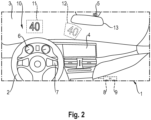
- FIG. 2 an exemplary interior view of a vehicle 1 is illustrated.
- the interior may be equipped with various display devices, which may be controlled by the above-described method 100.
- the adjustment of displayed content may be applied for a display of an infotainment system 4 on a central console or a display 7 in the steering wheel.
- the method 100 may be particularly beneficial for a head-up display 10, which is configured to display content in the region of the windshield 3 of the vehicle 1 such that the content appears above the hood or ahead of the vehicle on the road.
- a content may be a current speed of the vehicle, which is indicated in Fig. 2 by the number "40" by way of example.
- the number "40" is shown in a view 11, which appears in a central position above the steering wheel and may be a standard view for a straight driving direction and a neutral and straightforward gaze of the driver.
- a direction of gaze of the driver may be determined by an in-cabin camera 5 mounted e.g., in an area of a rear-view mirror 13.
- Fig. 2 also indicates in dotted lines an adjusted view 12 of the number "40", which may be an appropriate view if the driver looks to the right and/or the vehicle turns to the right.
- the view 12 also includes a perspective correction of the number "40” such that it appears free of distortion also in the position of view 12.
- Fig. 2 also illustrates an evaluation unit 8 for determining the adjusted view of the content and a control unit 9 for controlling the display.
- a curvature of the surface may be varied to be, e.g., elliptical, or the center of curvature may be changed.
- the virtual curved surface 14 may surround the vehicle with the driver in the center. This may be utilized to achieve further effects of adjustment of the view, e.g., a size and shape of the virtual curved surface 14 may be adapted depending on a drive situation. For instance, when the vehicle accelerates, the surface 14 may be extended in the driving direction such that the content appears farther away from the driver. Vice versa, when the vehicle brakes, the surface 14 may be compressed in the driving direction such that the content appears closer to the driver. This effect may likewise be achieved by shifting the center of curvature. Such adjustment may consider address the natural change of focus of the driver during the respective drive situation and may, thus, further improve readability of the content and the overall user experience.
Landscapes
- Engineering & Computer Science (AREA)
- Chemical & Material Sciences (AREA)
- Combustion & Propulsion (AREA)
- Transportation (AREA)
- Mechanical Engineering (AREA)
- General Engineering & Computer Science (AREA)
- Theoretical Computer Science (AREA)
- Human Computer Interaction (AREA)
- Physics & Mathematics (AREA)
- General Physics & Mathematics (AREA)
- Instrument Panels (AREA)
- Fittings On The Vehicle Exterior For Carrying Loads, And Devices For Holding Or Mounting Articles (AREA)
Abstract
Description
- The present invention relates to the field of controlling a display device in a vehicle, and more particularly to the field of displaying content on a display device of a vehicle. Specifically, the invention relates to a method and system for controlling a display device in a vehicle.
- Modern vehicles, such as cars, are often provided with display devices for displaying content such as information about the current trip, like current speed, speed limitation, etc., navigation system information, driving assistant information or any other content from the infotainment system or content concerning the vehicle. Those display devices may provide a driver with useful information. However, many display devices are positioned in a central console, dashboard or even steering wheel of the vehicle such that the driver must take gaze away from the road and, thus, cannot pay full attention to the traffic at the same time.
- Some vehicles are equipped with a so-called head-up display (HUD). A HUD projects the content to be displayed to a surface that is within the field of view of the driver, such as the windshield of the vehicle or a transparent board positioned in front of the steering wheel. The displayed content may then appear above the hood of the vehicle or even on the road ahead of the vehicle. This facilitates readability of the content since the driver is not required to look away from the road or to change focus. However, during driving, a driver may look into various directions. For instance, when turning left or right, the driver may look into the respective direction. If content displayed by a head-up display is at a fixed position, the driver will then again have to take gaze away from the road. While this is relevant particular with regards to driving safety, looking into different directions between the road or driving direction and a display device, may cause motion sickness for the driver. Particularly display devices having a large design, e.g., having a large width, require even more head movement of the driver.
- Attempts have been made to compensate for different viewing directions of the driver by adjusting a view of the displayed content e.g., by moving the content that is displayed on a display device. However, when moving the displayed content, it may have a distorted appearance for the driver. This may reduce readability and may again require increased attention for reading the content, which may distract the driver's attention from the traffic.
- It is an object of the present invention to provide an improved approach for displaying a content on a display device of a vehicle. Specifically, it is desirable to improve readability of a displayed content considering a certain drive situation, particularly including a driving direction of the vehicle and/or a driver's direction of gaze.
- A solution to this problem is provided by the teaching of the independent claims. Various preferred embodiments of the present invention are provided by the teachings of the dependent claims.
- A first aspect of the invention is directed to a, particularly computer-implemented, method of controlling a display device in a vehicle. A content to be displayed by the display device is provided. A drive situation dependent condition is determined and based on the determined drive dependent condition a view adjustment function is determined, the view adjustment function including a positional adjustment and a perspective adjustment of a view of the content. An adjusted view of the content is determined in accordance with the view adjustment function, and the content is displayed in the adjusted view by the display device.
- Accordingly, the method may be considered an improved method for controlling a display device in a vehicle. By not only applying a positional adjustment but also a perspective adjustment to a view of a content to be displayed readability of the content can be improved for a driver of the vehicle. Particularly for large positional adjustments a view of the content may become distorted if no perspective adjustment is applied. Thus, the method can contribute to driving safety as it may ensure that the driver can read the displayed content at a convenient position, where distortion possibly caused by the positional adjustment can be corrected by means of the perspective adjustment.
- An additional benefit of the method can be achieved in that the adjustment of the view provides an enhanced user experience. The content may be positioned and may look like the driver would most likely expect. Thus, a seamless user experience can be created while driving. In other words, the displayed content may merge into the view of the driver without distracting them from safe driving.
- The term "vehicle", as used herein, refers particularly to a car, including any type of motor vehicles, hybrid electric vehicles and battery electric vehicles as well as other vehicles like trucks, vans, or busses.
- The term "content", as used herein, refers particularly to data that is processed to be displayed by a display device of the vehicle to be readable by a user, particularly a driver of the vehicle. The content may represent any type of information concerning the vehicle, e.g., obtained by a processing unit (e.g., ECU) of the vehicle, by a navigation system or infotainment system. The content may specifically represent data about a trip of the vehicle, such as current speed, time, remaining fuel or power, or other data typically shown by a dashboard of the vehicle. The content may also relate to navigation data, like directing arrows, directing notes, street names, or any other navigation system information. Apart from that, driving assisting data may be represented by the content, such as speed limits, distance to another vehicle or the like. The content may also relate to other infotainment system information. A "view" of the content is the appearance of the content a user sees on a display device. This may be a single image or an animated view.
- The term "drive situation dependent condition", as used herein, refers particularly to any condition that is dependent on a drive situation of the vehicle. This may refer to operation of the vehicle, such as driving direction, turns, speed, acceleration, brake actions or the like. A drive situation may also refer to driver, particularly operations of the driver that relate to a drive situation, including actions or reactions, such as movements of the driver, particularly head or eye movement, and a viewing direction (direction of gaze) of the driver.
- The term "adjustment function", as used herein, refers particularly to a function that can be applied to a view of the content in order to adjust the view with regards to its position and perspective as will be explained below. The adjustment function may be applied to every pixel of the displayed view, which may result in at least one of a shift in any direction, a rotation in any direction or any distortion of the view. Thus, the adjustment function may be considered as a mapping function between a first view and a second view of the content, wherein the second view may be referred to as "adjusted view".
- The term "positional adjustment", as used herein, refers particularly to an adjustment of a view of the content that relates to its position of the view on the display device. This may specifically include a shift in any direction. Likewise, any rotation or tilt of the view may be considered to be a positional adjustment.
- The term "perspective adjustment", as used herein, refers particularly to an adjustment of a view of the content that relates to its perspective view. This may specifically include any adjustment of the view that affects its shape and/or size. A perspective adjustment may be achieved by any distortion of the view, e.g., trapezoidal or spherical distortions.
- If applicable, the terms "first", "second", "third" and the like in the description and in the claims, are used for distinguishing between similar elements and not necessarily for describing a sequential or chronological order. It is to be understood that the terms so used are interchangeable under appropriate circumstances and that the embodiments of the invention described herein are capable of operation in other sequences than described or illustrated herein.
- Where the term "comprising" or "including" is used in the present description and claims, it does not exclude other elements or steps. Where an indefinite or definite article is used when referring to a singular noun e.g., "a" or "an", "the", this includes a plural of that noun unless something else is specifically stated.
- Further, unless expressly stated to the contrary, "or" refers to an inclusive or and not to an exclusive or. For example, a condition A or B is satisfied by any one of the following: A is true (or present) and B is false (or not present), A is false (or not present) and B is true (or present), and both A and B are true (or present).
- In the following, preferred embodiments of the method are described, which can be arbitrarily combined with each other or with other aspects of the present invention, unless such combination is explicitly excluded or technically impossible.
- In some embodiments, the drive situation dependent condition comprises a driver's direction of gaze. The driver's direction of gaze, i.e., the direction in which the driver is actually looking, may be advantageously provide an input parameter for the adjustment function. Independent from an actual action of the vehicle, the driver's direction gaze may indicate where content should be displayed by the display device to be best readable for the driver. For instance, the driver may look into a certain direction even before the vehicle actually turns in that direction. Likewise, the driver may change the direction of gaze, e.g., for a lane change. As the displayed content is likely to be in the driver's field of view, not only readability can be improved but also the risk of motion sickness can be reduced.
- In some related embodiments, the driver's direction of gaze is determined by means of at least one in-vehicle camera, wherein the camera is directed to the driver to capture a motion of the driver's head and/or the driver's eyes. Using a camera specifically provides an easy an efficient way to determine a driver's direction of gaze. Possibly, the vehicle is equipped with one or more cameras for other purposes that rely on motion of the driver's head or eyes. Some applications may use eye-tracking, which may be utilized for adjusting a view of a content to be displayed by a display device in the vehicle. However, in order to avoid too many adjustments of the displayed content, which could be perceived as confusing or disturbing, it may be preferable to relay on head-tracking rather than eye-tracking.
- In some embodiments, the drive situation dependent condition comprises a driving direction of the vehicle. Alternatively or in addition to the driver's direction of gaze, the driving direction may provide an input parameter for the adjustment function to adjust a view of the content. For instance, when driving in a straight direction, there may be no adjustment of the view of the content. However, when turning left or right, the adjusted view of the content may be a shifted view in the respective direction. Most likely, the driver will tend to look into the driving direction of the vehicle. Thus, such shift in the respective direction may improve readability of the content, which is further improved by the perspective adjustment at the same time. As the displayed content is likely to be in the driver's field of view, not only readability can be improved but also the risk of motion sickness can be reduced.
- In some related embodiments, the driving direction of the vehicle is determined by determining a steering wheel angle. The steering wheel angle may be detected by respective vehicle sensors. Thus, an easy way is provided to determine the driving direction of the vehicle. Specifically, a certain amount of the steering wheel angle in the left or right direction may cause a movement of the displayed content to the left or right, respectively, corresponding to the amount of the steering wheel angle. It will be appreciated that this adjusted view also includes the perspective adjustment as set forth above.
- In some embodiments, the positional adjustment includes a horizontal movement of the content in accordance with a gaze-horizon-view angle of the driver. Rather than looking up and down, the driver tends to look at a horizon line and may turn his gaze along the horizon line. Thus, an efficient way of adjusting the view of the displayed content may be moving it in a horizontal direction. Based on a distance to a center, which would refer to a straightforward direction of gaze of the driver, the adjusted view of the content may include a respective perspective correction.
- In some embodiments the perspective adjustment is determined based on the positional adjustment. In other words, the perspective adjustment may be dependent on the positional adjustment. More specifically, the perspective adjustment can be determined so as to compensate for perspective distortions that might be caused by the positional adjustment. In this way, readability of the displayed content in the adjusted view may be improved regardless of the position where the content is displayed.
- In some embodiments, the perspective adjustment includes a distortion of the content such that the content appears with consistent proportions of dimensions for the driver in each adjusted view of the content. In other words, it is preferable that the content displayed by the displayed device has a consistent appearance independent from position of the content in the respective adjusted view. The displayed content will not appear distorted for the driver if the proportions of dimensions are always the same. While other perspective adjustments may be implemented, a perspective adjustment that aims at consistent proportions of dimensions may be considered most convenient for most users.
- In some embodiments, the content is displayed on a virtual curved surface at least partially surrounding the driver, wherein at least one of the positional adjustment and the perspective adjustment includes a movement of the content along the virtual curved surface. The virtual curved surface may have a center of curvature in a region of the driver's head. The position of the driver's head may be determined, e.g., by means of an in-cabin camera. With the driver's head in the center of the virtual curved surface, views of the content moving along the virtual curved surface may always achieve a desired impression for the driver. A radius of curvature may be chosen such that the virtual curved surface surrounds the driver's head, and more specifically such that the virtual curved surface even surrounds the vehicle or is located at least partially outside the vehicle, particularly in front of the vehicle. This may be particularly advantageous for head-up displays as the views of the content may easily appear in front of the driver above the hood of the vehicle or on the street ahead of the vehicle.
- In some embodiments, the drive situation dependent condition comprises at least one of an acceleration and a deceleration of the vehicle, wherein in case of an acceleration of the vehicle the adjustment function is determined such that the content appears farther away from the driver in the adjusted view, and in case of an acceleration of the vehicle the adjustment function is determined such that the content appears closer to the driver in the adjusted view. Such adjustment of the view may consider a natural distant view or near view of the driver when accelerating and decelerating, respectively.
- In some embodiments, a background to be displayed along with the content is provided. The view adjustment function may comprise a movement of a background displayed by the display device relative to the displayed content. A movement of the background may create an impression of a depth of the displayed view. This effect may be particularly achieved when the driver's view of gaze is input to the adjustment function and may improve the user experience. Furthermore, it may be advantageous to separate the content to be displayed from a background. The adjustment of the view of the actual content along with a respective movement of the background may also contribute to reducing the risk of motion sickness. It will be appreciated that only slight movement of the background may be desired or necessary.
- In some embodiments, the display device is a head-up display of the vehicle. The head-up display me be configured to display content such that it appears in the windshield of the vehicle. Specifically, the content may appear in a region above the hood of the vehicle. While a projecting surface of a head-up display may cover only a limited region in front of the driver, modern head-up display may cover a wider region extending across the windshield. For instance, when a driver (of a left-hand drive vehicle) looks far to the right, the view of the content displayed by the head-up display may be shifted to the right accordingly. By applying the perspective adjustment, the content may always be clearly readable for the driver without being distorted. In cases where the content may be displayed in such a way that it appears for the driver on the road ahead of the vehicle, the appearance of the content can be improved by the above-described adjustment. The adjustment allows content to appear correctly on the road not only for straight road but also in curves. Likewise, it can be achieved that content appears on a desired lane of the road.
- In some embodiments, the display device is a display in a steering wheel of the vehicle. In this case, the display device will move when turning the steering wheel. If no adjustment is applied on the view of displayed content, the content will change its orientation in accordance with the steering wheel, e.g., will appear upside-down upon a 90 degree turn of the steering wheel. Thus, it is advantageous to apply a positional adjustment to the view, which may include a tilt or rotation of the content, where a tilt or rotation angle of the content may be chosen in accordance with the steering wheel angle, i.e. to compensate for the rotation of the steering wheel. Apart from that, it is advantageous to apply a perspective adjustment to further improve readability of the content, particularly for changes of the steering wheel angle that result in a large position change of the display device, e.g., 45 to 135 degrees, specifically around 90 degrees.
- In some embodiments, the display device is a display in at least one of a central console, a dashboard, a rear-view mirror, and a side-view mirror of the vehicle. The method may be applied also for such fixed display devices to improve readability of the content.
- In some embodiments, the display device is a display in a region adjacent to the windshield. Such display device may be located, e.g., in the A-pillar, door or side window of the vehicle. Considering its location next to the windshield, particularly the sides of the windshield, it may be envisioned to extend a view of a head-up display. Since such view would extend from far left to far right across the vehicle, the method may be particularly advantageous to adjust a view of a displayed content.
- In some embodiments, the content is displayed by the display device in such a way that it is fully visible only for the driver. Possibly, the display device can be configured such that another passenger in the vehicle, in particular a co-driver, does not see anything or another content. This may be particularly advantageous for a wide head-up display because the content may be shifted far to the right into the co-driver's field of view (for left-hand drive vehicles), which may be disturbing for the co-driver. For instance, the display device may be configured to display content that is relevant for driving to the driver and may display entertainment content to the co-driver. Specifically, the display device may be at least partially polarized to enable a view of the content for a driver of the vehicle while a view of the content is at least partially blocked for a co-driver.
- In some embodiments, the vehicle has at least two display devices and the positional adjustment includes a selection of one of the display devices, wherein the content is displayed in the adjusted view by the selected display device, particularly only by the selected display device. In this way, the content can be displayed by a respective one of a plurality of display devices in the vehicle that would be appropriate for the drive dependent condition. For instance, the content may be displayed only by a display device the driver is actually looking at. This may ensure that the driver is always capable of reading the displayed content, while other display devices, which are out of the driver's field of view, need not display the content.
- A second aspect of the present invention is directed to a data processing system being configured to perform the method of the first aspect, i.e. a data processing system for controlling a display device in a vehicle. The data processing system might specifically be configured by means of one or more computer programs to perform the method of the first aspect. In addition, or alternatively, the configuration may be implemented, in whole or in parts by respective hardware. Specifically, the system comprises an evaluation unit and a control unit. The evaluation unit is configured to determine a drive situation dependent condition and to determine a view adjustment function based on the determined drive dependent condition, the view adjustment function including a positional adjustment and a perspective adjustment of a view of the content, and to determine an adjusted view of a content to be displayed in accordance with the view adjustment function. The control unit is configured to control the display device to cause the display device to display the content in the adjusted view.
- A third aspect of the present invention is directed to a computer program or a computer program product, comprising instructions, which when executed on a data processing system according to the second aspect of the invention cause the system to perform the method according to the first aspect of the invention.
- The computer program (product) may in particular be implemented in the form of a data carrier on which one or more programs for performing the method are stored. Preferably, this is a data carrier, such as a CD, a DVD or other optical medium, or a flash memory module. This may be advantageous, if the computer program product is meant to be traded as an individual product independent from the processor platform on which the one or more programs are to be executed. In another implementation, the computer program product is provided as a file on a data processing unit, in particular on a server, and can be downloaded via a data connection, e.g., the internet or a dedicated data connection, such as a proprietary or local area network.
- The system of the second aspect may accordingly have a program memory in which the computer program is stored. Alternatively, the system may also be set up to access a computer program available externally, for example on one or more servers or other data processing units, via a communication link, in particular to exchange with it data used during the course of the execution of the computer program or representing outputs of the computer program.
- The explanations, embodiments and advantages described above in connection with the method of the first aspect similarly apply to the other aspects of the invention.
- Further advantages, features and applications of the present invention are provided in the following detailed description and the appended figures, wherein:
-
Fig. 1 schematically illustrates an exemplary embodiment of a method according to the present invention; -
Fig. 2 schematically illustrates an interior of a vehicle; and -
Fig. 3 shows a schematic illustration of an adjustment of displayed content. - Referring to
Fig. 1 anexemplary embodiment 100 of a method of the first aspect of the present invention comprises a step S1 of providing a content to be displayed by a display device in a vehicle. The content may be provided by acquiring or receiving vehicle data, such as current speed or the like, from a control unit (e.g., ECU) of the vehicle, navigation data, driving assistant data or other data, like infotainment data. Typically, the content has a standard view, i.e., the view a driver should typically see. The standard view may be considered as undistorted and provides appropriate readability of the content. - In a step S2, a drive situation dependent condition is determined. A condition that is dependent on a drive situation may be simply a driving direction of the vehicle. The driving direction can be determined by a steering wheel angle. While the driving direction of the vehicle may be an indication for a direction in which the driver is looking, the driver's direction of view (direction of gaze) may be determined by monitoring motions the driver makes. For instance, an in-cabin camera may be configured to detect motions of the driver's head. Likewise, motions of the driver's eyes may be detected by an in-cabin camera.
- Based on the determined drive situation dependent condition, a view adjustment function is determined in a step S3. View adjustment of the content particularly comprises a positional adjustment and a perspective adjustment. In other words, the view adjustment function is determined to consider not only a position or change of a position of the content, i.e., where the content is displayed on the display device, but also determines a perspective adjustment. The perspective adjustment (or perspective correction) may be determined so as to compensate for possible distortions that may be caused by a positional change of the displayed content. It may be considered advantageous if the perspective adjustment results in an undistorted view of the content for the driver regardless of where the content is displayed.
- Based on a current view (or possibly the aforementioned standard view) an adjusted view of the content is then determined (step S4). Finally, the content is displayed by the display device in the adjusted view (step S5). It may be desirable to limit an amount of adjustment, i.e.. to make only subtle adjustment of the view of the content. Little adjustment may be sufficient to achieve a pleasant result for the driver, which may reduce the risk of motion sickness. Likewise, driving safety may be increased because the content will always appear distortion-free in the driver's field of view.
- In
Fig. 2 , an exemplary interior view of a vehicle 1 is illustrated. The interior may be equipped with various display devices, which may be controlled by the above-describedmethod 100. For instance, the adjustment of displayed content may be applied for a display of an infotainment system 4 on a central console or a display 7 in the steering wheel. Themethod 100 may be particularly beneficial for a head-updisplay 10, which is configured to display content in the region of thewindshield 3 of the vehicle 1 such that the content appears above the hood or ahead of the vehicle on the road. A content may be a current speed of the vehicle, which is indicated inFig. 2 by the number "40" by way of example. The number "40" is shown in aview 11, which appears in a central position above the steering wheel and may be a standard view for a straight driving direction and a neutral and straightforward gaze of the driver. A direction of gaze of the driver may be determined by an in-cabin camera 5 mounted e.g., in an area of a rear-view mirror 13. -
Fig. 2 also indicates in dotted lines an adjustedview 12 of the number "40", which may be an appropriate view if the driver looks to the right and/or the vehicle turns to the right. As can be seen in the schematic illustration ofFig. 2 not only the position of the number "40" has change in theview 12 compared to theview 11 by a shift to the right, but theview 12 also includes a perspective correction of the number "40" such that it appears free of distortion also in the position ofview 12.Fig. 2 also illustrates an evaluation unit 8 for determining the adjusted view of the content and a control unit 9 for controlling the display. - Referring now to
Fig. 3 an adjustment of a view of a content displayed by a head-up display of a vehicle 1 is schematically illustrated similar to the exampled explained above with respect toFig. 2 . The content in the example ofFig. 3 is a current speed indicated by the display of the expression "40 km/h". While in a straight driving direction of the vehicle (Fig. 3a ) the content appears in aview 11 straight in front of the driver, the content is shifted to the right and shown in an adjustedview 12 when the vehicle 1 turns right (Fig. 3b ). The respective view of the content is determined such that the driver sees an undistorted view of the content. - Indicated in
Fig. 3 is a virtualcurved surface 14, which may serve as a basis for determining an appropriate view, such as theview 11 and the adjustedview 12. A center of curvature may be considered to be the driver, or more specifically the driver's head. A radius of curvature of the curved surface may be chosen such that the virtualcurved surface 14 would be located around the vehicle 1 as shown inFig. 3 , specifically outside the vehicle 1 at least in front of the vehicle 1. In this way, a perspective adjustment can be easily determined, as well as a positional adjustment. The positional adjustment of the displayed content may be achieved by moving the content along the virtualcurved surface 14, which automatically would lead to a desired perspective adjustment. Likewise, a size of the displayed view of the content may be determined such that the content appears for the driver the same size for every position it is displayed. - While the
curved surface 14 may be assumed to be substantially spherical, a curvature of the surface may be varied to be, e.g., elliptical, or the center of curvature may be changed. As mentioned above, the virtualcurved surface 14 may surround the vehicle with the driver in the center. This may be utilized to achieve further effects of adjustment of the view, e.g., a size and shape of the virtualcurved surface 14 may be adapted depending on a drive situation. For instance, when the vehicle accelerates, thesurface 14 may be extended in the driving direction such that the content appears farther away from the driver. Vice versa, when the vehicle brakes, thesurface 14 may be compressed in the driving direction such that the content appears closer to the driver. This effect may likewise be achieved by shifting the center of curvature. Such adjustment may consider address the natural change of focus of the driver during the respective drive situation and may, thus, further improve readability of the content and the overall user experience. - While above at least one exemplary embodiment of the present invention has been described, it has to be noted that a great number of variations thereto exists. Furthermore, it is appreciated that the described exemplary embodiments only illustrate non-limiting examples of how the present invention can be implemented and that it is not intended to limit the scope, the application or the configuration of the herein-described apparatuses and methods. Rather, the preceding description will provide the person skilled in the art with constructions for implementing at least one exemplary embodiment of the invention, wherein it has to be understood that various changes of functionality and the arrangement of the elements of the exemplary embodiment can be made, without deviating from the subject-matter defined by the appended claims and their legal equivalents.
-
- 100
- exemplary embodiment of a method of controlling a display device in a vehicle
- 1
- vehicle
- 2
- steering wheel
- 3
- windshield
- 4
- infotainment system
- 5
- camera
- 6
- dashboard
- 7
- display in steering wheel
- 8
- evaluation unit
- 9
- control unit
- 10
- head-up display
- 11
- view of content
- 12
- adjusted view of content
- 13
- rear-view mirror
- 14
- virtual curved surface
Claims (16)
- A method (100) of controlling a display device (10) in a vehicle (1), the method comprising:- providing (S1) a content to be displayed by the display device (10);- determining (S2) a drive situation dependent condition;- determining (S3) a view adjustment function based on the determined drive dependent condition, the view adjustment function including a positional adjustment and a perspective adjustment of a view (11) of the content;- determining (S4) an adjusted view (12) of the content in accordance with the view adjustment function; and- displaying (S5) the content in the adjusted view (12).
- The method of claim 1, wherein the drive situation dependent condition comprises a driver's direction of gaze.
- The method of claim 2, wherein the driver's direction of gaze is determined by means of an in-vehicle camera (5), wherein the camera (5) is directed to the driver to capture a motion of the driver's head and/or the driver's eyes.
- The method of any one of the preceding claims, wherein the drive situation dependent condition comprises a driving direction of the vehicle (1).
- The method of claim 4, wherein the driving direction of the vehicle (1) is determined by determining a steering wheel angle.
- The method of any one of the preceding claims, wherein the positional adjustment includes a horizontal movement of the content in accordance with a gaze-horizon-view angle of the driver.
- The method of any one of the preceding claims, wherein the perspective adjustment is determined based on the positional adjustment.
- The method of any one of the preceding claims, wherein the perspective adjustment includes a distortion of the content such that the content appears with consistent proportions of dimensions for the driver in each adjusted view of the content.
- The method of any one of the preceding claims, wherein the content is displayed on a virtual curved surface (14) at least partially surrounding the driver, wherein at least one of the positional adjustment and the perspective adjustment includes a movement of the content along the virtual curved surface (14).
- The method of any one of the preceding claims, wherein the drive situation dependent condition comprises at least one of an acceleration and a deceleration of the vehicle (1), wherein in case of an acceleration of the vehicle (1) the adjustment function is determined such that the content appears farther away from the driver in the adjusted view, and in case of an acceleration of the vehicle (1) the adjustment function is determined such that the content appears closer to the driver in the adjusted view.
- The method of any one of the preceding claims, further comprising providing a background to be displayed by the display device along with the content, wherein the view adjustment function comprises a movement of the background relative to the content.
- The method of any one of the preceding claims, wherein the display device (10) is a head-up display of the vehicle.
- The method of any one of the preceding claims, wherein the display device is a display (7) in a steering wheel (2) of the vehicle (1), or wherein the display device is a display in at least one of a central console (4), a dashboard (6), a rear-view mirror (13), and a side-view mirror of the vehicle (1), or wherein the display device is a display in a region adjacent to a windshield (3) of the vehicle (1).
- The method of any one of the preceding claims, wherein the content is displayed by the display device in such a way that it is fully visible only for the driver.
- A data processing system for controlling a display device (10) in a vehicle (1), the system being configured to perform the method (100) of any one of claims 1 to 14, the system comprising an evaluation unit (8) and a control unit (9), wherein the evaluation unit (8) is configured to determine a drive situation dependent condition and to determine a view adjustment function based on the determined drive dependent condition, the view adjustment function including a positional adjustment and a perspective adjustment of a view (11) of the content, and to determine an adjusted view (12) of a content to be displayed in accordance with the view adjustment function, and the control unit (9) is configured to control the display device (10) to cause the display device (10) to display the content in the adjusted view (12).
- A computer program or a computer program product, comprising instructions, which when executed on one or more processors of a system according to claim 15 cause the system to perform the method (100) according to any one of claims 1 to 14.
Priority Applications (3)
| Application Number | Priority Date | Filing Date | Title |
|---|---|---|---|
| EP22183493.0A EP4303056B1 (en) | 2022-07-07 | 2022-07-07 | Method and system for controlling a display device in a vehicle |
| CN202380041333.6A CN119233906A (en) | 2022-07-07 | 2023-04-20 | Method and system for controlling a display device in a vehicle |
| PCT/EP2023/060227 WO2024008346A1 (en) | 2022-07-07 | 2023-04-20 | Method and system for controlling a display device in a vehicle |
Applications Claiming Priority (1)
| Application Number | Priority Date | Filing Date | Title |
|---|---|---|---|
| EP22183493.0A EP4303056B1 (en) | 2022-07-07 | 2022-07-07 | Method and system for controlling a display device in a vehicle |
Publications (2)
| Publication Number | Publication Date |
|---|---|
| EP4303056A1 true EP4303056A1 (en) | 2024-01-10 |
| EP4303056B1 EP4303056B1 (en) | 2025-11-12 |
Family
ID=82399333
Family Applications (1)
| Application Number | Title | Priority Date | Filing Date |
|---|---|---|---|
| EP22183493.0A Active EP4303056B1 (en) | 2022-07-07 | 2022-07-07 | Method and system for controlling a display device in a vehicle |
Country Status (3)
| Country | Link |
|---|---|
| EP (1) | EP4303056B1 (en) |
| CN (1) | CN119233906A (en) |
| WO (1) | WO2024008346A1 (en) |
Cited By (1)
| Publication number | Priority date | Publication date | Assignee | Title |
|---|---|---|---|---|
| FR3160784A1 (en) * | 2024-03-28 | 2025-10-03 | Stellantis Auto Sas | Method for controlling a display based on gaze detection |
Citations (4)
| Publication number | Priority date | Publication date | Assignee | Title |
|---|---|---|---|---|
| US20180011313A1 (en) * | 2015-01-12 | 2018-01-11 | Harman International Industries, Incorporated | In-vehicle projection display system with dynamic display area |
| US20190011712A1 (en) * | 2016-02-12 | 2019-01-10 | Maxell, Ltd. | Image display apparatus for vehicle |
| US20190315275A1 (en) * | 2016-11-21 | 2019-10-17 | Lg Electronics Inc. | Display device and operating method thereof |
| US20200333608A1 (en) * | 2017-10-13 | 2020-10-22 | Keita KATAGIRI | Display device, program, image processing method, display system, and moving body |
-
2022
- 2022-07-07 EP EP22183493.0A patent/EP4303056B1/en active Active
-
2023
- 2023-04-20 WO PCT/EP2023/060227 patent/WO2024008346A1/en not_active Ceased
- 2023-04-20 CN CN202380041333.6A patent/CN119233906A/en active Pending
Patent Citations (4)
| Publication number | Priority date | Publication date | Assignee | Title |
|---|---|---|---|---|
| US20180011313A1 (en) * | 2015-01-12 | 2018-01-11 | Harman International Industries, Incorporated | In-vehicle projection display system with dynamic display area |
| US20190011712A1 (en) * | 2016-02-12 | 2019-01-10 | Maxell, Ltd. | Image display apparatus for vehicle |
| US20190315275A1 (en) * | 2016-11-21 | 2019-10-17 | Lg Electronics Inc. | Display device and operating method thereof |
| US20200333608A1 (en) * | 2017-10-13 | 2020-10-22 | Keita KATAGIRI | Display device, program, image processing method, display system, and moving body |
Cited By (1)
| Publication number | Priority date | Publication date | Assignee | Title |
|---|---|---|---|---|
| FR3160784A1 (en) * | 2024-03-28 | 2025-10-03 | Stellantis Auto Sas | Method for controlling a display based on gaze detection |
Also Published As
| Publication number | Publication date |
|---|---|
| CN119233906A (en) | 2024-12-31 |
| EP4303056B1 (en) | 2025-11-12 |
| WO2024008346A1 (en) | 2024-01-11 |
Similar Documents
| Publication | Publication Date | Title |
|---|---|---|
| JP7515229B2 (en) | VIDEO DISPLAY SYSTEM, VIDEO DISPLAY METHOD, AND PROGRAM | |
| US10754154B2 (en) | Display device and moving body having display device | |
| JP7480756B2 (en) | Vehicle display control device, vehicle display device, vehicle display control method, and vehicle display control program | |
| CN110337377B (en) | Motor vehicle having a display device and method for operating a display device of a motor vehicle | |
| US10255705B2 (en) | Apparatus and method for displaying information | |
| WO2014174575A1 (en) | Vehicular head-up display device | |
| JP7521345B2 (en) | Vehicle display device | |
| CN112977460B (en) | Method and apparatus for preventing motion sickness when viewing image content in a traveling vehicle | |
| WO2021044741A1 (en) | Display control device, display control program, and heads-up display | |
| JP2010208359A (en) | Display device for vehicle | |
| EP4361999A1 (en) | Camera monitor system with angled awareness lines | |
| EP4303056B1 (en) | Method and system for controlling a display device in a vehicle | |
| US20220348081A1 (en) | Presentation of Information on Board a Vehicle | |
| JP2023183870A (en) | Display control device, display device, display system, vehicle, display control method and program | |
| WO2016088150A1 (en) | Vehicle-mounted display device, vehicle, and display method | |
| US11800082B2 (en) | Virtual 3D display | |
| EP3932740B1 (en) | Electronic mirror system for use in a vehicle and vehicle comprising same | |
| CN116963926A (en) | Improved visualization displays using augmented reality heads-up displays | |
| JP7827155B2 (en) | Display control method and display control device | |
| JP7602521B2 (en) | Vehicle display device | |
| CN116500787B (en) | Method and system for presenting augmented reality information in a vehicle | |
| WO2019074065A1 (en) | Image processing device | |
| US20250256572A1 (en) | Method for Improving AR Representations of a 3D Head-up Display in a Motor Vehicle | |
| CN121043771A (en) | motor vehicles | |
| JP2024086476A (en) | Vehicle display control device, vehicle display control method, and vehicle display control program. |
Legal Events
| Date | Code | Title | Description |
|---|---|---|---|
| PUAI | Public reference made under article 153(3) epc to a published international application that has entered the european phase |
Free format text: ORIGINAL CODE: 0009012 |
|
| STAA | Information on the status of an ep patent application or granted ep patent |
Free format text: STATUS: THE APPLICATION HAS BEEN PUBLISHED |
|
| AK | Designated contracting states |
Kind code of ref document: A1 Designated state(s): AL AT BE BG CH CY CZ DE DK EE ES FI FR GB GR HR HU IE IS IT LI LT LU LV MC MK MT NL NO PL PT RO RS SE SI SK SM TR |
|
| STAA | Information on the status of an ep patent application or granted ep patent |
Free format text: STATUS: REQUEST FOR EXAMINATION WAS MADE |
|
| 17P | Request for examination filed |
Effective date: 20240508 |
|
| RBV | Designated contracting states (corrected) |
Designated state(s): AL AT BE BG CH CY CZ DE DK EE ES FI FR GB GR HR HU IE IS IT LI LT LU LV MC MK MT NL NO PL PT RO RS SE SI SK SM TR |
|
| REG | Reference to a national code |
Ref country code: DE Ref legal event code: R079 Free format text: PREVIOUS MAIN CLASS: B60K0035000000 Ipc: B60K0035230000 Ref country code: DE Ref legal event code: R079 Ref document number: 602022024775 Country of ref document: DE Free format text: PREVIOUS MAIN CLASS: B60K0035000000 Ipc: B60K0035230000 |
|
| GRAP | Despatch of communication of intention to grant a patent |
Free format text: ORIGINAL CODE: EPIDOSNIGR1 |
|
| STAA | Information on the status of an ep patent application or granted ep patent |
Free format text: STATUS: GRANT OF PATENT IS INTENDED |
|
| RIC1 | Information provided on ipc code assigned before grant |
Ipc: B60K 35/23 20240101AFI20250820BHEP Ipc: B60K 35/235 20240101ALI20250820BHEP Ipc: B60K 35/28 20240101ALI20250820BHEP Ipc: B60K 35/60 20240101ALI20250820BHEP Ipc: B60K 35/65 20240101ALI20250820BHEP Ipc: B60K 35/81 20240101ALI20250820BHEP Ipc: G02B 27/01 20060101ALI20250820BHEP Ipc: G06F 3/01 20060101ALI20250820BHEP |
|
| GRAS | Grant fee paid |
Free format text: ORIGINAL CODE: EPIDOSNIGR3 |
|
| GRAA | (expected) grant |
Free format text: ORIGINAL CODE: 0009210 |
|
| STAA | Information on the status of an ep patent application or granted ep patent |
Free format text: STATUS: THE PATENT HAS BEEN GRANTED |
|
| INTG | Intention to grant announced |
Effective date: 20250910 |
|
| AK | Designated contracting states |
Kind code of ref document: B1 Designated state(s): AL AT BE BG CH CY CZ DE DK EE ES FI FR GB GR HR HU IE IS IT LI LT LU LV MC MK MT NL NO PL PT RO RS SE SI SK SM TR |
|
| REG | Reference to a national code |
Ref country code: CH Ref legal event code: F10 Free format text: ST27 STATUS EVENT CODE: U-0-0-F10-F00 (AS PROVIDED BY THE NATIONAL OFFICE) Effective date: 20251112 Ref country code: GB Ref legal event code: FG4D |
|
| REG | Reference to a national code |
Ref country code: DE Ref legal event code: R096 Ref document number: 602022024775 Country of ref document: DE |
|
| REG | Reference to a national code |
Ref country code: IE Ref legal event code: FG4D |
|
| REG | Reference to a national code |
Ref country code: NL Ref legal event code: MP Effective date: 20251112 |
|
| PG25 | Lapsed in a contracting state [announced via postgrant information from national office to epo] |
Ref country code: ES Free format text: LAPSE BECAUSE OF FAILURE TO SUBMIT A TRANSLATION OF THE DESCRIPTION OR TO PAY THE FEE WITHIN THE PRESCRIBED TIME-LIMIT Effective date: 20251112 |
|
| REG | Reference to a national code |
Ref country code: LT Ref legal event code: MG9D |
|
| PG25 | Lapsed in a contracting state [announced via postgrant information from national office to epo] |
Ref country code: NO Free format text: LAPSE BECAUSE OF FAILURE TO SUBMIT A TRANSLATION OF THE DESCRIPTION OR TO PAY THE FEE WITHIN THE PRESCRIBED TIME-LIMIT Effective date: 20260212 |
|
| PG25 | Lapsed in a contracting state [announced via postgrant information from national office to epo] |
Ref country code: HR Free format text: LAPSE BECAUSE OF FAILURE TO SUBMIT A TRANSLATION OF THE DESCRIPTION OR TO PAY THE FEE WITHIN THE PRESCRIBED TIME-LIMIT Effective date: 20251112 Ref country code: FI Free format text: LAPSE BECAUSE OF FAILURE TO SUBMIT A TRANSLATION OF THE DESCRIPTION OR TO PAY THE FEE WITHIN THE PRESCRIBED TIME-LIMIT Effective date: 20251112 Ref country code: AT Free format text: LAPSE BECAUSE OF FAILURE TO SUBMIT A TRANSLATION OF THE DESCRIPTION OR TO PAY THE FEE WITHIN THE PRESCRIBED TIME-LIMIT Effective date: 20251112 |
|
| REG | Reference to a national code |
Ref country code: AT Ref legal event code: MK05 Ref document number: 1856465 Country of ref document: AT Kind code of ref document: T Effective date: 20251112 |
|
| PG25 | Lapsed in a contracting state [announced via postgrant information from national office to epo] |
Ref country code: NL Free format text: LAPSE BECAUSE OF FAILURE TO SUBMIT A TRANSLATION OF THE DESCRIPTION OR TO PAY THE FEE WITHIN THE PRESCRIBED TIME-LIMIT Effective date: 20251112 |
|
| PG25 | Lapsed in a contracting state [announced via postgrant information from national office to epo] |
Ref country code: RS Free format text: LAPSE BECAUSE OF FAILURE TO SUBMIT A TRANSLATION OF THE DESCRIPTION OR TO PAY THE FEE WITHIN THE PRESCRIBED TIME-LIMIT Effective date: 20260212 |
|
| PG25 | Lapsed in a contracting state [announced via postgrant information from national office to epo] |
Ref country code: IS Free format text: LAPSE BECAUSE OF FAILURE TO SUBMIT A TRANSLATION OF THE DESCRIPTION OR TO PAY THE FEE WITHIN THE PRESCRIBED TIME-LIMIT Effective date: 20260312 |
|
| PG25 | Lapsed in a contracting state [announced via postgrant information from national office to epo] |
Ref country code: PT Free format text: LAPSE BECAUSE OF FAILURE TO SUBMIT A TRANSLATION OF THE DESCRIPTION OR TO PAY THE FEE WITHIN THE PRESCRIBED TIME-LIMIT Effective date: 20260312 |
|
| PG25 | Lapsed in a contracting state [announced via postgrant information from national office to epo] |
Ref country code: PL Free format text: LAPSE BECAUSE OF FAILURE TO SUBMIT A TRANSLATION OF THE DESCRIPTION OR TO PAY THE FEE WITHIN THE PRESCRIBED TIME-LIMIT Effective date: 20251112 |
|
| PG25 | Lapsed in a contracting state [announced via postgrant information from national office to epo] |
Ref country code: LV Free format text: LAPSE BECAUSE OF FAILURE TO SUBMIT A TRANSLATION OF THE DESCRIPTION OR TO PAY THE FEE WITHIN THE PRESCRIBED TIME-LIMIT Effective date: 20251112 |
|
| PG25 | Lapsed in a contracting state [announced via postgrant information from national office to epo] |
Ref country code: BG Free format text: LAPSE BECAUSE OF FAILURE TO SUBMIT A TRANSLATION OF THE DESCRIPTION OR TO PAY THE FEE WITHIN THE PRESCRIBED TIME-LIMIT Effective date: 20251112 |