EP4302379B1 - A power balancing reserve for an electrical grid - Google Patents
A power balancing reserve for an electrical grid Download PDFInfo
- Publication number
- EP4302379B1 EP4302379B1 EP22713355.0A EP22713355A EP4302379B1 EP 4302379 B1 EP4302379 B1 EP 4302379B1 EP 22713355 A EP22713355 A EP 22713355A EP 4302379 B1 EP4302379 B1 EP 4302379B1
- Authority
- EP
- European Patent Office
- Prior art keywords
- charging power
- time period
- frequency
- nominal
- observed
- Prior art date
- Legal status (The legal status is an assumption and is not a legal conclusion. Google has not performed a legal analysis and makes no representation as to the accuracy of the status listed.)
- Active
Links
Images



Classifications
-
- H—ELECTRICITY
- H02—GENERATION; CONVERSION OR DISTRIBUTION OF ELECTRIC POWER
- H02J—ELECTRIC POWER NETWORKS; CIRCUIT ARRANGEMENTS OR SYSTEMS FOR SUPPLYING OR DISTRIBUTING ELECTRIC POWER; SYSTEMS FOR STORING ELECTRIC ENERGY
- H02J3/00—Circuit arrangements for AC mains or AC distribution networks
- H02J3/28—Arrangements for balancing of the load in networks by storage of energy
-
- H—ELECTRICITY
- H02—GENERATION; CONVERSION OR DISTRIBUTION OF ELECTRIC POWER
- H02J—ELECTRIC POWER NETWORKS; CIRCUIT ARRANGEMENTS OR SYSTEMS FOR SUPPLYING OR DISTRIBUTING ELECTRIC POWER; SYSTEMS FOR STORING ELECTRIC ENERGY
- H02J3/00—Circuit arrangements for AC mains or AC distribution networks
- H02J3/28—Arrangements for balancing of the load in networks by storage of energy
- H02J3/32—Arrangements for balancing of the load in networks by storage of energy using batteries or super capacitors with converting means
-
- H—ELECTRICITY
- H02—GENERATION; CONVERSION OR DISTRIBUTION OF ELECTRIC POWER
- H02J—ELECTRIC POWER NETWORKS; CIRCUIT ARRANGEMENTS OR SYSTEMS FOR SUPPLYING OR DISTRIBUTING ELECTRIC POWER; SYSTEMS FOR STORING ELECTRIC ENERGY
- H02J7/00—Circuit arrangements for charging or discharging batteries or for supplying loads from batteries
- H02J7/02—Circuit arrangements for charging or discharging batteries or for supplying loads from batteries for charging batteries from AC mains by converters
-
- H—ELECTRICITY
- H02—GENERATION; CONVERSION OR DISTRIBUTION OF ELECTRIC POWER
- H02J—ELECTRIC POWER NETWORKS; CIRCUIT ARRANGEMENTS OR SYSTEMS FOR SUPPLYING OR DISTRIBUTING ELECTRIC POWER; SYSTEMS FOR STORING ELECTRIC ENERGY
- H02J7/00—Circuit arrangements for charging or discharging batteries or for supplying loads from batteries
- H02J7/40—Circuit arrangements for charging or discharging batteries or for supplying loads from batteries characterised by the exchange of charge or discharge related data
-
- H—ELECTRICITY
- H02—GENERATION; CONVERSION OR DISTRIBUTION OF ELECTRIC POWER
- H02J—ELECTRIC POWER NETWORKS; CIRCUIT ARRANGEMENTS OR SYSTEMS FOR SUPPLYING OR DISTRIBUTING ELECTRIC POWER; SYSTEMS FOR STORING ELECTRIC ENERGY
- H02J7/00—Circuit arrangements for charging or discharging batteries or for supplying loads from batteries
- H02J7/80—Circuit arrangements for charging or discharging batteries or for supplying loads from batteries including monitoring or indicating arrangements
- H02J7/82—Control of state of charge [SOC]
-
- H—ELECTRICITY
- H02—GENERATION; CONVERSION OR DISTRIBUTION OF ELECTRIC POWER
- H02J—ELECTRIC POWER NETWORKS; CIRCUIT ARRANGEMENTS OR SYSTEMS FOR SUPPLYING OR DISTRIBUTING ELECTRIC POWER; SYSTEMS FOR STORING ELECTRIC ENERGY
- H02J7/00—Circuit arrangements for charging or discharging batteries or for supplying loads from batteries
- H02J7/90—Regulation of charging or discharging current or voltage
-
- H—ELECTRICITY
- H02—GENERATION; CONVERSION OR DISTRIBUTION OF ELECTRIC POWER
- H02J—ELECTRIC POWER NETWORKS; CIRCUIT ARRANGEMENTS OR SYSTEMS FOR SUPPLYING OR DISTRIBUTING ELECTRIC POWER; SYSTEMS FOR STORING ELECTRIC ENERGY
- H02J9/00—Circuit arrangements for emergency or stand-by power supply, e.g. for emergency lighting
Definitions
- the example and non-limiting embodiments of the present invention relate to provision of a power balancing reserve for an electrical grid.
- An electrical grid especially a large one such as a national or a transnational electrical grid requires careful control in order to balance the electricity production from generating stations to the grid and the electricity consumption from the grid by consumers: electricity production to the grid needs to match the electricity consumption from the grid in order to keep the grid operational, whereas in a practical situation instantaneous electricity production and electricity consumption do not fully match each other.
- the frequency of alternating current (AC) transferred via the grid remains at a nominal system frequency, which e.g. in the European electrical grids is typically 50 Hz, whereas any imbalance between the production and consumption results in a small deviation from the nominal system frequency: in case the consumption exceeds the production (i.e. the grid is heavily loaded) the AC frequency in the grid falls below the nominal system frequency, whereas in case the production exceeds the consumption (i.e. the grid is lightly loaded) the AC frequency in the grid raises above the nominal system frequency.
- a nominal system frequency which e.g. in the European electrical grids is typically 50 Hz
- any imbalance between the production and consumption results in a small deviation from the nominal system frequency: in case the consumption exceeds the production (i.e. the grid is heavily loaded) the AC frequency in the grid falls below the nominal system frequency, whereas in case the production exceeds the consumption (i.e. the grid is lightly loaded) the AC frequency in the grid raises above the nominal system frequency.
- the nominal system frequency and the AC frequency of the grid are typically allowed while still considering the grid to be in a normal operational state.
- the AC frequency of the grid may be allowed to vary between 49.9 and 50.1 Hz while still considering the grid to be in the normal operational state.
- the grid operator aims at ensuring balance in the grid via planning the production and consumption within the network in advance, for example, on a daily basis and/or an hourly basis, e.g. via agreements made with entities producing and consuming electric power.
- the electricity production and consumption do not fully match the planned/agreed ones and, consequently, the AC frequency of the grid involves temporary deviations from the nominal system frequency on regular basis despite any planning.
- a known technique for facilitating balance in the grid in such circumstances involves usage of a power balancing reserve (PBR) that is able to increase or decrease its planned power supply to or power demand from the grid in dependence of the AC frequency of the grid.
- PBR power balancing reserve
- a PBR entity may carry out one or both of the following:
- the operation of the PBR entity needs to be carefully controlled in order to ensure providing a required power balancing function for the grid also over a prolonged period of time.
- the requirement for the power balancing function may arise from current operational state of the grid (e.g. in terms of the AC frequency of the grid deviating from the nominal system frequency) and/or from any regulations or agreements concerning the power consumed by the PBR entity and changes thereof over time. Consequently, controlling operation of the PBR entity such that all relevant technical and regulatory requirements are met requires careful design. In contrast, a failure to meet such requirements may result in compromised operation of the grid or even in disturbances in supply of electrical energy via the grid.
- a power balancing reserve (PBR) apparatus for an electrical grid comprising: an energy storage for storing electrical energy and having a minimum allowable state of charge, SoC, level and a maximum allowable SoC level defined therefor; and a controller for controlling transfer of electrical energy between the energy storage and the electrical grid in dependence of an observed AC frequency of the electrical grid in view of said minimum and maximum allowable SoC levels using one of a plurality of operating modes via adjustment of an instantaneous charging power that indicates the amount of electric power currently transferred from the electrical grid to the energy storage, the controller arranged to: receive, before starting a first time period respective indications of a first operating mode selected for the first time period and a second operating mode selected for a second time period, where the first and second time periods are consecutive time periods in a sequence of time periods
- a method for providing a power balancing reserve (PBR) for an electrical grid comprising: storing electrical energy in an energy storage that has a minimum state of charge, SoC, level and a maximum SoC level defined therefor; controlling transfer of electrical energy between the energy storage and the electrical grid in dependence of an observed AC frequency of the electrical grid in view of said minimum and maximum allowable SoC levels using one of a plurality of operating modes via adjustment of an instantaneous charging power that indicates the amount of electric power currently transferred from the electrical grid to the energy storage; receiving, before starting a first time period, respective indications of a first operating mode selected for the first time period and a second operating mode selected for a second time period, where the first and second time periods are consecutive time periods in a sequence of time periods of predefined duration and where the second time period follows the first time period in said sequence; and controlling the instantaneous charging power during the first time period in accordance with one or more power adjustment rules defined for the first operating mode, wherein said controlling is carried out according to
- a computer program for measuring wind speed comprising computer readable program code configured to cause performing at least the method according to the embodiment described in the foregoing when said program code is executed on one or more computing apparatuses.
- the computer program according to the above-described example embodiment may be embodied on a volatile or a non-volatile computer-readable record medium, for example as a computer program product comprising at least one computer readable non-transitory medium having the program code stored thereon, which, when executed by one or more computing apparatuses, causes the computing apparatuses at least to perform the method according to the example embodiment described in the foregoing.
- Figure 1 illustrates a block diagram of some logical elements that are coupled to an electrical grid 100 according to an example.
- the electrical grid 100 comprises an interconnected network that enables transfer and distribution of electric power from producers to consumers.
- the electrical grid 100 has coupled thereto power producer entities 102-1, 102-2, 102-3 for generation of electric power for delivery via the electrical grid 100 and power consumer entities 104-1, 104-2, 104-3 for consuming the electric power generated by the power producer entities 102-1, 102-2, 102-3.
- the power producer entities 102-1, 102-2, 102-3 represent a plurality of power producer entities
- the power consumer entities 104-1, 104-2, 104-3 represent a plurality of power consumer entities.
- the electrical grid 100 further has a power balancing reserve (PBR) system 110 coupled thereto, which operates to one of supply electrical power to the electrical grid 100 or consume electrical power from the electrical grid 100 in dependence of an observed AC frequency f ( t ) of the electrical grid 100 in order to contribute towards balancing the state of the electrical grid 100.
- the PBR system 110 represents one or more PBR systems that may be coupled to the electrical grid 100.
- a power balancing functionality results from concurrent operation of a plurality of PBR systems 110 that are coupled to the electrical grid 100 and that operate to adjust their respective power supply to the electrical grid 100 and/or power demand from the electrical grid 100 in dependence of the observed AC frequency f ( t ) of the grid with the aim of brining the observed AC frequency f ( t ) towards a nominal system frequency f mid of the electrical grid 100.
- the plurality of power producer entities may comprise respective power stations or power plants for production of electric power while the plurality power consumer entities may comprise any industrial, commercial and/or private establishment that consume the electric power.
- the electrical grid 100 may be alternatively referred to as an electric grid, as a power grid or, simply, just as a grid.
- the electrical grid 100 may be provided for transfer and distribution of alternating current (AC) at a predefined nominal system frequency f mid , which may be, for example, 50 Hz (e.g. in Europe) or 60 Hz (e.g. in the United States).
- AC alternating current
- observed AC frequency f ( t ) that is below the nominal system frequency f mid serves as an indication of a condition where the (overall) power consumption from the electrical grid 100 exceeds the power supply to the electrical grid 100
- observed AC frequency f ( t ) that is above the nominal system frequency f mid serves as an indication of a condition where the (overall) power supply to the electrical grid 100 exceeds the power consumption from the electrical grid 100.
- the electrical grid 100 may be considered to be in a normal operational state even though the observed AC frequency f ( t ) differs from the nominal system frequency f mid of the electrical grid 100.
- a range of AC frequencies around the nominal system frequency f mid of the electrical grid 100 that are considered to represent the normal operational state of the electrical grid 100 may be referred to as a nominal system frequency range, which may cover frequencies from f lo to f hi , where f lo ⁇ f mid and f hi > f mid .
- an observed AC frequency f ( t ) that is within the nominal system frequency range serves to indicate the normal operational state of the electrical grid 100, whereas an observed AC frequency f ( t ) that is outside the nominal system frequency range may be considered as a disturbance state (or an abnormal operational state) of the electrical grid 100.
- the nominal system frequency range may be defined, for example, by an operator of the electrical grid 100 and/or it may be set based at least in part on applicable regulatory requirements (e.g. ones applicable in the geographical location at which the electrical grid 100 is operated). In a non-limiting example, assuming the nominal system frequency f mid of 50 Hz, the nominal system frequency range may extend from 49.9 Hz to 50.1 Hz.
- FIG. 2 illustrates a block diagram of some logical elements of a PBR apparatus 120 that may serve as the PBR apparatus 110 shown the example of Figure 1 .
- the PBR apparatus 120 is shown with an energy storage 121 for receiving and supplying electric power and a controller 122 for controlling transfer of electric power from the electrical grid 100 to the energy storage 121 and/or transfer of electric power from the energy storage 121 to the electrical grid 100.
- the energy storage 121 comprises a rechargeable energy storage, such as a single rechargeable battery or a battery system comprising two or more rechargeable batteries.
- the controller 122 may selectively control or adjust the transfer of electric power between the energy storage 121 and the electrical grid 100.
- the supply of electric power from the energy storage 121 to the electrical grid 100 may be referred to as discharging the energy storage 121 and the PBR apparatus 120 may be considered to be in a discharging state when discharging electrical power from the energy storage 121 to the electrical grid 100.
- the supply of electric power from the electrical grid 100 to the energy storage 121 may be referred to as charging the energy storage 121 and the PBR apparatus 120 may considered to be in a charging state when the energy storage 121 is receiving electrical power from the electrical grid 100.
- the PBR apparatus 120 may be considered to be in an idle state.
- the amount of electric power transfer between the energy storage 121 and the electrical grid 100 may be indicated as an instantaneous charging power P in ( t ), which may be changed over time by the controller 122.
- an instantaneous charging power P in ( t ) may be changed over time by the controller 122.
- positive values of the instantaneous charging power P in ( t ) indicate charging of the energy storage 121 using electric power drawn from the electrical grid 100
- negative values of the instantaneous charging power P in ( t ) indicate discharging electric power from the energy storage 121 to the electrical grid 100.
- the aspect of decreasing the instantaneous charging power P in ( t ) may comprise one of the following:
- the aspect of increasing the instantaneous charging power P in ( t ) may comprise one of the following:
- the relative amount of electrical energy currently stored in the energy storage 121 may be indicated via its state of charge (SoC), in other words an SoC level C ( t ) of the energy storage may be applied to indicate the amount of electrical energy currently stored in the energy storage 121.
- SoC level C ( t ) may be expressed, for example, as a percentage of the predefined overall capacity of the energy storage 121 and/or as an absolute amount of electrical energy available in the energy storage 121 (e.g. as kilowatt-hours (kWh)).
- any measures related to the SoC of the energy storage 121 are predominantly referred to as respective percentages of the overall capacity of the energy storage 121, while these examples readily translate into ones that consider respective measures using a measure of electrical energy such as kWh.
- the energy storage 121 may have an allowable range of SoC levels (allowable SoC range in short) assigned therefor, whereas the controller 122 may be arranged to ensure controlling the charging and discharging of the energy storage 121 such that the SoC level C ( t ) of the energy storage 121 remains within the allowable SoC range.
- the allowable SoC range may be defined via a pair of a lower SoC limit C min and an upper SoC limit C max , which may be alternatively referred to as a minimum allowable SoC level C min and a maximum allowable SoC level C max , respectively.
- the lower SoC limit C min may be 0% or a non-zero value that is less than the upper SoC limit C max
- the upper SoC limit C max may be 100 % or a value that is lower than 100 % but larger than the lower SoC limit C min
- the lower SoC limit C min may be in a range from 3 to 10 %, e.g. 6 %
- the upper SoC limit C max may be in a range from 85 % to 95 %, e.g. 89 %.
- the lower SoC limit C min that is above zero and the upper SoC limit C max that is below 100 % may be set due to physical characteristics of the battery in order to increase battery life and/or to ensure sufficient charging/discharging rate throughout the allowable SoC range.
- the PBR apparatus 120 may be arranged to operate in a single operating mode during a plurality of consecutive time periods of a time schedule such that one or more operating parameters of the PBR apparatus 120 are fixed throughout a time period but they may be changed from one time period to another.
- respective values of a first subset of the one or more operating parameters may be selected in advance for the plurality of time periods and/or respective values of a second subset of the one or more operating parameters may be set upon starting the respective time period (or upon completing the time period preceding the respective time period).
- the time schedule hence consists of a sequence of time periods and the time periods of the time schedule preferably have a fixed predefined duration that is the same from one time period to another.
- the time schedule may comprise a given day and the plurality of time periods therein may comprise respective time portions of the given day, e.g. the hours of the given day or the half-an-hour periods of the given day).
- the pre-selection of the time periods of the time schedule for application of the single operation mode of the PBR apparatus 120 using the respective parameter value(s) may be based, for example, on an agreement between respective operators of the PBR apparatus 120 and the electrical grid 100.
- the single operating mode of the first scenario may be one where the controller 122 is arranged to operate the PBR apparatus 120 to provide a frequency containment reserve (FCR) function via adjusting the instantaneous charging power P in ( t ) in dependence of the observed AC frequency f ( t ) of the electrical grid 100, e.g. in dependence of a difference between the observed AC frequency f ( t ) of the electrical grid 100 and the nominal system frequency f mid of the electrical grid 100 in view of the allowable SoC range in order to facilitate keeping the AC frequency f ( t ) of the electrical grid 100 at or close to the nominal system frequency f mid when the electrical grid 100 is in its normal operational state.
- FCR frequency containment reserve
- the FCR function according to such an operating mode may be referred to as a FCR function for normal operational state of the electrical grid 100 (FCR-N function) and, consequently, this operating mode may be referred to as a FCR-N mode of the PBR apparatus 120.
- operation of the PBR apparatus 120 in the FCR-N mode may be limited to conditions where the observed AC frequency f ( t ) of the electrical grid 100 remains within the nominal system frequency range (e.g. the range from 49.9 Hz to 50.1 Hz in case of the 50 Hz nominal system frequency f mid ). Consequently, according to an example, in case the observed AC frequency f ( t ) of the electrical 100 is outside the nominal system frequency range, the controller 122 may terminate the FCR-N function for the remainder of the current time period.
- the nominal system frequency range e.g. the range from 49.9 Hz to 50.1 Hz in case of the 50 Hz nominal system frequency f mid .
- the controller 122 may discontinue the FCR-N function for a sub-period within the current time period when the observed AC frequency f ( t ) is outside the nominal system frequency range but continue the FRC-N function when the observed AC frequency f ( t ) is (again) within the nominal system frequency range.
- the PBR apparatus 120 may continue providing the FCR function according to the FCR-N mode also when the observed AC frequency f ( t ) is outside the nominal system frequency range.
- the one of more operating parameters of the PBR apparatus 120 for a time period k in the FCR-N mode may comprise the following:
- the nominal charging power P in_mid,k for the time period k may be considered as a virtual midpoint charging power or as a default charging power for the respective time period, which is applied as the instantaneous charging power P in ( t ) in a situation where the observed AC frequency f ( t ) of the electrical grid 100 matches or substantially matches the nominal system frequency f mid of the electrical grid 100.
- the instantaneous charging power P in ( t ) may be adjusted accordingly in view of the minimum allowable charging power P in_min,k and the maximum allowable charging power P in_max,k set for the time period k .
- the controller 122 may be arranged to set (e.g. to keep or adjust) the instantaneous charging power P in ( t ) in dependence of the difference with between the observed AC frequency f ( t ) of the electrical grid 100 and the nominal system frequency f mid of the electrical grid 100, for example, according to one or more of the following charging power adjustment rules:
- the controller 122 setting or adjusting the instantaneous charging power P in ( t ) in view of the allowable SoC range may comprise the controller 122 controlling discharging or charging of the energy storage 121 (whichever currently applies) such that the SoC level C ( t ) is kept within the allowable SoC range: the discharging may be continued until reaching the lower SoC limit C min or the charging the energy storage 121 may be continued until reaching the upper SoC limit C max , whichever currently applies.
- the controller 122 may terminate the discharging/charging and set the PBR apparatus 120 in the idle sate.
- the minimum allowable charging power P in_min,k and the maximum allowable charging power P in_max,k for the time period k may be defined in relation to the nominal charging power P in_mid,k defined or set for the time period k .
- the maximum allowable charging power P in_max,k and the minimum allowable charging power P in_min,k may be set symmetrically with respect to the nominal charging power P in_mid,k in view of a balancing reserve power P in_res,k assigned for the current time period k , e.g.
- the maximum allowable charging power P in_max,k and the minimum allowable charging power P in_min,k may be set asymmetrically with respect to the nominal charging power P in_mid,k in view of respective upper and lower balancing reserve powers P in_res_hi,k , P in_res_lo,k , e.g.
- the balancing reserve powers P in_res,k , P in_res_hi,k , P in_res_lo,k may be respective predefined values, set or defined for example based on the agreement between respective operators of the PBR apparatus 120 and the electrical grid 100.
- the nominal charging power P in_mid,k for the time period k may be defined (e.g. derived) in the course of operation of the PBR apparatus 120 in consideration of one or more of the following aspects:
- the net amount of electrical energy to be transferred from the electrical grid 100 to the energy storage 121 in the course of the time period k for the purpose of power balancing serves to indicate the difference between the amount of electrical energy transferred from the electrical grid 100 to the energy storage 121 and the amount of electrical energy transferred from the energy storage 121 to the electrical grid 100 during the time period k for power balancing purposes.
- This amount of electrical energy may be referred to, in short, as an estimated balancing energy E est,k (required for the time period k).
- the estimated net effect of energy transfer between the electrical grid 100 and the energy storage 121 due to the power balancing functionality over the time period k results in increasing the SoC level C ( t ) of the energy storage 121
- the estimated balancing energy E est,k is below zero
- the estimated net effect of energy transfer between the electrical grid 100 and the energy storage 121 due to the power balancing functionality over the time period k results in decreasing the SoC level C ( t ) of the energy storage 121
- the estimated balancing energy E est,k is zero
- the estimated net effect of the energy transfer between the electrical grid 100 and the energy storage 121 due to the power balancing functionality over the time period k is assumed not the change the SoC level of the energy storage 121.
- the nominal charging power P in_mid,k for the time period k may be derived upon starting the time period k with the aim of facilitating continued provision of the FCR-N function throughout the time period k and possibly also in the subsequent time periods(s).
- an advantageous starting point for any time period of operation in the FCR-N mode in terms of the initial SoC level C st,k is a midpoint SoC level C mid between the lower SoC limit C min and the upper SoC limit C max , which may be derived e.g. as an average of the upper SoC limit C max and the lower SoC limit C min , e.g.
- an advantageous value for the target SoC level C tgt,k at the end of the time period k may comprise the midpoint SoC level C mid .
- the nominal input power P in_mid,k for the time period k for operation in the FRC-N mode may be equal to, smaller than or greater than zero: in case the initial SoC level C st,k is equal to the target SoC level C tgt,k , the nominal charging power P in_mid,k may be set to zero, whereas in case the initial SoC level C st,k is above the target SoC level C tgt,k , the nominal charging power P in_mid,k may be set to a value below zero (which
- the selection of the nominal charging power P in_mid,k facilitates continued operation in the FCR-N mode also in the subsequent time period(s).
- the nominal charging power P in_mid,k for the time period k for operation in the FCR-N mode may be derived further in consideration of non-zero estimated balancing energy E est,k .
- the nominal charging power P in_mid,k for the time period k assumes a value smaller than that the default nominal charging power
- the nominal charging power P in_mid,k for the time period k assumes a value higher than the default nominal charging power
- the estimated balancing energy E est,k may be derived via predicting the AC frequency f ( t ) and/or the difference between the AC frequency f ( t ) of the electrical grid 100 and the nominal system frequency f mid of the electrical grid 100 over the time period k in view of the balancing reserve powers P in_res,k , P in_res_hi,k , P in_res_lo,k (as applicable).
- the prediction may be carried out before starting the time period k (e.g. at the end of the time period k -1 or in the beginning of the time period k ) and it may be based at least in part on history of observed AC frequencies f ( t ) in the electrical grid 100.
- the history of observed AC frequencies f ( t ) may be applied for deriving one or more predicted AC frequencies f' ( t ) during the time period k in one or more time scales, for example one or more of the following:
- the short-term prediction may involve applying a predefined prediction model on observed values of the AC frequency f ( t ) within the time window that precedes the time period k in order to derive predicted AC frequencies f' ( t ) for time period k .
- the time window may cover, for example, K time periods that precede the time period k in the sequence of time periods, e.g. the time periods from k - K to k -1.
- the number of time periods K considered in the short-term prediction may be a suitable value chosen from a range from 1 to 10.
- the long-term prediction may involve applying a predefined prediction model on observed values of the AC frequency f ( t ) on one or more past time periods that have a respective predefined temporal relationship with the time period k and that are hence likely to represent conditions with respect to status of the electrical grid 100 in terms of electricity production thereto and electricity consumption therefrom that are similar to those of the time period k .
- the long-term prediction may rely on one or more of the following types of temporally related past time periods:
- Each of the short-term prediction and the long-term prediction may rely on a respective predefined prediction model in accordance with any applicable prediction technique known in the art, parameters of which may be derived on basis of experimental data collected via observing the AC frequency f ( t ) of the electrical grid 100 over an extend period of time.
- the controller 122 may set the instantaneous charging power P in ( t ) to the minimum allowable charging power P in_min,k in case the observed AC frequency f ( t ) is smaller than the nominal system frequency f mid and set the instantaneous charging power P in ( t ) to the maximum allowable charging power P in_max,k in case the observed AC frequency f ( t ) is larger than the nominal system frequency f mid .
- the change applied in the instantaneous charging power P in ( t ) may be proportional to the difference between the observed AC frequency f ( t ) and the nominal system frequency f mid .
- the controller 122 may set the instantaneous charging power P in ( t ) to a value that is smaller than the nominal charging power P in_mid,k by an amount that is proportional to the difference between the nominal system frequency f mid and the observed AC frequency f ( t ).
- the controller 122 may set the instantaneous charging power P in ( t ) to a value that is larger than the nominal charging power P in_mid,k by an amount that is proportional to the difference between the observed AC frequency f ( t ) and the nominal system frequency f mid .
- the proportional adjustment may be carried out in view of the allowable range of charging powers defined by the minimum allowable charging power P in_min,k and the maximum allowable charging power P in_max,k defined for the time period k e.g. such that the proportional adjustment allows for decreasing the instantaneous charging power P in ( t ) with decreasing observed AC frequency f ( t ) until reaching the minimum allowable charging power P in_min,k and/or for increasing the instantaneous charging power P in ( t ) with increasing observed AC frequency f ( t ) until reaching the maximum allowable charging power P in_max,k .
- such proportional adjustment may be provided such that the instantaneous charging power P in ( t ) decreases substantially linearly with decreasing observed AC frequency f ( t ) and reaches the minimum allowable charging power P in_min,k when the observed AC frequency f ( t ) reaches the lower limit of the nominal system frequency range and that the instantaneous charging power P in ( t ) increases substantially linearly with increasing observed AC frequency f ( t ) and reaches the maximum allowable charging power P in_max,k when the observed AC frequency f ( t ) reaches the upper limit of the nominal system frequency range.
- the proportional adjustment of the instantaneous charging power P in ( t ) may be provided by using a step of a predefined size.
- the instantaneous charging power P in ( t ) may be decreased by a first predefined step (until reaching the minimum allowable charging power P in_min,k set for the time period k ) or the instantaneous charging power P in ( t ) may be increased by a second predefined step (until reaching the maximum allowable charging power P in_min,k set for the time period k ), depending on the direction of change in the instantaneous charging power P in ( t ).
- the step size towards a higher instantaneous charging power P in ( t ) i.e. an upwards step
- the step size towards a lower instantaneous charging power P in ( t ) i.e. a downwards step
- the upwards step is different from the downwards step.
- the downwards step may be larger than the upwards step to ensure providing a prompt and sufficient reaction to increased load in the electrical grid 100.
- An applicable step size may depend, for example, on the allowable charging power range (from the minimum allowable charging power P in_min,k to the maximum allowable charging power P in_max,k ), the overall capacity of the energy storage 121 and/or on any regulations or rules imposed by the operator of the electrical grid 100.
- the adjustment of the instantaneous charging power P in ( t ) in accordance with the applicable charging power adjustment rules in dependence of the observed AC frequency f ( t ) may be carried out according to a predefined schedule, e.g. such that the controller 122 monitors the AC frequency f ( t ) of the electrical grid 100 at predefined time intervals and adjusts the instantaneous charging power P in ( t ) accordingly.
- the time intervals that define the schedule for monitoring the AC frequency f ( t ) (and possibly adjusting the instantaneous charging power P in ( t )) may be a suitable value selected, for example, from a range from a few seconds to one minute, e.g. ten seconds.
- the most appropriate time interval may depend, for example, on the desired reaction speed to any changes in the observed AC frequency f ( t ) of the electrical grid 100, on characteristics and/or capabilities of the elements of the PBR apparatus 120 and/or on characteristics of and/or requirements set for the electrical grid 100.
- the controller 122 controls the transfer of electric power between the energy storage 121 and the electrical grid 100 (e.g. charging or discharging of the energy storage 121) during the time period k in accordance with operating parameters defined therefor, e.g. according to the nominal charging power P in_mid,k , the maximum allowable charging power P in_max,k and the minimum allowable charging power P in_min,k .
- FIG. 3 illustrates a flowchart depicting a method 200.
- the method 200 proceeds from controlling transfer of electrical energy between the energy storage 121 and the electrical grid 100 in dependence of the difference between the observed AC frequency f ( t ) of the electrical grid 100 and the nominal system frequency f mid of the electrical grid 100 in view of the minimum and maximum SoC levels via adjustment of the instantaneous charging power P in ( t ) that indicates the amount of electric power currently transferred from the electrical grid 100 to the energy storage 121, as indicated in block 202.
- the method 200 further comprises deriving the nominal charging power P in_mid,k for a time period at least in dependence of the initial SoC level C st,k of the energy storage 121 in the beginning of the time period and the target SoC level C tgt,k of the energy storage 121 at the end of the time period, as indicated in block 204.
- the method 200 further comprises setting the instantaneous charging power P in ( t ) to the nominal charging power P in_mid,k in response to the observed AC frequency f ( t ) substantially matching the nominal system frequency f mid , as indicated in block 206a, setting the instantaneous charging power P in ( t ) to a value that is smaller than the nominal charging power P in_mid,k in response to the observed AC frequency f ( t ) being below the nominal system frequency f mid , as indicated in block 206b, or setting the instantaneous charging power P in ( t ) to a value that is larger than the nominal charging power P in_mid,k in response to the observed AC frequency f ( t ) exceeding the nominal system frequency f mid , as indicated in block 206c.
- Respective operations described with references to blocks 202, 204, 206a, 206b and 206c pertaining to the method 200 may be implemented, varied and/or complemented in a number of ways, for example as described in the foregoing and in the following with references to the operation of the PBR apparatus 120.
- Graphs (i), (ii) and (iii) of Figure 4A illustrate a non-limiting example of respective changes in the observed AC frequency f ( t ), in the instantaneous charging power P in ( t ) and in the SoC level C ( t ) as a function of time during a time period in the FCR-N mode.
- the vertical dashed lines divide the time period illustrated therein is divided into five sub-periods, while any changes in the AC frequency f ( t ) of the electrical grid 100 is shown to occur upon change from a sub-period to the next one.
- the AC frequency f ( t ) in the first sub-period is below the nominal system frequency f mid , it rises above the nominal system frequency f mid for the second and third sub-periods, reduces to the nominal system frequency f mid for the fourth sub-period, and drops again below the nominal system frequency f mid for the fifth sub-period.
- the instantaneous charging power P in ( t ) follows the AC frequency f ( t ) such that when the AC frequency f ( t ) is below the nominal system frequency f mid (e.g.
- the instantaneous charging power P in ( t ) is set below the nominal charging power P in_mid,k , when the AC frequency f ( t ) is above the nominal system frequency f mid (e.g. in the second and third sub-periods), the instantaneous charging power P in ( t ) is set above the nominal charging power P in_mid,k and when the AC frequency f ( t ) substantially matches the nominal system frequency f mid (e.g. in the fourth sub-period), the instantaneous charging power P in ( t ) is set at the nominal charging power P in_mid,k .
- the graph (iii) shows two different examples regarding the change in the SoC level C ( t ) of the energy storage 121 over time:
- Figure 4B provides another example, where the AC frequency f ( t ) is below the nominal system frequency f mid throughout the time period and therefore the instantaneous charging power P in ( t ) is set below the nominal charging power P in_mid,k throughout the time period.
- a suitably selected lower-than-zero nominal charging power P in_mid,k enables keeping the SoC level C ( t ) close to the midpoint SoC level C mid throughout the time period and especially at the end of the time period while still providing the power balancing function defined for the time period.
- the SoC level C ( t ) of the energy storage 121 may end up being at or close to the minimum allowable SoC level C min or at or close to the maximum allowable SoC level C max , thereby resulting in a situation where the FCR-N function cannot be provided without a significant risk of departing from the allowable SoC range of the energy storage 121.
- the balancing reserve powers P in_res,k , P in_res_hi,k , P in_res_lo,k may be set values that decrease over time (i.e. over consecutive time periods), thereby facilitating prolonged operation in the FCR-N mode without departing from the allowable SoC range of the energy storage 121 with the cost of reduced balancing reserve power available from the PBR apparatus 120.
- the controller 122 may monitor the SoC level C ( t ) and change the operating mode of the PBR apparatus 120 from the FCR-N mode to the recovery mode after the time period k in response to the SoC level C ( t ) at the end of the time period k being within a predefined margin from the minimum allowable SoC level C min or from the maximum allowable SoC level C max .
- the controller 122 adjusts transfer of the electric power between the energy storage 121 and the electrical grid 100 to charge or discharge (whichever applies) the energy storage 121 such that the SoC level C ( t ) at the end of the respective time period is brought at or close to the target SoC level C tgt,k .
- An applicable target SoC level C tgt,k for a time period that follows the recovery period may depend on the operating mode of the PBR apparatus 120 in the respective time period. In case the PBR apparatus 120 is assigned to operate in the FCR-N mode in the time period following the time period in the recovery mode, the target SoC level C tgt,k may be the midpoint SoC level C mid .
- the single operating mode in the framework of the first scenario may be one where the controller 122 is arranged to operate the PBR apparatus 120 to provide a fast frequency reserve (FFR) function via temporarily increasing the supply of electric power from the energy storage 121 to the electrical grid 100 in response to the observed AC frequency f ( t ) of the electrical grid 100 falling below a predefined FFR threshold frequency f ffr , which FFR threshold frequency f ffr is below the nominal system frequency range.
- FFR fast frequency reserve
- the FFR threshold frequency f ffr may be set, for example, to a value in a range from 49.0 to 49.9 Hz, e.g. one of 49.5 Hz, 49.6 Hz and 49.7 Hz.
- the operating mode in which the PBR apparatus 120 provides the FFR function may be referred to as a FFR mode of the PBR apparatus 120.
- the controller 122 may adjust the instantaneous charging power P in ( t ) in dependence of the observed AC frequency f ( t ) according to one or more of the following charging power adjustment rules:
- the controller 122 may adjust the instantaneous charging power P in ( t ) in view of the allowable SoC range, e.g. such the SoC level C ( t ) is kept within the allowable SoC range, as described in the foregoing in context of the FCR-N mode.
- the one of more operating parameters of the PBR apparatus 120 for a time period k may comprise the following:
- the nominal charging power P in_mid,k for the time period k may be considered as a virtual midpoint charging power or as a default charging power for the respective time period, which is applied as the instantaneous charging power P in ( t ) unless the observed AC frequency f ( t ) falls below the FFR threshold frequency f ffr .
- the controller 122 decreases the instantaneous charging power P in ( t ) by the FFR power P ffr,k for the time segment that has the FFR pulse duration t ffr and increases the instantaneous charging power P in ( t ) back to the nominal charging power P in_mid,k after the power pulse has been discharged.
- the FFR power P ffr,k may be a predefined value set for the time period k that may be set, for example, based on the agreement with the respective operators of the PBR apparatus 120 and the electrical grid 100.
- the FFR pulse duration t ffr may be likewise a predefined one, set e.g. to a value in a range from a few seconds to a few minutes, e.g. 30 seconds.
- the FFR mode there may be a requirement to initiate discharging of the power pulse within a predefined time margin since the observed AC frequency f ( t ) having fallen below the FFR threshold frequency f ffr , where the time margin may be, for example, in a range of a few tenths of a second to a few seconds.
- the FFR mode may be applied to provide a virtually immediate reaction to a situation where the observed AC frequency f(t) of the electrical grid 100 falls below the FFR threshold frequency f ffr .
- the nominal charging power P in_mid,k for the time period k in the FFR mode is similar to that described in the foregoing for the FCR-N mode, mutatis mutandis.
- the nominal charging power P in_mid,k for the time period k in the FFR mode may be derived in dependence of the initial SoC level C st,k in the beginning of the time period k and the target SoC level C tgt,k at the end of the time period k further in view of the allowable SoC range.
- the estimated balancing energy E est,k described in context of the FCR-N mode may be omitted in derivation of the nominal charging power P in_mid,k and it may be assumed zero.
- an advantageous starting point for any time period of operation in the FFR mode in terms of the initial SoC level C st,k is any SoC level that allows for a power pulse to be discharged in the beginning of the respective time period without decreasing the SoC level C ( t ) below the lower SoC limit C min while the same applies for the target SoC level C tgt,k at the end of the respective time period.
- the target SoC level C tgt,k at the end of the time period k may be set to any value that enables provision of a power pulse in the beginning of the next time period without decreasing the SoC level C ( t ) below the lower SoC limit C min . Therefore, a suitable target SoC level C tgt,k is above the lower SoC limit C min at least by the amount of electrical energy that may need to be discharged from the energy storage 121 due to a power pulse, which may be referred to as a FFR pulse energy E frr,k+1 and it may be computed as a product of the FFR pulse duration t ffr and the FFR power P frr,k+1 , i.e.
- the lowest SoC level that enables provision of the power pulse may be computed as the sum of the lower SoC limit C min and the FFR pulse energy E frr,k+1 (i.e. C min + E frr,k+1 ) and, consequently, the target SoC level C tgt,k may be set to a value that is larger than or equal to C min + E frr,k+1 .
- this may be accounted for by determining a redefined nominal charging power P in _ mid ,k ′ for the remainder of the time period k after provision of the power pulse in dependence of the SoC level C ( t ) after provision of the power pulse and the target SoC level C tgt,k such that redefined nominal charging power P in _ mid ,k ′ would result in reaching the target SoC level C tgt,k at the end of the time period k if no further power pulses are discharged from the energy storage 121 during the remainder of the time period k .
- the nominal charging power P in_mid,k is applied as the instantaneous charging power P in ( t ) before discharging the power pulse and the instantaneous charging power P in ( t ) is adjusted to the redefined nominal charging power P in _ mid ,k ′ after the power pulse has been discharged to ensure reaching the target SoC level C tgt,k at the end of the time period k .
- the sufficient SoC level C ( t ) at the end of the time period k may be ensured via application of a further operating parameter for the FFR mode: a temporary lower SoC limit C min,k may be applied instead of the lower SoC limit C min to define the lowest allowable SoC level for the time period k .
- the temporary lower SoC limit C min,k may be also referred to as a virtual lower SoC limit.
- the temporary lower SoC limit C min,k applied for the time period k is larger than the lower SoC limit C min (i.e. C min,k > C min ).
- the temporary lower SoC limit C min,k may be set to a value that allows for a power pulse to be discharged in the beginning of the time period k+1 without decreasing the SoC level C ( t ) below the lower SoC limit C min .
- the temporary lower SoC limit C min,k may be set to a value that is larger than or equal to the sum of the lower SoC limit C min and the FFR pulse energy E frr,k+1 (i.e. C min + E frr,k+1 ).
- the nominal charging power P in_mid,k for the time period k may be zero, below zero (which corresponds to discharging the energy storage 121), or above zero (which corresponds to charging the energy storage 121), depending on the relationship between the initial SoC level C st,k in the beginning of the time period k and the target SoC level C tgt,k at the end of the time period k .
- the power actually discharged from the energy storage 121 in the course of a power pulse is a combined power of the currently applied nominal charging power P in_mid,k and the FFR power P ffr,k : in case the nominal charging power P in_mid,k is below zero, the total power discharged from the energy storage 121 during a power pulse is higher than the FFR power P ffr,k , whereas in case the nominal charging power P in_mid,k is above zero, the total power discharged from the energy storage 121 during a power pulse is actually lower than the FFR power P ffr,k .
- the controller 122 controls the transfer of electric power between the energy storage 121 and the electrical grid 100 (e.g. charging or discharging of the energy storage 121) during the time period k in accordance with operating parameters defined therefor, e.g. according to the nominal charging power P in_mid,k , the FFR power P ffr,k and (optionally) the temporary lower SoC limit C min,k .
- the SoC level of the energy storage 121 during the time period k may likewise change in an unpredictable manner. Consequently the SoC level C ( t ) at the end of the time period k , and hence in the beginning of the time period k+1 , may be taken into account in determination of the nominal charging power P in_mid,k for the time period k+1 according to the examples described above (that pertain to determination of these operating parameters for the FFR mode of the PBR apparatus 120 for the time period k ).
- Graphs (i), (ii) and (iii) of Figure 5 illustrate a non-limiting example of respective changes in the observed AC frequency f ( t ), in the instantaneous charging power P in ( t ) and in the SoC level C ( t ) as a function of time during a time period in the FFR mode.
- the graph (i) shows the AC frequency f ( t ) of the electrical grid 100 as a function of time, where the AC frequency f ( t ) remains close to the nominal system frequency f mid apart from dropping below the FFR threshold frequency f ffr for a short while.
- the AC frequency f ( t ) falling below the FFR threshold frequency f ffr results in discharging a power pulse from the energy storage 121, where the instantaneous charging power P in ( t ) is decreased by the amount defined by the FFR power P ffr,k for the time segment that has the FFR pulse duration t ffr .
- the graph (ii) further illustrates applying the nominal charging power P in_mid,k before discharging the power pulse and application of the redefined nominal charging power P in _ mid ,k ′ (that is higher than the nominal charging power P in_mid,k ) after the power pulse has been discharged.
- the graph (iii) illustrates two examples regarding the change in the SoC level C ( t ) of the energy storage 121 over time:
- the nominal charging power P in_mid,k may be smaller than zero, thereby constantly decreasing the SoC level C ( t ) at a rate defined by the nominal charging power P in_mid,k , whereas introduction of the power pulse due to the AC frequency f ( t ) dropping below the FFR threshold frequency f ffr results in temporarily discharging the energy storage 121 at an increased rate, followed by application of the redefined nominal charging power P ′ in_mid ,k (that is higher than the nominal charging power P in_mid,k ) to decrease the SoC level C ( t ) at a reduced rate (in comparison to the nominal charging power P in_mid,k ) in order to bring the SoC level C(t) at the end of the time period to the midpoint SoC level C mid (or to another target SoC level C tgt,k ).
- the application the redefined nominal charging power P ′ in_mid ,k after discharging the power pulse may be omitted, thereby possibly resulting in a SoC level C ( t ) that is higher or lower than the midpoint SoC level C mid (or another target SoC level C tgt,k ) at the end of the time period.
- the single operating mode in the framework of the first scenario may be one where the controller 122 is arranged to operate the PBR apparatus 120 to provide a frequency containment reserve (FCR) function for the disturbance state of the electrical grid 100.
- the operating mode in which the PBR apparatus 120 provides the FCR function for the disturbance state may be referred to as a FCR-D mode of the PBR apparatus 120.
- the electrical grid 100 may be considered to be in a disturbance state when the AC frequency f ( t ) of the electrical grid 100 is outside the nominal system frequency range of the electrical grid 100 (e.g. outside the range from 49.9 Hz to 50.1 Hz in case of the 50 Hz nominal system frequency f mid ).
- the PBR apparatus 120 may be further arranged to operate in one of the FCR-D up mode or in the FCR-D down mode.
- the PBR apparatus 120 operates to temporarily decrease the supply of electric power from the electrical grid 100 to the energy storage 121 in response to the observed AC frequency f ( t ) of the electrical grid 100 falling below a predefined lower FCR-D threshold frequency f fcr_lo , thereby contributing towards increasing the AC frequency f ( t ) of the electrical grid (hence the name FCR-D up ).
- the lower FCR-D threshold frequency f fcr_lo is smaller than or equal to the lower limit of the nominal system frequency range but above the FFR threshold frequency f ffr (if applicable).
- the lower FCR-D threshold frequency f fcr_lo may be set, for example, to 49.9 Hz.
- the PBR apparatus 120 operates to temporarily increase the supply of electric power from the electrical grid 100 to the energy storage 121 in response to the observed AC frequency f ( t ) of the electrical grid 100 exceeding a predefined upper FCR-D threshold frequency f fcr_hi , thereby contributing towards decreasing the AC frequency f ( t ) of the electrical grid (hence the name FCR-D down ).
- the upper FCR-D threshold frequency f fcr_hi is larger than or equal to the upper limit of the nominal system frequency range.
- the controller 122 may adjust the instantaneous charging power P in ( t ) in dependence of the observed AC frequency f ( t ) according to one or more of the following charging power adjustment rules:
- the controller 122 may adjust the instantaneous charging power P in ( t ) in view of the allowable SoC range, e.g. such the SoC level C ( t ) is kept within the allowable SoC range, as described in the foregoing in context of the FCR-N mode.
- the one of more operating parameters of the PBR apparatus 120 for a time period k may comprise the following:
- the nominal charging power P in_mid,k for the time period k may be considered as a virtual midpoint charging power or as a default charging power for the respective time period, which is applied as the instantaneous charging power P in ( t ) unless the observed AC frequency f ( t ) falls below the lower FCR-D threshold frequency f fcr_lo .
- the controller 122 decreases the instantaneous charging power P in ( t ) by the FCR-D power P fcr,k and increases the instantaneous charging power P in ( t ) back to the nominal charging power P in_mid,k when the observed AC frequency f ( t ) rises back above the lower FCR-D threshold frequency f fcr_lo .
- the FCR-D power P fcr,k may be a predefined value set for the time period k that may be set, for example, based on the agreement with the respective operators of the PBR apparatus 120 and the electrical grid 100.
- the power pulse that may be issued in the FCR-D up mode does not have a predefined duration but the pulse may be continued as long as the observed AC frequency f ( t ) remains below the lower FCR-D threshold frequency f fcr_lo .
- Another difference to the FFR mode in terms of provision of the power pulse arises from different threshold frequencies ( f fcr_lo , f ffr ) that trigger provision of the power pulse, whereas a further difference arises from a reaction time to the observed AC frequency f ( t ) of the electrical grid 100 falling below the respective ones of the thresholds f fcr_lo , f ffr : in the FCR-D up mode the allowable time margin for initiating discharging of the power pulse since the observed AC frequency f ( t ) has fallen below the lower FCR-D threshold frequency f fcr_lo may be, for example, in a range of a few seconds to a few tens of seconds, the FCR-D up mode hence serving to provide a slower reaction to decreased AC frequency f ( t ) of the electrical grid 100 while in some scenarios the resulting power pulse may be significantly longer than that of the FFR mode.
- the estimated maximum FCR-D pulse duration t fcr_max may be also applied as an upper limit for a duration of the power pulse in the FCR-D up mode.
- FFR operation described in the foregoing with references to Figure 5 applies to the FCR-D up mode as well, apart from application of the FCR-D power P fcr,k , an incident pulse duration occurring in the respective time period and the lower FCR-D threshold frequency f fcr_lo , respectively, instead of the FFR power P ffr,k , the FFR pulse duration t ffr and the FFR threshold frequency f ffr .
- the controller 122 may adjust the instantaneous charging power P in ( t ) in dependence of the observed AC frequency f ( t ) according to one or more of the following charging power adjustment rules:
- the controller 122 may adjust the instantaneous charging power P in ( t ) in view of the allowable SoC range, e.g. such the SoC level C ( t ) is kept within the allowable SoC range, as described in the foregoing in context of the FCR-N mode.
- the one of more operating parameters of the PBR apparatus 120 for a time period k may comprise the following:
- the nominal charging power P in_mid,k for the time period k may be considered as a virtual midpoint charging power or as a default charging power for the respective time period, which is applied as the instantaneous charging power P in ( t ) unless the observed AC frequency f(t) exceeds the upper FCR-D threshold frequency f fcr_hi .
- the controller 122 increases the instantaneous charging power P in ( t ) by the FCR-D power P fcr,k and decreases the instantaneous charging power P in ( t ) back to the nominal charging power P in_mid,k when the observed AC frequency f ( t ) falls back below the upper FCR-D threshold frequency f fcr_hi .
- the power pulse that may be absorbed in the FCR-D down mode does not have a predefined duration but the pulse may be continued as long as the observed AC frequency f ( t ) remains above the upper FCR-D threshold frequency f fcr_hi , while the required reaction time for initiating absorption of the power pulse in response to the observed AC frequency f ( t ) rising above the upper FCR-D threshold thresholds f fcr_hi may be similar to that applied in the FCR-D up mode.
- an advantageous starting point for any time period of operation in the FCR-D down mode in terms of the initial SoC level C st,k is any SoC level that allows for a power pulse to be absorbed in the beginning of the respective time period without increasing the SoC level C ( t ) above the upper SoC limit C max while the same applies for the target SoC level C tgt,k at the end of the respective time period.
- the target SoC level C tgt,k at the end of the time period k may be set to any value that enables absorption of a power pulse of the estimated maximum FCR-D pulse duration t fcr_max in the beginning of the next time period without increasing the SoC level C ( t ) above the upper SoC limit C max . Therefore, a suitable target SoC level C tgt,k is below the upper SoC limit C max by at least the amount the estimated FCR-D pulse energy E fcr,k+1 described in the foregoing in context of the FCR-D up mode.
- the estimated maximum FCR-D pulse duration t fcr_max may be also applied as an upper limit for a duration of the power pulse in the FCR-D down mode.
- the highest SoC level that enables absorption of the power pulse may be computed as the sum of the lower SoC limit C min and the estimated FCR-D pulse energy E fcr,k+1 (i.e. C max + E fcr,k+1 ) and, consequently, the target SoC level C tgt,k may be set to a value that is smaller than or equal to C min + E fcr,k+1 .
- this may be accounted for by deriving the redefine nominal charging power P ′ in_mid ,k for the remainder of the time period k after absorption of the power pulse in dependence of the SoC level C ( t ) after absorption of the power pulse and the target SoC level C tgt,k such that redefined nominal charging power P ′ in_mid ,k would result in reaching the target SoC level C tgt,k at the end of the time period k if no further power pulses are absorbed from the energy storage 121 during the remainder of the time period k .
- the nominal charging power P in_mid,k is applied as the instantaneous charging power P in ( t ) before absorbing the power pulse and the instantaneous charging power P in ( t ) is adjusted to the redefined nominal charging power P ′ in_mid ,k after the power pulse has been absorbed to ensure reaching the target SoC level C tgt,k at the end of the time period k .
- the redefined nominal charging power P ′ in_mid ,k may be derived in a manner similar to that described in the foregoing for the FFR mode.
- the sufficiently low SoC level C ( t ) at the end of the time period k may be ensured via application of a further operating parameter for the FCR-D down mode: a temporary upper SoC limit C max,k may be applied instead of the upper SoC limit C max to define the highest allowable SoC level for the time period k .
- the temporary upper SoC limit C max,k may be also referred to as a virtual upper SoC limit.
- the temporary upper SoC limit C max,k applied for the time period k is smaller than the upper SoC limit C max (i.e. C max,k ⁇ C max ).
- the temporary upper SoC limit C max,k may be set to a value that allows for a power pulse to be absorbed in the beginning of the time period k+1 without increasing the SoC level C ( t ) above the upper SoC limit C max .
- the temporary upper SoC limit C max,k may be set to a value that is smaller than the upper SoC limit C max by at least the amount of the estimated FCR-D pulse energy E fcr,k+1 , i.e. to a value that is smaller than or equal to C max - E fcr,k+1 .
- the nominal charging power P in_mid,k for the time period k may be zero, below zero (which corresponds to discharging the energy storage 121), or above zero (which corresponds to charging the energy storage 121), depending on the relationship between the initial SoC level C st,k in the beginning of the time period k and the target SoC level C tgt,k at the end of the time period k .
- the power actually absorbed to the energy storage 121 in the course of a power pulse is a combined power of the currently applied nominal charging power P in_mid,k and the FCR-D power P fcr,k : in case the nominal charging power P in_mid,k is below zero, the total power absorbed to the energy storage 121 during a power pulse is actually lower than the FCR-D power P fcr,k , whereas in case the nominal charging power P in_mid,k is above zero, the total power absorbed to the energy storage 121 during a power pulse is higher than the FCR-D power P fcr,k , In the former case, assuming that the FCR-D power P fcr,k is larger than the below-zero nominal charging power P in_mid,k , part of the power pulse actually arises from temporarily increasing the power consumption from the electrical grid 100 due to discharging of the energy storage 121 being temporarily discontinued for the FCR-D pulse duration t fcr
- the controller 122 controls the transfer of electric power between the energy storage 121 and the electrical grid 100 (e.g. charging or discharging of the energy storage 121) during the time period k in accordance with operating parameters defined therefor, e.g. according to the nominal charging power P in_mid,k , the FCR-D power P fcr,k and (optionally) the temporary upper SoC limit C max,k .
- the SoC level of the energy storage 121 during the time period k may likewise change in an unpredictable manner. Consequently the SoC level C ( t ) at the end of the time period k , and hence in the beginning of the time period k+1 , may be taken into account in determination of the nominal charging power P in_mid,k for the time period k+1 according to the examples described above (that pertain to determination of these operating parameters for the FCR-D mode of the PBR apparatus 120 for the time period k ).
- Graphs (i), (ii) and (iii) of Figure 6 illustrate a non-limiting example of respective changes in the observed AC frequency f ( t ), in the instantaneous charging power P in ( t ) and in the SoC level C ( t ) as a function of time during a time period in the FCR-D down mode.
- the graph (i) shows the AC frequency f ( t ) of the electrical grid 100 as a function of time, where the AC frequency f ( t ) remains close to the nominal system frequency f mid apart from rising above the upper FCR-D threshold frequency f fcr_hi for a short while.
- the AC frequency f ( t ) rising above the upper FCR-D threshold frequency f fcr_hi results in absorbing a power pulse from the electrical grid 100 to the energy storage 121, where the instantaneous charging power P in ( t ) is increased by the amount defined by the FCR-D power P fcr,k for the time segment that has the FCR-D pulse duration t fcr .
- the graph (ii) further illustrates applying the nominal charging power P in_mid,k before absorbing the power pulse and application of the redefined nominal charging power P in_mid ,k ′ (that is lower than the nominal charging power P in_mid,k ) after the power pulse has been absorbed.
- the graph (iii) illustrates two examples regarding the change in the SoC level C(t) of the energy storage 121 over time:
- the nominal charging power P in_mid,k may be larger than zero, thereby constantly increasing the SoC level C ( t ) at a rate defined by the nominal charging power P in_mid,k , whereas absorption of the power pulse due to the AC frequency f ( t ) rising above the upper FCR-D threshold frequency f fcr_hi results in temporarily charging the energy storage 121 at an increased rate, followed by application of the redefined nominal charging power P in_mid ,k ′ (that is lower than the nominal charging power P in_mid,k ) to increase the SoC level C ( t ) at a reduced rate (in comparison to the nominal charging power P in_mid,k ) in order to bring the SoC level C ( t ) at the end of the time period to the midpoint SoC level C mid (or to another target SoC level C tgt,k ).
- the application the redefined nominal charging power P in_mid ,k ′ after absorption of the power pulse may be omitted, thereby possibly resulting in a SoC level C ( t ) that is higher or lower than the midpoint SoC level C mid (or another target SoC level C tgt,k ) at the end of the time period.
- the PBR apparatus 120 may be arranged to operate according to one of a plurality of (e.g. two or more) operating modes in a plurality of consecutive time periods of the time schedule such that one of the available operating modes is selected for each of said consecutive time periods of the time schedule.
- the two or more operating modes may include two or more of the FCR-N mode, the FFR mode, the FCR-D up mode and the FCR-D down mode described in the foregoing.
- the applied operating modes and one or more of their operating parameters may be selected or set in advance.
- the pre-selection of the operating modes and/or their respective operating parameter values may be at least partially based, for example, on the agreement between the respective operators of the PBR apparatus 120 and the electrical grid 100.
- the knowledge of upcoming changes in operating mode enables enhancing operation of the PBR apparatus 120 via setting or adjusting at least one of the operating parameters of the PBR apparatus 120 for the time period k in accordance of the respective operating modes selected for the time period k and for subsequent time periods following the time period k .
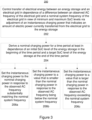
- the PBR apparatus 120 may operate according to a method 300 that is illustrated by a flowchart depicted in Figure 7 .
- the method 300 proceeds from operating the PBR apparatus 120 to control transfer of electrical energy between the energy storage 121 and the electrical grid 100 in dependence of the observed AC frequency f ( t ) of the electrical grid 100 in view of the minimum and maximum allowable SoC levels using one of a plurality of operating modes via adjustment of the instantaneous charging power P in ( t ) that indicates the amount of electric power currently transferred from the electrical grid 100 to the energy storage 121, as indicated in block 302.
- the method 300 further comprises receiving respective indications of a first operating mode selected for a first time period and a second operating mode selected for a second time period, where the first and second time periods are consecutive time periods in a sequence of time periods and where the second time period follows the first time period in said sequence, as indicated in block 304, and controlling the instantaneous charging power P in ( t ) during the first time period in accordance with the first operating mode in dependence of the observed AC frequency f ( t ) and at least partially in dependence of the second operating mode selected for the second time period, as indicated in block 306.
- Respective operations described with references to blocks 302 to 306 pertaining to the method 300 may be implemented, varied and/or complemented in a number of ways, for example as described in the foregoing and in the following with references to the operation of the PBR apparatus 120.
- the applied nominal charging power P in_mid,k is derived in dependence of the initial SoC level C st,k in the beginning of the time period k and the target SoC level C tgt,k at the end of the time period k, where definition or selection of the target SoC level C tgt,k may depend on the operating mode of the time period k +1.
- the aspect of controlling the instantaneous charging power P in ( t ) (cf.
- block 306) may comprise defining the target SoC level for the first time period at least partially in dependence of the second operating mode (selected for the second time period), deriving the nominal charging power P in_mid,k for the first time period at least in dependence of the initial SoC level C st,k in the beginning of the first time period and the target SoC level C tgt,k defined for the first time period, and controlling the instantaneous charging power P in ( t ) during the first time period in view of the nominal charging power P in_mid,k defined therefor in accordance with the charging power adjustment rules defined for the first operating mode.
- the target SoC value C tgt,k at the end of the first time period may be set to a value that is larger than or equal to the sum of the lower SoC limit C min and the FFR pulse energy E frr,k+1 (i.e.
- the target SoC value C tgt,k so derived is preferably smaller than the midpoint SoC value C mid while it may be within a predefined SoC margin C m from the lower SoC limit C min .
- the SoC margin C m may be defined such that corresponds to a predefined percentage of the overall capacity of the energy storage 121 (e.g. a suitable percentage in a range from 1 to 10 %). Consequently, selection of the target SoC level C tgt,k for the first time period in the FCR-N mode contributes towards providing an advantageous starting point for operation in the FFR mode in the second time period.
- the operating parameters of the FCR-N mode may further comprise the temporary lower SoC limit C min,k described in the foregoing in context of the FFR mode.
- the temporary lower SoC limit C min,k may be set to a value that is larger than or equal to the sum of the lower SoC limit C min and the FFR pulse energy E frr,k+1 , thereby ensuring sufficient SoC level C ( t ) that allows for a power pulse to be discharged from the energy storage 121 in the beginning of the second time period (if it turns out necessary) without decreasing the SoC level C ( t ) below the lower SoC limit C min . Consequently, application of the temporary lower SoC limit C min,k during the first time period in the FCR-N mode guarantees that the PBR apparatus 120 is able to validly operate in the FFR mode in the second time period.
- the target SoC value C tgt,k at the end of the first time period may be set to a value that is smaller than or equal to a SoC level computed by subtracting the estimated FCR-D pulse energy E fcr,k+1 from the upper SoC limit C max (i.e.
- the target SoC value C tgt,k so derived is preferably larger than the midpoint SoC value C mid while it may be within the predefined SoC margin C m from the upper SoC limit C max .
- the SoC margin C m may be defined in a manner similar to that described in the foregoing for transition from the FCR-N mode to the FFR mode. Consequently, selection of the target SoC level C tgt,k for the first time period in the FCR-N mode contributes towards providing an advantageous starting point for operation in the FCR-D down mode in the second time period.
- the operating parameters of the FCR-N mode may further comprise the temporary upper SoC limit C min,k described in the foregoing in context of the FCR-D down mode.
- the temporary upper SoC limit C min,k may be set to value that is smaller than or equal to a SoC level computed by subtracting the estimated FCR-D pulse energy E fcr,k+1 from the upper SoC limit C max (i.e.
- the target SoC level C tgt,k at the end of the first time period may be set to the midpoint SoC value C mid or to a value within the predefined SoC margin C m centered at the midpoint SoC value C mid (where the SoC margin C m may be defined in a manner similar to that described in the foregoing).
- having the SoC level C ( t ) at or relatively close the midpoint SoC level C mid provides an advantageous starting point for the second time period in the FCR-N mode via enabling an equal or substantially equal amount of charging or discharging of the energy storage 121 to be applied while keeping the SoC level C ( t ) with the allowable SoC range.
- the initial SoC level C st,k in the beginning of the first time period in the FFR mode is close to the lower SoC limit C min or at least below the midpoint SoC level C mid , this may also result in setting the nominal charging power P in_mid,k for the first time period to a positive value (i.e. one that results in charging the energy storage 121), which in turn may enable provision of (at least partially) virtual power pulses that exceed the discharging capability of the energy storage 121 (as described in the foregoing) during the first time period.
- the target SoC value C tgt,k at the end of the time period k may be set to a value that is smaller than or equal to a SoC level computed by subtracting the estimated FCR-D pulse energy E fcr,k+1 from the upper SoC limit C max (i.e.
- the PBR apparatus 120 to absorb a power pulse in the beginning of the second time period (in case it turns out necessary) without increasing the SoC level C ( t ) above the upper SoC limit C max while allowing usage of below-zero nominal charging power for the second time period.
- the target SoC value C tgt,k so derived is preferably larger than the midpoint SoC value C mid while it may be within the predefined SoC margin C m from the upper SoC limit C max . Consequently, selection of the target SoC level C tgt,k for the first time period in the FFR mode contributes towards providing an advantageous starting point for operation in the FCR-D down mode in the second time period.
- the operating parameters of the FFR mode may further comprise the temporary upper SoC limit C max,k described in the foregoing in context of the FCR-D down mode.
- the temporary upper SoC limit C max,k may be set to a value that is smaller than or equal to a SoC level computed by subtracting the estimated FCR-D pulse energy E fcr,k+1 from the upper SoC limit C max (i.e.
- the target SoC value C tgt,k at the end of the first time period may be set to a value that is larger than or equal to the sum of the lower SoC limit C min and the FFR pulse energy E frr,k+1 (i.e.
- the PBR apparatus 120 to discharge a power pulse in the beginning of the second time period (in case it turns out necessary) without decreasing the SoC level C ( t ) below the lower SoC limit C min while allowing usage of above-zero nominal charging power for the second time period.
- the target SoC value C tgt,k so derived is preferably smaller than the midpoint SoC value C mid while it may be within the predefined SoC margin C m from the lower SoC limit C min . Consequently, selection of the target SoC level C tgt,k for the first time period in the FCR-D down mode contributes towards providing an advantageous starting point for operation in the FFR mode in the second time period.
- the operating parameters of the FCR-D down mode may further comprise the temporary lower SoC limit C min,k described in the foregoing in context of the FFR mode.
- the temporary lower SoC limit C min,k may be set to a value that is larger than or equal to the sum of the lower SoC limit C min and the FFR pulse energy E frr,k+1 , thereby ensuring sufficient SoC level C ( t ) that allows for a power pulse to be discharged from the energy storage 121 in the beginning of the second time period (if it turns out necessary) without decreasing the SoC level C ( t ) below the lower SoC limit C min . Consequently, application of the temporary lower SoC limit C min,k during the first time period in the FCR-D down mode guarantees that the PBR apparatus 120 is able to validly operate in the FFR mode in the second time period.
- FIG. 8 schematically illustrates some components of an apparatus 400 that may be employed to implement the controller 122.
- the apparatus 400 comprises a processor 402 and a memory 404.
- the memory 404 may store data and computer program code 406.
- the apparatus 400 may further comprise communication means 408 for wired or wireless communication with other apparatuses and/or user I/O (input/output) components 410 that may be arranged, together with the processor 402 and a portion of the computer program code 406, to provide a user interface for receiving input from a user and/or providing output to the user.
- the user I/O components may include user input means, such as one or more keys or buttons, a keyboard, a touchscreen or a touchpad, etc.
- the user I/O components may include output means, such as a display or a touchscreen.
- the components of the apparatus 400 are communicatively coupled to each other via a bus 412 that enables transfer of data and control information between the components.
- the memory 404 and a portion of the computer program code 406 stored therein may be further arranged, with the processor 402, to cause the apparatus 400 to perform at least some aspects of operation of the controller 122.
- the processor 402 is configured to read from and write to the memory 404.
- the processor 402 is depicted as a respective single component, it may be implemented as respective one or more separate processing components.
- the memory 404 is depicted as a respective single component, it may be implemented as respective one or more separate components, some or all of which may be integrated/removable and/or may provide permanent / semi-permanent/ dynamic/cached storage.
- the computer program code 406 may comprise computer-executable instructions that implement at least some aspects of operation of the controller 122 when loaded into the processor 402.
- the computer program code 406 may include a computer program consisting of one or more sequences of one or more instructions.
- the processor 402 is able to load and execute the computer program by reading the one or more sequences of one or more instructions included therein from the memory 404.
- the one or more sequences of one or more instructions may be configured to, when executed by the processor 402, cause the apparatus 400 to perform at least some aspects of operation of the controller 122.
- the apparatus 400 may comprise at least one processor 402 and at least one memory 404 including the computer program code 406 for one or more programs, the at least one memory 404 and the computer program code 406 configured to, with the at least one processor 402, cause the apparatus 400 to perform at least some aspects of operation of the controller 122.
- the computer program code 406 may be provided e.g. a computer program product comprising at least one computer-readable non-transitory medium having the computer program code 406 stored thereon, which computer program code 406, when executed by the processor 402 causes the apparatus 400 to perform at least some aspects of operation of the controller 122.
- the computer-readable non-transitory medium may comprise a memory device or a record medium such as a CD-ROM, a DVD, a Blu-ray disc or another article of manufacture that tangibly embodies the computer program.
- the computer program may be provided as a signal configured to reliably transfer the computer program.
- references(s) to a processor herein should not be understood to encompass only programmable processors, but also dedicated circuits such as field-programmable gate arrays (FPGA), application specific circuits (ASIC), signal processors, etc.
- FPGA field-programmable gate arrays
- ASIC application specific circuits
- signal processors etc.
Landscapes
- Engineering & Computer Science (AREA)
- Power Engineering (AREA)
- Business, Economics & Management (AREA)
- Emergency Management (AREA)
- Supply And Distribution Of Alternating Current (AREA)
- Charge And Discharge Circuits For Batteries Or The Like (AREA)
Description
- The example and non-limiting embodiments of the present invention relate to provision of a power balancing reserve for an electrical grid.
- An electrical grid, especially a large one such as a national or a transnational electrical grid requires careful control in order to balance the electricity production from generating stations to the grid and the electricity consumption from the grid by consumers: electricity production to the grid needs to match the electricity consumption from the grid in order to keep the grid operational, whereas in a practical situation instantaneous electricity production and electricity consumption do not fully match each other.
- In general, in a balanced condition of the grid the frequency of alternating current (AC) transferred via the grid remains at a nominal system frequency, which e.g. in the European electrical grids is typically 50 Hz, whereas any imbalance between the production and consumption results in a small deviation from the nominal system frequency: in case the consumption exceeds the production (i.e. the grid is heavily loaded) the AC frequency in the grid falls below the nominal system frequency, whereas in case the production exceeds the consumption (i.e. the grid is lightly loaded) the AC frequency in the grid raises above the nominal system frequency. Since exact balancing of instantaneous production and consumption in a complex network is practically impossible, a minor deviation between the nominal system frequency and the AC frequency of the grid is typically allowed while still considering the grid to be in a normal operational state. As an example, assuming the nominal system frequency of 50 Hz, the AC frequency of the grid may be allowed to vary between 49.9 and 50.1 Hz while still considering the grid to be in the normal operational state.
- Typically, the grid operator aims at ensuring balance in the grid via planning the production and consumption within the network in advance, for example, on a daily basis and/or an hourly basis, e.g. via agreements made with entities producing and consuming electric power. Nevertheless, in a real-life environment the electricity production and consumption do not fully match the planned/agreed ones and, consequently, the AC frequency of the grid involves temporary deviations from the nominal system frequency on regular basis despite any planning. In this regard, a known technique for facilitating balance in the grid in such circumstances involves usage of a power balancing reserve (PBR) that is able to increase or decrease its planned power supply to or power demand from the grid in dependence of the AC frequency of the grid.
- Depending on the type of provided PBR function, a PBR entity may carry out one or both of the following:
- in case the AC frequency of the grid drops below a (first) predefined threshold (that is lower than or equal to the nominal system frequency), the PBR entity may decrease its power consumption in order to contribute towards decreasing the load of the grid (to account for a situation where the consumption exceeds the production),
- in case the AC frequency of the grid rises above a (second) predefined threshold (that is higher than or equal to the nominal system frequency), the PBR entity may increase its power consumption in order to contribute towards increasing the load of the grid (to account for a situation where the production exceeds the consumption).
- The operation of the PBR entity needs to be carefully controlled in order to ensure providing a required power balancing function for the grid also over a prolonged period of time. As examples in this regard, the requirement for the power balancing function may arise from current operational state of the grid (e.g. in terms of the AC frequency of the grid deviating from the nominal system frequency) and/or from any regulations or agreements concerning the power consumed by the PBR entity and changes thereof over time. Consequently, controlling operation of the PBR entity such that all relevant technical and regulatory requirements are met requires careful design. In contrast, a failure to meet such requirements may result in compromised operation of the grid or even in disturbances in supply of electrical energy via the grid.
- In related art, Hollinger, Raphael et al., "Fast Frequency Response with BESS: A Comparative Analysis of Germany, Great Britain and Sweden", 15th IEEE International Conference on the European Energy Market (EEM), 27 June 2018, pages 1-6 provides an analysis of provision of fast frequency response with BESS (Battery Energy Storage Systems) in Germany, Great Britain and Sweden.
- It is an object of the present invention to provide a technique for controlling a power balancing reserve for an electrical grid in a manner that enables providing continuous power balancing operation over a prolonged time period. According to an embodiment, a power balancing reserve (PBR) apparatus for an electrical grid is provided, the PBR apparatus comprising: an energy storage for storing electrical energy and having a minimum allowable state of charge, SoC, level and a maximum allowable SoC level defined therefor; and a controller for controlling transfer of electrical energy between the energy storage and the electrical grid in dependence of an observed AC frequency of the electrical grid in view of said minimum and maximum allowable SoC levels using one of a plurality of operating modes via adjustment of an instantaneous charging power that indicates the amount of electric power currently transferred from the electrical grid to the energy storage, the controller arranged to: receive, before starting a first time period respective indications of a first operating mode selected for the first time period and a second operating mode selected for a second time period, where the first and second time periods are consecutive time periods in a sequence of time periods of predefined duration and where the second time period follows the first time period in said sequence, and control the instantaneous charging power during the first time period in accordance with one or more power adjustment rules defined for the first operating mode, wherein said controlling is carried out according to a predefined schedule and in dependence of said observed AC frequency, wherein the controller is further arranged to: define, before starting the first time period, a target state of charge, SoC, level of the energy storage for the end of the first time period at least partially in dependence of the second operating mode selected for the second time period; derive, before starting the first time period, a first nominal charging power for the first time period at least in dependence of an initial SoC level of the energy storage in the beginning of the first time period and said target SoC level; and control, during the first time period according to said predefined schedule, the instantaneous charging power during the first time period in view of the first nominal charging power in accordance with the one or more charging power adjustment rules defined for the first operating mode.
- According to another embodiment, a method for providing a power balancing reserve (PBR) for an electrical grid is provided, the method comprising: storing electrical energy in an energy storage that has a minimum state of charge, SoC, level and a maximum SoC level defined therefor; controlling transfer of electrical energy between the energy storage and the electrical grid in dependence of an observed AC frequency of the electrical grid in view of said minimum and maximum allowable SoC levels using one of a plurality of operating modes via adjustment of an instantaneous charging power that indicates the amount of electric power currently transferred from the electrical grid to the energy storage; receiving, before starting a first time period, respective indications of a first operating mode selected for the first time period and a second operating mode selected for a second time period, where the first and second time periods are consecutive time periods in a sequence of time periods of predefined duration and where the second time period follows the first time period in said sequence; and controlling the instantaneous charging power during the first time period in accordance with one or more power adjustment rules defined for the first operating mode, wherein said controlling is carried out according to a predefined schedule and in dependence of said observed AC frequency, wherein said controlling comprises: defining, before starting the first time period, a target state of charge, SoC, level of the energy storage for the end of the first time period at least partially in dependence of the second operating mode selected for the second time period; deriving, before starting the first time period, a first nominal charging power for the first time period at least in dependence of an initial SoC level of the energy storage in the beginning of the first time period and said target SoC level; and controlling, during the first time period according to said predefined schedule, the instantaneous charging power during the first time period in view of the first nominal charging power in accordance with the one or more charging power adjustment rules defined for the first operating mode.
- According to another embodiment, a computer program for measuring wind speed is provided, the computer program comprising computer readable program code configured to cause performing at least the method according to the embodiment described in the foregoing when said program code is executed on one or more computing apparatuses.
- The computer program according to the above-described example embodiment may be embodied on a volatile or a non-volatile computer-readable record medium, for example as a computer program product comprising at least one computer readable non-transitory medium having the program code stored thereon, which, when executed by one or more computing apparatuses, causes the computing apparatuses at least to perform the method according to the example embodiment described in the foregoing.
- The exemplifying embodiments of the invention presented in this patent application are not to be interpreted to pose limitations to the applicability of the appended claims. The verb "to comprise" and its derivatives are used in this patent application as an open limitation that does not exclude the existence of also unrecited features. The features described hereinafter are mutually freely combinable unless explicitly stated otherwise.
- Some features of the invention are set forth in the appended claims. Aspects of the invention, however, both as to its construction and its method of operation, together with additional objects and advantages thereof, will be best understood from the following description of some example embodiments when read in connection with the accompanying drawings.
- The embodiments of the invention are illustrated by way of example, and not by way of limitation, in the figures of the accompanying drawings, where
-
Figure 1 illustrates a block diagram of some logical elements coupled to an electrical grid according to an example; -
Figure 2 illustrates a block diagram of some logical elements of a power balancing reserve system according to an example; -
Figure 3 illustrates a method according to an example; -
Figure 4A illustrates a relationship between an observed AC frequency of an electrical grid, an instantaneous charging power applied for transferring electrical energy from the electrical grid to an energy storage and a state of charge level of the energy storage according to an example; -
Figure 4B illustrates a relationship between an observed AC frequency of an electrical grid, an instantaneous charging power applied for transferring electrical energy from the electrical grid to an energy storage and a state of charge level of the energy storage according to an example; -
Figure 5 illustrates a relationship between an observed AC frequency of an electrical grid, an instantaneous charging power applied for transferring electrical energy from the electrical grid to an energy storage and a state of charge level of the energy storage according to an example; -
Figure 6 illustrates a relationship between an observed AC frequency of an electrical grid, an instantaneous charging power applied for transferring electrical energy from the electrical grid to an energy storage and a state of charge level of the energy storage according to an example; -
Figure 7 illustrates a method according to an example; and -
Figure 8 illustrates a block diagram of some components of an apparatus according to an example. -
Figure 1 illustrates a block diagram of some logical elements that are coupled to anelectrical grid 100 according to an example. Theelectrical grid 100 comprises an interconnected network that enables transfer and distribution of electric power from producers to consumers. In the example ofFigure 1 , theelectrical grid 100 has coupled thereto power producer entities 102-1, 102-2, 102-3 for generation of electric power for delivery via theelectrical grid 100 and power consumer entities 104-1, 104-2, 104-3 for consuming the electric power generated by the power producer entities 102-1, 102-2, 102-3. In this regard the power producer entities 102-1, 102-2, 102-3 represent a plurality of power producer entities and the power consumer entities 104-1, 104-2, 104-3 represent a plurality of power consumer entities. In the example ofFigure 1 theelectrical grid 100 further has a power balancing reserve (PBR)system 110 coupled thereto, which operates to one of supply electrical power to theelectrical grid 100 or consume electrical power from theelectrical grid 100 in dependence of an observed AC frequency f(t) of theelectrical grid 100 in order to contribute towards balancing the state of theelectrical grid 100. ThePBR system 110 represents one or more PBR systems that may be coupled to theelectrical grid 100. Hence, a power balancing functionality results from concurrent operation of a plurality ofPBR systems 110 that are coupled to theelectrical grid 100 and that operate to adjust their respective power supply to theelectrical grid 100 and/or power demand from theelectrical grid 100 in dependence of the observed AC frequency f(t) of the grid with the aim of brining the observed AC frequency f(t) towards a nominal system frequency f mid of theelectrical grid 100. - The plurality of power producer entities may comprise respective power stations or power plants for production of electric power while the plurality power consumer entities may comprise any industrial, commercial and/or private establishment that consume the electric power. The
electrical grid 100 may be alternatively referred to as an electric grid, as a power grid or, simply, just as a grid. Theelectrical grid 100 may be provided for transfer and distribution of alternating current (AC) at a predefined nominal system frequency f mid, which may be, for example, 50 Hz (e.g. in Europe) or 60 Hz (e.g. in the United States). Along the lines described in the foregoing, in the course of operation of theelectrical grid 100 the actual AC frequency in theelectrical grid 100 may serve as an indication of the operational state of the electrical grid 100: observed AC frequency f(t) that is below the nominal system frequency f mid serves as an indication of a condition where the (overall) power consumption from theelectrical grid 100 exceeds the power supply to theelectrical grid 100, whereas observed AC frequency f(t) that is above the nominal system frequency f mid serves as an indication of a condition where the (overall) power supply to theelectrical grid 100 exceeds the power consumption from theelectrical grid 100. - As further described in the foregoing, the
electrical grid 100 may be considered to be in a normal operational state even though the observed AC frequency f(t) differs from the nominal system frequency f mid of theelectrical grid 100. In this regard, a range of AC frequencies around the nominal system frequency f mid of theelectrical grid 100 that are considered to represent the normal operational state of theelectrical grid 100 may be referred to as a nominal system frequency range, which may cover frequencies from f lo to f hi, where f lo < f mid and f hi > f mid. Hence, an observed AC frequency f(t) that is within the nominal system frequency range serves to indicate the normal operational state of theelectrical grid 100, whereas an observed AC frequency f(t) that is outside the nominal system frequency range may be considered as a disturbance state (or an abnormal operational state) of theelectrical grid 100. The nominal system frequency range may be defined, for example, by an operator of theelectrical grid 100 and/or it may be set based at least in part on applicable regulatory requirements (e.g. ones applicable in the geographical location at which theelectrical grid 100 is operated). In a non-limiting example, assuming the nominal system frequency f mid of 50 Hz, the nominal system frequency range may extend from 49.9 Hz to 50.1 Hz. -
Figure 2 illustrates a block diagram of some logical elements of aPBR apparatus 120 that may serve as thePBR apparatus 110 shown the example ofFigure 1 . In the example ofFigure 2 , thePBR apparatus 120 is shown with anenergy storage 121 for receiving and supplying electric power and acontroller 122 for controlling transfer of electric power from theelectrical grid 100 to theenergy storage 121 and/or transfer of electric power from theenergy storage 121 to theelectrical grid 100. Hence, theenergy storage 121 comprises a rechargeable energy storage, such as a single rechargeable battery or a battery system comprising two or more rechargeable batteries. Thecontroller 122 may selectively control or adjust the transfer of electric power between theenergy storage 121 and theelectrical grid 100. In this regard, the supply of electric power from theenergy storage 121 to theelectrical grid 100 may be referred to as discharging theenergy storage 121 and thePBR apparatus 120 may be considered to be in a discharging state when discharging electrical power from theenergy storage 121 to theelectrical grid 100. Along similar lines, the supply of electric power from theelectrical grid 100 to theenergy storage 121 may be referred to as charging theenergy storage 121 and thePBR apparatus 120 may considered to be in a charging state when theenergy storage 121 is receiving electrical power from theelectrical grid 100. Moreover, in case no discharging or charging of theenergy storage 121 is taking place, thePBR apparatus 120 may be considered to be in an idle state. - The amount of electric power transfer between the
energy storage 121 and theelectrical grid 100 may be indicated as an instantaneous charging power P in(t), which may be changed over time by thecontroller 122. In this regard, positive values of the instantaneous charging power P in(t) indicate charging of theenergy storage 121 using electric power drawn from theelectrical grid 100, whereas negative values of the instantaneous charging power P in(t) indicate discharging electric power from theenergy storage 121 to theelectrical grid 100. Consequently, a related measure is an instantaneous discharging power P out(t) = -P in(t), for which a positive value indicates discharging electric power from theenergy storage 121 to theelectrical grid 100 and a negative value indicates charging of theenergy storage 121 using electric power drawn from theelectrical grid 100. - For notational convenience, in the following the transfer of electric power between the
electrical grid 100 and theenergy storage 121 is predominantly described via referring to the instantaneous charging power P in(t), regardless of the transfer of electric power involving charging or discharging of theenergy storage 121. Consequently, depending on a currently applied instantaneous charging power P in(t), the aspect of decreasing the instantaneous charging power P in(t) may comprise one of the following: - Continue to operate the
PBR apparatus 120 in the charging state but apply a decreased instantaneous charging power P in(t) (i.e. charge at reduced charging rate); - Continue to operate the
PBR apparatus 120 in the discharging state but apply an increased instantaneous discharging power P out(t) (i.e. discharge at an increased discharging rate); - Switch from operating the
PBR apparatus 120 in the charging state to operating thePBR apparatus 120 in the discharging state. - Along similar lines, depending on a currently applied instantaneous charging power P in(t), the aspect of increasing the instantaneous charging power P in(t) may comprise one of the following:
- Continue to operate the
PBR apparatus 120 in the discharging state at a decreased instantaneous discharging power P out(t) (i.e. discharge at a reduced discharging rate); - Continue to operate the
PBR apparatus 120 in the charging state at an increased instantaneous charging power P in(t) (i.e. charge at an increased charging rate); - Switch from operating the
PBR apparatus 120 in the discharging state to operating thePBR apparatus 120 in the charging state. - The relative amount of electrical energy currently stored in the
energy storage 121 may be indicated via its state of charge (SoC), in other words an SoC level C(t) of the energy storage may be applied to indicate the amount of electrical energy currently stored in theenergy storage 121. The SoC level C(t) may be expressed, for example, as a percentage of the predefined overall capacity of theenergy storage 121 and/or as an absolute amount of electrical energy available in the energy storage 121 (e.g. as kilowatt-hours (kWh)). In the following examples any measures related to the SoC of theenergy storage 121 are predominantly referred to as respective percentages of the overall capacity of theenergy storage 121, while these examples readily translate into ones that consider respective measures using a measure of electrical energy such as kWh. Theenergy storage 121 may have an allowable range of SoC levels (allowable SoC range in short) assigned therefor, whereas thecontroller 122 may be arranged to ensure controlling the charging and discharging of theenergy storage 121 such that the SoC level C(t) of theenergy storage 121 remains within the allowable SoC range. The allowable SoC range may be defined via a pair of a lower SoC limit C min and an upper SoC limit C max, which may be alternatively referred to as a minimum allowable SoC level C min and a maximum allowable SoC level C max, respectively. In various examples, the lower SoC limit C min may be 0% or a non-zero value that is less than the upper SoC limit C max, whereas the upper SoC limit C max may be 100 % or a value that is lower than 100 % but larger than the lower SoC limit C min. In a further non-limiting example pertaining to using one or more rechargeable batteries to provide theenergy storage 121, the lower SoC limit C min may be in a range from 3 to 10 %, e.g. 6 % and the upper SoC limit C max may be in a range from 85 % to 95 %, e.g. 89 %. The lower SoC limit C min that is above zero and the upper SoC limit C max that is below 100 % may be set due to physical characteristics of the battery in order to increase battery life and/or to ensure sufficient charging/discharging rate throughout the allowable SoC range. - In a first scenario, the
PBR apparatus 120 may be arranged to operate in a single operating mode during a plurality of consecutive time periods of a time schedule such that one or more operating parameters of thePBR apparatus 120 are fixed throughout a time period but they may be changed from one time period to another. In this regard, respective values of a first subset of the one or more operating parameters may be selected in advance for the plurality of time periods and/or respective values of a second subset of the one or more operating parameters may be set upon starting the respective time period (or upon completing the time period preceding the respective time period). The time schedule hence consists of a sequence of time periods and the time periods of the time schedule preferably have a fixed predefined duration that is the same from one time period to another. In an example, the time schedule may comprise a given day and the plurality of time periods therein may comprise respective time portions of the given day, e.g. the hours of the given day or the half-an-hour periods of the given day). The pre-selection of the time periods of the time schedule for application of the single operation mode of thePBR apparatus 120 using the respective parameter value(s) may be based, for example, on an agreement between respective operators of thePBR apparatus 120 and theelectrical grid 100. - As an example, the single operating mode of the first scenario may be one where the
controller 122 is arranged to operate thePBR apparatus 120 to provide a frequency containment reserve (FCR) function via adjusting the instantaneous charging power P in(t) in dependence of the observed AC frequency f(t) of theelectrical grid 100, e.g. in dependence of a difference between the observed AC frequency f(t) of theelectrical grid 100 and the nominal system frequency f mid of theelectrical grid 100 in view of the allowable SoC range in order to facilitate keeping the AC frequency f(t) of theelectrical grid 100 at or close to the nominal system frequency f mid when theelectrical grid 100 is in its normal operational state. Without losing generality, the FCR function according to such an operating mode may be referred to as a FCR function for normal operational state of the electrical grid 100 (FCR-N function) and, consequently, this operating mode may be referred to as a FCR-N mode of thePBR apparatus 120. - According to an example, operation of the
PBR apparatus 120 in the FCR-N mode may be limited to conditions where the observed AC frequency f(t) of theelectrical grid 100 remains within the nominal system frequency range (e.g. the range from 49.9 Hz to 50.1 Hz in case of the 50 Hz nominal system frequency f mid). Consequently, according to an example, in case the observed AC frequency f(t) of the electrical 100 is outside the nominal system frequency range, thecontroller 122 may terminate the FCR-N function for the remainder of the current time period. In another example, thecontroller 122 may discontinue the FCR-N function for a sub-period within the current time period when the observed AC frequency f(t) is outside the nominal system frequency range but continue the FRC-N function when the observed AC frequency f(t) is (again) within the nominal system frequency range. In a further example, thePBR apparatus 120 may continue providing the FCR function according to the FCR-N mode also when the observed AC frequency f(t) is outside the nominal system frequency range. - The one of more operating parameters of the
PBR apparatus 120 for a time period k in the FCR-N mode may comprise the following: - a nominal charging power P in_mid,k (or a nominal discharging power P out_mid,k = -P in_mid,k);
- a maximum allowable charging power P in_max,k (or a minimum allowable discharging power P out_min,k = -P in_max,k);
- a minimum allowable charging power P in_min,k (or a maximum allowable discharging power P out_max,k = -P in_min,k).
- In the FCR-N mode, the nominal charging power P in_mid,k for the time period k may be considered as a virtual midpoint charging power or as a default charging power for the respective time period, which is applied as the instantaneous charging power P in(t) in a situation where the observed AC frequency f(t) of the
electrical grid 100 matches or substantially matches the nominal system frequency f mid of theelectrical grid 100. In contrast, when the observed AC frequency f(t) fails to match the nominal system frequency f mid, the instantaneous charging power P in(t) may be adjusted accordingly in view of the minimum allowable charging power P in_min,k and the maximum allowable charging power P in_max,k set for the time period k. In this regard, thecontroller 122 may be arranged to set (e.g. to keep or adjust) the instantaneous charging power P in(t) in dependence of the difference with between the observed AC frequency f(t) of theelectrical grid 100 and the nominal system frequency f mid of theelectrical grid 100, for example, according to one or more of the following charging power adjustment rules: - Set (e.g. keep or adjust) the instantaneous charging power P in(t) to the nominal charging power P in_mid,k in response to the observed AC frequency f(t) matching or substantially matching the nominal system frequency f mid.
- Set (e.g. keep or adjust) the instantaneous charging power P in(t) to a value that is smaller than the nominal charging power P in_mid,k in response to the observed AC frequency f(t) being smaller than the nominal system frequency f mid.
- Set (e.g. keep or adjust) the instantaneous charging power P in(t) to a value that is larger than the nominal charging power P in_mid,k in response to the observed AC frequency f(t) exceeding the nominal system frequency f mid.
- In the FCR-N mode, the
controller 122 setting or adjusting the instantaneous charging power P in(t) in view of the allowable SoC range may comprise thecontroller 122 controlling discharging or charging of the energy storage 121 (whichever currently applies) such that the SoC level C(t) is kept within the allowable SoC range: the discharging may be continued until reaching the lower SoC limit C min or the charging theenergy storage 121 may be continued until reaching the upper SoC limit C max, whichever currently applies. Hence, in case the lower SoC limit C min is reached while discharging theenergy storage 121 or in case the upper SoC limit C max is reached while charging theenergy storage 121, thecontroller 122 may terminate the discharging/charging and set thePBR apparatus 120 in the idle sate. - The minimum allowable charging power P in_min,k and the maximum allowable charging power P in_max,k for the time period k, may be defined in relation to the nominal charging power P in_mid,k defined or set for the time period k. According to an example, the maximum allowable charging power P in_max,k and the minimum allowable charging power P in_min,k may be set symmetrically with respect to the nominal charging power P in_mid,k in view of a balancing reserve power P in_res,k assigned for the current time period k, e.g. such that the allowable range of charging powers from the minimum allowable charging power P in_min,k to the maximum allowable charging power P in_max,k are set as P in_min,k = P in_mid,k - P in_res,k and P in_max,k = P in_mid,k + P in_res,k. In another example, the maximum allowable charging power P in_max,k and the minimum allowable charging power P in_min,k may be set asymmetrically with respect to the nominal charging power P in_mid,k in view of respective upper and lower balancing reserve powers P in_res_hi,k, P in_res_lo,k, e.g. such that P in_min,k = P in_mid,k - P in_res_lo,k and P in_max,k = P in_mid,k + P in_res_hi,k with P in_res_lo,k ≠ P in_res_hi,k. Herein, the balancing reserve powers P in_res,k, P in_res_hi,k, P in_res_lo,k (as applicable) may be respective predefined values, set or defined for example based on the agreement between respective operators of the
PBR apparatus 120 and theelectrical grid 100. - According to an example, the nominal charging power P in_mid,k for the time period k may be defined (e.g. derived) in the course of operation of the
PBR apparatus 120 in consideration of one or more of the following aspects: - the SoC level C(t) in the beginning of the time period k, denoted as an initial SoC level C st,k,
- a target value for the SoC level C(t) at the end of the time period k, denoted as a target SoC level C tgt,k,
- an estimated net amount of electrical energy to be transferred from the
electrical grid 100 to theenergy storage 121 in the course of the time period k for the purpose of power balancing, and - the allowable SoC range.
- Herein, the net amount of electrical energy to be transferred from the
electrical grid 100 to theenergy storage 121 in the course of the time period k for the purpose of power balancing serves to indicate the difference between the amount of electrical energy transferred from theelectrical grid 100 to theenergy storage 121 and the amount of electrical energy transferred from theenergy storage 121 to theelectrical grid 100 during the time period k for power balancing purposes. This amount of electrical energy may be referred to, in short, as an estimated balancing energy E est,k (required for the time period k). Hence, in case the estimated balancing energy E est,k is above zero, the estimated net effect of energy transfer between theelectrical grid 100 and theenergy storage 121 due to the power balancing functionality over the time period k results in increasing the SoC level C(t) of theenergy storage 121, in case the estimated balancing energy E est,k is below zero, the estimated net effect of energy transfer between theelectrical grid 100 and theenergy storage 121 due to the power balancing functionality over the time period k results in decreasing the SoC level C(t) of theenergy storage 121, and in case the estimated balancing energy E est,k is zero, the estimated net effect of the energy transfer between theelectrical grid 100 and theenergy storage 121 due to the power balancing functionality over the time period k is assumed not the change the SoC level of theenergy storage 121. The estimated balancing energy E est,k may be also considered as or it may be translated into an (estimated) average charging power P in_est,k required for the power balancing functionality over the time period k, e.g. as P in_est,k = E est,k / t k. - The nominal charging power P in_mid,k for the time period k may be derived upon starting the time period k with the aim of facilitating continued provision of the FCR-N function throughout the time period k and possibly also in the subsequent time periods(s). In this regard, an advantageous starting point for any time period of operation in the FCR-N mode in terms of the initial SoC level C st,k is a midpoint SoC level C mid between the lower SoC limit C min and the upper SoC limit C max, which may be derived e.g. as an average of the upper SoC limit C max and the lower SoC limit C min, e.g. C mid = (C max + C min) / 2, since it enables equal amount of charging or discharging of the
energy storage 121 to be applied while keeping the SoC level C(t) within the allowable SoC range. Consequently, if assuming operation of thePBR apparatus 120 in the FCR-N mode also for the time period k+1, an advantageous value for the target SoC level C tgt,k at the end of the time period k may comprise the midpoint SoC level C mid. In a non-limiting example that assumes the upper SoC limit at C max = 89 % and the lower SoC limit at C min = 6 %, the midpoint SoC level C mid sets to C mid = (89 % + 6 %) / 2 = 47.5 %. Thus, if further assuming theenergy storage 121 to have an overall capacity of 1000 kWh, this translates into the lower SoC limit C max at 60 kWh, the upper SoC limit C max at 890 kWh and the midpoint SoC level C max at 475 kWh. - As an example, assuming that the estimated balancing energy E est,k is zero (i.e. the amount of electrical energy transferred from the
energy storage 121 to theelectrical grid 100 is substantially the same as the amount of electrical energy transferred from theelectrical grid 100 to theenergy storage 121 over the time period k), depending on the relationship between the initial SoC level C st,k at the beginning of the time period k and the target SoC level C tgt,k at the end of the time period k, the nominal input power P in_mid,k for the time period k for operation in the FRC-N mode may be equal to, smaller than or greater than zero: in case the initial SoC level C st,k is equal to the target SoC level C tgt,k, the nominal charging power P in_mid,k may be set to zero, whereas in case the initial SoC level C st,k is above the target SoC level C tgt,k, the nominal charging power P in_mid,k may be set to a value below zero (which corresponds to discharging the energy storage 121) while in case the initial SoC level C st,k is below the target SoC level C tgt,k, the nominal charging power P in_mid,k may be set to a value above zero (which corresponds to charging the energy storage 121). This way, the selection of the nominal charging power P in_mid,k facilitates continued operation in the FCR-N mode also in the subsequent time period(s). As an example in this regard, the nominal charging power P in_mid,k may be derived as P in_mid,k = (C tgt,k - C st,k) / t k, where t k denotes the duration of the time period k. - According to another example, the nominal charging power P in_mid,k for the time period k for operation in the FCR-N mode may be derived further in consideration of non-zero estimated balancing energy E est,k, In this regard, the nominal input power P in_mid,k that results in bringing the SoC level C(t) from the initial SoC level C st,k in the beginning of the time period k to the target SoC level C tgt,k at the end of the time period k may be derived, for example, as P in_mid,k = (C tgt,k - C st,k + E est,k) / t k. In other words, accounting for the estimated balancing energy E est,k in derivation of the nominal charging power P in_mid,k for the time period k, may be considered as derivation of an adjusted target SoC level C' tgt,k e.g. as C' tgt,k = C tgt,k + E est,k and derivation of the nominal charging power P in_mid,k for the time period k based on the initial SoC level C st,k and the adjusted target SoC level


- Hence, in case the estimated balancing energy E est,k is zero (and, consequently, also the estimated average charging power P in_est,k required for the power balancing functionality is zero), the nominal charging power P in_mid,k for the time period k is the charging power required to bring the SoC level C(t) during the time period k from the initial SoC level C st,k to the target SoC level C tgt,k, e.g. P in_mid,k = (C tgt,k - C st,k) / t k, which may be considered as a default nominal charging power (in view of the initial SoC level C st,k and the target SoC level C tgt,k). On the other hand, in case the estimated balancing energy E est,k is below zero (i.e. the net effect of energy transfer for the power balancing purposes is assumed to involve discharging the energy storage 121) the nominal charging power P in_mid,k for the time period k assumes a value smaller than that the default nominal charging power, whereas in case the estimated balancing energy E est,k is above zero (i.e. the net effect of energy transfer for the power balancing purposes is assumed to involve charging the energy storage 121) the nominal charging power P in_mid,k for the time period k assumes a value higher than the default nominal charging power.
- As an example, the estimated balancing energy E est,k may be derived via predicting the AC frequency f(t) and/or the difference between the AC frequency f(t) of the
electrical grid 100 and the nominal system frequency f mid of theelectrical grid 100 over the time period k in view of the balancing reserve powers P in_res,k, P in_res_hi,k, P in_res_lo,k (as applicable). The prediction may be carried out before starting the time period k (e.g. at the end of the time period k-1 or in the beginning of the time period k) and it may be based at least in part on history of observed AC frequencies f(t) in theelectrical grid 100. In this regard, the history of observed AC frequencies f(t) may be applied for deriving one or more predicted AC frequencies f'(t) during the time period k in one or more time scales, for example one or more of the following: - a short-term prediction may serve to estimate the AC frequencies f(t) over the time period k based on AC frequencies f(t) observed within a time window of predefined duration that precedes the time period k;
- a long-term prediction may serve to estimate the AC frequencies f(t) over the time period k based on AC frequencies f(t) having occurred during temporally related past time periods with respect to time of the day, day of the week, time of the year, etc.
- In this regard, the short-term prediction may involve applying a predefined prediction model on observed values of the AC frequency f(t) within the time window that precedes the time period k in order to derive predicted AC frequencies f'(t) for time period k. In this regard, the time window may cover, for example, K time periods that precede the time period k in the sequence of time periods, e.g. the time periods from k-K to k-1. Herein, the number of time periods K considered in the short-term prediction may be a suitable value chosen from a range from 1 to 10.
- The long-term prediction may involve applying a predefined prediction model on observed values of the AC frequency f(t) on one or more past time periods that have a respective predefined temporal relationship with the time period k and that are hence likely to represent conditions with respect to status of the
electrical grid 100 in terms of electricity production thereto and electricity consumption therefrom that are similar to those of the time period k. As a non-limiting example in this regard, the long-term prediction may rely on one or more of the following types of temporally related past time periods: - past time periods that have occurred at the same time of the day with the time period k,
- past time periods that have occurred at the same weekday with the time period k,
- past time periods that have occurred at the same time of the year with the time period k (e.g. in the same month of the year or in the same week from the beginning of the year).
- Each of the short-term prediction and the long-term prediction may rely on a respective predefined prediction model in accordance with any applicable prediction technique known in the art, parameters of which may be derived on basis of experimental data collected via observing the AC frequency f(t) of the
electrical grid 100 over an extend period of time. - In the course of the time period k in the FCR-N mode the changes in the instantaneous charging power P in(t) in accordance with the charging power adjustment rules described in the foregoing may be implemented by using a predefined approach with respect to the extent of change in the instantaneous charging power P in(t). As an example in this regard, the
controller 122 may set the instantaneous charging power P in(t) to the minimum allowable charging power P in_min,k in case the observed AC frequency f(t) is smaller than the nominal system frequency f mid and set the instantaneous charging power P in(t) to the maximum allowable charging power P in_max,k in case the observed AC frequency f(t) is larger than the nominal system frequency f mid. - As another example, the change applied in the instantaneous charging power P in(t) may be proportional to the difference between the observed AC frequency f(t) and the nominal system frequency f mid. As an example in this regard, in case the observed AC frequency f(t) is smaller than the nominal system frequency f mid, the
controller 122 may set the instantaneous charging power P in(t) to a value that is smaller than the nominal charging power P in_mid,k by an amount that is proportional to the difference between the nominal system frequency f mid and the observed AC frequency f(t). Along similar lines, in case the observed AC frequency f(t) is larger than the nominal system frequency f mid, thecontroller 122 may set the instantaneous charging power P in(t) to a value that is larger than the nominal charging power P in_mid,k by an amount that is proportional to the difference between the observed AC frequency f(t) and the nominal system frequency f mid. - The proportional adjustment may be carried out in view of the allowable range of charging powers defined by the minimum allowable charging power P in_min,k and the maximum allowable charging power P in_max,k defined for the time period k e.g. such that the proportional adjustment allows for decreasing the instantaneous charging power P in(t) with decreasing observed AC frequency f(t) until reaching the minimum allowable charging power P in_min,k and/or for increasing the instantaneous charging power P in(t) with increasing observed AC frequency f(t) until reaching the maximum allowable charging power P in_max,k. As a non-limiting example, such proportional adjustment may be provided such that the instantaneous charging power P in(t) decreases substantially linearly with decreasing observed AC frequency f(t) and reaches the minimum allowable charging power P in_min,k when the observed AC frequency f(t) reaches the lower limit of the nominal system frequency range and that the instantaneous charging power P in(t) increases substantially linearly with increasing observed AC frequency f(t) and reaches the maximum allowable charging power P in_max,k when the observed AC frequency f(t) reaches the upper limit of the nominal system frequency range.
- In the example(s) above, the proportional adjustment of the instantaneous charging power P in(t) may be provided by using a step of a predefined size. In this regard, in case the applicable charging power adjustment rules suggest a change in the instantaneous charging power P in(t) the instantaneous charging power P in(t) may be decreased by a first predefined step (until reaching the minimum allowable charging power P in_min,k set for the time period k) or the instantaneous charging power P in(t) may be increased by a second predefined step (until reaching the maximum allowable charging power P in_min,k set for the time period k), depending on the direction of change in the instantaneous charging power P in(t). According to an example, the step size towards a higher instantaneous charging power P in(t) (i.e. an upwards step) and the step size towards a lower instantaneous charging power P in(t) (i.e. a downwards step) are the same or substantially the same, whereas in another example the upwards step is different from the downwards step. As an example of the latter, the downwards step may be larger than the upwards step to ensure providing a prompt and sufficient reaction to increased load in the
electrical grid 100. An applicable step size may depend, for example, on the allowable charging power range (from the minimum allowable charging power P in_min,k to the maximum allowable charging power P in_max,k), the overall capacity of theenergy storage 121 and/or on any regulations or rules imposed by the operator of theelectrical grid 100. - The adjustment of the instantaneous charging power P in(t) in accordance with the applicable charging power adjustment rules in dependence of the observed AC frequency f(t) may be carried out according to a predefined schedule, e.g. such that the
controller 122 monitors the AC frequency f(t) of theelectrical grid 100 at predefined time intervals and adjusts the instantaneous charging power P in(t) accordingly. Herein, the time intervals that define the schedule for monitoring the AC frequency f(t) (and possibly adjusting the instantaneous charging power P in(t)) may be a suitable value selected, for example, from a range from a few seconds to one minute, e.g. ten seconds. The most appropriate time interval may depend, for example, on the desired reaction speed to any changes in the observed AC frequency f(t) of theelectrical grid 100, on characteristics and/or capabilities of the elements of thePBR apparatus 120 and/or on characteristics of and/or requirements set for theelectrical grid 100. - Consequently, in the FCR-N mode the
controller 122 controls the transfer of electric power between theenergy storage 121 and the electrical grid 100 (e.g. charging or discharging of the energy storage 121) during the time period k in accordance with operating parameters defined therefor, e.g. according to the nominal charging power P in_mid,k, the maximum allowable charging power P in_max,k and the minimum allowable charging power P in_min,k. - Operation of the
PBR apparatus 120 in the FCR-N mode described in the foregoing via a number of examples may be, alternatively, described as steps of a method. As an example in this regard,Figure 3 illustrates a flowchart depicting amethod 200. Themethod 200 proceeds from controlling transfer of electrical energy between theenergy storage 121 and theelectrical grid 100 in dependence of the difference between the observed AC frequency f(t) of theelectrical grid 100 and the nominal system frequency f mid of theelectrical grid 100 in view of the minimum and maximum SoC levels via adjustment of the instantaneous charging power P in(t) that indicates the amount of electric power currently transferred from theelectrical grid 100 to theenergy storage 121, as indicated inblock 202. Themethod 200 further comprises deriving the nominal charging power P in_mid,k for a time period at least in dependence of the initial SoC level C st,k of theenergy storage 121 in the beginning of the time period and the target SoC level C tgt,k of theenergy storage 121 at the end of the time period, as indicated inblock 204. Themethod 200 further comprises setting the instantaneous charging power P in(t) to the nominal charging power P in_mid,k in response to the observed AC frequency f(t) substantially matching the nominal system frequency f mid, as indicated inblock 206a, setting the instantaneous charging power P in(t) to a value that is smaller than the nominal charging power P in_mid,k in response to the observed AC frequency f(t) being below the nominal system frequency f mid, as indicated inblock 206b, or setting the instantaneous charging power P in(t) to a value that is larger than the nominal charging power P in_mid,k in response to the observed AC frequency f(t) exceeding the nominal system frequency f mid, as indicated inblock 206c. Respective operations described with references toblocks method 200 may be implemented, varied and/or complemented in a number of ways, for example as described in the foregoing and in the following with references to the operation of thePBR apparatus 120. - Graphs (i), (ii) and (iii) of
Figure 4A illustrate a non-limiting example of respective changes in the observed AC frequency f(t), in the instantaneous charging power P in(t) and in the SoC level C(t) as a function of time during a time period in the FCR-N mode. In the example ofFigure 4A , the vertical dashed lines divide the time period illustrated therein is divided into five sub-periods, while any changes in the AC frequency f(t) of theelectrical grid 100 is shown to occur upon change from a sub-period to the next one. This is a choice made for graphical clarity of illustration that leads to a relatively infrequent changes in the observed AC frequency f(t), and consequently, in the instantaneous charging power P in(t), whereas in a real-life situation the observed AC frequency f(t) in theelectrical grid 100 may change substantially continuously and, consequently, the instantaneous charging power P in(t) may be substantially continuously adjusted accordingly. - As shown in the graph (i), in the first sub-period the AC frequency f(t) is below the nominal system frequency f mid, it rises above the nominal system frequency f mid for the second and third sub-periods, reduces to the nominal system frequency f mid for the fourth sub-period, and drops again below the nominal system frequency f mid for the fifth sub-period. As shown in the graph (ii), the instantaneous charging power P in(t) follows the AC frequency f(t) such that when the AC frequency f(t) is below the nominal system frequency f mid (e.g. in the first and fifth sub-periods), the instantaneous charging power P in(t) is set below the nominal charging power P in_mid,k, when the AC frequency f(t) is above the nominal system frequency f mid (e.g. in the second and third sub-periods), the instantaneous charging power P in(t) is set above the nominal charging power P in_mid,k and when the AC frequency f(t) substantially matches the nominal system frequency f mid (e.g. in the fourth sub-period), the instantaneous charging power P in(t) is set at the nominal charging power P in_mid,k. The graph (iii) shows two different examples regarding the change in the SoC level C(t) of the
energy storage 121 over time: - The solid curve represents an example where the nominal charging power P in_mid,k is set to zero. In this example, since during the first sub-period the instantaneous charging power P in(t) is below the nominal charging power P in_mid,k, the SoC level C(t) constantly decreases throughout the first sub-period. In the second and third sub-periods the instantaneous charging power P in(t) is above the nominal charging power P in_mid,k, and consequently the SoC level C(t) constantly increases throughout the second and third sub-periods. In the fourth sub-period the instantaneous charging power P in(t) is substantially at the nominal charging power P in_mid,k (i.e. at zero), and consequently the SoC level C(t) remains substantially constant throughout the fourth sub-period. Finally, in the fifth sub-period the instantaneous charging power P in(t) is again below the nominal charging power P in_mid,k, and consequently the SoC level C(t) constantly decreases throughout the fifth sub-period.
- The dashed curve represent an example where the nominal charging power P in_mid,k is set to a value above zero, e.g. to account for a higher-than-zero estimated balancing energy E est,k estimated via prediction of the AC frequency f(t) for the respective time period. While the change in the SoC level C(t) follows a similar trend as in the example represented by the solid curve, in this example the higher-than-zero nominal charging power P in_mid,k results in compensating for the decreasing overall trend in the observed AC frequency f(t) and, consequently, results in bringing the SoC level C(t) at the end of the time period closer to the midpoint SoC level C mid, thereby providing more advantageous starting point for the next time period in the FCR-N mode.
-
Figure 4B provides another example, where the AC frequency f(t) is below the nominal system frequency f mid throughout the time period and therefore the instantaneous charging power P in(t) is set below the nominal charging power P in_mid,k throughout the time period. Consequently, if assuming zero-valued nominal charging power P in_mid,k, the SoC level C(t) drops to the lower SoC level C min at the end of the third sub-period (the solid curve in the graph (iii) ofFigure 4B ), whereas a suitably selected higher-than-zero nominal charging power P in_mid,k enables keeping the SoC level C(t) close to the midpoint SoC level C mid throughout the time period and especially at the end of the time period while still providing the power balancing function defined for the time period (the dashed curve in the chart (iii) ofFigure 4B ). Along similar lines, in case the AC frequency f(t) remains above the nominal system frequency f mid throughout the time period, a suitably selected lower-than-zero nominal charging power P in_mid,k enables keeping the SoC level C(t) close to the midpoint SoC level C mid throughout the time period and especially at the end of the time period while still providing the power balancing function defined for the time period. - Depending on the changes in the AC frequency f(t) of the
electrical grid 100 during consecutive time periods of operating thePBR apparatus 120 in the FCR-N mode the SoC level C(t) of theenergy storage 121 may end up being at or close to the minimum allowable SoC level C min or at or close to the maximum allowable SoC level C max, thereby resulting in a situation where the FCR-N function cannot be provided without a significant risk of departing from the allowable SoC range of theenergy storage 121. As an example of mitigating this risk, the balancing reserve powers P in_res,k, P in_res_hi,k, P in_res_lo,k (as applicable) may be set values that decrease over time (i.e. over consecutive time periods), thereby facilitating prolonged operation in the FCR-N mode without departing from the allowable SoC range of theenergy storage 121 with the cost of reduced balancing reserve power available from thePBR apparatus 120. However, such decreasing trend of the balancing reserve powers P in_res,k, P in_res_hi,k, P in_res_lo,k (as applicable) nevertheless serves to increase the overall power balancing capability of thePBR apparatus 120 due prolonged operation in the FCR-N mode. - According to an example, additionally or alternatively, there may be predefined maximum number of consecutive time periods in the FCR-n mode, after which the
PBR apparatus 120 is switched to operate in a recovery mode in order to mitigate the risk of resulting in a situation where the SoC level C(t) of theenergy storage 121 limits the applicability of the FCR-N function. In another example, thecontroller 122 may monitor the SoC level C(t) and change the operating mode of thePBR apparatus 120 from the FCR-N mode to the recovery mode after the time period k in response to the SoC level C(t) at the end of the time period k being within a predefined margin from the minimum allowable SoC level C min or from the maximum allowable SoC level C max. In the recovery mode, thecontroller 122 adjusts transfer of the electric power between theenergy storage 121 and theelectrical grid 100 to charge or discharge (whichever applies) theenergy storage 121 such that the SoC level C(t) at the end of the respective time period is brought at or close to the target SoC level C tgt,k. An applicable target SoC level C tgt,k for a time period that follows the recovery period may depend on the operating mode of thePBR apparatus 120 in the respective time period. In case thePBR apparatus 120 is assigned to operate in the FCR-N mode in the time period following the time period in the recovery mode, the target SoC level C tgt,k may be the midpoint SoC level C mid. - Still referring to the first scenario that assumes operating the
PBR apparatus 120 in a single operating mode during a plurality of consecutive time periods of the time schedule, in another example the single operating mode in the framework of the first scenario may be one where thecontroller 122 is arranged to operate thePBR apparatus 120 to provide a fast frequency reserve (FFR) function via temporarily increasing the supply of electric power from theenergy storage 121 to theelectrical grid 100 in response to the observed AC frequency f(t) of theelectrical grid 100 falling below a predefined FFR threshold frequency f ffr, which FFR threshold frequency f ffr is below the nominal system frequency range. As an example, assuming the nominal system frequency f mid of 50 Hz, the FFR threshold frequency f ffr, may be set, for example, to a value in a range from 49.0 to 49.9 Hz, e.g. one of 49.5 Hz, 49.6 Hz and 49.7 Hz. The operating mode in which thePBR apparatus 120 provides the FFR function may be referred to as a FFR mode of thePBR apparatus 120. - In the FFR mode, the
controller 122 may adjust the instantaneous charging power P in(t) in dependence of the observed AC frequency f(t) according to one or more of the following charging power adjustment rules: - The currently applied instantaneous charging power P in(t) is kept constant in case the observed AC frequency f(t) is above the FFR threshold frequency f ffr.
- In case the observed AC frequency f(t) falls below the FFR threshold frequency f ffr, the currently applied instantaneous charging power P in(t) is decreased for a time segment of predefined duration, after which the instantaneous charging power P in(t) is returned to its constant level, thereby discharging a power pulse form the
energy storage 121 to theelectrical grid 100. As an example in this regard, the instantaneous charging power P in(t) during the power pulse may be decreased by a predefined FFR power P ffr,k for the time segment that has a predefined FFR pulse duration t ffr. - In the FFR mode, the
controller 122 may adjust the instantaneous charging power P in(t) in view of the allowable SoC range, e.g. such the SoC level C(t) is kept within the allowable SoC range, as described in the foregoing in context of the FCR-N mode. In the FFR mode, the one of more operating parameters of thePBR apparatus 120 for a time period k may comprise the following: - the nominal charging power P in_mid,k (or the nominal discharging power P out_mid,k);
- the FFR power P ffr,k;
- As described in the foregoing for the FCR-N mode, the nominal charging power P in_mid,k for the time period k may be considered as a virtual midpoint charging power or as a default charging power for the respective time period, which is applied as the instantaneous charging power P in(t) unless the observed AC frequency f(t) falls below the FFR threshold frequency f ffr. In contrast, in case the observed AC frequency f(t) falls below the FFR threshold frequency f ffr, the
controller 122 decreases the instantaneous charging power P in(t) by the FFR power P ffr,k for the time segment that has the FFR pulse duration t ffr and increases the instantaneous charging power P in(t) back to the nominal charging power P in_mid,k after the power pulse has been discharged. - Along the lines described above, the FFR power P ffr,k may be a predefined value set for the time period k that may be set, for example, based on the agreement with the respective operators of the
PBR apparatus 120 and theelectrical grid 100. The FFR pulse duration t ffr may be likewise a predefined one, set e.g. to a value in a range from a few seconds to a few minutes, e.g. 30 seconds. In the FFR mode, there may be a requirement to initiate discharging of the power pulse within a predefined time margin since the observed AC frequency f(t) having fallen below the FFR threshold frequency f ffr, where the time margin may be, for example, in a range of a few tenths of a second to a few seconds. Hence, the FFR mode may be applied to provide a virtually immediate reaction to a situation where the observed AC frequency f(t) of theelectrical grid 100 falls below the FFR threshold frequency f ffr. - Derivation of the nominal charging power P in_mid,k for the time period k in the FFR mode is similar to that described in the foregoing for the FCR-N mode, mutatis mutandis. In other words, the nominal charging power P in_mid,k for the time period k in the FFR mode may be derived in dependence of the initial SoC level C st,k in the beginning of the time period k and the target SoC level C tgt,k at the end of the time period k further in view of the allowable SoC range. In the FFR mode, though, the estimated balancing energy E est,k described in context of the FCR-N mode may be omitted in derivation of the nominal charging power P in_mid,k and it may be assumed zero. Consequently, the nominal charging power P in_mid,k for the time period k in the FFR mode may be derived e.g. as P in_mid,k = (C tgt,k - C st,k) / t k, i.e. such that if the AC frequency f(t) of the
electrical grid 100 remains above the FFR threshold frequency f ffr throughout the time period k, the SoC level C(t) will be brought to the target SoC level C tgt,k at the end of the time period k (and hence at the beginning of the time period k+1). For the FFR mode, however, advantageous values for the initial SoC level C st,k in the beginning of the time period k and for the target SoC level C tgt,k at the end of the time period k are different from those of the FCR-N mode: for the FFR mode, an advantageous starting point for any time period of operation in the FFR mode in terms of the initial SoC level C st,k is any SoC level that allows for a power pulse to be discharged in the beginning of the respective time period without decreasing the SoC level C(t) below the lower SoC limit C min while the same applies for the target SoC level C tgt,k at the end of the respective time period. Hence, for continued operation in the FFR mode the target SoC level C tgt,k at the end of the time period k may be set to any value that enables provision of a power pulse in the beginning of the next time period without decreasing the SoC level C(t) below the lower SoC limit C min. Therefore, a suitable target SoC level C tgt,k is above the lower SoC limit C min at least by the amount of electrical energy that may need to be discharged from theenergy storage 121 due to a power pulse, which may be referred to as a FFR pulse energy E frr,k+1 and it may be computed as a product of the FFR pulse duration t ffr and the FFR power P frr,k+1, i.e. as E frr,k+1 = P frr,k+1 · t ffr. Hence, the lowest SoC level that enables provision of the power pulse may be computed as the sum of the lower SoC limit C min and the FFR pulse energy E frr,k+1 (i.e. C min + E frr,k+1) and, consequently, the target SoC level C tgt,k may be set to a value that is larger than or equal to C min + E frr,k+1. - If using the nominal charging power P in_mid,k derived according to the example described above, discharging electrical power from the
energy storage 121 to provide the power pulse to theelectrical grid 100 during the time period k results in reduction of the SoC level C(t) and, consequently, results in a failure the reach the target SoC level C tgt,k at the end of the time period k unless the instantaneous charging power P in(t) for the remainder of the time period k is increased to compensate for the decreased SoC level C(t). In an example, this may be accounted for by determining a redefined nominal charging power

energy storage 121 during the remainder of the time period k. Hence, in this example the nominal charging power P in_mid,k is applied as the instantaneous charging power P in(t) before discharging the power pulse and the instantaneous charging power P in(t) is adjusted to the redefined nominal charging power


- In another example, the sufficient SoC level C(t) at the end of the time period k may be ensured via application of a further operating parameter for the FFR mode: a temporary lower SoC limit C min,k may be applied instead of the lower SoC limit C min to define the lowest allowable SoC level for the time period k. The temporary lower SoC limit C min,k may be also referred to as a virtual lower SoC limit. The temporary lower SoC limit C min,k applied for the time period k is larger than the lower SoC limit C min (i.e. C min,k > C min). In particular, the temporary lower SoC limit C min,k may be set to a value that allows for a power pulse to be discharged in the beginning of the time period k+1 without decreasing the SoC level C(t) below the lower SoC limit C min. In this regard, the temporary lower SoC limit C min,k may be set to a value that is larger than or equal to the sum of the lower SoC limit C min and the FFR pulse energy E frr,k+1 (i.e. C min + E frr,k+1). Consequently, application of the temporary lower SoC limit C min,k (instead of the lower SoC limit C min) for the time period k ensures sufficient SoC level C(t) at the beginning of the time period k+1 and leaves some freedom in terms of reaching the target SoC level C tgt,k at the end of the time period k since observance of the temporary lower SoC limit C min,k guarantees sufficient SoC level C(t) at the end of the time period k, thereby rendering derivation of the redefined nominal charging power P in_mid,k during the time period k non-mandatory and/or allows for application of a redefined nominal charging power

- Like in the FCR-N mode, also in the FFR mode the nominal charging power P in_mid,k for the time period k may be zero, below zero (which corresponds to discharging the energy storage 121), or above zero (which corresponds to charging the energy storage 121), depending on the relationship between the initial SoC level C st,k in the beginning of the time period k and the target SoC level C tgt,k at the end of the time period k. In this regard, it is worth noting that since the power actually discharged from the
energy storage 121 in the course of a power pulse is a combined power of the currently applied nominal charging power P in_mid,k and the FFR power P ffr,k: in case the nominal charging power P in_mid,k is below zero, the total power discharged from theenergy storage 121 during a power pulse is higher than the FFR power P ffr,k, whereas in case the nominal charging power P in_mid,k is above zero, the total power discharged from theenergy storage 121 during a power pulse is actually lower than the FFR power P ffr,k. In the latter case, assuming that the FFR power P ffr,k is larger than the above-zero nominal charging power P in_mid,k, part of the power pulse actually arises from temporarily decreasing the power consumption from theelectrical grid 100 due to charging of theenergy storage 121 being temporarily discontinued for the FFR pulse duration t ffr, whereas in case the FFR power P ffr,k is not larger than the above-zero nominal charging power P in_mid,k, the power pulse is actually a virtual one that arises from temporary reduction of the charging power supplied from theelectrical grid 100 to theenergy storage 121. Hence, with a suitable selection of the nominal charging power P in_mid,k and the FFR power P ffr,k it is actually possible to provide (at least partially) virtual power pulse that exceeds the discharging capability of theenergy storage 121. - Consequently, in the FFR mode the
controller 122 controls the transfer of electric power between theenergy storage 121 and the electrical grid 100 (e.g. charging or discharging of the energy storage 121) during the time period k in accordance with operating parameters defined therefor, e.g. according to the nominal charging power P in_mid,k, the FFR power P ffr,k and (optionally) the temporary lower SoC limit C min,k. Since the transfer of electric power to and/or from theenergy storage 121 during the time period k depends on occasions of the observed AC frequency f(t) of theelectrical grid 100 falling below the FFR threshold frequency f ffr that may occur in an unpredictable manner, the SoC level of theenergy storage 121 during the time period k may likewise change in an unpredictable manner. Consequently the SoC level C(t) at the end of the time period k, and hence in the beginning of the time period k+1, may be taken into account in determination of the nominal charging power P in_mid,k for the time period k+1 according to the examples described above (that pertain to determination of these operating parameters for the FFR mode of thePBR apparatus 120 for the time period k). - Graphs (i), (ii) and (iii) of
Figure 5 illustrate a non-limiting example of respective changes in the observed AC frequency f(t), in the instantaneous charging power P in(t) and in the SoC level C(t) as a function of time during a time period in the FFR mode. In the example ofFigure 5 , the graph (i) shows the AC frequency f(t) of theelectrical grid 100 as a function of time, where the AC frequency f(t) remains close to the nominal system frequency f mid apart from dropping below the FFR threshold frequency f ffr for a short while. As described in the foregoing and illustrated in the graph (ii), the AC frequency f(t) falling below the FFR threshold frequency f ffr results in discharging a power pulse from theenergy storage 121, where the instantaneous charging power P in(t) is decreased by the amount defined by the FFR power P ffr,k for the time segment that has the FFR pulse duration t ffr. Moreover, the graph (ii) further illustrates applying the nominal charging power P in_mid,k before discharging the power pulse and application of the redefined nominal charging power
energy storage 121 over time: - The solid curve represents an example where the nominal charging power P in_mid,k is set to zero in order to keep the SoC level C(t) at the midpoint SoC level C mid. In this example, due to the zero-valued nominal charging power P in_mid,k the SoC level C(t) remains at the midpoint SoC level C mid until discharging the power pulse that decreases the SoC level C(t) accordingly, whereas the redefined nominal charging power

- The dashed curve represents an example where the nominal charging power P in_mid,k is set to a value that is above zero in order to bring the SoC level C(t) to the midpoint SoC level C mid at the end of the time period. In this example, due to the higher-than-zero nominal charging power P in_mid,k the SoC level C(t) constantly increases until discharging the power pulse that decreases the SoC level C(t) accordingly, whereas the redefined nominal charging power

- As described in the foregoing, in other examples the nominal charging power P in_mid,k may be smaller than zero, thereby constantly decreasing the SoC level C(t) at a rate defined by the nominal charging power P in_mid,k, whereas introduction of the power pulse due to the AC frequency f(t) dropping below the FFR threshold frequency f ffr results in temporarily discharging the
energy storage 121 at an increased rate, followed by application of the redefined nominal charging power

Figure 5 ) may be omitted, thereby possibly resulting in a SoC level C(t) that is higher or lower than the midpoint SoC level C mid (or another target SoC level C tgt,k) at the end of the time period. - Still referring to the first scenario that assumes operating the
PBR apparatus 120 in a single operating mode during a plurality of consecutive time periods of the time schedule, in a further example the single operating mode in the framework of the first scenario may be one where thecontroller 122 is arranged to operate thePBR apparatus 120 to provide a frequency containment reserve (FCR) function for the disturbance state of theelectrical grid 100. Hence, the operating mode in which thePBR apparatus 120 provides the FCR function for the disturbance state may be referred to as a FCR-D mode of thePBR apparatus 120. Theelectrical grid 100 may be considered to be in a disturbance state when the AC frequency f(t) of theelectrical grid 100 is outside the nominal system frequency range of the electrical grid 100 (e.g. outside the range from 49.9 Hz to 50.1 Hz in case of the 50 Hz nominal system frequency f mid). - In this regard, the
PBR apparatus 120 may be further arranged to operate in one of the FCR-D up mode or in the FCR-D down mode. In the FCR-D up mode thePBR apparatus 120 operates to temporarily decrease the supply of electric power from theelectrical grid 100 to theenergy storage 121 in response to the observed AC frequency f(t) of theelectrical grid 100 falling below a predefined lower FCR-D threshold frequency f fcr_lo, thereby contributing towards increasing the AC frequency f(t) of the electrical grid (hence the name FCR-D up). The lower FCR-D threshold frequency f fcr_lo is smaller than or equal to the lower limit of the nominal system frequency range but above the FFR threshold frequency f ffr (if applicable). As an example, assuming the nominal system frequency f mid of 50 Hz, the lower FCR-D threshold frequency f fcr_lo, may be set, for example, to 49.9 Hz. In the FCR-D down mode thePBR apparatus 120 operates to temporarily increase the supply of electric power from theelectrical grid 100 to theenergy storage 121 in response to the observed AC frequency f(t) of theelectrical grid 100 exceeding a predefined upper FCR-D threshold frequency f fcr_hi, thereby contributing towards decreasing the AC frequency f(t) of the electrical grid (hence the name FCR-D down). The upper FCR-D threshold frequency f fcr_hi is larger than or equal to the upper limit of the nominal system frequency range. As an example, assuming the nominal system frequency f mid of 50 Hz, the upper FCR-D threshold frequency f fcr_lo, may be set, for example, to 50.1 Hz. Referring now to the FCR-D up mode, in the course of operation in the FCR-D up mode thecontroller 122 may adjust the instantaneous charging power P in(t) in dependence of the observed AC frequency f(t) according to one or more of the following charging power adjustment rules: - The currently applied instantaneous charging power P in(t) is kept constant in case the observed AC frequency f(t) is above the lower FCR-D threshold frequency f fcr_lo.
- In case the observed AC frequency f(t) falls below the lower FCR-D threshold frequency f fcr_lo, the currently applied instantaneous charging power P in(t) is decreased until the observed AC frequency f(t) rises back above the lower FCR-D threshold frequency f fcr_lo, after which the instantaneous charging power P in(t) is returned to its constant level, thereby discharging a power pulse form the
energy storage 121 to theelectrical grid 100. As an example in this regard, the instantaneous charging power P in(t) during the power pulse may be decreased by a predefined FCR-D power P fcr,k. - In the FCR-D up mode, the
controller 122 may adjust the instantaneous charging power P in(t) in view of the allowable SoC range, e.g. such the SoC level C(t) is kept within the allowable SoC range, as described in the foregoing in context of the FCR-N mode. In the FCR-D up mode, the one of more operating parameters of thePBR apparatus 120 for a time period k may comprise the following: - the nominal charging power P in_mid,k (or the nominal discharging power P out_mid,k);
- the FCR-D power P fcr,k;
- As described in the foregoing for the FCR-N mode, the nominal charging power P in_mid,k for the time period k may be considered as a virtual midpoint charging power or as a default charging power for the respective time period, which is applied as the instantaneous charging power P in(t) unless the observed AC frequency f(t) falls below the lower FCR-D threshold frequency f fcr_lo. In contrast, in case the observed AC frequency f(t) falls below the lower FCR-D threshold frequency f fcr_lo, the
controller 122 decreases the instantaneous charging power P in(t) by the FCR-D power P fcr,k and increases the instantaneous charging power P in(t) back to the nominal charging power P in_mid,k when the observed AC frequency f(t) rises back above the lower FCR-D threshold frequency f fcr_lo. - Along the lines described above, the FCR-D power P fcr,k may be a predefined value set for the time period k that may be set, for example, based on the agreement with the respective operators of the
PBR apparatus 120 and theelectrical grid 100. Unlike in the FFR mode, the power pulse that may be issued in the FCR-D up mode does not have a predefined duration but the pulse may be continued as long as the observed AC frequency f(t) remains below the lower FCR-D threshold frequency f fcr_lo. Another difference to the FFR mode in terms of provision of the power pulse arises from different threshold frequencies (f fcr_lo, f ffr) that trigger provision of the power pulse, whereas a further difference arises from a reaction time to the observed AC frequency f(t) of theelectrical grid 100 falling below the respective ones of the thresholds f fcr_lo, f ffr: in the FCR-D up mode the allowable time margin for initiating discharging of the power pulse since the observed AC frequency f(t) has fallen below the lower FCR-D threshold frequency f fcr_lo may be, for example, in a range of a few seconds to a few tens of seconds, the FCR-D up mode hence serving to provide a slower reaction to decreased AC frequency f(t) of theelectrical grid 100 while in some scenarios the resulting power pulse may be significantly longer than that of the FFR mode. - Regarding other aspects of operation in the FCR-D up mode, including definition of the nominal charging power P in_mid,k, possible derivation of the redefined nominal charging power

charge storage 121 and/or application of the temporary lower SoC limit C min,k are similar to those described in the foregoing for the FFR mode, mutatis mutandis. However, for derivation of the nominal charging power P in_mid,k and the temporary lower SoC limit C min,k for the FCR-D up mode, an estimated FCR-D pulse energy E fcr,k+1, is applied instead of the FFR pulse energy E frr,k+1. This difference arises from the fact that pulse duration of the power pulse that may need to be discharged during the time period k+1 is not known in advance and hence the amount of electrical energy required therefor may be based on an estimated maximum pulse duration t fcr_max, which enables computing the estimated FCR-D pulse energy E fcr,k+1 as a product of the estimated maximum FCR-D pulse duration t fcr_max and the FCR-D power P fcr,k+1, i.e. as E fcr,k+1 = P fcr,k+1 · t fcr_max. In an example, the estimated maximum FCR-D pulse duration t fcr_max may be also applied as an upper limit for a duration of the power pulse in the FCR-D up mode. Moreover, also the example of FFR operation described in the foregoing with references toFigure 5 applies to the FCR-D up mode as well, apart from application of the FCR-D power P fcr,k, an incident pulse duration occurring in the respective time period and the lower FCR-D threshold frequency f fcr_lo, respectively, instead of the FFR power P ffr,k, the FFR pulse duration t ffr and the FFR threshold frequency f ffr. - Referring now to the FCR-D down mode, in the course of operation in the FCR-D down mode the
controller 122 may adjust the instantaneous charging power P in(t) in dependence of the observed AC frequency f(t) according to one or more of the following charging power adjustment rules: - The currently applied instantaneous charging power P in(t) is kept constant in case the observed AC frequency f(t) is below the upper FCR-D threshold frequency f fcr_hi.
- In case the observed AC frequency f(t) rises above the upper FCR-D threshold frequency f fcr_hi, the currently applied instantaneous charging power P in(t) is increased until the observed AC frequency f(t) falls back below the upper FCR-D threshold frequency f fcr_hi, after which the instantaneous charging power P in(t) is returned to its constant level, thereby absorbing a power pulse form the
electrical grid 100 to theenergy storage 121 to theelectrical grid 100. As an example in this regard, the instantaneous charging power P in(t) during the power pulse may be decreased by the FCR-D power P fcr,k. - In the FCR-D down mode, the
controller 122 may adjust the instantaneous charging power P in(t) in view of the allowable SoC range, e.g. such the SoC level C(t) is kept within the allowable SoC range, as described in the foregoing in context of the FCR-N mode. In the FCR-D down mode, the one of more operating parameters of thePBR apparatus 120 for a time period k may comprise the following: - the nominal charging power P in_mid,k (or the nominal discharging power P out_mid,k);
- the FCR-D power P fcr,k;
- As described in the foregoing for the FCR-N mode, the nominal charging power P in_mid,k for the time period k may be considered as a virtual midpoint charging power or as a default charging power for the respective time period, which is applied as the instantaneous charging power P in(t) unless the observed AC frequency f(t) exceeds the upper FCR-D threshold frequency f fcr_hi. In contrast, in case the observed AC frequency f(t) exceeds the upper FCR-D threshold frequency f fcr_hi, the
controller 122 increases the instantaneous charging power P in(t) by the FCR-D power P fcr,k and decreases the instantaneous charging power P in(t) back to the nominal charging power P in_mid,k when the observed AC frequency f(t) falls back below the upper FCR-D threshold frequency f fcr_hi. Along the lines of the FCR-D up mode, the power pulse that may be absorbed in the FCR-D down mode does not have a predefined duration but the pulse may be continued as long as the observed AC frequency f(t) remains above the upper FCR-D threshold frequency f fcr_hi, while the required reaction time for initiating absorption of the power pulse in response to the observed AC frequency f(t) rising above the upper FCR-D threshold thresholds f fcr_hi may be similar to that applied in the FCR-D up mode. - Derivation of the nominal charging power P in_mid,k for the time period k in the FFR mode is similar to that described in the foregoing for the FFR mode, mutatis mutandis, apart from different consideration of the power pulse, which in the case of FCR-D down mode involves the
PBR apparatus 120 absorbing a power pulse from theelectrical grid 100 instead of discharging one to theelectrical grid 100 and which, consequently, sets a different requirement for an advantageous target SoC level C tgt,k at the end of the time period k: unlike in the FFR mode (and in the FCR-D up mode), an advantageous starting point for any time period of operation in the FCR-D down mode in terms of the initial SoC level C st,k is any SoC level that allows for a power pulse to be absorbed in the beginning of the respective time period without increasing the SoC level C(t) above the upper SoC limit C max while the same applies for the target SoC level C tgt,k at the end of the respective time period. Hence, in continued operation in the FCR-D down mode the target SoC level C tgt,k at the end of the time period k may be set to any value that enables absorption of a power pulse of the estimated maximum FCR-D pulse duration t fcr_max in the beginning of the next time period without increasing the SoC level C(t) above the upper SoC limit C max. Therefore, a suitable target SoC level C tgt,k is below the upper SoC limit C max by at least the amount the estimated FCR-D pulse energy E fcr,k+1 described in the foregoing in context of the FCR-D up mode. In an example, the estimated maximum FCR-D pulse duration t fcr_max may be also applied as an upper limit for a duration of the power pulse in the FCR-D down mode. Hence, the highest SoC level that enables absorption of the power pulse may be computed as the sum of the lower SoC limit C min and the estimated FCR-D pulse energy E fcr,k+1 (i.e. C max + E fcr,k+1) and, consequently, the target SoC level C tgt,k may be set to a value that is smaller than or equal to C min + E fcr,k+1. - Along the lines described in the foregoing for the FFR mode, if using the nominal charging power P in_mid,k derived according to the example described above, receiving electrical power at the
energy storage 121 to absorb the power pulse to theelectrical grid 100 during the time period k results in increase of the SoC level C(t) and, consequently, results in a failure the reach the target SoC level C tgt,k at the end of the time period k unless the instantaneous charging power P in(t) for the remainder of the time period k is decreased to compensate for the increased SoC level C(t). In an example, this may be accounted for by deriving the redefine nominal charging power

energy storage 121 during the remainder of the time period k. Hence, in this example the nominal charging power P in_mid,k is applied as the instantaneous charging power P in(t) before absorbing the power pulse and the instantaneous charging power P in(t) is adjusted to the redefined nominal charging power

- Further along the lines described for the FFR mode, in another example the sufficiently low SoC level C(t) at the end of the time period k may be ensured via application of a further operating parameter for the FCR-D down mode: a temporary upper SoC limit C max,k may be applied instead of the upper SoC limit C max to define the highest allowable SoC level for the time period k. The temporary upper SoC limit C max,k may be also referred to as a virtual upper SoC limit. The temporary upper SoC limit C max,k applied for the time period k is smaller than the upper SoC limit C max (i.e. C max,k < C max). In particular, the temporary upper SoC limit C max,k may be set to a value that allows for a power pulse to be absorbed in the beginning of the time period k+1 without increasing the SoC level C(t) above the upper SoC limit C max. In this regard, the temporary upper SoC limit C max,k may be set to a value that is smaller than the upper SoC limit C max by at least the amount of the estimated FCR-D pulse energy E fcr,k+1, i.e. to a value that is smaller than or equal to C max - E fcr,k+1. Consequently, application of the temporary upper SoC limit C max,k (instead of the upper SoC limit C max) for the time period k ensures sufficiently low SoC level C(t) at the beginning of the time period k+1 and leaves some freedom in terms of reaching the target SoC level C tgt,k at the end of the time period k since observance of the temporary upper SoC limit C max,k guarantees sufficiently low SoC level C(t) at the end of the time period k, thereby rendering derivation of the redefined nominal charging power


- Like in the FFR mode, also in the FCR-D down mode the nominal charging power P in_mid,k for the time period k may be zero, below zero (which corresponds to discharging the energy storage 121), or above zero (which corresponds to charging the energy storage 121), depending on the relationship between the initial SoC level C st,k in the beginning of the time period k and the target SoC level C tgt,k at the end of the time period k. In this regard, it is worth noting that since the power actually absorbed to the
energy storage 121 in the course of a power pulse is a combined power of the currently applied nominal charging power P in_mid,k and the FCR-D power P fcr,k: in case the nominal charging power P in_mid,k is below zero, the total power absorbed to theenergy storage 121 during a power pulse is actually lower than the FCR-D power P fcr,k, whereas in case the nominal charging power P in_mid,k is above zero, the total power absorbed to theenergy storage 121 during a power pulse is higher than the FCR-D power P fcr,k, In the former case, assuming that the FCR-D power P fcr,k is larger than the below-zero nominal charging power P in_mid,k, part of the power pulse actually arises from temporarily increasing the power consumption from theelectrical grid 100 due to discharging of theenergy storage 121 being temporarily discontinued for the FCR-D pulse duration t fcr, whereas in case the FCR-D power P fcr,k is not larger than the below-zero nominal charging power P in_mid,k, the power pulse is actually a virtual one that arises from temporary reduction of the discharging power supplied from theelectrical grid 100 to theenergy storage 121. Hence, with a suitable selection of the nominal charging power P in_mid,k and the FCR-D power P fcr,k it is actually possible to provide (at least partially) virtual power pulse that exceeds the charging capability of theenergy storage 121. - Consequently, in the FCR-D down mode the
controller 122 controls the transfer of electric power between theenergy storage 121 and the electrical grid 100 (e.g. charging or discharging of the energy storage 121) during the time period k in accordance with operating parameters defined therefor, e.g. according to the nominal charging power P in_mid,k, the FCR-D power P fcr,k and (optionally) the temporary upper SoC limit C max,k. Since the transfer of electric power to and/or from theenergy storage 121 during the time period k depends on occasions of the observed AC frequency f(t) of theelectrical grid 100 exceeding the upper FCR-D threshold frequency f fcr that may occur in an unpredictable manner, the SoC level of theenergy storage 121 during the time period k may likewise change in an unpredictable manner. Consequently the SoC level C(t) at the end of the time period k, and hence in the beginning of the time period k+1, may be taken into account in determination of the nominal charging power P in_mid,k for the time period k+1 according to the examples described above (that pertain to determination of these operating parameters for the FCR-D mode of thePBR apparatus 120 for the time period k). - Graphs (i), (ii) and (iii) of
Figure 6 illustrate a non-limiting example of respective changes in the observed AC frequency f(t), in the instantaneous charging power P in(t) and in the SoC level C(t) as a function of time during a time period in the FCR-D down mode. In the example ofFigure 6 , the graph (i) shows the AC frequency f(t) of theelectrical grid 100 as a function of time, where the AC frequency f(t) remains close to the nominal system frequency f mid apart from rising above the upper FCR-D threshold frequency f fcr_hi for a short while. As described in the foregoing and illustrated in the graph (ii), the AC frequency f(t) rising above the upper FCR-D threshold frequency f fcr_hi results in absorbing a power pulse from theelectrical grid 100 to theenergy storage 121, where the instantaneous charging power P in(t) is increased by the amount defined by the FCR-D power P fcr,k for the time segment that has the FCR-D pulse duration t fcr. Moreover, the graph (ii) further illustrates applying the nominal charging power P in_mid,k before absorbing the power pulse and application of the redefined nominal charging power
energy storage 121 over time: - The solid curve represents an example where the nominal charging power P in_mid,k is set to zero in order to keep the SoC level C(t) at the midpoint SoC level C mid. In this example, due to the zero-valued nominal charging power P in_mid,k the SoC level C(t) remains at the midpoint SoC level C mid until absorbing the power pulse that increases the SoC level C(t) accordingly, whereas the redefined nominal charging power

- The dashed curve represents an example where the nominal charging power P in_mid,k is set to a value that is below zero in order to bring the SoC level C(t) to the midpoint SoC level C mid at the end of the time period. In this example, due to the lower-than-zero nominal charging power P in_mid,k the SoC level C(t) constantly decreases until absorbing the power pulse that increases the SoC level C(t) accordingly, whereas the redefined nominal charging power

- As described in the foregoing, in other examples the nominal charging power P in_mid,k may be larger than zero, thereby constantly increasing the SoC level C(t) at a rate defined by the nominal charging power P in_mid,k, whereas absorption of the power pulse due to the AC frequency f(t) rising above the upper FCR-D threshold frequency f fcr_hi results in temporarily charging the
energy storage 121 at an increased rate, followed by application of the redefined nominal charging power

Figure 6 ) may be omitted, thereby possibly resulting in a SoC level C(t) that is higher or lower than the midpoint SoC level C mid (or another target SoC level C tgt,k) at the end of the time period. - In a second scenario, the
PBR apparatus 120 may be arranged to operate according to one of a plurality of (e.g. two or more) operating modes in a plurality of consecutive time periods of the time schedule such that one of the available operating modes is selected for each of said consecutive time periods of the time schedule. The two or more operating modes may include two or more of the FCR-N mode, the FFR mode, the FCR-D up mode and the FCR-D down mode described in the foregoing. The applied operating modes and one or more of their operating parameters may be selected or set in advance. The pre-selection of the operating modes and/or their respective operating parameter values may be at least partially based, for example, on the agreement between the respective operators of thePBR apparatus 120 and theelectrical grid 100. While the basic operation in each of the FCR-N mode, the FFR mode, the FCR-D up mode and the FCR-D down mode in the course of the second scenario is similar to that described in the first scenario, the knowledge of upcoming changes in operating mode enables enhancing operation of thePBR apparatus 120 via setting or adjusting at least one of the operating parameters of thePBR apparatus 120 for the time period k in accordance of the respective operating modes selected for the time period k and for subsequent time periods following the time period k. - As an example in this regard, in the framework of the second scenario the
PBR apparatus 120 may operate according to amethod 300 that is illustrated by a flowchart depicted inFigure 7 . Themethod 300 proceeds from operating thePBR apparatus 120 to control transfer of electrical energy between theenergy storage 121 and theelectrical grid 100 in dependence of the observed AC frequency f(t) of theelectrical grid 100 in view of the minimum and maximum allowable SoC levels using one of a plurality of operating modes via adjustment of the instantaneous charging power P in(t) that indicates the amount of electric power currently transferred from theelectrical grid 100 to theenergy storage 121, as indicated in block 302. Themethod 300 further comprises receiving respective indications of a first operating mode selected for a first time period and a second operating mode selected for a second time period, where the first and second time periods are consecutive time periods in a sequence of time periods and where the second time period follows the first time period in said sequence, as indicated inblock 304, and controlling the instantaneous charging power P in(t) during the first time period in accordance with the first operating mode in dependence of the observed AC frequency f(t) and at least partially in dependence of the second operating mode selected for the second time period, as indicated inblock 306. Respective operations described with references to blocks 302 to 306 pertaining to themethod 300 may be implemented, varied and/or complemented in a number of ways, for example as described in the foregoing and in the following with references to the operation of thePBR apparatus 120. - Along the lines described in the foregoing, in each of the plurality of operating modes the applied nominal charging power P in_mid,k is derived in dependence of the initial SoC level C st,k in the beginning of the time period k and the target SoC level C tgt,k at the end of the time period k, where definition or selection of the target SoC level C tgt,k may depend on the operating mode of the time period k+1. Hence, in this regard the aspect of controlling the instantaneous charging power P in(t) (cf. block 306) may comprise defining the target SoC level for the first time period at least partially in dependence of the second operating mode (selected for the second time period), deriving the nominal charging power P in_mid,k for the first time period at least in dependence of the initial SoC level C st,k in the beginning of the first time period and the target SoC level C tgt,k defined for the first time period, and controlling the instantaneous charging power P in(t) during the first time period in view of the nominal charging power P in_mid,k defined therefor in accordance with the charging power adjustment rules defined for the first operating mode.
- As an example regarding a change from one mode of operation to another, in a scenario where the first operating mode (selected for the first time period) comprises the FCR-N mode and the second operating mode (selected for the second time period) comprises the FFR mode, the target SoC value C tgt,k at the end of the first time period may be set to a value that is larger than or equal to the sum of the lower SoC limit C min and the FFR pulse energy E frr,k+1 (i.e. C min + E frr,k+1), thereby enabling the
PBR apparatus 120 to discharge a power pulse in the beginning of the second time period (in case it turns out necessary) without decreasing the SoC level C(t) below the lower SoC limit C min while allowing usage of above-zero nominal charging power for the second time period. Moreover, the target SoC value C tgt,k so derived is preferably smaller than the midpoint SoC value C mid while it may be within a predefined SoC margin C m from the lower SoC limit C min. In this regard, the SoC margin C m may be defined such that corresponds to a predefined percentage of the overall capacity of the energy storage 121 (e.g. a suitable percentage in a range from 1 to 10 %). Consequently, selection of the target SoC level C tgt,k for the first time period in the FCR-N mode contributes towards providing an advantageous starting point for operation in the FFR mode in the second time period. - In another example pertaining to the transition from the FCR-N mode in the first time period to the FFR mode in the second time period, the operating parameters of the FCR-N mode may further comprise the temporary lower SoC limit C min,k described in the foregoing in context of the FFR mode. As described therein, the temporary lower SoC limit C min,k may be set to a value that is larger than or equal to the sum of the lower SoC limit C min and the FFR pulse energy E frr,k+1, thereby ensuring sufficient SoC level C(t) that allows for a power pulse to be discharged from the
energy storage 121 in the beginning of the second time period (if it turns out necessary) without decreasing the SoC level C(t) below the lower SoC limit C min. Consequently, application of the temporary lower SoC limit C min,k during the first time period in the FCR-N mode guarantees that thePBR apparatus 120 is able to validly operate in the FFR mode in the second time period. - The above-described example that pertains to a change from the FCR-N mode in the first time period to the FFR mode in the second time period applies to a transition from the FCR-N mode to the FCR-D up mode as well, mutatis mutandis, with the exception that the estimated FCR-D pulse energy E fcr,k+1 is considered instead of the FFR pulse energy E frr,k+1 in derivation of the target SoC level C tgt,k at the end of the first time period or in derivation of the temporary lower SoC limit C min,k (whichever applies).
- In a further example regarding a change from one mode of operation to another, in a scenario where the first operating mode (selected for the first time period) comprises the FCR-N mode and the second operating mode (selected for the second time period) comprises the FCR-D down mode, the target SoC value C tgt,k at the end of the first time period may be set to a value that is smaller than or equal to a SoC level computed by subtracting the estimated FCR-D pulse energy E fcr,k+1 from the upper SoC limit C max (i.e. C max - E fcr,k+1), thereby enabling the
PBR apparatus 120 to absorb a power pulse in the beginning of the second time period (in case it turns out necessary) without increasing the SoC level C(t) above the upper SoC limit C max while allowing usage of below-zero nominal charging power for the second time period. Moreover, the target SoC value C tgt,k so derived is preferably larger than the midpoint SoC value C mid while it may be within the predefined SoC margin C m from the upper SoC limit C max. In this regard, the SoC margin C m may be defined in a manner similar to that described in the foregoing for transition from the FCR-N mode to the FFR mode. Consequently, selection of the target SoC level C tgt,k for the first time period in the FCR-N mode contributes towards providing an advantageous starting point for operation in the FCR-D down mode in the second time period. - In another example pertaining to the transition from the FCR-N mode in the first time period to the FCR-D down mode in the second time period, the operating parameters of the FCR-N mode may further comprise the temporary upper SoC limit C min,k described in the foregoing in context of the FCR-D down mode. As described therein, the temporary upper SoC limit C min,k may be set to value that is smaller than or equal to a SoC level computed by subtracting the estimated FCR-D pulse energy E fcr,k+1 from the upper SoC limit C max (i.e. C max - E fcr,k+1), thereby ensuring sufficient SoC level C(t) that allows for a power pulse to be absorbed to the
energy storage 121 in the beginning of the second time period (if it turns out necessary) without increasing the SoC level C(t) above the upper SoC limit C max. Consequently, application of the temporary upper SoC limit C max,k during the first time period in the FCR-N mode guarantees that thePBR apparatus 120 is able to validly operate in the FCR-D down mode in the second time period. - In a further example regarding a change from one mode of operation to another, in a scenario where the first operating mode (selected for the first time period) comprises the FFR mode and the second operating mode (selected for the second time period) comprises the FCR-N mode, the target SoC level C tgt,k at the end of the first time period may be set to the midpoint SoC value C mid or to a value within the predefined SoC margin C m centered at the midpoint SoC value C mid (where the SoC margin C m may be defined in a manner similar to that described in the foregoing). Along the lines described in the foregoing, having the SoC level C(t) at or relatively close the midpoint SoC level C mid provides an advantageous starting point for the second time period in the FCR-N mode via enabling an equal or substantially equal amount of charging or discharging of the
energy storage 121 to be applied while keeping the SoC level C(t) with the allowable SoC range. In a scenario where the initial SoC level C st,k in the beginning of the first time period in the FFR mode is close to the lower SoC limit C min or at least below the midpoint SoC level C mid, this may also result in setting the nominal charging power P in_mid,k for the first time period to a positive value (i.e. one that results in charging the energy storage 121), which in turn may enable provision of (at least partially) virtual power pulses that exceed the discharging capability of the energy storage 121 (as described in the foregoing) during the first time period. - The above-described example that pertains to a change from the FFR mode in the first time period to the FCR-N mode in the second time period applies to a transition from the FCR-D up mode to the FCR-N mode and to a transition from the FCR-D down mode to the FRC-N mode as well, mutatis mutandis.
- In a further example regarding a change from one mode of operation to another, in a scenario where the first operating mode (selected for the first time period) comprises the FFR mode and the second operating mode (selected for the second time period) comprises the FCR-D down mode, the target SoC value C tgt,k at the end of the time period k may be set to a value that is smaller than or equal to a SoC level computed by subtracting the estimated FCR-D pulse energy E fcr,k+1 from the upper SoC limit C max (i.e. C max - E fcr,k+1), thereby enabling the
PBR apparatus 120 to absorb a power pulse in the beginning of the second time period (in case it turns out necessary) without increasing the SoC level C(t) above the upper SoC limit C max while allowing usage of below-zero nominal charging power for the second time period. Moreover, the target SoC value C tgt,k so derived is preferably larger than the midpoint SoC value C mid while it may be within the predefined SoC margin C m from the upper SoC limit C max. Consequently, selection of the target SoC level C tgt,k for the first time period in the FFR mode contributes towards providing an advantageous starting point for operation in the FCR-D down mode in the second time period. - In another example pertaining to the transition from the FFR mode in the first time period to the FCR-D down mode in the second time period, the operating parameters of the FFR mode may further comprise the temporary upper SoC limit C max,k described in the foregoing in context of the FCR-D down mode. As described therein, the temporary upper SoC limit C max,k may be set to a value that is smaller than or equal to a SoC level computed by subtracting the estimated FCR-D pulse energy E fcr,k+1 from the upper SoC limit C max (i.e. C max - E fcr,k), thereby ensuring sufficient SoC level C(t) that allows for a power pulse to be absorbed to the
energy storage 121 in the beginning of the second time period (if it turns out necessary) without increasing the SoC level C(t) above the upper SoC limit C max. Consequently, application of the temporary upper SoC limit C max,k during the first time period in the FCR-N mode guarantees that thePBR apparatus 120 is able to validly operate in the FCR-D down mode in the second time period. - The above-described example that pertains to a change from the FFR mode in the first time period to the FCR-D down mode in the second time period applies to a transition from the FCR-D up mode to the FCR-D down mode as well, mutatis mutandis.
- As a further example regarding a change from one mode of operation to another, in a scenario where the first operating mode (selected for the first time period) comprises the FCR-D down mode and the second operating mode (selected for the second time period) comprises the FFR mode, the target SoC value C tgt,k at the end of the first time period may be set to a value that is larger than or equal to the sum of the lower SoC limit C min and the FFR pulse energy E frr,k+1 (i.e. C min + E frr,k+1), thereby enabling the
PBR apparatus 120 to discharge a power pulse in the beginning of the second time period (in case it turns out necessary) without decreasing the SoC level C(t) below the lower SoC limit C min while allowing usage of above-zero nominal charging power for the second time period. Moreover, the target SoC value C tgt,k so derived is preferably smaller than the midpoint SoC value C mid while it may be within the predefined SoC margin C m from the lower SoC limit C min. Consequently, selection of the target SoC level C tgt,k for the first time period in the FCR-D down mode contributes towards providing an advantageous starting point for operation in the FFR mode in the second time period. - In another example pertaining to the transition from the FCR-D down mode in the first time period to the FFR mode in the second time period, the operating parameters of the FCR-D down mode may further comprise the temporary lower SoC limit C min,k described in the foregoing in context of the FFR mode. As described therein, the temporary lower SoC limit C min,k may be set to a value that is larger than or equal to the sum of the lower SoC limit C min and the FFR pulse energy E frr,k+1, thereby ensuring sufficient SoC level C(t) that allows for a power pulse to be discharged from the
energy storage 121 in the beginning of the second time period (if it turns out necessary) without decreasing the SoC level C(t) below the lower SoC limit C min. Consequently, application of the temporary lower SoC limit C min,k during the first time period in the FCR-D down mode guarantees that thePBR apparatus 120 is able to validly operate in the FFR mode in the second time period. - The above-described example that pertains to a change from the FCR-D down mode in the first time period to the FFR mode in the second time period applies to a transition from the FCR-D down mode to the FCR-D up mode as well, mutatis mutandis, with the exception that the estimated FCR-D pulse energy E fcr,k+1 is considered instead of the FFR pulse energy E frr,k+1 in derivation of the target SoC level C tgt,k at the end of the first time period or in the derivation of the temporary lower SoC limit C min,k (whichever applies).
-
Figure 8 schematically illustrates some components of anapparatus 400 that may be employed to implement thecontroller 122. Theapparatus 400 comprises aprocessor 402 and amemory 404. Thememory 404 may store data andcomputer program code 406. Theapparatus 400 may further comprise communication means 408 for wired or wireless communication with other apparatuses and/or user I/O (input/output)components 410 that may be arranged, together with theprocessor 402 and a portion of thecomputer program code 406, to provide a user interface for receiving input from a user and/or providing output to the user. In particular, the user I/O components may include user input means, such as one or more keys or buttons, a keyboard, a touchscreen or a touchpad, etc. The user I/O components may include output means, such as a display or a touchscreen. The components of theapparatus 400 are communicatively coupled to each other via abus 412 that enables transfer of data and control information between the components. - The
memory 404 and a portion of thecomputer program code 406 stored therein may be further arranged, with theprocessor 402, to cause theapparatus 400 to perform at least some aspects of operation of thecontroller 122. Theprocessor 402 is configured to read from and write to thememory 404. Although theprocessor 402 is depicted as a respective single component, it may be implemented as respective one or more separate processing components. Similarly, although thememory 404 is depicted as a respective single component, it may be implemented as respective one or more separate components, some or all of which may be integrated/removable and/or may provide permanent / semi-permanent/ dynamic/cached storage. - The
computer program code 406 may comprise computer-executable instructions that implement at least some aspects of operation of thecontroller 122 when loaded into theprocessor 402. As an example, thecomputer program code 406 may include a computer program consisting of one or more sequences of one or more instructions. Theprocessor 402 is able to load and execute the computer program by reading the one or more sequences of one or more instructions included therein from thememory 404. The one or more sequences of one or more instructions may be configured to, when executed by theprocessor 402, cause theapparatus 400 to perform at least some aspects of operation of thecontroller 122. Hence, theapparatus 400 may comprise at least oneprocessor 402 and at least onememory 404 including thecomputer program code 406 for one or more programs, the at least onememory 404 and thecomputer program code 406 configured to, with the at least oneprocessor 402, cause theapparatus 400 to perform at least some aspects of operation of thecontroller 122. - The
computer program code 406 may be provided e.g. a computer program product comprising at least one computer-readable non-transitory medium having thecomputer program code 406 stored thereon, whichcomputer program code 406, when executed by theprocessor 402 causes theapparatus 400 to perform at least some aspects of operation of thecontroller 122. The computer-readable non-transitory medium may comprise a memory device or a record medium such as a CD-ROM, a DVD, a Blu-ray disc or another article of manufacture that tangibly embodies the computer program. As another example, the computer program may be provided as a signal configured to reliably transfer the computer program. - Reference(s) to a processor herein should not be understood to encompass only programmable processors, but also dedicated circuits such as field-programmable gate arrays (FPGA), application specific circuits (ASIC), signal processors, etc.
Claims (16)
- A power balancing reserve, PBR, apparatus (120) for an electrical grid (100), the PBR apparatus (120) comprising:an energy storage (121) for storing electrical energy and having a minimum allowable state of charge, SoC, level and a maximum allowable SoC level defined therefor; anda controller (122) for controlling transfer of electrical energy between the energy storage (121) and the electrical grid (100) in dependence of an observed AC frequency of the electrical grid (100) in view of said minimum and maximum allowable SoC levels using one of a plurality of operating modes via adjustment of an instantaneous charging power that indicates the amount of electric power currently transferred from the electrical grid (100) to the energy storage (121),characterized in that the controller (122) is arranged to:receive, before starting a first time period, respective indications of a first operating mode selected for said first time period and a second operating mode selected for a second time period, where the first and second time periods are consecutive time periods in a sequence of time periods of predefined duration and where the second time period follows the first time period in said sequence, andcontrol the instantaneous charging power during the first time period in accordance with one or more power adjustment rules defined for the first operating mode, wherein said controlling is carried out according to a predefined schedule and in dependence of said observed AC frequency,wherein the controller (122) is arranged to:define, before starting the first time period, a target state of charge, SoC, level of the energy storage (121) for the end of the first time period at least partially in dependence of the second operating mode selected for the second time period;derive, before starting the first time period, a first nominal charging power for the first time period at least in dependence of an initial SoC level of the energy storage (121) in the beginning of the first time period and said target SoC level; andcontrol, during the first time period according to said predefined schedule, the instantaneous charging power during the first time period in view of the first nominal charging power in accordance with the one or more charging power adjustment rules defined for the first operating mode.
- A PBR apparatus (120) according to claim 1,wherein said one or more charging power adjustment rules for the first operating mode define setting the instantaneous charging power to the first nominal charging power in response to the observed AC frequency substantially matching a nominal system frequency of the electrical grid (100), setting the instantaneous charging power to a value that is smaller than the first nominal charging power in response to the observed AC frequency being below the nominal system frequency, and setting the instantaneous charging power to a value that is larger than the first nominal charging power in response to the observed AC frequency exceeding the nominal system frequency;wherein said one or more charging power adjustment rules for the second operating mode define setting the instantaneous charging power to a second nominal charging power in response to the observed AC frequency being above a predefined frequency threshold that is lower than the nominal system frequency and decreasing the instantaneous charging power by a predefined amount in response the observed AC frequency falling below said predefined frequency threshold; andwherein the controller (122) is arranged to define said target SoC level such that it is larger than or equal to a sum of said minimum allowable SoC level and a pulse energy defined by said predefined amount of change in the instantaneous charging power for a time segment of predefined duration.
- A PBR apparatus (120) according to claim 2, wherein the controller (122) is arranged to define said target SoC level such that it is smaller than an average of said minimum and maximum allowable SoC levels.
- A PBR apparatus (120) according to claim 1,wherein said one or more charging power adjustment rules for the first operating mode define setting the instantaneous charging power to the first nominal charging power in response to the observed AC frequency substantially matching a nominal system frequency of the electrical grid (100), setting the instantaneous charging power to a value that is smaller than the first nominal charging power in response to the observed AC frequency being below the nominal system frequency, and setting the instantaneous charging power to a value that is larger than the first nominal charging power in response to the observed AC frequency exceeding the nominal system frequency;wherein said one or more charging power adjustment rules for the second operating mode define setting the instantaneous charging power to a second nominal charging power in response to the observed AC frequency being below a predefined frequency threshold that is higher than the nominal system frequency and increasing the instantaneous charging power by a predefined amount in response the observed AC frequency exceeding said predefined frequency threshold; andwherein the controller (122) is arranged to define said target SoC level such that it is smaller than or equal to a SoC level computed by subtracting a pulse energy defined by said predefined amount of change in the instantaneous charging power for a time segment of predefined duration from said maximum allowable SoC level.
- A PBR apparatus (120) according to claim 4, wherein the controller (122) is arranged to define said target SoC level such that it is larger than an average of said minimum and maximum allowable SoC levels.
- A PBR apparatus (120) according to any of claims 1 to 5, wherein the controller (122) is arranged to derive the first nominal charging power further in dependence of an estimated balancing energy required for the first time period, said estimated balancing energy derived based on predicted AC frequency in the first time period, wherein the predicted AC frequency is derived based on past values of the observed AC frequency.
- A PBR apparatus (120) according to claim 6, wherein the controller (122) is arranged to derive the first nominal charging power according to one of the following approaches:computing a difference between the target SoC level and the initial SoC level and computing the first nominal charging power via dividing a sum of said difference and the estimated balancing energy by the duration of the first time period;computing an adjusted target SoC level as a sum of the target SoC level and the estimated balancing energy and computing the first nominal charging power via dividing a difference between the adjusted target SoC level and the initial SoC level by the duration of the time period.
- A PBR apparatus (120) according to claim 1,wherein said one or more charging power adjustment rules for the first operating mode define setting the instantaneous charging power to the first nominal charging power in response to the observed AC frequency being above a predefined frequency threshold that is lower than the nominal system frequency and decreasing the instantaneous charging power by a predefined amount in response the observed AC frequency falling below said predefined frequency threshold;wherein said one or more charging power adjustment rules for the second operating mode define setting the instantaneous charging power to a second nominal charging power in response to the observed AC frequency substantially matching a nominal system frequency of the electrical grid (100), setting the instantaneous charging power to a value that is smaller than the second nominal charging power in response to the observed AC frequency being below the nominal system frequency, and setting the instantaneous charging power to a value that is larger than the second nominal charging power in response to the observed AC frequency exceeding the nominal system frequency; andwherein the controller (122) is arranged to define said target SoC level as an average of the minimum allowable SoC level and the maximum allowable SoC level.
- A PBR apparatus (120) according to claim 1,wherein said one or more charging power adjustment rules for the first operating mode define setting the instantaneous charging power to the first nominal charging power in response to the observed AC frequency being below a predefined frequency threshold that is higher than the nominal system frequency and increasing the instantaneous charging power by a predefined amount in response the observed AC frequency exceeding said predefined frequency threshold;wherein said one or more charging power adjustment rules for the second operating mode define setting the instantaneous charging power to a second nominal charging power in response to the observed AC frequency substantially matching a nominal system frequency of the electrical grid (100), setting the instantaneous charging power to a value that is smaller than the second nominal charging power in response to the observed AC frequency being below the nominal system frequency, and setting the instantaneous charging power to a value that is larger than the second nominal charging power in response to the observed AC frequency exceeding the nominal system frequency; andwherein the controller (122) is arranged to define said target SoC level as an average of the minimum allowable SoC level and the maximum allowable SoC level.
- A PBR apparatus (120) according to claim 1,wherein said one or more charging power adjustment rules for the first operating mode define setting the instantaneous charging power to the first nominal charging power in response to the observed AC frequency being above a first predefined frequency threshold that is lower than the nominal system frequency and decreasing the instantaneous charging power by a predefined first amount in response the observed AC frequency falling below said first predefined frequency threshold;wherein said one or more charging power adjustment rules for the second operating mode define setting the instantaneous charging power to a second nominal charging power in response to the observed AC frequency being below a second predefined frequency threshold that is higher than the nominal system frequency and increasing the instantaneous charging power by a predefined second amount in response the observed AC frequency exceeding said predefined second frequency threshold; andwherein the controller (122) is arranged to define said target SoC level such that it is smaller than or equal to a SoC level computed by subtracting a pulse energy defined by said predefined second amount of change in the instantaneous charging power for a time segment of predefined duration from said maximum allowable SoC level.
- A PBR apparatus (120) according to claim 10, wherein the controller (122) is arranged to define said target SoC level such that it is larger than an average of said minimum and maximum allowable SoC levels.
- A PBR apparatus (120) according to claim 1,wherein said one or more charging power adjustment rules for the first operating mode define setting the instantaneous charging power to the first nominal charging power in response to the observed AC frequency being below a first predefined frequency threshold that is higher than the nominal system frequency and increasing the instantaneous charging power by a predefined first amount in response the observed AC frequency exceeding said first predefined frequency threshold;wherein said one or more charging power adjustment rules for the second operating mode define setting the instantaneous charging power to a second nominal charging power in response to the observed AC frequency being above a second predefined frequency threshold that is lower than the nominal system frequency and decreasing the instantaneous charging power by a predefined second amount in response the observed AC frequency falling below said second predefined frequency threshold; andwherein the controller (122) is arranged to define said target SoC level such that it is larger than or equal to a sum of said minimum allowable SoC level and a pulse energy defined by said predefined second amount of change in the instantaneous charging power for a time segment of predefined second duration.
- A PBR apparatus (120) according to claim 12, wherein the controller (122) is arranged to define said target SoC level such that it is smaller than an average of said minimum and maximum allowable SoC levels.
- A PBR apparatus (120) according to any of claims 2 to 13,wherein, depending on the instantaneous charging power before a change therein, decreasing the instantaneous charging power includes one of the following: continue charging at a reduced rate, change from charging to discharging, continue discharging at an increased discharging rate; and/orwherein, depending on the instantaneous charging power before a change therein, increasing the instantaneous charging power includes one of the following: continue charging at an increased rate, change from discharging to charging, continue discharging at a reduced discharging rate.
- A method (300) for providing a power balancing reserve, PBR, for an electrical grid (100), the method (300) comprising:storing electrical energy in an energy storage (121) that has a minimum state of charge, SoC, level and a maximum SoC level defined therefor;controlling (302) transfer of electrical energy between the energy storage (121) and the electrical grid (100) in dependence of an observed AC frequency of the electrical grid (100) in view of said minimum and maximum allowable SoC levels using one of a plurality of operating modes via adjustment of an instantaneous charging power that indicates the amount of electric power currently transferred from the electrical grid (100) to the energy storage (121);characterized in that the method (300) comprises:receiving (304), before starting a first time period, respective indications of a first operating mode selected for said first time period and a second operating mode selected for a second time period, where the first and second time periods are consecutive time periods in a sequence of time periods of predefined duration and where the second time period follows the first time period in said sequence; andcontrolling (306) the instantaneous charging power during the first time period in accordance with one or more power adjustment rules defined for the first operating mode, wherein said controlling is carried out according to a predefined schedule and in dependence of said observed AC frequency, wherein said controlling (306) comprises:defining, before starting the first time period, a target state of charge, SoC, level of the energy storage (121) for the end of the first time period at least partially in dependence of the second operating mode selected for the second time period;deriving, before starting the first time period, a first nominal charging power for the first time period at least in dependence of an initial SoC level of the energy storage (121) in the beginning of the first time period and said target SoC level; andcontrolling, during the first time period according to said predefined schedule, the instantaneous charging power during the first time period in view of the first nominal charging power in accordance with the one or more charging power adjustment rules defined for the first operating mode.
- A computer program comprising computer readable program code for providing a power balancing reserve, PBR, for an electrical grid (100) using a PBR apparatus (120) that comprisesan energy storage (121) for storing electrical energy and having a minimum allowable state of charge, SoC, level and a maximum allowable SoC level defined therefor; anda controller (122) for controlling transfer of electrical energy between the energy storage (121) and the electrical grid (100) in dependence of an observed AC frequency of the electrical grid (100) in view of said minimum and maximum allowable SoC levels using one of a plurality of operating modes via adjustment of an instantaneous charging power that indicates the amount of electric power currently transferred from the electrical grid (100) to the energy storage (121),characterized in that the computer program is configured to cause the PBR apparatus (120) to carry out the following when said program code is run on said controller (122):receive, before starting a first time period, respective indications of a first operating mode selected for said first time period and a second operating mode selected for a second time period, where the first and second time periods are consecutive time periods in a sequence of time periods of predefined duration and where the second time period follows the first time period in said sequence, andcontrol the instantaneous charging power during the first time period in accordance with one or more power adjustment rules defined for the first operating mode, wherein said controlling is carried out according to a predefined schedule and in dependence of said observed AC frequency, wherein said controlling comprises:defining, before starting the first time period, a target state of charge, SoC, level of the energy storage (121) for the end of the first time period at least partially in dependence of the second operating mode selected for the second time period;deriving, before starting the first time period, a first nominal charging power for the first time period at least in dependence of an initial SoC level of the energy storage (121) in the beginning of the first time period and said target SoC level; andcontrolling, during the first time period according to said predefined schedule, the instantaneous charging power during the first time period in view of the first nominal charging power in accordance with the one ormore charging power adjustment rules defined for the first operating mode.
Applications Claiming Priority (2)
| Application Number | Priority Date | Filing Date | Title |
|---|---|---|---|
| FI20215235A FI129786B (en) | 2021-03-03 | 2021-03-03 | Power balancing reserve for an electrical network |
| PCT/EP2022/055379 WO2022184816A1 (en) | 2021-03-03 | 2022-03-03 | A power balancing reserve for an electrical grid |
Publications (3)
| Publication Number | Publication Date |
|---|---|
| EP4302379A1 EP4302379A1 (en) | 2024-01-10 |
| EP4302379C0 EP4302379C0 (en) | 2024-10-30 |
| EP4302379B1 true EP4302379B1 (en) | 2024-10-30 |
Family
ID=80953286
Family Applications (1)
| Application Number | Title | Priority Date | Filing Date |
|---|---|---|---|
| EP22713355.0A Active EP4302379B1 (en) | 2021-03-03 | 2022-03-03 | A power balancing reserve for an electrical grid |
Country Status (4)
| Country | Link |
|---|---|
| EP (1) | EP4302379B1 (en) |
| FI (1) | FI129786B (en) |
| IL (1) | IL305609A (en) |
| WO (1) | WO2022184816A1 (en) |
Families Citing this family (1)
| Publication number | Priority date | Publication date | Assignee | Title |
|---|---|---|---|---|
| FR3157709B1 (en) * | 2023-12-22 | 2025-12-19 | Electricite De France | Order for a hybrid power plant comprising a power generation source and a storage system |
Family Cites Families (3)
| Publication number | Priority date | Publication date | Assignee | Title |
|---|---|---|---|---|
| EP2139090A1 (en) * | 2008-06-24 | 2009-12-30 | ABB Research Ltd. | Method for operating a battery energy storage system |
| KR101980687B1 (en) * | 2015-07-28 | 2019-05-22 | 엘에스산전 주식회사 | Energy Management System |
| US11641177B2 (en) * | 2019-02-08 | 2023-05-02 | 8Me Nova, Llc | Coordinated control of renewable electric generation resource and charge storage device |
-
2021
- 2021-03-03 FI FI20215235A patent/FI129786B/en active IP Right Grant
-
2022
- 2022-03-03 WO PCT/EP2022/055379 patent/WO2022184816A1/en not_active Ceased
- 2022-03-03 EP EP22713355.0A patent/EP4302379B1/en active Active
- 2022-03-03 IL IL305609A patent/IL305609A/en unknown
Also Published As
| Publication number | Publication date |
|---|---|
| EP4302379C0 (en) | 2024-10-30 |
| EP4302379A1 (en) | 2024-01-10 |
| FI129786B (en) | 2022-08-31 |
| IL305609A (en) | 2023-11-01 |
| WO2022184816A1 (en) | 2022-09-09 |
| FI20215235A1 (en) | 2022-08-31 |
Similar Documents
| Publication | Publication Date | Title |
|---|---|---|
| US10074987B2 (en) | Storage battery management device, storage battery, method of managing storage battery, and storage medium | |
| EP2654118B1 (en) | Method and device for controlling charge of battery | |
| JP3905692B2 (en) | Wind power generation control method | |
| EP2824789B1 (en) | Frequency control method | |
| EP2613416A2 (en) | Battery charging | |
| JP6544356B2 (en) | Control device, power storage device, control support device, control method, control support method, and recording medium | |
| EP3590174B1 (en) | Dynamic battery power management | |
| US20160276834A1 (en) | Primary frequency control through simulated droop control with electric loads | |
| US20220161687A1 (en) | Energy system control | |
| JPWO2012002429A1 (en) | Charge / discharge control device | |
| EP4336695B1 (en) | Energy storage system, energy storage converter, and optimization method for primary frequency modulation | |
| EP4302379B1 (en) | A power balancing reserve for an electrical grid | |
| JP2016167913A (en) | Power supply system and power supply method | |
| JP2015002619A (en) | Power management apparatus, power management system and power management method | |
| JP6794141B2 (en) | Information processing equipment, information processing systems, and information processing programs | |
| WO2022184809A1 (en) | A power balancing reserve for an electrical grid | |
| JP2018057092A (en) | Power storage device control method, power storage device control device, and power storage system | |
| JP2012205454A (en) | Demand controller | |
| JP5587941B2 (en) | Uninterruptible power supply and uninterruptible power supply method | |
| JP2022150731A (en) | Power control system, power control method, and power control program | |
| EP4614753A1 (en) | Method for operating power system and power system control device | |
| JP2020188521A (en) | Storage battery operation device and storage battery operation method | |
| JP2010074968A (en) | Method of controlling power storage apparatus, control device for power storage apparatus, and power storage system | |
| US20240319285A1 (en) | Storage battery management device, storage battery management method, and recording medium | |
| US20250239863A1 (en) | Method for operating power system and control apparatus for power system |
Legal Events
| Date | Code | Title | Description |
|---|---|---|---|
| STAA | Information on the status of an ep patent application or granted ep patent |
Free format text: STATUS: UNKNOWN |
|
| STAA | Information on the status of an ep patent application or granted ep patent |
Free format text: STATUS: THE INTERNATIONAL PUBLICATION HAS BEEN MADE |
|
| PUAI | Public reference made under article 153(3) epc to a published international application that has entered the european phase |
Free format text: ORIGINAL CODE: 0009012 |
|
| STAA | Information on the status of an ep patent application or granted ep patent |
Free format text: STATUS: REQUEST FOR EXAMINATION WAS MADE |
|
| 17P | Request for examination filed |
Effective date: 20230908 |
|
| AK | Designated contracting states |
Kind code of ref document: A1 Designated state(s): AL AT BE BG CH CY CZ DE DK EE ES FI FR GB GR HR HU IE IS IT LI LT LU LV MC MK MT NL NO PL PT RO RS SE SI SK SM TR |
|
| GRAP | Despatch of communication of intention to grant a patent |
Free format text: ORIGINAL CODE: EPIDOSNIGR1 |
|
| STAA | Information on the status of an ep patent application or granted ep patent |
Free format text: STATUS: GRANT OF PATENT IS INTENDED |
|
| DAV | Request for validation of the european patent (deleted) | ||
| DAX | Request for extension of the european patent (deleted) | ||
| INTG | Intention to grant announced |
Effective date: 20240528 |
|
| GRAS | Grant fee paid |
Free format text: ORIGINAL CODE: EPIDOSNIGR3 |
|
| GRAA | (expected) grant |
Free format text: ORIGINAL CODE: 0009210 |
|
| STAA | Information on the status of an ep patent application or granted ep patent |
Free format text: STATUS: THE PATENT HAS BEEN GRANTED |
|
| AK | Designated contracting states |
Kind code of ref document: B1 Designated state(s): AL AT BE BG CH CY CZ DE DK EE ES FI FR GB GR HR HU IE IS IT LI LT LU LV MC MK MT NL NO PL PT RO RS SE SI SK SM TR |
|
| REG | Reference to a national code |
Ref country code: GB Ref legal event code: FG4D |
|
| REG | Reference to a national code |
Ref country code: CH Ref legal event code: EP |
|
| REG | Reference to a national code |
Ref country code: IE Ref legal event code: FG4D |
|
| REG | Reference to a national code |
Ref country code: DE Ref legal event code: R096 Ref document number: 602022007287 Country of ref document: DE |
|
| U01 | Request for unitary effect filed |
Effective date: 20241121 |
|
| U07 | Unitary effect registered |
Designated state(s): AT BE BG DE DK EE FI FR IT LT LU LV MT NL PT RO SE SI Effective date: 20241127 |
|
| REG | Reference to a national code |
Ref country code: GR Ref legal event code: EP Ref document number: 20250400188 Country of ref document: GR Effective date: 20250314 |
|
| PG25 | Lapsed in a contracting state [announced via postgrant information from national office to epo] |
Ref country code: HR Free format text: LAPSE BECAUSE OF FAILURE TO SUBMIT A TRANSLATION OF THE DESCRIPTION OR TO PAY THE FEE WITHIN THE PRESCRIBED TIME-LIMIT Effective date: 20241030 Ref country code: IS Free format text: LAPSE BECAUSE OF FAILURE TO SUBMIT A TRANSLATION OF THE DESCRIPTION OR TO PAY THE FEE WITHIN THE PRESCRIBED TIME-LIMIT Effective date: 20250228 |
|
| PG25 | Lapsed in a contracting state [announced via postgrant information from national office to epo] |
Ref country code: ES Free format text: LAPSE BECAUSE OF FAILURE TO SUBMIT A TRANSLATION OF THE DESCRIPTION OR TO PAY THE FEE WITHIN THE PRESCRIBED TIME-LIMIT Effective date: 20241030 |
|
| PG25 | Lapsed in a contracting state [announced via postgrant information from national office to epo] |
Ref country code: NO Free format text: LAPSE BECAUSE OF FAILURE TO SUBMIT A TRANSLATION OF THE DESCRIPTION OR TO PAY THE FEE WITHIN THE PRESCRIBED TIME-LIMIT Effective date: 20250130 |
|
| U20 | Renewal fee for the european patent with unitary effect paid |
Year of fee payment: 4 Effective date: 20250317 |
|
| PG25 | Lapsed in a contracting state [announced via postgrant information from national office to epo] |
Ref country code: PL Free format text: LAPSE BECAUSE OF FAILURE TO SUBMIT A TRANSLATION OF THE DESCRIPTION OR TO PAY THE FEE WITHIN THE PRESCRIBED TIME-LIMIT Effective date: 20241030 |
|
| PG25 | Lapsed in a contracting state [announced via postgrant information from national office to epo] |
Ref country code: RS Free format text: LAPSE BECAUSE OF FAILURE TO SUBMIT A TRANSLATION OF THE DESCRIPTION OR TO PAY THE FEE WITHIN THE PRESCRIBED TIME-LIMIT Effective date: 20250130 |
|
| PG25 | Lapsed in a contracting state [announced via postgrant information from national office to epo] |
Ref country code: SM Free format text: LAPSE BECAUSE OF FAILURE TO SUBMIT A TRANSLATION OF THE DESCRIPTION OR TO PAY THE FEE WITHIN THE PRESCRIBED TIME-LIMIT Effective date: 20241030 |
|
| PG25 | Lapsed in a contracting state [announced via postgrant information from national office to epo] |
Ref country code: SK Free format text: LAPSE BECAUSE OF FAILURE TO SUBMIT A TRANSLATION OF THE DESCRIPTION OR TO PAY THE FEE WITHIN THE PRESCRIBED TIME-LIMIT Effective date: 20241030 |
|
| PG25 | Lapsed in a contracting state [announced via postgrant information from national office to epo] |
Ref country code: CZ Free format text: LAPSE BECAUSE OF FAILURE TO SUBMIT A TRANSLATION OF THE DESCRIPTION OR TO PAY THE FEE WITHIN THE PRESCRIBED TIME-LIMIT Effective date: 20241030 |
|
| PLBE | No opposition filed within time limit |
Free format text: ORIGINAL CODE: 0009261 |
|
| STAA | Information on the status of an ep patent application or granted ep patent |
Free format text: STATUS: NO OPPOSITION FILED WITHIN TIME LIMIT |
|
| 26N | No opposition filed |
Effective date: 20250731 |
|
| PG25 | Lapsed in a contracting state [announced via postgrant information from national office to epo] |
Ref country code: MC Free format text: LAPSE BECAUSE OF FAILURE TO SUBMIT A TRANSLATION OF THE DESCRIPTION OR TO PAY THE FEE WITHIN THE PRESCRIBED TIME-LIMIT Effective date: 20241030 |
|
| REG | Reference to a national code |
Ref country code: CH Ref legal event code: H13 Free format text: ST27 STATUS EVENT CODE: U-0-0-H10-H13 (AS PROVIDED BY THE NATIONAL OFFICE) Effective date: 20251023 |
|
| PG25 | Lapsed in a contracting state [announced via postgrant information from national office to epo] |
Ref country code: CH Free format text: LAPSE BECAUSE OF NON-PAYMENT OF DUE FEES Effective date: 20250331 |
|
| PG25 | Lapsed in a contracting state [announced via postgrant information from national office to epo] |
Ref country code: IE Free format text: LAPSE BECAUSE OF NON-PAYMENT OF DUE FEES Effective date: 20250303 |
|
| U20 | Renewal fee for the european patent with unitary effect paid |
Year of fee payment: 5 Effective date: 20260311 |
|
| PGFP | Annual fee paid to national office [announced via postgrant information from national office to epo] |
Ref country code: GR Payment date: 20260319 Year of fee payment: 5 |