EP4301570B1 - Method for decoloring of a textile material - Google Patents
Method for decoloring of a textile material Download PDFInfo
- Publication number
- EP4301570B1 EP4301570B1 EP22707914.2A EP22707914A EP4301570B1 EP 4301570 B1 EP4301570 B1 EP 4301570B1 EP 22707914 A EP22707914 A EP 22707914A EP 4301570 B1 EP4301570 B1 EP 4301570B1
- Authority
- EP
- European Patent Office
- Prior art keywords
- alkaline solution
- textile material
- weight
- textile
- cmc
- Prior art date
- Legal status (The legal status is an assumption and is not a legal conclusion. Google has not performed a legal analysis and makes no representation as to the accuracy of the status listed.)
- Active
Links
Images


Classifications
-
- D—TEXTILES; PAPER
- D06—TREATMENT OF TEXTILES OR THE LIKE; LAUNDERING; FLEXIBLE MATERIALS NOT OTHERWISE PROVIDED FOR
- D06L—DRY-CLEANING, WASHING OR BLEACHING FIBRES, FILAMENTS, THREADS, YARNS, FABRICS, FEATHERS OR MADE-UP FIBROUS GOODS; BLEACHING LEATHER OR FURS
- D06L4/00—Bleaching fibres, filaments, threads, yarns, fabrics, feathers or made-up fibrous goods; Bleaching leather or furs
-
- D—TEXTILES; PAPER
- D06—TREATMENT OF TEXTILES OR THE LIKE; LAUNDERING; FLEXIBLE MATERIALS NOT OTHERWISE PROVIDED FOR
- D06M—TREATMENT, NOT PROVIDED FOR ELSEWHERE IN CLASS D06, OF FIBRES, THREADS, YARNS, FABRICS, FEATHERS OR FIBROUS GOODS MADE FROM SUCH MATERIALS
- D06M15/00—Treating fibres, threads, yarns, fabrics, or fibrous goods made from such materials, with macromolecular compounds; Such treatment combined with mechanical treatment
-
- B—PERFORMING OPERATIONS; TRANSPORTING
- B29—WORKING OF PLASTICS; WORKING OF SUBSTANCES IN A PLASTIC STATE IN GENERAL
- B29B—PREPARATION OR PRETREATMENT OF THE MATERIAL TO BE SHAPED; MAKING GRANULES OR PREFORMS; RECOVERY OF PLASTICS OR OTHER CONSTITUENTS OF WASTE MATERIAL CONTAINING PLASTICS
- B29B17/00—Recovery of plastics or other constituents of waste material containing plastics
- B29B17/02—Separating plastics from other materials
-
- D—TEXTILES; PAPER
- D06—TREATMENT OF TEXTILES OR THE LIKE; LAUNDERING; FLEXIBLE MATERIALS NOT OTHERWISE PROVIDED FOR
- D06P—DYEING OR PRINTING TEXTILES; DYEING LEATHER, FURS OR SOLID MACROMOLECULAR SUBSTANCES IN ANY FORM
- D06P1/00—General processes of dyeing or printing textiles, or general processes of dyeing leather, furs, or solid macromolecular substances in any form, classified according to the dyes, pigments, or auxiliary substances employed
- D06P1/44—General processes of dyeing or printing textiles, or general processes of dyeing leather, furs, or solid macromolecular substances in any form, classified according to the dyes, pigments, or auxiliary substances employed using insoluble pigments or auxiliary substances, e.g. binders
- D06P1/46—General processes of dyeing or printing textiles, or general processes of dyeing leather, furs, or solid macromolecular substances in any form, classified according to the dyes, pigments, or auxiliary substances employed using insoluble pigments or auxiliary substances, e.g. binders using compositions containing natural macromolecular substances or derivatives thereof
-
- D—TEXTILES; PAPER
- D06—TREATMENT OF TEXTILES OR THE LIKE; LAUNDERING; FLEXIBLE MATERIALS NOT OTHERWISE PROVIDED FOR
- D06P—DYEING OR PRINTING TEXTILES; DYEING LEATHER, FURS OR SOLID MACROMOLECULAR SUBSTANCES IN ANY FORM
- D06P1/00—General processes of dyeing or printing textiles, or general processes of dyeing leather, furs, or solid macromolecular substances in any form, classified according to the dyes, pigments, or auxiliary substances employed
- D06P1/44—General processes of dyeing or printing textiles, or general processes of dyeing leather, furs, or solid macromolecular substances in any form, classified according to the dyes, pigments, or auxiliary substances employed using insoluble pigments or auxiliary substances, e.g. binders
- D06P1/46—General processes of dyeing or printing textiles, or general processes of dyeing leather, furs, or solid macromolecular substances in any form, classified according to the dyes, pigments, or auxiliary substances employed using insoluble pigments or auxiliary substances, e.g. binders using compositions containing natural macromolecular substances or derivatives thereof
- D06P1/48—Derivatives of carbohydrates
-
- D—TEXTILES; PAPER
- D06—TREATMENT OF TEXTILES OR THE LIKE; LAUNDERING; FLEXIBLE MATERIALS NOT OTHERWISE PROVIDED FOR
- D06P—DYEING OR PRINTING TEXTILES; DYEING LEATHER, FURS OR SOLID MACROMOLECULAR SUBSTANCES IN ANY FORM
- D06P1/00—General processes of dyeing or printing textiles, or general processes of dyeing leather, furs, or solid macromolecular substances in any form, classified according to the dyes, pigments, or auxiliary substances employed
- D06P1/44—General processes of dyeing or printing textiles, or general processes of dyeing leather, furs, or solid macromolecular substances in any form, classified according to the dyes, pigments, or auxiliary substances employed using insoluble pigments or auxiliary substances, e.g. binders
- D06P1/46—General processes of dyeing or printing textiles, or general processes of dyeing leather, furs, or solid macromolecular substances in any form, classified according to the dyes, pigments, or auxiliary substances employed using insoluble pigments or auxiliary substances, e.g. binders using compositions containing natural macromolecular substances or derivatives thereof
- D06P1/48—Derivatives of carbohydrates
- D06P1/50—Derivatives of cellulose
-
- D—TEXTILES; PAPER
- D06—TREATMENT OF TEXTILES OR THE LIKE; LAUNDERING; FLEXIBLE MATERIALS NOT OTHERWISE PROVIDED FOR
- D06P—DYEING OR PRINTING TEXTILES; DYEING LEATHER, FURS OR SOLID MACROMOLECULAR SUBSTANCES IN ANY FORM
- D06P1/00—General processes of dyeing or printing textiles, or general processes of dyeing leather, furs, or solid macromolecular substances in any form, classified according to the dyes, pigments, or auxiliary substances employed
- D06P1/44—General processes of dyeing or printing textiles, or general processes of dyeing leather, furs, or solid macromolecular substances in any form, classified according to the dyes, pigments, or auxiliary substances employed using insoluble pigments or auxiliary substances, e.g. binders
- D06P1/52—General processes of dyeing or printing textiles, or general processes of dyeing leather, furs, or solid macromolecular substances in any form, classified according to the dyes, pigments, or auxiliary substances employed using insoluble pigments or auxiliary substances, e.g. binders using compositions containing synthetic macromolecular substances
- D06P1/5207—Macromolecular compounds obtained by reactions involving only carbon-to-carbon unsaturated bonds
- D06P1/5214—Polymers of unsaturated compounds containing no COOH groups or functional derivatives thereof
- D06P1/5221—Polymers of unsaturated hydrocarbons, e.g. polystyrene polyalkylene
-
- D—TEXTILES; PAPER
- D06—TREATMENT OF TEXTILES OR THE LIKE; LAUNDERING; FLEXIBLE MATERIALS NOT OTHERWISE PROVIDED FOR
- D06P—DYEING OR PRINTING TEXTILES; DYEING LEATHER, FURS OR SOLID MACROMOLECULAR SUBSTANCES IN ANY FORM
- D06P1/00—General processes of dyeing or printing textiles, or general processes of dyeing leather, furs, or solid macromolecular substances in any form, classified according to the dyes, pigments, or auxiliary substances employed
- D06P1/44—General processes of dyeing or printing textiles, or general processes of dyeing leather, furs, or solid macromolecular substances in any form, classified according to the dyes, pigments, or auxiliary substances employed using insoluble pigments or auxiliary substances, e.g. binders
- D06P1/52—General processes of dyeing or printing textiles, or general processes of dyeing leather, furs, or solid macromolecular substances in any form, classified according to the dyes, pigments, or auxiliary substances employed using insoluble pigments or auxiliary substances, e.g. binders using compositions containing synthetic macromolecular substances
- D06P1/5207—Macromolecular compounds obtained by reactions involving only carbon-to-carbon unsaturated bonds
- D06P1/525—Polymers of unsaturated carboxylic acids or functional derivatives thereof
-
- D—TEXTILES; PAPER
- D06—TREATMENT OF TEXTILES OR THE LIKE; LAUNDERING; FLEXIBLE MATERIALS NOT OTHERWISE PROVIDED FOR
- D06P—DYEING OR PRINTING TEXTILES; DYEING LEATHER, FURS OR SOLID MACROMOLECULAR SUBSTANCES IN ANY FORM
- D06P1/00—General processes of dyeing or printing textiles, or general processes of dyeing leather, furs, or solid macromolecular substances in any form, classified according to the dyes, pigments, or auxiliary substances employed
- D06P1/44—General processes of dyeing or printing textiles, or general processes of dyeing leather, furs, or solid macromolecular substances in any form, classified according to the dyes, pigments, or auxiliary substances employed using insoluble pigments or auxiliary substances, e.g. binders
- D06P1/52—General processes of dyeing or printing textiles, or general processes of dyeing leather, furs, or solid macromolecular substances in any form, classified according to the dyes, pigments, or auxiliary substances employed using insoluble pigments or auxiliary substances, e.g. binders using compositions containing synthetic macromolecular substances
- D06P1/5207—Macromolecular compounds obtained by reactions involving only carbon-to-carbon unsaturated bonds
- D06P1/525—Polymers of unsaturated carboxylic acids or functional derivatives thereof
- D06P1/5257—(Meth)acrylic acid
-
- D—TEXTILES; PAPER
- D06—TREATMENT OF TEXTILES OR THE LIKE; LAUNDERING; FLEXIBLE MATERIALS NOT OTHERWISE PROVIDED FOR
- D06P—DYEING OR PRINTING TEXTILES; DYEING LEATHER, FURS OR SOLID MACROMOLECULAR SUBSTANCES IN ANY FORM
- D06P1/00—General processes of dyeing or printing textiles, or general processes of dyeing leather, furs, or solid macromolecular substances in any form, classified according to the dyes, pigments, or auxiliary substances employed
- D06P1/44—General processes of dyeing or printing textiles, or general processes of dyeing leather, furs, or solid macromolecular substances in any form, classified according to the dyes, pigments, or auxiliary substances employed using insoluble pigments or auxiliary substances, e.g. binders
- D06P1/52—General processes of dyeing or printing textiles, or general processes of dyeing leather, furs, or solid macromolecular substances in any form, classified according to the dyes, pigments, or auxiliary substances employed using insoluble pigments or auxiliary substances, e.g. binders using compositions containing synthetic macromolecular substances
- D06P1/56—Condensation products or precondensation products prepared with aldehydes
-
- D—TEXTILES; PAPER
- D06—TREATMENT OF TEXTILES OR THE LIKE; LAUNDERING; FLEXIBLE MATERIALS NOT OTHERWISE PROVIDED FOR
- D06P—DYEING OR PRINTING TEXTILES; DYEING LEATHER, FURS OR SOLID MACROMOLECULAR SUBSTANCES IN ANY FORM
- D06P5/00—Other features in dyeing or printing textiles, or dyeing leather, furs, or solid macromolecular substances in any form
-
- D—TEXTILES; PAPER
- D06—TREATMENT OF TEXTILES OR THE LIKE; LAUNDERING; FLEXIBLE MATERIALS NOT OTHERWISE PROVIDED FOR
- D06P—DYEING OR PRINTING TEXTILES; DYEING LEATHER, FURS OR SOLID MACROMOLECULAR SUBSTANCES IN ANY FORM
- D06P5/00—Other features in dyeing or printing textiles, or dyeing leather, furs, or solid macromolecular substances in any form
- D06P5/13—Fugitive dyeing or stripping dyes
- D06P5/131—Fugitive dyeing or stripping dyes with acids or bases
-
- D—TEXTILES; PAPER
- D06—TREATMENT OF TEXTILES OR THE LIKE; LAUNDERING; FLEXIBLE MATERIALS NOT OTHERWISE PROVIDED FOR
- D06P—DYEING OR PRINTING TEXTILES; DYEING LEATHER, FURS OR SOLID MACROMOLECULAR SUBSTANCES IN ANY FORM
- D06P5/00—Other features in dyeing or printing textiles, or dyeing leather, furs, or solid macromolecular substances in any form
- D06P5/13—Fugitive dyeing or stripping dyes
- D06P5/137—Fugitive dyeing or stripping dyes with other compounds
-
- B—PERFORMING OPERATIONS; TRANSPORTING
- B29—WORKING OF PLASTICS; WORKING OF SUBSTANCES IN A PLASTIC STATE IN GENERAL
- B29B—PREPARATION OR PRETREATMENT OF THE MATERIAL TO BE SHAPED; MAKING GRANULES OR PREFORMS; RECOVERY OF PLASTICS OR OTHER CONSTITUENTS OF WASTE MATERIAL CONTAINING PLASTICS
- B29B17/00—Recovery of plastics or other constituents of waste material containing plastics
- B29B17/04—Disintegrating plastics, e.g. by milling
-
- B—PERFORMING OPERATIONS; TRANSPORTING
- B29—WORKING OF PLASTICS; WORKING OF SUBSTANCES IN A PLASTIC STATE IN GENERAL
- B29B—PREPARATION OR PRETREATMENT OF THE MATERIAL TO BE SHAPED; MAKING GRANULES OR PREFORMS; RECOVERY OF PLASTICS OR OTHER CONSTITUENTS OF WASTE MATERIAL CONTAINING PLASTICS
- B29B17/00—Recovery of plastics or other constituents of waste material containing plastics
- B29B17/02—Separating plastics from other materials
- B29B2017/0213—Specific separating techniques
- B29B2017/0293—Dissolving the materials in gases or liquids
- B29B2017/0296—Dissolving the materials in aqueous alkaline solutions, e.g. NaOH or KOH
-
- B—PERFORMING OPERATIONS; TRANSPORTING
- B29—WORKING OF PLASTICS; WORKING OF SUBSTANCES IN A PLASTIC STATE IN GENERAL
- B29K—INDEXING SCHEME ASSOCIATED WITH SUBCLASSES B29B, B29C OR B29D, RELATING TO MOULDING MATERIALS OR TO MATERIALS FOR MOULDS, REINFORCEMENTS, FILLERS OR PREFORMED PARTS, e.g. INSERTS
- B29K2105/00—Condition, form or state of moulded material or of the material to be shaped
- B29K2105/0005—Condition, form or state of moulded material or of the material to be shaped containing compounding ingredients
- B29K2105/0032—Pigments, colouring agents or opacifiyng agents
-
- B—PERFORMING OPERATIONS; TRANSPORTING
- B29—WORKING OF PLASTICS; WORKING OF SUBSTANCES IN A PLASTIC STATE IN GENERAL
- B29L—INDEXING SCHEME ASSOCIATED WITH SUBCLASS B29C, RELATING TO PARTICULAR ARTICLES
- B29L2031/00—Other particular articles
- B29L2031/726—Fabrics
-
- D—TEXTILES; PAPER
- D06—TREATMENT OF TEXTILES OR THE LIKE; LAUNDERING; FLEXIBLE MATERIALS NOT OTHERWISE PROVIDED FOR
- D06M—TREATMENT, NOT PROVIDED FOR ELSEWHERE IN CLASS D06, OF FIBRES, THREADS, YARNS, FABRICS, FEATHERS OR FIBROUS GOODS MADE FROM SUCH MATERIALS
- D06M15/00—Treating fibres, threads, yarns, fabrics, or fibrous goods made from such materials, with macromolecular compounds; Such treatment combined with mechanical treatment
- D06M15/01—Treating fibres, threads, yarns, fabrics, or fibrous goods made from such materials, with macromolecular compounds; Such treatment combined with mechanical treatment with natural macromolecular compounds or derivatives thereof
-
- D—TEXTILES; PAPER
- D06—TREATMENT OF TEXTILES OR THE LIKE; LAUNDERING; FLEXIBLE MATERIALS NOT OTHERWISE PROVIDED FOR
- D06M—TREATMENT, NOT PROVIDED FOR ELSEWHERE IN CLASS D06, OF FIBRES, THREADS, YARNS, FABRICS, FEATHERS OR FIBROUS GOODS MADE FROM SUCH MATERIALS
- D06M15/00—Treating fibres, threads, yarns, fabrics, or fibrous goods made from such materials, with macromolecular compounds; Such treatment combined with mechanical treatment
- D06M15/01—Treating fibres, threads, yarns, fabrics, or fibrous goods made from such materials, with macromolecular compounds; Such treatment combined with mechanical treatment with natural macromolecular compounds or derivatives thereof
- D06M15/03—Polysaccharides or derivatives thereof
- D06M15/05—Cellulose or derivatives thereof
-
- D—TEXTILES; PAPER
- D06—TREATMENT OF TEXTILES OR THE LIKE; LAUNDERING; FLEXIBLE MATERIALS NOT OTHERWISE PROVIDED FOR
- D06M—TREATMENT, NOT PROVIDED FOR ELSEWHERE IN CLASS D06, OF FIBRES, THREADS, YARNS, FABRICS, FEATHERS OR FIBROUS GOODS MADE FROM SUCH MATERIALS
- D06M15/00—Treating fibres, threads, yarns, fabrics, or fibrous goods made from such materials, with macromolecular compounds; Such treatment combined with mechanical treatment
- D06M15/19—Treating fibres, threads, yarns, fabrics, or fibrous goods made from such materials, with macromolecular compounds; Such treatment combined with mechanical treatment with synthetic macromolecular compounds
-
- D—TEXTILES; PAPER
- D06—TREATMENT OF TEXTILES OR THE LIKE; LAUNDERING; FLEXIBLE MATERIALS NOT OTHERWISE PROVIDED FOR
- D06M—TREATMENT, NOT PROVIDED FOR ELSEWHERE IN CLASS D06, OF FIBRES, THREADS, YARNS, FABRICS, FEATHERS OR FIBROUS GOODS MADE FROM SUCH MATERIALS
- D06M15/00—Treating fibres, threads, yarns, fabrics, or fibrous goods made from such materials, with macromolecular compounds; Such treatment combined with mechanical treatment
- D06M15/19—Treating fibres, threads, yarns, fabrics, or fibrous goods made from such materials, with macromolecular compounds; Such treatment combined with mechanical treatment with synthetic macromolecular compounds
- D06M15/195—Treating fibres, threads, yarns, fabrics, or fibrous goods made from such materials, with macromolecular compounds; Such treatment combined with mechanical treatment with synthetic macromolecular compounds sulfated or sulfonated
-
- D—TEXTILES; PAPER
- D06—TREATMENT OF TEXTILES OR THE LIKE; LAUNDERING; FLEXIBLE MATERIALS NOT OTHERWISE PROVIDED FOR
- D06P—DYEING OR PRINTING TEXTILES; DYEING LEATHER, FURS OR SOLID MACROMOLECULAR SUBSTANCES IN ANY FORM
- D06P5/00—Other features in dyeing or printing textiles, or dyeing leather, furs, or solid macromolecular substances in any form
- D06P5/13—Fugitive dyeing or stripping dyes
-
- Y—GENERAL TAGGING OF NEW TECHNOLOGICAL DEVELOPMENTS; GENERAL TAGGING OF CROSS-SECTIONAL TECHNOLOGIES SPANNING OVER SEVERAL SECTIONS OF THE IPC; TECHNICAL SUBJECTS COVERED BY FORMER USPC CROSS-REFERENCE ART COLLECTIONS [XRACs] AND DIGESTS
- Y02—TECHNOLOGIES OR APPLICATIONS FOR MITIGATION OR ADAPTATION AGAINST CLIMATE CHANGE
- Y02W—CLIMATE CHANGE MITIGATION TECHNOLOGIES RELATED TO WASTEWATER TREATMENT OR WASTE MANAGEMENT
- Y02W30/00—Technologies for solid waste management
- Y02W30/20—Waste processing or separation
-
- Y—GENERAL TAGGING OF NEW TECHNOLOGICAL DEVELOPMENTS; GENERAL TAGGING OF CROSS-SECTIONAL TECHNOLOGIES SPANNING OVER SEVERAL SECTIONS OF THE IPC; TECHNICAL SUBJECTS COVERED BY FORMER USPC CROSS-REFERENCE ART COLLECTIONS [XRACs] AND DIGESTS
- Y02—TECHNOLOGIES OR APPLICATIONS FOR MITIGATION OR ADAPTATION AGAINST CLIMATE CHANGE
- Y02W—CLIMATE CHANGE MITIGATION TECHNOLOGIES RELATED TO WASTEWATER TREATMENT OR WASTE MANAGEMENT
- Y02W30/00—Technologies for solid waste management
- Y02W30/50—Reuse, recycling or recovery technologies
-
- Y—GENERAL TAGGING OF NEW TECHNOLOGICAL DEVELOPMENTS; GENERAL TAGGING OF CROSS-SECTIONAL TECHNOLOGIES SPANNING OVER SEVERAL SECTIONS OF THE IPC; TECHNICAL SUBJECTS COVERED BY FORMER USPC CROSS-REFERENCE ART COLLECTIONS [XRACs] AND DIGESTS
- Y02—TECHNOLOGIES OR APPLICATIONS FOR MITIGATION OR ADAPTATION AGAINST CLIMATE CHANGE
- Y02W—CLIMATE CHANGE MITIGATION TECHNOLOGIES RELATED TO WASTEWATER TREATMENT OR WASTE MANAGEMENT
- Y02W30/00—Technologies for solid waste management
- Y02W30/50—Reuse, recycling or recovery technologies
- Y02W30/66—Disintegrating fibre-containing textile articles to obtain fibres for re-use
Definitions
- This invention relates to a method for treatment of a textile material to effect decoloring of the textile material.
- the invention relates to methods for decoloring and recycling textile material.
- a process for recycling of textile materials may involve decoloring of the material and may also involve separation of different kinds of textile material, such as separating cellulosic material from polyester material.
- WO2020/013755 discloses an example of a process related to textile material recycling where cellulosic material is separated from a raw material containing both cellulosic and polyester material.
- An example of a decoloring process is disclosed in EP1067235A1 .
- CN105852714 A discloses a method for converting cotton textile waste into bath towels.
- the textile waste is soaked in water containing sodium hydroxide and CMC.
- the treated textile is washed, dewatered, dried, chopped and carded to regeneration cotton.
- the recovered textile material is blended with bamboo fibre and viscose to make a yarn which is used for making bath towels.
- SU1502671 A1 discloses a household bleach composition comprising alkali and CMC and a method for bleaching laundry with the composition.
- US3,644,081 A discloses a process for improving the handling of polyester fibrous materials, i.e., making the materials softer and silkier.
- the process involves impregnating the treated textile with alkali and CMC or other hydrocolloids.
- US4,007,305 A discloses a method of imparting soil release and soil repellency properties to textile materials, in particular man-made textile materials, with less use of fluorochemicals.
- the treatment involves contacting a textile material with an alkaline aqueous medium containing a dissolved water-soluble hydrophilic soil release polymer containing carboxylic acid groups.
- CN106065541 B discloses a deinking agent for office waste paper and a process for its preparation.
- An object of this invention is to provide a method for treatment of a textile material that exhibits improved decoloring efficiency and that is also better adapted to be included in textile material recycling processes compared to conventional methods. This and other objects may be achieved by the method defined by the technical features contained in claim 1. Variations of the disclosure are set out in the dependent claims and in the following description.
- the invention concerns a method for decoloring of a textile material, the method comprising the steps of: providing a textile material, at least a portion of the textile material being colored; providing an alkaline solution containing one or more anionic polyelectrolytes; treating the textile material in the alkaline solution during a treatment period of at least 10 minutes at a temperature in the range of from 100°C to 180°C; and recovering at least some of the textile material from the alkaline solution after the treatment period.
- the decoloring method of this disclosure is based on the finding that the presence of an anionic polyelectrolyte in the alkaline solution, such as carboxymethyl cellulose (CMC), significantly improves decoloring of textile materials.
- CMC carboxymethyl cellulose
- the method as disclosed herein can be integrated in an efficient way in a process for recycling of textile material, in particular where such a process is based on treating the textile material in an alkaline solution, such as the process disclosed in WO2020/013755 .
- an anionic polyelectrolyte such as CMC
- separation of cellulosic fibers from polyester fibers as well as decoloring of colored fibers can be carried out simultaneously.
- the method may comprise adding the one or more anionic polyelectrolytes to the alkaline solution. This may be done intermittently or continuously.
- treating means in this case typically that the textile material is immersed in the alkaline solution and processed therein during a treatment period.
- the alkaline solution is typically an aqueous solution with very high pH, such as a pH above 11.
- the textile material intended for decoloring i.e., the textile material provided in the first step, may be denoted textile raw material.
- the textile material recovered (by e.g., filtering) in the last step may be denoted recovered textile material.
- the method may comprise further steps for treatment of the recovered decolored material concerning e.g., additional cleaning and/or purification process steps, such as bleaching of a recovered cellulosic part, washing, screening, viscosity adjustments of the recovered cellulosic part, and/or drying.
- additional cleaning and/or purification process steps such as bleaching of a recovered cellulosic part, washing, screening, viscosity adjustments of the recovered cellulosic part, and/or drying.
- Dyeing is typically carried out with dyes that have affinity for the fibers and that can be made soluble in the dyeing media.
- Classification of dyes can be made both depending on dyeing method (e.g., reactive dyes, direct dyes, or vat-dyes) and based on the key structure of the dye (e.g., azo dyes, phthalocyanine dyes and anthraquinone dyes).
- dyeing method e.g., reactive dyes, direct dyes, or vat-dyes
- the key structure of the dye e.g., azo dyes, phthalocyanine dyes and anthraquinone dyes.
- different dyeing methods are used, as there must be an interaction between the fibers and the dye/dyeing system.
- Coloring by "pigmenting”, as referred to herein, typically involves printing systems based on pigments that generally are very stable and resistant to chemical degradation and where the pigments are essentially water insoluble and are applied as suspensions. Pigments generally exhibit a low affinity to textile fibers, requiring the use of a polymer binder to protect the print/textile from abrasion and wear. Pigmenting of whole textiles and garments are sometimes also performed with insoluble pigments in a manner similar to pigment printing. Printing, using printing inks with pigments, are common for textiles that are collected and washed by industrial laundry services, such as work-wear, towels and bed linen used in hospitals and hotels.
- anionic polyelectrolytes which are plausibly useful in accordance with this invention are salts of polymeric polyacids.
- polymeric polyacid is meant a high molecular weight compound made up of one or more recurring structural units and containing a multiplicity of acid groups such as carboxylic acid groups, sulfonic acid groups, sulfuric acid groups, and the like.
- anionic polyelectrolytes examples include carboxyalkyl ethers of cellulose, starch, amylose, amylopectin, and natural gums, for example, sodium carboxymethyl cellulose, sodium carboxymethyl starch, sodium carboxymethyl amylose, sodium carboxymethyl amylopectin, sodium carboxymethyl guar gum, sodium carboxymethyl locust bean gum, and the like.
- Further examples include polyacrylic acid, polymaleic acid, as well as acrylic acid maleic acid copolymer, polymethacrylic acid, and the like.
- Other examples include polymers of naphthalene sulfonic acids, sulfonated polystyrene, polyethylene sulfonate, and the like.
- the decoloring is additionally efficient if the alkaline solution besides an anionic polyelectrolyte contains white liquor, i.e., a highly alkaline liquid mainly containing dissolved sodium hydroxide (NaOH), sodium sulfide (Na 2 S) and water, as well as some other components, such as sodium carbonate (Na 2 CO 3 ) used in Kraft pulping.
- white liquor i.e., a highly alkaline liquid mainly containing dissolved sodium hydroxide (NaOH), sodium sulfide (Na 2 S) and water, as well as some other components, such as sodium carbonate (Na 2 CO 3 ) used in Kraft pulping.
- the major cationic species in white liquor is Na + , but also K + may be present in significant amounts.
- the major anionic species in white liquor are OH - , HS - and CO 3 2-
- the liquor also contains a number of minor constituents, such as sulfate and chloride and many others as traces
- such a solution contains a relatively high concentration of hydrosulfide ions (HS - ).
- HS - hydrosulfide ions
- the one or more anionic polyelectrolytes used in the method as disclosed herein may be selected from the group: carboxymethyl cellulose (CMC); carboxyalkyl ethers of cellulose, starch, amylose, amylopectin and/or natural gums; polyacrylic acid; polymaleic acid; acrylic acid maleic acid copolymer; polymethacrylic acid; polymers of naphthalene sulfonic acids; sulfonated polystyrene; and polyethylene sulfonate.
- CMC carboxymethyl cellulose
- carboxyalkyl ethers of cellulose, starch, amylose, amylopectin and/or natural gums polyacrylic acid
- polymaleic acid acrylic acid maleic acid copolymer
- polymethacrylic acid polymers of naphthalene sulfonic acids
- sulfonated polystyrene sulfonated polystyrene
- polyethylene sulfonate
- the one or more anionic polyelectrolytes used in the method as disclosed herein may have a concentration in the alkaline solution of at least 0.01% (weight), or at least 0.05% (weight), or at least 0.1% (weight), in relation to a dry weight of the textile material.
- concentration in the alkaline solution of at least 0.01% (weight), or at least 0.05% (weight), or at least 0.1% (weight), in relation to a dry weight of the textile material.
- the upper limit may then be set to below e.g. 10%, 5%, 1.5%, 1.2% or 1% (weight), in relation to the dry weight of the textile raw material. Experiments indicate that the decoloring effect does not increase significantly above around 1%.
- the one or more anionic polyelectrolytes used in the method as disclosed herein may comprise carboxymethyl cellulose (CMC).
- CMC carboxymethyl cellulose
- the concentration of carboxymethyl cellulose (CMC) in the alkaline solution may be at least 0.01% (weight), or at least 0.05% (weight), or at least 0.1% (weight), in relation to a dry weight of the textile material. Similar to above, the upper limit may be set to below e.g., 10%, 5%, 1.5%, 1.2% or 1% (weight), in relation to the dry weight of textile material.
- CMC may be the main anionic polyelectrolyte in the alkaline solution or may be the only anionic polyelectrolyte in the alkaline solution.
- the alkaline solution used in the method as disclosed herein may have a pH above 11, or above 12, or above 13.
- the alkaline solution used in the method as disclosed herein may have a basicity corresponding to at least 0.2 g, or at least 0.4 g, or at least 1 g, dissolved sodium hydroxide (NaOH) per liter of the solution.
- the alkaline solution may have a basicity corresponding to 10 g or more dissolved sodium hydroxide (NaOH) per liter of the solution.
- the concentration of alkali may also be defined in terms of effective alkali (EA).
- EA effective alkali
- alkaline solution refers to the basic hydroxide ion.
- the hydroxide ion may be present in different compounds such as, but not limited to, salts of sodium and potassium.
- concentration of alkali is here presented as sodium hydroxide (NaOH) equivalents regardless of counter ion. Further, the concentration of alkali may be determined by titration according to SCAN N 30:85 and SCAN N 33:94.
- the alkaline solution used in the method as disclosed herein may have an effective alkali (EA) concentration of at least 0.2 g, or at least 0.4 g, or at least 1 g, calculated as sodium hydroxide (NaOH) equivalents.
- the alkaline solution may have an effective alkali concentration in, for instance, a range from 5 g/l to 150 g/l, wherein the effective alkali concentration is calculated as NaOH.
- the alkaline solution used in the method as disclosed herein may contain sulfide.
- sulfur improves the decoloring effect and it is believed that the presence of HS - is important. If the alkaline solution contains sulfur, at least some of the sulfur will be present as HS - .
- the content of sulfur and HS - can be specified in different ways.
- S (%) 100 x (weight of Na 2 S)/(total weight of NaOH + Na 2 S) calculated as sodium equivalents and expressed as weight of NaOH, cf. SCAN N 30:85.
- the sulfidity may be around 30-40%, such as 35%, but in principle the sulfidity may be between 1% and 100% (when sulfur is present).
- Typical lower limits may be 10% or 20% and typical upper limits may be 80% or 60%.
- the alkaline solution may have a total content of sulfide of at least 0.01 g, or at least 0.1 g, per liter of the alkaline solution.
- the content of sulfide may be higher, for instance some grams of sulfide per liter of the alkaline solution, such as 1, 2, 3, 5 grams or more.
- Sulfur may be present in different chemical forms.
- the alkaline solution used in the method as disclosed herein may contain industrial white liquor.
- white liquor contains mainly NaOH and Na 2 S and is used e.g., in Kraft pulp processes for digesting and decomposition of wood-based raw material.
- the alkaline solution may contain or substantially consist of such white liquor.
- Some anionic polyelectrolyte(s) can be added to the liquor.
- the alkaline solution may also contain a mix of liquids typically formed in a Kraft pulp process, such as so-called black liquor formed during/after wood digestion and/or green liquor formed in the process of recovering chemicals. Treatment with black liquor might result in adsorption of lignin from the black liquor onto the textile material, which might lead to brown colouring. However, such colouring can be removed by adding a step to the method where the recovered textile material is bleached. Various bleaching process are well known as such.
- the treatment period is at least 10 min, preferably at least 30 min. Longer treatment times may be required depending on e.g., temperature or composition of the alkaline solution, or the total amount of textile material in relation to the amount of alkaline solution, or the particular type or mix of textile material, or the amount of colored textile material in relation to the amount of alkaline solution, or the degree or type of coloring of colored textile material.
- the alkaline solution may have, at least during a portion of the treatment period, a temperature in the range 110°C -180°C, 120 °C-170°C, or 120°C-150°C.
- the rate and the efficiency of the decoloring process increase with temperature, as also any hydrolysis of polyester material.
- the cellulose hydrolysis rate in alkaline solutions increases with increasing temperatures and at temperatures above approximately 170°C, cellulose degradation may be undesirably high, at least at longer treatment times.
- An example of a suitable temperature may therefore be around 140°C.
- the temperature may be varied during the treatment period, it is for instance possible to start the treatment at a lower temperature, such as 100°C, and raise it to e.g., 140°C during the treatment period.
- the textile raw material may comprise cellulosic fibers.
- cellulosic fibers used in textile materials comprise cotton, viscose, modal, lyocell and flax.
- the textile raw material may comprise polyester fibers and/or may comprise both polyester fibers and cellulosic fibers. Efficient dissolution of polyester material and efficient separation of polyester material from cellulosic material can be obtained over a wide range of mixture ratios between polyester fibers and cellulosic fibers.
- the method as disclosed herein may comprise a step of mechanically disintegrating the textile raw material before treating it in the alkaline solution. Although disintegration may not be needed, it generally makes the decoloring more efficient.
- At least a part of the textile raw material to be treated may be colored with pigments such as by pigment printing or pigment dyeing.
- At least a part of the textile raw material to be treated may be colored with dyes such as direct dyes, vat dyes, sulfur dyes, reactive dyes or combinations thereof.
- the invention also concerns a method for recycling of a textile material, wherein the method comprises steps according to the above decoloring method.
- recycling can be regarded to mean the action of reprocessing a material or component which has previously been processed, for inclusion in a product.
- the textile raw material to be treated comprises reclaimed textile material, i.e., material that would have otherwise been disposed of as waste or used for energy recovery but has instead been collected and reclaimed (recovered) as a material input, in lieu of new primary material, for a recycling or reuse process.
- different ratios between the volume of the alkaline solution and the dry weight of the textile raw material may be used.
- the method works efficiently from high volume/weight-ratios down to around 1 liter solution per kg dry textile raw material, or even lower.
- a typical volume/weight-ratio may be 2-40 liter/kg, preferably 3-20 liter/kg. It is generally an advantage to use as small volume of solutions as possible for cost and handling reasons.
- the method may be carried out batchwise or continuously.
- the invention also concerns a process plant, wherein the plant is configured to carry out a method for decoloring of a textile material as disclosed herein.
- the process plant may be configured to carry out also a Kraft pulp process comprising digesting and decomposing wood-based material and further comprising a process for recovering of chemicals used for digestion, wherein the alkaline solution used in the method for decoloring of the textile material contains components obtained from the Kraft pulp process.
- the alkaline solution may contain or substantially consist of white liquor used for wood digestion in the Kraft pulp process; it may also contain e.g., black liquor generated during digestion, and/or green liquor obtained from the recovery process.
- a polycotton bed sheet (polyester and cotton) with printed blue parts (lines) was separated into a blue-enriched fraction (by cutting out these parts).
- the samples were mechanically disintegrated and treated with an aqueous solution of sodium dithionite at two different pH-levels together with a reference without dithionite addition (Sample 1.3).
- sample 1.3 To the sample with low pH sodium acetate, 5 g/l, was added, and to the sample with high pH sodium carbonate, 5 g/l, was added. This experiment was performed as a reference experiment since sodium dithionite is commonly used for removing color from textiles.
- the treatments were performed using 5 g (dry) of textile material and a liquor to textile ratio of 40:1 liter/kg and with an addition of sodium dithionite of 2.5 % on textile weight.
- the temperature during the treatments were 70°C and the duration was 60 minutes.
- the samples were washed with water and the optical properties were evaluated using a Minolta Spectrophotometer CM-3630.
- the samples used for optical evaluation were prepared according to ISO 36:88.
- Example 2 The same "blue-enriched" material used in Example 1 were used in Example 2 and the k/s-ratios of the recovered material after treatment using dithionite in Example 1, is at least an order of magnitude larger than those reported for the alkaline treatment in combination with CMC.
- Example 4 the same material as in Example 3, consisting of "blue-enriched polycotton" was used. Apart from the fact that the alkali source was pure NaOH the experiments were performed according to Example 2 and the results evaluated according to Example 1. Table 4. Results for Example 4. The optical properties reported were measured using C / 2 illuminant and observer.
- CMC (% on textile weight R 457 (%) L* a* b* Starting material 76.41 86.65 -3.5 -5.76 Sample 4.1 0 87.72 92.95 -1.94 -3.64 Sample 4.2 1 88.70 93.67 -1.39 -3.10
- CMC beneficial effect of CMC is seen for all types of tested CMC with small differences between them. The highest effect is seen with Niklacell P70 UC and the smallest effect with Blanose 7HC with the remaining three in between but closer to Niklacell P70 UC.
- Example of a commercial pigmented cotton shirt was procured (Stenströms Navy Pigment Dyed Polo Shirt, Art nr: 4400112480190), mechanically disintegrated, and treated according to the procedure in Example 2, but with 40 g (dry) textile material.
- the decoloring method as disclosed herein forms part of a method for recycling of reclaimed textile material.
- the recycling method may additionally provide for separation and recovery of a cellulosic part from a material blend of polyester and cellulose, making use of CMC so as to provide for decoloring.
Landscapes
- Engineering & Computer Science (AREA)
- Textile Engineering (AREA)
- Chemical & Material Sciences (AREA)
- Chemical Kinetics & Catalysis (AREA)
- Molecular Biology (AREA)
- Life Sciences & Earth Sciences (AREA)
- Health & Medical Sciences (AREA)
- Environmental & Geological Engineering (AREA)
- Mechanical Engineering (AREA)
- Chemical Or Physical Treatment Of Fibers (AREA)
- Detergent Compositions (AREA)
- Treatment Of Fiber Materials (AREA)
- Treatments For Attaching Organic Compounds To Fibrous Goods (AREA)
- Preliminary Treatment Of Fibers (AREA)
Description
- This invention relates to a method for treatment of a textile material to effect decoloring of the textile material. In particular, the invention relates to methods for decoloring and recycling textile material.
- Recycling of textile materials is becoming increasingly important. A process for recycling of textile materials may involve decoloring of the material and may also involve separation of different kinds of textile material, such as separating cellulosic material from polyester material.
-
WO2020/013755 discloses an example of a process related to textile material recycling where cellulosic material is separated from a raw material containing both cellulosic and polyester material. An example of a decoloring process is disclosed inEP1067235A1 . - Known processes for decoloring of textile materials are typically either not very efficient or involve several process steps and chemicals that, if to be combined with a textile material recycling process, would make the resulting recycling process rather complex (Määttänen M., Asikainen S., Kamppuri T., et al. (2019), Colour management in circular economy: decolourization of cotton waste, Research Journal of Textile and Apparel 23 134-152, https://doi.org/10.1108/RJTA-10-2018-0058).
-
CN105852714 A discloses a method for converting cotton textile waste into bath towels. The textile waste is soaked in water containing sodium hydroxide and CMC. The treated textile is washed, dewatered, dried, chopped and carded to regeneration cotton. The recovered textile material is blended with bamboo fibre and viscose to make a yarn which is used for making bath towels. -
SU1502671 A1 -
US3,644,081 A discloses a process for improving the handling of polyester fibrous materials, i.e., making the materials softer and silkier. The process involves impregnating the treated textile with alkali and CMC or other hydrocolloids. -
US4,007,305 A discloses a method of imparting soil release and soil repellency properties to textile materials, in particular man-made textile materials, with less use of fluorochemicals. The treatment involves contacting a textile material with an alkaline aqueous medium containing a dissolved water-soluble hydrophilic soil release polymer containing carboxylic acid groups. -
CN106065541 B discloses a deinking agent for office waste paper and a process for its preparation. - There is thus a need for a process that decolors textile materials efficiently. There is also a need for an efficient decoloring process that is suitable for being included in a process for recycling of such materials.
- An object of this invention is to provide a method for treatment of a textile material that exhibits improved decoloring efficiency and that is also better adapted to be included in textile material recycling processes compared to conventional methods. This and other objects may be achieved by the method defined by the technical features contained in
claim 1. Variations of the disclosure are set out in the dependent claims and in the following description. - The invention concerns a method for decoloring of a textile material, the method comprising the steps of: providing a textile material, at least a portion of the textile material being colored; providing an alkaline solution containing one or more anionic polyelectrolytes; treating the textile material in the alkaline solution during a treatment period of at least 10 minutes at a temperature in the range of from 100°C to 180°C; and recovering at least some of the textile material from the alkaline solution after the treatment period.
- As will be further described below, the decoloring method of this disclosure is based on the finding that the presence of an anionic polyelectrolyte in the alkaline solution, such as carboxymethyl cellulose (CMC), significantly improves decoloring of textile materials. The method is not effective only for textile material coloured by dyeing but also for textile material coloured by pigmenting.
- Besides having a decoloring effect, the method as disclosed herein can be integrated in an efficient way in a process for recycling of textile material, in particular where such a process is based on treating the textile material in an alkaline solution, such as the process disclosed in
WO2020/013755 . By adding an anionic polyelectrolyte, such as CMC, to the alkaline solution ofWO2020/013755 , separation of cellulosic fibers from polyester fibers as well as decoloring of colored fibers can be carried out simultaneously. - The method may comprise adding the one or more anionic polyelectrolytes to the alkaline solution. This may be done intermittently or continuously.
- The term "treating" means in this case typically that the textile material is immersed in the alkaline solution and processed therein during a treatment period. The alkaline solution is typically an aqueous solution with very high pH, such as a pH above 11.
- The textile material intended for decoloring, i.e., the textile material provided in the first step, may be denoted textile raw material. The textile material recovered (by e.g., filtering) in the last step may be denoted recovered textile material.
- The method may comprise further steps for treatment of the recovered decolored material concerning e.g., additional cleaning and/or purification process steps, such as bleaching of a recovered cellulosic part, washing, screening, viscosity adjustments of the recovered cellulosic part, and/or drying.
- "Dyeing" as referred to herein, is typically carried out with dyes that have affinity for the fibers and that can be made soluble in the dyeing media. Classification of dyes can be made both depending on dyeing method (e.g., reactive dyes, direct dyes, or vat-dyes) and based on the key structure of the dye (e.g., azo dyes, phthalocyanine dyes and anthraquinone dyes). Depending on the fiber type, different dyeing methods are used, as there must be an interaction between the fibers and the dye/dyeing system.
- Coloring by "pigmenting", as referred to herein, typically involves printing systems based on pigments that generally are very stable and resistant to chemical degradation and where the pigments are essentially water insoluble and are applied as suspensions. Pigments generally exhibit a low affinity to textile fibers, requiring the use of a polymer binder to protect the print/textile from abrasion and wear. Pigmenting of whole textiles and garments are sometimes also performed with insoluble pigments in a manner similar to pigment printing. Printing, using printing inks with pigments, are common for textiles that are collected and washed by industrial laundry services, such as work-wear, towels and bed linen used in hospitals and hotels.
- Conventional processes that are efficient for decoloring of dyed textile material are in general inefficient for decoloring of textile material colored by pigmenting. The method of this disclosure provides for decoloring (and recycling) of clothes that have been colored by either (or both) dyeing and pigmenting.
- Although the exact mechanism for decoloring using anionic polyelectrolytes may not have been fully understood, there are reasons to believe that it is at least partly based on dispersion and solubilization of pigments and/or dyes and dye residues with low solubility in the treatment solution. Examples of anionic polyelectrolytes, which are plausibly useful in accordance with this invention are salts of polymeric polyacids. By polymeric polyacid is meant a high molecular weight compound made up of one or more recurring structural units and containing a multiplicity of acid groups such as carboxylic acid groups, sulfonic acid groups, sulfuric acid groups, and the like.
- Examples of potentially suitable anionic polyelectrolytes include carboxyalkyl ethers of cellulose, starch, amylose, amylopectin, and natural gums, for example, sodium carboxymethyl cellulose, sodium carboxymethyl starch, sodium carboxymethyl amylose, sodium carboxymethyl amylopectin, sodium carboxymethyl guar gum, sodium carboxymethyl locust bean gum, and the like. Further examples include polyacrylic acid, polymaleic acid, as well as acrylic acid maleic acid copolymer, polymethacrylic acid, and the like. Other examples include polymers of naphthalene sulfonic acids, sulfonated polystyrene, polyethylene sulfonate, and the like.
- As will be shown further below, the decoloring is additionally efficient if the alkaline solution besides an anionic polyelectrolyte contains white liquor, i.e., a highly alkaline liquid mainly containing dissolved sodium hydroxide (NaOH), sodium sulfide (Na2S) and water, as well as some other components, such as sodium carbonate (Na2CO3) used in Kraft pulping. The major cationic species in white liquor is Na+, but also K+ may be present in significant amounts. The major anionic species in white liquor are OH-, HS-and CO3 2- The liquor also contains a number of minor constituents, such as sulfate and chloride and many others as traces. Besides sodium ions and hydroxide ions, such a solution contains a relatively high concentration of hydrosulfide ions (HS-). The advantageous effect on the decoloring of textiles when using white liquor as alkali source in the decoloring method of this disclosure is believed to be mainly related to the presence of HS-.
- The one or more anionic polyelectrolytes used in the method as disclosed herein may be selected from the group: carboxymethyl cellulose (CMC); carboxyalkyl ethers of cellulose, starch, amylose, amylopectin and/or natural gums; polyacrylic acid; polymaleic acid; acrylic acid maleic acid copolymer; polymethacrylic acid; polymers of naphthalene sulfonic acids; sulfonated polystyrene; and polyethylene sulfonate.
- The one or more anionic polyelectrolytes used in the method as disclosed herein may have a concentration in the alkaline solution of at least 0.01% (weight), or at least 0.05% (weight), or at least 0.1% (weight), in relation to a dry weight of the textile material. To set an upper limit does not appear to be necessary with regard to the decoloring effect but may be useful for reducing the costs for chemicals when applying the method on an industrial scale. The upper limit may then be set to below e.g. 10%, 5%, 1.5%, 1.2% or 1% (weight), in relation to the dry weight of the textile raw material. Experiments indicate that the decoloring effect does not increase significantly above around 1%.
- The one or more anionic polyelectrolytes used in the method as disclosed herein may comprise carboxymethyl cellulose (CMC). The concentration of carboxymethyl cellulose (CMC) in the alkaline solution may be at least 0.01% (weight), or at least 0.05% (weight), or at least 0.1% (weight), in relation to a dry weight of the textile material. Similar to above, the upper limit may be set to below e.g., 10%, 5%, 1.5%, 1.2% or 1% (weight), in relation to the dry weight of textile material. CMC may be the main anionic polyelectrolyte in the alkaline solution or may be the only anionic polyelectrolyte in the alkaline solution.
- The alkaline solution used in the method as disclosed herein may have a pH above 11, or above 12, or above 13.
- The alkaline solution used in the method as disclosed herein may have a basicity corresponding to at least 0.2 g, or at least 0.4 g, or at least 1 g, dissolved sodium hydroxide (NaOH) per liter of the solution. Typically, the alkaline solution may have a basicity corresponding to 10 g or more dissolved sodium hydroxide (NaOH) per liter of the solution.
- The concentration of alkali may also be defined in terms of effective alkali (EA). The term "alkaline solution" refers to the basic hydroxide ion. The hydroxide ion may be present in different compounds such as, but not limited to, salts of sodium and potassium. The concentration of alkali is here presented as sodium hydroxide (NaOH) equivalents regardless of counter ion. Further, the concentration of alkali may be determined by titration according to SCAN N 30:85 and SCAN N 33:94.
- The alkaline solution used in the method as disclosed herein,may have an effective alkali (EA) concentration of at least 0.2 g, or at least 0.4 g, or at least 1 g, calculated as sodium hydroxide (NaOH) equivalents. The alkaline solution may have an effective alkali concentration in, for instance, a range from 5 g/l to 150 g/l, wherein the effective alkali concentration is calculated as NaOH.
- The alkaline solution used in the method as disclosed herein may contain sulfide. As mentioned above, sulfur improves the decoloring effect and it is believed that the presence of HS- is important. If the alkaline solution contains sulfur, at least some of the sulfur will be present as HS-. The content of sulfur and HS- can be specified in different ways.
- The alkaline solution may have a sulfidity S (%) of at least 1%, or at least 5%, wherein the sulfidity is calculated as S (%) = 100 x (weight of Na2S)/(total weight of NaOH + Na2S) calculated as sodium equivalents and expressed as weight of NaOH, cf. SCAN N 30:85. Typically, the sulfidity may be around 30-40%, such as 35%, but in principle the sulfidity may be between 1% and 100% (when sulfur is present). Typical lower limits may be 10% or 20% and typical upper limits may be 80% or 60%.
- The alkaline solution may have a total content of sulfide of at least 0.01 g, or at least 0.1 g, per liter of the alkaline solution. The content of sulfide may be higher, for instance some grams of sulfide per liter of the alkaline solution, such as 1, 2, 3, 5 grams or more. Sulfur may be present in different chemical forms.
- The alkaline solution used in the method as disclosed herein may contain industrial white liquor. As mentioned above, such white liquor contains mainly NaOH and Na2S and is used e.g., in Kraft pulp processes for digesting and decomposition of wood-based raw material. The alkaline solution may contain or substantially consist of such white liquor. Some anionic polyelectrolyte(s) can be added to the liquor. The alkaline solution may also contain a mix of liquids typically formed in a Kraft pulp process, such as so-called black liquor formed during/after wood digestion and/or green liquor formed in the process of recovering chemicals. Treatment with black liquor might result in adsorption of lignin from the black liquor onto the textile material, which might lead to brown colouring. However, such colouring can be removed by adding a step to the method where the recovered textile material is bleached. Various bleaching process are well known as such.
- As set out herein, the treatment period is at least 10 min, preferably at least 30 min. Longer treatment times may be required depending on e.g., temperature or composition of the alkaline solution, or the total amount of textile material in relation to the amount of alkaline solution, or the particular type or mix of textile material, or the amount of colored textile material in relation to the amount of alkaline solution, or the degree or type of coloring of colored textile material. In an industrial process, there is a trade-off between production rate of recovered textile material (i.e., production of decolored textile material, which may also be recycled textile material and cellulose-based material separated from polyester-based material) and, for instance, degree of decoloring, production costs (heating, handling of waste, etc.) and, if cellulose-polyester separation is involved, degree of or yield from separation. The treatment period in an industrial process may be longer than the minimum of 10 min given above, such as at least 30 min or at least 60 min. A maximum treatment period of a few hours may be used. However, even longer treatment times are possible.
- The alkaline solution may have, at least during a portion of the treatment period, a temperature in the range 110°C -180°C, 120 °C-170°C, or 120°C-150°C. In principle, the rate and the efficiency of the decoloring process increase with temperature, as also any hydrolysis of polyester material. However, the cellulose hydrolysis rate in alkaline solutions increases with increasing temperatures and at temperatures above approximately 170°C, cellulose degradation may be undesirably high, at least at longer treatment times. An example of a suitable temperature may therefore be around 140°C. The temperature may be varied during the treatment period, it is for instance possible to start the treatment at a lower temperature, such as 100°C, and raise it to e.g., 140°C during the treatment period.
- The textile raw material may comprise cellulosic fibers. Examples of cellulosic fibers used in textile materials comprise cotton, viscose, modal, lyocell and flax.
- The textile raw material may comprise polyester fibers and/or may comprise both polyester fibers and cellulosic fibers. Efficient dissolution of polyester material and efficient separation of polyester material from cellulosic material can be obtained over a wide range of mixture ratios between polyester fibers and cellulosic fibers.
- The method as disclosed herein may comprise a step of mechanically disintegrating the textile raw material before treating it in the alkaline solution. Although disintegration may not be needed, it generally makes the decoloring more efficient.
- At least a part of the textile raw material to be treated may be colored with pigments such as by pigment printing or pigment dyeing.
- At least a part of the textile raw material to be treated may be colored with dyes such as direct dyes, vat dyes, sulfur dyes, reactive dyes or combinations thereof.
- The textile raw material to be treated and decolored in the method as disclosed herein, may include any mixture of textiles which have been colored with pigments and textiles which have been colored with dyes, as well as a portion of non-colored textiles.
- The invention also concerns a method for recycling of a textile material, wherein the method comprises steps according to the above decoloring method. The term recycling can be regarded to mean the action of reprocessing a material or component which has previously been processed, for inclusion in a product. In such a recycling method, the textile raw material to be treated comprises reclaimed textile material, i.e., material that would have otherwise been disposed of as waste or used for energy recovery but has instead been collected and reclaimed (recovered) as a material input, in lieu of new primary material, for a recycling or reuse process.
- The invention also concerns a textile material recovered from a decoloring method as disclosed herein.
- In the decoloring method of this disclosure, different ratios between the volume of the alkaline solution and the dry weight of the textile raw material may be used. The method works efficiently from high volume/weight-ratios down to around 1 liter solution per kg dry textile raw material, or even lower. A typical volume/weight-ratio may be 2-40 liter/kg, preferably 3-20 liter/kg. It is generally an advantage to use as small volume of solutions as possible for cost and handling reasons. The method may be carried out batchwise or continuously.
- The invention also concerns a process plant, wherein the plant is configured to carry out a method for decoloring of a textile material as disclosed herein.
- The process plant may be configured to carry out also a Kraft pulp process comprising digesting and decomposing wood-based material and further comprising a process for recovering of chemicals used for digestion, wherein the alkaline solution used in the method for decoloring of the textile material contains components obtained from the Kraft pulp process. For instance, the alkaline solution may contain or substantially consist of white liquor used for wood digestion in the Kraft pulp process; it may also contain e.g., black liquor generated during digestion, and/or green liquor obtained from the recovery process.
- In the description of the invention given below reference is made to the following figures:
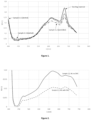
- Figure 1.
- Reference example with sodium dithionite. The ratio k/s calculated from reflectance using D65/10.
- Figure 2.
- The effect of CMC in white liquor. The ratio k/s calculated from reflectance as described using D65/10.
- Figure 3.
- The effect of different levels of addition of CMC using white liquor (D65/10).
- Figure 4.
- The effect of different levels of addition of CMC using NaOH (D65/10).
- Figure 5.
- Effect of different types of CMC in decoloring a dyed textile mixture using white liquor with and without CMC. The ratio k/s calculated from reflectance using D65/10.
- Figure 6.
- Effect of added CMC in decoloring a dark blue pigmented textile using white liquor as alkali source. The ratio k/s calculated from reflectance using D65/10.
- Figure 7.
- Effect of added CMC in decoloring a dark blue pigmented textile comparing NaOH and white liquor (WL) as alkali source. The ratio k/s calculated from reflectance using D65/10.
- Figure 8.
- Effect of added CMC in decoloring a blue denim textile using white liquor with and without CMC. The ratio k/s calculated from reflectance using D65/10.
- Figure 9.
- Effect of added CMC in decoloring a dyed textile mixture using white liquor with and without CMC. The ratio k/s calculated from reflectance using D65/10.
- In the following it will, for instance, be described some experiments showing the effects of the decoloring method as disclosed herein.
- A polycotton bed sheet (polyester and cotton) with printed blue parts (lines) was separated into a blue-enriched fraction (by cutting out these parts). The samples were mechanically disintegrated and treated with an aqueous solution of sodium dithionite at two different pH-levels together with a reference without dithionite addition (Sample 1.3). To the sample with low pH sodium acetate, 5 g/l, was added, and to the sample with high pH sodium carbonate, 5 g/l, was added. This experiment was performed as a reference experiment since sodium dithionite is commonly used for removing color from textiles.
- The treatments were performed using 5 g (dry) of textile material and a liquor to textile ratio of 40:1 liter/kg and with an addition of sodium dithionite of 2.5 % on textile weight. The temperature during the treatments were 70°C and the duration was 60 minutes. The samples were washed with water and the optical properties were evaluated using a Minolta Spectrophotometer CM-3630. The samples used for optical evaluation were prepared according to ISO 36:88. The reflectance values over the measured wavelengths (360-740 nm with spatial resolution of 10 nm) were used as such but also converted to the ratio between the light absorption coefficient (k) and the light scattering coefficient (s) using the Kubelka-Munk relation k/s=(1-R∞)2/2/R∞. The benefit of recalculating to k/s is that this ratio is linearly correlated to the chromophore concentration (at the same s) which the reflectance is not. Also, the CIELAB Lab-values give important information on color and were determined. In some cases, the C/2 illuminant/observer is used (ISO-brightness etc.) but in other cases it is interesting to look at the D65-values especially in relation to fluorescent structures like optical brightening agents (due to higher amount of UV-radiation in D compared to C illuminant). The experimental details and results can be seen in Table 1. Treatment with dithionite is clearly inefficient for removing the color from the textiles.
Table 1. Experimental overview and results for Example 1. The optical properties reported were measured using C/2 illuminant and observer. Material pH Sodium dithionite R457 (%) L* a* b* Starting material Enriched blue - - 71.58 82.38 -7.14 -9.06 Sample 1.1 Enriched blue 5.95 YES 72.18 82.29 -6.47 -9.72 Sample 1.2 Enriched blue 10.65 YES 72.96 82.84 -5.80 -9.44 Sample 1.3 Enriched blue 6.30 NO 70.56 82.12 -6.80 -8.66 - Based on the effect on brightness (R457) and L*a*b*-values the treatments are almost without effect. When looking at the UV-VIS-absorption using k/s (
Figure 1 ) there is a very small effect in the visible region at longer wavelengths. The reference treatment with water is as efficient as the treatment with dithionite at lower pH but the treatment at pH 10.65 gives an additional small benefit compared to the others. - The same material, "enriched blue", was treated in autoclaves in a hot-air oven (CAS 420 Autoclave Oven, manufactured by CRS Reactor Engineering AB, Sweden, equipped with acid resistant steel 1.4433 autoclaves, with a volume of 3 liters each). The following procedure was applied: 100 g (dry) textile material was added to an alkaline aqueous solution containing 0 or 1 % CMC (carboxymethyl cellulose) on textile weight in the form of Blanose 7MC (Ashland Inc.), with a liquor:textile=9:1 (kg/kg) and an effective alkali addition of 34.5 % based on textile weight (diluted industrial white liquor; EA=38.3 g/l, sulfidity=34%). The heating from 25 °C to 70 °C was performed at a constant rate of 0.75 °C/min. After 15 minutes stabilization of the temperature at 70 °C, the temperature was raised with 0.75 °C/min to the final temperature of 140 °C and holding time at maximum temperature=60 minutes. After cooling the samples were washed thoroughly with deionized water, see results in Table 2. The optical properties were evaluated as in Example 1.
Table 2. Results for Example 2. The optical properties are measured using C/2 illuminant and observer. Material CMC R457 (%) L* a* b* Starting material Enriched blue 71.58 82.38 -7.14 -9.06 Sample 2.1 Enriched blue NO 87.53 93.96 -1.63 -1.77 Sample 2.2 Enriched blue YES 89.24 95.35 -1.18 -0.6 - The effect of CMC is further exemplified in
Figure 2 . The reference is still clearly blue, but when CMC is added the k/s- ratio is decreased, showing much more color removal. - The same "blue-enriched" material used in Example 1 were used in Example 2 and the k/s-ratios of the recovered material after treatment using dithionite in Example 1, is at least an order of magnitude larger than those reported for the alkaline treatment in combination with CMC.
- To further investigate the effect of CMC another sample of "blue-enriched polycotton" was used with different addition levels of CMC (Blanose 7MC) was tried (0.1; 0.5 and 1 % on textile weight). The experiment was performed according to the method in Example 2 and the optical properties evaluated according to the method in Example 1.
Table 3. Results for Example 3. WL stands for industrial white liquor. The optical properties reported were measured using C/2 illuminant and observer. CMC (% on textile weight R457 (%) L* a* b* Starting material 76.41 86.65 -3.5 -5.76 Sample 3.1 0 88.56 94.14 -1.29 -2.24 Sample 3.2 0.1 89.94 95.24 -0.68 -1.31 Sample 3.3 0.5 90.10 95.47 -0.51 -1.02 Sample 3.4 1 90.61 95.53 -0.47 -1.29 - As can be seen in
Figure 3 , the addition of such a small amount of CMC as 0.1 % based on textile weight gives a large effect, there is a larger effect at 0.5 %, but 1 % does only improve the blue pigment removal to a very low degree in the short wavelengths. This show that only a rather small amount of CMC is needed to reach maximum effect. - To further investigate the effect of CMC (Blanose 7MC) in combination with NaOH, the same material as in Example 3, consisting of "blue-enriched polycotton" was used. Apart from the fact that the alkali source was pure NaOH the experiments were performed according to Example 2 and the results evaluated according to Example 1.
Table 4. Results for Example 4. The optical properties reported were measured using C/2 illuminant and observer. CMC (% on textile weight R457 (%) L* a* b* Starting material 76.41 86.65 -3.5 -5.76 Sample 4.1 0 87.72 92.95 -1.94 -3.64 Sample 4.2 1 88.70 93.67 -1.39 -3.10 - The effect of CMC is clear also in combination with pure NaOH and this is also made visual in
Figure 4 , where the k/s-ratio is shown for pure NaOH with and without addition of CMC. - Different types of CMC have different molecular weights and different degrees of substitution (DS). This influences the solubility and dispersing ability mainly due to differences in charge density. To investigate the effect of different CMC types, the following trials on another batch of "enriched blue polycotton textile" were performed. The experiment was performed according to the method in Example 2 but with 30 g (dry) textile material and the optical properties evaluated according to the method in Example 1. Commercial CMC grades Blanose 7LC, Blanose 7MC, Blanose 7HC from Ashland were tried together with Nymcel ZSB-10 from Noviant/CP Kelco and Niklacell P70 UC from Mare. The samples named Blanose have a degree of substitution at 0.65-0.9 with varying molecular weights (L=low molecular weight, M=medium molecular weight and H=high molecular weight). Nymcel ZSB-10 has a low degree of substitution (DS=0.2) with medium molecular weight and Niklacell P70 UC a degree of substitution of 0.5-0.65, with medium to high molecular weight. The results are summarized in Table 5 and show that all of the different types of CMC are effective in removing color.
Table 5. Results for Example 5. The optical properties reported were measured using C/2 illuminant and observer. CMC R457 (%) Line in Figure 5 Sample 5.1 Blanose 7LC 83.70 - · - · - Sample 5.2 Blanose 7MC 84.00 - · · - · Sample 5.3 Blanose 7HC 81.81 - - - - - Sample 5.4 Nymcel 84.01 - - - Sample 5.5 Niklacell P70 UC 84.91 ················· Sample 5.6 No CMC, WL 79.93 - - The beneficial effect of CMC is seen for all types of tested CMC with small differences between them. The highest effect is seen with Niklacell P70 UC and the smallest effect with Blanose 7HC with the remaining three in between but closer to Niklacell P70 UC.
- To exemplify the effect of the treatment on pigment-colored textiles an Example of a commercial pigmented cotton shirt was procured (Stenströms Navy Pigment Dyed Polo Shirt, Art nr: 4400112480190), mechanically disintegrated, and treated according to the procedure in Example 2, but with 40 g (dry) textile material.
- After the treatment the resulting material was washed, and the optical properties evaluated according to the method in Example 1. As can be seen in Table 6 and
Figures 6 , a clear beneficial effect of the added CMC was noted. InFigure 7 the addition of HS- in the WL show an improved effect compared to when only treating the textile with pure NaOH.Table 6. Results for Example 6. The optical properties reported were measured using C/2 illuminant and observer. Material CMC Alkali R457 (%) L* a* b* Sample 6.1 Untreated Dark blue - - 8.72 27.30 0.21 -13.93 Sample 6.2 Dark blue NO WL 82.43 94.31 0.35 2.71 Sample 6.3 Dark blue YES WL 83.02 94.56 0.40 2.70 Sample 6.4 Dark blue YES NaOH 79.92 93.42 0.14 3.17 - In order to investigate the influence of the treatment on textile colored by other dyes than pigments a denim textile and a mixture of many common and dyed textiles were treated with white liquor with and without CMC. The same procedure as in Example 2 was used to treat the samples, but with 40g (dry) textile material, and the analysis of the optical properties was performed according to the procedure in Example 1. As can be seen in
Figures 8 and9 the effect of CMC is significant and positive also for these colored materials.Table 7. Sample list for Example 7. The optical properties reported were measured using C/2 illuminant and observer. Material CMC R457 (%) Starting material Denim 18.37 Sample 7.1 Denim NO 23.40 Sample 7.2 Denim YES 26.57 Starting material Mixture 8.72 Sample 7.3 Mixture NO 19.33 Sample 7.4 Mixture YES 20.63 - In one example the decoloring method as disclosed herein forms part of a method for recycling of reclaimed textile material. The recycling method may additionally provide for separation and recovery of a cellulosic part from a material blend of polyester and cellulose, making use of CMC so as to provide for decoloring.
- In this exemplified process the following apply:
- Textile material: a mix of reclaimed textile material including around 50% polyester and around 50% cotton; a portion of the textile material to be treated is colored;
- Mechanical treatment for disintegration of the textile material
- Volume of alkaline aqueous solution in relation to dry weight of textile material: 9:1 (i.e. 9 l/kg);
- Concentration of certain species in the alkaline solution: effective alkali concentration (NaOH): 38 g/l; sulfidity S (%) 36%;
CMC 1% (weight) in relation to the dry weight of the textile material; - The alkali used in the treatment originates from white liquor obtained from a Kraft pulp process;
- The process/method includes a step of adding CMC to the alkaline solution so as to obtain the desired concentration.
- The temperature during treatment of the textile material in the alkaline solution containing CMC is adjusted to around 140°C.
- The treatment period can be adapted to the particular situation, but in a typical industrial situation the temperature is maintained at 140°C for 1-2 hours.
- After the treatment period, the recovered fibers are separated from the treatment solution.
- The process/method may also include additional cleaning and/or purification process steps for handling of the recovered cellulose-containing textile material, such as bleaching of a recovered cellulosic part, washing, screening and adjustment of a degree of polymerization of the recovered cellulosic part, and drying.
- The recovered cellulose-containing textile material can be used to produce molded bodies, such as fibers, to produce new textile material.
- Various variations of the above example are possible. For instance, the aqueous treatment solution may be a mix of white and black liquor obtained from the Kraft pulp process. Moreover, instead of obtaining the alkaline solution from a Kraft pulp process, it is possible to obtain the alkaline solution by dissolution of sodium hydroxide and sodium sulfide salts. Further, as an alternative or complement to CMC, the solution may contain one or more other polyelectrolyte(s). Also, other concentrations of the species in the alkaline solution may be used and e.g., treatment temperature and time can be varied and adjusted to the particular application.
- The invention is not limited by the embodiments described above but can be modified in various ways within the scope of the claims.
Claims (18)
- Method for decoloring of a textile material,
the method comprising the steps of:- providing a textile material, at least a portion of the textile material being colored;- providing an alkaline solution containing one or more anionic polyelectrolytes;- treating the textile material in the alkaline solution during a treatment period of at least 10 minutes at a temperature in the range of from 100°C to 180°C; and- recovering at least some of the textile material from the alkaline solution after the treatment period. - Method according to claim 1, wherein the one or more anionic polyelectrolytes is/are selected from the group: carboxymethyl cellulose (CMC); carboxyalkyl ethers of cellulose, starch, amylose, amylopectin and/or natural gums; polyacrylic acid; polymaleic acid; acrylic acid maleic acid copolymer; polymethacrylic acid; polymers of naphthalene sulfonic acids; sulfonated polystyrene; and polyethylene sulfonate.
- Method according to claim 1 or 2, wherein the one or more anionic polyelectrolytes has a concentration in the alkaline solution of at least 0.01% (weight), or at least 0.05% (weight), or at least 0.1% (weight), in relation to a dry weight of the textile material.
- Method according to claim 3, wherein the one or more anionic polyelectrolytes has a concentration in the alkaline solution of 1.5% (weight) or less, or 1.2% (weight) or less, or 1.0% (weight) or less.
- Method according to any one of the preceding claims, wherein the one or more anionic polyelectrolytes comprises carboxymethyl cellulose (CMC) and wherein the concentration of carboxymethyl cellulose (CMC) in the alkaline solution is at least 0.01% (weight), or at least 0.05% (weight), or at least 0.1 % (weight), in relation to a dry weight of the textile material.
- Method according to any one of the preceding claims, wherein the alkaline solution has a pH above 11, or above 12, or above 13.
- Method according to any one of the preceding claims, wherein the alkaline solution has a basicity corresponding to at least 0.2 g, or at least 0.4 g, or at least 1 g, dissolved sodium hydroxide (NaOH) per liter of the solution.
- Method according to any one of the preceding claims, wherein the alkaline solution has an effective alkali (EA) concentration of at least 0.2 g, or at least 0.4 g, or at least 1 g, calculated as sodium hydroxide (NaOH) equivalents.
- Method according to any one of the preceding claims, wherein the alkaline solution contains sulfide.
- Method according to claim 8, wherein the alkaline solution has a sulfidity S (%) of at least 1%, or at least 5%, wherein the sulfidity is calculated as S (%) = 100 x (weight of Na2S)/(total weight of NaOH + Na2S).
- Method according to any one of claims 9 or 10, wherein the alkaline solution has a total content of sulfide that is at least 0.01 g, or at least 0.1 g, per liter.
- Method according to any one of the preceding claims, wherein the alkaline solution contains industrial white liquor.
- Method according to any one of the preceding claims, wherein the treatment period is at least 30 min.
- Method according to any one of the preceding claims, wherein the alkaline solution has, at least during a portion of the treatment period, a temperature in the range of 110 °C -180°C, preferably in the range of 120°C - 170°C, and more preferably in the range of 120°C to 150°C.
- Method according to any one of the preceding claims, wherein the textile material comprises cellulosic fibers and/or polyester fibers.
- Method according to any one of the preceding claims, wherein the method comprises the step of mechanically disintegrating the textile material before treating it in the alkaline solution.
- Method for recycling of a textile material, wherein the method comprises steps according to any one of the preceding claims.
- Textile material recovered from a method according to any one of the preceding claims.
Applications Claiming Priority (2)
| Application Number | Priority Date | Filing Date | Title |
|---|---|---|---|
| SE2150245A SE545212C2 (en) | 2021-03-04 | 2021-03-04 | Method for treatment of a textile material in an alkaline solution containing one or more anionic polyelectrolytes |
| PCT/SE2022/050204 WO2022186754A1 (en) | 2021-03-04 | 2022-02-28 | Method for decoloring of a textile material |
Publications (3)
| Publication Number | Publication Date |
|---|---|
| EP4301570A1 EP4301570A1 (en) | 2024-01-10 |
| EP4301570C0 EP4301570C0 (en) | 2025-04-23 |
| EP4301570B1 true EP4301570B1 (en) | 2025-04-23 |
Family
ID=80628996
Family Applications (1)
| Application Number | Title | Priority Date | Filing Date |
|---|---|---|---|
| EP22707914.2A Active EP4301570B1 (en) | 2021-03-04 | 2022-02-28 | Method for decoloring of a textile material |
Country Status (10)
| Country | Link |
|---|---|
| US (1) | US12247348B2 (en) |
| EP (1) | EP4301570B1 (en) |
| CN (1) | CN116917103A (en) |
| BR (1) | BR112023017903A2 (en) |
| CA (1) | CA3211060A1 (en) |
| CL (1) | CL2023002622A1 (en) |
| ES (1) | ES3035472T3 (en) |
| SE (1) | SE545212C2 (en) |
| WO (1) | WO2022186754A1 (en) |
| ZA (1) | ZA202308076B (en) |
Family Cites Families (20)
| Publication number | Priority date | Publication date | Assignee | Title |
|---|---|---|---|---|
| US3377234A (en) * | 1963-09-05 | 1968-04-09 | Garden State Paper Co Inc | De-inking printed waste cellulosic stock utilizing an admixture of alkyl sulfates and alkyl aryl sulfonates |
| US3644081A (en) * | 1967-03-07 | 1972-02-22 | Asahi Chemical Ind | Process for the treatment of polyester fiberous materials |
| US4007305A (en) * | 1974-12-23 | 1977-02-08 | Basf Wyandotte Corporation | Method of imparting nondurable soil release and soil repellency properties to textile materials |
| SU1502671A1 (en) * | 1987-04-23 | 1989-08-23 | Уральский филиал Всесоюзного научно-исследовательского и проектного института химической промышленности | Bleaching composition |
| US5211809A (en) * | 1991-05-21 | 1993-05-18 | Air Products And Chemicals, Inc,. | Dye removal in oxygen color stripping of secondary fibers |
| EP0687759A1 (en) * | 1994-06-13 | 1995-12-20 | David Wing Bong Wong | Method and apparatus for mechanically abrading fabric |
| JPH0913287A (en) * | 1995-06-22 | 1997-01-14 | Kouritsu:Kk | Production of cloth of discharged style pattern or its sewed product |
| BR9808557A (en) * | 1997-04-17 | 2000-05-23 | Novo Nordisk Biochem Inc | Process for stamping by enzymatic discharge. |
| CA2261303C (en) * | 1998-02-06 | 2008-10-07 | Solutia Inc. | Method for removing color from ionically dyeable polymeric materials |
| US6217621B1 (en) | 1999-07-09 | 2001-04-17 | Morton International Inc. | Textile substrate dye stripping |
| US8133351B2 (en) * | 2008-07-09 | 2012-03-13 | Nalco Company | Deinking a cellulosic substrate using magnesium hydroxide |
| CN102493247A (en) * | 2011-12-14 | 2012-06-13 | 中冶美利浆纸有限公司 | Application of book paper to wastepaper deinking instead of office wastepaper |
| JP2017504694A (en) * | 2014-01-06 | 2017-02-09 | リライアンス、インダストリーズ、リミテッドReliance Industries Limited | Polyester recovery process |
| CN105852714B (en) * | 2016-04-29 | 2018-11-09 | 华南再生棉纱(梧州)有限公司 | The method for producing bath towel using textile waste |
| CN106065541B (en) * | 2016-08-04 | 2017-11-17 | 湖北金民纤维材料科技有限公司 | A kind of wastepaper deinking agent and preparation technology |
| CN106905445B (en) * | 2017-03-30 | 2019-02-26 | 广州振清环保技术有限公司 | A kind of Polyaminated chitosan decolorising agent of carboxymethyl-and its preparation method and application |
| EP3412826A1 (en) * | 2017-06-09 | 2018-12-12 | Acticell GmbH | Treatment of dyed material |
| AU2019206607B2 (en) * | 2018-01-12 | 2024-05-23 | Circ, Inc. | Methods for recycling cotton and polyester fibers from waste textiles |
| SE542172C2 (en) | 2018-07-13 | 2020-03-10 | Soedra Skogsaegarna Ekonomisk Foerening | Process for separation |
| EP3770208B1 (en) * | 2019-07-24 | 2024-02-07 | Smart Coloring GmbH | Method for decolorizing a colored synthetic or non-synthetic polar-polymer material |
-
2021
- 2021-03-04 SE SE2150245A patent/SE545212C2/en unknown
-
2022
- 2022-02-28 BR BR112023017903A patent/BR112023017903A2/en unknown
- 2022-02-28 CA CA3211060A patent/CA3211060A1/en active Pending
- 2022-02-28 ES ES22707914T patent/ES3035472T3/en active Active
- 2022-02-28 WO PCT/SE2022/050204 patent/WO2022186754A1/en not_active Ceased
- 2022-02-28 CN CN202280018926.6A patent/CN116917103A/en active Pending
- 2022-02-28 US US18/548,590 patent/US12247348B2/en active Active
- 2022-02-28 EP EP22707914.2A patent/EP4301570B1/en active Active
-
2023
- 2023-08-21 ZA ZA2023/08076A patent/ZA202308076B/en unknown
- 2023-09-04 CL CL2023002622A patent/CL2023002622A1/en unknown
Also Published As
| Publication number | Publication date |
|---|---|
| CL2023002622A1 (en) | 2024-03-15 |
| US20240044069A1 (en) | 2024-02-08 |
| BR112023017903A2 (en) | 2023-10-31 |
| CN116917103A (en) | 2023-10-20 |
| SE545212C2 (en) | 2023-05-23 |
| ZA202308076B (en) | 2025-11-26 |
| ES3035472T3 (en) | 2025-09-03 |
| US12247348B2 (en) | 2025-03-11 |
| SE2150245A1 (en) | 2022-09-05 |
| EP4301570C0 (en) | 2025-04-23 |
| WO2022186754A1 (en) | 2022-09-09 |
| CA3211060A1 (en) | 2022-09-09 |
| EP4301570A1 (en) | 2024-01-10 |
Similar Documents
| Publication | Publication Date | Title |
|---|---|---|
| EP3789406B1 (en) | Recycling of cellulosic textiles | |
| CN105765116B (en) | Method for pretreating recovered cotton fibers for the production of shaped bodies from regenerated cellulose | |
| US10023995B2 (en) | Process and a dissolving pulp manufactured by the process | |
| CN112585204A (en) | Process for separating a cellulosic fraction from a polyester and cellulosic composition | |
| EP4144785B1 (en) | A method of recycling textile waste cellulose | |
| CN115125751A (en) | A clean and efficient method for preparing cotton pulp from waste cotton textiles | |
| SE538752C2 (en) | Process for the production of a treated pulp, treated pulp, and textile fibres produced from the treated pulp | |
| Chattopadhyay et al. | Printing of jute fabric with natural dyes extracted from manjistha, annatto and ratanjot | |
| US5234544A (en) | Cleaning and bleaching of secondary fiber | |
| Hickman | Environmental aspects of textile processing | |
| Jin et al. | Evaluating an enzyme treatment of ramie fabrics | |
| Diab et al. | Alternative Eco-friendly treatment of Hollow cellulosic Fiber-Based hybrid composites for remarkable reactive dyeing | |
| US12247348B2 (en) | Method for decoloring of a textile material | |
| JP4989917B2 (en) | Pulp manufacturing method | |
| Koo et al. | Preparation and properties of chemical cellulose from ascidian tunic and their regenerated cellulose fibers | |
| Kindole et al. | Effect of alkali treatment on the chemical composition and dyeability of sisal fibers | |
| CN119630851A (en) | System for decolorization of cellulose containing materials | |
| WO2026093434A1 (en) | Method for recovering cellulose from a dyed cellulose containing textile raw material | |
| Bar et al. | Pretreatment and dyeability analysis of cotton and novel Bauhinia vahlii fiber | |
| KR100785827B1 (en) | Eco-friendly towel using enzyme refining and its manufacturing method | |
| Dessie et al. | Reactive dyeing of cotton without use of salt by cationization with amino acid derived from natural protein of soya bean hull | |
| Koralage | FINIX workwear study-Identification of the Cellulose Material Changes in the course of the Chemical Recycling of Workwear | |
| FI131312B1 (en) | Method of processing cellulosic waste material and decolourized material thus obtained | |
| CN113338067B (en) | Environment-friendly color series household paper and preparation method thereof | |
| Bar et al. | Discover Materials |
Legal Events
| Date | Code | Title | Description |
|---|---|---|---|
| STAA | Information on the status of an ep patent application or granted ep patent |
Free format text: STATUS: UNKNOWN |
|
| STAA | Information on the status of an ep patent application or granted ep patent |
Free format text: STATUS: THE INTERNATIONAL PUBLICATION HAS BEEN MADE |
|
| PUAI | Public reference made under article 153(3) epc to a published international application that has entered the european phase |
Free format text: ORIGINAL CODE: 0009012 |
|
| STAA | Information on the status of an ep patent application or granted ep patent |
Free format text: STATUS: REQUEST FOR EXAMINATION WAS MADE |
|
| 17P | Request for examination filed |
Effective date: 20230904 |
|
| AK | Designated contracting states |
Kind code of ref document: A1 Designated state(s): AL AT BE BG CH CY CZ DE DK EE ES FI FR GB GR HR HU IE IS IT LI LT LU LV MC MK MT NL NO PL PT RO RS SE SI SK SM TR |
|
| DAV | Request for validation of the european patent (deleted) | ||
| DAX | Request for extension of the european patent (deleted) | ||
| GRAP | Despatch of communication of intention to grant a patent |
Free format text: ORIGINAL CODE: EPIDOSNIGR1 |
|
| STAA | Information on the status of an ep patent application or granted ep patent |
Free format text: STATUS: GRANT OF PATENT IS INTENDED |
|
| INTG | Intention to grant announced |
Effective date: 20241115 |
|
| GRAS | Grant fee paid |
Free format text: ORIGINAL CODE: EPIDOSNIGR3 |
|
| GRAA | (expected) grant |
Free format text: ORIGINAL CODE: 0009210 |
|
| STAA | Information on the status of an ep patent application or granted ep patent |
Free format text: STATUS: THE PATENT HAS BEEN GRANTED |
|
| AK | Designated contracting states |
Kind code of ref document: B1 Designated state(s): AL AT BE BG CH CY CZ DE DK EE ES FI FR GB GR HR HU IE IS IT LI LT LU LV MC MK MT NL NO PL PT RO RS SE SI SK SM TR |
|
| REG | Reference to a national code |
Ref country code: GB Ref legal event code: FG4D |
|
| REG | Reference to a national code |
Ref country code: CH Ref legal event code: EP |
|
| REG | Reference to a national code |
Ref country code: DE Ref legal event code: R096 Ref document number: 602022013536 Country of ref document: DE |
|
| REG | Reference to a national code |
Ref country code: IE Ref legal event code: FG4D |
|
| U01 | Request for unitary effect filed |
Effective date: 20250523 |
|
| U07 | Unitary effect registered |
Designated state(s): AT BE BG DE DK EE FI FR IT LT LU LV MT NL PT RO SE SI Effective date: 20250603 |
|
| REG | Reference to a national code |
Ref country code: ES Ref legal event code: FG2A Ref document number: 3035472 Country of ref document: ES Kind code of ref document: T3 Effective date: 20250903 |
|
| PG25 | Lapsed in a contracting state [announced via postgrant information from national office to epo] |
Ref country code: NO Free format text: LAPSE BECAUSE OF FAILURE TO SUBMIT A TRANSLATION OF THE DESCRIPTION OR TO PAY THE FEE WITHIN THE PRESCRIBED TIME-LIMIT Effective date: 20250723 Ref country code: GR Free format text: LAPSE BECAUSE OF FAILURE TO SUBMIT A TRANSLATION OF THE DESCRIPTION OR TO PAY THE FEE WITHIN THE PRESCRIBED TIME-LIMIT Effective date: 20250724 |
|
| PG25 | Lapsed in a contracting state [announced via postgrant information from national office to epo] |
Ref country code: PL Free format text: LAPSE BECAUSE OF FAILURE TO SUBMIT A TRANSLATION OF THE DESCRIPTION OR TO PAY THE FEE WITHIN THE PRESCRIBED TIME-LIMIT Effective date: 20250423 |
|
| PG25 | Lapsed in a contracting state [announced via postgrant information from national office to epo] |
Ref country code: HR Free format text: LAPSE BECAUSE OF FAILURE TO SUBMIT A TRANSLATION OF THE DESCRIPTION OR TO PAY THE FEE WITHIN THE PRESCRIBED TIME-LIMIT Effective date: 20250423 |
|
| PG25 | Lapsed in a contracting state [announced via postgrant information from national office to epo] |
Ref country code: RS Free format text: LAPSE BECAUSE OF FAILURE TO SUBMIT A TRANSLATION OF THE DESCRIPTION OR TO PAY THE FEE WITHIN THE PRESCRIBED TIME-LIMIT Effective date: 20250723 |
|
| PG25 | Lapsed in a contracting state [announced via postgrant information from national office to epo] |
Ref country code: IS Free format text: LAPSE BECAUSE OF FAILURE TO SUBMIT A TRANSLATION OF THE DESCRIPTION OR TO PAY THE FEE WITHIN THE PRESCRIBED TIME-LIMIT Effective date: 20250823 |
|
| PG25 | Lapsed in a contracting state [announced via postgrant information from national office to epo] |
Ref country code: SM Free format text: LAPSE BECAUSE OF FAILURE TO SUBMIT A TRANSLATION OF THE DESCRIPTION OR TO PAY THE FEE WITHIN THE PRESCRIBED TIME-LIMIT Effective date: 20250423 |
|
| PG25 | Lapsed in a contracting state [announced via postgrant information from national office to epo] |
Ref country code: SK Free format text: LAPSE BECAUSE OF FAILURE TO SUBMIT A TRANSLATION OF THE DESCRIPTION OR TO PAY THE FEE WITHIN THE PRESCRIBED TIME-LIMIT Effective date: 20250423 |
|
| PLBE | No opposition filed within time limit |
Free format text: ORIGINAL CODE: 0009261 |
|
| STAA | Information on the status of an ep patent application or granted ep patent |
Free format text: STATUS: NO OPPOSITION FILED WITHIN TIME LIMIT |
|
| REG | Reference to a national code |
Ref country code: CH Ref legal event code: L10 Free format text: ST27 STATUS EVENT CODE: U-0-0-L10-L00 (AS PROVIDED BY THE NATIONAL OFFICE) Effective date: 20260304 |
|
| U20 | Renewal fee for the european patent with unitary effect paid |
Year of fee payment: 5 Effective date: 20260219 |
|
| 26N | No opposition filed |
Effective date: 20260126 |
|
| PGFP | Annual fee paid to national office [announced via postgrant information from national office to epo] |
Ref country code: TR Payment date: 20260204 Year of fee payment: 5 |
|
| PGFP | Annual fee paid to national office [announced via postgrant information from national office to epo] |
Ref country code: CZ Payment date: 20260204 Year of fee payment: 5 |