EP4300981A1 - Content preparation devices and methods - Google Patents
Content preparation devices and methods Download PDFInfo
- Publication number
- EP4300981A1 EP4300981A1 EP23178224.4A EP23178224A EP4300981A1 EP 4300981 A1 EP4300981 A1 EP 4300981A1 EP 23178224 A EP23178224 A EP 23178224A EP 4300981 A1 EP4300981 A1 EP 4300981A1
- Authority
- EP
- European Patent Office
- Prior art keywords
- devices
- subset
- content
- components
- dependence
- Prior art date
- Legal status (The legal status is an assumption and is not a legal conclusion. Google has not performed a legal analysis and makes no representation as to the accuracy of the status listed.)
- Pending
Links
Images


Classifications
-
- A—HUMAN NECESSITIES
- A63—SPORTS; GAMES; AMUSEMENTS
- A63F—CARD, BOARD, OR ROULETTE GAMES; INDOOR GAMES USING SMALL MOVING PLAYING BODIES; VIDEO GAMES; GAMES NOT OTHERWISE PROVIDED FOR
- A63F13/00—Video games, i.e. games using an electronically generated display having two or more dimensions
- A63F13/25—Output arrangements for video game devices
- A63F13/26—Output arrangements for video game devices having at least one additional display device, e.g. on the game controller or outside a game booth
-
- G—PHYSICS
- G06—COMPUTING OR CALCULATING; COUNTING
- G06F—ELECTRIC DIGITAL DATA PROCESSING
- G06F3/00—Input arrangements for transferring data to be processed into a form capable of being handled by the computer; Output arrangements for transferring data from processing unit to output unit, e.g. interface arrangements
- G06F3/14—Digital output to display device ; Cooperation and interconnection of the display device with other functional units
-
- H—ELECTRICITY
- H04—ELECTRIC COMMUNICATION TECHNIQUE
- H04N—PICTORIAL COMMUNICATION, e.g. TELEVISION
- H04N21/00—Selective content distribution, e.g. interactive television or video on demand [VOD]
- H04N21/40—Client devices specifically adapted for the reception of or interaction with content, e.g. set-top-box [STB]; Operations thereof
- H04N21/43—Processing of content or additional data, e.g. demultiplexing additional data from a digital video stream; Elementary client operations, e.g. monitoring of home network or synchronising decoder's clock; Client middleware
- H04N21/434—Disassembling of a multiplex stream, e.g. demultiplexing audio and video streams, extraction of additional data from a video stream; Remultiplexing of multiplex streams; Extraction or processing of SI; Disassembling of packetised elementary stream
-
- A—HUMAN NECESSITIES
- A63—SPORTS; GAMES; AMUSEMENTS
- A63F—CARD, BOARD, OR ROULETTE GAMES; INDOOR GAMES USING SMALL MOVING PLAYING BODIES; VIDEO GAMES; GAMES NOT OTHERWISE PROVIDED FOR
- A63F13/00—Video games, i.e. games using an electronically generated display having two or more dimensions
- A63F13/50—Controlling the output signals based on the game progress
- A63F13/53—Controlling the output signals based on the game progress involving additional visual information provided to the game scene, e.g. by overlay to simulate a head-up display [HUD] or displaying a laser sight in a shooting game
- A63F13/537—Controlling the output signals based on the game progress involving additional visual information provided to the game scene, e.g. by overlay to simulate a head-up display [HUD] or displaying a laser sight in a shooting game using indicators, e.g. showing the condition of a game character on screen
-
- H—ELECTRICITY
- H04—ELECTRIC COMMUNICATION TECHNIQUE
- H04N—PICTORIAL COMMUNICATION, e.g. TELEVISION
- H04N21/00—Selective content distribution, e.g. interactive television or video on demand [VOD]
- H04N21/40—Client devices specifically adapted for the reception of or interaction with content, e.g. set-top-box [STB]; Operations thereof
- H04N21/43—Processing of content or additional data, e.g. demultiplexing additional data from a digital video stream; Elementary client operations, e.g. monitoring of home network or synchronising decoder's clock; Client middleware
- H04N21/436—Interfacing a local distribution network, e.g. communicating with another STB or one or more peripheral devices inside the home
- H04N21/43615—Interfacing a Home Network, e.g. for connecting the client to a plurality of peripherals
-
- H—ELECTRICITY
- H04—ELECTRIC COMMUNICATION TECHNIQUE
- H04N—PICTORIAL COMMUNICATION, e.g. TELEVISION
- H04N21/00—Selective content distribution, e.g. interactive television or video on demand [VOD]
- H04N21/40—Client devices specifically adapted for the reception of or interaction with content, e.g. set-top-box [STB]; Operations thereof
- H04N21/45—Management operations performed by the client for facilitating the reception of or the interaction with the content or administrating data related to the end-user or to the client device itself, e.g. learning user preferences for recommending movies, resolving scheduling conflicts
- H04N21/4508—Management of client data or end-user data
Definitions
- the present invention relates to content preparation devices and methods.
- audio content may have been available to users before the development of moving image content, which is now also available to users.
- interactive content is content that is responsive to a user input such as video games.
- the variety of devices capable of reproducing content and the types of content reproducible by individual devices has likewise increased.
- a user may have possessed one device for reproducing audio content such as an MP3 player and another device for playing handheld video games.
- a smartphone for example, which is capable of reproducing audio, image and video game content.
- a user will also now often possess many different types of devices that are similarly able to reproduce a wide variety of types of content. Examples of such devices include smartwatches, smart televisions (smart TVs), smart fridges, personal computers, video game consoles, and tablet displays.
- a method for preparing content is provided in claim 1.
- a content preparation device is provided in claim 15.
- an example of an entertainment system 10 is a computer or console such as the Sony ® PlayStation 5 ® (PS5).
- PS5 Sony ® PlayStation 5 ®
- the entertainment system 10 comprises a central processor 20. This may be a single or multi core processor, for example comprising eight cores as in the PS5.
- the entertainment system also comprises a graphical processing unit or GPU 30.
- the GPU can be physically separate to the CPU, or integrated with the CPU as a system on a chip (SoC) as in the PS5.
- SoC system on a chip
- the entertainment device also comprises RAM 40, and may either have separate RAM for each of the CPU and GPU, or shared RAM as in the PS5.
- the or each RAM can be physically separate, or integrated as part of an SoC as in the PS5.
- Further storage is provided by a disk 50, either as an external or internal hard drive, or as an external solid state drive, or an internal solid state drive as in the PS5.
- the entertainment device may transmit or receive data via one or more data ports 60, such as a USB port, Ethernet ® port, WiFi ® port, Bluetooth ® port or similar, as appropriate. It may also optionally receive data via an optical drive 70.
- data ports 60 such as a USB port, Ethernet ® port, WiFi ® port, Bluetooth ® port or similar, as appropriate. It may also optionally receive data via an optical drive 70.
- Interaction with the system is typically provided using one or more handheld controllers 130, such as the DualSense ® controller in the case of the PS5.
- Audio/visual outputs from the entertainment device are typically provided through one or more A/V ports 90, or through one or more of the wired or wireless data ports 60.
- An example of a device for displaying images output by the entertainment system is a head mounted display 'HMD' 802, worn by a user 800.
- a TV or monitor may be used.
- content would typically be output by one device at a time. Additionally, in a case where content is output by multiple devices, such as a social screen for virtual reality (VR) where content is displayed by both a head mounted display (HMD) and an external display device such as a TV, the same content is displayed by both devices.
- VR virtual reality
- HMD head mounted display
- TV external display device
- multiple devices may be used by one application such as applications that make use of a plurality of smartphones as a controller or input device.
- applications that make use of a plurality of smartphones as a controller or input device.
- each user will be using a different device to display content.
- only one type of device may be used and the type of content displayed on each device is not modifiable, as applications are designed for a specific type of device, such as controllers (smartphones) and one external display monitor or TV for example.
- controllers smarttphones
- TV external display monitor
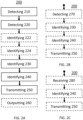
- FIG 2 in an embodiment of the present description, a method 200 for preparing content is provided. It is noted that the dotted outlines of some of the features in figures 2A, 2B, 2C and 4 indicate that these features are optional features.
- the method 200 comprises the steps of detecting 210 a plurality of devices; detecting 220 one or more properties in relation to the plurality of devices; identifying 230 a first subset of the plurality of devices in dependence upon one or more of the detected properties, in which a subset of the plurality of devices comprises one or more devices from the plurality of devices; identifying 240 a first set of one or more components of content in dependence upon the first subset of the devices; and transmitting 250 a respective component of the first set of identified components to a respective device of the first subset of the devices for output by the respective device.
- the plurality of devices may be detected by detecting visible devices on one or more networks such as a local area network (LAN), personal area network (PAN), wide area network (WAN) or the internet. Additionally, one or more of the devices may be detected in dependence upon being previously visible over the networks, even if the previously visible devices are not currently discoverable via the networks. This may enable a reduction in the time required to identify a subset of the devices and a set of components in response to a previously visible and non-discoverable device becoming visible/discoverable over one of the networks.
- networks such as a local area network (LAN), personal area network (PAN), wide area network (WAN) or the internet.
- LAN local area network
- PAN personal area network
- WAN wide area network
- the one or more detected properties may comprise one or more properties selected from the list consisting of:
- the one or more properties may be detected in many ways.
- one or more of the detected properties may be broadcast by one or more of the devices, such as a respective one of the devices broadcasting one or more device properties of the respective device.
- one or more of the detected properties may be detected by using a respective device's name or hardware identifier to consult a database, which may be stored locally or accessed over a network, where the database may comprise one or more device properties for one or more types of device.
- a gaze tracking camera may be used to detect the gaze direction or field of view of a user.
- a first subset of the plurality of devices may be identified in dependence upon at least one of the one or more detected properties.
- An identified subset of devices is the subset of devices from the plurality of devices that are intended to output a component of the content.
- the first subset of the plurality of devices may be identified in dependence upon whether the proximity of a respective one of the devices from the gaze direction of the user is less than a predetermined threshold or whether a respective one or the devices is within the field of view of the user.
- a connection status of a one or more of the plurality of devices may be used to identify the first subset of devices. For example, devices with a poor or unstable connection may be excluded from, or less likely to be included in, the first subset, whilst devices with a strong and stable connection may be included in, or less likely to be excluded from, the first subset.
- the types of input controls, if any, available at a respective one of the devices may be used in identifying whether to include the respective device within the first subset.
- this detected property may be advantageously combined with one or more other detected properties relating to the plurality of devices.
- the types of input controls, if any, available at a respective one of the devices may be considered alongside a proximity of a user to the respective device.
- the three devices in the subset may have a particular type of input control type, such as a touchscreen.
- a touchscreen In this example, seven of the ten devices comprise a touchscreen. However, some of these devices may be out of reach of the user, where the touchscreen controls may not be accessible to the user at the user's current position. Therefore, the three devices that comprise a touchscreen that are closest to the user may be identified as the subset of devices. This is advantageous as it is more likely that the user will be able to access the input controls of the devices identified to be included in the subset.
- the method 200 may further comprise the steps of detecting 270 a change to one or more of the detected properties; and in response to detecting the change to one or more of the detected properties: identifying 230 a second subset of the devices in dependence upon one or more of the changed properties, and identifying 240 a second set of components in dependence upon the identified second subset of the devices; and transmitting 250 a respective component of the second set of identified components to a respective device of the second subset of the devices for output by the respective device.
- a connection status of a particular one of the devices, which is not included in first subset may change from having a poor or unstable connection to having a strong and stable connection.
- a second subset may identified, in which the second subset comprises the particular device not included in the first subset.
- a second set of components may be identified in dependence upon the identified second subset of the devices; and a respective component of the second set of identified components may be transmitted to a respective device of the second subset of the devices for output by the respective device, as described elsewhere herein.
- the gaze direction of a user may change so that a device that was previously not visible to a user becomes visible to a user.
- a second subset of devices may be identified, in which the device that was previously not visible to the user is included in the second subset.
- the threshold relating to a property used for including a device in the subset may be higher once a subset has already been chosen and provided to the user, so that the user only experiences changes to the user interface experience when the overall benefit to them outweigh any inconvenience brought about by the change. Any such modifications in thresholds may be determined empirically. Hence in the case of a connection status, a small improvement in connection may not warrant a change of device subset. By contrast, one device coming into view whilst another falls out of view may clearly meet such a threshold and trigger a change of device set composition.
- the method may further comprise the steps of receiving 280 a user input identifying a third subset of the devices; identifying 240 a third set of components in dependence upon the identified third subset of the devices; and transmitting 250 a respective component of the third set of identified components to a respective device of the third subset of the devices for output by the respective device.
- a user may select a predefined subset of devices from a plurality of subsets of the devices, which may have a corresponding plurality of predefined sets of components of content.
- the user input may identify the third subset of the devices by identifying 230 one or more devices from the plurality of devices, in which the third subset of the devices consists of the one or more devices identified by the user input.
- a first set of one or more components of content may be identified in dependence upon the identified first subset of devices.
- a plurality of sets of one or more components of content may be predefined, by a creator of the content or a user for example, for a plurality of combinations of device types.
- a respective set of components of the content may be associated with a respective combination of device types.
- a device type may categorise particular devices.
- device types may include smartphones, tablets, portable came consoles, televisions, headphones, speakers, smartwatches, HMDs, external displays or any other suitable category of device type.
- a device type may identify properties of a device that are described elsewhere herein, or may identify a manufacturer and/or a model of a device.
- a respective component of a set of one or more components of content may be identified in dependence upon one or more characteristics of a respective device of a corresponding subset of the devices.
- the one or more characteristics of a respective device may comprise one or more characteristics selected from the list consisting of:
- the one or more characteristics of a respective device may be detected in a similar way to the detection of the one or more properties relating to the plurality of device as described elsewhere herein.
- a first predefined set of one or more components of content may be predefined for a first combination of device types, which, in this example, may consist of a smartphone, a television and a smartwatch
- a second predefined set of one or more components of the content may be predefined for a second combination of device types, which may consist of two smartphones and an external display
- other sets of components of the content may be predefined for other combinations of device types. Therefore, when a subset of devices that comprises a smartphone, a television and a smartwatch (i.e. the devices in the first combination of device types) is identified, the first predefined set of one or more components of the content may be identified in dependence upon the identified subset of devices. Similarly, when a subset of devices that comprises two smartphones and an external display (i.e. the devices in the second combination of device types) is identified, the second predefined set of one or more components of the content may be identified in dependence upon the identified subset of devices.
- the step of identifying 240 the first set of components may comprise the steps of identifying 222 a plurality of subsets of the plurality of devices; identifying 224 a plurality of sets of one or more components of the content in dependence upon the plurality of subsets of the devices, in which a respective set of the plurality of sets of components may be identified in dependence upon a respective subset of the plurality of subsets of the devices, in which the respective set of components may correspond to the respective subset of the devices; and identifying 230 the first subset of the devices from the plurality of subsets of the devices in dependence upon one or more of the detected properties, and identifying 240, from the plurality of sets of components, the first set of components corresponding to the identified first subset of the devices.
- a set of one or more components of the content may be identified in dependence upon the identified first subset of the devices and one or more characteristics of the content.
- the one or more characteristics of the content may comprise one or more characteristics selected from the list consisting of:
- Content types may include video games, which may be further categorised into genres such as strategy, shooter or role-playing games, video such as films or TV programs, webpages, which may comprise text and/or images, audio such as music, or any other suitable type of content.
- genres such as strategy, shooter or role-playing games
- video such as films or TV programs
- webpages which may comprise text and/or images, audio such as music, or any other suitable type of content.
- the content is a webpage of a news article comprising text and images
- one component of a set of one or more components may be identified as the text, which may be transmitted to phone for example, and another component may be identified as the images, which may be transmitted to an external display like a TV.
- the content is a video game comprising a heads-up display (HUD)
- HUD heads-up display
- one component of a set of one or more components may be identified as the HUD
- subtitles may be identified as a second component
- the remaining portions of the video game may be identified a third component.
- a set of one or more components of the content may be identified in dependence upon the identified first subset of the devices and one or more characteristics of the content by using the techniques of predefining components of content that are described elsewhere herein.
- An interactivity level of a portion of content may, for example, be defined as “interactive” when a user input can directly modify the portion of content, or "non-interactive" when a user input may not directly modify the portion of content even if the "non-interactive" portion of content may be responsive to a modification of an "interactive" portion of content caused by a user input.
- an "interactive" portion of content may be further categorised in dependence upon how many, or what type of, user input controls may modify the portion of content. Therefore, each component in a set of components of content may correspond to a portion of the content having a different interactivity level to the other portions of the content. This also provides an example of one or more characteristics of the content comprising one or more input controls required by one or more portions of the content
- a respective component of the set may be identified as corresponding to a respective device of the subset of devices in dependence upon the interactivity level of the respective component and the input control types of the respective device.
- components of the content may comprise one or more components selected from the list consisting of:
- Figure 3A illustrates an example of content 310 that may be used with embodiments of the present disclosure.
- figures 3B and 3C illustrate devices 340, 350 that may be used with embodiments of the present disclosure.
- the content 310 may be output for display (e.g. on a television) by a primary device such as the entertainment system 10.
- the primary device may be configured to detect the devices 340, 350, and one or more properties in relation to the devices 340, 350.
- the devices 340, 350 may be detected in dependence upon an association with a user for example.
- the device 340 may be a smartphone associated with the user and the device 350 may be a smartwatch associated with the user.
- the one or more detected properties may comprise, for example, the connection status of each of the devices 340, 350, a proximity of the user to each of the devices 340, 350, and one or more types of input controls present on one or more of the plurality of devices 340, 350.
- the primary device may attempt to connect to each of the devices 340, 350 to detect the connection status of each of the devices 340, 350.
- the primary device may use an imaging sensor to detect the position of the user and, optionally, each of the devices 340, 350 to determine the proximity of each of the devices 340, 350 to the user.
- the primary device may also receive positional data from one or more of the devices 340, 350, which may be generated by a sensor, such as a GPS sensor, on a respective device, in order to detect a proximity of one or more of the devices 340, 350 to the user.
- a sensor such as a GPS sensor
- the primary device 10 may detect that there is a connection available to device 340, but is unable to establish a connection to the device 350. Accordingly, the primary device 10 may, in dependence upon the detected connection status of each of the devices 340, 350, identify a subset of the devices 340, 350, where the subset would comprise the device 340 but not the device 350 in this example.
- the primary device 10 may detect that there is a connection available to both devices 340, 350, but that the device 340 is within a predetermined distance from the user whilst the device 350 is not within the predetermined distance. Accordingly, the primary device 10 may, in dependence upon the detected proximity of the user to each of the devices 340, 350, identify a subset of the devices 340, 350, where the subset would comprise the device 340 but not the device 350 in this example.
- the primary device 10 may identify a set of one or more components of the content 310 in dependence upon the subset of devices.
- the primary device may identify minimap 320 and status bars 330 as a component of the content 310.
- the minimap 320 and the status bars 330 may form a single component of the content even though they are not continuous within the content (i.e. the component may comprise both the minimap 320 and the status bars 330 even when the regions within the content occupied by each of the minimap 320 and the status bars 330 are not connected to each other).
- the primary device 10 may transmit the component comprising the minimap 320 and the status bars 330 to the device 340 for output by the device 340. Meanwhile, the primary device 10 may continue to output the content 310. It should be noted that in some examples, the primary device 10 may output the content 310 without outputting the minimap 320 and the status bars 330 as these may be output by the device 340. However, in other examples, the primary device may output the content including the minimap 320 and the status bars 330, even though the minimap 320 and the status bars 330 are output by the device 340.
- the method may further comprise a step of outputting 260 the content at a primary device of the plurality of devices, in which the steps of identifying 240 a set of one or more components of content in dependence upon a subset of the devices and transmitting 250 a respective component of the set of identified components to a respective device of the subset of the devices for output by the respective device are performed by the primary device.
- the primary device may be entertainment device 10 (or more generally a content source device), which itself may not have an integral display capability but is associated with a primary display such as a television.
- the minimap 320 provides an example of either an interactive or non-interactive Ul element.
- the minimap 320 may be interactive and may, for example, place a waypoint in response to a user input.
- the user may touch a location on the minimap 320 to place a waypoint on the minimap 320 when the minimap 320 is displayed by the device 340.
- the minimap 320 may also be non-interactive and may only be responsive to the content 310.
- the minimap 320 when the minimap 320 is output by the primary device 310, it may be a non-interactive UI element but, when the minimap 320 is transmitted to a device 340 for output by the device 340, the one or more input controls present on the device 340 may enable the minimap 320 to change into an interactive UI element when the minimap 320 is output by the device 340.
- the primary device 10 may detect a property of the device 340 that indicates that the device 340 comprises a touchscreen as an input control type. Therefore, in response to this detection, the primary device 10 may identify a UI element that requires a touchscreen as an input control type, such as the the minimap 320, as a component of the content 310.
- the primary device 10 may also modify an interactivity level of the minimap 320 to enable the minimap 320 to be controlled by a touchscreen, and transmit the minimap 320 to the device 340 for output by the device 340.
- the primary device 10 may detect that both the devices 340, 350 are connected and within a predetermined distance to the user.
- the primary device 10 may identify a subset of devices that comprises both devices 340, 350, and may identify a set of components in dependence upon the identified subset of devices. It should be noted that, whilst only devices 340, 350 are shown in figure 3C , other devices may also be detected by the primary device 10 and also form the plurality of devices along with devices 340, 350.
- the primary device may be transmitting a set of one or more components of the content 310 to a subset of devices comprising the device 340 but not the device 350, as the primary device 10 may have detected that the device 350 is not within a predetermined distance from the user for example.
- the primary device 10 may detect a change to the proximity of the device 350 to the user, and that the device 350 has moved to within a predetermined distance from the user.
- the primary device 10 may identify another subset of devices comprising the device 340 and the device 350, and may identify a second set of components in dependence upon the other subset of devices.
- the primary device may identify the minimap 320 as a component for output by the device 350 in dependence upon, for example, the display resolution of the device 350 and the shape of the minimap, as the minimap may be square in shape whilst the display resolution of the device 350 may indicate that the shape of the display on the device 350 is also square in shape.
- the primary device 10 may identify the status bars 330 as a component for output by the device 340 in dependence upon, for example, a user preference indicating that the user wants the status bars 330 to be displayed by the device 340.
- the primary device 10 may transmit the component comprising the minimap 320 to the device 350 for output by the device 350, and may transmit the component comprising the status bars 330 to the device 340 for output by the device 340.
- components may also be identified from audio data, or a combination of audio and image data.
- one or more image components of a set of components of the video game may be identified from the image data, whilst one or more audio components of the set of components of the video game may be identified from the audio data.
- Example audio components may include the background music of the video game, dialogue audio, sound effect audio, or one or more types of sound effect audio (e.g. the sounds of a horse's hooves may be one type of sound effect audio and the sound of gunfire may be another type).
- a component may comprise both audio and image data. For instance, if a device comprises hardware that is able to output image data and hardware that is able to output audio data, a component comprising both audio and image data may be identified for, and transmitted to, the device.
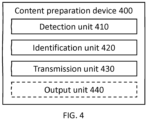
- the content preparation device 400 comprises a detection unit 410 that is configured to detect a plurality of devices associated with a user; the detection unit 410 is configured to detect one or more properties in relation to the plurality of devices; an identification unit 420 that is configured to identify a first subset of the plurality of devices in dependence upon one or more of the detected properties, in which a subset of the plurality of devices comprises one or more devices from the plurality of devices; the identification unit 420 is configured to identify a first set of one or more components of content in dependence upon the first subset of the devices; and a transmission unit 430 that is configured a respective component of the first set of identified components to a respective device of the first subset of the devices for output by the respective device.
- the content preparation device 400 may comprise an output unit 440 that is configured to out the content.
- a computer program comprising computer executable instructions adapted to cause a computer system to perform any of the methods described elsewhere herein.
- a conventional equivalent device may be implemented in the form of a computer program product comprising processor implementable instructions stored on a non-transitory machine-readable medium such as a floppy disk, optical disk, hard disk, solid state disk, PROM, RAM, flash memory or any combination of these or other storage media, or realised in hardware as an ASIC (application specific integrated circuit) or an FPGA (field programmable gate array) or other configurable circuit suitable to use in adapting the conventional equivalent device.
- a computer program may be transmitted via data signals on a network such as an Ethernet, a wireless network, the Internet, or any combination of these or other networks.
Landscapes
- Engineering & Computer Science (AREA)
- Multimedia (AREA)
- Signal Processing (AREA)
- Physics & Mathematics (AREA)
- Theoretical Computer Science (AREA)
- Optics & Photonics (AREA)
- Human Computer Interaction (AREA)
- General Engineering & Computer Science (AREA)
- General Physics & Mathematics (AREA)
- Databases & Information Systems (AREA)
- Two-Way Televisions, Distribution Of Moving Picture Or The Like (AREA)
- Information Transfer Between Computers (AREA)
Abstract
A method for preparing content, the method comprising: detecting a plurality of devices; detecting one or more properties in relation to the plurality of devices; identifying a first subset of the plurality of devices in dependence upon one or more of the detected properties, in which a subset of the plurality of devices comprises one or more devices from the plurality of devices; identifying a first set of one or more components of content in dependence upon the first subset of the devices; and transmitting a respective component of the first set of identified components to a respective device of the first subset of the devices for output by the respective device.
Description
- The present invention relates to content preparation devices and methods.
- Over the years, the types of content available to a user has increased. For example, in the past, audio content may have been available to users before the development of moving image content, which is now also available to users. One type of content that has become increasingly popular is interactive content, which is content that is responsive to a user input such as video games.
- Meanwhile, whilst the types of content available to a user has expanded, the variety of devices capable of reproducing content and the types of content reproducible by individual devices has likewise increased. For example, in the past, a user may have possessed one device for reproducing audio content such as an MP3 player and another device for playing handheld video games. However, in recent times, many users may possess a smartphone for example, which is capable of reproducing audio, image and video game content. Moreover, a user will also now often possess many different types of devices that are similarly able to reproduce a wide variety of types of content. Examples of such devices include smartwatches, smart televisions (smart TVs), smart fridges, personal computers, video game consoles, and tablet displays.
- Due to the variety of the types of content and devices that are now available to users, it is desirable to provide systems and methods for preparing content so that the content may be provided to a user across a subset of the user's devices to advantageously increase the flexibility of how content may be consumed by a user.
- It is in this context that the present disclosure arises.
- In a first aspect, a method for preparing content is provided in
claim 1. - In another aspect, a content preparation device is provided in claim 15.
- Further respective aspects and features of the invention are defined in the appended claims.
- Embodiments of the present invention will now be described by way of example with reference to the accompanying drawings, in which:
-
Figure 1 schematically illustrates an example entertainment system; -
Figures 2A, 2B and 2C schematically illustrate an example method; -
Figures 3A, 3B and 3C illustrate an example of content and example outputs of components of the content; and -
Figure 4 schematically illustrates an example content preparation device. - In the following description, a number of specific details are presented in order to provide a thorough understanding of the embodiments of the present invention. It will be apparent, however, to a person skilled in the art that these specific details need not be employed to practice the present invention. Conversely, specific details known to the person skilled in the art are omitted for the purposes of clarity where appropriate.
- Referring to
Figure 1 , an example of anentertainment system 10 is a computer or console such as the Sony ® PlayStation 5 ® (PS5). - The
entertainment system 10 comprises acentral processor 20. This may be a single or multi core processor, for example comprising eight cores as in the PS5. The entertainment system also comprises a graphical processing unit orGPU 30. The GPU can be physically separate to the CPU, or integrated with the CPU as a system on a chip (SoC) as in the PS5. - The entertainment device also comprises
RAM 40, and may either have separate RAM for each of the CPU and GPU, or shared RAM as in the PS5. The or each RAM can be physically separate, or integrated as part of an SoC as in the PS5. Further storage is provided by adisk 50, either as an external or internal hard drive, or as an external solid state drive, or an internal solid state drive as in the PS5. - The entertainment device may transmit or receive data via one or
more data ports 60, such as a USB port, Ethernet ® port, WiFi ® port, Bluetooth ® port or similar, as appropriate. It may also optionally receive data via anoptical drive 70. - Interaction with the system is typically provided using one or more
handheld controllers 130, such as the DualSense ® controller in the case of the PS5. - Audio/visual outputs from the entertainment device are typically provided through one or more A/
V ports 90, or through one or more of the wired orwireless data ports 60. - Where components are not integrated, they may be connected as appropriate either by a dedicated data link or via a
bus 100. - An example of a device for displaying images output by the entertainment system is a head mounted display 'HMD' 802, worn by a
user 800. Alternatively or in addition, a TV or monitor may be used. - Previously, content would typically be output by one device at a time. Additionally, in a case where content is output by multiple devices, such as a social screen for virtual reality (VR) where content is displayed by both a head mounted display (HMD) and an external display device such as a TV, the same content is displayed by both devices.
- In some cases, multiple devices may be used by one application such as applications that make use of a plurality of smartphones as a controller or input device. In these cases, each user will be using a different device to display content. However, in these cases, only one type of device may be used and the type of content displayed on each device is not modifiable, as applications are designed for a specific type of device, such as controllers (smartphones) and one external display monitor or TV for example. A similar caveat applies to using multiple monitors on a PC.
- Therefore, there is a need to provide a user with a content preparation method and device that may advantageously enable at least a portion of content to be prepared for output by at least a subset of a plurality of (typically different) devices in dependence upon at least one or more properties relating to the plurality of devices.
- Accordingly, turning now to
figure 2 , in an embodiment of the present description, amethod 200 for preparing content is provided. It is noted that the dotted outlines of some of the features infigures 2A, 2B, 2C and4 indicate that these features are optional features. - The
method 200 comprises the steps of detecting 210 a plurality of devices; detecting 220 one or more properties in relation to the plurality of devices; identifying 230 a first subset of the plurality of devices in dependence upon one or more of the detected properties, in which a subset of the plurality of devices comprises one or more devices from the plurality of devices; identifying 240 a first set of one or more components of content in dependence upon the first subset of the devices; and transmitting 250 a respective component of the first set of identified components to a respective device of the first subset of the devices for output by the respective device. - For example, the plurality of devices may be detected by detecting visible devices on one or more networks such as a local area network (LAN), personal area network (PAN), wide area network (WAN) or the internet. Additionally, one or more of the devices may be detected in dependence upon being previously visible over the networks, even if the previously visible devices are not currently discoverable via the networks. This may enable a reduction in the time required to identify a subset of the devices and a set of components in response to a previously visible and non-discoverable device becoming visible/discoverable over one of the networks.
- In some embodiments, the one or more detected properties may comprise one or more properties selected from the list consisting of:
- i) a connection status of one or more of the plurality of devices;
- ii) one or more user preferences identifying one or more of the plurality of devices;
- iii) a proximity of the user to one or more of the plurality of devices;
- iv) a screen size of one or more of the plurality of devices;
- v) a display resolution of one or more of the plurality of devices;
- vi) one or more types of input controls present on one or more of the plurality of devices;
- vii) a gaze direction of the user;
- viii) a field of view of the user; and
- ix) one or more types of output present on one or more of the plurality of devices.
- The one or more properties may be detected in many ways. For example, one or more of the detected properties may be broadcast by one or more of the devices, such as a respective one of the devices broadcasting one or more device properties of the respective device. Alternatively, or in addition, one or more of the detected properties may be detected by using a respective device's name or hardware identifier to consult a database, which may be stored locally or accessed over a network, where the database may comprise one or more device properties for one or more types of device. In the case where one of the properties is a gaze direction or field of view of the user, a gaze tracking camera may be used to detect the gaze direction or field of view of a user.
- In some embodiments, a first subset of the plurality of devices may be identified in dependence upon at least one of the one or more detected properties. An identified subset of devices is the subset of devices from the plurality of devices that are intended to output a component of the content. For example, in a case where one of the detected properties is a gaze direction or a field of view of a user, the first subset of the plurality of devices may be identified in dependence upon whether the proximity of a respective one of the devices from the gaze direction of the user is less than a predetermined threshold or whether a respective one or the devices is within the field of view of the user.
- Alternatively, or in addition, a connection status of a one or more of the plurality of devices may be used to identify the first subset of devices. For example, devices with a poor or unstable connection may be excluded from, or less likely to be included in, the first subset, whilst devices with a strong and stable connection may be included in, or less likely to be excluded from, the first subset.
- Alternatively, or in addition, the types of input controls, if any, available at a respective one of the devices may be used in identifying whether to include the respective device within the first subset. However, this detected property may be advantageously combined with one or more other detected properties relating to the plurality of devices. For example, the types of input controls, if any, available at a respective one of the devices may be considered alongside a proximity of a user to the respective device.
- For example, consider a case where it is desirable to identify, from a set of ten devices, a subset comprising three of the ten devices, and it is desirable for the three devices in the subset to have a particular type of input control type, such as a touchscreen. In this example, seven of the ten devices comprise a touchscreen. However, some of these devices may be out of reach of the user, where the touchscreen controls may not be accessible to the user at the user's current position. Therefore, the three devices that comprise a touchscreen that are closest to the user may be identified as the subset of devices. This is advantageous as it is more likely that the user will be able to access the input controls of the devices identified to be included in the subset.
- In some embodiments, as shown in
figure 2B themethod 200 may further comprise the steps of detecting 270 a change to one or more of the detected properties; and in response to detecting the change to one or more of the detected properties: identifying 230 a second subset of the devices in dependence upon one or more of the changed properties, and identifying 240 a second set of components in dependence upon the identified second subset of the devices; and transmitting 250 a respective component of the second set of identified components to a respective device of the second subset of the devices for output by the respective device. - For example, a connection status of a particular one of the devices, which is not included in first subset, may change from having a poor or unstable connection to having a strong and stable connection. In response to this change, a second subset may identified, in which the second subset comprises the particular device not included in the first subset. A second set of components may be identified in dependence upon the identified second subset of the devices; and a respective component of the second set of identified components may be transmitted to a respective device of the second subset of the devices for output by the respective device, as described elsewhere herein.
- As another example, the gaze direction of a user may change so that a device that was previously not visible to a user becomes visible to a user. In this case, a second subset of devices may be identified, in which the device that was previously not visible to the user is included in the second subset.
- Optionally the threshold relating to a property used for including a device in the subset may be higher once a subset has already been chosen and provided to the user, so that the user only experiences changes to the user interface experience when the overall benefit to them outweigh any inconvenience brought about by the change. Any such modifications in thresholds may be determined empirically. Hence in the case of a connection status, a small improvement in connection may not warrant a change of device subset. By contrast, one device coming into view whilst another falls out of view may clearly meet such a threshold and trigger a change of device set composition.
- Alternatively, or in addition, as shown in
figure 2C , the method may further comprise the steps of receiving 280 a user input identifying a third subset of the devices; identifying 240 a third set of components in dependence upon the identified third subset of the devices; and transmitting 250 a respective component of the third set of identified components to a respective device of the third subset of the devices for output by the respective device. - For example, a user may select a predefined subset of devices from a plurality of subsets of the devices, which may have a corresponding plurality of predefined sets of components of content. Alternatively, or in addition, the user input may identify the third subset of the devices by identifying 230 one or more devices from the plurality of devices, in which the third subset of the devices consists of the one or more devices identified by the user input.
- In some embodiments, a first set of one or more components of content may be identified in dependence upon the identified first subset of devices.
- In some cases, a plurality of sets of one or more components of content may be predefined, by a creator of the content or a user for example, for a plurality of combinations of device types. In these cases, a respective set of components of the content may be associated with a respective combination of device types.
- A device type may categorise particular devices. For example, device types may include smartphones, tablets, portable came consoles, televisions, headphones, speakers, smartwatches, HMDs, external displays or any other suitable category of device type. Alternatively, or in addition, a device type may identify properties of a device that are described elsewhere herein, or may identify a manufacturer and/or a model of a device.
- Additionally, a respective component of a set of one or more components of content may be identified in dependence upon one or more characteristics of a respective device of a corresponding subset of the devices. For example, the one or more characteristics of a respective device may comprise one or more characteristics selected from the list consisting of:
- i) a screen size of the respective device;
- ii) a display resolution of the respective device;
- iii) a user preference identifying the respective device; and
- iv) one or more types of input controls present on the respective device.
- The one or more characteristics of a respective device may be detected in a similar way to the detection of the one or more properties relating to the plurality of device as described elsewhere herein.
- As an example, a first predefined set of one or more components of content may be predefined for a first combination of device types, which, in this example, may consist of a smartphone, a television and a smartwatch, a second predefined set of one or more components of the content may be predefined for a second combination of device types, which may consist of two smartphones and an external display, and other sets of components of the content may be predefined for other combinations of device types. Therefore, when a subset of devices that comprises a smartphone, a television and a smartwatch (i.e. the devices in the first combination of device types) is identified, the first predefined set of one or more components of the content may be identified in dependence upon the identified subset of devices. Similarly, when a subset of devices that comprises two smartphones and an external display (i.e. the devices in the second combination of device types) is identified, the second predefined set of one or more components of the content may be identified in dependence upon the identified subset of devices.
- Therefore, optionally, in some embodiments, the step of identifying 240 the first set of components may comprise the steps of identifying 222 a plurality of subsets of the plurality of devices; identifying 224 a plurality of sets of one or more components of the content in dependence upon the plurality of subsets of the devices, in which a respective set of the plurality of sets of components may be identified in dependence upon a respective subset of the plurality of subsets of the devices, in which the respective set of components may correspond to the respective subset of the devices; and identifying 230 the first subset of the devices from the plurality of subsets of the devices in dependence upon one or more of the detected properties, and identifying 240, from the plurality of sets of components, the first set of components corresponding to the identified first subset of the devices.
- Alternatively, or in addition, a set of one or more components of the content may be identified in dependence upon the identified first subset of the devices and one or more characteristics of the content. The one or more characteristics of the content may comprise one or more characteristics selected from the list consisting of:
- i) a type of content;
- ii) an interactivity level of one or more portions of the content; and
- iii) one or more input controls required by one or more portions of the content.
- Content types may include video games, which may be further categorised into genres such as strategy, shooter or role-playing games, video such as films or TV programs, webpages, which may comprise text and/or images, audio such as music, or any other suitable type of content.
- As an example, if the content is a webpage of a news article comprising text and images, one component of a set of one or more components may be identified as the text, which may be transmitted to phone for example, and another component may be identified as the images, which may be transmitted to an external display like a TV.
- As another example, if the content is a video game comprising a heads-up display (HUD), one component of a set of one or more components may be identified as the HUD, subtitles may be identified as a second component, and the remaining portions of the video game may be identified a third component.
- Alternatively, or in addition, a set of one or more components of the content may be identified in dependence upon the identified first subset of the devices and one or more characteristics of the content by using the techniques of predefining components of content that are described elsewhere herein.
- An interactivity level of a portion of content may, for example, be defined as "interactive" when a user input can directly modify the portion of content, or "non-interactive" when a user input may not directly modify the portion of content even if the "non-interactive" portion of content may be responsive to a modification of an "interactive" portion of content caused by a user input. Additionally, an "interactive" portion of content may be further categorised in dependence upon how many, or what type of, user input controls may modify the portion of content. Therefore, each component in a set of components of content may correspond to a portion of the content having a different interactivity level to the other portions of the content. This also provides an example of one or more characteristics of the content comprising one or more input controls required by one or more portions of the content
- Optionally, a respective component of the set may be identified as corresponding to a respective device of the subset of devices in dependence upon the interactivity level of the respective component and the input control types of the respective device.
- In some embodiments, components of the content may comprise one or more components selected from the list consisting of:
- i) one or more interactive user interface (Ul) elements;
- ii) one or more non-interactive user interface (Ul) elements;
- iii) one or more types of audio;
- iv) one or more user notifications;
- v) one or more portions of textual information; and
- vi) one or more images.
- An example of the above methods will now be discussed with reference to
figures 3A, 3B and 3C. Figure 3A illustrates an example ofcontent 310 that may be used with embodiments of the present disclosure. Meanwhile,figures 3B and 3C illustratedevices - The
content 310 may be output for display (e.g. on a television) by a primary device such as theentertainment system 10. The primary device may be configured to detect thedevices devices devices device 340 may be a smartphone associated with the user and thedevice 350 may be a smartwatch associated with the user. - The one or more detected properties may comprise, for example, the connection status of each of the
devices devices devices devices devices - Meanwhile, the primary device may use an imaging sensor to detect the position of the user and, optionally, each of the
devices devices devices devices - It should be noted that other properties may also be detected in relation to the
devices - In the example of
figure 3B , theprimary device 10 may detect that there is a connection available todevice 340, but is unable to establish a connection to thedevice 350. Accordingly, theprimary device 10 may, in dependence upon the detected connection status of each of thedevices devices device 340 but not thedevice 350 in this example. - Alternatively, the
primary device 10 may detect that there is a connection available to bothdevices device 340 is within a predetermined distance from the user whilst thedevice 350 is not within the predetermined distance. Accordingly, theprimary device 10 may, in dependence upon the detected proximity of the user to each of thedevices devices device 340 but not thedevice 350 in this example. - The
primary device 10 may identify a set of one or more components of thecontent 310 in dependence upon the subset of devices. In the example offigure 3B , the primary device may identifyminimap 320 andstatus bars 330 as a component of thecontent 310. It should be noted that theminimap 320 and thestatus bars 330 may form a single component of the content even though they are not continuous within the content (i.e. the component may comprise both theminimap 320 and thestatus bars 330 even when the regions within the content occupied by each of theminimap 320 and thestatus bars 330 are not connected to each other). - The
primary device 10 may transmit the component comprising theminimap 320 and thestatus bars 330 to thedevice 340 for output by thedevice 340. Meanwhile, theprimary device 10 may continue to output thecontent 310. It should be noted that in some examples, theprimary device 10 may output thecontent 310 without outputting theminimap 320 and thestatus bars 330 as these may be output by thedevice 340. However, in other examples, the primary device may output the content including theminimap 320 and thestatus bars 330, even though theminimap 320 and thestatus bars 330 are output by thedevice 340. - Therefore, in some embodiments, the method may further comprise a step of outputting 260 the content at a primary device of the plurality of devices, in which the steps of identifying 240 a set of one or more components of content in dependence upon a subset of the devices and transmitting 250 a respective component of the set of identified components to a respective device of the subset of the devices for output by the respective device are performed by the primary device. As noted elsewhere herein, the primary device may be entertainment device 10 (or more generally a content source device), which itself may not have an integral display capability but is associated with a primary display such as a television.
- It should also be noted that the
minimap 320 provides an example of either an interactive or non-interactive Ul element. In some cases, theminimap 320 may be interactive and may, for example, place a waypoint in response to a user input. For example, the user may touch a location on theminimap 320 to place a waypoint on theminimap 320 when theminimap 320 is displayed by thedevice 340. However, theminimap 320 may also be non-interactive and may only be responsive to thecontent 310. - In some cases, when the
minimap 320 is output by theprimary device 310, it may be a non-interactive UI element but, when theminimap 320 is transmitted to adevice 340 for output by thedevice 340, the one or more input controls present on thedevice 340 may enable theminimap 320 to change into an interactive UI element when theminimap 320 is output by thedevice 340. For example, theprimary device 10 may detect a property of thedevice 340 that indicates that thedevice 340 comprises a touchscreen as an input control type. Therefore, in response to this detection, theprimary device 10 may identify a UI element that requires a touchscreen as an input control type, such as the theminimap 320, as a component of thecontent 310. Theprimary device 10 may also modify an interactivity level of theminimap 320 to enable theminimap 320 to be controlled by a touchscreen, and transmit theminimap 320 to thedevice 340 for output by thedevice 340. - Moving to the example of
figure 3C , in this example, theprimary device 10 may detect that both thedevices primary device 10 may identify a subset of devices that comprises bothdevices only devices figure 3C , other devices may also be detected by theprimary device 10 and also form the plurality of devices along withdevices - In some cases, the primary device may be transmitting a set of one or more components of the
content 310 to a subset of devices comprising thedevice 340 but not thedevice 350, as theprimary device 10 may have detected that thedevice 350 is not within a predetermined distance from the user for example. However, theprimary device 10 may detect a change to the proximity of thedevice 350 to the user, and that thedevice 350 has moved to within a predetermined distance from the user. In response to the detected change to the proximity of thedevice 350 to the user, theprimary device 10 may identify another subset of devices comprising thedevice 340 and thedevice 350, and may identify a second set of components in dependence upon the other subset of devices. - For example, the primary device may identify the
minimap 320 as a component for output by thedevice 350 in dependence upon, for example, the display resolution of thedevice 350 and the shape of the minimap, as the minimap may be square in shape whilst the display resolution of thedevice 350 may indicate that the shape of the display on thedevice 350 is also square in shape. Similarly, theprimary device 10 may identify thestatus bars 330 as a component for output by thedevice 340 in dependence upon, for example, a user preference indicating that the user wants thestatus bars 330 to be displayed by thedevice 340. - The
primary device 10 may transmit the component comprising theminimap 320 to thedevice 350 for output by thedevice 350, and may transmit the component comprising thestatus bars 330 to thedevice 340 for output by thedevice 340. - It should be noted that whilst the majority of the above description provides example of components being identified from image data, it should be noted that components may also be identified from audio data, or a combination of audio and image data.
- For example, in a case where the content is a video game comprising audio data and image data, one or more image components of a set of components of the video game may be identified from the image data, whilst one or more audio components of the set of components of the video game may be identified from the audio data. Example audio components may include the background music of the video game, dialogue audio, sound effect audio, or one or more types of sound effect audio (e.g. the sounds of a horse's hooves may be one type of sound effect audio and the sound of gunfire may be another type). Additionally, a component may comprise both audio and image data. For instance, if a device comprises hardware that is able to output image data and hardware that is able to output audio data, a component comprising both audio and image data may be identified for, and transmitted to, the device.
- Turning now to
figure 4 , acontent preparation device 400 is provided. Thecontent preparation device 400 comprises adetection unit 410 that is configured to detect a plurality of devices associated with a user; thedetection unit 410 is configured to detect one or more properties in relation to the plurality of devices; anidentification unit 420 that is configured to identify a first subset of the plurality of devices in dependence upon one or more of the detected properties, in which a subset of the plurality of devices comprises one or more devices from the plurality of devices; theidentification unit 420 is configured to identify a first set of one or more components of content in dependence upon the first subset of the devices; and atransmission unit 430 that is configured a respective component of the first set of identified components to a respective device of the first subset of the devices for output by the respective device. - Optionally, in some embodiments, the
content preparation device 400 may comprise anoutput unit 440 that is configured to out the content. - In some embodiments of the present disclosure, a computer program is provided. The computer program comprising computer executable instructions adapted to cause a computer system to perform any of the methods described elsewhere herein.
- It will be appreciated that the above methods may be carried out on conventional hardware (such as the content preparation device 400) suitably adapted as applicable by software instruction or by the inclusion or substitution of dedicated hardware.
- Thus the required adaptation to existing parts of a conventional equivalent device may be implemented in the form of a computer program product comprising processor implementable instructions stored on a non-transitory machine-readable medium such as a floppy disk, optical disk, hard disk, solid state disk, PROM, RAM, flash memory or any combination of these or other storage media, or realised in hardware as an ASIC (application specific integrated circuit) or an FPGA (field programmable gate array) or other configurable circuit suitable to use in adapting the conventional equivalent device. Separately, such a computer program may be transmitted via data signals on a network such as an Ethernet, a wireless network, the Internet, or any combination of these or other networks.
- The foregoing discussion discloses and describes merely exemplary embodiments of the present invention. As will be understood by those skilled in the art, the present invention may be embodied in other specific forms without departing from the spirit or essential characteristics thereof. Accordingly, the disclosure of the present invention is intended to be illustrative, but not limiting of the scope of the invention, as well as other claims. The disclosure, including any readily discernible variants of the teachings herein, defines, in part, the scope of the foregoing claim terminology such that no inventive subject matter is dedicated to the public.
Claims (15)
- A method for preparing content, the method comprising:detecting a plurality of devices;detecting one or more properties in relation to the plurality of devices;identifying a first subset of the plurality of devices in dependence upon one or more of the detected properties, in which a subset of the plurality of devices comprises one or more devices from the plurality of devices;identifying a first set of one or more components of content in dependence upon the first subset of the devices; andtransmitting a respective component of the first set of identified components to a respective device of the first subset of the devices for output by the respective device.
- The method according to claim 1, in which the step of identifying the first set of components comprises:identifying a plurality of subsets of the plurality of devices;identifying a plurality of sets of one or more components of the content in dependence upon the plurality of subsets of the devices, in which a respective set of the plurality of sets of components is identified in dependence upon a respective subset of the plurality of subsets of the devices, in which the respective set of components corresponds to the respective subset of the devices; andidentifying the first subset of the devices from the plurality of subsets of the devices in dependence upon one or more of the detected properties, and identifying, from the plurality of sets of components, the first set of components corresponding to the identified first subset of the devices.
- The method according to any one of the preceding claims, in which the one or more detected properties comprise one or more properties selected from the list consisting of:i) a connection status of one or more of the plurality of devices;ii) one or more user preferences identifying one or more of the plurality of devices;iii) a proximity of the user to one or more of the plurality of devices;iv) a screen size of one or more of the plurality of devices;v) a display resolution of one or more of the plurality of devices;vi) one or more types of input controls present on one or more of the plurality of devices;vii) a gaze direction of the user;viii) a field of view of the user; andix) one or more types of output present on one or more of the plurality of devices.
- The method according to any one of the preceding claims, the method comprising:detecting a change to one or more of the detected properties; andin response to detecting the change to one or more of the detected properties:identifying a second subset of the devices in dependence upon one or more of the changed properties, and identifying a second set of one or more components in dependence upon the identified second subset of the devices; andtransmitting a respective component of the second set of identified components to a respective device of the second subset of the devices for output by the respective device.
- The method according to any one of the preceding claims, in which a respective component of a set of one or more components of content is identified in dependence upon one or more characteristics of a respective device of a corresponding subset of the devices.
- The method according to claim 5, in which the one or more characteristics of a respective device comprise one or more characteristics selected from the list consisting of:i) a screen size of the respective device;ii) a display resolution of the respective device;iii) a user preference identifying the respective device; andiv) one or more types of input controls present on the respective device.
- The method according to any one of the preceding claims, the method further comprising outputting the content at a primary device of the plurality of devices, in which the steps of identifying a set of one or more components of content in dependence upon a subset of the devices and transmitting a respective component of the set of identified components to a respective device of the subset of the devices for output by the respective device are performed by the primary device.
- The method according to any one of the preceding claims, in which a set of one or more components of the content are identified in dependence upon a corresponding subset of the devices and one or more characteristics of the content.
- The method according to claim 8, in which the one or more characteristics of the content comprise one or more characteristics selected from the list consisting of:i) a type of content;ii) an interactivity level of one or more portions of the content; andiii) one or more input control types required by one or more portions of the content.
- The method according to any one of the preceding claims, in which components of the content comprise one or more components selected from the list consisting of:i) one or more interactive user interface (Ul) elements;ii) one or more non-interactive user interface (Ul) elements;iii) one or more types of audio;iv) one or more user notifications;v) one or more portions of textual information; andvi) one or more images.
- The method according to any one of the preceding claims, in which the method comprises:receiving a user input identifying a third subset of the devices;identifying a third set of components in dependence upon the identified third subset of the devices; andtransmitting a respective component of the third set of identified components to a respective device of the third subset of the devices for output by the respective device.
- The method according to claim 11, in which the user input identifies the third subset of the devices by identifying one or more devices from the plurality of devices, in which the third subset of the devices consists of the one or more devices identified by the user input.
- Computer software which, when executed by a computer causes the computer to carry out the method of any one of the preceding claims.
- A non-transitory machine-readable storage medium which stores computer software according to claim 13.
- A content preparation device comprising:a detection unit configured to detect a plurality of devices associated with a user;the detection unit configured to detect one or more properties in relation to the plurality of devices;an identification unit configured to identify a first subset of the plurality of devices in dependence upon one or more of the detected properties, in which a subset of the plurality of devices comprises one or more devices from the plurality of devices;the identification unit configured to identify a first set of one or more components of content in dependence upon the first subset of the devices; anda transmission unit configured a respective component of the first set of identified components to a respective device of the first subset of the devices for output by the respective device.
Applications Claiming Priority (1)
| Application Number | Priority Date | Filing Date | Title |
|---|---|---|---|
| GB2209506.1A GB2620151B (en) | 2022-06-29 | 2022-06-29 | Content preparation devices and methods |
Publications (1)
| Publication Number | Publication Date |
|---|---|
| EP4300981A1 true EP4300981A1 (en) | 2024-01-03 |
Family
ID=82705318
Family Applications (1)
| Application Number | Title | Priority Date | Filing Date |
|---|---|---|---|
| EP23178224.4A Pending EP4300981A1 (en) | 2022-06-29 | 2023-06-08 | Content preparation devices and methods |
Country Status (3)
| Country | Link |
|---|---|
| US (1) | US12611596B2 (en) |
| EP (1) | EP4300981A1 (en) |
| GB (1) | GB2620151B (en) |
Cited By (1)
| Publication number | Priority date | Publication date | Assignee | Title |
|---|---|---|---|---|
| US12611596B2 (en) | 2022-06-29 | 2026-04-28 | Sony Interactive Entertainment Inc. | Content preparation devices and methods |
Citations (2)
| Publication number | Priority date | Publication date | Assignee | Title |
|---|---|---|---|---|
| US20140006496A1 (en) * | 2012-06-29 | 2014-01-02 | Nokia Corporation | Apparatus and method for selection of a device for content sharing operations |
| US20140047487A1 (en) * | 2012-08-10 | 2014-02-13 | Qualcomm Incorporated | Ad-hoc media presentation based upon dynamic discovery of media output devices that are proximate to one or more users |
Family Cites Families (18)
| Publication number | Priority date | Publication date | Assignee | Title |
|---|---|---|---|---|
| US7191217B2 (en) * | 2002-04-10 | 2007-03-13 | Nippon Telegraph And Telephone Corporation | Distributed server-based collaborative computing |
| US7219127B2 (en) * | 2003-03-13 | 2007-05-15 | Oracle International Corporation | Control unit operations in a real-time collaboration server |
| WO2005109284A2 (en) * | 2004-05-03 | 2005-11-17 | Trintuition Llc | Apparatus and method for creating and using documents in a distributed computing network |
| US8270941B2 (en) * | 2006-02-24 | 2012-09-18 | Qualcomm Incorporated | System and method for downloading user interface components to wireless devices |
| US20080215581A1 (en) * | 2006-10-10 | 2008-09-04 | Bill Messing | Content/metadata selection and propagation service to propagate content/metadata to client devices |
| US8702505B2 (en) * | 2007-03-30 | 2014-04-22 | Uranus International Limited | Method, apparatus, system, medium, and signals for supporting game piece movement in a multiple-party communication |
| US8345869B2 (en) * | 2007-04-11 | 2013-01-01 | The Directv Group, Inc. | Method and apparatus for file sharing of missing content between a group of user devices in a peer-to-peer network |
| EP2073503A1 (en) * | 2007-12-17 | 2009-06-24 | Alcatel Lucent | Method for distributing content data packages originated by users of a super peer-to-peer network |
| US20100053069A1 (en) * | 2008-08-26 | 2010-03-04 | Symbol Technologies, Inc. | Mobile computing system facilitating adaptive display of content among a plurality of display components including at least one virtual image display component |
| CN102045885B (en) * | 2009-10-22 | 2015-07-29 | 华为技术有限公司 | A kind of content shared spreading method, equipment and system |
| WO2014146087A2 (en) * | 2013-03-15 | 2014-09-18 | Glss, Inc. | Measuring participation in content propagation across a dynamic network topology |
| US10063653B2 (en) * | 2014-12-29 | 2018-08-28 | Akamai Technologies, Inc. | Distributed server architecture for supporting a predictive content pre-fetching service for mobile device users |
| US11805467B2 (en) * | 2015-03-25 | 2023-10-31 | Comcast Cable Communications, Llc | Distributed content delivery for moving devices |
| CN105148517B (en) * | 2015-09-29 | 2017-08-15 | 腾讯科技(深圳)有限公司 | A kind of information processing method, terminal and computer-readable storage medium |
| NL1041549B1 (en) * | 2015-10-28 | 2017-05-24 | Quiver B V | A method, system, server, client and application for sharing digital content between communication devices within an internet network. |
| US20180092143A1 (en) * | 2016-06-03 | 2018-03-29 | Sriakhil Gogineni | Setup device for sharing content over a network |
| US10911559B2 (en) * | 2018-03-04 | 2021-02-02 | Netskrt Systems, Inc. | System and apparatus for implementing a high speed link between a mobile cache and an edge cache |
| GB2620151B (en) | 2022-06-29 | 2025-06-18 | Sony Interactive Entertainment Inc | Content preparation devices and methods |
-
2022
- 2022-06-29 GB GB2209506.1A patent/GB2620151B/en active Active
-
2023
- 2023-06-08 EP EP23178224.4A patent/EP4300981A1/en active Pending
- 2023-06-22 US US18/339,346 patent/US12611596B2/en active Active
Patent Citations (2)
| Publication number | Priority date | Publication date | Assignee | Title |
|---|---|---|---|---|
| US20140006496A1 (en) * | 2012-06-29 | 2014-01-02 | Nokia Corporation | Apparatus and method for selection of a device for content sharing operations |
| US20140047487A1 (en) * | 2012-08-10 | 2014-02-13 | Qualcomm Incorporated | Ad-hoc media presentation based upon dynamic discovery of media output devices that are proximate to one or more users |
Cited By (1)
| Publication number | Priority date | Publication date | Assignee | Title |
|---|---|---|---|---|
| US12611596B2 (en) | 2022-06-29 | 2026-04-28 | Sony Interactive Entertainment Inc. | Content preparation devices and methods |
Also Published As
| Publication number | Publication date |
|---|---|
| US20240001227A1 (en) | 2024-01-04 |
| GB2620151A (en) | 2024-01-03 |
| GB2620151B (en) | 2025-06-18 |
| US12611596B2 (en) | 2026-04-28 |
| GB202209506D0 (en) | 2022-08-10 |
Similar Documents
| Publication | Publication Date | Title |
|---|---|---|
| EP3069523B1 (en) | Methods, systems, and media for presenting recommended media content items | |
| JP7195426B2 (en) | Display page interaction control method and apparatus | |
| KR102264600B1 (en) | Systems and methods for adaptive notification networks | |
| US9357015B2 (en) | Enhanced content consumption | |
| US11329942B2 (en) | Methods, systems, and media for presenting messages related to notifications | |
| US20230032565A1 (en) | Systems and methods for inserting contextual advertisements into a virtual environment | |
| KR20150136314A (en) | display apparatus, user terminal apparatus, server and control method thereof | |
| US10082928B2 (en) | Providing content to a user based on amount of user contribution | |
| US12277654B2 (en) | Systems and methods for pinning content items to locations in an augmented reality display based on user preferences | |
| US20140122226A1 (en) | Hybrid advertising supported and user-owned content presentation | |
| CN104050260B (en) | Build the method and system of new show area browsing mode | |
| US20250182417A1 (en) | Systems and methods for pinning content items to locations in an augmented reality display based on user preferences | |
| US12611596B2 (en) | Content preparation devices and methods | |
| CN111176605B (en) | Audio output method and electronic equipment | |
| US9749701B2 (en) | Intelligent routing of notifications to grouped devices | |
| EP4179732B1 (en) | Automatically suspending or reducing portable device notifications when viewing audio/video programs | |
| JP2025083476A (en) | Information processing system, information processing device, and control program | |
| JP2019036786A (en) | Information processing apparatus, video distribution method, and video distribution program | |
| CN121079134A (en) | Display device and game image quality control method | |
| US20230370678A1 (en) | Method for Configuring a Multimedia Entertainment System | |
| JP7769259B2 (en) | Information processing device, video distribution method, and video distribution program | |
| KR102904511B1 (en) | Method for providing integrated reality service and apparatus and system therefor | |
| US20250170484A1 (en) | Electronic device and operating method thereof | |
| US20260106592A1 (en) | Dynamic audio volume leveling notification system | |
| WO2024049812A1 (en) | Systems and methods for pinning content items to locations in an augmented reality display based on user preferences |
Legal Events
| Date | Code | Title | Description |
|---|---|---|---|
| PUAI | Public reference made under article 153(3) epc to a published international application that has entered the european phase |
Free format text: ORIGINAL CODE: 0009012 |
|
| STAA | Information on the status of an ep patent application or granted ep patent |
Free format text: STATUS: REQUEST FOR EXAMINATION WAS MADE |
|
| 17P | Request for examination filed |
Effective date: 20230624 |
|
| AK | Designated contracting states |
Kind code of ref document: A1 Designated state(s): AL AT BE BG CH CY CZ DE DK EE ES FI FR GB GR HR HU IE IS IT LI LT LU LV MC ME MK MT NL NO PL PT RO RS SE SI SK SM TR |
|
| STAA | Information on the status of an ep patent application or granted ep patent |
Free format text: STATUS: EXAMINATION IS IN PROGRESS |
|
| 17Q | First examination report despatched |
Effective date: 20250326 |