EP4300616A1 - Electrode mixture for battery, and non-aqueous electrolyte secondary battery - Google Patents
Electrode mixture for battery, and non-aqueous electrolyte secondary battery Download PDFInfo
- Publication number
- EP4300616A1 EP4300616A1 EP22759298.7A EP22759298A EP4300616A1 EP 4300616 A1 EP4300616 A1 EP 4300616A1 EP 22759298 A EP22759298 A EP 22759298A EP 4300616 A1 EP4300616 A1 EP 4300616A1
- Authority
- EP
- European Patent Office
- Prior art keywords
- active material
- electrode mixture
- positive electrode
- cation
- mass
- Prior art date
- Legal status (The legal status is an assumption and is not a legal conclusion. Google has not performed a legal analysis and makes no representation as to the accuracy of the status listed.)
- Pending
Links
Images

Classifications
-
- H—ELECTRICITY
- H01—ELECTRIC ELEMENTS
- H01M—PROCESSES OR MEANS, e.g. BATTERIES, FOR THE DIRECT CONVERSION OF CHEMICAL ENERGY INTO ELECTRICAL ENERGY
- H01M50/00—Constructional details or processes of manufacture of the non-active parts of electrochemical cells other than fuel cells, e.g. hybrid cells
- H01M50/10—Primary casings; Jackets or wrappings
- H01M50/102—Primary casings; Jackets or wrappings characterised by their shape or physical structure
- H01M50/107—Primary casings; Jackets or wrappings characterised by their shape or physical structure having curved cross-section, e.g. round or elliptic
-
- H—ELECTRICITY
- H01—ELECTRIC ELEMENTS
- H01M—PROCESSES OR MEANS, e.g. BATTERIES, FOR THE DIRECT CONVERSION OF CHEMICAL ENERGY INTO ELECTRICAL ENERGY
- H01M4/00—Electrodes
- H01M4/02—Electrodes composed of, or comprising, active material
- H01M4/36—Selection of substances as active materials, active masses, active liquids
- H01M4/48—Selection of substances as active materials, active masses, active liquids of inorganic oxides or hydroxides
- H01M4/52—Selection of substances as active materials, active masses, active liquids of inorganic oxides or hydroxides of nickel, cobalt or iron
- H01M4/525—Selection of substances as active materials, active masses, active liquids of inorganic oxides or hydroxides of nickel, cobalt or iron of mixed oxides or hydroxides containing iron, cobalt or nickel for inserting or intercalating light metals, e.g. LiNiO2, LiCoO2 or LiCoOxFy
-
- H—ELECTRICITY
- H01—ELECTRIC ELEMENTS
- H01M—PROCESSES OR MEANS, e.g. BATTERIES, FOR THE DIRECT CONVERSION OF CHEMICAL ENERGY INTO ELECTRICAL ENERGY
- H01M4/00—Electrodes
- H01M4/02—Electrodes composed of, or comprising, active material
- H01M4/36—Selection of substances as active materials, active masses, active liquids
- H01M4/38—Selection of substances as active materials, active masses, active liquids of elements or alloys
- H01M4/386—Silicon or alloys based on silicon
-
- H—ELECTRICITY
- H01—ELECTRIC ELEMENTS
- H01M—PROCESSES OR MEANS, e.g. BATTERIES, FOR THE DIRECT CONVERSION OF CHEMICAL ENERGY INTO ELECTRICAL ENERGY
- H01M4/00—Electrodes
- H01M4/02—Electrodes composed of, or comprising, active material
- H01M4/36—Selection of substances as active materials, active masses, active liquids
- H01M4/48—Selection of substances as active materials, active masses, active liquids of inorganic oxides or hydroxides
- H01M4/50—Selection of substances as active materials, active masses, active liquids of inorganic oxides or hydroxides of manganese
- H01M4/505—Selection of substances as active materials, active masses, active liquids of inorganic oxides or hydroxides of manganese of mixed oxides or hydroxides containing manganese for inserting or intercalating light metals, e.g. LiMn2O4 or LiMn2OxFy
-
- H—ELECTRICITY
- H01—ELECTRIC ELEMENTS
- H01M—PROCESSES OR MEANS, e.g. BATTERIES, FOR THE DIRECT CONVERSION OF CHEMICAL ENERGY INTO ELECTRICAL ENERGY
- H01M4/00—Electrodes
- H01M4/02—Electrodes composed of, or comprising, active material
- H01M4/62—Selection of inactive substances as ingredients for active masses, e.g. binders, fillers
-
- H—ELECTRICITY
- H01—ELECTRIC ELEMENTS
- H01M—PROCESSES OR MEANS, e.g. BATTERIES, FOR THE DIRECT CONVERSION OF CHEMICAL ENERGY INTO ELECTRICAL ENERGY
- H01M2300/00—Electrolytes
- H01M2300/0017—Non-aqueous electrolytes
-
- Y—GENERAL TAGGING OF NEW TECHNOLOGICAL DEVELOPMENTS; GENERAL TAGGING OF CROSS-SECTIONAL TECHNOLOGIES SPANNING OVER SEVERAL SECTIONS OF THE IPC; TECHNICAL SUBJECTS COVERED BY FORMER USPC CROSS-REFERENCE ART COLLECTIONS [XRACs] AND DIGESTS
- Y02—TECHNOLOGIES OR APPLICATIONS FOR MITIGATION OR ADAPTATION AGAINST CLIMATE CHANGE
- Y02E—REDUCTION OF GREENHOUSE GAS [GHG] EMISSIONS, RELATED TO ENERGY GENERATION, TRANSMISSION OR DISTRIBUTION
- Y02E60/00—Enabling technologies; Technologies with a potential or indirect contribution to GHG emissions mitigation
- Y02E60/10—Energy storage using batteries
Definitions
- the present disclosure generally relates to an electrode mixture for a battery and a non-aqueous electrolyte secondary battery comprising an electrode constituted by using the electrode mixture.
- Patent Literature 1 discloses a lithium secondary battery comprising a positive electrode in which a silane-coupling agent is dispersed in a mixture layer, the silane-coupling agent having: an organic reactive group composed of an epoxy group and/or an amino group; and an inorganic reactive group composed of a methoxy group and/or an ethoxy group.
- Patent Literature 1 discloses that wettability between the positive electrode and an electrolyte solution at a low temperature is improved by dispersing the silane-coupling agent in the positive electrode.
- PATENT LITERATURE 1 Japanese Unexamined Patent Application Publication No. 2002-319405
- An electrode mixture for a battery of an aspect of the present disclosure is an electrode mixture for a battery including an active material that is able to occlude and release lithium, wherein the electrode mixture further includes an ionic compound bonded to a surface of the active material, and wherein the ionic compound contains a bonding moiety to the active material, an organic cation, and a counter anion to the organic cation.
- a non-aqueous electrolyte secondary battery of an aspect of the present disclosure comprises: a positive electrode; a negative electrode; and a non-aqueous electrolyte, wherein at least one of mixture layers of the positive electrode and the negative electrode is constituted with the above electrode mixture.
- the cycle characteristics of the battery can be improved.
- the side reaction between the active material and the electrolyte solution is inhibited to consequently yield excellent cycle characteristics.
- a capacity maintenance rate after a charge-discharge cycle is improved to specifically improve the cycle characteristics by adding an ionic compound to be bonded to a surface of the active material.
- the ionic compound bonded to the active material surface and including an organic cation is considered to function as a cushioning layer preventing a direct contact of the electrolyte solution with the active material surface. This cushioning layer is considered to inhibit the side reaction between the active material and the electrolyte solution, leading to the improvement of the cycle characteristics.
- the electrode mixture according to the present disclosure may be applied for the negative electrode, the electrode mixture is more effectively applied for the positive electrode.
- a cylindrical battery in which a wound electrode assembly 14 is housed in a bottomed cylindrical exterior housing can 16 will be exemplified, but the exterior is not limited to a cylindrical exterior housing can, and may be, for example, a rectangular exterior housing can (rectangular battery), a coin-shaped exterior housing can (coin battery), or an exterior constituted with laminated sheets including a metal layer and a resin layer (laminate battery).
- the electrode assembly is not limited to a wound electrode assembly, and may be a laminated electrode assembly in which a plurality of positive electrodes and a plurality of negative electrodes are alternately stacked with a separator interposed therebetween.
- the electrode mixture for a battery according to the present disclosure may be applied for an aqueous electrolyte secondary battery using an aqueous electrolyte
- the electrode mixture is particularly effective for a non-aqueous electrolyte secondary battery using a non-aqueous electrolyte.
- FIG. 1 is a sectional view of a non-aqueous electrolyte secondary battery 10 of an example of an embodiment.
- the non-aqueous electrolyte secondary battery 10 comprises the wound electrode assembly 14, a non-aqueous electrolyte, and the exterior housing can 16 housing the electrode assembly 14 and the non-aqueous electrolyte.
- the electrode assembly 14 has a positive electrode 11, a negative electrode 12, and a separator 13, and has a wound structure in which the positive electrode 11 and the negative electrode 12 are spirally wound with the separator 13 interposed therebetween.
- the exterior housing can 16 is a bottomed cylindrical metallic container having an opening at one side in an axial direction, and the opening of the exterior housing can 16 is sealed with a sealing assembly 17.
- the sealing assembly 17 side of the battery will be described as the upper side
- the bottom side of the exterior housing can 16 will be described as the lower side.
- the non-aqueous electrolyte includes a non-aqueous solvent and an electrolyte salt dissolved in the non-aqueous solvent.
- the non-aqueous solvent esters, ethers, nitriles, amides, and a mixed solvent of two or more thereof, and the like are used, for example.
- the non-aqueous solvent may contain a halogen-substituted derivative in which hydrogen of these solvents is at least partially substituted with a halogen atom such as fluorine.
- An example of the non-aqueous solvent is ethylene carbonate (EC), ethyl methyl carbonate (EMC), dimethyl carbonate (DMC), a mixed solvent thereof, and the like.
- a lithium salt such as LiPF 6 is used, for example.
- the positive electrode 11, the negative electrode 12, and the separator 13, which constitute the electrode assembly 14, are all a band-shaped elongated body, and spirally wound to be alternately stacked in a radial direction of the electrode assembly 14.
- the negative electrode 12 is formed to be one size larger than the positive electrode 11. That is, the negative electrode 12 is formed to be longer than the positive electrode 11 in a longitudinal direction and a width direction (short direction).
- the separator 13 are formed to be one size larger than at least the positive electrode 11, and two of them are disposed so as to sandwich the positive electrode 11, for example.
- the electrode assembly 14 has a positive electrode lead 20 connected to the positive electrode 11 by welding or the like and a negative electrode lead 21 connected to the negative electrode 12 by welding or the like.
- Insulating plates 18 and 19 are disposed on the upper and lower sides of the electrode assembly 14, respectively.
- the positive electrode lead 20 extends through a through hole of the insulating plate 18 toward the sealing assembly 17 side
- the negative electrode lead 21 extends through the outside of the insulating plate 19 toward the bottom side of the exterior housing can 16.
- the positive electrode lead 20 is connected to a lower surface of an internal terminal plate 23 of the sealing assembly 17 by welding or the like, and a cap 27, which is a top plate of the sealing assembly 17 electrically connected to the internal terminal plate 23, becomes a positive electrode terminal.
- the negative electrode lead 21 is connected to a bottom inner surface of the exterior housing can 16 by welding or the like, and the exterior housing can 16 becomes a negative electrode terminal.
- a gasket 28 is provided between the exterior housing can 16 and the sealing assembly 17, and thereby sealability inside the battery is ensured.
- a grooved portion 22 in which a part of a side wall thereof projects inward to support the sealing assembly 17 is formed.
- the grooved portion 22 is preferably formed in a circular shape along a circumferential direction of the exterior housing can 16, and supports the sealing assembly 17 with the upper face thereof.
- the sealing assembly 17 is fixed on the upper part of the exterior housing can 16 with the grooved portion 22 and with an end part of the opening of the exterior housing can 16 caulked to the sealing assembly 17.
- the sealing assembly 17 has a stacked structure of the internal terminal plate 23, a lower vent member 24, an insulating member 25, an upper vent member 26, and the cap 27 in this order from the electrode assembly 14 side.
- Each member constituting the sealing assembly 17 has, for example, a disk shape or a ring shape, and each member except for the insulating member 25 is electrically connected to each other.
- the lower vent member 24 and the upper vent member 26 are connected at each of central parts thereof, and the insulating member 25 is interposed between each of the circumferential parts. If the internal pressure of the battery increases due to abnormal heat generation, the lower vent member 24 is deformed so as to push the upper vent member 26 up toward the cap 27 side and breaks, and thereby a current pathway between the lower vent member 24 and the upper vent member 26 is cut off. If the internal pressure further increases, the upper vent member 26 breaks, and gas is discharged through an opening of the cap 27.
- the electrode mixture of an example of an embodiment includes: an active material that is able to occlude and release lithium ions; and an ionic compound bonded to a surface of the active material.
- the ionic compound contains a bonding moiety to the active material, an organic cation, and a counter anion to the organic cation.
- the ionic compound has the effect of inhibiting the side reaction between the active material and the electrolyte solution even at an extremely small amount to contribute to the improvement of the cycle characteristics of the battery, but the content of the ionic compound is preferably greater than or equal to 0.2 mass% relative to the mass of the active material.
- An upper limit of the content of the ionic compound is preferably 1.8 mass%.
- the electrode mixture of an example of an embodiment may be applied for the negative electrode 12, the electrode mixture is particularly effective for the positive electrode 11.
- description will be made with the mixture layer of the positive electrode 11 constituted with the electrode mixture of an example of an embodiment.
- the positive electrode 11 has a positive electrode core 30 and a positive electrode mixture layer 31 provided on a surface of the positive electrode core 30.
- a foil of a metal stable within a potential range of the positive electrode 11, such as aluminum and an aluminum alloy, a film in which such a metal is disposed on a surface layer thereof, and the like may be used.
- the positive electrode mixture layer 31 is preferably provided on both surfaces of the positive electrode core 30.
- the positive electrode 11 may be produced for example by applying a slurry of a positive electrode mixture on the positive electrode core 30, and drying and subsequently compressing the coating to form the positive electrode mixture layers 31 on both the surfaces of the positive electrode core 30.
- the positive electrode mixture layer 31 includes a positive electrode active material and the above ionic compound.
- the positive electrode mixture layer 31 preferably further includes a binder and a conductive agent.
- the positive electrode mixture layer 31 is formed for example by applying the slurry of the positive electrode mixture including the positive electrode active material, the binder, the conductive agent, and the ionic compound on the positive electrode core 30.
- a dispersion medium of the positive electrode mixture slurry is not particularly limited as long as it may disperse the positive electrode mixture, and an example thereof is N-methyl-2-pyrrolidone (NMP).
- NMP N-methyl-2-pyrrolidone
- the ionic compound may be mixed with the positive electrode active material and then form the slurry, or may be added into a slurry in which the positive electrode active material is dispersed to be mixed with the positive electrode active material.
- binder included in the positive electrode mixture layer 31 examples include a fluororesin such as polytetrafluoroethylene (PTFE) and polyvinylidene fluoride (PVdF), polyacrylonitrile (PAN), a polyimide, an acrylic resin, and a polyolefin.
- a fluororesin such as polytetrafluoroethylene (PTFE) and polyvinylidene fluoride (PVdF), polyacrylonitrile (PAN), a polyimide, an acrylic resin, and a polyolefin.
- PTFE polytetrafluoroethylene
- PVdF polyvinylidene fluoride
- PAN polyacrylonitrile
- the conductive agent included in the positive electrode mixture layer 31 forms a good conductive path in the mixture layer to contribute to reduction in electric resistance of the mixture layer.
- the conductive agent include: particle conductive agents such as carbon black, acetylene black, Ketjenblack, and graphite; and fibrous conductive agents of conductive agents and the like such as carbon nanotube (CNT), vapor-grown carbon fiber (VGCF), electrospinning carbon fiber, polyacrylonitrile (PAN)-based carbon fiber, pitch-based carbon fiber, and graphene.
- a content of the conductive agent is, for example, greater than or equal to 0.5 mass% and less than or equal to 2.0 mass% relative to the mass of the positive electrode mixture layer 31.
- the positive electrode active material is preferably a lithium-containing transition metal composite oxide.
- an element contained in the lithium-containing transition metal composite oxide include Ni, Co, Mn, Na, K, Mg, Ca, Sr, Ba, Sc, Y, La, Ce, Pr, Nd, Sm, Eu, Gd, Tb, Dy, Ho, Er, Tm, Yb, Lu, Ge, Sn, Pb, Sc, Ti, Si, V, Cr, Fe, Cu, Zn, Ru, Rh, Re, Pd, Ir, Ag, Bi, Sb, B, Al, Ga, In, P, Zr, Hf, Nb, Mo, and W.
- at least one of Ni, Co, and Mn is preferably contained.
- An example of preferable lithium-containing transition metal composite oxides has a layered rock-salt crystal structure, and is a composite oxide represented by the general formula: LiNi x M 1-x O 2 , wherein M represents at least one selected from the group consisting of Al, Mn, and Co, and 0.3 ⁇ x ⁇ 1.0.
- a composite oxide with a high Ni content is effective for increasing the capacity of the battery.
- the composite oxide represented by the above general formula has good compatibility with a layered silicate salt compound, and using this composite oxide may attempt to increase the capacity of the battery and more effectively improve diffusibility of lithium ions in the positive electrode mixture layer 31.
- the positive electrode active material contains the lithium-containing transition metal composite oxide represented by the above general formula as a main component.
- the main component means a component having the highest mass ratio among constituting components of the composite oxide.
- the positive electrode mixture layer 31 may contain a composite oxide other than the composite oxide represented by the above general formula in combination as the positive electrode active material, a content of the above composite oxide is preferably greater than or equal to 50 mass%, and may be substantially 100 mass%.
- the composition of the composite oxide may be measured by using an ICP emission spectrometer (iCAP6300, manufactured by Thermo Fisher Scientific K.K.).
- the lithium-containing transition metal composite oxide is of, for example, secondary particles formed by aggregation of a plurality of primary particles.
- An example of a median diameter (D50) of the lithium-containing transition metal composite oxide on a volumetric basis is greater than or equal to 1 ⁇ m and less than or equal to 20 ⁇ m, or greater than or equal to 2 ⁇ m and less than or equal to 15 ⁇ m.
- the D50 is a particle diameter at which a volumetric integrated value is 50% in a particle size distribution measured by a laser diffraction scattering method.
- a BET specific surface area of the composite oxide is, for example, greater than or equal to 1.0 mm 2 /g and less than or equal to 4.0 mm 2 /g. The BET specific surface area within this range easily achieves both of the high durability and the high capacity.
- the BET specific surface area is measured in accordance with a BET method (nitrogen adsorption method) described in JIS R1626.
- the positive electrode mixture layer 31 includes the ionic compound, as noted above.
- the ionic compound is a compound containing a bonding moiety to the positive electrode active material, an organic cation, and a counter anion to the organic cation, and chemically bonded to the particle surface of the positive electrode active material via the bonding moiety.
- a content of the ionic compound is preferably greater than or equal to 0.2 mass%, more preferably greater than or equal to 0.3 mass%, and particularly preferably greater than or equal to 0.5 mass%, relative to the mass of the positive electrode active material.
- An upper limit of the content of the ionic compound is preferably 1.8 mass%, more preferably 1.7 mass%, and particularly preferably 1.5 mass%.
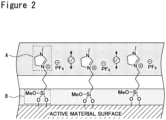
- FIG. 2 is a conceptual view illustrating a state of the particle surface of the positive electrode active material.
- the ionic compound bonded to the particle surface of the positive electrode active material allows the organic cation moiety in the ionic compound to function as a cushioning layer to inhibit the side reaction between the active material and the electrolyte solution. Therefore, the capacity hardly decreases even with repeated charge and discharge of the battery, and excellent cycle characteristics are obtained.
- the effect of improving the cycle characteristics is remarkable when the content of the ionic compound is greater than or equal to 0.2 mass% and less than or equal to 1.8 mass% relative to the positive electrode active material.
- An example of a preferable range of the content of the ionic compound is greater than or equal to 0.2 mass% and less than or equal to 1.8 mass%, greater than or equal to 0.3 mass% and less than or equal to 1.7 mass%, or greater than or equal to 0.5 mass% and less than or equal to 1.5 mass%, relative to the mass of the positive electrode active material.
- the bonding moiety to the positive electrode active material of the ionic compound is connected to the organic cation via, for example, a hydrocarbon chain.
- a functional group such as a hydroxy group is present on the surface of the positive electrode active material.
- a functional group of the ionic compound reacts with the functional group on the surface of the positive electrode active material to form the chemical bond of the bonding moiety.
- the functional group of the ionic compound may be any as long as it reacts with the functional group of the positive electrode active material, and an example of preferable functional groups is a hydrolysable silyl group, an epoxy group, a carboxyl group, or the like. Among them, a hydrolysable silyl group is preferable.
- the bonding moiety of the ionic compound is preferably derived from a hydrolysable silyl group.
- a layer including Si may be formed on the surface of the positive electrode active material, which is considered to improve the protective function on the active material surface.
- the hydrolysable silyl group is, for example, an alkoxysilyl group.
- FIG. 2 exemplifies a bonding moiety derived from a trimethoxysilyl group.
- the alkoxysilyl group is not limited to a methoxysilyl group, and may be an ethoxysilyl group and the like. Not all the functional groups of the ionic compound may be bonded to the surface of the positive electrode active material, and an ionic compound not bonded to the surface of the positive electrode active material may be present in the positive electrode mixture layer 31.
- the organic cation of the ionic compound may be any as long as it is electrochemically stable in the positive electrode mixture layer 31 and it does not deteriorate stability in the positive electrode mixture slurry used for forming the positive electrode mixture layer 31.
- the organic cation includes, for example, at least one selected from the group consisting of an ammonium cation, an imidazolium cation, a piperidinium cation, a pyridinium cation, a pyrrolidinium cation, a morpholinium cation, a sulfonium cation, and a phosphonium cation.
- an imidazolium cation, an ammonium cation, a phosphonium cation, a piperidinium cation, a pyridinium cation, and a pyrrolidinium cation are preferable.
- an A part in the molecular structure of the ionic compound illustrated in FIG. 2 is defined as the organic cation, and a B part therein is defined as the bonding moiety.
- the organic cation is a 1-methylimidazolium cation.
- the organic cation is not limited thereto, may be a 1-alkylimidazolium cation, a 1,2-alkylimidazolium cation, or the like (the alkyl group is, for example, an alkyl group having less than or equal to 10 carbon atoms), or may be an organic cation other than an imidazolium cation.
- the organic cation and the bonding moiety are connected via a hydrocarbon chain.
- An example of this hydrocarbon chain is a linear hydrocarbon having less than or equal to 10 or less than or equal to 5 carbon atoms.
- the anion of the ionic compound may be any, as in the cation, as long as it is electrochemically stable in the positive electrode mixture layer 31 and it does not deteriorate stability in the positive electrode mixture slurry used for forming the positive electrode mixture layer 31.
- the anion includes, for example, at least one selected from the group consisting of PF 6 - , BF 4 - , N(SO 2 CF 3 ) 2 - , N(SO 2 F) 2 - , PO 2 F 2 - , a bisoxalateborate anion, and a difluorooxalateborate anion.
- PF 6 - , BF 4 - , N(SO 2 CF 3 ) 2 - , and PO 2 F 2 - are preferable.
- an imide anion is preferably applied as the anion.
- a content of the bonding moiety to the positive electrode active material is, for example, less than or equal to 0.5 mass% relative to the total mass of the positive electrode active material and the ionic compound.
- the bonding moiety is derived from the functional group containing silicon (Si) such as a hydrolysable silyl group
- the content of Si is preferably greater than or equal to 0.03 mass% and less than or equal to 0.25 mass% relative to the total mass of the positive electrode active material and the ionic compound.
- the content of Si may be measured by inductively coupled plasma mass spectroscopy (ICP-MS). The content of Si within this range yields good reactivity of the ionic compound with the surface of the positive electrode active material and may more effectively inhibit the side reaction between the active material and the electrolyte solution.
- the ionic compound is bonded to the surface of the positive electrode active material by reacting the functional group such as the hydrolysable silyl group with the functional group on the surface of the positive electrode active material for example by mixing with a powder of the positive electrode active material or by mixing in the positive electrode mixture slurry in which the positive electrode active material is dispersed. This reaction may be performed at a room temperature.
- the ionic compound may be synthesized for example by a method described in Examples, described later.
- the negative electrode 12 has a negative electrode core 40 and a negative electrode mixture layer 41 provided on a surface of the negative electrode core 40.
- a foil of a metal stable within a potential range of the negative electrode 12, such as copper, a film in which such a metal is disposed on a surface layer thereof, and the like may be used.
- the negative electrode mixture layer 41 is preferably provided on both surfaces of the negative electrode core 40.
- the negative electrode 12 may be produced for example by applying a slurry of a negative electrode mixture on the negative electrode core 40, and drying and subsequently compressing the coating to form the negative electrode mixture layers 41 on both the surfaces of the negative electrode core 40.
- the negative electrode mixture layer 41 (negative electrode mixture) includes a negative electrode active material and a binder.
- the negative electrode mixture layer 41 may further include the above ionic compound to be bonded to a surface of the negative electrode active material.
- the negative electrode mixture layer 41 includes, for example, a carbon-based active material that reversibly occludes and releases lithium ions as the negative electrode active material.
- a preferable carbon-based active material is graphite such as: a natural graphite such as flake graphite, massive graphite, and amorphous graphite; and an artificial graphite such as massive artificial graphite (MAG) and graphitized mesophase-carbon microbead (MCMB).
- a Si-based active material constituted with at least one of Si and a Si-containing compound may be used, and the carbon-based active material and the Si-based active material may be used in combination.
- a fluororesin, PAN, a polyimide, an acrylic resin, a polyolefin, and the like may be used as in the case of the positive electrode 11, but styrene-butadiene rubber (SBR) is preferably used.
- the negative electrode mixture layer 41 preferably further includes CMC or a salt thereof, polyacrylic acid (PAA) or a salt thereof, polyvinyl alcohol (PVA), and the like. Among them, SBR; and CMC or a salt thereof, or PAA or a salt thereof are preferably used in combination.
- the negative electrode mixture layer 41 may include a conductive agent.
- a porous sheet having an ion permeation property and an insulation property is used.
- the porous sheet include a fine porous thin film, a woven fabric, and a nonwoven fabric.
- a polyolefin such as polyethylene, polypropylene, and a copolymer of ethylene and an ⁇ -olefin, cellulose, and the like are preferable.
- the separator 13 may have any of a single-layered structure and a stacked structure.
- a heat-resistant layer including inorganic particles On a surface of the separator 13, a heat-resistant layer including inorganic particles, a heat-resistant layer constituted with a highly heat-resistant resin such as an aramid resin, a polyimide, and a polyamideimide, and the like may be formed.
- a highly heat-resistant resin such as an aramid resin, a polyimide, and a polyamideimide, and the like
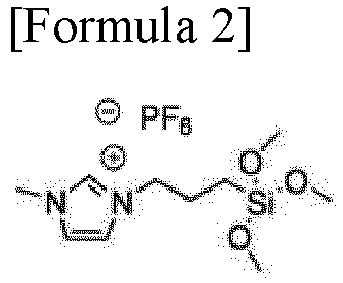
- the compound A0, dehydrated dichloromethane, and sodium hexafluorophosphate were added into a predetermined reaction vessel, and the mixture was stirred at a room temperature for five days. Thereafter, this suspension was filtered with a membrane filter, the filtrate was concentrated to be solidified, and then dried under high vacuum at 40°C to obtain an ionic compound A1 represented by the formula (2).
- a positive electrode active material a lithium-containing transition metal composite oxide was used.
- the positive electrode active material, acetylene black, polyvinylidene fluoride, and the ionic compound A1 were mixed at a predetermined mass ratio, and N-methyl-2-pyrrolidone (NMP) was used as a dispersion medium to prepare a positive electrode mixture slurry.
- NMP N-methyl-2-pyrrolidone
- the positive electrode mixture slurry was applied on a positive electrode core made of aluminum foil, the coating was dried and compressed, and then cut to a predetermined electrode size to obtain a positive electrode.
- Ethylene carbonate (EC), ethyl methyl carbonate (EMC), and dimethyl carbonate (DMC) were mixed at a predetermined volume ratio.
- LiPF 6 was added to obtain a non-aqueous electrolyte solution.
- the above positive electrode and a negative electrode made of lithium metal foil were oppositely disposed with a separator interposed therebetween to constitute an electrode assembly, and the electrode assembly and the above non-aqueous electrolyte were housed in an exterior constituted with an aluminum laminated sheet. Thereafter, an opening of the exterior was sealed to obtain a test cell (non-aqueous electrolyte secondary battery).
- Cycle characteristics (capacity maintenance rate after cycle) of the test cell of Example 1 were evaluated by the following method (the same applied to Examples and an Comparative Example described later). Table 1 shows the evaluation results together with the amount of the ionic compound added and the like.
- Example 1 Under a temperature environment at 25°C, the test cell of Example 1 was charged at a constant current of 0.2 C until a battery voltage reached 4.5 V, and charged at a constant voltage of 4.5 V until a current value reached 0.02 C. Thereafter, the test cell was discharged at a constant current of 0.2 C until the battery voltage reached 2.5 V. This charge-discharge cycle was repeated with 50 cycles.
- Capacity Maintenance Rate % Discharge Capacity at 50 th Cycle / Discharge Capacity at 1 st Cycle ⁇ 100
- Test cells were produced in the same manner as in Example 1 except that, in the production of the positive electrode, the amount of the ionic compound A1 added relative to the positive electrode active material was changed to amounts added shown in Table 1.
- a test cell was produced in the same manner as in Example 4 except that an ionic compound A2 in which the counter anion was changed from PF 6 to PO 2 F 2 was used.
- a test cell was produced in the same manner as in Example 4 except that an ionic compound A3 in which the counter anion was changed from PF 6 to bisfluorosulfonylimide (FSI) was used.
- FSI bisfluorosulfonylimide
- Example 1 A test cell was produced in the same manner as in Example 1 except that, in the production of the positive electrode, the ionic compound A1 was not added.
- [Table 1] Ionic compound Counter anion Amount added (mass%) Capacity maintenance rate
- Example 1 A1 PF 6 0.25 93.9%
- Example 2 A1 PF 6 0.50 94.1%
- Example 3 A1 PF 6 0.75 94.4%
- Example 4 A1 PF 6 1.00 94.9%
- Example 5 A1 PF 6 1.50 94.4%
- Example 6 A1 PF 6 1.75 93.6%
- Example 7 A2 PO 2 F 2 1.00 95.0%
- Example 8 A3 FSI 1.00 94.9% Comparative Example 1 - - - 93.5%
- the test cells of Examples all have higher capacity maintenance rates after the charge-discharge cycle than the test cell of Comparative Example, and have excellent cycle characteristics.
- the effect of improving the cycle characteristics is more remarkable when the amount of the ionic compound added relative to the active material is less than or equal to 1.75%, particularly when the amount is less than or equal to 1.50 mass%.
- non-aqueous electrolyte secondary battery 11 positive electrode, 12 negative electrode, 13 separator, 14 electrode assembly, 16 exterior housing can, 17 sealing assembly, 18, 19 insulating plate, 20 positive electrode lead, 21 negative electrode lead, 22 grooved portion, 23 internal terminal plate, 24 lower vent member, 25 insulating member, 26 upper vent member, 27 cap, 28 gasket, 30 positive electrode core, 31 positive electrode mixture layer, 40 negative electrode core, 41 negative electrode mixture layer
Landscapes
- Chemical & Material Sciences (AREA)
- Chemical Kinetics & Catalysis (AREA)
- Electrochemistry (AREA)
- General Chemical & Material Sciences (AREA)
- Inorganic Chemistry (AREA)
- Battery Electrode And Active Subsutance (AREA)
- Secondary Cells (AREA)
Abstract
Description
- The present disclosure generally relates to an electrode mixture for a battery and a non-aqueous electrolyte secondary battery comprising an electrode constituted by using the electrode mixture.
- An electrode of a non-aqueous electrolyte secondary battery such as a lithium-ion battery commonly comprises a mixture layer including an active material that is able to occlude and release lithium ions. Since the electrode mixture layer significantly affects battery performance such as input and output characteristics, a capacity, and charge-discharge cycle characteristics, many investigations have been made on the electrode mixture constituting the mixture layer. For example, Patent Literature 1 discloses a lithium secondary battery comprising a positive electrode in which a silane-coupling agent is dispersed in a mixture layer, the silane-coupling agent having: an organic reactive group composed of an epoxy group and/or an amino group; and an inorganic reactive group composed of a methoxy group and/or an ethoxy group. Patent Literature 1 discloses that wettability between the positive electrode and an electrolyte solution at a low temperature is improved by dispersing the silane-coupling agent in the positive electrode.
- PATENT LITERATURE 1:
Japanese Unexamined Patent Application Publication No. 2002-319405 - It is known that repeating charge and discharge of a battery gradually decreases the capacity due to a side reaction between an active material and an electrolyte solution. Thus, inhibition of this side reaction for inhibiting the decrease in the capacity due to the charge-discharge cycle to improve the cycle characteristics of the battery is an important challenge. The art in Patent Literature 1 does not consider the improvement of the cycle characteristics.
- It is an object of the present disclosure to provide an electrode mixture for a battery that can improve the cycle characteristics of the battery.
- An electrode mixture for a battery of an aspect of the present disclosure is an electrode mixture for a battery including an active material that is able to occlude and release lithium, wherein the electrode mixture further includes an ionic compound bonded to a surface of the active material, and wherein the ionic compound contains a bonding moiety to the active material, an organic cation, and a counter anion to the organic cation.
- A non-aqueous electrolyte secondary battery of an aspect of the present disclosure comprises: a positive electrode; a negative electrode; and a non-aqueous electrolyte, wherein at least one of mixture layers of the positive electrode and the negative electrode is constituted with the above electrode mixture.
- According to the electrode mixture for a battery according to the present disclosure, the cycle characteristics of the battery can be improved. With the non-aqueous electrolyte secondary battery using the electrode mixture according to the present disclosure, the side reaction between the active material and the electrolyte solution is inhibited to consequently yield excellent cycle characteristics.
-
-
FIG. 1 is a sectional view of a non-aqueous electrolyte secondary battery of an example of an embodiment. -
FIG. 2 is a conceptual view illustrating a state of an active material surface of an example of an embodiment. - As noted above, inhibition of the side reaction between the active material and the electrolyte solution to improve the cycle characteristics of the battery is an important challenge. The present inventors have made intensive investigation to solve this challenge, and consequently found that a capacity maintenance rate after a charge-discharge cycle is improved to specifically improve the cycle characteristics by adding an ionic compound to be bonded to a surface of the active material. The ionic compound bonded to the active material surface and including an organic cation is considered to function as a cushioning layer preventing a direct contact of the electrolyte solution with the active material surface. This cushioning layer is considered to inhibit the side reaction between the active material and the electrolyte solution, leading to the improvement of the cycle characteristics.
- Furthermore, when a content of the ionic compound is greater than or equal to 0.2 mass% and less than or equal to 1.8 mass% relative to the active material, the effect of improving the cycle characteristics is more remarkable. Although the electrode mixture according to the present disclosure may be applied for the negative electrode, the electrode mixture is more effectively applied for the positive electrode.
- Hereinafter, an example of embodiments of the electrode mixture for a battery and non-aqueous electrolyte secondary battery according to the present disclosure will be described in detail with reference to the drawings. It is anticipated from the beginning to selectively combine a plurality of embodiments and modified examples described below.
- Hereinafter, a cylindrical battery in which a
wound electrode assembly 14 is housed in a bottomed cylindrical exterior housing can 16 will be exemplified, but the exterior is not limited to a cylindrical exterior housing can, and may be, for example, a rectangular exterior housing can (rectangular battery), a coin-shaped exterior housing can (coin battery), or an exterior constituted with laminated sheets including a metal layer and a resin layer (laminate battery). The electrode assembly is not limited to a wound electrode assembly, and may be a laminated electrode assembly in which a plurality of positive electrodes and a plurality of negative electrodes are alternately stacked with a separator interposed therebetween. Although the electrode mixture for a battery according to the present disclosure may be applied for an aqueous electrolyte secondary battery using an aqueous electrolyte, the electrode mixture is particularly effective for a non-aqueous electrolyte secondary battery using a non-aqueous electrolyte. -
FIG. 1 is a sectional view of a non-aqueous electrolytesecondary battery 10 of an example of an embodiment. As illustrated inFIG. 1 , the non-aqueous electrolytesecondary battery 10 comprises thewound electrode assembly 14, a non-aqueous electrolyte, and the exterior housing can 16 housing theelectrode assembly 14 and the non-aqueous electrolyte. Theelectrode assembly 14 has apositive electrode 11, anegative electrode 12, and aseparator 13, and has a wound structure in which thepositive electrode 11 and thenegative electrode 12 are spirally wound with theseparator 13 interposed therebetween. The exterior housing can 16 is a bottomed cylindrical metallic container having an opening at one side in an axial direction, and the opening of the exterior housing can 16 is sealed with asealing assembly 17. Hereinafter, for convenience of description, thesealing assembly 17 side of the battery will be described as the upper side, and the bottom side of the exterior housing can 16 will be described as the lower side. - The non-aqueous electrolyte includes a non-aqueous solvent and an electrolyte salt dissolved in the non-aqueous solvent. For the non-aqueous solvent, esters, ethers, nitriles, amides, and a mixed solvent of two or more thereof, and the like are used, for example. The non-aqueous solvent may contain a halogen-substituted derivative in which hydrogen of these solvents is at least partially substituted with a halogen atom such as fluorine. An example of the non-aqueous solvent is ethylene carbonate (EC), ethyl methyl carbonate (EMC), dimethyl carbonate (DMC), a mixed solvent thereof, and the like. For the electrolyte salt, a lithium salt such as LiPF6 is used, for example.
- The
positive electrode 11, thenegative electrode 12, and theseparator 13, which constitute theelectrode assembly 14, are all a band-shaped elongated body, and spirally wound to be alternately stacked in a radial direction of theelectrode assembly 14. To prevent precipitation of lithium, thenegative electrode 12 is formed to be one size larger than thepositive electrode 11. That is, thenegative electrode 12 is formed to be longer than thepositive electrode 11 in a longitudinal direction and a width direction (short direction). Theseparator 13 are formed to be one size larger than at least thepositive electrode 11, and two of them are disposed so as to sandwich thepositive electrode 11, for example. Theelectrode assembly 14 has a positive electrode lead 20 connected to thepositive electrode 11 by welding or the like and anegative electrode lead 21 connected to thenegative electrode 12 by welding or the like. -
Insulating plates electrode assembly 14, respectively. In the example illustrated inFIG. 1 , the positive electrode lead 20 extends through a through hole of theinsulating plate 18 toward thesealing assembly 17 side, and thenegative electrode lead 21 extends through the outside of theinsulating plate 19 toward the bottom side of the exterior housing can 16. The positive electrode lead 20 is connected to a lower surface of aninternal terminal plate 23 of thesealing assembly 17 by welding or the like, and acap 27, which is a top plate of thesealing assembly 17 electrically connected to theinternal terminal plate 23, becomes a positive electrode terminal. Thenegative electrode lead 21 is connected to a bottom inner surface of the exterior housing can 16 by welding or the like, and the exterior housing can 16 becomes a negative electrode terminal. - A
gasket 28 is provided between the exterior housing can 16 and thesealing assembly 17, and thereby sealability inside the battery is ensured. On the exterior housing can 16, a grooved portion 22 in which a part of a side wall thereof projects inward to support thesealing assembly 17 is formed. The grooved portion 22 is preferably formed in a circular shape along a circumferential direction of the exterior housing can 16, and supports thesealing assembly 17 with the upper face thereof. Thesealing assembly 17 is fixed on the upper part of the exterior housing can 16 with the grooved portion 22 and with an end part of the opening of the exterior housing can 16 caulked to thesealing assembly 17. - The
sealing assembly 17 has a stacked structure of theinternal terminal plate 23, alower vent member 24, aninsulating member 25, anupper vent member 26, and thecap 27 in this order from theelectrode assembly 14 side. Each member constituting thesealing assembly 17 has, for example, a disk shape or a ring shape, and each member except for the insulatingmember 25 is electrically connected to each other. Thelower vent member 24 and theupper vent member 26 are connected at each of central parts thereof, and theinsulating member 25 is interposed between each of the circumferential parts. If the internal pressure of the battery increases due to abnormal heat generation, thelower vent member 24 is deformed so as to push theupper vent member 26 up toward thecap 27 side and breaks, and thereby a current pathway between thelower vent member 24 and theupper vent member 26 is cut off. If the internal pressure further increases, theupper vent member 26 breaks, and gas is discharged through an opening of thecap 27. - Hereinafter, the
positive electrode 11, thenegative electrode 12, and theseparator 13, which constitute theelectrode assembly 14, specifically an electrode mixture constituting mixture layers of thepositive electrode 11 and thenegative electrode 12,will be described in detail. - The electrode mixture of an example of an embodiment includes: an active material that is able to occlude and release lithium ions; and an ionic compound bonded to a surface of the active material. The ionic compound contains a bonding moiety to the active material, an organic cation, and a counter anion to the organic cation. The ionic compound has the effect of inhibiting the side reaction between the active material and the electrolyte solution even at an extremely small amount to contribute to the improvement of the cycle characteristics of the battery, but the content of the ionic compound is preferably greater than or equal to 0.2 mass% relative to the mass of the active material. An upper limit of the content of the ionic compound is preferably 1.8 mass%.
- Although the electrode mixture of an example of an embodiment may be applied for the
negative electrode 12, the electrode mixture is particularly effective for thepositive electrode 11. Hereinafter, description will be made with the mixture layer of thepositive electrode 11 constituted with the electrode mixture of an example of an embodiment. - The
positive electrode 11 has apositive electrode core 30 and a positiveelectrode mixture layer 31 provided on a surface of thepositive electrode core 30. For thepositive electrode core 30, a foil of a metal stable within a potential range of thepositive electrode 11, such as aluminum and an aluminum alloy, a film in which such a metal is disposed on a surface layer thereof, and the like may be used. The positiveelectrode mixture layer 31 is preferably provided on both surfaces of thepositive electrode core 30. Thepositive electrode 11 may be produced for example by applying a slurry of a positive electrode mixture on thepositive electrode core 30, and drying and subsequently compressing the coating to form the positive electrode mixture layers 31 on both the surfaces of thepositive electrode core 30. - The positive
electrode mixture layer 31 includes a positive electrode active material and the above ionic compound. The positiveelectrode mixture layer 31 preferably further includes a binder and a conductive agent. The positiveelectrode mixture layer 31 is formed for example by applying the slurry of the positive electrode mixture including the positive electrode active material, the binder, the conductive agent, and the ionic compound on thepositive electrode core 30. A dispersion medium of the positive electrode mixture slurry is not particularly limited as long as it may disperse the positive electrode mixture, and an example thereof is N-methyl-2-pyrrolidone (NMP). The ionic compound may be mixed with the positive electrode active material and then form the slurry, or may be added into a slurry in which the positive electrode active material is dispersed to be mixed with the positive electrode active material. - Examples of the binder included in the positive electrode mixture layer 31 (positive electrode mixture) include a fluororesin such as polytetrafluoroethylene (PTFE) and polyvinylidene fluoride (PVdF), polyacrylonitrile (PAN), a polyimide, an acrylic resin, and a polyolefin. With these resins, a cellulose derivative such as carboxymethylcellulose (CMC) or a salt thereof, polyethylene oxide (PEO), and the like may be used in combination. A content of the binder is, for example, greater than or equal to 0.5 mass% and less than or equal to 2.0 mass% relative to the mass of the positive
electrode mixture layer 31. - The conductive agent included in the positive
electrode mixture layer 31 forms a good conductive path in the mixture layer to contribute to reduction in electric resistance of the mixture layer. Examples of the conductive agent include: particle conductive agents such as carbon black, acetylene black, Ketjenblack, and graphite; and fibrous conductive agents of conductive agents and the like such as carbon nanotube (CNT), vapor-grown carbon fiber (VGCF), electrospinning carbon fiber, polyacrylonitrile (PAN)-based carbon fiber, pitch-based carbon fiber, and graphene. A content of the conductive agent is, for example, greater than or equal to 0.5 mass% and less than or equal to 2.0 mass% relative to the mass of the positiveelectrode mixture layer 31. - The positive electrode active material is preferably a lithium-containing transition metal composite oxide. Examples of an element contained in the lithium-containing transition metal composite oxide include Ni, Co, Mn, Na, K, Mg, Ca, Sr, Ba, Sc, Y, La, Ce, Pr, Nd, Sm, Eu, Gd, Tb, Dy, Ho, Er, Tm, Yb, Lu, Ge, Sn, Pb, Sc, Ti, Si, V, Cr, Fe, Cu, Zn, Ru, Rh, Re, Pd, Ir, Ag, Bi, Sb, B, Al, Ga, In, P, Zr, Hf, Nb, Mo, and W. Among them, at least one of Ni, Co, and Mn is preferably contained.
- An example of preferable lithium-containing transition metal composite oxides has a layered rock-salt crystal structure, and is a composite oxide represented by the general formula: LiNixM1-xO2, wherein M represents at least one selected from the group consisting of Al, Mn, and Co, and 0.3 ≤ x < 1.0. A composite oxide with a high Ni content is effective for increasing the capacity of the battery. The composite oxide represented by the above general formula has good compatibility with a layered silicate salt compound, and using this composite oxide may attempt to increase the capacity of the battery and more effectively improve diffusibility of lithium ions in the positive
electrode mixture layer 31. - The positive electrode active material contains the lithium-containing transition metal composite oxide represented by the above general formula as a main component. Here, the main component means a component having the highest mass ratio among constituting components of the composite oxide. Although the positive
electrode mixture layer 31 may contain a composite oxide other than the composite oxide represented by the above general formula in combination as the positive electrode active material, a content of the above composite oxide is preferably greater than or equal to 50 mass%, and may be substantially 100 mass%. The composition of the composite oxide may be measured by using an ICP emission spectrometer (iCAP6300, manufactured by Thermo Fisher Scientific K.K.). - The lithium-containing transition metal composite oxide is of, for example, secondary particles formed by aggregation of a plurality of primary particles. An example of a median diameter (D50) of the lithium-containing transition metal composite oxide on a volumetric basis is greater than or equal to 1 µm and less than or equal to 20 µm, or greater than or equal to 2 µm and less than or equal to 15 µm. The D50 is a particle diameter at which a volumetric integrated value is 50% in a particle size distribution measured by a laser diffraction scattering method. A BET specific surface area of the composite oxide is, for example, greater than or equal to 1.0 mm2/g and less than or equal to 4.0 mm2/g. The BET specific surface area within this range easily achieves both of the high durability and the high capacity. The BET specific surface area is measured in accordance with a BET method (nitrogen adsorption method) described in JIS R1626.
- The positive
electrode mixture layer 31 includes the ionic compound, as noted above. The ionic compound is a compound containing a bonding moiety to the positive electrode active material, an organic cation, and a counter anion to the organic cation, and chemically bonded to the particle surface of the positive electrode active material via the bonding moiety. A content of the ionic compound is preferably greater than or equal to 0.2 mass%, more preferably greater than or equal to 0.3 mass%, and particularly preferably greater than or equal to 0.5 mass%, relative to the mass of the positive electrode active material. An upper limit of the content of the ionic compound is preferably 1.8 mass%, more preferably 1.7 mass%, and particularly preferably 1.5 mass%. -
FIG. 2 is a conceptual view illustrating a state of the particle surface of the positive electrode active material. As illustrated inFIG. 2 , it is considered that the ionic compound bonded to the particle surface of the positive electrode active material allows the organic cation moiety in the ionic compound to function as a cushioning layer to inhibit the side reaction between the active material and the electrolyte solution. Therefore, the capacity hardly decreases even with repeated charge and discharge of the battery, and excellent cycle characteristics are obtained. In particular, the effect of improving the cycle characteristics is remarkable when the content of the ionic compound is greater than or equal to 0.2 mass% and less than or equal to 1.8 mass% relative to the positive electrode active material. An example of a preferable range of the content of the ionic compound is greater than or equal to 0.2 mass% and less than or equal to 1.8 mass%, greater than or equal to 0.3 mass% and less than or equal to 1.7 mass%, or greater than or equal to 0.5 mass% and less than or equal to 1.5 mass%, relative to the mass of the positive electrode active material. - The bonding moiety to the positive electrode active material of the ionic compound is connected to the organic cation via, for example, a hydrocarbon chain. On the surface of the positive electrode active material, a functional group such as a hydroxy group is present. Thus, a functional group of the ionic compound reacts with the functional group on the surface of the positive electrode active material to form the chemical bond of the bonding moiety. The functional group of the ionic compound may be any as long as it reacts with the functional group of the positive electrode active material, and an example of preferable functional groups is a hydrolysable silyl group, an epoxy group, a carboxyl group, or the like. Among them, a hydrolysable silyl group is preferable. That is, the bonding moiety of the ionic compound is preferably derived from a hydrolysable silyl group. In this case, a layer including Si may be formed on the surface of the positive electrode active material, which is considered to improve the protective function on the active material surface.
- The hydrolysable silyl group is, for example, an alkoxysilyl group.
FIG. 2 exemplifies a bonding moiety derived from a trimethoxysilyl group. The alkoxysilyl group is not limited to a methoxysilyl group, and may be an ethoxysilyl group and the like. Not all the functional groups of the ionic compound may be bonded to the surface of the positive electrode active material, and an ionic compound not bonded to the surface of the positive electrode active material may be present in the positiveelectrode mixture layer 31. - The organic cation of the ionic compound may be any as long as it is electrochemically stable in the positive
electrode mixture layer 31 and it does not deteriorate stability in the positive electrode mixture slurry used for forming the positiveelectrode mixture layer 31. The organic cation includes, for example, at least one selected from the group consisting of an ammonium cation, an imidazolium cation, a piperidinium cation, a pyridinium cation, a pyrrolidinium cation, a morpholinium cation, a sulfonium cation, and a phosphonium cation. Among them, an imidazolium cation, an ammonium cation, a phosphonium cation, a piperidinium cation, a pyridinium cation, and a pyrrolidinium cation are preferable. - In the present embodiment, an A part in the molecular structure of the ionic compound illustrated in
FIG. 2 is defined as the organic cation, and a B part therein is defined as the bonding moiety. InFIG. 2 , the organic cation is a 1-methylimidazolium cation. The organic cation is not limited thereto, may be a 1-alkylimidazolium cation, a 1,2-alkylimidazolium cation, or the like (the alkyl group is, for example, an alkyl group having less than or equal to 10 carbon atoms), or may be an organic cation other than an imidazolium cation. The organic cation and the bonding moiety are connected via a hydrocarbon chain. An example of this hydrocarbon chain is a linear hydrocarbon having less than or equal to 10 or less than or equal to 5 carbon atoms. - The anion of the ionic compound may be any, as in the cation, as long as it is electrochemically stable in the positive
electrode mixture layer 31 and it does not deteriorate stability in the positive electrode mixture slurry used for forming the positiveelectrode mixture layer 31. The anion includes, for example, at least one selected from the group consisting of PF6 -, BF4 -, N(SO2CF3)2 -, N(SO2F)2 -, PO2F2 -, a bisoxalateborate anion, and a difluorooxalateborate anion. Among them, PF6 -, BF4 -, N(SO2CF3)2 -, and PO2F2 - are preferable. When the ionic compound is used for thenegative electrode 12 manufactured by using an aqueous slurry, an imide anion is preferably applied as the anion. - In the ionic compound, a content of the bonding moiety to the positive electrode active material is, for example, less than or equal to 0.5 mass% relative to the total mass of the positive electrode active material and the ionic compound. When the bonding moiety is derived from the functional group containing silicon (Si) such as a hydrolysable silyl group, the content of Si is preferably greater than or equal to 0.03 mass% and less than or equal to 0.25 mass% relative to the total mass of the positive electrode active material and the ionic compound. The content of Si may be measured by inductively coupled plasma mass spectroscopy (ICP-MS). The content of Si within this range yields good reactivity of the ionic compound with the surface of the positive electrode active material and may more effectively inhibit the side reaction between the active material and the electrolyte solution.
- The ionic compound is bonded to the surface of the positive electrode active material by reacting the functional group such as the hydrolysable silyl group with the functional group on the surface of the positive electrode active material for example by mixing with a powder of the positive electrode active material or by mixing in the positive electrode mixture slurry in which the positive electrode active material is dispersed. This reaction may be performed at a room temperature. The ionic compound may be synthesized for example by a method described in Examples, described later.
- The
negative electrode 12 has anegative electrode core 40 and a negativeelectrode mixture layer 41 provided on a surface of thenegative electrode core 40. For thenegative electrode core 40, a foil of a metal stable within a potential range of thenegative electrode 12, such as copper, a film in which such a metal is disposed on a surface layer thereof, and the like may be used. The negativeelectrode mixture layer 41 is preferably provided on both surfaces of thenegative electrode core 40. Thenegative electrode 12 may be produced for example by applying a slurry of a negative electrode mixture on thenegative electrode core 40, and drying and subsequently compressing the coating to form the negative electrode mixture layers 41 on both the surfaces of thenegative electrode core 40. The negative electrode mixture layer 41 (negative electrode mixture) includes a negative electrode active material and a binder. The negativeelectrode mixture layer 41 may further include the above ionic compound to be bonded to a surface of the negative electrode active material. - The negative
electrode mixture layer 41 includes, for example, a carbon-based active material that reversibly occludes and releases lithium ions as the negative electrode active material. A preferable carbon-based active material is graphite such as: a natural graphite such as flake graphite, massive graphite, and amorphous graphite; and an artificial graphite such as massive artificial graphite (MAG) and graphitized mesophase-carbon microbead (MCMB). For the negative electrode active material, a Si-based active material constituted with at least one of Si and a Si-containing compound may be used, and the carbon-based active material and the Si-based active material may be used in combination. - For the binder included in the negative
electrode mixture layer 41, a fluororesin, PAN, a polyimide, an acrylic resin, a polyolefin, and the like may be used as in the case of thepositive electrode 11, but styrene-butadiene rubber (SBR) is preferably used. The negativeelectrode mixture layer 41 preferably further includes CMC or a salt thereof, polyacrylic acid (PAA) or a salt thereof, polyvinyl alcohol (PVA), and the like. Among them, SBR; and CMC or a salt thereof, or PAA or a salt thereof are preferably used in combination. The negativeelectrode mixture layer 41 may include a conductive agent. - For the
separator 13, a porous sheet having an ion permeation property and an insulation property is used. Specific examples of the porous sheet include a fine porous thin film, a woven fabric, and a nonwoven fabric. For a material of theseparator 13, a polyolefin such as polyethylene, polypropylene, and a copolymer of ethylene and an α-olefin, cellulose, and the like are preferable. Theseparator 13 may have any of a single-layered structure and a stacked structure. On a surface of theseparator 13, a heat-resistant layer including inorganic particles, a heat-resistant layer constituted with a highly heat-resistant resin such as an aramid resin, a polyimide, and a polyamideimide, and the like may be formed. - Hereinafter, the present disclosure will be further described with Examples, but the present disclosure is not limited to these Examples.
- Into a predetermined reaction vessel, 3-trimethoxysilylpropyl chloride and 1-methylimidazole were added, and the mixture was stirred at 95°C for 24 hours. After allowing the reaction container to be cooled, dehydrated ether was added into the reaction vessel, and the mixture was stirred, left to stand, and a supernatant liquid was removed. This procedure was repeated four times, an underlayer oil was dried under high vacuum at 40°C to have a constant weight to obtain a compound A0 represented by the formula (1).

- In a glove box, the compound A0, dehydrated dichloromethane, and sodium hexafluorophosphate were added into a predetermined reaction vessel, and the mixture was stirred at a room temperature for five days. Thereafter, this suspension was filtered with a membrane filter, the filtrate was concentrated to be solidified, and then dried under high vacuum at 40°C to obtain an ionic compound A1 represented by the formula (2).
- As a positive electrode active material, a lithium-containing transition metal composite oxide was used. The positive electrode active material, acetylene black, polyvinylidene fluoride, and the ionic compound A1 were mixed at a predetermined mass ratio, and N-methyl-2-pyrrolidone (NMP) was used as a dispersion medium to prepare a positive electrode mixture slurry. Then, the positive electrode mixture slurry was applied on a positive electrode core made of aluminum foil, the coating was dried and compressed, and then cut to a predetermined electrode size to obtain a positive electrode.
- Ethylene carbonate (EC), ethyl methyl carbonate (EMC), and dimethyl carbonate (DMC) were mixed at a predetermined volume ratio. Into this mixed solvent, LiPF6 was added to obtain a non-aqueous electrolyte solution.
- The above positive electrode and a negative electrode made of lithium metal foil were oppositely disposed with a separator interposed therebetween to constitute an electrode assembly, and the electrode assembly and the above non-aqueous electrolyte were housed in an exterior constituted with an aluminum laminated sheet. Thereafter, an opening of the exterior was sealed to obtain a test cell (non-aqueous electrolyte secondary battery).
- Cycle characteristics (capacity maintenance rate after cycle) of the test cell of Example 1 were evaluated by the following method (the same applied to Examples and an Comparative Example described later). Table 1 shows the evaluation results together with the amount of the ionic compound added and the like.
- Under a temperature environment at 25°C, the test cell of Example 1 was charged at a constant current of 0.2 C until a battery voltage reached 4.5 V, and charged at a constant voltage of 4.5 V until a current value reached 0.02 C. Thereafter, the test cell was discharged at a constant current of 0.2 C until the battery voltage reached 2.5 V. This charge-discharge cycle was repeated with 50 cycles.
- A discharge capacity at the 1st cycle and discharge capacity at the 50th cycle of the cycle test were determined to calculate a capacity maintenance rate by the following formula.

- Test cells were produced in the same manner as in Example 1 except that, in the production of the positive electrode, the amount of the ionic compound A1 added relative to the positive electrode active material was changed to amounts added shown in Table 1.
- A test cell was produced in the same manner as in Example 4 except that an ionic compound A2 in which the counter anion was changed from PF6 to PO2F2 was used.
- A test cell was produced in the same manner as in Example 4 except that an ionic compound A3 in which the counter anion was changed from PF6 to bisfluorosulfonylimide (FSI) was used.
- A test cell was produced in the same manner as in Example 1 except that, in the production of the positive electrode, the ionic compound A1 was not added.
[Table 1] Ionic compound Counter anion Amount added (mass%) Capacity maintenance rate Example 1 A1 PF6 0.25 93.9% Example 2 A1 PF6 0.50 94.1% Example 3 A1 PF6 0.75 94.4% Example 4 A1 PF6 1.00 94.9% Example 5 A1 PF6 1.50 94.4% Example 6 A1 PF6 1.75 93.6% Example 7 A2 PO2F2 1.00 95.0% Example 8 A3 FSI 1.00 94.9% Comparative Example 1 - - - 93.5% - As shown in Table 1, the test cells of Examples all have higher capacity maintenance rates after the charge-discharge cycle than the test cell of Comparative Example, and have excellent cycle characteristics. In particular, the effect of improving the cycle characteristics is more remarkable when the amount of the ionic compound added relative to the active material is less than or equal to 1.75%, particularly when the amount is less than or equal to 1.50 mass%.
- 10 non-aqueous electrolyte secondary battery, 11 positive electrode, 12 negative electrode, 13 separator, 14 electrode assembly, 16 exterior housing can, 17 sealing assembly, 18, 19 insulating plate, 20 positive electrode lead, 21 negative electrode lead, 22 grooved portion, 23 internal terminal plate, 24 lower vent member, 25 insulating member, 26 upper vent member, 27 cap, 28 gasket, 30 positive electrode core, 31 positive electrode mixture layer, 40 negative electrode core, 41 negative electrode mixture layer
Claims (9)
- An electrode mixture for a battery, including an active material that is able to occlude and release lithium, whereinthe electrode mixture further includes an ionic compound bonded to a surface of the active material, andwherein the ionic compound contains a bonding moiety to the active material, an organic cation, and a counter anion to the organic cation.
- The electrode mixture according to claim 1, wherein a content of the ionic compound is greater than or equal to 0.2 mass% and less than or equal to 1.8 mass% relative to the mass of the active material.
- The electrode mixture according to claim 1 or 2, wherein the organic cation includes at least one selected from the group consisting of an ammonium cation, an imidazolium cation, a piperidinium cation, a pyridinium cation, a pyrrolidinium cation, a morpholinium cation, a sulfonium cation, and a phosphonium cation.
- The electrode mixture according to any one of claims 1 to 3, wherein the counter anion includes at least one selected from the group consisting of PF6 -, BF4 -, N(SO2CF3)2 -, N(SO2F)2 -, PO2F2 -, a bisoxalateborate anion, and a difluorooxalateborate anion.
- The electrode mixture according to any one of claims 1 to 4, wherein the bonding moiety is derived from a hydrolysable silyl group.
- The electrode mixture according to any one of claims 1 to 5, wherein a content of silicon is greater than or equal to 0.03 mass% and less than or equal to 0.25 mass% relative to the total mass of the active material and the ionic compound.
- The electrode mixture according to any one of claims 1 to 6, wherein the active material includes a lithium-containing transition metal composite oxide.
- The electrode mixture according to claim 7, wherein the lithium-containing transition metal composite oxide has a layered rock-salt crystal structure, and includes a composite oxide represented by the general formula: LiNixM1-xO2, wherein M represents at least one selected from the group consisting of Al, Mn, and Co, and 0.3 ≤ x < 1.0.
- A non-aqueous electrolyte secondary battery, comprising:a positive electrode;a negative electrode; anda non-aqueous electrolyte, whereinat least one of mixture layers of the positive electrode and the negative electrode is constituted with the electrode mixture according to any one of claims 1 to 8.
Applications Claiming Priority (2)
| Application Number | Priority Date | Filing Date | Title |
|---|---|---|---|
| JP2021030629 | 2021-02-26 | ||
| PCT/JP2022/003815 WO2022181257A1 (en) | 2021-02-26 | 2022-02-01 | Electrode mixture for battery, and non-aqueous electrolyte secondary battery |
Publications (2)
| Publication Number | Publication Date |
|---|---|
| EP4300616A1 true EP4300616A1 (en) | 2024-01-03 |
| EP4300616A4 EP4300616A4 (en) | 2025-06-25 |
Family
ID=83048152
Family Applications (1)
| Application Number | Title | Priority Date | Filing Date |
|---|---|---|---|
| EP22759298.7A Pending EP4300616A4 (en) | 2021-02-26 | 2022-02-01 | ELECTRODE MIXTURE FOR BATTERY AND NONAQUEOUS ELECTROLYTE SECONDARY BATTERY |
Country Status (5)
| Country | Link |
|---|---|
| US (1) | US20230420670A1 (en) |
| EP (1) | EP4300616A4 (en) |
| JP (1) | JPWO2022181257A1 (en) |
| CN (1) | CN116897441A (en) |
| WO (1) | WO2022181257A1 (en) |
Family Cites Families (13)
| Publication number | Priority date | Publication date | Assignee | Title |
|---|---|---|---|---|
| JP2002319405A (en) | 2001-04-23 | 2002-10-31 | Toyota Motor Corp | Lithium secondary battery |
| JP2004342595A (en) * | 2003-04-25 | 2004-12-02 | Nec Tokin Corp | Electrode for electrochemical cell, and electrochemical cell using it |
| KR102280682B1 (en) * | 2014-09-15 | 2021-07-22 | 삼성전자주식회사 | Cathode and lithium air battery comprising the cathode, and preparation method thereof |
| KR102640841B1 (en) * | 2016-05-12 | 2024-02-27 | 삼성에스디아이 주식회사 | Protected anode for lithium battery and lithium metal battery comprising the same |
| CN106252649A (en) * | 2016-10-11 | 2016-12-21 | 宁德新能源科技有限公司 | A kind of anode pole piece and the lithium ion battery containing this pole piece |
| KR101913939B1 (en) * | 2017-04-17 | 2018-10-31 | 인천대학교 산학협력단 | Organic additive coating method for improving interfacial stability of cathode material for lithium secondary battery |
| JP7024791B2 (en) * | 2017-07-24 | 2022-02-24 | 株式会社村田製作所 | Negatives for secondary batteries, secondary batteries, battery packs, electric vehicles, power storage systems, power tools and electronic devices |
| JPWO2019035190A1 (en) * | 2017-08-16 | 2020-09-17 | 日立化成株式会社 | Battery components for secondary batteries and secondary batteries |
| CN107863493B (en) * | 2017-10-26 | 2020-05-08 | 广东羚光新材料股份有限公司 | Preparation method of lithium battery negative pole piece |
| CN107834070B (en) * | 2017-12-20 | 2020-08-07 | 安徽佳宏新材料有限公司 | Lithium iron phosphate positive electrode material, lithium ion battery and preparation method thereof |
| JP7446657B2 (en) * | 2018-04-05 | 2024-03-11 | エルジー エナジー ソリューション リミテッド | Electrodes for secondary batteries, electrolyte layers for secondary batteries, and secondary batteries |
| KR102871492B1 (en) * | 2018-12-21 | 2025-10-15 | 삼성전자주식회사 | Positive electrode and lithium battery including the same |
| CN111303489A (en) * | 2020-03-30 | 2020-06-19 | 华南理工大学 | An environmentally friendly rubber accelerator modified filler and its preparation method and application |
-
2022
- 2022-02-01 WO PCT/JP2022/003815 patent/WO2022181257A1/en not_active Ceased
- 2022-02-01 US US18/275,522 patent/US20230420670A1/en active Pending
- 2022-02-01 EP EP22759298.7A patent/EP4300616A4/en active Pending
- 2022-02-01 JP JP2023502228A patent/JPWO2022181257A1/ja active Pending
- 2022-02-01 CN CN202280015625.8A patent/CN116897441A/en active Pending
Also Published As
| Publication number | Publication date |
|---|---|
| CN116897441A (en) | 2023-10-17 |
| US20230420670A1 (en) | 2023-12-28 |
| EP4300616A4 (en) | 2025-06-25 |
| WO2022181257A1 (en) | 2022-09-01 |
| JPWO2022181257A1 (en) | 2022-09-01 |
Similar Documents
| Publication | Publication Date | Title |
|---|---|---|
| EP3734714B1 (en) | Negative electrode for nonaqueous electrolyte secondary battery, and nonaqueous electrolyte secondary battery | |
| KR102560936B1 (en) | Negative electrode active material for non-aqueous electrolyte secondary battery and non-aqueous electrolyte secondary battery, and producing method of negative electrode material for non-aqueous electrolyte secondary battery | |
| KR102413870B1 (en) | Negative electrode active substance for nonaqueous electrolyte secondary cell, negative electrode for nonaqueous electrolyte secondary cell, nonaqueous electrolyte secondary cell, and method for producing negative electrode material for nonaqueous electrolyte secondary cell | |
| KR102719294B1 (en) | Negative electrode active material, mixed negative electrode active material, negative electrode for non-aqueous electrolyte secondary battery, lithium ion secondary battery, method for producing negative electrode active material, and method for producing lithium ion secondary battery | |
| EP4120395B1 (en) | Negative-electrode active substance, mixed negative-electrode active substance material, and method for manufacturing negative-electrode active substance | |
| JP6861565B2 (en) | Negative electrode active material, mixed negative electrode active material, and method for manufacturing negative electrode active material | |
| JP6964386B2 (en) | Method for manufacturing negative electrode active material for non-aqueous electrolyte secondary battery, non-aqueous electrolyte secondary battery, and negative electrode material for non-aqueous electrolyte secondary battery | |
| JP6867821B2 (en) | Negative electrode active material, mixed negative electrode active material material, negative electrode for non-aqueous electrolyte secondary battery, negative electrode for lithium ion secondary battery, lithium ion secondary battery, negative electrode active material manufacturing method, negative electrode manufacturing method, and lithium ion secondary Battery manufacturing method | |
| EP2498323A2 (en) | Positive active material, and electrode and lithium battery containing the material | |
| KR102787408B1 (en) | Negative electrode active material, mixed negative electrode active material material, negative electrode for non-aqueous electrolyte secondary battery, lithium ion secondary battery and method for producing negative electrode active material | |
| KR102759833B1 (en) | Negative electrode active material, mixed negative electrode active material material, negative electrode for non-aqueous electrolyte secondary battery, lithium ion secondary battery, method for producing negative electrode active material and method for producing lithium ion secondary battery | |
| KR20160110380A (en) | Negative electrode material for nonaqueous electrolyte secondary batteries and method for producing negative electrode active material particles | |
| CN105990576A (en) | Electrode, nonaqueous electrolyte battery, and battery pack | |
| EP3761427A1 (en) | Non-aqueous electrolyte secondary battery | |
| KR20130033425A (en) | Lithium secondary battery | |
| KR20180118657A (en) | Non-aqueous electrolyte cell | |
| KR102472882B1 (en) | Lithium secondary battery | |
| CN114080703B (en) | Negative electrode active material for secondary battery, and secondary battery | |
| JP6802111B2 (en) | Method for manufacturing negative electrode active material for non-aqueous electrolyte secondary battery, non-aqueous electrolyte secondary battery, and negative electrode material for non-aqueous electrolyte secondary battery | |
| JP7147845B2 (en) | Negative electrode material for lithium ion secondary battery, negative electrode for lithium ion secondary battery, lithium ion secondary battery, and method for producing negative electrode for lithium ion secondary battery | |
| WO2020255489A1 (en) | Anode material, anode and battery cell | |
| WO2023033009A1 (en) | Positive electrode for nonaqueous electrolyte secondary battery, and nonaqueous electrolyte secondary battery | |
| US20160087261A1 (en) | Positive electrode for rechargeable lithium battery and rechargeable lithium battery including the same | |
| JP2017228434A (en) | Lithium ion secondary battery | |
| KR20230118210A (en) | Anode actibe material for lithium secondary battery and lithium secondary battery including the same |
Legal Events
| Date | Code | Title | Description |
|---|---|---|---|
| STAA | Information on the status of an ep patent application or granted ep patent |
Free format text: STATUS: THE INTERNATIONAL PUBLICATION HAS BEEN MADE |
|
| PUAI | Public reference made under article 153(3) epc to a published international application that has entered the european phase |
Free format text: ORIGINAL CODE: 0009012 |
|
| STAA | Information on the status of an ep patent application or granted ep patent |
Free format text: STATUS: REQUEST FOR EXAMINATION WAS MADE |
|
| 17P | Request for examination filed |
Effective date: 20230818 |
|
| AK | Designated contracting states |
Kind code of ref document: A1 Designated state(s): AL AT BE BG CH CY CZ DE DK EE ES FI FR GB GR HR HU IE IS IT LI LT LU LV MC MK MT NL NO PL PT RO RS SE SI SK SM TR |
|
| DAV | Request for validation of the european patent (deleted) | ||
| DAX | Request for extension of the european patent (deleted) | ||
| A4 | Supplementary search report drawn up and despatched |
Effective date: 20250522 |
|
| RIC1 | Information provided on ipc code assigned before grant |
Ipc: H01M 4/62 20060101ALI20250516BHEP Ipc: H01M 4/525 20100101ALI20250516BHEP Ipc: H01M 4/505 20100101ALI20250516BHEP Ipc: H01M 4/131 20100101ALI20250516BHEP Ipc: H01M 4/13 20100101AFI20250516BHEP |