EP4300428A1 - Image processing device, image processing method, and program - Google Patents
Image processing device, image processing method, and program Download PDFInfo
- Publication number
- EP4300428A1 EP4300428A1 EP22759417.3A EP22759417A EP4300428A1 EP 4300428 A1 EP4300428 A1 EP 4300428A1 EP 22759417 A EP22759417 A EP 22759417A EP 4300428 A1 EP4300428 A1 EP 4300428A1
- Authority
- EP
- European Patent Office
- Prior art keywords
- viewpoint
- image
- display
- information
- displaying
- Prior art date
- Legal status (The legal status is an assumption and is not a legal conclusion. Google has not performed a legal analysis and makes no representation as to the accuracy of the status listed.)
- Pending
Links
Images








Classifications
-
- G—PHYSICS
- G06—COMPUTING OR CALCULATING; COUNTING
- G06F—ELECTRIC DIGITAL DATA PROCESSING
- G06F3/00—Input arrangements for transferring data to be processed into a form capable of being handled by the computer; Output arrangements for transferring data from processing unit to output unit, e.g. interface arrangements
- G06F3/01—Input arrangements or combined input and output arrangements for interaction between user and computer
- G06F3/011—Arrangements for interaction with the human body, e.g. for user immersion in virtual reality
-
- H—ELECTRICITY
- H04—ELECTRIC COMMUNICATION TECHNIQUE
- H04N—PICTORIAL COMMUNICATION, e.g. TELEVISION
- H04N13/00—Stereoscopic video systems; Multi-view video systems; Details thereof
- H04N13/10—Processing, recording or transmission of stereoscopic or multi-view image signals
- H04N13/106—Processing image signals
- H04N13/111—Transformation of image signals corresponding to virtual viewpoints, e.g. spatial image interpolation
- H04N13/117—Transformation of image signals corresponding to virtual viewpoints, e.g. spatial image interpolation the virtual viewpoint locations being selected by the viewers or determined by viewer tracking
-
- G—PHYSICS
- G06—COMPUTING OR CALCULATING; COUNTING
- G06F—ELECTRIC DIGITAL DATA PROCESSING
- G06F3/00—Input arrangements for transferring data to be processed into a form capable of being handled by the computer; Output arrangements for transferring data from processing unit to output unit, e.g. interface arrangements
- G06F3/01—Input arrangements or combined input and output arrangements for interaction between user and computer
- G06F3/011—Arrangements for interaction with the human body, e.g. for user immersion in virtual reality
- G06F3/013—Eye tracking input arrangements
-
- G—PHYSICS
- G06—COMPUTING OR CALCULATING; COUNTING
- G06F—ELECTRIC DIGITAL DATA PROCESSING
- G06F3/00—Input arrangements for transferring data to be processed into a form capable of being handled by the computer; Output arrangements for transferring data from processing unit to output unit, e.g. interface arrangements
- G06F3/01—Input arrangements or combined input and output arrangements for interaction between user and computer
- G06F3/048—Interaction techniques based on graphical user interfaces [GUI]
- G06F3/0481—Interaction techniques based on graphical user interfaces [GUI] based on specific properties of the displayed interaction object or a metaphor-based environment, e.g. interaction with desktop elements like windows or icons, or assisted by a cursor's changing behaviour or appearance
- G06F3/04815—Interaction with a metaphor-based environment or interaction object displayed as three-dimensional [3D], e.g. changing the user viewpoint with respect to the environment or object
-
- G—PHYSICS
- G06—COMPUTING OR CALCULATING; COUNTING
- G06F—ELECTRIC DIGITAL DATA PROCESSING
- G06F3/00—Input arrangements for transferring data to be processed into a form capable of being handled by the computer; Output arrangements for transferring data from processing unit to output unit, e.g. interface arrangements
- G06F3/01—Input arrangements or combined input and output arrangements for interaction between user and computer
- G06F3/048—Interaction techniques based on graphical user interfaces [GUI]
- G06F3/0487—Interaction techniques based on graphical user interfaces [GUI] using specific features provided by the input device, e.g. functions controlled by the rotation of a mouse with dual sensing arrangements, or of the nature of the input device, e.g. tap gestures based on pressure sensed by a digitiser
- G06F3/0488—Interaction techniques based on graphical user interfaces [GUI] using specific features provided by the input device, e.g. functions controlled by the rotation of a mouse with dual sensing arrangements, or of the nature of the input device, e.g. tap gestures based on pressure sensed by a digitiser using a touch-screen or digitiser, e.g. input of commands through traced gestures
-
- G—PHYSICS
- G06—COMPUTING OR CALCULATING; COUNTING
- G06F—ELECTRIC DIGITAL DATA PROCESSING
- G06F3/00—Input arrangements for transferring data to be processed into a form capable of being handled by the computer; Output arrangements for transferring data from processing unit to output unit, e.g. interface arrangements
- G06F3/01—Input arrangements or combined input and output arrangements for interaction between user and computer
- G06F3/048—Interaction techniques based on graphical user interfaces [GUI]
- G06F3/0487—Interaction techniques based on graphical user interfaces [GUI] using specific features provided by the input device, e.g. functions controlled by the rotation of a mouse with dual sensing arrangements, or of the nature of the input device, e.g. tap gestures based on pressure sensed by a digitiser
- G06F3/0488—Interaction techniques based on graphical user interfaces [GUI] using specific features provided by the input device, e.g. functions controlled by the rotation of a mouse with dual sensing arrangements, or of the nature of the input device, e.g. tap gestures based on pressure sensed by a digitiser using a touch-screen or digitiser, e.g. input of commands through traced gestures
- G06F3/04883—Interaction techniques based on graphical user interfaces [GUI] using specific features provided by the input device, e.g. functions controlled by the rotation of a mouse with dual sensing arrangements, or of the nature of the input device, e.g. tap gestures based on pressure sensed by a digitiser using a touch-screen or digitiser, e.g. input of commands through traced gestures for inputting data by handwriting, e.g. gesture or text
-
- G—PHYSICS
- G06—COMPUTING OR CALCULATING; COUNTING
- G06T—IMAGE DATA PROCESSING OR GENERATION, IN GENERAL
- G06T15/00—Three-dimensional [3D] image rendering
- G06T15/10—Geometric effects
- G06T15/20—Perspective computation
-
- G—PHYSICS
- G06—COMPUTING OR CALCULATING; COUNTING
- G06T—IMAGE DATA PROCESSING OR GENERATION, IN GENERAL
- G06T7/00—Image analysis
- G06T7/20—Analysis of motion
-
- H—ELECTRICITY
- H04—ELECTRIC COMMUNICATION TECHNIQUE
- H04N—PICTORIAL COMMUNICATION, e.g. TELEVISION
- H04N21/00—Selective content distribution, e.g. interactive television or video on demand [VOD]
- H04N21/20—Servers specifically adapted for the distribution of content, e.g. VOD servers; Operations thereof
- H04N21/21—Server components or server architectures
- H04N21/218—Source of audio or video content, e.g. local disk arrays
- H04N21/21805—Source of audio or video content, e.g. local disk arrays enabling multiple viewpoints, e.g. using a plurality of cameras
-
- H—ELECTRICITY
- H04—ELECTRIC COMMUNICATION TECHNIQUE
- H04N—PICTORIAL COMMUNICATION, e.g. TELEVISION
- H04N21/00—Selective content distribution, e.g. interactive television or video on demand [VOD]
- H04N21/20—Servers specifically adapted for the distribution of content, e.g. VOD servers; Operations thereof
- H04N21/23—Processing of content or additional data; Elementary server operations; Server middleware
- H04N21/234—Processing of video elementary streams, e.g. splicing of video streams or manipulating encoded video stream scene graphs
- H04N21/23424—Processing of video elementary streams, e.g. splicing of video streams or manipulating encoded video stream scene graphs involving splicing one content stream with another content stream, e.g. for inserting or substituting an advertisement
-
- H—ELECTRICITY
- H04—ELECTRIC COMMUNICATION TECHNIQUE
- H04N—PICTORIAL COMMUNICATION, e.g. TELEVISION
- H04N21/00—Selective content distribution, e.g. interactive television or video on demand [VOD]
- H04N21/40—Client devices specifically adapted for the reception of or interaction with content, e.g. set-top-box [STB]; Operations thereof
- H04N21/47—End-user applications
- H04N21/472—End-user interface for requesting content, additional data or services; End-user interface for interacting with content, e.g. for content reservation or setting reminders, for requesting event notification, for manipulating displayed content
- H04N21/47217—End-user interface for requesting content, additional data or services; End-user interface for interacting with content, e.g. for content reservation or setting reminders, for requesting event notification, for manipulating displayed content for controlling playback functions for recorded or on-demand content, e.g. using progress bars, mode or play-point indicators or bookmarks
-
- H—ELECTRICITY
- H04—ELECTRIC COMMUNICATION TECHNIQUE
- H04N—PICTORIAL COMMUNICATION, e.g. TELEVISION
- H04N21/00—Selective content distribution, e.g. interactive television or video on demand [VOD]
- H04N21/60—Network structure or processes for video distribution between server and client or between remote clients; Control signalling between clients, server and network components; Transmission of management data between server and client, e.g. sending from server to client commands for recording incoming content stream; Communication details between server and client
- H04N21/65—Transmission of management data between client and server
- H04N21/658—Transmission by the client directed to the server
- H04N21/6587—Control parameters, e.g. trick play commands, viewpoint selection
-
- H—ELECTRICITY
- H04—ELECTRIC COMMUNICATION TECHNIQUE
- H04N—PICTORIAL COMMUNICATION, e.g. TELEVISION
- H04N21/00—Selective content distribution, e.g. interactive television or video on demand [VOD]
- H04N21/80—Generation or processing of content or additional data by content creator independently of the distribution process; Content per se
- H04N21/81—Monomedia components thereof
- H04N21/812—Monomedia components thereof involving advertisement data
-
- H—ELECTRICITY
- H04—ELECTRIC COMMUNICATION TECHNIQUE
- H04N—PICTORIAL COMMUNICATION, e.g. TELEVISION
- H04N21/00—Selective content distribution, e.g. interactive television or video on demand [VOD]
- H04N21/80—Generation or processing of content or additional data by content creator independently of the distribution process; Content per se
- H04N21/81—Monomedia components thereof
- H04N21/816—Monomedia components thereof involving special video data, e.g 3D video
-
- G—PHYSICS
- G06—COMPUTING OR CALCULATING; COUNTING
- G06F—ELECTRIC DIGITAL DATA PROCESSING
- G06F3/00—Input arrangements for transferring data to be processed into a form capable of being handled by the computer; Output arrangements for transferring data from processing unit to output unit, e.g. interface arrangements
- G06F3/14—Digital output to display device ; Cooperation and interconnection of the display device with other functional units
Definitions
- the technology of the present disclosure relates to an image processing apparatus, an image processing method, and a program.
- JP2018-142164A discloses an image processing apparatus provided in a system that generates, based on a plurality of captured images obtained by imaging a subject from different directions by a plurality of cameras and information according to a designation of a virtual viewpoint, a virtual viewpoint image in which a virtual object that is not included in the plurality of captured images is inserted, the image processing apparatus including an acquisition unit that acquires viewpoint information for specifying a movement route of the virtual viewpoint related to generation of the virtual viewpoint image, and a control unit that decides a display region that is a display region in the virtual viewpoint image corresponding to a virtual viewpoint at a first point in time on the movement route specified from the viewpoint information acquired by the acquisition unit and that displays the virtual object based on the virtual viewpoint at the first point in time and the virtual viewpoint, which is the virtual viewpoint on the movement route, at a second point in time different from the first point in time.
- JP2018-142164A discloses that the virtual object is an object for displaying an advertisement on the virtual viewpoint image.
- JP2020-101847A discloses an image file generation apparatus that generates an image file for generating a virtual viewpoint image, the image file generation apparatus comprising a material information acquisition unit that acquires material information used for the generation of the virtual viewpoint image, an additional information acquisition unit that acquires additional information to be displayed on the virtual viewpoint image, and an image file generation unit that generates the image file including the material information and the additional information.
- JP2012-048639A discloses free viewpoint video generation apparatus comprising a holding unit that holds data of a subject and a background for generating a free viewpoint video, a generation unit that generates a video seen from a received viewpoint by using the data held in the holding unit, a decision unit that decides a region in which a desired advertisement is inserted from a background region of the video generated by the generation unit, and a combination unit that generates a video in which the desired advertisement is attached to the region in which the advertisement is inserted in the video generated by the generation unit.
- One embodiment according to the technology of the present disclosure provides an image processing apparatus, an image processing method, and a program which can show a specific image to a viewer of a virtual viewpoint image.
- a first aspect according to the technology of the present disclosure relates to an image processing apparatus comprising a processor, and a memory connected to or built in the processor, in which the processor acquires a virtual viewpoint image showing an aspect of a subject in a case in which the subject is observed from a viewpoint specified by viewpoint information based on a plurality of captured images and the viewpoint information, and outputs data for displaying a specific image created in a process different from a process of the virtual viewpoint image, and the virtual viewpoint image on a display based on the viewpoint information.
- a second aspect according to the technology of the present disclosure relates to an image processing apparatus comprising a processor, and a memory connected to or built in the processor, in which the processor acquires a virtual viewpoint image showing an aspect of a subject in a case in which the subject is observed from a viewpoint specified by viewpoint information based on a plurality of captured images and the viewpoint information, and outputs data for displaying a specific image created without using the plurality of captured images, and the virtual viewpoint image on a display based on the viewpoint information.
- a third aspect according to the technology of the present disclosure relates to an image processing apparatus comprising a processor, and a memory connected to or built in the processor, in which the processor acquires a virtual viewpoint image showing an aspect of a subject in a case in which the subject is observed from a viewpoint specified by viewpoint information based on a plurality of captured images and the viewpoint information, and outputs data for displaying the virtual viewpoint image on a display and outputs data for displaying a specific image on the display at a timing which is decided according to the viewpoint information.
- a fourth aspect according to the technology of the present disclosure relates to the image processing apparatus according to any one of the first to third aspects, in which the viewpoint information includes a time parameter related to a time, and the data includes first data for displaying the virtual viewpoint image on the display and for displaying the specific image on the display according to the time parameter.
- a fifth aspect according to the technology of the present disclosure relates to the image processing apparatus according to any one of the first to fourth aspects, in which the viewpoint information includes setting completion information indicating that setting of the viewpoint information is completed, and the data includes second data for displaying the virtual viewpoint image on the display and for displaying the specific image on the display during a period from completion of the setting of the viewpoint information to displaying of the virtual viewpoint image on the display according to the setting completion information.
- a sixth aspect according to the technology of the present disclosure relates to the image processing apparatus according to any one of the first to fifth aspects, in which the data includes third data for displaying the virtual viewpoint image on the display and for displaying the specific image on the display according to a timing at which continuity of the viewpoint information is interrupted.
- a seventh aspect according to the technology of the present disclosure relates to the image processing apparatus according to any one of the first to sixth aspects, in which the viewpoint information includes viewpoint path information indicating a viewpoint path for observing the subject, and the data includes fourth data for displaying the virtual viewpoint image on the display and for displaying the specific image on the display at an interval at which the viewpoint path indicated by the viewpoint path information is divided.
- An eighth aspect according to the technology of the present disclosure relates to the image processing apparatus according to any one of the first to seventh aspects, in which the viewpoint information includes required time information indicating a required time which is required for a first viewpoint for observing the subject to move from a first position to a second position different from the first position, and the data includes fifth data for displaying the virtual viewpoint image on the display and for displaying the specific image on the display at an interval at which the required time indicated by the required time information is divided.
- a ninth aspect according to the technology of the present disclosure relates to the image processing apparatus according to any one of the first to eighth aspects, in which the viewpoint information includes elapsed time information indicating a position of a second viewpoint for observing the subject and an elapsed time corresponding to the position of the second viewpoint, and the data includes sixth data for displaying the virtual viewpoint image on the display and for displaying the specific image on the display at a timing which is decided according to a relationship between the elapsed time and the position of the second viewpoint indicated by the elapsed time information.
- a tenth aspect according to the technology of the present disclosure relates to the image processing apparatus according to any one of the first to ninth aspects, in which the viewpoint information includes movement speed information for specifying a movement speed of a position of a third viewpoint for observing the subject, and the data includes seventh data for displaying the virtual viewpoint image on the display and for displaying the specific image on the display at a timing at which the movement speed specified from the movement speed information is equal to or lower than a threshold value.
- An eleventh aspect according to the technology of the present disclosure relates to the image processing apparatus according to any one of the first to tenth aspects, in which the viewpoint information includes angle-of-view information related to an angle of view for observing the subject, and the data includes eighth data for displaying the virtual viewpoint image on the display and for displaying the specific image on the display at a timing which is decided according to the angle-of-view information.
- a twelfth aspect according to the technology of the present disclosure relates to the image processing apparatus according to any one of the first to eleventh aspects, in which the data includes ninth data for displaying the virtual viewpoint image on the display and for displaying the specific image on the display at a timing at which displaying of the virtual viewpoint image on the display is started, or ninth data for displaying the virtual viewpoint image on the display and for displaying the virtual viewpoint image on the display at a timing at which displaying of the specific image on the display ends.
- a thirteenth aspect according to the technology of the present disclosure relates to the image processing apparatus according to the twelfth aspect, in which the processor outputs tenth data for displaying a reception screen for receiving the viewpoint information on the display, and outputs the data including the ninth data on a condition that reception of the viewpoint information by the reception screen is completed.
- a fourteenth aspect according to the technology of the present disclosure relates to the image processing apparatus according to any one of the first to thirteenth aspects, in which the processor further acquires gaze point information for specifying a position of a gaze point, and controls a display timing of the specific image according to a fluctuation state of the gaze point specified from the gaze point information.
- a fifteenth aspect according to the technology of the present disclosure relates to an image processing method comprising acquiring a virtual viewpoint image showing an aspect of a subject in a case in which the subject is observed from a viewpoint specified by viewpoint information based on a plurality of captured images generated by imaging the subject by a plurality of imaging apparatuses and the viewpoint information, and outputting data for displaying a specific image created in a process different from a process of the virtual viewpoint image, and the virtual viewpoint image on a display based on the viewpoint information.
- a sixteenth aspect according to the technology of the present disclosure relates to an image processing method comprising acquiring a virtual viewpoint image showing an aspect of a subject in a case in which the subject is observed from a viewpoint specified by viewpoint information based on a plurality of captured images and the viewpoint information, and outputting, based on the viewpoint information, data for displaying a specific image created without using the plurality of captured images, and the virtual viewpoint image on a display based on the viewpoint information.
- a seventeenth aspect according to the technology of the present disclosure relates to an image processing method comprising acquiring a virtual viewpoint image showing an aspect of a subject in a case in which the subject is observed from a viewpoint specified by viewpoint information based on a plurality of captured images generated by imaging the subject by a plurality of imaging apparatuses and the viewpoint information, outputting data for displaying the virtual viewpoint image on a display, and outputting data for displaying a specific image on the display at a timing which is decided according to the viewpoint information.
- An eighteenth aspect according to the technology of the present disclosure relates to a program causing a computer to execute a process comprising acquiring a virtual viewpoint image showing an aspect of a subject in a case in which the subject is observed from a viewpoint specified by viewpoint information based on a plurality of captured images generated by imaging the subject by a plurality of imaging apparatuses and the viewpoint information, and outputting data for displaying a specific image created in a process different from a process of the virtual viewpoint image and the virtual viewpoint image on a display based on the viewpoint information.
- a nineteenth aspect according to the technology of the present disclosure relates to a program causing a computer to execute a process comprising acquiring a virtual viewpoint image showing an aspect of a subject in a case in which the subject is observed from a viewpoint specified by viewpoint information based on a plurality of captured images and the viewpoint information, and outputting data for displaying a specific image created without using the plurality of captured images and the virtual viewpoint image on a display based on the viewpoint information.
- a twentieth aspect according to the technology of the present disclosure relates to a program causing a computer to execute a process comprising acquiring a virtual viewpoint image showing an aspect of a subject in a case in which the subject is observed from a viewpoint specified by viewpoint information based on a plurality of captured images generated by imaging the subject by a plurality of imaging apparatuses and the viewpoint information, and outputting data for displaying the virtual viewpoint image on a display and outputting data for displaying a specific image on the display at a timing which is decided according to the viewpoint information.
- CPU refers to an abbreviation of "central processing unit”.
- GPU refers to an abbreviation of "graphics processing unit”.
- TPU refers to an abbreviation of "tensor processing unit”.
- NVM refers to an abbreviation of "non-volatile memory”.
- RAM refers to an abbreviation of "random access memory”.
- SSD refers to an abbreviation of "solid state drive”.
- HDD refers to an abbreviation of "hard disk drive”.
- EEPROM refers to an abbreviation of "electrically erasable and programmable read only memory”.
- I/F refers to an abbreviation of "interface”.
- ASIC refers to an abbreviation of "application specific integrated circuit”.
- PLD refers to an abbreviation of "programmable logic device”.
- FPGA refers to an abbreviation of "field-programmable gate array”.
- SoC refers to an abbreviation of "system-on-a-chip”.
- CMOS refers to an abbreviation of "complementary metal oxide semiconductor”.
- CCD refers to an abbreviation of "charge coupled device”.
- EL refers to an abbreviation of "electro-luminescence”.
- LAN refers to an abbreviation of "local area network”.
- USB refers to an abbreviation of "universal serial bus”.
- HMD refers to an abbreviation of "head mounted display”.
- LTE refers to an abbreviation of "long term evolution”.
- 5G refers to an abbreviation of "5th generation (wireless technology for digital cellular networks)”.
- TDM refers to an abbreviation of "time-division multiplexing".
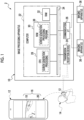
- an image processing system 2 comprises an image processing apparatus 10 and a user device 12.
- a server is applied as an example of the image processing apparatus 10.
- the server is realized by a main frame, for example. It should be noted that this is merely an example, and for example, the server may be realized by network computing, such as cloud computing, fog computing, edge computing, or grid computing.
- the image processing apparatus 10 may be a personal computer, a plurality of personal computers, a plurality of servers, a combination of the personal computer and the server, and the like.
- a smartphone is applied as an example of the user device 12.
- the smartphone is merely an example, and, for example, a personal computer may be applied, or a portable multifunctional terminal, such as a tablet terminal or a head mounted display (hereinafter, referred to as an "HMD"), may be applied.
- HMD head mounted display
- the image processing apparatus 10 and the user device 12 are connected in a communicable manner via, for example, a base station (not shown).
- the communication standards used in the base station include a wireless communication standard including a 5G standard and/or an LTE standard, a wireless communication standard including a WiFi (802.11) standard and/or a Bluetooth (registered trademark) standard, and a wired communication standard including a TDM standard and/or an Ethernet (registered trademark) standard.
- the image processing apparatus 10 acquires an image, and transmits the acquired image to the user device 12.
- the image refers to, for example, a captured image 64 (see Fig. 3 , Fig. 4 , Fig. 8 , and the like) obtained by being captured and an image generated based on the captured image 64 (see Fig. 3 , Fig. 4 , Fig. 8 , and the like).
- Examples of the image generated based on the captured image include a virtual viewpoint image 76 (see Fig. 8 and the like).
- the user device 12 is used by a user 14.
- the user device 12 comprises a touch panel display 16.
- the touch panel display 16 is realized by a display 18 and a touch panel 20.
- Examples of the display 18 include an EL display (for example, an organic EL display or an inorganic EL display). It should be noted that the display is not limited to the EL display, and another type of display, such as a liquid crystal display, may be applied.
- the touch panel display 16 is formed by superimposing the touch panel 20 on a display region of the display 18 or by forming an in-cell type in which a touch panel function is built in the display 18. It should be noted that the in-cell type is merely an example, and an out-cell type or an on-cell type may be applied.
- the user device 12 executes processing according to an instruction received from the user 14 by the touch panel 20 and the like.
- the user device 12 exchanges various types of information with the image processing apparatus 10 in response to the instruction received from the user 14 by the touch panel 20 and the like.
- the user device 12 receives the image transmitted from the image processing apparatus 10, and displays the received image on the display 18.
- the user 14 views the image displayed on the display 18.
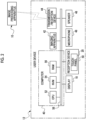
- the image processing apparatus 10 comprises a computer 22, a transmission/reception device 24, and a communication I/F 26.
- the computer 22 is an example of a "computer” according to the technology of the present disclosure, and comprises a CPU 28, an NVM 30, and a RAM 32.
- the image processing apparatus 10 comprises a bus 34, and the CPU 28, the NVM 30, and the RAM 32 are connected via the bus 34.
- one bus is shown as the bus 34 for convenience of illustration, but a plurality of buses may be used.
- the bus 34 may include a serial bus, or a parallel bus configured by a data bus, an address bus, a control bus, and the like.
- the CPU 28 is an example of a "processor" according to the technology of the present disclosure.
- the CPU 28 controls the entire image processing apparatus 10.
- Various parameters and various programs are stored in the NVM 30.
- Examples of the NVM 30 include an EEPROM, an SSD, and/or an HDD.
- the RAM 32 is an example of a "memory" according to the technology of the present disclosure.
- Various types of information are transitorily stored in the RAM 32.
- the RAM 32 is used as a work memory by the CPU 28.
- the transmission/reception device 24 is connected to the bus 34.
- the transmission/reception device 24 is a device including a communication processor (not shown), an antenna, and the like, and transmits and receives various types of information to and from the user device 12 via the base station (not shown) under the control of the CPU 28. That is, the CPU 28 exchanges various types of information with the user device 12 via the transmission/reception device 24.
- the communication I/F 26 is realized by a device including an FPGA, for example.
- the communication I/F 26 is connected to a plurality of imaging apparatuses 36 via a LAN cable (not shown).
- the imaging apparatus 36 is an imaging device including a CMOS image sensor, and has an optical zoom function and/or a digital zoom function. It should be noted that, instead of the CMOS image sensor, another type of image sensor, such as a CCD image sensor, may be adopted.
- the plurality of imaging apparatuses 36 are installed, for example, in a soccer stadium (not shown) and image a subject inside the soccer stadium.
- the captured image 64 (see Fig. 3 , Fig. 4 , Fig. 8 , and the like) obtained by imaging the subject by the imaging apparatus 36 is used, for example, for the generation of the virtual viewpoint image 76 (see Fig. 8 and the like). Therefore, the plurality of imaging apparatuses 36 are installed at different locations inside the soccer stadium, respectively, that is, at locations at which a plurality of captured images 64 (see Fig. 3 , Fig. 4 , Fig. 8 , and the like) for generating virtual viewpoint images 76 (see Fig. 8 and the like) are obtained.
- the soccer stadium is a three-dimensional region including a soccer field (not shown) and a spectator seat (not shown) that is constructed to surround the soccer field, and is an observation target of the user 14.
- An observer, that is, the user 14, can observe the inside of the soccer stadium from the spectator seat or a place outside the soccer stadium through the image displayed by the display 18 of the user device 12.
- the soccer stadium is described as an example as the place in which the plurality of imaging apparatuses 36 are installed, but the technology of the present disclosure is not limited to this.
- the place in which the plurality of imaging apparatuses 36 are installed may be any place as long as the place is a place in which the plurality of imaging apparatuses 36 can be installed, such as a baseball field, a rugby field, a curling field, an athletic field, a swimming pool, a concert hall, an outdoor music field, and a theater.
- the communication I/F 26 is connected to the bus 34, and controls the exchange of various types of information between the CPU 28 and the plurality of imaging apparatuses 36.
- the communication I/F 26 controls the plurality of imaging apparatuses 36 in response to a request from the CPU 28.
- the communication I/F 26 outputs the captured image 64 (see Fig. 3 , Fig. 4 , Fig. 8 , and the like) obtained by being captured by each of the plurality of imaging apparatuses 36 to the CPU 28.
- the communication I/F 26 is described as an example of a wired communication I/F, a wireless communication I/F, such as a high-speed wireless LAN, may be applied.
- the NVM 30 stores a screen generation processing program 38.
- the screen generation processing program 38 is an example of a "program" according to the technology of the present disclosure.
- the CPU 28 performs screen generation processing (see Fig. 20 ) by reading out the screen generation processing program 38 from the NVM 30 and executing the screen generation processing program 38 on the RAM 32.
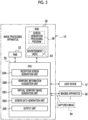
- the user device 12 comprises the display 18, a computer 40, an imaging apparatus 42, a transmission/reception device 44, a speaker 46, a microphone 48, and a reception device 50.
- the computer 40 comprises a CPU 52, an NVM 54, and a RAM 56.
- the user device 12 comprises a bus 58, and the CPU 52, the NVM 54, and the RAM 56 are connected via the bus 58.
- bus 58 In the example shown in Fig. 2 , one bus is shown as the bus 58 for convenience of illustration, but a plurality of buses may be used.
- the bus 58 may include a serial bus or a parallel bus configured by a data bus, an address bus, a control bus, and the like.
- the CPU 52 controls the entire user device 12.
- Various parameters and various programs are stored in the NVM 54.
- Examples of the NVM 54 include an EEPROM.
- Various types of information are transitorily stored in the RAM 56.
- the RAM 56 is used as a work memory by the CPU 52. By reading out various programs from the NVM 54 and executing the various programs on the RAM 56, the CPU 52 performs processing according to the various programs.
- the imaging apparatus 42 is an imaging device including a CMOS image sensor, and has an optical zoom function and/or a digital zoom function. It should be noted that, instead of the CMOS image sensor, another type of image sensor, such as a CCD image sensor, may be adopted.
- the imaging apparatus 42 is connected to the bus 58, and the CPU 52 controls the imaging apparatus 42. The captured image obtained by the imaging with the imaging apparatus 42 is acquired by the CPU 52 via the bus 58.
- the transmission/reception device 44 is connected to the bus 58.
- the transmission/reception device 44 is a device including a communication processor (not shown), an antenna, and the like, and transmits and receives various types of information to and from the image processing apparatus 10 via the base station (not shown) under the control of the CPU 52. That is, the CPU 52 exchanges various types of information with the image processing apparatus 10 via the transmission/reception device 44.
- the speaker 46 converts an electric signal into the sound.
- the speaker 46 is connected to the bus 58.
- the speaker 46 receives the electric signal output from the CPU 52 via the bus 58, converts the received electric signal into the sound, and outputs the sound obtained by the conversion from the electric signal to the outside of the user device 12.
- the microphone 48 converts the collected sound into the electric signal.
- the microphone 48 is connected to the bus 58.
- the CPU 52 acquires the electric signal obtained by the conversion from the sound collected by the microphone 48 via the bus 58.
- the reception device 50 receives an instruction from the user 14 or the like. Examples of the reception device 50 include the touch panel 20 and a hard key (not shown). The reception device 50 is connected to the bus 58, and the instruction received by the reception device 50 is acquired by the CPU 52.
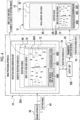
- a plurality of advertisement videos 62 are stored in the NVM 30 of the image processing apparatus 10.
- the advertisement video 62 is a video created in a process different from a process of the virtual viewpoint image 76 (see Fig. 8 and the like).
- the plurality of advertisement videos 62 stored in the NVM 30 are selectively read out from the NVM 30 by the CPU 28, and are used in the screen generation processing.
- the plurality of advertisement videos 62 are stored in the NVM 30, but this is merely an example, and a single advertisement video 62 may be stored in the NVM 30.
- the advertisement video 62 is a video showing an advertisement (for example, a moving image obtained by imaging the subject in a real space region by a camera, and/or an animation).
- the video showing the advertisement refers to, for example, a moving image in which the images of a plurality of frames created as an image for an advertisement are arranged in a time series.
- Examples of the advertisement video 62 include a video provided from a sponsor and the like who support the construction of the system (as shown in Fig. 1 as an example, the image processing system 2) for allowing the user 14 to view various videos including a virtual viewpoint video 78 (see Fig. 8 ).
- the advertisement video 62 may be an image for the advertisement of a single-frame or an image used for a purpose other than the advertisement.
- the advertisement video 62 is merely an example, and a moving image or a still image of another type may be used. It should be noted that the advertisement video 62 is an example of a "specific image" according to the technology of the present disclosure.
- the CPU 28 By reading out the screen generation processing program 38 from the NVM 30 and executing the screen generation processing program 38 on the RAM 32, the CPU 28 is operated as a reception screen generation unit 28A, a viewpoint information acquisition unit 28B, a virtual viewpoint image generation unit 28C, a screen data generation unit 28D, and an output unit 28E.
- a reception screen 66 and a virtual viewpoint video screen 68 are displayed on the display 18 of the user device 12.
- the reception screen 66 and the virtual viewpoint video screen 68 are displayed in an arranged manner. It should be noted that this is merely an example, and the reception screen 66 and the virtual viewpoint video screen 68 may be switched and displayed in response to the instruction given to the touch panel 20 by the user 14, or the reception screen 66 and the virtual viewpoint video screen 68 may be individually displayed by different display devices.
- the reception screen 66 is displayed on the display 18 of the user device 12, but the technology of the present disclosure is not limited to this, and for example, the reception screen 66 may be displayed on a display connected to a device (for example, a personal computer) used by a person who creates or edits the virtual viewpoint video 78 (see Fig. 8 ).
- a device for example, a personal computer
- the user device 12 acquires the virtual viewpoint video 78 (see Fig. 8 ) from the image processing apparatus 10 by performing communication with the image processing apparatus 10.
- the virtual viewpoint video 78 (see Fig. 8 ) acquired from the image processing apparatus 10 by the user device 12 is displayed on the virtual viewpoint video screen 68 of the display 18. In the example shown in Fig. 4 , the virtual viewpoint video 78 is not displayed on the virtual viewpoint video screen 68.
- the user device 12 performs communication with the image processing apparatus 10 to acquire reception screen data 70 indicating the reception screen 66 from the image processing apparatus 10.
- the reception screen 66 indicated by the reception screen data 70 acquired from the image processing apparatus 10 by the user device 12 is displayed on the display 18.
- the reception screen 66 includes a bird's-eye view video screen 66A, a guide message display region 66B, a decision key 66C, and a cancellation key 66D, and various types of information required for generating the virtual viewpoint video 78 (see Fig. 8 ) is displayed on the reception screen 66.
- the user 14 gives an indication to the user device 12 with reference to the reception screen 66.
- the indication from the user 14 is received by the touch panel 20, for example.
- a bird's-eye view video 72 is displayed on the bird's-eye view video screen 66A.
- the bird's-eye view video 72 is a moving image showing an aspect in a case in which the inside of the soccer stadium is observed from a bird's-eye view, and is generated based on the plurality of captured images 64 obtained by being captured by at least one of the plurality of imaging apparatuses 36.
- Examples of the bird's-eye view video 72 include a live coverage video.
- the operation requested to the user 14 refers to, for example, an operation required for generating the virtual viewpoint video 78 (see Fig. 8 ) (for example, an operation of setting the viewpoint, an operation of setting the gaze point, and the like).
- Display contents of the guide message display region 66B is switched according to an operation mode of the user device 12.
- the user device 12 has, as the operation mode, a viewpoint setting mode in which the viewpoint is set and a gaze point setting mode in which the gaze point is set, and the display contents of the guide message display region 66B are different between the viewpoint setting mode and the gaze point setting mode.
- Both the decision key 66C and the cancellation key 66D are soft keys.
- the decision key 66C is turned on by the user 14 in a case in which the indication received by the reception screen 66 is decided.
- the cancellation key 66D is turned on by the user 14 in a case in which the indication received by the reception screen 66 is cancelled.
- the reception screen generation unit 28A acquires the plurality of captured images 64 from the plurality of imaging apparatuses 36, and generates the bird's-eye view video 72 based on the acquired plurality of captured images 64. Then, the reception screen generation unit 28A generates data indicating the reception screen 66 including the bird's-eye view video 72, as the reception screen data 70.
- the output unit 28E acquires the reception screen data 70 generated by the reception screen generation unit 28A from the reception screen generation unit 28A to output the acquired reception screen data 70 to the transmission/reception device 24.
- the transmission/reception device 24 transmits the reception screen data 70 input from the output unit 28E to the user device 12.
- the user device 12 receives the reception screen data 70 transmitted from the transmission/reception device 24 by the transmission/reception device 44 (see Fig. 2 ).
- the reception screen 66 indicated by the reception screen data 70 received by the transmission/reception device 44 is displayed on the display 18.
- a message 66B1 is displayed in the guide message display region 66B of the reception screen 66.
- the message 66B1 is a message prompting the user 14 to indicate the viewpoint used for the generation of the virtual viewpoint video 78 (see Fig. 8 ).
- the viewpoint refers to a virtual viewpoint for observing the inside of the soccer stadium.
- the virtual viewpoint does not refer to a position at which an actually existing camera, such as a physical camera that images the subject (for example, the imaging apparatus 36), is installed, but refer to a position at which a virtual camera that images the subject is installed.
- the touch panel 20 receives an indication from the user 14 in a state in which the message 66B1 is displayed in the guide message display region 66B.
- the indication from the user 14 refers to an indication of the viewpoint.
- the viewpoint corresponds to a position of a pixel in the bird's-eye view video 72.
- the indication of the viewpoint is performed by the user 14 indicating the position of the pixel in the bird's-eye view video 72 via the touch panel 20. It should be noted that the viewpoint may have three-dimensional coordinates corresponding to a three-dimensional position in the bird's-eye view video 72. Any method can be used as a method of indicating the three-dimensional position.
- the user 14 may directly input a three-dimensional coordinate position, or may designate the three-dimensional coordinate position by displaying two images showing an aspect in a case in which the soccer stadium is seen from two planes perpendicular to each other and designating each pixel position.
- a viewpoint path P1 which is a path for observing the subject, is shown as an example of the viewpoint.
- the viewpoint path P1 is an aggregation in which a plurality of viewpoints are linearly arranged from a starting point P1s to an end point P1e.
- the viewpoint path P1 is defined along a route (in the example shown in Fig. 5 , a meandering route from the starting point P1s to the end point P1e) in which the user 14 slides (that is, swipes) his/her fingertip 14A on a region corresponding to a display region of the bird's-eye view video 72 in the entire region of the touch panel 20.
- an observation time from the viewpoint path P1 (for example, a time of observation between two different viewpoints and/or a time of observation at a certain point in a stationary state) is defined by a speed of the slide performed with respect to the touch panel 20 in a case in which the viewpoint path P1 is formed via the touch panel 20, a time (for example, a long press time) to stay at one viewpoint on the viewpoint path P1, and the like.
- the decision key 66C is turned on in a case in which the viewpoint path P1 is settled, and the cancellation key 66D is turned on in a case in which the viewpoint path P1 is cancelled.
- viewpoint path P1 is set, but this is merely an example, and a plurality of viewpoint paths may be set.
- the technology of the present disclosure is not limited to the viewpoint path, and a plurality of discontinuous viewpoints may be used, or one viewpoint may be used.
- a message 66B2 is displayed in the guide message display region 66B of the reception screen 66.
- the message 66B2 is a message prompting the user 14 to indicate the gaze point used for the generation of the virtual viewpoint video 78 (see Fig. 8 ).
- the gaze point refers to a point that is virtually gazed in a case in which the inside of the soccer stadium is observed from the viewpoint.
- a virtual visual line direction that is, an imaging direction of the virtual camera
- the virtual visual line direction refers to a direction from the viewpoint to the gaze point.
- the touch panel 20 receives an indication from the user 14 in a state in which the message 66B2 is displayed in the guide message display region 66B.
- the indication from the user 14 refers to an indication of the gaze point.
- the gaze point corresponds to a position of a pixel in the bird's-eye view video 72.
- the indication of the gaze point is performed by the user 14 indicating the position of the pixel in the bird's-eye view video 72 via the touch panel 20.
- a gaze point GP is shown.
- the gaze point GP is defined according to a location in which the user 14 touches his/her fingertip 14A on the region corresponding to the display region of the bird's-eye view video 72 in the entire region of the touch panel 20.
- the decision key 66C is turned on in a case in which the gaze point GP is settled, and the cancellation key 66D is turned on in a case in which the gaze point GP is cancelled.
- the gaze point may have three-dimensional coordinates corresponding to a three-dimensional position in the bird's-eye view video 72. Any method can be used as a method of indicating the three-dimensional position, as in the indication of the viewpoint position.
- a plurality of gaze points may be used, or a path (that is, a gaze point path) in which a plurality of gaze points are linearly arranged may be used.
- a gaze point path that is, a gaze point path
- One or a plurality of gaze point paths may be used.
- the CPU 52 of the user device 12 generates viewpoint information 74 based on the viewpoint path P1 and the gaze point GP.
- the viewpoint information 74 is information used for the generation of the virtual viewpoint video 78 (see Fig. 8 ).
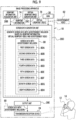
- the viewpoint information 74 includes total time information 74A, setting completion information 74B, viewpoint path information 74C, required time information 74D, elapsed time information 74E, movement speed information 74F, angle-of-view information 74G, and gaze point information 74H.
- the total time information 74A is information indicating a total time (hereinafter, also simply referred to as a "total time") in which the virtual viewpoint video 78 (see Fig. 8 ) generated based on one or more viewpoint paths (for example, the plurality of viewpoint paths including the viewpoint path P1) settled in the viewpoint setting mode is played back at a standard playback speed.
- the total time corresponds to a time in which the fingertip 14A is slid on the touch panel 20 to create the plurality of viewpoint paths.
- the total time information 74A is an example of a "time parameter related to a time" according to the technology of the present disclosure.
- the setting completion information 74B is information indicating that setting of the viewpoint information 74 is completed.
- the completion of the setting of the viewpoint information 74 means, for example, completion of generation of the viewpoint information 74 by the CPU 52.
- the viewpoint path information 74C is information indicating the viewpoint path P1 settled in the viewpoint setting mode (for example, coordinates for specifying a position of a pixel of the viewpoint path P1 in the bird's-eye view video 72).
- the required time information 74D is information indicating a required time (hereinafter, also simply referred to as a "required time"), which is required for a first viewpoint for observing the subject on the viewpoint path P1 to move from a first position to a second position different from the first position.
- the first position refers to the starting point P1s (see Fig. 5 and Fig. 6 )
- the second position refers to, for example, the end point P1e (see Fig. 5 and Fig. 6 ). It should be noted that this is merely an example, and the first position may be the starting point P1s (see Fig. 5 and Fig.
- the second position may be a position of the intermediate viewpoint on the viewpoint path P1
- the first position may be a position of the intermediate viewpoint in the viewpoint path P1
- the second position may be the end point P1e (see Fig. 5 and Fig. 6 ).
- the elapsed time information 74E is information indicating a position of the second viewpoint for observing the subject on the viewpoint path P1 and the elapsed time corresponding to the position of the second viewpoint.
- the elapsed time corresponding to the position of the second viewpoint (hereinafter, also simply referred to as an "elapsed time”) refers to, for example, a time in which the viewpoint is stationary at a position of a certain viewpoint on the viewpoint path P1.
- the movement speed information 74F is information for specifying a movement speed of a position of a third viewpoint for observing the subject on the viewpoint path P1.
- the movement speed of the position of the third viewpoint (hereinafter, also simply referred to as a "movement speed”) refers to, for example, the speed of the slide performed on the touch panel 20 in a case in which the viewpoint path P1 is formed via the touch panel 20.
- the movement speed information 74F is associated with each viewpoint in the viewpoint path P1.
- the angle-of-view information 74G is information related to an angle of view (hereinafter, also simply referred to as an "angle of view") for observing the subject on the viewpoint path P1.
- the angle of view is decided according to the movement speed. For example, within a range in which an upper limit (for example, 150 degrees) and a lower limit (for example, 15 degrees) of the angle of view are decided, the angle of view is narrower as the movement speed is lower.
- the angle of view may be narrower as the movement speed is higher.
- the angle of view may be decided according to the elapsed time. In this case, for example, the angle of view need only be minimized in a case in which the elapsed time exceeds a first predetermined time (for example, 3 seconds), or the angle of view need only be maximized in a case in which the elapsed time exceeds the first predetermined time.
- the angle of view may be decided according to, for example, the indication received by the reception device 50.
- the reception device 50 need only receive the indications regarding the position of the viewpoint of which the angle of view is changed and the changed angle of view on the viewpoint path P 1.
- the gaze point information 74H is information for specifying a position of the gaze point GP settled in the gaze point setting mode (for example, coordinates for specifying a position of a pixel of the gaze point GP in the bird's-eye view video 72). It should be noted that the gaze point information 74H is an example of "gaze point information" according to the technology of the present disclosure.
- the CPU 52 outputs the viewpoint information 74 to the transmission/reception device 44.
- the transmission/reception device 44 transmits the viewpoint information 74 input from the CPU 52 to the image processing apparatus 10.
- the transmission/reception device 24 of the image processing apparatus 10 receives the viewpoint information 74.
- the viewpoint information acquisition unit 28B of the image processing apparatus 10 acquires the viewpoint information 74 received by the transmission/reception device 24.
- the virtual viewpoint image generation unit 28C generates the virtual viewpoint image 76, which is an image showing an aspect of the subject in a case in which the subject is observed from the viewpoint specified by the viewpoint information 74, based on the plurality of captured images 64 and the viewpoint information 74.
- the virtual viewpoint image generation unit 28C acquires the plurality of captured images 64 from the plurality of imaging apparatuses 36 according to the viewpoint information 74, and generates the virtual viewpoint image 76 for each viewpoint on the viewpoint path P1 based on the acquired plurality of captured images 64. That is, the virtual viewpoint image generation unit 28C generates the virtual viewpoint images 76 of a plurality of frames according to the viewpoint path P1.
- the virtual viewpoint images 76 of the plurality of frames generated according to the viewpoint path P1 refers to the virtual viewpoint image 76 generated for each viewpoint on the viewpoint path P1.
- the virtual viewpoint image generation unit 28C generates the virtual viewpoint video 78 by arranging the virtual viewpoint images 76 of the plurality of frames in a time series. It should be noted that, even in a case in which the viewpoint path is present in addition to the viewpoint path P1, the virtual viewpoint image generation unit 28C generates the virtual viewpoint images 76 of the plurality of frames as in the viewpoint path P1, and generates the virtual viewpoint video 78 by arranging the generated virtual viewpoint images 76 of the plurality of frames in a time series.
- the virtual viewpoint video 78 is a moving image in which the virtual viewpoint images 76 of the plurality of frames are arranged in a time series.
- a person who views the virtual viewpoint video 78 is the user 14, for example.
- the virtual viewpoint video 78 is viewed by the user 14 via the display 18 of the user device 12.
- the virtual viewpoint images 76 of the plurality of frames are viewed by the user 14 as the virtual viewpoint video 78 by being displayed on the virtual viewpoint video screen 68 (see Fig. 4 ) of the display 18 of the user device 12 at a predetermined frame rate (for example, several tens of frames/second) from the first frame to the last frame.
- a predetermined frame rate for example, several tens of frames/second
- the screen data generation unit 28D generates screen data with advertisement inclusion 80 based on the viewpoint information 74 (for example, the viewpoint information 74 used for the generation of the virtual viewpoint video 78) acquired by the viewpoint information acquisition unit 28B, the virtual viewpoint video 78 generated by the virtual viewpoint image generation unit 28C, and at least one advertisement video 62 stored in the NVM 30.
- the screen data with advertisement inclusion 80 is data for displaying the advertisement video 62 and the virtual viewpoint video 78 on the display 18 (see Fig. 10 ) of the user device 12 based on the viewpoint information 74.
- the screen data with advertisement inclusion 80 is also data for displaying the advertisement video 62 on the display 18 (see Fig.
- the screen data with advertisement inclusion 80 does not have to be one data including the advertisement video 62 and the virtual viewpoint video 78, and may be any data as long as the data is for displaying the advertisement video 62 and the virtual viewpoint video 78 on the display 18 of the user device 12 at a timing described below.
- the screen data with advertisement inclusion 80 may be data only for deciding display timings of the advertisement video 62 and the virtual viewpoint video 78. In this case, the advertisement video 62 and the virtual viewpoint video 78 are streamed and distributed at the decided timings, and displayed on the display 18.
- the screen data with advertisement inclusion 80 includes first screen data 80A, second screen data 80B, third screen data 80C, fourth screen data 80D, fifth screen data 80E, sixth screen data 80F, seventh screen data 80G, and eighth screen data 80H.
- the screen data with advertisement inclusion 80 includes the first screen data 80A, the second screen data 80B, the third screen data 80C, the fourth screen data 80D, the fifth screen data 80E, the sixth screen data 80F, the seventh screen data 80G, and the eighth screen data 80H.
- the screen data with advertisement inclusion 80 need only include one or more screen data of the first screen data 80A, the second screen data 80B, the third screen data 80C, the fourth screen data 80D, the fifth screen data 80E, the sixth screen data 80F, the seventh screen data 80G, and the eighth screen data 80H.
- the screen data with advertisement inclusion 80 is an example of "data” according to the technology of the present disclosure.
- the first screen data 80A is an example of "first data” according to the technology of the present disclosure.
- the second screen data 80B is an example of "second data” according to the technology of the present disclosure.
- the third screen data 80C is an example of "third data” according to the technology of the present disclosure.
- the fourth screen data 80D is an example of "fourth data” according to the technology of the present disclosure.
- the fifth screen data 80E is an example of "fifth data” according to the technology of the present disclosure.
- the sixth screen data 80F is an example of "sixth data” according to the technology of the present disclosure.
- the seventh screen data 80G is an example of "seventh data” according to the technology of the present disclosure.
- the eighth screen data 80H is an example of "eighth data” according to the technology of the present disclosure.
- the output unit 28E outputs the screen data with advertisement inclusion 80 generated by the screen data generation unit 28D to the transmission/reception device 24.
- the transmission/reception device 24 transmits the screen data with advertisement inclusion 80 input from the output unit 28E to the user device 12.
- various types of information are exchanged between the image processing apparatus 10 and the user device 12.
- the user device 12 transmits the viewpoint information 74 to the image processing apparatus 10.
- the image processing apparatus 10 transmits the reception screen data 70 to the user device 12.
- the image processing apparatus 10 receives the viewpoint information 74 transmitted from the user device 12, and generates the screen data with advertisement inclusion 80 based on the received viewpoint information 74. Then, the image processing apparatus 10 transmits the screen data with advertisement inclusion 80 to the user device 12.
- the user device 12 receives the reception screen data 70 and the screen data with advertisement inclusion 80 which are transmitted from the image processing apparatus 10.
- the user device 12 displays the reception screen 66 indicated by the reception screen data 70 on the display 18, and displays an image based on the screen data with advertisement inclusion 80 on the virtual viewpoint video screen 68.
- the image based on the screen data with advertisement inclusion 80 refers to a virtual viewpoint video with advertisement inclusion 81.
- the virtual viewpoint video with advertisement inclusion 81 refers to a video including the advertisement video 62 and the virtual viewpoint video 78.
- the virtual viewpoint video with advertisement inclusion 81 is classified into virtual viewpoint videos with advertisement inclusion 81A to 81H (see Fig. 11 , Fig. 12 , and Fig. 14 to Fig. 19 ).
- the screen data generation unit 28D generates the first screen data 80A including the virtual viewpoint video with advertisement inclusion 81A based on the total time information 74A, the advertisement video 62, and the virtual viewpoint video 78.
- the first screen data 80A is data for displaying the virtual viewpoint video 78 on the display 18.
- the first screen data 80A is also data for displaying the advertisement video 62 on the display 18 according to the total time information 74A.
- the screen data generation unit 28D generates the virtual viewpoint video with advertisement inclusion 81A by inserting the advertisement video 62 in the virtual viewpoint video 78 such that the advertisement video 62 is displayed on the display 18 at a timing which is decided according to the total time information 74A.
- a first example of the timing which is decided according to the total time information 74A is a time interval obtained by equally dividing the total time indicated by the total time information 74A.
- a second example of the timing which is decided according to the total time information 74A is a timing before the virtual viewpoint image 76 of the first frame included in the virtual viewpoint video 78 is displayed in a case in which the total time indicated by the total time information 74A is shorter than a second predetermined time (for example, 20 seconds).
- a third example of the timing which is decided according to the total time information 74A is a timing in the middle of displaying of the virtual viewpoint video 78 in a case in which the total time indicated by the total time information 74A is equal to or longer than the second predetermined time.
- Another example of the timing which is decided according to the total time information 74A is a timing after the virtual viewpoint image 76 of the last frame is displayed.
- the screen data generation unit 28D generates the second screen data 80B including the virtual viewpoint video with advertisement inclusion 81B based on the setting completion information 74B, the advertisement video 62, and the virtual viewpoint video 78.
- the second screen data 80B is data for displaying the virtual viewpoint video 78 on the display 18.
- the second screen data 80B is data for displaying the advertisement video 62 on the display 18 during a period from the completion of the setting of the viewpoint information 74 to displaying of the virtual viewpoint video 78 on the display 18 according to the setting completion information 74B.
- the screen data generation unit 28D determines whether or not the setting completion information 74B is included in the viewpoint information 74. Then, in a case in which the screen data generation unit 28D determines that the setting completion information 74B is included in the viewpoint information 74, the screen data generation unit 28D generates the virtual viewpoint video with advertisement inclusion 81B by inserting the advertisement video 62 in the virtual viewpoint video 78 such that the advertisement video 62 is displayed on the display 18 after the setting of the viewpoint information 74 is completed and before the virtual viewpoint image 76 of the first frame included in the virtual viewpoint video 78 is displayed on the display 18.
- the advertisement video 62 is also inserted between the virtual viewpoint image 76 of the first frame of the virtual viewpoint video 78 and the virtual viewpoint image 76 of the last frame.
- a method of inserting the advertisement video 62 between the virtual viewpoint image 76 of the first frame and the virtual viewpoint image 76 of the last frame may be, for example, the same method as a method used for the generation of the virtual viewpoint video with advertisement inclusion 81A shown in Fig. 11 .
- the advertisement video 62 may be inserted in the middle of the virtual viewpoint video 78 by another method (for example, the same method as a method used for the generation of the virtual viewpoint videos with advertisement inclusion 81C to 81H described below).
- the continuity of the viewpoint information 74 may be interrupted between the end point of a certain viewpoint path and the starting point of the next starting point path.
- a viewpoint path P2 from a starting point P2s to an end point P2e is designated by the user 14, the virtual viewpoint video based on the viewpoint path P1 is played back, and subsequently, the virtual viewpoint video based on the viewpoint path P2 is played back.
- the end point P1e of the viewpoint path P1 and the starting point P2s of the viewpoint path P2 are discontinuous. That is, the continuity of the viewpoint information 74 is interrupted between the end point P1e of the viewpoint path P1 and the starting point P2s of the viewpoint path P2. Therefore, in a case in which the viewpoint moves from the end point P1e to the starting point P2s, the virtual viewpoint video is significantly changed. In this case, the screen data generation unit 28D generates the third screen data 80C.
- the screen data generation unit 28D generates the third screen data 80C including the virtual viewpoint video with advertisement inclusion 81C based on the advertisement video 62, the viewpoint path information 74C, and the virtual viewpoint video 78.
- the third screen data 80C is data for displaying the virtual viewpoint video 78 on the display 18.
- the third screen data 80C is also data for displaying the advertisement video 62 on the display 18 according to a timing at which the continuity of the viewpoint information 74 is interrupted.
- the screen data generation unit 28D generates the virtual viewpoint video with advertisement inclusion 81C by inserting the advertisement video 62 in the virtual viewpoint video 78 such that the advertisement video 62 is displayed on the display 18 at the timing at which the continuity of the viewpoint is interrupted, with reference to the viewpoint path information 74C.
- the timing at which the continuity of the viewpoint is interrupted refers to, for example, a timing from after the viewpoint corresponding to the virtual viewpoint image 76 reaches the end point P1e (see Fig. 14 ) of the viewpoint path P1 and to before the viewpoint reaches the starting point P2s (see Fig. 14 ) of the viewpoint path P2.
- the screen data generation unit 28D determines that the continuity of the viewpoint is interrupted.
- the timing at which the continuity of the viewpoint is interrupted is not limited to such a timing.
- the screen data generation unit 28D may determine that the continuity of the viewpoint is interrupted.
- the screen data generation unit 28D generates the fourth screen data 80D including the virtual viewpoint video with advertisement inclusion 81D based on the advertisement video 62, the viewpoint path information 74C, and the virtual viewpoint video 78.
- the fourth screen data 80D is data for displaying the virtual viewpoint video 78 on the display 18.
- the fourth screen data 80D is also data for displaying the advertisement video 62 on the display 18 at an interval at which the viewpoint path P1 indicated by the viewpoint path information 74C is divided.
- the screen data generation unit 28D generates the virtual viewpoint video with advertisement inclusion 81D by inserting the advertisement video 62 in the virtual viewpoint video 78 such that the advertisement video 62 is displayed on the display 18 at a positional interval at which the viewpoint path P1 indicated by the viewpoint path information 74C is divided into N (natural number of 2 or more) parts.
- the number of division parts of the viewpoint path P1 may be decided according to the instruction received by the reception device 50 (see Fig. 2 ), or may be decided according to a length from the starting point P1s to the end point P1e of the viewpoint path P1.
- the viewpoint path P1 does not always have to be equally divided into N parts.
- the advertisement video 62 may be displayed on the display 18 at a positional interval obtained by dividing the viewpoint path P1 into N parts such that an insertion interval of the advertisement video 62 is shortened as the viewpoint corresponding to the virtual viewpoint image 76 approaches the end point P1e of the viewpoint path P1, that is, as the virtual viewpoint video 78 approaches the virtual viewpoint image 76 of the last frame.
- the screen data generation unit 28D generates the fifth screen data 80E including the virtual viewpoint video with advertisement inclusion 81E based on the advertisement video 62, the required time information 74D, and the virtual viewpoint video 78.
- the fifth screen data 80E is data for displaying the virtual viewpoint video 78 on the display 18.
- the fifth screen data 80E is also data for displaying the advertisement video 62 on the display 18 at an interval at which the required time indicated by the required time information 74D is divided.
- the screen data generation unit 28D generates the virtual viewpoint video with advertisement inclusion 81E by inserting the advertisement video 62 in the virtual viewpoint video 78 such that the advertisement video 62 is displayed on the display 18 at a constant time interval at which the required time indicated by the required time information 74D is equally divided.
- the number of equal divisions of the required time may be decided according to the instruction received by the reception device 50 (see Fig. 2 ), or may be decided according to a length of the required time indicated by the required time information 74D.
- the equal division is merely an example, and for example, the insertion interval of the advertisement video 62 may be shortened as the viewpoint corresponding to the virtual viewpoint image 76 approaches the end point P1e of the viewpoint path P1, that is, as the virtual viewpoint video 78 approaches the virtual viewpoint image 76 of the last frame.
- the screen data generation unit 28D generates the sixth screen data 80F including the virtual viewpoint video with advertisement inclusion 81F based on the advertisement video 62, the elapsed time information 74E, and the virtual viewpoint video 78.
- the sixth screen data 80F is data for displaying the virtual viewpoint video 78 on the display 18.
- the sixth screen data 80F may also be data for displaying the advertisement video 62 on the display 18 at a timing which is decided according to a relationship between the elapsed time indicated by the elapsed time information 74E and the position of the second viewpoint.
- the screen data generation unit 28D generates the virtual viewpoint video with advertisement inclusion 81F such that the advertisement video 62 is displayed on the display 18 at a position at which the viewpoint is stationary, with reference to the elapsed time information 74E.
- the screen data generation unit 28D generates the virtual viewpoint video with advertisement inclusion 81F by inserting the advertisement video 62 in the virtual viewpoint video 78 such that the advertisement video 62 is displayed on the display 18 at a position of the viewpoint, among the plurality of viewpoints included in the viewpoint path P1, at which a condition in which the elapsed time indicated by the elapsed time information 74E is equal to or longer than a first threshold value (for example, 5 seconds) is satisfied (for example, at a timing at which a condition in which the elapsed time is equal to or longer than the first threshold value is satisfied).
- a first threshold value for example, 5 seconds
- the first threshold value may be a fixed value, or may be a variable value that is changed in response to the instruction received by the reception device 50 and
- the screen data generation unit 28D generates the seventh screen data 80G including the virtual viewpoint video with advertisement inclusion 81G based on the advertisement video 62, the movement speed information 74F, and the virtual viewpoint video 78.
- the seventh screen data 80G is data for displaying the virtual viewpoint video 78 on the display 18.
- the seventh screen data 80G is also data for displaying the advertisement video 62 on the display 18 at a timing at which the movement speed specified from the movement speed information 74F is equal to or lower than a second threshold value.
- the second threshold value is an example of a "threshold value" according to the technology of the present disclosure.
- the screen data generation unit 28D generates the virtual viewpoint video with advertisement inclusion 81F by inserting the advertisement video 62 in the virtual viewpoint video 78 such that the advertisement video 62 is displayed on the display 18 at a position of the viewpoint, among the plurality of viewpoints included in the viewpoint path P1, at which a condition in which the movement speed specified by the movement speed information 74F is the second threshold value (for example, 5 mm/second) is satisfied (for example, at a timing at which a condition in which the movement speed is equal to or higher than the second threshold value is satisfied).
- the second threshold value may be a fixed value, or may be a variable value that is changed in response to the instruction received by the reception device 50 and/or various conditions.
- the screen data generation unit 28D generates the eighth screen data 80H including the virtual viewpoint video with advertisement inclusion 81H based on the advertisement video 62, the angle-of-view information 74G, and the virtual viewpoint video 78.
- the eighth screen data 80H is data for displaying the virtual viewpoint video 78 on the display 18.
- the eighth screen data 80H is also data for displaying the advertisement video 62 on the display 18 at a timing which is decided according to the angle-of-view information 74G
- the screen data generation unit 28D generates the virtual viewpoint video with advertisement inclusion 81H by inserting the advertisement video 62 in the virtual viewpoint video 78 such that the advertisement video 62 is displayed on the display 18 at a position of the viewpoint, among the plurality of viewpoints included in the viewpoint path P1, at which the angle of view indicated by the angle-of-view information 74G is equal to or smaller than a third threshold value (for example, 40 degrees) (for example, at a timing at which the angle of view indicated by the angle-of-view information 74G is equal to or smaller than the third threshold value).
- a third threshold value for example, 40 degrees
- the form example is described in which the virtual viewpoint video with advertisement inclusion 81H is generated such that the advertisement video 62 is displayed on the display 18 at the timing at which the angle of view indicated by the angle-of-view information 74G is equal to or smaller than the third threshold value, but the technology of the present disclosure is not limited to this.
- the virtual viewpoint video with advertisement inclusion 81H may be generated such that the advertisement video 62 is displayed on the display 18 at a timing at which the angle of view indicated by the angle-of-view information 74G is equal to or larger than a fourth threshold value (for example, 110 degrees), or the virtual viewpoint video with advertisement inclusion 81H may be generated such that the advertisement video 62 is displayed on the display 18 at a timing at which the angle of view indicated by the angle-of-view information 74G is changed.
- a fourth threshold value for example, 110 degrees
- the third threshold value ad the fourth threshold value may be a fixed value, or may be a variable value that is changed in response to the instruction received by the reception device 50 and/or various conditions.
- Fig. 20 shows an example of a flow of screen generation processing performed by the CPU 28 of the image processing apparatus 10.
- the flow of the screen generation processing shown in Fig. 20 is an example of an image processing method according to the technology of the present disclosure.
- step ST10 the reception screen generation unit 28A generates the reception screen data 70 based on the plurality of captured images 64 (see Fig. 4 ). After the processing of step ST10 is executed, the screen generation processing shifts to step ST12.
- step ST12 the output unit 28E transmits the reception screen data 70 generated by the reception screen generation unit 28A to the user device 12 via the transmission/reception device 24.
- step ST12 the screen generation processing shifts to step ST14.
- the user device 12 receives the reception screen data 70, and displays the reception screen 66 indicated by the received reception screen data 70 on the display 18 (see Fig. 4 to Fig. 6 ).
- the reception screen 66 is displayed on the display 18 of the user device 12
- the indications of the viewpoint, the gaze point, and the like are given to the user device 12 from the user 14 via the touch panel 20 (see Fig. 5 and Fig. 6 ).
- the CPU 52 of the user device 12 generates the viewpoint information 74 based on the viewpoint and the gaze point which are received by the touch panel 20, and transmits the generated viewpoint information 74 to the image processing apparatus 10 via the transmission/reception device 44 (see Fig. 7 ).
- step ST14 the viewpoint information acquisition unit 28B determines whether or not the viewpoint information 74 is received by the transmission/reception device 24. In step ST14, in a case in which the viewpoint information 74 is not received by the transmission/reception device 24, a negative determination is made, and the screen generation processing shifts to step ST22. In step ST14, in a case in which the viewpoint information 74 is received by the transmission/reception device 24, a positive determination is made, and the screen generation processing shifts to step ST16. The viewpoint information acquisition unit 28B acquires the viewpoint information 74 received by the transmission/reception device 24 (see Fig. 7 ).
- step ST16 the virtual viewpoint image generation unit 28C acquires the plurality of captured images 64 from the plurality of imaging apparatuses 36 according to the viewpoint information 74 acquired by the viewpoint information acquisition unit 28B. Then, the virtual viewpoint image generation unit 28C generates the virtual viewpoint video 78 based on the plurality of captured images 64 acquired from the plurality of imaging apparatuses 36 and the viewpoint information 74 acquired by the viewpoint information acquisition unit 28B. After the processing of step ST16 is executed, the screen generation processing shifts to step ST18.
- step ST18 the screen data generation unit 28D generates screen data with advertisement inclusion 80 based on the viewpoint information 74 (in step ST16, the viewpoint information 74 used for the generation of the virtual viewpoint video 78) acquired by the viewpoint information acquisition unit 28B, the virtual viewpoint video 78 generated in step ST16, and the advertisement video 62 stored in the NVM 30 (see Fig. 9 to Fig. 19 ).
- the screen generation processing shifts to step ST20.
- step ST20 the output unit 28E transmits the screen data with advertisement inclusion 80 generated in step ST18 to the user device 12 via the transmission/reception device 24 (see Fig. 9 ).
- the user device 12 receives the screen data with advertisement inclusion 80, and displays the virtual viewpoint video with advertisement inclusion 81 included in the received screen data with advertisement inclusion 80 on the virtual viewpoint video screen 68 of the display 18 (see Fig. 10 ).
- the virtual viewpoint video with advertisement inclusion 81 displayed on the virtual viewpoint video screen 68 is viewed by the user 14.
- the virtual viewpoint video with advertisement inclusion 81 displayed on the virtual viewpoint video screen 68 may be any one or a plurality of the virtual viewpoint videos with advertisement inclusion 81A to 81H. Whether any one of the virtual viewpoint videos with advertisement inclusion 81A to 81H is displayed on the virtual viewpoint video screen 68 of the display 18 may be randomly decided, may be decided according to contents of the viewpoint information 74, or may be decided according to the number of times the user 14 views the virtual viewpoint video 78.
- step ST22 the output unit 28E determines whether or not a condition for ending the screen generation processing (hereinafter, referred to as an "end condition") is satisfied.
- a first example of the end condition is a condition in which an instruction to end the screen generation processing is received by the reception device 50 (see Fig. 2 ).
- a second example of the end condition includes a condition in which the communication between the image processing apparatus 10 and one or more imaging apparatuses 36 decided in advance among the plurality of imaging apparatuses 36 is cut off.
- a third example of the end condition is a condition in which a predetermined time (for example, 60 seconds) has elapsed without a positive determination made in step ST14.
- step ST22 In a case in which the end condition is not satisfied in step ST22, a negative determination is made, and the screen generation processing shifts to step ST10. In step ST22, in a case in which the end condition is satisfied, a positive determination is made, and the screen generation processing ends.
- the virtual viewpoint video 78 and the advertisement video 62 and created in a process different from a process of the virtual viewpoint video 78 are displayed on the display 18 of the user device 12 based on the viewpoint information 74.
- the virtual viewpoint video 78 is displayed on the display 18, and the advertisement video 62 is displayed on the display 18 at the timing which is decided according to the viewpoint information 74. Therefore, with the present configuration, the advertisement video 62 can be shown to the user 14 who is a viewer of the virtual viewpoint video 78.
- the first screen data 80A is generated.
- the first screen data 80A is the data for displaying the virtual viewpoint video 78 on the display 18.
- the first screen data 80A is also the data for displaying the advertisement video 62 on the display 18 according to the total time information 74A. Therefore, with the present configuration, as compared to a case in which the advertisement video 62 is displayed on the display 18 depending only on the viewpoint, the advertisement video 62 can be easily displayed on the display 18 at a timing that is convenient for a side that provides the advertisement video 62 to the user 14 and/or for the user 14.
- the second screen data 80B is generated.
- the second screen data 80B is the data for displaying the virtual viewpoint video 78 on the display 18.
- the second screen data 80B is the data for displaying the advertisement video 62 on the display 18 during the period from the completion of the setting of the viewpoint information 74 to displaying of the virtual viewpoint video 78 on the display 18 according to the setting completion information 74B. Therefore, with the present configuration, the advertisement video 62 can be shown to the user 14 during a period from the completion of the setting of the viewpoint information 74 to the viewing of the virtual viewpoint video 78 by the user 14.
- the third screen data 80C is generated.
- the third screen data 80C is the data for displaying the virtual viewpoint video 78 on the display 18.
- the third screen data 80C is also data for displaying the advertisement video 62 on the display 18 according to the timing at which the continuity of the viewpoint information 74 is interrupted. Therefore, with the present configuration, the advertisement video 62 can be shown to the user 14 at the timing at which the continuity of the viewpoint information 74 is interrupted.
- the fourth screen data 80D is generated.
- the fourth screen data 80D is the data for displaying the virtual viewpoint video 78 on the display 18.
- the fourth screen data 80D is also data for displaying the advertisement video 62 on the display 18 at the interval at which the viewpoint path P1 indicated by the viewpoint path information 74C is divided. Therefore, with the present configuration, the advertisement video 62 can be shown to the user 14 at each interval at which the viewpoint path P1 is divided.
- the fifth screen data 80E is generated.
- the fifth screen data 80E is the data for displaying the virtual viewpoint video 78 on the display 18.
- the fifth screen data 80E is also data for displaying the advertisement video 62 on the display 18 at the interval at which the required time indicated by the required time information 74D is divided. Therefore, with the present configuration, the advertisement video 62 can be shown to the user 14 at each interval at which the time required for the viewpoint to move from the first position to the second position is divided.
- the sixth screen data 80F is generated.
- the sixth screen data 80F is the data for displaying the virtual viewpoint video 78 on the display 18.
- the sixth screen data 80F may also be data for displaying the advertisement video 62 on the display 18 at the timing which is decided according to the relationship between the elapsed time indicated by the elapsed time information 74E and the position of the second viewpoint. Therefore, with the present configuration, the advertisement video 62 can be shown to the user 14 at the timing which is decided according to the relationship between the elapsed time indicated by the elapsed time information 74E and the position of the second viewpoint.
- the seventh screen data 80G is generated.
- the seventh screen data 80G is the data for displaying the virtual viewpoint video 78 on the display 18.
- the seventh screen data 80G is also data for displaying the advertisement video 62 on the display 18 at the timing at which the movement speed specified from the movement speed information 74F is equal to or lower than a second threshold value. Therefore, with the present configuration, the advertisement video 62 can be shown to the user 14 at the timing at which the movement speed specified from the movement speed information 74F is equal to or lower than the second threshold value.
- the eighth screen data 80H is generated.
- the eighth screen data 80H is the data for displaying the virtual viewpoint video 78 on the display 18.
- the eighth screen data 80H is also data for displaying the advertisement video 62 on the display 18 at the timing which is decided according to the angle-of-view information 74G Therefore, with the present configuration, the advertisement video 62 can be shown to the user 14 at the timing which is decided according to the angle-of-view information 74G
- the video created in the process different from the process of the virtual viewpoint video 78 is described as an example of the advertisement video 62, but the technology of the present disclosure is not limited to this.
- the advertisement video 62 may be a video created without using the plurality of captured images 64, and in this case as well, the same effect as the effect of the embodiment is obtained.
- the advertisement video 62 may be a video created in a process different from the process of the virtual viewpoint image 76 (see Fig. 8 and the like), and is created without using the plurality of captured images 64 (see Fig. 3 , Fig. 4 , and Fig. 8 and the like).
- the advertisement video 62 may be a video created by using at least a part of the plurality of captured images 64. Moreover, the advertisement video 62 may be a video that is not affected by the plurality of imaging apparatuses 36, may be a video that does not depend on a RAW image obtained by imaging the subject by the plurality of imaging apparatuses 36, or may be a video that is irrelevant to the data obtained from the plurality of imaging apparatuses 36.
- the advertisement video 62 is inserted between the virtual viewpoint images 76, but the technology of the present disclosure is not limited to this.
- the advertisement video 62 may be displayed in a superimposed manner on the virtual viewpoint video 78, or may be displayed in a state in which an advertisement image is embedded in the virtual viewpoint image 76.
- the screen data generation unit 28D generates ninth screen data 801 including a virtual viewpoint video with advertisement inclusion 811.
- the ninth screen data 801 is an example of "ninth data" according to the technology of the present disclosure.
- the ninth screen data 801 is data for displaying the virtual viewpoint video 78 on the display 18.
- the ninth screen data 80I is also data for displaying the advertisement video 62 on the display 18 at a timing at which the displaying of the virtual viewpoint video 78 on the display 18 is started.
- the screen data generation unit 28D generates the virtual viewpoint video with advertisement inclusion 81I by superimposing the advertisement video 62 on the virtual viewpoint video 78 such that the advertisement video 62 is displayed in a superimposed manner on the virtual viewpoint image 76 for a predetermined number of frames (for example, several hundred frames) from the virtual viewpoint image 76 of the first frame such that the advertisement video 62 is displayed on the display 18 at the timing at which the displaying of the virtual viewpoint video 78 on the display 18 is started.
- the displaying in a superimposed manner is realized by, for example, ⁇ -blend.
- the advertisement video 62 may be superimposed on the entirety of each virtual viewpoint image 76 included in the virtual viewpoint video with advertisement inclusion 81I, or may be superimposed on a part of each virtual viewpoint image 76.
- the screen data generation unit 28D may generate the virtual viewpoint video with advertisement inclusion 81I by embedding, in an order from the first frame, a plurality of advertisement images included in the advertisement video 62 to the virtual viewpoint image 76 for a predetermined number of frames (for example, several hundred frames) from the virtual viewpoint image 76 of the first frame such that the advertisement video 62 is displayed on the display 18 at the timing at which the displaying of the virtual viewpoint video 78 on the display 18 is started.
- the advertisement image need only be embedded in a part of the virtual viewpoint image 76.
- the virtual viewpoint video with advertisement inclusion 81I generated in this manner is displayed on the display 18 of the user device 12. Therefore, with the present configuration, the advertisement video 62 can be shown to the user 14 who is the viewer of the virtual viewpoint video 78 at the timing at which the displaying of the virtual viewpoint video 78 is started.
- the virtual viewpoint video with advertisement inclusion 81I may be generated by embedding, in the order, the plurality of advertisement images included in the advertisement video 62 from the virtual viewpoint image 76 temporally backed by a predetermined number of frames with respect to the virtual viewpoint image 76 of the last frame to the virtual viewpoint image 76 of the last frame.
- the advertisement video 62 can be shown to the user 14 who is the viewer of the virtual viewpoint video 78 around the timing at which the displaying of the virtual viewpoint video 78 ends.
- the ninth screen data 80I for displaying the advertisement video 62 on the display 18 at the timing at which the displaying of the virtual viewpoint video 78 on the display 18 is started is described, but the technology of the present disclosure is not limited to this.
- screen data 80J including a virtual viewpoint video with advertisement inclusion 81J may be used instead of the ninth screen data 80I.
- the screen data 80J is an example of "ninth data" according to the technology of the present disclosure.
- the screen data 80J is data for displaying the virtual viewpoint video 78 on the display 18.
- the screen data 80J is also data for displaying the virtual viewpoint video 78 on the display 18 at a timing at which the displaying of the advertisement video 62 on the display 18 ends.
- the screen data generation unit 28D generates the virtual viewpoint video with advertisement inclusion 81J by inserting the advertisement video 62 in the virtual viewpoint video 78 such that the advertisement video 62 is displayed on the display 18 before the displaying of the virtual viewpoint video 78 is started and the virtual viewpoint video 78 is displayed on the display 18 at the timing at which the displaying of the advertisement video 62 ends.
- the virtual viewpoint video with advertisement inclusion 81J generated in this manner is displayed on the display 18 of the user device 12. Therefore, with the present configuration, the advertisement video 62 can be shown to the user 14 who is the viewer of the virtual viewpoint video 78 at a timing before the displaying of the virtual viewpoint video 78 is started. Similarly, the advertisement video 62 may be shown to the user 14 who is the viewer of the virtual viewpoint video 78 at a timing after the displaying of the virtual viewpoint video 78 ends.
- the ninth screen data 80I or the screen data 80J may be included in the screen data with advertisement inclusion 80 (see Fig. 9 ) according to the embodiment described above.
- the output unit 28E may transmit at least one of the ninth screen data 80I or the screen data 80J to the user device 12 via the transmission/reception device 24 on a condition that the reception (see Fig. 4 to Fig. 7 ) of the viewpoint information 74 by the reception screen 66 indicated by the reception screen data 70 is completed.
- the reception screen data 70 is an example of "tenth data" according to the technology of the present disclosure.
- the virtual viewpoint video with advertisement inclusion 81I included in the ninth screen data 80I is displayed on the display 18 of the user device 12 in a case in which the ninth screen data 80I is transmitted to the user device 12, and the virtual viewpoint video with advertisement inclusion 81J included in the screen data 80J is displayed on the display 18 of the user device 12 in a case in which the screen data 80J is transmitted to the user device 12. Therefore, with the present configuration, on the condition that the reception of the viewpoint information 74 by the reception screen 66 is completed, the advertisement video 62 can be shown to the user 14 who is the viewer of the virtual viewpoint video 78 at the timing at which the displaying of the virtual viewpoint video 78 is started.
- the smartphone is described as an example of the user device 12, but the technology of the present disclosure is not limited to this, and the technology of the present disclosure is established even in a case in which an HMD 116 is applied instead of the user device 12, as shown in Fig. 23 as an example.
- the HMD 116 comprises a body part 116A and a mounting part 116B.
- the body part 116A is positioned in front of the eyes of the user 14, and the mounting part 116B is positioned in the upper half of the head of the user 14.
- the mounting part 116B is a band-shaped member having a width of about several centimeters, and is fixed in a state of being in close contact with the upper half of the head of the user 14.
- the body part 116A comprises various electric system devices.
- the various electric system devices include a transmission/reception device corresponding to the transmission/reception device 44 of the user device 12, a display body corresponding to the display 18 of the user device 12, a gyro sensor 118, and a computer 120 corresponding to the computer 40 of the user device 12.
- the HMD 116 is used together with the user device 12. That is, the HMD 116 is connected to the user device 12 in a communicable manner, and various types of information are exchanged between the HMD 116 and the user device 12.
- the reception screen 66 and the virtual viewpoint video screen 68 are displayed on the display body of the HMD 116 as in the display 18 of the user device 12.
- the viewpoint for example, the viewpoint path P1
- the gaze point GP set by the user 14 using the user device 12 are displayed.
- the gyro sensor 118 detects an angular velocity of the HMD 116.
- the CPU 52 of the user device 12 changes contents of the gaze point information 74H included in the viewpoint information 74. That is, the gaze point GP indicated by the gaze point information 74H is changed according to the angular velocity detected by the gyro sensor 118.
- the CPU 52 of the user device 12 controls the display 18 and the HMD 116 such that the gaze point GP in the reception screen 66 is displaced to the right side by a predetermined amount (for example, several millimeters), and rewrites the gaze point information 74H with information indicating a position of the gaze point GP after the displacement.
- a predetermined value for example, 1 m/s
- the screen data generation unit 28D generates screen data 80K including a virtual viewpoint video with advertisement inclusion 81K.
- the screen data generation unit 28D controls the display timing of the advertisement video 62 according to a fluctuation state of the gaze point GP (see Fig. 6 ) specified from the gaze point information 74H.
- the screen data generation unit 28D generates the virtual viewpoint video with advertisement inclusion 81K by inserting the advertisement video 62 in the virtual viewpoint video 78 such that the advertisement video 62 is displayed on the display 18 of the user device 12 and the display body of the HMD 116 at a timing at which the gaze point GP is suddenly changed, that is, a timing at which the user 14 shakes his/her head to the right side or the left side at the speed equal to or higher than the predetermined value.
- the advertisement video 62 is displayed on the display 18 of the user device 12 and the display body of the HMD 116 at the timing in which the user 14 shakes his/her head to the right side or the left side at the speed equal to or higher than the predetermined value. Therefore, with the present configuration, the advertisement video 62 of which the display timing is changed according to the fluctuation state of the gaze point GP (see Fig. 6 ) can be shown to the user 14 who is the viewer of the virtual viewpoint video 78.
- the direction in which the user 14 shakes the head may be a direction other than the right side and the left side.
- the gaze point GP may be changed as in the HMD 116 by shaking the user device 12.
- the display timing of the advertisement video 62 may be controlled as in the HMD 116 according to the fluctuation state of the gaze point GP.
- the advertisement video 62 is displayed on the display 18 of the user device 12 and the display body of the HMD 116 at the timing at which the gaze point GP is suddenly changed, but the technology of the present disclosure is not limited to this.
- the advertisement video 62 may be displayed on the display 18 of the user device 12 and the display body of the HMD 116 at a timing at which the gaze point GP is stationary from the sudden change.
- the form example is described in which the virtual viewpoint video with advertisement inclusion 81K is displayed on both the display 18 of the user device 12 and the display body of the HMD 116, but the technology of the present disclosure is not limited to this, and the virtual viewpoint video with advertisement inclusion 81K need only be displayed on at least the display body of the HMD 116 out of the display 18 of the user device 12 and the display body of the HMD 116.
- the screen data 80K may be generated by the user device 12 or the HMD 116, and the generated screen data 80K may be transmitted to the image processing apparatus 10.
- the form example is described in which the sudden change of the gaze point GP is detected by using the gyro sensor 118, but the technology of the present disclosure is not limited to this, and the acceleration sensor and/or an eye tracker may be used together with the gyro sensor 118 or instead of the gyro sensor 118 to detect the sudden change of the gaze point GP.
- the movement of eyeballs of the user 14 need only be detected to display the advertisement video 62 on at least the display body of the HMD 116 out of the display 18 of the user device 12 and the display body of the HMD 116 at a timing at which it is detected that the eyeballs are moved by a specific amount (for example, 5 millimeters) within a specific time (for example, 1 second).
- the screen generation processing is executed by the image processing apparatus 10.
- the screen generation processing may be executed by a plurality of apparatuses in a distributed manner.
- an image processing system 200 is used instead of the image processing system 2 according to the embodiment described above.
- the image processing system 200 comprises the user device 12, a first image processing apparatus 202, and a second image processing apparatus 204, and is connected to each other in a communicable manner.
- the first image processing apparatus 202 and the second image processing apparatus 204 are examples of an "image processing apparatus" according to the technology of the present disclosure.
- the hardware configuration of the electric system of the first image processing apparatus 202 is the same as the hardware configuration of the image processing apparatus 10 according to the embodiment described above.
- the CPU 28 of the first image processing apparatus 202 is operated as the reception screen generation unit 28A, the viewpoint information acquisition unit 28B, and the virtual viewpoint image generation unit 28C, as in the embodiment described above.
- the viewpoint information acquisition unit 28B transmits the viewpoint information 74 (see Fig. 7 and Fig. 8 ) to the second image processing apparatus 204, and the virtual viewpoint image generation unit 28C transmits the virtual viewpoint video 78 to the second image processing apparatus 204.
- the second image processing apparatus 204 receives the viewpoint information 74 transmitted from the viewpoint information acquisition unit 28B, and the virtual viewpoint video 78 transmitted from the virtual viewpoint image generation unit 28C.
- the second image processing apparatus 204 comprises a computer including a CPU 206, an NVM 208, and a RAM 210.
- the plurality of advertisement videos 62 are stored in the NVM 208.
- the CPU 206 is operated as the screen data generation unit 28D and the output unit 28E according to the embodiment described above.
- the screen data generation unit 28D generates the screen data with advertisement inclusion 80 (see Fig. 9 ) based on the viewpoint information 74, the virtual viewpoint video 78, and the advertisement video 62.
- the output unit 28E transmits the screen data with advertisement inclusion 80 generated by the screen data generation unit 28D to the user device 12.
- the virtual viewpoint video with advertisement inclusion 81 (see Fig.
- the virtual viewpoint image generation unit 28C generates the virtual viewpoint image 76, which is the image showing the aspect of the subject in a case in which the subject is observed from the viewpoint specified by the viewpoint information 74, based on the plurality of captured images 64 and the viewpoint information 74.
- the technology of the present disclosure is not limited to this, and the virtual viewpoint image generation unit 28C may cause an external device (for example, a server) connected to the image processing apparatus 10 in a communicable manner to generate the virtual viewpoint image 76, and may acquire the virtual viewpoint image 76 from the external device.
- an external device for example, a server
- the computer 22 is described as an example, but the technology of the present disclosure is not limited to this.
- a device including an ASIC, an FPGA, and/or a PLD may be applied.
- a hardware configuration and a software configuration may be used in combination. The same applies to the computer 40 of the user device 12.
- the screen generation processing program 38 is stored in the NVM 30, but the technology of the present disclosure is not limited to this, and as shown in Fig. 25 as an example, the screen generation processing program 38 may be stored in any portable storage medium 300, such as an SSD or a USB memory, which is a non-transitorily storage medium. In this case, by installing the screen generation processing program 38 stored in the storage medium 300 in the computer 22, and the CPU 28 executes the screen generation processing according to the screen generation processing program 38.
- the screen generation processing program 38 may be stored in a memory of another computer, a server device, or the like connected to the computer 22 via a communication network (not shown), and the screen generation processing program 38 may be downloaded to the image processing apparatus 10 in response to a request from the image processing apparatus 10. In this case, the screen generation processing is executed by the CPU 28 of the computer 22 according to the downloaded screen generation processing program 38.
- CPU 28 is described as an example in the embodiment described above, at least one CPU, at least one GPU, and/or at least TPU may be used instead of the CPU 28 or together with the CPU 28.
- processors can be used as a hardware resource for executing the screen generation processing.
- examples of the processor include the CPU, which is a general-purpose processor that functions as the hardware resource for executing the screen generation processing according to software, that is, the program.
- another example of the processor includes a dedicated electric circuit which is a processor having a circuit configuration specially designed for executing the dedicated processing, such as the FPGA, the PLD, or the ASIC.
- the memory is built in or connected to any processor, and any processor executes the screen generation processing by using the memory.
- the hardware resource for executing the screen generation processing may be configured by one of these various processors, or may be configured by a combination (for example, a combination of a plurality of FPGAs or a combination of the CPU and the FPGA) of two or more processors of the same type or different types.
- the hardware resource for executing the screen generation processing may be one processor.
- a first example in which the hardware resource is configured by one processor is a form in which one processor is configured by a combination of one or more CPUs and software, and the processor functions as the hardware resource for executing the screen generation processing, as represented by a computer, such as a client and a server.
- a second example thereof is a form in which a processor that realizes the functions of the entire system including a plurality of hardware resources for executing the screen generation processing with one IC chip is used, as represented by SoC.
- SoC SoC
- the screen generation processing is realized by using one or more of the various processors as the hardware resources.
- circuit elements such as semiconductor elements
- the screen generation processing described above is merely an example. Therefore, it is needless to say that unnecessary steps may be deleted, new steps may be added, or the processing order may be changed within a range that does not deviate from the gist.
- the described contents and the shown contents are the detailed description of the parts according to the technology of the present disclosure, and are merely examples of the technology of the present disclosure.
- the description of the configuration, the function, the action, and the effect are the description of examples of the configuration, the function, the action, and the effect of the parts according to the technology of the present disclosure. Accordingly, it is needless to say that unnecessary parts may be deleted, new elements may be added, or replacements may be made with respect to the described contents and the shown contents within a range that does not deviate from the gist of the technology of the present disclosure.
- a and/or B is synonymous with "at least one of A or B”. That is, “A and/or B” means that it may be only A, only B, or a combination of A and B.
- a and/or B means that it may be only A, only B, or a combination of A and B.
Landscapes
- Engineering & Computer Science (AREA)
- Theoretical Computer Science (AREA)
- General Engineering & Computer Science (AREA)
- Physics & Mathematics (AREA)
- General Physics & Mathematics (AREA)
- Multimedia (AREA)
- Human Computer Interaction (AREA)
- Signal Processing (AREA)
- Databases & Information Systems (AREA)
- Business, Economics & Management (AREA)
- Marketing (AREA)
- Computer Vision & Pattern Recognition (AREA)
- Computer Graphics (AREA)
- Geometry (AREA)
- Computing Systems (AREA)
- Processing Or Creating Images (AREA)
Abstract
Description
- The technology of the present disclosure relates to an image processing apparatus, an image processing method, and a program.
-
JP2018-142164A JP2018-142164A -
JP2020-101847A -
JP2012-048639A - One embodiment according to the technology of the present disclosure provides an image processing apparatus, an image processing method, and a program which can show a specific image to a viewer of a virtual viewpoint image.
- A first aspect according to the technology of the present disclosure relates to an image processing apparatus comprising a processor, and a memory connected to or built in the processor, in which the processor acquires a virtual viewpoint image showing an aspect of a subject in a case in which the subject is observed from a viewpoint specified by viewpoint information based on a plurality of captured images and the viewpoint information, and outputs data for displaying a specific image created in a process different from a process of the virtual viewpoint image, and the virtual viewpoint image on a display based on the viewpoint information.
- A second aspect according to the technology of the present disclosure relates to an image processing apparatus comprising a processor, and a memory connected to or built in the processor, in which the processor acquires a virtual viewpoint image showing an aspect of a subject in a case in which the subject is observed from a viewpoint specified by viewpoint information based on a plurality of captured images and the viewpoint information, and outputs data for displaying a specific image created without using the plurality of captured images, and the virtual viewpoint image on a display based on the viewpoint information.
- A third aspect according to the technology of the present disclosure relates to an image processing apparatus comprising a processor, and a memory connected to or built in the processor, in which the processor acquires a virtual viewpoint image showing an aspect of a subject in a case in which the subject is observed from a viewpoint specified by viewpoint information based on a plurality of captured images and the viewpoint information, and outputs data for displaying the virtual viewpoint image on a display and outputs data for displaying a specific image on the display at a timing which is decided according to the viewpoint information.
- A fourth aspect according to the technology of the present disclosure relates to the image processing apparatus according to any one of the first to third aspects, in which the viewpoint information includes a time parameter related to a time, and the data includes first data for displaying the virtual viewpoint image on the display and for displaying the specific image on the display according to the time parameter.
- A fifth aspect according to the technology of the present disclosure relates to the image processing apparatus according to any one of the first to fourth aspects, in which the viewpoint information includes setting completion information indicating that setting of the viewpoint information is completed, and the data includes second data for displaying the virtual viewpoint image on the display and for displaying the specific image on the display during a period from completion of the setting of the viewpoint information to displaying of the virtual viewpoint image on the display according to the setting completion information.
- A sixth aspect according to the technology of the present disclosure relates to the image processing apparatus according to any one of the first to fifth aspects, in which the data includes third data for displaying the virtual viewpoint image on the display and for displaying the specific image on the display according to a timing at which continuity of the viewpoint information is interrupted.
- A seventh aspect according to the technology of the present disclosure relates to the image processing apparatus according to any one of the first to sixth aspects, in which the viewpoint information includes viewpoint path information indicating a viewpoint path for observing the subject, and the data includes fourth data for displaying the virtual viewpoint image on the display and for displaying the specific image on the display at an interval at which the viewpoint path indicated by the viewpoint path information is divided.
- An eighth aspect according to the technology of the present disclosure relates to the image processing apparatus according to any one of the first to seventh aspects, in which the viewpoint information includes required time information indicating a required time which is required for a first viewpoint for observing the subject to move from a first position to a second position different from the first position, and the data includes fifth data for displaying the virtual viewpoint image on the display and for displaying the specific image on the display at an interval at which the required time indicated by the required time information is divided.
- A ninth aspect according to the technology of the present disclosure relates to the image processing apparatus according to any one of the first to eighth aspects, in which the viewpoint information includes elapsed time information indicating a position of a second viewpoint for observing the subject and an elapsed time corresponding to the position of the second viewpoint, and the data includes sixth data for displaying the virtual viewpoint image on the display and for displaying the specific image on the display at a timing which is decided according to a relationship between the elapsed time and the position of the second viewpoint indicated by the elapsed time information.
- A tenth aspect according to the technology of the present disclosure relates to the image processing apparatus according to any one of the first to ninth aspects, in which the viewpoint information includes movement speed information for specifying a movement speed of a position of a third viewpoint for observing the subject, and the data includes seventh data for displaying the virtual viewpoint image on the display and for displaying the specific image on the display at a timing at which the movement speed specified from the movement speed information is equal to or lower than a threshold value.
- An eleventh aspect according to the technology of the present disclosure relates to the image processing apparatus according to any one of the first to tenth aspects, in which the viewpoint information includes angle-of-view information related to an angle of view for observing the subject, and the data includes eighth data for displaying the virtual viewpoint image on the display and for displaying the specific image on the display at a timing which is decided according to the angle-of-view information.
- A twelfth aspect according to the technology of the present disclosure relates to the image processing apparatus according to any one of the first to eleventh aspects, in which the data includes ninth data for displaying the virtual viewpoint image on the display and for displaying the specific image on the display at a timing at which displaying of the virtual viewpoint image on the display is started, or ninth data for displaying the virtual viewpoint image on the display and for displaying the virtual viewpoint image on the display at a timing at which displaying of the specific image on the display ends.
- A thirteenth aspect according to the technology of the present disclosure relates to the image processing apparatus according to the twelfth aspect, in which the processor outputs tenth data for displaying a reception screen for receiving the viewpoint information on the display, and outputs the data including the ninth data on a condition that reception of the viewpoint information by the reception screen is completed.
- A fourteenth aspect according to the technology of the present disclosure relates to the image processing apparatus according to any one of the first to thirteenth aspects, in which the processor further acquires gaze point information for specifying a position of a gaze point, and controls a display timing of the specific image according to a fluctuation state of the gaze point specified from the gaze point information.
- A fifteenth aspect according to the technology of the present disclosure relates to an image processing method comprising acquiring a virtual viewpoint image showing an aspect of a subject in a case in which the subject is observed from a viewpoint specified by viewpoint information based on a plurality of captured images generated by imaging the subject by a plurality of imaging apparatuses and the viewpoint information, and outputting data for displaying a specific image created in a process different from a process of the virtual viewpoint image, and the virtual viewpoint image on a display based on the viewpoint information.
- A sixteenth aspect according to the technology of the present disclosure relates to an image processing method comprising acquiring a virtual viewpoint image showing an aspect of a subject in a case in which the subject is observed from a viewpoint specified by viewpoint information based on a plurality of captured images and the viewpoint information, and outputting, based on the viewpoint information, data for displaying a specific image created without using the plurality of captured images, and the virtual viewpoint image on a display based on the viewpoint information.
- A seventeenth aspect according to the technology of the present disclosure relates to an image processing method comprising acquiring a virtual viewpoint image showing an aspect of a subject in a case in which the subject is observed from a viewpoint specified by viewpoint information based on a plurality of captured images generated by imaging the subject by a plurality of imaging apparatuses and the viewpoint information, outputting data for displaying the virtual viewpoint image on a display, and outputting data for displaying a specific image on the display at a timing which is decided according to the viewpoint information.
- An eighteenth aspect according to the technology of the present disclosure relates to a program causing a computer to execute a process comprising acquiring a virtual viewpoint image showing an aspect of a subject in a case in which the subject is observed from a viewpoint specified by viewpoint information based on a plurality of captured images generated by imaging the subject by a plurality of imaging apparatuses and the viewpoint information, and outputting data for displaying a specific image created in a process different from a process of the virtual viewpoint image and the virtual viewpoint image on a display based on the viewpoint information.
- A nineteenth aspect according to the technology of the present disclosure relates to a program causing a computer to execute a process comprising acquiring a virtual viewpoint image showing an aspect of a subject in a case in which the subject is observed from a viewpoint specified by viewpoint information based on a plurality of captured images and the viewpoint information, and outputting data for displaying a specific image created without using the plurality of captured images and the virtual viewpoint image on a display based on the viewpoint information.
- A twentieth aspect according to the technology of the present disclosure relates to a program causing a computer to execute a process comprising acquiring a virtual viewpoint image showing an aspect of a subject in a case in which the subject is observed from a viewpoint specified by viewpoint information based on a plurality of captured images generated by imaging the subject by a plurality of imaging apparatuses and the viewpoint information, and outputting data for displaying the virtual viewpoint image on a display and outputting data for displaying a specific image on the display at a timing which is decided according to the viewpoint information.
-
-
Fig. 1 is a conceptual diagram showing an example of a configuration of an image processing system. -
Fig. 2 is a block diagram showing an example of a hardware configuration of an electric system of a user device. -
Fig. 3 is a block diagram showing an example of a function of a main unit of a CPU of an image processing apparatus. -
Fig. 4 is a conceptual diagram showing an example of processing contents of a reception screen generation unit and an output unit, and an example of display contents of a display of the user device. -
Fig. 5 is a screen view showing an example of a display aspect of a reception screen in a case in which an operation mode of the user device is a viewpoint setting mode. -
Fig. 6 is a screen view showing an example of a display aspect of the reception screen in a case in which the operation mode of the user device is a gaze point setting mode. -
Fig. 7 is a block diagram showing an example of contents of viewpoint information and an example of an aspect in which the viewpoint information is transmitted from the user device to the image processing apparatus. -
Fig. 8 is a conceptual diagram showing an example of processing contents of a virtual viewpoint image generation unit. -
Fig. 9 is a conceptual diagram showing an example of processing contents of a screen data generation unit and the output unit. -
Fig. 10 is a screen view showing an example of an aspect in which a virtual viewpoint video with advertisement inclusion and the reception screen are displayed on the display of the user device. -
Fig. 11 is a conceptual diagram showing an example of contents of first screen data generated by the screen data generation unit. -
Fig. 12 is a conceptual diagram showing an example of contents of second screen data generated by the screen data generation unit. -
Fig. 13 is a conceptual diagram showing an example of an aspect in which third screen data is generated by the screen data generation unit in a case in which continuity of the viewpoint information is interrupted. -
Fig. 14 is a conceptual diagram showing an example of contents of the third screen data generated by the screen data generation unit. -
Fig. 15 is a conceptual diagram showing an example of contents of fourth screen data generated by the screen data generation unit. -
Fig. 16 is a conceptual diagram showing an example of contents of fifth screen data generated by the screen data generation unit. -
Fig. 17 is a conceptual diagram showing an example of contents of sixth screen data generated by the screen data generation unit. -
Fig. 18 is a conceptual diagram showing an example of contents of seventh screen data generated by the screen data generation unit. -
Fig. 19 is a conceptual diagram showing an example of contents of eighth screen data generated by the screen data generation unit. -
Fig. 20 is a flowchart showing an example of a flow of screen generation processing. -
Fig. 21 is a conceptual diagram showing an example of contents of ninth screen data generated by the screen data generation unit. -
Fig. 22 is a conceptual diagram showing an example of contents of screen data generated by the screen data generation unit. -
Fig. 23 is a conceptual diagram showing an example of processing contents of the image processing system in a case in which a gaze point is suddenly changed. -
Fig. 24 is a conceptual diagram showing a modification example of the configuration of the image processing system. -
Fig. 25 is a conceptual diagram showing an example of an aspect in which a screen generation processing program stored in a storage medium is installed in a computer of the image processing apparatus. - An example of an embodiment of an image processing apparatus, an image processing method, and a program according to the technology of the present disclosure will be described with reference to the accompanying drawings.
- First, the terms used in the description below will be described.
- CPU refers to an abbreviation of "central processing unit". GPU refers to an abbreviation of "graphics processing unit". TPU refers to an abbreviation of "tensor processing unit". NVM refers to an abbreviation of "non-volatile memory". RAM refers to an abbreviation of "random access memory". SSD refers to an abbreviation of "solid state drive". HDD refers to an abbreviation of "hard disk drive". EEPROM refers to an abbreviation of "electrically erasable and programmable read only memory". I/F refers to an abbreviation of "interface". ASIC refers to an abbreviation of "application specific integrated circuit". PLD refers to an abbreviation of "programmable logic device". FPGA refers to an abbreviation of "field-programmable gate array". SoC refers to an abbreviation of "system-on-a-chip". CMOS refers to an abbreviation of "complementary metal oxide semiconductor". CCD refers to an abbreviation of "charge coupled device". EL refers to an abbreviation of "electro-luminescence". LAN refers to an abbreviation of "local area network". USB refers to an abbreviation of "universal serial bus". "HMD" refers to an abbreviation of "head mounted display". LTE refers to an abbreviation of "long term evolution". 5G refers to an abbreviation of "5th generation (wireless technology for digital cellular networks)". TDM refers to an abbreviation of "time-division multiplexing".
- As an example, as shown in
Fig. 1 , an image processing system 2 comprises animage processing apparatus 10 and auser device 12. - In the present embodiment, a server is applied as an example of the
image processing apparatus 10. The server is realized by a main frame, for example. It should be noted that this is merely an example, and for example, the server may be realized by network computing, such as cloud computing, fog computing, edge computing, or grid computing. In addition, theimage processing apparatus 10 may be a personal computer, a plurality of personal computers, a plurality of servers, a combination of the personal computer and the server, and the like. - Moreover, in the present embodiment, a smartphone is applied as an example of the
user device 12. It should be noted that the smartphone is merely an example, and, for example, a personal computer may be applied, or a portable multifunctional terminal, such as a tablet terminal or a head mounted display (hereinafter, referred to as an "HMD"), may be applied. - In addition, in the present embodiment, the
image processing apparatus 10 and theuser device 12 are connected in a communicable manner via, for example, a base station (not shown). The communication standards used in the base station include a wireless communication standard including a 5G standard and/or an LTE standard, a wireless communication standard including a WiFi (802.11) standard and/or a Bluetooth (registered trademark) standard, and a wired communication standard including a TDM standard and/or an Ethernet (registered trademark) standard. - The
image processing apparatus 10 acquires an image, and transmits the acquired image to theuser device 12. Here, the image refers to, for example, a captured image 64 (seeFig. 3 ,Fig. 4 ,Fig. 8 , and the like) obtained by being captured and an image generated based on the captured image 64 (seeFig. 3 ,Fig. 4 ,Fig. 8 , and the like). Examples of the image generated based on the captured image (seeFig. 3 ,Fig. 4 ,Fig. 8 , and the like) include a virtual viewpoint image 76 (seeFig. 8 and the like). - The
user device 12 is used by auser 14. Theuser device 12 comprises atouch panel display 16. Thetouch panel display 16 is realized by adisplay 18 and atouch panel 20. Examples of thedisplay 18 include an EL display (for example, an organic EL display or an inorganic EL display). It should be noted that the display is not limited to the EL display, and another type of display, such as a liquid crystal display, may be applied. - The
touch panel display 16 is formed by superimposing thetouch panel 20 on a display region of thedisplay 18 or by forming an in-cell type in which a touch panel function is built in thedisplay 18. It should be noted that the in-cell type is merely an example, and an out-cell type or an on-cell type may be applied. - The
user device 12 executes processing according to an instruction received from theuser 14 by thetouch panel 20 and the like. For example, theuser device 12 exchanges various types of information with theimage processing apparatus 10 in response to the instruction received from theuser 14 by thetouch panel 20 and the like. - The
user device 12 receives the image transmitted from theimage processing apparatus 10, and displays the received image on thedisplay 18. Theuser 14 views the image displayed on thedisplay 18. - The
image processing apparatus 10 comprises acomputer 22, a transmission/reception device 24, and a communication I/F 26. Thecomputer 22 is an example of a "computer" according to the technology of the present disclosure, and comprises aCPU 28, anNVM 30, and aRAM 32. Theimage processing apparatus 10 comprises abus 34, and theCPU 28, theNVM 30, and theRAM 32 are connected via thebus 34. In the example shown inFig. 1 , one bus is shown as thebus 34 for convenience of illustration, but a plurality of buses may be used. In addition, thebus 34 may include a serial bus, or a parallel bus configured by a data bus, an address bus, a control bus, and the like. - The
CPU 28 is an example of a "processor" according to the technology of the present disclosure. TheCPU 28 controls the entireimage processing apparatus 10. Various parameters and various programs are stored in theNVM 30. Examples of theNVM 30 include an EEPROM, an SSD, and/or an HDD. TheRAM 32 is an example of a "memory" according to the technology of the present disclosure. Various types of information are transitorily stored in theRAM 32. TheRAM 32 is used as a work memory by theCPU 28. - The transmission/
reception device 24 is connected to thebus 34. The transmission/reception device 24 is a device including a communication processor (not shown), an antenna, and the like, and transmits and receives various types of information to and from theuser device 12 via the base station (not shown) under the control of theCPU 28. That is, theCPU 28 exchanges various types of information with theuser device 12 via the transmission/reception device 24. - The communication I/F 26 is realized by a device including an FPGA, for example. The communication I/F 26 is connected to a plurality of
imaging apparatuses 36 via a LAN cable (not shown). Theimaging apparatus 36 is an imaging device including a CMOS image sensor, and has an optical zoom function and/or a digital zoom function. It should be noted that, instead of the CMOS image sensor, another type of image sensor, such as a CCD image sensor, may be adopted. - The plurality of
imaging apparatuses 36 are installed, for example, in a soccer stadium (not shown) and image a subject inside the soccer stadium. The captured image 64 (seeFig. 3 ,Fig. 4 ,Fig. 8 , and the like) obtained by imaging the subject by theimaging apparatus 36 is used, for example, for the generation of the virtual viewpoint image 76 (seeFig. 8 and the like). Therefore, the plurality ofimaging apparatuses 36 are installed at different locations inside the soccer stadium, respectively, that is, at locations at which a plurality of captured images 64 (seeFig. 3 ,Fig. 4 ,Fig. 8 , and the like) for generating virtual viewpoint images 76 (seeFig. 8 and the like) are obtained. The soccer stadium is a three-dimensional region including a soccer field (not shown) and a spectator seat (not shown) that is constructed to surround the soccer field, and is an observation target of theuser 14. An observer, that is, theuser 14, can observe the inside of the soccer stadium from the spectator seat or a place outside the soccer stadium through the image displayed by thedisplay 18 of theuser device 12. - It should be noted that, here, as an example, the soccer stadium is described as an example as the place in which the plurality of
imaging apparatuses 36 are installed, but the technology of the present disclosure is not limited to this. The place in which the plurality ofimaging apparatuses 36 are installed may be any place as long as the place is a place in which the plurality ofimaging apparatuses 36 can be installed, such as a baseball field, a rugby field, a curling field, an athletic field, a swimming pool, a concert hall, an outdoor music field, and a theater. - The communication I/F 26 is connected to the
bus 34, and controls the exchange of various types of information between theCPU 28 and the plurality ofimaging apparatuses 36. For example, the communication I/F 26 controls the plurality ofimaging apparatuses 36 in response to a request from theCPU 28. The communication I/F 26 outputs the captured image 64 (seeFig. 3 ,Fig. 4 ,Fig. 8 , and the like) obtained by being captured by each of the plurality ofimaging apparatuses 36 to theCPU 28. It should be noted that, here, although the communication I/F 26 is described as an example of a wired communication I/F, a wireless communication I/F, such as a high-speed wireless LAN, may be applied. - The
NVM 30 stores a screengeneration processing program 38. The screengeneration processing program 38 is an example of a "program" according to the technology of the present disclosure. TheCPU 28 performs screen generation processing (seeFig. 20 ) by reading out the screengeneration processing program 38 from theNVM 30 and executing the screengeneration processing program 38 on theRAM 32. - As shown in
Fig. 2 as an example, theuser device 12 comprises thedisplay 18, acomputer 40, animaging apparatus 42, a transmission/reception device 44, aspeaker 46, amicrophone 48, and areception device 50. Thecomputer 40 comprises aCPU 52, anNVM 54, and aRAM 56. Theuser device 12 comprises abus 58, and theCPU 52, theNVM 54, and theRAM 56 are connected via thebus 58. - In the example shown in
Fig. 2 , one bus is shown as thebus 58 for convenience of illustration, but a plurality of buses may be used. In addition, thebus 58 may include a serial bus or a parallel bus configured by a data bus, an address bus, a control bus, and the like. - The
CPU 52 controls theentire user device 12. Various parameters and various programs are stored in theNVM 54. Examples of theNVM 54 include an EEPROM. Various types of information are transitorily stored in theRAM 56. TheRAM 56 is used as a work memory by theCPU 52. By reading out various programs from theNVM 54 and executing the various programs on theRAM 56, theCPU 52 performs processing according to the various programs. - The
imaging apparatus 42 is an imaging device including a CMOS image sensor, and has an optical zoom function and/or a digital zoom function. It should be noted that, instead of the CMOS image sensor, another type of image sensor, such as a CCD image sensor, may be adopted. Theimaging apparatus 42 is connected to thebus 58, and theCPU 52 controls theimaging apparatus 42. The captured image obtained by the imaging with theimaging apparatus 42 is acquired by theCPU 52 via thebus 58. - The transmission/
reception device 44 is connected to thebus 58. The transmission/reception device 44 is a device including a communication processor (not shown), an antenna, and the like, and transmits and receives various types of information to and from theimage processing apparatus 10 via the base station (not shown) under the control of theCPU 52. That is, theCPU 52 exchanges various types of information with theimage processing apparatus 10 via the transmission/reception device 44. - The
speaker 46 converts an electric signal into the sound. Thespeaker 46 is connected to thebus 58. Thespeaker 46 receives the electric signal output from theCPU 52 via thebus 58, converts the received electric signal into the sound, and outputs the sound obtained by the conversion from the electric signal to the outside of theuser device 12. - The
microphone 48 converts the collected sound into the electric signal. Themicrophone 48 is connected to thebus 58. TheCPU 52 acquires the electric signal obtained by the conversion from the sound collected by themicrophone 48 via thebus 58. - The
reception device 50 receives an instruction from theuser 14 or the like. Examples of thereception device 50 include thetouch panel 20 and a hard key (not shown). Thereception device 50 is connected to thebus 58, and the instruction received by thereception device 50 is acquired by theCPU 52. - As an example, as shown in
Fig. 3 , a plurality ofadvertisement videos 62 are stored in theNVM 30 of theimage processing apparatus 10. Theadvertisement video 62 is a video created in a process different from a process of the virtual viewpoint image 76 (seeFig. 8 and the like). The plurality ofadvertisement videos 62 stored in theNVM 30 are selectively read out from theNVM 30 by theCPU 28, and are used in the screen generation processing. In the example shown inFig. 3 , the plurality ofadvertisement videos 62 are stored in theNVM 30, but this is merely an example, and asingle advertisement video 62 may be stored in theNVM 30. - The
advertisement video 62 is a video showing an advertisement (for example, a moving image obtained by imaging the subject in a real space region by a camera, and/or an animation). The video showing the advertisement refers to, for example, a moving image in which the images of a plurality of frames created as an image for an advertisement are arranged in a time series. Examples of theadvertisement video 62 include a video provided from a sponsor and the like who support the construction of the system (as shown inFig. 1 as an example, the image processing system 2) for allowing theuser 14 to view various videos including a virtual viewpoint video 78 (seeFig. 8 ). - Here, the moving image is described as an example of the
advertisement video 62, but the technology of the present disclosure is not limited to this. Theadvertisement video 62 may be an image for the advertisement of a single-frame or an image used for a purpose other than the advertisement. Theadvertisement video 62 is merely an example, and a moving image or a still image of another type may be used. It should be noted that theadvertisement video 62 is an example of a "specific image" according to the technology of the present disclosure. - By reading out the screen
generation processing program 38 from theNVM 30 and executing the screengeneration processing program 38 on theRAM 32, theCPU 28 is operated as a receptionscreen generation unit 28A, a viewpointinformation acquisition unit 28B, a virtual viewpointimage generation unit 28C, a screendata generation unit 28D, and anoutput unit 28E. - As an example, as shown in
Fig. 4 , areception screen 66 and a virtualviewpoint video screen 68 are displayed on thedisplay 18 of theuser device 12. In the example shown inFig. 4 , on thedisplay 18, thereception screen 66 and the virtualviewpoint video screen 68 are displayed in an arranged manner. It should be noted that this is merely an example, and thereception screen 66 and the virtualviewpoint video screen 68 may be switched and displayed in response to the instruction given to thetouch panel 20 by theuser 14, or thereception screen 66 and the virtualviewpoint video screen 68 may be individually displayed by different display devices. - In addition, in the present embodiment, the
reception screen 66 is displayed on thedisplay 18 of theuser device 12, but the technology of the present disclosure is not limited to this, and for example, thereception screen 66 may be displayed on a display connected to a device (for example, a personal computer) used by a person who creates or edits the virtual viewpoint video 78 (seeFig. 8 ). - The
user device 12 acquires the virtual viewpoint video 78 (seeFig. 8 ) from theimage processing apparatus 10 by performing communication with theimage processing apparatus 10. The virtual viewpoint video 78 (seeFig. 8 ) acquired from theimage processing apparatus 10 by theuser device 12 is displayed on the virtualviewpoint video screen 68 of thedisplay 18. In the example shown inFig. 4 , thevirtual viewpoint video 78 is not displayed on the virtualviewpoint video screen 68. - The
user device 12 performs communication with theimage processing apparatus 10 to acquirereception screen data 70 indicating thereception screen 66 from theimage processing apparatus 10. Thereception screen 66 indicated by thereception screen data 70 acquired from theimage processing apparatus 10 by theuser device 12 is displayed on thedisplay 18. - The
reception screen 66 includes a bird's-eyeview video screen 66A, a guidemessage display region 66B, adecision key 66C, and a cancellation key 66D, and various types of information required for generating the virtual viewpoint video 78 (seeFig. 8 ) is displayed on thereception screen 66. Theuser 14 gives an indication to theuser device 12 with reference to thereception screen 66. The indication from theuser 14 is received by thetouch panel 20, for example. - A bird's-
eye view video 72 is displayed on the bird's-eyeview video screen 66A. The bird's-eye view video 72 is a moving image showing an aspect in a case in which the inside of the soccer stadium is observed from a bird's-eye view, and is generated based on the plurality of capturedimages 64 obtained by being captured by at least one of the plurality ofimaging apparatuses 36. Examples of the bird's-eye view video 72 include a live coverage video. - Various messages indicating contents of an operation requested to the
user 14 are displayed in the guidemessage display region 66B. The operation requested to theuser 14 refers to, for example, an operation required for generating the virtual viewpoint video 78 (seeFig. 8 ) (for example, an operation of setting the viewpoint, an operation of setting the gaze point, and the like). - Display contents of the guide
message display region 66B is switched according to an operation mode of theuser device 12. For example, theuser device 12 has, as the operation mode, a viewpoint setting mode in which the viewpoint is set and a gaze point setting mode in which the gaze point is set, and the display contents of the guidemessage display region 66B are different between the viewpoint setting mode and the gaze point setting mode. - Both the
decision key 66C and the cancellation key 66D are soft keys. Thedecision key 66C is turned on by theuser 14 in a case in which the indication received by thereception screen 66 is decided. The cancellation key 66D is turned on by theuser 14 in a case in which the indication received by thereception screen 66 is cancelled. - The reception
screen generation unit 28A acquires the plurality of capturedimages 64 from the plurality ofimaging apparatuses 36, and generates the bird's-eye view video 72 based on the acquired plurality of capturedimages 64. Then, the receptionscreen generation unit 28A generates data indicating thereception screen 66 including the bird's-eye view video 72, as thereception screen data 70. - The
output unit 28E acquires thereception screen data 70 generated by the receptionscreen generation unit 28A from the receptionscreen generation unit 28A to output the acquiredreception screen data 70 to the transmission/reception device 24. The transmission/reception device 24 transmits thereception screen data 70 input from theoutput unit 28E to theuser device 12. Theuser device 12 receives thereception screen data 70 transmitted from the transmission/reception device 24 by the transmission/reception device 44 (seeFig. 2 ). Thereception screen 66 indicated by thereception screen data 70 received by the transmission/reception device 44 (seeFig. 2 ) is displayed on thedisplay 18. - As shown in
Fig. 5 as an example, in a case in which the operation mode of theuser device 12 is the viewpoint setting mode, a message 66B1 is displayed in the guidemessage display region 66B of thereception screen 66. The message 66B1 is a message prompting theuser 14 to indicate the viewpoint used for the generation of the virtual viewpoint video 78 (seeFig. 8 ). Here, the viewpoint refers to a virtual viewpoint for observing the inside of the soccer stadium. The virtual viewpoint does not refer to a position at which an actually existing camera, such as a physical camera that images the subject (for example, the imaging apparatus 36), is installed, but refer to a position at which a virtual camera that images the subject is installed. - The
touch panel 20 receives an indication from theuser 14 in a state in which the message 66B1 is displayed in the guidemessage display region 66B. In this case, the indication from theuser 14 refers to an indication of the viewpoint. The viewpoint corresponds to a position of a pixel in the bird's-eye view video 72. The indication of the viewpoint is performed by theuser 14 indicating the position of the pixel in the bird's-eye view video 72 via thetouch panel 20. It should be noted that the viewpoint may have three-dimensional coordinates corresponding to a three-dimensional position in the bird's-eye view video 72. Any method can be used as a method of indicating the three-dimensional position. For example, theuser 14 may directly input a three-dimensional coordinate position, or may designate the three-dimensional coordinate position by displaying two images showing an aspect in a case in which the soccer stadium is seen from two planes perpendicular to each other and designating each pixel position. - In the example shown in
Fig. 5 , a viewpoint path P1, which is a path for observing the subject, is shown as an example of the viewpoint. The viewpoint path P1 is an aggregation in which a plurality of viewpoints are linearly arranged from a starting point P1s to an end point P1e. The viewpoint path P1 is defined along a route (in the example shown inFig. 5 , a meandering route from the starting point P1s to the end point P1e) in which theuser 14 slides (that is, swipes) his/herfingertip 14A on a region corresponding to a display region of the bird's-eye view video 72 in the entire region of thetouch panel 20. In addition, an observation time from the viewpoint path P1 (for example, a time of observation between two different viewpoints and/or a time of observation at a certain point in a stationary state) is defined by a speed of the slide performed with respect to thetouch panel 20 in a case in which the viewpoint path P1 is formed via thetouch panel 20, a time (for example, a long press time) to stay at one viewpoint on the viewpoint path P1, and the like. - In the example shown in
Fig. 5 , thedecision key 66C is turned on in a case in which the viewpoint path P1 is settled, and the cancellation key 66D is turned on in a case in which the viewpoint path P1 is cancelled. - It should be noted that, in the example shown in
Fig. 5 , only the viewpoint path P1 is set, but this is merely an example, and a plurality of viewpoint paths may be set. In addition, the technology of the present disclosure is not limited to the viewpoint path, and a plurality of discontinuous viewpoints may be used, or one viewpoint may be used. - As shown in
Fig. 6 as an example, in a case in which the operation mode of theuser device 12 is the gaze point setting mode, a message 66B2 is displayed in the guidemessage display region 66B of thereception screen 66. The message 66B2 is a message prompting theuser 14 to indicate the gaze point used for the generation of the virtual viewpoint video 78 (seeFig. 8 ). Here, the gaze point refers to a point that is virtually gazed in a case in which the inside of the soccer stadium is observed from the viewpoint. In a case in which the viewpoint and the gaze point are set, a virtual visual line direction (that is, an imaging direction of the virtual camera) is also uniquely decided. The virtual visual line direction refers to a direction from the viewpoint to the gaze point. - The
touch panel 20 receives an indication from theuser 14 in a state in which the message 66B2 is displayed in the guidemessage display region 66B. In this case, the indication from theuser 14 refers to an indication of the gaze point. The gaze point corresponds to a position of a pixel in the bird's-eye view video 72. The indication of the gaze point is performed by theuser 14 indicating the position of the pixel in the bird's-eye view video 72 via thetouch panel 20. In the example shown inFig. 6 , a gaze point GP is shown. The gaze point GP is defined according to a location in which theuser 14 touches his/herfingertip 14A on the region corresponding to the display region of the bird's-eye view video 72 in the entire region of thetouch panel 20. In the example shown inFig. 6 , thedecision key 66C is turned on in a case in which the gaze point GP is settled, and the cancellation key 66D is turned on in a case in which the gaze point GP is cancelled. It should be noted that the gaze point may have three-dimensional coordinates corresponding to a three-dimensional position in the bird's-eye view video 72. Any method can be used as a method of indicating the three-dimensional position, as in the indication of the viewpoint position. - It should be noted that, in the example shown in
Fig. 6 , only the gaze point GP is designated, but this is merely an example, and a plurality of gaze points may be used, or a path (that is, a gaze point path) in which a plurality of gaze points are linearly arranged may be used. One or a plurality of gaze point paths may be used. - As an example, as shown in
Fig. 7 , theCPU 52 of theuser device 12 generatesviewpoint information 74 based on the viewpoint path P1 and the gaze point GP. Theviewpoint information 74 is information used for the generation of the virtual viewpoint video 78 (seeFig. 8 ). Theviewpoint information 74 includestotal time information 74A, settingcompletion information 74B,viewpoint path information 74C, requiredtime information 74D, elapsedtime information 74E,movement speed information 74F, angle-of-view information 74G, and gazepoint information 74H. - The
total time information 74A is information indicating a total time (hereinafter, also simply referred to as a "total time") in which the virtual viewpoint video 78 (seeFig. 8 ) generated based on one or more viewpoint paths (for example, the plurality of viewpoint paths including the viewpoint path P1) settled in the viewpoint setting mode is played back at a standard playback speed. The total time corresponds to a time in which thefingertip 14A is slid on thetouch panel 20 to create the plurality of viewpoint paths. It should be noted that thetotal time information 74A is an example of a "time parameter related to a time" according to the technology of the present disclosure. - The
setting completion information 74B is information indicating that setting of theviewpoint information 74 is completed. The completion of the setting of theviewpoint information 74 means, for example, completion of generation of theviewpoint information 74 by theCPU 52. - The
viewpoint path information 74C is information indicating the viewpoint path P1 settled in the viewpoint setting mode (for example, coordinates for specifying a position of a pixel of the viewpoint path P1 in the bird's-eye view video 72). - The required
time information 74D is information indicating a required time (hereinafter, also simply referred to as a "required time"), which is required for a first viewpoint for observing the subject on the viewpoint path P1 to move from a first position to a second position different from the first position. Here, the first position refers to the starting point P1s (seeFig. 5 andFig. 6 ), and the second position refers to, for example, the end point P1e (seeFig. 5 andFig. 6 ). It should be noted that this is merely an example, and the first position may be the starting point P1s (seeFig. 5 andFig. 6 ) and the second position may be a position of the intermediate viewpoint on the viewpoint path P1, or the first position may be a position of the intermediate viewpoint in the viewpoint path P1 and the second position may be the end point P1e (seeFig. 5 andFig. 6 ). - The elapsed
time information 74E is information indicating a position of the second viewpoint for observing the subject on the viewpoint path P1 and the elapsed time corresponding to the position of the second viewpoint. The elapsed time corresponding to the position of the second viewpoint (hereinafter, also simply referred to as an "elapsed time") refers to, for example, a time in which the viewpoint is stationary at a position of a certain viewpoint on the viewpoint path P1. - The
movement speed information 74F is information for specifying a movement speed of a position of a third viewpoint for observing the subject on the viewpoint path P1. The movement speed of the position of the third viewpoint (hereinafter, also simply referred to as a "movement speed") refers to, for example, the speed of the slide performed on thetouch panel 20 in a case in which the viewpoint path P1 is formed via thetouch panel 20. Themovement speed information 74F is associated with each viewpoint in the viewpoint path P1. - The angle-of-
view information 74G is information related to an angle of view (hereinafter, also simply referred to as an "angle of view") for observing the subject on the viewpoint path P1. In the present embodiment, the angle of view is decided according to the movement speed. For example, within a range in which an upper limit (for example, 150 degrees) and a lower limit (for example, 15 degrees) of the angle of view are decided, the angle of view is narrower as the movement speed is lower. - It should be noted that this is merely an example, and for example, the angle of view may be narrower as the movement speed is higher. In addition, the angle of view may be decided according to the elapsed time. In this case, for example, the angle of view need only be minimized in a case in which the elapsed time exceeds a first predetermined time (for example, 3 seconds), or the angle of view need only be maximized in a case in which the elapsed time exceeds the first predetermined time.
- In addition, the angle of view may be decided according to, for example, the indication received by the
reception device 50. In this case, thereception device 50 need only receive the indications regarding the position of the viewpoint of which the angle of view is changed and the changed angle of view on theviewpoint path P 1. - The
gaze point information 74H is information for specifying a position of the gaze point GP settled in the gaze point setting mode (for example, coordinates for specifying a position of a pixel of the gaze point GP in the bird's-eye view video 72). It should be noted that thegaze point information 74H is an example of "gaze point information" according to the technology of the present disclosure. - The
CPU 52 outputs theviewpoint information 74 to the transmission/reception device 44. The transmission/reception device 44 transmits theviewpoint information 74 input from theCPU 52 to theimage processing apparatus 10. The transmission/reception device 24 of theimage processing apparatus 10 receives theviewpoint information 74. The viewpointinformation acquisition unit 28B of theimage processing apparatus 10 acquires theviewpoint information 74 received by the transmission/reception device 24. - As shown in
Fig. 8 as an example, the virtual viewpointimage generation unit 28C generates thevirtual viewpoint image 76, which is an image showing an aspect of the subject in a case in which the subject is observed from the viewpoint specified by theviewpoint information 74, based on the plurality of capturedimages 64 and theviewpoint information 74. For example, the virtual viewpointimage generation unit 28C acquires the plurality of capturedimages 64 from the plurality ofimaging apparatuses 36 according to theviewpoint information 74, and generates thevirtual viewpoint image 76 for each viewpoint on the viewpoint path P1 based on the acquired plurality of capturedimages 64. That is, the virtual viewpointimage generation unit 28C generates thevirtual viewpoint images 76 of a plurality of frames according to the viewpoint path P1. Thevirtual viewpoint images 76 of the plurality of frames generated according to the viewpoint path P1 refers to thevirtual viewpoint image 76 generated for each viewpoint on the viewpoint path P1. The virtual viewpointimage generation unit 28C generates thevirtual viewpoint video 78 by arranging thevirtual viewpoint images 76 of the plurality of frames in a time series. It should be noted that, even in a case in which the viewpoint path is present in addition to the viewpoint path P1, the virtual viewpointimage generation unit 28C generates thevirtual viewpoint images 76 of the plurality of frames as in the viewpoint path P1, and generates thevirtual viewpoint video 78 by arranging the generatedvirtual viewpoint images 76 of the plurality of frames in a time series. - The
virtual viewpoint video 78 is a moving image in which thevirtual viewpoint images 76 of the plurality of frames are arranged in a time series. A person who views thevirtual viewpoint video 78 is theuser 14, for example. Thevirtual viewpoint video 78 is viewed by theuser 14 via thedisplay 18 of theuser device 12. For example, thevirtual viewpoint images 76 of the plurality of frames are viewed by theuser 14 as thevirtual viewpoint video 78 by being displayed on the virtual viewpoint video screen 68 (seeFig. 4 ) of thedisplay 18 of theuser device 12 at a predetermined frame rate (for example, several tens of frames/second) from the first frame to the last frame. - As shown in
Fig. 9 as an example, the screendata generation unit 28D generates screen data withadvertisement inclusion 80 based on the viewpoint information 74 (for example, theviewpoint information 74 used for the generation of the virtual viewpoint video 78) acquired by the viewpointinformation acquisition unit 28B, thevirtual viewpoint video 78 generated by the virtual viewpointimage generation unit 28C, and at least oneadvertisement video 62 stored in theNVM 30. The screen data withadvertisement inclusion 80 is data for displaying theadvertisement video 62 and thevirtual viewpoint video 78 on the display 18 (seeFig. 10 ) of theuser device 12 based on theviewpoint information 74. In addition, the screen data withadvertisement inclusion 80 is also data for displaying theadvertisement video 62 on the display 18 (seeFig. 10 ) at a timing which is decided according to theviewpoint information 74. It should be noted that the screen data withadvertisement inclusion 80 does not have to be one data including theadvertisement video 62 and thevirtual viewpoint video 78, and may be any data as long as the data is for displaying theadvertisement video 62 and thevirtual viewpoint video 78 on thedisplay 18 of theuser device 12 at a timing described below. For example, the screen data withadvertisement inclusion 80 may be data only for deciding display timings of theadvertisement video 62 and thevirtual viewpoint video 78. In this case, theadvertisement video 62 and thevirtual viewpoint video 78 are streamed and distributed at the decided timings, and displayed on thedisplay 18. - The screen data with
advertisement inclusion 80 includesfirst screen data 80A,second screen data 80B,third screen data 80C,fourth screen data 80D,fifth screen data 80E,sixth screen data 80F,seventh screen data 80G, andeighth screen data 80H. - Here, the form example is described in which the screen data with
advertisement inclusion 80 includes thefirst screen data 80A, thesecond screen data 80B, thethird screen data 80C, thefourth screen data 80D, thefifth screen data 80E, thesixth screen data 80F, theseventh screen data 80G, and theeighth screen data 80H. However, this is merely an example, and the screen data withadvertisement inclusion 80 need only include one or more screen data of thefirst screen data 80A, thesecond screen data 80B, thethird screen data 80C, thefourth screen data 80D, thefifth screen data 80E, thesixth screen data 80F, theseventh screen data 80G, and theeighth screen data 80H. - It should be noted that the screen data with
advertisement inclusion 80 is an example of "data" according to the technology of the present disclosure. In addition, thefirst screen data 80A is an example of "first data" according to the technology of the present disclosure. In addition, thesecond screen data 80B is an example of "second data" according to the technology of the present disclosure. In addition, thethird screen data 80C is an example of "third data" according to the technology of the present disclosure. In addition, thefourth screen data 80D is an example of "fourth data" according to the technology of the present disclosure. In addition, thefifth screen data 80E is an example of "fifth data" according to the technology of the present disclosure. In addition, thesixth screen data 80F is an example of "sixth data" according to the technology of the present disclosure. In addition, theseventh screen data 80G is an example of "seventh data" according to the technology of the present disclosure. Further, theeighth screen data 80H is an example of "eighth data" according to the technology of the present disclosure. - The
output unit 28E outputs the screen data withadvertisement inclusion 80 generated by the screendata generation unit 28D to the transmission/reception device 24. The transmission/reception device 24 transmits the screen data withadvertisement inclusion 80 input from theoutput unit 28E to theuser device 12. - As an example, as shown in
Fig. 10 , various types of information are exchanged between theimage processing apparatus 10 and theuser device 12. For example, theuser device 12 transmits theviewpoint information 74 to theimage processing apparatus 10. Theimage processing apparatus 10 transmits thereception screen data 70 to theuser device 12. In addition, theimage processing apparatus 10 receives theviewpoint information 74 transmitted from theuser device 12, and generates the screen data withadvertisement inclusion 80 based on the receivedviewpoint information 74. Then, theimage processing apparatus 10 transmits the screen data withadvertisement inclusion 80 to theuser device 12. - The
user device 12 receives thereception screen data 70 and the screen data withadvertisement inclusion 80 which are transmitted from theimage processing apparatus 10. Theuser device 12 displays thereception screen 66 indicated by thereception screen data 70 on thedisplay 18, and displays an image based on the screen data withadvertisement inclusion 80 on the virtualviewpoint video screen 68. Here, the image based on the screen data withadvertisement inclusion 80 refers to a virtual viewpoint video withadvertisement inclusion 81. The virtual viewpoint video withadvertisement inclusion 81 refers to a video including theadvertisement video 62 and thevirtual viewpoint video 78. In the present embodiment, the virtual viewpoint video withadvertisement inclusion 81 is classified into virtual viewpoint videos withadvertisement inclusion 81A to 81H (seeFig. 11 ,Fig. 12 , andFig. 14 toFig. 19 ). - As shown in
Fig. 11 as an example, the screendata generation unit 28D generates thefirst screen data 80A including the virtual viewpoint video withadvertisement inclusion 81A based on thetotal time information 74A, theadvertisement video 62, and thevirtual viewpoint video 78. Thefirst screen data 80A is data for displaying thevirtual viewpoint video 78 on thedisplay 18. In addition, thefirst screen data 80A is also data for displaying theadvertisement video 62 on thedisplay 18 according to thetotal time information 74A. - The screen
data generation unit 28D generates the virtual viewpoint video withadvertisement inclusion 81A by inserting theadvertisement video 62 in thevirtual viewpoint video 78 such that theadvertisement video 62 is displayed on thedisplay 18 at a timing which is decided according to thetotal time information 74A. - A first example of the timing which is decided according to the
total time information 74A is a time interval obtained by equally dividing the total time indicated by thetotal time information 74A. In addition, a second example of the timing which is decided according to thetotal time information 74A is a timing before thevirtual viewpoint image 76 of the first frame included in thevirtual viewpoint video 78 is displayed in a case in which the total time indicated by thetotal time information 74A is shorter than a second predetermined time (for example, 20 seconds). In addition, a third example of the timing which is decided according to thetotal time information 74A is a timing in the middle of displaying of thevirtual viewpoint video 78 in a case in which the total time indicated by thetotal time information 74A is equal to or longer than the second predetermined time. Another example of the timing which is decided according to thetotal time information 74A is a timing after thevirtual viewpoint image 76 of the last frame is displayed. - As shown in
Fig. 12 as an example, the screendata generation unit 28D generates thesecond screen data 80B including the virtual viewpoint video withadvertisement inclusion 81B based on thesetting completion information 74B, theadvertisement video 62, and thevirtual viewpoint video 78. Thesecond screen data 80B is data for displaying thevirtual viewpoint video 78 on thedisplay 18. In addition, thesecond screen data 80B is data for displaying theadvertisement video 62 on thedisplay 18 during a period from the completion of the setting of theviewpoint information 74 to displaying of thevirtual viewpoint video 78 on thedisplay 18 according to thesetting completion information 74B. - The screen
data generation unit 28D determines whether or not thesetting completion information 74B is included in theviewpoint information 74. Then, in a case in which the screendata generation unit 28D determines that thesetting completion information 74B is included in theviewpoint information 74, the screendata generation unit 28D generates the virtual viewpoint video withadvertisement inclusion 81B by inserting theadvertisement video 62 in thevirtual viewpoint video 78 such that theadvertisement video 62 is displayed on thedisplay 18 after the setting of theviewpoint information 74 is completed and before thevirtual viewpoint image 76 of the first frame included in thevirtual viewpoint video 78 is displayed on thedisplay 18. - It should be noted that, in the example shown in
Fig. 12 , theadvertisement video 62 is also inserted between thevirtual viewpoint image 76 of the first frame of thevirtual viewpoint video 78 and thevirtual viewpoint image 76 of the last frame. A method of inserting theadvertisement video 62 between thevirtual viewpoint image 76 of the first frame and thevirtual viewpoint image 76 of the last frame may be, for example, the same method as a method used for the generation of the virtual viewpoint video withadvertisement inclusion 81A shown inFig. 11 . Also, theadvertisement video 62 may be inserted in the middle of thevirtual viewpoint video 78 by another method (for example, the same method as a method used for the generation of the virtual viewpoint videos withadvertisement inclusion 81C to 81H described below). - As an example, as shown in
Fig. 13 , in a case in which the plurality of viewpoint paths including the viewpoint path P1 are designated via thereception screen 66 and virtual viewpoint videos generated based on the plurality of starting point paths are continuously played back, the continuity of theviewpoint information 74 may be interrupted between the end point of a certain viewpoint path and the starting point of the next starting point path. In the example shown inFig. 13 , in addition to the viewpoint path P1, a viewpoint path P2 from a starting point P2s to an end point P2e is designated by theuser 14, the virtual viewpoint video based on the viewpoint path P1 is played back, and subsequently, the virtual viewpoint video based on the viewpoint path P2 is played back. Here, the end point P1e of the viewpoint path P1 and the starting point P2s of the viewpoint path P2 are discontinuous. That is, the continuity of theviewpoint information 74 is interrupted between the end point P1e of the viewpoint path P1 and the starting point P2s of the viewpoint path P2. Therefore, in a case in which the viewpoint moves from the end point P1e to the starting point P2s, the virtual viewpoint video is significantly changed. In this case, the screendata generation unit 28D generates thethird screen data 80C. - As shown in
Fig. 14 as an example, the screendata generation unit 28D generates thethird screen data 80C including the virtual viewpoint video withadvertisement inclusion 81C based on theadvertisement video 62, theviewpoint path information 74C, and thevirtual viewpoint video 78. Thethird screen data 80C is data for displaying thevirtual viewpoint video 78 on thedisplay 18. In addition, thethird screen data 80C is also data for displaying theadvertisement video 62 on thedisplay 18 according to a timing at which the continuity of theviewpoint information 74 is interrupted. - The screen
data generation unit 28D generates the virtual viewpoint video withadvertisement inclusion 81C by inserting theadvertisement video 62 in thevirtual viewpoint video 78 such that theadvertisement video 62 is displayed on thedisplay 18 at the timing at which the continuity of the viewpoint is interrupted, with reference to theviewpoint path information 74C. Here, the timing at which the continuity of the viewpoint is interrupted refers to, for example, a timing from after the viewpoint corresponding to thevirtual viewpoint image 76 reaches the end point P1e (seeFig. 14 ) of the viewpoint path P1 and to before the viewpoint reaches the starting point P2s (seeFig. 14 ) of the viewpoint path P2. In other words, in this example, since the viewpoint path is divided into two parts by the instruction of theuser 14, the screendata generation unit 28D determines that the continuity of the viewpoint is interrupted. It should be noted that the timing at which the continuity of the viewpoint is interrupted is not limited to such a timing. For example, at a timing at which a distance between two viewpoints, which are temporally continuous, exceeds a predetermined threshold value or at a timing at which contents of the virtual viewpoint video decided by the position of the viewpoint and the position of the gaze point is significantly changed, the screendata generation unit 28D may determine that the continuity of the viewpoint is interrupted. - As shown in
Fig. 15 as an example, the screendata generation unit 28D generates thefourth screen data 80D including the virtual viewpoint video withadvertisement inclusion 81D based on theadvertisement video 62, theviewpoint path information 74C, and thevirtual viewpoint video 78. Thefourth screen data 80D is data for displaying thevirtual viewpoint video 78 on thedisplay 18. In addition, thefourth screen data 80D is also data for displaying theadvertisement video 62 on thedisplay 18 at an interval at which the viewpoint path P1 indicated by theviewpoint path information 74C is divided. - The screen
data generation unit 28D generates the virtual viewpoint video withadvertisement inclusion 81D by inserting theadvertisement video 62 in thevirtual viewpoint video 78 such that theadvertisement video 62 is displayed on thedisplay 18 at a positional interval at which the viewpoint path P1 indicated by theviewpoint path information 74C is divided into N (natural number of 2 or more) parts. The number of division parts of the viewpoint path P1 may be decided according to the instruction received by the reception device 50 (seeFig. 2 ), or may be decided according to a length from the starting point P1s to the end point P1e of the viewpoint path P1. - In addition, the viewpoint path P1 does not always have to be equally divided into N parts. For example, the
advertisement video 62 may be displayed on thedisplay 18 at a positional interval obtained by dividing the viewpoint path P1 into N parts such that an insertion interval of theadvertisement video 62 is shortened as the viewpoint corresponding to thevirtual viewpoint image 76 approaches the end point P1e of the viewpoint path P1, that is, as thevirtual viewpoint video 78 approaches thevirtual viewpoint image 76 of the last frame. - As shown in
Fig. 16 as an example, the screendata generation unit 28D generates thefifth screen data 80E including the virtual viewpoint video withadvertisement inclusion 81E based on theadvertisement video 62, the requiredtime information 74D, and thevirtual viewpoint video 78. Thefifth screen data 80E is data for displaying thevirtual viewpoint video 78 on thedisplay 18. In addition, thefifth screen data 80E is also data for displaying theadvertisement video 62 on thedisplay 18 at an interval at which the required time indicated by the requiredtime information 74D is divided. - The screen
data generation unit 28D generates the virtual viewpoint video withadvertisement inclusion 81E by inserting theadvertisement video 62 in thevirtual viewpoint video 78 such that theadvertisement video 62 is displayed on thedisplay 18 at a constant time interval at which the required time indicated by the requiredtime information 74D is equally divided. The number of equal divisions of the required time may be decided according to the instruction received by the reception device 50 (seeFig. 2 ), or may be decided according to a length of the required time indicated by the requiredtime information 74D. In addition, the equal division is merely an example, and for example, the insertion interval of theadvertisement video 62 may be shortened as the viewpoint corresponding to thevirtual viewpoint image 76 approaches the end point P1e of the viewpoint path P1, that is, as thevirtual viewpoint video 78 approaches thevirtual viewpoint image 76 of the last frame. - As shown in
Fig. 17 as an example, the screendata generation unit 28D generates thesixth screen data 80F including the virtual viewpoint video withadvertisement inclusion 81F based on theadvertisement video 62, the elapsedtime information 74E, and thevirtual viewpoint video 78. Thesixth screen data 80F is data for displaying thevirtual viewpoint video 78 on thedisplay 18. In addition, thesixth screen data 80F may also be data for displaying theadvertisement video 62 on thedisplay 18 at a timing which is decided according to a relationship between the elapsed time indicated by the elapsedtime information 74E and the position of the second viewpoint. - The screen
data generation unit 28D generates the virtual viewpoint video withadvertisement inclusion 81F such that theadvertisement video 62 is displayed on thedisplay 18 at a position at which the viewpoint is stationary, with reference to the elapsedtime information 74E. For example, the screendata generation unit 28D generates the virtual viewpoint video withadvertisement inclusion 81F by inserting theadvertisement video 62 in thevirtual viewpoint video 78 such that theadvertisement video 62 is displayed on thedisplay 18 at a position of the viewpoint, among the plurality of viewpoints included in the viewpoint path P1, at which a condition in which the elapsed time indicated by the elapsedtime information 74E is equal to or longer than a first threshold value (for example, 5 seconds) is satisfied (for example, at a timing at which a condition in which the elapsed time is equal to or longer than the first threshold value is satisfied). It should be noted that the first threshold value may be a fixed value, or may be a variable value that is changed in response to the instruction received by thereception device 50 and/or various conditions. - As shown in
Fig. 18 as an example, the screendata generation unit 28D generates theseventh screen data 80G including the virtual viewpoint video withadvertisement inclusion 81G based on theadvertisement video 62, themovement speed information 74F, and thevirtual viewpoint video 78. Theseventh screen data 80G is data for displaying thevirtual viewpoint video 78 on thedisplay 18. In addition, theseventh screen data 80G is also data for displaying theadvertisement video 62 on thedisplay 18 at a timing at which the movement speed specified from themovement speed information 74F is equal to or lower than a second threshold value. It should be noted that the second threshold value is an example of a "threshold value" according to the technology of the present disclosure. - The screen
data generation unit 28D generates the virtual viewpoint video withadvertisement inclusion 81F by inserting theadvertisement video 62 in thevirtual viewpoint video 78 such that theadvertisement video 62 is displayed on thedisplay 18 at a position of the viewpoint, among the plurality of viewpoints included in the viewpoint path P1, at which a condition in which the movement speed specified by themovement speed information 74F is the second threshold value (for example, 5 mm/second) is satisfied (for example, at a timing at which a condition in which the movement speed is equal to or higher than the second threshold value is satisfied). It should be noted that the second threshold value may be a fixed value, or may be a variable value that is changed in response to the instruction received by thereception device 50 and/or various conditions. - As an example, as shown in
Fig. 19 , the screendata generation unit 28D generates theeighth screen data 80H including the virtual viewpoint video withadvertisement inclusion 81H based on theadvertisement video 62, the angle-of-view information 74G, and thevirtual viewpoint video 78. Theeighth screen data 80H is data for displaying thevirtual viewpoint video 78 on thedisplay 18. In addition, theeighth screen data 80H is also data for displaying theadvertisement video 62 on thedisplay 18 at a timing which is decided according to the angle-of-view information 74G - The screen
data generation unit 28D generates the virtual viewpoint video withadvertisement inclusion 81H by inserting theadvertisement video 62 in thevirtual viewpoint video 78 such that theadvertisement video 62 is displayed on thedisplay 18 at a position of the viewpoint, among the plurality of viewpoints included in the viewpoint path P1, at which the angle of view indicated by the angle-of-view information 74G is equal to or smaller than a third threshold value (for example, 40 degrees) (for example, at a timing at which the angle of view indicated by the angle-of-view information 74G is equal to or smaller than the third threshold value). - Here, the form example is described in which the virtual viewpoint video with
advertisement inclusion 81H is generated such that theadvertisement video 62 is displayed on thedisplay 18 at the timing at which the angle of view indicated by the angle-of-view information 74G is equal to or smaller than the third threshold value, but the technology of the present disclosure is not limited to this. For example, the virtual viewpoint video withadvertisement inclusion 81H may be generated such that theadvertisement video 62 is displayed on thedisplay 18 at a timing at which the angle of view indicated by the angle-of-view information 74G is equal to or larger than a fourth threshold value (for example, 110 degrees), or the virtual viewpoint video withadvertisement inclusion 81H may be generated such that theadvertisement video 62 is displayed on thedisplay 18 at a timing at which the angle of view indicated by the angle-of-view information 74G is changed. - It should be noted that the third threshold value ad the fourth threshold value may be a fixed value, or may be a variable value that is changed in response to the instruction received by the
reception device 50 and/or various conditions. - Hereinafter, an action of the
image processing apparatus 10 will be described with reference toFig. 20 . -
Fig. 20 shows an example of a flow of screen generation processing performed by theCPU 28 of theimage processing apparatus 10. The flow of the screen generation processing shown inFig. 20 is an example of an image processing method according to the technology of the present disclosure. - In the screen generation processing shown in
Fig. 20 , first, in step ST10, the receptionscreen generation unit 28A generates thereception screen data 70 based on the plurality of captured images 64 (seeFig. 4 ). After the processing of step ST10 is executed, the screen generation processing shifts to step ST12. - In step ST12, the
output unit 28E transmits thereception screen data 70 generated by the receptionscreen generation unit 28A to theuser device 12 via the transmission/reception device 24. After the processing of step ST12 is executed, the screen generation processing shifts to step ST14. - In a case in which the
reception screen data 70 is transmitted from theimage processing apparatus 10 to theuser device 12 by executing the processing of step ST12, theuser device 12 receives thereception screen data 70, and displays thereception screen 66 indicated by the receivedreception screen data 70 on the display 18 (seeFig. 4 to Fig. 6 ). In a case in which thereception screen 66 is displayed on thedisplay 18 of theuser device 12, the indications of the viewpoint, the gaze point, and the like are given to theuser device 12 from theuser 14 via the touch panel 20 (seeFig. 5 andFig. 6 ). TheCPU 52 of theuser device 12 generates theviewpoint information 74 based on the viewpoint and the gaze point which are received by thetouch panel 20, and transmits the generatedviewpoint information 74 to theimage processing apparatus 10 via the transmission/reception device 44 (seeFig. 7 ). - In step ST14, the viewpoint
information acquisition unit 28B determines whether or not theviewpoint information 74 is received by the transmission/reception device 24. In step ST14, in a case in which theviewpoint information 74 is not received by the transmission/reception device 24, a negative determination is made, and the screen generation processing shifts to step ST22. In step ST14, in a case in which theviewpoint information 74 is received by the transmission/reception device 24, a positive determination is made, and the screen generation processing shifts to step ST16. The viewpointinformation acquisition unit 28B acquires theviewpoint information 74 received by the transmission/reception device 24 (seeFig. 7 ). - In step ST16, the virtual viewpoint
image generation unit 28C acquires the plurality of capturedimages 64 from the plurality ofimaging apparatuses 36 according to theviewpoint information 74 acquired by the viewpointinformation acquisition unit 28B. Then, the virtual viewpointimage generation unit 28C generates thevirtual viewpoint video 78 based on the plurality of capturedimages 64 acquired from the plurality ofimaging apparatuses 36 and theviewpoint information 74 acquired by the viewpointinformation acquisition unit 28B. After the processing of step ST16 is executed, the screen generation processing shifts to step ST18. - In step ST18, the screen
data generation unit 28D generates screen data withadvertisement inclusion 80 based on the viewpoint information 74 (in step ST16, theviewpoint information 74 used for the generation of the virtual viewpoint video 78) acquired by the viewpointinformation acquisition unit 28B, thevirtual viewpoint video 78 generated in step ST16, and theadvertisement video 62 stored in the NVM 30 (seeFig. 9 to Fig. 19 ). After the processing of step ST18 is executed, the screen generation processing shifts to step ST20. - In step ST20, the
output unit 28E transmits the screen data withadvertisement inclusion 80 generated in step ST18 to theuser device 12 via the transmission/reception device 24 (seeFig. 9 ). - In a case in which the screen data with
advertisement inclusion 80 is transmitted from theimage processing apparatus 10 to theuser device 12 by executing the processing of step ST20, theuser device 12 receives the screen data withadvertisement inclusion 80, and displays the virtual viewpoint video withadvertisement inclusion 81 included in the received screen data withadvertisement inclusion 80 on the virtualviewpoint video screen 68 of the display 18 (seeFig. 10 ). The virtual viewpoint video withadvertisement inclusion 81 displayed on the virtualviewpoint video screen 68 is viewed by theuser 14. - It should be noted that the virtual viewpoint video with
advertisement inclusion 81 displayed on the virtualviewpoint video screen 68 may be any one or a plurality of the virtual viewpoint videos withadvertisement inclusion 81A to 81H. Whether any one of the virtual viewpoint videos withadvertisement inclusion 81A to 81H is displayed on the virtualviewpoint video screen 68 of thedisplay 18 may be randomly decided, may be decided according to contents of theviewpoint information 74, or may be decided according to the number of times theuser 14 views thevirtual viewpoint video 78. - In step ST22, the
output unit 28E determines whether or not a condition for ending the screen generation processing (hereinafter, referred to as an "end condition") is satisfied. A first example of the end condition is a condition in which an instruction to end the screen generation processing is received by the reception device 50 (seeFig. 2 ). A second example of the end condition includes a condition in which the communication between theimage processing apparatus 10 and one ormore imaging apparatuses 36 decided in advance among the plurality ofimaging apparatuses 36 is cut off. A third example of the end condition is a condition in which a predetermined time (for example, 60 seconds) has elapsed without a positive determination made in step ST14. - In a case in which the end condition is not satisfied in step ST22, a negative determination is made, and the screen generation processing shifts to step ST10. In step ST22, in a case in which the end condition is satisfied, a positive determination is made, and the screen generation processing ends.
- As described above, in the
image processing apparatus 10, thevirtual viewpoint video 78 and theadvertisement video 62 and created in a process different from a process of thevirtual viewpoint video 78 are displayed on thedisplay 18 of theuser device 12 based on theviewpoint information 74. Specifically, thevirtual viewpoint video 78 is displayed on thedisplay 18, and theadvertisement video 62 is displayed on thedisplay 18 at the timing which is decided according to theviewpoint information 74. Therefore, with the present configuration, theadvertisement video 62 can be shown to theuser 14 who is a viewer of thevirtual viewpoint video 78. - In addition, in the
image processing apparatus 10, thefirst screen data 80A is generated. Thefirst screen data 80A is the data for displaying thevirtual viewpoint video 78 on thedisplay 18. In addition, thefirst screen data 80A is also the data for displaying theadvertisement video 62 on thedisplay 18 according to thetotal time information 74A. Therefore, with the present configuration, as compared to a case in which theadvertisement video 62 is displayed on thedisplay 18 depending only on the viewpoint, theadvertisement video 62 can be easily displayed on thedisplay 18 at a timing that is convenient for a side that provides theadvertisement video 62 to theuser 14 and/or for theuser 14. - In addition, in the
image processing apparatus 10, thesecond screen data 80B is generated. Thesecond screen data 80B is the data for displaying thevirtual viewpoint video 78 on thedisplay 18. In addition, thesecond screen data 80B is the data for displaying theadvertisement video 62 on thedisplay 18 during the period from the completion of the setting of theviewpoint information 74 to displaying of thevirtual viewpoint video 78 on thedisplay 18 according to thesetting completion information 74B. Therefore, with the present configuration, theadvertisement video 62 can be shown to theuser 14 during a period from the completion of the setting of theviewpoint information 74 to the viewing of thevirtual viewpoint video 78 by theuser 14. - In addition, in the
image processing apparatus 10, thethird screen data 80C is generated. Thethird screen data 80C is the data for displaying thevirtual viewpoint video 78 on thedisplay 18. In addition, thethird screen data 80C is also data for displaying theadvertisement video 62 on thedisplay 18 according to the timing at which the continuity of theviewpoint information 74 is interrupted. Therefore, with the present configuration, theadvertisement video 62 can be shown to theuser 14 at the timing at which the continuity of theviewpoint information 74 is interrupted. - In addition, in the
image processing apparatus 10, thefourth screen data 80D is generated. Thefourth screen data 80D is the data for displaying thevirtual viewpoint video 78 on thedisplay 18. In addition, thefourth screen data 80D is also data for displaying theadvertisement video 62 on thedisplay 18 at the interval at which the viewpoint path P1 indicated by theviewpoint path information 74C is divided. Therefore, with the present configuration, theadvertisement video 62 can be shown to theuser 14 at each interval at which the viewpoint path P1 is divided. - In addition, in the
image processing apparatus 10, thefifth screen data 80E is generated. Thefifth screen data 80E is the data for displaying thevirtual viewpoint video 78 on thedisplay 18. In addition, thefifth screen data 80E is also data for displaying theadvertisement video 62 on thedisplay 18 at the interval at which the required time indicated by the requiredtime information 74D is divided. Therefore, with the present configuration, theadvertisement video 62 can be shown to theuser 14 at each interval at which the time required for the viewpoint to move from the first position to the second position is divided. - In addition, in the
image processing apparatus 10, thesixth screen data 80F is generated. Thesixth screen data 80F is the data for displaying thevirtual viewpoint video 78 on thedisplay 18. In addition, thesixth screen data 80F may also be data for displaying theadvertisement video 62 on thedisplay 18 at the timing which is decided according to the relationship between the elapsed time indicated by the elapsedtime information 74E and the position of the second viewpoint. Therefore, with the present configuration, theadvertisement video 62 can be shown to theuser 14 at the timing which is decided according to the relationship between the elapsed time indicated by the elapsedtime information 74E and the position of the second viewpoint. - In addition, in the
image processing apparatus 10, theseventh screen data 80G is generated. Theseventh screen data 80G is the data for displaying thevirtual viewpoint video 78 on thedisplay 18. In addition, theseventh screen data 80G is also data for displaying theadvertisement video 62 on thedisplay 18 at the timing at which the movement speed specified from themovement speed information 74F is equal to or lower than a second threshold value. Therefore, with the present configuration, theadvertisement video 62 can be shown to theuser 14 at the timing at which the movement speed specified from themovement speed information 74F is equal to or lower than the second threshold value. - In addition, in the
image processing apparatus 10, theeighth screen data 80H is generated. Theeighth screen data 80H is the data for displaying thevirtual viewpoint video 78 on thedisplay 18. In addition, theeighth screen data 80H is also data for displaying theadvertisement video 62 on thedisplay 18 at the timing which is decided according to the angle-of-view information 74G Therefore, with the present configuration, theadvertisement video 62 can be shown to theuser 14 at the timing which is decided according to the angle-of-view information 74G - It should be noted that, in the embodiment described above, the video created in the process different from the process of the virtual viewpoint video 78 (see
Fig. 8 and the like) is described as an example of theadvertisement video 62, but the technology of the present disclosure is not limited to this. For example, theadvertisement video 62 may be a video created without using the plurality of capturedimages 64, and in this case as well, the same effect as the effect of the embodiment is obtained. In addition, theadvertisement video 62 may be a video created in a process different from the process of the virtual viewpoint image 76 (seeFig. 8 and the like), and is created without using the plurality of captured images 64 (seeFig. 3 ,Fig. 4 , andFig. 8 and the like). Also, theadvertisement video 62 may be a video created by using at least a part of the plurality of capturedimages 64. Moreover, theadvertisement video 62 may be a video that is not affected by the plurality ofimaging apparatuses 36, may be a video that does not depend on a RAW image obtained by imaging the subject by the plurality ofimaging apparatuses 36, or may be a video that is irrelevant to the data obtained from the plurality ofimaging apparatuses 36. - In addition, in the embodiment described above, the form example is described in which the
advertisement video 62 is inserted between thevirtual viewpoint images 76, but the technology of the present disclosure is not limited to this. For example, theadvertisement video 62 may be displayed in a superimposed manner on thevirtual viewpoint video 78, or may be displayed in a state in which an advertisement image is embedded in thevirtual viewpoint image 76. In this case, as shown inFig. 21 as an example, the screendata generation unit 28D generatesninth screen data 801 including a virtual viewpoint video withadvertisement inclusion 811. Theninth screen data 801 is an example of "ninth data" according to the technology of the present disclosure. - The
ninth screen data 801 is data for displaying thevirtual viewpoint video 78 on thedisplay 18. In addition, the ninth screen data 80I is also data for displaying theadvertisement video 62 on thedisplay 18 at a timing at which the displaying of thevirtual viewpoint video 78 on thedisplay 18 is started. - The screen
data generation unit 28D generates the virtual viewpoint video with advertisement inclusion 81I by superimposing theadvertisement video 62 on thevirtual viewpoint video 78 such that theadvertisement video 62 is displayed in a superimposed manner on thevirtual viewpoint image 76 for a predetermined number of frames (for example, several hundred frames) from thevirtual viewpoint image 76 of the first frame such that theadvertisement video 62 is displayed on thedisplay 18 at the timing at which the displaying of thevirtual viewpoint video 78 on thedisplay 18 is started. The displaying in a superimposed manner is realized by, for example, α-blend. Theadvertisement video 62 may be superimposed on the entirety of eachvirtual viewpoint image 76 included in the virtual viewpoint video with advertisement inclusion 81I, or may be superimposed on a part of eachvirtual viewpoint image 76. - Moreover, the screen
data generation unit 28D may generate the virtual viewpoint video with advertisement inclusion 81I by embedding, in an order from the first frame, a plurality of advertisement images included in theadvertisement video 62 to thevirtual viewpoint image 76 for a predetermined number of frames (for example, several hundred frames) from thevirtual viewpoint image 76 of the first frame such that theadvertisement video 62 is displayed on thedisplay 18 at the timing at which the displaying of thevirtual viewpoint video 78 on thedisplay 18 is started. The advertisement image need only be embedded in a part of thevirtual viewpoint image 76. - The virtual viewpoint video with advertisement inclusion 81I generated in this manner is displayed on the
display 18 of theuser device 12. Therefore, with the present configuration, theadvertisement video 62 can be shown to theuser 14 who is the viewer of thevirtual viewpoint video 78 at the timing at which the displaying of thevirtual viewpoint video 78 is started. Alternatively, the virtual viewpoint video with advertisement inclusion 81I may be generated by embedding, in the order, the plurality of advertisement images included in theadvertisement video 62 from thevirtual viewpoint image 76 temporally backed by a predetermined number of frames with respect to thevirtual viewpoint image 76 of the last frame to thevirtual viewpoint image 76 of the last frame. With the present configuration, theadvertisement video 62 can be shown to theuser 14 who is the viewer of thevirtual viewpoint video 78 around the timing at which the displaying of thevirtual viewpoint video 78 ends. - In addition, in the example shown in
Fig. 21 , the ninth screen data 80I for displaying theadvertisement video 62 on thedisplay 18 at the timing at which the displaying of thevirtual viewpoint video 78 on thedisplay 18 is started is described, but the technology of the present disclosure is not limited to this. For example, as shown inFig. 22 ,screen data 80J including a virtual viewpoint video withadvertisement inclusion 81J may be used instead of the ninth screen data 80I. Thescreen data 80J is an example of "ninth data" according to the technology of the present disclosure. - The
screen data 80J is data for displaying thevirtual viewpoint video 78 on thedisplay 18. In addition, thescreen data 80J is also data for displaying thevirtual viewpoint video 78 on thedisplay 18 at a timing at which the displaying of theadvertisement video 62 on thedisplay 18 ends. The screendata generation unit 28D generates the virtual viewpoint video withadvertisement inclusion 81J by inserting theadvertisement video 62 in thevirtual viewpoint video 78 such that theadvertisement video 62 is displayed on thedisplay 18 before the displaying of thevirtual viewpoint video 78 is started and thevirtual viewpoint video 78 is displayed on thedisplay 18 at the timing at which the displaying of theadvertisement video 62 ends. - The virtual viewpoint video with
advertisement inclusion 81J generated in this manner is displayed on thedisplay 18 of theuser device 12. Therefore, with the present configuration, theadvertisement video 62 can be shown to theuser 14 who is the viewer of thevirtual viewpoint video 78 at a timing before the displaying of thevirtual viewpoint video 78 is started. Similarly, theadvertisement video 62 may be shown to theuser 14 who is the viewer of thevirtual viewpoint video 78 at a timing after the displaying of thevirtual viewpoint video 78 ends. - It should be noted that at least one of the ninth screen data 80I or the
screen data 80J may be included in the screen data with advertisement inclusion 80 (seeFig. 9 ) according to the embodiment described above. - In addition, the
output unit 28E (seeFig. 4 ) may transmit at least one of the ninth screen data 80I or thescreen data 80J to theuser device 12 via the transmission/reception device 24 on a condition that the reception (seeFig. 4 to Fig. 7 ) of theviewpoint information 74 by thereception screen 66 indicated by thereception screen data 70 is completed. It should be noted that thereception screen data 70 is an example of "tenth data" according to the technology of the present disclosure. - The virtual viewpoint video with advertisement inclusion 81I included in the ninth screen data 80I is displayed on the
display 18 of theuser device 12 in a case in which the ninth screen data 80I is transmitted to theuser device 12, and the virtual viewpoint video withadvertisement inclusion 81J included in thescreen data 80J is displayed on thedisplay 18 of theuser device 12 in a case in which thescreen data 80J is transmitted to theuser device 12. Therefore, with the present configuration, on the condition that the reception of theviewpoint information 74 by thereception screen 66 is completed, theadvertisement video 62 can be shown to theuser 14 who is the viewer of thevirtual viewpoint video 78 at the timing at which the displaying of thevirtual viewpoint video 78 is started. - In addition, in the embodiment described above, the smartphone is described as an example of the
user device 12, but the technology of the present disclosure is not limited to this, and the technology of the present disclosure is established even in a case in which anHMD 116 is applied instead of theuser device 12, as shown inFig. 23 as an example. In the example shown inFig. 23 , theHMD 116 comprises abody part 116A and a mountingpart 116B. In a case in which theHMD 116 is mounted on theuser 14, thebody part 116A is positioned in front of the eyes of theuser 14, and the mountingpart 116B is positioned in the upper half of the head of theuser 14. The mountingpart 116B is a band-shaped member having a width of about several centimeters, and is fixed in a state of being in close contact with the upper half of the head of theuser 14. - The
body part 116A comprises various electric system devices. Examples of the various electric system devices include a transmission/reception device corresponding to the transmission/reception device 44 of theuser device 12, a display body corresponding to thedisplay 18 of theuser device 12, agyro sensor 118, and acomputer 120 corresponding to thecomputer 40 of theuser device 12. - The
HMD 116 is used together with theuser device 12. That is, theHMD 116 is connected to theuser device 12 in a communicable manner, and various types of information are exchanged between theHMD 116 and theuser device 12. - The
reception screen 66 and the virtualviewpoint video screen 68 are displayed on the display body of theHMD 116 as in thedisplay 18 of theuser device 12. On thereception screen 66, for example, the viewpoint (for example, the viewpoint path P1) and the gaze point GP (seeFig. 6 ) set by theuser 14 using theuser device 12 are displayed. - The
gyro sensor 118 detects an angular velocity of theHMD 116. TheCPU 52 of theuser device 12 changes contents of thegaze point information 74H included in theviewpoint information 74. That is, the gaze point GP indicated by thegaze point information 74H is changed according to the angular velocity detected by thegyro sensor 118. For example, in a case in which theuser 14 shakes his/her head to the right side at a speed equal to or higher than a predetermined value (for example, 1 m/s), theCPU 52 of theuser device 12 controls thedisplay 18 and theHMD 116 such that the gaze point GP in thereception screen 66 is displaced to the right side by a predetermined amount (for example, several millimeters), and rewrites thegaze point information 74H with information indicating a position of the gaze point GP after the displacement. - The screen
data generation unit 28D generatesscreen data 80K including a virtual viewpoint video withadvertisement inclusion 81K. The screendata generation unit 28D controls the display timing of theadvertisement video 62 according to a fluctuation state of the gaze point GP (seeFig. 6 ) specified from thegaze point information 74H. For example, the screendata generation unit 28D generates the virtual viewpoint video withadvertisement inclusion 81K by inserting theadvertisement video 62 in thevirtual viewpoint video 78 such that theadvertisement video 62 is displayed on thedisplay 18 of theuser device 12 and the display body of theHMD 116 at a timing at which the gaze point GP is suddenly changed, that is, a timing at which theuser 14 shakes his/her head to the right side or the left side at the speed equal to or higher than the predetermined value. - As a result, the
advertisement video 62 is displayed on thedisplay 18 of theuser device 12 and the display body of theHMD 116 at the timing in which theuser 14 shakes his/her head to the right side or the left side at the speed equal to or higher than the predetermined value. Therefore, with the present configuration, theadvertisement video 62 of which the display timing is changed according to the fluctuation state of the gaze point GP (seeFig. 6 ) can be shown to theuser 14 who is the viewer of thevirtual viewpoint video 78. - It should be noted that, here, the example is described in which the
user 14 shakes the head to the right side or the left side at the speed equal to or higher than the predetermined value is described, but the direction in which theuser 14 shakes the head may be a direction other than the right side and the left side. In addition, in a case in which the gyro sensor and/or an acceleration sensor is mounted on theuser device 12, the gaze point GP may be changed as in theHMD 116 by shaking theuser device 12. In this case as well, the display timing of theadvertisement video 62 may be controlled as in theHMD 116 according to the fluctuation state of the gaze point GP. - In addition, here, the form example is described in which the
advertisement video 62 is displayed on thedisplay 18 of theuser device 12 and the display body of theHMD 116 at the timing at which the gaze point GP is suddenly changed, but the technology of the present disclosure is not limited to this. For example, theadvertisement video 62 may be displayed on thedisplay 18 of theuser device 12 and the display body of theHMD 116 at a timing at which the gaze point GP is stationary from the sudden change. - In addition, here, the form example is described in which the virtual viewpoint video with
advertisement inclusion 81K is displayed on both thedisplay 18 of theuser device 12 and the display body of theHMD 116, but the technology of the present disclosure is not limited to this, and the virtual viewpoint video withadvertisement inclusion 81K need only be displayed on at least the display body of theHMD 116 out of thedisplay 18 of theuser device 12 and the display body of theHMD 116. - In addition, here, the form example is described in which the
user device 12 and theHMD 116 are used in combination, but thescreen data 80K may be generated by theuser device 12 or theHMD 116, and the generatedscreen data 80K may be transmitted to theimage processing apparatus 10. - In addition, here, the form example is described in which the sudden change of the gaze point GP is detected by using the
gyro sensor 118, but the technology of the present disclosure is not limited to this, and the acceleration sensor and/or an eye tracker may be used together with thegyro sensor 118 or instead of thegyro sensor 118 to detect the sudden change of the gaze point GP. In a case in which the eye tracker is used, the movement of eyeballs of theuser 14 need only be detected to display theadvertisement video 62 on at least the display body of theHMD 116 out of thedisplay 18 of theuser device 12 and the display body of theHMD 116 at a timing at which it is detected that the eyeballs are moved by a specific amount (for example, 5 millimeters) within a specific time (for example, 1 second). - In the embodiment described above, the form example is described in which the screen generation processing is executed by the
image processing apparatus 10. However, the screen generation processing may be executed by a plurality of apparatuses in a distributed manner. In this case, for example, as shown inFig. 24 , animage processing system 200 is used instead of the image processing system 2 according to the embodiment described above. Theimage processing system 200 comprises theuser device 12, a firstimage processing apparatus 202, and a secondimage processing apparatus 204, and is connected to each other in a communicable manner. It should be noted that the firstimage processing apparatus 202 and the secondimage processing apparatus 204 are examples of an "image processing apparatus" according to the technology of the present disclosure. - The hardware configuration of the electric system of the first
image processing apparatus 202 is the same as the hardware configuration of theimage processing apparatus 10 according to the embodiment described above. TheCPU 28 of the firstimage processing apparatus 202 is operated as the receptionscreen generation unit 28A, the viewpointinformation acquisition unit 28B, and the virtual viewpointimage generation unit 28C, as in the embodiment described above. The viewpointinformation acquisition unit 28B transmits the viewpoint information 74 (seeFig. 7 andFig. 8 ) to the secondimage processing apparatus 204, and the virtual viewpointimage generation unit 28C transmits thevirtual viewpoint video 78 to the secondimage processing apparatus 204. The secondimage processing apparatus 204 receives theviewpoint information 74 transmitted from the viewpointinformation acquisition unit 28B, and thevirtual viewpoint video 78 transmitted from the virtual viewpointimage generation unit 28C. - The second
image processing apparatus 204 comprises a computer including aCPU 206, anNVM 208, and aRAM 210. The plurality ofadvertisement videos 62 are stored in theNVM 208. TheCPU 206 is operated as the screendata generation unit 28D and theoutput unit 28E according to the embodiment described above. The screendata generation unit 28D generates the screen data with advertisement inclusion 80 (seeFig. 9 ) based on theviewpoint information 74, thevirtual viewpoint video 78, and theadvertisement video 62. Theoutput unit 28E transmits the screen data withadvertisement inclusion 80 generated by the screendata generation unit 28D to theuser device 12. The virtual viewpoint video with advertisement inclusion 81 (seeFig. 10 ) included in the screen data withadvertisement inclusion 80 is displayed on thedisplay 18 of theuser device 12, and the virtual viewpoint video withadvertisement inclusion 81 is viewed by theuser 14. Therefore, even in a case in which the screen generation processing is performed in a distributed manner by the firstimage processing apparatus 202 and the secondimage processing apparatus 204, each effect according to the embodiment described above can be obtained. - In addition, in the embodiment described above, the virtual viewpoint
image generation unit 28C generates thevirtual viewpoint image 76, which is the image showing the aspect of the subject in a case in which the subject is observed from the viewpoint specified by theviewpoint information 74, based on the plurality of capturedimages 64 and theviewpoint information 74. However, the technology of the present disclosure is not limited to this, and the virtual viewpointimage generation unit 28C may cause an external device (for example, a server) connected to theimage processing apparatus 10 in a communicable manner to generate thevirtual viewpoint image 76, and may acquire thevirtual viewpoint image 76 from the external device. - In addition, in the embodiment described above, the
computer 22 is described as an example, but the technology of the present disclosure is not limited to this. For example, instead of thecomputer 22, a device including an ASIC, an FPGA, and/or a PLD may be applied. Moreover, instead of thecomputer 22, a hardware configuration and a software configuration may be used in combination. The same applies to thecomputer 40 of theuser device 12. - In addition, in the embodiment described above, the screen
generation processing program 38 is stored in theNVM 30, but the technology of the present disclosure is not limited to this, and as shown inFig. 25 as an example, the screengeneration processing program 38 may be stored in anyportable storage medium 300, such as an SSD or a USB memory, which is a non-transitorily storage medium. In this case, by installing the screengeneration processing program 38 stored in thestorage medium 300 in thecomputer 22, and theCPU 28 executes the screen generation processing according to the screengeneration processing program 38. - In addition, the screen
generation processing program 38 may be stored in a memory of another computer, a server device, or the like connected to thecomputer 22 via a communication network (not shown), and the screengeneration processing program 38 may be downloaded to theimage processing apparatus 10 in response to a request from theimage processing apparatus 10. In this case, the screen generation processing is executed by theCPU 28 of thecomputer 22 according to the downloaded screengeneration processing program 38. - In addition, although the
CPU 28 is described as an example in the embodiment described above, at least one CPU, at least one GPU, and/or at least TPU may be used instead of theCPU 28 or together with theCPU 28. - The following various processors can be used as a hardware resource for executing the screen generation processing. As described above, examples of the processor include the CPU, which is a general-purpose processor that functions as the hardware resource for executing the screen generation processing according to software, that is, the program. In addition, another example of the processor includes a dedicated electric circuit which is a processor having a circuit configuration specially designed for executing the dedicated processing, such as the FPGA, the PLD, or the ASIC. The memory is built in or connected to any processor, and any processor executes the screen generation processing by using the memory.
- The hardware resource for executing the screen generation processing may be configured by one of these various processors, or may be configured by a combination (for example, a combination of a plurality of FPGAs or a combination of the CPU and the FPGA) of two or more processors of the same type or different types. In addition, the hardware resource for executing the screen generation processing may be one processor.
- A first example in which the hardware resource is configured by one processor is a form in which one processor is configured by a combination of one or more CPUs and software, and the processor functions as the hardware resource for executing the screen generation processing, as represented by a computer, such as a client and a server. A second example thereof is a form in which a processor that realizes the functions of the entire system including a plurality of hardware resources for executing the screen generation processing with one IC chip is used, as represented by SoC. As described above, the screen generation processing is realized by using one or more of the various processors as the hardware resources.
- Further, as the hardware structures of these various processors, more specifically, an electric circuit in which circuit elements, such as semiconductor elements, are combined can be used.
- Also, the screen generation processing described above is merely an example. Therefore, it is needless to say that unnecessary steps may be deleted, new steps may be added, or the processing order may be changed within a range that does not deviate from the gist.
- The described contents and the shown contents are the detailed description of the parts according to the technology of the present disclosure, and are merely examples of the technology of the present disclosure. For example, the description of the configuration, the function, the action, and the effect are the description of examples of the configuration, the function, the action, and the effect of the parts according to the technology of the present disclosure. Accordingly, it is needless to say that unnecessary parts may be deleted, new elements may be added, or replacements may be made with respect to the described contents and the shown contents within a range that does not deviate from the gist of the technology of the present disclosure. In addition, in order to avoid complications and facilitate understanding of the parts according to the technology of the present disclosure, the description of common technical knowledge or the like, which does not particularly require the description for enabling the implementation of the technology of the present disclosure, is omitted in the described contents and the shown contents.
- In the present specification, "A and/or B" is synonymous with "at least one of A or B". That is, "A and/or B" means that it may be only A, only B, or a combination of A and B. In addition, in the present specification, in a case in which three or more matters are associated and expressed by "and/or", the same concept as "A and/or B" is applied.
- All documents, patent applications, and technical standards described in the present specification are incorporated into the present specification by reference to the same extent as in a case in which the individual documents, patent applications, and technical standards are specifically and individually stated to be described by reference.
Claims (20)
- An image processing apparatus comprising:a processor; anda memory connected to or built in the processor,wherein the processoracquires a virtual viewpoint image showing an aspect of a subject in a case in which the subject is observed from a viewpoint specified by viewpoint information based on a plurality of captured images and the viewpoint information, andoutputs data for displaying a specific image created in a process different from a process of the virtual viewpoint image, and the virtual viewpoint image on a display based on the viewpoint information.
- An image processing apparatus comprising:a processor; anda memory connected to or built in the processor,wherein the processoracquires a virtual viewpoint image showing an aspect of a subject in a case in which the subject is observed from a viewpoint specified by viewpoint information based on a plurality of captured images and the viewpoint information, andoutputs data for displaying a specific image created without using the plurality of captured images, and the virtual viewpoint image on a display based on the viewpoint information.
- An image processing apparatus comprising:a processor; anda memory connected to or built in the processor,wherein the processoracquires a virtual viewpoint image showing an aspect of a subject in a case in which the subject is observed from a viewpoint specified by viewpoint information based on a plurality of captured images and the viewpoint information, andoutputs data for displaying the virtual viewpoint image on a display and outputs data for displaying a specific image on the display at a timing which is decided according to the viewpoint information.
- The image processing apparatus according to any one of claims 1 to 3,wherein the viewpoint information includes a time parameter related to a time, andthe data includes first data for displaying the virtual viewpoint image on the display and for displaying the specific image on the display according to the time parameter.
- The image processing apparatus according to any one of claims 1 to 4,wherein the viewpoint information includes setting completion information indicating that setting of the viewpoint information is completed, andthe data includes second data for displaying the virtual viewpoint image on the display and for displaying the specific image on the display during a period from completion of the setting of the viewpoint information to displaying of the virtual viewpoint image on the display according to the setting completion information.
- The image processing apparatus according to any one of claims 1 to 5,
wherein the data includes third data for displaying the virtual viewpoint image on the display and for displaying the specific image on the display according to a timing at which continuity of the viewpoint information is interrupted. - The image processing apparatus according to any one of claims 1 to 6,wherein the viewpoint information includes viewpoint path information indicating a viewpoint path for observing the subject, andthe data includes fourth data for displaying the virtual viewpoint image on the display and for displaying the specific image on the display at an interval at which the viewpoint path indicated by the viewpoint path information is divided.
- The image processing apparatus according to any one of claims 1 to 7,wherein the viewpoint information includes required time information indicating a required time which is required for a first viewpoint for observing the subject to move from a first position to a second position different from the first position, andthe data includes fifth data for displaying the virtual viewpoint image on the display and for displaying the specific image on the display at an interval at which the required time indicated by the required time information is divided.
- The image processing apparatus according to any one of claims 1 to 8,wherein the viewpoint information includes elapsed time information indicating a position of a second viewpoint for observing the subject and an elapsed time corresponding to the position of the second viewpoint, andthe data includes sixth data for displaying the virtual viewpoint image on the display and for displaying the specific image on the display at a timing which is decided according to a relationship between the elapsed time and the position of the second viewpoint indicated by the elapsed time information.
- The image processing apparatus according to any one of claims 1 to 9,wherein the viewpoint information includes movement speed information for specifying a movement speed of a position of a third viewpoint for observing the subject, andthe data includes seventh data for displaying the virtual viewpoint image on the display and for displaying the specific image on the display at a timing at which the movement speed specified from the movement speed information is equal to or lower than a threshold value.
- The image processing apparatus according to any one of claims 1 to 10,wherein the viewpoint information includes angle-of-view information related to an angle of view for observing the subject, andthe data includes eighth data for displaying the virtual viewpoint image on the display and for displaying the specific image on the display at a timing which is decided according to the angle-of-view information.
- The image processing apparatus according to any one of claims 1 to 11,
wherein the data includesninth data for displaying the virtual viewpoint image on the display and for displaying the specific image on the display at a timing at which displaying of the virtual viewpoint image on the display is started, orninth data for displaying the virtual viewpoint image on the display and for displaying the virtual viewpoint image on the display at a timing at which displaying of the specific image on the display ends. - The image processing apparatus according to claim 12,
wherein the processoroutputs tenth data for displaying a reception screen for receiving the viewpoint information on the display, andoutputs the data including the ninth data on a condition that reception of the viewpoint information by the reception screen is completed. - The image processing apparatus according to any one of claims 1 to 13,
wherein the processorfurther acquires gaze point information for specifying a position of a gaze point, andcontrols a display timing of the specific image according to a fluctuation state of the gaze point specified from the gaze point information. - An image processing method comprising:acquiring a virtual viewpoint image showing an aspect of a subject in a case in which the subject is observed from a viewpoint specified by viewpoint information based on a plurality of captured images generated by imaging the subject by a plurality of imaging apparatuses and the viewpoint information; andoutputting data for displaying a specific image created in a process different from a process of the virtual viewpoint image, and the virtual viewpoint image on a display based on the viewpoint information.
- An image processing method comprising:acquiring a virtual viewpoint image showing an aspect of a subject in a case in which the subject is observed from a viewpoint specified by viewpoint information based on a plurality of captured images and the viewpoint information; andoutputting, based on the viewpoint information, data for displaying a specific image created without using the plurality of captured images, and the virtual viewpoint image on a display based on the viewpoint information.
- An image processing method comprising:acquiring a virtual viewpoint image showing an aspect of a subject in a case in which the subject is observed from a viewpoint specified by viewpoint information based on a plurality of captured images and the viewpoint information;outputting data for displaying the virtual viewpoint image on a display; andoutputting data for displaying a specific image on the display at a timing which is decided according to the viewpoint information.
- A program causing a computer to execute a process comprising:acquiring a virtual viewpoint image showing an aspect of a subject in a case in which the subject is observed from a viewpoint specified by viewpoint information based on a plurality of captured images and the viewpoint information; andoutputting data for displaying a specific image created in a process different from a process of the virtual viewpoint image and the virtual viewpoint image on a display based on the viewpoint information.
- A program causing a computer to execute a process comprising:acquiring a virtual viewpoint image showing an aspect of a subject in a case in which the subject is observed from a viewpoint specified by viewpoint information based on a plurality of captured images and the viewpoint information; andoutputting data for displaying a specific image created without using the plurality of captured images and the virtual viewpoint image on a display based on the viewpoint information.
- A program causing a computer to execute a process comprising:acquiring a virtual viewpoint image showing an aspect of a subject in a case in which the subject is observed from a viewpoint specified by viewpoint information based on a plurality of captured images and the viewpoint information; andoutputting data for displaying the virtual viewpoint image on a display and outputting data for displaying a specific image on the display at a timing which is decided according to the viewpoint information.
Applications Claiming Priority (2)
| Application Number | Priority Date | Filing Date | Title |
|---|---|---|---|
| JP2021031212 | 2021-02-26 | ||
| PCT/JP2022/005745 WO2022181378A1 (en) | 2021-02-26 | 2022-02-14 | Image processing device, image processing method, and program |
Publications (2)
| Publication Number | Publication Date |
|---|---|
| EP4300428A1 true EP4300428A1 (en) | 2024-01-03 |
| EP4300428A4 EP4300428A4 (en) | 2024-07-17 |
Family
ID=83049272
Family Applications (1)
| Application Number | Title | Priority Date | Filing Date |
|---|---|---|---|
| EP22759417.3A Pending EP4300428A4 (en) | 2021-02-26 | 2022-02-14 | Image processing device, image processing method, and program |
Country Status (5)
| Country | Link |
|---|---|
| US (1) | US12542882B2 (en) |
| EP (1) | EP4300428A4 (en) |
| JP (1) | JP7832165B2 (en) |
| CN (1) | CN116897373A (en) |
| WO (1) | WO2022181378A1 (en) |
Family Cites Families (19)
| Publication number | Priority date | Publication date | Assignee | Title |
|---|---|---|---|---|
| AU2011218691B2 (en) * | 2007-09-07 | 2013-04-04 | Excalibur Ip, Llc | Bookmarking in videos |
| JP5567942B2 (en) | 2010-08-30 | 2014-08-06 | Kddi株式会社 | Free viewpoint video generation apparatus, method and program for displaying advertisement in free viewpoint video system |
| US20130311303A1 (en) * | 2012-05-15 | 2013-11-21 | Nvidia Corporation | Advertisement system with auction/bidding for advertisement placement opportunities |
| JP5593356B2 (en) * | 2012-08-22 | 2014-09-24 | ヤフー株式会社 | Advertisement distribution device, advertisement distribution method, and advertisement distribution program |
| US20140278847A1 (en) * | 2013-03-14 | 2014-09-18 | Fabio Gallo | Systems and methods for virtualized advertising |
| EP3306571A4 (en) * | 2015-06-02 | 2019-01-16 | Dentsu Inc. | THREE-DIMENSIONAL ADVERTISING SPACE DETERMINING SYSTEM, USER TERMINAL AND THREE-DIMENSIONAL ADVERTISING SPACE DETERMINING COMPUTER |
| JP6472486B2 (en) * | 2016-09-14 | 2019-02-20 | キヤノン株式会社 | Image processing apparatus, image processing method, and program |
| WO2018051747A1 (en) * | 2016-09-14 | 2018-03-22 | キヤノン株式会社 | Image processing device, image generating method, and program |
| US20190253743A1 (en) * | 2016-10-26 | 2019-08-15 | Sony Corporation | Information processing device, information processing system, and information processing method, and computer program |
| JP7086522B2 (en) | 2017-02-28 | 2022-06-20 | キヤノン株式会社 | Image processing equipment, information processing methods and programs |
| JP7013139B2 (en) | 2017-04-04 | 2022-01-31 | キヤノン株式会社 | Image processing device, image generation method and program |
| JP7080586B2 (en) * | 2017-04-04 | 2022-06-06 | キヤノン株式会社 | Information processing equipment, information processing methods and programs |
| WO2019021375A1 (en) * | 2017-07-25 | 2019-01-31 | 富士通株式会社 | Video generation program, video generation method, and video generation device |
| CN112602105A (en) * | 2018-06-15 | 2021-04-02 | 株式会社Mgr系统规划 | Advertisement method and advertisement device |
| JP2020028096A (en) * | 2018-08-17 | 2020-02-20 | キヤノン株式会社 | Image processing apparatus, control method for image processing apparatus, and program |
| JP7297439B2 (en) * | 2018-12-19 | 2023-06-26 | キヤノン株式会社 | File generation device and file generation method, image generation device and image generation method, and program |
| JP7296735B2 (en) * | 2019-01-23 | 2023-06-23 | キヤノン株式会社 | Image processing device, image processing method and program |
| JP2022032483A (en) * | 2020-08-12 | 2022-02-25 | キヤノン株式会社 | Image processing equipment, image processing methods, and programs |
| JP7589036B2 (en) * | 2020-12-08 | 2024-11-25 | キヤノン株式会社 | Information processing device, information processing system, information processing method, and program |
-
2022
- 2022-02-14 JP JP2023502293A patent/JP7832165B2/en active Active
- 2022-02-14 EP EP22759417.3A patent/EP4300428A4/en active Pending
- 2022-02-14 CN CN202280014644.9A patent/CN116897373A/en active Pending
- 2022-02-14 WO PCT/JP2022/005745 patent/WO2022181378A1/en not_active Ceased
-
2023
- 2023-08-14 US US18/448,992 patent/US12542882B2/en active Active
Also Published As
| Publication number | Publication date |
|---|---|
| WO2022181378A1 (en) | 2022-09-01 |
| US20230388471A1 (en) | 2023-11-30 |
| CN116897373A (en) | 2023-10-17 |
| JPWO2022181378A1 (en) | 2022-09-01 |
| JP7832165B2 (en) | 2026-03-17 |
| EP4300428A4 (en) | 2024-07-17 |
| US12542882B2 (en) | 2026-02-03 |
Similar Documents
| Publication | Publication Date | Title |
|---|---|---|
| KR102497683B1 (en) | Method, device, device and storage medium for controlling multiple virtual characters | |
| CN110557626B (en) | Image display method and electronic equipment | |
| JP6954410B2 (en) | Management system | |
| CN104571532A (en) | Method and device for realizing augmented reality or virtual reality | |
| WO2014016986A1 (en) | Three-dimensional environment sharing system, and three-dimensional environment sharing method | |
| JP2026001173A (en) | Image processing device, image processing method, and program | |
| US20180124310A1 (en) | Image management system, image management method and recording medium | |
| JP2025098206A (en) | Information processing device, operation method of information processing device, and program | |
| EP3805899A1 (en) | Head mounted display system and scene scanning method thereof | |
| JP7767550B2 (en) | Information processing device, information processing method, and program | |
| JP6617547B2 (en) | Image management system, image management method, and program | |
| JP2017212510A (en) | Image management apparatus, program, image management system, and information terminal | |
| JP2025183415A (en) | Image processing device, image processing method, and program | |
| EP4300428A1 (en) | Image processing device, image processing method, and program | |
| US20200342833A1 (en) | Head mounted display system and scene scanning method thereof | |
| JP7389140B2 (en) | Information processing device, information processing method, and program | |
| US12506967B2 (en) | Display terminal, communication system, display method, and recording medium which displays an image of predetermined area in a wide visual field image and the wide visual field image | |
| US12464248B2 (en) | Display terminal, communication system, and display method | |
| US20240282048A1 (en) | Information processing system, non-transitory computer readable medium, and information processing method | |
| JP2014174643A (en) | Image processing system, control method therefor, image processing device, and image processing method | |
| JP6816403B2 (en) | Image management system, image communication system, image management method, and program | |
| JP2025114391A (en) | Information processing device, control method, system, and program for information processing device | |
| CN117857770A (en) | Terminal device | |
| CN117768599A (en) | Method, device, system, electronic equipment and storage medium for processing image |
Legal Events
| Date | Code | Title | Description |
|---|---|---|---|
| STAA | Information on the status of an ep patent application or granted ep patent |
Free format text: STATUS: THE INTERNATIONAL PUBLICATION HAS BEEN MADE |
|
| PUAI | Public reference made under article 153(3) epc to a published international application that has entered the european phase |
Free format text: ORIGINAL CODE: 0009012 |
|
| STAA | Information on the status of an ep patent application or granted ep patent |
Free format text: STATUS: REQUEST FOR EXAMINATION WAS MADE |
|
| 17P | Request for examination filed |
Effective date: 20230828 |
|
| AK | Designated contracting states |
Kind code of ref document: A1 Designated state(s): AL AT BE BG CH CY CZ DE DK EE ES FI FR GB GR HR HU IE IS IT LI LT LU LV MC MK MT NL NO PL PT RO RS SE SI SK SM TR |
|
| DAV | Request for validation of the european patent (deleted) | ||
| DAX | Request for extension of the european patent (deleted) | ||
| A4 | Supplementary search report drawn up and despatched |
Effective date: 20240613 |
|
| RIC1 | Information provided on ipc code assigned before grant |
Ipc: G06F 3/14 20060101ALI20240607BHEP Ipc: G06F 3/04883 20220101ALI20240607BHEP Ipc: G06F 3/0488 20220101ALI20240607BHEP Ipc: G06F 3/04815 20220101ALI20240607BHEP Ipc: G06F 3/01 20060101ALI20240607BHEP Ipc: H04N 21/81 20110101ALI20240607BHEP Ipc: H04N 21/6587 20110101ALI20240607BHEP Ipc: H04N 21/472 20110101ALI20240607BHEP Ipc: H04N 21/234 20110101ALI20240607BHEP Ipc: H04N 21/218 20110101ALI20240607BHEP Ipc: G06T 15/20 20110101AFI20240607BHEP |
|
| STAA | Information on the status of an ep patent application or granted ep patent |
Free format text: STATUS: EXAMINATION IS IN PROGRESS |
|
| 17Q | First examination report despatched |
Effective date: 20260311 |