EP4299558A1 - Phenoxy-amidine ligands and complexes - Google Patents
Phenoxy-amidine ligands and complexes Download PDFInfo
- Publication number
- EP4299558A1 EP4299558A1 EP22305933.8A EP22305933A EP4299558A1 EP 4299558 A1 EP4299558 A1 EP 4299558A1 EP 22305933 A EP22305933 A EP 22305933A EP 4299558 A1 EP4299558 A1 EP 4299558A1
- Authority
- EP
- European Patent Office
- Prior art keywords
- formula
- alkyl
- aryl
- cycloalkyl
- group
- Prior art date
- Legal status (The legal status is an assumption and is not a legal conclusion. Google has not performed a legal analysis and makes no representation as to the accuracy of the status listed.)
- Withdrawn
Links
Classifications
-
- C—CHEMISTRY; METALLURGY
- C07—ORGANIC CHEMISTRY
- C07F—ACYCLIC, CARBOCYCLIC OR HETEROCYCLIC COMPOUNDS CONTAINING ELEMENTS OTHER THAN CARBON, HYDROGEN, HALOGEN, OXYGEN, NITROGEN, SULFUR, SELENIUM OR TELLURIUM
- C07F3/00—Compounds containing elements of Groups 2 or 12 of the Periodic Table
- C07F3/06—Zinc compounds
-
- C—CHEMISTRY; METALLURGY
- C07—ORGANIC CHEMISTRY
- C07C—ACYCLIC OR CARBOCYCLIC COMPOUNDS
- C07C257/00—Compounds containing carboxyl groups, the doubly-bound oxygen atom of a carboxyl group being replaced by a doubly-bound nitrogen atom, this nitrogen atom not being further bound to an oxygen atom, e.g. imino-ethers, amidines
- C07C257/10—Compounds containing carboxyl groups, the doubly-bound oxygen atom of a carboxyl group being replaced by a doubly-bound nitrogen atom, this nitrogen atom not being further bound to an oxygen atom, e.g. imino-ethers, amidines with replacement of the other oxygen atom of the carboxyl group by nitrogen atoms, e.g. amidines
- C07C257/18—Compounds containing carboxyl groups, the doubly-bound oxygen atom of a carboxyl group being replaced by a doubly-bound nitrogen atom, this nitrogen atom not being further bound to an oxygen atom, e.g. imino-ethers, amidines with replacement of the other oxygen atom of the carboxyl group by nitrogen atoms, e.g. amidines having carbon atoms of amidino groups bound to carbon atoms of six-membered aromatic rings
-
- B—PERFORMING OPERATIONS; TRANSPORTING
- B01—PHYSICAL OR CHEMICAL PROCESSES OR APPARATUS IN GENERAL
- B01J—CHEMICAL OR PHYSICAL PROCESSES, e.g. CATALYSIS OR COLLOID CHEMISTRY; THEIR RELEVANT APPARATUS
- B01J31/00—Catalysts comprising hydrides, coordination complexes or organic compounds
- B01J31/16—Catalysts comprising hydrides, coordination complexes or organic compounds containing coordination complexes
- B01J31/1616—Coordination complexes, e.g. organometallic complexes, immobilised on an inorganic support, e.g. ship-in-a-bottle type catalysts
-
- B—PERFORMING OPERATIONS; TRANSPORTING
- B01—PHYSICAL OR CHEMICAL PROCESSES OR APPARATUS IN GENERAL
- B01J—CHEMICAL OR PHYSICAL PROCESSES, e.g. CATALYSIS OR COLLOID CHEMISTRY; THEIR RELEVANT APPARATUS
- B01J31/00—Catalysts comprising hydrides, coordination complexes or organic compounds
- B01J31/16—Catalysts comprising hydrides, coordination complexes or organic compounds containing coordination complexes
- B01J31/1616—Coordination complexes, e.g. organometallic complexes, immobilised on an inorganic support, e.g. ship-in-a-bottle type catalysts
- B01J31/1625—Coordination complexes, e.g. organometallic complexes, immobilised on an inorganic support, e.g. ship-in-a-bottle type catalysts immobilised by covalent linkages, i.e. pendant complexes with optional linking groups
-
- B—PERFORMING OPERATIONS; TRANSPORTING
- B01—PHYSICAL OR CHEMICAL PROCESSES OR APPARATUS IN GENERAL
- B01J—CHEMICAL OR PHYSICAL PROCESSES, e.g. CATALYSIS OR COLLOID CHEMISTRY; THEIR RELEVANT APPARATUS
- B01J31/00—Catalysts comprising hydrides, coordination complexes or organic compounds
- B01J31/16—Catalysts comprising hydrides, coordination complexes or organic compounds containing coordination complexes
- B01J31/18—Catalysts comprising hydrides, coordination complexes or organic compounds containing coordination complexes containing nitrogen, phosphorus, arsenic or antimony as complexing atoms, e.g. in pyridine ligands, or in resonance therewith, e.g. in isocyanide ligands C=N-R or as complexed central atoms
- B01J31/1805—Catalysts comprising hydrides, coordination complexes or organic compounds containing coordination complexes containing nitrogen, phosphorus, arsenic or antimony as complexing atoms, e.g. in pyridine ligands, or in resonance therewith, e.g. in isocyanide ligands C=N-R or as complexed central atoms the ligands containing nitrogen
-
- B—PERFORMING OPERATIONS; TRANSPORTING
- B01—PHYSICAL OR CHEMICAL PROCESSES OR APPARATUS IN GENERAL
- B01J—CHEMICAL OR PHYSICAL PROCESSES, e.g. CATALYSIS OR COLLOID CHEMISTRY; THEIR RELEVANT APPARATUS
- B01J31/00—Catalysts comprising hydrides, coordination complexes or organic compounds
- B01J31/16—Catalysts comprising hydrides, coordination complexes or organic compounds containing coordination complexes
- B01J31/22—Organic complexes
- B01J31/2204—Organic complexes the ligands containing oxygen or sulfur as complexing atoms
- B01J31/2208—Oxygen, e.g. acetylacetonates
- B01J31/2226—Anionic ligands, i.e. the overall ligand carries at least one formal negative charge
- B01J31/2243—At least one oxygen and one nitrogen atom present as complexing atoms in an at least bidentate or bridging ligand
-
- C—CHEMISTRY; METALLURGY
- C07—ORGANIC CHEMISTRY
- C07F—ACYCLIC, CARBOCYCLIC OR HETEROCYCLIC COMPOUNDS CONTAINING ELEMENTS OTHER THAN CARBON, HYDROGEN, HALOGEN, OXYGEN, NITROGEN, SULFUR, SELENIUM OR TELLURIUM
- C07F5/00—Compounds containing elements of Groups 3 or 13 of the Periodic Table
- C07F5/06—Aluminium compounds
- C07F5/061—Aluminium compounds with C-aluminium linkage
- C07F5/066—Aluminium compounds with C-aluminium linkage compounds with Al linked to an element other than Al, C, H or halogen (this includes Al-cyanide linkage)
-
- C—CHEMISTRY; METALLURGY
- C08—ORGANIC MACROMOLECULAR COMPOUNDS; THEIR PREPARATION OR CHEMICAL WORKING-UP; COMPOSITIONS BASED THEREON
- C08G—MACROMOLECULAR COMPOUNDS OBTAINED OTHERWISE THAN BY REACTIONS ONLY INVOLVING UNSATURATED CARBON-TO-CARBON BONDS
- C08G63/00—Macromolecular compounds obtained by reactions forming a carboxylic ester link in the main chain of the macromolecule
- C08G63/78—Preparation processes
- C08G63/82—Preparation processes characterised by the catalyst used
- C08G63/823—Preparation processes characterised by the catalyst used for the preparation of polylactones or polylactides
-
- B—PERFORMING OPERATIONS; TRANSPORTING
- B01—PHYSICAL OR CHEMICAL PROCESSES OR APPARATUS IN GENERAL
- B01J—CHEMICAL OR PHYSICAL PROCESSES, e.g. CATALYSIS OR COLLOID CHEMISTRY; THEIR RELEVANT APPARATUS
- B01J2231/00—Catalytic reactions performed with catalysts classified in B01J31/00
- B01J2231/50—Redistribution or isomerisation reactions of C-C, C=C or C-C triple bonds
- B01J2231/54—Metathesis reactions, e.g. olefin metathesis
-
- B—PERFORMING OPERATIONS; TRANSPORTING
- B01—PHYSICAL OR CHEMICAL PROCESSES OR APPARATUS IN GENERAL
- B01J—CHEMICAL OR PHYSICAL PROCESSES, e.g. CATALYSIS OR COLLOID CHEMISTRY; THEIR RELEVANT APPARATUS
- B01J2531/00—Additional information regarding catalytic systems classified in B01J31/00
- B01J2531/02—Compositional aspects of complexes used, e.g. polynuclearity
- B01J2531/0202—Polynuclearity
- B01J2531/0205—Bi- or polynuclear complexes, i.e. comprising two or more metal coordination centres, without metal-metal bonds, e.g. Cp(Lx)Zr-imidazole-Zr(Lx)Cp
-
- B—PERFORMING OPERATIONS; TRANSPORTING
- B01—PHYSICAL OR CHEMICAL PROCESSES OR APPARATUS IN GENERAL
- B01J—CHEMICAL OR PHYSICAL PROCESSES, e.g. CATALYSIS OR COLLOID CHEMISTRY; THEIR RELEVANT APPARATUS
- B01J2531/00—Additional information regarding catalytic systems classified in B01J31/00
- B01J2531/02—Compositional aspects of complexes used, e.g. polynuclearity
- B01J2531/0238—Complexes comprising multidentate ligands, i.e. more than 2 ionic or coordinative bonds from the central metal to the ligand, the latter having at least two donor atoms, e.g. N, O, S, P
- B01J2531/0241—Rigid ligands, e.g. extended sp2-carbon frameworks or geminal di- or trisubstitution
- B01J2531/0252—Salen ligands or analogues, e.g. derived from ethylenediamine and salicylaldehyde
-
- B—PERFORMING OPERATIONS; TRANSPORTING
- B01—PHYSICAL OR CHEMICAL PROCESSES OR APPARATUS IN GENERAL
- B01J—CHEMICAL OR PHYSICAL PROCESSES, e.g. CATALYSIS OR COLLOID CHEMISTRY; THEIR RELEVANT APPARATUS
- B01J2531/00—Additional information regarding catalytic systems classified in B01J31/00
- B01J2531/20—Complexes comprising metals of Group II (IIA or IIB) as the central metal
- B01J2531/26—Zinc
-
- B—PERFORMING OPERATIONS; TRANSPORTING
- B01—PHYSICAL OR CHEMICAL PROCESSES OR APPARATUS IN GENERAL
- B01J—CHEMICAL OR PHYSICAL PROCESSES, e.g. CATALYSIS OR COLLOID CHEMISTRY; THEIR RELEVANT APPARATUS
- B01J2531/00—Additional information regarding catalytic systems classified in B01J31/00
- B01J2531/30—Complexes comprising metals of Group III (IIIA or IIIB) as the central metal
- B01J2531/31—Aluminium
Definitions
- the present invention relates to a class of ligands related to phenoxy-imines (FI) and bis(phenoxy-imines), also known as Salen in which the imine function is replaced by trisubstituted amidine, giving rise to new phenoxy-amidine and bis(phenoxy-amidine) ligands of formula (I).
- FI phenoxy-imines
- bis(phenoxy-imines) also known as Salen in which the imine function is replaced by trisubstituted amidine, giving rise to new phenoxy-amidine and bis(phenoxy-amidine) ligands of formula (I).
- the present invention also relates to coordination complexes involving these ligands and application in Ring Opening Polymerisation catalysis of cyclic esters (ROP).
- ROP Ring Opening Polymerisation catalysis of cyclic esters
- Phenoxy-imines and related bridged tetradentate Salen ligands represent one of the most useful classes of ligands for metals. Their ease of access and structural modularity allow the synthesis of a great variety of metal complexes, thus enabling thorough screening processes and identification of highly performant systems. These compounds, also known under the broader name of Schiff base ligands, can coordinate almost all metal ions in the periodic table. Schiff base complexes have found utility in a plethora of fields ranging from catalysis to organic electronics. In catalysis, FI catalysts have proved to be particularly effective in olefin polymerisation/oligomerisation and for the ring-opening polymerisation (ROP) of cyclic esters.
- ROP ring-opening polymerisation
- FI complexes have been used to catalyse a wide array of reactions such as cyclopropanation, silylcyanation of aldehydes, hydroamination etc.
- the performances of Salen ligands are also impressive, notably their ability to control the stereochemical outcome of the reactions.
- Salen complexes have been widely used to initiate the stereocontrolled ROP of rac -lactide. Jacobsen-Katsuki catalysts (chiral Mn(III)Salen complexes) have proved to be among the best systems for the stereoselective epoxidation of non-functionalised alkenes.
- the additional NR 2 group in the amidine fragment thus provides steric protection and electronic density to the otherwise exposed electrophilic imine carbon atom.
- Another advantage of the invention is that phenoxy-amidines are structurally very close to phenoxy-imines thus conferring high versatility in coordination chemistry.
- the present invention is directed to compounds of formula (I) :
- R 1 , R 2 , R 3 , R 4 and R 5 are as defined herein for formula (I),
- Another object of the present invention is to provide a coordination complex of formula (III) : ML'mXn (III) Wherein :
- Another object of the present invention relates to the use of a coordination complex of formula (IV) for catalyzing a ring opening polymerisation (ROP) of cyclic esters: ML"mXn (IV) Wherein
- a further object of the present invention is to provide a catalysts for use in ring opening polymerisation (ROP) of cyclic esters comprising a coordination complex of formula (III) as defined above.
- ROP ring opening polymerisation
- these catalysts turn out to be particularly robust and able to withstand protic impurities as water and/or lactid acid often present in technical grade monomers like lactide.
- the present invention provides a compound of formula (I) : and stereoisomeric forms, mixtures of stereoisomeric forms, and salts thereof, Wherein :
- Proligand compounds can be directly added to metal precursors in the presence of base (such as NEt 3 or pyridine) or not, or converted before into ligand compounds by reacting the proligand with a base, such as NaH, KHMDS, n-BuLi, sec-BuLi, tert -BuLi.
- base such as NEt 3 or pyridine
- a base such as NaH, KHMDS, n-BuLi, sec-BuLi, tert -BuLi.
- R 1 and R 2 at each occurrence are independently selected from H, or C 1 -C 6 alkyl, preferably H, methyl, ethyl, isopropyl, or t-butyl.
- R 3 and R 4 at each occurrence are independently selected from C 1 -C 6 alkyl, or C 3 -C 10 cycloalkyl, notably methyl, ethyl, isopropyl, cyclohexyl, or R 3 and R 4 may form together with the nitrogen to which they are attached, a pyrrolidinyl or a piperidinyl group.
- R 5 is C 1 -C 6 alkyl, C 3 -C 10 cycloalkyl, C 6 -C 10 aryl, C 6 -C 10 perfluoroaryl, notably n-propyl, cyclohexyl, or C 6 F 5 .
- Compounds of formula (I) are advantageously able to coordinate a metal or metalloid element thereby forming a coordination complex.
- the invention relates to a coordination complex of formula (III) : ML'mXn (III) Wherein :
- coordination complexes selected from (IIIa), (IIIb) or (IIIc) :
- the above formula (III) encompasses dimers of complexes of formula (III).
- the coordination complexes of the invention may exist in dimeric forms in the solid state or in non-coordinating solvents, which means that two monomeric complexes, such as two complexes of formula (IIIa), may be bound together by weak bonds so as to form a dimeric complex.
- An example of such a dimeric complex is given in the examples below :
- the coordination complexes of formula (III) turned out to be particularly useful to catalyze ring opening polymerisation (ROP) of cyclic esters.
- ring opening polymerisation refers to a reaction in which one polymer chain has a reactive center on its terminal end that reacts with another cyclic monomer, hence opening its ring system to form a longer polymer chain.
- the reactive center on the terminal end of the polymer chain can be ionic, neutral, or radical.
- the driving force is steric repulsions or bond-angle strain.
- These cyclic monomers usually contain alkenes, alkanes, or heteroatoms in the ring. The ability of polymerisation and the corresponding driving force varies depending on the type and size of the ring structure.
- Ring-opening polymerisation has been applied to produce many commercially important polymers including polyesters from cyclic ester (lactones), polysiloxanes from cyclic siloxanes, and polyamides from cyclic amides (lactams).
- the invention relates to the use of a coordination complex of formula (IV) for catalyzing a ring opening polymerisation (ROP) of cyclic esters : ML"mXn (IV) wherein
- the invention relates to a catalyst for use in ring opening polymerisation (ROP) of cyclic esters comprising a coordination complex of formula (III), as defined above.
- ROP ring opening polymerisation
- a catalyst which is the complex of formula (IIIa1) represented as a dimer:
- a range of values in the fonn "x-y” or “x to y”, or “x through y”, include integers x, y, and the integers therebetween.
- the phrases “I-6", or “I to 6” or “I through 6” are intended to include the integers 1, 2, 3, 4, 5, and 6.
- Preferred embodiments include each individual integer in the range, as well as any subcombination of integers.
- preferred integers for "1-6” can include 1, 2, 3, 4, 5, 6, 1-2, 1-3, 1-4, 1-5, 2-3, 2-4, 2-5, or 2-6, etc.
- alkyl refers to a straight-chain, or branched, alkyl group having 1 to 6 carbon atoms, such as methyl, ethyl, propyl, isopropyl, butyl, isobutyl, sec-butyl, tert-butyl, pentyl, isoamyl, neopentyl, 1-ethylpropyl, 3-methylpentyl, 2,2-dimethylbutyl, 2,3-dimethylbutyl, hexyl, etc.
- alkyl moiety of alkyl-containing groups such as alkoxy, alkoxycarbonyl, and alkylamino groups, has the same meaning as alkyl defined above.
- Lower alkyl groups which are preferred, are alkyl groups as defined above which contain 1 to 4 carbons, such as methyl, ethyl, propyl, isopropyl, butyl, isobutyl, sec-butyl, and tert-butyl.
- a designation such as "C 1 -C 4 alkyl” refers to an alkyl radical containing from 1 to 4 carbon atoms.
- cycloalkyl refers to a saturated or partially saturated mono-, bi- or tricyclic substituted or not substituted alkyl ring system containing 3 to 10 carbon atoms.
- a designation such as “C 3 -C 7 cycloalkyl” refers to a cycloalkyl radical containing from 3 to 7 ring carbon atoms.
- Preferred cycloalkyl groups include those containing 3, 4, 5, 6, or 7 ring carbon atoms. More preferred cycloalkyl groups include those containing 3, 4, 5, or 6 ring carbon atoms.
- cycloalkyl groups include such groups as cyclopropyl, cyclobutyl, cyclopentyl, cyclohexyl, cycloheptyl, cyclooctyl, pinenyl, and adamantanyl.
- aryl refers to a substituted or unsubstituted, mono- or bicyclic hydrocarbon aromatic ring system having 6 to 10 ring carbon atoms. Examples include phenyl and naphthyl. Preferred aryl groups include unsubstituted or substituted phenyl and naphthyl groups. Included within the definition of "aryl” are fused ring systems, including, for example, ring systems in which an aromatic ring is fused to a cycloalkyl ring. Examples of such fused ring systems include, for example, indane, indene, and tetrahydronaphthalene.
- heterocycloalkyl refers to a 3 to 7 membered cycloalkyl group in which one, two or three ring carbon atoms are replaced by a heteroatom such as -O-, -N-, or -S-.
- heterocycloalkyl groups include pyrrolidinyl, pyrrolinyl, imidazolidinyl, imidazolinyl, pirazolidinyl, pirazolinyl, pyrazalinyl, piperidyl, piperazinyl, morpholinyl, thiomorpholinyl, tetrahydrofuranyl, dithiolyl, oxathiolyl, dioxazolyl, oxathiazolyl, pyranyl, oxathiazinyl, and oxadiazinyl.
- heteroaryl refers to an aromatic group containing 5 to 14 ring carbon atoms in which one, two three, or four ring carbon atoms are replaced by a heteroatom such as -O-, -N-, -S-, or-Se-.
- heteroaryl groups include pyrrolyl, furanyl, thienyl, pyrazolyl, imidazolyl, thiazolyl, isothiazolyl, isoxazolyl, oxazolyl, oxathiolyl, oxadiazolyl, triazolyl, oxatriazolyl, furazanyl, tetrazolyl, pyridyl, pyrazinyl, pyrimidinyl, pyridazinyl, triazinyl, picolinyl, indolyl, isoindolyl, indazolyl, benzofuranyl, isobenzofuranyl, purinyl, quinazolinyl, quinolyl, isoquinolyl, benzoimidazolyl, benzothiazolyl, benzothiophenyl, thianaphthenyl, benzoxazolyl, benzisoxazolyl,
- fused ring systems including, for example, ring systems in which an aromatic ring is fused to a heterocycloalkyl ring.
- fused ring systems include, for example, phthalamide, phthalic anhydride, indoline, isoindoline, tetrahydroisoquinoline, chroman, isochroman, chromene, and isochromene.
- compounds of the present invention may exist in various stereoisomeric forms, in particular configuration or optical stereoisomers.
- Amidines are generally in trans form which is thermodynamically more favorable.
- the proligands will be therefore in trans form whereas the ligands in the complexes will be in cis form to allow the nitrogen atom and the oxygen atom of the phenolate group to chelate the metal or metalloid element.
- the compounds of the present invention include both diastereomers, enantiomers.
- the compounds are normally prepared as racemates and can conveniently be used as such, but individual enantiomers can be isolated or synthesized by conventional techniques if so desired. Such racemates and individual enantiomers and mixtures thereof form part of the present invention.
- Stereoisomers can be prepared by stereospecific synthesis using enantiomerically pure or enantiomerically enriched starting materials.
- the specific stereoisomers of either starting materials or products can be resolved and recovered by techniques known in the art, such as resolution of racemic forms, normal, reverse-phase, and chiral chromatography, recrystallization, enzymatic resolution, or fractional recrystallization of addition salts formed by reagents used for that purpose.
- the compounds of the present invention may be prepared in a number of methods well known to those skilled in the art, including, but not limited to those described below, or through modifications of these methods by applying standard techniques known to those skilled in the art of organic synthesis. All processes disclosed in association with the present invention are contemplated to be practiced on any scale, including milligram, gram, multigram, kilogram, multikilogram or commercial industrial scale.
- the compounds of the present invention may contain one or more asymmetrically substituted carbon atoms, and may be isolated in optically active or racemic forms.
- optically active or racemic forms all chiral, diastereomeric, racemic forms and all geometric isomeric forms of a structure are intended, unless the specific stereochemistry or isomeric form is specifically indicated.
- optically active forms mixtures of stereoisomers may be separated by standard techniques including, but not limited to, resolution of racemic forms, normal, reverse-phase, and chiral chromatography, preferential salt formation, recrystallization, and the like, or by chiral synthesis either from active starting materials or by deliberate chiral synthesis of target centers.
- the mixture was allowed to reach r.t. and stirred for 2h30. After hydrolysis with 50 mL of distilled water, the product was extracted with 4x50 mL of CH 2 Cl 2 . The organic phases were combined and dried over MgSO 4 before being evaporated.
- the brownish product was filtrated under vacuum and washed with 3x40 mL of diethyl ether.
- the product was extracted with 50mL of CH 2 Cl 2 .
Landscapes
- Chemical & Material Sciences (AREA)
- Organic Chemistry (AREA)
- Chemical Kinetics & Catalysis (AREA)
- Inorganic Chemistry (AREA)
- Engineering & Computer Science (AREA)
- Materials Engineering (AREA)
- Health & Medical Sciences (AREA)
- Medicinal Chemistry (AREA)
- Polymers & Plastics (AREA)
- Toxicology (AREA)
- Organic Low-Molecular-Weight Compounds And Preparation Thereof (AREA)
Abstract
The invention relates to compounds of formula (I) :

as well as stereoisomeric forms, mixtures of stereoisomeric forms,
and salts thereof, wherein R1, R2, R3, R4 and R5 are as defined in claim 1. Compounds of formula (I) are particularly useful for preparing coordination metal or metalloid complexes for the catalysis of ring opening polymerisation of cyclic esters.
and salts thereof, wherein R1, R2, R3, R4 and R5 are as defined in claim 1. Compounds of formula (I) are particularly useful for preparing coordination metal or metalloid complexes for the catalysis of ring opening polymerisation of cyclic esters.
Description
- The present invention relates to a class of ligands related to phenoxy-imines (FI) and bis(phenoxy-imines), also known as Salen in which the imine function is replaced by trisubstituted amidine, giving rise to new phenoxy-amidine and bis(phenoxy-amidine) ligands of formula (I).
- The present invention also relates to coordination complexes involving these ligands and application in Ring Opening Polymerisation catalysis of cyclic esters (ROP).
- Phenoxy-imines and related bridged tetradentate Salen ligands represent one of the most useful classes of ligands for metals. Their ease of access and structural modularity allow the synthesis of a great variety of metal complexes, thus enabling thorough screening processes and identification of highly performant systems. These compounds, also known under the broader name of Schiff base ligands, can coordinate almost all metal ions in the periodic table. Schiff base complexes have found utility in a plethora of fields ranging from catalysis to organic electronics. In catalysis, FI catalysts have proved to be particularly effective in olefin polymerisation/oligomerisation and for the ring-opening polymerisation (ROP) of cyclic esters. In addition, FI complexes have been used to catalyse a wide array of reactions such as cyclopropanation, silylcyanation of aldehydes, hydroamination etc. The performances of Salen ligands are also impressive, notably their ability to control the stereochemical outcome of the reactions. Salen complexes have been widely used to initiate the stereocontrolled ROP of rac-lactide. Jacobsen-Katsuki catalysts (chiral Mn(III)Salen complexes) have proved to be among the best systems for the stereoselective epoxidation of non-functionalised alkenes.
- However, one drawback of Schiff base ligands is the sensitivity of the core imine moiety(ies) that can undergo various reactions (hydrolysis, reduction, alkylation...); these deleterious processes can plague the overall catalytic behaviour and performance. The electrophilic character of the imine function further reinforced by the coordination to a transition metal is also problematic by avoiding the use of some reagents for catalyst activation or regeneration. For example, the fact that classical alkylating agents generally cannot be used with FI complexes, which complicates the access to dialkyl species and, consequently, to well-defined metal alkyl cation for use in olefin polymerisation. Moreover, despite alternative strategies have been found to get the desired active cationic alkyl metal species, intramolecular alkyl migration from the metal to the imine remains possible during the polymerisation reaction. In the ROP of cyclic esters, metal alkoxides are considered as ideal initiators for the polymerisation process. However, in Schiff base complexes, the preparation of the alkoxide derivatives is not straightforward notably because the imine function of the FI ligand may undergo Meerwein-Ponndorf-Verley (MPV) reduction from the isoproxy ligand.
- Therefore, there remains a need for the development of more robust Schiff base ligands and related complexes.
- It now has been discovered new compounds related to phenoxy-imine and bis(phenoxy-imine) ligands in which the imine function is replaced by trisubstituted non cyclic amidine, giving rise to new phenoxy-amidine and bis(phenoxy-amidine) ligands. Amidines differ from imines in that the free nitrogen pair of the amidine group NR2 is involved in resonance, making them much more basic and stable to nucleophiles than imines (pKa = 12 and 6, respectively). The additional NR2 group in the amidine fragment thus provides steric protection and electronic density to the otherwise exposed electrophilic imine carbon atom. In addition, the strong σ and π-donor nature of the amidine function give additional stability to the metal ion, which is often necessary for robust catalysts with improved performance in processes of great industrial interest. Therefore, unexpectedly, it has been discovered that this makes phenoxy-amidine metal complexes more robust against protic impurities compared to phenoxy-imine analogues.
- Another advantage of the invention is that phenoxy-amidines are structurally very close to phenoxy-imines thus conferring high versatility in coordination chemistry.
- Thus, in one aspect, the present invention is directed to compounds of formula (I) :

- Wherein R1, R2, R3, R4 and R5 are as defined herein for formula (I),
- Another object of the present invention is to provide a coordination complex of formula (III) :
ML'mXn (III)
Wherein : - M is a metal or a metalloid atom of valence p ;
- X is an halogen atom, C1-C6 alkoxy group, N(R27)2 or C1-C6 alkyl;
- R27 is a (C1-C6) alkyl group; a SiR16R17R18 group wherein R16, R17 and R18 are as defined in formula (I) ;
- m is 1, 2, 3 or 4 ;
- n is 0, 1, 2, or 3, provided that m+n=p,
- L' is a ligand of formula (I'b),

- wherein R1, R2, R3, R4 and R5 are as defined herein for formula (I'b),
- Another object of the present invention relates to the use of a coordination complex of formula (IV) for catalyzing a ring opening polymerisation (ROP) of cyclic esters:
ML"mXn (IV)
Wherein - M, m and n are as defined in any of claims 10 to 12, and
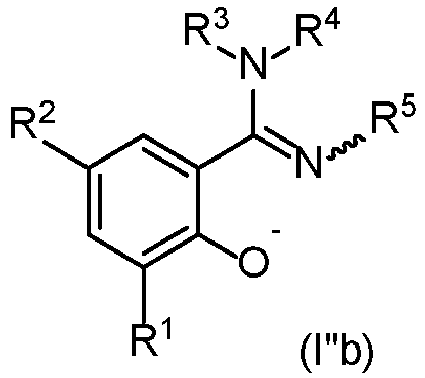
- L" is a ligand of formula (I"b),

- A further object of the present invention is to provide a catalysts for use in ring opening polymerisation (ROP) of cyclic esters comprising a coordination complex of formula (III) as defined above.
- Advantageously, these catalysts turn out to be particularly robust and able to withstand protic impurities as water and/or lactid acid often present in technical grade monomers like lactide.
- These and other objects, features and advantages of the compounds of formula (I) will be disclosed in the following detailed description of the patent disclosure.
- The invention is now described in more detail and in a non-limiting manner in the following description.
- In a first aspect, the present invention provides a compound of formula (I) :

and salts thereof,
Wherein : - R1 and R2 at each occurrence are independently selected from H, F, Cl, Br, I, C1-C6 alkyl, C3-C10 cycloalkyl, C6-C10 aryl or SiR6R7R8, said alkyl, cycloalkyl and aryl being optionally substituted by 1 to 3 R19 ;
- R3 and R4 at each occurrence are independently selected from C1-C6 alkyl, C3-C10 cycloalkyl or C6-C10 aryl; or
- R3 and R4 may form together with the nitrogen to which they are attached, a 3-7 membered heterocycloalkyl group,
- said alkyl, cycloalkyl, aryl and heterocycloalkyl being optionally substituted by 1 to 3 R20;
- R5 is C1-C6 alkyl, C1-C6 perfluoroalkyl, C3-C10 cycloalkyl, C6-C10 aryl, C6-C10 perfluoroaryl, 3-7 membered heterocycloalkyl, 5-7 membered heteroaryl; said alkyl, cycloalkyl, aryl, heteroaryl and heterocycloalkyl being optionally substituted by 1 to 3 R21; or
- R5 is -C(R9R10)-C(R11R12)-Y, -Ar-Y, -Ar-Ar-Y or a group of formula (II) :

- R9, R10, R11and R12 at each occurrence are independently selected from H, C1-C6 alkyl, C3-C10 cycloalkyl, C6-C10 aryl, said alkyl, cycloalkyl and aryl being optionally substituted by 1 to 3 R22; or
- R9 and R11 represent H and R10 and R12 form together with the carbon atoms to which they are attached a C3-C10 cycloalkyl group, said cycloalkyl being optionally substituted by 1 to 3 R22; or
- Ar is C6-C10 aryl group optionally substituted by 1 to 3 R23;
- R13, R14, R15 and R16 at each occurrence are independently selected from H, C1-C6 alkyl, C3-C10 cycloalkyl or C6-C10 aryl, said alkyl, cycloalkyl and aryl being optionally substituted by 1 to 3 R24; or
- R13 and R15 are H and R14 and R16 form together a C3-C10 cycloalkyl group optionally substituted by 1 to 3 R24 ; or
- R13, R14, R15 and R16 are combined to form together a C6-C10 aryl group optionally substituted by 1 to 3 R24 ;
- Y represent OH, C1-C6 alkoxy, NR17R18,
- R17 and R18 at each occurrence are independently selected from H, C1-C6 alkyl, C3-C10 cycloalkyl or a C6-C10 aryl, said alkyl, cycloalkyl and aryl being optionally substituted by 1 to 3 R25,
- R6, R7 and R8 at each occurrence are independently selected from C1-C6 alkyl, or C6-C10 aryl, said alkyl and aryl being optionally substituted by 1 to 3 R26,
- R19, R20, R21, R22, R23, R24, R25 and R26 at each occurrence are independently selected from C1-C4 alkyl, C1-C4 alkoxy or C6-C10 aryl,
- if R1 and R2 are both H, and R3 and R4 are both ethyl, then at least one of R13, R14, R15 and R16 is different from H,
- if R1 and R2 are both H, and R3 and R4 are both ethyl, then R5 cannot be propyl,
- if R1 and R2 are both H, and R3 and R4 are both methyl, then R13, R14, R15 and R16 cannot form together with the carbon atoms to which they are attached, a cyclohexyl group.
- Compounds of formula (I) notably include :
- Proligand compounds which are phenol derivatives, wherein the oxygen is protonated ((I)-OH), and
- Ligand compounds, which are phenolate compounds, wherein the oxygen is deprotonated (I)-O-.
- Proligand compounds can be directly added to metal precursors in the presence of base (such as NEt3 or pyridine) or not, or converted before into ligand compounds by reacting the proligand with a base, such as NaH, KHMDS, n-BuLi, sec-BuLi, tert-BuLi.
- In a preferred embodiment, there are provided compounds of formula (I) having a trans configuration stereoisomeric form, of formula (Ia):

- In another preferred embodiment, there are provided compounds of formula (I), wherein R5 is a group of formula (II) :

- In another preferred embodiment, there are provided compounds of formula (I), wherein which are an alcoholate salt of formula (Ib) :

- In another preferred embodiment, there are provided compounds of formula (I), which are compounds of formula (Ic) :

- In another preferred embodiment, there are provided compounds of formula (I), wherein R1 and R2 at each occurrence are independently selected from H, or C1-C6 alkyl, preferably H, methyl, ethyl, isopropyl, or t-butyl.
- In another preferred embodiment, there are provided compounds of formula (I), wherein R3 and R4 at each occurrence are independently selected from C1-C6 alkyl, or C3-C10 cycloalkyl, notably methyl, ethyl, isopropyl, cyclohexyl, or R3 and R4 may form together with the nitrogen to which they are attached, a pyrrolidinyl or a piperidinyl group.
- In another preferred embodiment, there are provided compounds of formula (I), wherein R5 is C1-C6 alkyl, C3-C10 cycloalkyl, C6-C10 aryl, C6-C10 perfluoroaryl, notably n-propyl, cyclohexyl, or C6F5.
- In another preferred embodiment, there are provided compounds of formula (I), wherein wherein Y is O-, OMe, N(Me)2 or N(iPr)2.
- Compounds of formula (I) are advantageously able to coordinate a metal or metalloid element thereby forming a coordination complex.
- Thus, in a second aspect, the invention relates to a coordination complex of formula (III) :
ML'mXn (III)
Wherein : - M is a metal or a metalloid element of valence p ;
- X is an halogen atom, C1-C6 alkoxy group, N(R27)2 or C1-C6 alkyl;
- R27 is a (C1-C6) alkyl group; a SiR16R17R18 group wherein R16, R17 and R18 are as defined in formula (I) ;
- m is 1, 2, 3 or 4 ;
- n is 0, 1, 2, or 3, provided that m+n=p,
- L' is a ligand of formula (I'b),
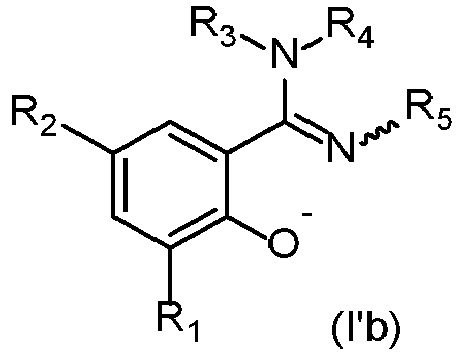
- wherein R1, R2, R3, R4 and R5 are as defined in formula (I) above, With the proviso that
- if R1 and R2 are both H, and R3 and R4 are both methyl, then R13, R14, R15 and R16 cannot form together with the carbon atoms to which they are attached, a cyclohexyl group.
- In a preferred embodiment, there are provided coordination complexes selected from (IIIa), (IIIb) or (IIIc) :

- In another preferred embodiment, there are provided coordination complexes of formula (III), wherein M is selected from Ti, Zr, Zn, Al or B.
- It is to be noted that the above formula (III) encompasses dimers of complexes of formula (III). Indeed, the coordination complexes of the invention may exist in dimeric forms in the solid state or in non-coordinating solvents, which means that two monomeric complexes, such as two complexes of formula (IIIa), may be bound together by weak bonds so as to form a dimeric complex. An example of such a dimeric complex is given in the examples below :

- The coordination complexes of formula (III) turned out to be particularly useful to catalyze ring opening polymerisation (ROP) of cyclic esters.
- As used herein, the term "ring opening polymerisation (ROP)" refers to a reaction in which one polymer chain has a reactive center on its terminal end that reacts with another cyclic monomer, hence opening its ring system to form a longer polymer chain. The reactive center on the terminal end of the polymer chain can be ionic, neutral, or radical. While in the cyclic monomer, the driving force is steric repulsions or bond-angle strain. These cyclic monomers usually contain alkenes, alkanes, or heteroatoms in the ring. The ability of polymerisation and the corresponding driving force varies depending on the type and size of the ring structure. Ring-opening polymerisation has been applied to produce many commercially important polymers including polyesters from cyclic ester (lactones), polysiloxanes from cyclic siloxanes, and polyamides from cyclic amides (lactams).
- Thus, in a third aspect, the invention relates to the use of a coordination complex of formula (IV) for catalyzing a ring opening polymerisation (ROP) of cyclic esters :
ML"mXn (IV)
Wherein - M, m and n are as defined in any of claims 10 to 12, and
- L" is a ligand of formula (I"b),
- In a fourth aspect, the invention relates to a catalyst for use in ring opening polymerisation (ROP) of cyclic esters comprising a coordination complex of formula (III), as defined above.
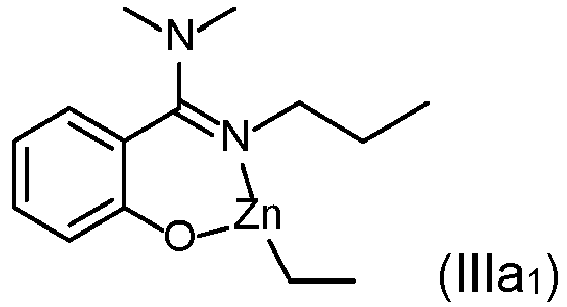
- In a preferred aspect, there is provided a catalyst which is the complex of formula (IIIa1) represented as a dimer:

- The following terms and expressions contained herein are defined as follows.
- As used herein, a range of values in the fonn "x-y" or "x to y", or "x through y", include integers x, y, and the integers therebetween. For example, the phrases "I-6", or "I to 6" or "I through 6" are intended to include the integers 1, 2, 3, 4, 5, and 6. Preferred embodiments include each individual integer in the range, as well as any subcombination of integers. For example, preferred integers for "1-6" can include 1, 2, 3, 4, 5, 6, 1-2, 1-3, 1-4, 1-5, 2-3, 2-4, 2-5, or 2-6, etc.
- As used herein, the term "alkyl" refers to a straight-chain, or branched, alkyl group having 1 to 6 carbon atoms, such as methyl, ethyl, propyl, isopropyl, butyl, isobutyl, sec-butyl, tert-butyl, pentyl, isoamyl, neopentyl, 1-ethylpropyl, 3-methylpentyl, 2,2-dimethylbutyl, 2,3-dimethylbutyl, hexyl, etc. The alkyl moiety of alkyl-containing groups, such as alkoxy, alkoxycarbonyl, and alkylamino groups, has the same meaning as alkyl defined above. Lower alkyl groups, which are preferred, are alkyl groups as defined above which contain 1 to 4 carbons, such as methyl, ethyl, propyl, isopropyl, butyl, isobutyl, sec-butyl, and tert-butyl. A designation such as "C1-C4 alkyl" refers to an alkyl radical containing from 1 to 4 carbon atoms.
- As used herein, the term "cycloalkyl" refers to a saturated or partially saturated mono-, bi- or tricyclic substituted or not substituted alkyl ring system containing 3 to 10 carbon atoms. A designation such as "C3-C7 cycloalkyl" refers to a cycloalkyl radical containing from 3 to 7 ring carbon atoms. Preferred cycloalkyl groups include those containing 3, 4, 5, 6, or 7 ring carbon atoms. More preferred cycloalkyl groups include those containing 3, 4, 5, or 6 ring carbon atoms. Examples of cycloalkyl groups include such groups as cyclopropyl, cyclobutyl, cyclopentyl, cyclohexyl, cycloheptyl, cyclooctyl, pinenyl, and adamantanyl.
- As used herein, the term "aryl" refers to a substituted or unsubstituted, mono- or bicyclic hydrocarbon aromatic ring system having 6 to 10 ring carbon atoms. Examples include phenyl and naphthyl. Preferred aryl groups include unsubstituted or substituted phenyl and naphthyl groups. Included within the definition of "aryl" are fused ring systems, including, for example, ring systems in which an aromatic ring is fused to a cycloalkyl ring. Examples of such fused ring systems include, for example, indane, indene, and tetrahydronaphthalene.
- As used herein, the term "heterocycloalkyl" refers to a 3 to 7 membered cycloalkyl group in which one, two or three ring carbon atoms are replaced by a heteroatom such as -O-, -N-, or -S-. Examples of heterocycloalkyl groups include pyrrolidinyl, pyrrolinyl, imidazolidinyl, imidazolinyl, pirazolidinyl, pirazolinyl, pyrazalinyl, piperidyl, piperazinyl, morpholinyl, thiomorpholinyl, tetrahydrofuranyl, dithiolyl, oxathiolyl, dioxazolyl, oxathiazolyl, pyranyl, oxathiazinyl, and oxadiazinyl.
- As used herein, the term "heteroaryl" refers to an aromatic group containing 5 to 14 ring carbon atoms in which one, two three, or four ring carbon atoms are replaced by a heteroatom such as -O-, -N-, -S-, or-Se-. Examples of heteroaryl groups include pyrrolyl, furanyl, thienyl, pyrazolyl, imidazolyl, thiazolyl, isothiazolyl, isoxazolyl, oxazolyl, oxathiolyl, oxadiazolyl, triazolyl, oxatriazolyl, furazanyl, tetrazolyl, pyridyl, pyrazinyl, pyrimidinyl, pyridazinyl, triazinyl, picolinyl, indolyl, isoindolyl, indazolyl, benzofuranyl, isobenzofuranyl, purinyl, quinazolinyl, quinolyl, isoquinolyl, benzoimidazolyl, benzothiazolyl, benzothiophenyl, thianaphthenyl, benzoxazolyl, benzisoxazolyl, cinnolinyl, phthalazinyl, naphthyridinyl, and quinoxalinyl. Included within the definition of "heteroaryl" are fused ring systems, including, for example, ring systems in which an aromatic ring is fused to a heterocycloalkyl ring. Examples of such fused ring systems include, for example, phthalamide, phthalic anhydride, indoline, isoindoline, tetrahydroisoquinoline, chroman, isochroman, chromene, and isochromene.
- It is recognized that compounds of the present invention may exist in various stereoisomeric forms, in particular configuration or optical stereoisomers. The compounds of the present invention thus include configuration cis-trans stereoisomers depending on the relative position of the substituents with regard to the double bond C=N of the amidine function. Amidines are generally in trans form which is thermodynamically more favorable. The proligands will be therefore in trans form whereas the ligands in the complexes will be in cis form to allow the nitrogen atom and the oxygen atom of the phenolate group to chelate the metal or metalloid element.
- As such, the compounds of the present invention include both diastereomers, enantiomers. The compounds are normally prepared as racemates and can conveniently be used as such, but individual enantiomers can be isolated or synthesized by conventional techniques if so desired. Such racemates and individual enantiomers and mixtures thereof form part of the present invention.
- It is well known in the art how to prepare and isolate such optically active forms. Specific stereoisomers can be prepared by stereospecific synthesis using enantiomerically pure or enantiomerically enriched starting materials. The specific stereoisomers of either starting materials or products can be resolved and recovered by techniques known in the art, such as resolution of racemic forms, normal, reverse-phase, and chiral chromatography, recrystallization, enzymatic resolution, or fractional recrystallization of addition salts formed by reagents used for that purpose. Useful methods of resolving and recovering specific stereoisomers described in Eliel, E. L.; ,Wilen, S.H. Stereochemistry of Organic Compounds; Wiley: New York, 1994, and Jacques, J, et al. Enantiomers, Racemates, and Resolutions; Wiley: New York, 1981, each incorporated by reference herein in their entireties.
- The compounds of the present invention may be prepared in a number of methods well known to those skilled in the art, including, but not limited to those described below, or through modifications of these methods by applying standard techniques known to those skilled in the art of organic synthesis. All processes disclosed in association with the present invention are contemplated to be practiced on any scale, including milligram, gram, multigram, kilogram, multikilogram or commercial industrial scale.
- It will be appreciated that the compounds of the present invention may contain one or more asymmetrically substituted carbon atoms, and may be isolated in optically active or racemic forms. Thus, all chiral, diastereomeric, racemic forms and all geometric isomeric forms of a structure are intended, unless the specific stereochemistry or isomeric form is specifically indicated. It is well known in the art how to prepare such optically active forms. For example, mixtures of stereoisomers may be separated by standard techniques including, but not limited to, resolution of racemic forms, normal, reverse-phase, and chiral chromatography, preferential salt formation, recrystallization, and the like, or by chiral synthesis either from active starting materials or by deliberate chiral synthesis of target centers.
- General routes to prepare the Examples of the present invention are shown in the Schemes and examples that follow. The reagents and starting materials are commercially available and/or, using well-known techniques, can be readily synthesized by one of ordinary skill in the art. All substituents in the synthetic Schemes, unless otherwise indicated, are as previously defined.
- Other features of the invention will become apparent in the course of the following descriptions of exemplary embodiments. These examples are given for illustration of the invention and are not intended to be limiting thereof.
-

- All reactions, except when indicated, were carried out under an atmosphere of argon using conventional Schlenk techniques and Ar glovebox. DCM, diethyl ether, THF, toluene, and pentane were dried using a MBRAUN SPS 800.
- Reagents were commercially available and used as received. High resolution mass spectra were recorded on a Thermo LTQ Orbitrap XL ESI-MS (ElectroSpray Ionization Mass Spectrometry). NMR spectra (1H, 13C) were recorded on Bruker 300 Avance Neo, Bruker 400 Avance Neo, Bruker 500 Avance Neo, or Bruker 600 Avance HD spectrometers. All acquisitions were performed at 300 K. Chemical shifts are quoted in parts per million (δ) relative to TMS (for 1H and 13C). For 1H and 13C spectra, values were determined by using solvent residual signals (e.g. CHCl3 in COCl3) as internal standards. The apparent multiplicity of the 1H signals is reported. Assignment of 1H and 13C signals (when possible) was done through the use of 2D experiences (COSY, HSQC and HMBC).
-

- 1H NMR (400 MHz, CD2Cl2, 298 K): δ (ppm) = 11.86 (s, 1H), 7.14 (ddd, J = 8.7, 7.1, 1.9 Hz, 1H), 6.83 (dd, J = 7.5, 1.9 Hz, 1H), 6.78 (d, J = 11.7 Hz, 1H), 6.52 (t, J =7.3 Hz, 1H), 3.01 (overlapping signals, 8H), 1.47 (hex, J = 6.9 Hz, 2H), 0.77 (t, J = 7.4 Hz, 3H).
- {1H}13C NMR (100 MHz, CD2Cl2, 298 K): δ(ppm) = 165.64, 163.12, 131.81, 128.74, 119.88, 118.43, 113.85, 49.76, 39.99, 24.77, 11.4.
-

- 2.0 g of N,N-dimethyl-2-hydroxybenzamide (12.3 mmol, 1 eq.) were charged in a Schlenk under argon and solubilized in 10 mL of thionyl chloride. The mixture was stirred overnight at r.t. and the solvent was then evaporated under vacuum. 15 mL of dried CH2Cl2 were added to solubilize the crude product before being further evaporated. A solution of the crude product and 8.6 mL of triethylamine (61.5 mmol, 5 eq.) in 50 mL of dried CH2Cl2 was then cooled to 0°C, and 600 mg of o-phenylenediamine (5.5 mmol, 0.45 eq.) were added. The mixture was allowed to reach r.t. and stirred for 2h30. After hydrolysis with 50 mL of distilled water, the product was extracted with 4x50 mL of CH2Cl2. The organic phases were combined and dried over MgSO4 before being evaporated. The crude product was taken back in 50 mL of diethyl ether and a 1M solution of HCI in diethyl ether was added up to pH=1. The brownish product was filtrated under vacuum and washed with 3x40 mL of diethyl ether. The whitish solid was suspended in 10 mL of distilled water and a 5M aqueous solution of NaOH was added up to pH=9-10. The product was extracted with 50mL of CH2Cl2. The organic phase was washed with 3x10 mL of distilled water before being dried over MgSO4 and evaporated under vacuum. The crude product was purified by column chromatography on silica using MeOH as eluent affording 1.48 g of pure proligand (67% yield).
- 1H NMR (600 MHz, CD2Cl2, 298 K): δ(ppm) = 7.08 (2H, pseudo td, J =7.7, 1.8 Hz), 6.98 (2H, dd, J = 7.6, 1.8 Hz), 6.80 (2H, broad s), 6.75 (2H, d, J = 8.2Hz), 6.57-6.52 (2H, m), 6.40 (2H, broad s), 3.21 (6H, broad m), 2.77 (6H, broad m).
- {1H}13C NMR (150 MHz, CD2Cl2, 298 K): δ(ppm) = 161.56, 155.30, 144.56, 130.41, 129.08, 124.01, 123.91, 123.37, 120.21, 119.96, 39.86, 37.89.
- In the glovebox, 114.5 mg (0.56 mmol) of (Ia) was solubilized in THF (8 mL) and ZnEt2 1M/hexanes (1 eq., 0.56 mmol, 0.56 mL) was added slowly. The mixture was stirred 2 h and then solvent was removed under vacuum. 4 mL of pentane were added and after a few minutes of stirring, the suspension was let to settle and the supernatant was eliminated. The whitish solid was finally dried under vacuum, affording 91 mg of complex IIIa as a white solid (54% yield).
- 1H NMR (400.16 MHz, pyridine-Ds, 298 K): δ(ppm) = 7.35 (t, J = 7.3 Hz, 1H), 7.19 (d J = 6.2 Hz, 1H), 7.11 (d, J = 8.1 Hz, 1H), 6.77 (t, J = 7.2 Hz, 1H), 3.46 (br, 2H), 3.06 (6H, s), 1.76 (m, 2H), 1.67 (t, J = 8.1 Hz, 3H), 0.94 (t, J = 7.3 Hz, 3H), 0.83 (q, J = 8.1 Hz, 2H).
- {1H}13C NMR (100.63 MHz, pyridine-Ds, 298K): δ(ppm) = 166.28, 163.81, 130.32, 129.21, 126.42, 120.72, 113.92, 54.04, 38.41, 26.97, 14.69, 13.04, -2.37.
-

- In a glovebox, 61.9 mg (0.3 mmol) of (Ia) were suspended into 3 mL of THF. Then 0.15 mL (0.3 mmol, 1 eq.) of a 2M solution of AIMe3 in hexane were added and the solution was stirred at r.t. for 2 h. Volatiles were evaporated under vacuum, and the sticky oil obtained was taken back in 4 mL of pentane. The solvent was then evaporated and 3 mL of pentane were added and further evaporated. 3 mL of pentane were used to suspend the white solid obtained. After decantation, the supernatant was eliminated and the white powder dried under vacuum, affording 29 mg (37% yield) of complex (IIIa2) containing about 9% of AIMe3.
- 1H NMR (400 MHz, THF-D8, 298 K): δ (ppm) = 7.40-7.16 (overlapping signals, 2H), 6.78 (d, J = 8.3 Hz, 1H), 6.66 (t, J = 7.6 Hz, 1H), 3.50 (br, 2H), 3.01 (s, 6H), 1.67 (m, 2H), 0.99 (t, 3H), -0.98 (6H, s).
- {1H}13C NMR (100 MHz, THF-D8, 298 K): δ (ppm) = 170.08, 166.59, 134.55, 132.48, 123.28, 119.19, 116.79, 50.85, 43.10, 24.45, 11.96, -0.98.
-

- In glovebox, 250µL of AIMe3 2M/hexanes (0.5mmol, 1 eq.) were added to a solution of 201.0 mg (0.5mmol, 1 eq.) of (Ic)H2 in 10mL of dried THF. The mixture was stirred at 60°C for 2h. After cooling down to r.t., the solvents were evaporated under vacuum. The crude product was washed with 8 mL of dried pentane, affording 180 mg of complex (81% yield).
- 1H NMR (500 MHz, CD2Cl2, 298 K): δ(ppm) = 7.33 (2H, dd, J = 8.0, 1.8 Hz), 7.25 (2H, pseudo ddd, J= 8.7, 7.2, 1.9 Hz), 6.80-6.73 (6H, m), 6.49-6.44 (2H, m), 3.00 (6H, s), 2.90 (6H, s), -1.12 (3H, s).
- {1H}13C NMR (125 MHz, CD2Cl2, 298 K): δ(ppm) = 165.40, 162.32, 141.99, 133.50, 131.33, 123.41, 122.91, 122.52, 119.71, 117.04, 42.40, 40.57, -13.60.
- The performance of a phenoxy-amidine ligand complex A for the ring-opening polymerisation (ROP) of lactide was tested. A similar phenoxy-imine complex B was tested in parallel to assess the impact of the amidine moiety on catalytic performance. As shown in Table 1, the two complexes gave comparable results (activity and MW control) when a recrystallized and sublimed lactide was used. On the other hand, it turns out that only the phenoxy-amidine complex A was active in the presence of a lactide contaminated with lactic acid (4 mol%). The ability of this Zn complex with bidentate anionic phenoxy-amidine ligand to withstand lactic acid content as high as 4 mol% (4 equiv/Zn) is unprecedented and is the first proof of concept that phenoxy-amidine ligands can outperform phenoxy-imine ligands in case of stability problems.


Init. Conv (%) Mn, exp (Ð) Mn, theo A 92 10500 (1.10) 13300 B 93 11000 (1.07) 13400 Aa 93 7300 (1.11) 13400 Ba 0 - - a reaction performed with a batch of LA
contaminated with 4 mol% of lactic acid. - Conditions : Under argon, 288.03 mg (2.00 mmol) of rac-Lactide and 0.01 eq. of catalyst are weighed in a vial then mixed in the chosen solvent. Afterwards, 0.01 eq. of co-initiator ( i PrOH and/or lactic acid) is added with a 5µL Hamilton then the vial is crimped and let stirred for 2h at the desired temperature.
Claims (15)
- A compound of formula (I) :

and salts thereof,
Wherein :R1 and R2 at each occurrence are independently selected from H, F, Cl, Br, I, C1-C6 alkyl, C3-C10 cycloalkyl, C6-C10 aryl or SiR6R7R8, said alkyl, cycloalkyl and aryl being optionally substituted by 1 to 3 R19 ;R3 and R4 at each occurrence are independently selected from C1-C6 alkyl, C3-C10 cycloalkyl or C6-C10 aryl; orR3 and R4 may form together with the nitrogen to which they are attached, a 3-7 membered heterocycloalkyl group,said alkyl, cycloalkyl, aryl and heterocycloalkyl being optionally substituted by 1 to 3 R20;R5 is C1-C6 alkyl, C1-C6 perfluoroalkyl, C3-C10 cycloalkyl, C6-C10 aryl, C6-C10 perfluoroaryl, 3-7 membered heterocycloalkyl, 5-7 membered heteroaryl; said alkyl, cycloalkyl, aryl, heteroaryl and heterocycloalkyl being optionally substituted by 1 to 3 R21; orR5 is -C(R9R10)-C(R11R12)-Y, -Ar-Y, -Ar -Ar-Y or a group of formula (II) : R9, R10, R11and R12 at each occurrence are independently selected from H, C1-C6 alkyl, C3-C10 cycloalkyl, C6-C10 aryl, said alkyl, cycloalkyl and aryl being optionally substituted by 1 to 3 R22; orR9 and R11 represent H and R10 and R12 form together with the carbon atoms to which they are attached a C3-C10 cycloalkyl group, said cycloalkyl being optionally substituted by 1 to 3 R22; orAr is C6-C10 aryl group optionally substituted by 1 to 3 R23;R13, R14, R15 and R16 at each occurrence are independently selected from H, C1-C6 alkyl, C3-C10 cycloalkyl or C6-C10 aryl, said alkyl, cycloalkyl and aryl being optionally substituted by 1 to 3 R24; orR13 and R15 are H and R14 and R16 form together a C3-C10 cycloalkyl group optionally substituted by 1 to 3 R24 ; orR13, R14, R15 and R16 are combined to form together a C6-C10 aryl group optionally substituted by 1 to 3 R24 ;Y represent OH, C1-C6 alkoxy, NR17R18,R17 and R18 at each occurrence are independently selected from H, C1-C6 alkyl, C3-C10 cycloalkyl or a C6-C10 aryl, said alkyl, cycloalkyl and aryl being optionally substituted by 1 to 3 R25,R6, R7 and R8 at each occurrence are independently selected from C1-C6 alkyl, or C6-C10 aryl, said alkyl and aryl being optionally substituted by 1 to 3 R26,R19, R20, R21, R22, R23, R24, R25 and R26 at each occurrence are independently selected from C1-C4 alkyl, C1-C4 alkoxy or C6-C10 aryl,With the proviso that :- if R1 and R2 are both H, and R3 and R4 are both ethyl, then at least one of R13, R14, R15 and R16 is different from H,- if R1 and R2 are both H, and R3 and R4 are both ethyl, then R5 cannot be propyl,- if R1 and R2 are both H, and R3 and R4 are both methyl, then R13, R14, R15 and R16 cannot form together with the carbon atoms to which they are attached, a cyclohexyl group.
 - The compound of formula (I) of claim 1, which is a stereoisomeric form having a trans configuration :

- The compound of formula (I) of any of claims 1 or 2, wherein R5 is a group of formula (II) :

- The compound of formula (I) of any of claims 1 to 3, which is an alcoholate salt of formula (Ib) :

- The compound of formula (I) of any of claims 1 to 4, which is a compound of formula (Ic) :

- The compound of formula (I) of any of claims 1 to 5, wherein R1 and R2 at each occurrence are independently selected from H, or C1-C6 alkyl, preferably H, methyl, ethyl, isopropyl, t-butyl.
- The compound of formula (I) of any of claims 1 to 6, wherein R3 and R4 at each occurrence are independently selected from C1-C6 alkyl, or C3-C10 cycloalkyl, notably methyl, ethyl, isopropyl, cyclohexyl, or R3 and R4 may form together with the nitrogen to which they are attached, a pyrrolidinyl or a piperidinyl group.
- The compound of formula (I) of any of claims 1 to 7, wherein R5 is C1-C6 alkyl, C3-C10 cycloalkyl, C6-C10 aryl, C6-C10 perfluoroaryl, notably n-propyl, cyclohexyl, or C6F5.
- The compound of formula (I) of any of claims 1 to 7, wherein Y is O-, OMe, N(Me)2 or N(iPr)2.
- A coordination complex of formula (III) :
ML'mXn (III)
Wherein :- M is a metal or a metalloid element of valence p ;- X is an halogen atom, C1-C6 alkoxy group, N(R27)2 or C1-C6 alkyl;- R27 is a (C1-C6) alkyl group; a SiR16R17R18 group wherein R16, R17 and R18 are as defined in formula (I);- m is 1, 2, 3 or 4 ;- n is 0, 1, 2, or 3, provided that m+n=p,- L' is a ligand of formula (I'b), - wherein R1, R2, R3, R4 and R5 are as defined in any of claims 4 to 9, With the proviso that- if R1 and R2 are both H, and R3 and R4are both methyl, then R13, R14, R15 and R16 cannot form together with the carbon atoms to which they are attached, a cyclohexyl group.
 - The coordination complex of claim 10, which is selected from (IIIa), (IIIb) or (IIIc) :

- The coordination complex of any of claims 10 or 11, wherein M is selected from Ti, Zr, Zn, Al or B.
- A use of a coordination complex of formula (IV) for catalyzing a ring opening polymerisation (ROP) of cyclic esters :
ML"mXn (IV)
WhereinM, m and n are as defined in any of claims 10 to 12, andL" is a ligand of formula (I"b),
- A catalyst for use in ring opening polymerisation (ROP) of cyclic esters comprising a coordination complex of formula (III), as defined in any of claims 10 to 12.
- The catalyst of claim 14 which is the complex (IIIa1) :

Priority Applications (4)
| Application Number | Priority Date | Filing Date | Title |
|---|---|---|---|
| EP22305933.8A EP4299558A1 (en) | 2022-06-27 | 2022-06-27 | Phenoxy-amidine ligands and complexes |
| PCT/EP2023/067091 WO2024002889A1 (en) | 2022-06-27 | 2023-06-23 | Phenoxy-amidine ligands and complexes |
| US18/877,888 US20250368663A1 (en) | 2022-06-27 | 2023-06-23 | Phenoxy-amidine ligands and complexes |
| EP23732158.3A EP4543849A1 (en) | 2022-06-27 | 2023-06-23 | Phenoxy-amidine ligands and complexes |
Applications Claiming Priority (1)
| Application Number | Priority Date | Filing Date | Title |
|---|---|---|---|
| EP22305933.8A EP4299558A1 (en) | 2022-06-27 | 2022-06-27 | Phenoxy-amidine ligands and complexes |
Publications (1)
| Publication Number | Publication Date |
|---|---|
| EP4299558A1 true EP4299558A1 (en) | 2024-01-03 |
Family
ID=82799904
Family Applications (2)
| Application Number | Title | Priority Date | Filing Date |
|---|---|---|---|
| EP22305933.8A Withdrawn EP4299558A1 (en) | 2022-06-27 | 2022-06-27 | Phenoxy-amidine ligands and complexes |
| EP23732158.3A Pending EP4543849A1 (en) | 2022-06-27 | 2023-06-23 | Phenoxy-amidine ligands and complexes |
Family Applications After (1)
| Application Number | Title | Priority Date | Filing Date |
|---|---|---|---|
| EP23732158.3A Pending EP4543849A1 (en) | 2022-06-27 | 2023-06-23 | Phenoxy-amidine ligands and complexes |
Country Status (3)
| Country | Link |
|---|---|
| US (1) | US20250368663A1 (en) |
| EP (2) | EP4299558A1 (en) |
| WO (1) | WO2024002889A1 (en) |
-
2022
- 2022-06-27 EP EP22305933.8A patent/EP4299558A1/en not_active Withdrawn
-
2023
- 2023-06-23 WO PCT/EP2023/067091 patent/WO2024002889A1/en not_active Ceased
- 2023-06-23 US US18/877,888 patent/US20250368663A1/en active Pending
- 2023-06-23 EP EP23732158.3A patent/EP4543849A1/en active Pending
Non-Patent Citations (6)
| Title |
|---|
| COZZI PIER GIORGIO: "META-SALEN SCHIFF BASE COMPLEXES IN CATALYSIS: PRACTICAL ASPECTS", CHEMICAL SOCIETY REVIEWS, ROYAL SOCIETY OF CHEMISTRY, UK, vol. 33, 1 January 2004 (2004-01-01), pages 410 - 421, XP009074985, ISSN: 0306-0012, DOI: 10.1039/B307853C * |
| ELIEL, E. L.WILEN, S.H.: "Stereochemistry of Organic Compounds", 1994, WILEY |
| GOMPPER RUDOLF ET AL: "Ketenderivate, VIII: [omega]-Dialkyl(aryl)amino-[omega]-methylmercapto-chinonmethide", CHEMISCHE BERICHTE, vol. 98, no. 5, 1 May 1965 (1965-05-01), DE, pages 1385 - 1390, XP093000045, ISSN: 0009-2940, Retrieved from the Internet <URL:https://onlinelibrary.wiley.com/doi/pdf/10.1002/cber.19650980505> DOI: 10.1002/cber.19650980505 * |
| JACQUES, J ET AL.: "Enantiomers, Racemates, and Resolutions", 1981, WILEY |
| PIOTR PANDER ET AL: "1,2,4-Triazines in the Synthesis of Bipyridine Bisphenolate ONNO Ligands and Their Highly Luminescent Tetradentate Pt(II) Complexes for Solution-Processable OLEDs", INORGANIC CHEMISTRY, vol. 57, no. 7, 14 March 2018 (2018-03-14), Easton , US, pages 3825 - 3832, XP055653219, ISSN: 0020-1669, DOI: 10.1021/acs.inorgchem.7b03175 * |
| VAILLANT-COINDARD VALENTIN ET AL: "Phenoxy-Amidine Ligands: Toward Lactic Acid-Tolerant Catalysts for Lactide Ring-Opening Polymerization", ORGANOMETALLICS, vol. 41, no. 21, 14 October 2022 (2022-10-14), pages 2920 - 2932, XP093000081, ISSN: 0276-7333, Retrieved from the Internet <URL:https://pubs.acs.org/doi/pdf/10.1021/acs.organomet.2c00343> DOI: 10.1021/acs.organomet.2c00343 * |
Also Published As
| Publication number | Publication date |
|---|---|
| EP4543849A1 (en) | 2025-04-30 |
| US20250368663A1 (en) | 2025-12-04 |
| WO2024002889A1 (en) | 2024-01-04 |
Similar Documents
| Publication | Publication Date | Title |
|---|---|---|
| JP4264418B2 (en) | Ruthenium complexes as (preliminary) catalysts for metathesis reactions | |
| EP1905777B1 (en) | Ruthenium complex ligand, ruthenium complex, carried ruthenium complex catalyst and the preparing methods and the use thereof | |
| EP0916637B1 (en) | Process for preparating optically active compounds | |
| CA2776035A1 (en) | Highly z-selective olefin metathesis | |
| US5747409A (en) | Catalytic compositions based on compounds of rhenium and aluminium, preparation thereof and use thereof for the metathesis of olefins | |
| CN114436949A (en) | Tetradentate ligand and metal complex, and preparation method and application thereof | |
| Wissing et al. | Organozinc. alpha.-Diimine Radicals, Synthesis and Reactivity toward Alkyl Halides | |
| JP3181885B2 (en) | Organic derivatives of rhenium oxide | |
| US11028110B2 (en) | Process for the alkoxycarbonylation of alcohols | |
| EP4299558A1 (en) | Phenoxy-amidine ligands and complexes | |
| JP3876350B2 (en) | New compounds of rhenium and aluminum, their preparation and their use as catalysts | |
| US4337363A (en) | Process for the preparation of 3-(4-methyl-3-cyclohexen-1-yl) butyraldehyde | |
| US11413610B2 (en) | Use of a transition metal catalyst comprising a tetradentate ligand for hydrogenation of esters and/or formation of esters, a process for hydrogenation of esters, a process for formation of esters and a transition metal complex comprising said tetradentate ligand | |
| RU2475491C1 (en) | Method of producing cationic complexes of palladium with diimine ligands | |
| Yiğit et al. | In situ generated rhodium‐based catalyst for addition of phenylboronic acid to aldehydes | |
| EP1948671B1 (en) | Preparation of catalysts | |
| KR100531132B1 (en) | Method for the preparation of alkylene carbonate using imidazolium zinctetrahalide catalysts | |
| WO2022266768A1 (en) | Iron-based complexes for use in the catalysis of hydrosilylation reactions | |
| US6326327B1 (en) | Process for preparing MeO-Peg-protected dihydroquinine or dihydroquinidine derivatives, new dihydroquinine or dihydroquinidine derivatives and their use | |
| US10494326B2 (en) | Process for the alkoxycarbonylation of ethers | |
| Okamoto | Reactions of Allenes. IV. New Palladium Complexes Having a Bridged Allene Trimer Ligand | |
| Kras’ ko et al. | Comparative activity of aryl, alkyl, and cycloalkyl halides in the suzuki reaction catalyzed with acyclic diaminocarbene complex of palladium | |
| EP4149912B1 (en) | Process for preparing diene | |
| JP2004196710A (en) | Ligand and asymmetric catalyst | |
| RU2577252C1 (en) | Method of producing catalyst for metathesis polymerisation of dicyclopentadiene |
Legal Events
| Date | Code | Title | Description |
|---|---|---|---|
| PUAI | Public reference made under article 153(3) epc to a published international application that has entered the european phase |
Free format text: ORIGINAL CODE: 0009012 |
|
| STAA | Information on the status of an ep patent application or granted ep patent |
Free format text: STATUS: THE APPLICATION HAS BEEN PUBLISHED |
|
| AK | Designated contracting states |
Kind code of ref document: A1 Designated state(s): AL AT BE BG CH CY CZ DE DK EE ES FI FR GB GR HR HU IE IS IT LI LT LU LV MC MK MT NL NO PL PT RO RS SE SI SK SM TR |
|
| STAA | Information on the status of an ep patent application or granted ep patent |
Free format text: STATUS: THE APPLICATION IS DEEMED TO BE WITHDRAWN |
|
| 18D | Application deemed to be withdrawn |
Effective date: 20240704 |