EP4298062B1 - Lithium nickel-based composite oxide as a positive electrode active material for rechargeable lithium-ion batteries - Google Patents
Lithium nickel-based composite oxide as a positive electrode active material for rechargeable lithium-ion batteries Download PDFInfo
- Publication number
- EP4298062B1 EP4298062B1 EP22707726.0A EP22707726A EP4298062B1 EP 4298062 B1 EP4298062 B1 EP 4298062B1 EP 22707726 A EP22707726 A EP 22707726A EP 4298062 B1 EP4298062 B1 EP 4298062B1
- Authority
- EP
- European Patent Office
- Prior art keywords
- mol
- positive electrode
- active material
- electrode active
- content
- Prior art date
- Legal status (The legal status is an assumption and is not a legal conclusion. Google has not performed a legal analysis and makes no representation as to the accuracy of the status listed.)
- Active
Links
Images


Classifications
-
- C—CHEMISTRY; METALLURGY
- C01—INORGANIC CHEMISTRY
- C01G—COMPOUNDS CONTAINING METALS NOT COVERED BY SUBCLASSES C01D OR C01F
- C01G53/00—Compounds of nickel
- C01G53/40—Complex oxides containing nickel and at least one other metal element
- C01G53/42—Complex oxides containing nickel and at least one other metal element containing alkali metals, e.g. LiNiO2
- C01G53/44—Complex oxides containing nickel and at least one other metal element containing alkali metals, e.g. LiNiO2 containing manganese
-
- H—ELECTRICITY
- H01—ELECTRIC ELEMENTS
- H01M—PROCESSES OR MEANS, e.g. BATTERIES, FOR THE DIRECT CONVERSION OF CHEMICAL ENERGY INTO ELECTRICAL ENERGY
- H01M4/00—Electrodes
- H01M4/02—Electrodes composed of, or comprising, active material
- H01M4/36—Selection of substances as active materials, active masses, active liquids
- H01M4/48—Selection of substances as active materials, active masses, active liquids of inorganic oxides or hydroxides
- H01M4/52—Selection of substances as active materials, active masses, active liquids of inorganic oxides or hydroxides of nickel, cobalt or iron
- H01M4/525—Selection of substances as active materials, active masses, active liquids of inorganic oxides or hydroxides of nickel, cobalt or iron of mixed oxides or hydroxides containing iron, cobalt or nickel for inserting or intercalating light metals, e.g. LiNiO2, LiCoO2 or LiCoOxFy
-
- C—CHEMISTRY; METALLURGY
- C01—INORGANIC CHEMISTRY
- C01G—COMPOUNDS CONTAINING METALS NOT COVERED BY SUBCLASSES C01D OR C01F
- C01G53/00—Compounds of nickel
- C01G53/40—Complex oxides containing nickel and at least one other metal element
- C01G53/42—Complex oxides containing nickel and at least one other metal element containing alkali metals, e.g. LiNiO2
- C01G53/44—Complex oxides containing nickel and at least one other metal element containing alkali metals, e.g. LiNiO2 containing manganese
- C01G53/50—Complex oxides containing nickel and at least one other metal element containing alkali metals, e.g. LiNiO2 containing manganese of the type (MnO2)n-, e.g. Li(NixMn1-x)O2 or Li(MyNixMn1-x-y)O2
-
- H—ELECTRICITY
- H01—ELECTRIC ELEMENTS
- H01M—PROCESSES OR MEANS, e.g. BATTERIES, FOR THE DIRECT CONVERSION OF CHEMICAL ENERGY INTO ELECTRICAL ENERGY
- H01M10/00—Secondary cells; Manufacture thereof
- H01M10/05—Accumulators with non-aqueous electrolyte
- H01M10/052—Li-accumulators
-
- H—ELECTRICITY
- H01—ELECTRIC ELEMENTS
- H01M—PROCESSES OR MEANS, e.g. BATTERIES, FOR THE DIRECT CONVERSION OF CHEMICAL ENERGY INTO ELECTRICAL ENERGY
- H01M10/00—Secondary cells; Manufacture thereof
- H01M10/05—Accumulators with non-aqueous electrolyte
- H01M10/052—Li-accumulators
- H01M10/0525—Rocking-chair batteries, i.e. batteries with lithium insertion or intercalation in both electrodes; Lithium-ion batteries
-
- H—ELECTRICITY
- H01—ELECTRIC ELEMENTS
- H01M—PROCESSES OR MEANS, e.g. BATTERIES, FOR THE DIRECT CONVERSION OF CHEMICAL ENERGY INTO ELECTRICAL ENERGY
- H01M10/00—Secondary cells; Manufacture thereof
- H01M10/05—Accumulators with non-aqueous electrolyte
- H01M10/056—Accumulators with non-aqueous electrolyte characterised by the materials used as electrolytes, e.g. mixed inorganic/organic electrolytes
- H01M10/0561—Accumulators with non-aqueous electrolyte characterised by the materials used as electrolytes, e.g. mixed inorganic/organic electrolytes the electrolyte being constituted of inorganic materials only
- H01M10/0562—Solid materials
-
- H—ELECTRICITY
- H01—ELECTRIC ELEMENTS
- H01M—PROCESSES OR MEANS, e.g. BATTERIES, FOR THE DIRECT CONVERSION OF CHEMICAL ENERGY INTO ELECTRICAL ENERGY
- H01M4/00—Electrodes
- H01M4/02—Electrodes composed of, or comprising, active material
- H01M4/36—Selection of substances as active materials, active masses, active liquids
- H01M4/48—Selection of substances as active materials, active masses, active liquids of inorganic oxides or hydroxides
- H01M4/50—Selection of substances as active materials, active masses, active liquids of inorganic oxides or hydroxides of manganese
- H01M4/505—Selection of substances as active materials, active masses, active liquids of inorganic oxides or hydroxides of manganese of mixed oxides or hydroxides containing manganese for inserting or intercalating light metals, e.g. LiMn2O4 or LiMn2OxFy
-
- C—CHEMISTRY; METALLURGY
- C01—INORGANIC CHEMISTRY
- C01P—INDEXING SCHEME RELATING TO STRUCTURAL AND PHYSICAL ASPECTS OF SOLID INORGANIC COMPOUNDS
- C01P2002/00—Crystal-structural characteristics
- C01P2002/50—Solid solutions
- C01P2002/52—Solid solutions containing elements as dopants
-
- C—CHEMISTRY; METALLURGY
- C01—INORGANIC CHEMISTRY
- C01P—INDEXING SCHEME RELATING TO STRUCTURAL AND PHYSICAL ASPECTS OF SOLID INORGANIC COMPOUNDS
- C01P2002/00—Crystal-structural characteristics
- C01P2002/80—Crystal-structural characteristics defined by measured data other than those specified in group C01P2002/70
- C01P2002/85—Crystal-structural characteristics defined by measured data other than those specified in group C01P2002/70 by XPS, EDX or EDAX data
-
- C—CHEMISTRY; METALLURGY
- C01—INORGANIC CHEMISTRY
- C01P—INDEXING SCHEME RELATING TO STRUCTURAL AND PHYSICAL ASPECTS OF SOLID INORGANIC COMPOUNDS
- C01P2004/00—Particle morphology
- C01P2004/01—Particle morphology depicted by an image
- C01P2004/03—Particle morphology depicted by an image obtained by SEM
-
- C—CHEMISTRY; METALLURGY
- C01—INORGANIC CHEMISTRY
- C01P—INDEXING SCHEME RELATING TO STRUCTURAL AND PHYSICAL ASPECTS OF SOLID INORGANIC COMPOUNDS
- C01P2004/00—Particle morphology
- C01P2004/01—Particle morphology depicted by an image
- C01P2004/04—Particle morphology depicted by an image obtained by TEM, STEM, STM or AFM
-
- C—CHEMISTRY; METALLURGY
- C01—INORGANIC CHEMISTRY
- C01P—INDEXING SCHEME RELATING TO STRUCTURAL AND PHYSICAL ASPECTS OF SOLID INORGANIC COMPOUNDS
- C01P2004/00—Particle morphology
- C01P2004/50—Agglomerated particles
-
- C—CHEMISTRY; METALLURGY
- C01—INORGANIC CHEMISTRY
- C01P—INDEXING SCHEME RELATING TO STRUCTURAL AND PHYSICAL ASPECTS OF SOLID INORGANIC COMPOUNDS
- C01P2004/00—Particle morphology
- C01P2004/51—Particles with a specific particle size distribution
-
- C—CHEMISTRY; METALLURGY
- C01—INORGANIC CHEMISTRY
- C01P—INDEXING SCHEME RELATING TO STRUCTURAL AND PHYSICAL ASPECTS OF SOLID INORGANIC COMPOUNDS
- C01P2004/00—Particle morphology
- C01P2004/60—Particles characterised by their size
- C01P2004/61—Micrometer sized, i.e. from 1-100 micrometer
-
- C—CHEMISTRY; METALLURGY
- C01—INORGANIC CHEMISTRY
- C01P—INDEXING SCHEME RELATING TO STRUCTURAL AND PHYSICAL ASPECTS OF SOLID INORGANIC COMPOUNDS
- C01P2004/00—Particle morphology
- C01P2004/60—Particles characterised by their size
- C01P2004/62—Submicrometer sized, i.e. from 0.1-1 micrometer
-
- C—CHEMISTRY; METALLURGY
- C01—INORGANIC CHEMISTRY
- C01P—INDEXING SCHEME RELATING TO STRUCTURAL AND PHYSICAL ASPECTS OF SOLID INORGANIC COMPOUNDS
- C01P2006/00—Physical properties of inorganic compounds
- C01P2006/40—Electric properties
-
- C—CHEMISTRY; METALLURGY
- C01—INORGANIC CHEMISTRY
- C01P—INDEXING SCHEME RELATING TO STRUCTURAL AND PHYSICAL ASPECTS OF SOLID INORGANIC COMPOUNDS
- C01P2006/00—Physical properties of inorganic compounds
- C01P2006/80—Compositional purity
-
- H—ELECTRICITY
- H01—ELECTRIC ELEMENTS
- H01M—PROCESSES OR MEANS, e.g. BATTERIES, FOR THE DIRECT CONVERSION OF CHEMICAL ENERGY INTO ELECTRICAL ENERGY
- H01M4/00—Electrodes
- H01M4/02—Electrodes composed of, or comprising, active material
- H01M2004/026—Electrodes composed of, or comprising, active material characterised by the polarity
- H01M2004/028—Positive electrodes
-
- H—ELECTRICITY
- H01—ELECTRIC ELEMENTS
- H01M—PROCESSES OR MEANS, e.g. BATTERIES, FOR THE DIRECT CONVERSION OF CHEMICAL ENERGY INTO ELECTRICAL ENERGY
- H01M2220/00—Batteries for particular applications
- H01M2220/20—Batteries in motive systems, e.g. vehicle, ship, plane
-
- H—ELECTRICITY
- H01—ELECTRIC ELEMENTS
- H01M—PROCESSES OR MEANS, e.g. BATTERIES, FOR THE DIRECT CONVERSION OF CHEMICAL ENERGY INTO ELECTRICAL ENERGY
- H01M2300/00—Electrolytes
- H01M2300/0017—Non-aqueous electrolytes
- H01M2300/0065—Solid electrolytes
- H01M2300/0068—Solid electrolytes inorganic
-
- Y—GENERAL TAGGING OF NEW TECHNOLOGICAL DEVELOPMENTS; GENERAL TAGGING OF CROSS-SECTIONAL TECHNOLOGIES SPANNING OVER SEVERAL SECTIONS OF THE IPC; TECHNICAL SUBJECTS COVERED BY FORMER USPC CROSS-REFERENCE ART COLLECTIONS [XRACs] AND DIGESTS
- Y02—TECHNOLOGIES OR APPLICATIONS FOR MITIGATION OR ADAPTATION AGAINST CLIMATE CHANGE
- Y02E—REDUCTION OF GREENHOUSE GAS [GHG] EMISSIONS, RELATED TO ENERGY GENERATION, TRANSMISSION OR DISTRIBUTION
- Y02E60/00—Enabling technologies; Technologies with a potential or indirect contribution to GHG emissions mitigation
- Y02E60/10—Energy storage using batteries
Definitions
- This invention relates to a lithium nickel-based oxide positive electrode active material for solid-state batteries suitable for electric vehicle (EV) and hybrid electric vehicle (HEV) applications, comprising lithium nickel-based oxide particles comprising zirconium (Zr).
- EV electric vehicle
- HEV hybrid electric vehicle
- a positive electrode active material is defined as a material which is electrochemically active in a positive electrode.
- active material it must be understood a material capable to capture and release Li ions when subjected to a voltage change over a predetermined period of time.
- At% signifies atomic percentage.
- the at% or "atom percent" of a given element expression of a concentration means how many percent of all atoms in the claimed compound are atoms of said element.
- the designation at% is equivalent to mol% or "molar percent”.
- This objective is achieved by providing a positive electrode active material for solid-state batteries, wherein the positive electrode active material comprises Li, M', and oxygen, wherein M' comprises:
- the present invention concerns a positive electrode active material for solid-state batteries, wherein the positive electrode active material comprises Li, M', and oxygen, wherein M' comprises:
- Zr A is the Zr content of the positive electrode active material as determined by ICP and expressed as a fraction relative to the sum of the contents of Co, Ni, Mn, and Zr.
- the Zr B / Zr A ratio is at least 80, preferably at least 100, more preferably at least 130.
- the Zr B / Zr A ratio is at most 500, more preferably at most 300 and most preferably at most 200.
- the positive electrode active material comprises secondary particles having a plurality of primary particles and wherein said primary particles have an average diameter of between 170 nm to 340 nm, preferably between 200 nm to 340 nm, as determined by measuring primary particle size in an image taken by SEM.
- said primary particles have an average diameter of at least 180 nm, preferably 200 nm, preferably 220 nm, even more preferably of at least 225 nm.
- Preferably said primary particles have an average diameter of at most 330 nm, preferably of at most 320 nm, more preferably of at most 300 nm, even more preferably of at most 250 nm.
- Preferably said primary particles have an average diameter of between 180 nm and 330 nm, preferably between 200 nm and 320 nm, more preferably between 220 nm and 310 nm, even more preferably between 225 nm and 250 nm.
- the primary particle size is determined by measuring the particle size of the primary particle in an image taken by SEM.
- said Ni in a content x is between 55 mol% and 72 mol% relative to M' and said Co in a content y is between 0.0 mol% and 20.0 mol% relative to M'.
- Ni is in a content x ⁇ 55.0 mol%, preferably x ⁇ 60.0 mol%, more preferably x ⁇ 62.0 mol%.
- x ⁇ 72.0 mol% preferably x ⁇ 70.0 mol% and more preferably x ⁇ 68.0 mol%.
- Ni is in a content x between 55.0 mol% ⁇ x ⁇ 72.0 mol%, preferably 60.0 mol% ⁇ x ⁇ 70.0 mol%, more preferably 62.0 mol% ⁇ x ⁇ 68.0 mol%.
- the amount of Li and M', preferably Li, Ni, Mn, Co, D and Zr in the positive electrode active material is measured with Inductively Coupled Plasma-Optical Emission Spectroscopy (ICP-OES).
- ICP-OES Inductively Coupled Plasma-Optical Emission Spectroscopy
- an Agilent ICP 720-ES is used in the ICP-OES analysis.
- Mn is in a content z > 0.0 mol%, more preferably z ⁇ 5.0 mol%, and even more preferably z ⁇ 8.0 mol%.
- the content is z ⁇ 40.0 mol%, preferably z ⁇ 30.0 mol%, and more preferably z ⁇ 25.0 mol%.
- the content is 0.0 mol% ⁇ z ⁇ 40.0 mol%, preferably 5.0 mol% ⁇ z ⁇ 30.0 mol%, more preferably 8.0 mol% ⁇ z ⁇ 25.0 mol%.
- Co is in a content y > 0.0 mol%, more preferably y ⁇ 1.0 mol%, and even more preferably y ⁇ 3.0 mol%.
- the content is y ⁇ 40.0 mol%, more preferably y ⁇ 30.0 mol%, and even more preferably y ⁇ 25.0 mol%.
- the content is 0.0 mol% ⁇ y ⁇ 40.0 mol%, preferably 1.0 mol% ⁇ y ⁇ 30.0 mol%, more preferably 3.0 mol% ⁇ y ⁇ 25.0 mol%.
- D comprises at least one element of the group consisting of: Al, B, Ba, Ca, Cr, Fe, Mg, Mo, Nb, S, Si, Sr, Ti, Y, V, W, and Zn; preferably Al, B, Cr, Nb, S, Si, Ti, Y and W.
- D is in a content a > 0.0 mol%, more preferably a ⁇ 0.25 mol%, and even more preferably a ⁇ 0.5 mol%.
- the content is a ⁇ 2.0 mol%, preferably a ⁇ 1.75 mol%, and more preferably a ⁇ 1.5 mol%.
- the content is 0.0 mol% ⁇ z ⁇ 2.0 mol%, preferably 0.25mol% ⁇ z ⁇ 1.75 mol% and more preferably 0.5 mol% ⁇ z ⁇ 1.5 mol%.
- the secondary particles comprise of a plurality of primary particles, preferably more than 20 primary particles, preferably more than 10 primary particles, most preferably more than 5 primary particles.
- Primary particles are particles which are individual crystals or which are formed of less than five, and preferably at most three, primary particles which are themselves individual crystals. This can be observed in proper microscope techniques like Scanning Electron Microscope (SEM) by observing grain boundaries.
- the Zr content Zr A is b/(b+x+y+z) is at least 0.10 mol% and at most 1.00 mol%.
- the Zr content Zr A is b/(b+x+y+z) is at least 0.20 mol% and at most 0.80 mol%.
- the Zr content Zr A is b/(b+x+y+z) is at least 0.30 mol% and at most 0.70 mol%.
- the Zr content Zr A is b/(b+x+y+z) is at least 0.10 mol% and at most 1.50 mol%.
- the Zr content Zr A is b/(b+x+y+z) is at least 0.20 mol% and at most 1.00 mol%. Most preferably the Zr content Zr A is b/(b+x+y+z) is at least 0.30 mol% and at most 0.90 mol%.
- Zr is in a content b of at least 0.10 mol% and at most 1.00 mol% relative M', more preferably at least 0.20 mol% and at most 0.80 mol% relative to M', most preferably at least 0.30 mol% and at most 0.70 mol% relative M'.
- Zr is in a content b of at least 0.10 mol% and at most 1.50 mol% relative M', more preferably at least 0.20 mol% and at most 1.00 mol% relative to M', most preferably at least 0.30 mol% and at most 0.90 mol% relative M'.
- the Zr content Zr B is more than 0.25 mol%, preferably more than 0.50 mol%, most preferably more than 0.60 mol%. In a preferred embodiment Zr B is less than 2.0 mol%, preferably less than 1.5 mol%, more preferably less than 1.0 mol%. In a preferred embodiment Zr B is between 0.25 mol% and 2.0 mol%, preferably between 0.50 mol% and 1.5 mol%, most preferably between 0.60 mol% and 1.0 mol%. As appreciated by the skilled person Zr B is expressed as molar fraction, as measured by XPS analysis compared to the sum of molar fractions of Co, Mn, Ni, and Zr, as measured by XPS analysis.
- said material has a secondary particle median size D50 of at least 2 ⁇ m, and preferably of at least 5 ⁇ m as determined by laser diffraction particle size analysis.
- said material has a secondary particle median size D50 of at most 15 ⁇ m, and preferably of at most 13 ⁇ m as determined by laser diffraction particle size analysis.
- the laser diffraction particle size analysis is performed by a Malvern Mastersizer 3000.
- said material has a carbon content of at least 600 ppm, preferably of at least 650 ppm, more preferably of at least 750 ppm and most preferably at least 900 ppm as determined by carbon analyzer.
- said material has a carbon content of at most 5000 ppm, preferably of at most 3000 ppm, more preferably of at most 1500 ppm and most preferably of at most 1100 ppm as determined by carbon analyzer.
- the thickness of Zr > 10 nm.
- the thickness is ⁇ 15 nm and more preferably ⁇ 20 nm as determined by TEM-EDS measurement.
- the thickness of Zr is ⁇ 100 nm, preferably the thickness is ⁇ 50 nm, more preferably the thickness is ⁇ 30 nm.
- the thickness of Zr is between 10 nm and 100 nm, preferably between 15 nm and 50 nm, more preferably between 22 nm and 28 nm.
- the (minimum) thickness of the surface layer is defined as the shortest distance between a first point located at a periphery of a cross-section of a particle and a second point located in a line defined between said first point and a geometric center (or centroid) of said particle, wherein the difference of content of Zr measured by TEM-EDS at the second point location (Zr 2 ) and at any location between said second point location and the center of the particle is around 0.1 at%.
- the content of Zr at the second point location (Zr 2 ) is constant: it can be superior to 0 at% and must be inferior or equal to 5.0% of a first content of Zr at the first point location (Zr 1 ).
- Said second content of Zr 2 is equal to a content of Zr at a third point location (Zr 3 ) in said line and said third point is located at any location between the geometric center of said particle and the second point location.
- Zr 3 is a third content of Zr (in at%) at a third point location ( L Zr3 ) in said line, said third point is located at any location between the geometric center of said particle and the second point location L Zr2 .
- the second and third content of Zr corresponds to the content of Zr, measured by TEM-EDS, present as a dopant in the core of the particles according to the invention.
- the TEM-EDS protocol is applied as follows:
- the aforementioned TEM-EDS measurement is performed on at least one particle.
- the Zr/(Ni+Mn+Co+Zr) are numerically averaged.
- TEM-EDS measurement is performed with a a Tecnai G 2 F30 S-TWIN (FEI) with ELITE T 70 detector (EDAX).
- FEI Tecnai G 2 F30 S-TWIN
- EDAX ELITE T 70 detector
- Zr B is expressed as molar fraction, as measured by XPS analysis compared to the sum of molar fractions of Co, Mn, Ni, and Zr, as measured by XPS analysis; in particular Zr B is the molar fractions of Zr measured in a region of a secondary particle of the positive electrode active material according to invention defined between a first point of an external edge of said particle and a second point at a distance from said first point, said distance separating said first to said second point being equal to a penetration depth of said XPS, said penetration depth D being comprised between 1.0 to 10.0 nm.
- the penetration depth is the distance along an axis perpendicular to a virtual line tangent to said external edge and passing trough said first point.
- XPS analysis provides atomic content of elements in an uppermost layer of a particle with a penetration depth of about 10.0 nm from an outer boundary of the particle.
- the outer boundary of the particle is also referred to as "surface".
- at% signifies atomic percentage.
- the at% or "atomic percent" of a given element expression of a concentration means how many percent of all atoms in the concerned compound are atoms of said element.
- the designation at% is equivalent to mol% or "molar percent”.
- XPS analysis is carried out with a Thermo K-a+ spectrometer (Thermo Scientific).
- the present invention concerns a use of the positive electrode active material according to any of the preceding Embodiments 1 to 5 in a battery.
- the present invention is also inclusive of a process for manufacturing the positive electrode active material according to any of the preceding Embodiments 1 to 5, comprising the steps of:
- the lithium transition metal-based compound is a lithium nickel-based oxide compound.
- the lithium transition metal-based oxide compound comprising Li, M' and oxygen, wherein M' comprises Ni, Mn, Co and D, wherein D is at least one element of the group consisting of: Al, B, Ba, Ca, Cr, Fe, Mg, Mo, Nb, S, Si, Sr, Ti, Y, V, W, and Zn; preferably Al, B, Cr, Nb, S, Si, Ti, Y, W
- the lithium transition metal oxide powder used is also typically prepared according to a lithiation process, that is the process wherein a mixture of a transition metal precursor and a lithium source is heated at a temperature preferably of at least 500 °C.
- the transition metal precursor is prepared by coprecipitation of one or more transition metal sources, such as salts, and preferably sulfates of the M' elements Ni, Mn and/or Co, in the presence of an alkali compound, such as an alkali hydroxide e.g. sodium hydroxide and/or ammonia.
- an alkali compound such as an alkali hydroxide e.g. sodium hydroxide and/or ammonia.
- the method comprises a further step, before heating said mixture, of drying said mixture, preferably by means of vacuum heating.
- the source of Zr is a Zr-alkoxide, preferably Zr-ethoxide, Zr-propoxide or Zr-butoxide, more preferably Zr-propoxide.
- the Zr-alkoxide is mixed as a solid with the mixture.
- the Zr alkoxide is mixed as a solution with the slurry, wherein the solution comprises the Zr-alkoxide and a further alcohol, wherein the alkoxide group is a conjugate base of the further alcohol.
- the Zr-alkoxide is Zr-propoxide, which is dissolved in propanol.
- the solution comprises 50-90 wt.% of the Zr-alkoxide by total weight of the solution.
- examples of such a solution are a 70 wt.% Zr-propoxide in 1-propanol or a 80 wt.% Zr-butoxide in 1-butanol.
- the alcohol solvent is methanol, ethanol, propanol or butanol, preferably ethanol.
- the present invention is also inclusive of a solid-state battery comprising the positive electrode active material according to any of the preceding Embodiments 1 to 5, preferably the solid-state battery comprises a sulfide based solid electrolyte, more preferably the sulfide based solid electrolyte comprises Li, P and S.
- the amount of Li, Ni, Mn, Co, and Zr in the positive electrode active material powder is measured with the Inductively Coupled Plasma (ICP) method by using an Agilent ICP 720-ES (Agilent Technologies, https://www.agilent.com/cs/library/brochures/5990-6497EN%20720-725_ICP-OES_LR.pdf).
- ICP Inductively Coupled Plasma
- 2 grams of powder sample is dissolved into 10 mL of high purity hydrochloric acid (at least 37 wt.% of HCl with respect to the total weight of solution) in an Erlenmeyer flask. The flask is covered by a glass and heated on a hot plate at 380°C until complete dissolution of the precursor.
- the solution of the Erlenmeyer flask is poured into a 250 mL volumetric flask. Afterwards, the volumetric flask is filled with deionized water up to the 250 mL mark, followed by complete homogenization. An appropriate amount of solution is taken out by pipette and transferred into a 250 mL volumetric flask for the 2 nd dilution, where the volumetric flask is filled with internal standard and 10% hydrochloric acid up to the 250 mL mark and then homogenized. Finally, this 50 mL solution is used for ICP measurement.
- the morphology of positive electrode active materials is analyzed by a Scanning Electron Microscopy (SEM) technique.
- SEM Scanning Electron Microscopy
- the measurement is performed with a JEOL JSM 7100F (https://www.jeolbenelux.com/JEOL-BV-News/jsm-7100f-thermal-field-emission-electron-microscope) under a high vacuum environment of 9.6 ⁇ 10 -5 Pa at 25°C.
- the particle size distribution (PSD) of the positive electrode active material powder is measured by laser diffraction particle size analysis using a Malvern Mastersizer 3000 with a Hydro MV wet dispersion accessory (https://www.malvernpanalytical.com/en/ products/product-range/mastersizer-range/mastersizer-3000#overview) after having dispersed each of the powder samples in an aqueous medium.
- D50 is defined as the particle size at 50% of the cumulative volume% distributions obtained from the Malvern Mastersizer 3000 with Hydro MV measurements.
- the diameter of primary particle is calculated by using ImageJ software (ImageJ 1.52a, National Institutes of Health, USA) according to the following steps:
- X-ray photoelectron spectroscopy is used to analyze the surface of positive electrode active material powder particles.
- the signal is acquired from the first few nanometers (e.g. 1 nm to 10 nm) of the uppermost part of a sample, i.e. surface layer. Therefore, all elements measured by XPS are contained in the surface layer.
- XPS measurement is carried out using a Thermo K-a+ spectrometer (Thermo Scientific, https://www.thermofisher.com/order/catalog/product/IQLAADGAAFFACVMAHV).
- a wide survey scan to identify elements present at the surface is conducted at 200 eV pass energy.
- C1s peak having a maximum intensity (or centered) at a binding energy of 284.8 eV is used as a calibrate peak position after data collection.
- Accurate narrow scans are performed afterwards at 50 eV for at least 10 scans for each identified element to determine the precise surface composition.
- Curve fitting is done with CasaXPS Version2.3.19PR1.0 (Casa Software, http://www.casaxps.com/) using a Shirley-type background treatment and Scofield sensitivity factors.
- the fitting parameters are according to Table 1a.
- Line shape GL(30) is the Gaussian/Lorentzian product formula with 70% Gaussian line and 30% Lorentzian line.
- LA( ⁇ , ⁇ , m) is an asymmetric line-shape where a and ⁇ define tail spreading of the peak and m define the width.
- Table 1a XPS fitting parameter for Ni2p3, Mn2p3, Co2p3, and Zr3d.
- Element Sensitivity factor Fitting range Defined peak(s) Line shape Ni 14.61 851.3 ⁇ 0.1-869.4 ⁇ 0.1 Ni2p3, Ni2p3 satellite LA(1.33, 2.44, 69) Mn 9.17 639.9 ⁇ 0.1-649.5 ⁇ 0.1 Mn2p3, Mn2p3 satellite GL(30) Co 12.62 775.8 ⁇ 0.4-792.5 ⁇ 0.4 Co2p3-1, Co2p3-2, Co2p3 satellite GL(30) Zr 7.04 178.0-188.5 Zr3d3, Zr3d1 GL(30)
- constraints are set for each defined peak according to Table 1b.
- Table 1b. XPS fitting constraints for peaks fitting.
- Element Defined peak Fitting range constraint (eV) FWHM constraint (eV) Area constraint Zr Zr3d1 184.0-188.5 Equal to Zr3d3 66.7% of Zr3d3 Zr3d3 178.0-184.0 0.5-4.0 No constraint set Co Co2p3-1 776.0-780.9 0.5-4.0 No constraint set Co2p3-2 781.0-785.0 0.5-4.0 No constraint set Co2p3 satellite 785.1-792.0 0.5-6.0 No constraint set
- a slurry contains positive electrode active material powder, Li-P-S based solid electrolyte, carbon (Super-P, Timcal), and binder (RC-10, Arkema) - with a formulation of 64.0 : 30.0 : 3.0 : 3.0 by weight - in butyl acetate solvent is mixed in Ar-filled glove box.
- the slurry is casted on one side of an aluminum foil followed by drying the slurry coated foil in a vacuum oven to obtain a positive electrode.
- the obtained positive electrode is punched with a diameter of 10 nm wherein the active material loading amount is around 4 mg/cm 2 .
- Li foil (diameter 3 mm, thickness 100 ⁇ m) is placed centered on the top of In foil (diameter 10 nm, thickness 100 ⁇ m) and pressed to form Li-In alloy negative electrode.
- the Li-P-S based solid electrolyte is pelletized with a pressure of 250 MPa to obtain 100 ⁇ m pellet thickness.
- a sulfide solid-state battery is assembled in an argon-filled glovebox with such order from bottom to top: positive electrode comprising Al current collector with the coated part on the top - separator - negative electrode with Li side on the top - Cu current collector.
- the stacked components are pressed together with a pressure of 250 MPa and placed in an external cage to prevent air exposure.
- the testing method is a conventional "constant cut-off voltage" test.
- the conventional cell test in the present invention follows the schedule shown in Table 2. Each cell is cycled at 60°C using a Toscat-3100 computer-controlled galvanostatic cycling station (from Toyo). The schedule uses a 1C current definition of 160 mA/g.
- the initial charge capacity (CQ1) and discharge capacity (DQ1) are measured in constant current mode (CC) at C rate of 0.1 C in below voltage range:
- IRRQ % CQ 1 ⁇ DQ 1 CQ 1 ⁇ 100 Table 2. Cycling schedule for sulfide solid-state battery testing method Charge Discharge C Rate End current Rest (min) V/Li metal (V) C Rate End current Rest (min) V/Li metal (V) 0.1 - 30 4.2 0.1 - 30 2.5 0.1 - 30 4.3 0.1 - 30 2.5
- cross-sectional TEM lamellas of particles are prepared by Nova Nano SEM200 (FEI).
- a Ga ion beam is used with 30kV voltage and 30pA-7nA current.
- the obtained etched sample has a dimension of 5 ⁇ 8 ⁇ m with 100nm thickness.
- EDS energy-dispersive X-ray spectroscopy
- the TEM-EDS line scan is performed on a Tecnai G 2 F30 S-TWIN (FEI) with ELITE T 70 detector (EDAX).
- EDS analysis of the lithium transition metal-based oxide particle provides the quantitative element analysis of the cross-section.
- Zr content is normalized by the total atomic fraction of Ni, Mn, Co, and Zr.
- CEX1 is obtained through a solid-state reaction between a lithium source and a transition metal-based source running as follows:
- a source of dopant can be added in the co-precipitation process in Step 1) or in the mixing step in the Step 2) together with lithium source.
- a certain element can be added as a dopant, for instance, to improve the electrochemical properties of the positive electrode active material.
- EX1 is obtained through a solid-state reaction between a lithium source and a transition metal-based source running as follows:
- CEX2.1 is obtained through the same procedure as CEX1, except that the first heating temperature in Step 3) is 860°C.
- CEX2.2 is obtained through the same procedure as EX1, except that the first heating temperature in Step 3) is 860°C.
- CEX3 is obtained through the same procedure as CEX1, except that the first heating temperature in Step 3) is 795°C.
- EX2 is obtained through the same procedure as EX1, except that the first heating temperature in Step 3) is 795°C.
- CEX5 is obtained through the same procedure as CEX1, except that the first heating temperature in Step 3) is 750°C.
- EX4 is obtained through the same procedure as EX1, except that the first heating temperature in Step 3) is 750°C.
- CEX6 is obtained through the same procedure as CEX1, except that the first heating temperature in Step 3) is 750°C.
- EX5 is obtained through the same procedure as EX1, except that the first heating temperature in Step 3) is 750°C.
- Table 3 summarizes the primary particle diameter, composition, and the corresponding electrochemical properties of example and comparative examples.
- the average primary particle diameter of EX1, EX2, EX3 and EX4 are 270, 231, 190, and 192 nm, respectively. These average diameters are smaller than the average primary particle diameters of CEX2.1 and CEX2.2 which are 371 nm.
- the primary particle SEM images of CEX2.2 and EX1 are shown in Figure 1b and 1c , respectively. The images contain drawn lines and number to identify primary particle in order to obtain the average primary particle diameter.
- the XPS analysis result of EX1 and CEX2.2 showing Zr atomic ratio (equivalent with molar ratio) with respect to the total atomic fraction of Ni, Mn, Co, and Zr (Zr B ).
- the table also compares the result with that of ICP.
- the Zr B higher than 0 indicates said Zr is presence in the surface of the positive electrode active material as associated with the XPS measurement which signal is acquired from the first few nanometers (e.g. 1 nm to 10 nm) of the uppermost part of a sample, i.e. surface layer.
- Zr atomic ratio obtained from ICP measurement (Zr A ) is from the entire particles.
- the ratio of XPS to ICP (Zr B /Zr A ) higher than 1 indicates said elements Zr presence mostly on the surface of the positive electrode active material.
- the higher Zr B /Zr A value corresponds with the more Zr presence in the surface of positive electrode active material.
- Zr B /Zr A in EX1 is higher than that of CEX2.2 Zr B /Zr A .
- the representative of XPS spectra showing Zr3d5 and 3d3 peaks of CEX2.2 and EX1 are displayed in Figure 2 .
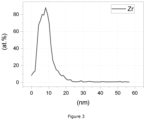
- Figure 3 shows the TEM-EDS measurement of EX1 (x-axis: distance where 0 is the starting point of the surface layer, y-axis: element in atomic ratio). Zr thickness from the measurement is 25.8 nm.
- Carbon content in positive electrode active material after Zr treatment is higher comparing with before treatment which associated with a better electrochemical performance of active material. Carbon is originated from the Zr alkoxide compound used in the treatment.
- the combination of average primary particle diameter in the range of 170 nm to 340 nm and Zr B /Zr A higher than 50.0, preferably higher than 100.0, can achieve the objective of the present invention, which is to provide a positive electrode active material having an improved first charge capacity of at least 160 mAh/g in the solid-state battery.
Landscapes
- Chemical & Material Sciences (AREA)
- Inorganic Chemistry (AREA)
- Chemical Kinetics & Catalysis (AREA)
- Electrochemistry (AREA)
- General Chemical & Material Sciences (AREA)
- Organic Chemistry (AREA)
- Engineering & Computer Science (AREA)
- Manufacturing & Machinery (AREA)
- Condensed Matter Physics & Semiconductors (AREA)
- General Physics & Mathematics (AREA)
- Physics & Mathematics (AREA)
- Materials Engineering (AREA)
- Battery Electrode And Active Subsutance (AREA)
- Secondary Cells (AREA)
Description
- This invention relates to a lithium nickel-based oxide positive electrode active material for solid-state batteries suitable for electric vehicle (EV) and hybrid electric vehicle (HEV) applications, comprising lithium nickel-based oxide particles comprising zirconium (Zr).
- A positive electrode active material is defined as a material which is electrochemically active in a positive electrode. By active material, it must be understood a material capable to capture and release Li ions when subjected to a voltage change over a predetermined period of time.
- Document
US 2018/026268 discloses a lithium nickel mixed oxide material (example 1) exhibiting ZrO2 particles on its surface. - In the framework of the present invention, at% signifies atomic percentage. The at% or "atom percent" of a given element expression of a concentration means how many percent of all atoms in the claimed compound are atoms of said element. The designation at% is equivalent to mol% or "molar percent".
- The weight percent (wt.%) of a first element E (Ewt1) in a material can be converted from a given atomic percent (at%) of said first element E (Eat1) in said material by applying the following formula:

- It is an object of the present invention to provide a positive electrode active material having an improved first charge capacity of at least 160 mAh/g in the solid-state battery.
- This objective is achieved by providing a positive electrode active material for solid-state batteries, wherein the positive electrode active material comprises Li, M', and oxygen, wherein M' comprises:
- Ni in a content x between 50.0 mol% and 75.0 mol%, relative to M';
- Co in a content y between 0.0 mol% and 40.0 mol%, relative to M';
- Mn in a content z between 0.0 mol% and 40.0 mol%, relative to M',
- D in a content a between 0.0 mol% and 2.0 mol%, relative to the total atomic content of M', wherein D comprises at least one element of the group consisting of: Al, B, Ba, Ca, Cr, Fe, Mg, Mo, Nb, S, Si, Sr, Ti, Y, V, W, and Zn, and,
- Zr in a content b between 0.1 mol% and 5.0 mol%, relative to M',
- wherein x, y, z, a, and b are measured by ICP,
- wherein x+y+z+a+b is 100.0 mol%,
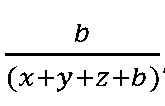
- wherein the positive electrode active material has a Zr content ZrA defined as
- wherein the positive electrode active material has a Zr content ZrB, wherein ZrB is determined by XPS analysis, wherein ZrB is expressed as molar fractions compared to the sum of molar fractions of Co, Mn, Ni, and Zr, as measured by XPS analysis,
- wherein the ratio ZrB / ZrA > 50.0,
- wherein the positive electrode active material comprises secondary particles having a plurality of primary particles,
- wherein said primary particle has an average diameter of between 170 nm to 340 nm as determined by the method of this invention.
- The present invention concerns the following embodiments:
- In a first aspect, the present invention concerns a positive electrode active material for solid-state batteries, wherein the positive electrode active material comprises Li, M', and oxygen, wherein M' comprises:
- Ni in a content x between 50.0 mol% and 75.0 mol%, relative to M';
- Co in a content y between 0.0 mol% and 40.0 mol%, relative to M';
- Mn in a content z between 0.0 mol% and 70.0 mol%, relative to M', preferably Mn in a content z between 0.0 mol% and 40.0 mol% relative to M',
- D in a content a between 0.0 mol% and 2.0 mol%, relative to the total atomic content of M', wherein D comprises at least one element of the group consisting of: Al, B, Ba, Ca, Cr, Fe, Mg, Mo, Nb, S, Si, Sr, Ti, Y, V, W, and Zn, and,
- Zr in a content b between 0.1 mol% and 5.0 mol%, relative to M',
- wherein x, y, z, a, and b are measured by ICP,
- wherein x+y+z+a+b is 100.0 mol%,
- wherein the positive electrode active material has a Zr content ZrA defined as

- wherein the positive electrode active material has a Zr content ZrB, wherein ZrB is determined by XPS analysis, wherein ZrB is expressed in percent as molar fractions compared to the sum of molar fractions of Co, Mn, Ni, and Zr, as measured by XPS analysis,
- wherein the ratio ZrB / ZrA > 50.0,
- Note that ZrA is the Zr content of the positive electrode active material as determined by ICP and expressed as a fraction relative to the sum of the contents of Co, Ni, Mn, and Zr.
- Preferably, the ZrB / ZrA ratio is at least 80, preferably at least 100, more preferably at least 130. Preferably, the ZrB / ZrA ratio is at most 500, more preferably at most 300 and most preferably at most 200.
- Preferably the positive electrode active material comprises secondary particles having a plurality of primary particles and wherein said primary particles have an average diameter of between 170 nm to 340 nm, preferably between 200 nm to 340 nm, as determined by measuring primary particle size in an image taken by SEM.
- More preferably said primary particles have an average diameter of at least 180 nm, preferably 200 nm, preferably 220 nm, even more preferably of at least 225 nm.
- Preferably said primary particles have an average diameter of at most 330 nm, preferably of at most 320 nm, more preferably of at most 300 nm, even more preferably of at most 250 nm.
- Preferably said primary particles have an average diameter of between 180 nm and 330 nm, preferably between 200 nm and 320 nm, more preferably between 220 nm and 310 nm, even more preferably between 225 nm and 250 nm.
- As appreciated by the skilled person the primary particle size is determined by measuring the particle size of the primary particle in an image taken by SEM.
- Preferably, x ≥ 55.0 mol% and more preferably x ≥ 60.0 mol%
- Preferably, y > 0 mol % and more preferably y ≥ 5.0 mol and even more preferably y ≥ 10.0 mol %
- In another embodiment, said Ni in a content x is between 55 mol% and 72 mol% relative to M' and said Co in a content y is between 0.0 mol% and 20.0 mol% relative to M'.
- In a preferred embodiment Ni is in a content x ≥ 55.0 mol%, preferably x ≥ 60.0 mol%, more preferably x ≥ 62.0 mol%. In a preferred embodiment, x ≤ 72.0 mol% preferably x ≤ 70.0 mol% and more preferably x ≤ 68.0 mol%.
- In a more preferred embodiment Ni is in a content x between 55.0 mol% ≤ x ≤ 72.0 mol%, preferably 60.0 mol% ≤ x ≤ 70.0 mol%, more preferably 62.0 mol% ≤ x ≤ 68.0 mol%.
- As appreciated by the skilled person the amount of Li and M', preferably Li, Ni, Mn, Co, D and Zr in the positive electrode active material is measured with Inductively Coupled Plasma-Optical Emission Spectroscopy (ICP-OES). For example, but not limiting to the invention, an Agilent ICP 720-ES is used in the ICP-OES analysis.
- In a preferred embodiment Mn is in a content z > 0.0 mol%, more preferably z ≥ 5.0 mol%, and even more preferably z ≥ 8.0 mol%. In a preferred embodiment the content is z ≤ 40.0 mol%, preferably z ≤ 30.0 mol%, and more preferably z ≤ 25.0 mol%. In a preferred embodiment the content is 0.0 mol% < z ≤ 40.0 mol%, preferably 5.0 mol% ≤ z ≤ 30.0 mol%, more preferably 8.0 mol% ≤ z ≤ 25.0 mol%.
- In a preferred embodiment Co is in a content y > 0.0 mol%, more preferably y ≥ 1.0 mol%, and even more preferably y ≥ 3.0 mol%. In a preferred embodiment the content is y ≤ 40.0 mol%, more preferably y ≤ 30.0 mol%, and even more preferably y ≤ 25.0 mol%. In a preferred embodiment the content is 0.0 mol% < y ≤ 40.0 mol%, preferably 1.0 mol% ≤ y ≤ 30.0 mol%, more preferably 3.0 mol% ≤ y ≤ 25.0 mol%.
- In a preferred embodiment D comprises at least one element of the group consisting of: Al, B, Ba, Ca, Cr, Fe, Mg, Mo, Nb, S, Si, Sr, Ti, Y, V, W, and Zn; preferably Al, B, Cr, Nb, S, Si, Ti, Y and W.
- In a preferred embodiment D is in a content a > 0.0 mol%, more preferably a ≥ 0.25 mol%, and even more preferably a ≥ 0.5 mol%. In a preferred embodiment the content is a ≤ 2.0 mol%, preferably a ≤ 1.75 mol%, and more preferably a ≤ 1.5 mol%. In a preferred embodiment the content is 0.0 mol% < z ≤ 2.0 mol%, preferably 0.25mol% ≤ z ≤ 1.75 mol% and more preferably 0.5 mol% ≤ z ≤ 1.5 mol%.
- As appreciated by the skilled person the secondary particles comprise of a plurality of primary particles, preferably more than 20 primary particles, preferably more than 10 primary particles, most preferably more than 5 primary particles. Primary particles are particles which are individual crystals or which are formed of less than five, and preferably at most three, primary particles which are themselves individual crystals. This can be observed in proper microscope techniques like Scanning Electron Microscope (SEM) by observing grain boundaries.
- In a second embodiment, preferably according to the Embodiment 1, wherein the Zr content ZrA is b/(b+x+y+z) is at least 0.10 mol% and at most 1.00 mol%. Preferably, the Zr content ZrA is b/(b+x+y+z) is at least 0.20 mol% and at most 0.80 mol%. Most preferably the Zr content ZrA is b/(b+x+y+z) is at least 0.30 mol% and at most 0.70 mol%. In an alternative but even preferred embodiment, the Zr content ZrA is b/(b+x+y+z) is at least 0.10 mol% and at most 1.50 mol%. Preferably, the Zr content ZrA is b/(b+x+y+z) is at least 0.20 mol% and at most 1.00 mol%. Most preferably the Zr content ZrA is b/(b+x+y+z) is at least 0.30 mol% and at most 0.90 mol%.
- In a preferred embodiment, Zr is in a content b of at least 0.10 mol% and at most 1.00 mol% relative M', more preferably at least 0.20 mol% and at most 0.80 mol% relative to M', most preferably at least 0.30 mol% and at most 0.70 mol% relative M'.
- In an alternative but even preferred embodiment Zr is in a content b of at least 0.10 mol% and at most 1.50 mol% relative M', more preferably at least 0.20 mol% and at most 1.00 mol% relative to M', most preferably at least 0.30 mol% and at most 0.90 mol% relative M'.
- In a preferred embodiment the Zr content ZrB is more than 0.25 mol%, preferably more than 0.50 mol%, most preferably more than 0.60 mol%. In a preferred embodiment ZrB is less than 2.0 mol%, preferably less than 1.5 mol%, more preferably less than 1.0 mol%. In a preferred embodiment ZrB is between 0.25 mol% and 2.0 mol%, preferably between 0.50 mol% and 1.5 mol%, most preferably between 0.60 mol% and 1.0 mol%. As appreciated by the skilled person ZrB is expressed as molar fraction, as measured by XPS analysis compared to the sum of molar fractions of Co, Mn, Ni, and Zr, as measured by XPS analysis.
- In a third embodiment, according to Embodiment 1 to 2, said material has a secondary particle median size D50 of at least 2 µm, and preferably of at least 5 µm as determined by laser diffraction particle size analysis.
- Preferably, said material has a secondary particle median size D50 of at most 15 µm, and preferably of at most 13 µm as determined by laser diffraction particle size analysis.
- For example, but not limiting to the invention, the laser diffraction particle size analysis is performed by a Malvern Mastersizer 3000.
- In a fourth embodiment, according to Embodiment 1 to 3, said material has a carbon content of at least 600 ppm, preferably of at least 650 ppm, more preferably of at least 750 ppm and most preferably at least 900 ppm as determined by carbon analyzer.
- Preferably, said material has a carbon content of at most 5000 ppm, preferably of at most 3000 ppm, more preferably of at most 1500 ppm and most preferably of at most 1100 ppm as determined by carbon analyzer.
- In a fifth embodiment, according to any Embodiment 1 to 4, wherein the thickness of Zr > 10 nm. Preferably, the thickness is ≥ 15 nm and more preferably ≥ 20 nm as determined by TEM-EDS measurement. Preferably the thickness of Zr is ≤ 100 nm, preferably the thickness is ≤ 50 nm, more preferably the thickness is ≤ 30 nm. Preferably the thickness of Zr is between 10 nm and 100 nm, preferably between 15 nm and 50 nm, more preferably between 22 nm and 28 nm.
- In the framework of this invention, the (minimum) thickness of the surface layer is defined as the shortest distance between a first point located at a periphery of a cross-section of a particle and a second point located in a line defined between said first point and a geometric center (or centroid) of said particle, wherein the difference of content of Zr measured by TEM-EDS at the second point location (Zr2) and at any location between said second point location and the center of the particle is around 0.1 at%.
- The content of Zr at the second point location (Zr2) is constant: it can be superior to 0 at% and must be inferior or equal to 5.0% of a first content of Zr at the first point location (Zr1). Said second content of Zr2 is equal to a content of Zr at a third point location (Zr3) in said line and said third point is located at any location between the geometric center of said particle and the second point location.
- In other words, the thickness of the surface layer corresponds to a minimal distance D defined as:

- wherein LZr1 is a first point location at the periphery of a particle, LZr2 is a second point location in a line defined between said first point location and a geometric center of said particle as illustrated in
Figure 2 , - wherein a second content of Zr measured by TEM-EDS at the second point location LZr2 is superior or equal to 0 at% and inferior or equal to 5.0% of a first content of Zr (Zr1) measured at the first point location. Said second content of Zr (Zr2) is defined as:


- Zr3 is a third content of Zr (in at%) at a third point location (LZr3 ) in said line, said third point is located at any location between the geometric center of said particle and the second point location LZr2.
- When Zr2 and Zr3 are superior to 0.0 at%, the second and third content of Zr corresponds to the content of Zr, measured by TEM-EDS, present as a dopant in the core of the particles according to the invention.
- The TEM-EDS protocol is applied as follows:
- 1) A cross-sectional TEM lamella of the lithium transition metal-based oxide particles is extracted by cutting the particle sample using a Ga ion beam so as to obtain a prepared sample.
- 2) The prepared sample (a cross section of particle) is scanned with a TEM/EDS line scan from the external edge of the surface layer to the center of a lithium transition metal-based oxide particle, so as to provide a quantitative element analysis of the cross-section.
- 3) The Zr content detected by EDS are normalized by the total atomic content of Ni, Mn, Co, and Zr in the scanned lamella.
- 4) The measured line scan of Zr/(Ni+Mn+Co+Zr) is then plotted as a function of a linear distance in a cross section of said particle.
- The aforementioned steps 1) to 4) are repeated as many times as there are particles to be analyzed.
- The aforementioned TEM-EDS measurement is performed on at least one particle. When more than one particle is measured, the Zr/(Ni+Mn+Co+Zr) are numerically averaged.
- For example, but not limiting to the invention, TEM-EDS measurement is performed with a a Tecnai G2 F30 S-TWIN (FEI) with ELITE T 70 detector (EDAX).
- As appreciated by the skilled person, for any of the Embodiments 1 to 5, ZrB is expressed as molar fraction, as measured by XPS analysis compared to the sum of molar fractions of Co, Mn, Ni, and Zr, as measured by XPS analysis; in particular ZrB is the molar fractions of Zr measured in a region of a secondary particle of the positive electrode active material according to invention defined between a first point of an external edge of said particle and a second point at a distance from said first point, said distance separating said first to said second point being equal to a penetration depth of said XPS, said penetration depth D being comprised between 1.0 to 10.0 nm. In particular, the penetration depth is the distance along an axis perpendicular to a virtual line tangent to said external edge and passing trough said first point.
- The external edge of the particle is, in the framework of this invention, the boundary or external limit distinguishing the particle from its external environment.
- Therefore, XPS analysis provides atomic content of elements in an uppermost layer of a particle with a penetration depth of about 10.0 nm from an outer boundary of the particle. The outer boundary of the particle is also referred to as "surface". In the framework of the present invention, at% signifies atomic percentage. The at% or "atomic percent" of a given element expression of a concentration means how many percent of all atoms in the concerned compound are atoms of said element. The designation at% is equivalent to mol% or "molar percent". For example, but not limiting to the invention, XPS analysis is carried out with a Thermo K-a+ spectrometer (Thermo Scientific).
- The present invention concerns a use of the positive electrode active material according to any of the preceding Embodiments 1 to 5 in a battery.
- The present invention is also inclusive of a process for manufacturing the positive electrode active material according to any of the preceding Embodiments 1 to 5, comprising the steps of:
- preparing a lithium transition metal-based compound,
- mixing said lithium transition metal-based compound with a source of Zr, preferably Zr alkoxide in lithium alkoxide containing alcohol solvent, thereby obtaining a mixture, and
- removing volatile phases including solvent, preferably by vacuum heating,
- heating the mixture in an oxidizing atmosphere in a furnace at a temperature between 350°C and less than 500°C, preferably at most 450°C, for a time between 1 hour and 20 hours so as to obtain the positive electrode active material powder according to the present invention.
- In a preferred embodiment the lithium transition metal-based compound is a lithium nickel-based oxide compound.
- In a preferred embodiment of the method the lithium transition metal-based oxide compound comprising Li, M' and oxygen, wherein M' comprises Ni, Mn, Co and D, wherein D is at least one element of the group consisting of: Al, B, Ba, Ca, Cr, Fe, Mg, Mo, Nb, S, Si, Sr, Ti, Y, V, W, and Zn; preferably Al, B, Cr, Nb, S, Si, Ti, Y, W
- Preferably the lithium transition metal oxide powder used is also typically prepared according to a lithiation process, that is the process wherein a mixture of a transition metal precursor and a lithium source is heated at a temperature preferably of at least 500 °C. Typically, the transition metal precursor is prepared by coprecipitation of one or more transition metal sources, such as salts, and preferably sulfates of the M' elements Ni, Mn and/or Co, in the presence of an alkali compound, such as an alkali hydroxide e.g. sodium hydroxide and/or ammonia.
- Preferably the method comprises a further step, before heating said mixture, of drying said mixture, preferably by means of vacuum heating.
- n a preferred embodiment of the method, the source of Zr is a Zr-alkoxide, preferably Zr-ethoxide, Zr-propoxide or Zr-butoxide, more preferably Zr-propoxide. In a preferred embodiment the Zr-alkoxide is mixed as a solid with the mixture. Alternatively, and more preferably, the Zr alkoxide is mixed as a solution with the slurry, wherein the solution comprises the Zr-alkoxide and a further alcohol, wherein the alkoxide group is a conjugate base of the further alcohol. For example, the Zr-alkoxide is Zr-propoxide, which is dissolved in propanol. Typically, the solution comprises 50-90 wt.% of the Zr-alkoxide by total weight of the solution. Examples of such a solution are a 70 wt.% Zr-propoxide in 1-propanol or a 80 wt.% Zr-butoxide in 1-butanol.
- Preferably, the alcohol solvent is methanol, ethanol, propanol or butanol, preferably ethanol.
- The present invention is also inclusive of a solid-state battery comprising the positive electrode active material according to any of the preceding Embodiments 1 to 5, preferably the solid-state battery comprises a sulfide based solid electrolyte, more preferably the sulfide based solid electrolyte comprises Li, P and S. Typically, the following sulfur containing compounds of Li6PS5Cl (LPSCL), Thio-LISICON (Li3.25Ge0.25P0.75S4), Li2S-P2S5-LiCl, LiC2S-SiS2, LiI-Li2S-SiS2, Li- P2S5-LiCl. LiC2S-SiS2, LiI-Li2S-SiS2, LiI-Li2S-P2S5. LiI-Li2SP2O5, LiI-Li3PO4-P2S5, Li2S-P2S5, Li3PS4, Li7P3S11, LiI-Li2S-B2S3 , Li3PO4-Li2S-SiS2, Li3PO4Li2S-SiS2, LiPO4-Li2S-SiS2, Li10GeP2S12, Li9.54Si1.74P1.44S11.7Cl0.3, and/or Li7P3S11 may be suitably used.
-
-
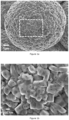
Figure 1a . SEM image shows secondary particle of CEX2.2 comprising plurality of primary particles. Dotted line shows the area to be captured in order to obtain the average primary particle diameter. -
Figure 1b . SEM image of CEX2.2 to obtain the average primary particle diameter. -
Figure 1c . SEM image of EX1 to obtain the average primary particle diameter. -
Figure 2 . XPS spectra showing Zr peak of EX1 and CEX2.2. -
Figure 3 . TEM-EDS analysis result of Zr/(Ni+Mn+Co+Zr) of EX1 (x-axis: distance where 0 is the starting point of the surface layer, y-axis: element in atomic ratio) - In the drawings and the following detailed description, preferred embodiments are described so as to enable the practice of the invention. Although the invention is described with reference to these specific preferred embodiments, it will be understood that the invention is not limited to these preferred embodiments. The invention includes numerous alternatives, modifications and equivalents that are apparent from consideration of the following detailed description and accompanying drawings.
- The amount of Li, Ni, Mn, Co, and Zr in the positive electrode active material powder is measured with the Inductively Coupled Plasma (ICP) method by using an Agilent ICP 720-ES (Agilent Technologies, https://www.agilent.com/cs/library/brochures/5990-6497EN%20720-725_ICP-OES_LR.pdf). 2 grams of powder sample is dissolved into 10 mL of high purity hydrochloric acid (at least 37 wt.% of HCl with respect to the total weight of solution) in an Erlenmeyer flask. The flask is covered by a glass and heated on a hot plate at 380°C until complete dissolution of the precursor. After being cooled to room temperature, the solution of the Erlenmeyer flask is poured into a 250 mL volumetric flask. Afterwards, the volumetric flask is filled with deionized water up to the 250 mL mark, followed by complete homogenization. An appropriate amount of solution is taken out by pipette and transferred into a 250 mL volumetric flask for the 2nd dilution, where the volumetric flask is filled with internal standard and 10% hydrochloric acid up to the 250 mL mark and then homogenized. Finally, this 50 mL solution is used for ICP measurement.
- The morphology of positive electrode active materials is analyzed by a Scanning Electron Microscopy (SEM) technique. The measurement is performed with a JEOL JSM 7100F (https://www.jeolbenelux.com/JEOL-BV-News/jsm-7100f-thermal-field-emission-electron-microscope) under a high vacuum environment of 9.6×10⁻⁵ Pa at 25°C.
- The particle size distribution (PSD) of the positive electrode active material powder is measured by laser diffraction particle size analysis using a Malvern Mastersizer 3000 with a Hydro MV wet dispersion accessory (https://www.malvernpanalytical.com/en/ products/product-range/mastersizer-range/mastersizer-3000#overview) after having dispersed each of the powder samples in an aqueous medium. In order to improve the dispersion of the powder, sufficient ultrasonic irradiation and stirring is applied, and an appropriate surfactant is introduced. D50 is defined as the particle size at 50% of the cumulative volume% distributions obtained from the Malvern Mastersizer 3000 with Hydro MV measurements.
- The diameter of primary particle is calculated by using ImageJ software (ImageJ 1.52a, National Institutes of Health, USA) according to the following steps:
- Step 1) Open the file containing SEM image of positive electrode active material with 10,000 times magnification wherein the image is taken at the center part of a secondary particle. Example of such image is shown in
Figure 1a wherein the dotted line shows the area to be captured corresponding toFigure 1b . - Step 2) Set scale according to the SEM magnification.
- Step 3) Draw lines following primary particle edges using polygon selections tool for at least 50 particles. The particles at the edges of image is to be excluded if truncated.
- Step 4) Measure the area of the drawn primary particles selected from Set Measurements and Area box.
- Step 5) Calculate the particle diameter of each measured area by assuming the particle in the spherical shape following

- In the present invention, X-ray photoelectron spectroscopy (XPS) is used to analyze the surface of positive electrode active material powder particles. In XPS measurement, the signal is acquired from the first few nanometers (e.g. 1 nm to 10 nm) of the uppermost part of a sample, i.e. surface layer. Therefore, all elements measured by XPS are contained in the surface layer.
- For the surface analysis of positive electrode active material powder particles, XPS measurement is carried out using a Thermo K-a+ spectrometer (Thermo Scientific, https://www.thermofisher.com/order/catalog/product/IQLAADGAAFFACVMAHV). Monochromatic Al Kα radiation (hu=1486.6 eV) is used with a spot size of 400 µm and measurement angle of 45°. A wide survey scan to identify elements present at the surface is conducted at 200 eV pass energy. C1s peak having a maximum intensity (or centered) at a binding energy of 284.8 eV is used as a calibrate peak position after data collection. Accurate narrow scans are performed afterwards at 50 eV for at least 10 scans for each identified element to determine the precise surface composition.
- Curve fitting is done with CasaXPS Version2.3.19PR1.0 (Casa Software, http://www.casaxps.com/) using a Shirley-type background treatment and Scofield sensitivity factors. The fitting parameters are according to Table 1a. Line shape GL(30) is the Gaussian/Lorentzian product formula with 70% Gaussian line and 30% Lorentzian line. LA(α, β, m) is an asymmetric line-shape where a and β define tail spreading of the peak and m define the width.
Table 1a. XPS fitting parameter for Ni2p3, Mn2p3, Co2p3, and Zr3d. Element Sensitivity factor Fitting range (eV) Defined peak(s) Line shape Ni 14.61 851.3±0.1-869.4±0.1 Ni2p3, Ni2p3 satellite LA(1.33, 2.44, 69) Mn 9.17 639.9±0.1-649.5±0.1 Mn2p3, Mn2p3 satellite GL(30) Co 12.62 775.8±0.4-792.5±0.4 Co2p3-1, Co2p3-2, Co2p3 satellite GL(30) Zr 7.04 178.0-188.5 Zr3d3, Zr3d1 GL(30) - For Zr and Co peaks, constraints are set for each defined peak according to Table 1b.
Table 1b. XPS fitting constraints for peaks fitting. Element Defined peak Fitting range constraint (eV) FWHM constraint (eV) Area constraint Zr Zr3d1 184.0-188.5 Equal to Zr3d3 66.7% of Zr3d3 Zr3d3 178.0-184.0 0.5-4.0 No constraint set Co Co2p3-1 776.0-780.9 0.5-4.0 No constraint set Co2p3-2 781.0-785.0 0.5-4.0 No constraint set Co2p3 satellite 785.1-792.0 0.5-6.0 No constraint set - The Zr surface contents as determined by XPS are expressed as a molar fraction of Zr in the surface layer of the particles divided by the total content of Ni, Mn, Co, and Zr in said surface layer. It is calculated as follows:

- For the preparation of a positive electrode, a slurry contains positive electrode active material powder, Li-P-S based solid electrolyte, carbon (Super-P, Timcal), and binder (RC-10, Arkema) - with a formulation of 64.0 : 30.0 : 3.0 : 3.0 by weight - in butyl acetate solvent is mixed in Ar-filled glove box. The slurry is casted on one side of an aluminum foil followed by drying the slurry coated foil in a vacuum oven to obtain a positive electrode.
- The obtained positive electrode is punched with a diameter of 10 nm wherein the active material loading amount is around 4 mg/cm2.
- For the preparation of negative electrode, Li foil (diameter 3 mm, thickness 100 µm) is placed centered on the top of In foil (
diameter 10 nm, thickness 100 µm) and pressed to form Li-In alloy negative electrode. - For the preparation of separator which also has a function of the solid electrolyte in a battery, the Li-P-S based solid electrolyte is pelletized with a pressure of 250 MPa to obtain 100 µm pellet thickness.
- A sulfide solid-state battery is assembled in an argon-filled glovebox with such order from bottom to top: positive electrode comprising Al current collector with the coated part on the top - separator - negative electrode with Li side on the top - Cu current collector. The stacked components are pressed together with a pressure of 250 MPa and placed in an external cage to prevent air exposure.
- The testing method is a conventional "constant cut-off voltage" test. The conventional cell test in the present invention follows the schedule shown in Table 2. Each cell is cycled at 60°C using a Toscat-3100 computer-controlled galvanostatic cycling station (from Toyo). The schedule uses a 1C current definition of 160 mA/g. The initial charge capacity (CQ1) and discharge capacity (DQ1) are measured in constant current mode (CC) at C rate of 0.1 C in below voltage range:
- 4.2 V to 2.5 V (Li/Li+) or 3.6 V to 1.9 V (InLi/Li+) for CEX1.1, EX1, CEX2.1, CEX2.2, CEX3, and EX2.
- The irreversible capacity IRRQ is expressed in % as follows:

Table 2. Cycling schedule for sulfide solid-state battery testing method Charge Discharge C Rate End current Rest (min) V/Li metal (V) C Rate End current Rest (min) V/Li metal (V) 0.1 - 30 4.2 0.1 - 30 2.5 0.1 - 30 4.3 0.1 - 30 2.5 - To examine the Zr distributions within a lithium transition metal-based oxide particle, cross-sectional TEM lamellas of particles are prepared by Nova Nano SEM200 (FEI). A Ga ion beam is used with 30kV voltage and 30pA-7nA current. The obtained etched sample has a dimension of 5×8µm with 100nm thickness. Using the prepared (etched) sample, the surface property from the top to the center of the lithium transition metal-based oxide particle is analyzed by TEM and energy-dispersive X-ray spectroscopy (EDS). The TEM-EDS line scan is performed on a Tecnai G2 F30 S-TWIN (FEI) with ELITE T 70 detector (EDAX). An EDS analysis of the lithium transition metal-based oxide particle provides the quantitative element analysis of the cross-section. Zr content is normalized by the total atomic fraction of Ni, Mn, Co, and Zr.
- The invention is further illustrated by the following (non-limitative) examples:
- CEX1 is obtained through a solid-state reaction between a lithium source and a transition metal-based source running as follows:
- 1) Co-precipitation: a transition metal-based oxidized hydroxide precursor with metal composition of Ni0.64Mn0.17Co0.20 is prepared by a co-precipitation process in a large-scale continuous stirred tank reactor (CSTR) with mixed nickel-manganese-cobalt sulfates, sodium hydroxide, and ammonia.
- 2) Mixing: the transition metal-based oxidized hydroxide precursor and LiOH as a lithium source are homogenously mix with a lithium to metal M' (Li/M') ratio of 1.03 in an industrial blending equipment to obtain a mixture.
- 3) First heating: the mixture from Step 2) is heated at 830°C for 10 hours under an oxygen atmosphere. The heated powder is crushed, classified, and sieved so as to obtain an intermediate product.
- 4) Second heating: the intermediate product from Step 3) is heated at 350°C for 6 hours under an oxygen atmosphere so as to obtain CEX1.1 having M' comprising Ni, Mn, and Co in a ratio Ni: Mn: Co of 0.638: 0.165: 0.197 as obtained by ICP. CEX1 has a D50 of 10 µm.
- Optionally, a source of dopant can be added in the co-precipitation process in Step 1) or in the mixing step in the Step 2) together with lithium source. A certain element can be added as a dopant, for instance, to improve the electrochemical properties of the positive electrode active material.
- EX1 is obtained through a solid-state reaction between a lithium source and a transition metal-based source running as follows:
- 1) Co-precipitation: a transition metal-based oxidized hydroxide precursor with metal composition of Ni0.64Mn0.17Co0.200 is prepared by a co-precipitation process in a large-scale continuous stirred tank reactor (CSTR) with mixed nickel-manganese-cobalt sulfates, sodium hydroxide, and ammonia.
- 2) Mixing: the transition metal-based oxidized hydroxide precursor and LiOH as a lithium source are homogenously mix with a lithium to metal M' (Li/M') ratio of 1.03 in an industrial blending equipment to obtain a mixture.
- 3) First heating: the mixture from Step 2) is heated at 830°C for 10 hours under an oxygen atmosphere. The heated powder is crushed, classified, and sieved so as to obtain an intermediate product.
- 4) Wet mixing: Step 4a) to Step 4c) below is applied to introduce Zr into the positive electrode active material
- Step 4a) Zr solution preparation: 0.6 mol% of Zr from Zr-propoxide (70 wt% Zr-propoxide in n-propanol solution), 1.2 mol% of Li-ethoxide powder, each with respect to the total molar contents of Ni, Mn, and Co in the intermediate product, and ethanol solvent are mixed to form a solution. The amount of ethanol solvent is 55 wt.% of the total weight of the designated intermediate product to mix in the Step 4b).
- Step 4b) Mixing: intermediate product obtained from Step 3) is mixed with Zr solution prepared in Step 4a) for 20 minutes in a heatable reactor.
- Step 4c) Heating: 70°C heat is applied to reactor in Step 4b) while at the same time reactor is connected to a vacuum pump to evaporate volatile phases. The product obtained from this step is a dried powder.
- 5) Second heating: the dried powder from Step 4c) is heated at 350°C for 6 hours under an oxygen atmosphere so as to obtain EX1 having M' comprising Ni, Mn, Co and Zr in a ratio Ni: Mn: Co: Zr of 0.635: 0.163: 0.196: 0.006 as obtained by ICP. EX1 has a D50 of 10 µm.
- CEX2.1 is obtained through the same procedure as CEX1, except that the first heating temperature in Step 3) is 860°C.
- CEX2.2 is obtained through the same procedure as EX1, except that the first heating temperature in Step 3) is 860°C.
- CEX3 is obtained through the same procedure as CEX1, except that the first heating temperature in Step 3) is 795°C.
- EX2 is obtained through the same procedure as EX1, except that the first heating temperature in Step 3) is 795°C.
- CEX5 is obtained through the same procedure as CEX1, except that the first heating temperature in Step 3) is 750°C.
- EX4 is obtained through the same procedure as EX1, except that the first heating temperature in Step 3) is 750°C.
- CEX6 is obtained through the same procedure as CEX1, except that the first heating temperature in Step 3) is 750°C.
- EX5 is obtained through the same procedure as EX1, except that the first heating temperature in Step 3) is 750°C.
Table 3. Summary of the primary particle diameter, composition, and the corresponding electrochemical properties of example and comparative examples. ID Average primary particle diameter (nm) Carbon ICP XPS XPS/ICP Electrochemical property (ppm) Ni (mol%) ZrA* ZrB* ZrB/ZrA, DQ1 (mAh/g) IRRQ (mAh/g) CEX1 270 249 63.8 0.00 0.00 n/a** 137.3 25.9 EX1 270 1077 63.5 0.0059 0.94 158.6 173.5 6.7 CEX2.1 371 178 63.8 0.00 0.00 n/a** 126.1 29.5 CEX2.2 371 549 63.2 0.0059 0.73 123.1 151.0 12.4 CEX3 231 195 65.0 0.00 0.00 n/a** 145.1 17.0 EX2 231 1062 64.7 0.0059 0.83 142.3 176.6 8.3 CEX4 190 149 65.0 0.00 0.00 n/a** 146.0 17.2 EX3 190 1001 65.1 0.0059 0.59 101.6 172.5 6.6 CEX5 192 238 64.9 0.00 0.00 n/a** 120.3 23.3 EX4 192 1076 65.1 0.0059 0.68 114.6 171.7 8.5 * Relative to molar contents of Ni, Mn, Co, and Zr
** Not applicable because ZrA is 0. - Table 3 summarizes the primary particle diameter, composition, and the corresponding electrochemical properties of example and comparative examples. The average primary particle diameter of EX1, EX2, EX3 and EX4 are 270, 231, 190, and 192 nm, respectively. These average diameters are smaller than the average primary particle diameters of CEX2.1 and CEX2.2 which are 371 nm. The primary particle SEM images of CEX2.2 and EX1 are shown in
Figure 1b and1c , respectively. The images contain drawn lines and number to identify primary particle in order to obtain the average primary particle diameter. - In the Table 3, the XPS analysis result of EX1 and CEX2.2 showing Zr atomic ratio (equivalent with molar ratio) with respect to the total atomic fraction of Ni, Mn, Co, and Zr (ZrB). The table also compares the result with that of ICP. The ZrB higher than 0 indicates said Zr is presence in the surface of the positive electrode active material as associated with the XPS measurement which signal is acquired from the first few nanometers (e.g. 1 nm to 10 nm) of the uppermost part of a sample, i.e. surface layer. On the other hand, Zr atomic ratio obtained from ICP measurement (ZrA) is from the entire particles. Therefore, the ratio of XPS to ICP (ZrB/ZrA) higher than 1 indicates said elements Zr presence mostly on the surface of the positive electrode active material. The higher ZrB/ZrA value corresponds with the more Zr presence in the surface of positive electrode active material. ZrB/ZrA in EX1 is higher than that of CEX2.2 ZrB/ZrA. The representative of XPS spectra showing Zr3d5 and 3d3 peaks of CEX2.2 and EX1 are displayed in
Figure 2 . -
Figure 3 shows the TEM-EDS measurement of EX1 (x-axis: distance where 0 is the starting point of the surface layer, y-axis: element in atomic ratio). Zr thickness from the measurement is 25.8 nm. - Carbon content in positive electrode active material after Zr treatment is higher comparing with before treatment which associated with a better electrochemical performance of active material. Carbon is originated from the Zr alkoxide compound used in the treatment.
- The combination of average primary particle diameter in the range of 170 nm to 340 nm and ZrB/ZrA higher than 50.0, preferably higher than 100.0, can achieve the objective of the present invention, which is to provide a positive electrode active material having an improved first charge capacity of at least 160 mAh/g in the solid-state battery.
Claims (16)
- A positive electrode active material for solid-state batteries, wherein the positive electrode active material comprises Li, M', and oxygen, wherein M' comprises:- Ni in a content x between 50.0 mol% and 75.0 mol%, relative to M';- Co in a content y between 0.0 mol% and 40.0 mol%, relative to M';- Mn in a content z between 0.0 mol% and 40.0 mol%, relative to M',- D in a content a between 0.0 mol% and 2.0 mol%, relative to M', wherein D comprises at least one element of the group consisting of: Al, B, Ba, Ca, Cr, Fe, Mg, Mo, Nb, S, Si, Sr, Ti, Y, V, W, and Zn, and,- Zr in a content b between 0.1 mol% and 5.0 mol%, relative to M',- wherein x, y, z, a, and b are measured by ICP,- wherein x+y+z+a+b is 100.0 mol%,wherein the positive electrode active material has a Zr content ZrA defined as
 wherein the positive electrode active material has a Zr content ZrB, wherein ZrB is determined by XPS analysis, wherein ZrB is expressed as molar fraction compared to the sum of molar fractions of Co, Mn, Ni, and Zr, as measured by XPS analysis,wherein the ratio ZrB / ZrA > 50.0,wherein the positive electrode active material comprises secondary particles having a plurality of primary particles,wherein said primary particles have an average diameter of between 170 nm to 340 nm as determined by measuring primary particle size in an image taken by SEM.
 - Positive electrode active material according to claim 1, wherein the ratio ZrB / ZrA is at least 80, preferably at least 100 and most preferably at least 120.
- Positive electrode active material according to claim 1 or 2, wherein the ratio ZrB / ZrA is at most 500 and preferably at most 300, and most preferably at most 200.
- Positive electrode active material according to any of the preceding claims, wherein x ≥ 55.0 mol% and preferably x > 60.0 mol%
- Positive electrode active material according to any of the preceding claims, wherein x ≤ 72.0 mol%.
- Positive electrode active material according to any of the preceding claims, 0 mol % ≤ y ≤ 20 mol%.
- Positive electrode active material according to any of the preceding claims, wherein b is at least 0.10 mol% and at most 1.00 mol%, relative to M'.
- Positive electrode active material according to any of the preceding claims, wherein the secondary particle median size D50 is at least 2.0 µm and at most 15.0 µm, as determined by laser diffraction particle size analysis.
- Positive electrode active material according to any of the preceding claims, wherein the carbon content is at least 600 ppm and at most 3000 ppm, as determined by carbon analyzer.
- Positive electrode active material according to any of the preceding claims, wherein the Zr thickness is at least 10 nm, as determined by TEM-EDS measurement.
- A method for the manufacturing of a positive electrode active material for solid-state batteries, wherein the positive electrode active material is the positive electrode active material according to any one of claims 1 to 10, comprising the consecutive steps of- preparing a lithium transition metal-based oxide compound,- mixing said lithium transition metal-based oxide compound with a source of Zr, preferably Zr alkoxide in lithium alkoxide containing alcohol solvent, thereby obtaining a mixture, and- heating the mixture in an oxidizing atmosphere in a furnace at a temperature between 350°C and less than 500°C, preferably at most 450°C, for a time between 1 hour and 20 hours so as to obtain said positive electrode active material powder according to any one of claims 1 to 10.
- The method according to claim 11, wherein the method comprises a further step, before heating said mixture, of drying said mixture.
- The method according to claim 11, wherein the method comprises a further step, before heating said mixture, of drying said mixture by means of vacuum heating.
- A solid-state battery comprising the positive electrode active material according to claims 1 to 10.
- Solid-state battery according to claim 14, wherein said solid-state battery comprises a sulfide based solid electrolyte comprising Li, P, and S.
- Use of the battery according to claim 14 or 15 in an electric vehicle or in a hybrid electric vehicle.
Applications Claiming Priority (5)
| Application Number | Priority Date | Filing Date | Title |
|---|---|---|---|
| EP21159378 | 2021-02-25 | ||
| EP21159397 | 2021-02-25 | ||
| EP21159402 | 2021-02-25 | ||
| EP21159385 | 2021-02-25 | ||
| PCT/EP2022/054619 WO2022180147A1 (en) | 2021-02-25 | 2022-02-24 | Lithium nickel-based composite oxide as a positive electrode active material for rechargeable lithium-ion batteries |
Publications (3)
| Publication Number | Publication Date |
|---|---|
| EP4298062A1 EP4298062A1 (en) | 2024-01-03 |
| EP4298062B1 true EP4298062B1 (en) | 2025-01-15 |
| EP4298062C0 EP4298062C0 (en) | 2025-01-15 |
Family
ID=80623834
Family Applications (3)
| Application Number | Title | Priority Date | Filing Date |
|---|---|---|---|
| EP22707458.0A Pending EP4298061A1 (en) | 2021-02-25 | 2022-02-24 | Lithium nickel-based composite oxide as a positive electrode active material for rechargeable lithium-ion batteries |
| EP22707186.7A Pending EP4298060A1 (en) | 2021-02-25 | 2022-02-24 | Lithium nickel-based composite oxide as a positive electrode active material for rechargeable lithium-ion batteries |
| EP22707726.0A Active EP4298062B1 (en) | 2021-02-25 | 2022-02-24 | Lithium nickel-based composite oxide as a positive electrode active material for rechargeable lithium-ion batteries |
Family Applications Before (2)
| Application Number | Title | Priority Date | Filing Date |
|---|---|---|---|
| EP22707458.0A Pending EP4298061A1 (en) | 2021-02-25 | 2022-02-24 | Lithium nickel-based composite oxide as a positive electrode active material for rechargeable lithium-ion batteries |
| EP22707186.7A Pending EP4298060A1 (en) | 2021-02-25 | 2022-02-24 | Lithium nickel-based composite oxide as a positive electrode active material for rechargeable lithium-ion batteries |
Country Status (10)
| Country | Link |
|---|---|
| US (3) | US20240132373A1 (en) |
| EP (3) | EP4298061A1 (en) |
| JP (3) | JP7670846B2 (en) |
| KR (3) | KR102933465B1 (en) |
| CN (1) | CN116867744B (en) |
| CA (3) | CA3209725A1 (en) |
| ES (1) | ES3015486T3 (en) |
| HU (1) | HUE070666T2 (en) |
| PL (1) | PL4298062T3 (en) |
| WO (3) | WO2022180143A1 (en) |
Family Cites Families (17)
| Publication number | Priority date | Publication date | Assignee | Title |
|---|---|---|---|---|
| JP2004311408A (en) * | 2003-03-25 | 2004-11-04 | Nichia Chem Ind Ltd | Positive active material for non-aqueous electrolyte secondary battery and non-aqueous electrolyte secondary battery |
| KR101666879B1 (en) * | 2012-08-14 | 2016-10-17 | 삼성에스디아이 주식회사 | Cathode active material for lithium secondary battery, method for preparing cathode active material for lithium secondary battery and lithium secondary battery including cathode active material |
| JP2014049309A (en) * | 2012-08-31 | 2014-03-17 | Toyota Motor Corp | Active substance material, all-solid-state battery, and method for producing active substance material |
| JP2017050204A (en) * | 2015-09-03 | 2017-03-09 | 日立マクセル株式会社 | Positive electrode material for nonaqueous electrolyte secondary batteries, method for manufacturing the same and nonaqueous electrolyte secondary battery |
| KR102510883B1 (en) * | 2015-11-05 | 2023-03-16 | 삼성에스디아이 주식회사 | Positive electrode active material, preparing method thereof, and lithium secondary battery including positive electrode comprising the same |
| US11302919B2 (en) * | 2016-07-20 | 2022-04-12 | Samsung Sdi Co., Ltd. | Nickel-based active material for lithium secondary battery, method of preparing the same, and lithium secondary battery including positive electrode including the nickel-based active material |
| JP6952467B2 (en) * | 2017-01-24 | 2021-10-20 | 三星電子株式会社Samsung Electronics Co.,Ltd. | Positive active material for all-solid-state secondary batteries, positive-positive active material layer for all-solid-state secondary batteries, and all-solid-state secondary batteries |
| JP6856763B2 (en) * | 2017-03-03 | 2021-04-14 | ユミコア | Precursors and methods for preparing Ni-based cathode materials for rechargeable lithium-ion batteries |
| US12315915B2 (en) * | 2017-07-14 | 2025-05-27 | Umicore | Ni based cathode material for rechargeable lithium-ion batteries |
| KR102306545B1 (en) * | 2017-10-19 | 2021-09-30 | 주식회사 엘지에너지솔루션 | Positive electrode material for lithium secondary battery, preparing method of the same, positive electrode and lithium secondary battery including the same |
| KR102698846B1 (en) * | 2017-11-22 | 2024-08-26 | 주식회사 엘지에너지솔루션 | Positive electrode active material for lithium secondary battery and method for preparing the same |
| US11522186B2 (en) * | 2017-12-22 | 2022-12-06 | Umicore | Positive electrode material for rechargeable lithium ion batteries |
| US11894555B2 (en) * | 2018-08-03 | 2024-02-06 | Sumitomo Metal Mining Co., Ltd. | Positive electrode active material for lithium ion secondary battery, method of manufacturing positive electrode active material for lithium ion secondary battery, and lithium ion secondary battery |
| CN110957474B (en) * | 2018-09-26 | 2020-12-11 | 宁德时代新能源科技股份有限公司 | Positive electrode active material, preparation method thereof, and electrochemical energy storage device |
| KR102701082B1 (en) * | 2018-10-24 | 2024-09-03 | 삼성전자주식회사 | Composite cathode active material, Cathode and Lithium battery containing composite cathode active material and Preparation method thereof |
| JP2020172426A (en) * | 2020-02-06 | 2020-10-22 | 住友化学株式会社 | Lithium metal composite oxide powder and positive electrode active material for lithium secondary batteries |
| JP7807219B2 (en) * | 2021-12-07 | 2026-01-27 | 株式会社ディスコ | Dressing tool and dressing method |
-
2022
- 2022-02-24 ES ES22707726T patent/ES3015486T3/en active Active
- 2022-02-24 EP EP22707458.0A patent/EP4298061A1/en active Pending
- 2022-02-24 CA CA3209725A patent/CA3209725A1/en active Pending
- 2022-02-24 WO PCT/EP2022/054606 patent/WO2022180143A1/en not_active Ceased
- 2022-02-24 KR KR1020237032848A patent/KR102933465B1/en active Active
- 2022-02-24 US US18/277,393 patent/US20240132373A1/en active Pending
- 2022-02-24 CA CA3209719A patent/CA3209719A1/en active Pending
- 2022-02-24 KR KR1020237032844A patent/KR102933461B1/en active Active
- 2022-02-24 US US18/277,484 patent/US20240132374A1/en active Pending
- 2022-02-24 EP EP22707186.7A patent/EP4298060A1/en active Pending
- 2022-02-24 PL PL22707726.0T patent/PL4298062T3/en unknown
- 2022-02-24 HU HUE22707726A patent/HUE070666T2/en unknown
- 2022-02-24 JP JP2023551773A patent/JP7670846B2/en active Active
- 2022-02-24 WO PCT/EP2022/054633 patent/WO2022180155A1/en not_active Ceased
- 2022-02-24 JP JP2023551777A patent/JP7721660B2/en active Active
- 2022-02-24 WO PCT/EP2022/054619 patent/WO2022180147A1/en not_active Ceased
- 2022-02-24 JP JP2023551774A patent/JP7665768B2/en active Active
- 2022-02-24 US US18/277,543 patent/US20240300824A1/en active Pending
- 2022-02-24 KR KR1020237032831A patent/KR102937487B1/en active Active
- 2022-02-24 EP EP22707726.0A patent/EP4298062B1/en active Active
- 2022-02-24 CN CN202280015475.0A patent/CN116867744B/en active Active
- 2022-02-24 CA CA3209722A patent/CA3209722A1/en active Pending
Also Published As
| Publication number | Publication date |
|---|---|
| JP2024507388A (en) | 2024-02-19 |
| JP7665768B2 (en) | 2025-04-21 |
| CA3209725A1 (en) | 2022-09-01 |
| JP2024509521A (en) | 2024-03-04 |
| HUE070666T2 (en) | 2025-06-28 |
| KR102937487B1 (en) | 2026-03-11 |
| EP4298061A1 (en) | 2024-01-03 |
| JP7721660B2 (en) | 2025-08-12 |
| EP4298060A1 (en) | 2024-01-03 |
| CN116867744A (en) | 2023-10-10 |
| US20240132373A1 (en) | 2024-04-25 |
| WO2022180155A1 (en) | 2022-09-01 |
| WO2022180143A1 (en) | 2022-09-01 |
| JP2024509522A (en) | 2024-03-04 |
| KR20230147731A (en) | 2023-10-23 |
| KR20230151531A (en) | 2023-11-01 |
| EP4298062A1 (en) | 2024-01-03 |
| US20240132374A1 (en) | 2024-04-25 |
| ES3015486T3 (en) | 2025-05-05 |
| CN116867744B (en) | 2025-12-23 |
| CA3209719A1 (en) | 2022-09-01 |
| KR102933461B1 (en) | 2026-03-04 |
| JP7670846B2 (en) | 2025-04-30 |
| PL4298062T3 (en) | 2025-03-24 |
| WO2022180147A1 (en) | 2022-09-01 |
| KR102933465B1 (en) | 2026-03-04 |
| KR20230147732A (en) | 2023-10-23 |
| CA3209722A1 (en) | 2022-09-01 |
| EP4298062C0 (en) | 2025-01-15 |
| US20240300824A1 (en) | 2024-09-12 |
Similar Documents
| Publication | Publication Date | Title |
|---|---|---|
| EP3994748B1 (en) | Lithium nickel manganese cobalt composite oxide as a positive electrode active material for rechargeable lithium ion batteries | |
| US12294078B2 (en) | As a positive electrode active material for rechargeable lithium ion batteries | |
| EP4298062B1 (en) | Lithium nickel-based composite oxide as a positive electrode active material for rechargeable lithium-ion batteries | |
| US20250046807A1 (en) | A positive electrode active material for rechargeable solid-state batteries | |
| US20250054967A1 (en) | Lithium nickel-based composite oxide as a positive electrode active material for rechargeable solid-state batteries | |
| US20240270599A1 (en) | Lithium nickel-based composite oxide as a positive electrode active material for solid-state lithium-ion rechargeable batteries | |
| EP4602661A1 (en) | Positive electrode active material and method for manufacturing a positive electrode active material | |
| EP4631116A1 (en) | Lithium nickel-based composite oxide as a positive electrode active material for sulfide solid-state rechargeable batteries | |
| CN121693473A (en) | Positive electrode active material powder and method for manufacturing positive electrode active material powder |
Legal Events
| Date | Code | Title | Description |
|---|---|---|---|
| STAA | Information on the status of an ep patent application or granted ep patent |
Free format text: STATUS: UNKNOWN |
|
| STAA | Information on the status of an ep patent application or granted ep patent |
Free format text: STATUS: THE INTERNATIONAL PUBLICATION HAS BEEN MADE |
|
| PUAI | Public reference made under article 153(3) epc to a published international application that has entered the european phase |
Free format text: ORIGINAL CODE: 0009012 |
|
| STAA | Information on the status of an ep patent application or granted ep patent |
Free format text: STATUS: REQUEST FOR EXAMINATION WAS MADE |
|
| 17P | Request for examination filed |
Effective date: 20230925 |
|
| AK | Designated contracting states |
Kind code of ref document: A1 Designated state(s): AL AT BE BG CH CY CZ DE DK EE ES FI FR GB GR HR HU IE IS IT LI LT LU LV MC MK MT NL NO PL PT RO RS SE SI SK SM TR |
|
| DAV | Request for validation of the european patent (deleted) | ||
| DAX | Request for extension of the european patent (deleted) | ||
| GRAP | Despatch of communication of intention to grant a patent |
Free format text: ORIGINAL CODE: EPIDOSNIGR1 |
|
| STAA | Information on the status of an ep patent application or granted ep patent |
Free format text: STATUS: GRANT OF PATENT IS INTENDED |
|
| INTG | Intention to grant announced |
Effective date: 20241004 |
|
| RIN1 | Information on inventor provided before grant (corrected) |
Inventor name: OH, JINDOO Inventor name: KANG, JIHOON Inventor name: YANG, HYEJEONG Inventor name: YANG, TAEHYEON Inventor name: KUMAKURA, SHINICHI Inventor name: PAULSEN, JENS MARTIN Inventor name: HYOUNG, JOOEUN |
|
| GRAS | Grant fee paid |
Free format text: ORIGINAL CODE: EPIDOSNIGR3 |
|
| GRAA | (expected) grant |
Free format text: ORIGINAL CODE: 0009210 |
|
| STAA | Information on the status of an ep patent application or granted ep patent |
Free format text: STATUS: THE PATENT HAS BEEN GRANTED |
|
| AK | Designated contracting states |
Kind code of ref document: B1 Designated state(s): AL AT BE BG CH CY CZ DE DK EE ES FI FR GB GR HR HU IE IS IT LI LT LU LV MC MK MT NL NO PL PT RO RS SE SI SK SM TR |
|
| REG | Reference to a national code |
Ref country code: CH Ref legal event code: EP Ref country code: GB Ref legal event code: FG4D |
|
| REG | Reference to a national code |
Ref country code: DE Ref legal event code: R096 Ref document number: 602022009591 Country of ref document: DE |
|
| REG | Reference to a national code |
Ref country code: IE Ref legal event code: FG4D |
|
| U01 | Request for unitary effect filed |
Effective date: 20250210 |
|
| U07 | Unitary effect registered |
Designated state(s): AT BE BG DE DK EE FI FR IT LT LU LV MT NL PT RO SE SI Effective date: 20250217 |
|
| U20 | Renewal fee for the european patent with unitary effect paid |
Year of fee payment: 4 Effective date: 20250519 |
|
| REG | Reference to a national code |
Ref country code: HU Ref legal event code: AG4A Ref document number: E070666 Country of ref document: HU |
|
| PG25 | Lapsed in a contracting state [announced via postgrant information from national office to epo] |
Ref country code: RS Free format text: LAPSE BECAUSE OF FAILURE TO SUBMIT A TRANSLATION OF THE DESCRIPTION OR TO PAY THE FEE WITHIN THE PRESCRIBED TIME-LIMIT Effective date: 20250415 |
|
| PG25 | Lapsed in a contracting state [announced via postgrant information from national office to epo] |
Ref country code: IS Free format text: LAPSE BECAUSE OF FAILURE TO SUBMIT A TRANSLATION OF THE DESCRIPTION OR TO PAY THE FEE WITHIN THE PRESCRIBED TIME-LIMIT Effective date: 20250515 Ref country code: NO Free format text: LAPSE BECAUSE OF FAILURE TO SUBMIT A TRANSLATION OF THE DESCRIPTION OR TO PAY THE FEE WITHIN THE PRESCRIBED TIME-LIMIT Effective date: 20250415 |
|
| PG25 | Lapsed in a contracting state [announced via postgrant information from national office to epo] |
Ref country code: HR Free format text: LAPSE BECAUSE OF FAILURE TO SUBMIT A TRANSLATION OF THE DESCRIPTION OR TO PAY THE FEE WITHIN THE PRESCRIBED TIME-LIMIT Effective date: 20250115 |
|
| PG25 | Lapsed in a contracting state [announced via postgrant information from national office to epo] |
Ref country code: GR Free format text: LAPSE BECAUSE OF FAILURE TO SUBMIT A TRANSLATION OF THE DESCRIPTION OR TO PAY THE FEE WITHIN THE PRESCRIBED TIME-LIMIT Effective date: 20250416 |
|
| REG | Reference to a national code |
Ref country code: CH Ref legal event code: PL |
|
| PG25 | Lapsed in a contracting state [announced via postgrant information from national office to epo] |
Ref country code: SM Free format text: LAPSE BECAUSE OF FAILURE TO SUBMIT A TRANSLATION OF THE DESCRIPTION OR TO PAY THE FEE WITHIN THE PRESCRIBED TIME-LIMIT Effective date: 20250115 |
|
| PG25 | Lapsed in a contracting state [announced via postgrant information from national office to epo] |
Ref country code: MC Free format text: LAPSE BECAUSE OF FAILURE TO SUBMIT A TRANSLATION OF THE DESCRIPTION OR TO PAY THE FEE WITHIN THE PRESCRIBED TIME-LIMIT Effective date: 20250115 |
|
| PG25 | Lapsed in a contracting state [announced via postgrant information from national office to epo] |
Ref country code: CH Free format text: LAPSE BECAUSE OF NON-PAYMENT OF DUE FEES Effective date: 20250228 |
|
| PG25 | Lapsed in a contracting state [announced via postgrant information from national office to epo] |
Ref country code: CZ Free format text: LAPSE BECAUSE OF FAILURE TO SUBMIT A TRANSLATION OF THE DESCRIPTION OR TO PAY THE FEE WITHIN THE PRESCRIBED TIME-LIMIT Effective date: 20250115 |
|
| PG25 | Lapsed in a contracting state [announced via postgrant information from national office to epo] |
Ref country code: SK Free format text: LAPSE BECAUSE OF FAILURE TO SUBMIT A TRANSLATION OF THE DESCRIPTION OR TO PAY THE FEE WITHIN THE PRESCRIBED TIME-LIMIT Effective date: 20250115 |
|
| PLBE | No opposition filed within time limit |
Free format text: ORIGINAL CODE: 0009261 |
|
| STAA | Information on the status of an ep patent application or granted ep patent |
Free format text: STATUS: NO OPPOSITION FILED WITHIN TIME LIMIT |
|
| 26N | No opposition filed |
Effective date: 20251016 |
|
| PG25 | Lapsed in a contracting state [announced via postgrant information from national office to epo] |
Ref country code: IE Free format text: LAPSE BECAUSE OF NON-PAYMENT OF DUE FEES Effective date: 20250224 |
|
| PGFP | Annual fee paid to national office [announced via postgrant information from national office to epo] |
Ref country code: PL Payment date: 20251212 Year of fee payment: 5 |
|
| PGFP | Annual fee paid to national office [announced via postgrant information from national office to epo] |
Ref country code: HU Payment date: 20260130 Year of fee payment: 5 |
|
| U20 | Renewal fee for the european patent with unitary effect paid |
Year of fee payment: 5 Effective date: 20260302 |
|
| PGFP | Annual fee paid to national office [announced via postgrant information from national office to epo] |
Ref country code: GB Payment date: 20260106 Year of fee payment: 5 |
|
| PGFP | Annual fee paid to national office [announced via postgrant information from national office to epo] |
Ref country code: ES Payment date: 20260304 Year of fee payment: 5 |