EP4297376A1 - Non-translated port oversubscribing for a proxy device - Google Patents
Non-translated port oversubscribing for a proxy device Download PDFInfo
- Publication number
- EP4297376A1 EP4297376A1 EP22189320.9A EP22189320A EP4297376A1 EP 4297376 A1 EP4297376 A1 EP 4297376A1 EP 22189320 A EP22189320 A EP 22189320A EP 4297376 A1 EP4297376 A1 EP 4297376A1
- Authority
- EP
- European Patent Office
- Prior art keywords
- session
- proxy
- information associated
- port
- session information
- Prior art date
- Legal status (The legal status is an assumption and is not a legal conclusion. Google has not performed a legal analysis and makes no representation as to the accuracy of the status listed.)
- Granted
Links
Images




Classifications
-
- H—ELECTRICITY
- H04—ELECTRIC COMMUNICATION TECHNIQUE
- H04L—TRANSMISSION OF DIGITAL INFORMATION, e.g. TELEGRAPHIC COMMUNICATION
- H04L63/00—Network architectures or network communication protocols for network security
- H04L63/02—Network architectures or network communication protocols for network security for separating internal from external traffic, e.g. firewalls
- H04L63/0281—Proxies
-
- H—ELECTRICITY
- H04—ELECTRIC COMMUNICATION TECHNIQUE
- H04L—TRANSMISSION OF DIGITAL INFORMATION, e.g. TELEGRAPHIC COMMUNICATION
- H04L67/00—Network arrangements or protocols for supporting network services or applications
- H04L67/14—Session management
- H04L67/141—Setup of application sessions
-
- H—ELECTRICITY
- H04—ELECTRIC COMMUNICATION TECHNIQUE
- H04L—TRANSMISSION OF DIGITAL INFORMATION, e.g. TELEGRAPHIC COMMUNICATION
- H04L67/00—Network arrangements or protocols for supporting network services or applications
- H04L67/50—Network services
- H04L67/56—Provisioning of proxy services
-
- H—ELECTRICITY
- H04—ELECTRIC COMMUNICATION TECHNIQUE
- H04L—TRANSMISSION OF DIGITAL INFORMATION, e.g. TELEGRAPHIC COMMUNICATION
- H04L47/00—Traffic control in data switching networks
- H04L47/10—Flow control; Congestion control
-
- H—ELECTRICITY
- H04—ELECTRIC COMMUNICATION TECHNIQUE
- H04L—TRANSMISSION OF DIGITAL INFORMATION, e.g. TELEGRAPHIC COMMUNICATION
- H04L49/00—Packet switching elements
- H04L49/25—Routing or path finding in a switch fabric
- H04L49/253—Routing or path finding in a switch fabric using establishment or release of connections between ports
-
- H—ELECTRICITY
- H04—ELECTRIC COMMUNICATION TECHNIQUE
- H04L—TRANSMISSION OF DIGITAL INFORMATION, e.g. TELEGRAPHIC COMMUNICATION
- H04L61/00—Network arrangements, protocols or services for addressing or naming
- H04L61/09—Mapping addresses
- H04L61/25—Mapping addresses of the same type
- H04L61/2503—Translation of Internet protocol [IP] addresses
- H04L61/2517—Translation of Internet protocol [IP] addresses using port numbers
-
- H—ELECTRICITY
- H04—ELECTRIC COMMUNICATION TECHNIQUE
- H04L—TRANSMISSION OF DIGITAL INFORMATION, e.g. TELEGRAPHIC COMMUNICATION
- H04L67/00—Network arrangements or protocols for supporting network services or applications
- H04L67/14—Session management
- H04L67/146—Markers for unambiguous identification of a particular session, e.g. session cookie or URL-encoding
Definitions
- the method may include intercepting, by a proxy device, a client session associated with a client device and a destination device.
- the method may include allocating, by the proxy device, a first port of the proxy device as a source port of a proxy session for the client session.
- the method may include determining, by the proxy device and based on allocating the first port, whether session information associated with the proxy session would match session information associated with another proxy session.
- the method may include initiating, by the proxy device, the proxy session after determining whether the session information associated with the proxy session would match session information associated with another proxy session, where a source port of the proxy session is one of: the first port of the proxy device based on a determination that the session information associated with the proxy session would not match session information associated with another proxy session, or a second port of the proxy device based on a determination that the session information associated with the proxy session would match session information associated with another proxy session.
- the device may include one or more memories and one or more processors.
- the device may be configured to intercept a first session associated with a first device and a second device.
- the device may be configured to allocate a first port of the device as a source port of a second session, the second session being associated with the first session.
- the device may be configured to determine, based on allocating the first port, whether session information associated with the second session would match session information associated with another session.
- the device may be configured to initiate the second session after determining whether the session information associated with the second session would match session information associated with another session, where a source port of the second session is one of: the first port of the device, based on a determination that the session information associated with the second session would not match session information associated with another session, or a second port of the device, based on a determination that the session information associated with the second session would match session information associated with another session.
- the set of instructions when executed by one or more processors of the proxy device, may cause the proxy device to initiate the proxy session with the destination device based on a determination of whether session information associated with the proxy session would match session information associated with another proxy session, where a source port of the proxy session is one of: the first port of the proxy device based on determining the session information associated with the proxy session would not match session information associated with another proxy session, or a second port of the proxy device based on determining the session information associated with the proxy session would match session information associated with another proxy session.
- a proxy device e.g., a web proxy
- a proxy device is configured to intercept a client session and originate a proxy session to a destination device associated with the client session.
- a quantity of proxy sessions that the proxy device can maintain is limited.
- a proxy device with single egress interface may have a limitation of handling a maximum of 65,536 proxy sessions originated from the proxy device.
- a client device with an Internet protocol (IP) address of 115.99.111.113 and using port 60026 initiates a client session in order to communicate with a first destination device (e.g., a first web server) with an IP address of 34.120.237.76 at port 443.
- a proxy device with an IP address of 10.10.1.10 intercepts the client session, terminates the client session, and initiates a new proxy session from the proxy device to the first destination device using the IP address of the proxy device (10.10.1.10) and port 38095.
- the quantity of available ports can scale up 65,536, meaning that the proxy device can support up to 65,536 proxy sessions.
- the proxy device may run out of source ports to allocate to proxy sessions and, therefore, may not be able to initiate proxy sessions to destination devices. As a result, reliability of communication for a given client device may be reduced.
- the proxy device may handle multiple destination sockets (i.e., destination IP/destination port combinations) using a given source socket (i.e., a given proxy IP address/ proxy port combination). That is, a given port of the proxy device can be allocated as a source port for multiple proxy sessions, effectively removing a session limitation (e.g., the 65,536 session limitation), thereby improving reliability of communication for a given client device via the proxy device.
- a given port of the proxy device can be allocated as a source port for multiple proxy sessions, effectively removing a session limitation (e.g., the 65,536 session limitation), thereby improving reliability of communication for a given client device via the proxy device.
- Figs. 1A and 1B are diagrams of an example implementation 100 associated with non-translated port oversubscribing for a proxy device. As shown in Figs. 1A and B , example implementation 100 includes a client device 210, a proxy device 220, and a destination device 230. These devices are described in more detail below in connection with Figs. 2-4 .
- the proxy device 220 may intercept a client session associated with the client device 210 and the destination device 230. For example, the proxy device 220 may receive, from the client device 210, an indication that the client device 210 is to initiate a session with the destination device 230. In some implementations, the indication may include a hypertext transfer protocol (HTTP) request.
- HTTP hypertext transfer protocol
- the proxy device 220 selects ports of the proxy device 220 to be allocated for proxy sessions in a sequential manner (e.g., such that ports are allocated in a particular order), in a randomized manner (e.g., such that ports are allocated in a random order), in a prioritized order (e.g., such that ports not currently being used for proxy sessions are allocated before ports being used), or in another manner configured on the proxy device 220.
- the proxy device 220 may allocate the first port of the proxy device 220 as the source port for the proxy session based on a determination that the first port is not allocated to any proxy sessions. That is, in some implementations, the proxy device 220 may identify a port of the proxy device 220 that is not allocated to any proxy session, and may allocate the identified port as the source port for the proxy session. In this way, the proxy device 220 may in some implementations allocate unallocated ports of the proxy device 220 as source ports for proxy sessions before reusing a given allocated port of the proxy device 220 for another proxy session.
- the proxy device 220 may determine, based on allocating the first port, whether session information associated with the proxy session would match session information associated with another proxy session. For example, the proxy device 220 may determine session information (e.g., a 5-tuple) associated with a proxy session that would use the first port of the proxy device 220 as the source port for the proxy session. The proxy device 220 may then compare the session information to session information (e.g., 5-tuples) associated with other proxy sessions being supported by the proxy device 220).
- session information e.g., a 5-tuple
- the proxy device 220 may receive a 5-tuple, associated with the client session, that indicates a source address of the client session (e.g., an IP address of the client device 210, such as 115.99.111.113), a source port of the client session (e.g., a port of the client device 210, such as 60026), a destination address of the client session (e.g., an IP address of the destination device 230, such as 34.120.237.76), a destination port of the client session (e.g., a port of the destination device 230, such as 443), and a protocol associated with the client session (e.g., TCP/IP).
- a source address of the client session e.g., an IP address of the client device 210, such as 115.99.111.113
- a source port of the client session e.g., a port of the client device 210, such as 60026
- a destination address of the client session e.g., an IP address of the
- the proxy device 220 uses a particular IP address of the proxy device 220 (e.g., 10.10.1.10) as a source address for the proxy session, and allocates a first port of the proxy device 220 (e.g., 38095) as the source port of the proxy session.
- a particular IP address of the proxy device 220 e.g., 10.10.1.10
- a first port of the proxy device 220 e.g., 38095
- the session information associated with the proxy session would be a 5-tuple that indicates the source address of the proxy session (e.g., 10.10.1.10 - the IP address of the proxy device 220), the source port of the proxy session (e.g., 38095 - the allocated first port of the client device 210), a destination address of the proxy session (e.g., 34.120.237.76 - the IP address of the destination device 230), a destination port of the proxy session (e.g., 443 - the port of the destination device 230), and a protocol associated with the proxy session (e.g., TCP/IP).
- the source address of the proxy session e.g., 10.10.1.10 - the IP address of the proxy device 220
- the source port of the proxy session e.g., 38095 - the allocated first port of the client device 210
- a destination address of the proxy session e.g., 34.120.237.76 - the IP address of the destination device 230
- the proxy device 220 determines that the session information associated with the proxy session would match session information associated with another proxy session when each item of information included in the session information associated with the proxy session (e.g., the source address, the source port, the destination address, the destination port, and the protocol) is identical to a corresponding item of information included in session information associated with another proxy session.
- the proxy device 220 would determine that the session information associated with the proxy session matches session information associated with another proxy session when the session information associated with the other session includes the same 5-tuple as that of the session information associated with the proxy session (e.g., 10.10.1.10, 38095, 34.120.237.76, 443, TCP/IP).
- the proxy device 220 determines that the session information associated with the proxy session would not match session information associated with another proxy session when at least one item of information included in the session information associated with the proxy session is different from a corresponding item of information included in the session information associated with the other proxy session. Using the above example, the proxy device 220 would determine that the session information associated with the proxy session does not match session information associated with another proxy session when the session information associated with the other session includes a 5-tuple that differs from that of the session information associated with the proxy session (e.g., 10.10.1.10, 38095, 142.250.69.206, 443, TCP/IP).
- a 5-tuple that differs from that of the session information associated with the proxy session
- the proxy device 220 determines that the session information associated with the proxy session does not match the session information associated with the other proxy session.
- the proxy device 220 may initiate the proxy session with the destination device 230, where a source port of the proxy session is the first port of the proxy device 220. That is, when the first port is not allocated to any proxy session, the proxy device 220 may proceed with initiating the proxy session using the first port without a need to compare the session information to session information associated with other proxy sessions.
- the proxy device 220 may initiate the proxy session with the destination device 230, where a source port of the proxy session is the first port of the proxy device. That is, the proxy device 220 may use the first port as the source port for the proxy session if the proxy device 220 determines that the session information associated with the proxy session would not match session information associated with another proxy session.
- the proxy device 220 may allocate the second port of the proxy device as the source port of the proxy session based on a determination that the session information associated with the proxy session would match session information associated with another proxy session. That is, the proxy device 220 may allocate a second (different) port as the source port for the proxy session based on a determination that the session information associated with the proxy session would match session information associated with another proxy session if the first port were to be used as the source port for the proxy session. In some implementations, the proxy device 220 may allocate the second port in a manner similar to that described above with respect to allocation of the first port (e.g., in a particular order, in a randomized order, in a prioritized order, or the like).
- the proxy device 220 may determine that the session information associated with the proxy session would not match session information associated with another proxy session. For example, the proxy device 220 may determine, based on allocating the second port, whether session information associated with the proxy session would match session information associated with another proxy session. As a particular example, the proxy device 220 may determine session information (e.g., a 5-tuple) associated with a proxy session that would use the second port of the proxy device 220 as the source port for the proxy session. The proxy device 220 may then compare the session information to session information (e.g., 5-tuples) associated with other proxy sessions being supported by the proxy device 220 in the manner described above.
- session information e.g., a 5-tuple
- the proxy device 220 may determine that the session information associated with the proxy session, when using the second port as the source port of the proxy session, would not match session information associated with another proxy session.
- the proxy device 220 may initiate the proxy session with the destination device 230, where a source port of the proxy session is the second port of the proxy device. That is, the proxy device 220 may use the second port as the source port for the proxy session if the proxy device 220 determines that the session information associated with the proxy session would not match session information associated with another proxy session.
- the proxy device 220 may determine that the session information associated with the proxy session, when using the second port as the source port for the proxy session, would match session information associated with another proxy session.
- the proxy device 220 may allocate a third port of the proxy device 220 as the source port of the proxy session and determine whether the session information associated with the proxy session, when using the third port as the source port for the proxy session, would match session information associated with another proxy session.
- the proxy device 220 may repeat these operations until the proxy device 220 allocates a port of the proxy device 220 as the source port for the proxy session that would result in session information that would not match session information associated with another proxy session being supported by the proxy device 220.
- the proxy device 220 stores the session information associated with the proxy session.
- the proxy device 220 may store a 5-tuple associated with the proxy session based on initiating the proxy session (e.g., using the first port of the proxy device 220 as the source port or using the second port of the proxy device 220 as the source port).
- the proxy device 220 stores the session information to enable the proxy device 220 to compare session information associated with a proxy session to be established at a later time to session information associated with the proxy session in the manner described above.
- the proxy device 220 may store mapping information that associates the proxy session with the client session. For example, based on initiating the proxy session (e.g., using the first port of the proxy device 220 as the source port or using the second port of the proxy device 220 as the source port), the proxy device 220 may store mapping information that associations the client session with the proxy session. In some implementations, the mapping information may include an indication that a session identifier of the client session is associated with a session identifier of the proxy session. In some implementations, the proxy device 220 uses the mapping information in association with routing traffic between the client device 210 and the destination device 230.
- a source socket of the proxy session may in some cases match a source socket of one or more other proxy sessions initiated by the proxy device 220. That is, a given socket (e.g., a given source IP address and source socket pair) may be used for multiple proxy sessions initiated by the proxy device 220. In this way, any given port of the proxy device 220 (e.g., all 65,536 ports of the proxy device 220) may support multiple proxy sessions, thereby effectively removing a session limitation (e.g., the 65,536 session limitation) and improving reliability of communication.
- a session limitation e.g., the 65,536 session limitation
- Figs. 1A and 1B are provided as an example. Other examples may differ from what is described with regard to Figs. 1A and 1B .
- the number and arrangement of devices shown in Figs. 1A and 1B are provided as an example. In practice, there may be additional devices, fewer devices, different devices, or differently arranged devices than those shown in Figs. 1A and 1B .
- two or more devices shown in Figs. 1A and 1B may be implemented within a single device, or a single device shown in Figs. 1A and 1B may be implemented as multiple, distributed devices.
- a set of devices (e.g., one or more devices) shown in Figs. 1A and 1B may perform one or more functions described as being performed by another set of devices shown in Figs. 1A and 1B .
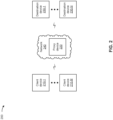
- Fig. 2 is a diagram of an example environment 200 in which systems and/or methods described herein may be implemented.
- environment 200 may include one or more client devices 210 (shown as client device 210-1 through client device 210-M ( M ⁇ 1)), a proxy device 220, one or more destination devices (shown as destination device 230-1 through destination device 230-N (N ⁇ 1)), and a network 240.
- client devices 210 shown as client device 210-1 through client device 210-M ( M ⁇ 1)
- proxy device 220 shown as destination device 230-1 through destination device 230-N (N ⁇ 1)
- destination devices shown as destination device 230-1 through destination device 230-N (N ⁇ 1)
- network 240 may interconnect via wired connections, wireless connections, or a combination of wired and wireless connections.
- Client device 210 includes one or more devices capable of receiving, generating, storing, processing, and/or providing information, such as information described herein.
- client device 210 may include a mobile phone (e.g., a smart phone or a radiotelephone), a laptop computer, a tablet computer, a desktop computer, a handheld computer, a gaming device, a wearable communication device (e.g., a smart watch, a pair of smart glasses, a heart rate monitor, a fitness tracker, smart clothing, smart jewelry, or a head mounted display), or a similar type of device.
- proxy device 220 may include a gateway, a switch, a firewall, a hub, a bridge, a reverse proxy, a server (e.g., a proxy server, a cloud server, or a data center server), a load balancer, and/or a similar device.
- proxy device 220 may be a physical device implemented within a housing, such as a chassis.
- proxy device 220 may be a virtual device implemented by one or more computer devices of a cloud computing environment or a data center.
- a group of proxy devices 220 may be a group of data center nodes that are used to route traffic flow through network 240.
- the number and arrangement of devices and networks shown in Fig. 2 are provided as an example. In practice, there may be additional devices and/or networks, fewer devices and/or networks, different devices and/or networks, or differently arranged devices and/or networks than those shown in Fig. 2 . Furthermore, two or more devices shown in Fig. 2 may be implemented within a single device, or a single device shown in Fig. 2 may be implemented as multiple, distributed devices. Additionally, or alternatively, a set of devices (e.g., one or more devices) of environment 200 may perform one or more functions described as being performed by another set of devices of environment 200.
- Bus 310 includes one or more components that enable wired and/or wireless communication among the components of device 300. Bus 310 may couple together two or more components of Fig. 3 , such as via operative coupling, communicative coupling, electronic coupling, and/or electric coupling.
- Processor 320 includes a central processing unit, a graphics processing unit, a microprocessor, a controller, a microcontroller, a digital signal processor, a field-programmable gate array, an application-specific integrated circuit, and/or another type of processing component.
- Processor 320 is implemented in hardware, firmware, or a combination of hardware and software. In some implementations, processor 320 includes one or more processors capable of being programmed to perform one or more operations or processes described elsewhere herein.
- Input component 410 may be one or more points of attachment for physical links and may be one or more points of entry for incoming traffic, such as packets. Input component 410 may process incoming traffic, such as by performing data link layer encapsulation or decapsulation. In some implementations, input component 410 may transmit and/or receive packets. In some implementations, input component 410 may include an input line card that includes one or more packet processing components (e.g., in the form of integrated circuits), such as one or more interface cards (IFCs), packet forwarding components, line card controller components, input ports, processors, memories, and/or input queues. In some implementations, device 400 may include one or more input components 410.
- packet processing components e.g., in the form of integrated circuits
- IFCs interface cards
- packet forwarding components line card controller components
- input ports e.g., processors, memories, and/or input queues.
- device 400 may include one or more input components 410.
- Output component 430 may store packets and may schedule packets for transmission on output physical links. Output component 430 may support data link layer encapsulation or decapsulation, and/or a variety of higher-level protocols. In some implementations, output component 430 may transmit packets and/or receive packets. In some implementations, output component 430 may include an output line card that includes one or more packet processing components (e.g., in the form of integrated circuits), such as one or more IFCs, packet forwarding components, line card controller components, output ports, processors, memories, and/or output queues. In some implementations, device 400 may include one or more output components 430. In some implementations, input component 410 and output component 430 may be implemented by the same set of components (e.g., and input/output component may be a combination of input component 410 and output component 430).
- packet processing components e.g., in the form of integrated circuits
- IFCs packet forwarding components
- line card controller components e.g., packet forwarding components
- controller 440 may include a RAM, a ROM, and/or another type of dynamic or static storage device (e.g., a flash memory, a magnetic memory, an optical memory, etc.) that stores information and/or instructions for use by controller 440.
- a RAM random access memory
- ROM read-only memory
- static storage device e.g., a flash memory, a magnetic memory, an optical memory, etc.
- device 400 may include additional components, fewer components, different components, or differently arranged components than those shown in Fig. 4 . Additionally, or alternatively, a set of components (e.g., one or more components) of device 400 may perform one or more functions described as being performed by another set of components of device 400.
- process 500 may include determining, based on allocating the first port, whether session information associated with the proxy session would match session information associated with another proxy session (block 530).
- the proxy device may determine, based on allocating the first port, whether session information associated with the proxy session would match session information associated with another proxy session, as described above.
- process 500 may include initiating the proxy session after determining whether the session information associated with the proxy session would match session information associated with another proxy session, wherein a source port of the proxy session is one of: the first port of the proxy device based on a determination that the session information associated with the proxy session would not match session information associated with another proxy session, or a second port of the proxy device based on a determination that the session information associated with the proxy session would match session information associated with another proxy session (block 540).
- the proxy device may initiate the proxy session after determining whether the session information associated with the proxy session would match session information associated with another proxy session, as described above.
- a source port of the proxy session is the first port of the proxy device (e.g., based on a determination that the session information associated with the proxy session would not match session information associated with another proxy session).
- the source port of the proxy session is a second port of the proxy device (e.g., based on a determination that the session information associated with the proxy session would match session information associated with another proxy session).
- Process 500 may include additional implementations, such as any single implementation or any combination of implementations described below and/or in connection with one or more other processes described elsewhere herein.
- a, b, or c is intended to cover a, b, c, a-b, a-c, b-c, and a-b-c, as well as any combination with multiple of the same item.
- the terms “has,” “have,” “having,” or the like are intended to be open-ended terms. Further, the phrase “based on” is intended to mean “based, at least in part, on” unless explicitly stated otherwise. Also, as used herein, the term “or” is intended to be inclusive when used in a series and may be used interchangeably with “and/or,” unless explicitly stated otherwise (e.g., if used in combination with “either” or “only one of').
- a proxy device may intercept a client session associated with a client device and a destination device.
- the proxy device may allocate a first port of the proxy device as a source port of a proxy session for the client session.
- the proxy device may determine, based on allocating the first port, whether session information associated with the proxy session would match session information associated with another proxy session.
- the proxy device may initiate the proxy session.
- a source port of the proxy session is the first port of the proxy device based on a determination that the session information associated with the proxy session would not match session information associated with another proxy session, or is a second port of the proxy device based on a determination that the session information associated with the proxy session would match session information associated with another proxy session.
Landscapes
- Engineering & Computer Science (AREA)
- Computer Networks & Wireless Communication (AREA)
- Signal Processing (AREA)
- Computer Hardware Design (AREA)
- Computer Security & Cryptography (AREA)
- Computing Systems (AREA)
- General Engineering & Computer Science (AREA)
- Computer And Data Communications (AREA)
Abstract
Description
- A proxy device (also referred to as a proxy server) is a device that acts as a gateway between a client device and destination devices with which the client device may communicate via a network (e.g., the Internet). Put another way, the proxy device acts as in intermediary server separating the client device from the destination devices. In some deployments, a proxy device may be utilized to provide privacy and/or security for the client device.
- Particular embodiments are set out in the independent claims. Various optional examples are set out in the dependent claims. Some implementations described herein relate to a method. The method may include intercepting, by a proxy device, a client session associated with a client device and a destination device. The method may include allocating, by the proxy device, a first port of the proxy device as a source port of a proxy session for the client session. The method may include determining, by the proxy device and based on allocating the first port, whether session information associated with the proxy session would match session information associated with another proxy session. The method may include initiating, by the proxy device, the proxy session after determining whether the session information associated with the proxy session would match session information associated with another proxy session, where a source port of the proxy session is one of: the first port of the proxy device based on a determination that the session information associated with the proxy session would not match session information associated with another proxy session, or a second port of the proxy device based on a determination that the session information associated with the proxy session would match session information associated with another proxy session..
- Some implementations described herein relate to a device. The device may include one or more memories and one or more processors. The device may be configured to intercept a first session associated with a first device and a second device. The device may be configured to allocate a first port of the device as a source port of a second session, the second session being associated with the first session. The device may be configured to determine, based on allocating the first port, whether session information associated with the second session would match session information associated with another session. The device may be configured to initiate the second session after determining whether the session information associated with the second session would match session information associated with another session, where a source port of the second session is one of: the first port of the device, based on a determination that the session information associated with the second session would not match session information associated with another session, or a second port of the device, based on a determination that the session information associated with the second session would match session information associated with another session.
- Some implementations described herein relate to a non-transitory computer-readable medium that stores a set of instructions for a proxy device. The set of instructions, when executed by one or more processors of the proxy device, may cause the proxy device to allocate a first port of the proxy device as a source port of a proxy session for a client session associated with a client device and a destination device. The set of instructions, when executed by one or more processors of the proxy device, may cause the proxy device to initiate the proxy session with the destination device based on a determination of whether session information associated with the proxy session would match session information associated with another proxy session, where a source port of the proxy session is one of: the first port of the proxy device based on determining the session information associated with the proxy session would not match session information associated with another proxy session, or a second port of the proxy device based on determining the session information associated with the proxy session would match session information associated with another proxy session.
-
-
Figs. 1A and1B are diagrams of an example implementation associated with non-translated port oversubscribing for a proxy device. -
Fig. 2 is a diagram of an example environment in which systems and/or methods described herein may be implemented. -
Fig. 3 is a diagram of example components of a device associated with non-translated port oversubscribing for a proxy device. -
Fig. 4 is a diagram of example components of a device associated with non-translated port oversubscribing for a proxy device. -
Fig. 5 is a flowchart of an example process associated with non-translated port oversubscribing for a proxy device. - The following detailed description of example implementations refers to the accompanying drawings. The same reference numbers in different drawings may identify the same or similar elements.
- In conventional operation, a proxy device (e.g., a web proxy) is configured to intercept a client session and originate a proxy session to a destination device associated with the client session. However, a quantity of proxy sessions that the proxy device can maintain is limited. For example, a proxy device with single egress interface may have a limitation of handling a maximum of 65,536 proxy sessions originated from the proxy device.
- In one example, a client device with an Internet protocol (IP) address of 115.99.111.113 and using port 60026 initiates a client session in order to communicate with a first destination device (e.g., a first web server) with an IP address of 34.120.237.76 at port 443. Here, a proxy device with an IP address of 10.10.1.10 intercepts the client session, terminates the client session, and initiates a new proxy session from the proxy device to the first destination device using the IP address of the proxy device (10.10.1.10) and port 38095. Here, the quantity of available ports can scale up 65,536, meaning that the proxy device can support up to 65,536 proxy sessions. Thus, as client devices continue to initiate client sessions, the proxy device may run out of source ports to allocate to proxy sessions and, therefore, may not be able to initiate proxy sessions to destination devices. As a result, reliability of communication for a given client device may be reduced.
- Some implementations described herein provide techniques and apparatuses for non-translated port oversubscribing for a proxy device. In some implementations, a proxy device may intercept a client session, and allocate a first port of the proxy device as a source port of a proxy session for the client session. The proxy device may then determine, based on allocating the first port, whether session information (e.g., a 5-tuple) associated with the proxy session would match session information associated with another proxy session, and may initiate the proxy session after the determination. Here, a source port of the proxy session may be the first port of the proxy device based on a determination that the session information associated with the proxy session would not match session information associated with another proxy session. Alternatively, the source port of the proxy session may be a second port of the proxy device based on a determination that the session information associated with the proxy session would match session information associated with another proxy session.
- In some implementations, by utilizing the techniques and apparatuses described herein, the proxy device may handle multiple destination sockets (i.e., destination IP/destination port combinations) using a given source socket (i.e., a given proxy IP address/ proxy port combination). That is, a given port of the proxy device can be allocated as a source port for multiple proxy sessions, effectively removing a session limitation (e.g., the 65,536 session limitation), thereby improving reliability of communication for a given client device via the proxy device. Additionally, the techniques and apparatuses described herein do not rely on translated port overloading (e.g., port overloading using network address translation (NAT) or port address translation (PAT)) to increase capability at the proxy device, meaning that processing overhead at the proxy device is reduced (e.g., as compared to a scenario in which NAT or PAT is applied). Additional details are provided below.
-
Figs. 1A and1B are diagrams of anexample implementation 100 associated with non-translated port oversubscribing for a proxy device. As shown inFigs. 1A andB ,example implementation 100 includes aclient device 210, aproxy device 220, and adestination device 230. These devices are described in more detail below in connection withFigs. 2-4 . - As shown in
Fig. 1A byreference 102, theproxy device 220 may intercept a client session associated with theclient device 210 and thedestination device 230. For example, theproxy device 220 may receive, from theclient device 210, an indication that theclient device 210 is to initiate a session with thedestination device 230. In some implementations, the indication may include a hypertext transfer protocol (HTTP) request. - In some implementations, the
proxy device 220 may receive session information associated with the client session when intercepting the client session. For example the HTTP request may include the session information associated with the client session. The session information may include, for example, information indicating (1) a source address of the client session (e.g., an IP address of the client device 210), (2) a source port of the client session (e.g., a port of the client device 210), (3) a destination address of the client session (e.g., an IP address of the destination device 230), (4) a destination port of the client session (e.g., a port of the destination device 230 ), and/or (5) a protocol associated with the client session (e.g., transmission control protocol (TCP), IP, or the like). Thus, in some implementations, the session information includes a 5-tuple associated with the client session. In some implementations, theproxy device 220 terminates the client session based on intercepting the client session. - As shown by
reference 104, theproxy device 220 may allocate a first port of theproxy device 220 as a source port of a proxy session for the client session. That is, in some implementations, theproxy device 220 may allocate a port of theproxy device 220 for use as a source port in association with initiating a proxy session corresponding to the client session. In some implementations, theproxy device 220 selects ports of theproxy device 220 to be allocated for proxy sessions in a sequential manner (e.g., such that ports are allocated in a particular order), in a randomized manner (e.g., such that ports are allocated in a random order), in a prioritized order (e.g., such that ports not currently being used for proxy sessions are allocated before ports being used), or in another manner configured on theproxy device 220. - In some implementations, the
proxy device 220 may allocate the first port of theproxy device 220 as the source port for the proxy session based on a determination that the first port is not allocated to any proxy sessions. That is, in some implementations, theproxy device 220 may identify a port of theproxy device 220 that is not allocated to any proxy session, and may allocate the identified port as the source port for the proxy session. In this way, theproxy device 220 may in some implementations allocate unallocated ports of theproxy device 220 as source ports for proxy sessions before reusing a given allocated port of theproxy device 220 for another proxy session. - As shown by
reference 106, theproxy device 220 may determine, based on allocating the first port, whether session information associated with the proxy session would match session information associated with another proxy session. For example, theproxy device 220 may determine session information (e.g., a 5-tuple) associated with a proxy session that would use the first port of theproxy device 220 as the source port for the proxy session. Theproxy device 220 may then compare the session information to session information (e.g., 5-tuples) associated with other proxy sessions being supported by the proxy device 220). - As a particular example, the
proxy device 220 may receive a 5-tuple, associated with the client session, that indicates a source address of the client session (e.g., an IP address of theclient device 210, such as 115.99.111.113), a source port of the client session (e.g., a port of theclient device 210, such as 60026), a destination address of the client session (e.g., an IP address of thedestination device 230, such as 34.120.237.76), a destination port of the client session (e.g., a port of thedestination device 230, such as 443), and a protocol associated with the client session (e.g., TCP/IP). In this example, theproxy device 220 uses a particular IP address of the proxy device 220 (e.g., 10.10.1.10) as a source address for the proxy session, and allocates a first port of the proxy device 220 (e.g., 38095) as the source port of the proxy session. Thus, in this example, the session information associated with the proxy session would be a 5-tuple that indicates the source address of the proxy session (e.g., 10.10.1.10 - the IP address of the proxy device 220), the source port of the proxy session (e.g., 38095 - the allocated first port of the client device 210), a destination address of the proxy session (e.g., 34.120.237.76 - the IP address of the destination device 230), a destination port of the proxy session (e.g., 443 - the port of the destination device 230), and a protocol associated with the proxy session (e.g., TCP/IP). Here, theproxy device 220 compares the 5-tuple associated with the proxy session to 5-tuples associated with other proxy sessions being supported by theproxy device 220 and determines whether any of the 5-tupes associated with the other proxy sessions match the 5-tuple associated with the proxy session. - In some implementations, the
proxy device 220 determines that the session information associated with the proxy session would match session information associated with another proxy session when each item of information included in the session information associated with the proxy session (e.g., the source address, the source port, the destination address, the destination port, and the protocol) is identical to a corresponding item of information included in session information associated with another proxy session. Using the above example, theproxy device 220 would determine that the session information associated with the proxy session matches session information associated with another proxy session when the session information associated with the other session includes the same 5-tuple as that of the session information associated with the proxy session (e.g., 10.10.1.10, 38095, 34.120.237.76, 443, TCP/IP). Conversely, theproxy device 220 determines that the session information associated with the proxy session would not match session information associated with another proxy session when at least one item of information included in the session information associated with the proxy session is different from a corresponding item of information included in the session information associated with the other proxy session. Using the above example, theproxy device 220 would determine that the session information associated with the proxy session does not match session information associated with another proxy session when the session information associated with the other session includes a 5-tuple that differs from that of the session information associated with the proxy session (e.g., 10.10.1.10, 38095, 142.250.69.206, 443, TCP/IP). Thus, so long as at least one item of information, such as the destination address or the destination port, included in the session information associated with the proxy session is different from the corresponding item of information included in the session information associated with the other proxy session, theproxy device 220 determine that the session information associated with the proxy session does not match the session information associated with the other proxy session. - In some implementations, the
proxy device 220 may compare the session information associated with the proxy session to session information associated with multiple other proxy sessions being supported by the proxy device 220 (e.g., such that theproxy device 220 can determine whether the session information associated with the proxy session matches session information associated with any proxy session being supported by the proxy device 220). For example, theproxy device 220 may compare the session information associated with the proxy session to session information for each other proxy session being supported by theproxy device 220 that uses the same source socket (i.e., source address and source port) as that which would be used by the proxy session. - In some implementations, the
proxy device 220 may determine whether the session information associated with the proxy session would match session information associated with another proxy session based on a determination that the first port of theproxy device 220 is allocated to at least one proxy session. That is, in some implementations, theproxy device 220 may maintain port allocation information that identifies ports already allocated by the proxy device 220 (e.g., ports being used for other proxy sessions). Here, if theproxy device 220 determines that the first port of theproxy device 220 is allocated to at least one proxy session, then theproxy device 220 may determine whether the session information associated with the proxy session would match session information associated with the at least one other proxy sessions to which the first port is allocated (e.g., in the manner described above). Conversely, if theproxy device 220 determines that the first port of theproxy device 220 is not allocated to at least one proxy session, then theproxy device 220 may initiate the proxy session with thedestination device 230, where a source port of the proxy session is the first port of theproxy device 220. That is, when the first port is not allocated to any proxy session, theproxy device 220 may proceed with initiating the proxy session using the first port without a need to compare the session information to session information associated with other proxy sessions. - As shown by
reference 108, if theproxy device 220 determines that the session information associated with the proxy session would not match session information associated with another proxy session, then theproxy device 220 may initiate the proxy session with thedestination device 230, where a source port of the proxy session is the first port of the proxy device. That is, theproxy device 220 may use the first port as the source port for the proxy session if theproxy device 220 determines that the session information associated with the proxy session would not match session information associated with another proxy session. - Conversely, with reference to
Fig. 1B , if theproxy device 220 determines that the session information associated with the proxy session would match session information associated with another proxy session, then theproxy device 220 may in some implementations initiate the proxy session with thedestination device 230, where a source port of the proxy session is a different port of the proxy device (e.g., a port of theproxy device 220 other than the first port). - For example, as shown by
reference 110, theproxy device 220 may allocate the second port of the proxy device as the source port of the proxy session based on a determination that the session information associated with the proxy session would match session information associated with another proxy session. That is, theproxy device 220 may allocate a second (different) port as the source port for the proxy session based on a determination that the session information associated with the proxy session would match session information associated with another proxy session if the first port were to be used as the source port for the proxy session. In some implementations, theproxy device 220 may allocate the second port in a manner similar to that described above with respect to allocation of the first port (e.g., in a particular order, in a randomized order, in a prioritized order, or the like). - As shown by
reference 112, after allocating the second port, theproxy device 220 may determine that the session information associated with the proxy session would not match session information associated with another proxy session. For example, theproxy device 220 may determine, based on allocating the second port, whether session information associated with the proxy session would match session information associated with another proxy session. As a particular example, theproxy device 220 may determine session information (e.g., a 5-tuple) associated with a proxy session that would use the second port of theproxy device 220 as the source port for the proxy session. Theproxy device 220 may then compare the session information to session information (e.g., 5-tuples) associated with other proxy sessions being supported by theproxy device 220 in the manner described above. Here, theproxy device 220 may determine that the session information associated with the proxy session, when using the second port as the source port of the proxy session, would not match session information associated with another proxy session. In this scenario, as shown byreference 114, theproxy device 220 may initiate the proxy session with thedestination device 230, where a source port of the proxy session is the second port of the proxy device. That is, theproxy device 220 may use the second port as the source port for the proxy session if theproxy device 220 determines that the session information associated with the proxy session would not match session information associated with another proxy session. - In an alternative scenario, the
proxy device 220 may determine that the session information associated with the proxy session, when using the second port as the source port for the proxy session, would match session information associated with another proxy session. In such a scenario, theproxy device 220 may allocate a third port of theproxy device 220 as the source port of the proxy session and determine whether the session information associated with the proxy session, when using the third port as the source port for the proxy session, would match session information associated with another proxy session. In general, theproxy device 220 may repeat these operations until theproxy device 220 allocates a port of theproxy device 220 as the source port for the proxy session that would result in session information that would not match session information associated with another proxy session being supported by theproxy device 220. - In some implementations, the
proxy device 220 stores the session information associated with the proxy session. For example, theproxy device 220 may store a 5-tuple associated with the proxy session based on initiating the proxy session (e.g., using the first port of theproxy device 220 as the source port or using the second port of theproxy device 220 as the source port). In some implementations, theproxy device 220 stores the session information to enable theproxy device 220 to compare session information associated with a proxy session to be established at a later time to session information associated with the proxy session in the manner described above. - In some implementations, the
proxy device 220 may store mapping information that associates the proxy session with the client session. For example, based on initiating the proxy session (e.g., using the first port of theproxy device 220 as the source port or using the second port of theproxy device 220 as the source port), theproxy device 220 may store mapping information that associations the client session with the proxy session. In some implementations, the mapping information may include an indication that a session identifier of the client session is associated with a session identifier of the proxy session. In some implementations, theproxy device 220 uses the mapping information in association with routing traffic between theclient device 210 and thedestination device 230. - Notably, according to the implementations described herein, a source socket of the proxy session may in some cases match a source socket of one or more other proxy sessions initiated by the
proxy device 220. That is, a given socket (e.g., a given source IP address and source socket pair) may be used for multiple proxy sessions initiated by theproxy device 220. In this way, any given port of the proxy device 220 (e.g., all 65,536 ports of the proxy device 220) may support multiple proxy sessions, thereby effectively removing a session limitation (e.g., the 65,536 session limitation) and improving reliability of communication. - As indicated above,
Figs. 1A and1B are provided as an example. Other examples may differ from what is described with regard toFigs. 1A and1B . The number and arrangement of devices shown inFigs. 1A and1B are provided as an example. In practice, there may be additional devices, fewer devices, different devices, or differently arranged devices than those shown inFigs. 1A and1B . Furthermore, two or more devices shown inFigs. 1A and1B may be implemented within a single device, or a single device shown inFigs. 1A and1B may be implemented as multiple, distributed devices. Additionally, or alternatively, a set of devices (e.g., one or more devices) shown inFigs. 1A and1B may perform one or more functions described as being performed by another set of devices shown inFigs. 1A and1B . -
Fig. 2 is a diagram of anexample environment 200 in which systems and/or methods described herein may be implemented. As shown inFig. 2 ,environment 200 may include one or more client devices 210 (shown as client device 210-1 through client device 210-M (M ≥ 1)), aproxy device 220, one or more destination devices (shown as destination device 230-1 through destination device 230-N (N ≥ 1)), and anetwork 240. Devices ofenvironment 200 may interconnect via wired connections, wireless connections, or a combination of wired and wireless connections. -
Client device 210 includes one or more devices capable of receiving, generating, storing, processing, and/or providing information, such as information described herein. For example,client device 210 may include a mobile phone (e.g., a smart phone or a radiotelephone), a laptop computer, a tablet computer, a desktop computer, a handheld computer, a gaming device, a wearable communication device (e.g., a smart watch, a pair of smart glasses, a heart rate monitor, a fitness tracker, smart clothing, smart jewelry, or a head mounted display), or a similar type of device. In some implementations,client device 210 may receive network traffic from and/or may provide network traffic toother client devices 210,proxy device 220, and/ordestination device 230, via network 240 (e.g., by routing packets usingproxy device 220 as an intermediary). -
Proxy device 220 includes one or more devices capable of receiving, processing, storing, routing, and/or providing traffic (e.g., a packet or other information or metadata) in a manner described herein. For example,proxy device 220 may include a router, such as a label switching router (LSR), a label edge router (LER), an ingress router, an egress router, a provider router (e.g., a provider edge router or a provider core router), a virtual router, or another type of router. Additionally, or alternatively,proxy device 220 may include a gateway, a switch, a firewall, a hub, a bridge, a reverse proxy, a server (e.g., a proxy server, a cloud server, or a data center server), a load balancer, and/or a similar device. In some implementations,proxy device 220 may be a physical device implemented within a housing, such as a chassis. In some implementations,proxy device 220 may be a virtual device implemented by one or more computer devices of a cloud computing environment or a data center. In some implementations, a group ofproxy devices 220 may be a group of data center nodes that are used to route traffic flow throughnetwork 240. -
Destination device 230 includes one or more devices capable of receiving, generating, storing, processing, and/or providing information, such as information described herein. For example,destination device 230 may include a laptop computer, a tablet computer, a desktop computer, a group of destination devices, or a similar type of device, associated with multicast traffic. In some implementations,destination device 230 may receive information from and/or transmit information (e.g., multicast traffic) toclient device 210, via network 240 (e.g., by routing packets usingproxy device 220 as an intermediary). -
Network 240 includes one or more wired and/or wireless networks. For example,network 240 may include a packet switched network, a cellular network (e.g., a fifth generation (5G) network, a fourth generation (4G) network, such as a long-term evolution (LTE) network, a third generation (3G) network, a code division multiple access (CDMA) network, a public land mobile network (PLMN), a local area network (LAN), a wide area network (WAN), a metropolitan area network (MAN), a telephone network (e.g., the Public Switched Telephone Network (PSTN)), a private network, an ad hoc network, an intranet, the Internet, a fiber optic-based network, a cloud computing network, or the like, and/or a combination of these or other types of networks. - The number and arrangement of devices and networks shown in
Fig. 2 are provided as an example. In practice, there may be additional devices and/or networks, fewer devices and/or networks, different devices and/or networks, or differently arranged devices and/or networks than those shown inFig. 2 . Furthermore, two or more devices shown inFig. 2 may be implemented within a single device, or a single device shown inFig. 2 may be implemented as multiple, distributed devices. Additionally, or alternatively, a set of devices (e.g., one or more devices) ofenvironment 200 may perform one or more functions described as being performed by another set of devices ofenvironment 200. -
Fig. 3 is a diagram of example components of adevice 300 associated with non-translated port oversubscribing for a proxy device.Device 300 may correspond toclient device 210,proxy device 220, and/ordestination device 230. In some implementations,client device 210,proxy device 220, and/ordestination device 230 include one ormore devices 300 and/or one or more components ofdevice 300. As shown inFig. 3 ,device 300 may include a bus 310, aprocessor 320, amemory 330, aninput component 340, anoutput component 350, and acommunication component 360. - Bus 310 includes one or more components that enable wired and/or wireless communication among the components of
device 300. Bus 310 may couple together two or more components ofFig. 3 , such as via operative coupling, communicative coupling, electronic coupling, and/or electric coupling.Processor 320 includes a central processing unit, a graphics processing unit, a microprocessor, a controller, a microcontroller, a digital signal processor, a field-programmable gate array, an application-specific integrated circuit, and/or another type of processing component.Processor 320 is implemented in hardware, firmware, or a combination of hardware and software. In some implementations,processor 320 includes one or more processors capable of being programmed to perform one or more operations or processes described elsewhere herein. -
Memory 330 includes volatile and/or nonvolatile memory. For example,memory 330 may include random access memory (RAM), read only memory (ROM), a hard disk drive, and/or another type of memory (e.g., a flash memory, a magnetic memory, and/or an optical memory).Memory 330 may include internal memory (e.g., RAM, ROM, or a hard disk drive) and/or removable memory (e.g., removable via a universal serial bus connection).Memory 330 may be a non-transitory computer-readable medium.Memory 330 stores information, instructions, and/or software (e.g., one or more software applications) related to the operation ofdevice 300. In some implementations,memory 330 includes one or more memories that are coupled to one or more processors (e.g., processor 320), such as via bus 310. -
Input component 340 enablesdevice 300 to receive input, such as user input and/or sensed input. For example,input component 340 may include a touch screen, a keyboard, a keypad, a mouse, a button, a microphone, a switch, a sensor, a global positioning system sensor, an accelerometer, a gyroscope, and/or an actuator.Output component 350 enablesdevice 300 to provide output, such as via a display, a speaker, and/or a light-emitting diode.Communication component 360 enablesdevice 300 to communicate with other devices via a wired connection and/or a wireless connection. For example,communication component 360 may include a receiver, a transmitter, a transceiver, a modem, a network interface card, and/or an antenna. -
Device 300 may perform one or more operations or processes described herein. For example, a non-transitory computer-readable medium (e.g., memory 330) may store a set of instructions (e.g., one or more instructions or code) for execution byprocessor 320.Processor 320 may execute the set of instructions to perform one or more operations or processes described herein. In some implementations, execution of the set of instructions, by one ormore processors 320, causes the one ormore processors 320 and/or thedevice 300 to perform one or more operations or processes described herein. In some implementations, hardwired circuitry is used instead of or in combination with the instructions to perform one or more operations or processes described herein. Additionally, or alternatively,processor 320 may be configured to perform one or more operations or processes described herein. Thus, implementations described herein are not limited to any specific combination of hardware circuitry and software. - The number and arrangement of components shown in
Fig. 3 are provided as an example.Device 300 may include additional components, fewer components, different components, or differently arranged components than those shown inFig. 3 . Additionally, or alternatively, a set of components (e.g., one or more components) ofdevice 300 may perform one or more functions described as being performed by another set of components ofdevice 300. -
Fig. 4 is a diagram of example components of adevice 400 associated with non-translated port oversubscribing for a proxy device.Device 400 may correspond toproxy device 220. In some implementations,proxy device 220 may include one ormore devices 400 and/or one or more components ofdevice 400. As shown inFig. 4 ,device 400 may include one or more input components 410-1 through 410-β (B ≥ 1) (hereinafter referred to collectively asinput components 410, and individually as input component 410), aswitching component 420, one or more output components 430-1 through 430-C (C ≥ 1) (hereinafter referred to collectively asoutput components 430, and individually as output component 430), and acontroller 440. -
Input component 410 may be one or more points of attachment for physical links and may be one or more points of entry for incoming traffic, such as packets.Input component 410 may process incoming traffic, such as by performing data link layer encapsulation or decapsulation. In some implementations,input component 410 may transmit and/or receive packets. In some implementations,input component 410 may include an input line card that includes one or more packet processing components (e.g., in the form of integrated circuits), such as one or more interface cards (IFCs), packet forwarding components, line card controller components, input ports, processors, memories, and/or input queues. In some implementations,device 400 may include one ormore input components 410. -
Switching component 420 may interconnectinput components 410 withoutput components 430. In some implementations, switchingcomponent 420 may be implemented via one or more crossbars, via busses, and/or with shared memories. The shared memories may act as temporary buffers to store packets frominput components 410 before the packets are eventually scheduled for delivery tooutput components 430. In some implementations, switchingcomponent 420 may enableinput components 410,output components 430, and/orcontroller 440 to communicate with one another. -
Output component 430 may store packets and may schedule packets for transmission on output physical links.Output component 430 may support data link layer encapsulation or decapsulation, and/or a variety of higher-level protocols. In some implementations,output component 430 may transmit packets and/or receive packets. In some implementations,output component 430 may include an output line card that includes one or more packet processing components (e.g., in the form of integrated circuits), such as one or more IFCs, packet forwarding components, line card controller components, output ports, processors, memories, and/or output queues. In some implementations,device 400 may include one ormore output components 430. In some implementations,input component 410 andoutput component 430 may be implemented by the same set of components (e.g., and input/output component may be a combination ofinput component 410 and output component 430). -
Controller 440 includes a processor in the form of, for example, a CPU, a GPU, an APU, a microprocessor, a microcontroller, a DSP, an FPGA, an ASIC, and/or another type of processor. The processor is implemented in hardware, firmware, or a combination of hardware and software. In some implementations,controller 440 may include one or more processors that can be programmed to perform a function. - In some implementations,
controller 440 may include a RAM, a ROM, and/or another type of dynamic or static storage device (e.g., a flash memory, a magnetic memory, an optical memory, etc.) that stores information and/or instructions for use bycontroller 440. - In some implementations,
controller 440 may communicate with other devices, networks, and/or systems connected todevice 400 to exchange information regarding network topology.Controller 440 may create routing tables based on the network topology information, may create forwarding tables based on the routing tables, and may forward the forwarding tables to inputcomponents 410 and/oroutput components 430.Input components 410 and/oroutput components 430 may use the forwarding tables to perform route lookups for incoming and/or outgoing packets. -
Controller 440 may perform one or more processes described herein.Controller 440 may perform these processes in response to executing software instructions stored by a non-transitory computer-readable medium. A computer-readable medium is defined herein as a non-transitory memory device. A memory device includes memory space within a single physical storage device or memory space spread across multiple physical storage devices. - Software instructions may be read into a memory and/or storage component associated with
controller 440 from another computer-readable medium or from another device via a communication interface. When executed, software instructions stored in a memory and/or storage component associated withcontroller 440 may causecontroller 440 to perform one or more processes described herein. Additionally, or alternatively, hardwired circuitry may be used in place of or in combination with software instructions to perform one or more processes described herein. Thus, implementations described herein are not limited to any specific combination of hardware circuitry and software. - The number and arrangement of components shown in
Fig. 4 are provided as an example. In practice,device 400 may include additional components, fewer components, different components, or differently arranged components than those shown inFig. 4 . Additionally, or alternatively, a set of components (e.g., one or more components) ofdevice 400 may perform one or more functions described as being performed by another set of components ofdevice 400. -
Fig. 5 is a flowchart of anexample process 500 associated with non-translated port oversubscribing for a proxy device. In some implementations, one or more process blocks ofFig. 5 are performed by a proxy device (e.g., proxy device 220). Additionally, or alternatively, one or more process blocks ofFig. 5 may be performed by one or more components of device 300 (e.g.,processor 320,memory 330,input component 340,output component 350, and/or communication component 360) and/or by one or more components of device 400 (e.g.,input component 410, switchingcomponent 420,output component 430, and/or controller 440). - As shown in
Fig. 5 ,process 500 may include intercepting a client session associated with a client device and a destination device (block 510). For example, the proxy device may intercept a client session associated with a client device (e.g., a client device 210) and a destination device (e.g., destination device 230), as described above. - As further shown in
Fig. 5 ,process 500 may include allocating a first port of the proxy device as a source port of a proxy session for the client session (block 520). For example, the proxy device may allocate a first port of the proxy device as a source port of a proxy session for the client session, as described above. - As further shown in
Fig. 5 ,process 500 may include determining, based on allocating the first port, whether session information associated with the proxy session would match session information associated with another proxy session (block 530). For example, the proxy device may determine, based on allocating the first port, whether session information associated with the proxy session would match session information associated with another proxy session, as described above. - As further shown in
Fig. 5 ,process 500 may include initiating the proxy session after determining whether the session information associated with the proxy session would match session information associated with another proxy session, wherein a source port of the proxy session is one of: the first port of the proxy device based on a determination that the session information associated with the proxy session would not match session information associated with another proxy session, or a second port of the proxy device based on a determination that the session information associated with the proxy session would match session information associated with another proxy session (block 540). For example, the proxy device may initiate the proxy session after determining whether the session information associated with the proxy session would match session information associated with another proxy session, as described above. In some implementations, a source port of the proxy session is the first port of the proxy device (e.g., based on a determination that the session information associated with the proxy session would not match session information associated with another proxy session). In some implementations, the source port of the proxy session is a second port of the proxy device (e.g., based on a determination that the session information associated with the proxy session would match session information associated with another proxy session). -
Process 500 may include additional implementations, such as any single implementation or any combination of implementations described below and/or in connection with one or more other processes described elsewhere herein. - In a first implementation, determining whether the session information associated with the proxy session would match session information associated with another proxy session is performed based on a determination that the first port of the proxy device is allocated to at least one proxy session.
- In a second implementation, alone or in combination with the first implementation,
process 500 includes storing mapping information that associates the proxy session with the client session. - In a third implementation, alone or in combination with one or more of the first and second implementations,
process 500 includes allocating the second port of the proxy device as the source port of the proxy session based on a determination that the session information associated with the proxy session would match session information associated with another proxy session, and determining that the session information associated with the proxy session would not match session information associated with another proxy session. - In a fourth implementation, alone or in combination with one or more of the first through third implementations, the session information associated with the proxy session indicates a source address of the proxy session, the source port of the proxy session, a destination address of the proxy session, a destination port of the proxy session, and a protocol associated with the proxy session.
- In a fifth implementation, alone or in combination with one or more of the first through fourth implementations, a source socket of the proxy session matches a source socket of one or more other proxy sessions initiated by the proxy device.
- In a sixth implementation, alone or in combination with one or more of the first through fifth implementations,
process 500 includes storing the session information associated with the proxy session. - Although
Fig. 5 shows example blocks ofprocess 500, in some implementations,process 500 includes additional blocks, fewer blocks, different blocks, or differently arranged blocks than those depicted inFig. 5 . Additionally, or alternatively, two or more of the blocks ofprocess 500 may be performed in parallel. - A computer readable medium may include non-transitory type media such as physical storage media including storage discs and solid state devices. A computer readable medium may also or alternatively include transient media such as carrier signals and transmission media. A computer-readable storage medium is defined herein as a non-transitory memory device. A memory device includes memory space within a single physical storage device or memory space spread across multiple physical storage devices.
- The foregoing disclosure provides illustration and description, but is not intended to be exhaustive or to limit the implementations to the precise forms disclosed. Modifications and variations may be made in light of the above disclosure or may be acquired from practice of the implementations.
- As used herein, traffic or content may include a set of packets. A packet may refer to a communication structure for communicating information, such as a protocol data unit (PDU), a service data unit (SDU), a network packet, a datagram, a segment, a message, a block, a frame (e.g., an Ethernet frame), a portion of any of the above, and/or another type of formatted or unformatted unit of data capable of being transmitted via a network.
- As used herein, the term "component" is intended to be broadly construed as hardware, firmware, or a combination of hardware and software. It will be apparent that systems and/or methods described herein may be implemented in different forms of hardware, firmware, and/or a combination of hardware and software. The actual specialized control hardware or software code used to implement these systems and/or methods is not limiting of the implementations. Thus, the operation and behavior of the systems and/or methods are described herein without reference to specific software code - it being understood that software and hardware can be used to implement the systems and/or methods based on the description herein.
- Even though particular combinations of features are recited in the claims and/or disclosed in the specification, these combinations are not intended to limit the disclosure of various implementations. In fact, many of these features may be combined in ways not specifically recited in the claims and/or disclosed in the specification. Although each dependent claim listed below may directly depend on only one claim, the disclosure of various implementations includes each dependent claim in combination with every other claim in the claim set. As used herein, a phrase referring to "at least one of' a list of items refers to any combination of those items, including single members. As an example, "at least one of: a, b, or c" is intended to cover a, b, c, a-b, a-c, b-c, and a-b-c, as well as any combination with multiple of the same item.
- No element, act, or instruction used herein should be construed as critical or essential unless explicitly described as such. Also, as used herein, the articles "a" and "an" are intended to include one or more items, and may be used interchangeably with "one or more." Further, as used herein, the article "the" is intended to include one or more items referenced in connection with the article "the" and may be used interchangeably with "the one or more." Furthermore, as used herein, the term "set" is intended to include one or more items (e.g., related items, unrelated items, or a combination of related and unrelated items), and may be used interchangeably with "one or more." Where only one item is intended, the phrase "only one" or similar language is used. Also, as used herein, the terms "has," "have," "having," or the like are intended to be open-ended terms. Further, the phrase "based on" is intended to mean "based, at least in part, on" unless explicitly stated otherwise. Also, as used herein, the term "or" is intended to be inclusive when used in a series and may be used interchangeably with "and/or," unless explicitly stated otherwise (e.g., if used in combination with "either" or "only one of').
- Thus, from one perspective, there has now been described a proxy device that may intercept a client session associated with a client device and a destination device. The proxy device may allocate a first port of the proxy device as a source port of a proxy session for the client session. The proxy device may determine, based on allocating the first port, whether session information associated with the proxy session would match session information associated with another proxy session. The proxy device may initiate the proxy session. A source port of the proxy session is the first port of the proxy device based on a determination that the session information associated with the proxy session would not match session information associated with another proxy session, or is a second port of the proxy device based on a determination that the session information associated with the proxy session would match session information associated with another proxy session.
- Further examples of feature combinations taught by the present disclosure are set out in the following numbered clauses:
- 1. A method, comprising:
- intercepting, by a proxy device, a client session associated with a client device and a destination device;
- allocating, by the proxy device, a first port of the proxy device as a source port of a proxy session for the client session;
- determining, by the proxy device and based on allocating the first port, whether session information associated with the proxy session would match session information associated with another proxy session; and
- initiating, by the proxy device, the proxy session after determining whether the session information associated with the proxy session would match session information associated with another proxy session,
wherein a source port of the proxy session is one of:- the first port of the proxy device based on a determination that the session information associated with the proxy session would not match session information associated with another proxy session, or
- a second port of the proxy device based on a determination that the session information associated with the proxy session would match session information associated with another proxy session.
- 2. The method of clause 1, wherein determining whether the session information associated with the proxy session would match session information associated with another proxy session is performed based on a determination that the first port of the proxy device is allocated to at least one proxy session.
- 3. The method of clause 1 or 2, further comprising storing mapping information that associates the proxy session with the client session.
- 4. The method of any preceding clause, further comprising:
- allocating the second port of the proxy device as the source port of the proxy session based on a determination that the session information associated with the proxy session would match session information associated with another proxy session; and
- determining that the session information associated with the proxy session would not match session information associated with another proxy session.
- 5. The method of any preceding clause, wherein the session information associated with the proxy session indicates a source address of the proxy session, the source port of the proxy session, a destination address of the proxy session, a destination port of the proxy session, and a protocol associated with the proxy session.
- 6. The method of any preceding clause, wherein a source socket of the proxy session matches a source socket of one or more other proxy sessions initiated by the proxy device.
- 7. The method of any preceding clause, further comprising storing the session information associated with the proxy session.
- 8. A device, comprising:
- one or more memories; and
- one or more processors to:
- intercept a first session associated with a first device and a second device;
- allocate a first port of the device as a source port of a second session, the second session being associated with the first session;
- determine, based on allocating the first port, whether session information associated with the second session would match session information associated with another session; and
- initiate the second session after determining whether the session information associated with the second session would match session information associated with another session,
wherein a source port of the second session is one of:- the first port of the device, based on a determination that the session information associated with the second session would not match session information associated with another session, or
- a second port of the device, based on a determination that the session information associated with the second session would match session information associated with another session.
- 9. The device of clause 8, wherein the one or more processors are further to determine whether the session information associated with the second session would match session information associated with another session based on a determination that the first port of the device is allocated to at least one session.
- 10. The device of clause 8 or 9, wherein the one or more processors are further to store mapping information that associates the second session with the first session.
- 11. The device of any of clauses 8 to 10, wherein the one or more processors are further to:
- allocate the second port of the device as the source port of the second session based on a determination that the session information associated with the second session would match session information associated with another session; and
- determine that the session information associated with the second session would not match session information associated with another session.
- 12. The device of any of clauses 8 to 11, wherein the session information associated with the second session indicates a source address of the second session, the source port of the second session, a destination address of the second session, a destination port of the second session, and a protocol associated with the second session.
- 13. The device of any of clauses 8 to 12, wherein a source socket of the second session matches a source socket of one or more other sessions initiated by the device.
- 14. The device of any of clauses 8 to 13, wherein the one or more processors are further to store the session information associated with the second session.
- 15. A computer-readable medium comprising a set of instructions, the set of instructions comprising:
one or more instructions that, when executed by one or more processors of a proxy device, cause the proxy device to:- allocate a first port of the proxy device as a source port of a proxy session for a client session associated with a client device and a destination device; and
- initiate the proxy session with the destination device based on a determination of whether session information associated with the proxy session would match session information associated with another proxy session,
wherein a source port of the proxy session is one of:- the first port of the proxy device based on determining the session information associated with the proxy session would not match session information associated with another proxy session, or
- a second port of the proxy device based on determining the session information associated with the proxy session would match session information associated with another proxy session.
- 16. The computer-readable medium of clause 15, wherein the one or more instructions further cause the proxy device to determine whether the session information associated with the proxy session would match session information associated with another proxy session.
- 17. The computer-readable medium of clause 15, wherein the one or more instructions cause the proxy device to determine whether the session information associated with the proxy session would match session information associated with another proxy session based on a determination that the first port of the proxy device is allocated to at least one proxy session.
- 18. The computer-readable medium of any of clauses 15 to 17, wherein the one or more instructions further cause the proxy device to store mapping information that associates the proxy session with the client session.
- 19. The computer-readable medium of any of clauses 15 to 18, wherein the one or more instructions further cause the proxy device to:
- allocate the second port of the proxy device as the source port of the proxy session based on a determination that the session information associated with the proxy session would match session information associated with another proxy session; and
- determine that the session information associated with the proxy session would not match session information associated with another proxy session.
- 20. The computer-readable medium of any of clauses 15 to 19, wherein a source socket of the proxy session matches a source socket of one or more other proxy sessions associated with the proxy device.
Claims (15)
- A method, comprising:intercepting, by a proxy device, a client session associated with a client device and a destination device;allocating, by the proxy device, a first port of the proxy device as a source port of a proxy session for the client session;determining, by the proxy device and based on allocating the first port, whether session information associated with the proxy session would match session information associated with another proxy session; andinitiating, by the proxy device, the proxy session after determining whether the session information associated with the proxy session would match session information associated with another proxy session,
wherein a source port of the proxy session is one of:the first port of the proxy device based on a determination that the session information associated with the proxy session would not match session information associated with another proxy session, ora second port of the proxy device based on a determination that the session information associated with the proxy session would match session information associated with another proxy session. - The method of claim 1, wherein determining whether the session information associated with the proxy session would match session information associated with another proxy session is performed based on a determination that the first port of the proxy device is allocated to at least one proxy session.
- The method of claim 1 or 2, further comprising storing mapping information that associates the proxy session with the client session.
- The method of any preceding claim, further comprising:allocating the second port of the proxy device as the source port of the proxy session based on a determination that the session information associated with the proxy session would match session information associated with another proxy session; anddetermining that the session information associated with the proxy session would not match session information associated with another proxy session.
- The method of any preceding claim, wherein the session information associated with the proxy session indicates a source address of the proxy session, the source port of the proxy session, a destination address of the proxy session, a destination port of the proxy session, and a protocol associated with the proxy session.
- The method of any preceding claim, wherein a source socket of the proxy session matches a source socket of one or more other proxy sessions initiated by the proxy device.
- The method of any preceding claim, further comprising storing the session information associated with the proxy session.
- A device, comprising:one or more memories; andone or more processors to:intercept a first session associated with a first device and a second device;allocate a first port of the device as a source port of a second session, the second session being associated with the first session;determine, based on allocating the first port, whether session information associated with the second session would match session information associated with another session; andinitiate the second session after determining whether the session information associated with the second session would match session information associated with another session,
wherein a source port of the second session is one of:the first port of the device, based on a determination that the session information associated with the second session would not match session information associated with another session, ora second port of the device, based on a determination that the session information associated with the second session would match session information associated with another session. - The device of claim 8, wherein the one or more processors are further to determine whether the session information associated with the second session would match session information associated with another session based on a determination that the first port of the device is allocated to at least one session.
- The device of claim 8 or 9, wherein the one or more processors are further to store mapping information that associates the second session with the first session.
- The device of any of claims 8 to 10, wherein the one or more processors are further to:allocate the second port of the device as the source port of the second session based on a determination that the session information associated with the second session would match session information associated with another session; anddetermine that the session information associated with the second session would not match session information associated with another session.
- The device of any of claims 8 to 11, wherein the session information associated with the second session indicates a source address of the second session, the source port of the second session, a destination address of the second session, a destination port of the second session, and a protocol associated with the second session.
- The device of any of claims 8 to 12, wherein a source socket of the second session matches a source socket of one or more other sessions initiated by the device.
- The device of any of claims 8 to 13, wherein the one or more processors are further to store the session information associated with the second session.
- A computer-readable medium comprising a set of instructions, the set of instructions comprising:
one or more instructions that, when executed by one or more processors of a proxy device, cause the proxy device to:allocate a first port of the proxy device as a source port of a proxy session for a client session associated with a client device and a destination device; andinitiate the proxy session with the destination device based on a determination of whether session information associated with the proxy session would match session information associated with another proxy session,
wherein a source port of the proxy session is one of:the first port of the proxy device based on determining the session information associated with the proxy session would not match session information associated with another proxy session, ora second port of the proxy device based on determining the session information associated with the proxy session would match session information associated with another proxy session.
Applications Claiming Priority (1)
| Application Number | Priority Date | Filing Date | Title |
|---|---|---|---|
| US17/845,538 US11765238B1 (en) | 2022-06-21 | 2022-06-21 | Non-translated port oversubscribing for a proxy device |
Publications (2)
| Publication Number | Publication Date |
|---|---|
| EP4297376A1 true EP4297376A1 (en) | 2023-12-27 |
| EP4297376B1 EP4297376B1 (en) | 2025-05-28 |
Family
ID=83149019
Family Applications (1)
| Application Number | Title | Priority Date | Filing Date |
|---|---|---|---|
| EP22189320.9A Active EP4297376B1 (en) | 2022-06-21 | 2022-08-08 | Non-translated port oversubscribing for a proxy device |
Country Status (3)
| Country | Link |
|---|---|
| US (2) | US11765238B1 (en) |
| EP (1) | EP4297376B1 (en) |
| CN (1) | CN117318974A (en) |
Citations (3)
| Publication number | Priority date | Publication date | Assignee | Title |
|---|---|---|---|---|
| US20130111038A1 (en) * | 2010-07-09 | 2013-05-02 | Attila Technologies, Llc | Transparent Proxy Architecture for Multi-Path Data Connections |
| US20130204988A1 (en) * | 2011-07-27 | 2013-08-08 | Mobidia Technology, Inc. | Method and system for loopback proxy |
| US9055139B1 (en) * | 2012-03-12 | 2015-06-09 | Cisco Technology, Inc. | Display protocol interception in the network for services and network-based multimedia support for VDI |
Family Cites Families (17)
| Publication number | Priority date | Publication date | Assignee | Title |
|---|---|---|---|---|
| US6141689A (en) * | 1993-10-01 | 2000-10-31 | International Business Machines Corp. | Method and mechanism for allocating switched communications ports in a heterogeneous data processing network gateway |
| US20030154306A1 (en) * | 2002-02-11 | 2003-08-14 | Perry Stephen Hastings | System and method to proxy inbound connections to privately addressed hosts |
| US7161947B1 (en) * | 2002-07-30 | 2007-01-09 | Cisco Technology, Inc. | Methods and apparatus for intercepting control and data connections |
| BR0318156A (en) * | 2003-04-01 | 2006-02-21 | Ericsson Telefon Ab L M | method and system for enabling the establishment of a connection between a node of an interior address domain and a node of an exterior address domain, portal resource manager for a communication portal, interior domain communication terminal, and methods to configure an interior domain communication node for communication with an exterior domain communication node, and to address processes on interior domain nodes |
| US8451718B2 (en) * | 2003-06-27 | 2013-05-28 | Broadcom Corporation | Flow control and congestion control in a data distribution network |
| US7706411B2 (en) * | 2004-03-29 | 2010-04-27 | Hewlett-Packard Development Company, L.P. | Handling oversubscribed mesh ports with re-tagging |
| US7543065B2 (en) * | 2005-03-15 | 2009-06-02 | Microsoft Corporation | Method and system for reducing the number of ports allocated by a relay |
| US8787393B2 (en) * | 2005-04-11 | 2014-07-22 | International Business Machines Corporation | Preventing duplicate sources from clients served by a network address port translator |
| CN101018228B (en) * | 2006-12-22 | 2011-11-23 | 华为技术有限公司 | A port convergence method and device |
| US8755370B1 (en) * | 2007-09-28 | 2014-06-17 | Cisco Technology, Inc. | Mechanisms for session border control of VOIP communication from non-symmetric port address translation device |
| JP5357707B2 (en) * | 2009-11-11 | 2013-12-04 | 株式会社日立製作所 | Gateway device and port number assigning method |
| US8737225B2 (en) * | 2012-02-17 | 2014-05-27 | City University Of Hong Kong | Mobile internet service system for long distance trains |
| US9456046B2 (en) * | 2014-05-08 | 2016-09-27 | Honeywell International Inc. | Dynamic generation of proxy connections |
| US10944695B2 (en) * | 2015-04-30 | 2021-03-09 | Hewlett Packard Enterprise Development Lp | Uplink port oversubscription determination |
| US10104002B2 (en) * | 2016-03-18 | 2018-10-16 | Cisco Technology, Inc. | Method and system for network address re-use in network address translation |
| US10277700B2 (en) * | 2016-04-12 | 2019-04-30 | Dell Products L.P. | Control plane redundancy system |
| US10659569B1 (en) | 2019-01-18 | 2020-05-19 | Hewlett Packard Enterprise Development Lp | End-to-end multipath TCP through network gateways |
-
2022
- 2022-06-21 US US17/845,538 patent/US11765238B1/en active Active
- 2022-08-08 EP EP22189320.9A patent/EP4297376B1/en active Active
- 2022-08-09 CN CN202210949039.2A patent/CN117318974A/en active Pending
-
2023
- 2023-08-23 US US18/454,176 patent/US20230412690A1/en not_active Abandoned
Patent Citations (3)
| Publication number | Priority date | Publication date | Assignee | Title |
|---|---|---|---|---|
| US20130111038A1 (en) * | 2010-07-09 | 2013-05-02 | Attila Technologies, Llc | Transparent Proxy Architecture for Multi-Path Data Connections |
| US20130204988A1 (en) * | 2011-07-27 | 2013-08-08 | Mobidia Technology, Inc. | Method and system for loopback proxy |
| US9055139B1 (en) * | 2012-03-12 | 2015-06-09 | Cisco Technology, Inc. | Display protocol interception in the network for services and network-based multimedia support for VDI |
Also Published As
| Publication number | Publication date |
|---|---|
| US20230412690A1 (en) | 2023-12-21 |
| EP4297376B1 (en) | 2025-05-28 |
| CN117318974A (en) | 2023-12-29 |
| US11765238B1 (en) | 2023-09-19 |
Similar Documents
| Publication | Publication Date | Title |
|---|---|---|
| US20230014411A1 (en) | Dynamic internet protocol translation for port-control-protocol communication | |
| US11743236B2 (en) | Generating an application-based proxy auto configuration | |
| EP4221098A1 (en) | Integrated broadband network gateway (bng) device for providing a bng control plane for one or more distributed bng user plane devices | |
| EP4580131A1 (en) | Group-based policy encoding for network virtualization overlays | |
| EP4195591A1 (en) | Using zones based on entry points and exit points of a network device to apply a security policy to network traffic | |
| EP4297376B1 (en) | Non-translated port oversubscribing for a proxy device | |
| EP4425886A1 (en) | Dhcp relay device to facilitate ip address reservation for client device | |
| EP4199480A1 (en) | Network management system for dial-out communication sessions | |
| EP4432605A1 (en) | Providing cloud-aware security for an application level network device | |
| EP4187848A1 (en) | Causing or preventing an update to a network address translation table | |
| EP4300887A1 (en) | Adjusting a security policy based on system resource utilization | |
| EP4373036A1 (en) | Inter-subnet multicast traffic forwarding using supplemental bridge domain (sbd) | |
| EP4436135A1 (en) | Enabling a bulk release of multiple logins for a server device | |
| US12519715B2 (en) | Inter-subnet multicast traffic forwarding using supplemental bridge domain (SBD) | |
| US11973739B2 (en) | Systems and methods for supporting host devices with a single network address when multiple prefixes are delegated | |
| US12609893B1 (en) | Passing metadata associated with a packet within a userspace of a network device | |
| EP4440070A1 (en) | Data structure associated with an interface of a network device | |
| US12120093B1 (en) | Providing subscriber aware network address filtering using an open configuration remote procedure call framework | |
| US12542758B1 (en) | Optimized dynamic host configuration protocol communication for an optical line terminal device | |
| EP4333396A1 (en) | Facilitating elasticy of a network device | |
| EP4297368A1 (en) | Internet protocol (ip) version 6 fragmentation and reassembly optimization for port-aware ip translators | |
| KR101836938B1 (en) | Method, apparatus and system for processing packet in high availability configuration |
Legal Events
| Date | Code | Title | Description |
|---|---|---|---|
| PUAI | Public reference made under article 153(3) epc to a published international application that has entered the european phase |
Free format text: ORIGINAL CODE: 0009012 |
|
| STAA | Information on the status of an ep patent application or granted ep patent |
Free format text: STATUS: THE APPLICATION HAS BEEN PUBLISHED |
|
| AK | Designated contracting states |
Kind code of ref document: A1 Designated state(s): AL AT BE BG CH CY CZ DE DK EE ES FI FR GB GR HR HU IE IS IT LI LT LU LV MC MK MT NL NO PL PT RO RS SE SI SK SM TR |
|
| STAA | Information on the status of an ep patent application or granted ep patent |
Free format text: STATUS: REQUEST FOR EXAMINATION WAS MADE |
|
| 17P | Request for examination filed |
Effective date: 20240625 |
|
| RBV | Designated contracting states (corrected) |
Designated state(s): AL AT BE BG CH CY CZ DE DK EE ES FI FR GB GR HR HU IE IS IT LI LT LU LV MC MK MT NL NO PL PT RO RS SE SI SK SM TR |
|
| GRAP | Despatch of communication of intention to grant a patent |
Free format text: ORIGINAL CODE: EPIDOSNIGR1 |
|
| STAA | Information on the status of an ep patent application or granted ep patent |
Free format text: STATUS: GRANT OF PATENT IS INTENDED |
|
| RIC1 | Information provided on ipc code assigned before grant |
Ipc: H04L 67/56 20220101AFI20241118BHEP |
|
| INTG | Intention to grant announced |
Effective date: 20241220 |
|
| GRAS | Grant fee paid |
Free format text: ORIGINAL CODE: EPIDOSNIGR3 |
|
| GRAA | (expected) grant |
Free format text: ORIGINAL CODE: 0009210 |
|
| STAA | Information on the status of an ep patent application or granted ep patent |
Free format text: STATUS: THE PATENT HAS BEEN GRANTED |
|
| AK | Designated contracting states |
Kind code of ref document: B1 Designated state(s): AL AT BE BG CH CY CZ DE DK EE ES FI FR GB GR HR HU IE IS IT LI LT LU LV MC MK MT NL NO PL PT RO RS SE SI SK SM TR |
|
| REG | Reference to a national code |
Ref country code: GB Ref legal event code: FG4D |
|
| REG | Reference to a national code |
Ref country code: CH Ref legal event code: EP |
|
| REG | Reference to a national code |
Ref country code: DE Ref legal event code: R096 Ref document number: 602022015153 Country of ref document: DE |
|
| P01 | Opt-out of the competence of the unified patent court (upc) registered |
Free format text: CASE NUMBER: APP_22010/2025 Effective date: 20250508 |
|
| REG | Reference to a national code |
Ref country code: IE Ref legal event code: FG4D |
|
| REG | Reference to a national code |
Ref country code: NL Ref legal event code: MP Effective date: 20250528 |
|
| PG25 | Lapsed in a contracting state [announced via postgrant information from national office to epo] |
Ref country code: ES Free format text: LAPSE BECAUSE OF FAILURE TO SUBMIT A TRANSLATION OF THE DESCRIPTION OR TO PAY THE FEE WITHIN THE PRESCRIBED TIME-LIMIT Effective date: 20250528 Ref country code: FI Free format text: LAPSE BECAUSE OF FAILURE TO SUBMIT A TRANSLATION OF THE DESCRIPTION OR TO PAY THE FEE WITHIN THE PRESCRIBED TIME-LIMIT Effective date: 20250528 |
|
| PGFP | Annual fee paid to national office [announced via postgrant information from national office to epo] |
Ref country code: DE Payment date: 20250724 Year of fee payment: 4 |
|
| REG | Reference to a national code |
Ref country code: LT Ref legal event code: MG9D |
|
| PG25 | Lapsed in a contracting state [announced via postgrant information from national office to epo] |
Ref country code: GR Free format text: LAPSE BECAUSE OF FAILURE TO SUBMIT A TRANSLATION OF THE DESCRIPTION OR TO PAY THE FEE WITHIN THE PRESCRIBED TIME-LIMIT Effective date: 20250829 Ref country code: NO Free format text: LAPSE BECAUSE OF FAILURE TO SUBMIT A TRANSLATION OF THE DESCRIPTION OR TO PAY THE FEE WITHIN THE PRESCRIBED TIME-LIMIT Effective date: 20250828 |
|
| PG25 | Lapsed in a contracting state [announced via postgrant information from national office to epo] |
Ref country code: NL Free format text: LAPSE BECAUSE OF FAILURE TO SUBMIT A TRANSLATION OF THE DESCRIPTION OR TO PAY THE FEE WITHIN THE PRESCRIBED TIME-LIMIT Effective date: 20250528 Ref country code: PL Free format text: LAPSE BECAUSE OF FAILURE TO SUBMIT A TRANSLATION OF THE DESCRIPTION OR TO PAY THE FEE WITHIN THE PRESCRIBED TIME-LIMIT Effective date: 20250528 |
|
| PG25 | Lapsed in a contracting state [announced via postgrant information from national office to epo] |
Ref country code: BG Free format text: LAPSE BECAUSE OF FAILURE TO SUBMIT A TRANSLATION OF THE DESCRIPTION OR TO PAY THE FEE WITHIN THE PRESCRIBED TIME-LIMIT Effective date: 20250528 |
|
| PG25 | Lapsed in a contracting state [announced via postgrant information from national office to epo] |
Ref country code: HR Free format text: LAPSE BECAUSE OF FAILURE TO SUBMIT A TRANSLATION OF THE DESCRIPTION OR TO PAY THE FEE WITHIN THE PRESCRIBED TIME-LIMIT Effective date: 20250528 |
|
| PGFP | Annual fee paid to national office [announced via postgrant information from national office to epo] |
Ref country code: FR Payment date: 20250723 Year of fee payment: 4 Ref country code: AT Payment date: 20251020 Year of fee payment: 4 |
|
| PG25 | Lapsed in a contracting state [announced via postgrant information from national office to epo] |
Ref country code: RS Free format text: LAPSE BECAUSE OF FAILURE TO SUBMIT A TRANSLATION OF THE DESCRIPTION OR TO PAY THE FEE WITHIN THE PRESCRIBED TIME-LIMIT Effective date: 20250828 |
|
| PG25 | Lapsed in a contracting state [announced via postgrant information from national office to epo] |
Ref country code: IS Free format text: LAPSE BECAUSE OF FAILURE TO SUBMIT A TRANSLATION OF THE DESCRIPTION OR TO PAY THE FEE WITHIN THE PRESCRIBED TIME-LIMIT Effective date: 20250928 |
|
| PG25 | Lapsed in a contracting state [announced via postgrant information from national office to epo] |
Ref country code: LV Free format text: LAPSE BECAUSE OF FAILURE TO SUBMIT A TRANSLATION OF THE DESCRIPTION OR TO PAY THE FEE WITHIN THE PRESCRIBED TIME-LIMIT Effective date: 20250528 |
|
| REG | Reference to a national code |
Ref country code: AT Ref legal event code: MK05 Ref document number: 1799313 Country of ref document: AT Kind code of ref document: T Effective date: 20250528 |
|
| PG25 | Lapsed in a contracting state [announced via postgrant information from national office to epo] |
Ref country code: AT Free format text: LAPSE BECAUSE OF FAILURE TO SUBMIT A TRANSLATION OF THE DESCRIPTION OR TO PAY THE FEE WITHIN THE PRESCRIBED TIME-LIMIT Effective date: 20250528 Ref country code: SM Free format text: LAPSE BECAUSE OF FAILURE TO SUBMIT A TRANSLATION OF THE DESCRIPTION OR TO PAY THE FEE WITHIN THE PRESCRIBED TIME-LIMIT Effective date: 20250528 Ref country code: DK Free format text: LAPSE BECAUSE OF FAILURE TO SUBMIT A TRANSLATION OF THE DESCRIPTION OR TO PAY THE FEE WITHIN THE PRESCRIBED TIME-LIMIT Effective date: 20250528 |
|
| PG25 | Lapsed in a contracting state [announced via postgrant information from national office to epo] |
Ref country code: CZ Free format text: LAPSE BECAUSE OF FAILURE TO SUBMIT A TRANSLATION OF THE DESCRIPTION OR TO PAY THE FEE WITHIN THE PRESCRIBED TIME-LIMIT Effective date: 20250528 |
|
| PG25 | Lapsed in a contracting state [announced via postgrant information from national office to epo] |
Ref country code: EE Free format text: LAPSE BECAUSE OF FAILURE TO SUBMIT A TRANSLATION OF THE DESCRIPTION OR TO PAY THE FEE WITHIN THE PRESCRIBED TIME-LIMIT Effective date: 20250528 |
|
| PG25 | Lapsed in a contracting state [announced via postgrant information from national office to epo] |
Ref country code: SK Free format text: LAPSE BECAUSE OF FAILURE TO SUBMIT A TRANSLATION OF THE DESCRIPTION OR TO PAY THE FEE WITHIN THE PRESCRIBED TIME-LIMIT Effective date: 20250528 |
|
| PG25 | Lapsed in a contracting state [announced via postgrant information from national office to epo] |
Ref country code: IT Free format text: LAPSE BECAUSE OF FAILURE TO SUBMIT A TRANSLATION OF THE DESCRIPTION OR TO PAY THE FEE WITHIN THE PRESCRIBED TIME-LIMIT Effective date: 20250528 |
|
| REG | Reference to a national code |
Ref country code: DE Ref legal event code: R097 Ref document number: 602022015153 Country of ref document: DE |
|
| PG25 | Lapsed in a contracting state [announced via postgrant information from national office to epo] |
Ref country code: RO Free format text: LAPSE BECAUSE OF FAILURE TO SUBMIT A TRANSLATION OF THE DESCRIPTION OR TO PAY THE FEE WITHIN THE PRESCRIBED TIME-LIMIT Effective date: 20250528 |
|
| REG | Reference to a national code |
Ref country code: CH Ref legal event code: H13 Free format text: ST27 STATUS EVENT CODE: U-0-0-H10-H13 (AS PROVIDED BY THE NATIONAL OFFICE) Effective date: 20260324 |
|
| PG25 | Lapsed in a contracting state [announced via postgrant information from national office to epo] |
Ref country code: MC Free format text: LAPSE BECAUSE OF FAILURE TO SUBMIT A TRANSLATION OF THE DESCRIPTION OR TO PAY THE FEE WITHIN THE PRESCRIBED TIME-LIMIT Effective date: 20250528 |
|
| PLBE | No opposition filed within time limit |
Free format text: ORIGINAL CODE: 0009261 |
|
| STAA | Information on the status of an ep patent application or granted ep patent |
Free format text: STATUS: NO OPPOSITION FILED WITHIN TIME LIMIT |
|
| REG | Reference to a national code |
Ref country code: CH Ref legal event code: L10 Free format text: ST27 STATUS EVENT CODE: U-0-0-L10-L00 (AS PROVIDED BY THE NATIONAL OFFICE) Effective date: 20260409 |
|
| PG25 | Lapsed in a contracting state [announced via postgrant information from national office to epo] |
Ref country code: LU Free format text: LAPSE BECAUSE OF NON-PAYMENT OF DUE FEES Effective date: 20250808 |
|
| PG25 | Lapsed in a contracting state [announced via postgrant information from national office to epo] |
Ref country code: CH Free format text: LAPSE BECAUSE OF NON-PAYMENT OF DUE FEES Effective date: 20250831 |
|
| 26N | No opposition filed |
Effective date: 20260303 |