EP4296967A1 - Method and device for monitoring of a heap of material - Google Patents
Method and device for monitoring of a heap of material Download PDFInfo
- Publication number
- EP4296967A1 EP4296967A1 EP22180300.0A EP22180300A EP4296967A1 EP 4296967 A1 EP4296967 A1 EP 4296967A1 EP 22180300 A EP22180300 A EP 22180300A EP 4296967 A1 EP4296967 A1 EP 4296967A1
- Authority
- EP
- European Patent Office
- Prior art keywords
- interest
- region
- spatial property
- video stream
- specific
- Prior art date
- Legal status (The legal status is an assumption and is not a legal conclusion. Google has not performed a legal analysis and makes no representation as to the accuracy of the status listed.)
- Granted
Links
Images


Classifications
-
- G—PHYSICS
- G01—MEASURING; TESTING
- G01J—MEASUREMENT OF INTENSITY, VELOCITY, SPECTRAL CONTENT, POLARISATION, PHASE OR PULSE CHARACTERISTICS OF INFRARED, VISIBLE OR ULTRAVIOLET LIGHT; COLORIMETRY; RADIATION PYROMETRY
- G01J5/00—Radiation pyrometry, e.g. infrared or optical thermometry
- G01J5/0003—Radiation pyrometry, e.g. infrared or optical thermometry for sensing the radiant heat transfer of samples, e.g. emittance meter
-
- G—PHYSICS
- G06—COMPUTING OR CALCULATING; COUNTING
- G06V—IMAGE OR VIDEO RECOGNITION OR UNDERSTANDING
- G06V20/00—Scenes; Scene-specific elements
- G06V20/50—Context or environment of the image
- G06V20/52—Surveillance or monitoring of activities, e.g. for recognising suspicious objects
-
- G—PHYSICS
- G01—MEASURING; TESTING
- G01J—MEASUREMENT OF INTENSITY, VELOCITY, SPECTRAL CONTENT, POLARISATION, PHASE OR PULSE CHARACTERISTICS OF INFRARED, VISIBLE OR ULTRAVIOLET LIGHT; COLORIMETRY; RADIATION PYROMETRY
- G01J5/00—Radiation pyrometry, e.g. infrared or optical thermometry
- G01J5/02—Constructional details
- G01J5/027—Constructional details making use of sensor-related data, e.g. for identification of sensor parts or optical elements
-
- G—PHYSICS
- G01—MEASURING; TESTING
- G01J—MEASUREMENT OF INTENSITY, VELOCITY, SPECTRAL CONTENT, POLARISATION, PHASE OR PULSE CHARACTERISTICS OF INFRARED, VISIBLE OR ULTRAVIOLET LIGHT; COLORIMETRY; RADIATION PYROMETRY
- G01J5/00—Radiation pyrometry, e.g. infrared or optical thermometry
- G01J5/02—Constructional details
- G01J5/0205—Mechanical elements; Supports for optical elements
-
- G—PHYSICS
- G01—MEASURING; TESTING
- G01J—MEASUREMENT OF INTENSITY, VELOCITY, SPECTRAL CONTENT, POLARISATION, PHASE OR PULSE CHARACTERISTICS OF INFRARED, VISIBLE OR ULTRAVIOLET LIGHT; COLORIMETRY; RADIATION PYROMETRY
- G01J5/00—Radiation pyrometry, e.g. infrared or optical thermometry
- G01J5/02—Constructional details
- G01J5/025—Interfacing a pyrometer to an external device or network; User interface
-
- G—PHYSICS
- G01—MEASURING; TESTING
- G01J—MEASUREMENT OF INTENSITY, VELOCITY, SPECTRAL CONTENT, POLARISATION, PHASE OR PULSE CHARACTERISTICS OF INFRARED, VISIBLE OR ULTRAVIOLET LIGHT; COLORIMETRY; RADIATION PYROMETRY
- G01J5/00—Radiation pyrometry, e.g. infrared or optical thermometry
- G01J5/02—Constructional details
- G01J5/08—Optical arrangements
- G01J5/0803—Arrangements for time-dependent attenuation of radiation signals
-
- G—PHYSICS
- G01—MEASURING; TESTING
- G01J—MEASUREMENT OF INTENSITY, VELOCITY, SPECTRAL CONTENT, POLARISATION, PHASE OR PULSE CHARACTERISTICS OF INFRARED, VISIBLE OR ULTRAVIOLET LIGHT; COLORIMETRY; RADIATION PYROMETRY
- G01J5/00—Radiation pyrometry, e.g. infrared or optical thermometry
- G01J5/02—Constructional details
- G01J5/08—Optical arrangements
- G01J5/0859—Sighting arrangements, e.g. cameras
-
- G—PHYSICS
- G01—MEASURING; TESTING
- G01J—MEASUREMENT OF INTENSITY, VELOCITY, SPECTRAL CONTENT, POLARISATION, PHASE OR PULSE CHARACTERISTICS OF INFRARED, VISIBLE OR ULTRAVIOLET LIGHT; COLORIMETRY; RADIATION PYROMETRY
- G01J5/00—Radiation pyrometry, e.g. infrared or optical thermometry
- G01J5/48—Thermography; Techniques using wholly visual means
-
- G—PHYSICS
- G01—MEASURING; TESTING
- G01K—MEASURING TEMPERATURE; MEASURING QUANTITY OF HEAT; THERMALLY-SENSITIVE ELEMENTS NOT OTHERWISE PROVIDED FOR
- G01K13/00—Thermometers specially adapted for specific purposes
- G01K13/10—Thermometers specially adapted for specific purposes for measuring temperature within piled or stacked materials
-
- G—PHYSICS
- G06—COMPUTING OR CALCULATING; COUNTING
- G06Q—INFORMATION AND COMMUNICATION TECHNOLOGY [ICT] SPECIALLY ADAPTED FOR ADMINISTRATIVE, COMMERCIAL, FINANCIAL, MANAGERIAL OR SUPERVISORY PURPOSES; SYSTEMS OR METHODS SPECIALLY ADAPTED FOR ADMINISTRATIVE, COMMERCIAL, FINANCIAL, MANAGERIAL OR SUPERVISORY PURPOSES, NOT OTHERWISE PROVIDED FOR
- G06Q50/00—Information and communication technology [ICT] specially adapted for implementation of business processes of specific business sectors, e.g. utilities or tourism
- G06Q50/10—Services
-
- G—PHYSICS
- G06—COMPUTING OR CALCULATING; COUNTING
- G06T—IMAGE DATA PROCESSING OR GENERATION, IN GENERAL
- G06T7/00—Image analysis
- G06T7/10—Segmentation; Edge detection
- G06T7/13—Edge detection
-
- G—PHYSICS
- G06—COMPUTING OR CALCULATING; COUNTING
- G06T—IMAGE DATA PROCESSING OR GENERATION, IN GENERAL
- G06T7/00—Image analysis
- G06T7/90—Determination of colour characteristics
-
- G—PHYSICS
- G06—COMPUTING OR CALCULATING; COUNTING
- G06V—IMAGE OR VIDEO RECOGNITION OR UNDERSTANDING
- G06V10/00—Arrangements for image or video recognition or understanding
- G06V10/10—Image acquisition
- G06V10/12—Details of acquisition arrangements; Constructional details thereof
- G06V10/14—Optical characteristics of the device performing the acquisition or on the illumination arrangements
- G06V10/143—Sensing or illuminating at different wavelengths
-
- G—PHYSICS
- G06—COMPUTING OR CALCULATING; COUNTING
- G06V—IMAGE OR VIDEO RECOGNITION OR UNDERSTANDING
- G06V10/00—Arrangements for image or video recognition or understanding
- G06V10/20—Image preprocessing
- G06V10/25—Determination of region of interest [ROI] or a volume of interest [VOI]
-
- G—PHYSICS
- G06—COMPUTING OR CALCULATING; COUNTING
- G06V—IMAGE OR VIDEO RECOGNITION OR UNDERSTANDING
- G06V20/00—Scenes; Scene-specific elements
- G06V20/80—Recognising image objects characterised by unique random patterns
-
- G—PHYSICS
- G08—SIGNALLING
- G08B—SIGNALLING SYSTEMS, e.g. PERSONAL CALLING SYSTEMS; ORDER TELEGRAPHS; ALARM SYSTEMS
- G08B21/00—Alarms responsive to a single specified undesired or abnormal condition and not otherwise provided for
- G08B21/18—Status alarms
- G08B21/182—Level alarms, e.g. alarms responsive to variables exceeding a threshold
-
- H—ELECTRICITY
- H04—ELECTRIC COMMUNICATION TECHNIQUE
- H04N—PICTORIAL COMMUNICATION, e.g. TELEVISION
- H04N23/00—Cameras or camera modules comprising electronic image sensors; Control thereof
- H04N23/20—Cameras or camera modules comprising electronic image sensors; Control thereof for generating image signals from infrared radiation only
- H04N23/23—Cameras or camera modules comprising electronic image sensors; Control thereof for generating image signals from infrared radiation only from thermal infrared radiation
-
- H—ELECTRICITY
- H04—ELECTRIC COMMUNICATION TECHNIQUE
- H04N—PICTORIAL COMMUNICATION, e.g. TELEVISION
- H04N25/00—Circuitry of solid-state image sensors [SSIS]; Control thereof
- H04N25/20—Circuitry of solid-state image sensors [SSIS]; Control thereof for transforming only infrared radiation into image signals
- H04N25/21—Circuitry of solid-state image sensors [SSIS]; Control thereof for transforming only infrared radiation into image signals for transforming thermal infrared radiation into image signals
-
- F—MECHANICAL ENGINEERING; LIGHTING; HEATING; WEAPONS; BLASTING
- F23—COMBUSTION APPARATUS; COMBUSTION PROCESSES
- F23N—REGULATING OR CONTROLLING COMBUSTION
- F23N2229/00—Flame sensors
- F23N2229/20—Camera viewing
-
- G—PHYSICS
- G06—COMPUTING OR CALCULATING; COUNTING
- G06T—IMAGE DATA PROCESSING OR GENERATION, IN GENERAL
- G06T2207/00—Indexing scheme for image analysis or image enhancement
- G06T2207/20—Special algorithmic details
- G06T2207/20092—Interactive image processing based on input by user
- G06T2207/20104—Interactive definition of region of interest [ROI]
-
- G—PHYSICS
- G06—COMPUTING OR CALCULATING; COUNTING
- G06T—IMAGE DATA PROCESSING OR GENERATION, IN GENERAL
- G06T2207/00—Indexing scheme for image analysis or image enhancement
- G06T2207/30—Subject of image; Context of image processing
- G06T2207/30181—Earth observation
- G06T2207/30192—Weather; Meteorology
-
- G—PHYSICS
- G08—SIGNALLING
- G08B—SIGNALLING SYSTEMS, e.g. PERSONAL CALLING SYSTEMS; ORDER TELEGRAPHS; ALARM SYSTEMS
- G08B17/00—Fire alarms; Alarms responsive to explosion
- G08B17/12—Actuation by presence of radiation or particles, e.g. of infrared radiation or of ions
- G08B17/125—Actuation by presence of radiation or particles, e.g. of infrared radiation or of ions by using a video camera to detect fire or smoke
Definitions
- the present invention relates to monitoring of a heap of material with a thermal video camera and a device configured to perform such monitoring.
- Thermal cameras are excellent devices for monitoring different scenes, especially scenes in which a temperature of one or more objects in the scene is to be monitored.
- One such example is to monitor heaps of material in a recycling station. By monitoring a temperature of a heap of material, an alarm on increased temperature may be triggered.
- there is a problem of false alarms typically due to machines having a combustion engine moving around at the recycling station. Hence, there is a need in reducing the number of false alarms.
- a first aspect method for monitoring a heap of material comprising: defining, in a thermal video stream of a scene captured by a thermal camera, a region of interest covering the heap of material; determining, from a video frame of the thermal video stream, a reference spatial property of the heap of material from pixel data within the region of interest; adjusting the region of interest such that regions in the video stream exhibiting a sample spatial property above a spatial property threshold are included by the region of interest; monitoring, over time and within the region of interest, a temperature measure in the video stream; upon the temperature measure exceeds a predetermined threshold generating an alarm event.
- the present method for monitoring a heap of material allow for dynamically adjusting the region of interest so that the heap of material is covered although the heap changed in size, is moved, etc. with time. This allow for avoidance of false alarms, this since only the heap may be covered by the region of interest despite the heap changes in size or is moved with time.
- the above is realized by adjusting the region of interest such that regions in the video stream exhibiting a sample spatial property above the spatial property threshold are included by the region of interest.
- the spatial property threshold should be sufficiently high so that non-heap areas are excluded from the heap.
- the spatial property threshold may e.g. be 60% of the reference spatial property.
- the reference spatial property of the heap is to be seen as an optical signature for the heap.
- the spatial property may, e.g., be a measure of a spatial frequency in wavelengths of the thermal image data constituting the video stream.
- the spatial frequency may be an entropy, an edge density or another spatial frequency related metrics.
- the spatial frequency (especially in thermal wavelengths) is typically exhibiting a large distribution for a heap of material whilst a region covering a building, or the ground is typically exhibiting a homogenous spatial frequency.
- the method may further comprise adjusting the region of interest such that regions in the video stream exhibiting a sample spatial property below the spatial property threshold are excluded by the adjusted region of interest.
- the temperature measure may be one or more of: an absolute value of temperature and a rate of change for the absolute value of the temperature.
- the method may further comprise updating the reference spatial property.
- the updating of the reference spatial property may be triggered by one or more of: an ambient temperature of the thermal camera, a contrast of the video stream; weather data associated with the scene; season; time of day.
- By updating the reference spatial property changes over time in the heap of material may be accounted for. For example, size of material in the heap may vary over time by addition or removal of material to/from the heap.
- the reference spatial property and the sample spatial property may be calculated for groups of pixels comprising 4x4 to 8x8 pixels. This will reduce the amount of processing power needed in the processing considerably.
- the method may further comprise: defining, in the video stream, a plurality of region of interests, wherein each region of interest is covering a specific heap of material; determining, from a video frame of the video stream, a specific reference spatial property for each specific heap of material from pixel data within each respective specific region of interest covering the specific heap of material; adjusting each specific region of interest such that regions in the video stream exhibiting a sample spatial property within 90% - 110% of the respective specific reference spatial property are included by the specific region of interest; setting a specific predetermined threshold for the temperature measure for each specific region of interest; monitoring, over time and within each specific region of interest, a specific temperature measure in the video stream; and upon the specific temperature measure exceeds the specific predetermined threshold generating an alarm event.
- the spatial frequency distribution in the thermal wavelength range for a heap comprising a specific material can hence be used as an optical signature for each specific heap of material.
- the method allow for setting different types of temperature triggers for different regions of interest, i.e. different heaps of material.
- a non-transitory computer-readable storage medium having stored thereon instructions for implementing the method according to the first aspect when executed on a device having processing capabilities.
- a device for monitoring a heap of material comprising circuitry configured to execute a region of interest function, a reference spatial property setting function, a region of interest adjusting function, and a temperature monitoring function.
- the region of interest function is configured to, in a thermal video stream of a scene captured by a thermal video camera, define a region of interest covering the heap of material.
- the reference spatial property setting function is configured to: from pixels within the region of interest of a video frame of the thermal video stream, determine a spatial property of the heap of material; and set the determined spatial property as a reference spatial property.
- the region of interest adjusting function is configured to: determine a respective sample spatial property for regions in the thermal video stream; and adjust the region of interest such that regions in the thermal video stream exhibiting a sample spatial property above a spatial property threshold are included by the region of interest.
- the temperature monitoring function is configured to: over time and within the region of interest, monitor a temperature measure in the video stream; and upon the temperature measure exceeds a predetermined threshold generate an alarm event.
- the spatial property threshold may e.g. be 60% of the reference spatial property.
- the region of interest adjusting function may further be configured to adjust the region of interest such that regions in the video stream exhibiting a sample spatial property below the spatial property threshold are excluded by the adjusted region of interest.
- the temperature measure may be one or more of: an absolute value of temperature and a rate of change for the absolute value of the temperature.
- the reference spatial property setting function may further be configured to, triggered by one or more of: an ambient temperature of the thermal camera, a contrast of the video stream; weather data associated with the scene; season; time of day, update the reference spatial property by, from pixels within a current region of interest of a video frame of the video stream, determine a spatial property of the heap of material, and set the determined spatial property as an updated reference spatial property.
- the reference spatial property setting function and the region of interest adjusting function may be configured to determine the reference spatial property and the sample spatial property, respectively, as one or more of: an image entropy and a density of edges.
- the reference spatial property setting function and the region of interest adjusting function may be configured to calculate the reference spatial property and the sample spatial property, respectively, for groups of pixels comprising 4x4 to 8x8 pixels.
- the region of interest function may be configured to, in the video stream, define a plurality of region of interests, wherein each region of interest is covering a specific heap of material.
- the reference spatial property setting function may be configured to, from pixels within each respective specific region of interest of a video frame of the thermal video stream, determine a specific reference spatial property for each specific heap of material.
- the region of interest adjusting function may be configured to adjust each specific region of interest such that regions in the video stream exhibiting a sample spatial property within 90% - 110% of the respective specific reference spatial property are included by the specific region of interest.
- the region of interest function may further be configured to set a specific predetermined threshold for the temperature measure for each region of interest.
- the temperature monitoring function may be configured to: over time and within each specific region of interest, monitor a specific temperature measure in the video stream, and upon the specific temperature measure exceeds the specific predetermined threshold for the specific region of interest, generate an alarm event.
- the device may further comprise an image sensor configured to capture thermal video data of the thermal video stream of the scene.
- Fig. 1 illustrates a device 100 for monitoring a heap of material.
- the device 10 is typically implemented in a thermal video camera. However, the device may be configured to be feed with a thermal video stream from a thermal video camera. In the following the device 100 will be discussed as being implemented in a thermal video camera.
- the device 100 in the form of the thermal video camera comprises a thermal image sensor 112.
- the thermal image sensor 112 is configured to capture thermal video data.
- the thermal video data is typically pixel-based data.
- the device 100 further comprises a video image pipeline 114.
- the video image pipeline 114 is configured to process the thermal video data into video frames of a thermal video stream.
- the thermal video camera is covering a field-of-view 111 depicting a scene.
- the thermal video camera is set to depict a scene comprising one or more heaps 190 of material.
- the material in each of the one or more heaps 190 of material may be different kind, such as wood scrap, scrap metal, plastic scrap, paper scrap, electronic scrap, etc.
- the thermal video camera is set up to monitor a scene covering at least a section of a recovery center.
- the thermal video camera is further typically set to monitor a temperature of a heap of material 190 and to generate an alarm upon an increased temperature, typically being above a threshold, is monitored.
- the threshold may be a measure of an absolute temperature in the heap 190.
- the threshold may be a rate of change of a temperature in the heap 190.
- the threshold may be differently set for heaps of different material. That is a heap mainly consisting of wood may have a lower threshold (in absolute temperature) than a heap mainly consisting of glass.
- the device 100 further comprises circuitry 120.
- the circuitry 120 is configured to carry out overall control of functions and operations of the device 100.
- the circuitry 120 may include a processor 121, such as a central processing unit (CPU), microcontroller, or microprocessor.
- the processor 121 is configured to execute program code stored in a memory 130, in order to carry out functions and operations of the device 100.
- the memory 130 may be one or more of a buffer, a flash memory, a hard drive, a removable medium, a volatile memory, a non-volatile memory, a random access memory (RAM), or another suitable device.
- the memory 130 may include a non-volatile memory for long term data storage and a volatile memory that functions as system memory for the circuitry 120.
- the memory 130 may exchange data with the circuitry 120 over a data bus. Accompanying control lines and an address bus between the memory 130 and the circuitry 120 also may be present.
- Functions and operations of the device 100 may be embodied in the form of executable logic routines (e.g., lines of code, software programs, etc.) that are stored on a non-transitory computer readable medium (e.g., the memory 130) of the device 100 and are executed by the circuitry 120 (e.g., using the processor 121).
- the functions and operations of the device 100 may be a stand-alone software application or form a part of a software application that carries out additional tasks related to the device 100.
- the described functions and operations may be considered a method that the corresponding part of the device is configured to carry out.
- the described functions and operations may be implemented in software, such functionality may as well be carried out via dedicated hardware or firmware, or some combination of hardware, firmware and/or software.
- the circuitry 120 is configured to execute a region of interest function 132.
- the region of interest function 132 is configured to, in a thermal video stream of a scene captured by the thermal video camera, define a region of interest covering the heap 190 of material.
- the region of interest function 132 may be configured to receive user input for defining region of interest. For example, a user may, on a display showing the scene covered by the thermal video camera, mark an area that shall constitute the region of interest. Alternatively, or in combination, a machine learned model may be used for defining the region or interest.
- the region of interest defined by region of interest function 132 does not necessarily need to cover the whole heap 190 of material. It is enough that a portion of the heap 190 is covered by the region of interest.
- the region of interest covers at least an area of 10x10 pixels in thermal video data of a frame of the thermal video stream.
- the region of interest function 132 may further be configured to attribute a temperature threshold for the heap 190.
- the temperature threshold being a threshold upon if it is reached the device 100 is configured to issue an alarm, see the temperature monitoring function 138 discussed below.
- the circuitry 120 is further configured to execute a reference spatial property setting function 134.
- the reference spatial property setting function 134 is configured to, from pixels within the region of interest of one or more video frames of the thermal video stream, determine a spatial property of the heap of material.
- the pixels within the region of interest used for determining the spatial property of the heap is preferably pixels well within the heap.
- the reference spatial property setting function 134 is further configured to set the determined spatial property as a reference spatial property.
- the reference spatial property of the heap is to be seen as an optical signature for the heap 190.
- the spatial property may, e.g., be a measure of a spatial frequency in thermal wavelengths of the thermal image data constituting the thermal video stream.
- the spatial frequency may be an entropy, an edge density or another spatial frequency related metrics.
- the spatial frequency may be determined by applying a Laplacian filter and/or a Sobel filter to pixel data of the thermal image data.
- the pixel data onto which the Laplacian filter and/or Sobel filter is applied may be grouped into groups of neighboring pixels. Such groups of neighboring pixels may comprise 4x4 to 8x8 pixels.
- the spatial frequency (especially in thermal wavelengths) is typically exhibiting a large distribution for a heap of material whilst a region covering a building, or the ground is typically exhibiting a homogenous spatial frequency.
- the spatial frequency distribution in the thermal wavelength range for a heap comprising a specific material can be used as an optical signature for the heap of material.
- the circuitry 120 is further configured to execute a region of interest adjusting function 136.
- the region of interest adjusting function 136 is configured to determine a respective sample spatial property for regions in the thermal video stream.
- the region of interest adjusting function 136 is typically set to operate on pixel data of thermal image data of image frame(s) being subsequent to the image frame used for setting the reference spatial property.
- the region of interest adjusting function 136 may be executed periodically.
- the frequency of the periodically executed region of interest adjusting function 136 may be fixed.
- the region of interest adjusting function 136 may be executed periodically within a period in the order of a minute to an hour.
- the frequency of the periodically executed region of interest adjusting function 136 may be random.
- the region of interest adjusting function 136 may be executed as response to movement detected in the region of interest. Movement in the region of interest is a strong indicator of that the heap is being handled, i.e., either material is added or removed, both providing a reason for adjustment of the region of interest. Movement can be readily detected using analytics of the thermal camera.
- the respective sample spatial property for regions in the thermal video stream are preferably determined in a same way as the reference spatial property.
- the sample spatial frequency may be determined by applying a Laplacian filter and/or a Sobel filter to pixel data of thermal image data. The pixel data onto which the Laplacian filter and/or Sobel filter is applied may be grouped into groups of neighboring pixels.
- Such groups of neighboring pixels may comprise 4x4 to 8x8 pixels.
- the region of interest adjusting function 136 may be configured to set a lower threshold for an area to constitute a heap of material to be an area covering at least 3x3 coherent groups of neighboring pixels.
- the region of interest adjusting function 136 is configured to adjust the region of interest such that regions in the thermal video stream exhibiting a sample spatial property above a spatial property threshold are included by the region of interest.
- the region of interest adjusting function 136 is configured to adjust the region of interest such that regions in the thermal video stream exhibiting a sample spatial property below the spatial property threshold are excluded by the adjusted region of interest.
- the spatial property threshold may be set to be 60% of the reference spatial property.
- the circuitry 120 is further configured to execute a temperature monitoring function 138.
- the temperature monitoring function 138 is configured to, over time and within the region of interest, monitor a temperature measure in the thermal video stream.
- the temperature measure may be one or more of: an absolute value of temperature and a rate of change for the absolute value of the temperature.
- the temperature monitoring function 138 is further configured to, upon the temperature measure exceeds a predetermined threshold, generate an alarm event.
- the reference spatial property setting function 134 may further be configured to update the reference spatial property by, from pixels within a current region of interest of a video frame of the video stream, determine a spatial property of the heap of material, and set the determined spatial property as an updated reference spatial property.
- the update of the reference spatial property may be set to be performed periodically, e.g., once a day or once a week.
- the update of the reference spatial property may be triggered by one or more of: an ambient temperature of the thermal video camera, a contrast of the thermal video stream, weather data associated with the scene, season, and time of day.
- the device 100 may comprise a temperature sensor 140 for determining the ambient temperature of the thermal video camera.
- the device 100 may be connected to a weather service providing weather data associated with the scene.
- the device 100 may comprise a transceiver 150 through which the device is configured to communication with other devices or services, e.g., the weather service.
- the ambient temperature may e.g. be estimated by determining the sensor temperature.
- the ambient temperature may be estimated by determining a temperature measure from pixels outside the region of interest.
- external weather information could also be used.
- contrast of the thermal video stream may e.g. be influenced by the weather, time of day etc.
- a change in contrast above a set threshold may be triggering an update of the reference spatial property.
- contrast within the region of interest as compared to outside the region of interest starts to deviate an update of the reference spatial property may be triggered.
- the region of interest is set during bad weather, e.g., raining or snowing. Upon the weather becomes better, the difference between contrast within the region of interest as compared to outside the region of interest will start to differ more. In this case it is time to update the reference spatial property.
- a condition for performing the update may be that the difference between contrast within the region of interest as compared to outside the region of interest increases with 10% or more.
- Another condition that can be set is that the absolute difference between contrast within the region of interest as compared to outside the region of interest shall be above a threshold, e.g. 50%. Moreover, upon initially setting up the region of interest, in case an absolute difference between contrast within a requested region of interest as compared to outside the region of interest is below a threshold (e.g. below a 25% difference in absolute numbers), a warning will be issued informing that no initial region of interest can be set.
- a threshold e.g. below a 25% difference in absolute numbers
- a total scene temperature dynamic can be estimated. If this temperature dynamic changes above a set threshold number of degrees, this may be a trigger for updating the reference spatial property.
- a method 200 for monitoring a heap of material will be discussed. Some of all the steps of the method 200 may be performed by the device 100 described above. However, it is equally realized that some or all of the steps of the method 200 may be performed by one or more other devices having similar functionality.
- the method 200 comprises the following steps. The steps may be performed in any suitable order.
- the region of interest 192 covering the heap 190 of material as defined by step S202 is illustrated in this figure.
- the step of defining S202 a region of interest covering the heap of material is discussed in more detail above in connection with the region of interest function 132. In order to avoid undue repetition reference is made to this discussion.
- Determining S204 from one or more video frames of the thermal video stream, a reference spatial property of the heap of material from pixel data within the region of interest.
- the step of determining S204 a reference spatial property is discussed in more detail above in connection with the reference spatial property setting function 134. In order to avoid undue repetition reference is made to this discussion.
- Adjusting S206 the region of interest such that regions in the video stream exhibiting a sample spatial property above a spatial property threshold are included by the region of interest.
- This step may alternatively, or in combination, be expressed as adjusting the region of interest such that regions in the video stream exhibiting a sample spatial property below the spatial property threshold are excluded by the adjusted region of interest.
- the step of adjusting S206 the region of interest is discussed in more detail above in connection with the region of interest adjusting function 136.
- the spatial property threshold may be 60% of the reference spatial property. In order to avoid undue repetition reference is made to this discussion.
- the step of adjusting S206 is performed on one or more frames of the thermal video stream being subsequent to the frame form which the reference spatial property is determined.
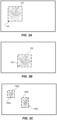
- Two different examples of such subsequent frames are illustrated in Figs 3B and 3C .
- the heap 190 of material has moved.
- the region of interest 192 has been adjusted in position to move with the heap of material.
- the heap 190 of material has been reduced in size.
- the region of interest 192 has been adjusted in size to reflect this.
- the heap 190 of material has split in two heaps 190a, 190b.
- the region of interest has also been split in two regions of interest 192a, 192b.
- the respective region of interest is illustrated as a rectangular region of interest, it is however realized that the region of interest may take any shape reflecting the shape of the heap of material.
- the temperature measure may be one or more of: an absolute value of temperature and a rate of change for the absolute value of the temperature.
- the method may further comprise updating S207 the reference spatial property.
- the updating of the reference spatial property may be triggered by one or more of: an ambient temperature of the thermal camera, a contrast of the video stream; weather data associated with the scene; season; time of day.
- the method may be implemented upon a plurality of different specific heaps of material are present.
- Each specific heap of material is typically a heap of a different material than the other heaps, e.g. a heap of metal material a heap of paper material, a heap of plastic material, etc.
- the method may comprise defining, in the video stream, a plurality of region of interests, wherein each region of interest is covering a specific heap of material. Determining, from a video frame of the video stream, a specific reference spatial property for each specific heap of material from pixel data within each respective specific region of interest covering the specific heap of material.
Landscapes
- General Physics & Mathematics (AREA)
- Physics & Mathematics (AREA)
- Engineering & Computer Science (AREA)
- Spectroscopy & Molecular Physics (AREA)
- Theoretical Computer Science (AREA)
- Multimedia (AREA)
- Business, Economics & Management (AREA)
- Computer Vision & Pattern Recognition (AREA)
- Tourism & Hospitality (AREA)
- Signal Processing (AREA)
- Health & Medical Sciences (AREA)
- Primary Health Care (AREA)
- Strategic Management (AREA)
- Economics (AREA)
- General Health & Medical Sciences (AREA)
- Human Resources & Organizations (AREA)
- Marketing (AREA)
- Toxicology (AREA)
- Emergency Management (AREA)
- General Business, Economics & Management (AREA)
- Human Computer Interaction (AREA)
- Radiation Pyrometers (AREA)
- Investigating Or Analyzing Materials Using Thermal Means (AREA)
- Emergency Alarm Devices (AREA)
- Studio Devices (AREA)
Abstract
Description
- The present invention relates to monitoring of a heap of material with a thermal video camera and a device configured to perform such monitoring.
- Thermal cameras are excellent devices for monitoring different scenes, especially scenes in which a temperature of one or more objects in the scene is to be monitored. One such example is to monitor heaps of material in a recycling station. By monitoring a temperature of a heap of material, an alarm on increased temperature may be triggered. However, there is a problem of false alarms, typically due to machines having a combustion engine moving around at the recycling station. Hence, there is a need in reducing the number of false alarms.
- It is an object to mitigate, alleviate or eliminate one or more of the above-identified deficiencies in the art and disadvantages singly or in any combination and solve at least the above-mentioned problem.
- According to a first aspect method for monitoring a heap of material is provided. The method comprising: defining, in a thermal video stream of a scene captured by a thermal camera, a region of interest covering the heap of material; determining, from a video frame of the thermal video stream, a reference spatial property of the heap of material from pixel data within the region of interest; adjusting the region of interest such that regions in the video stream exhibiting a sample spatial property above a spatial property threshold are included by the region of interest; monitoring, over time and within the region of interest, a temperature measure in the video stream; upon the temperature measure exceeds a predetermined threshold generating an alarm event.
- The present method for monitoring a heap of material allow for dynamically adjusting the region of interest so that the heap of material is covered although the heap changed in size, is moved, etc. with time. This allow for avoidance of false alarms, this since only the heap may be covered by the region of interest despite the heap changes in size or is moved with time. The above is realized by adjusting the region of interest such that regions in the video stream exhibiting a sample spatial property above the spatial property threshold are included by the region of interest. The spatial property threshold should be sufficiently high so that non-heap areas are excluded from the heap. The spatial property threshold may e.g. be 60% of the reference spatial property. The reference spatial property of the heap is to be seen as an optical signature for the heap. The spatial property may, e.g., be a measure of a spatial frequency in wavelengths of the thermal image data constituting the video stream. The spatial frequency may be an entropy, an edge density or another spatial frequency related metrics. The spatial frequency (especially in thermal wavelengths) is typically exhibiting a large distribution for a heap of material whilst a region covering a building, or the ground is typically exhibiting a homogenous spatial frequency. Hence, by adjusting the region of interest based on the spatial property of regions in the scene depicted by the thermal video stream the present method allows for keeping track of moved or changed heaps of material without the need of operator's updating region of interest over time.
- The method may further comprise adjusting the region of interest such that regions in the video stream exhibiting a sample spatial property below the spatial property threshold are excluded by the adjusted region of interest.
- The temperature measure may be one or more of: an absolute value of temperature and a rate of change for the absolute value of the temperature.
- The method may further comprise updating the reference spatial property. The updating of the reference spatial property may be triggered by one or more of: an ambient temperature of the thermal camera, a contrast of the video stream; weather data associated with the scene; season; time of day. By updating the reference spatial property changes over time in the heap of material may be accounted for. For example, size of material in the heap may vary over time by addition or removal of material to/from the heap.
- The reference spatial property and the sample spatial property may be calculated for groups of pixels comprising 4x4 to 8x8 pixels. This will reduce the amount of processing power needed in the processing considerably.
- The method may further comprise: defining, in the video stream, a plurality of region of interests, wherein each region of interest is covering a specific heap of material; determining, from a video frame of the video stream, a specific reference spatial property for each specific heap of material from pixel data within each respective specific region of interest covering the specific heap of material; adjusting each specific region of interest such that regions in the video stream exhibiting a sample spatial property within 90% - 110% of the respective specific reference spatial property are included by the specific region of interest; setting a specific predetermined threshold for the temperature measure for each specific region of interest; monitoring, over time and within each specific region of interest, a specific temperature measure in the video stream; and upon the specific temperature measure exceeds the specific predetermined threshold generating an alarm event. Hence, the spatial frequency distribution in the thermal wavelength range for a heap comprising a specific material can hence be used as an optical signature for each specific heap of material. By this the method allow for setting different types of temperature triggers for different regions of interest, i.e. different heaps of material.
- According to a second aspect, a non-transitory computer-readable storage medium is provided. The non-transitory computer-readable storage medium having stored thereon instructions for implementing the method according to the first aspect when executed on a device having processing capabilities.
- According to a second aspect, a device for monitoring a heap of material is provided. The device comprising circuitry configured to execute a region of interest function, a reference spatial property setting function, a region of interest adjusting function, and a temperature monitoring function. The region of interest function is configured to, in a thermal video stream of a scene captured by a thermal video camera, define a region of interest covering the heap of material. The reference spatial property setting function is configured to: from pixels within the region of interest of a video frame of the thermal video stream, determine a spatial property of the heap of material; and set the determined spatial property as a reference spatial property. The region of interest adjusting function is configured to: determine a respective sample spatial property for regions in the thermal video stream; and adjust the region of interest such that regions in the thermal video stream exhibiting a sample spatial property above a spatial property threshold are included by the region of interest. The temperature monitoring function is configured to: over time and within the region of interest, monitor a temperature measure in the video stream; and upon the temperature measure exceeds a predetermined threshold generate an alarm event. As discussed above, the spatial property threshold may e.g. be 60% of the reference spatial property.
- The region of interest adjusting function may further be configured to adjust the region of interest such that regions in the video stream exhibiting a sample spatial property below the spatial property threshold are excluded by the adjusted region of interest.
- The temperature measure may be one or more of: an absolute value of temperature and a rate of change for the absolute value of the temperature.
- The reference spatial property setting function may further be configured to, triggered by one or more of: an ambient temperature of the thermal camera, a contrast of the video stream; weather data associated with the scene; season; time of day, update the reference spatial property by, from pixels within a current region of interest of a video frame of the video stream, determine a spatial property of the heap of material, and set the determined spatial property as an updated reference spatial property.
- The reference spatial property setting function and the region of interest adjusting function may be configured to determine the reference spatial property and the sample spatial property, respectively, as one or more of: an image entropy and a density of edges.
- The reference spatial property setting function and the region of interest adjusting function may be configured to calculate the reference spatial property and the sample spatial property, respectively, for groups of pixels comprising 4x4 to 8x8 pixels.
- The region of interest function may be configured to, in the video stream, define a plurality of region of interests, wherein each region of interest is covering a specific heap of material. The reference spatial property setting function may be configured to, from pixels within each respective specific region of interest of a video frame of the thermal video stream, determine a specific reference spatial property for each specific heap of material. The region of interest adjusting function may be configured to adjust each specific region of interest such that regions in the video stream exhibiting a sample spatial property within 90% - 110% of the respective specific reference spatial property are included by the specific region of interest. The region of interest function may further be configured to set a specific predetermined threshold for the temperature measure for each region of interest. The temperature monitoring function may be configured to: over time and within each specific region of interest, monitor a specific temperature measure in the video stream, and upon the specific temperature measure exceeds the specific predetermined threshold for the specific region of interest, generate an alarm event.
- The device may further comprise an image sensor configured to capture thermal video data of the thermal video stream of the scene.
- The above-mentioned features of the method, when applicable, apply to the second and third aspects as well. In order to avoid undue repetition, reference is made to the above.
- A further scope of applicability of the present invention will become apparent from the detailed description given below. However, it should be understood that the detailed description and specific examples, while indicating preferred embodiments of the invention, are given by way of illustration only, since various changes and modifications within the scope of the invention will become apparent to those skilled in the art from this detailed description.
- Hence, it is to be understood that this invention is not limited to the particular component parts of the system described or acts of the methods described as such system and method may vary. It is also to be understood that the terminology used herein is for purpose of describing particular embodiments only, and is not intended to be limiting. It must be noted that, as used in the specification and the appended claim, the articles "a," "an," "the," and "said" are intended to mean that there are one or more of the elements unless the context clearly dictates otherwise. Thus, for example, reference to "a device" or "the device" may include several devices, and the like. Furthermore, the words "comprising", "including", "containing" and similar wordings does not exclude other elements or steps.
- The above and other aspects of the present invention will now be described in more detail, with reference to appended figures. The figures should not be considered limiting; instead, they are used for explaining and understanding.
- As illustrated in the figures, the sizes of layers and regions may be exaggerated for illustrative purposes and, thus, are provided to illustrate the general structures. Like reference numerals refer to like elements throughout.
-
Fig. 1 illustrates a device for monitoring a heap of material. -
Fig. 2 is a block diagram of a method for monitoring a heap of material. -
Figs 3A, 3B, 3C illustrate a heap of material as depicted by a thermal video camera at different time instances. - The present invention will now be described more fully hereinafter with reference to the accompanying drawings, in which currently preferred embodiments of the invention are shown. This invention may, however, be embodied in many different forms and should not be construed as limited to the embodiments set forth herein; rather, these embodiments are provided for thoroughness and completeness, and to fully convey the scope of the invention to the skilled person.
-
Fig. 1 illustrates adevice 100 for monitoring a heap of material. The device 10 is typically implemented in a thermal video camera. However, the device may be configured to be feed with a thermal video stream from a thermal video camera. In the following thedevice 100 will be discussed as being implemented in a thermal video camera. Thedevice 100 in the form of the thermal video camera comprises athermal image sensor 112. Thethermal image sensor 112 is configured to capture thermal video data. The thermal video data is typically pixel-based data. Thedevice 100 further comprises avideo image pipeline 114. Thevideo image pipeline 114 is configured to process the thermal video data into video frames of a thermal video stream. The thermal video camera is covering a field-of-view 111 depicting a scene. Under implementation the thermal video camera is set to depict a scene comprising one ormore heaps 190 of material. The material in each of the one ormore heaps 190 of material may be different kind, such as wood scrap, scrap metal, plastic scrap, paper scrap, electronic scrap, etc. Typically, the thermal video camera is set up to monitor a scene covering at least a section of a recovery center. The thermal video camera is further typically set to monitor a temperature of a heap ofmaterial 190 and to generate an alarm upon an increased temperature, typically being above a threshold, is monitored. The threshold may be a measure of an absolute temperature in theheap 190. Alternatively, or in combination, the threshold may be a rate of change of a temperature in theheap 190. The threshold may be differently set for heaps of different material. That is a heap mainly consisting of wood may have a lower threshold (in absolute temperature) than a heap mainly consisting of glass. - The
device 100 further comprisescircuitry 120. Thecircuitry 120 is configured to carry out overall control of functions and operations of thedevice 100. Thecircuitry 120 may include aprocessor 121, such as a central processing unit (CPU), microcontroller, or microprocessor. Theprocessor 121 is configured to execute program code stored in amemory 130, in order to carry out functions and operations of thedevice 100. - The
memory 130 may be one or more of a buffer, a flash memory, a hard drive, a removable medium, a volatile memory, a non-volatile memory, a random access memory (RAM), or another suitable device. In a typical arrangement, thememory 130 may include a non-volatile memory for long term data storage and a volatile memory that functions as system memory for thecircuitry 120. Thememory 130 may exchange data with thecircuitry 120 over a data bus. Accompanying control lines and an address bus between thememory 130 and thecircuitry 120 also may be present. - Functions and operations of the
device 100 may be embodied in the form of executable logic routines (e.g., lines of code, software programs, etc.) that are stored on a non-transitory computer readable medium (e.g., the memory 130) of thedevice 100 and are executed by the circuitry 120 (e.g., using the processor 121). Furthermore, the functions and operations of thedevice 100 may be a stand-alone software application or form a part of a software application that carries out additional tasks related to thedevice 100. The described functions and operations may be considered a method that the corresponding part of the device is configured to carry out. Also, while the described functions and operations may be implemented in software, such functionality may as well be carried out via dedicated hardware or firmware, or some combination of hardware, firmware and/or software. - The
circuitry 120 is configured to execute a region ofinterest function 132. The region ofinterest function 132 is configured to, in a thermal video stream of a scene captured by the thermal video camera, define a region of interest covering theheap 190 of material. The region ofinterest function 132 may be configured to receive user input for defining region of interest. For example, a user may, on a display showing the scene covered by the thermal video camera, mark an area that shall constitute the region of interest. Alternatively, or in combination, a machine learned model may be used for defining the region or interest. The region of interest defined by region ofinterest function 132 does not necessarily need to cover thewhole heap 190 of material. It is enough that a portion of theheap 190 is covered by the region of interest. Preferably, the region of interest covers at least an area of 10x10 pixels in thermal video data of a frame of the thermal video stream. In combination with the defining of the region of interest for the heap, the region ofinterest function 132 may further be configured to attribute a temperature threshold for theheap 190. The temperature threshold being a threshold upon if it is reached thedevice 100 is configured to issue an alarm, see thetemperature monitoring function 138 discussed below. - The
circuitry 120 is further configured to execute a reference spatialproperty setting function 134. The reference spatialproperty setting function 134 is configured to, from pixels within the region of interest of one or more video frames of the thermal video stream, determine a spatial property of the heap of material. The pixels within the region of interest used for determining the spatial property of the heap is preferably pixels well within the heap. The reference spatialproperty setting function 134 is further configured to set the determined spatial property as a reference spatial property. The reference spatial property of the heap is to be seen as an optical signature for theheap 190. The spatial property may, e.g., be a measure of a spatial frequency in thermal wavelengths of the thermal image data constituting the thermal video stream. The spatial frequency may be an entropy, an edge density or another spatial frequency related metrics. According to non-limiting examples, the spatial frequency may be determined by applying a Laplacian filter and/or a Sobel filter to pixel data of the thermal image data. The pixel data onto which the Laplacian filter and/or Sobel filter is applied may be grouped into groups of neighboring pixels. Such groups of neighboring pixels may comprise 4x4 to 8x8 pixels. The spatial frequency (especially in thermal wavelengths) is typically exhibiting a large distribution for a heap of material whilst a region covering a building, or the ground is typically exhibiting a homogenous spatial frequency. The spatial frequency distribution in the thermal wavelength range for a heap comprising a specific material can be used as an optical signature for the heap of material. - The
circuitry 120 is further configured to execute a region of interest adjusting function 136. The region of interest adjusting function 136 is configured to determine a respective sample spatial property for regions in the thermal video stream. The region of interest adjusting function 136 is typically set to operate on pixel data of thermal image data of image frame(s) being subsequent to the image frame used for setting the reference spatial property. The region of interest adjusting function 136 may be executed periodically. The frequency of the periodically executed region of interest adjusting function 136 may be fixed. For example, the region of interest adjusting function 136 may be executed periodically within a period in the order of a minute to an hour. The frequency of the periodically executed region of interest adjusting function 136 may be random. Alternatively, the region of interest adjusting function 136 may be executed as response to movement detected in the region of interest. Movement in the region of interest is a strong indicator of that the heap is being handled, i.e., either material is added or removed, both providing a reason for adjustment of the region of interest. Movement can be readily detected using analytics of the thermal camera. The respective sample spatial property for regions in the thermal video stream are preferably determined in a same way as the reference spatial property. Hence, the sample spatial frequency may be determined by applying a Laplacian filter and/or a Sobel filter to pixel data of thermal image data. The pixel data onto which the Laplacian filter and/or Sobel filter is applied may be grouped into groups of neighboring pixels. Such groups of neighboring pixels may comprise 4x4 to 8x8 pixels. The region of interest adjusting function 136 may be configured to set a lower threshold for an area to constitute a heap of material to be an area covering at least 3x3 coherent groups of neighboring pixels. The region of interest adjusting function 136 is configured to adjust the region of interest such that regions in the thermal video stream exhibiting a sample spatial property above a spatial property threshold are included by the region of interest. Differently expressed, the region of interest adjusting function 136 is configured to adjust the region of interest such that regions in the thermal video stream exhibiting a sample spatial property below the spatial property threshold are excluded by the adjusted region of interest. Hence, by adjusting the region of interest based on the spatial property of regions in the scene depicted by the thermal video stream the present set-up allows for keeping track of moved or changed heaps of material without the need of operator's updating the region of interest over time. The spatial property threshold may be set to be 60% of the reference spatial property. - The
circuitry 120 is further configured to execute atemperature monitoring function 138. Thetemperature monitoring function 138 is configured to, over time and within the region of interest, monitor a temperature measure in the thermal video stream. The temperature measure may be one or more of: an absolute value of temperature and a rate of change for the absolute value of the temperature. Thetemperature monitoring function 138 is further configured to, upon the temperature measure exceeds a predetermined threshold, generate an alarm event. - The reference spatial
property setting function 134 may further be configured to update the reference spatial property by, from pixels within a current region of interest of a video frame of the video stream, determine a spatial property of the heap of material, and set the determined spatial property as an updated reference spatial property. The update of the reference spatial property may be set to be performed periodically, e.g., once a day or once a week. Alternatively, the update of the reference spatial property may be triggered by one or more of: an ambient temperature of the thermal video camera, a contrast of the thermal video stream, weather data associated with the scene, season, and time of day. Thedevice 100 may comprise atemperature sensor 140 for determining the ambient temperature of the thermal video camera. Thedevice 100 may be connected to a weather service providing weather data associated with the scene. Thedevice 100 may comprise atransceiver 150 through which the device is configured to communication with other devices or services, e.g., the weather service. - Hence, if a change of surrounding environment is the present reference spatial property most probably will be needed to be updated. For example, in case the ambient temperature is changing the reference spatial property is to be updated. The ambient temperature may e.g. be estimated by determining the sensor temperature. Alternatively, the ambient temperature may be estimated by determining a temperature measure from pixels outside the region of interest. Alternatively, external weather information could also be used.
- Further, contrast of the thermal video stream may e.g. be influenced by the weather, time of day etc. A change in contrast above a set threshold may be triggering an update of the reference spatial property. Further, if contrast within the region of interest as compared to outside the region of interest starts to deviate an update of the reference spatial property may be triggered. According to one example, the region of interest is set during bad weather, e.g., raining or snowing. Upon the weather becomes better, the difference between contrast within the region of interest as compared to outside the region of interest will start to differ more. In this case it is time to update the reference spatial property. A condition for performing the update may be that the difference between contrast within the region of interest as compared to outside the region of interest increases with 10% or more. Another condition that can be set is that the absolute difference between contrast within the region of interest as compared to outside the region of interest shall be above a threshold, e.g. 50%. Moreover, upon initially setting up the region of interest, in case an absolute difference between contrast within a requested region of interest as compared to outside the region of interest is below a threshold (e.g. below a 25% difference in absolute numbers), a warning will be issued informing that no initial region of interest can be set.
- Moreover, if contrast within the region of interest and outside the region of interest starts to be more equal, i.e. the difference in these contrasts goes below a threshold (e.g. below a 25% difference in absolute numbers), no update of the reference spatial property is to be made.
- Also, as the thermal camera is calibrated, a total scene temperature dynamic can be estimated. If this temperature dynamic changes above a set threshold number of degrees, this may be a trigger for updating the reference spatial property.
- In connection with
Fig. 2 amethod 200 for monitoring a heap of material will be discussed. Some of all the steps of themethod 200 may be performed by thedevice 100 described above. However, it is equally realized that some or all of the steps of themethod 200 may be performed by one or more other devices having similar functionality. Themethod 200 comprises the following steps. The steps may be performed in any suitable order. - Defining S202, in a thermal video stream of a scene captured by a thermal camera, a region of interest covering the heap of material. This step is further illustrated in
Fig. 3A in which a frame of the thermal video stream of the scene comprising the heap of material is illustrated. The region ofinterest 192 covering theheap 190 of material as defined by step S202 is illustrated in this figure. The step of defining S202 a region of interest covering the heap of material is discussed in more detail above in connection with the region ofinterest function 132. In order to avoid undue repetition reference is made to this discussion. - Determining S204, from one or more video frames of the thermal video stream, a reference spatial property of the heap of material from pixel data within the region of interest. The step of determining S204 a reference spatial property is discussed in more detail above in connection with the reference spatial
property setting function 134. In order to avoid undue repetition reference is made to this discussion. - Adjusting S206 the region of interest such that regions in the video stream exhibiting a sample spatial property above a spatial property threshold are included by the region of interest. This step may alternatively, or in combination, be expressed as adjusting the region of interest such that regions in the video stream exhibiting a sample spatial property below the spatial property threshold are excluded by the adjusted region of interest. The step of adjusting S206 the region of interest is discussed in more detail above in connection with the region of interest adjusting function 136. The spatial property threshold may be 60% of the reference spatial property. In order to avoid undue repetition reference is made to this discussion. From the above discussion in connection with the region of interest adjusting function 136 it is realized that the step of adjusting S206 is performed on one or more frames of the thermal video stream being subsequent to the frame form which the reference spatial property is determined. Two different examples of such subsequent frames are illustrated in
Figs 3B and 3C . InFig. 3B theheap 190 of material has moved. Hence, the region ofinterest 192 has been adjusted in position to move with the heap of material. Moreover, inFig. 3B theheap 190 of material has been reduced in size. Hence, the region ofinterest 192 has been adjusted in size to reflect this. InFig. 3C theheap 190 of material has split in twoheaps interest - Monitoring S208, over time and within the region of interest, a temperature measure in the video stream. The temperature measure may be one or more of: an absolute value of temperature and a rate of change for the absolute value of the temperature.
- Upon the temperature measure exceeds a predetermined threshold generating S210 an alarm event.
- The method may further comprise updating S207 the reference spatial property. The updating of the reference spatial property may be triggered by one or more of: an ambient temperature of the thermal camera, a contrast of the video stream; weather data associated with the scene; season; time of day.
- The person skilled in the art realizes that the present invention by no means is limited to the preferred embodiments described above. On the contrary, many modifications and variations are possible within the scope of the appended claims.
- For example, the method may be implemented upon a plurality of different specific heaps of material are present. Each specific heap of material is typically a heap of a different material than the other heaps, e.g. a heap of metal material a heap of paper material, a heap of plastic material, etc. If so, the method may comprise defining, in the video stream, a plurality of region of interests, wherein each region of interest is covering a specific heap of material. Determining, from a video frame of the video stream, a specific reference spatial property for each specific heap of material from pixel data within each respective specific region of interest covering the specific heap of material. Adjusting each specific region of interest such that regions in the video stream exhibiting a sample spatial property within 90% - 110% of the respective specific reference spatial property are included by the specific region of interest. Setting a specific predetermined threshold for the temperature measure for each specific region of interest. Monitoring, over time and within each specific region of interest, a specific temperature measure in the video stream. Upon the specific temperature measure exceeds the specific predetermined threshold, generating an alarm event.
- Additionally, variations to the disclosed embodiments can be understood and effected by the skilled person in practicing the claimed invention, from a study of the drawings, the disclosure, and the appended claims.
Claims (15)
- A method for monitoring a heap (190) of material, the method comprising:defining, in a video stream of a scene captured by a thermal camera, a region of interest covering the heap of material;determining, from a video frame of the video stream, a reference spatial property of the heap of material from pixel data within the region of interest;adjusting the region of interest such that regions in the video stream exhibiting a sample spatial property above a spatial property threshold are included by the region of interest;monitoring, over time and within the region of interest, a temperature measure in the video stream;upon the temperature measure exceeds a predetermined threshold generating an alarm event.
- The method according to claim 1, further comprising adjusting the region of interest such that regions in the video stream exhibiting a sample spatial property below the spatial property threshold are excluded by the adjusted region of interest.
- The method according to claim 1 or 2, wherein the temperature measure is one or more of: an absolute value of temperature and a rate of change for the absolute value of the temperature.
- The method according to any one of claims 1-3, further comprising updating the reference spatial property, wherein the updating of the reference spatial property is triggered by one or more of: an ambient temperature of the thermal camera, a contrast of the video stream; weather data associated with the scene; season; time of day.
- The method according to any one of claims 1-4, wherein the reference spatial property and the sample spatial property are one or more of: an image entropy and a density of edges.
- The method according to any one of claims 1-5, wherein the reference spatial property and the sample spatial property are calculated for groups of pixels comprising 4x4 to 8x8 pixels.
- The method according to any one of claims 1-6, further comprising:defining, in the video stream, a plurality of region of interests, wherein each region of interest is covering a specific heap of material;determining, from a video frame of the video stream, a specific reference spatial property for each specific heap of material from pixel data within each respective specific region of interest covering the specific heap of material;adjusting each specific region of interest such that regions in the video stream exhibiting a sample spatial property within 90% - 110% of the respective specific reference spatial property are included by the specific region of interest;setting a specific predetermined threshold for the temperature measure for each specific region of interest;monitoring, over time and within each specific region of interest, a specific temperature measure in the video stream;upon the specific temperature measure exceeds the specific predetermined threshold generating an alarm event.
- A non-transitory computer-readable storage medium having stored thereon instructions for implementing the method according to any one of claims 1-7, when executed on a device having processing capabilities.
- A device for monitoring a heap (190) of material, the device comprising:
circuitry (120) configured to execute:a region of interest function (132) configured to, in a thermal video stream of a scene captured by a thermal video camera, define a region of interest covering the heap (190) of material;a reference spatial property setting function (134) configured to:from pixels within the region of interest of a video frame of the thermal video stream, determine a spatial property of the heap of material, andset the determined spatial property as a reference spatial property;a region of interest adjusting function (136) configured to:determine a respective sample spatial property for regions in the thermal video stream, andadjust the region of interest such that regions in the thermal video stream exhibiting a sample spatial property above a spatial property threshold are included by the region of interest; anda temperature monitoring function (138) configured to:over time and within the region of interest, monitor a temperature measure in the video stream, andupon the temperature measure exceeds a predetermined threshold generate an alarm event. - The device according to claim 9, wherein the temperature measure is one or more of: an absolute value of temperature and a rate of change for the absolute value of the temperature.
- The device according to claim 9 or 10, wherein the reference spatial property setting function is further configured to, triggered by one or more of: an ambient temperature of the thermal camera, a contrast of the video stream; weather data associated with the scene; season; time of day, update the reference spatial property by, from pixels within a current region of interest of a video frame of the video stream, determine a spatial property of the heap of material, and set the determined spatial property as an updated reference spatial property.
- The device according to any one of claims 9-11, wherein the reference spatial property setting function and the region of interest adjusting function are configured to determine the reference spatial property and the sample spatial property, respectively, as one or more of: an image entropy and a density of edges.
- The device according to any one of claims 9-12, wherein the reference spatial property setting function and the region of interest adjusting function are configured to calculate the reference spatial property and the sample spatial property, respectively, for groups of pixels comprising 4x4 to 8x8 pixels.
- The device according to any one of claims 9-13,wherein the region of interest function (132) is configured to, in the video stream, define a plurality of region of interests, wherein each region of interest is covering a specific heap of material;wherein the reference spatial property setting function (134) is configured to, from pixels within each respective specific region of interest of a video frame of the thermal video stream, determine a specific reference spatial property for each specific heap of material;wherein the region of interest adjusting function (136) is configured to adjust each specific region of interest such that regions in the video stream exhibiting a sample spatial property within 90% - 110% of the respective specific reference spatial property are included by the specific region of interest, and to set a specific predetermined threshold for the temperature measure for each specific region of interest;wherein the temperature monitoring function (138) is configured to:over time and within each specific region of interest, monitor a specific temperature measure in the video stream, andupon the specific temperature measure exceeds the specific predetermined threshold for the specific region of interest, generate an alarm event.
- The device according to any one of claims 9-14, further comprising an image sensor configured to capture thermal video data of the thermal video stream of the scene.
Priority Applications (6)
| Application Number | Priority Date | Filing Date | Title |
|---|---|---|---|
| EP22180300.0A EP4296967B1 (en) | 2022-06-22 | 2022-06-22 | Method and device for monitoring of a heap of material |
| KR1020230057633A KR20230175100A (en) | 2022-06-22 | 2023-05-03 | Method and device for monitoring of a heap of material |
| US18/318,024 US12578230B2 (en) | 2022-06-22 | 2023-05-16 | Method and device for monitoring of a heap of material |
| TW112118012A TW202416230A (en) | 2022-06-22 | 2023-05-16 | Method and device for monitoring of a heap of material |
| CN202310674192.3A CN117268556A (en) | 2022-06-22 | 2023-06-07 | Methods and devices for monitoring material piles |
| JP2023098322A JP2024001866A (en) | 2022-06-22 | 2023-06-15 | Methods and devices for monitoring heaps of materials |
Applications Claiming Priority (1)
| Application Number | Priority Date | Filing Date | Title |
|---|---|---|---|
| EP22180300.0A EP4296967B1 (en) | 2022-06-22 | 2022-06-22 | Method and device for monitoring of a heap of material |
Publications (3)
| Publication Number | Publication Date |
|---|---|
| EP4296967A1 true EP4296967A1 (en) | 2023-12-27 |
| EP4296967C0 EP4296967C0 (en) | 2024-05-08 |
| EP4296967B1 EP4296967B1 (en) | 2024-05-08 |
Family
ID=82492877
Family Applications (1)
| Application Number | Title | Priority Date | Filing Date |
|---|---|---|---|
| EP22180300.0A Active EP4296967B1 (en) | 2022-06-22 | 2022-06-22 | Method and device for monitoring of a heap of material |
Country Status (6)
| Country | Link |
|---|---|
| US (1) | US12578230B2 (en) |
| EP (1) | EP4296967B1 (en) |
| JP (1) | JP2024001866A (en) |
| KR (1) | KR20230175100A (en) |
| CN (1) | CN117268556A (en) |
| TW (1) | TW202416230A (en) |
Citations (3)
| Publication number | Priority date | Publication date | Assignee | Title |
|---|---|---|---|---|
| US20170094228A1 (en) * | 2015-06-29 | 2017-03-30 | Quantum IR Technologies, LLC | Methods and systems for hotspot detection |
| CN207439402U (en) * | 2017-11-29 | 2018-06-01 | 云南电网有限责任公司玉溪供电局 | A kind of substation's ambient enviroment monitoring system based on unmanned plane |
| CN212300446U (en) * | 2020-09-23 | 2021-01-05 | 广汉市蜀汉粮油机械有限公司 | Grain heap grain comprehensive state detection and analysis system |
Family Cites Families (12)
| Publication number | Priority date | Publication date | Assignee | Title |
|---|---|---|---|---|
| US7256818B2 (en) * | 2002-05-20 | 2007-08-14 | Simmonds Precision Products, Inc. | Detecting fire using cameras |
| US7245315B2 (en) * | 2002-05-20 | 2007-07-17 | Simmonds Precision Products, Inc. | Distinguishing between fire and non-fire conditions using cameras |
| JP4652740B2 (en) | 2004-07-30 | 2011-03-16 | 株式会社日立プラントテクノロジー | Automatic crane for waste disposal plant |
| DE102005039424B4 (en) | 2005-08-16 | 2007-07-12 | Deutsches Zentrum für Luft- und Raumfahrt e.V. | Method and device for detecting and sizing areas of the same texture in a digital image |
| US7710280B2 (en) * | 2006-05-12 | 2010-05-04 | Fossil Power Systems Inc. | Flame detection device and method of detecting flame |
| DE102006039832B9 (en) | 2006-08-25 | 2010-06-10 | Deutsches Zentrum für Luft- und Raumfahrt e.V. | Method and device for locating and distinguishing persons, animals or vehicles by means of automatic image monitoring of digital or digitized images |
| US9250135B2 (en) * | 2011-03-16 | 2016-02-02 | Honeywell International Inc. | MWIR sensor for flame detection |
| CN106303412B (en) | 2016-08-09 | 2019-03-29 | 鞍钢集团矿业有限公司 | Refuse dump based on monitoring image is displaced remote real time monitoring method |
| CN108288059B (en) | 2017-12-29 | 2020-04-21 | 中国电子科技集团公司第二十七研究所 | A construction waste monitoring method based on high-resolution remote sensing technology |
| CN108986379B (en) * | 2018-08-15 | 2020-09-08 | 重庆英卡电子有限公司 | Flame detector with infrared photographing function and control method thereof |
| CN110675588B (en) * | 2019-09-30 | 2021-06-01 | 北方民族大学 | Forest fire detection device and method |
| CN113920440A (en) | 2021-04-06 | 2022-01-11 | 中国科学院地理科学与资源研究所 | Remote sensing identification method and device for refuse landfill and computer equipment |
-
2022
- 2022-06-22 EP EP22180300.0A patent/EP4296967B1/en active Active
-
2023
- 2023-05-03 KR KR1020230057633A patent/KR20230175100A/en active Pending
- 2023-05-16 TW TW112118012A patent/TW202416230A/en unknown
- 2023-05-16 US US18/318,024 patent/US12578230B2/en active Active
- 2023-06-07 CN CN202310674192.3A patent/CN117268556A/en active Pending
- 2023-06-15 JP JP2023098322A patent/JP2024001866A/en active Pending
Patent Citations (3)
| Publication number | Priority date | Publication date | Assignee | Title |
|---|---|---|---|---|
| US20170094228A1 (en) * | 2015-06-29 | 2017-03-30 | Quantum IR Technologies, LLC | Methods and systems for hotspot detection |
| CN207439402U (en) * | 2017-11-29 | 2018-06-01 | 云南电网有限责任公司玉溪供电局 | A kind of substation's ambient enviroment monitoring system based on unmanned plane |
| CN212300446U (en) * | 2020-09-23 | 2021-01-05 | 广汉市蜀汉粮油机械有限公司 | Grain heap grain comprehensive state detection and analysis system |
Also Published As
| Publication number | Publication date |
|---|---|
| KR20230175100A (en) | 2023-12-29 |
| EP4296967C0 (en) | 2024-05-08 |
| US12578230B2 (en) | 2026-03-17 |
| CN117268556A (en) | 2023-12-22 |
| JP2024001866A (en) | 2024-01-10 |
| EP4296967B1 (en) | 2024-05-08 |
| TW202416230A (en) | 2024-04-16 |
| US20230417599A1 (en) | 2023-12-28 |
Similar Documents
| Publication | Publication Date | Title |
|---|---|---|
| EP2549738B1 (en) | Method and camera for determining an image adjustment parameter | |
| JP6832224B2 (en) | Adhesion detection device and deposit detection method | |
| US8041077B2 (en) | Method of motion detection and autonomous motion tracking using dynamic sensitivity masks in a pan-tilt camera | |
| EP3641298B1 (en) | Method and device for capturing target object and video monitoring device | |
| JP5701005B2 (en) | Object detection apparatus, object detection method, surveillance camera system, and program | |
| EP3425590B1 (en) | Image processing apparatus, image processing method, and storage medium | |
| US12586232B2 (en) | Method for object detection using cropped images | |
| KR20090043416A (en) | Surveillance camera device for detecting and suppressing camera movement influence and control method thereof | |
| US20100302367A1 (en) | Intelligent surveillance system and method for the same | |
| US20210192905A1 (en) | Mitigating effects caused by repeated and/or sporadic movement of objects in a field of view | |
| CN115278103A (en) | Security monitoring image compensation processing method and system based on environment perception | |
| KR20160089165A (en) | System and Method for Detecting Moving Objects | |
| JPH0844874A (en) | Image change detector | |
| CN101102504A (en) | A Hybrid Motion Detection Method Combined with Video Encoder | |
| KR101297121B1 (en) | Tunnel fire detection device using infrared imaging and thereof | |
| CN114550060B (en) | Perimeter intrusion identification method, system and electronic equipment | |
| US12578230B2 (en) | Method and device for monitoring of a heap of material | |
| EP2254097A1 (en) | Intelligent surveillance system and method for the same | |
| CN117635937A (en) | A method, system and medium for judging patrol robot camera occlusion alarm | |
| JP2004208209A (en) | Moving object monitoring device and moving object monitoring method | |
| JP2021052236A (en) | Deposit detection device and deposit detection method | |
| JP2021052237A (en) | Deposit detection device and deposit detection method | |
| CN115225825A (en) | Exposure adjusting system, method, device and storage medium | |
| JP5599228B2 (en) | Busy detection system and busy detection program | |
| JP2010283502A (en) | Intellectual monitoring system and intellectual monitoring method |
Legal Events
| Date | Code | Title | Description |
|---|---|---|---|
| PUAI | Public reference made under article 153(3) epc to a published international application that has entered the european phase |
Free format text: ORIGINAL CODE: 0009012 |
|
| STAA | Information on the status of an ep patent application or granted ep patent |
Free format text: STATUS: REQUEST FOR EXAMINATION WAS MADE |
|
| 17P | Request for examination filed |
Effective date: 20230110 |
|
| AK | Designated contracting states |
Kind code of ref document: A1 Designated state(s): AL AT BE BG CH CY CZ DE DK EE ES FI FR GB GR HR HU IE IS IT LI LT LU LV MC MK MT NL NO PL PT RO RS SE SI SK SM TR |
|
| GRAP | Despatch of communication of intention to grant a patent |
Free format text: ORIGINAL CODE: EPIDOSNIGR1 |
|
| STAA | Information on the status of an ep patent application or granted ep patent |
Free format text: STATUS: GRANT OF PATENT IS INTENDED |
|
| INTG | Intention to grant announced |
Effective date: 20240201 |
|
| GRAS | Grant fee paid |
Free format text: ORIGINAL CODE: EPIDOSNIGR3 |
|
| GRAA | (expected) grant |
Free format text: ORIGINAL CODE: 0009210 |
|
| STAA | Information on the status of an ep patent application or granted ep patent |
Free format text: STATUS: THE PATENT HAS BEEN GRANTED |
|
| AK | Designated contracting states |
Kind code of ref document: B1 Designated state(s): AL AT BE BG CH CY CZ DE DK EE ES FI FR GB GR HR HU IE IS IT LI LT LU LV MC MK MT NL NO PL PT RO RS SE SI SK SM TR |
|
| REG | Reference to a national code |
Ref country code: GB Ref legal event code: FG4D |
|
| REG | Reference to a national code |
Ref country code: CH Ref legal event code: EP |
|
| REG | Reference to a national code |
Ref country code: DE Ref legal event code: R096 Ref document number: 602022003310 Country of ref document: DE |
|
| REG | Reference to a national code |
Ref country code: IE Ref legal event code: FG4D |
|
| U01 | Request for unitary effect filed |
Effective date: 20240508 |
|
| U07 | Unitary effect registered |
Designated state(s): AT BE BG DE DK EE FI FR IT LT LU LV MT NL PT SE SI Effective date: 20240515 |
|
| U20 | Renewal fee for the european patent with unitary effect paid |
Year of fee payment: 3 Effective date: 20240521 |
|
| PG25 | Lapsed in a contracting state [announced via postgrant information from national office to epo] |
Ref country code: IS Free format text: LAPSE BECAUSE OF FAILURE TO SUBMIT A TRANSLATION OF THE DESCRIPTION OR TO PAY THE FEE WITHIN THE PRESCRIBED TIME-LIMIT Effective date: 20240908 |
|
| PG25 | Lapsed in a contracting state [announced via postgrant information from national office to epo] |
Ref country code: HR Free format text: LAPSE BECAUSE OF FAILURE TO SUBMIT A TRANSLATION OF THE DESCRIPTION OR TO PAY THE FEE WITHIN THE PRESCRIBED TIME-LIMIT Effective date: 20240508 |
|
| PG25 | Lapsed in a contracting state [announced via postgrant information from national office to epo] |
Ref country code: GR Free format text: LAPSE BECAUSE OF FAILURE TO SUBMIT A TRANSLATION OF THE DESCRIPTION OR TO PAY THE FEE WITHIN THE PRESCRIBED TIME-LIMIT Effective date: 20240809 |
|
| PG25 | Lapsed in a contracting state [announced via postgrant information from national office to epo] |
Ref country code: ES Free format text: LAPSE BECAUSE OF FAILURE TO SUBMIT A TRANSLATION OF THE DESCRIPTION OR TO PAY THE FEE WITHIN THE PRESCRIBED TIME-LIMIT Effective date: 20240508 |
|
| PG25 | Lapsed in a contracting state [announced via postgrant information from national office to epo] |
Ref country code: PL Free format text: LAPSE BECAUSE OF FAILURE TO SUBMIT A TRANSLATION OF THE DESCRIPTION OR TO PAY THE FEE WITHIN THE PRESCRIBED TIME-LIMIT Effective date: 20240508 |
|
| PG25 | Lapsed in a contracting state [announced via postgrant information from national office to epo] |
Ref country code: PL Free format text: LAPSE BECAUSE OF FAILURE TO SUBMIT A TRANSLATION OF THE DESCRIPTION OR TO PAY THE FEE WITHIN THE PRESCRIBED TIME-LIMIT Effective date: 20240508 Ref country code: NO Free format text: LAPSE BECAUSE OF FAILURE TO SUBMIT A TRANSLATION OF THE DESCRIPTION OR TO PAY THE FEE WITHIN THE PRESCRIBED TIME-LIMIT Effective date: 20240808 Ref country code: IS Free format text: LAPSE BECAUSE OF FAILURE TO SUBMIT A TRANSLATION OF THE DESCRIPTION OR TO PAY THE FEE WITHIN THE PRESCRIBED TIME-LIMIT Effective date: 20240908 Ref country code: HR Free format text: LAPSE BECAUSE OF FAILURE TO SUBMIT A TRANSLATION OF THE DESCRIPTION OR TO PAY THE FEE WITHIN THE PRESCRIBED TIME-LIMIT Effective date: 20240508 Ref country code: GR Free format text: LAPSE BECAUSE OF FAILURE TO SUBMIT A TRANSLATION OF THE DESCRIPTION OR TO PAY THE FEE WITHIN THE PRESCRIBED TIME-LIMIT Effective date: 20240809 Ref country code: ES Free format text: LAPSE BECAUSE OF FAILURE TO SUBMIT A TRANSLATION OF THE DESCRIPTION OR TO PAY THE FEE WITHIN THE PRESCRIBED TIME-LIMIT Effective date: 20240508 Ref country code: RS Free format text: LAPSE BECAUSE OF FAILURE TO SUBMIT A TRANSLATION OF THE DESCRIPTION OR TO PAY THE FEE WITHIN THE PRESCRIBED TIME-LIMIT Effective date: 20240808 |
|
| PG25 | Lapsed in a contracting state [announced via postgrant information from national office to epo] |
Ref country code: CZ Free format text: LAPSE BECAUSE OF FAILURE TO SUBMIT A TRANSLATION OF THE DESCRIPTION OR TO PAY THE FEE WITHIN THE PRESCRIBED TIME-LIMIT Effective date: 20240508 |
|
| PG25 | Lapsed in a contracting state [announced via postgrant information from national office to epo] |
Ref country code: RO Free format text: LAPSE BECAUSE OF FAILURE TO SUBMIT A TRANSLATION OF THE DESCRIPTION OR TO PAY THE FEE WITHIN THE PRESCRIBED TIME-LIMIT Effective date: 20240508 Ref country code: SK Free format text: LAPSE BECAUSE OF FAILURE TO SUBMIT A TRANSLATION OF THE DESCRIPTION OR TO PAY THE FEE WITHIN THE PRESCRIBED TIME-LIMIT Effective date: 20240508 |
|
| PG25 | Lapsed in a contracting state [announced via postgrant information from national office to epo] |
Ref country code: SM Free format text: LAPSE BECAUSE OF FAILURE TO SUBMIT A TRANSLATION OF THE DESCRIPTION OR TO PAY THE FEE WITHIN THE PRESCRIBED TIME-LIMIT Effective date: 20240508 |
|
| PG25 | Lapsed in a contracting state [announced via postgrant information from national office to epo] |
Ref country code: SM Free format text: LAPSE BECAUSE OF FAILURE TO SUBMIT A TRANSLATION OF THE DESCRIPTION OR TO PAY THE FEE WITHIN THE PRESCRIBED TIME-LIMIT Effective date: 20240508 Ref country code: SK Free format text: LAPSE BECAUSE OF FAILURE TO SUBMIT A TRANSLATION OF THE DESCRIPTION OR TO PAY THE FEE WITHIN THE PRESCRIBED TIME-LIMIT Effective date: 20240508 Ref country code: RO Free format text: LAPSE BECAUSE OF FAILURE TO SUBMIT A TRANSLATION OF THE DESCRIPTION OR TO PAY THE FEE WITHIN THE PRESCRIBED TIME-LIMIT Effective date: 20240508 Ref country code: CZ Free format text: LAPSE BECAUSE OF FAILURE TO SUBMIT A TRANSLATION OF THE DESCRIPTION OR TO PAY THE FEE WITHIN THE PRESCRIBED TIME-LIMIT Effective date: 20240508 |
|
| PG25 | Lapsed in a contracting state [announced via postgrant information from national office to epo] |
Ref country code: MC Free format text: LAPSE BECAUSE OF FAILURE TO SUBMIT A TRANSLATION OF THE DESCRIPTION OR TO PAY THE FEE WITHIN THE PRESCRIBED TIME-LIMIT Effective date: 20240508 |
|
| REG | Reference to a national code |
Ref country code: DE Ref legal event code: R097 Ref document number: 602022003310 Country of ref document: DE |
|
| PLBE | No opposition filed within time limit |
Free format text: ORIGINAL CODE: 0009261 |
|
| STAA | Information on the status of an ep patent application or granted ep patent |
Free format text: STATUS: NO OPPOSITION FILED WITHIN TIME LIMIT |
|
| 26N | No opposition filed |
Effective date: 20250211 |
|
| PG25 | Lapsed in a contracting state [announced via postgrant information from national office to epo] |
Ref country code: IE Free format text: LAPSE BECAUSE OF NON-PAYMENT OF DUE FEES Effective date: 20240622 |
|
| U20 | Renewal fee for the european patent with unitary effect paid |
Year of fee payment: 4 Effective date: 20250520 |
|
| PG25 | Lapsed in a contracting state [announced via postgrant information from national office to epo] |
Ref country code: CY Free format text: LAPSE BECAUSE OF FAILURE TO SUBMIT A TRANSLATION OF THE DESCRIPTION OR TO PAY THE FEE WITHIN THE PRESCRIBED TIME-LIMIT; INVALID AB INITIO Effective date: 20220622 |
|
| REG | Reference to a national code |
Ref country code: CH Ref legal event code: H13 Free format text: ST27 STATUS EVENT CODE: U-0-0-H10-H13 (AS PROVIDED BY THE NATIONAL OFFICE) Effective date: 20260127 |
|
| PG25 | Lapsed in a contracting state [announced via postgrant information from national office to epo] |
Ref country code: HU Free format text: LAPSE BECAUSE OF FAILURE TO SUBMIT A TRANSLATION OF THE DESCRIPTION OR TO PAY THE FEE WITHIN THE PRESCRIBED TIME-LIMIT; INVALID AB INITIO Effective date: 20220622 |
|
| PG25 | Lapsed in a contracting state [announced via postgrant information from national office to epo] |
Ref country code: CH Free format text: LAPSE BECAUSE OF NON-PAYMENT OF DUE FEES Effective date: 20250630 |