EP4296916A1 - Scheduling electric vehicles (evs) for charging at electric vehicle charging station (evcs) - Google Patents
Scheduling electric vehicles (evs) for charging at electric vehicle charging station (evcs) Download PDFInfo
- Publication number
- EP4296916A1 EP4296916A1 EP23180648.0A EP23180648A EP4296916A1 EP 4296916 A1 EP4296916 A1 EP 4296916A1 EP 23180648 A EP23180648 A EP 23180648A EP 4296916 A1 EP4296916 A1 EP 4296916A1
- Authority
- EP
- European Patent Office
- Prior art keywords
- evs
- evcs
- scheduled
- charging
- peer
- Prior art date
- Legal status (The legal status is an assumption and is not a legal conclusion. Google has not performed a legal analysis and makes no representation as to the accuracy of the status listed.)
- Granted
Links
Images





Classifications
-
- G—PHYSICS
- G06—COMPUTING OR CALCULATING; COUNTING
- G06Q—INFORMATION AND COMMUNICATION TECHNOLOGY [ICT] SPECIALLY ADAPTED FOR ADMINISTRATIVE, COMMERCIAL, FINANCIAL, MANAGERIAL OR SUPERVISORY PURPOSES; SYSTEMS OR METHODS SPECIALLY ADAPTED FOR ADMINISTRATIVE, COMMERCIAL, FINANCIAL, MANAGERIAL OR SUPERVISORY PURPOSES, NOT OTHERWISE PROVIDED FOR
- G06Q10/00—Administration; Management
- G06Q10/04—Forecasting or optimisation specially adapted for administrative or management purposes, e.g. linear programming or "cutting stock problem"
-
- B—PERFORMING OPERATIONS; TRANSPORTING
- B60—VEHICLES IN GENERAL
- B60L—PROPULSION OF ELECTRICALLY-PROPELLED VEHICLES; SUPPLYING ELECTRIC POWER FOR AUXILIARY EQUIPMENT OF ELECTRICALLY-PROPELLED VEHICLES; ELECTRODYNAMIC BRAKE SYSTEMS FOR VEHICLES IN GENERAL; MAGNETIC SUSPENSION OR LEVITATION FOR VEHICLES; MONITORING OPERATING VARIABLES OF ELECTRICALLY-PROPELLED VEHICLES; ELECTRIC SAFETY DEVICES FOR ELECTRICALLY-PROPELLED VEHICLES
- B60L53/00—Methods of charging batteries, specially adapted for electric vehicles; Charging stations or on-board charging equipment therefor; Exchange of energy storage elements in electric vehicles
- B60L53/60—Monitoring or controlling charging stations
- B60L53/64—Optimising energy costs, e.g. responding to electricity rates
-
- G—PHYSICS
- G06—COMPUTING OR CALCULATING; COUNTING
- G06Q—INFORMATION AND COMMUNICATION TECHNOLOGY [ICT] SPECIALLY ADAPTED FOR ADMINISTRATIVE, COMMERCIAL, FINANCIAL, MANAGERIAL OR SUPERVISORY PURPOSES; SYSTEMS OR METHODS SPECIALLY ADAPTED FOR ADMINISTRATIVE, COMMERCIAL, FINANCIAL, MANAGERIAL OR SUPERVISORY PURPOSES, NOT OTHERWISE PROVIDED FOR
- G06Q10/00—Administration; Management
- G06Q10/02—Reservations, e.g. for tickets, services or events
-
- G—PHYSICS
- G06—COMPUTING OR CALCULATING; COUNTING
- G06Q—INFORMATION AND COMMUNICATION TECHNOLOGY [ICT] SPECIALLY ADAPTED FOR ADMINISTRATIVE, COMMERCIAL, FINANCIAL, MANAGERIAL OR SUPERVISORY PURPOSES; SYSTEMS OR METHODS SPECIALLY ADAPTED FOR ADMINISTRATIVE, COMMERCIAL, FINANCIAL, MANAGERIAL OR SUPERVISORY PURPOSES, NOT OTHERWISE PROVIDED FOR
- G06Q10/00—Administration; Management
- G06Q10/06—Resources, workflows, human or project management; Enterprise or organisation planning; Enterprise or organisation modelling
- G06Q10/063—Operations research, analysis or management
- G06Q10/0631—Resource planning, allocation, distributing or scheduling for enterprises or organisations
-
- G—PHYSICS
- G06—COMPUTING OR CALCULATING; COUNTING
- G06Q—INFORMATION AND COMMUNICATION TECHNOLOGY [ICT] SPECIALLY ADAPTED FOR ADMINISTRATIVE, COMMERCIAL, FINANCIAL, MANAGERIAL OR SUPERVISORY PURPOSES; SYSTEMS OR METHODS SPECIALLY ADAPTED FOR ADMINISTRATIVE, COMMERCIAL, FINANCIAL, MANAGERIAL OR SUPERVISORY PURPOSES, NOT OTHERWISE PROVIDED FOR
- G06Q30/00—Commerce
- G06Q30/02—Marketing; Price estimation or determination; Fundraising
- G06Q30/0201—Market modelling; Market analysis; Collecting market data
-
- G—PHYSICS
- G06—COMPUTING OR CALCULATING; COUNTING
- G06Q—INFORMATION AND COMMUNICATION TECHNOLOGY [ICT] SPECIALLY ADAPTED FOR ADMINISTRATIVE, COMMERCIAL, FINANCIAL, MANAGERIAL OR SUPERVISORY PURPOSES; SYSTEMS OR METHODS SPECIALLY ADAPTED FOR ADMINISTRATIVE, COMMERCIAL, FINANCIAL, MANAGERIAL OR SUPERVISORY PURPOSES, NOT OTHERWISE PROVIDED FOR
- G06Q30/00—Commerce
- G06Q30/02—Marketing; Price estimation or determination; Fundraising
- G06Q30/0283—Price estimation or determination
-
- G—PHYSICS
- G06—COMPUTING OR CALCULATING; COUNTING
- G06Q—INFORMATION AND COMMUNICATION TECHNOLOGY [ICT] SPECIALLY ADAPTED FOR ADMINISTRATIVE, COMMERCIAL, FINANCIAL, MANAGERIAL OR SUPERVISORY PURPOSES; SYSTEMS OR METHODS SPECIALLY ADAPTED FOR ADMINISTRATIVE, COMMERCIAL, FINANCIAL, MANAGERIAL OR SUPERVISORY PURPOSES, NOT OTHERWISE PROVIDED FOR
- G06Q50/00—Information and communication technology [ICT] specially adapted for implementation of business processes of specific business sectors, e.g. utilities or tourism
- G06Q50/06—Energy or water supply
-
- G—PHYSICS
- G06—COMPUTING OR CALCULATING; COUNTING
- G06Q—INFORMATION AND COMMUNICATION TECHNOLOGY [ICT] SPECIALLY ADAPTED FOR ADMINISTRATIVE, COMMERCIAL, FINANCIAL, MANAGERIAL OR SUPERVISORY PURPOSES; SYSTEMS OR METHODS SPECIALLY ADAPTED FOR ADMINISTRATIVE, COMMERCIAL, FINANCIAL, MANAGERIAL OR SUPERVISORY PURPOSES, NOT OTHERWISE PROVIDED FOR
- G06Q50/00—Information and communication technology [ICT] specially adapted for implementation of business processes of specific business sectors, e.g. utilities or tourism
- G06Q50/40—Business processes related to the transportation industry
-
- B—PERFORMING OPERATIONS; TRANSPORTING
- B60—VEHICLES IN GENERAL
- B60L—PROPULSION OF ELECTRICALLY-PROPELLED VEHICLES; SUPPLYING ELECTRIC POWER FOR AUXILIARY EQUIPMENT OF ELECTRICALLY-PROPELLED VEHICLES; ELECTRODYNAMIC BRAKE SYSTEMS FOR VEHICLES IN GENERAL; MAGNETIC SUSPENSION OR LEVITATION FOR VEHICLES; MONITORING OPERATING VARIABLES OF ELECTRICALLY-PROPELLED VEHICLES; ELECTRIC SAFETY DEVICES FOR ELECTRICALLY-PROPELLED VEHICLES
- B60L2260/00—Operating Modes
- B60L2260/40—Control modes
- B60L2260/44—Control modes by parameter estimation
-
- B—PERFORMING OPERATIONS; TRANSPORTING
- B60—VEHICLES IN GENERAL
- B60L—PROPULSION OF ELECTRICALLY-PROPELLED VEHICLES; SUPPLYING ELECTRIC POWER FOR AUXILIARY EQUIPMENT OF ELECTRICALLY-PROPELLED VEHICLES; ELECTRODYNAMIC BRAKE SYSTEMS FOR VEHICLES IN GENERAL; MAGNETIC SUSPENSION OR LEVITATION FOR VEHICLES; MONITORING OPERATING VARIABLES OF ELECTRICALLY-PROPELLED VEHICLES; ELECTRIC SAFETY DEVICES FOR ELECTRICALLY-PROPELLED VEHICLES
- B60L2260/00—Operating Modes
- B60L2260/40—Control modes
- B60L2260/50—Control modes by future state prediction
-
- B—PERFORMING OPERATIONS; TRANSPORTING
- B60—VEHICLES IN GENERAL
- B60L—PROPULSION OF ELECTRICALLY-PROPELLED VEHICLES; SUPPLYING ELECTRIC POWER FOR AUXILIARY EQUIPMENT OF ELECTRICALLY-PROPELLED VEHICLES; ELECTRODYNAMIC BRAKE SYSTEMS FOR VEHICLES IN GENERAL; MAGNETIC SUSPENSION OR LEVITATION FOR VEHICLES; MONITORING OPERATING VARIABLES OF ELECTRICALLY-PROPELLED VEHICLES; ELECTRIC SAFETY DEVICES FOR ELECTRICALLY-PROPELLED VEHICLES
- B60L2260/00—Operating Modes
- B60L2260/40—Control modes
- B60L2260/50—Control modes by future state prediction
- B60L2260/54—Energy consumption estimation
-
- Y—GENERAL TAGGING OF NEW TECHNOLOGICAL DEVELOPMENTS; GENERAL TAGGING OF CROSS-SECTIONAL TECHNOLOGIES SPANNING OVER SEVERAL SECTIONS OF THE IPC; TECHNICAL SUBJECTS COVERED BY FORMER USPC CROSS-REFERENCE ART COLLECTIONS [XRACs] AND DIGESTS
- Y02—TECHNOLOGIES OR APPLICATIONS FOR MITIGATION OR ADAPTATION AGAINST CLIMATE CHANGE
- Y02T—CLIMATE CHANGE MITIGATION TECHNOLOGIES RELATED TO TRANSPORTATION
- Y02T10/00—Road transport of goods or passengers
- Y02T10/60—Other road transportation technologies with climate change mitigation effect
- Y02T10/70—Energy storage systems for electromobility, e.g. batteries
-
- Y—GENERAL TAGGING OF NEW TECHNOLOGICAL DEVELOPMENTS; GENERAL TAGGING OF CROSS-SECTIONAL TECHNOLOGIES SPANNING OVER SEVERAL SECTIONS OF THE IPC; TECHNICAL SUBJECTS COVERED BY FORMER USPC CROSS-REFERENCE ART COLLECTIONS [XRACs] AND DIGESTS
- Y02—TECHNOLOGIES OR APPLICATIONS FOR MITIGATION OR ADAPTATION AGAINST CLIMATE CHANGE
- Y02T—CLIMATE CHANGE MITIGATION TECHNOLOGIES RELATED TO TRANSPORTATION
- Y02T10/00—Road transport of goods or passengers
- Y02T10/60—Other road transportation technologies with climate change mitigation effect
- Y02T10/7072—Electromobility specific charging systems or methods for batteries, ultracapacitors, supercapacitors or double-layer capacitors
-
- Y—GENERAL TAGGING OF NEW TECHNOLOGICAL DEVELOPMENTS; GENERAL TAGGING OF CROSS-SECTIONAL TECHNOLOGIES SPANNING OVER SEVERAL SECTIONS OF THE IPC; TECHNICAL SUBJECTS COVERED BY FORMER USPC CROSS-REFERENCE ART COLLECTIONS [XRACs] AND DIGESTS
- Y02—TECHNOLOGIES OR APPLICATIONS FOR MITIGATION OR ADAPTATION AGAINST CLIMATE CHANGE
- Y02T—CLIMATE CHANGE MITIGATION TECHNOLOGIES RELATED TO TRANSPORTATION
- Y02T90/00—Enabling technologies or technologies with a potential or indirect contribution to GHG emissions mitigation
- Y02T90/10—Technologies relating to charging of electric vehicles
- Y02T90/12—Electric charging stations
Definitions
- the disclosure herein generally relates to scheduling electric vehicles (EVs) for charging and, more particularly, to real-time scheduling EVs for charging at electric vehicle charging station (EVCS).
- EVs electric vehicles
- EVCS electric vehicle charging station
- Electric Vehicle EV
- EVCS Electric Vehicle Charging Stations
- the EVCS procure power from open energy markets at time varying prices.
- the EVCS that facilitates charging of the EVs must have the knowledge of day-ahead EV charging requirements in-order to procure power from markets (forecast and bid for electricity at market).
- determining the EV charging demand is highly complicated and different from residential/commercial load as it is heavily dependent on several uncertain factors associated with the EVs such as EVs individual power requirements, driving and travel patterns, EV owner behavior etc.
- EVs Electric Vehicles
- a method for real-time scheduling EVs for charging at EVCS includes a memory storing instructions, one or more communication interfaces, and one or more hardware processors coupled to the memory via the one or more communication interfaces, wherein the one or more hardware processors are configured by the instructions to receive a plurality of inputs, via one or more hardware processors, wherein the plurality of inputs is associated with an energy market, an Electric vehicle charging station (EVCS), and a plurality of Electric Vehicles (EVs) associated with the EVCS and the plurality of input comprises a plurality of historical data of EV charging sessions, a plurality of EVCS parameters, a plurality of historical market price data and a plurality of EV data.
- EVCS Electric vehicle charging station
- EVs Electric Vehicles
- the system is further configured to forecast a EVCS demand profile for the EVCS, via one or more hardware processors, using the plurality of historical data of EV charging sessions based on a forecasting model technique, wherein the EVCS demand profile is a series of electricity demand values of the EVCS for a pre-defined day.
- the system is further configured to optimize the EVCS demand profile to obtain a minimum cost EVCS demand profile, via one or more hardware processors, based on a linear programming optimization technique using the plurality of EVCS parameters and a forecasted price profile, wherein the forecasted price profile is obtained using the plurality of historical market price data.
- the system is further configured to schedule the plurality of Electric Vehicles (EVs) for charging at the EVCS, via one or more hardware processors, based on a real-time scheduling technique comprising: computing a set of real-time EV parameters based on the plurality of inputs, wherein the set of real-time EV parameters comprises a charging power requirement, a remaining parking hours, a minimum charging hours, a charging rate to be scheduled in real time and a priority of each EV from the plurality of EVs; classifying the plurality of Electric Vehicles (EVs) based on the set of real-time EV parameters, wherein each EV is classified as one of a scheduled EVs, a non-scheduled EVs and a pool EVs; and scheduling the non-scheduled EV and the pool EV for charging at the EVCS, wherein: a first sequence is scheduled for charging at the EVCS from the non-scheduled EV using the priority of EV, a first deviation factor, the charging power to be scheduled in
- a method for real-time scheduling EVs for charging at EVCS includes receiving a plurality of inputs, wherein the plurality of inputs is associated with an energy market, an Electric vehicle charging station (EVCS), and a plurality of Electric Vehicles (EVs) associated with the EVCS and the plurality of input comprises a plurality of historical data of EV charging sessions, a plurality of EVCS parameters, a plurality of historical market price data and a plurality of EV data.
- EVCS Electric vehicle charging station
- EVs Electric Vehicles
- the method includes forecasting a EVCS demand profile for the EVCS using the plurality of historical data of EV charging sessions based on a forecasting model technique, wherein the EVCS demand profile is a series of electricity demand values of the EVCS for a pre-defined day.
- the method includes optimizing the EVCS demand profile to obtain a minimum cost EVCS demand profile, via one or more hardware processors, based on a linear programming optimization technique using the plurality of EVCS parameters and a forecasted price profile, wherein the forecasted price profile is obtained using the plurality of historical market price data.
- the method includes scheduling the plurality of Electric Vehicles (EVs) for charging at the EVCS, via one or more hardware processors, based on a real-time scheduling technique comprising: computing a set of real-time EV parameters based on the plurality of inputs, wherein the set of real-time EV parameters comprises a charging power requirement, a remaining parking hours, a minimum charging hours, a charging rate to be scheduled in real time and a priority of each EV from the plurality of EVs; classifying the plurality of Electric Vehicles (EVs) based on the set of real-time EV parameters, wherein each EV is classified as one of a scheduled EVs, a non-scheduled EVs and a pool EVs; and scheduling the non-scheduled EV and the pool EV for charging at the EVCS, wherein: a first sequence is scheduled for charging at the EVCS from the non-scheduled EV using the priority of EV, a first deviation factor, the charging power to be scheduled in real time,
- a non-transitory computer readable medium for real-time scheduling EVs for charging at EVCS.
- the method includes receiving a plurality of inputs, wherein the plurality of inputs is associated with an energy market, an Electric vehicle charging station (EVCS), and a plurality of Electric Vehicles (EVs) associated with the EVCS and the plurality of input comprises a plurality of historical data of EV charging sessions, a plurality of EVCS parameters, a plurality of historical market price data and a plurality of EV data.
- EVCS Electric vehicle charging station
- EVs Electric Vehicles
- the method includes forecasting a EVCS demand profile for the EVCS using the plurality of historical data of EV charging sessions based on a forecasting model technique, wherein the EVCS demand profile is a series of electricity demand values of the EVCS for a pre-defined day.
- the method includes optimizing the EVCS demand profile to obtain a minimum cost EVCS demand profile, via one or more hardware processors, based on a linear programming optimization technique using the plurality of EVCS parameters and a forecasted price profile, wherein the forecasted price profile is obtained using the plurality of historical market price data.
- the method includes scheduling the plurality of Electric Vehicles (EVs) for charging at the EVCS, via one or more hardware processors, based on a real-time scheduling technique comprising: computing a set of real-time EV parameters based on the plurality of inputs, wherein the set of real-time EV parameters comprises a charging power requirement, a remaining parking hours, a minimum charging hours, a charging rate to be scheduled in real time and a priority of each EV from the plurality of EVs; classifying the plurality of Electric Vehicles (EVs) based on the set of real-time EV parameters, wherein each EV is classified as one of a scheduled EVs, a non-scheduled EVs and a pool EVs; and scheduling the non-scheduled EV and the pool EV for charging at the EVCS, wherein: a first sequence is scheduled for charging at the EVCS from the non-scheduled EV using the priority of EV, a first deviation factor, the charging power to be scheduled in real time,
- An EVCS has multiple charging points all over a geographical area.
- the EVCS has a fixed number of EVs subscribed to it which come daily and park in any of charging points. Further the EVCS also has all the information about type of EVs, the EV's suitable charging rates and battery capacity.
- the charging behaviour of EVs is not fixed and varies daily and some EVs have a fixed schedule (fixed arrival and departure time) with a little variance while some vehicles show a high variance in their schedule. Further despite the nature of schedule, the energy requirement of each EV tends to change every day resulting into highly varying demand of EVCS.
- the main task of EVCS is to schedule the arriving EVs and fulfill their total requirement.
- the EVCS manages the cost of power procurement by following the steps: 1) Forecast a total station load for the next day, 2) bid in day-ahead market for buying power equivalent to forecasted load, and then 3) optimally schedule the arriving EVs in real time to incur minimum charging cost which is close to bid profile.
- the EVCS has to buy power from real time market which is quite costly.
- the disclosure estimates a demand profile of an EVCS, optimizes the demand profile and schedules EV arrivals in real time.
- the scheduling is performed by offering flexibility by 1) increasing parking hours so that charging sessions can be scheduled in lower price periods and 2) participating in peer-to-peer transfer, so that EV with extra parking time charged during lower price periods can transfer power to others during high price periods.
- FIG. 1 through FIG.8 where similar reference characters denote corresponding features consistently throughout the figures, there are shown preferred embodiments and these embodiments are described in the context of the following exemplary system and/or method.
- FIG.1 is an exemplary block diagram of a system 100 for real-time scheduling EVs for charging at EVCS in accordance with some embodiments of the present disclosure.
- the system 100 includes a processor(s) 104, communication interface device(s), alternatively referred as input/output (I/O) interface(s) 106, and one or more data storage devices or a memory 102 operatively coupled to the processor(s) 104.
- the system 100 with one or more hardware processors is configured to execute functions of one or more functional blocks of the system 100.
- the processor(s) 104 can be one or more hardware processors 104.
- the one or more hardware processors 104 can be implemented as one or more microprocessors, microcomputers, microcontrollers, digital signal processors, central processing units, state machines, logic circuitries, and/or any devices that manipulate signals based on operational instructions.
- the one or more hardware processors 104 is configured to fetch and execute computer-readable instructions stored in the memory 102.
- the system 100 can be implemented in a variety of computing systems including laptop computers, notebooks, hand-held devices such as mobile phones, workstations, mainframe computers, servers, a network cloud and the like.
- the I/O interface(s) 106 can include a variety of software and hardware interfaces, for example, a web interface, a graphical user interface, a touch user interface (TUI) and the like and can facilitate multiple communications within a wide variety of networks N/W and protocol types, including wired networks, for example, LAN, cable, etc., and wireless networks, such as WLAN, cellular, or satellite.
- the I/O interface (s) 106 can include one or more ports for connecting a number of devices (nodes) of the system 100 to one another or to another server.
- the memory 102 may include any computer-readable medium known in the art including, for example, volatile memory, such as static random-access memory (SRAM) and dynamic random-access memory (DRAM), and/or non-volatile memory, such as read only memory (ROM), erasable programmable ROM, flash memories, hard disks, optical disks, and magnetic tapes.
- volatile memory such as static random-access memory (SRAM) and dynamic random-access memory (DRAM)
- DRAM dynamic random-access memory
- non-volatile memory such as read only memory (ROM), erasable programmable ROM, flash memories, hard disks, optical disks, and magnetic tapes.
- the memory 102 may include a database 108 configured to include information regarding for real-time scheduling EVs for charging at EVCS.
- the memory 102 may comprise information pertaining to input(s)/output(s) of each step performed by the processor(s) 104 of the system 100 and methods of the present disclosure.
- the database 108 may be external (not shown) to the system 100 and coupled to the system via the I/O interface 106.
- the system 100 supports various connectivity options such as BLUETOOTH ® , USB, ZigBee and other cellular services.
- the network environment enables connection of various components of the system 100 using any communication link including Internet, WAN, MAN, and so on.
- the system 100 is implemented to operate as a stand-alone device.
- the system 100 may be implemented to work as a loosely coupled device to a smart computing environment. The components and functionalities of the system 100 are described further in detail.
- FIG.2 is an example functional block diagram of the various modules of the system of FIG. 1 , in accordance with some embodiments of the present disclosure. As depicted in the architecture, the FIG.2 illustrates the functions of the modules of the system 100 that includes for real-time scheduling EVs for charging at EVCS.
- the functional system 200 of system 100 is configured for real-time scheduling EVs for charging at EVCS.
- the system 200 comprises an input module 202 configured for receiving a plurality of inputs, wherein the plurality of inputs is associated with an energy market.
- the system 200 further comprises a forecaster 204 configured for forecasting a EVCS demand profile for the EVCS using the plurality of inputs based on a forecasting model technique.
- the system 200 further comprises an optimizer 206 configured for optimizing the EVCS demand profile to obtain a minimum cost EVCS demand profile based on a linear programming optimization technique using the plurality of inputs.
- the system 200 further comprises a scheduler 208 configured for scheduling the plurality of Electric Vehicles (EVs) for charging at the EVCS based on a real-time scheduling technique.
- EVs Electric Vehicles
- the various modules of the system 100 and the functional blocks in FIG.2 are configured for real-time scheduling EVs for charging at EVCS and are implemented as at least one of a logically self-contained part of a software program, a self-contained hardware component, and/or, a self-contained hardware component with a logically self-contained part of a software program embedded into each of the hardware component that when executed perform the above method described herein.
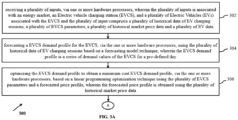
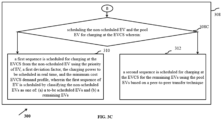
- FIGS.3A-3C is an exemplary flow diagram illustrating a method 300 for real-time scheduling EVs for charging at EVCS using the system 100 of FIG. 1 according to an embodiment of the present disclosure.
- a plurality of inputs is received at the input module 202.
- the plurality of inputs is associated with an energy market, an Electric vehicle charging station (EVCS), and a plurality of Electric Vehicles (EVs) associated with the EVCS.
- the plurality of input comprises a plurality of historical data of EV charging sessions, a plurality of EVCS parameters, a plurality of historical market price data and a plurality of EV data.
- the plurality of historical data of EV charging sessions includes several parameters such as an arrival time of the EVs, a departure time of the EVs, a parking time of the EVs, a charging duration of the EVs, an energy requirement of the EVs, a charging rate of the EVs and a transaction id for the EVs.
- the plurality of EVCS parameters includes a maximum minimum EVCS power requirement for each hour.
- the plurality of historical market price data includes a day ahead market clearing price for each hour.
- the plurality of EV data includes a charger type and a EV battery capacity.
- a EVCS demand profile is forecasted for the EVCS by the forecaster 206.
- the EVCS demand profile is a series of electricity demand values of the EVCS for a pre-defined day.
- the EVCS demand profile is forecasted using the plurality of historical data of EV charging sessions based on a forecasting model technique.
- the forecasting model technique used for forecasting the EVCS demand profile includes an Auto Regressive Integrated Moving Average (ARIMA) technique.
- ARIMA Auto Regressive Integrated Moving Average
- the EVCS is required to forecast a total demand profile of all its charging points for buying power from a day-ahead market.
- the forecasting of demand can be done in two ways - (a) addition of forecasted charging sessions of all the EVs or (b) forecasting of total station demand (for EVCS).
- For forecasting charging sessions of all the EVs the record of charging behaviour of all the EVs in the station is required for predicting every EV's arrival time and power requirement.
- making the forecasting charging sessions of all the EVs is a tedious task (when there is a large number of vehicles) and with relatively more error in the summed aggregated demand profile of each EV.
- the disclosed embodiments forecast the demand profile of the total station demand profile itself.
- the disclosed ARIMA technique is a combination of differencing with autoregression and moving average models.
- a plurality of predictors in the autoregression and moving average model include lagged terms of forecast variable and lagged errors.
- Appropriate values of p and q are found using an Auto Correlation Function (ACF) and a Partial Auto Correlation Function (PACF) plots techniques.
- ACF Auto Correlation Function
- PPF Partial Auto Correlation Function
- the EVCS demand profile is optimized by the optimizer 206.
- the EVCS demand profile ( P t forc ) is optimized to obtain a minimum cost EVCS demand profile ( P t opti ).
- the optimization is based on a linear programming optimization technique using the plurality of EVCS parameters and a forecasted price profile.
- the forecasted price profile is obtained using the plurality of historical market price data.
- the P t aggMin and P t aggMax are the maximum and minimum demand requirement of the EVCS at t respectively. As the above values change daily with a different schedule everyday, these values are selected from the plurality of historical data of EV charging sessions. To get highest probable values, a distribution histogram of total demand is extracted for all values of t. Further, the choice of P t aggMin and P t aggMax changes based on expected confidence level, wherein the limits can also be adjusted if schedule of some of the EVs is known beforehand. In an example scenario, if there is an EV whose schedule is fixed (fixed charging time) and is inflexible, P t aggMin can be modified to accommodate it. Hence the above optimization ensures that total energy of optimized profile is same as that of forecasted profile.
- the plurality of Electric Vehicles is scheduled for charging at the EVCS in the scheduler 208.
- the plurality of Electric Vehicles (EVs) is scheduled for charging based on a real-time scheduling technique.
- the real-time scheduling technique is explained in the below section using steps 310 to 318.
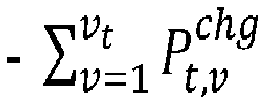
- the schedule for charging of arriving vehicles ( P t , v chg ) using the P t opti as the reference baseline.
- the proposed real-time scheduling technique avails the flexibility of EV to do so. EV can offer flexibility in two ways:
- the real-time scheduling technique is carried out with the plurality of inputs parameters of all EVs at each time instant t (real-time values).
- the vehicles present at t are termed to form a virtual pool, wherein V t is the set which consists of all the vehicles present in the station at time t .
- a set of real-time EV parameters is computed based on the plurality of inputs.
- the set of real-time EV parameters comprises a charging power requirement ( P t , v req ), a remaining parking hours ( N t , v park ), a minimum charging hours ( N t , v chg ), a charging rate to be scheduled in real time and a priority of each EV from the plurality of EVs.
- P t , v req is the charging power requirement for electric vehicle ( v ) and N t , v park is the number of remaining parking hours of EV ( v ) at a time t.
- N t , v park T v dep ⁇ t N t
- v chg is the minimum number of charging hours required to satisfy P t , v req and is expressed as shown below:
- N t , v chg P t , v req / P t , v chgrate
- ⁇ v is the priority of EV, wherein the priority indicates which EV should be preferred for charging in that hour.
- the plurality of Electric Vehicles is classified based on the set of real-time EV parameters.
- the EVs from the plurality of EVs is classified as one of:
- the scheduled EVs are a set of EV s that are currently scheduled for charging.
- the set of plugged-in EV (who have already started charging in previous time slots t - 1 and before).
- the EVs are arranged in descending order of priorities so that high priority EV get scheduled first.
- non-scheduled EVs ( V t non ⁇ sch ) is a set of EVs that have not scheduled for charging, as in the set of EVS which haven't started charging yet.
- the non-scheduled EVs set will include all the new EVs arriving at t and those EVs who have come earlier but haven't started charging yet.
- the vehicles in this set are also arranged in descending of priorities so that high priority EV get scheduled first.
- V t pool is a set of set of EV s that are already charged and have N t , v park > N t reqPark .
- the N t , v park > N t reqPark condition which implements the" Increased parking time".
- the pool EVS are arranged in descending order of N t , v park values so that EVs with higher parking time are taken up first for peer-to-peer discharging.
- N t reqPark t is calculated at every t in T p2p .
- the N t reqPark value is set equal to the number of consecutive time instances in the future set of N t reqPark .to take care that the discharging EV does not charge immediately during next peer-to-peer instant and has sufficient parking time after peer-to-peer duration to charge before its departure.
- ⁇ 0 is the deviation between the P opti and P t , j chg of all the vehicles who have already started charging (vehicles from set V t sch ). It ensures that the vehicles who have started charging in previous time instances continue their charging without being disconnected till their total requirement is satisfied.
- the real-time scheduling technique proposes to also use the already charged EVs (Pool EVs) to charge the non-scheduled EVs.
- Pool EVs already charged EVs
- both the non-scheduled EVs and the pool EV s are used for further scheduling, which is explained below sections.
- the non-scheduled EV and the pool EV are scheduled for charging at the EVCS.
- the non-scheduled EVs are charged immediately or based on a peer-to-peer transfer technique based on a first deviation factor or a second deviation factor as explained in the below sections.
- a first sequence is scheduled for charging at the EVCS from the non-scheduled EV.
- the first sequence is scheduled using the priority of EV, a first deviation factor, the charging power to be scheduled in real time, and the minimum cost EVCS demand profile.
- the first sequence of EV is scheduled by classifying the non-scheduled EVs as one of:
- first sequence of EV is scheduled by classifying the non-scheduled EVs based on the first deviation factor ( ⁇ ).
- the ⁇ is the deviation between P t Opti and P t , v chg of EVs ⁇ V t sch and V t non ⁇ sch at the station and assists in deciding the first sequence of scheduling the EVs.
- to-be scheduled EVs are identified for first schedule and the remaining vehicles are scheduled based on a second sequence as described in the next section.
- a second sequence is scheduled for charging at the EVCS for the remaining EVs using the pool EVs based on the peer-to-peer transfer technique based on a second deviation factor ( ⁇ pool ).
- the second deviation factor ( ⁇ pool ) is a deviation of a net peer-to-peer transfer parameter from the first deviation factor ( ⁇ ).
- the peer-to-peer transfer is obtained using the plurality of EV data of the pool EVs and the plurality of EV data of the unscheduled EVs.
- the second sequence is scheduled if t ⁇ T p2p for EV s in V t non ⁇ sch using V t pool .
- the EV combination charging for ( i ⁇ i min + 1; ... ; i max ) and pool discharging for q ⁇ (1, ..., q min ) which results in least ⁇ q min pool is scheduled for pool transfer.
- the historical data of total EVCS demand along with the EV charging sessions for a duration of a year is available.
- the entire process used by the EVCS owner for scheduling of EVs is divided in three modules - the forecaster 204, the optimizer 206 and the scheduler 208 (as described in FIG.2 ).
- the forecaster 204, the optimizer 206 are implemented on a day ahead basis while the scheduler 208is implemented in real time on an hourly basis. The results are described in the below sections.
- the forecaster 204 A training dataset of 100 days is used for training the ARIMA model for each hour t.
- the obtained forecasted total demand profile of the EVCS station for 1st Sept 2019 is illustrated in FIG.4 , where it can be inferred that P t forc is close to actual demand profile P t act .
- the difference between total energy required for charging EVs in both cases is 1.7 %.
- the optimizer 206 The values of P t aggMin and P t aggMax are extracted from the distribution histogram of hourly station demand, wherein distribution is calculated over same 100 historical days which were used to get P t forc . For each hour, quantile value of 5% is used as P t aggMin while quantile value of 95% is used as P t aggMax . These limits are used to optimize the forecasted profile P t forc to obtain the minimum cost EVCS demand profile of P t opt as shown in Fig. 5 , wherein it can be observed that the formulation modifies P t forc such that its value is lower during higher price ⁇ t time slots. It is to be noted that, the optimal profile is heavily dependent on the forecasted price profile ⁇ t .
- the disclosed scheduling algorithm is implemented with data of fresh arrivals and updated parameters of already parked vehicles for each hour t .
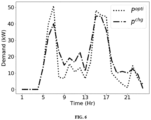
- the real time scheduled charging profile P t , v chg obtained as a result is shown in Fig.6 . It can be observed that P t , v chg is very close to the optimized profile P t opt .
- the disclosed scheduling algorithm allows violation of P t opt for some time instances, the requirements of EVs are always satisfied before their departure time. Hence there is no issue of infeasibility in the method disclosed herein.
- the total power requirement of EVCS for the simulation day is 415 kW. Out of total requirement, 29.8 kW is traded in pool. It can be observed that pool discharging are the ones with longer parking duration. Thus, their flexibility of higher parking time and readiness to participate in peer-to-peer trading aids in reducing the total power procurement cost of EVCS, wherein these EVs can be offered incentives in proportion to their battery degradation, however incentive allocation mechanism is out of scope of this experiment.
- Real time scheduling is done using P t opt as reference baseline which is optimized using forecasted price profile ⁇ t .
- the total procurement cost of EVCS is calculated after the day is overusing the actual market price ⁇ t .
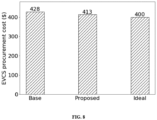
- the proposed model is simulated over the month with daily varying arrival schedules and price profiles. Comparison of total procurement cost for the simulation period is done for following three cases:
- the P t , n sch is the scheduled charging power of n th EV at time t.
- ⁇ t,n is a binary variable which indicates the parking hours ( T n dep ⁇ T n arr ) of the n th EV.
- ⁇ t,n 1, if it is parked in the station, else it is zero.
- P t , n sch in each hour is constrained by its charging rate P t , n chgrate n as shown in above equations Constraints (19) (above equation) ensures that the total requirement of every EV is satisfied. The constrain (20) the total scheduled power for every t so that maximum station demand is not violated.
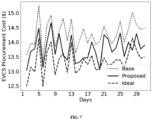
- Total procurement cost for all days of simulation period is given in Fig.7 .
- the Base case has highest cost as it does not do any optimization.
- the cost of disclosed case is always between Base and Ideal case cost which proves the efficacy of the proposed real time scheduling method.
- implementing the disclosed method will lead to cost savings.
- the cost for the disclosed case is even lower than Ideal case which is due to the peer-to-peer transfer modeling in former. If we compare the total procurement over entire month from Fig. 8 , we can see that there is an approximate cost savings of 3.5% with the Proposed case as compared to the Base case while the difference between cost of Proposed and Ideal case is around 3.25 %.
- This disclosure relates generally to real-time scheduling EVs for charging at electric vehicle charging station (EVCS).
- EVCS electric vehicle charging station
- the EVCS that enables charging of EVs, procure power from open markets at time varying prices.
- the estimation of demand profile for EVCS is very challenging as arrival of Electric Vehicles (EVs) is not known to EVCS apriori and is also heavily dependent on several uncertain factors associated with the EVs such as EVs individual power requirements, driving and travel patterns, EV owner behavior etc.
- the disclosure estimates a demand profile of an EVCS, optimizes the demand profile and schedules EV arrivals in real time.
- the scheduling is performed by offering flexibility by 1) increasing parking hours so that charging sessions can be scheduled in lower price periods and 2) participating in peer-to-peer transfer, so that EV with extra parking time charged during lower price periods can transfer power to others during high price periods.
- Such computer-readable storage means contain program-code means for implementation of one or more steps of the method, when the program runs on a server or mobile device or any suitable programmable device.
- the hardware device can be any kind of device which can be programmed including e.g., any kind of computer like a server or a personal computer, or the like, or any combination thereof.
- the device may also include means which could be e.g., hardware means like e.g., an application-specific integrated circuit (ASIC), a field-programmable gate array (FPGA), or a combination of hardware and software means, e.g., an ASIC and an FPGA, or at least one microprocessor and at least one memory with software processing components located therein.
- the means can include both hardware means and software means.
- the method embodiments described herein could be implemented in hardware and software.
- the device may also include software means. Alternatively, the embodiments may be implemented on different hardware devices, e.g., using a plurality of CPUs.
- the embodiments herein can comprise hardware and software elements.
- the embodiments that are implemented in software include but are not limited to, firmware, resident software, microcode, etc.
- the functions performed by various components described herein may be implemented in other components or combinations of other components.
- a computer-usable or computer readable medium can be any apparatus that can comprise, store, communicate, propagate, or transport the program for use by or in connection with the instruction execution system, apparatus, or device.
- a computer-readable storage medium refers to any type of physical memory on which information or data readable by a processor may be stored.
- a computer-readable storage medium may store instructions for execution by one or more processors, including instructions for causing the processor(s) to perform steps or stages consistent with the embodiments described herein.
- the term "computer-readable medium” should be understood to include tangible items and exclude carrier waves and transient signals, i.e., be non-transitory. Examples include random access memory (RAM), read-only memory (ROM), volatile memory, nonvolatile memory, hard drives, CD ROMs, DVDs, flash drives, disks, and any other known physical storage media.
Landscapes
- Business, Economics & Management (AREA)
- Engineering & Computer Science (AREA)
- Strategic Management (AREA)
- Economics (AREA)
- Development Economics (AREA)
- Human Resources & Organizations (AREA)
- Theoretical Computer Science (AREA)
- Marketing (AREA)
- Physics & Mathematics (AREA)
- General Business, Economics & Management (AREA)
- General Physics & Mathematics (AREA)
- Entrepreneurship & Innovation (AREA)
- Tourism & Hospitality (AREA)
- Finance (AREA)
- Accounting & Taxation (AREA)
- Game Theory and Decision Science (AREA)
- Quality & Reliability (AREA)
- Operations Research (AREA)
- Health & Medical Sciences (AREA)
- General Health & Medical Sciences (AREA)
- Primary Health Care (AREA)
- Power Engineering (AREA)
- Educational Administration (AREA)
- Data Mining & Analysis (AREA)
- Transportation (AREA)
- Mechanical Engineering (AREA)
- Public Health (AREA)
- Water Supply & Treatment (AREA)
- Charge And Discharge Circuits For Batteries Or The Like (AREA)
- Electric Propulsion And Braking For Vehicles (AREA)
Abstract
Description
- The present application claims priority from
Indian patent application no. 202221036454, filed on June 24, 2022 - The disclosure herein generally relates to scheduling electric vehicles (EVs) for charging and, more particularly, to real-time scheduling EVs for charging at electric vehicle charging station (EVCS).
- Increasing focus on sustainability is driving the transportation sector towards e-mobility. With the impending exhaustion of fossil fuel and growing concerns on environmental issues, Electric Vehicle (EV) is anticipated to be the next generation of transport. However, high penetration of EVs creates a need for good EV charging infrastructure or Electric Vehicle Charging Stations (EVCS) for charging the EVs conveniently.
- The EVCS procure power from open energy markets at time varying prices. Hence the EVCS that facilitates charging of the EVs, must have the knowledge of day-ahead EV charging requirements in-order to procure power from markets (forecast and bid for electricity at market). However, determining the EV charging demand is highly complicated and different from residential/commercial load as it is heavily dependent on several uncertain factors associated with the EVs such as EVs individual power requirements, driving and travel patterns, EV owner behavior etc. Further as the arrival of Electric Vehicles (EVs) is not known to EVCS apriori, it becomes difficult to have an estimate of the EVs demand and minimize the cost of power procurement to be obtained from the open energy markets.
- Numerous techniques of EV load prediction have been discussed in literature. Some of these methods are based on driving patterns derived from commuting behavior of population, while few other state-of-arts techniques employ forecasting techniques based on historical charging data using neural networks or queue mapping method to convert the EV queue to the charging demand queue to schedule EVs. However, most of the state-of-the-art techniques results in a mismatch between the power purchased in day-ahead market and power scheduled in real time for a particular time instant thus leading to an efficient scheduling the EVs at real-time. Hence it is still a challenging task for the EVCS to model the demand, optimize and schedule the EVs in real-time.
- Embodiments of the present disclosure present technological improvements as solutions to one or more of the above-mentioned technical problems recognized by the inventors in conventional systems. For example, in one embodiment, a method for real-time scheduling EVs for charging at EVCS is provided. The system includes a memory storing instructions, one or more communication interfaces, and one or more hardware processors coupled to the memory via the one or more communication interfaces, wherein the one or more hardware processors are configured by the instructions to receive a plurality of inputs, via one or more hardware processors, wherein the plurality of inputs is associated with an energy market, an Electric vehicle charging station (EVCS), and a plurality of Electric Vehicles (EVs) associated with the EVCS and the plurality of input comprises a plurality of historical data of EV charging sessions, a plurality of EVCS parameters, a plurality of historical market price data and a plurality of EV data. The system is further configured to forecast a EVCS demand profile for the EVCS, via one or more hardware processors, using the plurality of historical data of EV charging sessions based on a forecasting model technique, wherein the EVCS demand profile is a series of electricity demand values of the EVCS for a pre-defined day. The system is further configured to optimize the EVCS demand profile to obtain a minimum cost EVCS demand profile, via one or more hardware processors, based on a linear programming optimization technique using the plurality of EVCS parameters and a forecasted price profile, wherein the forecasted price profile is obtained using the plurality of historical market price data. The system is further configured to schedule the plurality of Electric Vehicles (EVs) for charging at the EVCS, via one or more hardware processors, based on a real-time scheduling technique comprising: computing a set of real-time EV parameters based on the plurality of inputs, wherein the set of real-time EV parameters comprises a charging power requirement, a remaining parking hours, a minimum charging hours, a charging rate to be scheduled in real time and a priority of each EV from the plurality of EVs; classifying the plurality of Electric Vehicles (EVs) based on the set of real-time EV parameters, wherein each EV is classified as one of a scheduled EVs, a non-scheduled EVs and a pool EVs; and scheduling the non-scheduled EV and the pool EV for charging at the EVCS, wherein: a first sequence is scheduled for charging at the EVCS from the non-scheduled EV using the priority of EV, a first deviation factor, the charging power to be scheduled in real time, and the minimum cost EVCS demand profile, wherein the first sequence of EV is scheduled by classifying the non-scheduled EVs as one of: (a) a to-be scheduled EVs and (b) a remaining EVs; and a second sequence is scheduled for charging at the EVCS for the remaining EVs using the pool EVs based on a peer-to-peer transfer technique.
- In another aspect, a method for real-time scheduling EVs for charging at EVCS is provided. The method includes receiving a plurality of inputs, wherein the plurality of inputs is associated with an energy market, an Electric vehicle charging station (EVCS), and a plurality of Electric Vehicles (EVs) associated with the EVCS and the plurality of input comprises a plurality of historical data of EV charging sessions, a plurality of EVCS parameters, a plurality of historical market price data and a plurality of EV data. The method includes forecasting a EVCS demand profile for the EVCS using the plurality of historical data of EV charging sessions based on a forecasting model technique, wherein the EVCS demand profile is a series of electricity demand values of the EVCS for a pre-defined day. The method includes optimizing the EVCS demand profile to obtain a minimum cost EVCS demand profile, via one or more hardware processors, based on a linear programming optimization technique using the plurality of EVCS parameters and a forecasted price profile, wherein the forecasted price profile is obtained using the plurality of historical market price data. The method includes scheduling the plurality of Electric Vehicles (EVs) for charging at the EVCS, via one or more hardware processors, based on a real-time scheduling technique comprising: computing a set of real-time EV parameters based on the plurality of inputs, wherein the set of real-time EV parameters comprises a charging power requirement, a remaining parking hours, a minimum charging hours, a charging rate to be scheduled in real time and a priority of each EV from the plurality of EVs; classifying the plurality of Electric Vehicles (EVs) based on the set of real-time EV parameters, wherein each EV is classified as one of a scheduled EVs, a non-scheduled EVs and a pool EVs; and scheduling the non-scheduled EV and the pool EV for charging at the EVCS, wherein: a first sequence is scheduled for charging at the EVCS from the non-scheduled EV using the priority of EV, a first deviation factor, the charging power to be scheduled in real time, and the minimum cost EVCS demand profile, wherein the first sequence of EV is scheduled by classifying the non-scheduled EVs as one of: (a) a to-be scheduled EVs and (b) a remaining EVs; and a second sequence is scheduled for charging at the EVCS for the remaining EVs using the pool EVs based on a peer-to-peer transfer technique.
- In yet another aspect, a non-transitory computer readable medium for real-time scheduling EVs for charging at EVCS. The method includes receiving a plurality of inputs, wherein the plurality of inputs is associated with an energy market, an Electric vehicle charging station (EVCS), and a plurality of Electric Vehicles (EVs) associated with the EVCS and the plurality of input comprises a plurality of historical data of EV charging sessions, a plurality of EVCS parameters, a plurality of historical market price data and a plurality of EV data. The method includes forecasting a EVCS demand profile for the EVCS using the plurality of historical data of EV charging sessions based on a forecasting model technique, wherein the EVCS demand profile is a series of electricity demand values of the EVCS for a pre-defined day. The method includes optimizing the EVCS demand profile to obtain a minimum cost EVCS demand profile, via one or more hardware processors, based on a linear programming optimization technique using the plurality of EVCS parameters and a forecasted price profile, wherein the forecasted price profile is obtained using the plurality of historical market price data. The method includes scheduling the plurality of Electric Vehicles (EVs) for charging at the EVCS, via one or more hardware processors, based on a real-time scheduling technique comprising: computing a set of real-time EV parameters based on the plurality of inputs, wherein the set of real-time EV parameters comprises a charging power requirement, a remaining parking hours, a minimum charging hours, a charging rate to be scheduled in real time and a priority of each EV from the plurality of EVs; classifying the plurality of Electric Vehicles (EVs) based on the set of real-time EV parameters, wherein each EV is classified as one of a scheduled EVs, a non-scheduled EVs and a pool EVs; and scheduling the non-scheduled EV and the pool EV for charging at the EVCS, wherein: a first sequence is scheduled for charging at the EVCS from the non-scheduled EV using the priority of EV, a first deviation factor, the charging power to be scheduled in real time, and the minimum cost EVCS demand profile, wherein the first sequence of EV is scheduled by classifying the non-scheduled EVs as one of: (a) a to-be scheduled EVs and (b) a remaining EVs; and a second sequence is scheduled for charging at the EVCS for the remaining EVs using the pool EVs based on a peer-to-peer transfer technique.
- It is to be understood that both the foregoing general description and the following detailed description are exemplary and explanatory only and are not restrictive of the invention, as claimed.
- The accompanying drawings, which are incorporated in and constitute a part of this disclosure, illustrate exemplary embodiments and, together with the description, serve to explain the disclosed principles:
-
FIG. 1 illustrates an exemplary system for real-time scheduling EVs for charging at EVCS, according to some embodiments of the present disclosure. -
FIG.2 is a functional block diagram of the system ofFIG. 1 , for real-time scheduling EVs for charging at EVCS, according to some embodiments of the present disclosure. -
FIGS.3A to FIG.3C is a flow diagram illustrating amethod 300 for real-time scheduling EVs for charging at EVCS, by the system ofFIG. 1 , in accordance with some embodiments of the present disclosure. -
FIG.4 is a illustrates an experimental graph result of forecasting a EVCS demand profile for the EVCS according to some embodiments of the present disclosure. -
FIG.5 is a illustrates an experimental graph result to obtain a minimum cost EVCS demand profile for the EVCS according to some embodiments of the present disclosure. -
FIG.6 is a illustrates an experimental graph result of real time scheduled charging profile according to some embodiments of the present disclosure. -
FIG.7 is a illustrates an experimental graph result of a total procurement cost for all days of a simulation period according to some embodiments of the present disclosure. -
FIG.8 is a illustrates an experimental graph result of the total procurement over entire month according to some embodiments of the present disclosure. - Exemplary embodiments are described with reference to the accompanying drawings. In the figures, the left-most digit(s) of a reference number identifies the figure in which the reference number first appears. Wherever convenient, the same reference numbers are used throughout the drawings to refer to the same or like parts. While examples and features of disclosed principles are described herein, modifications, adaptations, and other implementations are possible without departing from the scope of the disclosed embodiments.
- An EVCS has multiple charging points all over a geographical area. The EVCS has a fixed number of EVs subscribed to it which come daily and park in any of charging points. Further the EVCS also has all the information about type of EVs, the EV's suitable charging rates and battery capacity. The charging behaviour of EVs is not fixed and varies daily and some EVs have a fixed schedule (fixed arrival and departure time) with a little variance while some vehicles show a high variance in their schedule. Further despite the nature of schedule, the energy requirement of each EV tends to change every day resulting into highly varying demand of EVCS. Hence, considering the above-mentioned points, the main task of EVCS is to schedule the arriving EVs and fulfill their total requirement.
- Usually, the EVCS manages the cost of power procurement by following the steps: 1) Forecast a total station load for the next day, 2) bid in day-ahead market for buying power equivalent to forecasted load, and then 3) optimally schedule the arriving EVs in real time to incur minimum charging cost which is close to bid profile. However, in case of a mismatch between the power purchased in day-ahead market and power scheduled in real time for a particular time instant, the EVCS has to buy power from real time market which is quite costly. Considering the above mentioned points, it is a challenging task for the EVCS to model the demand, optimize and schedule the EVs in real-time.
- The disclosure estimates a demand profile of an EVCS, optimizes the demand profile and schedules EV arrivals in real time. The scheduling is performed by offering flexibility by 1) increasing parking hours so that charging sessions can be scheduled in lower price periods and 2) participating in peer-to-peer transfer, so that EV with extra parking time charged during lower price periods can transfer power to others during high price periods.
- Referring now to the drawings, and more particularly to
FIG. 1 through FIG.8 , where similar reference characters denote corresponding features consistently throughout the figures, there are shown preferred embodiments and these embodiments are described in the context of the following exemplary system and/or method. -
FIG.1 is an exemplary block diagram of asystem 100 for real-time scheduling EVs for charging at EVCS in accordance with some embodiments of the present disclosure. - In an embodiment, the
system 100 includes a processor(s) 104, communication interface device(s), alternatively referred as input/output (I/O) interface(s) 106, and one or more data storage devices or amemory 102 operatively coupled to the processor(s) 104. Thesystem 100 with one or more hardware processors is configured to execute functions of one or more functional blocks of thesystem 100. - Referring to the components of the
system 100, in an embodiment, the processor(s) 104, can be one ormore hardware processors 104. In an embodiment, the one ormore hardware processors 104 can be implemented as one or more microprocessors, microcomputers, microcontrollers, digital signal processors, central processing units, state machines, logic circuitries, and/or any devices that manipulate signals based on operational instructions. Among other capabilities, the one ormore hardware processors 104 is configured to fetch and execute computer-readable instructions stored in thememory 102. In an embodiment, thesystem 100 can be implemented in a variety of computing systems including laptop computers, notebooks, hand-held devices such as mobile phones, workstations, mainframe computers, servers, a network cloud and the like. - The I/O interface(s) 106 can include a variety of software and hardware interfaces, for example, a web interface, a graphical user interface, a touch user interface (TUI) and the like and can facilitate multiple communications within a wide variety of networks N/W and protocol types, including wired networks, for example, LAN, cable, etc., and wireless networks, such as WLAN, cellular, or satellite. In an embodiment, the I/O interface (s) 106 can include one or more ports for connecting a number of devices (nodes) of the
system 100 to one another or to another server. - The
memory 102 may include any computer-readable medium known in the art including, for example, volatile memory, such as static random-access memory (SRAM) and dynamic random-access memory (DRAM), and/or non-volatile memory, such as read only memory (ROM), erasable programmable ROM, flash memories, hard disks, optical disks, and magnetic tapes. - Further, the
memory 102 may include adatabase 108 configured to include information regarding for real-time scheduling EVs for charging at EVCS. Thememory 102 may comprise information pertaining to input(s)/output(s) of each step performed by the processor(s) 104 of thesystem 100 and methods of the present disclosure. In an embodiment, thedatabase 108 may be external (not shown) to thesystem 100 and coupled to the system via the I/O interface 106. - Functions of the components of
system 100 are explained in conjunction with functional overview of thesystem 100 inFIG.2 and flow diagram ofFIGS.3A andFIG.3B for real-time scheduling EVs for charging at EVCS. - The
system 100 supports various connectivity options such as BLUETOOTH®, USB, ZigBee and other cellular services. The network environment enables connection of various components of thesystem 100 using any communication link including Internet, WAN, MAN, and so on. In an exemplary embodiment, thesystem 100 is implemented to operate as a stand-alone device. In another embodiment, thesystem 100 may be implemented to work as a loosely coupled device to a smart computing environment. The components and functionalities of thesystem 100 are described further in detail. -
FIG.2 is an example functional block diagram of the various modules of the system ofFIG. 1 , in accordance with some embodiments of the present disclosure. As depicted in the architecture, theFIG.2 illustrates the functions of the modules of thesystem 100 that includes for real-time scheduling EVs for charging at EVCS. - As depicted in
FIG.2 , thefunctional system 200 ofsystem 100 is configured for real-time scheduling EVs for charging at EVCS. - The
system 200 comprises aninput module 202 configured for receiving a plurality of inputs, wherein the plurality of inputs is associated with an energy market. Thesystem 200 further comprises aforecaster 204 configured for forecasting a EVCS demand profile for the EVCS using the plurality of inputs based on a forecasting model technique. Thesystem 200 further comprises anoptimizer 206 configured for optimizing the EVCS demand profile to obtain a minimum cost EVCS demand profile based on a linear programming optimization technique using the plurality of inputs. Thesystem 200 further comprises ascheduler 208 configured for scheduling the plurality of Electric Vehicles (EVs) for charging at the EVCS based on a real-time scheduling technique. - The various modules of the
system 100 and the functional blocks inFIG.2 are configured for real-time scheduling EVs for charging at EVCS and are implemented as at least one of a logically self-contained part of a software program, a self-contained hardware component, and/or, a self-contained hardware component with a logically self-contained part of a software program embedded into each of the hardware component that when executed perform the above method described herein. - Functions of the components of the
system 200 are explained in conjunction with functional modules of thesystem 100 stored in the memory 102 (not shown) and further explained in conjunction with flow diagram ofFIGS.3A-3C . TheFIGS.3A-3C with reference toFIG.1 , is an exemplary flow diagram illustrating amethod 300 for real-time scheduling EVs for charging at EVCS using thesystem 100 ofFIG. 1 according to an embodiment of the present disclosure. - The steps of the
method 300 of the present disclosure will now be explained with reference to the components of thesystem 100 ofFIG. 1 for real-time scheduling EVs for charging at EVCS and the modules 202-208 as depicted inFIG.2 and the flow diagrams as depicted inFIGS.3A-3C . Although process steps, method steps, techniques or the like may be described in a sequential order, such processes, methods and techniques may be configured to work in alternate orders. In other words, any sequence or order of steps that may be described does not necessarily indicate a requirement that the steps to be performed in that order. The steps of processes described herein may be performed in any order practical. Further, some steps may be performed simultaneously. - At
step 302 of themethod 300, a plurality of inputs is received at theinput module 202. The plurality of inputs is associated with an energy market, an Electric vehicle charging station (EVCS), and a plurality of Electric Vehicles (EVs) associated with the EVCS. The plurality of input comprises a plurality of historical data of EV charging sessions, a plurality of EVCS parameters, a plurality of historical market price data and a plurality of EV data. - In an embodiment, the plurality of historical data of EV charging sessions includes several parameters such as an arrival time of the EVs, a departure time of the EVs, a parking time of the EVs, a charging duration of the EVs, an energy requirement of the EVs, a charging rate of the EVs and a transaction id for the EVs. Further the plurality of EVCS parameters includes a maximum minimum EVCS power requirement for each hour. The plurality of historical market price data includes a day ahead market clearing price for each hour. The plurality of EV data includes a charger type and a EV battery capacity.
- At
step 304 of themethod 300, a EVCS demand profile is forecasted for the EVCS by theforecaster 206. The EVCS demand profile is a series of electricity demand values of the EVCS for a pre-defined day. The EVCS demand profile is forecasted using the plurality of historical data of EV charging sessions based on a forecasting model technique. - In an embodiment, the forecasting model technique used for forecasting the EVCS demand profile (

- The EVCS is required to forecast a total demand profile of all its charging points for buying power from a day-ahead market. The forecasting of demand can be done in two ways - (a) addition of forecasted charging sessions of all the EVs or (b) forecasting of total station demand (for EVCS). For forecasting charging sessions of all the EVs - the record of charging behaviour of all the EVs in the station is required for predicting every EV's arrival time and power requirement. Hence making the forecasting charging sessions of all the EVs is a tedious task (when there is a large number of vehicles) and with relatively more error in the summed aggregated demand profile of each EV. Hence the disclosed embodiments forecast the demand profile of the total station demand profile itself.
- The disclosed ARIMA technique is a combination of differencing with autoregression and moving average models. A plurality of predictors in the autoregression and moving average model include lagged terms of forecast variable and lagged errors. The ARIMA technique is characterized as model with order as expressed below:

- p is the order of autoregressive part,
- d is the degree of the first differencing and
- q is the order of the moving average part.
- Appropriate values of p and q are found using an Auto Correlation Function (ACF) and a Partial Auto Correlation Function (PACF) plots techniques. The estimation is done by minimizing the sum of residuals of all the historical points in the training dataset. Further, the demand forecasting is done individually for each time instant t. Thus, there is a ARIMA model which gets trained over a training dataset of historical values for each t and estimates the EVCS demand profile (

- At
step 306 of themethod 300, the EVCS demand profile is optimized by theoptimizer 206. The EVCS demand profile (

- In an embodiment, the linear programming optimization technique is expressed as shown below:


- λt is forecasted price profile,
-

-

-


- The




- At
step 308 of themethod 300, the plurality of Electric Vehicles (EVs) is scheduled for charging at the EVCS in thescheduler 208. The plurality of Electric Vehicles (EVs) is scheduled for charging based on a real-time scheduling technique. The real-time scheduling technique is explained in the belowsection using steps 310 to 318. - The schedule for charging of arriving vehicles (




- (a) Increased parking time: if an EV has a longer parking time, the EVCS owner gets a degree of freedom for shifting the charging during lower price time periods.
- (b) Participating in peer-to-peer transfer: an EV who is completely charged and has sufficient idle hours before its departure, can discharge within the pool and help other high priority vehicles to reduce the grid import and not violate the optimal demand profile. The peer-to-peer transfer is enabled only for those hours for which market price is generally high, wherein the time instances are calculated over an average price profile obtained from historical price data.
- The real-time scheduling technique is carried out with the plurality of inputs parameters of all EVs at each time instant t (real-time values). The vehicles present at t are termed to form a virtual pool, wherein Vt is the set which consists of all the vehicles present in the station at time t.
- At
step 310 of themethod 300, a set of real-time EV parameters is computed based on the plurality of inputs. The set of real-time EV parameters comprises a charging power requirement (


- In an embodiment,






- ψv is the priority of EV, wherein the priority indicates which EV should be preferred for charging in that hour. The ψv thus ensures that vehicles are charged completely before their departure time and is expressed as shown below:

- At
step 312 of themethod 300, the plurality of Electric Vehicles (EVs) is classified based on the set of real-time EV parameters. The EVs from the plurality of EVs is classified as one of: - (a) a scheduled EVs, (

- (b) a non-scheduled EVs (

- (c) a pool EVs (

- The scheduled EVs (

- Further the non-scheduled EVs (

- Further the pool EVs (






- The scheduled EVs continue the charging of EVs who have been plugged in previous time slots. Hence only the non-scheduled EVs have been charged. Δ0 is the deviation between the Popti and





- The real-time scheduling technique proposes to also use the already charged EVs (Pool EVs) to charge the non-scheduled EVs. Hence both the non-scheduled EVs and the pool EV s are used for further scheduling, which is explained below sections.
- At step 314 of the
method 300, the non-scheduled EV and the pool EV are scheduled for charging at the EVCS. The non-scheduled EVs are charged immediately or based on a peer-to-peer transfer technique based on a first deviation factor or a second deviation factor as explained in the below sections. - At step 316 of the
method 300, a first sequence is scheduled for charging at the EVCS from the non-scheduled EV. The first sequence is scheduled using the priority of EV, a first deviation factor, the charging power to be scheduled in real time, and the minimum cost EVCS demand profile. The first sequence of EV is scheduled by classifying the non-scheduled EVs as one of: - (a) to-be scheduled EVs, and
- (b) remaining EVs.
- In an embodiment, first sequence of EV is scheduled by classifying the non-scheduled EVs based on the first deviation factor (Δ). The Δ is the deviation between





- At step 318 of the
method 300, a second sequence is scheduled for charging at the EVCS for the remaining EVs using the pool EVs based on the peer-to-peer transfer technique based on a second deviation factor (Δ pool ). - In an embodiment, the second deviation factor (Δ pool ) is a deviation of a net peer-to-peer transfer parameter from the first deviation factor (Δ). The peer-to-peer transfer is obtained using the plurality of EV data of the pool EVs and the plurality of EV data of the unscheduled EVs. The Δ pool gives the total unmet power of the vehicles

- The second sequence is scheduled if t ∈ Tp2p for EV s in




- Once the charging/peer to peer transfer is complete, the power requirements


- For experiment purposes, an EVCS with 30 EV subscribers was considered (N=30). The subscribed EVs visit the EVCS for charging on almost a daily basis. The charger types of the subscribed EVs is mentioned in Table 1, wherein the charger types and their penetration level are decided based on the maximum charge rate and the total number of the EV population.
Table 1 : Charger types of the subscribed EVs in a EVCS Type Charger type (kW/hr) Penetration level (%) A 3.3 51 B 10 38 C 6.6 11 - The historical data of total EVCS demand along with the EV charging sessions for a duration of a year is available. The entire process used by the EVCS owner for scheduling of EVs is divided in three modules - the
forecaster 204, theoptimizer 206 and the scheduler 208 (as described inFIG.2 ). Theforecaster 204, theoptimizer 206 are implemented on a day ahead basis while the scheduler 208is implemented in real time on an hourly basis. The results are described in the below sections. - The forecaster 204: A training dataset of 100 days is used for training the ARIMA model for each hour t. The obtained forecasted total demand profile of the EVCS station for 1st Sept 2019 is illustrated in
FIG.4 , where it can be inferred that

- The optimizer 206: The values of





Fig. 5 , wherein it can be observed that the formulation modifies
- The scheduler 208: On observation of average of actual market price profile λt obtained from historical data, two distinct peaks can be identified. Hence the set Tp2p = (8,... 14,... 18,...21) coinciding with the high price periods is selected for peer-to-peer trading. The disclosed scheduling algorithm is implemented with data of fresh arrivals and updated parameters of already parked vehicles for each hour t. The real time scheduled charging profile

Fig.6 . It can be observed that


- The total power requirement of EVCS for the simulation day is 415 kW. Out of total requirement, 29.8 kW is traded in pool. It can be observed that pool discharging are the ones with longer parking duration. Thus, their flexibility of higher parking time and readiness to participate in peer-to-peer trading aids in reducing the total power procurement cost of EVCS, wherein these EVs can be offered incentives in proportion to their battery degradation, however incentive allocation mechanism is out of scope of this experiment.
- Real time scheduling is done using

- 1) Base: This case corresponds to original scheduling method that is : when the EVCS starts charging the EVs as soon as they arrive at the station without any optimization.

- 2) Proposed: It is the case where disclosed technique discussed is applied (represented as "proposed" in the graph of
FIG. 8 );
- 3) Ideal: This is the scenario where information of all the parameters (




- The


- Total procurement cost for all days of simulation period is given in
Fig.7 . The Base case has highest cost as it does not do any optimization. The cost of disclosed case is always between Base and Ideal case cost which proves the efficacy of the proposed real time scheduling method. Thus, implementing the disclosed method will lead to cost savings. For a very few days, we can see that the cost for the disclosed case is even lower than Ideal case which is due to the peer-to-peer transfer modeling in former. If we compare the total procurement over entire month fromFig. 8 , we can see that there is an approximate cost savings of 3.5% with the Proposed case as compared to the Base case while the difference between cost of Proposed and Ideal case is around 3.25 %. - The written description describes the subject matter herein to enable any person skilled in the art to make and use the embodiments. The scope of the subject matter embodiments is defined by the claims and may include other modifications that occur to those skilled in the art. Such other modifications are intended to be within the scope of the claims if they have similar elements that do not differ from the literal language of the claims or if they include equivalent elements with insubstantial differences from the literal language of the claims.
- This disclosure relates generally to real-time scheduling EVs for charging at electric vehicle charging station (EVCS). The EVCS that enables charging of EVs, procure power from open markets at time varying prices. The estimation of demand profile for EVCS is very challenging as arrival of Electric Vehicles (EVs) is not known to EVCS apriori and is also heavily dependent on several uncertain factors associated with the EVs such as EVs individual power requirements, driving and travel patterns, EV owner behavior etc. The disclosure estimates a demand profile of an EVCS, optimizes the demand profile and schedules EV arrivals in real time. The scheduling is performed by offering flexibility by 1) increasing parking hours so that charging sessions can be scheduled in lower price periods and 2) participating in peer-to-peer transfer, so that EV with extra parking time charged during lower price periods can transfer power to others during high price periods.
- It is to be understood that the scope of the protection is extended to such a program and in addition to a computer-readable means having a message therein; such computer-readable storage means contain program-code means for implementation of one or more steps of the method, when the program runs on a server or mobile device or any suitable programmable device. The hardware device can be any kind of device which can be programmed including e.g., any kind of computer like a server or a personal computer, or the like, or any combination thereof. The device may also include means which could be e.g., hardware means like e.g., an application-specific integrated circuit (ASIC), a field-programmable gate array (FPGA), or a combination of hardware and software means, e.g., an ASIC and an FPGA, or at least one microprocessor and at least one memory with software processing components located therein. Thus, the means can include both hardware means and software means. The method embodiments described herein could be implemented in hardware and software. The device may also include software means. Alternatively, the embodiments may be implemented on different hardware devices, e.g., using a plurality of CPUs.
- The embodiments herein can comprise hardware and software elements. The embodiments that are implemented in software include but are not limited to, firmware, resident software, microcode, etc. The functions performed by various components described herein may be implemented in other components or combinations of other components. For the purposes of this description, a computer-usable or computer readable medium can be any apparatus that can comprise, store, communicate, propagate, or transport the program for use by or in connection with the instruction execution system, apparatus, or device.
- The illustrated steps are set out to explain the exemplary embodiments shown, and it should be anticipated that ongoing technological development will change the manner in which particular functions are performed. These examples are presented herein for purposes of illustration, and not limitation. Further, the boundaries of the functional building blocks have been arbitrarily defined herein for the convenience of the description. Alternative boundaries can be defined so long as the specified functions and relationships thereof are appropriately performed. Alternatives (including equivalents, extensions, variations, deviations, etc., of those described herein) will be apparent to persons skilled in the relevant art(s) based on the teachings contained herein. Such alternatives fall within the scope of the disclosed embodiments. Also, the words "comprising," "having," "containing," and "including," and other similar forms are intended to be equivalent in meaning and be open ended in that an item or items following any one of these words is not meant to be an exhaustive listing of such item or items, or meant to be limited to only the listed item or items. It must also be noted that as used herein and in the appended claims, the singular forms "a," "an," and "the" include plural references unless the context clearly dictates otherwise.
- Furthermore, one or more computer-readable storage media may be utilized in implementing embodiments consistent with the present disclosure. A computer-readable storage medium refers to any type of physical memory on which information or data readable by a processor may be stored. Thus, a computer-readable storage medium may store instructions for execution by one or more processors, including instructions for causing the processor(s) to perform steps or stages consistent with the embodiments described herein. The term "computer-readable medium" should be understood to include tangible items and exclude carrier waves and transient signals, i.e., be non-transitory. Examples include random access memory (RAM), read-only memory (ROM), volatile memory, nonvolatile memory, hard drives, CD ROMs, DVDs, flash drives, disks, and any other known physical storage media.
- It is intended that the disclosure and examples be considered as exemplary only, with a true scope of disclosed embodiments being indicated by the following claims.
Claims (13)
- A processor implemented method, comprising:receiving a plurality of inputs, via one or more hardware processors, wherein the plurality of inputs is associated with an energy market, an Electric vehicle charging station (EVCS), and a plurality of Electric Vehicles (EVs) associated with the EVCS and the plurality of input comprises a plurality of historical data of EV charging sessions, a plurality of EVCS parameters, a plurality of historical market price data and a plurality of EV data (302);forecasting an EVCS demand profile for the EVCS, via the one or more hardware processors, using the plurality of historical data of EV charging sessions based on a forecasting model technique, wherein the EVCS demand profile is a series of electricity demand values of the EVCS for a pre-defined day (304);optimizing the EVCS demand profile to obtain a minimum cost EVCS demand profile, via the one or more hardware processors, based on a linear programming optimization technique using the plurality of EVCS parameters and a forecasted price profile, wherein the forecasted price profile is obtained using the plurality of historical market price data (306); andscheduling the plurality of Electric Vehicles (EVs) for charging at the EVCS (308), via the one or more hardware processors, based on a real-time scheduling technique, comprising:computing a set of real-time EV parameters based on the plurality of inputs, wherein the set of real-time EV parameters comprises a charging power requirement, a remaining parking hours, a minimum charging hours, a charging rate to be scheduled in real time, and a priority of each EV from the plurality of EVs (308A);classifying the plurality of Electric Vehicles (EVs) based on the set of real-time EV parameters, wherein each EV is classified as one of a scheduled EVs, a non-scheduled EVs, and a pool EVs (308B); andscheduling the non-scheduled EVs and the pool EVs for charging at the EVCS (308C), wherein,a first sequence is scheduled for charging at the EVCS from the non-scheduled EV using the priority of EV, a first deviation factor, the charging power to be scheduled in real time, and the minimum cost EVCS demand profile, wherein the first sequence of EV is scheduled by classifying the non-scheduled EVs as one of: (a) a to-be scheduled EVs and (b) a remaining EVs (310), anda second sequence is scheduled for charging at the EVCS for the remaining EVs using the pool EVs based on a peer-to-peer transfer technique (312).
- The processor implemented method according to claim 1, the linear programming optimization technique is expressed as:


 λt is forecasted price profile,



- The processor implemented method according to claim 1, wherein the scheduled EVs is a set of EVs that are currently scheduled for charging, the non-scheduled EVs is a set of EVs that have not been scheduled for charging, and the pool EVs is a set of EVs that are already charged, wherein the scheduled EVs continue the charging which have been plugged in at previous time slots.
- The processor implemented method according to claim 1, wherein the first deviation factor is a deviation between the minimum cost EVCS demand profile and the charging power to be scheduled in real time.
- The processor implemented method according to claim 1, wherein the peer-to-peer transfer technique enables the remaining EVs to participate in a peer-to-peer transfer, where the pool EVs, that are completely charged EVs, discharge to the remaining EVs based on a pre-defined peer-to-peer transfer time threshold and a second deviation factor.
- The processor implemented method according to claim 1, wherein the second deviation factor is a deviation of a net peer-to-peer transfer parameter from the first deviation factor, wherein the peer-to-peer transfer is obtained using the plurality of EV data of the pool EVs and the plurality of EV data of the unscheduled EVs.
- A system (100), comprising:a memory (102) storing instructions;one or more communication interfaces (106); andone or more hardware processors (104) coupled to the memory (102) via the one or more communication interfaces (106), wherein the one or more hardware processors (104) are configured by the instructions to:receive a plurality of inputs, via one or more hardware processors, wherein the plurality of inputs is associated with an energy market, an Electric vehicle charging station (EVCS), and a plurality of Electric Vehicles (EVs) associated with the EVCS and the plurality of input comprises a plurality of historical data of EV charging sessions, a plurality of EVCS parameters, a plurality of historical market price data and a plurality of EV data;forecast a EVCS demand profile for the EVCS, via one or more hardware processors, using the plurality of historical data of EV charging sessions based on a forecasting model technique, wherein the EVCS demand profile is a series of electricity demand values of the EVCS for a pre-defined day;optimize the EVCS demand profile to obtain a minimum cost EVCS demand profile, via one or more hardware processors, based on a linear programming optimization technique using the plurality of EVCS parameters and a forecasted price profile, wherein the forecasted price profile is obtained using the plurality of historical market price data and;schedule the plurality of Electric Vehicles (EVs) for charging at the EVCS, via one or more hardware processors, based on a real-time scheduling technique comprising:computing a set of real-time EV parameters based on the plurality of inputs, wherein the set of real-time EV parameters comprises a charging power requirement, a remaining parking hours, a minimum charging hours, a charging rate to be scheduled in real time and a priority of each EV from the plurality of EVs;classifying the plurality of Electric Vehicles (EVs) based on the set of real-time EV parameters, wherein each EV is classified as one of a scheduled EVs, a non-scheduled EVs and a pool EVs; andscheduling the non-scheduled EV and the pool EV for charging at the EVCS, wherein:a first sequence is scheduled for charging at the EVCS from the non-scheduled EV using the priority of EV, a first deviation factor, the charging power to be scheduled in real time, and the minimum cost EVCS demand profile, wherein the first sequence of EV is scheduled by classifying the non-scheduled EVs as one of: (a) a to-be scheduled EVs and (b) a remaining EVs; anda second sequence is scheduled for charging at the EVCS for the remaining EVs using the pool EVs based on a peer-to-peer transfer technique.
- The system according to claim 7, the linear programming optimization technique is expressed as shown below:


 λt is forecasted price profile,


- The system according to claim 7, wherein the scheduled EVs is a set of EVs that are currently scheduled for charging, the non-scheduled EVs is a set of EVs that have not been scheduled for charging, and the pool EVs is a set of EVs that are already charged, wherein the scheduled EVs continue the charging which have been plugged in at previous time slots.
- The system according to claim 7, wherein the first deviation factor is a deviation between the minimum cost EVCS demand profile and the charging power to be scheduled in real time.
- The system according to claim 7, wherein the peer-to-peer transfer technique enables the remaining EVs to participate in a peer-to-peer transfer, where the pool EVs, that are completely charged EVs, discharge to the remaining EVs based on a pre-defined peer-to-peer transfer time threshold and a second deviation factor.
- The system according to claim 7, wherein the second deviation factor is a deviation of a net peer-to-peer transfer parameter from the first deviation factor, wherein the peer-to-peer transfer is obtained using the plurality of EV data of the pool EVs and the plurality of EV data of the unscheduled EVs.
- One or more non-transitory machine readable information storage mediums comprising one or more instructions which when executed by one or more hardware processors cause:receiving a plurality of inputs, wherein the plurality of inputs is associated with an energy market, an Electric vehicle charging station (EVCS), and a plurality of Electric Vehicles (EVs) associated with the EVCS and the plurality of input comprises a plurality of historical data of EV charging sessions, a plurality of EVCS parameters, a plurality of historical market price data and a plurality of EV data;forecasting an EVCS demand profile for the EVCS, using the plurality of historical data of EV charging sessions based on a forecasting model technique, wherein the EVCS demand profile is a series of electricity demand values of the EVCS for a pre-defined day;optimizing the EVCS demand profile to obtain a minimum cost EVCS demand profile, based on a linear programming optimization technique using the plurality of EVCS parameters and a forecasted price profile, wherein the forecasted price profile is obtained using the plurality of historical market price data; andscheduling the plurality of Electric Vehicles (EVs) for charging at the EVCS, based on a real-time scheduling technique, comprising:computing a set of real-time EV parameters based on the plurality of inputs, wherein the set of real-time EV parameters comprises a charging power requirement, a remaining parking hours, a minimum charging hours, a charging rate to be scheduled in real time, and a priority of each EV from the plurality of EVs;classifying the plurality of Electric Vehicles (EVs) based on the set of real-time EV parameters, wherein each EV is classified as one of a scheduled EVs, a non-scheduled EVs, and a pool EVs; andscheduling the non-scheduled EVs and the pool EVs for charging at the EVCS, wherein,a first sequence is scheduled for charging at the EVCS from the non-scheduled EV using the priority of EV, a first deviation factor, the charging power to be scheduled in real time, and the minimum cost EVCS demand profile, wherein the first sequence of EV is scheduled by classifying the non-scheduled EVs as one of: (a) a to-be scheduled EVs and (b) a remaining EVs, anda second sequence is scheduled for charging at the EVCS for the remaining EVs using the pool EVs based on a peer-to-peer transfer technique.
Applications Claiming Priority (1)
| Application Number | Priority Date | Filing Date | Title |
|---|---|---|---|
| IN202221036454 | 2022-06-24 |
Publications (3)
| Publication Number | Publication Date |
|---|---|
| EP4296916A1 true EP4296916A1 (en) | 2023-12-27 |
| EP4296916B1 EP4296916B1 (en) | 2025-01-01 |
| EP4296916C0 EP4296916C0 (en) | 2025-01-01 |
Family
ID=86942421
Family Applications (1)
| Application Number | Title | Priority Date | Filing Date |
|---|---|---|---|
| EP23180648.0A Active EP4296916B1 (en) | 2022-06-24 | 2023-06-21 | Scheduling electric vehicles (evs) for charging at electric vehicle charging station (evcs) |
Country Status (1)
| Country | Link |
|---|---|
| EP (1) | EP4296916B1 (en) |
Cited By (1)
| Publication number | Priority date | Publication date | Assignee | Title |
|---|---|---|---|---|
| CN118569621A (en) * | 2024-08-05 | 2024-08-30 | 深圳市菲尼基科技有限公司 | Information processing method of power exchange station and related equipment |
Citations (1)
| Publication number | Priority date | Publication date | Assignee | Title |
|---|---|---|---|---|
| US20120245750A1 (en) * | 2011-03-25 | 2012-09-27 | Kabushiki Kaisha Toshiba | Electric vehicle charging scheduling system |
-
2023
- 2023-06-21 EP EP23180648.0A patent/EP4296916B1/en active Active
Patent Citations (1)
| Publication number | Priority date | Publication date | Assignee | Title |
|---|---|---|---|---|
| US20120245750A1 (en) * | 2011-03-25 | 2012-09-27 | Kabushiki Kaisha Toshiba | Electric vehicle charging scheduling system |
Non-Patent Citations (4)
| Title |
|---|
| EL-TAWEEL NADER A ET AL: "Optimization Model for EV Charging Stations With PV Farm Transactive Energy", IEEE TRANSACTIONS ON INDUSTRIAL INFORMATICS, IEEE SERVICE CENTER, NEW YORK, NY, US, vol. 18, no. 7, 21 September 2021 (2021-09-21), pages 4608 - 4621, XP011906145, ISSN: 1551-3203, [retrieved on 20210921], DOI: 10.1109/TII.2021.3114276 * |
| JAVED MUHAMMAD UMAR ET AL: "Scheduling Charging of Electric Vehicles in a Secured Manner using Blockchain Technology", 2019 INTERNATIONAL CONFERENCE ON FRONTIERS OF INFORMATION TECHNOLOGY (FIT), IEEE, 16 December 2019 (2019-12-16), pages 351 - 3515, XP033714116, DOI: 10.1109/FIT47737.2019.00072 * |
| MUSHFIQUR R SARKER ET AL: "Optimal operation of aggregated electric vehicle charging stations coupled with energy storage", IET GENERATION, TRANSMISSION&DISTRIBUTION, IET, UK, vol. 12, no. 5, 19 January 2018 (2018-01-19), pages 1127 - 1136, XP006103963, ISSN: 1751-8687, DOI: 10.1049/IET-GTD.2017.0134 * |
| WU YU ET AL: "Demand side energy management of EV charging stations by approximate dynamic programming", ENERGY CONVERSION AND MANAGEMENT, ELSEVIER SCIENCE PUBLISHERS, OXFORD, GB, vol. 196, 27 June 2019 (2019-06-27), pages 878 - 890, XP085796318, ISSN: 0196-8904, [retrieved on 20190627], DOI: 10.1016/J.ENCONMAN.2019.06.058 * |
Cited By (1)
| Publication number | Priority date | Publication date | Assignee | Title |
|---|---|---|---|---|
| CN118569621A (en) * | 2024-08-05 | 2024-08-30 | 深圳市菲尼基科技有限公司 | Information processing method of power exchange station and related equipment |
Also Published As
| Publication number | Publication date |
|---|---|
| EP4296916B1 (en) | 2025-01-01 |
| EP4296916C0 (en) | 2025-01-01 |
Similar Documents
| Publication | Publication Date | Title |
|---|---|---|
| Pandžić et al. | Offering model for a virtual power plant based on stochastic programming | |
| US20240157836A1 (en) | Systems and methods for energy distribution entities and networks for electric vehicle energy delivery | |
| CN110390415A (en) | A kind of method and system carrying out trip mode recommendation based on user's trip big data | |
| EP3751496A1 (en) | Method and system for building reinforcement learning (rl) based model for generating bids | |
| US20160140449A1 (en) | Fuzzy linear programming method for optimizing charging schedules in unidirectional vehicle-to-grid systems | |
| US20250139548A1 (en) | Method and system for optimal scheduling of power sources for meeting electricity demand of enterprise | |
| EP4350589A1 (en) | Method and system for electric vehicle (ev) fleet charging | |
| EP4125028B1 (en) | Method and system to generate pricing for charging electric vehicles | |
| EP4296916B1 (en) | Scheduling electric vehicles (evs) for charging at electric vehicle charging station (evcs) | |
| Jarvis et al. | Smart and sustainable scheduling of charging events for electric buses | |
| Kahlen et al. | Smart markets for real-time allocation of multiproduct resources: the case of shared electric vehicles | |
| CN109978241B (en) | Method and device for determining charging load of electric automobile | |
| Sun et al. | Dynamic pricing for vehicle dispatching in mobility-as-a-service market via multi-agent deep reinforcement learning | |
| Bergmeir et al. | Comparison and evaluation of methods for a predict+ optimize problem in renewable energy | |
| Bessa et al. | Forecasting issues for managing a portfolio of electric vehicles under a smart grid paradigm | |
| EP4527682A1 (en) | Method and system for managing a bidirectional charging at an electric vehicle (ev) charging station | |
| Walraven et al. | Planning Under Uncertainty for Aggregated Electric Vehicle Charging with Renewable Energy Supply. | |
| US10726078B2 (en) | Method and system for dynamic score floor modeling and application thereof | |
| EP4293585B1 (en) | Systems and methods for generating optimal intraday bids and operating schedules for distributed energy resources | |
| KR102558580B1 (en) | Power allocation device for efficient charging of electric vehicle | |
| EP4053507A1 (en) | Method and system for forecasting building power consumption | |
| Babic et al. | Electricity trading agent for EV-enabled parking lots | |
| Kannan et al. | Energy trading for electric vehicle aggregator under random participation of EV owners | |
| EP4610597A1 (en) | Method and system for optimizing power procurement for enterprises with electrical vehicle fleet charging load | |
| US20260099787A1 (en) | Method and system for energy cost optimization framework for a logistic enterprise |
Legal Events
| Date | Code | Title | Description |
|---|---|---|---|
| PUAI | Public reference made under article 153(3) epc to a published international application that has entered the european phase |
Free format text: ORIGINAL CODE: 0009012 |
|
| STAA | Information on the status of an ep patent application or granted ep patent |
Free format text: STATUS: THE APPLICATION HAS BEEN PUBLISHED |
|
| AK | Designated contracting states |
Kind code of ref document: A1 Designated state(s): AL AT BE BG CH CY CZ DE DK EE ES FI FR GB GR HR HU IE IS IT LI LT LU LV MC ME MK MT NL NO PL PT RO RS SE SI SK SM TR |
|
| STAA | Information on the status of an ep patent application or granted ep patent |
Free format text: STATUS: REQUEST FOR EXAMINATION WAS MADE |
|
| 17P | Request for examination filed |
Effective date: 20240610 |
|
| RBV | Designated contracting states (corrected) |
Designated state(s): AL AT BE BG CH CY CZ DE DK EE ES FI FR GB GR HR HU IE IS IT LI LT LU LV MC ME MK MT NL NO PL PT RO RS SE SI SK SM TR |
|
| REG | Reference to a national code |
Ref country code: DE Ref legal event code: R079 Free format text: PREVIOUS MAIN CLASS: G06Q0010040000 Ipc: G06Q0050060000 Ref document number: 602023001568 Country of ref document: DE |
|
| GRAP | Despatch of communication of intention to grant a patent |
Free format text: ORIGINAL CODE: EPIDOSNIGR1 |
|
| STAA | Information on the status of an ep patent application or granted ep patent |
Free format text: STATUS: GRANT OF PATENT IS INTENDED |
|
| RIC1 | Information provided on ipc code assigned before grant |
Ipc: G06Q 30/0201 20230101ALI20240821BHEP Ipc: G06Q 10/0631 20230101ALI20240821BHEP Ipc: G06Q 10/02 20120101ALI20240821BHEP Ipc: B60L 53/64 20190101ALI20240821BHEP Ipc: G06Q 10/04 20230101ALI20240821BHEP Ipc: G06Q 50/06 20120101AFI20240821BHEP |
|
| INTG | Intention to grant announced |
Effective date: 20240919 |
|
| GRAS | Grant fee paid |
Free format text: ORIGINAL CODE: EPIDOSNIGR3 |
|
| GRAA | (expected) grant |
Free format text: ORIGINAL CODE: 0009210 |
|
| STAA | Information on the status of an ep patent application or granted ep patent |
Free format text: STATUS: THE PATENT HAS BEEN GRANTED |
|
| AK | Designated contracting states |
Kind code of ref document: B1 Designated state(s): AL AT BE BG CH CY CZ DE DK EE ES FI FR GB GR HR HU IE IS IT LI LT LU LV MC ME MK MT NL NO PL PT RO RS SE SI SK SM TR |
|
| REG | Reference to a national code |
Ref country code: GB Ref legal event code: FG4D |
|
| REG | Reference to a national code |
Ref country code: DE Ref legal event code: R096 Ref document number: 602023001568 Country of ref document: DE |
|
| REG | Reference to a national code |
Ref country code: CH Ref legal event code: EP |
|
| REG | Reference to a national code |
Ref country code: IE Ref legal event code: FG4D |
|
| U01 | Request for unitary effect filed |
Effective date: 20250101 |
|
| U07 | Unitary effect registered |
Designated state(s): AT BE BG DE DK EE FI FR IT LT LU LV MT NL PT RO SE SI Effective date: 20250114 |
|
| PG25 | Lapsed in a contracting state [announced via postgrant information from national office to epo] |
Ref country code: PL Free format text: LAPSE BECAUSE OF FAILURE TO SUBMIT A TRANSLATION OF THE DESCRIPTION OR TO PAY THE FEE WITHIN THE PRESCRIBED TIME-LIMIT Effective date: 20250101 |
|
| PG25 | Lapsed in a contracting state [announced via postgrant information from national office to epo] |
Ref country code: ES Free format text: LAPSE BECAUSE OF FAILURE TO SUBMIT A TRANSLATION OF THE DESCRIPTION OR TO PAY THE FEE WITHIN THE PRESCRIBED TIME-LIMIT Effective date: 20250101 |
|
| PG25 | Lapsed in a contracting state [announced via postgrant information from national office to epo] |
Ref country code: IS Free format text: LAPSE BECAUSE OF FAILURE TO SUBMIT A TRANSLATION OF THE DESCRIPTION OR TO PAY THE FEE WITHIN THE PRESCRIBED TIME-LIMIT Effective date: 20250501 Ref country code: NO Free format text: LAPSE BECAUSE OF FAILURE TO SUBMIT A TRANSLATION OF THE DESCRIPTION OR TO PAY THE FEE WITHIN THE PRESCRIBED TIME-LIMIT Effective date: 20250401 |
|
| PG25 | Lapsed in a contracting state [announced via postgrant information from national office to epo] |
Ref country code: HR Free format text: LAPSE BECAUSE OF FAILURE TO SUBMIT A TRANSLATION OF THE DESCRIPTION OR TO PAY THE FEE WITHIN THE PRESCRIBED TIME-LIMIT Effective date: 20250101 |
|
| PG25 | Lapsed in a contracting state [announced via postgrant information from national office to epo] |
Ref country code: GR Free format text: LAPSE BECAUSE OF FAILURE TO SUBMIT A TRANSLATION OF THE DESCRIPTION OR TO PAY THE FEE WITHIN THE PRESCRIBED TIME-LIMIT Effective date: 20250402 |
|
| PG25 | Lapsed in a contracting state [announced via postgrant information from national office to epo] |
Ref country code: CZ Free format text: LAPSE BECAUSE OF FAILURE TO SUBMIT A TRANSLATION OF THE DESCRIPTION OR TO PAY THE FEE WITHIN THE PRESCRIBED TIME-LIMIT Effective date: 20250101 |
|
| U20 | Renewal fee for the european patent with unitary effect paid |
Year of fee payment: 3 Effective date: 20250624 |
|
| PG25 | Lapsed in a contracting state [announced via postgrant information from national office to epo] |
Ref country code: SM Free format text: LAPSE BECAUSE OF FAILURE TO SUBMIT A TRANSLATION OF THE DESCRIPTION OR TO PAY THE FEE WITHIN THE PRESCRIBED TIME-LIMIT Effective date: 20250101 |
|
| PG25 | Lapsed in a contracting state [announced via postgrant information from national office to epo] |
Ref country code: SK Free format text: LAPSE BECAUSE OF FAILURE TO SUBMIT A TRANSLATION OF THE DESCRIPTION OR TO PAY THE FEE WITHIN THE PRESCRIBED TIME-LIMIT Effective date: 20250101 |
|
| PLBE | No opposition filed within time limit |
Free format text: ORIGINAL CODE: 0009261 |
|
| STAA | Information on the status of an ep patent application or granted ep patent |
Free format text: STATUS: NO OPPOSITION FILED WITHIN TIME LIMIT |
|
| 26N | No opposition filed |
Effective date: 20251002 |
|
| PG25 | Lapsed in a contracting state [announced via postgrant information from national office to epo] |
Ref country code: MC Free format text: LAPSE BECAUSE OF FAILURE TO SUBMIT A TRANSLATION OF THE DESCRIPTION OR TO PAY THE FEE WITHIN THE PRESCRIBED TIME-LIMIT Effective date: 20250101 |
|
| PG25 | Lapsed in a contracting state [announced via postgrant information from national office to epo] |
Ref country code: IE Free format text: LAPSE BECAUSE OF NON-PAYMENT OF DUE FEES Effective date: 20250621 |