EP4296265A1 - Use of a catalyst composition for biaryl synthesis by decarboxylative cross-coupling - Google Patents
Use of a catalyst composition for biaryl synthesis by decarboxylative cross-coupling Download PDFInfo
- Publication number
- EP4296265A1 EP4296265A1 EP23176278.2A EP23176278A EP4296265A1 EP 4296265 A1 EP4296265 A1 EP 4296265A1 EP 23176278 A EP23176278 A EP 23176278A EP 4296265 A1 EP4296265 A1 EP 4296265A1
- Authority
- EP
- European Patent Office
- Prior art keywords
- alkyl
- phenyl
- formula
- selected independently
- substituents
- Prior art date
- Legal status (The legal status is an assumption and is not a legal conclusion. Google has not performed a legal analysis and makes no representation as to the accuracy of the status listed.)
- Withdrawn
Links
- 239000000203 mixture Substances 0.000 title claims abstract description 94
- 239000003054 catalyst Substances 0.000 title claims abstract description 86
- 238000006880 cross-coupling reaction Methods 0.000 title claims abstract description 53
- 238000003786 synthesis reaction Methods 0.000 title description 14
- 230000015572 biosynthetic process Effects 0.000 title description 13
- 125000005841 biaryl group Chemical group 0.000 title description 3
- KDLHZDBZIXYQEI-UHFFFAOYSA-N Palladium Chemical compound [Pd] KDLHZDBZIXYQEI-UHFFFAOYSA-N 0.000 claims abstract description 200
- 125000003118 aryl group Chemical group 0.000 claims abstract description 165
- -1 polycyclic compound Chemical class 0.000 claims abstract description 155
- 238000000034 method Methods 0.000 claims abstract description 123
- 230000008569 process Effects 0.000 claims abstract description 116
- 229910052763 palladium Inorganic materials 0.000 claims abstract description 101
- 239000000376 reactant Substances 0.000 claims abstract description 72
- 125000006615 aromatic heterocyclic group Chemical group 0.000 claims abstract description 61
- 239000011203 carbon fibre reinforced carbon Substances 0.000 claims abstract description 37
- 239000012429 reaction media Substances 0.000 claims abstract description 34
- 150000002941 palladium compounds Chemical class 0.000 claims abstract description 27
- CREMABGTGYGIQB-UHFFFAOYSA-N carbon carbon Chemical compound C.C CREMABGTGYGIQB-UHFFFAOYSA-N 0.000 claims abstract description 26
- 150000002940 palladium Chemical class 0.000 claims abstract description 25
- 238000005859 coupling reaction Methods 0.000 claims abstract description 18
- 125000002837 carbocyclic group Chemical group 0.000 claims abstract description 16
- 230000008878 coupling Effects 0.000 claims abstract description 16
- 238000010168 coupling process Methods 0.000 claims abstract description 16
- 238000002156 mixing Methods 0.000 claims abstract description 9
- 125000004169 (C1-C6) alkyl group Chemical group 0.000 claims description 316
- XYFCBTPGUUZFHI-UHFFFAOYSA-N Phosphine Chemical compound P XYFCBTPGUUZFHI-UHFFFAOYSA-N 0.000 claims description 163
- 125000001997 phenyl group Chemical group [H]C1=C([H])C([H])=C(*)C([H])=C1[H] 0.000 claims description 115
- 125000001424 substituent group Chemical group 0.000 claims description 114
- 229910000073 phosphorus hydride Inorganic materials 0.000 claims description 90
- 239000003446 ligand Substances 0.000 claims description 88
- 229910052739 hydrogen Inorganic materials 0.000 claims description 83
- 239000001257 hydrogen Substances 0.000 claims description 83
- ZUOUZKKEUPVFJK-UHFFFAOYSA-N diphenyl Chemical compound C1=CC=CC=C1C1=CC=CC=C1 ZUOUZKKEUPVFJK-UHFFFAOYSA-N 0.000 claims description 64
- UFHFLCQGNIYNRP-UHFFFAOYSA-N Hydrogen Chemical compound [H][H] UFHFLCQGNIYNRP-UHFFFAOYSA-N 0.000 claims description 49
- 150000001875 compounds Chemical class 0.000 claims description 49
- 150000007942 carboxylates Chemical group 0.000 claims description 46
- 229910052736 halogen Inorganic materials 0.000 claims description 46
- VURFVHCLMJOLKN-UHFFFAOYSA-N diphosphane Chemical compound PP VURFVHCLMJOLKN-UHFFFAOYSA-N 0.000 claims description 45
- 125000001072 heteroaryl group Chemical group 0.000 claims description 38
- 125000004178 (C1-C4) alkyl group Chemical group 0.000 claims description 37
- 125000000171 (C1-C6) haloalkyl group Chemical group 0.000 claims description 37
- 150000002367 halogens Chemical class 0.000 claims description 35
- 235000010290 biphenyl Nutrition 0.000 claims description 32
- 239000004305 biphenyl Substances 0.000 claims description 32
- 150000002431 hydrogen Chemical class 0.000 claims description 30
- 125000004430 oxygen atom Chemical group O* 0.000 claims description 30
- 125000001624 naphthyl group Chemical group 0.000 claims description 29
- 125000005843 halogen group Chemical group 0.000 claims description 26
- 125000002877 alkyl aryl group Chemical group 0.000 claims description 24
- ADLVDYMTBOSDFE-UHFFFAOYSA-N 5-chloro-6-nitroisoindole-1,3-dione Chemical compound C1=C(Cl)C([N+](=O)[O-])=CC2=C1C(=O)NC2=O ADLVDYMTBOSDFE-UHFFFAOYSA-N 0.000 claims description 23
- 150000004291 polyenes Chemical class 0.000 claims description 23
- 125000002577 pseudohalo group Chemical group 0.000 claims description 23
- 125000003262 carboxylic acid ester group Chemical group [H]C([H])([*:2])OC(=O)C([H])([H])[*:1] 0.000 claims description 19
- 125000004432 carbon atom Chemical group C* 0.000 claims description 17
- 125000002843 carboxylic acid group Chemical group 0.000 claims description 15
- JKDRQYIYVJVOPF-FDGPNNRMSA-L palladium(ii) acetylacetonate Chemical compound [Pd+2].C\C([O-])=C\C(C)=O.C\C([O-])=C\C(C)=O JKDRQYIYVJVOPF-FDGPNNRMSA-L 0.000 claims description 15
- 125000000008 (C1-C10) alkyl group Chemical group 0.000 claims description 13
- 125000001273 sulfonato group Chemical group [O-]S(*)(=O)=O 0.000 claims description 13
- 150000001412 amines Chemical class 0.000 claims description 12
- 150000002825 nitriles Chemical class 0.000 claims description 12
- 229910052760 oxygen Inorganic materials 0.000 claims description 12
- 239000002904 solvent Substances 0.000 claims description 11
- 229910052757 nitrogen Inorganic materials 0.000 claims description 10
- YJVFFLUZDVXJQI-UHFFFAOYSA-L palladium(ii) acetate Chemical group [Pd+2].CC([O-])=O.CC([O-])=O YJVFFLUZDVXJQI-UHFFFAOYSA-L 0.000 claims description 10
- 125000000113 cyclohexyl group Chemical group [H]C1([H])C([H])([H])C([H])([H])C([H])(*)C([H])([H])C1([H])[H] 0.000 claims description 9
- 230000001678 irradiating effect Effects 0.000 claims description 8
- 125000006705 (C5-C7) cycloalkyl group Chemical group 0.000 claims description 7
- 125000000129 anionic group Chemical group 0.000 claims description 7
- 229910052799 carbon Inorganic materials 0.000 claims description 7
- 125000004765 (C1-C4) haloalkyl group Chemical group 0.000 claims description 6
- 125000000229 (C1-C4)alkoxy group Chemical group 0.000 claims description 6
- 125000004433 nitrogen atom Chemical group N* 0.000 claims description 6
- 125000004076 pyridyl group Chemical group 0.000 claims description 6
- 125000004191 (C1-C6) alkoxy group Chemical group 0.000 claims description 5
- 125000002733 (C1-C6) fluoroalkyl group Chemical group 0.000 claims description 5
- WQHGPFONMQLCNK-UHFFFAOYSA-N 2,3-dihydro-1,3-benzoxaphosphole Chemical compound C1=CC=C2PCOC2=C1 WQHGPFONMQLCNK-UHFFFAOYSA-N 0.000 claims description 5
- 239000003880 polar aprotic solvent Substances 0.000 claims description 4
- 125000004400 (C1-C12) alkyl group Chemical group 0.000 claims description 3
- ROFVEXUMMXZLPA-UHFFFAOYSA-N Bipyridyl Chemical compound N1=CC=CC=C1C1=CC=CC=N1 ROFVEXUMMXZLPA-UHFFFAOYSA-N 0.000 claims description 3
- WEVYAHXRMPXWCK-UHFFFAOYSA-N Acetonitrile Chemical compound CC#N WEVYAHXRMPXWCK-UHFFFAOYSA-N 0.000 description 35
- JFDZBHWFFUWGJE-UHFFFAOYSA-N benzonitrile Chemical compound N#CC1=CC=CC=C1 JFDZBHWFFUWGJE-UHFFFAOYSA-N 0.000 description 33
- RAXXELZNTBOGNW-UHFFFAOYSA-N imidazole Natural products C1=CNC=N1 RAXXELZNTBOGNW-UHFFFAOYSA-N 0.000 description 27
- RRKODOZNUZCUBN-CCAGOZQPSA-N (1z,3z)-cycloocta-1,3-diene Chemical compound C1CC\C=C/C=C\C1 RRKODOZNUZCUBN-CCAGOZQPSA-N 0.000 description 26
- 150000002148 esters Chemical class 0.000 description 22
- JUJWROOIHBZHMG-UHFFFAOYSA-N Pyridine Chemical compound C1=CC=NC=C1 JUJWROOIHBZHMG-UHFFFAOYSA-N 0.000 description 18
- KAESVJOAVNADME-UHFFFAOYSA-N Pyrrole Chemical compound C=1C=CNC=1 KAESVJOAVNADME-UHFFFAOYSA-N 0.000 description 18
- 125000005842 heteroatom Chemical group 0.000 description 17
- XEKOWRVHYACXOJ-UHFFFAOYSA-N Ethyl acetate Chemical compound CCOC(C)=O XEKOWRVHYACXOJ-UHFFFAOYSA-N 0.000 description 15
- KDUIUFJBNGTBMD-VXMYFEMYSA-N cyclooctatetraene Chemical compound C1=C\C=C/C=C\C=C1 KDUIUFJBNGTBMD-VXMYFEMYSA-N 0.000 description 14
- WMKGGPCROCCUDY-PHEQNACWSA-N dibenzylideneacetone Chemical compound C=1C=CC=CC=1\C=C\C(=O)\C=C\C1=CC=CC=C1 WMKGGPCROCCUDY-PHEQNACWSA-N 0.000 description 14
- 238000006243 chemical reaction Methods 0.000 description 13
- 229910052801 chlorine Inorganic materials 0.000 description 13
- 150000004820 halides Chemical class 0.000 description 13
- ZMXDDKWLCZADIW-UHFFFAOYSA-N N,N-Dimethylformamide Chemical compound CN(C)C=O ZMXDDKWLCZADIW-UHFFFAOYSA-N 0.000 description 12
- POILWHVDKZOXJZ-ARJAWSKDSA-M (z)-4-oxopent-2-en-2-olate Chemical compound C\C([O-])=C\C(C)=O POILWHVDKZOXJZ-ARJAWSKDSA-M 0.000 description 11
- QTBSBXVTEAMEQO-UHFFFAOYSA-M Acetate Chemical compound CC([O-])=O QTBSBXVTEAMEQO-UHFFFAOYSA-M 0.000 description 11
- 150000005347 biaryls Chemical group 0.000 description 11
- 229910052794 bromium Inorganic materials 0.000 description 11
- 229910052740 iodine Inorganic materials 0.000 description 11
- FVSKHRXBFJPNKK-UHFFFAOYSA-N propionitrile Chemical compound CCC#N FVSKHRXBFJPNKK-UHFFFAOYSA-N 0.000 description 11
- WTKZEGDFNFYCGP-UHFFFAOYSA-N Pyrazole Chemical compound C=1C=NNC=1 WTKZEGDFNFYCGP-UHFFFAOYSA-N 0.000 description 9
- CZPWVGJYEJSRLH-UHFFFAOYSA-N Pyrimidine Chemical compound C1=CN=CN=C1 CZPWVGJYEJSRLH-UHFFFAOYSA-N 0.000 description 9
- UMJSCPRVCHMLSP-UHFFFAOYSA-N pyridine Natural products COC1=CC=CN=C1 UMJSCPRVCHMLSP-UHFFFAOYSA-N 0.000 description 9
- XLQSXGGDTHANLN-UHFFFAOYSA-N 1-bromo-4-(trifluoromethyl)benzene Chemical compound FC(F)(F)C1=CC=C(Br)C=C1 XLQSXGGDTHANLN-UHFFFAOYSA-N 0.000 description 8
- 125000001637 1-naphthyl group Chemical group [H]C1=C([H])C([H])=C2C(*)=C([H])C([H])=C([H])C2=C1[H] 0.000 description 8
- IJGRMHOSHXDMSA-UHFFFAOYSA-N Atomic nitrogen Chemical compound N#N IJGRMHOSHXDMSA-UHFFFAOYSA-N 0.000 description 8
- IAZDPXIOMUYVGZ-UHFFFAOYSA-N Dimethylsulphoxide Chemical compound CS(C)=O IAZDPXIOMUYVGZ-UHFFFAOYSA-N 0.000 description 8
- IBAHLNWTOIHLKE-UHFFFAOYSA-N cyano cyanate Chemical compound N#COC#N IBAHLNWTOIHLKE-UHFFFAOYSA-N 0.000 description 7
- 239000012948 isocyanate Substances 0.000 description 7
- 150000002513 isocyanates Chemical class 0.000 description 7
- SIOXPEMLGUPBBT-UHFFFAOYSA-N picolinic acid Chemical class OC(=O)C1=CC=CC=N1 SIOXPEMLGUPBBT-UHFFFAOYSA-N 0.000 description 7
- 125000002827 triflate group Chemical group FC(S(=O)(=O)O*)(F)F 0.000 description 7
- 125000001622 2-naphthyl group Chemical group [H]C1=C([H])C([H])=C2C([H])=C(*)C([H])=C([H])C2=C1[H] 0.000 description 6
- OKTJSMMVPCPJKN-UHFFFAOYSA-N Carbon Chemical compound [C] OKTJSMMVPCPJKN-UHFFFAOYSA-N 0.000 description 6
- 150000001450 anions Chemical class 0.000 description 6
- QVGXLLKOCUKJST-UHFFFAOYSA-N atomic oxygen Chemical compound [O] QVGXLLKOCUKJST-UHFFFAOYSA-N 0.000 description 6
- 239000003153 chemical reaction reagent Substances 0.000 description 6
- 230000000052 comparative effect Effects 0.000 description 6
- 229910052731 fluorine Inorganic materials 0.000 description 6
- 125000005647 linker group Chemical group 0.000 description 6
- 239000001301 oxygen Substances 0.000 description 6
- 229940081066 picolinic acid Drugs 0.000 description 6
- 150000001502 aryl halides Chemical class 0.000 description 5
- 125000005228 aryl sulfonate group Chemical group 0.000 description 5
- 239000007795 chemical reaction product Substances 0.000 description 5
- 229940093499 ethyl acetate Drugs 0.000 description 5
- 235000019439 ethyl acetate Nutrition 0.000 description 5
- 239000000047 product Substances 0.000 description 5
- 238000004293 19F NMR spectroscopy Methods 0.000 description 4
- AFVFQIVMOAPDHO-UHFFFAOYSA-N Methanesulfonic acid Chemical class CS(O)(=O)=O AFVFQIVMOAPDHO-UHFFFAOYSA-N 0.000 description 4
- NINIDFKCEFEMDL-UHFFFAOYSA-N Sulfur Chemical compound [S] NINIDFKCEFEMDL-UHFFFAOYSA-N 0.000 description 4
- 238000004458 analytical method Methods 0.000 description 4
- SACNIGZYDTUHKB-UHFFFAOYSA-N ditert-butyl-[2-[2,4,6-tri(propan-2-yl)phenyl]phenyl]phosphane Chemical compound CC(C)C1=CC(C(C)C)=CC(C(C)C)=C1C1=CC=CC=C1P(C(C)(C)C)C(C)(C)C SACNIGZYDTUHKB-UHFFFAOYSA-N 0.000 description 4
- 125000000524 functional group Chemical group 0.000 description 4
- 125000004435 hydrogen atom Chemical group [H]* 0.000 description 4
- 125000000956 methoxy group Chemical group [H]C([H])([H])O* 0.000 description 4
- 125000002496 methyl group Chemical group [H]C([H])([H])* 0.000 description 4
- 239000000126 substance Substances 0.000 description 4
- 239000000758 substrate Substances 0.000 description 4
- 239000011593 sulfur Substances 0.000 description 4
- 229910052717 sulfur Inorganic materials 0.000 description 4
- 229910052723 transition metal Inorganic materials 0.000 description 4
- 150000003624 transition metals Chemical class 0.000 description 4
- RIOQSEWOXXDEQQ-UHFFFAOYSA-N triphenylphosphine Chemical compound C1=CC=CC=C1P(C=1C=CC=CC=1)C1=CC=CC=C1 RIOQSEWOXXDEQQ-UHFFFAOYSA-N 0.000 description 4
- KGZSSIFFYUBVOX-UHFFFAOYSA-N 2-[4-(trifluoromethyl)phenyl]pyridine Chemical compound C1=CC(C(F)(F)F)=CC=C1C1=CC=CC=N1 KGZSSIFFYUBVOX-UHFFFAOYSA-N 0.000 description 3
- DNIAPMSPPWPWGF-UHFFFAOYSA-N Propylene glycol Chemical compound CC(O)CO DNIAPMSPPWPWGF-UHFFFAOYSA-N 0.000 description 3
- 150000008052 alkyl sulfonates Chemical class 0.000 description 3
- 125000002947 alkylene group Chemical group 0.000 description 3
- 230000008901 benefit Effects 0.000 description 3
- 239000010949 copper Substances 0.000 description 3
- 125000000623 heterocyclic group Chemical group 0.000 description 3
- 238000004128 high performance liquid chromatography Methods 0.000 description 3
- 125000003367 polycyclic group Chemical group 0.000 description 3
- 238000012552 review Methods 0.000 description 3
- JOXIMZWYDAKGHI-UHFFFAOYSA-M toluene-4-sulfonate Chemical compound CC1=CC=C(S([O-])(=O)=O)C=C1 JOXIMZWYDAKGHI-UHFFFAOYSA-M 0.000 description 3
- 125000002030 1,2-phenylene group Chemical group [H]C1=C([H])C([*:1])=C([*:2])C([H])=C1[H] 0.000 description 2
- ASOKPJOREAFHNY-UHFFFAOYSA-N 1-Hydroxybenzotriazole Chemical class C1=CC=C2N(O)N=NC2=C1 ASOKPJOREAFHNY-UHFFFAOYSA-N 0.000 description 2
- AZUYLZMQTIKGSC-UHFFFAOYSA-N 1-[6-[4-(5-chloro-6-methyl-1H-indazol-4-yl)-5-methyl-3-(1-methylindazol-5-yl)pyrazol-1-yl]-2-azaspiro[3.3]heptan-2-yl]prop-2-en-1-one Chemical compound ClC=1C(=C2C=NNC2=CC=1C)C=1C(=NN(C=1C)C1CC2(CN(C2)C(C=C)=O)C1)C=1C=C2C=NN(C2=CC=1)C AZUYLZMQTIKGSC-UHFFFAOYSA-N 0.000 description 2
- CFMZSMGAMPBRBE-UHFFFAOYSA-N 2-hydroxyisoindole-1,3-dione Chemical class C1=CC=C2C(=O)N(O)C(=O)C2=C1 CFMZSMGAMPBRBE-UHFFFAOYSA-N 0.000 description 2
- 101100132433 Arabidopsis thaliana VIII-1 gene Proteins 0.000 description 2
- ZOXJGFHDIHLPTG-UHFFFAOYSA-N Boron Chemical compound [B] ZOXJGFHDIHLPTG-UHFFFAOYSA-N 0.000 description 2
- RYGMFSIKBFXOCR-UHFFFAOYSA-N Copper Chemical compound [Cu] RYGMFSIKBFXOCR-UHFFFAOYSA-N 0.000 description 2
- FXHOOIRPVKKKFG-UHFFFAOYSA-N N,N-Dimethylacetamide Chemical compound CN(C)C(C)=O FXHOOIRPVKKKFG-UHFFFAOYSA-N 0.000 description 2
- VYPSYNLAJGMNEJ-UHFFFAOYSA-N Silicium dioxide Chemical compound O=[Si]=O VYPSYNLAJGMNEJ-UHFFFAOYSA-N 0.000 description 2
- 238000006069 Suzuki reaction reaction Methods 0.000 description 2
- HEDRZPFGACZZDS-MICDWDOJSA-N Trichloro(2H)methane Chemical compound [2H]C(Cl)(Cl)Cl HEDRZPFGACZZDS-MICDWDOJSA-N 0.000 description 2
- 150000001543 aryl boronic acids Chemical class 0.000 description 2
- 150000001500 aryl chlorides Chemical class 0.000 description 2
- ZDZHCHYQNPQSGG-UHFFFAOYSA-N binaphthyl group Chemical group C1(=CC=CC2=CC=CC=C12)C1=CC=CC2=CC=CC=C12 ZDZHCHYQNPQSGG-UHFFFAOYSA-N 0.000 description 2
- 238000009835 boiling Methods 0.000 description 2
- 229910052796 boron Inorganic materials 0.000 description 2
- 230000003197 catalytic effect Effects 0.000 description 2
- 238000006555 catalytic reaction Methods 0.000 description 2
- 229910001914 chlorine tetroxide Inorganic materials 0.000 description 2
- 229910052802 copper Inorganic materials 0.000 description 2
- 238000006114 decarboxylation reaction Methods 0.000 description 2
- 238000007054 decarboxylative coupling reaction Methods 0.000 description 2
- 125000001153 fluoro group Chemical group F* 0.000 description 2
- 150000004795 grignard reagents Chemical class 0.000 description 2
- XMBWDFGMSWQBCA-UHFFFAOYSA-N hydrogen iodide Chemical compound I XMBWDFGMSWQBCA-UHFFFAOYSA-N 0.000 description 2
- 230000004048 modification Effects 0.000 description 2
- 238000012986 modification Methods 0.000 description 2
- 125000006574 non-aromatic ring group Chemical group 0.000 description 2
- 239000012038 nucleophile Substances 0.000 description 2
- 150000002923 oximes Chemical class 0.000 description 2
- MUJIDPITZJWBSW-UHFFFAOYSA-N palladium(2+) Chemical compound [Pd+2] MUJIDPITZJWBSW-UHFFFAOYSA-N 0.000 description 2
- PIBWKRNGBLPSSY-UHFFFAOYSA-L palladium(II) chloride Chemical compound Cl[Pd]Cl PIBWKRNGBLPSSY-UHFFFAOYSA-L 0.000 description 2
- INIOZDBICVTGEO-UHFFFAOYSA-L palladium(ii) bromide Chemical compound Br[Pd]Br INIOZDBICVTGEO-UHFFFAOYSA-L 0.000 description 2
- VLTRZXGMWDSKGL-UHFFFAOYSA-M perchlorate Chemical compound [O-]Cl(=O)(=O)=O VLTRZXGMWDSKGL-UHFFFAOYSA-M 0.000 description 2
- 125000000843 phenylene group Chemical group C1(=C(C=CC=C1)*)* 0.000 description 2
- 238000011913 photoredox catalysis Methods 0.000 description 2
- 229910052700 potassium Inorganic materials 0.000 description 2
- 239000011591 potassium Substances 0.000 description 2
- 238000002360 preparation method Methods 0.000 description 2
- YBBJKCMMCRQZMA-UHFFFAOYSA-N pyrithione Chemical class ON1C=CC=CC1=S YBBJKCMMCRQZMA-UHFFFAOYSA-N 0.000 description 2
- 238000007342 radical addition reaction Methods 0.000 description 2
- 239000011550 stock solution Substances 0.000 description 2
- HXJUTPCZVOIRIF-UHFFFAOYSA-N sulfolane Chemical compound O=S1(=O)CCCC1 HXJUTPCZVOIRIF-UHFFFAOYSA-N 0.000 description 2
- IMNIMPAHZVJRPE-UHFFFAOYSA-N triethylenediamine Chemical compound C1CN2CCN1CC2 IMNIMPAHZVJRPE-UHFFFAOYSA-N 0.000 description 2
- XLYOFNOQVPJJNP-UHFFFAOYSA-N water Substances O XLYOFNOQVPJJNP-UHFFFAOYSA-N 0.000 description 2
- CYPYTURSJDMMMP-WVCUSYJESA-N (1e,4e)-1,5-diphenylpenta-1,4-dien-3-one;palladium Chemical compound [Pd].[Pd].C=1C=CC=CC=1\C=C\C(=O)\C=C\C1=CC=CC=C1.C=1C=CC=CC=1\C=C\C(=O)\C=C\C1=CC=CC=C1.C=1C=CC=CC=1\C=C\C(=O)\C=C\C1=CC=CC=C1 CYPYTURSJDMMMP-WVCUSYJESA-N 0.000 description 1
- UKSZBOKPHAQOMP-SVLSSHOZSA-N (1e,4e)-1,5-diphenylpenta-1,4-dien-3-one;palladium Chemical compound [Pd].C=1C=CC=CC=1\C=C\C(=O)\C=C\C1=CC=CC=C1.C=1C=CC=CC=1\C=C\C(=O)\C=C\C1=CC=CC=C1 UKSZBOKPHAQOMP-SVLSSHOZSA-N 0.000 description 1
- FZENGILVLUJGJX-NSCUHMNNSA-N (E)-acetaldehyde oxime Chemical compound C\C=N\O FZENGILVLUJGJX-NSCUHMNNSA-N 0.000 description 1
- XOVCXMKIBNFMAL-UHFFFAOYSA-N 1,1-dimethyl-2h-acridine Chemical class C1=CC=C2C=C3C(C)(C)CC=CC3=NC2=C1 XOVCXMKIBNFMAL-UHFFFAOYSA-N 0.000 description 1
- KTORKRBAIRTBCP-UHFFFAOYSA-N 1,2-benzothiazole-3-carboxylic acid Chemical compound C1=CC=C2C(C(=O)O)=NSC2=C1 KTORKRBAIRTBCP-UHFFFAOYSA-N 0.000 description 1
- VPYXATIIMHQAPR-UHFFFAOYSA-N 1,2-benzoxazole-3-carboxylic acid Chemical compound C1=CC=C2C(C(=O)O)=NOC2=C1 VPYXATIIMHQAPR-UHFFFAOYSA-N 0.000 description 1
- ZIZMDHZLHJBNSQ-UHFFFAOYSA-N 1,2-dihydrophenazine Chemical compound C1=CC=C2N=C(C=CCC3)C3=NC2=C1 ZIZMDHZLHJBNSQ-UHFFFAOYSA-N 0.000 description 1
- BMPVWNJQCJQBFW-UHFFFAOYSA-N 1,2-thiazole-3-carboxylic acid Chemical compound OC(=O)C=1C=CSN=1 BMPVWNJQCJQBFW-UHFFFAOYSA-N 0.000 description 1
- UUVDQMYRPUHXPB-UHFFFAOYSA-N 1,3-benzothiazole-2-carboxylic acid Chemical compound C1=CC=C2SC(C(=O)O)=NC2=C1 UUVDQMYRPUHXPB-UHFFFAOYSA-N 0.000 description 1
- VKPJOERCBNIOLN-UHFFFAOYSA-N 1,3-benzoxazole-2-carboxylic acid Chemical compound C1=CC=C2OC(C(=O)O)=NC2=C1 VKPJOERCBNIOLN-UHFFFAOYSA-N 0.000 description 1
- CQHYICHMGNSGQH-UHFFFAOYSA-N 1,3-oxazole-2-carboxylic acid Chemical compound OC(=O)C1=NC=CO1 CQHYICHMGNSGQH-UHFFFAOYSA-N 0.000 description 1
- IJVLVRYLIMQVDD-UHFFFAOYSA-N 1,3-thiazole-2-carboxylic acid Chemical compound OC(=O)C1=NC=CS1 IJVLVRYLIMQVDD-UHFFFAOYSA-N 0.000 description 1
- RYHBNJHYFVUHQT-UHFFFAOYSA-N 1,4-Dioxane Chemical compound C1COCCO1 RYHBNJHYFVUHQT-UHFFFAOYSA-N 0.000 description 1
- TZMSYXZUNZXBOL-UHFFFAOYSA-N 10H-phenoxazine Chemical compound C1=CC=C2NC3=CC=CC=C3OC2=C1 TZMSYXZUNZXBOL-UHFFFAOYSA-N 0.000 description 1
- RHXSYTACTOMVLJ-UHFFFAOYSA-N 1H-benzimidazole-2-carboxylic acid Chemical compound C1=CC=C2NC(C(=O)O)=NC2=C1 RHXSYTACTOMVLJ-UHFFFAOYSA-N 0.000 description 1
- QGVQERKFDGXVOE-UHFFFAOYSA-N 1h-imidazol-2-ylphosphane Chemical compound PC1=NC=CN1 QGVQERKFDGXVOE-UHFFFAOYSA-N 0.000 description 1
- KYWMCFOWDYFYLV-UHFFFAOYSA-N 1h-imidazole-2-carboxylic acid Chemical compound OC(=O)C1=NC=CN1 KYWMCFOWDYFYLV-UHFFFAOYSA-N 0.000 description 1
- UBNWPQXLFRMMEI-GQCTYLIASA-N 5-[3-[(e)-3-(3-hydroxy-2-methoxycarbonylphenoxy)prop-1-enyl]phenyl]-1,2-oxazole-3-carboxylic acid Chemical compound COC(=O)C1=C(O)C=CC=C1OC\C=C\C1=CC=CC(C=2ON=C(C=2)C(O)=O)=C1 UBNWPQXLFRMMEI-GQCTYLIASA-N 0.000 description 1
- NIXOWILDQLNWCW-UHFFFAOYSA-M Acrylate Chemical compound [O-]C(=O)C=C NIXOWILDQLNWCW-UHFFFAOYSA-M 0.000 description 1
- 238000006027 Birch reduction reaction Methods 0.000 description 1
- 239000007818 Grignard reagent Substances 0.000 description 1
- HCUARRIEZVDMPT-UHFFFAOYSA-N Indole-2-carboxylic acid Chemical compound C1=CC=C2NC(C(=O)O)=CC2=C1 HCUARRIEZVDMPT-UHFFFAOYSA-N 0.000 description 1
- 238000005577 Kumada cross-coupling reaction Methods 0.000 description 1
- 238000006411 Negishi coupling reaction Methods 0.000 description 1
- ZLMJMSJWJFRBEC-UHFFFAOYSA-N Potassium Chemical compound [K] ZLMJMSJWJFRBEC-UHFFFAOYSA-N 0.000 description 1
- KJTLSVCANCCWHF-UHFFFAOYSA-N Ruthenium Chemical compound [Ru] KJTLSVCANCCWHF-UHFFFAOYSA-N 0.000 description 1
- 238000006619 Stille reaction Methods 0.000 description 1
- 230000002378 acidificating effect Effects 0.000 description 1
- 230000003213 activating effect Effects 0.000 description 1
- 230000029936 alkylation Effects 0.000 description 1
- 238000005804 alkylation reaction Methods 0.000 description 1
- 238000013459 approach Methods 0.000 description 1
- 159000000032 aromatic acids Chemical class 0.000 description 1
- 150000001503 aryl iodides Chemical class 0.000 description 1
- 238000006254 arylation reaction Methods 0.000 description 1
- 125000004429 atom Chemical group 0.000 description 1
- 238000010560 atom transfer radical polymerization reaction Methods 0.000 description 1
- JDPBLCQVGZLACA-UHFFFAOYSA-N benzo[a]perylene Chemical group C1=CC(C=2C3=CC=CC=C3C=C3C=2C2=CC=C3)=C3C2=CC=CC3=C1 JDPBLCQVGZLACA-UHFFFAOYSA-N 0.000 description 1
- WPYMKLBDIGXBTP-UHFFFAOYSA-N benzoic acid Chemical compound OC(=O)C1=CC=CC=C1 WPYMKLBDIGXBTP-UHFFFAOYSA-N 0.000 description 1
- 150000001558 benzoic acid derivatives Chemical class 0.000 description 1
- 150000001649 bromium compounds Chemical class 0.000 description 1
- 125000000609 carbazolyl group Chemical group C1(=CC=CC=2C3=CC=CC=C3NC12)* 0.000 description 1
- 125000003178 carboxy group Chemical group [H]OC(*)=O 0.000 description 1
- 230000008859 change Effects 0.000 description 1
- BLFJCJKTSCOLEY-UHFFFAOYSA-N cinnoline-3-carboxylic acid Chemical compound C1=CC=C2N=NC(C(=O)O)=CC2=C1 BLFJCJKTSCOLEY-UHFFFAOYSA-N 0.000 description 1
- 238000011109 contamination Methods 0.000 description 1
- 239000002826 coolant Substances 0.000 description 1
- 239000007819 coupling partner Substances 0.000 description 1
- 238000006352 cycloaddition reaction Methods 0.000 description 1
- 125000000753 cycloalkyl group Chemical group 0.000 description 1
- 238000005695 dehalogenation reaction Methods 0.000 description 1
- 238000013461 design Methods 0.000 description 1
- 238000011161 development Methods 0.000 description 1
- 238000006471 dimerization reaction Methods 0.000 description 1
- 150000005363 heterobiaryls Chemical class 0.000 description 1
- NPZTUJOABDZTLV-UHFFFAOYSA-N hydroxybenzotriazole Substances O=C1C=CC=C2NNN=C12 NPZTUJOABDZTLV-UHFFFAOYSA-N 0.000 description 1
- 238000011065 in-situ storage Methods 0.000 description 1
- 238000007116 intermolecular coupling reaction Methods 0.000 description 1
- 229910052741 iridium Inorganic materials 0.000 description 1
- GKOZUEZYRPOHIO-UHFFFAOYSA-N iridium atom Chemical compound [Ir] GKOZUEZYRPOHIO-UHFFFAOYSA-N 0.000 description 1
- 125000001786 isothiazolyl group Chemical group 0.000 description 1
- 125000000842 isoxazolyl group Chemical group 0.000 description 1
- 231100001231 less toxic Toxicity 0.000 description 1
- 239000007788 liquid Substances 0.000 description 1
- 238000011068 loading method Methods 0.000 description 1
- 238000004519 manufacturing process Methods 0.000 description 1
- 229910052751 metal Inorganic materials 0.000 description 1
- 239000002184 metal Substances 0.000 description 1
- 229910052752 metalloid Inorganic materials 0.000 description 1
- 150000002738 metalloids Chemical class 0.000 description 1
- PYLWMHQQBFSUBP-UHFFFAOYSA-N monofluorobenzene Chemical compound FC1=CC=CC=C1 PYLWMHQQBFSUBP-UHFFFAOYSA-N 0.000 description 1
- 239000000178 monomer Substances 0.000 description 1
- 239000012299 nitrogen atmosphere Substances 0.000 description 1
- 150000002902 organometallic compounds Chemical class 0.000 description 1
- 125000002971 oxazolyl group Chemical group 0.000 description 1
- 238000006213 oxygenation reaction Methods 0.000 description 1
- 238000007146 photocatalysis Methods 0.000 description 1
- 230000001699 photocatalysis Effects 0.000 description 1
- 239000012994 photoredox catalyst Substances 0.000 description 1
- 229920000642 polymer Polymers 0.000 description 1
- 238000000746 purification Methods 0.000 description 1
- NIPZZXUFJPQHNH-UHFFFAOYSA-N pyrazine-2-carboxylic acid Chemical compound OC(=O)C1=CN=CC=N1 NIPZZXUFJPQHNH-UHFFFAOYSA-N 0.000 description 1
- 125000003373 pyrazinyl group Chemical group 0.000 description 1
- RUUOPSRRIKJHNH-UHFFFAOYSA-N pyridazine-3-carboxylic acid Chemical compound OC(=O)C1=CC=CN=N1 RUUOPSRRIKJHNH-UHFFFAOYSA-N 0.000 description 1
- 125000002098 pyridazinyl group Chemical group 0.000 description 1
- ZFCHNZDUMIOWFV-UHFFFAOYSA-N pyrimidine-2-carboxylic acid Chemical compound OC(=O)C1=NC=CC=N1 ZFCHNZDUMIOWFV-UHFFFAOYSA-N 0.000 description 1
- 125000000714 pyrimidinyl group Chemical group 0.000 description 1
- 229960002026 pyrithione Drugs 0.000 description 1
- WRHZVMBBRYBTKZ-UHFFFAOYSA-N pyrrole-2-carboxylic acid Chemical compound OC(=O)C1=CC=CN1 WRHZVMBBRYBTKZ-UHFFFAOYSA-N 0.000 description 1
- LOAUVZALPPNFOQ-UHFFFAOYSA-N quinaldic acid Chemical class C1=CC=CC2=NC(C(=O)O)=CC=C21 LOAUVZALPPNFOQ-UHFFFAOYSA-N 0.000 description 1
- OKXPYKHKJCATPX-UHFFFAOYSA-N quinazoline-2-carboxylic acid Chemical compound C1=CC=CC2=NC(C(=O)O)=NC=C21 OKXPYKHKJCATPX-UHFFFAOYSA-N 0.000 description 1
- UPUZGXILYFKSGE-UHFFFAOYSA-N quinoxaline-2-carboxylic acid Chemical compound C1=CC=CC2=NC(C(=O)O)=CN=C21 UPUZGXILYFKSGE-UHFFFAOYSA-N 0.000 description 1
- 238000010526 radical polymerization reaction Methods 0.000 description 1
- 238000007348 radical reaction Methods 0.000 description 1
- 239000011541 reaction mixture Substances 0.000 description 1
- 230000009257 reactivity Effects 0.000 description 1
- 230000003134 recirculating effect Effects 0.000 description 1
- 230000009467 reduction Effects 0.000 description 1
- 238000006722 reduction reaction Methods 0.000 description 1
- 238000007363 ring formation reaction Methods 0.000 description 1
- 238000007142 ring opening reaction Methods 0.000 description 1
- 229910052707 ruthenium Inorganic materials 0.000 description 1
- 239000000377 silicon dioxide Substances 0.000 description 1
- 239000000243 solution Substances 0.000 description 1
- 238000001228 spectrum Methods 0.000 description 1
- 238000003756 stirring Methods 0.000 description 1
- 238000001308 synthesis method Methods 0.000 description 1
- 125000000335 thiazolyl group Chemical group 0.000 description 1
- 231100000331 toxic Toxicity 0.000 description 1
- 230000002588 toxic effect Effects 0.000 description 1
- 238000012546 transfer Methods 0.000 description 1
- 230000007704 transition Effects 0.000 description 1
- 238000002211 ultraviolet spectrum Methods 0.000 description 1
- 238000001429 visible spectrum Methods 0.000 description 1
Classifications
-
- C—CHEMISTRY; METALLURGY
- C07—ORGANIC CHEMISTRY
- C07D—HETEROCYCLIC COMPOUNDS
- C07D213/00—Heterocyclic compounds containing six-membered rings, not condensed with other rings, with one nitrogen atom as the only ring hetero atom and three or more double bonds between ring members or between ring members and non-ring members
- C07D213/02—Heterocyclic compounds containing six-membered rings, not condensed with other rings, with one nitrogen atom as the only ring hetero atom and three or more double bonds between ring members or between ring members and non-ring members having three double bonds between ring members or between ring members and non-ring members
- C07D213/04—Heterocyclic compounds containing six-membered rings, not condensed with other rings, with one nitrogen atom as the only ring hetero atom and three or more double bonds between ring members or between ring members and non-ring members having three double bonds between ring members or between ring members and non-ring members having no bond between the ring nitrogen atom and a non-ring member or having only hydrogen or carbon atoms directly attached to the ring nitrogen atom
- C07D213/24—Heterocyclic compounds containing six-membered rings, not condensed with other rings, with one nitrogen atom as the only ring hetero atom and three or more double bonds between ring members or between ring members and non-ring members having three double bonds between ring members or between ring members and non-ring members having no bond between the ring nitrogen atom and a non-ring member or having only hydrogen or carbon atoms directly attached to the ring nitrogen atom with substituted hydrocarbon radicals attached to ring carbon atoms
- C07D213/26—Radicals substituted by halogen atoms or nitro radicals
-
- B—PERFORMING OPERATIONS; TRANSPORTING
- B01—PHYSICAL OR CHEMICAL PROCESSES OR APPARATUS IN GENERAL
- B01J—CHEMICAL OR PHYSICAL PROCESSES, e.g. CATALYSIS OR COLLOID CHEMISTRY; THEIR RELEVANT APPARATUS
- B01J31/00—Catalysts comprising hydrides, coordination complexes or organic compounds
- B01J31/006—Catalysts comprising hydrides, coordination complexes or organic compounds comprising organic radicals, e.g. TEMPO
-
- B—PERFORMING OPERATIONS; TRANSPORTING
- B01—PHYSICAL OR CHEMICAL PROCESSES OR APPARATUS IN GENERAL
- B01J—CHEMICAL OR PHYSICAL PROCESSES, e.g. CATALYSIS OR COLLOID CHEMISTRY; THEIR RELEVANT APPARATUS
- B01J31/00—Catalysts comprising hydrides, coordination complexes or organic compounds
- B01J31/02—Catalysts comprising hydrides, coordination complexes or organic compounds containing organic compounds or metal hydrides
- B01J31/0234—Nitrogen-, phosphorus-, arsenic- or antimony-containing compounds
- B01J31/0235—Nitrogen containing compounds
- B01J31/0244—Nitrogen containing compounds with nitrogen contained as ring member in aromatic compounds or moieties, e.g. pyridine
-
- B—PERFORMING OPERATIONS; TRANSPORTING
- B01—PHYSICAL OR CHEMICAL PROCESSES OR APPARATUS IN GENERAL
- B01J—CHEMICAL OR PHYSICAL PROCESSES, e.g. CATALYSIS OR COLLOID CHEMISTRY; THEIR RELEVANT APPARATUS
- B01J31/00—Catalysts comprising hydrides, coordination complexes or organic compounds
- B01J31/02—Catalysts comprising hydrides, coordination complexes or organic compounds containing organic compounds or metal hydrides
- B01J31/0234—Nitrogen-, phosphorus-, arsenic- or antimony-containing compounds
- B01J31/0235—Nitrogen containing compounds
- B01J31/0245—Nitrogen containing compounds being derivatives of carboxylic or carbonic acids
- B01J31/0248—Nitriles
-
- B—PERFORMING OPERATIONS; TRANSPORTING
- B01—PHYSICAL OR CHEMICAL PROCESSES OR APPARATUS IN GENERAL
- B01J—CHEMICAL OR PHYSICAL PROCESSES, e.g. CATALYSIS OR COLLOID CHEMISTRY; THEIR RELEVANT APPARATUS
- B01J31/00—Catalysts comprising hydrides, coordination complexes or organic compounds
- B01J31/16—Catalysts comprising hydrides, coordination complexes or organic compounds containing coordination complexes
- B01J31/22—Organic complexes
- B01J31/2204—Organic complexes the ligands containing oxygen or sulfur as complexing atoms
- B01J31/2208—Oxygen, e.g. acetylacetonates
- B01J31/2226—Anionic ligands, i.e. the overall ligand carries at least one formal negative charge
- B01J31/223—At least two oxygen atoms present in one at least bidentate or bridging ligand
- B01J31/2234—Beta-dicarbonyl ligands, e.g. acetylacetonates
-
- B—PERFORMING OPERATIONS; TRANSPORTING
- B01—PHYSICAL OR CHEMICAL PROCESSES OR APPARATUS IN GENERAL
- B01J—CHEMICAL OR PHYSICAL PROCESSES, e.g. CATALYSIS OR COLLOID CHEMISTRY; THEIR RELEVANT APPARATUS
- B01J31/00—Catalysts comprising hydrides, coordination complexes or organic compounds
- B01J31/16—Catalysts comprising hydrides, coordination complexes or organic compounds containing coordination complexes
- B01J31/22—Organic complexes
- B01J31/2204—Organic complexes the ligands containing oxygen or sulfur as complexing atoms
- B01J31/2208—Oxygen, e.g. acetylacetonates
- B01J31/2226—Anionic ligands, i.e. the overall ligand carries at least one formal negative charge
- B01J31/223—At least two oxygen atoms present in one at least bidentate or bridging ligand
- B01J31/2239—Bridging ligands, e.g. OAc in Cr2(OAc)4, Pt4(OAc)8 or dicarboxylate ligands
-
- B—PERFORMING OPERATIONS; TRANSPORTING
- B01—PHYSICAL OR CHEMICAL PROCESSES OR APPARATUS IN GENERAL
- B01J—CHEMICAL OR PHYSICAL PROCESSES, e.g. CATALYSIS OR COLLOID CHEMISTRY; THEIR RELEVANT APPARATUS
- B01J31/00—Catalysts comprising hydrides, coordination complexes or organic compounds
- B01J31/16—Catalysts comprising hydrides, coordination complexes or organic compounds containing coordination complexes
- B01J31/24—Phosphines, i.e. phosphorus bonded to only carbon atoms, or to both carbon and hydrogen atoms, including e.g. sp2-hybridised phosphorus compounds such as phosphabenzene, phosphole or anionic phospholide ligands
- B01J31/2404—Cyclic ligands, including e.g. non-condensed polycyclic ligands, the phosphine-P atom being a ring member or a substituent on the ring
-
- B—PERFORMING OPERATIONS; TRANSPORTING
- B01—PHYSICAL OR CHEMICAL PROCESSES OR APPARATUS IN GENERAL
- B01J—CHEMICAL OR PHYSICAL PROCESSES, e.g. CATALYSIS OR COLLOID CHEMISTRY; THEIR RELEVANT APPARATUS
- B01J37/00—Processes, in general, for preparing catalysts; Processes, in general, for activation of catalysts
- B01J37/34—Irradiation by, or application of, electric, magnetic or wave energy, e.g. ultrasonic waves ; Ionic sputtering; Flame or plasma spraying; Particle radiation
- B01J37/341—Irradiation by, or application of, electric, magnetic or wave energy, e.g. ultrasonic waves ; Ionic sputtering; Flame or plasma spraying; Particle radiation making use of electric or magnetic fields, wave energy or particle radiation
- B01J37/344—Irradiation by, or application of, electric, magnetic or wave energy, e.g. ultrasonic waves ; Ionic sputtering; Flame or plasma spraying; Particle radiation making use of electric or magnetic fields, wave energy or particle radiation of electromagnetic wave energy
-
- B—PERFORMING OPERATIONS; TRANSPORTING
- B01—PHYSICAL OR CHEMICAL PROCESSES OR APPARATUS IN GENERAL
- B01J—CHEMICAL OR PHYSICAL PROCESSES, e.g. CATALYSIS OR COLLOID CHEMISTRY; THEIR RELEVANT APPARATUS
- B01J37/00—Processes, in general, for preparing catalysts; Processes, in general, for activation of catalysts
- B01J37/34—Irradiation by, or application of, electric, magnetic or wave energy, e.g. ultrasonic waves ; Ionic sputtering; Flame or plasma spraying; Particle radiation
- B01J37/341—Irradiation by, or application of, electric, magnetic or wave energy, e.g. ultrasonic waves ; Ionic sputtering; Flame or plasma spraying; Particle radiation making use of electric or magnetic fields, wave energy or particle radiation
- B01J37/344—Irradiation by, or application of, electric, magnetic or wave energy, e.g. ultrasonic waves ; Ionic sputtering; Flame or plasma spraying; Particle radiation making use of electric or magnetic fields, wave energy or particle radiation of electromagnetic wave energy
- B01J37/345—Irradiation by, or application of, electric, magnetic or wave energy, e.g. ultrasonic waves ; Ionic sputtering; Flame or plasma spraying; Particle radiation making use of electric or magnetic fields, wave energy or particle radiation of electromagnetic wave energy of ultraviolet wave energy
-
- C—CHEMISTRY; METALLURGY
- C07—ORGANIC CHEMISTRY
- C07D—HETEROCYCLIC COMPOUNDS
- C07D209/00—Heterocyclic compounds containing five-membered rings, condensed with other rings, with one nitrogen atom as the only ring hetero atom
- C07D209/56—Ring systems containing three or more rings
- C07D209/58—[b]- or [c]-condensed
-
- C—CHEMISTRY; METALLURGY
- C07—ORGANIC CHEMISTRY
- C07D—HETEROCYCLIC COMPOUNDS
- C07D209/00—Heterocyclic compounds containing five-membered rings, condensed with other rings, with one nitrogen atom as the only ring hetero atom
- C07D209/56—Ring systems containing three or more rings
- C07D209/80—[b, c]- or [b, d]-condensed
- C07D209/82—Carbazoles; Hydrogenated carbazoles
- C07D209/86—Carbazoles; Hydrogenated carbazoles with only hydrogen atoms, hydrocarbon or substituted hydrocarbon radicals, directly attached to carbon atoms of the ring system
-
- C—CHEMISTRY; METALLURGY
- C07—ORGANIC CHEMISTRY
- C07D—HETEROCYCLIC COMPOUNDS
- C07D219/00—Heterocyclic compounds containing acridine or hydrogenated acridine ring systems
- C07D219/02—Heterocyclic compounds containing acridine or hydrogenated acridine ring systems with only hydrogen, hydrocarbon or substituted hydrocarbon radicals, directly attached to carbon atoms of the ring system
-
- C—CHEMISTRY; METALLURGY
- C07—ORGANIC CHEMISTRY
- C07D—HETEROCYCLIC COMPOUNDS
- C07D219/00—Heterocyclic compounds containing acridine or hydrogenated acridine ring systems
- C07D219/14—Heterocyclic compounds containing acridine or hydrogenated acridine ring systems with hydrocarbon radicals, substituted by nitrogen atoms, attached to the ring nitrogen atom
-
- C—CHEMISTRY; METALLURGY
- C07—ORGANIC CHEMISTRY
- C07D—HETEROCYCLIC COMPOUNDS
- C07D241/00—Heterocyclic compounds containing 1,4-diazine or hydrogenated 1,4-diazine rings
- C07D241/36—Heterocyclic compounds containing 1,4-diazine or hydrogenated 1,4-diazine rings condensed with carbocyclic rings or ring systems
- C07D241/38—Heterocyclic compounds containing 1,4-diazine or hydrogenated 1,4-diazine rings condensed with carbocyclic rings or ring systems with only hydrogen or carbon atoms directly attached to the ring nitrogen atoms
- C07D241/46—Phenazines
-
- C—CHEMISTRY; METALLURGY
- C07—ORGANIC CHEMISTRY
- C07D—HETEROCYCLIC COMPOUNDS
- C07D265/00—Heterocyclic compounds containing six-membered rings having one nitrogen atom and one oxygen atom as the only ring hetero atoms
- C07D265/28—1,4-Oxazines; Hydrogenated 1,4-oxazines
- C07D265/34—1,4-Oxazines; Hydrogenated 1,4-oxazines condensed with carbocyclic rings
- C07D265/38—[b, e]-condensed with two six-membered rings
-
- B—PERFORMING OPERATIONS; TRANSPORTING
- B01—PHYSICAL OR CHEMICAL PROCESSES OR APPARATUS IN GENERAL
- B01J—CHEMICAL OR PHYSICAL PROCESSES, e.g. CATALYSIS OR COLLOID CHEMISTRY; THEIR RELEVANT APPARATUS
- B01J2231/00—Catalytic reactions performed with catalysts classified in B01J31/00
- B01J2231/40—Substitution reactions at carbon centres, e.g. C-C or C-X, i.e. carbon-hetero atom, cross-coupling, C-H activation or ring-opening reactions
- B01J2231/42—Catalytic cross-coupling, i.e. connection of previously not connected C-atoms or C- and X-atoms without rearrangement
- B01J2231/4205—C-C cross-coupling, e.g. metal catalyzed or Friedel-Crafts type
-
- B—PERFORMING OPERATIONS; TRANSPORTING
- B01—PHYSICAL OR CHEMICAL PROCESSES OR APPARATUS IN GENERAL
- B01J—CHEMICAL OR PHYSICAL PROCESSES, e.g. CATALYSIS OR COLLOID CHEMISTRY; THEIR RELEVANT APPARATUS
- B01J2531/00—Additional information regarding catalytic systems classified in B01J31/00
- B01J2531/02—Compositional aspects of complexes used, e.g. polynuclearity
- B01J2531/0286—Complexes comprising ligands or other components characterized by their function
- B01J2531/0288—Sterically demanding or shielding ligands
-
- B—PERFORMING OPERATIONS; TRANSPORTING
- B01—PHYSICAL OR CHEMICAL PROCESSES OR APPARATUS IN GENERAL
- B01J—CHEMICAL OR PHYSICAL PROCESSES, e.g. CATALYSIS OR COLLOID CHEMISTRY; THEIR RELEVANT APPARATUS
- B01J2531/00—Additional information regarding catalytic systems classified in B01J31/00
- B01J2531/80—Complexes comprising metals of Group VIII as the central metal
- B01J2531/82—Metals of the platinum group
- B01J2531/824—Palladium
Definitions
- the invention relates to a process for preparing heteroaromatic biaryl compounds by a light-assisted decarboxylative carbon-carbon cross-coupling reaction using a specific catalyst composition.
- Biaryl structures especially those containing heterocycles, form the core of many polymers, ligands, biologically active and functional molecules. Accordingly, efficient synthesis methods for preparing biaryl compounds are needed.
- Negishi and Kumada have several disadvantages compared to Suzuki.
- the drawbacks of Stille reactions are due to the use of organotin reagents, which are highly toxic, costly and have lower functional group tolerance. Negishi reaction tends to result in lower yields, less functional group tolerance and is water and oxygen sensitive. Due to the high reactivity of the Grignard reagent, Kumada couplings have limited functional group tolerance and are prone to protonolysis from even mildly acidic groups, which can be problematic in large syntheses. Accordingly, Suzuki has become the preferred method used in the industry due to its milder conditions, high tolerance toward functional groups, use of less toxic and more stable boron-based nucleophiles, ease of handling and purification from its reaction mixtures.
- Suzuki still suffers from fundamental drawbacks, which limit its application in heterocyclic substrates and base-sensitive substrates.
- some (hetero)aryl boronic acids may quickly deboronate under basic conditions and are thus challenging and problematic coupling partners. Furthermore, high catalyst loading is frequently needed.
- US 10,975,171 B2 discloses phenoxazine and dihydrophenazine photoredox catalysts which might be used in atom transfer radical addition/polymerization, dehalogenation, cycloaddition, cyclization, dimerization, coupling, reduction, ring-opening, alkylation, arylation, oxygenation and radical addition.
- the reaction medium is preferably free of a metal or metalloid.
- Dimethyl dihydroacridines as photoredox catalysts in atom transfer radical polymerization of acrylate monomers is described by C. Lim et al., Angew. Chem. Int. Ed. Engl., 2020, 59(8), pp. 3209-3217 .
- heteroaromatic biaryl compounds i.e. biaryl compounds wherein at least one of the two aromatic rings being linked to each other is a heterocyclic aromatic ring
- an object of the present invention is to provide a process by which a heterocyclic aromatic ring and a carbocyclic or heterocyclic aromatic ring can be coupled to each other (in particular for preparing heteroaromatic biaryl compounds) even at rather moderate temperatures (e.g. less than 100°C). It is also an object of the present invention to provide a composition which can be used as a catalyst in decarboxylative cross-coupling reactions for coupling a heterocyclic aromatic ring and a carbocyclic or heterocyclic aromatic ring to each other.
- the invention provides a process which comprises
- ⁇ - denotes the bond by which the carbazolyl group (i.e. substituent R 13 ) is connected to the aryl or C 1-10 alkyl residue (i.e. one of the residues R' to R 12 ).
- the product obtained by the process is a heteroaromatic biaryl compound, i.e. a compound which comprises a heterocyclic aromatic ring AR1 and an aromatic ring AR2 (which might be a carbocyclic or heterocyclic aromatic ring) being linked to each other by a carbon-carbon single bond.
- the heterocyclic aromatic ring AR1 originates from the first reactant, and the aromatic ring AR2 originates from the second reactant.
- the reaction outlined above represents an intermolecular decarboxylative cross-coupling reaction between a first compound and a second compound.
- the heterocyclic aromatic ring AR1 and the carbocyclic or heterocyclic aromatic ring AR2 might be coupled to each other by an intramolecular decarboxylative cross-coupling reaction (i.e. each of the reactant molecules containing both the heterocyclic aromatic ring AR1 and the carbocyclic or heterocyclic aromatic ring AR2, the rings AR1 and AR2 being linked by a bivalent linker unit).
- the present invention also relates to a process which comprises
- the present invention also relates to the use of the composition outlined above and described below in further detail (i.e. the composition comprising (i) a palladium compound and (ii) a polycyclic compound of Formula (I), (II) or (III)) as a catalyst for coupling a heterocyclic aromatic ring AR1 and a carbocyclic or heterocyclic aromatic ring AR2 to each other by a light-assisted decarboxylative carbon-carbon cross-coupling reaction.
- the cross-coupling reaction might be an intermolecular cross-coupling or an intramolecular cross-coupling.
- the preferred use is for synthesis of biaryl compounds.
- the catalyst composition used in the process of the present invention comprises (i) a palladium compound and (ii) a polycyclic compound of Formula (I), (II) or (III).
- heteroaryl carboxylic acid or a carboxylate or an ester thereof is reacted with a (hetero)aryl halide (or a (hetero)aryl pseudohalide or a (hetero)aryl sulfonate) in a reaction medium
- the catalyst composition used in the process of the present invention may comprise a polycyclic compound of Formula (I).
- residues R 1 to R 12 in Formula (I) are aryl, it can be a monoaryl group (e.g. phenyl or naphthyl) or a biaryl group (e.g. biphenyl).
- R 1 in Formula (I) is aryl, which can be a monoaryl group (e.g. phenyl or naphthyl) or a biaryl group (e.g. biphenyl).
- the polycyclic compound has the following Formula (Ia): wherein R 1 and R 2 to R 9 have the same meanings as outlined above in Formula (I).
- An exemplary compound of Formula (Ia) has the following Formula (I-1):
- the polycyclic compound has the following Formula (Ib): wherein R 1 to R 9 have the same meanings as outlined above in Formula (I).
- Exemplary compounds of Formula (Ib) are those of the following Formulas (I-2), (I-3), (I-4) and (I-5):
- the polycyclic compound has the following Formula (Ic): wherein R 1 , R 2 to R 9 and R 10 to R 11 have the same meanings as outlined above in Formula (I).
- Exemplary compounds of Formula (Ic) have the following Formulas (I-6.1) to (I-6.7):
- the polycyclic compound has the following Formula (Id): wherein R 1 , R 2 to R 9 and R 12 have the same meanings as outlined above in Formula (I).
- Exemplary compounds of Formula (Id) are those of the following Formulas (I-7) and (I-8):
- the catalyst composition used in the process of the present invention may comprise a polycyclic compound of Formula (II).
- one or more of the residues R 2 to R 11 in Formula (II) can be heteroaryl.
- the heteroaryl group preferably comprises or is a five- or six-membered aromatic ring containing one or more (preferably up to three) heteroatoms being selected from oxygen, nitrogen and sulfur.
- Exemplary heteroaryl groups are pyridinyl, pyridazinyl, pyrimidinyl, pyrazinyl, oxazolyl, thiazolyl, isoxazolyl, isothiazolyl and oxathiazolyl.
- Exemplary compounds of Formula (II) are those of the following Formulas (II-1), (II-2) and (II-3):
- the catalyst composition used in the process of the present invention may comprise a polycyclic compound of Formula (III).
- the compound of Formula (III) might be associated with one or more charge-compensating anions, e.g. one or more weakly coordinating anions such as [BF 4 ] - , [ClO 4 ] - , [SbF 6 ] - and [PF 6 ] - .
- charge-compensating anions e.g. one or more weakly coordinating anions such as [BF 4 ] - , [ClO 4 ] - , [SbF 6 ] - and [PF 6 ] - .
- other anions might be present as well.
- An exemplary compound of Formula (III) has the following Formula (III-1):
- the catalyst composition used in the process of the present invention comprises a palladium compound (component (i)) which is selected from a palladium salt or a palladium complex or a mixture thereof.
- the palladium compound of component (i) is a palladium salt
- it might be a palladium acetate (e.g. Pd(OAc) 2 ), a palladium acetylacetonate (e.g. Pd(acac) 2 ) or a palladium halide (such as palladium chloride, palladium bromide or palladium iodide), or any mixture thereof.
- a palladium acetate e.g. Pd(OAc) 2
- a palladium acetylacetonate e.g. Pd(acac) 2
- a palladium halide such as palladium chloride, palladium bromide or palladium iodide
- the palladium compound of component (i) is a palladium complex, it might comprise one or more ligands which are selected from a phosphine, a 1,4-dien-3-one (e.g. dibenzylideneacetone), a N-heterocyclic carbene, an aryl, a nitrile (e.g. acetonitrile, propionitrile or benzonitrile), a polyene (e.g. a polyene having 2 to 4 carbon-carbon double bonds, in particular a cyclic polyene such as cyclooctadiene or cyclooctatetraene), an amine, or any combination thereof.
- a phosphine e.g. dibenzylideneacetone
- N-heterocyclic carbene e.g. dibenzylideneacetone
- an aryl e.g. a nitrile (e.g. acetonitrile, propionit
- the palladium complex may comprise other ligands as well, such as a halide, a pseudohalide (e.g. CN - or OCN - ), an acetylacetonate or a carboxylate (e.g. acetate).
- a halide e.g. CN - or OCN -
- an acetylacetonate e.g. acetate
- the palladium complex of component (i) does not comprise any phosphine ligand, it will be referred to as a phosphine-free palladium complex.
- the phosphine-free palladium complex may comprise one or more of the non-phosphine ligands mentioned above, i.e. a 1,4-dien-3-one (e.g. dibenzylideneacetone), a N-heterocyclic carbene, an aryl, a nitrile (e.g. acetonitrile, propionitrile or benzonitrile), a polyene (e.g.
- the phosphine-free palladium complex may comprise other ligands as well, such as a halide, a pseudohalide (e.g. CN - or OCN - ), an acetylacetonate or a carboxylate (e.g. acetate).
- An exemplary phosphine-free palladium complex is a palladium complex comprising one or more ligands of dibenzylideneacetone (e.g.
- a palladium complex comprising one or more ligands of a cyclic polyene such as cyclooctadiene (COD) or cyclooctatetraene (e.g. Pd(COD)Cl 2 ).
- a cyclic polyene such as cyclooctadiene (COD) or cyclooctatetraene (e.g. Pd(COD)Cl 2 ).
- the composition of the present invention may comprise a component (iii) which is selected from a phosphine, a bipyridine or a cyclic diamine or a mixture of at least two of these compounds.
- the composition comprises the compound of component (iii) if the palladium compound of component (i) is a palladium salt or a phosphine-free palladium complex (e.g. a phosphine-free palladium complex comprising one or more ligands selected from dibenzylideneacetone and a cyclic polyene such as cyclooctadiene (COD) or cyclooctatetraene).
- a phosphine-free palladium complex comprising one or more ligands selected from dibenzylideneacetone and a cyclic polyene such as cyclooctadiene (COD) or cyclooctatetraene.
- the palladium compound of component (i) is a palladium complex which comprises a phosphine as a ligand and the composition further comprises a phosphine compound as component (iii), it is preferred that the phosphine ligand and the phosphine compound of component (iii) are different from each other.
- the palladium compound (in particular the palladium salt or the phosphine-free palladium complex) of component (i) and the compound of component (iii) might be kept in separate containers and brought into contact when performing the decarboxylative cross-coupling reaction, thereby forming in situ a palladium complex.
- the phosphine of component (iii) is of Formula (IV): P(R 1 )(R 2 )(R 3 ) (IV) wherein
- the phosphine of Formula (IV) may have one of the following Formulas (IV-1) to (IV-6): According to another exemplary embodiment, the phosphine of component (iii) is of Formula (V): P(R 1 )(R 2 )(R 3 ) (V) wherein
- the phosphine of Formula (V) may have one of the following Formulas (V-1) to (V-6):
- the phosphine of component (iii) is a ferrocenyl diphosphine or a xanthenyl diphosphine.
- the ferrocenyl diphosphine may have one of the following Formulas (VI-1) to (VI-2):
- the xanthenyl diphosphine may have the following Formula (VII-1):
- the phosphine of component (iii) is a diphosphine of Formula (VIII): (R 1 )(R 2 )P-(CH 2 ) n -P(R 3 )(R 4 ) (VIII) wherein
- the phosphine of Formula (VIII) may have one of the following Formulas (VIII-1) to (VIII-3):
- the phosphine of component (iii) is a 2,3-dihydrobenzo[d][1,3]oxaphosphole.
- the 2,3-dihydrobenzo[ d ][1,3]oxaphosphole may have the following Formula (IX): wherein R 1 to R 3 are selected independently from each other from hydrogen and C 1-4 alkyl.
- the 2,3-dihydrobenzo[ d ][1,3]oxaphosphole may have the following Formula (IX-1):
- the phosphine of component (iii) is a diadamantyl-C 1-6 alkyl-phosphine.
- the diadamantyl-C 1-6 alkyl-phosphine may have the following Formula (X-1):
- the cyclic diamine of component (iii) is preferably a bicyclic diamine such as 1,4-diazabicyclo[2.2.2]octane (DABCO).
- DABCO 1,4-diazabicyclo[2.2.2]octane
- the catalyst composition used in the process of the present invention comprises (i) a palladium salt (such as a palladium acetate, a palladium acetylacetonate or a palladium halide) or a phosphine-free palladium complex (e.g. a phosphine-free palladium complex comprising one or more ligands which are selected from a 1,4-dien-3-one (e.g. dibenzylideneacetone), a N-heterocyclic carbene, an aryl, a nitrile (e.g. acetonitrile, propionitrile or benzonitrile), a polyene (e.g.
- a palladium salt such as a palladium acetate, a palladium acetylacetonate or a palladium halide
- a phosphine-free palladium complex e.g. a phosphine-free palladium
- a polyene having 2 to 4 carbon-carbon double bonds in particular a cyclic polyene such as cyclooctadiene (COD) or cyclooctatetraene) and an amine, and optionally comprising one or more additional ligands which are selected from a halide, a pseudohalide, an acetylacetonate and a carboxylate (e.g. acetate)); (ii) a polycyclic compound of Formula (Ia), and (iii) a phosphine compound as outlined above, preferably a phosphine of Formula (IV).
- the polycyclic compound has the Formula (I-1) outlined above.
- a preferred phosphine-free palladium complex comprises one or more ligands selected from dibenzylideneacetone and a cyclic polyene such as cyclooctadiene (COD) or cyclooctatetraene.
- a cyclic polyene such as cyclooctadiene (COD) or cyclooctatetraene.
- the phosphine compound of component (iii) is of Formula (IV-4) indicated above.
- the catalyst composition used in the process of the present invention comprises (i) a palladium salt (such as a palladium acetate, a palladium acetylacetonate or a palladium halide) or a phosphine-free palladium complex (e.g. a phosphine-free palladium complex comprising one or more ligands which are selected from a 1,4-dien-3-one (e.g. dibenzylideneacetone), a N-heterocyclic carbene, an aryl, a nitrile (e.g. acetonitrile, propionitrile or benzonitrile), a polyene (e.g.
- a palladium salt such as a palladium acetate, a palladium acetylacetonate or a palladium halide
- a phosphine-free palladium complex e.g. a phosphine-free palladium
- a polyene having 2 to 4 carbon-carbon double bonds in particular a cyclic polyene such as cyclooctadiene (COD) or cyclooctatetraene) and an amine, and optionally comprising one or more additional ligands which are selected from a halide, a pseudohalide, an acetylacetonate and a carboxylate (e.g. acetate)); (ii) a polycyclic compound of Formula (Ib), and (iii) a phosphine compound as outlined above (e.g. a phosphine of Formula (IV)).
- COD cyclooctadiene
- cyclooctatetraene cyclooctatetraene
- additional ligands which are selected from a halide, a pseudohalide, an acetylacetonate and a carboxylate (e.g. acetate)
- the catalyst composition used in the process of the present invention comprises (i) a palladium salt (such as a palladium acetate, a palladium acetylacetonate or a palladium halide) or a phosphine-free palladium complex (e.g. a phosphine-free palladium complex comprising one or more ligands which are selected from a 1,4-dien-3-one (e.g. dibenzylideneacetone), a N-heterocyclic carbene, an aryl, a nitrile (e.g. acetonitrile, propionitrile or benzonitrile), a polyene (e.g.
- a palladium salt such as a palladium acetate, a palladium acetylacetonate or a palladium halide
- a phosphine-free palladium complex e.g. a phosphine-free palladium
- a polyene having 2 to 4 carbon-carbon double bonds in particular a cyclic polyene such as cyclooctadiene (COD) or cyclooctatetraene) and an amine, and optionally comprising one or more additional ligands which are selected from a halide, a pseudohalide, an acetylacetonate and a carboxylate (e.g. acetate)); (ii) a polycyclic compound of Formula (Ic), and (iii) a phosphine compound as outlined above (e.g. a phosphine of Formula (IV)).
- COD cyclooctadiene
- cyclooctatetraene cyclooctatetraene
- additional ligands which are selected from a halide, a pseudohalide, an acetylacetonate and a carboxylate (e.g. acetate)
- the catalyst composition used in the process of the present invention comprises (i) a palladium salt (such as a palladium acetate, a palladium acetylacetonate or a palladium halide) or a phosphine-free palladium complex (e.g. a phosphine-free palladium complex comprising one or more ligands which are selected from a 1,4-dien-3-one (e.g. dibenzylideneacetone), a N-heterocyclic carbene, an aryl, a nitrile (e.g. acetonitrile, propionitrile or benzonitrile), a polyene (e.g.
- a palladium salt such as a palladium acetate, a palladium acetylacetonate or a palladium halide
- a phosphine-free palladium complex e.g. a phosphine-free palladium
- a polyene having 2 to 4 carbon-carbon double bonds in particular a cyclic polyene such as cyclooctadiene (COD) or cyclooctatetraene) and an amine, and optionally comprising one or more additional ligands which are selected from a halide, a pseudohalide, an acetylacetonate and a carboxylate (e.g. acetate)); (ii) a polycyclic compound of Formula (Id), and (iii) a phosphine compound as outlined above (e.g. a phosphine of Formula (IV)).
- COD cyclooctadiene
- a phosphine compound as outlined above (e.g. a phosphine of Formula (IV)).
- the catalyst composition used in the process of the present invention comprises (i) a palladium salt (such as a palladium acetate, a palladium acetylacetonate or a palladium halide) or a phosphine-free palladium complex (e.g. a phosphine-free palladium complex comprising one or more ligands which are selected from a 1,4-dien-3-one (e.g. dibenzylideneacetone), a N-heterocyclic carbene, an aryl, a nitrile (e.g. acetonitrile, propionitrile or benzonitrile), a polyene (e.g.
- a palladium salt such as a palladium acetate, a palladium acetylacetonate or a palladium halide
- a phosphine-free palladium complex e.g. a phosphine-free palladium
- a polyene having 2 to 4 carbon-carbon double bonds in particular a cyclic polyene such as cyclooctadiene (COD) or cyclooctatetraene) and an amine, and optionally comprising one or more additional ligands which are selected from a halide, a pseudohalide, an acetylacetonate and a carboxylate (e.g. acetate)); (ii) a polycyclic compound of Formula (II), and (iii) a phosphine compound as outlined above (e.g. a phosphine of Formula (IV)).
- COD cyclooctadiene
- a phosphine compound as outlined above (e.g. a phosphine of Formula (IV)).
- the catalyst composition used in the process of the present invention comprises (i) a palladium salt (such as a palladium acetate, a palladium acetylacetonate or a palladium halide) or a phosphine-free palladium complex (e.g. a phosphine-free palladium complex comprising one or more ligands which are selected from a 1,4-dien-3-one (e.g. dibenzylideneacetone), a N-heterocyclic carbene, an aryl, a nitrile (e.g. acetonitrile, propionitrile or benzonitrile), a polyene (e.g.
- a palladium salt such as a palladium acetate, a palladium acetylacetonate or a palladium halide
- a phosphine-free palladium complex e.g. a phosphine-free palladium
- a polyene having 2 to 4 carbon-carbon double bonds in particular a cyclic polyene such as cyclooctadiene (COD) or cyclooctatetraene) and an amine, and optionally comprising one or more additional ligands which are selected from a halide, a pseudohalide, an acetylacetonate and a carboxylate (e.g. acetate)); (ii) a polycyclic compound of Formula (III), and (iii) a phosphine compound as outlined above (e.g. a phosphine of Formula (IV)).
- the palladium compound of component (i) is a palladium complex, it may comprise one or more ligands which are selected from a phosphine, a 1,4-dien-3-one (e.g. dibenzylideneacetone), an N-heterocyclic carbene, an aryl, a nitrile (e.g. acetonitrile, propionitrile or benzonitrile), a polyene (e.g. a polyene having 2 to 4 carbon-carbon double bonds, in particular a cyclic polyene such as cyclooctadiene or cyclooctatetraene), an amine, or any combination thereof.
- a phosphine e.g. dibenzylideneacetone
- N-heterocyclic carbene e.g. dibenzylideneacetone
- an aryl e.g. a nitrile (e.g. acetonitrile, propionitrile
- the palladium complex may comprise other ligands as well, such as a halide (e.g. Cl - , Br - ), a pseudohalide (e.g. CN - or OCN - ), an acetylacetonate or a carboxylate (e.g. acetate).
- a halide e.g. Cl - , Br -
- a pseudohalide e.g. CN - or OCN -
- an acetylacetonate or a carboxylate e.g. acetate
- the palladium complex of component (i) is of Formula (XI) wherein
- the compound of Formula (XI) might be associated with one or more charge-compensating anions, e.g. one or more weakly coordinating anions such as [BF 4 ] - , [ClO 4 ] - , [SbF 6 ] - and [PF 6 ] - .
- charge-compensating anions e.g. one or more weakly coordinating anions such as [BF 4 ] - , [ClO 4 ] - , [SbF 6 ] - and [PF 6 ] - .
- other anions might be present as well.
- ligand Lg 2 is an N-heterocyclic carbene; and/or ligand Lg 1 is a pyridine, a pyrrole, an imidazole, a pyrazole or a pyrimidine, each of which is optionally substituted with one or more halogens.
- N-heterocyclic carbene ligand Lg 2 can be of Formula (XII) or Formula (XIII):
- An exemplary palladium complex of Formula (XI) has the following Formula (XI-1):
- the catalyst composition used in the process of the present invention comprises (i) a palladium complex of Formula (XI); and (ii) a polycyclic compound of Formula (Ia).
- ligand Lg 2 in Formula (XI) is a N-heterocyclic carbene (e.g. of Formula (XII) or (XIII)); and/or ligand Lg 1 is a pyridine, a pyrrole, an imidazole, a pyrazole or a pyrimidine, each of which is optionally substituted with one or more halogens.
- the catalyst composition used in the process of the present invention comprises (i) a palladium complex of Formula (XI); and (ii) a polycyclic compound of Formula (Ib).
- ligand Lg 2 in Formula (XI) is a N-heterocyclic carbene (e.g. of Formula (XII) or (XIII)); and/or ligand Lg 1 is a pyridine, a pyrrole, an imidazole, a pyrazole or a pyrimidine, each of which is optionally substituted with one or more halogens.
- the catalyst composition used in the process of the present invention comprises (i) a palladium complex of Formula (XI); and (ii) a polycyclic compound of Formula (Ic).
- ligand Lg 2 in Formula (XI) is a N-heterocyclic carbene (e.g. of Formula (XII) or (XIII)); and/or ligand Lg 1 is a pyridine, a pyrrole, an imidazole, a pyrazole or a pyrimidine, each of which is optionally substituted with one or more halogens.
- the catalyst composition used in the process of the present invention comprises (i) a palladium complex of Formula (XI); and (ii) a polycyclic compound of Formula (Id).
- ligand Lg 2 in Formula (XI) is a N-heterocyclic carbene (e.g. of Formula (XII) or (XIII)); and/or ligand Lg 1 is a pyridine, a pyrrole, an imidazole, a pyrazole or a pyrimidine, each of which is optionally substituted with one or more halogens.
- the catalyst composition used in the process of the present invention comprises (i) a palladium complex of Formula (XI); and (ii) a polycyclic compound of Formula (II).
- ligand Lg 2 in Formula (XI) is a N-heterocyclic carbene (e.g. of Formula (XII) or (XIII)); and/or ligand Lg 1 is a pyridine, a pyrrole, an imidazole, a pyrazole or a pyrimidine, each of which is optionally substituted with one or more halogens.
- the catalyst composition used in the process of the present invention comprises (i) a palladium complex of Formula (XI); and (ii) a polycyclic compound of Formula (III).
- ligand Lg 2 in Formula (XI) is a N-heterocyclic carbene (e.g. of Formula (XII) or (XIII)); and/or ligand Lg 1 is a pyridine, a pyrrole, an imidazole, a pyrazole or a pyrimidine, each of which is optionally substituted with one or more halogens.
- the palladium complex of component (i) can be of Formula (XIV) wherein
- the non-ionic ligand Lg 1 in Formula (XIV) is a phosphine.
- the anionic ligand Lg 2 in Formula (XIV) might be an alkyl sulfonate (e.g. mesylate) or an aryl sulfonate (e.g. tosylate). However, other anionic ligands might be used as well.
- the phosphine ligand Lg 1 in Formula (XIV) can be phosphine of Formula (XV): P(R 1 )(R 2 )(R 3 ) (XV) wherein
- Exemplary palladium complexes of Formula (XIV) can have one of the following Formulas (XIV-1) to Formula (XIV-7):
- the phosphine ligand Lg 1 in Formula (XIV) is a ferrocenyl diphosphine.
- Exemplary palladium complexes of Formula (XIV) containing a ferrocenyl diphosphine ligand are those of Formula (XIV-8) or Formula (XIV-9):
- the phosphine ligand Lg 1 in Formula (XIV) is a trialkyl phosphine (e.g. P(C 1-6 alkyl) 3 ).
- An exemplary palladium complex of Formula (XIV) containing a trialkyl phosphine ligand is the palladium complex of Formula (XIV-10):
- exemplary palladium complexes of Formula (XIV) containing a phosphine ligand Lg 1 are those of Formula (XIV-11), (XIV-12), or (XIV-13):
- the catalyst composition used in the process of the present invention comprises (i) a palladium complex of Formula (XIV); and (ii) a polycyclic compound of Formula (Ia).
- the non-ionic ligand Lg 1 in Formula (XIV) is a phosphine (e.g. a phosphine of Formula (XV), a ferrocenyl diphosphine or a phosphine in one of the Formulas (XIV-11) to (XIV-13)).
- the catalyst composition used in the process of the present invention comprises (i) a palladium complex of Formula (XIV); and (ii) a polycyclic compound of Formula (Ib).
- the non-ionic ligand Lg 1 in Formula (XIV) is a phosphine (e.g. a phosphine of Formula (XV), a ferrocenyl diphosphine or a phosphine in one of the Formulas (XIV-11) to (XIV-13)).
- the catalyst composition used in the process of the present invention comprises (i) a palladium complex of Formula (XIV); and (ii) a polycyclic compound of Formula (Ic).
- the non-ionic ligand Lg 1 in Formula (XIV) is a phosphine (e.g. a phosphine of Formula (XV), a ferrocenyl diphosphine or a phosphine in one of the Formulas (XIV-11) to (XIV-13)).
- the catalyst composition used in the process of the present invention comprises (i) a palladium complex of Formula (XIV); and (ii) a polycyclic compound of Formula (Id).
- the non-ionic ligand Lg 1 in Formula (XIV) is a phosphine (e.g. a phosphine of Formula (XV), a ferrocenyl diphosphine or a phosphine in one of the Formulas (XIV-11) to (XIV-13)).
- the catalyst composition used in the process of the present invention comprises (i) a palladium complex of Formula (XIV); and (ii) a polycyclic compound of Formula (II).
- the non-ionic ligand Lg 1 in Formula (XIV) is a phosphine (e.g. a phosphine of Formula (XV), a ferrocenyl diphosphine or a phosphine in one of the Formulas (XIV-11) to (XIV-13)).
- the catalyst composition used in the process of the present invention comprises (i) a palladium complex of Formula (XIV); and (ii) a polycyclic compound of Formula (III).
- the non-ionic ligand Lg 1 in Formula (XIV) is a phosphine (e.g. a phosphine of Formula (XV), a ferrocenyl diphosphine or a phosphine in one of the Formulas (XIV-11) to (XIV-13)).
- the palladium complex of component (i) can be of Formula (XVI): Pd(L) 3-4 (XVI) wherein
- Exemplary palladium complexes of Formula (XVI) are those of Formula (XVI-1) or (XVI-2):
- the catalyst composition used in the process of the present invention comprises (i) a palladium complex of Formula (XVI); and (ii) a polycyclic compound of Formula (Ia).
- the catalyst composition used in the process of the present invention comprises (i) a palladium complex of Formula (XVI); and (ii) a polycyclic compound of Formula (Ib).
- the catalyst composition used in the process of the present invention comprises (i) a palladium complex of Formula (XVI); and (ii) a polycyclic compound of Formula (Ic).
- the catalyst composition used in the process of the present invention comprises (i) a palladium complex of Formula (XVI); and (ii) a polycyclic compound of Formula (Id).
- the catalyst composition used in the process of the present invention comprises (i) a palladium complex of Formula (XVI); and (ii) a polycyclic compound of Formula (II).
- the catalyst composition used in the process of the present invention comprises (i) a palladium complex of Formula (XVI); and (ii) a polycyclic compound of Formula (III).
- the palladium complex of component (i) can be of Formula (XVII): wherein
- Exemplary palladium complexes of Formula (XVII) are those of Formula (XVII-1) or (XVII-2):
- the catalyst composition used in the process of the present invention comprises (i) a palladium complex of Formula (XVII); and (ii) a polycyclic compound of Formula (Ia).
- the catalyst composition used in the process of the present invention comprises (i) a palladium complex of Formula (XVII); and (ii) a polycyclic compound of Formula (Ib).
- the catalyst composition used in the process of the present invention comprises (i) a palladium complex of Formula (XVII); and (ii) a polycyclic compound of Formula (Ic).
- the catalyst composition used in the process of the present invention comprises (i) a palladium complex of Formula (XVII); and (ii) a polycyclic compound of Formula (Id).
- the catalyst composition used in the process of the present invention comprises (i) a palladium complex of Formula (XVII); and (ii) a polycyclic compound of Formula (II).
- the catalyst composition used in the process of the present invention comprises (i) a palladium complex of Formula (XVII); and (ii) a polycyclic compound of Formula (III).
- the molar ratio between the palladium compound (component (i)) and the one or more polycyclic compounds of component (ii) might be in the range of from 100/1 to 1/100, more preferably 10/1 to 1/10.
- the process based on an intermolecular decarboxylative carbon-carbon cross-coupling reaction comprises
- the product obtained by the process is a heteroaromatic biaryl compound, i.e. a compound which comprises a heterocyclic aromatic ring AR1 and an aromatic ring AR2 (which might be a carbocyclic or heterocyclic aromatic ring) being linked to each other by a carbon-carbon single bond.
- the heterocyclic aromatic ring AR1 originates from the first reactant, and the aromatic ring AR2 originates from the second reactant.
- the heterocyclic aromatic ring AR1 of the first reactant is 5- or 6-membered aromatic ring which contains one or more heteroatoms (e.g. up to three heteroatoms) being selected from nitrogen, oxygen and sulfur.
- the carboxylic acid group, carboxylate group or carboxylic acid ester group is attached to a carbon ring atom of the heterocyclic aromatic ring.
- a further 5- or 6-membered aromatic ring might be fused to the heterocyclic aromatic ring, thereby forming a polycyclic aromatic ring system.
- Exemplary first reactants include a substituted or unsubstituted pyridine carboxylic acid or a carboxylate or an ester thereof, a substituted or unsubstituted benzopyridine carboxylic acid or a carboxylate or an ester thereof, a pyridazine carboxylic acid or a carboxylate or an ester thereof, a benzopyridazine carboxylic acid or a carboxylate or an ester thereof, a pyrimidine carboxylic acid or a carboxylate or an ester thereof, a benzopyrimidine carboxylic acid or a carboxylate or an ester thereof, a pyrazine carboxylic acid or a carboxylate or an ester thereof, a benzopyrazine carboxylic acid or a carboxylate or an ester thereof, a pyrrole carboxylic acid or a carboxylate or an ester thereof, a benzopyrrole carboxylic acid or a carboxylate or an ester thereof
- a carboxylic acid ester group is attached to the heterocyclic aromatic ring of the first reactant, it may have the following formula (XVIII): -C(O)O-A (XVIII) wherein the residue A is derived from a N-hydroxy compound.
- the carboxylic acid ester group might be obtained by reacting a carboxylic acid group with a N-hydroxy compound.
- N-hydroxy compounds from which residue A of the carboxylic acid ester group might be derived include oximes (ketoximes or aldoximes), N-hydroxy phthalimides, N-hydroxypyridine-2-thiones, and N-hydroxy benzotriazoles.
- the residue A in Formula (XVIII) might have one of the following Formulas (XIX-1) to (XIX-6): wherein in Formula (XIX-1)
- ⁇ - denotes the bond by which residue A is connected to the carboxylic acid ester group.
- n is 0 in Formula (XIX-1) or (XIX-6) or m is 0 in Formula (XIX-1), the aromatic ring is unsubstituted.
- the first reactant does not comprise a boron-carbon bond, a tin-carbon bond, a zinc-carbon bond or a magnesium-carbon bond.
- the aromatic ring AR2 of the second reactant is preferably a 5- or 6-membered aromatic ring. It can be a carbocyclic ring (i.e. a ring made of carbon atoms only) or heterocyclic aromatic ring. Optionally, it is fused to a further 5- or 6-membered aromatic ring, thereby forming a polycyclic aromatic ring system.
- Attached to the aromatic ring AR2 of the second reactant is a halogen atom (e.g. Cl, Br or I), a pseudohalogen group (e.g. cyano, cyanate or isocyanate) or a sulfonate group (such as a trifluoromethanesulfonate group -O-Tf).
- a halogen atom e.g. Cl, Br or I
- a pseudohalogen group e.g. cyano, cyanate or isocyanate
- a sulfonate group such as a trifluoromethanesulfonate group -O-Tf
- the aromatic ring AR2 is a heterocyclic aromatic ring, it is preferably a 5- or 6-membered aromatic ring which contains one or more (e.g. up to three) heteroatoms being selected from nitrogen, oxygen and sulfur.
- the halogen atom, the pseudohalogen group or the sulfonate group is attached to a carbon ring atom of the heterocyclic aromatic ring.
- neither the first reactant nor the second reactant comprises a boron-carbon bond, a tin-carbon bond, a zinc-carbon bond or a magnesium-carbon bond.
- the carboxylic acid group, the carboxylate group or the carboxylic acid ester group is split off from the heterocyclic aromatic ring AR1; and the halogen atom, the pseudohalogen group or the sulfonate group is split off from the aromatic ring AR2; and the aromatic rings AR1 and AR2 are coupled to each other via a single bond between the carbon ring atom of AR1 to which the carboxylic acid group, the carboxylate group or the carboxylic acid ester group was attached and the carbon ring atom of AR2 to which the halogen atom, the pseudohalogen group or the sulfonate group was attached.
- the reaction outlined above represents an intermolecular decarboxylative cross-coupling reaction between a first reactant and a second reactant.
- first reactant and the second reactant differ from each other (i.e. they are compounds which differ in chemical structure).
- heterocyclic aromatic ring AR1 and the carbocyclic or heterocyclic aromatic ring AR2 might be coupled to each other by an intramolecular decarboxylative cross-coupling reaction (i.e. each of the reactant molecules containing both the heterocyclic aromatic ring AR1 and the carbocyclic or heterocyclic aromatic ring AR2).
- the process based on an intramolecular decarboxylative carbon-carbon cross-coupling reaction comprises
- the aromatic ring AR2 can be a carbocyclic aromatic ring or a heterocyclic aromatic ring.
- the preferred heterocyclic aromatic ring AR1 and (carbocyclic or heterocyclic) aromatic ring AR2 of the intramolecular coupling reaction correspond to those of the intermolecular coupling reaction.
- each of the reactant molecules contains both the aromatic ring AR1 and the aromatic ring AR2 linked to each other by a bivalent linker unit L.
- the reactant does not comprise a boron-carbon bond, a tin-carbon bond, a zinc-carbon bond or a magnesium-carbon bond.
- the reactant(s) and the catalyst composition are mixed with each other in a solvent.
- the solvent may comprise a polar aprotic solvent.
- the solvent may comprise a high-boiling liquid having a boiling point of at least 120°C.
- Exemplary polar aprotic solvents include dimethylsulfoxide (DMSO), dimethylformamide (DMF), dimethylacetamide, sulfolane and ethylacetate.
- DMSO dimethylsulfoxide
- DMF dimethylformamide
- sulfolane ethylacetate
- the reactant(s) and the components of the catalyst composition i.e. components (i) to (ii) and optionally component (iii)
- each of the components of the catalyst composition might be added separately to the solvent, or the components of the catalyst composition are pre-mixed and the pre-mixture is subsequently added to the solvent.
- the external light source is a source which generates artificial light.
- the external light source might be a lamp such as an UV or UV/VIS lamp, a LED, a laser, or any combination of two or more of these external light sources.
- the light emitted by the external light source may have a wavelength in the range of from 254 nm to 800 nm, preferably 360 nm to 550 nm.
- the light can be a monochromatic light; or may cover a continuous wavelength spectrum (e.g. in the UV and/or visible spectrum).
- the light reaching the reaction medium may have an irradiance of 10 to 2000 milliwatts per square centimeter. However, lower or higher irradiance values can be used as well.
- the reaction medium might be heated to a temperature of 40°C to 90°C, more preferably 50°C to 80°C, for assisting the decarboxylative carbon-carbon cross-coupling reaction.
- a temperature of 40°C to 90°C more preferably 50°C to 80°C, for assisting the decarboxylative carbon-carbon cross-coupling reaction.
- lower or higher reaction temperatures might be used as well.
- the present invention relates to the use of the catalyst composition described above as a catalyst for coupling a heterocyclic aromatic ring AR1 and a carbocyclic or heterocyclic aromatic ring AR2 to each other by a light-assisted decarboxylative carbon-carbon cross-coupling reaction.
- the cross-coupling reaction might be an intermolecular cross-coupling or an intramolecular cross-coupling.
- the preferred use is for synthesis of biaryl compounds.
- "light assisted" means that the reaction medium in which the decarboxylative cross-coupling reaction is carried out is irradiated by an external light source (e.g. lamps such as UV or UV/VIS lamps, LEDs, laser, etc.).
- the picolinic acid ester had the following chemical formula:
- the catalyst composition used in Inventive Example 1 contained (i) palladium acetylacetonate (i.e. a palladium compound), (ii) a polycyclic compound of Formula (I-1) outlined above, and (iii) tBuXPhos which is a commercially available phosphine of Formula (IV-4) outlined above.
- the solvent in which the first and second reactants and the components of the catalyst composition were mixed was ethylacetate.
- the reaction medium was irradiated with a blue light emitting diode.
- reaction vial was allowed to cool to room temperature before being opened. 50 ⁇ L of 1.6 M biphenyl in ethylacetate (internal standard for HPLC analysis) was added to the vial.
- HPLC analysis 75 ⁇ L of the mixture was taken from the vial, filtered through a silica column, and washed with 1425 ⁇ L of CH 3 CN; all solution was collected for HPLC analysis.
- 19 F-NMR analysis 20 ⁇ L of the mixture was taken from the vial and added 600 ⁇ L of CDCl 3 (containing 0.1% v/v fluorobenzene as internal standard).
- Comparative Example 1a (CE1a), the same procedure as in Inventive Example 1 was applied, except that the reaction medium was not irradiated by the LED.
- Comparative Example 1b (CE1b), the same procedure as in Inventive Example 1 was applied, except that the compound of component (ii), i.e. the polycyclic compound of Formula (I-1), was not added to the reaction medium.
- Table 1 Results of IE1, CE1a and CE1b Reactants Catalyst Composition Irradation by LED? Desired reaction product formed? IE1 Picolinic acid ester and 4-bromobenzotrifluoride (i) Pd(acac) 2 Yes Yes (ii) polycyclic compound of Formula (I-1) (iii) a phosphine (tBuXPhos) CE1a Picolinic acid ester and 4-bromobenzotrifluoride (i) Pd(acac) 2 No No (ii) polycyclic compound of Formula (I-1) (iii) a phosphine (tBuXPhos) CE1b Picolinic acid ester and 4-bromobenzotrifluoride (i) Pd(acac) 2 Yes No (iii) a phosphine (tBuXPhos)
- the present invention relates to the following embodiments ⁇ 01 ⁇ to ⁇ 57 ⁇ :
Landscapes
- Chemical & Material Sciences (AREA)
- Organic Chemistry (AREA)
- Engineering & Computer Science (AREA)
- Materials Engineering (AREA)
- Chemical Kinetics & Catalysis (AREA)
- Physics & Mathematics (AREA)
- Inorganic Chemistry (AREA)
- Electromagnetism (AREA)
- Optics & Photonics (AREA)
- Health & Medical Sciences (AREA)
- Plasma & Fusion (AREA)
- Toxicology (AREA)
- Organic Low-Molecular-Weight Compounds And Preparation Thereof (AREA)
Abstract
- a reaction medium is provided by mixing a first reactant, a second reactant and a catalyst composition, wherein the catalyst composition comprises
(i) a palladium compound which is a palladium salt or a palladium complex or a mixture thereof, and
(ii) a polycyclic compound of Formula (I), (II) or (III):
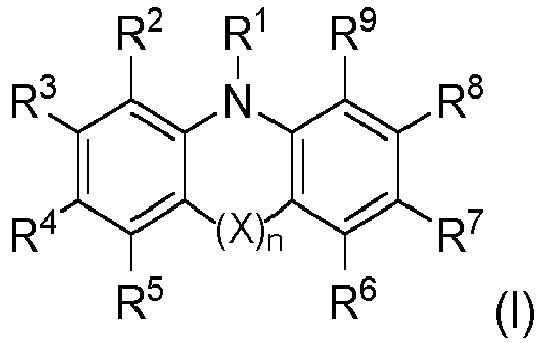
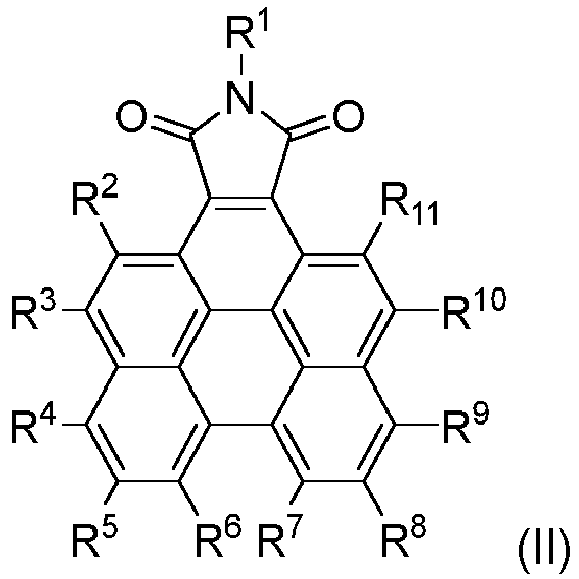

- the reaction medium is irradiated by an external light source, thereby coupling the heterocyclic aromatic ring AR1 of the first reactant to the aromatic ring AR2 of the second reactant by a decarboxylative carbon-carbon cross-coupling reaction.
Description
- The invention relates to a process for preparing heteroaromatic biaryl compounds by a light-assisted decarboxylative carbon-carbon cross-coupling reaction using a specific catalyst composition.
- Biaryl structures, especially those containing heterocycles, form the core of many polymers, ligands, biologically active and functional molecules. Accordingly, efficient synthesis methods for preparing biaryl compounds are needed.
- Several types of (hetero)aryl-(hetero)aryl cross-coupling methods have been developed for the synthesis of biaryl structures using different carbon nucleophiles, namely Suzuki (organoboron reagents), Stille (organotin reagents), Negishi (organozinc reagents), and Kumada (Grignard reagents) cross-coupling reactions.
- Cross-coupling reactions according to Stille, Negishi and Kumada have several disadvantages compared to Suzuki. The drawbacks of Stille reactions are due to the use of organotin reagents, which are highly toxic, costly and have lower functional group tolerance. Negishi reaction tends to result in lower yields, less functional group tolerance and is water and oxygen sensitive. Due to the high reactivity of the Grignard reagent, Kumada couplings have limited functional group tolerance and are prone to protonolysis from even mildly acidic groups, which can be problematic in large syntheses. Accordingly, Suzuki has become the preferred method used in the industry due to its milder conditions, high tolerance toward functional groups, use of less toxic and more stable boron-based nucleophiles, ease of handling and purification from its reaction mixtures.
- Despite the advantages and benefits of Suzuki reaction for biaryl synthesis compared to other methods, Suzuki still suffers from fundamental drawbacks, which limit its application in heterocyclic substrates and base-sensitive substrates.
- For example, some (hetero)aryl boronic acids may quickly deboronate under basic conditions and are thus challenging and problematic coupling partners. Furthermore, high catalyst loading is frequently needed.
- Because of the drawbacks and limited substrates of Suzuki coupling (e.g. difficult preparation of boron reagents, unstable (hetero)aryl boronic acid and use of stoichiometric amounts of expensive organometallic compounds), there are significant benefits in developing an alternative and superior method for the synthesis of biaryls.
- An alternative approach for preparing biaryl compounds is by decarboxylative carbon-carbon cross-coupling (see e.g. a review of L. Liu et al., "Transition metal-catalyzed decarboxylative cross-coupling reactions", Sci China Chem, Vol. 54, 2011, pp. 1670-1687).
- Nilsson et al., "A new biaryl synthesis illustrating a connection between the Ullmann biaryl synthesis and copper-catalyzed decarboxylation", Acta Chem. Scand., 1966, 20 (2), pp. 423-426, describe the biaryl synthesis by copper catalyzed decarboxylation of aromatic acid at 240°C. The drastic conditions and intrinsic limitations of this copper-catalyzed Ullmann cross-coupling reaction preclude the preparative application of this reaction.
- Liu et al., "Copper-Catalyzed Decarboxylative Cross-Coupling of Potassium Polyfluorobenzoates with Aryl Iodides and Bromides", Angewandte Chemie International Edition 2009, 48 (49), 9350-9354, describe a copper-catalyzed reaction with lower temperature of about 130°C. However, the substrate is limited to perfluorinated aromatic acid.
- Palladium-catalyzed carbon-carbon cross-coupling of heteroaromatic carboxylic acids is described by the following publications:
- P. Forgione et al., "Unexpected intermolecular Pd-catalyzed cross-coupling reaction employing heteroaromatic carboxylic acids as coupling partners", Journal of the American Chemical Society, 2006, 128 (35), 11350-11351;
- S. Messaoudi et al., "Palladium-catalyzed decarboxylative coupling of quinolinone-3-carboxylic acids and related heterocyclic carboxylic acids with (hetero) aryl halides", Organic Letters, 2012, 14 (6), 1496-1499;
- F. Bilodeau et al., "Palladium-catalyzed decarboxylative cross-coupling reaction between heteroaromatic carboxylic acids and aryl halides", The Journal of Organic Chemistry, 2010, 75 (5), 1550-1560;
- F. Arroyave et al., "3,4-Propylenedioxypyrrole-based conjugated oligomers via Pd-mediated decarboxylative cross coupling", Organic Letters, 2010, 12 (6), 1328-1331;
- M. Miyasaka et al., "Fluorescent diarylindoles by palladium-catalyzed direct and decarboxylative arylations of carboxyindoles", Chemistry, 2009, 15 (15), 3674-7.
- As opposed to a monometallic catalyst system, the use of Cu/Pd-based bimetallic catalysts for the synthesis of biaryls through decarboxylative carbon-carbon cross-coupling of (hetero)aryl carboxylic acids and (hetero)aryl halides or sulfonates has been described by the following publications:
- L.J. Gooßen et al., "Synthesis of biaryls via catalytic decarboxylative coupling", Science, 2006, 313 (5787), 662-4;
- L.J. Gooßen et al., "Biaryl synthesis via Pd-catalyzed decarboxylative coupling of aromatic carboxylates with aryl halides", Journal of the American Chemical Society, 2007, 129 (15), 4824-4833;
- L.J. Gooßen et al., "Palladium/copper-catalyzed decarboxylative cross-coupling of aryl chlorides with potassium carboxylates", Angewandte Chemie International Edition 2008, 47 (37), 7103-7106;
- D. Hackenberger et al., "Synthesis of 3-Substituted 2-Arylpyridines via Cu/Pd-Catalyzed Decarboxylative Cross-Coupling of Picolinic Acids with (Hetero)Aryl Halides", J. Org. Chem. 2017, 82 (7), 3917-3925;
- L.J. Gooßen et al., "Decarboxylative biaryl synthesis from aromatic carboxylates and aryl triflates", Journal of the American Chemical Society, 2008, 130 (46), 15248-15249;
- D. Hackenberger et al., "Bimetallic Cu/Pd Catalysts with Bridging Aminopyrimidinyl Phosphines for Decarboxylative Cross-Coupling Reactions at Moderate Temperature", ChemCatChem 2015, 7 (21), 3579-3588;
- L.J. Gooßen et al., "Decarboxylative Cross-Coupling of Aryl Tosylates with Aromatic Carboxylate Salts", Angewandte Chemie, 2010, 122 (6), 1129-1132;
- L.J. Gooßen et al., "Decarboxylative cross-coupling of mesylates catalyzed by copper/palladium systems with customized imidazolyl phosphine ligands", Angew. Chem. Int. Ed. Engl. 2013, 52 (10), 2954-8;
- L.J. Gooßen et al., "Catalytic Decarboxylative Cross-Coupling of Aryl Chlorides and Benzoates without Activating ortho Substituents", Angew. Chem. Int. Ed. Engl. 2015, 54 (44), 13130-3.
- F. Bilodeau et al, J. Org. Chem., 2010, 75 (5), pp. 1550-60, describe a method wherein heteroaryl carboxylates are coupled with various aryl halides to form corresponding arylated heteroarenes by a monometallic Pd catalyst system, instead of a bimetallic catalyst system. The reaction occurred at 170°C under microwave irradiation.
- However, high reaction temperatures are very unfavorable since many pharmaceutical compounds tend to change their stereochemistry or even decompose when heated this high.
- Recently, light-induced photoredox catalysis has become a tool for the design and development of a variety of radical reactions. A review on photoredox catalysis in organic chemistry is provided by M.H. Shaw et al., J. Org. Chem., 2016, 81, pp. 6898-6926.
-
US 10,975,171 B2 US 10,975,171 B2 - Dimethyl dihydroacridines as photoredox catalysts in atom transfer radical polymerization of acrylate monomers is described by C. Lim et al., Angew. Chem. Int. Ed. Engl., 2020, 59(8), pp. 3209-3217.
- C. Lim et al., Chem. Eur. J., 2017, 23(46), pp. 10962-10968, describe strongly reducing visible light organic photoredox catalysts (such as N-aryl phenoxazines and dihydrophenazines) as an alternative to iridium and ruthenium photoredox catalysts.
- C. Lim et al, J. Am. Chem. Soc., 2020, 142, 31, pp. 13573-13581, describe a light-induced Birch reduction in the presence of a benzoperylene monoimide acting as a photoredox catalyst.
- A combination of transition metal catalysts and photoredox catalysts is described by J. Twilton et al., "The merger of transition metal and photocatalysis", Nat Rev Chem, 1, 0052 (2017), https://doi. org/10.1038/s41570-017-0052.
- A review on cooperative photoredox and palladium catalysis is provided by N.D.P. Singh et al., Catal. Sci. Technol., 2021, 11, pp. 742-767.
- It remains very challenging to prepare heteroaromatic biaryl compounds (i.e. biaryl compounds wherein at least one of the two aromatic rings being linked to each other is a heterocyclic aromatic ring) under relatively moderate reaction conditions.
- Accordingly, an object of the present invention is to provide a process by which a heterocyclic aromatic ring and a carbocyclic or heterocyclic aromatic ring can be coupled to each other (in particular for preparing heteroaromatic biaryl compounds) even at rather moderate temperatures (e.g. less than 100°C). It is also an object of the present invention to provide a composition which can be used as a catalyst in decarboxylative cross-coupling reactions for coupling a heterocyclic aromatic ring and a carbocyclic or heterocyclic aromatic ring to each other.
- The invention provides a process which comprises
- mixing a first reactant, a second reactant and a catalyst composition, thereby providing a reaction medium, wherein
- the first reactant is a compound which comprises a heterocyclic aromatic ring AR1 to which a carboxylic acid group, a carboxylate group or a carboxylic acid ester group is attached,
- the second reactant is a compound which comprises an aromatic ring AR2 to which a halogen atom (e.g. Cl, Br or I), a pseudohalogen group (e.g. cyano, cyanate or isocyanate) or a sulfonate group (such as a trifluoromethanesulfonate group -O-Tf) is attached,
- the catalyst composition comprises
- (i) a palladium compound which is selected from a palladium salt or a palladium complex or a mixture thereof,
- (ii) a polycyclic compound of Formula (I), (II) or (III):

- n is 0 or 1,
- X is O, C(R10)(R11), or N(R12),
- R' to R12 are selected independently from each other from hydrogen, aryl and C1-10alkyl, wherein aryl and C1-10alkyl are optionally substituted with one or more substituents R13, wherein the one or more substituents R13, if present, are selected independently from each other from C1-6alkyl, C1-6haloalkyl, -OH, -O-(C1-6alkyl), -NO2, -CN, halogen (e.g. F, Cl, Br or I), -NH2, -NH(C1-6alkyl), -N(C1-6alkyl)2, -C(=O)OH, -C(=O)O-(C1-6alkyl), -C(=O)O-phenyl, -C(=O)(C1-6alkyl), -C(=O)-phenyl, -S(O)2NH2, -S(O)2NH(C1-6alkyl), -S(O)2N(C1-6alkyl)(C1-6alkyl), -S-(C1-6alkyl), -S(O)(C1-6alkyl), -S(O)2(C1-6alkyl), -S-(phenyl), -S(O)(phenyl), -S(O)2(phenyl), and a N-carbazolyl of Formula (1.1)


- R' is selected from C1-16alkyl and aryl, each of which is optionally substituted with one or more substituents R12, and/or C1-16alkyl is optionally interrupted by one or more oxygen atoms;
- R2 to R11 are selected independently from each other from hydrogen, C1-16alkyl, aryl and heteroaryl, wherein C1-16alkyl, aryl and heteroaryl are optionally substituted with one or more substituents R12, and/or C1-16alkyl is optionally interrupted by one or more oxygen atoms; or at least two of the residues R2 to R11 which are adjacent to each other form together with the carbon atoms to which they are attached a five- or six-membered aromatic ring and, if present, the remaining residues (i.e. those of the residues R2 to R11 which do not form a ring) are selected independently from each other from hydrogen, C1-16alkyl, aryl and heteroaryl, wherein C1-16alkyl, aryl and heteroaryl are optionally substituted with one or more substituents R12, and/or C1-16alkyl is optionally interrupted by one or more oxygen atoms;
- wherein the one or more substituents R12, if present, are selected independently from each other from C1-6alkyl, C1-6haloalkyl, -OH, -O-(C1-6alkyl), -NO2, -CN, halogen (e.g. F, Cl, Br or I), -NH2, -NH(C1-6alkyl), -N(C1-6alkyl)2, -C(=O)OH, -C(=O)O-(C1-6alkyl), -C(=O)O-phenyl, -C(=O)(C1-6alkyl), -C(=O)-phenyl, - S(O)2NH2, -S(O)2NH(C1-6alkyl), -S(O)2N(C1-6alkyl)(C1-6alkyl), -S-(C1-6alkyl), -S(O)(C1-6alkyl), -S(O)2(C1-6alkyl), -S-(phenyl), -S(O)(phenyl), and -S(O)2(phenyl),

- R' is selected from C1-16alkyl and aryl, each of which is optionally substituted with one or more substituents R11, and/or C1-16alkyl is optionally interrupted by one or more oxygen atoms;
- R2 to R9 are selected independently from each other from hydrogen, C1-16alkyl and aryl, wherein C1-16alkyl and aryl are optionally substituted with one or more substituents R11, and/or C1-16alkyl is optionally interrupted by one or more oxygen atoms;
- R10 is aryl which is optionally substituted with one or more substituents R12,
- wherein the one or more substituents R11, if present, are selected independently from each other from C1-6alkyl, C1-6haloalkyl, -OH, -O-(C1-6alkyl), -NO2, -CN, halogen (e.g. F, Cl, Br or I), -NH2, -NH(C1-6alkyl), -N(C1-6alkyl)2, -C(=O)OH, -C(=O)O-(C1-6alkyl), -C(=O)O-phenyl, -C(=O)(C1-6alkyl), -C(=O)-phenyl, - S(O)2NH2, -S(O)2NH(C1-6alkyl), -S(O)2N(C1-6alkyl)(C1-6alkyl), -S-(C1-6alkyl), -S(O)(C1-6alkyl), -S(O)2(C1-6alkyl), -S-(phenyl), -S(O)(phenyl), and -S(O)2(phenyl),
- wherein the one or more substituents R12, if present, are selected independently from each other from C1-6alkyl and aryl (e.g. phenyl), wherein aryl is optionally substituted with one or more C1-6alkyl;
- irradiating the reaction medium by an external light source, thereby coupling the heterocyclic aromatic ring AR1 of the first reactant to the aromatic ring AR2 of the second reactant by a decarboxylative carbon-carbon cross-coupling reaction.
- In Formula (1.1), ∗- denotes the bond by which the carbazolyl group (i.e. substituent R13) is connected to the aryl or C1-10alkyl residue (i.e. one of the residues R' to R12).
- The product obtained by the process is a heteroaromatic biaryl compound, i.e. a compound which comprises a heterocyclic aromatic ring AR1 and an aromatic ring AR2 (which might be a carbocyclic or heterocyclic aromatic ring) being linked to each other by a carbon-carbon single bond. The heterocyclic aromatic ring AR1 originates from the first reactant, and the aromatic ring AR2 originates from the second reactant.
- The reaction outlined above represents an intermolecular decarboxylative cross-coupling reaction between a first compound and a second compound. Alternatively, the heterocyclic aromatic ring AR1 and the carbocyclic or heterocyclic aromatic ring AR2 might be coupled to each other by an intramolecular decarboxylative cross-coupling reaction (i.e. each of the reactant molecules containing both the heterocyclic aromatic ring AR1 and the carbocyclic or heterocyclic aromatic ring AR2, the rings AR1 and AR2 being linked by a bivalent linker unit).
- Accordingly, the present invention also relates to a process which comprises
- mixing a reactant and a catalyst composition, thereby providing a reaction medium, wherein
- the reactant is a compound which comprises a heterocyclic aromatic ring AR1 to which a carboxylic acid group, a carboxylate group or a carboxylic acid ester group is attached and an aromatic ring AR2 to which a halogen atom (Cl, Br or I), a pseudohalogen group (e.g. cyano, cyanate or isocyanate) or a sulfonate group (e.g. trifluoromethanesulfonate group -O-Tf) is attached,
- the catalyst composition comprises
- (i) a palladium compound which is selected from a palladium salt or a palladium complex or a mixture thereof,
- (ii) a polycyclic compound of Formula (I), (II) or (III):

- n is 0 or 1,
- X is O, C(R10)(R11), or N(R12),
- R' to R12 are selected independently from each other from hydrogen, aryl and C1-10alkyl, wherein aryl and C1-10alkyl are optionally substituted with one or more substituents R13, wherein the one or more substituents R13, if present, are selected independently from each other from C1-6alkyl, C1-6haloalkyl, -OH, -O-(C1-6alkyl), -NO2, -CN, halogen (e.g. F, Cl, Br or I), -NH2, -NH(C1-6alkyl), -N(C1-6alkyl)2, -C(=O)OH, -C(=O)O-(C1-6alkyl), -C(=O)O-phenyl, -C(=O)(C1-6alkyl), -C(=O)-phenyl, -S(O)2NH2, -S(O)2NH(C1-6alkyl), -S(O)2N(C1-6alkyl)(C1-6alkyl), -S-(C1-6alkyl), -S(O)(C1-6alkyl), -S(O)2(C1-6alkyl), -S-(phenyl), -S(O)(phenyl), -S(O)2(phenyl), and a N-carbazolyl of Formula (1.1)


- R' is selected from C1-16alkyl and aryl, each of which is optionally substituted with one or more substituents R12, and/or C1-16alkyl is optionally interrupted by one or more oxygen atoms;
- R2 to R11 are selected independently from each other from hydrogen, C1-16alkyl, aryl and heteroaryl, wherein C1-16alkyl, aryl and heteroaryl are optionally substituted with one or more substituents R12, and/or C1-16alkyl is optionally interrupted by one or more oxygen atoms; or
- at least two of the residues R2 to R11 which are adjacent to each other form together with the carbon atoms to which they are attached a five- or six-membered aromatic ring and, if present, the remaining residues (i.e. those of the residues R2 to R11 which do not form a ring) are selected independently from each other from hydrogen, C1-16alkyl, aryl and heteroaryl, wherein C1-16alkyl, aryl and heteroaryl are optionally substituted with one or more substituents R12, and/or C1-16alkyl is optionally interrupted by one or more oxygen atoms;
- wherein the one or more substituents R12, if present, are selected independently from each other from C1-6alkyl, C1-6haloalkyl, -OH, -O-(C1-6alkyl), -NO2, -CN, halogen, -NH2, -NH(C1-6alkyl), -N(C1-6alkyl)2, -C(=O)OH, -C(=O)O-(C1-6alkyl), -C(=O)O-phenyl, -C(=O)(C1-6alkyl), -C(=O)-phenyl, - S(O)2NH2, -S(O)2NH(C1-6alkyl), -S(O)2N(C1-6alkyl)(C1-6alkyl), -S-(C1-6alkyl), -S(O)(C1-6alkyl), -S(O)2(C1-6alkyl), -S-(phenyl), -S(O)(phenyl), and -S(O)2(phenyl),

- R1 is selected from C1-16alkyl and aryl, each of which is optionally substituted with one or more substituents R11, and/or C1-16alkyl is optionally interrupted by one or more oxygen atoms;
- R2 to R9 are selected independently from each other from hydrogen, C1-16alkyl and aryl, wherein C1-16alkyl and aryl are optionally substituted with one or more substituents R11, and/or C1-16alkyl is optionally interrupted by one or more oxygen atoms;
- R10 is aryl which is optionally substituted with one or more substituents R12,
- wherein the one or more substituents R11, if present, are selected independently from each other from C1-6alkyl, C1-6haloalkyl, -OH, -O-(C1-6alkyl), -NO2, -CN, halogen, -NH2, -NH(C1-6alkyl), -N(C1-6alkyl)2, -C(=O)OH, -C(=O)O-(C1-6alkyl), -C(=O)O-phenyl, -C(=O)(C1-6alkyl), -C(=O)-phenyl, - S(O)2NH2, -S(O)2NH(C1-6alkyl), -S(O)2N(C1-6alkyl)(C1-6alkyl), -S-(C1-6alkyl), -S(O)(C1-6alkyl), -S(O)2(C1-6alkyl), -S-(phenyl), -S(O)(phenyl), and -S(O)2(phenyl),
- wherein the one or more substituents R12, if present, are selected independently from each other from C1-6alkyl and aryl (e.g. phenyl), wherein aryl is optionally substituted with one or more C1-6alkyl;
- irradiating the reaction medium by an external light source, thereby coupling the heterocyclic aromatic ring AR1 and the aromatic ring AR2 of the reactant to each other by a decarboxylative carbon-carbon cross-coupling reaction.
- The present invention also relates to the use of the composition outlined above and described below in further detail (i.e. the composition comprising (i) a palladium compound and (ii) a polycyclic compound of Formula (I), (II) or (III)) as a catalyst for coupling a heterocyclic aromatic ring AR1 and a carbocyclic or heterocyclic aromatic ring AR2 to each other by a light-assisted decarboxylative carbon-carbon cross-coupling reaction. As already mentioned above, the cross-coupling reaction might be an intermolecular cross-coupling or an intramolecular cross-coupling. The preferred use is for synthesis of biaryl compounds.
- As already outlined above, the catalyst composition used in the process of the present invention comprises (i) a palladium compound and (ii) a polycyclic compound of Formula (I), (II) or (III).
- If a heteroaryl carboxylic acid or a carboxylate or an ester thereof is reacted with a (hetero)aryl halide (or a (hetero)aryl pseudohalide or a (hetero)aryl sulfonate) in a reaction medium
- to which the catalyst composition of the present invention has been added and
- which is irradiated by an external light source,
- However, no heteroaromatic biaryl compound is formed from these reactants at moderate reaction temperature if
- the reaction medium comprises the palladium compound and is irradiated by an external light source but no polycyclic compound of component (ii) is present, or
- the reaction medium comprises both the palladium compound and the polycyclic compound of component (ii) but is not irradiated by an external light source.
- As outlined above, the catalyst composition used in the process of the present invention may comprise a polycyclic compound of Formula (I).
- If one or more of the residues R1 to R12 in Formula (I) are aryl, it can be a monoaryl group (e.g. phenyl or naphthyl) or a biaryl group (e.g. biphenyl).
- Preferably, R1 in Formula (I) is aryl, which can be a monoaryl group (e.g. phenyl or naphthyl) or a biaryl group (e.g. biphenyl).
- Preferably, R1 in Formula (I) is selected from phenyl, naphthyl and biphenyl, each of which is optionally substituted with one or more substituents R13, wherein R13 has the same meaning as outlined above. Accordingly, if present, the one or more substituents R13 are selected independently from each other from C1-6alkyl, C1-6haloalkyl, -OH, -O-(C1-6alkyl), -NO2, -CN, halogen, -NH2, -NH(C1-6alkyl), -N(C1-6alkyl)2, -C(=O)OH, -C(=O)O-(C1-6alkyl), -C(=O)O-phenyl, -C(=O)(C1-6alkyl), -C(=O)-phenyl, -S(O)2NH2, -S(O)2NH(C1-6alkyl), -S(O)2N(C1-6alkyl)(C1-6alkyl), -S-(C1-6alkyl), -S(O)(C1-6alkyl), -S(O)2(C1-6alkyl), -S-(phenyl), -S(O)(phenyl), -S(O)2(phenyl), and N-carbazolyl of Formula (1.1)

- If in Formula (I) n is 0, the polycyclic compound has the following Formula (Ia):
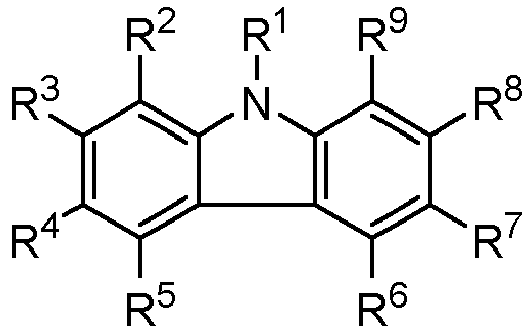
- In a preferred embodiment of Formula (Ia),
- R1 is selected from naphthyl (e.g. 1-naphthyl or 2-naphthyl), phenyl and biphenyl, each of which is optionally substituted with one or more R13;
- R2 to R9 are selected independently from each other from hydrogen, C1-6alkyl, phenyl, biphenyl and naphthyl, wherein phenyl, biphenyl and naphthyl are optionally substituted with one or more substituents R13;
- wherein, if present, the one or more substituents R13, are selected independently from each other from C1-6alkyl, C1-6haloalkyl, -OH, -O-(C1-6alkyl), -NO2, -CN, halogen, -NH2, -NH(C1-6alkyl), -N(C1-6alkyl)2, -C(=O)OH, -C(=O)O-(C1-6alkyl), -C(=O)O-phenyl, -C(=O)(C1-6alkyl), -C(=O)-phenyl, -S(O)2NH2, -S(O)2NH(C1-6alkyl), -S(O)2N(C1-6alkyl)(C1-6alkyl), -S-(C1-6alkyl), -S(O)(C1-6alkyl), -S(O)2(C1-6alkyl), -S-(phenyl), -S(O)(phenyl), -S(O)2(phenyl), and a N-carbazolyl of Formula (1.1)

- An exemplary compound of Formula (Ia) has the following Formula (I-1):

- If in Formula (I) n is 1 and X is O, the polycyclic compound has the following Formula (Ib):

- In a preferred embodiment of Formula (Ib),
- R1 is naphthyl (preferably 1-naphthyl) which is optionally substituted with one or more substituents R13;
- R2, R3, R5, R6, R8 and R9 are selected independently from each other from hydrogen and C1-6alkyl;
- R4 and R7 are selected independently from each other from phenyl, biphenyl and naphthyl, each of which is optionally substituted with one or more substituents R13;
- wherein, if present, the one or more substituents R13 are selected independently from each other from C1-6alkyl, C1-6haloalkyl, -OH, -O-(C1-6alkyl), -NO2, -CN, halogen, -NH2, -NH(C1-6alkyl), -N(C1-6alkyl)2, -C(=O)OH, -C(=O)O-(C1-6alkyl), -C(=O)O-phenyl, -C(=O)(C1-6alkyl), -C(=O)-phenyl, -S(O)2NH2, -S(O)2NH(C1-6alkyl), -S(O)2N(C1-6alkyl)(C1-6alkyl), -S-(C1-6alkyl), -S(O)(C1-6alkyl), -S(O)2(C1-6alkyl), -S-(phenyl), -S(O)(phenyl), and -S(O)2(phenyl).
- Exemplary compounds of Formula (Ib) are those of the following Formulas (I-2), (I-3), (I-4) and (I-5):


- If in Formula (I) n is 1 and X is C(R10)(R11), the polycyclic compound has the following Formula (Ic):

- In a preferred embodiment of Formula (Ic),
- R10 and R11 are selected independently from each other from hydrogen and C1-6alkyl;
- R1 is selected from naphthyl (e.g. 1-naphthyl or 2-naphthyl), phenyl and biphenyl, each of which is optionally substituted with one or more substituents R13,
- R2, R3, R5, R6, R8 and R9 are selected independently from each other from hydrogen and C1-6alkyl;
- R4 and R7 are selected independently from each other from phenyl, naphthyl and biphenyl, each of which is optionally substituted with one or more substituents R13;
- wherein, if present, the one or more substituents R13 are selected independently from each other from C1-6alkyl, C1-6haloalkyl, -OH, -O-(C1-6alkyl), -NO2, -CN, halogen, -NH2, -NH(C1-6alkyl), -N(C1-6alkyl)2, -C(=O)OH, -C(=O)O-(C1-6alkyl), -C(=O)O-phenyl, -C(=O)(C1-6alkyl), -C(=O)-phenyl, -S(O)2NH2, -S(O)2NH(C1-6alkyl), -S(O)2N(C1-6alkyl)(C1-6alkyl), -S-(C1-6alkyl), -S(O)(C1-6alkyl), -S(O)2(C1-6alkyl), -S-(phenyl), -S(O)(phenyl) and -S(O)2(phenyl).
- Exemplary compounds of Formula (Ic) have the following Formulas (I-6.1) to (I-6.7):


- If in Formula (I) n is 1 and X is N(R12), the polycyclic compound has the following Formula (Id):

- In a preferred embodiment of Formula (Id),
- R1 and R12 are selected independently from each other from phenyl, naphthyl (such as 2-naphthyl or 1 naphthyl) and biphenyl, each of which is optionally substituted with one or more substituents R13;
- R2 to R9 are selected independently from each other from hydrogen and C1-6alkyl; or at least two, preferably all of the residues R3, R4, R7, and R8 are phenyl which is optionally substituted with one or more substituents R13 and the residues R2, R5, R6 and R9 are selected independently from each other from hydrogen and C1-6alkyl;
- wherein, if present, the one or more substituents R13 are selected independently from each other from C1-6alkyl, C1-6haloalkyl, -OH, -O-(C1-6alkyl), -NO2, -CN, halogen, -NH2, -NH(C1-6alkyl), -N(C1-6alkyl)2, -C(=O)OH, -C(=O)O-(C1-6alkyl), -C(=O)O-phenyl, -C(=O)(C1-6alkyl), -C(=O)-phenyl, -S(O)2NH2, -S(O)2NH(C1-6alkyl), -S(O)2N(C1-6alkyl)(C1-6alkyl), -S-(C1-6alkyl), -S(O)(C1-6alkyl), -S(O)2(C1-6alkyl), -S-(phenyl), -S(O)(phenyl), and -S(O)2(phenyl).
- Exemplary compounds of Formula (Id) are those of the following Formulas (I-7) and (I-8):


- As outlined above, the catalyst composition used in the process of the present invention may comprise a polycyclic compound of Formula (II).
- As mentioned above, one or more of the residues R2 to R11 in Formula (II) can be heteroaryl. If present, the heteroaryl group preferably comprises or is a five- or six-membered aromatic ring containing one or more (preferably up to three) heteroatoms being selected from oxygen, nitrogen and sulfur. Exemplary heteroaryl groups are pyridinyl, pyridazinyl, pyrimidinyl, pyrazinyl, oxazolyl, thiazolyl, isoxazolyl, isothiazolyl and oxathiazolyl.
- In a preferred embodiment of Formula (II),
- R1 is C1-12alkyl which is optionally substituted with one or more substituents being selected from -OH, halogen (e.g. F, CI), -NH2, -NH(C1-6alkyl) and -N(C1-6alkyl)2;
- R4, R7 and R9 are selected independently from each other from hydrogen, aryl (e.g. phenyl), heteroaryl, C1-6alkyl and -O-(C1-6alkyl), wherein aryl and heteroaryl are optionally substituted with one or more substituents which are selected independently from each other from C1-6alkyl, C1-6haloalkyl (e.g. C1-6fluoroalkyl) and -O-(C1-6alkyl);
- R2, R3, R5, R6, R8, R10, and R11 are selected independently from each other from hydrogen and C1-6alkyl.
- Exemplary compounds of Formula (II) are those of the following Formulas (II-1), (II-2) and (II-3):


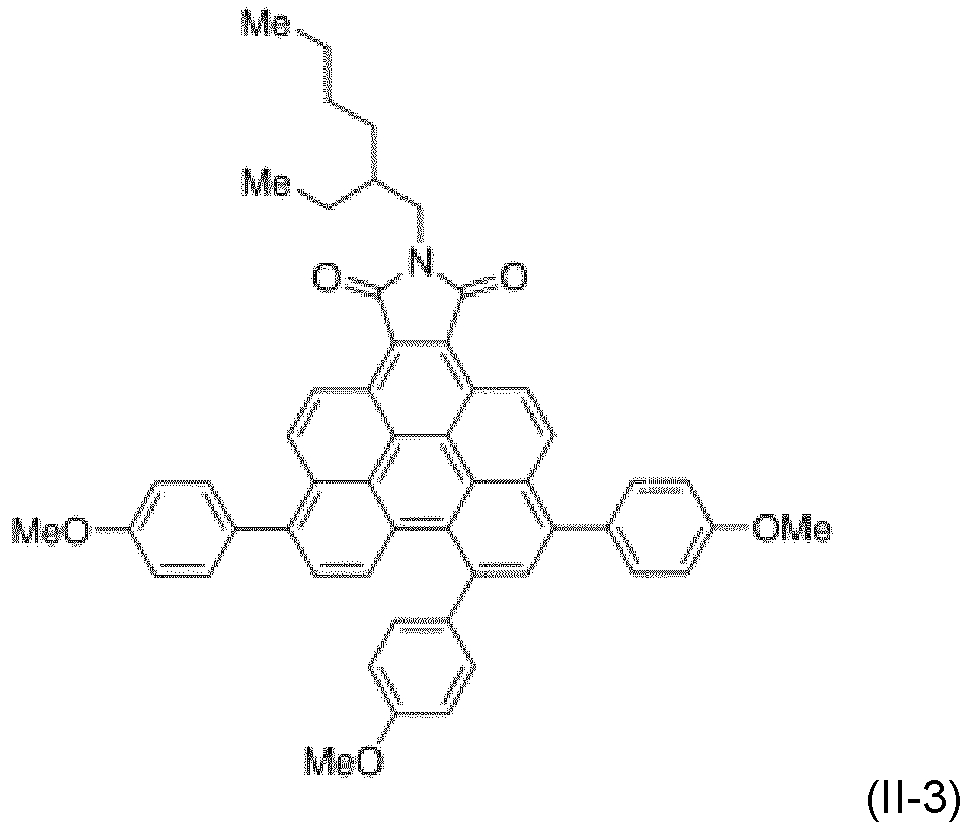
- As outlined above, the catalyst composition used in the process of the present invention may comprise a polycyclic compound of Formula (III).
- The compound of Formula (III) might be associated with one or more charge-compensating anions, e.g. one or more weakly coordinating anions such as [BF4]-, [ClO4]-, [SbF6]- and [PF6]-. However, other anions might be present as well.
- In a preferred embodiment of Formula (III),
- R1 is C1-6alkyl;
- R10 is phenyl which is optionally substituted with one or more substituents being selected independently from each other from C1-6alkyl, C1-6haloalkyl (e.g. C1-6fluoroalkyl) and -O-(C1-6alkyl);
- R2 to R9 are selected independently from each other from hydrogen and C1-6alkyl.
- An exemplary compound of Formula (III) has the following Formula (III-1):

- As already outlined above, in addition to the polycyclic compound of component (ii), i.e. the compound of Formula (I), (II) or (III), the catalyst composition used in the process of the present invention comprises a palladium compound (component (i)) which is selected from a palladium salt or a palladium complex or a mixture thereof.
- If the palladium compound of component (i) is a palladium salt, it might be a palladium acetate (e.g. Pd(OAc)2), a palladium acetylacetonate (e.g. Pd(acac)2) or a palladium halide (such as palladium chloride, palladium bromide or palladium iodide), or any mixture thereof.
- If the palladium compound of component (i) is a palladium complex, it might comprise one or more ligands which are selected from a phosphine, a 1,4-dien-3-one (e.g. dibenzylideneacetone), a N-heterocyclic carbene, an aryl, a nitrile (e.g. acetonitrile, propionitrile or benzonitrile), a polyene (e.g. a polyene having 2 to 4 carbon-carbon double bonds, in particular a cyclic polyene such as cyclooctadiene or cyclooctatetraene), an amine, or any combination thereof. In addition to one or more of these ligands, the palladium complex may comprise other ligands as well, such as a halide, a pseudohalide (e.g. CN- or OCN-), an acetylacetonate or a carboxylate (e.g. acetate).
- If the palladium complex of component (i) does not comprise any phosphine ligand, it will be referred to as a phosphine-free palladium complex. The phosphine-free palladium complex may comprise one or more of the non-phosphine ligands mentioned above, i.e. a 1,4-dien-3-one (e.g. dibenzylideneacetone), a N-heterocyclic carbene, an aryl, a nitrile (e.g. acetonitrile, propionitrile or benzonitrile), a polyene (e.g. a polyene having 2 to 4 carbon-carbon double bonds, in particular a cyclic polyene such as cyclooctadiene (COD) or cyclooctatetraene), an amine, or any combination thereof. In addition to one or more of these ligands, the phosphine-free palladium complex may comprise other ligands as well, such as a halide, a pseudohalide (e.g. CN- or OCN-), an acetylacetonate or a carboxylate (e.g. acetate). An exemplary phosphine-free palladium complex is a palladium complex comprising one or more ligands of dibenzylideneacetone (e.g. bis(dibenzylideneacetone)palladium or tris(dibenzylideneacetone)dipalladium) or a palladium complex comprising one or more ligands of a cyclic polyene such as cyclooctadiene (COD) or cyclooctatetraene (e.g. Pd(COD)Cl2).
- Optionally, the composition of the present invention may comprise a component (iii) which is selected from a phosphine, a bipyridine or a cyclic diamine or a mixture of at least two of these compounds. Preferably, the composition comprises the compound of component (iii) if the palladium compound of component (i) is a palladium salt or a phosphine-free palladium complex (e.g. a phosphine-free palladium complex comprising one or more ligands selected from dibenzylideneacetone and a cyclic polyene such as cyclooctadiene (COD) or cyclooctatetraene). If the compound of component (iii) is added to the reaction medium together with the palladium compound of component (i), it may subsequently coordinate as a ligand to the palladium atom of the palladium compound.
- If the palladium compound of component (i) is a palladium complex which comprises a phosphine as a ligand and the composition further comprises a phosphine compound as component (iii), it is preferred that the phosphine ligand and the phosphine compound of component (iii) are different from each other.
- The palladium compound (in particular the palladium salt or the phosphine-free palladium complex) of component (i) and the compound of component (iii) might be kept in separate containers and brought into contact when performing the decarboxylative cross-coupling reaction, thereby forming in situ a palladium complex.
- According to an exemplary embodiment, the phosphine of component (iii) is of Formula (IV):
P(R1)(R2)(R3) (IV)
wherein - R1 and R2 are selected independently from each other from C1-6 alkyl and C5-7-cycloalkyl (e.g. cyclohexyl);
- R3 is biphenyl which is optionally substituted with one or more R4;
- R4, if present, is C1-6 alkyl, C1-6 alkoxy, phenyl or pyridyl (more preferably C1-6 alkyl or C1-6 alkoxy).
- The phosphine of Formula (IV) may have one of the following Formulas (IV-1) to (IV-6):


P(R1)(R2)(R3) (V)
wherein - each of R1 to R3 is C1-6alkyl; or
- each of R1 to R3 is C5-7cycloalkyl (e.g. cyclohexyl); or
- R1 to R3 are selected independently from each other from aryl (e.g. phenyl) and heteroaryl (e.g. pyridyl) wherein each aryl or heteroaryl is optionally substituted with one or more C1-4 haloalkyl (e.g. -CF3), C1-4 alkyl (e.g. methyl) or C1-4 alkoxy (e.g. methoxy).
- The phosphine of Formula (V) may have one of the following Formulas (V-1) to (V-6):


- According to another exemplary embodiment, the phosphine of component (iii) is a ferrocenyl diphosphine or a xanthenyl diphosphine.
- The ferrocenyl diphosphine may have one of the following Formulas (VI-1) to (VI-2):

- The xanthenyl diphosphine may have the following Formula (VII-1):
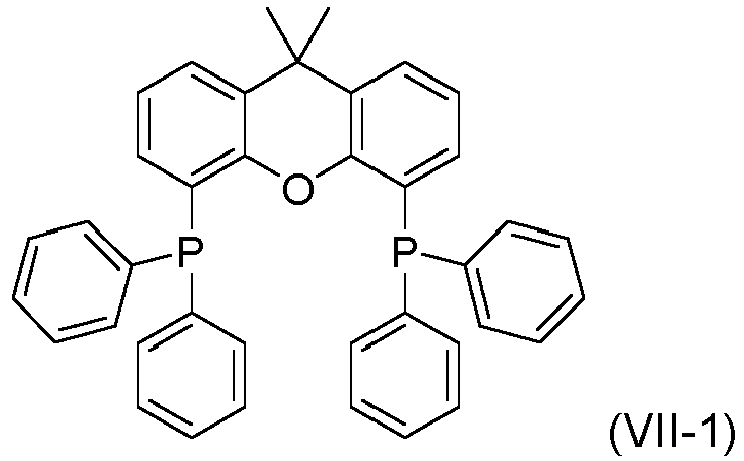
- According to another exemplary embodiment, the phosphine of component (iii) is a diphosphine of Formula (VIII):
(R1)(R2)P-(CH2)n-P(R3)(R4) (VIII)
wherein - n is 1 to 6, more preferably 2 to 4;
- R1, R2, R3 and R4 are selected independently from each other from phenyl and cyclohexyl, wherein phenyl or cyclohexyl is optionally substituted with one or more C1-4alkyl.
- The phosphine of Formula (VIII) may have one of the following Formulas (VIII-1) to (VIII-3):


- According to another exemplary embodiment, the phosphine of component (iii) is a 2,3-dihydrobenzo[d][1,3]oxaphosphole.
- The 2,3-dihydrobenzo[d][1,3]oxaphosphole may have the following Formula (IX):

R1 to R3 are selected independently from each other from hydrogen and C1-4alkyl. - According to an exemplary embodiment, the 2,3-dihydrobenzo[d][1,3]oxaphosphole may have the following Formula (IX-1):

- According to another exemplary embodiment, the phosphine of component (iii) is a diadamantyl-C1-6alkyl-phosphine.
- The diadamantyl-C1-6alkyl-phosphine may have the following Formula (X-1):

- The cyclic diamine of component (iii) is preferably a bicyclic diamine such as 1,4-diazabicyclo[2.2.2]octane (DABCO).
- According to an exemplary embodiment of the present invention, the catalyst composition used in the process of the present invention comprises (i) a palladium salt (such as a palladium acetate, a palladium acetylacetonate or a palladium halide) or a phosphine-free palladium complex (e.g. a phosphine-free palladium complex comprising one or more ligands which are selected from a 1,4-dien-3-one (e.g. dibenzylideneacetone), a N-heterocyclic carbene, an aryl, a nitrile (e.g. acetonitrile, propionitrile or benzonitrile), a polyene (e.g. a polyene having 2 to 4 carbon-carbon double bonds, in particular a cyclic polyene such as cyclooctadiene (COD) or cyclooctatetraene) and an amine, and optionally comprising one or more additional ligands which are selected from a halide, a pseudohalide, an acetylacetonate and a carboxylate (e.g. acetate)); (ii) a polycyclic compound of Formula (Ia), and (iii) a phosphine compound as outlined above, preferably a phosphine of Formula (IV). Preferably, the polycyclic compound has the Formula (I-1) outlined above. A preferred phosphine-free palladium complex comprises one or more ligands selected from dibenzylideneacetone and a cyclic polyene such as cyclooctadiene (COD) or cyclooctatetraene. Preferably, the phosphine compound of component (iii) is of Formula (IV-4) indicated above.
- According to another exemplary embodiment of the present invention, the catalyst composition used in the process of the present invention comprises (i) a palladium salt (such as a palladium acetate, a palladium acetylacetonate or a palladium halide) or a phosphine-free palladium complex (e.g. a phosphine-free palladium complex comprising one or more ligands which are selected from a 1,4-dien-3-one (e.g. dibenzylideneacetone), a N-heterocyclic carbene, an aryl, a nitrile (e.g. acetonitrile, propionitrile or benzonitrile), a polyene (e.g. a polyene having 2 to 4 carbon-carbon double bonds, in particular a cyclic polyene such as cyclooctadiene (COD) or cyclooctatetraene) and an amine, and optionally comprising one or more additional ligands which are selected from a halide, a pseudohalide, an acetylacetonate and a carboxylate (e.g. acetate)); (ii) a polycyclic compound of Formula (Ib), and (iii) a phosphine compound as outlined above (e.g. a phosphine of Formula (IV)).
- According to another exemplary embodiment of the present invention, the catalyst composition used in the process of the present invention comprises (i) a palladium salt (such as a palladium acetate, a palladium acetylacetonate or a palladium halide) or a phosphine-free palladium complex (e.g. a phosphine-free palladium complex comprising one or more ligands which are selected from a 1,4-dien-3-one (e.g. dibenzylideneacetone), a N-heterocyclic carbene, an aryl, a nitrile (e.g. acetonitrile, propionitrile or benzonitrile), a polyene (e.g. a polyene having 2 to 4 carbon-carbon double bonds, in particular a cyclic polyene such as cyclooctadiene (COD) or cyclooctatetraene) and an amine, and optionally comprising one or more additional ligands which are selected from a halide, a pseudohalide, an acetylacetonate and a carboxylate (e.g. acetate)); (ii) a polycyclic compound of Formula (Ic), and (iii) a phosphine compound as outlined above (e.g. a phosphine of Formula (IV)).
- According to another exemplary embodiment of the present invention, the catalyst composition used in the process of the present invention comprises (i) a palladium salt (such as a palladium acetate, a palladium acetylacetonate or a palladium halide) or a phosphine-free palladium complex (e.g. a phosphine-free palladium complex comprising one or more ligands which are selected from a 1,4-dien-3-one (e.g. dibenzylideneacetone), a N-heterocyclic carbene, an aryl, a nitrile (e.g. acetonitrile, propionitrile or benzonitrile), a polyene (e.g. a polyene having 2 to 4 carbon-carbon double bonds, in particular a cyclic polyene such as cyclooctadiene (COD) or cyclooctatetraene) and an amine, and optionally comprising one or more additional ligands which are selected from a halide, a pseudohalide, an acetylacetonate and a carboxylate (e.g. acetate)); (ii) a polycyclic compound of Formula (Id), and (iii) a phosphine compound as outlined above (e.g. a phosphine of Formula (IV)).
- According to another exemplary embodiment of the present invention, the catalyst composition used in the process of the present invention comprises (i) a palladium salt (such as a palladium acetate, a palladium acetylacetonate or a palladium halide) or a phosphine-free palladium complex (e.g. a phosphine-free palladium complex comprising one or more ligands which are selected from a 1,4-dien-3-one (e.g. dibenzylideneacetone), a N-heterocyclic carbene, an aryl, a nitrile (e.g. acetonitrile, propionitrile or benzonitrile), a polyene (e.g. a polyene having 2 to 4 carbon-carbon double bonds, in particular a cyclic polyene such as cyclooctadiene (COD) or cyclooctatetraene) and an amine, and optionally comprising one or more additional ligands which are selected from a halide, a pseudohalide, an acetylacetonate and a carboxylate (e.g. acetate)); (ii) a polycyclic compound of Formula (II), and (iii) a phosphine compound as outlined above (e.g. a phosphine of Formula (IV)).
- According to another exemplary embodiment of the present invention, the catalyst composition used in the process of the present invention comprises (i) a palladium salt (such as a palladium acetate, a palladium acetylacetonate or a palladium halide) or a phosphine-free palladium complex (e.g. a phosphine-free palladium complex comprising one or more ligands which are selected from a 1,4-dien-3-one (e.g. dibenzylideneacetone), a N-heterocyclic carbene, an aryl, a nitrile (e.g. acetonitrile, propionitrile or benzonitrile), a polyene (e.g. a polyene having 2 to 4 carbon-carbon double bonds, in particular a cyclic polyene such as cyclooctadiene (COD) or cyclooctatetraene) and an amine, and optionally comprising one or more additional ligands which are selected from a halide, a pseudohalide, an acetylacetonate and a carboxylate (e.g. acetate)); (ii) a polycyclic compound of Formula (III), and (iii) a phosphine compound as outlined above (e.g. a phosphine of Formula (IV)).
- As already indicated above, if the palladium compound of component (i) is a palladium complex, it may comprise one or more ligands which are selected from a phosphine, a 1,4-dien-3-one (e.g. dibenzylideneacetone), an N-heterocyclic carbene, an aryl, a nitrile (e.g. acetonitrile, propionitrile or benzonitrile), a polyene (e.g. a polyene having 2 to 4 carbon-carbon double bonds, in particular a cyclic polyene such as cyclooctadiene or cyclooctatetraene), an amine, or any combination thereof. In addition to these ligands, the palladium complex may comprise other ligands as well, such as a halide (e.g. Cl-, Br-), a pseudohalide (e.g. CN- or OCN-), an acetylacetonate or a carboxylate (e.g. acetate).
- In an exemplary embodiment of the present invention, the palladium complex of component (i) is of Formula (XI)

- L1 is a bivalent linker;
- R' and R2 are selected independently from each other from hydrogen and C1-4alkyl; or R1 and R2 together with the nitrogen atom to which they are attached form a five- or six-membered ring (which might be an aromatic or non-aromatic ring);
- R3, R4, R5, and R6 are selected independently from each other from hydrogen and C1-4alkyl; or at least two of the residues R3 to R6 which are adjacent to each other form together with the carbon atoms to which they are attached a five- or six-membered aromatic ring and, if present, the remaining residues (i.e. those of the residues R3 to R6 which do not form a ring) are selected independently from each other from hydrogen and C1-4alkyl;
- Lg1 and Lg2 are independently from each other a non-ionic ligand.
- The compound of Formula (XI) might be associated with one or more charge-compensating anions, e.g. one or more weakly coordinating anions such as [BF4]-, [ClO4]-, [SbF6]- and [PF6]-. However, other anions might be present as well.
- Preferably, ligand Lg2 is an N-heterocyclic carbene; and/or ligand Lg1 is a pyridine, a pyrrole, an imidazole, a pyrazole or a pyrimidine, each of which is optionally substituted with one or more halogens.
- According to an exemplary embodiment of Formula (XI),
- L1 is C1-3 alkylene (e.g. -CH2-; -CH2-CH2-; -CH2-CH2-CH2-);
- Lg1 is a pyridine, a pyrrole, an imidazole, a pyrazole or a pyrimidine, each of which is optionally substituted with one or more halogens;
- Lg2 is an N-heterocyclic carbene.
- The N-heterocyclic carbene ligand Lg2 can be of Formula (XII) or Formula (XIII):
-

R3 to R16 are selected independently from each other from hydrogen and C1-4alkyl; or at least two of the residues R3 to R16 which are adjacent to each other form together with the carbon atoms to which they are attached a 5- or 6-membered ring and, if present, the remaining residues (i.e. those of the residues R3 to R16 not forming a ring) are selected independently from each other from hydrogen and C1-4alkyl; -

R3 to R14 are selected independently from each other from hydrogen and C1-4 alkyl; or at least two of the residues R3 to R14 which are adjacent to each other form together with the carbon atoms to which they are attached a 5- or 6-membered ring and, if present, the remaining residues (i.e. those of the residues R3 to R14 not forming a ring) are selected independently from each other from hydrogen and C1-4alkyl. - An exemplary palladium complex of Formula (XI) has the following Formula (XI-1):

- According to an exemplary embodiment of the present invention, the catalyst composition used in the process of the present invention comprises (i) a palladium complex of Formula (XI); and (ii) a polycyclic compound of Formula (Ia). Preferably, ligand Lg2 in Formula (XI) is a N-heterocyclic carbene (e.g. of Formula (XII) or (XIII)); and/or ligand Lg1 is a pyridine, a pyrrole, an imidazole, a pyrazole or a pyrimidine, each of which is optionally substituted with one or more halogens.
- According to another exemplary embodiment of the present invention, the catalyst composition used in the process of the present invention comprises (i) a palladium complex of Formula (XI); and (ii) a polycyclic compound of Formula (Ib). Preferably, ligand Lg2 in Formula (XI) is a N-heterocyclic carbene (e.g. of Formula (XII) or (XIII)); and/or ligand Lg1 is a pyridine, a pyrrole, an imidazole, a pyrazole or a pyrimidine, each of which is optionally substituted with one or more halogens.
- According to another exemplary embodiment of the present invention, the catalyst composition used in the process of the present invention comprises (i) a palladium complex of Formula (XI); and (ii) a polycyclic compound of Formula (Ic). Preferably, ligand Lg2 in Formula (XI) is a N-heterocyclic carbene (e.g. of Formula (XII) or (XIII)); and/or ligand Lg1 is a pyridine, a pyrrole, an imidazole, a pyrazole or a pyrimidine, each of which is optionally substituted with one or more halogens.
- According to another exemplary embodiment of the present invention, the catalyst composition used in the process of the present invention comprises (i) a palladium complex of Formula (XI); and (ii) a polycyclic compound of Formula (Id). Preferably, ligand Lg2 in Formula (XI) is a N-heterocyclic carbene (e.g. of Formula (XII) or (XIII)); and/or ligand Lg1 is a pyridine, a pyrrole, an imidazole, a pyrazole or a pyrimidine, each of which is optionally substituted with one or more halogens.
- According to another exemplary embodiment of the present invention, the catalyst composition used in the process of the present invention comprises (i) a palladium complex of Formula (XI); and (ii) a polycyclic compound of Formula (II). Preferably, ligand Lg2 in Formula (XI) is a N-heterocyclic carbene (e.g. of Formula (XII) or (XIII)); and/or ligand Lg1 is a pyridine, a pyrrole, an imidazole, a pyrazole or a pyrimidine, each of which is optionally substituted with one or more halogens.
- According to another exemplary embodiment of the present invention, the catalyst composition used in the process of the present invention comprises (i) a palladium complex of Formula (XI); and (ii) a polycyclic compound of Formula (III). Preferably, ligand Lg2 in Formula (XI) is a N-heterocyclic carbene (e.g. of Formula (XII) or (XIII)); and/or ligand Lg1 is a pyridine, a pyrrole, an imidazole, a pyrazole or a pyrimidine, each of which is optionally substituted with one or more halogens.
- The palladium complex of component (i) can be of Formula (XIV)

- L1 is a bivalent linker;
- R1 and R2 are selected independently from each other from hydrogen and C1-4 alkyl; or R1 and R2 together with the nitrogen atom to which they are attached form a five- or six-membered ring,
- R3, R4, R5, and R6 are selected independently from each other from hydrogen and C1-4 alkyl; or at least two of the residues R3 to R6 which are adjacent to each other form together with the carbon atoms to which they are attached a five- or six-membered aromatic ring and, if present, the remaining residues (i.e. those of the residues R3 to R6 which do not form a ring) are selected independently from each other from hydrogen and C1-4alkyl,
- Lg1 is a non-ionic ligand,
- Lg2 is an anionic ligand.
- Preferably, the non-ionic ligand Lg1 in Formula (XIV) is a phosphine.
- The anionic ligand Lg2 in Formula (XIV) might be an alkyl sulfonate (e.g. mesylate) or an aryl sulfonate (e.g. tosylate). However, other anionic ligands might be used as well.
- In an exemplary embodiment of Formula (XIV),
- L1 is phenylene (e.g. 1,2-phenylene) or C1-3alkylene (e.g. -CH2-; -CH2-CH2-; -CH2-CH2-CH2-);
- the non-ionic ligand Lg1 is a phosphine;
- the anionic ligand Lg2 is an alkyl sulfonate (e.g. mesylate) or an aryl sulfonate (e.g. tosylate).
- The phosphine ligand Lg1 in Formula (XIV) can be phosphine of Formula (XV):
P(R1)(R2)(R3) (XV)
wherein - R1 and R2 are selected independently from each other from C1-6alkyl, C5-7cycloalkyl (in particular cyclohexyl) and phenyl, wherein phenyl is optionally substituted with one or more C1-4 alkyl;
- R3 is biphenyl or binaphthyl, each of which is optionally substituted with one or more R4;
- R4, if present, is C1-6alkyl, -NH2, -N(H)(C1-6alkyl), -N(C1-6alkyl)2, -P(Phenyl)2, or -O-C1-6alkyl.
- Exemplary palladium complexes of Formula (XIV) can have one of the following Formulas (XIV-1) to Formula (XIV-7):

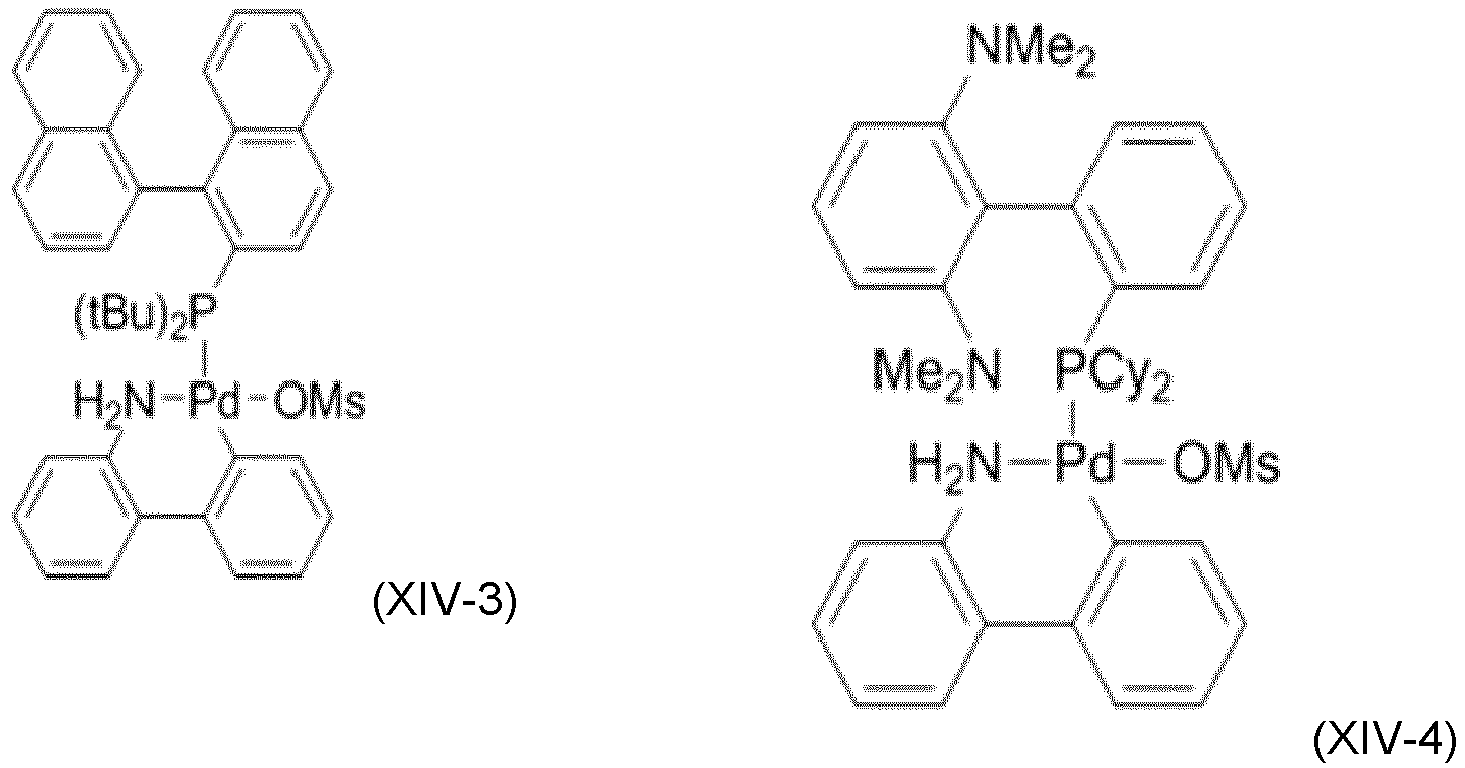


- According to another exemplary embodiment, the phosphine ligand Lg1 in Formula (XIV) is a ferrocenyl diphosphine.
- Exemplary palladium complexes of Formula (XIV) containing a ferrocenyl diphosphine ligand are those of Formula (XIV-8) or Formula (XIV-9):

- According to another exemplary embodiment, the phosphine ligand Lg1 in Formula (XIV) is a trialkyl phosphine (e.g. P(C1-6 alkyl)3). An exemplary palladium complex of Formula (XIV) containing a trialkyl phosphine ligand is the palladium complex of Formula (XIV-10):

- Other exemplary palladium complexes of Formula (XIV) containing a phosphine ligand Lg1 are those of Formula (XIV-11), (XIV-12), or (XIV-13):
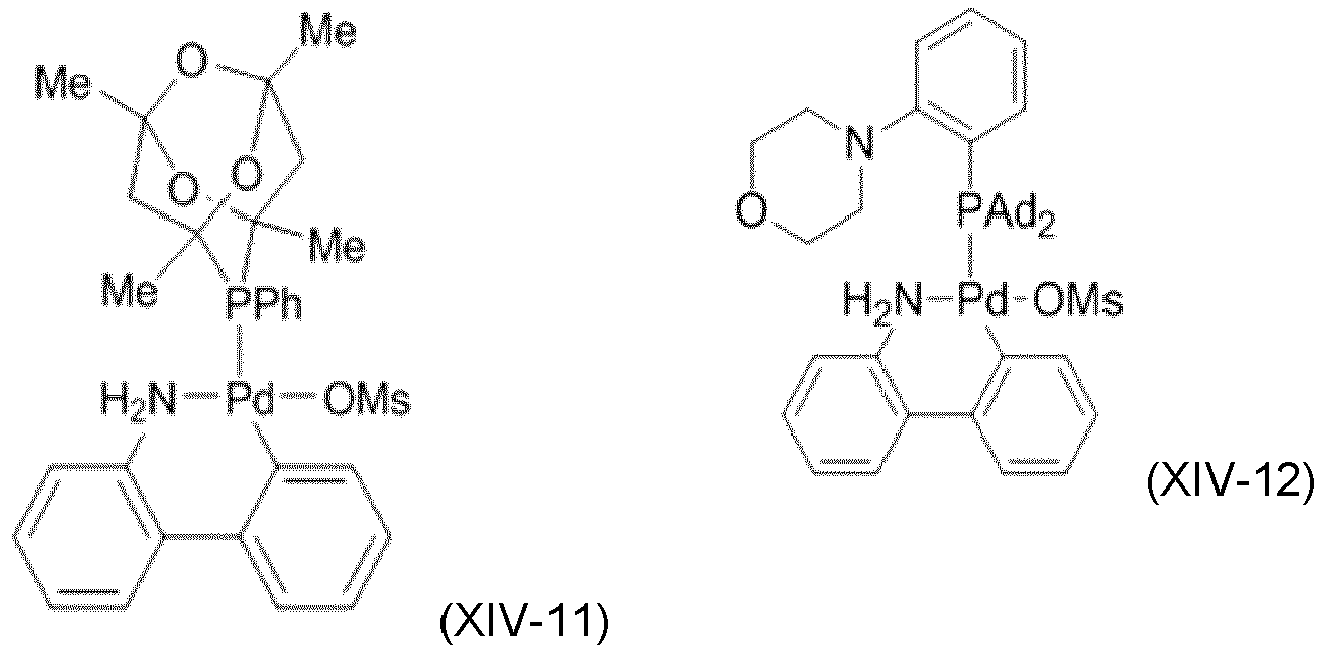

- According to an exemplary embodiment of the present invention, the catalyst composition used in the process of the present invention comprises (i) a palladium complex of Formula (XIV); and (ii) a polycyclic compound of Formula (Ia). Preferably, the non-ionic ligand Lg1 in Formula (XIV) is a phosphine (e.g. a phosphine of Formula (XV), a ferrocenyl diphosphine or a phosphine in one of the Formulas (XIV-11) to (XIV-13)).
- According to another exemplary embodiment of the present invention, the catalyst composition used in the process of the present invention comprises (i) a palladium complex of Formula (XIV); and (ii) a polycyclic compound of Formula (Ib). Preferably, the non-ionic ligand Lg1 in Formula (XIV) is a phosphine (e.g. a phosphine of Formula (XV), a ferrocenyl diphosphine or a phosphine in one of the Formulas (XIV-11) to (XIV-13)).
- According to another exemplary embodiment of the present invention, the catalyst composition used in the process of the present invention comprises (i) a palladium complex of Formula (XIV); and (ii) a polycyclic compound of Formula (Ic). Preferably, the non-ionic ligand Lg1 in Formula (XIV) is a phosphine (e.g. a phosphine of Formula (XV), a ferrocenyl diphosphine or a phosphine in one of the Formulas (XIV-11) to (XIV-13)).
- According to another exemplary embodiment of the present invention, the catalyst composition used in the process of the present invention comprises (i) a palladium complex of Formula (XIV); and (ii) a polycyclic compound of Formula (Id). Preferably, the non-ionic ligand Lg1 in Formula (XIV) is a phosphine (e.g. a phosphine of Formula (XV), a ferrocenyl diphosphine or a phosphine in one of the Formulas (XIV-11) to (XIV-13)).
- According to another exemplary embodiment of the present invention, the catalyst composition used in the process of the present invention comprises (i) a palladium complex of Formula (XIV); and (ii) a polycyclic compound of Formula (II). Preferably, the non-ionic ligand Lg1 in Formula (XIV) is a phosphine (e.g. a phosphine of Formula (XV), a ferrocenyl diphosphine or a phosphine in one of the Formulas (XIV-11) to (XIV-13)).
- According to an exemplary embodiment of the present invention, the catalyst composition used in the process of the present invention comprises (i) a palladium complex of Formula (XIV); and (ii) a polycyclic compound of Formula (III). Preferably, the non-ionic ligand Lg1 in Formula (XIV) is a phosphine (e.g. a phosphine of Formula (XV), a ferrocenyl diphosphine or a phosphine in one of the Formulas (XIV-11) to (XIV-13)).
- The palladium complex of component (i) can be of Formula (XVI):
Pd(L)3-4 (XVI)
wherein - the ligands L are independently from each other a triaryl phosphine (preferably a triphenyl phosphine), wherein each aryl group (which preferably is a phenyl group) is optionally substituted with one or more R1;
- R1, if present, is C1-4haloalkyl (e.g. -CF3), C1-4alkyl (e.g. methyl) or C1-4alkoxy (e.g. methoxy).
- Exemplary palladium complexes of Formula (XVI) are those of Formula (XVI-1) or (XVI-2):

- According to an exemplary embodiment of the present invention, the catalyst composition used in the process of the present invention comprises (i) a palladium complex of Formula (XVI); and (ii) a polycyclic compound of Formula (Ia).
- According to another exemplary embodiment of the present invention, the catalyst composition used in the process of the present invention comprises (i) a palladium complex of Formula (XVI); and (ii) a polycyclic compound of Formula (Ib).
- According to another exemplary embodiment of the present invention, the catalyst composition used in the process of the present invention comprises (i) a palladium complex of Formula (XVI); and (ii) a polycyclic compound of Formula (Ic).
- According to another exemplary embodiment of the present invention, the catalyst composition used in the process of the present invention comprises (i) a palladium complex of Formula (XVI); and (ii) a polycyclic compound of Formula (Id).
- According to another exemplary embodiment of the present invention, the catalyst composition used in the process of the present invention comprises (i) a palladium complex of Formula (XVI); and (ii) a polycyclic compound of Formula (II).
- According to another exemplary embodiment of the present invention, the catalyst composition used in the process of the present invention comprises (i) a palladium complex of Formula (XVI); and (ii) a polycyclic compound of Formula (III).
- The palladium complex of component (i) can be of Formula (XVII):

- Lg-Lg is a chelating ferrocenyl diphosphine ligand,
- X is a halide (e.g. CI).
- Exemplary palladium complexes of Formula (XVII) are those of Formula (XVII-1) or (XVII-2):


- According to an exemplary embodiment of the present invention, the catalyst composition used in the process of the present invention comprises (i) a palladium complex of Formula (XVII); and (ii) a polycyclic compound of Formula (Ia).
- According to another exemplary embodiment of the present invention, the catalyst composition used in the process of the present invention comprises (i) a palladium complex of Formula (XVII); and (ii) a polycyclic compound of Formula (Ib).
- According to another exemplary embodiment of the present invention, the catalyst composition used in the process of the present invention comprises (i) a palladium complex of Formula (XVII); and (ii) a polycyclic compound of Formula (Ic).
- According to another exemplary embodiment of the present invention, the catalyst composition used in the process of the present invention comprises (i) a palladium complex of Formula (XVII); and (ii) a polycyclic compound of Formula (Id).
- According to another exemplary embodiment of the present invention, the catalyst composition used in the process of the present invention comprises (i) a palladium complex of Formula (XVII); and (ii) a polycyclic compound of Formula (II).
- According to another exemplary embodiment of the present invention, the catalyst composition used in the process of the present invention comprises (i) a palladium complex of Formula (XVII); and (ii) a polycyclic compound of Formula (III).
- It might be preferred that no compound comprising a transition metal other than palladium is present in the catalyst composition.
- The molar ratio between the palladium compound (component (i)) and the one or more polycyclic compounds of component (ii) might be in the range of from 100/1 to 1/100, more preferably 10/1 to 1/10.
- As already outlined above, the process based on an intermolecular decarboxylative carbon-carbon cross-coupling reaction comprises
- mixing a first reactant, a second reactant and the catalyst composition described above, thereby providing a reaction medium, wherein the first reactant is a compound which comprises a heterocyclic aromatic ring AR1 to which a carboxylic acid group, a carboxylate group or a carboxylic acid ester group is directly attached, and the second reactant is a compound which comprises an aromatic ring AR2 to which a halogen atom (e.g. Cl, Br or I), a pseudohalogen group (e.g. cyano, cyanate or isocyanate) or a sulfonate group (e.g. trifluoromethanesulfonate group -O-Tf) is directly attached,
- irradiating the reaction medium by an external light source, thereby coupling the heterocyclic aromatic ring AR1 of the first reactant to the aromatic ring AR2 of the second reactant by a decarboxylative carbon-carbon cross-coupling reaction.
- The product obtained by the process is a heteroaromatic biaryl compound, i.e. a compound which comprises a heterocyclic aromatic ring AR1 and an aromatic ring AR2 (which might be a carbocyclic or heterocyclic aromatic ring) being linked to each other by a carbon-carbon single bond. The heterocyclic aromatic ring AR1 originates from the first reactant, and the aromatic ring AR2 originates from the second reactant.
- Preferably, the heterocyclic aromatic ring AR1 of the first reactant is 5- or 6-membered aromatic ring which contains one or more heteroatoms (e.g. up to three heteroatoms) being selected from nitrogen, oxygen and sulfur. The carboxylic acid group, carboxylate group or carboxylic acid ester group is attached to a carbon ring atom of the heterocyclic aromatic ring. Optionally, a further 5- or 6-membered aromatic ring might be fused to the heterocyclic aromatic ring, thereby forming a polycyclic aromatic ring system.
- Exemplary first reactants include a substituted or unsubstituted pyridine carboxylic acid or a carboxylate or an ester thereof, a substituted or unsubstituted benzopyridine carboxylic acid or a carboxylate or an ester thereof, a pyridazine carboxylic acid or a carboxylate or an ester thereof, a benzopyridazine carboxylic acid or a carboxylate or an ester thereof, a pyrimidine carboxylic acid or a carboxylate or an ester thereof, a benzopyrimidine carboxylic acid or a carboxylate or an ester thereof, a pyrazine carboxylic acid or a carboxylate or an ester thereof, a benzopyrazine carboxylic acid or a carboxylate or an ester thereof, a pyrrole carboxylic acid or a carboxylate or an ester thereof, a benzopyrrole carboxylic acid or a carboxylate or an ester thereof, an imidazole carboxylic acid or a carboxylate or an ester thereof, a benzimidazole carboxylic acid or a carboxylate or an ester thereof, an oxazole carboxylic acid or a carboxylate or an ester thereof, a benzoxazole carboxylic acid or a carboxylate or an ester thereof, an isoxazole carboxylic acid or a carboxylate or an ester thereof, a benzisoxazole carboxylic acid or a carboxylate or an ester thereof, a thiazole carboxylic acid or a carboxylate or an ester thereof, a benzothiazole carboxylic acid or a carboxylate or an ester thereof, an isothiazole carboxylic acid or a carboxylate or an ester thereof, and a benzisothiazole carboxylic acid or a carboxylate or an ester thereof.
- A carboxylic acid group is represented by the following formula: -COOH
- A carboxylate group is a deprotonated carboxylic acid group and is therefore represented by the following formula: -COO-
- If a carboxylic acid ester group is attached to the heterocyclic aromatic ring of the first reactant, it may have the following formula (XVIII):
-C(O)O-A (XVIII)
wherein the residue A is derived from a N-hydroxy compound. - Accordingly, the carboxylic acid ester group might be obtained by reacting a carboxylic acid group with a N-hydroxy compound.
- Exemplary N-hydroxy compounds from which residue A of the carboxylic acid ester group might be derived include oximes (ketoximes or aldoximes), N-hydroxy phthalimides, N-hydroxypyridine-2-thiones, and N-hydroxy benzotriazoles.
- According to an exemplary embodiment, the residue A in Formula (XVIII) might have one of the following Formulas (XIX-1) to (XIX-6):
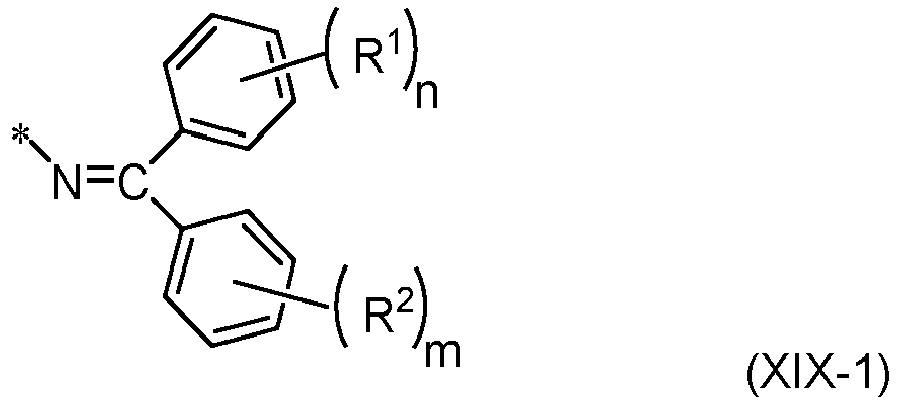
- n is 0 or 1,
- m is 0 or 1,
- R' and R2 are selected independently from each other from halogen (e.g. Cl or F) and halo-C1-4alkyl (e.g. CF3);
- R1 is hydrogen or CF3,
- R2 is hydrogen or fluoro;
- n is an integer from 0 to 4,
- R is halogen (e.g. CI).
- In Formulas (XIX-1) to (XIX-6), ∗- denotes the bond by which residue A is connected to the carboxylic acid ester group.
- If n is 0 in Formula (XIX-1) or (XIX-6) or m is 0 in Formula (XIX-1), the aromatic ring is unsubstituted.
- It might be preferred that the first reactant does not comprise a boron-carbon bond, a tin-carbon bond, a zinc-carbon bond or a magnesium-carbon bond.
- The aromatic ring AR2 of the second reactant is preferably a 5- or 6-membered aromatic ring. It can be a carbocyclic ring (i.e. a ring made of carbon atoms only) or heterocyclic aromatic ring. Optionally, it is fused to a further 5- or 6-membered aromatic ring, thereby forming a polycyclic aromatic ring system.
- Attached to the aromatic ring AR2 of the second reactant is a halogen atom (e.g. Cl, Br or I), a pseudohalogen group (e.g. cyano, cyanate or isocyanate) or a sulfonate group (such as a trifluoromethanesulfonate group -O-Tf).
- If the aromatic ring AR2 is a heterocyclic aromatic ring, it is preferably a 5- or 6-membered aromatic ring which contains one or more (e.g. up to three) heteroatoms being selected from nitrogen, oxygen and sulfur. The halogen atom, the pseudohalogen group or the sulfonate group is attached to a carbon ring atom of the heterocyclic aromatic ring.
- It might be preferred that neither the first reactant nor the second reactant comprises a boron-carbon bond, a tin-carbon bond, a zinc-carbon bond or a magnesium-carbon bond.
- During the cross-coupling reaction, the carboxylic acid group, the carboxylate group or the carboxylic acid ester group is split off from the heterocyclic aromatic ring AR1; and the halogen atom, the pseudohalogen group or the sulfonate group is split off from the aromatic ring AR2; and the aromatic rings AR1 and AR2 are coupled to each other via a single bond between the carbon ring atom of AR1 to which the carboxylic acid group, the carboxylate group or the carboxylic acid ester group was attached and the carbon ring atom of AR2 to which the halogen atom, the pseudohalogen group or the sulfonate group was attached.
- The reaction outlined above represents an intermolecular decarboxylative cross-coupling reaction between a first reactant and a second reactant. Typically, the first reactant and the second reactant differ from each other (i.e. they are compounds which differ in chemical structure).
- Alternatively, the heterocyclic aromatic ring AR1 and the carbocyclic or heterocyclic aromatic ring AR2 might be coupled to each other by an intramolecular decarboxylative cross-coupling reaction (i.e. each of the reactant molecules containing both the heterocyclic aromatic ring AR1 and the carbocyclic or heterocyclic aromatic ring AR2).
- The process based on an intramolecular decarboxylative carbon-carbon cross-coupling reaction comprises
- mixing a reactant and the catalyst composition described above, thereby providing a reaction medium, wherein the reactant is a compound which comprises a heterocyclic aromatic ring AR1 to which a carboxylic acid group, a carboxylate group or a carboxylic acid ester group is attached and an aromatic ring AR2 to which a halogen atom (e.g. Cl, Br or I), a pseudohalogen group (e.g. cyano, cyanate or isocyanate) or a sulfonate group (e.g. trifluoromethanesulfonate group -O-Tf) is attached,
- irradiating the reaction medium by an external light source, thereby coupling the heterocyclic aromatic ring AR1 and the aromatic ring AR2 of the reactant to each other by a decarboxylative carbon-carbon cross-coupling reaction.
- The aromatic ring AR2 can be a carbocyclic aromatic ring or a heterocyclic aromatic ring.
- The preferred heterocyclic aromatic ring AR1 and (carbocyclic or heterocyclic) aromatic ring AR2 of the intramolecular coupling reaction correspond to those of the intermolecular coupling reaction. However, for the intramolecular coupling reaction, each of the reactant molecules contains both the aromatic ring AR1 and the aromatic ring AR2 linked to each other by a bivalent linker unit L.
- It might be preferred that the reactant does not comprise a boron-carbon bond, a tin-carbon bond, a zinc-carbon bond or a magnesium-carbon bond.
- The following statements apply to both the intermolecular and the intramolecular decarboxylative carbon-carbon cross-coupling reactions.
- Typically, the reactant(s) and the catalyst composition are mixed with each other in a solvent. The solvent may comprise a polar aprotic solvent. The solvent may comprise a high-boiling liquid having a boiling point of at least 120°C. Exemplary polar aprotic solvents include dimethylsulfoxide (DMSO), dimethylformamide (DMF), dimethylacetamide, sulfolane and ethylacetate. The reactant(s) and the components of the catalyst composition (i.e. components (i) to (ii) and optionally component (iii)) can be added to the solvent in any order. Just as an example, each of the components of the catalyst composition might be added separately to the solvent, or the components of the catalyst composition are pre-mixed and the pre-mixture is subsequently added to the solvent.
- Typically, the external light source is a source which generates artificial light.
- The external light source might be a lamp such as an UV or UV/VIS lamp, a LED, a laser, or any combination of two or more of these external light sources.
- The light emitted by the external light source may have a wavelength in the range of from 254 nm to 800 nm, preferably 360 nm to 550 nm. The light can be a monochromatic light; or may cover a continuous wavelength spectrum (e.g. in the UV and/or visible spectrum). The light reaching the reaction medium may have an irradiance of 10 to 2000 milliwatts per square centimeter. However, lower or higher irradiance values can be used as well.
- Optionally, the reaction medium might be heated to a temperature of 40°C to 90°C, more preferably 50°C to 80°C, for assisting the decarboxylative carbon-carbon cross-coupling reaction. However, lower or higher reaction temperatures might be used as well.
- It might be preferred that no compound comprising a transition metal other than palladium is present in the reaction medium.
- Furthermore, the present invention relates to the use of the catalyst composition described above as a catalyst for coupling a heterocyclic aromatic ring AR1 and a carbocyclic or heterocyclic aromatic ring AR2 to each other by a light-assisted decarboxylative carbon-carbon cross-coupling reaction. As already mentioned above, the cross-coupling reaction might be an intermolecular cross-coupling or an intramolecular cross-coupling. The preferred use is for synthesis of biaryl compounds. As known to the skilled person, "light assisted" means that the reaction medium in which the decarboxylative cross-coupling reaction is carried out is irradiated by an external light source (e.g. lamps such as UV or UV/VIS lamps, LEDs, laser, etc.).
- In Inventive Example 1 (IE1), the following reactants were used:
- Picolinic acid ester (First Reactant), i.e. a compound which comprises a heterocyclic aromatic ring AR1 to which a carboxylic acid ester group is attached; and
- 4-bromobenzotrifluoride (Second Reactant), i.e. a compound which comprises an aromatic ring AR2 to which a halogen atom is attached.
- The picolinic acid ester had the following chemical formula:

- The catalyst composition used in Inventive Example 1 contained (i) palladium acetylacetonate (i.e. a palladium compound), (ii) a polycyclic compound of Formula (I-1) outlined above, and (iii) tBuXPhos which is a commercially available phosphine of Formula (IV-4) outlined above.
- The solvent in which the first and second reactants and the components of the catalyst composition were mixed was ethylacetate.
- The reaction medium was irradiated with a blue light emitting diode.
- The reactants and the desired reaction product to be obtained via decarboxylative cross-coupling are illustrated by the following reaction scheme:

- Details of the preparation process are as follows:
To a ½ dram vial containing a stir bar, 150 µL of 0.005 M stock solution of the polycyclic compound of Formula (I-1) in CH3CN was introduced; the solvent was then evaporated in a vacuum oven leaving behind the polycyclic compound of Formula (I-1). 38.1 mg of the picolinic acid ester and 1.1 mg of Pd(acac)2 were then added to the vial. The vial was transferred to a glovebox containing a nitrogen atmosphere. In the glovebox, degassed reagents of 10.5 µL of 4-bromobenzotrifluoride, 75 µL of 0.05 M stock solution of t-BuXPhos in dioxane, and 675 µL of ethylacetate solvent were added to the vial. The vial was tightly capped, sealed with parafilm, and removed from the glovebox. Upon exiting the glovebox, an electrical tape was wrapped around the cap of the vial to ensure that oxygen contamination did not occur. The vial was then placed in the Hepatochem photoreactor setup, where temperature (at 50°C) was controlled by a recirculating coolant (propylene glycol/water=1/1, v/v). The vial was illuminated with a Kessil Tuna Blue LED light (A160WE). - After 16 hours, the reaction vial was allowed to cool to room temperature before being opened. 50 µL of 1.6 M biphenyl in ethylacetate (internal standard for HPLC analysis) was added to the vial. For HPLC analysis, 75 µL of the mixture was taken from the vial, filtered through a silica column, and washed with 1425 µL of CH3CN; all solution was collected for HPLC analysis. For 19F-NMR analysis, 20 µL of the mixture was taken from the vial and added 600 µL of CDCl3 (containing 0.1% v/v fluorobenzene as internal standard).
- 19F-NMR analysis confirmed that the desired decarboxylative cross-coupling reaction product 2-(4-(trifluoromethyl)phenyl)pyridine product was formed.
- In Comparative Example 1a (CE1a), the same procedure as in Inventive Example 1 was applied, except that the reaction medium was not irradiated by the LED.
- 19F-NMR analysis confirmed that the desired decarboxylative cross-coupling reaction product 2-(4-(trifluoromethyl)phenyl)pyridine product was not formed.
- In Comparative Example 1b (CE1b), the same procedure as in Inventive Example 1 was applied, except that the compound of component (ii), i.e. the polycyclic compound of Formula (I-1), was not added to the reaction medium.
- 19F-NMR analysis confirmed that the desired decarboxylative cross-coupling reaction product 2-(4-(trifluoromethyl)phenyl)pyridine product was not formed.
- The results of Inventive Example 1 and Comparative Examples 1a and 1b are summarized in Table 1.
Table 1: Results of IE1, CE1a and CE1b Reactants Catalyst Composition Irradation by LED? Desired reaction product formed? IE1 Picolinic acid ester and 4-bromobenzotrifluoride (i) Pd(acac)2 Yes Yes (ii) polycyclic compound of Formula (I-1) (iii) a phosphine (tBuXPhos) CE1a Picolinic acid ester and 4-bromobenzotrifluoride (i) Pd(acac)2 No No (ii) polycyclic compound of Formula (I-1) (iii) a phosphine (tBuXPhos) CE1b Picolinic acid ester and 4-bromobenzotrifluoride (i) Pd(acac)2 Yes No (iii) a phosphine (tBuXPhos) - From the Inventive Example 1 and the Comparative Examples 1a and 1b, the following can be concluded:
If a heteroaryl carboxylic acid or a carboxylate or an ester thereof is reacted with a (hetero)aryl halide (or a (hetero)aryl pseudohalide or a (hetero)aryl sulfonate) in a reaction medium - to which the catalyst composition of the present invention has been added and
- which is irradiated by an external light source,
- However, no heteroaromatic biaryl compound is formed from these reactants at moderate reaction temperature if
- the reaction medium comprises the palladium compound and is irradiated by an external light source but no compound of component (ii) is present, or
- the reaction medium comprises both the palladium compound and at least one compound of component (ii) but is not irradiated by an external light source.
- While the invention has been described in detail and with reference to specific embodiments thereof, it will be apparent to one skilled in the art that various changes and modifications can be made therein without departing from the spirit and scope thereof. Thus, it is intended that the invention covers the modifications and variations of this invention provided they come within the scope of the appended claims and their equivalents.
- As described above, the present invention relates to the following embodiments {01} to {57}:
- Embodiment {01} relates to a process which comprises
- mixing a first reactant, a second reactant and a catalyst composition, thereby providing a reaction medium, wherein
- the first reactant is a compound which comprises a heterocyclic aromatic ring AR1 to which a carboxylic acid group, a carboxylate group or a carboxylic acid ester group is attached,
- the second reactant is a compound which comprises an aromatic ring AR2 to which a halogen atom (e.g. Cl, Br or I), a pseudohalogen group (e.g. cyano, cyanate or isocyanate) or a sulfonate group (such as a trifluoromethanesulfonate group -O-Tf) is attached,
- the catalyst composition comprises
- (i) a palladium compound which is selected from a palladium salt or a palladium complex or a mixture thereof,
- (ii) a polycyclic compound of Formula (I), (II) or (III):

- n is 0 or 1,
- X is O, C(R10)(R11), or N(R12),
- R' to R12 are selected independently from each other from hydrogen, aryl and C1-10alkyl, wherein aryl and C1-10alkyl are optionally substituted with one or more substituents R13, wherein the one or more substituents R13, if present, are selected independently from each other from C1-6alkyl, C1-6haloalkyl, -OH, -O-(C1-6alkyl), -NO2, -CN, halogen, -NH2, -NH(C1-6alkyl), -N(C1-6alkyl)2, -C(=O)OH, -C(=O)O-(C1-6alkyl), -C(=O)O-phenyl, -C(=O)(C1-6alkyl), -C(=O)-phenyl, -S(O)2NH2, -S(O)2NH(C1-6alkyl), -S(O)2N(C1-6alkyl)(C1-6alkyl), -S-(C1-6alkyl), -S(O)(C1-6alkyl), -S(O)2(C1-6alkyl), -S-(phenyl), -S(O)(phenyl), -S(O)2(phenyl), and a N-carbazolyl of Formula (1.1)


- R1 is selected from C1-16alkyl and aryl, each of which is optionally substituted with one or more substituents R12, and/or C1-16alkyl is optionally interrupted by one or more oxygen atoms;
- R2 to R11 are selected independently from each other from hydrogen, C1-16alkyl, aryl and heteroaryl, wherein C1-16alkyl, aryl and heteroaryl are optionally substituted with one or more substituents R12, and/or C1-16alkyl is optionally interrupted by one or more oxygen atoms; or at least two of the residues R2 to R11 which are adjacent to each other form together with the carbon atoms to which they are attached a five- or six-membered aromatic ring and, if present, the remaining residues (i.e. those of the residues R2 to R11 which do not form a ring) are selected independently from each other from hydrogen, C1-16alkyl, aryl and heteroaryl, wherein C1-16alkyl, aryl and heteroaryl are optionally substituted with one or more substituents R12, and/or C1-16alkyl is optionally interrupted by one or more oxygen atoms;
- wherein the one or more substituents R12, if present, are selected independently from each other from C1-6alkyl, C1-6haloalkyl, -OH, -O-(C1-6alkyl), -NO2, -CN, halogen, -NH2, -NH(C1-6alkyl), -N(C1-6alkyl)2, -C(=O)OH, -C(=O)O-(C1-6alkyl), -C(=O)O-phenyl, -C(=O)(C1-6alkyl), -C(=O)-phenyl, - S(O)2NH2, -S(O)2NH(C1-6alkyl), -S(O)2N(C1-6alkyl)(C1-6alkyl), -S-(C1-6alkyl), -S(O)(C1-6alkyl), -S(O)2(C1-6alkyl), -S-(phenyl), -S(O)(phenyl), and -S(O)2(phenyl),

- R1 is selected from C1-16alkyl and aryl, each of which is optionally substituted with one or more substituents R11, and/or C1-16alkyl is optionally interrupted by one or more oxygen atoms;
- R2 to R9 are selected independently from each other from hydrogen, C1-16alkyl and aryl, wherein C1-16alkyl and aryl are optionally substituted with one or more substituents R11, and/or C1-16alkyl is optionally interrupted by one or more oxygen atoms;
- R10 is aryl which is optionally substituted with one or more substituents R12;
- wherein the one or more substituents R11, if present, are selected independently from each other from C1-6alkyl, C1-6haloalkyl, -OH, -O-(C1-6alkyl), -NO2, -CN, a halogen atom, -NH2, -NH(C1-6alkyl), -N(C1-6alkyl)2, -C(=O)OH, -C(=O)O-(C1-6alkyl), -C(=O)O-phenyl, -C(=O)(C1-6alkyl), -C(=O)-phenyl, - S(O)2NH2, -S(O)2NH(C1-6alkyl), -S(O)2N(C1-6alkyl)(C1-6alkyl), -S-(C1-6alkyl), -S(O)(C1-6alkyl), -S(O)2(C1-6alkyl), -S-(phenyl), -S(O)(phenyl), and -S(O)2(phenyl);
- wherein the one or more substituents R12, if present, are selected independently from each other from C1-6alkyl and aryl (e.g. phenyl), wherein aryl is optionally substituted with one or more C1-6alkyl;
- irradiating the reaction medium by an external light source, thereby coupling the heterocyclic aromatic ring AR1 of the first reactant to the aromatic ring AR2 of the second reactant by a decarboxylative carbon-carbon cross-coupling reaction.
- mixing a first reactant, a second reactant and a catalyst composition, thereby providing a reaction medium, wherein
- Embodiment {02} relates to a process which comprises
- mixing a reactant and a catalyst composition, thereby providing a reaction medium, wherein
- the reactant is a compound which comprises a heterocyclic aromatic ring AR1 to which a carboxylic acid group, a carboxylate group or a carboxylic acid ester group is attached and an aromatic ring AR2 to which a halogen atom (Cl, Br or I), a pseudohalogen group (e.g. cyano, cyanate or isocyanate) or a sulfonate group (e.g. trifluoromethanesulfonate group -O-Tf) is attached,
- the catalyst composition comprises
- (i) a palladium compound which is selected from a palladium salt or a palladium complex or a mixture thereof,
- (ii) a polycyclic compound of Formula (I), (II) or (III):

- n is 0 or 1,
- X is O, C(R10)(R11), or N(R12),
- R1 to R12 are selected independently from each other from hydrogen, aryl and C1-10alkyl, wherein aryl and C1-10alkyl are optionally substituted with one or more substituents R13, wherein the one or more substituents R13, if present, are selected independently from each other from C1-6alkyl, C1-6haloalkyl, -OH, -O-(C1-6alkyl), -NO2, -CN, halogen, -NH2, -NH(C1-6alkyl), -N(C1-6alkyl)2, -C(=O)OH, -C(=O)O-(C1-6alkyl), -C(=O)O-phenyl, -C(=O)(C1-6alkyl), -C(=O)-phenyl, -S(O)2NH2, -S(O)2NH(C1-6alkyl), -S(O)2N(C1-6alkyl)(C1-6alkyl), -S-(C1-6alkyl), -S(O)(C1-6alkyl), -S(O)2(C1-6alkyl), -S-(phenyl), -S(O)(phenyl), -S(O)2(phenyl), and a N-carbazolyl of Formula (1.1)


- R1 is selected from C1-16alkyl and aryl, each of which is optionally substituted with one or more substituents R12, and/or C1-16alkyl is optionally interrupted by one or more oxygen atoms;
- R2 to R11 are selected independently from each other from hydrogen, C1-16alkyl, aryl and heteroaryl, wherein C1-16alkyl, aryl and heteroaryl are optionally substituted with one or more substituents R12, and/or C1-16alkyl is optionally interrupted by one or more oxygen atoms; or at least two of the residues R2 to R11 which are adjacent to each other form together with the carbon atoms to which they are attached a five- or six-membered aromatic ring and, if present, the remaining residues (i.e. those of the residues R2 to R11 which do not form a ring) are selected independently from each other from hydrogen, C1-16alkyl, aryl and heteroaryl, wherein C1-16alkyl, aryl and heteroaryl are optionally substituted with one or more substituents R12, and/or C1-16alkyl is optionally interrupted by one or more oxygen atoms;
- wherein the one or more substituents R12, if present, are selected independently from each other from C1-6alkyl, C1-6haloalkyl, -OH, -O-(C1-6alkyl), -NO2, -CN, halogen, -NH2, -NH(C1-6alkyl), -N(C1-6alkyl)2, -C(=O)OH, -C(=O)O-(C1-6alkyl), -C(=O)O-phenyl, -C(=O)(C1-6alkyl), -C(=O)-phenyl, - S(O)2NH2, -S(O)2NH(C1-6alkyl), -S(O)2N(C1-6alkyl)(C1-6alkyl), -S-(C1-6alkyl), -S(O)(C1-6alkyl), -S(O)2(C1-6alkyl), -S-(phenyl), -S(O)(phenyl), and -S(O)2(phenyl),

- R1 is selected from C1-16alkyl and aryl, each of which is optionally substituted with one or more substituents R11, and/or C1-16alkyl is optionally interrupted by one or more oxygen atoms;
- R2 to R9 are selected independently from each other from hydrogen, C1-16alkyl and aryl, wherein C1-16alkyl and aryl are optionally substituted with one or more substituents R11, and/or C1-16alkyl is optionally interrupted by one or more oxygen atoms;
- R10 is aryl which is optionally substituted with one or more substituents R12;
- wherein the one or more substituents R11, if present, are selected independently from each other from C1-6alkyl, C1-6haloalkyl, -OH, -O-(C1-6alkyl), -NO2, -CN, halogen, -NH2, -NH(C1-6alkyl), -N(C1-6alkyl)2, -C(=O)OH, -C(=O)O-(C1-6alkyl), -C(=O)O-phenyl, -C(=O)(C1-6alkyl), -C(=O)-phenyl, - S(O)2NH2, -S(O)2NH(C1-6alkyl), -S(O)2N(C1-6alkyl)(C1-6alkyl), -S-(C1-6alkyl), -S(O)(C1-6alkyl), -S(O)2(C1-6alkyl), -S-(phenyl), -S(O)(phenyl), and -S(O)2(phenyl);
- wherein the one or more substituents R12, if present, are selected independently from each other from C1-6alkyl and aryl (e.g. phenyl), wherein aryl is optionally substituted with one or more C1-6alkyl;
- irradiating the reaction medium by an external light source, thereby coupling the heterocyclic aromatic ring AR1 and the aromatic ring AR2 of the reactant to each other by a decarboxylative carbon-carbon cross-coupling reaction.
- mixing a reactant and a catalyst composition, thereby providing a reaction medium, wherein
- Embodiment {03} relates to the process according to embodiment {01} or embodiment {02}, wherein R1 in Formula (I) is selected from phenyl, naphthyl and biphenyl, each of which is optionally substituted with one or more substituents R13, wherein R13 has the same meaning as in embodiment {01} or embodiment {02}.
- Embodiment {04} relates to the process according to one of the embodiments {01} to {03}, wherein in Formula (I)
- n is 0;
- R1 is selected from naphthyl (e.g. 1-naphthyl or 2-naphthyl), phenyl and biphenyl, each of which is optionally substituted with one or more R13;
- R2 to R9 are selected independently from each other from hydrogen, C1-6alkyl, phenyl, biphenyl and naphthyl, wherein phenyl, biphenyl and naphthyl are optionally substituted with one or more substituents R13;
- wherein, if present, the one or more substituents R13, are selected independently from each other from C1-6alkyl, C1-6haloalkyl, -OH, -O-(C1-6alkyl), -NO2, -CN, halogen, -NH2, -NH(C1-6alkyl), -N(C1-6alkyl)2, -C(=O)OH, -C(=O)O-(C1-6alkyl), -C(=O)O-phenyl, -C(=O)(C1-6alkyl), -C(=O)-phenyl, -S(O)2NH2, -S(O)2NH(C1-6alkyl), -S(O)2N(C1-6alkyl)(C1-6alkyl), -S-(C1-6alkyl), -S(O)(C1-6alkyl), -S(O)2(C1-6alkyl), -S-(phenyl), -S(O)(phenyl), -S(O)2(phenyl), and a N-carbazolyl of Formula (1.1)

- Embodiment {05} relates to the process according to embodiment {04}, wherein the polycyclic compound is a compound of Formula (I-1):

- Embodiment {06} relates to the process according to one of the embodiments {01} to {03}, wherein in Formula (I)
- n is 1;
- X is O;
- R1 is naphthyl (e.g. 1-naphthyl) which is optionally substituted with one or more substituents R13; R2, R3, R5, R6, R8 and R9 are selected independently from each other from hydrogen and C1-6alkyl;
- R4 and R7 are selected independently from each other from phenyl, biphenyl and naphthyl, each of which is optionally substituted with one or more substituents R13;
- wherein, if present, the one or more substituents R13 are selected independently from each other from C1-6alkyl, C1-6haloalkyl, -OH, -O-(C1-6alkyl), -NO2, -CN, halogen, -NH2, -NH(C1-6alkyl), -N(C1-6alkyl)2, -C(=O)OH, -C(=O)O-(C1-6alkyl), -C(=O)O-phenyl, -C(=O)(C1-6alkyl), -C(=O)-phenyl, -S(O)2NH2, -S(O)2NH(C1-6alkyl), -S(O)2N(C1-6alkyl)(C1-6alkyl), -S-(C1-6alkyl), -S(O)(C1-6alkyl), -S(O)2(C1-6alkyl), -S-(phenyl), -S(O)(phenyl), and -S(O)2(phenyl).
- Embodiment {07} relates to the process according to embodiment {06}, wherein the polycyclic compound is a compound of Formula (I-2), (I-3), (I-4) or (I-5):


- Embodiment {08} relates to the process according to one of the embodiments {01} to {03},
wherein in Formula (I)- n is 1;
- X is C(R10)(R11), wherein R10 and R11 are selected independently from each other from hydrogen and C1-6alkyl;
- R1 is selected from naphthyl (e.g. 1-naphthyl or 2-naphthyl), phenyl and biphenyl, each of which is optionally substituted with one or more substituents R13;
- R2, R3, R5, R6, R8 and R9 are selected independently from each other from hydrogen and C1-6alkyl;
- R4 and R7 are selected independently from each other from phenyl, naphthyl and biphenyl, each of which is optionally substituted with one or more substituents R13; wherein, if present, the one or more substituents R13 are selected independently from each other from C1-6alkyl, C1-6haloalkyl, -OH, -O-(C1-6alkyl), -NO2, -CN, halogen, -NH2, -NH(C1-6alkyl), -N(C1-6alkyl)2, -C(=O)OH, -C(=O)O-(C1-6alkyl), -C(=O)O-phenyl, -C(=O)(C1-6alkyl), -C(=O)-phenyl, -S(O)2NH2, -S(O)2NH(C1-6alkyl), -S(O)2N(C1-6alkyl)(C1-6alkyl), -S-(C1-6alkyl), -S(O)(C1-6alkyl), -S(O)2(C1-6alkyl), -S-(phenyl), -S(O)(phenyl) and -S(O)2(phenyl).
- Embodiment {09} relates to the process according to embodiment {08}, wherein the polycyclic compound is a compound of one of the Formulas (I-6.1) to (I-6.7):


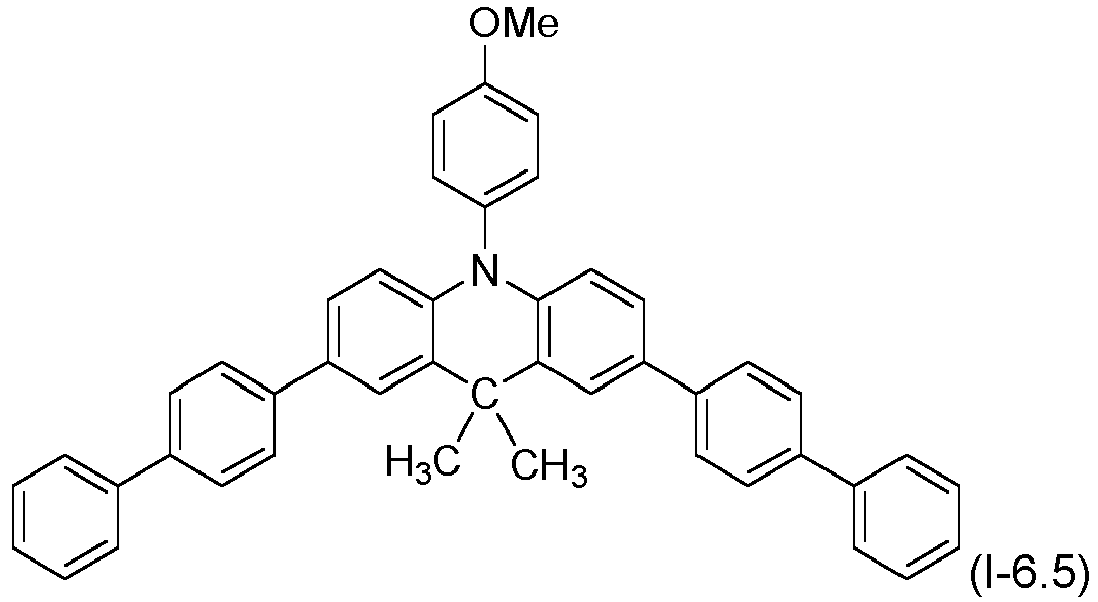


- Embodiment {10} relates to the process according to one of the embodiments {01} to {03},
wherein in Formula (I)- n is 1;
- Xis N(R12);
- R1 and R12 are selected independently from each other from phenyl, naphthyl (such as 2-naphthyl or 1-naphthyl) and biphenyl, each of which is optionally substituted with one or more substituents R13;
- R2 to R9 are selected independently from each other from hydrogen and C1-6alkyl; or at least two, preferably all of the residues R3, R4, R7, and R8 are a phenyl group which is optionally substituted with one or more substituents R13 and the residues R2, R5, R6 and R9 are selected independently from each other from hydrogen and C1-6alkyl;
- wherein, if present, the one or more substituents R13 are selected independently from each other from C1-6alkyl, C1-6haloalkyl, -OH, -O-(C1-6alkyl), -NO2, -CN, halogen, -NH2, -NH(C1-6alkyl), -N(C1-6alkyl)2, -C(=O)OH, -C(=O)O-(C1-6alkyl), -C(=O)O-phenyl, -C(=O)(C1-6alkyl), -C(=O)-phenyl, -S(O)2NH2, -S(O)2NH(C1-6alkyl), -S(O)2N(C1-6alkyl)(C1-6alkyl), -S-(C1-6alkyl), -S(O)(C1-6alkyl), -S(O)2(C1-6alkyl), -S-(phenyl), -S(O)(phenyl), and -S(O)2(phenyl).
- Embodiment {11} relates to the process according to embodiment {10}, wherein the polycyclic compound is a compound of Formula (I-7) or (I-8):


- Embodiment {12} relates to the process according to one of the embodiments {01} to {03},
wherein in Formula (II)- R1 is C1-12alkyl which is optionally substituted with one or more substituents being selected from -OH, halogen (e.g. F, CI), -NH2, -NH(C1-6alkyl) and -N(C1-6alkyl)2;
- R4, R7, and R9 are selected independently from each other from hydrogen, aryl (e.g. phenyl), heteroaryl, C1-6alkyl and -O-(C1-6alkyl), wherein aryl and heteroaryl are optionally substituted with one or more substituents which are selected independently from each other from C1-6alkyl, C1-6haloalkyl (e.g. C1-6fluoroalkyl) and -O-(C1-6alkyl);
- R2, R3, R5, R6, R8, R10, and R11 are selected independently from each other from hydrogen and C1-6alkyl.
- Embodiment {13} relates to the process according to embodiment {12}, wherein the polycyclic compound is a compound of Formula (II-1), (II-2) or (II-3):


- Embodiment {14} relates to the process according to one of the embodiments {01} to {03},
wherein in Formula (III)- R1 is C1-6alkyl;
- R10 is phenyl which is optionally substituted with one or more substituents being selected independently from each other from C1-6alkyl, C1-6haloalkyl (e.g. C1-6fluoroalkyl) and -O-(C1-6alkyl);
- R2 to R9 are selected independently from each other from hydrogen and C1-6alkyl.
- Embodiment {15} relates to the process according to embodiment {14}, wherein the polycyclic compound is a compound of Formula (III-1):

- Embodiment {16} relates to the process according to one of the embodiments {01} to {15}, wherein the palladium salt is a palladium acetate, a palladium acetylacetonate, or a palladium halide (such as palladium chloride, palladium bromide or palladium iodide), or any mixture thereof.
- Embodiment {17} relates to the process according to one of the embodiments {01} to {15}, wherein the palladium complex comprises one or more ligands which are selected from a phosphine, a 1,4-dien-3-one (e.g. dibenzylideneacetone), an N-heterocyclic carbene, an aryl, a nitrile (e.g. acetonitrile, propionitrile or benzonitrile), a polyene (e.g. a polyene having 2 to 4 carbon-carbon double bonds, in particular a cyclic polyene such as cyclooctadiene or cyclooctatetraene), an amine, or any combination thereof.
- Embodiment {18} relates to the process according to embodiment {17}, wherein the palladium complex additionally comprises one or more ligands which are selected from a halide (e.g. Cl-, Br-), a pseudohalide (e.g. CN- or OCN-), an acetylacetonate and a carboxylate (e.g. acetate). Embodiment {19} relates to the process according to one of the embodiments {01} to {18}, wherein the catalyst composition comprises a component (iii) which is selected from a phosphine, a bipyridine or a cyclic diamine or a mixture of at least two of these compounds.
- Embodiment {20} relates to the process according to embodiment {19}, wherein the palladium compound of component (i) is a palladium salt or a phosphine-free palladium complex (such as a phosphine-free palladium complex comprising one or more ligands selected from a 1,4-dien-3-one (e.g. dibenzylideneacetone), a N-heterocyclic carbene, an aryl, a nitrile (e.g. acetonitrile, propionitrile or benzonitrile), a polyene (e.g. a polyene having 2 to 4 carbon-carbon double bonds, in particular a cyclic polyene such as cyclooctadiene (COD) or cyclooctatetraene) and an amine, and optionally comprising one or more additional ligands selected from a halide, a pseudohalide (e.g. CN- or OCN-), an acetylacetonate and a carboxylate (e.g. acetate)).
- Embodiment {21} relates to the process according to embodiment {19} or {20}, wherein the phosphine of component (iii) is of Formula (IV):
P(R1)(R2)(R3) (IV)
wherein- R1 and R2 are selected independently from each other from C1-6 alkyl and C5-7-cycloalkyl (e.g. cyclohexyl);
- R3 is biphenyl which is optionally substituted with one or more R4;
- R4, if present, is C1-6 alkyl, C1-6 alkoxy, phenyl, or pyridyl (more preferably C1-6 alkyl or C1-6 alkoxy).
- Embodiment {22} relates to the process according to embodiment {21} wherein the phosphine of Formula (IV) has one of the following Formulas (IV-1) to (IV-6):


- Embodiment {23} relates to the process according to embodiment {19} or {20}, wherein the phosphine of component (iii) is of Formula (V):
P(R1)(R2)(R3) (V)
wherein- each of R1 to R3 is C1-6alkyl; or
- each of R1 to R3 is C5-7cycloalkyl (e.g. cyclohexyl); or
- R1 to R3 are selected independently from each other from aryl (e.g. phenyl) and heteroaryl (e.g. pyridyl), wherein each aryl or heteroaryl is optionally substituted with one or more C1-4 haloalkyl (e.g. -CF3), C1-4 alkyl (e.g. methyl) or C1-4 alkoxy (e.g. methoxy).
- Embodiment {24} relates to the process according to embodiment {23}, wherein the phosphine of component (iii) has one of the following Formulas (V-1) to (V-6):


- Embodiment {25} relates to the process according to embodiment {19} or {20}, wherein the phosphine of component (iii) is a ferrocenyl diphosphine or a xanthenyl diphosphine.
- Embodiment {26} relates to the process according to embodiment {25}, wherein the ferrocenyl diphosphine has one of the following Formulas (VI-1) to (VI-2):

- Embodiment {27} relates to the process according to embodiment {25}, wherein the xanthenyl diphosphine has the following Formula (VII-1):

- Embodiment {28} relates to the process according to embodiment {19} or {20}, wherein the phosphine of component (iii) is a diphosphine of Formula (VIII):
(R1)(R2)P-(CH2)n-P(R3)(R4) (VIII)
wherein- n is 1 to 6, more preferably 2 to 4;
- R1, R2, R3 and R4 are selected independently from each other from phenyl and cyclohexyl.
- Embodiment {29} relates to the process according to embodiment {28}, wherein the phosphine of Formula (VIII) has one of the following Formulas (VIII-1) to (VIII-3):


- Embodiment {30} relates to the process according to embodiment {19} or {20}, wherein the phosphine of component (iii) is a 2,3-dihydrobenzo[d][1,3]oxaphosphole, which preferably has the following Formula (IX):

R1 to R3 are selected independently from each other from hydrogen and C1-4alkyl. - Embodiment {31} relates to the process according to embodiment {19} or {20}, wherein the phosphine of component (iii) is a diadamantyl-C1-6alkyl-phosphine, which preferably has the following Formula (X-1):

- Embodiment {32} relates to the process according to embodiment {19} or {20}, wherein the cyclic diamine of component (iii) is a bicyclic diamine (such as 1,4-diazabicyclo[2.2.2]octane (DABCO)).
- Embodiment {33} relates to the process according to one of the embodiments {01} to {32}, wherein the palladium complex is of Formula (XI)

- L1 is a bivalent linker;
- R1 and R2 are selected independently from each other from hydrogen and C1-4alkyl; or R1 and R2 together with the nitrogen atom to which they are attached form a five- or six-membered ring (which might be an aromatic or non-aromatic ring);
- R3, R4, R5, and R6 are selected independently from each other from hydrogen and C1-4alkyl; or at least two of the residues R3 to R6 which are adjacent to each other form together with the carbon atoms to which they are attached a five- or six-membered aromatic ring and, if present, the remaining residues (i.e. those of the residues R3 to R6 which do not form a ring) are selected independently from each other from hydrogen and C1-4alkyl;
- Lg1 and Lg2 are, independently from each other, a non-ionic ligand.
- Embodiment {34} relates to the process according to embodiment {33}, wherein
- L1 is C1-3 alkylene (e.g. -CH2-; -CH2-CH2-; -CH2-CH2-CH2-);
- Lg1 is a pyridine, a pyrrole, an imidazole, a pyrazole or a pyrimidine, each of which is optionally substituted with one or more halogens;
- Lg2 is a N-heterocyclic carbene.
- Embodiment {35} relates to the process according to embodiment {34}, wherein the N-heterocyclic carbene is of Formula (XII) or Formula (XIII):
-

R3 to R16 are selected independently from each other from hydrogen and C1-4alkyl; or at least two of the residues R3 to R16 which are adjacent to each other form together with the carbon atoms to which they are attached a 5- or 6-membered ring and, if present, the remaining residues (i.e. those of the residues R3 to R16 not forming a ring) are selected independently from each other from hydrogen and C1-4alkyl; -

R3 to R14 are selected independently from each other from hydrogen and C1-4 alkyl; or at least two of the residues R3 to R14 which are adjacent to each other form together with the carbon atoms to which they are attached a 5- or 6-membered ring and, if present, the remaining residues (i.e. those of the residues R3 to R14 not forming a ring) are selected independently from each other from hydrogen and C1-4alkyl.
-
- Embodiment {36} relates to the process according to one of the embodiments {33} to {35}, wherein the palladium complex is of Formula (XI-1):
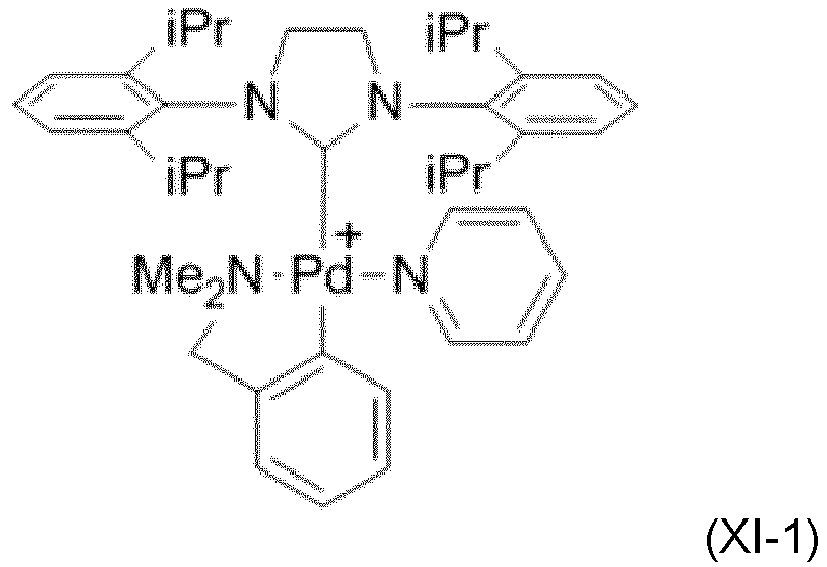
- Embodiment {37} relates to the process according to one of the embodiments {01} to {32}, wherein the palladium complex is of Formula (XIV)

- L1 is a bivalent linker;
- R1 and R2 are selected independently from each other from hydrogen and C1-4 alkyl; or R1 and R2 together with the nitrogen atom to which they are attached form a five- or six-membered ring,
- R3, R4, R5, and R6 are selected independently from each other from hydrogen and C1-4 alkyl; or at least two of the residues R3 to R6 which are adjacent to each other form together with the carbon atoms to which they are attached a five- or six-membered aromatic ring and, if present, the remaining residues (i.e. those of the residues R3 to R6 which do not form a ring) are selected independently from each other from hydrogen and C1-4alkyl,
- Lg1 is a non-ionic ligand,
- Lg2 is an anionic ligand.
- Embodiment {38} relates to the process according to embodiment {37}, wherein
- L1 is phenylene (e.g. 1 ,2-phenylene) or C1-3 alkylene (e.g. -CH2-; -CH2-CH2-; -CH2-CH2-CH2-);
- the non-ionic ligand Lg1 is a phosphine;
- the anionic ligand Lg2 is an alkyl sulfonate (e.g. mesylate) or an aryl sulfonate (e.g. tosylate).
- Embodiment {39} relates to the process according to embodiment {38}, wherein the phosphine ligand Lg1 is of Formula (XV):
P(R1)(R2)(R3) (XV)
wherein- R1 and R2 are selected independently from each other from C1-6 alkyl, cycloalkyl and phenyl, wherein phenyl is optionally substituted with one or more C1-4 alkyl;
- R3 is biphenyl or binaphthyl, each of which is optionally substituted with one or more R4;
- R4, if present, is C1-6 alkyl, -NH2, -N(H)(C1-6 alkyl), -N(C1-6 alkyl)2, -P(Phenyl)2, or -O-C1-6alkyl.
- Embodiment {40} relates to the process according to embodiment {39}, wherein the palladium complex is selected from Formulas (XIV-1) to (XIV-7):


- Embodiment {41} relates to the process according to embodiment {38}, wherein the phosphine ligand Lg1 is a ferrocenyl diphosphine.
- Embodiment {42} relates to the process according to embodiment {41}, wherein the palladium complex is of Formula (XIV-8) or Formula (XIV-9):

- Embodiment {43} relates to the process according to embodiment {38}, wherein the phosphine ligand Lg1 is a trialkyl phosphine (e.g. P(C1-6 alkyl)3).
- Embodiment {44} relates to the process according to embodiment {43}, wherein the palladium complex is of Formula (XIV-10):

- Embodiment {45} relates to the process according to embodiment {38}, wherein the palladium complex is of Formula (XIV-11), (XIV-12), or (XIV-13):


- Embodiment {46} relates to the process according to one of the embodiments {01} to {32}, wherein the palladium complex is of Formula (XVI):
Pd(L)3-4 (XVI)
wherein- each of the ligands L is a triaryl phosphine (e.g. a triphenyl phosphine), wherein each aryl group is optionally substituted with one or more R1;
- R1, if present, is C1-4 haloalkyl (e.g. -CF3), C1-4 alkyl (e.g. methyl), C1-4 alkoxy (e.g. methoxy).
- Embodiment {47} relates to the process according to embodiment {46}, wherein the palladium complex is of Formula (XVI-1) or (XVI-2):

- Embodiment {48} relates to the process according to one of the embodiments {01} to {32}, wherein the palladium complex is of Formula (XVII):

- Lg-Lg is a chelating ferrocenyl diphosphine ligand,
- X is a halide (e.g. CI).
- Embodiment {49} relates to the process according to embodiment {48}, wherein the palladium complex is of Formula (XVII-1) or (XVII-2):


- Embodiment {50} relates to the process according to one of the embodiments {01} to {49}, wherein the molar ratio between the palladium compound and the one or more compounds of component (ii) is in the range of from 100/1 to 1/100, more preferably 10/1 to 1/10.
- Embodiment {51} relates to the process according to one of the embodiments {01} to {50}, wherein the heterocyclic aromatic ring AR1 is a 5- or 6-membered aromatic ring containing one or more heteroatoms (e.g. up to three heteroatoms) which are selected from nitrogen, oxygen and sulfur, and the carboxylic acid group, carboxylate group or carboxylic acid ester group is attached to a carbon ring atom of the heterocyclic aromatic ring AR1.
- Embodiment {52} relates to the process according to one of the embodiments {01} to {51}, wherein the carboxylic acid ester group attached to the heterocyclic aromatic ring AR1 has the following formula (XVIII):
-C(O)O-A (XVIII)
wherein the residue A is derived from a N-hydroxy compound, which is preferably selected from an oxime (a ketoximes or an aldoxime), a N-hydroxy phthalimide, a N-hydroxypyridine-2-thione, and a N-hydroxy benzotriazole. - Embodiment {53} relates to the process according to embodiment {52}, wherein the residue A in Formula (XVIII) has one of the following Formulas (XIX-1) to (XIX-6):

- n is 0 or 1;
- m is 0 or 1;
- R1 and R2 are selected independently from each other from halogen (e.g. Cl or F) and halo-C1-4alkyl (e.g. -CF3);


- R1 is hydrogen or CF3,
- R2 is hydrogen or fluoro;


- n is an integer from 0 to 4,
- R is halogen (e.g. CI).
- Embodiment {54} relates to the process according to one of the embodiments {01} to {53}, wherein the reactants and the catalyst composition are mixed with each other in a solvent which comprises a polar aprotic solvent (such as dimethylsulfoxide (DMSO), dimethylformamide (DMF), dimethylacetamide, sulfolane and ethylacetate).
- Embodiment {55} relates to the process according to one of the embodiments {01} to {54}, wherein the external light source is a lamp (such as an UV or UV/VIS lamp), a LED, a laser, or any combination of two or more of these external light sources.
- Embodiment {56} relates to the process according to one of the embodiments {01} to {55}, wherein the light reaching the reaction medium has an irradiance of 10 to 2000 milliwatts per square centimeter.
- Embodiment {57} relates to the use of the catalyst composition described above (i.e. the composition comprising the palladium compound of component (i), the polycyclic compound of component (ii), and optionally the compound of component (iii)) as a catalyst for coupling a heterocyclic aromatic ring AR1 and a carbocyclic or heterocyclic aromatic ring AR2 to each other by a light-assisted decarboxylative carbon-carbon cross-coupling reaction.


Claims (18)
- A process which comprises- mixing a first reactant, a second reactant and a catalyst composition, thereby providing a reaction medium, whereinthe first reactant is a compound which comprises a heterocyclic aromatic ring AR1 to which a carboxylic acid group, a carboxylate group or a carboxylic acid ester group is attached,the second reactant is a compound which comprises an aromatic ring AR2 to which a halogen atom, a pseudohalogen group or a sulfonate group is attached,the catalyst composition comprises(i) a palladium compound which is selected from a palladium salt or a palladium complex or a mixture thereof,(ii) a polycyclic compound of Formula (I), (II) or (III):
 n is 0 or 1;X is O, C(R10)(R11), or N(R12);R1 to R12 are selected independently from each other from hydrogen, aryl and C1-10alkyl, wherein aryl and C1-10alkyl are optionally substituted with one or more substituents R13;wherein the one or more substituents R13, if present, are selected independently from each other from C1-6alkyl, C1-6haloalkyl, -OH, -O-(C1-6alkyl), -NO2, -CN, halogen, -NH2, -NH(C1-6alkyl), -N(C1-6alkyl)2, -C(=O)OH, -C(=O)O-(C1-6alkyl), -C(=O)O-phenyl, -C(=O)(C1-6alkyl), -C(=O)-phenyl, -S(O)2NH2, -S(O)2NH(C1-6alkyl), -S(O)2N(C1-6alkyl)(C1-6alkyl), -S-(C1-6alkyl), -S(O)(C1-6alkyl), -S(O)2(C1-6alkyl), -S-(phenyl), -S(O)(phenyl), -S(O)2(phenyl), and a N-carbazolyl of Formula (1.1)
 R1 is selected from C1-16alkyl and aryl, each of which is optionally substituted with one or more substituents R12, and/or C1-16alkyl is optionally interrupted by one or more oxygen atoms;R2 to R11 are selected independently from each other from hydrogen, C1-16alkyl, aryl and heteroaryl, wherein C1-16alkyl, aryl and heteroaryl are optionally substituted with one or more substituents R12, and/or C1-16alkyl is optionally interrupted by one or more oxygen atoms; or at least two of the residues R2 to R11 which are adjacent to each other form together with the carbon atoms to which they are attached a five- or six-membered aromatic ring and, if present, the remaining residues are selected independently from each other from hydrogen, C1-16alkyl, aryl and heteroaryl, wherein C1-16alkyl, aryl and heteroaryl are optionally substituted with one or more substituents R12, and/or C1-16alkyl is optionally interrupted by one or more oxygen atoms;wherein the one or more substituents R12, if present, are selected independently from each other from C1-6alkyl, C1-6haloalkyl, -OH, -O-(C1-6alkyl), -NO2, -CN, halogen, -NH2, -NH(C1-6alkyl), -N(C1-6alkyl)2, -C(=O)OH, -C(=O)O-(C1-6alkyl), -C(=O)O-phenyl, -C(=O)(C1-6alkyl), -C(=O)-phenyl, - S(O)2NH2, -S(O)2NH(C1-6alkyl), -S(O)2N(C1-6alkyl)(C1-6alkyl), -S-(C1-6alkyl), -S(O)(C1-6alkyl), -S(O)2(C1-6alkyl), -S-(phenyl), -S(O)(phenyl), and -S(O)2(phenyl),
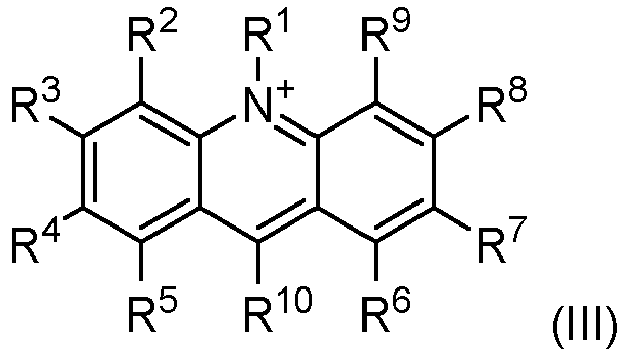 R1 is selected from C1-16alkyl and aryl, each of which is optionally substituted with one or more substituents R11, and/or C1-16alkyl is optionally interrupted by one or more oxygen atoms;R2 to R9 are selected independently from each other from hydrogen, C1-16alkyl and aryl, wherein C1-16alkyl and aryl are optionally substituted with one or more substituents R11, and/or C1-16alkyl is optionally interrupted by one or more oxygen atoms;R10 is aryl which is optionally substituted with one or more substituents R12; wherein the one or more substituents R11, if present, are selected independently from each other from C1-6alkyl, C1-6haloalkyl, -OH, -O-(C1-6alkyl), -NO2, -CN, halogen, -NH2, -NH(C1-6alkyl), -N(C1-6alkyl)2, -C(=O)OH, -C(=O)O-(C1-6alkyl), -C(=O)O-phenyl, -C(=O)(C1-6alkyl), -C(=O)-phenyl, - S(O)2NH2, -S(O)2NH(C1-6alkyl), -S(O)2N(C1-6alkyl)(C1-6alkyl), -S-(C1-6alkyl), -S(O)(C1-6alkyl), -S(O)2(C1-6alkyl), -S-(phenyl), -S(O)(phenyl), and -S(O)2(phenyl);wherein the one or more substituents R12, if present, are selected independently from each other from C1-6alkyl and aryl, wherein aryl is optionally substituted with one or more C1-6alkyl;- irradiating the reaction medium by an external light source, thereby coupling the heterocyclic aromatic ring AR1 of the first reactant to the aromatic ring AR2 of the second reactant by a decarboxylative carbon-carbon cross-coupling reaction.
 - A process which comprises- mixing a reactant and a catalyst composition, thereby providing a reaction medium, whereinthe reactant is a compound which comprises a heterocyclic aromatic ring AR1 to which a carboxylic acid group, a carboxylate group or a carboxylic acid ester group is attached and an aromatic ring AR2 to which a halogen atom, a pseudohalogen group or a sulfonate group is attached,the catalyst composition comprises(i) a palladium compound which is selected from a palladium salt or a palladium complex or a mixture thereof,(ii) a polycyclic compound of Formula (I), (II) or (III):wherein in Formula (II)
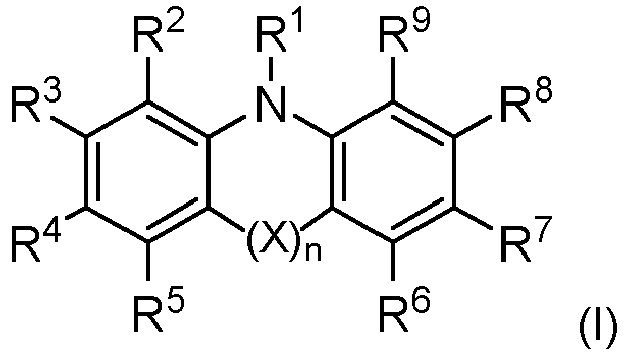 n is 0 or 1;X is O, C(R10)(R11), or N(R12);R1 to R12 are selected independently from each other from hydrogen, aryl and C1-10alkyl, wherein aryl and C1-10alkyl are optionally substituted with one or more substituents R13;wherein the one or more substituents R13, if present, are selected independently from each other from C1-6alkyl, C1-6haloalkyl, -OH, -O-(C1-6alkyl), -NO2, -CN, halogen, -NH2, -NH(C1-6alkyl), -N(C1-6alkyl)2, -C(=O)OH, -C(=O)O-(C1-6alkyl), -C(=O)O-phenyl, -C(=O)(C1-6alkyl), -C(=O)-phenyl, -S(O)2NH2, -S(O)2NH(C1-6alkyl), -S(O)2N(C1-6alkyl)(C1-6alkyl), -S-(C1-6alkyl), -S(O)(C1-6alkyl), -S(O)2(C1-6alkyl), -S-(phenyl), -S(O)(phenyl), -S(O)2(phenyl), and a N-carbazolyl of Formula (1.1)
 R1 is selected from C1-16alkyl and aryl, each of which is optionally substituted with one or more substituents R12, and/or C1-16alkyl is optionally interrupted by one or more oxygen atoms;R2 to R11 are selected independently from each other from hydrogen, C1-16alkyl, aryl and heteroaryl, wherein C1-16alkyl, aryl and heteroaryl are optionally substituted with one or more substituents R12, and/or C1-16alkyl is optionally interrupted by one or more oxygen atoms; or at least two of the residues R2 to R11 which are adjacent to each other form together with the carbon atoms to which they are attached a five- or six-membered aromatic ring and, if present, the remaining residues are selected independently from each other from hydrogen, C1-16alkyl, aryl and heteroaryl, wherein C1-16alkyl, aryl and heteroaryl are optionally substituted with one or more substituents R12, and/or C1-16alkyl is optionally interrupted by one or more oxygen atoms;wherein the one or more substituents R12, if present, are selected independently from each other from C1-6alkyl, C1-6haloalkyl, -OH, -O-(C1-6alkyl), -NO2, -CN, halogen, -NH2, -NH(C1-6alkyl), -N(C1-6alkyl)2, -C(=O)OH, -C(=O)O-(C1-6alkyl), -C(=O)O-phenyl, -C(=O)(C1-6alkyl), -C(=O)-phenyl, - S(O)2NH2, -S(O)2NH(C1-6alkyl), -S(O)2N(C1-6alkyl)(C1-6alkyl), -S-(C1-6alkyl), -S(O)(C1-6alkyl), -S(O)2(C1-6alkyl), -S-(phenyl), -S(O)(phenyl), and -S(O)2(phenyl),
 R1 is selected from C1-16alkyl and aryl, each of which is optionally substituted with one or more substituents R11, and/or C1-16alkyl is optionally interrupted by one or more oxygen atoms;R2 to R9 are selected independently from each other from hydrogen, C1-16alkyl and aryl, wherein C1-16alkyl and aryl are optionally substituted with one or more substituents R11, and/or C1-16alkyl is optionally interrupted by one or more oxygen atoms;R10 is aryl which is optionally substituted with one or more substituents R12;wherein the one or more substituents R11, if present, are selected independently from each other from C1-6alkyl, C1-6haloalkyl, -OH, -O-(C1-6alkyl), -NO2, -CN, halogen, -NH2, -NH(C1-6alkyl), -N(C1-6alkyl)2, -C(=O)OH, -C(=O)O-(C1-6alkyl), -C(=O)O-phenyl, -C(=O)(C1-6alkyl), -C(=O)-phenyl, - S(O)2NH2, -S(O)2NH(C1-6alkyl), -S(O)2N(C1-6alkyl)(C1-6alkyl), -S-(C1-6alkyl), -S(O)(C1-6alkyl), -S(O)2(C1-6alkyl), -S-(phenyl), -S(O)(phenyl), and -S(O)2(phenyl);wherein the one or more substituents R12, if present, are selected independently from each other from C1-6alkyl and aryl (e.g. phenyl), wherein aryl is optionally substituted with one or more C1-6alkyl;- irradiating the reaction medium by an external light source, thereby coupling the heterocyclic aromatic ring AR1 and the aromatic ring AR2 of the reactant to each other by a decarboxylative carbon-carbon cross-coupling reaction.
 - The process according to claim 1 or 2, wherein R1 in Formula (I) is selected from phenyl, naphthyl and biphenyl, each of which is optionally substituted with one or more substituents R13, wherein R13 has the same meaning as in claim 1.
- The process according to one of the preceding claims, wherein in Formula (I) n is 0;R1 is selected from naphthyl, phenyl and biphenyl, each of which is optionally substituted with one or more R13;R2 to R9 are selected independently from each other from hydrogen, C1-6alkyl, phenyl, biphenyl and naphthyl, wherein phenyl, biphenyl and naphthyl are optionally substituted with one or more substituents R13;wherein, if present, the one or more substituents R13, are selected independently from each other from C1-6alkyl, C1-6haloalkyl, -OH, -O-(C1-6alkyl), -NO2, -CN, halogen, -NH2, -NH(C1-6alkyl), -N(C1-6alkyl)2, -C(=O)OH, -C(=O)O-(C1-6alkyl), -C(=O)O-phenyl, -C(=O)(C1-6alkyl), -C(=O)-phenyl, -S(O)2NH2, -S(O)2NH(C1-6alkyl), -S(O)2N(C1-6alkyl)(C1-6alkyl), -S-(C1-6alkyl), -S(O)(C1-6alkyl), -S(O)2(C1-6alkyl), -S-(phenyl), -S(O)(phenyl), -S(O)2(phenyl), and a N-carbazolyl of Formula (1.1)

- The process according to one of the claims 1 to 3, wherein in Formula (I)n is 1;X is O;R1 is naphthyl which is optionally substituted with one or more substituents R13; R2, R3, R5, R6, R8 and R9 are selected independently from each other from hydrogen and C1-6alkyl;R4 and R7 are selected independently from each other from phenyl, biphenyl and naphthyl, each of which is optionally substituted with one or more substituents R13; wherein, if present, the one or more substituents R13 are selected independently from each other from C1-6alkyl, C1-6haloalkyl, -OH, -O-(C1-6alkyl), -NO2, -CN, halogen, -NH2, -NH(C1-6alkyl), -N(C1-6alkyl)2, -C(=O)OH, -C(=O)O-(C1-6alkyl), -C(=O)O-phenyl, -C(=O)(C1-6alkyl),-C(=O)-phenyl, -S(O)2NH2, -S(O)2NH(C1-6alkyl), -S(O)2N(C1-6alkyl)(C1-6alkyl), -S-(C1-6alkyl), -S(O)(C1-6alkyl), -S(O)2(C1-6alkyl), -S-(phenyl), -S(O)(phenyl), and -S(O)2(phenyl).
- The process according to one of the claims 1 to 3, wherein in Formula (I)n is 1;X is C(R10)(R11), wherein R10 and R11 are selected independently from each other from hydrogen and a C1-6alkyl group;R1 is selected from naphthyl, phenyl and biphenyl, each of which is optionally substituted with one or more substituents R13;R2, R3, R5, R6, R8 and R9 are selected independently from each other from hydrogen and C1-6alkyl;R4 and R7 are selected independently from each other from phenyl, naphthyl and biphenyl, each of which is optionally substituted with one or more substituents R13; wherein, if present, the one or more substituents R13 are selected independently from each other from C1-6alkyl, C1-6haloalkyl, -OH, -O-(C1-6alkyl), -NO2, -CN, halogen, -NH2, -NH(C1-6alkyl), -N(C1-6alkyl)2, -C(=O)OH, -C(=O)O-(C1-6alkyl), -C(=O)O-phenyl, -C(=O)(C1-6alkyl), -C(=O)-phenyl, -S(O)2NH2, -S(O)2NH(C1-6alkyl), -S(O)2N(C1-6alkyl)(C1-6alkyl), -S-(C1-6alkyl), -S(O)(C1-6alkyl), -S(O)2(C1-6alkyl), -S-(phenyl), -S(O)(phenyl) and -S(O)2(phenyl).
- The process according to one of the claims 1 to 3, wherein in Formula (I)n is 1;Xis N(R12);R1 and R12 are selected independently from each other from phenyl, naphthyl and biphenyl, each of which is optionally substituted with one or more substituents R13;R2 to R9 are selected independently from each other from hydrogen and C1-6alkyl; or at least two of the residues R3, R4, R7, and R8 are phenyl which is optionally substituted with one or more substituents R13 and the residues R2, R5, R6 and R9 are selected independently from each other from hydrogen and C1-6alkyl;wherein, if present, the one or more substituents R13 are selected independently from each other from C1-6alkyl, C1-6haloalkyl, -OH, -O-(C1-6alkyl), -NO2, -CN, halogen, -NH2, -NH(C1-6alkyl), -N(C1-6alkyl)2, -C(=O)OH, -C(=O)O-(C1-6alkyl), -C(=O)O-phenyl, -C(=O)(C1-6alkyl), -C(=O)-phenyl, -S(O)2NH2, -S(O)2NH(C1-6alkyl), -S(O)2N(C1-6alkyl)(C1-6alkyl), -S-(C1-6alkyl), -S(O)(C1-6alkyl), -S(O)2(C1-6alkyl), -S-(phenyl), -S(O)(phenyl), and -S(O)2(phenyl).
- The process according to one of the claims 1 to 3, wherein in Formula (II)R1 is C1-12alkyl which is optionally substituted with one or more substituents being selected from -OH, halogen, -NH2, -NH(C1-6alkyl) and -N(C1-6alkyl)2;R4, R7, and R9 are selected independently from each other from hydrogen, aryl, heteroaryl, C1-6alkyl and -O-(C1-6alkyl), wherein aryl and heteroaryl are optionally substituted with one or more substituents which are selected independently from each other from C1-6alkyl, C1-6haloalkyl (e.g. C1-6fluoroalkyl) and -O-(C1-6alkyl);R2, R3, R5, R6, R8, R10 and R11 are selected independently from each other from hydrogen and C1-6alkyl.
- The process according to one of the claims 1 to 3, wherein in Formula (III)R1 is C1-6alkyl;R10 is phenyl which is optionally substituted with one or more substituents being selected independently from each other from C1-6alkyl, C1-6haloalkyl and -O-(C1-6alkyl);R2 to R9 are selected independently from each other from hydrogen and C1-6alkyl.
- The process according to one of the preceding claims, wherein the palladium salt is a palladium acetate, a palladium acetylacetonate, a palladium halide, or any mixture thereof.
- The process according to one of the claims 1 to 9, wherein the palladium complex comprises one or more ligands which are selected from a phosphine, a 1,4-dien-3-one, a N-heterocyclic carbene, an aryl, a nitrile, a polyene, an amine, or any combination thereof.
- The process according to one of the preceding claims, the catalyst composition further comprising a component (iii) which is selected from a phosphine, a bipyridine or a cyclic diamine or a mixture of at least two of these compounds.
- The process according to claim 12, wherein the phosphine of component (iii) is selected from one or more of the following compounds:- a phosphine of Formula (IV):
P(R1)(R2)(R3) (IV)
whereinR1 and R2 are selected independently from each other from C1-6 alkyl and C5-7-cycloalkyl;R3 is biphenyl which is optionally substituted with one or more R4;R4, if present, is C1-6 alkyl, C1-6 alkoxy, phenyl or pyridyl;- a phosphine of Formula (V):
P(R1)(R2)(R3) (V)
whereineach of R1 to R3 is C1-6alkyl; oreach of R1 to R3 is C5-7cycloalkyl; orR1 to R3 are selected independently from each other from aryl and heteroaryl, each of which is optionally substituted with one or more C1-4 haloalkyl, C1-4 alkyl or C1-4 alkoxy;- a ferrocenyl diphosphine;- a xanthenyl diphosphine;- a diphosphine of Formula (VIII):
(R1)(R2)P-(CH2)n-P(R3)(R4) (VIII)
whereinn is 1 to 6, more preferably 2 to 4;R1, R2, R3 and R4 are selected independently from each other from phenyl and cyclohexyl;- a 2,3-dihydrobenzo[d][1,3]oxaphosphole;- a diadamantyl-C1-6alkyl-phosphine. - The process according to one of the preceding claims, wherein the palladium complex of component (i) has one of the following Formulas (XI), (XIV), (XVI) or (XVII):
 L1 is a bivalent linker,R1 and R2 are selected independently from each other from hydrogen and C1-4alkyl; or R1 and R2 together with the nitrogen atom to which they are attached form a five- or six-membered ring;R3, R4, R5, and R6 are selected independently from each other from hydrogen and C1-4alkyl; or at least two of the residues R3 to R6 which are adjacent to each other form together with the carbon atoms to which they are attached a five- or six-membered aromatic ring and, if present, the remaining residues are selected independently from each other from hydrogen and C1-4alkyl,Lg1 and Lg2 are, independently from each other, a non-ionic ligand;
 L1 is a bivalent linker;R1 and R2 are selected independently from each other from hydrogen and C1-4 alkyl; or R1 and R2 together with the nitrogen atom to which they are attached form a five- or six-membered ring;R3, R4, R5, and R6 are selected independently from each other from hydrogen and C1-4 alkyl; or at least two of the residues R3 to R6 which are adjacent to each other form together with the carbon atoms to which they are attached a five- or six-membered aromatic ring and, if present, the remaining residues are selected independently from each other from hydrogen and C1-4alkyl;Lg1 is a non-ionic ligand;Lg2 is an anionic ligand;
Pd(L)3-4 (XVI)
wherein in Formula (XVI)the ligands L are independently from each other a triaryl phosphine, wherein each aryl group is optionally substituted with one or more R1;R1, if present, is C1-4haloalkyl, C1-4alkyl or C1-4alkoxy; Lg-Lg is a chelating ferrocenyl diphosphine ligand;X is a halide.
 - The process according to one of the preceding claims, wherein the carboxylic acid ester group attached to the heterocyclic aromatic ring AR1 has the following formula (XVIII):
-C(O)O-A (XVIII)
wherein the residue A is derived from a N-hydroxy compound. - The process according to one of the preceding claims, wherein the reactants and the catalyst composition are mixed with each other in a solvent which comprises a polar aprotic solvent.
- The process according to one of the preceding claims, wherein the external light source is a lamp (such as a UV or UV/VIS lamp), a LED, a laser, or any combination of two or more of these external light sources.
- Use of the catalyst composition of one of the claims 1 to 14 as a catalyst for coupling a heterocyclic aromatic ring AR1 and a carbocyclic or heterocyclic aromatic ring AR2 to each other by a light-assisted decarboxylative carbon-carbon cross-coupling reaction.
Applications Claiming Priority (1)
| Application Number | Priority Date | Filing Date | Title |
|---|---|---|---|
| US202263366714P | 2022-06-21 | 2022-06-21 |
Publications (1)
| Publication Number | Publication Date |
|---|---|
| EP4296265A1 true EP4296265A1 (en) | 2023-12-27 |
Family
ID=86646549
Family Applications (1)
| Application Number | Title | Priority Date | Filing Date |
|---|---|---|---|
| EP23176278.2A Withdrawn EP4296265A1 (en) | 2022-06-21 | 2023-05-31 | Use of a catalyst composition for biaryl synthesis by decarboxylative cross-coupling |
Country Status (2)
| Country | Link |
|---|---|
| US (1) | US20230406826A1 (en) |
| EP (1) | EP4296265A1 (en) |
Citations (2)
| Publication number | Priority date | Publication date | Assignee | Title |
|---|---|---|---|---|
| US10975171B2 (en) | 2015-10-23 | 2021-04-13 | The Regents Of The University Of Colorado, A Body Corporate | Compositions and methods of promoting organic photocatalysis |
| EP4194089A2 (en) * | 2021-07-19 | 2023-06-14 | Heraeus Deutschland GmbH & Co. KG | Catalyst system for suzuki cross-coupling reactions comprising a photoredox component |
-
2023
- 2023-04-25 US US18/306,624 patent/US20230406826A1/en not_active Abandoned
- 2023-05-31 EP EP23176278.2A patent/EP4296265A1/en not_active Withdrawn
Patent Citations (2)
| Publication number | Priority date | Publication date | Assignee | Title |
|---|---|---|---|---|
| US10975171B2 (en) | 2015-10-23 | 2021-04-13 | The Regents Of The University Of Colorado, A Body Corporate | Compositions and methods of promoting organic photocatalysis |
| EP4194089A2 (en) * | 2021-07-19 | 2023-06-14 | Heraeus Deutschland GmbH & Co. KG | Catalyst system for suzuki cross-coupling reactions comprising a photoredox component |
Non-Patent Citations (28)
| Title |
|---|
| C. LIM ET AL., ANGEW. CHEM. INT. ED. ENGL., vol. 59, no. 8, 2020, pages 3209 - 3217 |
| C. LIM ET AL., CHEM. EUR. J., vol. 23, no. 46, 2017, pages 10962 - 10968 |
| C. LIM ET AL., J. AM. CHEM. SOC., vol. 142, no. 31, 2020, pages 13573 - 13581 |
| D. HACKENBERGER ET AL.: "Bimetallic Cu/Pd Catalysts with Bridging Aminopyrimidinyl Phosphines for Decarboxylative Cross-Coupling Reactions at Moderate Temperature", CHEMCATCHEM, vol. 7, no. 21, 2015, pages 3579 - 3588, XP055916802, DOI: 10.1002/cctc.201500769 |
| D. HACKENBERGER ET AL.: "Synthesis of 3-Substituted 2-Arylpyridines via Cu/Pd-Catalyzed Decarboxylative Cross-Coupling of Picolinic Acids with (Hetero)Aryl Halides", J. ORG. CHEM., vol. 82, no. 7, 2017, pages 3917 - 3925 |
| D. HACKENBERGER ET. AL.: "Bimetallic Cu/Pd Catalysts with Bridging Aminopyrimidinyl Phosphines for Decarboxylative Cross-Coupling Reactions at Moderate Temperature", CHEMCATCHEM, vol. 7, no. 21, 17 September 2015 (2015-09-17), pages 3579 - 3588, XP072437918, DOI: 10.1002/cctc.201500769 * |
| F. ARROYAVE ET AL.: "3,4-Propylenedioxypyrrole-based conjugated oligomers via Pd-mediated decarboxylative cross coupling", ORGANIC LETTERS, vol. 12, no. 6, 2010, pages 1328 - 1331 |
| F. BILODEAU ET AL., J. ORG. CHEM., vol. 75, no. 5, 2010, pages 1550 - 60 |
| F. BILODEAU ET AL.: "Palladium-catalyzed decarboxylative cross-coupling reaction between heteroaromatic carboxylic acids and aryl halides", THE JOURNAL OF ORGANIC CHEMISTRY, vol. 75, no. 5, 2010, pages 1550 - 1560 |
| J. TWILTON ET AL.: "The merger of transition metal and photocatalysis", NAT REV CHEM, vol. 1, 2017, pages 0052, Retrieved from the Internet <URL:https://doi.org/10.1038/s41570-017-0052> |
| L. J. GOOSSEN ET. AL.: "Synthesis of Biaryls by Catalytic Decarboxylative Coupling", SCIENCE, vol. 313, 1 January 2006 (2006-01-01), pages 662 - 664, XP009105738, DOI: 10.1126/science.1128684 * |
| L. LIU ET AL.: "Transition metal-catalyzed decarboxylative cross-coupling reactions", SCI CHINA CHEM, vol. 54, 2011, pages 1670 - 1687, XP019972747, DOI: 10.1007/s11426-011-4381-0 |
| L.J. GOOΒEN ET AL.: "Biaryl synthesis via Pd-catalyzed decarboxylative coupling of aromatic carboxylates with aryl halides", JOURNAL OF THE AMERICAN CHEMICAL SOCIETY, vol. 129, no. 15, 2007, pages 4824 - 4833 |
| L.J. GOOΒEN ET AL.: "Catalytic Decarboxylative Cross-Coupling of Aryl Chlorides and Benzoates without Activating ortho Substituents", ANGEW. CHEM. INT. ED. ENGL., vol. 54, no. 44, 2015, pages 13130 - 3 |
| L.J. GOOΒEN ET AL.: "Decarboxylative biaryl synthesis from aromatic carboxylates and aryl triflates", JOURNAL OF THE AMERICAN CHEMICAL SOCIETY, vol. 130, no. 46, 2008, pages 15248 - 15249, XP002698540, DOI: 10.1021/ja8050926 |
| L.J. GOOΒEN ET AL.: "Decarboxylative Cross-Coupling of Aryl Tosylates with Aromatic Carboxylate Salts", ANGEWANDTE CHEMIE, vol. 122, no. 6, 2010, pages 1129 - 1132 |
| L.J. GOOΒEN ET AL.: "Decarboxylative cross-coupling of mesylates catalyzed by copper/palladium systems with customized imidazolyl phosphine ligands", ANGEW. CHEM. INT. ED. ENGL., vol. 52, no. 10, 2013, pages 2954 - 8 |
| L.J. GOOΒEN ET AL.: "Palladium/copper-catalyzed decarboxylative cross-coupling of aryl chlorides with potassium carboxylates", ANGEWANDTE CHEMIE INTERNATIONAL EDITION, vol. 47, no. 37, 2008, pages 7103 - 7106 |
| L.J. GOOΒEN ET AL.: "Synthesis of biaryls via catalytic decarboxylative coupling", SCIENCE, vol. 313, no. 5787, 2006, pages 662 - 4, XP009105738, DOI: 10.1126/science.1128684 |
| LIU ET AL.: "Copper-Catalyzed Decarboxylative Cross-Coupling of Potassium Polyfluorobenzoates with Aryl Iodides and Bromides", ANGEWANDTE CHEMIE INTERNATIONAL EDITION, vol. 48, no. 49, 2009, pages 9350 - 9354 |
| M. MIYASAKA ET AL.: "Fluorescent diarylindoles by palladium-catalyzed direct and decarboxylative arylations of carboxyindoles", CHEMISTRY, vol. 15, no. 15, 2009, pages 3674 - 7 |
| M. SHEE ET. AL.: "Cooperative photoredux and palladium catalysis. Recent advances in various functionalization reactions.", CATALYSIS SCIENCES AND TECHNOLOGY, vol. 11, 1 January 2021 (2021-01-01), pages 742 - 767, XP093101362, DOI: 10.1039/d0cy02071k * |
| M.H. SHAW ET AL., J. ORG. CHEM., vol. 81, 2016, pages 6898 - 6926 |
| N.D.P. SINGH ET AL., CATAL. SCI. TECHNOL., vol. 11, 2021, pages 742 - 767 |
| NILSSON ET AL.: "A new biaryl synthesis illustrating a connection between the Ullmann biaryl synthesis and copper-catalyzed decarboxylation", ACTA CHEM. SCAND., vol. 20, no. 2, 1966, pages 423 - 426, XP009075993 |
| P. FORGIONE ET AL.: "Unexpected intermolecular Pd-catalyzed cross-coupling reaction employing heteroaromatic carboxylic acids as coupling partners", JOURNAL OF THE AMERICAN CHEMICAL SOCIETY, vol. 128, no. 35, 2006, pages 11350 - 11351 |
| R. SHANG ET. AL.: "Transition Metal Catalyzed Decarboxylative Cross Coupling Reactions", SCIENCE CHINA CHEMISTRY, vol. 54, no. 11, 1 November 2011 (2011-11-01), pages 1670 - 1687, XP019972747, DOI: 10.1007/s11426-011-4381-0 * |
| S. MESSAOUDI ET AL.: "Palladium-catalyzed decarboxylative coupling of quinolinone-3-carboxylic acids and related heterocyclic carboxylic acids with (hetero) aryl halides", ORGANIC LETTERS, vol. 14, no. 6, 2012, pages 1496 - 1499 |
Also Published As
| Publication number | Publication date |
|---|---|
| US20230406826A1 (en) | 2023-12-21 |
Similar Documents
| Publication | Publication Date | Title |
|---|---|---|
| Marzo et al. | Visible‐light photocatalysis: does it make a difference in organic synthesis? | |
| Chen et al. | Well-designed N-heterocyclic carbene ligands for palladium-catalyzed denitrative C–N coupling of nitroarenes with amines | |
| JP5591714B2 (en) | Ligands for transition metal catalyzed cross coupling and methods of use thereof | |
| Yu et al. | Alternative mechanistic explanation for ligand-dependent selectivities in copper-catalyzed N-and O-arylation reactions | |
| Yang et al. | Efficient Sonogashira reactions of aryl bromides with alkynylsilanes catalyzed by a palladium/imidazolium salt system | |
| Zhang et al. | Facile and efficient olefination of aryl halides catalyzed by a palladium complex containing a heteroarene-functionalized N-heterocyclic carbene | |
| Liang et al. | Catalytic suzuki coupling reactions by amido phosphine complexes of palladium | |
| Wolf et al. | Efficient synthesis of sterically crowded biaryls by palladium-phosphinous acid-catalyzed cross-coupling of aryl halides and aryl grignards | |
| Shah et al. | Metallaphotoredox-mediated Csp2–H hydroxylation of arenes under aerobic conditions | |
| Zucker et al. | Palladium-catalyzed directed halogenation of bipyridine N-oxides | |
| Sardarian et al. | Metal-free regioselective monocyanation of hydroxy-, alkoxy-, and benzyloxyarenes by potassium thiocyanate and silica sulfuric acid as a cyanating agent | |
| Hoshi et al. | An active, general, and long-lived palladium catalyst for cross-couplings of deactivated (hetero) aryl chlorides and bromides with arylboronic acids | |
| Haldon et al. | Dinuclear Copper (I) Complexes as precatalysts in Ullmann and Goldberg coupling reactions | |
| Wang et al. | Elemental sulfur-promoted aerobic dehydrogenative aromatization of cyclohexanones with amines | |
| Cannon et al. | Hydrodehalogenation of aryl chlorides and aryl bromides using a microwave-assisted, copper-catalyzed concurrent tandem catalysis methodology | |
| Iyer et al. | Nanoparticles as heterogeneous catalysts for ppm Pd-catalyzed aminations in water | |
| Semeniuchenko et al. | (DiMeIHeptCl) Pd: A Low-Load Catalyst for Solvent-Free (Melt) Amination | |
| CA3235646A1 (en) | Photocatalysts, preparation and use thereof | |
| Hu et al. | Preparation of New Buchwald-Type Secondary Phosphine Oxide Ligands and Applications in Suzuki− Miyaura Reactions | |
| Sinha et al. | [6, 5] CNN palladium (II) pincer complexes containing N-substituted monoanionic and dianionic guanidinate ligands: Syntheses, structural aspects, and their utility in Suzuki–Miyaura coupling reactions | |
| Gautam et al. | Functionalized imidazolium salt: an efficient catalyst for Buchwald–Hartwig type C–N cross-coupling of (hetero) aryl chlorides/bromides with amines under solvent-, inert gas-, and base-free ambience | |
| JP6437187B2 (en) | Method for producing optically active secondary alcohol | |
| Dible et al. | Remote substitution on N-heterocyclic carbenes heightens the catalytic reactivity of their palladium complexes | |
| CN1678395A (en) | Novel nickel-carbene, palladium-carbene and platinum-carbene complexes, their production and use in catalytic reactions | |
| EP4302876A1 (en) | Catalyst composition for biaryl synthesis by decarboxylative cross-coupling |
Legal Events
| Date | Code | Title | Description |
|---|---|---|---|
| PUAI | Public reference made under article 153(3) epc to a published international application that has entered the european phase |
Free format text: ORIGINAL CODE: 0009012 |
|
| STAA | Information on the status of an ep patent application or granted ep patent |
Free format text: STATUS: REQUEST FOR EXAMINATION WAS MADE |
|
| 17P | Request for examination filed |
Effective date: 20230531 |
|
| AK | Designated contracting states |
Kind code of ref document: A1 Designated state(s): AL AT BE BG CH CY CZ DE DK EE ES FI FR GB GR HR HU IE IS IT LI LT LU LV MC ME MK MT NL NO PL PT RO RS SE SI SK SM TR |
|
| STAA | Information on the status of an ep patent application or granted ep patent |
Free format text: STATUS: THE APPLICATION HAS BEEN WITHDRAWN |
|
| 18W | Application withdrawn |
Effective date: 20240111 |
|
| RAP1 | Party data changed (applicant data changed or rights of an application transferred) |
Owner name: NEW IRIDIUM, INC. Owner name: HERAEUS PRECIOUS METALS GMBH & CO. KG |