EP4293374B1 - Battery monitoring techniques - Google Patents
Battery monitoring techniques Download PDFInfo
- Publication number
- EP4293374B1 EP4293374B1 EP23176512.4A EP23176512A EP4293374B1 EP 4293374 B1 EP4293374 B1 EP 4293374B1 EP 23176512 A EP23176512 A EP 23176512A EP 4293374 B1 EP4293374 B1 EP 4293374B1
- Authority
- EP
- European Patent Office
- Prior art keywords
- battery cell
- time
- self
- discharge rate
- digital codes
- Prior art date
- Legal status (The legal status is an assumption and is not a legal conclusion. Google has not performed a legal analysis and makes no representation as to the accuracy of the status listed.)
- Active
Links
Images



Classifications
-
- G—PHYSICS
- G01—MEASURING; TESTING
- G01R—MEASURING ELECTRIC VARIABLES; MEASURING MAGNETIC VARIABLES
- G01R31/00—Arrangements for testing electric properties; Arrangements for locating electric faults; Arrangements for electrical testing characterised by what is being tested not provided for elsewhere
- G01R31/36—Arrangements for testing, measuring or monitoring the electrical condition of accumulators or electric batteries, e.g. capacity or state of charge [SoC]
- G01R31/382—Arrangements for monitoring battery or accumulator variables, e.g. SoC
- G01R31/3835—Arrangements for monitoring battery or accumulator variables, e.g. SoC involving only voltage measurements
-
- G—PHYSICS
- G01—MEASURING; TESTING
- G01R—MEASURING ELECTRIC VARIABLES; MEASURING MAGNETIC VARIABLES
- G01R31/00—Arrangements for testing electric properties; Arrangements for locating electric faults; Arrangements for electrical testing characterised by what is being tested not provided for elsewhere
- G01R31/36—Arrangements for testing, measuring or monitoring the electrical condition of accumulators or electric batteries, e.g. capacity or state of charge [SoC]
- G01R31/382—Arrangements for monitoring battery or accumulator variables, e.g. SoC
-
- G—PHYSICS
- G01—MEASURING; TESTING
- G01R—MEASURING ELECTRIC VARIABLES; MEASURING MAGNETIC VARIABLES
- G01R31/00—Arrangements for testing electric properties; Arrangements for locating electric faults; Arrangements for electrical testing characterised by what is being tested not provided for elsewhere
- G01R31/36—Arrangements for testing, measuring or monitoring the electrical condition of accumulators or electric batteries, e.g. capacity or state of charge [SoC]
- G01R31/367—Software therefor, e.g. for battery testing using modelling or look-up tables
-
- G—PHYSICS
- G01—MEASURING; TESTING
- G01R—MEASURING ELECTRIC VARIABLES; MEASURING MAGNETIC VARIABLES
- G01R19/00—Arrangements for measuring currents or voltages or for indicating presence or sign thereof
- G01R19/25—Arrangements for measuring currents or voltages or for indicating presence or sign thereof using digital measurement techniques
-
- G—PHYSICS
- G01—MEASURING; TESTING
- G01R—MEASURING ELECTRIC VARIABLES; MEASURING MAGNETIC VARIABLES
- G01R31/00—Arrangements for testing electric properties; Arrangements for locating electric faults; Arrangements for electrical testing characterised by what is being tested not provided for elsewhere
- G01R31/36—Arrangements for testing, measuring or monitoring the electrical condition of accumulators or electric batteries, e.g. capacity or state of charge [SoC]
- G01R31/3644—Constructional arrangements
- G01R31/3648—Constructional arrangements comprising digital calculation means, e.g. for performing an algorithm
-
- G—PHYSICS
- G01—MEASURING; TESTING
- G01R—MEASURING ELECTRIC VARIABLES; MEASURING MAGNETIC VARIABLES
- G01R31/00—Arrangements for testing electric properties; Arrangements for locating electric faults; Arrangements for electrical testing characterised by what is being tested not provided for elsewhere
- G01R31/36—Arrangements for testing, measuring or monitoring the electrical condition of accumulators or electric batteries, e.g. capacity or state of charge [SoC]
- G01R31/382—Arrangements for monitoring battery or accumulator variables, e.g. SoC
- G01R31/3828—Arrangements for monitoring battery or accumulator variables, e.g. SoC using current integration
-
- G—PHYSICS
- G01—MEASURING; TESTING
- G01R—MEASURING ELECTRIC VARIABLES; MEASURING MAGNETIC VARIABLES
- G01R31/00—Arrangements for testing electric properties; Arrangements for locating electric faults; Arrangements for electrical testing characterised by what is being tested not provided for elsewhere
- G01R31/36—Arrangements for testing, measuring or monitoring the electrical condition of accumulators or electric batteries, e.g. capacity or state of charge [SoC]
- G01R31/385—Arrangements for measuring battery or accumulator variables
-
- G—PHYSICS
- G01—MEASURING; TESTING
- G01R—MEASURING ELECTRIC VARIABLES; MEASURING MAGNETIC VARIABLES
- G01R31/00—Arrangements for testing electric properties; Arrangements for locating electric faults; Arrangements for electrical testing characterised by what is being tested not provided for elsewhere
- G01R31/36—Arrangements for testing, measuring or monitoring the electrical condition of accumulators or electric batteries, e.g. capacity or state of charge [SoC]
- G01R31/396—Acquisition or processing of data for testing or for monitoring individual cells or groups of cells within a battery
-
- H—ELECTRICITY
- H02—GENERATION; CONVERSION OR DISTRIBUTION OF ELECTRIC POWER
- H02J—ELECTRIC POWER NETWORKS; CIRCUIT ARRANGEMENTS OR SYSTEMS FOR SUPPLYING OR DISTRIBUTING ELECTRIC POWER; SYSTEMS FOR STORING ELECTRIC ENERGY
- H02J7/00—Circuit arrangements for charging or discharging batteries or for supplying loads from batteries
- H02J7/80—Circuit arrangements for charging or discharging batteries or for supplying loads from batteries including monitoring or indicating arrangements
-
- H—ELECTRICITY
- H03—ELECTRONIC CIRCUITRY
- H03M—CODING; DECODING; CODE CONVERSION IN GENERAL
- H03M1/00—Analogue/digital conversion; Digital/analogue conversion
- H03M1/12—Analogue/digital converters
- H03M1/50—Analogue/digital converters with intermediate conversion to time interval
Definitions
- a battery pack may include one or more battery modules, and a battery module may include one or more battery cells.
- Battery modules may include a battery cell monitoring circuit to monitor, among other things, a voltage of the battery cells in the battery module.
- Individual battery cells may be connected in series to provide a battery stack having a desired output voltage.
- a large number of cells may be connected in series such that the total potential difference developed across the battery stack is on the order of 150-600 volts, for example.
- the terminal voltage is a direct measurement of the DC voltage at the cell terminals.
- US 2018/164363 A1 discloses self-discharge leakage current measurements to determine a self-discharge leakage current characteristic of a battery cell.
- This disclosure is directed to various techniques for determining self-discharge rates of one or more battery cells, such as by determining a current leakage of the battery cell(s).
- the techniques may improve the effective ADC linearity.
- An example of a technique may calculate the average time when each ADC digital code is observed, such as for a given battery cell or battery module, which allows the battery cell discharge rate to be estimated from the interval between the average time observed for neighboring, e.g., adjacent, digital codes. This approach allows the self-discharge rate of a battery cell to be calculated with high resolution even when the total cell voltage excursion is only a few LSBs.
- this disclosure is directed to a battery management system configured to determine a self-discharge rate of at least one battery cell, the battery management system comprising: an analog-to-digital converter (ADC) circuit coupled to the at least one battery cell and configured to receive an analog input signal representing a voltage of the at least one battery cell and generate digital codes representing the analog input signal at corresponding time intervals; and a processor configured to: receive the digital codes; determine a length of time at which corresponding ones of the digital codes remain; and determine the self-discharge rate of the at least one battery cell using the determined length of time.
- ADC analog-to-digital converter
- this disclosure is directed to a method of determining a self-discharge rate of at least one battery cell coupled to an analog-to-digital converter (ADC) circuit, wherein the ADC circuit is configured to receive an analog input signal representing a voltage of the at least one battery cell and generate digital codes representing the analog input signal at corresponding time intervals, the method comprising: receiving the digital codes; determining a length of time at which corresponding ones of the digital codes remain; and determining the self-discharge rate of the at least one battery cell using the determined length of time.
- ADC analog-to-digital converter
- this disclosure is directed to a battery management system configured to determine a self-discharge rate of at least one battery cell
- the battery management system comprising: an analog-to-digital converter (ADC) circuit coupled to the at least one battery cell and configured to receive an analog input signal representing a voltage of the at least one battery cell and generate digital codes representing the analog input signal at corresponding time intervals; a processor configured to: receive the digital codes; determine a length of time at which corresponding ones of the digital codes remain; and determine the self-discharge rate of the at least one battery cell using the determined length of time; and a resistor coupled in series with a switching element, the resistor and switching element coupled in parallel across one of the battery cells, wherein the processor is configured to control operation of the switching element to increase a rate at which the battery cell discharges.
- ADC analog-to-digital converter
- the battery modules may be associated with a battery management system (BMS) that is configured to protect the battery modules from damage by controlling, such as by limiting or regulating, the power drawn from the modules, such as during operation of an electrical vehicle.
- BMS battery management system
- the BMS can include control circuitry that limits the amount of current that is drawn from a battery module by the drive train system of an electric vehicle.
- the control circuitry can interrupt the current drawn from the battery module when current exceeds a safe operating range of one or more components of the system.
- electric vehicles may monitor battery levels, such as individual cell voltages or battery module voltages, which in turn may operate the vehicle more reliably and efficiently.
- OEMs automotive original equipment manufacturers
- Self-discharge refers to a decrease in the stored charge of the battery where there is no connection between the electrodes of the battery and an external circuit.
- a self-discharge rate of more than 2% of full capacity per month may be classified as a fault.
- the most direct indicator of self-discharge rate is the reduction in battery cell open circuit voltage (OCV) as the battery cell state of charge (SOC) is reduced, such as by leakage current.
- OCV battery cell open circuit voltage
- SOC battery cell state of charge
- Finite resolution of an analog-to-digital converter (ADC) circuit is one impediment to detecting small changes in battery cell OCV.
- the BMS may include one or more analog-to-digital converter (ADC) circuits to digitize a signal representing a battery cell voltage, for example.
- ADC circuit may generate a digital code representing the magnitude of an input voltage, such as the battery cell voltage.
- the ADC circuit may operate bit-by-bit across all bit positions to determine the most significant bit (MSB) through the least significant bit (LSB) to generate a complete digital code that corresponds to the input voltage.
- the currents available to act as stimulus for electric vehicle battery monitoring are small, and the corresponding voltage response of the battery cell is very small, typically of the order of the LSB of the available embedded ADC circuits of the BMS.
- An example of the unit ADC step size in an electric vehicle battery monitor is 100 microvolts ( ⁇ V). That is, the LSB of an example of an ADC circuit may represent 100 ⁇ V. Therefore, the resolution of that example of an ADC circuit is 100 ⁇ V and thus the ADC circuit cannot discriminate voltage changes that are less than 100 ⁇ V.
- One approach to determining a self-discharge rate of a battery cell is to measure the OCV at the start and the end of some specified interval, then divide the voltage difference by the time difference to calculate a slope.
- This approach may have problems if the expected change in OCV is of the same scale as the LSB of the ADC circuit. For instance, if the leakage causes the battery cell OCV to drop at 10 ⁇ V/hour, then 10 hours of observation may be needed to detect that self-discharge, and 100 hours may be needed to determine the self-discharge with a resolution of 10% of reading.
- the present inventors have recognized a need to improve self-discharge rate determination techniques to allow the battery cell discharge rate to be calculated with high resolution even when the total battery cell voltage excursion is only a few LSBs.
- This disclosure is directed to various techniques for determining self-discharge rates of one or more battery cells, such as by determining a current leakage of the battery cell(s).
- the techniques may improve the effective ADC linearity.
- An example of a technique may calculate the average time when each ADC digital code is observed, such as for a given battery cell or battery module, which allows the battery cell discharge rate to be estimated from the interval between the average time observed for neighboring, e.g., adjacent, digital codes. This approach allows the self-discharge rate of a battery cell to be calculated with high resolution even when the total cell voltage excursion is only a few LSBs.
- ADC digital output codes means that the impact of transfer function errors associated with any particular code can be minimized by mean or median filtering.
- the filtering may be implemented using machine learning techniques such as neural networks or support vector machines.
- a machine learning model may be trained using a range of example measurements of input codes and corresponding desired outputs. As an example, the model may be trained in a laboratory in advance of system use in the field.
- FIG. 1 is a simplified block diagram of an example of a system that may implement various techniques of this disclosure.
- one or more battery cells 100A-100D may be coupled in series to form a battery module 102.
- the battery cells 100A-100D may be coupled to corresponding ADC circuits 104A-104D.
- the battery cells 100A-100D may be coupled to multiplexer circuit, and the multiplexer circuit may be coupled to a single ADC circuit.
- an ADC circuit may be coupled to one or more battery cells and configured to receive an analog input signal representing a corresponding voltage of the battery cell(s) and generate digital codes representing the analog input signal at corresponding time intervals.
- ADC circuit 104A may receive an analog input signal VIN1 that represents the corresponding voltage of the battery cell 100A and generate a digital output including digital codes DOUT1 that represents the analog input signal VIN1 at corresponding time intervals.
- a processor circuit 106 having a memory circuit 107 may be coupled to receive the output of the ADC circuits 104A-104D (or the output of a single ADC circuit in a multiplexed configuration).
- the processor circuit 106 may be coupled to a transceiver circuit 108, e.g., wireless radio.
- the transceiver circuit 108 may wirelessly communicate with a battery management control circuit 110, as indicated by lightning bolt 112.
- the battery management control circuit 110 may receive information from the processor circuit 106 and operate to protect the battery modules from damage by controlling, such as by limiting or regulating, the power drawn from the modules, such as during operation of an electrical vehicle.
- the ADC circuits 104A-104D, the processor circuit 106, the transceiver circuit 108, and the battery management control circuit 110 may form at least a portion of a battery management system (BMS) that may perform various techniques described in this disclosure.
- BMS battery management system
- a processor such as the processor circuit 106, may be configured to, among other things, receive digital codes generated by an ADC circuit, such as the ADC circuit 104A, determine a length of time at which corresponding ones of the digital codes remain (or linger), and determine a self-discharge rate of one or more corresponding battery cells, such as the battery cell 100A, using the determined length of time.
- the battery management system may include a resistor coupled in series with a switching element, where the resistor and switching element are coupled in parallel across one of the battery cells.
- resistor RS 1 may be coupled in series with switching element SW1, where the resistor RS1 and the switching element SW1 are coupled in parallel across the battery cell 100A.
- the other battery cells 100B-100D may be associated with similar resistors RS2-RS4 and switching elements SW2-SW4.
- a processor such the processor circuit 106, may be configured to control operation of a switching element to increase a rate at which the corresponding battery cell discharges.
- the processor may control, using a pulsed pattern, the switching element, e.g., SW1, to switch between an open state and a closed state.
- the pulsed pattern may be generated using pulse width modulation or pulse dense modulation techniques, for example. Controlling the resistor and switching element combination may reduce the time needed to test the battery cells.
- One or more of the ADC circuits may suffer from non-idealities, such as non-linearity.
- the non-idealities may be known at the time of manufacture, but are not corrected in the ADC. For example, there could be a range of codes for which the transfer function of the ADC is not ideal.
- information about the ADC non-linearity can be stored with the ADC or with the battery management control circuit 110.
- the processor or the battery management control circuit can correct the calculated ADC cell voltage slopes based on the known non-linearity. As an example, certain regions of the ADC transfer function are recorded as having less reliable linearity, and cell voltage slopes that are based on such regions are discarded as unreliable.
- the information about ADC non-linearity may be determined as part of the ADC characterization in the ADC factory.
- the processor circuit 106 can perform the techniques described above (such as linear regression techniques) on the battery cell side, such as by the processor circuit 106, with communication of the results over the air via the transceiver circuit 108 to the battery management control circuit 110.
- This can greatly reduce the amount of data transmitted over the air, compared to other implementations where every ADC sample is sent over the air, with calculations (such as the cell voltage slope) performed at the battery management control circuit 110.
- the processor circuit 106 may not have the capacity to perform these calculations. As such, it may be desirable for the battery management control circuit 110 to do so.
- the battery management control circuit 110 can be configured to, among other things, receive the digital codes, determine a length of time at which corresponding ones of the digital codes remain, and determine the self-discharge rate of the at least one battery cell using the determined length of time.
- the battery management control circuit 110 can further perform other techniques, such as the linear regression techniques, described in this disclosure.
- the processor circuit 106 or the battery management control circuit 110 can correct the calculated cell voltage slopes for changing cell temperatures based on sensitivity of cell voltage to temperature stored in a memory associated with the processor circuit 106 or the battery management control circuit 110. In this manner, the processor circuit 106 or the battery management control circuit 110 can determine temperature corrected cell voltages, which can then be processed to determine the self-discharge rates.
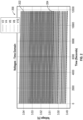
- FIG. 2 is a graph that depicts cell voltage waveforms for self-discharge rate determination.
- the x-axis depicts time in seconds and the y-axis depicts the cell voltage in volts.
- the graph 200 depicts the cell voltages for five (5) battery cells (V2, V4, V6, V8, and V10).
- the cell voltages may be acquired by controlling corresponding switching elements, such as the switching elements SW1-SW4 in FIG. 1 , using a pulsed pattern.
- a processor may control the switching element such that every 40 seconds the switching element closes for 32 seconds and opens for 8 seconds.
- the upper envelope 202 may be formed, and when the switching element is closed, the lower envelope 204 may be formed.
- Either the upper envelope 202 or the lower envelope 204 may be used to determine the self-discharge rate of the battery cell V10, such as resulting from a leakage current.
- One voltage may be measured when its switching element is closed (first state), and another voltage when its switching element is open (second state).
- the techniques described below may be applied to either of those two states separately, or to the average voltage of the two states. This choice may be used to select the state with the most convenient time alignment.
- the battery cell may discharge at a faster rate, which may increase the number of digital codes generated by an ADC circuit, which may expedite the testing of the battery cell.
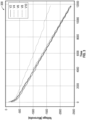
- FIG. 3 is a graph that depicts top-of-waveform envelopes with time averaging for the battery cells in FIG. 2 .
- the graph 300 depicts the cell voltages for the five (5) battery cells (V2, V4, V6, V8, and V10) of FIG. 2 , in particular the top envelope waveforms.
- the x-axis depicts time in seconds and the y-axis depicts the cell voltage in microvolts.
- 1 LSB of a digital code equals 100 microvolts.
- the techniques of this disclosure may determine a self-discharge rate, such as caused by leakage current, of one or more battery cells. For example, various techniques of this disclosure may be used to measure how long each change in LSB takes, rather than measuring how many LSBs change in a fixed time period. Such an approach may provide significantly improved measurement resolution. For instance, if a leakage current causes a first battery cell to self-discharge at 1LSB every 10 hours, and a second battery cell to self-discharge discharge at 1LSB every 11 hours, then the leakage in the second battery cell is 10% higher than in the first battery cell, after only 11 hours.
- the ADC circuit 104A of FIG. 1 may receive an analog input signal VIN1 that represents the corresponding voltage of the battery cell 100A of FIG. 1 and generate a digital output including digital codes DOUT1 that represents the analog input signal VIN1 at corresponding time intervals.
- the processor circuit 106 of FIG. 1 may receive the digital codes from the ADC circuit 104A and determine, for one or more of the digital codes, a length of time at which the corresponding digital codes remain or linger.
- the processor circuit 106 receives, at a first time, a first 4-bit digital code of 0111 from the ADC circuit 104A representing the voltage of the battery cell 100A of FIG. 1 .
- the ADC circuit 104A will output a second 4-bit digital code of 0110, at a second time, to the processor circuit 106, which is a change (decrease) in 1 LSB.
- the processor circuit 106 may determine a length of time at which the first digital code remained or lingered, such as before the first digital code changed to the second digital code.
- the processor circuit 106 may determine the difference between the first time and the second time. Then, the processor circuit 106 may determine the self-discharge rate of the battery cell using the determined length of time and the amount of change in the digital codes, which represents the voltage change. As a non-limiting example, the processor circuit 106 may determine a self-discharge rate of 1 LSB per 500 seconds.
- FIG. 3 depicts significant staircasing aligned to the LSBs (flat at the LSB transition and steep at the midpoints). That is, the cell voltages of the battery cells V2-V10 depict a staircase pattern rather than a smooth ramp.
- the staircase pattern may be the result of 100 microvolt steps, which may be improved by using interpolation.
- Time averaging such as over two minutes, may be useful because the measured cell voltage may be moving due to a noisy ADC circuit. Time averaging may smooth away the ADC sampling noise.
- the processor such as the processor circuit 106 of FIG. 1 , may be configured to perform, before determining the length of time at which corresponding ones of the digital codes remain, time averaging of the received digital codes to determine an average time at which corresponding ones of the digital codes were received.
- Noise in the cell voltage measurement system may be significant compared to the LSB size.
- An indicative magnitude of the noise in such systems is 50 microvolts (RMS) on each sample.
- RMS microvolts
- OCV open circuit voltage
- one such technique is to calculate the mean or median time that each digital code is observed.
- the processor such as the processor circuit 106 of FIG. 1
- the processor circuit 106 of FIG. 1 may be configured to perform, before determining the length of time at which corresponding ones of the digital codes remain, a linear regression technique, such as a least squares regression technique, to fit a line to the measured cell voltages to determine cell voltage slope.
- the slope of the line represents a self-discharge rate.
- the processor can perform a linear regression technique on received digital codes representing the cell voltages of the battery cells V2-V10 in FIG. 3 and the determined lengths of time at which corresponding ones of the digital codes remain to determine a slope of the line.
- FIG. 4 is a graph that depicts the plots in FIG. 3 after using the mean or median time at which each digital code was received.
- the graph 400 depicts the cell voltages for the five (5) battery cells (V2, V4, V6, V8, and V10) of FIG. 2 .
- the x-axis depicts time in seconds and the y-axis depicts the digital code in volts.
- Each point on a curve in FIG. 4 represents the mean or median time that the processor circuit 106 of FIG. 1 observed a particular digital code.
- the processor circuit 106 may add up the time when the processor 106 observed the digital code and then divide that time by the number of times the digital code was observed. In this manner, the processor circuit 106 may determine how long between a mean or median time that a digital code was observed and when the next digital code was observed, which is a measure of how fast the digital codes are being received and, as such, a measure of the discharge rate of a battery cell. As seen in FIG. 4 , the staircase effect of FIG. 3 has been removed.
- This mean or median time for each digital code may be used in the calculation of how long the LSB changes take, for example. For instance, if the mean (or median) time that a first 4-bit digital code of 0111 appeared was at 11:01 AM and the mean (or median) time that second 4-bit digital code of 0110 appeared was 11:21 AM, then the processor circuit 106 may determine that the digital codes are changing at a rate of 1LSB every 20 minutes.
- the processor circuit 106 may, for one or more digital codes, determine a mean or median time at which each digital code was received, and then determine the self-discharge rate of the battery cell(s) using the determined mean or median times.
- the processor 106 may determine the timing of the transition between adjacent digital codes.
- the processor circuit 106 may estimate a transition time from digital code N to digital code N+1 as the time when the output of a low pass filter, applied to the measured digital code stream, reaches a threshold of N+0.5. In this manner, the processor is determining a time between the digital code N(+0.5) and digital code N+ 1 (+0.5) In some examples, it may be desirable to adjust the timing to reflect group delay in the filter.
- a histogram may be created that records how often each ADC digital code is observed for each battery cell. Battery cells with a fast self-discharge rate will have more observed codes in their histogram, but those codes will be observed less often. Conversely, a slowly self-discharging battery cell will have few observed codes, but each of those codes will be observed many times.
- the processor circuit 106 may observe the output of an ADC circuit, such as the ADC circuit 104A, and determine how long particular ones of the digital codes DOUT1 remain by counting how often the digital codes occur. For example, the processor circuit 106 may store a count in a histogram bin, where the count represents a number of occurrences of corresponding ones of the digital codes. Then, the processor circuit 106 may determine the length of time at which the corresponding ones of the digital codes remain using a sampling rate of the ADC circuit and the count.
- the processor circuit 106 may store a count in a histogram bin in the memory circuit 107.
- the processor circuit 106 may receive a first 4-bit digital code of 0111 200 times before the output of the ADC circuit 104A changes (decreases) to a second 4-bit digital code of 0110, for example.
- the processor 106 may store the count in a histogram bin in the memory circuit 107. For a sampling rate of 100 samples per second (sps), the processor 106 may determine that the first digital code of 0111 remained for 2 seconds. In this manner, the processor circuit 106 may determine a time associated with a particular code and then determine the self-discharge rate of the at least one battery cell using the determined time.
- Low pass filtering applied to the output of an ADC that has noise at its input, may allow some interpolation between the thresholds set by the LSBs of the ADC. However, the interpolated results may have some sub-LSB error patterns.
- the techniques described above with respect to FIG. 4 where the mean or median times that the ADC LSBs are observed are used to calculate cell voltages as a function of time, may have improved tolerance of any sub-LSB error patterns.
- the processor circuit may receive outlier digital codes. It may be desirable to remove any outlier digital codes beforehand to more accurately determine the self-discharge rate of the battery cell(s) more accurately.
- An example of an outlier removal technique is described below with respect to FIG. 5 .
- FIG. 5 is a graph that depicts the plots in FIG. 4 after using an outlier rejection technique.
- the graph 500 depicts the cell voltages for the five (5) battery cells (V2, V4, V6, V8, and V10) of FIG. 2 , in particular the top envelope waveforms.
- the x-axis depicts the digital code in volts and the y-axis depicts the duration in seconds.
- the plots in the graph 500 may be formed by differentiating the smooth curves in FIG. 4 and then making a histogram of those points.
- the distributions are relatively flat on the top and steep on the sides.
- the battery cell V4 are relatively flat on the top, as shown at 502, and steep on the sides, as shown at 504 and 506.
- the flatness on the top corresponds to the substantially constant slope of the curve in FIG. 4 and the steep sides correspond to the ends of the curve where the slope is changing.
- the processor circuit 106 may implement an outlier rejection technique, such as a rank order filter or a median filter, to reject these outliers.
- unreliable digital codes may be known a-priori and the processor circuit 106 may reject those specific digital codes.
- digital codes at major carries may be unreliable.
- hexadecimal code 0FFF, 1FFF, 2FFF, etc. on may be unreliable in many successive approximation register (SAR) ADCs.
- SAR successive approximation register
- the outlier rejection technique may include ignoring specific digital codes.
- the processor circuit 106 may determine the self-discharge rate of one or more battery cells using the determined duration between the mean times of the consecutive codes from a result of an outlier rejection technique.
- a processor such the processor circuit 106, may be configured to control operation of a switching element to increase a rate at which the corresponding battery cell discharges.
- a switching element such as the processor circuit 106
- bleed current additional discharge current, or bleed current
- a first non-leaky battery cell may discharge at a rate of 1LSB every 2.5 hours
- a second battery cells with the threshold level of leakage may discharge at a rate of 1LSB every 2 hours.
- a processor circuit may determine a first self-discharge rate of the first battery cell and a second self-discharge rate of the second battery cell and then determine a relative self-discharge rate between the first battery cell and the second battery cell.
- these techniques may detect anomalous battery cells within a battery module that is being monitored by the BMS system.
- the processor circuit may compare discharge rates of adjacent battery cells to determine which battery cell self-discharge fastest. For example, if battery cell number 3 is discharging faster than its neighbors, then the system may determine that battery cell number 3 is leaky and may calculate the amount of that leakage.
- these techniques to accelerate the self-discharge of the battery cells may be applied to any of the techniques described in this disclosure.
- the techniques described above with respect to mean and median times and FIG. 4 may be combined with the accelerated self-discharge techniques.
- the speed-up arising from the addition of bleed current may also be used to count through more than just one LSB crossing when determining a self-discharge rate, such as due to leakage current, with a corresponding increase in detection time.
- This has the advantage that mean and median filtering of the per-LSB discharge rate measurements may be used to minimize the impact of errors associated with any individual measurement.
- the bleed current may be controlled using a pulsed pattern by controlling the operation of the switching elements. If the bleed current is being modulated using a pulsed pattern, then there will effectively be two measured voltages for each battery cell at a given state of charge. One voltage will be measured when its switching element is closed (first state), and another voltage when its switching element is open (second state). The techniques described above may be applied to either of those two states separately, or to the average voltage of the two states. This choice may be used to select the state with the most convenient time alignment.
- the discharge rate is the ratio of the leakage current divided by the incremental capacitance of the battery cell. It is not directly possible to distinguish between the two factors. However, by modulating the additional bleed current, it is possible to distinguish between leakage current and variation in incremental capacitance. For instance, if doubling the bleed current doubles the discharge rate, then the leakage current is zero. On the other hand, if doubling the bleed current increases the discharge rate by only 50%, then the leakage current is equal to the original bleed current.
- Any of the techniques described above may be used to determine the self-discharge rate of one or more battery cells using the determined length of time at which corresponding ones of the digital codes remain or linger, which in some examples may include determining a current leakage rate of the battery cell.
- FIG. 6 is a flow diagram of an example of a method 600 of determining a self-discharge rate of at least one battery cell coupled to an analog-to-digital converter (ADC) circuit, where the ADC circuit is configured to receive an analog input signal representing a voltage of the at least one battery cell and generate digital codes representing the analog input signal at corresponding time intervals.
- the method 600 includes receiving the digital codes.
- the processor circuit 106 or the battery management control circuit 110 can receive the digital codes.
- the method 600 includes determining a length of time at which corresponding ones of the digital codes remain.
- the processor circuit 106 or the battery management control circuit 110 can determine a length of time at which corresponding ones of the digital codes remain.
- the method 600 includes determining the self-discharge rate of the at least one battery cell using the determined length of time.
- the processor circuit 106 or the battery management control circuit 110 can determine the self-discharge rate of the at least one battery cell using the determined length of time.
- the method 600 includes performing, before determining the length of time at which corresponding ones of the digital codes remain, time averaging of the received digital codes to determine an average time at which corresponding ones of the digital codes were received.
- the method 600 includes for the plurality of digital codes, determining a mean or median time at which each digital code was received, wherein determining the self-discharge rate of the at least one battery cell using the determined length of time includes: determining the self-discharge rate of the at least one battery cell using the determined mean or median times.
- determining, using the plurality of the digital codes, the length of time at which corresponding ones of the digital codes remain includes: for the plurality of digital codes, determining a mean or median time at which each digital code was received; and determining a duration between corresponding mean or median times of consecutive codes, wherein determining the self-discharge rate of the at least one battery cell using the determined length of time includes: determining the self-discharge rate of the at least one battery cell using the determined duration between the corresponding mean or median times of the consecutive codes.
- the method 600 includes controlling, using a pulsed pattern, a switching element to switch between an open state and a closed state.
- the method 600 includes storing a count in a histogram bin, wherein the count represents a number of occurrences of the corresponding ones of the digital codes; and determining the length of time at which the corresponding ones of the digital codes remain using a sampling rate of the ADC circuit and the count.
- determining the self-discharge rate of the at least one battery cell using the determined length of time includes determining a leakage rate of the at least one battery cell.
- the at least one battery cell includes a first battery cell and a second battery cell
- determining the self-discharge rate of the at least one battery cell using the determined length of time includes: determining a first self-discharge rate of the first battery cell and a second self-discharge rate of the second battery cell
- the method 600 further comprises: determining a relative self-discharge rate between the first battery cell and the second battery cell.
- Method examples described herein may be machine or computer-implemented at least in part. Some examples may include a computer-readable medium or machine-readable medium encoded with instructions operable to configure an electronic device to perform methods as described in the above examples.
- An implementation of such methods may include code, such as microcode, assembly language code, a higher-level language code, or the like. Such code may include computer readable instructions for performing various methods. The code may form portions of computer program products. Further, in an example, the code may be tangibly stored on one or more volatile, non-transitory, or nonvolatile tangible computer-readable media, such as during execution or at other times.
- tangible computer-readable media may include, but are not limited to, hard disks, removable magnetic disks, removable optical disks (e.g., compact discs and digital video discs), magnetic cassettes, memory cards or sticks, random access memories (RAMs), read only memories (ROMs), and the like.
Landscapes
- Physics & Mathematics (AREA)
- General Physics & Mathematics (AREA)
- Engineering & Computer Science (AREA)
- Theoretical Computer Science (AREA)
- Power Engineering (AREA)
- Secondary Cells (AREA)
Description
- This application claims the benefit of priority of
U.S. Provisional Patent Application Serial Number 63/352,426, titled "BATTERY MONITORING TECHNIQUES" to Colin G. Lyden et al., filed on June 15, 2022 U.S Non-Provisional Patent Application Serial Number 18/200,446, titled "BATTERY MONITORING TECHNIQUES" to Colin G. Lyden et al., filed on May 22, 2023 - This document pertains generally, but not by way of limitation, to battery monitoring techniques.
- Electrified machines, such as electric vehicles, are powered by batteries instead of an engine to power or actuate an electric drive motor or other drive train system of the machine. A battery pack may include one or more battery modules, and a battery module may include one or more battery cells. Battery modules may include a battery cell monitoring circuit to monitor, among other things, a voltage of the battery cells in the battery module.
- Individual battery cells may be connected in series to provide a battery stack having a desired output voltage. A large number of cells may be connected in series such that the total potential difference developed across the battery stack is on the order of 150-600 volts, for example.
- In general, it may be desirable to monitor the terminal voltage because a low terminal voltage may indicate a discharged condition. The terminal voltage is a direct measurement of the DC voltage at the cell terminals.
-
US 2018/164363 A1 discloses self-discharge leakage current measurements to determine a self-discharge leakage current characteristic of a battery cell. - The invention is set out in the appended set of claims.
- This disclosure is directed to various techniques for determining self-discharge rates of one or more battery cells, such as by determining a current leakage of the battery cell(s). The techniques may improve the effective ADC linearity. An example of a technique may calculate the average time when each ADC digital code is observed, such as for a given battery cell or battery module, which allows the battery cell discharge rate to be estimated from the interval between the average time observed for neighboring, e.g., adjacent, digital codes. This approach allows the self-discharge rate of a battery cell to be calculated with high resolution even when the total cell voltage excursion is only a few LSBs.
- In some aspects, this disclosure is directed to a battery management system configured to determine a self-discharge rate of at least one battery cell, the battery management system comprising: an analog-to-digital converter (ADC) circuit coupled to the at least one battery cell and configured to receive an analog input signal representing a voltage of the at least one battery cell and generate digital codes representing the analog input signal at corresponding time intervals; and a processor configured to: receive the digital codes; determine a length of time at which corresponding ones of the digital codes remain; and determine the self-discharge rate of the at least one battery cell using the determined length of time.
- In some aspects, this disclosure is directed to a method of determining a self-discharge rate of at least one battery cell coupled to an analog-to-digital converter (ADC) circuit, wherein the ADC circuit is configured to receive an analog input signal representing a voltage of the at least one battery cell and generate digital codes representing the analog input signal at corresponding time intervals, the method comprising: receiving the digital codes; determining a length of time at which corresponding ones of the digital codes remain; and determining the self-discharge rate of the at least one battery cell using the determined length of time.
- In some aspects, this disclosure is directed to a battery management system configured to determine a self-discharge rate of at least one battery cell, the battery management system comprising: an analog-to-digital converter (ADC) circuit coupled to the at least one battery cell and configured to receive an analog input signal representing a voltage of the at least one battery cell and generate digital codes representing the analog input signal at corresponding time intervals; a processor configured to: receive the digital codes; determine a length of time at which corresponding ones of the digital codes remain; and determine the self-discharge rate of the at least one battery cell using the determined length of time; and a resistor coupled in series with a switching element, the resistor and switching element coupled in parallel across one of the battery cells, wherein the processor is configured to control operation of the switching element to increase a rate at which the battery cell discharges.
- In the drawings, which are not necessarily drawn to scale, like numerals may describe similar components in different views. Like numerals having different letter suffixes may represent different instances of similar components. The drawings illustrate generally, by way of example, but not by way of limitation, various embodiments discussed in the present document.
-
FIG. 1 is a simplified block diagram of an example of a system that may implement various techniques of this disclosure. -
FIG. 2 is a graph that depicts cell voltage waveforms for self-discharge rate determination. -
FIG. 3 is a graph that depicts top-of-waveform envelopes with time averaging for the battery cells inFIG. 2 . -
FIG. 4 is a graph that depicts the plots inFIG. 3 after using the mean or median time at which each digital code was received. -
FIG. 5 is a graph that depicts the plots inFIG. 4 after using an outlier rejection technique. -
FIG. 6 is a flow diagram of an example of a method of determining a self-discharge rate of at least one battery cell coupled to an analog-to-digital converter (ADC) circuit, where the ADC circuit is configured to receive an analog input signal representing a voltage of the at least one battery cell and generate digital codes representing the analog input signal at corresponding time intervals. - Electric vehicles have been gaining immense popularity. One factor facilitating adoption of electric vehicles has been improvement in battery management. The battery modules may be associated with a battery management system (BMS) that is configured to protect the battery modules from damage by controlling, such as by limiting or regulating, the power drawn from the modules, such as during operation of an electrical vehicle.
- In some examples, the BMS can include control circuitry that limits the amount of current that is drawn from a battery module by the drive train system of an electric vehicle. As an example, the control circuitry can interrupt the current drawn from the battery module when current exceeds a safe operating range of one or more components of the system. Using a BMS, electric vehicles may monitor battery levels, such as individual cell voltages or battery module voltages, which in turn may operate the vehicle more reliably and efficiently.
- As an example, automotive original equipment manufacturers (OEMs) are interested in monitoring battery cell self-discharge, such as in a manufacturing facility before installation into the electric vehicle and/or throughout the life of the batteries after installation into the electric vehicle. Self-discharge refers to a decrease in the stored charge of the battery where there is no connection between the electrodes of the battery and an external circuit.
- A self-discharge rate of more than 2% of full capacity per month may be classified as a fault. The most direct indicator of self-discharge rate is the reduction in battery cell open circuit voltage (OCV) as the battery cell state of charge (SOC) is reduced, such as by leakage current. As the OCV versus SOC curve is designed to be very flat, even faulty levels of self-discharge may cause very slow changes in OCV. To ensure that the cumulative effect of any leakage on battery cell OCV is detectable, it is common to let the battery cells sit for up to two weeks in the factory. The present inventors have recognized a need to reduce the manufacturing delay, through faster detection of battery cell self-discharge.
- Finite resolution of an analog-to-digital converter (ADC) circuit is one impediment to detecting small changes in battery cell OCV. The BMS may include one or more analog-to-digital converter (ADC) circuits to digitize a signal representing a battery cell voltage, for example. The ADC circuit may generate a digital code representing the magnitude of an input voltage, such as the battery cell voltage. The ADC circuit may operate bit-by-bit across all bit positions to determine the most significant bit (MSB) through the least significant bit (LSB) to generate a complete digital code that corresponds to the input voltage.
- The currents available to act as stimulus for electric vehicle battery monitoring are small, and the corresponding voltage response of the battery cell is very small, typically of the order of the LSB of the available embedded ADC circuits of the BMS. An example of the unit ADC step size in an electric vehicle battery monitor is 100 microvolts (µV). That is, the LSB of an example of an ADC circuit may represent 100 µV. Therefore, the resolution of that example of an ADC circuit is 100 µV and thus the ADC circuit cannot discriminate voltage changes that are less than 100 µV.
- One approach to determining a self-discharge rate of a battery cell is to measure the OCV at the start and the end of some specified interval, then divide the voltage difference by the time difference to calculate a slope. This approach may have problems if the expected change in OCV is of the same scale as the LSB of the ADC circuit. For instance, if the leakage causes the battery cell OCV to drop at 10µV/hour, then 10 hours of observation may be needed to detect that self-discharge, and 100 hours may be needed to determine the self-discharge with a resolution of 10% of reading. The present inventors have recognized a need to improve self-discharge rate determination techniques to allow the battery cell discharge rate to be calculated with high resolution even when the total battery cell voltage excursion is only a few LSBs.
- This disclosure is directed to various techniques for determining self-discharge rates of one or more battery cells, such as by determining a current leakage of the battery cell(s). The techniques may improve the effective ADC linearity. An example of a technique may calculate the average time when each ADC digital code is observed, such as for a given battery cell or battery module, which allows the battery cell discharge rate to be estimated from the interval between the average time observed for neighboring, e.g., adjacent, digital codes. This approach allows the self-discharge rate of a battery cell to be calculated with high resolution even when the total cell voltage excursion is only a few LSBs.
- Another example of a technique of this disclosure draws a controlled bleed current, such as from the battery cell or battery module, while self-discharge is being monitored, to ensure that the battery cell or battery module voltage changes by many LSBs in the measurement period. The resulting diversity in ADC digital output codes means that the impact of transfer function errors associated with any particular code can be minimized by mean or median filtering. In some examples, the filtering may be implemented using machine learning techniques such as neural networks or support vector machines. A machine learning model may be trained using a range of example measurements of input codes and corresponding desired outputs. As an example, the model may be trained in a laboratory in advance of system use in the field.
-
FIG. 1 is a simplified block diagram of an example of a system that may implement various techniques of this disclosure. InFIG. 1 , one ormore battery cells 100A-100D may be coupled in series to form abattery module 102. In the example shown, thebattery cells 100A-100D may be coupled tocorresponding ADC circuits 104A-104D. In other examples, thebattery cells 100A-100D may be coupled to multiplexer circuit, and the multiplexer circuit may be coupled to a single ADC circuit. - As an example, an ADC circuit may be coupled to one or more battery cells and configured to receive an analog input signal representing a corresponding voltage of the battery cell(s) and generate digital codes representing the analog input signal at corresponding time intervals. For example,
ADC circuit 104A may receive an analog input signal VIN1 that represents the corresponding voltage of thebattery cell 100A and generate a digital output including digital codes DOUT1 that represents the analog input signal VIN1 at corresponding time intervals. - A
processor circuit 106 having amemory circuit 107 may be coupled to receive the output of theADC circuits 104A-104D (or the output of a single ADC circuit in a multiplexed configuration). Theprocessor circuit 106 may be coupled to atransceiver circuit 108, e.g., wireless radio. Thetransceiver circuit 108 may wirelessly communicate with a batterymanagement control circuit 110, as indicated bylightning bolt 112. The batterymanagement control circuit 110 may receive information from theprocessor circuit 106 and operate to protect the battery modules from damage by controlling, such as by limiting or regulating, the power drawn from the modules, such as during operation of an electrical vehicle. - The
ADC circuits 104A-104D, theprocessor circuit 106, thetransceiver circuit 108, and the batterymanagement control circuit 110 may form at least a portion of a battery management system (BMS) that may perform various techniques described in this disclosure. As described in more detail below, a processor, such as theprocessor circuit 106, may be configured to, among other things, receive digital codes generated by an ADC circuit, such as theADC circuit 104A, determine a length of time at which corresponding ones of the digital codes remain (or linger), and determine a self-discharge rate of one or more corresponding battery cells, such as thebattery cell 100A, using the determined length of time. - In some examples, the battery management system may include a resistor coupled in series with a switching element, where the resistor and switching element are coupled in parallel across one of the battery cells. For example,
resistor RS 1 may be coupled in series with switching element SW1, where the resistor RS1 and the switching element SW1 are coupled in parallel across thebattery cell 100A. In some examples, theother battery cells 100B-100D may be associated with similar resistors RS2-RS4 and switching elements SW2-SW4. A processor, such theprocessor circuit 106, may be configured to control operation of a switching element to increase a rate at which the corresponding battery cell discharges. For example, the processor may control, using a pulsed pattern, the switching element, e.g., SW1, to switch between an open state and a closed state. The pulsed pattern may be generated using pulse width modulation or pulse dense modulation techniques, for example. Controlling the resistor and switching element combination may reduce the time needed to test the battery cells. - One or more of the ADC circuits, such as the
ADC circuits 104A-104D ofFIG. 1 , may suffer from non-idealities, such as non-linearity. In some cases, the non-idealities may be known at the time of manufacture, but are not corrected in the ADC. For example, there could be a range of codes for which the transfer function of the ADC is not ideal. - In some examples, information about the ADC non-linearity can be stored with the ADC or with the battery
management control circuit 110. In some examples, the processor or the battery management control circuit can correct the calculated ADC cell voltage slopes based on the known non-linearity. As an example, certain regions of the ADC transfer function are recorded as having less reliable linearity, and cell voltage slopes that are based on such regions are discarded as unreliable. The information about ADC non-linearity may be determined as part of the ADC characterization in the ADC factory. - In some implementations, it can be advantageous to perform the techniques described above (such as linear regression techniques) on the battery cell side, such as by the
processor circuit 106, with communication of the results over the air via thetransceiver circuit 108 to the batterymanagement control circuit 110. This can greatly reduce the amount of data transmitted over the air, compared to other implementations where every ADC sample is sent over the air, with calculations (such as the cell voltage slope) performed at the batterymanagement control circuit 110. - In other examples, the
processor circuit 106 may not have the capacity to perform these calculations. As such, it may be desirable for the batterymanagement control circuit 110 to do so. The batterymanagement control circuit 110 can be configured to, among other things, receive the digital codes, determine a length of time at which corresponding ones of the digital codes remain, and determine the self-discharge rate of the at least one battery cell using the determined length of time. The batterymanagement control circuit 110 can further perform other techniques, such as the linear regression techniques, described in this disclosure. - Battery cell voltage depends on temperature, and a steadily changing cell temperature will change the cell voltage slope. In many cases, the battery cell temperature is available as an auxiliary measurement. The sensitivity of cell voltage to temperature is known to be a function of cell chemistry and the state of charge (SOC). In some examples, the
processor circuit 106 or the batterymanagement control circuit 110 can correct the calculated cell voltage slopes for changing cell temperatures based on sensitivity of cell voltage to temperature stored in a memory associated with theprocessor circuit 106 or the batterymanagement control circuit 110. In this manner, theprocessor circuit 106 or the batterymanagement control circuit 110 can determine temperature corrected cell voltages, which can then be processed to determine the self-discharge rates. -
FIG. 2 is a graph that depicts cell voltage waveforms for self-discharge rate determination. The x-axis depicts time in seconds and the y-axis depicts the cell voltage in volts. - The
graph 200 depicts the cell voltages for five (5) battery cells (V2, V4, V6, V8, and V10). In an example of an implementation, the cell voltages may be acquired by controlling corresponding switching elements, such as the switching elements SW1-SW4 inFIG. 1 , using a pulsed pattern. As a non-limiting example, a processor may control the switching element such that every 40 seconds the switching element closes for 32 seconds and opens for 8 seconds. When a switching element associated with the battery cell V10 is open, theupper envelope 202 may be formed, and when the switching element is closed, thelower envelope 204 may be formed. - Either the
upper envelope 202 or thelower envelope 204 may be used to determine the self-discharge rate of the battery cell V10, such as resulting from a leakage current. One voltage may be measured when its switching element is closed (first state), and another voltage when its switching element is open (second state). The techniques described below may be applied to either of those two states separately, or to the average voltage of the two states. This choice may be used to select the state with the most convenient time alignment. - By controlling the switching element, such as the switching element SW1 in
FIG. 1 , to place a resistor, such as the resistor RS1 inFIG. 1 , in parallel with the battery cell, the battery cell may discharge at a faster rate, which may increase the number of digital codes generated by an ADC circuit, which may expedite the testing of the battery cell. -
FIG. 3 is a graph that depicts top-of-waveform envelopes with time averaging for the battery cells inFIG. 2 . Thegraph 300 depicts the cell voltages for the five (5) battery cells (V2, V4, V6, V8, and V10) ofFIG. 2 , in particular the top envelope waveforms. The x-axis depicts time in seconds and the y-axis depicts the cell voltage in microvolts. InFIG. 3 ,1 LSB of a digital code equals 100 microvolts. - As seen in
FIG. 3 , as time increases, the cell voltages decrease as the battery cells discharge. The techniques of this disclosure may determine a self-discharge rate, such as caused by leakage current, of one or more battery cells. For example, various techniques of this disclosure may be used to measure how long each change in LSB takes, rather than measuring how many LSBs change in a fixed time period. Such an approach may provide significantly improved measurement resolution. For instance, if a leakage current causes a first battery cell to self-discharge at 1LSB every 10 hours, and a second battery cell to self-discharge discharge at 1LSB every 11 hours, then the leakage in the second battery cell is 10% higher than in the first battery cell, after only 11 hours. - As an example, the
ADC circuit 104A ofFIG. 1 may receive an analog input signal VIN1 that represents the corresponding voltage of thebattery cell 100A ofFIG. 1 and generate a digital output including digital codes DOUT1 that represents the analog input signal VIN1 at corresponding time intervals. Theprocessor circuit 106 ofFIG. 1 may receive the digital codes from theADC circuit 104A and determine, for one or more of the digital codes, a length of time at which the corresponding digital codes remain or linger. - As a non-limiting example for the purposes of explanation only, assume the
processor circuit 106 receives, at a first time, a first 4-bit digital code of 0111 from theADC circuit 104A representing the voltage of thebattery cell 100A ofFIG. 1 . As thebattery cell 100A ofFIG. 1 self-discharges, such as by leakage current, the voltage of thebattery cell 100A will eventually decrease and theADC circuit 104A will output a second 4-bit digital code of 0110, at a second time, to theprocessor circuit 106, which is a change (decrease) in 1 LSB. Theprocessor circuit 106 may determine a length of time at which the first digital code remained or lingered, such as before the first digital code changed to the second digital code. For example, theprocessor circuit 106 may determine the difference between the first time and the second time. Then, theprocessor circuit 106 may determine the self-discharge rate of the battery cell using the determined length of time and the amount of change in the digital codes, which represents the voltage change. As a non-limiting example, theprocessor circuit 106 may determine a self-discharge rate of 1 LSB per 500 seconds. -
FIG. 3 depicts significant staircasing aligned to the LSBs (flat at the LSB transition and steep at the midpoints). That is, the cell voltages of the battery cells V2-V10 depict a staircase pattern rather than a smooth ramp. The staircase pattern may be the result of 100 microvolt steps, which may be improved by using interpolation. - Time averaging, such as over two minutes, may be useful because the measured cell voltage may be moving due to a noisy ADC circuit. Time averaging may smooth away the ADC sampling noise. For example, the processor, such as the
processor circuit 106 ofFIG. 1 , may be configured to perform, before determining the length of time at which corresponding ones of the digital codes remain, time averaging of the received digital codes to determine an average time at which corresponding ones of the digital codes were received. - Noise in the cell voltage measurement system may be significant compared to the LSB size. An indicative magnitude of the noise in such systems is 50 microvolts (RMS) on each sample. Estimates of change in open circuit voltage (OCV) should desirably minimize this noise. In accordance with this disclosure, and as described below with respect to
FIG. 4 , one such technique is to calculate the mean or median time that each digital code is observed. - In other examples, the processor, such as the
processor circuit 106 ofFIG. 1 , may be configured to perform, before determining the length of time at which corresponding ones of the digital codes remain, a linear regression technique, such as a least squares regression technique, to fit a line to the measured cell voltages to determine cell voltage slope. The slope of the line represents a self-discharge rate. For example, the processor can perform a linear regression technique on received digital codes representing the cell voltages of the battery cells V2-V10 inFIG. 3 and the determined lengths of time at which corresponding ones of the digital codes remain to determine a slope of the line. -
FIG. 4 is a graph that depicts the plots inFIG. 3 after using the mean or median time at which each digital code was received. Thegraph 400 depicts the cell voltages for the five (5) battery cells (V2, V4, V6, V8, and V10) ofFIG. 2 . The x-axis depicts time in seconds and the y-axis depicts the digital code in volts. - Each point on a curve in
FIG. 4 represents the mean or median time that theprocessor circuit 106 ofFIG. 1 observed a particular digital code. For each digital code, theprocessor circuit 106 may add up the time when theprocessor 106 observed the digital code and then divide that time by the number of times the digital code was observed. In this manner, theprocessor circuit 106 may determine how long between a mean or median time that a digital code was observed and when the next digital code was observed, which is a measure of how fast the digital codes are being received and, as such, a measure of the discharge rate of a battery cell. As seen inFIG. 4 , the staircase effect ofFIG. 3 has been removed. - This mean or median time for each digital code may be used in the calculation of how long the LSB changes take, for example. For instance, if the mean (or median) time that a first 4-bit digital code of 0111 appeared was at 11:01 AM and the mean (or median) time that second 4-bit digital code of 0110 appeared was 11:21 AM, then the
processor circuit 106 may determine that the digital codes are changing at a rate of 1LSB every 20 minutes. - To implement these techniques of
FIG. 4 , theprocessor circuit 106 may, for one or more digital codes, determine a mean or median time at which each digital code was received, and then determine the self-discharge rate of the battery cell(s) using the determined mean or median times. - As an alternative to the mean or median techniques described above, the
processor 106 may determine the timing of the transition between adjacent digital codes. As an example, theprocessor circuit 106 may estimate a transition time from digital code N to digital code N+1 as the time when the output of a low pass filter, applied to the measured digital code stream, reaches a threshold of N+0.5. In this manner, the processor is determining a time between the digital code N(+0.5) and digital code N+ 1 (+0.5) In some examples, it may be desirable to adjust the timing to reflect group delay in the filter. - In some examples, it may be desirable to use a histogram to determine the length of time at which corresponding ones of the digital codes are observed. A histogram may be created that records how often each ADC digital code is observed for each battery cell. Battery cells with a fast self-discharge rate will have more observed codes in their histogram, but those codes will be observed less often. Conversely, a slowly self-discharging battery cell will have few observed codes, but each of those codes will be observed many times.
- The
processor circuit 106 may observe the output of an ADC circuit, such as theADC circuit 104A, and determine how long particular ones of the digital codes DOUT1 remain by counting how often the digital codes occur. For example, theprocessor circuit 106 may store a count in a histogram bin, where the count represents a number of occurrences of corresponding ones of the digital codes. Then, theprocessor circuit 106 may determine the length of time at which the corresponding ones of the digital codes remain using a sampling rate of the ADC circuit and the count. - By way of a non-limiting specific example, each time that the
processor circuit 106 receives a digital code from theADC circuit 104A, theprocessor circuit 106 may store a count in a histogram bin in thememory circuit 107. For example, theprocessor circuit 106 may receive a first 4-bit digital code of 0111 200 times before the output of theADC circuit 104A changes (decreases) to a second 4-bit digital code of 0110, for example. After each time it receives the first 4-bit digital code of 0111, theprocessor 106 may store the count in a histogram bin in thememory circuit 107. For a sampling rate of 100 samples per second (sps), theprocessor 106 may determine that the first digital code of 0111 remained for 2 seconds. In this manner, theprocessor circuit 106 may determine a time associated with a particular code and then determine the self-discharge rate of the at least one battery cell using the determined time. - Low pass filtering, applied to the output of an ADC that has noise at its input, may allow some interpolation between the thresholds set by the LSBs of the ADC. However, the interpolated results may have some sub-LSB error patterns. The techniques described above with respect to
FIG. 4 , where the mean or median times that the ADC LSBs are observed are used to calculate cell voltages as a function of time, may have improved tolerance of any sub-LSB error patterns. - For various reasons, it is possible that the processor circuit may receive outlier digital codes. It may be desirable to remove any outlier digital codes beforehand to more accurately determine the self-discharge rate of the battery cell(s) more accurately. An example of an outlier removal technique is described below with respect to
FIG. 5 . -
FIG. 5 is a graph that depicts the plots inFIG. 4 after using an outlier rejection technique. Thegraph 500 depicts the cell voltages for the five (5) battery cells (V2, V4, V6, V8, and V10) ofFIG. 2 , in particular the top envelope waveforms. The x-axis depicts the digital code in volts and the y-axis depicts the duration in seconds. - The plots in the
graph 500 may be formed by differentiating the smooth curves inFIG. 4 and then making a histogram of those points. In thegraph 500, the distributions are relatively flat on the top and steep on the sides. For example, the battery cell V4 are relatively flat on the top, as shown at 502, and steep on the sides, as shown at 504 and 506. The flatness on the top corresponds to the substantially constant slope of the curve inFIG. 4 and the steep sides correspond to the ends of the curve where the slope is changing. - In the relatively flat portions, such as in
portion 502, there are a few outlier data points. Theprocessor circuit 106 may implement an outlier rejection technique, such as a rank order filter or a median filter, to reject these outliers. - In some examples, unreliable digital codes may be known a-priori and the
processor circuit 106 may reject those specific digital codes. For example, in some ADC architectures, digital codes at major carries may be unreliable. For instance, hexadecimal code 0FFF, 1FFF, 2FFF, etc. on may be unreliable in many successive approximation register (SAR) ADCs. In this manner, the outlier rejection technique may include ignoring specific digital codes. In some examples, it may be desirable to discharge past those digital codes before discharge measurements are performed. - In this manner, the
processor circuit 106 may determine the self-discharge rate of one or more battery cells using the determined duration between the mean times of the consecutive codes from a result of an outlier rejection technique. - For any of the techniques described above, a processor, such the
processor circuit 106, may be configured to control operation of a switching element to increase a rate at which the corresponding battery cell discharges. With respect to the outlier rejection techniques ofFIG. 5 , it may be advantageous to increase a rate at which the battery cell discharges because the number of digital codes generated by the ADC circuit may increase, which may assist in outlier rejection. - For example, assume that it may take 10 hours to detect leakage, as that is how long it takes the leakage current to discharge the cell voltage by 1LSB. This time may be reduced if additional discharge current, or bleed current, is provided through the switching elements, such as switching elements SW1-SW4 in
FIG. 1 , such as by using a pulsed pattern. If the bleed current is set at four times the leakage current threshold, then a first non-leaky battery cell may discharge at a rate of 1LSB every 2.5 hours, and a second battery cells with the threshold level of leakage may discharge at a rate of 1LSB every 2 hours. In this manner, a processor circuit may determine a first self-discharge rate of the first battery cell and a second self-discharge rate of the second battery cell and then determine a relative self-discharge rate between the first battery cell and the second battery cell. As such, these techniques may detect anomalous battery cells within a battery module that is being monitored by the BMS system. - In some examples, the processor circuit may compare discharge rates of adjacent battery cells to determine which battery cell self-discharge fastest. For example, if
battery cell number 3 is discharging faster than its neighbors, then the system may determine thatbattery cell number 3 is leaky and may calculate the amount of that leakage. - It should be noted that these techniques to accelerate the self-discharge of the battery cells may be applied to any of the techniques described in this disclosure. For example, the techniques described above with respect to mean and median times and
FIG. 4 may be combined with the accelerated self-discharge techniques. - The speed-up arising from the addition of bleed current may also be used to count through more than just one LSB crossing when determining a self-discharge rate, such as due to leakage current, with a corresponding increase in detection time. This has the advantage that mean and median filtering of the per-LSB discharge rate measurements may be used to minimize the impact of errors associated with any individual measurement.
- As mentioned above, in some examples, the bleed current may be controlled using a pulsed pattern by controlling the operation of the switching elements. If the bleed current is being modulated using a pulsed pattern, then there will effectively be two measured voltages for each battery cell at a given state of charge. One voltage will be measured when its switching element is closed (first state), and another voltage when its switching element is open (second state). The techniques described above may be applied to either of those two states separately, or to the average voltage of the two states. This choice may be used to select the state with the most convenient time alignment.
- In leakage detection, the discharge rate is the ratio of the leakage current divided by the incremental capacitance of the battery cell. It is not directly possible to distinguish between the two factors. However, by modulating the additional bleed current, it is possible to distinguish between leakage current and variation in incremental capacitance. For instance, if doubling the bleed current doubles the discharge rate, then the leakage current is zero. On the other hand, if doubling the bleed current increases the discharge rate by only 50%, then the leakage current is equal to the original bleed current.
- Any of the techniques described above may be used to determine the self-discharge rate of one or more battery cells using the determined length of time at which corresponding ones of the digital codes remain or linger, which in some examples may include determining a current leakage rate of the battery cell.
-
FIG. 6 is a flow diagram of an example of amethod 600 of determining a self-discharge rate of at least one battery cell coupled to an analog-to-digital converter (ADC) circuit, where the ADC circuit is configured to receive an analog input signal representing a voltage of the at least one battery cell and generate digital codes representing the analog input signal at corresponding time intervals. Atblock 602, themethod 600 includes receiving the digital codes. For example, theprocessor circuit 106 or the batterymanagement control circuit 110 can receive the digital codes. - At
block 604, themethod 600 includes determining a length of time at which corresponding ones of the digital codes remain. For example, theprocessor circuit 106 or the batterymanagement control circuit 110 can determine a length of time at which corresponding ones of the digital codes remain. - At
block 604, themethod 600 includes determining the self-discharge rate of the at least one battery cell using the determined length of time. For example, theprocessor circuit 106 or the batterymanagement control circuit 110 can determine the self-discharge rate of the at least one battery cell using the determined length of time. - In some examples, the
method 600 includes performing, before determining the length of time at which corresponding ones of the digital codes remain, time averaging of the received digital codes to determine an average time at which corresponding ones of the digital codes were received. - In some examples, the
method 600 includes for the plurality of digital codes, determining a mean or median time at which each digital code was received, wherein determining the self-discharge rate of the at least one battery cell using the determined length of time includes: determining the self-discharge rate of the at least one battery cell using the determined mean or median times. - In some examples, determining, using the plurality of the digital codes, the length of time at which corresponding ones of the digital codes remain includes: for the plurality of digital codes, determining a mean or median time at which each digital code was received; and determining a duration between corresponding mean or median times of consecutive codes, wherein determining the self-discharge rate of the at least one battery cell using the determined length of time includes: determining the self-discharge rate of the at least one battery cell using the determined duration between the corresponding mean or median times of the consecutive codes.
- In some examples, the
method 600 includes controlling, using a pulsed pattern, a switching element to switch between an open state and a closed state. - In some examples, the
method 600 includes storing a count in a histogram bin, wherein the count represents a number of occurrences of the corresponding ones of the digital codes; and determining the length of time at which the corresponding ones of the digital codes remain using a sampling rate of the ADC circuit and the count. - In some examples, determining the self-discharge rate of the at least one battery cell using the determined length of time includes determining a leakage rate of the at least one battery cell.
- In some examples, the at least one battery cell includes a first battery cell and a second battery cell, determining the self-discharge rate of the at least one battery cell using the determined length of time includes: determining a first self-discharge rate of the first battery cell and a second self-discharge rate of the second battery cell, and the
method 600 further comprises: determining a relative self-discharge rate between the first battery cell and the second battery cell. - Each of the non-limiting aspects or examples described herein may stand on its own, or may be combined in various permutations or combinations with one or more of the other examples.
- The above detailed description includes references to the accompanying drawings, which form a part of the detailed description. The drawings show, by way of illustration, specific embodiments in which the invention may be practiced. These embodiments are also referred to herein as "examples." Such examples may include elements in addition to those shown or described. However, the present inventors also contemplate examples in which only those elements shown or described are provided. Moreover, the present inventors also contemplate examples using any combination or permutation of those elements shown or described (or one or more aspects thereof), either with respect to a particular example (or one or more aspects thereof), or with respect to other examples (or one or more aspects thereof) shown or described herein.
- In the event of inconsistent usages between this document and any documents so incorporated by reference, the usage in this document controls.
- In this document, the terms "a" or "an" are used, as is common in patent documents, to include one or more than one, independent of any other instances or usages of "at least one" or "one or more." In this document, the term "or" is used to refer to a nonexclusive or, such that "A or B" includes "A but not B," "B but not A," and "A and B," unless otherwise indicated. In this document, the terms "including" and "in which" are used as the plain-English equivalents of the respective terms "comprising" and "wherein." Also, in the following aspects, the terms "including" and "comprising" are open-ended, that is, a system, device, article, composition, formulation, or process that includes elements in addition to those listed after such a term in an aspect are still deemed to fall within the scope of that aspect. Moreover, in the following aspects, the terms "first," "second," and "third," etc. are used merely as labels, and are not intended to impose numerical requirements on their objects.
- Method examples described herein may be machine or computer-implemented at least in part. Some examples may include a computer-readable medium or machine-readable medium encoded with instructions operable to configure an electronic device to perform methods as described in the above examples. An implementation of such methods may include code, such as microcode, assembly language code, a higher-level language code, or the like. Such code may include computer readable instructions for performing various methods. The code may form portions of computer program products. Further, in an example, the code may be tangibly stored on one or more volatile, non-transitory, or nonvolatile tangible computer-readable media, such as during execution or at other times. Examples of these tangible computer-readable media may include, but are not limited to, hard disks, removable magnetic disks, removable optical disks (e.g., compact discs and digital video discs), magnetic cassettes, memory cards or sticks, random access memories (RAMs), read only memories (ROMs), and the like.
- The above description is intended to be illustrative, and not restrictive.
Claims (15)
- A battery management system configured to determine a self-discharge rate of at least one battery cell, the battery management system comprising:an analog-to-digital converter, ADC (104A-104D), ADO, circuit coupled to the at least one battery cell (100A-100D) and configured to receive an analog input signal representing a voltage of the at least one battery cell and generate digital codes representing the analog input signal at corresponding time intervals; characterised in that the battery management system further comprisinga processor (106) configured to:receive the digital codes;determine a length of time at which corresponding ones of the digital codes remain; anddetermine the self-discharge rate of the at least one battery cell using the determined length of time.
- The battery management system of claim 1, wherein the processor is configured to:
perform, before determining the length of time at which corresponding ones of the digital codes remain, time averaging of the received digital codes to determine an average time at which corresponding ones of the digital codes were received. - The battery management system of claim 1 or 2, wherein the processor is configured to:
perform a linear regression technique of the received digital codes and the determined lengths of time to determine the self-discharge rate. - The battery management system of any preceding claim, wherein the processor configured to determine, using the plurality of the digital codes, the length of time at which corresponding ones of the digital codes remain includes:for the plurality of digital codes, determine a mean or median time at which each digital code was received; anddetermine a duration between corresponding mean or median times of consecutive codes,wherein the processor configured to determine the self-discharge rate of the at least one battery cell using the determined length of time is configured to:
determine the self-discharge rate of the at least one battery cell using the determined duration between the corresponding mean or median times of the consecutive codes. - The battery management system of any preceding claim, comprising:a resistor (RS1-RS4) coupled in series with a switching element (SW1-SW4), the resistor and switching element coupled in parallel across one of the battery cells,wherein the processor is configured to control operation of the switching element to increase a rate at which the battery cell discharges.
- The battery management system of claim 5, wherein the processor is configured to:
control, using a pulsed pattern, the switching element to switch between an open state and a closed state. - The battery management system of claim 6, wherein the processor is configured to, when the switching element is in the open state and/or when the switching element is in the closed state:receive the digital codes;determine the length of time at which corresponding ones of the digital codes remain; anddetermine the self-discharge rate of the at least one battery cell using the determined length of time.
- The battery management system of any of claims 5 to 7, wherein the processor configured to determine the self-discharge rate of the at least one battery cell using the determined duration between the mean times of the consecutive codes is configured to:
determine the self-discharge rate of the at least one battery cell using the determined duration between the mean times of the consecutive codes from a result of an outlier rejection technique, preferably wherein the outlier rejection technique includes ignoring specific digital codes. - The battery management system of any preceding claim, wherein the processor configured to determine the self-discharge rate of the at least one battery cell using the determined length of time is configured to determine a leakage rate of the at least one battery cell.
- The battery management system of any preceding claim, wherein the at least one battery cell includes a first battery cell and a second battery cell, wherein the processor configured determine the self-discharge rate of the at least one battery cell using the determined length of time is configured to:
determine a first self-discharge rate of the first battery cell and a second self-discharge rate of the second battery cell, and wherein the processor is further configured to:
determine a relative self-discharge rate between the first battery cell and the second battery cell. - The battery management system of any preceding claim, wherein the processor is a battery management control circuit.
- A method of determining a self-discharge rate of at least one battery cell coupled to an analog-to-digital converter, ADC, circuit, wherein the ADC circuit is configured to receive an analog input signal representing a voltage of the at least one battery cell and generate digital codes representing the analog input signal at corresponding time intervals, the method is characterised by:receiving (602) the digital codes;determining (604) a length of time at which corresponding ones of the digital codes remain; anddetermining (606) the self-discharge rate of the at least one battery cell using the determined length of time.
- The method of claim 12, comprising:
performing, before determining the length of time at which corresponding ones of the digital codes remain, time averaging of the received digital codes to determine an average time at which corresponding ones of the digital codes were received. - The method of claim 12 or 13, comprising:
wherein determining, using the plurality of the digital codes, the length of time at which corresponding ones of the digital codes remain includes:for the plurality of digital codes, determining a mean or median time at which each digital code was received; and preferably determining a duration between corresponding mean or median times of consecutive codes,wherein determining the self-discharge rate of the at least one battery cell using the determined length of time includes:
determining the self-discharge rate of the at least one battery cell using the determined mean or median times, preferably determining the self-discharge rate of the at least one battery cell using the determined duration between the corresponding mean or median times of the consecutive codes. - The method of any of claims 12 to 14, comprising:
controlling, using a pulsed pattern, a switching element to switch between an open state and a closed state.
Applications Claiming Priority (2)
| Application Number | Priority Date | Filing Date | Title |
|---|---|---|---|
| US202263352426P | 2022-06-15 | 2022-06-15 | |
| US18/200,446 US20240393398A1 (en) | 2022-06-15 | 2023-05-22 | Battery monitoring techniques |
Publications (2)
| Publication Number | Publication Date |
|---|---|
| EP4293374A1 EP4293374A1 (en) | 2023-12-20 |
| EP4293374B1 true EP4293374B1 (en) | 2024-10-30 |
Family
ID=86646516
Family Applications (1)
| Application Number | Title | Priority Date | Filing Date |
|---|---|---|---|
| EP23176512.4A Active EP4293374B1 (en) | 2022-06-15 | 2023-05-31 | Battery monitoring techniques |
Country Status (3)
| Country | Link |
|---|---|
| US (1) | US20240393398A1 (en) |
| EP (1) | EP4293374B1 (en) |
| KR (1) | KR102935149B1 (en) |
Families Citing this family (1)
| Publication number | Priority date | Publication date | Assignee | Title |
|---|---|---|---|---|
| WO2025116462A1 (en) | 2023-12-01 | 2025-06-05 | 주식회사 엘지에너지솔루션 | Battery assembly and battery pack comprising same |
Family Cites Families (5)
| Publication number | Priority date | Publication date | Assignee | Title |
|---|---|---|---|---|
| JP6156286B2 (en) * | 2014-08-14 | 2017-07-05 | Tdk株式会社 | Activity meter |
| US10330715B2 (en) | 2016-12-11 | 2019-06-25 | Keysight Technologies, Inc. | Systems and methods for determining a self-discharge current characteristic of a storage cell |
| US10522881B1 (en) * | 2018-01-12 | 2019-12-31 | Cora Aero Llc | Estimation of self discharge rate as a measure of battery health |
| US11131717B1 (en) * | 2020-08-18 | 2021-09-28 | Element Energy, Inc. | Methods and systems for in-situ leakage current testing of cells in multi-cell battery packs |
| US12487291B2 (en) * | 2021-08-23 | 2025-12-02 | Chaojiong Zhang | System for determining battery parameters |
-
2023
- 2023-05-22 US US18/200,446 patent/US20240393398A1/en active Pending
- 2023-05-31 EP EP23176512.4A patent/EP4293374B1/en active Active
- 2023-06-12 KR KR1020230074991A patent/KR102935149B1/en active Active
Also Published As
| Publication number | Publication date |
|---|---|
| EP4293374A1 (en) | 2023-12-20 |
| US20240393398A1 (en) | 2024-11-28 |
| KR20230172420A (en) | 2023-12-22 |
| KR102935149B1 (en) | 2026-03-05 |
Similar Documents
| Publication | Publication Date | Title |
|---|---|---|
| US11656294B2 (en) | Battery diagnostics system and method using second path redundant measurement approach | |
| US7576545B2 (en) | Lithium-ion battery prognostic testing and process | |
| US8063643B2 (en) | System and method for measuring battery internal resistance | |
| CN103081285B (en) | Maximization of capacitor life in series modules | |
| US11749845B2 (en) | Systems and processes for assessing electrochemical cell quality | |
| US7545109B2 (en) | Method and apparatus for monitoring an electrical energy storage device | |
| US7663382B2 (en) | High-speed capacitor leakage measurement systems and methods | |
| EP2378300B1 (en) | Apparatus and method for screening electrolytic capacitors | |
| EP4293374B1 (en) | Battery monitoring techniques | |
| US20250341590A1 (en) | Method of operating battery management systems, corresponding device and vehicle | |
| CN112834974A (en) | Method for testing battery sensor, and battery sensor | |
| CN112216882A (en) | Method of operating a battery management system, corresponding device and vehicle | |
| US20190271748A1 (en) | Dual-voltage battery with current sensors, and calibration method for the same | |
| CN117239262A (en) | Battery monitoring technology | |
| JP5208885B2 (en) | Battery voltage monitoring device | |
| EP1751567B1 (en) | Method for determining the available energy of a lithium ion battery | |
| CN119256467A (en) | Method and system for operating an energy storage device having a plurality of battery cells | |
| CN112240955A (en) | Insulation detection circuit and method |
Legal Events
| Date | Code | Title | Description |
|---|---|---|---|
| PUAI | Public reference made under article 153(3) epc to a published international application that has entered the european phase |
Free format text: ORIGINAL CODE: 0009012 |
|
| STAA | Information on the status of an ep patent application or granted ep patent |
Free format text: STATUS: REQUEST FOR EXAMINATION WAS MADE |
|
| 17P | Request for examination filed |
Effective date: 20230531 |
|
| AK | Designated contracting states |
Kind code of ref document: A1 Designated state(s): AL AT BE BG CH CY CZ DE DK EE ES FI FR GB GR HR HU IE IS IT LI LT LU LV MC ME MK MT NL NO PL PT RO RS SE SI SK SM TR |
|
| GRAP | Despatch of communication of intention to grant a patent |
Free format text: ORIGINAL CODE: EPIDOSNIGR1 |
|
| GRAP | Despatch of communication of intention to grant a patent |
Free format text: ORIGINAL CODE: EPIDOSNIGR1 |
|
| STAA | Information on the status of an ep patent application or granted ep patent |
Free format text: STATUS: GRANT OF PATENT IS INTENDED |
|
| RIC1 | Information provided on ipc code assigned before grant |
Ipc: G01R 31/396 20190101ALI20240529BHEP Ipc: G01R 31/3835 20190101AFI20240529BHEP |
|
| INTG | Intention to grant announced |
Effective date: 20240614 |
|
| GRAS | Grant fee paid |
Free format text: ORIGINAL CODE: EPIDOSNIGR3 |
|
| GRAA | (expected) grant |
Free format text: ORIGINAL CODE: 0009210 |
|
| STAA | Information on the status of an ep patent application or granted ep patent |
Free format text: STATUS: THE PATENT HAS BEEN GRANTED |
|
| AK | Designated contracting states |
Kind code of ref document: B1 Designated state(s): AL AT BE BG CH CY CZ DE DK EE ES FI FR GB GR HR HU IE IS IT LI LT LU LV MC ME MK MT NL NO PL PT RO RS SE SI SK SM TR |
|
| REG | Reference to a national code |
Ref country code: GB Ref legal event code: FG4D |
|
| REG | Reference to a national code |
Ref country code: CH Ref legal event code: EP |
|
| REG | Reference to a national code |
Ref country code: IE Ref legal event code: FG4D |
|
| REG | Reference to a national code |
Ref country code: DE Ref legal event code: R096 Ref document number: 602023000866 Country of ref document: DE |
|
| REG | Reference to a national code |
Ref country code: LT Ref legal event code: MG9D |
|
| REG | Reference to a national code |
Ref country code: NL Ref legal event code: MP Effective date: 20241030 |
|
| PG25 | Lapsed in a contracting state [announced via postgrant information from national office to epo] |
Ref country code: HR Free format text: LAPSE BECAUSE OF FAILURE TO SUBMIT A TRANSLATION OF THE DESCRIPTION OR TO PAY THE FEE WITHIN THE PRESCRIBED TIME-LIMIT Effective date: 20241030 Ref country code: IS Free format text: LAPSE BECAUSE OF FAILURE TO SUBMIT A TRANSLATION OF THE DESCRIPTION OR TO PAY THE FEE WITHIN THE PRESCRIBED TIME-LIMIT Effective date: 20250228 Ref country code: PT Free format text: LAPSE BECAUSE OF FAILURE TO SUBMIT A TRANSLATION OF THE DESCRIPTION OR TO PAY THE FEE WITHIN THE PRESCRIBED TIME-LIMIT Effective date: 20250228 |
|
| PG25 | Lapsed in a contracting state [announced via postgrant information from national office to epo] |
Ref country code: NL Free format text: LAPSE BECAUSE OF FAILURE TO SUBMIT A TRANSLATION OF THE DESCRIPTION OR TO PAY THE FEE WITHIN THE PRESCRIBED TIME-LIMIT Effective date: 20241030 Ref country code: FI Free format text: LAPSE BECAUSE OF FAILURE TO SUBMIT A TRANSLATION OF THE DESCRIPTION OR TO PAY THE FEE WITHIN THE PRESCRIBED TIME-LIMIT Effective date: 20241030 |
|
| REG | Reference to a national code |
Ref country code: AT Ref legal event code: MK05 Ref document number: 1737376 Country of ref document: AT Kind code of ref document: T Effective date: 20241030 |
|
| PG25 | Lapsed in a contracting state [announced via postgrant information from national office to epo] |
Ref country code: BG Free format text: LAPSE BECAUSE OF FAILURE TO SUBMIT A TRANSLATION OF THE DESCRIPTION OR TO PAY THE FEE WITHIN THE PRESCRIBED TIME-LIMIT Effective date: 20241030 |
|
| PG25 | Lapsed in a contracting state [announced via postgrant information from national office to epo] |
Ref country code: ES Free format text: LAPSE BECAUSE OF FAILURE TO SUBMIT A TRANSLATION OF THE DESCRIPTION OR TO PAY THE FEE WITHIN THE PRESCRIBED TIME-LIMIT Effective date: 20241030 |
|
| PG25 | Lapsed in a contracting state [announced via postgrant information from national office to epo] |
Ref country code: NO Free format text: LAPSE BECAUSE OF FAILURE TO SUBMIT A TRANSLATION OF THE DESCRIPTION OR TO PAY THE FEE WITHIN THE PRESCRIBED TIME-LIMIT Effective date: 20250130 |
|
| PG25 | Lapsed in a contracting state [announced via postgrant information from national office to epo] |
Ref country code: AT Free format text: LAPSE BECAUSE OF FAILURE TO SUBMIT A TRANSLATION OF THE DESCRIPTION OR TO PAY THE FEE WITHIN THE PRESCRIBED TIME-LIMIT Effective date: 20241030 Ref country code: LV Free format text: LAPSE BECAUSE OF FAILURE TO SUBMIT A TRANSLATION OF THE DESCRIPTION OR TO PAY THE FEE WITHIN THE PRESCRIBED TIME-LIMIT Effective date: 20241030 Ref country code: GR Free format text: LAPSE BECAUSE OF FAILURE TO SUBMIT A TRANSLATION OF THE DESCRIPTION OR TO PAY THE FEE WITHIN THE PRESCRIBED TIME-LIMIT Effective date: 20250131 |
|
| PG25 | Lapsed in a contracting state [announced via postgrant information from national office to epo] |
Ref country code: PL Free format text: LAPSE BECAUSE OF FAILURE TO SUBMIT A TRANSLATION OF THE DESCRIPTION OR TO PAY THE FEE WITHIN THE PRESCRIBED TIME-LIMIT Effective date: 20241030 |
|
| PG25 | Lapsed in a contracting state [announced via postgrant information from national office to epo] |
Ref country code: RS Free format text: LAPSE BECAUSE OF FAILURE TO SUBMIT A TRANSLATION OF THE DESCRIPTION OR TO PAY THE FEE WITHIN THE PRESCRIBED TIME-LIMIT Effective date: 20250130 |
|
| PG25 | Lapsed in a contracting state [announced via postgrant information from national office to epo] |
Ref country code: SM Free format text: LAPSE BECAUSE OF FAILURE TO SUBMIT A TRANSLATION OF THE DESCRIPTION OR TO PAY THE FEE WITHIN THE PRESCRIBED TIME-LIMIT Effective date: 20241030 |
|
| PGFP | Annual fee paid to national office [announced via postgrant information from national office to epo] |
Ref country code: DE Payment date: 20250423 Year of fee payment: 3 |
|
| PG25 | Lapsed in a contracting state [announced via postgrant information from national office to epo] |
Ref country code: DK Free format text: LAPSE BECAUSE OF FAILURE TO SUBMIT A TRANSLATION OF THE DESCRIPTION OR TO PAY THE FEE WITHIN THE PRESCRIBED TIME-LIMIT Effective date: 20241030 |
|
| PG25 | Lapsed in a contracting state [announced via postgrant information from national office to epo] |
Ref country code: EE Free format text: LAPSE BECAUSE OF FAILURE TO SUBMIT A TRANSLATION OF THE DESCRIPTION OR TO PAY THE FEE WITHIN THE PRESCRIBED TIME-LIMIT Effective date: 20241030 |
|
| PGFP | Annual fee paid to national office [announced via postgrant information from national office to epo] |
Ref country code: FR Payment date: 20250423 Year of fee payment: 3 |
|
| PG25 | Lapsed in a contracting state [announced via postgrant information from national office to epo] |
Ref country code: RO Free format text: LAPSE BECAUSE OF FAILURE TO SUBMIT A TRANSLATION OF THE DESCRIPTION OR TO PAY THE FEE WITHIN THE PRESCRIBED TIME-LIMIT Effective date: 20241030 |
|
| PG25 | Lapsed in a contracting state [announced via postgrant information from national office to epo] |
Ref country code: SK Free format text: LAPSE BECAUSE OF FAILURE TO SUBMIT A TRANSLATION OF THE DESCRIPTION OR TO PAY THE FEE WITHIN THE PRESCRIBED TIME-LIMIT Effective date: 20241030 |
|
| PG25 | Lapsed in a contracting state [announced via postgrant information from national office to epo] |
Ref country code: CZ Free format text: LAPSE BECAUSE OF FAILURE TO SUBMIT A TRANSLATION OF THE DESCRIPTION OR TO PAY THE FEE WITHIN THE PRESCRIBED TIME-LIMIT Effective date: 20241030 |
|
| PG25 | Lapsed in a contracting state [announced via postgrant information from national office to epo] |
Ref country code: IT Free format text: LAPSE BECAUSE OF FAILURE TO SUBMIT A TRANSLATION OF THE DESCRIPTION OR TO PAY THE FEE WITHIN THE PRESCRIBED TIME-LIMIT Effective date: 20241030 |
|
| REG | Reference to a national code |
Ref country code: DE Ref legal event code: R097 Ref document number: 602023000866 Country of ref document: DE |
|
| PLBE | No opposition filed within time limit |
Free format text: ORIGINAL CODE: 0009261 |
|
| STAA | Information on the status of an ep patent application or granted ep patent |
Free format text: STATUS: NO OPPOSITION FILED WITHIN TIME LIMIT |
|
| PG25 | Lapsed in a contracting state [announced via postgrant information from national office to epo] |
Ref country code: SE Free format text: LAPSE BECAUSE OF FAILURE TO SUBMIT A TRANSLATION OF THE DESCRIPTION OR TO PAY THE FEE WITHIN THE PRESCRIBED TIME-LIMIT Effective date: 20241030 |
|
| 26N | No opposition filed |
Effective date: 20250731 |
|
| PG25 | Lapsed in a contracting state [announced via postgrant information from national office to epo] |
Ref country code: LU Free format text: LAPSE BECAUSE OF NON-PAYMENT OF DUE FEES Effective date: 20250531 |
|
| REG | Reference to a national code |
Ref country code: BE Ref legal event code: MM Effective date: 20250531 |
|
| PG25 | Lapsed in a contracting state [announced via postgrant information from national office to epo] |
Ref country code: MC Free format text: LAPSE BECAUSE OF FAILURE TO SUBMIT A TRANSLATION OF THE DESCRIPTION OR TO PAY THE FEE WITHIN THE PRESCRIBED TIME-LIMIT Effective date: 20241030 |
|
| PG25 | Lapsed in a contracting state [announced via postgrant information from national office to epo] |
Ref country code: IE Free format text: LAPSE BECAUSE OF NON-PAYMENT OF DUE FEES Effective date: 20250531 |
|
| PG25 | Lapsed in a contracting state [announced via postgrant information from national office to epo] |
Ref country code: BE Free format text: LAPSE BECAUSE OF NON-PAYMENT OF DUE FEES Effective date: 20250531 |