EP4293006A1 - Compound, method for preparing same, and single molecule and polymer derived from same - Google Patents
Compound, method for preparing same, and single molecule and polymer derived from same Download PDFInfo
- Publication number
- EP4293006A1 EP4293006A1 EP22893219.0A EP22893219A EP4293006A1 EP 4293006 A1 EP4293006 A1 EP 4293006A1 EP 22893219 A EP22893219 A EP 22893219A EP 4293006 A1 EP4293006 A1 EP 4293006A1
- Authority
- EP
- European Patent Office
- Prior art keywords
- group
- compound
- chemical formula
- present specification
- exemplary embodiment
- Prior art date
- Legal status (The legal status is an assumption and is not a legal conclusion. Google has not performed a legal analysis and makes no representation as to the accuracy of the status listed.)
- Pending
Links
Images
Classifications
-
- C—CHEMISTRY; METALLURGY
- C07—ORGANIC CHEMISTRY
- C07C—ACYCLIC OR CARBOCYCLIC COMPOUNDS
- C07C22/00—Cyclic compounds containing halogen atoms bound to an acyclic carbon atom
- C07C22/02—Cyclic compounds containing halogen atoms bound to an acyclic carbon atom having unsaturation in the rings
- C07C22/04—Cyclic compounds containing halogen atoms bound to an acyclic carbon atom having unsaturation in the rings containing six-membered aromatic rings
-
- C—CHEMISTRY; METALLURGY
- C07—ORGANIC CHEMISTRY
- C07C—ACYCLIC OR CARBOCYCLIC COMPOUNDS
- C07C22/00—Cyclic compounds containing halogen atoms bound to an acyclic carbon atom
- C07C22/02—Cyclic compounds containing halogen atoms bound to an acyclic carbon atom having unsaturation in the rings
- C07C22/04—Cyclic compounds containing halogen atoms bound to an acyclic carbon atom having unsaturation in the rings containing six-membered aromatic rings
- C07C22/08—Cyclic compounds containing halogen atoms bound to an acyclic carbon atom having unsaturation in the rings containing six-membered aromatic rings containing fluorine
-
- C—CHEMISTRY; METALLURGY
- C07—ORGANIC CHEMISTRY
- C07C—ACYCLIC OR CARBOCYCLIC COMPOUNDS
- C07C17/00—Preparation of halogenated hydrocarbons
- C07C17/013—Preparation of halogenated hydrocarbons by addition of halogens
-
- C—CHEMISTRY; METALLURGY
- C07—ORGANIC CHEMISTRY
- C07C—ACYCLIC OR CARBOCYCLIC COMPOUNDS
- C07C29/00—Preparation of compounds having hydroxy or O-metal groups bound to a carbon atom not belonging to a six-membered aromatic ring
- C07C29/62—Preparation of compounds having hydroxy or O-metal groups bound to a carbon atom not belonging to a six-membered aromatic ring by introduction of halogen; by substitution of halogen atoms by other halogen atoms
-
- C—CHEMISTRY; METALLURGY
- C07—ORGANIC CHEMISTRY
- C07C—ACYCLIC OR CARBOCYCLIC COMPOUNDS
- C07C31/00—Saturated compounds having hydroxy or O-metal groups bound to acyclic carbon atoms
- C07C31/34—Halogenated alcohols
- C07C31/38—Halogenated alcohols containing only fluorine as halogen
-
- C—CHEMISTRY; METALLURGY
- C07—ORGANIC CHEMISTRY
- C07C—ACYCLIC OR CARBOCYCLIC COMPOUNDS
- C07C33/00—Unsaturated compounds having hydroxy or O-metal groups bound to acyclic carbon atoms
- C07C33/40—Halogenated unsaturated alcohols
- C07C33/46—Halogenated unsaturated alcohols containing only six-membered aromatic rings as cyclic parts
- C07C33/48—Halogenated unsaturated alcohols containing only six-membered aromatic rings as cyclic parts with unsaturation outside the aromatic rings
- C07C33/483—Monocyclic
-
- C—CHEMISTRY; METALLURGY
- C07—ORGANIC CHEMISTRY
- C07C—ACYCLIC OR CARBOCYCLIC COMPOUNDS
- C07C41/00—Preparation of ethers; Preparation of compounds having groups, groups or groups
- C07C41/01—Preparation of ethers
- C07C41/18—Preparation of ethers by reactions not forming ether-oxygen bonds
- C07C41/22—Preparation of ethers by reactions not forming ether-oxygen bonds by introduction of halogens; by substitution of halogen atoms by other halogen atoms
-
- C—CHEMISTRY; METALLURGY
- C07—ORGANIC CHEMISTRY
- C07C—ACYCLIC OR CARBOCYCLIC COMPOUNDS
- C07C43/00—Ethers; Compounds having groups, groups or groups
- C07C43/02—Ethers
- C07C43/03—Ethers having all ether-oxygen atoms bound to acyclic carbon atoms
- C07C43/14—Unsaturated ethers
- C07C43/17—Unsaturated ethers containing halogen
- C07C43/174—Unsaturated ethers containing halogen containing six-membered aromatic rings
- C07C43/176—Unsaturated ethers containing halogen containing six-membered aromatic rings having unsaturation outside the aromatic rings
-
- C—CHEMISTRY; METALLURGY
- C07—ORGANIC CHEMISTRY
- C07C—ACYCLIC OR CARBOCYCLIC COMPOUNDS
- C07C67/00—Preparation of carboxylic acid esters
- C07C67/30—Preparation of carboxylic acid esters by modifying the acid moiety of the ester, such modification not being an introduction of an ester group
- C07C67/307—Preparation of carboxylic acid esters by modifying the acid moiety of the ester, such modification not being an introduction of an ester group by introduction of halogen; by substitution of halogen atoms by other halogen atoms
-
- C—CHEMISTRY; METALLURGY
- C07—ORGANIC CHEMISTRY
- C07C—ACYCLIC OR CARBOCYCLIC COMPOUNDS
- C07C69/00—Esters of carboxylic acids; Esters of carbonic or haloformic acids
- C07C69/76—Esters of carboxylic acids having a carboxyl group bound to a carbon atom of a six-membered aromatic ring
-
- C—CHEMISTRY; METALLURGY
- C07—ORGANIC CHEMISTRY
- C07C—ACYCLIC OR CARBOCYCLIC COMPOUNDS
- C07C69/00—Esters of carboxylic acids; Esters of carbonic or haloformic acids
- C07C69/76—Esters of carboxylic acids having a carboxyl group bound to a carbon atom of a six-membered aromatic ring
- C07C69/84—Esters of carboxylic acids having a carboxyl group bound to a carbon atom of a six-membered aromatic ring of monocyclic hydroxy carboxylic acids, the hydroxy groups and the carboxyl groups of which are bound to carbon atoms of a six-membered aromatic ring
- C07C69/86—Esters of carboxylic acids having a carboxyl group bound to a carbon atom of a six-membered aromatic ring of monocyclic hydroxy carboxylic acids, the hydroxy groups and the carboxyl groups of which are bound to carbon atoms of a six-membered aromatic ring with esterified hydroxyl groups
-
- C—CHEMISTRY; METALLURGY
- C07—ORGANIC CHEMISTRY
- C07C—ACYCLIC OR CARBOCYCLIC COMPOUNDS
- C07C69/00—Esters of carboxylic acids; Esters of carbonic or haloformic acids
- C07C69/76—Esters of carboxylic acids having a carboxyl group bound to a carbon atom of a six-membered aromatic ring
- C07C69/94—Esters of carboxylic acids having a carboxyl group bound to a carbon atom of a six-membered aromatic ring of polycyclic hydroxy carboxylic acids, the hydroxy groups and the carboxyl groups of which are bound to carbon atoms of six-membered aromatic rings
-
- C—CHEMISTRY; METALLURGY
- C08—ORGANIC MACROMOLECULAR COMPOUNDS; THEIR PREPARATION OR CHEMICAL WORKING-UP; COMPOSITIONS BASED THEREON
- C08F—MACROMOLECULAR COMPOUNDS OBTAINED BY REACTIONS ONLY INVOLVING CARBON-TO-CARBON UNSATURATED BONDS
- C08F12/00—Homopolymers and copolymers of compounds having one or more unsaturated aliphatic radicals, each having only one carbon-to-carbon double bond, and at least one being terminated by an aromatic carbocyclic ring
- C08F12/02—Monomers containing only one unsaturated aliphatic radical
- C08F12/04—Monomers containing only one unsaturated aliphatic radical containing one ring
- C08F12/14—Monomers containing only one unsaturated aliphatic radical containing one ring substituted by hetero atoms or groups containing heteroatoms
- C08F12/16—Halogens
- C08F12/20—Fluorine
-
- C—CHEMISTRY; METALLURGY
- C08—ORGANIC MACROMOLECULAR COMPOUNDS; THEIR PREPARATION OR CHEMICAL WORKING-UP; COMPOSITIONS BASED THEREON
- C08F—MACROMOLECULAR COMPOUNDS OBTAINED BY REACTIONS ONLY INVOLVING CARBON-TO-CARBON UNSATURATED BONDS
- C08F12/00—Homopolymers and copolymers of compounds having one or more unsaturated aliphatic radicals, each having only one carbon-to-carbon double bond, and at least one being terminated by an aromatic carbocyclic ring
- C08F12/02—Monomers containing only one unsaturated aliphatic radical
- C08F12/04—Monomers containing only one unsaturated aliphatic radical containing one ring
- C08F12/14—Monomers containing only one unsaturated aliphatic radical containing one ring substituted by hetero atoms or groups containing heteroatoms
- C08F12/22—Oxygen
-
- C—CHEMISTRY; METALLURGY
- C08—ORGANIC MACROMOLECULAR COMPOUNDS; THEIR PREPARATION OR CHEMICAL WORKING-UP; COMPOSITIONS BASED THEREON
- C08F—MACROMOLECULAR COMPOUNDS OBTAINED BY REACTIONS ONLY INVOLVING CARBON-TO-CARBON UNSATURATED BONDS
- C08F12/00—Homopolymers and copolymers of compounds having one or more unsaturated aliphatic radicals, each having only one carbon-to-carbon double bond, and at least one being terminated by an aromatic carbocyclic ring
- C08F12/02—Monomers containing only one unsaturated aliphatic radical
- C08F12/04—Monomers containing only one unsaturated aliphatic radical containing one ring
- C08F12/14—Monomers containing only one unsaturated aliphatic radical containing one ring substituted by hetero atoms or groups containing heteroatoms
- C08F12/22—Oxygen
- C08F12/24—Phenols or alcohols
-
- C—CHEMISTRY; METALLURGY
- C08—ORGANIC MACROMOLECULAR COMPOUNDS; THEIR PREPARATION OR CHEMICAL WORKING-UP; COMPOSITIONS BASED THEREON
- C08F—MACROMOLECULAR COMPOUNDS OBTAINED BY REACTIONS ONLY INVOLVING CARBON-TO-CARBON UNSATURATED BONDS
- C08F12/00—Homopolymers and copolymers of compounds having one or more unsaturated aliphatic radicals, each having only one carbon-to-carbon double bond, and at least one being terminated by an aromatic carbocyclic ring
- C08F12/02—Monomers containing only one unsaturated aliphatic radical
- C08F12/32—Monomers containing only one unsaturated aliphatic radical containing two or more rings
Definitions
- the present specification provides a compound, a method for preparing the same, and a single molecule and a polymer derived from the compound.
- An exemplary embodiment of the present specification provides a method for preparing a compound of the following Chemical Formula 1, the method including: (s1) introducing the following Chemical Formula A, C n F 2n+1 X, trialkyltin hydride and a solvent and stirring the resulting mixture under nitrogen gas; and (s2) adding a radical initiator thereto and stirring the resulting mixture.
- An exemplary embodiment of the present specification provides a mixture including two or more of the compounds.
- Still another exemplary embodiment of the present specification provides a polymer including a monomer derived from the compound.
- a compound according to an exemplary embodiment of the present specification, and a single molecule and a polymer derived therefrom are used as an electronic material, an organic insulating material, and/or a substrate material.
- a method for preparing the compound according to an exemplary embodiment of the present specification has an advantage in that the compound is prepared under conditions where the reaction temperature is low. As a result, since the polymerization is suppressed to reduce side reactions, the yield of the compound of Chemical Formula 1, which is a target compound, is increased.
- the compound according to an exemplary embodiment of the present invention can be used as a multifunctional monomer to exhibit the effects of achieving low refractive index, low relative permittivity, low surface energy and low dissipation factor.
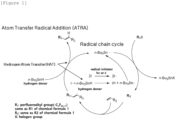
- FIG. 1 is a view describing the mechanism of an atom transfer radical addition (ATRA) reaction.
- ATRA atom transfer radical addition
- An exemplary embodiment of the present specification provides a compound of the following Chemical Formula 1.
- substitution means that a hydrogen atom bonded to a carbon atom of a compound is changed into another substituent, and a position to be substituted is not limited as long as the position is a position at which the hydrogen atom is substituted, that is, a position at which the substituent may be substituted, and when two or more are substituted, the two or more substituents may be the same as or different from each other.
- substituted or unsubstituted means being substituted with one or more substituents selected from the group consisting of deuterium; a halogen group; a hydroxyl group; an ester group; an alkyl group; an alkoxy group; and an aryl group, being substituted with a substituent to which two or more substituents among the exemplified substituents are linked, or having no substituent.
- the fact that two or more substituents are linked indicates that hydrogen of any one substituent is linked to another substituent.
- a phenyl group and a naphthyl group may be linked to each other to become a substituent of or
- the case where three substituents are linked to one another includes not only a case where (Substituent 1)-(Substituent 2)-(Substituent 3) are consecutively linked to one another, but also a case where (Substituent 2) and (Substituent 3) are linked to (Substituent 1).
- a phenyl group, a naphthyl group, and an isopropyl group may be linked to one another to become a substituent of
- the above-described definition also applies equally to the case where four or more substituents are linked to one another.
- examples of a halogen group include a fluoro group, a chloro group, a bromo group or an iodo group.
- the oxygen of the ester group may be substituted with a straight-chained alkyl group having 1 to 30 carbon atoms, a branched alkyl group having 3 to 30 carbon atoms, or a cyclic alkyl group having 3 to 30 carbon atoms, or an aryl group having 6 to 30 carbon atoms.
- the ester group may be any one of the following structural formulae, but is not limited thereto.
- the alkyl group may be straight-chained or branched, and the number of carbon atoms thereof is not particularly limited, but is preferably 1 to 30.
- Specific examples thereof include a methyl group, an ethyl group, a propyl group, an n-propyl group, an isopropyl group, a butyl group, an n-butyl group, an isobutyl group, a tert-butyl group, a sec-butyl group, a 1-methyl-butyl group, a 1-ethyl-butyl group, a pentyl group, an n-pentyl group, an isopentyl group, a neopentyl group, a tert-pentyl group, a hexyl group, an n-hexyl group, a 1-methylpentyl group, a 2-methylpentyl group, a 4-methyl-2-pentyl group, a
- the alkoxy group may be straight-chained, branched, or cyclic.
- the number of carbon atoms of the alkoxy group is not particularly limited, but is preferably 1 to 30. Specific examples thereof include a methoxy group, an ethoxy group, an n-propoxy group, an isopropoxy group, an n-butoxy group, an isobutoxy group, a tert-butoxy group, a sec-butoxy group, an n-pentyloxy group, an neopentyloxy group, an isopentyloxy group, an n-hexyloxy group, a 3,3-dimethylbutyloxy group, a 2-ethylbutyloxy group, an n-octyloxy group, an n-nonyloxy group, an n-decyloxy group, a benzyloxy group, a p-methylbenzyloxy group, and the like, but are not limited thereto.
- n is an integer from 4 to 12.
- R1 is -C 4 F 9 , -C 6 F 13 , -C B F 17 , or -C 12 F 25 .
- n when n is within the above range, compounds with various molecular weights may be prepared because the chain length of a perfluoroalkyl group is easily adjusted.
- a perfluoroalkyl group when a perfluoroalkyl group is included, it is possible to exhibit effects of achieving low refractive index, low relative permittivity, low surface energy and low dissipation factor.
- compounds containing a perfluoroalkyl group in the related art exhibit low permittivity and low refractive properties, compatibility is not easily exhibited.
- R1 of Chemical Formula 1 of the present invention when R1 of Chemical Formula 1 of the present invention is used, it is possible to exhibit the effects of achieving effective low refractive index, low relative permittivity, low surface energy and low dissipation factor while maintaining compatibility.
- the compound of Chemical Formula 1 is a single molecule including both a perfluoroalkyl group and a vinyl group, and may be used for various applications such as electronic materials.
- the compound of Chemical Formula 1 since the compound of Chemical Formula 1 according to an exemplary embodiment of the present specification includes both a perfluoroalkyl group and a vinyl group, the compound may be used as a monomer for preparing a polymer, and may be used for preparing a polymer including a perfluoroalkyl group.
- R2 is hydrogen; an ester group; or a substituted or unsubstituted straight-chained or branched alkyl group having 1 to 10 carbon atoms.
- R2 is hydrogen; an ester group; a methyl group substituted with a hydroxyl group; or a methyl group substituted with a straight-chained or branched alkoxy group having 1 to 10 carbon atoms substituted with a straight-chained or branched alkoxy group having 1 to 10 carbon atoms.
- R2 is hydrogen; an ester group; a methyl group substituted with a hydroxyl group; or a methyl group substituted with an ethoxy group substituted with a methoxy group.
- the ester group is
- R101 is a straight-chained or branched alkyl group having 1 to 10 carbon atoms, which is unsubstituted or substituted with a monocyclic or polycyclic aryl group having 6 to 30 carbon atoms; or a monocyclic or polycyclic aryl group having 6 to 30 carbon atoms.
- R101 is a methyl group; an ethyl group; a tert-butyl group; a methyl group substituted with a phenyl group; or an n-decyl group.
- r2 is 2.
- r2 is 1.
- Chemical Formula 1 includes a mixture of the compounds of Chemical Formula 1.
- the mixture of the compounds of Chemical Formula 1 means that two or more of the compounds of Chemical Formula 1 are included, and the structures thereof may be the same as or different from each other.
- An exemplary embodiment of the present specification provides a method for preparing a compound of the following Chemical Formula 1, the method including: (s1) introducing the following Chemical Formula A, C n F 2n+1 X, trialkyltin hydride and a solvent and stirring the resulting mixture under nitrogen gas; and (s2) adding a radical initiator thereto and stirring the resulting mixture.
- Chemical Formula 1 includes a mixture of the compounds of Chemical Formula 1.
- the mixture of the compounds of Chemical Formula 1 means that two or more of the compounds of Chemical Formula 1 are included, and the structures thereof may be the same as or different from each other.
- the reaction temperature in Steps (s1) and (s2) is 20°C to 40°C, preferably 25°C to 35°C, and more preferably 30°C.
- the radical initiator is an azo initiator.
- a step of obtaining the compound of Chemical Formula 1 is further included after Step (s2).
- the obtaining of the compound of Chemical Formula 1 according to an exemplary embodiment of the present specification includes:
- Step (s31) is a step of terminating the reaction by adding a reaction termination material, and separating the layers.
- Step (s31) is a step of diluting a reactant by adding the solvent used in Step (s1), terminating the reaction by adding a reaction termination material, and separating layers.
- Step (s34) additional filtration and drying steps may be added after Step (s34).
- drying step is a step of drying Chemical Formula 1.
- the drying step is different from Step (s32) and may be performed by a method known in the art, representative examples thereof include vacuum oven drying, spray drying, flash drying, and the like, and preferably, the compound of Chemical Formula 1 may be dried by vacuum oven drying.
- Step (s35) is a step of obtaining the compound of Chemical Formula 1 which is concentrated (dried) in Step (s34).
- Steps (s32) to (s33) may be performed three or more times, if necessary.
- a mixture including two or more of the compounds.
- two or more compounds included in the mixture are the same as or different from each other. That is, it means that the two or more compounds are the same as or different from each other while having the structure of Chemical Formula 1.
- the mixture may further include a compound different from the compound of Chemical Formula 1.
- a single molecule derived from the compound is provided.
- single molecule derived from the compound of Chemical Formula 1 may mean a single molecule in which the vinyl group of the compound of Chemical Formula 1 forms a radical and an additional substituent is introduced, or the compound of Chemical Formula 1 itself.
- a polymer including a monomer derived from the compound.
- the polymer may further include an additional monomer, and the additional monomer is not limited.
- the monomer is not limited to including only the mentioned monomer, and other monomers in addition to the aforementioned monomer may additionally be included as co-monomers within a range not departing from the object of the present invention.
- a compound according to an exemplary embodiment of the present specification, and a single molecule and a polymer derived therefrom are used as an electronic material, an organic insulating material, and/or a substrate material, but are not limited thereto.
- a compound according to an exemplary embodiment of the present specification, and a single molecule and a polymer derived therefrom may be used as a semiconductor copper clad laminate (CCL) material.
- representative materials used in semiconductor CCL materials include a plurality of monomers and polymers having a styrene group, monomers and polymers having a bismaleimide group, and the like.
- the bismaleimide group has a structure similar to that of maleic anhydride, and actually, it is generally known that a styrene group very effectively forms an alternating copolymer when polymerized with a bismaleimide group. This is because the transition state in the form of non-bonded resonance including electron transfer is stabilized by a polar effect charge transfer interaction.
Landscapes
- Chemical & Material Sciences (AREA)
- Organic Chemistry (AREA)
- Health & Medical Sciences (AREA)
- Chemical Kinetics & Catalysis (AREA)
- Medicinal Chemistry (AREA)
- Polymers & Plastics (AREA)
- Emergency Medicine (AREA)
- Organic Low-Molecular-Weight Compounds And Preparation Thereof (AREA)
- Addition Polymer Or Copolymer, Post-Treatments, Or Chemical Modifications (AREA)
- Steroid Compounds (AREA)
Abstract
Description
- This application claims priority to and the benefit of
Korean Patent Application No. 10-2021-0154715 filed in the Korean Intellectual Property Office on November 11, 2021 - The present specification relates to a compound, a method for preparing the same, and a single molecule and a polymer derived from the compound.
- Introduction of a perfluoalkyl group into an aromatic compound in the related art was induced through a nucleophilic aromatic substitution reaction using a Grignard reagent and halogenated benzene or derivatives thereof or a nucleophilic substitution reaction using a reaction in the opposite direction to that of the nucleophilic aromatic substitution reaction, but in such cases, development is difficult because there is a disadvantage in that a difficult-to-handle Grignard reagent needs to be used, a large amount of halogen compounds need to be used, and the reaction is sensitive to air and moisture.
- The present specification provides a compound, a method for preparing the same, and a single molecule and a polymer derived from the compound.
- An exemplary embodiment of the present specification provides a compound of the following Chemical Formula 1.

- In Chemical Formula 1,
- R1 is -CnF2n+1,
- n is an integer from 1 to 20,
- R2 is hydrogen; deuterium; a halogen group; an ester group; or a substituted or unsubstituted straight-chained or branched alkyl group having 1 to 10 carbon atoms,
- r2 is an integer from 1 to 4, and
- when r2 is 2 or higher, two or more R2's are the same as or different from each other.
- An exemplary embodiment of the present specification provides a method for preparing a compound of the following Chemical Formula 1, the method including: (s1) introducing the following Chemical Formula A, CnF2n+1X, trialkyltin hydride and a solvent and stirring the resulting mixture under nitrogen gas; and (s2) adding a radical initiator thereto and stirring the resulting mixture.


- In Step (s1), Chemical Formula A and Chemical Formula 1,
- R1 is -CnF2n+1,
- n is an integer from 1 to 20,
- R2 is hydrogen; deuterium; a halogen group; an ester group; or a substituted or unsubstituted straight-chained or branched alkyl group having 1 to 10 carbon atoms,
- r2 is an integer from 1 to 4,
- when r2 is 2 or higher, two or more R2's are the same as or different from each other, and
- X is a halogen group.
- An exemplary embodiment of the present specification provides a mixture including two or more of the compounds.
- Another exemplary embodiment of the present specification provides a single molecule derived from the compound.
- Still another exemplary embodiment of the present specification provides a polymer including a monomer derived from the compound.
- A compound according to an exemplary embodiment of the present specification, and a single molecule and a polymer derived therefrom are used as an electronic material, an organic insulating material, and/or a substrate material.
- A method for preparing the compound according to an exemplary embodiment of the present specification has an advantage in that the compound is prepared under conditions where the reaction temperature is low. As a result, since the polymerization is suppressed to reduce side reactions, the yield of the compound of Chemical Formula 1, which is a target compound, is increased.
- The compound according to an exemplary embodiment of the present invention can be used as a multifunctional monomer to exhibit the effects of achieving low refractive index, low relative permittivity, low surface energy and low dissipation factor.
-
FIG. 1 is a view describing the mechanism of an atom transfer radical addition (ATRA) reaction. - Hereinafter, the present specification will be described in more detail.
- An exemplary embodiment of the present specification provides a compound of the following Chemical Formula 1.

- In Chemical Formula 1,
- R1 is -CnF2n+1,
- n is an integer from 1 to 20,
- R2 is hydrogen; deuterium; a halogen group; an ester group; or a substituted or unsubstituted straight-chained or branched alkyl group having 1 to 10 carbon atoms,
- r2 is an integer from 1 to 4,
- when r2 is 2 or higher, two or more R2's are the same as or different from each other.
- Throughout the specification of the present application, the term "combination thereof" included in the Markush type expression means a mixture or combination of one or more selected from the group consisting of constituent elements described in the Markush type expression, and means including one or more selected from the group consisting of the above-described constituent elements.
- Examples of the substituents in the present specification will be described below, but are not limited thereto.
- In the present specification,

- The term "substitution" means that a hydrogen atom bonded to a carbon atom of a compound is changed into another substituent, and a position to be substituted is not limited as long as the position is a position at which the hydrogen atom is substituted, that is, a position at which the substituent may be substituted, and when two or more are substituted, the two or more substituents may be the same as or different from each other.
- In the present specification, the term "substituted or unsubstituted" means being substituted with one or more substituents selected from the group consisting of deuterium; a halogen group; a hydroxyl group; an ester group; an alkyl group; an alkoxy group; and an aryl group, being substituted with a substituent to which two or more substituents among the exemplified substituents are linked, or having no substituent.
- In the present specification, the fact that two or more substituents are linked indicates that hydrogen of any one substituent is linked to another substituent. For example, when two substituents are linked to each other, a phenyl group and a naphthyl group may be linked to each other to become a substituent of


- In the present specification, examples of a halogen group include a fluoro group, a chloro group, a bromo group or an iodo group.
- In the present specification, for an ester group, the oxygen of the ester group may be substituted with a straight-chained alkyl group having 1 to 30 carbon atoms, a branched alkyl group having 3 to 30 carbon atoms, or a cyclic alkyl group having 3 to 30 carbon atoms, or an aryl group having 6 to 30 carbon atoms. Specifically, the ester group may be any one of the following structural formulae, but is not limited thereto.

- In the structures, R101 and R102 are the same as or different from each other, and are each independently a straight-chained or branched alkyl group having 1 to 10 carbon atoms, which is unsubstituted or substituted with a monocyclic or polycyclic aryl group having 6 to 30 carbon atoms; or a monocyclic or polycyclic aryl group having 6 to 30 carbon atoms.
- In the present specification, the alkyl group may be straight-chained or branched, and the number of carbon atoms thereof is not particularly limited, but is preferably 1 to 30. Specific examples thereof include a methyl group, an ethyl group, a propyl group, an n-propyl group, an isopropyl group, a butyl group, an n-butyl group, an isobutyl group, a tert-butyl group, a sec-butyl group, a 1-methyl-butyl group, a 1-ethyl-butyl group, a pentyl group, an n-pentyl group, an isopentyl group, a neopentyl group, a tert-pentyl group, a hexyl group, an n-hexyl group, a 1-methylpentyl group, a 2-methylpentyl group, a 4-methyl-2-pentyl group, a 3,3-dimethylbutyl group, a 2-ethylbutyl group, a heptyl group, an n-heptyl group, a 1-methylhexyl group, a cyclopentylmethyl group, a cyclohexylmethyl group, an octyl group, an n-octyl group, a tert-octyl group, a 1-methylheptyl group, a 2-ethylhexyl group, a 2-propylpentyl group, an n-nonyl group, a 2,2-dimethylheptyl group, a 1-ethyl-propyl group, a 1,1-dimethyl-propyl group, an isohexyl group, a 2-methylpentyl group, a 4-methylhexyl group, a 5-methylhexyl group, and the like, but are not limited thereto.
- In the present specification, the alkoxy group may be straight-chained, branched, or cyclic. The number of carbon atoms of the alkoxy group is not particularly limited, but is preferably 1 to 30. Specific examples thereof include a methoxy group, an ethoxy group, an n-propoxy group, an isopropoxy group, an n-butoxy group, an isobutoxy group, a tert-butoxy group, a sec-butoxy group, an n-pentyloxy group, an neopentyloxy group, an isopentyloxy group, an n-hexyloxy group, a 3,3-dimethylbutyloxy group, a 2-ethylbutyloxy group, an n-octyloxy group, an n-nonyloxy group, an n-decyloxy group, a benzyloxy group, a p-methylbenzyloxy group, and the like, but are not limited thereto.
- According to an exemplary embodiment of the present specification, n is an integer from 4 to 12.
- According to an exemplary embodiment of the present specification, R1 is -C4F9, -C6F13, -CBF17, or -C12F25.
- According to an exemplary embodiment of the present specification, when n is within the above range, compounds with various molecular weights may be prepared because the chain length of a perfluoroalkyl group is easily adjusted. In addition, when a perfluoroalkyl group is included, it is possible to exhibit effects of achieving low refractive index, low relative permittivity, low surface energy and low dissipation factor. Specifically, although compounds containing a perfluoroalkyl group in the related art exhibit low permittivity and low refractive properties, compatibility is not easily exhibited. However, when R1 of Chemical Formula 1 of the present invention is used, it is possible to exhibit the effects of achieving effective low refractive index, low relative permittivity, low surface energy and low dissipation factor while maintaining compatibility.
- The compound of Chemical Formula 1 according to an exemplary embodiment of the present specification is a single molecule including both a perfluoroalkyl group and a vinyl group, and may be used for various applications such as electronic materials.
- Furthermore, since the compound of Chemical Formula 1 according to an exemplary embodiment of the present specification includes both a perfluoroalkyl group and a vinyl group, the compound may be used as a monomer for preparing a polymer, and may be used for preparing a polymer including a perfluoroalkyl group.
- According to an exemplary embodiment of the present specification, R2 is hydrogen; an ester group; or a substituted or unsubstituted straight-chained or branched alkyl group having 1 to 10 carbon atoms.
- According to an exemplary embodiment of the present specification, R2 is hydrogen; an ester group; or a straight-chained or branched alkyl group having 1 to 10 carbon atoms, which is unsubstituted or substituted with one or more of a hydroxyl group, a straight-chained or branched alkoxy group having 1 to 10 carbon atoms, and a combination thereof.
- According to an exemplary embodiment of the present specification, R2 is hydrogen; an ester group; a methyl group substituted with a hydroxyl group; or a methyl group substituted with a straight-chained or branched alkoxy group having 1 to 10 carbon atoms substituted with a straight-chained or branched alkoxy group having 1 to 10 carbon atoms.
- According to an exemplary embodiment of the present specification, R2 is hydrogen; an ester group; a methyl group substituted with a hydroxyl group; or a methyl group substituted with an ethoxy group substituted with a methoxy group.
- According to an exemplary embodiment of the present specification, in R2, the ester group is

- R101 is a straight-chained or branched alkyl group having 1 to 10 carbon atoms, which is unsubstituted or substituted with a monocyclic or polycyclic aryl group having 6 to 30 carbon atoms; or a monocyclic or polycyclic aryl group having 6 to 30 carbon atoms.
- According to an exemplary embodiment of the present specification, R101 is a methyl group; an ethyl group; a tert-butyl group; a methyl group substituted with a phenyl group; or an n-decyl group.
- According to an exemplary embodiment of the present specification, r2 is 4.
- According to an exemplary embodiment of the present specification, r2 is 2.
- According to an exemplary embodiment of the present specification, r2 is 1.
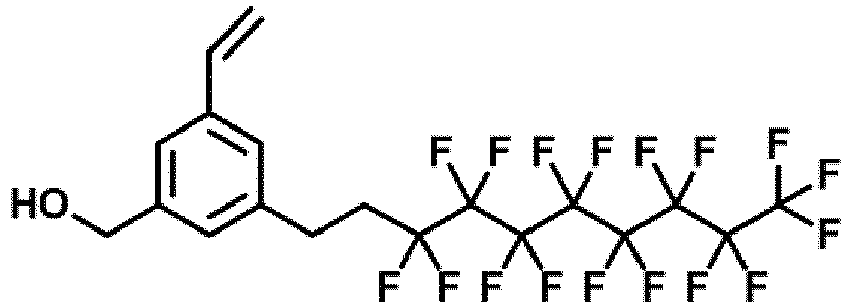
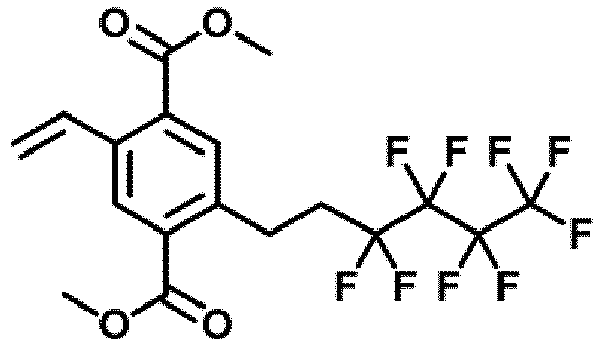
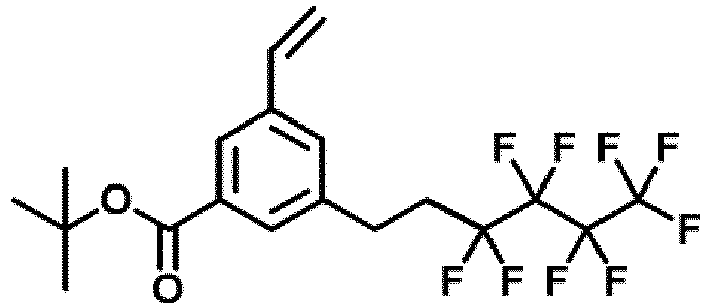
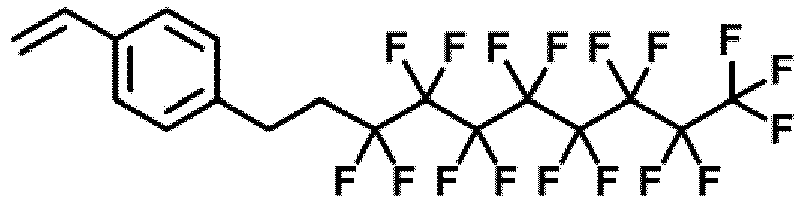
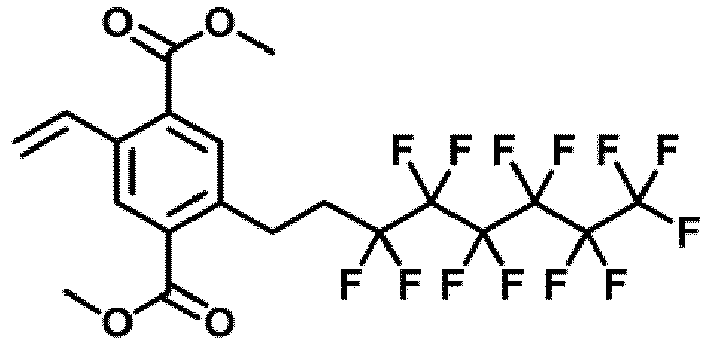
- According to an exemplary embodiment of the present specification, Chemical Formula 1 is any one selected from the following compounds.






- According to an exemplary embodiment of the present specification, Chemical Formula 1 includes a mixture of the compounds of Chemical Formula 1.
- Specifically, the mixture of the compounds of Chemical Formula 1 means that two or more of the compounds of Chemical Formula 1 are included, and the structures thereof may be the same as or different from each other.
- An exemplary embodiment of the present specification provides a method for preparing a compound of the following Chemical Formula 1, the method including: (s1) introducing the following Chemical Formula A, CnF2n+1X, trialkyltin hydride and a solvent and stirring the resulting mixture under nitrogen gas; and (s2) adding a radical initiator thereto and stirring the resulting mixture.


- In Step (s1), Chemical Formula A and Chemical Formula 1,
- R1 is -CnF2n+1,
- n is an integer from 1 to 20,
- R2 is hydrogen; deuterium; a halogen group; an ester group; or a substituted or unsubstituted straight-chained or branched alkyl group having 1 to 10 carbon atoms,
- r2 is an integer from 1 to 4,
- when r2 is 2 or higher, two or more R2's are the same as or different from each other, and
- X is a halogen group.
- According to an exemplary embodiment of the present specification, Chemical Formula 1 includes a mixture of the compounds of Chemical Formula 1.
- Specifically, the mixture of the compounds of Chemical Formula 1 means that two or more of the compounds of Chemical Formula 1 are included, and the structures thereof may be the same as or different from each other.
- According to an exemplary embodiment of the present specification, the reaction temperature in Steps (s1) and (s2) is 20°C to 40°C, preferably 25°C to 35°C, and more preferably 30°C.
- When the reaction is performed at the reaction temperature, reaction conditions are mild, the polymerization of the styrene of Chemical Formula A is suppressed, so that side reactions are reduced, and the yield of Chemical Formula 1, which is a final target product, is increased.
- According to an exemplary embodiment of the present specification, the radical initiator is an azo initiator.
- According to an exemplary embodiment of the present specification, the radical initiator is any one or more selected among azobisisobutyronitrile (AIBN), 2,2'-azobis-2,4-dimethylvaleronitrile, 2,2'-azobis(4-methoxy-2,4-dimethylvaleronitrile), benzoyl peroxide (BPO) or di-tert-butyl peroxide (DTBP).
- Preferably, the radical initiator is 2,2'-azobis(4-methoxy-2,4-dimethylvaleronitrile) .
- When the radical initiator is used, the radical reaction can be initiated at a low temperature, so that there is an advantage in that the reaction can be performed at the reaction temperature and under mild reaction conditions.
- According to an exemplary embodiment of the present specification, the trialkyltin hydride is tributyltin hydride.
- The trialkyltin hydride is a hydrogen donor with low binding energy, induces hydrogen atom transfer (HAT) to radicals generated from a small amount of radical initiator, and induces the introduction of a perfluoroalkyl group into Chemical Formula A through an atom transfer radical addition (ATRA) reaction, and the mechanism of the atom transfer radical addition (ATRA) reaction is as shown in
FIG. 1 . - According to an exemplary embodiment of the present specification, the solvent is an organic solvent.
- According to an exemplary embodiment of the present specification, the solvent is selected among hexane, heptane, toluene, benzene, dichloromethane, dichloroethane, trichloroethane, chloroform, dichloroform, nitromethane, dibromomethane, cyclopentanone, cyclohexanone, fluorobenzene, bromobenzene, chlorobenzene, xylene, mesitylene, ethylacetate or any mixture thereof, but is not limited thereto, and an organic solvent used in the related art may be used.
- According to an exemplary embodiment of the present specification, X is an iodine (I) group.
- According to an exemplary embodiment of the present specification, a step of obtaining the compound of Chemical Formula 1 is further included after Step (s2).
- The obtaining of the compound of Chemical Formula 1 according to an exemplary embodiment of the present specification includes:
- (s31) a quench and layer separation step;
- (s32) a drying step;
- (s33) a filtration step;
- (s34) a concentration step; and
- (s35) an obtaining step.
- According to an exemplary embodiment of the present specification, Step (s31) (quench and layer separation step) is a step of terminating the reaction by adding a reaction termination material, and separating the layers.
- According to an exemplary embodiment of the present specification, Step (s31) is a step of diluting a reactant by adding the solvent used in Step (s1), terminating the reaction by adding a reaction termination material, and separating layers.
- According to an exemplary embodiment of the present specification, as the reaction termination material of Step (s31), distilled water, an aqueous ammonium chloride solution, an aqueous sodium hydrogen carbonate solution, an aqueous KF (saturated) solution, an aqueous HCl solution, an aqueous NaCl (saturated) solution, dichloromethane, ethyl acetate, and the like may be used, but the reaction termination material is not limited thereto. Preferably, as the reaction termination material, an aqueous ammonium chloride solution, an aqueous sodium hydrogen carbonate solution, an aqueous NaCl solution, and ethyl acetate are used.
- In Step (s31), the order in which the reaction termination and layer separation are performed is not limited to a specific order. As an exemplary embodiment, reaction termination and layer separation may be simultaneously performed, and as another exemplary embodiment, the reaction is terminated by adding a reaction termination material, and then layers may be separated. However, the progression order is not limited to the above-described example.
- According to an exemplary embodiment of the present specification, Step (s32) (drying step) is performed by adding a desiccant to any one layer of the material layer-separated in Step (s31). For example, when dichloromethane exemplified above is used as the reaction termination material, Step (s32) is performed by adding a desiccant to a dichloromethane layer which is a lower layer, that is, an organic layer. Examples of the desiccant include magnesium sulfate, sodium sulfate, and the like, but are not limited thereto. According to a preferred exemplary embodiment, the desiccant is magnesium sulfate.
- In the present specification, the desiccant is added in a sufficient amount required for typical drying in the art.
- According to an exemplary embodiment of the present specification, Step (s33)(filtration step) may be performed by a method known in the art. As a representative example, it is possible to use a method of inhaling air using an inhaler and filtering impurities including a desiccant, and the like, which are separated from a target product with a filter, or a method of removing other impurities using a solvent that does not dissolve a target product, but dissolves other impurities by utilizing the difference in solubility in a specific solvent.
- According to an exemplary embodiment of the present specification, Step (s34)(concentration step) may be performed by a method known in the art. The step may be performed by evaporating the solvent using a vacuum rotary evaporator as a representative example, but the representative example is not limited thereto.
- According to an exemplary embodiment of the present specification, additional filtration and drying steps may be added after Step (s34).
- It is possible to include a drying step before the obtaining step (s35), and the drying step is a step of drying Chemical Formula 1. The drying step is different from Step (s32) and may be performed by a method known in the art, representative examples thereof include vacuum oven drying, spray drying, flash drying, and the like, and preferably, the compound of Chemical Formula 1 may be dried by vacuum oven drying.
- According to an exemplary embodiment of the present specification, Step (s35) (obtaining step) is a step of obtaining the compound of Chemical Formula 1 which is concentrated (dried) in Step (s34).
- According to an exemplary embodiment of the present specification, in the obtaining step, Steps (s32) to (s33) may be performed three or more times, if necessary.
- According to an exemplary embodiment of the present specification, provided is a mixture including two or more of the compounds.
- According to another exemplary embodiment of the present specification, two or more compounds included in the mixture are the same as or different from each other. That is, it means that the two or more compounds are the same as or different from each other while having the structure of Chemical Formula 1.
- According to still another exemplary embodiment of the present specification, the mixture may further include a compound different from the compound of Chemical Formula 1.
- According to an exemplary embodiment of the present specification, provided is a single molecule derived from the compound.
- In this specification, for example, the above-mentioned "single molecule derived from the compound of Chemical Formula 1" may mean a single molecule in which the vinyl group of the compound of Chemical Formula 1 forms a radical and an additional substituent is introduced, or the compound of Chemical Formula 1 itself.
- According to an exemplary embodiment of the present specification, provided is a polymer including a monomer derived from the compound.
- Those skilled in the art will understand the term "monomer" described in the present specification as a state in which a compound is polymerized to be linked to the main chain of the polymer.
- In the present specification, for example, the "monomer derived from the compound of Chemical Formula 1" is a repeating unit that constitutes the main chain in the polymer, and means that a vinyl group of the compound of Chemical Formula 1 may form a radical to become a monomer, and a monomer or end group which makes up the main chain of other polymers may be introduced.
- According to an exemplary embodiment of the present specification, the polymer may further include an additional monomer, and the additional monomer is not limited.
- According to an exemplary embodiment of the present specification, the polymer may be an alternating polymer or a random polymer, but is not limited thereto.
- Further, in the present specification, even when a monomer included in the polymer is mentioned, the monomer is not limited to including only the mentioned monomer, and other monomers in addition to the aforementioned monomer may additionally be included as co-monomers within a range not departing from the object of the present invention.
- According to an exemplary embodiment of the present specification, provided is a resin composition including the compound, and the single molecule and polymer derived therefrom.
- A compound according to an exemplary embodiment of the present specification, and a single molecule and a polymer derived therefrom are used as an electronic material, an organic insulating material, and/or a substrate material, but are not limited thereto.
- A compound according to an exemplary embodiment of the present specification, and a single molecule and a polymer derived therefrom may be used as a semiconductor copper clad laminate (CCL) material. Specifically, representative materials used in semiconductor CCL materials include a plurality of monomers and polymers having a styrene group, monomers and polymers having a bismaleimide group, and the like.
- The bismaleimide group has a structure similar to that of maleic anhydride, and actually, it is generally known that a styrene group very effectively forms an alternating copolymer when polymerized with a bismaleimide group. This is because the transition state in the form of non-bonded resonance including electron transfer is stabilized by a polar effect charge transfer interaction.
- Therefore, it is expected that the compound of Chemical Formula 1, which includes a perfluoroalkyl group having relative permittivity properties, can more effectively induce the thermoset networks generated during curing than compounds in the related art. An additional new additive does not need to be used for this reason, and it is possible to effectively lower the permittivity of existing insulating layers without phase separation with existing materials.
- Hereinafter, the present specification will be described in detail with reference to Examples for specifically describing the present specification. However, the Examples according to the present specification may be modified in various forms, and it is not interpreted that the scope of the present specification is limited to the Examples described below in detail. The Examples of the present specification are provided to explain the present specification more completely to a person with ordinary skill in the art.
- After 20.8 g of divinylbenzene, 6.9 mL of nonafluoro-1-iodobutane, and 10.8 mL of tributyltin hydride were dissolved in 40 mL of dichloromethane in a 100 mL two-neck round-bottom flask, the resulting mixture was bubbled with nitrogen at 30°C for 30 minutes. After 0.37 g of 2,2'-azobis(4-methoxy-2,4-dimethylvaleronitrile) (V-70) was added thereto, the resulting mixture was stirred for 15 hours. Thereafter, the mixture was diluted with 100 mL of dichloromethane, and the organic layer was washed with 100 mL of a KF saturated solution, 100 mL of a NaCl saturated solution and 100 mL of water, and then dried over 10 g of MgSO4. After filtration and evaporation, 7.9 g of the following Compound 1 was obtained.


- After 26.0 g of divinylbenzene, 10.7 mL of heptadecafluoro-n-octyl iodide, and 10.8 mL of tributyltin hydride were dissolved in 40 mL of dichloromethane in a 100 mL two-neck round-bottom flask, the resulting mixture was bubbled with nitrogen at 30°C for 30 minutes. After 0.37 g of 2,2'-azobis(4-methoxy-2,4-dimethylvaleronitrile) (V-70) was added thereto, the resulting mixture was stirred for 15 hours. Thereafter, the mixture was diluted with 100 mL of dichloromethane, and the organic layer was washed with 100 mL of a KF saturated solution, 100 mL of a NaCl saturated solution and 100 mL of water, and then dried over 10 g of MgSO4. After filtration and evaporation, 15.4 g of the following Compound 2 was obtained.

- The following Table 1 describes the amounts of vinyl and perfluoroalkyl groups of Compounds 1 and 2 prepared from Examples 1 and 2.
[Table 1] (by 1H NMR, mmol/g) Vinyl group per g Perfluoroalkyl group per g Example 1 2.24 4.01 Example 2 0.68 3.06 - According to Table 1, the compound of Chemical Formula 1 includes both a vinyl group and a perfluoroalkyl group in one molecule, and thus, may be used as a monomer for preparing a polymer, and through this, it can be seen that the compound of Chemical Formula 1 may be used for preparing a polymer including a perfluoroalkyl group.
Claims (9)
- A compound of the following Chemical Formula 1:
 R1 is -CnF2n+1,n is an integer from 1 to 20,R2 is hydrogen; deuterium; a halogen group; an ester group; or a substituted or unsubstituted straight-chained or branched alkyl group having 1 to 10 carbon atoms,r2 is an integer from 1 to 4, andwhen r2 is 2 or higher, two or more R2's are the same as or different from each other.
 - The compound of claim 1, wherein R1 is -C4F9, -C6F13, -C8F17, or -C12F25.
- The compound of claim 1, wherein R2 is hydrogen; an ester group; or a straight-chained or branched alkyl group having 1 to 10 carbon atoms, which is unsubstituted or substituted with one or more of a hydroxyl group, a straight-chained or branched alkoxy group having 1 to 10 carbon atoms, and a combination thereof.
- The compound of claim 1, wherein Chemical Formula 1 is any one selected from the following compounds:





- A method for preparing a compound of the following Chemical Formula 1, the method including:(s1) introducing the following Chemical Formula A, CnF2n+1X, trialkyltin hydride and a solvent and stirring the resulting mixture under nitrogen gas; and(s2) adding a radical initiator thereto and stirring the resulting mixture:wherein, in Step (s1), Chemical Formula A and Chemical Formula 1,


 R1 is -CnF2n+1,n is an integer from 1 to 20,R2 is hydrogen; deuterium; a halogen group; an ester group; or a substituted or unsubstituted straight-chained or branched alkyl group having 1 to 10 carbon atoms,r2 is an integer from 1 to 4,when r2 is 2 or higher, two or more R2's are the same as or different from each other, andX is a halogen group.
 - A mixture comprising two or more of the compounds of any one of claims 1 to 4.
- A single molecule derived from the compound of any one of claims 1 to 4.
- A polymer comprising a monomer derived from the compound of any one of claims 1 to 4.
- The polymer of claim 8, wherein the polymer further comprises an additional monomer.
Applications Claiming Priority (2)
| Application Number | Priority Date | Filing Date | Title |
|---|---|---|---|
| KR20210154715 | 2021-11-11 | ||
| PCT/KR2022/017634 WO2023085800A1 (en) | 2021-11-11 | 2022-11-10 | Compound, method for preparing same, and single molecule and polymer derived from same |
Publications (2)
| Publication Number | Publication Date |
|---|---|
| EP4293006A1 true EP4293006A1 (en) | 2023-12-20 |
| EP4293006A4 EP4293006A4 (en) | 2024-10-16 |
Family
ID=86336281
Family Applications (1)
| Application Number | Title | Priority Date | Filing Date |
|---|---|---|---|
| EP22893219.0A Pending EP4293006A4 (en) | 2021-11-11 | 2022-11-10 | COMPOUND, PROCESS FOR ITS PREPARATION AND SINGLE MOLECULE AND POLYMER DERIVED THEREFROM |
Country Status (7)
| Country | Link |
|---|---|
| US (1) | US20240190797A1 (en) |
| EP (1) | EP4293006A4 (en) |
| JP (1) | JP7687551B2 (en) |
| KR (1) | KR102825404B1 (en) |
| CN (1) | CN117157270A (en) |
| TW (1) | TWI826109B (en) |
| WO (1) | WO2023085800A1 (en) |
Family Cites Families (14)
| Publication number | Priority date | Publication date | Assignee | Title |
|---|---|---|---|---|
| JPS5829723A (en) * | 1981-08-14 | 1983-02-22 | Kureha Chem Ind Co Ltd | 3,3,3-trifluoropropylbenzene derivative |
| US5536442A (en) * | 1987-09-25 | 1996-07-16 | Merck Patent Gesellschaft Mit Beschrankter Haftung | Fluorinated liquid crystal compounds and liquid crystal medium containing same |
| DE4432105A1 (en) * | 1994-09-09 | 1996-03-14 | Hoechst Ag | Fluoro-alkyl / alkenyl-substituted benzoylguanidines, processes for their preparation, their use as medicaments or diagnostic agents and medicaments containing them |
| EP1976828B1 (en) * | 2005-12-29 | 2016-12-21 | Celtaxsys, Inc. | Diamine derivatives as inhibitors of leukotriene a4 hydrolase |
| JP5428133B2 (en) * | 2007-02-09 | 2014-02-26 | 三菱化学株式会社 | Method for producing crosslinked polymer particles |
| JP2008221067A (en) * | 2007-03-09 | 2008-09-25 | Daikin Ind Ltd | Fluoropolymer-immobilized transition metal catalyst |
| KR101238827B1 (en) | 2010-03-12 | 2013-03-04 | 한국과학기술원 | Method of preparing thermally-stable core-shell block copolymer-nanocomposite and thermally-stable core-shell block copolymer-nanocomposite made by the same |
| KR102126602B1 (en) * | 2016-04-22 | 2020-06-24 | 주식회사 엘지화학 | Carbazole derivatives and organic light emitting diode using the same |
| JPWO2018043729A1 (en) * | 2016-09-02 | 2019-06-24 | Jsr株式会社 | Composition, method of modifying surface of substrate and method of selective modification, method of pattern formation, and polymer |
| KR102186097B1 (en) * | 2017-12-26 | 2020-12-03 | 주식회사 엘지화학 | Xanthene-based compound and photosensitive resin composition comprising the same |
| JP7041756B2 (en) * | 2018-09-28 | 2022-03-24 | 富士フイルム株式会社 | Actinic cheilitis or radiation-sensitive resin composition, resist film, pattern forming method, manufacturing method of electronic device |
| CN109267038B (en) * | 2018-10-24 | 2019-12-06 | 江苏菲沃泰纳米科技有限公司 | Wear-resistant self-crosslinking nano coating and preparation method thereof |
| JP7377169B2 (en) | 2020-06-12 | 2023-11-09 | 株式会社シマノ | lure |
| CN113896846B (en) * | 2021-10-27 | 2022-06-14 | 大连理工大学 | Hydrogenated polyisoprene-embedded-syndiotactic poly (fluoro styryl) hydrophobic elastomer and preparation method thereof |
-
2022
- 2022-11-10 CN CN202280025707.0A patent/CN117157270A/en active Pending
- 2022-11-10 EP EP22893219.0A patent/EP4293006A4/en active Pending
- 2022-11-10 TW TW111142963A patent/TWI826109B/en active
- 2022-11-10 JP JP2023557088A patent/JP7687551B2/en active Active
- 2022-11-10 WO PCT/KR2022/017634 patent/WO2023085800A1/en not_active Ceased
- 2022-11-10 US US18/283,283 patent/US20240190797A1/en active Pending
- 2022-11-10 KR KR1020220149489A patent/KR102825404B1/en active Active
Also Published As
| Publication number | Publication date |
|---|---|
| TW202328035A (en) | 2023-07-16 |
| JP7687551B2 (en) | 2025-06-03 |
| US20240190797A1 (en) | 2024-06-13 |
| EP4293006A4 (en) | 2024-10-16 |
| TWI826109B (en) | 2023-12-11 |
| KR20230069030A (en) | 2023-05-18 |
| KR102825404B1 (en) | 2025-06-27 |
| WO2023085800A1 (en) | 2023-05-19 |
| JP2024511380A (en) | 2024-03-13 |
| CN117157270A (en) | 2023-12-01 |
Similar Documents
| Publication | Publication Date | Title |
|---|---|---|
| TWI707924B (en) | Ink composition for organic light emitting device | |
| KR102352441B1 (en) | Novel bromine-containing polymer and process for producing same | |
| TW200946502A (en) | Carbazole-based hole transport and/or electron blocking materials and/or host polymer materials | |
| JP5709094B2 (en) | Alkenyl phosphorus compound, alkenyl phosphorus compound polymer, and alkenyl phosphorus compound copolymer | |
| KR20010082353A (en) | Method of producing derivatives of polyarylene vinylene | |
| WO2010149620A1 (en) | Polymerizable ambipolar hosts for phosphorescent guest emitters | |
| KR20180090820A (en) | Method for producing polymerizable compound | |
| US20240190797A1 (en) | Compound, method for preparing same, and single molecule and polymer derived from same | |
| US7105258B2 (en) | Charge transport monomer, charge transport material, and process for producing the same | |
| JP5924557B2 (en) | Boron-containing compounds | |
| CN112204078B (en) | Polymer and organic light emitting device comprising same | |
| CN113906577A (en) | Organic light emitting device | |
| KR102290296B1 (en) | Polyfluorene derivatives and polyvinylidene fluoride graft copolymers and device including the same | |
| JP5618174B2 (en) | Method for producing heterocycle-containing aromatic compound | |
| WO2018225674A1 (en) | Method for producing polymer compound | |
| TWI818855B (en) | Compound, method for preparing the same, and single molecule and oligomer derived from the compound | |
| CN107849251B (en) | Sulfide-based polymer, film comprising same, and method for producing film | |
| TWI854544B (en) | Compound, coating composition comprising same, method for preparing compound and electronic device | |
| JP7761353B2 (en) | Compound, its production method, and monomolecules, oligomers, and polymers derived from the compound | |
| TW202610966A (en) | Compounds and methods for manufacturing compounds | |
| Ligon Jr | ADVANCED HYBRID FLUOROPOLYMERS FROM THE CYCLOADDITION OF ARYL TRIFLUOROVINYL ETHERS _ A Dissertation Presented to | |
| WO2023003038A1 (en) | Organic electronics material and organic electronics element | |
| WO2021020521A1 (en) | Dibenzophosphole oxide derivative and production method therefor | |
| WO2013081237A1 (en) | (meta) acryloyl iminophosphazene compound, method for manufacturing same, and copolymer comprising same |
Legal Events
| Date | Code | Title | Description |
|---|---|---|---|
| STAA | Information on the status of an ep patent application or granted ep patent |
Free format text: STATUS: THE INTERNATIONAL PUBLICATION HAS BEEN MADE |
|
| PUAI | Public reference made under article 153(3) epc to a published international application that has entered the european phase |
Free format text: ORIGINAL CODE: 0009012 |
|
| STAA | Information on the status of an ep patent application or granted ep patent |
Free format text: STATUS: REQUEST FOR EXAMINATION WAS MADE |
|
| 17P | Request for examination filed |
Effective date: 20230915 |
|
| AK | Designated contracting states |
Kind code of ref document: A1 Designated state(s): AL AT BE BG CH CY CZ DE DK EE ES FI FR GB GR HR HU IE IS IT LI LT LU LV MC ME MK MT NL NO PL PT RO RS SE SI SK SM TR |
|
| A4 | Supplementary search report drawn up and despatched |
Effective date: 20240916 |
|
| RIC1 | Information provided on ipc code assigned before grant |
Ipc: C08F 212/36 20060101ALI20240910BHEP Ipc: C08F 212/14 20060101ALI20240910BHEP Ipc: C07C 17/02 20060101ALI20240910BHEP Ipc: C07C 22/08 20060101AFI20240910BHEP |
|
| DAV | Request for validation of the european patent (deleted) | ||
| DAX | Request for extension of the european patent (deleted) | ||
| STAA | Information on the status of an ep patent application or granted ep patent |
Free format text: STATUS: EXAMINATION IS IN PROGRESS |
|
| 17Q | First examination report despatched |
Effective date: 20250530 |