EP4293004A1 - Novel graphene nanoribbon and method for producing same - Google Patents
Novel graphene nanoribbon and method for producing same Download PDFInfo
- Publication number
- EP4293004A1 EP4293004A1 EP22752630.8A EP22752630A EP4293004A1 EP 4293004 A1 EP4293004 A1 EP 4293004A1 EP 22752630 A EP22752630 A EP 22752630A EP 4293004 A1 EP4293004 A1 EP 4293004A1
- Authority
- EP
- European Patent Office
- Prior art keywords
- formula
- alkyl group
- carbon atoms
- group
- gnr
- Prior art date
- Legal status (The legal status is an assumption and is not a legal conclusion. Google has not performed a legal analysis and makes no representation as to the accuracy of the status listed.)
- Withdrawn
Links
Images


Classifications
-
- C—CHEMISTRY; METALLURGY
- C01—INORGANIC CHEMISTRY
- C01B—NON-METALLIC ELEMENTS; COMPOUNDS THEREOF; METALLOIDS OR COMPOUNDS THEREOF NOT COVERED BY SUBCLASS C01C
- C01B32/00—Carbon; Compounds thereof
- C01B32/15—Nano-sized carbon materials
- C01B32/182—Graphene
- C01B32/184—Preparation
-
- C—CHEMISTRY; METALLURGY
- C01—INORGANIC CHEMISTRY
- C01B—NON-METALLIC ELEMENTS; COMPOUNDS THEREOF; METALLOIDS OR COMPOUNDS THEREOF NOT COVERED BY SUBCLASS C01C
- C01B32/00—Carbon; Compounds thereof
- C01B32/15—Nano-sized carbon materials
-
- C—CHEMISTRY; METALLURGY
- C07—ORGANIC CHEMISTRY
- C07B—GENERAL METHODS OF ORGANIC CHEMISTRY; APPARATUS THEREFOR
- C07B61/00—Other general methods
-
- C—CHEMISTRY; METALLURGY
- C07—ORGANIC CHEMISTRY
- C07C—ACYCLIC OR CARBOCYCLIC COMPOUNDS
- C07C15/00—Cyclic hydrocarbons containing only six-membered aromatic rings as cyclic parts
- C07C15/20—Polycyclic condensed hydrocarbons
-
- C—CHEMISTRY; METALLURGY
- C07—ORGANIC CHEMISTRY
- C07F—ACYCLIC, CARBOCYCLIC OR HETEROCYCLIC COMPOUNDS CONTAINING ELEMENTS OTHER THAN CARBON, HYDROGEN, HALOGEN, OXYGEN, NITROGEN, SULFUR, SELENIUM OR TELLURIUM
- C07F7/00—Compounds containing elements of Groups 4 or 14 of the Periodic Table
- C07F7/02—Silicon compounds
- C07F7/08—Compounds having one or more C—Si linkages
- C07F7/0803—Compounds with Si-C or Si-Si linkages
- C07F7/0805—Compounds with Si-C or Si-Si linkages comprising only Si, C or H atoms
- C07F7/0807—Compounds with Si-C or Si-Si linkages comprising only Si, C or H atoms comprising Si as a ring atom
-
- C—CHEMISTRY; METALLURGY
- C08—ORGANIC MACROMOLECULAR COMPOUNDS; THEIR PREPARATION OR CHEMICAL WORKING-UP; COMPOSITIONS BASED THEREON
- C08G—MACROMOLECULAR COMPOUNDS OBTAINED OTHERWISE THAN BY REACTIONS ONLY INVOLVING UNSATURATED CARBON-TO-CARBON BONDS
- C08G61/00—Macromolecular compounds obtained by reactions forming a carbon-to-carbon link in the main chain of the macromolecule
- C08G61/02—Macromolecular compounds containing only carbon atoms in the main chain of the macromolecule, e.g. polyxylylenes
- C08G61/10—Macromolecular compounds containing only carbon atoms in the main chain of the macromolecule, e.g. polyxylylenes only aromatic carbon atoms, e.g. polyphenylenes
-
- C—CHEMISTRY; METALLURGY
- C01—INORGANIC CHEMISTRY
- C01B—NON-METALLIC ELEMENTS; COMPOUNDS THEREOF; METALLOIDS OR COMPOUNDS THEREOF NOT COVERED BY SUBCLASS C01C
- C01B2204/00—Structure or properties of graphene
- C01B2204/06—Graphene nanoribbons
-
- C—CHEMISTRY; METALLURGY
- C07—ORGANIC CHEMISTRY
- C07C—ACYCLIC OR CARBOCYCLIC COMPOUNDS
- C07C2603/00—Systems containing at least three condensed rings
- C07C2603/02—Ortho- or ortho- and peri-condensed systems
- C07C2603/54—Ortho- or ortho- and peri-condensed systems containing more than five condensed rings
Definitions
- the present invention relates to an improved method for producing a graphene nanoribbon and a novel graphene nanoribbon obtained by the production method.
- GNRs Graphene nanoribbons
- Graphene nanoribbons (sometimes referred to below as "GNRs") refer to a substance that shows promise in application to semiconductors, solar batteries, transparent electrodes, highspeed transistors, organic EL devices, and the like. Production methods for the GNRs are broadly divided into two methods: a top-down method and a bottom-up method. In particular, the latter is attractive in its ability to synthesize a large amount of GNRs with precise control of the edge structure and width.
- GNRs can be produced under specific conditions described above without using an alkyne compound represented by the following formula (4A): (wherein
- GNRs can be produced using a catalytic amount (i.e., less than the equivalent amount based on the silole compound) of a palladium compound. Additionally, the amount of a silver compound for use can also be reduced; thus, according to the method for producing a GNR of the present invention, GNRs can be produced more inexpensively.
- R 2a and R 2b are each preferably a methyl group, an ethyl group, or a phenyl group, and R 2a and R 2b are preferably the same substituents.
- These silole compounds can be used alone or in a combination of two or more.
- inorganic silver compounds are preferred; silver tetrafluoroborate (AgBF 4 ), silver hexafluorophosphate (AgPF 6 ), silver hexafluoroantimonate (AgSbF 6 ), etc. are more preferred; silver tetrafluoroborate (AgBF 4 ), silver hexafluoroantimonate (AgSbF 6 )etc. are even more preferred; and silver hexafluoroantimonate (AgSbF 6 )is particularly preferred.
- silver compounds can be used alone or in a combination of two or more.
- the present invention is preferably performed under anhydrous conditions and in an inert gas atmosphere (e.g., nitrogen gas or argon gas).
- the reaction temperature is, for example, 50 to 200°C, preferably 80 to 150°C, and more preferably 90 to 130°C.
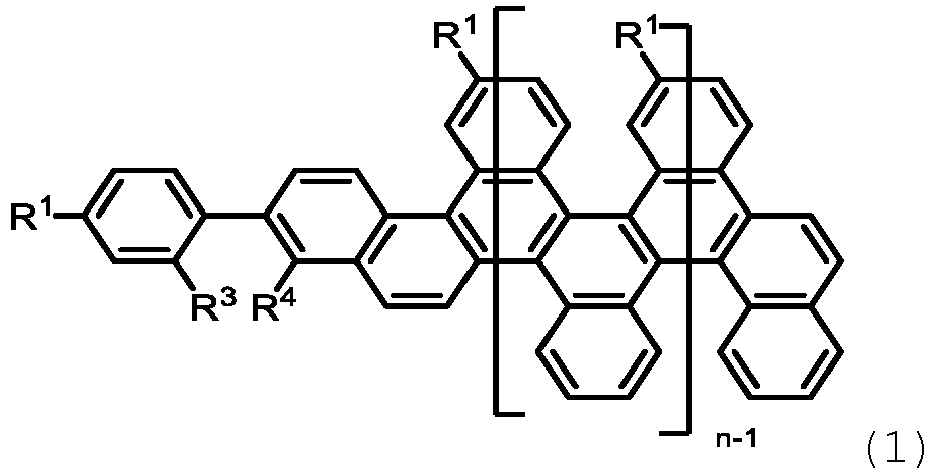
- the GNR of the present invention has a structure represented by the following formula (1): wherein R 1 represents a linear alkyl group having 1 to 12 carbon atoms, R 3 and R 4 are both hydrogen atoms, or R 3 and R 4 taken together form a group represented by -SiR 2a R 2b -, wherein R 2a and R 2b are the same or different, and each represents a hydrogen atom, an optionally branched alkyl group having 1 to 4 carbon atoms, or a phenyl group, and n represents an integer of 1 or more.
- the GNR of the present invention is produced by the method for producing a GNR of the present invention. It is presumed that, by this production method, a GNR (polymer) having a structure represented by formula (1-1):
- the GNR according to the present invention may be described as comprising a GNR (polymer) represented by formula (1-1) and/or (1-2) above.
- the method for producing a GNR of the present invention also enables production of a GNR with a relatively higher molecular weight.
- the number of repeating units in the GNR of the present invention i.e., polymerization degree n in formula (1), polymerization degree n a in formula (1-1), and polymerization degree n b in formula (1-2)
- the number of repeating units can be 1 to 1000, preferably 3 to 500, and more preferably 5 to 100.
- the number of repeating units n, n a , and n b can be calculated from the number average molecular weight (Mn) measured in terms of polystyrene by SEC under the conditions described in the Examples section below.
- the GNR of the present invention has a weight average molecular weight (Mw) measured in terms of polystyrene by SEC under the conditions described in the Examples section below of, for example, 2000 or more, preferably 3000 to 50000, and more preferably 4000 to 20000.
- Mw weight average molecular weight
- the GNR of the present invention does not contain any unit derived from an initiator compound, and such a GNR could not be produced by previously known methods. Since the GNR of the present invention has a further unified structure accordingly, the GNR is expected to have improved characteristics or develop different characteristics, compared to previously known GNRs.
Landscapes
- Chemical & Material Sciences (AREA)
- Organic Chemistry (AREA)
- Inorganic Chemistry (AREA)
- Engineering & Computer Science (AREA)
- Materials Engineering (AREA)
- Nanotechnology (AREA)
- Medicinal Chemistry (AREA)
- Polymers & Plastics (AREA)
- Chemical Kinetics & Catalysis (AREA)
- Health & Medical Sciences (AREA)
- Addition Polymer Or Copolymer, Post-Treatments, Or Chemical Modifications (AREA)
- Carbon And Carbon Compounds (AREA)
- Organic Low-Molecular-Weight Compounds And Preparation Thereof (AREA)
Abstract

Description
- The present invention relates to an improved method for producing a graphene nanoribbon and a novel graphene nanoribbon obtained by the production method.
- Graphene nanoribbons (sometimes referred to below as "GNRs") refer to a substance that shows promise in application to semiconductors, solar batteries, transparent electrodes, highspeed transistors, organic EL devices, and the like. Production methods for the GNRs are broadly divided into two methods: a top-down method and a bottom-up method. In particular, the latter is attractive in its ability to synthesize a large amount of GNRs with precise control of the edge structure and width.
- The present inventors focused on the bottom-up method and conducted extensive research on its production method. As a result, as a method for producing GNRs comprising fewer steps and involving reduced side reactions, the inventors found a method for polymerizing a silole compound by using an alkyne compound etc. having a specific structure as an initiator (see, for example, Patent Literature (PTL) 1).
- PTL 1:
WO2020/184625 - However, further improvement is required for the method of PTL 1 in terms of industrial practice, and a simpler production method for GNRs is in demand.
- Accordingly, an object of the present invention is to provide a simpler and industrially advantageous production method for a GNR, and novel GNRs obtained by the production method.
- The present inventors conducted extensive research to achieve the object, and found that the following method is capable of producing GNRs in a simpler and industrially advantageous manner, and providing the novel GNRs described below. Specifically, the invention encompasses the following embodiments.
-
- [1] A graphene nanoribbon represented by formula (1):

- [2] The graphene nanoribbon according to [1], which is represented by formula (1-1):

- wherein R1, R2a, and R2b are as defined above, and na represents an integer of 1 or more; and/or
- formula (1-2):

- wherein R1 is as defined above, and nb represents an integer of 1 or more.
- [3] A method for producing the graphene nanoribbon of [1] or [2], comprising
- polymerizing a silole compound represented by formula (2):

- wherein R1, R2a, and R2b are as defined above,
- in the presence of 0.01 to 0.4 mol, based on 1 mole of silole compound represented by formula (2), of a palladium compound, o-chloranil, and a silver compound.
- polymerizing a silole compound represented by formula (2):
- [4] A graphene nanoribbon obtained by polymerizing a silole compound represented by formula (2):

- wherein R1 represents a linear alkyl group having 1 to 12 carbon atoms, and R2a and R2b each represent an optionally branched alkyl group having 1 to 4 carbon atoms, or a phenyl group,
- in the presence of 0.01 to 0.4 mol, based on 1 mole of silole compound represented by formula (2), of a palladium compound, o-chloranil, and a silver compound.
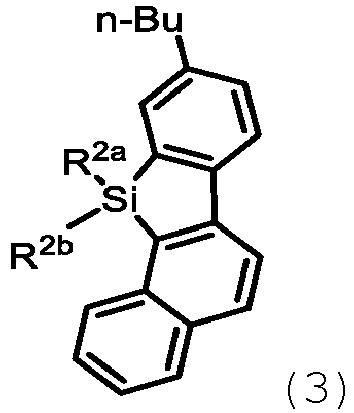
- [5] A silole compound represented by formula (3):
- According to the present invention, GNRs can be produced under specific conditions described above without using an alkyne compound represented by the following formula (4A):

- R5a and R5b are the same or different, and each represents a hydrogen atom, a halogen atom, an alkyl group, a cycloalkyl group, a (poly)ether group, an ester group, a boronic acid or an ester group thereof, a monovalent aromatic hydrocarbon group, or a monovalent heterocyclic group, and
- k1 and k2 are the same or different, and each represents an integer of 1 to 3, wherein when k1 and k2 are an integer of 2 or more, each R3a and/or R3b is optionally the same or different),
- a K region-containing aromatic compound represented by the following formula (4B):

- (wherein R6a, R6b, R6c, R6d, R6e, and R6f are the same or different, and each represents a hydrogen atom, a halogen atom, an alkyl group, a cycloalkyl group, a (poly)ether group, an ester group, a boronic acid or an ester group thereof, a monovalent aromatic hydrocarbon group, or a monovalent heterocyclic group, and a1 and a2 are the same or different, and each represents a carbon atom or a nitrogen atoms),
- dibenzocyclooctadiyne, benzothiophene, or benzofuran (sometimes referred to below as "initiator compounds"), which have so far been considered essential to initiate the polymerization reaction. Accordingly, since additional use of an initiator compound is not required, GNRs can be produced more inexpensively and simply. Furthermore, novel GNRs that do not contain a unit derived from the initiator compound and that could not be produced by previously known production methods, i.e., a GNR represented by formula (1), can be produced.
- According to previously known production methods, it was considered necessary to use an equivalent amount or more of a palladium compound based on the silole compound. However, according to the method for producing a GNR of the present invention, GNRs can be produced using a catalytic amount (i.e., less than the equivalent amount based on the silole compound) of a palladium compound. Additionally, the amount of a silver compound for use can also be reduced; thus, according to the method for producing a GNR of the present invention, GNRs can be produced more inexpensively.
-
-
Fig. 1 is a 1H-NMR spectrum of the silole compound obtained in Example 1. -
Fig. 2 is a 13C-NMR spectrum of the silole compound obtained in Example 1. - In the present specification, the terms "comprise" and "contain" include the concepts of consisting essentially of and consisting of.
- In the present specification, the range represented by "A to B" means A or more and B or less unless otherwise specified.
- The method for producing a GNR of the present invention is characterized by polymerizing a silole compound having a specific structure represented by formula (2):

- wherein R1 represents a linear alkyl group having 1 to 12 carbon atoms, and R2a and R2b are the same or different, and each represents a hydrogen atom, an optionally branched alkyl group having 1 to 4 carbon atoms, or a phenyl group,
- in the presence of 0.01 to 0.4 mol, based on 1 mole of silole compound represented by formula (2), of a palladium compound, o-chloranil, and a silver compound.
- The silole compound for use in the present invention has a structure represented by formula (2) above. In formula (2) above, substituent R1 must be a linear alkyl group having 1 to 12 carbon atoms. If substituent R1 is a hydrogen atom or a branched alkyl group, the polymerization reaction hardly proceeds and a GNR with a relatively higher molecular weight (i.e., a weight average molecular weight (Mw) measured in terms of polystyrene by size exclusion chromatography (sometimes referred to below as "SEC") under the conditions described in the Examples section below of, for example, 3000 or more) cannot be obtained. The linear alkyl group having 1 to 12 carbon atoms is preferably a linear alkyl group having 2 to 8 carbon atoms, and particularly preferably a linear alkyl group having 4 carbon atoms (an n-butyl group) . Substituents R2a and R2b are each a hydrogen atom, an optionally branched alkyl group having 1 to 4 carbon atoms, or a phenyl group. Examples of the optionally branched alkyl group include methyl, ethyl, n-propyl, isopropyl, n-butyl sec-butyl, and tert-butyl. From the viewpoint of ease of production of the silole compound represented by formula (2) above, R2a and R2b are each preferably a methyl group, an ethyl group, or a phenyl group, and R2a and R2b are preferably the same substituents. These silole compounds can be used alone or in a combination of two or more.
- The silole compound represented by formula (2) above can be produced in accordance with known methods (e.g., the method described in PTL 1). Specifically, as in the method described in the Examples section below, the silole compound can be produced by reacting a compound in which R1 is a halogen atom (e.g., a chlorine atom, bromine atom, or iodine atom) (e.g., compound S23 in Synthesis Example 5 of PTL 1) instead of a linear alkyl group having 1 to 12 carbon atoms with a Grignard reagent provided with a linear alkyl group having 1 to 12 carbon atoms in the presence of an iron compound, in accordance with the method in Synthesis Example 6 in PTL 1.
- In the present invention, any palladium compounds, known as synthetic catalysts for polymer compounds, can be used. Of these, divalent palladium compounds are preferred. Examples of usable palladium compounds include Pd(OH)2, Pd(OCOCH3)2, Pd2(dba)3, Pd(OCOCF3)2, Pd(acac)2, PdCl2, PdBr2, PdI2, Pd(NO3)2, and Pd(CH3CN)4(SbF6)2. "acac" means acetylacetonate, and "dba" means dibenzylideneacetone. The use of a weakly cationic palladium compound makes it less likely to disintegrate the silole skeleton of the substrate, and makes it more likely to obtain a higher-molecular-weight GNR. In the present invention, from such viewpoints, Pd(OH)2, Pd(OCOCH3)2, Pd(OCOCF3)2, PdBr2, PdI2, and Pd(CH3CN)4(SbF6)2 are preferred, Pd(OCOCH3)2, Pd(OCOCF3)2, PdBr2, PdI2, and Pd(CH3CN)4(SbF6)2 are more preferred, and Pd(OCOCH3)2 is particularly preferred. These palladium compounds can be used alone or in a combination of two or more.
- The amount of the palladium compound for use is 0.01 to 0.4 mol, and preferably 0.05 to 0.3 mol, per 1 mole of the silole compound. If the amount of the palladium compound for use is less than 0.01 mol or exceeds 0.4 mol, then a GNR with a relatively higher molecular weight cannot be obtained.
- In the present invention, the amount of o-chloranil for use may be any amount. From the viewpoint of easily obtaining a GNR with a relatively higher molecular weight, the amount is, for example, 0.5 to 5.0 mol, preferably 1.0 to 3.0 mol, and more preferably 1.5 to 2.5 mol, per 1 mole of the silole compound. If o-chloranil is not used, the polymerization reaction hardly proceeds, and the GNR of the present invention cannot be obtained.
- The silver compound for use in the present invention may be any silver compound, and examples include organic silver compounds, such as silver acetate, silver pivalate (AgOPiv), silver trifluoromethanesulfonate (AgOTf), and silver benzoate (AgOCOPh); and inorganic silver compounds, such as silver nitrate, silver fluoride, silver chloride, silver bromide, silver iodide, silver sulfate, silver oxide, silver sulfide, silver tetrafluoroborate (AgBF4), silver hexafluorophosphate (AgPF6), and silver hexafluoroantimonate (AgSbF6). In the present invention, from the viewpoint of easily obtaining a higher-molecular-weight GNR, inorganic silver compounds are preferred; silver tetrafluoroborate (AgBF4), silver hexafluorophosphate (AgPF6), silver hexafluoroantimonate (AgSbF6), etc. are more preferred; silver tetrafluoroborate (AgBF4), silver hexafluoroantimonate (AgSbF6)etc. are even more preferred; and silver hexafluoroantimonate (AgSbF6)is particularly preferred. These silver compounds can be used alone or in a combination of two or more.
- The amount of the silver compound for use is, for example, 0.1 to 3.0 mol per 1 mole of the palladium compound. From the viewpoint of easily obtaining a GNR with a relatively higher molecular weight, the amount is preferably 0.2 to 1.5 mol, and more preferably 0.3 to 1.3 mol, per 1 mole of the palladium compound.
- The present invention is preferably performed in a solvent. Examples of usable solvents include aliphatic hydrocarbons, such as pentane, hexane, heptane, and cyclohexane; halogenated aliphatic hydrocarbons, such as dichloromethane, dichloroethane (DCE), chloroform (CHCl3), carbon tetrachloride, and trichloroethylene (TCE); and halogenated aromatic hydrocarbons, such as monochlorobenzene (PhCl), dichlorobenzene (PhCl2) bromobenzene (PhBr), and 1,3,5-tribromobenzene (PhBr3). These solvents can be used alone or in a combination of two or more. Of these solvents, halogenated aliphatic hydrocarbons and halogenated aromatic hydrocarbons are preferred, and monochlorobenzene (PhCl) and dichlorobenzene (PhCl2) are more preferred. In addition to the above components, additives can be suitably used within the range in which the effects of the present invention are not impaired.
- The amount of the solvent when used is, for example, 2 to 20 parts by mass, and preferably 5 to 15 parts by mass, per 1 part by mass of the silole compound.
- The present invention is preferably performed under anhydrous conditions and in an inert gas atmosphere (e.g., nitrogen gas or argon gas). The reaction temperature is, for example, 50 to 200°C, preferably 80 to 150°C, and more preferably 90 to 130°C.
- After the reaction is stopped, the GNR of the present invention can be collected from the reaction liquid by an ordinary method, such as concentration, crystallization, or filtration. If necessary, purification may be performed by, for example, removal of metal by silica gel column chromatography, or separation or fractionation of polymer by gel permeation chromatography (GPC)).
- The GNR of the present invention has a structure represented by the following formula (1):

- The GNR of the present invention is produced by the method for producing a GNR of the present invention. It is presumed that, by this production method, a GNR (polymer) having a structure represented by formula (1-1):

- wherein R1 represents a linear alkyl group having 1 to 12 carbon atoms, R2a and R2b are the same or different, and each represents a hydrogen atom, an optionally branched alkyl group having 1 to 4 carbon atoms, or a phenyl group, and na represents an integer of 1 or more,
- is first formed, and that the polymer then partially or entirely undergoes a desilylation reaction to form a GNR (polymer) having a structure represented by the following formula (1-2):

- In view of the above, the GNR according to the present invention may be described as comprising a GNR (polymer) represented by formula (1-1) and/or (1-2) above.
- Substituents R1, R2a, and R2b in formulas (1), (1-1), and (1-2) above each correspond to substituents R1, R2a, and R2b in the silole compound described above; thus, the types and preferred specific examples of the substituents are also the same. According to the production method of the present invention described above, when multiple types of the silole compounds are used in combination, GNRs with different substituents R1 can be produced. Further, according to the production method of the present invention, the GNR of the present invention can also comprise a polymer other than the GNRs (polymers) represented by formulas (1), (1-1), and (1-2) above.
- The method for producing a GNR of the present invention also enables production of a GNR with a relatively higher molecular weight. The number of repeating units in the GNR of the present invention (i.e., polymerization degree n in formula (1), polymerization degree na in formula (1-1), and polymerization degree nb in formula (1-2)) may be any value and can be suitably selected according to the required properties. For example, the number of repeating units can be 1 to 1000, preferably 3 to 500, and more preferably 5 to 100. The number of repeating units n, na, and nb can be calculated from the number average molecular weight (Mn) measured in terms of polystyrene by SEC under the conditions described in the Examples section below.
- The GNR of the present invention has a weight average molecular weight (Mw) measured in terms of polystyrene by SEC under the conditions described in the Examples section below of, for example, 2000 or more, preferably 3000 to 50000, and more preferably 4000 to 20000.
- The GNR of the present invention does not contain any unit derived from an initiator compound, and such a GNR could not be produced by previously known methods. Since the GNR of the present invention has a further unified structure accordingly, the GNR is expected to have improved characteristics or develop different characteristics, compared to previously known GNRs.
- The GNRs of the present invention may be ring-condensed, if necessary, by previously known methods (e.g., an oxidation reaction or a Scholl reaction) to form ring-condensed GNRs (armchair GNRs described in previously known articles). This method can be performed, for example, in accordance with the method described in PTL 1.
- The present invention is more specifically described below with reference to Examples etc. However, the present invention is not limited in any way to these Examples.
- 1H-NMR and 13C-NMR were recorded using tetramethylsilane as an internal standard and deuterated chloroform (CDCl3) as a solvent with JEOL ESC-600 (1H 600 MHz, 13C 150 MHz) or JEOL ESC-400 (1H 400 MHz, 13C 100 MHz) spectrometer. The data are described as follows.
- Chemical shift, multiplicity (s = singlet, d = doublet, dd = doublet of doublets, t = triplet, sext = sextet, m = multiplet), coupling constant (Hz), and integration.
- The following apparatus was used for analysis under the following conditions.
- Apparatus: Acquity (Advanced Polymer Chromatography)
- Column: Acquity APC XT 125, 2.5 µm, 4.6×150 mm, produced by
- Waters; Acquity APC XT 200, 2.5 µm, 4.6×150 mm, produced by Waters
- Measurement temperature: 40°C
- Solvent: Tetrahydrofuran
- Molecular weight standard: Standard polystyrene
-

- In a nitrogen atmosphere, the compound represented by formula (5) (1.475 g, 5.0 mmol), tris(acetylacetonato)iron(III) (Fe(acac)3, 44.5 mg, 0.25 mmol), tetrahydrofuran (THF, 5.5 mL), and N-methyl-2-pyrrolidone (NMP, 3.4 mL) were added to a 20-mL round-bottom flask containing a magnetic stirrer. The reaction mixture was cooled to 0°C, and n-butylmagnesium bromide (1.0 M in THF, 7.5 mL, 7.5 mmol) was added at 0°C. The mixture was then heated to room temperature and stirred at room temperature for 14 hours.
- Subsequently, water was added to quench the reaction, ethyl acetate (15 mL) was added, and organic matter was extracted. After this extraction process was repeated three times in total, the organic layers were gathered and washed with saturated brine. Then, Na2SO4 was added and left it for overnight to dry. After drying, Na2SO4 was removed by filtration, and the solvent was removed under reduced pressure, and a crude product was obtained. The obtained crude product was purified by chromatography on silica gel (eluent: hexane), thereby 11,11-dimethyl-9-butyl-11H-benzo[b]naphtho[2,1-d]silole (a compound represented by formula (3-1)) was obtained as colorless crystals (535 mg, 340). The results of 1H-NMR and 13C-NMR analysis of the obtained compound represented by formula (3-1) were as follows.
Figs. 1 and2 show the 1H-NMR and 13C-NMR spectra. - 1H-NMR (400 MHz, CDCl3) δ 7.95 (d, J = 8.7 Hz, 1H), 7.91 (d, J = 8.7 Hz, 1H), 7.87-7.82 (m, 2H), 7.80 (d, J = 7.8 Hz, 1H), 7.53-7.47 (m, 2H), 7.46-7.40 m, 1H), 7.28 (dd, J = 1.8, 7.8 Hz, 1H), 2.68 (t, J = 7.3 Hz, 2H), 1.71-1.62 (m, 2H), 1.42 (sext, J = 7.3 Hz, 2H), 0.97 (t, J = 7.3 Hz, 3H), 0.58 (s, 6H).
- 13C-NMR (100 MHz, CDCl3) δ 146.9, 145.7, 142.1, 139.2, 136.8, 136.5, 132.84, 132.81, 130.8, 130.3, 128.9, 128.3, 126.5, 125.2, 120.8, 119.7, 35.6, 33.8, 22.5, 14.0, -2.7 (2C).
-

- In a nitrogen atmosphere, a monomer (the compound represented by formula (3-1), i.e., in formula (2) above, R1 = an n-butyl group, and R2a = R2b = a methyl group) (500 mg, 1.58 mmol), AgSbF6 (108.6 mg, 0.316 mmol), Pd(OCOCH3)2 (70.9 mg, 0.316 mmol), o-chloranil (777 mg, 3.159 mmol), and 1,2-dichlorobenzene (3.5 mL) were added to a 20-mL Schlenk tube containing a magnetic stirrer. The mixture was then heated to 120°C and stirred at 120°C for 40 hours, thereby obtaining a reaction mixture.
- The obtained reaction mixture was cooled to room temperature and passed through a short pad column of silica gel and metal scavenger by using CH2Cl2. The solvent was then removed under reduced pressure, and the resulting product was suspended by adding methanol, followed by filtration and drying, to thus obtain a GNR.
- Analysis of the obtained GNR by size exclusion chromatography (SEC) found that Mn= 4,118, Mw= 7,385, and Mw/Mn (PDI) = 1.79.
- GNRs were obtained in the same manner as in Example 2, except that the monomer was changed to a compound represented by formula (2) above in which R1 = the substituent shown in Table 1 below, and R2a = R2b = a methyl group. Table 1 below shows the results of SEC analysis of the obtained GNRs.
Table 1 Molecular weight Substituent R1 Mw Mn Example 2 n-Bu 7385 4118 3 Me 4379 2380 4 Et 5200 2669 5 n-octyl 5209 3126 Comparative Example 1 H 1522 1253 2 tert-Bu 1982 1462 3 Cl3* 1486 1216 4 Cl 2251 1555 
- A GNR was obtained in the same manner as in Example 2, except that the amount of Pd(OCOCH3)2 used was changed to 0.158 mmol (0.1 equivalents based on the monomer (the compound represented by formula (3-1))), and that the amount of AgSbF6 used was changed to 0.158 mmol (0.1 equivalents based on the monomer (the compound represented by formula (3-1))). Table 2 below shows the results of SEC analysis of the obtained GNR.
- A GNR was obtained in the same manner as in Example 2, except that the amount of Pd(OCOCH3)2 used was changed to 0.79 mmol (0.5 equivalents based on the monomer (the compound represented by formula (3-1))), and that the amount of AgSbF6 used was changed to 0.79 mmol (0.5 equivalents based on the monomer (the compound represented by formula (3-1))). Table 2 below shows the results of SEC analysis of the obtained GNR.
Table 2 Amount used (vs 1 equivalent of monomer) Molecular weight Pd(OCOCH3)2 AgSbF6 Mw Mn Example 6 0.1 0.1 5255 3074 Comparative Example 5 0.5 0.5 2884 1655
Claims (5)
- A graphene nanoribbon represented by formula (1):
- The graphene nanoribbon according to claim 1, which is represented by formula (1-1):
 wherein R1 represents a linear alkyl group having 1 to 12 carbon atoms, R2a and R2b are the same or different, and each represents a hydrogen atom, an optionally branched alkyl group having 1 to 4 carbon atoms, or a phenyl group, and na represents an integer of 1 or more; and/orformula (1-2):
 wherein R1 represents a linear alkyl group having 1 to 12 carbon atoms, and nb represents an integer of 1 or more.
 - A method for producing the graphene nanoribbon of claim 1 or 2, comprisingpolymerizing a silole compound represented by formula (2):
 wherein R1, R2a, and R2b are as defined above,in the presence of 0.01 to 0.4 mol, based on 1 mole of silole compound represented by formula (2), of a palladium compound, o-chloranil, and a silver compound.
 - A graphene nanoribbon obtained by polymerizing a silole compound represented by formula (2):
 wherein R1 represents a linear alkyl group having 1 to 12 carbon atoms, and R2a and R2b are the same or different, each represents a hydrogen atom, an optionally branched alkyl group having 1 to 4 carbon atoms, or a phenyl group,in the presence of 0.01 to 0.4 mol, based on 1 mole of silole compound represented by formula (2), of a palladium compound, o-chloranil, and a silver compound.
 - A silole compound represented by formula (3):

Applications Claiming Priority (2)
| Application Number | Priority Date | Filing Date | Title |
|---|---|---|---|
| JP2021020183 | 2021-02-10 | ||
| PCT/JP2022/003669 WO2022172801A1 (en) | 2021-02-10 | 2022-01-31 | Novel graphene nanoribbon and method for producing same |
Publications (2)
| Publication Number | Publication Date |
|---|---|
| EP4293004A1 true EP4293004A1 (en) | 2023-12-20 |
| EP4293004A4 EP4293004A4 (en) | 2025-02-19 |
Family
ID=82838826
Family Applications (1)
| Application Number | Title | Priority Date | Filing Date |
|---|---|---|---|
| EP22752630.8A Withdrawn EP4293004A4 (en) | 2021-02-10 | 2022-01-31 | NEW GRAPHENE NANORIBAN AND ITS PRODUCTION METHOD |
Country Status (6)
| Country | Link |
|---|---|
| US (1) | US20240140804A1 (en) |
| EP (1) | EP4293004A4 (en) |
| JP (1) | JP7709704B2 (en) |
| CN (1) | CN116724016A (en) |
| TW (1) | TW202239701A (en) |
| WO (1) | WO2022172801A1 (en) |
Family Cites Families (4)
| Publication number | Priority date | Publication date | Assignee | Title |
|---|---|---|---|---|
| KR102901200B1 (en) * | 2019-03-12 | 2025-12-16 | 타오카 케미컬 컴퍼니 리미티드 | Graphene nanoribbons and their manufacturing methods |
| JP2021011471A (en) * | 2019-07-05 | 2021-02-04 | 国立大学法人東海国立大学機構 | Solid naphthylbenzosilol compound and method for producing it |
| CN115210245B (en) * | 2020-03-04 | 2025-04-25 | 国立大学法人东海国立大学机构 | Preparation method of naphthyl siloles, naphthyl siloles having heterocyclic groups, and graphene nanoribbons having heterocyclic groups |
| CN111961038B (en) * | 2020-07-20 | 2021-10-08 | 陕西莱特光电材料股份有限公司 | Compound, organic electroluminescent device and electronic device |
-
2022
- 2022-01-31 JP JP2022580565A patent/JP7709704B2/en active Active
- 2022-01-31 CN CN202280010461.XA patent/CN116724016A/en active Pending
- 2022-01-31 WO PCT/JP2022/003669 patent/WO2022172801A1/en not_active Ceased
- 2022-01-31 US US18/546,007 patent/US20240140804A1/en not_active Abandoned
- 2022-01-31 EP EP22752630.8A patent/EP4293004A4/en not_active Withdrawn
- 2022-02-09 TW TW111104773A patent/TW202239701A/en unknown
Also Published As
| Publication number | Publication date |
|---|---|
| JP7709704B2 (en) | 2025-07-17 |
| WO2022172801A1 (en) | 2022-08-18 |
| JPWO2022172801A1 (en) | 2022-08-18 |
| CN116724016A (en) | 2023-09-08 |
| TW202239701A (en) | 2022-10-16 |
| EP4293004A4 (en) | 2025-02-19 |
| KR20230144061A (en) | 2023-10-13 |
| US20240140804A1 (en) | 2024-05-02 |
Similar Documents
| Publication | Publication Date | Title |
|---|---|---|
| Ishikawa et al. | Polymeric organosilicon systems. 12. Synthesis and anionic ring-opening polymerization of 1, 2, 5, 6-tetrasilacycloocta-3, 7-diynes | |
| Lei et al. | Dioxomolybdenum (VI) complexes with linear and tripodal tetradenate ligands: Synthesis, structures and their use as olefin epoxidation catalysts | |
| Bunz et al. | ortho-and meta-(Diethynylcyclopentadienyl) tricarbonylmanganese: Building Blocks toward the Construction of Metal Fragment Supported Fullerenynes? | |
| JP5830020B2 (en) | Carboxylate metal complexes and catalysts for olefin polymerization | |
| Scarel et al. | Trifluoroethanol: key solvent for palladium-catalyzed polymerization reactions | |
| EP4116308B1 (en) | Method for producing naphtylsilole, naphthylsilole containing heterocyclic group, and graphene nanoribbon containing heterocyclic group | |
| JPWO2020184625A5 (en) | ||
| US20240140804A1 (en) | Novel graphene nanoribbon and method for producing same | |
| Tarte et al. | Novel non-chelated cobalt (II) benzimidazole complex catalysts: Synthesis, crystal structures and cocatalyst effect in vinyl polymerization of norbornene | |
| KR102968727B1 (en) | Novel graphene nanoribbon and method for manufacturing the same | |
| Suzaki et al. | Transmetalation of arylpalladium and platinum complexes. Mechanism and factors to control the reaction | |
| Alper et al. | Synthesis of carbonyl-olefin complexes of platinum (II), PtX2 (CO)(olefin), and the catalytic hydrochlorination of olefins | |
| JPH0445105A (en) | Olefinic polymer having both modified terminals and its production | |
| KR101976406B1 (en) | The method for producing aryl alcohol and heteroaryl alcohol compounds | |
| JP2010138088A (en) | Method for producing fluorene derivative | |
| Shin et al. | Preparation of palladium complexes of 1, 3-di (2-pyridyl) propane derivatives and their use in norbornene polymerization | |
| EP3239125B1 (en) | Method for producing olefin | |
| Solmaz et al. | Synthesis and characterization of Ge-and Sn-containing ADMET polymers | |
| JP6233918B2 (en) | Poly (3-substituted thiophene) compounds, synthetic intermediates thereof, and methods for producing them | |
| JP4593352B2 (en) | Halogen-containing poly (diphenylacetylene) derivatives and halogen-containing diphenylacetylene compounds | |
| Luo et al. | Highly active self-assembled group-IV-metal multinuclear catalysts for ethylene polymerization | |
| KR101789386B1 (en) | Method of manufacturing optically active benzothiophenes compound with high yield and high purity | |
| EP3257885A1 (en) | Method for producing fluorine-containing polymer | |
| JP4505568B2 (en) | Coated heteroaromatic ring compound | |
| JP2014162745A (en) | Phosphine-palladium complex, production method thereof, substituted acetylene polymerization initiator, and production method of substituted polyacetylene |
Legal Events
| Date | Code | Title | Description |
|---|---|---|---|
| STAA | Information on the status of an ep patent application or granted ep patent |
Free format text: STATUS: THE INTERNATIONAL PUBLICATION HAS BEEN MADE |
|
| PUAI | Public reference made under article 153(3) epc to a published international application that has entered the european phase |
Free format text: ORIGINAL CODE: 0009012 |
|
| STAA | Information on the status of an ep patent application or granted ep patent |
Free format text: STATUS: REQUEST FOR EXAMINATION WAS MADE |
|
| 17P | Request for examination filed |
Effective date: 20230908 |
|
| AK | Designated contracting states |
Kind code of ref document: A1 Designated state(s): AL AT BE BG CH CY CZ DE DK EE ES FI FR GB GR HR HU IE IS IT LI LT LU LV MC MK MT NL NO PL PT RO RS SE SI SK SM TR |
|
| DAV | Request for validation of the european patent (deleted) | ||
| DAX | Request for extension of the european patent (deleted) | ||
| A4 | Supplementary search report drawn up and despatched |
Effective date: 20250122 |
|
| RIC1 | Information provided on ipc code assigned before grant |
Ipc: C08G 61/10 20060101ALI20250116BHEP Ipc: C01B 32/184 20170101ALI20250116BHEP Ipc: C01B 32/15 20170101ALI20250116BHEP Ipc: C07F 7/08 20060101ALI20250116BHEP Ipc: C07B 61/00 20060101ALI20250116BHEP Ipc: C07C 15/20 20060101AFI20250116BHEP |
|
| STAA | Information on the status of an ep patent application or granted ep patent |
Free format text: STATUS: THE APPLICATION IS DEEMED TO BE WITHDRAWN |
|
| 18D | Application deemed to be withdrawn |
Effective date: 20250812 |