EP4292995A2 - Particle-imbedded serving yarn for cmc applications - Google Patents
Particle-imbedded serving yarn for cmc applications Download PDFInfo
- Publication number
- EP4292995A2 EP4292995A2 EP23179766.3A EP23179766A EP4292995A2 EP 4292995 A2 EP4292995 A2 EP 4292995A2 EP 23179766 A EP23179766 A EP 23179766A EP 4292995 A2 EP4292995 A2 EP 4292995A2
- Authority
- EP
- European Patent Office
- Prior art keywords
- ceramic
- preform
- tow
- woven fabric
- particles
- Prior art date
- Legal status (The legal status is an assumption and is not a legal conclusion. Google has not performed a legal analysis and makes no representation as to the accuracy of the status listed.)
- Pending
Links
Images


Classifications
-
- D—TEXTILES; PAPER
- D03—WEAVING
- D03D—WOVEN FABRICS; METHODS OF WEAVING; LOOMS
- D03D15/00—Woven fabrics characterised by the material, structure or properties of the fibres, filaments, yarns, threads or other warp or weft elements used
- D03D15/20—Woven fabrics characterised by the material, structure or properties of the fibres, filaments, yarns, threads or other warp or weft elements used characterised by the material of the fibres or filaments constituting the yarns or threads
- D03D15/242—Woven fabrics characterised by the material, structure or properties of the fibres, filaments, yarns, threads or other warp or weft elements used characterised by the material of the fibres or filaments constituting the yarns or threads inorganic, e.g. basalt
-
- C—CHEMISTRY; METALLURGY
- C04—CEMENTS; CONCRETE; ARTIFICIAL STONE; CERAMICS; REFRACTORIES
- C04B—LIME, MAGNESIA; SLAG; CEMENTS; COMPOSITIONS THEREOF, e.g. MORTARS, CONCRETE OR LIKE BUILDING MATERIALS; ARTIFICIAL STONE; CERAMICS; REFRACTORIES; TREATMENT OF NATURAL STONE
- C04B35/00—Shaped ceramic products characterised by their composition; Ceramics compositions; Processing powders of inorganic compounds preparatory to the manufacturing of ceramic products
- C04B35/71—Ceramic products containing macroscopic reinforcing agents
- C04B35/78—Ceramic products containing macroscopic reinforcing agents containing non-metallic materials
- C04B35/80—Fibres, filaments, whiskers, platelets, or the like
-
- C—CHEMISTRY; METALLURGY
- C04—CEMENTS; CONCRETE; ARTIFICIAL STONE; CERAMICS; REFRACTORIES
- C04B—LIME, MAGNESIA; SLAG; CEMENTS; COMPOSITIONS THEREOF, e.g. MORTARS, CONCRETE OR LIKE BUILDING MATERIALS; ARTIFICIAL STONE; CERAMICS; REFRACTORIES; TREATMENT OF NATURAL STONE
- C04B35/00—Shaped ceramic products characterised by their composition; Ceramics compositions; Processing powders of inorganic compounds preparatory to the manufacturing of ceramic products
- C04B35/01—Shaped ceramic products characterised by their composition; Ceramics compositions; Processing powders of inorganic compounds preparatory to the manufacturing of ceramic products based on oxide ceramics
- C04B35/10—Shaped ceramic products characterised by their composition; Ceramics compositions; Processing powders of inorganic compounds preparatory to the manufacturing of ceramic products based on oxide ceramics based on aluminium oxide
-
- C—CHEMISTRY; METALLURGY
- C04—CEMENTS; CONCRETE; ARTIFICIAL STONE; CERAMICS; REFRACTORIES
- C04B—LIME, MAGNESIA; SLAG; CEMENTS; COMPOSITIONS THEREOF, e.g. MORTARS, CONCRETE OR LIKE BUILDING MATERIALS; ARTIFICIAL STONE; CERAMICS; REFRACTORIES; TREATMENT OF NATURAL STONE
- C04B35/00—Shaped ceramic products characterised by their composition; Ceramics compositions; Processing powders of inorganic compounds preparatory to the manufacturing of ceramic products
- C04B35/515—Shaped ceramic products characterised by their composition; Ceramics compositions; Processing powders of inorganic compounds preparatory to the manufacturing of ceramic products based on non-oxide ceramics
- C04B35/56—Shaped ceramic products characterised by their composition; Ceramics compositions; Processing powders of inorganic compounds preparatory to the manufacturing of ceramic products based on non-oxide ceramics based on carbides or oxycarbides
- C04B35/565—Shaped ceramic products characterised by their composition; Ceramics compositions; Processing powders of inorganic compounds preparatory to the manufacturing of ceramic products based on non-oxide ceramics based on carbides or oxycarbides based on silicon carbide
-
- C—CHEMISTRY; METALLURGY
- C04—CEMENTS; CONCRETE; ARTIFICIAL STONE; CERAMICS; REFRACTORIES
- C04B—LIME, MAGNESIA; SLAG; CEMENTS; COMPOSITIONS THEREOF, e.g. MORTARS, CONCRETE OR LIKE BUILDING MATERIALS; ARTIFICIAL STONE; CERAMICS; REFRACTORIES; TREATMENT OF NATURAL STONE
- C04B35/00—Shaped ceramic products characterised by their composition; Ceramics compositions; Processing powders of inorganic compounds preparatory to the manufacturing of ceramic products
- C04B35/622—Forming processes; Processing powders of inorganic compounds preparatory to the manufacturing of ceramic products
- C04B35/626—Preparing or treating the powders individually or as batches ; preparing or treating macroscopic reinforcing agents for ceramic products, e.g. fibres; mechanical aspects section B
- C04B35/63—Preparing or treating the powders individually or as batches ; preparing or treating macroscopic reinforcing agents for ceramic products, e.g. fibres; mechanical aspects section B using additives specially adapted for forming the products, e.g.. binder binders
- C04B35/632—Organic additives
- C04B35/634—Polymers
- C04B35/63404—Polymers obtained by reactions only involving carbon-to-carbon unsaturated bonds
- C04B35/63416—Polyvinylalcohols [PVA]; Polyvinylacetates
-
- C—CHEMISTRY; METALLURGY
- C04—CEMENTS; CONCRETE; ARTIFICIAL STONE; CERAMICS; REFRACTORIES
- C04B—LIME, MAGNESIA; SLAG; CEMENTS; COMPOSITIONS THEREOF, e.g. MORTARS, CONCRETE OR LIKE BUILDING MATERIALS; ARTIFICIAL STONE; CERAMICS; REFRACTORIES; TREATMENT OF NATURAL STONE
- C04B35/00—Shaped ceramic products characterised by their composition; Ceramics compositions; Processing powders of inorganic compounds preparatory to the manufacturing of ceramic products
- C04B35/622—Forming processes; Processing powders of inorganic compounds preparatory to the manufacturing of ceramic products
- C04B35/626—Preparing or treating the powders individually or as batches ; preparing or treating macroscopic reinforcing agents for ceramic products, e.g. fibres; mechanical aspects section B
- C04B35/63—Preparing or treating the powders individually or as batches ; preparing or treating macroscopic reinforcing agents for ceramic products, e.g. fibres; mechanical aspects section B using additives specially adapted for forming the products, e.g.. binder binders
- C04B35/638—Removal thereof
-
- C—CHEMISTRY; METALLURGY
- C04—CEMENTS; CONCRETE; ARTIFICIAL STONE; CERAMICS; REFRACTORIES
- C04B—LIME, MAGNESIA; SLAG; CEMENTS; COMPOSITIONS THEREOF, e.g. MORTARS, CONCRETE OR LIKE BUILDING MATERIALS; ARTIFICIAL STONE; CERAMICS; REFRACTORIES; TREATMENT OF NATURAL STONE
- C04B41/00—After-treatment of mortars, concrete, artificial stone or ceramics; Treatment of natural stone
-
- C—CHEMISTRY; METALLURGY
- C04—CEMENTS; CONCRETE; ARTIFICIAL STONE; CERAMICS; REFRACTORIES
- C04B—LIME, MAGNESIA; SLAG; CEMENTS; COMPOSITIONS THEREOF, e.g. MORTARS, CONCRETE OR LIKE BUILDING MATERIALS; ARTIFICIAL STONE; CERAMICS; REFRACTORIES; TREATMENT OF NATURAL STONE
- C04B41/00—After-treatment of mortars, concrete, artificial stone or ceramics; Treatment of natural stone
- C04B41/45—Coating or impregnating, e.g. injection in masonry, partial coating of green or fired ceramics, organic coating compositions for adhering together two concrete elements
- C04B41/4505—Coating or impregnating, e.g. injection in masonry, partial coating of green or fired ceramics, organic coating compositions for adhering together two concrete elements characterised by the method of application
- C04B41/4529—Coating or impregnating, e.g. injection in masonry, partial coating of green or fired ceramics, organic coating compositions for adhering together two concrete elements characterised by the method of application applied from the gas phase
- C04B41/4531—Coating or impregnating, e.g. injection in masonry, partial coating of green or fired ceramics, organic coating compositions for adhering together two concrete elements characterised by the method of application applied from the gas phase by C.V.D.
-
- D—TEXTILES; PAPER
- D02—YARNS; MECHANICAL FINISHING OF YARNS OR ROPES; WARPING OR BEAMING
- D02G—CRIMPING OR CURLING FIBRES, FILAMENTS, THREADS, OR YARNS; YARNS OR THREADS
- D02G3/00—Yarns or threads, e.g. fancy yarns; Processes or apparatus for the production thereof, not otherwise provided for
- D02G3/44—Yarns or threads characterised by the purpose for which they are designed
- D02G3/447—Yarns or threads for specific use in general industrial applications, e.g. as filters or reinforcement
-
- D—TEXTILES; PAPER
- D03—WEAVING
- D03D—WOVEN FABRICS; METHODS OF WEAVING; LOOMS
- D03D15/00—Woven fabrics characterised by the material, structure or properties of the fibres, filaments, yarns, threads or other warp or weft elements used
- D03D15/40—Woven fabrics characterised by the material, structure or properties of the fibres, filaments, yarns, threads or other warp or weft elements used characterised by the structure of the yarns or threads
-
- D—TEXTILES; PAPER
- D06—TREATMENT OF TEXTILES OR THE LIKE; LAUNDERING; FLEXIBLE MATERIALS NOT OTHERWISE PROVIDED FOR
- D06M—TREATMENT, NOT PROVIDED FOR ELSEWHERE IN CLASS D06, OF FIBRES, THREADS, YARNS, FABRICS, FEATHERS OR FIBROUS GOODS MADE FROM SUCH MATERIALS
- D06M11/00—Treating fibres, threads, yarns, fabrics or fibrous goods made from such materials, with inorganic substances or complexes thereof; Such treatment combined with mechanical treatment, e.g. mercerising
- D06M11/32—Treating fibres, threads, yarns, fabrics or fibrous goods made from such materials, with inorganic substances or complexes thereof; Such treatment combined with mechanical treatment, e.g. mercerising with oxygen, ozone, ozonides, oxides, hydroxides or percompounds; Salts derived from anions with an amphoteric element-oxygen bond
- D06M11/36—Treating fibres, threads, yarns, fabrics or fibrous goods made from such materials, with inorganic substances or complexes thereof; Such treatment combined with mechanical treatment, e.g. mercerising with oxygen, ozone, ozonides, oxides, hydroxides or percompounds; Salts derived from anions with an amphoteric element-oxygen bond with oxides, hydroxides or mixed oxides; with salts derived from anions with an amphoteric element-oxygen bond
- D06M11/46—Oxides or hydroxides of elements of Groups 4 or 14 of the Periodic Table; Titanates; Zirconates; Stannates; Plumbates
-
- D—TEXTILES; PAPER
- D06—TREATMENT OF TEXTILES OR THE LIKE; LAUNDERING; FLEXIBLE MATERIALS NOT OTHERWISE PROVIDED FOR
- D06M—TREATMENT, NOT PROVIDED FOR ELSEWHERE IN CLASS D06, OF FIBRES, THREADS, YARNS, FABRICS, FEATHERS OR FIBROUS GOODS MADE FROM SUCH MATERIALS
- D06M11/00—Treating fibres, threads, yarns, fabrics or fibrous goods made from such materials, with inorganic substances or complexes thereof; Such treatment combined with mechanical treatment, e.g. mercerising
- D06M11/58—Treating fibres, threads, yarns, fabrics or fibrous goods made from such materials, with inorganic substances or complexes thereof; Such treatment combined with mechanical treatment, e.g. mercerising with nitrogen or compounds thereof, e.g. with nitrides
-
- D—TEXTILES; PAPER
- D06—TREATMENT OF TEXTILES OR THE LIKE; LAUNDERING; FLEXIBLE MATERIALS NOT OTHERWISE PROVIDED FOR
- D06M—TREATMENT, NOT PROVIDED FOR ELSEWHERE IN CLASS D06, OF FIBRES, THREADS, YARNS, FABRICS, FEATHERS OR FIBROUS GOODS MADE FROM SUCH MATERIALS
- D06M11/00—Treating fibres, threads, yarns, fabrics or fibrous goods made from such materials, with inorganic substances or complexes thereof; Such treatment combined with mechanical treatment, e.g. mercerising
- D06M11/73—Treating fibres, threads, yarns, fabrics or fibrous goods made from such materials, with inorganic substances or complexes thereof; Such treatment combined with mechanical treatment, e.g. mercerising with carbon or compounds thereof
- D06M11/74—Treating fibres, threads, yarns, fabrics or fibrous goods made from such materials, with inorganic substances or complexes thereof; Such treatment combined with mechanical treatment, e.g. mercerising with carbon or compounds thereof with carbon or graphite; with carbides; with graphitic acids or their salts
-
- C—CHEMISTRY; METALLURGY
- C04—CEMENTS; CONCRETE; ARTIFICIAL STONE; CERAMICS; REFRACTORIES
- C04B—LIME, MAGNESIA; SLAG; CEMENTS; COMPOSITIONS THEREOF, e.g. MORTARS, CONCRETE OR LIKE BUILDING MATERIALS; ARTIFICIAL STONE; CERAMICS; REFRACTORIES; TREATMENT OF NATURAL STONE
- C04B2235/00—Aspects relating to ceramic starting mixtures or sintered ceramic products
- C04B2235/02—Composition of constituents of the starting material or of secondary phases of the final product
- C04B2235/30—Constituents and secondary phases not being of a fibrous nature
- C04B2235/32—Metal oxides, mixed metal oxides, or oxide-forming salts thereof, e.g. carbonates, nitrates, (oxy)hydroxides, chlorides
- C04B2235/3217—Aluminum oxide or oxide forming salts thereof, e.g. bauxite, alpha-alumina
-
- C—CHEMISTRY; METALLURGY
- C04—CEMENTS; CONCRETE; ARTIFICIAL STONE; CERAMICS; REFRACTORIES
- C04B—LIME, MAGNESIA; SLAG; CEMENTS; COMPOSITIONS THEREOF, e.g. MORTARS, CONCRETE OR LIKE BUILDING MATERIALS; ARTIFICIAL STONE; CERAMICS; REFRACTORIES; TREATMENT OF NATURAL STONE
- C04B2235/00—Aspects relating to ceramic starting mixtures or sintered ceramic products
- C04B2235/02—Composition of constituents of the starting material or of secondary phases of the final product
- C04B2235/30—Constituents and secondary phases not being of a fibrous nature
- C04B2235/32—Metal oxides, mixed metal oxides, or oxide-forming salts thereof, e.g. carbonates, nitrates, (oxy)hydroxides, chlorides
- C04B2235/3231—Refractory metal oxides, their mixed metal oxides, or oxide-forming salts thereof
- C04B2235/3244—Zirconium oxides, zirconates, hafnium oxides, hafnates, or oxide-forming salts thereof
-
- C—CHEMISTRY; METALLURGY
- C04—CEMENTS; CONCRETE; ARTIFICIAL STONE; CERAMICS; REFRACTORIES
- C04B—LIME, MAGNESIA; SLAG; CEMENTS; COMPOSITIONS THEREOF, e.g. MORTARS, CONCRETE OR LIKE BUILDING MATERIALS; ARTIFICIAL STONE; CERAMICS; REFRACTORIES; TREATMENT OF NATURAL STONE
- C04B2235/00—Aspects relating to ceramic starting mixtures or sintered ceramic products
- C04B2235/02—Composition of constituents of the starting material or of secondary phases of the final product
- C04B2235/30—Constituents and secondary phases not being of a fibrous nature
- C04B2235/38—Non-oxide ceramic constituents or additives
- C04B2235/3817—Carbides
- C04B2235/3821—Boron carbides
-
- C—CHEMISTRY; METALLURGY
- C04—CEMENTS; CONCRETE; ARTIFICIAL STONE; CERAMICS; REFRACTORIES
- C04B—LIME, MAGNESIA; SLAG; CEMENTS; COMPOSITIONS THEREOF, e.g. MORTARS, CONCRETE OR LIKE BUILDING MATERIALS; ARTIFICIAL STONE; CERAMICS; REFRACTORIES; TREATMENT OF NATURAL STONE
- C04B2235/00—Aspects relating to ceramic starting mixtures or sintered ceramic products
- C04B2235/02—Composition of constituents of the starting material or of secondary phases of the final product
- C04B2235/30—Constituents and secondary phases not being of a fibrous nature
- C04B2235/38—Non-oxide ceramic constituents or additives
- C04B2235/3817—Carbides
- C04B2235/3826—Silicon carbides
-
- C—CHEMISTRY; METALLURGY
- C04—CEMENTS; CONCRETE; ARTIFICIAL STONE; CERAMICS; REFRACTORIES
- C04B—LIME, MAGNESIA; SLAG; CEMENTS; COMPOSITIONS THEREOF, e.g. MORTARS, CONCRETE OR LIKE BUILDING MATERIALS; ARTIFICIAL STONE; CERAMICS; REFRACTORIES; TREATMENT OF NATURAL STONE
- C04B2235/00—Aspects relating to ceramic starting mixtures or sintered ceramic products
- C04B2235/02—Composition of constituents of the starting material or of secondary phases of the final product
- C04B2235/30—Constituents and secondary phases not being of a fibrous nature
- C04B2235/38—Non-oxide ceramic constituents or additives
- C04B2235/3852—Nitrides, e.g. oxynitrides, carbonitrides, oxycarbonitrides, lithium nitride, magnesium nitride
- C04B2235/386—Boron nitrides
-
- C—CHEMISTRY; METALLURGY
- C04—CEMENTS; CONCRETE; ARTIFICIAL STONE; CERAMICS; REFRACTORIES
- C04B—LIME, MAGNESIA; SLAG; CEMENTS; COMPOSITIONS THEREOF, e.g. MORTARS, CONCRETE OR LIKE BUILDING MATERIALS; ARTIFICIAL STONE; CERAMICS; REFRACTORIES; TREATMENT OF NATURAL STONE
- C04B2235/00—Aspects relating to ceramic starting mixtures or sintered ceramic products
- C04B2235/02—Composition of constituents of the starting material or of secondary phases of the final product
- C04B2235/30—Constituents and secondary phases not being of a fibrous nature
- C04B2235/38—Non-oxide ceramic constituents or additives
- C04B2235/3852—Nitrides, e.g. oxynitrides, carbonitrides, oxycarbonitrides, lithium nitride, magnesium nitride
- C04B2235/3873—Silicon nitrides, e.g. silicon carbonitride, silicon oxynitride
-
- C—CHEMISTRY; METALLURGY
- C04—CEMENTS; CONCRETE; ARTIFICIAL STONE; CERAMICS; REFRACTORIES
- C04B—LIME, MAGNESIA; SLAG; CEMENTS; COMPOSITIONS THEREOF, e.g. MORTARS, CONCRETE OR LIKE BUILDING MATERIALS; ARTIFICIAL STONE; CERAMICS; REFRACTORIES; TREATMENT OF NATURAL STONE
- C04B2235/00—Aspects relating to ceramic starting mixtures or sintered ceramic products
- C04B2235/02—Composition of constituents of the starting material or of secondary phases of the final product
- C04B2235/50—Constituents or additives of the starting mixture chosen for their shape or used because of their shape or their physical appearance
- C04B2235/52—Constituents or additives characterised by their shapes
- C04B2235/5208—Fibers
- C04B2235/5216—Inorganic
- C04B2235/522—Oxidic
- C04B2235/5224—Alumina or aluminates
-
- C—CHEMISTRY; METALLURGY
- C04—CEMENTS; CONCRETE; ARTIFICIAL STONE; CERAMICS; REFRACTORIES
- C04B—LIME, MAGNESIA; SLAG; CEMENTS; COMPOSITIONS THEREOF, e.g. MORTARS, CONCRETE OR LIKE BUILDING MATERIALS; ARTIFICIAL STONE; CERAMICS; REFRACTORIES; TREATMENT OF NATURAL STONE
- C04B2235/00—Aspects relating to ceramic starting mixtures or sintered ceramic products
- C04B2235/02—Composition of constituents of the starting material or of secondary phases of the final product
- C04B2235/50—Constituents or additives of the starting mixture chosen for their shape or used because of their shape or their physical appearance
- C04B2235/52—Constituents or additives characterised by their shapes
- C04B2235/5208—Fibers
- C04B2235/5216—Inorganic
- C04B2235/524—Non-oxidic, e.g. borides, carbides, silicides or nitrides
- C04B2235/5244—Silicon carbide
-
- C—CHEMISTRY; METALLURGY
- C04—CEMENTS; CONCRETE; ARTIFICIAL STONE; CERAMICS; REFRACTORIES
- C04B—LIME, MAGNESIA; SLAG; CEMENTS; COMPOSITIONS THEREOF, e.g. MORTARS, CONCRETE OR LIKE BUILDING MATERIALS; ARTIFICIAL STONE; CERAMICS; REFRACTORIES; TREATMENT OF NATURAL STONE
- C04B2235/00—Aspects relating to ceramic starting mixtures or sintered ceramic products
- C04B2235/02—Composition of constituents of the starting material or of secondary phases of the final product
- C04B2235/50—Constituents or additives of the starting mixture chosen for their shape or used because of their shape or their physical appearance
- C04B2235/52—Constituents or additives characterised by their shapes
- C04B2235/5208—Fibers
- C04B2235/5252—Fibers having a specific pre-form
-
- C—CHEMISTRY; METALLURGY
- C04—CEMENTS; CONCRETE; ARTIFICIAL STONE; CERAMICS; REFRACTORIES
- C04B—LIME, MAGNESIA; SLAG; CEMENTS; COMPOSITIONS THEREOF, e.g. MORTARS, CONCRETE OR LIKE BUILDING MATERIALS; ARTIFICIAL STONE; CERAMICS; REFRACTORIES; TREATMENT OF NATURAL STONE
- C04B2235/00—Aspects relating to ceramic starting mixtures or sintered ceramic products
- C04B2235/02—Composition of constituents of the starting material or of secondary phases of the final product
- C04B2235/50—Constituents or additives of the starting mixture chosen for their shape or used because of their shape or their physical appearance
- C04B2235/52—Constituents or additives characterised by their shapes
- C04B2235/5208—Fibers
- C04B2235/5252—Fibers having a specific pre-form
- C04B2235/5256—Two-dimensional, e.g. woven structures
-
- C—CHEMISTRY; METALLURGY
- C04—CEMENTS; CONCRETE; ARTIFICIAL STONE; CERAMICS; REFRACTORIES
- C04B—LIME, MAGNESIA; SLAG; CEMENTS; COMPOSITIONS THEREOF, e.g. MORTARS, CONCRETE OR LIKE BUILDING MATERIALS; ARTIFICIAL STONE; CERAMICS; REFRACTORIES; TREATMENT OF NATURAL STONE
- C04B2235/00—Aspects relating to ceramic starting mixtures or sintered ceramic products
- C04B2235/02—Composition of constituents of the starting material or of secondary phases of the final product
- C04B2235/50—Constituents or additives of the starting mixture chosen for their shape or used because of their shape or their physical appearance
- C04B2235/52—Constituents or additives characterised by their shapes
- C04B2235/5208—Fibers
- C04B2235/526—Fibers characterised by the length of the fibers
-
- C—CHEMISTRY; METALLURGY
- C04—CEMENTS; CONCRETE; ARTIFICIAL STONE; CERAMICS; REFRACTORIES
- C04B—LIME, MAGNESIA; SLAG; CEMENTS; COMPOSITIONS THEREOF, e.g. MORTARS, CONCRETE OR LIKE BUILDING MATERIALS; ARTIFICIAL STONE; CERAMICS; REFRACTORIES; TREATMENT OF NATURAL STONE
- C04B2235/00—Aspects relating to ceramic starting mixtures or sintered ceramic products
- C04B2235/02—Composition of constituents of the starting material or of secondary phases of the final product
- C04B2235/50—Constituents or additives of the starting mixture chosen for their shape or used because of their shape or their physical appearance
- C04B2235/52—Constituents or additives characterised by their shapes
- C04B2235/5208—Fibers
- C04B2235/5264—Fibers characterised by the diameter of the fibers
-
- C—CHEMISTRY; METALLURGY
- C04—CEMENTS; CONCRETE; ARTIFICIAL STONE; CERAMICS; REFRACTORIES
- C04B—LIME, MAGNESIA; SLAG; CEMENTS; COMPOSITIONS THEREOF, e.g. MORTARS, CONCRETE OR LIKE BUILDING MATERIALS; ARTIFICIAL STONE; CERAMICS; REFRACTORIES; TREATMENT OF NATURAL STONE
- C04B2235/00—Aspects relating to ceramic starting mixtures or sintered ceramic products
- C04B2235/02—Composition of constituents of the starting material or of secondary phases of the final product
- C04B2235/50—Constituents or additives of the starting mixture chosen for their shape or used because of their shape or their physical appearance
- C04B2235/54—Particle size related information
- C04B2235/5418—Particle size related information expressed by the size of the particles or aggregates thereof
- C04B2235/5436—Particle size related information expressed by the size of the particles or aggregates thereof micrometer sized, i.e. from 1 to 100 micron
-
- C—CHEMISTRY; METALLURGY
- C04—CEMENTS; CONCRETE; ARTIFICIAL STONE; CERAMICS; REFRACTORIES
- C04B—LIME, MAGNESIA; SLAG; CEMENTS; COMPOSITIONS THEREOF, e.g. MORTARS, CONCRETE OR LIKE BUILDING MATERIALS; ARTIFICIAL STONE; CERAMICS; REFRACTORIES; TREATMENT OF NATURAL STONE
- C04B2235/00—Aspects relating to ceramic starting mixtures or sintered ceramic products
- C04B2235/60—Aspects relating to the preparation, properties or mechanical treatment of green bodies or pre-forms
- C04B2235/614—Gas infiltration of green bodies or pre-forms
-
- D—TEXTILES; PAPER
- D10—INDEXING SCHEME ASSOCIATED WITH SUBLASSES OF SECTION D, RELATING TO TEXTILES
- D10B—INDEXING SCHEME ASSOCIATED WITH SUBLASSES OF SECTION D, RELATING TO TEXTILES
- D10B2505/00—Industrial
- D10B2505/02—Reinforcing materials; Prepregs
Definitions
- the present invention relates to ceramic matrix composites, and more particularly, to the preparation of woven ceramic fabrics for use in ceramic matrix composites.
- a method of preparing a fibrous preform for use in a ceramic matrix composite comprises coiling a serving yarn around a ceramic tow to form a served tow, the serving yarn comprising a polymer material with embedded ceramic particles, incorporating the served tow into a woven fabric, the woven fabric comprising a plurality of served tows, and removing the polymer material of the serving yarn such that the embedded ceramic particles remain in the woven fabric.
- a fibrous ceramic preform comprises a woven fabric formed from a plurality of ceramic tows, and ceramic particles deposited on the woven fabric.
- the percent by volume of ceramic particles in the preform ranges from 2% to 20%.
- This disclosure presents a method of and means for introducing particles into a fibrous ceramic preform.
- FIG. 1 is a simplified illustration of ceramic tow 10 wrapped with serving yarn 12.
- FIG. 2 is a simplified side-by-side cross-sectional view of tow 10 and serving yarn 12.
- FIG. 3 is simplified cross-sectional view of a section of fibrous preform 16 after the removal of serving yarns 12, leaving behind particles 14.
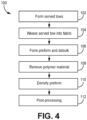
- FIG. 4 is a method flowchart illustrating select steps of method 100 for preparing a ceramic preform with deposited particles 14. Steps 102-112 of method 100 are discussed together with FIGS. 1-3 .
- Ceramic tow 10 can be formed from bundled filaments of silicon carbide (SiC) or, in an alternative embodiment, aluminum oxide (Al 2 O 3 ). Numerous tows 10 can be woven into two or three-dimensional fabrics or braids and incorporated into a preform (shown and labeled in FIG. 3 ).
- Serving yarn 12 can be formed from a polymer material, such as from a mixture of polyvinyl alcohol (PVA) and water. Other polymers are contemplated herein. The percent by weight of PVA in solution can be relatively high (e.g., ⁇ 75%) in order to form a continuous yarn via extrusion or other suitable method. Additionally, the polymer material and method of yarn formation should be appropriate for forming a yarn flexible enough to be coiled around tow 10.
- PVA polyvinyl alcohol
- particles 14 Prior to formation of serving yarn 12, particles 14 can be added to the PVA solution to create a serving yarn mixture.
- Exemplary particles 14 can be formed from a ceramic material, such as SiC, boron nitride (BN), boron carbide (B 4 C), zirconium dioxide (ZrO 2 ), and silicon nitride (Si 3 N 4 ) to name a few, non-limiting examples.
- Particle loading can be such that the percent by volume of particles 14 in a given serving yarn 12 can range from 5% to 25%.
- the D50 size of ceramic particles 14 can range from 10 microns to 60 microns, and more specifically, from 35 microns to 50 microns.
- Particles 14 within a given mixture can be homogenous with respect to particle material, or can be a mixture of particles 14 of different materials in some embodiments.
- Tow 10 can have diameter D1 and serving yarn 12 can have a smaller diameter D2.
- D2 can be roughly 25% to 50% the value of D1.
- D2 can range from 100 microns to 300 microns.
- D1 and D2 can represent the major diameters, respectively.
- serving yarn 12 can be coiled/wound around tow 10 to form a served tow 10. More specifically, serving yarn 12 can be wound such that there are n coils per unit length L of tow 10. Length L can represent all, or just a portion, as shown, of the length of tow 12. A coil can represent each segment of serving yarn 12 fully circumscribing tow 10. FIG. 1 illustrates an embodiment with about four coils per until length L, or 4/L. The number of coils can depend on several factors, including the yarn diameter D2 and particle loading of serving yarn 12. For example, a larger value D2 may prevent tight winding of serving yarn 12, which can reduce the number of coils per length L, particularly for smaller values of L.
- length L can be 1.0 inch (25.4mm), and the number of coils per 1.0 inch can range from 1-100.
- served tow 10 can be woven into a fabric with other served and/or unserved tows 10.
- the number of served tows 10 per unit area of a fabric will depend upon the desired volume percent of particles 14 in the fabric and/or preform, as is discussed in greater detail below with respect to FIG. 3 .
- "tighter" woven architectures such as those with higher values for ends-per-inch (EPI) and/or picks-per-inch (PPI), may be better suited for alternating served and unserved tows 10, such as every other tow 10 in a particular direction, only warp tows 10, etc.
- served fabrics i.e., those containing served tows 10
- the preform can be placed, for example, on a vacuum debulking table or in an autoclave under pressure, and optionally, relatively low heat (e.g., ranging from 100°F to 300°F (38°C to 149°C)) can be applied.
- the polymer material of serving yarns 12 can be removed/decomposed.
- the preform can be immersed in a vat of deionized water at or above boiling temperature (212°F or 100°C) to decompose the polymer material.
- the preform can be heated for a period of time, for example, to a temperature ranging from 700°F to 800°F (371°C to 427°C) for a number of hours to burn off the polymer material.
- FIG. 3 illustrates a portion of preform 16, after the polymer removal of step 108.
- preform 16 includes two woven fabric layers 18 of warp and weft tows 10.
- Particles 14 remain within the preform after the removal of the polymer material, and generally occupy open spaces between tows 10 (i.e., inter-tow pores).
- particles 14 on the lower end of the size distribution range i.e., those near 10 microns
- Layers 18 nearest a midplane of preform 16 at a given location can have a greater concentration/percent by volume of particles 14 than layer 18 at an outer surface in some embodiments.
- the percent by volume of particles 14 within preform 16 can range from 2% to 20%, with the percent by volume of fibers (i.e., tows 10) being around 40%.
- preform 16 can undergo matrix formation and densification within a reaction chamber using chemical vapor infiltration (CVI).
- CVI chemical vapor infiltration
- the fabric layers 18 are infiltrated by reactant vapors, and a gaseous precursor deposits on the underlying fibers.
- the matrix material can be SiC or other suitable ceramic material. Densification is carried out until the resulting CMC has reached the desired residual porosity.
- Other techniques for matrix formation are contemplated herein, such as one or a combination of slurry infiltration, melt infiltration, and polymer infiltration and pyrolysis.
- various post-processing steps can be performed, such as the application of one or more protective coatings (e.g., environmental and/or thermal barrier coatings).
- a bond coat can also be applied to facilitate bonding between the CMC and a protective coating.
- Other protective coatings especially those suitable for use in a gas turbine engine environment, are contemplated herein.
- a CMC formed with the disclosed perforated preforms can be incorporated into aerospace, maritime, or industrial equipment, to name a few, non-limiting examples.
- a method of preparing a fibrous preform for use in a ceramic matrix composite comprises coiling a serving yarn around a ceramic tow to form a served tow, the serving yarn comprising a polymer material with embedded ceramic particles, incorporating the served tow into a woven fabric, the woven fabric comprising a plurality of served tows, and removing the polymer material of the serving yarn such that the embedded ceramic particles remain in the woven fabric.
- the serving yarn can be coiled around the ceramic tow such that there are 1 to 100 coils per unit length of the ceramic tow.
- the unit length can be 1.0 inch.
- the polymer material can include polyvinyl alcohol.
- the embedded ceramic particles can include at least one of silicon carbide, boron nitride, boron carbide, zirconium dioxide, and silicon nitride.
- a size of the embedded ceramic particles can range from 10 microns to 60 microns.
- a percent by volume of the embedded ceramic particles in the serving yarn can range from 5% to 25%.
- the ceramic tow can have a first diameter
- the serving yarn can have a second diameter smaller than the first diameter
- the second diameter can range from 100 microns to 300 microns.
- Any of the above methods can further include prior to decomposing the polymer material, laying up the woven fabric into the preform and debulking the preform.
- removing the polymer material can include immersing the preform in boiling water, and heating the woven fabric to a temperature ranging from 700°F and 800°F.
- Any of the above methods can further include forming the ceramic matrix composite by densifying the preform using chemical vapor infiltration to deposit a ceramic matrix on and within the preform.
- Any of the above methods can further include applying at least one of a thermal barrier coating and an environmental barrier coating to the ceramic matrix composite.
- a fibrous ceramic preform comprises a woven fabric formed from a plurality of ceramic tows, and ceramic particles deposited on the woven fabric.
- the percent by volume of ceramic particles in the preform ranges from 2% to 20%.
- the preform of the preceding paragraph can optionally include, additionally and/or alternatively, any one or more of the following features, configurations and/or additional components:
- the ceramic tows can be formed from one of silicon carbide and aluminum oxide.
- the ceramic particles can include at least one of silicon carbide, boron nitride, boron carbide, zirconium dioxide, and silicon nitride.
- a size of the ceramic particles can range from 10 microns to 60 microns.
- a ceramic matrix composite can include any of the above preforms and a ceramic matrix deposited on and around the woven fabric and ceramic particles.
- the ceramic matrix can include silicon carbide.
- any of the above ceramic matrix composites can further include at least one of a thermal barrier coating and an environmental barrier coating.
Landscapes
- Engineering & Computer Science (AREA)
- Chemical & Material Sciences (AREA)
- Ceramic Engineering (AREA)
- Materials Engineering (AREA)
- Structural Engineering (AREA)
- Organic Chemistry (AREA)
- Manufacturing & Machinery (AREA)
- Textile Engineering (AREA)
- Inorganic Chemistry (AREA)
- Chemical Kinetics & Catalysis (AREA)
- Mechanical Engineering (AREA)
- Chemical Or Physical Treatment Of Fibers (AREA)
- Reinforced Plastic Materials (AREA)
Abstract
Description
- The present invention relates to ceramic matrix composites, and more particularly, to the preparation of woven ceramic fabrics for use in ceramic matrix composites.
- In the processing of ceramic matrix composites, there is a need to infiltrate matrix within and around fibrous tow bundles to replace pore volume with dense matrix material. In a woven system, there are often large voids that exist between adjacent tows of a preform. After infiltration, such voids can become large defects of the composite that are detrimental to composite properties. Particles can be added to a preform to occupy these large voids and reduce the volume fraction of defects in the composite. Introducing particles to ceramic fabrics in such manner as to provide a uniform distribution of particles using current methods (e.g., spraying, dunking, ultrasonication, etc.) can be challenging due to the lack of control of particles in a free-flowing solution state of matter. Thus, improved methods of particle deposition are desirable.
- A method of preparing a fibrous preform for use in a ceramic matrix composite comprises coiling a serving yarn around a ceramic tow to form a served tow, the serving yarn comprising a polymer material with embedded ceramic particles, incorporating the served tow into a woven fabric, the woven fabric comprising a plurality of served tows, and removing the polymer material of the serving yarn such that the embedded ceramic particles remain in the woven fabric.
- A fibrous ceramic preform comprises a woven fabric formed from a plurality of ceramic tows, and ceramic particles deposited on the woven fabric. The percent by volume of ceramic particles in the preform ranges from 2% to 20%.
-
-
FIG. 1 is a simplified perspective view of a ceramic tow with a serving yarn wrapped around its outer surface. -
FIG. 2 is a simplified cross-sectional side-by-side comparison of the serving yarn and ceramic tow. -
FIG. 3 is a simplified cross-section view of a portion of a ceramic preform after the serving yarns have been decomposed from the ceramic tows, leaving particles behind in the open spaces of the preform. -
FIG. 4 is a flow chart illustrating a method of depositing the particles in the preform using serving yarns. - While the above-identified figures set forth one or more embodiments of the present disclosure, other embodiments are also contemplated, as noted in the discussion. In all cases, this disclosure presents the invention by way of representation and not limitation. It should be understood that numerous other modifications and embodiments can be devised by those skilled in the art, which fall within the scope and spirit of the principles of the invention. The figures may not be drawn to scale, and applications and embodiments of the present invention may include features and components not specifically shown in the drawings.
- This disclosure presents a method of and means for introducing particles into a fibrous ceramic preform.
-
FIG. 1 is a simplified illustration ofceramic tow 10 wrapped withserving yarn 12.FIG. 2 is a simplified side-by-side cross-sectional view oftow 10 and servingyarn 12.FIG. 3 is simplified cross-sectional view of a section offibrous preform 16 after the removal ofserving yarns 12, leaving behindparticles 14.FIG. 4 is a method flowchart illustrating select steps ofmethod 100 for preparing a ceramic preform with depositedparticles 14. Steps 102-112 ofmethod 100 are discussed together withFIGS. 1-3 . -
Ceramic tow 10 can be formed from bundled filaments of silicon carbide (SiC) or, in an alternative embodiment, aluminum oxide (Al2O3).Numerous tows 10 can be woven into two or three-dimensional fabrics or braids and incorporated into a preform (shown and labeled inFIG. 3 ). Servingyarn 12 can be formed from a polymer material, such as from a mixture of polyvinyl alcohol (PVA) and water. Other polymers are contemplated herein. The percent by weight of PVA in solution can be relatively high (e.g., ≥ 75%) in order to form a continuous yarn via extrusion or other suitable method. Additionally, the polymer material and method of yarn formation should be appropriate for forming a yarn flexible enough to be coiled aroundtow 10. - Prior to formation of
serving yarn 12,particles 14 can be added to the PVA solution to create a serving yarn mixture.Exemplary particles 14 can be formed from a ceramic material, such as SiC, boron nitride (BN), boron carbide (B4C), zirconium dioxide (ZrO2), and silicon nitride (Si3N4) to name a few, non-limiting examples. Particle loading can be such that the percent by volume ofparticles 14 in a givenserving yarn 12 can range from 5% to 25%. In one embodiment, the D50 size ofceramic particles 14 can range from 10 microns to 60 microns, and more specifically, from 35 microns to 50 microns.Particles 14 within a given mixture can be homogenous with respect to particle material, or can be a mixture ofparticles 14 of different materials in some embodiments. Tow 10 can have diameter D1 andserving yarn 12 can have a smaller diameter D2. In an exemplary embodiment, D2 can be roughly 25% to 50% the value of D1. In an exemplary embodiment, D2 can range from 100 microns to 300 microns. For moreelliptical tows 10 and/oryarns 12, D1 and D2 can represent the major diameters, respectively. - At
step 102, servingyarn 12 can be coiled/wound aroundtow 10 to form a served tow 10. More specifically, servingyarn 12 can be wound such that there are n coils per unit length L oftow 10. Length L can represent all, or just a portion, as shown, of the length oftow 12. A coil can represent each segment ofserving yarn 12 fullycircumscribing tow 10.FIG. 1 illustrates an embodiment with about four coils per until length L, or 4/L. The number of coils can depend on several factors, including the yarn diameter D2 and particle loading ofserving yarn 12. For example, a larger value D2 may prevent tight winding ofserving yarn 12, which can reduce the number of coils per length L, particularly for smaller values of L. Similarly, higher particle loading values can reduce the number of turns needed, regardless of D2. This is due to the fact that the desired volume fraction, or percent by volume ofparticles 14 delivered totow 10 can be achieved with less (i.e., shorter overall length or smaller diameter) servingyarn 12. In an exemplary embodiment, length L can be 1.0 inch (25.4mm), and the number of coils per 1.0 inch can range from 1-100. - At
step 104, served tow 10 can be woven into a fabric with other served and/orunserved tows 10. Generally speaking, the number of servedtows 10 per unit area of a fabric will depend upon the desired volume percent ofparticles 14 in the fabric and/or preform, as is discussed in greater detail below with respect toFIG. 3 . Additionally, "tighter" woven architectures, such as those with higher values for ends-per-inch (EPI) and/or picks-per-inch (PPI), may be better suited for alternating served and unservedtows 10, such as everyother tow 10 in a particular direction, onlywarp tows 10, etc. - At
step 106, served fabrics (i.e., those containing served tows 10) can then be laid up into a net shape or near-net-shape preform and debulked. More specifically, the preform can be placed, for example, on a vacuum debulking table or in an autoclave under pressure, and optionally, relatively low heat (e.g., ranging from 100°F to 300°F (38°C to 149°C)) can be applied. - At
step 108, the polymer material ofserving yarns 12 can be removed/decomposed. In one embodiment, the preform can be immersed in a vat of deionized water at or above boiling temperature (212°F or 100°C) to decompose the polymer material. Alternatively, the preform can be heated for a period of time, for example, to a temperature ranging from 700°F to 800°F (371°C to 427°C) for a number of hours to burn off the polymer material. -
FIG. 3 illustrates a portion ofpreform 16, after the polymer removal ofstep 108. As shown,preform 16 includes twowoven fabric layers 18 of warp andweft tows 10.Particles 14 remain within the preform after the removal of the polymer material, and generally occupy open spaces between tows 10 (i.e., inter-tow pores). However,particles 14 on the lower end of the size distribution range (i.e., those near 10 microns) can be small enough to travel into spaces between filaments of a particular tow 10 (i.e., intra-tow pores).Layers 18 nearest a midplane ofpreform 16 at a given location can have a greater concentration/percent by volume ofparticles 14 thanlayer 18 at an outer surface in some embodiments. This allows for a more robust deposition of matrix in theinner layers 18 without canning off atouter layers 18, as theouter layers 18 can be slightly more porous prior to matrix formation. The percent by volume ofparticles 14 withinpreform 16 can range from 2% to 20%, with the percent by volume of fibers (i.e., tows 10) being around 40%. - At
step 110, preform 16 can undergo matrix formation and densification within a reaction chamber using chemical vapor infiltration (CVI). During densification, the fabric layers 18 are infiltrated by reactant vapors, and a gaseous precursor deposits on the underlying fibers. The matrix material can be SiC or other suitable ceramic material. Densification is carried out until the resulting CMC has reached the desired residual porosity. Other techniques for matrix formation are contemplated herein, such as one or a combination of slurry infiltration, melt infiltration, and polymer infiltration and pyrolysis. - At
step 112, various post-processing steps can be performed, such as the application of one or more protective coatings (e.g., environmental and/or thermal barrier coatings). A bond coat can also be applied to facilitate bonding between the CMC and a protective coating. Other protective coatings, especially those suitable for use in a gas turbine engine environment, are contemplated herein. - A CMC formed with the disclosed perforated preforms can be incorporated into aerospace, maritime, or industrial equipment, to name a few, non-limiting examples.
- The following are non-exclusive descriptions of possible embodiments of the present invention.
- A method of preparing a fibrous preform for use in a ceramic matrix composite comprises coiling a serving yarn around a ceramic tow to form a served tow, the serving yarn comprising a polymer material with embedded ceramic particles, incorporating the served tow into a woven fabric, the woven fabric comprising a plurality of served tows, and removing the polymer material of the serving yarn such that the embedded ceramic particles remain in the woven fabric.
- The method of the preceding paragraph can optionally include, additionally and/or alternatively, any one or more of the following features, configurations and/or additional components:
In the above method, the serving yarn can be coiled around the ceramic tow such that there are 1 to 100 coils per unit length of the ceramic tow. - In any of the above methods, the unit length can be 1.0 inch.
- In any of the above methods, the polymer material can include polyvinyl alcohol.
- In any of the above methods, the embedded ceramic particles can include at least one of silicon carbide, boron nitride, boron carbide, zirconium dioxide, and silicon nitride.
- In any of the above methods, a size of the embedded ceramic particles can range from 10 microns to 60 microns.
- In any of the above methods, a percent by volume of the embedded ceramic particles in the serving yarn can range from 5% to 25%.
- In any of the above methods, the ceramic tow can have a first diameter, and the serving yarn can have a second diameter smaller than the first diameter.
- In any of the above methods, the second diameter can range from 100 microns to 300 microns.
- Any of the above methods can further include prior to decomposing the polymer material, laying up the woven fabric into the preform and debulking the preform.
- In any of the above methods, removing the polymer material can include immersing the preform in boiling water, and heating the woven fabric to a temperature ranging from 700°F and 800°F.
- Any of the above methods can further include forming the ceramic matrix composite by densifying the preform using chemical vapor infiltration to deposit a ceramic matrix on and within the preform.
- Any of the above methods can further include applying at least one of a thermal barrier coating and an environmental barrier coating to the ceramic matrix composite.
- A fibrous ceramic preform comprises a woven fabric formed from a plurality of ceramic tows, and ceramic particles deposited on the woven fabric. The percent by volume of ceramic particles in the preform ranges from 2% to 20%.
- The preform of the preceding paragraph can optionally include, additionally and/or alternatively, any one or more of the following features, configurations and/or additional components:
In the above preform, the ceramic tows can be formed from one of silicon carbide and aluminum oxide. - In the above preform, the ceramic particles can include at least one of silicon carbide, boron nitride, boron carbide, zirconium dioxide, and silicon nitride.
- In the above preform, a size of the ceramic particles can range from 10 microns to 60 microns.
- A ceramic matrix composite can include any of the above preforms and a ceramic matrix deposited on and around the woven fabric and ceramic particles.
- In the above ceramic matrix composite, the ceramic matrix can include silicon carbide.
- Any of the above ceramic matrix composites can further include at least one of a thermal barrier coating and an environmental barrier coating.
- While the invention has been described with reference to an exemplary embodiment(s), it will be understood by those skilled in the art that various changes may be made and equivalents may be substituted for elements thereof without departing from the scope of the invention. In addition, many modifications may be made to adapt a particular situation or material to the teachings of the invention without departing from the essential scope thereof. Therefore, it is intended that the invention not be limited to the particular embodiment(s) disclosed, but that the invention will include all embodiments falling within the scope of the appended claims.
Claims (15)
- A method of preparing a fibrous preform (16) for use in a ceramic matrix composite, the method comprising:coiling a serving yarn (12) around a ceramic tow (10) to form a served tow, the serving yarn (12) comprising a polymer material with embedded ceramic particles (14);incorporating the served tow into a woven fabric, the woven fabric comprising a plurality of served tows; andremoving the polymer material of the serving yarn (12) such that the embedded ceramic particles (14) remain in the woven fabric.
- The method of claim 1, wherein the serving yarn (12) is coiled around the ceramic tow (10) such that there are 1 to 100 coils per unit length (L) of the ceramic tow (10).
- The method of claim 2, wherein the unit length (L) is 1.0 inch (25.4 mm).
- The method of claim 1, 2 or 3, wherein the polymer material comprises polyvinyl alcohol.
- The method of any preceding claim, wherein the embedded ceramic particles (14) comprise at least one of silicon carbide, boron nitride, boron carbide, zirconium dioxide, and silicon nitride.
- The method of any preceding claim, wherein:a size of the embedded ceramic particles (14) ranges from 10 microns to 60 microns; and/ora percent by volume of the embedded ceramic particles (14) in the serving yarn (12) ranges from 5% to 25%.
- The method of any preceding claim, wherein the ceramic tow (10) has a first diameter (D1), and the serving yarn (12) has a second diameter (D2) smaller than the first diameter (D1), wherein, optionally, the second diameter (D2) ranges from 100 microns to 300 microns.
- The method of any preceding claim, and further comprising: prior to decomposing the polymer material, laying up the woven fabric into the preform (16) and debulking the preform (16).
- The method of any preceding claim, wherein removing the polymer material comprises one of:immersing the preform (16) in boiling water; andheating the woven fabric to a temperature ranging from 700°F and 800°F (371°C to 427°C).
- The method of any preceding claim, and further comprising:forming the ceramic matrix composite by densifying the preform (16) using chemical vapor infiltration to deposit a ceramic matrix on and within the preform (16); and/orapplying at least one of a thermal barrier coating and an environmental barrier coating to the ceramic matrix composite.
- A fibrous ceramic preform (16) comprising:a woven fabric formed from a plurality of ceramic tows (10); andceramic particles (14) deposited on the woven fabric;wherein the percent by volume of ceramic particles (14) in the preform (16) ranges from 2% to 20%.
- The preform (16) of claim 11, wherein the ceramic tows (10) are formed from one of silicon carbide and aluminum oxide.
- The preform (16) of claim 11 or 12, wherein:the ceramic particles (14) comprise at least one of silicon carbide, boron nitride, boron carbide, zirconium dioxide, and silicon nitride; and/ora size of the ceramic particles (14) ranges from 10 microns to 60 microns.
- A ceramic matrix composite comprising:the preform (16) of claim 11, 12 or 13; anda ceramic matrix deposited on and around the woven fabric and ceramic particles (14).
- The ceramic matrix composite of claim 14, wherein:the ceramic matrix comprises silicon carbide; and/orthe ceramic matrix composite further comprises at least one of a thermal barrier coating and an environmental barrier coating.
Applications Claiming Priority (1)
| Application Number | Priority Date | Filing Date | Title |
|---|---|---|---|
| US17/842,700 US12428756B2 (en) | 2022-06-16 | 2022-06-16 | Particle-imbedded serving yarn for CMC applications |
Publications (2)
| Publication Number | Publication Date |
|---|---|
| EP4292995A2 true EP4292995A2 (en) | 2023-12-20 |
| EP4292995A3 EP4292995A3 (en) | 2024-05-08 |
Family
ID=86861747
Family Applications (1)
| Application Number | Title | Priority Date | Filing Date |
|---|---|---|---|
| EP23179766.3A Pending EP4292995A3 (en) | 2022-06-16 | 2023-06-16 | Particle-imbedded serving yarn for cmc applications |
Country Status (2)
| Country | Link |
|---|---|
| US (1) | US12428756B2 (en) |
| EP (1) | EP4292995A3 (en) |
Families Citing this family (1)
| Publication number | Priority date | Publication date | Assignee | Title |
|---|---|---|---|---|
| EP4144709A1 (en) * | 2021-09-01 | 2023-03-08 | Raytheon Technologies Corporation | Controlled particle injection in fabric for improved microstructure homogeneity in cmcs |
Family Cites Families (8)
| Publication number | Priority date | Publication date | Assignee | Title |
|---|---|---|---|---|
| US1101779A (en) * | 1913-05-19 | 1914-06-30 | American Heat & Power Co | Centrifugal burner. |
| EP3047061B8 (en) | 2013-09-19 | 2021-04-14 | Raytheon Technologies Corporation | Filament winding apparatus and method for ceramic matrix composites |
| FR3039149B1 (en) * | 2015-07-24 | 2020-09-25 | Aircelle Sa | POROUS CERAMIC MATERIAL OBTAINED BY WEAVING AND ACOUSTIC PANEL CONTAINING SUCH A MATERIAL |
| US11434176B2 (en) * | 2017-12-11 | 2022-09-06 | Rolls-Royce High Temperature Composites Inc. | Fugitive fiber commingling to provide loft in ceramic fiber tows |
| US10822282B2 (en) | 2018-11-15 | 2020-11-03 | United Technologies Corporation | Method of fabricating a ceramic composite |
| FR3101629B1 (en) * | 2019-10-07 | 2022-06-17 | Safran Ceram | Manufacturing process of a CMC part |
| WO2020209848A1 (en) * | 2019-04-10 | 2020-10-15 | Siemens Aktiengesellschaft | Method for manufacturing a three-dimensional, reinforced composite matrix component |
| US11760699B2 (en) | 2019-07-12 | 2023-09-19 | Rolls-Royce High Temperature Composites Inc. | Method of altering a surface of a ceramic matrix composite to aid in nodule removal |
-
2022
- 2022-06-16 US US17/842,700 patent/US12428756B2/en active Active
-
2023
- 2023-06-16 EP EP23179766.3A patent/EP4292995A3/en active Pending
Also Published As
| Publication number | Publication date |
|---|---|
| US20230407532A1 (en) | 2023-12-21 |
| EP4292995A3 (en) | 2024-05-08 |
| US12428756B2 (en) | 2025-09-30 |
Similar Documents
| Publication | Publication Date | Title |
|---|---|---|
| JP7071009B2 (en) | Methods of Forming Ceramic Substrate Composites Using Sacrificial Fibers and Non-Wet Coatings | |
| EP2154119B1 (en) | Method of producing a part from a thermostructural composite material and part thus obtained | |
| US8039053B2 (en) | Method for making a part of composite material with ceramic matrix and resulting part | |
| US5439627A (en) | Process for manufacturing reinforced composites | |
| US9611180B2 (en) | Method for manufacturing a part made of CMC | |
| US9784217B2 (en) | Low-thickness thermostructural composite material part, and manufacture method | |
| EP4197781A1 (en) | Pressurized stabilization of plies for improved interlaminar properties | |
| EP4292995A2 (en) | Particle-imbedded serving yarn for cmc applications | |
| CN110894164B (en) | A kind of silicon carbide ceramic matrix composite material with rare earth silicate layered distribution and preparation method thereof | |
| CN115677358B (en) | System and method for coating ceramic fibers | |
| EP4389415B1 (en) | Boron nitride aerogel interface coating precursor for ceramic matrix composites | |
| KR102153918B1 (en) | Method for preparing high density silicon carbide composite by uniform growth of sic nanowire using chemical vapor deposition and silicon carbide composite prepared by the same | |
| JP2019172503A (en) | PRODUCTION PROCESS FOR SiC FIBER REINFORCED SiC COMPOSITE MATERIAL | |
| US12365632B2 (en) | Superabsorbent polymer filament sizing for CMC applications | |
| EP4197987A2 (en) | Pva based binder application for cmcs | |
| EP4477413A1 (en) | Particle enhanced ceramic matrix composite with no particles on surface plies | |
| CN113748096B (en) | Method of manufacturing CMC component | |
| US11873249B2 (en) | Method to form aligned interface coating on silicon carbide fibers | |
| Nakazato et al. | Effects of pressure during preform densification on SiC/SiC composites | |
| EP4600232A1 (en) | Interface coating process | |
| EP4538251A1 (en) | Dispersion of filaments | |
| US20220177374A1 (en) | A method of fabricating a cmc part |
Legal Events
| Date | Code | Title | Description |
|---|---|---|---|
| PUAI | Public reference made under article 153(3) epc to a published international application that has entered the european phase |
Free format text: ORIGINAL CODE: 0009012 |
|
| STAA | Information on the status of an ep patent application or granted ep patent |
Free format text: STATUS: THE APPLICATION HAS BEEN PUBLISHED |
|
| AK | Designated contracting states |
Kind code of ref document: A2 Designated state(s): AL AT BE BG CH CY CZ DE DK EE ES FI FR GB GR HR HU IE IS IT LI LT LU LV MC ME MK MT NL NO PL PT RO RS SE SI SK SM TR |
|
| RIC1 | Information provided on ipc code assigned before grant |
Ipc: C04B 41/00 20060101ALI20231211BHEP Ipc: C04B 35/80 20060101AFI20231211BHEP |
|
| PUAL | Search report despatched |
Free format text: ORIGINAL CODE: 0009013 |
|
| AK | Designated contracting states |
Kind code of ref document: A3 Designated state(s): AL AT BE BG CH CY CZ DE DK EE ES FI FR GB GR HR HU IE IS IT LI LT LU LV MC ME MK MT NL NO PL PT RO RS SE SI SK SM TR |
|
| RIC1 | Information provided on ipc code assigned before grant |
Ipc: C04B 41/00 20060101ALI20240403BHEP Ipc: C04B 35/80 20060101AFI20240403BHEP |
|
| STAA | Information on the status of an ep patent application or granted ep patent |
Free format text: STATUS: REQUEST FOR EXAMINATION WAS MADE |
|
| 17P | Request for examination filed |
Effective date: 20241108 |
|
| RBV | Designated contracting states (corrected) |
Designated state(s): AL AT BE BG CH CY CZ DE DK EE ES FI FR GB GR HR HU IE IS IT LI LT LU LV MC ME MK MT NL NO PL PT RO RS SE SI SK SM TR |