EP4291042B1 - Oat derived composition - Google Patents
Oat derived composition Download PDFInfo
- Publication number
- EP4291042B1 EP4291042B1 EP21705449.3A EP21705449A EP4291042B1 EP 4291042 B1 EP4291042 B1 EP 4291042B1 EP 21705449 A EP21705449 A EP 21705449A EP 4291042 B1 EP4291042 B1 EP 4291042B1
- Authority
- EP
- European Patent Office
- Prior art keywords
- oat
- composition
- derived composition
- slurry
- oat derived
- Prior art date
- Legal status (The legal status is an assumption and is not a legal conclusion. Google has not performed a legal analysis and makes no representation as to the accuracy of the status listed.)
- Active
Links
Images
Classifications
-
- A—HUMAN NECESSITIES
- A23—FOODS OR FOODSTUFFS; TREATMENT THEREOF, NOT COVERED BY OTHER CLASSES
- A23L—FOODS, FOODSTUFFS OR NON-ALCOHOLIC BEVERAGES, NOT OTHERWISE PROVIDED FOR; PREPARATION OR TREATMENT THEREOF
- A23L7/00—Cereal-derived products; Malt products; Preparation or treatment thereof
- A23L7/10—Cereal-derived products
-
- A—HUMAN NECESSITIES
- A23—FOODS OR FOODSTUFFS; TREATMENT THEREOF, NOT COVERED BY OTHER CLASSES
- A23L—FOODS, FOODSTUFFS OR NON-ALCOHOLIC BEVERAGES, NOT OTHERWISE PROVIDED FOR; PREPARATION OR TREATMENT THEREOF
- A23L7/00—Cereal-derived products; Malt products; Preparation or treatment thereof
- A23L7/10—Cereal-derived products
- A23L7/198—Dry unshaped finely divided cereal products, not provided for in groups A23L7/117 - A23L7/196 and A23L29/00, e.g. meal, flour, powder, dried cereal creams or extracts
-
- A—HUMAN NECESSITIES
- A23—FOODS OR FOODSTUFFS; TREATMENT THEREOF, NOT COVERED BY OTHER CLASSES
- A23L—FOODS, FOODSTUFFS OR NON-ALCOHOLIC BEVERAGES, NOT OTHERWISE PROVIDED FOR; PREPARATION OR TREATMENT THEREOF
- A23L33/00—Modifying nutritive qualities of foods; Dietetic products; Preparation or treatment thereof
- A23L33/10—Modifying nutritive qualities of foods; Dietetic products; Preparation or treatment thereof using additives
- A23L33/105—Plant extracts, their artificial duplicates or their derivatives
-
- A—HUMAN NECESSITIES
- A23—FOODS OR FOODSTUFFS; TREATMENT THEREOF, NOT COVERED BY OTHER CLASSES
- A23L—FOODS, FOODSTUFFS OR NON-ALCOHOLIC BEVERAGES, NOT OTHERWISE PROVIDED FOR; PREPARATION OR TREATMENT THEREOF
- A23L33/00—Modifying nutritive qualities of foods; Dietetic products; Preparation or treatment thereof
- A23L33/10—Modifying nutritive qualities of foods; Dietetic products; Preparation or treatment thereof using additives
- A23L33/115—Fatty acids or derivatives thereof; Fats or oils
-
- A—HUMAN NECESSITIES
- A23—FOODS OR FOODSTUFFS; TREATMENT THEREOF, NOT COVERED BY OTHER CLASSES
- A23L—FOODS, FOODSTUFFS OR NON-ALCOHOLIC BEVERAGES, NOT OTHERWISE PROVIDED FOR; PREPARATION OR TREATMENT THEREOF
- A23L33/00—Modifying nutritive qualities of foods; Dietetic products; Preparation or treatment thereof
- A23L33/10—Modifying nutritive qualities of foods; Dietetic products; Preparation or treatment thereof using additives
- A23L33/125—Modifying nutritive qualities of foods; Dietetic products; Preparation or treatment thereof using additives containing carbohydrate syrups; containing sugars; containing sugar alcohols; containing starch hydrolysates
-
- A—HUMAN NECESSITIES
- A23—FOODS OR FOODSTUFFS; TREATMENT THEREOF, NOT COVERED BY OTHER CLASSES
- A23L—FOODS, FOODSTUFFS OR NON-ALCOHOLIC BEVERAGES, NOT OTHERWISE PROVIDED FOR; PREPARATION OR TREATMENT THEREOF
- A23L33/00—Modifying nutritive qualities of foods; Dietetic products; Preparation or treatment thereof
- A23L33/10—Modifying nutritive qualities of foods; Dietetic products; Preparation or treatment thereof using additives
- A23L33/17—Amino acids, peptides or proteins
- A23L33/185—Vegetable proteins
-
- A—HUMAN NECESSITIES
- A23—FOODS OR FOODSTUFFS; TREATMENT THEREOF, NOT COVERED BY OTHER CLASSES
- A23L—FOODS, FOODSTUFFS OR NON-ALCOHOLIC BEVERAGES, NOT OTHERWISE PROVIDED FOR; PREPARATION OR TREATMENT THEREOF
- A23L33/00—Modifying nutritive qualities of foods; Dietetic products; Preparation or treatment thereof
- A23L33/20—Reducing nutritive value; Dietetic products with reduced nutritive value
- A23L33/21—Addition of substantially indigestible substances, e.g. dietary fibres
-
- A—HUMAN NECESSITIES
- A23—FOODS OR FOODSTUFFS; TREATMENT THEREOF, NOT COVERED BY OTHER CLASSES
- A23L—FOODS, FOODSTUFFS OR NON-ALCOHOLIC BEVERAGES, NOT OTHERWISE PROVIDED FOR; PREPARATION OR TREATMENT THEREOF
- A23L7/00—Cereal-derived products; Malt products; Preparation or treatment thereof
- A23L7/10—Cereal-derived products
- A23L7/104—Fermentation of farinaceous cereal or cereal material; Addition of enzymes or microorganisms
- A23L7/107—Addition or treatment with enzymes not combined with fermentation with microorganisms
Definitions
- the present invention relates to an oat derived composition, and to a method for manufacturing the oat derived composition, and to a use of the composition.
- Oat in different forms are known ingredients in healthy and nutritious foods.
- oat meal or oat kernels are known for containing nutritious compounds. Oat may be considered a sustainable vegetable ingredient in food production. However, for some purposes it would be desirable with even improved properties of oat materials allowing it to be used in further applications. It would be desirable with obtaining such oat materials in environmentally friendly methods.
- WO 2010/140963 A2 discloses an oat dietary fibre fraction which has approximately the following content: carbohydrates 12 %, proteins 24 %, fat 9 %, beta-glucans 12 % and dietary fibre 33 % (calculated on a dry matter basis).
- an oat derived composition comprising, by dry weight of the composition, 20-55% of oat protein, 5-20% of fat, 20-40% of dietary fiber, and 3-20% of carbohydrates, wherein 3-20% by dry weight of the composition, of the carbohydrates are sugars.
- Such an oat derived composition provides high nutritious values suitable for use as food ingredient. It may be noted that the protein and fibre levels are high. Suitably, such an oat derived composition may be used as food or feed, or as an ingredient in food preparation or manufacturing.
- a method for manufacturing the oat derived composition comprising: providing an aqueous oat slurry comprising 10-30% by weight of micronised oats; separating, from the aqueous oat slurry, preferably by decanting, centrifugation, or filtration, or combinations thereof: a water rich fibre depleted slurry, and a water depleted fibre rich slurry comprising the oat derived composition and having a content of dry matter of 20-40%; optionally drying the water depleted fibre rich slurry; thereby obtaining the oat derived composition.
- the present inventive concepts are, at least in part, based on unexpected realisations that nutritious oat derived composition may be obtained and provided having several desirable properties over known oat products. Further, ways have been discovered allowing the oat derived composition to be manufactured without unnecessary waste material being produced as byproduct. It has further been realised that the oat derived composition may be manufactured while at the same time a useful liquid oat product is obtained, essentially without other by-products from the process. The, thus obtained, liquid oat product may be used for providing an oat drink. Thereby, the oat derived composition may be provided or manufactured without, or with minimum, waste of edible material. Further, the oat derived composition may be obtained as a side or residual product from manufacturing of oat drink. For example, use of the oat derived composition may in addition to be of high nutritional value as described herein, also be of value for reducing or avoiding waste from manufacturing of oat drink.
- the oat derived composition may be obtained from the aqueous phase, which composition may be described as rich in, for example, dietary fibre, protein, and fat while being low in carbohydrates. Further, the level of ⁇ -glucan may be at same level or higher as in untreated oats material.
- Oat derived refers to that the composition at least to a major part, preferably entirely, may be derived from, obtained from or manufactured from oats material.
- the oats material may be oat kernels, or part of oat kernels.
- Oat derived composition may, thus and for example, refer to a composition manufactured from micronized oat kernels wherein the manufacturing may comprise modifications to components of the oats material, such as, for example, treatment by enzymes, whereby components originally present in the oats material may be transformed and/or removed.
- an oat derived composition comprising, by dry weight of the composition, 20-55% of oat protein, 5-20% of fat, 20-40% of dietary fiber, and 3-20% of carbohydrates, wherein 3-20% by dry weight of the composition, of the carbohydrates are sugars.
- Such an oat derived composition provides high nutritious values suitable for use as food ingredient. It may be noted that, for example, the protein and fibre levels are high. Suitably, such an oat derived composition may be used as food or feed, or as an ingredient in food preparation or manufacturing. Carbohydrates may refer to carbohydrates other than fibres but including one or more of sugars and starch.
- the oat derived composition may be a particulate oat derived composition.
- the oat derived composition may, to a major part by dry weight of the composition, be in form of particles. Essentially all of the oat derived composition may be in form of particles.
- a major part of a weight of the particles, or the composition may be particles having sizes within the range from 90 ⁇ m to 1 mm, preferably at least 90% of the weight of the particles, or the composition, may be particles having sizes within the range from 90 ⁇ m to 1 mm. This may be determined by a major portion, or at least 90% of the weight of the particles, or the composition, in dry form passes a 1 mm sieve but is retained by a 90 ⁇ m sieve. It shall be realized and appreciated that this is only an example of sizes which has been realized with an embodiment, and that other sizes and fractions of particles of the powder may be obtained in accordance with embodiments.
- the sizes may be controlled or defined by, for example, the drying of the oat derived composition, and/or by mechanical processes.
- sizes of particles of the micronized oats used in manufacturing of the oat derived composition may determine or have an effect on the sizes of the particles.
- Other process parameters of the manufacturing of the oat derived composition may alternatively or additionally have an effect on the particle size, such as for example treatment of the micronized oats, for example degradation of starch or release of compounds from the micronized oats, but also from other type of treatments including mechanical treatment.
- the sizes of particles of the oat derived composition may be controlled and/or defined and/or affected by, for example, sizes and treatment of particles of the micronized oats.
- the oat derived composition may be treated to grinding or milling, optionally followed by sieving or other means of size fractioning, to provide a particulate oat derived composition with a desirable distribution of particles. Sizes of the particles may be subjected to change, for example dependent on level of moist/water.
- the oat derived composition, or particles of the oat derived composition may typically swell with increased level of moist. Therefore, it may be suitable to provide particle sizes together with water content of the particles or composition.
- the oat derived composition may partially, for example to a major part, or fully, be considered to be composed or consist of particles, although it may not be in form of a free flowing powder.
- the oat derived composition in form of a powder comprising particles may, for example, when wetted or moisturized, or compacted, obtain a form of eg. a cake or body, still comprising particles from the previous powder form.
- dietary fiber 2-9%, by dry weight of the composition, may be ⁇ -glucan.
- the oat derived composition may be an oat derived composition manufactured from an oats material, for example oat kernels or oat meal.
- the fat may be referred to as oat fat, or fat naturally occurring in oats.
- the carbohydrates may essentially be free from starch. 3-20%, such as 5-15%, by dry weight of the composition, of the carbohydrates are sugars.
- the sugars may be selected from one or more of monosaccharides, disaccharides, trisaccharides and olifosaccharides.
- Essentially all of the carbohydrates may be sugars.
- a major portion of the sugars may be maltose.
- 5 to 15 percent, by dry weight of the composition may be maltose.
- the oat derived composition may further comprise, by dry weight of the composition, 0-15%, preferably 2-10% of ash.
- Ash in this context refers to inorganic residues remaining after essentially complete oxidation of the oat derived composition.
- the water content of the composition may be in the range of 0 to 80%, by weight.
- the higher end of the range may describe the oat derived composition as obtained from manufacturing of the composition after the separating, and the lower end of the range may describe the oat derived composition as obtained from drying of the composition from the separating.
- the water content of the composition may be 1-20% by weight of the composition, or 5-15%, or 5-10% by weight of the composition. Such water content may be obtained by drying, and may lend the composition and the composition in powder form suitable handling properties and desirable shelf life. Alternatively, the water content of composition may be 60-80% by weight of the composition.
- the water content of 1-20% may be obtained by drying of the composition having a water content of 60-80%, for example drying by means of a flash dryer or a whirl flash.
- the water content of the composition may be around or below 12%, such as below 10% by weight of the composition.
- the maltose may be from degradation of starch from oats material, for example using enzymatic degradation, for example using amylase, such as ⁇ - or ⁇ -amylase.
- the oat derived composition to a major part by dry weight of the composition is in form of particles
- at least a major portion of individual particles may be characterized by a content of the oat derived composition, i.e. by having a content as specified by claims or embodiments herein.
- individual particles may be characterized by having a content which differs from the overall content of the composition, for which case a mean content of all particles may be characterized by the content of the composition.
- the oat derived composition is described by content as dry weight of the composition. It shall be understood and is discussed herein that the composition may be provided having different content of water.
- the oat derived composition may further comprise other compounds than the discussed protein, fibre, carbohydrates etc.
- the oat derived composition may be mixed or otherwise provided together with additional compounds or ingredients and and used as a mix, for example in manufacturing of food.
- the balance of the composition may be other additives, ingredients or compounds, preferably oat derived.
- the oat derived composition may be in form of a powder.
- a dried particulate oat derived composition may be in form of a powder, or the oat derived composition may be an oat derived powder composition.
- a particulate oat derived composition having a water content of the composition being 1-20% by weight of the composition, or 5-15%, or 5-10% may be in form of a powder.
- Such dried powder may be characterized by having free flowing properties, and may be fractionated using eg. sieving.
- the oat derived composition in form of a powder may be characterized by comprising or consisting of the particulate oat derived composition.
- the oat derived composition in form of a powder comprising particles may, for example, when wetted or moisturized, or compacted, obtain a form of eg. a cake or body, still comprising particles from the previous powder form.
- the fat may comprise or consist of 15-25% saturated fat, 30-50% mono-unsaturated fat, and 30-50% poly-unsaturated fat.
- a method for manufacturing the oat derived composition comprising: providing an aqueous oat slurry comprising 10-30% by weight of micronised oats; separating, from the aqueous oat slurry, preferably by decanting, centrifugation, or filtration, or combinations thereof: a water rich fibre depleted slurry, and a water depleted fibre rich slurry comprising the oat derived composition and having a content of dry matter of 20-40% by weight; optionally drying the water depleted fibre rich slurry; thereby obtaining the oat derived composition.
- the aqueous oat slurry may comprise 10-25%, such as 16-20%, by weight, of micronised oats.
- the water rich fibre depleted slurry may have a content of dry matter of 5-20%, such as, for example, 10-20% or 13-16% by weight.
- the water rich aqueous oat slurry comprising 10-30% by weight of micronised oats may, for example, be provided as micronized oats such as oat flour, mixed with water, and optionally other additives, or, for example, provided by micronizing oat material in aqueous solution, for example as part of the method.
- Separating, from the aqueous oat slurry preferably by decanting, centrifugation, or filtration, or combinations thereof, provides separation of the aqueous oat slurry into two slurries, or phases, for example streams or batches.
- One phase is a water rich fibre depleted slurry
- another phase the water depleted fibre rich slurry comprising the oat derived composition and having a content of dry matter of 20-40%. Rich and/or depleted are terms used in this context to compare content of water and fibre between the two phases. Rich denotes a higher content and depleted a lower content.
- The, thus, separated fibre rich slurry comprising the oat derived composition may be considered as the oat derived composition, and may be the composition according to the first aspect. If the water content and/or content of dry matter is considered desired or suitable, the oat derived composition may be considered achieved from the separating. Optionally, the separated fibre rich slurry may be further dried if a lower water and/or higher content of dry matter is desired. For example, the water content of the dried oat derived composition may be 1 to 15%, such as 5 to 10%.
- the slurry comprising the oat derived composition is described as being water depleted and fibre rich, it shall be understood and appreciated that it may have a content, and may be rich in, other components also, such as, for example rich in components selected from oat protein, of fat, and ⁇ -glucan.
- Fibre may comprise one or more of, for example, dietary fiber, and ⁇ -glucan.
- the separating may be selected from decanting and centrifugation, or combinations thereof.
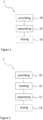
- the method 1 comprises: providing 10 an aqueous oat slurry comprising 10-30%, for example, 5-20% by weight of micronised oats; separating 12, from the aqueous oat slurry, by decanting, centrifugation or filtration: a water rich fibre depleted slurry, and a water depleted fibre rich slurry comprising the oat derived composition and having a content of dry matter of 20-40%; optionally drying 14 the water depleted fibre rich slurry, thereby obtaining the oat derived composition.
- oat derived compositions may suitably be dried as described herein.
- the composition may be dried to a content of dry matter of 80-99%, preferably 85-95%, such as 90-95%.
- the oat derived composition suitably when dried, may be provided in form of a powder. It has been found that the dried compositions and the powder compositions have a long shelf life. Further, they are easy to handle, for example they are pourable and, thus, easy to measure.
- the method may comprise said drying the water depleted fibre rich slurry to a content of dry matter of 80-99%, preferably 85-95%.
- the method may further comprise providing a powder comprising particles of the oat derived composition.
- a major part of the weight of the composition may consists of particles having sizes within the range from 90 ⁇ m to 1 mm. Such drying and powder allows for efficient handling of the oat derived composition and long shelf life.
- Said drying and/or said providing a powder may be performed using a flash dryer.
- a Whirl Flash may be used.
- wind sifting may be used for size-fractionising of the powder.
- drying or sifting may assist or be used for breaking up larger populations of particles.
- Said drying may be performed at temperatures within the range from 100°C to 300°C, for example 150°C to 275°C, or 160°C to 260°C.
- Said separating may be preceded by treating the aqueous oat slurry such that at least a portion of starch from the micronized oats are solubilized or degraded.
- starch and/or degraded components from the starch may further be depleted from the fibre rich phase, while other components desirable to the oat derived composition is enriched in the fibre rich phase and thereby in the oat derived composition.
- Solubilising or degrading the starch may be by providing conditions for degrading the starch in finer components.
- enzymatic treatment is used, such as treatment with amylase.
- the treating may be contacting with enzymes.
- the treating may further comprise a contacting or holding time of several minutes or hours, or to an extent necessary for obtaining desired degradation of starch.
- a major portion, up to essentially all, of starch present in the micronised oats may be treated and/or degraded.
- a method for manufacturing of oat derived compositions comprising the treating will now be described.
- the oat derived compositions were manufactured according to a method 1 as was described with reference to figure 1 , with addition of said separating 12 being preceded by treating 16 the aqueous oat slurry such that at least a portion of starch from the micronized oats are degraded.
- Said treating may be performed by contacting the aqueous oat slurry with amylase.
- a method for manufacturing of the oat derived composition comprising treating the aqueous oat slurry enzymatically is described in further detail in Example 3.
- Said treating the aqueous oat slurry such that at least a portion of starch from the micronized oats are degraded may be performed by contacting the aqueous oat slurry with amylase.
- Other enzymes may be used alternatively or in combination.
- one or more of ⁇ -amylase and ⁇ -amylase may be used.
- the water rich and fibre depleted slurry may be used for various purposes, such as for example in providing food stuffs or drinks, for example drinks sometimes referred to as oat drinks.
- oat drinks for example drinks sometimes referred to as oat drinks.
- a major part, or even the entire part, of the oat material used as raw material in the method may be used or taken care of, thereby minimizing or essentially completely avoiding non-useful waste.
- the oat derived composition may be a residual product, from manufacturing of another product, for example a residual product from manufacturing of oat drink.
- the oat derived composition may, thus, be obtained or manufactured, as a side or residual product from manufacturing of oat drink.
- Use of the, thus obtained, oat derived composition may in addition to be of high nutritional value and be used in food production as described herein, also be of value for reducing or avoiding waste from manufacturing of oat drink.
- the method for manufacturing the oat derived composition comprising treating the aqueous oat slurry with amylase or other starch degrading enzyme, may comprise separating a water rich fibre depleted slurry in form of oat drink, and a water depleted fibre rich slurry comprising the oat derived composition. It has been realized that a side- or by-stream product from manufacturing of oat drink may provide excellent dietary properties in combination with being suitable for use as in food or feed production.
- the oat derived composition may be obtained from manufacturing of oat drink.
- the oat derived material with the characteristic levels of nutrients as described herein, may provide for or be used in efficient production of nutritious food stuffs.
- the oat derived composition may be used as feed, or feed additive or ingredient, or for feed manufacturing.
- the dried samples were not dried samples of the wet samples of table 2. Therefore, variations for example in oat raw material and the manufacturing process may have an effect on the results. It was concluded from the experiments that the drying the oat derived composition provides oat derived compositions having desirable nutritional properties.
- Nutritional values for commercially available products based on oats have been reviewed and displayed in table 2. Data for the oat derived composition according an embodiment of the present invention has been retrieved from table 1, wet samples, and is included in table 2 for comparing. Table 2: Nutritional values for commercial oat products, with values as disclosed by provider. Values expressed as g/(100 g of product), dry weight.
- Product Protein DF Betaglucan Fat Sugars Carbohydrate (incl. sugars) Oat bran 1 19 18 N/A 7.0 3.2 45 Oat bran 2 19 18 N/A 8.5 2.5 39 Oat meal 1 12 8.5 4.0 7 1.2 60 Oat drink 10.5 8.4 4 5.3 40 42 Invention 32 34 5.9 14.6 9.7 11.8
- Oat bran 1 and 2 are commercially available products obtained from micronized hard outer layers of oat kernels/grains. Oat bran is known for being a product high in fibre and protein. Oat meal 1 is a commercially available, non-micronised oat product prepared from heat treated and rolled oat kernels. Thus, the oat meal may be considered similar to the raw material used in manufacturing of the oat derived composition according to embodiments described herein.
- the oat derived composition have unique values and properties when compared to the commercially available products.
- the levels of proteins and fibre are considerably higher than in all compared products, even the oat bran products known and sold for their high content of fibre.
- the fat levels for the oat derived composition is considerably higher. Thereby, for example if used in food production, fat as additive may not be desired or needed.
- the sugar level is higher than in all compared products, while notably the total levels of carbohydrates and sugar is considerably lower than in all compared products.
- the levels of ⁇ -glucan is higher than in the oat meal, and if the levels of ⁇ -glucan in the dried product in table 1 is compared it is similar to the oat meal.
- Vegetable products with high levels of proteins, vegetable products with high levels of fibre, vegetable products with high levels of fat, and vegetable products with low levels of carbohydrates is often desired and sought after in preparation of food and foodstuffs, with the present invention, a single product or composition provides high levels of all of protein, fibre, and fat, and low level of carbohydrates, is provided. Furthermore, the present invention provides high levels of ⁇ -glucan, even when compared with oat meal.
- the composition therefore may provide desired and unique properties and nutritional values not found in other available products or raw materials.
- the composition may be of high value when used eg. in food production.
- the oat derived product of this example was provided both as (i) having a water content within the range of 60-80% by weight of the composition, or having a dry matter content of 20-40% by weight of the composition, and (ii) having a content of dry matter of 80-99%, more specifically 90-95% by weight of the composition by drying provided as a powder.
- Aqueous oat slurry comprising 20% by weight of micronised oats were obtained from oat kernels by wet milling in aqueous solution being water. Although 20% was used for the present example, other concentrations may equally suitably be used, suitably within the range of 10-30%. Heat treated and non-heat treated oat kernels may be used. In this example, the oat kernels were peeled. Wet milling was used as it was available, but other means of micronizing the oat kernels may be used alternatively.
- the aqueous oat slurry may, for example, alternatively be directly provided by mixing oat flour in aqueous solution, such as water.
- the aqueous oat slurry was then enzymatically treated at suitable elevated temperature.
- amylase was used.
- the aqueous oat slurry was treated until most of the present starch was degraded.
- ⁇ -amylase and/or ⁇ -amylase may be used for this purpose.
- The, thus treated, aqueous oat slurry then underwent separation.
- decanting was used, but filtration or centrifugation may alternatively be used, as well as combinations of two or more separation techniques, resulting in a water rich fibre depleted slurry, and a water depleted fibre rich slurry comprising the oat derived composition.
- water depleted fibre rich slurry has a content of dry matter of approximately 30%; while remaining dry matter from the aqueous oat slurry was present in the water rich fibre depleted slurry reaching around approximately 15% dry matter by weight.
- The, thus obtained, water depleted fibre rich slurry is characterized as the oat derived composition and may be used as is or further treated if desired.
- Several samples of the oat derived composition were obtained as described hitherto, as indicated in table 3 as wet samples. Although referred to as wet samples, such samples have a characteristic of and may be described as a moist cake or having a wet or moist solid structure. Other samples manufactured this way, were further treated to drying.
- a Whirl Flash was used for drying. Drying was conducted so that the oat derived samples had a content of dry matter of approximately 90-95%. During drying the oat derived composition turned into a powder. Five dried samples were analysed and results are presented in table 3, referred to as dried samples.
- the water rich fibre depleted slurry may be characterised as a liquid product, which may be used, for example, as a drink or further treated to be used as a drink.
- the method for manufacturing of the oat derived composition provided wet oat derived compositions with a content of dry matter within the range 20-40%, by weight of the composition, and dried oat derived compositions in form of a powder having a dry content within the range of 80-99%. It shall be realised and appreciated that any content of dry matter between 20% to 99% may be achieved from drying to desired level drying of the oat material provided by the method. It has been found particularly desirable with above 80% dry matter, more desirable in the range of 85-99%, and even more desirable in the range of 85-95%, for reasons including that such a composition provides desirable stability and with relatively low consumption of energy for drying. Compositions with a content of dry matter within the range 20-40% benefits from being directly available via the method as this level of dryness was achievable with eg decanting, without further drying.
- Table 3 Analysis data from wet and dry samples of oat derived compositions. All values are expressed as g/(100 g) of dry weight.
- DF denotes dietary fibres. Sample Protein DF Beta-glucan Fat Maltose Sugars* Carbo-hyd rate (incl.
Landscapes
- Life Sciences & Earth Sciences (AREA)
- Engineering & Computer Science (AREA)
- Health & Medical Sciences (AREA)
- Chemical & Material Sciences (AREA)
- Nutrition Science (AREA)
- Food Science & Technology (AREA)
- Polymers & Plastics (AREA)
- Mycology (AREA)
- Microbiology (AREA)
- Biotechnology (AREA)
- Proteomics, Peptides & Aminoacids (AREA)
- Molecular Biology (AREA)
- Oil, Petroleum & Natural Gas (AREA)
- Botany (AREA)
- Cereal-Derived Products (AREA)
- Grain Derivatives (AREA)
Description
- The present invention relates to an oat derived composition, and to a method for manufacturing the oat derived composition, and to a use of the composition.
- There is a need and demand for improved nutritious products which can be used directly or be used as ingredients in cooking or manufacturing of food stuffs. Nutritious products having low impact on the environment and climate and which have an all-vegetable origin is further desirable.
- It is a problem with several nutritious products that they contain a plurality of processed additives. Such processed additives may suffer from requiring considerable amounts of raw materials and energy during preparation and creating wastage of raw material.
- Oat in different forms are known ingredients in healthy and nutritious foods.
- Further, oat meal or oat kernels are known for containing nutritious compounds. Oat may be considered a sustainable vegetable ingredient in food production. However, for some purposes it would be desirable with even improved properties of oat materials allowing it to be used in further applications. It would be desirable with obtaining such oat materials in environmentally friendly methods.
- Thus, there is a need for providing improved nutritious edible oat products, or products to be used as food ingredients or raw material for food production, 30 having low negative effects on health, environment and climate.
WO 2010/140963 A2 discloses an oat dietary fibre fraction which has approximately the following content:carbohydrates 12 %, proteins 24 %, fat 9 %, beta-glucans 12 % and dietary fibre 33 % (calculated on a dry matter basis). - It is a purpose of the present invention to solve at least one problem or need of prior art. It is a further purpose to provide an oat derived product. It is a yet further purpose to provide an oat derived product for use in production of foodstuff.
- According to a first aspect of the present inventive concept there is provided an oat derived composition comprising, by dry weight of the composition, 20-55% of oat protein, 5-20% of fat, 20-40% of dietary fiber, and 3-20% of carbohydrates, wherein 3-20% by dry weight of the composition, of the carbohydrates are sugars.
- Such an oat derived composition provides high nutritious values suitable for use as food ingredient. It may be noted that the protein and fibre levels are high. Suitably, such an oat derived composition may be used as food or feed, or as an ingredient in food preparation or manufacturing.
- According to a second inventive concept, there is provided a method for manufacturing the oat derived composition according to the first inventive concept, the method comprising: providing an aqueous oat slurry comprising 10-30% by weight of micronised oats; separating, from the aqueous oat slurry, preferably by decanting, centrifugation, or filtration, or combinations thereof: a water rich fibre depleted slurry, and a water depleted fibre rich slurry comprising the oat derived composition and having a content of dry matter of 20-40%; optionally drying the water depleted fibre rich slurry; thereby obtaining the oat derived composition.
- According to a third inventive concepts, there is provided a use of the oat derived composition according to the first inventive concept, or as provided by the second inventive concept, as food additive or ingredient, or for food manufacturing.
- Aspects of the present disclosure will now be described in more detail, with reference to the appended drawings showing embodiments of the invention, in which:
-
Fig. 1 schematically illustrates a method for manufacturing the oat derived composition according to embodiments. -
Fig. 2 schematically illustrates a method for manufacturing the oat derived composition according to embodiments. - The present invention will now be described more fully hereinafter. This invention may, however, be embodied in many different forms and should not be construed as limited to the embodiments set forth herein; rather, these embodiments are provided for thoroughness and completeness, and for fully convey the scope of the invention to a skilled person. Although individual features may be included in different embodiments, these may possibly be combined in other ways, and the inclusion in different embodiments does not imply that a combination of features is not feasible. In addition, singular references do not exclude a plurality. In the context of the present invention, the terms "a", "an" does not preclude a plurality.
- The present inventive concepts are, at least in part, based on unexpected realisations that nutritious oat derived composition may be obtained and provided having several desirable properties over known oat products. Further, ways have been discovered allowing the oat derived composition to be manufactured without unnecessary waste material being produced as byproduct. It has further been realised that the oat derived composition may be manufactured while at the same time a useful liquid oat product is obtained, essentially without other by-products from the process. The, thus obtained, liquid oat product may be used for providing an oat drink. Thereby, the oat derived composition may be provided or manufactured without, or with minimum, waste of edible material. Further, the oat derived composition may be obtained as a side or residual product from manufacturing of oat drink. For example, use of the oat derived composition may in addition to be of high nutritional value as described herein, also be of value for reducing or avoiding waste from manufacturing of oat drink.
- By treating an oats material in aqueous phase, such as micronized oats in aqueous phase, in an enzymatic process as described herein, the oat derived composition may be obtained from the aqueous phase, which composition may be described as rich in, for example, dietary fibre, protein, and fat while being low in carbohydrates. Further, the level of β-glucan may be at same level or higher as in untreated oats material.
- "Oat derived", as used herein, refers to that the composition at least to a major part, preferably entirely, may be derived from, obtained from or manufactured from oats material. For example, the oats material may be oat kernels, or part of oat kernels. Oat derived composition may, thus and for example, refer to a composition manufactured from micronized oat kernels wherein the manufacturing may comprise modifications to components of the oats material, such as, for example, treatment by enzymes, whereby components originally present in the oats material may be transformed and/or removed.
- According to a first aspect of the present inventive concept there is provided an oat derived composition comprising, by dry weight of the composition, 20-55% of oat protein, 5-20% of fat, 20-40% of dietary fiber, and 3-20% of carbohydrates, wherein 3-20% by dry weight of the composition, of the carbohydrates are sugars.
- Such an oat derived composition provides high nutritious values suitable for use as food ingredient. It may be noted that, for example, the protein and fibre levels are high. Suitably, such an oat derived composition may be used as food or feed, or as an ingredient in food preparation or manufacturing. Carbohydrates may refer to carbohydrates other than fibres but including one or more of sugars and starch.
- The oat derived composition may be a particulate oat derived composition. The oat derived composition may, to a major part by dry weight of the composition, be in form of particles. Essentially all of the oat derived composition may be in form of particles.
- A major part of a weight of the particles, or the composition, may be particles having sizes within the range from 90 µm to 1 mm, preferably at least 90% of the weight of the particles, or the composition, may be particles having sizes within the range from 90 µm to 1 mm. This may be determined by a major portion, or at least 90% of the weight of the particles, or the composition, in dry form passes a 1 mm sieve but is retained by a 90 µm sieve. It shall be realized and appreciated that this is only an example of sizes which has been realized with an embodiment, and that other sizes and fractions of particles of the powder may be obtained in accordance with embodiments. The sizes may be controlled or defined by, for example, the drying of the oat derived composition, and/or by mechanical processes. Further, sizes of particles of the micronized oats used in manufacturing of the oat derived composition may determine or have an effect on the sizes of the particles. Other process parameters of the manufacturing of the oat derived composition may alternatively or additionally have an effect on the particle size, such as for example treatment of the micronized oats, for example degradation of starch or release of compounds from the micronized oats, but also from other type of treatments including mechanical treatment. Thus, the sizes of particles of the oat derived composition may be controlled and/or defined and/or affected by, for example, sizes and treatment of particles of the micronized oats. The oat derived composition may be treated to grinding or milling, optionally followed by sieving or other means of size fractioning, to provide a particulate oat derived composition with a desirable distribution of particles. Sizes of the particles may be subjected to change, for example dependent on level of moist/water. The oat derived composition, or particles of the oat derived composition, may typically swell with increased level of moist. Therefore, it may be suitable to provide particle sizes together with water content of the particles or composition.
- It shall be realized that the oat derived composition may partially, for example to a major part, or fully, be considered to be composed or consist of particles, although it may not be in form of a free flowing powder. The oat derived composition in form of a powder comprising particles, may, for example, when wetted or moisturized, or compacted, obtain a form of eg. a cake or body, still comprising particles from the previous powder form.
- Of the dietary fiber, 2-9%, by dry weight of the composition, may be β-glucan.
- The oat derived composition may be an oat derived composition manufactured from an oats material, for example oat kernels or oat meal.
- The fat may be referred to as oat fat, or fat naturally occurring in oats.
- The carbohydrates may essentially be free from starch. 3-20%, such as 5-15%, by dry weight of the composition, of the carbohydrates are sugars.
- The sugars may be selected from one or more of monosaccharides, disaccharides, trisaccharides and olifosaccharides.
- Essentially all of the carbohydrates may be sugars.
- A major portion of the sugars may be maltose. For example, 5 to 15 percent, by dry weight of the composition, may be maltose.
- The oat derived composition may further comprise, by dry weight of the composition, 0-15%, preferably 2-10% of ash. Ash in this context refers to inorganic residues remaining after essentially complete oxidation of the oat derived composition.
- The water content of the composition may be in the range of 0 to 80%, by weight. The higher end of the range may describe the oat derived composition as obtained from manufacturing of the composition after the separating, and the lower end of the range may describe the oat derived composition as obtained from drying of the composition from the separating.
- In particular, the water content of the composition may be 1-20% by weight of the composition, or 5-15%, or 5-10% by weight of the composition. Such water content may be obtained by drying, and may lend the composition and the composition in powder form suitable handling properties and desirable shelf life. Alternatively, the water content of composition may be 60-80% by weight of the composition.
- The water content of 1-20% may be obtained by drying of the composition having a water content of 60-80%, for example drying by means of a flash dryer or a whirl flash.
- In particular, the water content of the composition may be around or below 12%, such as below 10% by weight of the composition.
- 50% or more, such as 60% or more, or 90% or more, by weight of the sugar of the composition, may be maltose. The maltose may be from degradation of starch from oats material, for example using enzymatic degradation, for example using amylase, such as α- or β-amylase.
- When the oat derived composition to a major part by dry weight of the composition is in form of particles, at least a major portion of individual particles may be characterized by a content of the oat derived composition, i.e. by having a content as specified by claims or embodiments herein. Alternatively, individual particles may be characterized by having a content which differs from the overall content of the composition, for which case a mean content of all particles may be characterized by the content of the composition.
- The oat derived composition is described by content as dry weight of the composition. It shall be understood and is discussed herein that the composition may be provided having different content of water.
- The oat derived composition may further comprise other compounds than the discussed protein, fibre, carbohydrates etc. The oat derived composition may be mixed or otherwise provided together with additional compounds or ingredients and and used as a mix, for example in manufacturing of food.
- The balance of the composition, up to 100% the weight of the composition, may be other additives, ingredients or compounds, preferably oat derived.
- The oat derived composition may be in form of a powder.
- In particular, a dried particulate oat derived composition may be in form of a powder, or the oat derived composition may be an oat derived powder composition. For example, a particulate oat derived composition having a water content of the composition being 1-20% by weight of the composition, or 5-15%, or 5-10%, may be in form of a powder. Such dried powder may be characterized by having free flowing properties, and may be fractionated using eg. sieving.
- The oat derived composition in form of a powder, may be characterized by comprising or consisting of the particulate oat derived composition. oThe oat derived composition in form of a powder comprising particles, may, for example, when wetted or moisturized, or compacted, obtain a form of eg. a cake or body, still comprising particles from the previous powder form.
- The fat may comprise or consist of 15-25% saturated fat, 30-50% mono-unsaturated fat, and 30-50% poly-unsaturated fat.
- According to a second inventive concept, there is provided a method for manufacturing the oat derived composition according to the first inventive concept, the method comprising: providing an aqueous oat slurry comprising 10-30% by weight of micronised oats; separating, from the aqueous oat slurry, preferably by decanting, centrifugation, or filtration, or combinations thereof: a water rich fibre depleted slurry, and a water depleted fibre rich slurry comprising the oat derived composition and having a content of dry matter of 20-40% by weight; optionally drying the water depleted fibre rich slurry; thereby obtaining the oat derived composition.
- The aqueous oat slurry may comprise 10-25%, such as 16-20%, by weight, of micronised oats.
- The water rich fibre depleted slurry may have a content of dry matter of 5-20%, such as, for example, 10-20% or 13-16% by weight. The water rich aqueous oat slurry comprising 10-30% by weight of micronised oats, may, for example, be provided as micronized oats such as oat flour, mixed with water, and optionally other additives, or, for example, provided by micronizing oat material in aqueous solution, for example as part of the method.
- Separating, from the aqueous oat slurry, preferably by decanting, centrifugation, or filtration, or combinations thereof, provides separation of the aqueous oat slurry into two slurries, or phases, for example streams or batches. One phase is a water rich fibre depleted slurry, and another phase the water depleted fibre rich slurry comprising the oat derived composition and having a content of dry matter of 20-40%. Rich and/or depleted are terms used in this context to compare content of water and fibre between the two phases. Rich denotes a higher content and depleted a lower content. The, thus, separated fibre rich slurry comprising the oat derived composition may be considered as the oat derived composition, and may be the composition according to the first aspect. If the water content and/or content of dry matter is considered desired or suitable, the oat derived composition may be considered achieved from the separating. Optionally, the separated fibre rich slurry may be further dried if a lower water and/or higher content of dry matter is desired. For example, the water content of the dried oat derived composition may be 1 to 15%, such as 5 to 10%.
- Although the slurry comprising the oat derived composition is described as being water depleted and fibre rich, it shall be understood and appreciated that it may have a content, and may be rich in, other components also, such as, for example rich in components selected from oat protein, of fat, and β-glucan. Fibre may comprise one or more of, for example, dietary fiber, and β-glucan.
- The separating may be selected from decanting and centrifugation, or combinations thereof.
- With reference to
figure 1 , a method for manufacturing of oat derived compositions will now be described. Themethod 1 comprises: providing 10 an aqueous oat slurry comprising 10-30%, for example, 5-20% by weight of micronised oats; separating 12, from the aqueous oat slurry, by decanting, centrifugation or filtration: a water rich fibre depleted slurry, and a water depleted fibre rich slurry comprising the oat derived composition and having a content of dry matter of 20-40%; optionally drying 14 the water depleted fibre rich slurry, thereby obtaining the oat derived composition. The box infigure 1 indicating the drying 14 is drawn with dotted lines in an attempt to illustrate the drying being optional. Thus obtained oat derived compositions may suitably be dried as described herein. The composition may be dried to a content of dry matter of 80-99%, preferably 85-95%, such as 90-95%. Further, the oat derived composition, suitably when dried, may be provided in form of a powder. It has been found that the dried compositions and the powder compositions have a long shelf life. Further, they are easy to handle, for example they are pourable and, thus, easy to measure. - The method may comprise said drying the water depleted fibre rich slurry to a content of dry matter of 80-99%, preferably 85-95%. The method may further comprise providing a powder comprising particles of the oat derived composition. A major part of the weight of the composition may consists of particles having sizes within the range from 90 µm to 1 mm. Such drying and powder allows for efficient handling of the oat derived composition and long shelf life.
- Said drying and/or said providing a powder may be performed using a flash dryer. For example, a Whirl Flash may be used. For example, wind sifting may be used for size-fractionising of the powder. For example, drying or sifting may assist or be used for breaking up larger populations of particles. Said drying may be performed at temperatures within the range from 100°C to 300°C, for example 150°C to 275°C, or 160°C to 260°C.
- Said separating may be preceded by treating the aqueous oat slurry such that at least a portion of starch from the micronized oats are solubilized or degraded. Thereby, in combination with, for example, the separating by decanting, centrifugation, or filtration, or combinations thereof, starch and/or degraded components from the starch may further be depleted from the fibre rich phase, while other components desirable to the oat derived composition is enriched in the fibre rich phase and thereby in the oat derived composition.
- Solubilising or degrading the starch may be by providing conditions for degrading the starch in finer components. Suitably enzymatic treatment is used, such as treatment with amylase. Thus, the treating may be contacting with enzymes. The treating may further comprise a contacting or holding time of several minutes or hours, or to an extent necessary for obtaining desired degradation of starch. A major portion, up to essentially all, of starch present in the micronised oats may be treated and/or degraded.
- With reference to
figure 2 , a method for manufacturing of oat derived compositions comprising the treating will now be described. The oat derived compositions were manufactured according to amethod 1 as was described with reference tofigure 1 , with addition of said separating 12 being preceded by treating 16 the aqueous oat slurry such that at least a portion of starch from the micronized oats are degraded. Said treating may be performed by contacting the aqueous oat slurry with amylase. A method for manufacturing of the oat derived composition comprising treating the aqueous oat slurry enzymatically is described in further detail in Example 3. - Said treating the aqueous oat slurry such that at least a portion of starch from the micronized oats are degraded, may be performed by contacting the aqueous oat slurry with amylase. Other enzymes may be used alternatively or in combination. For example, one or more of α-amylase and β-amylase may be used.
- It shall be appreciated that the water rich and fibre depleted slurry may be used for various purposes, such as for example in providing food stuffs or drinks, for example drinks sometimes referred to as oat drinks. Thereby, it will be appreciated that with the present invention, a major part, or even the entire part, of the oat material used as raw material in the method may be used or taken care of, thereby minimizing or essentially completely avoiding non-useful waste. The oat derived composition may be a residual product, from manufacturing of another product, for example a residual product from manufacturing of oat drink.
- The oat derived composition may, thus, be obtained or manufactured, as a side or residual product from manufacturing of oat drink. Use of the, thus obtained, oat derived composition may in addition to be of high nutritional value and be used in food production as described herein, also be of value for reducing or avoiding waste from manufacturing of oat drink.
- The method for manufacturing the oat derived composition comprising treating the aqueous oat slurry with amylase or other starch degrading enzyme, may comprise separating a water rich fibre depleted slurry in form of oat drink, and a water depleted fibre rich slurry comprising the oat derived composition. It has been realized that a side- or by-stream product from manufacturing of oat drink may provide excellent dietary properties in combination with being suitable for use as in food or feed production. The oat derived composition may be obtained from manufacturing of oat drink.
- According to a third inventive concept, there is provided a use of the oat derived composition according to the first inventive concept, or as provided by the second inventive concept, as food additive or ingredient, or for food manufacturing. The oat derived material with the characteristic levels of nutrients as described herein, may provide for or be used in efficient production of nutritious food stuffs.
- Further, the oat derived composition may be used as feed, or feed additive or ingredient, or for feed manufacturing.
- Herein below follows examples and description of experiments further explaining and illustrating embodiments.
- Four samples of the oat derived composition having a water content of approximately 10%, i.e. in the range of 5-15%, referred in this section as dried samples, and nineteen samples of the oat derived composition having a water content of approximately 67%, i.e. in the range of 60-80%, referred in this section as wet samples, were manufactured and analysed. The dried samples were obtained by drying wet samples. Drying was conducted using a Whirl Flash. The samples were analysed and the results are listed in table 1. The values for carbohydrates were not obtained from analysis but from calculations according to the following formula: (Carbohydrates in g/(100 g)) = 100 - (protein in g/(100 g)) - (fat in g/(100 g)) - (water content in g/(100 g)) - (ash in g/(100 g)) - (alcohol in g/(100 g)) - (dietary fibre in g/(100 g)) - (organic acids in (g/100 g). Therefore, for a given sample, there may be a lower value obtained for starch than for sugar.
Table 1: Results from analysis of wet and dry samples of oat derived composition. Mean values from 19 wet and 4 dried samples are displayed. All values are expressed as g/(100 g) of dry weight. Values for carbohydrates in tables 1 to 3 include values for sugar. DF denotes dietary fibres. Protein DF Soluble DF Betaglucan Fat Maltose Sugars* Carbohydrate Ash total wet samples 32,0 34,1 3,2 5,9 14,6 9,3 9,7 11,8 6,6 dried samples 39,0 30,8 4,5 3,9 13,0 8,6 9,0 10,7 6,5 *Sugars is the total sum of Glucose, Fructose, Sucrose, and Maltose. - It shall be noted that the dried samples were not dried samples of the wet samples of table 2. Therefore, variations for example in oat raw material and the manufacturing process may have an effect on the results. It was concluded from the experiments that the drying the oat derived composition provides oat derived compositions having desirable nutritional properties.
- Nutritional values for commercially available products based on oats have been reviewed and displayed in table 2. Data for the oat derived composition according an embodiment of the present invention has been retrieved from table 1, wet samples, and is included in table 2 for comparing.
Table 2: Nutritional values for commercial oat products, with values as disclosed by provider. Values expressed as g/(100 g of product), dry weight. Product Protein DF Betaglucan Fat Sugars Carbohydrate (incl. sugars) Oat bran 119 18 N/A 7.0 3.2 45 Oat bran 2 19 18 N/A 8.5 2.5 39 Oat meal 112 8.5 4.0 7 1.2 60 Oat drink 10.5 8.4 4 5.3 40 42 Invention 32 34 5.9 14.6 9.7 11.8 -
Oat bran 1 and 2 are commercially available products obtained from micronized hard outer layers of oat kernels/grains. Oat bran is known for being a product high in fibre and protein.Oat meal 1 is a commercially available, non-micronised oat product prepared from heat treated and rolled oat kernels. Thus, the oat meal may be considered similar to the raw material used in manufacturing of the oat derived composition according to embodiments described herein. - It can be concluded from data of table 2 that the oat derived composition according to embodiments have unique values and properties when compared to the commercially available products. The levels of proteins and fibre are considerably higher than in all compared products, even the oat bran products known and sold for their high content of fibre. Also, the fat levels for the oat derived composition is considerably higher. Thereby, for example if used in food production, fat as additive may not be desired or needed. Also, the sugar level is higher than in all compared products, while notably the total levels of carbohydrates and sugar is considerably lower than in all compared products. The levels of β-glucan is higher than in the oat meal, and if the levels of β-glucan in the dried product in table 1 is compared it is similar to the oat meal.
- Vegetable products with high levels of proteins, vegetable products with high levels of fibre, vegetable products with high levels of fat, and vegetable products with low levels of carbohydrates is often desired and sought after in preparation of food and foodstuffs, with the present invention, a single product or composition provides high levels of all of protein, fibre, and fat, and low level of carbohydrates, is provided. Furthermore, the present invention provides high levels of β-glucan, even when compared with oat meal.
- The composition therefore may provide desired and unique properties and nutritional values not found in other available products or raw materials. The composition may be of high value when used eg. in food production.
- We will now discuss examples of a manufacturing method comprising treating with enzymes, in this example α- and β-amylase, although it shall be realised that other ways of treating may be possible, such as using other enzymes or alternative amylase enzymes. The oat derived product of this example was provided both as (i) having a water content within the range of 60-80% by weight of the composition, or having a dry matter content of 20-40% by weight of the composition, and (ii) having a content of dry matter of 80-99%, more specifically 90-95% by weight of the composition by drying provided as a powder.
- Aqueous oat slurry comprising 20% by weight of micronised oats were obtained from oat kernels by wet milling in aqueous solution being water. Although 20% was used for the present example, other concentrations may equally suitably be used, suitably within the range of 10-30%. Heat treated and non-heat treated oat kernels may be used. In this example, the oat kernels were peeled. Wet milling was used as it was available, but other means of micronizing the oat kernels may be used alternatively. The aqueous oat slurry may, for example, alternatively be directly provided by mixing oat flour in aqueous solution, such as water. In the present example, the aqueous oat slurry was then enzymatically treated at suitable elevated temperature. In the present example with amylase was used. The aqueous oat slurry was treated until most of the present starch was degraded. For example, α-amylase and/or β-amylase may be used for this purpose. The, thus treated, aqueous oat slurry then underwent separation. For the samples decanting was used, but filtration or centrifugation may alternatively be used, as well as combinations of two or more separation techniques, resulting in a water rich fibre depleted slurry, and a water depleted fibre rich slurry comprising the oat derived composition. The separation was conducted such that the water depleted fibre rich slurry had a content of dry matter of approximately 30%; while remaining dry matter from the aqueous oat slurry was present in the water rich fibre depleted slurry reaching around approximately 15% dry matter by weight. The, thus obtained, water depleted fibre rich slurry is characterized as the oat derived composition and may be used as is or further treated if desired. Several samples of the oat derived composition were obtained as described hitherto, as indicated in table 3 as wet samples. Although referred to as wet samples, such samples have a characteristic of and may be described as a moist cake or having a wet or moist solid structure. Other samples manufactured this way, were further treated to drying. For the present example, a Whirl Flash was used for drying. Drying was conducted so that the oat derived samples had a content of dry matter of approximately 90-95%. During drying the oat derived composition turned into a powder. Five dried samples were analysed and results are presented in table 3, referred to as dried samples.
- Dried and wet samples were analysed, as discussed with reference to Table 1, and analysis data are presented in table 3. Dried samples further underwent wind sieving, from which it was concluded that a major part of a weight of the powder, for the present example approximately 90%, consisted of particles having sizes within the range from 90 µm to 1 mm.
- The water rich fibre depleted slurry may be characterised as a liquid product, which may be used, for example, as a drink or further treated to be used as a drink.
- It may be concluded from the above example, and data from table 3, that the method for manufacturing of the oat derived composition according to the example and embodiments provided wet oat derived compositions with a content of dry matter within the range 20-40%, by weight of the composition, and dried oat derived compositions in form of a powder having a dry content within the range of 80-99%. It shall be realised and appreciated that any content of dry matter between 20% to 99% may be achieved from drying to desired level drying of the oat material provided by the method. It has been found particularly desirable with above 80% dry matter, more desirable in the range of 85-99%, and even more desirable in the range of 85-95%, for reasons including that such a composition provides desirable stability and with relatively low consumption of energy for drying. Compositions with a content of dry matter within the range 20-40% benefits from being directly available via the method as this level of dryness was achievable with eg decanting, without further drying.
- Taking care of and further using both the water rich fibre depleted slurry, and the oat derived composition allows use of essentially all oat material entering a process using the method, i.e. indicating a process essentially without waste products.
Table 3: Analysis data from wet and dry samples of oat derived compositions. All values are expressed as g/(100 g) of dry weight. DF denotes dietary fibres. Sample Protein DF Beta-glucan Fat Maltose Sugars* Carbo-hyd rate (incl. sugars) Ash Wet 1 26,7 38,7 7,9 12,9 N/A N/A N/A N/A Wet 2 31,6 34,7 7,7 14,0 N/A N/A N/A N/A Wet 3 29,0 34,2 7,9 14,4 N/A N/A N/A N/A Wet 4 34,6 32,5 6,9 13,4 N/A N/A N/A N/A Wet 5 29,2 33,4 6,1 16,3 N/A N/A N/A N/A Wet 6 29,9 34,4 6,9 17,2 N/A N/A N/A N/A Wet 7 33,7 31,3 5,5 14,7 N/A N/A N/A N/A Wet 8 31,2 31,8 5,2 10,7 N/A N/A N/A N/A Wet 9 33,8 33,8 5,8 17,0 10,2 10,6 8,5 6,9 Wet 10 37,1 N/A 5,2 14,1 10,3 10,8 N/A 6,6 Wet 11 31,2 34,8 4,8 12,7 10,6 11,1 14,4 6,9 Wet 12 34,2 35,6 5,8 13,0 9,8 10,3 10,3 6,9 Wet 13 40,0 29,2 4,8 14,3 8,4 8,7 11,7 4,8 Wet 14 35,6 28,5 5,3 13,4 8,6 9,0 16,9 5,5 Wet 15 23,9 37,9 6,2 14,8 8,5 8,9 16,2 7,2 Wet 16 31,4 36,0 5,0 16,8 8,9 9,3 9,1 6,8 Wet 17 31,2 34,8 4,1 16,9 9,9 10,3 10,0 7,1 Wet 18 32,2 38,3 6,6 17,3 7,4 7,8 5,2 7,0 Wet 19 31,4 33,2 4,6 13,7 9,4 9,8 15,3 6,4 Dried 1 47.0 24.1 3.2 11.4 8.2 8.6 11.9 5.7 Dried 2 39.1 30.6 4.6 13.5 8.2 8.7 9.8 7.0 Dried 3 38.3 34.6 N/A 13.4 8.9 9.3 7.3 6.4 Dried 4 31.6 34.1 N/A 13.6 9.0 9.4 13.7 7.0 Dried 5 31.6 32.5 N/A 14.9 8.9 9.3 14.3 6.8 *Sugars is the total sum of Glucose, Fructose, Sucrose, and Maltose. - Several experiments with drying have been conducted by means of a whirl flash within the temperature range from 100°C to 300°C, and in particular within the range 160°C to 300°C, including drying at 180°C, 200°C, 220°C, 240°C, 250°C, 260°C, and 280°C. Wet samples manufactured similar to the description of Example 3 and having a water content around 70% by weight were dried to dried samples having a water content around 10% by weight, typically ranging between 9 and 13% by weight.
- It was concluded from the experiment that samples of the oat derived product were very easy to dry and that the drying provided a powder from the samples. A change in colour could be noted between 180 and 240°C, at or below 180°C, a brighter colour of the product was registered. 180°C was selected as a suitable drying temperature in prepration of several dried oat derived samples.
- Notably, similar nutritious values of dried oat derived composition obtained from drying at 180°C and 240°C were obtained for analysis.
Claims (15)
- Oat derived composition comprising, by dry weight of the composition,20-55% of oat protein,5-20% of fat,20-40% of dietary fiber, and3-20% of carbohydrates,wherein 3-20% by dry weight of the composition, of the carbohydrates are sugars.
- The oat derived composition according to claim 1, wherein the oat derived composition to a major part by dry weight of the composition is in form of particles.
- The oat derived composition according to claim 1 or 2, wherein 2-9% by dry weight of the composition, of the dietary fiber is β-glucan.
- The oat derived composition according to any one of the previous claims, wherein 5-15%, by dry weight of the composition, of the carbohydrates are sugars.
- The oat derived composition according to any one of claims 1 to 4, further comprising, by dry weight of the composition,
0-15%, preferably 2-10% of ash. - The oat derived composition according to any one of the previous claims, wherein the water content of the composition is 1-20% by weight of the composition, or 5-15%, or 5-10%.
- The oat derived composition according to any one of claims 1 to 5, wherein the water content of the composition is 60-80% by weight of the composition.
- The oat derived composition according to any one of claims 5 to 7, wherein 50% or more, such as 60% or more, or 90% or more, by weight of the sugar of the composition is maltose.
- The oat derived composition according to any one of claims 2 to 8, wherein individual particles of the oat derived composition are characterized by a content of the composition.
- The oat derived composition according to claim 6 in form of a powder.
- The oat derived composition according to any one of the previous claims wherein the fat comprises 15-25% saturated fat, 30-50% mono-unsaturated fat, and 30-50% poly-unsaturated fat.
- Method (1) for manufacturing the oat derived composition according to any one of claims 1 to 11, the method comprising:
providing (10) an aqueous oat slurry comprising 10-30% by weight of micronised oats,
separating (12), from the aqueous oat slurry, preferably by decanting, centrifugation, or filtration:a water rich fibre depleted slurry, anda water depleted fibre rich slurry comprising the oat derived composition and having a content of dry matter of 20-40%,optionally drying (14) the water depleted fibre rich slurry, thereby obtaining the oat derived composition. - The method for manufacturing the oat derived composition according to claim 12, comprising said drying the water depleted fibre rich slurry, to a content of dry matter of 80-99%, preferably 85-95%, optionally performed using a flash dryer, and, optionally,
the method further comprising providing a powder comprising particles of the oat derived composition, wherein a major part of the weight of the composition consists of particles having sizes within the range from 90 µm to 1 mm. - The method for manufacturing the oat derived composition according to anyone of claims 12 to 13, wherein said separating is preceded by: treating the aqueous oat slurry such that at least a portion of starch from the micronized oats are degraded, optionally by contacting the aqueous oat slurry with amylase.
- Use of the oat derived composition according to any one of claims 1 to 11, or manufactured by the method according to any one of claims 12 to 16, as food additive or ingredient, or for food manufacturing.
Priority Applications (2)
| Application Number | Priority Date | Filing Date | Title |
|---|---|---|---|
| PL21705449.3T PL4291042T3 (en) | 2021-02-10 | 2021-02-10 | Oat derived composition |
| EP24205344.5A EP4464173A3 (en) | 2021-02-10 | 2021-02-10 | Oat derived composition |
Applications Claiming Priority (1)
| Application Number | Priority Date | Filing Date | Title |
|---|---|---|---|
| PCT/EP2021/053172 WO2022171273A1 (en) | 2021-02-10 | 2021-02-10 | Oat derived composition |
Related Child Applications (2)
| Application Number | Title | Priority Date | Filing Date |
|---|---|---|---|
| EP24205344.5A Division EP4464173A3 (en) | 2021-02-10 | 2021-02-10 | Oat derived composition |
| EP24205344.5A Division-Into EP4464173A3 (en) | 2021-02-10 | 2021-02-10 | Oat derived composition |
Publications (3)
| Publication Number | Publication Date |
|---|---|
| EP4291042A1 EP4291042A1 (en) | 2023-12-20 |
| EP4291042C0 EP4291042C0 (en) | 2024-11-13 |
| EP4291042B1 true EP4291042B1 (en) | 2024-11-13 |
Family
ID=74625952
Family Applications (2)
| Application Number | Title | Priority Date | Filing Date |
|---|---|---|---|
| EP21705449.3A Active EP4291042B1 (en) | 2021-02-10 | 2021-02-10 | Oat derived composition |
| EP24205344.5A Pending EP4464173A3 (en) | 2021-02-10 | 2021-02-10 | Oat derived composition |
Family Applications After (1)
| Application Number | Title | Priority Date | Filing Date |
|---|---|---|---|
| EP24205344.5A Pending EP4464173A3 (en) | 2021-02-10 | 2021-02-10 | Oat derived composition |
Country Status (6)
| Country | Link |
|---|---|
| US (1) | US20240108038A1 (en) |
| EP (2) | EP4291042B1 (en) |
| CN (1) | CN117015311A (en) |
| ES (1) | ES3010362T3 (en) |
| PL (1) | PL4291042T3 (en) |
| WO (1) | WO2022171273A1 (en) |
Families Citing this family (2)
| Publication number | Priority date | Publication date | Assignee | Title |
|---|---|---|---|---|
| WO2024261381A1 (en) * | 2023-06-21 | 2024-12-26 | Helander Holding Oy | Use of a protein rich and a lipid poor composition and method of upgrading a by-product of a food production process |
| FI131753B1 (en) * | 2023-06-21 | 2025-11-11 | Helander Holding Oy | Fiber-rich composition, method for producing a fiber-rich composition and foodstuff |
Citations (13)
| Publication number | Priority date | Publication date | Assignee | Title |
|---|---|---|---|---|
| US4996063A (en) | 1989-06-30 | 1991-02-26 | The United States Of America, As Represented By The Secretary Of Agriculture | Method for making a soluble dietary fiber composition from oats |
| US5063078A (en) | 1989-11-16 | 1991-11-05 | General Mills, Inc. | Method of dry milling and preparing high soluble fiber barley fraction |
| WO1995007628A1 (en) | 1993-09-15 | 1995-03-23 | Lennart Lindahl | Homogeneous and stable cereal suspension |
| WO2000022938A2 (en) | 1998-10-19 | 2000-04-27 | Cereal Base Ceba Ab | Enzyme-modified cereal suspensions |
| WO2000024270A1 (en) | 1998-10-26 | 2000-05-04 | Ceba Ab | METHOD FOR THE ISOLATION OF A β-GLUCAN COMPOSITION FROM OATS AND PRODUCTS MADE THEREFROM |
| US6685974B2 (en) | 1995-01-26 | 2004-02-03 | American Oats, Inc. | Process for preparing an oat-based functional syrup |
| WO2005048735A1 (en) | 2003-11-24 | 2005-06-02 | Biovelop International B.V. | Soluble dietary fibre from oat and barley grains, method for producing a fraction rich in b-glucan and use of the fraction in foods, pharmaceuticals and cosmetics |
| WO2010140963A2 (en) | 2009-06-01 | 2010-12-09 | Pb Cereal Procsessing Ag | An oat cereal product and method for making the same |
| US20130183404A1 (en) | 2012-01-17 | 2013-07-18 | Oat Tech Inc. | Method of preparing an oat protein and fiber product |
| WO2020240095A1 (en) | 2019-05-31 | 2020-12-03 | Oy Karl Fazer Ab | Texturised food product comprising destarched oats and method for producing it |
| WO2021001478A1 (en) | 2019-07-02 | 2021-01-07 | Roquette Freres | Low lipid content oat protein composition without traces of organic solvent |
| WO2022003095A1 (en) | 2020-07-02 | 2022-01-06 | Société des Produits Nestlé S.A. | Oat-based products with high oat protein content and functionality and production processes thereof |
| WO2022144450A2 (en) | 2021-01-04 | 2022-07-07 | Roquette Freres | Method for preparing oat protein composition from oat milk co-products |
Family Cites Families (9)
| Publication number | Priority date | Publication date | Assignee | Title |
|---|---|---|---|---|
| AU720797B2 (en) * | 1996-02-09 | 2000-06-15 | Societe Des Produits Nestle S.A. | Nutrient composition for exercise |
| FI121844B (en) * | 2008-09-01 | 2011-05-13 | Ravintoraisio Oy | Improved edible composition and method of manufacture thereof |
| TWI441600B (en) * | 2009-08-10 | 2014-06-21 | V Products Corp Ag | Oligo-saccharide enhanced oat-based drink for treating hyperlipidaemia and hyperglycemia and improving gastrointestinal function and process for preparing the same by tri-enzyme hydrolysis and micro-particle milling |
| CN116420790A (en) * | 2013-02-05 | 2023-07-14 | 奥特丽有限公司 | Liquid Oatmeal Base |
| US20160106125A1 (en) * | 2013-04-30 | 2016-04-21 | Glucanova Ab | Method for preparing a liquid oat base and products prepared by the method |
| JP6130283B2 (en) * | 2013-10-29 | 2017-05-17 | 株式会社えんばく生活 | Food composition derived from bran bran and method for producing the same |
| HK1256598A1 (en) * | 2015-07-30 | 2019-09-27 | 奥特丽公司 | Vegetable health drink |
| CN105558738A (en) * | 2016-01-04 | 2016-05-11 | 刘大勇 | Oat beverage and preparation method thereof |
| CN107307246A (en) * | 2017-08-15 | 2017-11-03 | 无锡群硕谷唐生物科技有限公司 | A kind of method by oat coproduction oats milk beverage and avenin |
-
2021
- 2021-02-10 WO PCT/EP2021/053172 patent/WO2022171273A1/en not_active Ceased
- 2021-02-10 PL PL21705449.3T patent/PL4291042T3/en unknown
- 2021-02-10 EP EP21705449.3A patent/EP4291042B1/en active Active
- 2021-02-10 ES ES21705449T patent/ES3010362T3/en active Active
- 2021-02-10 CN CN202180093226.9A patent/CN117015311A/en active Pending
- 2021-02-10 US US18/264,818 patent/US20240108038A1/en active Pending
- 2021-02-10 EP EP24205344.5A patent/EP4464173A3/en active Pending
Patent Citations (15)
| Publication number | Priority date | Publication date | Assignee | Title |
|---|---|---|---|---|
| US4996063A (en) | 1989-06-30 | 1991-02-26 | The United States Of America, As Represented By The Secretary Of Agriculture | Method for making a soluble dietary fiber composition from oats |
| US5063078A (en) | 1989-11-16 | 1991-11-05 | General Mills, Inc. | Method of dry milling and preparing high soluble fiber barley fraction |
| WO1995007628A1 (en) | 1993-09-15 | 1995-03-23 | Lennart Lindahl | Homogeneous and stable cereal suspension |
| US5686123A (en) | 1993-09-15 | 1997-11-11 | Lindahl; Lennart | Homogeneous and stable cereal suspension and a method of making the same |
| US6685974B2 (en) | 1995-01-26 | 2004-02-03 | American Oats, Inc. | Process for preparing an oat-based functional syrup |
| WO2000022938A2 (en) | 1998-10-19 | 2000-04-27 | Cereal Base Ceba Ab | Enzyme-modified cereal suspensions |
| WO2000024270A1 (en) | 1998-10-26 | 2000-05-04 | Ceba Ab | METHOD FOR THE ISOLATION OF A β-GLUCAN COMPOSITION FROM OATS AND PRODUCTS MADE THEREFROM |
| WO2005048735A1 (en) | 2003-11-24 | 2005-06-02 | Biovelop International B.V. | Soluble dietary fibre from oat and barley grains, method for producing a fraction rich in b-glucan and use of the fraction in foods, pharmaceuticals and cosmetics |
| WO2010140963A2 (en) | 2009-06-01 | 2010-12-09 | Pb Cereal Procsessing Ag | An oat cereal product and method for making the same |
| US20130183404A1 (en) | 2012-01-17 | 2013-07-18 | Oat Tech Inc. | Method of preparing an oat protein and fiber product |
| WO2013109760A2 (en) | 2012-01-17 | 2013-07-25 | Oat Tech Incorporated | Oat protein and fiber product |
| WO2020240095A1 (en) | 2019-05-31 | 2020-12-03 | Oy Karl Fazer Ab | Texturised food product comprising destarched oats and method for producing it |
| WO2021001478A1 (en) | 2019-07-02 | 2021-01-07 | Roquette Freres | Low lipid content oat protein composition without traces of organic solvent |
| WO2022003095A1 (en) | 2020-07-02 | 2022-01-06 | Société des Produits Nestlé S.A. | Oat-based products with high oat protein content and functionality and production processes thereof |
| WO2022144450A2 (en) | 2021-01-04 | 2022-07-07 | Roquette Freres | Method for preparing oat protein composition from oat milk co-products |
Non-Patent Citations (15)
| Title |
|---|
| "Bachelor's Thesis, Turku University of Applied Sciences", 1 January 2018, article MOTHER AINO: "OKARA'S ALTERNATIVE USE", XP093306459 |
| "Doctoral thesis", 1 January 2011, TECHNICAL UNIVERSITY OF CRETE, DEPARTMENT OF ENVIRONMENTAL ENGINEERING, Greece, article PASTIOURA ANNA: "Kinetic and environmental study of a multi-enzyme system for the hydrolysis of oat starch to maltose product", pages: 1 - 166, XP093306945, DOI: 10.26233/heallink.tuc.13914 |
| AASTHA DESWAL, NAVNEET SINGH DEORA, HARI NIWAS MISHRA: "Optimization of Enzymatic Production Process of Oat Milk Using Response Surface Methodology", FOOD AND BIOPROCESS TECHNOLOGY ; AN INTERNATIONAL JOURNAL, SPRINGER-VERLAG, NEW YORK, vol. 7, no. 2, 1 February 2014 (2014-02-01), New York , pages 610 - 618, XP055643362, ISSN: 1935-5130, DOI: 10.1007/s11947-013-1144-2 |
| ÄIKÄÄ AINO: "Okaran vaihtoehtoinen käyttö [Alternative uses for okra]", THESIS, TURKU UNIVERSITY OF APPLIED SCIENCES, pages 1 - 54, XP093306924, Retrieved from the Internet <URL:https://urn.fi/URN:NBN:fi:amk-2018121020645> |
| ANONYMOUS: "Dextrose equivalent ", WIKIPEDIA, 11 March 2025 (2025-03-11), XP093306446, Retrieved from the Internet <URL:https://en.wikipedia.org/w/index.php?title=Dextrose equivalent&oldid=1279950990> |
| ANONYMOUS: "Oat-based beverages", NOVOZYMES A/S, 1 October 2020 (2020-10-01), XP093306444, Retrieved from the Internet <URL:https://biosolutions.novozymes.com/sites/default/files/file_download/AS_Oat-based_beverage.pdf> |
| ANONYMOUS: "SIK report Oatly Material Description", SIK (SWEDISH INSTITUTE FOR FOOD AND BIOTECHNOLOGY), 29 April 2013 (2013-04-29), XP093306452 |
| D16 - Chemical composition of rolled oats; an extract from The national Food Composition Database in Finland (Fineli) (no date found) |
| HOLMSTEN THERESE: "Cereal dietary fibres as prebiotics -Metabolite production and health effects of arabinoxylan and β-glucan fermentation", SWEDISH UNIVERSITY OF AGRICULTURAL SCIENCES, 1 January 2018 (2018-01-01), XP093306443, Retrieved from the Internet <URL:https://stud.epsilon.slu.se/13735/7/holmsten_t_180906.pdf> |
| LINDEBERG-LINDVET HEIL: "Functional properties of an oat fiber fraction - and its effect in vegan burgers", SLU, 1 January 2022 (2022-01-01), XP093306454, Retrieved from the Internet <URL:https://stud.epsilon.slu.se/17977/1/lindberg-lindvet-h-220629.pdf> |
| NACHTIGALL CARSTEN, FISCHER JASMIN, PLEBST RAMONA, ROHM HARALD, JAROS DORIS: "Upcycling of minimally processed oat okara: Dietary fibre enrichment of wheat bread", JOURNAL OF CEREAL SCIENCE, ACADEMIC PRESS LTD., GB, vol. 122, 1 March 2025 (2025-03-01), GB , pages 104109, XP093306462, ISSN: 0733-5210, DOI: 10.1016/j.jcs.2025.104109 |
| PATSIOURA ANNA, GALANAKIS CHARIS M., GEKAS VASSILIS: "Ultrafiltration optimization for the recovery of β-glucan from oat mill waste", JOURNAL OF MEMBRANE SCIENCE, ELSEVIER B.V, vol. 373, no. 1-2, 1 May 2011 (2011-05-01), pages 53 - 63, XP093306435, ISSN: 0376-7388, DOI: 10.1016/j.memsci.2011.02.032 |
| RASANE PRASAD; JHA ALOK; SABIKHI LATHA; KUMAR ARVIND; UNNIKRISHNAN V. S.: "Nutritional advantages of oats and opportunities for its processing as value added foods - a review", JOURNAL OF FOOD SCIENCE AND TECHNOLOGY, SPRINGER (INDIA) PRIVATE LTD., INDIA, vol. 52, no. 2, 25 June 2013 (2013-06-25), India , pages 662 - 675, XP035448435, ISSN: 0022-1155, DOI: 10.1007/s13197-013-1072-1 |
| SANGWAN SEEMA, SINGH RAMESHWAR, KUMAR TOMAR SUDHIR: "Nutritional and functional properties of oats: An update", JOURNAL OF INNOVATIVE BIOLOGY, vol. 1, no. 1, 1 March 2014 (2014-03-01), pages 3 - 14, XP093306440, ISSN: 2348-6473 |
| VICENTE JOÃO; PINTO JOÃO; MENEZES JOSÉ; GASPAR FILIPE : "Fundamental analysis of particle formation in spray drying", POWDER TECHNOLOGY, ELSEVIER, BASEL (CH), vol. 247, 1 January 1900 (1900-01-01), Basel (CH) , pages 1 - 7, XP028710120, ISSN: 0032-5910, DOI: 10.1016/j.powtec.2013.06.038 |
Also Published As
| Publication number | Publication date |
|---|---|
| WO2022171273A1 (en) | 2022-08-18 |
| CN117015311A (en) | 2023-11-07 |
| EP4464173A3 (en) | 2025-02-12 |
| ES3010362T3 (en) | 2025-04-02 |
| EP4291042A1 (en) | 2023-12-20 |
| EP4291042C0 (en) | 2024-11-13 |
| PL4291042T3 (en) | 2025-08-18 |
| EP4464173A2 (en) | 2024-11-20 |
| US20240108038A1 (en) | 2024-04-04 |
Similar Documents
| Publication | Publication Date | Title |
|---|---|---|
| Stewart et al. | Particle size and fraction of wheat bran influence short-chain fatty acid production in vitro | |
| AU2013229554B2 (en) | Cereal pieces containing alpha-linolenic acid | |
| US4950491A (en) | Process for preparing powdered fruit | |
| KR20150120465A (en) | Coffee cherry flour compositions and methods for their preparation | |
| Ennouri et al. | Evaluation of some biological parameters of Opuntia ficus indica. 2. Influence of seed supplemented diet on rats | |
| CN102448326A (en) | Acidic Emulsified Liquid Seasoning Containing Sesame | |
| EP2491794A1 (en) | Corn protein concentrates | |
| WO2007015519A1 (en) | Safe and stable edible material having reinforced concrete-like structure | |
| Austin et al. | Effects of brans from specialty sorghum varieties on in vitro starch digestibility of soft and hard sorghum endosperm porridges | |
| EP4464173A2 (en) | Oat derived composition | |
| US20030165607A1 (en) | Food composition | |
| Ge et al. | Effects of twin-screw extrusion on physicochemical properties and functional properties of bamboo shoots dietary fiber | |
| Malomo et al. | Protein quality and functional properties of masa produced from maize, acha and soybean | |
| KR20150053524A (en) | Dried Noodle Using Helianthus tuberosus and Dangjo Pepper and Their of Method | |
| Hayrapetyan et al. | The development of technology for functional food products on based on combination of raw materials of vegetable and meat origin | |
| CN114711358A (en) | Preparation method of black waxy corn beverage | |
| CN111374269A (en) | Preparation method and product of nutrition-enriched rice noodles | |
| Giap et al. | Study on enzyme‐assisted extraction of the total phenolic content, vitamin C and antioxidant activity from Beta vulgaris var. rubra | |
| CN111165534B (en) | Slow-digestion type whole grain energy bar and preparation method thereof | |
| JP2002171934A (en) | Method for producing health supplementary food using thin coat (surface coat) of onion as raw material | |
| JP3797938B2 (en) | Method for producing powdered rice bran | |
| CN113142572A (en) | Fruit and vegetable type nutritious food and preparation method thereof | |
| EP4570081A1 (en) | Method for manufacturing a dried plant-based food product, dried plant-based food product, and uses thereof | |
| CN112772726A (en) | Preparation method of fructus cannabis corn steep liquor | |
| KR20220047762A (en) | cereal flakes |
Legal Events
| Date | Code | Title | Description |
|---|---|---|---|
| STAA | Information on the status of an ep patent application or granted ep patent |
Free format text: STATUS: UNKNOWN |
|
| STAA | Information on the status of an ep patent application or granted ep patent |
Free format text: STATUS: THE INTERNATIONAL PUBLICATION HAS BEEN MADE |
|
| PUAI | Public reference made under article 153(3) epc to a published international application that has entered the european phase |
Free format text: ORIGINAL CODE: 0009012 |
|
| STAA | Information on the status of an ep patent application or granted ep patent |
Free format text: STATUS: REQUEST FOR EXAMINATION WAS MADE |
|
| 17P | Request for examination filed |
Effective date: 20230908 |
|
| AK | Designated contracting states |
Kind code of ref document: A1 Designated state(s): AL AT BE BG CH CY CZ DE DK EE ES FI FR GB GR HR HU IE IS IT LI LT LU LV MC MK MT NL NO PL PT RO RS SE SI SK SM TR |
|
| DAV | Request for validation of the european patent (deleted) | ||
| DAX | Request for extension of the european patent (deleted) | ||
| REG | Reference to a national code |
Ref country code: DE Ref legal event code: R079 Free format text: PREVIOUS MAIN CLASS: A23L0007100000 Ipc: A23L0033105000 Ref country code: DE Ref legal event code: R079 Ref document number: 602021021756 Country of ref document: DE Free format text: PREVIOUS MAIN CLASS: A23L0007100000 Ipc: A23L0033105000 |
|
| GRAP | Despatch of communication of intention to grant a patent |
Free format text: ORIGINAL CODE: EPIDOSNIGR1 |
|
| STAA | Information on the status of an ep patent application or granted ep patent |
Free format text: STATUS: GRANT OF PATENT IS INTENDED |
|
| RIC1 | Information provided on ipc code assigned before grant |
Ipc: A23L 33/185 20160101ALI20240828BHEP Ipc: A23L 7/104 20160101ALI20240828BHEP Ipc: A23L 7/10 20160101ALI20240828BHEP Ipc: A23L 33/21 20160101ALI20240828BHEP Ipc: A23L 33/125 20160101ALI20240828BHEP Ipc: A23L 33/105 20160101AFI20240828BHEP |
|
| GRAS | Grant fee paid |
Free format text: ORIGINAL CODE: EPIDOSNIGR3 |
|
| INTG | Intention to grant announced |
Effective date: 20240909 |
|
| GRAA | (expected) grant |
Free format text: ORIGINAL CODE: 0009210 |
|
| STAA | Information on the status of an ep patent application or granted ep patent |
Free format text: STATUS: THE PATENT HAS BEEN GRANTED |
|
| AK | Designated contracting states |
Kind code of ref document: B1 Designated state(s): AL AT BE BG CH CY CZ DE DK EE ES FI FR GB GR HR HU IE IS IT LI LT LU LV MC MK MT NL NO PL PT RO RS SE SI SK SM TR |
|
| REG | Reference to a national code |
Ref country code: GB Ref legal event code: FG4D |
|
| REG | Reference to a national code |
Ref country code: CH Ref legal event code: EP |
|
| REG | Reference to a national code |
Ref country code: IE Ref legal event code: FG4D |
|
| REG | Reference to a national code |
Ref country code: DE Ref legal event code: R096 Ref document number: 602021021756 Country of ref document: DE |
|
| U01 | Request for unitary effect filed |
Effective date: 20241212 |
|
| U07 | Unitary effect registered |
Designated state(s): AT BE BG DE DK EE FI FR IT LT LU LV MT NL PT RO SE SI Effective date: 20241220 |
|
| U20 | Renewal fee for the european patent with unitary effect paid |
Year of fee payment: 5 Effective date: 20250115 |
|
| REG | Reference to a national code |
Ref country code: ES Ref legal event code: FG2A Ref document number: 3010362 Country of ref document: ES Kind code of ref document: T3 Effective date: 20250402 |
|
| PG25 | Lapsed in a contracting state [announced via postgrant information from national office to epo] |
Ref country code: IS Free format text: LAPSE BECAUSE OF FAILURE TO SUBMIT A TRANSLATION OF THE DESCRIPTION OR TO PAY THE FEE WITHIN THE PRESCRIBED TIME-LIMIT Effective date: 20250313 Ref country code: HR Free format text: LAPSE BECAUSE OF FAILURE TO SUBMIT A TRANSLATION OF THE DESCRIPTION OR TO PAY THE FEE WITHIN THE PRESCRIBED TIME-LIMIT Effective date: 20241113 |
|
| PG25 | Lapsed in a contracting state [announced via postgrant information from national office to epo] |
Ref country code: NO Free format text: LAPSE BECAUSE OF FAILURE TO SUBMIT A TRANSLATION OF THE DESCRIPTION OR TO PAY THE FEE WITHIN THE PRESCRIBED TIME-LIMIT Effective date: 20250213 |
|
| PG25 | Lapsed in a contracting state [announced via postgrant information from national office to epo] |
Ref country code: GR Free format text: LAPSE BECAUSE OF FAILURE TO SUBMIT A TRANSLATION OF THE DESCRIPTION OR TO PAY THE FEE WITHIN THE PRESCRIBED TIME-LIMIT Effective date: 20250214 |
|
| PG25 | Lapsed in a contracting state [announced via postgrant information from national office to epo] |
Ref country code: RS Free format text: LAPSE BECAUSE OF FAILURE TO SUBMIT A TRANSLATION OF THE DESCRIPTION OR TO PAY THE FEE WITHIN THE PRESCRIBED TIME-LIMIT Effective date: 20250213 |
|
| PG25 | Lapsed in a contracting state [announced via postgrant information from national office to epo] |
Ref country code: SM Free format text: LAPSE BECAUSE OF FAILURE TO SUBMIT A TRANSLATION OF THE DESCRIPTION OR TO PAY THE FEE WITHIN THE PRESCRIBED TIME-LIMIT Effective date: 20241113 |
|
| PG25 | Lapsed in a contracting state [announced via postgrant information from national office to epo] |
Ref country code: SK Free format text: LAPSE BECAUSE OF FAILURE TO SUBMIT A TRANSLATION OF THE DESCRIPTION OR TO PAY THE FEE WITHIN THE PRESCRIBED TIME-LIMIT Effective date: 20241113 |
|
| PG25 | Lapsed in a contracting state [announced via postgrant information from national office to epo] |
Ref country code: CZ Free format text: LAPSE BECAUSE OF FAILURE TO SUBMIT A TRANSLATION OF THE DESCRIPTION OR TO PAY THE FEE WITHIN THE PRESCRIBED TIME-LIMIT Effective date: 20241113 |
|
| PLBI | Opposition filed |
Free format text: ORIGINAL CODE: 0009260 |
|
| PLAX | Notice of opposition and request to file observation + time limit sent |
Free format text: ORIGINAL CODE: EPIDOSNOBS2 |
|
| PG25 | Lapsed in a contracting state [announced via postgrant information from national office to epo] |
Ref country code: MC Free format text: LAPSE BECAUSE OF FAILURE TO SUBMIT A TRANSLATION OF THE DESCRIPTION OR TO PAY THE FEE WITHIN THE PRESCRIBED TIME-LIMIT Effective date: 20241113 |
|
| 26 | Opposition filed |
Opponent name: COMPAGNIE GERVAIS DANONE Effective date: 20250811 Opponent name: OY KARL FAZER AB Effective date: 20250812 Opponent name: GROTH & CO KB Effective date: 20250812 Opponent name: RAISIO NUTRITION LTD Effective date: 20250813 |
|
| PLBB | Reply of patent proprietor to notice(s) of opposition received |
Free format text: ORIGINAL CODE: EPIDOSNOBS3 |
|
| U20 | Renewal fee for the european patent with unitary effect paid |
Year of fee payment: 6 Effective date: 20260115 |
|
| REG | Reference to a national code |
Ref country code: CH Ref legal event code: U11 Free format text: ST27 STATUS EVENT CODE: U-0-0-U10-U11 (AS PROVIDED BY THE NATIONAL OFFICE) Effective date: 20260301 |
|
| PGFP | Annual fee paid to national office [announced via postgrant information from national office to epo] |
Ref country code: GB Payment date: 20260115 Year of fee payment: 6 |
|
| PGFP | Annual fee paid to national office [announced via postgrant information from national office to epo] |
Ref country code: ES Payment date: 20260302 Year of fee payment: 6 |
|
| PGFP | Annual fee paid to national office [announced via postgrant information from national office to epo] |
Ref country code: IE Payment date: 20260115 Year of fee payment: 6 |
|
| PGFP | Annual fee paid to national office [announced via postgrant information from national office to epo] |
Ref country code: CH Payment date: 20260301 Year of fee payment: 6 |
|
| PGFP | Annual fee paid to national office [announced via postgrant information from national office to epo] |
Ref country code: PL Payment date: 20260113 Year of fee payment: 6 |