EP4290063B1 - Axial internal combustion engine - Google Patents
Axial internal combustion engine Download PDFInfo
- Publication number
- EP4290063B1 EP4290063B1 EP22382557.1A EP22382557A EP4290063B1 EP 4290063 B1 EP4290063 B1 EP 4290063B1 EP 22382557 A EP22382557 A EP 22382557A EP 4290063 B1 EP4290063 B1 EP 4290063B1
- Authority
- EP
- European Patent Office
- Prior art keywords
- engine
- piston
- fuel
- cylinder
- piston assembly
- Prior art date
- Legal status (The legal status is an assumption and is not a legal conclusion. Google has not performed a legal analysis and makes no representation as to the accuracy of the status listed.)
- Active
Links
Images






Classifications
-
- F—MECHANICAL ENGINEERING; LIGHTING; HEATING; WEAPONS; BLASTING
- F02—COMBUSTION ENGINES; HOT-GAS OR COMBUSTION-PRODUCT ENGINE PLANTS
- F02B—INTERNAL-COMBUSTION PISTON ENGINES; COMBUSTION ENGINES IN GENERAL
- F02B75/00—Other engines
- F02B75/26—Engines with cylinder axes coaxial with, or parallel or inclined to, main-shaft axis; Engines with cylinder axes arranged substantially tangentially to a circle centred on main-shaft axis
-
- F—MECHANICAL ENGINEERING; LIGHTING; HEATING; WEAPONS; BLASTING
- F01—MACHINES OR ENGINES IN GENERAL; ENGINE PLANTS IN GENERAL; STEAM ENGINES
- F01B—MACHINES OR ENGINES, IN GENERAL OR OF POSITIVE-DISPLACEMENT TYPE, e.g. STEAM ENGINES
- F01B3/00—Reciprocating-piston machines or engines with cylinder axes coaxial with, or parallel or inclined to, main shaft axis
- F01B3/04—Reciprocating-piston machines or engines with cylinder axes coaxial with, or parallel or inclined to, main shaft axis the piston motion being transmitted by curved surfaces
Definitions
- the present disclosure relates engines. More particularly, the present disclosure relates to axial internal combustion engines.
- the present internal combustion engine may be applied to cars, flying vehicles such as model airplanes, and many other different applications.
- One-stroke internal combustion engines are known in the art. In one-stroke internal combustion engines, one combustion is produced per piston stroke. The intake, compression, power, and exhaust strokes occur in a single turn of an output shaft or crankshaft. Every piston stroke is the power stroke so that only one power stroke is required to rotate the output shaft or crankshaft continuously to complete a full cycle.
- the engine comprises a combustion chamber and a compression chamber.
- a compression member is provided within the compression chamber for defining first and second combustion sub-chambers.
- a piston is slidably disposed within the combustion chamber in communication with the compression member for defining the first and second combustion sub-chambers. Motion of the piston toward the first combustion sub-chamber enables a first fuel-air mixture to flow into the second combustion sub-chamber from the second combustion sub-chamber for subsequent combustion therein together with drawing of a second fuel-air mixture into the first compression chamber. Motion of the piston toward the second combustion sub-chamber enables the second fuel-air mixture to flow into the first combustion sub-chamber from the first combustion sub-chamber for subsequent combustion therein together with drawing of a third fuel/air mixture into the second compression chamber.
- a further example of a one-stroke internal combustion engine is disclosed in US2016025001A1 . It comprises intake, compression, combustion and exhaust chambers operating with a linear, rotary or opposed piston configuration. A crankshaft is driven as pistons are alternately ignited.
- EP3066312B1 filed by the same applicant as the present application, refers to an opposed piston engine capable of completing the entire cycle in just one time.
- mutually opposed power cams are connected to respective rotary shafts such that reciprocation of pistons acting on power cams imparts a rotating motion to the rotary shafts to drive the engine.
- Axial or barrel engines are known in the art such as the one disclosed in US1042018 having cylinders arranged around and parallel to a central shaft, like the chambers in the cylinder of a revolver.
- cylinders arranged around and parallel to a central shaft, like the chambers in the cylinder of a revolver.
- problems such as poor access for maintenance, are usually found on the swashplate that is used for converting the piston thrust into rotary motion.
- a two-stroke axial internal combustion engine is disclosed herein with which at least the above needs are met and with which further advantages and benefits are obtained.
- the present two-stroke axial internal combustion engine comprises at least one cylinder, such as two or four. Other suitable number of cylinders are possible.
- the cylinders may be arranged to work in any desired position, such as horizontal vertical or inclined.
- the present axial internal combustion engine comprises as many piston assemblies as cylinders.
- the piston assembly defines, within the cylinder, a combustion chamber and a pump chamber.
- the present engine in referred herein to as axial internal combustion engine since the pump chamber within the cylinder is arranged axially relative to the combustion chamber.
- An engine mount is provided for supporting the cylinder or cylinders.
- the engine mount may have an opening for receiving the piston body.
- the pump chamber is intended for suction of air to be pumped into the combustion chamber.
- the combustion chamber is intended for compressing a fuel-air-oil mixture in one stroke of the piston assembly and subsequent explosion of the compressed fuel-air-oil mixture.
- the piston assembly comprises a piston head, a piston body, and a piston rod.
- the piston rod has a first end that is connected to the piston head.
- a cam follower is attached to the piston body.
- the cam follower may be, for example, a roller rotatably mounted in the piston body.
- the piston head is preferably frusto-conical in shape.
- the piston rod is connected to the piston head and the piston body so that swinging is limited. Loads are therefore withstood by the piston body and not by the piston head with no side loads being present against the cylinder and therefore with less wear. Fitting of the piston assembly within the cylinder is facilitated and opening and closing of ports are more effective.
- a single power cam is provided.
- the above mentioned cam follower provided at the second end of the piston rod is intended to bear directly, i.e. to roll, on a surface of said single power cam.
- a roller bearing is preferably provided for rotation of the single power cam.
- the piston assembly is configured to move along a first direction inside the cylinder causing a fuel-air-oil mixture to be drawn into the pump chamber through intake ports while transfer and exhaust ports are closed, then to move along a second, opposite direction, for pumping the fuel-air-oil mixture into the combustion chamber through transfer ports, then to move again along the first direction where the fuel-air-oil mixture is compressed by the piston assembly within the combustion chamber, and then to move again along the second direction inside the cylinder due to ignition of the compressed fuel-air-oil mixture, performing the power stroke and opening the exhaust ports such that combustion gases are exhausted out from the combustion chamber. Fresh fuel-air-oil mixture is then pumped again into the pump chamber for subsequent cycle.
- Displacement of the piston assembly within the cylinder along the second, opposite direction causes the cam follower to roll onto the surface of the single power cam causing the single power cam to be rotated. This, in turn, causes an output shaft connected to the single power cam to be rotated. This is repeated for subsequent strokes of the piston assembly.
- Counter cams may be provided in the output shaft for receiving corresponding counter cam followers that are mounted in the piston body coaxially with the cam followers of the piston assembly.
- the diameter of the counter cams is smaller than the diameter of the power cams.
- the counter cams are intended to prevent piston assemblies from losing contact with the single power cam.
- a one-stroke refers to an engine that requires one single power stroke to rotate the power cam 180° completing the cycle.
- the cam follower may be provided with at least one channel for the passage of lubricant. Also, the cam follower may preferably be arranged to act close to a central area of the surface of the single power cam. Other configurations are possible.
- a number of cylinders may be provided each with a corresponding piston assembly slidably received there within.
- a single power cam is associated with all the piston assemblies.
- a pump chamber and a combustion chamber as stated above are defined by each piston assembly within each cylinder.
- the cylinder may include a single crankcase that is part of the pump chamber. Said single crankcase is associated with a piston assembly. A common crankcase for the cylinders may be provided. Said common crankcase may be integrally formed with the engine mount, or it may be a separate part.
- Fuel control means are preferably provided for adjusting the amount of fuel and/or air entering the cylinders.
- the fuel control means may be, for example, at least one carburetor, or a fuel injection system. In any case, it may be advantageous that the fuel control means are arranged in the above mentioned common crankcase, if provided.
- At least one intake port may be provided for the intake of the fuel-air-oil mixture into the pump chamber of the cylinder.
- At least one transfer port may be provided for the flow of the fuel-air-oil mixture from the pump chamber into the combustion chamber of the cylinder.
- At least one exhaust port may be provided for the exhaust of combustion gases out of the engine. The exhaust port may be preferably arranged to open before the transfer port opens and to close after the transfer port closes.
- One or more longitudinal guides may be advantageously provided for guiding the piston body of the piston assembly as it is moved within the cylinder.
- at least one longitudinal guide provided in an outermost part of the engine mount is larger than other longitudinal guides arranged at other locations of the piston assembly.
- a clearance volume that is, a part of the cylinder volume that is not swept by the piston, is advantageously very small. This results in a higher compression ratio, volumetric efficiency, and enhanced cooling capacity.
- costs are significantly lower as compared to standard internal combustion engines.
- the present engine is lightweight, and it easily spins up which is beneficial in flying vehicles such as model airplanes.
- the present engine also finds advantageous application in cars and many other.
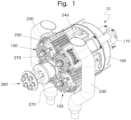
- the two-stroke axial internal combustion engine 10 comprises four cylinders 100 each having a cylinder head 250 as shown in figures 1 and 2 .
- the cylinders 100 are supported by an engine mount 240 as shown in figures 1-3 of the drawings.
- a different number of cylinders 100 is of course possible depending on the specific application of the engine 10.
- the engine mount 240 has an opening 500 suitable for receiving the piston body 112.
- the piston body 112 can be thus fully received into the engine mount 240.
- the opening 500 is defined by spaced apart walls 510 inside the engine mount 240.
- a piston assembly 110 is slidably received as shown in figures 4-5 .
- the piston assembly 110 is shown in detail in figures 6-10 of the drawings. In use, the piston assembly 110 reciprocates along a longitudinal axis L of the cylinder 100 depicted in figures 13 and 14 of the drawings.
- the piston assembly 110 comprises a piston head 111, a piston body 112, and a piston rod 135.
- a cam follower 150 is attached to the piston body 112.
- the piston rod 135 connects the piston head 111 with the piston body 112 together, as shown in figures 1-3 .
- the piston rod 135 has one end connected to the piston head 111 through a connecting clip 116.
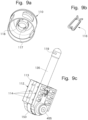
- the connecting clip 116 has two arms, as shown in figure 9b . In use, the arms of the connecting clip 116 pass through an opening 117 formed in a connecting body 118 formed inside the piston head 111.
- the arms of the connecting clip 116 are received into and press against an annular groove 119 formed said end of the piston rod 135, as shown in figures 9a, 9b and 9c .
- the piston rod 135 is connected to the piston head 111 with a little swinging freedom.
- each piston assembly 110 defines, within the corresponding cylinder 100, a combustion chamber 200 and a pump chamber 300.
- the combustion chamber 200 may be also referred herein to as compression chamber since it is configured to receive a fuel-air-oil mixture to be compressed by the piston assembly 110 in one stroke of the combustion engine 10.
- the pump chamber 300 is arranged axially relative to the combustion chamber 200 along said longitudinal axis L of the cylinder 100.
- the pump chamber 300 may be also referred to as sweeping chamber since it is configured to draw air there from a common crankcase 160 into the combustion chamber 200 in the stroke of the combustion engine 10.
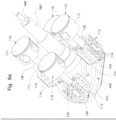
- FIG. 6a-10 of the drawings where the piston assembly 110 is shown with the piston head 111 connected with the piston body 112 through the piston rod 135 as described above.
- the piston rod 135 has a first end that is connected to the piston head 111 and a second end that is connected to the piston body 112.
- a number of parallel channels 113 are provided in the piston body 112.
- the channels 113 are provided with ports 114 for cooling and delivery of lubricant.
- the channels 113 in the piston body 112 are configured for receiving longitudinal guides 115 formed in the engine mount 240 as shown in figure 16 .
- the longitudinal guides 115 guide the piston body 112 as it is moved within the engine mount 240.
- Longitudinal guides 115 located at an outermost part of the engine mount 240 are larger than other longitudinal guides 115 located at other locations of the engine mount 240.
- a single power cam 400 is provided as shown in figures 17 and 18 .
- the single power cam 400 is attached to an output shaft 440.
- the output shaft 440 is in turn attached to a propeller carrier as shown in the figures.
- each piston assembly 110 is intended to bear directly on a surface 410 in the single power cam 400.
- the cam follower 150 is arranged to act close to a central area of the surface of the single power cam 400.
- a displacement of the piston assembly 110 within the cylinders 100 causes the cam follower 150 of the piston assembly 110 to roll onto said surface 410 of the single power cam 400 causing the single power cam 400 with the output shaft 440 to be rotated together.
- the single power cam 400 is supported in rotation by a roller bearing 430 as shown in figure 4 .
- counter cams 450 are formed in the output shaft 440.
- Counter cams 450 are intended to receive corresponding counter cam followers 455.
- the opening 500 in the engine mount 240 is suitable for receiving the counter cams 450.
- counter cam followers 455 are mounted in the piston body 112 coaxially with the cam followers 150 of the piston assembly 110.
- the diameter of the counter cams 450 is smaller than the diameter of the power cam 400.
- the counter cams 450 are intended to prevent piston assemblies 110 from losing contact with the single power cam 400.
- Each cylinder 100 includes a single crankcase that is part of the pump chamber 300. Further, the above mentioned common crankcase 160 that is part of the engine mount 240 is also provided as shown in figures 1 and 3 of the drawings.
- fuel control means 170 are provided in the above mentioned common crankcase 160.
- the fuel control means 170 comprises one or more carburetors.
- Other fuel control means 170 for example, based on fuel injection, may be possible.
- Intake of a fuel-air-oil mixture into the pump chamber 300 is carried out through intake ports 180 formed in the engine mount 240 as shown in figures 15 and 16 .
- Transfer ports 185 are provided for the flow of the fuel-air-oil mixture from the pump chamber 300 into the combustion chamber 200 within the cylinders 100 as shown in figures 6c and 6d .
- Exhaust ports 190 shown in figures 6c , 13 and 14 are also provided for the exhaust of combustion gases out of the engine 10 through corresponding exhaust pipes 230.
- the exhaust ports 190 are arranged to open before the transfer ports 185 open and to close after the transfer ports 185 close.
- the piston assembly 110 first moves along a first direction inside the cylinder along said longitudinal axis L of the cylinder 100 causing a fuel-air-oil mixture coming from carburettors 170 to be drawn into the pump chamber 300 through intake ports 180 while transfer ports 185 and exhaust ports 190 are closed.
- the piston assembly 110 then moves along a second, opposite direction along said longitudinal axis L of the cylinder 100 pumping the fuel-air-oil mixture through transfer into the combustion chamber 200.
- the piston assembly 110 then moves again along the first direction where the fuel-air-oil mixture is compressed by the piston assembly 110 within the combustion chamber 200.
- the piston assembly 110 moves along the second direction inside the cylinder 100 due to ignition of the compressed fuel-air-oil mixture by spark plugs 270 performing the power stroke and opening the exhaust ports 190 such that combustion gases are exhausted out from the combustion chamber 200 through exhaust pipes 230.
- Fresh fuel-air-oil mixture is then pumped again into the pump chamber 300 for subsequent cycle. This is repeated for subsequent strokes of the piston assembly 110 causing the cam followers 150 to roll onto the surface 410 of the single power cam 400 so that the single power cam 400 is rotated and thus the output shaft 440 that is connected thereto.
- the transfer port 185 and the exhaust port 190 are opened and closed correspondingly.
- An intake leaf valve is provided in the intake port 180 that is driven as the piston assembly 110 moves within the cylinder 100.
- the intake leaf valve opens and closes under internal pressure on the cylinder 100.
Landscapes
- Engineering & Computer Science (AREA)
- Mechanical Engineering (AREA)
- General Engineering & Computer Science (AREA)
- Chemical & Material Sciences (AREA)
- Combustion & Propulsion (AREA)
- Lubrication Of Internal Combustion Engines (AREA)
- Valve-Gear Or Valve Arrangements (AREA)
- Combustion Methods Of Internal-Combustion Engines (AREA)
Description
- The present disclosure relates engines. More particularly, the present disclosure relates to axial internal combustion engines. The present internal combustion engine may be applied to cars, flying vehicles such as model airplanes, and many other different applications.
- One-stroke internal combustion engines are known in the art. In one-stroke internal combustion engines, one combustion is produced per piston stroke. The intake, compression, power, and exhaust strokes occur in a single turn of an output shaft or crankshaft. Every piston stroke is the power stroke so that only one power stroke is required to rotate the output shaft or crankshaft continuously to complete a full cycle.
- One example of a one-stroke internal combustion engine is disclosed in
US20030121482A1 . The engine comprises a combustion chamber and a compression chamber. A compression member is provided within the compression chamber for defining first and second combustion sub-chambers. A piston is slidably disposed within the combustion chamber in communication with the compression member for defining the first and second combustion sub-chambers. Motion of the piston toward the first combustion sub-chamber enables a first fuel-air mixture to flow into the second combustion sub-chamber from the second combustion sub-chamber for subsequent combustion therein together with drawing of a second fuel-air mixture into the first compression chamber. Motion of the piston toward the second combustion sub-chamber enables the second fuel-air mixture to flow into the first combustion sub-chamber from the first combustion sub-chamber for subsequent combustion therein together with drawing of a third fuel/air mixture into the second compression chamber. - A further example of a one-stroke internal combustion engine is disclosed in
US2016025001A1 . It comprises intake, compression, combustion and exhaust chambers operating with a linear, rotary or opposed piston configuration. A crankshaft is driven as pistons are alternately ignited. -
EP3066312B1 , filed by the same applicant as the present application, refers to an opposed piston engine capable of completing the entire cycle in just one time. For this purpose, mutually opposed power cams are connected to respective rotary shafts such that reciprocation of pistons acting on power cams imparts a rotating motion to the rotary shafts to drive the engine. - Axial or barrel engines are known in the art such as the one disclosed in
US1042018 having cylinders arranged around and parallel to a central shaft, like the chambers in the cylinder of a revolver. Although such motors have low frontal area with very good balance and great compactness, problems, such as poor access for maintenance, are usually found on the swashplate that is used for converting the piston thrust into rotary motion. - Although known internal combustion engines have been shown to provide a number of significant benefits, such as smaller displacement and lower emissions, there still remains a need for a simpler engine that requires much fewer auxiliary parts and higher specific power and higher power to weight ratio.
- A two-stroke axial internal combustion engine is disclosed herein with which at least the above needs are met and with which further advantages and benefits are obtained.
- The present two-stroke axial internal combustion engine comprises at least one cylinder, such as two or four. Other suitable number of cylinders are possible. The cylinders may be arranged to work in any desired position, such as horizontal vertical or inclined.
- A piston assembly is slidably received within each cylinder. Thus, the present axial internal combustion engine comprises as many piston assemblies as cylinders. The piston assembly defines, within the cylinder, a combustion chamber and a pump chamber. The present engine in referred herein to as axial internal combustion engine since the pump chamber within the cylinder is arranged axially relative to the combustion chamber. An engine mount is provided for supporting the cylinder or cylinders. The engine mount may have an opening for receiving the piston body.
- The pump chamber is intended for suction of air to be pumped into the combustion chamber. The combustion chamber is intended for compressing a fuel-air-oil mixture in one stroke of the piston assembly and subsequent explosion of the compressed fuel-air-oil mixture.
- The piston assembly comprises a piston head, a piston body, and a piston rod. The piston rod has a first end that is connected to the piston head. A cam follower is attached to the piston body. The cam follower may be, for example, a roller rotatably mounted in the piston body.
- The piston head is preferably frusto-conical in shape. The piston rod is connected to the piston head and the piston body so that swinging is limited. Loads are therefore withstood by the piston body and not by the piston head with no side loads being present against the cylinder and therefore with less wear. Fitting of the piston assembly within the cylinder is facilitated and opening and closing of ports are more effective.
- A single power cam is provided. The above mentioned cam follower provided at the second end of the piston rod is intended to bear directly, i.e. to roll, on a surface of said single power cam. A roller bearing is preferably provided for rotation of the single power cam.
- The piston assembly is configured to move along a first direction inside the cylinder causing a fuel-air-oil mixture to be drawn into the pump chamber through intake ports while transfer and exhaust ports are closed, then to move along a second, opposite direction, for pumping the fuel-air-oil mixture into the combustion chamber through transfer ports, then to move again along the first direction where the fuel-air-oil mixture is compressed by the piston assembly within the combustion chamber, and then to move again along the second direction inside the cylinder due to ignition of the compressed fuel-air-oil mixture, performing the power stroke and opening the exhaust ports such that combustion gases are exhausted out from the combustion chamber. Fresh fuel-air-oil mixture is then pumped again into the pump chamber for subsequent cycle.
- Displacement of the piston assembly within the cylinder along the second, opposite direction causes the cam follower to roll onto the surface of the single power cam causing the single power cam to be rotated. This, in turn, causes an output shaft connected to the single power cam to be rotated. This is repeated for subsequent strokes of the piston assembly.
- Counter cams may be provided in the output shaft for receiving corresponding counter cam followers that are mounted in the piston body coaxially with the cam followers of the piston assembly. The diameter of the counter cams is smaller than the diameter of the power cams. The counter cams are intended to prevent piston assemblies from losing contact with the single power cam.
- With the configuration as described above, no crankshaft is required so that an advantageous compact design is achieved with a high power to weight ratio. Provision of a single power cam results in an efficient, robust engine with improved mass balance and low vibrations.
- Within the meaning of the present disclosure, a one-stroke refers to an engine that requires one single power stroke to rotate the
power cam 180° completing the cycle. - The cam follower may be provided with at least one channel for the passage of lubricant. Also, the cam follower may preferably be arranged to act close to a central area of the surface of the single power cam. Other configurations are possible.
- As stated above, a number of cylinders may be provided each with a corresponding piston assembly slidably received there within. In that case, still a single power cam is associated with all the piston assemblies. Also in that case, a pump chamber and a combustion chamber as stated above are defined by each piston assembly within each cylinder.
- The cylinder may include a single crankcase that is part of the pump chamber. Said single crankcase is associated with a piston assembly. A common crankcase for the cylinders may be provided. Said common crankcase may be integrally formed with the engine mount, or it may be a separate part.
- Fuel control means are preferably provided for adjusting the amount of fuel and/or air entering the cylinders. The fuel control means may be, for example, at least one carburetor, or a fuel injection system. In any case, it may be advantageous that the fuel control means are arranged in the above mentioned common crankcase, if provided.
- At least one intake port may be provided for the intake of the fuel-air-oil mixture into the pump chamber of the cylinder. At least one transfer port may be provided for the flow of the fuel-air-oil mixture from the pump chamber into the combustion chamber of the cylinder. At least one exhaust port may be provided for the exhaust of combustion gases out of the engine. The exhaust port may be preferably arranged to open before the transfer port opens and to close after the transfer port closes.
- One or more longitudinal guides may be advantageously provided for guiding the piston body of the piston assembly as it is moved within the cylinder. Optimally, at least one longitudinal guide provided in an outermost part of the engine mount is larger than other longitudinal guides arranged at other locations of the piston assembly.
- In the axial internal combustion engine described above, a clearance volume, that is, a part of the cylinder volume that is not swept by the piston, is advantageously very small. This results in a higher compression ratio, volumetric efficiency, and enhanced cooling capacity. In has been found that, for the same power, costs are significantly lower as compared to standard internal combustion engines. The present engine is lightweight, and it easily spins up which is beneficial in flying vehicles such as model airplanes. The present engine also finds advantageous application in cars and many other.
- A non-limiting example of the present two-stroke axial internal combustion engine will be described in the following, with reference to the appended drawings.
- In the drawings:
-
Figure 1 is a general perspective view of one example of the two-stroke axial internal combustion engine; -
Figures 2 and3 are elevational and side views, respectively, of the example of the two-stroke axial internal combustion engine shown infigure 1 ; -
Figures 4 and 5 are sectional views of the two-stroke axial internal combustion engine shown infigures 1-3 ; -
Figure 6a is a perspective view of the axial internal combustion engine shown infigures 1-5 with the cylinders removed to show the piston assemblies; -
Figure 6b is a fragmentary perspective view of one of the piston assemblies shown infigure 6a ; -
Figures 6c and 6d are perspective views of a cylinder where transfer ports and the exhaust ports are shown; -
Figures 7-10 are top, bottom, perspective, and side views of a piston assembly with the cylinders removed in order to show the piston assemblies; -
Figures 9a-9c show parts of the piston assembly for illustrating how the piston head is connected with the piston rod; -
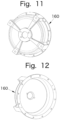
Figures 11 and 12 are perspective views showing the single crankcase taken from different sides; -
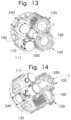
Figures 13 and 14 are fragmentary perspective views showing the piston assembly engine taken from different sides; -
Figures 15 and 16 are perspective views showing the engine mount taken from different sides; and -
Figures 17 and 18 are perspective views of the single power cam. - A non-limiting example of a two-stroke axial
internal combustion engine 10 for a model airplane is shown infigures 1-16 of the drawings and described below. - The two-stroke axial
internal combustion engine 10 comprises fourcylinders 100 each having acylinder head 250 as shown infigures 1 and2 . Thecylinders 100 are supported by anengine mount 240 as shown infigures 1-3 of the drawings. A different number ofcylinders 100 is of course possible depending on the specific application of theengine 10. As shown infigure 6 , theengine mount 240 has anopening 500 suitable for receiving thepiston body 112. Thepiston body 112 can be thus fully received into theengine mount 240. Theopening 500 is defined by spaced apartwalls 510 inside theengine mount 240. - Within each
cylinder 100, apiston assembly 110 is slidably received as shown infigures 4-5 . Thepiston assembly 110 is shown in detail infigures 6-10 of the drawings. In use, thepiston assembly 110 reciprocates along a longitudinal axis L of thecylinder 100 depicted infigures 13 and 14 of the drawings. - As shown in
figures 6a-10 , thepiston assembly 110 comprises apiston head 111, apiston body 112, and apiston rod 135. Acam follower 150 is attached to thepiston body 112. In use, thepiston rod 135 connects thepiston head 111 with thepiston body 112 together, as shown infigures 1-3 . In particular, referring tofigures 9a, 9b and 9c of the drawings, thepiston rod 135 has one end connected to thepiston head 111 through a connectingclip 116. The connectingclip 116 has two arms, as shown infigure 9b . In use, the arms of the connectingclip 116 pass through anopening 117 formed in a connectingbody 118 formed inside thepiston head 111. In turn, the arms of the connectingclip 116 are received into and press against anannular groove 119 formed said end of thepiston rod 135, as shown infigures 9a, 9b and 9c . In this way, thepiston rod 135 is connected to thepiston head 111 with a little swinging freedom. - As shown in
figure 6b , eachpiston assembly 110 defines, within thecorresponding cylinder 100, acombustion chamber 200 and apump chamber 300. - The
combustion chamber 200 may be also referred herein to as compression chamber since it is configured to receive a fuel-air-oil mixture to be compressed by thepiston assembly 110 in one stroke of thecombustion engine 10. - The
pump chamber 300 is arranged axially relative to thecombustion chamber 200 along said longitudinal axis L of thecylinder 100. Thepump chamber 300 may be also referred to as sweeping chamber since it is configured to draw air there from acommon crankcase 160 into thecombustion chamber 200 in the stroke of thecombustion engine 10. - Reference is now made to
figures 6a-10 of the drawings where thepiston assembly 110 is shown with thepiston head 111 connected with thepiston body 112 through thepiston rod 135 as described above. Thepiston rod 135 has a first end that is connected to thepiston head 111 and a second end that is connected to thepiston body 112. - A number of
parallel channels 113, shown in detail infigures 9 and 10 , are provided in thepiston body 112. Thechannels 113, in turn, are provided withports 114 for cooling and delivery of lubricant. Thechannels 113 in thepiston body 112 are configured for receivinglongitudinal guides 115 formed in theengine mount 240 as shown infigure 16 . In use, thelongitudinal guides 115 guide thepiston body 112 as it is moved within theengine mount 240. Longitudinal guides 115 located at an outermost part of theengine mount 240 are larger than otherlongitudinal guides 115 located at other locations of theengine mount 240. - A
single power cam 400 is provided as shown infigures 17 and 18 . Thesingle power cam 400 is attached to anoutput shaft 440. Theoutput shaft 440 is in turn attached to a propeller carrier as shown in the figures. - The above mentioned
cam follower 150 of eachpiston assembly 110 is intended to bear directly on asurface 410 in thesingle power cam 400. In particular, thecam follower 150 is arranged to act close to a central area of the surface of thesingle power cam 400. In operation, a displacement of thepiston assembly 110 within thecylinders 100 causes thecam follower 150 of thepiston assembly 110 to roll onto saidsurface 410 of thesingle power cam 400 causing thesingle power cam 400 with theoutput shaft 440 to be rotated together. Thesingle power cam 400 is supported in rotation by aroller bearing 430 as shown infigure 4 . - As a result of the above configuration, no crankshaft is required so a compact design is achieved with a high power to weight ratio and an improved mass balance with low vibrations.
- Referring now to
figures 17 and 18 ,counter cams 450 are formed in theoutput shaft 440.Counter cams 450 are intended to receive correspondingcounter cam followers 455. Theopening 500 in theengine mount 240 is suitable for receiving thecounter cams 450. As shown infigures 7-10 ,counter cam followers 455 are mounted in thepiston body 112 coaxially with thecam followers 150 of thepiston assembly 110. As shown infigures 7-10 , the diameter of thecounter cams 450 is smaller than the diameter of thepower cam 400. Thecounter cams 450 are intended to preventpiston assemblies 110 from losing contact with thesingle power cam 400. - Each
cylinder 100 includes a single crankcase that is part of thepump chamber 300. Further, the above mentionedcommon crankcase 160 that is part of theengine mount 240 is also provided as shown infigures 1 and3 of the drawings. - For adjusting the amount of fuel and/or air entering the
cylinders 100, in particular, entering thepump chamber 300 ofcylinders 100, fuel control means 170 are provided in the above mentionedcommon crankcase 160. In the non-limiting example shown in the figures, the fuel control means 170 comprises one or more carburetors. Other fuel control means 170, for example, based on fuel injection, may be possible. - Intake of a fuel-air-oil mixture into the
pump chamber 300 is carried out throughintake ports 180 formed in theengine mount 240 as shown infigures 15 and 16 .Transfer ports 185 are provided for the flow of the fuel-air-oil mixture from thepump chamber 300 into thecombustion chamber 200 within thecylinders 100 as shown infigures 6c and 6d .Exhaust ports 190 shown infigures 6c ,13 and 14 are also provided for the exhaust of combustion gases out of theengine 10 through correspondingexhaust pipes 230. Theexhaust ports 190 are arranged to open before thetransfer ports 185 open and to close after thetransfer ports 185 close. - In operation, the
piston assembly 110 first moves along a first direction inside the cylinder along said longitudinal axis L of thecylinder 100 causing a fuel-air-oil mixture coming fromcarburettors 170 to be drawn into thepump chamber 300 throughintake ports 180 whiletransfer ports 185 andexhaust ports 190 are closed. Thepiston assembly 110 then moves along a second, opposite direction along said longitudinal axis L of thecylinder 100 pumping the fuel-air-oil mixture through transfer into thecombustion chamber 200. Thepiston assembly 110 then moves again along the first direction where the fuel-air-oil mixture is compressed by thepiston assembly 110 within thecombustion chamber 200. Finally, thepiston assembly 110 moves along the second direction inside thecylinder 100 due to ignition of the compressed fuel-air-oil mixture byspark plugs 270 performing the power stroke and opening theexhaust ports 190 such that combustion gases are exhausted out from thecombustion chamber 200 throughexhaust pipes 230. Fresh fuel-air-oil mixture is then pumped again into thepump chamber 300 for subsequent cycle. This is repeated for subsequent strokes of thepiston assembly 110 causing thecam followers 150 to roll onto thesurface 410 of thesingle power cam 400 so that thesingle power cam 400 is rotated and thus theoutput shaft 440 that is connected thereto. - As the
piston assembly 110 moves within thecylinder 100, thetransfer port 185 and theexhaust port 190 are opened and closed correspondingly. An intake leaf valve is provided in theintake port 180 that is driven as thepiston assembly 110 moves within thecylinder 100. The intake leaf valve opens and closes under internal pressure on thecylinder 100. - The scope of the present disclosure should not be limited by the particular example disclosed herein but should be determined only by the claims that follow.
- Reference signs related to drawings placed in parentheses in a claim are solely for attempting to increase the intelligibility of the claim, and shall not be construed as limiting its scope.
Claims (15)
- Two stroke axial internal combustion engine (10) comprising at least one cylinder (100) supported by an engine mount (240) and a piston assembly (110),characterized in that the piston assembly (110) is slidably received within the cylinder (100) defining a combustion chamber (200) and a pump chamber (300) arranged axially relative to each other, the piston assembly (110) being configured to move along a first direction inside the cylinder (100) causing a fuel-air-oil mixture to be drawn into the pump chamber (300), then to move along a second, opposite direction, for pumping the fuel-air-oil mixture into the combustion chamber (200), then to move again along the first direction where the fuel-air-oil mixture is compressed by the piston assembly (110) within the combustion chamber (200), and then to move again along the second direction inside the cylinder (100) due to ignition of the compressed fuel-air-oil mixture,and wherein the piston assembly (110) comprises:- a piston head (111),- a piston body (112), and- a piston rod (135) having an end (130) connected to the piston head (111);- a cam follower (150) attached to the piston body (112) to bear directly on a surface (410) of a single power cam (400), whereby displacement of the piston assembly (110) within the cylinder (100) causes the cam follower (150) to roll onto the surface (410) of the single power cam (400) causing the single power cam (400) to be rotated.
- The engine (10) of claim 1, wherein the engine mount (240) has an opening (500) for receiving the piston body (112).
- The engine (10) of claim 1 or 2, wherein it comprises a number of cylinders (100) with corresponding piston assemblies (110) and a single power cam (400) associated with the piston assemblies (110), a pump chamber (300) and a combustion chamber (200) being defined by each piston assembly (110) within each cylinder (100).
- The engine (10) of any of the preceding claims, wherein, it includes fuel control means (170) for adjusting the amount of fuel and/or air entering the cylinders (100).
- The engine of claim 4, wherein the fuel control means (170) comprise at least one carburetor or a fuel injection system.
- The engine (10) of any of the claims 2-5, wherein it includes a common crankcase (160) for the cylinders (100).
- The engine (10) of claim 6, wherein the fuel control means (170) are arranged in the common crankcase (160).
- The engine (10) of any of the preceding claims, wherein the cylinder (100) further includes at least one intake port (180) for the intake of the fuel-air-oil mixture into the pump chamber (300) of the cylinder (100), at least one transfer port (185) for the flow of the fuel-air-oil mixture from the pump chamber (300) into the combustion chamber (200) of the cylinder (100), and at least one exhaust port (190) for the exhaust of combustion gases from the combustion chamber (200),
- The engine (10) of claim 8, wherein the exhaust port (190) is arranged to open before the transfer port (185) opens and to close after the transfer port (185) closes.
- The engine (10) of any of the preceding claims, wherein the cam follower (150) is provided with at least one channel (113) for the passage of lubricant.
- The engine (10) of any of the preceding claims, wherein the cam follower (150) is arranged to act close to a central area of the surface (410) of the single power cam (400).
- The engine (10) of any of the preceding claims, wherein it includes a roller bearing (430) for rotation of the single power cam (400).
- The engine (10) of any of the preceding claims, wherein a piston rod (135) is provided for connecting the piston head (111) with the piston body (112).
- The engine (10) of any of the preceding claims, wherein at least one longitudinal guide (115) is provided for guiding the piston body (112) of the piston assembly (110) within as it is moved within the engine mount (240).
- The engine (10) of claim 14, wherein a number of longitudinal guides (115) are provided for guiding the piston body (112) of the piston assembly (110) as it is moved within the engine mount (240), at least one longitudinal guide (115) located in an outermost part of the engine mount (240) being larger than the other longitudinal guides (115).
Priority Applications (7)
| Application Number | Priority Date | Filing Date | Title |
|---|---|---|---|
| PL22382557.1T PL4290063T3 (en) | 2022-06-09 | 2022-06-09 | Axial internal combustion engine |
| EP22382557.1A EP4290063B1 (en) | 2022-06-09 | 2022-06-09 | Axial internal combustion engine |
| ES22382557T ES3035783T3 (en) | 2022-06-09 | 2022-06-09 | Axial internal combustion engine |
| KR1020247041125A KR20250019051A (en) | 2022-06-09 | 2023-06-08 | Axial internal combustion engine |
| CN202380044906.0A CN119317771A (en) | 2022-06-09 | 2023-06-08 | Axial internal combustion engine |
| PCT/EP2023/065408 WO2023237695A1 (en) | 2022-06-09 | 2023-06-08 | Axial internal combustion engine |
| JP2024572305A JP2025521223A (en) | 2022-06-09 | 2023-06-08 | Axial flow internal combustion engine |
Applications Claiming Priority (1)
| Application Number | Priority Date | Filing Date | Title |
|---|---|---|---|
| EP22382557.1A EP4290063B1 (en) | 2022-06-09 | 2022-06-09 | Axial internal combustion engine |
Publications (2)
| Publication Number | Publication Date |
|---|---|
| EP4290063A1 EP4290063A1 (en) | 2023-12-13 |
| EP4290063B1 true EP4290063B1 (en) | 2025-05-07 |
Family
ID=82117373
Family Applications (1)
| Application Number | Title | Priority Date | Filing Date |
|---|---|---|---|
| EP22382557.1A Active EP4290063B1 (en) | 2022-06-09 | 2022-06-09 | Axial internal combustion engine |
Country Status (7)
| Country | Link |
|---|---|
| EP (1) | EP4290063B1 (en) |
| JP (1) | JP2025521223A (en) |
| KR (1) | KR20250019051A (en) |
| CN (1) | CN119317771A (en) |
| ES (1) | ES3035783T3 (en) |
| PL (1) | PL4290063T3 (en) |
| WO (1) | WO2023237695A1 (en) |
Family Cites Families (8)
| Publication number | Priority date | Publication date | Assignee | Title |
|---|---|---|---|---|
| US1042018A (en) | 1911-04-05 | 1912-10-22 | Walter G Macomber | Rotary engine. |
| GB160296A (en) * | 1919-12-29 | 1921-03-24 | Oswald George Braid | Improvements in internal combustion engines |
| US2076334A (en) * | 1934-04-16 | 1937-04-06 | Earl A Burns | Diesel engine |
| US2243818A (en) * | 1937-05-14 | 1941-05-27 | Karl L Herrmann | Internal combustion engine |
| BG63221B1 (en) * | 1997-03-14 | 2001-06-29 | Боян БАХНЕВ | Cam type engine |
| US20030121482A1 (en) | 2001-12-28 | 2003-07-03 | Macey Stuart P. | One-stroke internal combustion engine |
| US9371775B2 (en) | 2013-03-27 | 2016-06-21 | Differential Dynamics Corporation | One-stroke internal combustion engine |
| CN105849383B (en) | 2013-11-04 | 2019-06-25 | 颖引擎有限公司 | Internal combustion engine |
-
2022
- 2022-06-09 ES ES22382557T patent/ES3035783T3/en active Active
- 2022-06-09 EP EP22382557.1A patent/EP4290063B1/en active Active
- 2022-06-09 PL PL22382557.1T patent/PL4290063T3/en unknown
-
2023
- 2023-06-08 CN CN202380044906.0A patent/CN119317771A/en active Pending
- 2023-06-08 WO PCT/EP2023/065408 patent/WO2023237695A1/en not_active Ceased
- 2023-06-08 KR KR1020247041125A patent/KR20250019051A/en active Pending
- 2023-06-08 JP JP2024572305A patent/JP2025521223A/en active Pending
Also Published As
| Publication number | Publication date |
|---|---|
| CN119317771A (en) | 2025-01-14 |
| EP4290063A1 (en) | 2023-12-13 |
| WO2023237695A1 (en) | 2023-12-14 |
| JP2025521223A (en) | 2025-07-08 |
| PL4290063T3 (en) | 2025-07-28 |
| KR20250019051A (en) | 2025-02-07 |
| ES3035783T3 (en) | 2025-09-09 |
Similar Documents
| Publication | Publication Date | Title |
|---|---|---|
| US8109737B1 (en) | Reciprocating device with dual chambered cylinders | |
| US5813372A (en) | Axial piston rotary engine | |
| US4011842A (en) | Piston machine | |
| US5884590A (en) | Two-stroke engine | |
| US10267225B2 (en) | Internal combustion engine | |
| US6065440A (en) | Internal combustion engine with binary cylinder sizing for variable power output | |
| US3955544A (en) | Internal combustion engine | |
| US9016256B2 (en) | Concentric cylinder engine | |
| US11519305B2 (en) | Internal combustion engine system | |
| US11098586B2 (en) | Engine crank and connecting rod mechanism | |
| US6032622A (en) | Internal combustion cylinder engine | |
| US20060239839A1 (en) | Universal hybrid engine, compressor and pump, and method of operation | |
| EP4290063B1 (en) | Axial internal combustion engine | |
| KR20200109369A (en) | Internal combustion engine | |
| US20210003121A1 (en) | Process for operating a single-stroke combustion engine | |
| US3968777A (en) | Internal combustion engine | |
| US9032917B1 (en) | Barrel cam rotating cylinder engine | |
| WO2011034657A2 (en) | A supercharged internal combustion engine including a pressurized fluid outlet | |
| WO1986004637A1 (en) | Axial shaft piston engine | |
| US10294792B2 (en) | Split-chamber rotary engine improvements | |
| US10253680B2 (en) | Internal combustion engine having fuel/air induction system | |
| WO2022018627A1 (en) | Reciprocating mechanism | |
| IL199375A (en) | Two-stroke opposite radial-piston engine | |
| GB2167124A (en) | Two stroke reciprocating internal combustion engine | |
| CN85108050A (en) | Stroke Split Rotary Piston Internal Combustion Engine |
Legal Events
| Date | Code | Title | Description |
|---|---|---|---|
| PUAI | Public reference made under article 153(3) epc to a published international application that has entered the european phase |
Free format text: ORIGINAL CODE: 0009012 |
|
| STAA | Information on the status of an ep patent application or granted ep patent |
Free format text: STATUS: THE APPLICATION HAS BEEN PUBLISHED |
|
| AK | Designated contracting states |
Kind code of ref document: A1 Designated state(s): AL AT BE BG CH CY CZ DE DK EE ES FI FR GB GR HR HU IE IS IT LI LT LU LV MC MK MT NL NO PL PT RO RS SE SI SK SM TR |
|
| STAA | Information on the status of an ep patent application or granted ep patent |
Free format text: STATUS: REQUEST FOR EXAMINATION WAS MADE |
|
| 17P | Request for examination filed |
Effective date: 20240613 |
|
| RBV | Designated contracting states (corrected) |
Designated state(s): AL AT BE BG CH CY CZ DE DK EE ES FI FR GB GR HR HU IE IS IT LI LT LU LV MC MK MT NL NO PL PT RO RS SE SI SK SM TR |
|
| GRAP | Despatch of communication of intention to grant a patent |
Free format text: ORIGINAL CODE: EPIDOSNIGR1 |
|
| STAA | Information on the status of an ep patent application or granted ep patent |
Free format text: STATUS: GRANT OF PATENT IS INTENDED |
|
| INTG | Intention to grant announced |
Effective date: 20241206 |
|
| GRAS | Grant fee paid |
Free format text: ORIGINAL CODE: EPIDOSNIGR3 |
|
| GRAA | (expected) grant |
Free format text: ORIGINAL CODE: 0009210 |
|
| STAA | Information on the status of an ep patent application or granted ep patent |
Free format text: STATUS: THE PATENT HAS BEEN GRANTED |
|
| AK | Designated contracting states |
Kind code of ref document: B1 Designated state(s): AL AT BE BG CH CY CZ DE DK EE ES FI FR GB GR HR HU IE IS IT LI LT LU LV MC MK MT NL NO PL PT RO RS SE SI SK SM TR |
|
| RAP3 | Party data changed (applicant data changed or rights of an application transferred) |
Owner name: INNENGINE S.L. |
|
| REG | Reference to a national code |
Ref country code: GB Ref legal event code: FG4D |
|
| REG | Reference to a national code |
Ref country code: CH Ref legal event code: EP |
|
| REG | Reference to a national code |
Ref country code: DE Ref legal event code: R096 Ref document number: 602022014224 Country of ref document: DE |
|
| REG | Reference to a national code |
Ref country code: IE Ref legal event code: FG4D |
|
| PGFP | Annual fee paid to national office [announced via postgrant information from national office to epo] |
Ref country code: DE Payment date: 20250627 Year of fee payment: 4 |
|
| PGFP | Annual fee paid to national office [announced via postgrant information from national office to epo] |
Ref country code: FR Payment date: 20250625 Year of fee payment: 4 |
|
| PGFP | Annual fee paid to national office [announced via postgrant information from national office to epo] |
Ref country code: AT Payment date: 20250721 Year of fee payment: 4 |
|
| REG | Reference to a national code |
Ref country code: ES Ref legal event code: FG2A Ref document number: 3035783 Country of ref document: ES Kind code of ref document: T3 Effective date: 20250909 |
|
| REG | Reference to a national code |
Ref country code: NL Ref legal event code: MP Effective date: 20250507 |
|
| PG25 | Lapsed in a contracting state [announced via postgrant information from national office to epo] |
Ref country code: FI Free format text: LAPSE BECAUSE OF FAILURE TO SUBMIT A TRANSLATION OF THE DESCRIPTION OR TO PAY THE FEE WITHIN THE PRESCRIBED TIME-LIMIT Effective date: 20250507 Ref country code: PT Free format text: LAPSE BECAUSE OF FAILURE TO SUBMIT A TRANSLATION OF THE DESCRIPTION OR TO PAY THE FEE WITHIN THE PRESCRIBED TIME-LIMIT Effective date: 20250908 |
|
| PGFP | Annual fee paid to national office [announced via postgrant information from national office to epo] |
Ref country code: ES Payment date: 20250701 Year of fee payment: 4 |
|
| REG | Reference to a national code |
Ref country code: LT Ref legal event code: MG9D |
|
| PG25 | Lapsed in a contracting state [announced via postgrant information from national office to epo] |
Ref country code: GR Free format text: LAPSE BECAUSE OF FAILURE TO SUBMIT A TRANSLATION OF THE DESCRIPTION OR TO PAY THE FEE WITHIN THE PRESCRIBED TIME-LIMIT Effective date: 20250808 Ref country code: NO Free format text: LAPSE BECAUSE OF FAILURE TO SUBMIT A TRANSLATION OF THE DESCRIPTION OR TO PAY THE FEE WITHIN THE PRESCRIBED TIME-LIMIT Effective date: 20250807 |
|
| PG25 | Lapsed in a contracting state [announced via postgrant information from national office to epo] |
Ref country code: NL Free format text: LAPSE BECAUSE OF FAILURE TO SUBMIT A TRANSLATION OF THE DESCRIPTION OR TO PAY THE FEE WITHIN THE PRESCRIBED TIME-LIMIT Effective date: 20250507 |
|
| PGFP | Annual fee paid to national office [announced via postgrant information from national office to epo] |
Ref country code: PL Payment date: 20250623 Year of fee payment: 4 Ref country code: IT Payment date: 20250630 Year of fee payment: 4 |
|
| REG | Reference to a national code |
Ref country code: AT Ref legal event code: MK05 Ref document number: 1792683 Country of ref document: AT Kind code of ref document: T Effective date: 20250507 |
|
| PG25 | Lapsed in a contracting state [announced via postgrant information from national office to epo] |
Ref country code: BG Free format text: LAPSE BECAUSE OF FAILURE TO SUBMIT A TRANSLATION OF THE DESCRIPTION OR TO PAY THE FEE WITHIN THE PRESCRIBED TIME-LIMIT Effective date: 20250507 |
|
| PG25 | Lapsed in a contracting state [announced via postgrant information from national office to epo] |
Ref country code: HR Free format text: LAPSE BECAUSE OF FAILURE TO SUBMIT A TRANSLATION OF THE DESCRIPTION OR TO PAY THE FEE WITHIN THE PRESCRIBED TIME-LIMIT Effective date: 20250507 Ref country code: AT Free format text: LAPSE BECAUSE OF FAILURE TO SUBMIT A TRANSLATION OF THE DESCRIPTION OR TO PAY THE FEE WITHIN THE PRESCRIBED TIME-LIMIT Effective date: 20250507 |
|
| PG25 | Lapsed in a contracting state [announced via postgrant information from national office to epo] |
Ref country code: RS Free format text: LAPSE BECAUSE OF FAILURE TO SUBMIT A TRANSLATION OF THE DESCRIPTION OR TO PAY THE FEE WITHIN THE PRESCRIBED TIME-LIMIT Effective date: 20250807 |
|
| PG25 | Lapsed in a contracting state [announced via postgrant information from national office to epo] |
Ref country code: IS Free format text: LAPSE BECAUSE OF FAILURE TO SUBMIT A TRANSLATION OF THE DESCRIPTION OR TO PAY THE FEE WITHIN THE PRESCRIBED TIME-LIMIT Effective date: 20250907 |
|
| PG25 | Lapsed in a contracting state [announced via postgrant information from national office to epo] |
Ref country code: LV Free format text: LAPSE BECAUSE OF FAILURE TO SUBMIT A TRANSLATION OF THE DESCRIPTION OR TO PAY THE FEE WITHIN THE PRESCRIBED TIME-LIMIT Effective date: 20250507 |
|
| PG25 | Lapsed in a contracting state [announced via postgrant information from national office to epo] |
Ref country code: DK Free format text: LAPSE BECAUSE OF FAILURE TO SUBMIT A TRANSLATION OF THE DESCRIPTION OR TO PAY THE FEE WITHIN THE PRESCRIBED TIME-LIMIT Effective date: 20250507 Ref country code: SM Free format text: LAPSE BECAUSE OF FAILURE TO SUBMIT A TRANSLATION OF THE DESCRIPTION OR TO PAY THE FEE WITHIN THE PRESCRIBED TIME-LIMIT Effective date: 20250507 |
|
| PG25 | Lapsed in a contracting state [announced via postgrant information from national office to epo] |
Ref country code: CZ Free format text: LAPSE BECAUSE OF FAILURE TO SUBMIT A TRANSLATION OF THE DESCRIPTION OR TO PAY THE FEE WITHIN THE PRESCRIBED TIME-LIMIT Effective date: 20250507 |
|
| PG25 | Lapsed in a contracting state [announced via postgrant information from national office to epo] |
Ref country code: EE Free format text: LAPSE BECAUSE OF FAILURE TO SUBMIT A TRANSLATION OF THE DESCRIPTION OR TO PAY THE FEE WITHIN THE PRESCRIBED TIME-LIMIT Effective date: 20250507 |
|
| PG25 | Lapsed in a contracting state [announced via postgrant information from national office to epo] |
Ref country code: SK Free format text: LAPSE BECAUSE OF FAILURE TO SUBMIT A TRANSLATION OF THE DESCRIPTION OR TO PAY THE FEE WITHIN THE PRESCRIBED TIME-LIMIT Effective date: 20250507 |
|
| REG | Reference to a national code |
Ref country code: CH Ref legal event code: H13 Free format text: ST27 STATUS EVENT CODE: U-0-0-H10-H13 (AS PROVIDED BY THE NATIONAL OFFICE) Effective date: 20260127 |
|
| REG | Reference to a national code |
Ref country code: DE Ref legal event code: R097 Ref document number: 602022014224 Country of ref document: DE |
|
| PG25 | Lapsed in a contracting state [announced via postgrant information from national office to epo] |
Ref country code: LU Free format text: LAPSE BECAUSE OF NON-PAYMENT OF DUE FEES Effective date: 20250609 |
|
| PG25 | Lapsed in a contracting state [announced via postgrant information from national office to epo] |
Ref country code: MC Free format text: LAPSE BECAUSE OF FAILURE TO SUBMIT A TRANSLATION OF THE DESCRIPTION OR TO PAY THE FEE WITHIN THE PRESCRIBED TIME-LIMIT Effective date: 20250507 |
|
| REG | Reference to a national code |
Ref country code: BE Ref legal event code: MM Effective date: 20250630 |
|
| PG25 | Lapsed in a contracting state [announced via postgrant information from national office to epo] |
Ref country code: RO Free format text: LAPSE BECAUSE OF FAILURE TO SUBMIT A TRANSLATION OF THE DESCRIPTION OR TO PAY THE FEE WITHIN THE PRESCRIBED TIME-LIMIT Effective date: 20250507 |
|
| PLBE | No opposition filed within time limit |
Free format text: ORIGINAL CODE: 0009261 |
|
| STAA | Information on the status of an ep patent application or granted ep patent |
Free format text: STATUS: NO OPPOSITION FILED WITHIN TIME LIMIT |
|
| REG | Reference to a national code |
Ref country code: CH Ref legal event code: L10 Free format text: ST27 STATUS EVENT CODE: U-0-0-L10-L00 (AS PROVIDED BY THE NATIONAL OFFICE) Effective date: 20260318 |
|
| PG25 | Lapsed in a contracting state [announced via postgrant information from national office to epo] |
Ref country code: IE Free format text: LAPSE BECAUSE OF NON-PAYMENT OF DUE FEES Effective date: 20250609 |
|
| 26N | No opposition filed |
Effective date: 20260210 |
|
| PG25 | Lapsed in a contracting state [announced via postgrant information from national office to epo] |
Ref country code: BE Free format text: LAPSE BECAUSE OF NON-PAYMENT OF DUE FEES Effective date: 20250630 |
|
| PG25 | Lapsed in a contracting state [announced via postgrant information from national office to epo] |
Ref country code: CH Free format text: LAPSE BECAUSE OF NON-PAYMENT OF DUE FEES Effective date: 20250630 |