EP4289855A1 - Method for preparing phosphorus-containing ligand - Google Patents
Method for preparing phosphorus-containing ligand Download PDFInfo
- Publication number
- EP4289855A1 EP4289855A1 EP22755062.1A EP22755062A EP4289855A1 EP 4289855 A1 EP4289855 A1 EP 4289855A1 EP 22755062 A EP22755062 A EP 22755062A EP 4289855 A1 EP4289855 A1 EP 4289855A1
- Authority
- EP
- European Patent Office
- Prior art keywords
- group
- mixture
- reaction
- range
- formula
- Prior art date
- Legal status (The legal status is an assumption and is not a legal conclusion. Google has not performed a legal analysis and makes no representation as to the accuracy of the status listed.)
- Granted
Links
Classifications
-
- C—CHEMISTRY; METALLURGY
- C07—ORGANIC CHEMISTRY
- C07F—ACYCLIC, CARBOCYCLIC OR HETEROCYCLIC COMPOUNDS CONTAINING ELEMENTS OTHER THAN CARBON, HYDROGEN, HALOGEN, OXYGEN, NITROGEN, SULFUR, SELENIUM OR TELLURIUM
- C07F9/00—Compounds containing elements of Groups 5 or 15 of the Periodic Table
- C07F9/02—Phosphorus compounds
- C07F9/06—Phosphorus compounds without P—C bonds
- C07F9/08—Esters of oxyacids of phosphorus
- C07F9/141—Esters of phosphorous acids
- C07F9/145—Esters of phosphorous acids with hydroxyaryl compounds
-
- B—PERFORMING OPERATIONS; TRANSPORTING
- B01—PHYSICAL OR CHEMICAL PROCESSES OR APPARATUS IN GENERAL
- B01J—CHEMICAL OR PHYSICAL PROCESSES, e.g. CATALYSIS OR COLLOID CHEMISTRY; THEIR RELEVANT APPARATUS
- B01J31/00—Catalysts comprising hydrides, coordination complexes or organic compounds
- B01J31/16—Catalysts comprising hydrides, coordination complexes or organic compounds containing coordination complexes
- B01J31/18—Catalysts comprising hydrides, coordination complexes or organic compounds containing coordination complexes containing nitrogen, phosphorus, arsenic or antimony as complexing atoms, e.g. in pyridine ligands, or in resonance therewith, e.g. in isocyanide ligands C=N-R or as complexed central atoms
- B01J31/1845—Catalysts comprising hydrides, coordination complexes or organic compounds containing coordination complexes containing nitrogen, phosphorus, arsenic or antimony as complexing atoms, e.g. in pyridine ligands, or in resonance therewith, e.g. in isocyanide ligands C=N-R or as complexed central atoms the ligands containing phosphorus
- B01J31/185—Phosphites ((RO)3P), their isomeric phosphonates (R(RO)2P=O) and RO-substitution derivatives thereof
- B01J31/186—Mono- or diamide derivatives thereof
-
- B—PERFORMING OPERATIONS; TRANSPORTING
- B01—PHYSICAL OR CHEMICAL PROCESSES OR APPARATUS IN GENERAL
- B01J—CHEMICAL OR PHYSICAL PROCESSES, e.g. CATALYSIS OR COLLOID CHEMISTRY; THEIR RELEVANT APPARATUS
- B01J31/00—Catalysts comprising hydrides, coordination complexes or organic compounds
- B01J31/02—Catalysts comprising hydrides, coordination complexes or organic compounds containing organic compounds or metal hydrides
- B01J31/0277—Catalysts comprising hydrides, coordination complexes or organic compounds containing organic compounds or metal hydrides comprising ionic liquids, as components in catalyst systems or catalysts per se, the ionic liquid compounds being used in the molten state at the respective reaction temperature
- B01J31/0278—Catalysts comprising hydrides, coordination complexes or organic compounds containing organic compounds or metal hydrides comprising ionic liquids, as components in catalyst systems or catalysts per se, the ionic liquid compounds being used in the molten state at the respective reaction temperature containing nitrogen as cationic centre
- B01J31/0281—Catalysts comprising hydrides, coordination complexes or organic compounds containing organic compounds or metal hydrides comprising ionic liquids, as components in catalyst systems or catalysts per se, the ionic liquid compounds being used in the molten state at the respective reaction temperature containing nitrogen as cationic centre the nitrogen being a ring member
- B01J31/0284—Catalysts comprising hydrides, coordination complexes or organic compounds containing organic compounds or metal hydrides comprising ionic liquids, as components in catalyst systems or catalysts per se, the ionic liquid compounds being used in the molten state at the respective reaction temperature containing nitrogen as cationic centre the nitrogen being a ring member of an aromatic ring, e.g. pyridinium
-
- B—PERFORMING OPERATIONS; TRANSPORTING
- B01—PHYSICAL OR CHEMICAL PROCESSES OR APPARATUS IN GENERAL
- B01J—CHEMICAL OR PHYSICAL PROCESSES, e.g. CATALYSIS OR COLLOID CHEMISTRY; THEIR RELEVANT APPARATUS
- B01J31/00—Catalysts comprising hydrides, coordination complexes or organic compounds
- B01J31/02—Catalysts comprising hydrides, coordination complexes or organic compounds containing organic compounds or metal hydrides
- B01J31/06—Catalysts comprising hydrides, coordination complexes or organic compounds containing organic compounds or metal hydrides containing polymers
-
- B—PERFORMING OPERATIONS; TRANSPORTING
- B01—PHYSICAL OR CHEMICAL PROCESSES OR APPARATUS IN GENERAL
- B01J—CHEMICAL OR PHYSICAL PROCESSES, e.g. CATALYSIS OR COLLOID CHEMISTRY; THEIR RELEVANT APPARATUS
- B01J31/00—Catalysts comprising hydrides, coordination complexes or organic compounds
- B01J31/16—Catalysts comprising hydrides, coordination complexes or organic compounds containing coordination complexes
- B01J31/18—Catalysts comprising hydrides, coordination complexes or organic compounds containing coordination complexes containing nitrogen, phosphorus, arsenic or antimony as complexing atoms, e.g. in pyridine ligands, or in resonance therewith, e.g. in isocyanide ligands C=N-R or as complexed central atoms
- B01J31/1845—Catalysts comprising hydrides, coordination complexes or organic compounds containing coordination complexes containing nitrogen, phosphorus, arsenic or antimony as complexing atoms, e.g. in pyridine ligands, or in resonance therewith, e.g. in isocyanide ligands C=N-R or as complexed central atoms the ligands containing phosphorus
- B01J31/185—Phosphites ((RO)3P), their isomeric phosphonates (R(RO)2P=O) and RO-substitution derivatives thereof
-
- B—PERFORMING OPERATIONS; TRANSPORTING
- B01—PHYSICAL OR CHEMICAL PROCESSES OR APPARATUS IN GENERAL
- B01J—CHEMICAL OR PHYSICAL PROCESSES, e.g. CATALYSIS OR COLLOID CHEMISTRY; THEIR RELEVANT APPARATUS
- B01J35/00—Catalysts, in general, characterised by their form or physical properties
- B01J35/50—Catalysts, in general, characterised by their form or physical properties characterised by their shape or configuration
- B01J35/51—Spheres
-
- C—CHEMISTRY; METALLURGY
- C07—ORGANIC CHEMISTRY
- C07F—ACYCLIC, CARBOCYCLIC OR HETEROCYCLIC COMPOUNDS CONTAINING ELEMENTS OTHER THAN CARBON, HYDROGEN, HALOGEN, OXYGEN, NITROGEN, SULFUR, SELENIUM OR TELLURIUM
- C07F9/00—Compounds containing elements of Groups 5 or 15 of the Periodic Table
- C07F9/02—Phosphorus compounds
- C07F9/06—Phosphorus compounds without P—C bonds
- C07F9/08—Esters of oxyacids of phosphorus
- C07F9/141—Esters of phosphorous acids
- C07F9/1412—Polyol derivatives esterified at least twice by phosphorous acid groups
-
- C—CHEMISTRY; METALLURGY
- C07—ORGANIC CHEMISTRY
- C07F—ACYCLIC, CARBOCYCLIC OR HETEROCYCLIC COMPOUNDS CONTAINING ELEMENTS OTHER THAN CARBON, HYDROGEN, HALOGEN, OXYGEN, NITROGEN, SULFUR, SELENIUM OR TELLURIUM
- C07F9/00—Compounds containing elements of Groups 5 or 15 of the Periodic Table
- C07F9/02—Phosphorus compounds
- C07F9/547—Heterocyclic compounds, e.g. containing phosphorus as a ring hetero atom
- C07F9/553—Heterocyclic compounds, e.g. containing phosphorus as a ring hetero atom having one nitrogen atom as the only ring hetero atom
- C07F9/572—Five-membered rings
-
- C—CHEMISTRY; METALLURGY
- C07—ORGANIC CHEMISTRY
- C07F—ACYCLIC, CARBOCYCLIC OR HETEROCYCLIC COMPOUNDS CONTAINING ELEMENTS OTHER THAN CARBON, HYDROGEN, HALOGEN, OXYGEN, NITROGEN, SULFUR, SELENIUM OR TELLURIUM
- C07F9/00—Compounds containing elements of Groups 5 or 15 of the Periodic Table
- C07F9/02—Phosphorus compounds
- C07F9/547—Heterocyclic compounds, e.g. containing phosphorus as a ring hetero atom
- C07F9/645—Heterocyclic compounds, e.g. containing phosphorus as a ring hetero atom having two nitrogen atoms as the only ring hetero atoms
- C07F9/6503—Five-membered rings
- C07F9/6506—Five-membered rings having the nitrogen atoms in positions 1 and 3
-
- C—CHEMISTRY; METALLURGY
- C07—ORGANIC CHEMISTRY
- C07F—ACYCLIC, CARBOCYCLIC OR HETEROCYCLIC COMPOUNDS CONTAINING ELEMENTS OTHER THAN CARBON, HYDROGEN, HALOGEN, OXYGEN, NITROGEN, SULFUR, SELENIUM OR TELLURIUM
- C07F9/00—Compounds containing elements of Groups 5 or 15 of the Periodic Table
- C07F9/02—Phosphorus compounds
- C07F9/547—Heterocyclic compounds, e.g. containing phosphorus as a ring hetero atom
- C07F9/6564—Heterocyclic compounds, e.g. containing phosphorus as a ring hetero atom having phosphorus atoms, with or without nitrogen, oxygen, sulfur, selenium or tellurium atoms, as ring hetero atoms
- C07F9/6581—Heterocyclic compounds, e.g. containing phosphorus as a ring hetero atom having phosphorus atoms, with or without nitrogen, oxygen, sulfur, selenium or tellurium atoms, as ring hetero atoms having phosphorus and nitrogen atoms with or without oxygen or sulfur atoms, as ring hetero atoms
- C07F9/6584—Heterocyclic compounds, e.g. containing phosphorus as a ring hetero atom having phosphorus atoms, with or without nitrogen, oxygen, sulfur, selenium or tellurium atoms, as ring hetero atoms having phosphorus and nitrogen atoms with or without oxygen or sulfur atoms, as ring hetero atoms having one phosphorus atom as ring hetero atom
-
- C—CHEMISTRY; METALLURGY
- C07—ORGANIC CHEMISTRY
- C07F—ACYCLIC, CARBOCYCLIC OR HETEROCYCLIC COMPOUNDS CONTAINING ELEMENTS OTHER THAN CARBON, HYDROGEN, HALOGEN, OXYGEN, NITROGEN, SULFUR, SELENIUM OR TELLURIUM
- C07F9/00—Compounds containing elements of Groups 5 or 15 of the Periodic Table
- C07F9/02—Phosphorus compounds
- C07F9/547—Heterocyclic compounds, e.g. containing phosphorus as a ring hetero atom
- C07F9/6564—Heterocyclic compounds, e.g. containing phosphorus as a ring hetero atom having phosphorus atoms, with or without nitrogen, oxygen, sulfur, selenium or tellurium atoms, as ring hetero atoms
- C07F9/6581—Heterocyclic compounds, e.g. containing phosphorus as a ring hetero atom having phosphorus atoms, with or without nitrogen, oxygen, sulfur, selenium or tellurium atoms, as ring hetero atoms having phosphorus and nitrogen atoms with or without oxygen or sulfur atoms, as ring hetero atoms
- C07F9/6584—Heterocyclic compounds, e.g. containing phosphorus as a ring hetero atom having phosphorus atoms, with or without nitrogen, oxygen, sulfur, selenium or tellurium atoms, as ring hetero atoms having phosphorus and nitrogen atoms with or without oxygen or sulfur atoms, as ring hetero atoms having one phosphorus atom as ring hetero atom
- C07F9/65842—Cyclic amide derivatives of acids of phosphorus, in which one nitrogen atom belongs to the ring
-
- C—CHEMISTRY; METALLURGY
- C07—ORGANIC CHEMISTRY
- C07F—ACYCLIC, CARBOCYCLIC OR HETEROCYCLIC COMPOUNDS CONTAINING ELEMENTS OTHER THAN CARBON, HYDROGEN, HALOGEN, OXYGEN, NITROGEN, SULFUR, SELENIUM OR TELLURIUM
- C07F9/00—Compounds containing elements of Groups 5 or 15 of the Periodic Table
- C07F9/02—Phosphorus compounds
- C07F9/547—Heterocyclic compounds, e.g. containing phosphorus as a ring hetero atom
- C07F9/6564—Heterocyclic compounds, e.g. containing phosphorus as a ring hetero atom having phosphorus atoms, with or without nitrogen, oxygen, sulfur, selenium or tellurium atoms, as ring hetero atoms
- C07F9/6581—Heterocyclic compounds, e.g. containing phosphorus as a ring hetero atom having phosphorus atoms, with or without nitrogen, oxygen, sulfur, selenium or tellurium atoms, as ring hetero atoms having phosphorus and nitrogen atoms with or without oxygen or sulfur atoms, as ring hetero atoms
- C07F9/6584—Heterocyclic compounds, e.g. containing phosphorus as a ring hetero atom having phosphorus atoms, with or without nitrogen, oxygen, sulfur, selenium or tellurium atoms, as ring hetero atoms having phosphorus and nitrogen atoms with or without oxygen or sulfur atoms, as ring hetero atoms having one phosphorus atom as ring hetero atom
- C07F9/65848—Cyclic amide derivatives of acids of phosphorus, in which two nitrogen atoms belong to the ring
-
- B—PERFORMING OPERATIONS; TRANSPORTING
- B01—PHYSICAL OR CHEMICAL PROCESSES OR APPARATUS IN GENERAL
- B01J—CHEMICAL OR PHYSICAL PROCESSES, e.g. CATALYSIS OR COLLOID CHEMISTRY; THEIR RELEVANT APPARATUS
- B01J2531/00—Additional information regarding catalytic systems classified in B01J31/00
- B01J2531/001—General concepts, e.g. reviews, relating to catalyst systems and methods of making them, the concept being defined by a common material or method/theory
- B01J2531/002—Materials
- B01J2531/004—Ligands
-
- C—CHEMISTRY; METALLURGY
- C07—ORGANIC CHEMISTRY
- C07F—ACYCLIC, CARBOCYCLIC OR HETEROCYCLIC COMPOUNDS CONTAINING ELEMENTS OTHER THAN CARBON, HYDROGEN, HALOGEN, OXYGEN, NITROGEN, SULFUR, SELENIUM OR TELLURIUM
- C07F9/00—Compounds containing elements of Groups 5 or 15 of the Periodic Table
- C07F9/02—Phosphorus compounds
- C07F9/06—Phosphorus compounds without P—C bonds
- C07F9/22—Amides of acids of phosphorus
- C07F9/26—Amides of acids of phosphorus containing P-halide groups
-
- Y—GENERAL TAGGING OF NEW TECHNOLOGICAL DEVELOPMENTS; GENERAL TAGGING OF CROSS-SECTIONAL TECHNOLOGIES SPANNING OVER SEVERAL SECTIONS OF THE IPC; TECHNICAL SUBJECTS COVERED BY FORMER USPC CROSS-REFERENCE ART COLLECTIONS [XRACs] AND DIGESTS
- Y02—TECHNOLOGIES OR APPLICATIONS FOR MITIGATION OR ADAPTATION AGAINST CLIMATE CHANGE
- Y02P—CLIMATE CHANGE MITIGATION TECHNOLOGIES IN THE PRODUCTION OR PROCESSING OF GOODS
- Y02P20/00—Technologies relating to chemical industry
- Y02P20/50—Improvements relating to the production of bulk chemicals
- Y02P20/54—Improvements relating to the production of bulk chemicals using solvents, e.g. supercritical solvents or ionic liquids
Definitions
- the present disclosure relates to a technical field of a phosphorus-containing ligand, in particular, to a method for preparing a phosphorus-containing ligand.
- Phosphite ester compounds are known in the art as catalytic systems associated with hydrocyanation of alkenes.
- phosphite compounds are usually prepared by purging R-OH and phosphorus chloride compounds with an inert gas or adding an organic base acid binding agent to the R-OH and the phosphorus chloride compounds.
- a liquid amine compound is normally added as an acid binding agent to react with a generated hydrogen chloride to generate an ammonium hydrochloride.
- a target product is purified by filtration, removal of solvent, and column chromatography.
- the method in related art generally has problems such as a large consumption amount of acid binding agent, an excessively high viscosity of the reaction system, a difficult post-processing of the acid binding agent, and a complicated recycling procedure, which increase a cost of wastes treatment.
- a method for preparing a phosphorus-containing ligand is provided.
- polypyridine ionic liquid-loaded porous microspheres are employed as catalysts and hydrogen chloride produced by the reaction are removed from a reaction device, so that the method may have an excellent reaction selectivity and an excellent yield.
- a method for preparing a phosphorus-containing ligand includes the following steps:
- the first polypyridine ionic liquid-loaded porous microspheres includes a polypyridine ionic liquid, and a structural formula of the polypyridine ionic liquid is shown in Formula (3), in Formula (3), R is selected from a C 1 -C 10 linear chain alkyl group or a C 1 -C 10 branched chain alkyl group, wherein R 1 and R 2 is independently selected from hydrogen atom, halogen atom, C 1 -C 10 alkyl group, C 1 -C 10 alkoxy group, C 1 -C 10 alkanoyl group, aryl group, heteroaryl group, cyano group, or nitro group, m is an integer in a range of 0 to 3, and Q is a direct bond or a divalent linking group.
- R is selected from a C 1 -C 10 linear chain alkyl group or a C 1 -C 10 branched chain alkyl group, wherein R 1 and R 2 is independently selected from hydrogen atom, halogen atom, C 1
- Q is selected from wherein R 3 , R 4 , R 5 , and R 6 are independently selected from hydrogen atom, halogen atom, C 1 -C 10 alkyl group, C 1 -C 10 alkoxy group, C 1 -C 10 alkanoyl group, aryl group, heteroaryl group, cyano group, or nitro group, wherein Q 0 is selected from a direct bond or a divalent linking group, m 0 is an integer in a range of 0 to 3, and m 1 is an integer in a range of 0 to 2.
- Qo is selected from -(CH 2 )n 1 -, -(CH 2 O)n 2 -, substituted aryl group, or unsubstituted aryl group, and n 1 and n 2 are independently selected from integers in a range of 1 to 50.
- the first polypyridine ionic liquid-loaded porous microspheres includes polystyrene porous microspheres, particle sizes of the polystyrene microspheres are in a range of 50 nm to 100 nm, and a relative deviation of the particle sizes is less than 3%.
- a BET specific surface area of the first polypyridine ionic liquid-loaded porous microspheres is in a range of 50m 2 /g to 500m 2 /g, and an average aperture size of apertures in the first polypyridine ionic liquid-loaded porous microspheres is in a range of 10 nm to 50 nm.
- a structural formula of the substituted aryloxy groups is wherein Rx and Ry are independently selected from hydrogen atom, halogen atom, nitrile group, C 1 -C 10 alkyl group, C 1 -C 10 alkoxy group, C 1 -C 10 alkanoyl group, C 1 -C 10 ester group, C 1 -C 10 sulfonate group, vinyl group, propenyl group, acryloyl group, acrylate group, or methacryloyl group.
- both X and Y are selected from X and Y are not cyclized. In an embodiment, when both X and Y are selected from nitrogen-containing heterocyclic groups, X and Y are not cyclized, or X and Y are cyclized via a single bond or methylene. In an embodiment, when X is selected from and Y is selected from nitrogen-containing heterocyclic groups, X and Y are cyclized via methylene.
- the nitrogen-containing heterocyclic groups are selected from or wherein Rx and Ry are independently selected from hydrogen atom, halogen atom, nitrile group, C 1 -C 10 alkyl group, C 1 -C 10 alkoxy group, C 1 -C 10 alkanoyl group, C 1 -C 10 ester group, C 1 -C 10 sulfonate group, vinyl group, propenyl group, acryloyl group, acrylate group, or methacryloyl group.
- Rx and Ry are independently selected from hydrogen atom, halogen atom, nitrile group, C 1 -C 10 alkyl group, C 1 -C 10 alkoxy group, C 1 -C 10 alkanoyl group, C 1 -C 10 ester group, C 1 -C 10 sulfonate group, vinyl group, propenyl group, acryloyl group, acrylate group, or methacryloyl group.
- both X and Y are selected from nitrogen-containing heterocyclic groups, and X and Y are cyclized via the single bond or the methylene to form a structure selected from the group consisting of
- Z is selected from or wherein R 1 and R 2 are independently selected from hydrogen atom, halogen atom, nitrile group, C 1 -C 10 alkyl group, C 1 -C 10 alkoxy group, C 1 -C 10 alkanoyl group, C 1 -C 10 ester group, C 1 -C 10 sulfonate group, vinyl group, propenyl group, acryloyl group, acrylate group, or methacryloyl group.
- R 1 and R 2 are independently selected from hydrogen atom, halogen atom, nitrile group, C 1 -C 10 alkyl group, C 1 -C 10 alkoxy group, C 1 -C 10 alkanoyl group, C 1 -C 10 ester group, C 1 -C 10 sulfonate group, vinyl group, propenyl group, acryloyl group, acrylate group, or methacryloyl group.
- n is an integer in a range of 2 to 4.
- a molar ratio of the phosphorus chloride compound to the compound as shown in Formula (2) is in a range of 1.0:(1/x) to 1.3:(1/x), x is equal to n in Formula (2), and a molar ratio of nitrogen atoms in the first polypyridine ionic liquid-loaded porous microspheres to hydroxyl groups in the compound as shown in Formula (2) is in a range of 0.01:1 to 0.1:1.
- a molar concentration of the phosphorus chloride compound in the first mixture is in a range of 0.05 mol/L to 5.0 mol/L
- a molar concentration of the compound as shown in Formula (2) in the second mixture is in a range of 0.05 mol/L to 5.0 mol/L.
- a reaction temperature is in a range of 0 to 50 degrees centigrade
- a reaction time is in a range of 1 hour to 5 hours.
- the second mixture is added into the first mixture in batches.
- an adding duration is in a range of 2 hours to 10 hours.
- the step of filtrating the reaction mixture to obtain the filter liquor after the reaction further includes recovering second polypyridine ionic liquid-loaded porous microspheres.
- the recovered second polypyridine ionic liquid-loaded porous microspheres are washed, dried and re-used for preparing the first mixture.
- the step of mixing the first mixture with the second mixture in the reaction device to make the first mixture react with the second mixture to obtain the reaction mixture further includes blowing a protective gas in to the reaction device to remove the generated hydrogen chloride out from the reaction device, so as to co-produce hydrogen chloride.
- Chinese patent No. CN100441584C disclosed a method for preparing a pentaerythritol phosphite ester antioxidant.
- pentaerythritol, a solvent, phosphorus trichloride, and 2, 6-di-tertbutyl-p-cresol were used as raw materials and a weak base type macroporous ion exchange resin was used as a catalyst to prepare pentaerythritol phosphite ester.
- Hydrogen chloride gas generated in a reaction was removed from a system. The catalyst after the reaction was easily separated and recovered, and may be regenerated and reused.
- the regeneration treatment may include steps of acid washing, alkali washing, distilled water washing to neutrality, and drying, which is complicated in operation, large in energy consumption, and produces a large amount of waste water and waste salt.
- the present disclosure provides a method for preparing a phosphorus-containing ligand , which includes the following steps:
- the polypyridine ionic liquid-loaded porous microspheres may include polystyrene porous microspheres and polypyridine ionic liquid loaded on the polystyrene porous microspheres.
- the polystyrene porous microspheres can play a role of "seed crystal". Specifically, pyridine monomers are physically adsorbed on the polystyrene porous microspheres, and polymerized to grow into a polypyridine ionic liquid by pores of the polystyrene porous microspheres.
- the formed polypyridine ionic liquid-loaded porous microspheres may have more active sites.
- the more active sites of the polypyridine ionic liquid-loaded porous microspheres can effectively improve reaction selectivity and yield.
- the polypyridine ionic liquid-loaded porous microspheres are in sphere-shaped, a post-processing thereof is simple, and properties of the polypyridine ionic liquid-loaded porous microspheres are more stable, a cycle performance of the polypyridine ionic liquid-loaded porous microspheres is good, thus the polypyridine ionic liquid-loaded porous microspheres are easy to be recycled and reused.
- R is selected from a C 1 -C 10 linear chain alkyl group or a C 1 -C 10 branched chain alkyl group.
- R 1 and R 2 are independently selected from hydrogen atom, halogen atom, C 1 -C 10 alkyl group, C 1 -C 10 alkoxy group, C 1 -C 10 alkanoyl group, aryl group, heteroaryl group, cyano group, or nitro group, and m is an integer in a range of 0 to 3.
- R 1 and R 2 are each independently selected from hydrogen atom, fluorine atom, chlorine atom, bromine atom, methyl group, ethyl group, n-propyl group, isopropyl group, methoxy group, ethoxy group, n-propyl oxy group, isopropoxy group, cyano group, acetyl group, or propionyl group.
- Q is a direct bond or a divalent linking group. In some embodiments, Q is selected from or
- R 3 , R 4 , R 5 , and R 6 are independently selected from hydrogen atom, halogen atom, C 1 -C 10 alkyl group, C 1 -C 10 alkoxy group, C 1 -C 10 alkanoyl group, aryl group, heteroaryl group, cyano group, or nitro group, where m 0 is an integer in a range of 0 to 3, and m 1 is an integer in a range of 0 to 2.
- R 3 , R 4 , R 5 , and R 6 are independently selected from hydrogen atom, fluorine atom, chlorine atom, bromine atom, methyl group, ethyl group, n-propyl group, isopropyl group, methoxy group, an ethoxy group, n-propoxy group, isopropoxy group, cyano group, acetyl group, or propionyl group.
- Qo is selected from a direct bond or a divalent linking group. In some embodiments, Qo is selected from -(CH 2 )n 1 - , -(CH 2 O)n 2 - , a substituted aryl group or an unsubstituted aryl group, and n 1 and n 2 are independently selected from integers in a range of 1 to 50.
- the polypyridine ionic liquid-loaded porous microspheres may include polystyrene porous microspheres. Particle sizes of the polystyrene porous microspheres are in a range of 50 nm to 100 nm, and a relative deviation of the particle sizes is less than 3%.
- the polypyridine ionic liquid-loaded porous microspheres may have a porous structure.
- a BET specific surface area of the polypyridine ionic liquid-loaded porous microspheres is in a range of 50 m 2 /g to 500 m 2 /g, and an average aperture size of apertures thereof is in a range of 10 nm to 50 nm.
- a method for preparing the polypyridine ionic liquid-loaded porous microspheres can include the following steps.
- concentrations of the first surfactant aqueous solution, the second surfactant aqueous solution and the third surfactant aqueous solution are in arrange of 0.2 wt% to 1.5wt%. In some embodiments, concentrations of the first surfactant aqueous solution, second surfactant aqueous solution and third surfactant aqueous solution are in arrange of 0.5wt% to 1.0wt%. In some embodiments, a time of shaking and mixing is in a range of 6 hours to 18 hours. In some embodiments, the time of shaking and mixing is in a range of 10 hours to 12 hours.
- the surfactant is selected from the group consisting of a cationic surfactant, an anionic surfactant, a nonionic surfactant, or a combination thereof.
- the surfactant is selected from the group consisting of cetyltrimethyl ammonium bromide, benzyldimethyl octadecyl ammonium chloride, ammonium dodecyl sulfate, sodium dodecyl sulfate, sodium dodecyl benzene sulfonate, potassium dodecyl phosphate, polyvinyl alcohol, Tween-80, or a combination thereof.
- a ratio of a mass of the polystyrene porous microspheres to a volume of the first surfactant aqueous solution is in a range of 1 g: 20 mL to 1 g: 100 mL.
- a volume ratio of the third organic solvent to the second surfactant aqueous solution is in a range of 1:10 -1:30.
- the third organic solvent is selected the group consisting of ethyl acetate, tetrahydrofuran, N, N-dimethylformamide, dimethyl sulfoxide, methanol, ethanol, propanol, tert-butyl alcohol, ethylene glycol, propylene glycol, glycerol, acetone, and any combinations thereof.
- step (2) a molar ratio of the pyridine monomers to the initiator is in a range of 20:1 to 50:1, and a mass ratio of the pyridine monomers to the polystyrene porous microspheres in step (1) is in a range of 50:1 to 100:1.
- a general formula of the pyridine monomers is and the initiator is selected from azo initiators.
- the initiator is at least one selected from azobisisobutyronitrile (AIBN), 2, 2'-Azobis(2,4-dimethyl)valeronitrile (ABVN), dimethyl azobisisobutyrate (AIBME), azobisisobutyronitrile amidine hydrochloride (AIBA), or azobisisobutylimidazoline hydrochloride (AIBI).
- the fourth organic solvent is at least one selected from aliphatic hydrocarbon or alicyclic hydrocarbon, halogenated aliphatic hydrocarbon or halogenated alicyclic hydrocarbon, substituted aromatic hydrocarbon or unsubstituted aromatic hydrocarbon, aliphatic ether, of cyclic ether.
- the fourth organic solvent is at least one selected from benzene, toluene, xylene, dichloromethane, cyclohexane, n-hexane, or tetrahydrofuran.
- a temperature of the polymerization reaction is in a range of 40 degrees centigrade to 120 degrees centigrade. In some embodiments, the temperature of the polymerization reaction is in a range of 60 degrees centigrade to 80 degrees centigrade, and a time of the polymerization reaction is in a range of 6 hours to 36 hours. In some embodiments, the time of the polymerization reaction is in a range of 20 hours to 24 hours.
- the fifth organic solvent is at least one selected from ethyl acetate, tetrahydrofuran, N, N-dimethylformamide, dimethyl sulfoxide, methanol, ethanol, propanol, tert-butyl alcohol, ethylene glycol, propylene glycol, glycerol, or acetone.
- a content of nitrogen element ( ⁇ N ) of the cross-linked polystyrene pyridine porous microspheres obtained in step (3) is in a range of 5% to 20%.
- a molar ratio of the cross-linked polystyrene-pyridine porous microspheres to the halogenated alkane ( n N : n halogenated alkane ) is in a range of 1: 1.0 to 1: 1.5.
- the sixth organic solvent is at least one selected from toluene, benzene, xylene, tetrahydrofuran, cyclohexane, n-hexane, or dichloromethane.
- the halogenated alkane is selected from C 1 -C 10 halogenated alkanes. In some embodiments, the halogenated alkane is at least one selected from 1-chloropropane, 2-chloropropane, 1-bromopropane, 1-bromobutane, 2-bromobutane, 1-iodopentane, or 2-iodopentane.
- the seventh organic solvent is at least one selected from ethyl acetate, tetrahydrofuran, N, N-dimethylformamide, dimethyl sulfoxide, methanol, ethanol, propanol, tert-butyl alcohol, ethylene glycol, propylene glycol, glycerol, or acetone.
- a reaction temperature is in a range of 60 degrees centigrade to 150 degrees centigrade. In some embodiments, the reaction temperature is in a range of 80 degrees centigrade to 120 degrees centigrade. In some embodiments, a reaction time is in a range of 6 hours to 36 hours. In some embodiments, the reaction time is in a range of 18 hours to 24 hours.
- X and Y are independently selected from substituted aryloxy groups or nitrogen-containing heterocyclic groups.
- a structural formula of the substituted aryloxy group is Rx and Ry are independently selected from hydrogen atom, halogen atom, nitrile group, C 1 -C 10 alkyl group, C 1 -C 10 alkoxy group, C 1 -C 10 alkanoyl group, C 1 -C 10 ester group, C 1 -C 10 sulfonate group, vinyl group, propenyl group, acryloyl group, acrylate group, or methacryloyl group.
- the nitrogen-containing heterocyclic group is selected from or wherein Rx and Ry are independently selected from hydrogen atom, halogen atoms, nitrile group, C 1 -C 10 alkyl group, C 1 -C 10 alkoxy group, C 1 -C 10 alkanoyl group, C 1 -C 10 ester group, C 1 -C 10 sulfonate group, vinyl group, propenyl group, acryloyl group, acrylate group, or methacryloyl group.
- Rx and Ry are independently selected from hydrogen atom, halogen atoms, nitrile group, C 1 -C 10 alkyl group, C 1 -C 10 alkoxy group, C 1 -C 10 alkanoyl group, C 1 -C 10 ester group, C 1 -C 10 sulfonate group, vinyl group, propenyl group, acryloyl group, acrylate group, or methacryloyl group.
- both X and Y are each selected from X and Y are not cyclized; when X and Y are each selected from nitrogen-containing heterocyclic groups, X and Y are not cyclized, or X and Y are cyclized via a single bond or methylene; optionally, when X is selected from and Y is selected from a nitrogen-containing heterocyclic group, X and Y are cyclized via methylene.
- both X and Y are each selected from nitrogen-containing heterocyclic groups, and X and Y are cyclized via a single bond or methylene to form a structure selected from any one of the group consisting of: or
- Z is selected from or wherein R 1 and R 2 are independently selected from hydrogen atom, halogen atoms, nitrile group, C 1 -C 10 alkyl group, C 1 -C 10 alkoxy group, C 1 -C 10 alkanoyl group, C 1 -C 10 ester group, C 1 -C 10 sulfonate group, vinyl group, propenyl group, acryloyl group, acrylate group, or methacryloyl group.
- R 1 and R 2 are independently selected from hydrogen atom, halogen atoms, nitrile group, C 1 -C 10 alkyl group, C 1 -C 10 alkoxy group, C 1 -C 10 alkanoyl group, C 1 -C 10 ester group, C 1 -C 10 sulfonate group, vinyl group, propenyl group, acryloyl group, acrylate group, or methacryloyl group.
- n is an integer in a range of 2 to 8. In some embodiments, in Formula (2), n is an integer in a range of 2 to 4.
- both the first organic solvent in the first mixture and the second organic solvent in the second mixture are selected from at least one of C 4 -C 8 alkane, ester, ether, C 3 -C 6 ketone, or nitrile.
- both the first organic solvent in the first mixture and the second organic solvent in the second mixture are selected from at least one of benzene, toluene, xylene, pentane, n-hexane, n-heptane, cyclohexane, methylcyclohexane, ether, diisopropyl ether, methyl tert-butyl ether, tetrahydrofuran, dichloromethane, 1,4-dioxane, 1,3-dioxolane, ethyl acetate, isobutyl acetate, tert-butyl acetate, acetone, 2-butanone, 3,3-dimethyl-2-butanone,
- a molar concentration of the phosphorus chloride compound in the first mixture is in a range of 0.05 mol/L to 5.0 mol/L. In some embodiments, a molar concentration of the phosphorus chloride compound in the first mixture is in a range of 0.05 mol/L to 2.0 mol/L.
- a molar concentration of the compound as shown in Formula (2) of the second mixture is in a range of 0.05 mol/L to 5.0 mol/L. In some embodiments, a molar concentration of the compound as shown in Formula (2) in the second mixture is in a range of 0.2 mol/L to 1.5 mol/L.
- a reaction temperature in the step of mixing the first mixture with the second mixture in a reaction device to make the first mixture react with the second mixture to obtain a reaction mixture, is in a range of 0 to 50 degrees centigrade. In some embodiments, the reaction temperature is in a range of 20 degrees centigrade to 30 degrees centigrade. In step S2, a reaction time is in a range of 1 hour to 5 hours. In some embodiments, the reaction time is in a range of 3 hours to 3.5 hours.
- a molar ratio of the phosphorus chloride compound to the compound as shown in Formula (2) is controlled to be in a range of 1.0:(1/x) to 1.3:(1/x), wherein x is equal to n in the compound of Formula (2), and a molar ratio of nitrogen element in the polypyridine ionic liquid-loaded porous microspheres to a hydroxyl group in the compound as shown in Formula (2) is controlled to be in a range of 0.01:1 to 0.1:1.
- the molar ratio of nitrogen element in the polypyridine ionic liquid-loaded porous microspheres to the hydroxyl group in the compound as shown in Formula (2) is controlled to be in a range of 0.02:1 to 0.05:1.
- the second mixture in the step of mixing the first mixture with the second mixture in the reaction device to make the first mixture react with the second mixture to obtain the reaction mixture, is added to the first mixture in batches by means of dropwise addition and the like.
- the second mixture is continuously and uniformly added dropwise to the first mixture, and an adding duration is controlled in a range of 2 hours to 10 hours. And in some embodiments, the adding duration is in a range of 3 hours to 5 hours.
- step S2 of the present disclosure in a reaction process, hydrogen chloride generated by the reaction is further removed from a reaction device, so as to solve problems of a high viscosity of a system and a difficult post-processing, while improving a selectivity of the reaction and a yield of the reaction.
- the generated hydrogen chloride may be removed from the reaction device by physical methods such as protective gas purging, decompression, ultrasound, etc., and discharged into a hydrogen chloride absorption system to generate hydrochloric acid.
- step S2 in a step of mixing the first mixture with the second mixture in the reaction device to make the first mixture react with the second mixture, a protective gas is introduced into the reaction device for purging to remove the hydrogen chloride produced by a reaction of the first mixture and the second mixture out from the reaction device.
- any gas that does not affect the reaction can be used as a protective gas.
- the protective gas is selected from at least one of nitrogen, argon, neon, helium, carbon monoxide, or carbon dioxide.
- a dry protective gas may be continuously introduced into the reaction device to replace the air and water vapor inside the reaction device, and then the first mixture may be added in the reaction device. Then the second mixture may be dropwise added in the reaction device, and then the second mixture may be added to the first mixture in batches by means of dropwise addition and the like. During the addition, the dry protective gas may be continuously introduced in the reaction device for purging.
- a reaction solution is filtered, a filter liquor is firstly concentrated to remove the organic solvent, and a concentrated solution is subjected to a posttreatment, separation and purification to obtain phosphorus-containing ligands.
- the phosphorus-containing ligands can be separated and purified by post-processing means such as column chromatography, simulated moving bed, crystallization, extraction, rectification, and the like.
- second polypyridine ionic liquid-loaded porous microspheres may be further recovered.
- the recovered second polypyridine ionic liquid-loaded porous microspheres may be recycled and re-used in the first mixture in step S1 after washing and drying.
- Methods for preparing polypyridine ionic liquid-loaded porous microspheres D2 to D12 were substantially the same as the method for preparing the polypyridine ionic liquid-loaded porous microspheres D1, except that some reaction parameters in the methods for preparing the polypyridine ionic liquid-loaded porous microspheres D2 to D12 are different from those in the method for preparing the polypyridine ionic liquid-loaded porous microspheres D1.
- Specific reaction parameters in the methods for preparing the polypyridine ionic liquid-loaded porous microspheres D2 to D12 are shown in Table 1, and reaction results thereof are shown in Table 2. Table 1 No.
- Phosphorus chloride compound E1 (86.17 g, 0.341mol), polypyridine ionic liquid-loaded porous microspheres D1 (3.68 g, containing 0.0195 mol of nitrogen element), and toluene were mixed into 200 mL of a first mixture.
- Dry nitrogen gas was continuously fed into a reaction device for 30 min to replace air and water vapor inside the reaction device. Then the first mixture was transferred to the reaction device, and the second mixture was transferred to a high-level dripping device. A stirrer in the reaction device was started and hydrogen chloride absorption system was operated.
- the second mixture was continuously and uniformly added into the reaction device from the high-level dripping device.
- An adding time was 3 hours, and dry nitrogen was continuously introduced into the reaction device during the dripping process.
- reactants in the reaction device were continuously stirred for 4 hours.
- a reaction solution was filtered to remove polypyridine ionic liquid-loaded porous microspheres D1 from the reaction solution to obtain a filter liquor.
- the filter liquor was concentrated to remove toluene from the filter liquor and obtain a concentrated solution.
- the concentrated solution was separated and purified by column chromatography to obtain 70.65 g of phosphorus-containing ligand L1 with a yield of 78.3%.
- Methods for preparing phosphorus-containing ligands L2 to L12 were the same as the method for preparing the phosphorus-containing ligand L1, except that reaction parameters in the methods for preparing the phosphorus-containing ligands L2 to L12 were different from those in the method for preparing the phosphorus-containing ligand L1. Specific reaction parameters in the methods for preparing the phosphorus-containing ligands L2 to L12 were shown in Table 3, and reaction results thereof were shown in Table 4.
- Polypyridine ionic liquid-loaded porous microspheres D1 recycled in Embodiment 1 were re-used in experiments for preparing phosphorus-containing ligand L1. Data of the experiments were shown in Table 5 below, and specific steps for preparing the phosphorus-containing ligand L1 were the same as those in Embodiment 1.
- Comparative embodiment 1 differed from Embodiment 1 only in that the polypyridine ionic liquid-loaded porous microspheres in embodiment 1 was replaced with a weak base type macroporous ion exchange resin (3.68 g, model: D301, produced by Chemical Plant of Nankai University).
- a weak base type macroporous ion exchange resin (3.68 g, model: D301, produced by Chemical Plant of Nankai University).
- 48.45 g of phosphorus-containing ligand L1 was can be obtained by separation and purification, with a selectivity of 59.2% and a yield of 53.7%.
- Comparative embodiment 2 differed from Embodiment 1 only in that the polypyridine ionic liquid-loaded porous microspheres in Embodiment 1 was replaced with 81 mL of anhydrous triethylamine, and the reaction in comparative embodiment 2 was carried out without continuous introduction of dry nitrogen or operation of hydrogen chloride absorption system.
- comparative embodiment 2 after the reaction was completed, 38.35 g of phosphate-containing ligand L1 was obtained by separation and purification, with a selectivity of 47.3% and a yield of 42.5%.
- polypyridine ionic liquid-loaded porous microspheres were used as catalysts, and porous structures of the polypyridine ionic liquid-loaded porous microspheres can increase catalytic active sites of a reaction, thereby improving a selectivity and a yield of the reaction. Meanwhile, a catalytic effect can reduce an activation energy required for the reaction. Specifically, due to the catalytic effect, a reaction temperature can be reduced, and a chemical reaction rate can be speed up, which is more suitable for preparing phosphorus-containing ligands containing sensitive groups (such as double bonds, etc.). Moreover, the catalysts in the present disclosure have stable properties, simple post-treatments, good recycling performances, and thus they are easy to be recovered and reused.
Landscapes
- Chemical & Material Sciences (AREA)
- Organic Chemistry (AREA)
- Health & Medical Sciences (AREA)
- Life Sciences & Earth Sciences (AREA)
- Biochemistry (AREA)
- General Health & Medical Sciences (AREA)
- Molecular Biology (AREA)
- Engineering & Computer Science (AREA)
- Materials Engineering (AREA)
- Chemical Kinetics & Catalysis (AREA)
- Inorganic Chemistry (AREA)
Abstract
Description
- This application claims all benefits accruing from
China Patent Application No. 202210445344.8, filed on April 26, 2022 - The present disclosure relates to a technical field of a phosphorus-containing ligand, in particular, to a method for preparing a phosphorus-containing ligand.
- Phosphite ester compounds are known in the art as catalytic systems associated with hydrocyanation of alkenes. In related technologies, phosphite compounds are usually prepared by purging R-OH and phosphorus chloride compounds with an inert gas or adding an organic base acid binding agent to the R-OH and the phosphorus chloride compounds.
- During a process for preparing a bidentate phosphorus-containing ligand and a multidentate phosphorus-containing ligand in the related art, a liquid amine compound is normally added as an acid binding agent to react with a generated hydrogen chloride to generate an ammonium hydrochloride. After a reaction is finished, a target product is purified by filtration, removal of solvent, and column chromatography. However, the method in related art generally has problems such as a large consumption amount of acid binding agent, an excessively high viscosity of the reaction system, a difficult post-processing of the acid binding agent, and a complicated recycling procedure, which increase a cost of wastes treatment.
- Therefore, how to solve problems such as a high salt content, a high viscosity and a difficult post-processing of a system after using the acid binding agent in a process for preparing phosphorus-containing ligand compounds, and how to solve problems of a low selectivity and a low conversion rate in the process for preparing phosphorus-containing ligand compounds are challenges in the art. Meanwhile, for some phosphorus-containing ligand compounds including sensitive groups (such as double bonds, etc.), it is also an urgent need in the art to prepare them by faster methods under milder conditions.
- Details of one or more embodiments of the present disclosure are set forth in the following description. Other features, objects and advantages of the present disclosure will become apparent from the specification and the claims.
- In some embodiments of the present disclosure, a method for preparing a phosphorus-containing ligand is provided. In the method, polypyridine ionic liquid-loaded porous microspheres are employed as catalysts and hydrogen chloride produced by the reaction are removed from a reaction device, so that the method may have an excellent reaction selectivity and an excellent yield.
- A method for preparing a phosphorus-containing ligand includes the following steps:
- mixing a phosphorus chloride compound as shown in Formula (1), first polypyridine ionic liquid-loaded porous microspheres with a first organic solvent to obtain a first mixture, and mixing a compound as shown in Formula (2) with a second organic solvent to obtain a second mixture; and
- mixing the first mixture with the second mixture in a reaction device to make the first mixture react with the second mixture to obtain a reaction mixture, removing generated hydrogen chloride from the reaction device, filtrating the reaction mixture to obtain a filter liquor after a reaction of the first mixture and the second mixture, and treating the filter liquor to obtain the phosphorus-containing ligand,

- wherein in Formula (1), X and Y are independently selected from substituted aryloxy groups or nitrogen-containing heterocyclic groups,
- in Formula (2), Z is a multivalent aliphatic hydrocarbon group or a multivalent aromatic hydrocarbon group including at least one substituent group,
- wherein the at least one substituent group is selected from hydrogen atom, halogen atom, C1-C10 alkyl group, C1-C10 alkoxy group, C1-C10 alkanoyl group, aryl group, heteroaryl group, cyano group, or nitro group, and n is an integer in a range of 1 to 8.
- In an embodiment, the first polypyridine ionic liquid-loaded porous microspheres includes a polypyridine ionic liquid, and a structural formula of the polypyridine ionic liquid is shown in Formula (3),

- In an embodiment, Q is selected from


- In an embodiment, Qo is selected from

- In an embodiment, the first polypyridine ionic liquid-loaded porous microspheres includes polystyrene porous microspheres, particle sizes of the polystyrene microspheres are in a range of 50 nm to 100 nm, and a relative deviation of the particle sizes is less than 3%.
- In an embodiment, a BET specific surface area of the first polypyridine ionic liquid-loaded porous microspheres is in a range of 50m2/g to 500m2/g, and an average aperture size of apertures in the first polypyridine ionic liquid-loaded porous microspheres is in a range of 10 nm to 50 nm.
- In an embodiment, in Formula (1), a structural formula of the substituted aryloxy groups is

- In an embodiment, when both X and Y are selected from


- In an embodiment, the nitrogen-containing heterocyclic groups are selected from


- In an embodiment, both X and Y are selected from nitrogen-containing heterocyclic groups, and X and Y are cyclized via the single bond or the methylene to form a structure selected from the group consisting of


- In an embodiment, in Formula (2), Z is selected from


- In an embodiment, in Formula (2), n is an integer in a range of 2 to 4.
- In an embodiment, in the step of mixing the first mixture with the second mixture in the reaction device to obtain the reaction mixture, a molar ratio of the phosphorus chloride compound to the compound as shown in Formula (2) is in a range of 1.0:(1/x) to 1.3:(1/x), x is equal to n in Formula (2), and a molar ratio of nitrogen atoms in the first polypyridine ionic liquid-loaded porous microspheres to hydroxyl groups in the compound as shown in Formula (2) is in a range of 0.01:1 to 0.1:1.
- In an embodiment, a molar concentration of the phosphorus chloride compound in the first mixture is in a range of 0.05 mol/L to 5.0 mol/L, and a molar concentration of the compound as shown in Formula (2) in the second mixture is in a range of 0.05 mol/L to 5.0 mol/L.
- In an embodiment, in the step of mixing the first mixture with the second mixture in the reaction device to make the first mixture react with the second mixture to obtain the reaction mixture, a reaction temperature is in a range of 0 to 50 degrees centigrade, and a reaction time is in a range of 1 hour to 5 hours.
- In an embodiment, in the step of mixing the first mixture with the second mixture in the reaction device to make the first mixture react with the second mixture to obtain the reaction mixture, the second mixture is added into the first mixture in batches.
- In an embodiment, in the step of adding the second mixture into the first mixture in batches, an adding duration is in a range of 2 hours to 10 hours.
- In an embodiment, the step of filtrating the reaction mixture to obtain the filter liquor after the reaction further includes recovering second polypyridine ionic liquid-loaded porous microspheres.
- In an embodiment, after the recovering the second polypyridine ionic liquid-loaded porous microspheres, the recovered second polypyridine ionic liquid-loaded porous microspheres are washed, dried and re-used for preparing the first mixture.
- In an embodiment, the step of mixing the first mixture with the second mixture in the reaction device to make the first mixture react with the second mixture to obtain the reaction mixture further includes blowing a protective gas in to the reaction device to remove the generated hydrogen chloride out from the reaction device, so as to co-produce hydrogen chloride.
- In Chinese patent No.
CN101250200A , a synthetic method of bis(2,4-di-tert-butylphenyl) pentaerythritol diphosphate ester was provided. In the synthetic method, nitrogen gas was introduced to reactants and stirred, and hydrogen chloride generated in the reaction was absorbed by a sodium hydroxide solution. In Chinese patent No.CN106220681A , a method for preparing a phosphite ester antioxidant was provided. In the method, a slight positive pressure of a system was maintained during a reaction, and generated hydrogen chloride was completely discharged into a hydrogen chloride absorption system to generate hydrochloric acid. - In Chinese patent No.
CN102875599A , a method for preparing tridentate phosphorus-containing ligands was provided. In the method, 2, 2', 6-trihydroxybiphenyl was reacted with dipyrrole phosphorus chloride in the presence of an anhydrous triethylamine, and after a reaction was completed, a triethylamine hydrochloride was filtered, and a target product with a yield of 64% was obtained by removal of solvent, a crude purification through column chromatography and a recrystallization using methanol. Chinese patent No.CN101331144B disclosed a method for preparing a tetradentate phosphorus ligand. In the method, 2, 2', 6, 6'-tetrahydroxy-1, 1'-biphenyl was reacted with dipyrrole phosphorus chloride in the presence of an anhydrous triethylamine, and after a reaction was completed, a target product with a yield of 36% was obtained by a filtration, a removal of solvent, and column chromatography. - Chinese patent No.
CN100441584C disclosed a method for preparing a pentaerythritol phosphite ester antioxidant. In the method, pentaerythritol, a solvent, phosphorus trichloride, and 2, 6-di-tertbutyl-p-cresol were used as raw materials and a weak base type macroporous ion exchange resin was used as a catalyst to prepare pentaerythritol phosphite ester. Hydrogen chloride gas generated in a reaction was removed from a system. The catalyst after the reaction was easily separated and recovered, and may be regenerated and reused. However, using the weak base type macroporous ion exchange resin as a catalyst has disadvantages such as a high cost, a large consumption amount, and a complicated regeneration treatment. The regeneration treatment may include steps of acid washing, alkali washing, distilled water washing to neutrality, and drying, which is complicated in operation, large in energy consumption, and produces a large amount of waste water and waste salt. - In order to facilitate understanding of the present disclosure, the present disclosure will be more fully described below with reference to the relevant drawings which give the preferred embodiments of the present disclosure. However, the present disclosure may be implemented in many different forms and is not limited to the embodiments described herein. Rather, these embodiments are provided for a more thorough and complete understanding of the content of the present disclosure.
- Unless otherwise defined, all technical and scientific terms used herein have the same meaning as commonly understood by one of ordinary skill in the art to which the present disclosure pertains. The terms used in the specification of the present disclosure are for the purpose of describing specific embodiments only and are not intended to limit the present disclosure.
- The present disclosure provides a method for preparing a phosphorus-containing ligand , which includes the following steps:
- S1, mixing a phosphorus chloride compound as shown in Formula (1), polypyridine ionic liquid-loaded porous microspheres with a first organic solvent to obtain a first mixture, and mixing a compound as shown in Formula (2) with a second organic solvent to obtain a second mixture,

- S2, mixing the first mixture with the second mixture in a reaction device to make the first mixture react with the second mixture to obtain a reaction mixture, removing generated hydrogen chloride from the reaction device, filtrating the reaction mixture to obtain a filter liquor after a reaction of the first mixture and the second mixture, and treating the filter liquor to obtain the phosphorus-containing ligand.
- It should be noted that the polypyridine ionic liquid-loaded porous microspheres may include polystyrene porous microspheres and polypyridine ionic liquid loaded on the polystyrene porous microspheres. When preparing the polypyridine ionic liquid-loaded porous microspheres, the polystyrene porous microspheres can play a role of "seed crystal". Specifically, pyridine monomers are physically adsorbed on the polystyrene porous microspheres, and polymerized to grow into a polypyridine ionic liquid by pores of the polystyrene porous microspheres. Thus, the formed polypyridine ionic liquid-loaded porous microspheres may have more active sites.
- Therefore, in the present disclosure, when polypyridine ionic liquid-loaded porous microspheres are used as catalysts, the more active sites of the polypyridine ionic liquid-loaded porous microspheres can effectively improve reaction selectivity and yield. Meanwhile, because the polypyridine ionic liquid-loaded porous microspheres are in sphere-shaped, a post-processing thereof is simple, and properties of the polypyridine ionic liquid-loaded porous microspheres are more stable, a cycle performance of the polypyridine ionic liquid-loaded porous microspheres is good, thus the polypyridine ionic liquid-loaded porous microspheres are easy to be recycled and reused.
- In an embodiment, a structural formula of the polypyridine ionic liquid is shown in Formula (3),

- In Formula (3), R is selected from a C1-C10 linear chain alkyl group or a C1-C10 branched chain alkyl group.
- In Formula (3), R1 and R2 are independently selected from hydrogen atom, halogen atom, C1-C10 alkyl group, C1-C10 alkoxy group, C1-C10 alkanoyl group, aryl group, heteroaryl group, cyano group, or nitro group, and m is an integer in a range of 0 to 3. In some embodiments, R1 and R2 are each independently selected from hydrogen atom, fluorine atom, chlorine atom, bromine atom, methyl group, ethyl group, n-propyl group, isopropyl group, methoxy group, ethoxy group, n-propyl oxy group, isopropoxy group, cyano group, acetyl group, or propionyl group.
- In Formula (3), Q is a direct bond or a divalent linking group. In some embodiments, Q is selected from


- In some embodiments, R3, R4, R5, and R6 are independently selected from hydrogen atom, halogen atom, C1-C10 alkyl group, C1-C10 alkoxy group, C1-C10 alkanoyl group, aryl group, heteroaryl group, cyano group, or nitro group, where m0 is an integer in a range of 0 to 3, and m1 is an integer in a range of 0 to 2. In some embodiments, R3, R4, R5, and R6 are independently selected from hydrogen atom, fluorine atom, chlorine atom, bromine atom, methyl group, ethyl group, n-propyl group, isopropyl group, methoxy group, an ethoxy group, n-propoxy group, isopropoxy group, cyano group, acetyl group, or propionyl group.
- In some embodiments, Qo is selected from a direct bond or a divalent linking group. In some embodiments, Qo is selected from

- In some embodiments, the polypyridine ionic liquid-loaded porous microspheres may include polystyrene porous microspheres. Particle sizes of the polystyrene porous microspheres are in a range of 50 nm to 100 nm, and a relative deviation of the particle sizes is less than 3%.
- In some embodiments, the polypyridine ionic liquid-loaded porous microspheres may have a porous structure. A BET specific surface area of the polypyridine ionic liquid-loaded porous microspheres is in a range of 50 m2/g to 500 m2/g, and an average aperture size of apertures thereof is in a range of 10 nm to 50 nm.
- In some embodiments, a method for preparing the polypyridine ionic liquid-loaded porous microspheres can include the following steps.
- (1) Polystyrene porous microspheres are added and ultrasonically dispersed in a first surfactant aqueous solution to obtain a first emulsion; and a third organic solvent is added and ultrasonically dispersed in a second surfactant aqueous solution to obtain a second emulsion. The second emulsion is quickly added into the first emulsion and shaken and mixed for a period of time to obtain a first mixed solution containing polystyrene porous microspheres.
- (2) Pyridine monomers and an initiator are dissolved in a fourth organic solvent, and then dispersed in a third surfactant aqueous solution and subjected to ultrasonic emulsification. After the ultrasonic emulsification, the resultant is quickly added to the first mixed solution, and is continuously shaken and mixed to obtain a second mixed solution.
- (3) An air in the second mixed liquid is removed by displacing the air with an inert gas, and then a polymerization reaction is carried out. After the polymerization reaction is finished, a first solid is separated from a polymerization reaction liquid, washed with a fifth organic solvent, and then dried under a vacuum condition to obtain cross-linked polyvinyl pyridine porous microspheres.
- (4) The cross-linked polyvinyl pyridine porous microspheres are mixed with a sixth organic solvent and halogenated alkanes, and then a mixture thus obtained is stirred at a certain temperature for a reaction. After the reaction is finished, a second solid is separated from a reaction liquid and washed with a seventh organic solvent, and then dried to obtain polypyridine ionic liquid-loaded porous microspheres.
- In step (1) and step (2), concentrations of the first surfactant aqueous solution, the second surfactant aqueous solution and the third surfactant aqueous solution are in arrange of 0.2 wt% to 1.5wt%. In some embodiments, concentrations of the first surfactant aqueous solution, second surfactant aqueous solution and third surfactant aqueous solution are in arrange of 0.5wt% to 1.0wt%. In some embodiments, a time of shaking and mixing is in a range of 6 hours to 18 hours. In some embodiments, the time of shaking and mixing is in a range of 10 hours to 12 hours.
- The surfactant is selected from the group consisting of a cationic surfactant, an anionic surfactant, a nonionic surfactant, or a combination thereof. In some embodiments, the surfactant is selected from the group consisting of cetyltrimethyl ammonium bromide, benzyldimethyl octadecyl ammonium chloride, ammonium dodecyl sulfate, sodium dodecyl sulfate, sodium dodecyl benzene sulfonate, potassium dodecyl phosphate, polyvinyl alcohol, Tween-80, or a combination thereof.
- In the first emulsion of step (1), a ratio of a mass of the polystyrene porous microspheres to a volume of the first surfactant aqueous solution is in a range of 1 g: 20 mL to 1 g: 100 mL. In the second emulsion of step (1), a volume ratio of the third organic solvent to the second surfactant aqueous solution is in a range of 1:10 -1:30.
- In some embodiments, the third organic solvent is selected the group consisting of ethyl acetate, tetrahydrofuran, N, N-dimethylformamide, dimethyl sulfoxide, methanol, ethanol, propanol, tert-butyl alcohol, ethylene glycol, propylene glycol, glycerol, acetone, and any combinations thereof.
- In step (2), a molar ratio of the pyridine monomers to the initiator is in a range of 20:1 to 50:1, and a mass ratio of the pyridine monomers to the polystyrene porous microspheres in step (1) is in a range of 50:1 to 100:1.
- In some embodiments, a general formula of the pyridine monomers is

- In step (3), a temperature of the polymerization reaction is in a range of 40 degrees centigrade to 120 degrees centigrade. In some embodiments, the temperature of the polymerization reaction is in a range of 60 degrees centigrade to 80 degrees centigrade, and a time of the polymerization reaction is in a range of 6 hours to 36 hours. In some embodiments, the time of the polymerization reaction is in a range of 20 hours to 24 hours.
- In step (3), the fifth organic solvent is at least one selected from ethyl acetate, tetrahydrofuran, N, N-dimethylformamide, dimethyl sulfoxide, methanol, ethanol, propanol, tert-butyl alcohol, ethylene glycol, propylene glycol, glycerol, or acetone.
- A content of nitrogen element (ωN) of the cross-linked polystyrene pyridine porous microspheres obtained in step (3) is in a range of 5% to 20%.
- In step (4), a molar amount of nitrogen element (nx) in the cross-linked polystyrene pyridine porous microspheres obtained in the step (3) conforms to a following equation: nN=mC*ωN/14, wherein mC refers to a mass of the cross-linked polystyrene pyridine porous microspheres. In some embodiments, a molar ratio of the cross-linked polystyrene-pyridine porous microspheres to the halogenated alkane ( nN: nhalogenated alkane) is in a range of 1: 1.0 to 1: 1.5.
- In step (4), the sixth organic solvent is at least one selected from toluene, benzene, xylene, tetrahydrofuran, cyclohexane, n-hexane, or dichloromethane. The halogenated alkane is selected from C1-C10 halogenated alkanes. In some embodiments, the halogenated alkane is at least one selected from 1-chloropropane, 2-chloropropane, 1-bromopropane, 1-bromobutane, 2-bromobutane, 1-iodopentane, or 2-iodopentane. In some embodiments, the seventh organic solvent is at least one selected from ethyl acetate, tetrahydrofuran, N, N-dimethylformamide, dimethyl sulfoxide, methanol, ethanol, propanol, tert-butyl alcohol, ethylene glycol, propylene glycol, glycerol, or acetone.
- In step (4), a reaction temperature is in a range of 60 degrees centigrade to 150 degrees centigrade. In some embodiments, the reaction temperature is in a range of 80 degrees centigrade to 120 degrees centigrade. In some embodiments, a reaction time is in a range of 6 hours to 36 hours. In some embodiments, the reaction time is in a range of 18 hours to 24 hours.
- In order to obtain different phosphorus-containing ligand, in some embodiments, in phosphorus chloride compounds having a structural formula as shown in Formula (1), X and Y are independently selected from substituted aryloxy groups or nitrogen-containing heterocyclic groups.
- In some embodiments, a structural formula of the substituted aryloxy group is

- In some embodiments, the nitrogen-containing heterocyclic group is selected from


- In some embodiments, when both X and Y are each selected from


- In some embodiments, when both X and Y are each selected from nitrogen-containing heterocyclic groups, and X and Y are cyclized via a single bond or methylene to form a structure selected from any one of the group consisting of:


- In some embodiments, in Formula (2), Z is selected from


- In some embodiments, in Formula (2), n is an integer in a range of 2 to 8. In some embodiments, in Formula (2), n is an integer in a range of 2 to 4.
- In some embodiments, both the first organic solvent in the first mixture and the second organic solvent in the second mixture are selected from at least one of C4-C8 alkane, ester, ether, C3-C6 ketone, or nitrile. In some embodiments, both the first organic solvent in the first mixture and the second organic solvent in the second mixture are selected from at least one of benzene, toluene, xylene, pentane, n-hexane, n-heptane, cyclohexane, methylcyclohexane, ether, diisopropyl ether, methyl tert-butyl ether, tetrahydrofuran, dichloromethane, 1,4-dioxane, 1,3-dioxolane, ethyl acetate, isobutyl acetate, tert-butyl acetate, acetone, 2-butanone, 3,3-dimethyl-2-butanone, benzonitrile, propionitrile, or acetonitrile. And in some embodiments, both the first organic solvent in the first mixture and the second organic solvent in the second mixture are elected from at least one of tetrahydrofuran, toluene, or ethyl acetate.
- In some embodiments, a molar concentration of the phosphorus chloride compound in the first mixture is in a range of 0.05 mol/L to 5.0 mol/L. In some embodiments, a molar concentration of the phosphorus chloride compound in the first mixture is in a range of 0.05 mol/L to 2.0 mol/L.
- In some embodiments, a molar concentration of the compound as shown in Formula (2) of the second mixture is in a range of 0.05 mol/L to 5.0 mol/L. In some embodiments, a molar concentration of the compound as shown in Formula (2) in the second mixture is in a range of 0.2 mol/L to 1.5 mol/L.
- In step S2, in the step of mixing the first mixture with the second mixture in a reaction device to make the first mixture react with the second mixture to obtain a reaction mixture, a reaction temperature is in a range of 0 to 50 degrees centigrade. In some embodiments, the reaction temperature is in a range of 20 degrees centigrade to 30 degrees centigrade. In step S2, a reaction time is in a range of 1 hour to 5 hours. In some embodiments, the reaction time is in a range of 3 hours to 3.5 hours. Meanwhile, a molar ratio of the phosphorus chloride compound to the compound as shown in Formula (2) is controlled to be in a range of 1.0:(1/x) to 1.3:(1/x), wherein x is equal to n in the compound of Formula (2), and a molar ratio of nitrogen element in the polypyridine ionic liquid-loaded porous microspheres to a hydroxyl group in the compound as shown in Formula (2) is controlled to be in a range of 0.01:1 to 0.1:1. In some embodiments, the molar ratio of nitrogen element in the polypyridine ionic liquid-loaded porous microspheres to the hydroxyl group in the compound as shown in Formula (2) is controlled to be in a range of 0.02:1 to 0.05:1.
- In some embodiments, in the step of mixing the first mixture with the second mixture in the reaction device to make the first mixture react with the second mixture to obtain the reaction mixture, the second mixture is added to the first mixture in batches by means of dropwise addition and the like. In some embodiments, the second mixture is continuously and uniformly added dropwise to the first mixture, and an adding duration is controlled in a range of 2 hours to 10 hours. And in some embodiments, the adding duration is in a range of 3 hours to 5 hours.
- In step S2 of the present disclosure, in a reaction process, hydrogen chloride generated by the reaction is further removed from a reaction device, so as to solve problems of a high viscosity of a system and a difficult post-processing, while improving a selectivity of the reaction and a yield of the reaction.
- In some embodiments, the generated hydrogen chloride may be removed from the reaction device by physical methods such as protective gas purging, decompression, ultrasound, etc., and discharged into a hydrogen chloride absorption system to generate hydrochloric acid.
- Continuously introducing the protective gas into the reaction device and purging can improve a mixing effect of the reaction. In some embodiments, in step S2, in a step of mixing the first mixture with the second mixture in the reaction device to make the first mixture react with the second mixture, a protective gas is introduced into the reaction device for purging to remove the hydrogen chloride produced by a reaction of the first mixture and the second mixture out from the reaction device.
- It can be understood that, any gas that does not affect the reaction can be used as a protective gas. In some embodiments, the protective gas is selected from at least one of nitrogen, argon, neon, helium, carbon monoxide, or carbon dioxide.
- In an actual operation, a dry protective gas may be continuously introduced into the reaction device to replace the air and water vapor inside the reaction device, and then the first mixture may be added in the reaction device. Then the second mixture may be dropwise added in the reaction device, and then the second mixture may be added to the first mixture in batches by means of dropwise addition and the like. During the addition, the dry protective gas may be continuously introduced in the reaction device for purging.
- After a reaction is completed, a reaction solution is filtered, a filter liquor is firstly concentrated to remove the organic solvent, and a concentrated solution is subjected to a posttreatment, separation and purification to obtain phosphorus-containing ligands. Typically, the phosphorus-containing ligands can be separated and purified by post-processing means such as column chromatography, simulated moving bed, crystallization, extraction, rectification, and the like.
- Meanwhile, in a step of filtering the reaction solution, second polypyridine ionic liquid-loaded porous microspheres may be further recovered. In some embodiments, the recovered second polypyridine ionic liquid-loaded porous microspheres may be recycled and re-used in the first mixture in step S1 after washing and drying.
- Hereinafter, a method for preparing the phosphorus-containing ligand will be further illustrated in conjunction with the following specific embodiments.
- In the following methods for preparing polypyridine ionic liquid-loaded porous microspheres, structural formulas of pyridine monomers are as shown in Formulas N0-1 to N0-10.


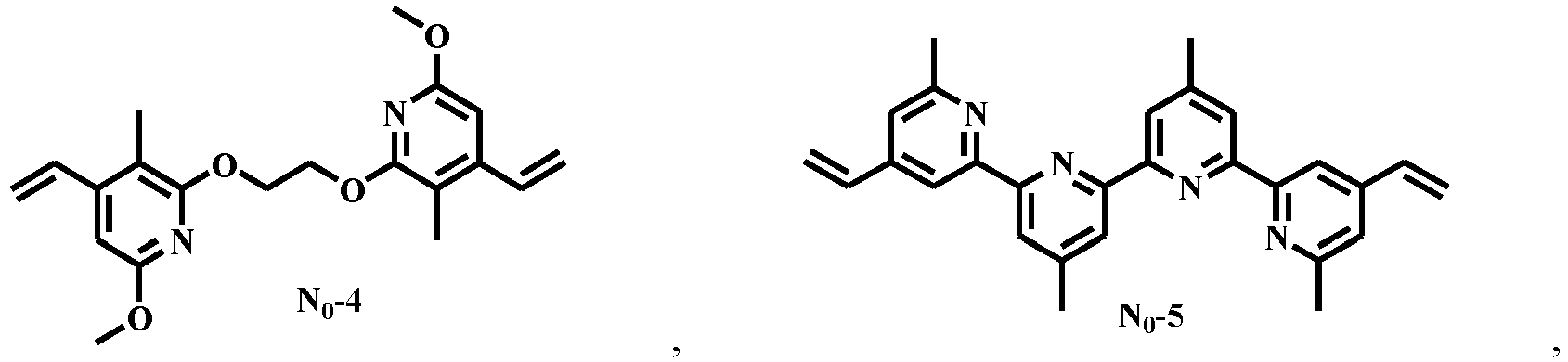


-
- (1) 1g of polystyrene porous microspheres (a particle size of which was 55 nm, a relative deviation of the particle sizes was 1.6%) were ultrasonically dispersed in 20 mL of a sodium dodecyl sulfate solution (0.5 wt%) to obtain a first emulsion. 2 mL of butyl acetate was ultrasonically dispersed in 20 mL of sodium dodecyl sulfate solution (0.5 wt%) to obtain a second emulsion. The second emulsion was quickly added into the first emulsion, mixed and shaken at room temperature for 12 hours to obtain a first mixed solution containing polystyrene porous microspheres.
- (2) 50 g of bipyridine monomers having a structural formula as shown in Formula No-1 and 1.97g of AIBN initiator were dissolved in 40 mL of toluene, and a mixture of the bipyridine monomer and the AIBN initiator were dispersed in a sodium dodecyl sulfate solution (0.5wt%) and ultrasonically emulsified. After the ultrasonic emulsification, the resultant was quickly added to the first mixed solution and mixed with the first mixed solution by continuously shaking at a room temperature for 12 hours to obtain a second mixed solution.
- (3) Nitrogen was introduced into the reaction device to remove air in the second mixed solution, and the second mixed solution was then vibrated and polymerized at a temperature of 65 degrees centigrade for 24 hours. After the vibration polymerization, a polymerization reaction solution was centrifuged, washed with ethanol, and then vacuum-dried at a room temperature to obtain 49.98 g of cross-linked polyvinyl pyridine porous microspheres C1. A content of nitrogen element in the cross-linked polyvinyl pyridine porous microspheres C1 was tested by elemental analysis.
- (4) 45 g of the cross-linked polyvinyl pyridine porous microspheres were placed in a reaction flask, and then a certain amount of toluene and 34.94 g of 1-chloropropane were added into the reaction flask. The cross-linked polyvinyl pyridine porous microspheres, the toluene, and the 1-chloropropane in the reaction flask were mixed evenly, and then were stirred at 100 degrees centigrade for 24 hours for a reaction. Thereafter, a reaction solution was centrifuged, washed with ethanol, and dried under vacuum at a room temperature to obtain 78.9 g of polypyridine ionic liquid-loaded porous microspheres D1 with a yield of 98.7%. A nitrogen content of the polypyridine ionic liquid-loaded porous microspheres D1 was tested by elemental analysis.
- Methods for preparing polypyridine ionic liquid-loaded porous microspheres D2 to D12 were substantially the same as the method for preparing the polypyridine ionic liquid-loaded porous microspheres D1, except that some reaction parameters in the methods for preparing the polypyridine ionic liquid-loaded porous microspheres D2 to D12 are different from those in the method for preparing the polypyridine ionic liquid-loaded porous microspheres D1. Specific reaction parameters in the methods for preparing the polypyridine ionic liquid-loaded porous microspheres D2 to D12 are shown in Table 1, and reaction results thereof are shown in Table 2.
Table 1 No. Surfactant Pyridine monomer Polymerizat ion temperature /degrees centigrade Initiator Halogenated alkane Structure Mass/g Type Mass/g Type Mass/g D2 Sodium dodecyl sulfate N0-2 50 65 ABV N 2.35 1-chlorop ropane 48.02 D3 Polyvinyl alcohol N0-3 50 70 AIB ME 2.15 1-chlorob utane 30.99 D4 Polyvinyl alcohol N0-4 55 70 AIB A 1.67 2-chlorop ropane 37.28 D5 Tween-80 N0-5 60 80 AIBI 1.54 2-chlorop entane 85.19 D6 Tween-80 N0-6 60 80 AIB N 0.78 2-chlorob utane 119.58 D7 Sodium dodecyl benzene sulfonate N0-7 100 80 ABV N 0.89 1-chlorop entane 62.77 D8 Sodium dodecyl benzene sulfonate N0-8 80 85 AIB N 0.68 1-chlorop ropane 101.53 D9 Sodium dodecyl sulfate N0-9 80 65 ABV N 0.97 1-chlorob utane 131.50 D10 Polyvinyl alcohol N0-10 100 65 AIB ME 0.84 2-chloroh exane 64.16 D11 Tween-80 N0-11 50 65 AIB A 2.32 2-chlorob utane 58.83 D12 Sodium dodecyl benzene sulfonate N0-12 60 80 AIB N 0.73 1-chlorop ropane 37.83 Table 2 Cross-linked polyvinyl pyridine porous microspheres Polypyridine ionic liquid-loaded porous microspheres No. Content of nitrogen element /% No. Content of nitrogen element /% Specific surface area / m2/g Average particle size / µm Average aperture size / nm C1 13.19 D1 7.43 394 580 28.2 C2 10.39 D2 5.03 404 562 32.0 C3 10.24 D3 6.06 412 554 30.3 C4 7.72 D4 4.42 388 548 29.8 C5 13.20 D5 5.18 379 532 28.7 C6 13.08 D6 4.12 410 541 29.5 C7 9.95 D7 5.86 422 553 31.1 C8 13.92 D8 7.01 418 567 30.8 C9 10.85 D9 3.77 412 570 31.5 C10 10.17 D10 5.94 420 558 32.2 C11 18.84 D11 8.17 385 558 29.3 C12 12.27 D12 6.98 392 564 30.6 - In the methods for preparing the phosphorus-containing ligands of the following Embodiment 1 to Embodiment 12, structural formula of the phosphorus chloride compounds represented by Formula (1) are shown in Formulas E1 to E12, structural formulas of the compound represented by Formula (2) were shown as Formulas F1 to F12, and structural formulas of the phosphorus-containing ligands are as shown in Formulas L1 to L 12.


- Phosphorus chloride compound E1 (86.17 g, 0.341mol), polypyridine ionic liquid-loaded porous microspheres D1 (3.68 g, containing 0.0195 mol of nitrogen element), and toluene were mixed into 200 mL of a first mixture.
- 4, 5-dimethyl-2, 2', 6, 6'-tetrahydroxybiphenyl F1 (20 g, 0.081mol) was mixed with toluene to make 100 mL of a second mixture.
- Dry nitrogen gas was continuously fed into a reaction device for 30 min to replace air and water vapor inside the reaction device. Then the first mixture was transferred to the reaction device, and the second mixture was transferred to a high-level dripping device. A stirrer in the reaction device was started and hydrogen chloride absorption system was operated.
- At a temperature of 25 degrees centigrade, the second mixture was continuously and uniformly added into the reaction device from the high-level dripping device. An adding time was 3 hours, and dry nitrogen was continuously introduced into the reaction device during the dripping process. After the dripping process was completed, reactants in the reaction device were continuously stirred for 4 hours. Subsequently, a reaction solution was filtered to remove polypyridine ionic liquid-loaded porous microspheres D1 from the reaction solution to obtain a filter liquor. The filter liquor was concentrated to remove toluene from the filter liquor and obtain a concentrated solution. The concentrated solution was separated and purified by column chromatography to obtain 70.65 g of phosphorus-containing ligand L1 with a yield of 78.3%.
- Methods for preparing phosphorus-containing ligands L2 to L12 were the same as the method for preparing the phosphorus-containing ligand L1, except that reaction parameters in the methods for preparing the phosphorus-containing ligands L2 to L12 were different from those in the method for preparing the phosphorus-containing ligand L1. Specific reaction parameters in the methods for preparing the phosphorus-containing ligands L2 to L12 were shown in Table 3, and reaction results thereof were shown in Table 4.
Table 3 Polypyridine ionic liquid-loaded porous microspheres Phosphorus chloride compounds represented in Formula (1) Compound represented in Formula (2) Type Mass/g Type Mass /g Type Mass Embodiment 1 D1 4.90 E1 86.17 F1 20 Embodiment 2 D2 0.38 E2 45.95 F2 20 Embodiment 3 D3 1.98 E3 91.33 F3 20 Embodiment 4 D4 2.78 E4 55.69 F4 20 Embodiment 5 D5 0.97 E5 47.00 F5 20 Embodiment 6 D6 3.73 E6 138.40 F6 20 Embodiment 7 D7 5.22 E7 137.74 F7 20 Embodiment 8 D8 1.37 E8 69.80 F8 20 Embodiment 9 D9 1.63 E9 56.48 F9 20 Embodiment 10 D10 3.68 E10 86.45 F10 20 Embodiment 11 D11 6.04 E11 364.14 F11 20 Embodiment 12 D12 0.69 E12 262.06 F12 20 Table 4 Phosphorus-containing ligand Recovery rate of polypyridine ionic liquid-loaded porous microspheres Type Mass /g Selectivity % Yield Embodiment 1 L1 70.65 83.9% 78.3% 99.2% Embodiment 2 L2 51.65 92.4% 89.3% 99.5% Embodiment 3 L3 67.40 80.5% 75.6% 98.7% Embodiment 4 L4 42.74 71.3% 65.8% 99.1% Embodiment 5 L5 38.37 76.2% 71.4% 99.7% Embodiment 6 L6 80.38 65.8% 61.5% 98.9% Embodiment 7 L7 70.25 60.6% 55.4% 99.0% Embodiment 8 L8 48.22 70.5% 64.2% 99.6% Embodiment 9 L9 48.99 81.7% 76.8% 99.4% Embodiment 10 L10 60.49 75.3% 72.1% 98.8% Embodiment 11 L11 180.59 88.9% 85.7% 99.4% Embodiment 12 L12 87.63 93.5% 89.5% 99.1% - Polypyridine ionic liquid-loaded porous microspheres D1 recycled in Embodiment 1 were re-used in experiments for preparing phosphorus-containing ligand L1. Data of the experiments were shown in Table 5 below, and specific steps for preparing the phosphorus-containing ligand L1 were the same as those in Embodiment 1.
Table 5 Times of recycle Polypyridine ionic liquid-loaded porous microspheres D1 Reaction time /h Phosphorus-containing ligand L1 content of nitrogen element /% Recovery rate /% Selectivity /% Yield /% 1 7.43 99.3% 4 83.6 78.5 3 7.41 99.5% 4 83.9 78.7 5 7.40 99.4% 4 83.4 78.1 10 7.38 99.6% 4 83.2 78.4 20 7.36 98.9% 4 81.5 76.9 - It can be seen from Table 5 that the polypyridine ionic liquid-loaded porous microspheres of the present disclosure can be recycled for many times, and a recovery rate was still greater than 95% and a reactivity was not significantly reduced after 20 recycles.
- Comparative embodiment 1 differed from Embodiment 1 only in that the polypyridine ionic liquid-loaded porous microspheres in embodiment 1 was replaced with a weak base type macroporous ion exchange resin (3.68 g, model: D301, produced by Chemical Plant of Nankai University). In comparative embodiment 1, after a reaction was completed, 48.45 g of phosphorus-containing ligand L1 was can be obtained by separation and purification, with a selectivity of 59.2% and a yield of 53.7%.
- Comparative embodiment 2 differed from Embodiment 1 only in that the polypyridine ionic liquid-loaded porous microspheres in Embodiment 1 was replaced with 81 mL of anhydrous triethylamine, and the reaction in comparative embodiment 2 was carried out without continuous introduction of dry nitrogen or operation of hydrogen chloride absorption system. In comparative embodiment 2, after the reaction was completed, 38.35 g of phosphate-containing ligand L1 was obtained by separation and purification, with a selectivity of 47.3% and a yield of 42.5%.
- In preparation methods of the present disclosure, polypyridine ionic liquid-loaded porous microspheres were used as catalysts, and porous structures of the polypyridine ionic liquid-loaded porous microspheres can increase catalytic active sites of a reaction, thereby improving a selectivity and a yield of the reaction. Meanwhile, a catalytic effect can reduce an activation energy required for the reaction. Specifically, due to the catalytic effect, a reaction temperature can be reduced, and a chemical reaction rate can be speed up, which is more suitable for preparing phosphorus-containing ligands containing sensitive groups (such as double bonds, etc.). Moreover, the catalysts in the present disclosure have stable properties, simple post-treatments, good recycling performances, and thus they are easy to be recovered and reused.
- In the present disclosure, in a reaction process, hydrogen chloride generated by the reaction is removed from a reaction device, so as to solve problems of a high viscosity of a system and a difficult post-processing, thus improving a selectivity and a yield of the reaction.
- The technical features of the above-described embodiments may be combined in any combination. For the sake of brevity of description, not all possible combinations of the technical features in the above embodiments are described. However, as long as there is no contradiction between the combinations of these technical features, all should be considered as within the scope of this disclosure.
- The above-described embodiments are merely illustrative of several embodiments of the present disclosure, and the description thereof is relatively specific and detailed, but is not to be construed as limiting the scope of the disclosure. It should be noted that a number of variations and modifications may be made by those skilled in the art without departing from the spirit and scope of the disclosure. Therefore, the scope of the disclosure should be determined by the appended claims.
Claims (20)
- A method for preparing a phosphorus-containing ligand, comprising:mixing a phosphorus chloride compound as shown in Formula (1), first polypyridine ionic liquid-loaded porous microspheres with a first organic solvent to obtain a first mixture, and mixing a compound as shown in Formula (2) with a second organic solvent to obtain a second mixture; andmixing the first mixture with the second mixture in a reaction device to make the first mixture react with the second mixture to obtain a reaction mixture, removing generated hydrogen chloride from the reaction device, filtrating the reaction mixture to obtain a filter liquor after a reaction of the first mixture and the second mixture, and treating the filter liquor to obtain the phosphorus-containing ligand,
 wherein in Formula (1), X and Y are independently selected from substituted aryloxy groups or nitrogen-containing heterocyclic groups,in Formula (2), Z is a multivalent aliphatic hydrocarbon group or a multivalent aromatic hydrocarbon group comprising at least one substituent group,wherein the at least one substituent group is selected from hydrogen atom, halogen atoms, C1-C10 alkyl group, C1-C10 alkoxy group, C1-C10 alkanoyl group, aryl group, heteroaryl group, cyano group, or nitro group, and n is an integer in a range of 1 to 8.
 - The method of claim 1, wherein the first polypyridine ionic liquid-loaded porous microspheres comprises a polypyridine ionic liquid, and a structural formula of the polypyridine ionic liquid is shown in Formula (3),


- The method of claim 2, wherein Q is selected from


- The method of claim 3, wherein Q0 is selected from

- The method of any one of claims 1 to 4, wherein the first polypyridine ionic liquid-loaded porous microspheres comprises polystyrene porous microspheres, particle sizes of the polystyrene microspheres are in a range of 50 nm to 100 nm, and a relative deviation of the particle sizes is less than 3%.
- The method of any one of claims 1 to 4, wherein a BET specific surface area of the first polypyridine ionic liquid-loaded porous microspheres is in a range of 50m2/g to 500m2/g, and an average aperture size of apertures in the first polypyridine ionic liquid-loaded porous microspheres is in a range of 10 nm to 50 nm.
- The method of any one of claims 1 to 4, wherein in Formula (1), a structural formula of the substituted aryloxy groups is

- The method of claim 7, wherein when both X and Y are selected from
 when both X and Y are selected from nitrogen-containing heterocyclic groups, X and Y are not cyclized, or X and Y are cyclized via a single bond or methylene; or,when X is selected from
- The method of claim 8, wherein the nitrogen-containing heterocyclic groups are selected from


- The method of claim 9, wherein both X and Y are selected from nitrogen-containing heterocyclic groups, and X and Y are cyclized via the single bond or the methylene to form a structure selected from any one of the group consisting of


- The method of any one of claims 1 to 4, wherein in Formula (2), Z is selected from


- The method of any one of claims 1 to 4, wherein in Formula (2), n is an integer in a range of 2 to 4.
- The method of any one of claims 1 to 4, wherein in the step of mixing the first mixture with the second mixture in the reaction device to obtain the reaction mixture, a molar ratio of the phosphorus chloride compound to the compound as shown in Formula (2) is in a range of 1.0:(1/x) to 1.3:(1/x), x is equal to n in Formula (2), and a molar ratio of nitrogen atoms in the first polypyridine ionic liquid-loaded porous microspheres to hydroxyl groups in the compound as shown in Formula (2) is in a range of 0.01:1 to 0.1:1.
- The method of claim 13, wherein a molar concentration of the phosphorus chloride compound in the first mixture is in a range of 0.05 mol/L to 5.0 mol/L, and a molar concentration of the compound as shown in Formula (2) in the second mixture is in a range of 0.05 mol/L to 5.0 mol/L.
- The method of any one of claims 1 to 4, wherein in the step of mixing the first mixture with the second mixture in the reaction device to make the first mixture react with the second mixture to obtain the reaction mixture, a reaction temperature is in a range of 0 to 50 degrees centigrade, and a reaction time is in a range of 1 hour to 5 hours.
- The method of any one of claims 1 to 4, wherein in the step of mixing the first mixture with the second mixture in the reaction device to make the first mixture react with the second mixture to obtain the reaction mixture, adding the second mixture into the first mixture in batches.
- The method of claim 16, wherein in the step of adding the second mixture into the first mixture in batches, an adding duration is in a range of 2 hours to 10 hours.
- The method of any one of claims 1 to 4, wherein the step of filtrating the reaction mixture to obtain the filter liquor after the reaction further comprises recovering second polypyridine ionic liquid-loaded porous microspheres.
- The method of claim 18, wherein after the recovering the second polypyridine ionic liquid-loaded porous microspheres, further comprising a step of washing, drying and re-using the recovered second polypyridine ionic liquid-loaded porous microspheres for preparing the first mixture.
- The method of any one of claims 1 to 4, wherein the step of mixing the first mixture with the second mixture in the reaction device to make the first mixture react with the second mixture to obtain the reaction mixture further comprises blowing a protective gas in to the reaction device to remove the generated hydrogen chloride out from the reaction device.
Applications Claiming Priority (2)
| Application Number | Priority Date | Filing Date | Title |
|---|---|---|---|
| CN202210445344.8A CN114891036B (en) | 2022-04-26 | 2022-04-26 | Process for preparing phosphorus-containing ligands |
| PCT/CN2022/102172 WO2023206791A1 (en) | 2022-04-26 | 2022-06-29 | Method for preparing phosphorus-containing ligand |
Publications (3)
| Publication Number | Publication Date |
|---|---|
| EP4289855A1 true EP4289855A1 (en) | 2023-12-13 |
| EP4289855A4 EP4289855A4 (en) | 2024-01-03 |
| EP4289855B1 EP4289855B1 (en) | 2024-11-27 |
Family
ID=82719737
Family Applications (1)
| Application Number | Title | Priority Date | Filing Date |
|---|---|---|---|
| EP22755062.1A Active EP4289855B1 (en) | 2022-04-26 | 2022-06-29 | Method for preparing phosphorus-containing ligand |
Country Status (4)
| Country | Link |
|---|---|
| US (1) | US20250345782A1 (en) |
| EP (1) | EP4289855B1 (en) |
| CN (1) | CN114891036B (en) |
| WO (1) | WO2023206791A1 (en) |
Families Citing this family (1)
| Publication number | Priority date | Publication date | Assignee | Title |
|---|---|---|---|---|
| CN119899210B (en) * | 2023-10-26 | 2026-01-06 | 中国石油化工股份有限公司 | Lead complexes, precursor solutions for perovskite preparation, perovskite layers, perovskite solar cells, their preparation methods and applications |
Family Cites Families (13)
| Publication number | Priority date | Publication date | Assignee | Title |
|---|---|---|---|---|
| DE10360771A1 (en) * | 2003-12-23 | 2005-07-28 | Oxeno Olefinchemie Gmbh | Process for the preparation of trivalent organophosphorus compounds |
| CN100441584C (en) * | 2005-10-10 | 2008-12-10 | 中国石油化工股份有限公司 | A kind of preparation method of pentaerythritol phosphite antioxidant |
| ZA200804818B (en) | 2005-12-15 | 2009-11-25 | Penn State Res Found | Tetraphosphorus ligands for catalytic hydroformylation and related reactions |
| CN101250200A (en) | 2008-04-01 | 2008-08-27 | 华南理工大学 | Synthetic method of bis(2,4-di-tert-butylphenyl) pentaerythritol diphosphite |
| CN102875599B (en) | 2012-09-29 | 2015-11-04 | 武汉大学 | Three tooth Phosphine ligands and the application in linear hydroformylation and similar reaction thereof |
| CN103537321A (en) * | 2013-10-17 | 2014-01-29 | 南开大学 | Polymer-supported ionic liquid and preparation method thereof as well as application of polymer-supported ionic liquid in catalytic esterification |
| CN103706396B (en) * | 2014-01-06 | 2016-05-11 | 北京化工大学 | Preparation method and the application thereof of one class polydivinylbenezene-ionic liquid-polyacid catalyst |
| CN106220681A (en) | 2016-07-22 | 2016-12-14 | 上海石化西尼尔化工科技有限公司 | A kind of preparation method of phosphite antioxidant |
| CN109400922B (en) * | 2018-10-26 | 2021-05-14 | 绍兴文理学院 | Preparation method and application of hypercrosslinked porous polyionic liquid material |
| CN110961055B (en) * | 2019-12-06 | 2021-01-05 | 锦州医科大学 | Ionic liquid polymeric microspheres and preparation method and application thereof |
| CN111533767A (en) * | 2020-04-30 | 2020-08-14 | 卢海元 | Tetradentate phosphine ligand and preparation method thereof, hydroformylation catalyst and reaction method, and preparation method of 1, 3-propylene glycol |
| CN114075245B (en) * | 2020-08-18 | 2024-06-04 | 中国石油化工股份有限公司 | Bidentate phosphite ligand, preparation method and application thereof |
| CN112794948B (en) * | 2020-12-31 | 2022-08-26 | 浙江大学 | Porous polymer, preparation method thereof, catalyst and preparation method of adiponitrile |
-
2022
- 2022-04-26 CN CN202210445344.8A patent/CN114891036B/en active Active
- 2022-06-29 EP EP22755062.1A patent/EP4289855B1/en active Active
- 2022-06-29 US US17/799,923 patent/US20250345782A1/en active Pending
- 2022-06-29 WO PCT/CN2022/102172 patent/WO2023206791A1/en not_active Ceased
Also Published As
| Publication number | Publication date |
|---|---|
| US20250345782A1 (en) | 2025-11-13 |
| CN114891036A (en) | 2022-08-12 |
| CN114891036B (en) | 2023-12-05 |
| EP4289855B1 (en) | 2024-11-27 |
| WO2023206791A1 (en) | 2023-11-02 |
| EP4289855A4 (en) | 2024-01-03 |
Similar Documents
| Publication | Publication Date | Title |
|---|---|---|
| Bandini et al. | The first catalytic enantioselective Nozaki–Hiyama reaction | |
| EP2943462B1 (en) | Method to obtain methylene malonate via bis(hydroxymethyl) malonate pathway | |
| CN105728046B (en) | A kind of ruthenium metal olefin metathesis catalyst and its methods for making and using same | |
| CN105921178B (en) | A kind of immobilized metal palladium catalyst PAF11-Pd of porous aromatic skeleton compound and its preparation method and application | |
| CN106939026B (en) | Preparation and application of ruthenium metal olefin metathesis catalyst | |
| CN112645831B (en) | Synthesis and crystallization method of high-purity N-hydroxymethyl acrylamide | |
| EP4289855B1 (en) | Method for preparing phosphorus-containing ligand | |
| CN110330447B (en) | Preparation method and application of nafamostat mesylate intermediate | |
| CN114276220B (en) | Preparation method of o-phenyl phenoxyethanol | |
| CN102503976A (en) | Alpha-quaternary carbon contained alpha, beta-diamino acid derivative, synthetic method thereof and application thereof | |
| CN116836348A (en) | Novel hydrazone chiral covalent organic framework material and preparation method and application thereof | |
| CN113121400A (en) | Method for preparing 2-pyrrolidone compound | |
| CN107497485B (en) | Water-phase asymmetric Aldol reaction catalyst and preparation method and application thereof | |
| EP2330107A2 (en) | Improved production method for adefovir dipivoxil | |
| CN109762026B (en) | A kind of fluorine-containing phenanthrenequinone skeleton asymmetric α-diimine nickel (II) complex and preparation method and application | |
| CN111808281B (en) | Method for synthesizing polypyrazole vesicles in one step | |
| CN106939059A (en) | The poromeric method of homochiral molecule construction based on 1,1 ' 2 naphthols of connection | |
| CN114163474B (en) | Polyketone catalyst ligand and synthesis method thereof | |
| CN112010882A (en) | Method for stereoselectively preparing 1, 3-disubstituted cyclohexane compounds and application | |
| KR102093966B1 (en) | Purification method of halogenated methoxy-PEG | |
| CN115784933B (en) | Difunctional nitrile oxide, preparation method and application thereof | |
| CN113511984B (en) | Preparation method and application of beta-azido acid and beta-amino acid compound | |
| CN113214447B (en) | Polybenzoxazine based on pyridyl and preparation method and application thereof | |
| CN117229266B (en) | Method for synthesizing ramosetron racemate and salt thereof | |
| CN114749212B (en) | An acetaldehyde azoin condensation heterogeneous catalyst and its preparation method and application |
Legal Events
| Date | Code | Title | Description |
|---|---|---|---|
| STAA | Information on the status of an ep patent application or granted ep patent |
Free format text: STATUS: UNKNOWN |
|
| STAA | Information on the status of an ep patent application or granted ep patent |
Free format text: STATUS: THE INTERNATIONAL PUBLICATION HAS BEEN MADE |
|
| PUAI | Public reference made under article 153(3) epc to a published international application that has entered the european phase |
Free format text: ORIGINAL CODE: 0009012 |
|
| STAA | Information on the status of an ep patent application or granted ep patent |
Free format text: STATUS: REQUEST FOR EXAMINATION WAS MADE |
|
| 17P | Request for examination filed |
Effective date: 20220826 |
|
| AK | Designated contracting states |
Kind code of ref document: A1 Designated state(s): AL AT BE BG CH CY CZ DE DK EE ES FI FR GB GR HR HU IE IS IT LI LT LU LV MC MK MT NL NO PL PT RO RS SE SI SK SM TR |
|
| A4 | Supplementary search report drawn up and despatched |
Effective date: 20231130 |
|
| RIC1 | Information provided on ipc code assigned before grant |
Ipc: B01J 35/08 20060101ALI20231124BHEP Ipc: B01J 31/06 20060101ALI20231124BHEP Ipc: B01J 31/02 20060101ALI20231124BHEP Ipc: C07F 9/6584 20060101ALI20231124BHEP Ipc: C07F 9/6506 20060101ALI20231124BHEP Ipc: C07F 9/572 20060101ALI20231124BHEP Ipc: C07F 9/145 20060101ALI20231124BHEP Ipc: C07F 9/141 20060101AFI20231124BHEP |
|
| REG | Reference to a national code |
Ref legal event code: R079 Free format text: PREVIOUS MAIN CLASS: C07F0009141000 Ref country code: DE Ref legal event code: R079 Ref document number: 602022008241 Country of ref document: DE Free format text: PREVIOUS MAIN CLASS: C07F0009141000 Ipc: C07F0009145000 |
|
| RIC1 | Information provided on ipc code assigned before grant |
Ipc: C07F 9/6584 20060101ALI20240503BHEP Ipc: C07F 9/6506 20060101ALI20240503BHEP Ipc: C07F 9/572 20060101ALI20240503BHEP Ipc: C07F 9/145 20060101AFI20240503BHEP |
|
| GRAP | Despatch of communication of intention to grant a patent |
Free format text: ORIGINAL CODE: EPIDOSNIGR1 |
|
| STAA | Information on the status of an ep patent application or granted ep patent |
Free format text: STATUS: GRANT OF PATENT IS INTENDED |
|
| DAV | Request for validation of the european patent (deleted) | ||
| DAX | Request for extension of the european patent (deleted) | ||
| INTG | Intention to grant announced |
Effective date: 20240618 |
|
| RAP1 | Party data changed (applicant data changed or rights of an application transferred) |
Owner name: ZHEJIANG NHU NYLON MATERIALS CO., LTD. Owner name: ZHEJIANG NHU SPECIAL MATERIALS CO., LTD. Owner name: ZHEJIANG NHU COMPANY LTD. |
|
| GRAS | Grant fee paid |
Free format text: ORIGINAL CODE: EPIDOSNIGR3 |
|
| GRAA | (expected) grant |
Free format text: ORIGINAL CODE: 0009210 |
|
| STAA | Information on the status of an ep patent application or granted ep patent |
Free format text: STATUS: THE PATENT HAS BEEN GRANTED |
|
| AK | Designated contracting states |
Kind code of ref document: B1 Designated state(s): AL AT BE BG CH CY CZ DE DK EE ES FI FR GB GR HR HU IE IS IT LI LT LU LV MC MK MT NL NO PL PT RO RS SE SI SK SM TR |
|
| REG | Reference to a national code |
Ref country code: GB Ref legal event code: FG4D |
|
| REG | Reference to a national code |
Ref country code: CH Ref legal event code: EP |
|
| REG | Reference to a national code |
Ref country code: IE Ref legal event code: FG4D |
|
| REG | Reference to a national code |
Ref country code: DE Ref legal event code: R096 Ref document number: 602022008241 Country of ref document: DE |
|
| REG | Reference to a national code |
Ref country code: LT Ref legal event code: MG9D |
|
| REG | Reference to a national code |
Ref country code: NL Ref legal event code: MP Effective date: 20241127 |
|
| PG25 | Lapsed in a contracting state [announced via postgrant information from national office to epo] |
Ref country code: IS Free format text: LAPSE BECAUSE OF FAILURE TO SUBMIT A TRANSLATION OF THE DESCRIPTION OR TO PAY THE FEE WITHIN THE PRESCRIBED TIME-LIMIT Effective date: 20250327 Ref country code: PT Free format text: LAPSE BECAUSE OF FAILURE TO SUBMIT A TRANSLATION OF THE DESCRIPTION OR TO PAY THE FEE WITHIN THE PRESCRIBED TIME-LIMIT Effective date: 20250327 Ref country code: HR Free format text: LAPSE BECAUSE OF FAILURE TO SUBMIT A TRANSLATION OF THE DESCRIPTION OR TO PAY THE FEE WITHIN THE PRESCRIBED TIME-LIMIT Effective date: 20241127 |
|
| PG25 | Lapsed in a contracting state [announced via postgrant information from national office to epo] |
Ref country code: FI Free format text: LAPSE BECAUSE OF FAILURE TO SUBMIT A TRANSLATION OF THE DESCRIPTION OR TO PAY THE FEE WITHIN THE PRESCRIBED TIME-LIMIT Effective date: 20241127 Ref country code: NL Free format text: LAPSE BECAUSE OF FAILURE TO SUBMIT A TRANSLATION OF THE DESCRIPTION OR TO PAY THE FEE WITHIN THE PRESCRIBED TIME-LIMIT Effective date: 20241127 |
|
| REG | Reference to a national code |
Ref country code: AT Ref legal event code: MK05 Ref document number: 1745634 Country of ref document: AT Kind code of ref document: T Effective date: 20241127 |
|
| PG25 | Lapsed in a contracting state [announced via postgrant information from national office to epo] |
Ref country code: BG Free format text: LAPSE BECAUSE OF FAILURE TO SUBMIT A TRANSLATION OF THE DESCRIPTION OR TO PAY THE FEE WITHIN THE PRESCRIBED TIME-LIMIT Effective date: 20241127 |
|
| PG25 | Lapsed in a contracting state [announced via postgrant information from national office to epo] |
Ref country code: ES Free format text: LAPSE BECAUSE OF FAILURE TO SUBMIT A TRANSLATION OF THE DESCRIPTION OR TO PAY THE FEE WITHIN THE PRESCRIBED TIME-LIMIT Effective date: 20241127 |
|
| PG25 | Lapsed in a contracting state [announced via postgrant information from national office to epo] |
Ref country code: NO Free format text: LAPSE BECAUSE OF FAILURE TO SUBMIT A TRANSLATION OF THE DESCRIPTION OR TO PAY THE FEE WITHIN THE PRESCRIBED TIME-LIMIT Effective date: 20250227 |
|
| PG25 | Lapsed in a contracting state [announced via postgrant information from national office to epo] |
Ref country code: GR Free format text: LAPSE BECAUSE OF FAILURE TO SUBMIT A TRANSLATION OF THE DESCRIPTION OR TO PAY THE FEE WITHIN THE PRESCRIBED TIME-LIMIT Effective date: 20250228 Ref country code: AT Free format text: LAPSE BECAUSE OF FAILURE TO SUBMIT A TRANSLATION OF THE DESCRIPTION OR TO PAY THE FEE WITHIN THE PRESCRIBED TIME-LIMIT Effective date: 20241127 Ref country code: LV Free format text: LAPSE BECAUSE OF FAILURE TO SUBMIT A TRANSLATION OF THE DESCRIPTION OR TO PAY THE FEE WITHIN THE PRESCRIBED TIME-LIMIT Effective date: 20241127 |
|
| PG25 | Lapsed in a contracting state [announced via postgrant information from national office to epo] |
Ref country code: PL Free format text: LAPSE BECAUSE OF FAILURE TO SUBMIT A TRANSLATION OF THE DESCRIPTION OR TO PAY THE FEE WITHIN THE PRESCRIBED TIME-LIMIT Effective date: 20241127 |
|
| PG25 | Lapsed in a contracting state [announced via postgrant information from national office to epo] |
Ref country code: RS Free format text: LAPSE BECAUSE OF FAILURE TO SUBMIT A TRANSLATION OF THE DESCRIPTION OR TO PAY THE FEE WITHIN THE PRESCRIBED TIME-LIMIT Effective date: 20250227 |
|
| PG25 | Lapsed in a contracting state [announced via postgrant information from national office to epo] |
Ref country code: SM Free format text: LAPSE BECAUSE OF FAILURE TO SUBMIT A TRANSLATION OF THE DESCRIPTION OR TO PAY THE FEE WITHIN THE PRESCRIBED TIME-LIMIT Effective date: 20241127 |
|
| PG25 | Lapsed in a contracting state [announced via postgrant information from national office to epo] |
Ref country code: DK Free format text: LAPSE BECAUSE OF FAILURE TO SUBMIT A TRANSLATION OF THE DESCRIPTION OR TO PAY THE FEE WITHIN THE PRESCRIBED TIME-LIMIT Effective date: 20241127 |
|
| PG25 | Lapsed in a contracting state [announced via postgrant information from national office to epo] |
Ref country code: EE Free format text: LAPSE BECAUSE OF FAILURE TO SUBMIT A TRANSLATION OF THE DESCRIPTION OR TO PAY THE FEE WITHIN THE PRESCRIBED TIME-LIMIT Effective date: 20241127 |
|
| PG25 | Lapsed in a contracting state [announced via postgrant information from national office to epo] |
Ref country code: RO Free format text: LAPSE BECAUSE OF FAILURE TO SUBMIT A TRANSLATION OF THE DESCRIPTION OR TO PAY THE FEE WITHIN THE PRESCRIBED TIME-LIMIT Effective date: 20241127 |
|
| PG25 | Lapsed in a contracting state [announced via postgrant information from national office to epo] |
Ref country code: SK Free format text: LAPSE BECAUSE OF FAILURE TO SUBMIT A TRANSLATION OF THE DESCRIPTION OR TO PAY THE FEE WITHIN THE PRESCRIBED TIME-LIMIT Effective date: 20241127 |
|
| PG25 | Lapsed in a contracting state [announced via postgrant information from national office to epo] |
Ref country code: CZ Free format text: LAPSE BECAUSE OF FAILURE TO SUBMIT A TRANSLATION OF THE DESCRIPTION OR TO PAY THE FEE WITHIN THE PRESCRIBED TIME-LIMIT Effective date: 20241127 |
|
| PG25 | Lapsed in a contracting state [announced via postgrant information from national office to epo] |
Ref country code: IT Free format text: LAPSE BECAUSE OF FAILURE TO SUBMIT A TRANSLATION OF THE DESCRIPTION OR TO PAY THE FEE WITHIN THE PRESCRIBED TIME-LIMIT Effective date: 20241127 |
|
| REG | Reference to a national code |
Ref country code: DE Ref legal event code: R097 Ref document number: 602022008241 Country of ref document: DE |
|
| PG25 | Lapsed in a contracting state [announced via postgrant information from national office to epo] |
Ref country code: SE Free format text: LAPSE BECAUSE OF FAILURE TO SUBMIT A TRANSLATION OF THE DESCRIPTION OR TO PAY THE FEE WITHIN THE PRESCRIBED TIME-LIMIT Effective date: 20241127 |
|
| PLBE | No opposition filed within time limit |
Free format text: ORIGINAL CODE: 0009261 |
|
| STAA | Information on the status of an ep patent application or granted ep patent |
Free format text: STATUS: NO OPPOSITION FILED WITHIN TIME LIMIT |
|
| REG | Reference to a national code |
Ref country code: CH Ref legal event code: L10 Free format text: ST27 STATUS EVENT CODE: U-0-0-L10-L00 (AS PROVIDED BY THE NATIONAL OFFICE) Effective date: 20251008 |
|
| 26N | No opposition filed |
Effective date: 20250828 |
|
| REG | Reference to a national code |
Ref country code: CH Ref legal event code: H13 Free format text: ST27 STATUS EVENT CODE: U-0-0-H10-H13 (AS PROVIDED BY THE NATIONAL OFFICE) Effective date: 20260127 |
|
| PG25 | Lapsed in a contracting state [announced via postgrant information from national office to epo] |
Ref country code: MC Free format text: LAPSE BECAUSE OF FAILURE TO SUBMIT A TRANSLATION OF THE DESCRIPTION OR TO PAY THE FEE WITHIN THE PRESCRIBED TIME-LIMIT Effective date: 20241127 |
|
| PG25 | Lapsed in a contracting state [announced via postgrant information from national office to epo] |
Ref country code: LU Free format text: LAPSE BECAUSE OF NON-PAYMENT OF DUE FEES Effective date: 20250629 |
|
| REG | Reference to a national code |
Ref country code: BE Ref legal event code: MM Effective date: 20250630 |
|
| PG25 | Lapsed in a contracting state [announced via postgrant information from national office to epo] |
Ref country code: IE Free format text: LAPSE BECAUSE OF NON-PAYMENT OF DUE FEES Effective date: 20250629 |
|
| PG25 | Lapsed in a contracting state [announced via postgrant information from national office to epo] |
Ref country code: BE Free format text: LAPSE BECAUSE OF NON-PAYMENT OF DUE FEES Effective date: 20250630 |
|
| PG25 | Lapsed in a contracting state [announced via postgrant information from national office to epo] |
Ref country code: CH Free format text: LAPSE BECAUSE OF NON-PAYMENT OF DUE FEES Effective date: 20250630 |
|
| PG25 | Lapsed in a contracting state [announced via postgrant information from national office to epo] |
Ref country code: LT Free format text: LAPSE BECAUSE OF FAILURE TO SUBMIT A TRANSLATION OF THE DESCRIPTION OR TO PAY THE FEE WITHIN THE PRESCRIBED TIME-LIMIT Effective date: 20241127 |
|
| PGFP | Annual fee paid to national office [announced via postgrant information from national office to epo] |
Ref country code: DE Payment date: 20260612 Year of fee payment: 5 |
|
| PGFP | Annual fee paid to national office [announced via postgrant information from national office to epo] |
Ref country code: FR Payment date: 20260630 Year of fee payment: 5 |
|
| PG25 | Lapsed in a contracting state [announced via postgrant information from national office to epo] |
Ref country code: CY Free format text: LAPSE BECAUSE OF FAILURE TO SUBMIT A TRANSLATION OF THE DESCRIPTION OR TO PAY THE FEE WITHIN THE PRESCRIBED TIME-LIMIT Effective date: 20241127 |