EP4289794A1 - Layered cobalt-free positive electrode material and preparation method therefor, and lithium-ion battery - Google Patents
Layered cobalt-free positive electrode material and preparation method therefor, and lithium-ion battery Download PDFInfo
- Publication number
- EP4289794A1 EP4289794A1 EP22778648.0A EP22778648A EP4289794A1 EP 4289794 A1 EP4289794 A1 EP 4289794A1 EP 22778648 A EP22778648 A EP 22778648A EP 4289794 A1 EP4289794 A1 EP 4289794A1
- Authority
- EP
- European Patent Office
- Prior art keywords
- positive electrode
- electrode material
- layered
- cobalt
- free positive
- Prior art date
- Legal status (The legal status is an assumption and is not a legal conclusion. Google has not performed a legal analysis and makes no representation as to the accuracy of the status listed.)
- Pending
Links
Images

Classifications
-
- C—CHEMISTRY; METALLURGY
- C01—INORGANIC CHEMISTRY
- C01G—COMPOUNDS CONTAINING METALS NOT COVERED BY SUBCLASSES C01D OR C01F
- C01G53/00—Compounds of nickel
- C01G53/40—Complex oxides containing nickel and at least one other metal element
- C01G53/42—Complex oxides containing nickel and at least one other metal element containing alkali metals, e.g. LiNiO2
- C01G53/44—Complex oxides containing nickel and at least one other metal element containing alkali metals, e.g. LiNiO2 containing manganese
- C01G53/50—Complex oxides containing nickel and at least one other metal element containing alkali metals, e.g. LiNiO2 containing manganese of the type (MnO2)n-, e.g. Li(NixMn1-x)O2 or Li(MyNixMn1-x-y)O2
-
- H—ELECTRICITY
- H01—ELECTRIC ELEMENTS
- H01M—PROCESSES OR MEANS, e.g. BATTERIES, FOR THE DIRECT CONVERSION OF CHEMICAL ENERGY INTO ELECTRICAL ENERGY
- H01M4/00—Electrodes
- H01M4/02—Electrodes composed of, or comprising, active material
- H01M4/36—Selection of substances as active materials, active masses, active liquids
- H01M4/362—Composites
- H01M4/366—Composites as layered products
-
- C—CHEMISTRY; METALLURGY
- C01—INORGANIC CHEMISTRY
- C01F—COMPOUNDS OF THE METALS BERYLLIUM, MAGNESIUM, ALUMINIUM, CALCIUM, STRONTIUM, BARIUM, RADIUM, THORIUM, OR OF THE RARE-EARTH METALS
- C01F7/00—Compounds of aluminium
- C01F7/02—Aluminium oxide; Aluminium hydroxide; Aluminates
- C01F7/021—After-treatment of oxides or hydroxides
-
- C—CHEMISTRY; METALLURGY
- C01—INORGANIC CHEMISTRY
- C01G—COMPOUNDS CONTAINING METALS NOT COVERED BY SUBCLASSES C01D OR C01F
- C01G25/00—Compounds of zirconium
- C01G25/02—Oxides
-
- C—CHEMISTRY; METALLURGY
- C01—INORGANIC CHEMISTRY
- C01G—COMPOUNDS CONTAINING METALS NOT COVERED BY SUBCLASSES C01D OR C01F
- C01G41/00—Compounds of tungsten
- C01G41/02—Oxides; Hydroxides
-
- C—CHEMISTRY; METALLURGY
- C01—INORGANIC CHEMISTRY
- C01G—COMPOUNDS CONTAINING METALS NOT COVERED BY SUBCLASSES C01D OR C01F
- C01G53/00—Compounds of nickel
- C01G53/40—Complex oxides containing nickel and at least one other metal element
- C01G53/42—Complex oxides containing nickel and at least one other metal element containing alkali metals, e.g. LiNiO2
- C01G53/44—Complex oxides containing nickel and at least one other metal element containing alkali metals, e.g. LiNiO2 containing manganese
-
- C—CHEMISTRY; METALLURGY
- C01—INORGANIC CHEMISTRY
- C01G—COMPOUNDS CONTAINING METALS NOT COVERED BY SUBCLASSES C01D OR C01F
- C01G53/00—Compounds of nickel
- C01G53/40—Complex oxides containing nickel and at least one other metal element
- C01G53/66—Complex oxides containing nickel and at least one other metal element containing alkaline earth metals, e.g. SrNiO3 or SrNiO2
-
- C—CHEMISTRY; METALLURGY
- C01—INORGANIC CHEMISTRY
- C01G—COMPOUNDS CONTAINING METALS NOT COVERED BY SUBCLASSES C01D OR C01F
- C01G53/00—Compounds of nickel
- C01G53/40—Complex oxides containing nickel and at least one other metal element
- C01G53/70—Complex oxides containing nickel and at least one other metal element containing rare earths, e.g. LaNiO3
-
- H—ELECTRICITY
- H01—ELECTRIC ELEMENTS
- H01M—PROCESSES OR MEANS, e.g. BATTERIES, FOR THE DIRECT CONVERSION OF CHEMICAL ENERGY INTO ELECTRICAL ENERGY
- H01M10/00—Secondary cells; Manufacture thereof
- H01M10/05—Accumulators with non-aqueous electrolyte
- H01M10/052—Li-accumulators
- H01M10/0525—Rocking-chair batteries, i.e. batteries with lithium insertion or intercalation in both electrodes; Lithium-ion batteries
-
- H—ELECTRICITY
- H01—ELECTRIC ELEMENTS
- H01M—PROCESSES OR MEANS, e.g. BATTERIES, FOR THE DIRECT CONVERSION OF CHEMICAL ENERGY INTO ELECTRICAL ENERGY
- H01M4/00—Electrodes
- H01M4/02—Electrodes composed of, or comprising, active material
- H01M4/04—Processes of manufacture in general
- H01M4/0471—Processes of manufacture in general involving thermal treatment, e.g. firing, sintering, backing particulate active material, thermal decomposition, pyrolysis
-
- H—ELECTRICITY
- H01—ELECTRIC ELEMENTS
- H01M—PROCESSES OR MEANS, e.g. BATTERIES, FOR THE DIRECT CONVERSION OF CHEMICAL ENERGY INTO ELECTRICAL ENERGY
- H01M4/00—Electrodes
- H01M4/02—Electrodes composed of, or comprising, active material
- H01M4/13—Electrodes for accumulators with non-aqueous electrolyte, e.g. for lithium-accumulators; Processes of manufacture thereof
- H01M4/131—Electrodes based on mixed oxides or hydroxides, or on mixtures of oxides or hydroxides, e.g. LiCoOx
-
- H—ELECTRICITY
- H01—ELECTRIC ELEMENTS
- H01M—PROCESSES OR MEANS, e.g. BATTERIES, FOR THE DIRECT CONVERSION OF CHEMICAL ENERGY INTO ELECTRICAL ENERGY
- H01M4/00—Electrodes
- H01M4/02—Electrodes composed of, or comprising, active material
- H01M4/13—Electrodes for accumulators with non-aqueous electrolyte, e.g. for lithium-accumulators; Processes of manufacture thereof
- H01M4/139—Processes of manufacture
- H01M4/1391—Processes of manufacture of electrodes based on mixed oxides or hydroxides, or on mixtures of oxides or hydroxides, e.g. LiCoOx
-
- H—ELECTRICITY
- H01—ELECTRIC ELEMENTS
- H01M—PROCESSES OR MEANS, e.g. BATTERIES, FOR THE DIRECT CONVERSION OF CHEMICAL ENERGY INTO ELECTRICAL ENERGY
- H01M4/00—Electrodes
- H01M4/02—Electrodes composed of, or comprising, active material
- H01M4/36—Selection of substances as active materials, active masses, active liquids
- H01M4/48—Selection of substances as active materials, active masses, active liquids of inorganic oxides or hydroxides
- H01M4/50—Selection of substances as active materials, active masses, active liquids of inorganic oxides or hydroxides of manganese
- H01M4/505—Selection of substances as active materials, active masses, active liquids of inorganic oxides or hydroxides of manganese of mixed oxides or hydroxides containing manganese for inserting or intercalating light metals, e.g. LiMn2O4 or LiMn2OxFy
-
- H—ELECTRICITY
- H01—ELECTRIC ELEMENTS
- H01M—PROCESSES OR MEANS, e.g. BATTERIES, FOR THE DIRECT CONVERSION OF CHEMICAL ENERGY INTO ELECTRICAL ENERGY
- H01M4/00—Electrodes
- H01M4/02—Electrodes composed of, or comprising, active material
- H01M4/36—Selection of substances as active materials, active masses, active liquids
- H01M4/48—Selection of substances as active materials, active masses, active liquids of inorganic oxides or hydroxides
- H01M4/52—Selection of substances as active materials, active masses, active liquids of inorganic oxides or hydroxides of nickel, cobalt or iron
- H01M4/525—Selection of substances as active materials, active masses, active liquids of inorganic oxides or hydroxides of nickel, cobalt or iron of mixed oxides or hydroxides containing iron, cobalt or nickel for inserting or intercalating light metals, e.g. LiNiO2, LiCoO2 or LiCoOxFy
-
- C—CHEMISTRY; METALLURGY
- C01—INORGANIC CHEMISTRY
- C01P—INDEXING SCHEME RELATING TO STRUCTURAL AND PHYSICAL ASPECTS OF SOLID INORGANIC COMPOUNDS
- C01P2002/00—Crystal-structural characteristics
- C01P2002/20—Two-dimensional structures
-
- C—CHEMISTRY; METALLURGY
- C01—INORGANIC CHEMISTRY
- C01P—INDEXING SCHEME RELATING TO STRUCTURAL AND PHYSICAL ASPECTS OF SOLID INORGANIC COMPOUNDS
- C01P2002/00—Crystal-structural characteristics
- C01P2002/50—Solid solutions
- C01P2002/52—Solid solutions containing elements as dopants
-
- C—CHEMISTRY; METALLURGY
- C01—INORGANIC CHEMISTRY
- C01P—INDEXING SCHEME RELATING TO STRUCTURAL AND PHYSICAL ASPECTS OF SOLID INORGANIC COMPOUNDS
- C01P2002/00—Crystal-structural characteristics
- C01P2002/50—Solid solutions
- C01P2002/52—Solid solutions containing elements as dopants
- C01P2002/54—Solid solutions containing elements as dopants one element only
-
- C—CHEMISTRY; METALLURGY
- C01—INORGANIC CHEMISTRY
- C01P—INDEXING SCHEME RELATING TO STRUCTURAL AND PHYSICAL ASPECTS OF SOLID INORGANIC COMPOUNDS
- C01P2002/00—Crystal-structural characteristics
- C01P2002/70—Crystal-structural characteristics defined by measured X-ray, neutron or electron diffraction data
- C01P2002/72—Crystal-structural characteristics defined by measured X-ray, neutron or electron diffraction data by d-values or two theta-values, e.g. as X-ray diagram
-
- C—CHEMISTRY; METALLURGY
- C01—INORGANIC CHEMISTRY
- C01P—INDEXING SCHEME RELATING TO STRUCTURAL AND PHYSICAL ASPECTS OF SOLID INORGANIC COMPOUNDS
- C01P2004/00—Particle morphology
- C01P2004/80—Particles consisting of a mixture of two or more inorganic phases
-
- C—CHEMISTRY; METALLURGY
- C01—INORGANIC CHEMISTRY
- C01P—INDEXING SCHEME RELATING TO STRUCTURAL AND PHYSICAL ASPECTS OF SOLID INORGANIC COMPOUNDS
- C01P2004/00—Particle morphology
- C01P2004/80—Particles consisting of a mixture of two or more inorganic phases
- C01P2004/82—Particles consisting of a mixture of two or more inorganic phases two phases having the same anion, e.g. both oxidic phases
- C01P2004/84—Particles consisting of a mixture of two or more inorganic phases two phases having the same anion, e.g. both oxidic phases one phase coated with the other
-
- C—CHEMISTRY; METALLURGY
- C01—INORGANIC CHEMISTRY
- C01P—INDEXING SCHEME RELATING TO STRUCTURAL AND PHYSICAL ASPECTS OF SOLID INORGANIC COMPOUNDS
- C01P2006/00—Physical properties of inorganic compounds
- C01P2006/40—Electric properties
-
- H—ELECTRICITY
- H01—ELECTRIC ELEMENTS
- H01M—PROCESSES OR MEANS, e.g. BATTERIES, FOR THE DIRECT CONVERSION OF CHEMICAL ENERGY INTO ELECTRICAL ENERGY
- H01M4/00—Electrodes
- H01M4/02—Electrodes composed of, or comprising, active material
- H01M2004/021—Physical characteristics, e.g. porosity, surface area
-
- H—ELECTRICITY
- H01—ELECTRIC ELEMENTS
- H01M—PROCESSES OR MEANS, e.g. BATTERIES, FOR THE DIRECT CONVERSION OF CHEMICAL ENERGY INTO ELECTRICAL ENERGY
- H01M4/00—Electrodes
- H01M4/02—Electrodes composed of, or comprising, active material
- H01M2004/026—Electrodes composed of, or comprising, active material characterised by the polarity
- H01M2004/028—Positive electrodes
-
- Y—GENERAL TAGGING OF NEW TECHNOLOGICAL DEVELOPMENTS; GENERAL TAGGING OF CROSS-SECTIONAL TECHNOLOGIES SPANNING OVER SEVERAL SECTIONS OF THE IPC; TECHNICAL SUBJECTS COVERED BY FORMER USPC CROSS-REFERENCE ART COLLECTIONS [XRACs] AND DIGESTS
- Y02—TECHNOLOGIES OR APPLICATIONS FOR MITIGATION OR ADAPTATION AGAINST CLIMATE CHANGE
- Y02E—REDUCTION OF GREENHOUSE GAS [GHG] EMISSIONS, RELATED TO ENERGY GENERATION, TRANSMISSION OR DISTRIBUTION
- Y02E60/00—Enabling technologies; Technologies with a potential or indirect contribution to GHG emissions mitigation
- Y02E60/10—Energy storage using batteries
Definitions
- the present disclosure relates to the technical field of batteries, in particular to a layered cobalt-free positive electrode material, a preparation method therefor and a lithium-ion battery.
- a global energy issue is increasingly serious, and an environmental issue is also becoming more prominent.
- a lithium-ion battery as a clean efficient energy means, is of wide interest, and is widely applied to various fields such as electronic products, automobiles and aerospace because of its high energy density, good cycle performance and other advantages.
- battery design and optimization are also more and more important. Development of new energy automobiles is in urgent need for improvement on power battery specific energy and reduction of cost.
- a conventional synthetic process of a layered structure positive electrode material needs co-precipitation to synthesize a precursor, then the precursor is mixed with lithium for calcination to obtain a target product, for example, co-precipitation is performed in the following way to synthesize the precursor: a sulfate is selected as a raw material, then an appropriate precipitant is added, and a precipitate is obtained by controlling power of hydrogen, stirring temperature and speed, reaction time, a concentration and the like of a solution.
- the process has disadvantages of producing much industrial wastewater, having many synthetic process steps, costing highly, and causing nonuniformity and many elements not to be doped into a crystal lattice when the precursor is mixed and doped with a lithium salt.
- the precursor at a co-precipitation stage may be produced by a professional company, then the precursor is sold to a positive electrode material manufacturer, many steps are needed in the middle, and meanwhile, it spends much transportation cost.
- most of positive electrode material manufacturers stabilize a structure only through interface doping during synthesis of a layered positive electrode material, which has a defect of fast attenuation during cycle.
- d is 0.002 to 0.01.
- consumptions of the nickel source, the manganese source, the lithium salt and the dopant should meet a formula ratio, namely, a molar ratio of corresponding elements lithium to nickel to manganese to M meets a:b:c:d.
- cobalt plays a very important role in structure stabilizing, however, development and application of the ternary material are limited due to high price of the cobalt, a cobalt-free material avoids use of the cobalt, so cost is greatly reduced, the cobalt-free material is expected to replace the ternary material, but due to the lack of the cobalt, structure stability of the cobalt-free material is reduced greatly, and playing of its electrochemical performance is affected.
- An embodiment of the present disclosure replaces the expensive cobalt element with the above specific type of doping element, especially, a doping element with a larger ionic radius, wet ball-milling and spray drying processes are used cooperatively, so not only can bulk phase doping be realized, but also a c-axis increases, layering is more obvious, and lithium-nickel mixing is reduced when crystals are formed in the material, thereby improving the stability of the material, and excellent electrochemical performance is obtained.
- raw materials are mixed directly, the layered positive electrode material is prepared through calcination, the process method is less studied at home and abroad and, compared with a conventional co-precipitation method and sol-gel method, has the following advantages: the method is simple, less wastewater is produced in the process, cost is low, bulk phase doping of elements can be implemented on the premise of omitting the cobalt, the doping element uniformly enters a crystal lattice, and the stability of the material is improved.
- the dopant is an oxide of M and/or a salt of M.
- the nickel source in step (1) is selected from at least one of a nickel salt or an oxide of nickel.
- the manganese source in step (1) is selected from at least one of a manganese salt or an oxide of manganese.
- the manganese source in step (1) is Mn 3 O 4 .
- the lithium salt in step (1) includes Li 2 CO 3 and/or LiOH.
- the nickel source, the manganese source and the lithium salt are selected from NiO, Mn 3 O 4 , Li 2 CO 3 and LiOH, and these products are staple commodities in the market, stable in performance and easy to process.
- the wet ball-milling in step (1) is carried out at a speed of ranging from 2000 r/min to 3000 r/min, for example, 2000 r/min, 2200 r/min, 2300 r/min, 2400 r/min, 2500 r/min, 2600 r/min, 2800 r/min, 3000 r/min or the like, for a time period of ranging from 1 h to 2 h, for example, 1 h, 1.2 h, 1.3 h, 1.5 h, 1.7 h, 1.8 h, 2 h or the like.
- the primary calcination in step (3) is carried out at a temperature of ranging from 800°C to 950°C.
- the primary calcination in step (3) is carried out for a time period of ranging from 6 h to 20 h, for example, 6 h, 8 h, 9 h, 10 h, 12 h, 15 h, 17 h, 18 h, 20 h or the like.
- the primary calcination in step (3) is carried out for a time period of ranging from 8 h to 15 h.
- a temperature and time of primary calcination may affect forming of a layered structure of the positive electrode material and have a certain influence on crystallinity, and within the above range, the layered structure is easy to form and crystallinity is high.
- the method further includes performing coating treatment on the layered cobalt-free positive electrode material after step (3).
- the coating agent includes at least one of Al 2 O 3 , ZrO 2 or WO 3 .
- a mass ratio of the layered cobalt-free positive electrode material to the coating agent is 100:(0.12-0.4), for example, 100:0.12, 100:0.15, 100:0.18, 100:0.2, 100:0.22, 100:0.26, 100:0.28, 100:0.3, 100:0.33, 100:0.35, 100:0.37, 100:0.4 or the like.
- the secondary calcination is carried out at a temperature of ranging from 300°C to 900°C. for example, 300°C, 350°C, 400°C, 500°C, 550°C, 600°C, 650°C, 700°C, 750°C, 800°C or the like.
- the secondary calcination is carried out for a time period of ranging from 3 h to 10 h, for example, 3 h, 4 h, 5 h, 6 h, 7 h, 8 h, 9 h, 10 h or the like.
- the method includes the following steps:
- the expensive cobalt element is replaced with the above specific type of doping element, especially, a doping element (for example, Zr, Sr, Ta, W and Y) with a larger ionic radius, wet ball-milling and spray drying processes are used cooperatively, so not only can bulk phase doping be realized, but also a c-axis increases, layering is more obvious, and lithium-nickel mixing is reduced when crystals are formed in the material, thereby improving the stability of the material, and excellent electrochemical performance is obtained.
- a doping element for example, Zr, Sr, Ta, W and Y
- wet ball-milling and spray drying processes are used cooperatively, so not only can bulk phase doping be realized, but also a c-axis increases, layering is more obvious, and lithium-nickel mixing is reduced when crystals are formed in the material, thereby improving the stability of the material, and excellent electrochemical performance is obtained.
- the method has the following advantages: the method is simple, less wastewater is produced in the process, cost is low, bulk phase doping of elements can be implemented on the premise of omitting the cobalt, the doping element uniformly enters a crystal lattice, and the stability of the material is improved.
- a layered cobalt-free positive electrode material obtained by the above method is provided in an embodiment of the present disclosure.
- This embodiment provides a method for preparing a layered positive electrode material.
- the method includes the following steps: (1) a lithium salt Li 2 CO 3 , a nickel source NiO, a manganese source Mn 3 O 4 and a dopant ZrO 2 are formulated according to a molar ratio 1.05:0.75:0.25:0.004 of lithium to nickel to manganese to cobalt, and then added into deionized water in sequence for uniform mixing to form a suspension, the suspension is added into a ceramic grinding machine and milled at a speed of 2000 r/min for a time period of 1 h to obtain a slurry, and the slurry is spray dried at a temperature of 180°C to obtain powder.
- This embodiment provides a method for preparing a layered positive electrode material.
- the method includes the following steps:
- This embodiment provides a method for preparing a layered positive electrode material.
- the method includes the following steps:
- This comparative embodiment provides a method for preparing a layered positive electrode material.
- the method includes the following steps:
- Positive electrode materials of each embodiment and each comparative embodiment are tested in the same way, first, the prepared layered positive electrode material, carbon black (SP) and polyvinylidene fluoride (PVDF) are added into N-methylpyrrolidone (NMP) according to a mass ratio 92:4:4, uniformly mixed and then applied on an aluminum foil to be dried at a temperature of 100°C for a time period of 4 h and cut into a positive electrode sheet with a diameter being 12 mm, assembling is performed to form a button half battery, the button half battery is in still standing for a time period of 12 h, an electrochemical test is performed, and a test result is shown in Table 1.
- NMP N-methylpyrrolidone
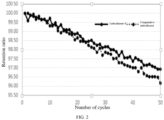
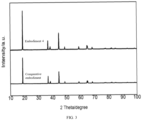
- FIG. 1 Comparison diagrams of capacities, cycles and XRD of lithium-ion battery layered positive electrode materials obtained in Embodiment 4 and Comparative embodiment 1 are shown in FIG. 1 , FIG. 2 and FIG. 3 respectively.
- Embodiment 4 It may be known through comparison of Embodiment 4 and Embodiments 8 to 9 that compared with barium doping and boron doping, a capacity and a retention ratio of a positive electrode material obtained by zirconium doping are better.
Landscapes
- Chemical & Material Sciences (AREA)
- Organic Chemistry (AREA)
- Inorganic Chemistry (AREA)
- Chemical Kinetics & Catalysis (AREA)
- Electrochemistry (AREA)
- General Chemical & Material Sciences (AREA)
- Engineering & Computer Science (AREA)
- Materials Engineering (AREA)
- Composite Materials (AREA)
- Manufacturing & Machinery (AREA)
- Geology (AREA)
- Life Sciences & Earth Sciences (AREA)
- General Life Sciences & Earth Sciences (AREA)
- Battery Electrode And Active Subsutance (AREA)
Abstract
Description
- The present disclosure relates to the technical field of batteries, in particular to a layered cobalt-free positive electrode material, a preparation method therefor and a lithium-ion battery.
- A global energy issue is increasingly serious, and an environmental issue is also becoming more prominent. To develop a new efficient energy technology and a new energy material has become an important way to solve social, energy and environmental issues. A lithium-ion battery, as a clean efficient energy means, is of wide interest, and is widely applied to various fields such as electronic products, automobiles and aerospace because of its high energy density, good cycle performance and other advantages. With higher and higher demands of people for environmental friendliness, run time, life and the like of the lithium-ion battery, battery design and optimization are also more and more important. Development of new energy automobiles is in urgent need for improvement on power battery specific energy and reduction of cost.
- At present, specific energy of a lithium iron phosphate battery has approached to the limit, and synthetic cost of a positive electrode material of a high-capacity layered structure is high. A conventional synthetic process of a layered structure positive electrode material needs co-precipitation to synthesize a precursor, then the precursor is mixed with lithium for calcination to obtain a target product, for example, co-precipitation is performed in the following way to synthesize the precursor: a sulfate is selected as a raw material, then an appropriate precipitant is added, and a precipitate is obtained by controlling power of hydrogen, stirring temperature and speed, reaction time, a concentration and the like of a solution. The process has disadvantages of producing much industrial wastewater, having many synthetic process steps, costing highly, and causing nonuniformity and many elements not to be doped into a crystal lattice when the precursor is mixed and doped with a lithium salt. In general, the precursor at a co-precipitation stage may be produced by a professional company, then the precursor is sold to a positive electrode material manufacturer, many steps are needed in the middle, and meanwhile, it spends much transportation cost. Besides, most of positive electrode material manufacturers stabilize a structure only through interface doping during synthesis of a layered positive electrode material, which has a defect of fast attenuation during cycle.
- A method for preparing a layered cobalt-free positive electrode material is provided in an embodiment of the present disclosure and includes the following steps:
- (1) mixing a lithium salt, a nickel source, a manganese source, a dopant and a solvent, and then carrying out a wet ball-milling to obtain a mixed slurry;
- (2) spray drying the mixed slurry to obtain a precursor; and
- (3) carrying out a primary calcination on the precursor in an oxygen-containing atmosphere to obtain the layered cobalt-free positive electrode material, wherein the chemical formula of the layered cobalt-free positive electrode material is LiaNibMncMdO2, wherein 1.0≤a≤1.2, 0≤b≤1.0, 0≤c≤1.0, b+c=1, 0<d≤0.1; and
- In the layered cobalt-free positive electrode material obtained by the method provided in the embodiment of the present disclosure, a may be, for example, 1.0, 1.05, 1.1, 1.05, 1.1, 1.2 or the like, b may be, for example, 0, 0.1, 0.2, 0.3, 0.5, 0.7, 0.8, 1.0 or the like, c may be, for example, 0, 0.2, 0.3, 0.4, 0.5, 0.6, 0.8, 1.0 or the like, d may be, for example, 0.002, 0.003, 0.004, 0.005, 0.006, 0.008, 0.01, 0.015, 0.017, 0.02, 0.025, 0.03, 0.035, 0.04, 0.045, 0.05, 0.055, 0.06, 0.065, 0.07, 0.075, 0.08, 0.085, 0.09, 0.1 or the like.
- In an embodiment, d is 0.002 to 0.01.
- In the present disclosure, consumptions of the nickel source, the manganese source, the lithium salt and the dopant should meet a formula ratio, namely, a molar ratio of corresponding elements lithium to nickel to manganese to M meets a:b:c:d.
- In a nickel-cobalt-manganese ternary material, cobalt plays a very important role in structure stabilizing, however, development and application of the ternary material are limited due to high price of the cobalt, a cobalt-free material avoids use of the cobalt, so cost is greatly reduced, the cobalt-free material is expected to replace the ternary material, but due to the lack of the cobalt, structure stability of the cobalt-free material is reduced greatly, and playing of its electrochemical performance is affected. An embodiment of the present disclosure replaces the expensive cobalt element with the above specific type of doping element, especially, a doping element with a larger ionic radius, wet ball-milling and spray drying processes are used cooperatively, so not only can bulk phase doping be realized, but also a c-axis increases, layering is more obvious, and lithium-nickel mixing is reduced when crystals are formed in the material, thereby improving the stability of the material, and excellent electrochemical performance is obtained.
- In the method provided by the embodiment of the present disclosure, raw materials are mixed directly, the layered positive electrode material is prepared through calcination, the process method is less studied at home and abroad and, compared with a conventional co-precipitation method and sol-gel method, has the following advantages: the method is simple, less wastewater is produced in the process, cost is low, bulk phase doping of elements can be implemented on the premise of omitting the cobalt, the doping element uniformly enters a crystal lattice, and the stability of the material is improved.
- In an embodiment, the doping element M is at least one of Zr, Sr, Ta, W or Y
- In an embodiment, the doping element M is Zr, a combination of Zr and Sr, a combination of Zr and Ta, or a combination of W and Y
- Different types of doping elements cause different crystal parameters in a crystal structure, and layered materials are different mainly in c axes, which leads to difference in electrical performance.
- In an embodiment, the dopant is an oxide of M and/or a salt of M.
- In an embodiment, the doping element is the oxide of M.
- In an embodiment, the nickel source in step (1) is selected from at least one of a nickel salt or an oxide of nickel.
- In an embodiment, the nickel source in step (1) is NiO.
- In an embodiment, the manganese source in step (1) is selected from at least one of a manganese salt or an oxide of manganese.
- In an embodiment, the manganese source in step (1) is Mn3O4.
- In an embodiment, the lithium salt in step (1) includes Li2CO3 and/or LiOH.
- In an embodiment, the nickel source, the manganese source and the lithium salt are selected from NiO, Mn3O4, Li2CO3 and LiOH, and these products are staple commodities in the market, stable in performance and easy to process.
- In an embodiment, the wet ball-milling in step (1) is carried out at a speed of ranging from 2000 r/min to 3000 r/min, for example, 2000 r/min, 2200 r/min, 2300 r/min, 2400 r/min, 2500 r/min, 2600 r/min, 2800 r/min, 3000 r/min or the like, for a time period of ranging from 1 h to 2 h, for example, 1 h, 1.2 h, 1.3 h, 1.5 h, 1.7 h, 1.8 h, 2 h or the like.
- In an embodiment, a volume fraction of oxygen in the oxygen-containing atmosphere in step (3) is greater than 20%, for example, 21%, 25%, 30%, 50%, 60%, 70%, 80%, 90% or 100%.
- In an embodiment, the primary calcination in step (3) is carried out at a temperature of ranging from 700°C to 1100°C, for example, 700°C, 750°C, 800°C, 825°C, 850°C, 880°C, 900°C, 950°C, 1000°C, 1050°C, 1100°C or the like.
- In an embodiment, the primary calcination in step (3) is carried out at a temperature of ranging from 800°C to 950°C.
- In an embodiment, the primary calcination in step (3) is carried out for a time period of ranging from 6 h to 20 h, for example, 6 h, 8 h, 9 h, 10 h, 12 h, 15 h, 17 h, 18 h, 20 h or the like.
- In an embodiment, the primary calcination in step (3) is carried out for a time period of ranging from 8 h to 15 h.
- A temperature and time of primary calcination may affect forming of a layered structure of the positive electrode material and have a certain influence on crystallinity, and within the above range, the layered structure is easy to form and crystallinity is high.
- In an embodiment, the method further includes performing coating treatment on the layered cobalt-free positive electrode material after step (3).
- In an embodiment, the coating treatment includes: mixing the layered cobalt-free positive electrode material with a coating agent, and carrying out a secondary calcination in an oxygen-containing atmosphere to obtain a coated layered cobalt-free positive electrode material.
- In an embodiment, the coating agent includes at least one of Al2O3, ZrO2 or WO3.
- In an embodiment, a mass ratio of the layered cobalt-free positive electrode material to the coating agent is 100:(0.12-0.4), for example, 100:0.12, 100:0.15, 100:0.18, 100:0.2, 100:0.22, 100:0.26, 100:0.28, 100:0.3, 100:0.33, 100:0.35, 100:0.37, 100:0.4 or the like.
- In an embodiment, the secondary calcination is carried out at a temperature of ranging from 300°C to 900°C. for example, 300°C, 350°C, 400°C, 500°C, 550°C, 600°C, 650°C, 700°C, 750°C, 800°C or the like.
- In an embodiment, the secondary calcination is carried out at a temperature of ranging from 500°C to 800°C.
- In an embodiment, the secondary calcination is carried out for a time period of ranging from 3 h to 10 h, for example, 3 h, 4 h, 5 h, 6 h, 7 h, 8 h, 9 h, 10 h or the like.
- In an embodiment, the secondary calcination is carried out for a time period of ranging from 4 h to 7 h.
- By performing coating and secondary calcination on the layered cobalt-free positive electrode material, conductivity of the material may be enhanced, a surface of the positive electrode material is repaired, and the surface of the positive electrode material is prevented from having a strong side reaction with an electrolyte. By optimizing a temperature and time of the secondary calcination, a better coating effect may be obtained.
- In an embodiment, steps of crushing and sieving are carried out on the layered cobalt-free positive electrode material before the coating treatment.
- In an embodiment, the method includes the following steps:
- S1: formulating the lithium salt, the nickel source, the manganese source and the dopant MOx (x is an oxygen content meeting a valence balance of MOx elements) according to a molar ratio a:b:c:d of lithium to nickel to manganese to M, then adding them into deionized water in sequence for uniform mixing to form a suspension, adding the suspension into a ceramic grinding machine, and milling at a speed of 2000 r/min for a time period of 1 h to obtain a slurry;
- S2: spray drying the slurry to obtain powder, calcinating the powder at a temperature of ranging from 800°C to 950°C for a time period of ranging from 8 h to 15 h in an air atmosphere, and cooling, crushing and sieving to obtain a layered positive electrode material LiaNibMncMdO2, wherein 1.0<a<1.2, 0≤b≤1.0, 0≤c≤1.0, b+c=1, 0<d≤0.1; and
- S3: formulating the layered positive electrode material LiaNibMncMdO2 and the coating agent according to a mass ratio 100:(0.15-0.4), mixing in a high-speed mixer, and calcinating the obtained mixture in an air atmosphere at a temperature of ranging from 500°C to 800°C for a time period of ranging from 4 h to 7 h to obtain a coated layered cobalt-free positive electrode material, wherein the positive electrode material is also a layered positive electrode material;
- wherein the dopant is selected from at least one of oxides of Zr, Sr, Ta, W or Y; and
- the coating agent is selected from at least one of Al2O3, ZrO2 or WO3.
- In the method provided in the embodiment of the present disclosure, the expensive cobalt element is replaced with the above specific type of doping element, especially, a doping element (for example, Zr, Sr, Ta, W and Y) with a larger ionic radius, wet ball-milling and spray drying processes are used cooperatively, so not only can bulk phase doping be realized, but also a c-axis increases, layering is more obvious, and lithium-nickel mixing is reduced when crystals are formed in the material, thereby improving the stability of the material, and excellent electrochemical performance is obtained.
- In the method provided by the embodiment of the present disclosure, raw materials are mixed directly, the layered positive electrode material is prepared through calcination, and compared with a conventional co-precipitation method and sol-gel method, the method has the following advantages: the method is simple, less wastewater is produced in the process, cost is low, bulk phase doping of elements can be implemented on the premise of omitting the cobalt, the doping element uniformly enters a crystal lattice, and the stability of the material is improved.
- A layered cobalt-free positive electrode material obtained by the above method is provided in an embodiment of the present disclosure.
- A lithium-ion battery is provided in an embodiment of the present disclosure and includes the above layered cobalt-free positive electrode material.
- Accompanying drawings are for providing further understanding of the technical solutions of the present disclosure, constitute a part of the specification and together with the embodiments of the present application, serve to explain the technical solutions of the present disclosure without constituting the limitation on the technical solutions of the present disclosure.
-
FIG. 1 is a comparison diagram of specific capacity of a layered positive electrode material obtained inEmbodiment 4 of the present disclosure and specific capacity of a layered positive electrode material obtained in Comparative embodiment 1. -
FIG. 2 is a comparison diagram of cycle of a layered positive electrode material obtained inEmbodiment 4 of the present disclosure and cycle of a layered positive electrode material obtained in Comparative embodiment 1. -
FIG. 3 is a comparison diagram of XRD of a layered positive electrode material obtained inEmbodiment 4 of the present disclosure and XRD of a layered positive electrode material obtained in Comparative embodiment 1. - The technical solutions of the present disclosure are further described below through specific implementations. Those skilled in the art should understand that the embodiments are only intended to help understand the present disclosure but not to be regarded as a specific limitation on the present disclosure.
- This embodiment provides a method for preparing a layered positive electrode material. The method includes the following steps:
- (1) a lithium salt Li2CO3, a nickel source NiO, a manganese source Mn3O4 and a dopant ZrO2 are formulated according to a molar ratio 1.05:0.6:0.4:0.003 of lithium to nickel to manganese to cobalt, and then added into deionized water in sequence for uniform mixing to form a suspension, the suspension is added into a ceramic grinding machine and milled at a speed of 2000 r/min for a time period of 1 h to obtain a slurry, and the slurry is spray dried at a temperature of 180°C to obtain powder.
- (2) The above powder is calcinated at a temperature of 900°C for a time period of 12 h in an air atmosphere, cooled, crushed and sieved to obtain a layered positive electrode material. The above obtained positive electrode material and a coating agent WO3 are formulated according to a mass ratio 100:0.13, and mixed in a high-speed mixer, the obtained mixture is calcinated in an air atmosphere at a temperature of 500°C for a time period of 5 h, and then a final layered positive electrode material may be obtained.
- This embodiment provides a method for preparing a layered positive electrode material. The method includes the following steps: (1) a lithium salt Li2CO3, a nickel source NiO, a manganese source Mn3O4 and a dopant ZrO2 are formulated according to a molar ratio 1.05:0.75:0.25:0.004 of lithium to nickel to manganese to cobalt, and then added into deionized water in sequence for uniform mixing to form a suspension, the suspension is added into a ceramic grinding machine and milled at a speed of 2000 r/min for a time period of 1 h to obtain a slurry, and the slurry is spray dried at a temperature of 180°C to obtain powder.
(2) The above powder is calcinated at a temperature of 880°C for a time period of 10 h in an air atmosphere, cooled, crushed and sieved to obtain a layered positive electrode material. The above obtained positive electrode material and a coating agent Al2O3 are formulated according to a mass ratio 100:0.2, and mixed in a high-speed mixer, the obtained mixture is calcinated in an air atmosphere at a temperature of 600°C for a time period of 5 h, and then a final layered positive electrode material may be obtained. - This embodiment provides a method for preparing a layered positive electrode material. The method includes the following steps:
- (1) a lithium salt LiOH, a nickel source NiCO3, a manganese source MnCO3 and a dopant (Ta2O5 and ZrO2) are formulated according to a molar ratio 1.06:0.3:0.7:0.006:0.004 of lithium to nickel to manganese to tantalum to cobalt, and then added into deionized water in sequence for uniform mixing to form a suspension, the suspension is added into a ceramic grinding machine and milled at a speed of 2500 r/min for a time period of 1.5 h to obtain a slurry, and the slurry is spray dried at a temperature of 180°C to obtain powder. The above powder is calcinated at a temperature of 860°C for a time period of 10 h in an air atmosphere, cooled, crushed and sieved to obtain a layered positive electrode material.
- (2) The above obtained positive electrode material and a coating agent WO3 are formulated according to a mass ratio 100:0.15, and mixed in a high-speed mixer, the obtained mixture is calcinated in an air atmosphere at a temperature of 500°C for a time period of 6 h, and then a final layered positive electrode material may be obtained.
- This embodiment provides a method for preparing a layered positive electrode material. The method includes the following steps:
- (1) a lithium salt Li2CO3, a nickel source NiO, a manganese source Mn3O4 and a dopant ZrO2 are formulated according to a molar ratio 1.06:0.8:0.2:0.002 of lithium to nickel to manganese to cobalt, and then added into deionized water in sequence for uniform mixing to form a suspension, the suspension is added into a ceramic grinding machine and milled at a speed of 2500 r/min for a time period of 1.2 h to obtain a slurry, and the slurry is spray dried at a temperature of 180°C to obtain powder. The above powder is calcinated at a temperature of 860°C for a time period of 10 h in an air atmosphere, cooled, crushed and sieved to obtain a layered positive electrode material.
- (2) The above obtained positive electrode material and coating agents ZrO2 and Al2O3 are formulated according to a mass ratio 100:0.17:0.2, and mixed in a high-speed mixer, the obtained mixture is calcinated in an air atmosphere at a temperature of 700°C for a time period of 6 h, and then a final layered positive electrode material may be obtained.
- This embodiment provides a method for preparing a layered positive electrode material. The method includes the following steps:
- (1) a lithium salt Li2CO3, a nickel source NiO, a manganese source MnCO3 and a dopant (WO3 and Y2O3) are formulated according to a molar ratio 1.07:0.9:0.1:0.003:0.004 of lithium to nickel to manganese to wolfram to yttrium, and then added into deionized water in sequence for uniform mixing to form a suspension, the suspension is added into a ceramic grinding machine and milled at a speed of 2800 r/min for a time period of 2 h to obtain a slurry, and the slurry is spray dried at a temperature of 180°C to obtain powder. The above powder is calcinated at a temperature of 920°C for a time period of 10 h in an air atmosphere, cooled, crushed and sieved to obtain a layered positive electrode material.
- (2) The above obtained positive electrode material and a coating agent ZrO2 are formulated according to a mass ratio 100:0.17, and mixed in a high-speed mixer, the obtained mixture is calcinated in an air atmosphere at a temperature of 700°C for a time period of 6 h, and then a final layered positive electrode material may be obtained.
- This embodiment provides a method for preparing a layered positive electrode material. The method includes the following steps:
- (1) a lithium salt Li2CO3, a nickel source NiCO3, a manganese source MnCO3 and a dopant BaCO3 are formulated according to a molar ratio 1.05:0.5:0.5:0.003 of lithium to nickel to manganese to barium, and then added into deionized water in sequence for uniform mixing to form a suspension, the suspension is added into a ceramic grinding machine and milled at a speed of 2500 r/min for a time period of 1.5 h to obtain a slurry, and the slurry is spray dried at a temperature of 180°C to obtain powder.
- (2) The above powder is calcinated at a temperature of 860°C for a time period of 10 h in an air atmosphere, cooled, crushed and sieved to obtain a layered positive electrode material. The above obtained positive electrode material and the coating agent WO3 are formulated according to a mass ratio 100:0.2, and mixed in a high-speed mixer, the obtained mixture is calcinated in an air atmosphere at a temperature of 400°C for a time period of 6 h, and then a final layered positive electrode material may be obtained.
- This embodiment provides a method for preparing a layered positive electrode material. The method includes the following steps:
- (1) a lithium salt Li2CO3, a nickel source NiO, a manganese source MnO2 and a dopant ZrO2 are formulated according to a molar ratio 1.05:0.25:0.75:0.003 of lithium to nickel to manganese to zirconium, and then added into deionized water in sequence for uniform mixing to form a suspension, the suspension is added into a ceramic grinding machine and milled at a speed of 3000 r/min for a time period of 1.5 h to obtain a slurry, and the slurry is spray dried at a temperature of 180°C to obtain powder.
- (2) The above powder is calcinated at a temperature of 950°C for a time period of 10 h in an air atmosphere, cooled, crushed and sieved to obtain a layered positive electrode material. The above obtained positive electrode material and the coating agent Al2O3 are formulated according to a mass ratio 100:0.2, and mixed in a high-speed mixer, the obtained mixture is calcinated in an air atmosphere at a temperature of 600°C for a time period of 5 h, and then a final layered positive electrode material may be obtained.
- This embodiment provides a method for preparing a layered positive electrode material. The method includes the following steps:
- (1) a lithium salt Li2CO3, a nickel source NiO, a manganese source Mn3O4 and a dopant BaO are formulated according to a molar ratio 1.06:0.8:0.2:0.002 of lithium to nickel to manganese to barium, and then added into deionized water in sequence for uniform mixing to form a suspension, the suspension is added into a ceramic grinding machine and milled at a speed of 2500 r/min for a time period of 1.2 h to obtain a slurry, and the slurry is spray dried at a temperature of 180°C to obtain powder. The above powder is calcinated at a temperature of 860°C for a time period of 10 h in an air atmosphere, cooled, crushed and sieved to obtain a layered positive electrode material.
- (2) The above obtained positive electrode material and coating agents ZrO2 and Al2O3 are formulated according to a mass ratio 100:0.17:0.2, and mixed in a high-speed mixer, the obtained mixture is calcinated in an air atmosphere at a temperature of 700°C for a time period of 6 h, and then a final layered positive electrode material may be obtained.
- This embodiment provides a method for preparing a layered positive electrode material. The method includes the following steps:
- (1) a lithium salt Li2CO3, a nickel source NiO, a manganese source Mn3O4 and a dopant B2O3 are formulated according to a molar ratio 1.06:0.8:0.2:0.002 of lithium to nickel to manganese to boron, and then added into deionized water in sequence for uniform mixing to form a suspension, the suspension is added into a ceramic grinding machine and milled at a speed of 2500 r/min for a time period of 1.2 h to obtain a slurry, and the slurry is spray dried at a temperature of 180°C to obtain powder. The above powder is calcinated at a temperature of 860°C for a time period of 10 h in an air atmosphere, cooled, crushed and sieved to obtain a layered positive electrode material.
- (2) The above obtained positive electrode material and coating agents ZrO2 and Al2O3 are formulated according to a mass ratio 100:0.17:0.2, and mixed in a high-speed mixer, the obtained mixture is calcinated in an air atmosphere at a temperature of 700°C for a time period of 6 h, and then a final layered positive electrode material may be obtained.
- This embodiment provides a method for preparing a layered positive electrode material. The method includes the following steps:
- (1) a lithium salt Li2CO3, a nickel source NiO, a manganese source Mn3O4 and a dopant ZrO2 are formulated according to a molar ratio 1.06:0.8:0.2:0.002 of lithium to nickel to manganese to cobalt, and then added into deionized water in sequence for uniform mixing to form a suspension, the suspension is added into a ceramic grinding machine and milled at a speed of 2500 r/min for a time period of 1.2 h to obtain a slurry, and the slurry is spray dried at a temperature of 180°C to obtain powder. The above powder is calcinated at a temperature of 700°C for a time period of 10 h in an air atmosphere, cooled, crushed and sieved to obtain a layered positive electrode material.
- (2) The above obtained positive electrode material and coating agents ZrO2 and Al2O3 are formulated according to a mass ratio 100:0.17:0.2, and mixed in a high-speed mixer, the obtained mixture is calcinated in an air atmosphere at a temperature of 700°C for a time period of 6 h, and then a final layered positive electrode material may be obtained.
- This embodiment provides a method for preparing a layered positive electrode material. The method includes the following steps:
- (1) a lithium salt Li2CO3, a nickel source NiO, a manganese source Mn3O4 and a dopant ZrO2 are formulated according to a molar ratio 1.06:0.8:0.2:0.002 of lithium to nickel to manganese to cobalt, and then added into deionized water in sequence for uniform mixing to form a suspension, the suspension is added into a ceramic grinding machine and milled at a speed of 2500 r/min for a time period of 1.2 h to obtain a slurry, and the slurry is spray dried at a temperature of 180°C to obtain powder. The above powder is calcinated at a temperature of 1100°C for a time period of 10 h in an air atmosphere, cooled, crushed and sieved to obtain a layered positive electrode material.
- (2) The above obtained positive electrode material and coating agents ZrO2 and Al2O3 are formulated according to a mass ratio 100:0.17:0.2, and mixed in a high-speed mixer, the obtained mixture is calcinated in an air atmosphere at a temperature of 700°C for a time period of 6 h, and then a final layered positive electrode material may be obtained.
- This embodiment provides a method for preparing a layered positive electrode material. The method includes the following steps:
- (1) a lithium salt Li2CO3, a nickel source NiO, a manganese source Mn3O4 and a dopant ZrO2 are formulated according to a molar ratio 1.06:0.8:0.2:0.1 of lithium to nickel to manganese to cobalt, and then added into deionized water in sequence for uniform mixing to form a suspension, the suspension is added into a ceramic grinding machine and milled at a speed of 2500 r/min for a time period of 1.2 h to obtain a slurry, and the slurry is spray dried at a temperature of 180°C to obtain powder. The above powder is calcinated at a temperature of 860°C for a time period of 10 h in an air atmosphere, cooled, crushed and sieved to obtain a layered positive electrode material.
- (2) The above obtained positive electrode material and coating agents ZrO2 and Al2O3 are formulated according to a mass ratio 100:0.17:0.2, and mixed in a high-speed mixer, the obtained mixture is calcinated in an air atmosphere at a temperature of 700°C for a time period of 6 h, and then a final layered positive electrode material may be obtained.
- This comparative embodiment provides a method for preparing a layered positive electrode material. The method includes the following steps:
- (1) a nickel source NiClz and a manganese source MnCl are formulated into a mixed aqueous solution with a molar ratio 0.8:0.2 of nickel to manganese and a concentration 80 g/L. A sodium hydroxide aqueous solution with a concentration 100 g/L and an ammonia-water solution with a concentration 180 g/L are prepared respectively and are uniformly mixed according to a volume ratio 10:1 to form a precipitant. The two prepared solutions are added into a reactor with a stirrer through a constant flow pump, a nickel and manganese salt mixed solution is controlled to flow at a rate of 300 ml/h, a pH value in the reactor is controlled to be 9.0 by adjusting a flow rate of the precipitant, a reaction temperature is controlled to be 60°C, and after reacting for a time period of 40 h, the obtained precipitate is repeatedly filtered and washed with 80°C pure water. The obtained precipitate is subjected to a drying treatment in a drying oven with a temperature set at 80°C to obtain a positive electrode material precursor.
- (2) The positive electrode material precursor is mixed with a lithium source LiOH and a dopant ZrO2 (a molar ratio of lithium to nickel to manganese to zirconium after mixing meets 1.06:0.8:0.2:0.002) to obtain a product after mixing; the product after mixing is calcinated at a temperature of 860°C for a time period of 10 h, the product after calcination is crushed and sieved; and the product after primary calcination and coating agents ZrO2 and Al2O3 are mixed according to a mass ratio 100:0.17:0.2, then subjected to a heat treatment at a temperature of 700°C for a time period of 6 h, and are naturally cooled and sieved to obtain a layered positive electrode material.
- This comparative embodiment provides a method for preparing a layered positive electrode material. The method includes the following steps:
- (1) a lithium salt Li2CO3, a nickel source NiO, a manganese source Mn3O4 and a dopant Al2O3 are formulated according to a molar ratio 1.06:0.8:0.2:0.002 of lithium to nickel to manganese to aluminum, and then added into deionized water in sequence for uniform mixing to form a suspension, the suspension is added into a ceramic grinding machine and milled at a speed of 2500 r/min for a time period of 1.2 h to obtain a slurry, and the slurry is spray dried at a temperature of 180°C to obtain powder. The above powder is calcinated at a temperature of 860°C for a time period of 10 h in an air atmosphere, cooled, crushed and sieved to obtain a layered positive electrode material.
- (2) The above obtained positive electrode material and coating agents ZrO2 and Al2O3 are formulated according to a mass ratio 100:0.17:0.2, and mixed in a high-speed mixer, the obtained mixture is calcinated in an air atmosphere at a temperature of 700°C for a time period of 6 h, and then a final layered positive electrode material may be obtained.
- Positive electrode materials of each embodiment and each comparative embodiment are tested in the same way, first, the prepared layered positive electrode material, carbon black (SP) and polyvinylidene fluoride (PVDF) are added into N-methylpyrrolidone (NMP) according to a mass ratio 92:4:4, uniformly mixed and then applied on an aluminum foil to be dried at a temperature of 100°C for a time period of 4 h and cut into a positive electrode sheet with a diameter being 12 mm, assembling is performed to form a button half battery, the button half battery is in still standing for a time period of 12 h, an electrochemical test is performed, and a test result is shown in Table 1.
- Capacity test: this test is first discharge capacity under 0.1C.
- Cycle test: this test is a retention ratio of 50 cycles under 1C.
- Comparison diagrams of capacities, cycles and XRD of lithium-ion battery layered positive electrode materials obtained in
Embodiment 4 and Comparative embodiment 1 are shown inFIG. 1 ,FIG. 2 andFIG. 3 respectively. - Results of
FIG. 1 andFIG. 2 show that compared with a layered positive electrode material prepared by a conventional co-precipitation method, the layered positive electrode material prepared by the present disclosure is better in cycle performance and stability under the condition of the equivalent capacity. A result ofFIG. 3 shows that the present disclosure truly prepares the layered positive electrode material, and a peak shape corresponds to a peak shape of the layered positive electrode material prepared by the conventional co-precipitation method.Table 1 Instance First discharge capacity (mAh/g) Capacity retention ratio (%) of 50 cycles Embodiment 1 180.1 96.8 Embodiment 2185.4 96.9 Embodiment 3 145.2 97.9 Embodiment 4205.2 96.9 Embodiment 5 212.1 97.8 Embodiment 6 164.1 98.5 Embodiment 7 138.3 98.9 Embodiment 8 201.2 96.0 Embodiment 9 202.1 95.5 Embodiment 10199.2 95.8 Embodiment 11 194.1 95.4 Embodiment 12 196.2 96.1 Comparative embodiment 1 207.4 96.1 Comparative embodiment 2192.2 95.0 - The present disclosure performs bulk phase doping by using specific types of elements and may obtain good structure stability on the premise of omitting cobalt and obtain excellent cycle performance on the premise of not losing capacity.
- It may be known through comparison of
Embodiment 4 and Embodiments 8 to 9 that compared with barium doping and boron doping, a capacity and a retention ratio of a positive electrode material obtained by zirconium doping are better. - It may be known through comparison of
Embodiment 4 andEmbodiments 10 to 11 that a temperature of the primary calcination has a significant influence on product performance, and a crystal structure is more obvious in layering and better in electrical performance within a preferred range of 800°C to 950°C. - It may be known through comparison of
Embodiment 4 and Embodiment 12 that too much doped zirconium has an inhibiting effect on the capacity playing. - It may be known through comparison of
Embodiment 4 andComparative embodiment 2 that zirconium doping has an advantage of capacity playing over aluminum doping.
Claims (13)
- A method for preparing a layered cobalt-free positive electrode material, wherein the method comprising the following steps:(1) mixing a lithium salt, a nickel source, a manganese source, a dopant and a solvent, and then carrying out a wet ball-milling to obtain a mixed slurry;(2) spray drying the mixed slurry to obtain a precursor; and(3) carrying out a primary calcination on the precursor in an oxygen-containing atmosphere to obtain the layered cobalt-free positive electrode material, wherein the chemical formula of the layered cobalt-free positive electrode material is LiaNibMncMdO2, wherein 1.0≤a≤1.2, 0≤b≤1.0, 0≤c≤1.0, b+c=1, 0<d≤0.1; andwherein the doping element M in the dopant is selected from at least one of Ta, Rb, Sr, Zr, Na, Cs, Y, W, B, Nb, Ba, Mo or P.
- The method of claim 1, wherein the doping element M is at least one of Zr, Sr, Ta, W or Y
- The method of claim 2, wherein the doping element M is Zr, a combination of Zr and Sr, a combination of Zr and Ta, or a combination of W and Y
- The method of any one of claims 1 to 3, wherein the dopant is an oxide of M and/or a salt of M;the nickel source in step (1) is selected from at least one of a nickel salt or an oxide of nickel;the manganese source in step (1) is selected from at least one of a manganese salt or an oxide of manganese; andthe lithium salt in step (1) comprises Li2CO3 and/or LiOH.
- The method of any one of claims 1 to 4, wherein the wet ball-milling in step (1) is carried out at a speed of ranging from 2000 r/min to 3000 r/min for a time period of ranging from 1 h to 2 h.
- The method of any one of claims 1 to 5, wherein a volume fraction of oxygen in the oxygen-containing atmosphere in step (3) is greater than 20%; and
the primary calcination in step (3) is carried out at a temperature of ranging from 700°C to 1100°C for a time period of ranging from 6 h to 20 h. - The method of any one of claims 1 to 6, wherein the method further comprises performing coating treatment on the layered cobalt-free positive electrode material after step (3);
wherein the coating treatment comprises: mixing the layered cobalt-free positive electrode material with a coating agent, and carrying out a secondary calcination in an oxygen-containing atmosphere to obtain a coated layered cobalt-free positive electrode material; wherein the coating agent comprises at least one of Al2O3, ZrO2 or WO3. - The method of any one of claims 1 to 7, wherein a mass ratio of the layered cobalt-free positive electrode material to the coating agent is 100:(0.12-0.4).
- The method of any one of claims 1 to 8, wherein the secondary calcination is carried out at a temperature of ranging from 300°C to 900°C for a time period of ranging from 3 h to 10 h.
- The method of any one of claims 7 to 9, wherein steps of crushing and sieving are carried out on the layered cobalt-free positive electrode material before the coating treatment.
- The method of any one of claims 1 to 10, wherein the method comprises the following steps:S1: formulating the lithium salt, the nickel source, the manganese source and the dopant MOx according to a molar ratio a:b:c:d of lithium to nickel to manganese to M, then adding them into deionized water in sequence for uniform mixing to form a suspension, adding the suspension into a ceramic grinding machine, and milling at a speed of 2000 r/min for 1 h to obtain a slurry;S2: spray drying the slurry to obtain powder, calcinating the powder at a temperature of ranging from 800°C to 950°C for a time period of ranging from 8 h to 15 h in an air atmosphere, and cooling, crushing and sieving to obtain a layered positive electrode material LiaNibMncMdO2, wherein 1.0≤a≤1.2, 0≤b≤1.0, 0≤c≤1.0, b+c=1, 0<d≤0.1; andS3: formulating the layered positive electrode material LiaNibMncMdO2 and the coating agent according to a mass ratio 100:(0.15-0.4), mixing in a high-speed mixer, and calcinating the obtained mixture in an air atmosphere at a temperature of ranging from 500°C to 800°C for a time period of ranging from 4 h to 7 h to obtain a coated layered cobalt-free positive electrode material;wherein the dopant is selected from at least one of oxides of Zr, Sr, Ta, W or Y; andthe coating agent is selected from at least one of Al2O3, ZrO2 or WO3.
- A layered cobalt-free positive electrode material obtained by using the method of any one of claims 1 to 11.
- A lithium-ion battery, comprising the layered cobalt-free positive electrode material of claim 12.
Applications Claiming Priority (2)
| Application Number | Priority Date | Filing Date | Title |
|---|---|---|---|
| CN202110352067.1A CN113060776B (en) | 2021-03-31 | 2021-03-31 | A kind of layered cobalt-free cathode material, its preparation method and lithium ion battery |
| PCT/CN2022/082155 WO2022206465A1 (en) | 2021-03-31 | 2022-03-22 | Layered cobalt-free positive electrode material and preparation method therefor, and lithium-ion battery |
Publications (2)
| Publication Number | Publication Date |
|---|---|
| EP4289794A1 true EP4289794A1 (en) | 2023-12-13 |
| EP4289794A4 EP4289794A4 (en) | 2024-08-28 |
Family
ID=76565224
Family Applications (1)
| Application Number | Title | Priority Date | Filing Date |
|---|---|---|---|
| EP22778648.0A Pending EP4289794A4 (en) | 2021-03-31 | 2022-03-22 | Layered cobalt-free positive electrode material and preparation method therefor, and lithium-ion battery |
Country Status (4)
| Country | Link |
|---|---|
| US (1) | US20240162420A1 (en) |
| EP (1) | EP4289794A4 (en) |
| CN (1) | CN113060776B (en) |
| WO (1) | WO2022206465A1 (en) |
Families Citing this family (20)
| Publication number | Priority date | Publication date | Assignee | Title |
|---|---|---|---|---|
| CN113060776B (en) * | 2021-03-31 | 2023-07-25 | 蜂巢能源科技有限公司 | A kind of layered cobalt-free cathode material, its preparation method and lithium ion battery |
| CN113488634B (en) * | 2021-07-29 | 2022-09-13 | 浙江帕瓦新能源股份有限公司 | Double-layer coated modified high-nickel cobalt-free single crystal ternary cathode material and preparation method thereof |
| CN113809290B (en) * | 2021-07-30 | 2023-02-28 | 蜂巢能源科技有限公司 | Cobalt-free high-nickel cathode material and preparation method thereof |
| CN113666430A (en) * | 2021-07-30 | 2021-11-19 | 蜂巢能源科技有限公司 | Lithium-rich cathode material, preparation method thereof and lithium ion battery |
| CN113675395B (en) * | 2021-08-19 | 2023-05-23 | 蜂巢能源科技有限公司 | Binary positive electrode material, preparation method thereof and lithium ion battery |
| CN113690419B (en) * | 2021-08-25 | 2023-04-14 | 蜂巢能源科技有限公司 | Ternary cathode composite material and preparation method thereof and lithium ion battery |
| CN113851652A (en) * | 2021-08-26 | 2021-12-28 | 蜂巢能源科技有限公司 | Modified cobalt-free positive electrode material of sodium ion battery, preparation method of modified cobalt-free positive electrode material and sodium ion battery |
| CN113889615A (en) * | 2021-08-30 | 2022-01-04 | 中南大学 | A kind of cobalt-free high-nickel ternary concentration gradient core-shell structure lithium ion battery cathode material and preparation method thereof |
| CN113764670A (en) * | 2021-08-30 | 2021-12-07 | 浙江帕瓦新能源股份有限公司 | Conductive polymer modified cobalt-free single crystal ternary cathode material and preparation method thereof |
| CN113903884B (en) * | 2021-09-30 | 2022-07-22 | 清华大学深圳国际研究生院 | Positive electrode active material, preparation method thereof, positive electrode and lithium ion battery |
| CN114551866B (en) * | 2022-03-02 | 2023-10-24 | 浙江帕瓦新能源股份有限公司 | High nickel lithium ion battery positive electrode material and preparation method thereof |
| CN114335552B (en) * | 2022-03-15 | 2022-06-24 | 浙江帕瓦新能源股份有限公司 | Positive electrode material, modification process thereof and solid-state battery |
| CN114597378B (en) * | 2022-03-23 | 2024-03-22 | 蜂巢能源科技股份有限公司 | Ultrahigh nickel polycrystalline positive electrode material and preparation method and application thereof |
| CN114695877B (en) * | 2022-05-06 | 2023-10-27 | 广东工业大学 | A high-nickel cobalt-free lithium-ion battery material and its preparation method |
| CN115259240B (en) * | 2022-06-30 | 2024-04-23 | 蜂巢能源科技股份有限公司 | Cobalt-free positive electrode material, preparation method thereof and lithium ion battery |
| CN114927698B (en) * | 2022-07-18 | 2023-03-31 | 蜂巢能源科技股份有限公司 | Preparation method of cobalt-free cathode material, cobalt-free cathode material and lithium ion battery |
| CN115275184A (en) * | 2022-07-26 | 2022-11-01 | 合肥综合性国家科学中心能源研究院(安徽省能源实验室) | High-nickel cobalt-free cathode material of lithium ion battery and preparation method thereof |
| CN117117109B (en) * | 2023-01-03 | 2024-08-02 | 宁夏汉尧富锂科技有限责任公司 | Cobalt-free monocrystal positive electrode material, preparation method thereof and lithium ion battery |
| CN116314739B (en) * | 2023-04-12 | 2024-04-05 | 南开大学 | A manganese-based layered oxide positive electrode material and its preparation method and application |
| WO2024037261A1 (en) * | 2023-07-13 | 2024-02-22 | 广东邦普循环科技有限公司 | Preparation method for double-layer coated lithium-sodium composite lithium-rich manganese-based positive electrode material |
Family Cites Families (16)
| Publication number | Priority date | Publication date | Assignee | Title |
|---|---|---|---|---|
| CN102237516B (en) * | 2010-04-21 | 2014-07-23 | 中国科学院宁波材料技术与工程研究所 | Preparation method of lithium ion power battery positive electrode material |
| CN102983326B (en) * | 2012-09-20 | 2015-04-29 | 横店集团东磁股份有限公司 | Spherical lithium-nickel-cobalt composite oxide positive electrode material preparation method |
| CN103794758B (en) * | 2014-02-20 | 2016-08-17 | 新乡锦润科技有限公司 | The preparation method of vapour deposition process coating-doping lithium manganate composite anode material |
| US10290869B2 (en) * | 2014-03-20 | 2019-05-14 | Washington University | Doped lithium-rich layered composite cathode materials |
| KR20180009911A (en) * | 2016-07-20 | 2018-01-30 | 주식회사 엘지화학 | Positive Electrode Active Material Comprising High-voltage Lithium Cobalt Oxide for Lithium Secondary Battery and Method of Manufacturing the Same |
| CN108199027A (en) * | 2018-01-09 | 2018-06-22 | 江西理工大学 | A kind of niobium doping is without cobalt nickel-base anode material and preparation method thereof |
| CN108448109B (en) * | 2018-03-23 | 2021-07-02 | 中南大学 | A layered lithium-rich manganese-based cathode material and preparation method thereof |
| CN111244397A (en) * | 2018-11-28 | 2020-06-05 | 天津国安盟固利新材料科技股份有限公司 | High-nickel ternary cathode material and preparation method thereof |
| US20220263086A1 (en) * | 2019-06-28 | 2022-08-18 | Virginia Tech Intellectual Properties, Inc. | Methods and compositions for high-energy battery cathodes |
| CN111434618B (en) * | 2020-01-17 | 2022-07-22 | 蜂巢能源科技有限公司 | Cobalt-free layered positive electrode material, preparation method and lithium ion battery |
| CN111509214B (en) * | 2020-05-14 | 2021-08-17 | 华鼎国联四川电池材料有限公司 | High-nickel layered composite material and lithium ion battery anode material prepared from same |
| CN111592053A (en) * | 2020-06-30 | 2020-08-28 | 国联汽车动力电池研究院有限责任公司 | A kind of nickel-based lithium ion battery cathode material and preparation method and application thereof |
| CN111908519A (en) * | 2020-07-24 | 2020-11-10 | 四川长虹电器股份有限公司 | A kind of high-capacity nickel-rich precursor, positive electrode material and preparation method thereof |
| CN112382734B (en) * | 2020-08-25 | 2021-10-15 | 万向一二三股份公司 | Lithium ion battery positive plate using cobalt-free high-nickel positive electrode material |
| CN112133917B (en) * | 2020-09-09 | 2021-11-26 | 天津巴莫科技有限责任公司 | Preparation method and application of cobalt-free composite material with spinel structure and layered structure |
| CN113060776B (en) * | 2021-03-31 | 2023-07-25 | 蜂巢能源科技有限公司 | A kind of layered cobalt-free cathode material, its preparation method and lithium ion battery |
-
2021
- 2021-03-31 CN CN202110352067.1A patent/CN113060776B/en active Active
-
2022
- 2022-03-22 US US18/280,968 patent/US20240162420A1/en active Pending
- 2022-03-22 WO PCT/CN2022/082155 patent/WO2022206465A1/en not_active Ceased
- 2022-03-22 EP EP22778648.0A patent/EP4289794A4/en active Pending
Also Published As
| Publication number | Publication date |
|---|---|
| US20240162420A1 (en) | 2024-05-16 |
| EP4289794A4 (en) | 2024-08-28 |
| CN113060776B (en) | 2023-07-25 |
| WO2022206465A1 (en) | 2022-10-06 |
| CN113060776A (en) | 2021-07-02 |
Similar Documents
| Publication | Publication Date | Title |
|---|---|---|
| US20240162420A1 (en) | Layered cobalt-free positive electrode material and preparation method therefor, and lithium-ion battery | |
| KR102669854B1 (en) | Single-crystal multi-element cathode material and its manufacturing method and application | |
| CN111446444B (en) | Lithium-rich manganese-based material, preparation method and application thereof | |
| CN109336193B (en) | Multi-element in-situ co-doped ternary material precursor and preparation method and application thereof | |
| CN111509214B (en) | High-nickel layered composite material and lithium ion battery anode material prepared from same | |
| EP4394976A1 (en) | Lithium-rich manganese-based positive electrode material, and preparation method therefor and use thereof | |
| US11569505B2 (en) | Cathode material, and preparation method and application thereof | |
| CN110422890A (en) | Anode material for lithium-ion batteries and preparation method thereof and lithium ion cell positive and lithium ion battery | |
| CN109192972A (en) | Mixture of multi-elements is mixed with modified tertiary cathode material and preparation method thereof | |
| CN113644272A (en) | Cerium-bismuth composite oxide doped lithium ion battery positive electrode material and preparation method thereof | |
| CN109167056A (en) | Tungsten ion doped high-nickel layered oxide lithium battery positive electrode material and preparation method thereof | |
| EP4310952A1 (en) | Iron-manganese-based positive electrode material, and preparation method therefor and use thereof | |
| EP4299650A1 (en) | Core-shell gradient ternary precursor, and preparation method therefor and use thereof | |
| CN110943212A (en) | Vanadium-doped nickel-manganese composite hydroxide and preparation method thereof | |
| CN116960337B (en) | A titanium, strontium, fluorine composite doped co-coated high-voltage ternary positive electrode material and its preparation method and application | |
| CN112225261B (en) | Lithium-rich manganese-based positive electrode material carbonate precursor and preparation method and application thereof | |
| CN112062167A (en) | A micron-scale binary doped lithium-rich material and its preparation method and application | |
| WO2024239832A1 (en) | Sodium nickel iron manganese oxide composite material coated with hydrophobic coating and preparation method therefor | |
| JP2023523209A (en) | Positive electrode active material containing spinel composite solid solution oxide, method for producing same, and lithium secondary battery containing same | |
| CN114094080A (en) | A single crystal lithium-rich layered-spinel composite cathode material and preparation method thereof | |
| CN113690419B (en) | Ternary cathode composite material and preparation method thereof and lithium ion battery | |
| CN119069688A (en) | Positive electrode active material and preparation method thereof, battery and electric device | |
| CN113258057A (en) | Double-element doped ternary nickel-rich anode material precursor and anode material | |
| CN116072858B (en) | A niobium-doped nickel-cobalt-manganese-aluminum lithium quaternary material and a preparation method thereof and a lithium-ion battery containing the same | |
| CN119503885A (en) | A method for preparing modified lithium manganese oxide positive electrode material |
Legal Events
| Date | Code | Title | Description |
|---|---|---|---|
| STAA | Information on the status of an ep patent application or granted ep patent |
Free format text: STATUS: THE INTERNATIONAL PUBLICATION HAS BEEN MADE |
|
| PUAI | Public reference made under article 153(3) epc to a published international application that has entered the european phase |
Free format text: ORIGINAL CODE: 0009012 |
|
| STAA | Information on the status of an ep patent application or granted ep patent |
Free format text: STATUS: REQUEST FOR EXAMINATION WAS MADE |
|
| 17P | Request for examination filed |
Effective date: 20230906 |
|
| AK | Designated contracting states |
Kind code of ref document: A1 Designated state(s): AL AT BE BG CH CY CZ DE DK EE ES FI FR GB GR HR HU IE IS IT LI LT LU LV MC MK MT NL NO PL PT RO RS SE SI SK SM TR |
|
| DAV | Request for validation of the european patent (deleted) | ||
| DAX | Request for extension of the european patent (deleted) | ||
| A4 | Supplementary search report drawn up and despatched |
Effective date: 20240725 |
|
| RIC1 | Information provided on ipc code assigned before grant |
Ipc: H01M 10/0525 20100101ALI20240719BHEP Ipc: H01M 4/131 20100101ALI20240719BHEP Ipc: H01M 4/525 20100101ALI20240719BHEP Ipc: H01M 4/505 20100101ALI20240719BHEP Ipc: C01G 25/02 20060101ALI20240719BHEP Ipc: C01F 7/02 20220101ALI20240719BHEP Ipc: C01G 41/02 20060101ALI20240719BHEP Ipc: C01G 53/00 20060101AFI20240719BHEP |