EP4289788A1 - Process for making transition metal oxyfluorides as electrode materials for alkali metal ion cells - Google Patents
Process for making transition metal oxyfluorides as electrode materials for alkali metal ion cells Download PDFInfo
- Publication number
- EP4289788A1 EP4289788A1 EP22177443.3A EP22177443A EP4289788A1 EP 4289788 A1 EP4289788 A1 EP 4289788A1 EP 22177443 A EP22177443 A EP 22177443A EP 4289788 A1 EP4289788 A1 EP 4289788A1
- Authority
- EP
- European Patent Office
- Prior art keywords
- transition metal
- making
- heat treatment
- oxyfluoride
- hours
- Prior art date
- Legal status (The legal status is an assumption and is not a legal conclusion. Google has not performed a legal analysis and makes no representation as to the accuracy of the status listed.)
- Pending
Links
- 238000000034 method Methods 0.000 title claims abstract description 42
- 229910052723 transition metal Inorganic materials 0.000 title claims abstract description 41
- 150000003624 transition metals Chemical class 0.000 title claims abstract description 40
- 230000008569 process Effects 0.000 title claims abstract description 34
- 239000007772 electrode material Substances 0.000 title claims abstract description 9
- 229910001413 alkali metal ion Inorganic materials 0.000 title claims description 13
- 238000010438 heat treatment Methods 0.000 claims abstract description 52
- 239000002243 precursor Substances 0.000 claims abstract description 11
- 238000002156 mixing Methods 0.000 claims abstract description 7
- 150000003623 transition metal compounds Chemical class 0.000 claims abstract description 7
- 150000001339 alkali metal compounds Chemical class 0.000 claims abstract description 5
- 238000001816 cooling Methods 0.000 claims abstract description 5
- 229910001515 alkali metal fluoride Inorganic materials 0.000 claims abstract description 4
- 239000000203 mixture Substances 0.000 claims description 12
- 230000003750 conditioning effect Effects 0.000 claims description 8
- 239000003792 electrolyte Substances 0.000 claims description 8
- WHXSMMKQMYFTQS-UHFFFAOYSA-N Lithium Chemical compound [Li] WHXSMMKQMYFTQS-UHFFFAOYSA-N 0.000 claims description 7
- 230000001351 cycling effect Effects 0.000 claims description 7
- 229910052748 manganese Inorganic materials 0.000 claims description 7
- 239000002002 slurry Substances 0.000 claims description 7
- 229910052719 titanium Inorganic materials 0.000 claims description 7
- 239000011230 binding agent Substances 0.000 claims description 5
- 229910052744 lithium Inorganic materials 0.000 claims description 5
- 239000002482 conductive additive Substances 0.000 claims description 4
- 239000011248 coating agent Substances 0.000 claims description 3
- 238000000576 coating method Methods 0.000 claims description 3
- 229910052759 nickel Inorganic materials 0.000 claims description 3
- 229910052758 niobium Inorganic materials 0.000 claims description 3
- 239000002904 solvent Substances 0.000 claims description 3
- 229910052720 vanadium Inorganic materials 0.000 claims description 3
- 229910052804 chromium Inorganic materials 0.000 claims description 2
- 229910052802 copper Inorganic materials 0.000 claims description 2
- 229910052742 iron Inorganic materials 0.000 claims description 2
- 238000003801 milling Methods 0.000 claims description 2
- 229910052750 molybdenum Inorganic materials 0.000 claims description 2
- 229910052706 scandium Inorganic materials 0.000 claims description 2
- 229910052725 zinc Inorganic materials 0.000 claims description 2
- 238000010316 high energy milling Methods 0.000 claims 1
- 238000007873 sieving Methods 0.000 claims 1
- 239000000463 material Substances 0.000 description 16
- 239000011572 manganese Substances 0.000 description 12
- PQXKHYXIUOZZFA-UHFFFAOYSA-M lithium fluoride Chemical group [Li+].[F-] PQXKHYXIUOZZFA-UHFFFAOYSA-M 0.000 description 11
- FAPWRFPIFSIZLT-UHFFFAOYSA-M Sodium chloride Chemical compound [Na+].[Cl-] FAPWRFPIFSIZLT-UHFFFAOYSA-M 0.000 description 9
- XKRFYHLGVUSROY-UHFFFAOYSA-N Argon Chemical compound [Ar] XKRFYHLGVUSROY-UHFFFAOYSA-N 0.000 description 8
- 229910001416 lithium ion Inorganic materials 0.000 description 8
- 230000015572 biosynthetic process Effects 0.000 description 7
- 239000010406 cathode material Substances 0.000 description 7
- 239000000843 powder Substances 0.000 description 7
- 238000003786 synthesis reaction Methods 0.000 description 7
- 229910006557 Li1+xMn2 Inorganic materials 0.000 description 6
- 150000001875 compounds Chemical class 0.000 description 6
- 239000002245 particle Substances 0.000 description 6
- 235000002639 sodium chloride Nutrition 0.000 description 6
- 239000011780 sodium chloride Substances 0.000 description 6
- PUZPDOWCWNUUKD-UHFFFAOYSA-M sodium fluoride Chemical compound [F-].[Na+] PUZPDOWCWNUUKD-UHFFFAOYSA-M 0.000 description 6
- 230000007547 defect Effects 0.000 description 5
- 239000007789 gas Substances 0.000 description 5
- 230000006641 stabilisation Effects 0.000 description 5
- SECXISVLQFMRJM-UHFFFAOYSA-N N-Methylpyrrolidone Chemical compound CN1CCCC1=O SECXISVLQFMRJM-UHFFFAOYSA-N 0.000 description 4
- 238000002441 X-ray diffraction Methods 0.000 description 4
- 239000011149 active material Substances 0.000 description 4
- 229910052786 argon Inorganic materials 0.000 description 4
- 239000013078 crystal Substances 0.000 description 4
- 230000007774 longterm Effects 0.000 description 4
- 230000014759 maintenance of location Effects 0.000 description 4
- 238000011105 stabilization Methods 0.000 description 4
- HBBGRARXTFLTSG-UHFFFAOYSA-N Lithium ion Chemical compound [Li+] HBBGRARXTFLTSG-UHFFFAOYSA-N 0.000 description 3
- PXHVJJICTQNCMI-UHFFFAOYSA-N Nickel Chemical compound [Ni] PXHVJJICTQNCMI-UHFFFAOYSA-N 0.000 description 3
- 239000012298 atmosphere Substances 0.000 description 3
- QVGXLLKOCUKJST-UHFFFAOYSA-N atomic oxygen Chemical class [O] QVGXLLKOCUKJST-UHFFFAOYSA-N 0.000 description 3
- 230000008901 benefit Effects 0.000 description 3
- 230000001143 conditioned effect Effects 0.000 description 3
- 238000006731 degradation reaction Methods 0.000 description 3
- 238000000113 differential scanning calorimetry Methods 0.000 description 3
- 230000000694 effects Effects 0.000 description 3
- 239000011737 fluorine Substances 0.000 description 3
- 229910052731 fluorine Inorganic materials 0.000 description 3
- 238000005259 measurement Methods 0.000 description 3
- 239000001301 oxygen Substances 0.000 description 3
- 229910052760 oxygen Inorganic materials 0.000 description 3
- 239000008188 pellet Substances 0.000 description 3
- 235000013024 sodium fluoride Nutrition 0.000 description 3
- 239000011775 sodium fluoride Substances 0.000 description 3
- YCKRFDGAMUMZLT-UHFFFAOYSA-N Fluorine atom Chemical compound [F] YCKRFDGAMUMZLT-UHFFFAOYSA-N 0.000 description 2
- FUJCRWPEOMXPAD-UHFFFAOYSA-N Li2O Inorganic materials [Li+].[Li+].[O-2] FUJCRWPEOMXPAD-UHFFFAOYSA-N 0.000 description 2
- 239000002033 PVDF binder Substances 0.000 description 2
- 229910009973 Ti2O3 Inorganic materials 0.000 description 2
- 229910052783 alkali metal Inorganic materials 0.000 description 2
- 150000001340 alkali metals Chemical class 0.000 description 2
- 230000009286 beneficial effect Effects 0.000 description 2
- 230000005540 biological transmission Effects 0.000 description 2
- 239000006229 carbon black Substances 0.000 description 2
- 239000006182 cathode active material Substances 0.000 description 2
- 150000001768 cations Chemical class 0.000 description 2
- 230000008859 change Effects 0.000 description 2
- 239000002131 composite material Substances 0.000 description 2
- 238000000354 decomposition reaction Methods 0.000 description 2
- 238000009792 diffusion process Methods 0.000 description 2
- XUCJHNOBJLKZNU-UHFFFAOYSA-M dilithium;hydroxide Chemical compound [Li+].[Li+].[OH-] XUCJHNOBJLKZNU-UHFFFAOYSA-M 0.000 description 2
- 238000005562 fading Methods 0.000 description 2
- -1 fluorine anions Chemical class 0.000 description 2
- 239000011888 foil Substances 0.000 description 2
- 238000000227 grinding Methods 0.000 description 2
- 238000009766 low-temperature sintering Methods 0.000 description 2
- GEYXPJBPASPPLI-UHFFFAOYSA-N manganese(III) oxide Inorganic materials O=[Mn]O[Mn]=O GEYXPJBPASPPLI-UHFFFAOYSA-N 0.000 description 2
- 230000007246 mechanism Effects 0.000 description 2
- 230000000116 mitigating effect Effects 0.000 description 2
- 230000003647 oxidation Effects 0.000 description 2
- 238000007254 oxidation reaction Methods 0.000 description 2
- 238000002161 passivation Methods 0.000 description 2
- 229920002981 polyvinylidene fluoride Polymers 0.000 description 2
- 238000003825 pressing Methods 0.000 description 2
- 238000006479 redox reaction Methods 0.000 description 2
- 239000011435 rock Substances 0.000 description 2
- 238000005245 sintering Methods 0.000 description 2
- 239000011734 sodium Substances 0.000 description 2
- KKCBUQHMOMHUOY-UHFFFAOYSA-N sodium oxide Chemical compound [O-2].[Na+].[Na+] KKCBUQHMOMHUOY-UHFFFAOYSA-N 0.000 description 2
- 238000006467 substitution reaction Methods 0.000 description 2
- GQUJEMVIKWQAEH-UHFFFAOYSA-N titanium(III) oxide Chemical compound O=[Ti]O[Ti]=O GQUJEMVIKWQAEH-UHFFFAOYSA-N 0.000 description 2
- 230000009466 transformation Effects 0.000 description 2
- 229910000314 transition metal oxide Inorganic materials 0.000 description 2
- 238000011282 treatment Methods 0.000 description 2
- QTBSBXVTEAMEQO-UHFFFAOYSA-M Acetate Chemical compound CC([O-])=O QTBSBXVTEAMEQO-UHFFFAOYSA-M 0.000 description 1
- BVKZGUZCCUSVTD-UHFFFAOYSA-L Carbonate Chemical compound [O-]C([O-])=O BVKZGUZCCUSVTD-UHFFFAOYSA-L 0.000 description 1
- KMTRUDSVKNLOMY-UHFFFAOYSA-N Ethylene carbonate Chemical compound O=C1OCCO1 KMTRUDSVKNLOMY-UHFFFAOYSA-N 0.000 description 1
- DGAQECJNVWCQMB-PUAWFVPOSA-M Ilexoside XXIX Chemical compound C[C@@H]1CC[C@@]2(CC[C@@]3(C(=CC[C@H]4[C@]3(CC[C@@H]5[C@@]4(CC[C@@H](C5(C)C)OS(=O)(=O)[O-])C)C)[C@@H]2[C@]1(C)O)C)C(=O)O[C@H]6[C@@H]([C@H]([C@@H]([C@H](O6)CO)O)O)O.[Na+] DGAQECJNVWCQMB-PUAWFVPOSA-M 0.000 description 1
- 229910012599 Li3NbO4 Inorganic materials 0.000 description 1
- 229910011309 Li3V2O5 Inorganic materials 0.000 description 1
- 229910014143 LiMn2 Inorganic materials 0.000 description 1
- 229910001290 LiPF6 Inorganic materials 0.000 description 1
- 229910006715 Li—O Inorganic materials 0.000 description 1
- PWHULOQIROXLJO-UHFFFAOYSA-N Manganese Chemical compound [Mn] PWHULOQIROXLJO-UHFFFAOYSA-N 0.000 description 1
- 206010037660 Pyrexia Diseases 0.000 description 1
- 238000003991 Rietveld refinement Methods 0.000 description 1
- 229910052581 Si3N4 Inorganic materials 0.000 description 1
- 239000000654 additive Substances 0.000 description 1
- 230000000996 additive effect Effects 0.000 description 1
- 230000032683 aging Effects 0.000 description 1
- 239000003513 alkali Substances 0.000 description 1
- 229910052782 aluminium Inorganic materials 0.000 description 1
- XAGFODPZIPBFFR-UHFFFAOYSA-N aluminium Chemical compound [Al] XAGFODPZIPBFFR-UHFFFAOYSA-N 0.000 description 1
- PNEYBMLMFCGWSK-UHFFFAOYSA-N aluminium oxide Inorganic materials [O-2].[O-2].[O-2].[Al+3].[Al+3] PNEYBMLMFCGWSK-UHFFFAOYSA-N 0.000 description 1
- 150000001450 anions Chemical class 0.000 description 1
- 239000012300 argon atmosphere Substances 0.000 description 1
- 238000000498 ball milling Methods 0.000 description 1
- 230000004888 barrier function Effects 0.000 description 1
- 239000013590 bulk material Substances 0.000 description 1
- 239000002775 capsule Substances 0.000 description 1
- 230000015556 catabolic process Effects 0.000 description 1
- 239000000919 ceramic Substances 0.000 description 1
- 238000006243 chemical reaction Methods 0.000 description 1
- 239000003795 chemical substances by application Substances 0.000 description 1
- 229910017052 cobalt Inorganic materials 0.000 description 1
- 239000010941 cobalt Substances 0.000 description 1
- GUTLYIVDDKVIGB-UHFFFAOYSA-N cobalt atom Chemical compound [Co] GUTLYIVDDKVIGB-UHFFFAOYSA-N 0.000 description 1
- 230000002950 deficient Effects 0.000 description 1
- 208000037265 diseases, disorders, signs and symptoms Diseases 0.000 description 1
- 208000035475 disorder Diseases 0.000 description 1
- 238000004090 dissolution Methods 0.000 description 1
- 238000009826 distribution Methods 0.000 description 1
- 238000001035 drying Methods 0.000 description 1
- 230000007613 environmental effect Effects 0.000 description 1
- JBTWLSYIZRCDFO-UHFFFAOYSA-N ethyl methyl carbonate Chemical compound CCOC(=O)OC JBTWLSYIZRCDFO-UHFFFAOYSA-N 0.000 description 1
- 239000012467 final product Substances 0.000 description 1
- 239000010419 fine particle Substances 0.000 description 1
- 238000003682 fluorination reaction Methods 0.000 description 1
- 239000003365 glass fiber Substances 0.000 description 1
- 238000000713 high-energy ball milling Methods 0.000 description 1
- 238000001483 high-temperature X-ray diffraction Methods 0.000 description 1
- 230000006872 improvement Effects 0.000 description 1
- 239000012535 impurity Substances 0.000 description 1
- 238000011065 in-situ storage Methods 0.000 description 1
- 238000010348 incorporation Methods 0.000 description 1
- 239000011261 inert gas Substances 0.000 description 1
- 238000003780 insertion Methods 0.000 description 1
- 230000037431 insertion Effects 0.000 description 1
- 150000002500 ions Chemical class 0.000 description 1
- 229910021450 lithium metal oxide Inorganic materials 0.000 description 1
- 229910001947 lithium oxide Inorganic materials 0.000 description 1
- 238000004519 manufacturing process Methods 0.000 description 1
- 239000002086 nanomaterial Substances 0.000 description 1
- 230000037361 pathway Effects 0.000 description 1
- 238000005325 percolation Methods 0.000 description 1
- 238000012545 processing Methods 0.000 description 1
- 239000010453 quartz Substances 0.000 description 1
- 230000005855 radiation Effects 0.000 description 1
- 230000009257 reactivity Effects 0.000 description 1
- 230000009467 reduction Effects 0.000 description 1
- 238000011160 research Methods 0.000 description 1
- 238000013341 scale-up Methods 0.000 description 1
- VYPSYNLAJGMNEJ-UHFFFAOYSA-N silicon dioxide Inorganic materials O=[Si]=O VYPSYNLAJGMNEJ-UHFFFAOYSA-N 0.000 description 1
- HQVNEWCFYHHQES-UHFFFAOYSA-N silicon nitride Chemical compound N12[Si]34N5[Si]62N3[Si]51N64 HQVNEWCFYHHQES-UHFFFAOYSA-N 0.000 description 1
- 229910052708 sodium Inorganic materials 0.000 description 1
- 229910001948 sodium oxide Inorganic materials 0.000 description 1
- 229910001220 stainless steel Inorganic materials 0.000 description 1
- 239000010935 stainless steel Substances 0.000 description 1
- 238000012360 testing method Methods 0.000 description 1
- 238000002076 thermal analysis method Methods 0.000 description 1
- 231100000331 toxic Toxicity 0.000 description 1
- 230000002588 toxic effect Effects 0.000 description 1
- GPPXJZIENCGNKB-UHFFFAOYSA-N vanadium Chemical compound [V]#[V] GPPXJZIENCGNKB-UHFFFAOYSA-N 0.000 description 1
Images


Classifications
-
- C—CHEMISTRY; METALLURGY
- C01—INORGANIC CHEMISTRY
- C01G—COMPOUNDS CONTAINING METALS NOT COVERED BY SUBCLASSES C01D OR C01F
- C01G45/00—Compounds of manganese
- C01G45/12—Complex oxides containing manganese and at least one other metal element
- C01G45/1221—Manganates or manganites with trivalent manganese, tetravalent manganese or mixtures thereof
- C01G45/1228—Manganates or manganites with trivalent manganese, tetravalent manganese or mixtures thereof of the type (MnO2)-, e.g. LiMnO2 or Li(MxMn1-x)O2
-
- C—CHEMISTRY; METALLURGY
- C01—INORGANIC CHEMISTRY
- C01G—COMPOUNDS CONTAINING METALS NOT COVERED BY SUBCLASSES C01D OR C01F
- C01G23/00—Compounds of titanium
- C01G23/002—Compounds containing titanium, with or without oxygen or hydrogen, and containing two or more other elements
-
- C—CHEMISTRY; METALLURGY
- C01—INORGANIC CHEMISTRY
- C01G—COMPOUNDS CONTAINING METALS NOT COVERED BY SUBCLASSES C01D OR C01F
- C01G45/00—Compounds of manganese
- C01G45/20—Compounds containing manganese, with or without oxygen or hydrogen, and containing one or more other elements
- C01G45/22—Compounds containing manganese, with or without oxygen or hydrogen, and containing two or more other elements
-
- C—CHEMISTRY; METALLURGY
- C01—INORGANIC CHEMISTRY
- C01G—COMPOUNDS CONTAINING METALS NOT COVERED BY SUBCLASSES C01D OR C01F
- C01G53/00—Compounds of nickel
- C01G53/40—Complex oxides containing nickel and at least one other metal element
- C01G53/42—Complex oxides containing nickel and at least one other metal element containing alkali metals, e.g. LiNiO2
- C01G53/44—Complex oxides containing nickel and at least one other metal element containing alkali metals, e.g. LiNiO2 containing manganese
- C01G53/50—Complex oxides containing nickel and at least one other metal element containing alkali metals, e.g. LiNiO2 containing manganese of the type (MnO2)n-, e.g. Li(NixMn1-x)O2 or Li(MyNixMn1-x-y)O2
-
- H—ELECTRICITY
- H01—ELECTRIC ELEMENTS
- H01M—PROCESSES OR MEANS, e.g. BATTERIES, FOR THE DIRECT CONVERSION OF CHEMICAL ENERGY INTO ELECTRICAL ENERGY
- H01M10/00—Secondary cells; Manufacture thereof
- H01M10/05—Accumulators with non-aqueous electrolyte
- H01M10/052—Li-accumulators
-
- H—ELECTRICITY
- H01—ELECTRIC ELEMENTS
- H01M—PROCESSES OR MEANS, e.g. BATTERIES, FOR THE DIRECT CONVERSION OF CHEMICAL ENERGY INTO ELECTRICAL ENERGY
- H01M10/00—Secondary cells; Manufacture thereof
- H01M10/05—Accumulators with non-aqueous electrolyte
- H01M10/052—Li-accumulators
- H01M10/0525—Rocking-chair batteries, i.e. batteries with lithium insertion or intercalation in both electrodes; Lithium-ion batteries
-
- H—ELECTRICITY
- H01—ELECTRIC ELEMENTS
- H01M—PROCESSES OR MEANS, e.g. BATTERIES, FOR THE DIRECT CONVERSION OF CHEMICAL ENERGY INTO ELECTRICAL ENERGY
- H01M4/00—Electrodes
- H01M4/02—Electrodes composed of, or comprising, active material
- H01M4/13—Electrodes for accumulators with non-aqueous electrolyte, e.g. for lithium-accumulators; Processes of manufacture thereof
- H01M4/131—Electrodes based on mixed oxides or hydroxides, or on mixtures of oxides or hydroxides, e.g. LiCoOx
-
- H—ELECTRICITY
- H01—ELECTRIC ELEMENTS
- H01M—PROCESSES OR MEANS, e.g. BATTERIES, FOR THE DIRECT CONVERSION OF CHEMICAL ENERGY INTO ELECTRICAL ENERGY
- H01M4/00—Electrodes
- H01M4/02—Electrodes composed of, or comprising, active material
- H01M4/13—Electrodes for accumulators with non-aqueous electrolyte, e.g. for lithium-accumulators; Processes of manufacture thereof
- H01M4/131—Electrodes based on mixed oxides or hydroxides, or on mixtures of oxides or hydroxides, e.g. LiCoOx
- H01M4/1315—Electrodes based on mixed oxides or hydroxides, or on mixtures of oxides or hydroxides, e.g. LiCoOx containing halogen atoms, e.g. LiCoOxFy
-
- H—ELECTRICITY
- H01—ELECTRIC ELEMENTS
- H01M—PROCESSES OR MEANS, e.g. BATTERIES, FOR THE DIRECT CONVERSION OF CHEMICAL ENERGY INTO ELECTRICAL ENERGY
- H01M4/00—Electrodes
- H01M4/02—Electrodes composed of, or comprising, active material
- H01M4/13—Electrodes for accumulators with non-aqueous electrolyte, e.g. for lithium-accumulators; Processes of manufacture thereof
- H01M4/136—Electrodes based on inorganic compounds other than oxides or hydroxides, e.g. sulfides, selenides, tellurides, halogenides or LiCoFy
-
- H—ELECTRICITY
- H01—ELECTRIC ELEMENTS
- H01M—PROCESSES OR MEANS, e.g. BATTERIES, FOR THE DIRECT CONVERSION OF CHEMICAL ENERGY INTO ELECTRICAL ENERGY
- H01M4/00—Electrodes
- H01M4/02—Electrodes composed of, or comprising, active material
- H01M4/13—Electrodes for accumulators with non-aqueous electrolyte, e.g. for lithium-accumulators; Processes of manufacture thereof
- H01M4/139—Processes of manufacture
- H01M4/1391—Processes of manufacture of electrodes based on mixed oxides or hydroxides, or on mixtures of oxides or hydroxides, e.g. LiCoOx
-
- H—ELECTRICITY
- H01—ELECTRIC ELEMENTS
- H01M—PROCESSES OR MEANS, e.g. BATTERIES, FOR THE DIRECT CONVERSION OF CHEMICAL ENERGY INTO ELECTRICAL ENERGY
- H01M4/00—Electrodes
- H01M4/02—Electrodes composed of, or comprising, active material
- H01M4/13—Electrodes for accumulators with non-aqueous electrolyte, e.g. for lithium-accumulators; Processes of manufacture thereof
- H01M4/139—Processes of manufacture
- H01M4/1391—Processes of manufacture of electrodes based on mixed oxides or hydroxides, or on mixtures of oxides or hydroxides, e.g. LiCoOx
- H01M4/13915—Processes of manufacture of electrodes based on mixed oxides or hydroxides, or on mixtures of oxides or hydroxides, e.g. LiCoOx containing halogen atoms, e.g. LiCoOxFy
-
- H—ELECTRICITY
- H01—ELECTRIC ELEMENTS
- H01M—PROCESSES OR MEANS, e.g. BATTERIES, FOR THE DIRECT CONVERSION OF CHEMICAL ENERGY INTO ELECTRICAL ENERGY
- H01M4/00—Electrodes
- H01M4/02—Electrodes composed of, or comprising, active material
- H01M4/13—Electrodes for accumulators with non-aqueous electrolyte, e.g. for lithium-accumulators; Processes of manufacture thereof
- H01M4/139—Processes of manufacture
- H01M4/1397—Processes of manufacture of electrodes based on inorganic compounds other than oxides or hydroxides, e.g. sulfides, selenides, tellurides, halogenides or LiCoFy
-
- H—ELECTRICITY
- H01—ELECTRIC ELEMENTS
- H01M—PROCESSES OR MEANS, e.g. BATTERIES, FOR THE DIRECT CONVERSION OF CHEMICAL ENERGY INTO ELECTRICAL ENERGY
- H01M4/00—Electrodes
- H01M4/02—Electrodes composed of, or comprising, active material
- H01M4/36—Selection of substances as active materials, active masses, active liquids
- H01M4/362—Composites
- H01M4/366—Composites as layered products
-
- H—ELECTRICITY
- H01—ELECTRIC ELEMENTS
- H01M—PROCESSES OR MEANS, e.g. BATTERIES, FOR THE DIRECT CONVERSION OF CHEMICAL ENERGY INTO ELECTRICAL ENERGY
- H01M4/00—Electrodes
- H01M4/02—Electrodes composed of, or comprising, active material
- H01M4/36—Selection of substances as active materials, active masses, active liquids
- H01M4/48—Selection of substances as active materials, active masses, active liquids of inorganic oxides or hydroxides
- H01M4/485—Selection of substances as active materials, active masses, active liquids of inorganic oxides or hydroxides of mixed oxides or hydroxides for inserting or intercalating light metals, e.g. LiTi2O4 or LiTi2OxFy
-
- H—ELECTRICITY
- H01—ELECTRIC ELEMENTS
- H01M—PROCESSES OR MEANS, e.g. BATTERIES, FOR THE DIRECT CONVERSION OF CHEMICAL ENERGY INTO ELECTRICAL ENERGY
- H01M4/00—Electrodes
- H01M4/02—Electrodes composed of, or comprising, active material
- H01M4/36—Selection of substances as active materials, active masses, active liquids
- H01M4/48—Selection of substances as active materials, active masses, active liquids of inorganic oxides or hydroxides
- H01M4/50—Selection of substances as active materials, active masses, active liquids of inorganic oxides or hydroxides of manganese
- H01M4/505—Selection of substances as active materials, active masses, active liquids of inorganic oxides or hydroxides of manganese of mixed oxides or hydroxides containing manganese for inserting or intercalating light metals, e.g. LiMn2O4 or LiMn2OxFy
-
- H—ELECTRICITY
- H01—ELECTRIC ELEMENTS
- H01M—PROCESSES OR MEANS, e.g. BATTERIES, FOR THE DIRECT CONVERSION OF CHEMICAL ENERGY INTO ELECTRICAL ENERGY
- H01M4/00—Electrodes
- H01M4/02—Electrodes composed of, or comprising, active material
- H01M4/36—Selection of substances as active materials, active masses, active liquids
- H01M4/48—Selection of substances as active materials, active masses, active liquids of inorganic oxides or hydroxides
- H01M4/52—Selection of substances as active materials, active masses, active liquids of inorganic oxides or hydroxides of nickel, cobalt or iron
- H01M4/525—Selection of substances as active materials, active masses, active liquids of inorganic oxides or hydroxides of nickel, cobalt or iron of mixed oxides or hydroxides containing iron, cobalt or nickel for inserting or intercalating light metals, e.g. LiNiO2, LiCoO2 or LiCoOxFy
-
- H—ELECTRICITY
- H01—ELECTRIC ELEMENTS
- H01M—PROCESSES OR MEANS, e.g. BATTERIES, FOR THE DIRECT CONVERSION OF CHEMICAL ENERGY INTO ELECTRICAL ENERGY
- H01M4/00—Electrodes
- H01M4/02—Electrodes composed of, or comprising, active material
- H01M4/36—Selection of substances as active materials, active masses, active liquids
- H01M4/58—Selection of substances as active materials, active masses, active liquids of inorganic compounds other than oxides or hydroxides, e.g. sulfides, selenides, tellurides, halogenides or LiCoFy; of polyanionic structures, e.g. phosphates, silicates or borates
- H01M4/582—Halogenides
-
- Y—GENERAL TAGGING OF NEW TECHNOLOGICAL DEVELOPMENTS; GENERAL TAGGING OF CROSS-SECTIONAL TECHNOLOGIES SPANNING OVER SEVERAL SECTIONS OF THE IPC; TECHNICAL SUBJECTS COVERED BY FORMER USPC CROSS-REFERENCE ART COLLECTIONS [XRACs] AND DIGESTS
- Y02—TECHNOLOGIES OR APPLICATIONS FOR MITIGATION OR ADAPTATION AGAINST CLIMATE CHANGE
- Y02E—REDUCTION OF GREENHOUSE GAS [GHG] EMISSIONS, RELATED TO ENERGY GENERATION, TRANSMISSION OR DISTRIBUTION
- Y02E60/00—Enabling technologies; Technologies with a potential or indirect contribution to GHG emissions mitigation
- Y02E60/10—Energy storage using batteries
Definitions
- the present invention concerns a process for making transition metal oxyfluorides as electrode materials for alkali metal ion cells as well as a procedure for bulk and surface stabilization of metastable disordered rocksalt oxyfluorides as efficient electrode materials for alkali metal ion cells.
- the objective of the present invention is to overcome the limitations and disadvantages of the prior art.
- the transition metal oxyfluorides should further demonstrate a long-term electrochemical stability under high-voltage and in the presence of dissociating media.
- Alkali metal means in the present invention lithium or sodium. Lithium is preferred.
- the alkali metal compound and/or the transition metal compound is an oxide, an acetate or a carbonate.
- the alkali metal compound is lithium or sodium oxide and the transition metal compound is a transition metal oxide.
- the alkali metal fluoride is LiF or NaF, preferably LiF.
- the powder obtained after step (c) is cold-pressed, preferably with a pressure in the range of between 100 MPa and 300 MPa, more preferably at 240 MPa before carrying out step (d).
- Cold pressing allows to protect the powders, and induces faster crystallite growth for better structural stabilization.
- the thus obtained powder-pellets are then heat treated.
- steps (d) and (e) are repeated at least once, leading to at least a second heat treatment, preferably twice, leading to a third heat treatment.
- the temperature of the first heat treatment, of the second heat treatment and of the subsequent heat treatments are equal.
- the duration of the first heat treatment is in the range of between 1 hour and 10 hours, preferably between 3 hours and 8 hours, more preferably between 4 hours and 6 hours especially 5 hours.
- the duration of the second heat treatment and of the subsequemt heat treatments is in the range of between 1 hour and 10 hours preferably between 3 hours and 8 hours more preferably between 4 hours and 6 hours especially 5 hours.
- the duration of the first heat treatment, of the second heat treatment and of the subsequent heat treatments are equal.
- the process comprises the following steps: (1) synthesis by pre-drying, mixing and milling the precursors for 20h, and then by adding a lithium or sodium fluoride especially LiF under the same conditions under argon atmosphere (2) cold-pressing of the powders at 240 MPa (3) carrying out first heat treatment (Temperature T1, time t1), cooling down to room temperature, and then the second heat treatment (T2, t2), followed by a third heat treatment (T3, t3). All the heating/cooling steps are done under reducing gas flow (150°C ⁇ T1,T2,T3 ⁇ 400°C).
- the sintered powders are ground and passed through a sieve (200 mesh) to obtain fine TM oxyfluoride powders ( ⁇ 0.5 micron), consisting of disordered rocksalt structure of increased symmetry.
- the at least one transition metal is preferably chosen from the group consisting of ⁇ Sc, Ti, V, Cr, Mn, Fe, Co, Ni, Cu, Zn, Nb and Mo ⁇ more preferably ⁇ Ti, Mn ⁇ .
- two transition metal compounds are provided during step (a).
- mixed transition metal oxyfluorides show higher stability of the crystal structure during electrochemical cycling. This occurs in particular by adding Ti or Nb.
- Ti and Mn as transition metals used Ti keeps Mn in lower oxidation state thus providing double redox reaction.
- step (b) and/or step (c) is performed under inert gas atmosphere preferably argon.
- step (d) and/or step (e) is performed under reducing gas flow preferably H 2 gas or a gas mixture H 2 /Ar.
- the obtained transition metal oxyfluoride is sieved and/or mixed preferably milled more preferably via high energy ball-milling.
- the precursors are pre-dried and/or milled before the step (b).
- the present invention relates to a transition metal oxyfluoride obtained by the above mentioned process.
- the transition metal oxyfluorides are structurally homogenous and have the structure of disordered rock crystals. Disordered rock crystals have a cubic crystalline structure with lacking ions in commonly occupied sites. Those sites can be filled by alkali metal ions.
- the size of the transition metal oxyfluoride particles are in the range of between 100 ⁇ m and 500 ⁇ m preferably between 150 ⁇ m and 450 ⁇ m more preferably between 200 ⁇ m and 400 ⁇ m.
- the main features of the present transition metal oxyfluorides are mitigated structural and surface defects, elevated atomic homogeneity and increased crystallite size. Their advantage is in particular to be beneficial for relieving the Mn-dissolution degradation process of the oxyfluoride cathode materials during lithium ion battery operation.
- the oxyfluoride comprises two transition metals preferably Mn and Ti.
- the oxyfluoride has the formula Li 1+x Mn 2/3 Ti 1/3 O 2 F x or Na 1+x Mn 1/2 Ti 1/2 O 2 F x with 0 ⁇ x ⁇ 2/3 and a disordered rocksalt structure of the space group Fm-3m.
- the present invention relates also to a cathode comprising a transition metal oxyfluoride as active cathode material preferably a conductive additive, a binder and a current collector.
- an alkali metal ion cell comprising a cathode comprising a transition metal oxyfluoride as active cathode material and preferably an electrolyte, a separator and a counter electrode.
- a further aspect of the present invention is a process for making an electrode, preferably a cathode comprising at least a transition metal oxyfluoride and comprising following steps:
- Another aspect of the present invention is a process for making a alkali metal ion cell comprising following steps:
- a remarkable surface stability and long-term cycling stability of the electrodes was reached through an additional conditioning step of the Li-ion half-cells for 3 days, combined with a voltage cut-off, which had improved further the electrochemical performance of the cells and could guaranty a notable capacity retention over 200 cycles, without any additive incorporation process.
- the conditioning corresponds to a self aging of the electrode in contact with the electrolyte.
- the cell is preferably cycled in the voltage window between 1 V and 4.8 V, preferably between 1.3 V and 4.5 V especially between 1.5 V and 4.0 V.
- the process of the present invention allows the mitigation of structural and surface defects, elevates the atomic homogeneity and increase of crystallite size of air-sensitive disordered rocksalt (DRS) oxyfluoride materials avoiding the degradation process of the oxyfluoride cathode materials.
- DRS disordered rocksalt
- the process of the present invention is solvent-free and uses a low-temperature sintering.
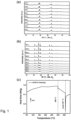
- Fig. 1 (a)-(b) shows high temperature in-situ XRD measurements of a transition metal oxyfluoride according to the invention from 200-560°C; (c) DSC analysis from room temperature to 400°C under argon flow (50 ml/min).
- Fig. 2 shows the comparison of the XRD patterns of oxyfluorides according to the present invention before and after heat treatment (HT).
- Fig. 4 shows the galvanostatic charge and discharge profile of two oxyfluorides according to the present invention before and after heat treatment at the rate of 0.1C and within a voltage window of 1.5-4.3V.
- the precursors were ball milled together in two steps with the aim to produce 3 g of the final product.
- First a lithium metal oxide and the transition metal oxides (Li 2 O, Mn 2 O 3 , Ti 2 O 3 ) were mixed together for 20 hours at a rate of 600 rpm under inert atmosphere during which Li 2 Mn x Ti 1-x O 2 is formed.
- LiF was added, and the mixture was ball milled for more 20 hours at the same speed to form the phases Li 1+x Mn 2/3 Ti 1/3 O 2 F x (0 ⁇ x ⁇ 2/3).
- the synthesized oxyfluorides are referred as LMO, LMOF11, LMOF20, LMOF33, for 0%, 11%, 20% and 33% of F, respectively:
- Rietveld refinement was completed using Full Prof-Suite software.
- Fig. 1 shows the high temperature XRD measurements from 200-560 °C of the LMOF33 oxyfluoride indicating that the structure is stable until 280-300 °C (in agreement with DSC thermal analysis in Fig. 1c ) and after that some changes start to appear in the XRD pattern of the oxyfluoride until complete decomposition of the oxyfluoride at 520°C.
- Fig. 2 shows the XRD patterns of the synthesized samples before and after heat treatment. All Li 1+x Mn 2/3 Ti 1/3 O 2 F x 0 ⁇ x ⁇ 2/3 compounds have a disordered rocksalt structure of the space group Fm-3m. XRD refinements on the patterns have been performed with the target compositions of LMOF11, LMOF20 and LMOF33. The lattice parameters were found to be 4.208, 4.206 and 4.179 ⁇ before heat treatment and 4.180, 4.182 and 4.151 ⁇ after heat treatment of LMOF11, LMOF20 and LMOF33 oxyfluorides, respectively.
- Fig. 4 shows the galvanostatic charge and discharge profiles up to 100 cycles at the rate of 0.1C and within the voltage profile of 1.5-4.3V of the oxyfluorides before and after heat treatment. It is clear that although the initial capacity of the oxyfluorides after heat treatment is lower, the trend of losing the capacity is much slower. These profiles for both compositions show that the treatment was successful to increase the performance of all the compounds, specifically for the LMOF oxyfluoride, where the capacity loss after 100 cycles is 39% before heat treatment and 8% after heat treatment process.
- Fig. 5 shows the cyclability of the oxyfluorides with respect to number of cycles. It can be seen that the degradation mechanism of the oxyfluorides has been slowed down, which can be due to structural and morphology changes of the oxyfluorides.
- Fig. 5c shows the cyclability of the heat treated oxyfluorides up to 200 cycles in charge and discharge states. The sole effect of heat treatment is clear, and the LMOF33 oxyfluoride after heat treatment showed a promising discharge capacity of 140 mAh.g -1 .
- the LMOF33 sample was cycled at slow rate of 0.025C up to 50 cycles at different cut-off voltages from 4 to 4.4 V ( Fig. 6 ).
- the sample charged to 4 V although it had lower initial capacity, showed the best capacity retention. All the samples were cycled from 1.5 V to the certain voltage. It was found that the cells charged at higher voltages (>4.3 V) demonstrated a drastic capacity fading. We decided to limit the voltage to 4 V and focus on further effect of electrode conditioning in contact with the electrolyte.
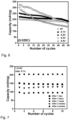
- Fig. 7 shows the galvanostatic charge and discharge profiles of the oxyfluorides at the rate of 0.1C. Electrodes with heat treated oxyfluorides have been prepared and aged at different times in the Li-ion half-cells, meaning for 1 day, 3 days, 1 week, 2 weeks and 4 weeks. This strategy will allow to find the appropriate thickness of the formed passivation layer, and hence reduce any surface related issues in contact with the electrolyte. The cells were then cycled in the voltage window 1.5-4V. The results lead to the finding that the batteries which have been aged for 3 days showed the highest capacities as it is shown in Fig.7 . It comes out that the 3 days conditioning, along with working with lower voltage windows, is an additional asset for long-term cycling stability of heat treated oxyfluorides.
Landscapes
- Chemical & Material Sciences (AREA)
- Electrochemistry (AREA)
- General Chemical & Material Sciences (AREA)
- Chemical Kinetics & Catalysis (AREA)
- Engineering & Computer Science (AREA)
- Inorganic Chemistry (AREA)
- Organic Chemistry (AREA)
- Materials Engineering (AREA)
- Manufacturing & Machinery (AREA)
- Composite Materials (AREA)
- Life Sciences & Earth Sciences (AREA)
- Geology (AREA)
- General Life Sciences & Earth Sciences (AREA)
- Environmental & Geological Engineering (AREA)
- Battery Electrode And Active Subsutance (AREA)
Abstract
Description
- The present invention concerns a process for making transition metal oxyfluorides as electrode materials for alkali metal ion cells as well as a procedure for bulk and surface stabilization of metastable disordered rocksalt oxyfluorides as efficient electrode materials for alkali metal ion cells.
- Today's demand for lithium ion batteries have proved that cobalt and nickel need to be replaced with alternative transition metals (TMs). Novel disordered rocksalt (DRS) oxyfluorides can meet this goal, since they can be synthesized with a multitude of TMs and their combinations. A typical DRS material, with a cubic close packed structure, can allow the creation of percolation pathways within the material to support fast ionic diffusion beneficial for (de)charging the batteries. Moreover, the cation disorder contributes to the enhancement of the structural and thermodynamic stability of Li-rich cathode materials with better kinetics. Up to now, several lithium excess phases such as Li3V2O5, Li2VO3 or Li3NbO4 have shown high capacities around 300 mAh·g-1 as cathode materials. However, vanadium is a toxic and expensive element, which may be a hindrance for large scale application. In addition, cathode materials based on manganese have the potential to attract attention due to their low cost, ease of synthesis, great stability, and environmental friendliness. A widely used strategy is the substitution of oxygen with fluorine, which can stabilize the structure and enhance the electrochemical properties. In a DRS configuration, the fluorination allows to work with lower oxidation state of the TM for instance Mn, and makes the Li-O bond weaker. It can also induce Mn3+ and oxygen vacancies, which would reduce the energy barrier of Li+ in the crystal structure and improve the electronic transmission performance. Despite the structural advances for these materials, however, all these compositions suffer from short life span already after 25 cycles. Shirazi Moghadam et al. has combined in Toward Better Stability and Reversibility of the Mn4+/Mn2+ Double Redox Activity in Disordered Rocksalt Oxyfluoride Cathode Materials, Chem. Mater. 2021, 33, 8235-8247 the strategy of using high-valent cations with partial substitution of oxygen by fluorine anions in disordered rocksalt-structure phase to achieve optimal Mn4+/Mn2+ double-redox reaction in the composition system Li1+xMn2/3Ti1/3O2Fx (0 ≤ x ≤ 2/3). However after observation of their initial electrochemical properties, the synthesized materials are not stable. Indeed, these DRS materials resulting from ball-milling synthesis exhibit a metastability, owing to the presence of microstrain and significant surface defect domains comparable to the size of the nanocrystalline bulk material.
- To overcome these structural anomalies is a real challenge since the discovery of this class of materials in 2015. Since more than 5 years, several research groups tried to stabilize the structure of these materials and control their behavior in battery cells, which turned out unsuccessful so far.
- The objective of the present invention is to overcome the limitations and disadvantages of the prior art.
- In particular it is an aim of the present invention to stabilize disordered rocksalt transition metal oxyfluorides and to enable their use as cathode materials in electrochemical alkali metal ion cells. Although the thermodynamic stability is important, the transition metal oxyfluorides should further demonstrate a long-term electrochemical stability under high-voltage and in the presence of dissociating media.
- This objective is solved with regard to a process for making a transition metal oxyfluoride by the features of
claim 1, with regard to a transition metal oxyfluoride by the features ofclaim 10 and with regard to an electrode material by the features of claim 11. Furthermore, it is solved with regard to an alkali metal ion cell by features of claim 12, with regard to a process for making an electrode by features of claim 13 and with regard to a process for using an alkali metal ion cell by features of claim 14. The subclaims each describe advantageous embodiments of the invention. - The invention refers to a process for making a transition metal oxyfluoride comprising the following steps:
- (a) providing an alkali metal compound and at least one transition metal compound as precursors
- (b) mixing the precursors
- (c) adding an alkali metal fluoride
- (d) carrying out a first heat treatment
- (e) cooling down to room temperature
- "Alkali metal" means in the present invention lithium or sodium. Lithium is preferred.
- In a particular embodiment the alkali metal compound and/or the transition metal compound is an oxide, an acetate or a carbonate. Preferably the alkali metal compound is lithium or sodium oxide and the transition metal compound is a transition metal oxide. In a preferred embodiment the alkali metal fluoride is LiF or NaF, preferably LiF.
- In a particular embodiment the powder obtained after step (c) is cold-pressed, preferably with a pressure in the range of between 100 MPa and 300 MPa, more preferably at 240 MPa before carrying out step (d). Cold pressing allows to protect the powders, and induces faster crystallite growth for better structural stabilization. The thus obtained powder-pellets are then heat treated.
- In a preferred embodiment the steps (d) and (e) are repeated at least once, leading to at least a second heat treatment, preferably twice, leading to a third heat treatment.
- The temperature of the first heat treatment is in particular in the range of between 150°C and 400°C preferably between 200°C and 300°C more preferably between 270°C and 290°C especially 280°C. The upper temperature limit is defined by the phase transformation to spinel-like structure occurring at high temperature, which will depend on the composition of the transition metal oxyfluoride. The temperature chosen is in particular up to 10°C lower than the temperature of phase transformation. The thermal stability is currently determined using differential scanning calorimetry (DSC). The advantage of this process step is to use a low temperature sintering in contrast to spinel-like oxyfluorides, which need hightemperature sintering and which have different insertion mechanism and alkali metal diffusion.
- Futhermore, the temperature of the at least second heat treatment and of the subsequent heat treatment is in the range of between 150°C and 400°C.
- In a particular embodiment the temperature of the first heat treatment, of the second heat treatment and of the subsequent heat treatments are equal.
- In a particular embodiment the duration of the first heat treatment is in the range of between 1 hour and 10 hours, preferably between 3 hours and 8 hours, more preferably between 4 hours and 6 hours especially 5 hours. In a preferred embodiment the duration of the second heat treatment and of the subsequemt heat treatments is in the range of between 1 hour and 10 hours preferably between 3 hours and 8 hours more preferably between 4 hours and 6 hours especially 5 hours.
- In a particular embodiment the duration of the first heat treatment, of the second heat treatment and of the subsequent heat treatments are equal.
- In a particular embodiment the process comprises the following steps: (1) synthesis by pre-drying, mixing and milling the precursors for 20h, and then by adding a lithium or sodium fluoride especially LiF under the same conditions under argon atmosphere (2) cold-pressing of the powders at 240 MPa (3) carrying out first heat treatment (Temperature T1, time t1), cooling down to room temperature, and then the second heat treatment (T2, t2), followed by a third heat treatment (T3, t3). All the heating/cooling steps are done under reducing gas flow (150°C < T1,T2,T3 < 400°C). Afterwards, the sintered powders, with mitigated defects and strains, are ground and passed through a sieve (200 mesh) to obtain fine TM oxyfluoride powders (< 0.5 micron), consisting of disordered rocksalt structure of increased symmetry.
- Previous works deal with the optimisation of the synthesis of the materials. No records for low temperature stabilisation of oxyfluorides can be found below their temperature of decomposition. Only few reports exist for ceramic synthesis at high temperature beyond the thermal stability of the compounds. The technical features reside in the combination of a low temperature heat treatment process under reducing atmosphere and further cathodes conditioning in a Li-ion cells.
- The at least one transition metal is preferably chosen from the group consisting of {Sc, Ti, V, Cr, Mn, Fe, Co, Ni, Cu, Zn, Nb and Mo} more preferably {Ti, Mn}.
- In a particular embodiment two transition metal compounds are provided during step (a). Thus obtained mixed transition metal oxyfluorides show higher stability of the crystal structure during electrochemical cycling. This occurs in particular by adding Ti or Nb. In a particular embodiment with Ti and Mn as transition metals used, Ti keeps Mn in lower oxidation state thus providing double redox reaction.
- In a preferred embodiment step (b) and/or step (c) is performed under inert gas atmosphere preferably argon.
- In a preferred embodiment step (d) and/or step (e) is performed under reducing gas flow preferably H2 gas or a gas mixture H2/Ar.
- In a further embodiment the obtained transition metal oxyfluoride is sieved and/or mixed preferably milled more preferably via high energy ball-milling.
- In a preferred embodiment the precursors are pre-dried and/or milled before the step (b).
- The present invention relates to a transition metal oxyfluoride obtained by the above mentioned process. The transition metal oxyfluorides are structurally homogenous and have the structure of disordered rock crystals. Disordered rock crystals have a cubic crystalline structure with lacking ions in commonly occupied sites. Those sites can be filled by alkali metal ions. The size of the transition metal oxyfluoride particles are in the range of between 100 µm and 500 µm preferably between 150 µm and 450 µm more preferably between 200 µm and 400 µm.
- The main features of the present transition metal oxyfluorides are mitigated structural and surface defects, elevated atomic homogeneity and increased crystallite size. Their advantage is in particular to be beneficial for relieving the Mn-dissolution degradation process of the oxyfluoride cathode materials during lithium ion battery operation.
- In a preferred embodiment the oxyfluoride comprises two transition metals preferably Mn and Ti.
- In a preferred embodiment the oxyfluoride has the formula Li1+xMn2/3Ti1/3O2Fx or Na1+xMn1/2Ti1/2O2Fx with 0 ≤ x ≤ 2/3 and a disordered rocksalt structure of the space group Fm-3m.
- The present invention relates also to a cathode comprising a transition metal oxyfluoride as active cathode material preferably a conductive additive, a binder and a current collector.
- Furthermore, an alkali metal ion cell is claimed comprising a cathode comprising a transition metal oxyfluoride as active cathode material and preferably an electrolyte, a separator and a counter electrode.
- A further aspect of the present invention is a process for making an electrode, preferably a cathode comprising at least a transition metal oxyfluoride and comprising following steps:
- a) providing the transition metal oxyfluoride as active electrode material and a conductive additive
- b) adding a mixture of a binder and a solvent to obtain a slurry
- c) coating the obtained slurry on a current collector
- Another aspect of the present invention is a process for making a alkali metal ion cell comprising following steps:
- a) assembling the cell
- b) conditioning the cell between 1 day and 14 days preferably between 1 day and 7 days, more preferably between 2 days and 5 days especially 3 days
- c) electrochemical cycling.
- A remarkable surface stability and long-term cycling stability of the electrodes was reached through an additional conditioning step of the Li-ion half-cells for 3 days, combined with a voltage cut-off, which had improved further the electrochemical performance of the cells and could guaranty a notable capacity retention over 200 cycles, without any additive incorporation process. The conditioning corresponds to a self aging of the electrode in contact with the electrolyte.
- The cell is preferably cycled in the voltage window between 1 V and 4.8 V, preferably between 1.3 V and 4.5 V especially between 1.5 V and 4.0 V.
- The process of the present invention allows the mitigation of structural and surface defects, elevates the atomic homogeneity and increase of crystallite size of air-sensitive disordered rocksalt (DRS) oxyfluoride materials avoiding the degradation process of the oxyfluoride cathode materials. This allows fast charging of the alkali lithium ion batteries, procedure for structural/surface stabilization and methods for use thereof.
- The process of the present invention is solvent-free and uses a low-temperature sintering.
- The results point clearly to a means of guided stabilization procedure of DRS materials for sustainable alkali metal-ion batteries.
- The process has induced a clear impact for practical utilization, an evidence for structural/surface improvements in relation with mitigation of defects, strain free particles, and reduced surface deficient domains. The sintering process has a strong influence on the particle/crystallite size of the active materials.
- The procedure has the advantages of simple processing, and reactivity and electrochemical processes can be significantly controlled according to the particle/crystallite size. The final electrode materials show higher battery performance and repeatedly stable capacity retention over 200 cycles (80%), where the reported patent-data provide a capacity fading of at least 25% already in the 20th cycle. The materials can be synthesized in large amounts for industrial scale-up and mass production.
- The present invention will be illustrated in more detail below by means of working examples and figures. Therefore
Fig. 1 (a)-(b) shows high temperature in-situ XRD measurements of a transition metal oxyfluoride according to the invention from 200-560°C; (c) DSC analysis from room temperature to 400°C under argon flow (50 ml/min). -
Fig. 2 shows the comparison of the XRD patterns of oxyfluorides according to the present invention before and after heat treatment (HT). -
Fig. 3 shows the comparison of the crystallite size (a) and particle size (b) of oxyfluorides according to the present invention before (left sphere) and after (right sphere) heat treatment. The slope of the rectangles indicates the extent of the size change. -
Fig. 4 shows the galvanostatic charge and discharge profile of two oxyfluorides according to the present invention before and after heat treatment at the rate of 0.1C and within a voltage window of 1.5-4.3V. -
Fig. 5 (a) -(b) shows the cyclability profile of 2 oxyfluorides according to the present invention before and after heat treatment with respect to number of cycles up to 100 cycles, and (c) the comparison of the cyclability (discharge) of both oxyfluorides after heat treatment up to 200 cycles. -
Fig. 6 shows the capacity retention of an oxyfluoride according to the present invention at different cut-off voltages. -
Fig. 7 shows the comparison of the gained discharge capacities of the conditioned electrochemical cells according to the present invention. - The process used the following materials as precursors:
- Li2O (Alfa Aesar, 99.7 %) or Na2O (Alfa Aesar, 80 %)
- Mn2O3 (Alfa Aesar, 99%)
- Ti2O3 (Alfa Aesar, 99.8%)
- LiF (Alfa Aesar, 99.9%) or NaF (Alfa Aesar, 99.99%)
- The precursors were ball milled together in two steps with the aim to produce 3 g of the final product. First a lithium metal oxide and the transition metal oxides (Li2O, Mn2O3, Ti2O3) were mixed together for 20 hours at a rate of 600 rpm under inert atmosphere during which Li2MnxTi1-xO2 is formed. In the second step, LiF was added, and the mixture was ball milled for more 20 hours at the same speed to form the phases Li1+xMn2/3Ti1/3O2Fx (0 ≤ x ≤ 2/3). According to the F/(O+F)anions ratio, the synthesized oxyfluorides are referred as LMO, LMOF11, LMOF20, LMOF33, for 0%, 11%, 20% and 33% of F, respectively:
- LiMn2/3Ti1/3O2 (LMO) as a reference
- Li1.25Mn2/3Ti1/3O2F0.25 (LMOF11)
- Li1.5Mn2/3Ti1/3O2F0.5 (LMOF20)
- Li2Mn2/3T11/3O2F (LMOF33)
- The DRS materials consisting of 500 mg of the material were pressed at 240 MPa using 10 mm die-set. The resulted pellets were put in a stainless steel cells. The cells were introduced in an alumina crucible inside a quartz tube with the length of 43 cm. The tube was put in a tubular oven under forming gas flow (∼ 50 ml/min), and heated with the rate of 80 °C/h up to 280 °C for five hours, then the tube was self-cooled down to room temperature. This procedure was repeated two more times, resulting in a total heating time of 15 hours.
- After heat treatment the pellets were ground to fine particles. Phase identification was conducted using transmission geometry using STOE STADI-p diffractometer in Mo Kα radiation (λ=0.70932 Å), in 2θ range of 10-60 degrees and step size of 0.02°. Rietveld refinement was completed using Full Prof-Suite software.
- The XRD patterns of the oxyfluorides before and after heat treatment indicate that all Li1+xMn2/3Ti1/3O2Fx with 0 ≤ x ≤ 2/3 compounds have a disordered rocksalt structure of the space group Fm-3m. XRD refinements on the patterns have been performed with the target compositions of LMOF11, LMOF20 and LMOF33. The lattice parameters were found to be 4.208, 4.206 and 4.179 Å before heat treatment and 4.180, 4.182 and 4.151 Å after heat treatment for LMOF11, LMOF20 and LMOF33 oxyfluorides, respectively.
- Electrodes with heat treated oxyfluorides have been prepared and conditioned at different times in the Li-ion half-cells, meaning for 1 day, 3 days, 1 week, 2 weeks and 4 weeks. This strategy will allow to find the appropriate thickness of the formed passivation layer, and hence reduce any surface related issues in contact with the electrolyte. The cells were then cycled in the voltage window 1.5-4V. The results lead to the finding that the batteries which have been conditioned for 3 days showed the highest capacities as it is shown in
Fig. 7 . It comes out that the 3 days conditioning, along with working with voltage limitation at 4V, is an additional asset for long-term cycling stability of heat treated oxyfluorides. - To prepare a cathode film from Li1+xMn2/3Ti1/3O2Fx with 0 ≤ x ≤ 2/3, the powder of the active compounds and carbon black (Timcal, SUPER C65) were mixed together for three hours in Ar-filled 20 ml silicon nitride vial containing 10 balls (
Ø 2 mm) of the same material. The grinding medium was carried out at low rate of 200 rpm, using Fritsch P7 planetary ball mill. The composite was then sieved using 200 mesh sieve. For making slurry first the polyvinylidene fluoride (PVDF) as a binder was mixed with N-methyl-2-pyrrolidone (NMP) as solvent for 5 minutes. Then the mixture of active material and carbon black was added in two steps each step mixing for 5 minutes, in total the mixing time was 15 minutes. Forslurry making process 4 cm capsules were used with 5 small balls as grinding agent compatible with Thinky mixer (ARE-250, Thinky Inc.). The slurry was then coated on an aluminum foil with an automatic doctor blade machine in an argon filled glove box. The composite coating was dried at 120°C overnight in vacuum oven. Each working electrode contained approximately 2 mg of active material. To assemble a cell for all cycling tests, Swagelok cells were fabricated in an argon filled glove box. 140 µL of 1 M of LiPF6 in ethylene carbonate and ethyl methyl carbonate (EC/DEC) solution (1:1, BASF®), lithium foil and two Whatman® glass fiber was used as electrolyte, counter electrode and a separator, respectively. The assembled swaglock cells were tested at 25 °C in climate chambers using Arbin BT2000 electrochemical workstation. The specific capacity of the cells was calculated on the amount of active compounds (60 wt %) in the cathode film. -
Fig. 1 shows the high temperature XRD measurements from 200-560 °C of the LMOF33 oxyfluoride indicating that the structure is stable until 280-300 °C (in agreement with DSC thermal analysis inFig. 1c ) and after that some changes start to appear in the XRD pattern of the oxyfluoride until complete decomposition of the oxyfluoride at 520°C. -
Fig. 2 shows the XRD patterns of the synthesized samples before and after heat treatment. All Li1+xMn2/3Ti1/3O2Fx 0 ≤ x ≤ 2/3 compounds have a disordered rocksalt structure of the space group Fm-3m. XRD refinements on the patterns have been performed with the target compositions of LMOF11, LMOF20 and LMOF33. The lattice parameters were found to be 4.208, 4.206 and 4.179 Å before heat treatment and 4.180, 4.182 and 4.151 Å after heat treatment of LMOF11, LMOF20 and LMOF33 oxyfluorides, respectively. - The XRD measurements recorded for longer times before and after heat treatment show the presence of the disordered rocksalt phase, with no obvious additional extra peaks of impurity. However, after heat treatment all the patterns showed sharper peaks, with slight shift to higher angles in comparison with non-treated powders. This corresponds to lattice shrinking of the DRS structure owing to the increase of symmetry, leading to a better thermodynamic stability
- The structural details before and after treatment can be found in
Fig. 3 . As mentioned above, all the four compositions have smaller lattice parameter after heat treatment and bigger crystallite size, calculated by Williamson-Hall method. It should be noted that the BET measured for LMOF33 oxyfluoride revealed that the heat treatment resulted in reduced specific surface area from 5 to 4.5 m2/g. This reduction should end with a better stability of the heat treated oxyfluoride, since it will diminish the possible reactions of the active material with the electrolyte. At the same time due to small active surface area, the areal capacity of the heat treated oxyfluoride should be smaller. - The change in morphology of the LMOF33 oxyfluoride and increase of particle size after heat treatment are visible in the SEM (Scanning Electron Microscope). The STEM-EDX images of the LMOF33 oxyfluoride show that the fluorine is well incorporated in the nanostructure, and all the elements have a homogenous distribution in the oxyfluoride.
-
Fig. 4 shows the galvanostatic charge and discharge profiles up to 100 cycles at the rate of 0.1C and within the voltage profile of 1.5-4.3V of the oxyfluorides before and after heat treatment. It is clear that although the initial capacity of the oxyfluorides after heat treatment is lower, the trend of losing the capacity is much slower. These profiles for both compositions show that the treatment was successful to increase the performance of all the compounds, specifically for the LMOF oxyfluoride, where the capacity loss after 100 cycles is 39% before heat treatment and 8% after heat treatment process. - The comparison of the results up to 100 cycles can be more visible in
Fig. 5 , which shows the cyclability of the oxyfluorides with respect to number of cycles. It can be seen that the degradation mechanism of the oxyfluorides has been slowed down, which can be due to structural and morphology changes of the oxyfluorides. -
Fig. 5c shows the cyclability of the heat treated oxyfluorides up to 200 cycles in charge and discharge states. The sole effect of heat treatment is clear, and the LMOF33 oxyfluoride after heat treatment showed a promising discharge capacity of 140 mAh.g-1. - In order to find the proper voltage cut off for these materials, the LMOF33 sample was cycled at slow rate of 0.025C up to 50 cycles at different cut-off voltages from 4 to 4.4 V (
Fig. 6 ). The sample charged to 4 V, although it had lower initial capacity, showed the best capacity retention. All the samples were cycled from 1.5 V to the certain voltage. It was found that the cells charged at higher voltages (>4.3 V) demonstrated a drastic capacity fading. We decided to limit the voltage to 4 V and focus on further effect of electrode conditioning in contact with the electrolyte. -
Fig. 7 shows the galvanostatic charge and discharge profiles of the oxyfluorides at the rate of 0.1C. Electrodes with heat treated oxyfluorides have been prepared and aged at different times in the Li-ion half-cells, meaning for 1 day, 3 days, 1 week, 2 weeks and 4 weeks. This strategy will allow to find the appropriate thickness of the formed passivation layer, and hence reduce any surface related issues in contact with the electrolyte. The cells were then cycled in the voltage window 1.5-4V. The results lead to the finding that the batteries which have been aged for 3 days showed the highest capacities as it is shown inFig.7 . It comes out that the 3 days conditioning, along with working with lower voltage windows, is an additional asset for long-term cycling stability of heat treated oxyfluorides. - As a result, we cycled the cells made of LMOF33 oxyfluoride aged for three days, before and after heat treatment in the voltage window of 1.5-4 V, and we found out the very special stability of the heat treated oxyfluoride after 200 cycles (140 mAh.g-1), with only 20% loss of the initial capacity.
Claims (15)
- Process for making a transition metal oxyfluoride comprising the following steps:(a) providing an alkali metal compound and at least one transition metal compound as precursors(b) mixing the precursors(c) adding an alkali metal fluoride(d) carrying out a first heat treatment(e) cooling down to room temperature.
- Process for making a transition metal oxyfluoride according to claim 1, wherein the steps (d) and (e) are repeated at least once, leading to at least a second heat treatment.
- Process for making a transition metal oxyfluoride according to claim 1 or 2, wherein the steps (d) and (e) are repeated twice.
- Process for making a transition metal oxyfluoride according to one of the claims 1 to 3, wherein the temperature of the first heat treatment and/or the subsequent heat treatment is in the range of between 150°C and 400°C preferably between 200°C and 300°C more preferably between 270°C and 290°C especially 280°C.
- Process for making a transition metal oxyfluoride according to one of the claims 1 to 4, wherein the duration of the first heat treatment is in the range of between 1 hour and 10 hours preferably between 3 hours and 8 hours more preferably between 4 hours and 6 hours especially 5 hours.
- Process for making a transition metal oxyfluoride according to one of the claims 1 to 5, wherein the at least one transition metal is chosen from the group consisting of {Sc, Ti, V, Cr, Mn, Fe, Co, Ni, Cu, Zn, Nb and Mo} preferably {Ti, Mn}.
- Process for making a transition metal oxyfluoride according to one of the claims 1 to 6, wherein during step (a) two transition metal compounds are provided.
- Process for making a transition metal oxyfluoride according to one of the claims 1 to 7, wherein a subsequent step of sieving and or mixing preferably milling more preferably high energy milling is carried out after step (e).
- Process for making a transition metal oxyfluoride according to one of the claims 1 to 8, wherein the precursors are pre-dried and/or milled before step (b).
- Transition metal oxyfluoride obtained by the process according to one of the claims 1 to 9.
- Electrode comprising a transition metal oxyfluoride as active electrode material according to claim 10, a conductive additive, a binder and a current collector.
- Alkali metal-ion cell comprising an electrode according to claim 11, an electrolyte, a separator and a counter electrode.
- Process for making an electrode comprising at least a transition metal oxyfluoride according to claim 10 and comprising following steps:a) providing the transition metal oxyfluoride as active electrode material and a conductive additiveb) adding a mixture of a binder and a solvent to obtain a slurryc) coating the obtained slurry on a current collector.
- Process for using the alkali metal ion cell according to claim 12 comprising following steps:a) assembling the cellb) conditioning the cell between 1 day and 14 days preferably between 1 day and 7 days, more preferably between 2 days and 5 days especially 3 daysc) electrochemical cycling.
- Process for using a lithium alkali metal ion cell according to claim 14, whereby the cell is cycled in the voltage window between 1 V and 4.8 V, preferably between 1.3 V and 4.5 V especially between 1.5 V and 4.0 V.
Priority Applications (1)
| Application Number | Priority Date | Filing Date | Title |
|---|---|---|---|
| EP22177443.3A EP4289788A1 (en) | 2022-06-07 | 2022-06-07 | Process for making transition metal oxyfluorides as electrode materials for alkali metal ion cells |
Applications Claiming Priority (1)
| Application Number | Priority Date | Filing Date | Title |
|---|---|---|---|
| EP22177443.3A EP4289788A1 (en) | 2022-06-07 | 2022-06-07 | Process for making transition metal oxyfluorides as electrode materials for alkali metal ion cells |
Publications (1)
| Publication Number | Publication Date |
|---|---|
| EP4289788A1 true EP4289788A1 (en) | 2023-12-13 |
Family
ID=81975209
Family Applications (1)
| Application Number | Title | Priority Date | Filing Date |
|---|---|---|---|
| EP22177443.3A Pending EP4289788A1 (en) | 2022-06-07 | 2022-06-07 | Process for making transition metal oxyfluorides as electrode materials for alkali metal ion cells |
Country Status (1)
| Country | Link |
|---|---|
| EP (1) | EP4289788A1 (en) |
Cited By (1)
| Publication number | Priority date | Publication date | Assignee | Title |
|---|---|---|---|---|
| WO2024209466A1 (en) * | 2023-04-04 | 2024-10-10 | Bar Ilan University | Air-stable cathode for sodium-ion batteries |
Citations (1)
| Publication number | Priority date | Publication date | Assignee | Title |
|---|---|---|---|---|
| WO2021158620A1 (en) * | 2020-02-07 | 2021-08-12 | The Regents Of The University Of California | Cation-disordered rocksalt type high entropy cathode with reduced short-range order for li-ion batteries |
-
2022
- 2022-06-07 EP EP22177443.3A patent/EP4289788A1/en active Pending
Patent Citations (1)
| Publication number | Priority date | Publication date | Assignee | Title |
|---|---|---|---|---|
| WO2021158620A1 (en) * | 2020-02-07 | 2021-08-12 | The Regents Of The University Of California | Cation-disordered rocksalt type high entropy cathode with reduced short-range order for li-ion batteries |
Non-Patent Citations (2)
| Title |
|---|
| HE YUEYUE ET AL: "Identifying the effect of fluorination on cation and anion redox activity in Mn based cation-disordered cathode", JOURNAL OF COLLOID AND INTERFACE SCIENCE, ACADEMIC PRESS,INC, US, vol. 607, 21 September 2021 (2021-09-21), pages 1333 - 1342, XP086862429, ISSN: 0021-9797, [retrieved on 20210921], DOI: 10.1016/J.JCIS.2021.09.101 * |
| SHIRAZI MOGHADAM ET AL.: "Toward Better Stability and Reversibility of the Mn4+/Mn2+ Double Redox Activity in Disordered Rocksalt Oxyfluoride Cathode Materials", CHEM. MATER., vol. 33, 2021, pages 8235 - 8247 |
Cited By (1)
| Publication number | Priority date | Publication date | Assignee | Title |
|---|---|---|---|---|
| WO2024209466A1 (en) * | 2023-04-04 | 2024-10-10 | Bar Ilan University | Air-stable cathode for sodium-ion batteries |
Similar Documents
| Publication | Publication Date | Title |
|---|---|---|
| EP3774663B1 (en) | O3/p2 mixed phase sodium-containing doped layered oxide materials | |
| JP7676851B2 (en) | Transition metal composite hydroxide particles, method for producing transition metal composite hydroxide particles, positive electrode active material for lithium ion secondary battery, and lithium ion secondary battery | |
| US10290869B2 (en) | Doped lithium-rich layered composite cathode materials | |
| EP3145870B1 (en) | Doped nickelate materials | |
| EP2872450B1 (en) | Doped nickelate compounds | |
| EP4266407A1 (en) | Positive active material for rechargeable lithium battery, method of preparing same, and rechargeable lithium battery including same | |
| WO2021245411A1 (en) | Active electrode material | |
| KR101378303B1 (en) | Bismuth fluoride based nanocomposites as electrode materials | |
| US8623549B2 (en) | Iron oxyfluoride electrodes for electrochemical energy storage | |
| EP4398338A1 (en) | Positive electrode active material for rechargeable lithium battery, method of preparing same, and rechargeable lithium battery including same | |
| US20090224212A1 (en) | Surface and Bulk Modified High Capacity Layered Oxide Cathodes with Low Irreversible Capacity Loss | |
| US8906553B1 (en) | High voltage cathode material for Li-ion batteries | |
| EP3261158B1 (en) | Positive electrode active material for nonaqueous electrolyte secondary batteries, and nonaqueous electrolyte secondary battery | |
| US9203082B2 (en) | Iron oxyfluoride electrodes for electrochemical energy storage | |
| Moustafa et al. | NASICON-type lithium iron germanium phosphate glass ceramic nanocomposites as anode materials for lithium ion batteries | |
| KR20050079782A (en) | Positive active material for rechargeable lithium battery, method of preparing same and rechargeable lithium battery comprising same | |
| KR20100060362A (en) | Positive active material for a lithium secondary battery, method of preparing thereof, and lithium secondary battery comprising the same | |
| KR20120069691A (en) | Process for the preparation of lithium metal oxides involving fluidized bed techniques | |
| KR20240043755A (en) | Lithium-rich nickel manganese oxide battery cathode materials and methods | |
| JP2025517532A (en) | Method for preparing lithium nickel manganese cobalt oxide particles | |
| EP4289788A1 (en) | Process for making transition metal oxyfluorides as electrode materials for alkali metal ion cells | |
| JP7206819B2 (en) | Positive electrode active material for lithium ion secondary battery, method for producing the same, and lithium ion secondary battery | |
| KR100555971B1 (en) | Cathode active material and lithium secondary battery employing the same | |
| Ehi-Eromosele et al. | High-voltage LiNi 0.5 Mn 1.5 O 4 cathodes for Li-ion batteries obtained by sol–gel combustion method: effects of fuel-type and silver doping | |
| Abbas et al. | Lithium-Rich Spinel Cathode with Higher Energy Density for Sustainable Li-Ion Batteries Operating in Extended Potential Range |
Legal Events
| Date | Code | Title | Description |
|---|---|---|---|
| PUAI | Public reference made under article 153(3) epc to a published international application that has entered the european phase |
Free format text: ORIGINAL CODE: 0009012 |
|
| STAA | Information on the status of an ep patent application or granted ep patent |
Free format text: STATUS: THE APPLICATION HAS BEEN PUBLISHED |
|
| AK | Designated contracting states |
Kind code of ref document: A1 Designated state(s): AL AT BE BG CH CY CZ DE DK EE ES FI FR GB GR HR HU IE IS IT LI LT LU LV MC MK MT NL NO PL PT RO RS SE SI SK SM TR |
|
| STAA | Information on the status of an ep patent application or granted ep patent |
Free format text: STATUS: REQUEST FOR EXAMINATION WAS MADE |
|
| 17P | Request for examination filed |
Effective date: 20240528 |
|
| RBV | Designated contracting states (corrected) |
Designated state(s): AL AT BE BG CH CY CZ DE DK EE ES FI FR GB GR HR HU IE IS IT LI LT LU LV MC MK MT NL NO PL PT RO RS SE SI SK SM TR |
|
| RAP3 | Party data changed (applicant data changed or rights of an application transferred) |
Owner name: KARLSRUHER INSTITUT FUER TECHNOLOGIE |