EP4289634B1 - Tire - Google Patents
Tire Download PDFInfo
- Publication number
- EP4289634B1 EP4289634B1 EP23175321.1A EP23175321A EP4289634B1 EP 4289634 B1 EP4289634 B1 EP 4289634B1 EP 23175321 A EP23175321 A EP 23175321A EP 4289634 B1 EP4289634 B1 EP 4289634B1
- Authority
- EP
- European Patent Office
- Prior art keywords
- tire
- circumferential groove
- groove
- tread
- jointless
- Prior art date
- Legal status (The legal status is an assumption and is not a legal conclusion. Google has not performed a legal analysis and makes no representation as to the accuracy of the status listed.)
- Active
Links
Images

Classifications
-
- B—PERFORMING OPERATIONS; TRANSPORTING
- B60—VEHICLES IN GENERAL
- B60C—VEHICLE TYRES; TYRE INFLATION; TYRE CHANGING; CONNECTING VALVES TO INFLATABLE ELASTIC BODIES IN GENERAL; DEVICES OR ARRANGEMENTS RELATED TO TYRES
- B60C11/00—Tyre tread bands; Tread patterns; Anti-skid inserts
- B60C11/03—Tread patterns
- B60C11/0306—Patterns comprising block rows or discontinuous ribs
- B60C11/0309—Patterns comprising block rows or discontinuous ribs further characterised by the groove cross-section
-
- B—PERFORMING OPERATIONS; TRANSPORTING
- B60—VEHICLES IN GENERAL
- B60C—VEHICLE TYRES; TYRE INFLATION; TYRE CHANGING; CONNECTING VALVES TO INFLATABLE ELASTIC BODIES IN GENERAL; DEVICES OR ARRANGEMENTS RELATED TO TYRES
- B60C11/00—Tyre tread bands; Tread patterns; Anti-skid inserts
- B60C11/03—Tread patterns
- B60C11/032—Patterns comprising isolated recesses
- B60C11/0323—Patterns comprising isolated recesses tread comprising channels under the tread surface, e.g. for draining water
-
- B—PERFORMING OPERATIONS; TRANSPORTING
- B60—VEHICLES IN GENERAL
- B60C—VEHICLE TYRES; TYRE INFLATION; TYRE CHANGING; CONNECTING VALVES TO INFLATABLE ELASTIC BODIES IN GENERAL; DEVICES OR ARRANGEMENTS RELATED TO TYRES
- B60C9/00—Reinforcements or ply arrangement of pneumatic tyres
- B60C9/18—Structure or arrangement of belts or breakers, crown-reinforcing or cushioning layers
- B60C9/20—Structure or arrangement of belts or breakers, crown-reinforcing or cushioning layers built-up from rubberised plies each having all cords arranged substantially parallel
- B60C9/22—Structure or arrangement of belts or breakers, crown-reinforcing or cushioning layers built-up from rubberised plies each having all cords arranged substantially parallel the plies being arranged with all cords disposed along the circumference of the tyre
-
- B—PERFORMING OPERATIONS; TRANSPORTING
- B60—VEHICLES IN GENERAL
- B60C—VEHICLE TYRES; TYRE INFLATION; TYRE CHANGING; CONNECTING VALVES TO INFLATABLE ELASTIC BODIES IN GENERAL; DEVICES OR ARRANGEMENTS RELATED TO TYRES
- B60C9/00—Reinforcements or ply arrangement of pneumatic tyres
- B60C9/18—Structure or arrangement of belts or breakers, crown-reinforcing or cushioning layers
- B60C9/20—Structure or arrangement of belts or breakers, crown-reinforcing or cushioning layers built-up from rubberised plies each having all cords arranged substantially parallel
- B60C9/22—Structure or arrangement of belts or breakers, crown-reinforcing or cushioning layers built-up from rubberised plies each having all cords arranged substantially parallel the plies being arranged with all cords disposed along the circumference of the tyre
- B60C9/2204—Structure or arrangement of belts or breakers, crown-reinforcing or cushioning layers built-up from rubberised plies each having all cords arranged substantially parallel the plies being arranged with all cords disposed along the circumference of the tyre obtained by circumferentially narrow strip winding
-
- B—PERFORMING OPERATIONS; TRANSPORTING
- B60—VEHICLES IN GENERAL
- B60C—VEHICLE TYRES; TYRE INFLATION; TYRE CHANGING; CONNECTING VALVES TO INFLATABLE ELASTIC BODIES IN GENERAL; DEVICES OR ARRANGEMENTS RELATED TO TYRES
- B60C9/00—Reinforcements or ply arrangement of pneumatic tyres
- B60C9/18—Structure or arrangement of belts or breakers, crown-reinforcing or cushioning layers
- B60C9/20—Structure or arrangement of belts or breakers, crown-reinforcing or cushioning layers built-up from rubberised plies each having all cords arranged substantially parallel
- B60C9/22—Structure or arrangement of belts or breakers, crown-reinforcing or cushioning layers built-up from rubberised plies each having all cords arranged substantially parallel the plies being arranged with all cords disposed along the circumference of the tyre
- B60C2009/2223—Structure or arrangement of belts or breakers, crown-reinforcing or cushioning layers built-up from rubberised plies each having all cords arranged substantially parallel the plies being arranged with all cords disposed along the circumference of the tyre with an interrupted zero degree ply, e.g. using two or more portions for the same ply
-
- B—PERFORMING OPERATIONS; TRANSPORTING
- B60—VEHICLES IN GENERAL
- B60C—VEHICLE TYRES; TYRE INFLATION; TYRE CHANGING; CONNECTING VALVES TO INFLATABLE ELASTIC BODIES IN GENERAL; DEVICES OR ARRANGEMENTS RELATED TO TYRES
- B60C11/00—Tyre tread bands; Tread patterns; Anti-skid inserts
- B60C11/03—Tread patterns
- B60C2011/0337—Tread patterns characterised by particular design features of the pattern
- B60C2011/0339—Grooves
- B60C2011/0341—Circumferential grooves
-
- B—PERFORMING OPERATIONS; TRANSPORTING
- B60—VEHICLES IN GENERAL
- B60C—VEHICLE TYRES; TYRE INFLATION; TYRE CHANGING; CONNECTING VALVES TO INFLATABLE ELASTIC BODIES IN GENERAL; DEVICES OR ARRANGEMENTS RELATED TO TYRES
- B60C11/00—Tyre tread bands; Tread patterns; Anti-skid inserts
- B60C11/03—Tread patterns
- B60C2011/0337—Tread patterns characterised by particular design features of the pattern
- B60C2011/0339—Grooves
- B60C2011/0341—Circumferential grooves
- B60C2011/0346—Circumferential grooves with zigzag shape
-
- B—PERFORMING OPERATIONS; TRANSPORTING
- B60—VEHICLES IN GENERAL
- B60C—VEHICLE TYRES; TYRE INFLATION; TYRE CHANGING; CONNECTING VALVES TO INFLATABLE ELASTIC BODIES IN GENERAL; DEVICES OR ARRANGEMENTS RELATED TO TYRES
- B60C11/00—Tyre tread bands; Tread patterns; Anti-skid inserts
- B60C11/03—Tread patterns
- B60C2011/0337—Tread patterns characterised by particular design features of the pattern
- B60C2011/0339—Grooves
- B60C2011/0341—Circumferential grooves
- B60C2011/0348—Narrow grooves, i.e. having a width of less than 4 mm
-
- B—PERFORMING OPERATIONS; TRANSPORTING
- B60—VEHICLES IN GENERAL
- B60C—VEHICLE TYRES; TYRE INFLATION; TYRE CHANGING; CONNECTING VALVES TO INFLATABLE ELASTIC BODIES IN GENERAL; DEVICES OR ARRANGEMENTS RELATED TO TYRES
- B60C11/00—Tyre tread bands; Tread patterns; Anti-skid inserts
- B60C11/03—Tread patterns
- B60C2011/0337—Tread patterns characterised by particular design features of the pattern
- B60C2011/0339—Grooves
- B60C2011/0341—Circumferential grooves
- B60C2011/0353—Circumferential grooves characterised by width
-
- B—PERFORMING OPERATIONS; TRANSPORTING
- B60—VEHICLES IN GENERAL
- B60C—VEHICLE TYRES; TYRE INFLATION; TYRE CHANGING; CONNECTING VALVES TO INFLATABLE ELASTIC BODIES IN GENERAL; DEVICES OR ARRANGEMENTS RELATED TO TYRES
- B60C2200/00—Tyres specially adapted for particular applications
- B60C2200/06—Tyres specially adapted for particular applications for heavy duty vehicles
-
- B—PERFORMING OPERATIONS; TRANSPORTING
- B60—VEHICLES IN GENERAL
- B60C—VEHICLE TYRES; TYRE INFLATION; TYRE CHANGING; CONNECTING VALVES TO INFLATABLE ELASTIC BODIES IN GENERAL; DEVICES OR ARRANGEMENTS RELATED TO TYRES
- B60C3/00—Tyres characterised by the transverse section
- B60C3/04—Tyres characterised by the transverse section characterised by the relative dimensions of the section, e.g. low profile
Definitions
- the present invention relates to a tire.
- Japanese Laid-Open Patent Publication No. 2017-7424 describes a heavy duty tire having circumferential main grooves and circumferential narrow grooves.
- the circumferential narrow grooves each demarcate two rib-like land portions that can come into contact with each other when the tire comes into contact with the ground.
- Such a heavy duty tire is considered to have reduced rolling resistance.
- the present invention has been made in view of the above circumstances, and a main object of the present invention is to provide a tire that can have further improved rolling resistance performance and wet grip performance.
- a tire according to the preamble of claim 1 is known from WO 2017/103448 A1 .
- Related tires are described in WO 2019/122791 A1 , EP 3 895 913 A1 , US 2022/097456 A1 , US 2017/174008 A1 and EP 4 119 358 A1 (document according to Article 54(3) EPC).
- the present invention is directed to a tire including a tread portion having a first tread end, wherein: the tread portion has a shoulder circumferential groove adjacent to the first tread end, and a crown circumferential groove provided between the shoulder circumferential groove and a tire equator; each of the shoulder circumferential groove and the crown circumferential groove includes a pair of groove walls; in a standardized load-applied state where the tire is fitted on a standardized rim at a standardized internal pressure, a standardized load is applied to the tire, and the tire is brought into contact with a flat surface at a camber angle of 0°, the pair of groove walls of the shoulder circumferential groove are not in contact with each other, and at least parts of the pair of groove walls of the crown circumferential groove are in contact with each other; the crown circumferential groove has a widened portion on an inner side in a tire radial direction with respect to a tread ground-contact surface; a groove width of the widened portion is larger than a groove width at the tread
- the tire of the present invention can have further improved rolling resistance performance and wet grip performance.
- the groove width at the tread ground-contact surface of the crown circumferential groove is 0.01 to 0.2 times a groove width of the shoulder circumferential groove.
- a groove area of a transverse cross-section of the crown circumferential groove is 0.1 to 0.5 times a groove area of a transverse cross-section of the shoulder circumferential groove.
- a length in the tire radial direction from the tread ground-contact surface to the widened portion is 0.4 to 0.7 times a groove depth of the crown circumferential groove.
- a separation distance in the tire axial direction between the outer end of the shoulder circumferential groove and the outer end of the jointless band ply is 10% to 50% of a separation distance in the tire axial direction between the outer end of the shoulder circumferential groove and the first tread end.
- a belt layer including at least three belt plies in which belt cords are arranged at an angle of 10 to 50 degrees with respect to the tire circumferential direction is provided inside the tread portion, and at least one belt ply of the at least three belt plies is located inward of the jointless band ply in the tire radial direction.
- the belt ply located inward of the jointless band ply in the tire radial direction has an outer end on the outer side in the tire axial direction with respect to the outer end of the jointless band ply.
- the band layer includes a jointless edge band ply which is adjacent to the first tread end and in which a band cord is helically wound at an angle of 5 degrees or less with respect to the tire circumferential direction, and the jointless edge band ply straddles the outer end of the jointless band ply.
- an inner end in the tire axial direction of the jointless edge band ply is located on the outer side in the tire axial direction with respect to the outer end of the shoulder circumferential groove.
- the tire is a heavy duty tire having an aspect ratio of 70% or less.
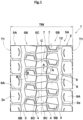
- FIG. 1 is a plan view of a tread portion 2 of a tire 1 of the present embodiment.
- the tire 1 of the present embodiment of the invention is suitably used, for example, as a heavy duty tire.
- the present invention may be applied to heavy duty pneumatic tires as well as pneumatic tires for a passenger car and a small truck.
- the tread portion 2 of the present embodiment of the invention has shoulder circumferential grooves 3 adjacent to first tread ends T1, and crown circumferential grooves 4 provided between the shoulder circumferential grooves 3 and a tire equator C.
- Each of the shoulder circumferential grooves 3 and the crown circumferential grooves 4 includes a pair of groove walls 6 or 7.
- the stiffness of the tread portion 2 has a large contribution to rolling resistance, and it is particularly effective to increase the stiffness of the tread portion 2 on the tire equator C side where the ground-contact pressure is high. Therefore, in the present invention, in a standardized load-applied state, the pair of groove walls 6 of each shoulder circumferential groove 3 are not in contact with each other. In addition, at least parts of the pair of groove walls 7 of each crown circumferential groove 4 are in contact with each other. Accordingly, in the tire 1 of the present invention, when a tread ground-contact surface 2s comes into contact with the ground, the groove walls 7 of each crown circumferential groove 4 support each other, and thus deformation of land portions adjacent to the crown circumferential groove 4 is suppressed, thereby reducing rolling resistance. In addition, even when the tread ground-contact surface 2s comes into contact with the ground, the pair of groove walls 6 of each shoulder circumferential groove 3 do not come into contact with each other, and thus the shoulder circumferential groove 3 exhibits an excellent drainage effect.
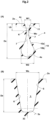
- FIG. 2(A) is a cross-sectional view taken along a line A-A in FIG. 1 , and shows a transverse cross-section in a direction orthogonal to a groove center line 4c of the crown circumferential groove 4.
- the crown circumferential groove 4 has a widened portion 10 on the inner side in the tire radial direction with respect to the tread ground-contact surface 2s.
- the widened portion 10 is formed such that a groove width W2 thereof is larger than a groove width W1 at the tread ground-contact surface 2s of the crown circumferential groove 4.
- Such a widened portion 10 contributes to suppressing a decrease in the stiffness of the tread portion 2 to enhance rolling resistance performance in the early stage of wear, and enhancing drainage performance in the late stage of wear.
- the tread portion 2 of the present embodiment of the invention includes the first tread ends T1 on both sides in the tire axial direction.
- each first tread end T1 is a ground-contact position on the outermost side in the tire axial direction when a standardized load is applied to the tire 1 in a standardized state and the tire 1 is brought into contact with a flat surface at a camber angle of 0°.
- the "standardized state" is a state where the tire 1 is fitted on a standardized rim and inflated to a standardized internal pressure and no load is applied to the tire 1.
- the standardized state means a standard use state, corresponding to the purpose of use of the tire, where no load is applied to the tire.
- dimensions and the like of components of the tire 1 are values measured in the standardized state.
- the distance in the tire axial direction between the first tread ends T1 is a tread width TW.
- the "standardized rim” is a rim that is defined, in a standard system including a standard on which the tire 1 is based, by the standard for each tire, and is, for example, the "standard rim” in the JATMA standard, the "Design Rim” in the TRA standard, or the “Measuring Rim” in the ETRTO standard.
- the "standardized internal pressure” is an air pressure that is defined, in a standard system including a standard on which the tire 1 is based, by the standard for each tire, and is the “highest air pressure” in the JATMA standard, the maximum value indicated in the table "TIRE LOAD LIMITS AT VARIOUS COLD INFLATION PRESSURES" in the TRA standard, or the "INFLATION PRESSURE” in the ETRTO standard.
- the "standardized load” is a load that is defined, in a standard system including a standard on which the tire 1 is based, by the standard for each tire, and is the "maximum load capacity" in the JATMA standard, the maximum value indicated in the table "TIRE LOAD LIMITS AT VARIOUS COLD INFLATION PRESSURES" in the TRA standard, or the "LOAD CAPACITY” in the ETRTO standard.
- the "standardized load” refers to the maximum load applicable when the tire is used, according to the above-described standards.
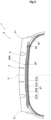
- FIG. 3 is a tire meridian cross-sectional view of the tread portion 2 of the tire 1.
- the present invention is preferably applied to the tire (heavy duty tire) 1 having an aspect ratio of 70% or less.
- the shape of the tread portion 2 is easily deformed during running such that, for example, the groove area is decreased due to an increase in the size of an outer diameter shape, so that it is difficult to obtain desired rolling resistance performance and wet grip performance. Therefore, the technology of the present invention is to suppress deformation during running, thereby exhibiting these performances as desired.
- the "aspect ratio" is the ratio of a cross-sectional height to a cross-sectional width of the tire 1.
- the "cross-sectional width” is the maximum width in the tire axial direction obtained by excluding patterns, characters, and the like on the side surfaces of the tire 1.
- the "cross-sectional height” is 1/2 of the difference between the outer diameter of the tire 1 and the rim diameter of the standardized rim.
- a carcass 19 As shown in FIG. 3 , in the tire 1 of the present embodiment of the invention, a carcass 19, a band layer 20, and a belt layer 21 are provided inside the tread portion 2. In the present embodiment of the invention, a well-known structure is employed for the carcass 19.
- the band layer 20 is formed so as to include a jointless band ply 20A in which a band cord (not shown) is helically wound at an angle of 5 degrees or less with respect to the tire circumferential direction.
- a jointless band ply 20A effectively prevents an increase in the outer diameter shape of the tire 1 due to running (radially outward growth) and serves to enhance rolling resistance performance.
- the jointless band ply 20A exhibits a high effect of suppressing the radially outward growth in the tire 1 having an aspect ratio of 70% or less.
- cords having a well-known structure and containing steel are used as the band cord and belt cords described later.
- the jointless band ply 20A is placed so as to cover the tire equator C. Accordingly, the above-described effect is effectively exhibited on both sides in the tire axial direction from the tire equator C.
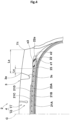
- FIG. 4 is an enlarged view of FIG. 3 .
- outer ends 25 in the tire axial direction on the first tread end T1 sides (in the present embodiment of the invention, both ends in the tire axial direction) of the jointless band ply 20A are located on the outer side in the tire axial direction with respect to outer ends 3e in the tire axial direction of the shoulder circumferential grooves 3. Accordingly, the radially outward growth is further effectively suppressed.
- each shoulder circumferential groove 3 extends in a zigzag manner as in the present embodiment of the invention
- the outer end 3e of the shoulder circumferential groove 3 is the portion where the shoulder circumferential groove 3 is located on the outermost side in the tire axial direction over the tire circumferential direction.
- each shoulder lateral groove 8A connects the shoulder circumferential groove 3 and the first tread end T1.
- each middle lateral groove 8B connects the shoulder circumferential groove 3 and the crown circumferential groove 4.
- each crown lateral groove 8C connects the crown circumferential grooves 4 on both sides.
- the tread portion 2 includes, for example, shoulder land portions 5A in each of which shoulder blocks 9A are aligned, middle land portions 5B in each of which middle blocks 9B are aligned, and a crown land portion 5C in which crown blocks 9C are aligned.
- Each shoulder block 9A of the present embodiment of the invention is formed in a substantially pentagonal shape in a tread plan view.
- Each of the middle blocks 9B and the crown blocks 9C is formed, for example, in a barrel-like substantially hexagonal shape having a larger width in the tire axial direction at a center portion in the tire circumferential direction than at both side portions in the tire circumferential direction, in a tread plan view.
- the shapes of the shoulder blocks 9A, the middle blocks 9B, and the crown blocks 9C are not limited to such shapes.
- FIG. 2(B) is a cross-sectional view taken along a line B-B in FIG. 1 , and shows a transverse cross-section in a direction orthogonal to a groove center line 3c of the shoulder circumferential groove 3.
- the pair of groove walls 6 of the shoulder circumferential groove 3 extend from the tread ground-contact surface 2s toward the inner side in the tire radial direction in a tapered manner.
- a groove width Ws of the shoulder circumferential groove 3 is, for example, preferably 6 to 16 mm.
- a groove depth Ds of the shoulder circumferential groove 3 is, for example, preferably 10 to 20 mm.
- the crown circumferential groove 4 includes the widened portion 10, and an outer portion 11 extending outward in the tire radial direction from the widened portion 10.
- the outer portion 11 has a groove width continuously and gradually decreasing from the tread ground-contact surface 2s toward the inner side in the tire radial direction.
- the outer portion 11 may have, for example, a groove width that is uniform from the tread ground-contact surface 2s toward the inner side in the tire radial direction (as shown in FIG. 4 ).
- the widened portion 10 includes, for example, a first portion 10a having a groove width continuously and gradually increasing toward the inner side in the tire radial direction, and a second portion 10b connected to the first portion 10a and having a groove width gradually decreasing toward the inner side in the tire radial direction.
- the second portion 10b includes a groove bottom 4s of the crown circumferential groove 4.
- the widened portion 10 is defined as a groove-like portion formed between the groove bottom 4s and the position at which the groove width is the smallest and which is on the innermost side in the tire radial direction on the outer side in the tire radial direction with respect to the position at which the groove width W2 of the widened portion 10 is the largest.
- the groove width W 1 at the tread ground-contact surface 2s of the crown circumferential groove 4 is preferably 0.01 to 0.2 times the groove width Ws of the shoulder circumferential groove 3. Accordingly, wet grip performance and rolling resistance performance can be enhanced further.
- the groove width W1 is more preferably not less than 0.05 times and more preferably not greater than 0.15 times the groove width Ws.
- the groove area of the transverse cross-section of the crown circumferential groove 4 is preferably not less than 0.1 times and further preferably not less than 0.2 times the groove area of the transverse cross-section of the shoulder circumferential groove 3, and is preferably not greater than 0.5 times and further preferably not greater than 0.4 times the groove area of the transverse cross-section of the shoulder circumferential groove 3.
- a length Lb in the tire radial direction from the tread ground-contact surface 2s to the widened portion 10 is preferably not less than 0.4 times and further preferably not less than 0.5 times a groove depth Dc of the crown circumferential groove 4, and is preferably not greater than 0.7 times and further preferably not greater than 0.6 times the groove depth Dc. Since the length Lb is not less than 0.4 times the groove depth Dc, a decrease in the stiffness on the tread ground-contact surface 2s side of the tread portion 2 can be suppressed, thereby enhancing rolling resistance performance. Since the length Lb is not greater than 0.7 times the groove depth Dc, the volume of the widened portion 10 is maintained, thereby exhibiting high drainage performance.
- the groove depth Dc of the crown circumferential groove 4 is, for example, preferably not less than 90% and further preferably not less than 95% of the groove depth Ds of the shoulder circumferential groove 3, and is preferably not greater than 110% and further preferably not greater than 105% of the groove depth Ds.
- the length Lb is the length in the tire radial direction of the outer portion 11.
- a groove width Wc of the crown circumferential groove 4 at the boundary K between the widened portion 10 and the outer portion 11 is, for example, preferably not less than 70% and further preferably not less than 80% of the groove width W1 of the crown circumferential groove 4, and is preferably not greater than 100% of the groove width W1.
- the jointless band ply 20A is likely to be broken at each outer end 25 thereof. Therefore, the outer end 25 is preferably separated from the first tread end T1 to which a relatively large lateral force is applied during running of the tire 1. On the other hand, if the outer end 25 is excessively close to the shoulder circumferential groove 3, damage such as cracks may occur starting from a groove bottom 3s of the shoulder circumferential groove 3.
- a separation distance Lc in the tire axial direction between the outer end 3e of the shoulder circumferential groove 3 and the outer end 25 of the jointless band ply 20A is preferably not less than 10% and further preferably not less than 15% of a separation distance Ls in the tire axial direction between the outer end 3e of the shoulder circumferential groove 3 and the first tread end T1, and is preferably not greater than 50% and further preferably not greater than 45% of the separation distance Ls.
- the separation distance Ls is not particularly limited, but is preferably not less than 10% and further preferably not less than 15% of the tread width TW and is preferably not greater than 26% and further preferably not greater than 23% of the tread width TW.
- the belt layer 21 is formed from at least three belt plies in which belt cords (not shown) are arranged at an angle of 10 to 50 degrees with respect to the tire circumferential direction.
- the belt layer 21 includes a first belt ply 21A, a second belt ply 21B, a third belt ply 21C, and a fourth belt ply 21D which are stacked from the inner side toward the outer side in the tire radial direction.
- Each of the belt plies 21A to 21D is formed so as to have a well-known structure.
- At least one of the at least three belt plies is located, for example, inward of the jointless band ply 20A in the tire radial direction. Accordingly, the tension applied to the jointless band ply 20A can be reduced.
- the first belt ply 21A and the second belt ply 21B are located on the inner side in the tire radial direction with respect to the jointless band ply 20A.
- the belt ply located inward of the jointless band ply 20A in the tire radial direction has, for example, an outer end on the outer side in the tire axial direction with respect to the outer end 25 of the jointless band ply 20A. Accordingly, the large tension applied to the outer end 25 of the jointless band ply 20A can be reduced, and thus deformation of the tread portion 2 and deformation of each circumferential groove 3 or 4 are suppressed, thereby enhancing wet grip performance and rolling resistance performance.
- an outer end e1 of the first belt ply 21A and an outer end e2 of the second belt ply 21B are located on the outer side in the tire axial direction with respect to the outer end 25 of the jointless band ply 20A.
- the third belt ply 21C adjacent to the outer side in the tire radial direction of the jointless band ply 20A has an outer end e3 on the outer side in the tire axial direction with respect to the outer end 25 of the jointless band ply 20A.
- Such a third belt ply 21C can reduce the large tension applied to the outer end 25 of the jointless band ply 20A.
- a reinforcing rubber 22 is provided so as to extend from each outer end 25 of the jointless band ply 20A toward the outer side in the tire axial direction and be interposed between the second belt ply 21B and the third belt ply 21C.
- Such a reinforcing rubber 22 maintains the distance between the second belt ply 21B and the third belt ply 21C and serves to reduce the tension applied to the jointless band ply 20A.
- An outer end 22e in the tire axial direction of the reinforcing rubber 22 is located at the same position in the tire axial direction as the outer end e2 of the second belt ply 21B.
- the reinforcing rubber 22 is formed so as to have a well-known structure.
- FIG. 5 is a tire meridian cross-sectional view of a tread portion 2 of another embodiment of the invention.
- the band layer 20 of this embodiment of the invention is formed so as to further include a jointless edge band ply 20B which is adjacent to the first tread end T1 and in which a band cord is helically wound at an angle of 5 degrees or less with respect to the tire circumferential direction.
- the jointless edge band ply 20B is placed so as to straddle the outer end 25 of the jointless band ply 20A.
- an inner end 26i in the tire axial direction of the jointless edge band ply 20B is located on the inner side in the tire axial direction with respect to the outer end 25 of the jointless band ply 20A.
- an outer end 26e in the tire axial direction of the jointless edge band ply 20B is located on the outer side in the tire axial direction with respect to the outer end 25 of the jointless band ply 20A.
- Such a jointless edge band ply 20B suppresses large movement of the outer end 25 of the jointless band ply 20A, thereby enhancing rolling resistance performance and improving uneven wear resistance.
- the inner end 26i of the jointless edge band ply 20B is located, for example, on the outer side in the tire axial direction with respect to the outer end 3e of the shoulder circumferential groove 3. Accordingly, damage such as cracks starting from the groove bottom 3s of the shoulder circumferential groove 3 can be suppressed.
- the jointless edge band ply 20B extends from an outer end e4 in the tire axial direction of the fourth belt ply 21D toward the outer side in the tire axial direction and terminates on the inner side in the tire axial direction with respect to the outer end e3 of the third belt ply 21C.
- a separation distance Le in the tire axial direction between the outer end 26e of the jointless edge band ply 20B and the outer end e3 of the third belt ply 21C is preferably not less than 15% and further preferably not less than 20% of the separation distance Ls, and is preferably not greater than 35% and further preferably not greater than 30% of the separation distance Ls.
Landscapes
- Engineering & Computer Science (AREA)
- Mechanical Engineering (AREA)
- Tires In General (AREA)
Description
- The present invention relates to a tire.
-
Japanese Laid-Open Patent Publication No. 2017-7424 - In recent years, the international standard "UN/ECE Regulation No. 117 02 Series (R117-02)" and the "labeling system" of The Japan Automobile Tyre Manufacturers Association, Inc. have been attracting attention, and further improvement of rolling resistance performance and wet grip performance is required.
- The present invention has been made in view of the above circumstances, and a main object of the present invention is to provide a tire that can have further improved rolling resistance performance and wet grip performance.
- A tire according to the preamble of
claim 1 is known fromWO 2017/103448 A1 . Related tires are described inWO 2019/122791 A1 ,EP 3 895 913 A1US 2022/097456 A1 ,US 2017/174008 A1 andEP 4 119 358 A1 - The object is solved by a tire having the features of
claim 1. Sub-claims are directed at preferable embodiments of the invention. - The present invention is directed to a tire including a tread portion having a first tread end, wherein: the tread portion has a shoulder circumferential groove adjacent to the first tread end, and a crown circumferential groove provided between the shoulder circumferential groove and a tire equator; each of the shoulder circumferential groove and the crown circumferential groove includes a pair of groove walls; in a standardized load-applied state where the tire is fitted on a standardized rim at a standardized internal pressure, a standardized load is applied to the tire, and the tire is brought into contact with a flat surface at a camber angle of 0°, the pair of groove walls of the shoulder circumferential groove are not in contact with each other, and at least parts of the pair of groove walls of the crown circumferential groove are in contact with each other; the crown circumferential groove has a widened portion on an inner side in a tire radial direction with respect to a tread ground-contact surface; a groove width of the widened portion is larger than a groove width at the tread ground-contact surface of the crown circumferential groove; a band layer including a jointless band ply in which a band cord is helically wound at an angle of 5 degrees or less with respect to a tire circumferential direction is provided inside the tread portion; the jointless band ply is placed so as to cover the tire equator; and an outer end in a tire axial direction on the first tread end side of the jointless band ply is located on an outer side in the tire axial direction with respect to an outer end in the tire axial direction of the shoulder circumferential groove.
- As a result of employing the above configuration, the tire of the present invention can have further improved rolling resistance performance and wet grip performance.
- According to an embodiment of the invention, the groove width at the tread ground-contact surface of the crown circumferential groove is 0.01 to 0.2 times a groove width of the shoulder circumferential groove.
- According to an embodiment of the invention, a groove area of a transverse cross-section of the crown circumferential groove is 0.1 to 0.5 times a groove area of a transverse cross-section of the shoulder circumferential groove.
- According to an embodiment of the invention, a length in the tire radial direction from the tread ground-contact surface to the widened portion is 0.4 to 0.7 times a groove depth of the crown circumferential groove.
- According to an embodiment of the invention, a separation distance in the tire axial direction between the outer end of the shoulder circumferential groove and the outer end of the jointless band ply is 10% to 50% of a separation distance in the tire axial direction between the outer end of the shoulder circumferential groove and the first tread end.
- According to an embodiment of the invention, a belt layer including at least three belt plies in which belt cords are arranged at an angle of 10 to 50 degrees with respect to the tire circumferential direction is provided inside the tread portion, and at least one belt ply of the at least three belt plies is located inward of the jointless band ply in the tire radial direction.
- According to an embodiment of the invention, the belt ply located inward of the jointless band ply in the tire radial direction has an outer end on the outer side in the tire axial direction with respect to the outer end of the jointless band ply.
- According to an embodiment of the invention, the band layer includes a jointless edge band ply which is adjacent to the first tread end and in which a band cord is helically wound at an angle of 5 degrees or less with respect to the tire circumferential direction, and the jointless edge band ply straddles the outer end of the jointless band ply.
- According to an embodiment of the invention, an inner end in the tire axial direction of the jointless edge band ply is located on the outer side in the tire axial direction with respect to the outer end of the shoulder circumferential groove.
- According to an embodiment of the invention, the tire is a heavy duty tire having an aspect ratio of 70% or less.
-
-
FIG. 1 is a plan view of a tread portion showing an embodiment of the tire of the present invention; -
FIG. 2(A) is a cross-sectional view taken along a line A-A inFIG. 1 ; -
FIG. 2(B) is a cross-sectional view taken along a line B-B inFIG. 1 ; -
FIG. 3 is a tire meridian cross-sectional view of the tread portion of the tire inFIG. 1 ; -
FIG. 4 is an enlarged view ofFIG. 3 ; and -
FIG. 5 is a tire meridian cross-sectional view of a tread portion of another embodiment of the invention. - Hereinafter, an embodiment of the present invention will be described with reference to the drawings.
-
FIG. 1 is a plan view of atread portion 2 of atire 1 of the present embodiment. Thetire 1 of the present embodiment of the invention is suitably used, for example, as a heavy duty tire. The present invention may be applied to heavy duty pneumatic tires as well as pneumatic tires for a passenger car and a small truck. - As shown in
FIG. 1 , thetread portion 2 of the present embodiment of the invention has shouldercircumferential grooves 3 adjacent to first tread ends T1, and crowncircumferential grooves 4 provided between the shouldercircumferential grooves 3 and a tire equator C. Each of the shouldercircumferential grooves 3 and the crowncircumferential grooves 4 includes a pair ofgroove walls - The stiffness of the
tread portion 2 has a large contribution to rolling resistance, and it is particularly effective to increase the stiffness of thetread portion 2 on the tire equator C side where the ground-contact pressure is high. Therefore, in the present invention, in a standardized load-applied state, the pair ofgroove walls 6 of each shouldercircumferential groove 3 are not in contact with each other. In addition, at least parts of the pair ofgroove walls 7 of each crowncircumferential groove 4 are in contact with each other. Accordingly, in thetire 1 of the present invention, when a tread ground-contact surface 2s comes into contact with the ground, thegroove walls 7 of each crowncircumferential groove 4 support each other, and thus deformation of land portions adjacent to the crowncircumferential groove 4 is suppressed, thereby reducing rolling resistance. In addition, even when the tread ground-contact surface 2s comes into contact with the ground, the pair ofgroove walls 6 of each shouldercircumferential groove 3 do not come into contact with each other, and thus the shouldercircumferential groove 3 exhibits an excellent drainage effect. -
FIG. 2(A) is a cross-sectional view taken along a line A-A inFIG. 1 , and shows a transverse cross-section in a direction orthogonal to agroove center line 4c of the crowncircumferential groove 4. As shown inFIG. 2(A) , the crowncircumferential groove 4 has a widenedportion 10 on the inner side in the tire radial direction with respect to the tread ground-contact surface 2s. The widenedportion 10 is formed such that a groove width W2 thereof is larger than a groove width W1 at the tread ground-contact surface 2s of the crowncircumferential groove 4. Such a widenedportion 10 contributes to suppressing a decrease in the stiffness of thetread portion 2 to enhance rolling resistance performance in the early stage of wear, and enhancing drainage performance in the late stage of wear. - As shown in
FIG. 1 , thetread portion 2 of the present embodiment of the invention includes the first tread ends T1 on both sides in the tire axial direction. In the case where thetire 1 is a pneumatic tire, each first tread end T1 is a ground-contact position on the outermost side in the tire axial direction when a standardized load is applied to thetire 1 in a standardized state and thetire 1 is brought into contact with a flat surface at a camber angle of 0°. In the case of thepneumatic tire 1 for which various standards are defined, the "standardized state" is a state where thetire 1 is fitted on a standardized rim and inflated to a standardized internal pressure and no load is applied to thetire 1. In the case of a tire for which various standards are not defined, the standardized state means a standard use state, corresponding to the purpose of use of the tire, where no load is applied to the tire. In the present specification, unless otherwise specified, dimensions and the like of components of thetire 1 are values measured in the standardized state. In addition, the distance in the tire axial direction between the first tread ends T1 is a tread width TW. - The "standardized rim" is a rim that is defined, in a standard system including a standard on which the
tire 1 is based, by the standard for each tire, and is, for example, the "standard rim" in the JATMA standard, the "Design Rim" in the TRA standard, or the "Measuring Rim" in the ETRTO standard. - The "standardized internal pressure" is an air pressure that is defined, in a standard system including a standard on which the
tire 1 is based, by the standard for each tire, and is the "highest air pressure" in the JATMA standard, the maximum value indicated in the table "TIRE LOAD LIMITS AT VARIOUS COLD INFLATION PRESSURES" in the TRA standard, or the "INFLATION PRESSURE" in the ETRTO standard. - The "standardized load" is a load that is defined, in a standard system including a standard on which the
tire 1 is based, by the standard for each tire, and is the "maximum load capacity" in the JATMA standard, the maximum value indicated in the table "TIRE LOAD LIMITS AT VARIOUS COLD INFLATION PRESSURES" in the TRA standard, or the "LOAD CAPACITY" in the ETRTO standard. In the case of a tire for which various standards are not defined, the "standardized load" refers to the maximum load applicable when the tire is used, according to the above-described standards. -
FIG. 3 is a tire meridian cross-sectional view of thetread portion 2 of thetire 1. The present invention is preferably applied to the tire (heavy duty tire) 1 having an aspect ratio of 70% or less. In such atire 1, the shape of thetread portion 2 is easily deformed during running such that, for example, the groove area is decreased due to an increase in the size of an outer diameter shape, so that it is difficult to obtain desired rolling resistance performance and wet grip performance. Therefore, the technology of the present invention is to suppress deformation during running, thereby exhibiting these performances as desired. The "aspect ratio" is the ratio of a cross-sectional height to a cross-sectional width of thetire 1. The "cross-sectional width" is the maximum width in the tire axial direction obtained by excluding patterns, characters, and the like on the side surfaces of thetire 1. The "cross-sectional height" is 1/2 of the difference between the outer diameter of thetire 1 and the rim diameter of the standardized rim. - As shown in
FIG. 3 , in thetire 1 of the present embodiment of the invention, acarcass 19, aband layer 20, and abelt layer 21 are provided inside thetread portion 2. In the present embodiment of the invention, a well-known structure is employed for thecarcass 19. - The
band layer 20 is formed so as to include a jointless band ply 20A in which a band cord (not shown) is helically wound at an angle of 5 degrees or less with respect to the tire circumferential direction. Such a jointless band ply 20A effectively prevents an increase in the outer diameter shape of thetire 1 due to running (radially outward growth) and serves to enhance rolling resistance performance. In particular, the jointless band ply 20A exhibits a high effect of suppressing the radially outward growth in thetire 1 having an aspect ratio of 70% or less. In the present embodiment of the invention, cords having a well-known structure and containing steel are used as the band cord and belt cords described later. - In the present embodiment of the invention, the jointless band ply 20A is placed so as to cover the tire equator C. Accordingly, the above-described effect is effectively exhibited on both sides in the tire axial direction from the tire equator C.
-
FIG. 4 is an enlarged view ofFIG. 3 . As shown inFIG. 4 , outer ends 25 in the tire axial direction on the first tread end T1 sides (in the present embodiment of the invention, both ends in the tire axial direction) of thejointless band ply 20A are located on the outer side in the tire axial direction with respect toouter ends 3e in the tire axial direction of the shouldercircumferential grooves 3. Accordingly, the radially outward growth is further effectively suppressed. In the case where each shouldercircumferential groove 3 extends in a zigzag manner as in the present embodiment of the invention, theouter end 3e of the shouldercircumferential groove 3 is the portion where the shouldercircumferential groove 3 is located on the outermost side in the tire axial direction over the tire circumferential direction. - As shown in
FIG. 1 , on thetread portion 2 of the present embodiment of the invention, the shouldercircumferential grooves 3 and thecrown circumferential grooves 4 are provided on both sides of the tire equator C. Furthermore, for example, a plurality ofshoulder lateral grooves 8A, a plurality of middlelateral grooves 8B, and a plurality ofcrown lateral grooves 8C are formed on thetread portion 2. For example, eachshoulder lateral groove 8A connects the shouldercircumferential groove 3 and the first tread end T1. In the present embodiment of the invention, each middlelateral groove 8B connects the shouldercircumferential groove 3 and the crowncircumferential groove 4. For example, each crownlateral groove 8C connects thecrown circumferential grooves 4 on both sides. - Thus, the
tread portion 2 includes, for example,shoulder land portions 5A in each of which shoulder blocks 9A are aligned,middle land portions 5B in each of whichmiddle blocks 9B are aligned, and acrown land portion 5C in which crown blocks 9C are aligned. Eachshoulder block 9A of the present embodiment of the invention is formed in a substantially pentagonal shape in a tread plan view. Each of themiddle blocks 9B and the crown blocks 9C is formed, for example, in a barrel-like substantially hexagonal shape having a larger width in the tire axial direction at a center portion in the tire circumferential direction than at both side portions in the tire circumferential direction, in a tread plan view. The shapes of the shoulder blocks 9A, themiddle blocks 9B, and the crown blocks 9C are not limited to such shapes. -
FIG. 2(B) is a cross-sectional view taken along a line B-B inFIG. 1 , and shows a transverse cross-section in a direction orthogonal to a groove center line 3c of the shouldercircumferential groove 3. As shown inFIG. 2(B) , the pair ofgroove walls 6 of the shouldercircumferential groove 3 extend from the tread ground-contact surface 2s toward the inner side in the tire radial direction in a tapered manner. A groove width Ws of the shouldercircumferential groove 3 is, for example, preferably 6 to 16 mm. A groove depth Ds of the shouldercircumferential groove 3 is, for example, preferably 10 to 20 mm. - As shown in
FIG. 2(A) , the crowncircumferential groove 4 includes the widenedportion 10, and anouter portion 11 extending outward in the tire radial direction from the widenedportion 10. In the present embodiment of the invention, theouter portion 11 has a groove width continuously and gradually decreasing from the tread ground-contact surface 2s toward the inner side in the tire radial direction. Theouter portion 11 may have, for example, a groove width that is uniform from the tread ground-contact surface 2s toward the inner side in the tire radial direction (as shown inFIG. 4 ). The widenedportion 10 includes, for example, afirst portion 10a having a groove width continuously and gradually increasing toward the inner side in the tire radial direction, and asecond portion 10b connected to thefirst portion 10a and having a groove width gradually decreasing toward the inner side in the tire radial direction. Thesecond portion 10b includes agroove bottom 4s of the crowncircumferential groove 4. The widenedportion 10 is defined as a groove-like portion formed between thegroove bottom 4s and the position at which the groove width is the smallest and which is on the innermost side in the tire radial direction on the outer side in the tire radial direction with respect to the position at which the groove width W2 of the widenedportion 10 is the largest. - When the tread ground-
contact surface 2s comes into contact with the ground, therespective groove walls 7 of such a crowncircumferential groove 4 initially come into contact with each other at a boundary K between the widenedportion 10 and theouter portion 11, and the contact area therebetween is gradually increased from the boundary K toward the inner and outer sides in the tire radial direction. Accordingly, the contact pressure between thegroove walls 7 is reduced, and the effect of thegroove walls 7 supporting each other is exhibited at a higher level, so that rolling resistance is reduced further. - The
groove width W 1 at the tread ground-contact surface 2s of the crowncircumferential groove 4 is preferably 0.01 to 0.2 times the groove width Ws of the shouldercircumferential groove 3. Accordingly, wet grip performance and rolling resistance performance can be enhanced further. In order to more effectively exhibit such an effect, the groove width W1 is more preferably not less than 0.05 times and more preferably not greater than 0.15 times the groove width Ws. - In order to more effectively exhibit the above-described effect, the groove area of the transverse cross-section of the crown
circumferential groove 4 is preferably not less than 0.1 times and further preferably not less than 0.2 times the groove area of the transverse cross-section of the shouldercircumferential groove 3, and is preferably not greater than 0.5 times and further preferably not greater than 0.4 times the groove area of the transverse cross-section of the shouldercircumferential groove 3. - A length Lb in the tire radial direction from the tread ground-
contact surface 2s to the widenedportion 10 is preferably not less than 0.4 times and further preferably not less than 0.5 times a groove depth Dc of the crowncircumferential groove 4, and is preferably not greater than 0.7 times and further preferably not greater than 0.6 times the groove depth Dc. Since the length Lb is not less than 0.4 times the groove depth Dc, a decrease in the stiffness on the tread ground-contact surface 2s side of thetread portion 2 can be suppressed, thereby enhancing rolling resistance performance. Since the length Lb is not greater than 0.7 times the groove depth Dc, the volume of the widenedportion 10 is maintained, thereby exhibiting high drainage performance. The groove depth Dc of the crowncircumferential groove 4 is, for example, preferably not less than 90% and further preferably not less than 95% of the groove depth Ds of the shouldercircumferential groove 3, and is preferably not greater than 110% and further preferably not greater than 105% of the groove depth Ds. In the present embodiment of the invention, the length Lb is the length in the tire radial direction of theouter portion 11. - A groove width Wc of the crown
circumferential groove 4 at the boundary K between the widenedportion 10 and theouter portion 11 is, for example, preferably not less than 70% and further preferably not less than 80% of the groove width W1 of the crowncircumferential groove 4, and is preferably not greater than 100% of the groove width W1. - The jointless band ply 20A is likely to be broken at each
outer end 25 thereof. Therefore, theouter end 25 is preferably separated from the first tread end T1 to which a relatively large lateral force is applied during running of thetire 1. On the other hand, if theouter end 25 is excessively close to the shouldercircumferential groove 3, damage such as cracks may occur starting from agroove bottom 3s of the shouldercircumferential groove 3. Therefore, a separation distance Lc in the tire axial direction between theouter end 3e of the shouldercircumferential groove 3 and theouter end 25 of the jointless band ply 20A is preferably not less than 10% and further preferably not less than 15% of a separation distance Ls in the tire axial direction between theouter end 3e of the shouldercircumferential groove 3 and the first tread end T1, and is preferably not greater than 50% and further preferably not greater than 45% of the separation distance Ls. - The separation distance Ls is not particularly limited, but is preferably not less than 10% and further preferably not less than 15% of the tread width TW and is preferably not greater than 26% and further preferably not greater than 23% of the tread width TW.
- As shown in
FIG. 3 andFIG. 4 , thebelt layer 21 is formed from at least three belt plies in which belt cords (not shown) are arranged at an angle of 10 to 50 degrees with respect to the tire circumferential direction. In the present embodiment of the invention, thebelt layer 21 includes a first belt ply 21A, a second belt ply 21B, a third belt ply 21C, and afourth belt ply 21D which are stacked from the inner side toward the outer side in the tire radial direction. Each of the belt plies 21A to 21D is formed so as to have a well-known structure. - At least one of the at least three belt plies is located, for example, inward of the jointless band ply 20A in the tire radial direction. Accordingly, the tension applied to the jointless band ply 20A can be reduced. In the present embodiment of the invention, the first belt ply 21A and the
second belt ply 21B are located on the inner side in the tire radial direction with respect to the jointless band ply 20A. - The belt ply located inward of the jointless band ply 20A in the tire radial direction has, for example, an outer end on the outer side in the tire axial direction with respect to the
outer end 25 of the jointless band ply 20A. Accordingly, the large tension applied to theouter end 25 of the jointless band ply 20A can be reduced, and thus deformation of thetread portion 2 and deformation of eachcircumferential groove first belt ply 21A and an outer end e2 of thesecond belt ply 21B are located on the outer side in the tire axial direction with respect to theouter end 25 of the jointless band ply 20A. - Also, for example, the third belt ply 21C adjacent to the outer side in the tire radial direction of the jointless band ply 20A has an outer end e3 on the outer side in the tire axial direction with respect to the
outer end 25 of the jointless band ply 20A. Such a third belt ply 21C can reduce the large tension applied to theouter end 25 of the jointless band ply 20A. - In the
tread portion 2 of the present embodiment of the invention, a reinforcingrubber 22 is provided so as to extend from eachouter end 25 of the jointless band ply 20A toward the outer side in the tire axial direction and be interposed between the second belt ply 21B and thethird belt ply 21C. Such a reinforcingrubber 22 maintains the distance between the second belt ply 21B and thethird belt ply 21C and serves to reduce the tension applied to the jointless band ply 20A. Anouter end 22e in the tire axial direction of the reinforcingrubber 22 is located at the same position in the tire axial direction as the outer end e2 of the second belt ply 21B. The reinforcingrubber 22 is formed so as to have a well-known structure. -
FIG. 5 is a tire meridian cross-sectional view of atread portion 2 of another embodiment of the invention. The same components as those of the above embodiment of the invention are designated by the same reference characters, and the description thereof is sometimes omitted. As shown inFIG. 5 , theband layer 20 of this embodiment of the invention is formed so as to further include a jointlessedge band ply 20B which is adjacent to the first tread end T1 and in which a band cord is helically wound at an angle of 5 degrees or less with respect to the tire circumferential direction. - The jointless edge band ply 20B is placed so as to straddle the
outer end 25 of the jointless band ply 20A. In other words, aninner end 26i in the tire axial direction of the jointlessedge band ply 20B is located on the inner side in the tire axial direction with respect to theouter end 25 of the jointless band ply 20A. In addition, anouter end 26e in the tire axial direction of the jointlessedge band ply 20B is located on the outer side in the tire axial direction with respect to theouter end 25 of the jointless band ply 20A. Such a jointless edge band ply 20B suppresses large movement of theouter end 25 of the jointless band ply 20A, thereby enhancing rolling resistance performance and improving uneven wear resistance. - The
inner end 26i of the jointlessedge band ply 20B is located, for example, on the outer side in the tire axial direction with respect to theouter end 3e of the shouldercircumferential groove 3. Accordingly, damage such as cracks starting from thegroove bottom 3s of the shouldercircumferential groove 3 can be suppressed. - The jointless edge band ply 20B extends from an outer end e4 in the tire axial direction of the
fourth belt ply 21D toward the outer side in the tire axial direction and terminates on the inner side in the tire axial direction with respect to the outer end e3 of thethird belt ply 21C. A separation distance Le in the tire axial direction between theouter end 26e of the jointless edge band ply 20B and the outer end e3 of the third belt ply 21C is preferably not less than 15% and further preferably not less than 20% of the separation distance Ls, and is preferably not greater than 35% and further preferably not greater than 30% of the separation distance Ls. - Although the embodiments of the present invention have been described in detail above, the present invention is not limited to the above specific embodiments, and various modifications can be made to implement the present invention within the scope of the appended claims.
Claims (10)
- A tire (1) comprising:a tread portion (2) having a first tread end (T1), whereinthe tread portion (2) has a shoulder circumferential groove (3) adjacent to the first tread end (T1), and a crown circumferential groove (4) provided between the shoulder circumferential groove (3) and a tire equator (C),each of the shoulder circumferential groove (3) and the crown circumferential groove (4) includes a pair of groove walls (6, 7),in a standardized load-applied state where the tire (1) is fitted on a standardized rim at a standardized internal pressure, a standardized load is applied to the tire (1), and the tire (1) is brought into contact with a flat surface at a camber angle of 0°, the pair of groove walls (6) of the shoulder circumferential groove (3) are not in contact with each other, and at least parts of the pair of groove walls (7) of the crown circumferential groove (4) are in contact with each other,the crown circumferential groove (4) has a widened portion (10) on an inner side in a tire radial direction with respect to a tread ground-contact surface (2s),a groove width (W2) of the widened portion (10) is larger than a groove width (W1) at the tread ground-contact surface (2s) of the crown circumferential groove (4),a band layer (20) including a jointless band ply (20A) in which a band cord is helically wound at an angle of 5 degrees or less with respect to a tire circumferential direction is provided inside the tread portion (2), andthe jointless band ply (20A) is placed so as to cover the tire equator (C),characterized in thatan outer end (25) in a tire axial direction on the first tread end (T1) side of the jointless band ply (20A) is located on an outer side in the tire axial direction with respect to an outer end (3e) in the tire axial direction of the shoulder circumferential groove (3).
- The tire (1) according to claim 1, wherein the groove width (W1) at the tread ground-contact surface (2s) of the crown circumferential groove (4) is 0.01 to 0.2 times a groove width (Ws) of the shoulder circumferential groove (3).
- The tire (1) according to claim 1 or 2, wherein a groove area of a transverse cross-section of the crown circumferential groove (4) is 0.1 to 0.5 times a groove area of a transverse cross-section of the shoulder circumferential groove (3).
- The tire (1) according to any one of claims 1 to 3, wherein a length (Lb) in the tire radial direction from the tread ground-contact surface (2s) to the widened portion (10) is 0.4 to 0.7 times a groove depth (Dc) of the crown circumferential groove (4).
- The tire (1) according to any one of claims 1 to 4, wherein a separation distance (Lc) in the tire axial direction between the outer end (3e) of the shoulder circumferential groove (3) and the outer end (25) of the jointless band ply (20A) is 10% to 50% of a separation distance (Ls) in the tire axial direction between the outer end (3e) of the shoulder circumferential groove (3) and the first tread end (T1).
- The tire (1) according to any one of claims 1 to 5, whereina belt layer (21) including at least three belt plies (21A, 21B, 21C, 21D) in which belt cords are arranged at an angle of 10 to 50 degrees with respect to the tire circumferential direction is provided inside the tread portion (2), andat least one belt ply (21A, 21B) of the at least three belt plies (21A, 21B, 21C, 21D) is located inward of the jointless band ply (20A) in the tire radial direction.
- The tire (1) according to claim 6, wherein the belt ply (21A, 21B) located inward of the jointless band ply (20A) in the tire radial direction has an outer end (e1, e2) on the outer side in the tire axial direction with respect to the outer end (25) of the jointless band ply (20A).
- The tire (1) according to any one of claims 1 to 7, whereinthe band layer (20) includes a jointless edge band ply (20B) which is adjacent to the first tread end (T1) and in which a band cord is helically wound at an angle of 5 degrees or less with respect to the tire circumferential direction, andthe jointless edge band ply (20B) straddles the outer end (25) of the jointless band ply (20A).
- The tire (1) according to claim 8, wherein an inner end (26i) in the tire axial direction of the jointless edge band ply (20B) is located on the outer side in the tire axial direction with respect to the outer end (3e) of the shoulder circumferential groove (3).
- The tire (1) according to any one of claims 1 to 9, wherein the tire (1) is a heavy duty tire having an aspect ratio of 70% or less.
Applications Claiming Priority (1)
| Application Number | Priority Date | Filing Date | Title |
|---|---|---|---|
| JP2022093941A JP2023180553A (en) | 2022-06-09 | 2022-06-09 | tire |
Publications (2)
| Publication Number | Publication Date |
|---|---|
| EP4289634A1 EP4289634A1 (en) | 2023-12-13 |
| EP4289634B1 true EP4289634B1 (en) | 2024-05-29 |
Family
ID=86603837
Family Applications (1)
| Application Number | Title | Priority Date | Filing Date |
|---|---|---|---|
| EP23175321.1A Active EP4289634B1 (en) | 2022-06-09 | 2023-05-25 | Tire |
Country Status (2)
| Country | Link |
|---|---|
| EP (1) | EP4289634B1 (en) |
| JP (1) | JP2023180553A (en) |
Families Citing this family (2)
| Publication number | Priority date | Publication date | Assignee | Title |
|---|---|---|---|---|
| JP2026042590A (en) | 2024-08-27 | 2026-03-11 | 住友ゴム工業株式会社 | tire |
| CN119459185B (en) * | 2024-12-20 | 2025-10-31 | 安徽佳通乘用子午线轮胎有限公司 | A pneumatic radial tire with low rolling resistance and high wet grip |
Family Cites Families (11)
| Publication number | Priority date | Publication date | Assignee | Title |
|---|---|---|---|---|
| FR3017076B1 (en) * | 2014-02-03 | 2016-02-12 | Michelin & Cie | TIRE TREAD TIRE FOR HEAVY WEIGHT |
| FR3017075B1 (en) * | 2014-02-03 | 2016-02-12 | Michelin & Cie | TIRE TREAD TIRE FOR HEAVY WEIGHT |
| JP6557064B2 (en) | 2015-06-18 | 2019-08-07 | 株式会社ブリヂストン | Heavy duty tire |
| FR3045464B1 (en) * | 2015-12-16 | 2017-12-22 | Michelin & Cie | PNEUMATIC HAVING IMPROVED WEAR PROPERTIES |
| US11548322B2 (en) * | 2017-12-22 | 2023-01-10 | Compagnie Generale Des Etablissements Michelin | Heavy goods vehicle tire with improved endurance |
| DE102020201730A1 (en) * | 2020-02-12 | 2021-08-12 | Continental Reifen Deutschland Gmbh | Pneumatic vehicle tires |
| EP3895913A1 (en) * | 2020-04-17 | 2021-10-20 | Bridgestone Europe NV/SA | Improved tyre |
| JP6927362B1 (en) * | 2020-04-28 | 2021-08-25 | 住友ゴム工業株式会社 | tire |
| JP7131589B2 (en) * | 2020-09-14 | 2022-09-06 | 住友ゴム工業株式会社 | Heavy duty pneumatic tire |
| JP2022057910A (en) * | 2020-09-30 | 2022-04-11 | 横浜ゴム株式会社 | tire |
| US12565063B2 (en) * | 2021-07-14 | 2026-03-03 | Sumitomo Rubber Industries, Ltd. | Tire |
-
2022
- 2022-06-09 JP JP2022093941A patent/JP2023180553A/en active Pending
-
2023
- 2023-05-25 EP EP23175321.1A patent/EP4289634B1/en active Active
Also Published As
| Publication number | Publication date |
|---|---|
| EP4289634A1 (en) | 2023-12-13 |
| JP2023180553A (en) | 2023-12-21 |
Similar Documents
| Publication | Publication Date | Title |
|---|---|---|
| US10710415B2 (en) | Tire | |
| EP3572243B1 (en) | Tire | |
| US20160144668A1 (en) | Pneumatic tire | |
| US7918256B2 (en) | Heavy duty tire having ground contacting face at 70% and 100% maximum tire load | |
| JP6729808B2 (en) | Pneumatic tire | |
| EP4289634B1 (en) | Tire | |
| JP7547870B2 (en) | tire | |
| JP7711521B2 (en) | tire | |
| JP4677028B2 (en) | Pneumatic tire | |
| JP5923057B2 (en) | Heavy duty tire | |
| EP3415342B1 (en) | Heavy-duty tire | |
| JP5109823B2 (en) | Pneumatic tire | |
| US11535066B2 (en) | Tire | |
| EP3599112B1 (en) | Studless tyre | |
| EP3718789B1 (en) | Tire | |
| US12202300B2 (en) | Heavy duty tire | |
| EP4209361B1 (en) | Tire | |
| JP7287178B2 (en) | pneumatic tire | |
| WO2018235335A1 (en) | tire | |
| US12090792B2 (en) | Tire and tire-vehicle combination | |
| JP7818393B2 (en) | tire | |
| JP7314625B2 (en) | tire | |
| US12370839B2 (en) | Tire | |
| EP4714675A2 (en) | Tire | |
| CN111791650B (en) | Tire with a tire body |
Legal Events
| Date | Code | Title | Description |
|---|---|---|---|
| PUAI | Public reference made under article 153(3) epc to a published international application that has entered the european phase |
Free format text: ORIGINAL CODE: 0009012 |
|
| STAA | Information on the status of an ep patent application or granted ep patent |
Free format text: STATUS: THE APPLICATION HAS BEEN PUBLISHED |
|
| AK | Designated contracting states |
Kind code of ref document: A1 Designated state(s): AL AT BE BG CH CY CZ DE DK EE ES FI FR GB GR HR HU IE IS IT LI LT LU LV MC ME MK MT NL NO PL PT RO RS SE SI SK SM TR |
|
| STAA | Information on the status of an ep patent application or granted ep patent |
Free format text: STATUS: REQUEST FOR EXAMINATION WAS MADE |
|
| 17P | Request for examination filed |
Effective date: 20240119 |
|
| RBV | Designated contracting states (corrected) |
Designated state(s): AL AT BE BG CH CY CZ DE DK EE ES FI FR GB GR HR HU IE IS IT LI LT LU LV MC ME MK MT NL NO PL PT RO RS SE SI SK SM TR |
|
| GRAP | Despatch of communication of intention to grant a patent |
Free format text: ORIGINAL CODE: EPIDOSNIGR1 |
|
| STAA | Information on the status of an ep patent application or granted ep patent |
Free format text: STATUS: GRANT OF PATENT IS INTENDED |
|
| GRAS | Grant fee paid |
Free format text: ORIGINAL CODE: EPIDOSNIGR3 |
|
| RIC1 | Information provided on ipc code assigned before grant |
Ipc: B60C 3/04 20060101ALI20240319BHEP Ipc: B60C 9/22 20060101ALI20240319BHEP Ipc: B60C 11/03 20060101AFI20240319BHEP |
|
| GRAA | (expected) grant |
Free format text: ORIGINAL CODE: 0009210 |
|
| STAA | Information on the status of an ep patent application or granted ep patent |
Free format text: STATUS: THE PATENT HAS BEEN GRANTED |
|
| INTG | Intention to grant announced |
Effective date: 20240405 |
|
| P01 | Opt-out of the competence of the unified patent court (upc) registered |
Effective date: 20240327 |
|
| RAP3 | Party data changed (applicant data changed or rights of an application transferred) |
Owner name: SUMITOMO RUBBER INDUSTRIES, LTD. |
|
| RIN1 | Information on inventor provided before grant (corrected) |
Inventor name: MIHARA, NAOYA |
|
| AK | Designated contracting states |
Kind code of ref document: B1 Designated state(s): AL AT BE BG CH CY CZ DE DK EE ES FI FR GB GR HR HU IE IS IT LI LT LU LV MC ME MK MT NL NO PL PT RO RS SE SI SK SM TR |
|
| REG | Reference to a national code |
Ref country code: CH Ref legal event code: EP |
|
| REG | Reference to a national code |
Ref country code: IE Ref legal event code: FG4D |
|
| REG | Reference to a national code |
Ref country code: DE Ref legal event code: R096 Ref document number: 602023000119 Country of ref document: DE |
|
| REG | Reference to a national code |
Ref country code: LT Ref legal event code: MG9D |
|
| REG | Reference to a national code |
Ref country code: NL Ref legal event code: MP Effective date: 20240529 |
|
| PG25 | Lapsed in a contracting state [announced via postgrant information from national office to epo] |
Ref country code: IS Free format text: LAPSE BECAUSE OF FAILURE TO SUBMIT A TRANSLATION OF THE DESCRIPTION OR TO PAY THE FEE WITHIN THE PRESCRIBED TIME-LIMIT Effective date: 20240929 |
|
| PG25 | Lapsed in a contracting state [announced via postgrant information from national office to epo] |
Ref country code: BG Free format text: LAPSE BECAUSE OF FAILURE TO SUBMIT A TRANSLATION OF THE DESCRIPTION OR TO PAY THE FEE WITHIN THE PRESCRIBED TIME-LIMIT Effective date: 20240529 |
|
| PG25 | Lapsed in a contracting state [announced via postgrant information from national office to epo] |
Ref country code: HR Free format text: LAPSE BECAUSE OF FAILURE TO SUBMIT A TRANSLATION OF THE DESCRIPTION OR TO PAY THE FEE WITHIN THE PRESCRIBED TIME-LIMIT Effective date: 20240529 Ref country code: FI Free format text: LAPSE BECAUSE OF FAILURE TO SUBMIT A TRANSLATION OF THE DESCRIPTION OR TO PAY THE FEE WITHIN THE PRESCRIBED TIME-LIMIT Effective date: 20240529 |
|
| PG25 | Lapsed in a contracting state [announced via postgrant information from national office to epo] |
Ref country code: GR Free format text: LAPSE BECAUSE OF FAILURE TO SUBMIT A TRANSLATION OF THE DESCRIPTION OR TO PAY THE FEE WITHIN THE PRESCRIBED TIME-LIMIT Effective date: 20240830 |
|
| REG | Reference to a national code |
Ref country code: AT Ref legal event code: MK05 Ref document number: 1690339 Country of ref document: AT Kind code of ref document: T Effective date: 20240529 |
|
| PG25 | Lapsed in a contracting state [announced via postgrant information from national office to epo] |
Ref country code: ES Free format text: LAPSE BECAUSE OF FAILURE TO SUBMIT A TRANSLATION OF THE DESCRIPTION OR TO PAY THE FEE WITHIN THE PRESCRIBED TIME-LIMIT Effective date: 20240529 |
|
| PG25 | Lapsed in a contracting state [announced via postgrant information from national office to epo] |
Ref country code: AT Free format text: LAPSE BECAUSE OF FAILURE TO SUBMIT A TRANSLATION OF THE DESCRIPTION OR TO PAY THE FEE WITHIN THE PRESCRIBED TIME-LIMIT Effective date: 20240529 |
|
| PG25 | Lapsed in a contracting state [announced via postgrant information from national office to epo] |
Ref country code: PL Free format text: LAPSE BECAUSE OF FAILURE TO SUBMIT A TRANSLATION OF THE DESCRIPTION OR TO PAY THE FEE WITHIN THE PRESCRIBED TIME-LIMIT Effective date: 20240529 |
|
| PG25 | Lapsed in a contracting state [announced via postgrant information from national office to epo] |
Ref country code: LV Free format text: LAPSE BECAUSE OF FAILURE TO SUBMIT A TRANSLATION OF THE DESCRIPTION OR TO PAY THE FEE WITHIN THE PRESCRIBED TIME-LIMIT Effective date: 20240529 |
|
| PG25 | Lapsed in a contracting state [announced via postgrant information from national office to epo] |
Ref country code: PL Free format text: LAPSE BECAUSE OF FAILURE TO SUBMIT A TRANSLATION OF THE DESCRIPTION OR TO PAY THE FEE WITHIN THE PRESCRIBED TIME-LIMIT Effective date: 20240529 Ref country code: NO Free format text: LAPSE BECAUSE OF FAILURE TO SUBMIT A TRANSLATION OF THE DESCRIPTION OR TO PAY THE FEE WITHIN THE PRESCRIBED TIME-LIMIT Effective date: 20240829 Ref country code: LV Free format text: LAPSE BECAUSE OF FAILURE TO SUBMIT A TRANSLATION OF THE DESCRIPTION OR TO PAY THE FEE WITHIN THE PRESCRIBED TIME-LIMIT Effective date: 20240529 Ref country code: IS Free format text: LAPSE BECAUSE OF FAILURE TO SUBMIT A TRANSLATION OF THE DESCRIPTION OR TO PAY THE FEE WITHIN THE PRESCRIBED TIME-LIMIT Effective date: 20240929 Ref country code: HR Free format text: LAPSE BECAUSE OF FAILURE TO SUBMIT A TRANSLATION OF THE DESCRIPTION OR TO PAY THE FEE WITHIN THE PRESCRIBED TIME-LIMIT Effective date: 20240529 Ref country code: GR Free format text: LAPSE BECAUSE OF FAILURE TO SUBMIT A TRANSLATION OF THE DESCRIPTION OR TO PAY THE FEE WITHIN THE PRESCRIBED TIME-LIMIT Effective date: 20240830 Ref country code: FI Free format text: LAPSE BECAUSE OF FAILURE TO SUBMIT A TRANSLATION OF THE DESCRIPTION OR TO PAY THE FEE WITHIN THE PRESCRIBED TIME-LIMIT Effective date: 20240529 Ref country code: ES Free format text: LAPSE BECAUSE OF FAILURE TO SUBMIT A TRANSLATION OF THE DESCRIPTION OR TO PAY THE FEE WITHIN THE PRESCRIBED TIME-LIMIT Effective date: 20240529 Ref country code: BG Free format text: LAPSE BECAUSE OF FAILURE TO SUBMIT A TRANSLATION OF THE DESCRIPTION OR TO PAY THE FEE WITHIN THE PRESCRIBED TIME-LIMIT Effective date: 20240529 Ref country code: AT Free format text: LAPSE BECAUSE OF FAILURE TO SUBMIT A TRANSLATION OF THE DESCRIPTION OR TO PAY THE FEE WITHIN THE PRESCRIBED TIME-LIMIT Effective date: 20240529 Ref country code: RS Free format text: LAPSE BECAUSE OF FAILURE TO SUBMIT A TRANSLATION OF THE DESCRIPTION OR TO PAY THE FEE WITHIN THE PRESCRIBED TIME-LIMIT Effective date: 20240829 |
|
| PG25 | Lapsed in a contracting state [announced via postgrant information from national office to epo] |
Ref country code: NL Free format text: LAPSE BECAUSE OF FAILURE TO SUBMIT A TRANSLATION OF THE DESCRIPTION OR TO PAY THE FEE WITHIN THE PRESCRIBED TIME-LIMIT Effective date: 20240529 |
|
| PG25 | Lapsed in a contracting state [announced via postgrant information from national office to epo] |
Ref country code: NL Free format text: LAPSE BECAUSE OF FAILURE TO SUBMIT A TRANSLATION OF THE DESCRIPTION OR TO PAY THE FEE WITHIN THE PRESCRIBED TIME-LIMIT Effective date: 20240529 |
|
| PG25 | Lapsed in a contracting state [announced via postgrant information from national office to epo] |
Ref country code: DK Free format text: LAPSE BECAUSE OF FAILURE TO SUBMIT A TRANSLATION OF THE DESCRIPTION OR TO PAY THE FEE WITHIN THE PRESCRIBED TIME-LIMIT Effective date: 20240529 |
|
| PG25 | Lapsed in a contracting state [announced via postgrant information from national office to epo] |
Ref country code: EE Free format text: LAPSE BECAUSE OF FAILURE TO SUBMIT A TRANSLATION OF THE DESCRIPTION OR TO PAY THE FEE WITHIN THE PRESCRIBED TIME-LIMIT Effective date: 20240529 |
|
| PG25 | Lapsed in a contracting state [announced via postgrant information from national office to epo] |
Ref country code: CZ Free format text: LAPSE BECAUSE OF FAILURE TO SUBMIT A TRANSLATION OF THE DESCRIPTION OR TO PAY THE FEE WITHIN THE PRESCRIBED TIME-LIMIT Effective date: 20240529 |
|
| PG25 | Lapsed in a contracting state [announced via postgrant information from national office to epo] |
Ref country code: SK Free format text: LAPSE BECAUSE OF FAILURE TO SUBMIT A TRANSLATION OF THE DESCRIPTION OR TO PAY THE FEE WITHIN THE PRESCRIBED TIME-LIMIT Effective date: 20240529 Ref country code: RO Free format text: LAPSE BECAUSE OF FAILURE TO SUBMIT A TRANSLATION OF THE DESCRIPTION OR TO PAY THE FEE WITHIN THE PRESCRIBED TIME-LIMIT Effective date: 20240529 |
|
| PG25 | Lapsed in a contracting state [announced via postgrant information from national office to epo] |
Ref country code: SM Free format text: LAPSE BECAUSE OF FAILURE TO SUBMIT A TRANSLATION OF THE DESCRIPTION OR TO PAY THE FEE WITHIN THE PRESCRIBED TIME-LIMIT Effective date: 20240529 |
|
| PG25 | Lapsed in a contracting state [announced via postgrant information from national office to epo] |
Ref country code: SM Free format text: LAPSE BECAUSE OF FAILURE TO SUBMIT A TRANSLATION OF THE DESCRIPTION OR TO PAY THE FEE WITHIN THE PRESCRIBED TIME-LIMIT Effective date: 20240529 Ref country code: SK Free format text: LAPSE BECAUSE OF FAILURE TO SUBMIT A TRANSLATION OF THE DESCRIPTION OR TO PAY THE FEE WITHIN THE PRESCRIBED TIME-LIMIT Effective date: 20240529 Ref country code: RO Free format text: LAPSE BECAUSE OF FAILURE TO SUBMIT A TRANSLATION OF THE DESCRIPTION OR TO PAY THE FEE WITHIN THE PRESCRIBED TIME-LIMIT Effective date: 20240529 Ref country code: EE Free format text: LAPSE BECAUSE OF FAILURE TO SUBMIT A TRANSLATION OF THE DESCRIPTION OR TO PAY THE FEE WITHIN THE PRESCRIBED TIME-LIMIT Effective date: 20240529 Ref country code: DK Free format text: LAPSE BECAUSE OF FAILURE TO SUBMIT A TRANSLATION OF THE DESCRIPTION OR TO PAY THE FEE WITHIN THE PRESCRIBED TIME-LIMIT Effective date: 20240529 Ref country code: CZ Free format text: LAPSE BECAUSE OF FAILURE TO SUBMIT A TRANSLATION OF THE DESCRIPTION OR TO PAY THE FEE WITHIN THE PRESCRIBED TIME-LIMIT Effective date: 20240529 |
|
| PG25 | Lapsed in a contracting state [announced via postgrant information from national office to epo] |
Ref country code: IT Free format text: LAPSE BECAUSE OF FAILURE TO SUBMIT A TRANSLATION OF THE DESCRIPTION OR TO PAY THE FEE WITHIN THE PRESCRIBED TIME-LIMIT Effective date: 20240529 |
|
| REG | Reference to a national code |
Ref country code: DE Ref legal event code: R097 Ref document number: 602023000119 Country of ref document: DE |
|
| PLBE | No opposition filed within time limit |
Free format text: ORIGINAL CODE: 0009261 |
|
| STAA | Information on the status of an ep patent application or granted ep patent |
Free format text: STATUS: NO OPPOSITION FILED WITHIN TIME LIMIT |
|
| PG25 | Lapsed in a contracting state [announced via postgrant information from national office to epo] |
Ref country code: SI Free format text: LAPSE BECAUSE OF FAILURE TO SUBMIT A TRANSLATION OF THE DESCRIPTION OR TO PAY THE FEE WITHIN THE PRESCRIBED TIME-LIMIT Effective date: 20240529 |
|
| 26N | No opposition filed |
Effective date: 20250303 |
|
| PGFP | Annual fee paid to national office [announced via postgrant information from national office to epo] |
Ref country code: DE Payment date: 20250402 Year of fee payment: 3 |
|
| PGFP | Annual fee paid to national office [announced via postgrant information from national office to epo] |
Ref country code: FR Payment date: 20250401 Year of fee payment: 3 |
|
| PG25 | Lapsed in a contracting state [announced via postgrant information from national office to epo] |
Ref country code: SE Free format text: LAPSE BECAUSE OF FAILURE TO SUBMIT A TRANSLATION OF THE DESCRIPTION OR TO PAY THE FEE WITHIN THE PRESCRIBED TIME-LIMIT Effective date: 20240529 |
|
| PG25 | Lapsed in a contracting state [announced via postgrant information from national office to epo] |
Ref country code: LU Free format text: LAPSE BECAUSE OF NON-PAYMENT OF DUE FEES Effective date: 20250525 |
|
| REG | Reference to a national code |
Ref country code: BE Ref legal event code: MM Effective date: 20250531 |
|
| PG25 | Lapsed in a contracting state [announced via postgrant information from national office to epo] |
Ref country code: MC Free format text: LAPSE BECAUSE OF FAILURE TO SUBMIT A TRANSLATION OF THE DESCRIPTION OR TO PAY THE FEE WITHIN THE PRESCRIBED TIME-LIMIT Effective date: 20240529 |
|
| PG25 | Lapsed in a contracting state [announced via postgrant information from national office to epo] |
Ref country code: IE Free format text: LAPSE BECAUSE OF NON-PAYMENT OF DUE FEES Effective date: 20250525 |
|
| PG25 | Lapsed in a contracting state [announced via postgrant information from national office to epo] |
Ref country code: BE Free format text: LAPSE BECAUSE OF NON-PAYMENT OF DUE FEES Effective date: 20250531 |