EP4289491A1 - Method for purifying brine generated in aromatic compound producing process - Google Patents
Method for purifying brine generated in aromatic compound producing process Download PDFInfo
- Publication number
- EP4289491A1 EP4289491A1 EP22749931.6A EP22749931A EP4289491A1 EP 4289491 A1 EP4289491 A1 EP 4289491A1 EP 22749931 A EP22749931 A EP 22749931A EP 4289491 A1 EP4289491 A1 EP 4289491A1
- Authority
- EP
- European Patent Office
- Prior art keywords
- boiling point
- low
- organic compound
- point organic
- brine solution
- Prior art date
- Legal status (The legal status is an assumption and is not a legal conclusion. Google has not performed a legal analysis and makes no representation as to the accuracy of the status listed.)
- Pending
Links
Images

Classifications
-
- B—PERFORMING OPERATIONS; TRANSPORTING
- B01—PHYSICAL OR CHEMICAL PROCESSES OR APPARATUS IN GENERAL
- B01D—SEPARATION
- B01D3/00—Distillation or related exchange processes in which liquids are contacted with gaseous media, e.g. stripping
- B01D3/14—Fractional distillation or use of a fractionation or rectification column
- B01D3/32—Other features of fractionating columns ; Constructional details of fractionating columns not provided for in groups B01D3/16 - B01D3/30
-
- C—CHEMISTRY; METALLURGY
- C01—INORGANIC CHEMISTRY
- C01D—COMPOUNDS OF ALKALI METALS, i.e. LITHIUM, SODIUM, POTASSIUM, RUBIDIUM, CAESIUM, OR FRANCIUM
- C01D3/00—Halides of sodium, potassium or alkali metals in general
- C01D3/14—Purification
-
- C—CHEMISTRY; METALLURGY
- C02—TREATMENT OF WATER, WASTE WATER, SEWAGE, OR SLUDGE
- C02F—TREATMENT OF WATER, WASTE WATER, SEWAGE, OR SLUDGE
- C02F1/00—Treatment of water, waste water, or sewage
- C02F1/02—Treatment of water, waste water, or sewage by heating
- C02F1/04—Treatment of water, waste water, or sewage by heating by distillation or evaporation
- C02F1/10—Treatment of water, waste water, or sewage by heating by distillation or evaporation by direct contact with a particulate solid or with a fluid, as a heat transfer medium
- C02F1/12—Spray evaporation
-
- B—PERFORMING OPERATIONS; TRANSPORTING
- B01—PHYSICAL OR CHEMICAL PROCESSES OR APPARATUS IN GENERAL
- B01D—SEPARATION
- B01D11/00—Solvent extraction
- B01D11/04—Solvent extraction of solutions which are liquid
-
- B—PERFORMING OPERATIONS; TRANSPORTING
- B01—PHYSICAL OR CHEMICAL PROCESSES OR APPARATUS IN GENERAL
- B01D—SEPARATION
- B01D3/00—Distillation or related exchange processes in which liquids are contacted with gaseous media, e.g. stripping
- B01D3/14—Fractional distillation or use of a fractionation or rectification column
- B01D3/32—Other features of fractionating columns ; Constructional details of fractionating columns not provided for in groups B01D3/16 - B01D3/30
- B01D3/322—Reboiler specifications
-
- B—PERFORMING OPERATIONS; TRANSPORTING
- B01—PHYSICAL OR CHEMICAL PROCESSES OR APPARATUS IN GENERAL
- B01D—SEPARATION
- B01D3/00—Distillation or related exchange processes in which liquids are contacted with gaseous media, e.g. stripping
- B01D3/34—Distillation or related exchange processes in which liquids are contacted with gaseous media, e.g. stripping with one or more auxiliary substances
- B01D3/38—Steam distillation
-
- C—CHEMISTRY; METALLURGY
- C02—TREATMENT OF WATER, WASTE WATER, SEWAGE, OR SLUDGE
- C02F—TREATMENT OF WATER, WASTE WATER, SEWAGE, OR SLUDGE
- C02F1/00—Treatment of water, waste water, or sewage
- C02F1/02—Treatment of water, waste water, or sewage by heating
- C02F1/04—Treatment of water, waste water, or sewage by heating by distillation or evaporation
-
- C—CHEMISTRY; METALLURGY
- C02—TREATMENT OF WATER, WASTE WATER, SEWAGE, OR SLUDGE
- C02F—TREATMENT OF WATER, WASTE WATER, SEWAGE, OR SLUDGE
- C02F1/00—Treatment of water, waste water, or sewage
- C02F1/02—Treatment of water, waste water, or sewage by heating
- C02F1/04—Treatment of water, waste water, or sewage by heating by distillation or evaporation
- C02F1/043—Details
-
- C—CHEMISTRY; METALLURGY
- C02—TREATMENT OF WATER, WASTE WATER, SEWAGE, OR SLUDGE
- C02F—TREATMENT OF WATER, WASTE WATER, SEWAGE, OR SLUDGE
- C02F1/00—Treatment of water, waste water, or sewage
- C02F1/26—Treatment of water, waste water, or sewage by extraction
-
- B—PERFORMING OPERATIONS; TRANSPORTING
- B01—PHYSICAL OR CHEMICAL PROCESSES OR APPARATUS IN GENERAL
- B01D—SEPARATION
- B01D11/00—Solvent extraction
- B01D11/04—Solvent extraction of solutions which are liquid
- B01D11/0492—Applications, solvents used
-
- C—CHEMISTRY; METALLURGY
- C02—TREATMENT OF WATER, WASTE WATER, SEWAGE, OR SLUDGE
- C02F—TREATMENT OF WATER, WASTE WATER, SEWAGE, OR SLUDGE
- C02F1/00—Treatment of water, waste water, or sewage
- C02F1/24—Treatment of water, waste water, or sewage by flotation
-
- C—CHEMISTRY; METALLURGY
- C02—TREATMENT OF WATER, WASTE WATER, SEWAGE, OR SLUDGE
- C02F—TREATMENT OF WATER, WASTE WATER, SEWAGE, OR SLUDGE
- C02F1/00—Treatment of water, waste water, or sewage
- C02F1/66—Treatment of water, waste water, or sewage by neutralisation; pH adjustment
-
- C—CHEMISTRY; METALLURGY
- C02—TREATMENT OF WATER, WASTE WATER, SEWAGE, OR SLUDGE
- C02F—TREATMENT OF WATER, WASTE WATER, SEWAGE, OR SLUDGE
- C02F2101/00—Nature of the contaminant
- C02F2101/30—Organic compounds
-
- C—CHEMISTRY; METALLURGY
- C02—TREATMENT OF WATER, WASTE WATER, SEWAGE, OR SLUDGE
- C02F—TREATMENT OF WATER, WASTE WATER, SEWAGE, OR SLUDGE
- C02F2101/00—Nature of the contaminant
- C02F2101/30—Organic compounds
- C02F2101/34—Organic compounds containing oxygen
- C02F2101/345—Phenols
-
- C—CHEMISTRY; METALLURGY
- C02—TREATMENT OF WATER, WASTE WATER, SEWAGE, OR SLUDGE
- C02F—TREATMENT OF WATER, WASTE WATER, SEWAGE, OR SLUDGE
- C02F2209/00—Controlling or monitoring parameters in water treatment
- C02F2209/02—Temperature
-
- C—CHEMISTRY; METALLURGY
- C02—TREATMENT OF WATER, WASTE WATER, SEWAGE, OR SLUDGE
- C02F—TREATMENT OF WATER, WASTE WATER, SEWAGE, OR SLUDGE
- C02F2209/00—Controlling or monitoring parameters in water treatment
- C02F2209/06—Controlling or monitoring parameters in water treatment pH
-
- C—CHEMISTRY; METALLURGY
- C02—TREATMENT OF WATER, WASTE WATER, SEWAGE, OR SLUDGE
- C02F—TREATMENT OF WATER, WASTE WATER, SEWAGE, OR SLUDGE
- C02F2209/00—Controlling or monitoring parameters in water treatment
- C02F2209/40—Liquid flow rate
Definitions
- the present invention relates to a method for removing a low-boiling point organic compound, and more particularly, to a method for removing a low-boiling point organic compound in a brine solution produced in a process of preparing an aromatic compound, including a method for purifying a brine solution.
- Aromatic compounds are widely used as basic raw materials of organic synthesis in the pharmaceutical and chemical fields.
- cresol which is one of the aromatic compounds is being used in manufacture of synthetic resins such as local anesthetics, disinfectants, surfactants, or semiconductor sealing agents.
- Cresol is found in a tar acid form in various kinds of plants (wood tar), crude oil, coal tar, and the like, and is also produced by natural organic matter which is decomposed by microorganisms in soil and water. Cresol-like compounds may be obtained by distilling and purifying those included in a naturally existing mixture, or obtained by organic synthesis.
- cresol since many materials having physical and chemical properties similar to those of cresol, such as pyridine, methyl pyridine, aniline, and xylenol, are included in the natural mixture such as coal tar, distillation is not easy, and since these materials also remain in a purified resulting material, it is not easy to obtain high-purity cresol, and thus, distillation is not appropriate for the above use, and cresol is often prepared by organic synthesis.
- Korean Patent Laid-Open Publication No. 10-2017-0106804A which was previously filed by the present applicant discloses a method for preparing cresol including: a reaction step of reacting halotoluene and a basic aqueous solution; a step of acidifying by adding an acid; and an extraction step of adding an organic solvent to extract cresol from a water-soluble layer into an organic solvent layer.
- a water-soluble layer which is finally phase-separated is a brine aqueous solution including 20 wt% of NaCl, and to the aqueous solution, a low-boiling point organic compound such as MTBE is added in order for cresol produced in the reaction step to be more dissolved in the organic solvent layer in the extraction step, and since the low-boiling point organic compound as such is present at 1000 ppm or more in the brine solution layer, the brine solution may not be recycled in a formation process. Thus, there is a problem of eventually discarding the brine solution.
- the content of the organic compound should be adjusted to 1 ppm or less, so that a side reaction is not caused in a reaction such as electrolysis in the formation process. That is, for brine recycling, a step of adjusting the content of the organic compound as such is very important.
- An object of the present invention is to provide a method for removing a low-boiling point organic compound, which may prevent salt precipitation when the low-boiling point organic compound in brine produced in a process of preparing an aromatic compound is removed by distillation.
- extraction in which an organic solvent is added to extract the aromatic compound from a water-soluble layer into an organic solvent layer may be included, wherein the brine solution is the water-soluble layer in the extraction.
- the low-boiling point organic compound may be the organic solvent added in the extraction in which the aromatic compound is extracted.
- water may be sprayed from an upper portion of the distillation tower into the brine solution.
- a temperature of the water may be the same as a distillation temperature.
- the adding of an acid may be performed using an acid having a pKa value of -6 or less.
- the organic solvent in the extraction in which the aromatic compound is extracted, may have a DI value of 20 or less.
- the extraction with an organic solvent may be repeated twice or more.
- an apparatus for removing a low-boiling point organic compound includes: a distillation tower; and a brine forced circulation unit including: a forced circulation heat exchanger which is supplied with a brine solution produced in a process of preparing an aromatic compound from a supply line and exchanges heat, a first circulation line which supplies the brine solution which is heat-exchanged through the heat exchanger to the distillation tower, and a second circulation line which supplies the brine solution supplied from the distillation tower to the forced circulation heat exchanger.
- a water spray unit which includes at least one nozzle disposed on the distillation tower to spray water into the distillation tower may be further included.
- the second circulation line may diverge from the supply line.
- the method for removing a low-boiling point organic compound according to the present invention suppresses salt precipitation when a low-boiling point organic compound in brine is removed, it is easy to maintain process facilities and the low-boiling point organic compound may be easily removed.
- brine having high purity may be obtained by the method for removing a low-boiling point organic compound according to the present invention, brine having high purity may be reused in a formation process, and thus, process efficiency may be further increased.
- FIG. 1 illustrates a schematic diagram of an apparatus for removing a low-boiling point organic compound according to an exemplary embodiment of the present invention.
- a unit of % or ratio refers to a wt% or a weight ratio and wt% refers to wt% of any one component in a total composition, unless otherwise defined.
- the numerical range used in the present specification includes all values within the range including the lower limit and the upper limit, increments logically derived in a form and span of a defined range, all double limited values, and all possible combinations of the upper limit and the lower limit in the numerical range defined in different forms. Unless otherwise defined in the specification of the present invention, values which may be outside a numerical range due to experimental error or rounding off of a value are also included in the defined numerical range.
- aromatic compound throughout the present specification refers to an organic compound containing a benzene ring in a molecule, and encompasses all of ortho, meta, and para forms.
- a non-limiting specific example may be ortho, meta, and para cresols.
- a brine aqueous solution including 20 wt% of NaCl formed in a process of preparing an aromatic compound may include other organic materials used in a previous process.
- a method of distilling with a heat exchanger has been devised, but when distilling is performed with a heat exchanger, NaCl is precipitated to cause scaling inside the heat exchanger and heat exchange efficiency is decreased.
- NaCl is precipitated also in a distillation tower to decrease the distillation efficiency, there are a lot of problems in a long-term use.
- the distilled brine solution satisfies the above equation, and is forced to circulate with the heat exchanger, thereby preventing salt precipitation by a linear speed.
- a salt NaCl
- a facility for removing the low-boiling point organic compound may be stably operated for a long time, and thus, it is easy to maintain the facility.
- the brine solution from which the low-boiling point organic compound has been removed by the method as such has high purity, it may be directly put into the formation process. That is, the present removal method allows preparation of a brine solution having high utility value.
- C which is an empirical constant, may be 10 to 200, as described in the above equation, but preferably 50 to 100, and more preferably 70 to 90. Within the range, suppression of salt precipitation may be maximized.
- the brine solution of the present invention is produced in the process of preparing an aromatic compound.
- an extraction process and a distillation process are introduced.
- the extraction process may include extraction in which an oil-soluble layer and a water-soluble are separated, the oil-soluble layer is recovered, and an organic solvent is added to the separated water-soluble layer to extract cresol from the water-soluble layer into an organic solvent layer.
- the brine solution refers to the water-soluble layer in the extraction.
- the separating of the aromatic compound from the oil-soluble layer and the water-soluble layer and then recovering the oil-soluble layer may be separating of a product having a pH adjusted by adding an acid in the previous step into an oil-soluble layer and a water-soluble layer and then recovering the oil-soluble layer, and the recovery of the oil-soluble layer may be performed by a method such as recovering only the oil-soluble layer in a layer-separated state or recovering only the water-soluble layer in a layer-separated state.
- the extraction may be performed once or more, preferably twice or more. By repeating the step as such, a residual aromatic compound in the water-soluble layer may be obtained in a high yield.
- separation may be performed by upper layer separation (decanting).
- the present step may be performed at a temperature of 0°C or higher and 100°C or lower, and situationally, an operation temperature may be adjusted between 0°C and 100°C, but considering actual operating costs, a temperature of 40°C to 60°C may be appropriate.
- the extraction in which an organic solvent is added to the separated water-soluble layer to perform extraction from the water-soluble layer into an organic solvent layer is intended to further increase the yield of the aromatic compound.
- a usable organic solvent herein may be any organic solvent which may fractionate the aromatic compound in the water-soluble layer, and those having a DI value of about 20 or less may be used.
- a DI value is a dielectric constant or relative permittivity, and the value refers to a ratio of an absolute permittivity of a material to a vacuum permittivity in a vacuum state. That is, as the dielectric constant is higher, polarity like water is shown, and as the dielectric constant is lower, non-polarity is shown, which is favorable for extraction from the water-soluble layer.
- benzene, toluene, methyl-t-butyl ether (MTBE), methyl isobutyl ketone (MIBK), isobutyl acetate (IBA), or a mixture thereof may be used, and other than that, any organic solvent commonly used in the art to which the present invention pertains, such as hexane, heptane, cyclohexane, or xylene may be used without a particular limitation.
- the organic solvent may be 10 parts by weight or more and 200 parts by weight or less with respect to a total amount of 100 parts by weight of a product produced in the producing of the aromatic compound. More specifically, it may be 20 parts by weight or more and 100 parts by weight or less.
- the extraction may be performed at a temperature of 0°C or higher and 60°C or lower. More specifically, the step may be performed at a temperature of 30°C or higher and 50°C or lower. When the temperature is too low during the extraction, an extraction speed may be reduced. In addition, though an optimal operating temperature of an upper layer separation in the former stage of the extraction process is 40°C to 60°C, a cooler is installed for increasing extraction efficiency to adjust the temperature.
- the water-soluble layer after the extraction of the aromatic compound is completed may have a concentration of about 20 w% as a brine solution.
- the low-boiling point organic compound in the brine solution produced in the above-described process may be removed.
- the low boiling point refers to a boiling point of 150°C or lower.
- the low-boiling point organic compound may be the organic solvent described above.
- the brine solution may be supplied to the distillation tower at a temperature of 20°C to 100°C, specifically 50°C to 70°C by the heat exchanger, in which the linear speed follows the equation described above.
- the distillation in the distillation tower may be performed in the conditions of a pressure of 0 barg to 2 barg and a temperature of 60°C to 150°C, but is not limited thereto.
- water may be sprayed from an upper portion of the distillation tower into the brine solution accommodated in the distillation tower.
- Water has a washing effect and may further prevent scale formation by a salt.
- a temperature of the water may be the same as a distillation temperature, but is not limited thereto. However, since water is sprayed in the above temperature range, change in distillation conditions by water is prevented to facilitate the maintenance of process conditions.
- FIG. 1 illustrates an apparatus for removing a low-boiling point organic compound according to an exemplary embodiment of the present invention.
- the apparatus for removing a low-boiling point organic compound of the present invention may include: a distillation tower 10; and a brine forced circulation unit 30 including: a forced circulation heat exchanger 33 which is supplied with a brine solution produced in a process of preparing cresol from a supply line 20 and exchanges heat, a first circulation line 35 which supplies the brine solution which is heat-exchanged through the heat exchanger 33 to the distillation tower 10, and a second circulation line 31 which supplies the brine solution supplied from the distillation tower 10 to the forced circulation heat exchanger 33. Since the apparatus for removing a low-boiling point organic compound as such may force the brine solution to circulate to supply the brine solution, formation of salt in the heat exchanger 33 and the distillation tower 10 may be prevented.
- the distillation tower 10 is not limited as long as it is a distillation device used in the art.
- the brine forced circulation unit may be provided by the second circulation line 31 diverging from the supply line 20, as shown in the drawing, but is not limited thereto, the supply line 20 may be connected to the forced circulation heat exchanger 33, and the second circulation line 31 may separately connect the distillation tower 10 and the forced circulation heat exchanger 33.
- the second circulation line 31 diverges from the supply line 20 it may be connected by a 3 way valve, as shown in the drawing, and is controlled by a control unit to supply the brine solution to the heat exchanger 33 or supply the brine solution by circulating the brine solution to the distillation tower 10 and the heat exchanger 33.
- the forced circulation heat exchanger 33 is a heat exchanger 33 including a pump 37, and the brine solution may have a constant linear speed by the pump 37.
- the linear speed of the brine solution satisfies the above equation, and hereinafter, the detailed description will be omitted.
- a water spray unit (not shown) which includes at least one nozzle disposed on the distillation tower 10 to spray water into the distillation tower 10 may be further included.
- the water spray unit sprays water to the brine solution supplied to the distillation tower 10 by the forced circulation heat exchanger, thereby further preventing scaling by the salt in the distillation tower 10.
- the water spray unit may be supplied with water through tap water or water reservoir installed outside the distillation tower 10. As the nozzle, nozzles known in the art may be used.
- the brine solution of the present invention is supplied to the forced circulation heat exchanger 33 through the supply line 20, and the brine solution having the constant linear speed by the forced circulation heat exchanger 33 is supplied into the distillation tower 10 through the first circulation line 35.
- water may be supplied to the upper portion of the distillation tower 10.
- the brine solution after first distillation is completed may be supplied to the forced circulation heat exchanger 33 again through the second circulation line 31, and the low-boiling point organic compound in the brine solution may be removed with a high removal rate by the circulation process as such.
- cresolate by hydrolysis reaction A NaOH aqueous solution (10 wt%) and chlorotoluene were added to a continuous reactor at a mole ratio of 2.5:1 (NaOH:chlorotoluene), the conditions of 400°C and 300 atm were maintained for 30 minutes, and the hydrolysis reaction of chlorotoluene was performed under the basic conditions of about pH 13 to produce a cresolate (cresol ion) mixture.
- PH adjustment and separation of oil-soluble layer and water-soluble layer HCl was added to a product of the hydrolysis reaction to adjust each of the pH of the product to 1. Thereafter, the product was transferred to a decanter, and upper separation (decanting) was performed at 45°C for 5 minutes so that the oil-soluble layer and the water-soluble layer are separated. As the pH was lowered, the oil-soluble layer and the water-soluble layer were rapidly separated, and it was confirmed that the separation was almost completed within 2 minutes.
- the oil-soluble layer was separated to the upper portion, and the water-soluble layer was separated to a lower portion of the decanter of each example.
- the lower water-soluble layer other than a boundary surface was separately sampled, and the oil-soluble layer was separately recovered. Thereafter, the concentration of cresol in the sampled water-soluble layer was measured. Concentration analysis was performed using high performance liquid chromatography (HPLC), and a C18 column was used, in which the lower limit of the detectable concentration was 10 ppm.
- methyl tertiary butyl ether (MTBE) at 40°C was added to the water-soluble layer sample to extract a residual aromatic compound. Then, after stirring for about 20 seconds, 2-stage extraction was performed, and a part of a water-soluble layer in an upper MTBE layer and a lower water-soluble layer was sampled to analyze the concentration of residual cresol. Concentration analysis was performed using high performance liquid chromatography (HPLC), and a C18 column was used, in which the lower limit of the detectable concentration was 10 ppm. As a result of measurement, all samples were determined to be “undetectable", which means that the concentration of residual cresol was less than 10 ppm.
- HPLC high performance liquid chromatography
- MTBE which was used as the extraction solvent was included at its solubility in the water-soluble layer after the cresol extraction was completed, that is, the brine solution, and in order to remove MTBE, the brine solution was supplied to the distillation tower.
- a low-boiling point organic material was removed to the upper portion of the distillation tower, and the brine solution was supplied at a linear speed at which the brine solution was circulated by the forced circulation heat exchanger, which was set so that the C value was 80 in the above equation. Distillation was performed at a pressure of 0.1 barg and a temperature of 125°C ( ⁇ 5°C) in the distillation tower.
- the concentration of the residual organic material was analyzed using a total organic carbon amount analyzer (TOC), and the concentration of less than 100 ppm was confirmed. Thereafter, the content of the organic material was adjusted to 1 ppm or less through an adsorption tower, and brine was recycled to a formation process.
- TOC total organic carbon amount analyzer
- a low-boiling point organic compound was removed in the same manner as in Example 1, except that the brine solution was forced to circulate at a constant linear speed in which the C value was set to 300 unlike the linear speed of Example 1, in the removing of a low-boiling point organic compound of Example 1.
- the brine solution from which the low-boiling point organic compound had been removed in Example 1 had a concentration of the low-boiling point organic compound of less than 10 ppm, and it was confirmed that a very high-purity brine solution was able to be obtained.
Landscapes
- Chemical & Material Sciences (AREA)
- Organic Chemistry (AREA)
- Engineering & Computer Science (AREA)
- Life Sciences & Earth Sciences (AREA)
- Chemical Kinetics & Catalysis (AREA)
- Water Supply & Treatment (AREA)
- Environmental & Geological Engineering (AREA)
- Hydrology & Water Resources (AREA)
- Materials Engineering (AREA)
- Inorganic Chemistry (AREA)
- Thermal Sciences (AREA)
- Physics & Mathematics (AREA)
- Organic Low-Molecular-Weight Compounds And Preparation Thereof (AREA)
Abstract
Description
- The present invention relates to a method for removing a low-boiling point organic compound, and more particularly, to a method for removing a low-boiling point organic compound in a brine solution produced in a process of preparing an aromatic compound, including a method for purifying a brine solution.
- Aromatic compounds are widely used as basic raw materials of organic synthesis in the pharmaceutical and chemical fields.
- Specifically, cresol which is one of the aromatic compounds is being used in manufacture of synthetic resins such as local anesthetics, disinfectants, surfactants, or semiconductor sealing agents. Cresol is found in a tar acid form in various kinds of plants (wood tar), crude oil, coal tar, and the like, and is also produced by natural organic matter which is decomposed by microorganisms in soil and water. Cresol-like compounds may be obtained by distilling and purifying those included in a naturally existing mixture, or obtained by organic synthesis.
- However, since many materials having physical and chemical properties similar to those of cresol, such as pyridine, methyl pyridine, aniline, and xylenol, are included in the natural mixture such as coal tar, distillation is not easy, and since these materials also remain in a purified resulting material, it is not easy to obtain high-purity cresol, and thus, distillation is not appropriate for the above use, and cresol is often prepared by organic synthesis.
-
Korean Patent Laid-Open Publication No. 10-2017-0106804A - In the above method, a water-soluble layer which is finally phase-separated is a brine aqueous solution including 20 wt% of NaCl, and to the aqueous solution, a low-boiling point organic compound such as MTBE is added in order for cresol produced in the reaction step to be more dissolved in the organic solvent layer in the extraction step, and since the low-boiling point organic compound as such is present at 1000 ppm or more in the brine solution layer, the brine solution may not be recycled in a formation process. Thus, there is a problem of eventually discarding the brine solution.
- In order to usually recycle the brine which is formed in the process of preparing an aromatic compound including a chlorine group using caustic soda in the formation process, the content of the organic compound should be adjusted to 1 ppm or less, so that a side reaction is not caused in a reaction such as electrolysis in the formation process. That is, for brine recycling, a step of adjusting the content of the organic compound as such is very important.
- Thus, in order to lower the content of the organic compound, a method of distilling with a heat exchanger has been devised, but when distilling is performed with a heat exchanger, NaCl is precipitated to cause scaling inside the heat exchanger and heat exchange efficiency is decreased.
- In addition, since NaCl is precipitated also in a distillation tower to decrease the distillation efficiency, there are a lot of problems in a long-term use.
- An object of the present invention is to provide a method for removing a low-boiling point organic compound, which may prevent salt precipitation when the low-boiling point organic compound in brine produced in a process of preparing an aromatic compound is removed by distillation.
- In one general aspect, a method for removing a low-boiling point organic compound in a brine solution by distilling the brine solution produced in a process of preparing an aromatic compound in a distillation tower includes: heat-exchanging the brine solution including the low-boiling point organic compound while forcing the brine solution to circulate by a forced circulation heat exchanger so that the following equation is satisfied:
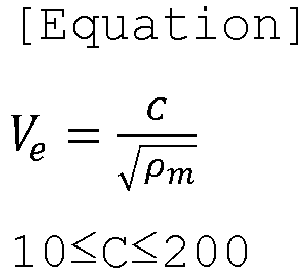
wherein Ve is a fluid speed (ft/s), C is an empirical constant, and ρm is a fluid density (lb/ft3). - In the method for removing a low-boiling point organic compound according to an exemplary embodiment of the present invention, in order to remove the low-boiling point organic material included in the brine solution produced during the process of preparing an aromatic compound, extraction in which an organic solvent is added to extract the aromatic compound from a water-soluble layer into an organic solvent layer may be included, wherein the brine solution is the water-soluble layer in the extraction.
- In the method for removing a low-boiling point organic compound according to an exemplary embodiment of the present invention, the low-boiling point organic compound may be the organic solvent added in the extraction in which the aromatic compound is extracted.
- In the method for removing a low-boiling point organic compound according to an exemplary embodiment of the present invention, water may be sprayed from an upper portion of the distillation tower into the brine solution.
- In the method for removing a low-boiling point organic compound according to an exemplary embodiment of the present invention, a temperature of the water may be the same as a distillation temperature.
- In the method for removing a low-boiling point organic compound according to an exemplary embodiment of the present invention, the adding of an acid may be performed using an acid having a pKa value of -6 or less.
- In the method for removing a low-boiling point organic compound according to an exemplary embodiment of the present invention, in the extraction in which the aromatic compound is extracted, the organic solvent may have a DI value of 20 or less.
- In the method for removing a low-boiling point organic compound according to an exemplary embodiment of the present invention, the extraction with an organic solvent may be repeated twice or more.
- In another general aspect, an apparatus for removing a low-boiling point organic compound includes: a distillation tower; and a brine forced circulation unit including: a forced circulation heat exchanger which is supplied with a brine solution produced in a process of preparing an aromatic compound from a supply line and exchanges heat, a first circulation line which supplies the brine solution which is heat-exchanged through the heat exchanger to the distillation tower, and a second circulation line which supplies the brine solution supplied from the distillation tower to the forced circulation heat exchanger.
- In the apparatus for removing a low-boiling point organic compound according to an exemplary embodiment of the present invention, a water spray unit which includes at least one nozzle disposed on the distillation tower to spray water into the distillation tower may be further included.
- In the apparatus for removing a low-boiling point organic compound according to an exemplary embodiment of the present invention, in the brine forced circulation unit, the second circulation line may diverge from the supply line.
- Since the method for removing a low-boiling point organic compound according to the present invention suppresses salt precipitation when a low-boiling point organic compound in brine is removed, it is easy to maintain process facilities and the low-boiling point organic compound may be easily removed.
- In addition, since brine having high purity may be obtained by the method for removing a low-boiling point organic compound according to the present invention, brine having high purity may be reused in a formation process, and thus, process efficiency may be further increased.
-
FIG. 1 illustrates a schematic diagram of an apparatus for removing a low-boiling point organic compound according to an exemplary embodiment of the present invention. - Technical terms and scientific terms used in the present specification have the general meanings understood by those skilled in the art to which the present invention pertains unless otherwise defined, and a description for the known function and configuration obscuring the gist of the present invention will be omitted in the following description and the accompanying drawings.
- In addition, the singular form used in the present specification may be intended to also include a plural form, unless otherwise indicated in the context.
- In addition, units used in the present specification without particular mention are based on weights, and as an example, a unit of % or ratio refers to a wt% or a weight ratio and wt% refers to wt% of any one component in a total composition, unless otherwise defined.
- In addition, the numerical range used in the present specification includes all values within the range including the lower limit and the upper limit, increments logically derived in a form and span of a defined range, all double limited values, and all possible combinations of the upper limit and the lower limit in the numerical range defined in different forms. Unless otherwise defined in the specification of the present invention, values which may be outside a numerical range due to experimental error or rounding off of a value are also included in the defined numerical range.
- The term "comprise" in the present specification is an open-ended description having a meaning equivalent to the term such as "is/are provided", "contain", "have", or "is/are characterized", and does not exclude elements, materials, or processes which are not further listed.
- The term "aromatic compound" throughout the present specification refers to an organic compound containing a benzene ring in a molecule, and encompasses all of ortho, meta, and para forms. A non-limiting specific example may be ortho, meta, and para cresols.
- Conventionally, a brine aqueous solution including 20 wt% of NaCl formed in a process of preparing an aromatic compound may include other organic materials used in a previous process. In this case, there is a problem of eventually discarding the brine solution. Thus, in order to lower the content of the organic compound in the brine solution, a method of distilling with a heat exchanger has been devised, but when distilling is performed with a heat exchanger, NaCl is precipitated to cause scaling inside the heat exchanger and heat exchange efficiency is decreased. In addition, since NaCl is precipitated also in a distillation tower to decrease the distillation efficiency, there are a lot of problems in a long-term use.
- The present invention is a method for removing a low-boiling point organic compound in a brine solution by distilling the brine solution produced in a process of preparing an aromatic compound in a distillation tower, the method including: heat-exchanging the brine solution including the low-boiling point organic compound while forcing the brine solution to circulate by a forced circulation heat exchanger so that the following equation is satisfied:

wherein Ve is a fluid speed (ft/s), C is an empirical constant, and ρm is a fluid density (lb/ft3). - The distilled brine solution satisfies the above equation, and is forced to circulate with the heat exchanger, thereby preventing salt precipitation by a linear speed. Thus, since a salt (NaCl) is prevented from being deposited on removal facilities such as a heat exchanger, piping, and a distillation tower which causes formation of scale and the like, a facility for removing the low-boiling point organic compound may be stably operated for a long time, and thus, it is easy to maintain the facility. Furthermore, since the brine solution from which the low-boiling point organic compound has been removed by the method as such has high purity, it may be directly put into the formation process. That is, the present removal method allows preparation of a brine solution having high utility value.
- Specifically, in the above equation, C, which is an empirical constant, may be 10 to 200, as described in the above equation, but preferably 50 to 100, and more preferably 70 to 90. Within the range, suppression of salt precipitation may be maximized.
- The brine solution of the present invention is produced in the process of preparing an aromatic compound. Generally, in order to remove organic materials in a system having a high NaCl solubility at a high temperature like 10-25% (15-23%, 20-22%) NaCl, an extraction process and a distillation process are introduced.
- The extraction process may include extraction in which an oil-soluble layer and a water-soluble are separated, the oil-soluble layer is recovered, and an organic solvent is added to the separated water-soluble layer to extract cresol from the water-soluble layer into an organic solvent layer. Herein, the brine solution refers to the water-soluble layer in the extraction.
- The separating of the aromatic compound from the oil-soluble layer and the water-soluble layer and then recovering the oil-soluble layer may be separating of a product having a pH adjusted by adding an acid in the previous step into an oil-soluble layer and a water-soluble layer and then recovering the oil-soluble layer, and the recovery of the oil-soluble layer may be performed by a method such as recovering only the oil-soluble layer in a layer-separated state or recovering only the water-soluble layer in a layer-separated state.
- The extraction may be performed once or more, preferably twice or more. By repeating the step as such, a residual aromatic compound in the water-soluble layer may be obtained in a high yield.
- As the method of separating the oil-soluble layer and the water-soluble layer in the present step, various known methods may be adopted. As an example, separation may be performed by upper layer separation (decanting).
- In addition, the present step may be performed at a temperature of 0°C or higher and 100°C or lower, and situationally, an operation temperature may be adjusted between 0°C and 100°C, but considering actual operating costs, a temperature of 40°C to 60°C may be appropriate.
- Then, the extraction in which an organic solvent is added to the separated water-soluble layer to perform extraction from the water-soluble layer into an organic solvent layer is intended to further increase the yield of the aromatic compound.
- A usable organic solvent herein may be any organic solvent which may fractionate the aromatic compound in the water-soluble layer, and those having a DI value of about 20 or less may be used. A DI value is a dielectric constant or relative permittivity, and the value refers to a ratio of an absolute permittivity of a material to a vacuum permittivity in a vacuum state. That is, as the dielectric constant is higher, polarity like water is shown, and as the dielectric constant is lower, non-polarity is shown, which is favorable for extraction from the water-soluble layer.
- For example, benzene, toluene, methyl-t-butyl ether (MTBE), methyl isobutyl ketone (MIBK), isobutyl acetate (IBA), or a mixture thereof may be used, and other than that, any organic solvent commonly used in the art to which the present invention pertains, such as hexane, heptane, cyclohexane, or xylene may be used without a particular limitation.
- The organic solvent may be 10 parts by weight or more and 200 parts by weight or less with respect to a total amount of 100 parts by weight of a product produced in the producing of the aromatic compound. More specifically, it may be 20 parts by weight or more and 100 parts by weight or less.
- The extraction may be performed at a temperature of 0°C or higher and 60°C or lower. More specifically, the step may be performed at a temperature of 30°C or higher and 50°C or lower. When the temperature is too low during the extraction, an extraction speed may be reduced. In addition, though an optimal operating temperature of an upper layer separation in the former stage of the extraction process is 40°C to 60°C, a cooler is installed for increasing extraction efficiency to adjust the temperature.
- Thereafter, the water-soluble layer after the extraction of the aromatic compound is completed may have a concentration of about 20 w% as a brine solution.
- In an exemplary embodiment of the present invention, the low-boiling point organic compound in the brine solution produced in the above-described process may be removed. Herein, the low boiling point refers to a boiling point of 150°C or lower. Specifically, the low-boiling point organic compound may be the organic solvent described above.
- In the present invention, the brine solution may be supplied to the distillation tower at a temperature of 20°C to 100°C, specifically 50°C to 70°C by the heat exchanger, in which the linear speed follows the equation described above.
- In an exemplary embodiment of the present invention, the distillation in the distillation tower may be performed in the conditions of a pressure of 0 barg to 2 barg and a temperature of 60°C to 150°C, but is not limited thereto.
- In an exemplary embodiment of the present invention, during the distillation, water may be sprayed from an upper portion of the distillation tower into the brine solution accommodated in the distillation tower. Water has a washing effect and may further prevent scale formation by a salt. Herein, a temperature of the water may be the same as a distillation temperature, but is not limited thereto. However, since water is sprayed in the above temperature range, change in distillation conditions by water is prevented to facilitate the maintenance of process conditions.
- Hereinafter, a removal apparatus which may remove a low-boiling point organic compound by the method for removing a low-boiling point organic compound described above will be described.
-
FIG. 1 illustrates an apparatus for removing a low-boiling point organic compound according to an exemplary embodiment of the present invention. - Referring to
FIG. 1 , the apparatus for removing a low-boiling point organic compound of the present invention may include: adistillation tower 10; and a brine forcedcirculation unit 30 including: a forcedcirculation heat exchanger 33 which is supplied with a brine solution produced in a process of preparing cresol from asupply line 20 and exchanges heat, afirst circulation line 35 which supplies the brine solution which is heat-exchanged through theheat exchanger 33 to thedistillation tower 10, and asecond circulation line 31 which supplies the brine solution supplied from thedistillation tower 10 to the forcedcirculation heat exchanger 33. Since the apparatus for removing a low-boiling point organic compound as such may force the brine solution to circulate to supply the brine solution, formation of salt in theheat exchanger 33 and thedistillation tower 10 may be prevented. - Specifically, the
distillation tower 10 is not limited as long as it is a distillation device used in the art. - The brine forced circulation unit may be provided by the
second circulation line 31 diverging from thesupply line 20, as shown in the drawing, but is not limited thereto, thesupply line 20 may be connected to the forcedcirculation heat exchanger 33, and thesecond circulation line 31 may separately connect thedistillation tower 10 and the forcedcirculation heat exchanger 33. When thesecond circulation line 31 diverges from thesupply line 20, it may be connected by a 3 way valve, as shown in the drawing, and is controlled by a control unit to supply the brine solution to theheat exchanger 33 or supply the brine solution by circulating the brine solution to thedistillation tower 10 and theheat exchanger 33. - The forced
circulation heat exchanger 33 is aheat exchanger 33 including apump 37, and the brine solution may have a constant linear speed by thepump 37. Herein, the linear speed of the brine solution satisfies the above equation, and hereinafter, the detailed description will be omitted. - In an exemplary embodiment of the present invention, a water spray unit (not shown) which includes at least one nozzle disposed on the
distillation tower 10 to spray water into thedistillation tower 10 may be further included. - The water spray unit sprays water to the brine solution supplied to the
distillation tower 10 by the forced circulation heat exchanger, thereby further preventing scaling by the salt in thedistillation tower 10. The water spray unit may be supplied with water through tap water or water reservoir installed outside thedistillation tower 10. As the nozzle, nozzles known in the art may be used. - Hereinafter, referring to the drawing, a process of removing the low-boiling point organic compound in the brine solution through the apparatus of the present invention will be described.
- Referring to
FIG. 1 , the brine solution of the present invention is supplied to the forcedcirculation heat exchanger 33 through thesupply line 20, and the brine solution having the constant linear speed by the forcedcirculation heat exchanger 33 is supplied into thedistillation tower 10 through thefirst circulation line 35. Herein, unlike what is shown in the drawing, water may be supplied to the upper portion of thedistillation tower 10. The brine solution after first distillation is completed may be supplied to the forcedcirculation heat exchanger 33 again through thesecond circulation line 31, and the low-boiling point organic compound in the brine solution may be removed with a high removal rate by the circulation process as such. - Hereinafter, the preferred examples and the comparative examples of the present invention will be described. However, the following examples are only a preferred exemplary embodiment of the present invention, and the present invention is not limited thereto.
- Production of cresolate by hydrolysis reaction: A NaOH aqueous solution (10 wt%) and chlorotoluene were added to a continuous reactor at a mole ratio of 2.5:1 (NaOH:chlorotoluene), the conditions of 400°C and 300 atm were maintained for 30 minutes, and the hydrolysis reaction of chlorotoluene was performed under the basic conditions of about pH 13 to produce a cresolate (cresol ion) mixture.
- PH adjustment and separation of oil-soluble layer and water-soluble layer: HCl was added to a product of the hydrolysis reaction to adjust each of the pH of the product to 1. Thereafter, the product was transferred to a decanter, and upper separation (decanting) was performed at 45°C for 5 minutes so that the oil-soluble layer and the water-soluble layer are separated. As the pH was lowered, the oil-soluble layer and the water-soluble layer were rapidly separated, and it was confirmed that the separation was almost completed within 2 minutes.
- At this time, the oil-soluble layer was separated to the upper portion, and the water-soluble layer was separated to a lower portion of the decanter of each example. Here, the lower water-soluble layer other than a boundary surface was separately sampled, and the oil-soluble layer was separately recovered. Thereafter, the concentration of cresol in the sampled water-soluble layer was measured. Concentration analysis was performed using high performance liquid chromatography (HPLC), and a C18 column was used, in which the lower limit of the detectable concentration was 10 ppm.
- Thereafter, methyl tertiary butyl ether (MTBE) at 40°C was added to the water-soluble layer sample to extract a residual aromatic compound. Then, after stirring for about 20 seconds, 2-stage extraction was performed, and a part of a water-soluble layer in an upper MTBE layer and a lower water-soluble layer was sampled to analyze the concentration of residual cresol. Concentration analysis was performed using high performance liquid chromatography (HPLC), and a C18 column was used, in which the lower limit of the detectable concentration was 10 ppm. As a result of measurement, all samples were determined to be "undetectable", which means that the concentration of residual cresol was less than 10 ppm.
- Removal of low-boiling point organic compound: MTBE which was used as the extraction solvent was included at its solubility in the water-soluble layer after the cresol extraction was completed, that is, the brine solution, and in order to remove MTBE, the brine solution was supplied to the distillation tower. A low-boiling point organic material was removed to the upper portion of the distillation tower, and the brine solution was supplied at a linear speed at which the brine solution was circulated by the forced circulation heat exchanger, which was set so that the C value was 80 in the above equation. Distillation was performed at a pressure of 0.1 barg and a temperature of 125°C (±5°C) in the distillation tower.
- After removing the low-boiling point organic material, the concentration of the residual organic material was analyzed using a total organic carbon amount analyzer (TOC), and the concentration of less than 100 ppm was confirmed. Thereafter, the content of the organic material was adjusted to 1 ppm or less through an adsorption tower, and brine was recycled to a formation process.
- A low-boiling point organic compound was removed in the same manner as in Example 1, except that the brine solution was forced to circulate at a constant linear speed in which the C value was set to 300 unlike the linear speed of Example 1, in the removing of a low-boiling point organic compound of Example 1.
- The brine solution from which the low-boiling point organic compound had been removed in Example 1 had a concentration of the low-boiling point organic compound of less than 10 ppm, and it was confirmed that a very high-purity brine solution was able to be obtained.
- In addition, when salt formation in the facility was observed with the naked eye after the processes of Example 1 and Comparative Example 1, the salt was not observed in Example 1, but the salt was observed in the facility in Comparative Example 1.
- Hereinabove, although the present invention has been described by specific matters, limited exemplary embodiments, and drawings, they have been provided only for assisting the entire understanding of the present invention, and the present invention is not limited to the exemplary embodiments, and various modifications and changes may be made by those skilled in the art to which the present invention pertains from the description.
- Therefore, the spirit of the present invention should not be limited to the above-described exemplary embodiments, and the following claims as well as all modified equally or equivalently to the claims are intended to fall within the scope and spirit of the invention.
Claims (11)
- A method for removing a low-boiling point organic compound in a brine solution by distilling a brine solution produced in a process of preparing an aromatic compound in a distillation tower, the method comprising:heat-exchanging the brine solution including the low-boiling point organic compound while forcing the brine solution to circulate by a forced circulation heat exchanger so that the following equation is satisfied:
 wherein Ve is a fluid speed (ft/s), C is an empirical constant, and ρm is a fluid density (lb/ft3).
 - The method for removing a low-boiling point organic compound of claim 1,wherein in order to remove the low-boiling point organic material included in the brine solution produced during the process of preparing the aromatic compound,extraction in which an organic solvent is added to extract the aromatic compound from a water-soluble layer into an organic solvent layer is included, andthe brine solution is the water-soluble layer in the extraction.
- The method for removing a low-boiling point organic compound of claim 2, wherein the low-boiling point organic compound is the organic solvent which is added in the extraction in which the aromatic compound is extracted.
- The method for removing a low-boiling point organic compound of claim 1, wherein water is sprayed from an upper portion of the distillation tower to the brine solution.
- The method for removing a low-boiling point organic compound of claim 4, wherein a temperature of the water is the same as a distillation temperature.
- The method for removing a low-boiling point organic compound of claim 2, wherein the adding of an acid is performed using an acid having a pKa value of -6 or less.
- The method for removing a low-boiling point organic compound of claim 2, wherein in the extraction in which the aromatic compound is extracted, the organic solvent has a DI value of 20 or less.
- The method for removing a low-boiling point organic compound of claim 2, wherein the extraction with an organic solvent is repeated twice or more.
- An apparatus for removing a low-boiling point organic compound comprising:a distillation tower; anda brine forced circulation unit including: a forced circulation heat exchanger which is supplied with a brine solution produced in a process of preparing an aromatic compound from a supply line and exchanges heat, a first circulation line which supplies the brine solution which is heat-exchanged through the heat exchanger to the distillation tower, and a second circulation line which supplies the brine solution supplied from the distillation tower to the forced circulation heat exchanger.
- The apparatus for removing a low-boiling point organic compound of claim 9, further comprising: a water spray unit which includes at least one nozzle disposed in an upper portion of the distillation tower to spray water into the distillation tower.
- The apparatus for removing a low-boiling point organic compound of claim 9, wherein in the brine forced circulation unit, the second circulation line diverges from the supply line.
Applications Claiming Priority (2)
| Application Number | Priority Date | Filing Date | Title |
|---|---|---|---|
| KR1020210015468A KR102880782B1 (en) | 2021-02-03 | 2021-02-03 | Method for purifying Brine produced in the aromatic compound manufacturing process |
| PCT/KR2022/001363 WO2022169179A1 (en) | 2021-02-03 | 2022-01-26 | Method for purifying brine generated in aromatic compound producing process |
Publications (2)
| Publication Number | Publication Date |
|---|---|
| EP4289491A1 true EP4289491A1 (en) | 2023-12-13 |
| EP4289491A4 EP4289491A4 (en) | 2024-12-04 |
Family
ID=82741389
Family Applications (1)
| Application Number | Title | Priority Date | Filing Date |
|---|---|---|---|
| EP22749931.6A Pending EP4289491A4 (en) | 2021-02-03 | 2022-01-26 | Method for purifying brine generated in aromatic compound producing process |
Country Status (6)
| Country | Link |
|---|---|
| US (1) | US20240124328A1 (en) |
| EP (1) | EP4289491A4 (en) |
| JP (1) | JP7627772B2 (en) |
| KR (1) | KR102880782B1 (en) |
| CN (1) | CN116887898A (en) |
| WO (1) | WO2022169179A1 (en) |
Family Cites Families (16)
| Publication number | Priority date | Publication date | Assignee | Title |
|---|---|---|---|---|
| US6355145B1 (en) * | 1997-01-14 | 2002-03-12 | Aqua-Pure Ventures, Inc. | Distillation process with reduced fouling |
| US6536523B1 (en) * | 1997-01-14 | 2003-03-25 | Aqua Pure Ventures Inc. | Water treatment process for thermal heavy oil recovery |
| DE10332758A1 (en) * | 2003-07-17 | 2004-05-27 | Basf Ag | Thermal separation process for the separation of at least one (meth)acrylic monomer enriched material stream comprises use of a device having separate volume elements and defined residence time |
| WO2009026208A2 (en) * | 2007-08-23 | 2009-02-26 | Dow Global Technologies Inc. | Brine purification |
| CN101700891A (en) * | 2009-09-09 | 2010-05-05 | 王嘉兴 | Method for preparing industrial salt and recycling p-cresol from sulfuric acid by utilizing petrochemical phenol residues |
| DE102010010997A1 (en) * | 2010-03-10 | 2011-09-15 | Lurgi Gmbh | Process and apparatus for the distillation of polymerization-prone compounds |
| US9169131B1 (en) * | 2010-04-21 | 2015-10-27 | Trinity Manufacturing, Inc. | System and process for removing total organic carbons from a brine waste stream |
| DE102010028781A1 (en) * | 2010-05-10 | 2011-11-10 | Evonik Stockhausen Gmbh | Separation of acrylic acid by means of a distillation column having a side draw |
| US8778037B2 (en) * | 2010-05-25 | 2014-07-15 | Veolia Water Solutions & Technologies North America, Inc. | Process of scrubbing volatiles from evaporator water vapor |
| FR2964096A1 (en) * | 2010-08-27 | 2012-03-02 | Solvay | PROCESS FOR PURIFYING BRINE |
| BR112014012907B8 (en) * | 2011-12-07 | 2022-08-02 | Jsr Corp | METHOD FOR PRODUCTION OF A MODIFIED POLYMER OR A HYDROGENATED PRODUCT THEREOF |
| US20170044313A1 (en) * | 2014-04-30 | 2017-02-16 | Sabic Global Technologies B.V. | Purification of brine solution |
| US10093551B2 (en) * | 2014-09-23 | 2018-10-09 | Basf Se | Process and plant for treatment of secondary components obtained in acrolein and/or (meth)acrylic acid production |
| CN105503573B (en) * | 2015-12-23 | 2017-05-10 | 安徽金禾实业股份有限公司 | Method and device for separation treatment of sodium formate in NPG (neopentyl glycol) production technology |
| KR20170106804A (en) | 2016-03-14 | 2017-09-22 | 한화케미칼 주식회사 | Method for preparing cresol |
| EP3917885A1 (en) * | 2019-01-31 | 2021-12-08 | Nouryon Chemicals International B.V. | Process for producing salt from waste aqueous streams of organic peroxides production |
-
2021
- 2021-02-03 KR KR1020210015468A patent/KR102880782B1/en active Active
-
2022
- 2022-01-26 US US18/264,088 patent/US20240124328A1/en active Pending
- 2022-01-26 JP JP2023546476A patent/JP7627772B2/en active Active
- 2022-01-26 EP EP22749931.6A patent/EP4289491A4/en active Pending
- 2022-01-26 WO PCT/KR2022/001363 patent/WO2022169179A1/en not_active Ceased
- 2022-01-26 CN CN202280013304.4A patent/CN116887898A/en active Pending
Also Published As
| Publication number | Publication date |
|---|---|
| JP2024505568A (en) | 2024-02-06 |
| EP4289491A4 (en) | 2024-12-04 |
| US20240124328A1 (en) | 2024-04-18 |
| JP7627772B2 (en) | 2025-02-06 |
| WO2022169179A1 (en) | 2022-08-11 |
| KR20220112006A (en) | 2022-08-10 |
| CN116887898A (en) | 2023-10-13 |
| KR102880782B1 (en) | 2025-11-03 |
Similar Documents
| Publication | Publication Date | Title |
|---|---|---|
| EP0028338B1 (en) | Process for preparing aromatic di- and/or polyisocyanates | |
| EP3830069B1 (en) | Method for the preparation of aminobenzoic acid or an aminobenzoic acid derivative | |
| EP0028724B1 (en) | Process for preparing aryl isocyanates by thermal decomposition of aryl urethanes | |
| EP3374347B1 (en) | Process for reprocessing alkane sulfonic acid | |
| CA1173062A (en) | High purity 2,4-dinitrotoluene from toluene nitration process | |
| US20240124328A1 (en) | Method for purifying brine generated in aromatic compound producing process | |
| CN112739675B (en) | Methods for recovering high-quality 3-methyl-but-3-en-1-ol | |
| CN113666802B (en) | Method for synthesizing and extracting purified 3-hexyne-2, 5-diol | |
| CN108947777B (en) | Enrichment and separation process of low-concentration multi-component phenol-containing mixture | |
| DE60018308T2 (en) | METHOD FOR PRODUCING DIAZOMETHANE | |
| US6326521B2 (en) | Process for the preparation of benzyl alcohol | |
| EP0717024B1 (en) | Process for the recovery of phenol from an aqueous stream containing Na2So4 | |
| EP0066205B1 (en) | Process for preparation of 2-hydroxynaphthalene-3-carboxylic acid | |
| CN110642680B (en) | Crystallization separation method for preparing high-purity o-cresol | |
| DE60111593T2 (en) | Process for removing tert-butyl groups from tert-butylphenol compounds | |
| CN114436762B (en) | Safe and green production method of pentafluorobenzene | |
| PL172805B1 (en) | Method of processing creosolic acid of natural origin | |
| EP3140279B1 (en) | Process for producing diarylcarbonates | |
| KR102746674B1 (en) | Method for preparing cresol for surpressing byproducts | |
| US9309184B2 (en) | Method for producing diamines and polyamines of the diphenylmethane series | |
| EP0952136B1 (en) | Process for the extraction of the salts contained in the neutralized separated product obtained in the preparation of phenol by the oxidation of cumene | |
| EP0274600B1 (en) | Process for the production of alkoxy-butenynes | |
| DE1468848A1 (en) | Process for the production of pivalol acetone | |
| EP4403544A1 (en) | Process for producing cresols | |
| DE2935396C2 (en) | Process for the preparation of methyl isocyanate |
Legal Events
| Date | Code | Title | Description |
|---|---|---|---|
| STAA | Information on the status of an ep patent application or granted ep patent |
Free format text: STATUS: THE INTERNATIONAL PUBLICATION HAS BEEN MADE |
|
| PUAI | Public reference made under article 153(3) epc to a published international application that has entered the european phase |
Free format text: ORIGINAL CODE: 0009012 |
|
| STAA | Information on the status of an ep patent application or granted ep patent |
Free format text: STATUS: REQUEST FOR EXAMINATION WAS MADE |
|
| 17P | Request for examination filed |
Effective date: 20230828 |
|
| AK | Designated contracting states |
Kind code of ref document: A1 Designated state(s): AL AT BE BG CH CY CZ DE DK EE ES FI FR GB GR HR HU IE IS IT LI LT LU LV MC MK MT NL NO PL PT RO RS SE SI SK SM TR |
|
| DAV | Request for validation of the european patent (deleted) | ||
| DAX | Request for extension of the european patent (deleted) | ||
| A4 | Supplementary search report drawn up and despatched |
Effective date: 20241104 |
|
| RIC1 | Information provided on ipc code assigned before grant |
Ipc: C02F 101/34 20060101ALI20241028BHEP Ipc: C02F 1/66 20230101ALI20241028BHEP Ipc: C02F 1/24 20230101ALI20241028BHEP Ipc: B01D 3/38 20060101ALI20241028BHEP Ipc: C02F 1/04 20230101ALI20241028BHEP Ipc: C01D 3/14 20060101ALI20241028BHEP Ipc: B01D 11/04 20060101ALI20241028BHEP Ipc: B01D 3/32 20060101AFI20241028BHEP |