EP4288339B1 - Improved drone with railway driving capabilities - Google Patents
Improved drone with railway driving capabilities Download PDFInfo
- Publication number
- EP4288339B1 EP4288339B1 EP21925008.1A EP21925008A EP4288339B1 EP 4288339 B1 EP4288339 B1 EP 4288339B1 EP 21925008 A EP21925008 A EP 21925008A EP 4288339 B1 EP4288339 B1 EP 4288339B1
- Authority
- EP
- European Patent Office
- Prior art keywords
- propeller
- drone
- arms
- motor
- assembly
- Prior art date
- Legal status (The legal status is an assumption and is not a legal conclusion. Google has not performed a legal analysis and makes no representation as to the accuracy of the status listed.)
- Active
Links
Images



Classifications
-
- B—PERFORMING OPERATIONS; TRANSPORTING
- B61—RAILWAYS
- B61D—BODY DETAILS OR KINDS OF RAILWAY VEHICLES
- B61D15/00—Other railway vehicles, e.g. scaffold cars; Adaptations of vehicles for use on railways
-
- B—PERFORMING OPERATIONS; TRANSPORTING
- B60—VEHICLES IN GENERAL
- B60F—VEHICLES FOR USE BOTH ON RAIL AND ON ROAD; VEHICLES CAPABLE OF TRAVELLING IN OR ON DIFFERENT MEDIA, e.g. AMPHIBIOUS VEHICLES
- B60F5/00—Other vehicles capable of travelling in or on different media
- B60F5/02—Other vehicles capable of travelling in or on different media convertible into aircraft
-
- B—PERFORMING OPERATIONS; TRANSPORTING
- B61—RAILWAYS
- B61D—BODY DETAILS OR KINDS OF RAILWAY VEHICLES
- B61D15/00—Other railway vehicles, e.g. scaffold cars; Adaptations of vehicles for use on railways
- B61D15/08—Railway inspection trolleys
- B61D15/12—Railway inspection trolleys power propelled
-
- B—PERFORMING OPERATIONS; TRANSPORTING
- B61—RAILWAYS
- B61F—RAIL VEHICLE SUSPENSIONS, e.g. UNDERFRAMES, BOGIES OR ARRANGEMENTS OF WHEEL AXLES; RAIL VEHICLES FOR USE ON TRACKS OF DIFFERENT WIDTH; PREVENTING DERAILING OF RAIL VEHICLES; WHEEL GUARDS, OBSTRUCTION REMOVERS OR THE LIKE FOR RAIL VEHICLES
- B61F13/00—Rail vehicles characterised by wheel arrangements, not otherwise provided for
-
- B—PERFORMING OPERATIONS; TRANSPORTING
- B61—RAILWAYS
- B61K—AUXILIARY EQUIPMENT SPECIALLY ADAPTED FOR RAILWAYS, NOT OTHERWISE PROVIDED FOR
- B61K3/00—Wetting or lubricating rails or wheel flanges
-
- B—PERFORMING OPERATIONS; TRANSPORTING
- B61—RAILWAYS
- B61K—AUXILIARY EQUIPMENT SPECIALLY ADAPTED FOR RAILWAYS, NOT OTHERWISE PROVIDED FOR
- B61K3/00—Wetting or lubricating rails or wheel flanges
- B61K3/02—Apparatus therefor combined with vehicles
-
- B—PERFORMING OPERATIONS; TRANSPORTING
- B64—AIRCRAFT; AVIATION; COSMONAUTICS
- B64C—AEROPLANES; HELICOPTERS
- B64C37/00—Convertible aircraft
-
- B—PERFORMING OPERATIONS; TRANSPORTING
- B64—AIRCRAFT; AVIATION; COSMONAUTICS
- B64U—UNMANNED AERIAL VEHICLES [UAV]; EQUIPMENT THEREFOR
- B64U10/00—Type of UAV
- B64U10/10—Rotorcrafts
- B64U10/13—Flying platforms
-
- B—PERFORMING OPERATIONS; TRANSPORTING
- B64—AIRCRAFT; AVIATION; COSMONAUTICS
- B64U—UNMANNED AERIAL VEHICLES [UAV]; EQUIPMENT THEREFOR
- B64U10/00—Type of UAV
- B64U10/10—Rotorcrafts
- B64U10/13—Flying platforms
- B64U10/14—Flying platforms with four distinct rotor axes, e.g. quadcopters
-
- B—PERFORMING OPERATIONS; TRANSPORTING
- B64—AIRCRAFT; AVIATION; COSMONAUTICS
- B64U—UNMANNED AERIAL VEHICLES [UAV]; EQUIPMENT THEREFOR
- B64U10/00—Type of UAV
- B64U10/10—Rotorcrafts
- B64U10/13—Flying platforms
- B64U10/16—Flying platforms with five or more distinct rotor axes, e.g. octocopters
-
- B—PERFORMING OPERATIONS; TRANSPORTING
- B64—AIRCRAFT; AVIATION; COSMONAUTICS
- B64U—UNMANNED AERIAL VEHICLES [UAV]; EQUIPMENT THEREFOR
- B64U10/00—Type of UAV
- B64U10/70—Convertible aircraft, e.g. convertible into land vehicles
-
- B—PERFORMING OPERATIONS; TRANSPORTING
- B64—AIRCRAFT; AVIATION; COSMONAUTICS
- B64U—UNMANNED AERIAL VEHICLES [UAV]; EQUIPMENT THEREFOR
- B64U30/00—Means for producing lift; Empennages; Arrangements thereof
- B64U30/20—Rotors; Rotor supports
- B64U30/29—Constructional aspects of rotors or rotor supports; Arrangements thereof
-
- B—PERFORMING OPERATIONS; TRANSPORTING
- B64—AIRCRAFT; AVIATION; COSMONAUTICS
- B64U—UNMANNED AERIAL VEHICLES [UAV]; EQUIPMENT THEREFOR
- B64U30/00—Means for producing lift; Empennages; Arrangements thereof
- B64U30/20—Rotors; Rotor supports
- B64U30/29—Constructional aspects of rotors or rotor supports; Arrangements thereof
- B64U30/296—Rotors with variable spatial positions relative to the UAV body
- B64U30/297—Tilting rotors
-
- B—PERFORMING OPERATIONS; TRANSPORTING
- B64—AIRCRAFT; AVIATION; COSMONAUTICS
- B64U—UNMANNED AERIAL VEHICLES [UAV]; EQUIPMENT THEREFOR
- B64U30/00—Means for producing lift; Empennages; Arrangements thereof
- B64U30/20—Rotors; Rotor supports
- B64U30/29—Constructional aspects of rotors or rotor supports; Arrangements thereof
- B64U30/299—Rotor guards
-
- B—PERFORMING OPERATIONS; TRANSPORTING
- B64—AIRCRAFT; AVIATION; COSMONAUTICS
- B64U—UNMANNED AERIAL VEHICLES [UAV]; EQUIPMENT THEREFOR
- B64U40/00—On-board mechanical arrangements for adjusting control surfaces or rotors; On-board mechanical arrangements for in-flight adjustment of the base configuration
- B64U40/10—On-board mechanical arrangements for adjusting control surfaces or rotors; On-board mechanical arrangements for in-flight adjustment of the base configuration for adjusting control surfaces or rotors
-
- B—PERFORMING OPERATIONS; TRANSPORTING
- B64—AIRCRAFT; AVIATION; COSMONAUTICS
- B64U—UNMANNED AERIAL VEHICLES [UAV]; EQUIPMENT THEREFOR
- B64U50/00—Propulsion; Power supply
- B64U50/10—Propulsion
- B64U50/13—Propulsion using external fans or propellers
-
- B—PERFORMING OPERATIONS; TRANSPORTING
- B64—AIRCRAFT; AVIATION; COSMONAUTICS
- B64U—UNMANNED AERIAL VEHICLES [UAV]; EQUIPMENT THEREFOR
- B64U50/00—Propulsion; Power supply
- B64U50/10—Propulsion
- B64U50/19—Propulsion using electrically powered motors
-
- B—PERFORMING OPERATIONS; TRANSPORTING
- B64—AIRCRAFT; AVIATION; COSMONAUTICS
- B64U—UNMANNED AERIAL VEHICLES [UAV]; EQUIPMENT THEREFOR
- B64U50/00—Propulsion; Power supply
- B64U50/30—Supply or distribution of electrical power
-
- B—PERFORMING OPERATIONS; TRANSPORTING
- B64—AIRCRAFT; AVIATION; COSMONAUTICS
- B64U—UNMANNED AERIAL VEHICLES [UAV]; EQUIPMENT THEREFOR
- B64U60/00—Undercarriages
- B64U60/70—Movable wings, rotor supports or shrouds acting as ground-engaging elements
-
- E—FIXED CONSTRUCTIONS
- E01—CONSTRUCTION OF ROADS, RAILWAYS, OR BRIDGES
- E01B—PERMANENT WAY; PERMANENT-WAY TOOLS; MACHINES FOR MAKING RAILWAYS OF ALL KINDS
- E01B7/00—Switches; Crossings
- E01B7/26—Lubricating of switches
-
- B—PERFORMING OPERATIONS; TRANSPORTING
- B64—AIRCRAFT; AVIATION; COSMONAUTICS
- B64U—UNMANNED AERIAL VEHICLES [UAV]; EQUIPMENT THEREFOR
- B64U2101/00—UAVs specially adapted for particular uses or applications
- B64U2101/25—UAVs specially adapted for particular uses or applications for manufacturing or servicing
-
- B—PERFORMING OPERATIONS; TRANSPORTING
- B64—AIRCRAFT; AVIATION; COSMONAUTICS
- B64U—UNMANNED AERIAL VEHICLES [UAV]; EQUIPMENT THEREFOR
- B64U2101/00—UAVs specially adapted for particular uses or applications
- B64U2101/25—UAVs specially adapted for particular uses or applications for manufacturing or servicing
- B64U2101/26—UAVs specially adapted for particular uses or applications for manufacturing or servicing for manufacturing, inspections or repairs
-
- B—PERFORMING OPERATIONS; TRANSPORTING
- B64—AIRCRAFT; AVIATION; COSMONAUTICS
- B64U—UNMANNED AERIAL VEHICLES [UAV]; EQUIPMENT THEREFOR
- B64U2101/00—UAVs specially adapted for particular uses or applications
- B64U2101/30—UAVs specially adapted for particular uses or applications for imaging, photography or videography
-
- B—PERFORMING OPERATIONS; TRANSPORTING
- B64—AIRCRAFT; AVIATION; COSMONAUTICS
- B64U—UNMANNED AERIAL VEHICLES [UAV]; EQUIPMENT THEREFOR
- B64U2201/00—UAVs characterised by their flight controls
- B64U2201/10—UAVs characterised by their flight controls autonomous, i.e. by navigating independently from ground or air stations, e.g. by using inertial navigation systems [INS]
-
- B—PERFORMING OPERATIONS; TRANSPORTING
- B64—AIRCRAFT; AVIATION; COSMONAUTICS
- B64U—UNMANNED AERIAL VEHICLES [UAV]; EQUIPMENT THEREFOR
- B64U2201/00—UAVs characterised by their flight controls
- B64U2201/20—Remote controls
Definitions
- the invention relates to an improved drone with railway driving capabilities.
- the method comprises the steps of: i) remotely directing the device to the railway switch; ii) remotely instructing the device to lubricate the railway switch; and iii) remotely directing the device away from the railway switch to avoid hindering train traffic passing said switch.
- CN104669964A discloses a water-land-air triphibious unmanned investigation device.
- US2017/0029103A1 discloses unmanned vehicle of an amphibious kind that is able to move both in the sky and on the land.
- KR20200012524A discloses a drone that can be used on land, at sea and in the air.
- the drone comprises a total of eight propeller arms. This constitutes a third group of embodiments that is discussed in the detailed description.
- the subset having tiltable propeller assemblies may comprise three to eight propeller arms, implying all the arms in the latter embodiment.
- the motor assembly comprises a first motor for driving the propeller and a second motor for driving the propeller guard.
- driving the propellers and the propeller guards is concerned there are numerous possibilities to implement this.
- the embodiment presented here is an advantageous embodiment which is very compact, volume efficient and has a very good power-to-weight ratio. This embodiment is discussed in more detail in the detailed description.
- the motor assembly comprises a gear and a motor for driving the propeller and the propeller guard, wherein the gear is coupled between the propeller and the propeller guard.
- This embodiment requires fewer motors but is mechanically a bit more complex. This embodiment is discussed in more detail in the detailed description.
- the drone further comprises at least one camera, preferably a plurality of cameras for performing visual inspection.
- the inspection cameras render the drone very suitable for amongst others railway inspection.
- the inspection cameras may be mounted to the drone body through camera arms as also presented in the detailed description. More details are also found in earlier-discussed patent publication WO2020/209726A1 .
- the drone further comprises railway maintenance equipment, such as a lubrication system, a manipulator or gripper.
- the lubrication system may typically comprise a lubricant container connected to nozzles for spraying the lubricant.
- the nozzles may be conveniently placed on the propeller arms. More details are also found in earlier-discussed patent publication WO2020/209726A1 .
- Manipulators or grippers may be used to perform operations on the railway track or to pick up or release objects.
- At least one of the propeller arms provides at least one translation degree of freedom.
- Adding a translation degree of freedom to the propeller arms allows for even more flexibility of reshaping/morphing the drone when switching between flight mode and driving mode and back.
- An example of a translation degree of freedom is to make the propeller arms telescopically extendible. It goes without saying that the other two translation degrees of freedom also imply a pivotable movement of the propeller arm requiring a further joint.
- At least one of the propeller arms provides at least two translation degrees of freedom. Compared to the previously mentioned embodiment, adding two translation degrees of freedom to the propeller arms allows for even more flexibility of reshaping/morphing the drone when switching between flight mode and driving mode and back.
- the configuration allows the second motor 25b to drive the propeller guard 22 in driving mode. Then the first motor may be switched off keeping the propeller standing still, but this is not essential either.
- the propeller 24 might also be rotated in the same direction as the propeller guard 22 or in the opposite direction.
- the invention is about a special drone, which has extra functionality, namely that it can drive on the railway. How a drone is controlled and remotely operated or autonomously controlling itself is considered known to the person skilled in the art and is therefore not discussed in this specification. Also, the specification does not give many details about the controlling of the motors and actuators in the drone as that is also is considered to be known knowledge for the person skilled in the art. Drones, motors and actuators and all control to make them do what they are supposed to do are off-the-shelf ingredients.
Landscapes
- Engineering & Computer Science (AREA)
- Mechanical Engineering (AREA)
- Aviation & Aerospace Engineering (AREA)
- Chemical & Material Sciences (AREA)
- Combustion & Propulsion (AREA)
- Remote Sensing (AREA)
- Transportation (AREA)
- Architecture (AREA)
- Civil Engineering (AREA)
- Structural Engineering (AREA)
- Toys (AREA)
- Compositions Of Oxide Ceramics (AREA)
Description
- The invention relates to an improved drone with railway driving capabilities.
- A drone with railway driving capability was reported before.
WO2020/209726A1 , concerning an invention from the same inventor, discloses a drone for lubricating a railway switch, the drone being remotely controllable and configured for moving on a railway track, wherein the drone comprises a container for lubricant and at least one nozzle configured for lubricating the railway switch with the lubricant. The document further discloses a system comprising the drone and a controller for remotely controlling said drone. Furthermore, it discloses a method for lubricating a railway switch, wherein the method comprises the steps of: i) remotely directing the device to the railway switch; ii) remotely instructing the device to lubricate the railway switch; and iii) remotely directing the device away from the railway switch to avoid hindering train traffic passing said switch. - The known drone constitutes a clear improvement over the existing solutions for lubricating railway switches, a new application area where drones can be used. However, there is a need to further develop and improve the functionality of drones.
-
CN104669964A discloses a water-land-air triphibious unmanned investigation device.US2017/0029103A1 discloses unmanned vehicle of an amphibious kind that is able to move both in the sky and on the land.KR20200012524A - The invention has for its object to remedy or to reduce at least one of the drawbacks of the prior art, or at least provide a useful alternative to prior art.
- The object is achieved through features which are specified in the description below and in the claims that follow.
- The invention is defined by the independent patent claims. The dependent claims define advantageous embodiments of the invention.
- In a first aspect the invention relates to a drone having railway driving capabilities in accordance with
claim 1. - The effects of the features of the drone in accordance with the invention are explained below.
- First of all, it must be noted that drone propellers are dangerous to people and damaging to equipment in case the drone collides. Propeller guards are conventionally used to reduce the risk of injury to people or damage to equipment. In prior art solutions they only add weight, drag and complexity to drones. A first key feature of the invention is that the propeller guards form a vital part of the drive train, because they serve both as propeller guard for the propellers as well as train wheels. The propeller guards are rotatably mounted and coaxially with the propellers. These features result in a highly effective use of the space and reduce the weight and complexity of the drone. The rotatable propeller guards only need to have a slightly larger diameter than the propellers. Their large size allows for compliance with train wheel standards and ensures smooth running through the unguided part of a fixed crossing. Reusing the propeller guards as wheels opens a totally new design space for drones as the embodiments in the current specification also will illustrate.
- It is important to note that the respective propeller arms are provided with at least one rotation degree of freedom through a respective actuated joint (a standard off-the-shelf robot feature), so that the respective propeller assemblies can be switched between a flying mode and a driving mode as
claim 1 describes. This will allow the propeller assemblies to be positioned vertically, horizontally and having any orientation in between. This also makes landing of the drone on the rail easier. In some embodiments the actuated joint may be placed at the ends of the propeller arms near the motor assembly for the propeller and the propeller guard, but this is not essential. - The actuated joints also provide the drone with better aerial skills and flight capability in case one motor is broken. If that happens the remaining propellers can be tilted to compensate for the lack of thrust power of the non-functioning propeller. A further effect is that the centre of gravity and moment of inertia is better than the known drones because more weight is placed in the vicinity of the propeller by the coaxially placed propeller guards. This design is also cost-effective in view of mass-production since the actuated coaxial propeller/wheel drivetrain may be produced as one part.
- To facilitate understanding of the invention one or more expressions are further defined hereinafter.
- The wording "flight mode" must be interpreted as a mode of the drone wherein at least a subset of the propellers is oriented and positioned for generating at least upward thrust, which means that the respective propeller and propeller guards are oriented in a non-vertical plane, because a fully vertical plane would result in no upward thrust force at all.
- The wording "driving mode" must be interpreted as a mode of the drone wherein at least a subset of the propellers is oriented and positioned for allowing the drone to drive on their respective propeller guards, which means that the respective propeller and propeller guards are oriented in a non-horizontal plane, because a fully horizontal plane would make it impossible for the propeller guards to drive on a horizontal railway track.
- In an embodiment of the drone according to the invention the actuated joints are placed near ends of the propeller arms. The advantage of this embodiment is that rotation of the propeller assembly will not result in a significant translation of the propeller assembly. In a variant of this embodiment the actuated joints are placed further away from the end or in middle sections of the propeller arms. These embodiments will still work. However, a rotation of the propeller assembly will then inevitably result in significant translation of the propeller assembly during the rotation. This translation must then to be accounted for when designing and dimensioning the propeller arms of the drone, so that it will fit on a railway track when in driving mode.
- In an embodiment of the drone according to the invention the subset comprises at least two propeller arms, and preferably at least three propeller arms. The drone will need at least two wheels to be able to properly drive on the railway track, and preferably more to be able to drive in a stable manner without requiring balancing techniques. The wording "subset" refers to a selection of the total number of propeller arms that is provided with an actuated joint causing the connected propeller assembly to be pivotable.
- In an embodiment of the drone according to the invention at least one of the actuated joints is configured for providing at least two rotation degrees of freedom. This embodiment is advantageous because it makes it easier to independently configure the flight mode and the driving mode based upon a given propeller arm configuration. Expressed differently, it will be easier to manipulate the propeller assemblies into the right positions and orientations when switching to either flight mode or driving mode. In fact, this embodiment opens the possibility for very smooth landing in case there are four propeller assemblies that are all rotatable in accordance with the invention. This will be explained further in the detailed description. In this embodiment the actuated joint may comprise a single subjoint providing two rotation degrees of freedom or a double subjoint, wherein each subjoint provides one rotation degree of freedom. Such subjoint would typically be a ball joint with sophisticated actuators to allow for two rotation degrees of freedom. However, the use of two subjoints each providing only one rotation degree of freedom has certain technical advantages.
- These aspects will be elaborated upon further in the detailed description.
- In an embodiment of the drone according to the invention at least one of the actuated joints is configured for providing at least three rotation degrees of freedom. Using three rotation degrees of freedom provides even more flexibility to the drone in terms of adaptability to different requirements, i.e., railway track width in driving mode or maximum drone diameter in flight mode. Also, in this embodiment the actuated joint may comprise a single subjoint providing three rotation degrees of freedom, a double subjoint wherein one provides one rotation degree of freedom and the other subjoint two rotation degrees of freedom, or a triple subjoint, wherein each subjoint provides one rotation degree of freedom. These aspects will be elaborated upon further in the detailed description.
- In an embodiment of the drone according to the invention the drone comprises a total of four propeller arms. This constitutes a first group of embodiments that is discussed in the detailed description. The subset having tiltable propeller assemblies may comprise three or four propeller arms, implying all the arms in the latter embodiment.
- In an embodiment of the drone according to the invention the drone comprises a total of six propeller arms. This constitutes a second group of embodiments that is discussed in the detailed description. The subset having tiltable propeller assemblies may comprise three to six propeller arms, implying all the arms in the latter embodiment.
- In an embodiment of the drone according to the invention the drone comprises a total of eight propeller arms. This constitutes a third group of embodiments that is discussed in the detailed description. The subset having tiltable propeller assemblies may comprise three to eight propeller arms, implying all the arms in the latter embodiment.
- In an embodiment of the drone according to the invention the motor assembly comprises a first motor for driving the propeller and a second motor for driving the propeller guard. As far as driving the propellers and the propeller guards is concerned there are numerous possibilities to implement this. The embodiment presented here is an advantageous embodiment which is very compact, volume efficient and has a very good power-to-weight ratio. This embodiment is discussed in more detail in the detailed description.
- In an embodiment of the drone according to the invention the motor assembly comprises a gear and a motor for driving the propeller and the propeller guard, wherein the gear is coupled between the propeller and the propeller guard. This embodiment requires fewer motors but is mechanically a bit more complex. This embodiment is discussed in more detail in the detailed description.
- In an embodiment of the drone according to the invention the drone further comprises at least one camera, preferably a plurality of cameras for performing visual inspection. The inspection cameras render the drone very suitable for amongst others railway inspection. The inspection cameras may be mounted to the drone body through camera arms as also presented in the detailed description. More details are also found in earlier-discussed patent publication
WO2020/209726A1 . - In an embodiment of the drone according to the invention the drone further comprises railway maintenance equipment, such as a lubrication system, a manipulator or gripper. The lubrication system may typically comprise a lubricant container connected to nozzles for spraying the lubricant. The nozzles may be conveniently placed on the propeller arms. More details are also found in earlier-discussed patent publication
WO2020/209726A1 . Manipulators or grippers may be used to perform operations on the railway track or to pick up or release objects. - In an embodiment of the drone according to the invention at least one of the propeller arms provides at least one translation degree of freedom. Adding a translation degree of freedom to the propeller arms allows for even more flexibility of reshaping/morphing the drone when switching between flight mode and driving mode and back. An example of a translation degree of freedom is to make the propeller arms telescopically extendible. It goes without saying that the other two translation degrees of freedom also imply a pivotable movement of the propeller arm requiring a further joint.
- In an embodiment of the drone according to the invention at least one of the propeller arms provides at least two translation degrees of freedom. Compared to the previously mentioned embodiment, adding two translation degrees of freedom to the propeller arms allows for even more flexibility of reshaping/morphing the drone when switching between flight mode and driving mode and back.
- In the following is described examples of embodiments illustrated in the accompanying figures, wherein:
- Fig. 1
- shows a first embodiment of a drone in accordance with the invention being in flight mode;
- Fig. 2
- shows a top view of the drone of
Fig. 1 ; - Fig. 3
- shows a top view of the drone of
Fig. 1 in driving mode, while driving on a railway track; - Fig. 4
- shows a perspective front view of
Fig. 3 ; - Fig. 5
- shows a perspective side view of
Fig. 4 ; - Fig. 6
- shows a propeller assembly combined with a 2-DOF actuated joint in accordance with an embodiment of the invention;
- Fig. 7
- shows the drone of
Fig. 1 during landing on a railway track or during take-off from the railway track; - Fig. 8
- shows the drone of
Fig. 7 in a different stage during landing on the railway track or take-off from the railway track; - Fig. 9
- shows a second embodiment of a drone in accordance with the invention being in flight mode;
- Fig. 10
- shows a third embodiment of a drone in accordance with the invention being in flight mode;
- Fig. 11
- shows a fourth embodiment of a drone in accordance with the invention being in flight mode;
- Fig. 12
- shows the propeller assembly of
Fig. 1 combined with a 3-DOF actuated joint in accordance with a further embodiment of the invention. - Fig. 13
- shows a fifth embodiment of a drone in accordance with the invention being in flight mode;
- Fig. 14a
- shows a front view of a propeller assembly in accordance with a further embodiment of the invention;
- Fig. 14b
- shows a side view of the propeller assembly of
Fig. 14a , where also part of the actuated joint is visible; - Fig. 15a
- shows a zoom view of
Fig. 15a , and - Fig. 15b
- shows a zoom view of
Fig. 14b . - Various illustrative embodiments of the present subject matter are described below. In the interest of clarity, not all features of an actual implementation are described in this specification. It will of course be appreciated that in the development of any such embodiment, numerous implementation-specific decisions must be made to achieve the developers' specific goals, such as compliance with system-related and business-related constraints, which will vary from one implementation to another. Moreover, it will be appreciated that such a development effort might be complex and time-consuming but would nevertheless be a routine undertaking for those of ordinary skill in the art having the benefit of this disclosure.
- The present subject matter will now be described with reference to the attached figures. Various systems, structures and devices are schematically depicted in the figures for purposes of explanation only and to not obscure the present disclosure with details that are well known to those skilled in the art. Nevertheless, the attached figures are included to describe and explain illustrative examples of the present disclosure. The words and phrases used herein should be understood and interpreted to have a meaning consistent with the understanding of those words and phrases by those skilled in the relevant art. No special definition of a term or phrase, i.e., a definition that is different from the ordinary and customary meaning as understood by those skilled in the art, is intended to be implied by consistent usage of the term or phrase herein. To the extent that a term or phrase is intended to have a special meaning, i.e., a meaning other than that understood by skilled artisans, such a special definition will be expressly set forth in the specification in a definitional manner that directly and unequivocally provides the special definition for the term or phrase.
- The invention is a compact coaxial propeller and train wheel motor system, with the propeller inside the train wheel, where the latter also doubles as propeller guard for human/machine and infrastructure/machine safety. The coaxial propeller/wheel drivetrain is actuated by an end effector with at least one degree of freedom. The at least one degree of freedom end effector enables transition from air to rail and from rail to air and flying skills. This system may be used for inspection of railway infrastructure from the air and inspection and (lighter) maintenance of railway infrastructure while running on the rails. An embodiment of the system further compromises six dual thermo and RGB camera gimbal rigs facilitating spherical inspection capabilities and gives the robot excellent understanding of its surroundings allowing for state-of-the-art sense and avoid. The system may also be called a drone or a robot. The system may be provided with necessary compute power from GPU-based robot brain(s) that is also used in self-driving cars. The system is made to be fully autonomous both on rails and in the air.
- The invention will be discussed in more detail with reference to the figures. The figures will be mainly discussed in as far as they differ from previous figures.
-
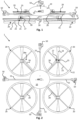
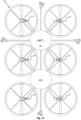
Fig. 1 shows a first embodiment of adrone 1 in accordance with the invention being in flight mode.Fig. 2 shows a top view of thedrone 1 ofFig. 1 . Thedrone 1 comprises adrone body 10 having a plurality ofpropeller arms 28 extending from the body in radial directions and distributed around the circumference of thedrone body 10. At eachfar end 28e of the propeller arms 28 arespective propeller assembly 20 is mounted via an actuated joint 27. In this embodiment the actuated joint 27 provides two rotation degrees of freedom to thepropeller assembly 20. However, the drone may also be built with only one rotation degree of freedom for thepropeller assemblies 20, or even with more degrees of freedom including a rotation degree of freedom and up to three translation degrees of freedom. There are in total six degrees of freedom for objects. The actuated joint 27 is coupled to thepropeller assembly 20 via amotor assembly 25. The details of themotor assembly 25 will be discussed in more detail in view ofFigs. 6 and12 . The embodiment illustrated in this figure constitutes a so-called quadcopter with fourpropeller assemblies 25, but the invention may be applied to drones having three ormore propeller assemblies 20. Thepropeller assemblies 20 comprise apropeller 24 and apropeller guard 22, which are rotatably mounted coaxially as illustrated. Further details as regards how thepropeller assemblies 20 are assembled are given in view ofFigs. 6 ,12 and14a-15b . The flight mode of thedrone 1 inFigs. 1 and 2 may be recognized by thepropeller assemblies 20 being oriented horizontally providing for an upwardly directed thrust in operational use. The propeller guards 22 of thepropeller assemblies 20 are shaped as train wheels, which can be observed by the protrudingrim 21 at one side of thewheel 22. The propeller guards 22 are coupled to themotor assembly 25 viarespective spokes 23 asFig. 2 clearly illustrates. In this embodiment thedrone 1 is further provided with a plurality ofcameras 50 that are mounted to thedrone body 10 viarespective camera arms 55. Furthermore, these cameras comprise six dual thermo and RGB gimbal sensor packs, one for each direction providing spherical inspection possibilities, but it can be any other number of cameras/packs. The cameras will not be further discussed in this description, because the invention is not about changing these cameras compared to the prior art. -
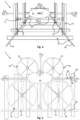
Fig. 3 shows a top view of thedrone 1 ofFig. 1 in driving mode, while driving on arailway track 99.Fig. 4 shows a perspective front view ofFig. 3 .Fig. 5 shows a perspective side view ofFig. 4 .Fig. 3 also schematically shows some further components or modules that are embodied in thedrone body 10. These components or modules are only shown inFigs. 3 and13 to simplify the figures. A first component that is quite essential for drones is abattery 11 for providing power to thedrone 1. A second component is storage ormemory 12 for storing all sorts of monitoring data which thedrone 1 collects, but also operational data. A third component is a global positioning system (GPS) for tracking a position of thedrone 1. A fourth component is a robot brain, general processing unit (GPU) or central processing unit (CPU) or the like. This component is at the heart of the drone and controls all other active components.Fig. 3 also illustrates how thepropeller assemblies 20 are vertically oriented and nicely place the propeller guards 22 on therails 98 of therailway 99 so that the aforementioned protrudingrim 21 falls within therails 98. The flight mode of thedrone 1 inFigs. 3-5 may be recognized by thepropeller assemblies 20 being oriented vertically for allowing thedrone 1 to drive on the rotatable and driven propeller guards 22. It must be noted that a perfectly vertical orientation is not necessary for allowing thedrone 1 to drive on therailway 99. Thepropeller assemblies 20 may also be oriented in a plane that is tilted relative to a vertical plane. -
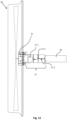
Fig. 6 shows apropeller assembly 20 combined with a 2-DOF actuated joint 27 in accordance with an embodiment of the invention. It must be noted that there are many ways of building coaxially placed rotatable driven parts. The embodiment here is a convenient and compact example. The same applies to making actuated joints, where there are many design options. Thepropeller assembly 20 and actuated joint 27 ofFig. 6 are built up as follows. Themotor assembly 25 comprises afirst motor 25a and asecond motor 25b that is placed concentrically around thefirst motor 25a. Thefirst motor 25a is the inner motor and is connected to thepropeller 28 via the respective actuated joint 27. Thefirst motor 25a has a driving shaft 25a1 that is physically connected with and drives thepropeller 24, as illustrated. Thesecond motor 25b is built around thefirst motor 25a by providing an annular stator 25b1 around the housing of thefirst motor 25a and then providing a rotor 25b2 around the stator 25b1 as illustrated. Such motors are off-the-shelf products. It is the rotor 25b2 of thesecond motor 25b that is physically connected with and drives thespokes 23 of thepropeller guard 22.Bearings 30 are provided and connect the rotor 25b2 with thepropeller arm 28 as illustrated. This configuration enables thefirst motor 25a to drive thepropeller 24 in flight mode. Then thesecond motor 25b may be typically switched off keeping thepropeller guard 22 still, but this is not essential. Thepropeller guard 22 might also be rotated in the same direction as thepropeller 24 or in the opposite direction. Furthermore, the configuration allows thesecond motor 25b to drive thepropeller guard 22 in driving mode. Then the first motor may be switched off keeping the propeller standing still, but this is not essential either. Thepropeller 24 might also be rotated in the same direction as thepropeller guard 22 or in the opposite direction. -
Fig. 6 also illustrates how the actuated joint 27 comprises two subjoints 27-1, 27-2, each subjoint taking care of another rotation degree of freedom (DOF). Alternatively, a more complex 2-DOF joint 27 could have been implemented. For the invention to work at least one DOF is required so that thepropeller assemblies 20 can be switched from horizontal to vertical orientation or opposite. -
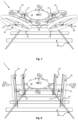
Fig. 7 shows thedrone 1 ofFig. 1 just during landing on arailway track 99 or during take-off from therailway track 99. In this transition from landing to flying or vice versa the actuatedjoints 27 of thepropeller arms 28 are actuated. In order to achieve a pyramid orientation of thepropeller assemblies 20 inFig. 7 that can drive on a railway track 99 a 2-DOF joint 27 is required. This embodiment facilitates landing on the railway track as the orientation shown in this figure is less critical in terms of positioning relative to therailway track 99. All what is required is to have thedrone 1 land in this position on thetracks 99, whereafter thepropeller assemblies 20 may be gradually rotated to a vertical position allowing the propeller guards 22 to slide into the right position on the tracks. When taking off from the track the opposite order of events is chosen. First, the propeller assemblies are rotated from their parallel vertical orientation towards the pyramid form ofFig. 7 , while the propellers are started creating a gradually increasing upwardly directed thrust. After that, the thrust may be boosted to enable thedrone 1 to fly. - To facilitate understanding of the landing or take-off procedure,
Fig. 8 shows thedrone 1 ofFig. 7 in a different stage during landing on therailway track 99 or take-off from therailway track 99. -
Fig. 9 shows a second embodiment of a drone 1-2 in accordance with the invention being in flight mode. The quadcopter embodiment of thedrone 1 as illustrated inFigs. 1-8 functions well. However, during landing and take-off it has a reduced upwardly directed thrust due to the tilting of thepropeller assemblies 20. The embodiment ofFig. 9 has twomore propeller arms 28, i.e., second subset 28-2 ofpropeller arms 28, wherein the twoadditional propeller arms 28 do not have an actuated joint as the other subset 28-1 ofpropeller arms 28 have. These twopropeller arms 28 together with their propeller assemblies 28-2 provide for an additional upwardly directed thrust when the first subset 28-1 ofpropeller arms 28 is being rotated towards vertical orientation (driving mode). This facilitates an easier and faster landing of thedrone 1. Of course, it is possible to provide these arms also with actuated joints, but just to keep those joints unchanged during landing or take-off. -
Fig. 10 shows a third embodiment of a drone 1-3 in accordance with the invention being in flight mode. In the same line as the embodiment ofFig. 9 thedrone 1 may be provided with a subset 28-2 of fouradditional propeller arms 28 for generating even more upwardly directed thrust when the first subset 28-1 is rotated towards vertical orientation (driving mode). Therespective propeller arms 28 do not have an actuated joint. Of course, it is possible to provide these arms also with actuated joints, but just to keep those joints unchanged during landing or take-off. -
Fig. 11 shows a fourth embodiment of a drone 1-4 in accordance with the invention being in flight mode. This drone 1-4 is provided with 6 propeller arms, which all have an actuated joint 27 providing three rotation degrees of freedom. The drone 1-4 also comprises a second drone body 10-2 as illustrated, which may comprise further components, such as an extra battery. The three rotation degrees of freedom provide for additional flexibility for the drone both in flight mode as well as in driving mode, where the drone may be adapted to different railway track widths, for example. -
Fig. 12 shows thepropeller assembly 20 ofFig. 1 combined with a 3-DOF actuated joint 27 in accordance with a further embodiment of the invention. The third rotation degree of freedom is obtained by adding a third subjoint 27-3 as illustrated. -
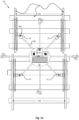
Fig. 13 shows a fifth embodiment of a drone 1-5 in accordance with the invention being in flight mode. Thisdrone 1 is a quadcopter and has the same actuatedjoints 27 as inFig. 12 mounted at respective far ends 28e of thepropeller arms 28. The figure serves to illustrate how two extra degrees of freedom allow for adapting the drone dimensions to different widths W1, W2 of therailway track 99. -
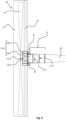
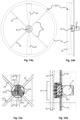
Fig. 14a shows a front view of a propeller assembly 20-2 in accordance with a further embodiment of the invention.Fig. 14b shows a side view of the propeller assembly 20-2 ofFig. 14a , where also part of the actuated joint 27 is visible.Fig. 15a shows a zoom view ofFig. 14a. Fig. 15b shows a zoom view ofFig. 14b . The propeller assembly 20-2 comprises a modified motor assembly 25-2. This propeller assembly 25-2 comprises onemotor 25a and aplanetary gear 25c mounted on and around themotor 25a. The driving shaft 25a1 of themotor 25a not only drives thepropeller 24, but also the sun gear of theplanetary gear 25c. Thering gear 25d of the planetary gear is connected with thespokes 23 of thepropeller guard 22. An electromechanically operated clutch (not shown) may be provided as well to allow for selecting between rotating thepropeller 24 or thepropeller guard 22. - The particular embodiments disclosed above are illustrative only, as the invention may be modified and practiced in different but equivalent manners apparent to those skilled in the art having the benefit of the teachings herein, as long as such manners are covered by the appended claims. For example, even though the figures all show embodiments having four propeller assemblies or more, the invention explicitly applies to embodiments having three propeller assemblies as well. Drones with three propellers have been disclosed before and the invention equally applies to those drones as well. Depending on the configuration of the drone and the propeller arms, it may be necessary (when switching from flight mode to driving mode) to modify one of the propeller arms in that embodiment so that one of the propeller guards can be translated to land on one of the two railway tracks (while the other propeller assemblies only require rotation when switching from flight mode to driving mode, each propeller guard landing on a different track).
- The invention is about a special drone, which has extra functionality, namely that it can drive on the railway. How a drone is controlled and remotely operated or autonomously controlling itself is considered known to the person skilled in the art and is therefore not discussed in this specification. Also, the specification does not give many details about the controlling of the motors and actuators in the drone as that is also is considered to be known knowledge for the person skilled in the art. Drones, motors and actuators and all control to make them do what they are supposed to do are off-the-shelf ingredients.
- The person skilled in the art may easily find alternative solutions for the mechanical parts of the drone. The invention covers all these variants as long as they are covered by the claims. No limitations are intended to the details of construction or design herein shown, other than as described in the claims below. It is therefore evident that the particular embodiments disclosed above may be altered or modified and all such variations are considered within the scope of the invention. Accordingly, the protection sought herein is as set forth in the claims below.
- It should be noted that the abovementioned embodiments illustrate rather than limit the invention, and that those skilled in the art will be able to design many alternative embodiments without departing from the scope of the appended claims. In the claims, any reference signs placed between parentheses shall not be construed as limiting the claim. Use of the verb "comprise" and its conjugations does not exclude the presence of elements or steps other than those stated in a claim. The article "a" or "an" preceding an element does not exclude the presence of a plurality of such elements. The mere fact that certain measures are recited in mutually different dependent claims does not indicate that a combination of these measures cannot be used to advantage. The invention may be implemented by means of hardware comprising several distinct elements, and by means of a suitably programmed computer. In the device claims enumerating several means, several of these means may be embodied by one and the same item of hardware.
Claims (12)
- Drone (1) having railway driving capabilities, the drone (1) comprising:- a drone body (10), and- at least three propeller arms (28) distributed around and connected to the drone body (10), wherein each propeller arm (28) is provided with a propeller assembly (20) comprising a propeller (24), wherein each propeller (24) is driven by a motor assembly (25), the propeller assembly (20) of at least a subset (28-1) of the at least three propeller arms (28) is provided with a rotatably mounted propeller guard (22) mounted around and being placed coaxially with the propeller (24),wherein the subset (28-1) of the at least three propeller arms (28) is provided with an actuated joint (27) for providing the respective propeller arm (20) with at least one rotation degree of freedom so that the propeller (24) can be rotated between a flight mode and a driving mode and back, wherein the flight mode involves a more horizontal orientation of the propeller assembly (20) for providing an upwardly -directed thrust force to the drone (1), in operational use, and wherein the driving mode involves a more vertical orientation of the propeller assembly (20) , characterised in that the propeller guard (22) is shaped as a train wheel and is driven by the motor assembly (25) for allowing the respective propeller guard (22) to drive on the railway track (99) in the driving mode.
- The drone (1) according to claim 1, wherein the actuated joints (27) are placed near ends (28e) of the propeller arms (28).
- The drone (1) according to claim 1 or 2, wherein the subset (28-1) comprises at least two propeller arms (28), and preferably at least three propeller arms (28).
- The drone (1) according to any one of the preceding claims, wherein at least one of the actuated joints (27) is configured for providing at least two rotation degrees of freedom.
- The drone (1) according to any one of the preceding claims, wherein at least one of the actuated joints (27) is configured for providing at least three rotation degrees of freedom.
- The drone (1) according to any one of the preceding claims, wherein the drone (1) comprises a total of four propeller arms (28).
- The drone (1) according to any one of claims 1 to 5, wherein the drone (1) comprises a total of six propeller arms (28).
- The drone (1) according to any one of claims 1 to 5, wherein the drone (1) comprises a total of eight propeller arms (28).
- The drone (1) according to any one of the preceding claims, wherein the motor assembly (25) comprises a first motor (25a) for driving the propeller (24) and a second motor (25b) for driving the propeller guard (22).
- The drone (1) according to any one of the claims 1 to 8, wherein the motor assembly (25) comprises a gear (25c, 25d) and a motor (25a) for driving the propeller (24) and the propeller guard (22), wherein the gear (25c, 25d) is coupled between the propeller (24) and the propeller guard (22).
- The drone (1) according to any one of the preceding claims, wherein the drone (1) further comprises at least one camera (50) for performing visual inspection.
- The drone (1) according to any one of the preceding claims, wherein the drone (1) further comprises railway maintenance equipment, such as a lubrication system, a manipulator or gripper.
Applications Claiming Priority (2)
| Application Number | Priority Date | Filing Date | Title |
|---|---|---|---|
| NO20210132A NO346478B1 (en) | 2021-02-03 | 2021-02-03 | Improved drone with railway driving capabilities |
| PCT/NO2021/050259 WO2022169368A1 (en) | 2021-02-03 | 2021-12-10 | Improved drone with railway driving capabilities |
Publications (4)
| Publication Number | Publication Date |
|---|---|
| EP4288339A1 EP4288339A1 (en) | 2023-12-13 |
| EP4288339A4 EP4288339A4 (en) | 2024-12-18 |
| EP4288339B1 true EP4288339B1 (en) | 2025-07-02 |
| EP4288339C0 EP4288339C0 (en) | 2025-07-02 |
Family
ID=82741633
Family Applications (1)
| Application Number | Title | Priority Date | Filing Date |
|---|---|---|---|
| EP21925008.1A Active EP4288339B1 (en) | 2021-02-03 | 2021-12-10 | Improved drone with railway driving capabilities |
Country Status (4)
| Country | Link |
|---|---|
| US (1) | US12296993B2 (en) |
| EP (1) | EP4288339B1 (en) |
| NO (1) | NO346478B1 (en) |
| WO (1) | WO2022169368A1 (en) |
Families Citing this family (6)
| Publication number | Priority date | Publication date | Assignee | Title |
|---|---|---|---|---|
| AU2022253780B2 (en) * | 2021-04-08 | 2026-03-26 | Thius Canada Inc. | Multi-mode convertible vehicle |
| CN220721406U (en) * | 2022-06-09 | 2024-04-05 | 影石创新科技股份有限公司 | Unmanned aerial vehicle |
| JPWO2024142207A1 (en) * | 2022-12-27 | 2024-07-04 | ||
| US12522387B2 (en) | 2023-07-07 | 2026-01-13 | Brookhurst Garage, Inc. | Aerial drone and battery pack |
| US20250282505A1 (en) * | 2024-03-11 | 2025-09-11 | Ideaforge Technology Limited | Landing gears for aerial vehicle to minimise aerodynamic drag during flight |
| US20250375991A1 (en) * | 2025-08-22 | 2025-12-11 | Guanhao Wu | Dual-Mode Vehicle with Selectively Attachable Flight Module and Energy Transmission Control |
Family Cites Families (19)
| Publication number | Priority date | Publication date | Assignee | Title |
|---|---|---|---|---|
| US8167234B1 (en) * | 2010-03-21 | 2012-05-01 | Michael Moore | Insect-like micro air vehicle having perching, energy scavenging, crawling, and offensive payload capabilities |
| US11338634B1 (en) * | 2014-10-30 | 2022-05-24 | Robotic Research Opco, Llc | Vehicle capable of multiple varieties of locomotion |
| CN204172626U (en) | 2014-10-31 | 2015-02-25 | 蔡闯 | A kind of air-ground amphibious vehicle |
| CN104669964B (en) | 2015-03-11 | 2017-06-16 | 北京工业大学 | A water, land and air amphibious unmanned detection device |
| US9108479B1 (en) | 2015-03-30 | 2015-08-18 | TTEH Associates, Trustee for Train track enabled helicopter CRT Trust | Train track enabled helicopter |
| US20170029103A1 (en) | 2015-07-28 | 2017-02-02 | Inventec Appliances (Pudong) Corporation | Unmanned vehicle |
| US11702194B1 (en) * | 2016-07-13 | 2023-07-18 | Hyalta Aeronautics, Inc. | Convertible ducted fan engine |
| KR101794198B1 (en) * | 2016-10-26 | 2017-11-07 | 한국철도기술연구원 | Autonomous driving railway drone for mobilization to the scene of the fire |
| US10675932B2 (en) | 2017-03-08 | 2020-06-09 | Toyota Motor Engineering & Manufacturing North America, Inc. | Dual-mode vehicle with wheel rotors |
| ES2691145B2 (en) * | 2017-05-23 | 2020-04-08 | Univ Madrid Carlos Iii | Unmanned railway vehicle, system and procedure for the inspection of railway infrastructure and superstructure. |
| WO2019093967A1 (en) * | 2017-11-08 | 2019-05-16 | Prohibition X Pte. Ltd. | Surveillance with an unmanned aerial vehicle |
| US10836406B2 (en) | 2017-11-15 | 2020-11-17 | Peter Lum | Drone railway system |
| KR102609548B1 (en) | 2018-07-27 | 2023-12-05 | 이소민 | Drone |
| CN109249768A (en) | 2018-10-30 | 2019-01-22 | 佛山市神风航空科技有限公司 | A kind of car of new model |
| US20210387739A1 (en) * | 2018-11-30 | 2021-12-16 | William J. Neff | Propulsion system for an aerial vehicle |
| NO345381B1 (en) | 2019-04-09 | 2021-01-11 | Bane Nor Sf | Device, system and method for lubricating a railway switch |
| GB2586835B (en) * | 2019-09-05 | 2022-04-27 | Rallings Alan | Motor vehicles for use on the ground and in the air |
| CN112026463B (en) * | 2020-08-11 | 2024-04-12 | 泉州中国兵器装备集团特种机器人研发中心 | Intelligent railway patrol robot |
| US12344407B2 (en) * | 2021-11-15 | 2025-07-01 | California Institute Of Technology | Multi-modal mobility unmanned vehicle |
-
2021
- 2021-02-03 NO NO20210132A patent/NO346478B1/en unknown
- 2021-12-10 WO PCT/NO2021/050259 patent/WO2022169368A1/en not_active Ceased
- 2021-12-10 EP EP21925008.1A patent/EP4288339B1/en active Active
- 2021-12-10 US US18/272,900 patent/US12296993B2/en active Active
Also Published As
| Publication number | Publication date |
|---|---|
| US12296993B2 (en) | 2025-05-13 |
| NO346478B1 (en) | 2022-08-29 |
| WO2022169368A1 (en) | 2022-08-11 |
| EP4288339C0 (en) | 2025-07-02 |
| NO20210132A1 (en) | 2022-08-04 |
| EP4288339A1 (en) | 2023-12-13 |
| EP4288339A4 (en) | 2024-12-18 |
| US20240076065A1 (en) | 2024-03-07 |
Similar Documents
| Publication | Publication Date | Title |
|---|---|---|
| EP4288339B1 (en) | Improved drone with railway driving capabilities | |
| US10301017B2 (en) | Flying and walking drone | |
| US10689108B2 (en) | Unmanned aerial vehicle with omnidirectional thrust vectoring | |
| JP3870257B2 (en) | Robot with offset rotary joint | |
| JP6640930B2 (en) | Deformable aircraft | |
| US7959104B2 (en) | Flying device with improved movement on the ground | |
| CN101890722B (en) | Novel three-degree-of-freedom (three-DOF) mechanical claw | |
| CN112838731A (en) | Unmanned aerial vehicle with tilted propeller and related system and method | |
| Borenstein et al. | The OmniTread OT-4 serpentine robot | |
| CN109227527A (en) | A kind of unmanned plane search and rescue device and its application based on head and the tail double end Snakelike mechanical arm | |
| CN120645599A (en) | Land-air multi-mode cross-domain robot system with clutch structure and control method | |
| CN114987126B (en) | An amphibious ball-footed robot based on coaxial double-propeller power | |
| Sivakumar et al. | Modelling of tethered UAV system for coconut/ice apple harvesting–A review | |
| CN109334964A (en) | A drone-type stage lighting and sound device | |
| KR20260061694A (en) | An all-weather, multi-purpose inspection drone carrying mission equipment and flying over a target area | |
| KR20240082421A (en) | A drone equipped with a hammer robot arm that can be docked with a variety of work devices and can be adjusted in length | |
| CN121536513A (en) | A drone system and method that can be air-deployed and transform into a quadruped robot | |
| CN112722267A (en) | Aerial real-time reconfigurable aircraft |
Legal Events
| Date | Code | Title | Description |
|---|---|---|---|
| STAA | Information on the status of an ep patent application or granted ep patent |
Free format text: STATUS: THE INTERNATIONAL PUBLICATION HAS BEEN MADE |
|
| PUAI | Public reference made under article 153(3) epc to a published international application that has entered the european phase |
Free format text: ORIGINAL CODE: 0009012 |
|
| STAA | Information on the status of an ep patent application or granted ep patent |
Free format text: STATUS: REQUEST FOR EXAMINATION WAS MADE |
|
| 17P | Request for examination filed |
Effective date: 20230803 |
|
| AK | Designated contracting states |
Kind code of ref document: A1 Designated state(s): AL AT BE BG CH CY CZ DE DK EE ES FI FR GB GR HR HU IE IS IT LI LT LU LV MC MK MT NL NO PL PT RO RS SE SI SK SM TR |
|
| DAV | Request for validation of the european patent (deleted) | ||
| DAX | Request for extension of the european patent (deleted) | ||
| REG | Reference to a national code |
Free format text: PREVIOUS MAIN CLASS: B64C0039020000 Ref country code: DE Ref legal event code: R079 Ref document number: 602021033601 Country of ref document: DE Free format text: PREVIOUS MAIN CLASS: B64C0039020000 Ipc: B60F0005020000 |
|
| A4 | Supplementary search report drawn up and despatched |
Effective date: 20241114 |
|
| RIC1 | Information provided on ipc code assigned before grant |
Ipc: E01B 7/26 20060101ALN20241108BHEP Ipc: B64U 101/25 20230101ALN20241108BHEP Ipc: B64U 60/70 20230101ALI20241108BHEP Ipc: B64U 50/13 20230101ALI20241108BHEP Ipc: B64U 40/10 20230101ALI20241108BHEP Ipc: B64U 30/299 20230101ALI20241108BHEP Ipc: B64U 30/297 20230101ALI20241108BHEP Ipc: B64U 30/29 20230101ALI20241108BHEP Ipc: B64U 10/70 20230101ALI20241108BHEP Ipc: B64U 10/16 20230101ALI20241108BHEP Ipc: B64U 10/13 20230101ALI20241108BHEP Ipc: B60F 5/02 20060101AFI20241108BHEP |
|
| GRAP | Despatch of communication of intention to grant a patent |
Free format text: ORIGINAL CODE: EPIDOSNIGR1 |
|
| STAA | Information on the status of an ep patent application or granted ep patent |
Free format text: STATUS: GRANT OF PATENT IS INTENDED |
|
| RIC1 | Information provided on ipc code assigned before grant |
Ipc: E01B 7/26 20060101ALN20250114BHEP Ipc: B64U 101/25 20230101ALN20250114BHEP Ipc: B64U 60/70 20230101ALI20250114BHEP Ipc: B64U 50/13 20230101ALI20250114BHEP Ipc: B64U 40/10 20230101ALI20250114BHEP Ipc: B64U 30/299 20230101ALI20250114BHEP Ipc: B64U 30/297 20230101ALI20250114BHEP Ipc: B64U 30/29 20230101ALI20250114BHEP Ipc: B64U 10/70 20230101ALI20250114BHEP Ipc: B64U 10/16 20230101ALI20250114BHEP Ipc: B64U 10/13 20230101ALI20250114BHEP Ipc: B60F 5/02 20060101AFI20250114BHEP |
|
| INTG | Intention to grant announced |
Effective date: 20250128 |
|
| GRAS | Grant fee paid |
Free format text: ORIGINAL CODE: EPIDOSNIGR3 |
|
| GRAA | (expected) grant |
Free format text: ORIGINAL CODE: 0009210 |
|
| STAA | Information on the status of an ep patent application or granted ep patent |
Free format text: STATUS: THE PATENT HAS BEEN GRANTED |
|
| AK | Designated contracting states |
Kind code of ref document: B1 Designated state(s): AL AT BE BG CH CY CZ DE DK EE ES FI FR GB GR HR HU IE IS IT LI LT LU LV MC MK MT NL NO PL PT RO RS SE SI SK SM TR |
|
| REG | Reference to a national code |
Ref country code: GB Ref legal event code: FG4D |
|
| REG | Reference to a national code |
Ref country code: CH Ref legal event code: EP |
|
| REG | Reference to a national code |
Ref country code: DE Ref legal event code: R096 Ref document number: 602021033601 Country of ref document: DE |
|
| REG | Reference to a national code |
Ref country code: IE Ref legal event code: FG4D |
|
| U01 | Request for unitary effect filed |
Effective date: 20250730 |
|
| U07 | Unitary effect registered |
Designated state(s): AT BE BG DE DK EE FI FR IT LT LU LV MT NL PT RO SE SI Effective date: 20250807 |
|
| PG25 | Lapsed in a contracting state [announced via postgrant information from national office to epo] |
Ref country code: IS Free format text: LAPSE BECAUSE OF FAILURE TO SUBMIT A TRANSLATION OF THE DESCRIPTION OR TO PAY THE FEE WITHIN THE PRESCRIBED TIME-LIMIT Effective date: 20251102 |
|
| PGFP | Annual fee paid to national office [announced via postgrant information from national office to epo] |
Ref country code: GB Payment date: 20251210 Year of fee payment: 5 |
|
| PG25 | Lapsed in a contracting state [announced via postgrant information from national office to epo] |
Ref country code: NO Free format text: LAPSE BECAUSE OF FAILURE TO SUBMIT A TRANSLATION OF THE DESCRIPTION OR TO PAY THE FEE WITHIN THE PRESCRIBED TIME-LIMIT Effective date: 20251002 |
|
| PG25 | Lapsed in a contracting state [announced via postgrant information from national office to epo] |
Ref country code: HR Free format text: LAPSE BECAUSE OF FAILURE TO SUBMIT A TRANSLATION OF THE DESCRIPTION OR TO PAY THE FEE WITHIN THE PRESCRIBED TIME-LIMIT Effective date: 20250702 |
|
| PG25 | Lapsed in a contracting state [announced via postgrant information from national office to epo] |
Ref country code: GR Free format text: LAPSE BECAUSE OF FAILURE TO SUBMIT A TRANSLATION OF THE DESCRIPTION OR TO PAY THE FEE WITHIN THE PRESCRIBED TIME-LIMIT Effective date: 20251003 |
|
| PG25 | Lapsed in a contracting state [announced via postgrant information from national office to epo] |
Ref country code: CZ Free format text: LAPSE BECAUSE OF FAILURE TO SUBMIT A TRANSLATION OF THE DESCRIPTION OR TO PAY THE FEE WITHIN THE PRESCRIBED TIME-LIMIT Effective date: 20250702 |
|
| U20 | Renewal fee for the european patent with unitary effect paid |
Year of fee payment: 5 Effective date: 20251212 |
|
| PG25 | Lapsed in a contracting state [announced via postgrant information from national office to epo] |
Ref country code: PL Free format text: LAPSE BECAUSE OF FAILURE TO SUBMIT A TRANSLATION OF THE DESCRIPTION OR TO PAY THE FEE WITHIN THE PRESCRIBED TIME-LIMIT Effective date: 20250702 |
|
| PG25 | Lapsed in a contracting state [announced via postgrant information from national office to epo] |
Ref country code: RS Free format text: LAPSE BECAUSE OF FAILURE TO SUBMIT A TRANSLATION OF THE DESCRIPTION OR TO PAY THE FEE WITHIN THE PRESCRIBED TIME-LIMIT Effective date: 20251002 |
|
| PG25 | Lapsed in a contracting state [announced via postgrant information from national office to epo] |
Ref country code: ES Free format text: LAPSE BECAUSE OF FAILURE TO SUBMIT A TRANSLATION OF THE DESCRIPTION OR TO PAY THE FEE WITHIN THE PRESCRIBED TIME-LIMIT Effective date: 20250702 |
|
| PG25 | Lapsed in a contracting state [announced via postgrant information from national office to epo] |
Ref country code: SM Free format text: LAPSE BECAUSE OF FAILURE TO SUBMIT A TRANSLATION OF THE DESCRIPTION OR TO PAY THE FEE WITHIN THE PRESCRIBED TIME-LIMIT Effective date: 20250702 |
|
| PG25 | Lapsed in a contracting state [announced via postgrant information from national office to epo] |
Ref country code: SK Free format text: LAPSE BECAUSE OF FAILURE TO SUBMIT A TRANSLATION OF THE DESCRIPTION OR TO PAY THE FEE WITHIN THE PRESCRIBED TIME-LIMIT Effective date: 20250702 |