EP4287556A1 - Masked decomposition of polynomials for lattice-based cryptography - Google Patents
Masked decomposition of polynomials for lattice-based cryptography Download PDFInfo
- Publication number
- EP4287556A1 EP4287556A1 EP23176177.6A EP23176177A EP4287556A1 EP 4287556 A1 EP4287556 A1 EP 4287556A1 EP 23176177 A EP23176177 A EP 23176177A EP 4287556 A1 EP4287556 A1 EP 4287556A1
- Authority
- EP
- European Patent Office
- Prior art keywords
- shares
- boolean
- arithmetic
- polynomial
- decomposition
- Prior art date
- Legal status (The legal status is an assumption and is not a legal conclusion. Google has not performed a legal analysis and makes no representation as to the accuracy of the status listed.)
- Granted
Links
Images

Classifications
-
- H—ELECTRICITY
- H04—ELECTRIC COMMUNICATION TECHNIQUE
- H04L—TRANSMISSION OF DIGITAL INFORMATION, e.g. TELEGRAPHIC COMMUNICATION
- H04L9/00—Cryptographic mechanisms or cryptographic arrangements for secret or secure communications; Network security protocols
- H04L9/30—Public key, i.e. encryption algorithm being computationally infeasible to invert or user's encryption keys not requiring secrecy
- H04L9/3093—Public key, i.e. encryption algorithm being computationally infeasible to invert or user's encryption keys not requiring secrecy involving Lattices or polynomial equations, e.g. NTRU scheme
-
- G—PHYSICS
- G06—COMPUTING OR CALCULATING; COUNTING
- G06F—ELECTRIC DIGITAL DATA PROCESSING
- G06F7/00—Methods or arrangements for processing data by operating upon the order or content of the data handled
- G06F7/38—Methods or arrangements for performing computations using exclusively denominational number representation, e.g. using binary, ternary, decimal representation
- G06F7/48—Methods or arrangements for performing computations using exclusively denominational number representation, e.g. using binary, ternary, decimal representation using non-contact-making devices, e.g. tube, solid state device; using unspecified devices
- G06F7/483—Computations with numbers represented by a non-linear combination of denominational numbers, e.g. rational numbers, logarithmic number system or floating-point numbers
- G06F7/487—Multiplying; Dividing
- G06F7/4873—Dividing
-
- G—PHYSICS
- G06—COMPUTING OR CALCULATING; COUNTING
- G06F—ELECTRIC DIGITAL DATA PROCESSING
- G06F7/00—Methods or arrangements for processing data by operating upon the order or content of the data handled
- G06F7/60—Methods or arrangements for performing computations using a digital non-denominational number representation, i.e. number representation without radix; Computing devices using combinations of denominational and non-denominational quantity representations, e.g. using difunction pulse trains, STEELE computers, phase computers
- G06F7/72—Methods or arrangements for performing computations using a digital non-denominational number representation, i.e. number representation without radix; Computing devices using combinations of denominational and non-denominational quantity representations, e.g. using difunction pulse trains, STEELE computers, phase computers using residue arithmetic
- G06F7/727—Modulo N arithmetic, with N being either (2**n)-1,2**n or (2**n)+1, e.g. mod 3, mod 4 or mod 5
-
- G—PHYSICS
- G06—COMPUTING OR CALCULATING; COUNTING
- G06F—ELECTRIC DIGITAL DATA PROCESSING
- G06F2207/00—Indexing scheme relating to methods or arrangements for processing data by operating upon the order or content of the data handled
- G06F2207/72—Indexing scheme relating to groups G06F7/72 - G06F7/729
- G06F2207/7219—Countermeasures against side channel or fault attacks
- G06F2207/7223—Randomisation as countermeasure against side channel attacks
- G06F2207/7233—Masking, e.g. (A**e)+r mod n
-
- H—ELECTRICITY
- H04—ELECTRIC COMMUNICATION TECHNIQUE
- H04L—TRANSMISSION OF DIGITAL INFORMATION, e.g. TELEGRAPHIC COMMUNICATION
- H04L2209/00—Additional information or applications relating to cryptographic mechanisms or cryptographic arrangements for secret or secure communication H04L9/00
- H04L2209/04—Masking or blinding
Definitions
- Various exemplary embodiments disclosed herein relate generally to efficient and masked decomposition of polynomials for lattice-based cryptography.
- Various exemplary embodiments disclosed herein relate generally to efficient and masked decomposition of polynomials for lattice-based cryptography.
- LWE Learning With Errors
- One of the leading lattice-based signature schemes is Dilithium which requires operations involving arithmetic with polynomials with integer coefficients. When implemented, the main computationally expensive operations are the arithmetic with polynomials.
- performing a rounded Euclidian division of the polynomial a by a base ⁇ to compute t ( ⁇ )A includes adding ⁇ /2 to a ( ⁇ )A and dividing by ⁇ .
- calculating arithmetic shares a 0 ⁇ A of the low part a 0 includes: calculating u ( ⁇ ) A by subtracting a 1 from t ( ⁇ ) A and adding q mod ⁇ , where q is a prime modulus; and multiplying u ( ⁇ ) A by ⁇ and then subtracting ⁇ /2.
- performing a rounded Euclidian division of the polynomial a by a base ⁇ to compute t ( ⁇ ) A includes adding ⁇ /2 to a ( ⁇ ) A and dividing by ⁇ .
- performing a rounded Euclidian division of the polynomial a by a base ⁇ to compute t ( ⁇ ) A includes adding ⁇ /2 to a ( ⁇ ) A and dividing by ⁇ .
- calculating the arithmetic shares a 0 ⁇ A of the low part a 0 includes: calculating u ( ⁇ ) A by subtracting a 1 from t ( ⁇ ) A and adding q mod ⁇ , where q is a prime modulus; and multiplying u ( ⁇ ) A by ⁇ and then subtracting ⁇ /2.
- FIG. 1 constitutes, in some respects, an abstraction and that the actual organization of the components of the device may be more complex than illustrated.
- Some post-quantum cryptography schemes require a decomposition or a truncation-like operation of polynomial coefficients. For unprotected implementations, this can be straightforwardly realized via different algorithms, mainly involving an Euclidean division or a simple truncation for power of two base and modulus.
- One family of attacks so-called side-channel analysis, exploits data dependencies in physical measurements of the target device (e.g., power consumption) to recover secret keys and can be thwarted with the help of masking the processed data.
- the decomposition operation requires protection since its input and outputs depend on the secret key.
- previous or straightforward techniques for masked decomposition introduce a significant performance overhead for non power of two base and modulus.
- a new approach is presented to perform masked decomposition securely and efficiently for non power of 2 moduli.
- the signing operation of a digital signature scheme generates a signature for a given message using a secret key. If this secret key was to be leaked, it would invalidate the security properties provided by the scheme. It has been shown that unprotected implementations of post-quantum signature schemes are vulnerable to implementation attacks, e.g., side-channel analysis. In particular, it was demonstrated that the secret key may be extracted from physical measurements of key-dependent parts in the signing operation.
- the key-dependent operations include the decomposition of polynomials in a base ⁇ .
- Masking is a common countermeasure to thwart side-channel analysis and has been utilized for various applications. Besides security, efficiency is also an important aspect when designing a masked algorithm. Important metrics for software implementations of masking are the number of operations and the number of fresh random elements required for the masking scheme.
- the decomposition operation for prime modulus is performed using multiple arithmetic additions modulus q over Boolean shares. It takes as input an arithmetic sharing of coefficients and produces Boolean-shared decompositions.
- GLP does not require a decomposition operation similar to the one needed for Dilithium.
- qTESLA only requires a rounding operation by a power of 2.
- Francois tenu and M Kunststoffsa Rossi An efficient and provable masked implementation of qtesla, Smart Card Research and Advanced Applications - 18th International Conference, CARDIS 2019, Prague, Czech Republic, November 11-13, 2019 , Revised (Sonia Belaid and Tim Güneysu, eds.), Lecture Notes in Computer Science, vol. 11833, Springer, 2019, pp. 74-91 (Gérard )., the authors extend on Barthe to mask the signature scheme qTESLA, but modify the original parameters of the scheme by changing the prime modulus to a power of two for simpler masking of the rounding operation.
- Decomposition methods are disclosed herein that improves on the state-of-the-art enabling significantly more efficient implementations of post quantum cryptography (PQC) schemes requiring a decomposition operation with non power of 2 moduli.
- PQC post quantum cryptography
- An example of such a PQC scheme is Dilithium that includes the decomposition of secret polynomial coefficients by the base ⁇ .
- the decomposition methods disclosed herein improves both the number of operations and the number of random elements required.
- SecDecomposeOriginal (or Algorithm 12 Decompose in Migliore where the name is adapted for better readability) computes a 0 first as the division remainder of a by ⁇ and then ensures that a 0 is in the required range by the Decompose function specifications.
- the next step of SecDecomposeOriginal is to compute a 1 as a ⁇ a 0 ⁇ .
- SecDecomposeOriginal begins by converting the input from arithmetic to Boolean shares and then exclusively operates on the Boolean shares.
- SecDecomposeOriginal includes the following drawbacks.
- the functions SecDecomposeA2Apow2 and SecDecomposeA2Bpow2 provide efficient decomposition when the opposite of the base's inverse is a power of two.
- the first function SecDecomposeA2Apow2 circumvents the first drawback of SecDecomposeOriginal by providing a 0 in arithmetic shares.
- the second function SecDecomposeA2Bpow2 provides a more efficient approach to SecDecomposeOriginal while still outputting a Boolean-shared a 0 , when this is needed for certain implementations.
- the function SecDecomposeA2Anotpow2 provides an efficient alternative for arbitrary decomposition bases (when the opposite of the base's inverse is not a power of 2). All the functions make use of the observation that once a 1 is computed, a 1 may be unmasked because its value may be easily recovered from a public signature and the public key.
- the disclosed decomposition functions with rounded division also allows for the computation of the value of a 1 that does not require any corner case evaluation/correction and also results implicitly in the correct range for a 0 when it is computed from a and the computed a 1 .
- Functions SecDecomposeA2Apow2 and SecDecomposeA2Bpow2 require one A2B conversion to perform the following ⁇ operation efficiently.
- SecDecomposeA2Apow2 does not require any other expensive operation on arithmetic or Boolean shares.
- SecDecomposeA2Bpow2 requires a single addition on Boolean shares.
- SecDecomposeA2Anotpow2 performs an efficient decomposition for non power of 2 base and uses one A2B conversion and one B2A conversion.
- the disclosed decomposition functions may be applied for arbitrary non power of 2 moduli q and arbitrary decomposition base ⁇ .
- Multiple decomposition function versions are provided: namely when - ⁇ -1 is a power of two and when it is not. All masked operations on arithmetic shares are naturally performed modulus q.
- the annotation mod q shows where a modular reduction has to be performed for the unmasked versions of the algorithms. If an operation is not annotated, the reduction is either explicit or not required.
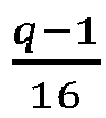
- the possible values for the decomposition base ⁇ are q ⁇ 1 16 and q ⁇ 1 44 .
- Lines 7 and 8 involve dividing u by ⁇ -1 which is equivalent to multiplying by ⁇ , then subtracting ⁇ to recover a 0 .
- Function SecDecomposeA2Apow2(a ( ⁇ ) A ) Input: An arithmetic sharing a ( ⁇ ) A of a coefficient.
- a function SecDecomposeA2Bpow2 illustrated in pseudocode below presents an alternative to the SecDecomposeA2Apow2 function when Boolean shares are required for the masking of a 0 .
- a 1 is unshared as in the SecDecomposeA2Apow2 function.
- the same rounded to nearest integer Euclidean division as in the SecDecomposeA2Apow2 function is used to extract a 1 at Lines 1-5. Then all the previous operations performed on the arithmetic shares are replaced by Boolean operations that essentially perform the same operations.
- SecDecomposeA2Anotpow2 is directed to cases where ⁇ is not a power of 2. It essentially performs the same operations as SecDecomposeA2Apow2. However, in this case, the AND on Line 4 in SecDecomposeA2Apow2 cannot be performed to extract the bits of a 1 because ⁇ is not a power of 2. Instead, a modular reduction using a B2A conversion modulus ⁇ is performed. At Line 4 a 1 ⁇ A is extracted from t ( ⁇ ) B using a B2A function. Then at Line 5 a 1 is unmasked. Then Lines 6-9 are identical to those in SecDecomposeA2Apow2.
- n s be the number of Boolean or arithmetic shares
- ⁇ be the word length of the processor (usually 32 or 64 bit)
- l log ⁇ - 1.
- n f to be the number of operations for a function f.
- the number of operations required for the elementary functions are provided in Table 1 and the number of operations required for SecDecomposeA2Apow2, SecDecomposeA2Bpow2 and SecDecomposeOriginal are provided in Table 2.
- the cost of the B2A conversion required for a 0 in Dilithium following SecDecomposeOriginal and SecDecomposeA2Bpow2 are not included.
- Table 1 Number of operations for different functions.
- r f denotes the number of random bits for a function f .
- Table 3. Number of random bits for different functions. Function Number of Random Bits SecAnd, SecOr ⁇ 2 n s 2 ⁇ n s SecAdd ⁇ l + 1 n s 2 ⁇ n s A2B r A 2 B + 9 r SecAdd + 3 r SecAnd + 138 n s Table 4. Number of random bits for SecDecomposeA2Apow2, SecDecomposeA2Bpow2 and SecDecomposeOriginal.
- the countermeasures that result from using the implementation of the decomposition functions disclosed herein provide a technological advantage over the prior art that requires fewer calculations and the generation of fewer random bits than prior implementations. This will allow for lattice based post-quantum cryptography schemes to be implemented in more applications that have limited processing resources.
- FIG. 1 illustrates an exemplary hardware diagram 100 for implementing masked polynomial decomposition by using the functions SecDecomposeA2Apow2, SecDecomposeA2Bpow2, and SecDecomposeA2Anotpow2.
- the device 100 includes a processor 120, memory 130, user interface 140, network interface 150, and storage 160 interconnected via one or more system buses 110.
- FIG. 1 illustrates an exemplary hardware diagram for implementing masked polynomial decomposition by using the functions SecDecomposeA2Apow2, SecDecomposeA2Bpow2, and SecDecomposeA2Anotpow2.
- the processor 120 may be any hardware device capable of executing instructions stored in memory 130 or storage 160 or otherwise processing data.
- the processor may include a microprocessor, microcontroller, graphics processing unit (GPU), field programmable gate array (FPGA), application-specific integrated circuit (ASIC), or other similar devices.
- the processor may be implemented as a secure processor or may include both a secure processor and unsecure processor.
- the memory 130 may include various memories such as, for example L1, L2, or L3 cache or system memory. As such, the memory 130 may include static random-access memory (SRAM), dynamic RAM (DRAM), flash memory, read only memory (ROM), or other similar memory devices.
- SRAM static random-access memory
- DRAM dynamic RAM
- ROM read only memory
- the user interface 140 may include one or more devices for enabling communication with a user as needed.
- the user interface 140 may include a display, a touch interface, a mouse, and/or a keyboard for receiving user commands.
- the user interface 140 may include a command line interface or graphical user interface that may be presented to a remote terminal via the network interface 150.
- the network interface 150 may include one or more devices for enabling communication with other hardware devices.
- the network interface 150 may include a network interface card (NIC) configured to communicate according to the Ethernet protocol or other communications protocols, including wireless protocols.
- NIC network interface card
- the network interface 150 may implement a TCP/IP stack for communication according to the TCP/IP protocols.
- TCP/IP protocols Various alternative or additional hardware or configurations for the network interface 150 will be apparent.
- the storage 160 may include one or more machine-readable storage media such as read-only memory (ROM), random-access memory (RAM), magnetic disk storage media, optical storage media, flash-memory devices, or similar storage media.
- the storage 160 may store instructions for execution by the processor 120 or data upon with the processor 120 may operate.
- the storage 160 may store a base operating system 161 for controlling various basic operations of the hardware 100.
- the storage 162 may include instructions for implementing masked polynomial decomposition by using the functions SecDecomposeA2Apow2, SecDecomposeA2Bpow2, and SecDecomposeA2Anotpow2 described above.
- the memory 130 may also be considered to constitute a “storage device” and the storage 160 may be considered a “memory.” Various other arrangements will be apparent. Further, the memory 130 and storage 160 may both be considered to be “non-transitory machine-readable media.” As used herein, the term “non-transitory” will be understood to exclude transitory signals but to include all forms of storage, including both volatile and non-volatile memories.
- the various components may be duplicated in various embodiments.
- the processor 120 may include multiple microprocessors that are configured to independently execute the methods described herein or are configured to perform steps or subroutines of the methods described herein such that the multiple processors cooperate to achieve the functionality described herein.
- the various hardware components may belong to separate physical systems.
- the processor 120 may include a first processor in a first server and a second processor in a second server.
- non-transitory machine-readable storage medium will be understood to exclude a transitory propagation signal but to include all forms of volatile and non-volatile memory.
- software is implemented on a processor, the combination of software and processor becomes a single specific machine.
Landscapes
- Engineering & Computer Science (AREA)
- General Physics & Mathematics (AREA)
- Physics & Mathematics (AREA)
- Theoretical Computer Science (AREA)
- Mathematical Analysis (AREA)
- Mathematical Optimization (AREA)
- Pure & Applied Mathematics (AREA)
- Computing Systems (AREA)
- Computational Mathematics (AREA)
- Mathematical Physics (AREA)
- General Engineering & Computer Science (AREA)
- Computer Security & Cryptography (AREA)
- Computer Networks & Wireless Communication (AREA)
- Signal Processing (AREA)
- Algebra (AREA)
- Nonlinear Science (AREA)
- Complex Calculations (AREA)
- Storage Device Security (AREA)
Abstract


Description
- Various exemplary embodiments disclosed herein relate generally to efficient and masked decomposition of polynomials for lattice-based cryptography.
- Various exemplary embodiments disclosed herein relate generally to efficient and masked decomposition of polynomials for lattice-based cryptography.
- Recent significant advances in quantum computing have accelerated the research into post-quantum cryptography schemes: cryptographic algorithms which run on classical computers but are believed to be still secure even when faced with an adversary with access to a quantum computer. This demand is driven by interest from standardization bodies, such as the call for proposals for new public-key cryptography standards by the National Institute of Standards and Technology (NIST). The selection procedure for this new cryptographic standard has started and has further accelerated the research of post-quantum cryptography schemes.
- There are various families of problems to instantiate these post-quantum cryptographic approaches. Constructions based on the hardness of lattice problems are considered to be promising candidates to become the next standard. A subset of approaches considered within this family are instantiations of the Learning With Errors (LWE) framework: the Ring-Learning With Errors problem. One of the leading lattice-based signature schemes is Dilithium which requires operations involving arithmetic with polynomials with integer coefficients. When implemented, the main computationally expensive operations are the arithmetic with polynomials. More precisely, computations are done in a ring


- A summary of various exemplary embodiments is presented below. Some simplifications and omissions may be made in the following summary, which is intended to highlight and introduce some aspects of the various exemplary embodiments, but not to limit the scope of the invention. Detailed descriptions of an exemplary embodiment adequate to allow those of ordinary skill in the art to make and use the inventive concepts will follow in later sections.
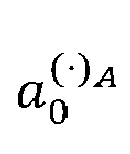
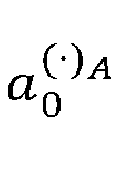
- Various embodiments relate to a data processing system comprising instructions embodied in a non-transitory computer readable medium, the instructions for a cryptographic operation including a masked decomposition of a polynomial a having ns arithmetic shares into a high part a 1 and a low part a 0 for lattice-based cryptography in a processor, the instructions, including: performing a rounded Euclidian division of the polynomial a by a base α to compute t (·)A ; extracting Boolean shares


- Various embodiments are described, wherein performing a rounded Euclidian division of the polynomial a by a base α to compute t (·)Aincludes adding α/2 to a (·)Aand dividing by α.
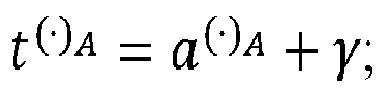
- Various embodiments are described, wherein performing a rounded Euclidian division of the polynomial a by a base α to compute t (·)A includes calculating: t (·) A = a (·)A + γ; and t (·)A= α -1 × t (·)A - (q mod ζ), where γ = α/2 and q is a prime modulus.
- Various embodiments are described, wherein calculating arithmetic shares

- Further various embodiments relate to a data processing system comprising instructions embodied in a non-transitory computer readable medium, the instructions for a cryptographic operation including a masked decomposition of a polynomial a having ns arithmetic shares into a high part a 1 and a low part a 0 for lattice-based cryptography in a processor, the instructions, including: performing a rounded Euclidian division of the polynomial a by a base α to compute t (·)A ; extracting Boolean shares


- Various embodiments are described, wherein performing a rounded Euclidian division of the polynomial a by a base α to compute t (·)A includes adding α/2 to a (·)A and dividing by α.
- Various embodiments are described, wherein performing a rounded Euclidian division of the polynomial a by a base α to compute t (·)A includes calculating: t (·) A = a (·)A + γ; and t (·)A = α -1 × t (·)A - (q mod ζ), where γ = α/2 and q is a prime modulus.
- Various embodiments are described, wherein calculating the Boolean shares


- Further various embodiments relate to a data processing system comprising instructions embodied in a non-transitory computer readable medium, the instructions for a cryptographic operation including a masked decomposition of a polynomial a having ns arithmetic shares into a high part a 1 and a low part a 0 for lattice-based cryptography in a processor, the instructions, including: performing a rounded Euclidian division of the polynomial a by a base α to compute t (·)A ; extracting Boolean shares


- Various embodiments are described, wherein performing a rounded Euclidian division of the polynomial a by a base α to compute t (·)A includes adding α/2 to a (·)A and dividing by α.
- Various embodiments are described, wherein performing a rounded Euclidian division of the polynomial a by a base α to compute t (·)A includes calculating: t (·) A = a (·)A+ γ; and t (·)A= α -1 × t (·)A - (q mod ζ), where γ = α/2 and q is a prime modulus.
- Various embodiments are described, wherein calculating the arithmetic shares

- In order to better understand various exemplary embodiments, reference is made to the accompanying drawings, wherein:
FIG. 1 constitutes, in some respects, an abstraction and that the actual organization of the components of the device may be more complex than illustrated. - To facilitate understanding, identical reference numerals have been used to designate elements having substantially the same or similar structure and/or substantially the same or similar function.
- The description and drawings illustrate the principles of the invention. It will thus be appreciated that those skilled in the art will be able to devise various arrangements that, although not explicitly described or shown herein, embody the principles of the invention and are included within its scope. Furthermore, all examples recited herein are principally intended expressly to be for pedagogical purposes to aid the reader in understanding the principles of the invention and the concepts contributed by the inventor(s) to furthering the art and are to be construed as being without limitation to such specifically recited examples and conditions. Additionally, the term, "or," as used herein, refers to a non-exclusive or (i.e., and/or), unless otherwise indicated (e.g., "or else" or "or in the alternative"). Also, the various embodiments described herein are not necessarily mutually exclusive, as some embodiments can be combined with one or more other embodiments to form new embodiments.
- Some post-quantum cryptography schemes require a decomposition or a truncation-like operation of polynomial coefficients. For unprotected implementations, this can be straightforwardly realized via different algorithms, mainly involving an Euclidean division or a simple truncation for power of two base and modulus. One family of attacks, so-called side-channel analysis, exploits data dependencies in physical measurements of the target device (e.g., power consumption) to recover secret keys and can be thwarted with the help of masking the processed data. The decomposition operation requires protection since its input and outputs depend on the secret key. However, previous or straightforward techniques for masked decomposition introduce a significant performance overhead for non power of two base and modulus. In this disclosure, a new approach is presented to perform masked decomposition securely and efficiently for non power of 2 moduli.
- The signing operation of a digital signature scheme generates a signature for a given message using a secret key. If this secret key was to be leaked, it would invalidate the security properties provided by the scheme. It has been shown that unprotected implementations of post-quantum signature schemes are vulnerable to implementation attacks, e.g., side-channel analysis. In particular, it was demonstrated that the secret key may be extracted from physical measurements of key-dependent parts in the signing operation.
- For Dilithium, the key-dependent operations include the decomposition of polynomials in a base α. Concretely, for a coefficient


- Masking is a common countermeasure to thwart side-channel analysis and has been utilized for various applications. Besides security, efficiency is also an important aspect when designing a masked algorithm. Important metrics for software implementations of masking are the number of operations and the number of fresh random elements required for the masking scheme.
- The first masking approach for Dilithium was proposed in Vincent Migliore, Benoit Gérard, Mehdi Tibouchi, and Pierre-Alain Fouque, Masking dilithium - efficient implementation and side-channel evaluation, Applied Cryptography and Network Security - 17th International Conference, ACNS 2019, Bogota, Colombia, June 5-7, 2019, Proceedings (Robert H. Deng, Valérie Gauthier-Umaña, hoa, and Moti Yung, eds.), Lecture Notes in Computer Science, vol. 11464, Springer, 2019, pp. 344-362 (Migliore). In Migliore, the decomposition operation for prime modulus is performed using multiple arithmetic additions modulus q over Boolean shares. It takes as input an arithmetic sharing of coefficients and produces Boolean-shared decompositions.
- Similar lattice-based signature schemes to Dilithium include GLP and qTESLA. The first dedicated masking of GLP was presented in Gilles Barthe, Sonia Belaid, Thomas Espitau, Pierre-Alain Fouque, Benjamin Grégoire, Mélissa Rossi, and Mehdi Tibouchi, Masking the GLP lattice-based signature scheme at any order, Advances in Cryptology - EUROCRYPT 2018 - 37th Annual International Conference on the Theory and Applications of Cryptographic Techniques, Tel Aviv, Israel, April 29 - May 3, 2018 Proceedings, Part II (Jesper Buus Nielsen and Vincent Rijmen, eds.), Lecture Notes in Computer Science, vol. 10821, Springer, 2018, pp. 354-384 (Barthe). GLP does not require a decomposition operation similar to the one needed for Dilithium. qTESLA only requires a rounding operation by a power of 2. In Francois Gérard and Mélissa Rossi, An efficient and provable masked implementation of qtesla, Smart Card Research and Advanced Applications - 18th International Conference, CARDIS 2019, Prague, Czech Republic, November 11-13, 2019, Revised (Sonia Belaid and Tim Güneysu, eds.), Lecture Notes in Computer Science, vol. 11833, Springer, 2019, pp. 74-91 (Gérard)., the authors extend on Barthe to mask the signature scheme qTESLA, but modify the original parameters of the scheme by changing the prime modulus to a power of two for simpler masking of the rounding operation.
- Decomposition methods are disclosed herein that improves on the state-of-the-art enabling significantly more efficient implementations of post quantum cryptography (PQC) schemes requiring a decomposition operation with non power of 2 moduli. An example of such a PQC scheme is Dilithium that includes the decomposition of secret polynomial coefficients by the base α. The decomposition methods disclosed herein improves both the number of operations and the number of random elements required.
- SecDecomposeOriginal (or Algorithm 12 Decompose in Migliore where the name is adapted for better readability) computes a 0 first as the division remainder of a by α and then ensures that a 0 is in the required range by the Decompose function specifications. The next step of SecDecomposeOriginal is to compute a 1 as

- SecDecomposeOriginal includes the following drawbacks. First, because the output a 0 of the decomposition function is the input to an addition, an implementation of Dilithium using SecDecomposeOriginal requires an additional B2A conversion in order to perform the addition efficiently or alternatively performs this addition on Boolean shares. Both options are not efficient because both a B2A conversion and an addition on Boolean shares are expensive operations. Second, in SecDecomposeOriginal the computation of a 0 and a 1 requires many calls to SecAdd (i.e., arithmetic addition over Boolean shares) which is a particularly expensive operation on Boolean shares. Third, in SecDecomposeOriginal almost half of the operations are used only to ensure the range on a0 and to cater to the specific case where a - a0 = q - 1 (in particular this part of the algorithm includes one call to SecAnd and two calls to SecAdd).
- As a result, for NIST level 5 for one Dilithium signing iteration and d = 5, SecDecomposeOriginal takes about 24.2 million operations and 100.3 million random bits. The proposed SecDecomposeA2Apow2 takes 8 million operations and 38 million random bits for the same task. For NIST level 3 taking into account the average number of signing iterations (= 5.1) and for d = 5, SecDecomposeOriginal takes 92.6 million operations and 383.9 million random bits. The proposed SecDecomposeA2Apow2 requires only 30.8 million operations and 145.3 million random bits in comparison.
- The functions SecDecomposeA2Apow2 and SecDecomposeA2Bpow2 provide efficient decomposition when the opposite of the base's inverse is a power of two. The first function SecDecomposeA2Apow2 circumvents the first drawback of SecDecomposeOriginal by providing a0 in arithmetic shares. The second function SecDecomposeA2Bpow2 provides a more efficient approach to SecDecomposeOriginal while still outputting a Boolean-shared a0, when this is needed for certain implementations. The function SecDecomposeA2Anotpow2 provides an efficient alternative for arbitrary decomposition bases (when the opposite of the base's inverse is not a power of 2). All the functions make use of the observation that once a1 is computed, a1 may be unmasked because its value may be easily recovered from a public signature and the public key.
- The improvements of the decomposition functions disclosed herein are based on computing a 1 first using a rounded up division by α. As opposed to SecDecomposeOriginal, which operates only on Boolean shares, this is efficiently performed on the input arithmetic shares of a by adding

- The disclosed decomposition functions with rounded division also allows for the computation of the value of a 1 that does not require any corner case evaluation/correction and also results implicitly in the correct range for a 0 when it is computed from a and the computed a 1. Functions SecDecomposeA2Apow2 and SecDecomposeA2Bpow2 require one A2B conversion to perform the following Λ operation efficiently. SecDecomposeA2Apow2 does not require any other expensive operation on arithmetic or Boolean shares. SecDecomposeA2Bpow2 requires a single addition on Boolean shares. SecDecomposeA2Anotpow2 performs an efficient decomposition for non power of 2 base and uses one A2B conversion and one B2A conversion.
- The disclosed decomposition functions may be applied for arbitrary non power of 2 moduli q and arbitrary decomposition base α. Multiple decomposition function versions are provided: namely when -α -1 is a power of two and when it is not. All masked operations on arithmetic shares are naturally performed modulus q. The annotation mod q shows where a modular reduction has to be performed for the unmasked versions of the algorithms. If an operation is not annotated, the reduction is either explicit or not required.
- An application of the disclosed decomposition functions may include the signing process of Dilithium where the coefficients of a secret vector w are decomposed. Concretely, each coefficient



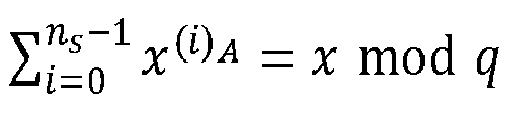
- The coefficients of w must remain secret to ensure the security of the signature scheme. A common approach is to split up the sensitive values into Boolean or arithmetic shares. A Boolean or arithmetically masked variable x as x (·)Bor x (·)Amay be denoted respectively, with

- The new disclosed decomposition functions SecDecomposeA2Apow2, SecDecomposeA2Bpow2, and SecDecomposeA2Anotpow2 will now be described.
- The function SecDecomposeA2Apow2 is dedicated to the case where ζ = -α -1 is a power of 2. Let n be the number of bits in ζ. Below pseudocode is used to describe SecDecomposeA2Apow2. SecDecomposeA2Apow2 outputs a0 in arithmetic shares and a 1 is unshared. The first step of SecDecomposeA2Apow2 is to compute a 1 as the rounded Euclidean division of a by α as illustrated in Lines 1-2. The rounding is done to the nearest integer. This is achieved by first adding


Function SecDecomposeA2Apow2(a(·)A ) Input: An arithmetic sharing a (·)A of a coefficient. Output: A decomposition a 1, 
1: 
2: 
▷mod q 3: 
4: 
5: 
▷unmasking of a 1 6: 
7: 
▷mod q 8: 
9: return a 1, 
- A function SecDecomposeA2Bpow2 illustrated in pseudocode below presents an alternative to the SecDecomposeA2Apow2 function when Boolean shares are required for the masking of a 0. a 1 is unshared as in the SecDecomposeA2Apow2 function. First, the same rounded to nearest integer Euclidean division as in the SecDecomposeA2Apow2 function is used to extract a 1 at Lines 1-5. Then all the previous operations performed on the arithmetic shares are replaced by Boolean operations that essentially perform the same operations. First, instead of subtracting (a 1 - 1) and multiplying by a (SecDecomposeA2Apow2, Lines 6-7), instead t is shifted by n bits to the right at line 6 that is equivalent to dividing by ζ or multiplying by α. Finally, the subtraction γ - t is is performed at Line 7 using t's two's complement.
Function SecDecomposeA2Bpow2(a (·)A ) Input: An arithmetic sharing a (·)A of a coefficient. Output: A Boolean decomposition a 1, 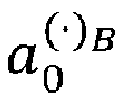
1: 
2: 
Dmod q 3: 
4: 
5: 
▷unmasking of a 1 6: 
7: 
8: return a 1, 
- A function SecDecomposeA2Anotpow2 is directed to cases where ζ is not a power of 2. It essentially performs the same operations as SecDecomposeA2Apow2. However, in this case, the AND on Line 4 in SecDecomposeA2Apow2 cannot be performed to extract the bits of a 1 because ζ is not a power of 2. Instead, a modular reduction using a B2A conversion modulus ζ is performed. At Line 4

Function SecDecomposeA2Anotpow2(a (·)A ) Input: An arithmetic sharing a (·)A of a coefficient. Output: A decomposition a 1, 
1: 
2: 
▷mod q 3: 
4: 
5: 
▷unmasking of a 1 6: 
7: 
▷mod q 8: 
9: return a 1, 
- A description of auxiliary variables and functions used in the functions described herein is now provided.
- q: modulus. It is equal to q = 223 - 213 + 1 for Dilithium.
- γ: low-order rounding range. It is equal to


- α: decomposition base. It is equal to 2γ.
- α -1: multipicative inverse of α.
- ζ: additive inverse of α -1 .
- n: number of bits in ζ if ζ is a power of 2 i.e. ζ = 2 n.
- ns : The number of Boolean or arithmetic shares used in the sharing of the secret coefficient. Increasing this value will improve the side-channel security, but also lower the performance of the algorithm.
- A2B: This function converts ns arithmetic shares


- B2Aζ: This function converts ns Boolean shares


- Λ: The function computes the bit-wise AND of two inputs. In a Boolean masking context, if one of the inputs is a constant or a public value, the Λ operation is applied on each share of the other input independently.
- >>: The function computes the bit-wise right shift of the input bitstring. In a Boolean masking context, the >> operation is applied on each share of the other input independently.
- ¬: The function computes the bit-wise negation of the input bitstring. When applied to a Boolean-shared input only one share has to be negated, because ¬(P ⊕ Q) = (¬P) ⊕ Q. +/-: The function computes arithmetic addition or subtraction of the inputs. When applied to one arithmetically-shared input and one public input only one share has to be included in the addition or subtraction, because (P + Q) + R = P + (Q + R).
- ×: The function computes arithmetic multiplication of the inputs. In an arithmetic masking context, if one of the inputs is a constant or a public value, the × operation is applied on each share of the other input independently.
- The disclosed decomposition functions will now be compared to SecDecomposeOriginal. One of the disadvantages of using SecDecomposeOriginal is that it requires 138ns random bits to mask constant public values. The fact that these values are masked also increases the number of operations because these masked values are inputs to additions over Boolean shares which are costly operations.
- A comparison of the number of operations required for SecDecomposeA2Apow2 and SecDecomposeA2Bpow2 will now be made. Let ns be the number of Boolean or arithmetic shares, ω be the word length of the processor (usually 32 or 64 bit), and l = log ω - 1. Additionally, define nf to be the number of operations for a function f.
- The number of operations required for the elementary functions are provided in Table 1 and the number of operations required for SecDecomposeA2Apow2, SecDecomposeA2Bpow2 and SecDecomposeOriginal are provided in Table 2. The cost of the B2A conversion required for a 0 in Dilithium following SecDecomposeOriginal and SecDecomposeA2Bpow2 are not included.
Table 1. Number of operations for different functions. Function Number of Operations +, -, ¬,⊕ 1 Λ,×, >> ns A2B 
SecAnd 
SecOr 
SecAdd 
Table 2. Number of operations for SecDecomposeA2Apow2, SecDecomposeA2Bpow2 and SecDecomposeOriginal. Function Number of Operations SecDecomposeA2A 
SecDecomposeA2B 
SecDecomposeOriginal 
- Next, the number of random bits that need to be generated in the original algorithm versus the new decomposition functions are compared. SecDecomposeOriginal generates a lot of random bits to mask public values in order to perform masked additions straightforwardly. In SecDecomposeA2Apow2 no masking of public values is required and only SecDecomposeA2Bpow2 requires randomness to mask the constant public value γ + 1 to perform a masked addition.
- The comparative results are summarized in Tables 3 and 4. There, rf denotes the number of random bits for a function f.
Table 3. Number of random bits for different functions. Function Number of Random Bits SecAnd, SecOr 
SecAdd 
A2B 
Table 4. Number of random bits for SecDecomposeA2Apow2, SecDecomposeA2Bpow2 and SecDecomposeOriginal. Function Number of Random Bits SecDecomposeA2Apow2 
SecDecomposeA2Bpow2 
SecDecomposeOriginal 
- The calculations illustrated in Tables 1-4 illustrate that the disclosed decomposition functions reduce the number of operations and random bits needed to perform the decomposition function.
- The countermeasures that result from using the implementation of the decomposition functions disclosed herein provide a technological advantage over the prior art that requires fewer calculations and the generation of fewer random bits than prior implementations. This will allow for lattice based post-quantum cryptography schemes to be implemented in more applications that have limited processing resources.
-
FIG. 1 illustrates an exemplary hardware diagram 100 for implementing masked polynomial decomposition by using the functions SecDecomposeA2Apow2, SecDecomposeA2Bpow2, and SecDecomposeA2Anotpow2. As illustrated, thedevice 100 includes aprocessor 120,memory 130,user interface 140,network interface 150, andstorage 160 interconnected via one ormore system buses 110. It will be understood thatFIG. 1 illustrates an exemplary hardware diagram for implementing masked polynomial decomposition by using the functions SecDecomposeA2Apow2, SecDecomposeA2Bpow2, and SecDecomposeA2Anotpow2. - The
processor 120 may be any hardware device capable of executing instructions stored inmemory 130 orstorage 160 or otherwise processing data. As such, the processor may include a microprocessor, microcontroller, graphics processing unit (GPU), field programmable gate array (FPGA), application-specific integrated circuit (ASIC), or other similar devices. The processor may be implemented as a secure processor or may include both a secure processor and unsecure processor. - The
memory 130 may include various memories such as, for example L1, L2, or L3 cache or system memory. As such, thememory 130 may include static random-access memory (SRAM), dynamic RAM (DRAM), flash memory, read only memory (ROM), or other similar memory devices. - The
user interface 140 may include one or more devices for enabling communication with a user as needed. For example, theuser interface 140 may include a display, a touch interface, a mouse, and/or a keyboard for receiving user commands. In some embodiments, theuser interface 140 may include a command line interface or graphical user interface that may be presented to a remote terminal via thenetwork interface 150. - The
network interface 150 may include one or more devices for enabling communication with other hardware devices. For example, thenetwork interface 150 may include a network interface card (NIC) configured to communicate according to the Ethernet protocol or other communications protocols, including wireless protocols. Additionally, thenetwork interface 150 may implement a TCP/IP stack for communication according to the TCP/IP protocols. Various alternative or additional hardware or configurations for thenetwork interface 150 will be apparent. - The
storage 160 may include one or more machine-readable storage media such as read-only memory (ROM), random-access memory (RAM), magnetic disk storage media, optical storage media, flash-memory devices, or similar storage media. In various embodiments, thestorage 160 may store instructions for execution by theprocessor 120 or data upon with theprocessor 120 may operate. For example, thestorage 160 may store abase operating system 161 for controlling various basic operations of thehardware 100. Thestorage 162 may include instructions for implementing masked polynomial decomposition by using the functions SecDecomposeA2Apow2, SecDecomposeA2Bpow2, and SecDecomposeA2Anotpow2 described above. - It will be apparent that various information described as stored in the
storage 160 may be additionally or alternatively stored in thememory 130. In this respect, thememory 130 may also be considered to constitute a "storage device" and thestorage 160 may be considered a "memory." Various other arrangements will be apparent. Further, thememory 130 andstorage 160 may both be considered to be "non-transitory machine-readable media." As used herein, the term "non-transitory" will be understood to exclude transitory signals but to include all forms of storage, including both volatile and non-volatile memories. - While the
host device 100 is shown as including one of each described component, the various components may be duplicated in various embodiments. For example, theprocessor 120 may include multiple microprocessors that are configured to independently execute the methods described herein or are configured to perform steps or subroutines of the methods described herein such that the multiple processors cooperate to achieve the functionality described herein. Further, where thedevice 100 is implemented in a cloud computing system, the various hardware components may belong to separate physical systems. For example, theprocessor 120 may include a first processor in a first server and a second processor in a second server. - As used herein, the term "non-transitory machine-readable storage medium" will be understood to exclude a transitory propagation signal but to include all forms of volatile and non-volatile memory. When software is implemented on a processor, the combination of software and processor becomes a single specific machine. Although the various embodiments have been described in detail, it should be understood that the invention is capable of other embodiments and its details are capable of modifications in various obvious respects.
- Because the data processing implementing the present invention is, for the most part, composed of electronic components and circuits known to those skilled in the art, circuit details will not be explained in any greater extent than that considered necessary as illustrated above, for the understanding and appreciation of the underlying concepts of the present invention and in order not to obfuscate or distract from the teachings of the present invention.
- Although the invention is described herein with reference to specific embodiments, various modifications and changes can be made without departing from the scope of the present invention as set forth in the claims below. Accordingly, the specification and figures are to be regarded in an illustrative rather than a restrictive sense, and all such modifications are intended to be included within the scope of the present invention. Any benefits, advantages, or solutions to problems that are described herein with regard to specific embodiments are not intended to be construed as a critical, required, or essential feature or element of any or all the claims.
- Furthermore, the terms "a" or "an," as used herein, are defined as one or more than one. Also, the use of introductory phrases such as "at least one" and "one or more" in the claims should not be construed to imply that the introduction of another claim element by the indefinite articles "a" or "an" limits any particular claim containing such introduced claim element to inventions containing only one such element, even when the same claim includes the introductory phrases "one or more" or "at least one" and indefinite articles such as "a" or "an." The same holds true for the use of definite articles.
- Unless stated otherwise, terms such as "first" and "second" are used to arbitrarily distinguish between the elements such terms describe. Thus, these terms are not necessarily intended to indicate temporal or other prioritization of such elements.
- Any combination of specific software running on a processor to implement the embodiments of the invention, constitute a specific dedicated machine.
- It should be appreciated by those skilled in the art that any block diagrams herein represent conceptual views of illustrative circuitry embodying the principles of the invention.
Claims (12)
- A data processing system comprising instructions embodied in a non-transitory computer readable medium, the instructions for a cryptographic operation including a masked decomposition of a polynomial a having ns arithmetic shares into a high part a 1 and a low part a 0 for lattice-based cryptography in a processor, the instructions, comprising:performing a rounded Euclidian division of the polynomial a by a base α to compute t (·)A ;extracting Boolean shares
 unmasking a 1 by combining Boolean shares of
 calculating arithmetic shares
 performing a cryptographic function using a 1 and
- The data processing system of claim 1, wherein performing a rounded Euclidian division of the polynomial a by a base α to compute t (·)A includes adding α/2 to a (·)A and dividing by α.
- The data processing system of claim 2, wherein performing a rounded Euclidian division of the polynomial a by a base α to compute t (·)A includes calculating:


- The data processing system of any preceding claim, wherein calculating arithmetic shares
 calculating u (·)A by subtracting a1 from t (·)A and adding q mod ζ, where q is a prime modulus; andmultiplying u (·)A by α and then subtracting α/2.
 - A data processing system comprising instructions embodied in a non-transitory computer readable medium, the instructions for a cryptographic operation including a masked decomposition of a polynomial a having ns arithmetic shares into a high part a 1 and a low part a 0 for lattice-based cryptography in a processor, the instructions, comprising:performing a rounded Euclidian division of the polynomial a by a base α to compute t (·)A ;extracting Boolean shares
 unmasking a 1 by combining Boolean shares of
 calculating the Boolean shares
 performing a cryptographic function using a 1 and
- The data processing system of claim 5, wherein performing a rounded Euclidian division of the polynomial a by a base α to compute t (·)A includes adding α/2 to a (·)A and dividing by α.
- The data processing system of claim 6, wherein performing a rounded Euclidian division of the polynomial a by a base α to compute t (·)A includes calculating:


- The data processing system of any one of claims 5 to 7, wherein calculating the Boolean shares
 shifting t (·) B n bits to the right, where n is a number of bits in ζ; andcalculating
- A data processing system comprising instructions embodied in a non-transitory computer readable medium, the instructions for a cryptographic operation including a masked decomposition of a polynomial a having ns arithmetic shares into a high part a 1 and a low part a 0 for lattice-based cryptography in a processor, the instructions, comprising:performing a rounded Euclidian division of the polynomial a by a base α to compute t (·)A ;extracting Boolean shares
 unmasking a 1 by combining arithmetic shares of
 calculating the arithmetic shares
 performing a cryptographic function using a 1 and
- The data processing system of claim 9, wherein performing a rounded Euclidian division of the polynomial a by a base α to compute t (·)A includes adding α/2 to a (·)A and dividing by α.
- The data processing system of claim 10, wherein performing a rounded Euclidian division of the polynomial a by a base α to compute t (·)A includes calculating:

- The data processing system of any one of the claims 9 to 11, wherein calculating the arithmetic shares
 calculating u (·)A by subtracting a 1 from t (·)A and adding q mod ζ, where q is a prime modulus; andmultiplying u (·)A by α and then subtracting α/2.
Applications Claiming Priority (1)
| Application Number | Priority Date | Filing Date | Title |
|---|---|---|---|
| US17/832,521 US12021985B2 (en) | 2022-06-03 | 2022-06-03 | Masked decomposition of polynomials for lattice-based cryptography |
Publications (2)
| Publication Number | Publication Date |
|---|---|
| EP4287556A1 true EP4287556A1 (en) | 2023-12-06 |
| EP4287556B1 EP4287556B1 (en) | 2025-01-22 |
Family
ID=86609874
Family Applications (1)
| Application Number | Title | Priority Date | Filing Date |
|---|---|---|---|
| EP23176177.6A Active EP4287556B1 (en) | 2022-06-03 | 2023-05-30 | Masked decomposition of polynomials for lattice-based cryptography |
Country Status (3)
| Country | Link |
|---|---|
| US (1) | US12021985B2 (en) |
| EP (1) | EP4287556B1 (en) |
| CN (1) | CN117176348A (en) |
Families Citing this family (3)
| Publication number | Priority date | Publication date | Assignee | Title |
|---|---|---|---|---|
| US12499277B2 (en) | 2023-04-10 | 2025-12-16 | Nxp B.V. | Flexible hardware accelerators for masking conversions with a power of two modulus |
| EP4614869A1 (en) * | 2024-03-06 | 2025-09-10 | Nxp B.V. | Decomposition of masked values |
| DE102024107405B4 (en) * | 2024-03-15 | 2026-02-26 | Infineon Technologies Ag | METHOD AND DEVICE FOR MASKED PERFORMING A MODULAR DECOMPOSITION OF A NUMBER INTO A HIGH-BIT COMPONENT AND A LOW-BIT COMPONENT |
Family Cites Families (10)
| Publication number | Priority date | Publication date | Assignee | Title |
|---|---|---|---|---|
| FR2926652B1 (en) | 2008-01-23 | 2010-06-18 | Inside Contactless | COUNTER-MEASUREMENT METHOD AND DEVICES FOR ASYMMETRIC CRYPTOGRAPHY WITH SIGNATURE SCHEMA |
| FR3028368B1 (en) | 2014-11-07 | 2019-05-31 | Idemia France | METHOD AND DEVICE FOR CRYPTOGRAPHIC DATA PROCESSING |
| EP3874364A4 (en) * | 2018-10-29 | 2022-08-03 | Cryptography Research, Inc. | SECURE CONSTANT DURATION ARITHMETIC-BOOLEAN MASK CONVERSION |
| EP3903300A4 (en) | 2019-02-19 | 2022-09-07 | Massachusetts Institute Of Technology | Configurable lattice cryptography processor for the quantum-secure internet of things and related techniques |
| DE102019108095A1 (en) * | 2019-03-28 | 2020-10-01 | Infineon Technologies Ag | Perform a cryptographic operation |
| DE102021106883A1 (en) * | 2021-03-19 | 2022-09-22 | Infineon Technologies Ag | Compression in lattice-based cryptography |
| US11496297B1 (en) * | 2021-06-10 | 2022-11-08 | Pqsecure Technologies, Llc | Low footprint resource sharing hardware architecture for CRYSTALS-Dilithium and CRYSTALS-Kyber |
| WO2023232951A1 (en) * | 2022-06-02 | 2023-12-07 | Katholieke Universiteit Leuven | Method and circuit for securely mapping a masked variable |
| US20240126511A1 (en) * | 2022-09-26 | 2024-04-18 | Nxp B.V. | Protecting polynomial rejection through masked compression comparison |
| US20240113888A1 (en) * | 2022-09-28 | 2024-04-04 | Intel Corporation | Post-quantum lattice-based signature latency reduction |
-
2022
- 2022-06-03 US US17/832,521 patent/US12021985B2/en active Active
-
2023
- 2023-05-30 EP EP23176177.6A patent/EP4287556B1/en active Active
- 2023-06-02 CN CN202310651204.0A patent/CN117176348A/en active Pending
Non-Patent Citations (6)
| Title |
|---|
| "Proceedings", vol. 11464, 2019, SPRINGER, article "Lecture Notes in Computer Science", pages: 344 - 362 |
| AMIN ABDULRAHMAN ET AL: "Faster Kyber and Dilithium on the Cortex-M4", vol. 20220513:123335, 13 May 2022 (2022-05-13), pages 1 - 23, XP061074879, Retrieved from the Internet <URL:https://eprint.iacr.org/archive/2022/112/1652445215.pdf> [retrieved on 20220513] * |
| FRANCOIS GERARD,MELISSA ROSSI: "Lecture Notes in Computer Science", vol. 11833, 29 April 2018, SPRINGER, article "Advances in Cryptology - EUROCRYPT 2018 - 37th Annual International Conference on the Theory and Applications of Cryptographic Techniques", pages: 354 - 384 |
| ROSSI MéLISSA: "Extended Security of Lattice-Based Cryptography", 10 September 2020 (2020-09-10), pages 1 - 205, XP055823015, Retrieved from the Internet <URL:https://hal.archives-ouvertes.fr/tel-02946399/document> [retrieved on 20210709] * |
| VINCENT MIGLIORE ET AL: "Masking Dilithium: Efficient Implementation and Side-Channel Evaluation", vol. 20190418:190035, 18 April 2019 (2019-04-18), pages 1 - 28, XP061032583, Retrieved from the Internet <URL:http://eprint.iacr.org/2019/394.pdf> [retrieved on 20190414] * |
| VINCENT MIGLIOREBENOIT GERARDMEHDI TIBOUCHIPIERRE-ALAIN FOUQUE: "Masking dilithium - efficient implementation and side-channel evaluation", APPLIED CRYPTOGRAPHY AND NETWORK SECURITY - 17TH INTERNATIONAL CONFERENCE, ACNS 2019, 5 June 2019 (2019-06-05) |
Also Published As
| Publication number | Publication date |
|---|---|
| CN117176348A (en) | 2023-12-05 |
| US12021985B2 (en) | 2024-06-25 |
| US20230396436A1 (en) | 2023-12-07 |
| EP4287556B1 (en) | 2025-01-22 |
Similar Documents
| Publication | Publication Date | Title |
|---|---|---|
| EP4287556B1 (en) | Masked decomposition of polynomials for lattice-based cryptography | |
| Beirendonck et al. | A side-channel-resistant implementation of SABER | |
| US11283608B2 (en) | Executing a cryptographic operation | |
| US10726108B2 (en) | Protecting the input/output of modular encoded white-box RSA | |
| CN110363030A (en) | Method and processing device for performing lattice-based cryptographic operations | |
| EP4033692B1 (en) | Efficient masked polynomial comparison | |
| US20070064931A1 (en) | Elliptic curve point multiplication | |
| US11595195B2 (en) | Masked decoding of polynomials | |
| EP4344122A1 (en) | Protecting polynomial rejection through masked compressed comparison | |
| US10140437B2 (en) | Array indexing with modular encoded values | |
| US11863657B2 (en) | Using cryptographic blinding for efficient use of montgomery multiplication | |
| Shim et al. | Efficient Implementations of Rainbow and UOV using AVX2 | |
| US10235506B2 (en) | White-box modular exponentiation | |
| US12166879B2 (en) | Rejection of masked polynomials | |
| US11924346B2 (en) | Efficient and masked sampling of polynomials for lattice-based cryptography | |
| US10361855B2 (en) | Computing a secure elliptic curve scalar multiplication using an unsecured and secure environment | |
| US10068070B2 (en) | White-box elliptic curve point multiplication | |
| EP3125145A1 (en) | White-box elliptic curve point multiplication | |
| US12621150B2 (en) | Bit-rotation to prevent single-bit leakage in lattice based cryptography | |
| Fouque et al. | Zalcon: an alternative FPA-free NTRU sampler for Falcon | |
| Yi | Under quantum computer attack: is rainbow a replacement of rsa and elliptic curves on hardware? | |
| US20070156797A1 (en) | Protection of a calculation performed by an integrated circuit | |
| Lee et al. | Homomorphic Field Trace Revisited: Breaking the Cubic Noise Barrier | |
| Feng et al. | Research on improved AES-RSA hybrid encryption algorithm | |
| US12634134B2 (en) | Masked kronecker substitution for polynomial multiplication |
Legal Events
| Date | Code | Title | Description |
|---|---|---|---|
| PUAI | Public reference made under article 153(3) epc to a published international application that has entered the european phase |
Free format text: ORIGINAL CODE: 0009012 |
|
| STAA | Information on the status of an ep patent application or granted ep patent |
Free format text: STATUS: THE APPLICATION HAS BEEN PUBLISHED |
|
| AK | Designated contracting states |
Kind code of ref document: A1 Designated state(s): AL AT BE BG CH CY CZ DE DK EE ES FI FR GB GR HR HU IE IS IT LI LT LU LV MC ME MK MT NL NO PL PT RO RS SE SI SK SM TR |
|
| STAA | Information on the status of an ep patent application or granted ep patent |
Free format text: STATUS: REQUEST FOR EXAMINATION WAS MADE |
|
| 17P | Request for examination filed |
Effective date: 20240606 |
|
| RBV | Designated contracting states (corrected) |
Designated state(s): AL AT BE BG CH CY CZ DE DK EE ES FI FR GB GR HR HU IE IS IT LI LT LU LV MC ME MK MT NL NO PL PT RO RS SE SI SK SM TR |
|
| GRAP | Despatch of communication of intention to grant a patent |
Free format text: ORIGINAL CODE: EPIDOSNIGR1 |
|
| STAA | Information on the status of an ep patent application or granted ep patent |
Free format text: STATUS: GRANT OF PATENT IS INTENDED |
|
| INTG | Intention to grant announced |
Effective date: 20241028 |
|
| GRAS | Grant fee paid |
Free format text: ORIGINAL CODE: EPIDOSNIGR3 |
|
| GRAA | (expected) grant |
Free format text: ORIGINAL CODE: 0009210 |
|
| STAA | Information on the status of an ep patent application or granted ep patent |
Free format text: STATUS: THE PATENT HAS BEEN GRANTED |
|
| AK | Designated contracting states |
Kind code of ref document: B1 Designated state(s): AL AT BE BG CH CY CZ DE DK EE ES FI FR GB GR HR HU IE IS IT LI LT LU LV MC ME MK MT NL NO PL PT RO RS SE SI SK SM TR |
|
| REG | Reference to a national code |
Ref country code: GB Ref legal event code: FG4D |
|
| REG | Reference to a national code |
Ref country code: CH Ref legal event code: EP |
|
| REG | Reference to a national code |
Ref country code: IE Ref legal event code: FG4D |
|
| REG | Reference to a national code |
Ref country code: DE Ref legal event code: R096 Ref document number: 602023001742 Country of ref document: DE |
|
| REG | Reference to a national code |
Ref country code: NL Ref legal event code: MP Effective date: 20250122 |
|
| PG25 | Lapsed in a contracting state [announced via postgrant information from national office to epo] |
Ref country code: NL Free format text: LAPSE BECAUSE OF FAILURE TO SUBMIT A TRANSLATION OF THE DESCRIPTION OR TO PAY THE FEE WITHIN THE PRESCRIBED TIME-LIMIT Effective date: 20250122 |
|
| PG25 | Lapsed in a contracting state [announced via postgrant information from national office to epo] |
Ref country code: RS Free format text: LAPSE BECAUSE OF FAILURE TO SUBMIT A TRANSLATION OF THE DESCRIPTION OR TO PAY THE FEE WITHIN THE PRESCRIBED TIME-LIMIT Effective date: 20250422 |
|
| PG25 | Lapsed in a contracting state [announced via postgrant information from national office to epo] |
Ref country code: FI Free format text: LAPSE BECAUSE OF FAILURE TO SUBMIT A TRANSLATION OF THE DESCRIPTION OR TO PAY THE FEE WITHIN THE PRESCRIBED TIME-LIMIT Effective date: 20250122 |
|
| PG25 | Lapsed in a contracting state [announced via postgrant information from national office to epo] |
Ref country code: PL Free format text: LAPSE BECAUSE OF FAILURE TO SUBMIT A TRANSLATION OF THE DESCRIPTION OR TO PAY THE FEE WITHIN THE PRESCRIBED TIME-LIMIT Effective date: 20250122 |
|
| PGFP | Annual fee paid to national office [announced via postgrant information from national office to epo] |
Ref country code: DE Payment date: 20250423 Year of fee payment: 3 |
|
| PG25 | Lapsed in a contracting state [announced via postgrant information from national office to epo] |
Ref country code: ES Free format text: LAPSE BECAUSE OF FAILURE TO SUBMIT A TRANSLATION OF THE DESCRIPTION OR TO PAY THE FEE WITHIN THE PRESCRIBED TIME-LIMIT Effective date: 20250122 |
|
| REG | Reference to a national code |
Ref country code: LT Ref legal event code: MG9D |
|
| PG25 | Lapsed in a contracting state [announced via postgrant information from national office to epo] |
Ref country code: NO Free format text: LAPSE BECAUSE OF FAILURE TO SUBMIT A TRANSLATION OF THE DESCRIPTION OR TO PAY THE FEE WITHIN THE PRESCRIBED TIME-LIMIT Effective date: 20250422 Ref country code: IS Free format text: LAPSE BECAUSE OF FAILURE TO SUBMIT A TRANSLATION OF THE DESCRIPTION OR TO PAY THE FEE WITHIN THE PRESCRIBED TIME-LIMIT Effective date: 20250522 |
|
| REG | Reference to a national code |
Ref country code: AT Ref legal event code: MK05 Ref document number: 1762293 Country of ref document: AT Kind code of ref document: T Effective date: 20250122 |
|
| PG25 | Lapsed in a contracting state [announced via postgrant information from national office to epo] |
Ref country code: HR Free format text: LAPSE BECAUSE OF FAILURE TO SUBMIT A TRANSLATION OF THE DESCRIPTION OR TO PAY THE FEE WITHIN THE PRESCRIBED TIME-LIMIT Effective date: 20250122 |
|
| PG25 | Lapsed in a contracting state [announced via postgrant information from national office to epo] |
Ref country code: LV Free format text: LAPSE BECAUSE OF FAILURE TO SUBMIT A TRANSLATION OF THE DESCRIPTION OR TO PAY THE FEE WITHIN THE PRESCRIBED TIME-LIMIT Effective date: 20250122 Ref country code: PT Free format text: LAPSE BECAUSE OF FAILURE TO SUBMIT A TRANSLATION OF THE DESCRIPTION OR TO PAY THE FEE WITHIN THE PRESCRIBED TIME-LIMIT Effective date: 20250522 |
|
| PGFP | Annual fee paid to national office [announced via postgrant information from national office to epo] |
Ref country code: FR Payment date: 20250423 Year of fee payment: 3 |
|
| PG25 | Lapsed in a contracting state [announced via postgrant information from national office to epo] |
Ref country code: BG Free format text: LAPSE BECAUSE OF FAILURE TO SUBMIT A TRANSLATION OF THE DESCRIPTION OR TO PAY THE FEE WITHIN THE PRESCRIBED TIME-LIMIT Effective date: 20250122 Ref country code: GR Free format text: LAPSE BECAUSE OF FAILURE TO SUBMIT A TRANSLATION OF THE DESCRIPTION OR TO PAY THE FEE WITHIN THE PRESCRIBED TIME-LIMIT Effective date: 20250423 |
|
| PG25 | Lapsed in a contracting state [announced via postgrant information from national office to epo] |
Ref country code: AT Free format text: LAPSE BECAUSE OF FAILURE TO SUBMIT A TRANSLATION OF THE DESCRIPTION OR TO PAY THE FEE WITHIN THE PRESCRIBED TIME-LIMIT Effective date: 20250122 |
|
| PG25 | Lapsed in a contracting state [announced via postgrant information from national office to epo] |
Ref country code: SE Free format text: LAPSE BECAUSE OF FAILURE TO SUBMIT A TRANSLATION OF THE DESCRIPTION OR TO PAY THE FEE WITHIN THE PRESCRIBED TIME-LIMIT Effective date: 20250122 |
|
| PG25 | Lapsed in a contracting state [announced via postgrant information from national office to epo] |
Ref country code: SM Free format text: LAPSE BECAUSE OF FAILURE TO SUBMIT A TRANSLATION OF THE DESCRIPTION OR TO PAY THE FEE WITHIN THE PRESCRIBED TIME-LIMIT Effective date: 20250122 |
|
| PG25 | Lapsed in a contracting state [announced via postgrant information from national office to epo] |
Ref country code: DK Free format text: LAPSE BECAUSE OF FAILURE TO SUBMIT A TRANSLATION OF THE DESCRIPTION OR TO PAY THE FEE WITHIN THE PRESCRIBED TIME-LIMIT Effective date: 20250122 |
|
| PG25 | Lapsed in a contracting state [announced via postgrant information from national office to epo] |
Ref country code: IT Free format text: LAPSE BECAUSE OF FAILURE TO SUBMIT A TRANSLATION OF THE DESCRIPTION OR TO PAY THE FEE WITHIN THE PRESCRIBED TIME-LIMIT Effective date: 20250122 |
|
| PG25 | Lapsed in a contracting state [announced via postgrant information from national office to epo] |
Ref country code: EE Free format text: LAPSE BECAUSE OF FAILURE TO SUBMIT A TRANSLATION OF THE DESCRIPTION OR TO PAY THE FEE WITHIN THE PRESCRIBED TIME-LIMIT Effective date: 20250122 Ref country code: CZ Free format text: LAPSE BECAUSE OF FAILURE TO SUBMIT A TRANSLATION OF THE DESCRIPTION OR TO PAY THE FEE WITHIN THE PRESCRIBED TIME-LIMIT Effective date: 20250122 |
|
| REG | Reference to a national code |
Ref country code: DE Ref legal event code: R097 Ref document number: 602023001742 Country of ref document: DE |
|
| PG25 | Lapsed in a contracting state [announced via postgrant information from national office to epo] |
Ref country code: RO Free format text: LAPSE BECAUSE OF FAILURE TO SUBMIT A TRANSLATION OF THE DESCRIPTION OR TO PAY THE FEE WITHIN THE PRESCRIBED TIME-LIMIT Effective date: 20250122 |
|
| PG25 | Lapsed in a contracting state [announced via postgrant information from national office to epo] |
Ref country code: SK Free format text: LAPSE BECAUSE OF FAILURE TO SUBMIT A TRANSLATION OF THE DESCRIPTION OR TO PAY THE FEE WITHIN THE PRESCRIBED TIME-LIMIT Effective date: 20250122 |
|
| PLBE | No opposition filed within time limit |
Free format text: ORIGINAL CODE: 0009261 |
|
| STAA | Information on the status of an ep patent application or granted ep patent |
Free format text: STATUS: NO OPPOSITION FILED WITHIN TIME LIMIT |
|
| 26N | No opposition filed |
Effective date: 20251023 |
|
| PG25 | Lapsed in a contracting state [announced via postgrant information from national office to epo] |
Ref country code: LU Free format text: LAPSE BECAUSE OF NON-PAYMENT OF DUE FEES Effective date: 20250530 |
|
| REG | Reference to a national code |
Ref country code: BE Ref legal event code: MM Effective date: 20250531 |
|
| PG25 | Lapsed in a contracting state [announced via postgrant information from national office to epo] |
Ref country code: MC Free format text: LAPSE BECAUSE OF FAILURE TO SUBMIT A TRANSLATION OF THE DESCRIPTION OR TO PAY THE FEE WITHIN THE PRESCRIBED TIME-LIMIT Effective date: 20250122 |
|
| PG25 | Lapsed in a contracting state [announced via postgrant information from national office to epo] |
Ref country code: IE Free format text: LAPSE BECAUSE OF NON-PAYMENT OF DUE FEES Effective date: 20250530 |
|
| PG25 | Lapsed in a contracting state [announced via postgrant information from national office to epo] |
Ref country code: BE Free format text: LAPSE BECAUSE OF NON-PAYMENT OF DUE FEES Effective date: 20250531 |