EP4287517A1 - Dual-card communication method for terminal, apparatus and device, and storage medium - Google Patents
Dual-card communication method for terminal, apparatus and device, and storage medium Download PDFInfo
- Publication number
- EP4287517A1 EP4287517A1 EP22745225.7A EP22745225A EP4287517A1 EP 4287517 A1 EP4287517 A1 EP 4287517A1 EP 22745225 A EP22745225 A EP 22745225A EP 4287517 A1 EP4287517 A1 EP 4287517A1
- Authority
- EP
- European Patent Office
- Prior art keywords
- sim card
- controlling
- sim
- receive
- signal
- Prior art date
- Legal status (The legal status is an assumption and is not a legal conclusion. Google has not performed a legal analysis and makes no representation as to the accuracy of the status listed.)
- Granted
Links
Images


Classifications
-
- H—ELECTRICITY
- H04—ELECTRIC COMMUNICATION TECHNIQUE
- H04B—TRANSMISSION
- H04B7/00—Radio transmission systems, i.e. using radiation field
- H04B7/02—Diversity systems; Multi-antenna system, i.e. transmission or reception using multiple antennas
- H04B7/04—Diversity systems; Multi-antenna system, i.e. transmission or reception using multiple antennas using two or more spaced independent antennas
- H04B7/06—Diversity systems; Multi-antenna system, i.e. transmission or reception using multiple antennas using two or more spaced independent antennas at the transmitting station
- H04B7/0602—Diversity systems; Multi-antenna system, i.e. transmission or reception using multiple antennas using two or more spaced independent antennas at the transmitting station using antenna switching
-
- H—ELECTRICITY
- H04—ELECTRIC COMMUNICATION TECHNIQUE
- H04W—WIRELESS COMMUNICATION NETWORKS
- H04W8/00—Network data management
- H04W8/18—Processing of user or subscriber data, e.g. subscribed services, user preferences or user profiles; Transfer of user or subscriber data
- H04W8/183—Processing at user equipment or user record carrier
-
- H—ELECTRICITY
- H04—ELECTRIC COMMUNICATION TECHNIQUE
- H04B—TRANSMISSION
- H04B1/00—Details of transmission systems, not covered by a single one of groups H04B3/00 - H04B13/00; Details of transmission systems not characterised by the medium used for transmission
- H04B1/38—Transceivers, i.e. devices in which transmitter and receiver form a structural unit and in which at least one part is used for functions of transmitting and receiving
- H04B1/40—Circuits
- H04B1/401—Circuits for selecting or indicating operating mode
-
- H—ELECTRICITY
- H04—ELECTRIC COMMUNICATION TECHNIQUE
- H04B—TRANSMISSION
- H04B7/00—Radio transmission systems, i.e. using radiation field
- H04B7/02—Diversity systems; Multi-antenna system, i.e. transmission or reception using multiple antennas
- H04B7/04—Diversity systems; Multi-antenna system, i.e. transmission or reception using multiple antennas using two or more spaced independent antennas
- H04B7/0404—Diversity systems; Multi-antenna system, i.e. transmission or reception using multiple antennas using two or more spaced independent antennas the mobile station comprising multiple antennas, e.g. to provide uplink diversity
-
- H—ELECTRICITY
- H04—ELECTRIC COMMUNICATION TECHNIQUE
- H04B—TRANSMISSION
- H04B7/00—Radio transmission systems, i.e. using radiation field
- H04B7/02—Diversity systems; Multi-antenna system, i.e. transmission or reception using multiple antennas
- H04B7/04—Diversity systems; Multi-antenna system, i.e. transmission or reception using multiple antennas using two or more spaced independent antennas
- H04B7/08—Diversity systems; Multi-antenna system, i.e. transmission or reception using multiple antennas using two or more spaced independent antennas at the receiving station
- H04B7/0802—Diversity systems; Multi-antenna system, i.e. transmission or reception using multiple antennas using two or more spaced independent antennas at the receiving station using antenna selection
-
- H—ELECTRICITY
- H04—ELECTRIC COMMUNICATION TECHNIQUE
- H04W—WIRELESS COMMUNICATION NETWORKS
- H04W72/00—Local resource management
- H04W72/20—Control channels or signalling for resource management
- H04W72/23—Control channels or signalling for resource management in the downlink direction of a wireless link, i.e. towards a terminal
-
- H—ELECTRICITY
- H04—ELECTRIC COMMUNICATION TECHNIQUE
- H04W—WIRELESS COMMUNICATION NETWORKS
- H04W88/00—Devices specially adapted for wireless communication networks, e.g. terminals, base stations or access point devices
- H04W88/02—Terminal devices
- H04W88/06—Terminal devices adapted for operation in multiple networks or having at least two operational modes, e.g. multi-mode terminals
-
- H—ELECTRICITY
- H04—ELECTRIC COMMUNICATION TECHNIQUE
- H04W—WIRELESS COMMUNICATION NETWORKS
- H04W72/00—Local resource management
- H04W72/04—Wireless resource allocation
- H04W72/044—Wireless resource allocation based on the type of the allocated resource
- H04W72/0446—Resources in time domain, e.g. slots or frames
Definitions
- This application pertains to the field of communication technologies, and in particular, to a dual SIM communication method for a terminal, a dual SIM communication apparatus for a terminal, an electronic device, and a readable storage medium.
- Dual SIM dual active means that two subscriber identity module (Subscriber Identity Module, SIM) cards are not only standby at the same time, but also can perform service transmission at the same time. For example, a user may watch an online video by using SIM2 while making a call through SIM1 by using a dual SIM dual active function.
- SIM Subscriber Identity Module
- To implement dual SIM dual active strictly speaking, two hardware radio frequency circuits are required. The SIM1 and the SIM2 implement simultaneous paging and service transmission through different hardware radio frequency circuits.
- a virtual dual SIM dual active technology that is, partial access of the SIM1 and the SIM2 is performed in a time division manner.
- both the SIM1 and the SIM2 communicate in a time division duplexing (Time Division Duplexing, TDD) manner.
- TDD Time Division Duplexing
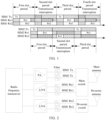
- a communication process corresponding to the virtual dual SIM dual active technology is shown in FIG. 1 (a blank area in FIG. 1 indicates that a corresponding antenna is in a working state, a shadow part indicates that a corresponding antenna is in an inactive state, and a grid area indicates that a corresponding antenna is in an occupied state).
- FIG. 1 it may be learned from FIG. 1 that, in some slot periods of the SIM1 and the SIM2, transmission is completely interrupted, and communication quality is greatly reduced.
- Embodiments of this application aim to provide a dual SIM communication method for a terminal, to resolve a problem that communication quality is reduced because transmission of each of dual SIM cards is interrupted in an even-numbered slot.
- an embodiment of this application provides a dual SIM communication method for a terminal, where dual SIM cards share a main antenna and a diversity antenna, the dual SIM cards include a first SIM card and a second SIM card, and the method includes:
- an embodiment of this application provides a dual SIM communication apparatus for a terminal, where dual SIM cards share a main antenna and a diversity antenna, the dual SIM cards include a first SIM card and a second SIM card, and the apparatus includes:
- an embodiment of this application provides a terminal.
- the terminal includes a processor, a memory, and a program or an instruction that is stored in the memory and that can be run on the processor, where when the program or the instruction is executed by the processor, the steps of the method in the first aspect are implemented.
- an embodiment of this application provides a readable storage medium.
- the readable storage medium stores a program or an instruction, and when the program or the instruction is executed by a processor, the steps of the method in the first aspect are implemented.
- an embodiment of this application provides a chip.
- the chip includes a processor and a communications interface, the communications interface is coupled to the processor, and the processor is configured to run a program or an instruction to implement the method in the first aspect.
- the second SIM card is controlled to transmit a signal by using a main antenna; for an odd-numbered downlink slot of the second SIM card, the second SIM card is controlled to receive a signal by using a diversity antenna within the entire downlink slot, and a first SIM card is controlled to transmit a signal by using the main antenna in a preceding time period within the downlink slot and to receive a signal by using the main antenna in a later time period within the downlink slot; and for an even-numbered downlink slot of the second SIM card, in a preceding time period within the downlink slot, the second SIM card is controlled to receive a signal by using the diversity antenna and the first SIM card is controlled to transmit a signal by using the main antenna, and in a later time period within the downlink slot, the first SIM
- first”, second, and the like are intended to distinguish between similar objects but do not describe a specific order or sequence. It should be understood that, data used in such a way are interchangeable in proper circumstances, so that the embodiments of this application can be implemented in an order other than the order illustrated or described herein.
- Objects classified by "first”, “second”, and the like are usually of a same type, and the number of objects is not limited. For example, there may be one or more first objects.
- "and/or" represents at least one of connected objects, and a character “/" generally represents an "or” relationship between associated objects.
- FIG. 2 shows a radio frequency circuit of a virtual dual SIM dual active technology.
- the circuit includes a power amplifier (Power Amplifier, PA), a low noise amplifier (low noise amplifier, LNA), a radio frequency transceiver, a main switch, a diversity switch, a filter, a main antenna, and a diversity antenna.
- a first SIM card and a second SIM card communicate by using different TDD frequency bands, and the frequency bands corresponding to the first SIM card and the second SIM card share one PA. Transmission by the first SIM card, main receiving by the first SIM card, transmission by the second SIM card, and main receiving by the second SIM card are switched through a single-pole main switch, and diversity receiving by the first SIM card and diversity receiving by the second SIM card are switched through a single-pole diversity switch.
- SIM1 represents the first SIM card
- SIM2 represents the second SIM card
- Tx represents transmission
- Rx represents reception
- SIM1 Tx represents main transmission by the first SIM card
- SIM2 Tx represents main transmission by the second SIM card
- SIM1 Rx1 represents main receiving by the first SIM card
- SIM2 Rx1 represents main receiving by the second SIM card
- SIM1 Rx2 represents diversity receiving by the first SIM card
- SIM2 Rx2 represents diversity receiving by the second SIM card.
- an embodiment of this application provides a dual SIM communication method for a terminal.
- the method is implemented based on the circuit shown in FIG. 2 and includes the following S3100 to S3400: S3100. Determine whether slots of dual SIM cards are aligned.
- one slot period may include an uplink slot and a downlink slot.
- An uplink slot and a downlink slot of a same SIM card do not overlap each other.
- the uplink slot or the downlink slot of the SIM card may include an idle time period, and the SIM card does not perform a transmit operation or a receive operation in the idle time period.
- the dual SIM cards mentioned in this embodiment are separately denoted as a first SIM card and a second SIM card.
- the first SIM card and the second SIM card share a main antenna and a diversity antenna.
- a start time of an uplink slot of the first SIM card is the same as a start time of an uplink slot of the second SIM card
- an end time of the uplink slot of the first SIM card is the same as an end time of the uplink slot of the second SIM card
- a start time of a downlink slot of the first SIM card is the same as a start time of a downlink slot of the second SIM card
- an end time of the downlink slot of the first SIM card is the same as an end time of the downlink slot of the second SIM card
- a standard of a SIM card is determined by a working band of the SIM card, and the standard of the SIM card specifies a communication slot of the SIM card. On this basis, it may be determined, based on a working band of the first SIM card and a working band of the second SIM card, whether the slots of the dual SIM cards are aligned.
- the first SIM card and the second SIM card are controlled to communicate in a first manner.
- the performing communication in a first manner includes steps S3200 to S3400.
- the second SIM card in the uplink slot of the second SIM card, the second SIM card always transmits a signal by using the main antenna.
- control the second SIM card For an odd-numbered downlink slot of the second SIM card, control the second SIM card to receive a signal by using the diversity antenna within the entire odd-numbered downlink slot, and control the first SIM card to transmit a signal by using the main antenna in a preceding time period within the odd-numbered downlink slot and to receive a signal by using the main antenna in a later time period within the odd-numbered downlink slot.
- the odd-numbered downlink slot of the second SIM card a signal is received by using the diversity antenna within the entire odd-numbered downlink slot of the second SIM card.
- the odd-numbered downlink slot of the second SIM card is divided into two time periods, which are specifically the preceding time period within the odd-numbered downlink slot and the later time period within the odd-numbered downlink slot.
- the first SIM card is controlled to transmit a signal by using the main antenna in the preceding time period within the odd-numbered downlink slot of the second SIM card and to receive a signal by using the main antenna in the later time period within the odd-numbered downlink slot of the second SIM card.
- the second SIM card may receive a signal within the odd-numbered downlink slot of the second SIM card. Further, the odd-numbered downlink slot of the second SIM card corresponds to a part of an even-numbered slot period of the first SIM card.
- the first SIM card may transmit a signal in the even-numbered slot period of the first SMI card, and no transmission interruption exists.
- the first SIM card may receive a signal in the even-numbered slot period of the first SIM card.
- control the second SIM card for an even-numbered downlink slot of the second SIM card, in a preceding time period within the even-numbered downlink slot, control the second SIM card to receive a signal by using the diversity antenna and control the first SIM card to transmit a signal by using the main antenna, and in a later time period within the even-numbered downlink slot, control the first SIM card to receive a signal by using the main antenna.
- the uplink slot of the second SIM card and a downlink slot of the second SIM card are alternated.
- the even-numbered downlink slot of the second SIM card is divided into two periods, which are respectively the preceding time period within the even-numbered downlink slot and the later time period within the even-numbered downlink slot.
- the second SIM card is controlled to receive a signal by using the diversity antenna. In this case, the main antenna is not occupied.
- the first SIM card is controlled to transmit a signal by using the main antenna, and in the later time period within the even-numbered downlink slot, the first SIM card is controlled to receive a signal by using the main antenna.
- the second SIM card may receive a signal within the even-numbered downlink slot of the second SIM card, Further, the even-numbered downlink slot of the second SIM card corresponds to a part of an odd-numbered slot period of the first SIM card.
- the first SIM card may transmit a signal in the odd-numbered slot period of the first SIM card, and no transmission interruption exists.
- the first SIM card may receive a signal in the odd-numbered slot period of the first SIM card.
- the first SIM card can transmit a signal and receive a signal in each slot period of the first SIM card
- the second SIM card can transmit a signal and receive a signal in each slot period of the second SIM card
- the second SIM card is controlled to transmit a signal by using a main antenna; for an odd-numbered downlink slot of the second SIM card, the second SIM card is controlled to receive a signal by using a diversity antenna within the entire downlink slot, and a first SIM card is controlled to transmit a signal by using the main antenna in a preceding time period within the downlink slot and to receive a signal by using the main antenna in a later time period within the downlink slot; and for an even-numbered downlink slot of the second SIM card, in a preceding time period within the downlink slot, the second SIM card is controlled to receive a signal by using the diversity antenna and the first SIM card is controlled to transmit a signal by using the main antenna, and in a later time period within the downlink slot, the first SIM card
- the performing communication in a first manner may further include step S3500.
- the first SIM card may receive a signal by using both the main antenna and the diversity antenna in a same time period. Based on this, a high-quality received signal can be obtained.
- the second SIM card is idle in the later time period within the even-numbered downlink slot of the second SIM card.
- the performing communication in a first manner may further include step S3600.
- control the first SIM card to receive a signal by using the diversity antenna in at least a preceding time period within the uplink slot.
- the diversity antenna is not occupied.
- the first SIM card may be controlled to receive a signal by using the diversity antenna in at least the preceding time period within the uplink slot. In this way, duration of receiving a signal by the first SIM card can be prolonged.
- the dual SIM communication method for a terminal provided in this embodiment of this application further includes the following S3 710 to S3 740: S3710. Obtain a transmit power of the terminal and a receive power of the terminal.
- the transmit power of the terminal is a transmit power of a SIM card in a transmit state in the terminal
- the receive power of the terminal is a receive power of a SIM card in a receive state in the terminal.
- the antenna isolation threshold is antenna isolation when a power of a signal transmitted by the main antenna does not greatly affect a signal received by the diversity antenna.
- a unit of the antenna isolation is dBm.
- the preset range may be set based on an experimental simulation or engineering test result.
- the second difference in a case that the second difference is within the preset range, it indicates that the transmit power and the receive power of the terminal are basically the same, that is, the terminal has a medium signal strength, and a SIM in a transmit state interferes with a SIM card in a receive state.
- at least one of reducing a modulation order of a SIM card in a receive state in the terminal and reducing a working bandwidth of a SIM card in a transmit state in the terminal is performed.
- a modulation scheme of the SIM card in a receive state may be quadrature amplitude modulation (Quadrature Amplitude Modulation, QAM), and an adjustment rule may be that a modulation order of the quadrature amplitude modulation is reduced by one level. For example, if a current modulation scheme of the SIM card in a receive state is 256 QAM, the modulation scheme is reduced to 64 QAM. If the current modulation scheme of the SIM card in a receive state is 64 QAM, the modulation scheme is reduced to 16 QAM.
- QAM Quadrature Amplitude Modulation
- the transmit power of the terminal is far less than the receive power of the terminal, that is, the terminal is in a strong signal scene, and the SIM in a transmit state does not interfere with the SIM card in a receive state.
- the foregoing S3710 is repeatedly performed.
- the performing communication in a second manner may further include the following S3810 and S3820: S38 10.
- S3810 and S3820 S38 10.
- control the first SIM card and the second SIM card to transmit signals by using the main antenna in a time division manner.
- duration corresponding to the transmit slot and the receive slot may be set based on an actual requirement.
- a dual SIM communication process of the terminal may be shown in FIG. 5 .
- the first SIM card and the second SIM card may perform sending and receiving in each slot through the foregoing S3810 and S3820. In this way, a case that transmission of the first SIM card and the second SIM card is completely interrupted in a slot is resolved. In addition, transmission and reception interference caused when the terminal transmits a signal by using a SIM card and receives a signal by using another SIM card at a same moment is avoided.
- a transmit path of the first SIM card and a transmit path of the second SIM card may share a same filter, that is, the transmit path of the first SIM card and the transmit path of the second SIM card are a same channel.
- a main switch does not need to be switched. Therefore, in the dual SIM communication method for a terminal provided in this embodiment, switching of the main switch can be further reduced, thereby greatly reducing overheads of a radio frequency circuit.
- the dual SIM communication method for a terminal provided in this embodiment of this application further includes: in a case that the slots of the dual SIM cards are aligned, performing communication in a third manner.
- the performing communication in a third manner may further include the following S3910 and S3920: S3910.
- S3910 and S3920 S3910.
- control the first SIM card and the second SIM card to transmit signals by using the main antenna in a frequency division manner.
- the entire slot is divided into two parts: a receive slot and a transmit slot, and the transmit slot is before the receive slot.
- duration corresponding to the transmit slot and the receive slot may be set based on an actual requirement.
- a dual SIM communication process of the terminal may be shown in FIG. 6 .
- the first SIM card and the second SIM card may perform sending and receiving in each slot through the foregoing S3910 and S3920. In this way, a case that transmission of the first SIM card and the second SIM card is completely interrupted in a slot is resolved.
- a transmit path of the first SIM card and a transmit path of the second SIM card may share a same filter, that is, the transmit path of the first SIM card and the transmit path of the second SIM card are a same channel.
- a main switch does not need to be switched. Therefore, in the dual SIM communication method for a terminal provided in this embodiment, switching of the main switch can be further reduced, thereby greatly reducing overheads of a radio frequency circuit.
- the dual SIM communication method for a terminal provided in the embodiments of this application may be performed by a dual SIM communication apparatus for a terminal, or a control module that is in the dual SIM communication apparatus for a terminal and that is configured to perform and load the foregoing dual SIM communication method.
- a dual SIM communication apparatus for a terminal performs and loads the dual SIM communication method for a terminal is used to describe the dual SIM communication method for a terminal provided in the embodiments of this application.
- an embodiment of this application provides a dual SIM communication apparatus 700 for a terminal, where dual SIM cards share a main antenna and a diversity antenna, the dual SIM cards include a first SIM card and a second SIM card, and the apparatus 700 includes a determining module 701 and a first control module 702.
- the determining module 701 is configured to determine whether current slots of the dual SIM cards of the terminal are aligned.
- the first control module 702 is configured to: in a case that the slots of the dual SIM cards are not aligned, control the first SIM card and the second SIM card to communicate in a first manner.
- That the first control module 702 controls the first SIM card and the second SIM card to communicate in a first manner includes:
- that the first control module 702 controls the first SIM card and the second SIM card to communicate in a first manner further includes: for the even-numbered downlink slot of the second SIM card, when the first SIM card receives a signal by using the main antenna, controlling the first SIM card to simultaneously receive a signal by using the diversity antenna.
- that the first control module 702 controls the first SIM card and the second SIM card to communicate in a first manner further includes: within the uplink slot of the second SIM card, controlling the first SIM card to receive a signal by using the diversity antenna within at least a preceding time period within the uplink slot.
- the apparatus 700 further includes an obtaining module, a calculation module, and an adjustment module.
- the obtaining module is configured to obtain a transmit power of the terminal and a receive power of the terminal.
- the calculation module is configured to: calculate a first difference between the transmit power and an antenna isolation threshold, and calculate a second difference between the first difference and the receive power.
- the adjustment module is configured to adjust a communication state of the terminal based on the second difference.
- the adjustment module includes a first adjustment submodule and/or a second adjustment submodule.
- the first adjustment submodule is configured to: in a case that the second difference is greater than an upper limit of a preset range, adjust the terminal to enter a dual SIM dual standby mode.
- the second adjustment submodule is configured to: in a case that the second difference is within the preset range, perform at least one of reducing a modulation order of a SIM card in a receive state in the terminal and reducing a working bandwidth of a SIM card in a transmit state in the terminal.
- the apparatus 700 further includes a second control module.
- the second control module is configured to: in a case that the slots of the dual SIM cards are aligned, control the first SIM card and the second SIM card to communicate in a second manner.
- That the second control module controls the first SIM card and the second SIM card to communicate in a second manner includes:
- the apparatus 700 further includes a third control module.
- the third control module is configured to: in a case that the slots of the dual SIM cards are aligned, control the first SIM card and the second SIM card to communicate in a third manner.
- That the third control module controls the first SIM card and the second SIM card to communicate in a third manner includes:
- the dual SIM communication apparatus for a terminal in this embodiment of this application may be an apparatus, or may be a component, an integrated circuit, or a chip in a terminal.
- the apparatus may be a mobile electronic device, or may be a non-mobile electronic device.
- the mobile electronic device may be a mobile phone, a tablet computer, an ultra-mobile personal computer (ultra-mobile personal computer, UMPC), a netbook, or a personal digital assistant (personal digital assistant, PDA), and the non-mobile electronic device may be a server. This is not specifically limited in this embodiment of this application.
- the dual SIM communication apparatus for a terminal in this embodiment of this application may be an apparatus with an operating system.
- the operating system may be an Android (Android) operating system, an iOS operating system, or another possible operating system. This is not specifically limited in the embodiments of this application.
- the dual SIM communication apparatus for a terminal provided in this embodiment of this application can implement the processes implemented in the dual SIM communication apparatus for a terminal in the method embodiment in FIG. 3 . To avoid repetition, details are not described herein again.
- an embodiment of this application further provides a terminal 800.
- the terminal 800 includes dual SIM cards, where the dual SIM cards share a main antenna and a diversity antenna, and the dual SIM cards include a first SIM card and a second SIM card.
- the terminal 800 further includes a processor 810, a memory 809, and a program or an instruction that is stored in the memory 809 and executable on the processor 810, where when the program or the instruction is executed by the processor 810, the processes of the foregoing dual SIM communication method for a terminal are implemented and a same technical effect can be achieved. To avoid repetition, details are not described herein again.
- the electronic device in this embodiment of this application may be a mobile electronic device or a non-mobile electronic device.
- FIG. 9 is a schematic diagram of a hardware structure of a terminal according to an embodiment of this application.
- a terminal 800 includes but is not limited to components such as a radio frequency unit 801, a network module 802, an audio output unit 803, an input unit 804, a sensor 805, a display unit 806, a user input unit 807, an interface unit 808, a memory 809, and a processor 810.
- the processor 810 is configured to determine whether current slots of the dual SIM cards of the terminal are aligned; and in a case that the slots of the dual SIM cards are not aligned, control the first SIM card and the second SIM card to communicate in a first manner, where the controlling the first SIM card and the second SIM card to communicate in a first manner includes: within an uplink slot of the second SIM card, controlling the second SIM card to transmit a signal by using the main antenna; for an odd-numbered downlink slot of the second SIM card, controlling the second SIM card to receive a signal by using the diversity antenna within the entire odd-numbered downlink slot, and controlling the first SIM card to transmit a signal by using the main antenna in a preceding time period within the odd-numbered downlink slot and to receive a signal by using the main antenna in a later time period within the odd-numbered downlink slot; and for an even-numbered downlink slot of the second SIM card, in a preceding time period within the even-numbered downlink slot, controlling the second SIM card to receive a signal by using the diversity antenna and controlling the
- a processor determines whether current slots of dual SIM cards of a terminal are aligned; and in a case that the slots of the dual SIM cards are not aligned, within an uplink slot of a second SIM card, controls the second SIM card to transmit a signal by using a main antenna; for an odd-numbered downlink slot of the second SIM card, controls the second SIM card to receive a signal by using a diversity antenna within the entire odd-numbered downlink slot, and controls a first SIM card to transmit a signal by using the main antenna in a preceding time period within the downlink slot and to receive a signal by using the main antenna in a later time period within the odd-numbered downlink slot; and for an even-numbered downlink slot of the second SIM card, in a preceding time period within the even-numbered downlink slot, controls the second SIM card to receive a signal by using the diversity antenna and controls the first SIM card to transmit a signal by using the main antenna, and in a later time period within the even-numbered downlink slot, controls the first SIM card
- An embodiment of this application further provides a readable storage medium.
- the readable storage medium stores a program or an instruction, and when the program or the instruction is executed by a processor, the processes of the foregoing embodiment of the dual SIM communication method for a terminal are implemented and a same technical effect can be achieved. To avoid repetition, details are not described herein again.
- An embodiment of this application further provides a chip.
- the chip includes a processor and a communications interface, the communications interface is coupled to the processor, and the processor is configured to run a program or an instruction to implement the processes of the foregoing embodiment of the dual SIM communication method for a terminal and a same technical effect can be achieved. To avoid repetition, details are not described herein again.
- the chip mentioned in this embodiment of this application may also be referred to as a system-level chip, a system chip, a chip system, or an on-chip system chip.
- the terms "include”, “comprise”, or their any other variant is intended to cover a non-exclusive inclusion, so that a process, a method, an article, or an apparatus that includes a list of elements not only includes those elements but also includes other elements which are not expressly listed, or further includes elements inherent to such process, method, article, or apparatus.
- An element limited by “including a " does not, without more constraints, preclude the presence of additional identical elements in the process, method, article, or apparatus that includes the element.
- the scope of the method and the apparatus in the embodiments of this application is not limited to performing functions in an illustrated or discussed sequence, and may further include performing functions in a basically simultaneous manner or in a reverse sequence according to the functions concerned.
- the described method may be performed in an order different from that described, and the steps may be added, omitted, or combined.
- features described with reference to some examples may be combined in other examples.
- the method in the foregoing embodiment may be implemented by software in addition to a necessary universal hardware platform or by hardware only. In most circumstances, the former is a preferred implementation. Based on such an understanding, the technical solutions of this application essentially or the part contributing to the prior art may be implemented in a form of a software product.
- the computer software product is stored in a storage medium (such as a ROM/RAM, a hard disk, or an optical disc), and includes several instructions for instructing a terminal (which may be mobile phone, a computer, or a server) to perform the methods described in the embodiments of this application.
Landscapes
- Engineering & Computer Science (AREA)
- Computer Networks & Wireless Communication (AREA)
- Signal Processing (AREA)
- Databases & Information Systems (AREA)
- Mobile Radio Communication Systems (AREA)
- Radio Transmission System (AREA)
Abstract
Description
- The present invention claims priority to
Chinese Patent Application No. 202110123420.9, filed with the China National Intellectual Property Administration on January 28, 2021 - This application pertains to the field of communication technologies, and in particular, to a dual SIM communication method for a terminal, a dual SIM communication apparatus for a terminal, an electronic device, and a readable storage medium.
- At present, a dual SIM design has become a routine setting for mobile phones. Existing dual SIM designs are classified into two types: dual SIM dual standby and dual SIM dual active. Dual SIM dual active means that two subscriber identity module (Subscriber Identity Module, SIM) cards are not only standby at the same time, but also can perform service transmission at the same time. For example, a user may watch an online video by using SIM2 while making a call through SIM1 by using a dual SIM dual active function. To implement dual SIM dual active, strictly speaking, two hardware radio frequency circuits are required. The SIM1 and the SIM2 implement simultaneous paging and service transmission through different hardware radio frequency circuits.
- To simplify a hardware architecture of dual SIM dual active, a virtual dual SIM dual active technology is proposed, that is, partial access of the SIM1 and the SIM2 is performed in a time division manner. For example, both the SIM1 and the SIM2 communicate in a time division duplexing (Time Division Duplexing, TDD) manner. A communication process corresponding to the virtual dual SIM dual active technology is shown in
FIG. 1 (a blank area inFIG. 1 indicates that a corresponding antenna is in a working state, a shadow part indicates that a corresponding antenna is in an inactive state, and a grid area indicates that a corresponding antenna is in an occupied state). However, it may be learned fromFIG. 1 that, in some slot periods of the SIM1 and the SIM2, transmission is completely interrupted, and communication quality is greatly reduced. - Embodiments of this application aim to provide a dual SIM communication method for a terminal, to resolve a problem that communication quality is reduced because transmission of each of dual SIM cards is interrupted in an even-numbered slot.
- To resolve the foregoing technical problem, this application is implemented as follows:
- According to a first aspect, an embodiment of this application provides a dual SIM communication method for a terminal, where dual SIM cards share a main antenna and a diversity antenna, the dual SIM cards include a first SIM card and a second SIM card, and the method includes:
- determining whether slots of the dual SIM cards are aligned; and
- in a case that the slots of the dual SIM cards are not aligned, controlling the first SIM card and the second SIM card to communicate in a first manner, where
- the controlling the first SIM card and the second SIM card to communicate in a first manner includes:
- within an uplink slot of the second SIM card, controlling the second SIM card to transmit a signal by using the main antenna;
- for an odd-numbered downlink slot of the second SIM card, controlling the second SIM card to receive a signal by using the diversity antenna within the entire odd-numbered downlink slot, and controlling the first SIM card to transmit a signal by using the main antenna in a preceding time period within the odd-numbered downlink slot and to receive a signal by using the main antenna in a later time period within the odd-numbered downlink slot; and
- for an even-numbered downlink slot of the second SIM card, in a preceding time period within the even-numbered downlink slot, controlling the second SIM card to receive a signal by using the diversity antenna and controlling the first SIM card to transmit a signal by using the main antenna, and in a later time period within the even-numbered downlink slot, controlling the first SIM card to receive a signal by using the main antenna, where
- the uplink slot of the second SIM card and a downlink slot of the second SIM card are alternated.
- According to a second aspect, an embodiment of this application provides a dual SIM communication apparatus for a terminal, where dual SIM cards share a main antenna and a diversity antenna, the dual SIM cards include a first SIM card and a second SIM card, and the apparatus includes:
- a determining module, configured to determine whether current slots of the dual SIM cards of the terminal are aligned; and
- a first control module, configured to: in a case that the slots of the dual SIM cards are not aligned, control the first SIM card and the second SIM card to communicate in a first manner, where
- the controlling the first SIM card and the second SIM card to communicate in a first manner includes: within an uplink slot of the second SIM card, controlling the second SIM card to transmit a signal by using the main antenna;
- for an odd-numbered downlink slot of the second SIM card, controlling the second SIM card to receive a signal by using the diversity antenna within the entire odd-numbered downlink slot, and controlling the first SIM card to transmit a signal by using the main antenna in a preceding time period within the odd-numbered downlink slot and to receive a signal by using the main antenna in a later time period within the odd-numbered downlink slot; and
- for an even-numbered downlink slot of the second SIM card, in a preceding time period within the even-numbered downlink slot, controlling the second SIM card to receive a signal by using the diversity antenna and controlling the first SIM card to transmit a signal by using the main antenna, and in a later time period within the even-numbered downlink slot, controlling the first SIM card to receive a signal by using the main antenna, where the uplink slot of the second SIM card and a downlink slot of the second SIM card are alternated.
- According to a third aspect, an embodiment of this application provides a terminal. The terminal includes a processor, a memory, and a program or an instruction that is stored in the memory and that can be run on the processor, where when the program or the instruction is executed by the processor, the steps of the method in the first aspect are implemented.
- According to a fourth aspect, an embodiment of this application provides a readable storage medium. The readable storage medium stores a program or an instruction, and when the program or the instruction is executed by a processor, the steps of the method in the first aspect are implemented.
- According to a fifth aspect, an embodiment of this application provides a chip. The chip includes a processor and a communications interface, the communications interface is coupled to the processor, and the processor is configured to run a program or an instruction to implement the method in the first aspect.
- In the embodiments of this application, it is determined whether current slots of dual SIM cards of a terminal are aligned; and in a case that the slots of the dual SIM cards are not aligned, communication is performed in a first manner, where within an uplink slot of a second SIM card, the second SIM card is controlled to transmit a signal by using a main antenna; for an odd-numbered downlink slot of the second SIM card, the second SIM card is controlled to receive a signal by using a diversity antenna within the entire downlink slot, and a first SIM card is controlled to transmit a signal by using the main antenna in a preceding time period within the downlink slot and to receive a signal by using the main antenna in a later time period within the downlink slot; and for an even-numbered downlink slot of the second SIM card, in a preceding time period within the downlink slot, the second SIM card is controlled to receive a signal by using the diversity antenna and the first SIM card is controlled to transmit a signal by using the main antenna, and in a later time period within the downlink slot, the first SIM card is controlled to receive a signal by using the main antenna, where the uplink slot of the second SIM card and a downlink slot of the second SIM card are alternated. In this way, for either the first SIM card or the second SIM card, a signal may be transmitted in each slot period. This avoids transmission interruption between the first SIM card and the second SIM card, thereby greatly improving communication quality.
-
-
FIG. 1 is a schematic diagram of a communication process corresponding to an existing virtual dual SIM dual active technology; -
FIG. 2 is a schematic structural diagram of a radio frequency circuit corresponding to an existing virtual dual SIM dual active technology; -
FIG. 3 is a schematic flowchart of a dual SIM communication method for a terminal according to an embodiment of this application; -
FIG. 4 is a first schematic diagram of a communication process of a dual SIM dual active technology according to an embodiment of this application; -
FIG. 5 is a second schematic diagram of a communication process of a dual SIM dual active technology according to an embodiment of this application; -
FIG. 6 is a third schematic diagram of a communication process of a dual SIM dual active technology according to an embodiment of this application; -
FIG. 7 shows a dual SIM communication apparatus for a terminal according to an embodiment of this application; -
FIG. 8 is a schematic structural diagram of a terminal according to an embodiment of this application; and -
FIG. 9 is a schematic diagram of a hardware structure of a terminal according to an embodiment of this application. - The following clearly and completely describes the technical solutions in the embodiments of this application with reference to the accompanying drawings in the embodiments of this application. Apparently, the described embodiments are some but not all of the embodiments of this application. All other embodiments obtained by a person of ordinary skill in the art based on the embodiments of this application without creative efforts shall fall within the protection scope of this application.
- In the specification and claims of this application, the terms "first", "second", and the like are intended to distinguish between similar objects but do not describe a specific order or sequence. It should be understood that, data used in such a way are interchangeable in proper circumstances, so that the embodiments of this application can be implemented in an order other than the order illustrated or described herein. Objects classified by "first", "second", and the like are usually of a same type, and the number of objects is not limited. For example, there may be one or more first objects. In addition, in the specification and the claims, "and/or" represents at least one of connected objects, and a character "/" generally represents an "or" relationship between associated objects.
- With reference to the accompanying drawings, a dual SIM communication method and apparatus for a terminal, a device, and a storage medium provided in the embodiments of this application are described in detail by using specific embodiments and application scenes.
-
FIG. 2 shows a radio frequency circuit of a virtual dual SIM dual active technology. The circuit includes a power amplifier (Power Amplifier, PA), a low noise amplifier (low noise amplifier, LNA), a radio frequency transceiver, a main switch, a diversity switch, a filter, a main antenna, and a diversity antenna. A first SIM card and a second SIM card communicate by using different TDD frequency bands, and the frequency bands corresponding to the first SIM card and the second SIM card share one PA. Transmission by the first SIM card, main receiving by the first SIM card, transmission by the second SIM card, and main receiving by the second SIM card are switched through a single-pole main switch, and diversity receiving by the first SIM card and diversity receiving by the second SIM card are switched through a single-pole diversity switch. On this basis, it may be learned that, at a same moment, only one of transmission by the first SIM card, main receiving by the first SIM card, transmission by the second SIM card, and main receiving by the second SIM card may occur. In addition, at a same moment, only either diversity receiving by the first SIM card or diversity receiving by the second SIM card may occur. - In the embodiments of this application, in the accompanying drawings, SIM1 represents the first SIM card, SIM2 represents the second SIM card, Tx represents transmission, and Rx represents reception. In the accompanying drawings, SIM1 Tx represents main transmission by the first SIM card, SIM2 Tx represents main transmission by the second SIM card, SIM1 Rx1represents main receiving by the first SIM card, SIM2 Rx1 represents main receiving by the second SIM card, SIM1 Rx2 represents diversity receiving by the first SIM card, and SIM2 Rx2 represents diversity receiving by the second SIM card.
- As shown in
FIG. 3 , an embodiment of this application provides a dual SIM communication method for a terminal. The method is implemented based on the circuit shown inFIG. 2 and includes the following S3100 to S3400:
S3100. Determine whether slots of dual SIM cards are aligned. - In this embodiment of this application, one slot period may include an uplink slot and a downlink slot. An uplink slot and a downlink slot of a same SIM card do not overlap each other. The uplink slot or the downlink slot of the SIM card may include an idle time period, and the SIM card does not perform a transmit operation or a receive operation in the idle time period.
- In this embodiment of this application, the dual SIM cards mentioned in this embodiment are separately denoted as a first SIM card and a second SIM card. The first SIM card and the second SIM card share a main antenna and a diversity antenna.
- In an example, in a case that a start time of an uplink slot of the first SIM card is the same as a start time of an uplink slot of the second SIM card, an end time of the uplink slot of the first SIM card is the same as an end time of the uplink slot of the second SIM card, a start time of a downlink slot of the first SIM card is the same as a start time of a downlink slot of the second SIM card, and an end time of the downlink slot of the first SIM card is the same as an end time of the downlink slot of the second SIM card, it is determined that the slots of the dual SIM cards of the terminal are aligned; otherwise, it is determined that the slots of the dual SIM cards of the terminal are not aligned.
- In this embodiment of this application, a standard of a SIM card is determined by a working band of the SIM card, and the standard of the SIM card specifies a communication slot of the SIM card. On this basis, it may be determined, based on a working band of the first SIM card and a working band of the second SIM card, whether the slots of the dual SIM cards are aligned.
- In a case that the slots of the dual SIM cards are not aligned, the first SIM card and the second SIM card are controlled to communicate in a first manner. The performing communication in a first manner includes steps S3200 to S3400.
- S3200. Within an uplink slot of the second SIM card, control the second SIM card to transmit a signal by using the main antenna.
- In this embodiment, in the uplink slot of the second SIM card, the second SIM card always transmits a signal by using the main antenna.
- Based on the foregoing S3200, it may be learned that a signal may be transmitted in each slot period of the second SIM card, and no transmission interruption exists.
- S3300. For an odd-numbered downlink slot of the second SIM card, control the second SIM card to receive a signal by using the diversity antenna within the entire odd-numbered downlink slot, and control the first SIM card to transmit a signal by using the main antenna in a preceding time period within the odd-numbered downlink slot and to receive a signal by using the main antenna in a later time period within the odd-numbered downlink slot.
- In this embodiment, for the odd-numbered downlink slot of the second SIM card, a signal is received by using the diversity antenna within the entire odd-numbered downlink slot of the second SIM card. On this basis, the odd-numbered downlink slot of the second SIM card is divided into two time periods, which are specifically the preceding time period within the odd-numbered downlink slot and the later time period within the odd-numbered downlink slot. The first SIM card is controlled to transmit a signal by using the main antenna in the preceding time period within the odd-numbered downlink slot of the second SIM card and to receive a signal by using the main antenna in the later time period within the odd-numbered downlink slot of the second SIM card.
- It may be learned from the foregoing content that, the second SIM card may receive a signal within the odd-numbered downlink slot of the second SIM card. Further, the odd-numbered downlink slot of the second SIM card corresponds to a part of an even-numbered slot period of the first SIM card. On this basis, with reference to the foregoing S3300, it may be learned that the first SIM card may transmit a signal in the even-numbered slot period of the first SMI card, and no transmission interruption exists. In addition, the first SIM card may receive a signal in the even-numbered slot period of the first SIM card.
- S3400. For an even-numbered downlink slot of the second SIM card, in a preceding time period within the even-numbered downlink slot, control the second SIM card to receive a signal by using the diversity antenna and control the first SIM card to transmit a signal by using the main antenna, and in a later time period within the even-numbered downlink slot, control the first SIM card to receive a signal by using the main antenna.
- In this embodiment, the uplink slot of the second SIM card and a downlink slot of the second SIM card are alternated.
- In this embodiment, the even-numbered downlink slot of the second SIM card is divided into two periods, which are respectively the preceding time period within the even-numbered downlink slot and the later time period within the even-numbered downlink slot. In the preceding time period within the even-numbered downlink slot, the second SIM card is controlled to receive a signal by using the diversity antenna. In this case, the main antenna is not occupied. On this basis, in the preceding time period within the even-numbered downlink slot, the first SIM card is controlled to transmit a signal by using the main antenna, and in the later time period within the even-numbered downlink slot, the first SIM card is controlled to receive a signal by using the main antenna.
- It may be learned from the foregoing content that, the second SIM card may receive a signal within the even-numbered downlink slot of the second SIM card, Further, the even-numbered downlink slot of the second SIM card corresponds to a part of an odd-numbered slot period of the first SIM card. On this basis, with reference to the foregoing S3400, it may be learned that the first SIM card may transmit a signal in the odd-numbered slot period of the first SIM card, and no transmission interruption exists. In addition, the first SIM card may receive a signal in the odd-numbered slot period of the first SIM card.
- That is, the first SIM card can transmit a signal and receive a signal in each slot period of the first SIM card, and the second SIM card can transmit a signal and receive a signal in each slot period of the second SIM card.
- In this embodiment of this application, it is determined whether current slots of dual SIM cards of a terminal are aligned; and in a case that the slots of the dual SIM cards are not aligned, communication is performed in a first manner, where within an uplink slot of a second SIM card, the second SIM card is controlled to transmit a signal by using a main antenna; for an odd-numbered downlink slot of the second SIM card, the second SIM card is controlled to receive a signal by using a diversity antenna within the entire downlink slot, and a first SIM card is controlled to transmit a signal by using the main antenna in a preceding time period within the downlink slot and to receive a signal by using the main antenna in a later time period within the downlink slot; and for an even-numbered downlink slot of the second SIM card, in a preceding time period within the downlink slot, the second SIM card is controlled to receive a signal by using the diversity antenna and the first SIM card is controlled to transmit a signal by using the main antenna, and in a later time period within the downlink slot, the first SIM card is controlled to receive a signal by using the main antenna, where the uplink slot of the second SIM card and a downlink slot of the second SIM card are alternated. In this way, for either the first SIM card or the second SIM card, a signal may be transmitted in each slot period. This avoids transmission interruption between the first SIM card and the second SIM card, thereby greatly improving communication quality.
- Based on any one of the foregoing embodiments, the performing communication in a first manner may further include step S3500.
- S3500. For the even-numbered downlink slot of the second SIM card, when the first SIM card receives a signal by using the main antenna, control the first SIM card to simultaneously receive a signal by using the diversity antenna.
- In this embodiment, the first SIM card may receive a signal by using both the main antenna and the diversity antenna in a same time period. Based on this, a high-quality received signal can be obtained.
- Correspondingly, the second SIM card is idle in the later time period within the even-numbered downlink slot of the second SIM card.
- Based on any one of the foregoing embodiments, the performing communication in a first manner may further include step S3600.
- S3600. Within the uplink slot of the second SIM card, control the first SIM card to receive a signal by using the diversity antenna in at least a preceding time period within the uplink slot.
- In this embodiment, in the uplink slot of the second SIM card, the diversity antenna is not occupied. In this case, the first SIM card may be controlled to receive a signal by using the diversity antenna in at least the preceding time period within the uplink slot. In this way, duration of receiving a signal by the first SIM card can be prolonged.
- Based on the foregoing embodiment shown in S3600, a dual SIM communication process may be shown in
FIG. 4 . - On the basis of any one of the foregoing embodiments, with reference to the communication process shown in
FIG. 4 , one of the first SIM card and the second SIM card of the terminal is in a signal receiving state, and the other of the first SIM card and the second SIM card is in a signal sending state, which may lead to a problem of transmission and reception interference. Especially, when the first SIM card and the second SIM card are in a same frequency, more serious transmission and reception interference may occur. In the case of serious transmission and reception interference, there is a risk of component damage in a radio frequency circuit. To resolve the problem of transmission and reception interference, the dual SIM communication method for a terminal provided in this embodiment of this application further includes the following S3 710 to S3 740:
S3710. Obtain a transmit power of the terminal and a receive power of the terminal. - In this embodiment of this application, the transmit power of the terminal is a transmit power of a SIM card in a transmit state in the terminal, and the receive power of the terminal is a receive power of a SIM card in a receive state in the terminal.
- It should be noted that specific implementation of the foregoing S3710 is: obtaining the transmit power of the terminal and the receive power of the terminal at a same moment.
- S3720. Calculate a first difference between the transmit power and an antenna isolation threshold.
- In this embodiment, the antenna isolation threshold is antenna isolation when a power of a signal transmitted by the main antenna does not greatly affect a signal received by the diversity antenna. A unit of the antenna isolation is dBm.
- S3730. Calculate a second difference between the first difference and the receive power.
- S3740. Adjust a communication state of the terminal based on the second difference.
- In this embodiment of this application, steps S3710 to S3740 may be performed in a case that the slots of the dual SIM cards are not aligned.
- In this embodiment of this application, the foregoing S3740 may be implemented by the following S3741 and S3742:
S3741. In a case that the second difference is greater than an upper limit of a preset range, adjust the terminal to enter a dual SIM dual standby mode. - In this embodiment, in a case that the second difference is greater than the upper limit of the preset range, it indicates that the transmit power of the terminal is far greater than the receive power of the terminal, that is, the terminal has a weak signal, and a SIM card in a transmit state strongly interferes with a SIM card in a receive state. In this case, the terminal is adjusted to be switched to the dual SIM dual standby mode. In this way, a case that one SIM card is in a receive state and the other SIM card is in a transmit state at a same moment is avoided, thereby avoiding transmission and reception interference.
- It should be noted that in this embodiment, the preset range may be set based on an experimental simulation or engineering test result.
- S3742. In a case that the second difference is within the preset range, perform at least one of reducing a modulation order of a SIM card in a receive state in the terminal and reducing a working bandwidth of a SIM card in a transmit state in the terminal.
- In this embodiment, in a case that the second difference is within the preset range, it indicates that the transmit power and the receive power of the terminal are basically the same, that is, the terminal has a medium signal strength, and a SIM in a transmit state interferes with a SIM card in a receive state. In this case, at least one of reducing a modulation order of a SIM card in a receive state in the terminal and reducing a working bandwidth of a SIM card in a transmit state in the terminal is performed.
- In this embodiment, under a same signal noise ratio (SIGNAL NOISE RATIO, SNR) requirement, if total noise of a narrower working bandwidth is lower, a power of a wanted signal is also lower. Therefore, when the SIM card in a transmit state interferes with the SIM card in a receive state, the working bandwidth of the SIM card in a transmit state may be reduced, to reduce the transmit power, thereby reducing interference to the SIM card in a receive state.
- In this embodiment, a larger SNR is required for a higher order modulation scheme to meet a demodulation requirement. Therefore, when the SIM card in a transmit state interferes with the SIM card in a receive state, the modulation order of the SIM card in a receive state in the terminal may be reduced, to meet a receive SNR requirement. In this embodiment of this application, a modulation scheme of the SIM card in a receive state may be quadrature amplitude modulation (Quadrature Amplitude Modulation, QAM), and an adjustment rule may be that a modulation order of the quadrature amplitude modulation is reduced by one level. For example, if a current modulation scheme of the SIM card in a receive state is 256 QAM, the modulation scheme is reduced to 64 QAM. If the current modulation scheme of the SIM card in a receive state is 64 QAM, the modulation scheme is reduced to 16 QAM.
- Corresponding to the foregoing S3741 and S3742, in a case that the second difference is less than the upper limit of the preset range, it indicates that the transmit power of the terminal is far less than the receive power of the terminal, that is, the terminal is in a strong signal scene, and the SIM in a transmit state does not interfere with the SIM card in a receive state. In this case, the foregoing S3710 is repeatedly performed.
- On the basis of any one of the foregoing embodiments, the dual SIM communication method for a terminal provided in this embodiment of this application further includes: in a case that the slots of the dual SIM cards are aligned, performing communication in a second manner.
- The performing communication in a second manner may further include the following S3810 and S3820:
S38 10. Within a transmit slot, control the first SIM card and the second SIM card to transmit signals by using the main antenna in a time division manner. - S3820. Within a receive slot, control the first SIM card and the second SIM card to receive signals by using the main antenna in the time division manner and control the first SIM card and the second SIM card to receive signals by using the diversity antenna in the time division manner.
- In this embodiment of this application, corresponding to the foregoing S3200, in a case that a slot of the first SIM card and a slot of the second SIM card are aligned, the entire slot is divided into two parts: a receive slot and a transmit slot, and the transmit slot is before the receive slot.
- It should be noted that, in this embodiment, duration corresponding to the transmit slot and the receive slot may be set based on an actual requirement.
- In this embodiment, based on the foregoing S3810 and S3820, a dual SIM communication process of the terminal may be shown in
FIG. 5 . - It may be learned from the foregoing content that, in the dual SIM communication method for a terminal provided in this embodiment of this application, in a case that the slots are aligned, the first SIM card and the second SIM card may perform sending and receiving in each slot through the foregoing S3810 and S3820. In this way, a case that transmission of the first SIM card and the second SIM card is completely interrupted in a slot is resolved. In addition, transmission and reception interference caused when the terminal transmits a signal by using a SIM card and receives a signal by using another SIM card at a same moment is avoided.
- In addition, in this embodiment, in a case that the first SIM card and the second SIM card are in a same communication frequency band, a transmit path of the first SIM card and a transmit path of the second SIM card may share a same filter, that is, the transmit path of the first SIM card and the transmit path of the second SIM card are a same channel. On this basis, a main switch does not need to be switched. Therefore, in the dual SIM communication method for a terminal provided in this embodiment, switching of the main switch can be further reduced, thereby greatly reducing overheads of a radio frequency circuit.
- On the basis of any one of the foregoing embodiments, the dual SIM communication method for a terminal provided in this embodiment of this application further includes: in a case that the slots of the dual SIM cards are aligned, performing communication in a third manner.
- The performing communication in a third manner may further include the following S3910 and S3920:
S3910. Within a transmit slot, control the first SIM card and the second SIM card to transmit signals by using the main antenna in a frequency division manner. - S3920. Within a receive slot, control the first SIM card and the second SIM card to receive signals by using the main antenna in the frequency division manner and control the first SIM card and the second SIM card to receive signals by using the diversity antenna in the frequency division manner.
- In this embodiment of this application, corresponding to the foregoing S3200, in a case that a slot of the first SIM card and a slot of the second SIM card are aligned, the entire slot is divided into two parts: a receive slot and a transmit slot, and the transmit slot is before the receive slot.
- It should be noted that, in this embodiment, duration corresponding to the transmit slot and the receive slot may be set based on an actual requirement.
- In this embodiment, based on the foregoing S3910 and S3920, a dual SIM communication process of the terminal may be shown in
FIG. 6 . - It may be learned from the foregoing content that, in the dual SIM communication method for a terminal provided in this embodiment of this application, in a case that the slots are aligned, the first SIM card and the second SIM card may perform sending and receiving in each slot through the foregoing S3910 and S3920. In this way, a case that transmission of the first SIM card and the second SIM card is completely interrupted in a slot is resolved.
- In addition, in this embodiment, in a case that the first SIM card and the second SIM card are in different subbands in a same communication frequency band, for example, the first SIM card is in a Long Term Evolution (Long Term Evolution, LTE) B41 of 2560 MHz to 2580 MHz, and the second SIM card is in an LTE B41 of 2600 MHz to 2620 MHz, a transmit path of the first SIM card and a transmit path of the second SIM card may share a same filter, that is, the transmit path of the first SIM card and the transmit path of the second SIM card are a same channel. On this basis, a main switch does not need to be switched. Therefore, in the dual SIM communication method for a terminal provided in this embodiment, switching of the main switch can be further reduced, thereby greatly reducing overheads of a radio frequency circuit.
- The dual SIM communication method for a terminal provided in the embodiments of this application may be performed by a dual SIM communication apparatus for a terminal, or a control module that is in the dual SIM communication apparatus for a terminal and that is configured to perform and load the foregoing dual SIM communication method. In the embodiments of this application, an example in which the dual SIM communication apparatus for a terminal performs and loads the dual SIM communication method for a terminal is used to describe the dual SIM communication method for a terminal provided in the embodiments of this application.
- As shown in
FIG. 7 , an embodiment of this application provides a dual SIM communication apparatus 700 for a terminal, where dual SIM cards share a main antenna and a diversity antenna, the dual SIM cards include a first SIM card and a second SIM card, and the apparatus 700 includes a determiningmodule 701 and afirst control module 702. - The determining
module 701 is configured to determine whether current slots of the dual SIM cards of the terminal are aligned. - The
first control module 702 is configured to: in a case that the slots of the dual SIM cards are not aligned, control the first SIM card and the second SIM card to communicate in a first manner. - That the
first control module 702 controls the first SIM card and the second SIM card to communicate in a first manner includes: - within an uplink slot of the second SIM card, controlling the second SIM card to transmit a signal by using the main antenna;
- for an odd-numbered downlink slot of the second SIM card, controlling the second SIM card to receive a signal by using the diversity antenna within the entire odd-numbered downlink slot, and controlling the first SIM card to transmit a signal by using the main antenna in a preceding time period within the odd-numbered downlink slot and to receive a signal by using the main antenna in a later time period within the odd-numbered downlink slot; and
- for an even-numbered downlink slot of the second SIM card, in a preceding time period within the even-numbered downlink slot, controlling the second SIM card to receive a signal by using the diversity antenna and controlling the first SIM card to transmit a signal by using the main antenna, and in a later time period within the even-numbered downlink slot, controlling the first SIM card to receive a signal by using the main antenna, where the uplink slot of the second SIM card and a downlink slot of the second SIM card are alternated.
- In an embodiment, that the
first control module 702 controls the first SIM card and the second SIM card to communicate in a first manner further includes: for the even-numbered downlink slot of the second SIM card, when the first SIM card receives a signal by using the main antenna, controlling the first SIM card to simultaneously receive a signal by using the diversity antenna. - In an embodiment, that the
first control module 702 controls the first SIM card and the second SIM card to communicate in a first manner further includes: within the uplink slot of the second SIM card, controlling the first SIM card to receive a signal by using the diversity antenna within at least a preceding time period within the uplink slot. - In an embodiment, the apparatus 700 further includes an obtaining module, a calculation module, and an adjustment module.
- The obtaining module is configured to obtain a transmit power of the terminal and a receive power of the terminal.
- The calculation module is configured to: calculate a first difference between the transmit power and an antenna isolation threshold, and calculate a second difference between the first difference and the receive power.
- The adjustment module is configured to adjust a communication state of the terminal based on the second difference.
- In an embodiment, the adjustment module includes a first adjustment submodule and/or a second adjustment submodule.
- The first adjustment submodule is configured to: in a case that the second difference is greater than an upper limit of a preset range, adjust the terminal to enter a dual SIM dual standby mode.
- The second adjustment submodule is configured to: in a case that the second difference is within the preset range, perform at least one of reducing a modulation order of a SIM card in a receive state in the terminal and reducing a working bandwidth of a SIM card in a transmit state in the terminal.
- In an embodiment, the apparatus 700 further includes a second control module.
- The second control module is configured to: in a case that the slots of the dual SIM cards are aligned, control the first SIM card and the second SIM card to communicate in a second manner.
- That the second control module controls the first SIM card and the second SIM card to communicate in a second manner includes:
- within a transmit slot, controlling the first SIM card and the second SIM card to transmit signals by using the main antenna in the time division manner; and
- within a receive slot, controlling the first SIM card and the second SIM card to receive signals by using the main antenna in the time division manner and controlling the first SIM card and the second SIM card to receive signals by using the diversity antenna in the time division manner.
- In an embodiment, the apparatus 700 further includes a third control module.
- The third control module is configured to: in a case that the slots of the dual SIM cards are aligned, control the first SIM card and the second SIM card to communicate in a third manner.
- That the third control module controls the first SIM card and the second SIM card to communicate in a third manner includes:
- in a case that the slots of the dual SIM cards are aligned, within a transmit slot, controlling the first SIM card and the second SIM card to transmit signals by using the main antenna in the frequency division manner; and
- within a receive slot, controlling the first SIM card and the second SIM card to receive signals by using the main antenna in the frequency division manner and controlling the first SIM card and the second SIM card to receive signals by using the diversity antenna in the frequency division manner.
- The dual SIM communication apparatus for a terminal in this embodiment of this application may be an apparatus, or may be a component, an integrated circuit, or a chip in a terminal. The apparatus may be a mobile electronic device, or may be a non-mobile electronic device. For example, the mobile electronic device may be a mobile phone, a tablet computer, an ultra-mobile personal computer (ultra-mobile personal computer, UMPC), a netbook, or a personal digital assistant (personal digital assistant, PDA), and the non-mobile electronic device may be a server. This is not specifically limited in this embodiment of this application.
- The dual SIM communication apparatus for a terminal in this embodiment of this application may be an apparatus with an operating system. The operating system may be an Android (Android) operating system, an iOS operating system, or another possible operating system. This is not specifically limited in the embodiments of this application.
- The dual SIM communication apparatus for a terminal provided in this embodiment of this application can implement the processes implemented in the dual SIM communication apparatus for a terminal in the method embodiment in
FIG. 3 . To avoid repetition, details are not described herein again. - In this embodiment of this application, a determining module is configured to determine whether current slots of dual SIM cards of a terminal are aligned; and a first control module is configured to: in a case that the slots of the dual SIM cards are not aligned, within an uplink slot of a second SIM card, control the second SIM card to transmit a signal by using a main antenna; for an odd-numbered downlink slot of the second SIM card, control the second SIM card to receive a signal by using a diversity antenna within the entire downlink slot, and control a first SIM card to transmit a signal by using the main antenna in a preceding time period within the downlink slot and to receive a signal by using the main antenna in a later time period within the downlink slot; and for an even-numbered downlink slot of the second SIM card, in a preceding time period within the downlink slot, control the second SIM card to receive a signal by using the diversity antenna and control the first SIM card to transmit a signal by using the main antenna, and in a later time period within the downlink slot, control the first SIM card to receive a signal by using the main antenna, where the uplink slot of the second SIM card and a downlink slot of the second SIM card are alternated. In this way, for either the first SIM card or the second SIM card, a signal may be transmitted in each slot period. This avoids transmission interruption between the first SIM card and the second SIM card, thereby greatly improving communication quality.
- Optionally, an embodiment of this application further provides a terminal 800. As shown in
FIG. 8 , the terminal 800 includes dual SIM cards, where the dual SIM cards share a main antenna and a diversity antenna, and the dual SIM cards include a first SIM card and a second SIM card. The terminal 800 further includes aprocessor 810, amemory 809, and a program or an instruction that is stored in thememory 809 and executable on theprocessor 810, where when the program or the instruction is executed by theprocessor 810, the processes of the foregoing dual SIM communication method for a terminal are implemented and a same technical effect can be achieved. To avoid repetition, details are not described herein again. - The electronic device in this embodiment of this application may be a mobile electronic device or a non-mobile electronic device.
-
FIG. 9 is a schematic diagram of a hardware structure of a terminal according to an embodiment of this application. - A terminal 800 includes but is not limited to components such as a
radio frequency unit 801, anetwork module 802, anaudio output unit 803, aninput unit 804, asensor 805, a display unit 806, a user input unit 807, aninterface unit 808, amemory 809, and aprocessor 810. - A person skilled in the art can understand that the terminal 800 may further include a power supply (such as a battery) that supplies power to each component. The power supply may be logically connected to the
processor 810 by using a power supply management system, to implement functions such as charging and discharging management, and power consumption management by using the power supply management system. The terminal structure shown inFIG. 9 constitutes no limitation on the terminal, and the terminal may include more or fewer components than those shown in the figure, or combine some components, or have different component arrangements. Details are not described herein. - The processor 810 is configured to determine whether current slots of the dual SIM cards of the terminal are aligned; and in a case that the slots of the dual SIM cards are not aligned, control the first SIM card and the second SIM card to communicate in a first manner, where the controlling the first SIM card and the second SIM card to communicate in a first manner includes: within an uplink slot of the second SIM card, controlling the second SIM card to transmit a signal by using the main antenna; for an odd-numbered downlink slot of the second SIM card, controlling the second SIM card to receive a signal by using the diversity antenna within the entire odd-numbered downlink slot, and controlling the first SIM card to transmit a signal by using the main antenna in a preceding time period within the odd-numbered downlink slot and to receive a signal by using the main antenna in a later time period within the odd-numbered downlink slot; and for an even-numbered downlink slot of the second SIM card, in a preceding time period within the even-numbered downlink slot, controlling the second SIM card to receive a signal by using the diversity antenna and controlling the first SIM card to transmit a signal by using the main antenna, and in a later time period within the even-numbered downlink slot, controlling the first SIM card to receive a signal by using the main antenna, where the uplink slot of the second SIM card and a downlink slot of the second SIM card are alternated.
- In this embodiment of the application, a processor determines whether current slots of dual SIM cards of a terminal are aligned; and in a case that the slots of the dual SIM cards are not aligned, within an uplink slot of a second SIM card, controls the second SIM card to transmit a signal by using a main antenna; for an odd-numbered downlink slot of the second SIM card, controls the second SIM card to receive a signal by using a diversity antenna within the entire odd-numbered downlink slot, and controls a first SIM card to transmit a signal by using the main antenna in a preceding time period within the downlink slot and to receive a signal by using the main antenna in a later time period within the odd-numbered downlink slot; and for an even-numbered downlink slot of the second SIM card, in a preceding time period within the even-numbered downlink slot, controls the second SIM card to receive a signal by using the diversity antenna and controls the first SIM card to transmit a signal by using the main antenna, and in a later time period within the even-numbered downlink slot, controls the first SIM card to receive a signal by using the main antenna, where the uplink slot of the second SIM card and a downlink slot of the second SIM card are alternated. In this way, for either the first SIM card or the second SIM card, a signal may be transmitted in each slot period. This avoids transmission interruption between the first SIM card and the second SIM card, thereby greatly improving communication quality.
- An embodiment of this application further provides a readable storage medium. The readable storage medium stores a program or an instruction, and when the program or the instruction is executed by a processor, the processes of the foregoing embodiment of the dual SIM communication method for a terminal are implemented and a same technical effect can be achieved. To avoid repetition, details are not described herein again.
- The processor is a processor in the electronic device in the foregoing embodiment. The readable storage medium includes a computer-readable storage medium, such as a computer read-only memory (Read-Only Memory, ROM), a random access memory (Random Access Memory, RAM), a magnetic disk, or an optical disc.
- An embodiment of this application further provides a chip. The chip includes a processor and a communications interface, the communications interface is coupled to the processor, and the processor is configured to run a program or an instruction to implement the processes of the foregoing embodiment of the dual SIM communication method for a terminal and a same technical effect can be achieved. To avoid repetition, details are not described herein again.
- It should be understood that the chip mentioned in this embodiment of this application may also be referred to as a system-level chip, a system chip, a chip system, or an on-chip system chip.
- It should be noted that, in this specification, the terms "include", "comprise", or their any other variant is intended to cover a non-exclusive inclusion, so that a process, a method, an article, or an apparatus that includes a list of elements not only includes those elements but also includes other elements which are not expressly listed, or further includes elements inherent to such process, method, article, or apparatus. An element limited by "including a ..." does not, without more constraints, preclude the presence of additional identical elements in the process, method, article, or apparatus that includes the element. In addition, it should be noted that the scope of the method and the apparatus in the embodiments of this application is not limited to performing functions in an illustrated or discussed sequence, and may further include performing functions in a basically simultaneous manner or in a reverse sequence according to the functions concerned. For example, the described method may be performed in an order different from that described, and the steps may be added, omitted, or combined. In addition, features described with reference to some examples may be combined in other examples.
- Based on the descriptions of the foregoing implementations, a person skilled in the art may clearly understand that the method in the foregoing embodiment may be implemented by software in addition to a necessary universal hardware platform or by hardware only. In most circumstances, the former is a preferred implementation. Based on such an understanding, the technical solutions of this application essentially or the part contributing to the prior art may be implemented in a form of a software product. The computer software product is stored in a storage medium (such as a ROM/RAM, a hard disk, or an optical disc), and includes several instructions for instructing a terminal (which may be mobile phone, a computer, or a server) to perform the methods described in the embodiments of this application.
- The embodiments of this application are described above with reference to the accompanying drawings, but this application is not limited to the above specific implementations, and the above specific implementations are only illustrative and not restrictive. Under the enlightenment of this application, those of ordinary skill in the art can make many forms without departing from the purpose of this application and the protection scope of the claims, all of which fall within the protection of this application.
Claims (16)
- A dual SIM communication method for a terminal, wherein dual SIM cards share a main antenna and a diversity antenna, the dual SIM cards comprise a first SIM card and a second SIM card, and the method comprises:determining whether slots of the dual SIM cards are aligned; andin a case that the slots of the dual SIM cards are not aligned, controlling the first SIM card and the second SIM card to communicate in a first manner, whereinthe controlling the first SIM card and the second SIM card to communicate in a first manner comprises:within an uplink slot of the second SIM card, controlling the second SIM card to transmit a signal by using the main antenna;for an odd-numbered downlink slot of the second SIM card, controlling the second SIM card to receive a signal by using the diversity antenna within the entire odd-numbered downlink slot, and controlling the first SIM card to transmit a signal by using the main antenna in a preceding time period within the odd-numbered downlink slot and to receive a signal by using the main antenna in a later time period within the odd-numbered downlink slot; andfor an even-numbered downlink slot of the second SIM card, in a preceding time period within the even-numbered downlink slot, controlling the second SIM card to receive a signal by using the diversity antenna and controlling the first SIM card to transmit a signal by using the main antenna, and in a later time period within the even-numbered downlink slot, controlling the first SIM card to receive a signal by using the main antenna, whereinthe uplink slot of the second SIM card and a downlink slot of the second SIM card are alternated.
- The method according to claim 1, wherein the controlling the first SIM card and the second SIM card to communicate in a first manner further comprises:
for the even-numbered downlink slot of the second SIM card, when the first SIM card receives a signal by using the main antenna, controlling the first SIM card to simultaneously receive a signal by using the diversity antenna. - The method according to claim 1, wherein the controlling the first SIM card and the second SIM card to communicate in a first manner further comprises:
within the uplink slot of the second SIM card, controlling the first SIM card to receive a signal by using the diversity antenna within at least a preceding time period within the uplink slot. - The method according to claim 1, wherein the method further comprises:obtaining a transmit power of the terminal and a receive power of the terminal;calculating a first difference between the transmit power and an antenna isolation threshold;calculating a second difference between the first difference and the receive power; andadjusting a communication state of the terminal based on the second difference.
- The method according to claim 4, wherein the adjusting a communication state of the terminal based on the second difference comprises:in a case that the second difference is greater than an upper limit of a preset range, adjusting the terminal to enter a dual SIM dual standby mode; andin a case that the second difference is within the preset range, performing at least one of reducing a modulation order of a SIM card in a receive state in the terminal and reducing a working bandwidth of a SIM card in a transmit state in the terminal.
- The method according to claim 1, wherein the method further comprises:in a case that the slots of the dual SIM cards are aligned, controlling the first SIM card and the second SIM card to communicate in a second manner, whereinthe controlling the first SIM card and the second SIM card to communicate in a second manner comprises:within a transmit slot, controlling the first SIM card and the second SIM card to transmit signals by using the main antenna in a time division manner; andwithin a receive slot, controlling the first SIM card and the second SIM card to receive signals by using the main antenna in the time division manner and controlling the first SIM card and the second SIM card to receive signals by using the diversity antenna in the time division manner.
- The method according to claim 1, wherein the method further comprises:in a case that the slots of the dual SIM cards are aligned, controlling the first SIM card and the second SIM card to communicate in a third manner, whereinthe controlling the first SIM card and the second SIM card to communicate in a third manner comprises:within a transmit slot, controlling the first SIM card and the second SIM card to transmit signals by using the main antenna in a frequency division manner; andwithin a receive slot, controlling the first SIM card and the second SIM card to receive signals by using the main antenna in the frequency division manner and controlling the first SIM card and the second SIM card to receive signals by using the diversity antenna in the frequency division manner.
- A dual SIM communication apparatus for a terminal, wherein dual SIM cards share a main antenna and a diversity antenna, the dual SIM cards comprise a first SIM card and a second SIM card, and the apparatus comprises:a determining module, configured to determine whether current slots of the dual SIM cards of the terminal are aligned; anda first control module, configured to: in a case that the slots of the dual SIM cards are not aligned, control the first SIM card and the second SIM card to communicate in a first manner, whereinthe controlling the first SIM card and the second SIM card to communicate in a first manner comprises: within an uplink slot of the second SIM card, controlling the second SIM card to transmit a signal by using the main antenna;for an odd-numbered downlink slot of the second SIM card, controlling the second SIM card to receive a signal by using the diversity antenna within the entire odd-numbered downlink slot, and controlling the first SIM card to transmit a signal by using the main antenna in a preceding time period within the odd-numbered downlink slot and to receive a signal by using the main antenna in a later time period within the odd-numbered downlink slot; andfor an even-numbered downlink slot of the second SIM card, in a preceding time period within the even-numbered downlink slot, controlling the second SIM card to receive a signal by using the diversity antenna and controlling the first SIM card to transmit a signal by using the main antenna, and in a later time period within the even-numbered downlink slot, controlling the first SIM card to receive a signal by using the main antenna, whereinthe uplink slot of the second SIM card and a downlink slot of the second SIM card are alternated.
- The apparatus according to claim 8, wherein the controlling the first SIM card and the second SIM card to communicate in a first manner further comprises:
for the even-numbered downlink slot of the second SIM card, when the first SIM card receives a signal by using the main antenna, controlling the first SIM card to simultaneously receive a signal by using the diversity antenna. - The apparatus according to claim 8, wherein the controlling the first SIM card and the second SIM card to communicate in a first manner further comprises:
within the uplink slot of the second SIM card, controlling the first SIM card to receive a signal by using the diversity antenna within at least a preceding time period within the uplink slot. - The apparatus according to claim 8, wherein the apparatus further comprises:an obtaining module, configured to obtain a transmit power of the terminal and a receive power of the terminal;a calculation module, configured to: calculate a first difference between the transmit power and an antenna isolation threshold, and calculate a second difference between the first difference and the receive power; andan adjustment module, configured to adjust a communication state of the terminal based on the second difference.
- The apparatus according to claim 11, wherein the adjustment module comprises a first adjustment submodule and/or a second adjustment submodule, whereinthe first adjustment submodule is configured to: in a case that the second difference is greater than an upper limit of a preset range, adjust the terminal to enter a dual SIM dual standby mode; andthe second adjustment submodule is configured to: in a case that the second difference is within the preset range, perform at least one of reducing a modulation order of a SIM card in a receive state in the terminal and reducing a working bandwidth of a SIM card in a transmit state in the terminal.
- The apparatus according to claim 8, wherein the apparatus further comprises a second control module; andthe second control module is configured to: in a case that the slots of the dual SIM cards are aligned, control the first SIM card and the second SIM card to communicate in a second manner, whereinthe controlling the first SIM card and the second SIM card to communicate in a second manner comprises:within a transmit slot, controlling the first SIM card and the second SIM card to transmit signals by using the main antenna in a time division manner; andwithin a receive slot, controlling the first SIM card and the second SIM card to receive signals by using the main antenna in a time division manner and controlling the first SIM card and the second SIM card to receive signals by using the diversity antenna in the time division manner.
- The apparatus according to claim 8, wherein the apparatus further comprises a third control module; andthe third control module is configured to: in a case that the slots of the dual SIM cards are aligned, control the first SIM card and the second SIM card to communicate in a third manner, whereinthe controlling the first SIM card and the second SIM card to communicate in a third manner comprises:in a case that the slots of the dual SIM cards are aligned, within a transmit slot, controlling the first SIM card and the second SIM card to transmit signals by using the main antenna in a frequency division manner; andwithin a receive slot, controlling the first SIM card and the second SIM card to receive signals by using the main antenna in the frequency division manner and controlling the first SIM card and the second SIM card to receive signals by using the diversity antenna in the frequency division manner.
- A terminal, comprising dual SIM cards, wherein the dual SIM cards share a main antenna and a diversity antenna, and the dual SIM cards comprise a first SIM card and a second SIM card; and
the terminal further comprises a processor, a memory, and a program or an instruction that is stored in the memory and executable on the processor, wherein when the program or the instruction is executed by the processor, steps of the dual SIM communication method for a terminal according to any one of claims 1 to 7 are implemented. - A readable storage medium, wherein the readable storage medium stores a program or an instruction, and when the program or the instruction is executed by a processor, steps of the dual SIM communication method for a terminal according to any one of claims 1 to 7 are implemented.
Applications Claiming Priority (2)
| Application Number | Priority Date | Filing Date | Title |
|---|---|---|---|
| CN202110123420.9A CN112910491B (en) | 2021-01-28 | 2021-01-28 | Terminal double-card communication method, device, equipment and storage medium |
| PCT/CN2022/073787 WO2022161350A1 (en) | 2021-01-28 | 2022-01-25 | Dual-card communication method for terminal, apparatus and device, and storage medium |
Publications (3)
| Publication Number | Publication Date |
|---|---|
| EP4287517A1 true EP4287517A1 (en) | 2023-12-06 |
| EP4287517A4 EP4287517A4 (en) | 2024-07-17 |
| EP4287517B1 EP4287517B1 (en) | 2025-06-11 |
Family
ID=76120774
Family Applications (1)
| Application Number | Title | Priority Date | Filing Date |
|---|---|---|---|
| EP22745225.7A Active EP4287517B1 (en) | 2021-01-28 | 2022-01-25 | Dual-card communication method for terminal, apparatus and device, and storage medium |
Country Status (6)
| Country | Link |
|---|---|
| US (1) | US12464336B2 (en) |
| EP (1) | EP4287517B1 (en) |
| JP (1) | JP7518299B2 (en) |
| CN (2) | CN112910491B (en) |
| ES (1) | ES3035903T3 (en) |
| WO (1) | WO2022161350A1 (en) |
Families Citing this family (7)
| Publication number | Priority date | Publication date | Assignee | Title |
|---|---|---|---|---|
| US11997616B2 (en) | 2020-06-22 | 2024-05-28 | Qualcomm Incorporated | Methods and apparatus to facilitate managing multi-sim concurrent mode for co-banded or spectrum overlap carriers |
| US12284720B2 (en) | 2021-01-15 | 2025-04-22 | Qualcomm Incorporated | Techniques for managing power amplifier reliability for multi-SIM antenna switching concurrency |
| CN112910491B (en) * | 2021-01-28 | 2022-08-02 | 维沃移动通信有限公司 | Terminal double-card communication method, device, equipment and storage medium |
| US12279302B2 (en) | 2021-03-11 | 2025-04-15 | Qualcomm Incorporated | Techniques for prioritizing communications for dual subscriber user equipment |
| US12177931B2 (en) * | 2021-09-10 | 2024-12-24 | Qualcomm Incorporated | Dual subscriber coexistence management |
| CN113612498B (en) * | 2021-09-30 | 2021-12-31 | 荣耀终端有限公司 | Antenna configuration method and device |
| US12219540B2 (en) * | 2022-04-28 | 2025-02-04 | Qualcomm Incorporated | Systems and methods to include demodulation reference signal bundling in multi-subscriber identity module devices |
Family Cites Families (46)
| Publication number | Priority date | Publication date | Assignee | Title |
|---|---|---|---|---|
| JPH09289500A (en) * | 1995-10-06 | 1997-11-04 | Nippon Telegr & Teleph Corp <Ntt> | TDMA communication method and apparatus |
| US6924790B1 (en) * | 1995-10-16 | 2005-08-02 | Nec Corporation | Mode switching for pen-based computer systems |
| JP3848152B2 (en) * | 2001-12-20 | 2006-11-22 | 株式会社東芝 | Multifunctional IC card |
| FR2870412B1 (en) * | 2004-05-13 | 2006-09-15 | Gemplus Sa | TRANSFER OF DATA BETWEEN TWO CHIP CARDS |
| JP2008156572A (en) * | 2006-12-26 | 2008-07-10 | Idemitsu Kosan Co Ltd | Plasticizer for resin and resin composition containing the same |
| KR20090032678A (en) * | 2007-09-28 | 2009-04-01 | 삼성전자주식회사 | Dual SIM card terminal and its function performing method |
| CN101247591B (en) * | 2007-12-21 | 2011-01-12 | 嘉兴闻泰通讯科技有限公司 | SIM card initialization method of dual-card dual-standby mobile phone |
| CN101247596B (en) * | 2008-01-29 | 2010-12-08 | 展讯通信(上海)有限公司 | Single baseband single radio frequency dual card dual standby communication terminal and communication method thereof |
| CN101621864A (en) * | 2008-07-03 | 2010-01-06 | 展讯通信(上海)有限公司 | Double-card double-standby mobile phone realized by single-baseband processing chip |
| KR101682034B1 (en) * | 2008-08-18 | 2016-12-05 | 삼성전자주식회사 | Apparatus and method for using secondary frequency assignment optionnally in a wireless communication system using multiple band |
| KR101636456B1 (en) * | 2009-12-21 | 2016-07-06 | 삼성전자주식회사 | Apparatus and method for supporting sim card in multi modem mobile communication terminal |
| CN101951287B (en) * | 2010-09-07 | 2015-06-17 | 展讯通信(上海)有限公司 | Receiving conflict overcoming method for multi-card and multi-standby communication terminal |
| KR101714790B1 (en) * | 2010-10-29 | 2017-03-10 | 삼성전자주식회사 | Method and apparatus for communicating of portable terminal using a plurality of sim cards |
| CN102655547A (en) * | 2011-03-01 | 2012-09-05 | 凹凸电子(武汉)有限公司 | Electronic device for data transmission, controller and control method thereof |
| CN103368622B (en) * | 2012-03-27 | 2017-02-22 | 联芯科技有限公司 | Multi-mode dual standby terminal and method for distributing antenna resources thereof |
| US9025576B2 (en) * | 2012-11-01 | 2015-05-05 | Qualcomm Incorporated | Apparatus and method for employing a tune-away operation to communicate simultaneously with a plurality of channels |
| EP2959745A4 (en) * | 2013-02-22 | 2016-10-05 | St Ericsson Sa | Communication method, device for dual-sim card-dual-call terminal, and dual-sim card-dual-call terminal |
| CN104066066A (en) * | 2013-03-19 | 2014-09-24 | 中兴通讯股份有限公司 | Dual-pass realization method, system and mobile terminal based on one set of radio frequency equipment |
| US20150116161A1 (en) * | 2013-10-28 | 2015-04-30 | Skycross, Inc. | Antenna structures and methods thereof for determining a frequency offset based on a signal magnitude measurement |
| EP2903176B1 (en) | 2014-01-30 | 2020-03-11 | Sony Corporation | Method for transmitting data between a user equipment and a base station in a wireless radio network |
| US9198180B2 (en) * | 2014-03-11 | 2015-11-24 | Qualcomm Incorporated | Opportunistic receive diversity for multi-subscriber scenario |
| CN105337629B (en) * | 2014-08-05 | 2019-08-27 | 联想(北京)有限公司 | The control method of electronic equipment and electronic equipment |
| US20160095157A1 (en) | 2014-09-26 | 2016-03-31 | Intel IP Corporation | Communication terminal and method for performing a communication |
| US9258413B1 (en) * | 2014-09-29 | 2016-02-09 | Qualcomm Incorporated | System and methods for reducing silence descriptor frame transmit rate to improve performance in a multi-SIM wireless communication device |
| US20160119820A1 (en) * | 2014-10-28 | 2016-04-28 | Qualcomm Incorporated | Transmitting data through partially available time slots |
| US20160134317A1 (en) * | 2014-11-11 | 2016-05-12 | Qualcomm Incorporated | System and methods for dynamically managing receive modes to improve performance on a multi-subscriber identity (sim) wireless communication device |
| CN105992399A (en) * | 2015-02-05 | 2016-10-05 | 中兴通讯股份有限公司 | Method and apparatus of realizing multi-card and multi-call |
| DE102015104186B4 (en) * | 2015-03-20 | 2017-04-27 | Intel IP Corporation | Method and apparatus for synchronizing data reception from a first radio network and from a second radio network |
| CN106658629B (en) * | 2015-10-28 | 2019-10-01 | 小米科技有限责任公司 | Method for switching network and device |
| CN105429647B (en) * | 2015-11-06 | 2018-08-31 | 联想(北京)有限公司 | Electronic equipment and its control method |
| CN106100688B (en) * | 2016-06-21 | 2018-09-04 | 维沃移动通信有限公司 | A kind of communication means and mobile terminal |
| CN107872881A (en) * | 2016-09-26 | 2018-04-03 | 展讯通信(上海)有限公司 | Timeslot scheduling method and device for double-card mobile terminal |
| CN108242991B (en) * | 2016-12-23 | 2021-05-18 | 华为技术有限公司 | A multi-card service concurrent method and user equipment |
| US10334558B2 (en) * | 2017-06-15 | 2019-06-25 | Qualcomm Incorporated | Persistent paging collision enhancement using dynamically switched higher-order antennas in idle-mode |
| CN111108701B (en) * | 2017-10-20 | 2021-09-14 | 荣耀终端有限公司 | Resource scheduling method and terminal equipment |
| WO2019222954A1 (en) * | 2018-05-24 | 2019-11-28 | 华为技术有限公司 | Method for receiving signal and terminal device |
| CN109104219A (en) * | 2018-06-26 | 2018-12-28 | 努比亚技术有限公司 | Multiple antennas switching method, mobile terminal and computer storage medium |
| CN112740779B (en) * | 2018-11-22 | 2022-06-14 | 深圳市欢太科技有限公司 | Double-card communication method and related product |
| CN111866849B9 (en) * | 2019-04-30 | 2022-07-15 | 华为技术有限公司 | Communication method and device based on dual-communication card |
| CN111294986B (en) * | 2019-06-10 | 2021-09-24 | 展讯通信(上海)有限公司 | Dual-SIM UE data transmission method and device, storage medium, and user equipment |
| CN110086481B (en) * | 2019-06-14 | 2021-06-15 | Oppo广东移动通信有限公司 | RF circuits and electronic equipment |
| CN110166074B (en) * | 2019-06-14 | 2021-06-15 | Oppo广东移动通信有限公司 | Radio frequency circuit, electronic equipment and control method of radio frequency circuit |
| CN110299927B (en) * | 2019-07-08 | 2021-04-02 | Oppo广东移动通信有限公司 | Radio frequency circuit, electronic equipment and radio frequency circuit control method |
| CN110380754B (en) * | 2019-07-22 | 2021-08-20 | 浙江威力克通信股份有限公司 | Dual-frequency time division signal receiving and transmitting amplifier |
| US12284720B2 (en) * | 2021-01-15 | 2025-04-22 | Qualcomm Incorporated | Techniques for managing power amplifier reliability for multi-SIM antenna switching concurrency |
| CN112910491B (en) * | 2021-01-28 | 2022-08-02 | 维沃移动通信有限公司 | Terminal double-card communication method, device, equipment and storage medium |
-
2021
- 2021-01-28 CN CN202110123420.9A patent/CN112910491B/en active Active
- 2021-01-28 CN CN202210915137.4A patent/CN115296692B/en active Active
-
2022
- 2022-01-25 ES ES22745225T patent/ES3035903T3/en active Active
- 2022-01-25 EP EP22745225.7A patent/EP4287517B1/en active Active
- 2022-01-25 JP JP2023545369A patent/JP7518299B2/en active Active
- 2022-01-25 WO PCT/CN2022/073787 patent/WO2022161350A1/en not_active Ceased
-
2023
- 2023-07-27 US US18/227,300 patent/US12464336B2/en active Active
Also Published As
| Publication number | Publication date |
|---|---|
| EP4287517A4 (en) | 2024-07-17 |
| JP7518299B2 (en) | 2024-07-17 |
| US12464336B2 (en) | 2025-11-04 |
| ES3035903T3 (en) | 2025-09-11 |
| CN115296692B (en) | 2024-09-03 |
| US20230370833A1 (en) | 2023-11-16 |
| WO2022161350A1 (en) | 2022-08-04 |
| JP2024504743A (en) | 2024-02-01 |
| CN112910491B (en) | 2022-08-02 |
| EP4287517B1 (en) | 2025-06-11 |
| CN112910491A (en) | 2021-06-04 |
| CN115296692A (en) | 2022-11-04 |
Similar Documents
| Publication | Publication Date | Title |
|---|---|---|
| EP4287517B1 (en) | Dual-card communication method for terminal, apparatus and device, and storage medium | |
| US20240155501A1 (en) | Uplink Spatial Relation Indication and Power Control | |
| US10412591B2 (en) | Simultaneous VoLTE and 2G/3G/LTE data in dual SIM configuration | |
| CN111148197B (en) | Apparatus, system, and method for mobile station power saving | |
| EP3902371A1 (en) | Method and apparatus for dynamically adjusting sar value, mobile terminal, and computer storage medium | |
| KR100384189B1 (en) | Multiple frequency communication device | |
| US9369927B2 (en) | User equipment with selective neighbor cell detection during handover | |
| US11277785B2 (en) | Communication method and apparatus | |
| US20240040511A1 (en) | Uplink power determination method, terminal and non-transitory readable storage medium | |
| US9326048B2 (en) | Radio communication apparatus, radio communication method, and program | |
| EP2068583A1 (en) | Wireless communication method and wireless communication apparatus | |
| CN117295173A (en) | LTE NR power control for EN-DC | |
| US9843939B2 (en) | Measurement of a first RAT based on metrics of a second RAT | |
| WO2015171343A1 (en) | Spectrum enhancement and user equipment coexistence through uplink/downlink decoupling for time division duplexing and through non-continuous frame structures for frequency division duplexing | |
| KR20160120333A (en) | Multi-mode wireless terminal | |
| US20250039803A1 (en) | Transmit power determining method and apparatus, terminal, network side device, and storage medium | |
| EP2088680A2 (en) | Apparatus for impedance matching in dual standby portable terminal and method thereof | |
| CN116097572A (en) | Systems and methods for providing network indication for selecting asymmetric Uplink (UL) antenna panels at a User Equipment (UE) | |
| CN118843158A (en) | Cell switching method and device for double-card terminal | |
| US12289122B2 (en) | Dynamic antenna tuner setting by a wireless device | |
| US20250380310A1 (en) | Small data transmission method and apparatus, terminal, and network side device | |
| EP3920424B1 (en) | Receiving device and method for dynamically adjusting the attenuation of the received signal | |
| WO2025039100A1 (en) | Methods for autonomous port re-selection in uplink multiple-input multiple-output operation | |
| WO2024211197A1 (en) | Enhancements for aggregated uplink transmissions in wireless communication systems | |
| WO2025210543A1 (en) | Ue initiated beam reporting under joint tci framework |
Legal Events
| Date | Code | Title | Description |
|---|---|---|---|
| STAA | Information on the status of an ep patent application or granted ep patent |
Free format text: STATUS: THE INTERNATIONAL PUBLICATION HAS BEEN MADE |
|
| PUAI | Public reference made under article 153(3) epc to a published international application that has entered the european phase |
Free format text: ORIGINAL CODE: 0009012 |
|
| STAA | Information on the status of an ep patent application or granted ep patent |
Free format text: STATUS: REQUEST FOR EXAMINATION WAS MADE |
|
| 17P | Request for examination filed |
Effective date: 20230823 |
|
| AK | Designated contracting states |
Kind code of ref document: A1 Designated state(s): AL AT BE BG CH CY CZ DE DK EE ES FI FR GB GR HR HU IE IS IT LI LT LU LV MC MK MT NL NO PL PT RO RS SE SI SK SM TR |
|
| DAV | Request for validation of the european patent (deleted) | ||
| DAX | Request for extension of the european patent (deleted) | ||
| A4 | Supplementary search report drawn up and despatched |
Effective date: 20240617 |
|
| RIC1 | Information provided on ipc code assigned before grant |
Ipc: H04W 72/0446 20230101ALN20240611BHEP Ipc: H04W 88/06 20090101ALI20240611BHEP Ipc: H04W 8/18 20090101ALI20240611BHEP Ipc: H04B 7/08 20060101ALI20240611BHEP Ipc: H04B 7/06 20060101ALI20240611BHEP Ipc: H04B 1/401 20150101AFI20240611BHEP |
|
| GRAP | Despatch of communication of intention to grant a patent |
Free format text: ORIGINAL CODE: EPIDOSNIGR1 |
|
| STAA | Information on the status of an ep patent application or granted ep patent |
Free format text: STATUS: GRANT OF PATENT IS INTENDED |
|
| RIC1 | Information provided on ipc code assigned before grant |
Ipc: H04W 72/0446 20230101ALN20250121BHEP Ipc: H04W 88/06 20090101ALI20250121BHEP Ipc: H04W 8/18 20090101ALI20250121BHEP Ipc: H04B 7/08 20060101ALI20250121BHEP Ipc: H04B 7/06 20060101ALI20250121BHEP Ipc: H04B 1/401 20150101AFI20250121BHEP |
|
| INTG | Intention to grant announced |
Effective date: 20250217 |
|
| GRAS | Grant fee paid |
Free format text: ORIGINAL CODE: EPIDOSNIGR3 |
|
| GRAA | (expected) grant |
Free format text: ORIGINAL CODE: 0009210 |
|
| STAA | Information on the status of an ep patent application or granted ep patent |
Free format text: STATUS: THE PATENT HAS BEEN GRANTED |
|
| AK | Designated contracting states |
Kind code of ref document: B1 Designated state(s): AL AT BE BG CH CY CZ DE DK EE ES FI FR GB GR HR HU IE IS IT LI LT LU LV MC MK MT NL NO PL PT RO RS SE SI SK SM TR |
|
| REG | Reference to a national code |
Ref country code: GB Ref legal event code: FG4D |
|
| REG | Reference to a national code |
Ref country code: CH Ref legal event code: EP |
|
| REG | Reference to a national code |
Ref country code: DE Ref legal event code: R096 Ref document number: 602022015853 Country of ref document: DE |
|
| REG | Reference to a national code |
Ref country code: IE Ref legal event code: FG4D |
|
| REG | Reference to a national code |
Ref country code: NL Ref legal event code: FP |
|
| REG | Reference to a national code |
Ref country code: ES Ref legal event code: FG2A Ref document number: 3035903 Country of ref document: ES Kind code of ref document: T3 Effective date: 20250911 |
|
| PG25 | Lapsed in a contracting state [announced via postgrant information from national office to epo] |
Ref country code: FI Free format text: LAPSE BECAUSE OF FAILURE TO SUBMIT A TRANSLATION OF THE DESCRIPTION OR TO PAY THE FEE WITHIN THE PRESCRIBED TIME-LIMIT Effective date: 20250611 |
|
| REG | Reference to a national code |
Ref country code: LT Ref legal event code: MG9D |
|
| PG25 | Lapsed in a contracting state [announced via postgrant information from national office to epo] |
Ref country code: GR Free format text: LAPSE BECAUSE OF FAILURE TO SUBMIT A TRANSLATION OF THE DESCRIPTION OR TO PAY THE FEE WITHIN THE PRESCRIBED TIME-LIMIT Effective date: 20250912 Ref country code: NO Free format text: LAPSE BECAUSE OF FAILURE TO SUBMIT A TRANSLATION OF THE DESCRIPTION OR TO PAY THE FEE WITHIN THE PRESCRIBED TIME-LIMIT Effective date: 20250911 |
|
| PG25 | Lapsed in a contracting state [announced via postgrant information from national office to epo] |
Ref country code: BG Free format text: LAPSE BECAUSE OF FAILURE TO SUBMIT A TRANSLATION OF THE DESCRIPTION OR TO PAY THE FEE WITHIN THE PRESCRIBED TIME-LIMIT Effective date: 20250611 |
|
| PG25 | Lapsed in a contracting state [announced via postgrant information from national office to epo] |
Ref country code: HR Free format text: LAPSE BECAUSE OF FAILURE TO SUBMIT A TRANSLATION OF THE DESCRIPTION OR TO PAY THE FEE WITHIN THE PRESCRIBED TIME-LIMIT Effective date: 20250611 |
|
| PG25 | Lapsed in a contracting state [announced via postgrant information from national office to epo] |
Ref country code: RS Free format text: LAPSE BECAUSE OF FAILURE TO SUBMIT A TRANSLATION OF THE DESCRIPTION OR TO PAY THE FEE WITHIN THE PRESCRIBED TIME-LIMIT Effective date: 20250911 |
|
| PG25 | Lapsed in a contracting state [announced via postgrant information from national office to epo] |
Ref country code: LV Free format text: LAPSE BECAUSE OF FAILURE TO SUBMIT A TRANSLATION OF THE DESCRIPTION OR TO PAY THE FEE WITHIN THE PRESCRIBED TIME-LIMIT Effective date: 20250611 |
|
| PG25 | Lapsed in a contracting state [announced via postgrant information from national office to epo] |
Ref country code: PT Free format text: LAPSE BECAUSE OF FAILURE TO SUBMIT A TRANSLATION OF THE DESCRIPTION OR TO PAY THE FEE WITHIN THE PRESCRIBED TIME-LIMIT Effective date: 20251013 |
|
| REG | Reference to a national code |
Ref country code: AT Ref legal event code: MK05 Ref document number: 1803074 Country of ref document: AT Kind code of ref document: T Effective date: 20250611 |
|
| PG25 | Lapsed in a contracting state [announced via postgrant information from national office to epo] |
Ref country code: IS Free format text: LAPSE BECAUSE OF FAILURE TO SUBMIT A TRANSLATION OF THE DESCRIPTION OR TO PAY THE FEE WITHIN THE PRESCRIBED TIME-LIMIT Effective date: 20251011 |
|
| PGFP | Annual fee paid to national office [announced via postgrant information from national office to epo] |
Ref country code: GB Payment date: 20251204 Year of fee payment: 5 |
|
| PG25 | Lapsed in a contracting state [announced via postgrant information from national office to epo] |
Ref country code: SM Free format text: LAPSE BECAUSE OF FAILURE TO SUBMIT A TRANSLATION OF THE DESCRIPTION OR TO PAY THE FEE WITHIN THE PRESCRIBED TIME-LIMIT Effective date: 20250611 Ref country code: AT Free format text: LAPSE BECAUSE OF FAILURE TO SUBMIT A TRANSLATION OF THE DESCRIPTION OR TO PAY THE FEE WITHIN THE PRESCRIBED TIME-LIMIT Effective date: 20250611 |
|
| PGFP | Annual fee paid to national office [announced via postgrant information from national office to epo] |
Ref country code: NL Payment date: 20251215 Year of fee payment: 5 Ref country code: FR Payment date: 20251128 Year of fee payment: 5 |
|
| PG25 | Lapsed in a contracting state [announced via postgrant information from national office to epo] |
Ref country code: CZ Free format text: LAPSE BECAUSE OF FAILURE TO SUBMIT A TRANSLATION OF THE DESCRIPTION OR TO PAY THE FEE WITHIN THE PRESCRIBED TIME-LIMIT Effective date: 20250611 |
|
| PG25 | Lapsed in a contracting state [announced via postgrant information from national office to epo] |
Ref country code: PL Free format text: LAPSE BECAUSE OF FAILURE TO SUBMIT A TRANSLATION OF THE DESCRIPTION OR TO PAY THE FEE WITHIN THE PRESCRIBED TIME-LIMIT Effective date: 20250611 |
|
| PG25 | Lapsed in a contracting state [announced via postgrant information from national office to epo] |
Ref country code: EE Free format text: LAPSE BECAUSE OF FAILURE TO SUBMIT A TRANSLATION OF THE DESCRIPTION OR TO PAY THE FEE WITHIN THE PRESCRIBED TIME-LIMIT Effective date: 20250611 |
|
| PG25 | Lapsed in a contracting state [announced via postgrant information from national office to epo] |
Ref country code: SK Free format text: LAPSE BECAUSE OF FAILURE TO SUBMIT A TRANSLATION OF THE DESCRIPTION OR TO PAY THE FEE WITHIN THE PRESCRIBED TIME-LIMIT Effective date: 20250611 |
|
| REG | Reference to a national code |
Ref country code: DE Ref legal event code: R097 Ref document number: 602022015853 Country of ref document: DE |
|
| PGFP | Annual fee paid to national office [announced via postgrant information from national office to epo] |
Ref country code: ES Payment date: 20260213 Year of fee payment: 5 |
|
| PG25 | Lapsed in a contracting state [announced via postgrant information from national office to epo] |
Ref country code: DK Free format text: LAPSE BECAUSE OF FAILURE TO SUBMIT A TRANSLATION OF THE DESCRIPTION OR TO PAY THE FEE WITHIN THE PRESCRIBED TIME-LIMIT Effective date: 20250611 |
|
| PGFP | Annual fee paid to national office [announced via postgrant information from national office to epo] |
Ref country code: DE Payment date: 20251203 Year of fee payment: 5 |
|
| PGFP | Annual fee paid to national office [announced via postgrant information from national office to epo] |
Ref country code: IT Payment date: 20251219 Year of fee payment: 5 |
|
| PLBE | No opposition filed within time limit |
Free format text: ORIGINAL CODE: 0009261 |
|
| STAA | Information on the status of an ep patent application or granted ep patent |
Free format text: STATUS: NO OPPOSITION FILED WITHIN TIME LIMIT |
|
| REG | Reference to a national code |
Ref country code: CH Ref legal event code: L10 Free format text: ST27 STATUS EVENT CODE: U-0-0-L10-L00 (AS PROVIDED BY THE NATIONAL OFFICE) Effective date: 20260423 |