EP4287373A1 - Battery assembly, and battery pack - Google Patents
Battery assembly, and battery pack Download PDFInfo
- Publication number
- EP4287373A1 EP4287373A1 EP22746076.3A EP22746076A EP4287373A1 EP 4287373 A1 EP4287373 A1 EP 4287373A1 EP 22746076 A EP22746076 A EP 22746076A EP 4287373 A1 EP4287373 A1 EP 4287373A1
- Authority
- EP
- European Patent Office
- Prior art keywords
- battery
- insulating material
- heat dissipation
- battery cell
- assembled battery
- Prior art date
- Legal status (The legal status is an assumption and is not a legal conclusion. Google has not performed a legal analysis and makes no representation as to the accuracy of the status listed.)
- Pending
Links
- 239000011810 insulating material Substances 0.000 claims abstract description 97
- 230000002093 peripheral effect Effects 0.000 claims abstract description 49
- 230000017525 heat dissipation Effects 0.000 claims description 76
- 239000000463 material Substances 0.000 claims description 57
- 239000000835 fiber Substances 0.000 claims description 46
- 239000012784 inorganic fiber Substances 0.000 claims description 24
- 229920001971 elastomer Polymers 0.000 claims description 13
- 239000013013 elastic material Substances 0.000 claims description 11
- 229910052751 metal Inorganic materials 0.000 claims description 6
- 239000002184 metal Substances 0.000 claims description 6
- 239000000806 elastomer Substances 0.000 claims description 5
- 239000000919 ceramic Substances 0.000 claims description 4
- 150000002739 metals Chemical class 0.000 claims description 4
- OKTJSMMVPCPJKN-UHFFFAOYSA-N Carbon Chemical compound [C] OKTJSMMVPCPJKN-UHFFFAOYSA-N 0.000 claims description 3
- 229910052799 carbon Inorganic materials 0.000 claims description 3
- 238000013461 design Methods 0.000 abstract description 5
- 230000002159 abnormal effect Effects 0.000 abstract description 2
- 238000001816 cooling Methods 0.000 abstract 1
- -1 poly(ethylene terephthalate) Polymers 0.000 description 16
- 229920001059 synthetic polymer Polymers 0.000 description 15
- 230000005856 abnormality Effects 0.000 description 13
- 230000000694 effects Effects 0.000 description 11
- 238000012546 transfer Methods 0.000 description 11
- KKEYFWRCBNTPAC-UHFFFAOYSA-N Terephthalic acid Chemical compound OC(=O)C1=CC=C(C(O)=O)C=C1 KKEYFWRCBNTPAC-UHFFFAOYSA-N 0.000 description 8
- MCMNRKCIXSYSNV-UHFFFAOYSA-N Zirconium dioxide Chemical compound O=[Zr]=O MCMNRKCIXSYSNV-UHFFFAOYSA-N 0.000 description 6
- PNEYBMLMFCGWSK-UHFFFAOYSA-N aluminium oxide Inorganic materials [O-2].[O-2].[O-2].[Al+3].[Al+3] PNEYBMLMFCGWSK-UHFFFAOYSA-N 0.000 description 6
- VYPSYNLAJGMNEJ-UHFFFAOYSA-N Silicium dioxide Chemical compound O=[Si]=O VYPSYNLAJGMNEJ-UHFFFAOYSA-N 0.000 description 5
- 150000002148 esters Chemical class 0.000 description 5
- 238000010304 firing Methods 0.000 description 5
- 229920000139 polyethylene terephthalate Polymers 0.000 description 5
- 239000005020 polyethylene terephthalate Substances 0.000 description 5
- 239000004698 Polyethylene Substances 0.000 description 4
- 239000004743 Polypropylene Substances 0.000 description 4
- GWEVSGVZZGPLCZ-UHFFFAOYSA-N Titan oxide Chemical compound O=[Ti]=O GWEVSGVZZGPLCZ-UHFFFAOYSA-N 0.000 description 4
- 230000002401 inhibitory effect Effects 0.000 description 4
- 229910044991 metal oxide Inorganic materials 0.000 description 4
- 150000004706 metal oxides Chemical class 0.000 description 4
- 229920000573 polyethylene Polymers 0.000 description 4
- 229920001155 polypropylene Polymers 0.000 description 4
- LYCAIKOWRPUZTN-UHFFFAOYSA-N Ethylene glycol Chemical compound OCCO LYCAIKOWRPUZTN-UHFFFAOYSA-N 0.000 description 3
- 239000004952 Polyamide Substances 0.000 description 3
- 230000001351 cycling effect Effects 0.000 description 3
- 239000007789 gas Substances 0.000 description 3
- 239000010954 inorganic particle Substances 0.000 description 3
- 239000007769 metal material Substances 0.000 description 3
- 229920002647 polyamide Polymers 0.000 description 3
- 229920001707 polybutylene terephthalate Polymers 0.000 description 3
- NLHHRLWOUZZQLW-UHFFFAOYSA-N Acrylonitrile Chemical group C=CC#N NLHHRLWOUZZQLW-UHFFFAOYSA-N 0.000 description 2
- BPQQTUXANYXVAA-UHFFFAOYSA-N Orthosilicate Chemical compound [O-][Si]([O-])([O-])[O-] BPQQTUXANYXVAA-UHFFFAOYSA-N 0.000 description 2
- 150000001338 aliphatic hydrocarbons Chemical class 0.000 description 2
- 229910052782 aluminium Inorganic materials 0.000 description 2
- XAGFODPZIPBFFR-UHFFFAOYSA-N aluminium Chemical compound [Al] XAGFODPZIPBFFR-UHFFFAOYSA-N 0.000 description 2
- WERYXYBDKMZEQL-UHFFFAOYSA-N butane-1,4-diol Chemical compound OCCCCO WERYXYBDKMZEQL-UHFFFAOYSA-N 0.000 description 2
- 239000008151 electrolyte solution Substances 0.000 description 2
- 239000003365 glass fiber Substances 0.000 description 2
- 238000009413 insulation Methods 0.000 description 2
- 238000004519 manufacturing process Methods 0.000 description 2
- 239000011490 mineral wool Substances 0.000 description 2
- 229920001778 nylon Polymers 0.000 description 2
- 229920000747 poly(lactic acid) Polymers 0.000 description 2
- 229920000515 polycarbonate Polymers 0.000 description 2
- 239000004417 polycarbonate Substances 0.000 description 2
- 229920000728 polyester Polymers 0.000 description 2
- 229920002215 polytrimethylene terephthalate Polymers 0.000 description 2
- 229920002635 polyurethane Polymers 0.000 description 2
- 239000004814 polyurethane Substances 0.000 description 2
- 238000012545 processing Methods 0.000 description 2
- 230000002829 reductive effect Effects 0.000 description 2
- 239000011347 resin Substances 0.000 description 2
- 229920005989 resin Polymers 0.000 description 2
- 229920006395 saturated elastomer Polymers 0.000 description 2
- 239000000377 silicon dioxide Substances 0.000 description 2
- 239000010935 stainless steel Substances 0.000 description 2
- 229910001220 stainless steel Inorganic materials 0.000 description 2
- 125000001424 substituent group Chemical group 0.000 description 2
- 229920002994 synthetic fiber Polymers 0.000 description 2
- 239000012209 synthetic fiber Substances 0.000 description 2
- DNIAPMSPPWPWGF-VKHMYHEASA-N (+)-propylene glycol Chemical compound C[C@H](O)CO DNIAPMSPPWPWGF-VKHMYHEASA-N 0.000 description 1
- LGXVIGDEPROXKC-UHFFFAOYSA-N 1,1-dichloroethene Chemical group ClC(Cl)=C LGXVIGDEPROXKC-UHFFFAOYSA-N 0.000 description 1
- YPFDHNVEDLHUCE-UHFFFAOYSA-N 1,3-propanediol Substances OCCCO YPFDHNVEDLHUCE-UHFFFAOYSA-N 0.000 description 1
- 229910000838 Al alloy Inorganic materials 0.000 description 1
- PZNSFCLAULLKQX-UHFFFAOYSA-N Boron nitride Chemical compound N#B PZNSFCLAULLKQX-UHFFFAOYSA-N 0.000 description 1
- RYGMFSIKBFXOCR-UHFFFAOYSA-N Copper Chemical compound [Cu] RYGMFSIKBFXOCR-UHFFFAOYSA-N 0.000 description 1
- 229910000881 Cu alloy Inorganic materials 0.000 description 1
- LFQSCWFLJHTTHZ-UHFFFAOYSA-N Ethanol Chemical compound CCO LFQSCWFLJHTTHZ-UHFFFAOYSA-N 0.000 description 1
- IMROMDMJAWUWLK-UHFFFAOYSA-N Ethenol Chemical group OC=C IMROMDMJAWUWLK-UHFFFAOYSA-N 0.000 description 1
- HBBGRARXTFLTSG-UHFFFAOYSA-N Lithium ion Chemical compound [Li+] HBBGRARXTFLTSG-UHFFFAOYSA-N 0.000 description 1
- CPLXHLVBOLITMK-UHFFFAOYSA-N Magnesium oxide Chemical compound [Mg]=O CPLXHLVBOLITMK-UHFFFAOYSA-N 0.000 description 1
- 229920002821 Modacrylic Polymers 0.000 description 1
- 239000004677 Nylon Substances 0.000 description 1
- 229920001328 Polyvinylidene chloride Polymers 0.000 description 1
- 229920002334 Spandex Polymers 0.000 description 1
- 229910000831 Steel Inorganic materials 0.000 description 1
- BZHJMEDXRYGGRV-UHFFFAOYSA-N Vinyl chloride Chemical group ClC=C BZHJMEDXRYGGRV-UHFFFAOYSA-N 0.000 description 1
- 229920002978 Vinylon Polymers 0.000 description 1
- 238000006359 acetalization reaction Methods 0.000 description 1
- 239000002253 acid Substances 0.000 description 1
- NIXOWILDQLNWCW-UHFFFAOYSA-N acrylic acid group Chemical group C(C=C)(=O)O NIXOWILDQLNWCW-UHFFFAOYSA-N 0.000 description 1
- 230000002411 adverse Effects 0.000 description 1
- 125000002723 alicyclic group Chemical group 0.000 description 1
- 125000001931 aliphatic group Chemical group 0.000 description 1
- 150000001408 amides Chemical class 0.000 description 1
- 239000003125 aqueous solvent Substances 0.000 description 1
- 239000004760 aramid Substances 0.000 description 1
- 229920003235 aromatic polyamide Polymers 0.000 description 1
- INAHAJYZKVIDIZ-UHFFFAOYSA-N boron carbide Chemical compound B12B3B4C32B41 INAHAJYZKVIDIZ-UHFFFAOYSA-N 0.000 description 1
- 238000009954 braiding Methods 0.000 description 1
- 125000004432 carbon atom Chemical group C* 0.000 description 1
- 239000003575 carbonaceous material Substances 0.000 description 1
- 150000001875 compounds Chemical class 0.000 description 1
- 239000000470 constituent Substances 0.000 description 1
- 239000010949 copper Substances 0.000 description 1
- 229910052802 copper Inorganic materials 0.000 description 1
- 229910052593 corundum Inorganic materials 0.000 description 1
- 238000000354 decomposition reaction Methods 0.000 description 1
- 230000003247 decreasing effect Effects 0.000 description 1
- 230000006866 deterioration Effects 0.000 description 1
- KZHJGOXRZJKJNY-UHFFFAOYSA-N dioxosilane;oxo(oxoalumanyloxy)alumane Chemical compound O=[Si]=O.O=[Si]=O.O=[Al]O[Al]=O.O=[Al]O[Al]=O.O=[Al]O[Al]=O KZHJGOXRZJKJNY-UHFFFAOYSA-N 0.000 description 1
- NJLLQSBAHIKGKF-UHFFFAOYSA-N dipotassium dioxido(oxo)titanium Chemical compound [K+].[K+].[O-][Ti]([O-])=O NJLLQSBAHIKGKF-UHFFFAOYSA-N 0.000 description 1
- 230000005611 electricity Effects 0.000 description 1
- 125000002573 ethenylidene group Chemical group [*]=C=C([H])[H] 0.000 description 1
- 239000012634 fragment Substances 0.000 description 1
- 238000013007 heat curing Methods 0.000 description 1
- 230000020169 heat generation Effects 0.000 description 1
- 229910052739 hydrogen Inorganic materials 0.000 description 1
- 239000001257 hydrogen Substances 0.000 description 1
- 239000012212 insulator Substances 0.000 description 1
- 238000011835 investigation Methods 0.000 description 1
- 239000007788 liquid Substances 0.000 description 1
- 229910001416 lithium ion Inorganic materials 0.000 description 1
- 238000002844 melting Methods 0.000 description 1
- 230000008018 melting Effects 0.000 description 1
- 238000000034 method Methods 0.000 description 1
- 125000002496 methyl group Chemical group [H]C([H])([H])* 0.000 description 1
- 230000000116 mitigating effect Effects 0.000 description 1
- 238000012986 modification Methods 0.000 description 1
- 230000004048 modification Effects 0.000 description 1
- 229910052863 mullite Inorganic materials 0.000 description 1
- 125000001997 phenyl group Chemical group [H]C1=C([H])C([H])=C(*)C([H])=C1[H] 0.000 description 1
- 229920000642 polymer Polymers 0.000 description 1
- 229920000166 polytrimethylene carbonate Polymers 0.000 description 1
- 229920002451 polyvinyl alcohol Polymers 0.000 description 1
- 229920000915 polyvinyl chloride Polymers 0.000 description 1
- 239000004800 polyvinyl chloride Substances 0.000 description 1
- 239000011148 porous material Substances 0.000 description 1
- 238000003825 pressing Methods 0.000 description 1
- 230000001105 regulatory effect Effects 0.000 description 1
- 230000003014 reinforcing effect Effects 0.000 description 1
- 239000007787 solid Substances 0.000 description 1
- 239000000243 solution Substances 0.000 description 1
- 239000002904 solvent Substances 0.000 description 1
- 238000003892 spreading Methods 0.000 description 1
- 239000010959 steel Substances 0.000 description 1
- 238000003860 storage Methods 0.000 description 1
- 229920005992 thermoplastic resin Polymers 0.000 description 1
- 229910001845 yogo sapphire Inorganic materials 0.000 description 1
Images



Classifications
-
- H—ELECTRICITY
- H01—ELECTRIC ELEMENTS
- H01M—PROCESSES OR MEANS, e.g. BATTERIES, FOR THE DIRECT CONVERSION OF CHEMICAL ENERGY INTO ELECTRICAL ENERGY
- H01M50/00—Constructional details or processes of manufacture of the non-active parts of electrochemical cells other than fuel cells, e.g. hybrid cells
- H01M50/20—Mountings; Secondary casings or frames; Racks, modules or packs; Suspension devices; Shock absorbers; Transport or carrying devices; Holders
- H01M50/204—Racks, modules or packs for multiple batteries or multiple cells
- H01M50/207—Racks, modules or packs for multiple batteries or multiple cells characterised by their shape
- H01M50/213—Racks, modules or packs for multiple batteries or multiple cells characterised by their shape adapted for cells having curved cross-section, e.g. round or elliptic
-
- H—ELECTRICITY
- H01—ELECTRIC ELEMENTS
- H01M—PROCESSES OR MEANS, e.g. BATTERIES, FOR THE DIRECT CONVERSION OF CHEMICAL ENERGY INTO ELECTRICAL ENERGY
- H01M10/00—Secondary cells; Manufacture thereof
- H01M10/60—Heating or cooling; Temperature control
- H01M10/65—Means for temperature control structurally associated with the cells
- H01M10/655—Solid structures for heat exchange or heat conduction
- H01M10/6551—Surfaces specially adapted for heat dissipation or radiation, e.g. fins or coatings
-
- H—ELECTRICITY
- H01—ELECTRIC ELEMENTS
- H01M—PROCESSES OR MEANS, e.g. BATTERIES, FOR THE DIRECT CONVERSION OF CHEMICAL ENERGY INTO ELECTRICAL ENERGY
- H01M10/00—Secondary cells; Manufacture thereof
- H01M10/60—Heating or cooling; Temperature control
- H01M10/61—Types of temperature control
- H01M10/613—Cooling or keeping cold
-
- H—ELECTRICITY
- H01—ELECTRIC ELEMENTS
- H01M—PROCESSES OR MEANS, e.g. BATTERIES, FOR THE DIRECT CONVERSION OF CHEMICAL ENERGY INTO ELECTRICAL ENERGY
- H01M10/00—Secondary cells; Manufacture thereof
- H01M10/60—Heating or cooling; Temperature control
- H01M10/62—Heating or cooling; Temperature control specially adapted for specific applications
- H01M10/625—Vehicles
-
- H—ELECTRICITY
- H01—ELECTRIC ELEMENTS
- H01M—PROCESSES OR MEANS, e.g. BATTERIES, FOR THE DIRECT CONVERSION OF CHEMICAL ENERGY INTO ELECTRICAL ENERGY
- H01M10/00—Secondary cells; Manufacture thereof
- H01M10/60—Heating or cooling; Temperature control
- H01M10/64—Heating or cooling; Temperature control characterised by the shape of the cells
- H01M10/643—Cylindrical cells
-
- H—ELECTRICITY
- H01—ELECTRIC ELEMENTS
- H01M—PROCESSES OR MEANS, e.g. BATTERIES, FOR THE DIRECT CONVERSION OF CHEMICAL ENERGY INTO ELECTRICAL ENERGY
- H01M10/00—Secondary cells; Manufacture thereof
- H01M10/60—Heating or cooling; Temperature control
- H01M10/64—Heating or cooling; Temperature control characterised by the shape of the cells
- H01M10/647—Prismatic or flat cells, e.g. pouch cells
-
- H—ELECTRICITY
- H01—ELECTRIC ELEMENTS
- H01M—PROCESSES OR MEANS, e.g. BATTERIES, FOR THE DIRECT CONVERSION OF CHEMICAL ENERGY INTO ELECTRICAL ENERGY
- H01M10/00—Secondary cells; Manufacture thereof
- H01M10/60—Heating or cooling; Temperature control
- H01M10/65—Means for temperature control structurally associated with the cells
- H01M10/653—Means for temperature control structurally associated with the cells characterised by electrically insulating or thermally conductive materials
-
- H—ELECTRICITY
- H01—ELECTRIC ELEMENTS
- H01M—PROCESSES OR MEANS, e.g. BATTERIES, FOR THE DIRECT CONVERSION OF CHEMICAL ENERGY INTO ELECTRICAL ENERGY
- H01M10/00—Secondary cells; Manufacture thereof
- H01M10/60—Heating or cooling; Temperature control
- H01M10/65—Means for temperature control structurally associated with the cells
- H01M10/655—Solid structures for heat exchange or heat conduction
- H01M10/6554—Rods or plates
-
- H—ELECTRICITY
- H01—ELECTRIC ELEMENTS
- H01M—PROCESSES OR MEANS, e.g. BATTERIES, FOR THE DIRECT CONVERSION OF CHEMICAL ENERGY INTO ELECTRICAL ENERGY
- H01M10/00—Secondary cells; Manufacture thereof
- H01M10/60—Heating or cooling; Temperature control
- H01M10/65—Means for temperature control structurally associated with the cells
- H01M10/655—Solid structures for heat exchange or heat conduction
- H01M10/6554—Rods or plates
- H01M10/6555—Rods or plates arranged between the cells
-
- H—ELECTRICITY
- H01—ELECTRIC ELEMENTS
- H01M—PROCESSES OR MEANS, e.g. BATTERIES, FOR THE DIRECT CONVERSION OF CHEMICAL ENERGY INTO ELECTRICAL ENERGY
- H01M10/00—Secondary cells; Manufacture thereof
- H01M10/60—Heating or cooling; Temperature control
- H01M10/65—Means for temperature control structurally associated with the cells
- H01M10/658—Means for temperature control structurally associated with the cells by thermal insulation or shielding
-
- H—ELECTRICITY
- H01—ELECTRIC ELEMENTS
- H01M—PROCESSES OR MEANS, e.g. BATTERIES, FOR THE DIRECT CONVERSION OF CHEMICAL ENERGY INTO ELECTRICAL ENERGY
- H01M50/00—Constructional details or processes of manufacture of the non-active parts of electrochemical cells other than fuel cells, e.g. hybrid cells
- H01M50/20—Mountings; Secondary casings or frames; Racks, modules or packs; Suspension devices; Shock absorbers; Transport or carrying devices; Holders
-
- H—ELECTRICITY
- H01—ELECTRIC ELEMENTS
- H01M—PROCESSES OR MEANS, e.g. BATTERIES, FOR THE DIRECT CONVERSION OF CHEMICAL ENERGY INTO ELECTRICAL ENERGY
- H01M50/00—Constructional details or processes of manufacture of the non-active parts of electrochemical cells other than fuel cells, e.g. hybrid cells
- H01M50/20—Mountings; Secondary casings or frames; Racks, modules or packs; Suspension devices; Shock absorbers; Transport or carrying devices; Holders
- H01M50/204—Racks, modules or packs for multiple batteries or multiple cells
-
- H—ELECTRICITY
- H01—ELECTRIC ELEMENTS
- H01M—PROCESSES OR MEANS, e.g. BATTERIES, FOR THE DIRECT CONVERSION OF CHEMICAL ENERGY INTO ELECTRICAL ENERGY
- H01M50/00—Constructional details or processes of manufacture of the non-active parts of electrochemical cells other than fuel cells, e.g. hybrid cells
- H01M50/20—Mountings; Secondary casings or frames; Racks, modules or packs; Suspension devices; Shock absorbers; Transport or carrying devices; Holders
- H01M50/233—Mountings; Secondary casings or frames; Racks, modules or packs; Suspension devices; Shock absorbers; Transport or carrying devices; Holders characterised by physical properties of casings or racks, e.g. dimensions
- H01M50/24—Mountings; Secondary casings or frames; Racks, modules or packs; Suspension devices; Shock absorbers; Transport or carrying devices; Holders characterised by physical properties of casings or racks, e.g. dimensions adapted for protecting batteries from their environment, e.g. from corrosion
-
- H—ELECTRICITY
- H01—ELECTRIC ELEMENTS
- H01M—PROCESSES OR MEANS, e.g. BATTERIES, FOR THE DIRECT CONVERSION OF CHEMICAL ENERGY INTO ELECTRICAL ENERGY
- H01M50/00—Constructional details or processes of manufacture of the non-active parts of electrochemical cells other than fuel cells, e.g. hybrid cells
- H01M50/50—Current conducting connections for cells or batteries
- H01M50/572—Means for preventing undesired use or discharge
- H01M50/584—Means for preventing undesired use or discharge for preventing incorrect connections inside or outside the batteries
- H01M50/588—Means for preventing undesired use or discharge for preventing incorrect connections inside or outside the batteries outside the batteries, e.g. incorrect connections of terminals or busbars
-
- H—ELECTRICITY
- H01—ELECTRIC ELEMENTS
- H01M—PROCESSES OR MEANS, e.g. BATTERIES, FOR THE DIRECT CONVERSION OF CHEMICAL ENERGY INTO ELECTRICAL ENERGY
- H01M50/00—Constructional details or processes of manufacture of the non-active parts of electrochemical cells other than fuel cells, e.g. hybrid cells
- H01M50/50—Current conducting connections for cells or batteries
- H01M50/572—Means for preventing undesired use or discharge
- H01M50/584—Means for preventing undesired use or discharge for preventing incorrect connections inside or outside the batteries
- H01M50/59—Means for preventing undesired use or discharge for preventing incorrect connections inside or outside the batteries characterised by the protection means
- H01M50/591—Covers
-
- H—ELECTRICITY
- H01—ELECTRIC ELEMENTS
- H01M—PROCESSES OR MEANS, e.g. BATTERIES, FOR THE DIRECT CONVERSION OF CHEMICAL ENERGY INTO ELECTRICAL ENERGY
- H01M50/00—Constructional details or processes of manufacture of the non-active parts of electrochemical cells other than fuel cells, e.g. hybrid cells
- H01M50/50—Current conducting connections for cells or batteries
- H01M50/572—Means for preventing undesired use or discharge
- H01M50/584—Means for preventing undesired use or discharge for preventing incorrect connections inside or outside the batteries
- H01M50/59—Means for preventing undesired use or discharge for preventing incorrect connections inside or outside the batteries characterised by the protection means
- H01M50/593—Spacers; Insulating plates
-
- Y—GENERAL TAGGING OF NEW TECHNOLOGICAL DEVELOPMENTS; GENERAL TAGGING OF CROSS-SECTIONAL TECHNOLOGIES SPANNING OVER SEVERAL SECTIONS OF THE IPC; TECHNICAL SUBJECTS COVERED BY FORMER USPC CROSS-REFERENCE ART COLLECTIONS [XRACs] AND DIGESTS
- Y02—TECHNOLOGIES OR APPLICATIONS FOR MITIGATION OR ADAPTATION AGAINST CLIMATE CHANGE
- Y02E—REDUCTION OF GREENHOUSE GAS [GHG] EMISSIONS, RELATED TO ENERGY GENERATION, TRANSMISSION OR DISTRIBUTION
- Y02E60/00—Enabling technologies; Technologies with a potential or indirect contribution to GHG emissions mitigation
- Y02E60/10—Energy storage using batteries
Definitions
- the present invention relates to an assembled battery and a battery pack which are to be mounted, for example, in power tools, etc. and used as power sources for electric motors, etc.
- Power tools generally include ones which are used in the state of being connected to the so-called commercial power source and ones which have an assembled battery mounted therein that serves as a power source for an electric motor for driving.
- the power tools having an assembled battery mounted therein are frequently used from the point of view of the excellent handleability, etc.
- An assembled battery is a battery in which a plurality of battery cells is connected serially or in parallel.
- battery cells are enclosed in a battery case made of, for example, a polycarbonate and united therewith, and the assembled battery is housed inside a power tool.
- Patent Document 1 proposes an assembled battery in which in case where abnormal heat generation has occurred, for example, because an overcurrent has flowed into a battery cell, the burning can be prevented or inhibited from spreading to adjoining battery cells.
- the assembled battery described in Patent Document 1 is configured of a plurality of battery cells and a block for holding the battery cells, the block being made of a metallic material and composed of a plurality of small blocks. The dimensions of the gap between the block and each battery cell are regulated.
- Patent Document 1 states that in the assembled battery described therein, which has such configuration, heat can be rapidly diffused because the block holding the battery cells is made of a metallic material.
- Patent Document 2 discloses a battery pack intended to attain an improvement in the heat dissipation properties of secondary batteries and mitigation of performance deterioration.
- the battery pack described in Patent Document 2 is one which includes a plurality of secondary batteries enclosed in a case and in which a plate-shaped rubber sheet having a heat transfer coefficient not lower than a given value and being changed in shape by pressure has been disposed between the plurality of secondary batteries and the case.
- Patent Document 2 states that since the heat transfer coefficient of the rubber sheet is relatively high, the heat of the secondary batteries can be satisfactorily discharged via the case. Furthermore, this battery pack can be prevented from being damaged when dropped, since the rubber sheet has elasticity.
- Patent Document 3 discloses an anti-firing material capable of reducing the risk of firing in electricity storage devices.
- the above anti-firing material is, for example, a porous carbonaceous material having a noncombustible gas, aqueous solvent, or noncombustible solvent adsorbed into the pores and onto the surface thereof.
- Patent Document 3 as stated above describes that in case of abnormality, when the secondary battery has released the electrolytic solution or a gaseous component, e.g., an electrolytic-solution decomposition gas, then an effect can be obtained in which the gaseous component passes through the above anti-firing material and is thereby reduced in temperature.
- a gaseous component e.g., an electrolytic-solution decomposition gas
- the assembled battery described in Patent Document 1 necessitates a plurality of blocks and the blocks need to be designed in accordance with the electronic appliance, power tool, or the like in which the assembled battery is to be mounted, since the gaps between the blocks and the battery cells are varied. There is hence a problem in that the design of the blocks and fabrication of the assembled battery are complicated.
- the battery pack described in Patent Document 2 has no means whereby the occurrence of thermal runaway in one battery cell is inhibited from resulting in thermal runaway in another adjoining battery cell.
- the anti-firing material although effective against the evolution of a gaseous component from a secondary battery in case of abnormality, is unable to lower the temperature of the batteries themselves in cases when the battery cells which have been fabricated into an assembled battery are subjected to charge/discharge cycling (i.e., "during ordinary use") and in case of abnormality.
- the present invention is made in view of those problems, and an object of the present invention is to provide an assembled battery and a battery pack which are easy to design and fabricate and in which during ordinary use and in case of abnormality, heat transfer between battery cells can be inhibited and the battery cells can be efficiently cooled to inhibit the occurrence of thermal runaway.
- the object of the present invention is accomplished with the following configuration [1] regarding an assembled battery.
- the assembled battery of the present invention includes an insulating material covering the peripheral surface of each battery cell, and the insulating material has a plurality of holes piercing the insulating material from the surface thereof facing the battery cell to the surface thereof facing the heat dissipation member. Due to this, during ordinary use and in case of abnormality, heat generated in each battery cell can be effectively transferred to the heat dissipation member. Since the heat dissipation member covers the peripheral surface of the insulating material, the heat which has reached the heat dissipation member can be efficiently radiated to the outside.
- the assembled battery of the present invention can be fabricated by merely attaching the insulating material and the heat dissipation member to the peripheral surface of each battery cell, there is no need of changing the design of the battery case in accordance with the kind of the battery cells and fabrication of the assembled battery requires no complicated operation.
- the battery pack of the present invention includes the assembled battery encased, not only the transfer of heat between the battery cells can be inhibited and the propagation of thermal runaway can be prevented, but also this battery pack can be easily fabricated.
- the present inventor diligently made investigations in order to provide an assembled battery in which during ordinary use and in case of abnormality, heat transfer between the battery cells can be inhibited and the battery cells can be efficiently cooled to inhibit the occurrence of thermal runaway.
- FIG. 1 is a cross-sectional view schematically illustrating a battery pack containing an assembled battery according to a first embodiment of the present invention.
- FIG. 2 is a partly cross-sectional view schematically illustrating some of the assembled battery according to the first embodiment of the present invention.
- the battery pack 1 is one obtained by encasing an assembled battery 40 according to a first embodiment, which is described in detail below, in a battery case 7 made of, for example, a resin.
- each battery cell 2 has an electrode surface 2a having an electrode 3 and a peripheral surface 2b that is a surface orthogonal to the electrode surface 2a.
- the battery cells 2 have been disposed such that the peripheral surfaces 2b thereof face each other, and are connected serially or in parallel, with the electrodes 3 and a connector (not shown), etc. interposed therebetween.
- each battery cell 2 is covered with an insulating material 14 and the peripheral surface of the insulating material 14 is covered with a heat dissipation member 8 made of, for example, a metal, thereby configuring the assembled battery 40.
- the insulating material 14 is formed of an elastic material made of a rubber or elastomer, is a tubular body which is open at both ends, and covers the peripheral surface of the battery cell 2 and flameproof material 4 along the peripheral direction.
- the insulating material 14 has a plurality of holes 14a piercing the insulating material 14 in the thickness direction thereof from the surface facing the battery cell 2 to the surface facing the heat dissipation member 8.
- both ends of the insulating material 14 means one longitudinal-direction (top-bottom direction in FIG. 1 ) end of the insulating material 14 and the other end thereof, namely, the open ends of the tubular body.
- the peripheral surface 2b of each battery cell 2 is covered with the insulating material 14 made of an elastic material, and the rubber or elastomer used as the material of the elastic material is superior in heat-insulating property to the heat dissipation member 8. Consequently, some of the heat generated by the battery cell 2 during ordinary use and in case of abnormality can be inhibited from being transferred to the heat dissipation member 8.
- the insulating material 14 has a plurality of holes 14a, the remainder of the heat generated by the battery cell 2 is efficiently transferred to the heat dissipation member 8 via the holes 14a.
- the heat dissipation member 8 further covering the peripheral surface of the battery cell 2 and insulating material 14 is made of a material having excellent thermal conductivity, as will be described later. Because of this, the heat which has reached the heat dissipation member 8 via the holes 14a of the insulating material 14 spreads in plane directions of the dissipation member 8 and is radiated to both end sides of the heat dissipation member 8, that is, both end sides of the insulating material 14. The battery cell 2 can hence be efficiently cooled.
- the insulating material 14, which covers the peripheral surface of each battery cell 2 along the peripheral direction and presses the battery cell 2 has both the effect of inhibiting the battery cell 2 from deforming and the effect of absorbing deformations of the battery cell 2. That is, when the battery cell 2 deforms in case of abnormality, the insulating material 14 deforms flexibly in accordance with the deformation of the battery cell 2 while inhibiting the deformation of the battery cell 2.
- the battery case 7 can hence be inhibited from breaking.
- the battery cell 2 undergoes slight deformations. That is, in cases when the gap between the battery cell 2 and the battery case 7 is small, the battery cell 2, when having expanded, is pressed by the battery case 7 and the battery cell 2, when having contracted, is released from the pressure of the battery case 7. Such repetitions of the pressing to the battery cell 2 and the relaxation thereto are causative of a decrease in battery performance.
- the insulating material 14 deforms flexibly in accordance with even slight deformations of the battery cell 2 in charge/discharge cycling during ordinary use, it is possible to inhibit the battery cell 2 from decreasing in battery performance.
- the heat dissipation member 8 in cases when the heat dissipation member 8 is made of a metal and is a tubular body like the insulating material 14, this heat dissipation member 8 has substantially no stretchability.
- the assembled battery 40 since the assembled battery 40 includes the elastic insulating material 14 disposed between each battery cell 2 and the heat dissipation member 8, slight deformations of the battery cell 2 during ordinary use can be absorbed to prevent a pressure from being unnecessarily applied to adjoining battery cells 2 during ordinary use.
- the covering of the battery cell 2 with both the insulating material 14 and the heat dissipation member 8 makes it possible to avoid a trouble, for example, that fragments of the battery cell 2, an organic electrolytic liquid present in the battery cell 2, etc. reach other battery cells 2 to exert an adverse influence.
- the battery cells 2 may be prismatic or round.
- the holes 14a of the insulating material 14 are not particularly limited in the number and size thereof.
- the number and size of the holes 14a can be suitably designed so long as insulation between the battery cell 2 and the heat dissipation member 8 can be ensured.
- the heat dissipation member 8 preferably covers all of the peripheral surface of the battery cell 2 covered with the insulating material 14. However, some of the peripheral surface may be uncovered according to need, so long as the heat dissipation member 8 can have the heat dissipation effect described above.
- the heat dissipation members 8 were each a tubular body open at both ends.
- the heat dissipation members 8 are not limited to tubular bodies.
- a sheet-shaped heat dissipation material may be used and wrapped around the outer surface of a battery cell 2 covered with an insulating material 14 to form a heat dissipation member 8.
- the effect of inhibiting the battery cell 2 from deforming is lower than that in the case of using the tubular heat dissipation member 8.
- the insulating material 14 covers the peripheral surface of the battery cell 2 along the peripheral direction and presses the battery cell 2, it is possible to inhibit the battery case 7 from breaking, while the battery cell 2 is being allowed to deform.
- a tubular heat dissipation member 8 can be easily produced by wrapping the sheet around the outer surface of the insulating material 14 and then fixing the free end of the wrapped sheet to some of the wrapped sheet.
- FIG. 3 is a cross-sectional view schematically illustrating a battery pack containing an assembled battery according to a second embodiment of the present invention.
- FIGs. 3 and 4 which show the second and third embodiments described below, parts or portions that are identical with or equal to those in the first embodiment are designated by like numerals, and explanations thereon are omitted or simplified.
- the assembled battery 50 includes flameproof materials 4 each disposed between a battery cell 2 and an insulating material 14.
- the heat generated by the battery cell 2 can be more effectively inhibited from being transferred to the periphery during ordinary use and in case of abnormality, as compared with the case of covering with only two layers, i.e., the insulating material 14 and the heat dissipation member 8.
- the heat transfer to the periphery is inhibited and, hence, battery cells adjoining said one battery cell can be inhibited from receiving the heat.
- the propagation of thermal runaway can be prevented.
- the insulating material 14 is made of a material which is prone to be altered by heat and when the insulating material 14 is in contact with a battery cell 2 having a high temperature, there is a possibility that this insulating material 14 might decrease in insulating performance and in the property of transferring heat to the heat dissipation member 8, because of melting, etc.
- the flameproof material 4 since the flameproof material 4 has been disposed so as to be in contact with the battery cell 2, the insulating material 14 can be inhibited from being affected by the heat.
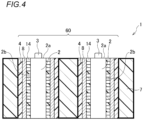
- FIG. 4 is a cross-sectional view schematically illustrating a battery pack containing an assembled battery according to a third embodiment of the present invention.
- the assembled battery 60 includes flameproof materials 4 each disposed on the peripheral surface of an insulating material 14 and a heat dissipation member 8 which have been disposed over the peripheral surface 2b of a battery cell 2.
- the heat which has reached the heat dissipation member 8 and been transferred in the thickness direction of the heat dissipation member 8 can be blocked by the flameproof material 4. Because of this, the heat which has reached the heat dissipation member 8 is apt to be transferred in plane directions of the heat dissipation member 8. The effect of radiating the heat from both ends of the heat dissipation member 8 can hence be enhanced, and the transfer of heat from a battery cell where thermal runaway has occurred to the periphery thereof can be more effectively inhibited.
- each flameproof material 4 need not cover all the peripheral surface of the battery cell 2 or heat dissipation member 8, and may be one which can be expected to have the effects of flameproof materials 4 described above.
- each flameproof material 4 may cover only some of the peripheral surface of the battery cell 2 or heat dissipation member 8.
- the insulating materials 14 used in the assembled batteries 40, 50, and 60 according to the embodiments may be ones formed of an elastic material made of a rubber or elastomer, as shown in the first to third embodiments, or may be ones made of a flameproofing material.
- the insulating materials preferably have insulating performance including, for example, a withstand voltage of 500 V or higher.
- the elastic material preferably has both elasticity which enables the insulating materials 14 to deform flexibly in accordance with deformations of the battery cells 2 and stretchability which enables the insulating materials 14 attached to the peripheral surfaces of the battery cells 2 or heat dissipation members 8 to press the battery cells 2. More preferably, the elastic material has heat-insulating properties.
- the flameproofing material preferably contains organic fibers and/or inorganic fibers, and more preferably contains inorganic particles according to need.
- the flameproofing material preferably contains organic fibers and/or inorganic fibers, and more preferably contains inorganic particles according to need.
- the inorganic fibers include silica-alumina fibers, alumina fibers, silica fibers, rock wool, alkaline-earth silicate fibers, glass fibers, zirconia fibers, and potassium titanate whisker fibers. These inorganic fibers are preferred from the standpoints of heat resistance, strength, availability, etc. Inorganic fibers of one kind may be used alone, or two or more kinds of inorganic fibers may be used in combination. Especially preferred of those inorganic fibers from the standpoint of handleability are silica-alumina fibers, alumina fibers, silica fibers, rock wool, alkaline-earth silicate fibers, and glass fibers.
- the cross-sectional shape of the inorganic fibers is not particularly limited, and examples thereof include a circular cross-section, a flat cross-section, a hollow cross-section, a polygonal cross-section, and a core cross-section.
- fibers having an unusual cross-section such as a hollow, flat, or polygonal cross-section are suitable for use because such fibers slightly improve the heat-insulating properties.
- a preferred lower limit of the average fiber length of the inorganic fibers is 0.1 mm, and a more preferred lower limit thereof is 0.5 mm. Meanwhile, a preferred upper limit of the average fiber length of the inorganic fibers is 50 mm, and a more preferred upper limit thereof is 10 mm. In case where the average fiber length of the inorganic fibers is less than 0.1 mm, the inorganic fibers are less apt to be intertwined with each other and this may reduce the mechanical strength of the insulating material 14.
- the inorganic fibers although having a reinforcing effect, cannot be tightly intertwined with each other, or the individual inorganic fibers separately become round and this is prone to form continuous voids and may hence result in a decrease in heat-insulating property.
- a preferred lower limit of the average fiber diameter of the inorganic fibers is 1 ⁇ m, a more preferred lower limit thereof is 2 ⁇ m, and a still more preferred lower limit thereof is 3 ⁇ m. Meanwhile, a preferred upper limit of the average fiber diameter of the inorganic fibers is 15 ⁇ m, and a more preferred upper limit thereof is 10 ⁇ m. In case where the average fiber diameter of the inorganic fibers is less than 1 ⁇ m, the inorganic fibers themselves are likely to have reduced mechanical strength. From the standpoint of influences on human health, the average fiber diameter of the inorganic fibers is preferably 3 ⁇ m or larger.
- the average fiber diameter of the inorganic fibers is larger than 15 ⁇ m, there is a possibility that heat transfer by the inorganic fibers as a solid medium might be enhanced to result in a decrease in heat-insulating property and that the insulating material might be deteriorated in shapability and strength.
- fibers made of heat-curing resins and thermoplastic resins can be selected.
- use can be made of synthetic fibers made of modified poly(ethylene terephthalate) (PET), polyethylene (PE), polypropylene, polyesters, nylons, poly(butylene terephthalate), and the like.
- Vinylon fibers made of a long-chain synthetic polymer including at least 65 mass% vinyl alcohol units.
- Vinylal fibers made of a long-chain synthetic poly(vinyl alcohol) polymer having a different degree of acetalization.
- Vinylidene poly(vinylidene chloride), chlorofiber
- Acrylic fibers made of a long-chain synthetic polymer including at least 85 mass% repeating units of acrylonitrile group.
- Modacrylic fibers made of a long-chain synthetic polymer including repeating units of acrylonitrile group in an amount of 35 mass% or larger but less than 85 mass%.
- Nylon polyamide: fibers made of a long-chain synthetic polymer in which 85% or more of repeating amide bonds are bonded to aliphatic or alicyclic units.
- Aramid fibers made of a long-chain synthetic polymer in which 85 mass% or more of amide or imide bonds are each directly bonded to two benzene rings and the number of imide bonds, if any, does not exceed the number of amide bonds.
- Polyester fibers made of a long-chain synthetic polymer including at least 85 mass% units of an ester of terephthalic acid with a dihydric alcohol.
- PET Poly(ethylene terephthalate)
- Poly(trimethylene terephthalate) (PTT) fibers made of a long-chain synthetic polymer including at least 85 mass% units of an ester of terephthalic acid with 1,3-propanediol.
- PBT Poly(butylene terephthalate)
- PE Polyethylene
- Polypropylene (PP) fibers made of a long-chain synthetic polymer which is a polymer formed from a saturated aliphatic hydrocarbon and having a methyl side chain bonded to one of every two carbon atoms and which has stereoregularity and has no other substituents.
- Polyurethane fibers made of a long-chain synthetic polymer which includes 85 mass% or more polyurethane segment and which, when elongated three times the tension-free length, rapidly recovers the original length upon release from the tension.
- Preferred ranges of the average fiber length and average fiber diameter of the organic fibers are the same as those of the inorganic fibers.
- the inorganic particles are preferably ones made of a compound having heat resistance.
- a metal oxide can be used.
- the metal oxide examples include silica (SiO 2 ), alumina (Al 2 O 3 ), mullite (Al 6 O 13 Si 2 ), zirconia (ZrO 2 ), magnesia (MgO), and titania (TiO 2 ).
- the metal oxide is not limited to these.
- preferred examples of the inorganic particles include boron nitride (BN) and boron carbide (B 4 C).
- each insulating material 14 may be ones formed in a tubular or sheet-shaped material so as to extend from the surface thereof facing the battery cell 2 to the surface thereof facing the heat dissipation member 8, as shown in the aforementioned embodiments, or may be ones formed by processing a material for the insulating material 14 into a mesh shape.
- FIG. 5 is a partly cross-sectional view schematically illustrating some of an assembled battery employing insulating materials having a mesh shape.
- the insulating material 24 is one obtained by processing a material for the insulating material, such as organic fibers or inorganic fibers, into a cord-shaped one and braiding the resultant into a sheet shape.
- the insulating material 24 is formed to have holes 24a therein which extend from the surface thereof facing the battery cell 2 to the surface thereof facing the heat dissipation member 8, which can hence provide the same effects as in the first to third embodiments.
- materials having thermal conductivity can be selected so that the heat which was generated by each battery cell 2 and has reached the heat dissipation member 8 is diffused in plane directions of the heat dissipation member 8 and radiated to both end sides of the heat dissipation member 8.
- Such materials preferably have heat transfer coefficients of, for example, 10 (W/m•K) or higher. Specifically, it is preferred to select at least one material from among metals, carbon, and ceramics.
- metals examples include stainless steel, aluminum or aluminum alloys, and copper or copper alloys.
- Ceramics examples include SiC and AlN.
- the assembled batteries 50 and 60 in the second and third embodiments include flameproof materials each disposed between the battery cell 2 and the insulating material 14 or on the peripheral surface of the heat dissipation member 8.
- flameproof materials each disposed between the battery cell 2 and the insulating material 14 or on the peripheral surface of the heat dissipation member 8.
- the material of the flameproof materials thus disposed use can be made of the flameproofing material described above as an example of the material of the insulating materials.
- the battery case 7 for encasing therein any of the assembled batteries 40, 50, and 60 according to the embodiments is not particularly limited in the material and shape thereof. Besides being a polycarbonate, the material of the battery case 7 can be PP, PET, a polyamide (PA), aluminum, stainless steel (steel use stainless; SUS), or the like. The shape of the battery case 7 can be selected at will in accordance with the device, e.g., power tool, to which the assembled battery is to be applied.
- the assembled batteries 40, 50, and 60 are ones in which each battery cell 2 by itself has heat-insulating properties and which include the heat dissipation members 8 for further inhibiting heat transfer to adjoining battery cells 2 and can inhibit the occurrence of heat propagation.
- These assembled batteries hence may not have been encased in the battery case 7.
- a plurality of battery cells 2 each covered with an insulating material 14 or 24 and with a heat dissipation member 8 may be tied up with a band or the like to configure an assembled battery and this assembled battery as such can be mounted in a device, e.g., a power tool.
- the assembled batteries 40, 50, and 60 according to the embodiments each can be easily fabricated, as an assembled battery showing the effects described above, by merely covering each of battery cells 2 with an insulating material 14 or 24 having the desired holes 14a or 24a formed therein and attaching thereto a heat dissipation member 8 which is, for example, a tubular body. Since an insulating material 14 or 24 and a heat dissipation member 8 are attached to each of the battery cells 2, a complicated design is unnecessary for the battery case 7.
- the insulating materials 14 or 24 in cases when the insulating materials 14 or 24 are sheet-shaped ones, the insulating materials 14 or 24 each can be easily processed into a size suitable for covering the peripheral surface of a battery cell 2 regardless of the shape or size of the battery cell 2. In cases when the insulating materials 14 or 24 are tubular bodies made of an elastic material, the insulating materials 14 or 24 can be easily attached to various battery cells 2 without being affected by the shapes and sizes of the battery cells 2, since the elastic material has stretchability.
- the assembled batteries and battery packs according to the embodiments can be favorably used not only in power tools but in power-assisted bicycles, electric two-wheeled vehicles, electric vehicles, etc.
Landscapes
- Chemical & Material Sciences (AREA)
- Chemical Kinetics & Catalysis (AREA)
- Electrochemistry (AREA)
- General Chemical & Material Sciences (AREA)
- Engineering & Computer Science (AREA)
- Manufacturing & Machinery (AREA)
- Battery Mounting, Suspending (AREA)
- Secondary Cells (AREA)
Abstract
Description
- The present invention relates to an assembled battery and a battery pack which are to be mounted, for example, in power tools, etc. and used as power sources for electric motors, etc.
- Power tools generally include ones which are used in the state of being connected to the so-called commercial power source and ones which have an assembled battery mounted therein that serves as a power source for an electric motor for driving. The power tools having an assembled battery mounted therein are frequently used from the point of view of the excellent handleability, etc.
- An assembled battery is a battery in which a plurality of battery cells is connected serially or in parallel. For example, battery cells are enclosed in a battery case made of, for example, a polycarbonate and united therewith, and the assembled battery is housed inside a power tool.
- Mainly used as such battery cells to be mounted in power tools are lithium-ion secondary batteries, which can have higher capacities and higher outputs than lead acid batteries and nickel-hydrogen batteries. However, in case where thermal runaway has occurred in one battery cell because of internal short-circuiting, overcharge, or the like of the battery (that is, in case of " abnormality"), it is possible that heat transfer to adjoining another battery cells might occur to cause thermal runaway to the adjoining another battery cells.
- As a measure against the occurrence of thermal runaway described above,
Patent Document 1, for example, proposes an assembled battery in which in case where abnormal heat generation has occurred, for example, because an overcurrent has flowed into a battery cell, the burning can be prevented or inhibited from spreading to adjoining battery cells. The assembled battery described inPatent Document 1 is configured of a plurality of battery cells and a block for holding the battery cells, the block being made of a metallic material and composed of a plurality of small blocks. The dimensions of the gap between the block and each battery cell are regulated. -
Patent Document 1 states that in the assembled battery described therein, which has such configuration, heat can be rapidly diffused because the block holding the battery cells is made of a metallic material. -
Patent Document 2 discloses a battery pack intended to attain an improvement in the heat dissipation properties of secondary batteries and mitigation of performance deterioration. The battery pack described inPatent Document 2 is one which includes a plurality of secondary batteries enclosed in a case and in which a plate-shaped rubber sheet having a heat transfer coefficient not lower than a given value and being changed in shape by pressure has been disposed between the plurality of secondary batteries and the case. -
Patent Document 2 states that since the heat transfer coefficient of the rubber sheet is relatively high, the heat of the secondary batteries can be satisfactorily discharged via the case. Furthermore, this battery pack can be prevented from being damaged when dropped, since the rubber sheet has elasticity. - Furthermore,
Patent Document 3 discloses an anti-firing material capable of reducing the risk of firing in electricity storage devices. The above anti-firing material is, for example, a porous carbonaceous material having a noncombustible gas, aqueous solvent, or noncombustible solvent adsorbed into the pores and onto the surface thereof. -
Patent Document 3 as stated above describes that in case of abnormality, when the secondary battery has released the electrolytic solution or a gaseous component, e.g., an electrolytic-solution decomposition gas, then an effect can be obtained in which the gaseous component passes through the above anti-firing material and is thereby reduced in temperature. -
- Patent Document 1:
JP2014-96271A - Patent Document 2:
JP2004-146161A - Patent Document 3:
JP2013-187089A - However, in the assembled battery described in
Patent Document 1, since the block made of a metallic material is composed of two, vertically separated parts and has a heat insulator disposed between the two parts, it is difficult to efficiently dissipate heat generated from one battery. - Furthermore, the assembled battery described in
Patent Document 1 necessitates a plurality of blocks and the blocks need to be designed in accordance with the electronic appliance, power tool, or the like in which the assembled battery is to be mounted, since the gaps between the blocks and the battery cells are varied. There is hence a problem in that the design of the blocks and fabrication of the assembled battery are complicated. - The battery pack described in
Patent Document 2 has no means whereby the occurrence of thermal runaway in one battery cell is inhibited from resulting in thermal runaway in another adjoining battery cell. - Meanwhile, with respect to
Patent Document 3, the anti-firing material, although effective against the evolution of a gaseous component from a secondary battery in case of abnormality, is unable to lower the temperature of the batteries themselves in cases when the battery cells which have been fabricated into an assembled battery are subjected to charge/discharge cycling (i.e., "during ordinary use") and in case of abnormality. - The present invention is made in view of those problems, and an object of the present invention is to provide an assembled battery and a battery pack which are easy to design and fabricate and in which during ordinary use and in case of abnormality, heat transfer between battery cells can be inhibited and the battery cells can be efficiently cooled to inhibit the occurrence of thermal runaway.
- The object of the present invention is accomplished with the following configuration [1] regarding an assembled battery.
-
- [1] An assembled battery in which a plurality of battery cells is connected serially or in parallel, the battery cells each having an electrode surface having an electrode and a peripheral surface orthogonal to the electrode surface and being disposed such that the peripheral surfaces face each other,
- the assembled battery including
- the battery cells,
- an insulating material covering the peripheral surface of the battery cells, and
- a heat dissipation member covering the peripheral surface of the battery cells which is covered with the insulating material, wherein
- the insulating material has a plurality of holes piercing the insulating material from a surface thereof facing the battery cells to a surface thereof facing the heat dissipation member
Preferred embodiments of the present invention regarding assembled batteries relate to the following [2] to [11]. - [2] The assembled battery according to [1] wherein the insulating material has a withstand voltage of 500 V or higher.
- [3] The assembled battery according to [1] or [2] wherein the insulating material has a mesh shape.
- [4] The assembled battery according to any one of [1] to [3] wherein the insulating material is formed of an elastic material made of a rubber or an elastomer, the assembled battery being configured such that the insulating material covers the peripheral surface of the battery cell along a peripheral direction and presses the battery cell.
- [5] The assembled battery according to [4] wherein the insulating material is a tubular body which is open at both ends.
- [6] The assembled battery according to [4] or [5] which includes a flameproof material disposed between the battery cell and the insulating material, the flameproof material covering the peripheral surface of the battery cell.
- [7] The assembled battery according to [4] or [5] which includes a flameproof material covering the peripheral surface of the battery cell covered with both the insulating material and the heat dissipation member
- [8] The assembled battery according to any one of [1] to [3] wherein the insulating material is formed of a flameproofing material containing organic fibers and/or inorganic fibers.
- [9] The assembled battery according to any one of [1] to [8] wherein the heat dissipation member is a tubular body which is open at both ends.
- [10] The assembled battery according to any one of [1] to [8] wherein the heat dissipation member is a sheet-shaped heat dissipation material wrapped around the peripheral surface of the battery cell which is covered with the insulating material.
- [11] The assembled battery according to any one of [1] to [10] wherein the heat dissipation member is made of at least one material selected from among metals, carbon, and ceramics.
The object of the present invention is accomplished with the following configuration [12] regarding a battery pack. - [12] A battery pack in which the assembled battery according to any one of [1] to [11] is encased in a battery case.
- The assembled battery of the present invention includes an insulating material covering the peripheral surface of each battery cell, and the insulating material has a plurality of holes piercing the insulating material from the surface thereof facing the battery cell to the surface thereof facing the heat dissipation member. Due to this, during ordinary use and in case of abnormality, heat generated in each battery cell can be effectively transferred to the heat dissipation member. Since the heat dissipation member covers the peripheral surface of the insulating material, the heat which has reached the heat dissipation member can be efficiently radiated to the outside. Furthermore, since the assembled battery of the present invention can be fabricated by merely attaching the insulating material and the heat dissipation member to the peripheral surface of each battery cell, there is no need of changing the design of the battery case in accordance with the kind of the battery cells and fabrication of the assembled battery requires no complicated operation.
- Since the battery pack of the present invention includes the assembled battery encased, not only the transfer of heat between the battery cells can be inhibited and the propagation of thermal runaway can be prevented, but also this battery pack can be easily fabricated.
-
-
FIG. 1 is a cross-sectional view schematically illustrating a battery pack containing an assembled battery according to a first embodiment of the present invention. -
FIG. 2 is a partly cross-sectional view schematically illustrating some of the assembled battery according to the first embodiment of the present invention. -
FIG. 3 is a cross-sectional view schematically illustrating a battery pack containing an assembled battery according to a second embodiment of the present invention. -
FIG. 4 is a cross-sectional view schematically illustrating a battery pack containing an assembled battery according to a third embodiment of the present invention. -
FIG. 5 is a partly cross-sectional view schematically illustrating some of an assembled battery employing insulating materials having mesh shape. - The present inventor diligently made investigations in order to provide an assembled battery in which during ordinary use and in case of abnormality, heat transfer between the battery cells can be inhibited and the battery cells can be efficiently cooled to inhibit the occurrence of thermal runaway.
- As a result, the inventor has discovered that the problems described above can be eliminated by covering the peripheral surface of each battery cell with an insulating material having a plurality of holes and covering the peripheral surface thereof with a heat dissipation member
- Embodiments of the present invention are described in detail below while referring to the drawings. The present invention is not limited to the following embodiments, and can be modified at will so long as the modifications do not depart from the spirit of the invention.
-
FIG. 1 is a cross-sectional view schematically illustrating a battery pack containing an assembled battery according to a first embodiment of the present invention.FIG. 2 is a partly cross-sectional view schematically illustrating some of the assembled battery according to the first embodiment of the present invention. Thebattery pack 1 is one obtained by encasing an assembledbattery 40 according to a first embodiment, which is described in detail below, in abattery case 7 made of, for example, a resin. - The assembled battery according to a first embodiment of the present invention is described in detail below.
- As
FIG. 1 andFIG. 2 show, eachbattery cell 2 has anelectrode surface 2a having anelectrode 3 and aperipheral surface 2b that is a surface orthogonal to theelectrode surface 2a. Thebattery cells 2 have been disposed such that theperipheral surfaces 2b thereof face each other, and are connected serially or in parallel, with theelectrodes 3 and a connector (not shown), etc. interposed therebetween. - The
peripheral surface 2b of eachbattery cell 2 is covered with an insulatingmaterial 14 and the peripheral surface of the insulatingmaterial 14 is covered with aheat dissipation member 8 made of, for example, a metal, thereby configuring the assembledbattery 40. - In this embodiment, the insulating
material 14 is formed of an elastic material made of a rubber or elastomer, is a tubular body which is open at both ends, and covers the peripheral surface of thebattery cell 2 andflameproof material 4 along the peripheral direction. The insulatingmaterial 14 has a plurality ofholes 14a piercing the insulatingmaterial 14 in the thickness direction thereof from the surface facing thebattery cell 2 to the surface facing theheat dissipation member 8. - In this embodiment, the expression "both ends of the insulating material 14 (tubular body)" means one longitudinal-direction (top-bottom direction in
FIG. 1 ) end of the insulatingmaterial 14 and the other end thereof, namely, the open ends of the tubular body. - In the assembled
battery 40 having such configuration, theperipheral surface 2b of eachbattery cell 2 is covered with the insulatingmaterial 14 made of an elastic material, and the rubber or elastomer used as the material of the elastic material is superior in heat-insulating property to theheat dissipation member 8. Consequently, some of the heat generated by thebattery cell 2 during ordinary use and in case of abnormality can be inhibited from being transferred to theheat dissipation member 8. - Meanwhile, since the insulating
material 14 has a plurality ofholes 14a, the remainder of the heat generated by thebattery cell 2 is efficiently transferred to theheat dissipation member 8 via theholes 14a. - In general, if a member or material having high electrical conductivity has been disposed in the vicinity of a
battery cell 2, there is a risk that thebattery cell 2 short-circuits. In this embodiment, since the insulatingmaterial 14 has been disposed between thebattery cell 2 and theheat dissipation member 8, it is possible to prevent the short-circuiting. - The
heat dissipation member 8 further covering the peripheral surface of thebattery cell 2 and insulatingmaterial 14 is made of a material having excellent thermal conductivity, as will be described later. Because of this, the heat which has reached theheat dissipation member 8 via theholes 14a of the insulatingmaterial 14 spreads in plane directions of thedissipation member 8 and is radiated to both end sides of theheat dissipation member 8, that is, both end sides of the insulatingmaterial 14. Thebattery cell 2 can hence be efficiently cooled. - Furthermore, in this embodiment, since only some of the heat generated by the
battery cell 2 is transferred to theheat dissipation member 8, it is possible to prevent theheat dissipation member 8 from being excessively heated. A battery cell adjoining another battery cell can hence be inhibited from receiving heat therefrom and the propagation of thermal runaway can be prevented. - Incidentally, when thermal runaway occurs in a battery cell in case of abnormality, a gas is evolved within this battery to elevate the internal pressure and thus cause a deformation of the battery cell. This deformation, when large, may cause breakage of the case.
- In the assembled
battery 40 according to the first embodiment, the insulatingmaterial 14, which covers the peripheral surface of eachbattery cell 2 along the peripheral direction and presses thebattery cell 2, has both the effect of inhibiting thebattery cell 2 from deforming and the effect of absorbing deformations of thebattery cell 2. That is, when thebattery cell 2 deforms in case of abnormality, the insulatingmaterial 14 deforms flexibly in accordance with the deformation of thebattery cell 2 while inhibiting the deformation of thebattery cell 2. Thebattery case 7 can hence be inhibited from breaking. - Even in charge/discharge cycling during ordinary use, the
battery cell 2 undergoes slight deformations. That is, in cases when the gap between thebattery cell 2 and thebattery case 7 is small, thebattery cell 2, when having expanded, is pressed by thebattery case 7 and thebattery cell 2, when having contracted, is released from the pressure of thebattery case 7. Such repetitions of the pressing to thebattery cell 2 and the relaxation thereto are causative of a decrease in battery performance. - In this embodiment, since the insulating
material 14 deforms flexibly in accordance with even slight deformations of thebattery cell 2 in charge/discharge cycling during ordinary use, it is possible to inhibit thebattery cell 2 from decreasing in battery performance. - Moreover, in this embodiment, in cases when the
heat dissipation member 8 is made of a metal and is a tubular body like the insulatingmaterial 14, thisheat dissipation member 8 has substantially no stretchability. However, since the assembledbattery 40 includes the elastic insulatingmaterial 14 disposed between eachbattery cell 2 and theheat dissipation member 8, slight deformations of thebattery cell 2 during ordinary use can be absorbed to prevent a pressure from being unnecessarily applied to adjoiningbattery cells 2 during ordinary use. - By reducing the gap between the
heat dissipation member 8 and thebattery cell 2 and insulatingmaterial 14, it is rendered possible to further enhance the effect wherein if thebattery cell 2 has deformed in case of abnormality, the deformation of thebattery cell 2 is inhibited by theheat dissipation member 8. Thebattery case 7 can hence be inhibited from breaking. - Even if the
battery cell 2 has heated up to an even higher temperature and exploded due to an increase in internal pressure, the covering of thebattery cell 2 with both the insulatingmaterial 14 and theheat dissipation member 8 makes it possible to avoid a trouble, for example, that fragments of thebattery cell 2, an organic electrolytic liquid present in thebattery cell 2, etc. reachother battery cells 2 to exert an adverse influence. - In this embodiment, the
battery cells 2 may be prismatic or round. - The
holes 14a of the insulatingmaterial 14 are not particularly limited in the number and size thereof. The number and size of theholes 14a can be suitably designed so long as insulation between thebattery cell 2 and theheat dissipation member 8 can be ensured. - The
heat dissipation member 8 preferably covers all of the peripheral surface of thebattery cell 2 covered with the insulatingmaterial 14. However, some of the peripheral surface may be uncovered according to need, so long as theheat dissipation member 8 can have the heat dissipation effect described above. - In the assembled
battery 40 according to the first embodiment described above, theheat dissipation members 8 were each a tubular body open at both ends. However, theheat dissipation members 8 are not limited to tubular bodies. For example, a sheet-shaped heat dissipation material may be used and wrapped around the outer surface of abattery cell 2 covered with an insulatingmaterial 14 to form aheat dissipation member 8. - In the case of using a heat dissipation member thus formed, the effect of inhibiting the
battery cell 2 from deforming is lower than that in the case of using the tubularheat dissipation member 8. However, in the first embodiment, since the insulatingmaterial 14 covers the peripheral surface of thebattery cell 2 along the peripheral direction and presses thebattery cell 2, it is possible to inhibit thebattery case 7 from breaking, while thebattery cell 2 is being allowed to deform. - Even with a sheet-shaped heat dissipation material, a tubular
heat dissipation member 8 can be easily produced by wrapping the sheet around the outer surface of the insulatingmaterial 14 and then fixing the free end of the wrapped sheet to some of the wrapped sheet. -
FIG. 3 is a cross-sectional view schematically illustrating a battery pack containing an assembled battery according to a second embodiment of the present invention. InFIGs. 3 and4 , which show the second and third embodiments described below, parts or portions that are identical with or equal to those in the first embodiment are designated by like numerals, and explanations thereon are omitted or simplified. - In the second embodiment, the assembled
battery 50 includesflameproof materials 4 each disposed between abattery cell 2 and an insulatingmaterial 14. - In the second embodiment, which has such configuration, since the
peripheral surface 2b of eachbattery cell 2 is covered with theflameproof material 4, the heat generated by thebattery cell 2 can be more effectively inhibited from being transferred to the periphery during ordinary use and in case of abnormality, as compared with the case of covering with only two layers, i.e., the insulatingmaterial 14 and theheat dissipation member 8. Especially in case of abnormality, when thermal runaway has occurred in one battery cell, heat transfer to the periphery is inhibited and, hence, battery cells adjoining said one battery cell can be inhibited from receiving the heat. Thus, the propagation of thermal runaway can be prevented. - Of the portion of heat that was unable to be inhibited by the
flameproof material 4 from being transferred, some is blocked by the insulatingmaterial 14 as in the first embodiment and the remainder is transferred to theheat dissipation member 8 via theholes 14a and radiated. Consequently, in case where thermal runaway has occurred in one battery cell, the propagation of the thermal runaway can be more effectively inhibited than that in the first embodiment. - In cases when the insulating
material 14 is made of a material which is prone to be altered by heat and when the insulatingmaterial 14 is in contact with abattery cell 2 having a high temperature, there is a possibility that this insulatingmaterial 14 might decrease in insulating performance and in the property of transferring heat to theheat dissipation member 8, because of melting, etc. In the second embodiment, since theflameproof material 4 has been disposed so as to be in contact with thebattery cell 2, the insulatingmaterial 14 can be inhibited from being affected by the heat. -
FIG. 4 is a cross-sectional view schematically illustrating a battery pack containing an assembled battery according to a third embodiment of the present invention. - In the third embodiment, the assembled
battery 60 includesflameproof materials 4 each disposed on the peripheral surface of an insulatingmaterial 14 and aheat dissipation member 8 which have been disposed over theperipheral surface 2b of abattery cell 2. - In the third embodiment, which has such configuration, the heat which has reached the
heat dissipation member 8 and been transferred in the thickness direction of theheat dissipation member 8 can be blocked by theflameproof material 4. Because of this, the heat which has reached theheat dissipation member 8 is apt to be transferred in plane directions of theheat dissipation member 8. The effect of radiating the heat from both ends of theheat dissipation member 8 can hence be enhanced, and the transfer of heat from a battery cell where thermal runaway has occurred to the periphery thereof can be more effectively inhibited. - In the second and third embodiments, which include
flameproof materials 4, eachflameproof material 4 need not cover all the peripheral surface of thebattery cell 2 orheat dissipation member 8, and may be one which can be expected to have the effects offlameproof materials 4 described above. For example, eachflameproof material 4 may cover only some of the peripheral surface of thebattery cell 2 orheat dissipation member 8. - Next, the insulating
materials 14,heat dissipation members 8, andflameproof materials 4 which constitute the assembled batteries according to the embodiments are described in detail. - The insulating
materials 14 used in the assembledbatteries - The insulating materials preferably have insulating performance including, for example, a withstand voltage of 500 V or higher.
- In the case where the insulating
materials 14 are formed of an elastic material, the elastic material preferably has both elasticity which enables the insulatingmaterials 14 to deform flexibly in accordance with deformations of thebattery cells 2 and stretchability which enables the insulatingmaterials 14 attached to the peripheral surfaces of thebattery cells 2 orheat dissipation members 8 to press thebattery cells 2. More preferably, the elastic material has heat-insulating properties. - In the case where the insulating
materials 14 are formed of a flameproofing material, the flameproofing material preferably contains organic fibers and/or inorganic fibers, and more preferably contains inorganic particles according to need. In the embodiments, use can be made of these materials which have been processed into, for example, a sheet shape. Since it is important that materials for constituting the insulatingmaterials 14 should have insulation properties, these materials are selected from among materials having high insulating performance. - Examples of the inorganic fibers include silica-alumina fibers, alumina fibers, silica fibers, rock wool, alkaline-earth silicate fibers, glass fibers, zirconia fibers, and potassium titanate whisker fibers. These inorganic fibers are preferred from the standpoints of heat resistance, strength, availability, etc. Inorganic fibers of one kind may be used alone, or two or more kinds of inorganic fibers may be used in combination. Especially preferred of those inorganic fibers from the standpoint of handleability are silica-alumina fibers, alumina fibers, silica fibers, rock wool, alkaline-earth silicate fibers, and glass fibers.
- The cross-sectional shape of the inorganic fibers is not particularly limited, and examples thereof include a circular cross-section, a flat cross-section, a hollow cross-section, a polygonal cross-section, and a core cross-section. Of these, fibers having an unusual cross-section such as a hollow, flat, or polygonal cross-section are suitable for use because such fibers slightly improve the heat-insulating properties.
- A preferred lower limit of the average fiber length of the inorganic fibers is 0.1 mm, and a more preferred lower limit thereof is 0.5 mm. Meanwhile, a preferred upper limit of the average fiber length of the inorganic fibers is 50 mm, and a more preferred upper limit thereof is 10 mm. In case where the average fiber length of the inorganic fibers is less than 0.1 mm, the inorganic fibers are less apt to be intertwined with each other and this may reduce the mechanical strength of the insulating
material 14. Meanwhile, in case where the average fiber length thereof exceeds 50 mm, the inorganic fibers, although having a reinforcing effect, cannot be tightly intertwined with each other, or the individual inorganic fibers separately become round and this is prone to form continuous voids and may hence result in a decrease in heat-insulating property. - A preferred lower limit of the average fiber diameter of the inorganic fibers is 1 µm, a more preferred lower limit thereof is 2 µm, and a still more preferred lower limit thereof is 3 µm. Meanwhile, a preferred upper limit of the average fiber diameter of the inorganic fibers is 15 µm, and a more preferred upper limit thereof is 10 µm. In case where the average fiber diameter of the inorganic fibers is less than 1 µm, the inorganic fibers themselves are likely to have reduced mechanical strength. From the standpoint of influences on human health, the average fiber diameter of the inorganic fibers is preferably 3 µm or larger. Meanwhile, in case where the average fiber diameter of the inorganic fibers is larger than 15 µm, there is a possibility that heat transfer by the inorganic fibers as a solid medium might be enhanced to result in a decrease in heat-insulating property and that the insulating material might be deteriorated in shapability and strength.
- As the organic fibers, fibers made of heat-curing resins and thermoplastic resins can be selected. For example, use can be made of synthetic fibers made of modified poly(ethylene terephthalate) (PET), polyethylene (PE), polypropylene, polyesters, nylons, poly(butylene terephthalate), and the like.
- The kinds, structures, etc. of synthetic fibers usable in the embodiments are explained in greater detail below.
- Vinylon: fibers made of a long-chain synthetic polymer including at least 65 mass% vinyl alcohol units.
- Vinylal: fibers made of a long-chain synthetic poly(vinyl alcohol) polymer having a different degree of acetalization.
- Poly (vinyl chloride) (chlorofiber): fibers made of a long-chain synthetic polymer including vinyl chloride units as a main component.
- Vinylidene (poly(vinylidene chloride), chlorofiber): fibers made of a long-chain synthetic polymer including vinylidene chloride units (-CH2-CCl2-) as a main component.
- Acrylic: fibers made of a long-chain synthetic polymer including at least 85 mass% repeating units of acrylonitrile group.
- Modacrylic: fibers made of a long-chain synthetic polymer including repeating units of acrylonitrile group in an amount of 35 mass% or larger but less than 85 mass%.
- Nylon (polyamide): fibers made of a long-chain synthetic polymer in which 85% or more of repeating amide bonds are bonded to aliphatic or alicyclic units.
- Aramid: fibers made of a long-chain synthetic polymer in which 85 mass% or more of amide or imide bonds are each directly bonded to two benzene rings and the number of imide bonds, if any, does not exceed the number of amide bonds.
- Polyester: fibers made of a long-chain synthetic polymer including at least 85 mass% units of an ester of terephthalic acid with a dihydric alcohol.
- Poly(ethylene terephthalate) (PET): fibers made of a long-chain synthetic polymer including at least 85 mass% units of an ester of terephthalic acid with ethylene glycol.
- Poly(trimethylene terephthalate) (PTT): fibers made of a long-chain synthetic polymer including at least 85 mass% units of an ester of terephthalic acid with 1,3-propanediol.
- Poly(butylene terephthalate) (PBT): fibers made of a long-chain synthetic polymer including at least 85 mass% units of an ester of terephthalic acid with 1,4-butanediol.
- Polyethylene (PE): fibers made of a long-chain synthetic polymer formed from a saturated aliphatic hydrocarbon and having no substituents.
- Polypropylene (PP): fibers made of a long-chain synthetic polymer which is a polymer formed from a saturated aliphatic hydrocarbon and having a methyl side chain bonded to one of every two carbon atoms and which has stereoregularity and has no other substituents.
- Polyurethane (elastane): fibers made of a long-chain synthetic polymer which includes 85 mass% or more polyurethane segment and which, when elongated three times the tension-free length, rapidly recovers the original length upon release from the tension.
- Poly (lactic acid) (polylactide): fibers made of a long-chain synthetic polymer including lactic ester units in an amount of 50 mass% or larger
- Preferred ranges of the average fiber length and average fiber diameter of the organic fibers are the same as those of the inorganic fibers.
- The inorganic particles are preferably ones made of a compound having heat resistance. For example, a metal oxide can be used.
- Specific examples of the metal oxide include silica (SiO2), alumina (Al2O3), mullite (Al6O13Si2), zirconia (ZrO2), magnesia (MgO), and titania (TiO2). However, the metal oxide is not limited to these. Besides those metal oxides, preferred examples of the inorganic particles include boron nitride (BN) and boron carbide (B4C).
- The
holes 14a of each insulatingmaterial 14 may be ones formed in a tubular or sheet-shaped material so as to extend from the surface thereof facing thebattery cell 2 to the surface thereof facing theheat dissipation member 8, as shown in the aforementioned embodiments, or may be ones formed by processing a material for the insulatingmaterial 14 into a mesh shape. -
FIG. 5 is a partly cross-sectional view schematically illustrating some of an assembled battery employing insulating materials having a mesh shape. AsFIG. 5 shows, the insulatingmaterial 24 is one obtained by processing a material for the insulating material, such as organic fibers or inorganic fibers, into a cord-shaped one and braiding the resultant into a sheet shape. - Even with an insulating
material 24 having such a shape, the insulatingmaterial 24 is formed to haveholes 24a therein which extend from the surface thereof facing thebattery cell 2 to the surface thereof facing theheat dissipation member 8, which can hence provide the same effects as in the first to third embodiments. - As materials for the heat dissipation members to be used in the assembled batteries according to the embodiments, materials having thermal conductivity can be selected so that the heat which was generated by each
battery cell 2 and has reached theheat dissipation member 8 is diffused in plane directions of theheat dissipation member 8 and radiated to both end sides of theheat dissipation member 8. - Such materials preferably have heat transfer coefficients of, for example, 10 (W/m•K) or higher. Specifically, it is preferred to select at least one material from among metals, carbon, and ceramics.
- Examples of the metals include stainless steel, aluminum or aluminum alloys, and copper or copper alloys.
- Examples of the ceramics include SiC and AlN.
- The assembled
batteries battery cell 2 and the insulatingmaterial 14 or on the peripheral surface of theheat dissipation member 8. As the material of the flameproof materials thus disposed, use can be made of the flameproofing material described above as an example of the material of the insulating materials. - The
battery case 7 for encasing therein any of the assembledbatteries battery case 7 can be PP, PET, a polyamide (PA), aluminum, stainless steel (steel use stainless; SUS), or the like. The shape of thebattery case 7 can be selected at will in accordance with the device, e.g., power tool, to which the assembled battery is to be applied. - Incidentally, the assembled
batteries battery cell 2 by itself has heat-insulating properties and which include theheat dissipation members 8 for further inhibiting heat transfer to adjoiningbattery cells 2 and can inhibit the occurrence of heat propagation. These assembled batteries hence may not have been encased in thebattery case 7. For example, a plurality ofbattery cells 2 each covered with an insulatingmaterial heat dissipation member 8 may be tied up with a band or the like to configure an assembled battery and this assembled battery as such can be mounted in a device, e.g., a power tool. - The assembled
batteries battery cells 2 with an insulatingmaterial holes heat dissipation member 8 which is, for example, a tubular body. Since an insulatingmaterial heat dissipation member 8 are attached to each of thebattery cells 2, a complicated design is unnecessary for thebattery case 7. - In the embodiments, in cases when the insulating
materials materials battery cell 2 regardless of the shape or size of thebattery cell 2. In cases when the insulatingmaterials materials various battery cells 2 without being affected by the shapes and sizes of thebattery cells 2, since the elastic material has stretchability. - The assembled batteries and battery packs according to the embodiments can be favorably used not only in power tools but in power-assisted bicycles, electric two-wheeled vehicles, electric vehicles, etc.
- Various embodiments were explained above while referring to the drawings, but it is a matter of course that the present invention is not limited to those examples. It is apparent that a person skilled in the art can conceive of variously modified or changed examples within the scope of the claims, and these examples are, of course, considered to be within the technical range of the present invention. The constituent elements in the embodiments described above may be combined at will so long as the combinations do not depart from the spirit of the invention.
- This application is based on a
Japanese patent application filed on February 1, 2021 (Application No. 2021-014633 -
- 1: Battery pack
- 2: Battery cell
- 2a: Electrode surface
- 3: Electrode
- 4: Flameproof material
- 7: Battery case
- 8: Heat dissipation member
- 14, 24: Insulating material
- 14a, 24a: Hole
- 40, 50, 60: Assembled battery
Claims (12)
- An assembled battery in which a plurality of battery cells is connected serially or in parallel, the battery cells each having an electrode surface having an electrode and a peripheral surface orthogonal to the electrode surface and being disposed such that the peripheral surfaces face each other,the assembled battery comprisingthe battery cells,an insulating material covering the peripheral surface of the battery cells, anda heat dissipation member covering the peripheral surface of the battery cells which is covered with the insulating material, whereinthe insulating material has a plurality of holes piercing the insulating material from a surface thereof facing the battery cells to a surface thereof facing the heat dissipation member
- The assembled battery according to claim 1, wherein the insulating material has a withstand voltage of 500 V or higher.
- The assembled battery according to claim 1 or 2, wherein the insulating material has a mesh shape.
- The assembled battery according to any one of claims 1 to 3, wherein the insulating material is formed of an elastic material made of a rubber or an elastomer, the assembled battery being configured such that the insulating material covers the peripheral surface of the battery cell along a peripheral direction and presses the battery cell.
- The assembled battery according to claim 4, wherein the insulating material is a tubular body which is open at both ends.
- The assembled battery according to claim 4 or 5, which comprises a flameproof material disposed between the battery cell and the insulating material, the flameproof material covering the peripheral surface of the battery cell.
- The assembled battery according to claim 4 or 5, which comprises a flameproof material covering the peripheral surface of the battery cell covered with both the insulating material and the heat dissipation member.
- The assembled battery according to any one of claims 1 to 3, wherein the insulating material is formed of a flameproofing material containing organic fibers and/or inorganic fibers.
- The assembled battery according to any one of claims 1 to 8, wherein the heat dissipation member is a tubular body which is open at both ends.
- The assembled battery according to any one of claims 1 to 8, wherein the heat dissipation member is a sheet-shaped heat dissipation material wrapped around the peripheral surface of the battery cell which is covered with the insulating material.
- The assembled battery according to any one of claims 1 to 10, wherein the heat dissipation member is made of at least one material selected from among metals, carbon, and ceramics.
- A battery pack in which the assembled battery according to any one of claims 1 to 11 is encased in a battery case.
Applications Claiming Priority (2)
| Application Number | Priority Date | Filing Date | Title |
|---|---|---|---|
| JP2021014633A JP7089077B1 (en) | 2021-02-01 | 2021-02-01 | Batteries and battery packs |
| PCT/JP2022/003688 WO2022163857A1 (en) | 2021-02-01 | 2022-01-31 | Battery assembly, and battery pack |
Publications (2)
| Publication Number | Publication Date |
|---|---|
| EP4287373A1 true EP4287373A1 (en) | 2023-12-06 |
| EP4287373A4 EP4287373A4 (en) | 2025-03-26 |
Family
ID=82100052
Family Applications (1)
| Application Number | Title | Priority Date | Filing Date |
|---|---|---|---|
| EP22746076.3A Pending EP4287373A4 (en) | 2021-02-01 | 2022-01-31 | Battery assembly, and battery pack |
Country Status (5)
| Country | Link |
|---|---|
| US (1) | US20240322287A1 (en) |
| EP (1) | EP4287373A4 (en) |
| JP (1) | JP7089077B1 (en) |
| CN (1) | CN116830366A (en) |
| WO (1) | WO2022163857A1 (en) |
Cited By (1)
| Publication number | Priority date | Publication date | Assignee | Title |
|---|---|---|---|---|
| EP4648191A1 (en) * | 2024-05-10 | 2025-11-12 | CALB Group Co., Ltd. | Battery device |
Families Citing this family (1)
| Publication number | Priority date | Publication date | Assignee | Title |
|---|---|---|---|---|
| KR102887516B1 (en) * | 2025-06-05 | 2025-11-18 | 한국특수전지 주식회사 | The battery module for underwater mobility with thermal runaway diffusion prevention utilizing aerogel heat shield sheets and urethane foam materials |
Family Cites Families (16)
| Publication number | Priority date | Publication date | Assignee | Title |
|---|---|---|---|---|
| JP2000090976A (en) * | 1998-09-11 | 2000-03-31 | Ngk Insulators Ltd | Lithium secondary battery module |
| JP2003197158A (en) * | 2001-12-27 | 2003-07-11 | Sanyo Electric Co Ltd | Battery with excellent heat dissipation and battery pack using the same |
| JP2004014139A (en) * | 2002-06-03 | 2004-01-15 | Hitachi Koki Co Ltd | Battery pack |
| JP2004146161A (en) | 2002-10-23 | 2004-05-20 | Sony Corp | battery pack |
| AT9968U1 (en) * | 2006-12-22 | 2008-06-15 | Magna Steyr Fahrzeugtechnik Ag | HIGH TEMPERATURE BATTERY WITH AIR COOLING |
| WO2010131852A2 (en) | 2009-05-11 | 2010-11-18 | 주식회사 엘지화학 | Cell cartridge comprising a resilient press member, and cell module comprising same |
| JP5966457B2 (en) | 2012-03-08 | 2016-08-10 | 栗田工業株式会社 | Ignition prevention material for electricity storage device, ignition prevention system including this ignition prevention material, and electricity storage system using this ignition prevention system |
| JP2015111493A (en) | 2012-03-28 | 2015-06-18 | 三洋電機株式会社 | Power supply device, and vehicle and power storage device comprising the same |
| JP2014096271A (en) | 2012-11-09 | 2014-05-22 | Panasonic Corp | Battery pack |
| JP6583219B2 (en) * | 2016-11-15 | 2019-10-02 | トヨタ自動車株式会社 | Battery module |
| JP2020095777A (en) | 2017-03-31 | 2020-06-18 | 三洋電機株式会社 | Battery pack |
| JP2021061087A (en) | 2018-02-09 | 2021-04-15 | 三洋電機株式会社 | Power supply device and electric vehicle and power storage device equipped with power supply device |
| EP3827447A1 (en) * | 2018-07-26 | 2021-06-02 | 3M Innovative Properties Company | Flame resistant materials for electric vehicle battery applications |
| JP6845833B2 (en) * | 2018-08-30 | 2021-03-24 | 第一工業製薬株式会社 | Battery holder and battery pack |
| UA135453U (en) * | 2019-04-10 | 2019-06-25 | Олександр Сергійович Цихмістро | BATTERY |
| JP6914999B2 (en) | 2019-07-16 | 2021-08-04 | Jx金属株式会社 | Surface treatment copper powder |
-
2021
- 2021-02-01 JP JP2021014633A patent/JP7089077B1/en active Active
-
2022
- 2022-01-31 US US18/275,101 patent/US20240322287A1/en active Pending
- 2022-01-31 WO PCT/JP2022/003688 patent/WO2022163857A1/en not_active Ceased
- 2022-01-31 EP EP22746076.3A patent/EP4287373A4/en active Pending
- 2022-01-31 CN CN202280012605.5A patent/CN116830366A/en active Pending
Cited By (1)
| Publication number | Priority date | Publication date | Assignee | Title |
|---|---|---|---|---|
| EP4648191A1 (en) * | 2024-05-10 | 2025-11-12 | CALB Group Co., Ltd. | Battery device |
Also Published As
| Publication number | Publication date |
|---|---|
| WO2022163857A1 (en) | 2022-08-04 |
| JP7089077B1 (en) | 2022-06-21 |
| US20240322287A1 (en) | 2024-09-26 |
| CN116830366A (en) | 2023-09-29 |
| EP4287373A4 (en) | 2025-03-26 |
| JP2022117874A (en) | 2022-08-12 |
Similar Documents
| Publication | Publication Date | Title |
|---|---|---|
| JP7441643B2 (en) | Cell unit, battery including the same, and battery manufacturing method | |
| US8263250B2 (en) | Liquid cooling manifold with multi-function thermal interface | |
| US8367239B2 (en) | Cell separator for minimizing thermal runaway propagation within a battery pack | |
| EP4287371A1 (en) | Flameproof sheet, assembled battery, and battery pack | |
| KR101459828B1 (en) | Radiant heat plate for battery cell module and battery cell module having the same | |
| CN106935927B (en) | Battery module and vehicle including same | |
| US20240322287A1 (en) | Assembled battery and battery pack | |
| CN114730940A (en) | Battery pack having structure for preventing heat diffusion between battery modules | |
| KR102772374B1 (en) | Energy storage system | |
| KR101757382B1 (en) | Cooling member of improved cooling performance and battery module comprising the same | |
| JP7273237B2 (en) | Flame-retardant sheets, assembled batteries and battery packs | |
| CN1647308A (en) | Temperature control apparatus and method for high energy electrochemical cells | |
| WO2021106444A1 (en) | Heat conductive member and battery provided with same | |
| KR102213758B1 (en) | High power Lithium Ion Battery at elevated temperature with composite heat dissipated material | |
| EP4287372A1 (en) | Assembled battery and battery pack | |
| KR102767949B1 (en) | Heat insulation sheet for battery pack and battery pack comprising the same | |
| KR101976588B1 (en) | Assembly type heat dissipation cartridge and battery pack for electric vehicle using the same | |
| KR20220132374A (en) | Secondary battery module and secondary battery pack including same | |
| JP2011113641A (en) | Battery module | |
| KR102872030B1 (en) | Battery pack with improved safety | |
| JP2022016898A (en) | device | |
| KR20260053856A (en) | Battery module for electric vehicles with cooling pad made of two types of metal plates | |
| KR980007343U (en) | Battery Module Cooling Structure of Electric Vehicle |
Legal Events
| Date | Code | Title | Description |
|---|---|---|---|
| STAA | Information on the status of an ep patent application or granted ep patent |
Free format text: STATUS: THE INTERNATIONAL PUBLICATION HAS BEEN MADE |
|
| PUAI | Public reference made under article 153(3) epc to a published international application that has entered the european phase |
Free format text: ORIGINAL CODE: 0009012 |
|
| STAA | Information on the status of an ep patent application or granted ep patent |
Free format text: STATUS: REQUEST FOR EXAMINATION WAS MADE |
|
| 17P | Request for examination filed |
Effective date: 20230831 |
|
| AK | Designated contracting states |
Kind code of ref document: A1 Designated state(s): AL AT BE BG CH CY CZ DE DK EE ES FI FR GB GR HR HU IE IS IT LI LT LU LV MC MK MT NL NO PL PT RO RS SE SI SK SM TR |
|
| DAV | Request for validation of the european patent (deleted) | ||
| DAX | Request for extension of the european patent (deleted) | ||
| A4 | Supplementary search report drawn up and despatched |
Effective date: 20250224 |
|
| RIC1 | Information provided on ipc code assigned before grant |
Ipc: H01M 50/591 20210101ALI20250218BHEP Ipc: H01M 50/588 20210101ALI20250218BHEP Ipc: H01M 10/6554 20140101ALI20250218BHEP Ipc: H01M 10/653 20140101ALI20250218BHEP Ipc: H01M 10/613 20140101ALI20250218BHEP Ipc: H01M 50/204 20210101AFI20250218BHEP |