EP4287321A1 - Electrolytic solution for non-aqueous secondary battery, and non-aqueous secondary battery - Google Patents
Electrolytic solution for non-aqueous secondary battery, and non-aqueous secondary battery Download PDFInfo
- Publication number
- EP4287321A1 EP4287321A1 EP22745841.1A EP22745841A EP4287321A1 EP 4287321 A1 EP4287321 A1 EP 4287321A1 EP 22745841 A EP22745841 A EP 22745841A EP 4287321 A1 EP4287321 A1 EP 4287321A1
- Authority
- EP
- European Patent Office
- Prior art keywords
- secondary battery
- electrolyte solution
- nonaqueous secondary
- lithium
- present
- Prior art date
- Legal status (The legal status is an assumption and is not a legal conclusion. Google has not performed a legal analysis and makes no representation as to the accuracy of the status listed.)
- Granted
Links
Images

Classifications
-
- H—ELECTRICITY
- H01—ELECTRIC ELEMENTS
- H01M—PROCESSES OR MEANS, e.g. BATTERIES, FOR THE DIRECT CONVERSION OF CHEMICAL ENERGY INTO ELECTRICAL ENERGY
- H01M10/00—Secondary cells; Manufacture thereof
- H01M10/05—Accumulators with non-aqueous electrolyte
- H01M10/056—Accumulators with non-aqueous electrolyte characterised by the materials used as electrolytes, e.g. mixed inorganic/organic electrolytes
- H01M10/0564—Accumulators with non-aqueous electrolyte characterised by the materials used as electrolytes, e.g. mixed inorganic/organic electrolytes the electrolyte being constituted of organic materials only
- H01M10/0566—Liquid materials
- H01M10/0568—Liquid materials characterised by the solutes
-
- H—ELECTRICITY
- H01—ELECTRIC ELEMENTS
- H01M—PROCESSES OR MEANS, e.g. BATTERIES, FOR THE DIRECT CONVERSION OF CHEMICAL ENERGY INTO ELECTRICAL ENERGY
- H01M10/00—Secondary cells; Manufacture thereof
- H01M10/05—Accumulators with non-aqueous electrolyte
- H01M10/052—Li-accumulators
-
- H—ELECTRICITY
- H01—ELECTRIC ELEMENTS
- H01M—PROCESSES OR MEANS, e.g. BATTERIES, FOR THE DIRECT CONVERSION OF CHEMICAL ENERGY INTO ELECTRICAL ENERGY
- H01M10/00—Secondary cells; Manufacture thereof
- H01M10/05—Accumulators with non-aqueous electrolyte
- H01M10/056—Accumulators with non-aqueous electrolyte characterised by the materials used as electrolytes, e.g. mixed inorganic/organic electrolytes
- H01M10/0564—Accumulators with non-aqueous electrolyte characterised by the materials used as electrolytes, e.g. mixed inorganic/organic electrolytes the electrolyte being constituted of organic materials only
- H01M10/0566—Liquid materials
- H01M10/0567—Liquid materials characterised by the additives
-
- H—ELECTRICITY
- H01—ELECTRIC ELEMENTS
- H01M—PROCESSES OR MEANS, e.g. BATTERIES, FOR THE DIRECT CONVERSION OF CHEMICAL ENERGY INTO ELECTRICAL ENERGY
- H01M10/00—Secondary cells; Manufacture thereof
- H01M10/05—Accumulators with non-aqueous electrolyte
- H01M10/056—Accumulators with non-aqueous electrolyte characterised by the materials used as electrolytes, e.g. mixed inorganic/organic electrolytes
- H01M10/0564—Accumulators with non-aqueous electrolyte characterised by the materials used as electrolytes, e.g. mixed inorganic/organic electrolytes the electrolyte being constituted of organic materials only
- H01M10/0566—Liquid materials
- H01M10/0569—Liquid materials characterised by the solvents
-
- H—ELECTRICITY
- H01—ELECTRIC ELEMENTS
- H01M—PROCESSES OR MEANS, e.g. BATTERIES, FOR THE DIRECT CONVERSION OF CHEMICAL ENERGY INTO ELECTRICAL ENERGY
- H01M4/00—Electrodes
- H01M4/02—Electrodes composed of, or comprising, active material
- H01M4/36—Selection of substances as active materials, active masses, active liquids
- H01M4/38—Selection of substances as active materials, active masses, active liquids of elements or alloys
- H01M4/381—Alkaline or alkaline earth metals elements
- H01M4/382—Lithium
-
- H—ELECTRICITY
- H01—ELECTRIC ELEMENTS
- H01M—PROCESSES OR MEANS, e.g. BATTERIES, FOR THE DIRECT CONVERSION OF CHEMICAL ENERGY INTO ELECTRICAL ENERGY
- H01M4/00—Electrodes
- H01M4/02—Electrodes composed of, or comprising, active material
- H01M4/36—Selection of substances as active materials, active masses, active liquids
- H01M4/58—Selection of substances as active materials, active masses, active liquids of inorganic compounds other than oxides or hydroxides, e.g. sulfides, selenides, tellurides, halogenides or LiCoFy; of polyanionic structures, e.g. phosphates, silicates or borates
-
- H—ELECTRICITY
- H01—ELECTRIC ELEMENTS
- H01M—PROCESSES OR MEANS, e.g. BATTERIES, FOR THE DIRECT CONVERSION OF CHEMICAL ENERGY INTO ELECTRICAL ENERGY
- H01M4/00—Electrodes
- H01M4/02—Electrodes composed of, or comprising, active material
- H01M4/36—Selection of substances as active materials, active masses, active liquids
- H01M4/58—Selection of substances as active materials, active masses, active liquids of inorganic compounds other than oxides or hydroxides, e.g. sulfides, selenides, tellurides, halogenides or LiCoFy; of polyanionic structures, e.g. phosphates, silicates or borates
- H01M4/581—Chalcogenides or intercalation compounds thereof
- H01M4/5815—Sulfides
-
- H—ELECTRICITY
- H01—ELECTRIC ELEMENTS
- H01M—PROCESSES OR MEANS, e.g. BATTERIES, FOR THE DIRECT CONVERSION OF CHEMICAL ENERGY INTO ELECTRICAL ENERGY
- H01M4/00—Electrodes
- H01M4/02—Electrodes composed of, or comprising, active material
- H01M2004/026—Electrodes composed of, or comprising, active material characterised by the polarity
- H01M2004/027—Negative electrodes
-
- H—ELECTRICITY
- H01—ELECTRIC ELEMENTS
- H01M—PROCESSES OR MEANS, e.g. BATTERIES, FOR THE DIRECT CONVERSION OF CHEMICAL ENERGY INTO ELECTRICAL ENERGY
- H01M4/00—Electrodes
- H01M4/02—Electrodes composed of, or comprising, active material
- H01M2004/026—Electrodes composed of, or comprising, active material characterised by the polarity
- H01M2004/028—Positive electrodes
-
- H—ELECTRICITY
- H01—ELECTRIC ELEMENTS
- H01M—PROCESSES OR MEANS, e.g. BATTERIES, FOR THE DIRECT CONVERSION OF CHEMICAL ENERGY INTO ELECTRICAL ENERGY
- H01M2300/00—Electrolytes
- H01M2300/0017—Non-aqueous electrolytes
- H01M2300/0025—Organic electrolyte
- H01M2300/0028—Organic electrolyte characterised by the solvent
- H01M2300/0037—Mixture of solvents
-
- Y—GENERAL TAGGING OF NEW TECHNOLOGICAL DEVELOPMENTS; GENERAL TAGGING OF CROSS-SECTIONAL TECHNOLOGIES SPANNING OVER SEVERAL SECTIONS OF THE IPC; TECHNICAL SUBJECTS COVERED BY FORMER USPC CROSS-REFERENCE ART COLLECTIONS [XRACs] AND DIGESTS
- Y02—TECHNOLOGIES OR APPLICATIONS FOR MITIGATION OR ADAPTATION AGAINST CLIMATE CHANGE
- Y02E—REDUCTION OF GREENHOUSE GAS [GHG] EMISSIONS, RELATED TO ENERGY GENERATION, TRANSMISSION OR DISTRIBUTION
- Y02E60/00—Enabling technologies; Technologies with a potential or indirect contribution to GHG emissions mitigation
- Y02E60/10—Energy storage using batteries
Definitions
- the present invention relates to a nonaqueous secondary battery electrolyte solution and a nonaqueous secondary battery.
- Sulfur which has a theoretical capacity as high as about 1670 mAh/g, is a promising candidate for use as a sulfur-based cathode active material.
- the use of a sulfur-based material as a cathode active material tends to result in lost capacity after repeated charge/discharge cycles.
- Patent Literature (PTL) 1 It has been reported that the use of vanadium sulfide as a sulfur-based cathode active material results in a certain improvement in charge/discharge cycle performance.
- an object of the present invention is to provide a nonaqueous secondary battery that has excellent charge/discharge cycle performance while using a sulfur-based material as a cathode active material and that enables suppression of needle-like lithium deposition while using lithium as an anode active material.
- the present inventors conducted extensive research to achieve the above object and found that a nonaqueous secondary battery that has excellent charge/discharge performance while using a sulfur-based cathode active material and that enables suppression of needle-like lithium deposition can be provided by using specific materials in an electrolyte solution.
- the present invention has been accomplished through further research based on the above finding.
- the present invention provides the following nonaqueous secondary battery electrolyte solutions and nonaqueous secondary batteries.
- a nonaqueous secondary battery electrolyte solution for use in a nonaqueous secondary battery comprising vanadium sulfide as a cathode active material and a lithium-containing compound as an anode active material, the nonaqueous secondary battery electrolyte solution comprising lithium bis(fluorosulfonyl)imide (LiFSI), cyclic carbonates, and a hydrofluoroether (HFE).
- LiFSI lithium bis(fluorosulfonyl)imide
- HFE hydrofluoroether
- nonaqueous secondary battery electrolyte solution according to Item 1 or 2, wherein the cyclic carbonates are ethylene carbonate (EC) and propylene carbonate (PC).
- EC ethylene carbonate
- PC propylene carbonate
- a nonaqueous secondary battery comprising the nonaqueous secondary battery electrolyte solution according to any one of Items 1 to 3.
- the nonaqueous secondary battery according to Item 4 wherein the lithium-containing compound is lithium metal.
- nonaqueous secondary battery electrolyte solution of the present invention makes it possible to provide a secondary battery that has excellent charge/discharge cycle performance while using a sulfur-based material as a cathode active material and that enables suppression of needle-like lithium deposition although lithium is used as an anode active material.
- the nonaqueous secondary battery electrolyte solution of the present invention is used in nonaqueous secondary batteries comprising vanadium sulfide as a cathode active material and a lithium-containing compound as an anode active material.
- the nonaqueous secondary battery electrolyte solution comprises lithium bis(fluorosulfonyl)imide (LiFSI), cyclic carbonates, and a hydrofluoroether (HFE).
- the lithium bis(fluorosulfonyl)imide (which may be referred to below as "LiFSI”) is a lithium salt represented by the following formula (1).
- the content of LiFSI in the nonaqueous secondary battery electrolyte solution is preferably 3 to 6 mol/L in order to enhance the interaction between lithium ions, and the solvent and anions.
- the cyclic carbonates are not particularly limited, and a wide range of known cyclic carbonates that can be used as organic solvents in nonaqueous secondary battery electrolyte solutions can be used. Specific examples include ethylene carbonate (which may be referred to below as “EC”) represented by the following formula (2), propylene carbonate (which may be referred to below as “PC”) represented by the following formula (3), butylene carbonate, and the like. These cyclic carbonates may be used singly, or in a combination of two or more.
- EC ethylene carbonate
- PC propylene carbonate
- PC butylene carbonate
- Only one of the above cyclic carbonates may be used alone as described above; however, it is preferable to use two of the above cyclic carbonates in combination. Among them, it is particularly preferable to use EC and PC in combination.
- the proportions of the cyclic carbonates for use are such that the molar ratio of EC:PC is preferably 1.0:0.7 to 1.0:1.3, more preferably 1.0:0.8 to 1.0:1.2, and even more preferably 1.0:0.9 to 1.0:1.1, in order to prevent the viscosity of the electrolyte solution from becoming too high.
- the molar ratio of the cyclic carbonates to the LiFSI is preferably 1 or more and 3 or less, and more preferably 1 or more and 2 or less, in order to enhance the interaction between lithium ions, and the solvent and anions.
- the nonaqueous secondary battery electrolyte solution of the present invention further comprises a hydrofluoroether (which may be referred to below as "HFE").
- HFE hydrofluoroether
- the molar ratio of the HFE used to the LiFSI is preferably 1 or more and 4 or less, in order to decrease the viscosity of the electrolyte solution and ensure properties such as lithium ion conductivity of the electrolyte solution.
- the nonaqueous secondary battery electrolyte solution of the present invention may contain components other than those described above, such as additives, as long as the effects of the present invention are not impaired (e.g., 0.01 to 0.2 mol/L, and particularly 0.02 to 0.1 mol/L).
- additives examples include tetrabutylammonium hexafluorophosphate, tetrabutylammonium perchlorate, tetramethylammonium tetrafluoroborate, tetramethylammonium chloride, tetraethylammonium chloride, tetrabutylammonium chloride, tetramethylammonium bromide, tetraethylammonium bromide, tetrabutylammonium bromide, vinylene carbonate, fluoroethylene carbonate, trifluoromethyl ethylene carbonate, vinyl ethylene carbonate, 1,3,2-dioxathiolane-2-oxide, 3-sulfolene, biphenyl, trialkyl phosphate (e.g., trimethyl phosphate), and the like. These additives may be used singly, or in a combination of two or more.
- the nonaqueous secondary battery electrolyte solution of the present invention is typically in liquid form; however, for example, a gelled electrolyte prepared by gelation with a gelling agent containing a polymer or the like is also usable.
- the nonaqueous secondary battery electrolyte solution of the present invention is used in the nonaqueous secondary battery described below, which comprises a cathode active material and an anode active material.
- the present invention includes an invention relating to a nonaqueous secondary battery comprising the nonaqueous secondary battery electrolyte solution of the present invention described above.
- a nonaqueous secondary battery comprising the nonaqueous secondary battery electrolyte solution of the present invention described above.
- the nonaqueous secondary battery of the present invention may comprises a cathode, an anode, and a separator in addition to the nonaqueous secondary battery electrolyte solution.
- the cathode may have a configuration in which a cathode layer containing a cathode active material, a binder, etc. is formed on one surface or both surfaces of a cathode current collector.
- the cathode layer can be produced through the steps of adding a binder to a cathode active material and a conductive material added as necessary, dispersing the binder in an organic solvent to prepare a paste for forming a cathode layer (in this case, the binder may be dissolved or dispersed in an organic solvent in advance), applying the paste to the surface (one surface or both surfaces) of a cathode current collector made of a metal foil or the like, drying the paste to form a cathode layer, and processing the cathode layer as necessary.
- vanadium sulfide As the cathode active material, vanadium sulfide is used.
- the vanadium sulfide is not particularly limited, and a wide range of known vanadium sulfides can be used. Specific examples include V 3 S 4 , V 2 S 5 , and VS 4 .
- the vanadium sulfide preferably has a crystalline structure similar to that of crystalline vanadium(IV) tetrasulfide (VS 4 ) (which may be referred to below as "VS 4 crystalline structure").
- VS 4 crystalline vanadium(IV) tetrasulfide
- the X-ray diffraction pattern is obtained by a powder X-ray diffraction method ( ⁇ -2 ⁇ method), and measurement is performed under the following measurement conditions:
- the vanadium sulfide has a high sulfur ratio in the average composition, little sulfur is present in the form of elemental sulfur as described below, and that sulfur is bound to vanadium to form a low-crystalline sulfide. Accordingly, in the present invention, the vanadium sulfide with a lower crystallinity can have more sites in which lithium ions can be inserted and extracted, and can structurally have more defects that can serve as conductive pathways for lithium in three dimensions.
- the vanadium sulfide has many advantages, including the ability to undergo three-dimensional volume changes during charging and discharging. This further improves specific capacity and charge/discharge cycle performance. Moreover, it is also preferred that a vanadium sulfide (e.g., V 2 S 3 ) used as a raw material is almost completely absent.
- the average composition of a sulfide refers to the element ratio of each element that constitutes the sulfide as a whole. As such a vanadium sulfide, a low-crystalline vanadium sulfide like that disclosed in PTL 1 is preferably used.
- vanadium sulfide in the present invention allows the vanadium sulfide in the present invention to be a material that contains almost no elemental sulfur. Additionally, this also reduces concern about causing a reaction with an electrolyte solution as described above and further improves specific capacity and charge/discharge cycle performance.
- This allows the vanadium sulfide to be a material that contains almost no elemental sulfur. Additionally, this also reduces concern of causing a reaction with an electrolyte solution as described above and further improves specific capacity and charge/discharge cycle performance.
- the vanadium sulfide preferably has not only V-S bonds but also S-S bonds (disulfide bonds).
- the vanadium sulfide described above can be obtained, for example, by a production method that includes the step of subjecting a vanadium sulfide and sulfur used as raw materials or intermediates to mechanical milling.
- Mechanical milling is a method of milling and mixing raw materials while adding mechanical energy. This method adds a mechanical impact and friction to raw materials to mill and mix the materials, whereby a vanadium sulfide and sulfur intensely come into contact with each other and become fine particles to allow the reaction of the raw materials to proceed. That is, in this case, mixing, pulverization, and reaction occur simultaneously. This enables the reaction of the raw materials to reliably proceed without heating the raw materials at a high temperature. Mechanical milling may provide a metastable crystalline structure that cannot be obtained by ordinary heat treatment.
- mechanical milling include mixing and pulverization using a mechanical pulverizer, such as a ball mill, a bead mill, a rod mill, a vibration mill, a disc mill, a hammer mill, or a jet mill.
- a mechanical pulverizer such as a ball mill, a bead mill, a rod mill, a vibration mill, a disc mill, a hammer mill, or a jet mill.
- raw materials or intermediates may all be mixed together simultaneously and subjected to mechanical milling.
- the remaining materials may be added thereto and subjected to mechanical milling.
- a crystalline vanadium sulfide in the production of a vanadium sulfide with a high sulfur content (the compositional ratio of sulfur to vanadium (S/V) being 3.3 or more in terms of moles), a crystalline vanadium sulfide can be obtained depending on the mass to be fed.
- S/V sulfur to vanadium
- crystalline vanadium(III) sulfide V 2 S 3
- the vanadium sulfide is not particularly limited, and any commercially available vanadium sulfide can be used. It is particularly preferable to use a high-purity vanadium sulfide. Since a vanadium sulfide is mixed and pulverized by mechanical milling, the particle size of the vanadium sulfide for use is also not limited. A commercially available vanadium sulfide powder can usually be used.
- elemental sulfur (S 8 ) in an amount necessary to form a sulfide of a desired composition can be used.
- the sulfur used as a raw material is also not particularly limited, and any sulfur can be used. It is particularly preferable to use high-purity sulfur. Since sulfur is mixed and pulverized by mechanical milling, the particle size of the sulfur for use is also not limited. A commercially available sulfur powder can usually be used.
- the intermediate for use may be, for example, a low-crystalline vanadium sulfide of a desired composition (e.g., low-crystalline VS 2.5 ).
- the ratio of the raw materials to be mixed may be adjusted to the elemental ratio of vanadium and sulfur in the desired vanadium sulfide.
- sulfur is preferably used in an amount of 1.2 mol or more, in particular, 1.2 to 17.0 mol, and more preferably 3.0 to 13.0 mol, per mol of vanadium sulfide.
- the temperature at which mechanical milling is performed is not particularly limited. In order to prevent the volatilization of sulfur and the formation of the crystalline phases previously reported, the temperature during the mechanical milling is preferably 300°C or lower, and more preferably -10 to 200°C.
- the time during which mechanical milling is performed is not particularly limited. Mechanical milling can be performed for any length of time until a desired vanadium sulfide is precipitated.
- the atmosphere in which mechanical milling is performed is not particularly limited and may be an inert gas atmosphere, such as a nitrogen gas atmosphere or an argon gas atmosphere.
- mechanical milling can be performed for 0.1 to 100 hours (in particular, 15 to 80 hours). Mechanical milling may optionally be performed multiple times with pauses in between.
- the mechanical milling described above can provide a desired vanadium sulfide in fine powder form.
- a conductive material graphite; carbon black (e.g., acetylene black and Ketjen black); amorphous carbon materials, such as carbon materials with amorphous carbon generated on a surface thereof; fibrous carbon (vapor-phase grown carbon fiber, carbon fiber obtained by carbonization treatment after spinning pitch, etc.); carbon nanotubes (various types of multi-layered or single-layered carbon nanotubes); etc.
- carbon black e.g., acetylene black and Ketjen black
- amorphous carbon materials such as carbon materials with amorphous carbon generated on a surface thereof
- fibrous carbon vapor-phase grown carbon fiber, carbon fiber obtained by carbonization treatment after spinning pitch, etc.
- carbon nanotubes variant types of multi-layered or single-layered carbon nanotubes
- binder examples include polyvinylidene fluoride (PVDF), polytetrafluoroethylene, polyacrylic acid, styrenebutadiene rubber, polyimide, polyvinyl alcohol, and water-soluble carboxymethyl cellulose.
- PVDF polyvinylidene fluoride
- polyacrylic acid examples include acrylic acid, styrenebutadiene rubber, polyimide, polyvinyl alcohol, and water-soluble carboxymethyl cellulose.
- the organic solvent used in producing the cathode layer is not particularly limited, and examples include N-methylpyrrolidone (NMP).
- NMP N-methylpyrrolidone
- a paste can be formed from the organic solvent, a cathode active material, a binder, etc.
- the cathode active material is present in an amount of about 70 to 95 wt% and that the binder is present in an amount of about 1 to 30 wt%.
- the cathode active material is present in an amount of about 50 to 90 wt%, that the binder is present in an amount of about 1 to 20 wt%, and that the conductive material is present in an amount of about 1 to 40 wt%.
- the thickness of the cathode layer is preferably about 1 to 100 um per surface of the current collector.
- the cathode current collector for example, a foil, punched metal, expanded metal, net, or the like of aluminum, stainless steel, nickel, titanium, or an alloy thereof can be used.
- a foil, punched metal, expanded metal, net, or the like of aluminum, stainless steel, nickel, titanium, or an alloy thereof can be used.
- an aluminum foil having a thickness of about 10 to 30 um is preferably used.
- the anode may have a configuration in which an anode layer containing an anode active material, a binder, etc. is formed on one surface or both surfaces of an anode current collector.
- the anode layer can be produced through the steps of mixing a binder with an anode active material and a conductive material added as necessary to form a sheet, and pressure-bonding the sheet to the surface (one surface or both surfaces) of an anode current collector made of a metal foil or the like.
- anode active material a lithium-containing compound is used. Specific examples include lithium metal, lithium alloys, and the like. A material that can be doped or undoped with lithium ions (graphite (e.g., natural graphite and artificial graphite), sintering-resistant carbon, etc.), or the like can also be used as the active material. These anode active materials may be used singly, or in a combination of two or more.
- a conductive material graphite; carbon black (e.g., acetylene black and Ketjen black); amorphous carbon materials, such as carbon materials with amorphous carbon generated on a surface thereof; fibrous carbon (vapor-phase grown carbon fiber, carbon fiber obtained by carbonization treatment after spinning pitch, etc.); carbon nanotubes (various types of multi-layered or single-layered carbon nanotubes); etc.
- these materials may be used singly, or in a combination of two or more, or may not be used when the conductivity of the anode active material is high.
- binder examples include polyvinylidene fluoride (PVDF), polytetrafluoroethylene, polyacrylic acid, styrenebutadiene rubber, polyimide, polyvinyl alcohol, and water-soluble carboxymethyl cellulose.
- PVDF polyvinylidene fluoride
- polyacrylic acid examples include acrylic acid, styrenebutadiene rubber, polyimide, polyvinyl alcohol, and water-soluble carboxymethyl cellulose.
- the anode active material is present in an amount of about 70 to 95 wt% and that the binder is present in an amount of about 1 to 30 wt%.
- the anode active material is present in an amount of about 50 to 90 wt%, that the binder is present in an amount of about 1 to 20 wt%, and that the conductive material is present in an amount of about 1 to 40 wt%.
- the thickness of the anode layer is preferably about 1 to 100 um per surface of the current collector.
- anode current collector for example, a foil, punched metal, expanded metal, mesh, net, or the like of aluminum, copper, stainless steel, nickel, titanium, or an alloy thereof can be used.
- a copper foil having a thickness of about 5 to 30 um is preferably used.
- the cathode and the anode described above are used in the form of, for example, a laminated electrode prepared by laminating the cathode and the anode with an interjacent separator between them, or in the form of a spiral-wound electrode prepared by further winding the laminated electrode into a spiral shape.
- the separator preferably has sufficient strength and can retain as much electrolyte solution as possible.
- the separator is preferably a microporous film, a non-woven fabric, or the like that has a thickness of 10 to 50 um and an open-pore ratio of 30 to 70%, and that contains at least one of the following: polyethylene, polypropylene, an ethylenepropylene copolymer, etc.
- nonaqueous secondary battery of the present invention examples include a cylindrical shape (e.g., a rectangular tube shape or circular tube shape) that uses a stainless-steel can, an aluminum can, or the like as an outer can. Further, a soft-package battery that uses a laminate film integrated with a metal foil as its exterior body can also be used.
- a cylindrical shape e.g., a rectangular tube shape or circular tube shape
- a soft-package battery that uses a laminate film integrated with a metal foil as its exterior body can also be used.
- Constant-current charge-and-discharge measurement of two-electrode nonaqueous secondary batteries having a diameter of about 60 mm and a height of about 20 mm was performed.
- solutions obtained by mixing LiFSI, EC, PC, and HFE at 1:1.5:1.5:1.5 (molar ratio) and at 1:1:1:1 (molar ratio) (Example 1 and Example 2, respectively)
- solutions obtained by mixing LiFSI, EC, and PC at 1:5:5 and at 1:1.5:1.5 (Comparative Example 1 and Comparative Example 2, respectively)
- LiTFSI lithium bis(trifluoromethanesulfonyl)imide
- EC:PC 1:1 (volume ratio) electrolyte solution
- low-crystalline VS 4 synthesized by the method disclosed in PTL 1 was used for a cathode, and lithium metal was used for an anode.
- the VS 4 cathode layer had a thickness of about 15 um and a diameter of 15 mm, and the weight per area of the active material was about 1.74 mg/cm 2 .
- the lithium metal anode had a thickness of about 200 um and a diameter of 15 mm.
- the amount of each electrolyte solution was 400 ⁇ L.
- the temperature was 25°C, the voltage range was 1.5 V to 2.6 V, the number of cycles was 50, and the current value was 240 mA/g based on the VS 4 weight.
- Fig. 1 shows the obtained discharge capacity vs. cycle number plot.
- the Coulombic efficiency of the VS 4 /lithium metal secondary batteries using each individual electrolyte solution described above was calculated to investigate the reaction reversibility.
- the Coulombic efficiency as used herein is defined as charge capacity (capacity of extraction of lithium ions form VS 4 )/discharge capacity (capacity of insertion of lithium ions into VS 4 ) and is an indicator of the reaction reversibility.
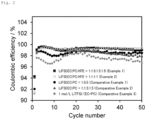
- Fig. 2 shows the obtained Coulombic efficiency vs. cycle number plot.
- two-electrode cells were produced using the individual electrolyte solutions described above, a copper foil for a working electrode, and lithium metal for a counterelectrode, and a test for lithium deposition on the copper foil was performed. After the lithium deposition test, the cells were disassembled, and the morphology of lithium metal deposited on the copper foil was observed with a scanning electron microscope. The temperature was 25°C, the deposition capacity was 1.0 mAh/cm 2 , and the current value was 0.5 mA/cm 2 .
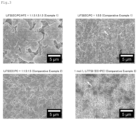
- Fig. 3 shows electron microscope images of lithium metal deposited on the copper foil.
Landscapes
- Chemical & Material Sciences (AREA)
- General Chemical & Material Sciences (AREA)
- Chemical Kinetics & Catalysis (AREA)
- Electrochemistry (AREA)
- Engineering & Computer Science (AREA)
- Inorganic Chemistry (AREA)
- Manufacturing & Machinery (AREA)
- General Physics & Mathematics (AREA)
- Condensed Matter Physics & Semiconductors (AREA)
- Physics & Mathematics (AREA)
- Materials Engineering (AREA)
- Secondary Cells (AREA)
- Battery Electrode And Active Subsutance (AREA)
Abstract
Description
- The present invention relates to a nonaqueous secondary battery electrolyte solution and a nonaqueous secondary battery.
- In recent years, along with the higher performance of portable electronic devices and the growing demand for hybrid vehicles and electric vehicles, the lithium-ion secondary batteries used for such devices and vehicles are increasingly required to have higher capacity.
- However, when a lithium-based material is used as an anode active material, there is a problem in that the charge/discharge cycle performance is low. In addition, needle-like lithium tends to deposit inside the battery during use, and there are also safety problems, such as internal short circuits.
- Sulfur, which has a theoretical capacity as high as about 1670 mAh/g, is a promising candidate for use as a sulfur-based cathode active material. However, the use of a sulfur-based material as a cathode active material tends to result in lost capacity after repeated charge/discharge cycles.
- It has been reported that the use of vanadium sulfide as a sulfur-based cathode active material results in a certain improvement in charge/discharge cycle performance (Patent Literature (PTL) 1).
- However, such batteries still do not have sufficient charge/discharge cycle performance, and further improvement is required.
- PTL 1:
WO2018/181698 - In view of the above, an object of the present invention is to provide a nonaqueous secondary battery that has excellent charge/discharge cycle performance while using a sulfur-based material as a cathode active material and that enables suppression of needle-like lithium deposition while using lithium as an anode active material.
- The present inventors conducted extensive research to achieve the above object and found that a nonaqueous secondary battery that has excellent charge/discharge performance while using a sulfur-based cathode active material and that enables suppression of needle-like lithium deposition can be provided by using specific materials in an electrolyte solution. The present invention has been accomplished through further research based on the above finding.
- Specifically, the present invention provides the following nonaqueous secondary battery electrolyte solutions and nonaqueous secondary batteries.
- A nonaqueous secondary battery electrolyte solution for use in a nonaqueous secondary battery comprising vanadium sulfide as a cathode active material and a lithium-containing compound as an anode active material, the nonaqueous secondary battery electrolyte solution comprising lithium bis(fluorosulfonyl)imide (LiFSI), cyclic carbonates, and a hydrofluoroether (HFE).
- The nonaqueous secondary battery electrolyte solution according to
Item 1, wherein the molar ratio of the cyclic carbonates to the LiFSI (cyclic carbonates/LiFSI) is 3 or less. - The nonaqueous secondary battery electrolyte solution according to
Item - A nonaqueous secondary battery comprising the nonaqueous secondary battery electrolyte solution according to any one of
Items 1 to 3. - The nonaqueous secondary battery according to Item 4, wherein the lithium-containing compound is lithium metal.
- The use of the nonaqueous secondary battery electrolyte solution of the present invention makes it possible to provide a secondary battery that has excellent charge/discharge cycle performance while using a sulfur-based material as a cathode active material and that enables suppression of needle-like lithium deposition although lithium is used as an anode active material.
-
-
Fig. 1 shows discharge capacity vs. cycle number of Examples and Comparative Examples. -
Fig. 2 shows Coulombic efficiency vs. cycle number of Examples and Comparative Examples. -
Fig. 3 shows electron microscope images of deposited lithium metal after a lithium deposition test in Examples and Comparative Examples. - In the present specification, the terms "comprise" and "contain" include all the concepts of comprising, consisting essentially of, and consisting of. In the present specification, a numerical range expressed as "A to B" means A or more and B or less.
- The nonaqueous secondary battery electrolyte solution of the present invention is used in nonaqueous secondary batteries comprising vanadium sulfide as a cathode active material and a lithium-containing compound as an anode active material. The nonaqueous secondary battery electrolyte solution comprises lithium bis(fluorosulfonyl)imide (LiFSI), cyclic carbonates, and a hydrofluoroether (HFE).
- The lithium bis(fluorosulfonyl)imide (which may be referred to below as "LiFSI") is a lithium salt represented by the following formula (1).

- The content of LiFSI in the nonaqueous secondary battery electrolyte solution is preferably 3 to 6 mol/L in order to enhance the interaction between lithium ions, and the solvent and anions.
- The cyclic carbonates are not particularly limited, and a wide range of known cyclic carbonates that can be used as organic solvents in nonaqueous secondary battery electrolyte solutions can be used. Specific examples include ethylene carbonate (which may be referred to below as "EC") represented by the following formula (2), propylene carbonate (which may be referred to below as "PC") represented by the following formula (3), butylene carbonate, and the like. These cyclic carbonates may be used singly, or in a combination of two or more.


- Only one of the above cyclic carbonates may be used alone as described above; however, it is preferable to use two of the above cyclic carbonates in combination. Among them, it is particularly preferable to use EC and PC in combination.
- When EC and PC are used in combination, the proportions of the cyclic carbonates for use are such that the molar ratio of EC:PC is preferably 1.0:0.7 to 1.0:1.3, more preferably 1.0:0.8 to 1.0:1.2, and even more preferably 1.0:0.9 to 1.0:1.1, in order to prevent the viscosity of the electrolyte solution from becoming too high.
- The molar ratio of the cyclic carbonates to the LiFSI (cyclic carbonates/LiFSI) is preferably 1 or more and 3 or less, and more preferably 1 or more and 2 or less, in order to enhance the interaction between lithium ions, and the solvent and anions.
- The nonaqueous secondary battery electrolyte solution of the present invention further comprises a hydrofluoroether (which may be referred to below as "HFE"). The HFE is not particularly limited, and a wide range of known HFEs can be used. Among them, an HFE represented by CaHbFc-O-CdHeFf (wherein 2a + 1 = b + c, 2d + 1 = e + f, and a to f ≥ 1) is preferred, and an HFE represented by the following formula (4), i.e., 1,1,2,2-tetrafluoro-3-(1,1,2,2-tetrafluoroethoxy)propane, is more preferred because such an HFE mixes with an electrolyte solution containing the LiFSI and cyclic carbonates described above and does not interact with lithium ions.

- The molar ratio of the HFE used to the LiFSI (HFE/LiFSI) is preferably 1 or more and 4 or less, in order to decrease the viscosity of the electrolyte solution and ensure properties such as lithium ion conductivity of the electrolyte solution.
- The nonaqueous secondary battery electrolyte solution of the present invention may contain components other than those described above, such as additives, as long as the effects of the present invention are not impaired (e.g., 0.01 to 0.2 mol/L, and particularly 0.02 to 0.1 mol/L). Examples of such additives include tetrabutylammonium hexafluorophosphate, tetrabutylammonium perchlorate, tetramethylammonium tetrafluoroborate, tetramethylammonium chloride, tetraethylammonium chloride, tetrabutylammonium chloride, tetramethylammonium bromide, tetraethylammonium bromide, tetrabutylammonium bromide, vinylene carbonate, fluoroethylene carbonate, trifluoromethyl ethylene carbonate, vinyl ethylene carbonate, 1,3,2-dioxathiolane-2-oxide, 3-sulfolene, biphenyl, trialkyl phosphate (e.g., trimethyl phosphate), and the like. These additives may be used singly, or in a combination of two or more.
- The nonaqueous secondary battery electrolyte solution of the present invention is typically in liquid form; however, for example, a gelled electrolyte prepared by gelation with a gelling agent containing a polymer or the like is also usable.
- The nonaqueous secondary battery electrolyte solution of the present invention is used in the nonaqueous secondary battery described below, which comprises a cathode active material and an anode active material.
- The present invention includes an invention relating to a nonaqueous secondary battery comprising the nonaqueous secondary battery electrolyte solution of the present invention described above. For configurations and structures other than the nonaqueous secondary battery electrolyte solution described above and the cathode active material and anode active material described below, configurations and structures used in conventionally known nonaqueous secondary batteries can be used. Typically, the nonaqueous secondary battery of the present invention may comprises a cathode, an anode, and a separator in addition to the nonaqueous secondary battery electrolyte solution.
- The cathode may have a configuration in which a cathode layer containing a cathode active material, a binder, etc. is formed on one surface or both surfaces of a cathode current collector.
- The cathode layer can be produced through the steps of adding a binder to a cathode active material and a conductive material added as necessary, dispersing the binder in an organic solvent to prepare a paste for forming a cathode layer (in this case, the binder may be dissolved or dispersed in an organic solvent in advance), applying the paste to the surface (one surface or both surfaces) of a cathode current collector made of a metal foil or the like, drying the paste to form a cathode layer, and processing the cathode layer as necessary.
- As the cathode active material, vanadium sulfide is used. The vanadium sulfide is not particularly limited, and a wide range of known vanadium sulfides can be used. Specific examples include V3S4, V2S5, and VS4.
- In the present invention, the vanadium sulfide preferably has a crystalline structure similar to that of crystalline vanadium(IV) tetrasulfide (VS4) (which may be referred to below as "VS4 crystalline structure"). Of course, it is particularly preferable to use VS4 as vanadium sulfide.
- More specifically, the vanadium sulfide preferably has peaks at 15.4°, 35.3°, and 45.0° in the diffraction angle range of 2Θ = 10° to 80° with a tolerance of ±1.0° in an X-ray diffraction pattern obtained using Cu Kα radiation. That is, the vanadium sulfide preferably has peaks in the range of 14.4° to 16.4°, 34.3° to 36.3°, and 44.0° to 46.0°.
- In the present invention, the X-ray diffraction pattern is obtained by a powder X-ray diffraction method (θ-2θ method), and measurement is performed under the following measurement conditions:
- Measuring device: D8 ADVANCE (Bruker AXS)
- X-ray source:
Cu Kα 40 kV/40 mA - Measurement conditions: 2Θ = 10° to 80°, 0.1° step, scanning
- rate: 0.02°/sec.
- In the present invention, the vanadium sulfide preferably has peaks at the 2Θ positions mentioned above, and preferably has at least one peak at 54.0° or 56.0° (in particular, both) in the diffraction angle range of 2Θ = 10° to 80° with a tolerance of ±1.0°.
- In the present invention, it is preferred that although the vanadium sulfide has a high sulfur ratio in the average composition, little sulfur is present in the form of elemental sulfur as described below, and that sulfur is bound to vanadium to form a low-crystalline sulfide. Accordingly, in the present invention, the vanadium sulfide with a lower crystallinity can have more sites in which lithium ions can be inserted and extracted, and can structurally have more defects that can serve as conductive pathways for lithium in three dimensions.
- In addition, the vanadium sulfide has many advantages, including the ability to undergo three-dimensional volume changes during charging and discharging. This further improves specific capacity and charge/discharge cycle performance. Moreover, it is also preferred that a vanadium sulfide (e.g., V2S3) used as a raw material is almost completely absent. In the present specification, the average composition of a sulfide refers to the element ratio of each element that constitutes the sulfide as a whole. As such a vanadium sulfide, a low-crystalline vanadium sulfide like that disclosed in
PTL 1 is preferably used. - The following explains the phrase "low-crystalline" in the present invention. In the present invention, it is preferred that there be no peaks of the vanadium sulfide at 2Θ = 15.4°, 35.3°, and 45.0°, or that if peaks appear, the full width at half maximum of all of the peaks is 0.8 to 2.0° (in particular, 1.0 to 2.0°). In crystalline vanadium(IV) sulfide (VS4), the full width at half maximum of all of the peaks at 2Θ = 15.4°, 35.3°, and 45.0° is 0.2 to 0.6°. Accordingly, in the present invention, it is preferred that there be no peaks of the vanadium sulfide at 2Θ = 15.4°, 35.3°, and 45.0°, or that if peaks appear, the full width at half maximum of the peaks is larger than that of crystalline vanadium(IV) sulfide (VS4). Accordingly, in the present invention, the low crystallinity increases the number of sites in which Li can be stably present; thus, the use of the metal sulfide of the present invention as a cathode active material makes it easier to improve specific capacity and charge/discharge cycle performance.
- The use of a material containing a large amount of elemental sulfur etc. as a cathode active material is likely to cause a reaction of the cyclic carbonate compound contained in the nonaqueous secondary battery electrolyte solution of the present invention with elemental sulfur. In the present invention, however, for example, if mechanical milling is performed for a sufficient amount of time, the vanadium sulfide described above contains almost no elemental sulfur etc.; thus, even if a cyclic carbonate compound is used, the vanadium sulfide used as a cathode active material does not cause the above problem, making it easier to remarkably improve specific capacity and charge/discharge cycle performance.
- More specifically, the most intense peak of sulfur (S8) is located at 2Θ = 23.0° with a tolerance of ±1.0°. It is thus preferable that the vanadium sulfide does not have a peak with a local maximum at 2Θ = 23.0°, which is a peak characteristic of elemental sulfur, with a tolerance of ±1.0° in an X-ray diffraction pattern obtained using Cu Kα radiation. Alternatively, it is preferable that the area of the peak with a local maximum at 2Θ = 23.0° is 20% or less (0 to 20%, in particular, 0.1 to 190) of the area of the peak with a local maximum at 2Θ = 35.3°. This allows the vanadium sulfide in the present invention to be a material that contains almost no elemental sulfur. Additionally, this also reduces concern about causing a reaction with an electrolyte solution as described above and further improves specific capacity and charge/discharge cycle performance.
- In the present invention, it is also preferable that the vanadium sulfide does not have peaks at positions of 2Θ = 25.8° and 27.8°, which are peaks characteristic of elemental sulfur, with a tolerance of ±1.0°, or that the area of peaks with local maxima at these positions is 10% or less (0 to 10%, in particular, 0.1 to 8%) of the area of the peak with a local maximum at 2Θ = 35.3°. This allows the vanadium sulfide to be a material that contains almost no elemental sulfur. Additionally, this also reduces concern of causing a reaction with an electrolyte solution as described above and further improves specific capacity and charge/discharge cycle performance.
- Vanadium sulfides satisfying the above conditions preferably have an intense peak at g(r) = 2.4 Å with a tolerance of ±0.1 Å in X-ray/neutron atomic pair distribution function (PDF) analysis. Sulfides with better specific capacity and charge/discharge cycle performance more preferably have a shoulder peak at g(r) = 2.0 Å and more preferably also have a peak at g(r) = 3.3 Å. In other words, the vanadium sulfide preferably has not only V-S bonds but also S-S bonds (disulfide bonds).
- In the present invention, the vanadium sulfide described above can be obtained, for example, by a production method that includes the step of subjecting a vanadium sulfide and sulfur used as raw materials or intermediates to mechanical milling.
- Mechanical milling is a method of milling and mixing raw materials while adding mechanical energy. This method adds a mechanical impact and friction to raw materials to mill and mix the materials, whereby a vanadium sulfide and sulfur intensely come into contact with each other and become fine particles to allow the reaction of the raw materials to proceed. That is, in this case, mixing, pulverization, and reaction occur simultaneously. This enables the reaction of the raw materials to reliably proceed without heating the raw materials at a high temperature. Mechanical milling may provide a metastable crystalline structure that cannot be obtained by ordinary heat treatment.
- Specific examples of mechanical milling include mixing and pulverization using a mechanical pulverizer, such as a ball mill, a bead mill, a rod mill, a vibration mill, a disc mill, a hammer mill, or a jet mill.
- These raw materials or intermediates may all be mixed together simultaneously and subjected to mechanical milling. Alternatively, after a portion of the raw materials or intermediates are first subjected to mechanical milling, the remaining materials may be added thereto and subjected to mechanical milling.
- In particular, in the production of a vanadium sulfide with a high sulfur content (the compositional ratio of sulfur to vanadium (S/V) being 3.3 or more in terms of moles), a crystalline vanadium sulfide can be obtained depending on the mass to be fed. Thus, in order to easily obtain a low-crystalline vanadium sulfide with excellent specific capacity and charge/discharge cycle performance, it is preferred to first obtain a desired low-crystalline sulfide as an intermediate by subjecting a vanadium sulfide and a portion of sulfur to mechanical milling, and then subjecting the obtained low-crystalline sulfide and the remaining sulfur to mechanical milling.
- Preferable examples of specific vanadium sulfides that can be used as raw materials include crystalline vanadium(III) sulfide (V2S3). The vanadium sulfide is not particularly limited, and any commercially available vanadium sulfide can be used. It is particularly preferable to use a high-purity vanadium sulfide. Since a vanadium sulfide is mixed and pulverized by mechanical milling, the particle size of the vanadium sulfide for use is also not limited. A commercially available vanadium sulfide powder can usually be used.
- For sulfur, elemental sulfur (S8) in an amount necessary to form a sulfide of a desired composition can be used. The sulfur used as a raw material is also not particularly limited, and any sulfur can be used. It is particularly preferable to use high-purity sulfur. Since sulfur is mixed and pulverized by mechanical milling, the particle size of the sulfur for use is also not limited. A commercially available sulfur powder can usually be used.
- When multiple-step (in particular, two-step) mechanical milling is applied as described above, the intermediate for use may be, for example, a low-crystalline vanadium sulfide of a desired composition (e.g., low-crystalline VS2.5).
- Because the ratio of the raw materials fed almost directly results in the ratio of the elements of the product, the ratio of the raw materials to be mixed may be adjusted to the elemental ratio of vanadium and sulfur in the desired vanadium sulfide. For example, sulfur is preferably used in an amount of 1.2 mol or more, in particular, 1.2 to 17.0 mol, and more preferably 3.0 to 13.0 mol, per mol of vanadium sulfide.
- The temperature at which mechanical milling is performed is not particularly limited. In order to prevent the volatilization of sulfur and the formation of the crystalline phases previously reported, the temperature during the mechanical milling is preferably 300°C or lower, and more preferably -10 to 200°C.
- The time during which mechanical milling is performed is not particularly limited. Mechanical milling can be performed for any length of time until a desired vanadium sulfide is precipitated.
- The atmosphere in which mechanical milling is performed is not particularly limited and may be an inert gas atmosphere, such as a nitrogen gas atmosphere or an argon gas atmosphere.
- For example, mechanical milling can be performed for 0.1 to 100 hours (in particular, 15 to 80 hours). Mechanical milling may optionally be performed multiple times with pauses in between.
- When mechanical milling is performed multiple times, the above conditions can be applied in each mechanical milling step.
- The mechanical milling described above can provide a desired vanadium sulfide in fine powder form.
- As a conductive material, graphite; carbon black (e.g., acetylene black and Ketjen black); amorphous carbon materials, such as carbon materials with amorphous carbon generated on a surface thereof; fibrous carbon (vapor-phase grown carbon fiber, carbon fiber obtained by carbonization treatment after spinning pitch, etc.); carbon nanotubes (various types of multi-layered or single-layered carbon nanotubes); etc. can be used in the same manner as in an ordinary nonaqueous secondary battery. For the conductive material for the cathode, these materials may be used singly, or in a combination of two or more.
- Examples of the binder include polyvinylidene fluoride (PVDF), polytetrafluoroethylene, polyacrylic acid, styrenebutadiene rubber, polyimide, polyvinyl alcohol, and water-soluble carboxymethyl cellulose.
- The organic solvent used in producing the cathode layer is not particularly limited, and examples include N-methylpyrrolidone (NMP). A paste can be formed from the organic solvent, a cathode active material, a binder, etc.
- Regarding the composition of the cathode layer, for example, it is preferred that the cathode active material is present in an amount of about 70 to 95 wt% and that the binder is present in an amount of about 1 to 30 wt%. When a conductive material is used, it is preferred that the cathode active material is present in an amount of about 50 to 90 wt%, that the binder is present in an amount of about 1 to 20 wt%, and that the conductive material is present in an amount of about 1 to 40 wt%. Furthermore, the thickness of the cathode layer is preferably about 1 to 100 um per surface of the current collector.
- As the cathode current collector, for example, a foil, punched metal, expanded metal, net, or the like of aluminum, stainless steel, nickel, titanium, or an alloy thereof can be used. Typically, an aluminum foil having a thickness of about 10 to 30 um is preferably used.
- The anode may have a configuration in which an anode layer containing an anode active material, a binder, etc. is formed on one surface or both surfaces of an anode current collector.
- The anode layer can be produced through the steps of mixing a binder with an anode active material and a conductive material added as necessary to form a sheet, and pressure-bonding the sheet to the surface (one surface or both surfaces) of an anode current collector made of a metal foil or the like.
- As the anode active material, a lithium-containing compound is used. Specific examples include lithium metal, lithium alloys, and the like. A material that can be doped or undoped with lithium ions (graphite (e.g., natural graphite and artificial graphite), sintering-resistant carbon, etc.), or the like can also be used as the active material. These anode active materials may be used singly, or in a combination of two or more.
- As a conductive material, graphite; carbon black (e.g., acetylene black and Ketjen black); amorphous carbon materials, such as carbon materials with amorphous carbon generated on a surface thereof; fibrous carbon (vapor-phase grown carbon fiber, carbon fiber obtained by carbonization treatment after spinning pitch, etc.); carbon nanotubes (various types of multi-layered or single-layered carbon nanotubes); etc. can be used in the same manner as in an ordinary nonaqueous secondary battery. For the conductive material for the anode, these materials may be used singly, or in a combination of two or more, or may not be used when the conductivity of the anode active material is high.
- Examples of the binder include polyvinylidene fluoride (PVDF), polytetrafluoroethylene, polyacrylic acid, styrenebutadiene rubber, polyimide, polyvinyl alcohol, and water-soluble carboxymethyl cellulose.
- Regarding the composition of the anode layer, for example, it is preferred that the anode active material is present in an amount of about 70 to 95 wt% and that the binder is present in an amount of about 1 to 30 wt%. When a conductive material is used, it is preferred that the anode active material is present in an amount of about 50 to 90 wt%, that the binder is present in an amount of about 1 to 20 wt%, and that the conductive material is present in an amount of about 1 to 40 wt%. Furthermore, the thickness of the anode layer is preferably about 1 to 100 um per surface of the current collector.
- As the anode current collector, for example, a foil, punched metal, expanded metal, mesh, net, or the like of aluminum, copper, stainless steel, nickel, titanium, or an alloy thereof can be used. Typically, a copper foil having a thickness of about 5 to 30 um is preferably used.
- The cathode and the anode described above are used in the form of, for example, a laminated electrode prepared by laminating the cathode and the anode with an interjacent separator between them, or in the form of a spiral-wound electrode prepared by further winding the laminated electrode into a spiral shape.
- The separator preferably has sufficient strength and can retain as much electrolyte solution as possible. From these viewpoints, the separator is preferably a microporous film, a non-woven fabric, or the like that has a thickness of 10 to 50 um and an open-pore ratio of 30 to 70%, and that contains at least one of the following: polyethylene, polypropylene, an ethylenepropylene copolymer, etc.
- Examples of the form of the nonaqueous secondary battery of the present invention include a cylindrical shape (e.g., a rectangular tube shape or circular tube shape) that uses a stainless-steel can, an aluminum can, or the like as an outer can. Further, a soft-package battery that uses a laminate film integrated with a metal foil as its exterior body can also be used.
- The embodiments of the present invention are described above; however, the present invention is not limited to these examples. Needless to say, the present invention can be implemented in various forms without departing from the gist of the present invention.
- The embodiments of the present invention are described in more detail below based on Examples; however, the present invention is not limited thereto.
- Constant-current charge-and-discharge measurement of two-electrode nonaqueous secondary batteries having a diameter of about 60 mm and a height of about 20 mm was performed. In the two-electrode nonaqueous secondary batteries, solutions obtained by mixing LiFSI, EC, PC, and HFE at 1:1.5:1.5:1.5 (molar ratio) and at 1:1:1:1 (molar ratio) (Example 1 and Example 2, respectively), solutions obtained by mixing LiFSI, EC, and PC at 1:5:5 and at 1:1.5:1.5 (Comparative Example 1 and Comparative Example 2, respectively), and a 1 mol/L lithium bis(trifluoromethanesulfonyl)imide (LiTFSI)/(EC+PC) (EC:PC = 1:1 (volume ratio)) electrolyte solution (Comparative Example 3) were used, low-crystalline VS4 synthesized by the method disclosed in
PTL 1 was used for a cathode, and lithium metal was used for an anode. The VS4 cathode layer had a thickness of about 15 um and a diameter of 15 mm, and the weight per area of the active material was about 1.74 mg/cm2. The lithium metal anode had a thickness of about 200 um and a diameter of 15 mm. The amount of each electrolyte solution was 400 µL. The temperature was 25°C, the voltage range was 1.5 V to 2.6 V, the number of cycles was 50, and the current value was 240 mA/g based on the VS4 weight.Fig. 1 shows the obtained discharge capacity vs. cycle number plot. - As shown in
Fig. 1 , when the 1 mol/L LiTFSI/(EC+PC) (EC:PC = 1:1 (volume ratio)) electrolyte solution (Comparative Example 3) was used, the capacity tended to decrease significantly as the number of charge-and-discharge cycles increased, and the capacity at 50 cycles was 218 mAh/g. When the low-concentration LiFSI:EC:PC = 1:5:5 (molar ratio) electrolyte solution (Comparative Example 1) was used, the capacity tended to decrease as the number of charge-and-discharge cycles increased. On the other hand, when the high-concentration LiFSI:EC:PC = 1:1.5:1.5 (molar ratio) electrolyte solution (Comparative Example 2) was used, the decrease in capacity with increasing charge-and-discharge cycles was suppressed. When the LiFSI:EC:PC:HFE = 1:1.5:1.5:1.5 (molar ratio) electrolyte solution (Example 1) was used and when the LiFSI:EC:PC:HFE = 1:1:1:1 (molar ratio) electrolyte solution (Example 2) was used, the decrease in capacity with increasing charge-and-discharge cycles was further suppressed, and the capacity at 50 cycles was 437 mAh/g and 485 mAh/g. Thus, the results show that the use of the electrolyte solution of the present invention can improve the cycle life of nonaqueous secondary batteries containing vanadium sulfide as a cathode and lithium metal as an anode. - The Coulombic efficiency of the VS4/lithium metal secondary batteries using each individual electrolyte solution described above was calculated to investigate the reaction reversibility. The Coulombic efficiency as used herein is defined as charge capacity (capacity of extraction of lithium ions form VS4)/discharge capacity (capacity of insertion of lithium ions into VS4) and is an indicator of the reaction reversibility.
Fig. 2 shows the obtained Coulombic efficiency vs. cycle number plot. - As shown in
Fig. 2 , when the LiFSI:EC:PC:HFE = 1:1.5:1.5:1.5 (molar ratio) electrolyte solution (Example 1) was used and when the LiFSI:EC:PC:HFE = 1:1:1:1 (molar ratio) electrolyte solution (Example 2) was used, after the initial cycle, which includes an irreversible capacity derived from side reactions, such as reductive decomposition of the electrolyte solution, Coulombic efficiency of 99% or more was maintained up to 50 cycles. This indicates that the use of the electrolyte solution of the present invention can improve the charge-and-discharge efficiency of VS4/lithium metal secondary batteries. - To demonstrate the effect of suppressing needle-like deposition of lithium metal by the electrolyte solution of the present invention, two-electrode cells were produced using the individual electrolyte solutions described above, a copper foil for a working electrode, and lithium metal for a counterelectrode, and a test for lithium deposition on the copper foil was performed. After the lithium deposition test, the cells were disassembled, and the morphology of lithium metal deposited on the copper foil was observed with a scanning electron microscope. The temperature was 25°C, the deposition capacity was 1.0 mAh/cm2, and the current value was 0.5 mA/cm2.
Fig. 3 shows electron microscope images of lithium metal deposited on the copper foil. - As shown in
Fig. 3 , when the low-concentration 1 mol/L LiTFSI/(EC+PC) (EC:PC = 1:1 (volume ratio)) electrolyte solution (Comparative Example 3) was used and when the low-concentration LiFSI:EC:PC = 1:5:5 (molar ratio) electrolyte solution (Comparative Example 1) was used, needle-like or string-like lithium metal, as indicated by arrows inFig. 3 , was observed in a large amount. On the other hand, when the high-concentration LiFSI:EC:PC = 1:1.5:1.5 (molar ratio) electrolyte solution (Comparative Example 2) was used, almost no needle-like deposition was observed, and granular lithium metal was mainly deposited. In particular, when the LiFSI:EC:PC:HFE = 1:1.5:1.5:1.5 (molar ratio) electrolyte solution (Example 1) was used, large granules of lithium metal were deposited. This is due to the formation of a LiFSI-derived film with low interfacial resistance on the lithium metal surface. Thus, it was demonstrated that the use of the electrolyte solution of the present invention can prevent needle-like deposition of lithium metal.
Claims (5)
- A nonaqueous secondary battery electrolyte solution for use in a nonaqueous secondary battery comprising vanadium sulfide as a cathode active material and a lithium-containing compound as an anode active material, the nonaqueous secondary battery electrolyte solution comprising lithium bis(fluorosulfonyl)imide (LiFSI), cyclic carbonates, and a hydrofluoroether (HFE).
- The nonaqueous secondary battery electrolyte solution according to claim 1, wherein the molar ratio of the cyclic carbonates to the LiFSI (cyclic carbonates/LiFSI) is 3 or less.
- The nonaqueous secondary battery electrolyte solution according to claim 1 or 2, wherein the cyclic carbonates are ethylene carbonate (EC) and propylene carbonate (PC).
- A nonaqueous secondary battery comprising the nonaqueous secondary battery electrolyte solution according to any one of claims 1 to 3.
- The nonaqueous secondary battery according to claim 4, wherein the lithium-containing compound is lithium metal.
Applications Claiming Priority (2)
| Application Number | Priority Date | Filing Date | Title |
|---|---|---|---|
| JP2021010817 | 2021-01-27 | ||
| PCT/JP2022/002570 WO2022163620A1 (en) | 2021-01-27 | 2022-01-25 | Electrolytic solution for non-aqueous secondary battery, and non-aqueous secondary battery |
Publications (3)
| Publication Number | Publication Date |
|---|---|
| EP4287321A1 true EP4287321A1 (en) | 2023-12-06 |
| EP4287321A4 EP4287321A4 (en) | 2025-02-12 |
| EP4287321B1 EP4287321B1 (en) | 2026-04-15 |
Family
ID=82654614
Family Applications (1)
| Application Number | Title | Priority Date | Filing Date |
|---|---|---|---|
| EP22745841.1A Active EP4287321B1 (en) | 2021-01-27 | 2022-01-25 | Electrolytic solution for non-aqueous secondary battery, and non-aqueous secondary battery |
Country Status (5)
| Country | Link |
|---|---|
| US (1) | US20240105995A1 (en) |
| EP (1) | EP4287321B1 (en) |
| JP (1) | JP7492775B2 (en) |
| CN (1) | CN116888802A (en) |
| WO (1) | WO2022163620A1 (en) |
Family Cites Families (7)
| Publication number | Priority date | Publication date | Assignee | Title |
|---|---|---|---|---|
| JP6867713B2 (en) * | 2017-03-31 | 2021-05-12 | 国立研究開発法人産業技術総合研究所 | Low crystalline vanadium sulfide |
| US11127980B2 (en) * | 2017-10-19 | 2021-09-21 | Battelle Memorial Institute | Localized superconcentrated electrolytes for silicon anodes |
| JP7301266B2 (en) | 2019-03-28 | 2023-07-03 | パナソニックエナジー株式会社 | Non-aqueous electrolyte secondary battery |
| CN110336078B (en) * | 2019-08-09 | 2021-02-09 | 深圳市天劲新能源研究院 | Silicon-based negative electrode electrolyte and lithium ion power battery |
| CN111276744A (en) * | 2020-02-12 | 2020-06-12 | 清华大学 | Local high-concentration lithium metal battery electrolyte containing anion receptor additive |
| CN111477954B (en) * | 2020-04-22 | 2021-05-04 | 西湖大学 | A kind of high-concentration re-diluted electrolyte and preparation method thereof |
| US12451519B2 (en) * | 2021-01-08 | 2025-10-21 | Honeycomb Battery Company | Flame-resistant quasi-solid electrolyte for lithium-ion and lithium metal batteries and production method |
-
2022
- 2022-01-25 CN CN202280011726.8A patent/CN116888802A/en active Pending
- 2022-01-25 US US18/262,928 patent/US20240105995A1/en active Pending
- 2022-01-25 JP JP2022578394A patent/JP7492775B2/en active Active
- 2022-01-25 WO PCT/JP2022/002570 patent/WO2022163620A1/en not_active Ceased
- 2022-01-25 EP EP22745841.1A patent/EP4287321B1/en active Active
Also Published As
| Publication number | Publication date |
|---|---|
| JP7492775B2 (en) | 2024-05-30 |
| EP4287321B1 (en) | 2026-04-15 |
| JPWO2022163620A1 (en) | 2022-08-04 |
| CN116888802A (en) | 2023-10-13 |
| WO2022163620A1 (en) | 2022-08-04 |
| US20240105995A1 (en) | 2024-03-28 |
| EP4287321A4 (en) | 2025-02-12 |
Similar Documents
| Publication | Publication Date | Title |
|---|---|---|
| TWI496333B (en) | Use of expanded graphite in lithium/sulphur batteries | |
| JP5716093B2 (en) | Positive electrode active material for lithium ion capacitor and method for producing the same | |
| US7771876B2 (en) | Anode active material method of manufacturing the same and nonaqueous electrolyte secondary battery using the same | |
| JP6764414B2 (en) | High-energy lithium-ion battery that can be used with ionic liquids | |
| JP5882516B2 (en) | Lithium secondary battery | |
| EP2538484B1 (en) | Negative active material for rechargeable lithium battery, method of preparing the same, and negative electrode and rechargeable lithium battery including the same | |
| EP3117474B1 (en) | Cathode for lithium batteries | |
| US10403885B2 (en) | Active material for batteries | |
| JP2009224307A (en) | Nonaqueous electrolyte secondary battery and method for manufacturing the same | |
| CN110800134B (en) | Method for improving the life of lithium-sulfur batteries | |
| DE102019105900A1 (en) | Electrolyte systems for silicon-containing electrodes | |
| JP2016024879A (en) | Non-aqueous electrolyte secondary battery positive electrode, non-aqueous electrolyte secondary battery and system thereof | |
| US20150357632A1 (en) | Negative electrode active material for lithium secondary batteries, and lithium secondary battery | |
| KR20130129819A (en) | Lithium ion secondary battery | |
| US20150056510A1 (en) | Negative active material for rechargeable lithium battery, method of preparing same, and negative electrode and rechargeable lithium battery including same | |
| JP2017050204A (en) | Positive electrode material for nonaqueous electrolyte secondary batteries, method for manufacturing the same and nonaqueous electrolyte secondary battery | |
| US9005823B2 (en) | Electrolyte for rechargeable lithium battery and rechargeable lithium battery including the same | |
| EP4287321B1 (en) | Electrolytic solution for non-aqueous secondary battery, and non-aqueous secondary battery | |
| KR20170025137A (en) | Negative active material for rechargeable lithium battery, and rechargeable lithium battery including the same | |
| JP2015076336A (en) | Positive electrode material for nonaqueous electrolyte secondary batteries, method for manufacturing the same and nonaqueous electrolyte secondary battery | |
| US20240194932A1 (en) | Nonaqueous secondary battery electrolyte, and nonaqueous secondary battery using this | |
| DE102022119829A1 (en) | PROCESSES FOR THE PRODUCTION OF PRELITHIATED SILICON ELECTROACTIVE MATERIALS INCLUDING SILICIDES AND SILICATES | |
| DE102024124483B3 (en) | LITHIUM ALUMINUM TITANIUM PHOSPHATE (LATP) CONTAINING POSITIVE ELECTRODE AND BATTERY CONTAINING IT | |
| JP5949199B2 (en) | Lithium manganese-containing oxide and method for producing the same, positive electrode active material for lithium ion secondary battery, and lithium ion secondary battery | |
| JP2020061246A (en) | Negative electrode material containing Si and TiC |
Legal Events
| Date | Code | Title | Description |
|---|---|---|---|
| STAA | Information on the status of an ep patent application or granted ep patent |
Free format text: STATUS: THE INTERNATIONAL PUBLICATION HAS BEEN MADE |
|
| PUAI | Public reference made under article 153(3) epc to a published international application that has entered the european phase |
Free format text: ORIGINAL CODE: 0009012 |
|
| STAA | Information on the status of an ep patent application or granted ep patent |
Free format text: STATUS: REQUEST FOR EXAMINATION WAS MADE |
|
| 17P | Request for examination filed |
Effective date: 20230818 |
|
| AK | Designated contracting states |
Kind code of ref document: A1 Designated state(s): AL AT BE BG CH CY CZ DE DK EE ES FI FR GB GR HR HU IE IS IT LI LT LU LV MC MK MT NL NO PL PT RO RS SE SI SK SM TR |
|
| DAV | Request for validation of the european patent (deleted) | ||
| DAX | Request for extension of the european patent (deleted) | ||
| A4 | Supplementary search report drawn up and despatched |
Effective date: 20250113 |
|
| RIC1 | Information provided on ipc code assigned before grant |
Ipc: H01M 4/02 20060101ALN20250107BHEP Ipc: H01M 10/0567 20100101ALI20250107BHEP Ipc: H01M 4/38 20060101ALI20250107BHEP Ipc: H01M 10/0569 20100101ALI20250107BHEP Ipc: H01M 10/0568 20100101ALI20250107BHEP Ipc: H01M 10/052 20100101ALI20250107BHEP Ipc: H01M 4/58 20100101AFI20250107BHEP |
|
| GRAP | Despatch of communication of intention to grant a patent |
Free format text: ORIGINAL CODE: EPIDOSNIGR1 |
|
| STAA | Information on the status of an ep patent application or granted ep patent |
Free format text: STATUS: GRANT OF PATENT IS INTENDED |
|
| RIC1 | Information provided on ipc code assigned before grant |
Ipc: H01M 4/58 20100101AFI20251106BHEP Ipc: H01M 10/052 20100101ALI20251106BHEP Ipc: H01M 10/0568 20100101ALI20251106BHEP Ipc: H01M 10/0569 20100101ALI20251106BHEP Ipc: H01M 4/38 20060101ALI20251106BHEP Ipc: H01M 10/0567 20100101ALI20251106BHEP Ipc: H01M 4/02 20060101ALN20251106BHEP |
|
| INTG | Intention to grant announced |
Effective date: 20251118 |
|
| GRAS | Grant fee paid |
Free format text: ORIGINAL CODE: EPIDOSNIGR3 |
|
| GRAA | (expected) grant |
Free format text: ORIGINAL CODE: 0009210 |
|
| STAA | Information on the status of an ep patent application or granted ep patent |
Free format text: STATUS: THE PATENT HAS BEEN GRANTED |
|
| AK | Designated contracting states |
Kind code of ref document: B1 Designated state(s): AL AT BE BG CH CY CZ DE DK EE ES FI FR GB GR HR HU IE IS IT LI LT LU LV MC MK MT NL NO PL PT RO RS SE SI SK SM TR |
|
| REG | Reference to a national code |
Ref country code: CH Ref legal event code: F10 Free format text: ST27 STATUS EVENT CODE: U-0-0-F10-F00 (AS PROVIDED BY THE NATIONAL OFFICE) Effective date: 20260415 |
|
| REG | Reference to a national code |
Ref country code: DE Ref legal event code: R096 Ref document number: 602022034622 Country of ref document: DE |