EP4286831A1 - Capillary stabilizer for a liquid sample - Google Patents
Capillary stabilizer for a liquid sample Download PDFInfo
- Publication number
- EP4286831A1 EP4286831A1 EP22213041.1A EP22213041A EP4286831A1 EP 4286831 A1 EP4286831 A1 EP 4286831A1 EP 22213041 A EP22213041 A EP 22213041A EP 4286831 A1 EP4286831 A1 EP 4286831A1
- Authority
- EP
- European Patent Office
- Prior art keywords
- capillary
- holder
- range
- liquid sample
- stabilizer
- Prior art date
- Legal status (The legal status is an assumption and is not a legal conclusion. Google has not performed a legal analysis and makes no representation as to the accuracy of the status listed.)
- Granted
Links
Images
Classifications
-
- G—PHYSICS
- G01—MEASURING; TESTING
- G01N—INVESTIGATING OR ANALYSING MATERIALS BY DETERMINING THEIR CHEMICAL OR PHYSICAL PROPERTIES
- G01N21/00—Investigating or analysing materials by the use of optical means, i.e. using sub-millimetre waves, infrared, visible or ultraviolet light
- G01N21/01—Arrangements or apparatus for facilitating the optical investigation
-
- B—PERFORMING OPERATIONS; TRANSPORTING
- B01—PHYSICAL OR CHEMICAL PROCESSES OR APPARATUS IN GENERAL
- B01L—CHEMICAL OR PHYSICAL LABORATORY APPARATUS FOR GENERAL USE
- B01L9/00—Supporting devices; Holding devices
- B01L9/06—Test-tube stands; Test-tube holders
- B01L9/065—Test-tube stands; Test-tube holders specially adapted for capillary tubes
-
- G—PHYSICS
- G01—MEASURING; TESTING
- G01N—INVESTIGATING OR ANALYSING MATERIALS BY DETERMINING THEIR CHEMICAL OR PHYSICAL PROPERTIES
- G01N21/00—Investigating or analysing materials by the use of optical means, i.e. using sub-millimetre waves, infrared, visible or ultraviolet light
- G01N21/01—Arrangements or apparatus for facilitating the optical investigation
- G01N21/03—Cuvette constructions
-
- B—PERFORMING OPERATIONS; TRANSPORTING
- B01—PHYSICAL OR CHEMICAL PROCESSES OR APPARATUS IN GENERAL
- B01L—CHEMICAL OR PHYSICAL LABORATORY APPARATUS FOR GENERAL USE
- B01L2300/00—Additional constructional details
- B01L2300/12—Specific details about materials
-
- G—PHYSICS
- G01—MEASURING; TESTING
- G01N—INVESTIGATING OR ANALYSING MATERIALS BY DETERMINING THEIR CHEMICAL OR PHYSICAL PROPERTIES
- G01N21/00—Investigating or analysing materials by the use of optical means, i.e. using sub-millimetre waves, infrared, visible or ultraviolet light
- G01N21/01—Arrangements or apparatus for facilitating the optical investigation
- G01N21/03—Cuvette constructions
- G01N2021/0346—Capillary cells; Microcells
-
- G—PHYSICS
- G01—MEASURING; TESTING
- G01N—INVESTIGATING OR ANALYSING MATERIALS BY DETERMINING THEIR CHEMICAL OR PHYSICAL PROPERTIES
- G01N21/00—Investigating or analysing materials by the use of optical means, i.e. using sub-millimetre waves, infrared, visible or ultraviolet light
- G01N21/01—Arrangements or apparatus for facilitating the optical investigation
- G01N21/03—Cuvette constructions
- G01N2021/0378—Shapes
- G01N2021/0382—Frustoconical, tapered cell
-
- G—PHYSICS
- G01—MEASURING; TESTING
- G01N—INVESTIGATING OR ANALYSING MATERIALS BY DETERMINING THEIR CHEMICAL OR PHYSICAL PROPERTIES
- G01N21/00—Investigating or analysing materials by the use of optical means, i.e. using sub-millimetre waves, infrared, visible or ultraviolet light
- G01N21/17—Systems in which incident light is modified in accordance with the properties of the material investigated
- G01N21/25—Colour; Spectral properties, i.e. comparison of effect of material on the light at two or more different wavelengths or wavelength bands
- G01N21/31—Investigating relative effect of material at wavelengths characteristic of specific elements or molecules, e.g. atomic absorption spectrometry
- G01N21/35—Investigating relative effect of material at wavelengths characteristic of specific elements or molecules, e.g. atomic absorption spectrometry using infrared light
- G01N21/3577—Investigating relative effect of material at wavelengths characteristic of specific elements or molecules, e.g. atomic absorption spectrometry using infrared light for analysing liquids, e.g. polluted water
-
- G—PHYSICS
- G01—MEASURING; TESTING
- G01N—INVESTIGATING OR ANALYSING MATERIALS BY DETERMINING THEIR CHEMICAL OR PHYSICAL PROPERTIES
- G01N21/00—Investigating or analysing materials by the use of optical means, i.e. using sub-millimetre waves, infrared, visible or ultraviolet light
- G01N21/17—Systems in which incident light is modified in accordance with the properties of the material investigated
- G01N21/55—Specular reflectivity
- G01N21/552—Attenuated total reflection
Definitions
- the invention relates to a capillary stabilizer for a liquid sample designed for recording of infrared spectra of volatile liquids by the Attenuated Total Reflectance Infrared (ATR-FTIR) technique.
- ATR-FTIR Attenuated Total Reflectance Infrared
- auxiliary tool for testing samples consists of a platform mounted on a stage of a microscope that is designed for ATR mode measurements, which platform includes a mounting element located on the platform and a sample holding element that is also located on the platform, wherein the holding element is movable to a limited extend relative to the stage and it is located below an ATR crystal.
- a solution known from the manufacturer's PerkinElmer brochure (available at the address https://www.s4science.at/ WordPress/wp-content/uploads/2019/04/ L105023.pdf) is based on use of a stainless steel tube with an outer diameter of 7 mm and an inner diameter of 3 mm and a height of a few millimeters, which tube is centered coaxially with respect to an ATR crystal by means of a high-pressure arm. Once the tube is positioned, a sample is introduced into the tube (on a surface of the crystal). When measuring spectra of particularly volatile liquids the manufacturer recommends positioning the high-pressure arm over the tube and pressing down on a tip, to reduce evaporation.
- a solution known from the manufacturer's Pike Technologies brochure (available online at https://www.piketech.com/wp-content/uploads/PIKE-Technologies_GladiATR.pdf) consists of a thin disk with a funnel-shaped cavity on the bottom of which an opening having a dimeter of 3 mm is located ( Liquids Retainer - an element that prevents a sample from spilling over a surface of an ATR stage), a cover to inhibit evaporation of a sample ( Volatiles Cover ) and a U-shaped bridge that serves to centering an accessory and to tighten it when pressed with the high-pressure arm of the apparatus.
- an inventive capillary stabilizer for a liquid sample that stabilizer consists of a capillary and a supporting element (a holder)
- the capillary is made of borosilicate glass and it has a length in the range of from 35.0 to 60.0 mm, an outer diameter in the range of from 6.5 to 10.0 mm, and an inner diameter in the range of from 1.2 to 1.8 mm.
- a widening (extension) which in its inlet portion has a diameter in the range of from 4.0 to 8.0 mm and a height in the range of from 5.0 to 10.0 mm.
- a widening having a diameter of its base in the range of from 3.0 to 3.5 mm and a height in the range of from 0.7 to 1.0 mm, whereas a chamfer is provided on an outer perimeter of an upper outlet of the capillary having a depth in the range of from 0.3 to 0.5 mm.
- the capillary is placed in a supporting element (a holder).
- the capillary at its upper portion has a widening of a funnel-shape.
- the capillary in its lower portion has a widening of a conical-shape.
- the holder is made of plastic.
- the plastic of which the holder is made is organic glass.
- the holder is made of metal.
- the metal of which the holder is made is aluminum.
- the holder has a cylindrical hollow recess at the bottom.
- the holder has a conical hollow recess located at the bottom thereof around the opening through which the capillary passes.
- the inventive solution ensures that the effect of changes in concentrations of analyzed samples caused by evaporation of their volatile components from the ATR crystal attachment during the measurement and by chemical transformations associated with a contact of the sample with atmospheric oxygen is eliminated.
- This makes it possible to record a large number of scans (increasing in the measurement time), which significantly improves a quality of IR spectra as a result of maximizing the signal-to-noise ratio (spectrum smoothing effect).
- This in turn, enables observation of absorption bands having low intensity, and thus allows for an in-depth analysis of spectra.
- the solution relates to the field of molecular spectroscopy as one of the branches of instrumental analysis and can be used in recording of IR spectra of a high quality of problematic analytical samples in the form of, among others, volatile compounds/mixtures or those containing volatile components, such as crude oil, low-boiling petroleum fractions and their mixtures (e.g. motor gasoline, aviation fuels), volatile solvent-based solutions (mixtures), extracts containing low-boiling components, paint and varnish solvents, essential oils and fragrance compositions, volatile pharmaceutical and cosmetic products, condensates of volatile organic compounds and other substances characterized by high vapor pressure.
- volatile compounds/mixtures or those containing volatile components such as crude oil, low-boiling petroleum fractions and their mixtures (e.g. motor gasoline, aviation fuels), volatile solvent-based solutions (mixtures), extracts containing low-boiling components, paint and varnish solvents, essential oils and fragrance compositions, volatile pharmaceutical and cosmetic products, condensates of volatile organic compounds and other substances characterized by high vapor pressure
- the subject stabilizer according to the application is compatible with high-temperature ATR devices designed for operation at temperatures generally not exceeding 300 °C.
- the holder can be made of metal (to work in a high-temperature) or of plastic (to work in a room temperature).
- the conical-shaped widening 3 (extension) prevents to contact of the glass with the ATR crystal and facilitates application of the sample to its surface.
- the capillary stabilizer consists of a capillary 1 and a supporting element (a holder) 5.
- the capillary 1 is in the form of a segment of a thick-walled tube made of borosilicate glass, which segment has a length of 49.0 mm, an outer diameter of 8.0 mm and an inner diameter of 1.5 mm.
- a conical-shaped widening 2 in the upper portion of the capillary 1 is realized by means of hollow-out method, and having a diameter of its inlet portion in the range of from 4.0 to 8.0 mm, and a height in the range of from 5.0 to 10.0 mm.
- a conical-shaped widening 3 (extension) is made in the lower portion of the capillary 1 and having a diameter of its base of 3.5 mm and a height of 1.0 mm, whereas a chamfer 4 having a depth of 0.5 mm is made on an outer perimeter of the upper outlet of the capillary 1.
- the capillary 1 is placed in a supporting element - a holder 5, that is made of plastic, such as organic glass.
- the holder 5 has a cylindrical hollow recess 6 at its bottom having a diameter of 62.0 mm and a depth of 5.0 mm.
- the holder 5 at its bottom underside and located around the opening through which the capillary 1 passes has a conical hollow recess 7 with a diameter of from 25.0 to 30.0 mm and a height of from 2.0 to 3.0 mm at the point of contact to the capillary, that recess is made coaxially with the axis of the holder 5.
- the capillary 1 having an inner diameter of 1.5 mm is designed to provide the height of a liquid column over the ATR crystal in the range of from a few to several (between ten and twenty) millimeters.
- Cylindrical hollow recess 6 is provided to ensure that the capillary 1 and the ATR crystal are positioned coaxially to each other.
- the conical hollow recess 7 is provided to prevent a contact between the sample and the material of the holder 5.
Landscapes
- Chemical & Material Sciences (AREA)
- Health & Medical Sciences (AREA)
- General Health & Medical Sciences (AREA)
- Life Sciences & Earth Sciences (AREA)
- Analytical Chemistry (AREA)
- Biochemistry (AREA)
- Physics & Mathematics (AREA)
- General Physics & Mathematics (AREA)
- Immunology (AREA)
- Pathology (AREA)
- Clinical Laboratory Science (AREA)
- Chemical Kinetics & Catalysis (AREA)
- Devices For Use In Laboratory Experiments (AREA)
- Investigating Or Analysing Materials By Optical Means (AREA)
- Sampling And Sample Adjustment (AREA)
Abstract
Description
- The invention relates to a capillary stabilizer for a liquid sample designed for recording of infrared spectra of volatile liquids by the Attenuated Total Reflectance Infrared (ATR-FTIR) technique.
- From U.S. patent specification of
US8223429B2 an auxiliary tool for testing samples is known that consists of a platform mounted on a stage of a microscope that is designed for ATR mode measurements, which platform includes a mounting element located on the platform and a sample holding element that is also located on the platform, wherein the holding element is movable to a limited extend relative to the stage and it is located below an ATR crystal. - A solution known from the manufacturer's PerkinElmer brochure (available at the address https://www.s4science.at/wordpress/wp-content/uploads/2019/04/ L105023.pdf) is based on use of a stainless steel tube with an outer diameter of 7 mm and an inner diameter of 3 mm and a height of a few millimeters, which tube is centered coaxially with respect to an ATR crystal by means of a high-pressure arm. Once the tube is positioned, a sample is introduced into the tube (on a surface of the crystal). When measuring spectra of particularly volatile liquids the manufacturer recommends positioning the high-pressure arm over the tube and pressing down on a tip, to reduce evaporation.
- A solution known from the manufacturer's Pike Technologies brochure (available online at https://www.piketech.com/wp-content/uploads/PIKE-Technologies_GladiATR.pdf) consists of a thin disk with a funnel-shaped cavity on the bottom of which an opening having a dimeter of 3 mm is located (Liquids Retainer - an element that prevents a sample from spilling over a surface of an ATR stage), a cover to inhibit evaporation of a sample (Volatiles Cover) and a U-shaped bridge that serves to centering an accessory and to tighten it when pressed with the high-pressure arm of the apparatus.
- The solutions presented above do not protect a sample from contact with air, which can affect its composition, require the use of a high-pressure arm, and make it difficult - or impossible - to observe the sample as it comes into contact with the crystal.
- The essence of an inventive capillary stabilizer for a liquid sample, that stabilizer consists of a capillary and a supporting element (a holder), is that the capillary is made of borosilicate glass and it has a length in the range of from 35.0 to 60.0 mm, an outer diameter in the range of from 6.5 to 10.0 mm, and an inner diameter in the range of from 1.2 to 1.8 mm. In an upper portion of the capillary there is a widening (extension), which in its inlet portion has a diameter in the range of from 4.0 to 8.0 mm and a height in the range of from 5.0 to 10.0 mm. In a lower portion of the capillary there is located a widening having a diameter of its base in the range of from 3.0 to 3.5 mm and a height in the range of from 0.7 to 1.0 mm, whereas a chamfer is provided on an outer perimeter of an upper outlet of the capillary having a depth in the range of from 0.3 to 0.5 mm. Simultaneously, the capillary is placed in a supporting element (a holder).
- Preferably, the capillary at its upper portion has a widening of a funnel-shape.
- Preferably, the capillary in its lower portion has a widening of a conical-shape.
- Preferably, the holder is made of plastic.
- Preferably, the plastic of which the holder is made is organic glass.
- Preferably, the holder is made of metal.
- Preferably, the metal of which the holder is made is aluminum.
- Preferably, the holder has a cylindrical hollow recess at the bottom.
- Preferably, the holder has a conical hollow recess located at the bottom thereof around the opening through which the capillary passes.
- The inventive solution ensures that the effect of changes in concentrations of analyzed samples caused by evaporation of their volatile components from the ATR crystal attachment during the measurement and by chemical transformations associated with a contact of the sample with atmospheric oxygen is eliminated. This makes it possible to record a large number of scans (increasing in the measurement time), which significantly improves a quality of IR spectra as a result of maximizing the signal-to-noise ratio (spectrum smoothing effect). This, in turn, enables observation of absorption bands having low intensity, and thus allows for an in-depth analysis of spectra.
- The solution relates to the field of molecular spectroscopy as one of the branches of instrumental analysis and can be used in recording of IR spectra of a high quality of problematic analytical samples in the form of, among others, volatile compounds/mixtures or those containing volatile components, such as crude oil, low-boiling petroleum fractions and their mixtures (e.g. motor gasoline, aviation fuels), volatile solvent-based solutions (mixtures), extracts containing low-boiling components, paint and varnish solvents, essential oils and fragrance compositions, volatile pharmaceutical and cosmetic products, condensates of volatile organic compounds and other substances characterized by high vapor pressure.
- Thanks to possibility of stabilizing of the composition of the aforementioned problematic samples during IR analysis, there is an opportunity to expand the use of the IR technique for studying of such samples' composition or physicochemical properties. In the high-temperature variant of the solution (the capillary made of borosilicate glass and a centering holder made of aluminum), the subject stabilizer according to the application is compatible with high-temperature ATR devices designed for operation at temperatures generally not exceeding 300 °C. Depending on the operating conditions, the holder can be made of metal (to work in a high-temperature) or of plastic (to work in a room temperature). The conical-shaped widening 3 (extension) prevents to contact of the glass with the ATR crystal and facilitates application of the sample to its surface.
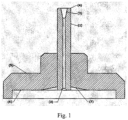
- The inventive solution in the embodiment is shown in the drawing which presents a cross-section of the capillary stabilizer.
- The capillary stabilizer according to the invention consists of a capillary 1 and a supporting element (a holder) 5. The
capillary 1 is in the form of a segment of a thick-walled tube made of borosilicate glass, which segment has a length of 49.0 mm, an outer diameter of 8.0 mm and an inner diameter of 1.5 mm. A conical-shaped widening 2 in the upper portion of thecapillary 1 is realized by means of hollow-out method, and having a diameter of its inlet portion in the range of from 4.0 to 8.0 mm, and a height in the range of from 5.0 to 10.0 mm. A conical-shaped widening 3 (extension) is made in the lower portion of thecapillary 1 and having a diameter of its base of 3.5 mm and a height of 1.0 mm, whereas achamfer 4 having a depth of 0.5 mm is made on an outer perimeter of the upper outlet of thecapillary 1. Simultaneously, thecapillary 1 is placed in a supporting element - aholder 5, that is made of plastic, such as organic glass. Theholder 5 has a cylindrical hollow recess 6 at its bottom having a diameter of 62.0 mm and a depth of 5.0 mm. Theholder 5 at its bottom underside and located around the opening through which the capillary 1 passes has a conicalhollow recess 7 with a diameter of from 25.0 to 30.0 mm and a height of from 2.0 to 3.0 mm at the point of contact to the capillary, that recess is made coaxially with the axis of theholder 5. - The
capillary 1 having an inner diameter of 1.5 mm is designed to provide the height of a liquid column over the ATR crystal in the range of from a few to several (between ten and twenty) millimeters. - Cylindrical hollow recess 6 is provided to ensure that the
capillary 1 and the ATR crystal are positioned coaxially to each other. - The conical
hollow recess 7 is provided to prevent a contact between the sample and the material of theholder 5.
Claims (9)
- Capillary stabilizer for a liquid sample, that consists of a capillary and a supporting element (a holder), characterized in that the capillary (1) is made of borosilicate glass and it has a length in the range of from 35.0 to 60.0 mm, an outer diameter in the range of from 6.5 to 10.0 mm and an inner diameter in the range of from 1.2 to 1.8 mm, wherein a widening (2) is located in the upper portion of the capillary (1), which the widening in its inlet portion has a diameter in the range of from 4.0 to 8.0 mm, and a height in the range of from 5.0 to 10.0 mm, while in the lower portion of the capillary (1) there is a widening (3) having with a diameter of its base in the range of from 3.0 to 3.5 mm and a height in the range of from 0.7 to 1.0 mm, and whereas a chamfer (4) is made on the outer perimeter of the upper outlet of the capillary (1) which chamfer (4) having a depth in the range of from 0.3 to 0.5 mm, simultaneously the capillary (1) is placed in a supporting element - holder (5).
- The capillary stabilizer for a liquid sample according to claim 1, characterized in that the capillary (1) at its upper portion has a funnel-shaped widening (2).
- The capillary stabilizer for a liquid sample according to claim 1, characterized in that the capillary (1) in its lower portion has a conical-shaped widening (3).
- The capillary stabilizer for a liquid sample according to claim 1, characterized in that the holder (5) is made of plastic.
- The capillary stabilizer for a liquid sample according to claim 4, characterized in that the plastic of which the holder (5) is made is organic glass.
- The capillary stabilizer for a liquid sample according to claim 1, characterized in that the holder (5) is made of metal.
- The capillary stabilizer for a liquid sample according to claim 6, characterized in that the metal of which the holder (5) is made is aluminum.
- The capillary stabilizer for a liquid sample according to claim 1, characterized in that the holder (5) has a cylindrical hollow recess (6) at its bottom.
- The capillary stabilizer for a liquid sample according to claim 1, characterized in that the holder (5) has a conical hollow recess (7) located at its bottom and around the opening through which the capillary (1) passes.
Applications Claiming Priority (1)
| Application Number | Priority Date | Filing Date | Title |
|---|---|---|---|
| PL441364A PL247774B1 (en) | 2022-06-03 | 2022-06-03 | Capillary liquid sample stabilizer |
Publications (3)
| Publication Number | Publication Date |
|---|---|
| EP4286831A1 true EP4286831A1 (en) | 2023-12-06 |
| EP4286831B1 EP4286831B1 (en) | 2025-02-12 |
| EP4286831C0 EP4286831C0 (en) | 2025-02-12 |
Family
ID=85158534
Family Applications (1)
| Application Number | Title | Priority Date | Filing Date |
|---|---|---|---|
| EP22213041.1A Active EP4286831B1 (en) | 2022-06-03 | 2022-12-13 | Capillary stabilizer for a liquid sample |
Country Status (2)
| Country | Link |
|---|---|
| EP (1) | EP4286831B1 (en) |
| PL (1) | PL247774B1 (en) |
Citations (3)
| Publication number | Priority date | Publication date | Assignee | Title |
|---|---|---|---|---|
| JP2001318270A (en) * | 2000-05-09 | 2001-11-16 | Nippon Electric Glass Co Ltd | Glass capillary tube |
| US7391953B2 (en) * | 2006-02-08 | 2008-06-24 | Nippon Electric Glass Co., Ltd. | Capillary tube for holding optical fiber and connecting structure for optical component |
| US8223429B2 (en) | 2006-04-26 | 2012-07-17 | Perkinelmer Singapore Pte Ltd. | Accessory for attenuated total internal reflective (ATR) spectroscopy |
Family Cites Families (5)
| Publication number | Priority date | Publication date | Assignee | Title |
|---|---|---|---|---|
| JPS63198835A (en) * | 1987-02-13 | 1988-08-17 | Jeol Ltd | Chromatographic spectrometer |
| US5581085A (en) * | 1995-03-06 | 1996-12-03 | Spectra-Tech, Inc. | Infrared microspectrometer accessory |
| GB9719673D0 (en) * | 1997-09-17 | 1997-11-19 | Glaxo Group Ltd | Novel apparatus |
| DE29824644U1 (en) * | 1997-09-17 | 2001-12-06 | Glaxo Group Ltd., Greenford, Middlesex | Device for carrying out photometric tests |
| JPH11166889A (en) * | 1997-12-04 | 1999-06-22 | St Japan:Kk | ATR crystal support structure |
-
2022
- 2022-06-03 PL PL441364A patent/PL247774B1/en unknown
- 2022-12-13 EP EP22213041.1A patent/EP4286831B1/en active Active
Patent Citations (3)
| Publication number | Priority date | Publication date | Assignee | Title |
|---|---|---|---|---|
| JP2001318270A (en) * | 2000-05-09 | 2001-11-16 | Nippon Electric Glass Co Ltd | Glass capillary tube |
| US7391953B2 (en) * | 2006-02-08 | 2008-06-24 | Nippon Electric Glass Co., Ltd. | Capillary tube for holding optical fiber and connecting structure for optical component |
| US8223429B2 (en) | 2006-04-26 | 2012-07-17 | Perkinelmer Singapore Pte Ltd. | Accessory for attenuated total internal reflective (ATR) spectroscopy |
Non-Patent Citations (1)
| Title |
|---|
| JANUS RAFAL ET AL: "A novel capillary forces-founded accessory for reliable measurements of ATR-FTIR spectra of volatile liquids", MICROCHEMICAL JOURNAL, NEW YORK, NY, US, vol. 185, 24 November 2022 (2022-11-24), XP087235381, ISSN: 0026-265X, [retrieved on 20221124], DOI: 10.1016/J.MICROC.2022.108219 * |
Also Published As
| Publication number | Publication date |
|---|---|
| EP4286831B1 (en) | 2025-02-12 |
| EP4286831C0 (en) | 2025-02-12 |
| PL441364A1 (en) | 2023-12-04 |
| PL247774B1 (en) | 2025-09-01 |
Similar Documents
| Publication | Publication Date | Title |
|---|---|---|
| CN101228433B (en) | Development of disposable/sealable tips for spectroscopic probes | |
| Gazulla et al. | High precision measurement of silicon in naphthas by ICP-OES using isooctane as diluent | |
| Rochdi et al. | Transmission micro-infrared spectroscopy: an efficient tool for microscale characterization of coal | |
| EP4286831A1 (en) | Capillary stabilizer for a liquid sample | |
| Anselmi et al. | Determination of trace elements in automotive fuels by filter furnace atomic absorption spectrometry | |
| US3861874A (en) | Total recovery thermal analysis system | |
| JP2006322841A (en) | Spectroscopic measurement method and spectrophotometer | |
| Kargioti et al. | Unraveling the origin of aged varnishes for the proper restoration of old paintings using spectroscopic and spectrometric techniques | |
| Knuutinen et al. | Wax analysis in conservation objects by solubility studies, FTIR and DSC | |
| Tuan et al. | Evaluation of the performance of various universal and selective detectors for sulfur determination in natural gas | |
| CN109313146B (en) | Sample processing equipment for pressurized fluids and their X-ray analyzer applications | |
| Ramezani et al. | Dendrimer grafted nanoporous silica fibers for headspace solid phase microextraction coupled to gas chromatography determination of solvent residues in edible oil | |
| Janus et al. | A novel capillary forces-founded accessory for reliable measurements of ATR-FTIR spectra of volatile liquids | |
| CN103149270B (en) | Method for detecting grease by utilizing ion mobility spectrometer | |
| EP0082263A1 (en) | Sample introduction for chemical analysis by spectrometry/liquid chromatography | |
| Hashimoto et al. | Determination of residual solvents in pharmaceuticals by thermal desorption-GC/MS | |
| Arzberger et al. | Fourier transform infrared spectroscopy with multivariate analysis as a novel method for characterizing alcoholic strength, density, and total dry extract in spirits and liqueurs | |
| Jeltes et al. | Gas chromatography versus infra-red spectrometry for determination of mineral oil dissolved in water | |
| Atiku et al. | FTIR spectroscopic analysis and fuel properties of wild castor (Ricinus communis L) seed oil | |
| Ali et al. | Noninvasive in situ identification and band assignments of some pharmaceutical excipients inside USP vials with FT-near-infrared spectroscopy | |
| CN108020484A (en) | A kind of method of quick measurement crude oil saturated vapor pressure | |
| CN111830166A (en) | Detection method and application of normal alkane in microcrystalline wax | |
| Lafford et al. | Near near infrared spectroscopy for quantitative and qualitative quality control | |
| US2729970A (en) | Carbonization testing apparatus | |
| DE10000738A1 (en) | Use of electronic nose for e.g. quality control and empirical characterization of foods, comprises thermally decomposing sample and producing recognizable pattern from parallel sensors |
Legal Events
| Date | Code | Title | Description |
|---|---|---|---|
| PUAI | Public reference made under article 153(3) epc to a published international application that has entered the european phase |
Free format text: ORIGINAL CODE: 0009012 |
|
| STAA | Information on the status of an ep patent application or granted ep patent |
Free format text: STATUS: THE APPLICATION HAS BEEN PUBLISHED |
|
| AK | Designated contracting states |
Kind code of ref document: A1 Designated state(s): AL AT BE BG CH CY CZ DE DK EE ES FI FR GB GR HR HU IE IS IT LI LT LU LV MC ME MK MT NL NO PL PT RO RS SE SI SK SM TR |
|
| STAA | Information on the status of an ep patent application or granted ep patent |
Free format text: STATUS: REQUEST FOR EXAMINATION WAS MADE |
|
| 17P | Request for examination filed |
Effective date: 20240604 |
|
| RBV | Designated contracting states (corrected) |
Designated state(s): AL AT BE BG CH CY CZ DE DK EE ES FI FR GB GR HR HU IE IS IT LI LT LU LV MC ME MK MT NL NO PL PT RO RS SE SI SK SM TR |
|
| GRAP | Despatch of communication of intention to grant a patent |
Free format text: ORIGINAL CODE: EPIDOSNIGR1 |
|
| STAA | Information on the status of an ep patent application or granted ep patent |
Free format text: STATUS: GRANT OF PATENT IS INTENDED |
|
| RIC1 | Information provided on ipc code assigned before grant |
Ipc: G01N 21/03 20060101ALN20240923BHEP Ipc: G01N 21/552 20140101ALN20240923BHEP Ipc: G01N 21/3577 20140101ALN20240923BHEP Ipc: B01L 9/06 20060101ALI20240923BHEP Ipc: G01N 21/01 20060101AFI20240923BHEP |
|
| INTG | Intention to grant announced |
Effective date: 20241004 |
|
| GRAS | Grant fee paid |
Free format text: ORIGINAL CODE: EPIDOSNIGR3 |
|
| GRAA | (expected) grant |
Free format text: ORIGINAL CODE: 0009210 |
|
| STAA | Information on the status of an ep patent application or granted ep patent |
Free format text: STATUS: THE PATENT HAS BEEN GRANTED |
|
| AK | Designated contracting states |
Kind code of ref document: B1 Designated state(s): AL AT BE BG CH CY CZ DE DK EE ES FI FR GB GR HR HU IE IS IT LI LT LU LV MC ME MK MT NL NO PL PT RO RS SE SI SK SM TR |
|
| REG | Reference to a national code |
Ref country code: GB Ref legal event code: FG4D |
|
| RIN1 | Information on inventor provided before grant (corrected) |
Inventor name: LEWANDOWSKI, MAREK Inventor name: WADRZYK, MARIUSZ Inventor name: JANUS, RAFAL |
|
| REG | Reference to a national code |
Ref country code: CH Ref legal event code: EP |
|
| REG | Reference to a national code |
Ref country code: DE Ref legal event code: R096 Ref document number: 602022010465 Country of ref document: DE |
|
| REG | Reference to a national code |
Ref country code: IE Ref legal event code: FG4D |
|
| U01 | Request for unitary effect filed |
Effective date: 20250225 |
|
| U07 | Unitary effect registered |
Designated state(s): AT BE BG DE DK EE FI FR IT LT LU LV MT NL PT RO SE SI Effective date: 20250304 |
|
| PG25 | Lapsed in a contracting state [announced via postgrant information from national office to epo] |
Ref country code: RS Free format text: LAPSE BECAUSE OF FAILURE TO SUBMIT A TRANSLATION OF THE DESCRIPTION OR TO PAY THE FEE WITHIN THE PRESCRIBED TIME-LIMIT Effective date: 20250512 |
|
| PG25 | Lapsed in a contracting state [announced via postgrant information from national office to epo] |
Ref country code: PL Free format text: LAPSE BECAUSE OF FAILURE TO SUBMIT A TRANSLATION OF THE DESCRIPTION OR TO PAY THE FEE WITHIN THE PRESCRIBED TIME-LIMIT Effective date: 20250212 |
|
| PG25 | Lapsed in a contracting state [announced via postgrant information from national office to epo] |
Ref country code: ES Free format text: LAPSE BECAUSE OF FAILURE TO SUBMIT A TRANSLATION OF THE DESCRIPTION OR TO PAY THE FEE WITHIN THE PRESCRIBED TIME-LIMIT Effective date: 20250212 |
|
| PG25 | Lapsed in a contracting state [announced via postgrant information from national office to epo] |
Ref country code: IS Free format text: LAPSE BECAUSE OF FAILURE TO SUBMIT A TRANSLATION OF THE DESCRIPTION OR TO PAY THE FEE WITHIN THE PRESCRIBED TIME-LIMIT Effective date: 20250612 Ref country code: NO Free format text: LAPSE BECAUSE OF FAILURE TO SUBMIT A TRANSLATION OF THE DESCRIPTION OR TO PAY THE FEE WITHIN THE PRESCRIBED TIME-LIMIT Effective date: 20250512 |
|
| PG25 | Lapsed in a contracting state [announced via postgrant information from national office to epo] |
Ref country code: HR Free format text: LAPSE BECAUSE OF FAILURE TO SUBMIT A TRANSLATION OF THE DESCRIPTION OR TO PAY THE FEE WITHIN THE PRESCRIBED TIME-LIMIT Effective date: 20250212 |
|
| PG25 | Lapsed in a contracting state [announced via postgrant information from national office to epo] |
Ref country code: GR Free format text: LAPSE BECAUSE OF FAILURE TO SUBMIT A TRANSLATION OF THE DESCRIPTION OR TO PAY THE FEE WITHIN THE PRESCRIBED TIME-LIMIT Effective date: 20250513 |
|
| PG25 | Lapsed in a contracting state [announced via postgrant information from national office to epo] |
Ref country code: SM Free format text: LAPSE BECAUSE OF FAILURE TO SUBMIT A TRANSLATION OF THE DESCRIPTION OR TO PAY THE FEE WITHIN THE PRESCRIBED TIME-LIMIT Effective date: 20250212 |
|
| PG25 | Lapsed in a contracting state [announced via postgrant information from national office to epo] |
Ref country code: CZ Free format text: LAPSE BECAUSE OF FAILURE TO SUBMIT A TRANSLATION OF THE DESCRIPTION OR TO PAY THE FEE WITHIN THE PRESCRIBED TIME-LIMIT Effective date: 20250212 |
|
| PG25 | Lapsed in a contracting state [announced via postgrant information from national office to epo] |
Ref country code: SK Free format text: LAPSE BECAUSE OF FAILURE TO SUBMIT A TRANSLATION OF THE DESCRIPTION OR TO PAY THE FEE WITHIN THE PRESCRIBED TIME-LIMIT Effective date: 20250212 |
|
| U20 | Renewal fee for the european patent with unitary effect paid |
Year of fee payment: 4 Effective date: 20251021 |
|
| PLBE | No opposition filed within time limit |
Free format text: ORIGINAL CODE: 0009261 |
|
| STAA | Information on the status of an ep patent application or granted ep patent |
Free format text: STATUS: NO OPPOSITION FILED WITHIN TIME LIMIT |
|
| 26N | No opposition filed |
Effective date: 20251113 |