EP4286471A1 - Rubber composition with elastocaloric effect - Google Patents
Rubber composition with elastocaloric effect Download PDFInfo
- Publication number
- EP4286471A1 EP4286471A1 EP23382529.8A EP23382529A EP4286471A1 EP 4286471 A1 EP4286471 A1 EP 4286471A1 EP 23382529 A EP23382529 A EP 23382529A EP 4286471 A1 EP4286471 A1 EP 4286471A1
- Authority
- EP
- European Patent Office
- Prior art keywords
- rubber
- weight
- composition
- blend
- natural rubber
- Prior art date
- Legal status (The legal status is an assumption and is not a legal conclusion. Google has not performed a legal analysis and makes no representation as to the accuracy of the status listed.)
- Granted
Links
Images


Classifications
-
- C—CHEMISTRY; METALLURGY
- C08—ORGANIC MACROMOLECULAR COMPOUNDS; THEIR PREPARATION OR CHEMICAL WORKING-UP; COMPOSITIONS BASED THEREON
- C08L—COMPOSITIONS OF MACROMOLECULAR COMPOUNDS
- C08L7/00—Compositions of natural rubber
-
- C—CHEMISTRY; METALLURGY
- C08—ORGANIC MACROMOLECULAR COMPOUNDS; THEIR PREPARATION OR CHEMICAL WORKING-UP; COMPOSITIONS BASED THEREON
- C08K—Use of inorganic or non-macromolecular organic substances as compounding ingredients
- C08K3/00—Use of inorganic substances as compounding ingredients
- C08K3/02—Elements
- C08K3/04—Carbon
-
- C—CHEMISTRY; METALLURGY
- C08—ORGANIC MACROMOLECULAR COMPOUNDS; THEIR PREPARATION OR CHEMICAL WORKING-UP; COMPOSITIONS BASED THEREON
- C08L—COMPOSITIONS OF MACROMOLECULAR COMPOUNDS
- C08L1/00—Compositions of cellulose, modified cellulose or cellulose derivatives
- C08L1/02—Cellulose; Modified cellulose
-
- C—CHEMISTRY; METALLURGY
- C08—ORGANIC MACROMOLECULAR COMPOUNDS; THEIR PREPARATION OR CHEMICAL WORKING-UP; COMPOSITIONS BASED THEREON
- C08L—COMPOSITIONS OF MACROMOLECULAR COMPOUNDS
- C08L9/00—Compositions of homopolymers or copolymers of conjugated diene hydrocarbons
- C08L9/06—Copolymers with styrene
-
- C—CHEMISTRY; METALLURGY
- C09—DYES; PAINTS; POLISHES; NATURAL RESINS; ADHESIVES; COMPOSITIONS NOT OTHERWISE PROVIDED FOR; APPLICATIONS OF MATERIALS NOT OTHERWISE PROVIDED FOR
- C09K—MATERIALS FOR MISCELLANEOUS APPLICATIONS, NOT PROVIDED FOR ELSEWHERE
- C09K5/00—Heat-transfer, heat-exchange or heat-storage materials, e.g. refrigerants; Materials for the production of heat or cold by chemical reactions other than by combustion
- C09K5/02—Materials undergoing a change of physical state when used
-
- F—MECHANICAL ENGINEERING; LIGHTING; HEATING; WEAPONS; BLASTING
- F25—REFRIGERATION OR COOLING; COMBINED HEATING AND REFRIGERATION SYSTEMS; HEAT PUMP SYSTEMS; MANUFACTURE OR STORAGE OF ICE; LIQUEFACTION SOLIDIFICATION OF GASES
- F25D—REFRIGERATORS; COLD ROOMS; ICE-BOXES; COOLING OR FREEZING APPARATUS NOT OTHERWISE PROVIDED FOR
- F25D29/00—Arrangement or mounting of control or safety devices
-
- Y—GENERAL TAGGING OF NEW TECHNOLOGICAL DEVELOPMENTS; GENERAL TAGGING OF CROSS-SECTIONAL TECHNOLOGIES SPANNING OVER SEVERAL SECTIONS OF THE IPC; TECHNICAL SUBJECTS COVERED BY FORMER USPC CROSS-REFERENCE ART COLLECTIONS [XRACs] AND DIGESTS
- Y02—TECHNOLOGIES OR APPLICATIONS FOR MITIGATION OR ADAPTATION AGAINST CLIMATE CHANGE
- Y02B—CLIMATE CHANGE MITIGATION TECHNOLOGIES RELATED TO BUILDINGS, e.g. HOUSING, HOUSE APPLIANCES OR RELATED END-USER APPLICATIONS
- Y02B10/00—Integration of renewable energy sources in buildings
-
- Y—GENERAL TAGGING OF NEW TECHNOLOGICAL DEVELOPMENTS; GENERAL TAGGING OF CROSS-SECTIONAL TECHNOLOGIES SPANNING OVER SEVERAL SECTIONS OF THE IPC; TECHNICAL SUBJECTS COVERED BY FORMER USPC CROSS-REFERENCE ART COLLECTIONS [XRACs] AND DIGESTS
- Y02—TECHNOLOGIES OR APPLICATIONS FOR MITIGATION OR ADAPTATION AGAINST CLIMATE CHANGE
- Y02B—CLIMATE CHANGE MITIGATION TECHNOLOGIES RELATED TO BUILDINGS, e.g. HOUSING, HOUSE APPLIANCES OR RELATED END-USER APPLICATIONS
- Y02B30/00—Energy efficient heating, ventilation or air conditioning [HVAC]
Definitions
- the present invention relates to a rubber-based composition having elastocaloric properties. It also relates to the method for obtaining the composition and to the use thereof in different applications.
- compositions having 20% by weight of particles of rubber waste (consisting of ground tyre rubber) in a natural rubber matrix which maintains and even slightly improves heat exchange.
- EP2476657 A1 describes compositions and methods for obtaining an asphalt blend comprising an elasticity-increasing agent which can be, among others, a natural rubber powder and recycled rubber powder blend.
- CA2104344A1 describes plastic particles having a sulfonated layer. These plastic particles can be of natural or recycled rubber, and can even be embedded in a cellulose matrix, for example.
- WO2020247663A describes a method for preparing a composite from a solid elastomer, which can be natural rubber, and it can contain filler materials such as nanocellulose, among others.
- the present invention describes a composition that is an alternative to the compositions known and described in the state of the art with improved properties, specifically in relation to the elastocaloric effect.
- the present invention describes a composition comprising a natural rubber (NR), rubber waste, and cellulose nanocrystal (CNC) blend.
- NR natural rubber
- CNC cellulose nanocrystal
- the present invention describes a method for obtaining a composition which comprises: a) masticating natural rubber in a mixer; b) adding rubber waste and cellulose nanocrystal powder to the masticated natural rubber, obtaining a first blend; c) adding a vulcanising agent to the first blend obtained in step b), obtaining a second blend; and d) vulcanising the second blend obtained in step c).
- the present invention describes the use of the composition referred to herein for heating or cooling buildings.
- composition according to the present invention is defined as described in the present description.
- composition according to the present invention comprises a natural rubber, rubber waste, and cellulose nanocrystal blend, wherein the rubber waste is preferably ground tyre rubber.
- the ground tyre rubber preferably comprises a natural rubber, styrene-butadiene rubber, and carbon black blend.
- the natural rubber in the ground tyre rubber is in an amount of between 30% and 60% by weight with respect to the total ground tyre rubber by weight, preferably between 35% and 55%.
- the styrene-butadiene rubber in the ground tyre rubber is in an amount of between 1% and 15% by weight with respect to the total ground tyre rubber by weight, preferably between 5% and 10%.
- the carbon black in the ground tyre rubber is in an amount of between 30% and 60% by weight with respect to the total ground tyre rubber by weight, preferably between 35% and 55%.
- composition according to the present invention may further comprise hydroxylamine.
- the hydroxylamine is in an amount of between 0.01% and 0.5% by weight with respect to the total weight of the composition, preferably between 0.05% and 0.25%.
- the natural rubber of the composition preferably has a Mooney viscosity at 100°C of between 40 and 80, preferably between 45 and 70.
- the natural rubber present in the composition according to the present invention is preferably in an amount of between 40% and 70% by weight with respect to the total composition, preferably between 45% and 65%.
- the rubber waste present in the composition according to the present invention is preferably in an amount of between 15% and 45% by weight with respect to the total composition, preferably between 20% and 40%.
- the cellulose nanocrystals present in the composition according to the present invention are preferably in an amount of between 0.1% and 20% by weight with respect to the total weight of the composition, preferably between 1% and 15%.
- the cellulose nanocrystals preferably comprise cellulose sulphate sodium salt.
- the cellulose nanocrystals also referred to as nanocellulose, are cellulose-derived nanomaterials. Specifically, they are rigid, rod-shaped particles formed by segments of cellulose chain in an almost perfect crystalline structure.
- the present invention also describes a method for obtaining a composition which comprises the following steps: a) masticating natural rubber in a mixer; b) adding rubber waste and cellulose nanocrystal powder to the masticated natural rubber, obtaining a first blend; c) adding a vulcanising agent to the first blend obtained in step b), obtaining a second blend; d) vulcanising the second blend obtained in step c); wherein step a) is preferably performed at a temperature of between 70°C and 130°C.
- the masticating step a) is preferably performed for a time comprised between 1 and 10 minutes; preferably under rotation of between 10 and 60 rpm, preferably between 20 and 50 rpm, preferably 40 rpm.
- step of adding rubber waste and cellulose nanocrystal powder to the masticated natural rubber b) is preferably performed for a time comprised between 1 and 10 minutes; and step c) of adding a vulcanising agent to the first blend obtained in step b) is preferably performed for a time comprised between 1 and 10 minutes.
- Step d) of vulcanising the second blend obtained in step c) is preferably performed at a temperature of between 150°C and 200°C. This step is performed at a high pressure, greater than atmospheric pressure, preferably between 2 and 6 MPa.
- the vulcanising agent is dicumyl peroxide. Other alternatives can be sulphur.
- the vulcanising agent is added in step d) in an amount of between 0.5% and 3% by weight with respect to the total weight of the natural rubber described in step a).
- the present invention also describes the use of the composition herein described for heating or cooling buildings, utilising the elastocaloric properties of the composition.
- the natural rubber (NR) of this study is SMR (Standard Malaysian Rubber) CV60 (Mooney viscosity ML 1+4, 100°C: 55-60) provided by the company Akrochem (USA) with 0.15% by weight of hydroxylamine added in the latex stage to prevent the raw rubber from hardening while being stored.
- GTR Ground tyre rubber
- the GTR is made up of 55% by weight of rubber (85% by weight of natural rubber (NR) and 15% by weight of styrene butadiene rubber (SBR) and 45% by weight of carbon black. GTR crumbs are free of contaminants such as fabrics, metal, and road grime.
- GTR particles were first sieved with a shaking sieve (Analysette 3, Germany) with a 120 mesh (measurement ⁇ 125 ⁇ m). Before processing, GTR particles were dried overnight in a vacuum oven (Vaciotem-TV, J.P. SELECTA ® , Spain) to prevent moisture absorption, on a silica gel at 70°C in order to remove any moisture.
- CNCs are a white-coloured dry solid powder provided by CelluForce NCCTM. Its chemical name is cellulose sulphate sodium salt (NaCS) obtained by means of the sulphation method.
- NaCS cellulose sulphate sodium salt
- the CNCs have a density of 0.7 g.mol-1. The CNCs were stored at room temperature in a cool, dry, and ventilated place before use.
- the natural rubber was masticated inside the chamber of an internal mixer (Brabender Plastic-Corder W50EHT, Brabender GmbH & Co., Germany) at a temperature of 100°C for 5 minutes and at a rotational speed of 40 rpm. After masticating for 10 minutes, 1.5% by weight of dicumyl peroxide (DCP) was added, and mixing continued for 5 minutes. During the blending stage in the internal mixer (Brabender), torque was measured as a function of mixing time using the WinMix Brabender Mixer software.
- DCP dicumyl peroxide
- the blend containing NR and DCP was hot vulcanised according to the optimal time estimated at 170°C and 4 MPa.
- dogbone-shaped specimens that were 1 mm thick, 4 mm wide, and 15 mm long were extracted from the hot moulded sheets by means of die-cutting with a specimen preparation punching machine (CEAST).
- the natural rubber was masticated inside the chamber of an internal mixer (Brabender Plastic-Corder W50EHT, Brabender GmbH & Co., Germany) at a temperature of 100°C for 5 minutes and at a rotational speed of 40 rpm. After masticating for 5 minutes, GTR particles were added in a content varying from 10 to 40% by weight. After another 5 minutes, the vulcanising agent dicumyl peroxide (DCP) (1.5% by weight of the NR fraction) was added and mixed for 5 minutes. During each blending stage in the internal mixer (Brabender), torque was measured as a function of mixing time using the WinMix Brabender Mixer software, as shown in FIG. 1 .
- DCP dicumyl peroxide
- Example 7 Preparation of vulcanised natural rubber/ground tyre rubber (vulcanised NR/GTR) blends
- the blend containing NR, GTR, and DCP was vulcanised according to the optimal time estimated at 170°C under 4 MPa.
- dogbone-shaped specimens of 1 mm thick, 4 mm wide, and 15 mm long were extracted from hot moulded sheets by means of die-cutting with a specimen preparation punching machine (CEAST).
- the natural rubber was masticated inside the chamber of an internal mixer (Brabender Plastic-Corder W50EHT, Brabender GmbH & Co., Germany) at a temperature of 100°C for 5 minutes and at a rotational speed of 40 rpm. After masticatng for 5 minutes, CNC powder was added in a content varying from 1 to 10% by weight. After another 5 minutes, the vulcanising agent dicumyl peroxide (DCP) (1.5% by weight of the NR fraction) was added and mixed for 5 minutes. During each blending stage in the internal mixer (Brabender), torque was measured as a function of mixing time using the WinMix Brabender Mixer software, as shown in FIG. 2 .
- DCP dicumyl peroxide
- Example 9 Preparation of vulcanised natural rubber/rubber waste (vulcanised NRICNC) blends
- the blend containing NR, CNCs, and DCP prepared according to the method explained in Example 7 was then vulcanised according to the optimal time estimated at 170°C under 4 MPa, following the method described in Example 5.
- Example 10 Preparation of natural rubber, ground tyre rubber, and cellulose nanocrystal (NRIGTRICNC) blends
- the natural rubber was masticated inside the chamber of an internal mixer (Brabender Plastic-Corder W50EHT, Brabender GmbH & Co., Germany) at a temperature of 100°C for 5 minutes and at a rotational speed of 40 rpm. After masticating for 5 minutes, GTR particles and CNC powder were added in a content varying from 10 to 40% by weight and from 1 to 10% by weight, respectively. After another 5 minutes, the vulcanising agent dicumyl peroxide (DCP) (1.5% by weight of the NR fraction) was added and mixed for 5 minutes. During each blending stage in the internal mixer (Brabender), torque was measured as a function of mixing time using the WinMix Brabender Mixer software, as shown in FIG. 3 .
- DCP dicumyl peroxide
- Example 11 Preparation of vulcanised natural rubber/ground tyre rubber/cellulose nanocrystal (vulcanised NR/GTR/CNC) blends
- the blend containing NR, GTR, CNCs, and DCP prepared according to the method explained in Example 10 was then vulcanised according to the optimal time estimated at 170°C under 4 MPa, following the method described in Example 5.
- Example 12 Elastocaloric properties of the vulcanised natural rubber
- the vulcanised natural rubber (vulcanised NR) was mechanically deformed at room temperature by means of a uniaxial traction test performed on a Zwick/Roell universal testing machine (Z005) equipped with a 5 kN force sensor.
- the crosshead speed during the loading and unloading phases was chosen to be equal to 3000 mm/min, which corresponds to a nominal strain rate of 2 ⁇ 10 2 min-' according to the dimensions of the specimen (15 mm in length).
- the rubber samples were stretched to 500% strain, followed by a relaxation phase in the strained stated for one minute. After the relaxation stage, the specimens were unloaded with the same nominal strain rate of 2 ⁇ 10 2 min -1 to the relaxed state (zero force), followed by another relaxation for one more minute.
- FIG. 4 shows the temperature of the surface measured during the four phases of the test.
- the temperature on the surface of the sample increases during the loading phase, particularly from 300% strain onwards, which is attributed to the capacity of the vulcanised natural rubber to undergo strain-induced crystallisation associated with heating of more than 4°C due to the exothermic character thereof (latent heat from phase transition).
- the temperature on the surface of the sample decreases gradually to room temperature after 1 minute of relaxation. Rapid unloading gives rise to cooling of more than 6°C with respect to room temperature. This is due to the melting of the crystalline phase previously formed during loading and is associated with an endothermic behaviour due to the latent heat from melting.
- Example 13 Elastocaloric properties of the vulcanised natural rubber/ground tyre rubber blends (vulcanised NR/GTR)
- the vulcanised natural rubber/ground tyre rubber (vulcanised NR/GTR) blend the preparation of which was described in Example 6 and Example 7 were mechanically deformed at room temperature by means of uniaxial traction tests performed on the same universal testing machine described in Example 12.
- the loading phase performed until failure is associated with an increase of the temperature on the surface of the sample.
- the increase of temperature was greater as the amount of ground tyre rubber particles increases, and the increase of temperature measured right before failure shows a maximum of 6.6°C for the vulcanised NR/GTR33 blend.
- the increase of temperature with GTR particles is attributed to the strain being localised in the natural rubber matrix, due to the presence of reinforcement carbon black fillers in GTR particles, which gives rise to a nucleating effect in the strain-induced crystallisation, which occurs at a lower strain, and therefore favours the associated elastocaloric effect.
- the vulcanised natural rubber/ground tyre rubber (vulcanised NR/GTR) blends were subjected to mechanical cycles.
- the temperature span is the maximum temperature difference measured between heating (loading) and cooling (unloading).
- the temperature span increases as the GTR content increases from 0 to 40% by weight. This is likely due to the heating/cooling capacity during the loading/cooling associated with the elastocaloric properties of theses blends, reinforced by the nucleating effect, as described above in FIG. 5 .
- the diffusion time is the time needed for the temperature on the surface of the sample to return to room temperature during the relaxation stage.
- Two cases are studied: (i) relaxation after a rapid loading and (ii) relaxation after a rapid unloading. In both cases, the thermal diffusion time is reduced in the presence of GTR, which is likely due to the greater thermal conductivity of the vulcanised NR/GTR blends compared to vulcanised NR blends, due to their carbon black particle content, as shown in FIG. 6 .
- Example 14 Elastocaloric properties of vulcanised natural rubber/cellulose nanocrystals (vulcanised NRICNC) blends
- vulcanised natural rubber/cellulose nanocrystal (vulcanised NR/CNC) blends the preparation of which was described in Example 8 and Example 9 were mechanically deformed at room temperature by means of uniaxial traction tests performed on the same universal testing machine described in Example 12. It was found that the maximum heating/cooling measured during loading/unloading increased from vulcanised NR to vulcanised NR/CNC1 blend, the temperature span of which is the maximum found for that blend, with a value of 11°C compared to 9.6°C for vulcanised NR.
- CNCs are reinforcement fillers which localise strain in the rubber matrix, and therefore accelerate strain-induced crystallisation.
- the thermal diffusion time decreases from 60 s to 45 s between vulcanised NR and vulcanised NR/CNC1 for relaxed samples in the strained state, and from 24 s to 20 s for relaxed samples in the unstrained state.
- this is expected to be due to the greater thermal conductivity of CNCs due to their crystalline nature, favouring heat transport.
- This effect can also be enhanced in the strained state, likely due to the orientation of the fibres along the stretching axis. No other significant effect is observed in both the temperature span and the diffusion time when the CNC content is increased from 1 to 5% by weight, which is likely due to an inefficient dispersion of CNCs in the NR matrix.
- the preparation of blends containing concomitantly GTR and CNC particles can be used to increase shear force during blending and to limit the possible undesired aggregation of CNC particles, as shown in FIG. 7 .
- Example 15 Elastocaloric properties of the vulcanised natural rubber/ground tyre rubber/cellulose nanocrystal blends
- the vulcanised natural rubber/ground tyre rubber/cellulose nanocrystals (NR/GTR/CNCs) the preparation of which was described in Example 10 and Example 11 was mechanically deformed at room temperature by means of uniaxial traction tests performed on the same universal testing machine described in Example 12.
- the increase of temperature during loading of the rubber samples is shown in FIG. 8 . It is observed that the increase of temperature of the series of vulcanised NR/GTR33/CNC blend first decreases by adding 1% by weight of CNC (NR/GTR33/CNC1), but then increases with higher contents, reaching 7.6°C for a CNC content of 10% by weight.
- the thermal diffusion time after loading decreases constantly upon adding CNC to the vulcanised NR/GTR40 blend until reaching a minimum of 42 s for vulcanised NR/GTR40/CNC10 blend ( FIG. 9 ). Like for heating during the loading phase, a synergistic effect on the reduction of thermal diffusion time in the strained state is observed. The same ratios as those set forth in FIG. 8 can be used. The impact of CNC on thermal diffusion is less evident in the unloaded state, since it is likely that the fibres are oriented randomly, so a specific direction of the thermal trajectory cannot be used to promote heat transport.
- the fine dispersion of CNC particles can be used to prevent the reaggregation of GTR particles during the curing stage.
- These two mechanisms are expected to promote the dispersion of both GTR and CNC while they are used simultaneously, particularly when compared with NR/CNC or NR/GTR blend.
Landscapes
- Chemical & Material Sciences (AREA)
- Chemical Kinetics & Catalysis (AREA)
- Organic Chemistry (AREA)
- Health & Medical Sciences (AREA)
- Engineering & Computer Science (AREA)
- Polymers & Plastics (AREA)
- Medicinal Chemistry (AREA)
- Combustion & Propulsion (AREA)
- Thermal Sciences (AREA)
- Physics & Mathematics (AREA)
- Materials Engineering (AREA)
- General Engineering & Computer Science (AREA)
- Mechanical Engineering (AREA)
- Compositions Of Macromolecular Compounds (AREA)
- Processes Of Treating Macromolecular Substances (AREA)
Abstract
Description
- The present invention relates to a rubber-based composition having elastocaloric properties. It also relates to the method for obtaining the composition and to the use thereof in different applications.
- Sustainable energy and material recycling are two fundamental issues that seek to contribute to reducing the environmental impact of energy and material production. Sustainable energy is developed in response to the growing demand to regulate the surface temperature of the planet without increasing greenhouse gas emissions. Caloric materials have promising properties which can contribute to achieving this objective. These materials are solids that can exchange heat from the environment, including cooling and refrigeration applications. However, conventional caloric materials use rare earth-based materials, which are not only expensive, but also prone to supply shortages.
- To overcome this problem, there is a need to conduct research on innovative solutions that allow efficient commercial application, while addressing current economic and ecological concerns at the same time.
- The scientific article by Candau et al., Polymer 236 (2021) 124309, discloses vulcanised natural rubber and rubber waste blends, as well as the elastocaloric properties of these blends. In particular, this document discloses compositions having 20% by weight of particles of rubber waste (consisting of ground tyre rubber) in a natural rubber matrix which maintains and even slightly improves heat exchange.
- There are also several patent applications in the literature which describe natural rubber and recycled rubber blends for various applications, without mentioning the elastocaloric effect.
- For example,
EP2476657 A1 describes compositions and methods for obtaining an asphalt blend comprising an elasticity-increasing agent which can be, among others, a natural rubber powder and recycled rubber powder blend. - Furthermore,
CA2104344A1 describes plastic particles having a sulfonated layer. These plastic particles can be of natural or recycled rubber, and can even be embedded in a cellulose matrix, for example. - Other documents also describe obtaining various composites based on rubber and other additives, although the elastocaloric effect associated with said materials is not mentioned either.
- For example,
WO2020247663A describes a method for preparing a composite from a solid elastomer, which can be natural rubber, and it can contain filler materials such as nanocellulose, among others. - The present invention describes a composition that is an alternative to the compositions known and described in the state of the art with improved properties, specifically in relation to the elastocaloric effect.
- In a first aspect, the present invention describes a composition comprising a natural rubber (NR), rubber waste, and cellulose nanocrystal (CNC) blend.
- In a second aspect, the present invention describes a method for obtaining a composition which comprises: a) masticating natural rubber in a mixer; b) adding rubber waste and cellulose nanocrystal powder to the masticated natural rubber, obtaining a first blend; c) adding a vulcanising agent to the first blend obtained in step b), obtaining a second blend; and d) vulcanising the second blend obtained in step c).
- In a third aspect, the present invention describes the use of the composition referred to herein for heating or cooling buildings.
- Other features of the invention will become evident in the following detailed description.
-
-
FIG. 1 shows the torque as a function of time for NR/GTR10, NR/GTR20, NR/GTR33, and NR/GTR40 blends (10, 20, 33, and 40 refer to the % by weight of GTR in the blend). Data on the vertical axis has been shifted upwards with an increase of 10 Nm for the sake of clarity. -
FIG. 2 shows the torque as a function of time for NR, NR/CNC1, NR/CNC3, and NR/CNC5 blends (1, 3, and 5 refer to the % by weight of CNC in the blend). Data on the vertical axis has been shifted upwards with an increase of 10 Nm for the sake of clarity. -
FIG. 3 shows the torque as a function of time for NR/GTR40, NR/GTR40/CNC1, NR/GTR40/CNC5, and NR/GTR40/CNC10 blends (GTR40 refers to the % of GTR in the blend, whereas CNC1, 5 and 10 refer to the % by weight of CNC in the blend). Data on the vertical axis has been shifted upwards with an increase of 10 Nm for the sake of clarity. -
FIG. 4 shows the temperature on the surface of a vulcanised natural rubber during a traction cycle as a function of deformation (%) and as a function of time (seconds). -
FIG. 5 shows the increase of the temperature on the surface of the sample during the simple loading of an NR, NR/GTR10, NR/GTR20, NR/GTR33, and NR/GTR40. -
FIG. 6 shows the thermal diffusion time after loading and unloading during the cyclical test of an NR, NR/GTR40, NR/GTR40/CNC1, NR/GTR40/CNC5, and NR/GTR40/CNC10. -
FIG. 7 shows the changes in temperature measured after loading, unloading, the temperature span, and the diffusion time after loading and after unloading as a function of the weight fraction of the CNC. -
FIG. 8 shows the increase of the temperature on the surface of the sample during the sole loading of an NR, NR/GTR33, NR/GTR33/CNC1, NR/GTR33/CNC5, and NR/GTR33/CNC10. -
FIG. 9 shows the thermal diffusion time after loading and unloading during the cyclical test of an NR, NR/GTR33, NR/GTR33/CNC1, NR/GTR33/CNC5, and NR/GTR33/CNC10. -
FIG. 10 shows the temperature span on the surface of the sample during the cyclic loading of an NR, NR/GTR40, NR/GTR40/CNC1, NR/GTR40/CNC5, and NR/GTR40/CNC10. -
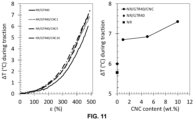
FIG. 11 shows the increase of the temperature on the surface of the sample during the sole loading of an NR, NR/GTR40, NR/GTR40/CNC1, NR/GTR40/CNC5, and NR/GTR40/CNC10. - The composition according to the present invention is defined as described in the present description.
- Unless otherwise indicated, all the percentages relative to the content of an element or to a set of elements refer to percentage by weight with respect to the total weight of the composition.
- It will also be understood that the extreme values of any offered range of values may not be optimal and may require adaptations of the invention so that said extreme values are applicable, said adaptations being within the reach of a person skilled in the art.
- The composition according to the present invention comprises a natural rubber, rubber waste, and cellulose nanocrystal blend, wherein the rubber waste is preferably ground tyre rubber.
- The ground tyre rubber, according to the present invention, preferably comprises a natural rubber, styrene-butadiene rubber, and carbon black blend.
- Preferably, the natural rubber in the ground tyre rubber is in an amount of between 30% and 60% by weight with respect to the total ground tyre rubber by weight, preferably between 35% and 55%.
- Preferably, the styrene-butadiene rubber in the ground tyre rubber is in an amount of between 1% and 15% by weight with respect to the total ground tyre rubber by weight, preferably between 5% and 10%.
- Preferably, the carbon black in the ground tyre rubber is in an amount of between 30% and 60% by weight with respect to the total ground tyre rubber by weight, preferably between 35% and 55%.
- Furthermore, the composition according to the present invention may further comprise hydroxylamine.
- Preferably, the hydroxylamine is in an amount of between 0.01% and 0.5% by weight with respect to the total weight of the composition, preferably between 0.05% and 0.25%.
- The natural rubber of the composition preferably has a Mooney viscosity at 100°C of between 40 and 80, preferably between 45 and 70.
- Furthermore, the natural rubber present in the composition according to the present invention is preferably in an amount of between 40% and 70% by weight with respect to the total composition, preferably between 45% and 65%.
- The rubber waste present in the composition according to the present invention is preferably in an amount of between 15% and 45% by weight with respect to the total composition, preferably between 20% and 40%.
- The cellulose nanocrystals present in the composition according to the present invention are preferably in an amount of between 0.1% and 20% by weight with respect to the total weight of the composition, preferably between 1% and 15%.
- The cellulose nanocrystals preferably comprise cellulose sulphate sodium salt.
- The cellulose nanocrystals, also referred to as nanocellulose, are cellulose-derived nanomaterials. Specifically, they are rigid, rod-shaped particles formed by segments of cellulose chain in an almost perfect crystalline structure.
- The present invention also describes a method for obtaining a composition which comprises the following steps: a) masticating natural rubber in a mixer; b) adding rubber waste and cellulose nanocrystal powder to the masticated natural rubber, obtaining a first blend; c) adding a vulcanising agent to the first blend obtained in step b), obtaining a second blend; d) vulcanising the second blend obtained in step c); wherein step a) is preferably performed at a temperature of between 70°C and 130°C.
- Furthermore, the masticating step a) is preferably performed for a time comprised between 1 and 10 minutes; preferably under rotation of between 10 and 60 rpm, preferably between 20 and 50 rpm, preferably 40 rpm.
- The step of adding rubber waste and cellulose nanocrystal powder to the masticated natural rubber b) is preferably performed for a time comprised between 1 and 10 minutes; and step c) of adding a vulcanising agent to the first blend obtained in step b) is preferably performed for a time comprised between 1 and 10 minutes.
- Step d) of vulcanising the second blend obtained in step c) is preferably performed at a temperature of between 150°C and 200°C. This step is performed at a high pressure, greater than atmospheric pressure, preferably between 2 and 6 MPa. Preferably, the vulcanising agent is dicumyl peroxide. Other alternatives can be sulphur.
- Generally, the vulcanising agent is added in step d) in an amount of between 0.5% and 3% by weight with respect to the total weight of the natural rubber described in step a).
- The present invention also describes the use of the composition herein described for heating or cooling buildings, utilising the elastocaloric properties of the composition.
- The natural rubber (NR) of this study is SMR (Standard Malaysian Rubber) CV60 (
Mooney viscosity ML 1+4, 100°C: 55-60) provided by the company Akrochem (USA) with 0.15% by weight of hydroxylamine added in the latex stage to prevent the raw rubber from hardening while being stored. - Ground tyre rubber (GTR) was provided by the company J. Allock & Sons (United Kingdom) using the transformation of the tyre polish into finer rubber crumbs by means of a controlled cryo-milling. The GTR is made up of 55% by weight of rubber (85% by weight of natural rubber (NR) and 15% by weight of styrene butadiene rubber (SBR) and 45% by weight of carbon black. GTR crumbs are free of contaminants such as fabrics, metal, and road grime. GTR particles were first sieved with a shaking sieve (
Analysette 3, Germany) with a 120 mesh (measurement <125 µm). Before processing, GTR particles were dried overnight in a vacuum oven (Vaciotem-TV, J.P. SELECTA®, Spain) to prevent moisture absorption, on a silica gel at 70°C in order to remove any moisture. - Cellulose nanocrystals (CNCs) are a white-coloured dry solid powder provided by CelluForce NCCTM. Its chemical name is cellulose sulphate sodium salt (NaCS) obtained by means of the sulphation method. The CNCs have a density of 0.7 g.mol-1. The CNCs were stored at room temperature in a cool, dry, and ventilated place before use.
- The natural rubber was masticated inside the chamber of an internal mixer (Brabender Plastic-Corder W50EHT, Brabender GmbH & Co., Germany) at a temperature of 100°C for 5 minutes and at a rotational speed of 40 rpm. After masticating for 10 minutes, 1.5% by weight of dicumyl peroxide (DCP) was added, and mixing continued for 5 minutes. During the blending stage in the internal mixer (Brabender), torque was measured as a function of mixing time using the WinMix Brabender Mixer software.
- The blend containing NR and DCP was hot vulcanised according to the optimal time estimated at 170°C and 4 MPa. To perform the traction tests, dogbone-shaped specimens that were 1 mm thick, 4 mm wide, and 15 mm long were extracted from the hot moulded sheets by means of die-cutting with a specimen preparation punching machine (CEAST).
- The natural rubber was masticated inside the chamber of an internal mixer (Brabender Plastic-Corder W50EHT, Brabender GmbH & Co., Germany) at a temperature of 100°C for 5 minutes and at a rotational speed of 40 rpm. After masticating for 5 minutes, GTR particles were added in a content varying from 10 to 40% by weight. After another 5 minutes, the vulcanising agent dicumyl peroxide (DCP) (1.5% by weight of the NR fraction) was added and mixed for 5 minutes. During each blending stage in the internal mixer (Brabender), torque was measured as a function of mixing time using the WinMix Brabender Mixer software, as shown in
FIG. 1 . - The blend containing NR, GTR, and DCP was vulcanised according to the optimal time estimated at 170°C under 4 MPa. To perform the traction test, dogbone-shaped specimens of 1 mm thick, 4 mm wide, and 15 mm long were extracted from hot moulded sheets by means of die-cutting with a specimen preparation punching machine (CEAST).
- The natural rubber was masticated inside the chamber of an internal mixer (Brabender Plastic-Corder W50EHT, Brabender GmbH & Co., Germany) at a temperature of 100°C for 5 minutes and at a rotational speed of 40 rpm. After masticatng for 5 minutes, CNC powder was added in a content varying from 1 to 10% by weight. After another 5 minutes, the vulcanising agent dicumyl peroxide (DCP) (1.5% by weight of the NR fraction) was added and mixed for 5 minutes. During each blending stage in the internal mixer (Brabender), torque was measured as a function of mixing time using the WinMix Brabender Mixer software, as shown in
FIG. 2 . - The blend containing NR, CNCs, and DCP prepared according to the method explained in Example 7 was then vulcanised according to the optimal time estimated at 170°C under 4 MPa, following the method described in Example 5.
- The natural rubber was masticated inside the chamber of an internal mixer (Brabender Plastic-Corder W50EHT, Brabender GmbH & Co., Germany) at a temperature of 100°C for 5 minutes and at a rotational speed of 40 rpm. After masticating for 5 minutes, GTR particles and CNC powder were added in a content varying from 10 to 40% by weight and from 1 to 10% by weight, respectively. After another 5 minutes, the vulcanising agent dicumyl peroxide (DCP) (1.5% by weight of the NR fraction) was added and mixed for 5 minutes. During each blending stage in the internal mixer (Brabender), torque was measured as a function of mixing time using the WinMix Brabender Mixer software, as shown in
FIG. 3 . - The blend containing NR, GTR, CNCs, and DCP prepared according to the method explained in Example 10 was then vulcanised according to the optimal time estimated at 170°C under 4 MPa, following the method described in Example 5.
- The vulcanised natural rubber (vulcanised NR) was mechanically deformed at room temperature by means of a uniaxial traction test performed on a Zwick/Roell universal testing machine (Z005) equipped with a 5 kN force sensor. The crosshead speed during the loading and unloading phases was chosen to be equal to 3000 mm/min, which corresponds to a nominal strain rate of 2 × 10² min-' according to the dimensions of the specimen (15 mm in length). The rubber samples were stretched to 500% strain, followed by a relaxation phase in the strained stated for one minute. After the relaxation stage, the specimens were unloaded with the same nominal strain rate of 2 × 10² min-1 to the relaxed state (zero force), followed by another relaxation for one more minute. The temperature field on the front face of the samples were recorded by means of an infrared chamber (InfraTech ImageIR® 8800) equipped with a MCT detector with a temperature resolution at 30°C exceeding 0.035 K.
FIG. 4 shows the temperature of the surface measured during the four phases of the test. - The temperature on the surface of the sample increases during the loading phase, particularly from 300% strain onwards, which is attributed to the capacity of the vulcanised natural rubber to undergo strain-induced crystallisation associated with heating of more than 4°C due to the exothermic character thereof (latent heat from phase transition). The temperature on the surface of the sample decreases gradually to room temperature after 1 minute of relaxation. Rapid unloading gives rise to cooling of more than 6°C with respect to room temperature. This is due to the melting of the crystalline phase previously formed during loading and is associated with an endothermic behaviour due to the latent heat from melting.
- The vulcanised natural rubber/ground tyre rubber (vulcanised NR/GTR) blend the preparation of which was described in Example 6 and Example 7 were mechanically deformed at room temperature by means of uniaxial traction tests performed on the same universal testing machine described in Example 12. The loading phase performed until failure is associated with an increase of the temperature on the surface of the sample. The increase of temperature was greater as the amount of ground tyre rubber particles increases, and the increase of temperature measured right before failure shows a maximum of 6.6°C for the vulcanised NR/GTR33 blend. The increase of temperature with GTR particles is attributed to the strain being localised in the natural rubber matrix, due to the presence of reinforcement carbon black fillers in GTR particles, which gives rise to a nucleating effect in the strain-induced crystallisation, which occurs at a lower strain, and therefore favours the associated elastocaloric effect.
- The vulcanised natural rubber/ground tyre rubber (vulcanised NR/GTR) blends were subjected to mechanical cycles. The temperature span is the maximum temperature difference measured between heating (loading) and cooling (unloading). The temperature span increases as the GTR content increases from 0 to 40% by weight. This is likely due to the heating/cooling capacity during the loading/cooling associated with the elastocaloric properties of theses blends, reinforced by the nucleating effect, as described above in
FIG. 5 . - The diffusion time is the time needed for the temperature on the surface of the sample to return to room temperature during the relaxation stage. Two cases are studied: (i) relaxation after a rapid loading and (ii) relaxation after a rapid unloading. In both cases, the thermal diffusion time is reduced in the presence of GTR, which is likely due to the greater thermal conductivity of the vulcanised NR/GTR blends compared to vulcanised NR blends, due to their carbon black particle content, as shown in
FIG. 6 . - The vulcanised natural rubber/cellulose nanocrystal (vulcanised NR/CNC) blends the preparation of which was described in Example 8 and Example 9 were mechanically deformed at room temperature by means of uniaxial traction tests performed on the same universal testing machine described in Example 12. It was found that the maximum heating/cooling measured during loading/unloading increased from vulcanised NR to vulcanised NR/CNC1 blend, the temperature span of which is the maximum found for that blend, with a value of 11°C compared to 9.6°C for vulcanised NR. This increase is expected to be due to a nucleating effect of the CNCs on strain-induced crystallisation in the natural rubber matrix, from which the elastocaloric effect primarily originates (both for heating and for cooling). In fact, like in the case of GTR particles containing carbon black, CNCs are reinforcement fillers which localise strain in the rubber matrix, and therefore accelerate strain-induced crystallisation.
- The thermal diffusion time decreases from 60 s to 45 s between vulcanised NR and vulcanised NR/CNC1 for relaxed samples in the strained state, and from 24 s to 20 s for relaxed samples in the unstrained state. Like in the case of GTR particles, this is expected to be due to the greater thermal conductivity of CNCs due to their crystalline nature, favouring heat transport. This effect can also be enhanced in the strained state, likely due to the orientation of the fibres along the stretching axis. No other significant effect is observed in both the temperature span and the diffusion time when the CNC content is increased from 1 to 5% by weight, which is likely due to an inefficient dispersion of CNCs in the NR matrix. Hereafter, the preparation of blends containing concomitantly GTR and CNC particles can be used to increase shear force during blending and to limit the possible undesired aggregation of CNC particles, as shown in
FIG. 7 . - The vulcanised natural rubber/ground tyre rubber/cellulose nanocrystals (NR/GTR/CNCs) the preparation of which was described in Example 10 and Example 11 was mechanically deformed at room temperature by means of uniaxial traction tests performed on the same universal testing machine described in Example 12. The increase of temperature during loading of the rubber samples is shown in
FIG. 8 . It is observed that the increase of temperature of the series of vulcanised NR/GTR33/CNC blend first decreases by adding 1% by weight of CNC (NR/GTR33/CNC1), but then increases with higher contents, reaching 7.6°C for a CNC content of 10% by weight. This suggests a synergistic effect of GTR and CNC particles on elastocaloric capacities during the phase of loading in the vulcanised NR/GTR/CNC blends compared to those of vulcanised NR/GTR blends. This can be attributed to the capacity of CNC nanoparticles to limit GTR agglomeration during the different phases for preparing the materials (blending and curing). - The thermal diffusion time after loading decreases constantly upon adding CNC to the vulcanised NR/GTR40 blend until reaching a minimum of 42 s for vulcanised NR/GTR40/CNC10 blend (
FIG. 9 ). Like for heating during the loading phase, a synergistic effect on the reduction of thermal diffusion time in the strained state is observed. The same ratios as those set forth inFIG. 8 can be used. The impact of CNC on thermal diffusion is less evident in the unloaded state, since it is likely that the fibres are oriented randomly, so a specific direction of the thermal trajectory cannot be used to promote heat transport. - It has been proven that the temperature span combining heating and cooling capacities during loading and unloading, respectively, increases gradually in NR/GTR40/CNC blends when the CNC content is increased from 1 to 10% by weight until reaching a maximum value of about 10.5°C. This value is greater than that of vulcanised NR but is still less than that of the NR/GTR40 blend, as shown in
FIG. 10 . - Individual tests until failure are performed in order to focus on the elastocaloric properties associated with heating in the same NR/GTR40/CNC blends (
FIG. 11 ). Interestingly, it is found that the heating capacity in NR/GTR40/CNC blends increases significantly while 1 to 10% by weight of CNC is added, reaching a maximum of 7.4°C for vulcanised NR/GTR40/CNC10 compared to 6°C for vulcanised NR/GTR blend and 5.7°C for vulcanised NR. The large amount of waste rubber (GTR) particles is expected to increase shear forces during the blending stage, thereby favouring the spatial dispersion of the CNC. In turn, the fine dispersion of CNC particles can be used to prevent the reaggregation of GTR particles during the curing stage. These two mechanisms are expected to promote the dispersion of both GTR and CNC while they are used simultaneously, particularly when compared with NR/CNC or NR/GTR blend.
Claims (15)
- A composition comprising a natural rubber, rubber waste, and cellulose nanocrystals blend.
- The composition according to claim 1, wherein the rubber waste is ground tyre rubber.
- The composition according to claim 2, wherein the ground tyre rubber comprises a natural rubber, styrene-butadiene rubber, and carbon black blend.
- The composition according to claim 3, wherein the natural rubber in the ground tyre rubber is in an amount of between 35% and 55% with respect to the total ground tyre rubber by weight, the styrene-butadiene rubber in the ground tyre rubber is in an amount of between 5% and 10% by weight with respect to the total weight of the ground tyre rubber, and/or the carbon black in the ground tyre rubber is in an amount of between 35% and 55% by weight with respect to the total weight of the ground tyre rubber.
- The composition according to any one of the preceding claims, further comprising hydroxylamine.
- The composition according to claim 5, wherein the hydroxylamine is in an amount of between 0.05% and 0.25% by weight with respect to the total weight of the composition, the natural rubber of the composition has a Mooney viscosity at 100°C of between 45 and 70, the natural rubber is in an amount of between 45% and 65% by weight with respect to the total weight of the composition, the rubber waste is in an amount of between 20% and 40% by weight with respect to the total weight of the composition and/or the cellulose nanocrystals are in an amount of between 1% and 15% by weight with respect to the total weight of the composition.
- The composition according to any one of the preceding claims, wherein the cellulose nanocrystals comprise cellulose sulphate sodium salt.
- A method for obtaining a composition which comprises:a) masticating natural rubber in a mixer;b) adding rubber waste and cellulose nanocrystal powder to the masticated natural rubber, obtaining a first blend;c) adding a vulcanising agent to the first blend obtained in step b), obtaining a second blend;d) vulcanising the second blend obtained in step c).
- The method according to claim 8, wherein step a) is performed at a temperature of between 70°C and 130°C, for a time of between 1 and 10 minutes and/or under rotation of between 20 and 50 rpm.
- The method according to claims 8 or 9, wherein step b) is performed for a time of between 1 and 10 minutes.
- The method according to any one of claims 8 to 10, wherein step c) is performed for a time of between 1 and 10 minutes.
- The method according to any one of claims 8 to 11, wherein step d) is performed at a temperature of between 150 and 200°C, and/or at a pressure of between 2 and 6 MPa.
- The method according to any one of claims 8 to 12, wherein the vulcanising agent is dicumyl peroxide.
- The method according to any one of claims 8 to 13, wherein the vulcanising agent is in an amount of between 0.5% and 3% by weight with respect to the total weight of the natural rubber of step a).
- Use of the composition according to any one of claims 1 to 7 for heating or cooling buildings.
Applications Claiming Priority (1)
| Application Number | Priority Date | Filing Date | Title |
|---|---|---|---|
| ES202230479A ES2957342A1 (en) | 2022-06-02 | 2022-06-02 | Rubber composition with elastocaloric effect (Machine-translation by Google Translate, not legally binding) |
Publications (3)
| Publication Number | Publication Date |
|---|---|
| EP4286471A1 true EP4286471A1 (en) | 2023-12-06 |
| EP4286471B1 EP4286471B1 (en) | 2025-11-12 |
| EP4286471C0 EP4286471C0 (en) | 2025-11-12 |
Family
ID=86862000
Family Applications (1)
| Application Number | Title | Priority Date | Filing Date |
|---|---|---|---|
| EP23382529.8A Active EP4286471B1 (en) | 2022-06-02 | 2023-06-01 | Rubber composition with elastocaloric effect |
Country Status (2)
| Country | Link |
|---|---|
| EP (1) | EP4286471B1 (en) |
| ES (2) | ES2957342A1 (en) |
Citations (3)
| Publication number | Priority date | Publication date | Assignee | Title |
|---|---|---|---|---|
| CA2104344A1 (en) | 1993-06-03 | 1994-12-04 | Wilhelm E. Walles | Rubber and plastic particles with a sulfonated skin layer, method and apparatus for making, and use of the sulfonated particles for an aggregate in cements, organic resins, cellulosics and so forth |
| EP2476657A1 (en) | 2009-09-07 | 2012-07-18 | Jung Do Huh | Temperature-adjusted and modified recycled ascon composition for reusing 100% of waste ascon for road pavement, and method for manufacturing same |
| WO2020247663A1 (en) | 2019-06-05 | 2020-12-10 | Beyond Lotus Llc | Methods of preparing a composite having elastomer and filler |
Family Cites Families (2)
| Publication number | Priority date | Publication date | Assignee | Title |
|---|---|---|---|---|
| CN104356434A (en) * | 2014-10-24 | 2015-02-18 | 华南理工大学 | Nanocrystalline cellulose blended rubber composite based on wood fibers and preparing method thereof |
| JP7264008B2 (en) * | 2019-10-23 | 2023-04-25 | 住友ゴム工業株式会社 | tire |
-
2022
- 2022-06-02 ES ES202230479A patent/ES2957342A1/en not_active Withdrawn
-
2023
- 2023-06-01 EP EP23382529.8A patent/EP4286471B1/en active Active
- 2023-06-01 ES ES23382529T patent/ES3061712T3/en active Active
Patent Citations (3)
| Publication number | Priority date | Publication date | Assignee | Title |
|---|---|---|---|---|
| CA2104344A1 (en) | 1993-06-03 | 1994-12-04 | Wilhelm E. Walles | Rubber and plastic particles with a sulfonated skin layer, method and apparatus for making, and use of the sulfonated particles for an aggregate in cements, organic resins, cellulosics and so forth |
| EP2476657A1 (en) | 2009-09-07 | 2012-07-18 | Jung Do Huh | Temperature-adjusted and modified recycled ascon composition for reusing 100% of waste ascon for road pavement, and method for manufacturing same |
| WO2020247663A1 (en) | 2019-06-05 | 2020-12-10 | Beyond Lotus Llc | Methods of preparing a composite having elastomer and filler |
Non-Patent Citations (3)
| Title |
|---|
| CANDAU ET AL., POLYMER, vol. 236, 2021, pages 124309 |
| CANDAU NICOLAS ET AL: "Elastocaloric effect in vulcanized natural rubber and natural/wastes rubber blends", POLYMER, vol. 236, 29 October 2021 (2021-10-29), AMSTERDAM, NL, pages 124309, XP093090384, ISSN: 0032-3861, DOI: 10.1016/j.polymer.2021.124309 * |
| MOHD SANI NOOR FAEZAH ET AL: "Intrinsic self-healing rubber: A review and perspective of material and reinforcement", POLYMER TESTING, ELSEVIER, AMSTERDAM, NL, vol. 111, 27 April 2022 (2022-04-27), XP087060821, ISSN: 0142-9418, [retrieved on 20220427], DOI: 10.1016/J.POLYMERTESTING.2022.107598 * |
Also Published As
| Publication number | Publication date |
|---|---|
| ES2957342A1 (en) | 2024-01-17 |
| ES3061712T3 (en) | 2026-04-07 |
| EP4286471B1 (en) | 2025-11-12 |
| EP4286471C0 (en) | 2025-11-12 |
Similar Documents
| Publication | Publication Date | Title |
|---|---|---|
| Huang et al. | Reprocessable and robust crosslinked elastomers via interfacial CN transalkylation of pyridinium | |
| Vishvanathperumal et al. | Effect of nanoclay/nanosilica on the mechanical properties, abrasion and swelling resistance of EPDM/SBR composites | |
| Sui et al. | Preparation and properties of natural rubber composites reinforced with pretreated carbon nanotubes | |
| Ghorai et al. | Mechanochemical devulcanization of natural rubber vulcanizate by dual function disulfide chemicals | |
| Bai et al. | Partial replacement of silica with microcrystalline cellulose in rubber composites | |
| De et al. | Reinforcing effect of reclaim rubber on natural rubber/polybutadiene rubber blends | |
| Wu et al. | Rubber–pristine clay nanocomposites prepared by co-coagulating rubber latex and clay aqueous suspension | |
| Bashir et al. | Mechanical, thermal, and morphological properties of (eggshell powder)‐filled natural rubber latex foam | |
| Sadhu et al. | Preparation and properties of nanocomposites based on acrylonitrile–butadiene rubber, styrene–butadiene rubber, and polybutadiene rubber | |
| Mathew et al. | Recycling of natural rubber latex waste and its interaction in epoxidised natural rubber | |
| Wang et al. | A catalyst-free and recycle-reinforcing elastomer vitrimer with exchangeable links | |
| Nair et al. | Enhanced mechanical and thermal performance of multiwalled carbon nanotubes-filled polypropylene/natural rubber thermoplastic elastomers | |
| Hou et al. | Influence of liquid isoprene rubber on strain softening of carbon black filled isoprene rubber nanocomposites | |
| Zhang et al. | Devulcanisation of natural rubber vulcanisate through solid state mechanochemical milling at ambient temperature | |
| Azizli et al. | Theoretical and experimental analyses of rheological, compatibility and mechanical properties of PVMQ/XNBR-g GMA/XNBR/GO ternary hybrid nanocomposites | |
| Maiti et al. | Dynamic viscoelastic properties of fluoroelastomer/clay nanocomposites | |
| Theja et al. | Investigation into mechanical properties of EPDM/SBR-nanoclay nanocomposites | |
| Rodak et al. | Waste tire rubber with low and high devulcanization level prepared in the planetary extruder | |
| EP4286471B1 (en) | Rubber composition with elastocaloric effect | |
| Jana et al. | Mechano-chemical recycling of sulfur cured natural rubber | |
| Abdel-Haleem et al. | Impact of different types of treated nanoclays on physico-mechanical, thermal and antibacterial properties of EPDMgMA nanocomposites | |
| Hu et al. | Regulating vulcanization kinetics with deep eutectic solvents for developing greener processing technology of thermoplastic vulcanizates | |
| Candau et al. | Cellulose nanocrystals as nucleating agents for the strain induced crystallization in natural rubber | |
| Razak et al. | GRAPHENE NANOPLATELETS-FILLED NR/EPDM RUBBER BLEND: EFFECTS OF GNPS LOADING ON BLEND PROCESS ABILITY, MECHANICAL PROPERTIES AND FRACTURE MORPHOLOGY. | |
| Helaly et al. | Bone meal waste and Ca (HPO4) 2 as reinforcing filler for NR and CR and their blends compared with conventional white filler |
Legal Events
| Date | Code | Title | Description |
|---|---|---|---|
| PUAI | Public reference made under article 153(3) epc to a published international application that has entered the european phase |
Free format text: ORIGINAL CODE: 0009012 |
|
| STAA | Information on the status of an ep patent application or granted ep patent |
Free format text: STATUS: THE APPLICATION HAS BEEN PUBLISHED |
|
| AK | Designated contracting states |
Kind code of ref document: A1 Designated state(s): AL AT BE BG CH CY CZ DE DK EE ES FI FR GB GR HR HU IE IS IT LI LT LU LV MC ME MK MT NL NO PL PT RO RS SE SI SK SM TR |
|
| STAA | Information on the status of an ep patent application or granted ep patent |
Free format text: STATUS: REQUEST FOR EXAMINATION WAS MADE |
|
| 17P | Request for examination filed |
Effective date: 20240524 |
|
| RBV | Designated contracting states (corrected) |
Designated state(s): AL AT BE BG CH CY CZ DE DK EE ES FI FR GB GR HR HU IE IS IT LI LT LU LV MC ME MK MT NL NO PL PT RO RS SE SI SK SM TR |
|
| GRAP | Despatch of communication of intention to grant a patent |
Free format text: ORIGINAL CODE: EPIDOSNIGR1 |
|
| STAA | Information on the status of an ep patent application or granted ep patent |
Free format text: STATUS: GRANT OF PATENT IS INTENDED |
|
| RIC1 | Information provided on ipc code assigned before grant |
Ipc: C08L 7/00 20060101AFI20250704BHEP |
|
| INTG | Intention to grant announced |
Effective date: 20250729 |
|
| RIN1 | Information on inventor provided before grant (corrected) |
Inventor name: CANDAU, NICOLAS Inventor name: MASPOCH RULDUA, MA LLUISA |
|
| GRAS | Grant fee paid |
Free format text: ORIGINAL CODE: EPIDOSNIGR3 |
|
| GRAA | (expected) grant |
Free format text: ORIGINAL CODE: 0009210 |
|
| STAA | Information on the status of an ep patent application or granted ep patent |
Free format text: STATUS: THE PATENT HAS BEEN GRANTED |
|
| AK | Designated contracting states |
Kind code of ref document: B1 Designated state(s): AL AT BE BG CH CY CZ DE DK EE ES FI FR GB GR HR HU IE IS IT LI LT LU LV MC ME MK MT NL NO PL PT RO RS SE SI SK SM TR |
|
| REG | Reference to a national code |
Ref country code: CH Ref legal event code: F10 Free format text: ST27 STATUS EVENT CODE: U-0-0-F10-F00 (AS PROVIDED BY THE NATIONAL OFFICE) Effective date: 20251112 Ref country code: GB Ref legal event code: FG4D |
|
| REG | Reference to a national code |
Ref country code: IE Ref legal event code: FG4D |
|
| U01 | Request for unitary effect filed |
Effective date: 20251119 |
|
| U07 | Unitary effect registered |
Designated state(s): AT BE BG DE DK EE FI FR IT LT LU LV MT NL PT RO SE SI Effective date: 20251125 |
|
| REG | Reference to a national code |
Ref country code: ES Ref legal event code: FG2A Ref document number: 3061712 Country of ref document: ES Kind code of ref document: T3 Effective date: 20260407 |
|
| PG25 | Lapsed in a contracting state [announced via postgrant information from national office to epo] |
Ref country code: NO Free format text: LAPSE BECAUSE OF FAILURE TO SUBMIT A TRANSLATION OF THE DESCRIPTION OR TO PAY THE FEE WITHIN THE PRESCRIBED TIME-LIMIT Effective date: 20260212 |
|
| PG25 | Lapsed in a contracting state [announced via postgrant information from national office to epo] |
Ref country code: HR Free format text: LAPSE BECAUSE OF FAILURE TO SUBMIT A TRANSLATION OF THE DESCRIPTION OR TO PAY THE FEE WITHIN THE PRESCRIBED TIME-LIMIT Effective date: 20251112 |
|
| PG25 | Lapsed in a contracting state [announced via postgrant information from national office to epo] |
Ref country code: RS Free format text: LAPSE BECAUSE OF FAILURE TO SUBMIT A TRANSLATION OF THE DESCRIPTION OR TO PAY THE FEE WITHIN THE PRESCRIBED TIME-LIMIT Effective date: 20260212 |
|
| PG25 | Lapsed in a contracting state [announced via postgrant information from national office to epo] |
Ref country code: IS Free format text: LAPSE BECAUSE OF FAILURE TO SUBMIT A TRANSLATION OF THE DESCRIPTION OR TO PAY THE FEE WITHIN THE PRESCRIBED TIME-LIMIT Effective date: 20260312 |
|
| PG25 | Lapsed in a contracting state [announced via postgrant information from national office to epo] |
Ref country code: PL Free format text: LAPSE BECAUSE OF FAILURE TO SUBMIT A TRANSLATION OF THE DESCRIPTION OR TO PAY THE FEE WITHIN THE PRESCRIBED TIME-LIMIT Effective date: 20251112 |