EP4286450A1 - Polycarbonate, and method for preparing same - Google Patents
Polycarbonate, and method for preparing same Download PDFInfo
- Publication number
- EP4286450A1 EP4286450A1 EP22746103.5A EP22746103A EP4286450A1 EP 4286450 A1 EP4286450 A1 EP 4286450A1 EP 22746103 A EP22746103 A EP 22746103A EP 4286450 A1 EP4286450 A1 EP 4286450A1
- Authority
- EP
- European Patent Office
- Prior art keywords
- substituted
- unsubstituted
- chemical formula
- polycarbonate
- same
- Prior art date
- Legal status (The legal status is an assumption and is not a legal conclusion. Google has not performed a legal analysis and makes no representation as to the accuracy of the status listed.)
- Pending
Links
- 239000004417 polycarbonate Substances 0.000 title claims abstract description 98
- 229920000515 polycarbonate Polymers 0.000 title claims abstract description 98
- 238000000034 method Methods 0.000 title claims description 18
- 239000000126 substance Substances 0.000 claims abstract description 188
- 239000000203 mixture Substances 0.000 claims abstract description 30
- 125000002947 alkylene group Chemical group 0.000 claims description 60
- 125000000732 arylene group Chemical group 0.000 claims description 56
- 125000002993 cycloalkylene group Chemical group 0.000 claims description 39
- 150000001875 compounds Chemical class 0.000 claims description 30
- KLDXJTOLSGUMSJ-JGWLITMVSA-N Isosorbide Chemical group O[C@@H]1CO[C@@H]2[C@@H](O)CO[C@@H]21 KLDXJTOLSGUMSJ-JGWLITMVSA-N 0.000 claims description 22
- 125000005549 heteroarylene group Chemical group 0.000 claims description 21
- 125000000217 alkyl group Chemical group 0.000 claims description 19
- BVKZGUZCCUSVTD-UHFFFAOYSA-L Carbonate Chemical compound [O-]C([O-])=O BVKZGUZCCUSVTD-UHFFFAOYSA-L 0.000 claims description 18
- 229910052760 oxygen Inorganic materials 0.000 claims description 18
- 229910052717 sulfur Inorganic materials 0.000 claims description 18
- 125000001931 aliphatic group Chemical group 0.000 claims description 14
- 239000002243 precursor Substances 0.000 claims description 13
- 125000000843 phenylene group Chemical group C1(=C(C=CC=C1)*)* 0.000 claims description 12
- 125000003545 alkoxy group Chemical group 0.000 claims description 11
- 125000003118 aryl group Chemical group 0.000 claims description 8
- 229910052739 hydrogen Inorganic materials 0.000 claims description 8
- 239000001257 hydrogen Substances 0.000 claims description 8
- 229910052736 halogen Inorganic materials 0.000 claims description 7
- 150000002367 halogens Chemical class 0.000 claims description 7
- 230000000379 polymerizing effect Effects 0.000 claims description 6
- 125000000753 cycloalkyl group Chemical group 0.000 claims description 5
- 125000001072 heteroaryl group Chemical group 0.000 claims description 5
- 125000001997 phenyl group Chemical group [H]C1=C([H])C([H])=C(*)C([H])=C1[H] 0.000 claims 4
- 150000002431 hydrogen Chemical class 0.000 claims 2
- 125000004432 carbon atom Chemical group C* 0.000 description 44
- -1 alicyclic hydrocarbon Chemical class 0.000 description 28
- 239000000178 monomer Substances 0.000 description 21
- 125000001424 substituent group Chemical group 0.000 description 14
- XEKOWRVHYACXOJ-UHFFFAOYSA-N Ethyl acetate Chemical compound CCOC(C)=O XEKOWRVHYACXOJ-UHFFFAOYSA-N 0.000 description 12
- ZMXDDKWLCZADIW-UHFFFAOYSA-N N,N-Dimethylformamide Chemical compound CN(C)C=O ZMXDDKWLCZADIW-UHFFFAOYSA-N 0.000 description 12
- 238000006243 chemical reaction Methods 0.000 description 11
- 125000006588 heterocycloalkylene group Chemical group 0.000 description 11
- 125000004435 hydrogen atom Chemical group [H]* 0.000 description 8
- 229960002479 isosorbide Drugs 0.000 description 8
- 125000002950 monocyclic group Chemical group 0.000 description 8
- 238000006116 polymerization reaction Methods 0.000 description 7
- 238000002360 preparation method Methods 0.000 description 7
- WMFOQBRAJBCJND-UHFFFAOYSA-M Lithium hydroxide Chemical compound [Li+].[OH-] WMFOQBRAJBCJND-UHFFFAOYSA-M 0.000 description 6
- CSNNHWWHGAXBCP-UHFFFAOYSA-L Magnesium sulfate Chemical compound [Mg+2].[O-][S+2]([O-])([O-])[O-] CSNNHWWHGAXBCP-UHFFFAOYSA-L 0.000 description 6
- XLYOFNOQVPJJNP-UHFFFAOYSA-N water Substances O XLYOFNOQVPJJNP-UHFFFAOYSA-N 0.000 description 6
- VGGSQFUCUMXWEO-UHFFFAOYSA-N Ethene Chemical compound C=C VGGSQFUCUMXWEO-UHFFFAOYSA-N 0.000 description 5
- 239000005977 Ethylene Substances 0.000 description 5
- 230000000052 comparative effect Effects 0.000 description 5
- 125000004956 cyclohexylene group Chemical group 0.000 description 5
- 125000001570 methylene group Chemical group [H]C([H])([*:1])[*:2] 0.000 description 5
- YCCILVSKPBXVIP-UHFFFAOYSA-N 2-(4-hydroxyphenyl)ethanol Chemical compound OCCC1=CC=C(O)C=C1 YCCILVSKPBXVIP-UHFFFAOYSA-N 0.000 description 4
- YLQBMQCUIZJEEH-UHFFFAOYSA-N Furan Chemical group C=1C=COC=1 YLQBMQCUIZJEEH-UHFFFAOYSA-N 0.000 description 4
- 239000004793 Polystyrene Substances 0.000 description 4
- 239000003963 antioxidant agent Substances 0.000 description 4
- 230000003078 antioxidant effect Effects 0.000 description 4
- ROORDVPLFPIABK-UHFFFAOYSA-N diphenyl carbonate Chemical compound C=1C=CC=CC=1OC(=O)OC1=CC=CC=C1 ROORDVPLFPIABK-UHFFFAOYSA-N 0.000 description 4
- 239000012044 organic layer Substances 0.000 description 4
- 239000008188 pellet Substances 0.000 description 4
- 229920005668 polycarbonate resin Polymers 0.000 description 4
- 239000004431 polycarbonate resin Substances 0.000 description 4
- 125000005570 polycyclic cycloalkylene group Chemical group 0.000 description 4
- 238000012360 testing method Methods 0.000 description 4
- PBKONEOXTCPAFI-UHFFFAOYSA-N 1,2,4-trichlorobenzene Chemical group ClC1=CC=C(Cl)C(Cl)=C1 PBKONEOXTCPAFI-UHFFFAOYSA-N 0.000 description 3
- ZZHIDJWUJRKHGX-UHFFFAOYSA-N 1,4-bis(chloromethyl)benzene Chemical compound ClCC1=CC=C(CCl)C=C1 ZZHIDJWUJRKHGX-UHFFFAOYSA-N 0.000 description 3
- HEMHJVSKTPXQMS-UHFFFAOYSA-M Sodium hydroxide Chemical compound [OH-].[Na+] HEMHJVSKTPXQMS-UHFFFAOYSA-M 0.000 description 3
- 150000001555 benzenes Chemical group 0.000 description 3
- 125000002529 biphenylenyl group Chemical group C1(=CC=CC=2C3=CC=CC=C3C12)* 0.000 description 3
- 229910052799 carbon Inorganic materials 0.000 description 3
- 125000004979 cyclopentylene group Chemical group 0.000 description 3
- 239000012760 heat stabilizer Substances 0.000 description 3
- 125000005842 heteroatom Chemical group 0.000 description 3
- 125000000592 heterocycloalkyl group Chemical group 0.000 description 3
- 239000000314 lubricant Substances 0.000 description 3
- 239000000463 material Substances 0.000 description 3
- 229910052757 nitrogen Inorganic materials 0.000 description 3
- 230000000704 physical effect Effects 0.000 description 3
- 229920002223 polystyrene Polymers 0.000 description 3
- 229920005989 resin Polymers 0.000 description 3
- 239000011347 resin Substances 0.000 description 3
- 239000002904 solvent Substances 0.000 description 3
- IJGRMHOSHXDMSA-UHFFFAOYSA-N Atomic nitrogen Chemical compound N#N IJGRMHOSHXDMSA-UHFFFAOYSA-N 0.000 description 2
- 238000005481 NMR spectroscopy Methods 0.000 description 2
- ISWSIDIOOBJBQZ-UHFFFAOYSA-N Phenol Chemical compound OC1=CC=CC=C1 ISWSIDIOOBJBQZ-UHFFFAOYSA-N 0.000 description 2
- JKIJEFPNVSHHEI-UHFFFAOYSA-N Phenol, 2,4-bis(1,1-dimethylethyl)-, phosphite (3:1) Chemical compound CC(C)(C)C1=CC(C(C)(C)C)=CC=C1OP(OC=1C(=CC(=CC=1)C(C)(C)C)C(C)(C)C)OC1=CC=C(C(C)(C)C)C=C1C(C)(C)C JKIJEFPNVSHHEI-UHFFFAOYSA-N 0.000 description 2
- NBIIXXVUZAFLBC-UHFFFAOYSA-N Phosphoric acid Chemical compound OP(O)(O)=O NBIIXXVUZAFLBC-UHFFFAOYSA-N 0.000 description 2
- WQDUMFSSJAZKTM-UHFFFAOYSA-N Sodium methoxide Chemical compound [Na+].[O-]C WQDUMFSSJAZKTM-UHFFFAOYSA-N 0.000 description 2
- WYURNTSHIVDZCO-UHFFFAOYSA-N Tetrahydrofuran Chemical compound C1CCOC1 WYURNTSHIVDZCO-UHFFFAOYSA-N 0.000 description 2
- OCKWAZCWKSMKNC-UHFFFAOYSA-N [3-octadecanoyloxy-2,2-bis(octadecanoyloxymethyl)propyl] octadecanoate Chemical compound CCCCCCCCCCCCCCCCCC(=O)OCC(COC(=O)CCCCCCCCCCCCCCCCC)(COC(=O)CCCCCCCCCCCCCCCCC)COC(=O)CCCCCCCCCCCCCCCCC OCKWAZCWKSMKNC-UHFFFAOYSA-N 0.000 description 2
- 239000002253 acid Substances 0.000 description 2
- 239000000654 additive Substances 0.000 description 2
- 125000004429 atom Chemical group 0.000 description 2
- 230000008901 benefit Effects 0.000 description 2
- IISBACLAFKSPIT-UHFFFAOYSA-N bisphenol A Chemical compound C=1C=C(O)C=CC=1C(C)(C)C1=CC=C(O)C=C1 IISBACLAFKSPIT-UHFFFAOYSA-N 0.000 description 2
- 238000004440 column chromatography Methods 0.000 description 2
- 125000004976 cyclobutylene group Chemical group 0.000 description 2
- 238000004821 distillation Methods 0.000 description 2
- 238000000605 extraction Methods 0.000 description 2
- 239000011521 glass Substances 0.000 description 2
- 238000002347 injection Methods 0.000 description 2
- 239000007924 injection Substances 0.000 description 2
- 238000001746 injection moulding Methods 0.000 description 2
- 229910052943 magnesium sulfate Inorganic materials 0.000 description 2
- 125000002496 methyl group Chemical group [H]C([H])([H])* 0.000 description 2
- 125000004957 naphthylene group Chemical group 0.000 description 2
- 150000002825 nitriles Chemical class 0.000 description 2
- 239000012299 nitrogen atmosphere Substances 0.000 description 2
- SSDSCDGVMJFTEQ-UHFFFAOYSA-N octadecyl 3-(3,5-ditert-butyl-4-hydroxyphenyl)propanoate Chemical compound CCCCCCCCCCCCCCCCCCOC(=O)CCC1=CC(C(C)(C)C)=C(O)C(C(C)(C)C)=C1 SSDSCDGVMJFTEQ-UHFFFAOYSA-N 0.000 description 2
- 230000003287 optical effect Effects 0.000 description 2
- BVJSUAQZOZWCKN-UHFFFAOYSA-N p-hydroxybenzyl alcohol Chemical compound OCC1=CC=C(O)C=C1 BVJSUAQZOZWCKN-UHFFFAOYSA-N 0.000 description 2
- NFHFRUOZVGFOOS-UHFFFAOYSA-N palladium;triphenylphosphane Chemical compound [Pd].C1=CC=CC=C1P(C=1C=CC=CC=1)C1=CC=CC=C1.C1=CC=CC=C1P(C=1C=CC=CC=1)C1=CC=CC=C1.C1=CC=CC=C1P(C=1C=CC=CC=1)C1=CC=CC=C1.C1=CC=CC=C1P(C=1C=CC=CC=1)C1=CC=CC=C1 NFHFRUOZVGFOOS-UHFFFAOYSA-N 0.000 description 2
- 125000003367 polycyclic group Chemical group 0.000 description 2
- BWHMMNNQKKPAPP-UHFFFAOYSA-L potassium carbonate Chemical compound [K+].[K+].[O-]C([O-])=O BWHMMNNQKKPAPP-UHFFFAOYSA-L 0.000 description 2
- 229910052711 selenium Inorganic materials 0.000 description 2
- 239000000243 solution Substances 0.000 description 2
- 238000003756 stirring Methods 0.000 description 2
- 125000000383 tetramethylene group Chemical group [H]C([H])([*:1])C([H])([H])C([H])([H])C([H])([H])[*:2] 0.000 description 2
- HVLLSGMXQDNUAL-UHFFFAOYSA-N triphenyl phosphite Chemical compound C=1C=CC=CC=1OP(OC=1C=CC=CC=1)OC1=CC=CC=C1 HVLLSGMXQDNUAL-UHFFFAOYSA-N 0.000 description 2
- GPFJHNSSBHPYJK-UHFFFAOYSA-N (3-methylphenyl) hydrogen carbonate Chemical compound CC1=CC=CC(OC(O)=O)=C1 GPFJHNSSBHPYJK-UHFFFAOYSA-N 0.000 description 1
- 125000006832 (C1-C10) alkylene group Chemical group 0.000 description 1
- JYEUMXHLPRZUAT-UHFFFAOYSA-N 1,2,3-triazine Chemical group C1=CN=NN=C1 JYEUMXHLPRZUAT-UHFFFAOYSA-N 0.000 description 1
- VNQNXQYZMPJLQX-UHFFFAOYSA-N 1,3,5-tris[(3,5-ditert-butyl-4-hydroxyphenyl)methyl]-1,3,5-triazinane-2,4,6-trione Chemical compound CC(C)(C)C1=C(O)C(C(C)(C)C)=CC(CN2C(N(CC=3C=C(C(O)=C(C=3)C(C)(C)C)C(C)(C)C)C(=O)N(CC=3C=C(C(O)=C(C=3)C(C)(C)C)C(C)(C)C)C2=O)=O)=C1 VNQNXQYZMPJLQX-UHFFFAOYSA-N 0.000 description 1
- GGMHFGIZPKYWGQ-UHFFFAOYSA-N 1,4-bis(2-chloroethyl)benzene Chemical compound ClCCC1=CC=C(CCCl)C=C1 GGMHFGIZPKYWGQ-UHFFFAOYSA-N 0.000 description 1
- INZDTEICWPZYJM-UHFFFAOYSA-N 1-(chloromethyl)-4-[4-(chloromethyl)phenyl]benzene Chemical group C1=CC(CCl)=CC=C1C1=CC=C(CCl)C=C1 INZDTEICWPZYJM-UHFFFAOYSA-N 0.000 description 1
- VXNZUUAINFGPBY-UHFFFAOYSA-N 1-Butene Chemical group CCC=C VXNZUUAINFGPBY-UHFFFAOYSA-N 0.000 description 1
- RNFJDJUURJAICM-UHFFFAOYSA-N 2,2,4,4,6,6-hexaphenoxy-1,3,5-triaza-2$l^{5},4$l^{5},6$l^{5}-triphosphacyclohexa-1,3,5-triene Chemical compound N=1P(OC=2C=CC=CC=2)(OC=2C=CC=CC=2)=NP(OC=2C=CC=CC=2)(OC=2C=CC=CC=2)=NP=1(OC=1C=CC=CC=1)OC1=CC=CC=C1 RNFJDJUURJAICM-UHFFFAOYSA-N 0.000 description 1
- GXURZKWLMYOCDX-UHFFFAOYSA-N 2,2-bis(hydroxymethyl)propane-1,3-diol;dihydroxyphosphanyl dihydrogen phosphite Chemical compound OP(O)OP(O)O.OCC(CO)(CO)CO GXURZKWLMYOCDX-UHFFFAOYSA-N 0.000 description 1
- GJDRKHHGPHLVNI-UHFFFAOYSA-N 2,6-ditert-butyl-4-(diethoxyphosphorylmethyl)phenol Chemical compound CCOP(=O)(OCC)CC1=CC(C(C)(C)C)=C(O)C(C(C)(C)C)=C1 GJDRKHHGPHLVNI-UHFFFAOYSA-N 0.000 description 1
- QSRJVOOOWGXUDY-UHFFFAOYSA-N 2-[2-[2-[3-(3-tert-butyl-4-hydroxy-5-methylphenyl)propanoyloxy]ethoxy]ethoxy]ethyl 3-(3-tert-butyl-4-hydroxy-5-methylphenyl)propanoate Chemical compound CC(C)(C)C1=C(O)C(C)=CC(CCC(=O)OCCOCCOCCOC(=O)CCC=2C=C(C(O)=C(C)C=2)C(C)(C)C)=C1 QSRJVOOOWGXUDY-UHFFFAOYSA-N 0.000 description 1
- AIBRSVLEQRWAEG-UHFFFAOYSA-N 3,9-bis(2,4-ditert-butylphenoxy)-2,4,8,10-tetraoxa-3,9-diphosphaspiro[5.5]undecane Chemical compound CC(C)(C)C1=CC(C(C)(C)C)=CC=C1OP1OCC2(COP(OC=3C(=CC(=CC=3)C(C)(C)C)C(C)(C)C)OC2)CO1 AIBRSVLEQRWAEG-UHFFFAOYSA-N 0.000 description 1
- SSADPHQCUURWSW-UHFFFAOYSA-N 3,9-bis(2,6-ditert-butyl-4-methylphenoxy)-2,4,8,10-tetraoxa-3,9-diphosphaspiro[5.5]undecane Chemical compound CC(C)(C)C1=CC(C)=CC(C(C)(C)C)=C1OP1OCC2(COP(OC=3C(=CC(C)=CC=3C(C)(C)C)C(C)(C)C)OC2)CO1 SSADPHQCUURWSW-UHFFFAOYSA-N 0.000 description 1
- PZRWFKGUFWPFID-UHFFFAOYSA-N 3,9-dioctadecoxy-2,4,8,10-tetraoxa-3,9-diphosphaspiro[5.5]undecane Chemical compound C1OP(OCCCCCCCCCCCCCCCCCC)OCC21COP(OCCCCCCCCCCCCCCCCCC)OC2 PZRWFKGUFWPFID-UHFFFAOYSA-N 0.000 description 1
- VSAWBBYYMBQKIK-UHFFFAOYSA-N 4-[[3,5-bis[(3,5-ditert-butyl-4-hydroxyphenyl)methyl]-2,4,6-trimethylphenyl]methyl]-2,6-ditert-butylphenol Chemical compound CC1=C(CC=2C=C(C(O)=C(C=2)C(C)(C)C)C(C)(C)C)C(C)=C(CC=2C=C(C(O)=C(C=2)C(C)(C)C)C(C)(C)C)C(C)=C1CC1=CC(C(C)(C)C)=C(O)C(C(C)(C)C)=C1 VSAWBBYYMBQKIK-UHFFFAOYSA-N 0.000 description 1
- CNGYZEMWVAWWOB-VAWYXSNFSA-N 5-[[4-anilino-6-[bis(2-hydroxyethyl)amino]-1,3,5-triazin-2-yl]amino]-2-[(e)-2-[4-[[4-anilino-6-[bis(2-hydroxyethyl)amino]-1,3,5-triazin-2-yl]amino]-2-sulfophenyl]ethenyl]benzenesulfonic acid Chemical compound N=1C(NC=2C=C(C(\C=C\C=3C(=CC(NC=4N=C(N=C(NC=5C=CC=CC=5)N=4)N(CCO)CCO)=CC=3)S(O)(=O)=O)=CC=2)S(O)(=O)=O)=NC(N(CCO)CCO)=NC=1NC1=CC=CC=C1 CNGYZEMWVAWWOB-VAWYXSNFSA-N 0.000 description 1
- ZVVFVKJZNVSANF-UHFFFAOYSA-N 6-[3-(3,5-ditert-butyl-4-hydroxyphenyl)propanoyloxy]hexyl 3-(3,5-ditert-butyl-4-hydroxyphenyl)propanoate Chemical compound CC(C)(C)C1=C(O)C(C(C)(C)C)=CC(CCC(=O)OCCCCCCOC(=O)CCC=2C=C(C(O)=C(C=2)C(C)(C)C)C(C)(C)C)=C1 ZVVFVKJZNVSANF-UHFFFAOYSA-N 0.000 description 1
- ROFVEXUMMXZLPA-UHFFFAOYSA-N Bipyridyl Chemical group N1=CC=CC=C1C1=CC=CC=N1 ROFVEXUMMXZLPA-UHFFFAOYSA-N 0.000 description 1
- DKOMHNDZTMTVGY-UHFFFAOYSA-N C(C)(C)C=1C(=C(C=CC=1)P(O)(O)O)C(C)C Chemical compound C(C)(C)C=1C(=C(C=CC=1)P(O)(O)O)C(C)C DKOMHNDZTMTVGY-UHFFFAOYSA-N 0.000 description 1
- FGXMMMNGOLPDRJ-UHFFFAOYSA-N CCCCCCCCC1=CC=CC(P(O)(O)O)=C1CCCCCCCC Chemical compound CCCCCCCCC1=CC=CC(P(O)(O)O)=C1CCCCCCCC FGXMMMNGOLPDRJ-UHFFFAOYSA-N 0.000 description 1
- OKTJSMMVPCPJKN-UHFFFAOYSA-N Carbon Chemical compound [C] OKTJSMMVPCPJKN-UHFFFAOYSA-N 0.000 description 1
- 239000004215 Carbon black (E152) Substances 0.000 description 1
- YZCKVEUIGOORGS-OUBTZVSYSA-N Deuterium Chemical group [2H] YZCKVEUIGOORGS-OUBTZVSYSA-N 0.000 description 1
- JYFHYPJRHGVZDY-UHFFFAOYSA-N Dibutyl phosphate Chemical compound CCCCOP(O)(=O)OCCCC JYFHYPJRHGVZDY-UHFFFAOYSA-N 0.000 description 1
- OIFBSDVPJOWBCH-UHFFFAOYSA-N Diethyl carbonate Chemical compound CCOC(=O)OCC OIFBSDVPJOWBCH-UHFFFAOYSA-N 0.000 description 1
- 235000014755 Eruca sativa Nutrition 0.000 description 1
- 244000024675 Eruca sativa Species 0.000 description 1
- 239000004609 Impact Modifier Substances 0.000 description 1
- VQTUBCCKSQIDNK-UHFFFAOYSA-N Isobutene Chemical group CC(C)=C VQTUBCCKSQIDNK-UHFFFAOYSA-N 0.000 description 1
- JCXJVPUVTGWSNB-UHFFFAOYSA-N Nitrogen dioxide Chemical compound O=[N]=O JCXJVPUVTGWSNB-UHFFFAOYSA-N 0.000 description 1
- GVNCHYLJCJMKID-UHFFFAOYSA-N OCCC(C=C1)=CC=C1OCC1=CC=C(COC2=CC=C(CCO)C=C2)C=C1 Chemical compound OCCC(C=C1)=CC=C1OCC1=CC=C(COC2=CC=C(CCO)C=C2)C=C1 GVNCHYLJCJMKID-UHFFFAOYSA-N 0.000 description 1
- YGYAWVDWMABLBF-UHFFFAOYSA-N Phosgene Chemical compound ClC(Cl)=O YGYAWVDWMABLBF-UHFFFAOYSA-N 0.000 description 1
- ABLZXFCXXLZCGV-UHFFFAOYSA-N Phosphorous acid Chemical compound OP(O)=O ABLZXFCXXLZCGV-UHFFFAOYSA-N 0.000 description 1
- JUJWROOIHBZHMG-UHFFFAOYSA-N Pyridine Chemical group C1=CC=NC=C1 JUJWROOIHBZHMG-UHFFFAOYSA-N 0.000 description 1
- FZWLAAWBMGSTSO-UHFFFAOYSA-N Thiazole Chemical group C1=CSC=N1 FZWLAAWBMGSTSO-UHFFFAOYSA-N 0.000 description 1
- YTPLMLYBLZKORZ-UHFFFAOYSA-N Thiophene Chemical group C=1C=CSC=1 YTPLMLYBLZKORZ-UHFFFAOYSA-N 0.000 description 1
- CGRTZESQZZGAAU-UHFFFAOYSA-N [2-[3-[1-[3-(3-tert-butyl-4-hydroxy-5-methylphenyl)propanoyloxy]-2-methylpropan-2-yl]-2,4,8,10-tetraoxaspiro[5.5]undecan-9-yl]-2-methylpropyl] 3-(3-tert-butyl-4-hydroxy-5-methylphenyl)propanoate Chemical compound CC(C)(C)C1=C(O)C(C)=CC(CCC(=O)OCC(C)(C)C2OCC3(CO2)COC(OC3)C(C)(C)COC(=O)CCC=2C=C(C(O)=C(C)C=2)C(C)(C)C)=C1 CGRTZESQZZGAAU-UHFFFAOYSA-N 0.000 description 1
- VSVVZZQIUJXYQA-UHFFFAOYSA-N [3-(3-dodecylsulfanylpropanoyloxy)-2,2-bis(3-dodecylsulfanylpropanoyloxymethyl)propyl] 3-dodecylsulfanylpropanoate Chemical compound CCCCCCCCCCCCSCCC(=O)OCC(COC(=O)CCSCCCCCCCCCCCC)(COC(=O)CCSCCCCCCCCCCCC)COC(=O)CCSCCCCCCCCCCCC VSVVZZQIUJXYQA-UHFFFAOYSA-N 0.000 description 1
- JOBBTVPTPXRUBP-UHFFFAOYSA-N [3-(3-sulfanylpropanoyloxy)-2,2-bis(3-sulfanylpropanoyloxymethyl)propyl] 3-sulfanylpropanoate Chemical compound SCCC(=O)OCC(COC(=O)CCS)(COC(=O)CCS)COC(=O)CCS JOBBTVPTPXRUBP-UHFFFAOYSA-N 0.000 description 1
- BGYHLZZASRKEJE-UHFFFAOYSA-N [3-[3-(3,5-ditert-butyl-4-hydroxyphenyl)propanoyloxy]-2,2-bis[3-(3,5-ditert-butyl-4-hydroxyphenyl)propanoyloxymethyl]propyl] 3-(3,5-ditert-butyl-4-hydroxyphenyl)propanoate Chemical compound CC(C)(C)C1=C(O)C(C(C)(C)C)=CC(CCC(=O)OCC(COC(=O)CCC=2C=C(C(O)=C(C=2)C(C)(C)C)C(C)(C)C)(COC(=O)CCC=2C=C(C(O)=C(C=2)C(C)(C)C)C(C)(C)C)COC(=O)CCC=2C=C(C(O)=C(C=2)C(C)(C)C)C(C)(C)C)=C1 BGYHLZZASRKEJE-UHFFFAOYSA-N 0.000 description 1
- 239000006096 absorbing agent Substances 0.000 description 1
- 238000010521 absorption reaction Methods 0.000 description 1
- 125000000641 acridinyl group Chemical group C1(=CC=CC2=NC3=CC=CC=C3C=C12)* 0.000 description 1
- 230000000996 additive effect Effects 0.000 description 1
- 150000001338 aliphatic hydrocarbons Chemical class 0.000 description 1
- 229910000147 aluminium phosphate Inorganic materials 0.000 description 1
- 238000004458 analytical method Methods 0.000 description 1
- 125000004653 anthracenylene group Chemical group 0.000 description 1
- 239000002216 antistatic agent Substances 0.000 description 1
- 239000004305 biphenyl Substances 0.000 description 1
- 235000010290 biphenyl Nutrition 0.000 description 1
- 125000006267 biphenyl group Chemical group 0.000 description 1
- MUCRFDZUHPMASM-UHFFFAOYSA-N bis(2-chlorophenyl) carbonate Chemical compound ClC1=CC=CC=C1OC(=O)OC1=CC=CC=C1Cl MUCRFDZUHPMASM-UHFFFAOYSA-N 0.000 description 1
- 230000000740 bleeding effect Effects 0.000 description 1
- 125000001246 bromo group Chemical group Br* 0.000 description 1
- STKZSWMDNMKTDV-UHFFFAOYSA-N butoxy-dihydroxy-diphenyl-lambda5-phosphane Chemical compound C(CCC)OP(O)(O)(C1=CC=CC=C1)C1=CC=CC=C1 STKZSWMDNMKTDV-UHFFFAOYSA-N 0.000 description 1
- FJDQFPXHSGXQBY-UHFFFAOYSA-L caesium carbonate Chemical compound [Cs+].[Cs+].[O-]C([O-])=O FJDQFPXHSGXQBY-UHFFFAOYSA-L 0.000 description 1
- 229910000024 caesium carbonate Inorganic materials 0.000 description 1
- 238000011088 calibration curve Methods 0.000 description 1
- 125000000609 carbazolyl group Chemical group C1(=CC=CC=2C3=CC=CC=C3NC12)* 0.000 description 1
- MOIPGXQKZSZOQX-UHFFFAOYSA-N carbonyl bromide Chemical compound BrC(Br)=O MOIPGXQKZSZOQX-UHFFFAOYSA-N 0.000 description 1
- 239000003054 catalyst Substances 0.000 description 1
- 239000007809 chemical reaction catalyst Substances 0.000 description 1
- 125000001309 chloro group Chemical group Cl* 0.000 description 1
- 125000005584 chrysenylene group Chemical group 0.000 description 1
- 239000011248 coating agent Substances 0.000 description 1
- 238000000576 coating method Methods 0.000 description 1
- 239000004035 construction material Substances 0.000 description 1
- 125000004977 cycloheptylene group Chemical group 0.000 description 1
- NJPPTRABUACKFL-UHFFFAOYSA-N decoxy-dihydroxy-diphenyl-$l^{5}-phosphane Chemical compound C=1C=CC=CC=1P(O)(O)(OCCCCCCCCCC)C1=CC=CC=C1 NJPPTRABUACKFL-UHFFFAOYSA-N 0.000 description 1
- 230000006866 deterioration Effects 0.000 description 1
- 229910052805 deuterium Inorganic materials 0.000 description 1
- 238000011161 development Methods 0.000 description 1
- QLVWOKQMDLQXNN-UHFFFAOYSA-N dibutyl carbonate Chemical compound CCCCOC(=O)OCCCC QLVWOKQMDLQXNN-UHFFFAOYSA-N 0.000 description 1
- HDGDMUNGKHYYEA-UHFFFAOYSA-N dihydroxy-octoxy-diphenyl-$l^{5}-phosphane Chemical compound C=1C=CC=CC=1P(O)(O)(OCCCCCCCC)C1=CC=CC=C1 HDGDMUNGKHYYEA-UHFFFAOYSA-N 0.000 description 1
- WZPMZMCZAGFKOC-UHFFFAOYSA-N diisopropyl hydrogen phosphate Chemical compound CC(C)OP(O)(=O)OC(C)C WZPMZMCZAGFKOC-UHFFFAOYSA-N 0.000 description 1
- IEJIGPNLZYLLBP-UHFFFAOYSA-N dimethyl carbonate Chemical compound COC(=O)OC IEJIGPNLZYLLBP-UHFFFAOYSA-N 0.000 description 1
- HTDKEJXHILZNPP-UHFFFAOYSA-N dioctyl hydrogen phosphate Chemical compound CCCCCCCCOP(O)(=O)OCCCCCCCC HTDKEJXHILZNPP-UHFFFAOYSA-N 0.000 description 1
- 125000005716 dioxanylene group Chemical group 0.000 description 1
- HCUYBXPSSCRKRF-UHFFFAOYSA-N diphosgene Chemical compound ClC(=O)OC(Cl)(Cl)Cl HCUYBXPSSCRKRF-UHFFFAOYSA-N 0.000 description 1
- 238000002845 discoloration Methods 0.000 description 1
- 238000001035 drying Methods 0.000 description 1
- 230000000694 effects Effects 0.000 description 1
- 150000002148 esters Chemical class 0.000 description 1
- 238000011156 evaluation Methods 0.000 description 1
- 238000001125 extrusion Methods 0.000 description 1
- 239000003063 flame retardant Substances 0.000 description 1
- 230000009975 flexible effect Effects 0.000 description 1
- 125000005567 fluorenylene group Chemical group 0.000 description 1
- 125000001153 fluoro group Chemical group F* 0.000 description 1
- 125000001188 haloalkyl group Chemical group 0.000 description 1
- 125000004836 hexamethylene group Chemical group [H]C([H])([*:2])C([H])([H])C([H])([H])C([H])([H])C([H])([H])C([H])([H])[*:1] 0.000 description 1
- 229930195733 hydrocarbon Natural products 0.000 description 1
- 125000002887 hydroxy group Chemical group [H]O* 0.000 description 1
- 125000002883 imidazolyl group Chemical group 0.000 description 1
- 125000001041 indolyl group Chemical group 0.000 description 1
- 125000002346 iodo group Chemical group I* 0.000 description 1
- 125000002183 isoquinolinyl group Chemical group C1(=NC=CC2=CC=CC=C12)* 0.000 description 1
- 238000005259 measurement Methods 0.000 description 1
- 238000000691 measurement method Methods 0.000 description 1
- 238000002156 mixing Methods 0.000 description 1
- 125000000449 nitro group Chemical group [O-][N+](*)=O 0.000 description 1
- 239000002667 nucleating agent Substances 0.000 description 1
- WCPAKWJPBJAGKN-UHFFFAOYSA-N oxadiazole Chemical group C1=CON=N1 WCPAKWJPBJAGKN-UHFFFAOYSA-N 0.000 description 1
- 125000002971 oxazolyl group Chemical group 0.000 description 1
- 125000005563 perylenylene group Chemical group 0.000 description 1
- 239000003208 petroleum Substances 0.000 description 1
- 125000005560 phenanthrenylene group Chemical group 0.000 description 1
- ZUOUZKKEUPVFJK-UHFFFAOYSA-N phenylbenzene Natural products C1=CC=CC=C1C1=CC=CC=C1 ZUOUZKKEUPVFJK-UHFFFAOYSA-N 0.000 description 1
- XRBCRPZXSCBRTK-UHFFFAOYSA-N phosphonous acid Chemical compound OPO XRBCRPZXSCBRTK-UHFFFAOYSA-N 0.000 description 1
- LFSXCDWNBUNEEM-UHFFFAOYSA-N phthalazine Chemical group C1=NN=CC2=CC=CC=C21 LFSXCDWNBUNEEM-UHFFFAOYSA-N 0.000 description 1
- 239000000049 pigment Substances 0.000 description 1
- 239000004014 plasticizer Substances 0.000 description 1
- 229920000642 polymer Polymers 0.000 description 1
- 239000002861 polymer material Substances 0.000 description 1
- 125000004805 propylene group Chemical group [H]C([H])([H])C([H])([*:1])C([H])([H])[*:2] 0.000 description 1
- 238000010926 purge Methods 0.000 description 1
- FQOBINBWTPHVEO-UHFFFAOYSA-N pyrazino[2,3-b]pyrazine Chemical group N1=CC=NC2=NC=CN=C21 FQOBINBWTPHVEO-UHFFFAOYSA-N 0.000 description 1
- 125000003373 pyrazinyl group Chemical group 0.000 description 1
- 125000005548 pyrenylene group Chemical group 0.000 description 1
- PBMFSQRYOILNGV-UHFFFAOYSA-N pyridazine Chemical group C1=CC=NN=C1 PBMFSQRYOILNGV-UHFFFAOYSA-N 0.000 description 1
- YEYHFKBVNARCNE-UHFFFAOYSA-N pyrido[2,3-b]pyrazine Chemical group N1=CC=NC2=CC=CN=C21 YEYHFKBVNARCNE-UHFFFAOYSA-N 0.000 description 1
- BWESROVQGZSBRX-UHFFFAOYSA-N pyrido[3,2-d]pyrimidine Chemical group C1=NC=NC2=CC=CN=C21 BWESROVQGZSBRX-UHFFFAOYSA-N 0.000 description 1
- 125000000714 pyrimidinyl group Chemical group 0.000 description 1
- 125000000168 pyrrolyl group Chemical group 0.000 description 1
- 125000002294 quinazolinyl group Chemical group N1=C(N=CC2=CC=CC=C12)* 0.000 description 1
- 125000002943 quinolinyl group Chemical group N1=C(C=CC2=CC=CC=C12)* 0.000 description 1
- 125000001567 quinoxalinyl group Chemical group N1=C(C=NC2=CC=CC=C12)* 0.000 description 1
- 239000003381 stabilizer Substances 0.000 description 1
- 238000006467 substitution reaction Methods 0.000 description 1
- ISIJQEHRDSCQIU-UHFFFAOYSA-N tert-butyl 2,7-diazaspiro[4.5]decane-7-carboxylate Chemical compound C1N(C(=O)OC(C)(C)C)CCCC11CNCC1 ISIJQEHRDSCQIU-UHFFFAOYSA-N 0.000 description 1
- 125000001425 triazolyl group Chemical group 0.000 description 1
- STCOOQWBFONSKY-UHFFFAOYSA-N tributyl phosphate Chemical compound CCCCOP(=O)(OCCCC)OCCCC STCOOQWBFONSKY-UHFFFAOYSA-N 0.000 description 1
- 229940093635 tributyl phosphate Drugs 0.000 description 1
- DQWPFSLDHJDLRL-UHFFFAOYSA-N triethyl phosphate Chemical compound CCOP(=O)(OCC)OCC DQWPFSLDHJDLRL-UHFFFAOYSA-N 0.000 description 1
- WVLBCYQITXONBZ-UHFFFAOYSA-N trimethyl phosphate Chemical compound COP(=O)(OC)OC WVLBCYQITXONBZ-UHFFFAOYSA-N 0.000 description 1
- CNUJLMSKURPSHE-UHFFFAOYSA-N trioctadecyl phosphite Chemical compound CCCCCCCCCCCCCCCCCCOP(OCCCCCCCCCCCCCCCCCC)OCCCCCCCCCCCCCCCCCC CNUJLMSKURPSHE-UHFFFAOYSA-N 0.000 description 1
- QOQNJVLFFRMJTQ-UHFFFAOYSA-N trioctyl phosphite Chemical compound CCCCCCCCOP(OCCCCCCCC)OCCCCCCCC QOQNJVLFFRMJTQ-UHFFFAOYSA-N 0.000 description 1
- XZZNDPSIHUTMOC-UHFFFAOYSA-N triphenyl phosphate Chemical compound C=1C=CC=CC=1OP(OC=1C=CC=CC=1)(=O)OC1=CC=CC=C1 XZZNDPSIHUTMOC-UHFFFAOYSA-N 0.000 description 1
- UCPYLLCMEDAXFR-UHFFFAOYSA-N triphosgene Chemical compound ClC(Cl)(Cl)OC(=O)OC(Cl)(Cl)Cl UCPYLLCMEDAXFR-UHFFFAOYSA-N 0.000 description 1
- WGKLOLBTFWFKOD-UHFFFAOYSA-N tris(2-nonylphenyl) phosphite Chemical compound CCCCCCCCCC1=CC=CC=C1OP(OC=1C(=CC=CC=1)CCCCCCCCC)OC1=CC=CC=C1CCCCCCCCC WGKLOLBTFWFKOD-UHFFFAOYSA-N 0.000 description 1
- QQBLOZGVRHAYGT-UHFFFAOYSA-N tris-decyl phosphite Chemical compound CCCCCCCCCCOP(OCCCCCCCCCC)OCCCCCCCCCC QQBLOZGVRHAYGT-UHFFFAOYSA-N 0.000 description 1
Classifications
-
- C—CHEMISTRY; METALLURGY
- C08—ORGANIC MACROMOLECULAR COMPOUNDS; THEIR PREPARATION OR CHEMICAL WORKING-UP; COMPOSITIONS BASED THEREON
- C08G—MACROMOLECULAR COMPOUNDS OBTAINED OTHERWISE THAN BY REACTIONS ONLY INVOLVING UNSATURATED CARBON-TO-CARBON BONDS
- C08G64/00—Macromolecular compounds obtained by reactions forming a carbonic ester link in the main chain of the macromolecule
- C08G64/04—Aromatic polycarbonates
-
- C—CHEMISTRY; METALLURGY
- C08—ORGANIC MACROMOLECULAR COMPOUNDS; THEIR PREPARATION OR CHEMICAL WORKING-UP; COMPOSITIONS BASED THEREON
- C08G—MACROMOLECULAR COMPOUNDS OBTAINED OTHERWISE THAN BY REACTIONS ONLY INVOLVING UNSATURATED CARBON-TO-CARBON BONDS
- C08G64/00—Macromolecular compounds obtained by reactions forming a carbonic ester link in the main chain of the macromolecule
- C08G64/16—Aliphatic-aromatic or araliphatic polycarbonates
- C08G64/1608—Aliphatic-aromatic or araliphatic polycarbonates saturated
-
- C—CHEMISTRY; METALLURGY
- C08—ORGANIC MACROMOLECULAR COMPOUNDS; THEIR PREPARATION OR CHEMICAL WORKING-UP; COMPOSITIONS BASED THEREON
- C08G—MACROMOLECULAR COMPOUNDS OBTAINED OTHERWISE THAN BY REACTIONS ONLY INVOLVING UNSATURATED CARBON-TO-CARBON BONDS
- C08G64/00—Macromolecular compounds obtained by reactions forming a carbonic ester link in the main chain of the macromolecule
- C08G64/20—General preparatory processes
- C08G64/30—General preparatory processes using carbonates
- C08G64/305—General preparatory processes using carbonates and alcohols
-
- C—CHEMISTRY; METALLURGY
- C08—ORGANIC MACROMOLECULAR COMPOUNDS; THEIR PREPARATION OR CHEMICAL WORKING-UP; COMPOSITIONS BASED THEREON
- C08G—MACROMOLECULAR COMPOUNDS OBTAINED OTHERWISE THAN BY REACTIONS ONLY INVOLVING UNSATURATED CARBON-TO-CARBON BONDS
- C08G64/00—Macromolecular compounds obtained by reactions forming a carbonic ester link in the main chain of the macromolecule
- C08G64/20—General preparatory processes
- C08G64/30—General preparatory processes using carbonates
- C08G64/307—General preparatory processes using carbonates and phenols
-
- C—CHEMISTRY; METALLURGY
- C08—ORGANIC MACROMOLECULAR COMPOUNDS; THEIR PREPARATION OR CHEMICAL WORKING-UP; COMPOSITIONS BASED THEREON
- C08L—COMPOSITIONS OF MACROMOLECULAR COMPOUNDS
- C08L69/00—Compositions of polycarbonates; Compositions of derivatives of polycarbonates
Definitions
- the present invention relates to a polycarbonate and a preparation method thereof. More specifically, the present invention relates to a polycarbonate having high hardness and/or heat resistance, and a preparation method thereof.
- a polycarbonate resin is a polymer material which has been used in various fields such as exterior materials of electrical and electronic products, automobile parts, construction materials, and optical parts.
- Polycarbonate is a material extracted from bisphenol A petroleum and has a problem in that in order to increase the hardness, additional processes such as hard coating and costs are required, and the durability is reduced.
- An exemplary embodiment of the present invention has been made in an effort to provide a polycarbonate having a novel structure, and a preparation method thereof.
- Another exemplary embodiment of the present invention has been made in an effort to provide a composition including a polycarbonate having a novel structure, and a molded article prepared from the composition.
- An exemplary embodiment of the present invention provides a polycarbonate including a unit represented by the following Chemical Formula 1a; and a unit represented by the following Chemical Formula 1b.
- An exemplary embodiment of the present invention provides a method for preparing the polycarbonate according to the above-described exemplary embodiment, the method including: polymerizing a composition including a compound of the following Chemical Formula 11a, a compound of the following Chemical Formula 11b, and a carbonate precursor.
- Chemical Formula 11a HO-L3-O - L1-A-L2-O-L4-OH
- Another exemplary embodiment of the present invention provides a composition including the polycarbonate according to the above-described exemplary embodiment.
- Still another exemplary embodiment of the present invention provides a molded article prepared from a composition including the polycarbonate according to the above-described exemplary embodiment.
- the polycarbonate according to some exemplary embodiments of the present invention has a high hardness.
- the polycarbonate according to some exemplary embodiments of the present invention has excellent heat resistance.
- the polycarbonate can be utilized in a wide range of fields such as lenses, glass, optical parts and vehicle parts that require excellent mechanical strength or heat resistance.
- a cycloalkylene may be a monocyclic or polycyclic cycloalkylene.
- the cycloalkylene may be a cycloalkylene having 3 to 20 carbon atoms; a monocyclic or polycyclic cycloalkylene having 6 to 18 carbon atoms; or a monocyclic or polycyclic cycloalkylene having 6 to 12 carbon atoms.
- the cycloalkylene may be a divalent group derived from an alicyclic hydrocarbon such as cyclopentylene, cyclohexylene, or cycloheptylene as the monocyclic cycloalkylene, and may be adamantane-diyl, norbonane-diyl, and the like as the polycyclic cycloalkylene.
- the cycloalkylene is not limited thereto.
- the cycloalkylene may be unsubstituted or substituted one or more with an alkyl group having 1 to 10 carbon atoms, an alkoxy having 1 to 10 carbon atoms, or a halogen.
- cycloalkylene is a monovalent group rather than a divalent group.
- a heterocycloalkylene may be a monocyclic or polycyclic heterocycloalkylene group including O, S, Se or N as a heteroatom.
- the heterocycloalkylene may be a heterocycloalkylene having 1 to 20 carbon atoms; a monocyclic or polycyclic heterocycloalkylene having 2 to 18 carbon atoms; or a monocyclic or polycyclic heterocycloalkylene having 2 to 12 carbon atoms. More specifically, examples of the heterocycloalkylene include dioxanylene, dithianylene, and the like.
- heterocycloalkylene is a monovalent group rather than a divalent group.
- a straight-chained or branched alkylene may be a straight-chained or branched alkylene as a divalent group derived from an aliphatic hydrocarbon having 1 to 10, or 1 to 5 carbon atoms.
- alkylene examples include methylene, ethylene, propylene, n-propylene, isopropylene, butylene, n-butylene, isobutylene, tert-butylene, sec-butylene, 1-methyl-butylene, 1-ethyl-butylene, pentylene, n-pentylene, isopentylene, neopentylene, tert-pentylene, hexylene, n-hexylene, 1-methylpentylene, 2-methylpentylene, 4-methyl-2-pentylene, 3,3-dimethylbutylene, 2-ethylbutylene, heptylene, n-heptylene, 1-methylhexylene, octylene, n-octylene, tert-octylene, 1-methylheptylene, 2-ethylhexylene, 2-propylpentylene, n-nonylene, 2,2-
- straight-chained or branched alkylene may be applied, except that a straight-chained or branched alkyl is a monovalent group rather than a divalent group.
- the alkyl includes a straight-chained alkyl and a branched alkyl, unless otherwise limited.
- an arylene may be a monocyclic or polycyclic arylene, and the number of carbon atoms thereof is not particularly limited, but is preferably 6 to 30, and may be 6 to 20.
- Specific examples of the monocyclic arylene include phenylene, biphenylylene, terphenylylene, and the like, but are not limited thereto.
- the arylene is a polycyclic arylene, the number of carbon atoms thereof is not particularly limited, but is preferably 10 to 30, and may be 10 to 20.
- polycyclic arylene examples include naphthylene, anthracenylene, phenanthrenylene, triphenylenylene, pyrenylene, phenalenylene, perylenylene, chrysenylene, fluorenylene, and the like, but are not limited thereto.
- aryl is a monovalent group rather than a divalent group.
- a heteroarylene includes one or more atoms other than carbon, that is, one or more heteroatoms, and specifically, the heteroatom includes one or more atoms selected from the group consisting of O, N, Se, S, and the like.
- the number of carbon atoms of the heteroarylene is not particularly limited, but is preferably 1 to 30, and may be 1 to 20.
- the heteroarylene may be monocyclic or polycyclic.
- heteroarylene examples include a divalent thiophene group, a divalent furan group, a divalent pyrrole group, a divalent imidazole group, a divalent thiazole group, a divalent oxazole group, a divalent oxadiazole group, a divalent pyridine group, a divalent bipyridine group, a divalent pyrimidine group, a divalent triazine group, a divalent triazole group, a divalent acridine group, a divalent pyridazine group, a divalent pyrazine group, a divalent quinoline group, a divalent quinazoline group, a divalent quinoxaline group, a divalent phthalazine group, a divalent pyrido pyrimidine group, a divalent pyrido pyrazine group, a divalent pyrazino pyrazine group, a divalent isoquino
- heteroarylene is a monovalent group rather than a divalent group.
- a divalent aliphatic hydrocarbon group means the above-described straight-chained or branched alkylene, cycloalkylene, heterocycloalkylene, and the like.
- an alkoxy may be an alkoxy group having 1 to 10, or 1 to 5 carbon atoms.
- Specific examples of the alkoxy group include methoxy, ethoxy, n-propoxy, isopropoxy, n-butoxy, isobutoxy, tert-butoxy, sec-butoxy, 1-methyl-butoxy, 1-ethyl-butoxy, pentoxy, or the like, but are not limited thereto.
- a halogen is a fluoro, chloro, bromo, or iodo group.
- cycloalkylene or heterocycloalkylene may be applied to an aliphatic ring, and the description on the arylene or heteroarylene may be applied to an aromatic ring.
- substitution means that a hydrogen atom bonded to a carbon atom of a compound is changed into another substituent, and a position to be substituted is not limited as long as the position is a position at which the hydrogen atom is substituted, that is, a position at which the substituent may be substituted, and when two or more are substituted, the two or more substituents may be the same as or different from each other.
- substituted or unsubstituted means being substituted with one or more substituents selected from the group consisting of deuterium; a halogen; nitro (NO 2 ); nitrile (CN); haloalkyl; COOR; alkyl; cycloalkyl; heterocycloalkyl; alkoxy; aryl; and heteroaryl, being substituted with a substituent to which two or more substituents among the exemplified substituents are linked, or having no substituent.
- R is alkyl, cycloalkyl, heterocycloalkyl, alkoxy, aryl or heteroaryl.
- * means a binding site to another structure.
- An exemplary embodiment of the present invention provides a polycarbonate including a unit represented by the following Chemical Formula 1a; and a unit represented by the following Chemical Formula 1b.
- Polycarbonate composed of an isosorbide group in the related art has advantages such as high heat resistance, high scratch resistance and transparency.
- the polycarbonate in the related art has a disadvantage of lower impact strength than a commercialized polycarbonate due to the rigidity of the monomer itself.
- the present inventors have studied a method for improving the impact strength of polycarbonate by copolymerizing a monomer having a flexible property in addition to an isosorbide group.
- the free volume of a polycarbonate chain may be reduced, thereby improving the heat resistance of the polycarbonate. Further, the segment rotation of the isosorbide group may be limited to exhibit an effect of improving the hardness of the polycarbonate.
- the units of Chemical Formula 1a are the same as or different from each other.
- the units of Chemical Formula 1b are the same as or different from each other.
- a of Chemical Formula 1a may be phenylene, biphenylene, or naphthylene.
- a of Chemical Formula 1a may be selected from the following structural formulae.
- * means a binding position
- a of Chemical Formula 1a may be selected from the following structural formulae.
- * means a binding position
- L1 and L2 of Chemical Formula 1a are the same as or different from each other, and are each a straight-chained or branched alkylene.
- L1 and L2 of Chemical Formula 1a are the same as or different from each other, and are each a straight-chained or branched C1 to C20 alkylene.
- L1 and L2 of Chemical Formula 1a are the same as or different from each other, and are each a straight-chained C1 to C10 alkylene, preferably a straight-chained C1 to C5 alkylene.
- L1 and L2 of Chemical Formula 1a are the same as or different from each other, and are each methylene or ethylene.
- L1 and L2 of Chemical Formula 1a are the same as each other, and are methylene or ethylene.
- Chemical Formula 1a may be represented by the following Chemical Formula 1a-1.
- n and m of Chemical Formula 1a-1 are the same as or different from each other, and may be each an integer from 1 to 10, an integer from 1 to 5, or an integer from 1 to 3.
- L3 and L4 of Chemical Formula 1a are the same as or different from each other, and are each a straight-chained or branched alkylene, cycloalkylene, arylene, a straight-chained or branched alkylene-cycloalkylene, cycloalkylene-a straight-chained or branched alkylene, a straight-chained or branched alkylene-cycloalkylene-a straight-chained or branched alkylene, a straight-chained or branched alkylene-arylene, arylene-a straight-chained or branched alkylene, or a straight-chained or branched alkylene-arylene-a straight-chained or branched alkylene, and here, the straight-chained or branched alkylene, cycloalkylene and arylene are each unsubstituted or substituted with alkoxy, COOR, alkyl
- cycloalkylene-a straight-chained or branched alkylene means a divalent group in which cycloalkylene and a straight-chained or branched alkylene are linked by a single bond.
- L3 and L4 of Chemical Formula 1a are the same as or different from each other, and are each arylene, a straight-chained or branched alkylene-arylene, arylene-a straight-chained or branched alkylene, or a straight-chained or branched alkylene-arylene-a straight-chained or branched alkylene.
- a straight-chained or branched alkylene-arylene-a straight-chained or branched alkylene means a divalent group in which a straight-chained or branched alkylene, arylene and a straight-chained or branched alkylene are linked by a single bond in this order.
- L3 and L4 of Chemical Formula 1a are the same as or different from each other, and are each arylene, a straight-chained or branched alkylene-arylene, arylene-a straight-chained or branched alkylene, or a straight-chained or branched alkylene-arylene-a straight-chained or branched alkylene, and here, the arylene is C6 to C20, and the straight-chained or branched alkylene is C1 to C6.
- L3 and L4 of Chemical Formula 1a are the same as or different from each other, and are each a C6 to C20 arylene, a C1 to C6 alkylene-a C6 to C20 arylene, or a C6 to C20 arylene-a C1 to C6 alkylene.
- L3 and L4 of Chemical Formula 1a are the same as or different from each other, and are each phenylene, alkylene-phenylene, or phenylene-alkylene, and here, the alkylene is methylene or ethylene.
- L3 of Chemical Formula 1a is alkylene-phenylene
- L4 is phenylene-alkylene
- the alkylene is methylene or ethylene
- Chemical Formula 1a may be represented by the following Chemical Formula 1a-2.
- L7 and L8 are a C1 to C20 straight-chained or branched alkylene, specifically a C1 to C6 straight-chained alkylene, and for example, methylene or ethylene.
- L5 and L6 of Chemical Formula 1b are the same as or different from each other, and are each a single bond, or a straight-chained or branched alkylene.
- L5 and L6 of Chemical Formula 1b are the same as or different from each other, and are each a single bond, or a straight-chained or branched C1 to C6 alkylene.
- L5 and L6 of Chemical Formula 1b are the same as or different from each other, and are each a single bond, methylene, ethylene, propylene, or butylene.
- the polycarbonate may include the unit represented by Chemical Formula 1a in an amount of 10 wt% or more, preferably 15 wt% or more, more preferably 20 wt% or more and 50 wt% or less, 45 wt% or less, or 40 wt% or less, based on the total weight of the polycarbonate.
- the polycarbonate may include the unit represented by Chemical Formula 1b in an amount of 40 wt% or more, preferably 50 wt% or more, more preferably 60 wt% or more, and 90 wt% or less, for example, 85 wt% or less, or 70 wt% or less, based on the total weight of the polycarbonate.
- the content of the structure included in the polycarbonate can be calculated by a typical method from the result after a nuclear magnetic resonance (NMR) analysis on the polycarbonate.
- NMR nuclear magnetic resonance
- the weight average molecular weight (Mw) of the polycarbonate according to an exemplary embodiment of the invention may be appropriately adjusted according to the purpose and use, and the weight average molecular weight of the polycarbonate may be 30,000 g/mol or more, or 40,000 g/mol or more and 60,000 g/mol or less, or 55,000 g/mol or less, or 50,000 g/mol or less, considering that it is possible to exhibit improved weather resistance while maintaining excellent characteristics of the polycarbonate itself, such as transparency and impact strength.
- the weight average molecular weights (Mws) of the polycarbonate and the oligomer used in the preparation thereof may be measured by gel permeation chromatograph (GPC) using a polystyrene (PS) standard using Agilent 1200 series.
- GPC gel permeation chromatograph
- PS polystyrene
- the weight average molecular weights may be measured using an Agilent 1200 series device using a Polymer Laboratories PLgel MIX-B 300 mm length column, and in this case, the measurement temperature is 160°C, the used solvent is 1,2,4-trichlorobenzene, and the flow rate is 1 mL/min.
- the sample of the polycarbonate or oligomer is each prepared at a concentration of 10 mg/10 mL, and then fed in an amount of 200 ⁇ L, and the Mw value is induced using a calibration curve formed using a polystyrene standard.
- a polystyrene standard nine types of polystyrene standard products with a molecular weight (g/mol) of 2,000 / 10,000 / 30,000 / 70,000 / 200,000 / 700,000 / 2,000,000 / 4,000,000 / 10,000,000 are used.
- the polycarbonate further includes a unit of the following Chemical Formula 2.
- the units of Chemical Formula 2 are the same as or different from each other.
- the polycarbonate includes the unit represented by Chemical Formula 2 in an amount of 30 wt% or more, preferably 50 wt% or more, and more preferably 70 wt%, based on the total weight of the polycarbonate.
- the polycarbonate may include the unit represented by Chemical Formula 2 in an amount of 70 wt% or less, for example, 50 wt% or less.
- Chemical Formula 2 may be represented by one of the following Chemical Formulae 3 to 6.
- the units of Chemical Formulae 3 to 6 are the same as or different from each other.
- Y1 of Chemical Formula 3 may be a substituted or unsubstituted cycloalkylene, a substituted or unsubstituted heterocycloalkylene, a substituted or unsubstituted arylene, or a substituted or unsubstituted heteroarylene.
- Y1 of Chemical Formula 3 may be a substituted or unsubstituted cycloalkylene having 3 to 30 carbon atoms, a substituted or unsubstituted heterocycloalkylene having 2 to 30 carbon atoms, a substituted or unsubstituted arylene having 6 to 30 carbon atoms, or a substituted or unsubstituted heteroarylene having 2 to 30 carbon atoms.
- Y1 of Chemical Formula 3 may be a substituted or unsubstituted cycloalkylene having 3 to 15 carbon atoms, a substituted or unsubstituted heterocycloalkylene having 2 to 15 carbon atoms, a substituted or unsubstituted arylene having 6 to 15 carbon atoms, or a substituted or unsubstituted heteroarylene having 2 to 15 carbon atoms.
- Y1 of Chemical Formula 3 may be a substituted or unsubstituted cyclobutylene, a substituted or unsubstituted cyclopentylene, a substituted or unsubstituted cyclohexylene, a substituted or unsubstituted divalent tetrahydrofuran, a substituted or unsubstituted biphenylene, or a substituted or unsubstituted divalent furan.
- Y2 of Chemical Formula 4 may be a substituted or unsubstituted cycloalkylene, or a substituted or unsubstituted arylene.
- Y2 of Chemical Formula 4 may be a substituted or unsubstituted cycloalkylene having 3 to 30 carbon atoms, or a substituted or unsubstituted arylene having 6 to 30 carbon atoms.
- Y2 of Chemical Formula 4 may be a substituted or unsubstituted cycloalkylene having 3 to 15 carbon atoms, or a substituted or unsubstituted arylene having 6 to 15 carbon atoms.
- Y2 of Chemical Formula 4 may be a substituted or unsubstituted cyclobutylene, a substituted or unsubstituted cyclopentylene, a substituted or unsubstituted cyclohexylene, or a substituted or unsubstituted biphenylene.
- Y3 of Chemical Formula 5 may be a substituted or unsubstituted alkylene, a substituted or unsubstituted cycloalkylene, a substituted or unsubstituted arylene, or SO 2 .
- Y3 of Chemical Formula 5 may be a substituted or unsubstituted alkylene having 1 to 30 carbon atoms, a substituted or unsubstituted cycloalkylene having 3 to 30 carbon atoms, a substituted or unsubstituted arylene having 6 to 30 carbon atoms, or SO 2 .
- Y3 of Chemical Formula 5 may be a substituted or unsubstituted alkylene having 1 to 10 carbon atoms, a substituted or unsubstituted cycloalkylene having 3 to 15 carbon atoms, a substituted or unsubstituted arylene having 6 to 15 carbon atoms, or SO 2 .
- Y3 of Chemical Formula 5 may be a substituted or unsubstituted straight-chained or branched alkylene having 1 to 5 carbon atoms, a substituted or unsubstituted cyclohexylene, a substituted or unsubstituted phenylene, or SO 2 .
- Y4 of Chemical Formula 6 may be a substituted or unsubstituted alkylene, a substituted or unsubstituted cycloalkylene, a substituted or unsubstituted arylene, or SO 2 .
- Y4 of Chemical Formula 6 may be a substituted or unsubstituted alkylene having 1 to 30 carbon atoms, a substituted or unsubstituted cycloalkylene having 3 to 30 carbon atoms, a substituted or unsubstituted arylene having 6 to 30 carbon atoms, or SO 2 .
- Y4 of Chemical Formula 6 may be a substituted or unsubstituted alkylene having 1 to 10 carbon atoms, a substituted or unsubstituted cycloalkylene having 3 to 15 carbon atoms, a substituted or unsubstituted arylene having 6 to 15 carbon atoms, or SO 2 .
- Y4 of Chemical Formula 6 may be a substituted or unsubstituted straight-chained or branched alkylene having 1 to 5 carbon atoms, a substituted or unsubstituted cyclohexylene, a substituted or unsubstituted phenylene, or SO 2 .
- R1 to R4 of Chemical Formulae 5 and 6 may be hydrogen, or a substituted or unsubstituted alkyl having 1 to 10 carbon atoms.
- R1 to R4 of Chemical Formulae 5 and 6 may be hydrogen, or a substituted or unsubstituted alkyl having 1 to 5 carbon atoms.
- R1 to R4 of Chemical Formulae 5 and 6 may be hydrogen, or a substituted or unsubstituted methyl.
- R1 to R4 of Chemical Formulae 5 and 6 may be a substituted or unsubstituted alkyl having 1 to 10 carbon atoms.
- R1 to R4 of Chemical Formulae 5 and 6 may be a substituted or unsubstituted alkyl having 1 to 5 carbon atoms.
- R1 to R4 of Chemical Formulae 5 and 6 may be a substituted or unsubstituted methyl.
- Chemical Formula 3 may be represented by any one of the following units.
- Chemical Formula 4 may be represented by any one of the following units.
- Chemical Formula 5 may be represented by any one of the following units.
- Chemical Formula 6 may be represented by any one of the following units.
- the polycarbonate may have a hydroxyl group as an end group, but is not limited thereto.
- the impact strength of the polycarbonate when measured at 23°C in accordance with ASTM D256 (1/8 inch, Notched Izod), the impact strength may be 245 J/m or more, 250 J/m or more, or 280 J/m or more.
- the upper limit of the impact strength is not particularly limited, but may be, for example, 500 J/m or less, or 450 J/m or less.
- the Izod impact strength measurement method is a method using a pendulum with a predetermined weight, and the impact strength is obtained by dividing an absorption energy obtained as a returning height when a test specimen is hit by the pendulum and rotated by the cross-sectional area at the notch part of the test specimen.
- the pencil hardness of the polycarbonate when the pencil hardness of the polycarbonate is measured at an angle of 45 degrees under a load of 50 g using a pencil hardness tester (Cometech) at a temperature of 23°C and in accordance with ASTM D3363, the pencil hardness may be HB or more.
- Another exemplary embodiment of the present invention provides a method for preparing a polycarbonate including a unit presented by the above-described Chemical Formula 1a; and a unit represented by Chemical Formula 1b, the method including: polymerizing a composition including a compound of the following Chemical Formula 11a, a compound of the following Chemical Formula 11b and a carbonate precursor.
- Chemical Formula 11a HO-L3-O - L1-A-L2-4-L4-OH
- Chemical Formula 11a may be represented by the following Chemical Formula 11a-1.
- Chemical Formula 11a-1 may be represented by the following Chemical Formula 11a-2.
- the compound of Chemical Formula 11a may be represented by the following structures.
- the compound of Chemical Formula 11a may be prepared by the following reaction formula.
- the compound of Chemical Formula 11b may be prepared by a method known in the art and used, or may be used by purchasing a commercially available product.
- the carbonate precursor may be represented by the following Chemical Formula 12.
- R5 and R6 are the same as or different from each other, and are each a substituted or unsubstituted straight-chained or branched alkyl, a substituted or unsubstituted cycloalkyl, a substituted or unsubstituted aryl, or a substituted or unsubstituted heteroaryl.
- the carbonate precursor serves to link the compound of Chemical Formula 11a and the compound of Chemical Formula 11b, or an additional comonomer such as the compound of Chemical Formula 21, if necessary.
- Chemical Formula 12 include phosgene, triphosgene, diphosgene, bromophosgene, dimethyl carbonate, diethyl carbonate, dibutyl carbonate, dicylcohexyl carbonate, diphenyl carbonate, ditolyl carbonate, bis(chlorophenyl) carbonate, m-cresyl carbonate, dinaphthyl carbonate, bis(diphenyl) carbonate, bishaloformate, or the like, and any one of them or a mixture of two or more thereof may be used.
- the carbonate precursor may be diphenyl carbonate.
- a unit of the above-described Chemical Formula 1a may be formed by polymerizing the compound of Chemical Formula 11a and the carbonate precursor of Chemical Formula 12, and a unit of the above-described Chemical Formula 1b may be formed by polymerizing the compound of Chemical Formula 11b and the carbonate precursor of Chemical Formula 12.
- a polycarbonate including a unit of Chemical Formula 1a and a unit of Chemical Formula 1b may be prepared by polymerizing the compound of Chemical Formula 11a, the compound of Chemical Formula 11b and the carbonate precursor of Chemical Formula 12.
- the compound of Chemical Formula 11a may be included in an amount of 5 wt% to 50 wt%, 10 wt% to 40 wt%, 15 wt% or more and 30 wt%, based on the total weight of the composition.
- the compound of Chemical Formula 11b may be included in an amount of 20 wt% to 70 wt%, 30 wt% to 60 wt%, and 35 wt% to 50 wt%, based on the total weight of the composition.
- the carbonate precursor of Chemical Formula 12 may be included in an amount of 20 wt% to 70 wt%, 30 wt% to 60 wt%, and 35 wt% to 50 wt%, based on the total weight of the composition.
- polymerization a method known in the art may be used, and it is desirable to perform the polymerization by melt polymerization.
- the composition including the compound of Chemical Formula 11a, the compound of Chemical Formula 11b and the carbonate precursor is melted under conditions of a pressure of 700 to 800 Torr and a temperature of 120 to 170°C under a nitrogen atmosphere, the temperature is increased to a temperature of 180 to 200°C under a pressure condition of 80 to 120 Torr, phenol generated during the reaction is removed, the temperature is increased to a temperature of 200°C or more under a pressure condition of 20 to 40 Torr, the temperature is finally increased to a temperature of 220°C or more under a pressure of 0.05 to 0.2 Torr, and then the composition can be polymerized by terminating the reaction.
- reaction catalyst such as lithium hydroxide, cesium carbonate, sodium hydroxide and sodium methoxide may be additionally used.
- the composition used in the polymerization step may further include a compound of the following Chemical Formula 21.
- the compound of Chemical Formula 21 may be formed as the unit of the above-described Chemical Formula 2 by polymerization.
- the compound of Chemical Formula 21 may be included in an amount of 30 parts by mole or more, 40 parts by mole or more, 90 parts by mole or less, or 80 parts by mole or less, based on 100 parts by mole of the carbonate precursor of Chemical Formula 12.
- Chemical Formula 21 may be represented by the following Chemical Formula 31, 41, 51 or 61.
- Chemical Formulae 3 to 6 may be applied to Y1 to Y4 and R1 to R4 of Chemical Formulae 31, 41, 51 and 61.
- Chemical Formula 31 may be represented by any one of the following structures.
- Chemical Formula 41 may be represented by any one of the following structures.
- Chemical Formula 51 may be represented by any one of the following structures.
- Chemical Formula 61 may be represented by any one of the following structures.
- Still another exemplary embodiment of the present invention provides a composition including the polycarbonate according to the above-described exemplary embodiments.
- the composition including the polycarbonate may further include a heat stabilizer in order to prevent a decrease in molecular weight or a deterioration in color of a resin molded article.
- heat stabilizer examples include phosphorous acid, phosphoric acid, phosphonous acid, phosphonic acid, esters thereof, and the like, and specific examples thereof include triphenylphosphite, tris(nonylphenyl)phosphite, tris(2,4-di-tert-butylphenyl)phosphite, tridecylphosphite, trioctylphosphite, trioctadecylphosphite, didecylmonophenylphosphite, dioctylmonophenylphosphite, diisopropylmonophenylphosphite, monobutyldiphenylphosphite, monodecyldiphenylphosphite, monooctyldiphenylphosphite, bis(2,6-di-tert-butyl-4-methylphenyl)pentaerythritoldiphos
- the heat stabilizer may be used in a content of 0.0001 part by weight to 1 part by weight, 0.005 part by weight to 0.5 part by weight, or 0.01 part by weight to 0.2 part by weight, based on 100 parts by weight of the polycarbonate resin.
- the stabilizer is used in the above content, it is possible to prevent a decrease in the molecular weight or discoloration of the resin without causing bleeding of the additive, and the like.
- a composition including the polycarbonate may further include a typically known antioxidant.
- antioxidants include pentaerythritol tetrakis(3-mercaptopropionate), pentaerythritol tetrakis(3-laurylthiopropionate), glycerol-3-stearyl thiopropionate, triethylene glycol-bis[3-(3-tert-butyl-5-methyl-4-hydroxyphenyl)propionate], 1,6-hexanediol-bis[3-(3,5-di-tert-butyl-4-hydroxyphenyl)propionate], pentaerythritol-tetrakis[3-(3,5-di-tert-butyl-4-hydroxyphenyl)propionate], octadecyl-3-(3,5-di-tert-butyl-4-hydroxyphenyl)propionate, 1,3,5-trimethyl-2,4,6-tris(3,5-di-tert-butyl-4-hydroxybenzy
- the antioxidant may be used in a content of 0.0001 part by weight to 1 part by weight, 0.001 part by weight to 0.5 part by weight, or 0.005 part by weight to 0.1 part by weight, based on 100 parts by weight of the polycarbonate.
- a composition including the polycarbonate may further include a lubricant, and may include, for example, pentaerythritol tetrastearate.
- the lubricant may be used in a content of 0.0001 part by weight to 1 part by weight, 0.005 part by weight to 0.5 part by weight, or 0.01 part by weight to 0.2 part by weight, based on 100 parts by weight of the polycarbonate.
- Yet another exemplary embodiment of the present invention provides a molded article prepared from a composition including the polycarbonate according to the above-described exemplary embodiments.
- the polycarbonate including the unit represented by Chemical Formula 1a and the unit represented by Chemical Formula 1b has excellent hardness or heat resistance
- the molded article according to the present invention has a wider range of applications than molded articles prepared from a polycarbonate used in the related art.
- the polycarbonate further includes a repeating unit represented by Chemical Formula 2
- the range of applications may be further expanded because desired physical properties can be implemented by adjusting the weight ratio of the units represented by Chemical Formulae 1a, 1b and 2.
- composition or molded article may further include one or more selected from the group consisting of an antioxidant, a plasticizer, an anti-static agent, a nucleating agent, a flame retardant, a lubricant, an impact modifier, a fluorescent brightener, a UV absorber, a pigment and a dye, if necessary, in addition to the aforementioned polycarbonate.
- a method of preparing the molded article it is possible to include mixing the aforementioned polycarbonate and other additives well using a mixer, preparing the resulting mixture as a pellet by extrusion molding the mixture using an extruder, drying the pellet, and then injecting the pellet using an injection molder.
- Monomer 2 was prepared in the same manner as in Example 1, except that 1,4-bis(2-chloroethyl)benzene was used instead of 1,4-bis(chloromethyl)benzene in Example 1, and a polycarbonate was prepared in the same manner as in Example 1, except that Monomer 2 was used instead of Monomer 1.
- Monomer 3 was prepared in the same manner as in Example 1, except that 4,4'-bis(chloromethyl)-1,1'-biphenyl was used instead of 1,4-bis(chloromethyl)benzene in Example 1, and a polycarbonate was prepared in the same manner as in Example 1, except that Monomer 3 was used instead of Monomer 1.
- Monomer 4 was prepared in the same manner as in Example 1, except that 4-(hydroxymethyl)phenol was used instead of 4-(2-hydroxyethyl)phenol in Example 1, and a polycarbonate was prepared in the same manner as in Example 1, except that Monomer 4 was used instead of Monomer 1.
- a polycarbonate was prepared in the same manner as in Example 1 by performing the polymerization using only isosorbide except for Monomer 1 in Example 1.
- the polycarbonate including both the unit of Chemical Formula 1a and the unit of Chemical Formula 1b of the present invention can achieve both improved impact resistance and high hardness.
Landscapes
- Chemical & Material Sciences (AREA)
- Health & Medical Sciences (AREA)
- Chemical Kinetics & Catalysis (AREA)
- Medicinal Chemistry (AREA)
- Polymers & Plastics (AREA)
- Organic Chemistry (AREA)
- Polyesters Or Polycarbonates (AREA)
Abstract
Description
- The present application is a National Phase entry pursuant to International Application No.
PCT/KR2022/000318 filed on January 7, 2022 Korean Patent No. 10-2021-0012478 filed in the Korean Intellectual Property Office on January 28, 2021 - The present invention relates to a polycarbonate and a preparation method thereof. More specifically, the present invention relates to a polycarbonate having high hardness and/or heat resistance, and a preparation method thereof.
- A polycarbonate resin is a polymer material which has been used in various fields such as exterior materials of electrical and electronic products, automobile parts, construction materials, and optical parts.
- Polycarbonate is a material extracted from bisphenol A petroleum and has a problem in that in order to increase the hardness, additional processes such as hard coating and costs are required, and the durability is reduced.
- Therefore, there is a need for the development of a polycarbonate with improved durability while maintaining excellent physical properties of the polycarbonate itself.
- An exemplary embodiment of the present invention has been made in an effort to provide a polycarbonate having a novel structure, and a preparation method thereof.
- Another exemplary embodiment of the present invention has been made in an effort to provide a composition including a polycarbonate having a novel structure, and a molded article prepared from the composition.
- An exemplary embodiment of the present invention provides a polycarbonate including a unit represented by the following Chemical Formula 1a; and a unit represented by the following Chemical Formula 1b.


- In Chemical Formulae 1a and 1b,
- A is a substituted or unsubstituted phenylene; or an arylene in which two or more substituted or unsubstituted benzene rings are linked by a single bond or condensed,
- L1 and L2 are the same as or different from each other, and are each a substituted or unsubstituted straight-chained or branched alkylene,
- L3 and L4 are the same as or different from each other, and are each one selected from a substituted or unsubstituted straight-chained or branched alkylene, a substituted or unsubstituted cycloalkylene and a substituted or unsubstituted arylene, or a divalent group in which two or more of them are linked by a single bond,
- L5 and L6 are the same as or different from each other, and are each a single bond; or one selected from a substituted or unsubstituted straight-chained or branched alkylene, a substituted or unsubstituted cycloalkylene and a substituted or unsubstituted arylene, or a divalent group in which two or more of them are linked by a single bond,
- units of Chemical Formula 1a included in the polycarbonate are the same as or different from each other,
- units of Chemical Formula 1b included in the polycarbonate are the same as or different from each other, and
- * means a site linked to the main chain of the polycarbonate.
- An exemplary embodiment of the present invention provides a method for preparing the polycarbonate according to the above-described exemplary embodiment, the method including: polymerizing a composition including a compound of the following Chemical Formula 11a, a compound of the following Chemical Formula 11b, and a carbonate precursor.
[Chemical Formula 11a] HO-L3-O-L1-A-L2-O-L4-OH

- In Chemical Formulae 11a and 11b,
- A is a substituted or unsubstituted phenylene; or an arylene in which two or more substituted or unsubstituted benzene rings are linked by a single bond or condensed,
- L1 and L2 are the same as or different from each other, and are each a substituted or unsubstituted straight-chained or branched alkylene,
- L3 and L4 are the same as or different from each other, and are each one selected from a substituted or unsubstituted straight-chained or branched alkylene, a substituted or unsubstituted cycloalkylene and a substituted or unsubstituted arylene, or a divalent group in which two or more of them are linked by a single bond, and
- L5 and L6 are the same as or different from each other, and are each a single bond; or one selected from a substituted or unsubstituted straight-chained or branched alkylene, a substituted or unsubstituted cycloalkylene and a substituted or unsubstituted arylene, or a divalent group in which two or more of them are linked by a single bond.
- Another exemplary embodiment of the present invention provides a composition including the polycarbonate according to the above-described exemplary embodiment.
- Still another exemplary embodiment of the present invention provides a molded article prepared from a composition including the polycarbonate according to the above-described exemplary embodiment.
- The polycarbonate according to some exemplary embodiments of the present invention has a high hardness.
- The polycarbonate according to some exemplary embodiments of the present invention has excellent heat resistance.
- Therefore, by using a polycarbonate having high hardness or excellent heat resistance, the polycarbonate can be utilized in a wide range of fields such as lenses, glass, optical parts and vehicle parts that require excellent mechanical strength or heat resistance.
- Hereinafter, specific exemplary embodiments will be described in more detail.
- In the present specification, a cycloalkylene may be a monocyclic or polycyclic cycloalkylene. Specifically, the cycloalkylene may be a cycloalkylene having 3 to 20 carbon atoms; a monocyclic or polycyclic cycloalkylene having 6 to 18 carbon atoms; or a monocyclic or polycyclic cycloalkylene having 6 to 12 carbon atoms. More specifically, the cycloalkylene may be a divalent group derived from an alicyclic hydrocarbon such as cyclopentylene, cyclohexylene, or cycloheptylene as the monocyclic cycloalkylene, and may be adamantane-diyl, norbonane-diyl, and the like as the polycyclic cycloalkylene. However, the cycloalkylene is not limited thereto. Further, the cycloalkylene may be unsubstituted or substituted one or more with an alkyl group having 1 to 10 carbon atoms, an alkoxy having 1 to 10 carbon atoms, or a halogen.
- In the present specification, the description on the cycloalkylene may be applied, except that cycloalkyl is a monovalent group rather than a divalent group.
- In the present specification, a heterocycloalkylene may be a monocyclic or polycyclic heterocycloalkylene group including O, S, Se or N as a heteroatom. Specifically, the heterocycloalkylene may be a heterocycloalkylene having 1 to 20 carbon atoms; a monocyclic or polycyclic heterocycloalkylene having 2 to 18 carbon atoms; or a monocyclic or polycyclic heterocycloalkylene having 2 to 12 carbon atoms. More specifically, examples of the heterocycloalkylene include dioxanylene, dithianylene, and the like.
- In the present specification, the description on the heterocycloalkylene may be applied, except that heterocycloalkyl is a monovalent group rather than a divalent group.
- In the present specification, a straight-chained or branched alkylene may be a straight-chained or branched alkylene as a divalent group derived from an aliphatic hydrocarbon having 1 to 10, or 1 to 5 carbon atoms. Specific examples of the alkylene include methylene, ethylene, propylene, n-propylene, isopropylene, butylene, n-butylene, isobutylene, tert-butylene, sec-butylene, 1-methyl-butylene, 1-ethyl-butylene, pentylene, n-pentylene, isopentylene, neopentylene, tert-pentylene, hexylene, n-hexylene, 1-methylpentylene, 2-methylpentylene, 4-methyl-2-pentylene, 3,3-dimethylbutylene, 2-ethylbutylene, heptylene, n-heptylene, 1-methylhexylene, octylene, n-octylene, tert-octylene, 1-methylheptylene, 2-ethylhexylene, 2-propylpentylene, n-nonylene, 2,2-dimethylheptylene, 1-ethyl-propylene, 1,1-dimethyl-propylene, isohexylene, 2-methylpentylene, 4-methylhexylene, 5-methylhexylene, and the like, but are not limited thereto.
- In the present specification, the description on the straight-chained or branched alkylene may be applied, except that a straight-chained or branched alkyl is a monovalent group rather than a divalent group.
- In the present specification, the alkyl includes a straight-chained alkyl and a branched alkyl, unless otherwise limited.
- In the present specification, an arylene may be a monocyclic or polycyclic arylene, and the number of carbon atoms thereof is not particularly limited, but is preferably 6 to 30, and may be 6 to 20. Specific examples of the monocyclic arylene include phenylene, biphenylylene, terphenylylene, and the like, but are not limited thereto. When the arylene is a polycyclic arylene, the number of carbon atoms thereof is not particularly limited, but is preferably 10 to 30, and may be 10 to 20. Specific examples of the polycyclic arylene include naphthylene, anthracenylene, phenanthrenylene, triphenylenylene, pyrenylene, phenalenylene, perylenylene, chrysenylene, fluorenylene, and the like, but are not limited thereto.
- In the present specification, the description on the arylene may be applied, except that aryl is a monovalent group rather than a divalent group.
- In the present specification, a heteroarylene includes one or more atoms other than carbon, that is, one or more heteroatoms, and specifically, the heteroatom includes one or more atoms selected from the group consisting of O, N, Se, S, and the like. The number of carbon atoms of the heteroarylene is not particularly limited, but is preferably 1 to 30, and may be 1 to 20. The heteroarylene may be monocyclic or polycyclic. Examples of the heteroarylene include a divalent thiophene group, a divalent furan group, a divalent pyrrole group, a divalent imidazole group, a divalent thiazole group, a divalent oxazole group, a divalent oxadiazole group, a divalent pyridine group, a divalent bipyridine group, a divalent pyrimidine group, a divalent triazine group, a divalent triazole group, a divalent acridine group, a divalent pyridazine group, a divalent pyrazine group, a divalent quinoline group, a divalent quinazoline group, a divalent quinoxaline group, a divalent phthalazine group, a divalent pyrido pyrimidine group, a divalent pyrido pyrazine group, a divalent pyrazino pyrazine group, a divalent isoquinoline group, a divalent indole group, a divalent carbazole group, and the like, but are not limited thereto.
- In the present specification, the description on the heteroarylene may be applied, except that heteroaryl is a monovalent group rather than a divalent group.
- In the present specification, a divalent aliphatic hydrocarbon group means the above-described straight-chained or branched alkylene, cycloalkylene, heterocycloalkylene, and the like.
- In the present specification, an alkoxy may be an alkoxy group having 1 to 10, or 1 to 5 carbon atoms. Specific examples of the alkoxy group include methoxy, ethoxy, n-propoxy, isopropoxy, n-butoxy, isobutoxy, tert-butoxy, sec-butoxy, 1-methyl-butoxy, 1-ethyl-butoxy, pentoxy, or the like, but are not limited thereto.
In the present specification, a halogen is a fluoro, chloro, bromo, or iodo group. - In the present specification, the description on the above-described cycloalkylene or heterocycloalkylene may be applied to an aliphatic ring, and the description on the arylene or heteroarylene may be applied to an aromatic ring.
- The term "substitution" means that a hydrogen atom bonded to a carbon atom of a compound is changed into another substituent, and a position to be substituted is not limited as long as the position is a position at which the hydrogen atom is substituted, that is, a position at which the substituent may be substituted, and when two or more are substituted, the two or more substituents may be the same as or different from each other.
- In the present specification, the term "substituted or unsubstituted" means being substituted with one or more substituents selected from the group consisting of deuterium; a halogen; nitro (NO2); nitrile (CN); haloalkyl; COOR; alkyl; cycloalkyl; heterocycloalkyl; alkoxy; aryl; and heteroaryl, being substituted with a substituent to which two or more substituents among the exemplified substituents are linked, or having no substituent. Here, R is alkyl, cycloalkyl, heterocycloalkyl, alkoxy, aryl or heteroaryl.
- In the present specification, * means a binding site to another structure.
- An exemplary embodiment of the present invention provides a polycarbonate including a unit represented by the following Chemical Formula 1a; and a unit represented by the following Chemical Formula 1b.


- In Chemical Formulae 1a and 1b, the definition of each of the substituents A and L1-L6 are the same as that previously described herein.
- Polycarbonate composed of an isosorbide group in the related art has advantages such as high heat resistance, high scratch resistance and transparency. However, the polycarbonate in the related art has a disadvantage of lower impact strength than a commercialized polycarbonate due to the rigidity of the monomer itself. In order to solve this problem, the present inventors have studied a method for improving the impact strength of polycarbonate by copolymerizing a monomer having a flexible property in addition to an isosorbide group.
- By including the units represented by Chemical Formulae 1a and 1b of the present invention, the free volume of a polycarbonate chain may be reduced, thereby improving the heat resistance of the polycarbonate. Further, the segment rotation of the isosorbide group may be limited to exhibit an effect of improving the hardness of the polycarbonate.
- According to an exemplary embodiment of the present invention, when the polycarbonate includes two or more units of Chemical Formula 1a, the units of Chemical Formula 1a are the same as or different from each other.
- According to an exemplary embodiment of the present invention, when the polycarbonate includes two or more units of Chemical Formula 1b, the units of Chemical Formula 1b are the same as or different from each other.
- According to an exemplary embodiment of the present invention, A of Chemical Formula 1a may be phenylene, biphenylene, or naphthylene.
- According to an exemplary embodiment of the present invention, A of Chemical Formula 1a may be selected from the following structural formulae.

- In the structural formulae, * means a binding position.
- According to an exemplary embodiment of the present invention, A of Chemical Formula 1a may be selected from the following structural formulae.

- In the structural formulae, * means a binding position.
- According to an exemplary embodiment of the present invention, L1 and L2 of Chemical Formula 1a are the same as or different from each other, and are each a straight-chained or branched alkylene.
- According to an exemplary embodiment of the present invention, L1 and L2 of Chemical Formula 1a are the same as or different from each other, and are each a straight-chained or branched C1 to C20 alkylene.
- According to an exemplary embodiment of the present invention, L1 and L2 of Chemical Formula 1a are the same as or different from each other, and are each a straight-chained C1 to C10 alkylene, preferably a straight-chained C1 to C5 alkylene.
- According to an exemplary embodiment of the present invention, L1 and L2 of Chemical Formula 1a are the same as or different from each other, and are each methylene or ethylene.
- According to an exemplary embodiment of the present invention, L1 and L2 of Chemical Formula 1a are the same as each other, and are methylene or ethylene.
- According to an exemplary embodiment of the present invention, Chemical Formula 1a may be represented by the following Chemical Formula 1a-1.

- In Chemical Formula 1a-1,
- n and m are the same as or different from each other, and are each an integer from 1 to 20, and
- the definitions of the other substituents A, L2 and L3 are the same as those defined in Chemical Formula 1a.
- According to an exemplary embodiment of the present invention, n and m of Chemical Formula 1a-1 are the same as or different from each other, and may be each an integer from 1 to 10, an integer from 1 to 5, or an integer from 1 to 3.
- According to an exemplary embodiment of the present invention, L3 and L4 of Chemical Formula 1a are the same as or different from each other, and are each a straight-chained or branched alkylene, cycloalkylene, arylene, a straight-chained or branched alkylene-cycloalkylene, cycloalkylene-a straight-chained or branched alkylene, a straight-chained or branched alkylene-cycloalkylene-a straight-chained or branched alkylene, a straight-chained or branched alkylene-arylene, arylene-a straight-chained or branched alkylene, or a straight-chained or branched alkylene-arylene-a straight-chained or branched alkylene, and here, the straight-chained or branched alkylene, cycloalkylene and arylene are each unsubstituted or substituted with alkoxy, COOR, alkyl or aryl, wherein R is hydrogen, alkyl or aryl.
- For example, cycloalkylene-a straight-chained or branched alkylene means a divalent group in which cycloalkylene and a straight-chained or branched alkylene are linked by a single bond.
- According to an exemplary embodiment of the present invention, L3 and L4 of Chemical Formula 1a are the same as or different from each other, and are each arylene, a straight-chained or branched alkylene-arylene, arylene-a straight-chained or branched alkylene, or a straight-chained or branched alkylene-arylene-a straight-chained or branched alkylene.
- For example, a straight-chained or branched alkylene-arylene-a straight-chained or branched alkylene means a divalent group in which a straight-chained or branched alkylene, arylene and a straight-chained or branched alkylene are linked by a single bond in this order.
- According to an exemplary embodiment of the present invention, L3 and L4 of Chemical Formula 1a are the same as or different from each other, and are each arylene, a straight-chained or branched alkylene-arylene, arylene-a straight-chained or branched alkylene, or a straight-chained or branched alkylene-arylene-a straight-chained or branched alkylene, and here, the arylene is C6 to C20, and the straight-chained or branched alkylene is C1 to C6.
- According to an exemplary embodiment of the present invention, L3 and L4 of Chemical Formula 1a are the same as or different from each other, and are each a C6 to C20 arylene, a C1 to C6 alkylene-a C6 to C20 arylene, or a C6 to C20 arylene-a C1 to C6 alkylene.
- According to an exemplary embodiment of the present invention, L3 and L4 of Chemical Formula 1a are the same as or different from each other, and are each phenylene, alkylene-phenylene, or phenylene-alkylene, and here, the alkylene is methylene or ethylene.
- According to an exemplary embodiment of the present invention, L3 of Chemical Formula 1a is alkylene-phenylene, L4 is phenylene-alkylene, and here, the alkylene is methylene or ethylene.
- According to an exemplary embodiment of the present invention, Chemical Formula 1a may be represented by the following Chemical Formula 1a-2.
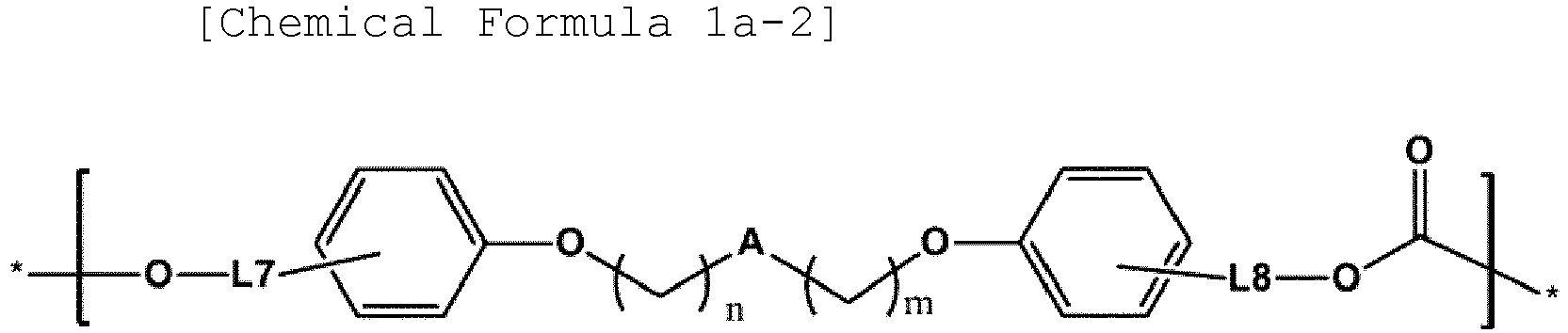
- In Chemical Formula 1a-2,
- L7 and L8 are the same as or different from each other, and are each a straight-chained or branched alkylene, and
- the definitions of A, n and m are the same as those defined in Chemical Formulae 1a and 1a-1.
- According to an example, L7 and L8 are a C1 to C20 straight-chained or branched alkylene, specifically a C1 to C6 straight-chained alkylene, and for example, methylene or ethylene.
- According to an exemplary embodiment of the present invention, L5 and L6 of Chemical Formula 1b are the same as or different from each other, and are each a single bond, or a straight-chained or branched alkylene.
- According to an exemplary embodiment of the present invention, L5 and L6 of Chemical Formula 1b are the same as or different from each other, and are each a single bond, or a straight-chained or branched C1 to C6 alkylene.
- According to an exemplary embodiment of the present invention, L5 and L6 of Chemical Formula 1b are the same as or different from each other, and are each a single bond, methylene, ethylene, propylene, or butylene.
- According to an exemplary embodiment of the present invention, the polycarbonate may include the unit represented by Chemical Formula 1a in an amount of 10 wt% or more, preferably 15 wt% or more, more preferably 20 wt% or more and 50 wt% or less, 45 wt% or less, or 40 wt% or less, based on the total weight of the polycarbonate.
- According to an exemplary embodiment of the present invention, the polycarbonate may include the unit represented by Chemical Formula 1b in an amount of 40 wt% or more, preferably 50 wt% or more, more preferably 60 wt% or more, and 90 wt% or less, for example, 85 wt% or less, or 70 wt% or less, based on the total weight of the polycarbonate.
- In the present invention, the content of the structure included in the polycarbonate can be calculated by a typical method from the result after a nuclear magnetic resonance (NMR) analysis on the polycarbonate.
- The weight average molecular weight (Mw) of the polycarbonate according to an exemplary embodiment of the invention may be appropriately adjusted according to the purpose and use, and the weight average molecular weight of the polycarbonate may be 30,000 g/mol or more, or 40,000 g/mol or more and 60,000 g/mol or less, or 55,000 g/mol or less, or 50,000 g/mol or less, considering that it is possible to exhibit improved weather resistance while maintaining excellent characteristics of the polycarbonate itself, such as transparency and impact strength.
- Meanwhile, in the present invention, the weight average molecular weights (Mws) of the polycarbonate and the oligomer used in the preparation thereof may be measured by gel permeation chromatograph (GPC) using a polystyrene (PS) standard using Agilent 1200 series. Specifically, the weight average molecular weights may be measured using an Agilent 1200 series device using a Polymer Laboratories PLgel MIX-B 300 mm length column, and in this case, the measurement temperature is 160°C, the used solvent is 1,2,4-trichlorobenzene, and the flow rate is 1 mL/min. The sample of the polycarbonate or oligomer is each prepared at a concentration of 10 mg/10 mL, and then fed in an amount of 200 µL, and the Mw value is induced using a calibration curve formed using a polystyrene standard. In this case, nine types of polystyrene standard products with a molecular weight (g/mol) of 2,000 / 10,000 / 30,000 / 70,000 / 200,000 / 700,000 / 2,000,000 / 4,000,000 / 10,000,000 are used.
- According to an exemplary embodiment of the present invention, the polycarbonate further includes a unit of the following Chemical Formula 2.

- In Chemical Formula 2,
- X1 and X3 are the same as or different from each other, and are each a substituted or unsubstituted divalent aliphatic hydrocarbon group, a substituted or unsubstituted divalent isosorbide group, a substituted or unsubstituted arylene, or a substituted or unsubstituted heteroarylene,
- X2 is a substituted or unsubstituted divalent aliphatic hydrocarbon group, a substituted or unsubstituted divalent isosorbide group, a substituted or unsubstituted arylene, a substituted or unsubstituted heteroarylene, O, S, SO, SO2 or CO,
- k1 is 0 or 1, provided that when X2 directly bonded to X1 is O, S, SO, SO2 or CO, k1 is 1,
- l is an integer from 1 to 5, and when l is 2 or higher, X2's are the same as or different from each other,
- k2 is 0 or 1, provided that when X2 directly bonded to X3 is O, S, SO, SO2 or CO, k2 is 1,
- units of Chemical Formula 2 included in the polycarbonate are the same as or different from each other, and
- * means a site linked to the main chain of the polycarbonate.
- According to an exemplary embodiment of the present invention, when the polycarbonate includes two or more units of Chemical Formula 2, the units of Chemical Formula 2 are the same as or different from each other.
- According to an exemplary embodiment of the present invention, the polycarbonate includes the unit represented by Chemical Formula 2 in an amount of 30 wt% or more, preferably 50 wt% or more, and more preferably 70 wt%, based on the total weight of the polycarbonate. The polycarbonate may include the unit represented by Chemical Formula 2 in an amount of 70 wt% or less, for example, 50 wt% or less.
- According to an exemplary embodiment of the present invention, Chemical Formula 2 may be represented by one of the following Chemical Formulae 3 to 6.


- In Chemical Formulae 3 to 6,
- Y1 and Y2 are each a substituted or unsubstituted divalent aliphatic hydrocarbon group, a substituted or unsubstituted divalent isosorbide group, a substituted or unsubstituted arylene, or a substituted or unsubstituted heteroarylene,
- Y3 and Y4 are each a substituted or unsubstituted straight-chained or branched alkylene, a substituted or unsubstituted cycloalkylene, a substituted or unsubstituted arylene, O, S, SO, SO2 or CO,
- R1 to R4 are the same as or different from each other, and are each hydrogen, a halogen, a substituted or unsubstituted alkyl, or a substituted or unsubstituted alkoxy,
- a and b are each an integer from 0 to 4,
- c, d, e and f are each an integer from 1 to 4,
- g, h, i and j are each an integer from 0 to 4,
- when g, h, i and j are each 2 or higher, each R1 to R4 is the same as or different from each other,
- the units of Chemical Formulae 3 to 6 included in the polycarbonate are the same as or different from each other, and
- * means a site linked to the main chain of the polycarbonate.
- According to an exemplary embodiment of the present invention, when the polycarbonate each includes two or more units of Chemical Formulae 3 to 6, the units of Chemical Formulae 3 to 6 are the same as or different from each other.
- According to an exemplary embodiment of the present invention, Y1 of Chemical Formula 3 may be a substituted or unsubstituted cycloalkylene, a substituted or unsubstituted heterocycloalkylene, a substituted or unsubstituted arylene, or a substituted or unsubstituted heteroarylene.
- According to an exemplary embodiment of the present invention, Y1 of Chemical Formula 3 may be a substituted or unsubstituted cycloalkylene having 3 to 30 carbon atoms, a substituted or unsubstituted heterocycloalkylene having 2 to 30 carbon atoms, a substituted or unsubstituted arylene having 6 to 30 carbon atoms, or a substituted or unsubstituted heteroarylene having 2 to 30 carbon atoms.
- According to an exemplary embodiment of the present invention, Y1 of Chemical Formula 3 may be a substituted or unsubstituted cycloalkylene having 3 to 15 carbon atoms, a substituted or unsubstituted heterocycloalkylene having 2 to 15 carbon atoms, a substituted or unsubstituted arylene having 6 to 15 carbon atoms, or a substituted or unsubstituted heteroarylene having 2 to 15 carbon atoms.
- According to an exemplary embodiment of the present invention, Y1 of Chemical Formula 3 may be a substituted or unsubstituted cyclobutylene, a substituted or unsubstituted cyclopentylene, a substituted or unsubstituted cyclohexylene, a substituted or unsubstituted divalent tetrahydrofuran, a substituted or unsubstituted biphenylene, or a substituted or unsubstituted divalent furan.
- According to an exemplary embodiment of the present invention, Y2 of Chemical Formula 4 may be a substituted or unsubstituted cycloalkylene, or a substituted or unsubstituted arylene.
- According to an exemplary embodiment of the present invention, Y2 of Chemical Formula 4 may be a substituted or unsubstituted cycloalkylene having 3 to 30 carbon atoms, or a substituted or unsubstituted arylene having 6 to 30 carbon atoms.
- According to an exemplary embodiment of the present invention, Y2 of Chemical Formula 4 may be a substituted or unsubstituted cycloalkylene having 3 to 15 carbon atoms, or a substituted or unsubstituted arylene having 6 to 15 carbon atoms.
- According to an exemplary embodiment of the present invention, Y2 of Chemical Formula 4 may be a substituted or unsubstituted cyclobutylene, a substituted or unsubstituted cyclopentylene, a substituted or unsubstituted cyclohexylene, or a substituted or unsubstituted biphenylene.
- According to an exemplary embodiment of the present invention, Y3 of Chemical Formula 5 may be a substituted or unsubstituted alkylene, a substituted or unsubstituted cycloalkylene, a substituted or unsubstituted arylene, or SO2.
- According to an exemplary embodiment of the present invention, Y3 of Chemical Formula 5 may be a substituted or unsubstituted alkylene having 1 to 30 carbon atoms, a substituted or unsubstituted cycloalkylene having 3 to 30 carbon atoms, a substituted or unsubstituted arylene having 6 to 30 carbon atoms, or SO2.
- According to an exemplary embodiment of the present invention, Y3 of Chemical Formula 5 may be a substituted or unsubstituted alkylene having 1 to 10 carbon atoms, a substituted or unsubstituted cycloalkylene having 3 to 15 carbon atoms, a substituted or unsubstituted arylene having 6 to 15 carbon atoms, or SO2.
- According to an exemplary embodiment of the present invention, Y3 of Chemical Formula 5 may be a substituted or unsubstituted straight-chained or branched alkylene having 1 to 5 carbon atoms, a substituted or unsubstituted cyclohexylene, a substituted or unsubstituted phenylene, or SO2.
- According to an exemplary embodiment of the present invention, Y4 of Chemical Formula 6 may be a substituted or unsubstituted alkylene, a substituted or unsubstituted cycloalkylene, a substituted or unsubstituted arylene, or SO2.
- According to an exemplary embodiment of the present invention, Y4 of Chemical Formula 6 may be a substituted or unsubstituted alkylene having 1 to 30 carbon atoms, a substituted or unsubstituted cycloalkylene having 3 to 30 carbon atoms, a substituted or unsubstituted arylene having 6 to 30 carbon atoms, or SO2.
- According to an exemplary embodiment of the present invention, Y4 of Chemical Formula 6 may be a substituted or unsubstituted alkylene having 1 to 10 carbon atoms, a substituted or unsubstituted cycloalkylene having 3 to 15 carbon atoms, a substituted or unsubstituted arylene having 6 to 15 carbon atoms, or SO2.
- According to an exemplary embodiment of the present invention, Y4 of Chemical Formula 6 may be a substituted or unsubstituted straight-chained or branched alkylene having 1 to 5 carbon atoms, a substituted or unsubstituted cyclohexylene, a substituted or unsubstituted phenylene, or SO2.
- According to an exemplary embodiment of the present invention, R1 to R4 of Chemical Formulae 5 and 6 may be hydrogen, or a substituted or unsubstituted alkyl having 1 to 10 carbon atoms.
- According to an exemplary embodiment of the present invention, R1 to R4 of Chemical Formulae 5 and 6 may be hydrogen, or a substituted or unsubstituted alkyl having 1 to 5 carbon atoms.
- According to an exemplary embodiment of the present invention, R1 to R4 of Chemical Formulae 5 and 6 may be hydrogen, or a substituted or unsubstituted methyl.
- According to an exemplary embodiment of the present invention, R1 to R4 of Chemical Formulae 5 and 6 may be a substituted or unsubstituted alkyl having 1 to 10 carbon atoms.
- According to an exemplary embodiment of the present invention, R1 to R4 of Chemical Formulae 5 and 6 may be a substituted or unsubstituted alkyl having 1 to 5 carbon atoms.
- According to an exemplary embodiment of the present invention, R1 to R4 of Chemical Formulae 5 and 6 may be a substituted or unsubstituted methyl.
- According to an exemplary embodiment of the present invention, Chemical Formula 3 may be represented by any one of the following units.


- According to an exemplary embodiment of the present invention, Chemical Formula 4 may be represented by any one of the following units.


- According to an exemplary embodiment of the present invention, Chemical Formula 5 may be represented by any one of the following units.


- According to an exemplary embodiment of the present invention, Chemical Formula 6 may be represented by any one of the following units.


- According to an exemplary embodiment of the present invention, the polycarbonate may have a hydroxyl group as an end group, but is not limited thereto.
- According to an exemplary embodiment of the present invention, when the impact strength of the polycarbonate is measured at 23°C in accordance with ASTM D256 (1/8 inch, Notched Izod), the impact strength may be 245 J/m or more, 250 J/m or more, or 280 J/m or more. The upper limit of the impact strength is not particularly limited, but may be, for example, 500 J/m or less, or 450 J/m or less.
- Specifically, the Izod impact strength measurement method is a method using a pendulum with a predetermined weight, and the impact strength is obtained by dividing an absorption energy obtained as a returning height when a test specimen is hit by the pendulum and rotated by the cross-sectional area at the notch part of the test specimen.
- According to an exemplary embodiment of the present invention, when the pencil hardness of the polycarbonate is measured at an angle of 45 degrees under a load of 50 g using a pencil hardness tester (Cometech) at a temperature of 23°C and in accordance with ASTM D3363, the pencil hardness may be HB or more.
- Another exemplary embodiment of the present invention provides a method for preparing a polycarbonate including a unit presented by the above-described Chemical Formula 1a; and a unit represented by Chemical Formula 1b, the method including: polymerizing a composition including a compound of the following Chemical Formula 11a, a compound of the following Chemical Formula 11b and a carbonate precursor.
[Chemical Formula 11a] HO-L3-O-L1-A-L2-4-L4-OH

- In Chemical Formulae 11a and 11b,
- A is a substituted or unsubstituted phenylene; or an arylene in which two or more substituted or unsubstituted benzene rings are linked by a single bond or condensed,
- L1 and L2 are the same as or different from each other, and are each a substituted or unsubstituted straight-chained or branched alkylene,
- L3 and L4 are the same as or different from each other, and are each one selected from a substituted or unsubstituted straight-chained or branched alkylene, a substituted or unsubstituted cycloalkylene and a substituted or unsubstituted arylene, or a divalent group in which two or more of them are linked by a single bond, and
- L5 and L6 are the same as or different from each other, and are each a single bond; or one selected from a substituted or unsubstituted straight-chained or branched alkylene, a substituted or unsubstituted cycloalkylene and a substituted or unsubstituted arylene, or a divalent group in which two or more of them are linked by a single bond.
- Preferred examples of the substituents of Chemical Formula 11a are the same as the description related to the above-described Chemical Formula 1a.
- Preferred examples of the substituents of Chemical Formula 11b are the same as the description related to the above-described Chemical Formula 1b.
- According to another exemplary embodiment of the present invention, Chemical Formula 11a may be represented by the following Chemical Formula 11a-1.

- In Chemical Formula 11a-1, the definitions of the substituents A, L3, L4, n and M are the same as that in Chemical Formula 1a-1.
- According to still another exemplary embodiment of the present invention, Chemical Formula 11a-1 may be represented by the following Chemical Formula 11a-2.

- In Chemical Formula 11a-2, the definitions of the substituents A, L7, L8, n and m are the same as that in Chemical Formula 1a-2.
- According to an exemplary embodiment of the present invention, the compound of Chemical Formula 11a may be represented by the following structures.


- According to an exemplary embodiment of the present invention, the compound of Chemical Formula 11a may be prepared by the following reaction formula.

- In the reaction formula, the definitions of A and L1 to L3 are the same as the definitions in Chemical Formula 11a.
- After 1 equivalent of a dichloro compound, 2.2 equivalents of a diol compound and potassium carbonate (K2CO3) are dissolved in a dimethylformamide (DMF) solvent, the resulting solution is stirred at 80°C. After the reaction is completed, extraction is performed using ethyl acetate (EA) and water, and then water is removed from the separated organic layer using anhydrous magnesium sulfate (MgSO4). After the organic layer from which water has been removed is concentrated by distillation under reduced pressure, a compound of Chemical Formula 11a is synthesized by column chromatography.
- The compound of Chemical Formula 11b may be prepared by a method known in the art and used, or may be used by purchasing a commercially available product.
- According to an exemplary embodiment of the present invention, the carbonate precursor may be represented by the following Chemical Formula 12.


- In Chemical Formula 12,
R5 and R6 are the same as or different from each other, and are each a substituted or unsubstituted straight-chained or branched alkyl, a substituted or unsubstituted cycloalkyl, a substituted or unsubstituted aryl, or a substituted or unsubstituted heteroaryl. - The carbonate precursor serves to link the compound of Chemical Formula 11a and the compound of Chemical Formula 11b, or an additional comonomer such as the compound of Chemical Formula 21, if necessary. Specific examples of Chemical Formula 12 include phosgene, triphosgene, diphosgene, bromophosgene, dimethyl carbonate, diethyl carbonate, dibutyl carbonate, dicylcohexyl carbonate, diphenyl carbonate, ditolyl carbonate, bis(chlorophenyl) carbonate, m-cresyl carbonate, dinaphthyl carbonate, bis(diphenyl) carbonate, bishaloformate, or the like, and any one of them or a mixture of two or more thereof may be used.
- In an exemplary embodiment of the present specification, the carbonate precursor may be diphenyl carbonate.
- A unit of the above-described Chemical Formula 1a may be formed by polymerizing the compound of Chemical Formula 11a and the carbonate precursor of Chemical Formula 12, and a unit of the above-described Chemical Formula 1b may be formed by polymerizing the compound of Chemical Formula 11b and the carbonate precursor of Chemical Formula 12.
- In other words, a polycarbonate including a unit of Chemical Formula 1a and a unit of Chemical Formula 1b may be prepared by polymerizing the compound of Chemical Formula 11a, the compound of Chemical Formula 11b and the carbonate precursor of Chemical Formula 12.
- The compound of Chemical Formula 11a may be included in an amount of 5 wt% to 50 wt%, 10 wt% to 40 wt%, 15 wt% or more and 30 wt%, based on the total weight of the composition.
- The compound of Chemical Formula 11b may be included in an amount of 20 wt% to 70 wt%, 30 wt% to 60 wt%, and 35 wt% to 50 wt%, based on the total weight of the composition.
- The carbonate precursor of Chemical Formula 12 may be included in an amount of 20 wt% to 70 wt%, 30 wt% to 60 wt%, and 35 wt% to 50 wt%, based on the total weight of the composition.
- For the polymerization, a method known in the art may be used, and it is desirable to perform the polymerization by melt polymerization.
- Specifically, the composition including the compound of Chemical Formula 11a, the compound of Chemical Formula 11b and the carbonate precursor is melted under conditions of a pressure of 700 to 800 Torr and a temperature of 120 to 170°C under a nitrogen atmosphere, the temperature is increased to a temperature of 180 to 200°C under a pressure condition of 80 to 120 Torr, phenol generated during the reaction is removed, the temperature is increased to a temperature of 200°C or more under a pressure condition of 20 to 40 Torr, the temperature is finally increased to a temperature of 220°C or more under a pressure of 0.05 to 0.2 Torr, and then the composition can be polymerized by terminating the reaction.
- In addition, in order to promote the polymerization reaction, a reaction catalyst such as lithium hydroxide, cesium carbonate, sodium hydroxide and sodium methoxide may be additionally used.
- According to an exemplary embodiment of the present invention, the composition used in the polymerization step may further include a compound of the following Chemical Formula 21.

- In Chemical Formula 21,
- X1 and X3 are the same as or different from each other, and are each a substituted or unsubstituted divalent aliphatic hydrocarbon group, a substituted or unsubstituted divalent isosorbide group, a substituted or unsubstituted arylene, or a substituted or unsubstituted heteroarylene,
- X2 is a substituted or unsubstituted divalent aliphatic hydrocarbon group, a substituted or unsubstituted divalent isosorbide group, a substituted or unsubstituted arylene, a substituted or unsubstituted heteroarylene, O, S, SO, SO2 or CO,
- k1 is 0 or 1, provided that when X2 directly bonded to X1 is O, S, SO, SO2 or CO, k1 is 1,
- l is an integer from 1 to 5, and when l is 2 or higher, X2's are the same as or different from each other, and
- k2 is 0 or 1, provided that when X2 directly bonded to X3 is O, S, SO, SO2 or CO, k2 is 1.
- The compound of Chemical Formula 21 may be formed as the unit of the above-described Chemical Formula 2 by polymerization. The compound of Chemical Formula 21 may be included in an amount of 30 parts by mole or more, 40 parts by mole or more, 90 parts by mole or less, or 80 parts by mole or less, based on 100 parts by mole of the carbonate precursor of Chemical Formula 12.
- According to an exemplary embodiment of the present invention, Chemical Formula 21 may be represented by the following Chemical Formula 31, 41, 51 or 61.


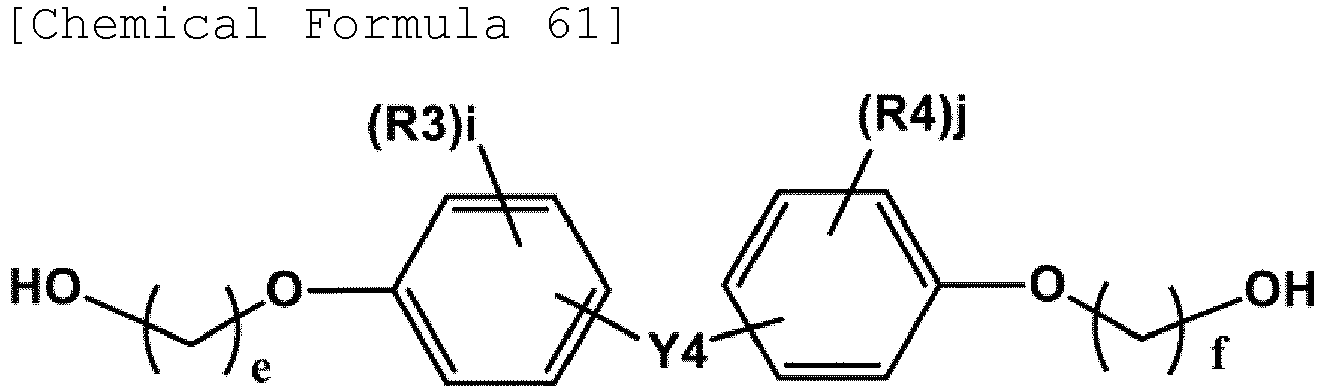
- In Chemical Formulae 31, 41, 51 and 61,
- Y1 and Y2 are the same as or different from each other, and are each a substituted or unsubstituted divalent aliphatic hydrocarbon group, a substituted or unsubstituted divalent isosorbide group, a substituted or unsubstituted arylene, or a substituted or unsubstituted heteroarylene,
- Y3 and Y4 are the same as or different from each other, and are each a substituted or unsubstituted straight-chained or branched alkylene, a substituted or unsubstituted cycloalkylene, a substituted or unsubstituted arylene, O, S, SO, SO2 or CO,
- R1 to R4 are the same as or different from each other, and are each hydrogen, a halogen, a substituted or unsubstituted alkyl, or a substituted or unsubstituted alkoxy,
- a and b are each an integer from 0 to 4,
- c, d, e and f are each an integer from 1 to 4,
- g, h, i and j are each an integer from 0 to 4, and
- when g, h, i and j are each 2 or higher, each R1 to R4 is the same as or different from each other.
- According to an exemplary embodiment of the present invention, the description in Chemical Formulae 3 to 6 may be applied to Y1 to Y4 and R1 to R4 of Chemical Formulae 31, 41, 51 and 61.
- According to an exemplary embodiment of the present invention, Chemical Formula 31 may be represented by any one of the following structures.


- According to an exemplary embodiment of the present invention, Chemical Formula 41 may be represented by any one of the following structures.


- According to an exemplary embodiment of the present invention, Chemical Formula 51 may be represented by any one of the following structures.



- According to an exemplary embodiment of the present invention, Chemical Formula 61 may be represented by any one of the following structures.


- Still another exemplary embodiment of the present invention provides a composition including the polycarbonate according to the above-described exemplary embodiments.
- According to an example, the composition including the polycarbonate may further include a heat stabilizer in order to prevent a decrease in molecular weight or a deterioration in color of a resin molded article.
- Examples of the heat stabilizer include phosphorous acid, phosphoric acid, phosphonous acid, phosphonic acid, esters thereof, and the like, and specific examples thereof include triphenylphosphite, tris(nonylphenyl)phosphite, tris(2,4-di-tert-butylphenyl)phosphite, tridecylphosphite, trioctylphosphite, trioctadecylphosphite, didecylmonophenylphosphite, dioctylmonophenylphosphite, diisopropylmonophenylphosphite, monobutyldiphenylphosphite, monodecyldiphenylphosphite, monooctyldiphenylphosphite, bis(2,6-di-tert-butyl-4-methylphenyl)pentaerythritoldiphosphite, 2,2-methylenebis(4,6-di-tert-butylphenyl)octylphosphite, bis(nonylphenyl)pentaerythritoldiphosphite, bis(2,4-di-tert-butylphenyl)pentaerythritoldiphosphite, distearylpentaerythritoldiphosphite, tributylphosphate, triethylphosphate, trimethylphosphate, triphenylphosphate, diphenylmonoorthoxenylphosphate, dibutylphosphate, dioctylphosphate, diisopropylphosphate, 4,4'-biphenylenediphosphinic acid tetrakis(2,4-di-tert-butyl phenyl), benzenephosphonic acid dimethyl, benzenephosphonic acid diethyl, benzenephosphonic acid dipropyl or a mixture of two or more thereof.
- The heat stabilizer may be used in a content of 0.0001 part by weight to 1 part by weight, 0.005 part by weight to 0.5 part by weight, or 0.01 part by weight to 0.2 part by weight, based on 100 parts by weight of the polycarbonate resin. As the stabilizer is used in the above content, it is possible to prevent a decrease in the molecular weight or discoloration of the resin without causing bleeding of the additive, and the like.
- According to another example, a composition including the polycarbonate may further include a typically known antioxidant.
- Specific examples of the antioxidant include pentaerythritol tetrakis(3-mercaptopropionate), pentaerythritol tetrakis(3-laurylthiopropionate), glycerol-3-stearyl thiopropionate, triethylene glycol-bis[3-(3-tert-butyl-5-methyl-4-hydroxyphenyl)propionate], 1,6-hexanediol-bis[3-(3,5-di-tert-butyl-4-hydroxyphenyl)propionate], pentaerythritol-tetrakis[3-(3,5-di-tert-butyl-4-hydroxyphenyl)propionate], octadecyl-3-(3,5-di-tert-butyl-4-hydroxyphenyl)propionate, 1,3,5-trimethyl-2,4,6-tris(3,5-di-tert-butyl-4-hydroxybenzyl)benzene, N,N-hexamethylenebis(3,5-di-tert-butyl-4-hydroxyhydrocinnamide), 3,5-di-tert-butyl-4-hydroxybenzylphosphonate-diethyl ester, tris(3,5-di-tert-butyl-4-hydroxybenzyl)isocyanurate, 4,4'-biphenylenediphospinic acid tetrakis(2,4-di-tert-butylphenyl), 3,9-bis{1,1-dimethyl-2-[β-(3-tert-butyl-4-hydroxy-5-methylphenyl)propionyloxy]ethyl}-2,4,8,10-tetraoxaspiro(5,5)undecane or a mixture of two or more thereof.
- The antioxidant may be used in a content of 0.0001 part by weight to 1 part by weight, 0.001 part by weight to 0.5 part by weight, or 0.005 part by weight to 0.1 part by weight, based on 100 parts by weight of the polycarbonate.
- According to another example, a composition including the polycarbonate may further include a lubricant, and may include, for example, pentaerythritol tetrastearate. The lubricant may be used in a content of 0.0001 part by weight to 1 part by weight, 0.005 part by weight to 0.5 part by weight, or 0.01 part by weight to 0.2 part by weight, based on 100 parts by weight of the polycarbonate.
- Yet another exemplary embodiment of the present invention provides a molded article prepared from a composition including the polycarbonate according to the above-described exemplary embodiments. As described above, since the polycarbonate including the unit represented by Chemical Formula 1a and the unit represented by Chemical Formula 1b has excellent hardness or heat resistance, the molded article according to the present invention has a wider range of applications than molded articles prepared from a polycarbonate used in the related art. Furthermore, when the polycarbonate further includes a repeating unit represented by Chemical Formula 2, the range of applications may be further expanded because desired physical properties can be implemented by adjusting the weight ratio of the units represented by Chemical Formulae 1a, 1b and 2.
- The composition or molded article may further include one or more selected from the group consisting of an antioxidant, a plasticizer, an anti-static agent, a nucleating agent, a flame retardant, a lubricant, an impact modifier, a fluorescent brightener, a UV absorber, a pigment and a dye, if necessary, in addition to the aforementioned polycarbonate.
- As an example of a method of preparing the molded article, it is possible to include mixing the aforementioned polycarbonate and other additives well using a mixer, preparing the resulting mixture as a pellet by extrusion molding the mixture using an extruder, drying the pellet, and then injecting the pellet using an injection molder.
- Experimental Example 1. Preparation of polycarbonate Example 1.
-

- After 1 equivalent of 1,4-bis(chloromethyl)benzene, 2.2 equivalents of 4-(2-hydroxyethyl)phenol and potassium carbonate (K2CO3) were dissolved in a dimethylformamide (DMF) solvent, the resulting solution was stirred at 80°C. After the reaction was completed, extraction was performed using ethyl acetate (EA) and water, and then water was removed from the separated organic layer using anhydrous magnesium sulfate (MgSO4). After the organic layer from which water had been removed was concentrated by distillation under reduced pressure, Monomer 1 was obtained by column chromatography.
- After a reaction vessel was cleaned such that there was no moisture, nitrogen purging was performed. 105 parts by weight of diphenyl carbonate (DPC) and 40 parts by weight of Monomer 1 (compound of Chemical Formula 11a) based on 100 parts by weight of isosorbide (Roquette Freres) and 0.02 wt% (based on the weight of isosorbide) of lithium hydroxide as a catalyst were introduced into a 1 L glass reaction vessel, and the introduced materials were dissolved by stirring under conditions of a pressure of 760 Torr and a temperature of 150°C under a nitrogen atmosphere for 20 minutes. Thereafter, the pressure was changed to 100 Torr, and phenol generated during the reaction was removed while the reaction temperature was increased to 190°C over 60 minutes. And then, the pressure was changed to 30 Torr, and the temperature was increased to 210°C over 40 minutes. Subsequently, as the torque of the stirrer was increased and the viscosity was increased, the pressure was finally changed to 0.1 Torr and the temperature was increased to 230°C. After the stirrer was allowed to reach the stirring torque, the reaction was terminated, and the resulting melt was pelletized to prepare a carbonate resin.
-

- Monomer 2 was prepared in the same manner as in Example 1, except that 1,4-bis(2-chloroethyl)benzene was used instead of 1,4-bis(chloromethyl)benzene in Example 1, and a polycarbonate was prepared in the same manner as in Example 1, except that Monomer 2 was used instead of Monomer 1.
-

- Monomer 3 was prepared in the same manner as in Example 1, except that 4,4'-bis(chloromethyl)-1,1'-biphenyl was used instead of 1,4-bis(chloromethyl)benzene in Example 1, and a polycarbonate was prepared in the same manner as in Example 1, except that Monomer 3 was used instead of Monomer 1.
-

- Monomer 4 was prepared in the same manner as in Example 1, except that 4-(hydroxymethyl)phenol was used instead of 4-(2-hydroxyethyl)phenol in Example 1, and a polycarbonate was prepared in the same manner as in Example 1, except that Monomer 4 was used instead of Monomer 1.
- A polycarbonate was prepared in the same manner as in Example 1 by performing the polymerization using only isosorbide except for Monomer 1 in Example 1.
- Experimental Example 2. Evaluation of physical properties of polycarbonate
- 0.050 part by weight of tris(2,4-di-tert-butylphenyl)phosphite, 0.010 part by weight of octadecyl-3-(3,5-di-tert-butyl-4-hydroxyphenyl)propionate and 0.030 part by weight of pentaerythritol tetrastearate were added to 100 parts by weight of each of the polycarbonate resins prepared in the Examples and the Comparative Examples, the resulting mixture was pelletized using HAAKE Mini CTW with a vent attached, and then a test specimen was prepared by injection molding the pellet at a cylinder temperature of 300°C and a mold temperature of 120°C using an HAAKE Minijet injection molding system.
- The characteristics of these injection test specimens or polycarbonates were measured by the following methods, and the results are shown in Table 1.
- Weight average molecular weight (g/mol): Measured by calibration with PS standard using Agilent 1200 series.
- Fluidity (MI): Measured in accordance with ASTM D1238 (under conditions of 300°C, 1.2 kg).
- Izod room temperature impact strength (J/m): Measured at 23°C in accordance with ASTM D256 (1/8 inch, Notched Izod).
- Pencil hardness: Measured with a pencil having a strength of 2B, B, and HB at an angle of 45 degrees under a load of 50 g in accordance with ASTM D3363 using a pencil hardness tester (Cometech) at 23°C.
- Referring to Table 1, it was confirmed that the compounds of the Examples exhibited high impact strength and high hardness compared to the Comparative Examples.
- Specifically, it could be seen that when compared to Comparative Example 1 in which the unit of Chemical Formula 1a of the present invention was not included and only the unit of Chemical Formula 1b was included, the Examples had a pencil hardness of HB while having a high impact strength of 250 J/m or more.
- Therefore, it could be confirmed that the polycarbonate including both the unit of Chemical Formula 1a and the unit of Chemical Formula 1b of the present invention can achieve both improved impact resistance and high hardness.
| Chemical Formula 11a Compound | Chemical Formula 12a Compound | Weight average molecular weight (g/mol) | MI (g/10 min) | Impact strength (J/m) | Pencil hardness | |
| Example 1 | Monomer 1 | Isosorbide | 44,000 | 13.4 | 300 | HB |
| Example 2 | Monomer 2 | Isosorbide | 43,000 | 12.0 | 280 | HB |
| Example 3 | Monomer 3 | Isosorbide | 41,000 | 13.0 | 260 | HB |
| Example 4 | Monomer 4 | Isosorbide | 42,000 | 12.1 | 250 | HB |
| Comparative Example 1 | - | Isosorbide | 35,000 | 10.3 | 240 | B |
Claims (14)
- A polycarbonate comprising a unit represented by the following Chemical Formula 1a; and a unit represented by the following Chemical Formula 1b:
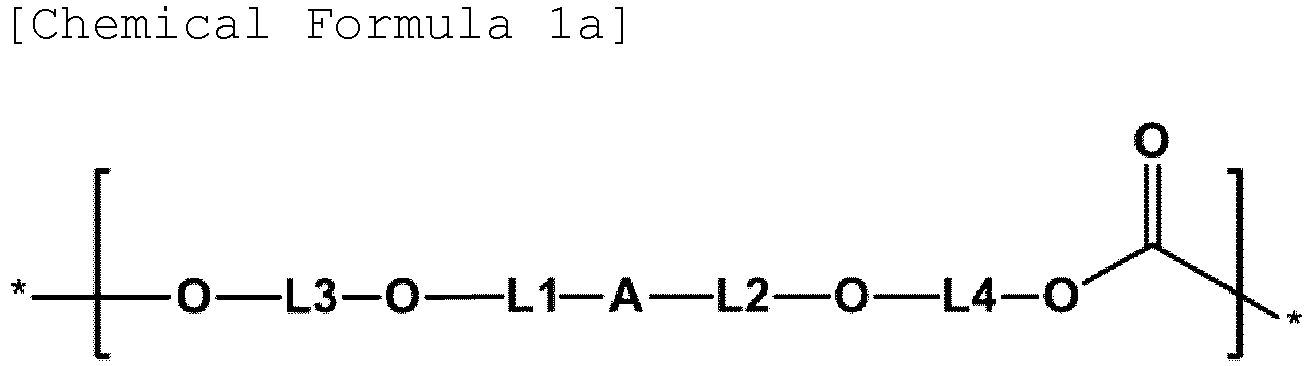
 wherein A is a substituted or unsubstituted phenylene; or an arylene in which two or more substituted or unsubstituted benzene rings are linked by a single bond or condensed,L1 and L2 are the same as or different from each other, and are each a substituted or unsubstituted straight-chained or branched alkylene,L3 and L4 are the same as or different from each other, and are each one selected from a substituted or unsubstituted straight-chained or branched alkylene, a substituted or unsubstituted cycloalkylene and a substituted or unsubstituted arylene, or a divalent group in which two or more of them are linked by a single bond, andL5 and L6 are the same as or different from each other, and are each a single bond; or one selected from a substituted or unsubstituted straight-chained or branched alkylene, a substituted or unsubstituted cycloalkylene and a substituted or unsubstituted arylene, or a divalent group in which two or more of them are linked by a single bond,units of Chemical Formula 1a included in the polycarbonate are the same as or different from each other,units of Chemical Formula 1b included in the polycarbonate are the same as or different from each other, and* means a site linked to the main chain of the polycarbonate.
 - The polycarbonate of claim 1, wherein the polycarbonate comprises the unit represented by Chemical Formula 1a in an amount of 10 wt% to 50 wt%, based on a total weight of the polycarbonate.
- The polycarbonate of claim 1, wherein the polycarbonate has a weight average molecular weight of 30,000 g/mol to 60,000 g/mol.
- The polycarbonate of claim 1, wherein Chemical Formula 1a is represented by the following Chemical Formula 1a-1:
 wherein A is a substituted or unsubstituted phenylene; or an arylene in which two or more substituted or unsubstituted benzene rings are linked by a single bond or condensed,L3 and L4 are the same as or different from each other, and are each one selected from a substituted or unsubstituted straight-chained or branched alkylene, a substituted or unsubstituted cycloalkylene and a substituted or unsubstituted arylene, or a divalent group in which two or more of them are linked by a single bond, andn and m are the same as or different from each other, and are each an integer from 1 to 20
 - The polycarbonate of claim 4, wherein Chemical Formula 1a-1 is represented by the following Chemical Formula 1a-2:
 wherein L7 and L8 are the same as or different from each other, and are each a straight-chained or branched alkylene, andA is a substituted or unsubstituted phenylene; or an arylene in which two or more substituted or unsubstituted benzene rings are linked by a single bond or condensed, andn and m are the same as or different from each other, and are each an integer from 1 to 20.
 - The polycarbonate of claim 1, wherein A of Chemical Formula 1a is selected from the following structural formulae:

- The polycarbonate of claim 1, wherein the polycarbonate further comprises a unit of the following Chemical Formula 2:
 wherein X1 and X3 are the same as or different from each other, and are each a substituted or unsubstituted divalent aliphatic hydrocarbon group, a substituted or unsubstituted divalent isosorbide group, a substituted or unsubstituted arylene, or a substituted or unsubstituted heteroarylene,X2 is a substituted or unsubstituted divalent aliphatic hydrocarbon group, a substituted or unsubstituted divalent isosorbide group, a substituted or unsubstituted arylene, a substituted or unsubstituted heteroarylene, O, S, SO, SO2 or CO,k1 is 0 or 1, provided that when X2 directly bonded to X1 is O, S, SO, SO2 or CO, k1 is 1,1 is an integer from 1 to 5, and when 1 is 2 or higher, X2's are the same as or different from each other,k2 is 0 or 1, provided that when X2 directly bonded to X3 is O, S, SO, SO2 or CO, k2 is 1,units of Chemical Formula 2 included in the polycarbonate are the same as or different from each other, and* means a site linked to the main chain of the polycarbonate.
 - The polycarbonate of claim 7, wherein Chemical Formula 2 is represented by any one of the following Chemical Formulae 3 to 6:


 wherein Y1 and Y2 are each a substituted or unsubstituted divalent aliphatic hydrocarbon group, a substituted or unsubstituted divalent isosorbide group, a substituted or unsubstituted arylene, or a substituted or unsubstituted heteroarylene,Y3 and Y4 are each a substituted or unsubstituted straight-chained or branched alkylene, a substituted or unsubstituted cycloalkylene, a substituted or unsubstituted arylene, O, S, SO, SO2 or CO,R1 to R4 are the same as or different from each other, and are each hydrogen, a halogen, a substituted or unsubstituted alkyl, or a substituted or unsubstituted alkoxy,a and b are each an integer from 0 to 4,c, d, e and f are each an integer from 1 to 4,g, h, i and j are each an integer from 0 to 4,when g, h, i and j are each 2 or higher, each R1 to R4 is the same as or different from each other,the units of Chemical Formulae 3 to 6 included in the polycarbonate are the same as or different from each other, and* means a site linked to the main chain of the polycarbonate.
 - A method for preparing the polycarbonate according to claim 1, the method comprising:
polymerizing a composition comprising a compound of the following Chemical Formula 11a, a compound of the following Chemical Formula 11b and a carbonate precursor:
[Chemical Formula 11a] HO-L3-O-L1-A-L2-C3-L4-OH
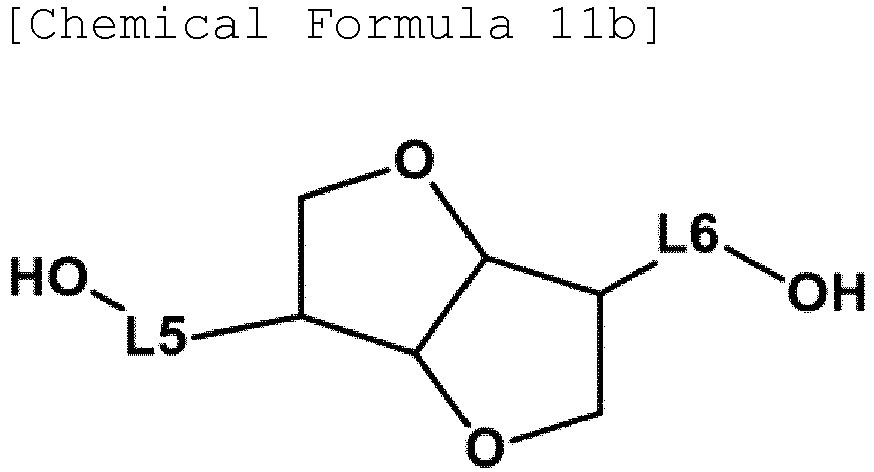 wherein A is a substituted or unsubstituted phenylene; or an arylene in which two or more substituted or unsubstituted benzene rings are linked by a single bond or condensed,L1 and L2 are the same as or different from each other, and are each a substituted or unsubstituted straight-chained or branched alkylene,L3 and L4 are the same as or different from each other, and are each one selected from a substituted or unsubstituted straight-chained or branched alkylene, a substituted or unsubstituted cycloalkylene and a substituted or unsubstituted arylene, or a divalent group in which two or more of them are linked by a single bond, andL5 and L6 are the same as or different from each other, and are each a single bond; or one selected from a substituted or unsubstituted straight-chained or branched alkylene, a substituted or unsubstituted cycloalkylene and a substituted or unsubstituted arylene, or a divalent group in which two or more of them are linked by a single bond.
 - The method of claim 9, wherein the carbonate precursor is represented by the following Chemical Formula 12:

R5 and R6 are the same as or different from each other, and are each a substituted or unsubstituted straight-chained or branched alkyl, a substituted or unsubstituted cycloalkyl, a substituted or unsubstituted aryl, or a substituted or unsubstituted heteroaryl. - The method of claim 9, wherein the composition further comprises a compound of the following Chemical Formula 21:
 wherein X1 and X3 are the same as or different from each other, and are each a substituted or unsubstituted divalent aliphatic hydrocarbon group, a substituted or unsubstituted divalent isosorbide group, a substituted or unsubstituted arylene, or a substituted or unsubstituted heteroarylene,X2 is a substituted or unsubstituted divalent aliphatic hydrocarbon group, a substituted or unsubstituted divalent isosorbide group, a substituted or unsubstituted arylene, a substituted or unsubstituted heteroarylene, O, S, SO, SO2 or CO,k1 is 0 or 1, provided that when X2 directly bonded to X1 is O, S, SO, SO2 or CO, k1 is 1,1 is an integer from 1 to 5, and when 1 is 2 or higher, X2's are the same as or different from each other, andk2 is 0 or 1, provided that when X2 directly bonded to X3 is O, S, SO, SO2 or CO, k2 is 1.
 - The method of claim 11, wherein Chemical Formula 21 is represented by the following Chemical Formula 31, 41, 51 or 61:


 wherein Y1 and Y2 are the same as or different from each other, and are each a substituted or unsubstituted divalent aliphatic hydrocarbon group, a substituted or unsubstituted divalent isosorbide group, a substituted or unsubstituted arylene, or a substituted or unsubstituted heteroarylene,Y3 and Y4 are the same as or different from each other, and are each a substituted or unsubstituted straight-chained or branched alkylene, a substituted or unsubstituted cycloalkylene, a substituted or unsubstituted arylene, O, S, SO, SO2 or CO,R1 to R4 are the same as or different from each other, and are each hydrogen, a halogen, a substituted or unsubstituted alkyl, or a substituted or unsubstituted alkoxy,a and b are each an integer from 0 to 4,c, d, e and f are each an integer from 1 to 4,g, h, i and j are each an integer from 0 to 4, andwhen g, h, i and j are each 2 or higher, each R1 to R4 is the same as or different from each other.
 - A composition comprising the polycarbonate according to any one of claims 1 to 8.
- A molded article prepared from a composition comprising the polycarbonate according to any one of claims 1 to 8.
Applications Claiming Priority (2)
| Application Number | Priority Date | Filing Date | Title |
|---|---|---|---|
| KR1020210012478A KR102865677B1 (en) | 2021-01-28 | 2021-01-28 | Polycarbonate and preparation method thereof |
| PCT/KR2022/000318 WO2022164074A1 (en) | 2021-01-28 | 2022-01-07 | Polycarbonate, and method for preparing same |
Publications (2)
| Publication Number | Publication Date |
|---|---|
| EP4286450A1 true EP4286450A1 (en) | 2023-12-06 |
| EP4286450A4 EP4286450A4 (en) | 2024-07-31 |
Family
ID=82652996
Family Applications (1)
| Application Number | Title | Priority Date | Filing Date |
|---|---|---|---|
| EP22746103.5A Pending EP4286450A4 (en) | 2021-01-28 | 2022-01-07 | POLYCARBONATE AND ITS PREPARATION PROCESS |
Country Status (7)
| Country | Link |
|---|---|
| US (1) | US20240101758A1 (en) |
| EP (1) | EP4286450A4 (en) |
| JP (1) | JP7688711B2 (en) |
| KR (1) | KR102865677B1 (en) |
| CN (1) | CN116710503B (en) |
| TW (1) | TWI836319B (en) |
| WO (1) | WO2022164074A1 (en) |
Family Cites Families (15)
| Publication number | Priority date | Publication date | Assignee | Title |
|---|---|---|---|---|
| KR100561337B1 (en) | 2002-05-29 | 2006-03-16 | 주식회사 엘지화학 | Method for producing high molecular weight polycarbonate resin |
| US7718755B2 (en) * | 2007-10-18 | 2010-05-18 | Sabic Innovative Plastics Ip B.V. | Aliphatic diol-based polycarbonates, method of making, and articles formed therefrom |
| WO2010119574A1 (en) * | 2009-04-16 | 2010-10-21 | 帝人株式会社 | Copolymerized polycarbonate and method for producing the same |
| US8273849B2 (en) | 2009-12-30 | 2012-09-25 | Sabic Innovative Plastics Ip B.V. | Isosorbide-based polycarbonates, method of making, and articles formed therefrom |
| TWI503349B (en) * | 2010-05-27 | 2015-10-11 | Mitsubishi Chem Corp | Polycarbonate resin and transparency film containing the same |
| US8372943B2 (en) | 2010-12-10 | 2013-02-12 | Sabic Innovative Plastics Ip B.V. | Isosorbide—containing polycarbonates and their preparation |
| EP2799463B1 (en) * | 2011-12-27 | 2017-05-03 | Teijin Limited | Polycarbonate resin |
| KR101611705B1 (en) | 2013-07-01 | 2016-04-12 | 주식회사 엘지화학 | Eco-friendly polycarbonate resin |
| KR101608411B1 (en) * | 2013-07-02 | 2016-04-11 | 주식회사 삼양사 | [poly(isosorbide carbonate-aromatic carbonate)]-[polycarbonate] block copolymer and method for preparing the same |
| US20150183929A1 (en) * | 2013-12-30 | 2015-07-02 | Sabic Innovative Plastics Ip B.V | Bisphenol polyether oligomers, methods of manufacture, and polycarbonates made therefrom |
| KR101831886B1 (en) * | 2016-01-07 | 2018-04-04 | 주식회사 엘지화학 | Novel polyorganosiloxane, and copolycarbonate prepared by using the same |
| KR102781622B1 (en) * | 2018-06-08 | 2025-03-13 | 미쯔비시 케미컬 주식회사 | Polycarbonate resin composition, molded article, laminate |
| KR102308714B1 (en) * | 2018-09-14 | 2021-10-01 | 주식회사 엘지화학 | Diol compound, polycarbonate and method for preparing the same |
| KR102199921B1 (en) | 2019-05-31 | 2021-01-11 | 주식회사 삼양사 | Polycarbonate diol derived from anhydrohexitol and preparation method thereof, and polyurethane prepared therefrom and adhesive comprising the same |
| KR20210012478A (en) | 2019-07-25 | 2021-02-03 | 김종필 | Propulsion apparatus of pipe tunnel for undergroundlaying and Propulsion methode |
-
2021
- 2021-01-28 KR KR1020210012478A patent/KR102865677B1/en active Active
-
2022
- 2022-01-07 CN CN202280009247.2A patent/CN116710503B/en active Active
- 2022-01-07 US US18/273,518 patent/US20240101758A1/en active Pending
- 2022-01-07 WO PCT/KR2022/000318 patent/WO2022164074A1/en not_active Ceased
- 2022-01-07 JP JP2023539183A patent/JP7688711B2/en active Active
- 2022-01-07 EP EP22746103.5A patent/EP4286450A4/en active Pending
- 2022-01-13 TW TW111101512A patent/TWI836319B/en active
Also Published As
| Publication number | Publication date |
|---|---|
| WO2022164074A1 (en) | 2022-08-04 |
| EP4286450A4 (en) | 2024-07-31 |
| KR20220109153A (en) | 2022-08-04 |
| CN116710503B (en) | 2026-03-17 |
| JP2024503802A (en) | 2024-01-29 |
| TW202233720A (en) | 2022-09-01 |
| US20240101758A1 (en) | 2024-03-28 |
| TWI836319B (en) | 2024-03-21 |
| JP7688711B2 (en) | 2025-06-04 |
| KR102865677B1 (en) | 2025-09-26 |
| CN116710503A (en) | 2023-09-05 |
Similar Documents
| Publication | Publication Date | Title |
|---|---|---|
| EP3162853B1 (en) | Copolycarbonate resin composition | |
| KR20200031469A (en) | Diol compound, polycarbonate and method for preparing the same | |
| EP4286451B1 (en) | Polycarbonate and method for preparing same | |
| KR101758962B1 (en) | Diol monomer, its polycarbonate and article containing the same | |
| KR101489957B1 (en) | Polycarbonate-polysiloxane copolymer and method for preparing the same | |
| KR102855167B1 (en) | Polycarbonate and preparation method thereof | |
| KR102008378B1 (en) | Polycarbonate resin, method for preparing the resin and molded article comprising the resin | |
| TWI836319B (en) | Polycarbonate and preparation method thereof | |
| TWI807587B (en) | Polycarbonate and preparation method thereof | |
| KR20230166901A (en) | Polycarbonate copolymer | |
| KR102811651B1 (en) | Polycarbonate composition | |
| EP3805289B1 (en) | Polycarbonate and method for producing same | |
| EP4257630A1 (en) | Resin and method for manufacturing same | |
| KR102907312B1 (en) | Polycarbonate and molded article formed therefrom | |
| EP3381980B1 (en) | Polycarbonate resin composition | |
| KR102913369B1 (en) | Polycarbonate and molded article formed therefrom | |
| KR20220115343A (en) | Polycarbonate and preparation method thereof | |
| KR102798815B1 (en) | Copolycarbonate and polycarbonate composition comprising the same |
Legal Events
| Date | Code | Title | Description |
|---|---|---|---|
| STAA | Information on the status of an ep patent application or granted ep patent |
Free format text: STATUS: THE INTERNATIONAL PUBLICATION HAS BEEN MADE |
|
| PUAI | Public reference made under article 153(3) epc to a published international application that has entered the european phase |
Free format text: ORIGINAL CODE: 0009012 |
|
| STAA | Information on the status of an ep patent application or granted ep patent |
Free format text: STATUS: REQUEST FOR EXAMINATION WAS MADE |
|
| 17P | Request for examination filed |
Effective date: 20230622 |
|
| AK | Designated contracting states |
Kind code of ref document: A1 Designated state(s): AL AT BE BG CH CY CZ DE DK EE ES FI FR GB GR HR HU IE IS IT LI LT LU LV MC MK MT NL NO PL PT RO RS SE SI SK SM TR |
|
| DAV | Request for validation of the european patent (deleted) | ||
| DAX | Request for extension of the european patent (deleted) | ||
| A4 | Supplementary search report drawn up and despatched |
Effective date: 20240702 |
|
| RIC1 | Information provided on ipc code assigned before grant |
Ipc: C08G 64/16 20060101ALI20240626BHEP Ipc: C08L 69/00 20060101ALI20240626BHEP Ipc: C08G 64/30 20060101ALI20240626BHEP Ipc: C08G 64/04 20060101AFI20240626BHEP |