EP4286325A1 - Method for resource recycling of nickel-iron alloy and use thereof - Google Patents
Method for resource recycling of nickel-iron alloy and use thereof Download PDFInfo
- Publication number
- EP4286325A1 EP4286325A1 EP21924031.4A EP21924031A EP4286325A1 EP 4286325 A1 EP4286325 A1 EP 4286325A1 EP 21924031 A EP21924031 A EP 21924031A EP 4286325 A1 EP4286325 A1 EP 4286325A1
- Authority
- EP
- European Patent Office
- Prior art keywords
- solution
- nickel
- phosphate
- iron
- iron phosphate
- Prior art date
- Legal status (The legal status is an assumption and is not a legal conclusion. Google has not performed a legal analysis and makes no representation as to the accuracy of the status listed.)
- Withdrawn
Links
Images

Classifications
-
- C—CHEMISTRY; METALLURGY
- C22—METALLURGY; FERROUS OR NON-FERROUS ALLOYS; TREATMENT OF ALLOYS OR NON-FERROUS METALS
- C22B—PRODUCTION AND REFINING OF METALS; PRETREATMENT OF RAW MATERIALS
- C22B23/00—Obtaining nickel or cobalt
- C22B23/02—Obtaining nickel or cobalt by dry processes
- C22B23/023—Obtaining nickel or cobalt by dry processes with formation of ferro-nickel or ferro-cobalt
-
- C—CHEMISTRY; METALLURGY
- C01—INORGANIC CHEMISTRY
- C01B—NON-METALLIC ELEMENTS; COMPOUNDS THEREOF; METALLOIDS OR COMPOUNDS THEREOF NOT COVERED BY SUBCLASS C01C
- C01B25/00—Phosphorus; Compounds thereof
- C01B25/16—Oxyacids of phosphorus; Salts thereof
- C01B25/26—Phosphates
- C01B25/37—Phosphates of heavy metals
- C01B25/375—Phosphates of heavy metals of iron
-
- C—CHEMISTRY; METALLURGY
- C01—INORGANIC CHEMISTRY
- C01G—COMPOUNDS CONTAINING METALS NOT COVERED BY SUBCLASSES C01D OR C01F
- C01G53/00—Compounds of nickel
- C01G53/10—Sulfates
-
- C—CHEMISTRY; METALLURGY
- C22—METALLURGY; FERROUS OR NON-FERROUS ALLOYS; TREATMENT OF ALLOYS OR NON-FERROUS METALS
- C22B—PRODUCTION AND REFINING OF METALS; PRETREATMENT OF RAW MATERIALS
- C22B23/00—Obtaining nickel or cobalt
- C22B23/04—Obtaining nickel or cobalt by wet processes
- C22B23/0407—Leaching processes
- C22B23/0415—Leaching processes with acids or salt solutions except ammonium salts solutions
-
- C—CHEMISTRY; METALLURGY
- C22—METALLURGY; FERROUS OR NON-FERROUS ALLOYS; TREATMENT OF ALLOYS OR NON-FERROUS METALS
- C22B—PRODUCTION AND REFINING OF METALS; PRETREATMENT OF RAW MATERIALS
- C22B23/00—Obtaining nickel or cobalt
- C22B23/04—Obtaining nickel or cobalt by wet processes
- C22B23/0407—Leaching processes
- C22B23/0415—Leaching processes with acids or salt solutions except ammonium salts solutions
- C22B23/0423—Halogenated acids or salts thereof
-
- C—CHEMISTRY; METALLURGY
- C22—METALLURGY; FERROUS OR NON-FERROUS ALLOYS; TREATMENT OF ALLOYS OR NON-FERROUS METALS
- C22B—PRODUCTION AND REFINING OF METALS; PRETREATMENT OF RAW MATERIALS
- C22B23/00—Obtaining nickel or cobalt
- C22B23/04—Obtaining nickel or cobalt by wet processes
- C22B23/0407—Leaching processes
- C22B23/0415—Leaching processes with acids or salt solutions except ammonium salts solutions
- C22B23/043—Sulfurated acids or salts thereof
-
- C—CHEMISTRY; METALLURGY
- C22—METALLURGY; FERROUS OR NON-FERROUS ALLOYS; TREATMENT OF ALLOYS OR NON-FERROUS METALS
- C22B—PRODUCTION AND REFINING OF METALS; PRETREATMENT OF RAW MATERIALS
- C22B23/00—Obtaining nickel or cobalt
- C22B23/04—Obtaining nickel or cobalt by wet processes
- C22B23/0407—Leaching processes
- C22B23/0415—Leaching processes with acids or salt solutions except ammonium salts solutions
- C22B23/0438—Nitric acids or salts thereof
-
- C—CHEMISTRY; METALLURGY
- C22—METALLURGY; FERROUS OR NON-FERROUS ALLOYS; TREATMENT OF ALLOYS OR NON-FERROUS METALS
- C22B—PRODUCTION AND REFINING OF METALS; PRETREATMENT OF RAW MATERIALS
- C22B23/00—Obtaining nickel or cobalt
- C22B23/04—Obtaining nickel or cobalt by wet processes
- C22B23/0453—Treatment or purification of solutions, e.g. obtained by leaching
- C22B23/0461—Treatment or purification of solutions, e.g. obtained by leaching by chemical methods
-
- C—CHEMISTRY; METALLURGY
- C22—METALLURGY; FERROUS OR NON-FERROUS ALLOYS; TREATMENT OF ALLOYS OR NON-FERROUS METALS
- C22B—PRODUCTION AND REFINING OF METALS; PRETREATMENT OF RAW MATERIALS
- C22B3/00—Extraction of metal compounds from ores or concentrates by wet processes
- C22B3/20—Treatment or purification of solutions, e.g. obtained by leaching
- C22B3/44—Treatment or purification of solutions, e.g. obtained by leaching by chemical processes
-
- C—CHEMISTRY; METALLURGY
- C01—INORGANIC CHEMISTRY
- C01B—NON-METALLIC ELEMENTS; COMPOUNDS THEREOF; METALLOIDS OR COMPOUNDS THEREOF NOT COVERED BY SUBCLASS C01C
- C01B25/00—Phosphorus; Compounds thereof
- C01B25/16—Oxyacids of phosphorus; Salts thereof
- C01B25/26—Phosphates
- C01B25/45—Phosphates containing plural metal, or metal and ammonium
-
- C—CHEMISTRY; METALLURGY
- C22—METALLURGY; FERROUS OR NON-FERROUS ALLOYS; TREATMENT OF ALLOYS OR NON-FERROUS METALS
- C22B—PRODUCTION AND REFINING OF METALS; PRETREATMENT OF RAW MATERIALS
- C22B23/00—Obtaining nickel or cobalt
- C22B23/005—Preliminary treatment of ores, e.g. by roasting or by the Krupp-Renn process
-
- Y—GENERAL TAGGING OF NEW TECHNOLOGICAL DEVELOPMENTS; GENERAL TAGGING OF CROSS-SECTIONAL TECHNOLOGIES SPANNING OVER SEVERAL SECTIONS OF THE IPC; TECHNICAL SUBJECTS COVERED BY FORMER USPC CROSS-REFERENCE ART COLLECTIONS [XRACs] AND DIGESTS
- Y02—TECHNOLOGIES OR APPLICATIONS FOR MITIGATION OR ADAPTATION AGAINST CLIMATE CHANGE
- Y02P—CLIMATE CHANGE MITIGATION TECHNOLOGIES IN THE PRODUCTION OR PROCESSING OF GOODS
- Y02P10/00—Technologies related to metal processing
- Y02P10/20—Recycling
Definitions
- the present invention belongs to the field of ferronickel alloy hydrometallurgy, and particularly relates to a method for recycling ferronickel alloy and an application thereof.
- Ferronickel alloy as an alloy element additive, is mainly applied in the steelmaking and cast iron industries, and the main use thereof is as a raw material for smelting stainless steel.
- the process of using laterite nickel ore to smelt ferronickel has developed rapidly.
- Due to the lack of laterite nickel ore in China and the increasingly stringent domestic environmental protection requirements a large number of companies have established smelting plants in Indonesia. It is expected that the production of ferronickel in Indonesia will accelerate in the next few years, and in the medium to long term, the growth rate of ferronickel production in China and Indonesia is much higher than the production rate and consumption growth rate of stainless steel, indicating that the domestic ferronickel alloy market will gradually reach saturation.
- Lithium iron phosphate is mainly used in the industry of new energy vehicles due to the advantages of a good safety, a long cycle period, a low cost, etc., and the demand for iron phosphate, which is used as a precursor for the preparation of lithium iron phosphate, is also increasing accordingly.
- iron phosphate there are basically two methods for preparing iron phosphate: 1) a co-precipitation method, involving dissolving a phosphorus source and an iron source and then adding another compound for precipitation, whereby iron phosphate with a better particle size uniformity can be prepared; however, this method may have the problem of a higher impurity content; and 2) a hydrothermal method, involving uniformly mixing an iron source, a phosphorus source and a surfactant, and then carrying out a hydrothermal reaction at 180°C to obtain composite mesoporous iron phosphate.
- the process is simple and the product has a high crystallinity; however, the equipment requirements are high, and high temperature and high pressure conditions are needed
- the related technology discloses a method for preparing a nickel sulfate solution and battery-grade iron phosphate from nickel-containing pig iron.
- the method involved therein involves leaching nickel-containing pig iron with a mixed acid of phosphoric acid/sulfuric acid or phosphoric acid/hydrochloric acid, then adding an alkaline solution and an oxidizing agent to precipitate iron phosphate, and subjecting the resulting nickel sulfate and sodium sulfate/ammonium sulfate mixed solution to extraction-reverse extraction to obtain a neat nickel sulfate solution.
- This process is feasible; however, the prepared iron phosphate does not reach the battery grade; in addition, the increase in the extraction process leads to increased costs, which is not conducive for promotion.
- the present invention aims to solve at least one of the technical problems existing in the above existing technology.
- the present invention proposes a method for recycling ferronickel alloy and an application thereof.
- the method can separate nickel and iron separately and realize effective utilization; in addition, the operation is simple, the metal recovery rate is high, and iron phosphate with greater economic benefits is prepared.
- a method for recycling ferronickel alloy including the following steps:
- step (3) further includes washing, filtering, and drying the iron phosphate to obtain an iron phosphate product.
- the washing is pulping washing
- the washing has a liquid-to-solid ratio of (1-20): 1 mL/g, further preferably (1-10) : 1 mL/g
- the washing time is 0.5-5 h, further preferably 1-3 h.
- the ferronickel alloy is obtained by subjecting laterite nickel ore to reduction roasting, and the ferronickel alloy has a nickel content of 15-40%, an iron content of 60-85% and a total impurity content of less than 2%.
- the impurities of the ferronickel alloy include the following components in percentage by mass: 60-85% of Fe, 15-40% of Ni, 0.34-0.4% of Co, 0.09-0.1% of Mn, 0.27-0.3% of Si, 0.05-0.1% of Cr, 0.006-0.01% of Ca, 0.004-0.006% of Mg, 0.03-0.05% of Cu, 0.21-0.25% of S, and 0.03-0.08% of P.
- the ferronickel alloy powder has a particle size of 10-900 ⁇ m.
- step (2) further includes adding ferronickel alloy blocks, where the ferronickel alloy blocks have a particle size of 1-60 mm, the ferronickel alloy blocks are prepared by smelting laterite nickel ore, the morphology is mainly round-like particles with a relatively smooth surface.
- the acid solution is at least one of sulfuric acid, hydrochloric acid or nitric acid.
- the acid solution has a concentration of 0.1-10 mol/L, more preferably 0.5-5 mol/L.
- the heating temperature is 30-100°C, more preferably 50-90°C, and the leaching time is 1-24 h, more preferably 3-15 h.
- the leaching residue can be returned to the leaching section for continued reaction, and since the content of impurities in the ferronickel alloy is relatively small, the recovery rates of Ni and Fe from the raw material can be more than 99%.
- the phosphorus source is at least one of phosphoric acid or a phosphate salt; and the phosphate salt includes, but is not limited to, at least one of trisodium phosphate, sodium dihydrogen phosphate, sodium monohydrogen phosphate, ammonium monohydrogen phosphate, ammonium dihydrogen phosphate or potassium phosphate.
- the added amount of the phosphorus source is determined according to the content of iron ions in the acid leaching effluent, the Fe/P ratio is 0.5-1.5, more preferably 0.9-1.2, and the stirring time is 0.1-2 h.
- an oxidizing agent is further added to the leaching effluent; and the oxidizing agent is at least one of air, oxygen, hydrogen peroxide, ozone, sodium chlorate, or sodium persulfate.
- the iron ions in the leaching effluent may be divalent iron, or a mixture of divalent iron and trivalent iron, it is necessary to use an oxidizing agent to oxidize it into trivalent iron.
- the amount of the oxidizing agent is 0.5-2 times the theoretical amount, further preferably 0.9-1.5 times.
- the theoretical amount is the theoretical amount for oxidizing the divalent iron into trivalent iron, and the added amount of the oxidizing agent in the present invention is 0.5-2 times the theoretical amount.
- the oxidizing agent is not necessarily added.
- the acid solution used in step (2) is nitric acid
- the iron ions in the leaching effluent have already been trivalent iron, and therefore, no oxidation is needed.
- the heating temperature is 30-100°C, further preferably 50-90°C.
- the stirring time is 1-24 h, further preferably 4-18 h.
- step (3) it is necessary to add a precipitant before the heating; and the precipitant includes, but is not limited to, at least one of sodium hydroxide, sodium carbonate, titanium dioxide, aluminum hydroxide, aluminum oxide, anhydrous iron phosphate or iron phosphate dihydrate.
- the precipitant includes, but is not limited to, at least one of sodium hydroxide, sodium carbonate, titanium dioxide, aluminum hydroxide, aluminum oxide, anhydrous iron phosphate or iron phosphate dihydrate.
- the precipitant includes, but is not limited to, at least one of titanium dioxide, aluminum hydroxide, aluminum oxide, anhydrous iron phosphate or iron phosphate dihydrate.
- the added amount of the precipitant is 1-100 g/L, further preferably 10-50 g/L.
- the neutralizing agent is at least one of sodium carbonate, calcium carbonate, ammonium carbonate, potassium hydroxide, or sodium hydroxide.
- the neutralizing agent is formulated into a solution or slurry and added to the post-precipitation solution to make the pH value of the solution reach 3-6.
- the heating temperature is 30-100°C, further preferably 50-80°C.
- the stirring time is 1-10 h, further preferably 2-6 h.
- the present invention further provides an application of the above-mentioned method in the preparation of a precursor.
- Figures 1 and 2 are SEM images of the iron phosphate product prepared in Embodiment 1. It can be seen from Figure 1 that the iron phosphate has a relatively uniform particle size distribution, and the iron phosphate is mainly pellets formed by the combination of flake-like primary sheets, with the particle size being about 10 ⁇ m.
- Figure 3 is an XRD pattern of the iron phosphate product prepared in Embodiment 1 of the present invention. It can be seen from the diffraction pattern of Figure 2 that the iron phosphate prepared in Embodiment 1 of the present invention is fully consistent with the characteristic peaks on a standard card (PDF#50-1635), the peak shapes are sharp, and the characteristic peaks are obvious.
- a standard card PDF#50-1635
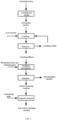
- FIG 4 is a process flow diagram of Embodiment 1 of the present invention.
- the ferronickel alloy is ball-milled and crushed into a powder prior to being leached or ferronickel ingots are directly used for leaching, the leaching residue is returned for continued reaction, and a phosphorus source and an oxidizing agent are added to the leaching effluent and mixed; and a precipitant is added to the resulting mixed phosphorus iron solution, the solution is heated and stirred to obtain an iron phosphate product and a post-precipitation solution, and the post-precipitation solution is subjected to impurity removal to obtain a nickel-containing solution with a lower impurity content.
- a high-cobalt-level solution used in the embodiment was a white alloy leaching effluent, the main composition of which was as shown in Table 1: Table 1: Contents of main elements in white alloy leaching effluent (g/L) Element Co Cu Ni Fe Al Mn Ca Mg Zn Content 37.71 0.0067 0.016 112.3 0.55 0.35 0.72 0.76 0.65
- the method for preparing a nickel sulfate solution and battery-grade iron phosphate from nickel-containing pig iron of this comparative example included the following steps:
- the present invention has a first discharge specific capacity that can reach 161.9 mAh/g or more, and a capacity retention ratio after 100 cycles of greater than 95%, whereas the first discharge specific capacities of Comparative Examples 1 and 2 are lower and are less than 145 mAh/g.
- Table 4 Analysis of impurity elements in the nickel-containing solutions prepared in Embodiments 1-3 of the present invention (mg/L) Ni Fe Co Mn Cu Al Embodiment 1 30125.6 2.58 113.5 34.8 0.112 0.331 Embodiment 2 45562.9 1.68 81.1 26.2 0.106 0.252 Embodiment 3 47371.0 2.31 254.6 56.5 0.178 0.389 Ca Mg P Cr Zn Si Embodiment 1 12.5 1.07 1.55 0.134 1.047 55.9 Embodiment 2 10.7 0.86 1.14 0.098 1.005 50.2 Embodiment 3 18.3 1.12 2.27 0.102 1.062 61.3
- the concentrations of Co and Mn in the solutions are slightly higher, mainly due to the presence of Co and Mn in the raw material.
- the pH should not be too high so as to avoid precipitation of Ni; in addition, the precipitation of Co and Mn requires a higher pH value, and therefore, Co and Mn are present.
- the nickel-containing solutions of Embodiments 1-3 can be used for the preparation of a nickel-cobalt-manganese positive electrode material. Therefore, the presence of Co and Mn not only has no effect on the preparation of a nickel-cobalt-manganese positive electrode material, but can also reduce the addition of Co and Mn, thereby making full use of the nickel-containing solutions.
Landscapes
- Chemical & Material Sciences (AREA)
- Engineering & Computer Science (AREA)
- Organic Chemistry (AREA)
- Metallurgy (AREA)
- Mechanical Engineering (AREA)
- Materials Engineering (AREA)
- Manufacturing & Machinery (AREA)
- General Chemical & Material Sciences (AREA)
- Chemical Kinetics & Catalysis (AREA)
- Inorganic Chemistry (AREA)
- Geochemistry & Mineralogy (AREA)
- Geology (AREA)
- General Life Sciences & Earth Sciences (AREA)
- Environmental & Geological Engineering (AREA)
- Life Sciences & Earth Sciences (AREA)
- Manufacture And Refinement Of Metals (AREA)
Abstract
Description
- The present invention belongs to the field of ferronickel alloy hydrometallurgy, and particularly relates to a method for recycling ferronickel alloy and an application thereof.
- Ferronickel alloy, as an alloy element additive, is mainly applied in the steelmaking and cast iron industries, and the main use thereof is as a raw material for smelting stainless steel. In recent years, the process of using laterite nickel ore to smelt ferronickel has developed rapidly. However, due to the lack of laterite nickel ore in China and the increasingly stringent domestic environmental protection requirements, a large number of companies have established smelting plants in Indonesia. It is expected that the production of ferronickel in Indonesia will accelerate in the next few years, and in the medium to long term, the growth rate of ferronickel production in China and Indonesia is much higher than the production rate and consumption growth rate of stainless steel, indicating that the domestic ferronickel alloy market will gradually reach saturation.
- Meanwhile, new energy technologies are developing rapidly. Lithium iron phosphate is mainly used in the industry of new energy vehicles due to the advantages of a good safety, a long cycle period, a low cost, etc., and the demand for iron phosphate, which is used as a precursor for the preparation of lithium iron phosphate, is also increasing accordingly. At present, there are basically two methods for preparing iron phosphate: 1) a co-precipitation method, involving dissolving a phosphorus source and an iron source and then adding another compound for precipitation, whereby iron phosphate with a better particle size uniformity can be prepared; however, this method may have the problem of a higher impurity content; and 2) a hydrothermal method, involving uniformly mixing an iron source, a phosphorus source and a surfactant, and then carrying out a hydrothermal reaction at 180°C to obtain composite mesoporous iron phosphate. The process is simple and the product has a high crystallinity; however, the equipment requirements are high, and high temperature and high pressure conditions are needed
- The related technology discloses a method for preparing a nickel sulfate solution and battery-grade iron phosphate from nickel-containing pig iron. The method involved therein involves leaching nickel-containing pig iron with a mixed acid of phosphoric acid/sulfuric acid or phosphoric acid/hydrochloric acid, then adding an alkaline solution and an oxidizing agent to precipitate iron phosphate, and subjecting the resulting nickel sulfate and sodium sulfate/ammonium sulfate mixed solution to extraction-reverse extraction to obtain a neat nickel sulfate solution. This process is feasible; however, the prepared iron phosphate does not reach the battery grade; in addition, the increase in the extraction process leads to increased costs, which is not conducive for promotion.
- The present invention aims to solve at least one of the technical problems existing in the above existing technology. In view of this, the present invention proposes a method for recycling ferronickel alloy and an application thereof. The method can separate nickel and iron separately and realize effective utilization; in addition, the operation is simple, the metal recovery rate is high, and iron phosphate with greater economic benefits is prepared.
- In order to achieve the above-mentioned object, the following technical solution is used for the present invention:
A method for recycling ferronickel alloy, including the following steps: - (1) ball-milling, crushing and sieving the ferronickel alloy to obtain a ferronickel alloy powder;
- (2) leaching the ferronickel alloy powder with an acid solution, heating and stirring the solution, and filtering the solution to obtain a leaching effluent and a leaching residue;
- (3) adding a phosphorus source to the leaching effluent, and mixing, stirring, heating and filtering the leaching effluent to obtain iron phosphate and a post-precipitation solution; and
- (4) adding a neutralizing agent to the post-precipitation solution, and heating, stirring and filtering the solution to obtain a nickel-containing solution.
- Preferably, step (3) further includes washing, filtering, and drying the iron phosphate to obtain an iron phosphate product.
- More preferably, the washing is pulping washing, the washing has a liquid-to-solid ratio of (1-20): 1 mL/g, further preferably (1-10) : 1 mL/g, and the washing time is 0.5-5 h, further preferably 1-3 h.
- Preferably, in step (1), the ferronickel alloy is obtained by subjecting laterite nickel ore to reduction roasting, and the ferronickel alloy has a nickel content of 15-40%, an iron content of 60-85% and a total impurity content of less than 2%.
- More preferably, in step (1), the impurities of the ferronickel alloy include the following components in percentage by mass: 60-85% of Fe, 15-40% of Ni, 0.34-0.4% of Co, 0.09-0.1% of Mn, 0.27-0.3% of Si, 0.05-0.1% of Cr, 0.006-0.01% of Ca, 0.004-0.006% of Mg, 0.03-0.05% of Cu, 0.21-0.25% of S, and 0.03-0.08% of P.
- Preferably, in step (1), the ferronickel alloy powder has a particle size of 10-900 µm.
- Preferably, prior to leaching with the acid solution, step (2) further includes adding ferronickel alloy blocks, where the ferronickel alloy blocks have a particle size of 1-60 mm, the ferronickel alloy blocks are prepared by smelting laterite nickel ore, the morphology is mainly round-like particles with a relatively smooth surface.
- Preferably, in step (2), the acid solution is at least one of sulfuric acid, hydrochloric acid or nitric acid.
- Preferably, in step (2), the acid solution has a concentration of 0.1-10 mol/L, more preferably 0.5-5 mol/L.
- Preferably, in step (2), the heating temperature is 30-100°C, more preferably 50-90°C, and the leaching time is 1-24 h, more preferably 3-15 h.
- Preferably, in step (2), the leaching residue can be returned to the leaching section for continued reaction, and since the content of impurities in the ferronickel alloy is relatively small, the recovery rates of Ni and Fe from the raw material can be more than 99%.
- Preferably, in step (3), the phosphorus source is at least one of phosphoric acid or a phosphate salt; and the phosphate salt includes, but is not limited to, at least one of trisodium phosphate, sodium dihydrogen phosphate, sodium monohydrogen phosphate, ammonium monohydrogen phosphate, ammonium dihydrogen phosphate or potassium phosphate.
- Preferably, in step (3), the added amount of the phosphorus source is determined according to the content of iron ions in the acid leaching effluent, the Fe/P ratio is 0.5-1.5, more preferably 0.9-1.2, and the stirring time is 0.1-2 h.
- Preferably, in step (3), an oxidizing agent is further added to the leaching effluent; and the oxidizing agent is at least one of air, oxygen, hydrogen peroxide, ozone, sodium chlorate, or sodium persulfate. Since the iron ions in the leaching effluent may be divalent iron, or a mixture of divalent iron and trivalent iron, it is necessary to use an oxidizing agent to oxidize it into trivalent iron.
- More preferably, the amount of the oxidizing agent is 0.5-2 times the theoretical amount, further preferably 0.9-1.5 times. The theoretical amount is the theoretical amount for oxidizing the divalent iron into trivalent iron, and the added amount of the oxidizing agent in the present invention is 0.5-2 times the theoretical amount.
- More preferably, the oxidizing agent is not necessarily added. When the acid solution used in step (2) is nitric acid, the iron ions in the leaching effluent have already been trivalent iron, and therefore, no oxidation is needed.
- Preferably, in step (3), the heating temperature is 30-100°C, further preferably 50-90°C.
- Preferably, in step (3), the stirring time is 1-24 h, further preferably 4-18 h.
- Preferably, in step (3), it is necessary to add a precipitant before the heating; and the precipitant includes, but is not limited to, at least one of sodium hydroxide, sodium carbonate, titanium dioxide, aluminum hydroxide, aluminum oxide, anhydrous iron phosphate or iron phosphate dihydrate.
- More preferably, the precipitant includes, but is not limited to, at least one of titanium dioxide, aluminum hydroxide, aluminum oxide, anhydrous iron phosphate or iron phosphate dihydrate.
- More preferably, the added amount of the precipitant is 1-100 g/L, further preferably 10-50 g/L.
- Preferably, in step (4), the neutralizing agent is at least one of sodium carbonate, calcium carbonate, ammonium carbonate, potassium hydroxide, or sodium hydroxide.
- Preferably, in step (4), the neutralizing agent is formulated into a solution or slurry and added to the post-precipitation solution to make the pH value of the solution reach 3-6.
- Preferably, in step (4), the heating temperature is 30-100°C, further preferably 50-80°C.
- Preferably, in step (4), the stirring time is 1-10 h, further preferably 2-6 h.
- The present invention further provides an application of the above-mentioned method in the preparation of a precursor.
- Principle of the Invention:
- Step 2: This step involves reacting nickel with iron under the action of an acid to obtain nickel ions and ferrous ions or nickel ions and iron ions:
Ni+Fe+2H2SO4→NiSO4+FeSO4+2H2↑;
2Ni+Fe+8HCl→2NiCl3+FeCl2+4H2↑;
and
3Ni+Fe+12HNO3→3Ni(NO3)2+Fe(NO3)3+3NO↑+6H2O.
- Step 3: This step involves preparing an iron phosphate product:
- Sulfuric acid or hydrochloric acid system:
2Fe2++2H3PO4+H2O2→2FePO4+2H2O+4H+;
- Nitric acid system:
Fe3++H3PO4→FePO4+3H+.
- Sulfuric acid or hydrochloric acid system:
- Step 3 further includes adding a neutralizing agent to the post-precipitation solution, and heating, stirring and filtering the solution to obtain a nickel-containing solution. This step is mainly for impurity removal. The nickel sulfate solution contains small amounts of Ca, Mg, and Fe. This step involves, without limitation, the following reactions:
Ca2++Na2CO3→CaCO3↓+2Na+; Mg2++2NaOH→Mg(OH)2↓+2Na+;
and
2Fe3++3Na2CO3+3H2O→2Fe(OH)3↓+6Na++3CO2.
- Compared with the existing technology, the beneficial effects of the present invention are as follows:
- 1. In the present invention, after the ferronickel alloy is dissolved with an acid solution, iron phosphate is prepared by means of a phosphorus source or a phosphorus source and an oxidizing agent under the action of a precipitant, and the iron phosphate can be further used as a precursor of lithium iron phosphate for the preparation of a lithium iron phosphate positive electrode material. A neutralizing agent is added to the post-precipitation solution, and the solution is heated, stirred and filtered to obtain a nickel-containing solution, which can be further used for preparing a nickel-cobalt-manganese ternary positive electrode material; and the leaching residue can be returned to the leaching section for continued reaction, and since the content of impurities in the ferronickel alloy is relatively small, the recovery rates of Ni and Fe from the raw material can be more than 99%.
- 2. The present invention has simple operation, a short technological process, and low equipment requirements, and is suitable for industrialized production and application.
- The present invention will be further illustrated below in conjunction with the accompanying drawings and embodiments, where:
-
Figure 1 is an SEM image of an iron phosphate product prepared in Embodiment 1 of the present invention at a magnification of 5000 folds; -
Figure 2 is an SEM image of the iron phosphate product prepared in Embodiment 1 of the present invention at a magnification of 50000 folds; -
Figure 3 is an XRD pattern of the iron phosphate product prepared in Embodiment 1 of the present invention; and -
Figure 4 is a process flow diagram of Embodiment 1 of the present invention. - The concept of the present invention and the technical effects produced thereby will be described below clearly and completely in conjunction with the embodiments, so as to fully understand the object, features and effects of the present invention. Obviously, the described embodiments are only some, rather than all, of the embodiments of the present invention. Based on the embodiments of the present invention, other embodiments obtained by those skilled having ordinary in the art without involving any inventive effort all fall within the scope of protection of the present invention.
- The method for recycling ferronickel alloy of this embodiment included the following steps:
- (1) ball-milling, crushing and sieving 1-60 mm ferronickel alloy blocks (iron: 63.28%, nickel: 35.51%, Co: 0.34%, Mn: 0.09%, Si: 0.27%, Cr: 0.05%, Ca: 0.006%, Mg: 0.004%, Cu: 0.03%, S: 0.21%, and P: 0.03%) to obtain a ferronickel powder;
- (2) mixing 100 g of the ferronickel powder with 1 L of sulfuric acid with a concentration of 1.5 mol/L, heating the mixture to 90°C for 4 h of reaction, and filtering the reaction product to obtain a leaching effluent containing nickel and iron and a leaching residue;
- (3) adding sodium phosphate to the leaching effluent obtained in step (2) in an amount that was 0.9 times the theoretical amount, stirring the mixture for 1 h, then adding hydrogen peroxide in an amount that was 1.3 times the theoretical amount, stirring the mixture for 2 h, further adding 50 g of anhydrous iron phosphate, heating the mixture to 80°C for 6 h of reaction, and filtering the reaction product to obtain iron phosphate and a post-precipitation solution;
- (4) subjecting the iron phosphate obtained in step (3) to pulping washing for 1 h, and filtering and then drying the iron phosphate to obtain an iron phosphate product; and
- (5) adjusting the pH of the post-precipitation solution obtained in step (3) with a 25% sodium carbonate solution to about 4.5, with the adjustment time being 3 h, and filtering the solution to obtain a nickel sulfate solution.
-
Figures 1 and 2 are SEM images of the iron phosphate product prepared in Embodiment 1. It can be seen fromFigure 1 that the iron phosphate has a relatively uniform particle size distribution, and the iron phosphate is mainly pellets formed by the combination of flake-like primary sheets, with the particle size being about 10 µm. -
Figure 3 is an XRD pattern of the iron phosphate product prepared in Embodiment 1 of the present invention. It can be seen from the diffraction pattern ofFigure 2 that the iron phosphate prepared in Embodiment 1 of the present invention is fully consistent with the characteristic peaks on a standard card (PDF#50-1635), the peak shapes are sharp, and the characteristic peaks are obvious. -
Figure 4 is a process flow diagram of Embodiment 1 of the present invention. As can be seen fromFigure 4 , the ferronickel alloy is ball-milled and crushed into a powder prior to being leached or ferronickel ingots are directly used for leaching, the leaching residue is returned for continued reaction, and a phosphorus source and an oxidizing agent are added to the leaching effluent and mixed; and a precipitant is added to the resulting mixed phosphorus iron solution, the solution is heated and stirred to obtain an iron phosphate product and a post-precipitation solution, and the post-precipitation solution is subjected to impurity removal to obtain a nickel-containing solution with a lower impurity content. - The method for recycling ferronickel alloy of this embodiment included the following steps:
- (1) mixing 200 g of ferronickel alloy blocks (iron: 63.28%, nickel: 35.51%, Co: 0.34%, Mn: 0.09%, Si: 0.27%, Cr: 0.05%, Ca: 0.006%, Mg: 0.004%, Cu: 0.03%, S: 0.21%, and P: 0.03%) with 1 L of sulfuric acid with a concentration of 1.5 mol/L, heating the mixture to 80°C for 12 h of reaction, and then filtering the reaction product to obtain a leaching effluent containing nickel and iron and incompletely reacted ferronickel alloy blocks;
- (2) adding phosphoric acid to the leaching effluent obtained in step (2) in an amount that was 1.0 times the theoretical amount, stirring the leaching effluent for 0.5 h, then introducing oxygen, and performing a reaction for a time of 5 h;
- (3) adding 100 g of iron phosphate dihydrate to the phosphorus iron solution obtained in step (3), heating the phosphorus iron solution to 90°C for 4 h of reaction, and filtering the reaction product to obtain iron phosphate and a post-precipitation solution;
- (4) subjecting the iron phosphate obtained in step (4) to pulping washing for 2 h, and filtering and then drying the iron phosphate to obtain an iron phosphate product; and
- (5) adjusting the pH of the post-precipitation solution obtained in step (4) with 30% ammonium carbonate to about 5, with the adjustment time being 4 h, and filtering the solution to obtain a nickel sulfate solution with a lower impurity content.
- The method for recycling ferronickel alloy of this embodiment included the following steps:
- (1) ball-milling, crushing and sieving ferronickel alloy blocks (iron: 83.12%, nickel: 15.45%, Co: 0.51%, Mn: 0.05%, Si: 0.36%, Cr: 0.09%, Ca: 0.012%, Mg: 0.008%, Cu: 0.05%, S: 0.22%, and P: 0.01%) to obtain a ferronickel powder;
- (2) mixing 200 g of the ferronickel powder with 0.8 L of nitric acid with a concentration of 2.5 mol/L, heating the mixture to 85°C for 5 h of reaction, and filtering the reaction product to obtain a leaching effluent containing nickel and iron and a leaching residue;
- (3) adding ammonium phosphate to the leaching effluent obtained in step (2) in an amount that was 0.93 times the theoretical amount, and stirring the leaching effluent for 2 h;
- (4) adding 20 g of aluminum oxide and iron phosphate dihydrate to the phosphorus iron solution obtained in step (3), heating the phosphorus iron solution to 70°C for 12 h of reaction, and filtering the reaction product to obtain iron phosphate and a post-precipitation solution;
- (5) subjecting the iron phosphate obtained in step (4) to pulping washing for 0.5 h, and filtering and then drying the iron phosphate to obtain an iron phosphate product; and
- (6) adjusting the pH of the post-precipitation solution obtained in step (4) with 5% sodium hydroxide to about 4, with the adjustment time being 5 h, and filtering the solution to obtain a nickel-containing solution with a lower impurity content.
- The method for recycling ferronickel alloy of this embodiment included the following steps:
- (1) ball-milling, crushing and sieving ferronickel alloy blocks (iron 67.22%, nickel 30.79%, Co 0.47%, Mn 0.08%, Si 0.25%, Cr 0.09%, Ca 0.008%, Mg 0.005%, Cu 0.04%, S 0.29%, and P 0.05%) to obtain a ferronickel powder;
- (2) mixing 50 g of the ferronickel powder with 0.75 L of hydrochloric acid with a concentration of 3.0 mol/L, heating the mixture to 80°C for 6 h of reaction, and filtering the reaction product to obtain a leaching effluent containing nickel and iron and a leaching residue;
- (3) adding phosphoric acid to the leaching effluent obtained in step (2) in an amount that was 0.95 times, stirring the leaching effluent for 1.5 h, then adding hydrogen peroxide in an amount that was 1.5 times the theoretical amount, and stirring the mixture for 3 h;
- (4) adding 10 g of titanium dioxide and anhydrous iron phosphate to the phosphorus iron solution obtained in step (3), heating the phosphorus iron solution to 75°C for 10 h of reaction, and filtering the reaction product to obtain iron phosphate and a post-precipitation solution;
- (5) subjecting the iron phosphate obtained in step (4) to pulping washing for 2 h, and filtering and then drying the iron phosphate to obtain an iron phosphate product; and
- (6) adjusting the pH of the post-precipitation solution obtained in step (4) with calcium phosphate to about 5.1, with the adjustment time being 6 h, and filtering the solution to obtain a nickel-containing solution with a lower impurity content.
- A high-cobalt-level solution used in the embodiment was a white alloy leaching effluent, the main composition of which was as shown in Table 1:
Table 1: Contents of main elements in white alloy leaching effluent (g/L) Element Co Cu Ni Fe Al Mn Ca Mg Zn Content 37.71 0.0067 0.016 112.3 0.55 0.35 0.72 0.76 0.65 - The specific steps of recovering iron from the alloy leaching effluent of the cobalt-nickel industry were as follows:
- 1) First of all, the pH of the white alloy leaching effluent was adjusted with cobalt carbonate to 4-5 at room temperature, iron powder was then added, the mixture was stirred at room temperature for 0.5 h and then subjected to suction filtration, the pH of the filtrate was then adjusted to 2.8 to obtain a post-purification solution, and the post-purification solution was diluted to 72 g/L; and at the same time, 155 g/L diammonium hydrogen phosphate was prepared.
- 2) Tap water and a small amount of hydrogen peroxide was added to a reaction kettle as a basis, and during stirring, the diammonium hydrogen phosphate solution, the 2.5 mol ferrous post-purification solution, and hydrogen peroxide were added to the reaction kettle in parallel for synthesis, where the molar ratio of the charged iron to phosphorus during the process was maintained at 1, the charging temperature was 40-50°C, the charging time is 10 min, the stirring rotation speed was 240 rpm, and the pH value during the process was 2.3-2.6; and the post-synthesis material was maintained at the temperature in the reaction kettle for 60 min and then subjected to suction filtration to obtain a synthesized material and an iron-removed solution.
- 3) The post-synthesis material was washed by means of a combination of rinsing and slurry washing at a temperature of 40-70°C until the conductivity of the washing liquid was less than 5 ms/m. During the washing process, the liquid-to-solid ratio of a wet basis pulp was 6 : 1, and the stirring rotation speed was 300 rpm.
- 4) Phosphoric acid was added to the pulp obtained after synthesis and washing in an amount that was 0.5 times the amount of Fe by mole, and after the rotation speed was set to 260 rpm and the temperature was raised to 90°C, conversion was carried out, where he conversion time was 120 min.
- 5) The converted material was washed until the conductivity was less than 300 µm/cm, and then subjected to suction filtration, and after drying at 105°C, iron phosphate dihydrate was obtained; and the dry basis was further calcined at 520°C for 3 h to obtain anhydrous iron phosphate.
- The method for preparing a nickel sulfate solution and battery-grade iron phosphate from nickel-containing pig iron of this comparative example included the following steps:
- (1) a raw material pretreatment, where nickel-containing pig iron was dried and crushed into a powder, and the powder was sieved for composition detection;
- (2) a leaching treatment, where the undersize material obtained in step (1) was subjected to atmospheric pressure leaching using a mixed acid and to solid-liquid separation to obtain a filtrate, where the leaching temperature was 50-90°C, and the leaching time was 3-8 hours;
- (3) a precipitation treatment, where under the condition of using a precipitant to maintain the pH of the filtrate in step (2), an oxidizing agent was added simultaneously to oxidize divalent iron in the filtrate, a controlled crystallization method was used to prepare an iron phosphate precipitate, and after reaction, filtration and washing were performed to obtain a nickel-containing filtrate and an iron phosphate precipitate;
- (4) an iron phosphate drying treatment, where the iron phosphate solid was vacuum dried at 90-120°C to obtain a battery-grade anhydrous iron phosphate product; and
- (5) a nickel-containing filtrate extraction treatment, where the nickel-containing filtrate in step (3) was collected, a diluted extractant was used for nickel extraction, and the product was left to stand, followed by separation to obtain a nickel-containing extraction organic phase and an impurity-containing raffinate.
- The iron phosphate products prepared in the above-mentioned Embodiments 1-3 and Comparative Examples 1 and 2 were tested for physical and chemical indexes, and the results were as shown in Table 2 below:
Table 2: Physical and chemical index test results of anhydrous iron phosphate prepared in Embodiments 1-3 Item Iron phosphate standards for lithium iron phosphate positive electrode material Embodiment 1 Embodiment 2 Embodiment 3 Comparative Example 1 Comparative Example 2 Fe (%) 36.00-37.00 36.52 37.15 36.86 36.01 35.98 P (%) 20.50-21.00 20.74 20.98 20.65 20.8 20.24 Fe/P 0.960-1.0 0.976 0.982 0.989 0.961 0.986 BET (specific surface area) (m2/g) 3.00-12.00 8.91 6.56 7.32 9.23 6.73 - From the results in Table 2, it can be seen that the physical and chemical indexes of the iron phosphate prepared after recycling the ferronickel alloy according to the present invention all met the standards for lithium iron phosphate positive electrode materials.
- The iron phosphates prepared in the above-mentioned Embodiments 1-3 and Comparative Examples 1 and 2 were taken and prepared into lithium iron phosphates according to a conventional method, and the electrical properties of the prepared lithium iron phosphates were tested. The results were as shown in Table 3:
Table 3: Comparison table of the test results of the compaction density and electrical properties of lithium iron phosphate powders synthesized from the iron phosphates of Embodiments 1-3 and Comparative Examples 1 and 2 No. Powder compaction density (g/cc) Charge/discharge specific capacity at 0.1 C (mAh/g) Charge/discharge specific capacity at 0.1 C after 100 cycles (mAh/g) Capacity retention ratio after 100 cycles (%) First coulombic efficiency (%) Embodiment 1 2.3458 162.3/155.7 151.1/150.2 96.47 95.93 Embodiment 2 2.3379 162.9/156.4 152.4/151.7 96.99 96.00 Embodiment 3 2.3802 161.9/156.9 150.8/149.8 95.47 96.91 Comparative Example 1 2.3905 143.9/136.1 136.2/129.0 94.8 94.6 Comparative Example 2 2.3910 142/135.2 135.5/128.5 95.0 95.2 - It can be seen from Table 3 that the present invention has a first discharge specific capacity that can reach 161.9 mAh/g or more, and a capacity retention ratio after 100 cycles of greater than 95%, whereas the first discharge specific capacities of Comparative Examples 1 and 2 are lower and are less than 145 mAh/g.
Table 4: Analysis of impurity elements in the nickel-containing solutions prepared in Embodiments 1-3 of the present invention (mg/L) Ni Fe Co Mn Cu Al Embodiment 1 30125.6 2.58 113.5 34.8 0.112 0.331 Embodiment 2 45562.9 1.68 81.1 26.2 0.106 0.252 Embodiment 3 47371.0 2.31 254.6 56.5 0.178 0.389 Ca Mg P Cr Zn Si Embodiment 1 12.5 1.07 1.55 0.134 1.047 55.9 Embodiment 2 10.7 0.86 1.14 0.098 1.005 50.2 Embodiment 3 18.3 1.12 2.27 0.102 1.062 61.3 - In these embodiments, the concentrations of Co and Mn in the solutions are slightly higher, mainly due to the presence of Co and Mn in the raw material. During impurity removal, when adjusting the pH, the pH should not be too high so as to avoid precipitation of Ni; in addition, the precipitation of Co and Mn requires a higher pH value, and therefore, Co and Mn are present. In addition, the nickel-containing solutions of Embodiments 1-3 can be used for the preparation of a nickel-cobalt-manganese positive electrode material. Therefore, the presence of Co and Mn not only has no effect on the preparation of a nickel-cobalt-manganese positive electrode material, but can also reduce the addition of Co and Mn, thereby making full use of the nickel-containing solutions.
- The embodiments of the present invention are described in detail above in conjunction with the accompanying drawings; however, the present invention is not limited to the above-mentioned embodiments. Within the scope of knowledge possessed by those of ordinary skill in the art, various changes can also be made without departing from the gist of the present invention. In addition, in the case of no conflict, the embodiments of the present invention and the features in the embodiments can be combined with each other.
Claims (10)
- A method for recycling ferronickel alloy, comprising the following steps:(1) ball-milling, crushing and sieving the ferronickel alloy to obtain a ferronickel alloy powder;(2) leaching the ferronickel alloy powder with an acid solution, heating and stirring the solution, and filtering the solution to obtain a leaching effluent and a leaching residue;(3) adding a phosphorus source to the leaching effluent, and mixing, stirring, heating and filtering the leaching effluent to obtain iron phosphate and a post-precipitation solution; and(4) adding a neutralizing agent to the post-precipitation solution, and heating, stirring and filtering the solution to obtain a nickel-containing solution.
- The method according to claim 1, wherein step (3) further comprises washing, filtering, and drying the iron phosphate to obtain an iron phosphate product.
- The method according to claim 2, wherein the washing is pulping washing, the washing has a liquid-to-solid ratio of (1-20): 1 mL/g, and the washing time is 0.5-5 h.
- The method according to claim 1, wherein in step (1), the ferronickel alloy is obtained by subjecting laterite nickel ore to reduction roasting, and the ferronickel alloy has a nickel content of 15-40% and an iron content of 60-85%.
- The method according to claim 1, wherein in step (2), the acid solution is at least one of sulfuric acid, hydrochloric acid or nitric acid.
- The method according to claim 1, wherein in step (3), the phosphorus source is at least one of phosphoric acid or a phosphate salt; and the phosphate salt includes, but is not limited to, at least one of trisodium phosphate, sodium dihydrogen phosphate, sodium monohydrogen phosphate, ammonium monohydrogen phosphate, ammonium dihydrogen phosphate or potassium phosphate.
- The method according to claim 1, wherein in step (3), an oxidizing agent is further added to the leaching effluent; and the oxidizing agent is at least one of air, oxygen, hydrogen peroxide, ozone, sodium chlorate, or sodium persulfate.
- The method according to claim 1, wherein in step (3), a phosphorus source is added to the leaching effluent for mixing and stirring, and a precipitant is then added, wherein the precipitant includes, but is not limited to, at least one of sodium hydroxide, sodium carbonate, titanium dioxide, aluminum hydroxide, aluminum oxide, anhydrous iron phosphate or iron phosphate dihydrate.
- The method according to claim 1, wherein in step (4), the neutralizing agent is at least one of sodium carbonate, calcium carbonate, ammonium carbonate, potassium hydroxide, and sodium hydroxide.
- An application of the method according to any one of claims 1-9 in the preparation of a positive electrode material precursor.
Applications Claiming Priority (2)
| Application Number | Priority Date | Filing Date | Title |
|---|---|---|---|
| CN202110154815.5A CN113044821B (en) | 2021-02-04 | 2021-02-04 | Method for recycling nickel-iron alloy and application |
| PCT/CN2021/093666 WO2022166023A1 (en) | 2021-02-04 | 2021-05-13 | Method for resource recycling of nickel-iron alloy and use thereof |
Publications (2)
| Publication Number | Publication Date |
|---|---|
| EP4286325A1 true EP4286325A1 (en) | 2023-12-06 |
| EP4286325A4 EP4286325A4 (en) | 2024-08-14 |
Family
ID=76508866
Family Applications (1)
| Application Number | Title | Priority Date | Filing Date |
|---|---|---|---|
| EP21924031.4A Withdrawn EP4286325A4 (en) | 2021-02-04 | 2021-05-13 | METHOD OF RECYCLING NICKEL-IRON ALLOY RESOURCES AND ITS USE |
Country Status (3)
| Country | Link |
|---|---|
| EP (1) | EP4286325A4 (en) |
| CN (1) | CN113044821B (en) |
| WO (1) | WO2022166023A1 (en) |
Families Citing this family (30)
| Publication number | Priority date | Publication date | Assignee | Title |
|---|---|---|---|---|
| CN113800578B (en) * | 2021-08-03 | 2022-11-15 | 广东邦普循环科技有限公司 | Method for preparing nickel sulfate by using low-nickel ferronickel |
| CN113666351B (en) * | 2021-08-31 | 2023-12-12 | 广东邦普循环科技有限公司 | Method for preparing ferric phosphate by recycling ferronickel slag |
| CN113753872A (en) * | 2021-09-15 | 2021-12-07 | 广东邦普循环科技有限公司 | Comprehensive utilization method of iron-containing minerals |
| CN113942986B (en) * | 2021-09-27 | 2023-06-16 | 荆门市格林美新材料有限公司 | Method for recycling nickel and iron from nickel-iron alloy |
| CN113979415A (en) * | 2021-11-24 | 2022-01-28 | 四川顺应动力电池材料有限公司 | Method for producing iron phosphate |
| CN114105116A (en) * | 2021-12-15 | 2022-03-01 | 格林美股份有限公司 | Method for preparing battery-grade iron phosphate from nickel-iron alloy |
| CN114314700B (en) * | 2021-12-28 | 2024-06-14 | 四川顺应动力电池材料有限公司 | A method for comprehensive resource utilization of iron, nickel and/or cobalt alloy materials |
| CN116409830A (en) * | 2021-12-29 | 2023-07-11 | 荆门市格林美新材料有限公司 | Comprehensive utilization method for nickel-iron alloy resource |
| CN116409762A (en) * | 2021-12-29 | 2023-07-11 | 荆门市格林美新材料有限公司 | A kind of method that utilizes nickel-iron alloy to prepare battery material |
| CN114597399B (en) * | 2022-02-15 | 2024-10-18 | 广东邦普循环科技有限公司 | A preparation method and application of sodium ferrovanadium phosphate material |
| CN114592128B (en) * | 2022-03-02 | 2023-04-14 | 楚能新能源股份有限公司 | A method of recycling waste nickel-iron alloy to prepare high-value materials |
| CN114702079A (en) * | 2022-03-28 | 2022-07-05 | 广东邦普循环科技有限公司 | Method for separating and extracting nickel and iron from nickel-iron alloys |
| CN114614136B (en) * | 2022-04-01 | 2024-04-16 | 山东宏匀纳米科技有限公司 | Method for preparing dihydrate ferric phosphate and ternary positive electrode material from laterite nickel ore |
| CN115180653B (en) * | 2022-07-04 | 2023-11-03 | 四川顺应动力电池材料有限公司 | Method for efficiently utilizing limonite type and magnesia type laterite-nickel ore combination |
| CN115448282B (en) * | 2022-09-15 | 2024-01-05 | 广东邦普循环科技有限公司 | Method for preparing lithium iron phosphate from nickel-iron alloy and application |
| CN115676789B (en) * | 2022-09-28 | 2024-01-23 | 成都盛威兴科新材料研究院合伙企业(有限合伙) | Preparation method for producing battery-grade ferric phosphate by adopting iron-based nickel-containing alloy |
| CN115849307A (en) * | 2022-11-05 | 2023-03-28 | 广东邦普循环科技有限公司 | Method for extracting iron from nickel-iron alloy and preparing hydrogen peroxide |
| CN115896451B (en) * | 2022-12-09 | 2025-04-25 | 荆门市格林美新材料有限公司 | A method for jointly treating laterite nickel ore and nickel-iron alloy and recovering nickel and iron |
| CN116240381B (en) * | 2023-02-07 | 2025-02-07 | 广东邦普循环科技有限公司 | A method for comprehensive utilization of laterite nickel ore leaching residue |
| CN115838871B (en) * | 2023-02-24 | 2023-05-23 | 中国科学院过程工程研究所 | Method for obtaining leaching liquid capable of being directly used for nickel-cobalt separation from brown iron type laterite nickel ore |
| CN116621147A (en) * | 2023-03-13 | 2023-08-22 | 株洲冶炼集团股份有限公司 | A method for preparing lithium manganese iron phosphate cathode material from lithium iron phosphate waste powder |
| CN116902999A (en) * | 2023-05-31 | 2023-10-20 | 广东盛祥新材料科技有限公司 | Ternary powder/lithium iron powder/lithium carbonate processing method and waste battery recycling method |
| EP4524268A4 (en) * | 2023-07-27 | 2025-10-08 | Pt Esg New Energy Mat | METHOD FOR EXTRACTING METALS FROM SAPROLITE-LATERITIC NICKEL ORE |
| CN117023536A (en) * | 2023-08-18 | 2023-11-10 | 福安国隆纳米材料有限公司 | Method for preparing battery-grade ferric phosphate by utilizing nickel-iron alloy |
| CN117377638B (en) * | 2023-08-25 | 2025-08-26 | 广东邦普循环科技有限公司 | Preparation method of flaky iron phosphate and preparation method of flaky lithium iron phosphate |
| CN117187597A (en) * | 2023-09-12 | 2023-12-08 | 荆门市格林美新材料有限公司 | A method for removing chromium from the leachate obtained from nickel-iron alloy, chromium removal liquid and its application |
| CN117393261B (en) * | 2023-11-13 | 2024-08-20 | 中南大学 | FeSiNi soft magnetic composite material and preparation method thereof |
| CN117858970A (en) * | 2023-11-24 | 2024-04-09 | 广东邦普循环科技有限公司 | A method for separating and recovering ferronickel from ferronickel material |
| CN118083933B (en) * | 2024-03-01 | 2026-03-17 | 广东光华科技股份有限公司 | Continuous preparation methods for iron phosphate, and preparation methods for iron phosphate and lithium iron phosphate. |
| CN118324109A (en) * | 2024-05-15 | 2024-07-12 | 湖南邦普循环科技有限公司 | Preparation method of ferric phosphate |
Family Cites Families (13)
| Publication number | Priority date | Publication date | Assignee | Title |
|---|---|---|---|---|
| CN101016581A (en) * | 2006-12-20 | 2007-08-15 | 福建省顺昌金紫矿业有限公司 | Method of synthetically and highly effectively reclaiming nickel and magnesium resource from nickel-containing serpentine |
| CN101575092A (en) * | 2009-06-18 | 2009-11-11 | 中南大学 | Method for preparing lithium iron phosphate precursor comprehensively from laterite type nickel ores |
| EP4112543A1 (en) * | 2009-09-18 | 2023-01-04 | A123 Systems, LLC | Ferric phosphate and methods of preparation thereof |
| US8980126B2 (en) * | 2010-10-08 | 2015-03-17 | Semiconductor Energy Laboratory Co., Ltd. | Electrode material and method for manufacturing power storage device |
| CN102041381B (en) * | 2011-01-17 | 2011-12-07 | 河南永通镍业有限公司 | Method for recovering nickel, cobalt, iron, manganese and magnesium from oxidized nickel ore |
| WO2013077296A1 (en) * | 2011-11-22 | 2013-05-30 | 住友金属鉱山株式会社 | Method for producing high-purity nickel sulfate |
| WO2016058007A2 (en) * | 2014-10-10 | 2016-04-14 | Rare Element Resources, Ltd. | Processing for the extraction of rare earth elements |
| WO2018117771A1 (en) * | 2016-12-23 | 2018-06-28 | 주식회사 포스코 | Method for recovering nickel and cobalt from nickel, iron, and cobalt-containing raw material |
| CN106987728B (en) * | 2017-03-28 | 2019-08-13 | 中南大学 | A method of normal pressure phosphoric acid, which leaches nickel cobalt and synchronizes, from lateritic nickel ore prepares ferric phosphate |
| CN106829907B (en) * | 2017-03-31 | 2019-05-14 | 广东佳纳能源科技有限公司 | A kind of method that nickel-contained pig iron prepares nickel sulfate solution and battery-grade iron phosphate |
| CN111254281B (en) * | 2020-03-30 | 2021-01-29 | 中南大学 | A kind of method of laterite nickel ore pressurized phosphoric acid leaching |
| CN111394595B (en) * | 2020-04-17 | 2021-04-23 | 中南大学 | Method for extracting nickel and cobalt from phosphoric acid leaching solution of laterite-nickel ore |
| CN111471856B (en) * | 2020-05-06 | 2021-06-22 | 中南大学 | Method for one-step acid leaching of laterite nickel ore and co-production of lithium iron phosphate cathode active material |
-
2021
- 2021-02-04 CN CN202110154815.5A patent/CN113044821B/en active Active
- 2021-05-13 EP EP21924031.4A patent/EP4286325A4/en not_active Withdrawn
- 2021-05-13 WO PCT/CN2021/093666 patent/WO2022166023A1/en not_active Ceased
Also Published As
| Publication number | Publication date |
|---|---|
| EP4286325A4 (en) | 2024-08-14 |
| WO2022166023A1 (en) | 2022-08-11 |
| CN113044821B (en) | 2022-12-13 |
| CN113044821A (en) | 2021-06-29 |
Similar Documents
| Publication | Publication Date | Title |
|---|---|---|
| CN113044821B (en) | Method for recycling nickel-iron alloy and application | |
| CN113025822B (en) | Method for extracting nickel from nickel-containing iron powder and preparing iron phosphate and application | |
| CN115367725B (en) | Doped lithium iron phosphate and preparation method and application thereof | |
| CN113277489A (en) | Method for preparing high-purity iron phosphate by using ferrophosphorus waste | |
| CN115448279B (en) | Method for preparing battery grade ferric phosphate material by recycling lithium-extracted ferrophosphorus slag | |
| CN112645299A (en) | Preparation method and application of iron phosphate | |
| CN112551498A (en) | Method for recovering phosphorus iron slag after lithium extraction of lithium iron phosphate | |
| CN113060712B (en) | A method for preparing iron phosphate and nickel-cobalt-manganese hydroxide battery precursor materials from metal nickel-cobalt-iron powder | |
| CN112159897A (en) | Method for purifying nickel-cobalt-manganese leaching solution | |
| EP4545477A1 (en) | Method for preparing iron phosphate from iron phosphorus slag, iron phosphate and application of iron phosphate | |
| CN115477293B (en) | Preparation method of anhydrous ferric phosphate with low impurity and high specific surface area | |
| CN117602604A (en) | A method for recycling iron phosphate slag after lithium extraction to prepare battery grade iron phosphate | |
| CN110436427B (en) | Preparation method of composite structure ferric orthophosphate for high-capacity high-compaction lithium iron phosphate | |
| CN104241724A (en) | Method for preparing battery-grade lithium carbonate from recycled lithium ion battery material | |
| CN107058745A (en) | A kind of method that valuable metal is extracted in cobalt metallurgical waste | |
| CN115196609A (en) | Method for recovering iron phosphate from lithium iron phosphate lithium extraction slag and application thereof | |
| CN115784188A (en) | Method for recycling and preparing battery-grade iron phosphate | |
| CN112499686A (en) | Method for preparing aluminum-doped battery-grade manganese oxyhydroxide by using waste manganese liquid | |
| CN112456461B (en) | Method for preparing battery-grade flaky iron phosphate by using cobalt-iron leaching solution | |
| CN112342383B (en) | Separation and recovery method of nickel, cobalt, manganese and lithium in ternary waste | |
| CN115072687B (en) | Method for preparing battery-grade ferric phosphate by using sulfuric acid cinder | |
| CN106498442B (en) | A kind of antimony electrolyte selectivity iron removaling and the method for preparing ferrous oxalate | |
| CN115709979B (en) | Method for preparing battery-grade manganese iron phosphate by taking high-iron manganese ore as raw material | |
| CN117280055B (en) | Combined treatment method of laterite-nickel ore smelting slag and phosphating slag | |
| CN115924989B (en) | Method for recovering cobalt nickel hydroxide from waste ternary batteries |
Legal Events
| Date | Code | Title | Description |
|---|---|---|---|
| STAA | Information on the status of an ep patent application or granted ep patent |
Free format text: STATUS: THE INTERNATIONAL PUBLICATION HAS BEEN MADE |
|
| PUAI | Public reference made under article 153(3) epc to a published international application that has entered the european phase |
Free format text: ORIGINAL CODE: 0009012 |
|
| STAA | Information on the status of an ep patent application or granted ep patent |
Free format text: STATUS: REQUEST FOR EXAMINATION WAS MADE |
|
| 17P | Request for examination filed |
Effective date: 20230831 |
|
| AK | Designated contracting states |
Kind code of ref document: A1 Designated state(s): AL AT BE BG CH CY CZ DE DK EE ES FI FR GB GR HR HU IE IS IT LI LT LU LV MC MK MT NL NO PL PT RO RS SE SI SK SM TR |
|
| DAV | Request for validation of the european patent (deleted) | ||
| DAX | Request for extension of the european patent (deleted) | ||
| A4 | Supplementary search report drawn up and despatched |
Effective date: 20240717 |
|
| RIC1 | Information provided on ipc code assigned before grant |
Ipc: C22B 23/02 20060101ALI20240711BHEP Ipc: C22B 3/00 20060101ALI20240711BHEP Ipc: C01G 53/10 20060101ALI20240711BHEP Ipc: C22B 3/44 20060101ALI20240711BHEP Ipc: C22B 3/06 20060101ALI20240711BHEP Ipc: C22B 23/00 20060101ALI20240711BHEP Ipc: C01B 25/37 20060101AFI20240711BHEP |
|
| STAA | Information on the status of an ep patent application or granted ep patent |
Free format text: STATUS: EXAMINATION IS IN PROGRESS |
|
| 17Q | First examination report despatched |
Effective date: 20250328 |
|
| STAA | Information on the status of an ep patent application or granted ep patent |
Free format text: STATUS: THE APPLICATION IS DEEMED TO BE WITHDRAWN |
|
| 18D | Application deemed to be withdrawn |
Effective date: 20250729 |