EP4285551B1 - Zero trust end point network security device - Google Patents
Zero trust end point network security device Download PDFInfo
- Publication number
- EP4285551B1 EP4285551B1 EP22704130.8A EP22704130A EP4285551B1 EP 4285551 B1 EP4285551 B1 EP 4285551B1 EP 22704130 A EP22704130 A EP 22704130A EP 4285551 B1 EP4285551 B1 EP 4285551B1
- Authority
- EP
- European Patent Office
- Prior art keywords
- ztens
- communication channel
- data
- user
- website
- Prior art date
- Legal status (The legal status is an assumption and is not a legal conclusion. Google has not performed a legal analysis and makes no representation as to the accuracy of the status listed.)
- Active
Links
Images


Classifications
-
- H—ELECTRICITY
- H04—ELECTRIC COMMUNICATION TECHNIQUE
- H04L—TRANSMISSION OF DIGITAL INFORMATION, e.g. TELEGRAPHIC COMMUNICATION
- H04L63/00—Network architectures or network communication protocols for network security
- H04L63/20—Network architectures or network communication protocols for network security for managing network security; network security policies in general
-
- H—ELECTRICITY
- H04—ELECTRIC COMMUNICATION TECHNIQUE
- H04L—TRANSMISSION OF DIGITAL INFORMATION, e.g. TELEGRAPHIC COMMUNICATION
- H04L61/00—Network arrangements, protocols or services for addressing or naming
- H04L61/45—Network directories; Name-to-address mapping
- H04L61/4505—Network directories; Name-to-address mapping using standardised directories; using standardised directory access protocols
- H04L61/4511—Network directories; Name-to-address mapping using standardised directories; using standardised directory access protocols using domain name system [DNS]
-
- H—ELECTRICITY
- H04—ELECTRIC COMMUNICATION TECHNIQUE
- H04L—TRANSMISSION OF DIGITAL INFORMATION, e.g. TELEGRAPHIC COMMUNICATION
- H04L61/00—Network arrangements, protocols or services for addressing or naming
- H04L61/50—Address allocation
- H04L61/5007—Internet protocol [IP] addresses
-
- H—ELECTRICITY
- H04—ELECTRIC COMMUNICATION TECHNIQUE
- H04L—TRANSMISSION OF DIGITAL INFORMATION, e.g. TELEGRAPHIC COMMUNICATION
- H04L63/00—Network architectures or network communication protocols for network security
- H04L63/02—Network architectures or network communication protocols for network security for separating internal from external traffic, e.g. firewalls
- H04L63/0281—Proxies
-
- H—ELECTRICITY
- H04—ELECTRIC COMMUNICATION TECHNIQUE
- H04L—TRANSMISSION OF DIGITAL INFORMATION, e.g. TELEGRAPHIC COMMUNICATION
- H04L63/00—Network architectures or network communication protocols for network security
- H04L63/08—Network architectures or network communication protocols for network security for authentication of entities
- H04L63/083—Network architectures or network communication protocols for network security for authentication of entities using passwords
-
- H—ELECTRICITY
- H04—ELECTRIC COMMUNICATION TECHNIQUE
- H04L—TRANSMISSION OF DIGITAL INFORMATION, e.g. TELEGRAPHIC COMMUNICATION
- H04L63/00—Network architectures or network communication protocols for network security
- H04L63/08—Network architectures or network communication protocols for network security for authentication of entities
- H04L63/0853—Network architectures or network communication protocols for network security for authentication of entities using an additional device, e.g. smartcard, SIM or a different communication terminal
-
- H—ELECTRICITY
- H04—ELECTRIC COMMUNICATION TECHNIQUE
- H04L—TRANSMISSION OF DIGITAL INFORMATION, e.g. TELEGRAPHIC COMMUNICATION
- H04L63/00—Network architectures or network communication protocols for network security
- H04L63/08—Network architectures or network communication protocols for network security for authentication of entities
- H04L63/0861—Network architectures or network communication protocols for network security for authentication of entities using biometrical features, e.g. fingerprint, retina-scan
-
- H—ELECTRICITY
- H04—ELECTRIC COMMUNICATION TECHNIQUE
- H04L—TRANSMISSION OF DIGITAL INFORMATION, e.g. TELEGRAPHIC COMMUNICATION
- H04L63/00—Network architectures or network communication protocols for network security
- H04L63/08—Network architectures or network communication protocols for network security for authentication of entities
- H04L63/0884—Network architectures or network communication protocols for network security for authentication of entities by delegation of authentication, e.g. a proxy authenticates an entity to be authenticated on behalf of this entity vis-à-vis an authentication entity
-
- H—ELECTRICITY
- H04—ELECTRIC COMMUNICATION TECHNIQUE
- H04L—TRANSMISSION OF DIGITAL INFORMATION, e.g. TELEGRAPHIC COMMUNICATION
- H04L63/00—Network architectures or network communication protocols for network security
- H04L63/14—Network architectures or network communication protocols for network security for detecting or protecting against malicious traffic
- H04L63/1408—Network architectures or network communication protocols for network security for detecting or protecting against malicious traffic by monitoring network traffic
-
- H—ELECTRICITY
- H04—ELECTRIC COMMUNICATION TECHNIQUE
- H04L—TRANSMISSION OF DIGITAL INFORMATION, e.g. TELEGRAPHIC COMMUNICATION
- H04L63/00—Network architectures or network communication protocols for network security
- H04L63/14—Network architectures or network communication protocols for network security for detecting or protecting against malicious traffic
- H04L63/1408—Network architectures or network communication protocols for network security for detecting or protecting against malicious traffic by monitoring network traffic
- H04L63/1425—Traffic logging, e.g. anomaly detection
-
- H—ELECTRICITY
- H04—ELECTRIC COMMUNICATION TECHNIQUE
- H04L—TRANSMISSION OF DIGITAL INFORMATION, e.g. TELEGRAPHIC COMMUNICATION
- H04L63/00—Network architectures or network communication protocols for network security
- H04L63/18—Network architectures or network communication protocols for network security using different networks or channels, e.g. using out of band channels
-
- H—ELECTRICITY
- H04—ELECTRIC COMMUNICATION TECHNIQUE
- H04L—TRANSMISSION OF DIGITAL INFORMATION, e.g. TELEGRAPHIC COMMUNICATION
- H04L67/00—Network arrangements or protocols for supporting network services or applications
- H04L67/01—Protocols
- H04L67/02—Protocols based on web technology, e.g. hypertext transfer protocol [HTTP]
-
- H—ELECTRICITY
- H04—ELECTRIC COMMUNICATION TECHNIQUE
- H04L—TRANSMISSION OF DIGITAL INFORMATION, e.g. TELEGRAPHIC COMMUNICATION
- H04L2463/00—Additional details relating to network architectures or network communication protocols for network security covered by H04L63/00
- H04L2463/082—Additional details relating to network architectures or network communication protocols for network security covered by H04L63/00 applying multi-factor authentication
-
- H—ELECTRICITY
- H04—ELECTRIC COMMUNICATION TECHNIQUE
- H04L—TRANSMISSION OF DIGITAL INFORMATION, e.g. TELEGRAPHIC COMMUNICATION
- H04L9/00—Cryptographic mechanisms or cryptographic arrangements for secret or secure communications; Network security protocols
- H04L9/32—Cryptographic mechanisms or cryptographic arrangements for secret or secure communications; Network security protocols including means for verifying the identity or authority of a user of the system or for message authentication, e.g. authorization, entity authentication, data integrity or data verification, non-repudiation, key authentication or verification of credentials
- H04L9/3263—Cryptographic mechanisms or cryptographic arrangements for secret or secure communications; Network security protocols including means for verifying the identity or authority of a user of the system or for message authentication, e.g. authorization, entity authentication, data integrity or data verification, non-repudiation, key authentication or verification of credentials involving certificates, e.g. public key certificate [PKC] or attribute certificate [AC]; Public key infrastructure [PKI] arrangements
Definitions
- Embodiments discussed herein regard devices, systems, and methods for network security.
- the network security can be single or multiple, but limited, use.
- a majority of data on an external network is accessed through a web application, such as a web browser a web app.
- Security for a compute device that requests the data is provided by software on the compute device.
- the software is part of the web application, operating system (OS), or firewall of the compute device. This security is limited in its flexibility and the user of the compute device is in charge of the security provided.
- the owner of the data being accessed has no control over the security after the data has left their database.
- US 2020/236112 A1 dislcoses a gateway to a zero trust network that applies an access control policy to an endpoint device attempting to access a cloud-based application hosted by the zero trust network.
- the gateway acts as a reverse proxy between the endpoint device and the cloud-based application, based on the access control policy applied to the endpoint device.
- the gateway captures telemetry data regarding application traffic reverse proxied by the gateway between the endpoint device and the cloud-based application.
- the gateway detects an anomalous behavior of the application traffic by comparing the captured telemetry data to a machine learning-based behavioral model for the application.
- the gateway initiates a mitigation action for the detected anomalous behavior of the application traffic.
- the present disclosure provides a computer-implemented method for zero trust endpoint network security, ZTENS, the method comprising: providing, by a ZTENS device communicatively coupled to a compute device, over a wired or wireless first communication channel, and through a web application of the compute device, first data indicating the ZTENS device is communicatively coupled to the compute device; providing, by an application of the ZTENS device, over the first communication channel through the web application of the compute device, directly using the web application for presentation to the user, and without any web server intervention, a list of one or more uniform resource locators, URLs, that are accessible only through the ZTENS device; receiving, by the ZTENS device and over the first communication channel, data indicating a URL of the one or more URLs selected by a user of the compute device through the web application; communicating, by the ZTENS device and over a wired or wireless second communication channel, the second communication channel different from the first communication channel, a request for website data of a website associated with the selected URL; and
- the present disclosure provides a non-transitory machine-readable medium including instructions that, when executed by a zero trust endpoint network security, ZTENS, device, cause the ZTENS device to perform operations for ZTENS, the operations comprising: providing, by the ZTENS device communicatively coupled to a compute device, over a wired or wireless first communication channel, first data indicating the ZTENS device is communicatively coupled to the compute device; providing, by an application of the ZTENS device, over the first communication channel and to the web application of the compute device, directly using the web application for presentation to the user, and without any web server intervention, a list of one or more uniform resource locators, URLs, that are accessible through the ZTENS device; receiving, over the first communication channel, data indicating a URL of the one or more URLs selected by a user of the compute device through the web application; communicating, over a wired or wireless second communication channel, the second communication channel different from the first communication channel, a request for website data of a website associated with the selected URL;
- the present disclosure provides a system for zero trust endpoint network security, ZTENS, the system comprising: a compute device including a user interface, communications circuitry, and a web application; a ZTENS device communicatively coupled to the compute device through first and second wired or wireless communication channels of communications circuitry and through the web application, the ZTENS device including security circuitry and the communication circuitry, wherein the security circuitry is configured to provide intrusion detection and/or prevention for communications to or from the ZTENS device, the ZTENS device configured to: provide, by the communications circuitry, first data indicating the ZTENS device is communicatively coupled to the compute device; provide, by an application of the ZTENS device, over the first communication channel, and through the web application, directly using the web application for presentation to the user, and without any web server intervention, a list of one or more uniform resource locators, URLs, accessible through the ZTENS device; receive, over the first communication channel, data indicating a URL of the one or more URLs selected by a user of
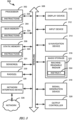
- FIG. 1 illustrates, by way of example, a diagram of an embodiment of a system 100 including a zero trust endpoint network security (ZTENS) device 110.
- the system 100 as illustrated includes a compute device 104 operable by a user 102.
- the compute device 104 can be communicatively coupled to an external network 106.
- the compute device 104 can be communicatively coupled to the ZTENS device 110.
- the ZTENS device 110 can be communicatively coupled to the network 106.
- the network 106 is communicatively coupled to a web server 108.
- the user 102 can access functionality of applications or hardware of the compute device 104 through a user interface 112.
- the user interface 112 can, for example, provide the user 102 with access to functionality or data through a web application 118.
- the web application 118 can include a web browser, a web app (e.g., a mobile app or other application that accesses data or services on another network).
- the web application 118 is accesses functionality of hardware or software that runs on the web server 108 , unlike computer-based software programs that are run locally on the operating system (OS) 114 of the device 100.
- Web functionality or hardware is accessed by the user 102 through the web application 118 using an active internet connection (provided by the ZTENS device 110).
- Web functionality is programmed using a client-server modeled structure-the user 102 ("client") is provided services through an off-site server (web server 108) that is hosted by a third-party.
- client client-server modeled structure-the user 102
- web server 108 off-site server
- Examples of commonly-used web applications include: web-mail, online retail sales, online banking, data storage, and online auctions.
- the user 102 when the user 102 wants to access web functionality, the user 102 will enter a uniform resource locator (URL) into a web browser or launch the web application 118.
- the web application 118 can then access functionality of a network interface 116 through an operating system (OS) 114.
- the OS 114 provides applications, like the web application 118, with access to functionality of hardware of the compute device 104.
- Communications circuitry 120 of the network interface 116 is an example of such hardware.
- the communications circuitry 120 can implement a wired, data port protocol, such as Ethernet (e.g., Ethernet RJ45 or the like), universal serial bus (USB), controller area network (CAN), serial peripheral interface (SPI), inter-integrated circuit (I 2 C), universal asynchronous transmit/receive (UART), firewire, or the like over a physical port or bus.
- the communications circuitry 120 can, additionally or alternatively, implement a wireless communication protocol, such as Bluetooth ® , WiFi, or a cellular data communication channel, such as long term evolution (LTE), fifth generation (5G), institute of electric or electronic engineers (IEEE) 802.11), or the like, using a transmitter, receiver, or transceiver.
- a wireless communication protocol such as Bluetooth ® , WiFi, or a cellular data communication channel, such as long term evolution (LTE), fifth generation (5G), institute of electric or electronic engineers (IEEE) 802.11), or the like, using a transmitter, receiver, or transceiver.
- LTE long term evolution
- the OS 114 can issue a command to the network interface 116 that causes communication of a request for data corresponding to the URL.
- the network 106 can communicate with the web server 108 to retrieve the data of the URL.
- the web server 108 can return the data corresponding to the URL to the compute device 104 through the network 106.
- the user 102 can then view the data corresponding to the URL through the web application 118.
- This process of accessing the data corresponding to the URL includes security risks.
- An adversary can intercept a communication between the compute device 104 to the network 106.
- An adversary can intercept the communication between the network 106 and the web server 108.
- the adversary can alter the data in the intercepted communication.
- the altered data can harm one or more of the compute device 104, the network 106, or the web server 108.
- the altered data can spoof a domain name service (DNS) conversion of a URL to an internet protocol (IP) address, be a part of a distributed denial of service (DDOS) attack, include credential stuffing, or the like.
- DNS domain name service
- IP internet protocol
- DDOS distributed denial of service
- the OS 114 and the web application 118 can include software or hardware configured to help mitigate these vulnerabilities, but no true solution for mitigation of these vulnerabilities is currently known. These vulnerabilities of the typical URL data access can be mitigated using the ZTENS device 110.
- the ZTENS device 110 as illustrated includes a web USB/web Bluetooth ® application 154.
- WebUSB and WebBluetooth are application programming interface (API) standards for securely providing access to USB or Bluetooth ® devices from a web browser (through web pages).
- API application programming interface
- the application 154 can launch when the user 102 communicatively connects to the ZTENS device 110 through the compute device 104.
- the application 154 can cause the web browser 118 to show a home page of the ZTENS device 110.
- the home page of the ZTENS device 110 can present services available from the ZTENS device.
- the user 102 can interact with the ZTENS device 110 through the web application 118, such as by selecting an available service.
- the service can include a URL to a website accessible through (e.g., only through) the ZTENS device 110.
- the ZTENS device 110 further includes security circuitry 122, communications circuitry 124 (similar to communications circuitry 120), and a memory 126.
- the security circuitry 122 provides intrusion detection and/or prevention, such as to help reduce a likelihood of communications intercept, spoofing, or other attack.
- the communications circuitry 124 provides wired and/or wireless communications capability to the ZTENS device 110.
- the communications circuitry 124 can communicate with the compute device 104 or the network 106.
- the compute device 104 can communicate with the network 106, through the ZTENS device 110.
- the user 102 can improve web security by using the ZTENS device 110.
- the application 154 can cause (through the communications circuitry 124) the web application 118 to present a list of one or more acceptable URLs 132 (or links to acceptable URLs 132) that when selected navigates, through the ZTENS device 110, to the website corresponding to the selected URL. Communications to the ZTENS device 110 can be secured by security circuitry 122.
- the security circuitry 122 as illustrated includes a geo-fence application 138, multi-factor authentication application 140, personal identification number (PIN) 142, cryptography 144 hardware and/or software, biometric 146 hardware and/or software, transport layer security (TLS) 150, certificate authority 148, and a random number generator (RNG) 152.
- the security circuitry 122 in general, provides intrusion detection and/or prevention for communications to or from the ZTENS device 110.
- the geo-fence 138 can include a global positioning system (GPS), Galileo, or other geo location circuitry configured to determine a location of the ZTENS device 110.
- GPS global positioning system
- the geo-fence 138 can include rules defining locations at which functionality of the ZTENS device 110 is accessible and/or inaccessible.
- the geo-fence 138 can force the user 102 to only use the ZTENS device 110 in a specified geographic location.
- the multi-factor authentication 140 can prohibit access to the functionality of the ZTENS device 110, unless the user 102 can provide multiple forms of authentication.
- Examples of authentication include a password, PIN (e.g., the PIN 142), biometric (e.g., fingerprint, iris or face scan, or the like, through the biometric 146), a verification code sent to a personal electronic mail (email), phone, or the like, among others.
- the PIN 142 can include a hardware interface, such as a keypad (e.g., on a touch screen) through which a PIN of the user 102 can be entered.
- a hardware interface such as a keypad (e.g., on a touch screen) through which a PIN of the user 102 can be entered.
- the PIN 142 entry can help ensure that the user 102 is authorized to access functionality of the ZTENS device 110.
- the cryptography 144 can implement symmetric, asymmetric, or other cryptographic techniques.
- the cryptography 144 can include hardware or software cryptographic techniques. Symmetric cryptography is generally more secure than asymmetric cryptography and can be preferred. In symmetric cryptography, a single key is used to encrypt and decrypt data. In asymmetric cryptography a private key is used for encryption and a public key is used for decryption. It is possible to determine a private key based on the public key, thus making asymmetric cryptography less secure.
- the symmetric cryptography can be implemented using a secure RNG 152, a password, or code.
- symmetric encryption examples include advanced encryption standard (AES), data encryption standard (DES), international data encryption algorithm (IDEA), or Rivest cipher (RC) (e.g., RC4, RC5, or RC6).
- AES advanced encryption standard
- DES data encryption standard
- IDEA international data encryption algorithm
- RC Rivest cipher
- SSL Secure socket layer
- TLS transport layer security
- ECC Elliptic-curve cryptography
- DSA digital signature algorithm
- the biometric 146 hardware and/or software can be accessed through a user interface 160 through which the user 102 provides biometric data.
- the biometric 146 hardware and/or software can perform an iris scan, a face scan, a fingerprint scan, or the like of the user 102.
- the memory 126 can include expected biometric 156 data of the user 102 from a previous biometric scan.
- the biometric 146 hardware and/or software can be used to help guarantee that only an authorized user accesses functionality of the ZTENS device 110.
- a certificate authority 148 issues digital certificates certifying the ownership of the cryptography key 136.
- the certificate authority 148 allows the manage of the web server 108 that hosts the website on the acceptable URLs 132 to certify ownership of the cryptography key 136.
- the certificate authority 148 along with TLS/SSL 150, can enable HTTPS communication between the compute device 104 and the ZTENS device 110.
- the memory 126 can include a acceptable URLs 132 of one or more websites (in the form of URLs) that can be accessed through the ZTENS device 110.
- the acceptable URLs 132 can include websites that include information that is more sensitive than usual. Examples of such websites include personal or business banking websites, medical record websites, utility service websites, insurance websites, government websites, internal revenue service (IRS) tax filing, covert communications, or the like.
- the ZTENS device 110 can include a replacement for a virtual private network (VPN).
- the memory 126 can include proxy data 158 that can be used to hide an actual IP address of the compute device 104 or the ZTENS device 110.
- the DNS data 134 can associate, for each website of the acceptable URLs 132, a URL with an IP address.
- the DNS data 134 can take the place of the normal DNS server access, and thus eliminates any vulnerabilities associated with such normal DNS server access.
- the crypto key 136 includes one or more symmetric or asymmetric cryptography keys.
- the crypto key 136 can be used by the cryptography 144 hardware and/or software to encrypt or decrypt data of a communication.
- the communications circuitry 124 implements one or more different communications protocols 128, 130.
- the communications protocol can include a protocol discussed regarding the communications circuitry 120.
- the communications circuitry 124 can be configured to communicate with the compute device 104 using the first communications protocol 128 and the network 106 using the second communications protocol 130.
- the application 154 can allow the user 102 to interact with the ZTENS device 110 over Bluetooth ® , USB, or other communication protocol, through the web application 118.
- the communications circuitry 124 can parse a communication to a single endpoint (e.g., the web server 108) into two or more disjoint packets. The communications circuitry 124 can then transmit the disjoint packets of the multiple packets using two or more respective communications protocols. The communications circuitry 124 thus transmit a first portion of a communication using a wireless fidelity (WiFi), Ethernet, or cellular data communication channel (e.g., LTE, 5G, or the like) and a second, different portion of the communication using a different one of the wireless fidelity, Ethernet, or cellular data communication channel, for example. More portions and more communication protocols can be used.
- WiFi wireless fidelity
- Ethernet or cellular data communication channel
- the ZTENS device 110 can be issued by a host of a website accessible through the web server 108.
- the host can restrict access to the website to only those users that can pass the security measures of the ZTENS device 110. This allows the host of the website to manage the security required to access the website. Normally, the user 102 accesses the website with just the security of the web application 118 or the OS 114. Requiring the protocols of the ZTENS device 110 for accessing the website puts the security of the website into the hands of the website host.
- the ZTENS device 110 can implement one or more of ephemeral IPv6 (or the like), net maneuver, port knocking, channel hopping, or the like.
- the ZTENS device 110 can include further enhancement using physical security measures (e.g., tamper evidence, tamper resistance, or the like).
- the ZTENS device 110 can provide a replacement for a common access card (CAC), such as a public key infrastructure (PKI) card, Yubikey card, or the like.
- CAC common access card
- PKI public key infrastructure
- the user 102 can connect the ZTENS device 110 to the compute device 110.
- the user can input a PIN using the PIN 142, biometric data through the biometric 146 hardware and/or software, a username, password, a certification code using the multi-factor authentication 140, or a combination thereof to authenticate themselves and gain access to the ZTENS device 110.
- Authentication is a process of verifying an identity of the user 102. Passing authentication can allow the user 102 to access further functionality of the ZTENS device 110 through the web application 118.
- the user 102 can issue a communication to the ZTENS device 110 through the web application 118.
- the communication can initiate ZTENS device 110 capabilities (e.g., hardware, software, or a combination thereof).
- the ZTENS device 110 can inspect content from the compute device 104, such as to detect malicious behavior or exfiltration of data.
- the ZTENS device 110 can transact with the network 106 using the communications circuitry 124, such as after performing URL translation to IP address (using the DNS data 134).
- the communication with the network 106 or the compute device 104 can be secured using TSL/SSL protocol 150, certificate authority 148, or the like.
- the ZTENS device 110 can receive content from the network 106 and detect malicious behavior or exfiltration of data (e.g., using a recurrent neural network (RNN) or the like).
- the ZTENS device 110 can provide content that passes inspection (e.g., by the RNN) to the web application 118 through the communications circuitry 124.
- the user 102 has then accessed the content of the website through the ZTENS device 110.
- FIG. 2 illustrates, by way of example, a diagram of an embodiment of a method 200 for ZTENS.
- the method 200 as illustrated includes providing (by a ZTENS device communicatively coupled to a compute device, over a wired or wireless first communication channel, and through a web application of the compute device) first data indicating the ZTENS device is communicatively coupled to the compute device, at operation 202; providing (by the ZTENS device and over the first communication channel through a web application of the compute device) one or more uniform resource locators (URLs), at operation 204; receive (by the ZTENS device and over the first communication channel) data indicating a URL of the one or more URLs selected by a user of the compute device through the web application, at operation 206; communicating (by the ZTENS device and over a wired or wireless second communication channel, the second communication channel different from the first communication channel) a request for website data of a website associated with the selected URL, at operation 208; and receiving (by the ZTENS device and over the second
- the method 200 can further include before communicating the request for website data, authenticating, by the ZTENS device, an identity of the user.
- the method 200 can further include, wherein authenticating the identity of the user includes receiving, by the ZTENS device, a personal identification number (PIN) or biometric scan data from the user through a user interface of the ZTENS device.
- the method 200 can further include, wherein authenticating the identity of the user includes using multi-factor authentication through the web application.
- the method 200 can further include analyzing data from the compute device for malicious behavior or exfiltration of the data before communicating the request for website data.
- the method 200 can further include translating, by the ZTENS device, the URL to an internet protocol (IP) address using domain name service (DNS) data in a memory of the ZTENS device.
- IP internet protocol
- DNS domain name service
- the method 200 can further include parsing the request for website data into multiple packets, the multiple packets including different portions of the request for website data, and wherein communicating the request for website data includes communicating different packets of the multiple packets over different communication channels including the second communication channel and a third communication channel.
- the method 200 can further include, wherein the second and third communication channels include different ones of a cellular data communication channel, a wireless fidelity communication channel, and an Ethernet communication channel.
- the method 200 can further include, wherein the first communication channel includes one of universal serial bus (USB) and Bluetooth operating using a webUSB or webBluetooth communication protocol.
- the method 200 can further include before providing the website data to the compute device, performing, by the ZTENS device, malicious behavior and exfiltration of data analysis on the website data.
- FIG. 3 illustrates, by way of example, a block diagram of an embodiment of a machine in the example form of a computer system 300 within which instructions, for causing the machine to perform any one or more of the methodologies discussed herein, may be executed.
- the machine may operate in the capacity of a server or a client machine in server-client network environment, or as a peer machine in a peer-to-peer (or distributed) network environment.
- the machine may be a personal computer (PC), a tablet PC, a set-top box (STB), a Personal Digital Assistant (PDA), a cellular telephone, a web appliance, a network router, switch or bridge, or any machine capable of executing instructions (sequential or otherwise) that specify actions to be taken by that machine.
- PC personal computer
- PDA Personal Digital Assistant
- STB set-top box
- STB set-top box
- FIG. 3 illustrates, by way of example, a block diagram of an embodiment of a machine in the example form of a computer system 300 within which instructions,
- the example computer system 300 includes a processor 302 (e.g., a central processing unit (CPU), a graphics processing unit (GPU) or both), a main memory 304 and a static memory 306, which communicate with each other via a bus 308.
- the computer system 300 may further include a video display unit 310 (e.g., a liquid crystal display (LCD) or a cathode ray tube (CRT)).
- the computer system 300 also includes an alphanumeric input device 312 (e.g., a keyboard), a user interface (UI) navigation device 314 (e.g., a mouse), a mass storage unit 316, a signal generation device 318 (e.g., a speaker), a network interface device 320, and a radio 330 such as Bluetooth, WWAN, WLAN, and NFC, permitting the application of security controls on such protocols.
- UI user interface
- the mass storage unit 316 includes a machine-readable medium 322 on which is stored one or more sets of instructions and data structures (e.g., software) 324 embodying or utilized by any one or more of the methodologies or functions described herein.
- the instructions 324 may also reside, completely or at least partially, within the main memory 304 and/or within the processor 302 during execution thereof by the computer system 300, the main memory 304 and the processor 302 also constituting machine-readable media.
- machine-readable medium 322 is shown in an example embodiment to be a single medium, the term “machine-readable medium” may include a single medium or multiple media (e.g., a centralized or distributed database, and/or associated caches and servers) that store the one or more instructions or data structures.
- the term “machine-readable medium” shall also be taken to include any tangible medium that is capable of storing, encoding or carrying instructions for execution by the machine and that cause the machine to perform any one or more of the methodologies of the present invention, or that is capable of storing, encoding or carrying data structures utilized by or associated with such instructions.
- the term “machine-readable medium” shall accordingly be taken to include, but not be limited to, solid-state memories, and optical and magnetic media.
- machine-readable media include nonvolatile memory, including by way of example semiconductor memory devices, e.g., Erasable Programmable Read-Only Memory (EPROM), Electrically Erasable Programmable Read-Only Memory (EEPROM), and flash memory devices; magnetic disks such as internal hard disks and removable disks; magneto-optical disks; and CD-ROM and DVD-ROM disks.
- semiconductor memory devices e.g., Erasable Programmable Read-Only Memory (EPROM), Electrically Erasable Programmable Read-Only Memory (EEPROM), and flash memory devices
- EPROM Erasable Programmable Read-Only Memory
- EEPROM Electrically Erasable Programmable Read-Only Memory
- flash memory devices e.g., electrically Erasable Programmable Read-Only Memory (EEPROM), and flash memory devices
- magnetic disks such as internal hard disks and removable disks
- magneto-optical disks e.g., magneto-optical disks
- the instructions 324 may further be transmitted or received over a communications network 326 using a transmission medium.
- the instructions 324 may be transmitted using the network interface device 320 and any one of a number of well-known transfer protocols (e.g., HTTP).
- Examples of communication networks include a local area network ("LAN”), a wide area network (“WAN”), the Internet, mobile telephone networks, Plain Old Telephone (POTS) networks, and wireless data networks (e.g., WiFi and WiMax networks).
- POTS Plain Old Telephone
- the term "transmission medium” shall be taken to include any intangible medium that is capable of storing, encoding or carrying instructions for execution by the machine, and includes digital or analog communications signals or other intangible media to facilitate communication of such software.
Landscapes
- Engineering & Computer Science (AREA)
- Computer Security & Cryptography (AREA)
- Computer Networks & Wireless Communication (AREA)
- Signal Processing (AREA)
- Computer Hardware Design (AREA)
- Computing Systems (AREA)
- General Engineering & Computer Science (AREA)
- Health & Medical Sciences (AREA)
- Biomedical Technology (AREA)
- General Health & Medical Sciences (AREA)
- Mobile Radio Communication Systems (AREA)
- Data Exchanges In Wide-Area Networks (AREA)
Description
- Embodiments discussed herein regard devices, systems, and methods for network security. The network security can be single or multiple, but limited, use.
- A majority of data on an external network is accessed through a web application, such as a web browser a web app. Security for a compute device that requests the data is provided by software on the compute device. Typically, the software is part of the web application, operating system (OS), or firewall of the compute device. This security is limited in its flexibility and the user of the compute device is in charge of the security provided. The owner of the data being accessed has no control over the security after the data has left their database.
-
US 2020/236112 A1 dislcoses a gateway to a zero trust network that applies an access control policy to an endpoint device attempting to access a cloud-based application hosted by the zero trust network. The gateway acts as a reverse proxy between the endpoint device and the cloud-based application, based on the access control policy applied to the endpoint device. The gateway captures telemetry data regarding application traffic reverse proxied by the gateway between the endpoint device and the cloud-based application. The gateway detects an anomalous behavior of the application traffic by comparing the captured telemetry data to a machine learning-based behavioral model for the application. The gateway initiates a mitigation action for the detected anomalous behavior of the application traffic. - In an aspect, the present disclosure provides a computer-implemented method for zero trust endpoint network security, ZTENS, the method comprising: providing, by a ZTENS device communicatively coupled to a compute device, over a wired or wireless first communication channel, and through a web application of the compute device, first data indicating the ZTENS device is communicatively coupled to the compute device; providing, by an application of the ZTENS device, over the first communication channel through the web application of the compute device, directly using the web application for presentation to the user, and without any web server intervention, a list of one or more uniform resource locators, URLs, that are accessible only through the ZTENS device; receiving, by the ZTENS device and over the first communication channel, data indicating a URL of the one or more URLs selected by a user of the compute device through the web application; communicating, by the ZTENS device and over a wired or wireless second communication channel, the second communication channel different from the first communication channel, a request for website data of a website associated with the selected URL; and receiving, by the ZTENS device and over the second communication channel, the website data and providing the website data to the compute device, wherein the ZTENS device comprises a security circuity configured to provide intrusion detection and/or prevention for communications to or from the ZTENS device.
- In another aspect, the present disclosure provides a non-transitory machine-readable medium including instructions that, when executed by a zero trust endpoint network security, ZTENS, device, cause the ZTENS device to perform operations for ZTENS, the operations comprising: providing, by the ZTENS device communicatively coupled to a compute device, over a wired or wireless first communication channel, first data indicating the ZTENS device is communicatively coupled to the compute device; providing, by an application of the ZTENS device, over the first communication channel and to the web application of the compute device, directly using the web application for presentation to the user, and without any web server intervention, a list of one or more uniform resource locators, URLs, that are accessible through the ZTENS device; receiving, over the first communication channel, data indicating a URL of the one or more URLs selected by a user of the compute device through the web application; communicating, over a wired or wireless second communication channel, the second communication channel different from the first communication channel, a request for website data of a website associated with the selected URL; and receiving, over the second communication channel, the website data and providing the website data to the compute device, wherein the ZTENS device comprises a security circuity configured to provide intrusion detection and/or prevention for communications to or from the ZTENS device.
- In yet another aspect, the present disclosure provides a system for zero trust endpoint network security, ZTENS, the system comprising: a compute device including a user interface, communications circuitry, and a web application; a ZTENS device communicatively coupled to the compute device through first and second wired or wireless communication channels of communications circuitry and through the web application, the ZTENS device including security circuitry and the communication circuitry, wherein the security circuitry is configured to provide intrusion detection and/or prevention for communications to or from the ZTENS device, the ZTENS device configured to: provide, by the communications circuitry, first data indicating the ZTENS device is communicatively coupled to the compute device; provide, by an application of the ZTENS device, over the first communication channel, and through the web application, directly using the web application for presentation to the user, and without any web server intervention, a list of one or more uniform resource locators, URLs, accessible through the ZTENS device; receive, over the first communication channel, data indicating a URL of the one or more URLs selected by a user of the compute device through the web application; communicate, over the second communication channel and to a web server, a request for website data of a website associated with the selected URL; and receive, over the second communication channel, the website data and provide the website data to the compute device through the web application.
-
-
FIG. 1 illustrates, by way of example, a diagram of an embodiment of a system that includes a zero trust endpoint network security (ZTENS) device. -
FIG. 2 illustrates, by way of example, a diagram of an embodiment of a method for ZTENS. -
FIG. 3 illustrates, by way of example, a block diagram of an embodiment of a machine in the example form of a computer system within which instructions, for causing the machine to perform any one or more of the methodologies discussed herein, may be executed. -
FIG. 1 illustrates, by way of example, a diagram of an embodiment of asystem 100 including a zero trust endpoint network security (ZTENS)device 110. Thesystem 100 as illustrated includes acompute device 104 operable by auser 102. Thecompute device 104 can be communicatively coupled to anexternal network 106. Thecompute device 104 can be communicatively coupled to the ZTENSdevice 110. The ZTENSdevice 110 can be communicatively coupled to thenetwork 106. Thenetwork 106 is communicatively coupled to aweb server 108. - The
user 102 can access functionality of applications or hardware of thecompute device 104 through auser interface 112. Theuser interface 112 can, for example, provide theuser 102 with access to functionality or data through aweb application 118. Theweb application 118 can include a web browser, a web app (e.g., a mobile app or other application that accesses data or services on another network). Theweb application 118 is accesses functionality of hardware or software that runs on theweb server 108 , unlike computer-based software programs that are run locally on the operating system (OS) 114 of thedevice 100. Web functionality or hardware is accessed by theuser 102 through theweb application 118 using an active internet connection (provided by the ZTENS device 110). Web functionality is programmed using a client-server modeled structure-the user 102 ("client") is provided services through an off-site server (web server 108) that is hosted by a third-party. Examples of commonly-used web applications include: web-mail, online retail sales, online banking, data storage, and online auctions. - Typically, when the
user 102 wants to access web functionality, theuser 102 will enter a uniform resource locator (URL) into a web browser or launch theweb application 118. Theweb application 118 can then access functionality of anetwork interface 116 through an operating system (OS) 114. The OS 114 provides applications, like theweb application 118, with access to functionality of hardware of thecompute device 104.Communications circuitry 120 of thenetwork interface 116 is an example of such hardware. - The
communications circuitry 120 can implement a wired, data port protocol, such as Ethernet (e.g., Ethernet RJ45 or the like), universal serial bus (USB), controller area network (CAN), serial peripheral interface (SPI), inter-integrated circuit (I2C), universal asynchronous transmit/receive (UART), firewire, or the like over a physical port or bus. Thecommunications circuitry 120 can, additionally or alternatively, implement a wireless communication protocol, such as Bluetooth®, WiFi, or a cellular data communication channel, such as long term evolution (LTE), fifth generation (5G), institute of electric or electronic engineers (IEEE) 802.11), or the like, using a transmitter, receiver, or transceiver. - The
OS 114 can issue a command to thenetwork interface 116 that causes communication of a request for data corresponding to the URL. Thenetwork 106 can communicate with theweb server 108 to retrieve the data of the URL. Theweb server 108 can return the data corresponding to the URL to thecompute device 104 through thenetwork 106. Theuser 102 can then view the data corresponding to the URL through theweb application 118. - This process of accessing the data corresponding to the URL includes security risks. An adversary can intercept a communication between the
compute device 104 to thenetwork 106. An adversary can intercept the communication between thenetwork 106 and theweb server 108. The adversary can alter the data in the intercepted communication. The altered data can harm one or more of thecompute device 104, thenetwork 106, or theweb server 108. The altered data can spoof a domain name service (DNS) conversion of a URL to an internet protocol (IP) address, be a part of a distributed denial of service (DDOS) attack, include credential stuffing, or the like. The OS 114 and theweb application 118 can include software or hardware configured to help mitigate these vulnerabilities, but no true solution for mitigation of these vulnerabilities is currently known. These vulnerabilities of the typical URL data access can be mitigated using the ZTENSdevice 110. - The ZTENS
device 110 as illustrated includes a web USB/web Bluetooth®application 154. WebUSB and WebBluetooth are application programming interface (API) standards for securely providing access to USB or Bluetooth® devices from a web browser (through web pages). The WebUSB standard, for example, was published by the Web Platform Incubator Community Group. - The
application 154 can launch when theuser 102 communicatively connects to the ZTENSdevice 110 through thecompute device 104. Theapplication 154 can cause theweb browser 118 to show a home page of the ZTENSdevice 110. The home page of the ZTENSdevice 110 can present services available from the ZTENS device. Theuser 102 can interact with the ZTENSdevice 110 through theweb application 118, such as by selecting an available service. The service can include a URL to a website accessible through (e.g., only through) the ZTENSdevice 110. - The ZTENS
device 110 further includessecurity circuitry 122, communications circuitry 124 (similar to communications circuitry 120), and amemory 126. Thesecurity circuitry 122 provides intrusion detection and/or prevention, such as to help reduce a likelihood of communications intercept, spoofing, or other attack. Thecommunications circuitry 124 provides wired and/or wireless communications capability to the ZTENSdevice 110. Thecommunications circuitry 124 can communicate with thecompute device 104 or thenetwork 106. Thecompute device 104 can communicate with thenetwork 106, through theZTENS device 110. - Instead of relying on the security provided by the
OS 114,web application 118, or other component of thecompute device 104, theuser 102 can improve web security by using theZTENS device 110. - The
application 154 can cause (through the communications circuitry 124) theweb application 118 to present a list of one or more acceptable URLs 132 (or links to acceptable URLs 132) that when selected navigates, through theZTENS device 110, to the website corresponding to the selected URL. Communications to theZTENS device 110 can be secured bysecurity circuitry 122. - The
security circuitry 122 as illustrated includes a geo-fence application 138,multi-factor authentication application 140, personal identification number (PIN) 142,cryptography 144 hardware and/or software, biometric 146 hardware and/or software, transport layer security (TLS) 150,certificate authority 148, and a random number generator (RNG) 152. Thesecurity circuitry 122, in general, provides intrusion detection and/or prevention for communications to or from theZTENS device 110. - The geo-
fence 138 can include a global positioning system (GPS), Galileo, or other geo location circuitry configured to determine a location of theZTENS device 110. The geo-fence 138 can include rules defining locations at which functionality of theZTENS device 110 is accessible and/or inaccessible. The geo-fence 138 can force theuser 102 to only use theZTENS device 110 in a specified geographic location. - The
multi-factor authentication 140 can prohibit access to the functionality of theZTENS device 110, unless theuser 102 can provide multiple forms of authentication. Examples of authentication include a password, PIN (e.g., the PIN 142), biometric (e.g., fingerprint, iris or face scan, or the like, through the biometric 146), a verification code sent to a personal electronic mail (email), phone, or the like, among others. - The
PIN 142 can include a hardware interface, such as a keypad (e.g., on a touch screen) through which a PIN of theuser 102 can be entered. ThePIN 142 entry can help ensure that theuser 102 is authorized to access functionality of theZTENS device 110. - The
cryptography 144 can implement symmetric, asymmetric, or other cryptographic techniques. Thecryptography 144 can include hardware or software cryptographic techniques. Symmetric cryptography is generally more secure than asymmetric cryptography and can be preferred. In symmetric cryptography, a single key is used to encrypt and decrypt data. In asymmetric cryptography a private key is used for encryption and a public key is used for decryption. It is possible to determine a private key based on the public key, thus making asymmetric cryptography less secure. The symmetric cryptography can be implemented using asecure RNG 152, a password, or code. Examples of symmetric encryption include advanced encryption standard (AES), data encryption standard (DES), international data encryption algorithm (IDEA), or Rivest cipher (RC) (e.g., RC4, RC5, or RC6). Secure socket layer (SSL) and transport layer security (TLS) 150 are example protocols (used by hypertext transport protocol secure (HTTPS)) that implement asymmetric cryptography protocols. Rivest-Shamir-Adleman (RSA), Diffie-Helman, Elliptic-curve cryptography (ECC), El Gamal, and digital signature algorithm (DSA) are examples of asymmetric cryptography protocols. - The biometric 146 hardware and/or software can be accessed through a
user interface 160 through which theuser 102 provides biometric data. The biometric 146 hardware and/or software can perform an iris scan, a face scan, a fingerprint scan, or the like of theuser 102. Thememory 126 can include expected biometric 156 data of theuser 102 from a previous biometric scan. The biometric 146 hardware and/or software can be used to help guarantee that only an authorized user accesses functionality of theZTENS device 110. - A
certificate authority 148 issues digital certificates certifying the ownership of thecryptography key 136. Thecertificate authority 148 allows the manage of theweb server 108 that hosts the website on theacceptable URLs 132 to certify ownership of thecryptography key 136. Thecertificate authority 148, along with TLS/SSL 150, can enable HTTPS communication between thecompute device 104 and theZTENS device 110. - The
memory 126 can include aacceptable URLs 132 of one or more websites (in the form of URLs) that can be accessed through theZTENS device 110. Theacceptable URLs 132 can include websites that include information that is more sensitive than usual. Examples of such websites include personal or business banking websites, medical record websites, utility service websites, insurance websites, government websites, internal revenue service (IRS) tax filing, covert communications, or the like. TheZTENS device 110 can include a replacement for a virtual private network (VPN). Thememory 126 can includeproxy data 158 that can be used to hide an actual IP address of thecompute device 104 or theZTENS device 110. - The
DNS data 134 can associate, for each website of theacceptable URLs 132, a URL with an IP address. TheDNS data 134 can take the place of the normal DNS server access, and thus eliminates any vulnerabilities associated with such normal DNS server access. - The
crypto key 136 includes one or more symmetric or asymmetric cryptography keys. Thecrypto key 136 can be used by thecryptography 144 hardware and/or software to encrypt or decrypt data of a communication. - The
communications circuitry 124 implements one or moredifferent communications protocols communications circuitry 120. Thecommunications circuitry 124 can be configured to communicate with thecompute device 104 using thefirst communications protocol 128 and thenetwork 106 using thesecond communications protocol 130. Theapplication 154 can allow theuser 102 to interact with theZTENS device 110 over Bluetooth®, USB, or other communication protocol, through theweb application 118. - The
communications circuitry 124, in some embodiments, can parse a communication to a single endpoint (e.g., the web server 108) into two or more disjoint packets. Thecommunications circuitry 124 can then transmit the disjoint packets of the multiple packets using two or more respective communications protocols. Thecommunications circuitry 124 thus transmit a first portion of a communication using a wireless fidelity (WiFi), Ethernet, or cellular data communication channel (e.g., LTE, 5G, or the like) and a second, different portion of the communication using a different one of the wireless fidelity, Ethernet, or cellular data communication channel, for example. More portions and more communication protocols can be used. - The
ZTENS device 110 can be issued by a host of a website accessible through theweb server 108. The host can restrict access to the website to only those users that can pass the security measures of theZTENS device 110. This allows the host of the website to manage the security required to access the website. Normally, theuser 102 accesses the website with just the security of theweb application 118 or theOS 114. Requiring the protocols of theZTENS device 110 for accessing the website puts the security of the website into the hands of the website host. - Further security can be provided by the
ZTENS device 110 by implementing one or more of ephemeral IPv6 (or the like), net maneuver, port knocking, channel hopping, or the like. TheZTENS device 110 can include further enhancement using physical security measures (e.g., tamper evidence, tamper resistance, or the like). TheZTENS device 110 can provide a replacement for a common access card (CAC), such as a public key infrastructure (PKI) card, Yubikey card, or the like. - In use, the
user 102 can connect theZTENS device 110 to thecompute device 110. The user can input a PIN using thePIN 142, biometric data through the biometric 146 hardware and/or software, a username, password, a certification code using themulti-factor authentication 140, or a combination thereof to authenticate themselves and gain access to theZTENS device 110. Authentication is a process of verifying an identity of theuser 102. Passing authentication can allow theuser 102 to access further functionality of theZTENS device 110 through theweb application 118. Theuser 102 can issue a communication to theZTENS device 110 through theweb application 118. The communication can initiateZTENS device 110 capabilities (e.g., hardware, software, or a combination thereof). TheZTENS device 110 can inspect content from thecompute device 104, such as to detect malicious behavior or exfiltration of data. TheZTENS device 110 can transact with thenetwork 106 using thecommunications circuitry 124, such as after performing URL translation to IP address (using the DNS data 134). The communication with thenetwork 106 or thecompute device 104 can be secured using TSL/SSL protocol 150,certificate authority 148, or the like. TheZTENS device 110 can receive content from thenetwork 106 and detect malicious behavior or exfiltration of data (e.g., using a recurrent neural network (RNN) or the like). TheZTENS device 110 can provide content that passes inspection (e.g., by the RNN) to theweb application 118 through thecommunications circuitry 124. Theuser 102 has then accessed the content of the website through theZTENS device 110. -
FIG. 2 illustrates, by way of example, a diagram of an embodiment of amethod 200 for ZTENS. Themethod 200 as illustrated includes providing (by a ZTENS device communicatively coupled to a compute device, over a wired or wireless first communication channel, and through a web application of the compute device) first data indicating the ZTENS device is communicatively coupled to the compute device, atoperation 202; providing (by the ZTENS device and over the first communication channel through a web application of the compute device) one or more uniform resource locators (URLs), atoperation 204; receive (by the ZTENS device and over the first communication channel) data indicating a URL of the one or more URLs selected by a user of the compute device through the web application, atoperation 206; communicating (by the ZTENS device and over a wired or wireless second communication channel, the second communication channel different from the first communication channel) a request for website data of a website associated with the selected URL, atoperation 208; and receiving (by the ZTENS device and over the second communication channel), the website data and providing the website data to the compute device. - The
method 200 can further include before communicating the request for website data, authenticating, by the ZTENS device, an identity of the user. Themethod 200 can further include, wherein authenticating the identity of the user includes receiving, by the ZTENS device, a personal identification number (PIN) or biometric scan data from the user through a user interface of the ZTENS device. Themethod 200 can further include, wherein authenticating the identity of the user includes using multi-factor authentication through the web application. - The
method 200 can further include analyzing data from the compute device for malicious behavior or exfiltration of the data before communicating the request for website data. Themethod 200 can further include translating, by the ZTENS device, the URL to an internet protocol (IP) address using domain name service (DNS) data in a memory of the ZTENS device. Themethod 200 can further include parsing the request for website data into multiple packets, the multiple packets including different portions of the request for website data, and wherein communicating the request for website data includes communicating different packets of the multiple packets over different communication channels including the second communication channel and a third communication channel. - The
method 200 can further include, wherein the second and third communication channels include different ones of a cellular data communication channel, a wireless fidelity communication channel, and an Ethernet communication channel. Themethod 200 can further include, wherein the first communication channel includes one of universal serial bus (USB) and Bluetooth operating using a webUSB or webBluetooth communication protocol. Themethod 200 can further include before providing the website data to the compute device, performing, by the ZTENS device, malicious behavior and exfiltration of data analysis on the website data. -
FIG. 3 illustrates, by way of example, a block diagram of an embodiment of a machine in the example form of acomputer system 300 within which instructions, for causing the machine to perform any one or more of the methodologies discussed herein, may be executed. In a networked deployment, the machine may operate in the capacity of a server or a client machine in server-client network environment, or as a peer machine in a peer-to-peer (or distributed) network environment. The machine may be a personal computer (PC), a tablet PC, a set-top box (STB), a Personal Digital Assistant (PDA), a cellular telephone, a web appliance, a network router, switch or bridge, or any machine capable of executing instructions (sequential or otherwise) that specify actions to be taken by that machine. Further, while only a single machine is illustrated, the term "machine" shall also be taken to include any collection of machines that individually or jointly execute a set (or multiple sets) of instructions to perform any one or more of the methodologies discussed herein. - The
example computer system 300 includes a processor 302 (e.g., a central processing unit (CPU), a graphics processing unit (GPU) or both), amain memory 304 and astatic memory 306, which communicate with each other via abus 308. Thecomputer system 300 may further include a video display unit 310 (e.g., a liquid crystal display (LCD) or a cathode ray tube (CRT)). Thecomputer system 300 also includes an alphanumeric input device 312 (e.g., a keyboard), a user interface (UI) navigation device 314 (e.g., a mouse), amass storage unit 316, a signal generation device 318 (e.g., a speaker), anetwork interface device 320, and aradio 330 such as Bluetooth, WWAN, WLAN, and NFC, permitting the application of security controls on such protocols. - The
mass storage unit 316 includes a machine-readable medium 322 on which is stored one or more sets of instructions and data structures (e.g., software) 324 embodying or utilized by any one or more of the methodologies or functions described herein. Theinstructions 324 may also reside, completely or at least partially, within themain memory 304 and/or within theprocessor 302 during execution thereof by thecomputer system 300, themain memory 304 and theprocessor 302 also constituting machine-readable media. - While the machine-
readable medium 322 is shown in an example embodiment to be a single medium, the term "machine-readable medium" may include a single medium or multiple media (e.g., a centralized or distributed database, and/or associated caches and servers) that store the one or more instructions or data structures. The term "machine-readable medium" shall also be taken to include any tangible medium that is capable of storing, encoding or carrying instructions for execution by the machine and that cause the machine to perform any one or more of the methodologies of the present invention, or that is capable of storing, encoding or carrying data structures utilized by or associated with such instructions. The term "machine-readable medium" shall accordingly be taken to include, but not be limited to, solid-state memories, and optical and magnetic media. Specific examples of machine-readable media include nonvolatile memory, including by way of example semiconductor memory devices, e.g., Erasable Programmable Read-Only Memory (EPROM), Electrically Erasable Programmable Read-Only Memory (EEPROM), and flash memory devices; magnetic disks such as internal hard disks and removable disks; magneto-optical disks; and CD-ROM and DVD-ROM disks. - The
instructions 324 may further be transmitted or received over acommunications network 326 using a transmission medium. Theinstructions 324 may be transmitted using thenetwork interface device 320 and any one of a number of well-known transfer protocols (e.g., HTTP). Examples of communication networks include a local area network ("LAN"), a wide area network ("WAN"), the Internet, mobile telephone networks, Plain Old Telephone (POTS) networks, and wireless data networks (e.g., WiFi and WiMax networks). The term "transmission medium" shall be taken to include any intangible medium that is capable of storing, encoding or carrying instructions for execution by the machine, and includes digital or analog communications signals or other intangible media to facilitate communication of such software.
Claims (15)
- A computer-implemented method for zero trust endpoint network security, ZTENS, the method comprising:providing, by a ZTENS device (110) communicatively coupled to a compute device (104), over a wired or wireless first communication channel, and through a web application (118) of the compute device, first data indicating the ZTENS device is communicatively coupled to the compute device;providing, by an application (154) of the ZTENS device, over the first communication channel through the web application of the compute device, directly using the web application for presentation to the user, and without any web server (108) intervention, a list of one or more uniform resource locators, URLs, that are accessible only through the ZTENS device;receiving, by the ZTENS device and over the first communication channel, data indicating a URL of the one or more URLs selected by a user of the compute device through the web application;communicating, by the ZTENS device and over a wired or wireless second communication channel, the second communication channel different from the first communication channel, a request for website data of a website associated with the selected URL; andreceiving, by the ZTENS device and over the second communication channel, the website data and providing the website data to the compute device, wherein the ZTENS device comprises a security circuity (122) configured to provide intrusion detection and/or prevention for communications to or from the ZTENS device.
- The method of claim 1, further comprising:
before communicating the request for website data, authenticating, by the ZTENS device (110), an identity of the user. - The method of claim 2, wherein authenticating the identity of the user includes receiving, by the ZTENS device (110), a personal identification number (PIN) or biometric scan data from the user through a user interface of the ZTENS device; or
wherein authenticating the identity of the user includes using multi-factor authentication through the web application (118). - The method of claim 2, further comprising analyzing data from the compute device (104) for malicious behavior or exfiltration of the data before communicating the request for website data; or
further comprising translating, by the ZTENS device (110), the selected URL to an internet protocol, IP, address using domain name service, DNS, data in a memory (126) of the ZTENS device. - The method of claim 2, further comprising parsing the request for website data into multiple packets, the multiple packets including different portions of the request for website data, and wherein communicating the request for website data includes communicating different packets of the multiple packets over different communication channels including the second communication channel and a third communication channel; and
preferably, wherein the second and third communication channels include different ones of a cellular data communication channel, a wireless fidelity communication channel, and an Ethernet communication channel. - The method of claim 5, wherein the first communication channel includes one of universal serial bus, USB, and Bluetooth operating using a webUSB or webBluetooth communication protocol, respectively.
- The method of claim 2, further comprising before providing the website data to the compute device (104), performing, by the ZTENS device (110), malicious behavior and exfiltration of data analysis on the website data.
- A non-transitory machine-readable medium including instructions that, when executed by a zero trust endpoint network security, ZTENS, device (110), cause the ZTENS device to perform operations for ZTENS, the operations comprising:providing, by the ZTENS device communicatively coupled to a compute device (104), over a wired or wireless first communication channel, first data indicating the ZTENS device is communicatively coupled to the compute device;providing, by an application (154) of the ZTENS device, over the first communication channel and to the web application (118) of the compute device, directly using the web application for presentation to the user, and without any web server (108) intervention, a list of one or more uniform resource locators, URLs, that are accessible through the ZTENS device;receiving, over the first communication channel, data indicating a URL of the one or more URLs selected by a user of the compute device through the web application;communicating, over a wired or wireless second communication channel, the second communication channel different from the first communication channel, a request for website data of a website associated with the selected URL; andreceiving, over the second communication channel, the website data and providing the website data to the compute device,wherein the ZTENS device (110) comprises a security circuity (122) configured to provide intrusion detection and/or prevention for communications to or from the ZTENS device.
- The non-transitory machine readable medium of claim 8, wherein the operations further comprise:
before communicating the request for website data, authenticating an identity of the user. - The non-transitory machine readable medium of claim 9, wherein authenticating the identity of the user includes receiving, by the ZTENS device (110), a personal identification number, PIN, or biometric scan data from the user through a user interface of the ZTENS device or,
wherein authenticating the identity of the user includes using multi-factor authentication through the web application (118). - The non-transitory machine readable medium of claim 9, wherein the operations further comprise analyzing data from the compute device (104) for malicious behavior or exfiltration of the data before communicating the request for website data.
- A system (100) for zero trust endpoint network security, ZTENS, the system comprising:a compute device (104) including a user interface, communications circuitry, and a web application;a ZTENS device (110) communicatively coupled to the compute device through first and second wired or wireless communication channels of communications circuitry and through the web application, the ZTENS device including security circuitry and the communication circuitry, wherein the security circuitry is configured to provide intrusion detection and/or prevention for communications to or from the ZTENS device, the ZTENS device configured to:provide, by the communications circuitry, first data indicating the ZTENS device is communicatively coupled to the compute device;provide, by an application (154) of the ZTENS device, over the first communication channel, and through the web application, directly using the web application (118) for presentation to the user, and without any web server (108) intervention, a list of one or more uniform resource locators, URLs, accessible through the ZTENS device;receive, over the first communication channel, data indicating a URL of the one or more URLs selected by a user of the compute device through the web application;communicate, over the second communication channel and to a web server, a request for website data of a website associated with the selected URL; andreceive, over the second communication channel, the website data and provide the website data to the compute device through the web application.
- The system (100) of claim 12, wherein the ZTENS device (110) is further configured to translate the URL to an internet protocol (IP) address using domain name service, DNS, data in a memory (126) of the ZTENS device.
- The system (100) of claim 12 wherein the ZTENS device (110) is further configured to parse the request for website data into multiple packets, the multiple packets including different portions of the request for website data, and wherein communicating the request for website data includes communicating different packets of the multiple packets over different communication channels including the second communication channel and a third communication channel.
- The system (100) of claim 14, wherein the second and third communication channels include different ones of a cellular data communication channel, a wireless fidelity communication channel, and an Ethernet communication channel, and
preferably, wherein the first communication channel includes one of universal serial bus, USB, and Bluetooth operating using a webUSB or webBluetooth communication protocol, respectively.
Applications Claiming Priority (2)
| Application Number | Priority Date | Filing Date | Title |
|---|---|---|---|
| US17/158,345 US11848964B2 (en) | 2021-01-26 | 2021-01-26 | Zero trust end point network security device |
| PCT/US2022/013519 WO2022164751A1 (en) | 2021-01-26 | 2022-01-24 | Zero trust end point network security device |
Publications (2)
| Publication Number | Publication Date |
|---|---|
| EP4285551A1 EP4285551A1 (en) | 2023-12-06 |
| EP4285551B1 true EP4285551B1 (en) | 2025-05-21 |
Family
ID=80446896
Family Applications (1)
| Application Number | Title | Priority Date | Filing Date |
|---|---|---|---|
| EP22704130.8A Active EP4285551B1 (en) | 2021-01-26 | 2022-01-24 | Zero trust end point network security device |
Country Status (5)
| Country | Link |
|---|---|
| US (1) | US11848964B2 (en) |
| EP (1) | EP4285551B1 (en) |
| JP (1) | JP7601498B2 (en) |
| KR (1) | KR102872618B1 (en) |
| WO (1) | WO2022164751A1 (en) |
Families Citing this family (4)
| Publication number | Priority date | Publication date | Assignee | Title |
|---|---|---|---|---|
| US11848964B2 (en) | 2021-01-26 | 2023-12-19 | Raytheon Company | Zero trust end point network security device |
| US12580918B2 (en) * | 2022-01-07 | 2026-03-17 | Hewlett Packard Enterprise Development Lp | Techniques for providing long uniform resource locators through a secure environment |
| EP4641974A4 (en) * | 2022-12-23 | 2026-04-08 | Wangsu Science & Tech Co Ltd | DATA PROCESSING METHOD, DEVICE AND READABLE STORAGE MEDIUM |
| KR102795482B1 (en) * | 2025-01-17 | 2025-04-15 | (주)에이엔알 | Zero-trust operating system based on software-defined network using TS encryption module for short-range wireless communication |
Family Cites Families (20)
| Publication number | Priority date | Publication date | Assignee | Title |
|---|---|---|---|---|
| JP5576005B2 (en) * | 2000-11-07 | 2014-08-20 | 株式会社三菱東京Ufj銀行 | Authentication agent device |
| US7039037B2 (en) * | 2001-08-20 | 2006-05-02 | Wang Jiwei R | Method and apparatus for providing service selection, redirection and managing of subscriber access to multiple WAP (Wireless Application Protocol) gateways simultaneously |
| US20070294457A1 (en) | 2006-06-16 | 2007-12-20 | Alexander Gantman | USB wireless network drive |
| US20080052245A1 (en) * | 2006-08-23 | 2008-02-28 | Richard Love | Advanced multi-factor authentication methods |
| US20100250761A1 (en) | 2009-03-26 | 2010-09-30 | Dale Kyle Hird | Method for streaming shared media files with USB connected wireless media device |
| US8973108B1 (en) * | 2011-05-31 | 2015-03-03 | Amazon Technologies, Inc. | Use of metadata for computing resource access |
| JP5727991B2 (en) * | 2012-11-12 | 2015-06-03 | 株式会社オプティム | User terminal, unauthorized site information management server, unauthorized request blocking method, and unauthorized request blocking program |
| US20140189799A1 (en) * | 2012-12-28 | 2014-07-03 | Gemalto Sa | Multi-factor authorization for authorizing a third-party application to use a resource |
| US10491587B2 (en) * | 2013-10-28 | 2019-11-26 | Singou Technology Ltd. | Method and device for information system access authentication |
| JP6279348B2 (en) * | 2014-02-28 | 2018-02-14 | セコムトラストシステムズ株式会社 | Web relay server device and web page browsing system |
| US9949127B1 (en) * | 2014-04-21 | 2018-04-17 | Google Llc | Web-based wireless hotspot creation and management |
| EP2942925B1 (en) * | 2014-05-05 | 2016-08-24 | Advanced Digital Broadcast S.A. | A method and system for providing a private network |
| JP5923136B2 (en) * | 2014-06-03 | 2016-05-24 | 西日本電信電話株式会社 | Communication terminal, determination method, and computer program |
| US9602468B2 (en) * | 2014-11-19 | 2017-03-21 | Facebook, Inc. | Techniques to authenticate a client to a proxy through a domain name server intermediary |
| KR101713191B1 (en) * | 2015-10-27 | 2017-03-08 | 한국정보보호시스템(주) | Access point for preventing malignant action using prior testing of malignant data and method of the same |
| US10009773B2 (en) * | 2016-03-31 | 2018-06-26 | Appbrilliance, Inc. | Secured data access from a mobile device executing a native mobile application and a headless browser |
| KR101976840B1 (en) * | 2017-02-22 | 2019-05-09 | 한남대학교 산학협력단 | Apparatus and method for multichannel data communication |
| US11411958B2 (en) | 2019-01-18 | 2022-08-09 | Cisco Technology, Inc. | Machine learning-based application posture for zero trust networking |
| US11756097B2 (en) * | 2021-01-05 | 2023-09-12 | Walmart Apollo, Llc | Methods and apparatus for automatically detecting data attacks using machine learning processes |
| US11848964B2 (en) | 2021-01-26 | 2023-12-19 | Raytheon Company | Zero trust end point network security device |
-
2021
- 2021-01-26 US US17/158,345 patent/US11848964B2/en active Active
-
2022
- 2022-01-24 JP JP2023544461A patent/JP7601498B2/en active Active
- 2022-01-24 WO PCT/US2022/013519 patent/WO2022164751A1/en not_active Ceased
- 2022-01-24 EP EP22704130.8A patent/EP4285551B1/en active Active
- 2022-01-24 KR KR1020237019586A patent/KR102872618B1/en active Active
Also Published As
| Publication number | Publication date |
|---|---|
| JP2024504719A (en) | 2024-02-01 |
| US11848964B2 (en) | 2023-12-19 |
| EP4285551A1 (en) | 2023-12-06 |
| KR20230100745A (en) | 2023-07-05 |
| JP7601498B2 (en) | 2024-12-17 |
| US20220239697A1 (en) | 2022-07-28 |
| WO2022164751A1 (en) | 2022-08-04 |
| KR102872618B1 (en) | 2025-10-20 |
Similar Documents
| Publication | Publication Date | Title |
|---|---|---|
| EP2632108B1 (en) | Method and system for secure communication | |
| US11848964B2 (en) | Zero trust end point network security device | |
| CN107666383B (en) | Message processing method and device based on HTTPS protocol | |
| US9237168B2 (en) | Transport layer security traffic control using service name identification | |
| US9197420B2 (en) | Using information in a digital certificate to authenticate a network of a wireless access point | |
| US9887997B2 (en) | Web authentication using client platform root of trust | |
| US10491587B2 (en) | Method and device for information system access authentication | |
| US20100031029A1 (en) | Techniques to provide access point authentication for wireless network | |
| US20130205133A1 (en) | Strongly authenticated, third-party, out-of-band transactional authorization system | |
| CN109413201B (en) | SSL communication method, device and storage medium | |
| US10257171B2 (en) | Server public key pinning by URL | |
| US20130061310A1 (en) | Security server for cloud computing | |
| US10834131B2 (en) | Proactive transport layer security identity verification | |
| JP2015536061A (en) | Method and apparatus for registering a client with a server | |
| US20250007888A1 (en) | Header-based authentication in a virtual private network | |
| KR20170111809A (en) | Bidirectional authentication method using security token based on symmetric key | |
| US11463433B1 (en) | Secure bearer-sensitive authentication and digital object transmission system and method for spoof prevention | |
| CN106576050B (en) | Three-tier security and computing architecture | |
| US11418504B1 (en) | Optimized authentication mechanism | |
| US12381740B2 (en) | Web browser generation of unique identifiers | |
| 이현우 | Transport Layer Security Extensions for Middleboxes and Edge Computing |
Legal Events
| Date | Code | Title | Description |
|---|---|---|---|
| STAA | Information on the status of an ep patent application or granted ep patent |
Free format text: STATUS: UNKNOWN |
|
| STAA | Information on the status of an ep patent application or granted ep patent |
Free format text: STATUS: THE INTERNATIONAL PUBLICATION HAS BEEN MADE |
|
| PUAI | Public reference made under article 153(3) epc to a published international application that has entered the european phase |
Free format text: ORIGINAL CODE: 0009012 |
|
| STAA | Information on the status of an ep patent application or granted ep patent |
Free format text: STATUS: REQUEST FOR EXAMINATION WAS MADE |
|
| 17P | Request for examination filed |
Effective date: 20230807 |
|
| AK | Designated contracting states |
Kind code of ref document: A1 Designated state(s): AL AT BE BG CH CY CZ DE DK EE ES FI FR GB GR HR HU IE IS IT LI LT LU LV MC MK MT NL NO PL PT RO RS SE SI SK SM TR |
|
| DAV | Request for validation of the european patent (deleted) | ||
| DAX | Request for extension of the european patent (deleted) | ||
| GRAP | Despatch of communication of intention to grant a patent |
Free format text: ORIGINAL CODE: EPIDOSNIGR1 |
|
| STAA | Information on the status of an ep patent application or granted ep patent |
Free format text: STATUS: GRANT OF PATENT IS INTENDED |
|
| INTG | Intention to grant announced |
Effective date: 20250113 |
|
| GRAS | Grant fee paid |
Free format text: ORIGINAL CODE: EPIDOSNIGR3 |
|
| GRAA | (expected) grant |
Free format text: ORIGINAL CODE: 0009210 |
|
| STAA | Information on the status of an ep patent application or granted ep patent |
Free format text: STATUS: THE PATENT HAS BEEN GRANTED |
|
| AK | Designated contracting states |
Kind code of ref document: B1 Designated state(s): AL AT BE BG CH CY CZ DE DK EE ES FI FR GB GR HR HU IE IS IT LI LT LU LV MC MK MT NL NO PL PT RO RS SE SI SK SM TR |
|
| REG | Reference to a national code |
Ref country code: GB Ref legal event code: FG4D |
|
| REG | Reference to a national code |
Ref country code: CH Ref legal event code: EP |
|
| REG | Reference to a national code |
Ref country code: DE Ref legal event code: R096 Ref document number: 602022014935 Country of ref document: DE |
|
| REG | Reference to a national code |
Ref country code: IE Ref legal event code: FG4D |
|
| REG | Reference to a national code |
Ref country code: NL Ref legal event code: MP Effective date: 20250521 |
|
| PG25 | Lapsed in a contracting state [announced via postgrant information from national office to epo] |
Ref country code: FI Free format text: LAPSE BECAUSE OF FAILURE TO SUBMIT A TRANSLATION OF THE DESCRIPTION OR TO PAY THE FEE WITHIN THE PRESCRIBED TIME-LIMIT Effective date: 20250521 Ref country code: ES Free format text: LAPSE BECAUSE OF FAILURE TO SUBMIT A TRANSLATION OF THE DESCRIPTION OR TO PAY THE FEE WITHIN THE PRESCRIBED TIME-LIMIT Effective date: 20250521 Ref country code: PT Free format text: LAPSE BECAUSE OF FAILURE TO SUBMIT A TRANSLATION OF THE DESCRIPTION OR TO PAY THE FEE WITHIN THE PRESCRIBED TIME-LIMIT Effective date: 20250922 |
|
| REG | Reference to a national code |
Ref country code: LT Ref legal event code: MG9D |
|
| PG25 | Lapsed in a contracting state [announced via postgrant information from national office to epo] |
Ref country code: GR Free format text: LAPSE BECAUSE OF FAILURE TO SUBMIT A TRANSLATION OF THE DESCRIPTION OR TO PAY THE FEE WITHIN THE PRESCRIBED TIME-LIMIT Effective date: 20250822 Ref country code: NO Free format text: LAPSE BECAUSE OF FAILURE TO SUBMIT A TRANSLATION OF THE DESCRIPTION OR TO PAY THE FEE WITHIN THE PRESCRIBED TIME-LIMIT Effective date: 20250821 |
|
| PG25 | Lapsed in a contracting state [announced via postgrant information from national office to epo] |
Ref country code: NL Free format text: LAPSE BECAUSE OF FAILURE TO SUBMIT A TRANSLATION OF THE DESCRIPTION OR TO PAY THE FEE WITHIN THE PRESCRIBED TIME-LIMIT Effective date: 20250521 Ref country code: PL Free format text: LAPSE BECAUSE OF FAILURE TO SUBMIT A TRANSLATION OF THE DESCRIPTION OR TO PAY THE FEE WITHIN THE PRESCRIBED TIME-LIMIT Effective date: 20250521 |
|
| PG25 | Lapsed in a contracting state [announced via postgrant information from national office to epo] |
Ref country code: BG Free format text: LAPSE BECAUSE OF FAILURE TO SUBMIT A TRANSLATION OF THE DESCRIPTION OR TO PAY THE FEE WITHIN THE PRESCRIBED TIME-LIMIT Effective date: 20250521 |
|
| PG25 | Lapsed in a contracting state [announced via postgrant information from national office to epo] |
Ref country code: HR Free format text: LAPSE BECAUSE OF FAILURE TO SUBMIT A TRANSLATION OF THE DESCRIPTION OR TO PAY THE FEE WITHIN THE PRESCRIBED TIME-LIMIT Effective date: 20250521 |
|
| PG25 | Lapsed in a contracting state [announced via postgrant information from national office to epo] |
Ref country code: RS Free format text: LAPSE BECAUSE OF FAILURE TO SUBMIT A TRANSLATION OF THE DESCRIPTION OR TO PAY THE FEE WITHIN THE PRESCRIBED TIME-LIMIT Effective date: 20250821 |
|
| PG25 | Lapsed in a contracting state [announced via postgrant information from national office to epo] |
Ref country code: IS Free format text: LAPSE BECAUSE OF FAILURE TO SUBMIT A TRANSLATION OF THE DESCRIPTION OR TO PAY THE FEE WITHIN THE PRESCRIBED TIME-LIMIT Effective date: 20250921 |
|
| PG25 | Lapsed in a contracting state [announced via postgrant information from national office to epo] |
Ref country code: LV Free format text: LAPSE BECAUSE OF FAILURE TO SUBMIT A TRANSLATION OF THE DESCRIPTION OR TO PAY THE FEE WITHIN THE PRESCRIBED TIME-LIMIT Effective date: 20250521 |
|
| REG | Reference to a national code |
Ref country code: AT Ref legal event code: MK05 Ref document number: 1797783 Country of ref document: AT Kind code of ref document: T Effective date: 20250521 |
|
| PGFP | Annual fee paid to national office [announced via postgrant information from national office to epo] |
Ref country code: GB Payment date: 20251217 Year of fee payment: 5 |
|
| PG25 | Lapsed in a contracting state [announced via postgrant information from national office to epo] |
Ref country code: DK Free format text: LAPSE BECAUSE OF FAILURE TO SUBMIT A TRANSLATION OF THE DESCRIPTION OR TO PAY THE FEE WITHIN THE PRESCRIBED TIME-LIMIT Effective date: 20250521 Ref country code: AT Free format text: LAPSE BECAUSE OF FAILURE TO SUBMIT A TRANSLATION OF THE DESCRIPTION OR TO PAY THE FEE WITHIN THE PRESCRIBED TIME-LIMIT Effective date: 20250521 Ref country code: SM Free format text: LAPSE BECAUSE OF FAILURE TO SUBMIT A TRANSLATION OF THE DESCRIPTION OR TO PAY THE FEE WITHIN THE PRESCRIBED TIME-LIMIT Effective date: 20250521 |
|
| PGFP | Annual fee paid to national office [announced via postgrant information from national office to epo] |
Ref country code: FR Payment date: 20251217 Year of fee payment: 5 |
|
| PG25 | Lapsed in a contracting state [announced via postgrant information from national office to epo] |
Ref country code: CZ Free format text: LAPSE BECAUSE OF FAILURE TO SUBMIT A TRANSLATION OF THE DESCRIPTION OR TO PAY THE FEE WITHIN THE PRESCRIBED TIME-LIMIT Effective date: 20250521 |
|
| PG25 | Lapsed in a contracting state [announced via postgrant information from national office to epo] |
Ref country code: EE Free format text: LAPSE BECAUSE OF FAILURE TO SUBMIT A TRANSLATION OF THE DESCRIPTION OR TO PAY THE FEE WITHIN THE PRESCRIBED TIME-LIMIT Effective date: 20250521 |
|
| PG25 | Lapsed in a contracting state [announced via postgrant information from national office to epo] |
Ref country code: SK Free format text: LAPSE BECAUSE OF FAILURE TO SUBMIT A TRANSLATION OF THE DESCRIPTION OR TO PAY THE FEE WITHIN THE PRESCRIBED TIME-LIMIT Effective date: 20250521 |
|
| PG25 | Lapsed in a contracting state [announced via postgrant information from national office to epo] |
Ref country code: IT Free format text: LAPSE BECAUSE OF FAILURE TO SUBMIT A TRANSLATION OF THE DESCRIPTION OR TO PAY THE FEE WITHIN THE PRESCRIBED TIME-LIMIT Effective date: 20250521 |
|
| REG | Reference to a national code |
Ref country code: DE Ref legal event code: R097 Ref document number: 602022014935 Country of ref document: DE |
|
| PLBE | No opposition filed within time limit |
Free format text: ORIGINAL CODE: 0009261 |
|
| STAA | Information on the status of an ep patent application or granted ep patent |
Free format text: STATUS: NO OPPOSITION FILED WITHIN TIME LIMIT |
|
| REG | Reference to a national code |
Ref country code: CH Ref legal event code: L10 Free format text: ST27 STATUS EVENT CODE: U-0-0-L10-L00 (AS PROVIDED BY THE NATIONAL OFFICE) Effective date: 20260402 |
|
| PGFP | Annual fee paid to national office [announced via postgrant information from national office to epo] |
Ref country code: DE Payment date: 20251217 Year of fee payment: 5 |
|
| 26N | No opposition filed |
Effective date: 20260224 |